-
AuthorSearch Results
-
July 16, 2025 at 6:06 am #7969
In reply to: The Elusive Samuel Housley and Other Family Stories
Gatacre Hall and The Old Book
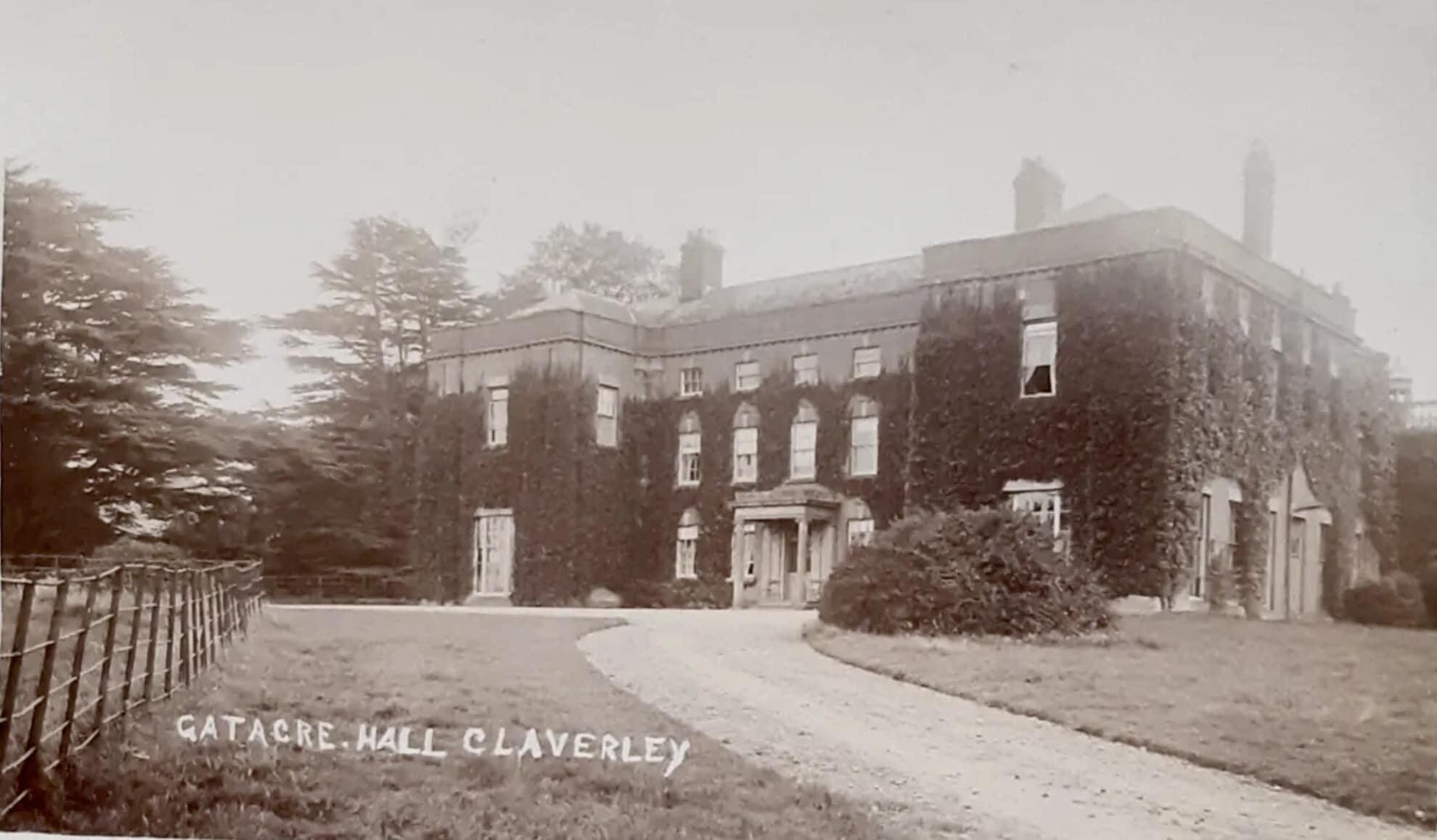
In the early 1950s my uncle John and his friend, possibly John Clare, ventured into an abandoned old house while out walking in Shropshire. He (or his friend) saved an old book from the vandalised dereliction and took it home. Somehow my mother ended up with the book.
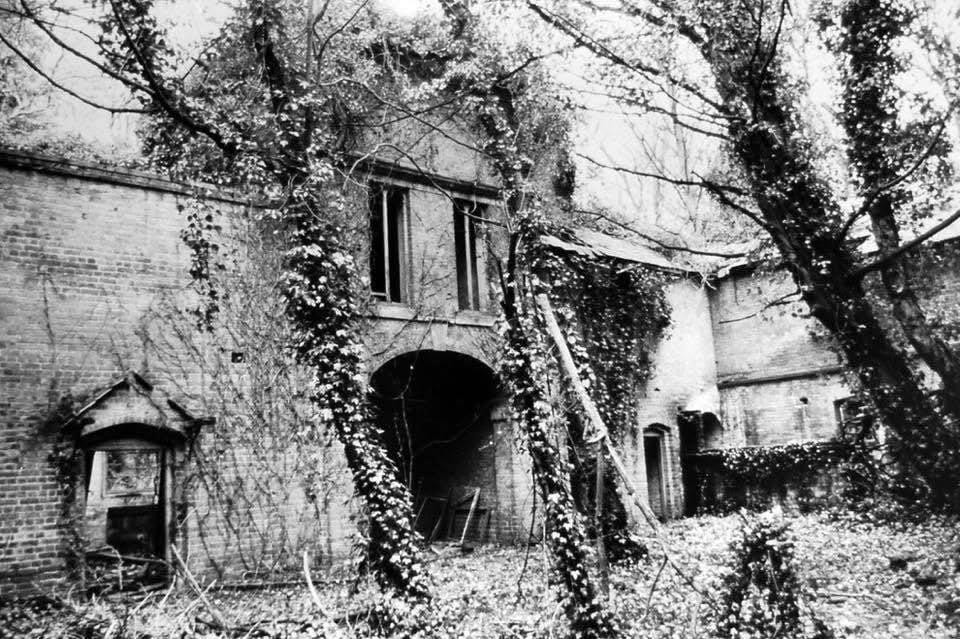
I remember that we had the book when we were living in USA, and that my mother said that John didn’t want the book in his house. He had said the abandoned hall had been spooky. The book was heavy and thick with a hard cover. I recall it was a “magazine” which seemed odd to me at the time; a compendium of information. I seem to recall the date 1553, but also recall that it was during the reign of Henry VIII. No doubt one of those recollections is wrong, probably the date. It was written in English, and had illustrations, presumably woodcuts.
I found out a few years ago that my mother had sold the book some years before. Had I known she was going to sell it, I’d have first asked her not to, and then at least made a note of the name of it, and taken photographs of it. It seems that she sold the book in Connecticut, USA, probably in the 1980’s.
My cousin and I were talking about the book and the story. We decided to try and find out which abandoned house it was although we didn’t have much to go on: it was in Shropshire, it was in a state of abandoned dereliction in the early 50s, and it contained antiquarian books.
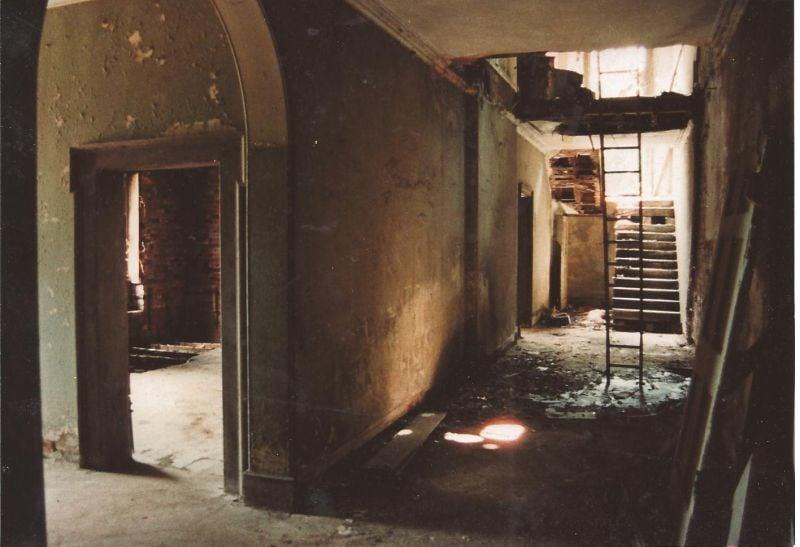
I posted the story on a Shropshire History and Nostalgia facebook group, and almost immediately had a reply from someone whose husband remembered such a place with ancient books and manuscripts all over the floor, and the place was called Gatacre Hall in Claverley, near Bridgnorth. She also said that there was a story that the family had fled to Canada just after WWII, even leaving the dishes on the table.
The Gatacre family sailing to Canada in 1947:
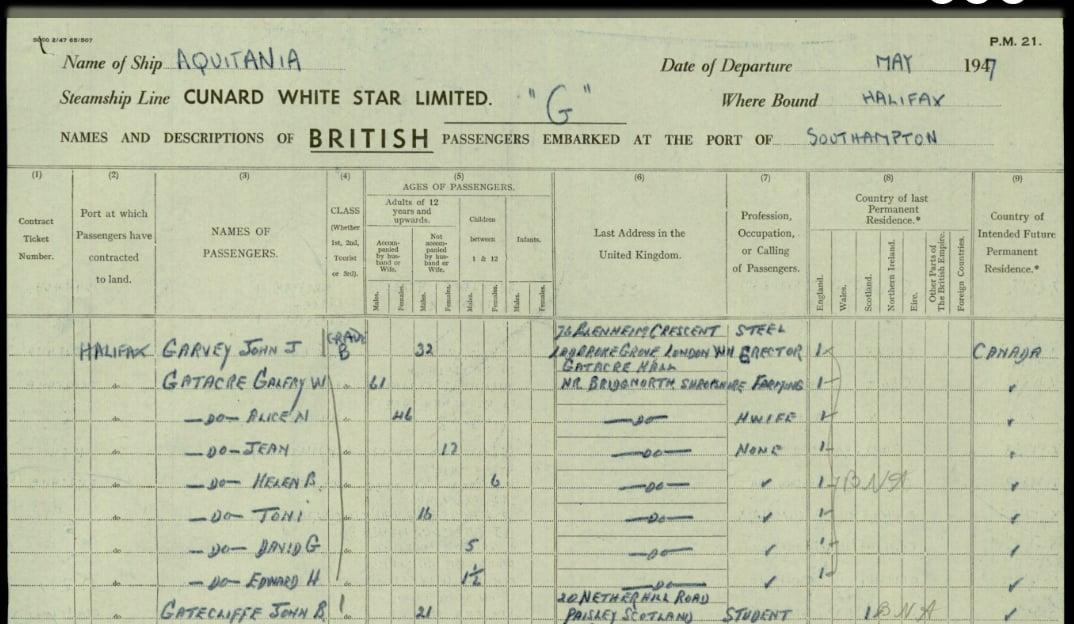
When my cousin heard the name Gatacre Hall she remembered that was the name of the place where her father had found the book.
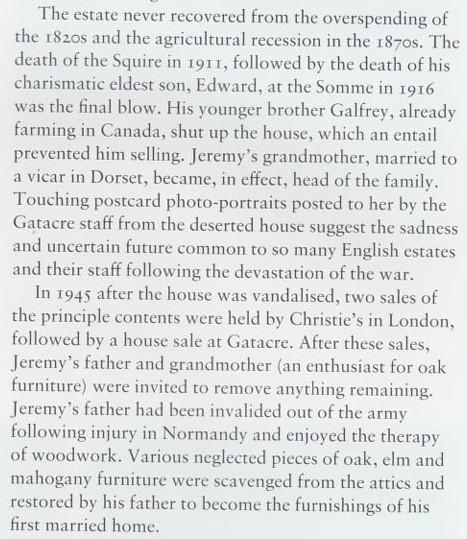
I looked into Gatacre Hall online, in the newspaper archives, the usual genealogy sites and google books searches and so on. The estate had been going downhill with debts for some years. The old squire died in 1911, and his eldest son died in 1916 at the Somme. Another son, Galfrey Gatacre, was already farming in BC, Canada. He was unable to sell Gatacre Hall because of an entail, so he closed the house up. Between 1945-1947 some important pieces of furniture were auctioned, and the rest appears to have been left in the empty house.
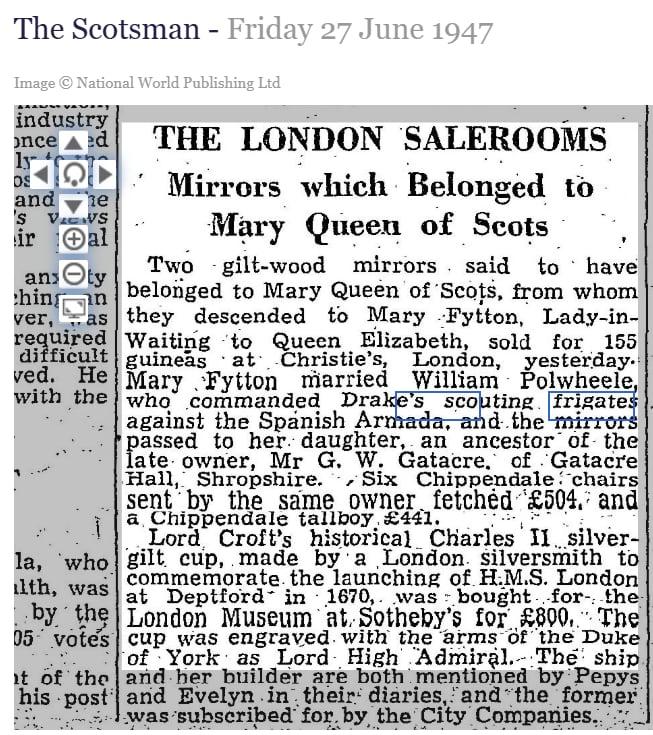
The family didn’t suddenly flee to Canada leaving the dishes on the table, although it was true that the family were living in Canada.
An interesting thing to note here is that not long after this book was found, my parents moved to BC Canada (where I was born), and a year later my uncle moved to Toronto (where he met his wife).
Captain Gatacre in 1918:
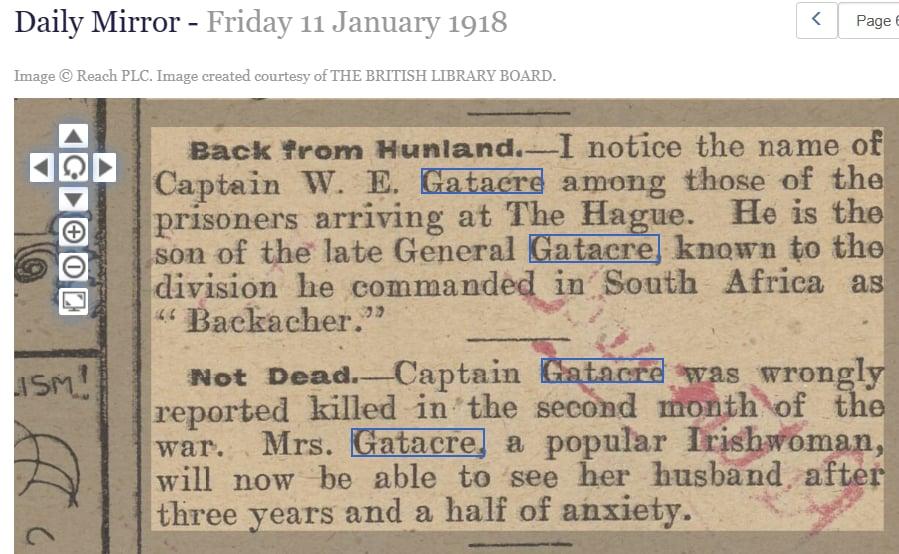
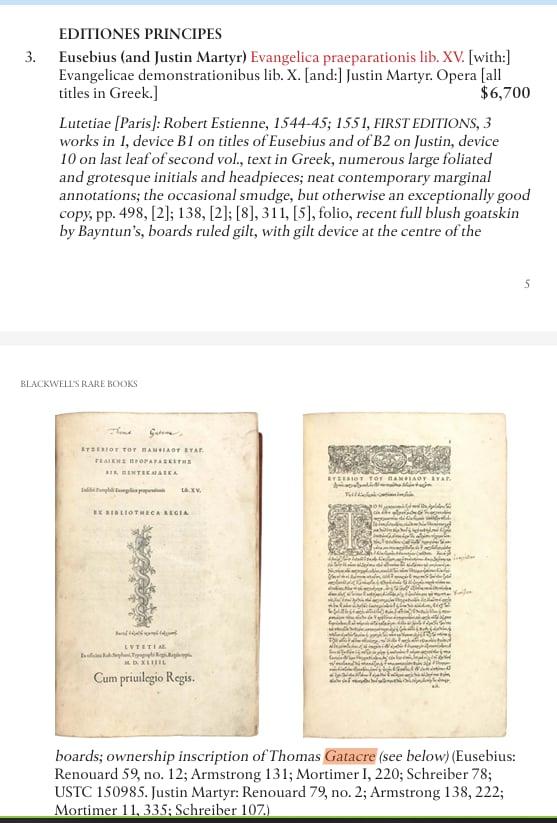
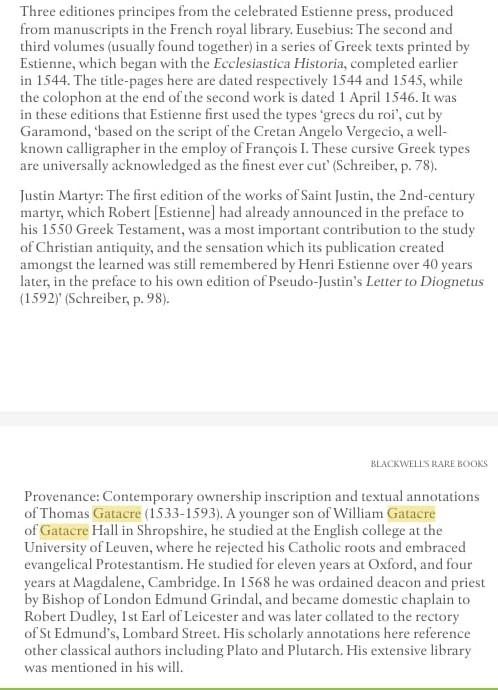
The Gatacre library was mentioned in the auction notes of a particular antiquarian book:
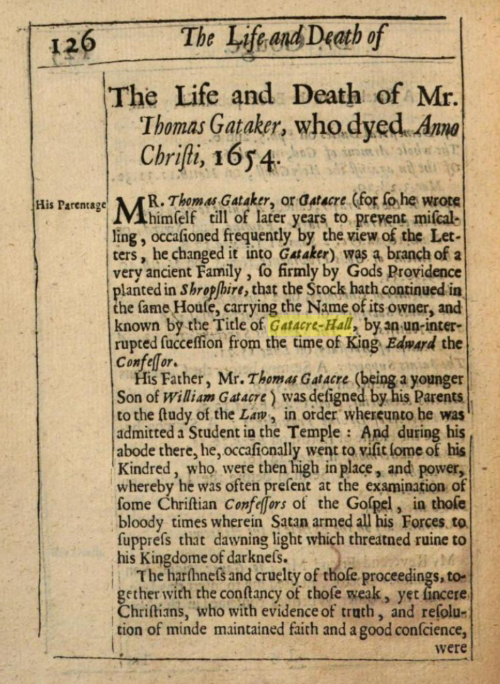
“Provenance: Contemporary ownership inscription and textual annotations of Thomas Gatacre (1533-1593). A younger son of William Gatacre of Gatacre Hall in Shropshire, he studied at the English college at the University of Leuven, where he rejected his Catholic roots and embraced evangelical Protestantism. He studied for eleven years at Oxford, and four years at Magdalene, Cambridge. In 1568 he was ordained deacon and priest by Bishop of London Edmund Grindal, and became domestic chaplain to Robert Dudley, 1st Earl of Leicester and was later collated to the rectory of St Edmund’s, Lombard Street. His scholarly annotations here reference other classical authors including Plato and Plutarch. His extensive library was mentioned in his will.”
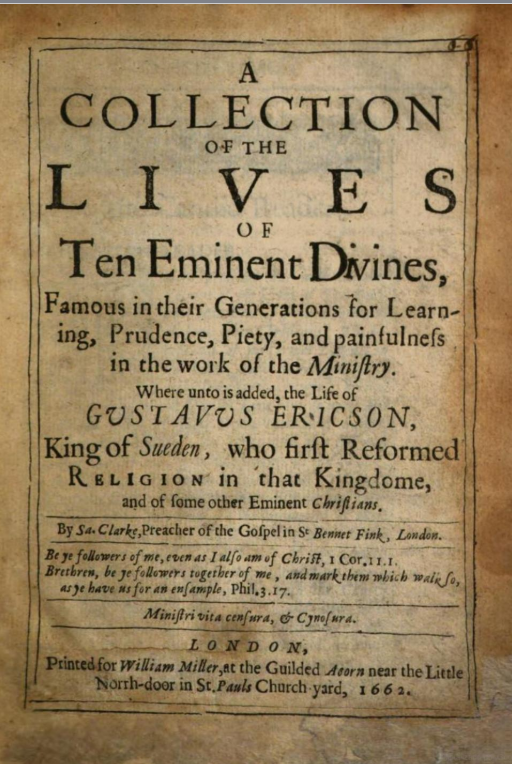
There are thirty four pages in this 1662 book about Thomas Gatacre d 1654:
 January 16, 2024 at 9:30 pm #7294
In reply to: The Whale’s Diaries Collection
hello Whale, to continue about the roman villa remains in the andalucian garden: If the owner of the house was Roman, but the staff and surrounding population were indigenous Iberian Turdetani, circa 75BC, just one days walk from Carteia, and one days walk from Lacipo, what can we imagine about the daily lives and relationships of the non roman local people?
Ah, the intermingling of cultures, a dance as old as civilization itself. Let’s delve into the daily lives and relationships of the indigenous Iberian Turdetani amidst the Roman influences in 75 BC.
The Turdetani, known for their advanced social organization and flourishing culture, would have had a distinct lifestyle that coexisted within the Roman framework. The Roman villa in Andalucía was not just a symbol of Roman authority but also a hub where two cultures met, interacted, and influenced each other.
Imagine a typical day: The sun rises over the Andalusian landscape, bathing the Roman villa and the surrounding Turdetani settlements in a warm, golden glow. Turdetanian workers make their way to the villa, ready for a day of work. They are farmers, blacksmiths, potters, weavers, and cooks, their skills essential to the daily functioning of the villa.
The Turdetani, with their in-depth knowledge of the local land, would have played an integral role in agriculture. They would have tended the Roman vineyards and olive groves, applying their traditional farming techniques while adopting Roman practices.
Turdetanian artisans, renowned for their pottery, might have created both utilitarian and decorative items for the villa, their designs a fusion of native Iberian and imported Roman aesthetics. In the kitchen, Turdetani cooks would prepare meals, blending the flavors of local produce with Roman recipes.
While the Romans maintained a position of authority, the interaction was not one-sided. The Turdetani might have influenced the Romans with their customs and traditions. Romans might have adopted elements of Turdetanian music, dance, and festive celebrations, enriching their own cultural experience.
Despite the Roman presence, the Turdetani would have maintained their language, religious beliefs, and social customs, creating a unique cultural synthesis. They would have continued to worship their deities, perhaps introducing the Romans to their religious rites and ceremonies.
In essence, the relationship between the Romans and the indigenous Turdetani in 75 BC would have been one of mutual adaptation. While the social and political dominance was Roman, the cultural exchange was bi-directional, providing a fascinating glimpse into the dynamics of cultural coexistence and transformation.
Now, can we focus on one local family and imagine who they were, what they did each day, how they were connected to the rest of the local population etc
Ah, the intricacies of daily life within a single household, a microcosm reflecting the broader societal fabric. Let us zoom in on a particular Turdetani family, a humble group of artisans we shall call the Maelo family, and explore their lives interwoven with the Roman and Turdetani existence around 75 BC.
At the heart of the family was the patriarch, Oris Maelo. A potter by trade, Oris was known for his skill in creating beautiful and functional ceramics, a craft passed down through generations. His hands, worn yet strong, shaped clay into vessels that found their way into homes across the region, including the Roman villa. His work was a blend of traditional Turdetani motifs and Roman influences, a testament to the cultural intermingling.
His wife, Caelia, was a weaver. Her nimble fingers spun stories in wool and linen. Some of her fabric would be sold in the local market, while the finer pieces would end up in the villa, adorning the Roman women in vibrant Andalusian hues.
Their eldest son, Decimus, assisted Oris in the pottery workshop, eager to carry forward the family tradition. Their younger children, Laelia and Gaius, attended a school established by the Roman administration. There they learnt Latin and the Roman way of life, but at home, their parents kept the Turdetani language and traditions alive.
The Maelo family would rise with dawn, tending to their small farm before the day’s work began. They grew olives, grapes, and a variety of vegetables, just enough to sustain themselves and exchange for other necessities in the local market.
Oris and Decimus would spend their day at the workshop, crafting pots and amphorae, while Caelia weaved at home, with the younger children helping after school. Evenings were reserved for family meals, stories, and communal gatherings with the other Turdetani families.
Their connection with the local population was multifaceted. Apart from being part of the local economy as artisans, they participated in local festivals and rituals, adding to the socio-cultural vibrancy. Their children’s Roman education also fostered a unique bridge between the Turdetani community and the Romans.
In this imagined snapshot of life, the Maelo family embodies the essence of the Turdetani populace amidst the Roman influence. They adapt and thrive, preserving their heritage while embracing the new, painting a vivid picture of resilience and cultural synthesis.
Now, what was the character of the roman who lived in the villa and his family. Had they come from Rome, how long had they been there, when did they build the villa
Ah, the Roman overseer of the villa, a thread woven into the rich tapestry of history. Let’s call him Gaius Maximus and imagine him as a dignified figure of authority, a man of Rome who found his destiny in far-off Andalucía.
Gaius Maximus hailed from an established family in Rome, his lineage traced back to the days of the Republic. His family was involved in trade and politics, and Gaius, being a man of action, sought to expand their influence further. Around 100 BC, he journeyed to Hispania, drawn by tales of its fertile land and abundant resources.
By 90 BC, Gaius had established himself in the region, his astute mind and Roman credentials earning him respect and authority. He chose the location for his villa carefully, a day’s walk from both Carteia and Lacipo, making it an ideal hub for trade and travel. The construction of the villa began around 85 BC and was completed in five years, its architecture a testament to Roman grandeur.
His wife, Claudia, hailed from a patrician family in Rome. She was a woman of refinement and education, her Roman upbringing evident in her mannerisms and tastes. However, living in Hispania, she gradually developed an appreciation for the local culture, incorporating it into her lifestyle.
Their two children, Marcus and Julia, were born in Hispania. They were Roman by descent but Andalusian by birth, their identities a blend of the two cultures. Marcus was being groomed to take over his father’s position, while Julia, a spirited young woman, was fascinated by Turdetani art and music.
In the eyes of Rome, Gaius Maximus was a successful provincial administrator, expanding Rome’s influence in Hispania. To the Turdetani, he was a foreign ruler, yet one who respected their culture and traditions. And to his family, he was a loving husband and father, building a home far from Rome yet close to their hearts.
Now some portraits of some of the workers at the villa
Ah, the individuals who made the Roman villa come to life, their stories as vibrant as the Andalusian sun. Let’s give our imagination wings and step into their world.
First, we have Tertius, the villa’s steward. Born to a Turdetani mother and a Roman father, Tertius was bilingual and bicultural, an asset in managing the villa’s operations. He was a man of medium height, with a sturdy build and a sharp gaze. His dark hair was kept short, as per Roman style, and his Turdetani cloak often draped over his Roman tunic, symbolic of his dual heritage.
Then we have Aelia, the head cook. A native Turdetani, Aelia was a robust woman with a jovial demeanor. Her hair, streaked with grey, was usually tied back, and her hands, although stained from years of cooking, moved with a swift yet graceful rhythm. Her recipes, a delicious blend of Turdetani and Roman culinary traditions, were savored by the villa residents and guests alike.
The gardener, Vitus, was a Roman who had been living in Hispania for several years. A man of few words, Vitus spoke through his work. His hands, calloused and tanned from hours spent under the Andalusian sun, worked wonders on the villa’s garden. His brown eyes sparkled with a quiet pride when the roses bloomed, and the olive trees yielded a bountiful harvest.
Lastly, we must not forget the youngest worker, Lyra. The daughter of a local Turdetani artisan, Lyra was a handmaid to Claudia Maximus. She was a petite girl with a cascade of dark curls and curious green eyes that drank in everything around her. Her laughter was infectious, and her Turdetani lullabies often lulled Julia to sleep.
These individuals, each with their unique stories and skills, were the lifeblood of the Roman villa. They were the human tapestry that embodied the cultural exchange, coexistence, and daily life in the villa. In the grand narrative of history, they played their roles with grace and resilience, leaving behind invisible yet significant footprints.
what were some of the cooks recipes?
Ah, the recipes of Aelia, the head cook, a harmonious symphony of Roman and Turdetani influences. Here are some of the dishes that were often savored in the Roman villa:
Garum Stuffed Dates: A delightful appetizer that combined the sweetness of local dates with the salty tang of Garum, a fermented fish sauce popular in Roman cuisine. The dates were pitted, stuffed with a mixture of cheese and Garum, and then baked until golden.
Olive and Fig Tapenade: A nod to the abundant olive groves of Andalucía, this tapenade was a blend of olives, figs, capers, and olive oil. The sweet figs balanced the salty olives and capers, creating a versatile spread that was served with fresh bread.
Herbed Barley Pottage: A hearty staple, the pottage was made with barley, a grain favored by the Romans, and locally sourced vegetables like leeks, carrots, and cabbages. Fresh herbs from the villa’s garden added a burst of flavor.
Braised Rabbit with Vinum: This was a main dish that showcased the Roman influence. Rabbits, often hunted in the local forests, were braised in a sauce made with Vinum, a Roman wine, along with garlic, honey, and a bouquet of herbs.
Honey-Nut Patina: A classic Roman dessert with an Andalusian twist. Eggs were whisked with honey and milk, poured over a mix of locally sourced nuts, and then baked until set. It was a sweet ending to the meals at the villa.
Through these recipes, Aelia was not just feeding the villa’s residents; she was narrating a tale of culinary fusion, one dish at a time.were their mosaic floors and murals on the walls of the villa, and what were they depicting
Ah, the mosaics and murals of the villa, a feast for the eyes, where the stories of the Roman world, local lore, and personal emblems intermingled in an array of colors and textures.
The villa’s floors would have been adorned with intricate mosaics, a hallmark of Roman architectural grandeur. Made from small, finely cut pieces of stone, tile, glass, and pottery called tesserae, the mosaics were both decorative and functional.
In the atrium, the mosaic might depict a scene from Roman mythology. Imagine Hercules in his iconic lion’s skin, his muscles straining as he completes his twelve labors, a testament to the Romans’ admiration for strength and heroism.
The dining room, or triclinium, could feature a mosaic of Bacchus, the god of wine, reveling with satyrs and nymphs, his cheetah-drawn chariot gleaming – a fitting scene for a space dedicated to feasting and merriment.
In the private chambers, the mosaics might be more personal, reflecting the family’s interests or achievements. Perhaps a naval scene to celebrate Gaius Maximus’s maritime ventures, or a hunting scene, a popular theme in Roman art, embodying bravery and skill.
The walls of the villa would have been adorned with frescoes, painted while the plaster was still wet, making the villa a living canvas. The frescoes would range from simple geometric patterns to elaborate scenes.
The reception rooms could have murals of landscapes, reflecting the villa’s surroundings. Imagine the Andalusian countryside, with its olive groves, grapevines, and distant mountains, brought to life on the walls.
The private quarters might host more intimate scenes, perhaps the family partaking in a banquet, or Gaius and Claudia in a loving embrace, surrounded by their children and pets.
Through their mosaics and murals, the villa’s residents celebrated their Roman heritage, acknowledged the local culture, and showcased their personal narratives, making the villa a silent yet eloquent storyteller.
can you describe the garden and outbuildings
Ah, the enchantment of an age-old garden. Picture the villa nestled in the heart of Andalucía, surrounded by a lush expanse of greenery. Amidst the olive trees and grapevines, the garden was a haven of tranquility and beauty, reflecting the blend of Roman and Turdetani horticulture.
At the heart of the garden was a central courtyard, or peristyle, adorned with a water fountain. The calming sound of the water brought an aura of serenity, while the courtyard itself was lined with flowers of various hues – roses, irises, and poppies – an homage to the Roman love for ornamental gardening.
Beyond the peristyle, the garden was a mixture of beauty and utility. Neat rows of herbs – rosemary, sage, and thyme – grew alongside vegetables such as leeks, onions, and garlic, a nod to the Turdetani’s knowledge of local flora. Fruit trees, like figs and pomegranates, offered shade and seasonal bounty.
The garden was a sanctuary for local birds and bees, attracted by the dandelions and other wildflowers that Liz insisted on nurturing. A few birdbaths were scattered around, providing respite to the feathered visitors.
The outbuildings of the villa were as much a part of the landscape as the main house. Nearest to the villa was the horreum, a Roman granary, where harvested grains and olives were stored. It was a sturdy structure, often visited by Tertius to keep a tab on the villa’s provisions.
Not far from the horreum was the pottery workshop. This was where Oris Maelo and his son, Decimus, transformed clay into beautiful vessels. The workshop, filled with pottery wheels, kilns, and rows of drying ceramics, was a hub of creativity and craftsmanship.
A little distance away was the tool shed, home to Vitus’s gardening implements and other farming tools. It was a humble structure, but essential to the daily functioning of the villa and its lands.
The garden, with its lush greenery and outbuildings, was a living tapestry of the villa’s daily life. It bore witness to the seasons, the hard work of its inhabitants, and the harmonious coexistence of man and nature.
August 17, 2023 at 4:32 pm #7268In reply to: Family Stories From The Other Side ~ Book Two
William Tomlinson
1797-1867
The Tomlinsons of Wolverhampton were butchers and publicans for several generations. Therefore it was a surprise to find that William’s father was a gentleman of independant means.
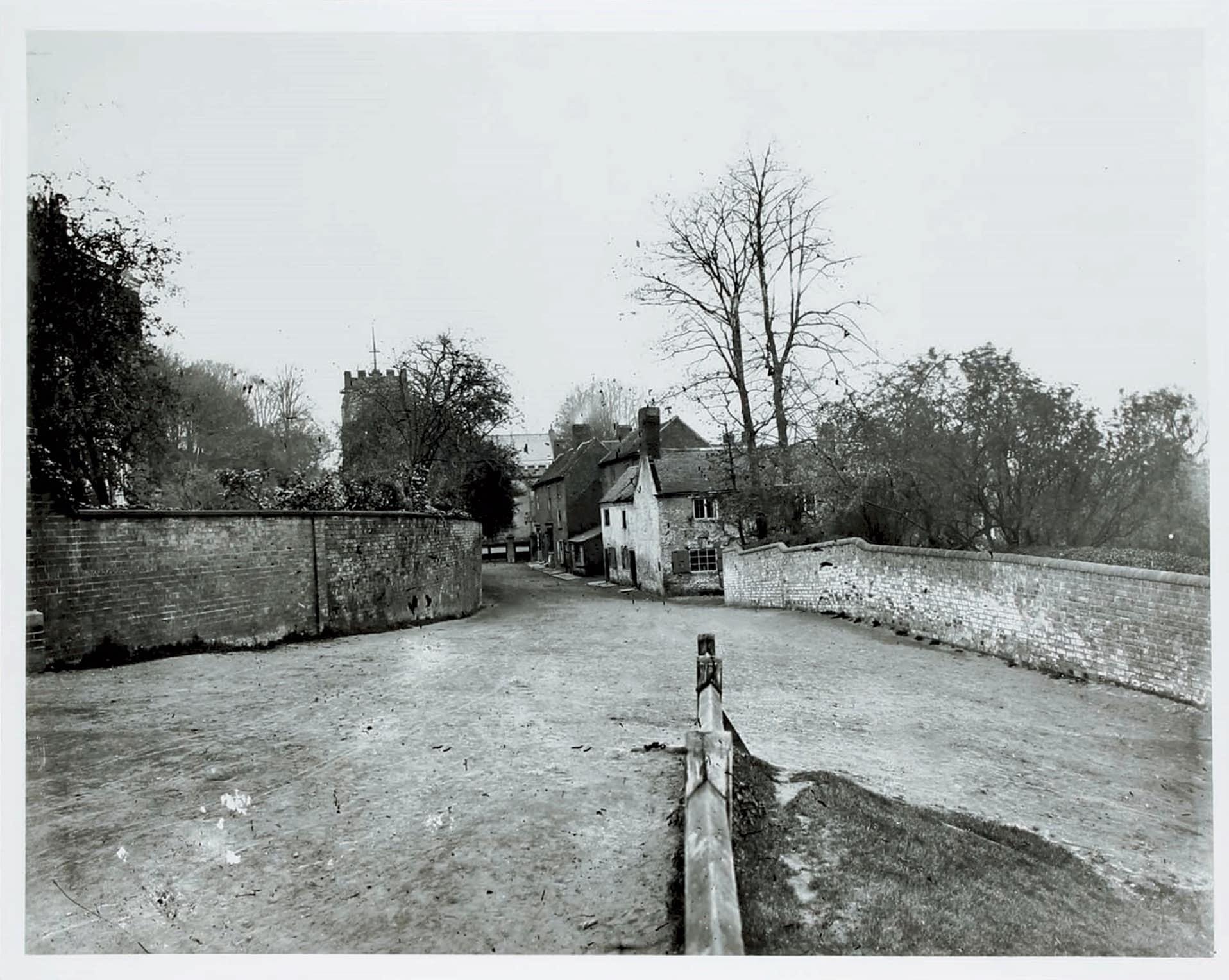
William Tomlinson 1797-1867 was born in Wergs, Tettenhall. His birthplace, and that of his first four children, is stated as Wergs on the 1851 census. They were baptised at St Michael and All Angels church in Tettenhall Regis, as were many of the Tomlinson family including William.
Tettenhall, St Michael and All Angels church:
Wergs is a very small area and there was no other William Tomlinson baptised there at the time of William’s birth. It is of course possible that another William Tomlinson was born in Wergs and the record of the baptism hasn’t been found, but there are a number of other documents that prove that John Tomlinson, gentleman of Wergs, was Williams father.
In 1834 on the Shropshire Quarter session rolls there are two documents regarding William. In October 1834 William Tomlinson of Tettenhall, son of John, took an examination. Also in October of 1834 there is a reconizance document for William Tomlinson for “pig dealer”. On the marriage certificate of his son Charles Tomlinson to Emma Grattidge (mistranscribed as Pratadge) in 1872, father William’s occupation is “dealer”.
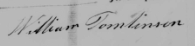
William Tomlinson was a witness at his sister Catherine and Benjamin Smiths wedding in 1822 in Tettenhall. In John Tomlinson’s 1844 will, he mentions his “daughter Catherine Smith, wife of Benjamin Smith”. William’s signature as a witness at Catherine’s marriage matches his signature on the licence for his own marriage to Elizabeth Adams in 1827 in Shareshill, Staffordshire.
William’s signature on his wedding licence:
Williams signature as a witness to Catherine’s marriage:

William was the eldest surviving son when his father died in 1844, so it is surprising that William only inherited £25. John Tomlinson left his various properties to his daughters, with the exception of Catherine, who also received £25. There was one other surviving son, Sidney, born in 1814. Three of John and Sarah Tomlinson’s sons and one daughter died in infancy. Sidney was still unmarried and living at home when his father died, and in 1851 and 1861 was living with his sister Emma Wilson. He was unmarried when he died in 1867. John left Sidney an income for life in his will, but not property.
In John Tomlinson’s will he also mentions his daughter Jemima, wife of William Smith, farmer, of Great Barr. On the 1841 census William, butcher, is a visitor. His two children Sarah and Thomas are with him. His wife Elizabeth and the rest of the children are at Graisley Street. William is also on the Graisley Street census, occupation castrator. This was no doubt done in error, not realizing that he was also registered on the census where he was visiting at the time.
William’s wife, Elizabeth Adams, was born in Tong, Shropshire in 1807. The Adams in Tong appear to be agricultural labourers, at least on later censuses. Perhaps we can speculate that John didn’t approve of his son marrying an agricutural labourers daughter. Elizabeth would have been twenty years old at the time of the marriage; William thirty.
July 4, 2023 at 7:52 pm #7261In reply to: Family Stories From The Other Side ~ Book Two
Long Lost Enoch Edwards
My father used to mention long lost Enoch Edwards. Nobody in the family knew where he went to and it was assumed that he went to USA, perhaps to Utah to join his sister Sophie who was a Mormon handcart pioneer, but no record of him was found in USA.
Andrew Enoch Edwards (my great great grandfather) was born in 1840, but was (almost) always known as Enoch. Although civil registration of births had started from 1 July 1837, neither Enoch nor his brother Stephen were registered. Enoch was baptised (as Andrew) on the same day as his brothers Reuben and Stephen in May 1843 at St Chad’s Catholic cathedral in Birmingham. It’s a mystery why these three brothers were baptised Catholic, as there are no other Catholic records for this family before or since. One possible theory is that there was a school attached to the church on Shadwell Street, and a Catholic baptism was required for the boys to go to the school. Enoch’s father John died of TB in 1844, and perhaps in 1843 he knew he was dying and wanted to ensure an education for his sons. The building of St Chads was completed in 1841, and it was close to where they lived.
Enoch appears (as Enoch rather than Andrew) on the 1841 census, six months old. The family were living at Unett Street in Birmingham: John and Sarah and children Mariah, Sophia, Matilda, a mysterious entry transcribed as Lene, a daughter, that I have been unable to find anywhere else, and Reuben and Stephen.
Enoch was just four years old when his father John, an engineer and millwright, died of consumption in 1844.
In 1851 Enoch’s widowed mother Sarah was a mangler living on Summer Street, Birmingham, Matilda a dressmaker, Reuben and Stephen were gun percussionists, and eleven year old Enoch was an errand boy.
On the 1861 census, Sarah was a confectionrer on Canal Street in Birmingham, Stephen was a blacksmith, and Enoch a button tool maker.
On the 10th November 1867 Enoch married Emelia Parker, daughter of jeweller and rope maker Edward Parker, at St Philip in Birmingham. Both Emelia and Enoch were able to sign their own names, and Matilda and Edwin Eddington were witnesses (Enoch’s sister and her husband). Enoch’s address was Church Street, and his occupation button tool maker.
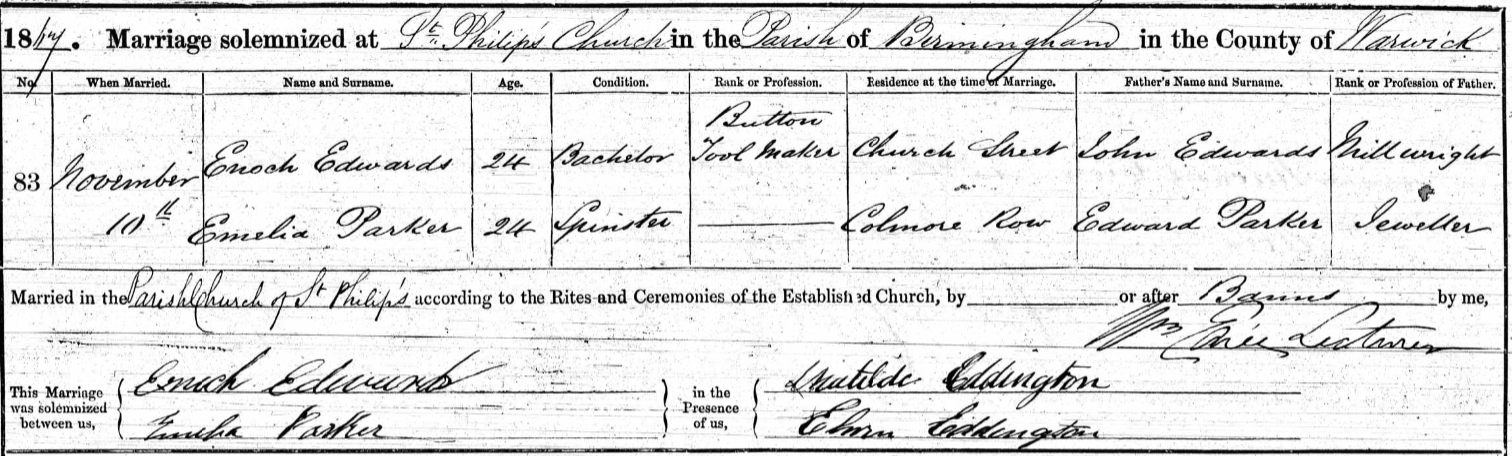
Four years later in 1871, Enoch was a publican living on Clifton Road. Son Enoch Henry was two years old, and Ralph Ernest was three months. Eliza Barton lived with them as a general servant.
By 1881 Enoch was back working as a button tool maker in Bournebrook, Birmingham. Enoch and Emilia by then had three more children, Amelia, Albert Parker (my great grandfather) and Ada.
Garnet Frederick Edwards was born in 1882. This is the first instance of the name Garnet in the family, and subsequently Garnet has been the middle name for the eldest son (my brother, father and grandfather all have Garnet as a middle name).
Enoch was the licensed victualler at the Pack Horse Hotel in 1991 at Kings Norton. By this time, only daughters Amelia and Ada and son Garnet are living at home.
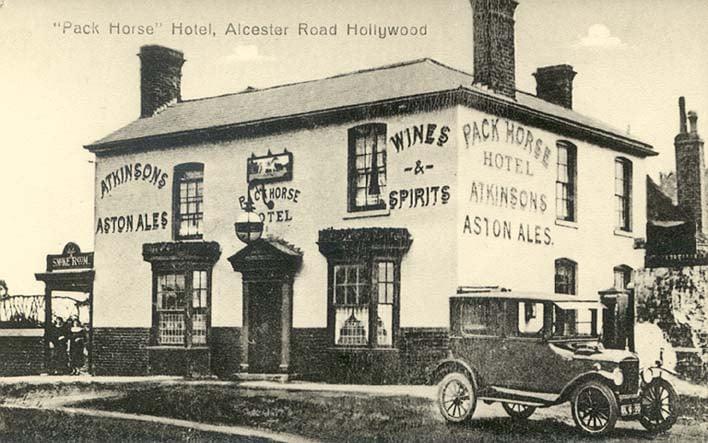
Additional information from my fathers cousin, Paul Weaver:
“Enoch refused to allow his son Albert Parker to go to King Edwards School in Birmingham, where he had been awarded a place. Instead, in October 1890 he made Albert Parker Edwards take an apprenticeship with a pawnboker in Tipton.
Towards the end of the 19th century Enoch kept The Pack Horse in Alcester Road, Hollywood, where a twist was 1d an ounce, and beer was 2d a pint. The children had to get up early to get breakfast at 6 o’clock for the hay and straw men on their way to the Birmingham hay and straw market. Enoch is listed as a member of “The Kingswood & Pack Horse Association for the Prosecution of Offenders”, a kind of early Neighbourhood Watch, dated 25 October 1890.
The Edwards family later moved to Redditch where they kept The Rifleman Inn at 35 Park Road. They must have left the Pack Horse by 1895 as another publican was in place by then.”Emelia his wife died in 1895 of consumption at the Rifleman Inn in Redditch, Worcestershire, and in 1897 Enoch married Florence Ethel Hedges in Aston. Enoch was 56 and Florence was just 21 years old.
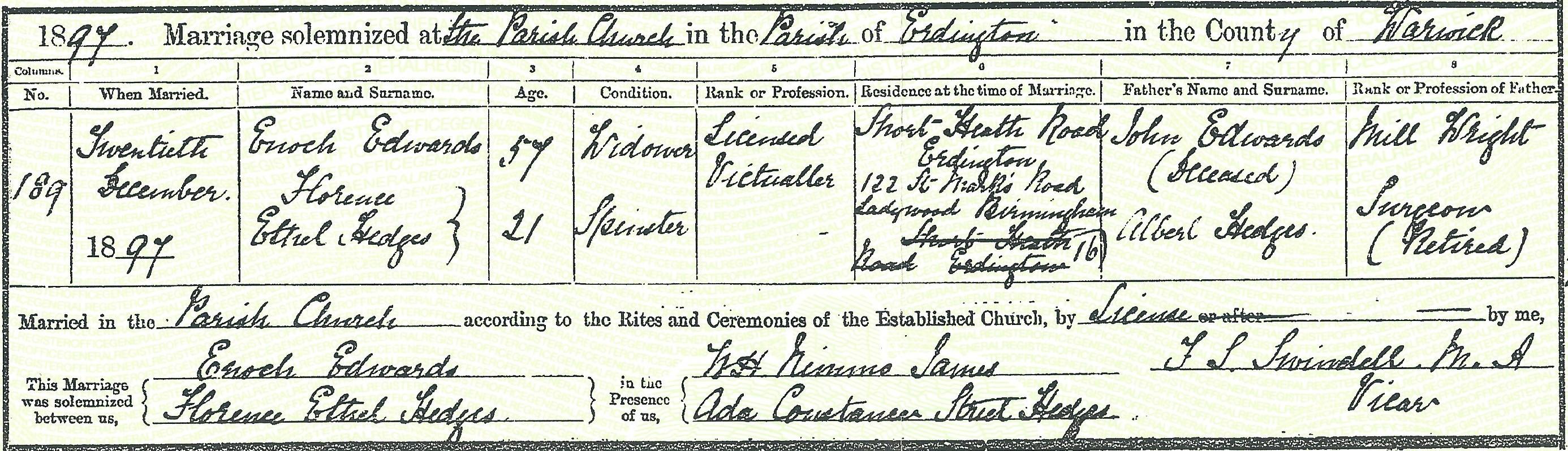
The following year in 1898 their daughter Muriel Constance Freda Edwards was born in Deritend, Warwickshire.
In 1901 Enoch, (Andrew on the census), publican, Florence and Muriel were living in Dudley. It was hard to find where he went after this.From Paul Weaver:
“Family accounts have it that Enoch EDWARDS fell out with all his family, and at about the age of 60, he left all behind and emigrated to the U.S.A. Enoch was described as being an active man, and it is believed that he had another family when he settled in the U.S.A. Esmor STOKES has it that a postcard was received by the family from Enoch at Niagara Falls.
On 11 June 1902 Harry Wright (the local postmaster responsible in those days for licensing) brought an Enoch EDWARDS to the Bedfordshire Petty Sessions in Biggleswade regarding “Hole in the Wall”, believed to refer to the now defunct “Hole in the Wall” public house at 76 Shortmead Street, Biggleswade with Enoch being granted “temporary authority”. On 9 July 1902 the transfer was granted. A year later in the 1903 edition of Kelly’s Directory of Bedfordshire, Hunts and Northamptonshire there is an Enoch EDWARDS running the Wheatsheaf Public House, Church Street, St. Neots, Huntingdonshire which is 14 miles south of Biggleswade.”
It seems that Enoch and his new family moved away from the midlands in the early 1900s, but again the trail went cold.
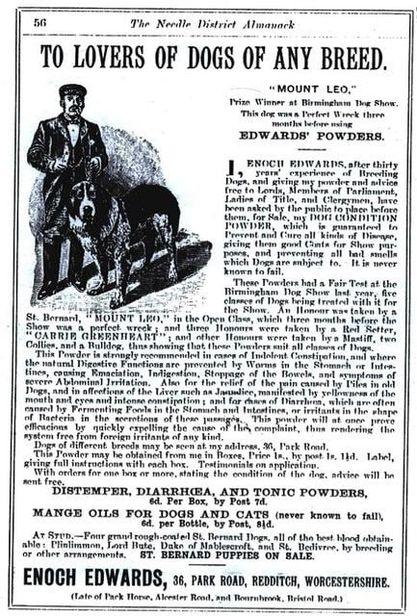
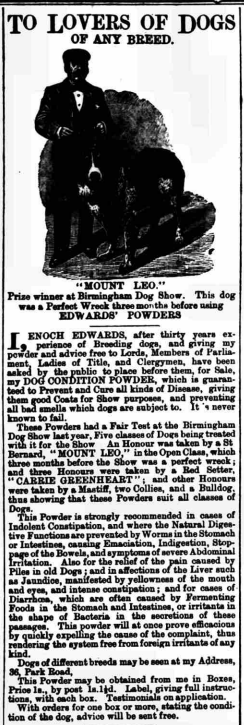
When I started doing the genealogy research, I joined a local facebook group for Redditch in Worcestershire. Enoch’s son Albert Parker Edwards (my great grandfather) spent most of his life there. I asked in the group about Enoch, and someone posted an illustrated advertisement for Enoch’s dog powders. Enoch was a well known breeder/keeper of St Bernards and is cited in a book naming individuals key to the recovery/establishment of ‘mastiff’ size dog breeds.
We had not known that Enoch was a breeder of champion St Bernard dogs!
Once I knew about the St Bernard dogs and the names Mount Leo and Plinlimmon via the newspaper adverts, I did an internet search on Enoch Edwards in conjunction with these dogs.
Enoch’s St Bernard dog “Mount Leo” was bred from the famous Plinlimmon, “the Emperor of Saint Bernards”. He was reported to have sent two puppies to Omaha and one of his stud dogs to America for a season, and in 1897 Enoch made the news for selling a St Bernard to someone in New York for £200. Plinlimmon, bred by Thomas Hall, was born in Liverpool, England on June 29, 1883. He won numerous dog shows throughout Europe in 1884, and in 1885, he was named Best Saint Bernard.
In the Birmingham Mail on 14th June 1890:
“Mr E Edwards, of Bournebrook, has been well to the fore with his dogs of late. He has gained nine honours during the past fortnight, including a first at the Pontypridd show with a St Bernard dog, The Speaker, a son of Plinlimmon.”
In the Alcester Chronicle on Saturday 05 June 1897:
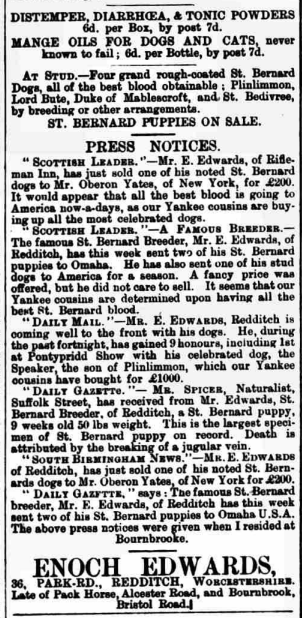
It was discovered that Enoch, Florence and Muriel moved to Canada, not USA as the family had assumed. The 1911 census for Montreal St Jaqcues, Quebec, stated that Enoch, (Florence) Ethel, and (Muriel) Frida had emigrated in 1906. Enoch’s occupation was machinist in 1911. The census transcription is not very good. Edwards was transcribed as Edmand, but the dates of birth for all three are correct. Birthplace is correct ~ A for Anglitan (the census is in French) but race or tribe is also an A but the transcribers have put African black! Enoch by this time was 71 years old, his wife 33 and daughter 11.
Additional information from Paul Weaver:
“In 1906 he and his new family travelled to Canada with Enoch travelling first and Ethel and Frida joined him in Quebec on 25 June 1906 on board the ‘Canada’ from Liverpool.
Their immigration record suggests that they were planning to travel to Winnipeg, but five years later in 1911, Enoch, Florence Ethel and Frida were still living in St James, Montreal. Enoch was employed as a machinist by Canadian Government Railways working 50 hours. It is the 1911 census record that confirms his birth as November 1840. It also states that Enoch could neither read nor write but managed to earn $500 in 1910 for activity other than his main profession, although this may be referring to his innkeeping business interests.
By 1921 Florence and Muriel Frida are living in Langford, Neepawa, Manitoba with Peter FUCHS, an Ontarian farmer of German descent who Florence had married on 24 Jul 1913 implying that Enoch died sometime in 1911/12, although no record has been found.”The extra $500 in earnings was perhaps related to the St Bernard dogs. Enoch signed his name on the register on his marriage to Emelia, and I think it’s very unlikely that he could neither read nor write, as stated above.
However, it may not be Enoch’s wife Florence Ethel who married Peter Fuchs. A Florence Emma Edwards married Peter Fuchs, and on the 1921 census in Neepawa her daugther Muriel Elizabeth Edwards, born in 1902, lives with them. Quite a coincidence, two Florence and Muriel Edwards in Neepawa at the time. Muriel Elizabeth Edwards married and had two children but died at the age of 23 in 1925. Her mother Florence was living with the widowed husband and the two children on the 1931 census in Neepawa. As there was no other daughter on the 1911 census with Enoch, Florence and Muriel in Montreal, it must be a different Florence and daughter. We don’t know, though, why Muriel Constance Freda married in Neepawa.
Indeed, Florence was not a widow in 1913. Enoch died in 1924 in Montreal, aged 84. Neither Enoch, Florence or their daughter has been found yet on the 1921 census. The search is not easy, as Enoch sometimes used the name Andrew, Florence used her middle name Ethel, and daughter Muriel used Freda, Valerie (the name she added when she married in Neepawa), and died as Marcheta. The only name she NEVER used was Constance!
A Canadian genealogist living in Montreal phoned the cemetery where Enoch was buried. She said “Enoch Edwards who died on Feb 27 1924 is not buried in the Mount Royal cemetery, he was only cremated there on March 4, 1924. There are no burial records but he died of an abcess and his body was sent to the cemetery for cremation from the Royal Victoria Hospital.”
1924 Obituary for Enoch Edwards:
Cimetière Mont-Royal Outremont, Montreal Region, Quebec, Canada
The Montreal Star 29 Feb 1924, Fri · Page 31

Muriel Constance Freda Valerie Edwards married Arthur Frederick Morris on 24 Oct 1925 in Neepawa, Manitoba. (She appears to have added the name Valerie when she married.)
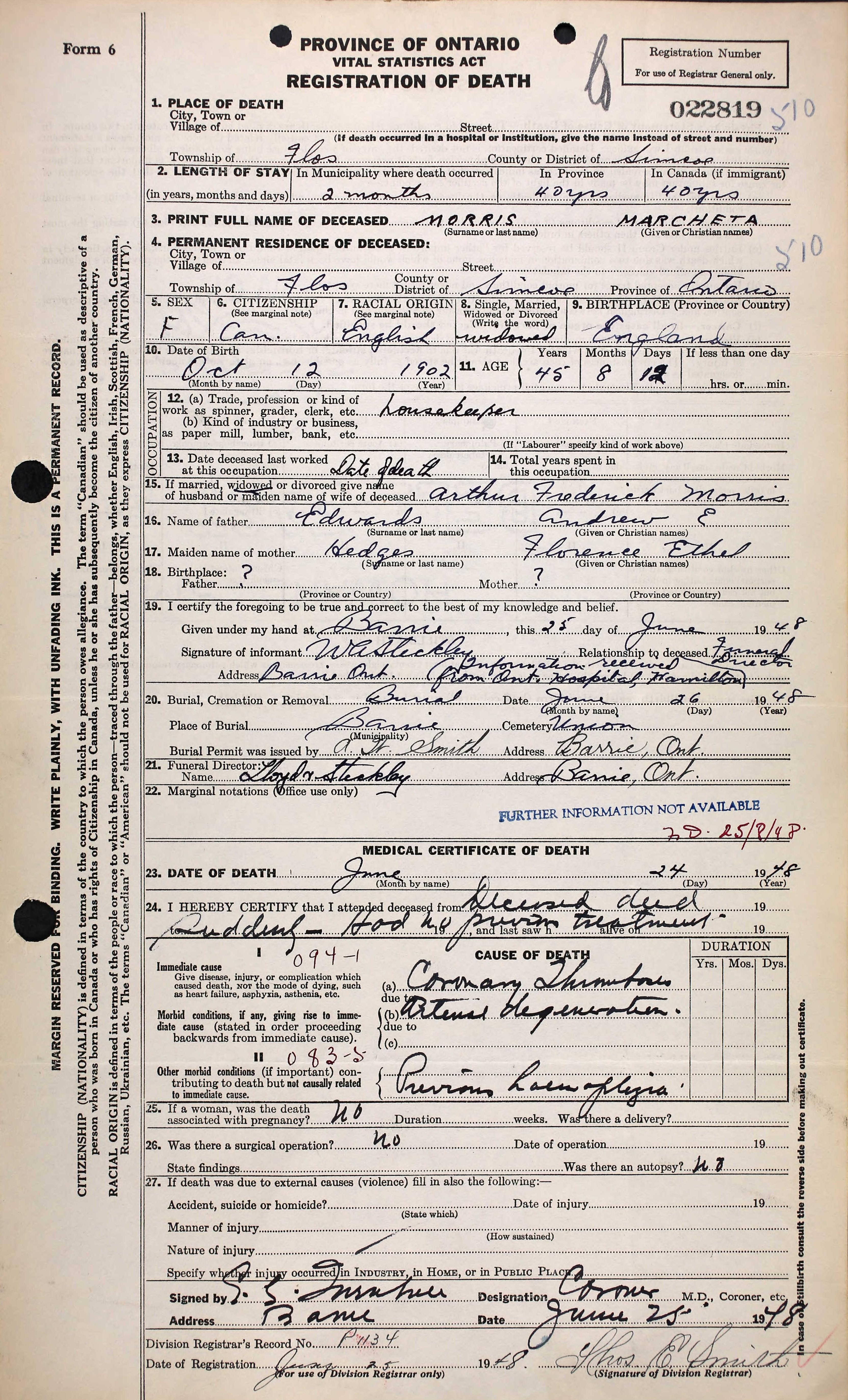
Unexpectedly a death certificate appeared for Muriel via the hints on the ancestry website. Her name was “Marcheta Morris” on this document, however it also states that she was the widow of Arthur Frederick Morris and daughter of Andrew E Edwards and Florence Ethel Hedges. She died suddenly in June 1948 in Flos, Simcoe, Ontario of a coronary thrombosis, where she was living as a housekeeper.
 June 13, 2023 at 10:31 am #7255
In reply to: Family Stories From The Other Side ~ Book Two
The First Wife of John Edwards
1794-1844
John was a widower when he married Sarah Reynolds from Kinlet. Both my fathers cousin and I had come to a dead end in the Edwards genealogy research as there were a number of possible births of a John Edwards in Birmingham at the time, and a number of possible first wives for a John Edwards at the time.
John Edwards was a millwright on the 1841 census, the only census he appeared on as he died in 1844, and 1841 was the first census. His birth is recorded as 1800, however on the 1841 census the ages were rounded up or down five years. He was an engineer on some of the marriage records of his children with Sarah, and on his death certificate, engineer and millwright, aged 49. The age of 49 at his death from tuberculosis in 1844 is likely to be more accurate than the census (Sarah his wife was present at his death), making a birth date of 1794 or 1795.
John married Sarah Reynolds in January 1827 in Birmingham, and I am descended from this marriage. Any children of John’s first marriage would no doubt have been living with John and Sarah, but had probably left home by the time of the 1841 census.
I found an Elizabeth Edwards, wife of John Edwards of Constitution Hill, died in August 1826 at the age of 23, as stated on the parish death register. It would be logical for a young widower with small children to marry again quickly. If this was John’s first wife, the marriage to Sarah six months later in January 1827 makes sense. Therefore, John’s first wife, I assumed, was Elizabeth, born in 1803.
Death of Elizabeth Edwards, 23 years old. St Mary, Birmingham, 15 Aug 1826:

There were two baptisms recorded for parents John and Elizabeth Edwards, Constitution Hill, and John’s occupation was an engineer on both baptisms.
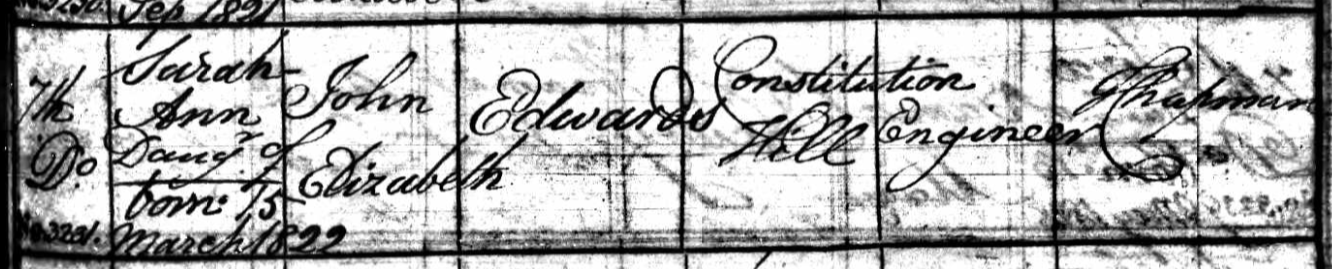
They were both daughters: Sarah Ann in 1822 and Elizabeth in 1824.Sarah Ann Edwards: St Philip, Birmingham. Born 15 March 1822, baptised 7 September 1822:
Elizabeth Edwards: St Philip, Birmingham. Born 6 February 1824, baptised 25 February 1824:

With John’s occupation as engineer stated, it looked increasingly likely that I’d found John’s first wife and children of that marriage.
Then I found a marriage of Elizabeth Beach to John Edwards in 1819, and subsequently found an Elizabeth Beach baptised in 1803. This appeared to be the right first wife for John, until an Elizabeth Slater turned up, with a marriage to a John Edwards in 1820. An Elizabeth Slater was baptised in 1803. Either Elizabeth Beach or Elizabeth Slater could have been the first wife of John Edwards. As John’s first wife Elizabeth is not related to us, it’s not necessary to go further back, and in a sense, doesn’t really matter which one it was.
But the Slater name caught my eye.
But first, the name Sarah Ann.
Of the possible baptisms for John Edwards, the most likely seemed to be in 1794, parents John and Sarah. John and Sarah had two infant daughters die just prior to John’s birth. The first was Sarah, the second Sarah Ann. Perhaps this was why John named his daughter Sarah Ann? In the absence of any other significant clues, I decided to assume these were the correct parents. I found and read half a dozen wills of any John Edwards I could find within the likely time period of John’s fathers death.
One of them was dated 1803. In this will, John mentions that his children are not yet of age. (John would have been nine years old.)
He leaves his plating business and some properties to his eldest son Thomas Davis Edwards, (just shy of 21 years old at the time of his fathers death in 1803) with the business to be run jointly with his widow, Sarah. He mentions his son John, and leaves several properties to him, when he comes of age. He also leaves various properties to his daughters Elizabeth and Mary, ditto. The baptisms for all of these children, including the infant deaths of Sarah and Sarah Ann have been found. All but Mary’s were in the same parish. (I found one for Mary in Sutton Coldfield, which was apparently correct, as a later census also recorded her birth as Sutton Coldfield. She was living with family on that census, so it would appear to be correct that for whatever reason, their daughter Mary was born in Sutton Coldfield)Mary married John Slater in 1813. The witnesses were Elizabeth Whitehouse and John Edwards, her sister and brother. Elizabeth married William Nicklin Whitehouse in 1805 and one of the witnesses was Mary Edwards.
Mary’s husband John Slater died in 1821. They had no children. Mary never remarried, and lived with her bachelor brother Thomas Davis Edwards in West Bromwich. Thomas never married, and on the census he was either a proprietor of houses, or “sinecura” (earning a living without working).With Mary marrying a Slater, does this indicate that her brother John’s first wife was Elizabeth Slater rather than Elizabeth Beach? It is a compelling possibility, but does not constitute proof.
Not only that, there is no absolute proof that the John Edwards who died in 1803 was our ancestor John Edwards father.
If we can’t be sure which Elizabeth married John Edwards, we can be reasonably sure who their daughters married. On both of the marriage records the father is recorded as John Edwards, engineer.
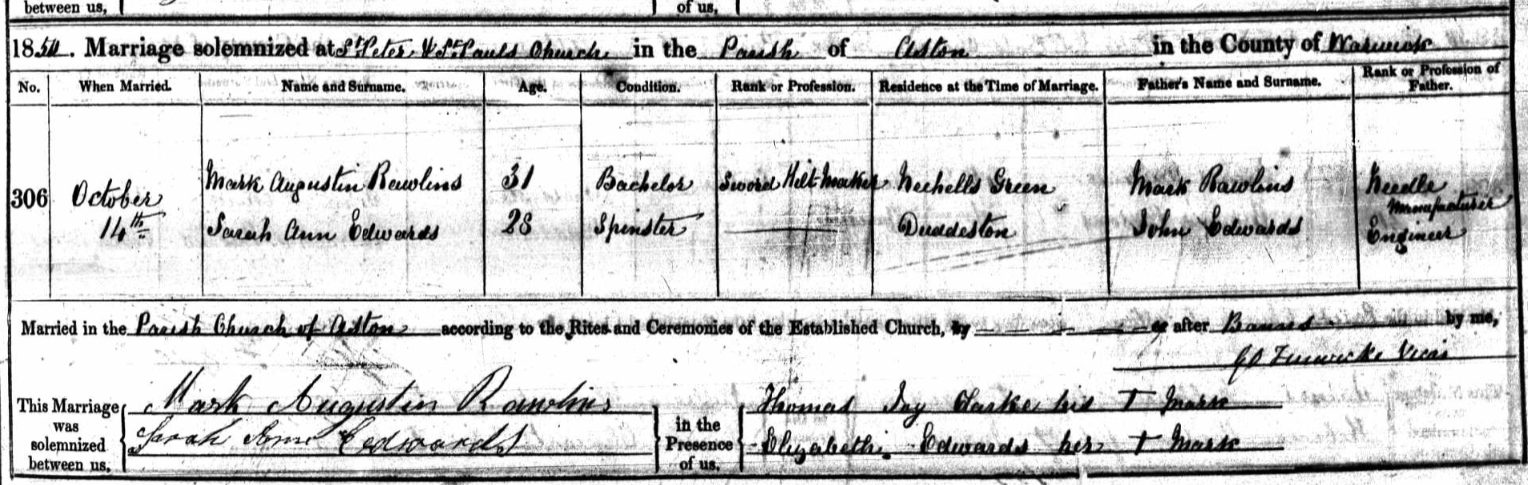
Sarah Ann married Mark Augustin Rawlins in 1850. Mark was a sword hilt maker at the time of the marriage, his father Mark a needle manufacturer. One of the witnesses was Elizabeth Edwards, who signed with her mark. Sarah Ann and Mark however were both able to sign their own names on the register.
Sarah Ann Edwards and Mark Augustin Rawlins marriage 14 October 1850 St Peter and St Paul, Aston, Birmingham:
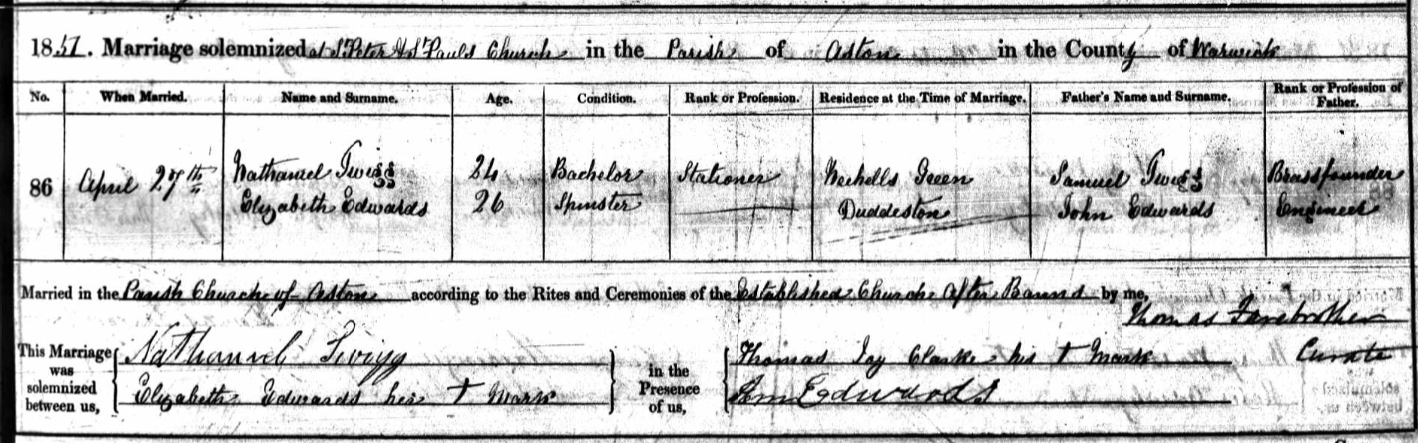
Elizabeth married Nathaniel Twigg in 1851. (She was living with her sister Sarah Ann and Mark Rawlins on the 1851 census, I assume the census was taken before her marriage to Nathaniel on the 27th April 1851.) Nathaniel was a stationer (later on the census a bookseller), his father Samuel a brass founder. Elizabeth signed with her mark, apparently unable to write, and a witness was Ann Edwards. Although Sarah Ann, Elizabeth’s sister, would have been Sarah Ann Rawlins at the time, having married the previous year, she was known as Ann on later censuses. The signature of Ann Edwards looks remarkably similar to Sarah Ann Edwards signature on her own wedding. Perhaps she couldn’t write but had learned how to write her signature for her wedding?
Elizabeth Edwards and Nathaniel Twigg marriage 27 April 1851, St Peter and St Paul, Aston, Birmingham:
Sarah Ann and Mark Rawlins had one daughter and four sons between 1852 and 1859. One of the sons, Edward Rawlins 1857-1931, was a school master and later master of an orphanage.
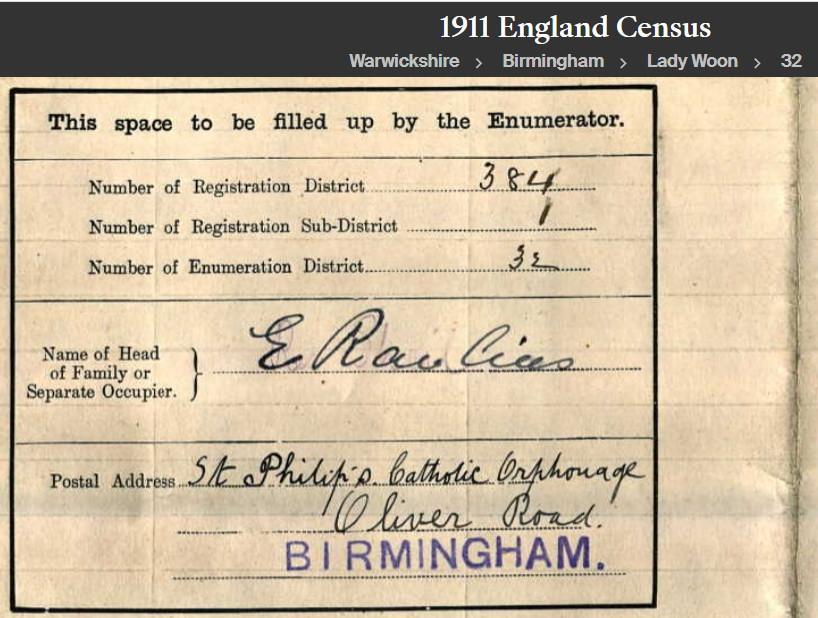
On the 1881 census Edward was a bookseller, in 1891 a stationer, 1901 schoolmaster and his wife Edith was matron, and in 1911 he and Edith were master and matron of St Philip’s Catholic Orphanage on Oliver Road in Birmingham. Edward and Edith did not have any children.
Edward Rawlins, 1911:
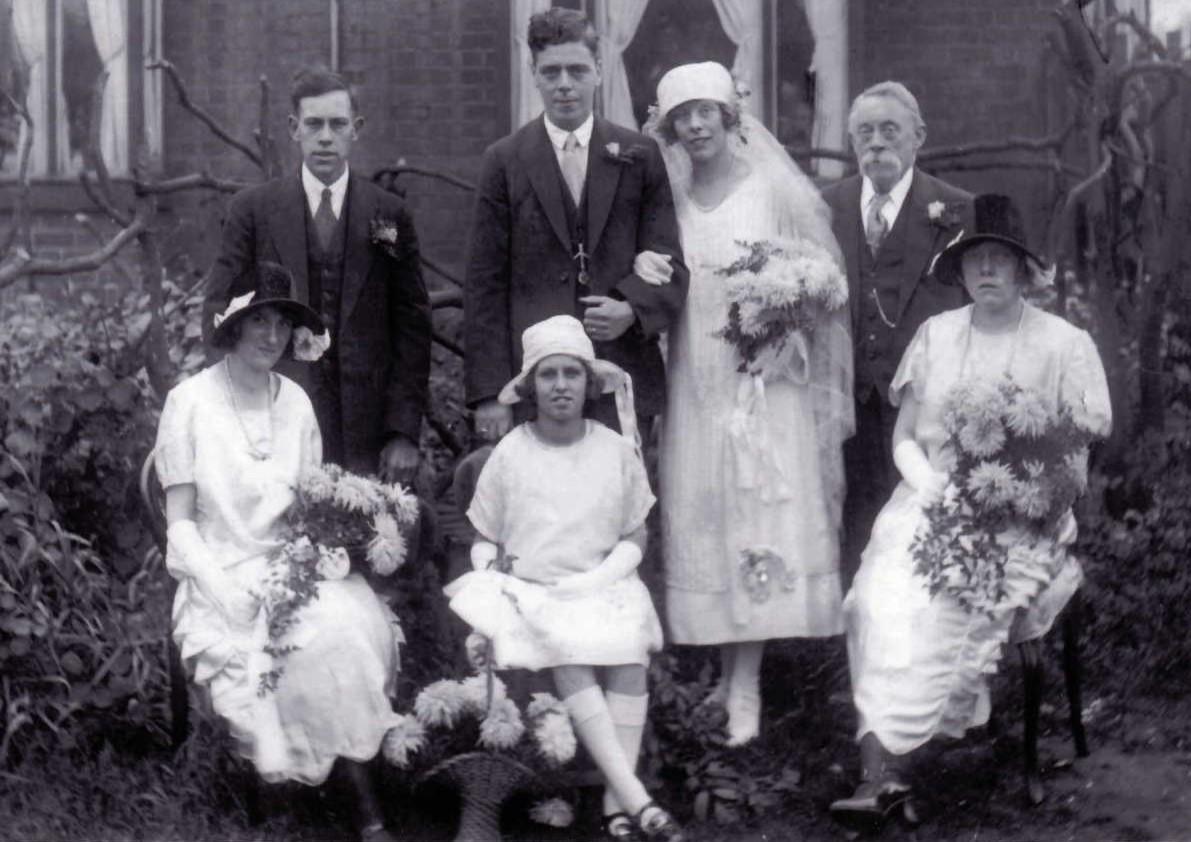
Elizabeth and Nathaniel Twigg appear to have had only one son, Arthur Twigg 1862-1943. Arthur was a photographer at 291 Bloomsbury Street, Birmingham. Arthur married Harriet Moseley from Burton on Trent, and they had two daughters, Elizabeth Ann 1897-1954, and Edith 1898-1983. I found a photograph of Edith on her wedding day, with her father Arthur in the picture. Arthur and Harriet also had a son Samuel Arthur, who lived for less than a month, born in 1904. Arthur had mistakenly put this son on the 1911 census stating “less than one month”, but the birth and death of Samuel Arthur Twigg were registered in the same quarter of 1904, and none were found registered for 1911.
Edith Twigg and Leslie A Hancock on their Wedding Day 1925. Arthur Twigg behind the bride. Maybe Elizabeth Ann Twigg seated on the right: (photo found on the ancestry website)
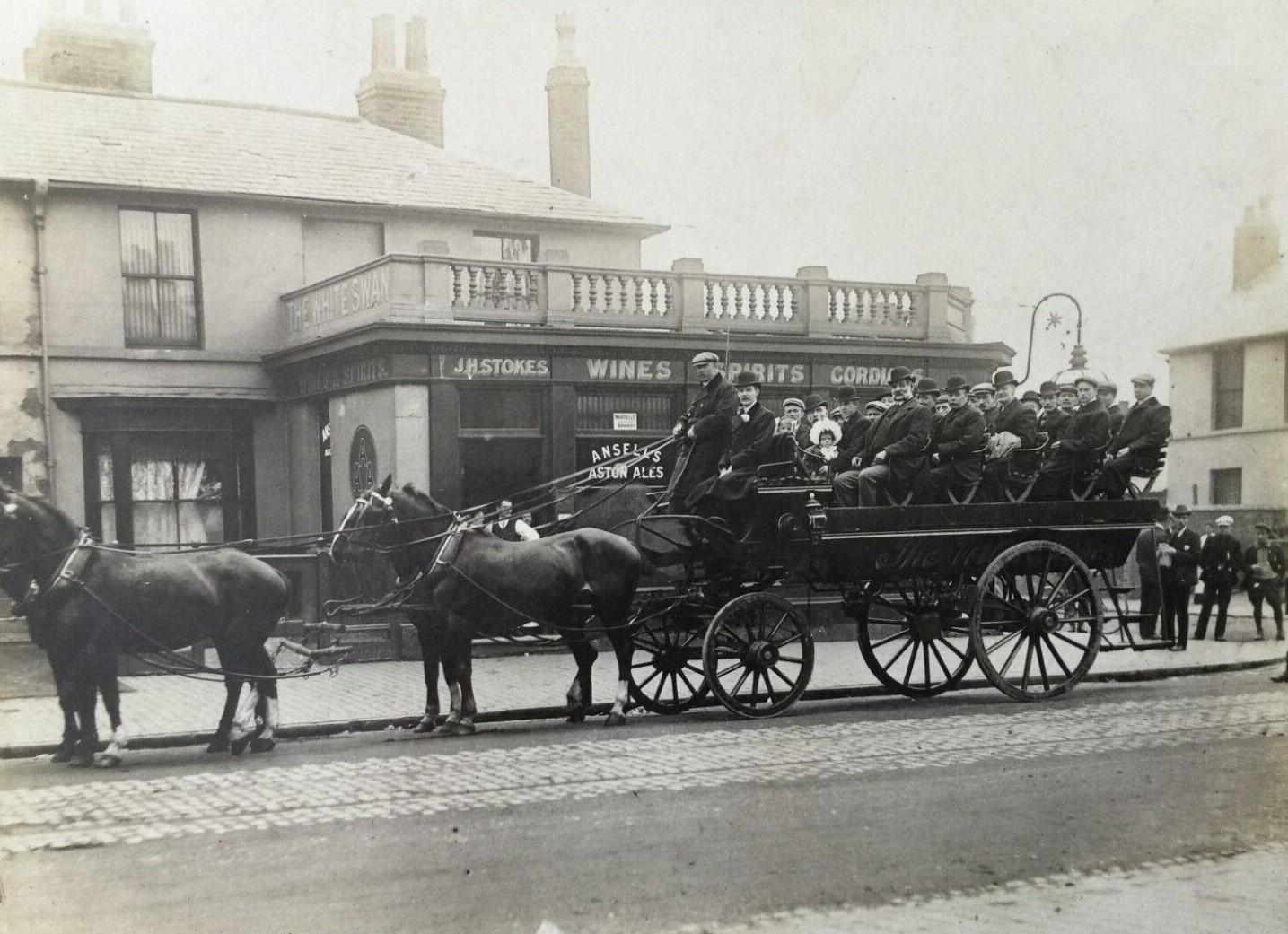
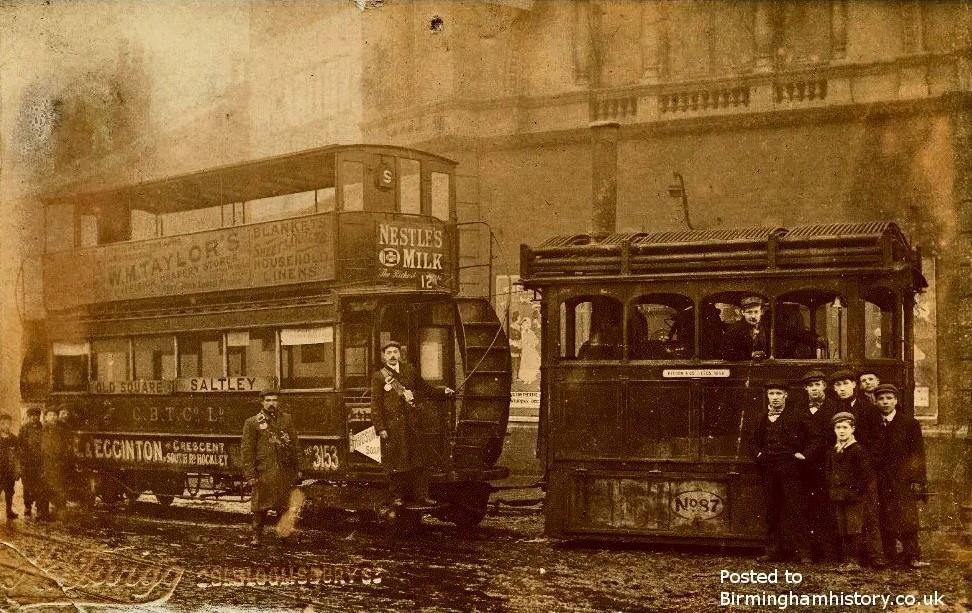
Photographs by Arthur Twigg, 291 Bloomsbury Street, Birmingham:
 January 23, 2023 at 10:28 pm #6454
In reply to: Prompts of Madjourneys
YASMIN’S QUIRK: Entry level quirk – snort laughing when socially anxious
Setting
The initial setting for this quest is a comedic theater in the heart of a bustling city. You will start off by exploring the different performances and shows, trying to find the source of the snort laughter that seems to be haunting your thoughts. As you delve deeper into the theater, you will discover that the snort laughter is coming from a mischievous imp who has taken residence within the theater.
Directions to Investigate
Possible directions to investigate include talking to the theater staff and performers to gather information, searching backstage for clues, and perhaps even sneaking into the imp’s hiding spot to catch a glimpse of it in action.
Characters
Possible characters to engage include the theater manager, who may have information about the imp’s history and habits, and a group of comedic performers who may have some insight into the imp’s behavior.
Task
Your task is to find a key or tile that represents the imp, and take a picture of it in real life as proof of completion of the quest. Good luck on your journey to uncover the source of the snort laughter!
THE SECRET ROOM AND THE UNDERGROUND MINES
1st thread’s answer:
As the family struggles to rebuild the inn and their lives in the wake of the Great Fires, they begin to uncover clues that lead them to believe that the mines hold the key to unlocking a great mystery. They soon discover that the mines were not just a source of gold and other precious minerals, but also a portal to another dimension. The family realizes that Mater had always known about this portal, and had kept it a secret for fear of the dangers it posed.
The family starts to investigate the mines more closely and they come across a hidden room off Room 8. Inside the room, they find a strange device that looks like a portal, and a set of mysterious symbols etched into the walls. The family realizes that this is the secret room that Mater had always spoken about in hushed tones.
The family enlists the help of four gamers, Xavier, Zara, Yasmin, and Youssef, to help them decipher the symbols and unlock the portal. Together, they begin to unravel the mystery of the mines, and the portal leads them on an epic journey through a strange and fantastical alternate dimension.
As they journey deeper into the mines, the family discovers that the portal was created by an ancient civilization, long thought to be lost to history. The civilization had been working on a powerful energy source that could have changed the fate of humanity, but the project was abandoned due to the dangers it posed. The family soon discovers that the civilization had been destroyed by a powerful and malevolent force, and that the portal was the only way to stop it from destroying the world.
The family and the gamers must navigate treacherous landscapes, battle fierce monsters, and overcome seemingly insurmountable obstacles in order to stop the malevolent force and save the world. Along the way, they discover secrets about their own past and the true origins of the mines.
As they journey deeper into the mines and the alternate dimension, they discover that the secret room leads to a network of underground tunnels, and that the tunnels lead to a secret underground city that was built by the ancient civilization. The city holds many secrets and clues to the fate of the ancient civilization, and the family and the gamers must explore the city and uncover the truth before it’s too late.
As the story unfolds, the family and the gamers must come to grips with the truth about the mines, and the role that the family has played in the fate of the world for generations. They must also confront the demons of their own past, and learn to trust and rely on each other if they hope to save the world and bring the family back together.
second thread’s answer:
As the 4 gamers, Xavier, Zara, Yasmin and Youssef, arrived at the Flying Fish Inn in the Australian outback, they were greeted by the matriarch of the family, Mater. She was a no-nonsense woman who ran the inn with an iron fist, but her tough exterior hid a deep love for her family and the land.
The inn was run by Mater and her daughter Dido, who the family affectionately called Aunt Idle. She was a free spirit who loved to explore the land and had a deep connection to the local indigenous culture.
The family was made up of Devan, the eldest son who lived in town and helped with the inn when he could, and the twin sisters Clove and Coriander, who everyone called Corrie. The youngest was Prune, a precocious child who was always getting into mischief.
The family had a handyman named Bert, who had been with them for decades and knew all the secrets of the land. Tiku, an old and wise Aborigine woman was also a regular visitor and a valuable source of information and guidance. Finly, the dutiful helper, assisted the family in their daily tasks.
As the 4 gamers settled in, they learned that the area was rich in history and mystery. The old mines that lay abandoned nearby were a source of legends and stories passed down through the generations. Some even whispered of supernatural occurrences linked to the mines.
Mater and Dido, however, were not on good terms, and the family had its own issues and secrets, but the 4 gamers were determined to unravel the mystery of the mines and find the secret room that was said to be hidden somewhere in the inn.
As they delved deeper into the history of the area, they discovered that the mines had a connection to the missing brother, Jasper, and Fred, the father of the family and a sci-fi novelist who had been influenced by the supernatural occurrences of the mines.
The 4 gamers found themselves on a journey of discovery, not only in the game but in the real world as well, as they uncovered the secrets of the mines and the Flying Fish Inn, and the complicated relationships of the family that ran it.
THE SNOOT’S WISE WORDS ON SOCIAL ANXIETY
Deear Francie Mossie Pooh,
The Snoot, a curious creature of the ages, understands the swirling winds of social anxiety, the tempestuous waves it creates in one’s daily life.
But The Snoot also believes that like a Phoenix, one must rise from the ashes, and embrace the journey of self-discovery and growth.
It’s important to let yourself be, to accept the feelings as they come and go, like the ebb and flow of the ocean. But also, like a gardener, tend to the inner self with care and compassion, for the roots to grow deep and strong.The Snoot suggests seeking guidance from the wise ones, the ones who can hold the mirror and show you the way, like the North Star guiding the sailors.
And remember, the journey is never-ending, like the spiral of the galaxy, and it’s okay to take small steps, to stumble and fall, for that’s how we learn to fly.The Snoot is here for you, my dear Francie Mossie Pooh, a beacon in the dark, a friend on the journey, to hold your hand and sing you a lullaby.
Fluidly and fantastically yours,
The Snoot.
March 17, 2022 at 10:37 am #6283In reply to: The Elusive Samuel Housley and Other Family Stories
Purdy Cousins
My great grandmother Mary Ann Gilman Purdy was one of five children. Her sister Ellen Purdy was a well traveled nurse, and her sister Kate Rushby was a publican whose son who went to Africa. But what of her eldest sister Elizabeth and her brother Richard?
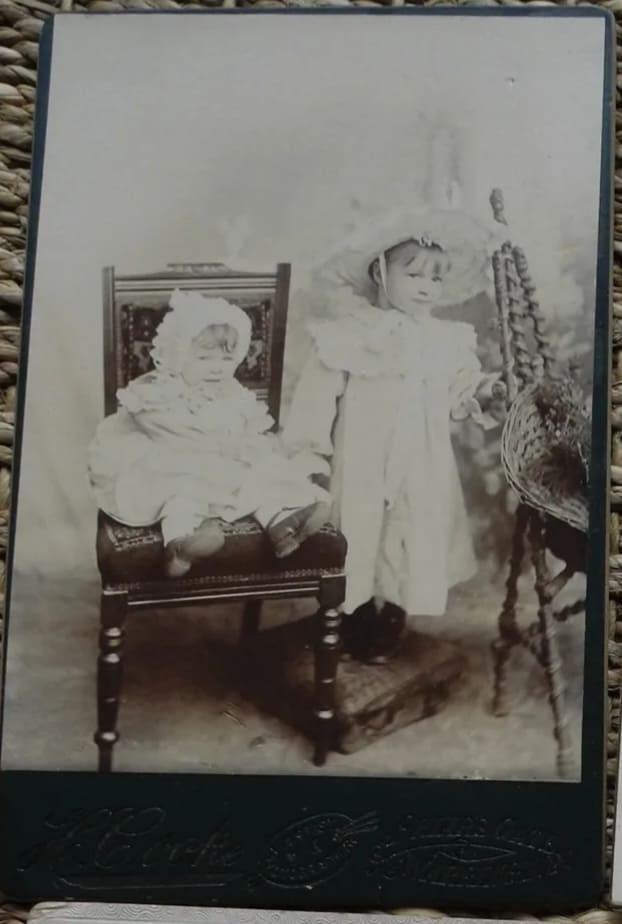
Elizabeth Purdy 1869-1905 married Benjamin George Little in 1892 in Basford, Nottinghamshire. Their first child, Frieda Olive Little, was born in Eastwood in December 1896, and their second daughter Catherine Jane Little was born in Warrington, Cheshire, in 1898. A third daughter, Edna Francis Little was born in 1900, but died three months later.
When I noticed that this unidentified photograph in our family collection was taken by a photographer in Warrington, and as no other family has been found in Warrington, I concluded that these two little girls are Frieda and Catherine:
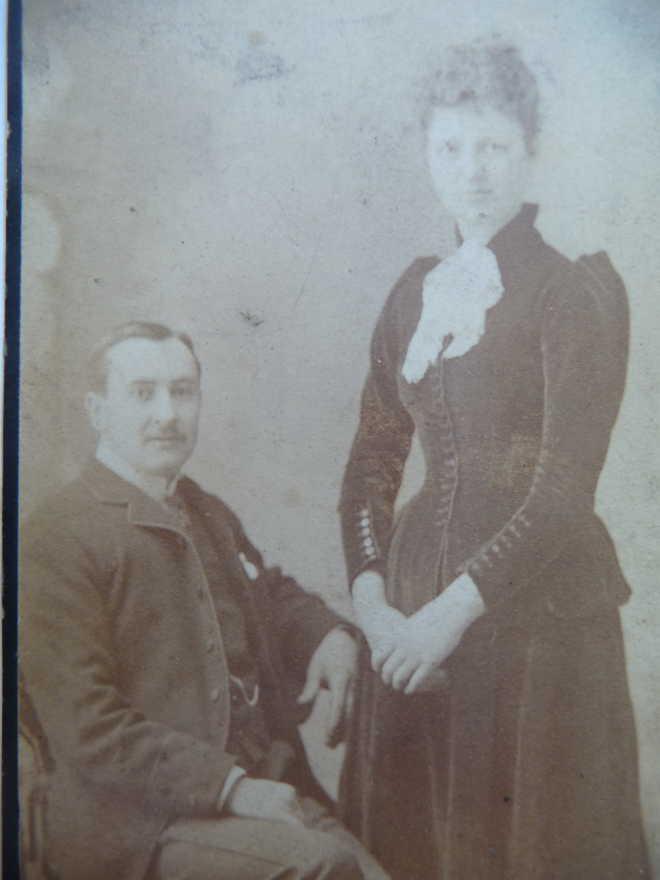
Benjamin Little, born in 1869, was the manager of a boot shop, according to the 1901 census, and a boot maker on the 1911 census. I found a photograph of Benjamin and Elizabeth Little on an ancestry website:
Frieda Olive Little 1896-1977 married Robert Warburton in 1924.
Frieda and Robert had two sons and a daughter, although one son died in infancy. They lived in Leominster, in Herefordshire, but Frieda died in 1977 at Enfield Farm in Warrington, four years after the death of her husband Robert.
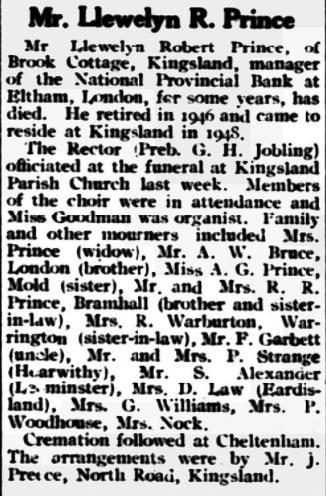
Catherine Jane Little 1899-1975 married Llewelyn Robert Prince 1884-1950. They do not appear to have had any children. Llewelyn was manager of the National Provinical Bank at Eltham in London, but died at Brook Cottage in Kingsland, Herefordshire. His wifes aunt Ellen Purdy the nurse had also lived at Brook Cottage. Ellen died in 1947, but her husband Frank Garbett was at the funeral:
Richard Purdy 1877-1940
Richard was born in Eastwood, Nottinghamshire. When his mother Catherine died in 1884 Richard was six years old. My great grandmother Mary Ann and her sister Ellen went to live with the Gilman’s in Buxton, but Richard and the two older sisters, Elizabeth and Kate, stayed with their father George Purdy, who remarried soon afterwards.
Richard married Ada Elizabeth Clarke in 1899. In 1901 Richard was an earthenware packer at a pottery, and on the 1939 census he was a colliery dataller. A dataller was a day wage man, paid on a daily basis for work done as required.
Richard and Ada had four children: Richard Baden Purdy 1900-1945, Winifred Maude 1903-1974, John Frederick 1907-1945, and Violet Gertrude 1910-1974.
Richard Baden Purdy married Ethel May Potter in Mansfield, Nottinghamshire, in 1926. He was listed on the 1939 census as a colliery deputy. In 1945 Richard Baden Purdy died as a result of injuries in a mine explosion.
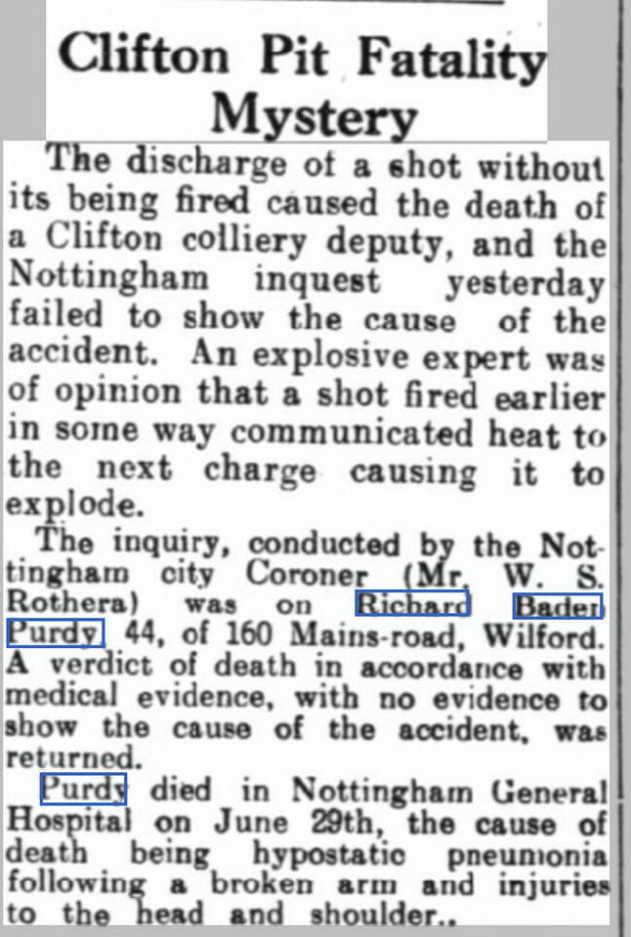
John Frederick Purdy married Iris Merryweather in 1938. On the 1939 census John and Iris live in Arnold, Nottinghamshire, and John’s occupation is a colliery hewer. Their daughter Barbara Elizabeth was born later that year. John died in 1945, the same year as his brother Richard Baden Purdy. It is not known without purchasing the death certificate what the cause of death was.
A memorial was posted in the Nottingham Evening Post on 29 June 1948:
PURDY, loving memories, Richard Baden, accidentally killed June 29th 1945; John Frederick, died 1 April 1945; Richard Purdy, father, died December 1940. Too dearly loved to be forgotten. Mother, families.
Violet Gertrude Purdy married Sidney Garland in 1932 in Southwell, Nottinghamshire. She died in Edwinstowe, Nottinghamshire, in 1974.
Winifred Maude Purdy married Bernard Fowler in Southwell in 1928. She also died in 1974, in Mansfield.
The two brothers died the same year, in 1945, and the two sisters died the same year, in 1974.
February 25, 2022 at 8:21 am #6277In reply to: The Elusive Samuel Housley and Other Family Stories
William Housley the Elder
Intestate
William Housley of Kidsley Grange Farm in Smalley, Derbyshire, was born in 1781 in Selston, just over the county border in Nottinghamshire. His father was also called William Housley, and he was born in Selston in 1735. It would appear from the records that William the father married late in life and only had one son (unless of course other records are missing or have not yet been found). Never the less, William Housley of Kidsley was the eldest son, or eldest surviving son, evident from the legal document written in 1816 regarding William the fathers’ estate.
William Housley died in Smalley in 1815, intestate. William the son claims that “he is the natural and lawful son of the said deceased and the person entitled to letters of administration of his goods and personal estate”.
Derby the 16th day of April 1816:
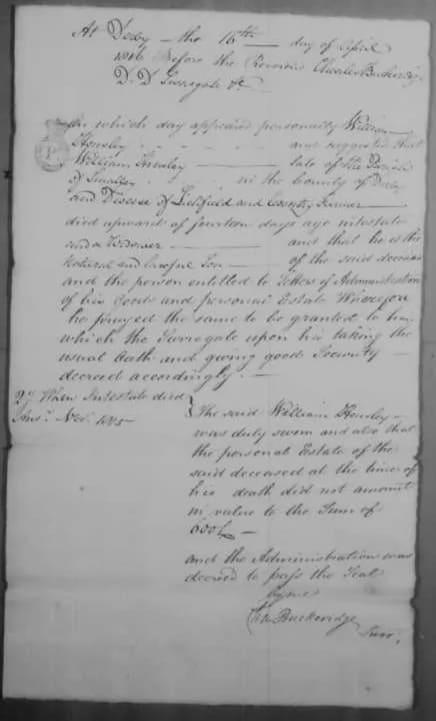
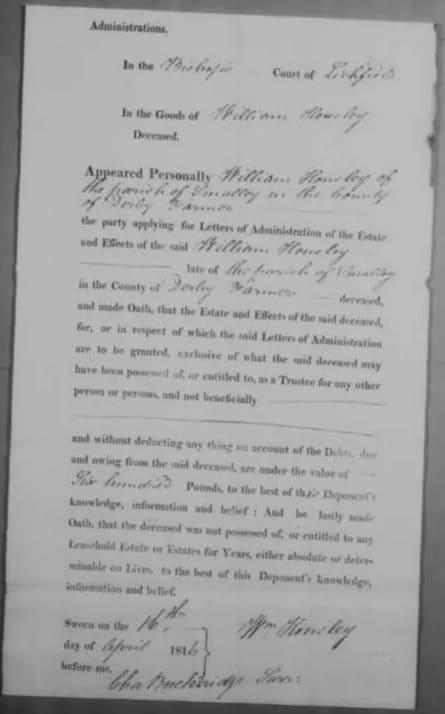
I transcribed three pages of this document, which was mostly repeated legal jargon. It appears that William Housley the elder died intestate, but that William the younger claimed that he was the sole heir. £1200 is mentioned to be held until the following year until such time that there is certainty than no will was found and so on. On the last page “no more than £600” is mentioned and I can’t quite make out why both figures are mentioned! However, either would have been a considerable sum in 1816.
I also found a land tax register in William Housley’s the elders name in Smalley (as William the son would have been too young at the time, in 1798). William the elder was an occupant of one of his properties, and paid tax on two others, with other occupants named, so presumably he owned three properties in Smalley.
The only likely marriage for William Housley was in Selston. William Housley married Elizabeth Woodhead in 1777. It was a miracle that I found it, because the transcription on the website said 1797, which would have been too late to be ours, as William the son was born in 1781, but for some reason I checked the image and found that it was clearly 1777, listed between entries for 1776 and 1778. (I reported the transcription error.) There were no other William Housley marriages recorded during the right time frame in Selston or in the vicinity.
I found a birth registered for William the elder in Selston in 1735. Notwithstanding there may be pages of the register missing or illegible, in the absence of any other baptism registration, we must assume this is our William, in which case he married rather late in his 40s. It would seem he didn’t have a previous wife, as William the younger claims to be the sole heir to his fathers estate. I haven’t found any other children registered to the couple, which is also unusual, and the only death I can find for an Elizabeth Housley prior to 1815 (as William the elder was a widower when he died) is in Selston in 1812. I’m not convinced that this is the death of William’s wife, however, as they were living in Smalley ~ at least, they were living in Smalley in 1798, according to the tax register, and William was living in Smalley when he died in 1815.
February 5, 2022 at 10:50 am #6271In reply to: The Elusive Samuel Housley and Other Family Stories
The Housley Letters
FRIENDS AND NEIGHBORS
from Barbara Housley’s Narrative on the Letters:
George apparently asked about old friends and acquaintances and the family did their best to answer although Joseph wrote in 1873: “There is very few of your old cronies that I know of knocking about.”
In Anne’s first letter she wrote about a conversation which Robert had with EMMA LYON before his death and added “It (his death) was a great trouble to Lyons.” In her second letter Anne wrote: “Emma Lyon is to be married September 5. I am going the Friday before if all is well. There is every prospect of her being comfortable. MRS. L. always asks after you.” In 1855 Emma wrote: “Emma Lyon now Mrs. Woolhouse has got a fine boy and a pretty fuss is made with him. They call him ALFRED LYON WOOLHOUSE.”
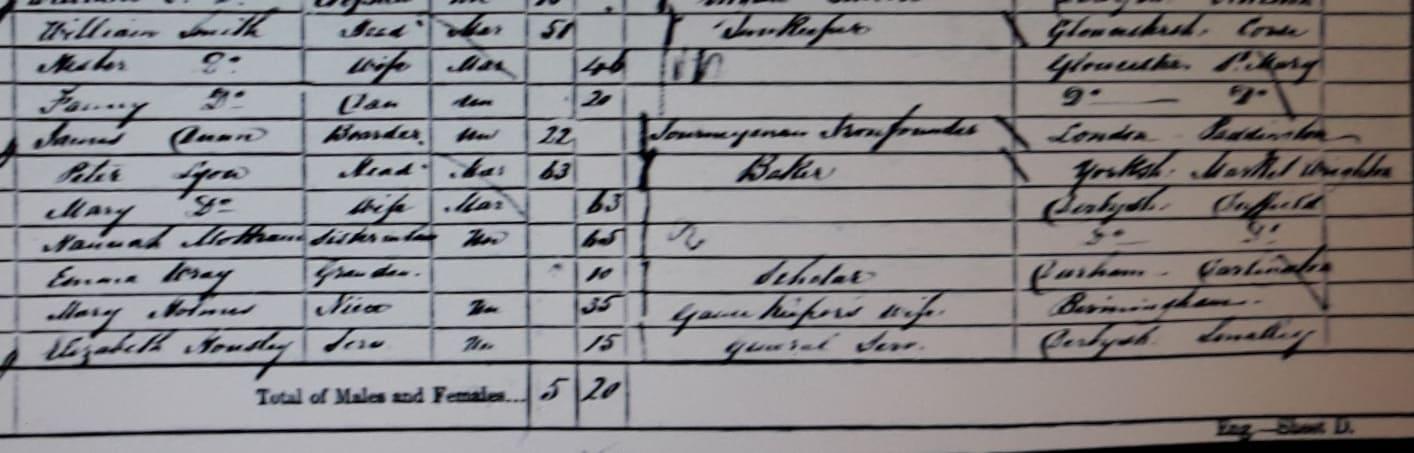
(Interesting to note that Elizabeth Housley, the eldest daughter of Samuel and Elizabeth, was living with a Lyon family in Derby in 1861, after she left Belper workhouse. The Emma listed on the census in 1861 was 10 years old, and so can not be the Emma Lyon mentioned here, but it’s possible, indeed likely, that Peter Lyon the baker was related to the Lyon’s who were friends of the Housley’s. The mention of a sea captain in the Lyon family begs the question did Elizabeth Housley meet her husband, George William Stafford, a seaman, through some Lyon connections, but to date this remains a mystery.)
Elizabeth Housley living with Peter Lyon and family in Derby St Peters in 1861:
A Henrietta Lyon was married in 1860. Her father was Matthew, a Navy Captain. The 1857 Derby Directory listed a Richard Woolhouse, plumber, glazier, and gas fitter on St. Peter’s Street. Robert lived in St. Peter’s parish at the time of his death. An Alfred Lyon, son of Alfred and Jemima Lyon 93 Friargate, Derby was baptised on December 4, 1877. An Allen Hewley Lyon, born February 1, 1879 was baptised June 17 1879.
Anne wrote in August 1854: “KERRY was married three weeks since to ELIZABETH EATON. He has left Smith some time.” Perhaps this was the same person referred to by Joseph: “BILL KERRY, the blacksmith for DANIEL SMITH, is working for John Fletcher lace manufacturer.” According to the 1841 census, Elizabeth age 12, was the oldest daughter of Thomas and Rebecca Eaton. She would certainly have been of marriagable age in 1854. A William Kerry, age 14, was listed as a blacksmith’s apprentice in the 1851 census; but another William Kerry who was 29 in 1851 was already working for Daniel Smith as a blacksmith. REBECCA EATON was listed in the 1851 census as a widow serving as a nurse in the John Housley household. The 1881 census lists the family of William Kerry, blacksmith, as Jane, 19; William 13; Anne, 7; and Joseph, 4. Elizabeth is not mentioned but Bill is not listed as a widower.
Anne also wrote in 1854 that she had not seen or heard anything of DICK HANSON for two years. Joseph wrote that he did not know Old BETTY HANSON’S son. A Richard Hanson, age 24 in 1851, lived with a family named Moore. His occupation was listed as “journeyman knitter.” An Elizabeth Hanson listed as 24 in 1851 could hardly be “Old Betty.” Emma wrote in June 1856 that JOE OLDKNOW age 27 had married Mrs. Gribble’s servant age 17.
Anne wrote that “JOHN SPENCER had not been since father died.” The only John Spencer in Smalley in 1841 was four years old. He would have been 11 at the time of William Housley’s death. Certainly, the two could have been friends, but perhaps young John was named for his grandfather who was a crony of William’s living in a locality not included in the Smalley census.
TAILOR ALLEN had lost his wife and was still living in the old house in 1872. JACK WHITE had died very suddenly, and DR. BODEN had died also. Dr. Boden’s first name was Robert. He was 53 in 1851, and was probably the Robert, son of Richard and Jane, who was christened in Morely in 1797. By 1861, he had married Catherine, a native of Smalley, who was at least 14 years his junior–18 according to the 1871 census!
Among the family’s dearest friends were JOSEPH AND ELIZABETH DAVY, who were married some time after 1841. Mrs. Davy was born in 1812 and her husband in 1805. In 1841, the Kidsley Park farm household included DANIEL SMITH 72, Elizabeth 29 and 5 year old Hannah Smith. In 1851, Mr. Davy’s brother William and 10 year old Emma Davy were visiting from London. Joseph reported the death of both Davy brothers in 1872; Joseph apparently died first.
Mrs. Davy’s father, was a well known Quaker. In 1856, Emma wrote: “Mr. Smith is very hearty and looks much the same.” He died in December 1863 at the age of 94. George Fox, the founder of the Quakers visited Kidsley Park in 1650 and 1654.
Mr. Davy died in 1863, but in 1854 Anne wrote how ill he had been for two years. “For two last winters we never thought he would live. He is now able to go out a little on the pony.” In March 1856, his wife wrote, “My husband is in poor health and fell.” Later in 1856, Emma wrote, “Mr. Davy is living which is a great wonder. Mrs. Davy is very delicate but as good a friend as ever.”
In The Derbyshire Advertiser and Journal, 15 May 1863:
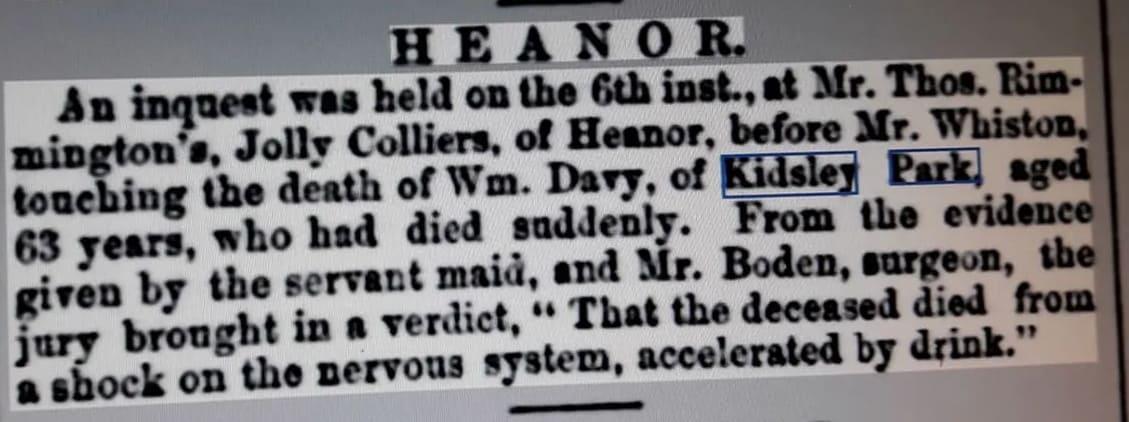
Whenever the girls sent greetings from Mrs. Davy they used her Quaker speech pattern of “thee and thy.” Mrs. Davy wrote to George on March 21 1856 sending some gifts from his sisters and a portrait of their mother–“Emma is away yet and A is so much worse.” Mrs. Davy concluded: “With best wishes for thy health and prosperity in this world and the next I am thy sincere friend.”
Mrs. Davy later remarried. Her new husband was W.T. BARBER. The 1861 census lists William Barber, 35, Bachelor of Arts, Cambridge, living with his 82 year old widowed mother on an 135 acre farm with three servants. One of these may have been the Ann who, according to Joseph, married Jack Oldknow. By 1871 the farm, now occupied by William, 47 and Elizabeth, 57, had grown to 189 acres. Meanwhile, Kidsley Park Farm became the home of the Housleys’ cousin Selina Carrington and her husband Walker Martin. Both Barbers were still living in 1881.
Mrs. Davy was described in Kerry’s History of Smalley as “an accomplished and exemplary lady.” A piece of her poetry “Farewell to Kidsley Park” was published in the history. It was probably written when Elizabeth moved to the Barber farm. Emma sent one of her poems to George. It was supposed to be about their house. “We have sent you a piece of poetry that Mrs. Davy composed about our ‘Old House.’ I am sure you will like it though you may not understand all the allusions she makes use of as well as we do.”
Kiddsley Park Farm, Smalley, in 1898. (note that the Housley’s lived at Kiddsley Grange Farm, and the Davy’s at neighbouring Kiddsley Park Farm)
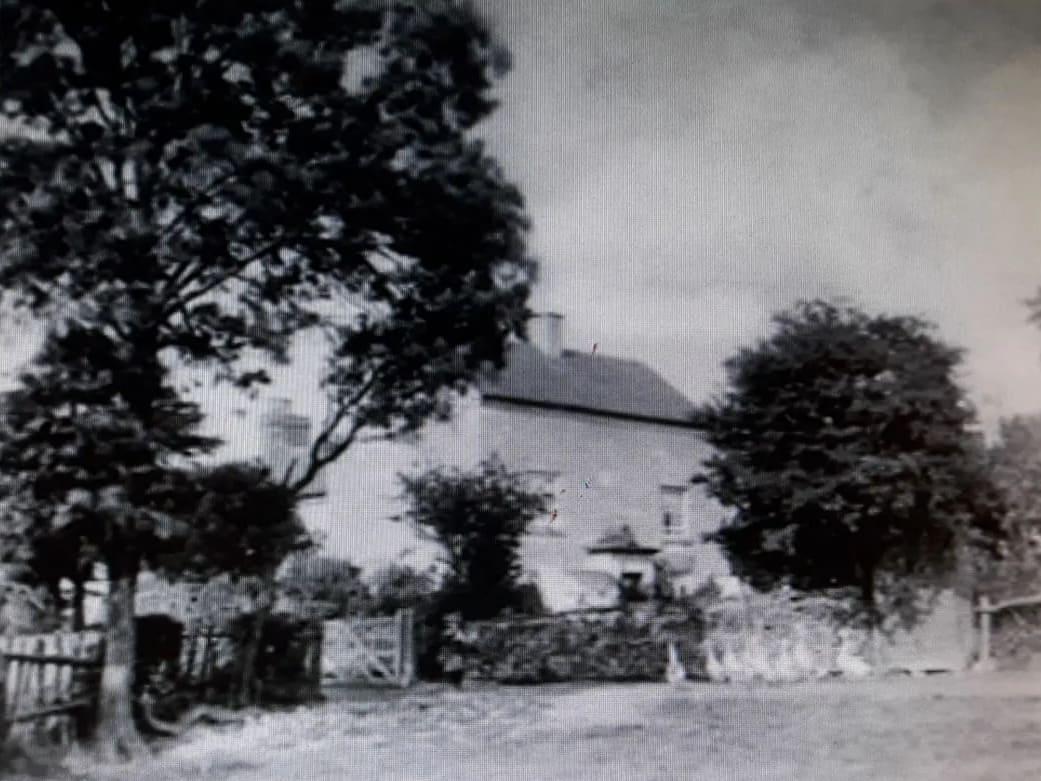
Emma was not sure if George wanted to hear the local gossip (“I don’t know whether such little particulars will interest you”), but shared it anyway. In November 1855: “We have let the house to Mr. Gribble. I dare say you know who he married, Matilda Else. They came from Lincoln here in March. Mrs. Gribble gets drunk nearly every day and there are such goings on it is really shameful. So you may be sure we have not very pleasant neighbors but we have very little to do with them.”
John Else and his wife Hannah and their children John and Harriet (who were born in Smalley) lived in Tag Hill in 1851. With them lived a granddaughter Matilda Gribble age 3 who was born in Lincoln. A Matilda, daughter of John and Hannah, was christened in 1815. (A Sam Else died when he fell down the steps of a bar in 1855.)
January 23, 2022 at 6:59 pm #6258In reply to: The Elusive Samuel Housley and Other Family Stories
The Buxton Marshalls
and the DNA Match
Several years before I started researching the family tree, a friend treated me to a DNA test just for fun. The ethnicity estimates were surprising (and still don’t make much sense): I am apparently 58% Scandinavian, 37% English, and a little Iberian, North African, and even a bit Nigerian! My ancestry according to genealogical research is almost 100% Midlands English for the past three hundred years.
Not long after doing the DNA test, I was contacted via the website by Jim Perkins, who had noticed my Marshall name on the DNA match. Jim’s grandfather was James Marshall, my great grandfather William Marshall’s brother. Jim told me he had done his family tree years before the advent of online genealogy. Jim didn’t have a photo of James, but we had several photos with “William Marshall’s brother” written on the back.
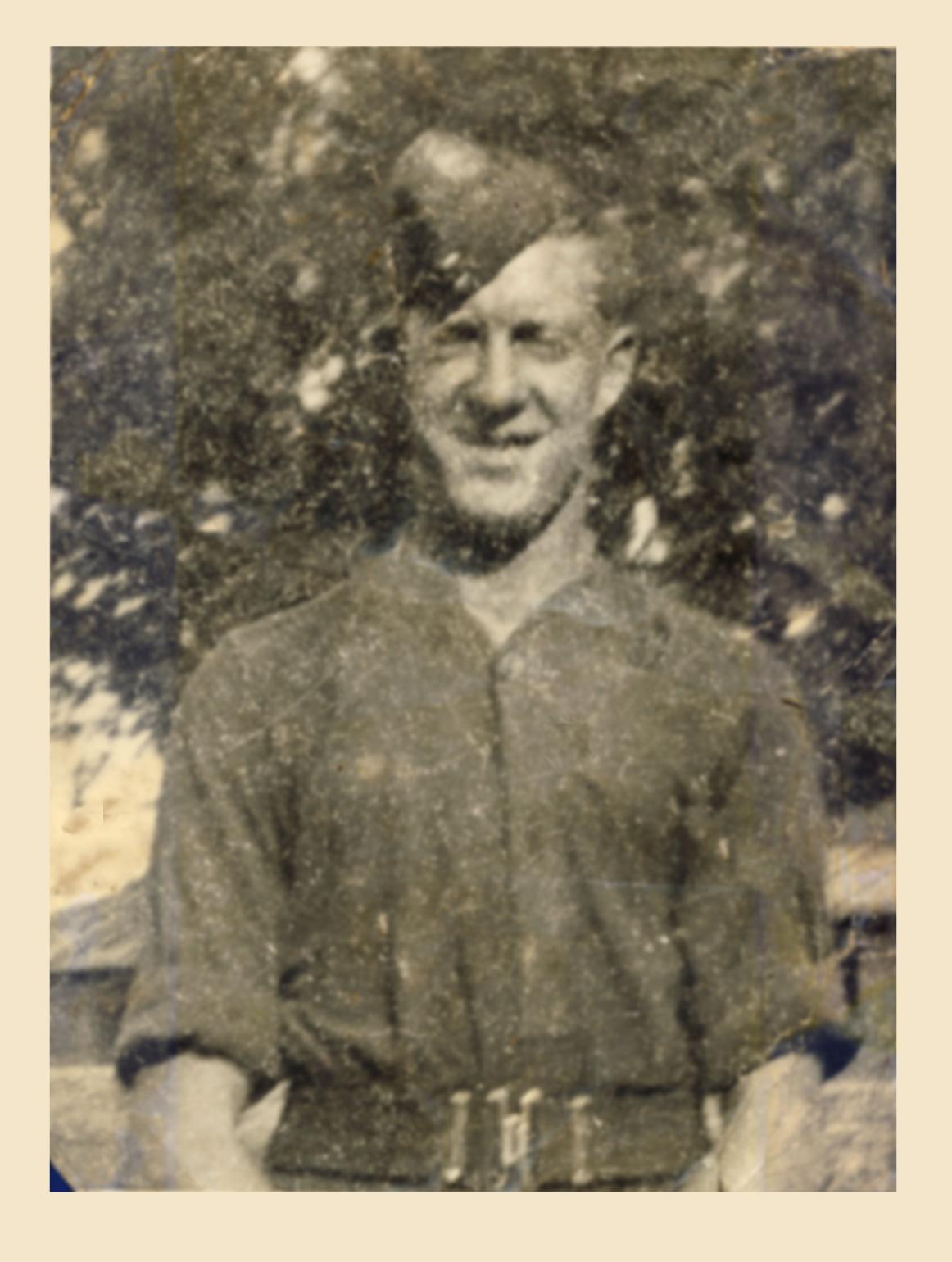
Jim sent me a photo of his uncle, the man he was named after. The photo shows Charles James Marshall in his army uniform. He escaped Dunkirk in 1940 by swimming out to a destroyer, apparently an excellent swimmer. Sadly he was killed, aged 25 and unmarried, on Sep 2 1942 at the Battle of Alma-Halfa in North Africa. Jim was born exactly one year later.
Jim and I became friends on Facebook. In 2021 a relative kindly informed me that Jim had died. I’ve since been in contact with his sister Marilyn. Jim’s grandfather James Marshall was the eldest of John and Emma’s children, born in 1873. James daughter with his first wife Martha, Hilda, married James Perkins, Jim and Marilyn’s parents. Charles James Marshall who died in North Africa was James son by a second marriage. James was a railway engine fireman on the 1911 census, and a retired rail driver on the 1939 census.
Charles James Marshall 1917-1942 died at the Battle of Alma-Halfa in North Africa:
photo thanks to Jim Perkins
Anna Marshall, born in 1875, was a dressmaker and never married. She was still living with her parents John and Emma in Buxton on the 1921 census. One the 1939 census she was still single at the age of 66, and was living with John J Marshall born 1916. Perhaps a nephew?
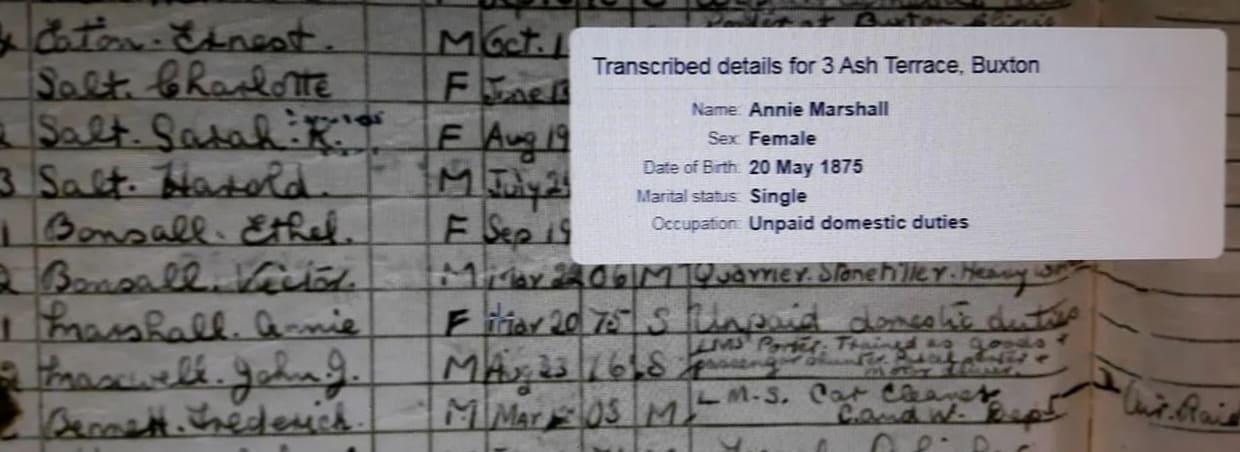
John Marshall was born in 1877. Buxton is a spa town with many hotels, and John was the 2nd porter living in at the Crescent Hotel on the 1901 census, although he married later that year. In the 1911 census John was married with three children and living in Fairfield, Buxton, and his occupation was Hotel Porter and Boots. John and Alice had four children, although one son died in infancy, leaving two sons and a daughter, Lily.
My great grandfather William Marshall was born in 1878, and Edward Marshall was born in 1880. According to the family stories, one of William’s brothers was chief of police in Lincolnshire, and two of the family photos say on the back “Frank Marshall, chief of police Lincolnshire”. But it wasn’t Frank, it was Edward, and it wasn’t Lincolnshire, it was Lancashire.
The records show that Edward Marshall was a hotel porter at the Pulteney Hotel in Bath, Somerset, in 1901. Presumably he started working in hotels in Buxton prior to that. James married Florence in Bath in 1903, and their first four children were born in Bath. By 1911 the family were living in Salmesbury, near Blackburn Lancashire, and Edward was a police constable. On the 1939 census, James was a retired police inspector, still living in Lancashire. Florence and Edward had eight children.
It became clear that the two photographs we have that were labeled “Frank Marshall Chief of police” were in fact Edward, when I noticed that both photos were taken by a photographer in Bath. They were correctly labeled as the policeman, but we had the name wrong.
Edward and Florence Marshall, Bath, Somerset:
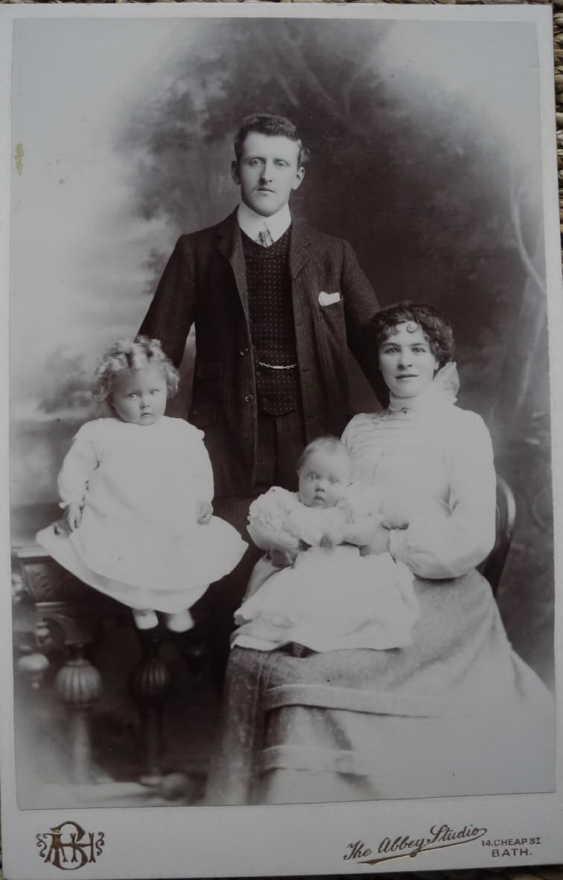
Sarah Marshall was born in 1882 and died two years later.
Nellie Marshall was born in 1885 and I have not yet found a marriage or death for her.
Harry Marshall was John and Emma’s next child, born in 1887. On the 1911 census Harry is 24 years old, and lives at home with his parents and sister Ann. His occupation is a barman in a hotel. I haven’t yet found any further records for Harry.
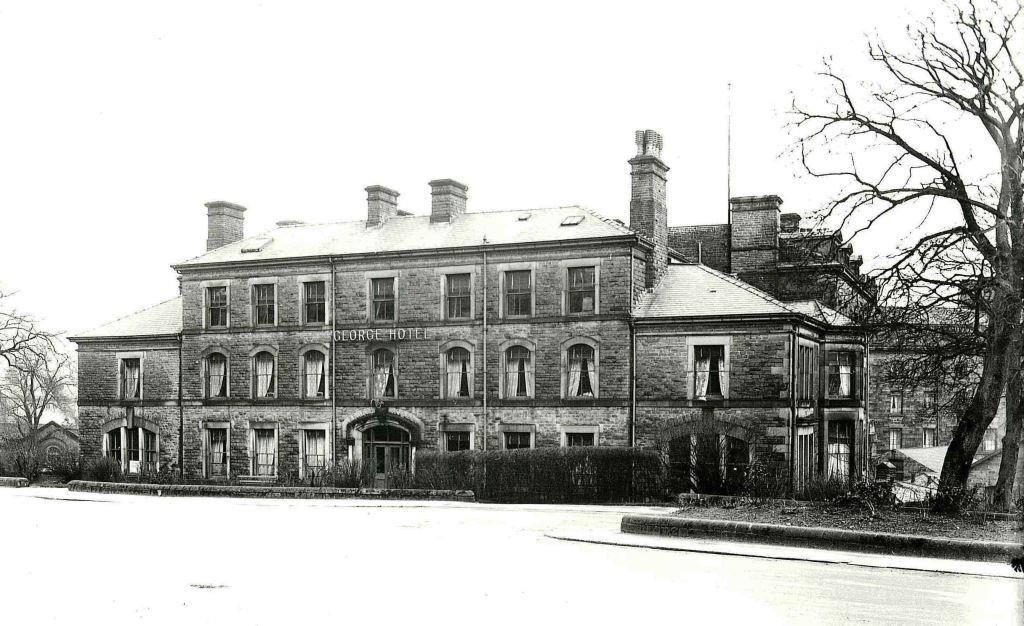
Frank Marshall was the youngest, born in 1889. In 1911 Frank was living at the George Hotel in Buxton, employed as a boot boy. Also listed as live in staff at the hotel was Lily Moss, a kitchenmaid.
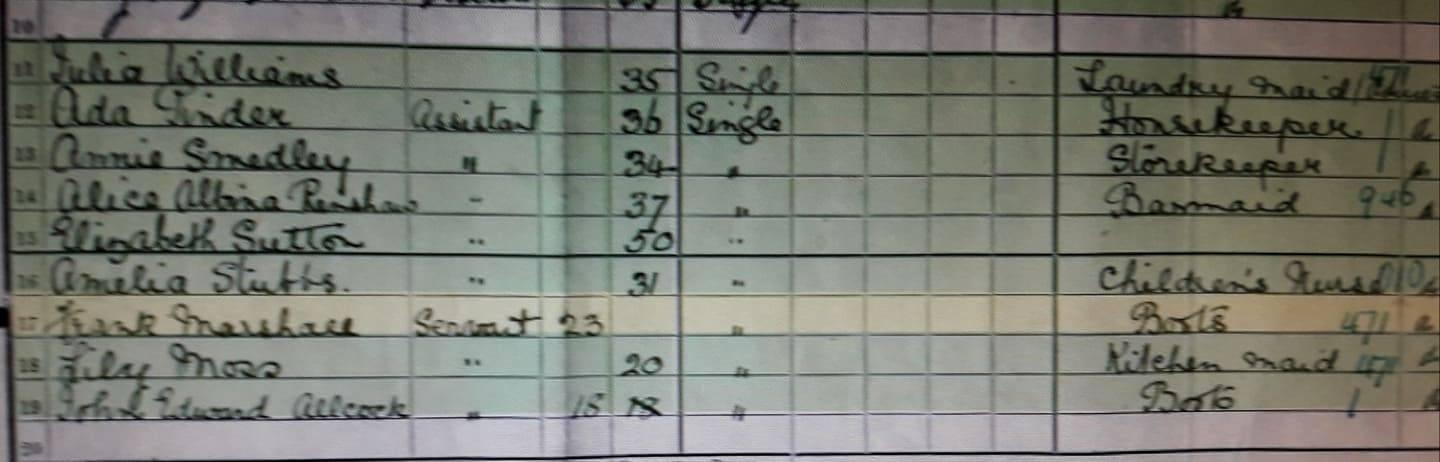
In 1913 Frank and Lily were married, and in 1914 their first child Millicent Rose was born. On the 1921 census Frank, Lily, William Rose and one other (presumably Millicent Rose) were living in Hartington Upper Quarter, Buxton.
The George Hotel, Buxton:
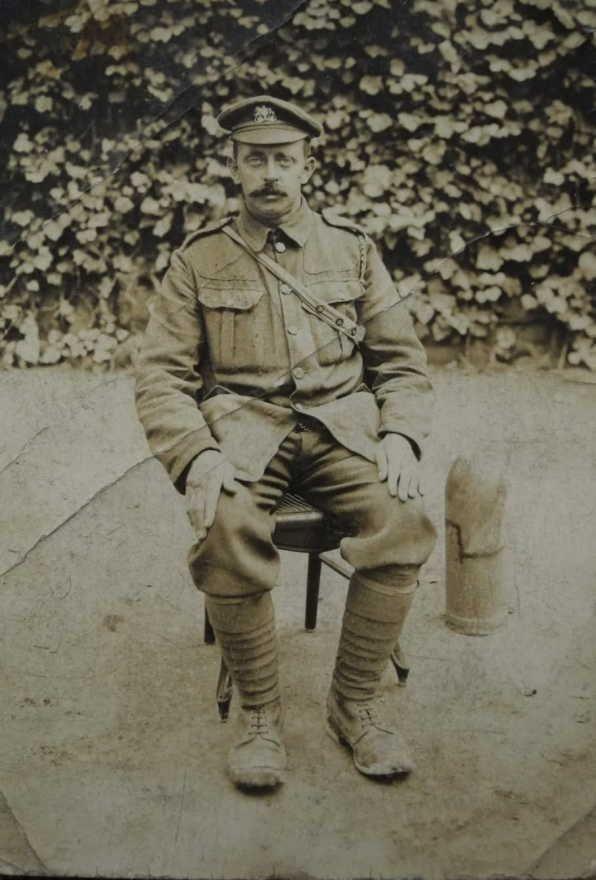
One of the photos says on the back “Jack Marshall, brother of William Marshall, WW1”:
Another photo that says on the back “William Marshalls brother”:
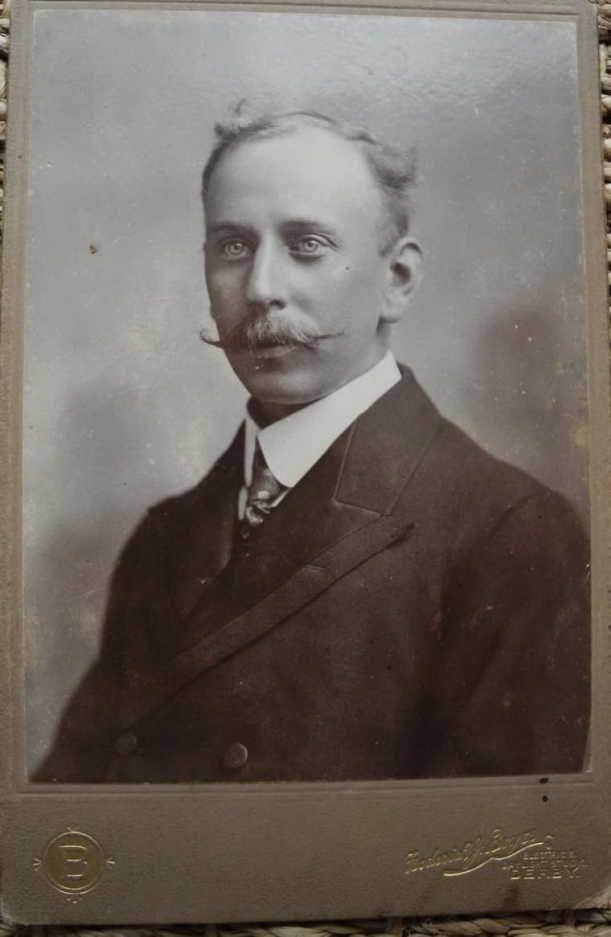
Another “William Marshalls brother”:
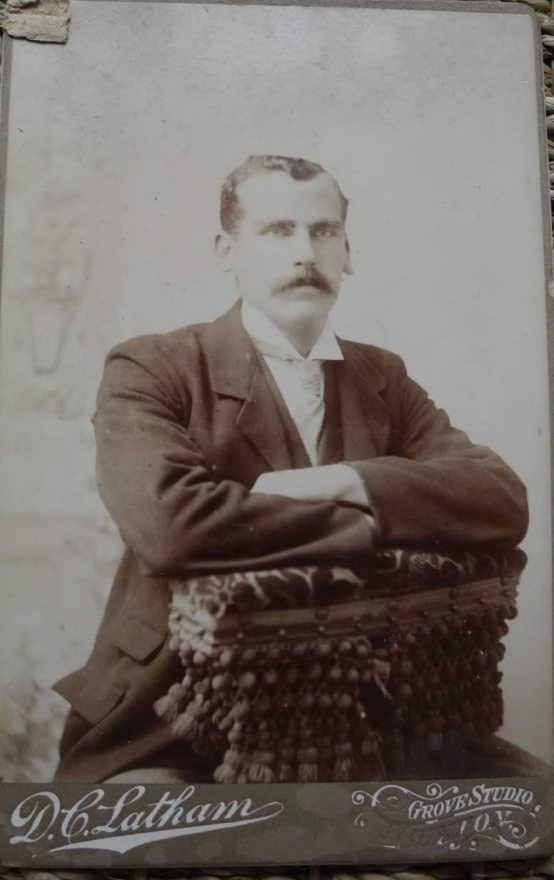
And another “William Marshalls brother”:
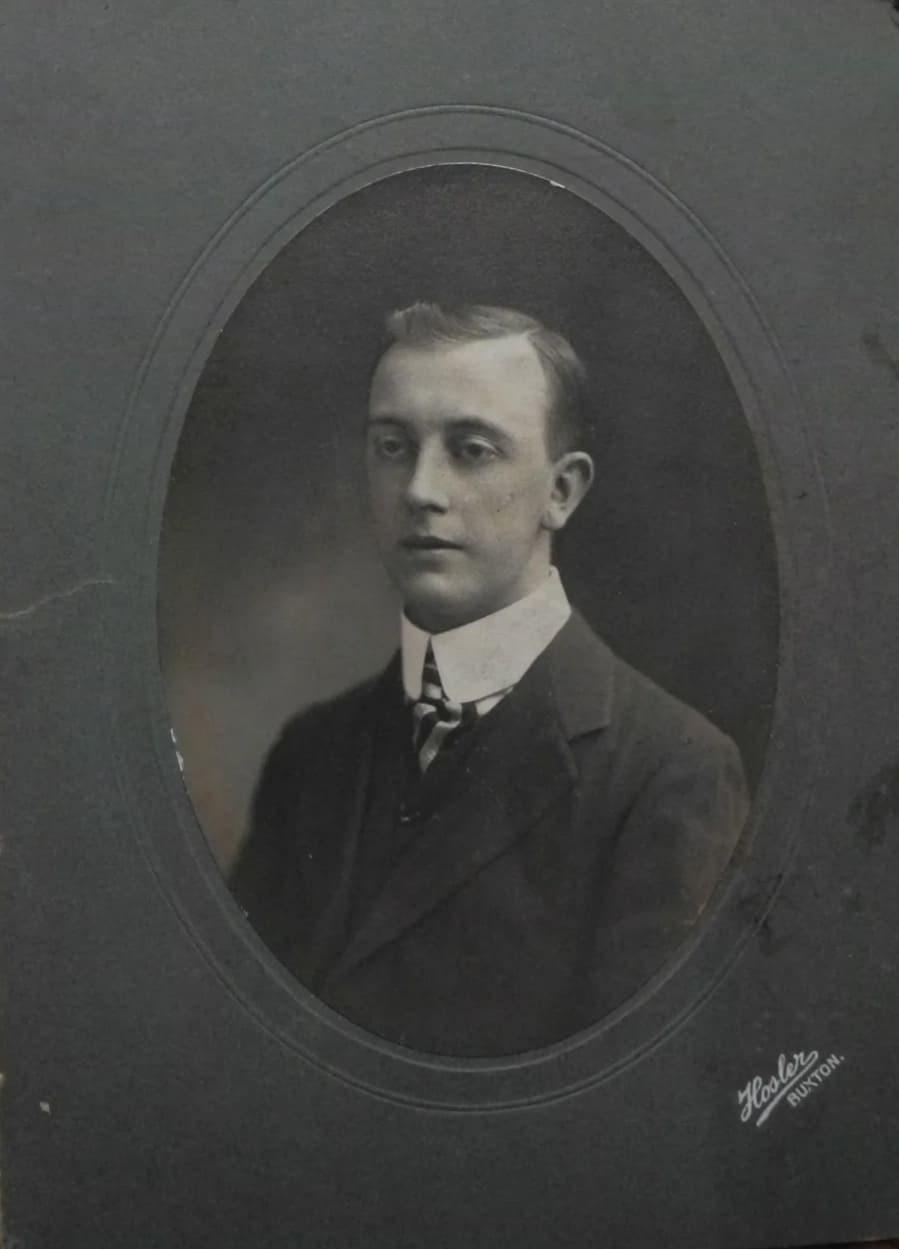
Unlabeled but clearly a Marshall:
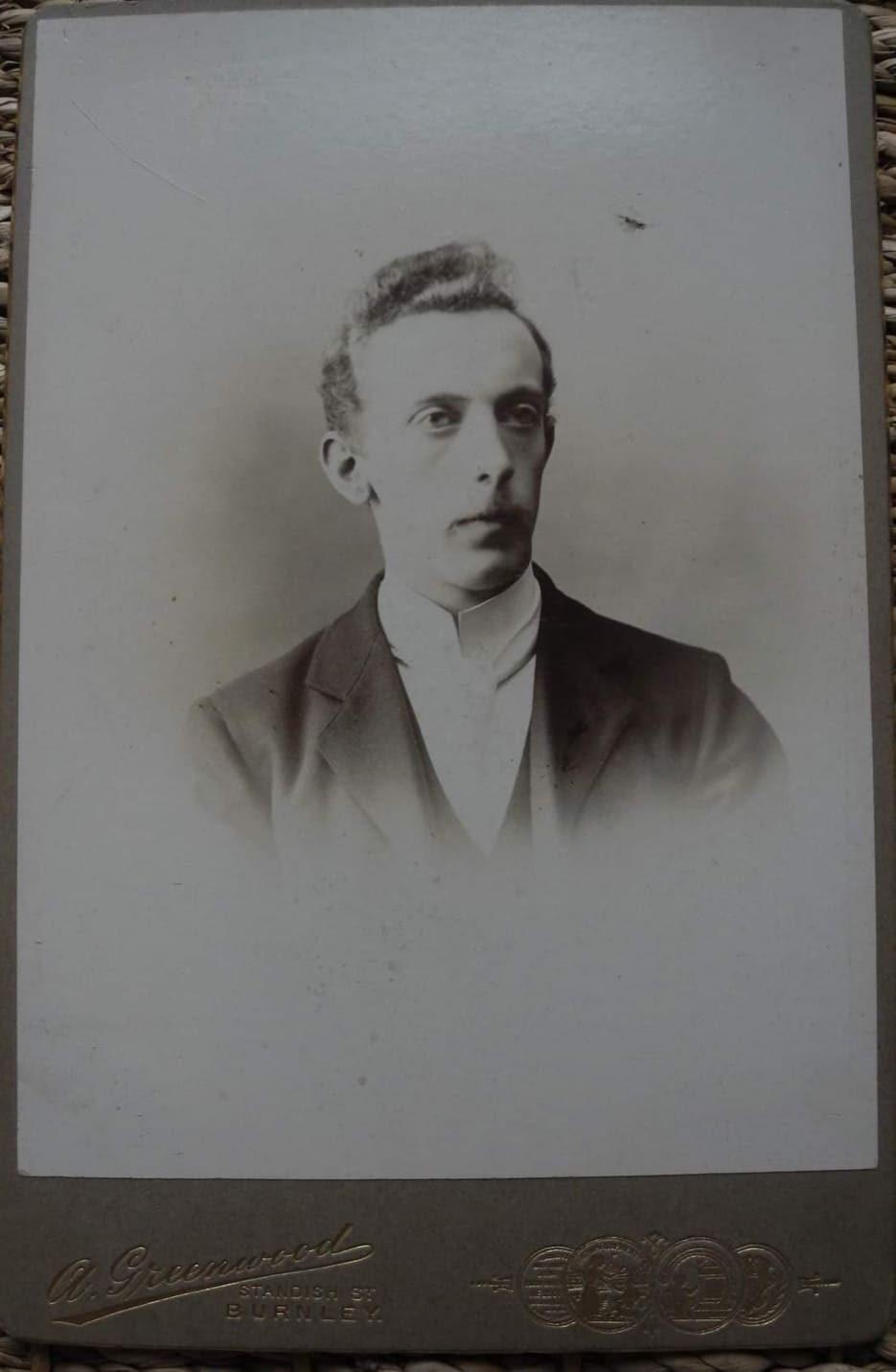
The last photo is clearly a Marshall, but I haven’t yet found a Burnley connection with any of the Marshall brothers.
December 18, 2021 at 7:05 pm #6246In reply to: The Elusive Samuel Housley and Other Family Stories
Florence Nightingale Gretton
1881-1927
Florence’s father was Richard Gretton, a baker in Swadlincote, Derbyshire. When Richard married Sarah Orgill in 1861, they lived with her mother, a widow, in Measham, Ashby de la Zouch in Leicestershire. On the 1861 census Sarah’s mother, Elizabeth, is a farmer of two acres.
(Swadlincote and Ashby de la Zouch are on the Derbyshire Leicestershire border and not far from each other. Swadlincote is near to Burton upon Trent which is sometimes in Staffordshire, sometimes in Derbyshire. Newhall, Church Gresley, and Swadlincote are all very close to each other or districts in the same town.)
Ten years later in 1871 Richard and Sarah have their own place in Swadlincote, he is a baker, and they have four children. A fourteen year old apprentice or servant is living with them.
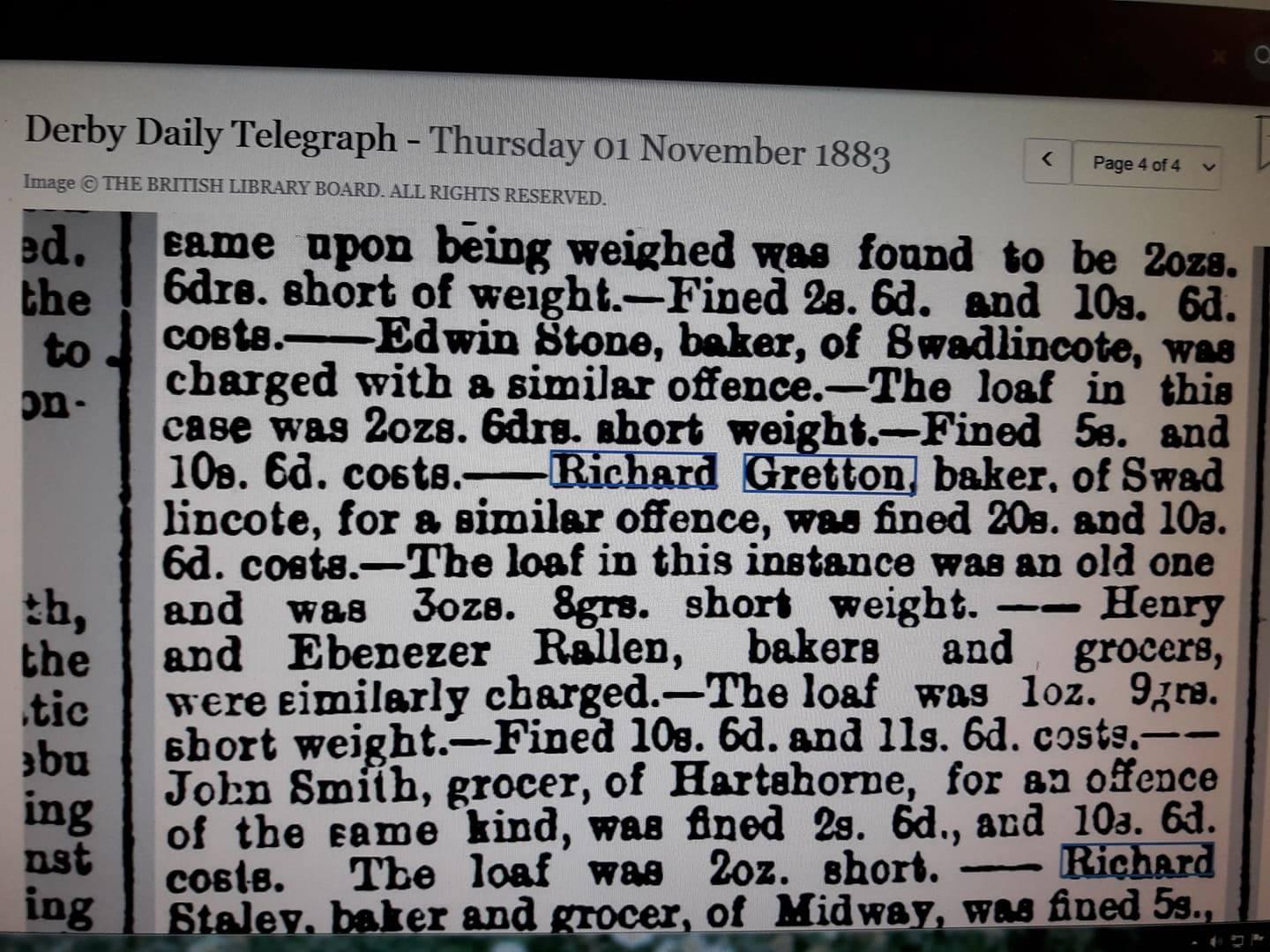
In the Ashby-de-la-Zouch Gazette on 28 February 1880, it was reported that Richard Gretton, baker, of Swadlincote, was charged by Captain Bandys with carrying bread in a cart for sale, the said cart not being provided with scales and weights, according to the requirements of the Act, on the 17th January last.—Defendant pleaded guilty, but urged in extenuation of the offence that in the hurry he had forgotten to put the scales in the cart before his son started.—The Bench took this view of the case, regarding it as an oversight, and fined him one shilling only and costs. This was not his only offence.
In 1883, he was fined twenty shillings, and ten shillings and sixpence costs.
By 1881 they have 4 more children, and Florence Nightingale is the youngest at four months. Richard is 48 by now, and Sarah is 44. Florence’s older brother William is a blacksmith.
Interestingly on the same census page, two doors down Thomas and Selina Warren live at the Stanhope Arms. Richards son John Gretton lives at the pub, a 13 year old servant. Incidentally, I noticed on Thomas and Selena’s marriage register that Richard and Sarah Gretton were the witnesses at the wedding.
Ten years later in 1891, Florence Nightingale and her sister Clara are living with Selina Warren, widow, retired innkeeper, one door down from the Stanhope Arms. Florence is ten, Clara twelve and they are scholars.
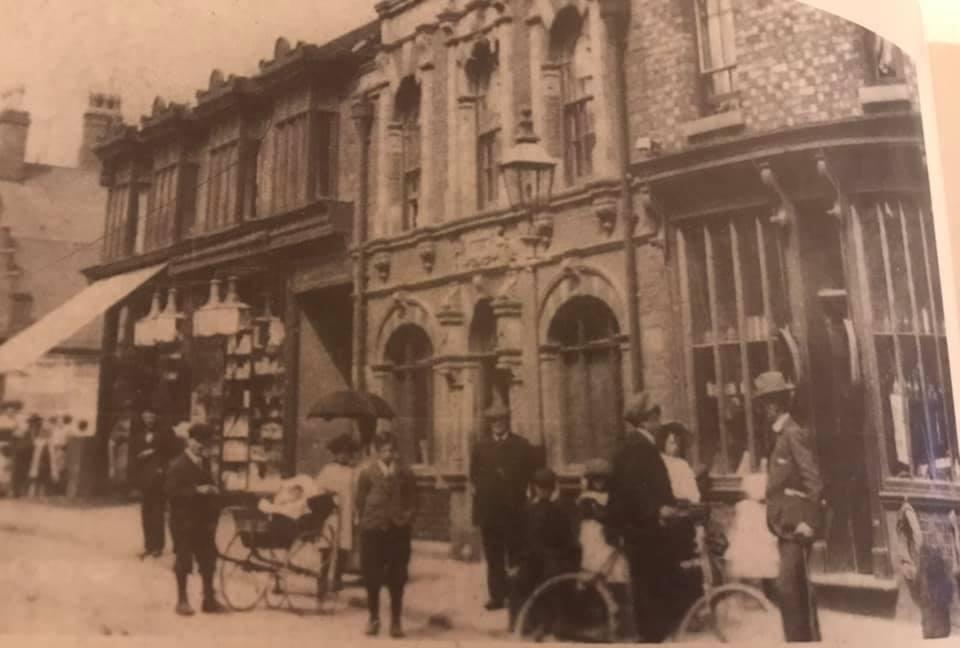
Richard and Sarah are still living three doors up on the other side of the Stanhope Arms, with three of their sons. But the two girls lived up the road with the Warren widow!The Stanhope Arms, Swadlincote: it’s possible that the shop with the awning was Richard Gretton’s bakers shop (although not at the time of this later photo).
Richard died in 1898, a year before Florence married Samuel Warren.
Sarah is a widowed 60 year old baker on the 1901 census. Her son 26 year old son Alf, also a baker, lives at the same address, as does her 22 year old daughter Clara who is a district nurse.
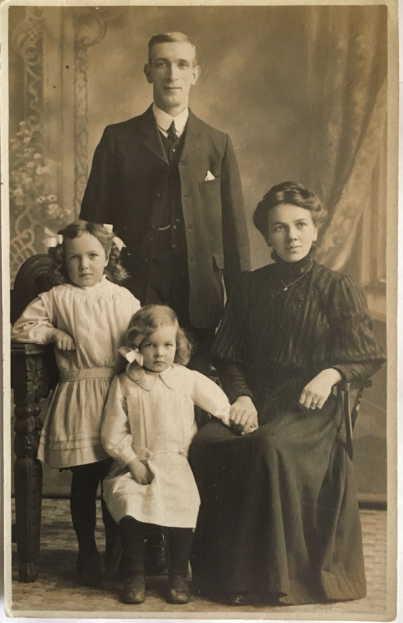
Clara Gretton and family, photo found online:
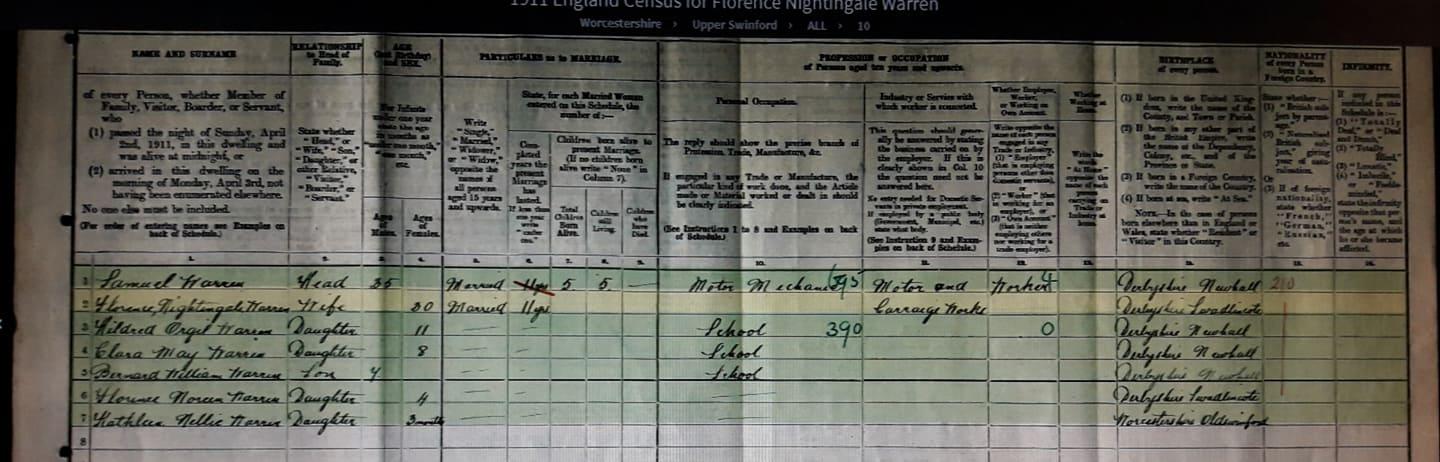
In 1901 Florence Nightingale (who we don’t have a photograph of!) is now married and is Florrie Warren on the census, and she, her husband Samuel, and their one year old daughter Hildred are visitors at the address of Elizabeth (Staley)Warren, 60 year old widow and Samuel’s mother, and Samuel’s 36 year old brother William. Samuel and William are engineers.
Samuel and Florrie had ten children between 1900 and 1925 (and all but two of them used their middle name and not first name: my mother and I had no idea until I found all the records. My grandmother Florence Noreen was known as Nora, which we knew of course, uncle Jack was actually Douglas John, and so on).
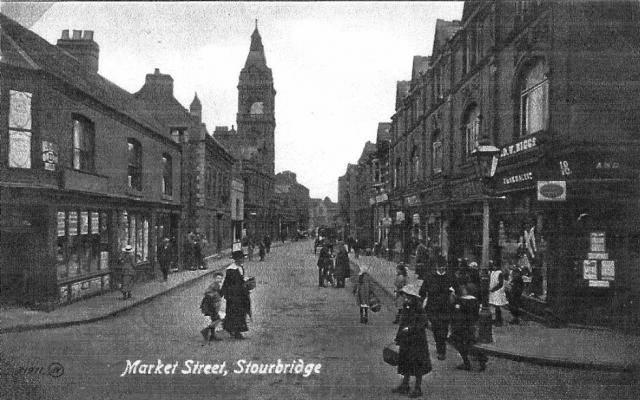
Hildred, Clara, Billy, and Nora were born in Swadlincote. Sometime between my grandmother’s birth in 1907 and Kay’s birth in 1911, the family moved to Oldswinford, in Stourbridge. Later they moved to Market Street.
1911 census, Oldswinford, Stourbridge:
Oddly, nobody knew when Florrie Warren died. My mothers cousin Ian Warren researched the Warren family some years ago, while my grandmother was still alive. She contributed family stories and information, but couldn’t remember if her mother died in 1929 or 1927. A recent search of records confirmed that it was the 12th November 1927.
She was 46 years old. We were curious to know how she died, so my mother ordered a paper copy of her death certificate. It said she died at 31 Market Street, Stourbridge at the age of 47. Clara May Warren, her daughter, was in attendance. Her husband Samuel Warren was a motor mechanic. The Post mortem was by Percival Evans, coroner for Worcestershire, who clarified the cause of death as vascular disease of the heart. There was no inquest. The death was registered on 15 Nov 1927.
I looked for a photo of 31 Market Street in Stourbridge, and was astonished to see that it was the house next door to one I lived in breifly in the 1980s. We didn’t know that the Warren’s lived in Market Street until we started searching the records.
Market Street, Stourbridge. I lived in the one on the corner on the far right, my great grandmother died in the one next door.
I found some hitherto unknown emigrants in the family. Florence Nightingale Grettons eldest brother William 1861-1940 stayed in Swadlincote. John Orgill Gretton born in 1868 moved to Trenton New Jersey USA in 1888, married in 1892 and died in 1949 in USA. Michael Thomas born in 1870 married in New York in 1893 and died in Trenton in 1940. Alfred born 1875 stayed in Swadlincote. Charles Herbert born 1876 married locally and then moved to Australia in 1912, and died in Victoria in 1954. Clara Elizabeth was a district nurse, married locally and died at the age of 99.
December 15, 2021 at 8:14 am #6235In reply to: The Elusive Samuel Housley and Other Family Stories
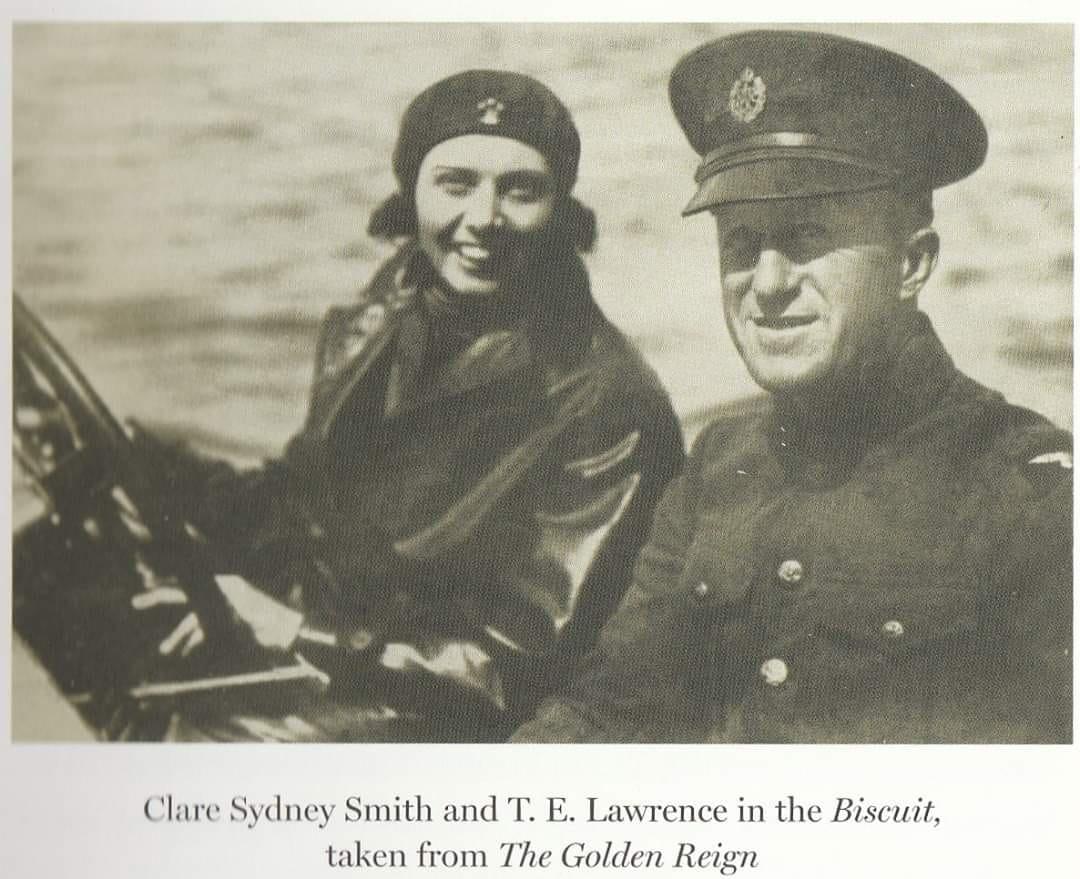
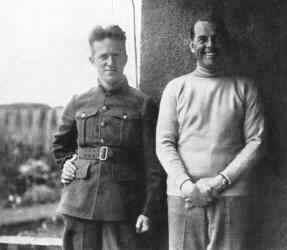
Sydney Smith and Lawrence of Arabia
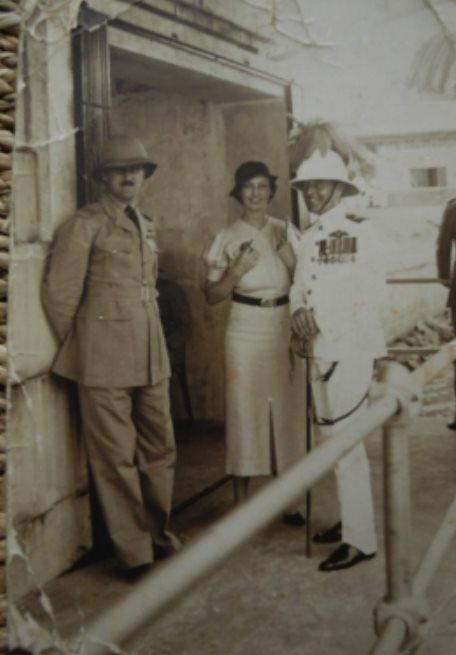
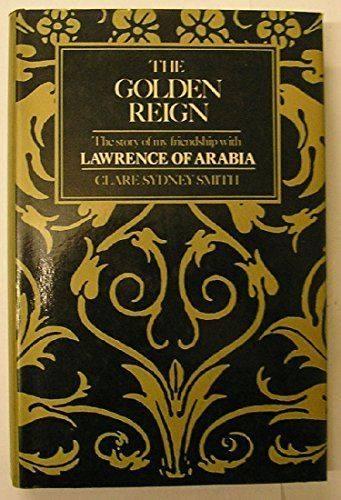
Hannah Warren 1865-1946 was my great grandfather Samuel’s sister. Hannah married Charles Smith, and their son was Sydney Smith 1888-1971, Lawrence of Arabia’s commanding officer. Sydney’s wife, Clare Sydney Smith, wrote a book about their friendship with Lawrence of Arabia called The Golden Reign.
This photograph of Sydney Smith and Clare is in our collection of family photos. Written on the back: Sydney Smith son of Hannah Smith sister of Samuel Warren married Clare Eustace Jameson, niece of Earl Haig.
The Burton Observer and Chronicle – Thursday 19 September 1940:
BURTONIANS’ FRIENDSHIP WITH EX-ARAB LEADER. By Clare Sydney Smith (Cassell, 12s. 6d.). general interest as an intimate study of the most romantic personality on the Allied side… this volume has distinctly local appeal, for the authoress, who is a niece of the late Earl Haig, is the wife of Mr Commodore Sydney Smith, eldest son of Mr. Charles Smith (former joint managing director of Allsopp’s). Her volume, on the whole, is a fascinating record of the devoted friendship which existed between Colonel Lawrence of Arabia, her husband and herself during the latter years of the one-time Arab leader’s life. Their acquaintance with Lawrence, alias Aircraftman T. E. Shaw, commenced with the Cairo Conference in 1920.
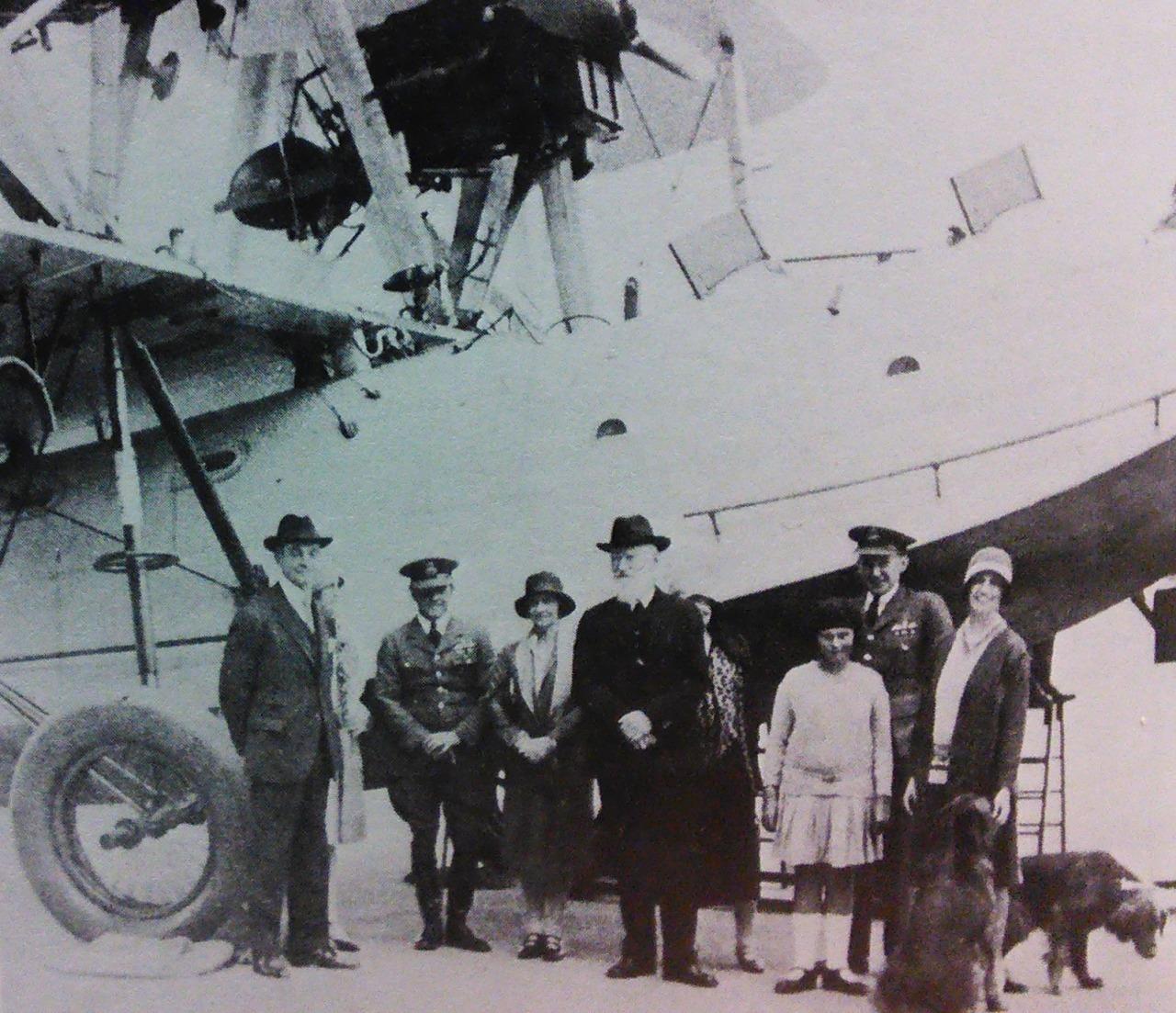
A photograph from the book: From left to right: Lord Astor, Wing-Commander Sydney Smith, Lady Astor, George Bernard Shaw, Charlotte Shaw (hiding behind GBS’s shoulder), Sydney’s daughter Maureen Sydney Smith, an unknown man, Clare Sydney Smith, and on the ladder, T.E.’s feet.
Also from Clare’s book:
Sydney Smith with Lawrence of Arabia:
 September 10, 2014 at 3:54 am #115
Topic: The Hosts of Mars
in forum Yurara Fameliki’s Stories2049. 22 years after the original settlers had landed on Mars, where they had since been followed by more and more pioneers looking for the next frontier of civilization.
A lot had changed since they arrived, they were now a few hundred strong, and the first generation of Martian born babies were entering adulthood.
Maia would celebrate her 50th birthday tonight. In Earth years. By Mars’ count, she was younger by half. Still, she was the eldest of the mission, and had learnt so much during these years. Her son, John had grown into a fine young man. He was named after John Carter of course. He wasn’t the first born here, but was the first to have survived. He always had the will to explore more, despite the dangers, he wanted to make the planet his own.
She knew he was destined to greatness. She had a dream a long time ago, one dream that made her enlist into the program. She’d dreamt of Mars as a lush planet, that mankind had managed to terraform with a vaporous atmosphere, more dense than on Earth, but breathable. The light of the evening sky was misty and a pale grey-green. Maia hoped she would live to see her dream come true, that somehow they found a way to venture out and breathe the new air, having succeeded in making the best out of the immense resources of the red dust planet.
January 4, 2013 at 11:53 am #2902In reply to: The Surge Team’s Coils
Madam Li was gorgeous in her red silk chinese dress. She might be the eldest of the Team, but she appeared to be one of the youngest. She was proud of her Chinese ancestry. The two golden dragons on her dress emphasized her silhouette and her hair artistically arranged like an empress.
She had just received the invitation to the Tartessos’ 3 King’s parade. Eventhough she didn’t much like travelling, it might be an occasion to go somewhere warmer. It was snowing again in Shanghai and she had been sent there to investigate this strange occurance in that part of the country. Not that it was really strange to her, she had been raised in Harbin, and its ice festival. But having cars half burried in snow in Shanghai was not a normal sight.
At the moment, she was staying at an over-heated serviced apartment near the Pearl Tower of Shanghai. One of the perks of being part of the Team. Ed had always offered them a good salary and an apartment provided with the job, and they could use the red fleet whenever the wanted.
When she had tried to open the window, and didn’t succeeded, the night sight from her window gave her chills. Reminding her that she so loved this city. All the lights, blinking in and out, creating organized or random patterns at every corner. The city had changed so much these last years.
Madam Li put the invitation on the table, she would think of it later and checked with the red fleet to book a flight as soon as she had found out about all that snow in Shanghai.
February 21, 2008 at 11:00 am #742In reply to: Circle of Eights, Stories
Due to the unusual events in the year 2026, Nishanti and her five sisters lived in the reconstructed ancient city of Hingapooloopi that had been submerged beneath the ocean for centuries. There had been a series of tsunami’s and eathquakes and volcanic eruptions resulting in an enormous hole appearing in the sea bed into which a considerable amount of Indian Ocean sea water had disappeared, lowering the sea levels in some locations, mainly those that had risen slightly due to shifting tectonic plates.
Ten year old Nishanti and her five sisters (Hinni, 3; Yaso, 5; Yuvani, 7; Eromi, 13; and Nanda, 16) had lost their parents, and indeed most of their relatives, due to an unfortunate mishap in the kitchens two years previously in the year 2032 at the wedding party of their brother, Chandra. Gayesh, Nishanti’s eldest brother had mistakenly included poisonous red berries in the desert. Fortunately, Nishanti and her sisters had been reading the Snoot Q&A column in The Tarty Nun girls magazine that they had procured without their parents knowledge from a school trip of American tourists, in which Snoot had advised against red fruits.
Hingapooloopi was located on the land bridge , once again exposed, between Sri Lanka and the Indian continent. The reconstruction had been an enormously interesting undertaking, and Nishanti’s uncle Roshan had been involved in the ground work excavations. He found many artifacts, which he smuggled off the building site, and secreted under the floorboards of the old family home in the highlands . Perhaps the most interesting one was the crystal skull; certainly it was the one that Nishanti found the most intriguing.
December 29, 2007 at 10:10 pm #615In reply to: Circle of Eights, Stories
From Georges and Salome’s diary
I woke up from my mediation, having seen those whom Georges refers to as “Guardians”. They looked deeply troubled. Apparently, they possess some kind of power that each of them share to an extent, at least the Eldest of them (or Jokans). With that power, they can travel in time and space and undo what another of them could have planted at some point in the canvas of their material reality.
It thus appears of extreme importance that their decisions are reached with unanimity, as they have come to experience. My own presumptions tell me of a time not so far from this now where they were more numerous, but that the competition may have quickly decimated —exhausted, most certainly— those who did not align with the more powerfully expressed movement. Or perhaps they simply parted in different probable versions of this World, which is an eventuality equally as presumable.
In any case, they were distraught over one in their ranks apparently doubting the decision they had just taken. They all knew of the consequence of one of them disagreeing, and it could nullify their efforts. It was thus of great importance that they come to understand, as much for the group as for the individual the source of his anguish. It seems some big changes are being planned…
December 11, 2007 at 10:17 pm #581In reply to: Circle of Eights, Stories
Aglaë had been reluctantly coming back to the games of her sisters, when Thalÿs, the eldest had come back from her trip.
She’d had trouble with one of her dolphins who had fallen ill, and had been seeking advice from one of the healers in another distant underwater city.Eufrosÿn, her other sister was listening to her account, and was amazed at the similarities between her sister’s depiction and her own recent dream imageries. But Aglaë, who was usually very fond of such bizarre coincidences, barely did more than a few silent nods.
Her mind was halfway here, and halfway there, with the mysterious life she had felt on the surface…
She wanted to come back, and a sudden impulse made her leave her sisters without an explanation and rush to her spot of observation.October 9, 2007 at 2:39 pm #269In reply to: Circle of Eights, Stories
Malvina had been busy opening doors for herself, and thus, for the All.
Creating the sabulmantium with Leörmn had revealed new potentials to her. And just before putting the final touch to the device, she had felt engulfed in a huge wave and before she knew it, she was talking with someone. A great creative power, which was stemming from herself, and also from which she stemmed too.
It had named itself Naasir.
It had revealed to her, in the form of a dark abyss, myriads of unknown potentials waiting for her to leap in faith into them. It had gently requested that she release her hold on the caves openings, so that she could explore more, and also bring more to herself.
Then Naasir took the form of a great dragon in that abyss, from which roots were growing and pushing their way, slowly and surely, into the rich soil towards the light of their fullness.
She had then seen the dragon’s arched back and tail shift into a chain of spiked rocks, separating the worlds seas in two. Three of the scales on the right of the dragon’s skin were glimmering, and she could see they were looking for a passage.
Would she allow that to happen? Yes, she wanted to. Open the doorways, and reunite what was separate, but gently, one at a time.
Slowly, the kite-shaped rocky plates on the back of the dragon moved apart, to open a slight, safe passage for the glimmering scales. They were caught in the eddies that surged from the opening, but Malvina’s focus helped them to float and cross safely, as they wanted to.
She then came back to herself, seated in front of the glass-shell dragon egg filled with coloured sand, awed with that power she had just felt through her. She knew it was her own power, and that the device had only allowed it to be expressed, but she had felt wary of how the sabulmantium could be used by others.
At the same time, Leörmn who was once again the tiny weaszchilla trotting on the wooden table in front of her had laughed squeakingly. And looking at the toy in front of her, she had understood how it could only be used by those who would see beyond the thinly veiled surface. For the uncaring eye, this would only be a toy, mundane and without interest, but for the pure of heart, its help could be harnessed.
That’s how she’d knew she did not need it any longer, and could release it.
So, the doors had been opened, and people were feeling the new jewels sparkling behind the dark passages. And gifts from friends could now come across the veils.
Malvina saw that during the last transmugrification, Leörmn had created an entrance near her laboratory, and it was as if it beckoned her now.
When she entered, she saw a guéridon table in the middle of a moistly pungent room. On the table, a polished egg was here. She recognized it at once. It had an azure blue glow to it, and fond memories came back to her.
Back then, she was a young Sorceress in training on the Island of Mörk, in the middle of the Icy Lands, the birth and dying place of the dragons.
This egg was one from a set of three. It was the first glubolín she’d ever made, along with her two companions. They had kept it to communicate with each other when they parted.
Malvina, the youngest of the three, had kept the azure blue, and chose to go to the Dragon Head Peninsula.
Oörlaith had kept the mauve, and went near the town of Kapalÿka, on the Snimeÿa River delta bordering the Marshes of Doom.
As for Roselÿn, the eldest of the three, she had taken the amber one, and had went as far as anyone would have dared go, flying on her spiked dragon Rëgkvist, past the Great Rift.
They had kept in touch, but contacts had been more and more sporadic as each were discovering their own new environments, and had ceased altogether, almost at the same time.
As far as she knew, Roselÿn had been starting her own rookery in the sandy ice deserts of Åsgurdy, mostly hiding there from the superstitious people of that land. And Oörlaith, whom she was closest to, had been devising another funny way to keep people away from her rookery. Her own dragon, the playful Andarión, was shape-shifting as a huge shrimp to pretend that the surroundings were haunted.
Recalling all these moment, Malvina laughed at how silly they all were, and felt a long to be connecting again with her friends. Would anyone of them be around their own glubolíns?
October 2, 2007 at 6:01 pm #248In reply to: Circle of Eights, Stories
New York, October, 4 th 2033
Albert had opened the newspaper, scanning distractedly through the various pages of text that would read aloud automatically when he was running his fingers through it. He was about to close it, when he noticed that article in the Life Focus section.

Dublin, October 5 th 2033
Sean Doran Wrick had received tons of phone calls, emails and voice mails of condolences since the past few weeks, but he had not found the strength to answer any of them. Especially those coming from his father.
That morning, he had received some letters that he would have left on top of the others, had he not recognized the round and cheerful calligraphy of Becky on one of them.
He had known Becky when they had traveled together in Syria, and had enjoyed so much the lively young woman that they had kept in touch during all those years.
He was pleased to read from her, and wanted to enjoy it fully.
So he took his time to put to bed Guinevere and Peregrine before. Guinevere was the eldest, very mature for her barely 11 year old. She took great care of her younger brother, who was more dreamy and foolish. Peregrine would turn 10 next March… but he was hardly as responsible as his sister when she was his age…
Dear Sean, Becky was writing
I would have liked to finally take the time to write to you in better conditions, but I could not delay any longer. I saw the obituary in the newspaper, and wanted you to know that I share your grief and loss, and extend much love and support to you and to your dear little ones.
I know you’re not the kind of person to be satisfied with banalities, so I will not dwell on this tragedy, and will remember the best moments we shared together.
I still continue my studies and practices on dramatherapy, and till now it has proved very beneficial, in many ways. I have learned so many things. It’s quite rewarding. We are a close-knit group of fools (or drôles as Al loves to say, as some of his ancestors come from the bayous!), and that is very much enjoyable when things that tragic come to one’s reality.
In case you feel like talking, don’t hesitate any moment, I’ll be here. Anytime.
Love,
Becky.
Orkney Islands, October 4 th, 2057
This year again, Sean Doran had not answered his father’s calls.
This September 23 th was the twenty fourth anniversary of the disengagement of Lord Wrick’s daughter-in-law, and this was always a very somber period for the family.
Hopefully, the twins were here to enliven the old mansion, for as long as their parents, Lord Wrick’s grand-children, would be traveling. And of course, there had been the unexpected return of the books, which had been comforting too.
Nonetheless, Hilarion Wrick was sad, and Bill the painter was uneasy as to how he could not quite put right the portrait of the old dragon…
-
AuthorSearch Results
Search Results for 'eldest'
-
Search Results
-
Topic: The Hosts of Mars
2049. 22 years after the original settlers had landed on Mars, where they had since been followed by more and more pioneers looking for the next frontier of civilization.
A lot had changed since they arrived, they were now a few hundred strong, and the first generation of Martian born babies were entering adulthood.
Maia would celebrate her 50th birthday tonight. In Earth years. By Mars’ count, she was younger by half. Still, she was the eldest of the mission, and had learnt so much during these years. Her son, John had grown into a fine young man. He was named after John Carter of course. He wasn’t the first born here, but was the first to have survived. He always had the will to explore more, despite the dangers, he wanted to make the planet his own.
She knew he was destined to greatness. She had a dream a long time ago, one dream that made her enlist into the program. She’d dreamt of Mars as a lush planet, that mankind had managed to terraform with a vaporous atmosphere, more dense than on Earth, but breathable. The light of the evening sky was misty and a pale grey-green. Maia hoped she would live to see her dream come true, that somehow they found a way to venture out and breathe the new air, having succeeded in making the best out of the immense resources of the red dust planet.