

Search Results for 'box'
-
AuthorSearch Results
-
February 5, 2026 at 11:51 pm #8055
In reply to: The Hoards of Sanctorum AD26
Helier watched Yvoise squinting at the bone through her screen, trying to decipher the “map” amidst the noxious fumes. He observed the scene with a detachment that surprised him.
The room was vibrating with tension, but for once, it wasn’t coming from Yvoise —it was directed at her. She was standing by the window, phone pressed to her ear, nodding furiously at some invisible bureaucrat on the other end.
“I am violently in agreement with you, Mr. Prufrock,” she was saying, her voice tight but diplomatic. “The olfactory output of Unit 26 is indeed non-compliant with the Olympus Park Clean Air protocols. We are… rectifying the asset.”
It was the “Kyber-Auditor” from the Business Park Administration. The new management had been cracking down lately, restricting their “unauthorized usage” of miracles and enforcing standard operating procedures.
It was all too much noise. Above the smell, which was screaming of decay rather than play, there was the frantic energy of it all. Mrs. Fennel’s panic, Yvoise’s spreadsheets, the looming threat of this “Varlet” from the Council. It was pure Negotium, the active denial of peace, waging war on the idle time of the Romans: Otium. The world was demanding relentlessly that they justify their existence with hygiene certificates, clean surfaces, and significantly fewer piled-up treasures, branding their sacred collections as mere “trip hazards.”
Helier gripped the bamboo handle of his umbrella —a sturdy, shepherd-style thing he had almost tossed into the ‘Charity Pile’ yesterday. He felt a sudden, fierce longing for Otium, a sacred pause where one simply is.
Earlier that morning, a delivery guy had held the elevator door for him with a foot, balancing a mountain of cardboard boxes. A simple, clumsy gesture of kindness amidst the clutter. It had stayed with Helier. It reminded him that you could be overloaded and still have grace. That moment of suspension, of courteous stillness in the middle of the rush, had been a tiny bubble of Otium.
They needed that bubble now. They needed to stop the clock.
Spirius, who had been hovering in the doorway, seemed to hear Helier’s thought.
“A map is useless if you pass out before you can follow it,” Spirius muttered. He stepped fully into the room, brandishing a heavy glass jar like a weapon. “We need a Containment of the Sins.”
“A what?” asked Cerenise, holding her nose.
“Of WHAT?!” asked Yvoise, raising an eyebrow while covering her mouthpiece.
“Sins…” Spirius said doubtfully, “…that should bring back some memories.”
He marched to the table. “Hold on to your halos…”
Yvoise pulled back, shielding her phone. “Wait! I haven’t finished cataloging the striations—”
“The bone will be visible through the glass, Yvoise. But the miasma must be paused.”
Spirius didn’t wait for a vote. He scooped the yellowed bone—and its mysterious map—into the jar. He didn’t recite a Latin prayer. He didn’t summon a lightning bolt. The Administration wouldn’t allow that kind of energy spike anyway. He just screwed the lid on tight, with one word.
“Oïton,” Spirius incanted.
To Helier’s ears, attuned to the drift of languages over centuries, it didn’t sound like a name anymore. It sounded like a desperate, corrupted invocation of the old Latin. Otium. The right to be left alone, fierce as a dragon guarding its sleep.
Psshitt.
It was the sound of a pressure valve releasing. Soft, pneumatic.
Instantly, the stench was cut off. Deleted. The air was neutral again, smelling only of old paper and the faint, metallic tang of Yvoise’s anxiety.
“It is done,” Spirius announced, holding up the jar. The bone rattled inside, harmless now, an archived file. The faint lines of the map were still visible against the glass, safe in their bubble of silence.
“Mr. Prufrock?” Yvoise said into the phone, her voice smooth as silk. “I think you’ll find the sensors are returning to normal parameters. Yes. Have a productive day.”
She hung up and slumped against the curtains, letting out a breath she seemed to have been holding since New Year’s Eve.
“Well,” Helier said, tapping his umbrella on the floorboards, feeling the tension drain from his shoulders. “That felt… cleansing.”
“If we could do that with the auditor, it would be a marvelous idea,” Cerenise agreed, eyeing the jar with renewed interest. “A spiritual purification. Now, Yvoise, hand me a magnifying glass. If we have restored our Otium, we might as well use it to see where this bone wants to take us.”
“A Novena, even,” Yvoise added, a mischievous glint returning to her eye. “Technically, we have ‘cleansed’ the house of the impurity. The Will didn’t explicitly say we had to throw away the good stuff. Just the… bad air.”
Helier smiled. It was a loophole, of course. A massive, gaping loophole. The threat of the Novena still hung over them like a storm cloud that hadn’t quite burst, and the mystery of the Varlet descendant was still unresolved. But for today, the audit was over. The hoard was safe.
“Oïton,” Helier repeated softly, testing the weight of the word. He looked at his umbrella. He wouldn’t need to open it. The storm had passed.
February 5, 2026 at 2:14 am #8054In reply to: The Hoards of Sanctorum AD26
Mrs. Fennel was beating the dust out of a rug with more violence than was strictly necessary. “Another bloody rug,” she moaned. “If I had a penny for every rug in this place, Boothroyd!”
She shook her head, then cursed, as a cascade of dust floated from her hair. “No idea which of them four picked this one up from god-knows-where, but they’re each as bad as the other.”
She paused to wipe her brow with a corner of her apron, wheezing slightly. “I’m telling you,” she whispered, peering at him conspiratorially, “it’s not just clutter anymore. It’s … REMAINS.”
Boothroyd looked up from a tray of seedlings, his brow furrowing. “Remains, Mrs. F?”
“Human remains!” she hissed, leaning in so close he could smell the peppermint gum on her breath. “A stinking, ancient bone in a plastic box, and Miss Cerenise acting like it’s a piece of the Crown Jewels. Then there’s Miss Yvoise, snapping photos on her fancy phone like she’s … I dunno … Sherlock Holmes or something. And the smell… dear lord, I couldn’t get out of there fast enough.”
Boothroyd grunted, his gaze drifting toward the cellar door. “They do seem particularly out of control lately. My boots are still damp from that ridiculous boat business. I’m not sure they know which century they’re living in.”
“Anyway bone or no,” Mrs. Fennel huffed, “if that gentleman from the Council shows up, that Varlet fellow they’re on about, we’ll all be out on the street, mark my words!”
January 19, 2026 at 6:51 pm #8051In reply to: The Hoards of Sanctorum AD26
“Lace, did you say?” asked Cerenise with interest. “I must have a look at it. Stench, you say? How very odd. But I want to see it. Fetch me the container while I look for my mask and rubber gloves.”
“I’m not going near it again, I’ll get Boothroyd to bring it,” Spirius replied making a hasty exit.
“I’d have thought you’d have wanted to bottle the smell, Spirius.”
In due course the gardener appeared holding a container at arms length with a pained expression on his face. “Stinks worse than keeg, this does, and I’ve smelled some manure and compost in my time, but never anything as disgusting as this. Where am I to put it?”
Cerenise cleared a space on a table piled with old books and catalogues. “Gosh, that is a pong, isn’t it! Reminds me of something,” she said twitching her nose. “There is a delicate note of ~ what is it?”
“Dead rats?” suggested Boothroyd helpfully, adding “Will that be all?” as he backed towards the door.
As Cerenise lifted the lid, the gardener turned and fled.
“Why, it’s a Nottingham lace Lambrequin window drape if I’m not mistaken!” exclaimed Cerenise, gently lifting the delicate fabric and holding it up to the light. “Probably 1912 or thereabouts, and in perfect condition.”
“Perfectly rancid,” said Yvoise, her voice muffled by the thick towel she had wrapped around her mouth and nose.
“Come and look, it’s a delightful specimen. Not terribly rare, but it wonderful condition. Oh look! There’s another piece underneath. Aha! seventeenth century bone lace!”
Yvoise crept closer. “What’s that other thing? Is that where the smell’s coming from?”
“By Georges, I think you’re right. It’s a bone bobbin. Bone lace, they used to call it, until they started making bobbins out of wood.” Cerenise was pleased. She could get Mrs Fennel to wash the lace and then she could add it to her collection. “Spirius can bottle the bone bobbin and bury it in Bobbington Woods.”
Duly summoned from the kitchen, the faithful daily woman appeared, drying her hands on her apron.
“Pooo eee!” exclaimed Mrs Fennel, “That’ll need a good boil in bleach, will that!”
“Good lord woman, no! A gentle soak in some soap should do it. It won’t smell half so bad as soon as this bone bobbin is removed.”
“Did you say BONE bobbin?” asked Helier from a relatively safe distance just outside the door. “WHOSE bone?”
“By Georges!” Cerenise said again. “Whose bone indeed! Therein lies the clue to the mystery, you know.”
“Can’t you just put it in a parcel and mail it to someone horrible?” suggested Mrs Fennel.
“A capital idea, Mrs Fennel, a politician. So many horrible ones to choose from though,” Yvoise was already making a mental list.
“We can mail the smelly empty box to the prime minister, but we must keep the bone bobbin safe,” said Helier. “And we must find out whose bones it was made from. Cerenise is right. It’s the clue.”
“An empty smelly box, even better. More fitting, if I do say so myself, for the prime minister,” said Mrs Fennel with some relief. At least she wasn’t going to be required to wash the bone and the box as well as the smelly lace.
January 19, 2026 at 4:22 am #8050In reply to: The Hoards of Sanctorum AD26
The reek hit her with the force of a physical blow. Yvoise was sensitive to smell; for hundreds of years, Yvoise had cultivated the scent of library dust and dried wildflowers, a fragrance she believed to be the height of sophistication.
“Spirius,” she said at last. “The spiders are a symptom. This dreadful smell must surely be the manifestation of Austreberthe’s lingering ego. She always was a bit… pungent.”
Yvoise immediately felt guilty for speaking ill of the departed. “I’m so sorry,” she said, “that was not kind of me.” She was mostly annoyed at herself for not being able to comprehend Austreberthe’s choice to leave. She checked her smartwatch. Her ‘Conflict Resolution’ seminar was a lost cause; the group would have to resolve their own, dare she think it, rather petty tensions today. Of course, having the wisdom of hundreds of years’ experience does tend to give one a unique perspective.
“I think I overheard Cerenise say the Varlet descendant works in Gloucester?” Yvoise continued, her fingers tapping her phone. ”I’ve done a cross-reference on the municipal database and have found a Varlet who works for the Environmental Health Department.” She snorted. “Of course, the irony is, if that stench reaches the street… he won’t be coming for a family reunion; he’ll be coming with a condemnation order and a dumpster.”
The colour drained from Spirius’s face. Yvoise knew that the only thing a fellow hoarder feared more than fire was a man with a dumpster. “Don’t worry,” she said, kindly patting Spirius on the arm, “I was joking… I’m mostly, or nearly sure it won’t come to that.”
She pointed a manicured finger at the Topperware tower. “Be brave and open that top box. If there is a relic in there causing this stench, we need to neutralize it with vinegar immediately.”
Spirius reached out, his hand trembling as he gripped the lid of the highest container. As the lid clicked open, the frightful smell erupted into the room, a thick, dank smell of wet wool and lye soap. Spirius hastily set the container down and his hand flew to his nose.
“I believe it is her laundry,” he wheezed eventually. “I’m sure I saw a lace thingammy before I was overcome. Cerenise will surely want to know.”
“It’s a biohazard,” said Yvoise, as she quickly snapped some photos of it for her ‘Relics and Records’ files.
January 18, 2026 at 8:18 am #8049In reply to: The Hoards of Sanctorum AD26
Phurt was starting to think something fishy was a play, each time he thought his short spider life had ended he was pulled back from Spiderheaven by some unknown force. Not that he minded this time, there were plenty of places to hide and cast his strong silk cables. He had developed a sense of adventure and the sheer height of some of the mounds made him dizzy. It also made him want to be the first spider in the history of this thread to climb on top of that Mount Wobbly of the Topperware Chain.
Phurt had also noticed a strange and strong smell that seemed to come from the top of Mount Wobbly. Not that he minded the hygiene of the place; it was, to the contrary, a rather promising smell. It was the smell that said swarms of flies would gather there like an endless supply of blessed food.
Seeing that other spiders were gathering at the bottom of Mount Wobbly, he contorted his butt and secured his first cable.

Spirius had been investigating the origin of a strong smell that had started not long after Austreberthe puffed out of existence and became part of the dust she had spent her life chasing away. Which gave him one more proof that his theory of the holy body influence upon the physical world was true. He looked for a pen but they were behind two piles of unopened parcels he had started collecting when he had noticed that the postmen were leaving the boxes unattended and unprotected from the elements on the front porch of houses. His intentions were pure, as any saintly intentions are, but when he saw what good addition to the other boxes they made, he felt a pang of regret each time he thought of giving back those boxes to their rightful recipients.
Alas, most of them were dead by now, so he felt his duty was to keep those boxes intact to honour the memory of the dead.
Yvoise came in just as Spirius saw an odd and colourful australian jumping spider cast a delicate silk thread to one of the bottom row of his Tupperware collection.
“You should really do something about that smell,” she said. “I remember a time when decorum required holy people to exude only fragrance and essential oils.”
“Well, you know, it’s Austreberthe,” he said as wobbly as his heaps of plastic boxes. He had them all. You could even say he started the whole trend of pyramid schemes when his friend Pearl Topper saw him buy boxes from antiques shops. She invented the first plastic box as…
“Well, I asked you a question,” said Yvoise, interrupting his wandering thoughts.
“Have you noticed the spiders,” said Spirius.
“What spiders?”
“I think they’re trying to go up there,” Spirius said. “Look!”
He pointed a proud finger at the top of the highest Topperware tower in the Guyness book of records. A swarm of flies was circling around one of the boxes.
“And that means the smell comes from there.”
December 31, 2025 at 7:34 pm #8018In reply to: The Hoards of Sanctorum AD26
It must be two hundred years at least since we’ve heard a will read at number 26, Cerenise thought to herself, still in a mild state of shock at the unexpected turn of events. She allowed her mind to wander, as she was wont to do.
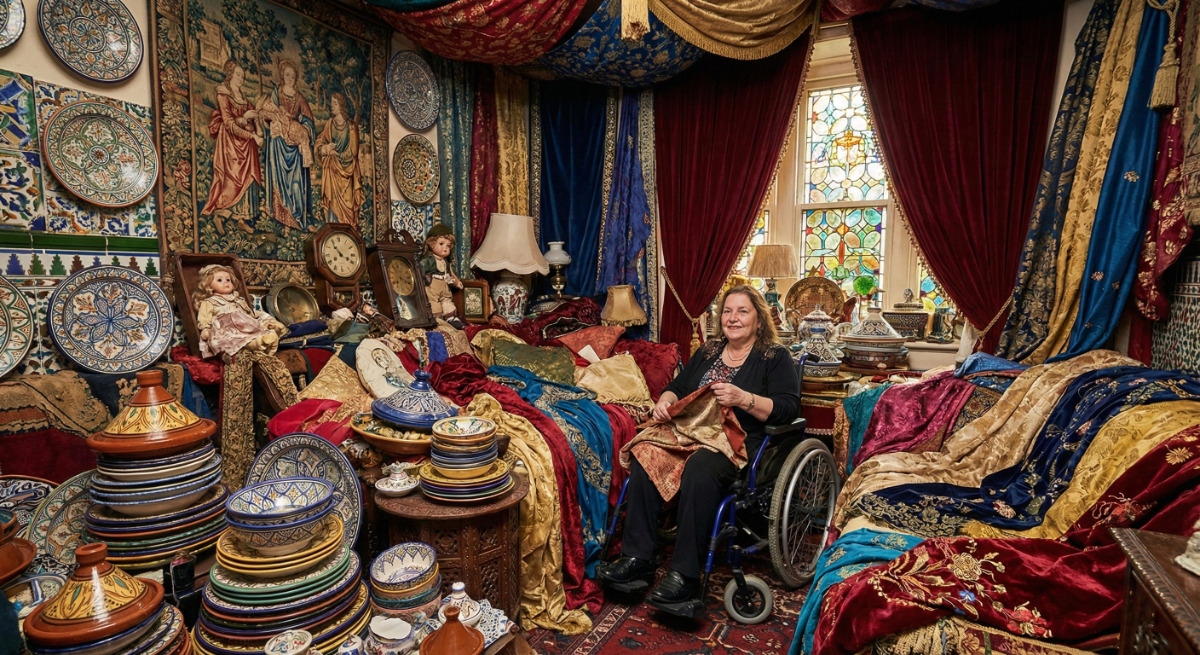
 Cerenise had spent the best part of a week choosing a suitable outfit to wear for the occasion and the dressing room adjoining her bedroom had become even more difficult to navigate. Making sure her bedroom door was securely locked before hopping out of her wicker bath chair (she didn’t want the others to see how nimble she still was), she spent hours inching her way through the small gaps between wardrobes and storage boxes and old wooden coffers, pulling out garment after garment and taking them to the Napoleon III cheval mirror to try on. She touched the rosewood lovingly each time and sighed. It was a beautiful mirror that had faithfully reflected her image for over 150 years.
Holding a voluminous black taffetta mourning dress under her chin, Cerenise scrutinised her appearance. She looked well in black, she always felt, and it was such a good background for exotic shawls and scarves. Pulling the waist of the dress closer, it became apparent that a whalebone corset would be required if she was to wear the dress, a dreadful blight on the fun of wearing Victorian dresses. She lowered the dress and peered at her face. Not bad for, what was it now? One thousand 6 hundred and 43 years old? At around 45 years old, Cerenise decided that her face was perfect, not too young and not too old and old enough to command a modicum of respect. Thenceforth she stopped visibly aging, although she had allowed her fair hair to go silver white.
It was just after the siege of Gloucester in 1643, which often seemed like just yesterday, when Cerenise stopped walking in public. Unlike anyone else, she had relished the opportunity to stay in one place, and not be sent on errands miles away having to walk all the way in all weathers. Decades, or was it centuries, it was hard to keep track, of being a saint of travellers had worn thin by then, and she didn’t care if she never travelled again. She had done her share, although she still bestowed blessings when asked.
It was when she gave up walking in public that the hoarding started. Despite the dwellings having far fewer things in general in those days, there had always been pebbles and feathers, people’s teeth when they fell out, which they often did, and dried herbs and so forth. As the centuries rolled on, there were more and more things to hoard, reaching an awe inspiring crescendo in the last 30 years.
Cerenise, however, had wisely chosen to stop aging her teeth at the age of 21.
Physically, she was in surprisingly good shape for an apparent invalid but she spent hours every day behind locked doors, clambering and climbing among her many treasures, stored in many rooms of the labyrinthine old building. There was always just enough room for the bath chair to enter the door in each of her many rooms, and a good strong lock on the door. As soon as the door was locked, Cerenise parked the bath chair in front of the door and spent the day lifting boxes and climbing over bags and cupboards, a part of herself time travelling to wherever the treasures took her.
Eventually Cerenise settled on a long and shapeless but thickly woven, and thus warm, Neolithic style garment of unknown provenance but likely to be an Arts and Crafts replica. It was going to be cold in the library, and she could dress it up with a colourful shawl.
December 30, 2025 at 6:42 pm #8003In reply to: The Elusive Samuel Housley and Other Family Stories
JOHN BROOKS ALIAS PRIESTLAND
1766-1846John Brooks, my 5x great grandfather, was born in 1766, according to the 1841 census and the burial register in 1846 which stated his age at death as 80 years, but no baptism has been found thus far.
On his first son’s baptism in 1790 the parish register states “John son of John and Elizabeth Brooks Priestnal was baptised”. The name Priestnal was not mentioned in any further sibling baptism, and he was John Brooks on his marriage, on the 1841 census and on his burial in the Netherseal parish register. The name Priestnal was a mystery.
I wondered why there was a nine year gap between the first son John, and the further six siblings, and found that his first wife Elizabeth Wilson died in 1791, and in 1798 John married Elizabeth Cowper, a widow.
John was a farmer of Netherseal on both marriage licences, and of independent means on the 1841 census.
Without finding a baptism it was impossible to go further back, and I was curious to find another tree on the ancestry website with many specific dates but no sources attached, that had Thomas Brooks as his father and his mother as Mary Priestland. I couldn’t find a marriage for John and Mary Priestland, so I sent a message to the owner of the tree, and before receiving a reply, did a bit more searching.
I found an article in the newspaper archives dated 9 August 1839 about a dispute over a right of way, and John Brooks, 73 years of age and a witness for the complainant, said that he had lived in Netherseal all his life (and had always know that public right of way and so on).
I found three lists of documents held by the Derby Records Office about property deeds and transfers, naming a John Brooks alias Priestland, one in 1794, one in 1814, and one in 1824. One of them stated that his father was Thomas Brooks. I was beginning to wonder if Thomas Brooks and Mary Priestland had never married, and this proved to be the case.
The Australian owner of the other tree replied, and said that they had paid a researcher in England many years ago, and that she would look through a box of papers. She sent me a transcribed summary of the main ponts of Thomas Brooks 1784 will:
Thomas Brooks, husbandman of Netherseal
To daughter Ann husband of George Oakden, £20.
To grandson William Brooks, £20.
To son William Brooks and his wife Ann, one shilling each.
To his servant Mary Priestland, £20 and certain household effects and certain property.
To his natural son John Priestland alias Brooks, various properties and the residue of his estate.
John Priestland alias Brooks appointed sole executor.It would appear that Thomas Brooks left the bulk of his estate to his illegitimate son, and more to his servant Mary Priestland than to his legitimate children.
THOMAS BROOKS
1706-1784
Thomas Brooks, my 6x great grandfather, had three wives. He had four children with his first wife, Elizabeth, between 1732 and 1737. Elizabeth died in 1737. He then married Mary Bath, who died in 1763. Thomas had no children with Mary Bath. In 1765 Thomas married Mary Beck. In 1766 his son John Brooks alias Priestland was born to his servant Mary Priestland.
Thomas Brooks parents were John Brooks 1671-1741, and his wife Anne Speare 1674-1718, both of Netherseal, Leicestershire.
March 23, 2025 at 10:50 am #7880In reply to: The Precious Life and Rambles of Liz Tattler
“Nice arse,” said Idle non too quietly, admiring Roberto as he stacked firewood beside the hearth. The gardener glanced round and gave her a cheeky wink. He’d noticed her leaning out of an upstairs window watching him weeding the herbacious border.
“Now, now, Idle, no molesting the staff. I’ll write some men into the story for you later,” Liz said, “But first let’s talk about my new book. I’m wondering what to name the six spinsters. Some kind of a theme. Cerise, Fuschia, Scarlett, Coral, Rose and Magenta?”
“What about Cobalt, Lapis, Cerulean, Indigo, Sapphire and Capri?” offered Idle, topping up their wine glasses. “Chartreuse, Emerald, Jade, Fern, Pistachio and Malachite? Marigold, Saffron, Citron, Amber, Maize and Apricot?”
“How about Bratwurst, Chorizo, Salami, Knackwurst, Bologna and Frankfurter?” suggested Godfrey who was still miffed about all the spare parts being disposed of. “Lasagne, Macaroni, Canneloni, Farfali, Linguini and Ravioli?”
Roberto lit the fire and stood up. “I have an idea, you can call them Trowel, Rake, Hoe, Wheelbarrow, Spade and Secateur.”
“Marvelous Roberto, I love it!” gushed Aunt Idle.
“You’re all mad as a box of frogs, madder than Almad,” Finnley said. “How about Duster, Mop, Bleach, Broom, Dustpan and Cloth?”
“I think this incessant rain is driving us all mad,” Liz said, glancing out of the French windows with a sigh.
February 28, 2025 at 8:18 am #7837In reply to: The Last Cruise of Helix 25
The village lay huddled before them, appearing like a mirage as they reached the top of the rise. Habitation always looks so picturesque when it’s been taken over by nature, Molly thought, by no means for the first time. Even before the collapse, she had penchant for overgrown abandoned ruins. Vines and ivy rampaged gleefully over the houses, softening the hard outlines, and saplings reached for the sky through crumbling roofs.
The survivors had stopped on the low hill to survey the scene, but soon they were rushing down towards the village to explore. As they came closer they could see all the cucumbers and courgettes dangling from the festoons of vines. Molly had visions of cucumber sandwiches on delicate thin sliced white bread with a piping hot pot of tea. But a waterey tasteless courgette soup will have to do, I suppose.
It was mid afternoon but there was no debate about continuing the journey that day. There were all the houses to search, and several shops, and more importantly, shelter for the night. The rain clouds were approaching from the east.
The church was chosen as a base camp as it was spacious enough to accomodate them all and the roof was intact, all but for the collapsed wooden tower which would provide wood for a fire. Lev and Luka set to work organising the space inside the church, supervised by Molly, Gregor and Petro, who wanted to rest. The others had dumped their bags and gone off to explore the buildings for supplies and forage in the overgrown gardens.
Tundra, happy that for once the responsibility of finding food was shared with so many other people, indulged her curiosity to just snoop around aimlessly. Clambering over a crumbling wooden porch, she pushed open what remained of a peeling door and stepped carefully inside. Venturing around the edges of the room, she peered at all the faded and warped framed photographs on the walls, portraits and family groups, wondering about the family who had lived here. There was a tray on a side table inscribed with Greetings from Niagara Falls! in a jolly cursive script, and an odd shaped rusting metal object with the words Souvenir de la tour Eiffel.
Slowly Tundra toured the house, inspecting all the objects in the rooms. Gingerly she made her way up the stairs, testing each riser before committing her weight to it. In a small bedroom packed with decomposing plastic bags and cardboard boxes spilling their assorted contents, she came upon a pile of letters and postcards, yellowy and curling, with mouse nibbled edges. Molly had told her about grandads postcard collection, but he’d taken it with him and she’d never seen them herself. I wonder what happened to that ship? Is my grandad still alive? Tundra sighed. Maybe he’ll come back one day. And my dad.

Sitting on the floor, Tundra sorted out the intact postcards from the badly damaged ones. She would take them with her to look at later, maybe ask the others what they knew of all the pictured places.
February 8, 2025 at 8:20 am #7739In reply to: The Last Cruise of Helix 25
Not knowing what else to do to calm his nerves Ellis took Finkley’s advice and took his box of postcards back down off the shelf. Extracting a random one from the middle of the stack he gazed at the picture of a lump of orange rock in the middle of a desert. Turning it over with trembling hands he tried to focus on the message. It was written in a childish hand and mentioned an outing to the old Bundy place and that Mater had locked herself in her bedroom again, signed lots of love from Clove.
Ellis was trying to decipher the smudged postmark when Finkley barged in again. “Ellis, sit down,” Finkley said pointlessly as Ellis was already seated. “Detective TP wants to talk to you about the murder victim.”
“But why? I don’t know anything about it.”
“You’re not the only one who doesn’t know anything, I can assure you. Nobody seems to know what’s going on, but TP says he wants to talk to you. Don’t shoot the messenger, Ellis, I’m as confused as you are. You’re to go to his pod immediately.” Seeing his discomfiture, Finkley added kindly, “I’ll come with you if you like.”
February 7, 2025 at 8:43 pm #7738In reply to: The Last Cruise of Helix 25
Finkley patted Ellis on a shoulder a few times and suggested he had another look through his box of postcards.
“And try and get a grip, eh? I’m going to see what’s going on, I’ll be back in a bit.”
February 3, 2025 at 7:54 am #7731In reply to: The Last Cruise of Helix 25
The colours were bright, garish really, an impossibly blue sea and sky and splashes of pillar box red on the square shaped cars and dated clothes, but it was his favourite postcard of them all. It wasn’t the most scenic, it wasn’t the most spectacular location, but it was an echo from those long ago days of summer, of seaside holidays, souvenirs and a dozen postcards to write at a beachside cafe. The days when the post was delivered by conscientious postmen such as he himself had been, and the postcards arrived at their destinations before the holidaymakers had returned to their suburban homes and city jobs. The scene in the postcard was bathed in glorious sunshine, but the message on the back told the usual tale of the weather and the rain and that it might brighten up tomorrow but they were having a lovely time and they’d be back on Sunday and would the recipients get them a loaf and a pint of milk.
Ellis Marlowe put the Margate postcard to the back of the pile in his hand and pondered the image on the next one. He sighed at the image of the Statue of Liberty, sickly green, sadly proclaiming the height of a lost empire, and quickly put it at the back of the pile. Nobody needed to dwell on that story.
His perusal of the next image, an alpine meadow with an attractively skirted peasant scampering in a field, was interrupted with a bang on his door as Finkley barged in without waiting for a response. “There’s been a murder on the ship! Murder! Poor sod’s been dessicated like a dried tomato…”
Ellis looked at her in astonishment. His hand shook slightly as he put his postcard collection back in the box, replaced the lid and returned it to his locker. “Murder?” he repeated. “Murder? On here? But we’re supposed to be safe here, we left all that behind.” Visibly shaken, Ellis repeated, almost shouting, “But we left all that behind!”
December 23, 2024 at 10:36 am #7707In reply to: Quintessence: Reversing the Fifth
Matteo — Easter Break 2023
The air in the streets carried the sweet intoxicating smell of orange blossoms, as Matteo stood at the edge of a narrow cobbled street in Xàtiva, the small town just a train ride from Valencia that Juliette had insisted on visiting. The weekend had been a blur of color and history—street markets in Italy, Venetian canals last month, and now this little-known hometown of the Borgias, nestled under the shadow of an ancient castle.
Post-pandemic tourism was reshaping the rhythm of Europe. The crowds in the big capitals felt different now—quieter in some places, overwhelming in others. Xàtiva, however, seemed untouched, its charm untouched. Matteo liked it. It felt authentic, a place with layers to uncover.
Juliette, as always, had planned everything. She had a knack for unearthing destinations that felt simultaneously curated and spontaneous. They had started with the obvious—Berlin, Amsterdam, Florence—but now her choices were becoming more eccentric.
“Where do you even find these places?” Matteo had asked on the flight to Valencia, his curiosity genuine.
She grinned, pulling out her phone and scrolling through saved videos. “Here,” she said, passing it to him. “This channel had great ideas before it went dark. He had listed all those places with 1-euro houses deals in many fantastic places in Europe. Once we’re ready to settle” she smiled at him.
The video that played featured sweeping shots of abandoned stone houses and misty mountain roads, narrated by a deep, calm voice. “There’s magic in forgotten places,” the narrator said. “A story waiting for the right hands to revive it.”
Matteo leaned closer, intrigued. The channel was called Wayfare, and the host, though unnamed in the video, had a quiet magnetism that made him linger. The content wasn’t polished—some shots were shaky, the editing rough—but there was an earnestness to it that immediately captured his attention.
“This guy’s great,” Matteo said. “What happened to him?”
“Darius, I think his name was,” Juliette replied. “I loved his videos. He didn’t have a huge audience, but it felt like he was speaking to you, you know?” She shrugged. “He shut it down a while back. Rumors about some drama with patrons or something.”
Matteo handed the phone back, his interest waning. “Too bad,” he said. “I like his style.”
The train ride to Xàtiva had been smooth, the rolling hills and sun-drenched orchards sliding slowly outside the window. The time seemed to move at a slower pace here. Matteo’d been working with an international moving company in Paris, mostly focused to expats in and out of France. Tips were good and it usually meant having a tiring week, but what the job lacked in interest, it compensated with with extra recuperation days.
As they climbed toward the castle overlooking the town, Juliette rattled off details she’d picked up online.
“The Borgias are fascinating,” she said, gesturing toward the town below. “They came from here, you know. Rose to power around the 13th century. Claimed they were descended from Visigoth kings, but most people think that’s all invention.”
“Clever, though,” Matteo said. “Makes you almost wish you had a magic box to smartly rewrite your ancestry, that people would believe it if you play it right.”
Juliette smiled. “Yeah! They were masters cheaters and gaslighters.”
“Reinventing where they came from, like us, always reinventing where we go…”
Juliette chuckled but didn’t reply.
Matteo’s mind wandered, threading Juliette’s history lesson with stories his grandmother used to tell—tales of the Borgias’ rise through cunning and charm, and how they were descended from the infamous family through Lucrecia, the Pope’s illegitimate daughter. It was strange how family lore could echo through places so distant from where he’d grown up.
As they reached the castle’s summit, Matteo paused to take it all in. The valley stretched below them, a patchwork of red-tiled rooftops and olive groves shimmering in the afternoon light. Somewhere in this region, Juliette said, Darius had explored foreclosed homes, hoping to revive them with new communities. Matteo couldn’t help but think how odd it was, these faint connections between lives—threads weaving places and people together, even when the patterns weren’t clear.

Later, over a shared plate of paella, Juliette nudged him with her fork. “What are you thinking about?”
“Nothing much,” Matteo said, swirling his glass of wine. “Just… how people tell stories. The Borgias, this Darius guy, even us—everyone’s looking for a way to leave a mark, even if it’s just on a weekend trip.”
Juliette smiled, her eyes glinting with mischief. “Well, you better leave your mark tomorrow. I want a picture of you standing on that castle wall.”
Matteo laughed, raising his glass. “Deal. But only if you promise not to fall off first.”
As the sun dipped below the horizon, the streets of Xàtiva began to glow with the warmth of lamplight. Matteo leaned back in his chair, the wine softening the edges of the day. For a moment, he thought of Darius again—of foreclosed homes and forgotten stories. He didn’t dwell on it, though. The present was enough.
December 20, 2024 at 1:44 am #7701In reply to: Quintessence: Reversing the Fifth
Amei attached a card and ribbon to the last of the neatly wrapped gifts and placed it under the tree. This one was for Paul—a notebook with a cover of soft fabric she’d block-printed with delicate, overlapping circles in muted blues and greens. The fabric was left over from a set of cushions for a client, but she had spent hours crafting the notebook, knowing all the while Paul probably wouldn’t use it. He was impossible to buy for, preferring things he picked out himself. Tabitha had been far easier: Amei had secretly made a dress out of a soft, flowing fabric that Tabitha had fallen in love with the moment Amei showed it to her.
The house felt calm for the moment. Tabitha had gone out earlier, calling over her shoulder that she’d be back in time for dinner. Amei smiled at the memory of her daughter’s laughter. Her excitement about Christmas was palpable, a bright contrast to the quietness that had settled over everything else. Amei used to feel like that about Christmas too. This year, though, she was only making the effort for Tabitha.
Somewhere down the hallway, Paul’s voice murmured on a call—distant, like everything about him lately. The air smelled faintly of cinnamon and cloves from the mulled wine simmering on the stove, but even that warm, festive scent felt like it was trying too hard.
The house felt big, despite the occasional bursts of life it saw on days like this. It had felt that way for months now, the weight of unspoken things pressing against the faded walls.
She sighed and reached for the decoration box, pulling out a small clay angel with chipped wings. The sight of it made her pause. Lucien had given it to her years ago, one Christmas, and declared it “charmingly imperfect,” insisting it belonged at the top of her tree. She smiled faintly at the memory, turning it over in her hands. Every year since, it had held its place at the top of the tree.
“Still not done?” Paul’s voice cut into her thoughts. She turned to see him standing in the doorway. At the sound of Paul’s voice, Briar, their elderly cat—or technically Paul’s cat—emerged from behind the curtain, her tail curling as she wove around his legs. Paul crouched slightly to scratch behind her ears, and Briar leaned into his touch, purring softly
“She thinks it’s dinner time,” Amei said evenly.
“You always go overboard with these things, Amei,” Paul said, straightening and nodding towards the gifts.
“It’s Christmas,” she snapped, the irritation slipping through before she could stop it. She turned back to the tree, her fingers moving stiffly as she busied herself with strands of sparkly tinsel.
Paul didn’t respond, but she could feel his gaze linger. It was the silence that had grown between them in recent months, filled with everything they couldn’t bring themselves to say…yet.
The sound of the front door banging shut and brisk footsteps broke the tension. Tabitha burst past Paul into the room, her cheeks flushed from the cold. “Hey, Paul. Hey, Mumma Bear,” she said brightly. Her eyes lit up as they landed on the tree. “The tree looks gorgeous! Don’t you just love Christmas?”
December 14, 2024 at 8:00 pm #7683In reply to: The Precious Life and Rambles of Liz Tattler
“What do you think Godfrey?” Liz’ snapped at her publisher, sightly annoyed by his debonair smile. “And honestly, I sometimes wonder if I shouldn’t ask Finnley, she seems to have more wits about her than you, dear friend. And where is she by the way?”
“Liz’, will you calm down, this interview business is driving you back to your old manic madness; don’t worry about Finnley, she’s had some errands to run, something about coaching the younger generation, and tiktok oven challenge —don’t ask.”
“Exactly! What? what coaching nonsense? Tsk, stop digressing. Yes, that interview is getting bees in my bonnet, if you see what I mean.”
“Driving you nuts, you mean?”
“Obvie. But look, how about that as an intro? ‘Every story begins with something lost, but it’s never about the loss. It’s about what you find because of it.’ ”
“It’s quite brilliant I must say; how much of it is from the artificial box?”
“That’s what I mean Godfrey! None! But you not seeing a difference is worrying to say the least. This thing is every author’s nightmare; it spews nonsense faster, and even with greater details I can manage in one draft. Look at that. It still comes to me as naturally as when I did my first book. Very heavy door curtain, and the wooden pole sags so I’m on tip toe yanking it, and middle of back unsupported, very stupid really. Stuff like that, I can immediately conjure, painting a world of innuendos and mysteries behind a few carefully crafted words. My words’ a stage. And I even managed to write my last book, with impossibly challenging characters, being a scientist without knowing the first thing about science —apart maybe from science of marriage, although one may argue it’s more an art form. The thing is, Godfrey, and pardon that unusual monologue, yes, and please don’t choke on your peanuts. I’m starting to feel like a faulty robot who can’t stick to the robot plan.”
“I can see you do, Liz, but honestly, we can all make out the tree for the forest. Yours is truly an art that cannot be mimicked by machinery. Have a tonic, and let’s get you ready for that interview —the manicurist is downstairs ready for you with the best shades of pink you can ever dream of.
December 13, 2024 at 1:22 am #7664In reply to: Quintessence: Reversing the Fifth
There was a sharp knock on the front door. Amei opened it to find Finnley from Meticulous Maids standing there, bucket in one hand, a bag of cleaning supplies in the other.
“Back to tackle that oven,” she announced, brushing past Amei and striding towards the kitchen.
“Good to see you too, Finnley.”
A moment later, an anguished cry echoed from the kitchen. Amei rushed in to find Finnley clutching her brow and pointing accusingly at the oven. “This oven has not been treated with respect,” she declared dramatically.
“Well, I told you on the phone it was quite bad.”
“Quite bad!” Finnley rolled her eyes and dumped her supplies on the counter with a thud. “Moving out, are we?”
“In a few weeks,” Amei said, leaning against the doorframe. “I’ve still got books and stuff to pack, but I’m trying to leave the place in decent shape.”
“Decent?” Finnley snorted, already pulling on a pair of gloves. “This oven’s beyond decent. But I’ll see if I can drag it back from the brink.”
Finnley proceeded to inspect the oven with the air of a general preparing for war. She muttered something under her breath that Amei couldn’t quite catch, then added louder, “Books and boxes. Someone’s got the easy bit.”
Finnley had cleaned for Amei before. She was rude and pricey, but she always got the job done.
“I’ll leave you to it, then,” said Amei, retreating back to her packing.
“Sure,” Finnley muttered. “But if I find anything moving in here, I’m charging extra.”
The house fell silent, save for the occasional scrape of metal and Finnley’s muffled grumblings. An hour later, Amei realized she hadn’t heard anything for a while. Curious, she walked back to the kitchen and peeked her head around the door.
Finnley was slumped in a chair by the kitchen bench, arms crossed, her head tilted at an awkward angle. Her bucket and gloves sat abandoned on the floor. She was fast asleep.
Amei stood there for a moment, not sure what to do. Finally, she cleared her throat. “I take it the oven won?”
Finnley’s eyes snapped open, and she straightened with a snort. “I just needed a regroup,” she muttered, rubbing her face. She looked at the oven and shuddered. “I dreamed that bloody monster of a thing was chasing me.”
“Chasing you?” Amei said, trying hard not to laugh.
Finnley stood, tugging her gloves back on with determination. “It’s not going to win. Not today.” She glared at Amei. “And I’ll be charging you for my break.”
December 8, 2024 at 9:42 pm #7656In reply to: Quintessence: Reversing the Fifth
Matteo — December 1st 2023: the Advent Visit
(near Avignon, France)
The hallway smelled of nondescript antiseptic and artificial lavender, a lingering scent jarring his senses with an irreconciliable blend of sterility and forced comfort. Matteo shifted the small box of Christmas decorations under his arm, his boots squeaking slightly against the linoleum floor. Outside, the low winter sun cast long, pale shadows through the care facility’s narrow windows.
When he reached Room 208, Matteo paused, hand resting on the doorframe. From inside, he could hear the soft murmur of a holiday tune—something old-fashioned and meant to be cheerful, likely playing from the small radio he’d gifted her last year. Taking a breath, he stepped inside.
His mother, Drusilla sat by the window in her padded chair, a thick knit shawl draped over her frail shoulders. She was staring intently at her hands, her fingers trembling slightly as they folded and unfolded the edge of the shawl. The golden light streaming through the window framed her face, softening the lines of age and wear.
“Hi, Ma,” Matteo said softly, setting the box down on the small table beside her.
Her head snapped up at the sound of his voice, her eyes narrowing as she fixed him with a sharp, almost panicked look. “Léon?” she said, her voice shaking. “What are you doing here? How are you here?” There was a tinge of anger in her tone, the kind that masked fear.
Matteo froze, his breath catching. “Ma, it’s me. Matteo. I’m Matteo, your son, please calm down” he said gently, stepping closer. “Who’s Léon?”
She stared at him for a long moment, her eyes clouded with confusion. Then, like a tide retreating, recognition crept back into her expression. “Matteo,” she murmured, her voice softer now, though tinged with exhaustion. “Oh, my boy. I’m sorry. I—” She looked away, her hands clutching the shawl tighter. “I thought you were someone else.”
“It’s okay,” Matteo said, crouching beside her chair. “I’m here. It’s me.”
Drusilla reached out hesitantly, her fingers brushing his cheek. “You look so much like him sometimes,” she said. “Léon… your father. He’d hold his head just like that when he didn’t want anyone to know he was worried.”
As much as Matteo knew, Drusilla had arrived in France from Italy in her twenties. He was born soon after. She had a job as a hairdresser in a little shop in Avignon, and did errands and chores for people in the village. For the longest time, it was just the two of them, as far as he’d recall.
Matteo’s chest tightened. “You’ve never told me much about him.”
“There wasn’t much to tell,” she said, her voice distant. “He came. He left. But he gave me something before he went. I always thought it would mean something, but…” Her voice trailed off as she reached into the pocket of her shawl and pulled out a small silver medallion, worn smooth with age. She held it out to him. “He said it was for you. When you were older.”
Matteo took the medallion carefully, turning it over in his hand. It was a simple but well-crafted Saint Christopher medal, the patron saint of travellers, with faint initials etched on the back—L.A.. He didn’t recognize the letters, but the weight of it in his palm felt significant, grounding.
“Why didn’t you give it to me before?” he asked, his voice quiet.
“I forgot I had it,” she admitted with a faint, sad laugh. “And then I thought… maybe it was better to keep it. Something of his, for when I needed it. But I think it’s yours now.”
Matteo slipped the medallion into his pocket, his mind spinning with questions he didn’t want to ask—not now. “Thanks, Ma,” he said simply.
Drusilla sighed and leaned back in her chair, her gaze drifting to the small box he’d brought. “What’s that?”
“Decorations,” Matteo said, seizing the moment to shift the focus. “I thought we could make your room a little festive for Christmas.”
Her face softened, and she smiled faintly. “That’s nice,” she said. “I haven’t done that in… I don’t remember when.”
Matteo opened the box and began pulling out garlands and baubles. As he worked, Drusilla watched silently, her hands still clutching the shawl. After a moment, she spoke again, her voice quieter now.
“Do you remember our house in Crest?” she asked.
Matteo paused, a tangle of tinsel in his hands. “Crest?” he echoed. “The place where you wanted to move to?”
Drusilla nodded slowly. “I thought it would be nice. A co-housing place. I could grow old in the garden, and you’d be nearby. It seemed like a good idea then.”
“It was a good idea,” Matteo said. “It just… didn’t happen.”
“No,… you’re right” she said, collecting her thoughts for a moment, her gaze distant. “You were too restless. Always moving. I thought maybe you’d stay if we built something together.”
Matteo swallowed hard, the weight of her words pressing on him. “I wanted to, Ma,” he said. “I really did.”
Drusilla’s eyes softened, and she reached for his hand, her grip surprisingly strong. “You’re here now,” she said. “That’s what matters.”
They spent the next hour decorating the room. Matteo hung garlands around the window and draped tinsel over the small tree he’d set up on the table. Drusilla directed him with occasional nods and murmured suggestions, her moments of lucidity shining like brief flashes of sunlight through clouds.
When the last bauble was hung, Drusilla smiled faintly. “It’s beautiful,” she said. “Like home.”
Matteo sat beside her, emotion weighing on him more than the physical efforts and the early drive. He was thinking about the job offer in London, the chance to earn more money to ensure she had everything she needed here. But leaving her felt impossible, even as staying seemed equally unsustainable. He was afraid it was just a justification to avoid facing the slow fraying of her memories.
Drusilla’s voice broke through his thoughts. “You’ll figure it out,” she said, her eyes closing as she leaned back in her chair. “You always do.”
Matteo watched her as she drifted into a light doze, her breathing steady and peaceful. He reached into his pocket, his fingers brushing against the medallion. The weight of it felt like both a question and an answer—one he wasn’t ready to face yet.
“Patron saint of travellers”, that felt like a sign, if not a blessing.
December 7, 2024 at 10:48 pm #7654In reply to: Quintessence: Reversing the Fifth
The first one to find the bar buys the drinks, Darius had said, and they’d all laughed, but it was no laughing matter being lost in those woods.
Siiting on a cushion on the floor surrounded by cardboard shoeboxes and piles of photos and letters, Elara leaned towards the lamp to better see the photograph. The white bull.
Lucien had refused when Elara asked him to do a painting of the white bull, and then relented and said he would. But he hadn’t, not that she knew of anyway. The incident had happened the year before the pandemic, the spring of 2019. Not long before they all went their separate ways. Elara had been visiting her father in Andalucia for his 90th birthday when a neighbour of his had told her about the stone in the woods. She knew the others would be interested and had invited them over; her father Roland had plenty of room at his finca overlooking the Hozgarganta river, and had no objections.
Darius had wanted to bring those people to see the pyramidal stone in the woods, and Elara was having none of it. I was told in private about that, I shouldn’t have shown anyone, Darius, not even you, she had told him. Resentfully, Darius had tried to argue his point: that it was for the greater good, shouldn’t be kept secret, and how could he keep it from them anyway, they would know he was hiding something.
You may not be able to find it again, look at the trouble we had. You might get attacked by wild boar or fall off a precipice into the gorge, Amei added, not relishing the idea of sharing the discovery with those people either. She couldn’t help thinking it wouldn’t be a bad thing if those people did disappear without a trace. Darius hadn’t been the same since getting sucked into their cultish clutches.
They had lost their way in the gloomy trackless forest trying to find the stone, impossible to see further than the next few trees. Increasingly alarmed at the boar tracks and the fading late afternoon light, Elara had suggested they give up and try and retrace their steps, rather than penetrating further down into the woods. And then suddenly Lucien shouted There is it! That’s it! and there it stood, rising above the tree canopy, the sharp grey stone sides contrasting gloriously with the thick tangled foliage.
Rushing towards it, they fanned out circling it, touching it, gazing up at the smooth sides. Solid stone, not constructed with blocks, its purpose indecipherable, astonishingly incongruous to the location.
Look, we need to start making our way back to the car, Elara had said, It’ll be dark in a couple of hours.
Amei had helped her convince Lucien and Darius who were reluctant to leave, promising another visit. Now we know where it is, she said, although she wasn’t sure if they did know how to find it again. It had appeared while they were lost, after all.The scramble back to the car had been no less confusing than the walk down to the stone, they only knew they had to go uphill to find the unpaved forest road.
Squinting as they emerged from trees into the sunlight, a spontaneous cheer was immediately silenced at the sight of the white bull lying serenely by the site of the road, glowing like white marble, implacable, wise, and godly.
Is it real? whispered Amei, awestruck.I wonder if Darius ever did take those people there, Elara wondered. It had never been mentioned again, but then, things started to change after that. So many things were left unsaid. Elara had never been back, but the white bull had stayed in her mind perhaps more even than the stone pyramid had. I wonder if Lucien ever did that painting of it? Elara propped the photo up behind a candlestick on the fireplace mantel. Now that she was retired, maybe she’d do a painting of it herself.
December 7, 2024 at 11:52 am #7653In reply to: Quintessence: Reversing the Fifth
Matteo — Winter 2023: The Move
The rumble of the moving truck echoed faintly in the quiet residential street as Matteo leaned against the open door, arms crossed, waiting for the signal to load the boxes. He glanced at the crisp winter sky, a pale gray threatening snow, and then at the house behind him. Its windows were darkened by empty rooms, their once-lived-in warmth replaced by the starkness of transition. The ornate names artistically painted on the mailbox struck him somehow. Amei & Tabitha M.: his clients for the day.
The cold damp of London’s suburbia was making him long even more for the warmth of sunny days. With the past few moves he’s been managing for his company, the tipping had been generous; he could probably plan a spring break in South of France, or maybe make a more permanent move there.
The sound of the doorbell brought him back from his rêverie.
Inside the house, the faint sounds of boxes being taped and last-minute goodbyes carried through the hallways. Matteo had been part of these moves too many times to count now. People always left a little bit of themselves behind—forgotten trinkets, echoes of old conversations, or the faint imprint of a life lived. It was a rhythm he’d come to expect, and he knew his part in it: lift, carry, and disappear into the background.
Matteo straightened as the door opened and a girl that could have been in her early twenties, but looked like a teenager stepped out, bundled against the cold. She held a steaming mug in one hand and balanced a box awkwardly on her hip with the other.
“That’s the last of it,” she called over her shoulder. “Mum, are you sure you don’t want me to take the notebooks?”
“They’re fine in the car, Tabitha!” A voice—calm and steady, maybe tinged with weariness—floated from inside.
The girl named Tabitha turned to Matteo, offering the box. “This is fragile,” she said, a smile tugging at her lips. “Be nice to it.”
Matteo took the box carefully, glancing at the mug in her hand. “You’re not leaving that behind, are you?” he asked with a faint smile.
Tabitha laughed. “This? No way. That’s my lifeline. The mug stays.”
As Matteo carried the box to the truck, his eyes caught on something inside—a weathered postcard tucked haphazardly between the pages of a journal. The image on the front was striking: a swirling green fairy, dancing above a glass of absinthe. La Fée Verte was scrawled in looping letters across the top.
“Tabitha!” Her mother’s voice carried out to the driveway, and Matteo turned instinctively. She stepped out onto the porch, her scarf wrapped loosely around her neck, her breath visible in the chilly air. Matteo could see the resemblance—the same poise and humor in her gaze, though softened by something older, quieter.
“Put this somewhere, will you” she said, holding up another postcard, this one with a faded image of a winding mountain road.
Tabitha grinned, stepping forward to take it. “Thanks, Mum. That one’s special.” She tucked it into her coat pocket.
“Special how?” her mother asked lightly.
“It’s from Darius,” Tabitha said, her tone almost teasing. “… The one you never want to talk about.” she leaned teasingly. “One of his cryptic postcards —too bad I was too young to really remember him, he must have been fun to be around.”
Matteo’s ears perked at the name, though he kept his head down, settling the box in place. It wasn’t unusual to overhear snippets like this during a move, but something about the unusual name roused his curiosity.
“Why you want to keep those?” Amei asked, tilting her head.
Tabitha shrugged. “They’re kind of… a map, I guess. Of people, not places.”
Amei paused, her expression softening. “He was always good at that,” she murmured, almost to herself.
The conversation lingered in Matteo’s mind as the day went on. By the time the truck was loaded, and he’d helped arrange the last of the boxes in Amei’s new, smaller apartment, the name and the postcard had taken root.
As Matteo stacked the final piece of furniture—a worn bookshelf—against the living room wall, he noticed Amei lingering near a window, her gaze distant.
“It’s different, isn’t it?” she said suddenly, not looking at him.
“Moving?” Matteo asked, unsure if the question was for him.
“Starting over,” she clarified, her voice quieter now. “Feels smaller, even when it’s supposed to be lighter.”
Matteo didn’t reply, sensing she wasn’t looking for an answer. He stepped back, nodding politely as she thanked him and disappeared into the kitchen.
The postcard stuck in his mind for days after. Matteo had heard of absinthe before, of course—its mystique, its history—but something about the way Tabitha had called the postcard a “map of people” resonated.
By the time spring arrived, Matteo was wandering through Avignon, chasing vague curiosities and half-formed questions. When he saw Lucien crouched over his chalk labyrinth, the memory of the postcard rose unbidden.
“Do you know where I can find absinthe?” he asked, the question more instinct than intent.
Lucien’s raised eyebrow and faint smile felt like another piece clicking into place. The connections were there—threads woven in patterns he couldn’t yet see. But for the first time in months, Matteo felt he was back on the right path.
December 5, 2024 at 2:37 am #7645In reply to: Quintessence: Reversing the Fifth
Amei sat cross-legged on the floor in what had once been the study, its emptiness amplified by the packed boxes stacked along the walls. The bookshelves were mostly bare now, save for a few piles of books she was donating to goodwill.
The window was open, and a soft breeze stirred the curtains, carrying with it the faint chime of church bells in the distance. Ten o’clock. Tomorrow was moving day.
Her notebooks were heaped beside her on the floor—a chaotic mix of battered leather covers, spiral-bound pads, and sleek journals bought in fleeting fits of optimism. She ran a hand over the stack, wondering if it was time to let them go. A fresh start meant travelling lighter, didn’t it?
She hesitated, then picked up the top notebook. Flipping it open, she skimmed the pages—lists, sketches, fragments of thoughts and poems. As she turned another page, a postcard slipped out and fluttered to the floor.
She picked it up. The faded image showed a winding mountain road, curling into mist. On the back, Darius had written:
“Found this place by accident. You’d love it. Or maybe hate it. Either way, it made me think of you. D.”
Amei stared at the card. She’d forgotten about these postcards, scattered through her notebooks like breadcrumbs to another time. Sliding it back into place, she set the notebook aside and reached for another, older one. Its edges were frayed, its cover softened by time.
She flicked through the pages until an entry caught her eye, scrawled as though written in haste:
Lucien found the map at a flea market. He thought it was just a novelty, but the seller was asking too much. L was ready to leave it when Elara saw the embossed bell in the corner. LIKE THE OTHER BELL. Darius was sure it wasn’t a coincidence, but of course wouldn’t say why. Typical. He insisted we buy it, and somehow the map ended up with me. “You’ll keep it safe,” he said. Safe from what? He wouldn’t say.
The map! Where was the map now? How had she forgotten it entirely? It had just been another one of their games back then, following whatever random clues they stumbled across. Fun at the time, but nothing she’d taken seriously. Maybe Darius had, though—especially in light of what happened later. She flipped the page, but the next entry was mundane—a note about Elara’s birthday. She read through to the end of the notebook, but there was no follow-up.
She glanced at the boxes. Could the map still be here, buried among her things? Stuffed into one of her notebooks? Or, most likely, had it been lost long ago?
She closed the notebook and sighed. Throwing them out would have been easier if they hadn’t started whispering to her again, pulling at fragments of a past she thought she had left behind.
-
AuthorSearch Results