-
AuthorSearch Results
-
December 8, 2024 at 9:51 pm #7657
In reply to: Quintessence: A Portrait in Reverse
A list of events for reference (WIP)
Date Matteo Lucien Darius Amei Elara Nov 2024 M: Working as a server in Paris; recognizes and cryptically addresses the group at the Sarah Bernhardt Café. L: Sketching in Paris; begins orchestrating the reunion by sending letters to the group. D: is back in Paris for the reunion A: visits Paris for the reunion E: visits Paris for the reunion from Churchill Guest House (Samphire Hoe), visits a guest house in Kent, back in England for a week weeks/months, all expense paid. Mrs Lovejoy the landlady. Spring 2024 M: In Avignon, works at a vineyard. Finds a map. Crosses path with Lucien. Moves to next job in Paris. L: Visits Avignon. Caught in debt to Monsieur Renard; creates labyrinthine sketches blending personal and mythical themes. Crosses path with Matteo. D: by June 2024 sends a postcard to Amei, Is seen in Goa A: Her daughter Tabitha is in Goa teaching E: is retired in Tuscany, living with Florian, a distant relative met through family research.
Summer 2024 (Olympics) has a strange dream at CERN learning about the death of her mother who’d actually died in her youth.
She reminisces about chalkapocalypse.Feb 2024 M:In London, works for a moving company. Crosses path with Amei and Tabitha. L: Is implied he is caught back into the schemes of M. Renard to pay his debts. D: A: Moves from her London home to a smaller apartment in London; reflects on her estranged friends and past. Crosses path with Matteo. E: Dec 2023 M:In Avignon, considers moving to a job in London to support his mother’s care. L: Going with the alias “Julien”, he is recognized in the streets, after 3 years of self-imposed exile, to escape M. Renard & Eloïse. D: Resumes his travels on his own terms A: Buys candles, reflects on leaving. E: Nov 2023 M: His mother requires more care, he goes to Avignon regularly where she is in care. Breaks up with Juliette end of summer. L: D: moves on from Guadeloupe, where he spent time rebuilding homes and reflecting. A: E: early 2023 M: Visits Valencia and Xàtiva, hometown of the Borgias with Juliette; she makes him discover Darius’ videos. L: D: Lives in South of France, returns to Guadeloupe after hurricane Fiona. A: E: Dec 2022 M: New year’s eve, Matteo discovers about Elara’s work on memory applicable to early stage Alzheimer with sensory soundwaves stimuli and ancestral genetic research. L: D: Runs a wellness channel. Goes back to Paris, breaks ties with M. Renard & Eloïse. Receives an invitation to see friends in South of France A: Lives with Paul E: early 2022 M: Lives in Paris with Juliette, travels to many places together, week-ends getaways in London, Amsterdam, Rome… L: D: A: E: Early May, pandemic restrictions were largely over. Florian, her distant relative, moves in to Elara’s Tuscan farmhouse, where she is enjoying retirement. end of 2021 M: L: After the pandemic lockdown thinks of a way to escape. Goes by the alias “Julien” D: Locked down in Budapest; sketches empty streets, sends postcards to Amei to maintain emotional connections. A: E: Dec. 2021, first Christmas in Tuscany
Nov – end of Genealogix royalties from her successful patent, taken over by more efficient AI algorithms. She gives the idea to Darius of looking for 1-euro housing.beginning 2021 M: L: Third & last wave of lockdown measures in France D: A: E: 2020 M: L: D: A: E: beg. 2020 M: L: Pandemic starts – first waves of lockdown D: A: E: Nov 2019 M: Last group meeting before the Nov 2024 reunion L: Last group meeting before the Nov 2024 reunion D: Last group meeting before the Nov 2024 reunion A: Last group meeting before the Nov 2024 reunion E: Last group meeting before the Nov 2024 reunion 2019 M: Plans for his mother / co-housing project L: Spring break in Andalucia with Elara D: Spring break in Andalucia with Elara A: Spring break in Andalucia with Elara E: Spring, before pandemic; visit in Andalucia to her father – joined by Lucien & Amei ; Darius tried to bring those people (M. Renard & Eloïse presumably) to see the hidden pyramid ca. 2014 M: L: D: A: E: chalkapocalypse, before Elara’s retirement. She is employed in Warwick.
Before that, lived from short term teaching contracts mostly, enabling her to travel. She learned Spanish when she moved with her father to Spain 30 years ago, working in an English school for expats, improved her French while working in Paris, moved to Warwick to be near her sister Vanessa thinking she would settle there.2010 M: L: D: A: E: Genealogix became unexpectedly lucrative when it was picked up by a now-dominant genealogy platform around 2010. Every ancestry test sold earned her a modest but steady royalty, which for a time, gave her the freedom to pursue less practical research. 2007 M: L: Meets Elara & Amei, Darius a concert of Eliane Radigue at Aarau, Switzerland D: Meets Lucien, Elara & Amei a concert of Eliane Radigue at Aarau, Switzerland A:Accepts Elara’s invitation to go to a concert of Eliane Radigue at Aarau, Switzerland, meets Lucien & Darius there. The group is formed E:Goes to a concert of Eliane Radigue at Aarau, Switzerland with Amei, meets Lucien & Darius there. The group is formed before 2007 M: L: D: A:Meets Elara at a gallery in London, Southbank E: Meets Amei at a gallery, London Southbank December 6, 2024 at 8:44 am #7648In reply to: Quintessence: Reversing the Fifth
Spring 2024
Matteo was wandering through the streets of Avignon, the spring air heavy with the scent of blooming flowers and sun-warmed stone. The hum of activity surrounded him—shopkeepers arranging displays, the occasional burst of laughter from a café terrace. He walked with no particular destination, drawn more by instinct than intent, until a splash of colour caught his eye.
On the cobblestones ahead, an artist crouched over a sprawling chalk drawing. It was a labyrinthine map, its intricate paths winding across the ground with deliberate precision. Matteo froze, his breath catching. The resemblance to the map he’d found at the vineyard office was uncanny—the same loops and spirals, the same sense of motion and stillness intertwined. But it wasn’t the map itself that held him in place. It was the faces.
Four of them, scattered in different corners of the design, each rendered with surprising detail. Beneath them were names. Matteo felt a shiver crawl up his spine. He knew three of those faces. Amei, Elara, Darius… he had met each of them once, in moments that now felt distant and fragmented. Strangers to him, but not quite.
The artist shifted, brushing dark, rain-damp curls from his forehead. His scarf, streaked faintly with paint, hung loosely around his neck. Matteo stepped closer, his curiosity overpowering any hesitation. “Is that your name?” he asked, gesturing toward the face labeled Lucien.
The artist straightened, his hand resting lightly on a piece of green chalk. He studied Matteo for a moment, his expression unreadable. “Yes,” he said simply, his voice low but clear.
Matteo crouched beside him, tracing the edge of the map with his eyes. “It’s incredible,” he said. “The detail, the connections. Why the faces?”
Lucien hesitated, glancing at the names scattered across his work. “Because that’s how it is,” he said softly. “We’re all here, but… not together.”
Matteo tilted his head, intrigued. “You mean you’ve drifted?”
Lucien nodded, his gaze dropping to the chalk in his hand. “Something like that. Paths cross, then they don’t. People take their turns.”
Matteo studied the map again, its intertwining lines seeming both chaotic and deliberate. The faces stared back at him, and he felt the pull of the map he no longer carried. “Do you think paths can lead back?” he asked, his voice thoughtful.
Lucien glanced at him, something flickering briefly in his eyes. “Sometimes. If you follow them long enough.”
Matteo smiled faintly, standing. His curiosity shifted as he turned his attention to the artist himself. “Do you know where I can find absinthe?” he asked.
Lucien raised an eyebrow. “Absinthe? Haven’t heard anyone ask for that in a while.”
“Just something I’ve been chasing,” Matteo replied lightly, his tone almost playful.
Lucien gestured vaguely toward a café down the street. “You might try there. They keep the old things alive.”
“Thanks,” Matteo said, offering a nod. He took a few steps away but paused, turning back to the artist still crouched over his map. “It’s a good drawing,” he said. “Hope your paths cross again.”
Lucien didn’t reply, but his hand moved back to the chalk, drawing a faint line that connected two of the faces. Matteo watched for a moment longer before continuing down the street, the memory of the map and the names lingering in his mind like an unanswered question. Paths crossed, he thought, but maybe they didn’t always stay apart.
For the first time in days, Matteo felt a strange sense of possibility. The map was gone, but perhaps it had done what it was meant to do—leave its mark.
December 5, 2024 at 11:01 pm #7647In reply to: Quintessence: Reversing the Fifth
Darius: A Map of People
June 2023 – Capesterre-Belle-Eau, Guadeloupe
The air in Capesterre-Belle-Eau was thick with humidity, the kind that clung to your skin and made every movement slow and deliberate. Darius leaned against the railing of the veranda, his gaze fixed on the horizon where the sky blends into the sea. The scent of wet earth and banana leaves filling the air. He was home.
It had been nearly a year since hurricane Fiona swept through Guadeloupe, its winds blowing a trail of destruction across homes, plantations, and lives. Capesterre-Belle-Eau had been among the hardest hit, its banana plantations reduced to ruin and its roads washed away in torrents of mud.
Darius hadn’t been here when it happened. He’d read about it from across the Atlantic, the news filtering through headlines and phone calls from his aunt, her voice brittle with worry.
“Darius, you should come back,” she’d said. “The land remembers everyone who’s left it.”
It was an unusual thing for her to say, but the words lingered. By the time he arrived in early 2023 to join the relief efforts, the worst of the crisis had passed, but the scars remained—on the land, on the people, and somewhere deep inside himself.
Home, and Not — Now, passing days having turned into quick six months, Darius was still here, though he couldn’t say why. He had thrown himself into the work, helped to rebuild homes, clear debris, and replant crops. But it wasn’t just the physical labor that kept him—it was the strange sensation of being rooted in a place he’d once fled.
Capesterre-Belle-Eau wasn’t just home; it was bones-deep memories of childhood. The long walks under the towering banana trees, the smell of frying codfish and steaming rice from his aunt’s kitchen, the rhythm of gwoka drums carrying through the evening air.
“Tu reviens pour rester cette fois ?” Come back to stay? a neighbor had asked the day he returned, her eyes sharp with curiosity.
He had laughed, brushing off the question. “On verra,” he’d replied. We’ll see.
But deep down, he knew the answer. He wasn’t back for good. He was here to make amends—not just to the land that had raised him but to himself.
A Map of Travels — On the veranda that afternoon, Darius opened his phone and scrolled through his photo gallery. Each image was pinned to a digital map, marking all the places he’d been since he got the phone. Of all places, it was Budapest which popped out, a poor snapshot of Buda Castle.
He found it a funny thought — just like where he was now, he hadn’t planned to stay so long there. He remembered the date: 2020, in the midst of the pandemic. He’d spent in Budapest most of it, sketching the empty streets.
Five years ago, their little group of four had all been reconnecting in Paris, full of plans that never came to fruition. By late 2019, the group had scattered, each of them drawn into their own orbits, until the first whispers of the pandemic began to ripple across the world.
Funding his travels had never been straightforward. He’d tried his hand at dozens of odd jobs over the years—bartending in Lisbon, teaching English in Marrakech, sketching portraits in tourist squares across Europe. He lived frugally, keeping his possessions light and his plans loose. Yet, his confidence had a way of opening doors; people trusted him without knowing why, offering him opportunities that always seemed to arrive at just the right time.
Even during the pandemic, when the world seemed to fold in on itself, he had found a way.
Darius had already arrived in Budapest by then, living cheaply in a rented studio above a bakery. The city had remained open longer than most in Europe or the world, its streets still alive with muted activity even as the rest of Europe closed down. He’d wandered freely for months, sketching graffiti-covered bridges, quiet cafes, and the crumbling facades of buildings that seemed to echo his own restlessness.
When the lockdowns finally came like everywhere else, it was just before winter, he’d stayed, uncertain of where else to go. His days became a rhythm of sketching, reading, and sending postcards. Amei was one of the few who replied—but never ostentatiously. It was enough to know she was still there, even if the distance between them felt greater than ever.
But the map didn’t tell the whole story. It didn’t show the faces, the laughter, the fleeting connections that had made those places matter.
Swatting at a buzzing mosquito, he reached for the small leather-bound folio on the table beside him. Inside was a collection of fragments: ticket stubs, pressed flowers, a frayed string bracelet gifted by a child in Guatemala, and a handful of postcards he’d sent to Amei but had never been sure she received.
One of them, yellowed at the edges, showed a labyrinth carved into stone. He turned it over, his own handwriting staring back at him.
“Amei,” it read. “I thought of you today. Of maps and paths and the people who make them worth walking. Wherever you are, I hope you’re well. —D.”
He hadn’t sent it. Amei’s responses had always been brief—a quick WhatsApp message, a thumbs-up on his photos, or a blue tick showing she’d read his posts. But they’d never quite managed to find their way back to the conversations they used to have.
The Market — The next morning, Darius wandered through the market in Trois-Rivières, a smaller town nestled between the sea and the mountains. The vendors called out their wares—bunches of golden bananas, pyramids of vibrant mangoes, bags of freshly ground cassava flour.
“Tiens, Darius!” called a woman selling baskets woven from dried palm fronds. “You’re not at work today?”
“Day off,” he said, smiling as he leaned against her stall. “Figured I’d treat myself.”
She handed him a small woven bracelet, her eyes twinkling. “A gift. For luck, wherever you go next.”
Darius accepted it with a quiet laugh. “Merci, tatie.”
As he turned to leave, he noticed a couple at the next stall—tourists, by the look of them, their backpacks and wide-eyed curiosity marking them as outsiders. They made him suddenly realise how much he missed the lifestyle.
The woman wore an orange scarf, its boldness standing out as if the color orange itself had disappeared from the spectrum, and only a single precious dash could be seen into all the tones of the market. Something else about them caught his attention. Maybe it was the way they moved together, or the way the man gestured as he spoke, as if every word carried weight.
“Nice scarf,” Darius said casually as he passed.
The woman smiled, adjusting the fabric. “Thanks. Picked it up in Rajasthan. It’s been with me everywhere since.”
Her partner added, “It’s funny, isn’t it? The things we carry. Sometimes it feels like they know more about where we’ve been than we do.”
Darius tilted his head, intrigued. “Do you ever think about maps? Not the ones that lead to places, but the ones that lead to people. Paths crossing because they’re meant to.”
The man grinned. “Maybe it’s not about the map itself,” he said. “Maybe it’s about being open to seeing the connections.”
A Letter to Amei — That evening, as the sun dipped below the horizon, Darius sat at the edge of the bay, his feet dangling above the water. The leather-bound folio sat open beside him, its contents spread out in the fading light.
He picked up the labyrinth postcard again, tracing its worn edges with his thumb.
“Amei,” he wrote on the back just under the previous message a second one —the words flowing easily this time. “Guadeloupe feels like a map of its own, its paths crossing mine in ways I can’t explain. It made me think of you. I hope you’re well. —D.”
He folded the card into an envelope and tucked it into his bag, resolving to send it the next day.
As he watched the waves lap against the rocks, he felt a sense of motion rolling like waves asking to be surfed. He didn’t know where the next path would lead next, but he felt it was time to move on again.
December 4, 2024 at 11:58 pm #7644In reply to: Quintessence: Reversing the Fifth
From Decay to Birth: a Map of Paths and Connections
7. Darius’s Encounter (November 2024)
Moments before the reunion with Lucien and his friends, Darius was wandering the bouquinistes along the Seine when he spotted this particular map among a stack of old prints. The design struck him immediately—the spirals, the loops, the faint shimmer of indigo against yellowed paper.
He purchased it without hesitation. As he would examine it more closely, he would notice faint marks along the edges—creases that had come from a vineyard pin, and a smudge of red dust, from Catalonia.
When the bouquiniste had mentioned that the map had come from a traveler passing through, Darius had felt a strange familiarity. It wasn’t the map itself but the echoes of its journey— quiet connections he couldn’t yet place.
6. Matteo’s Discovery (near Avignon, Spring 2024)
The office at the edge of the vineyard was a ruin, its beams sagging and its walls cracked. Matteo had wandered in during a quiet afternoon, drawn by the promise of shade and a moment of solitude.
His eyes scanned the room—a rusted typewriter, ledgers crumbling into dust, and a paper pinned to the wall, its edges curling with age. Matteo stepped closer, pulling the pin free and unfolding what turned out to be a map.
Its lines twisted and looped in ways that seemed deliberate yet impossible to follow. Matteo traced one path with his finger, feeling the faint grooves where the ink had sunk into the paper. Something about it unsettled him, though he couldn’t say why.
Days later, while sharing a drink with a traveler at the local inn, Matteo showed him the map.
“It’s beautiful,” the traveler said, running his hand over the faded indigo lines. “But it doesn’t belong here.”
Matteo nodded. “Take it, then. Maybe you’ll figure it out.”
The traveler left with the map that night, and Matteo returned to the vineyard, feeling lighter somehow.
5. From Hand to Hand (1995–2024)
By the time Matteo found it in the spring of 2024, the map had long been forgotten, its intricate lines dulled by dust and time.
2012: A vineyard owner near Avignon purchased it at an estate sale, pinning it to the wall of his office without much thought.
2001: A collector in Marseille framed it in her study, claiming it was a lost artifact of a secret cartographer society, though she later sold it when funds ran low.
1997: A scholar in Barcelona traded an old atlas for it, drawn to its artistry but unable to decipher its purpose.
The map had passed through many hands over the previous three decades and each owner puzzling over, and finally adding their own meaning to its lines.
4. The Artist (1995)
The mapmaker was a recluse, known only as Almadora to the handful of people who bought her work. Living in a sunlit attic in Girona, she spent her days tracing intricate patterns onto paper, claiming to chart not geography but connections.
“I don’t map what is,” she once told a curious buyer. “I map what could be.”
In 1995, Almadora began work on the labyrinthine map. She used a pale paper from Girona and indigo ink from India, layering lines that seemed to twist and spiral outward endlessly. The map wasn’t signed, nor did it bear any explanations. When it was finished, Almadora sold it to a passing merchant for a handful of coins, its journey into the world beginning quietly, without ceremony.
3. The Ink (1990s)
The ink came from a different path altogether. Indigo plants, or aviri, grown on Kongarapattu, were harvested, fermented, and dried into cakes of pigment. The process was ancient, perfected over centuries, and the resulting hue was so rich it seemed to vibrate with unexplored depth.
From the harbour of Pondicherry, this particular batch of indigo made its way to an artisan in Girona, who mixed it with oils and resins to create a striking ink. Its journey intersected with Amei’s much later, when remnants of the same batch were used to dye textiles she would work with as a designer. But in the mid-1990s, it served a singular purpose: to bring a recluse artist’s vision to life.
2. The Paper (1980)
The tree bore laughter and countless other sounds of nature and passer-by’s arguments for years, a sturdy presence, unwavering in a sea of shifting lives. Even after the farmhouse was sold, long after the sisters had grown apart, the tree remained. But time is merciless, even to the strongest roots.
By 1979, battered by storms and neglect, the great tree cracked and fell, its once-proud form reduced to timber for a nearby mill.
The tree’s journey didn’t end in the mill; it transformed. Its wood was stripped, pulped, and pressed into paper. Some sheets were coarse and rough, destined for everyday use. But a few, including one particularly smooth and pale sheet, were set aside as high-quality stock for specialized buyers.
This sheet traveled south to Catalonia, where it sat in a shop in Girona for years, its surface untouched but full of potential. By the time the artist found it in the mid-1990s, it had already begun to yellow at the edges, carrying the faint scent of age.
1. The Seed (1950s)
It began in a forgotten corner of Kent, where a seed took root beneath a patch of open sky. The tree grew tall and sprawling over decades, its branches a canopy for birds and children alike. By 1961, it had become the centerpiece of the small farmhouse where two young sisters, Vanessa and Elara, played beneath its shade.
“Elara, you’re too slow!” Vanessa called, her voice sharp with mock impatience. Elara, only six years old, trailed behind, clutching a wooden stick she used to scratch shapes into the dirt. “I’m making a map!” she announced, her curls bouncing as she ran to catch up.
Vanessa rolled her eyes, already halfway up the tree’s lowest branch. “You and your maps. You think you’re going somewhere?”
December 4, 2024 at 3:22 pm #7642In reply to: Quintessence: Reversing the Fifth
It was the chalkapocalypse, which in actual fact occurred so close to Elara’s coming retirement that it hardly need have bothered her in the slightest, that had sparked her interest. She, like many of her colleagues, had quickly stockpiled the Japanese chalk, and she had more than enough to see out the remaining term of her employment at the university. Not that she wanted to stay at Warwick, she’d had enough of university politics and funding cuts, not to mention the dreary midlands weather.
When at last the day had come, she’d sold her mediocre semi detached suburban house with its, more often than not, dripping shrubbery and rarely if ever used white metal patio table and chairs, and made the move, with the intention of pursuing her research at her leisure. In the warmth of a Tuscan sun.
Often the words of her friend and colleague Tom came to her, as she settled into the farmhouse and familiarised herself with the land and the locals.
Physics is a process of getting stuck. Blackboards are the best tool for getting unstuck. You do most of your calculations on paper. Then, when you reach a dead end, you go to the blackboard and share the problem with a colleague. But here’s the funny thing. You often solve the problem yourself in the process of writing it out. You don’t imagine something first and then write it down. It’s through the act of writing that ideas make themselves known. Scientists at blackboards have thoughts that wouldn’t come if they just stood there, with their arms folded.
It was entirely down to Tom’s words that Elara had painted the walls of the barn with blackboard paint, and stocked it with the remains of her Hagoromo chalk hoard, as well as samples of every other available chalk. She had also purchased a number of books on the history of chalk. She’d had no intention of rushing, and retirement provided a relaxed environment for going at her own pace, unfettered by the relentless demands of students and classes. It was a project to savour, luxuriate in, amuse herself with.
When Florian had arrived, she was occupied with showing him around, and before long setting him to tasks that needed doing, and her chalk project had remained on a back burner. He’d asked her about the blackboards in the barn, and wondered if she was planning on giving lectures.
Laughing, Elara said no, that was the last thing she ever wanted to do again. She shared with him what Tom had said, about the ideas flowing during the process of writing.
“And while that makes perfect sense in any medium, not just chalk, it’s the chalk itself ….” Elara smiled. “Well, you don’t want to hear all the technical details. And I wouldn’t want to spill the beans before I’m sure.”
“It does make sense,” Florian replied, “To just write and then the ideas will flow. I’ve been wanting to write a book, but I never know how to start, and I’m not even sure what I want to write about. But perhaps I should just start writing.” Grinning, he added, “Probably not with chalk, though.”
“That’s the spirit, just make a start. You never know what may come of it. And it can be fun, you know, and illuminating in ways you didn’t expect. I used to write stories with a few friends….” Elara’s voice trailed off uncomfortably, as if a cloud had obscured the sun.
Florian noticed her unexpected discomfiture, and tactfully changed the subject. We all have pasts we don’t want to talk about. “Is the sun sufficiently past the yard arm for a glass of wine?” he asked. “What is a yard arm, anyway?”
“A yard is a spar on a mast from which sails are set. It may be constructed of timber or steel or from more modern materials such as aluminium or carbon fibre. Although some types of fore and aft rigs have yards, the term is usually used to describe the horizontal spars used on square rigged sails…”
“Once a lecturer, always a lecturer, eh?” Florian teased.
“Sorry!” Elara said with a rueful look. ” I’d love a glass of wine.”
November 20, 2024 at 10:44 pm #7610In reply to: The Incense of the Quadrivium’s Mystiques
Thanks to Eris’s undeniable aptitude and professionalism for choosing the most efficacious spells and implementing them perfectly, and before Truella had got to grips with the first layer of the costumes undergarments, Cromwell was back at Austin Friars, and Malove stood before them, quivering with rage. Or was it panic?
“Fancy some of this cheese and some olives? The bread’s amazing, we’re having a picnic, and there’s some champers if Jeezel hasn’t guzzled it all,” Truella thought a casual nothing is wrong approach was worth a shot, however futile. It might delay the inevitable.
“Thanks,” replied Malove, sinking down on to the tartan picnic rug with a grateful if shuddering sigh. “That was awful, don’t even ask! I will never complain about anything ever again!”
“Really?” Truella wasn’t convinced. “What was it like?”
“No iboprufen. It was just awful. So damp, and no iboprufen.” Malove shivered. “My arthritis played me up something rotten.”
“Well, why on earth didn’t you just magic some up then?” Truella blurted out.
“Do you remember to just magic up a spell for your arthritis?” Truella quaked under the force of Malove’s terrifying glare.
“She doesn’t, but I do,” interjected Jeezel, scrolling through the images she’d just captured of the ongoing scenario and capturing a few more.
Does this mean I’m on holiday now too? Malove wondered. Jeezel caught the pensive but hopeful expression, Malove’s harsh profile softened with a fortuitous wisp of Truella’s cigarette smoke against a backdrop of bramble and vine covered ruins, an exotic foreign flower dangling lanquidly beside her ~ what a picture!
November 12, 2024 at 8:00 pm #7592In reply to: The Incense of the Quadrivium’s Mystiques
The inefficiency of the Quadrivium had been obvious from the start, but the solution was becoming clear to Cromwell. First, the witches needed an extended holiday, a sabbatical. They had become jaded, and unfocused. While they were away, he would put some of his own clerks and auditors in to sort everything out. Before the witches returned, he intended to separate the financial side of the enterprise from the creative side, retaining his own staff for the business side. The creative spellworkers need never hear another word about profits or sales.
Malove needed a holiday too, but he would need to keep her physical presence to enable him to use it. Perhaps once he had his own staff in place and had made arrangements for them to communicate directly with him, he could dispense with the body of Malove and send her away too.
November 7, 2024 at 9:34 pm #7591In reply to: The Incense of the Quadrivium’s Mystiques
Eris had called in sick. Even with the worst case of cold she’s had in years, she was feeling well enough to do jinx-from-home duties, and while her brain was in slow motion, she was relishing the quiet from the daily nagging of processes at the Quadrivium’s office, paperwork, tedious explaining to new hires in the ever growing coven extensions.
When Jeezel called her at the end of the day, she was glad to learn that Truella had found courage to stand up for them. Jeezel had such a colorful way of describing events, and in describing that particular scene where Truella had made her stand, it was always difficult to extract the truth from the makeup.
“You’re not really paying attention, are you?” Jeezel, ever astute to where attention was, quizzed her.
“What made you say that?” Eris didn’t try to deny.
“Oh I guess, when I started to speak about the camels in knickers going for a bath in the ball pit from all the dropped balls this year.”
“Ah, right. That would do.”
“Tell me, anything troubling you, luv’? You know you can tell me things.”
After a little moment, Eris said “Well, it’s just a thought,… but what if I’m in need of change of path?”
“What do you mean?” Jeezel tried to not sound too alarmed. “Not being a witch anymore?”
“Oh, no. Well,… why not, there’s no shame in no magic —but no. More like…”
“What? Quitting the coven?”
“… Yeah. It’s gone to madder and madder, it’s so hard to keep track with all the nonsense.” Eris corrected seeing the face of Jeezel. “Not that nonsense. You know what I mean… the daily nonsense. Our nonsense is fine. More than fine actually.”
“Phew, you had me worried though. Although…”
“I know… Quitting the coven.”
“You could be stripped of magic, if Malové learns about this…” then with more concern in her voice “WE could all be stripped of magic.”
“Yeah, I know. But look, is that what makes us happy?”
“It certainly foots the bill —or more like magically takes care of the bills.”
“Like I said, Jeez’, it’s just a thought, nothing to worry about, actually it helped to get it out.”
“I think it’s more than a thought.” Jeezel said with an air of age-old wisdom. “Let’s see where this leads. Imagine that…”
“Yeah, we’ll see. Thanks for checking in, it’s nice for a change. I don’t know what’s got into the other two these days, they’re always talking about clothing.”
“Yeah, I know. And pjs’.”
“Go figure.”
November 7, 2024 at 7:36 am #7590In reply to: The Incense of the Quadrivium’s Mystiques
“Permission to speak, My Lady Malove?” Truella asked respectfully. She was still wearing Frella’s raincoat of respect as it hadn’t stopped raining the whole time she’d been in Ireland, although the respectfulness was becoming tedious. But she was inside the Quadrivium building now, facing her agitated boss. She shrugged the raincoat off and tossed it aside and squared her shoulders.
“Speak!” Malove replied, rude and abrupt.
“I say, would you like some new pyjamas by any chance? No, never mind that now. Someone needs to say this to your face, as you haven’t figured it out for yourself yet.”
Gasps of astonishment echoed around the great hall and the air quivered with tension.
“You have been so obsessed with the fact sheets of the merge and the number crunching that you’ve been blind to a more significant merge.” Truella boldly held her hand up to silence Malove whose mouth was gaping open like a goldfish, or perhaps more like a carp.
“No, you listen to me for once,” Truella almost quaked at her own impudence then, but caught the merest glimmer of amusement from the depths of Malove’s being, or rather the essence of Cromwell who was lodged there.
Don’t you dare leave me now, Thomas, stay right there until I’ve finished or I’m toast.
“You have been so outwardly focused that you’re not paying attention to your own self, or you’d have noticed. Which just goes to show the immense efficiency and subtley of Cromwell’s merge tactics. It would behoove you to admit that you needed direction, and to appreciate the help that has been provided for you. You are not entirely yourself, or rather, you are entirely yourself, but at times lately you are more than that.”
Taking a deep breath, Truella continued. “At first it may be unsettling, but you must persevere and don’t fight it. Accept that you needed help, give thanks that you received it, and work well with Cromwell’s suggestions.”
“Saints preserve us,” whispered Malove, shocked to the core. “I don’t mean papish saints though,” she added hastily, unsure how to proceed.
Truella laughed nervously, her courage suddenly evaporating. She felt a strong urge to flee.
I asked you not to leave me alone with her!
November 6, 2024 at 9:38 pm #7589In reply to: Two Aunties au Pair and Their Pert Carouses
November hadn’t counted on May, and the insurmountable difficulties in dealing with May, who may or may not do anything you may care to predict.
Maybe May would and maybe May wouldn’t, May may be there or May may not, May may do this or May may do that, in short, May was either or, this or that, yes or no and maybe never. May was better or worse or maybe May was neither, or both. May was red and blue and maybe purple, or maybe May was sunny yellow, mellow yellow, maybe May was just a banana, for scale.
November 5, 2024 at 10:08 am #7582In reply to: The Incense of the Quadrivium’s Mystiques
The postcard was marked URGENT and the man in charge of postcards made haste to find Thomas Cromwell but he was nowhere to be found. The postcard was damp and the ink had run, but “send your boatman asap” was decipherable. The man in charge of postcards was not aware of any boatman by the name of Asap, but knowing Thomas it was possible he’d found another bright waif to train, probably one of the urchins hanging about the gates waiting for scraps from the kitchen.
“Asap! Asap!” the postcard man called as he ran down to the river. “Boatman Asap!”
“There be no boatman by that name on the masters barge, lad. Are you speaking my language?” replied boatman Rafe.
“Have you seen the master?” the postcard man asked, “And be quick about you, whatever your name is.”
“Aye, I can tell you that. He’s asleep in the barge.”
“Asleep? Asleep? In the middle of the day? You fool, get out of my way!” the postcard man shoved Rafe out of the way roughly. “My Lord Cromwell! Asleep on the barge in the middle of the day! Call the physician, you dolt!”
“Calm yourself man, I am in no need of assistance,” Cromwell said, yawning and rubbing his eyes as he rose to see what all the shouting was about. Being in two places at once was becoming difficult to conceal. He would have to employ a man of concealment to cover for him while he was in Malove’s body.
I must have a word with Thurston about licorice spiders, Cromwell made a mental note to speak to his cook, while holding out his hand for the postcard. “Thank you, Babbidge”, he said to the man in charge of postcards, giving him a few coins. “You did well to find me. That will be all.”
“Rafe,” Cromwell said to the boatman after a slight pause, “Can you row to the future, do you think?”
“Whatever you say, master, just tell me where it is.”
“Therein lies the problem,” replied Thomas Cromwell, promptly falling asleep again.
While Malove was tucking into some sugared ghosts at the party, she felt an odd plucking sensation, as if one of her spells had been accessed.
A split second later, Cromwell woke up. There was no time to lose gathering ingredients for spells, or laborious complicated rituals. Cromwell made a mental note to streamline the future coven with more efficient simple magic.
“Take all your clothes off, Rafe.” Astonished, the boatman removed his hat and his cloak. Thomas Cromwell did likewise. “Now you put my clothes on, Rafe, and I’ll wear yours. Get out of the boat and go and find somewhere under a bush to hide until I come back. I’m taking your boat. Don’t, under any circumstances, allow yourself to be seen.”
Terrified, the boatman scuttled off to seek cover. He’d heard the rumours about Cromwell’s imminent arrest. He almost laughed maniacally when the thought crossed his mind that he wished he had a mirror to see himself in Lord Cromwell’s hat, but that thought quickly turned to horror when he imagined the hat ~ and the head ~ rolling under the scaffold. God save us all, he whispered, knowing that God wouldn’t.
In a split second, boatman Cromwell found himself rowing the barge through flooded orange groves. I must fill my pockets with oranges for Thurston to make spiced orange tarts, he thought, before I return.
“Ah, there you are, bedraggled wench, you did well to send for assistance. A biblical flood if ever I saw one. There’s just one small problem,” Cromwell said as he pulled Truella into the barge, ” I can save you from drowning, but we must return forthwith to the Thames. I can not put my boatman in danger for long.”
“The Thames in the 1500s?” Truella said stupidly, shivering in her wet clothes.
Cromwell looked at her tight blue breeches and thin unseemly vest. “Your clothes simply won’t do”.
“Some dry ones would be nice,” Truella admitted.
“It’s not that your clothes are too wet,” he replied, frowning. He could send Rafe for a kitchenmaids dress, but then what would the kitchenmaid wear? They had one dress only, not racks of garments like the people in the future. Not unless they were ladies.
Lord Thomas Cromwell cast another eye over Truella. She was a similar build to Anne of Chives.
“If you think I’m dressing up as one of Henry’s wives…”
Laughing, Cromwell admitted she had a point. “No, perhaps not a good idea, especially as he does not well like this one. No need for her to be the death of both of us.”
“Look, just drop me off in Limerick on the way home, it’s barely out of your way. It’s probably raining there too, but at least I won’t have to worry about clothes. I’d look awful in one of those linen caps anyway.”
Cromwell gave her an approving look and agreed to her idea. Within a split second they were in Ireland, but Cromwell was in for a surprise.
“Yoohoo, Frella!” Truella called, delighted to see her friend strolling along the river bank. “It’s me!”
Thomas Cromwell pulled the boat up to the river bank, tossing the rope to Frella’s friend to secure it. Frella’s friend grabbed the rope and froze in astonishment. “You! Fancy seeing YOU here! Uncle Thomas!”
November 4, 2024 at 3:36 pm #7579In reply to: The Incense of the Quadrivium’s Mystiques
When Eris called for an urgent meeting, Malové nearly canceled. She had her own pressing concerns and little patience for the usual parade of complaints or flimsy excuses about unmet goals from her staff. Yet, feeling the weight of her own stress, she was drawn to the idea of venting a bit—and Truella or Jeezel often made for her preferred targets. Frella, though reserved, always performed consistently, leaving little room for critique. And Eris… well, Eris was always methodical, never using the word “urgent” lightly. Every meeting she arranged was meticulously planned and efficiently run, making the unexpected urgency of this gathering all the more intriguing to Malové.
Curiosity, more than duty, ultimately compelled her to step into the meeting room five minutes early. She tensed as she saw the draped dark fabrics, flickering lights, forlorn pumpkins, and the predictable stuffed creatures scattered haphazardly around. There was no mistaking the culprit behind this gaudy display and the careless use of sacred symbols.
“Speak of the devil…” she muttered as Jeezel emerged from behind a curtain, squeezed into a gown a bit too tight for her own good and wearing a witch’s hat adorned with mystical symbols and pheasant feathers. “Well, you’ve certainly outdone yourself with the meeting room,” Malové said with a subtle tone that could easily be mistaken for admiration.
Jeezel’s face lit up with joy. “Trick or treat!” she exclaimed, barely able to contain her excitement.
“What?” Malové’s eyebrows arched.
“Well, you’re supposed to say it!” Jeezel beamed. “Then I can show you the table with my carefully handcrafted Halloween treats.” She led Malové to a table heaving with treats and cauldrons bubbling with mystical mist.
Malové felt a wave of nausea at the sight of the dramatically overdone spread, brimming with sweets in unnaturally vibrant colors. “Where are the others?” she asked, pressing her lips together. “I thought this was supposed to be a meeting, not… whatever this is.”
“They should arrive shortly,” said Jeezel, gesturing grandly. “Just take your seat.”
Malové’s eyes fell on the chairs, and she stifled a sigh. Each swivel chair had been transformed into a mock throne, draped in rich, faux velvet covers of midnight blue and deep burgundy. Golden tassels dangled from the edges, and oversized, ornate backrests loomed high, adorned with intricate patterns that appeared to be hastily hand-painted in metallic hues. The armrests were festooned with faux jewels and sequins that caught the flickering light, giving the impression of a royal seat… if the royal in question had questionable taste. The final touch was a small, crowned cushion placed in the center of each seat, as if daring the occupants to take their place in this theatrical rendition of a court meeting.
When she noticed the small cards in front of each chair, neatly displaying her name and the names of her coven’s witches, Malové’s brow furrowed. So, seats had been assigned. Instinctively, her eyes darted around the room, scanning for hidden tricks or sutble charms embedded in the decor. One could never be too cautious, even among her own coven—time had taught her that lesson all too often, and not always to her liking.
Symbols, runes, sigils—even some impressively powerful ones—where scattered thoughtfully around the room. Yet none of them aligned into any coherent pattern or served any purpose beyond mild relaxation or mental clarity. Malové couldn’t help but recognize the subtlety of Jeezel’s craft. This was the work of someone who, beyond decorum, understood restraint and intention, not an amateur cobbling together spells pulled from the internet. Even her own protective amulets, attuned to detect any trace of harm, remained quiet, confirming that nothing in the room, except for those treats, posed a threat.
As the gentle aroma of burning sage and peppermint reached her nose, and Jeezel placed a hat remarkably similar to her own onto Malové’s head, the Head Witch felt herself unexpectedly beginning to relax, her initial tension and worries melting away. To her own surprise, she found herself softening to the atmosphere and, dare she admit, actually beginning to enjoy the gathering.
October 24, 2024 at 7:56 am #7568In reply to: The Incense of the Quadrivium’s Mystiques
The year 480 AD. It was there hovering in her mind the moment she woke up the morning after Eris had mentioned the DNA spell idea. 480 AD. But why? And it seemed strangely familiar, as if she’d dreamed of that date before. Mumbling the date over and over, Truella pushed the bed covers back, noted the welcome slight chill of the October morning, and made her way blindly to the kitchen to make coffee. 480 AD. Why, though?
Eris’s change of tune yesterday about the paperwork had given her a slight inward chuckle, but it was a good sign. And Eris had been right: Truella did like the DNA idea. At first she’d wondered if she would find something containing DNA. Then she reminded herself that she herself contained DNA available to use. But what was the year 480 AD to do with it?
Taking her steaming mug of coffee outside, Truella sat down under the porch and lit a cigarette. Too late for Romans but then what was next after Romans? It would have made more sense if it was 1480 AD, when Cromwell was born.
Oh, but what an idea! Yes! The DNA of Cromwell! She was reminded of the pieces of Hannibals tunic, and the efficacy of that spell. If they could find a bit of that old tunic, they could surely time travel back to gather some DNA from old Thomas. Truella giggled, imagining herself appearing in Cromwell’s chamber, armed with a cotton swab. “If you please, my Lord, open wide, this will only take a moment.”
He would rub his eyes, wondering if the fever had returned. What was this unseemly wench doing in here, bearing an uncanny resemblance to Lizzie, his dead wife. “Open wide,” she would say, for all the world as if she was the one giving the orders. “My lady, if you please to explain your purpose?” he would replied calmly, rather amused at the incomprehensible interlude.
“Well if you must know, we need some of your DNA. Yes, yes, I know you don’t know what that is yet, I’ve come from the future you see, and we know a lot more. Well, that’s not strictly true or I wouldn’t be here now. We know more about some things, but other things haven’t changed much. It’s the sea of paperwork we’re drowning in. Nobody could have more paperwork than you, my Lord Cromwell, but you have a particularly efficient way of dealing with it.”
“Are you referring to the Tower and the …”
“Gosh, no! No, we don’t plan to execute anyone. We just need a bit, a tiny bit, of your DNA to use in a spell…”
Suddenly Cromwell understood who this woman was. He didn’t need to call for the man who dealt with postcards from the future: everyone knows that Cromwell never forgets any paperwork he’s ever seen. In the future they called it photographic memory, but of course it wasn’t called that in his time.
“You, my lady, are one of those witches from the future, are you not? And why, pray, would I be willing to assist with witchcraft?”
“Well, why not?” retorted Truella. “You won’t be around to be executed for heresy, you were already..” She clapped her hand to her mouth. He didn’t know about that yet, obviously.
Cromwell merely raised a sardonic eyebrow. “I don’t want to know when,” he said calmly. He knew his days were numbered.
“Now, there a number of ways we can collect a bit of your DNA, sir, any bodily fluid will do,” Truella said, and then blushed deeply. Well, why not? she asked herself, and then wondered, What if he hasn’t had a bath for six months?
October 23, 2024 at 6:55 pm #7567In reply to: The Incense of the Quadrivium’s Mystiques
“I’m glad Hallowe’en is soon coming…” Eris sighed to her colleague. “Honestly, when did all the witchery stuff got outnumbered by Project Managers Officers?”
“Don’t ask me!” replied Truella in the dirt-smeared reflection of her obsidian mirror. She was still obviously distracted from her Incense-making numbers, not that she ever really cared about it —and even less since Malové got replaced for a while.
“Found anything worth scrying in your old postcards?” Jeezel affably trying to practice genuine interest in Truella’s games. Her own image was all pixellated due to the abundance of glitter on the makeup stand she was using for the conference call.
“Shht…” shushed Frella appearing in a faint halo light through her pristinely shiny scrying mirror, “Don’t encourage her, silly. There’s going to be no end of it. And Eris has a point, I may say.”
“Does she, now? And when did you start to take sides?” Truella felt like Pinocchio being told the Land of Toys wasn’t all that it was supposed to be.
“Listen,” Eris said “I’m sure you’ve realised by now, we have PM Officers for about any ridiculous thing in the Quadrivium nowadays. None of them having any magic to show for. They’re going to suffocate us in paperwork if you ask me. I suspect the Malové that came back was put under some sleeper sort of a spell; the Malové we knew would never have tolerated such nonsense.”
Eris marked a pause, looking sideways at Truella’s reflection on her Witchype screen. “And I think she’s had a fair deal of nonsense to contend with… but at least, even in a dragon fire mishap, there was magical prowess that could be harnessed.”
“I do like to get my hands dirty you know, and unravel layers of earth without the help of any spell” snickered Truella.
“That is not the matter and you know it…” Eris sighed.
“You meant to say, it’s time for a good old fashioned witchy coven spell to unravel the truth and break one maybe?” Frella ventured mockingly coyly.
“I’m in!” Jeeze jumped in suddenly “Been so bored for so long with all these timesheeting, spreadsheeting, and reportshitting if you don’t mind my French.”
“Actually I have an idea for a spell… and it may be of interest to you Truella too.” Eris continued.
Truella raised an eyebrow. She was not one to take things at face value. “Try me”
“All my ancestry research has pointed me to something we could work with. You know that bits of hair and nail are basically just middle-agey way of gathering DNA; and that DNA can act as a conduit through time and space, the same way it connects people.”
“Ooooh…” cooed Trooella.
“Exactly.” All nodded in a silent conspiring understanding.
September 20, 2024 at 10:13 pm #7557In reply to: The Incense of the Quadrivium’s Mystiques
The whole summer had been a blur. So much so it felt at times to Eris she’d woken up from a dream to enter another one; carefully crafted illusions as heavy as an obfuscating spell.
She could remember the fair, vaguely the Games too —each event felt like another layer of enchantment, casting a surreal pallor over everything. Indeed, the summer was a blur of fleeting images and half-remembered events, like how everyone quickly disbanded to go for a respite and a salutary holiday. Truth be told, the witches of the Quadrivium all needed it after the utter chaotic year they’d been through.
The resurgence of Malové at the fair, left unexplained, had appeared as an evidence. They all needed the tough love that only she as a head of Coven could provide, rather than the micro-management of the well-meaning but people-inapt Austreberthe. To be fair, Eris wasn’t sure Malové was still in charge or not —Eris had never as much struggled with continuity as now; she could feel they were all flipping through and sliding into potential realities opened by the incoming Samhain doorways on the horizons.
Standing on the cusp of autumn, Eris décided to prepare herself for a clarity spell under the iridescent harvest moon.
As the leaves began to turn and the air grew crisp, Eris stood poised to harness the energies of the propitious harvest moon. Preparation for a clarity spell required ascertained precision and intention waved into the elements.
Eris began by setting her space. The clearing near Lake Saimaa was her sanctum, a place where the natural energies converged seamlessly with her own. She laid out a circle of stones, each one representing a different aspect of clarity—vision, truth, focus, and discernment. In the center, she placed a mirror, a symbolic portal to the inner self and higher understanding.
Mandrake, her Norwegian Forest cat, watched with a knowing gaze, his presence grounding her as she moved through the rituals. Echo, the familiar sprite, flitted about, ensuring everything was in place.
“Mandrake, guard the perimeter,” Eris instructed. The cat slinked off into the shadows, his eyes glowing with an otherworldly light.
Eris took a deep breath and began to chant, her voice steady and resonant:
“By the light of the harvest moon,
I call forth clarity, swift and soon.
Let fog disperse and shadows flee,
Reveal the truth, illuminate me.”She sprinkled dried hellebores around the mirror, their protective and healing properties amplifying the spell’s potency. The hellebores, collected from Normandy, held within them the strength of her Viking ancestors and the promise of Imbolc’s rebirth. They were not just flowers; they were talismans of resilience and transformation.
As the moon reached its zenith, Eris held a vial of enchanted water. She poured it over the mirror, watching as the surface shimmered and rippled, reflecting the moonlight with an ethereal glow. The water, drawn from the depths of Lake Saimaa, was imbued with the ancient magic of the land.
Eris closed her eyes and focused on her intentions. She saw the faces of her sisters at the Quadrivium Emporium, each one struggling with their own burdens. Stalkers, postcards, camphor chests, ever prancing reindeers high on mushrooms. She saw the chaotic energies of early spring, swirling, and the potential and peril they carried. She saw Malové’s stern visage, a reminder of the standards they were meant to uphold, and a reminder to make more magical rejuvenating cream.
“Show me the path,” she whispered. “Guide me through the haze.”
The mirror began to clear, the ripples settling into a smooth, reflective surface. Images started to form—visions of the future, hints of what lay ahead. She saw herself within the coven with renewed purpose, her objectives clear and her drive rekindled. She saw her sisters working in harmony, each one contributing their unique strengths to the collective power.
The clarity spell was working, the fog lifting to reveal the roadmap she needed. Decisions that once seemed insurmountable now appeared manageable, their resolutions within grasp. The inefficiencies plaguing their organization were laid bare, offering a blueprint for the reforms necessary to streamline their efforts.
Eris opened her eyes, the vision fading yet leaving an indelible mark on her mind. She felt a surge of confidence, a sense of direction that had been sorely lacking.
“Thank you,” she murmured to the moon, to the elements, to the spirits that had guided her.
As she began to dismantle the circle, Echo fluttered down to her shoulder, a small smile on her ethereal face. Mandrake emerged from the shadows, his eyes reflecting the calm and order Eris had sought to instill.
“Well done, Eris,” Echo said softly. “The road ahead is clearer now. The harvest moon has gifted you its wisdom.”
Eris nodded, feeling ready as autumn would be a season of action, of turning vision into reality.
August 28, 2024 at 6:26 am #7548In reply to: The Elusive Samuel Housley and Other Family Stories
Elton Marshall’s
Early Quaker Emigrants to USA.
The earliest Marshall in my tree is Charles Marshall (my 5x great grandfather), Overseer of the Poor and Churchwarden of Elton. His 1819 gravestone in Elton says he was 77 years old when he died, indicating a birth in 1742, however no baptism can be found.
According to the Derbyshire records office, Elton was a chapelry of Youlgreave until 1866. The Youlgreave registers date back to the mid 1500s, and there are many Marshalls in the registers from 1559 onwards. The Elton registers however are incomplete due to fire damage.
While doing a google books search for Marshall’s of Elton, I found many American family history books mentioning Abraham Marshall of Gratton born in 1667, who became a Quaker aged 16, and emigrated to Pennsylvania USA in 1700. Some of these books say that Abraham’s parents were Humphrey Marshall and his wife Hannah Turner. (Gratton is a tiny village next to Elton, also in Youlgreave parish.)
Abraham’s son born in USA was also named Humphrey. He was a well known botanist.
Abraham’s cousin John Marshall, also a Quaker, emigrated from Elton to USA in 1687, according to these books.
(There are a number of books on Colonial Families in Pennsylvania that repeat each other so impossible to cite the original source)
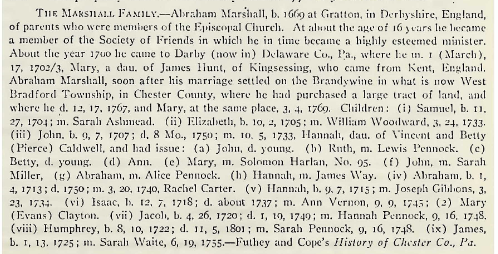
In the Youlgreave parish registers I found a baptism in 1667 for Humphrey Marshall son of Humphrey and Hannah. I didn’t find a baptism for Abraham, but it looks as though it could be correct. Abraham had a son he named Humphrey. But did it just look logical to whoever wrote the books, or do they know for sure? Did the famous botanist Humphrey Marshall have his own family records? The books don’t say where they got this information.
An earlier Humphrey Marshall was baptised in Youlgreave in 1559, his father Edmund. And in 1591 another Humphrey Marshall was baptised, his father George.
But can we connect these Marshall’s to ours? We do have an Abraham Marshall, grandson of Charles, born in 1792. The name isn’t all that common, so may indicate a family connection. The villages of Elton, Gratton and Youlgreave are all very small and it would seem very likely that the Marshall’s who went the USA are related to ours, if not brothers, then probably cousins.
Derbyshire Quakers
In “Derbyshire Quakers 1650-1761” by Helen Forde:
“… Friends lived predominantly in the northern half of the country during this first century of existence. Numbers may have been reduced by emigration to America and migration to other parts of the country but were never high and declined in the early eighteenth century. Predominantly a middle to lower class group economically, Derbyshire Friends numbered very few wealthy members. Many were yeoman farmers or wholesalers and it was these groups who dominated the business meetings having time to devote themselves to the Society. Only John Gratton of Monyash combined an outstanding ministry together with an organising ability which brought him recognition amongst London Friends as well as locally. Derbyshire Friends enjoyed comparatively harmonious relations with civil and Anglican authorities, though prior to the Toleration Act of 1639 the priests were their worst persecutors…..”
Also mentioned in this book: There were monthly meetings in Elton, as well as a number of other nearby places.
John Marshall of Elton 1682/3 appears in a list of Quaker emigrants from Derbyshire.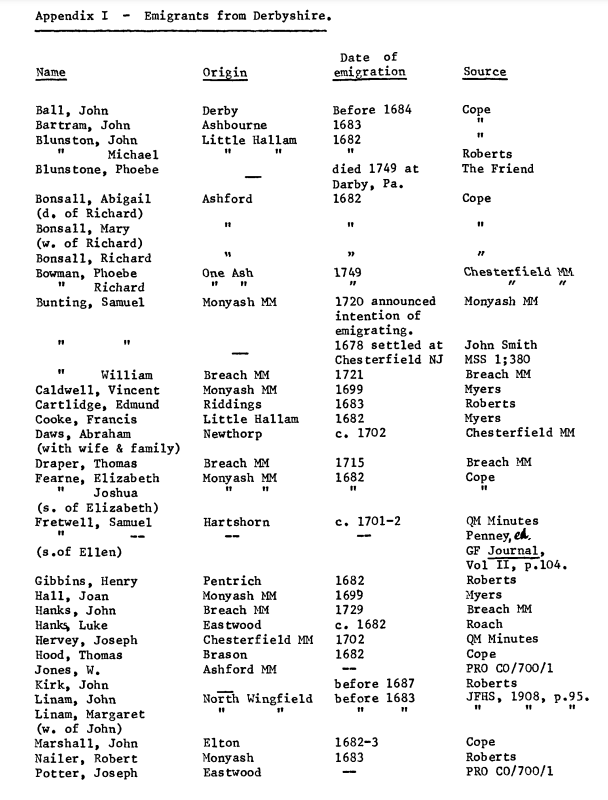
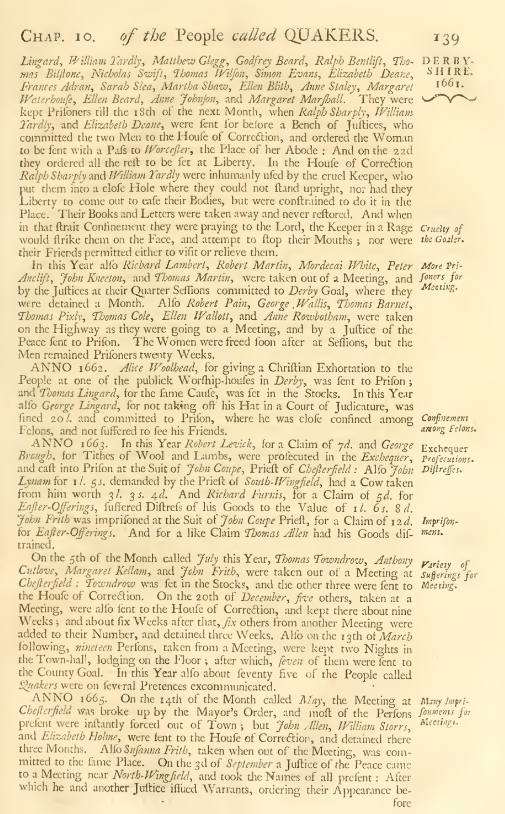
The following image is a page from the 1753 book on the sufferings of Quakers by Joseph Besse as an example of some of the persecutions of Quakers in Derbyshire in the 1600s:
A collection of the sufferings of the people called Quakers, for the testimony of a good conscience from the time of their being first distinguished by that name in the year 1650 to the time of the act commonly called the Act of toleration granted to Protestant dissenters in the first year of the reign of King William the Third and Queen Mary in the year 1689 (Volume 1)
Besse, Joseph. 1753Note the names Margaret Marshall and Anne Staley. This book would appear to contradict Helen Forde’s statement above about the harmonious relations with Anglican authority.
The Botanist
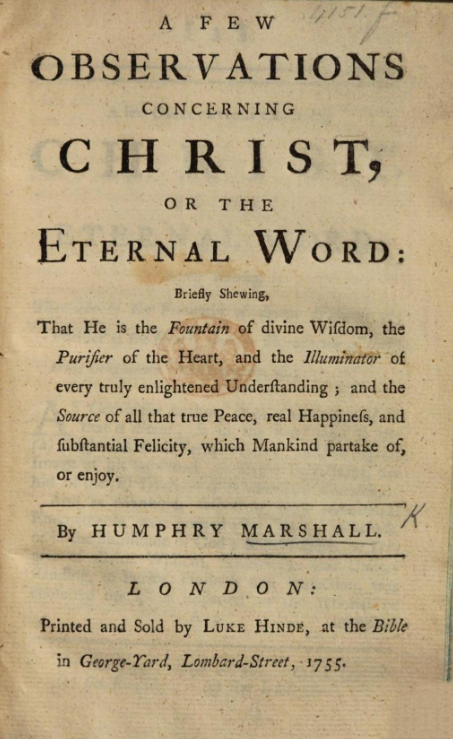
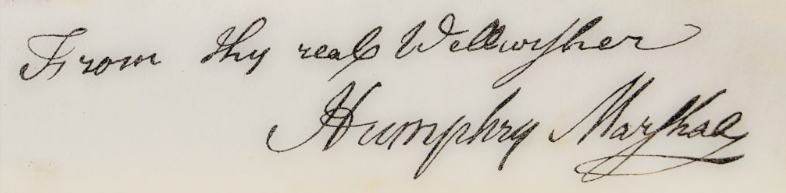
Humphry Marshall 1722-1801 was born in Marshallton, Pennsylvania, the son of the immigrant from Elton, Abraham Marshall. He was the cousin of botanists John Bartram and William Bartram. Like many early American botanists, he was a Quaker. He wrote his first book, A Few Observations Concerning Christ, in 1755.
In 1785, Marshall published Arbustrum Americanum: The American Grove, an Alphabetical Catalogue of Forest Trees and Shrubs, Natives of the American United States (Philadelphia).
Marshall has been called the “Father of American Dendrology”.
A genus of plants, Marshallia, was named in honor of Humphry Marshall and his nephew Moses Marshall, also a botanist.
In 1848 the Borough of West Chester established the Marshall Square Park in his honor. Marshall Square Park is four miles east of Marshallton.
via Wikipedia.
From The History of Chester County Pennsylvania, 1881, by J Smith Futhey and Gilbert Cope:
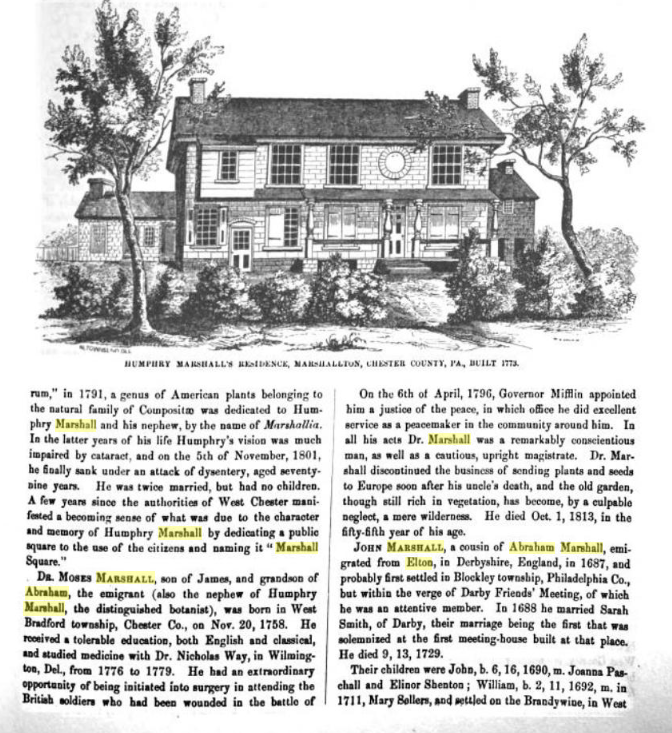
From The Chester Country History Center:
“Immediately on the Receipt of your Letter, I ordered a Reflecting Telescope for you which was made accordingly. Dr. Fothergill had since desired me to add a Microscope and Thermometer, and will
pay for the whole.’– Benjamin Franklin to Humphry, March 18, 1770
“In his lifetime, Humphry Marshall made his living as a stonemason, farmer, and miller, but eventually became known for his contributions to astronomy, meteorology, agriculture, and the natural sciences.
In 1773, Marshall built a stone house with a hothouse, a botanical laboratory, and an observatory for astronomical studies. He established an arboretum of native trees on the property and the second botanical garden in the nation (John Bartram, his cousin, had the first). From his home base, Humphry expanded his botanical plant exchange business and increased his overseas contacts. With the help of men like Benjamin Franklin and the English botanist Dr. John Fothergill, they eventually included German, Dutch, Swedish, and Irish plant collectors and scientists. Franklin, then living in London, introduced Marshall’s writings to the Royal Society in London and both men encouraged Marshall’s astronomical and botanical studies by supplying him with books and instruments including the latest telescope and microscope.
Marshall’s scientific work earned him honorary memberships to the American Philosophical Society and the Philadelphia Society for Promoting Agriculture, where he shared his ground-breaking ideas on scientific farming methods. In the years before the American Revolution, Marshall’s correspondence was based on his extensive plant and seed exchanges, which led to further studies and publications. In 1785, he authored his magnum opus, Arbustum Americanum: The American Grove. It is a catalog of American trees and shrubs that followed the Linnaean system of plant classification and was the first publication of its kind.”
 August 16, 2024 at 2:56 pm #7544
In reply to: The Elusive Samuel Housley and Other Family Stories
Youlgreave
The Frost Family and The Big Snow
The Youlgreave parish registers are said to be the most complete and interesting in the country. Starting in 1558, they are still largely intact today.
“The future historian of this parish will find a vast stock of material ready to hand, and if such a work was ever accomplished it would once more be seen how the history of even a remote village is but the history of the nation in little; how national victories were announced on the church bells, and national disasters by the proclamation of a form of prayer…”
J. Charles Cox, Notes on the Churches of Derbyshire, 1877.
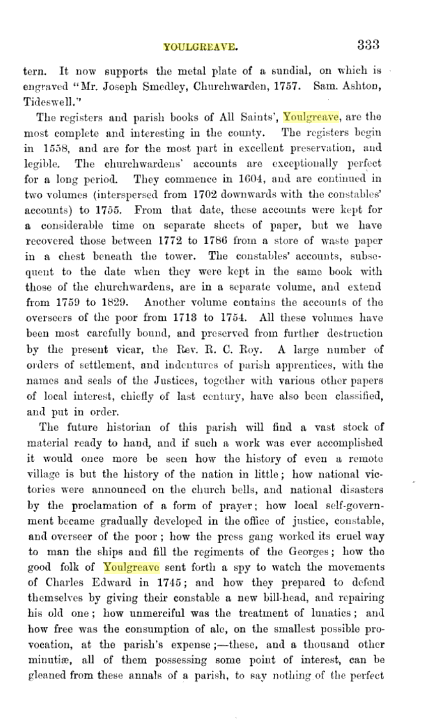
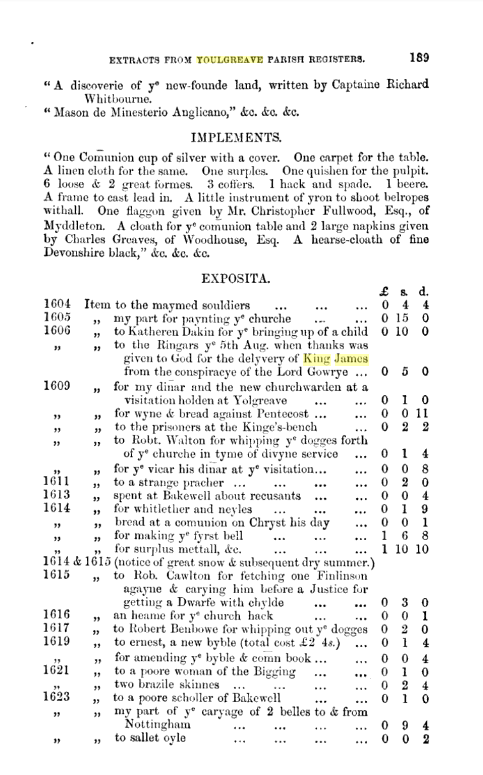
Although the Youlgreave parish registers are available online on microfilm, just the baptisms, marriages and burials are provided on the genealogy websites. However, I found some excerpts from the churchwardens accounts in a couple of old books, The Reliquary 1864, and Notes on Derbyshire Churches 1877.
Hannah Keeling, my 4x great grandmother, was born in Youlgreave, Derbyshire, in 1767. In 1791 she married Edward Lees of Hartington, Derbyshire, a village seven and a half miles south west of Youlgreave. Edward and Hannah’s daughter Sarah Lees, born in Hartington in 1808, married Francis Featherstone in 1835. The Featherstone’s were farmers. Their daughter Emma Featherstone married John Marshall from Elton. Elton is just three miles from Youlgreave, and there are a great many Marshall’s in the Youlgreave parish registers, some no doubt distantly related to ours.
Hannah Keeling’s parents were John Keeling 1734-1823, and Ellen Frost 1739-1805, both of Youlgreave.
On the burial entry in the parish registers in Youlgreave in 1823, John Keeling was 88 years old when he died, and was the “late parish clerk”, indicating that my 5x great grandfather played a part in compiling the “best parish registers in the country”. In 1762 John’s father in law John Frost died intestate, and John Keeling, cordwainer, co signed the documents with his mother in law Ann. John Keeling was a shoe maker and a parish clerk.
John Keeling’s father was Thomas Keeling, baptised on the 9th of March 1709 in Youlgreave and his parents were John Keeling and Ann Ashmore. John and Ann were married on the 6th April 1708. Some of the transcriptions have Thomas baptised in March 1708, which would be a month before his parents married. However, this was before the Julian calendar was replaced by the Gregorian calendar, and prior to 1752 the new year started on the 25th of March, therefore the 9th of March 1708 was eleven months after the 6th April 1708.
Thomas Keeling married Dorothy, which we know from the baptism of John Keeling in 1734, but I have not been able to find their marriage recorded. Until I can find my 6x great grandmother Dorothy’s maiden name, I am unable to trace her family further back.
Unfortunately I haven’t found a baptism for Thomas’s father John Keeling, despite that there are Keelings in the Youlgrave registers in the early 1600s, possibly it is one of the few illegible entries in these registers.
The Frosts of Youlgreave
Ellen Frost’s father was John Frost, born in Youlgreave in 1707. John married Ann Staley of Elton in 1733 in Youlgreave.
(Note that this part of the family tree is the Marshall side, but we also have Staley’s in Elton on the Warren side. Our branch of the Elton Staley’s moved to Stapenhill in the mid 1700s. Robert Staley, born 1711 in Elton, died in Stapenhill in 1795. There are many Staley’s in the Youlgreave parish registers, going back to the late 1500s.)
John Frost (my 6x great grandfather), miner, died intestate in 1762 in Youlgreave. Miner in this case no doubt means a lead miner, mining his own land (as John Marshall’s father John was in Elton. On the 1851 census John Marshall senior was mining 9 acres). Ann Frost, as the widow and relict of the said deceased John Frost, claimed the right of administration of his estate. Ann Frost (nee Staley) signed her own name, somewhat unusual for a woman to be able to write in 1762, as well as her son in law John Keeling.
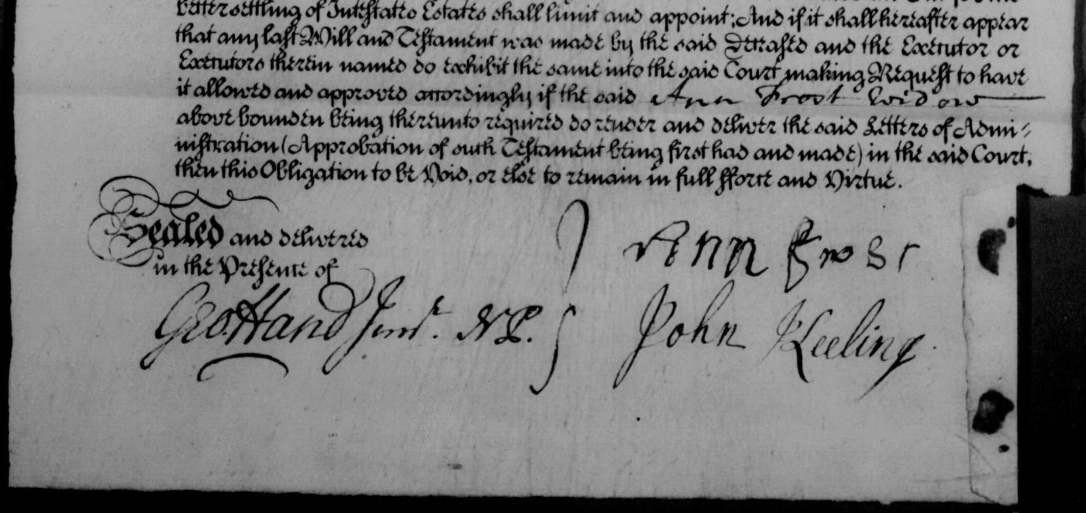
John’s parents were David Frost and Ann. David was baptised in 1665 in Youlgreave. Once again, I have not found a marriage for David and Ann so I am unable to continue further back with her family. Marriages were often held in the parish of the bride, and perhaps those neighbouring parish records from the 1600s haven’t survived.
David’s parents were William Frost and Ellen (or Ellin, or Helen, depending on how the parish clerk chose to spell it). Once again, their marriage hasn’t been found, but was probably in a neighbouring parish.
William Frost’s wife Ellen, my 8x great grandmother, died in Youlgreave in 1713. In her will she left her daughter Catherine £20. Catherine was born in 1665 and was apparently unmarried at the age of 48 in 1713. She named her son Isaac Frost (born in 1662) executor, and left him the remainder of her “goods, chattels and cattle”.
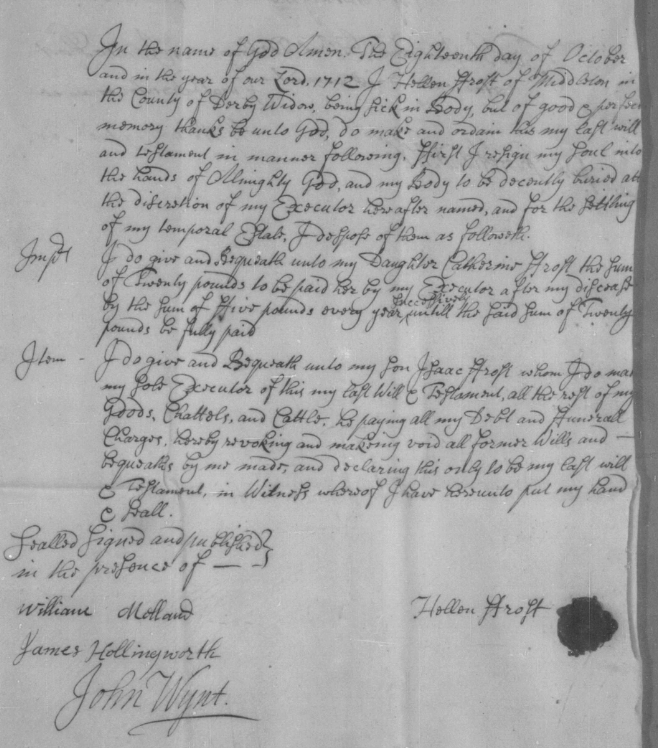
William Frost was baptised in Youlgreave in 1627, his parents were William Frost and Anne.
William Frost senior, husbandman, was probably born circa 1600, and died intestate in 1648 in Middleton, Youlgreave. His widow Anna was named in the document. On the compilation of the inventory of his goods, Thomas Garratt, Will Melland and A Kidiard are named.(Husbandman: The old word for a farmer below the rank of yeoman. A husbandman usually held his land by copyhold or leasehold tenure and may be regarded as the ‘average farmer in his locality’. The words ‘yeoman’ and ‘husbandman’ were gradually replaced in the later 18th and 19th centuries by ‘farmer’.)
Unable to find a baptism for William Frost born circa 1600, I read through all the pages of the Youlgreave parish registers from 1558 to 1610. Despite the good condition of these registers, there are a number of illegible entries. There were three Frost families baptising children during this timeframe and one of these is likely to be Willliam’s.
Baptisms:
1581 Eliz Frost, father Michael.
1582 Francis f Michael. (must have died in infancy)
1582 Margaret f William.
1585 Francis f Michael.
1586 John f Nicholas.
1588 Barbara f Michael.
1590 Francis f Nicholas.
1591 Joane f Michael.
1594 John f Michael.
1598 George f Michael.
1600 Fredericke (female!) f William.Marriages in Youlgreave which could be William’s parents:
1579 Michael Frost Eliz Staley
1587 Edward Frost Katherine Hall
1600 Nicholas Frost Katherine Hardy.
1606 John Frost Eliz Hanson.Michael Frost of Youlgreave is mentioned on the Derbyshire Muster Rolls in 1585.
(Muster records: 1522-1649. The militia muster rolls listed all those liable for military service.)
Frideswide:
A burial is recorded in 1584 for Frideswide Frost (female) father Michael. As the father is named, this indicates that Frideswide was a child.
(Frithuswith, commonly Frideswide c. 650 – 19 October 727), was an English princess and abbess. She is credited as the foundress of a monastery later incorporated into Christ Church, Oxford. She was the daughter of a sub-king of a Merica named Dida of Eynsham whose lands occupied western Oxfordshire and the upper reaches of the River Thames.)
An unusual name, and certainly very different from the usual names of the Frost siblings. As I did not find a baptism for her, I wondered if perhaps she died too soon for a baptism and was given a saints name, in the hope that it would help in the afterlife, given the beliefs of the times. Or perhaps it wasn’t an unusual name at the time in Youlgreave. A Fridesweda Gilbert was buried in Youlgreave in 1604, the spinster daughter of Francis Gilbert. There is a small brass effigy in the church, underneath is written “Frideswide Gilbert to the grave, Hath resigned her earthly part…”
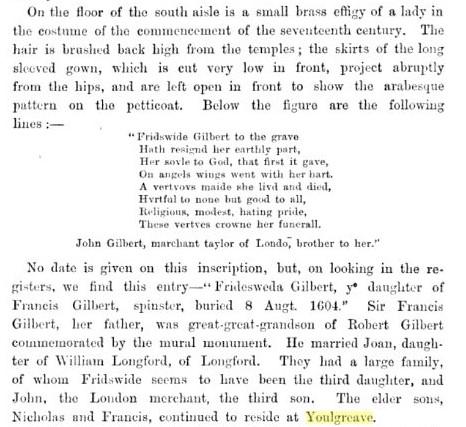
J. Charles Cox, Notes on the Churches of Derbyshire, 1877.
King James
A parish register entry in 1603:
“1603 King James of Skottland was proclaimed kinge of England, France and Ireland at Bakewell upon Monday being the 29th of March 1603.” (March 1603 would be 1604, because of the Julian calendar in use at the time.)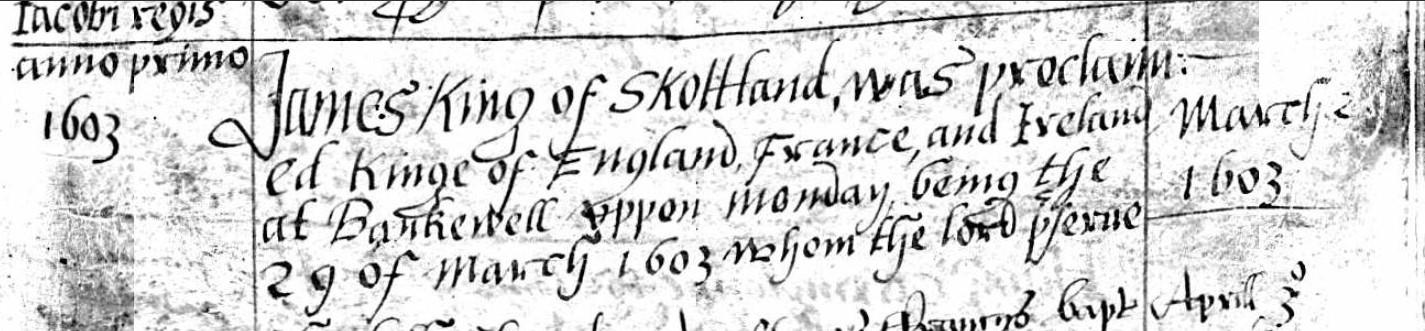
The Big Snow
“This year 1614/5 January 16th began the greatest snow whichever fell uppon the earth within man’s memorye. It covered the earth fyve quarters deep uppon the playne. And for heaps or drifts of snow, they were very deep; so that passengers both horse or foot passed over yates, hedges and walles. ….The spring was so cold and so late that much cattel was in very great danger and some died….”
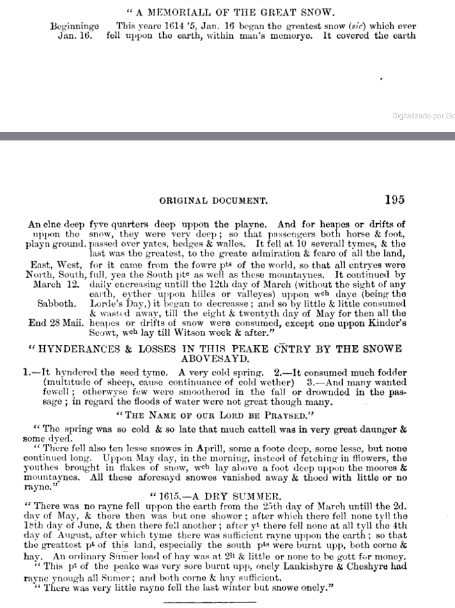
From the Youlgreave parish registers.
Our ancestor William Frost born circa 1600 would have been a teenager during the big snow.
July 25, 2024 at 7:58 am #7542In reply to: The Incense of the Quadrivium’s Mystiques
Shivering, Truella pulled the thin blanket over her head. Colder than a witches tit here, colder in summer than winter at home! It was no good, she may as well get up and go for a walk to try and warm up. Poking her head outside Truella gasped and coughed at the chill air. Shapes were becoming discernible in the dim pre dawn light, the other pods, the hedgerow, a couple of looming trees. Truella rummaged through her bag, hoping to find warm clothes yet knowing she hadn’t packed anything warm enough. Sighing, her teeth chattering, she pulled on everything she had in layers and pulled the blanket off the bed to use as a cape. With a towel over her head for extra warmth, she ventured out into the Irish morning.
The grass was sodden with dew and Truella’s feet were wet through and icy. Bracing her shoulders with determination, she forged ahead towards a gate leading into the next field. She struggled for a few minutes with the baler twine holding the gate closed, numb fingers refusing to cooperate. Cows watched her curiously, slowly munching. One lifted her tail and dropped a steaming splat on the grass, chewing continuously. I don’t think I could eat and do that at the same time.
Heading off across the field which sloped gently upwards, Treulla picked up her pace, keeping her eyes down to avoid the cow pats. By the time she reached the oak tree along the top hedge, the sun started to make an appearance over the hill. Warmer from the exercise, she gazed over the countryside. How beautiful it was with the mist in the valleys, and everything so green.
If only it was warmer!
“Are you cold then, is that why you’re decked out like that? From a distance I thought I was seeing a ghost in a cloak and head shawl!” The woman smiled at Truella from the other side of the hedgerow. “Sorry, did I startle you? You’ll get your feet soaked walking in that wet grass, climb over that stile over there, the lane here’s better for a morning walk.”
It sounded like good advice and the woman seemed pleasant enough. “Are you here for the games too?” Truella asked, readjusting the blanket and towel after navigating the stile.
“Yes, I am. I’m retired, you see,” the woman said with a wide grin. “It’s a wonderful thing, not that you’d know, you’re much to young.”
“That must be nice,” Truella replied politely. “I sometimes wish I was retired.”
“Oh, my dear! It’s wonderful! I haven’t had a job for years, but it’s the strangest thing, now that I’ve officially retired, there’s a marvellous feeling of freedom. I don’t have to do anything. Well, I didn’t have to do anything before I retired but one always feels one should keep busy, do productive things, be seen to be doing some kind of work to justify ones existance. Have you seen the old priory?”
“No, only just got here yesterday.”
“You’ll love it, it’s up this path here, follow me. But now I’ve retired,” the woman continued, “I get up in the morning with a sense of liberation. I can do as little as I want ~ funny thing is that I’ve actually been doing more, but there’s no feeling of obligation, no things to cross off a list. All I’m expected to do as a retired person is tick along, trying not to be much of a bother for as long as I can.”
“I wish I was retired!” exclaimed Truella with feeling. “I wish I didn’t have to do the cow goddess stall, it’ll be such a bind having to stand there all evening.” She explained about the coven and the stalls, and the depressing productivity goals.
“But why not get someone else to do the stall for you?”
“It’s such short notice and I don’t know anyone here. It’s an idea though, maybe someone will turn up.”
July 19, 2024 at 12:26 pm #7536In reply to: The Incense of the Quadrivium’s Mystiques
The rainbow was neon bright, one end disappearing behind a spinney in the distance, and the other end landing squarely in the middle of the glamping pods. A good sign! thought Truella, the first of the coven to arrive. For a moment she imagined herself digging a hole right there, and finding the elusive pot of gold. I wouldn’t be able to do that in a fancy hotel. For once, Truella was happy with Austreberthe’s choice. A week or two in a green field sounded relaxing, refreshing. So much more to her taste than the endless fitted carpets, closed windows, and artifically controlled air blasting out of metal grilles in hotels.
Taking a deep breath of cool fresh air, she surveyed the site before checking into reception. The neighbouring fields were full of cows, perfect for her to practice her Bubona spells on before she set up her Goddess Spell Booth. The Goddess spell tents were to be open in the evenings, after the games each day, along with other stalls selling handicrafts, homemade cakes and jams, wines and potions, trinkets and souvenirs, and all the other tat that people on holiday enjoyed browsing. Obviously the coven would have a stall selling incense. No doubt Austreberthe would have hatched some hard sell plan for that.
Inside the reception office, Truella pinged the bell and waited for someone to attend. The registration book was open on the counter and Truella craned her neck to read the names on the list. She planned to ask for a pod in a far corner, near the hedgerow. It might make it easier to slip out unnoticed, if she should have a mind to do so. The door behind the counter opened and a young man appeared, smiling a welcome. But not before Truella had seen the name on the list. She sucked her breath in sharply. Malove! Nobody was expecting her. Did Austreberthe know?
“Welcome to Finnegan’s Farm Glampsite, I’m Liam,” said the young man, pushing long mousy hair out of his eyes, “You’ve a booking I take it, because we’re fully booked up for the next fortnight. Because of the Games, you see.”
Replying that she did, Truella asked for a pod in the furthest corner. Liam looked at a list and frowned. “The corners are all taken, I’m afraid. But I tell you what,” he said, “As you’re the first to arrive I’ll swap your pod, let’s see…” He scanned the list. “Ah yes, the late booking. I can put you in the one we’ve assigned to Mrs …Malone I think it says, and put her in yours.”
“Thank you very much, Liam,” Truella said as he handed her a key with a big wooden tag with the number 33 etched on it.
“I’ll carry your bags over and show you where it is, follow me.”
July 18, 2024 at 9:16 am #7534In reply to: The Incense of the Quadrivium’s Mystiques
Ms Nicraith Noble, the Mayor of Limerick taking a bath in the Shannon River with reporters had made the rounds of news in ways that were quite incomprehensible.
Obviously it was part of a media ploy to boost public attention for the incoming Roman Games.
“Did she require some anti-rash-and-boil spells?” Jeezel messaged on the network, worried about what such swimming stunt would do to her ravishing hair.
“Probably…” Eris responded in a terse manner “Don’t forget Austreberthe managed to get us to sponsor the event. She may have eased the deal with some goodies. Like anti-age spell too.”
Eris was glad Austreberthe had refocused the efforts towards the imminent launch of the Roman Games. Those mass events were key moments in the Coven’s seasonal activities, as they provided a bounty of emotions to refine and process for creation of their most epic incenses. The recent mass events had been too heavy on fear, anger and gloom-mongering, not the grade A quality they required.
Austreberthe had called all hands on deck to be ready for the event, having deemed the reconnaissance work in Spain’s cloisters sufficiently well under way to take a break from it. In truth, Eris suspected she’d started to receive the first invoices from the undertakers’ Guild and had realised it was a hefty cost for their consulting services.
On top of that, there was a recent case of the drunken sheep flu in Andalucia, some local variety of virus that got the cloister sisters fear for their elderly’s Mother Loreena’s health. Considering the gleeful vulture’s smiles of the Morticians in waiting, they had decided in agreement for an early dismiss into the Summer holidays retreats.
“More prayers, phew, glad they didn’t need us for that.” true to her swagger way, Truella had conceded and accepted to put a hold to her passionate researches —she’d managed to get their personal phone numbers too anyway.
“One week to the start of the Games then.” Eris sighed. The last stretch to summer holidays seemed to take forever.
-
AuthorSearch Results