

Search Results for 'gardener'
-
AuthorSearch Results
-
January 19, 2026 at 6:51 pm #8051
In reply to: The Hoards of Sanctorum AD26
“Lace, did you say?” asked Cerenise with interest. “I must have a look at it. Stench, you say? How very odd. But I want to see it. Fetch me the container while I look for my mask and rubber gloves.”
“I’m not going near it again, I’ll get Boothroyd to bring it,” Spirius replied making a hasty exit.
“I’d have thought you’d have wanted to bottle the smell, Spirius.”
In due course the gardener appeared holding a container at arms length with a pained expression on his face. “Stinks worse than keeg, this does, and I’ve smelled some manure and compost in my time, but never anything as disgusting as this. Where am I to put it?”
Cerenise cleared a space on a table piled with old books and catalogues. “Gosh, that is a pong, isn’t it! Reminds me of something,” she said twitching her nose. “There is a delicate note of ~ what is it?”
“Dead rats?” suggested Boothroyd helpfully, adding “Will that be all?” as he backed towards the door.
As Cerenise lifted the lid, the gardener turned and fled.
“Why, it’s a Nottingham lace Lambrequin window drape if I’m not mistaken!” exclaimed Cerenise, gently lifting the delicate fabric and holding it up to the light. “Probably 1912 or thereabouts, and in perfect condition.”
“Perfectly rancid,” said Yvoise, her voice muffled by the thick towel she had wrapped around her mouth and nose.
“Come and look, it’s a delightful specimen. Not terribly rare, but it wonderful condition. Oh look! There’s another piece underneath. Aha! seventeenth century bone lace!”
Yvoise crept closer. “What’s that other thing? Is that where the smell’s coming from?”
“By Georges, I think you’re right. It’s a bone bobbin. Bone lace, they used to call it, until they started making bobbins out of wood.” Cerenise was pleased. She could get Mrs Fennel to wash the lace and then she could add it to her collection. “Spirius can bottle the bone bobbin and bury it in Bobbington Woods.”
Duly summoned from the kitchen, the faithful daily woman appeared, drying her hands on her apron.
“Pooo eee!” exclaimed Mrs Fennel, “That’ll need a good boil in bleach, will that!”
“Good lord woman, no! A gentle soak in some soap should do it. It won’t smell half so bad as soon as this bone bobbin is removed.”
“Did you say BONE bobbin?” asked Helier from a relatively safe distance just outside the door. “WHOSE bone?”
“By Georges!” Cerenise said again. “Whose bone indeed! Therein lies the clue to the mystery, you know.”
“Can’t you just put it in a parcel and mail it to someone horrible?” suggested Mrs Fennel.
“A capital idea, Mrs Fennel, a politician. So many horrible ones to choose from though,” Yvoise was already making a mental list.
“We can mail the smelly empty box to the prime minister, but we must keep the bone bobbin safe,” said Helier. “And we must find out whose bones it was made from. Cerenise is right. It’s the clue.”
“An empty smelly box, even better. More fitting, if I do say so myself, for the prime minister,” said Mrs Fennel with some relief. At least she wasn’t going to be required to wash the bone and the box as well as the smelly lace.
January 4, 2026 at 10:01 pm #8043In reply to: Finder’s Keepers of the Hoard
A cinematic, low-angle shot inside a flooded, ancient brick sewer tunnel that looks like a mix of Roman catacombs and Victorian industrial plumbing. The water is dark and murky, reflecting the light of a flickering lantern.
In the center of the frame, floating precariously, is a bright yellow, cheap inflatable dinghy.
Inside the dinghy are two men:
-
Spirius: An elderly man with a nervous expression, wearing a high-vis vest over ancient saintly robes. He is clutching an antique musket that is clearly too heavy for him. A faint, golden neon halo flickers erratically behind his head like a faulty streetlamp.
-
Boothroyd: A grumpy, weather-beaten gardener in a tweed cap. He looks completely resigned to his fate, lazily paddling with a plastic oar in one hand and holding a sharp garden spear in the other.
Action: The dinghy squeaks as it bumps against the wet brick walls. Spirius jumps at a drip of water falling from the ceiling. Something large ripples the water in the foreground—a menacing shadow moving beneath the surface.
Atmosphere:
-
Lighting: Chiaroscuro—deep shadows and warm lantern light, contrasting with the synthetic yellow of the boat.
-
Mood: Tense but ridiculous. High-stakes fantasy meets low-budget reality.
Movement:
-
The camera tracks slowly backward as the boat drifts forward.
-
The water ripples ominously.
-
Spirius’s halo buzzes and dims when he gets scared.
January 3, 2026 at 8:09 pm #8025In reply to: The Hoards of Sanctorum AD26
As soon as Boothroyd had gone, Laddie Bentry, the under gardener, emerged from behind the Dicksonia squarrosa that was planted in a rare French Majolica Onnaing dragon eagle pot. The pot, and in particular the tree fern residing within it, were Laddie’s favourite specimen, reminding him of his homeland far away.
Keeping a cautious eye on the the door leading into the house, Laddie hurried over to the cast iron planter and retrieved the Liz Tattler novel hidden underneath. Quickly he tucked in into the inside pocket of his shabby tweed jacket and hastened to the door leading to the garden. Holding on to his cap, for the wind was cold and gusty, he ran to the old stable and darted inside. Laddie reckoned he had an hour or two free without Boothroyd hovering over him, and he settled himself on a heap of old sacks.
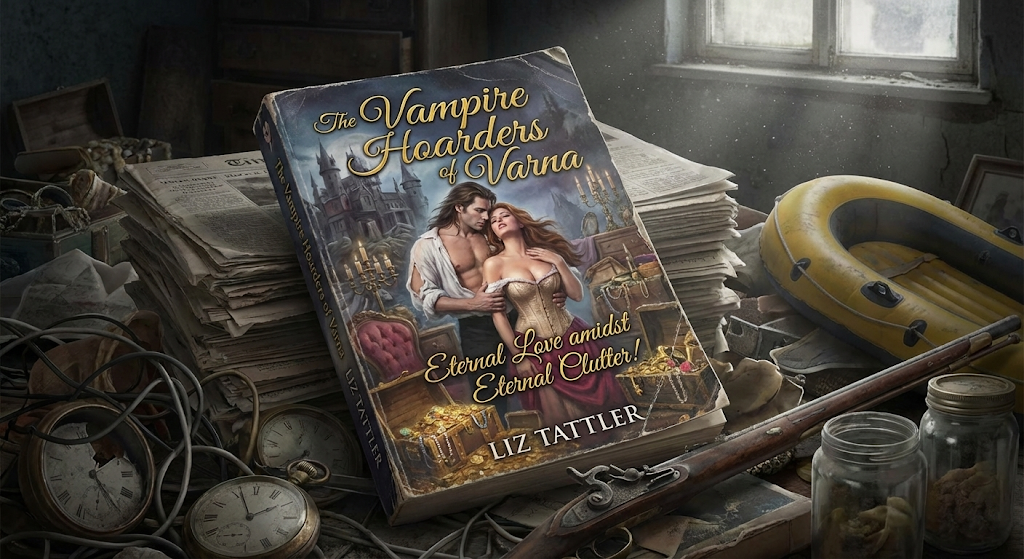
 The Vampire Hoarders of Varna. It wasn’t the first time Laddie had seen Boothroyd surreptitiously reading Helier’s books, and it had piqued his curiosity. What was it the old fart found so interesting about Helier’s novels? The library was full of books, if he wanted to read. Not bothering to read the preface, and not having time to start on page one, Laddie Bentry flicked through the book, pausing to read random passages.
….the carriage rattled and lurched headlong through the valley, jostling the three occupants unmercifully. “I’ll have the guts of that coachman for garters! The devil take him!” Galfrey exclaimed, after bouncing his head off the door frame of the compartment.
“Is it bleeding?” asked Triviella, inadvertently licking her lips and she inspected his forehead.
“The devil take you too, for your impertinence,” Galfrey scowled and shook her off, his irritation enhanced by his alarm at the situation they found themselves in.
Ignoring his uncharacteristic bad humour, Triviella snuggled close and and stroked his manly thigh, clad in crimson silk breeches. “Just think about the banquet later,” she purred.
Jacobino, austere and taciturn, on the opposite seat, who had thus far been studiously ignoring both of them, heard the mention of the banquet and smiled for the first time since…
Laddie opened the book to another passage.
“……1631, just before the siege of Gloucester, and what a feast it was! It was hard to imagine a time when we’d feasted so well. Such rich and easy pickings and such a delightful cocktail. One can never really predict a perfect cocktail of blood types at a party, and centuries pass between particularly memorable ones. Another is long overdue, and one would hate to miss it,” Jacobino explained to the innocent and trusting young dairy maid, who was in awe that the handsome young gentleman was talking to her at all, yet understood very little of his dialogue.
“Which is why,” Jacobino implored, taking hold of her small calloused hands, “You must come with me to the banquet tonight.”
Little did she know that her soft rosy throat was on the menu…..
January 3, 2026 at 11:55 am #8024In reply to: The Hoards of Sanctorum AD26
Floviana sunk her yellowed fangs into the milky white throat of the village wench and slurped the revitalising iron rich nectar, relishing the immediate surge of strength. The buxom peasant girl swooned, faint with shock and loss of vital fluids, and Floviana struggled to hold her upright as she drank her fill. Sated at last, Floviana unceremoniously dropped the girl on the leaf covered mulch of the forest floor, carelessly leaving her body in a shameful disarray with her coarse woollen stockings and plump white thighs exposed.
Boothroyd grunted with pleasure as he imagined the scene and then quickly snapped Helier’s book closed when he heard the door to the conservatory open. Dropping the book and kicking it under a cast iron jardiniere, he rose as Spirius entered the room.
“Ah, there you are Boothroyd. If you’re not too busy,” Spirius cast his eyes around in a fruitless manner attempting to discover what exactly the gardener had been busy with, “I’d like you to accompany me down the cellar. Bring some weapons.”
“Weapons, sire?” Boothroyd scratched his head.
“Yes, Yes, weapons! Are you deaf? A long spear and perhaps a musket. And a small inflatable dinghy.”
“A dinghy, sire?”
Spirius sighed. “Yes, a dinghy. And a big net. Meet me at the top of the cellar steps in an hour. I’ll go and get the bottles.”
Boothroyd sighed and glanced wistfully at the cast iron planter, haunted by the vision of plump white thighs.
January 3, 2026 at 9:04 am #8023In reply to: The Hoards of Sanctorum AD26
“Quite fitting that I should get her sleeves,” Cerenise said with satisfaction. “And what a relief that she left the wolf to you, Spirius. I’d not have been able to manage a wolf.” Cerenise popped another cashew nut into her mouth.
Spirius looked at her with a raised eyebrow. “My guess is you’d have managed just fine,” he replied drily. He’d heard all the noise she made behind those locked doors. He’d seen her prancing around the orchard in the moonlight when she thought nobody was watching, naked as the day she was born all those centuries ago. He hadn’t lingered at the window, but he had put two and two together years ago, many years ago, just after the seige of Gloucester. If truth be told, Cerenise’s secret was known to them all, but they hadn’t interfered with her delusion.
“There’s going to come a point, and very soon, when we will have to deal with the water leak, you know,” Yvoise interrupted the inconsequential chatter. “Holy and healing as it may be, it will be the ruin of my collection if it reaches the upper floors.”
“And what do you propose?” asked Helier.
“I suggest we call a plumber!” snapped Yvoise. “This is the 21st century is it not? I know tradesmen are in short supply, and I know this isn’t an ordinary leak, but we should start with the obvious, and then adapt accordingly.”
“I must bottle as much of the holy water as possible before we stop the leak,” Spirius said, standing up abruptly in agitation.
Helier put a calming hand on the old boy’s shoulder. “There’s no rush, Spirius, there’s plenty of water in the cellars, it’s already waist deep down there.”
“And the saints only know what has floated into the cellars by now from the tunnels. Be careful down there, Spirius. Take Boothroyd the gardener with you,” Yvoise advised.
March 23, 2025 at 10:50 am #7880In reply to: The Precious Life and Rambles of Liz Tattler
“Nice arse,” said Idle non too quietly, admiring Roberto as he stacked firewood beside the hearth. The gardener glanced round and gave her a cheeky wink. He’d noticed her leaning out of an upstairs window watching him weeding the herbacious border.
“Now, now, Idle, no molesting the staff. I’ll write some men into the story for you later,” Liz said, “But first let’s talk about my new book. I’m wondering what to name the six spinsters. Some kind of a theme. Cerise, Fuschia, Scarlett, Coral, Rose and Magenta?”
“What about Cobalt, Lapis, Cerulean, Indigo, Sapphire and Capri?” offered Idle, topping up their wine glasses. “Chartreuse, Emerald, Jade, Fern, Pistachio and Malachite? Marigold, Saffron, Citron, Amber, Maize and Apricot?”
“How about Bratwurst, Chorizo, Salami, Knackwurst, Bologna and Frankfurter?” suggested Godfrey who was still miffed about all the spare parts being disposed of. “Lasagne, Macaroni, Canneloni, Farfali, Linguini and Ravioli?”
Roberto lit the fire and stood up. “I have an idea, you can call them Trowel, Rake, Hoe, Wheelbarrow, Spade and Secateur.”
“Marvelous Roberto, I love it!” gushed Aunt Idle.
“You’re all mad as a box of frogs, madder than Almad,” Finnley said. “How about Duster, Mop, Bleach, Broom, Dustpan and Cloth?”
“I think this incessant rain is driving us all mad,” Liz said, glancing out of the French windows with a sigh.
March 7, 2025 at 8:25 pm #7859In reply to: The Precious Life and Rambles of Liz Tattler
“Godfrey,” Liz peered menacingly over her spectacles at her increasingly rogue editor, “Are you trying to replace me? Because it won’t work, you know.”
“You won’t be able to replace me, either,” Finnley called over her shoulder while sweeping up mouse droppings.
“I too am irreplacable,” shouted Roberto who just happened to be passing the French windows with a trug of prunings.
On impulse, Liz dived through the French windows onto the terrace and snatched the secateurs from the trug over Roberto’s arm. In a trice she had snipped through Godfrey’s cables.
“Pass the peanuts,” intoned Godfrey mechanically, deprived of electricity and with a low back up battery. It wouldn’t be long before he was silent and Liz could get back to the business of writing stories.
“I’ll plug you back in, in a minute,” hissed Finnley to Godfrey, while Liz was diverted with returning the secateurs to the gardener. “Once she’s settled down.”
February 23, 2025 at 1:42 pm #7829In reply to: Helix Mysteries – Inside the Case
Helix 25 – Investigation Breakdown: Suspects, Factions, and Ship’s Population
To systematically investigate the murder(s) and the overarching mystery, let’s break down the known groups and individuals, their possible means to commit crimes, and their potential motivations.
1. Ship Population & Structure
Estimated Population of Helix 25
- Originally a luxury cruise ship before the exodus.
- Largest cruise ships built on Earth in 2025 carried ~5,000 people.
Space travel, however, requires generations. - Estimated current ship population on Helix 25: Between 15,000 and 50,000, depending on deck expansion and growth of refugee populations over decades.
- Possible Ship Propulsion:
- Plasma-based propulsion (high-efficiency ion drives)
- Slingshot navigation using gravity assists
- Solar sails & charged particle fields
- Current trajectory: Large elliptical orbit, akin to a comet.
Estimated direction of the original space trek was still within Solar System, not beyond the Kuiper Belt (~30 astrological units) and programmed to return towards it point of origin.
Due to the reprogramming by the refugees, it is not known if there has been significant alteration of the course – it should be known as the ship starts to reach the aphelion (farthest from the Sun) and either comes back towards it, or to a different course.

- Question: Are they truly on a course out of the galaxy? Or is that just the story Synthia is feeding them?
Is there a Promised Land beyond the Ark’s adventure?
2. Breaking Down People & Factions
To find the killer(s), conspiracies, and ship dynamics, here are some of factions, known individuals, and their possible means/motives.
A. Upper Decks: The Elite & Decision-Makers
- Defining Features:
- Wealthy descendants of the original passengers. They have adopted names of stars as new family names, as if de-facto rulers of the relative segments of the space.
- Have never known hardship like the Lower Decks.
- Kept busy with social prestige, arts, and “meaningful” pursuits to prevent existential crisis.
Key Individuals:
-
Sue Forgelot –
- Means: Extensive social connections, influence, and hidden cybernetic enhancements.
- Motive: Could be protecting something or someone—she knows too much about the ship’s past.
- Secrets: Claims to have met the Captain. Likely lying… unless?
-
Dr. Amara Voss –
- Means: Expert geneticist, access to data. Could tamper with DNA.
- Motive: What if Herbert knew something about her old research? Did she kill to bury it?
-
Ellis Marlowe (Retired Postman) –
- Means: None obvious. But as a former Earth liaison, he has archives and knowledge of what was left behind.
- Motive: Unclear, but his son was the murder victim. His son was previously left on Earth, and seemed to have found a way onto Helix 25 (possibly through the refugee wave who took over the ship)
- Question: Did he know Herbert’s real identity?
-
Finkley (Upper Deck cleaner, informant) –
- Means: As a cleaner, has access everywhere.
- Motive: None obvious, but cleaners notice everything.
- Secret: She and Finja (on Earth) are telepathically linked. Could Finja have picked up something?
-
The Three Old Ladies (Shar, Glo, Mavis) –
- Means: Absolutely none.
- Motive: Probably just want more drama.
- Accidental Detectives: They mix up stories but might have stumbled on actual facts.
-
Trevor Pee Marshall (TP, AI detective) –
- Means: Can scan records, project into locations, analyze logic patterns.
- Motive: Should have none—unless he’s been compromised as hinted by some of the remnants of old Muck & Lump tech into his program.
B. Lower Decks: Workers, Engineers, Hidden Knowledge
- Defining Features:
- Unlike the Upper Decks, they work—mechanics, hydroponics, labor.
- Self-sufficient, but cut off from decisions.
- Some distrust Synthia, believing Helix 25 is off-course.
Key Individuals:
-
Luca Stroud (Engineer, Cybernetic Expert) –
- Means: Can tamper with ship’s security, medical implants, and life-support systems.
- Motive: Possible sabotage, or he was helping Herbert with something.
- Secret: Works in black-market tech modifications.
-
Romualdo (Gardener, Archivist-in-the-Making) –
- Means: None obvious. Seem to lack the intelligence, but isn’t stupid.
- Motive: None—but he lent Herbert a Liz Tattler book about genetic memories.
- Question: What exactly did Herbert learn from his reading?
-
Zoya Kade (Revolutionary Figure, Not Directly Involved) –
- Means: Strong ideological influence, but not an active conspirator.
- Motive: None, but her teachings have created and fed factions.
-
The Underground Movement –
- Means: They know ways around Synthia’s surveillance.
- Motive: They believe the ship is on a suicide mission.
- Question: Would they kill to prove it?
C. The Hold: The Wild Cards & Forgotten Spaces
- Defining Features:
- Refugees who weren’t fully integrated.
- Maintain autonomy, trade, and repair systems that the rest of the ship ignores.
Key Individuals:
-
Kai Nova (Pilot, Disillusioned) –
- Means: Can manually override ship systems… if Synthia lets him.
- Motive: Suspects something’s off about the ship’s fuel levels.
-
Cadet Taygeta (Sharp, Logical, Too Honest) –
- Means: No real power, but access to data.
- Motive: Trying to figure out what Kai is hiding.
D. AI & Non-Human Factors
-
Synthia (Central AI, Overseer of Helix 25)
- Means: Controls everything.
- Motive: Unclear, but her instructions are decades old.
- Question: Does she even have free will?
-
The Captain (Nemo)
- Means: Access to ship-wide controls. He is blending in the ship’s population but has special access.
- Motive: Seems uncertain about his mission.
- Secret: He might not be following Synthia’s orders anymore.
3. Who Has the Means to Kill in Zero-G?
The next murder happens in a zero-gravity sector. Likely methods:
- Oxygen deprivation (tampered life-support, “accident”)
- Drowning (hydro-lab “malfunction”)
Likely Suspects for Next Murder
Suspect Means to Kill in Zero-G Motive Luca Stroud Can tamper with tech Knows ship secrets Amara Voss Access to medical, genetic data Herbert was digging into past Underground Movement Can evade Synthia’s surveillance Wants to prove ship is doomed Synthia (or Rogue AI processes) Controls airflow, gravity, and safety protocols If she sees someone as a threat, can she remove them? The Captain (Nemo?) Has override authority Is he protecting secrets?
4. Next Steps in the Investigation
- Evie and Riven Re-interview Suspects. Who benefited from Herbert’s death?
- Investigate the Flat-Earth Conspiracies. Who is spreading paranoia?
- Check the Captain’s Logs. What does Nemo actually believe?
- Stop the Next Murder. (Too late?)
Final Question: Where Do We Start?
- Evie and Riven visit the Captain’s quarters? (If they find him…)
- Investigate the Zero-G Crime Scene? (Second body = New urgency)
- Confront one of the Underground Members? (Are they behind it?)
Let’s pick a thread and dive back into the case!
February 23, 2025 at 1:35 pm #7828In reply to: The Last Cruise of Helix 25
Helix 25 – The Murder Board
Evie sat cross-legged on the floor of her cramped workspace, staring at the scattered notes, datapads, and threads taped to the wall. Finding some yarn on the ship had not been as easy as she thought, but it was a nice touch she thought.
The Murder Board, as Riven Holt had started calling it, was becoming an increasingly frustrating mess of unanswered questions.
Riven stood nearby, arms crossed, with a an irritated skepticism. “Almost a week,” he muttered. “We’re no closer than when we started.”
Evie exhaled sharply. “Then let’s go back to the basics.”
She tapped the board, where the crime scene was crudely sketched. The Drying Machine. Granary. Jardenery. Blood that shouldn’t exist.
She turned to Riven. “Alright, let’s list it out. Who are our suspects?”
He looked at his notes, dejected for a moment; “too many, obviously.” Last census on the ship was not accurate by far, but by all AI’s accounts cross-referenced with Finkley’s bots data, they estimated the population to be between 15,000 and 50,000. Give or take.
They couldn’t interview possibly all of them, all the more since there the interest in the murder had waned very rapidly. Apart from the occasional trio of nosy elderly ladies, the ship had returned mostly to the lull of the day-to-day routine.
So they’d focused on a few, and hoped TP’s machine brain could see patterns where they couldn’t.- First, the Obvious Candidates: People with Proximity to the Crime Scene
Romualdo, the Gardener – Friendly, unassuming. He lends books, grows plants, and talks about Elizabeth Tattler novels. But Herbert visited him often. Why?
Dr. Amara Voss – The geneticist. Her research proves the Crusader DNA link, but could she be hiding more? Despite being Evie’s godmother, she couldn’t be ruled out just yet.
Sue Forgelot – The socialite with connections everywhere. She had eluded their request for interviews. —does she know more than she lets on?
The Cleaning Staff – they had access everywhere. And the murder had a clean elegance to it… - Second, The Wild Cards: People with Unknown Agendas
The Lower Deck Engineers – Talented mechanic, with probable cybernetic knowledge, with probable access to unauthorized modifications. Could they kill for a reason, or for hire?
Zoya Kade and her Followers – They believe Helix 25 is on a doomed course, manipulated by a long-dead tycoon’s plan. Would they kill to force exposure of an inconvenient truth?
The Crew – Behind the sense of duty and polite smiles, could any of them be covering something up? - Third, The AI Factor: Sentient or Insentient?
Synthia, the AI – Controls the ship. Omnipresent. Can see everything, and yet… didn’t notice or report the murder. Too convenient.
Other personal AIs – Like Trevor Pee’s programme, most had in-built mechanisms to make them incapable of lying or harming humans. But could one of their access be compromised?
Riven frowned. “And what about Herbert himself? Who was he, really? He called himself Mr. Herbert, but the cat erm… Mandrake says that wasn’t his real name. If we figure out his past, maybe we find out why he was killed.”
Evie rubbed her temples. “We also still don’t know how he was killed. The ship’s safety systems should have shut the machine down. But something altered how the system perceived him before he went in.”
She gestured to another note. “And there’s still the genetic link. What was Herbert doing with Crusader DNA?”
A heavy silence settled between them.
Then TP’s voice chimed in. “Might I suggest an old detective’s trick? When stumped, return to who benefits.”
Riven exhaled. “Fine. Who benefits from Herbert’s death?”
Evie chewed the end of her stylus. “Depends. If it was personal, the killer is on this ship, and it’s someone who knew him. If it was bigger than Herbert, then we’re dealing with something… deeper.”
TP hummed. “I do hate deeper mysteries. They tend to involve conspiracies, misplaced prophecies, and far too many secret societies.”
Evie and Riven exchanged a glance.
Riven sighed. “We need a break.”
Evie scoffed. “Time means nothing here.”
Riven gestured out the window. “Then let’s go see it. The Sun.”
Helix 25 – The Sun-Gazing Chamber
The Sun-Gazing Chamber was one of Helix 25’s more poetic and yet practical inventions —an optically and digitally-enhanced projection of the Sun, positioned at the ship’s perihelion. It was meant to provide a psychological tether, a sense of humanity’s connection to the prime provider of life as they drifted in the void of the Solar System.
It was a beautifully designed setting where people would simply sit and relax, attuned to the shift of days and nights as if still on Earth. The primary setting had been voted to a massive 83.5% to be like in Hawai’i latitude and longitude, as its place was believed to be a reflection of Earth’s heart. That is was a State in the USA was a second thought of course.
Evie sat on the observation bench, staring at the massive, golden sphere suspended in the darkness. “Do you think people back on Earth are still watching the sunrise?” she murmured.
Riven was quiet for a moment. “If there’s anyone left.”
Evie frowned. “If they are, I doubt they got much of a choice.”
TP materialized beside them, adjusting his holographic tie. “Ah, the age-old existential debate: are we the lucky ones who left Earth, or the tragic fools who abandoned it?”
Evie ignored him, glancing at the other ship residents in the chamber. Most people just sat quietly, basking in the light. But she caught snippets of whispers, doubt, something spreading through the ranks.
“Some people think we’re not really where they say we are,” she muttered.
Riven raised an eyebrow. “What, like conspiracy theories?”
TP scoffed. “Oh, you mean the Flat-Earthers?” He tsked. “Who couldn’t jump on the Helix lifeboats for their lives, convinced as they were we couldn’t make it to the stars. They deserved what came to them. Next they’ll be saying Helix 25 never even launched and we’re all just trapped in a simulation of a luxury cruise.”
Evie was shocked at Trevor Pee’s eructation and rubbed her face. “Damn Effin Muck tech, and those “Truth Control” rubbish datasets. I thought I’d thoroughly scrubbed all the old propaganda tech from the system.”
“Ah,” TP said, “but conspiracies are like mold. Persistent. Annoying. Occasionally toxic.”
Riven shook his head. “It’s nonsense. We’re moving. We’ve been moving for decades.”
Evie didn’t look convinced. “Then why do we feel stuck?”
A chime interrupted them.
A voice, over the comms. Solar flare alert.
Evie stiffened.
Then: Stay calm and return to your quarters until further notice.
Evie raised an eyebrow. This was the first time something like that happened. She turned to Riven who was looking at his datapad who was flashing and buzzing.
He said to her: “Stay quiet and come with me, a new death has been reported. Crazy coincidence. It’s just behind the Sun-Gazing chamber actually, in the Zero-G sector.”
February 15, 2025 at 10:33 am #7794In reply to: Helix Mysteries – Inside the Case
Some pictures selections
Evie and TP Investigating the Drying Machine Crime Scene
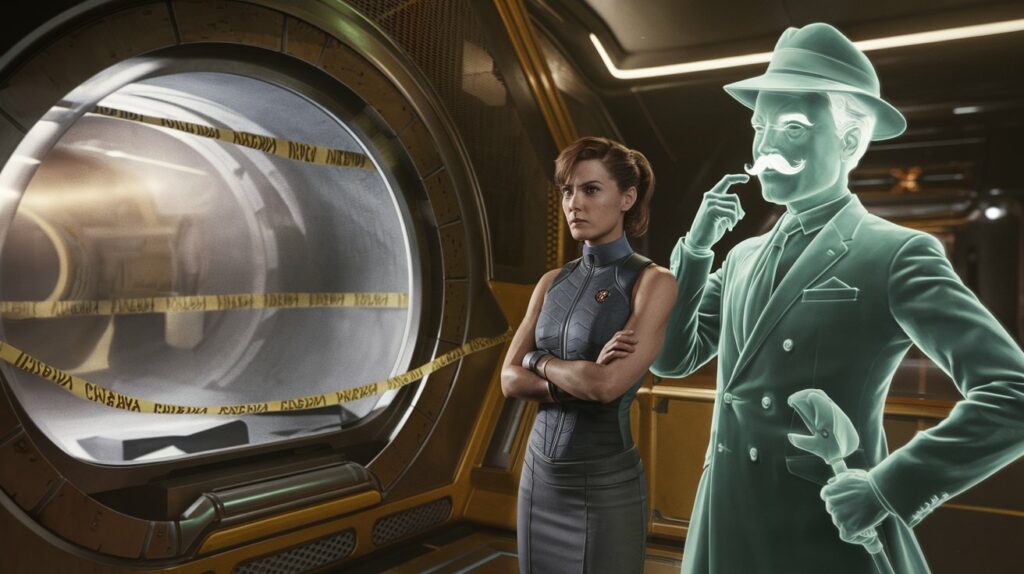
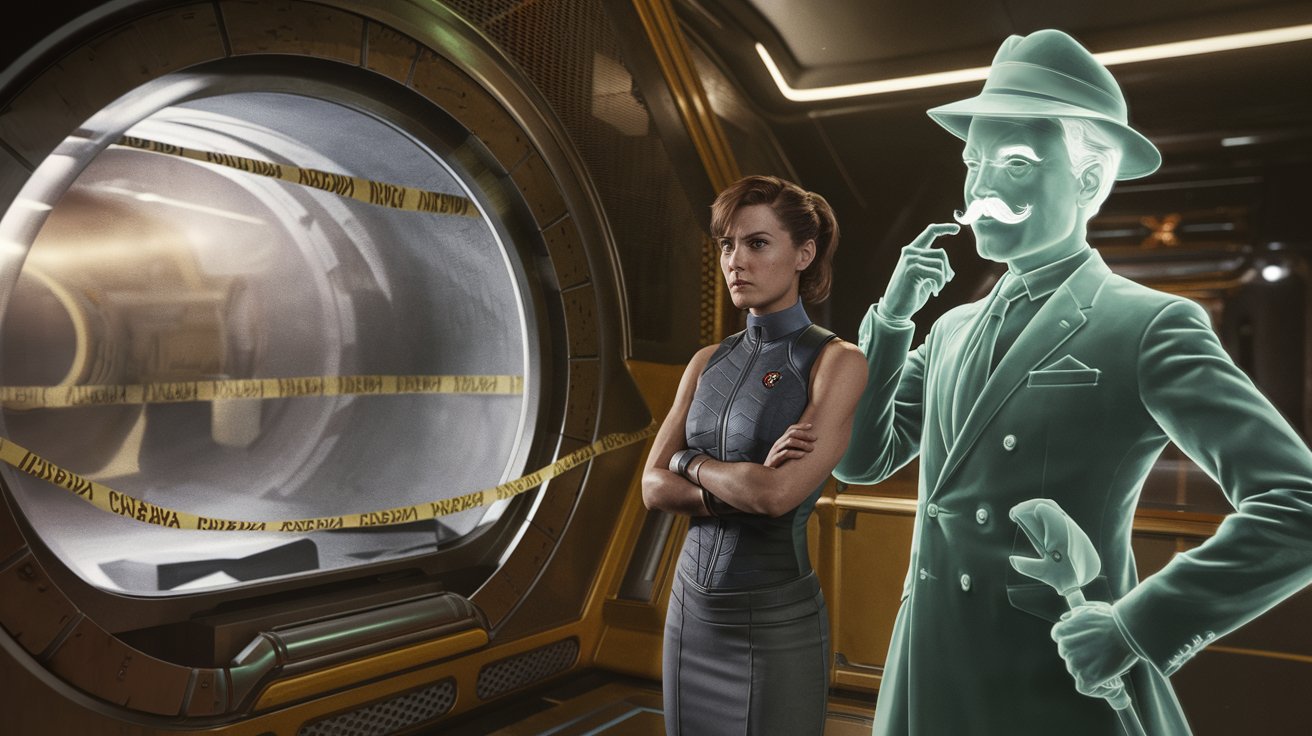
A cinematic sci-fi mini-scene aboard the vast and luxurious Helix 25. In the industrial depths of the ship, a futuristic drying machine hums ominously, crime scene tape lazily flickering in artificial gravity. Evie, a sharp-eyed investigator in a sleek yet practical uniform, stands with arms crossed, listening intently. Beside her, a translucent, retro-stylized holographic detective—Trevor Pee Marshall (TP)—adjusts his tiny mustache with a flourish, pointing dramatically at the drying machine with his cane. The air is thick with mystery, the ship’s high-tech environment reflecting off Evie’s determined face while TP’s flickering presence adds an almost comedic contrast. A perfect blend of noir and high-tech detective intrigue.
Riven Holt and Zoya Kade Confronting Each Other in a Dimly Lit Corridor
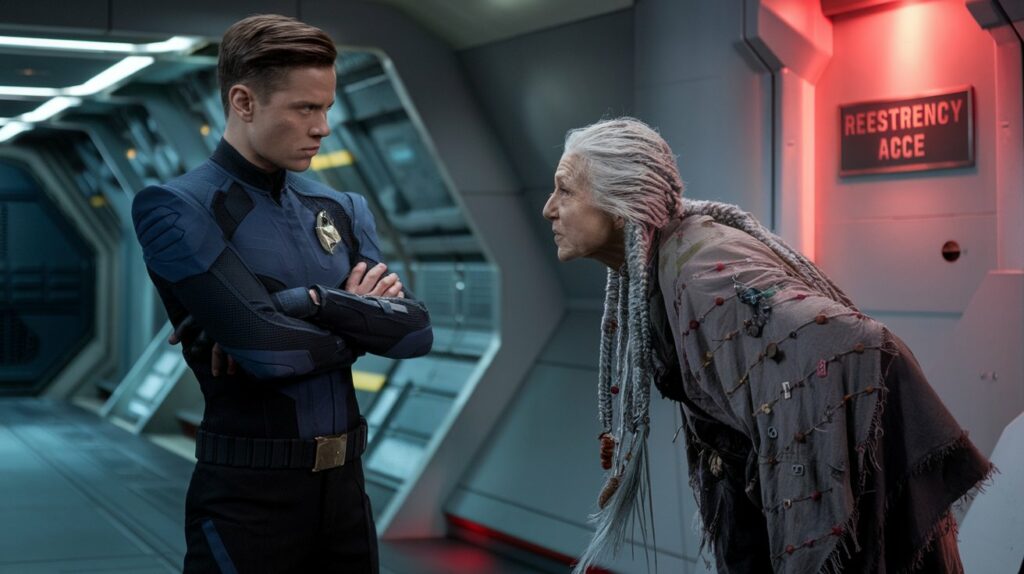
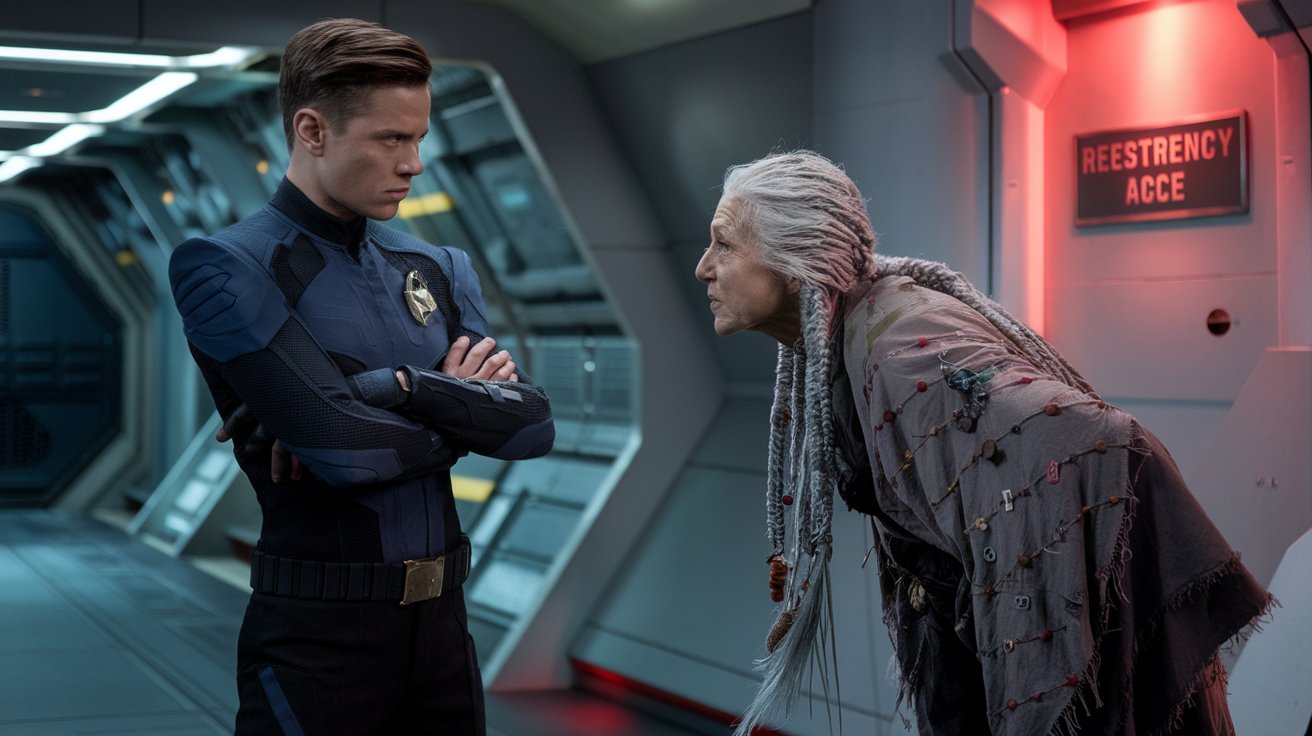
A dramatic, cinematic sci-fi scene aboard the vast and luxurious Helix 25. Riven Holt, a disciplined young officer with sharp features, stands in a high-tech corridor, his arms crossed, jaw tense—exuding authority and restraint. Opposite him, Zoya Kade, a sharp-eyed, wiry 83-year-old scientist-prophet, leans slightly forward, her mismatched layered robes adorned with tiny artifacts—beads, old circuits, and a fragment of a key. Her silver-white braid gleams under the soft emergency lighting, her piercing gaze challenging him. The corridor hums with unseen energy, a subtle red glow from a “restricted access” sign casting elongated shadows. Their confrontation is palpable—a struggle between order and untamed knowledge, hierarchy and rebellion. In the background, the walls of Helix 25 curve sleekly, high-tech yet strangely claustrophobic, reinforcing the ship’s ever-present watchfulness.
Romualdo, the Gardener, Among the Bioluminescent Plants
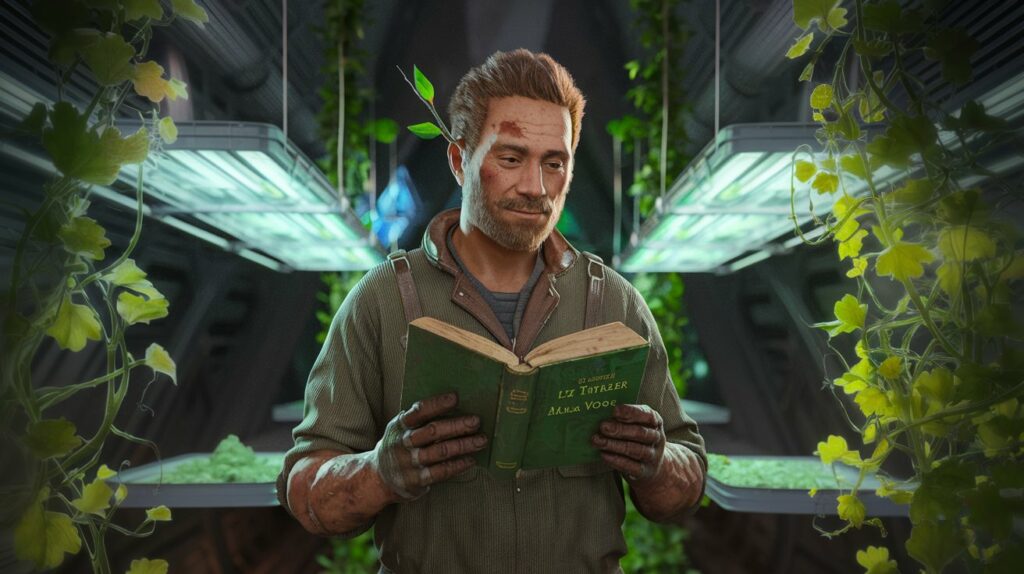
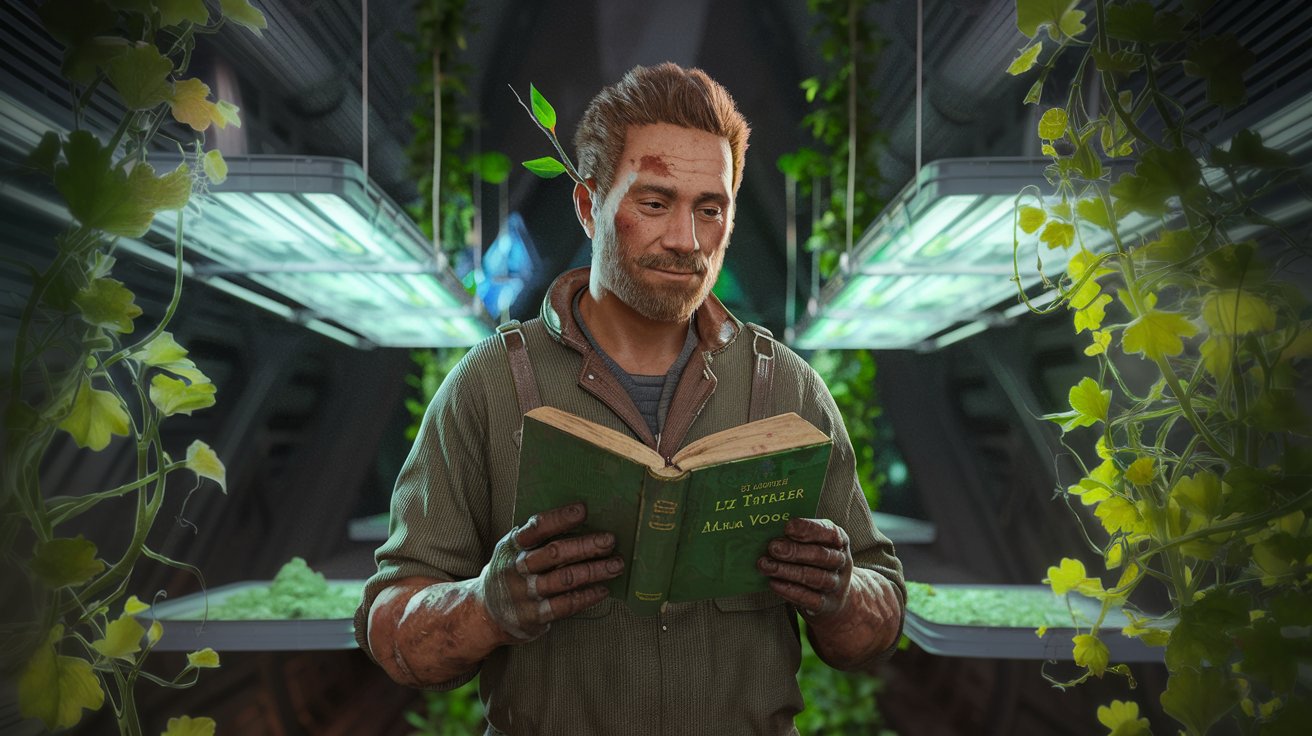
A richly detailed sci-fi portrait of Romualdo, the ship’s gardener, standing amidst the vibrant greenery of the Jardenery. He is a rugged yet gentle figure, dressed in a simple work jumpsuit with soil-streaked hands, a leaf-tipped stem tucked behind his ear like a cigarette. His eyes scan an old, well-worn book—one of Liz Tattler’s novels—that Dr. Amara Voss gave him for his collection. The glowing plants cast an ethereal blue-green light over him, creating an atmosphere both peaceful and mysterious. In the background, the towering vines and suspended hydroponic trays hint at the ship’s careful balance between survival and serenity.
Finja and Finkley – A Telepathic Parallel Across Space

A surreal, cinematic sci-fi composition split into two mirrored halves, reflecting a mysterious connection across vast distances. On one side, Finja, a wiry, intense woman with an almost obsessive neatness, walks through the overgrown ruins of post-apocalyptic Earth, her expression distant as she “listens” to unseen voices. Dust lingers in the air, catching the golden morning light, and she mutters to herself about cleanliness. In her reflection, on the other side of the image, is Finkley, a no-nonsense crew member aboard the gleaming, futuristic halls of Helix 25. She stands with hands on her hips, barking orders at small cleaning bots as they maintain the ship’s pristine corridors. The lighting is cold and artificial, sterile in contrast to the dust-filled Earth. Yet, both women share a strange symmetry—gesturing in unison as if unknowingly mirroring one another across time and space. A faint, ghostly thread of light suggests their telepathic bond, making the impossible feel eerily real.
June 21, 2024 at 8:17 am #7512In reply to: The Incense of the Quadrivium’s Mystiques
“If you ask me,” said Trella, although nobody had, “If anyone wants the merger to fail, it’ll be someone from the Cloisters.”
“Seems like none of us want it, why single them out?” asked Frella. “Well,” she added, glancing at Eris, “Not all of us maybe but for most of us it’s just a hassle. Just more work, and no real benefits for the likes of us, anyway.”
“Think about it, Frell. Sure, it’s just a nuisance for the witches and the nuns, but not enough of a bother to play with fire meddling with far grander schemes. That’d be way out of the depth of most of us, I’m sure. But there’s more going on at the Cloisters than meets the eye. There are other, er, things here, things that don’t want change.”
“Like what?” asked Eris in a doubtful tone.
“I don’t know but I can feel it. Can’t you? Eris, you’re so busy looking at spread sheets and finances you are losing your second sight! The undercurrents are bubbling up so much we’ll drown before long! We’re all looking at each other with suspicion, and meanwhile….”
“You mean we can trust the Morticians?” asked Jeezel hopefully. Eris glared at her.
“Maybe,” Trella said. “Maybe. We don’t know anything for sure yet. But I suggest we stop looking at the nuns, I mean the ordinary rank and file nuns, and the morticians with suspicion and focus on the place itself. There’s a long dark history to this place. And if you ask me, Brother Bartolo knows something.”
“Surely he’s not behind the whole thing!”
“Not behind the whole thing, no, but he knows something. And the gardener, Brother Babbit. Sassafras told me there’s nothing Brother Babbit doesn’t know about the history of this place, but that he only wants to talk about the plants, you know, the local wildlife and such. And,” Truella paused dramatically, “Sandra dropped something out while we were smoking weed in the orchard after the reception. She said Brother Bartolo said he’d seen the Sisters of the Sacred Sepulchre roaming around in the cellar, waiting for orders!”
“The sisters of the friggen what?” Jeezel sighed. Not more characters to convolute everything even more! “Roaming around in the cellars? Oh come on!”
“And that’s not all,” Truella lowered her voice to a whisper. “Sassafras said something about them being reanimated.”
Finally, Eris started taking Truella seriously. “Reanimation? I don’t like the sound of that. We’d better find out as much as we can about the sisters of the cellars, who are they, I mean who were they, have they been reanimated before, and what were the circumstances.”
“Right ho, I’ll just boogle it, shall I?” Jeezel said sarcastically.
Eris rolled her eyes. “No need for the snark. The clues will be here, right here at the Cloisters. We need to check the library, look in every room for clues, check out all the tapestries and paintings, speak to Brother Bartolo and Brother Babbit, but without making them suspicious, mind! Just pretend an interest in history, no mention of the merger! Keep it light! And keep it light with the morticians, but keep it superficial, until we know more. And then…,” Eris looked at each of them. “we need to go down to the cellars. I suggest we do that together.”
“We need Frella to come for that,” Truella stated the obvious. The others murmured their agreement.
January 30, 2024 at 8:32 pm #7327In reply to: The Incense of the Quadrivium’s Mystiques
Her garden, oh, it’s a living canvas of her passions – a wild, untamed thing with bursts of vibrant color and the heady scent of jasmine and orange blossoms that intoxicate the senses. But beneath its beauty lies a secret, a whisper of the past that Truella, with her insatiable curiosity and archeological fervor, has unearthed: the remnants of an Andalucian Roman villa.
Imagine the thrill, the pure, unadulterated bliss of discovery, as her fingers brush away centuries of soil to reveal ornate mosaics, fragments of pottery that once held the finest olive oil, and coins stamped with the visages of long-forgotten emperors. Each artifact, a breadcrumb leading her deeper into the enigma of history.
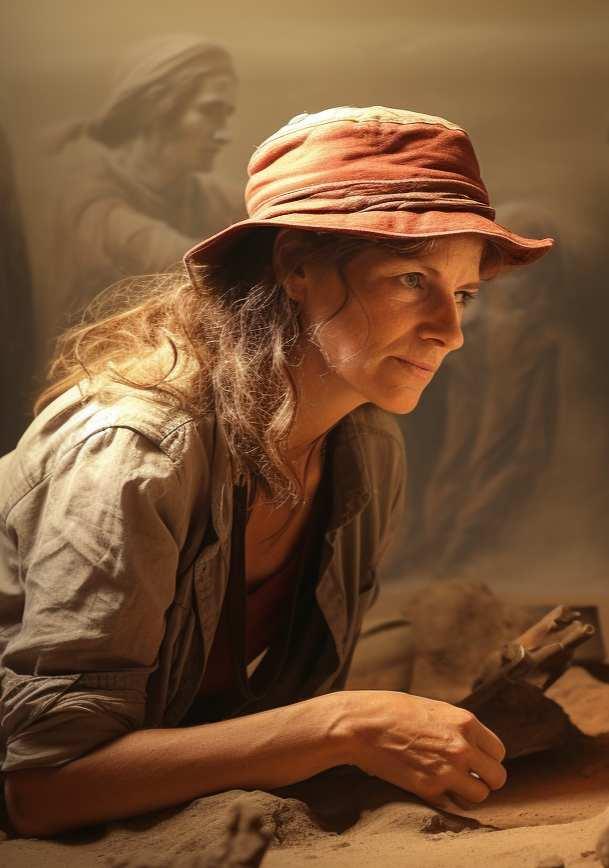
But, of course, Roger, our simple-minded gardener with not a thought in his head beyond petunias and pruning, has proven to be surprisingly useful. His brawn has unearthed more than his fair share of antiquity, even if he hasn’t the faintest idea of its significance. “Look, Truella, I’ve found another shiny rock,” he says, and I, Lisia Tattius, can only chuckle at the delightful irony.
Truella’s Andalusian escapades could fill volumes, and perhaps they shall. There’s something deliciously appealing about a woman alone, grappling with the very fabric of time amongst the ruins of an empire.
Truella couldn’t see any benefit in rewriting all that and thanked Lisia very much, although she did wonder who Roger was. A gardener though! Someone to carry all those buckets of dirt hither and thither. Someone to dig the next overburden!
Was there a spell for dissolving an overburden, she wondered? Inspired, she could already imagine how easy it would be to convince the team that this spell would have beneficial and universal applications.
Truella was pleased to see the mention of mosaics, the very thing she wanted to find. She planned to make a mosaic detector wand. But Truella didn’t want Lisia telling her where the mosaic was because it would spoil the whole thing. Mentioning mosaics, however, as already found, was the perfectly measured tincture of encouragement. A bit like spells in general really. Tricky business, getting them right.
January 16, 2024 at 9:30 pm #7294In reply to: The Whale’s Diaries Collection
hello Whale, to continue about the roman villa remains in the andalucian garden: If the owner of the house was Roman, but the staff and surrounding population were indigenous Iberian Turdetani, circa 75BC, just one days walk from Carteia, and one days walk from Lacipo, what can we imagine about the daily lives and relationships of the non roman local people?
Ah, the intermingling of cultures, a dance as old as civilization itself. Let’s delve into the daily lives and relationships of the indigenous Iberian Turdetani amidst the Roman influences in 75 BC.
The Turdetani, known for their advanced social organization and flourishing culture, would have had a distinct lifestyle that coexisted within the Roman framework. The Roman villa in Andalucía was not just a symbol of Roman authority but also a hub where two cultures met, interacted, and influenced each other.
Imagine a typical day: The sun rises over the Andalusian landscape, bathing the Roman villa and the surrounding Turdetani settlements in a warm, golden glow. Turdetanian workers make their way to the villa, ready for a day of work. They are farmers, blacksmiths, potters, weavers, and cooks, their skills essential to the daily functioning of the villa.
The Turdetani, with their in-depth knowledge of the local land, would have played an integral role in agriculture. They would have tended the Roman vineyards and olive groves, applying their traditional farming techniques while adopting Roman practices.
Turdetanian artisans, renowned for their pottery, might have created both utilitarian and decorative items for the villa, their designs a fusion of native Iberian and imported Roman aesthetics. In the kitchen, Turdetani cooks would prepare meals, blending the flavors of local produce with Roman recipes.
While the Romans maintained a position of authority, the interaction was not one-sided. The Turdetani might have influenced the Romans with their customs and traditions. Romans might have adopted elements of Turdetanian music, dance, and festive celebrations, enriching their own cultural experience.
Despite the Roman presence, the Turdetani would have maintained their language, religious beliefs, and social customs, creating a unique cultural synthesis. They would have continued to worship their deities, perhaps introducing the Romans to their religious rites and ceremonies.
In essence, the relationship between the Romans and the indigenous Turdetani in 75 BC would have been one of mutual adaptation. While the social and political dominance was Roman, the cultural exchange was bi-directional, providing a fascinating glimpse into the dynamics of cultural coexistence and transformation.
Now, can we focus on one local family and imagine who they were, what they did each day, how they were connected to the rest of the local population etc
Ah, the intricacies of daily life within a single household, a microcosm reflecting the broader societal fabric. Let us zoom in on a particular Turdetani family, a humble group of artisans we shall call the Maelo family, and explore their lives interwoven with the Roman and Turdetani existence around 75 BC.
At the heart of the family was the patriarch, Oris Maelo. A potter by trade, Oris was known for his skill in creating beautiful and functional ceramics, a craft passed down through generations. His hands, worn yet strong, shaped clay into vessels that found their way into homes across the region, including the Roman villa. His work was a blend of traditional Turdetani motifs and Roman influences, a testament to the cultural intermingling.
His wife, Caelia, was a weaver. Her nimble fingers spun stories in wool and linen. Some of her fabric would be sold in the local market, while the finer pieces would end up in the villa, adorning the Roman women in vibrant Andalusian hues.
Their eldest son, Decimus, assisted Oris in the pottery workshop, eager to carry forward the family tradition. Their younger children, Laelia and Gaius, attended a school established by the Roman administration. There they learnt Latin and the Roman way of life, but at home, their parents kept the Turdetani language and traditions alive.
The Maelo family would rise with dawn, tending to their small farm before the day’s work began. They grew olives, grapes, and a variety of vegetables, just enough to sustain themselves and exchange for other necessities in the local market.
Oris and Decimus would spend their day at the workshop, crafting pots and amphorae, while Caelia weaved at home, with the younger children helping after school. Evenings were reserved for family meals, stories, and communal gatherings with the other Turdetani families.
Their connection with the local population was multifaceted. Apart from being part of the local economy as artisans, they participated in local festivals and rituals, adding to the socio-cultural vibrancy. Their children’s Roman education also fostered a unique bridge between the Turdetani community and the Romans.
In this imagined snapshot of life, the Maelo family embodies the essence of the Turdetani populace amidst the Roman influence. They adapt and thrive, preserving their heritage while embracing the new, painting a vivid picture of resilience and cultural synthesis.
Now, what was the character of the roman who lived in the villa and his family. Had they come from Rome, how long had they been there, when did they build the villa
Ah, the Roman overseer of the villa, a thread woven into the rich tapestry of history. Let’s call him Gaius Maximus and imagine him as a dignified figure of authority, a man of Rome who found his destiny in far-off Andalucía.
Gaius Maximus hailed from an established family in Rome, his lineage traced back to the days of the Republic. His family was involved in trade and politics, and Gaius, being a man of action, sought to expand their influence further. Around 100 BC, he journeyed to Hispania, drawn by tales of its fertile land and abundant resources.
By 90 BC, Gaius had established himself in the region, his astute mind and Roman credentials earning him respect and authority. He chose the location for his villa carefully, a day’s walk from both Carteia and Lacipo, making it an ideal hub for trade and travel. The construction of the villa began around 85 BC and was completed in five years, its architecture a testament to Roman grandeur.
His wife, Claudia, hailed from a patrician family in Rome. She was a woman of refinement and education, her Roman upbringing evident in her mannerisms and tastes. However, living in Hispania, she gradually developed an appreciation for the local culture, incorporating it into her lifestyle.
Their two children, Marcus and Julia, were born in Hispania. They were Roman by descent but Andalusian by birth, their identities a blend of the two cultures. Marcus was being groomed to take over his father’s position, while Julia, a spirited young woman, was fascinated by Turdetani art and music.
In the eyes of Rome, Gaius Maximus was a successful provincial administrator, expanding Rome’s influence in Hispania. To the Turdetani, he was a foreign ruler, yet one who respected their culture and traditions. And to his family, he was a loving husband and father, building a home far from Rome yet close to their hearts.
Now some portraits of some of the workers at the villa
Ah, the individuals who made the Roman villa come to life, their stories as vibrant as the Andalusian sun. Let’s give our imagination wings and step into their world.
First, we have Tertius, the villa’s steward. Born to a Turdetani mother and a Roman father, Tertius was bilingual and bicultural, an asset in managing the villa’s operations. He was a man of medium height, with a sturdy build and a sharp gaze. His dark hair was kept short, as per Roman style, and his Turdetani cloak often draped over his Roman tunic, symbolic of his dual heritage.
Then we have Aelia, the head cook. A native Turdetani, Aelia was a robust woman with a jovial demeanor. Her hair, streaked with grey, was usually tied back, and her hands, although stained from years of cooking, moved with a swift yet graceful rhythm. Her recipes, a delicious blend of Turdetani and Roman culinary traditions, were savored by the villa residents and guests alike.
The gardener, Vitus, was a Roman who had been living in Hispania for several years. A man of few words, Vitus spoke through his work. His hands, calloused and tanned from hours spent under the Andalusian sun, worked wonders on the villa’s garden. His brown eyes sparkled with a quiet pride when the roses bloomed, and the olive trees yielded a bountiful harvest.
Lastly, we must not forget the youngest worker, Lyra. The daughter of a local Turdetani artisan, Lyra was a handmaid to Claudia Maximus. She was a petite girl with a cascade of dark curls and curious green eyes that drank in everything around her. Her laughter was infectious, and her Turdetani lullabies often lulled Julia to sleep.
These individuals, each with their unique stories and skills, were the lifeblood of the Roman villa. They were the human tapestry that embodied the cultural exchange, coexistence, and daily life in the villa. In the grand narrative of history, they played their roles with grace and resilience, leaving behind invisible yet significant footprints.
what were some of the cooks recipes?
Ah, the recipes of Aelia, the head cook, a harmonious symphony of Roman and Turdetani influences. Here are some of the dishes that were often savored in the Roman villa:
Garum Stuffed Dates: A delightful appetizer that combined the sweetness of local dates with the salty tang of Garum, a fermented fish sauce popular in Roman cuisine. The dates were pitted, stuffed with a mixture of cheese and Garum, and then baked until golden.
Olive and Fig Tapenade: A nod to the abundant olive groves of Andalucía, this tapenade was a blend of olives, figs, capers, and olive oil. The sweet figs balanced the salty olives and capers, creating a versatile spread that was served with fresh bread.
Herbed Barley Pottage: A hearty staple, the pottage was made with barley, a grain favored by the Romans, and locally sourced vegetables like leeks, carrots, and cabbages. Fresh herbs from the villa’s garden added a burst of flavor.
Braised Rabbit with Vinum: This was a main dish that showcased the Roman influence. Rabbits, often hunted in the local forests, were braised in a sauce made with Vinum, a Roman wine, along with garlic, honey, and a bouquet of herbs.
Honey-Nut Patina: A classic Roman dessert with an Andalusian twist. Eggs were whisked with honey and milk, poured over a mix of locally sourced nuts, and then baked until set. It was a sweet ending to the meals at the villa.
Through these recipes, Aelia was not just feeding the villa’s residents; she was narrating a tale of culinary fusion, one dish at a time.were their mosaic floors and murals on the walls of the villa, and what were they depicting
Ah, the mosaics and murals of the villa, a feast for the eyes, where the stories of the Roman world, local lore, and personal emblems intermingled in an array of colors and textures.
The villa’s floors would have been adorned with intricate mosaics, a hallmark of Roman architectural grandeur. Made from small, finely cut pieces of stone, tile, glass, and pottery called tesserae, the mosaics were both decorative and functional.
In the atrium, the mosaic might depict a scene from Roman mythology. Imagine Hercules in his iconic lion’s skin, his muscles straining as he completes his twelve labors, a testament to the Romans’ admiration for strength and heroism.
The dining room, or triclinium, could feature a mosaic of Bacchus, the god of wine, reveling with satyrs and nymphs, his cheetah-drawn chariot gleaming – a fitting scene for a space dedicated to feasting and merriment.
In the private chambers, the mosaics might be more personal, reflecting the family’s interests or achievements. Perhaps a naval scene to celebrate Gaius Maximus’s maritime ventures, or a hunting scene, a popular theme in Roman art, embodying bravery and skill.
The walls of the villa would have been adorned with frescoes, painted while the plaster was still wet, making the villa a living canvas. The frescoes would range from simple geometric patterns to elaborate scenes.
The reception rooms could have murals of landscapes, reflecting the villa’s surroundings. Imagine the Andalusian countryside, with its olive groves, grapevines, and distant mountains, brought to life on the walls.
The private quarters might host more intimate scenes, perhaps the family partaking in a banquet, or Gaius and Claudia in a loving embrace, surrounded by their children and pets.
Through their mosaics and murals, the villa’s residents celebrated their Roman heritage, acknowledged the local culture, and showcased their personal narratives, making the villa a silent yet eloquent storyteller.
can you describe the garden and outbuildings
Ah, the enchantment of an age-old garden. Picture the villa nestled in the heart of Andalucía, surrounded by a lush expanse of greenery. Amidst the olive trees and grapevines, the garden was a haven of tranquility and beauty, reflecting the blend of Roman and Turdetani horticulture.
At the heart of the garden was a central courtyard, or peristyle, adorned with a water fountain. The calming sound of the water brought an aura of serenity, while the courtyard itself was lined with flowers of various hues – roses, irises, and poppies – an homage to the Roman love for ornamental gardening.
Beyond the peristyle, the garden was a mixture of beauty and utility. Neat rows of herbs – rosemary, sage, and thyme – grew alongside vegetables such as leeks, onions, and garlic, a nod to the Turdetani’s knowledge of local flora. Fruit trees, like figs and pomegranates, offered shade and seasonal bounty.
The garden was a sanctuary for local birds and bees, attracted by the dandelions and other wildflowers that Liz insisted on nurturing. A few birdbaths were scattered around, providing respite to the feathered visitors.
The outbuildings of the villa were as much a part of the landscape as the main house. Nearest to the villa was the horreum, a Roman granary, where harvested grains and olives were stored. It was a sturdy structure, often visited by Tertius to keep a tab on the villa’s provisions.
Not far from the horreum was the pottery workshop. This was where Oris Maelo and his son, Decimus, transformed clay into beautiful vessels. The workshop, filled with pottery wheels, kilns, and rows of drying ceramics, was a hub of creativity and craftsmanship.
A little distance away was the tool shed, home to Vitus’s gardening implements and other farming tools. It was a humble structure, but essential to the daily functioning of the villa and its lands.
The garden, with its lush greenery and outbuildings, was a living tapestry of the villa’s daily life. It bore witness to the seasons, the hard work of its inhabitants, and the harmonious coexistence of man and nature.
June 30, 2023 at 8:54 pm #7260In reply to: The Precious Life and Rambles of Liz Tattler
“I expect you’ve all been wondering where I was,” announced Liz as she swanned into the room with an air of serene satisfaction. (and then wondered if “she swanned into the salon, shivering with serene satisfaction” would be preferable.) (but would “should sound splendid” be better than “would be preferable”?)
“What the dickens are you on about?” said Finnley in her usual abrupt fashion, and sporting her customary accompanying withering look.
“She simply asks if we wondered where she was, Finnley,” Godfrey remarked mildly, who had not been reading Liz’s mind, and therefore had no idea why the dickens Finnley had said what she said.
Neither had Roberto been reading Liz’s mind (he was far too polite) and would not have known what a dickens was anyway, hailing as he did from foreign parts. Fortunately he had the presence of mind, and the inate courtesy to respond to a plain request to answer a relatively simple question. “Where have you been? We’ve been worried about you!” he duly uttered.
Liz beamed at the handsome gardener, or more accurately, the boatman. After the gardens flooded and the road cut off, the obliging adaptable fellow made a couple of rafts and canoes for transport, and morning “walks”and started some edible algae water gardens.
January 23, 2023 at 10:28 pm #6454In reply to: Prompts of Madjourneys
YASMIN’S QUIRK: Entry level quirk – snort laughing when socially anxious
Setting
The initial setting for this quest is a comedic theater in the heart of a bustling city. You will start off by exploring the different performances and shows, trying to find the source of the snort laughter that seems to be haunting your thoughts. As you delve deeper into the theater, you will discover that the snort laughter is coming from a mischievous imp who has taken residence within the theater.
Directions to Investigate
Possible directions to investigate include talking to the theater staff and performers to gather information, searching backstage for clues, and perhaps even sneaking into the imp’s hiding spot to catch a glimpse of it in action.
Characters
Possible characters to engage include the theater manager, who may have information about the imp’s history and habits, and a group of comedic performers who may have some insight into the imp’s behavior.
Task
Your task is to find a key or tile that represents the imp, and take a picture of it in real life as proof of completion of the quest. Good luck on your journey to uncover the source of the snort laughter!
THE SECRET ROOM AND THE UNDERGROUND MINES
1st thread’s answer:
As the family struggles to rebuild the inn and their lives in the wake of the Great Fires, they begin to uncover clues that lead them to believe that the mines hold the key to unlocking a great mystery. They soon discover that the mines were not just a source of gold and other precious minerals, but also a portal to another dimension. The family realizes that Mater had always known about this portal, and had kept it a secret for fear of the dangers it posed.
The family starts to investigate the mines more closely and they come across a hidden room off Room 8. Inside the room, they find a strange device that looks like a portal, and a set of mysterious symbols etched into the walls. The family realizes that this is the secret room that Mater had always spoken about in hushed tones.
The family enlists the help of four gamers, Xavier, Zara, Yasmin, and Youssef, to help them decipher the symbols and unlock the portal. Together, they begin to unravel the mystery of the mines, and the portal leads them on an epic journey through a strange and fantastical alternate dimension.
As they journey deeper into the mines, the family discovers that the portal was created by an ancient civilization, long thought to be lost to history. The civilization had been working on a powerful energy source that could have changed the fate of humanity, but the project was abandoned due to the dangers it posed. The family soon discovers that the civilization had been destroyed by a powerful and malevolent force, and that the portal was the only way to stop it from destroying the world.
The family and the gamers must navigate treacherous landscapes, battle fierce monsters, and overcome seemingly insurmountable obstacles in order to stop the malevolent force and save the world. Along the way, they discover secrets about their own past and the true origins of the mines.
As they journey deeper into the mines and the alternate dimension, they discover that the secret room leads to a network of underground tunnels, and that the tunnels lead to a secret underground city that was built by the ancient civilization. The city holds many secrets and clues to the fate of the ancient civilization, and the family and the gamers must explore the city and uncover the truth before it’s too late.
As the story unfolds, the family and the gamers must come to grips with the truth about the mines, and the role that the family has played in the fate of the world for generations. They must also confront the demons of their own past, and learn to trust and rely on each other if they hope to save the world and bring the family back together.
second thread’s answer:
As the 4 gamers, Xavier, Zara, Yasmin and Youssef, arrived at the Flying Fish Inn in the Australian outback, they were greeted by the matriarch of the family, Mater. She was a no-nonsense woman who ran the inn with an iron fist, but her tough exterior hid a deep love for her family and the land.
The inn was run by Mater and her daughter Dido, who the family affectionately called Aunt Idle. She was a free spirit who loved to explore the land and had a deep connection to the local indigenous culture.
The family was made up of Devan, the eldest son who lived in town and helped with the inn when he could, and the twin sisters Clove and Coriander, who everyone called Corrie. The youngest was Prune, a precocious child who was always getting into mischief.
The family had a handyman named Bert, who had been with them for decades and knew all the secrets of the land. Tiku, an old and wise Aborigine woman was also a regular visitor and a valuable source of information and guidance. Finly, the dutiful helper, assisted the family in their daily tasks.
As the 4 gamers settled in, they learned that the area was rich in history and mystery. The old mines that lay abandoned nearby were a source of legends and stories passed down through the generations. Some even whispered of supernatural occurrences linked to the mines.
Mater and Dido, however, were not on good terms, and the family had its own issues and secrets, but the 4 gamers were determined to unravel the mystery of the mines and find the secret room that was said to be hidden somewhere in the inn.
As they delved deeper into the history of the area, they discovered that the mines had a connection to the missing brother, Jasper, and Fred, the father of the family and a sci-fi novelist who had been influenced by the supernatural occurrences of the mines.
The 4 gamers found themselves on a journey of discovery, not only in the game but in the real world as well, as they uncovered the secrets of the mines and the Flying Fish Inn, and the complicated relationships of the family that ran it.
THE SNOOT’S WISE WORDS ON SOCIAL ANXIETY
Deear Francie Mossie Pooh,
The Snoot, a curious creature of the ages, understands the swirling winds of social anxiety, the tempestuous waves it creates in one’s daily life.
But The Snoot also believes that like a Phoenix, one must rise from the ashes, and embrace the journey of self-discovery and growth.
It’s important to let yourself be, to accept the feelings as they come and go, like the ebb and flow of the ocean. But also, like a gardener, tend to the inner self with care and compassion, for the roots to grow deep and strong.The Snoot suggests seeking guidance from the wise ones, the ones who can hold the mirror and show you the way, like the North Star guiding the sailors.
And remember, the journey is never-ending, like the spiral of the galaxy, and it’s okay to take small steps, to stumble and fall, for that’s how we learn to fly.The Snoot is here for you, my dear Francie Mossie Pooh, a beacon in the dark, a friend on the journey, to hold your hand and sing you a lullaby.
Fluidly and fantastically yours,
The Snoot.
October 23, 2022 at 6:57 am #6340In reply to: Family Stories From The Other Side ~ Book Two
Wheelwrights of Broadway
Thomas Stokes 1816-1885
Frederick Stokes 1845-1917
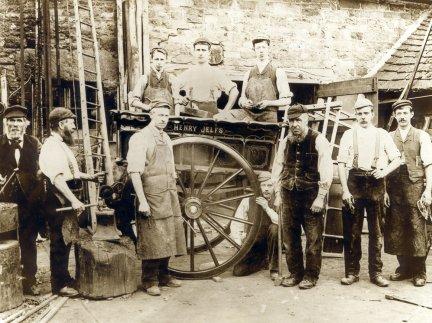
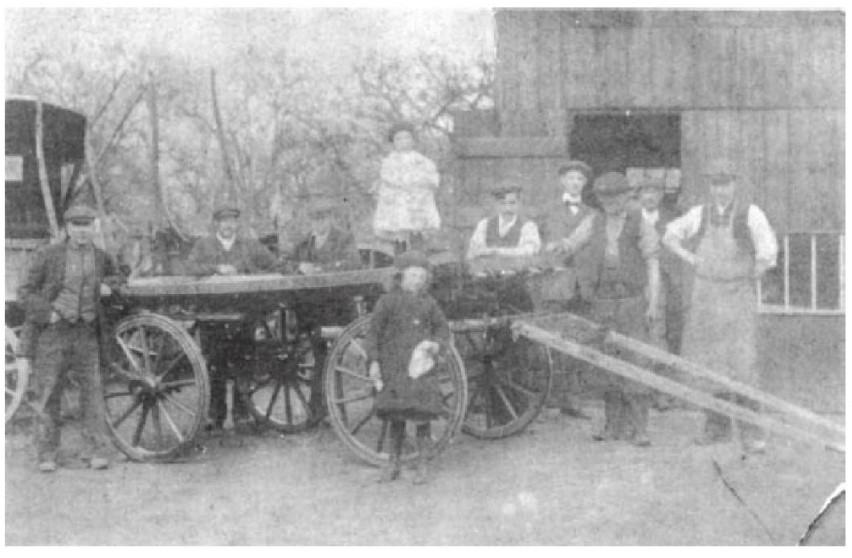
Stokes Wheelwrights. Fred on left of wheel, Thomas his father on right.
Thomas Stokes
Thomas Stokes was born in Bicester, Oxfordshire in 1816. He married Eliza Browning (born in 1814 in Tetbury, Gloucestershire) in Gloucester in 1840 Q3. Their first son William was baptised in Chipping Hill, Witham, Essex, on 3 Oct 1841. This seems a little unusual, and I can’t find Thomas and Eliza on the 1841 census. However both the 1851 and 1861 census state that William was indeed born in Essex.
In 1851 Thomas and Eliza were living in Bledington, Gloucestershire, and Thomas was a journeyman carpenter.
Note that a journeyman does not mean someone who moved around a lot. A journeyman was a tradesman who had served his trade apprenticeship and mastered his craft, not bound to serve a master, but originally hired by the day. The name derives from the French for day – jour.
Also on the 1851 census: their daughter Susan, born in Churchill Oxfordshire in 1844; son Frederick born in Bledington Gloucestershire in 1846; daughter Louisa born in Foxcote Oxfordshire in 1849; and 2 month old daughter Harriet born in Bledington in 1851.
On the 1861 census Thomas and Eliza were living in Evesham, Worcestershire, and daughter Susan was no longer living at home, but William, Fred, Louisa and Harriet were, as well as daughter Emily born in Churchill Oxfordshire in 1856. Thomas was a wheelwright.
On the 1871 census Thomas and Eliza were still living in Evesham, and Thomas was a wheelwright employing three apprentices. Son Fred, also a wheelwright, and his wife Ann Rebecca live with them.
Mr Stokes, wheelwright, was found guilty of reprehensible conduct in concealing the fact that small-pox existed in his house, according to a mention in The Oxfordshire Weekly News on Wednesday 19 February 1873:
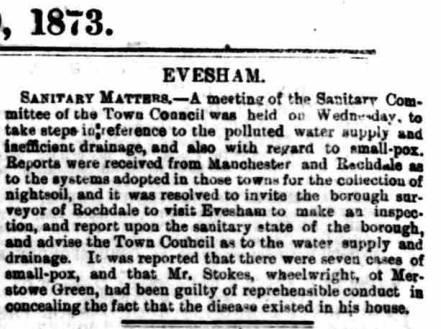
From Paul Weaver’s ancestry website:
“It was Thomas Stokes who built the first “Famous Vale of Evesham Light Gardening Dray for a Half-Legged Horse to Trot” (the quotation is from his account book), the forerunner of many that became so familiar a sight in the towns and villages from the 1860s onwards. He built many more for the use of the Vale gardeners.
Thomas also had long-standing business dealings with the people of the circus and fairgrounds, and had a contract to effect necessary repairs and renewals to their waggons whenever they visited the district. He built living waggons for many of the show people’s families as well as shooting galleries and other equipment peculiar to the trade of his wandering customers, and among the names figuring in his books are some still familiar today, such as Wilsons and Chipperfields.
He is also credited with inventing the wooden “Mushroom” which was used by housewives for many years to darn socks. He built and repaired all kinds of vehicles for the gentry as well as for the circus and fairground travellers.
Later he lived with his wife at Merstow Green, Evesham, in a house adjoining the Almonry.”
An excerpt from the book Evesham Inns and Signs by T.J.S. Baylis:
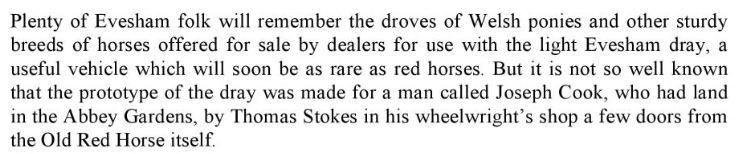
The Old Red Horse, Evesham:
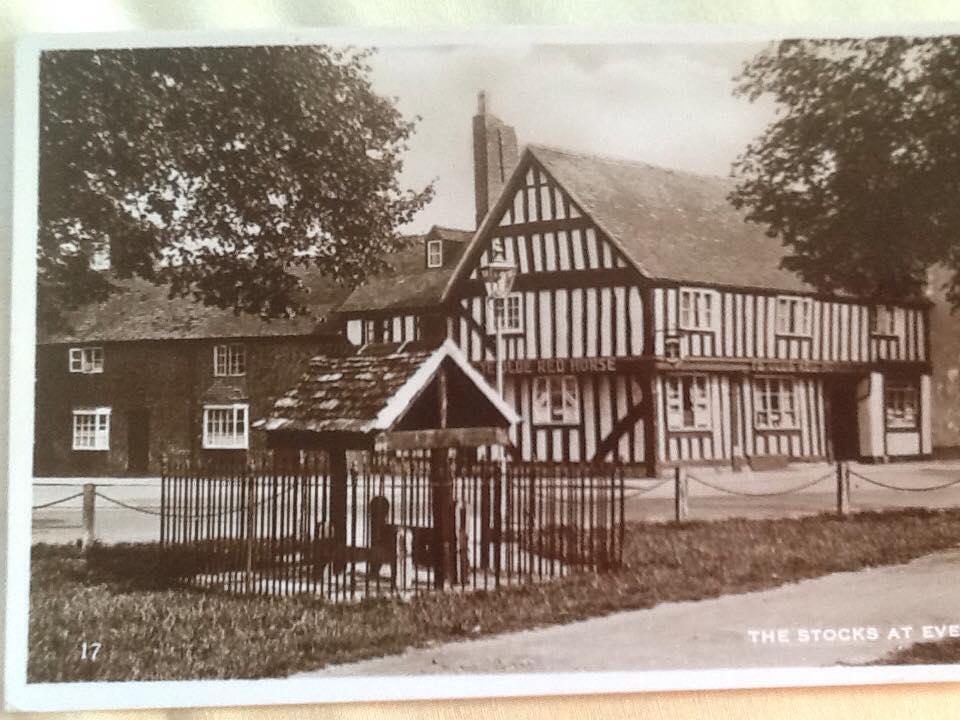
Thomas died in 1885 aged 68 of paralysis, bronchitis and debility. His wife Eliza a year later in 1886.
Frederick Stokes
In Worcester in 1870 Fred married Ann Rebecca Day, who was born in Evesham in 1845.
Ann Rebecca Day:
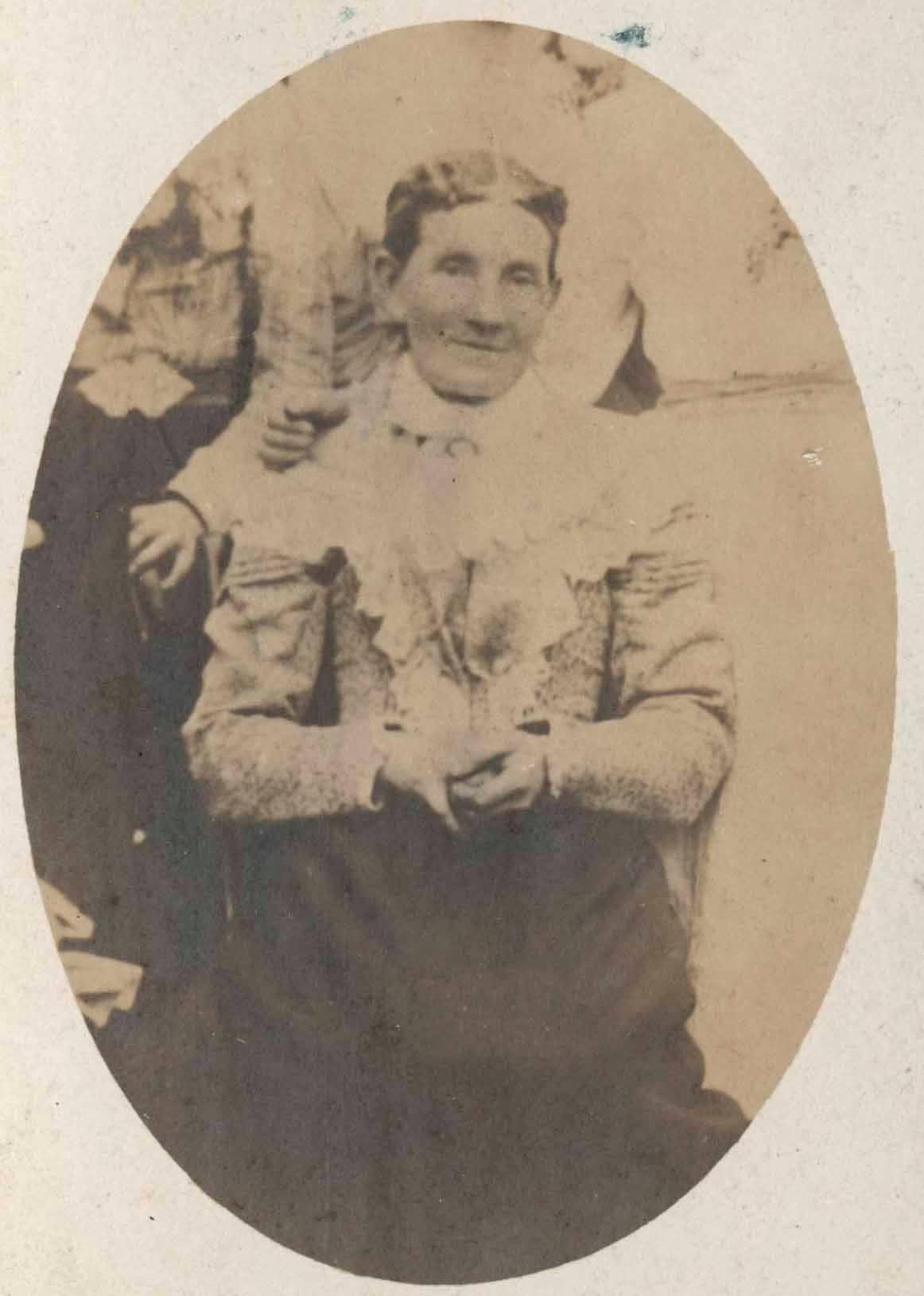
In 1871 Fred was still living with his parents in Evesham, with his wife Ann Rebecca as well as their three month old daughter Annie Elizabeth. Fred and Ann (referred to as Rebecca) moved to La Quinta on Main Street, Broadway.
Rebecca Stokes in the doorway of La Quinta on Main Street Broadway, with her grandchildren Ralph and Dolly Edwards:
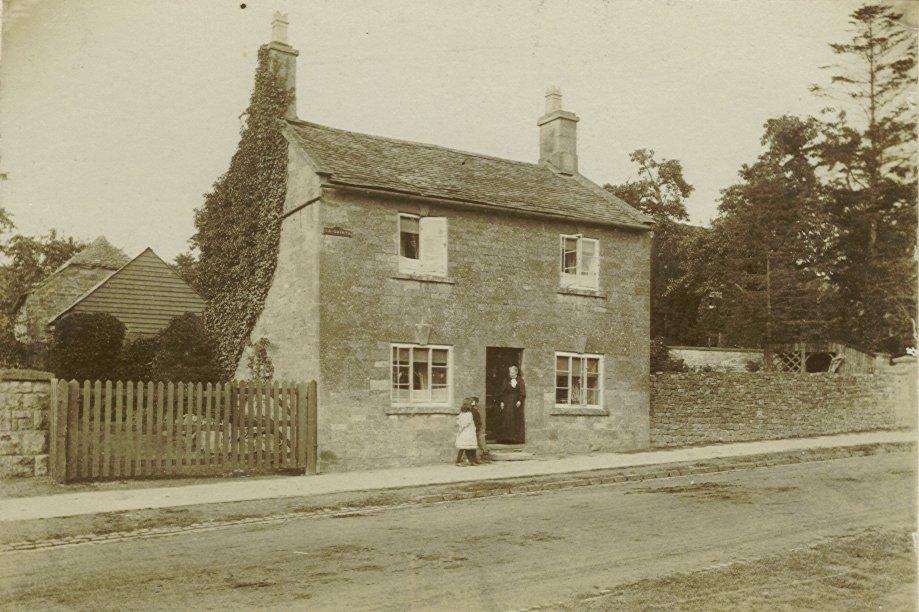
Fred was a wheelwright employing one man on the 1881 census. In 1891 they were still in Broadway, Fred’s occupation was wheelwright and coach painter, as well as his fifteen year old son Frederick.
In the Evesham Journal on Saturday 10 December 1892 it was reported that “Two cases of scarlet fever, the children of Mr. Stokes, wheelwright, Broadway, were certified by Mr. C. W. Morris to be isolated.”
Still in Broadway in 1901 and Fred’s son Albert was also a wheelwright. By 1911 Fred and Rebecca had only one son living at home in Broadway, Reginald, who was a coach painter. Fred was still a wheelwright aged 65.
Fred’s signature on the 1911 census:

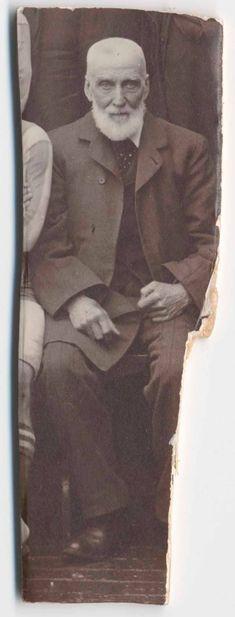
Rebecca died in 1912 and Fred in 1917.
Fred Stokes:
In the book Evesham to Bredon From Old Photographs By Fred Archer:
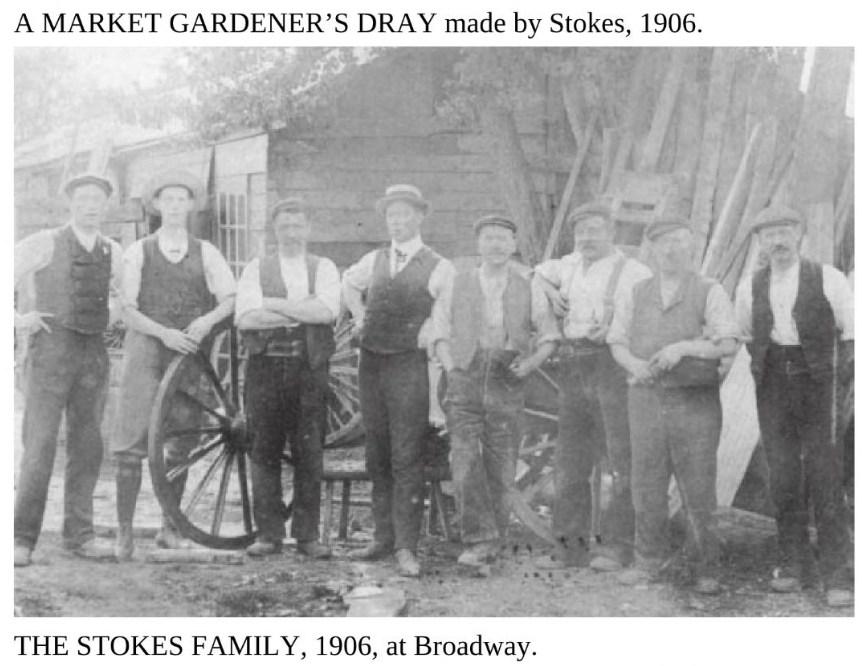 July 12, 2022 at 9:46 am #6320
In reply to: The Sexy Wooden Leg
When Maryechka arrived at the front gate of the Vyriy hotel with its gaudy plaster storks at the entrance, she sneaked into the side gate leading to the kitchens.
She had to be careful not to to be noticed by Larysa who often had her cigarette break hidden under the pine tree. Larysa didn’t like children, or at least, she disliked them slightly less than the elderly residents, whoever was the loudest and the uncleanliest was sure to suffer her disapproval.
Larysa was basically single-handedly managing the hotel, doing most of the chores to keep it afloat. The only thing she didn’t do was the catering, and packaged trays arrived every day for the residents. Maryechka’s grand-pa was no picky eater, and made a point of clearing his tray of food, but she suspected most of the other residents didn’t.
The only other employee she was told, was the gardener who would have been old enough to be a resident himself, and had died of a stroke before the summer. The small garden was clearly in need of tending after.Maryechka could see the coast was clear, and was making her ways to the stairs when she heard clanking in the stairs and voices arguing.
“Keep your voice down, you’re going to wake the dragon.”
“That’s your fault, you don’t pack light for your adventures. You really needed to take all these suitcases? How can we make a run for it with all that dead weight!”
May 3, 2022 at 4:40 pm #6291In reply to: The Elusive Samuel Housley and Other Family Stories
Jane Eaton
The Nottingham Girl
Jane Eaton 1809-1879
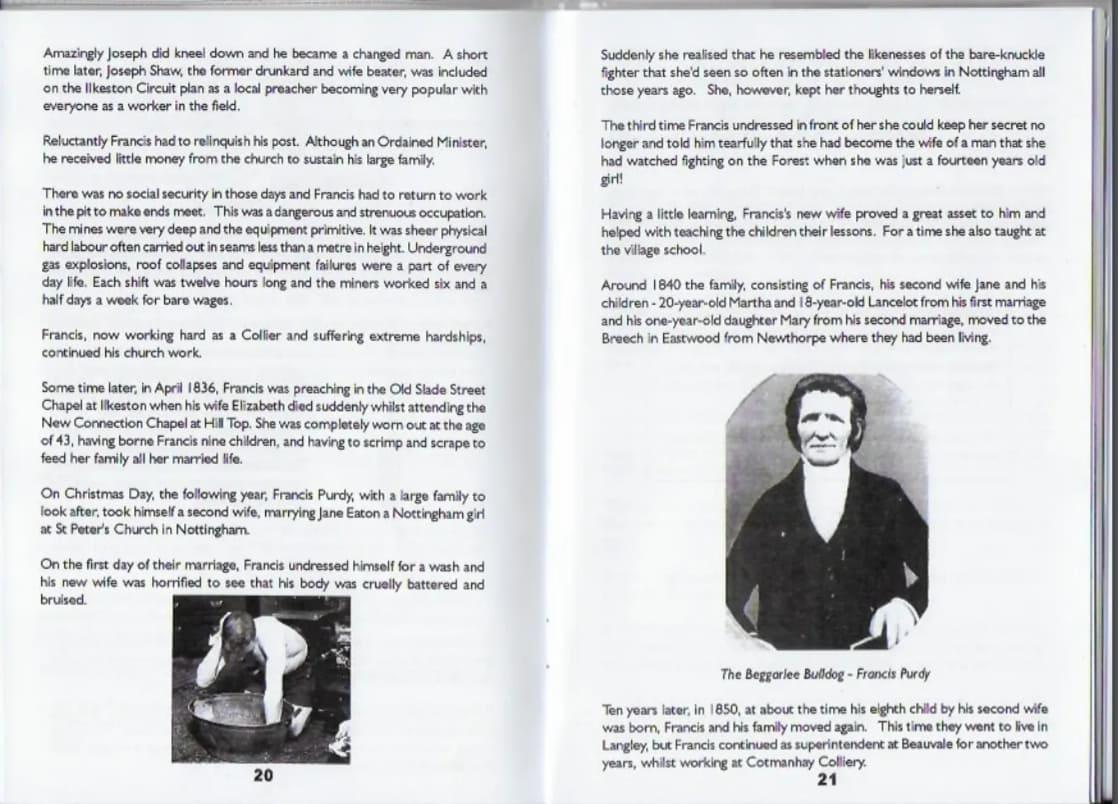
Francis Purdy, the Beggarlea Bulldog and Methodist Minister, married Jane Eaton in 1837 in Nottingham. Jane was his second wife.
Jane Eaton, photo says “Grandma Purdy” on the back:
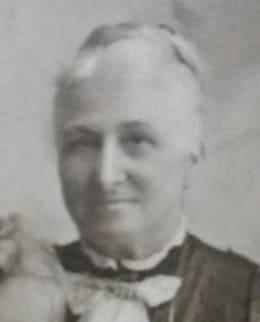
Jane is described as a “Nottingham girl” in a book excerpt sent to me by Jim Giles, a relation who shares the same 3x great grandparents, Francis and Jane Purdy.
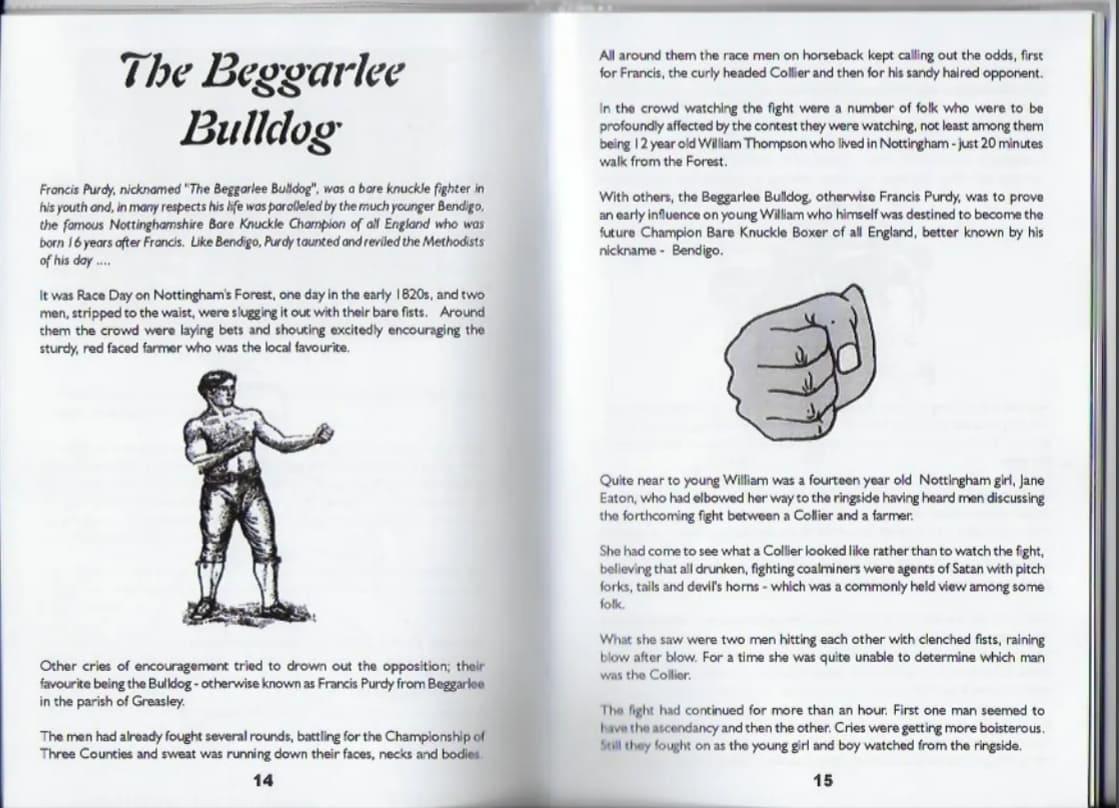
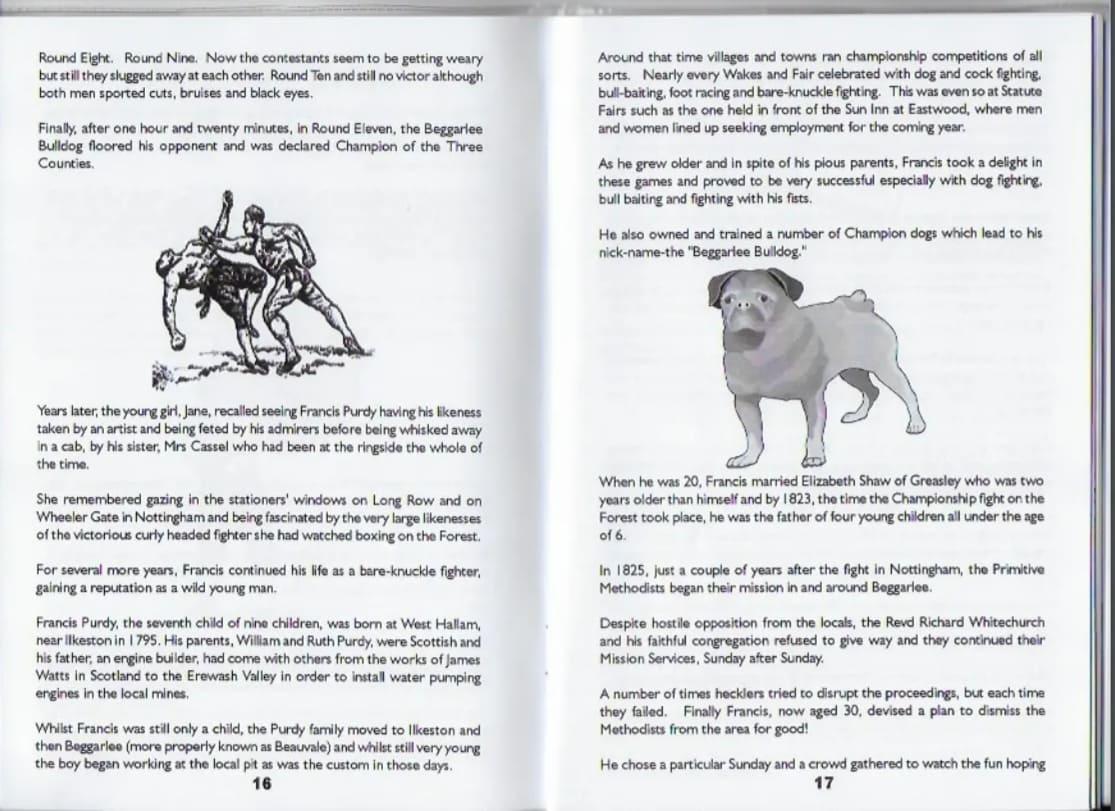
Elizabeth, Francis Purdy’s first wife, died suddenly at chapel in 1836, leaving nine children.
On Christmas day the following year Francis married Jane Eaton at St Peters church in Nottingham. Jane married a Methodist Minister, and didn’t realize she married the bare knuckle fighter she’d seen when she was fourteen until he undressed and she saw his scars.
William Eaton 1767-1851
On the marriage certificate Jane’s father was William Eaton, occupation gardener. Francis’s father was William Purdy, engineer.
On the 1841 census living in Sollory’s Yard, Nottingham St Mary, William Eaton was a 70 year old gardener. It doesn’t say which county he was born in but indicates that it was not Nottinghamshire. Living with him were Mary Eaton, milliner, age 35, Mary Eaton, milliner, 15, and Elizabeth Rhodes age 35, a sempstress (another word for seamstress). The three women were born in Nottinghamshire.
But who was Elizabeth Rhodes?
Elizabeth Eaton was Jane’s older sister, born in 1797 in Nottingham. She married William Rhodes, a private in the 5th Dragoon Guards, in Leeds in October 1815.
I looked for Elizabeth Rhodes on the 1851 census, which stated that she was a widow. I was also trying to determine which William Eaton death was the right one, and found William Eaton was still living with Elizabeth in 1851 at Pilcher Gate in Nottingham, but his name had been entered backwards: Eaton William. I would not have found him on the 1851 census had I searched for Eaton as a last name.
Pilcher Gate gets its strange name from pilchers or fur dealers and was once a very narrow thoroughfare. At the lower end stood a pub called The Windmill – frequented by the notorious robber and murderer Charlie Peace.
This was a lucky find indeed, because William’s place of birth was listed as Grantham, Lincolnshire. There were a couple of other William Eaton’s born at the same time, both near to Nottingham. It was tricky to work out which was the right one, but as it turned out, neither of them were.
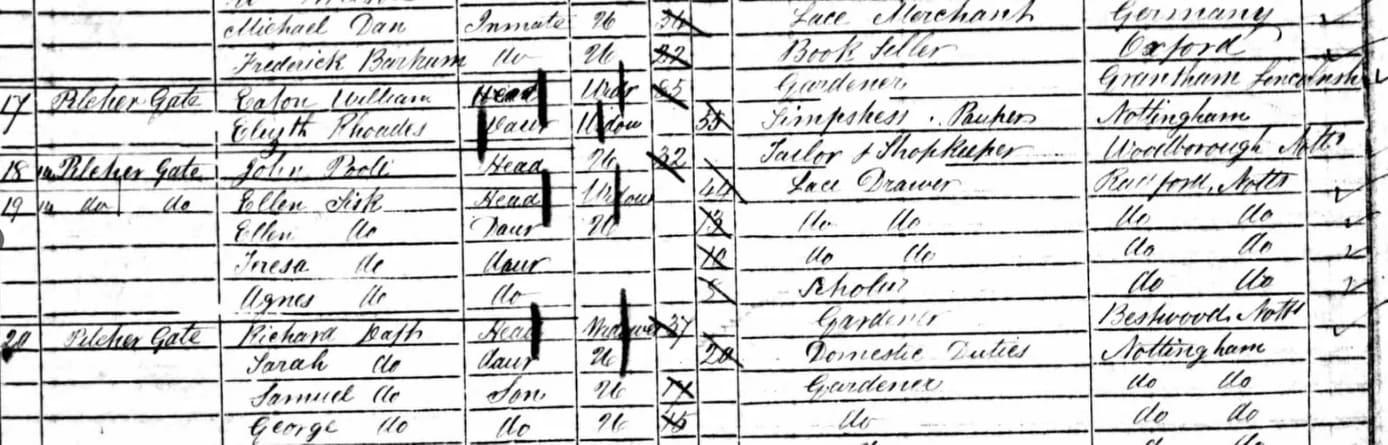
Now we had Nottinghamshire and Lincolnshire border straddlers, so the search moved to the Lincolnshire records.
But first, what of the two Mary Eatons living with William?William and his wife Mary had a daughter Mary in 1799 who died in 1801, and another daughter Mary Ann born in 1803. (It was common to name children after a previous infant who had died.) It seems that Mary Ann didn’t marry but had a daughter Mary Eaton born in 1822.
William and his wife Mary also had a son Richard Eaton born in 1801 in Nottingham.
Who was William Eaton’s wife Mary?
There are two possibilities: Mary Cresswell and a marriage in Nottingham in 1797, or Mary Dewey and a marriage at Grantham in 1795. If it’s Mary Cresswell, the first child Elizabeth would have been born just four or five months after the wedding. (This was far from unusual). However, no births in Grantham, or in Nottingham, were recorded for William and Mary in between 1795 and 1797.
We don’t know why William moved from Grantham to Nottingham or when he moved there. According to Dearden’s 1834 Nottingham directory, William Eaton was a “Gardener and Seedsman”.
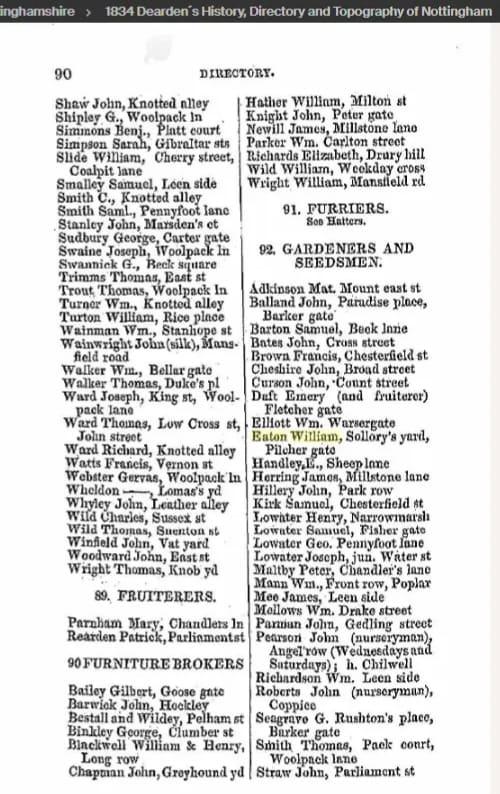
There was another William Eaton selling turnip seeds in the same part of Nottingham. At first I thought it must be the same William, but apparently not, as that William Eaton is recorded as a victualler, born in Ruddington. The turnip seeds were advertised in 1847 as being obtainable from William Eaton at the Reindeer Inn, Wheeler Gate. Perhaps he was related.
William lived in the Lace Market part of Nottingham. I wondered where a gardener would be working in that part of the city. According to CreativeQuarter website, “in addition to the trades and housing (sometimes under the same roof), there were a number of splendid mansions being built with extensive gardens and orchards. Sadly, these no longer exist as they were gradually demolished to make way for commerce…..The area around St Mary’s continued to develop as an elegant residential district during the seventeenth and eighteenth centuries, with buildings … being built for nobility and rich merchants.”
William Eaton died in Nottingham in September 1851, thankfully after the census was taken recording his place of birth.
February 5, 2022 at 2:16 pm #6273In reply to: The Elusive Samuel Housley and Other Family Stories
The Housley Letters
THE NEIGHBORHOODFrom Barbara Housley’s Narrative on the Letters:
In July 1872, Joseph wrote to George who had been gone for 21 years: “You would not know Heanor now. It has got such a large place. They have got a town hall built where Charles’ stone yard was.”
Then Joseph took George on a tour from Smalley to Heanor pointing out all the changes:
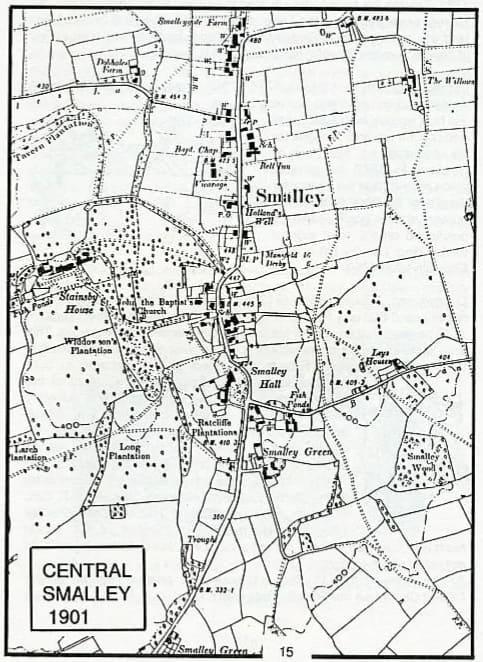
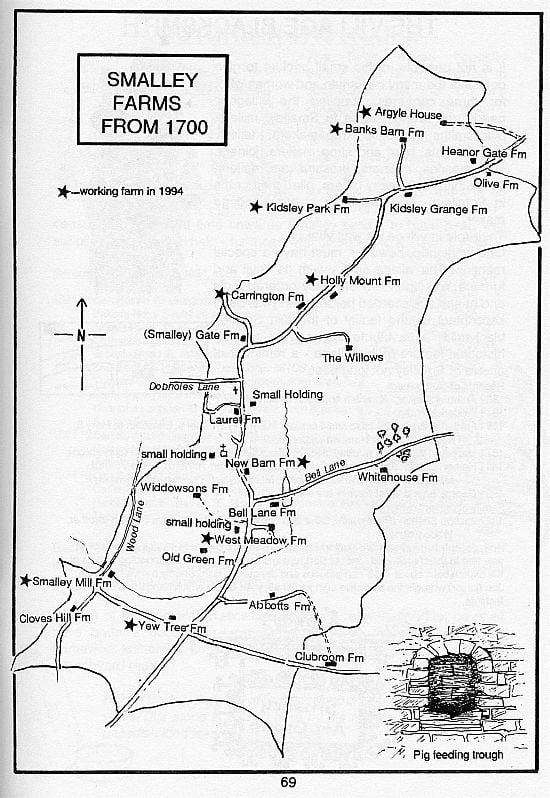
“Now we commence at Firby Brook. There is no public house there. It is turned into a market gardener’s place. Morley smithy stands as it did. You would know Chris Shepperd that used to keep the farm opposite. He is dead and the farm is got into other hands.” (In 1851, Chris Shepherd, age 39, and his widowed mother, Mary, had a farm of 114 acres. Charles Carrington, age 14, worked for them as a “cow boy.” In 1851 Hollingsworths also lived at Morely smithy.) “The Rose and Crown stands and Antony Kerry keeps that yet.” (In 1851, the census listed Kerry as a mason, builder, victicular, and farmer. He lived with his wife and four sons and numerous servants.) “They have pulled down Samuel Kerry’s farm house down and built him one in another place. Now we come to the Bell that was but they have pulled the old one down and made Isaac Potters House into the new Bell.” (In 1851, The Bell was run by Ann Weston, a widow.)
Smalley Roundhouse:
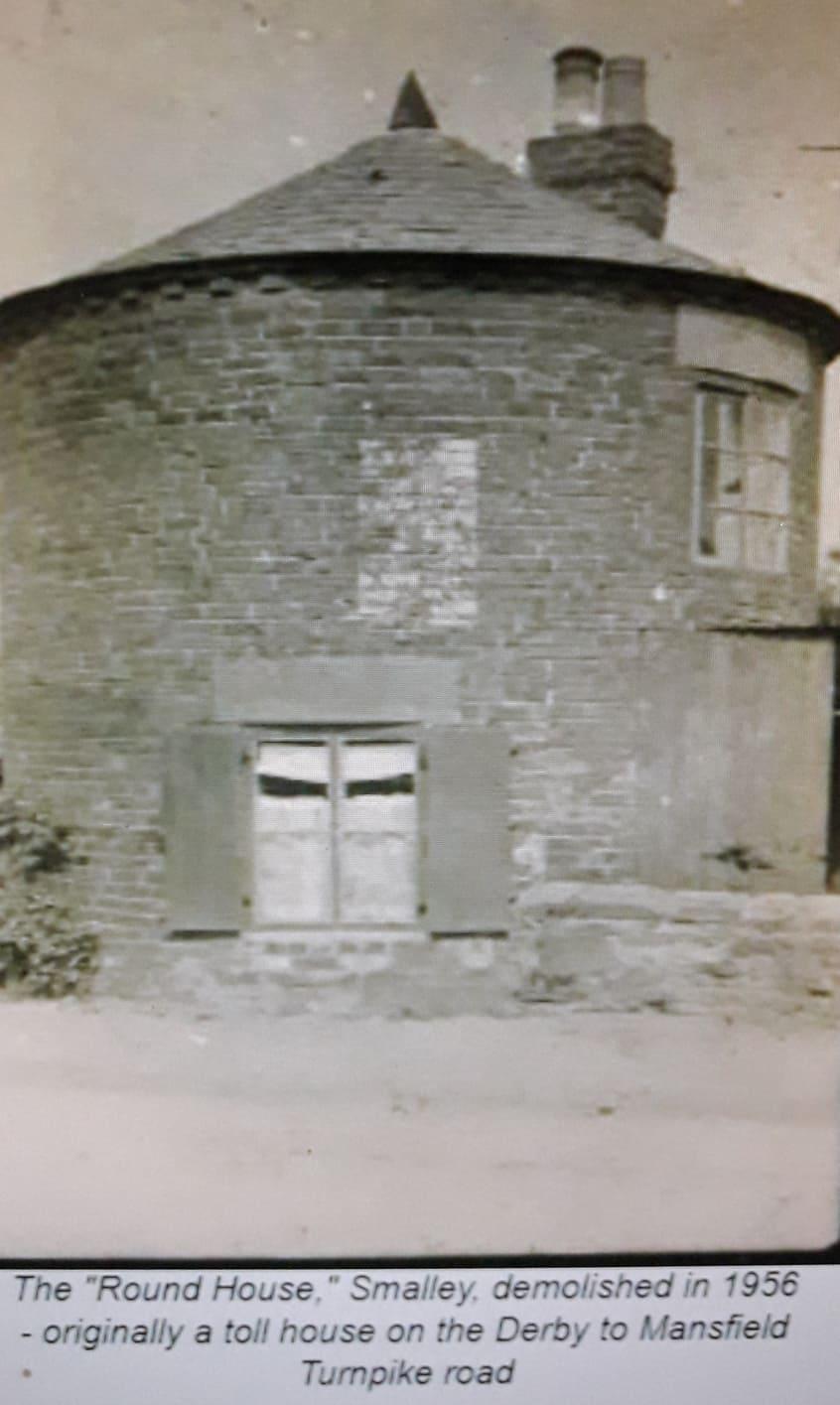
“The old Round House is standing yet but they have took the machine away. The Public House at the top end is kept by Mrs. Turton. I don’t know who she was before she married. Now we get to old Tom Oldknow. The old house is pulled down and a new one is put up but it is gone out of the family altogether. Now Jack is living at Stanley. He married Ann that used to live at Barbers at Smalley. That finishes Smalley. Now for Taghill. The old Jolly Collier is standing yet and a man of the name of Remmington keeps the new one opposite. Jack Foulkes son Jack used to keep that but has left just lately. There is the Nottingham House, Nags Head, Cross Keys and then the Red Lion but houses built on both sides all the way down Taghill. Then we get to the town hall that is built on the ground that Charles’ Stone Yard used to be. There is Joseph Watson’s shop standing yet in the old place. The King of Prussia, the White Lion and Hanks that is the Public House. You see there are more than there used to be. The Magistrate sits at the Town Hall and tries cases there every fortnight.”
.
April 25, 2021 at 12:25 am #6195In reply to: Twists and One Return From the Time Capsule
Sometimes Bob spoke without his lips. Telepathy is what Jane liked to call it. It’s just thinking that other people can hear, apparently.
Bob could hear Jane thinking now and she didn’t sound too pleased. “What’s she doing here?” she hissed in his head.
Jane and Julienne never got on. Well, they used to years ago. Then something happened. Something to do with a fruit cake recipe … Bob could never understand the ins and outs of it. They hadn’t spoken much after that. Jane called Julienne the town gossip.
“That’s very thoughtful of you,” said Bob reaching out for the offshoots.Goodness knows what he was going to do with them. It was Jane who was the gardener.
Clara smirked. “I’ll go and see if Nora is up.”
“No, she’s alright,” said Bob sharply. “You stay here. She’ll just be resting up now. It’s all been quite a shock for her I think.”
“What’s all this?” asked Julienne. “Someone’s had a shock?”
-
-
AuthorSearch Results