


Search Results for 'heavy'
-
AuthorSearch Results
-
September 20, 2024 at 10:13 pm #7557
In reply to: The Incense of the Quadrivium’s Mystiques
The whole summer had been a blur. So much so it felt at times to Eris she’d woken up from a dream to enter another one; carefully crafted illusions as heavy as an obfuscating spell.
She could remember the fair, vaguely the Games too —each event felt like another layer of enchantment, casting a surreal pallor over everything. Indeed, the summer was a blur of fleeting images and half-remembered events, like how everyone quickly disbanded to go for a respite and a salutary holiday. Truth be told, the witches of the Quadrivium all needed it after the utter chaotic year they’d been through.
The resurgence of Malové at the fair, left unexplained, had appeared as an evidence. They all needed the tough love that only she as a head of Coven could provide, rather than the micro-management of the well-meaning but people-inapt Austreberthe. To be fair, Eris wasn’t sure Malové was still in charge or not —Eris had never as much struggled with continuity as now; she could feel they were all flipping through and sliding into potential realities opened by the incoming Samhain doorways on the horizons.
Standing on the cusp of autumn, Eris décided to prepare herself for a clarity spell under the iridescent harvest moon.
As the leaves began to turn and the air grew crisp, Eris stood poised to harness the energies of the propitious harvest moon. Preparation for a clarity spell required ascertained precision and intention waved into the elements.
Eris began by setting her space. The clearing near Lake Saimaa was her sanctum, a place where the natural energies converged seamlessly with her own. She laid out a circle of stones, each one representing a different aspect of clarity—vision, truth, focus, and discernment. In the center, she placed a mirror, a symbolic portal to the inner self and higher understanding.
Mandrake, her Norwegian Forest cat, watched with a knowing gaze, his presence grounding her as she moved through the rituals. Echo, the familiar sprite, flitted about, ensuring everything was in place.
“Mandrake, guard the perimeter,” Eris instructed. The cat slinked off into the shadows, his eyes glowing with an otherworldly light.
Eris took a deep breath and began to chant, her voice steady and resonant:
“By the light of the harvest moon,
I call forth clarity, swift and soon.
Let fog disperse and shadows flee,
Reveal the truth, illuminate me.”She sprinkled dried hellebores around the mirror, their protective and healing properties amplifying the spell’s potency. The hellebores, collected from Normandy, held within them the strength of her Viking ancestors and the promise of Imbolc’s rebirth. They were not just flowers; they were talismans of resilience and transformation.
As the moon reached its zenith, Eris held a vial of enchanted water. She poured it over the mirror, watching as the surface shimmered and rippled, reflecting the moonlight with an ethereal glow. The water, drawn from the depths of Lake Saimaa, was imbued with the ancient magic of the land.
Eris closed her eyes and focused on her intentions. She saw the faces of her sisters at the Quadrivium Emporium, each one struggling with their own burdens. Stalkers, postcards, camphor chests, ever prancing reindeers high on mushrooms. She saw the chaotic energies of early spring, swirling, and the potential and peril they carried. She saw Malové’s stern visage, a reminder of the standards they were meant to uphold, and a reminder to make more magical rejuvenating cream.
“Show me the path,” she whispered. “Guide me through the haze.”
The mirror began to clear, the ripples settling into a smooth, reflective surface. Images started to form—visions of the future, hints of what lay ahead. She saw herself within the coven with renewed purpose, her objectives clear and her drive rekindled. She saw her sisters working in harmony, each one contributing their unique strengths to the collective power.
The clarity spell was working, the fog lifting to reveal the roadmap she needed. Decisions that once seemed insurmountable now appeared manageable, their resolutions within grasp. The inefficiencies plaguing their organization were laid bare, offering a blueprint for the reforms necessary to streamline their efforts.
Eris opened her eyes, the vision fading yet leaving an indelible mark on her mind. She felt a surge of confidence, a sense of direction that had been sorely lacking.
“Thank you,” she murmured to the moon, to the elements, to the spirits that had guided her.
As she began to dismantle the circle, Echo fluttered down to her shoulder, a small smile on her ethereal face. Mandrake emerged from the shadows, his eyes reflecting the calm and order Eris had sought to instill.
“Well done, Eris,” Echo said softly. “The road ahead is clearer now. The harvest moon has gifted you its wisdom.”
Eris nodded, feeling ready as autumn would be a season of action, of turning vision into reality.
July 18, 2024 at 9:16 am #7534In reply to: The Incense of the Quadrivium’s Mystiques
Ms Nicraith Noble, the Mayor of Limerick taking a bath in the Shannon River with reporters had made the rounds of news in ways that were quite incomprehensible.
Obviously it was part of a media ploy to boost public attention for the incoming Roman Games.
“Did she require some anti-rash-and-boil spells?” Jeezel messaged on the network, worried about what such swimming stunt would do to her ravishing hair.
“Probably…” Eris responded in a terse manner “Don’t forget Austreberthe managed to get us to sponsor the event. She may have eased the deal with some goodies. Like anti-age spell too.”
Eris was glad Austreberthe had refocused the efforts towards the imminent launch of the Roman Games. Those mass events were key moments in the Coven’s seasonal activities, as they provided a bounty of emotions to refine and process for creation of their most epic incenses. The recent mass events had been too heavy on fear, anger and gloom-mongering, not the grade A quality they required.
Austreberthe had called all hands on deck to be ready for the event, having deemed the reconnaissance work in Spain’s cloisters sufficiently well under way to take a break from it. In truth, Eris suspected she’d started to receive the first invoices from the undertakers’ Guild and had realised it was a hefty cost for their consulting services.
On top of that, there was a recent case of the drunken sheep flu in Andalucia, some local variety of virus that got the cloister sisters fear for their elderly’s Mother Loreena’s health. Considering the gleeful vulture’s smiles of the Morticians in waiting, they had decided in agreement for an early dismiss into the Summer holidays retreats.
“More prayers, phew, glad they didn’t need us for that.” true to her swagger way, Truella had conceded and accepted to put a hold to her passionate researches —she’d managed to get their personal phone numbers too anyway.
“One week to the start of the Games then.” Eris sighed. The last stretch to summer holidays seemed to take forever.
June 21, 2024 at 10:04 am #7516In reply to: The Incense of the Quadrivium’s Mystiques
“Wait! Look at that one up there!” Truella grabbed Rufus’s arm. “That cloth hanging right up there by the rafters, see it? Have you got a torch, it’s so dark up there.”
Obligingly, Rufus pulled a torch out of his leather coat pocket. “That looks like…”
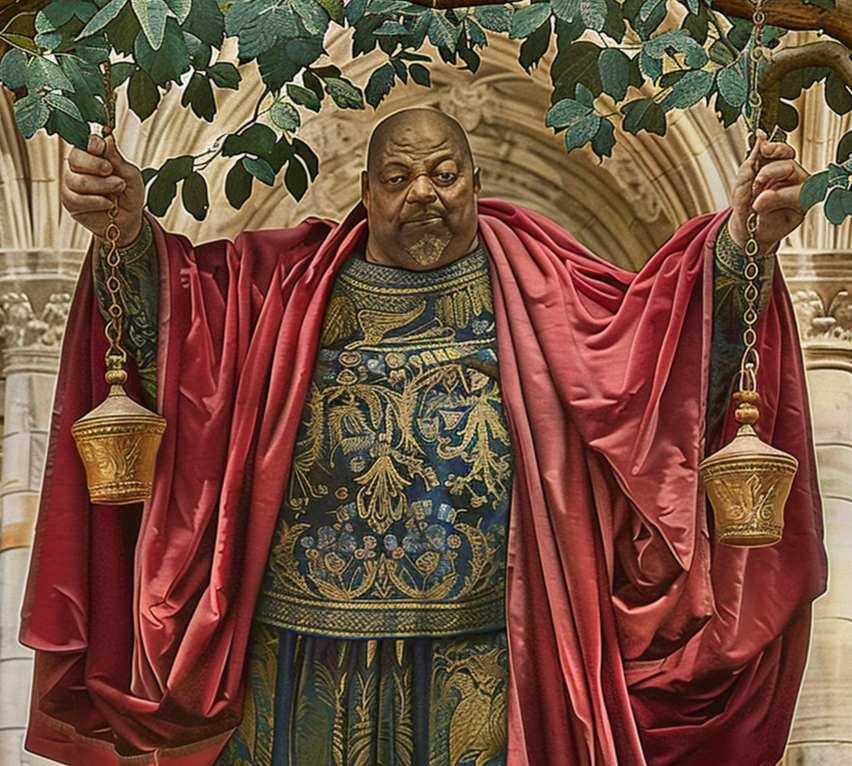
“Brother Bartolo!” Truella finished for him in a whisper. “Why is there an ancient tapestry of him, with all those frog faced nuns?”
Rufus felt dizzy and clutched the bannisters to steady himself. It was all coming back to him in a rush: images and sounds crowded his mind, malodorous wafts assailed his nostrils.
“Why, whatever is the matter? You look like you’ve seen a ghost. Come, come and sit down in my room.”
“Don’t you remember?” Rufus asked, with a note of desperation in his voice. “You remember now, don’t you?”
“Come,” Truella insisted, tugging his arm. “Not here on the stairs.”
Rufus allowed Truella to lead him to her room, rubbing a hand over his eyes. He was so damn hot in this leather coat. The memories had first chilled him to the bone, and then a prickly sweat broke out.
Leading him into her room, Truella closed and locked the door behind them. “You look so hot,” she said softly and reached up to slide the heavy coat from his shoulders. They were close now, very close. “Take it off, darling, take it all off. We can talk later.”
Rufus didn’t wait to be asked twice. He slipped out of his clothes quickly as Truella’s dress fell to the floor. She bent down to remove her undergarments, and raised her head slowly. She gasped, not once but twice, the second time when her eyes were level with his manly chest. The Punic frog amulet! It was identical to the one she had found in her dig.
A terrible thought crossed her mind. Had he stolen it? Or were there two of them? Were they connected to the frog faced sisters? But she would think about all that later.
“Darling,” she breathed, “It’s been so long….”
June 20, 2024 at 9:52 am #7510In reply to: The Incense of the Quadrivium’s Mystiques
After everyone got the program for the six rituals, they dispersed. Jeezel observed groups reform and the whereabouts of people. Eris walked alone toward the dark corridors. Truella, Sandra and Sassafras went to the gardens. Rufus followed shortly after, his dark moody eyes showing intense reflections. Jeezel noticed that Bartolo from the convent had been observing the mortician and hurried to catch up with him. Mother Lorena stood as stern as ever in the center of the lobby. She kept cupping her hands around her ears to check if her earpieces were working. Which they weren’t from the irritated look on her face. Silas was in an animated discussion with Austreberthe and the remaining nuns were laughing heartily and running around as if they had overindulged in Sister Sassafras’ hallucinogenic mushroom canapés.
Jeezel decided to go back to the lounge and explore the antiques, maybe see if there were hidden passageways behind those tapestries. She found Garrett waiting for her in the corridor as if he knew what she intended to do. His deep blue eyes seemed to embrace her whole silhouette in a myriad of unspoken emotions, and when they settle on her emerald green eyes, a subtle grin showed his appreciation.
“Don’t look back,” he said, his voice a deep velvet baritone. “Old Silas and Austreberthe are looking at us with a very disapproving look.”
Jeezel couldn’t help but chuckle softly. “And what if they do? We’re not doing anything wrong.”
Garrett’s grin widened. He took a step closer, the scent of his cologne– a tantalizing mix of cedarwood and bergamot– mingling with the faint aroma of her own enchanting perfume.
“You intrigue me, Jeezel. More than the rituals, more than any relic or spell.”
Jeezel laughed heartily. Don’t they say keep your enemy close? I have questions for him. And I wouldn’t mind the company while I’m exploring the area? she thought.
“I was about to check for secret passages in the old lounge,” she said. “Would you join me?”
She let him take her hand and guide her toward the lounge. As they entered the heavy scent of aged wood and old books greeted them. Jeezel’s eyes darted to the tapestries lining the walls, each depicting scenes of ancient rituals and forgotten histories.
“Where do you think we should start?” Garrett asked, his deep voice barely above a whisper, adding to the mysterious ambiance of the room.
Jeezel tilted her head, considering the possibilities. “That one,” she said, pointing to a particularly intricate tapestry depicting a moonlit garden. “It looks like it could hide something.” She reached out to the fabric and pulled it aside, revealing a wooden door. She tensed when she noticed lingering traces of cedarwood and bergamot. “Or someone,” she added, turning toward him. “You’ve been here recently, have you not?”
“Direct as ever. Very well. I’m here to protect and help you. You need to be careful with Silas. He has hidden motives.”
Jeezel narrowed her eyes. “And why should I trust you?”
Garrett pulled out his crimson handkerchief from his pocket, revealing a symbol embroidered in gold. Her eyes widened as identical to the one on the key Malové had given her.
“How did you get that?” she asked.
“Malové entrusted me with this,” Garret explained, “to show her chosen allies. I was told to seek you out and offer you my assistance. This symbol matches the one on your key, doesn’t it?”
Jeezel felt the weight of the key in her purse. She hadn’t shown it to anyone, not even to her friends. She felt even more confused than before. It was possible that Silas would try to divert her attention from him if he was against the merger. And what better way to do than alert her to unknown enemies. The fact that Garrett knew about the key just added a layer of complexity to the situation, but also a layer of excitement. She wondered what game was being played here, and who were the true players.
“Alright, Garrett,” she said, her voice steadying as she added, “I’ll hear you out. But if you’re lying, you’ll regret it.”
He nodded. “Faire enough. Silas isn’t just interested in the failure of the merger; he’s got his own agenda. Something to do with ancient punic artifacts and power that could rival even the Crimson Opus. And he’s not the only one. There are some ancient Punic families that are looking for the same things.”
Jeezel’s heart skipped a beat. If Silas was after the same kind of power, it could jeopardize everything—the merger, her mission, and possibly the balance of power in their world. Jeezle felt she was in way over her head. She had to breathe and connect to her inner Queen’s innate knowledge in order to slide into her role of leader.
“Then, I accept your assistance,” she conceded with a slight node. “But this doesn’t mean I trust you, Garrett. You’ll have to prove your loyalty.”
Garrett folded the handkerchief back into his pocket. “I wouldn’t expect anything less. For now, let’s just say our interests align. And if we work together, we might just come out of this with everything we need—and more.”
“Then show me where this hidden door lead!”
June 17, 2024 at 7:13 pm #7493In reply to: The Incense of the Quadrivium’s Mystiques
“Do you know who that Everone is?” Jeezel whispered to Eris.
“Shtt,” she silenced Jeezel worried that some creative inspiration sparked into existence yet another character into their swirling adventure.
The ancient stone walls of the Cloisters resonated with the hum of anticipation. The air was thick with the scent of incense barely covering musky dogs’ fart undertones, mingling with the faint aroma of fresh parchment eaten away by centuries of neglect. Illuminated by the soft glow of enchanted lanterns sparkling chaotically like a toddler’s magic candle at its birthday, the grand hall was prepared for an unprecedented gathering of minds and traditions.

While all the attendants were fumbling around, grasping at the finger foods and chitchatting while things were getting ready, Eris was reminded of the scene of the deal’s signature between the two sisterhoods unlikely brought together.
Few weeks before, under a great deal of secrecy, Malové, Austreberthe, and Lorena had convened in the cloister’s grand hall, the gothic arches echoing their words. Before she signed, Lorena had stated rather grandiloquently, with a voice firm and unwavering. “We are a nunnery dedicated to craftsmanship and spiritual devotion. This merger must respect our traditions.”
Austreberthe, ever the pragmatist, replied, “And we bring innovation and magical prowess. Together, we can create something greater than the sum of our parts.”
The undertaker’s spokesman, Garrett, had interjected with a charming smile, “Consider us the matchmakers of this unlikely union. We promise not to leave you at the altar.”
That’s were he’d started to spell out the numbingly long Strategic Integration Plan to build mutual understanding of the mission and a framework for collaboration.Eris sighed at the memory. That would require yet a great deal of joint workshops and collaborative sessions — something that would be the key to facilitate new product developments and innovation. Interestingly, Malové at the time had suggested for Jeezel to lead with Silas the integration rituals designed to symbolically and spiritually unite the groups. She’d had always had a soft spot for our Jeezel, but that seemed unprecedented to want to put her to task on something as delicate. Maybe there was another plan in motion, she would have to trust Malové’s foresight and let it play out.
As the heavy oak doors creaked open, a hush fell over the assembled witches, nuns and the undertakers. Mother Lorena Blaen stepped forward. Her presence was commanding, her eyes sharp and scrutinising. She wore the traditional garb of her order, but her demeanour was anything but traditional.
“Welcome, everyone,” Lorena began, her voice echoing through the hallowed halls. “Or should I say, welcome to the heart of tradition and innovation, where ancient craftsmanship meets arcane mastery.”
She paused, letting her words sink in, before continuing. “You stand at the threshold of the Quintessivium Cloister Crafts, a sanctuary where every stitch is a prayer, every garment a humble display of our deepest devotion. But today, we are not just nuns and witches, morticians and mystics. Today, we are the architects of a new era.”
Truella yawned at the speech, not without waving like a schoolgirl at the tall Rufus guy, while Lorena was presenting a few of the nuns, ready to model in various fashionable nun’s garbs for their latest midsummer fashion show.
Lorena’s eyes twinkled with a mixture of pride and determination as she turned back to the visitors. “Together, we shall transcend the boundaries of faith and magic. With the guidance of the Morticians’ Guild—Garrett, Rufus, Silas, and Nemo—we will forge a new path, one that honors our past while embracing the future.”
Garrett, ever the showman, gave a theatrical bow. “We’re here to ensure this union is as seamless as a well-tailored shroud, my dear Lorena.” Rufus, standing silent and vigilant, offered a nod of agreement. Silas, with his grandfatherly smile, added, “We bring centuries of wisdom to this endeavor. Trust in the old ways, and we shall succeed.” Nemo, with his characteristic smirk, couldn’t resist a final quip. “And if things go awry, well, we have ways of making them… interesting.”
June 17, 2024 at 10:11 am #7490In reply to: The Incense of the Quadrivium’s Mystiques
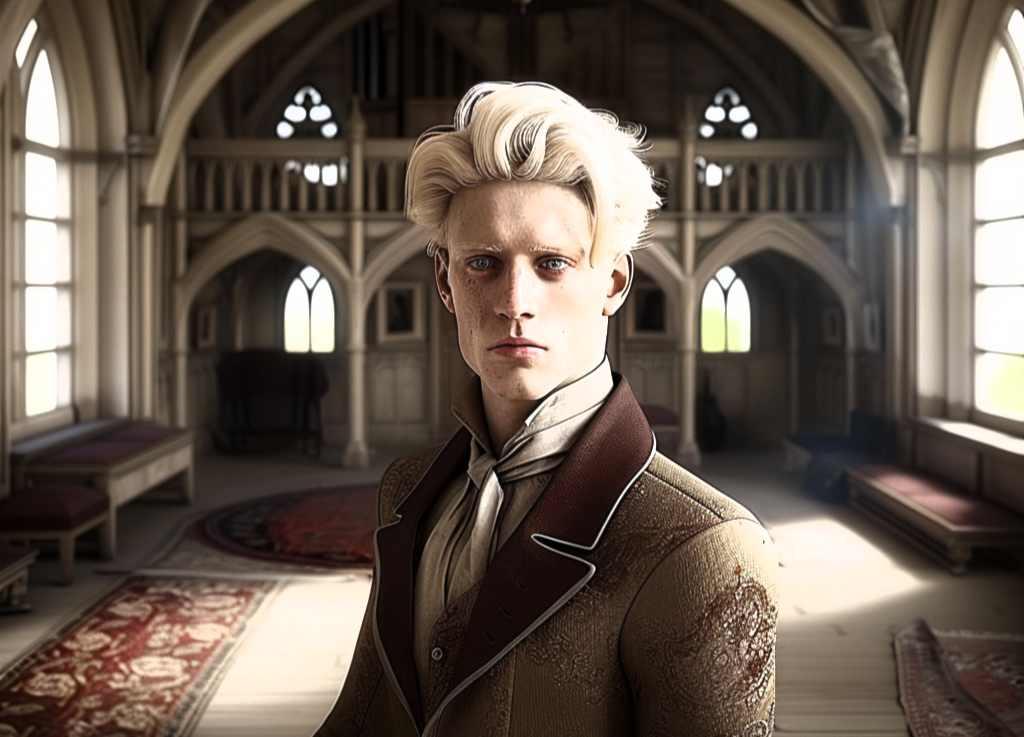
Adjusting the crimson silk handkerchief in his breast pocket, Garrett swanned into the reception hall, his piercing pale blue eyes scanning the room. The walls were hung with colourful but faded tapestries, shabby enough to be genuinely ancient. The furniture was heavy and blackened with age, but it was the floor that caught his critical eye. In the centre of the old terracotta tiles floor was a mosaic, mostly hidden under a large conference table. Garret was no expert on Roman mosaics but it looked like the real deal. He would return to this room later for a closer inspection, he could hardly go crawling under the table now. It was a mercy, at least, that the ancient building hadn’t been decked out in ghastly modern furnishings as so many charming old hotels were these days.
He turned his attention to the few occupants. A ravishing raven haired beauty had just wafted in from the covered cloister beyond the open doors. Her silver mantilla shone in the sunlight slanting down into the courtyard for a moment, for all the world looking like an angelic medieval halo. As she slippped into the shadows the halo vanished, her ebony tresses showing beneath the gauzy lace. She settled herself in a low armchair, smoothing the burgundy folds of her gown. Garrett watched, spellbound. What an enchantress! Perhaps this weekend wouldn’t be such a bore, after all.
June 12, 2024 at 6:29 am #7468In reply to: The Incense of the Quadrivium’s Mystiques
At least the weather was nice in Brussels. The trip to the International Witch Bank of Grungebotts, in the quarters of Ravenstein was luckily a day trip this time, rather these week-long offsite workshops they’d been submitted to in the previous months.
It had not taken long to Austreberthe to send some of the Quadrivium witches to do her errands.
Eris was summoned in the wee hours of the day, in order to do a check-in with the bankers. The state of finances of the Quadrivium had been under scrutiny already at the time of Malové, but probably even more now during this power vacuum period.
Austreberthe had insisted Eris could be there to join with a few of the Witches of Compliance who would handle most of the discussion, while she would present the business side of their last ventures. Apparently Malové had only hinted at the secret missions she’d given some of the witches, without sharing any detail to her head of Finance.
Malové was apparently very used to these exchanges with the bankers, having struggled for a while to keep the Incense venture afloat. The presentation had been very expertly put together, and Eris for her part was mostly here to embody the seriousness and practicality of the business; in truth the bankers themselves, some greying end-of-career wizards, were obviously just here to do their job, and not eager to find fault that would require a more heavy-handed audit approach.
Within two hours of confident presentation, soft discussions on the state of international witches and wizard affairs, the political state in the union, and the incoming Worldwide Roman Games, with the help of a few madeleines dipped in black coffee, it was quickly done.
“How did it go?” Austreberthe anxious message was already flashing imperiously on her device as she boarded the return magical train. Eris distractly showed her ticket to the lady controller with the red lavallière and the strangest red octopus brooch, while struggling to answer.
She was too tired to overthink it. She tapped in quick taps the answer “All good for now. We should be in the clear until the next one.” and reclined back to get some needed rest.
May 17, 2024 at 9:55 pm #7444In reply to: The Incense of the Quadrivium’s Mystiques
Sometimes the storm within is far more tumultuous than the one without.
After yet another seminar under Malové’s exacting eye, followed by the treasure hunt team-building exercise that left more than a few witches grumbling, Eris found herself at a crossroads.
The seminar had been, as always, a rigorous affair. Malové’s stern teachings, laced with cryptic wisdom and unyielding standards, forced the witches to confront their weaknesses and push their magical boundaries. The treasure hunt, designed to test their teamwork and resourcefulness, had revealed underlying tensions and frayed nerves despite the moments of camaraderie.
Eris, already exhausted from the constant demands and the emotional toll of the coven’s internal conflicts, felt her resolve wavering. The weight of responsibility hung heavy on her shoulders, and the recent events had only amplified her sense of weariness.
After the seminar, Eris retreated to her quarters, seeking solace in the familiar comforts of her personal space. She lit a calming incense blend, one of the Quadrivium’s finest, hoping it would help clear her mind and ease her spirits. As the soothing aroma filled the room, she couldn’t help but reflect on Malové’s private comments about Truella and the importance of clear communication and assertiveness balanced with respect.
The treasure hunt had forced Eris to confront her own limitations and the gaps in her magical expertise. She realized that while she had always been diligent and skilled, she had often hesitated to take bold risks or assert her ideas for fear of criticism. Malové’s teachings, though harsh, had a way of stripping away these hesitations, leaving only the raw truth.
Determined to rise above her doubts, Eris decided to approach the next phase of her journey with renewed vigor. She had a moment of appreciation for Malové’s tough but fair leadership —they had joked about their Breton witch colleague who had emphasised in her address to be “tough leaders” ; at least that’s what they understood until they all realised under the thick French accent, she’d actually meant being a “thought leader”. Expressing her gratitude for the guidance, Eris vowed to bridge the gap with Truella, understanding that their differences could be a source of strength rather than division.
March 4, 2024 at 9:57 pm #7395In reply to: The Incense of the Quadrivium’s Mystiques
In the dimly lit chambers of the Quadrivium’s headquarters, a cold gust slipped through the cracked window, teasing the heavy velvet drapes and sending shivers down Malové’s spine. The Head Witchtress sat behind her opulent mahogany desk, lost in the musty pages of an ancient tome, when a discreet rap disturbed the solemnity of the room. With an air of urgency, a Beige House maid entered, her demeanor betraying the weight of her message.
“Mistress Malové,” she began, her voice a mere whisper, “I bear dire tidings.”
Malové arched an eyebrow. “Speak plainly, my dear.”
The spy-maid straightened, her gaze unwavering. “Lump, the ex-president, plots a resurrection across the pond. The Coven cannot allow it.”
A sly grin danced upon Malové’s lips as she pondered the revelation. “Indeed, we cannot.”
After a pregnant pause, she continued, her voice dripping with intrigue. “And perhaps, I have just the antidote.”
Rising from her seat, Malové cast a commanding presence upon the room. “We shall concoct a brew, a potion so potent that it shall pierce through the veil of deception and illuminate the truth. I dub it the ‘Illuminare Blend‘—a fusion of veracity essence, clarity petals, and a hint of the elusive enlightening elixir.”
This concoction, once ignited, would unleash a smoke suffused with spells of clarity and truth, penetrating minds and hearts alike. Under its influence, the populace would awaken to the reality of Lump’s nefarious designs.
“The essence of truth lies in the realm of the Forsaken Fae, beneath the boughs of the ever-blooming Tree of Veracity. Clarity petals are harvested beneath the Full Cold Moon from the enigmatic Clarity Bloom. And the enlightening elixir, rarest of all, is distilled during a solar eclipse, using the crystallized tears of a celestial phoenix.”
Malové’s laughter rang through the chamber, cutting through the tension like a knife. “Are we now in a Barry Otter novel? What do you expect me to say next? ‘This is the mission. We must procure these ingredients. The fate of the nation hangs in the balance. There is no room for failure’?”
The Beige House maid stood, bewildered by the abrupt shift in tone.
Chuckling, Malové waved a dismissive hand. “Fear not, my dear. Though the task is grave, most of these ingredients are but a click away, courtesy of Jibborium’s Emporium. They have yet to disappoint.”
With a nod, the maid retreated, prepared to execute her mission with alacrity.
“Wait,” Malové called after her. “You may need a prescription for some of these.” With a flourish, she produced a document that bore an official seal, albeit embellished with whimsy.
“Contact me when you have procured them. I shall dispatch my finest witches to assist with the incantations. Though we may be persona non grata in the Americas, we shall make do with Zoom.”
With a murmured acknowledgment, the maid vanished, leaving Malové to her thoughts and her dusty tome, a faint smirk playing upon her lips. “One cannot have that, indeed,” she mused, her mind already devising the spell that would thwart Lump’s resurgence and safeguard the nation.
February 15, 2024 at 11:04 am #7373In reply to: The Incense of the Quadrivium’s Mystiques
The disturbance had been felt in the bustling heart of Rio.
The warmth of the night had amplified the vibrant energy of the Carnival in Rio, a pulsating heart that reverberated through the city’s veins. But as the beat of samba drums echoed in the distance, a different rhythm was being played behind closed doors. Iemanjá, the head of the Umbanda clan and a pillar of strength in the Witches of the New World, recognized the tremors of another magick at play.
Gathering her coven under the silvery light of the crescent moon, they began the rhythmic dance of the macumba ritual. The air grew heavy, scented with copal and the salty tang of the ocean. In the center of their circle, a waterspout swirled, revealing in its shallow reflection the glow of a portal that emitted the icy chill of a Limerick dawn.
Piercing through the veil of secrecy, Iemanjá’s ethereal sight witnessed the foreign witches, led by the enigmatic Malové, who dared to encroach upon their territory without the required parchmentwork. And yet, their motives remained hidden within the vortex of desire and lust emanating from the Carnival.
A murmur of discontent rippled through the Umbanda clan. Mesmirah, her second, couldn’t stop herself shouting Sacrilégio! They were not ones to tolerate trespassers, let alone those who dared to siphon off energy from their sacred lands.
Silêncio! Iemanjá commanded the crowd. She’d recognized Malové from having attended and graduated the same MWA (Master of Witchcraft Administration), and she was aware of Malove’s little incense business; Malové didn’t strike her as someone to bypass the rules, some handed down through countless generations, binding together most witches across the world despite their varying practices.
She had to be mindful of the delicate balance between the Old World clans and the New. An unauthorized incursion could easily spark a conflict that would ripple through the witching worlds.
Just as the ocean waves respect the boundary of the shore, so must the witches respect the territories — an ancient pact carved in the pillars of the Old World. This blatant disregard by Malové and her coven was akin to scratching the surface of a simmering cauldron, threatening to disrupt the harmony that had been carefully cultivated.
As the revelation sunk in, Iemanjá knew they had to tread carefully. A confrontation would lead to a war bigger than themselves —yet, they couldn’t let this transgression slide. Their pride and the protection of their territory demanded action.
Mesmirah! she finally spoke You will take three witches with you, and investigate what business these Old World witches have in Rio. You will report to me.
Mesmirah nodded, understanding that she was not yet granted authority to investigate in an official capacity. Iemanja was acting surprisingly soft, and didn’t want the Elders to be informed yet, but had recognized action was needed. Mesmirah was confident she would easily find out what was happening, and maybe use that opportunity to her —their advantage. The game of power was on.
February 28, 2023 at 1:14 pm #6720In reply to: The Precious Life and Rambles of Liz Tattler
“It’s amazing, all the material we gathered over the years, it makes one’s head spin…” Godfrey was poring over quantities of papers, mostly early drafts stuck haphazardly in a pile of donations boxes that Elizabeth had generously contributed to the National Library’s archives of great works and renowned authors, but mostly as way of spring cleaning.
He had materialized some of the links from the pages with webs of purple yarn tied to the wall of the dining hall. It had soon become a tangled mess of interwoven threads that he had to protect from the cleaning frenzied assaults of energetic feather duster of Finnley.
She’d softened her stance a little when she’s realised how often her namesake has popped in the various storylines, almost making her emotional about Liz’ incorporating her in her works of fictions —only to remember that most of the time, she’d been the working hand behind the continuity, the Finnleys appearances being an offshoot of this endeavour.
Godfrey had almost forgotten he was actually a publisher to start with, before he became more of a useful side-kick, if not a useful idiot.
The phone rang in the empty hall. Soon after, Finnley arrived with the heavy bakelite telephone, handing it over to Godfrey unceremoniously. “You might want to take this, it’s Felicity…” she mouthed the last word like it was the name of the Devil himself.
“Dear Flove protect us, don’t tell me Liz’ mother is in town…”
“Well, at least she has comic relief value” snorted Finnley on her way back to her duties.
February 19, 2023 at 9:00 pm #6612In reply to: Orbs of Madjourneys
Two young women, identical to the purple lock of hair hiding their left eye, entered the room. They moved as one person to the table, balancing their arms and bouncing on the floor like little girls. Youssef couldn’t help a shiver as he remembered The Shining.
“We are the twins,” they said, looking at him from behind their purple lock of hair. “Don’t mind us.”
One spoke a few milliseconds after the other, giving their combined voice an otherworldly touch that wasn’t reassuring. One took the sheets of paper from under the obsidian stone and the other the notebooks. After an hesitation they left the stone on the table and went back to the door.
“Wait,” said Youssef as they were about to leave, “What was on that paper? It looked like a map.”
“We leave you the stone,” they said without looking at him. “You might need it.”
As they shut the door, Youssef jumped out of his bed and tried to catch up with them. People couldn’t just enter his room like that. But when he flung the door open, the corridor was empty. He had the impression echoes of a combined laugh remained in the air and, tired as he was, decided not to look for them. Better not break the veil between dream and reality.
Intrigued by what the girls said, he took the black stone from the table and the last snicker bar from his backpack. He noted he would have to go to the grocery store tomorrow to buy some. Once he was back on his bed, he engulfed the snack and, while chewing, turned the stone around, trying to figure out what the girls meant by “You might need it”. The stone was cold to the touch and his reflection kept changing but nothing particular happened. Disappointed, he put the stone on his pillow and resumed the game on his phone.
Youssef finds himself in a small ghost town in what looks like the middle of the Australian outback. He’s standing in the town square, surrounded by an old post office, a saloon, and a few other ramshackle buildings.
He had a hard time focusing on the game. He started to feel the fatigue from the day. He yawned and started to doze off.
Youssef is standing in the town square, surrounded by an old post office, a saloon, and a few other ramshackle buildings. Scraps of mist are floating towards him. A ghostly laugh resounds from behind. He turns swiftly only to see a flash of purple disappear in a dark alleyway. He starts to run to catch them but a man, thrown out of the saloon, stumbles in front of him and they roll together on the dust.
“It’s not that I don’t like you,” said the man, “but you’re heavy.”
Youssef rolls on the side, mumbling some excuses and looks at where the twins had disappeared but the alleyway was gone.
“I think you broke one of my rib with your stone,” says the man, feeling his chest.
He looks as old as the town itself and quite harmless in his clothes, too big for him.
“What stone?” asks Youssef.
The old man points at a fragment of black obsidian between them on the ground.
“Don’t show them,” he says, “or they’ll take it from you.”
“What did you do?”
“They don’t like it when you ask questions about the old mines.”
February 2, 2023 at 9:10 pm #6492In reply to: Orbs of Madjourneys
With a determined glint in his eye, Xavier set his sights on the slot machines. He scanned the rows of blinking lights and flashing screens until one caught his attention. He approached the machine and inserted a coin, feeling a rush of excitement as he pulled the lever.
With a satisfying whir, the reels began to spin, and before he knew it, the golden banana appeared on the screen, lining up perfectly. The machine erupted in flashing lights and loud noises, and a ticket spilled out onto the floor.
🎰 · 💰
🍌🍌🍌Xavier picked it up, reading aloud the inscriptions on the ticket, “Congratulations on completing your quest. You may enjoy your trip until the next stage of your journey. Look for the cook on the pirate boat, she will give you directions to regroup with your friends. And don’t forget to confirm your bookings.”
Glimmer let out a whoop of trepidation, “Let’s go find that cook, Xav! I can’t wait to see what’s next in store for us!”
But Xavier, feeling a bit worn out, replied with a smile, “Hold on a minute, love. All I need at the moment is just some R&R after all that brouhaha.”
Glimmer nodded in understanding and they both made their way to the deck, taking in the fresh air and the breathtaking scenery as the boat sailed towards its next destination.
As the boat continued its journey, sailing and gliding on the river in the air filled with moist, they could start to see across the mist opening like a heavy curtain a colourful floating market in the distance, and the sounds of haggling and laughter filled the air.
They couldn’t wait to explore and see what treasures and surprises awaited them. The journey was far from over, but for now, they were content to simply enjoy the ride.

Xavier closed his laptop while his friends were still sending messages on the chatroom. He’d had long days of work before leaving to take his flights to Australia, during which he hoped he could rest enough during the flights.
Most of the flights he’d checked had a minimum of 3 layovers, and a unbelievably long durations (not to count the astronomic amount of carbon emissions). Against all common sense, he’d taken one of the longest flight duration. It was 57h, but only 3 layovers. From Berlin, to Stockholm, then Dubai and Sydney. He could probably catch up with Youssef there as apparently he sent a message before boarding. They could go to Alice Spring and the Frying Mush Inn together. He’d try to find the reviews, but they were only listed on boutiquehotelsdownunder.com and didn’t have the rave reviews of the prestigious Kookynie Grand Hotel franchise. God knows what Zara had in mind while booking this place, it’d better be good. Reminded him of the time they all went to that improbably ghastly hotel in Spain (at the time Yasmin was still volunteering in a mission and couldn’t join) for a seminar with other game loonies and cosplayers. Those were the early days of the game, and the technology frankly left a lot to be desired at the time. They’d ended up eating raspberry jam with disposable toothbrushes, and get drunk on laughter.
When Brytta had seen the time it took to go there, she’d reconsidered coming. She couldn’t afford taking that much time off, and spending the equivalent of 4 full days of her hard-won vacation as a nurse into a plane simply for the round-trip —there was simply no way.
Xavier had proposed to shorten his stay, but she’d laughed and said, “you go there, I’ll enjoy some girl time with my friends, and I’ll work on my painting” —it was more convenient when he was gone for business trips, she would be able to put all the materials out, and not care to keep the apartment neat and tidy.The backpack was ready with the essentials; Xavier liked to travel light.
January 31, 2023 at 3:17 am #6476In reply to: Orbs of Madjourneys
Yasmin was having a hard time with the heavy rains and mosquitoes in the real-world. She couldn’t seem to make a lot of progress on finding the snorting imp. She was feeling discouraged and unsure of what to do next.
Suddenly, an emoji of a snake appeared on her screen. It seemed to be slithering and wriggling, as if it was trying to grab her attention. Without hesitation, Yasmin clicked on the emoji.
She was taken to a new area in the game, where the ground was covered in tall grass and the sky was dark and stormy. She could see the snorting imp in the distance, but it was surrounded by a group of dangerous-looking snakes.
Clue unlocked It sounds like you’re having a hard time in the real world, but don’t let that discourage you in the game. The snorting imp is nearby and it seems like the snakes are guarding it. You’ll have to be brave and quick to catch it. Remember, the snorting imp represents your determination and bravery in real life.
Rude! thought Yasmin. Telling me I’m having a hard time! And I’m supposed to be the brains of the group! Suddenly the screen went blank. “Oh blimmin dodgy internet!” she moaned.
“Road’s closed with the flooding,” said a man from the kitchen door. Yasmin didn’t know him; he had a tinge of an accent and took up a lot of space in the doorway. “They reckon it should be clear by tomorrow though.”
“Fred!” Sister Aliti looked up from chopping yam and beamed. She pointed her knife at Yasmin who was washing the breakfast dishes. “Have you met Yasmin? One of our new volunteers. Such a good girl.” The knife circled towards the door. “Yasmin this is Fred – Fred drives the van for us when we are too busy to do it ourselves. So very kind.” She smiled fondly at the man.
Fred nodded and, taking a step into the kitchen, he stuck a hand towards Yasmin. She quickly wiped her damp hands on her skirt before taking it. Fred’s hand was brown and weathered like his face and he gripped her fingers firmly.
“Nice to meet you Yasmin. So where are you from?”
“Oh, um, I’ve been living in London most recently but originally from Manchester.” Yasmin noticed he had a snake tattoo curling up his inner bicep, over his shoulder and disappearing under his black singlet. “Is your accent Australian?”
A flicker of a frown crossed Fred’s face and Yasmin felt anxious. “Sorry,” she mumbled, although she wasn’t sure what for. “It’s just I’m visiting soon …”
“Yeah, originally. But I’ve not been back home for while.” His eyes drifted to the kitchen window and stayed there. For a moment, they all watched the rain pelt against the glass.
Sister Aliti broke the silence. “Fred’s a writer,” she said sounding like a proud mother.
“Oh, that’s so cool! What do you write?” Yasmin immediately worried she’d been too nosy again. “I’ve always wanted to write!” she added brightly which wasn’t true, she’d never given it much thought. Realising this, and to her horror, she snort laughed.
Fred dragged his eyes back from the window and looked at her with amusement. “Yeah? Well you should go for it!” He turned to Sister Aliti. “Internet’s down again too with this weather,” He dug into the pocket of his shorts and dangled some keys in the air. “I’ll leave the van keys with you but I’ll be back tomorrow, if the rain’s stopped.” The keys clanked onto the bench.
“He’s such a chatterbox,” murmured Sister Aliti after Fred had gone and Yasmin laughed.
“Shall I put these in the office?” Yasmin gestured to the set of keys then gasped as she saw that on the keychain was a devilish looking imp grinning up at her.
January 28, 2023 at 11:27 am #6463In reply to: Prompts of Madjourneys
Additional clues from AL (based on Xavier’s comment)
Yasmin
:snake:

Yasmin was having a hard time with the heavy rains and mosquitoes in the real-world. She couldn’t seem to make a lot of progress on finding the snorting imp, which she was trying to find in the real world rather than in the game. She was feeling discouraged and unsure of what to do next.
Suddenly, an emoji of a snake appeared on her screen. It seemed to be slithering and wriggling, as if it was trying to grab her attention. Without hesitation, Yasmin clicked on the emoji.
She was taken to a new area in the game, where the ground was covered in tall grass and the sky was dark and stormy. She could see the snorting imp in the distance, but it was surrounded by a group of dangerous-looking snakes.
Clue unlocked It sounds like you’re having a hard time in the real world, but don’t let that discourage you in the game. The snorting imp is nearby and it seems like the snakes are guarding it. You’ll have to be brave and quick to catch it. Remember, the snorting imp represents your determination and bravery in real life.
🐍🔍🐗 Use your skills and abilities to navigate through the tall grass and avoid the snakes. Keep your eyes peeled for any clues or symbols that may help you in your quest. Don’t give up and remember that the snorting imp is a representation of your determination and bravery.
A message bumped on the screen: “Need help? Contact me 👉”
Stryke_Assist is trying to make contact : ➡️ACCEPT <> ➡️DENY ❓
Youssef
:desert:

Youssef has not yet been aware of the quest, since he’s been off the grid in the Gobi desert. But, interestingly, his story unfolds in real-life parallel to his quest. He’s found a strange grumpy shaman at a food booth, and it seems that his natural steps are converging back with the game. His blog website for his boss seems to take most of his attention.
An emoji of a desert suddenly appeared on his screen. It seemed to be a barren and empty landscape, with sand dunes stretching as far as the eye could see. Without hesitation, Youssef clicked on the emoji.
He was taken to a new area in the game, where the ground was covered in sand and the sky was a deep orange, as if the sun was setting. He could see a mysterious figure in the distance, standing at the top of a sand dune.
Clue unlocked It sounds like you’re in a remote location and disconnected from the game. But, your real-life experiences seem to be converging with your quest. The grumpy shaman you met at the food booth may hold the key to unlocking the next steps in the game. Remember, the desert represents your ability to adapt and navigate through difficult situations.
🏜️🧭🧙♂️ Explore the desert and see if the grumpy shaman’s clues lead you to the next steps in the game. Keep an open mind and pay attention to any symbols or clues that may help you in your quest. Remember, the desert represents your ability to adapt and navigate through difficult situations.
A message bumped on the screen: “Need help? Contact me 👉”
Sands_of_time is trying to make contact : ➡️ACCEPT <> ➡️DENY ❓
Zara
:carved_tile:

Zara looked more advanced [in her explorations – stream breaks – resume conversation]
Zara had come across a strange and ancient looking mine. It was clear that it had been abandoned for many years, but there were still signs of activity. The entrance was blocked by a large pile of rocks, but she could see a faint light coming from within. She knew that she had to find a way in.
As she approached the mine, she noticed a small, carved wooden tile on the ground. It was intricately detailed and seemed to depict a map of some sort. She picked it up and examined it closely. It seemed to show the layout of the mine and possibly the location of the secret room.
With this new clue in hand, Zara set to work trying to clear the entrance. She used all of her strength to move the rocks, and after a few minutes of hard work, she was able to create an opening large enough for her to squeeze through.
As she ventured deeper into the mine, she found herself in a large chamber. The walls were lined with strange markings and symbols, and she could see a faint light coming from a small room off to the side. She knew that this must be the secret room she had been searching for.
Zara approached the room and pushed open the door. Inside, she found a small, dimly lit chamber. In the center of the room stood a large stone altar, and on the altar was a strange, glowing object. She couldn’t quite make out what it was, but she knew that this must be the key to solving the mystery of the mine.
With a sense of excitement and curiosity, Zara reached out to take the glowing object. As her hand touched it, she felt a strange energy coursing through her body. She knew that her quest was far from over, and that there were many more secrets to uncover in the mine.
January 23, 2023 at 1:27 pm #6451In reply to: Orbs of Madjourneys
The progress on the quest in the Land of the Quirks was too tantalizing; Xavier made himself a quick sandwich and jumped back on it during his lunch break.
 The jungle had an oppressing quality… Maybe it has to do with the shrieks of the apes tearing the silence apart.
 It was time for a slight adjustment of his avatar.
Xavimunk opened his bag of tricks, something that the wise owl had suggested he looked into. Few items from the AIorium Emporium had been supplied. They tended to shift and disappear if you didn’t focus, but his intention was set on the task at hand. At the bottom of the bag, there was a small vial with a golden liquid with a tag written in ornate handwriting “MJ remix: for when words elude and shapes confuse at your own peril”.
 He gulped the potion without thinking too much. He felt himself shrink, and his arms elongate a little. There, he thought. Imp-munk’s more suited to the mission. Hope the effects will be temporary…
As Xavier mustered the courage to enter through the front gate, monkeys started to become silent. He couldn’t say if it was an ominous sign, or maybe an effect of his adaptation. The temple’s light inside was gorgeous, but nothing seemed to be there.
He gestured around, to make the menu appear. He looked again at the instructions on his screen overlay:
As for possible characters to engage, you may come across a sly fox who claims to know the location of the fruit but will only reveal it in exchange for a favor, or a brave adventurer who has been searching for the Golden Banana for years and may be willing to team up with you.
Suddenly a loud monkey honking noise came from outside, distracting him.
What the?… Had to be one of Zara’s remixes. He saw the three dots bleeping on the screen.
Here’s the Banana bus, hope it helps! Envoy! bugger Enjoy!
Yep… With the distinct typo-heavy accent, definitely Zara’s style. Strange idea that AL designated her as the leader… He’d have to roll with it.
Suddenly, as the Banana bus parked in front of the Temple, a horde of Italien speaking tourists started to flock in and snap pictures around. The monkeys didn’t know what to do and seemed to build growing and noisy interest in their assortiment of colorful shoes, flip-flops, boots and all.


Focus, thought Xavimunk… What did the wise owl say? Look for a guide…
Only the huge colorful bus seemed to take the space now… But wait… what if?He walked to the parking spot under the shades of the huge banyan tree next to the temple’s entrance, under which the bus driver had parked it. The driver was still there, napping under a newspaper, his legs on the wheel.
“Whatcha lookin’ at?” he said chewing his gum loudly. “Never seen a fox drive a banana bus before?”
Xavier smiled. “Any chance you can guide me to the location of the Golden Banana?”
“For a price… maybe.” The fox had jumped closely and was considering the strange avatar from head to toe.
“Ain’t no usual stuff that got you into this? Got any left? That would be a nice price.”
“As it happens…” Xavier smiled.The quest seemed back on track. Xavier looked at the time. Blimmey! already late again. And I promised Brytta to get some Chinese snacks for dinner.
January 19, 2023 at 10:49 am #6419In reply to: Orbs of Madjourneys
“I’d advise you not to take the parrot, Zara,” Harry the vet said, “There are restrictions on bringing dogs and other animals into state parks, and you can bet some jobsworth official will insist she stays in a cage at the very least.”
“Yeah, you’re right, I guess I’ll leave her here. I want to call in and see my cousin in Camden on the way to the airport in Sydney anyway. He has dozens of cats, I’d hate for anything to happen to Pretty Girl,” Zara replied.
“Is that the distant cousin you met when you were doing your family tree?” Harry asked, glancing up from the stitches he was removing from a wounded wombat. “There, he’s good to go. Give him a couple more days, then he can be released back where he came from.”
Zara smiled at Harry as she picked up the animal. “Yes! We haven’t met in person yet, and he’s going to show me the church my ancestor built. He says people have been spotting ghosts there lately, and there are rumours that it’s the ghost of the old convict Isaac who built it. If I can’t find photos of the ancestors, maybe I can get photos of their ghosts instead,” Zara said with a laugh.
“Good luck with that,” Harry replied raising an eyebrow. He liked Zara, she was quirkier than the others.
Zara hadn’t found it easy to research her mothers family from Bangalore in India, but her fathers English family had been easy enough. Although Zara had been born in England and emigrated to Australia in her late 20s, many of her ancestors siblings had emigrated over several generations, and Zara had managed to trace several down and made contact with a few of them. Isaac Stokes wasn’t a direct ancestor, he was the brother of her fourth great grandfather but his story had intrigued her. Sentenced to transportation for stealing tools for his work as a stonemason seemed to have worked in his favour. He built beautiful stone buildings in a tiny new town in the 1800s in the charming style of his home town in England.
Zara planned to stay in Camden for a couple of days before meeting the others at the Flying Fish Inn, anticipating a pleasant visit before the crazy adventure started.
Zara stepped down from the bus, squinting in the bright sunlight and looking around for her newfound cousin Bertie. A lanky middle aged man in dungarees and a red baseball cap came forward with his hand extended.
“Welcome to Camden, Zara I presume! Great to meet you!” he said shaking her hand and taking her rucksack. Zara was taken aback to see the family resemblance to her grandfather. So many scattered generations and yet there was still a thread of familiarity. “I bet you’re hungry, let’s go and get some tucker at Belle’s Cafe, and then I bet you want to see the church first, hey? Whoa, where’d that dang parrot come from?” Bertie said, ducking quickly as the bird swooped right in between them.
“Oh no, it’s Pretty Girl!” exclaimed Zara. “She wasn’t supposed to come with me, I didn’t bring her! How on earth did you fly all this way to get here the same time as me?” she asked the parrot.
“Pretty Girl has her ways, don’t forget to feed the parrot,” the bird replied with a squalk that resembled a mirthful guffaw.
“That’s one strange parrot you got here, girl!” Bertie said in astonishment.
“Well, seeing as you’re here now, Pretty Girl, you better come with us,” Zara said.
“Obviously,” replied Pretty Girl. It was hard to say for sure, but Zara was sure she detected an avian eye roll.
They sat outside under a sunshade to eat rather than cause any upset inside the cafe. Zara fancied an omelette but Pretty Girl objected, so she ordered hash browns instead and a fruit salad for the parrot. Bertie was a good sport about the strange talking bird after his initial surprise.
Bertie told her a bit about the ghost sightings, which had only started quite recently. They started when I started researching him, Zara thought to herself, almost as if he was reaching out. Her imagination was running riot already.
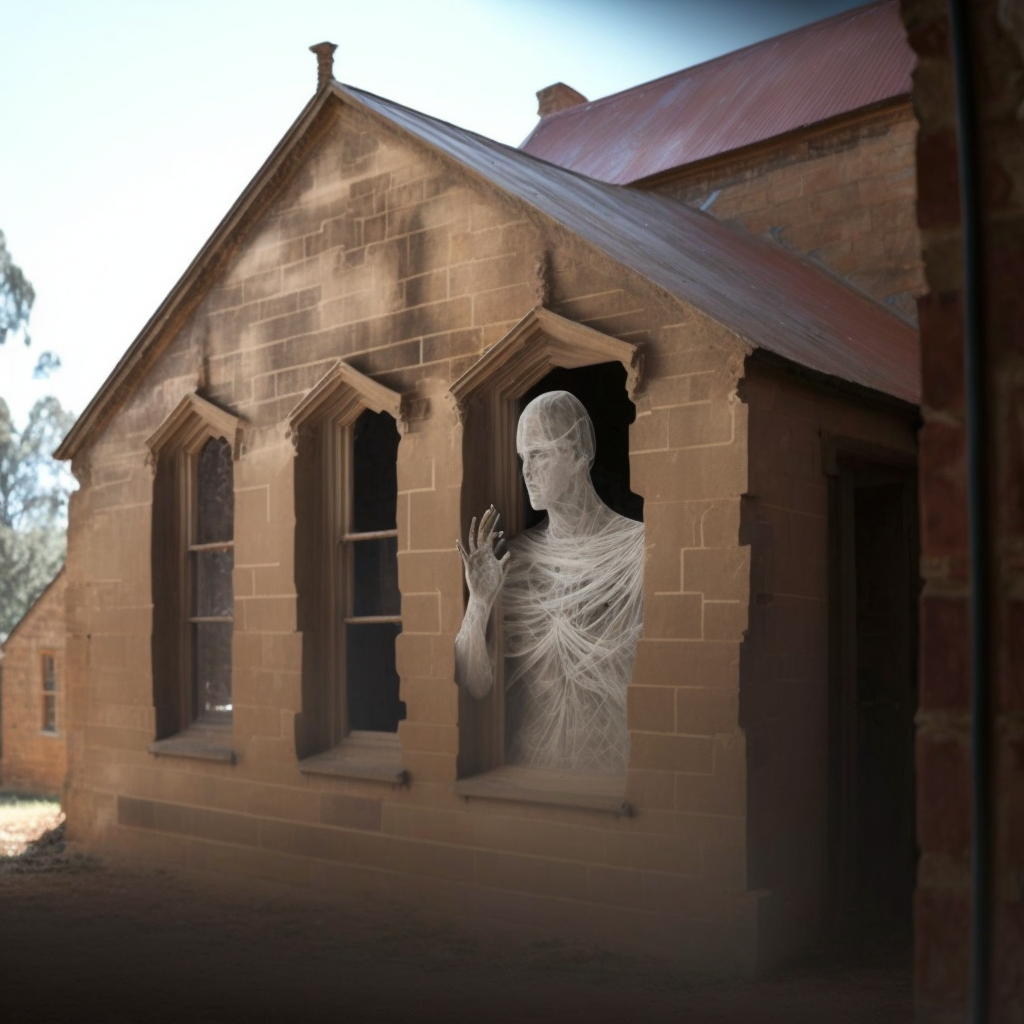
Bertie showed Zara around the church, a small building made of sandstone, but no ghost appeared in the bright heat of the afternoon. He took her on a little tour of Camden, once a tiny outpost but now a suburb of the city, pointing out all the original buildings, in particular the ones that Isaac had built. The church was walking distance of Bertie’s house and Zara decided to slip out and stroll over there after everyone had gone to bed.
Bertie had kindly allowed Pretty Girl to stay in the guest bedroom with her, safe from the cats, and Zara intended that the parrot stay in the room, but Pretty Girl was having none of it and insisted on joining her.
“Alright then, but no talking! I don’t want you scaring any ghost away so just keep a low profile!”
The moon was nearly full and it was a pleasant walk to the church. Pretty Girl fluttered from tree to tree along the sidewalk quietly. Enchanting aromas of exotic scented flowers wafted into her nostrils and Zara felt warmly relaxed and optimistic.
Zara was disappointed to find that the church was locked for the night, and realized with a sigh that she should have expected this to be the case. She wandered around the outside, trying to peer in the windows but there was nothing to be seen as the glass reflected the street lights. These things are not done in a hurry, she reminded herself, be patient.
Sitting under a tree on the grassy lawn attempting to open her mind to receiving ghostly communications (she wasn’t quite sure how to do that on purpose, any ghosts she’d seen previously had always been accidental and unexpected) Pretty Girl landed on her shoulder rather clumsily, pressing something hard and chill against her cheek.
“I told you to keep a low profile!” Zara hissed, as the parrot dropped the key into her lap. “Oh! is this the key to the church door?”
It was hard to see in the dim light but Zara was sure the parrot nodded, and was that another avian eye roll?
Zara walked slowly over the grass to the church door, tingling with anticipation. Pretty Girl hopped along the ground behind her. She turned the key in the lock and slowly pushed open the heavy door and walked inside and up the central aisle, looking around. And then she saw him.
Zara gasped. For a breif moment as the spectral wisps cleared, he looked almost solid. And she could see his tattoos.
“Oh my god,” she whispered, “It is really you. I recognize those tattoos from the description in the criminal registers. Some of them anyway, it seems you have a few more tats since you were transported.”
“Aye, I did that, wench. I were allays fond o’ me tats, does tha like ’em?”
He actually spoke to me! This was beyond Zara’s wildest hopes. Quick, ask him some questions!
“If you don’t mind me asking, Isaac, why did you lie about who your father was on your marriage register? I almost thought it wasn’t you, you know, that I had the wrong Isaac Stokes.”
A deafening rumbling laugh filled the building with echoes and the apparition dispersed in a labyrinthine swirl of tattood wisps.
“A story for another day,” whispered Zara, “Time to go back to Berties. Come on Pretty Girl. And put that key back where you found it.”
 January 17, 2023 at 5:05 pm #6408
In reply to: Orbs of Madjourneys
Glimmer gave Zara and Yasmin a cheery
 , smirking to herself at their alarm at leaving her to her own devices. She had no intention of inviting guests yet, but felt no need to reassure them. Xavier would play along with her, she felt sure.
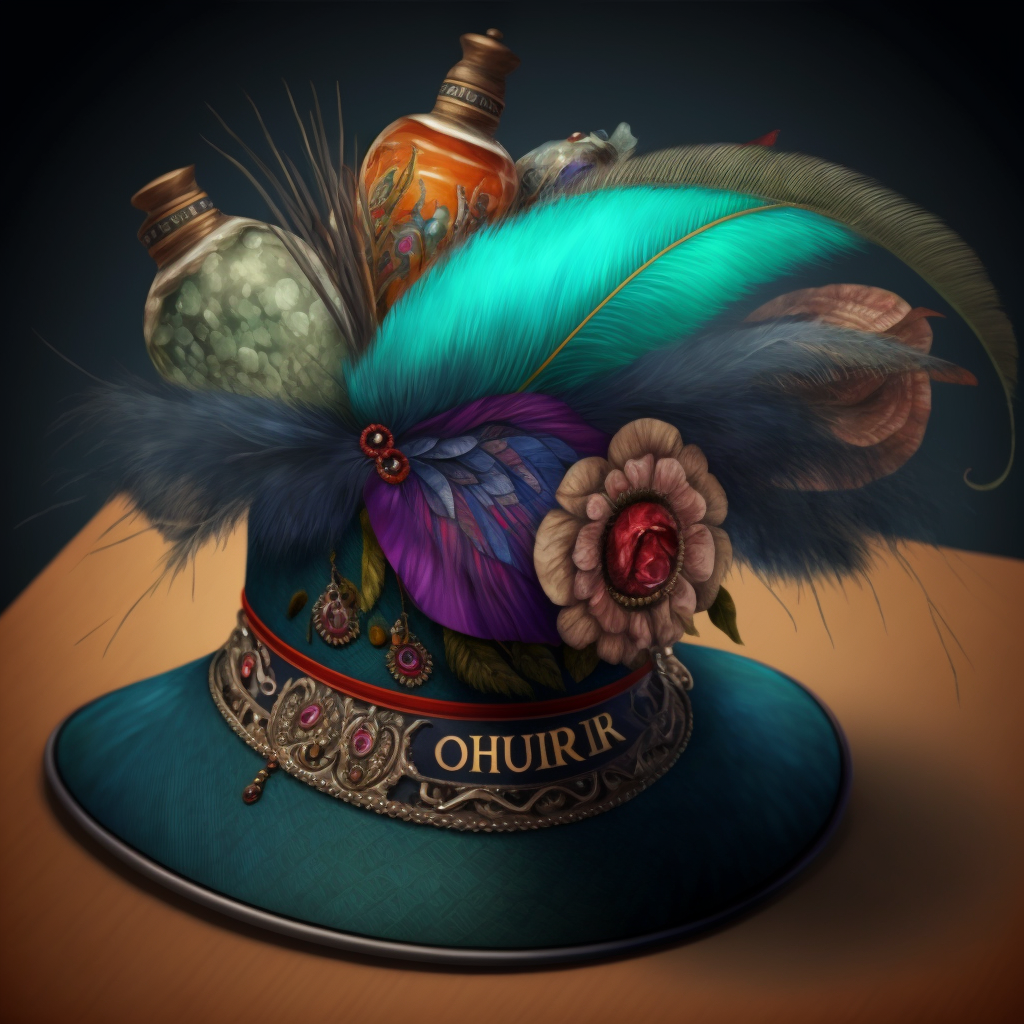
Glimmer settled herself comfortably to peruse the new AIorium Emporium catalogue with the intention of ordering some new hats and accessories for the adventure. She had always had a weakness for elaborate hats, but the truth was they were often rather heavy and cumbersome. That is until she found the AIorium hats which were made of a semi anti gravity material. Not entirely anti gravity, obviously, or they would have floated right off her head, but just enough to make them feel weightless. Once she’d discovered these wonderful hats and their unique properties, she had the idea to carry all her accessories, tools and devices upon her hat. This would save her the bother of carrying around bags of stuff. She was no light weight herself, and it was quite enough to carry herself around, let alone bags of objects.
Glimmer had heard a rumour (well not a rumour exactly, she had a direct line to ~ well not to spill the beans too soon, but she had some lines of information that the others didn’t know about yet) that the adventure was going to start at The Flying Fish Inn. This was welcome news to Glimmer, who had met Idle many years before when they were both teenagers. Yes, it’s hard to imagine these two as teenagers, but although they’d only met breifly on holiday, they’d hit it off immediately. Despite not keeping in contact over the years, Glimmer remembered Idle fondly and felt sure that Idle felt similarly.
Glimmer perused the catalogue for a suitable gift to take for her old friend. The delightful little bottles of spirited spirit essences caught her eye, and recalling Idle’s enthusiasm for an exotic tipple, she ordered several bottles. Perhaps Glimmer should have read carefully the description of the effects of the contents of each bottle but she did not. She immediately added the bottles to the new hat she’d ordered for the trip.
Feeling pleased with her selection, she settled down for a snooze until her new hat arrived.
 January 13, 2023 at 7:40 pm #6379
In reply to: Prompts of Madjourneys
Asking to give each of the 4 characters some particular traits that makes them uniquely distinctive and recognizable
The four friends, Zara, Xavier, Yasmin, and Youssef, each have their own unique traits that make them stand out and recognizable.
Zara is the leader of the group, she is confident, and always ready for an adventure. She is a natural leader and has a strong sense of justice. She is also a tech-savvy person, always carrying a variety of gadgets with her, and is always the first to try out new technology.
Xavier is the joker of the group, always cracking jokes and making puns. He is a free-spirited person who is always up for an adventure, he has a great sense of humor and is not afraid to be himself. He is also an artist and often carries a sketchbook and pencils with him, he likes to draw whatever he sees in his journeys.
Yasmin is the brains of the group, she is intelligent and logical. She is always able to think on her feet and come up with a plan when things get tough. She is also a bit of a perfectionist and likes to have everything organized. She is a history buff and always carries a notebook with her to document her findings.
Youssef is the muscle of the group, He is physically strong, and always ready to help out in a fight. He is also a bit of a foodie and loves trying new dishes. He is always the first one to volunteer to carry the heavy bags and equipment. He is also a bit of a daredevil and loves trying out new sports and activities.
Give each of them a color, and an animal, and a secret name in a funny language
The four friends, Zara, Xavier, Yasmin, and Youssef, each have their own unique traits that make them stand out and recognizable.
Zara is the leader of the group, her color is red, her animal is a lion, and her secret name in a funny language is “Zaraloon”
Xavier is the joker of the group, his color is orange, his animal is a monkey, and his secret name in a funny language is “Xavimunk”
Yasmin is the brains of the group, her color is blue, her animal is an owl, and her secret name in a funny language is “Yasminowl”
Youssef is the muscle of the group, his color is green, his animal is a bear, and his secret name in a funny language is “Youssefbear”
Now, we need physical descriptions for each of them. Also, their ages, height, clothes, facial features, ethnicity (for instance Youssef may be half Yemeni and half Norwegian), etc. with a good mix of generic and eccentric. We also need surnames congruent with their described ethnicity, not too bland, but not too daft either. For instance Youssef Olafsson, Zara Patara-Smythe, etc. Also explain how they become friends.
Zara Patara-Smythe is a
25-year-oldwoman of mixed heritage, her mother is Indian and her father is British. She has long, dark hair that she keeps in a sleek ponytail, dark brown eyes and a sharp jawline. She stands at 5’6″ and has a toned and athletic build. She usually wears practical clothing that allows her to move around easily, such as cargo pants and a tank top.Xavier Olafsson is a
27-year-oldman of Norwegian and Danish descent. He has blonde hair that he keeps in a messy style, blue eyes, and a charming smile. He stands at 6’1″ and has a lean build. He is always seen wearing a colorful and bold clothing, such as a Hawaiian shirt and shorts.Yasmin Ahmed is a
23-year-oldwoman of Egyptian descent. She has long, black hair that she keeps in a tight braid, dark brown eyes and a round face. She stands at 5’4″ and has a petite build. She usually wears conservative clothing, such as long skirts and blouses.Youssef Ali is a
26-year-oldman of half Yemeni, half Norwegian descent. He has short, curly black hair, dark brown eyes and a square jawline. He stands at 6’2″ and has a muscular build. He usually wears comfortable clothing such as a t-shirt and jeans, and always has a backpack on his shoulder.The four of them became friends
in college, they were all studying different majors, but they all shared a love for adventure and exploration. They found themselves in the same class project, and from there they formed a strong bond. After college, they decided to keep exploring the world together, and went on many trips and adventures, always seeking for something new and exciting.
1/ Change the ages of Zara, Xavier, Yasmin and Youssef to more random patterns – rewrite if needed how they met each other to reflect eventual age gaps. Give them some flaws, mental or physical challenges.
2/ increase again the age gaps while keeping the youngest one a young adult, and remove “minor” from the flaws descriptionsZara is a 22-year-old woman who is the youngest of the group. She is a free-spirited, adventurous person, but also a bit reckless and impulsive. She has a scar on her cheek that she got from a Skateboarding accident when she was a teenager.
Xavier is a 45-year-old man who is the oldest of the group. He is a responsible and level-headed person, but also a bit of a perfectionist and can be hard on himself and others. He has dyslexia which he has been able to work around and it doesn’t impede his daily life.
Yasmin is a 38-year-old woman who is the second oldest of the group. She is a kind and compassionate person, but also a bit of a pushover and can have trouble standing up for herself. She has social anxiety that affect her in certain situations and she have been working on coping mechanisms.
Youssef is a 33-year-old man who is the second youngest of the group. He is a charismatic and outgoing person, but also a bit of a flirt and can be a bit insensitive to others feelings. He has ADHD which he has been able to manage with medication, but it still affects him from time to time.
The group met each other through different means, Xavier and Yasmin met at work, Zara and Youssef met at a college class, and eventually, they all became friends through common interests and activities. They decided to go on this adventure together because they were all looking for a change in their lives and wanted to explore the unknown.
February 2, 2022 at 1:15 pm #6268In reply to: The Elusive Samuel Housley and Other Family Stories
From Tanganyika with Love
continued part 9
With thanks to Mike Rushby.
Lyamungu 3rd January 1945
Dearest Family.
We had a novel Christmas this year. We decided to avoid the expense of
entertaining and being entertained at Lyamungu, and went off to spend Christmas
camping in a forest on the Western slopes of Kilimanjaro. George decided to combine
business with pleasure and in this way we were able to use Government transport.
We set out the day before Christmas day and drove along the road which skirts
the slopes of Kilimanjaro and first visited a beautiful farm where Philip Teare, the ex
Game Warden, and his wife Mary are staying. We had afternoon tea with them and then
drove on in to the natural forest above the estate and pitched our tent beside a small
clear mountain stream. We decorated the tent with paper streamers and a few small
balloons and John found a small tree of the traditional shape which we decorated where
it stood with tinsel and small ornaments.We put our beer, cool drinks for the children and bottles of fresh milk from Simba
Estate, in the stream and on Christmas morning they were as cold as if they had been in
the refrigerator all night. There were not many presents for the children, there never are,
but they do not seem to mind and are well satisfied with a couple of balloons apiece,
sweets, tin whistles and a book each.George entertain the children before breakfast. He can make a magical thing out
of the most ordinary balloon. The children watched entranced as he drew on his pipe
and then blew the smoke into the balloon. He then pinched the neck of the balloon
between thumb and forefinger and released the smoke in little puffs. Occasionally the
balloon ejected a perfect smoke ring and the forest rang with shouts of “Do it again
Daddy.” Another trick was to blow up the balloon to maximum size and then twist the
neck tightly before releasing. Before subsiding the balloon darted about in a crazy
fashion causing great hilarity. Such fun, at the cost of a few pence.After breakfast George went off to fish for trout. John and Jim decided that they
also wished to fish so we made rods out of sticks and string and bent pins and they
fished happily, but of course quite unsuccessfully, for hours. Both of course fell into the
stream and got soaked, but I was prepared for this, and the little stream was so shallow
that they could not come to any harm. Henry played happily in the sand and I had a
most peaceful morning.Hamisi roasted a chicken in a pot over the camp fire and the jelly set beautifully in the
stream. So we had grilled trout and chicken for our Christmas dinner. I had of course
taken an iced cake for the occasion and, all in all, it was a very successful Christmas day.
On Boxing day we drove down to the plains where George was to investigate a
report of game poaching near the Ngassari Furrow. This is a very long ditch which has
been dug by the Government for watering the Masai stock in the area. It is also used by
game and we saw herds of zebra and wildebeest, and some Grant’s Gazelle and
giraffe, all comparatively tame. At one point a small herd of zebra raced beside the lorry
apparently enjoying the fun of a gallop. They were all sleek and fat and looked wild and
beautiful in action.We camped a considerable distance from the water but this precaution did not
save us from the mosquitoes which launched a vicious attack on us after sunset, so that
we took to our beds unusually early. They were on the job again when we got up at
sunrise so I was very glad when we were once more on our way home.“I like Christmas safari. Much nicer that silly old party,” said John. I agree but I think
it is time that our children learned to play happily with others. There are no other young
children at Lyamungu though there are two older boys and a girl who go to boarding
school in Nairobi.On New Years Day two Army Officers from the military camp at Moshi, came for
tea and to talk game hunting with George. I think they rather enjoy visiting a home and
seeing children and pets around.Eleanor.
Lyamungu 14 May 1945
Dearest Family.
So the war in Europe is over at last. It is such marvellous news that I can hardly
believe it. To think that as soon as George can get leave we will go to England and
bring Ann and George home with us to Tanganyika. When we know when this leave can
be arranged we will want Kate to join us here as of course she must go with us to
England to meet George’s family. She has become so much a part of your lives that I
know it will be a wrench for you to give her up but I know that you will all be happy to
think that soon our family will be reunited.The V.E. celebrations passed off quietly here. We all went to Moshi to see the
Victory Parade of the King’s African Rifles and in the evening we went to a celebration
dinner at the Game Warden’s house. Besides ourselves the Moores had invited the
Commanding Officer from Moshi and a junior officer. We had a very good dinner and
many toasts including one to Mrs Moore’s brother, Oliver Milton who is fighting in Burma
and has recently been awarded the Military Cross.There was also a celebration party for the children in the grounds of the Moshi
Club. Such a spread! I think John and Jim sampled everything. We mothers were
having our tea separately and a friend laughingly told me to turn around and have a look.
I did, and saw the long tea tables now deserted by all the children but my two sons who
were still eating steadily, and finding the party more exciting than the game of Musical
Bumps into which all the other children had entered with enthusiasm.There was also an extremely good puppet show put on by the Italian prisoners
of war from the camp at Moshi. They had made all the puppets which included well
loved characters like Snow White and the Seven Dwarfs and the Babes in the Wood as
well as more sophisticated ones like an irritable pianist and a would be prima donna. The
most popular puppets with the children were a native askari and his family – a very
happy little scene. I have never before seen a puppet show and was as entranced as
the children. It is amazing what clever manipulation and lighting can do. I believe that the
Italians mean to take their puppets to Nairobi and am glad to think that there, they will
have larger audiences to appreciate their art.George has just come in, and I paused in my writing to ask him for the hundredth
time when he thinks we will get leave. He says I must be patient because it may be a
year before our turn comes. Shipping will be disorganised for months to come and we
cannot expect priority simply because we have been separated so long from our
children. The same situation applies to scores of other Government Officials.
I have decided to write the story of my childhood in South Africa and about our
life together in Tanganyika up to the time Ann and George left the country. I know you
will have told Kate these stories, but Ann and George were so very little when they left
home that I fear that they cannot remember much.My Mother-in-law will have told them about their father but she can tell them little
about me. I shall send them one chapter of my story each month in the hope that they
may be interested and not feel that I am a stranger when at last we meet again.Eleanor.
Lyamungu 19th September 1945
Dearest Family.
In a months time we will be saying good-bye to Lyamungu. George is to be
transferred to Mbeya and I am delighted, not only as I look upon Mbeya as home, but
because there is now a primary school there which John can attend. I feel he will make
much better progress in his lessons when he realises that all children of his age attend
school. At present he is putting up a strong resistance to learning to read and spell, but
he writes very neatly, does his sums accurately and shows a real talent for drawing. If
only he had the will to learn I feel he would do very well.Jim now just four, is too young for lessons but too intelligent to be interested in
the ayah’s attempts at entertainment. Yes I’ve had to engage a native girl to look after
Henry from 9 am to 12.30 when I supervise John’s Correspondence Course. She is
clean and amiable, but like most African women she has no initiative at all when it comes
to entertaining children. Most African men and youths are good at this.I don’t regret our stay at Lyamungu. It is a beautiful spot and the change to the
cooler climate after the heat of Morogoro has been good for all the children. John is still
tall for his age but not so thin as he was and much less pale. He is a handsome little lad
with his large brown eyes in striking contrast to his fair hair. He is wary of strangers but
very observant and quite uncanny in the way he sums up people. He seldom gets up
to mischief but I have a feeling he eggs Jim on. Not that Jim needs egging.Jim has an absolute flair for mischief but it is all done in such an artless manner that
it is not easy to punish him. He is a very sturdy child with a cap of almost black silky hair,
eyes brown, like mine, and a large mouth which is quick to smile and show most beautiful
white and even teeth. He is most popular with all the native servants and the Game
Scouts. The servants call Jim, ‘Bwana Tembo’ (Mr Elephant) because of his sturdy
build.Henry, now nearly two years old, is quite different from the other two in
appearance. He is fair complexioned and fair haired like Ann and Kate, with large, black
lashed, light grey eyes. He is a good child, not so merry as Jim was at his age, nor as
shy as John was. He seldom cries, does not care to be cuddled and is independent and
strong willed. The servants call Henry, ‘Bwana Ndizi’ (Mr Banana) because he has an
inexhaustible appetite for this fruit. Fortunately they are very inexpensive here. We buy
an entire bunch which hangs from a beam on the back verandah, and pluck off the
bananas as they ripen. This way there is no waste and the fruit never gets bruised as it
does in greengrocers shops in South Africa. Our three boys make a delightful and
interesting trio and I do wish you could see them for yourselves.We are delighted with the really beautiful photograph of Kate. She is an
extraordinarily pretty child and looks so happy and healthy and a great credit to you.
Now that we will be living in Mbeya with a school on the doorstep I hope that we will
soon be able to arrange for her return home.Eleanor.
c/o Game Dept. Mbeya. 30th October 1945
Dearest Family.
How nice to be able to write c/o Game Dept. Mbeya at the head of my letters.
We arrived here safely after a rather tiresome journey and are installed in a tiny house on
the edge of the township.We left Lyamungu early on the morning of the 22nd. Most of our goods had
been packed on the big Ford lorry the previous evening, but there were the usual
delays and farewells. Of our servants, only the cook, Hamisi, accompanied us to
Mbeya. Japhet, Tovelo and the ayah had to be paid off and largesse handed out.
Tovelo’s granny had come, bringing a gift of bananas, and she also brought her little
granddaughter to present a bunch of flowers. The child’s little scolded behind is now
completely healed. Gifts had to be found for them too.At last we were all aboard and what a squash it was! Our few pieces of furniture
and packing cases and trunks, the cook, his wife, the driver and the turney boy, who
were to take the truck back to Lyamungu, and all their bits and pieces, bunches of
bananas and Fanny the dog were all crammed into the body of the lorry. George, the
children and I were jammed together in the cab. Before we left George looked
dubiously at the tyres which were very worn and said gloomily that he thought it most
unlikely that we would make our destination, Dodoma.Too true! Shortly after midday, near Kwakachinja, we blew a back tyre and there
was a tedious delay in the heat whilst the wheel was changed. We were now without a
spare tyre and George said that he would not risk taking the Ford further than Babati,
which is less than half way to Dodoma. He drove very slowly and cautiously to Babati
where he arranged with Sher Mohammed, an Indian trader, for a lorry to take us to
Dodoma the next morning.It had been our intention to spend the night at the furnished Government
Resthouse at Babati but when we got there we found that it was already occupied by
several District Officers who had assembled for a conference. So, feeling rather
disgruntled, we all piled back into the lorry and drove on to a place called Bereku where
we spent an uncomfortable night in a tumbledown hut.Before dawn next morning Sher Mohammed’s lorry drove up, and there was a
scramble to dress by the light of a storm lamp. The lorry was a very dilapidated one and
there was already a native woman passenger in the cab. I felt so tired after an almost
sleepless night that I decided to sit between the driver and this woman with the sleeping
Henry on my knee. It was as well I did, because I soon found myself dosing off and
drooping over towards the woman. Had she not been there I might easily have fallen
out as the battered cab had no door. However I was alert enough when daylight came
and changed places with the woman to our mutual relief. She was now able to converse
with the African driver and I was able to enjoy the scenery and the fresh air!
George, John and Jim were less comfortable. They sat in the lorry behind the
cab hemmed in by packing cases. As the lorry was an open one the sun beat down
unmercifully upon them until George, ever resourceful, moved a table to the front of the
truck. The two boys crouched under this and so got shelter from the sun but they still had
to endure the dust. Fanny complicated things by getting car sick and with one thing and
another we were all jolly glad to get to Dodoma.We spent the night at the Dodoma Hotel and after hot baths, a good meal and a
good nights rest we cheerfully boarded a bus of the Tanganyika Bus Service next
morning to continue our journey to Mbeya. The rest of the journey was uneventful. We slept two nights on the road, the first at Iringa Hotel and the second at Chimala. We
reached Mbeya on the 27th.I was rather taken aback when I first saw the little house which has been allocated
to us. I had become accustomed to the spacious houses we had in Morogoro and
Lyamungu. However though the house is tiny it is secluded and has a long garden
sloping down to the road in front and another long strip sloping up behind. The front
garden is shaded by several large cypress and eucalyptus trees but the garden behind
the house has no shade and consists mainly of humpy beds planted with hundreds of
carnations sadly in need of debudding. I believe that the previous Game Ranger’s wife
cultivated the carnations and, by selling them, raised money for War Funds.
Like our own first home, this little house is built of sun dried brick. Its original
owners were Germans. It is now rented to the Government by the Custodian of Enemy
Property, and George has his office in another ex German house.This afternoon we drove to the school to arrange about enrolling John there. The
school is about four miles out of town. It was built by the German settlers in the late
1930’s and they were justifiably proud of it. It consists of a great assembly hall and
classrooms in one block and there are several attractive single storied dormitories. This
school was taken over by the Government when the Germans were interned on the
outbreak of war and many improvements have been made to the original buildings. The
school certainly looks very attractive now with its grassed playing fields and its lawns and
bright flower beds.The Union Jack flies from a tall flagpole in front of the Hall and all traces of the
schools German origin have been firmly erased. We met the Headmaster, Mr
Wallington, and his wife and some members of the staff. The school is co-educational
and caters for children from the age of seven to standard six. The leaving age is elastic
owing to the fact that many Tanganyika children started school very late because of lack
of educational facilities in this country.The married members of the staff have their own cottages in the grounds. The
Matrons have quarters attached to the dormitories for which they are responsible. I felt
most enthusiastic about the school until I discovered that the Headmaster is adamant
upon one subject. He utterly refuses to take any day pupils at the school. So now our
poor reserved Johnny will have to adjust himself to boarding school life.
We have arranged that he will start school on November 5th and I shall be very
busy trying to assemble his school uniform at short notice. The clothing list is sensible.
Boys wear khaki shirts and shorts on weekdays with knitted scarlet jerseys when the
weather is cold. On Sundays they wear grey flannel shorts and blazers with the silver
and scarlet school tie.Mbeya looks dusty, brown and dry after the lush evergreen vegetation of
Lyamungu, but I prefer this drier climate and there are still mountains to please the eye.
In fact the lower slopes of Lolesa Mountain rise at the upper end of our garden.Eleanor.
c/o Game Dept. Mbeya. 21st November 1945
Dearest Family.
We’re quite settled in now and I have got the little house fixed up to my
satisfaction. I have engaged a rather uncouth looking houseboy but he is strong and
capable and now that I am not tied down in the mornings by John’s lessons I am able to
go out occasionally in the mornings and take Jim and Henry to play with other children.
They do not show any great enthusiasm but are not shy by nature as John is.
I have had a good deal of heartache over putting John to boarding school. It
would have been different had he been used to the company of children outside his
own family, or if he had even known one child there. However he seems to be adjusting
himself to the life, though slowly. At least he looks well and tidy and I am quite sure that
he is well looked after.I must confess that when the time came for John to go to school I simply did not
have the courage to take him and he went alone with George, looking so smart in his
new uniform – but his little face so bleak. The next day, Sunday, was visiting day but the
Headmaster suggested that we should give John time to settle down and not visit him
until Wednesday.When we drove up to the school I spied John on the far side of the field walking
all alone. Instead of running up with glad greetings, as I had expected, he came almost
reluctently and had little to say. I asked him to show me his dormitory and classroom and
he did so politely as though I were a stranger. At last he volunteered some information.
“Mummy,” he said in an awed voice, Do you know on the night I came here they burnt a
man! They had a big fire and they burnt him.” After a blank moment the penny dropped.
Of course John had started school and November the fifth but it had never entered my
head to tell him about that infamous character, Guy Fawkes!I asked John’s Matron how he had settled down. “Well”, she said thoughtfully,
“John is very good and has not cried as many of the juniors do when they first come
here, but he seems to keep to himself all the time.” I went home very discouraged but
on the Sunday John came running up with another lad of about his own age.” This is my
friend Marks,” he announced proudly. I could have hugged Marks.Mbeya is very different from the small settlement we knew in the early 1930’s.
Gone are all the colourful characters from the Lupa diggings for the alluvial claims are all
worked out now, gone also are our old friends the Menzies from the Pub and also most
of the Government Officials we used to know. Mbeya has lost its character of a frontier
township and has become almost suburban.The social life revolves around two places, the Club and the school. The Club
which started out as a little two roomed building, has been expanded and the golf
course improved. There are also tennis courts and a good library considering the size of
the community. There are frequent parties and dances, though most of the club revenue
comes from Bar profits. The parties are relatively sober affairs compared with the parties
of the 1930’s.The school provides entertainment of another kind. Both Mr and Mrs Wallington
are good amateur actors and I am told that they run an Amateur Dramatic Society. Every
Wednesday afternoon there is a hockey match at the school. Mbeya town versus a
mixed team of staff and scholars. The match attracts almost the whole European
population of Mbeya. Some go to play hockey, others to watch, and others to snatch
the opportunity to visit their children. I shall have to try to arrange a lift to school when
George is away on safari.I have now met most of the local women and gladly renewed an old friendship
with Sheilagh Waring whom I knew two years ago at Morogoro. Sheilagh and I have
much in common, the same disregard for the trappings of civilisation, the same sense of
the ludicrous, and children. She has eight to our six and she has also been cut off by the
war from two of her children. Sheilagh looks too young and pretty to be the mother of so
large a family and is, in fact, several years younger than I am. her husband, Donald, is a
large quiet man who, as far as I can judge takes life seriously.Our next door neighbours are the Bank Manager and his wife, a very pleasant
couple though we seldom meet. I have however had correspondence with the Bank
Manager. Early on Saturday afternoon their houseboy brought a note. It informed me
that my son was disturbing his rest by precipitating a heart attack. Was I aware that my
son was about 30 feet up in a tree and balanced on a twig? I ran out and,sure enough,
there was Jim, right at the top of the tallest eucalyptus tree. It would be the one with the
mound of stones at the bottom! You should have heard me fluting in my most
wheedling voice. “Sweets, Jimmy, come down slowly dear, I’ve some nice sweets for
you.”I’ll bet that little story makes you smile. I remember how often you have told me
how, as a child, I used to make your hearts turn over because I had no fear of heights
and how I used to say, “But that is silly, I won’t fall.” I know now only too well, how you
must have felt.Eleanor.
c/o Game Dept. Mbeya. 14th January 1946
Dearest Family.
I hope that by now you have my telegram to say that Kate got home safely
yesterday. It was wonderful to have her back and what a beautiful child she is! Kate
seems to have enjoyed the train journey with Miss Craig, in spite of the tears she tells
me she shed when she said good-bye to you. She also seems to have felt quite at
home with the Hopleys at Salisbury. She flew from Salisbury in a small Dove aircraft
and they had a smooth passage though Kate was a little airsick.I was so excited about her home coming! This house is so tiny that I had to turn
out the little store room to make a bedroom for her. With a fresh coat of whitewash and
pretty sprigged curtains and matching bedspread, borrowed from Sheilagh Waring, the
tiny room looks most attractive. I had also iced a cake, made ice-cream and jelly and
bought crackers for the table so that Kate’s home coming tea could be a proper little
celebration.I was pleased with my preparations and then, a few hours before the plane was
due, my crowned front tooth dropped out, peg and all! When my houseboy wants to
describe something very tatty, he calls it “Second-hand Kabisa.” Kabisa meaning
absolutely. That is an apt description of how I looked and felt. I decided to try some
emergency dentistry. I think you know our nearest dentist is at Dar es Salaam five
hundred miles away.First I carefully dried the tooth and with a match stick covered the peg and base
with Durofix. I then took the infants rubber bulb enema, sucked up some heat from a
candle flame and pumped it into the cavity before filling that with Durofix. Then hopefully
I stuck the tooth in its former position and held it in place for several minutes. No good. I
sent the houseboy to a shop for Scotine and tried the whole process again. No good
either.When George came home for lunch I appealed to him for advice. He jokingly
suggested that a maize seed jammed into the space would probably work, but when
he saw that I really was upset he produced some chewing gum and suggested that I
should try that . I did and that worked long enough for my first smile anyway.
George and the three boys went to meet Kate but I remained at home to
welcome her there. I was afraid that after all this time away Kate might be reluctant to
rejoin the family but she threw her arms around me and said “Oh Mummy,” We both
shed a few tears and then we both felt fine.How gay Kate is, and what an infectious laugh she has! The boys follow her
around in admiration. John in fact asked me, “Is Kate a Princess?” When I said
“Goodness no, Johnny, she’s your sister,” he explained himself by saying, “Well, she
has such golden hair.” Kate was less complementary. When I tucked her in bed last night
she said, “Mummy, I didn’t expect my little brothers to be so yellow!” All three boys
have been taking a course of Atebrin, an anti-malarial drug which tinges skin and eyeballs
yellow.So now our tiny house is bursting at its seams and how good it feels to have one
more child under our roof. We are booked to sail for England in May and when we return
we will have Ann and George home too. Then I shall feel really content.Eleanor.
c/o Game Dept. Mbeya. 2nd March 1946
Dearest Family.
My life just now is uneventful but very busy. I am sewing hard and knitting fast to
try to get together some warm clothes for our leave in England. This is not a simple
matter because woollen materials are in short supply and very expensive, and now that
we have boarding school fees to pay for both Kate and John we have to budget very
carefully indeed.Kate seems happy at school. She makes friends easily and seems to enjoy
communal life. John also seems reconciled to school now that Kate is there. He no
longer feels that he is the only exile in the family. He seems to rub along with the other
boys of his age and has a couple of close friends. Although Mbeya School is coeducational
the smaller boys and girls keep strictly apart. It is considered extremely
cissy to play with girls.The local children are allowed to go home on Sundays after church and may bring
friends home with them for the day. Both John and Kate do this and Sunday is a very
busy day for me. The children come home in their Sunday best but bring play clothes to
change into. There is always a scramble to get them to bath and change again in time to
deliver them to the school by 6 o’clock.When George is home we go out to the school for the morning service. This is
taken by the Headmaster Mr Wallington, and is very enjoyable. There is an excellent
school choir to lead the singing. The service is the Church of England one, but is
attended by children of all denominations, except the Roman Catholics. I don’t think that
more than half the children are British. A large proportion are Greeks, some as old as
sixteen, and about the same number are Afrikaners. There are Poles and non-Nazi
Germans, Swiss and a few American children.All instruction is through the medium of English and it is amazing how soon all the
foreign children learn to chatter in English. George has been told that we will return to
Mbeya after our leave and for that I am very thankful as it means that we will still be living
near at hand when Jim and Henry start school. Because many of these children have to
travel many hundreds of miles to come to school, – Mbeya is a two day journey from the
railhead, – the school year is divided into two instead of the usual three terms. This
means that many of these children do not see their parents for months at a time. I think
this is a very sad state of affairs especially for the seven and eight year olds but the
Matrons assure me , that many children who live on isolated farms and stations are quite
reluctant to go home because they miss the companionship and the games and
entertainment that the school offers.My only complaint about the life here is that I see far too little of George. He is
kept extremely busy on this range and is hardly at home except for a few days at the
months end when he has to be at his office to check up on the pay vouchers and the
issue of ammunition to the Scouts. George’s Range takes in the whole of the Southern
Province and the Southern half of the Western Province and extends to the border with
Northern Rhodesia and right across to Lake Tanganyika. This vast area is patrolled by
only 40 Game Scouts because the Department is at present badly under staffed, due
partly to the still acute shortage of rifles, but even more so to the extraordinary reluctance
which the Government shows to allocate adequate funds for the efficient running of the
Department.The Game Scouts must see that the Game Laws are enforced, protect native
crops from raiding elephant, hippo and other game animals. Report disease amongst game and deal with stock raiding lions. By constantly going on safari and checking on
their work, George makes sure the range is run to his satisfaction. Most of the Game
Scouts are fine fellows but, considering they receive only meagre pay for dangerous
and exacting work, it is not surprising that occasionally a Scout is tempted into accepting
a bribe not to report a serious infringement of the Game Laws and there is, of course,
always the temptation to sell ivory illicitly to unscrupulous Indian and Arab traders.
Apart from supervising the running of the Range, George has two major jobs.
One is to supervise the running of the Game Free Area along the Rhodesia –
Tanganyika border, and the other to hunt down the man-eating lions which for years have
terrorised the Njombe District killing hundreds of Africans. Yes I know ‘hundreds’ sounds
fantastic, but this is perfectly true and one day, when the job is done and the official
report published I shall send it to you to prove it!I hate to think of the Game Free Area and so does George. All the game from
buffalo to tiny duiker has been shot out in a wide belt extending nearly two hundred
miles along the Northern Rhodesia -Tanganyika border. There are three Europeans in
widely spaced camps who supervise this slaughter by African Game Guards. This
horrible measure is considered necessary by the Veterinary Departments of
Tanganyika, Rhodesia and South Africa, to prevent the cattle disease of Rinderpest
from spreading South.When George is home however, we do relax and have fun. On the Saturday
before the school term started we took Kate and the boys up to the top fishing camp in
the Mporoto Mountains for her first attempt at trout fishing. There are three of these
camps built by the Mbeya Trout Association on the rivers which were first stocked with
the trout hatched on our farm at Mchewe. Of the three, the top camp is our favourite. The
scenery there is most glorious and reminds me strongly of the rivers of the Western
Cape which I so loved in my childhood.The river, the Kawira, flows from the Rungwe Mountain through a narrow valley
with hills rising steeply on either side. The water runs swiftly over smooth stones and
sometimes only a foot or two below the level of the banks. It is sparkling and shallow,
but in places the water is deep and dark and the banks high. I had a busy day keeping
an eye on the boys, especially Jim, who twice climbed out on branches which overhung
deep water. “Mummy, I was only looking for trout!”How those kids enjoyed the freedom of the camp after the comparative
restrictions of town. So did Fanny, she raced about on the hills like a mad dog chasing
imaginary rabbits and having the time of her life. To escape the noise and commotion
George had gone far upstream to fish and returned in the late afternoon with three good
sized trout and four smaller ones. Kate proudly showed George the two she had caught
with the assistance or our cook Hamisi. I fear they were caught in a rather unorthodox
manner but this I kept a secret from George who is a stickler for the orthodox in trout
fishing.Eleanor.
Jacksdale England 24th June 1946
Dearest Family.
Here we are all together at last in England. You cannot imagine how wonderful it
feels to have the whole Rushby family reunited. I find myself counting heads. Ann,
George, Kate, John, Jim, and Henry. All present and well. We had a very pleasant trip
on the old British India Ship Mantola. She was crowded with East Africans going home
for the first time since the war, many like us, eagerly looking forward to a reunion with their
children whom they had not seen for years. There was a great air of anticipation and
good humour but a little anxiety too.“I do hope our children will be glad to see us,” said one, and went on to tell me
about a Doctor from Dar es Salaam who, after years of separation from his son had
recently gone to visit him at his school. The Doctor had alighted at the railway station
where he had arranged to meet his son. A tall youth approached him and said, very
politely, “Excuse me sir. Are you my Father?” Others told me of children who had
become so attached to their relatives in England that they gave their parents a very cool
reception. I began to feel apprehensive about Ann and George but fortunately had no
time to mope.Oh, that washing and ironing for six! I shall remember for ever that steamy little
laundry in the heat of the Red Sea and queuing up for the ironing and the feeling of guilt
at the size of my bundle. We met many old friends amongst the passengers, and made
some new ones, so the voyage was a pleasant one, We did however have our
anxious moments.John was the first to disappear and we had an anxious search for him. He was
quite surprised that we had been concerned. “I was just talking to my friend Chinky
Chinaman in his workshop.” Could John have called him that? Then, when I returned to
the cabin from dinner one night I found Henry swigging Owbridge’s Lung Tonic. He had
drunk half the bottle neat and the label said ‘five drops in water’. Luckily it did not harm
him.Jim of course was forever risking his neck. George had forbidden him to climb on
the railings but he was forever doing things which no one had thought of forbidding him
to do, like hanging from the overhead pipes on the deck or standing on the sill of a
window and looking down at the well deck far below. An Officer found him doing this and
gave me the scolding.Another day he climbed up on a derrick used for hoisting cargo. George,
oblivious to this was sitting on the hatch cover with other passengers reading a book. I
was in the wash house aft on the same deck when Kate rushed in and said, “Mummy
come and see Jim.” Before I had time to more than gape, the butcher noticed Jim and
rushed out knife in hand. “Get down from there”, he bellowed. Jim got, and with such
speed that he caught the leg or his shorts on a projecting piece of metal. The cotton
ripped across the seam from leg to leg and Jim stood there for a humiliating moment in a
sort of revealing little kilt enduring the smiles of the passengers who had looked up from
their books at the butcher’s shout.That incident cured Jim of his urge to climb on the ship but he managed to give
us one more fright. He was lost off Dover. People from whom we enquired said, “Yes
we saw your little boy. He was by the railings watching that big aircraft carrier.” Now Jim,
though mischievous , is very obedient. It was not until George and I had conducted an
exhaustive search above and below decks that I really became anxious. Could he have
fallen overboard? Jim was returned to us by an unamused Officer. He had been found
in one of the lifeboats on the deck forbidden to children.Our ship passed Dover after dark and it was an unforgettable sight. Dover Castle
and the cliffs were floodlit for the Victory Celebrations. One of the men passengers sat
down at the piano and played ‘The White Cliffs of Dover’, and people sang and a few
wept. The Mantola docked at Tilbury early next morning in a steady drizzle.
There was a dockers strike on and it took literally hours for all the luggage to be
put ashore. The ships stewards simply locked the public rooms and went off leaving the
passengers shivering on the docks. Eventually damp and bedraggled, we arrived at St
Pancras Station and were given a warm welcome by George’s sister Cath and her
husband Reg Pears, who had come all the way from Nottingham to meet us.
As we had to spend an hour in London before our train left for Nottingham,
George suggested that Cath and I should take the children somewhere for a meal. So
off we set in the cold drizzle, the boys and I without coats and laden with sundry
packages, including a hand woven native basket full of shoes. We must have looked like
a bunch of refugees as we stood in the hall of The Kings Cross Station Hotel because a
supercilious waiter in tails looked us up and down and said, “I’m afraid not Madam”, in
answer to my enquiry whether the hotel could provide lunch for six.
Anyway who cares! We had lunch instead at an ABC tea room — horrible
sausage and a mound or rather sloppy mashed potatoes, but very good ice-cream.
After the train journey in a very grimy third class coach, through an incredibly green and
beautiful countryside, we eventually reached Nottingham and took a bus to Jacksdale,
where George’s mother and sisters live in large detached houses side by side.
Ann and George were at the bus stop waiting for us, and thank God, submitted
to my kiss as though we had been parted for weeks instead of eight years. Even now
that we are together again my heart aches to think of all those missed years. They have
not changed much and I would have picked them out of a crowd, but Ann, once thin and
pale, is now very rosy and blooming. She still has her pretty soft plaits and her eyes are
still a clear calm blue. Young George is very striking looking with sparkling brown eyes, a
ready, slightly lopsided smile, and charming manners.Mother, and George’s elder sister, Lottie Giles, welcomed us at the door with the
cheering news that our tea was ready. Ann showed us the way to mother’s lovely lilac
tiled bathroom for a wash before tea. Before I had even turned the tap, Jim had hung
form the glass towel rail and it lay in three pieces on the floor. There have since been
similar tragedies. I can see that life in civilisation is not without snags.I am most grateful that Ann and George have accepted us so naturally and
affectionately. Ann said candidly, “Mummy, it’s a good thing that you had Aunt Cath with
you when you arrived because, honestly, I wouldn’t have known you.”Eleanor.
Jacksdale England 28th August 1946
Dearest Family.
I am sorry that I have not written for some time but honestly, I don’t know whether
I’m coming or going. Mother handed the top floor of her house to us and the
arrangement was that I should tidy our rooms and do our laundry and Mother would
prepare the meals except for breakfast. It looked easy at first. All the rooms have wall to
wall carpeting and there was a large vacuum cleaner in the box room. I was told a
window cleaner would do the windows.Well the first time I used the Hoover I nearly died of fright. I pressed the switch
and immediately there was a roar and the bag filled with air to bursting point, or so I
thought. I screamed for Ann and she came at the run. I pointed to the bag and shouted
above the din, “What must I do? It’s going to burst!” Ann looked at me in astonishment
and said, “But Mummy that’s the way it works.” I couldn’t have her thinking me a
complete fool so I switched the current off and explained to Ann how it was that I had
never seen this type of equipment in action. How, in Tanganyika , I had never had a
house with electricity and that, anyway, electric equipment would be superfluous
because floors are of cement which the houseboy polishes by hand, one only has a
few rugs or grass mats on the floor. “But what about Granny’s house in South Africa?’”
she asked, so I explained about your Josephine who threatened to leave if you
bought a Hoover because that would mean that you did not think she kept the house
clean. The sad fact remains that, at fourteen, Ann knows far more about housework than I
do, or rather did! I’m learning fast.The older children all go to school at different times in the morning. Ann leaves first
by bus to go to her Grammar School at Sutton-in-Ashfield. Shortly afterwards George
catches a bus for Nottingham where he attends the High School. So they have
breakfast in relays, usually scrambled egg made from a revolting dried egg mixture.
Then there are beds to make and washing and ironing to do, so I have little time for
sightseeing, though on a few afternoons George has looked after the younger children
and I have gone on bus tours in Derbyshire. Life is difficult here with all the restrictions on
foodstuffs. We all have ration books so get our fair share but meat, fats and eggs are
scarce and expensive. The weather is very wet. At first I used to hang out the washing
and then rush to bring it in when a shower came. Now I just let it hang.We have left our imprint upon my Mother-in-law’s house for ever. Henry upset a
bottle of Milk of Magnesia in the middle of the pale fawn bedroom carpet. John, trying to
be helpful and doing some dusting, broke one of the delicate Dresden china candlesticks
which adorn our bedroom mantelpiece.Jim and Henry have wrecked the once
professionally landscaped garden and all the boys together bored a large hole through
Mother’s prized cherry tree. So now Mother has given up and gone off to Bournemouth
for a much needed holiday. Once a week I have the capable help of a cleaning woman,
called for some reason, ‘Mrs Two’, but I have now got all the cooking to do for eight. Mrs
Two is a godsend. She wears, of all things, a print mob cap with a hole in it. Says it
belonged to her Grandmother. Her price is far beyond Rubies to me, not so much
because she does, in a couple of hours, what it takes me all day to do, but because she
sells me boxes of fifty cigarettes. Some non-smoking relative, who works in Players
tobacco factory, passes on his ration to her. Until Mrs Two came to my rescue I had
been starved of cigarettes. Each time I asked for them at the shop the grocer would say,
“Are you registered with us?” Only very rarely would some kindly soul sell me a little
packet of five Woodbines.England is very beautiful but the sooner we go home to Tanganyika, the better.
On this, George and I and the children agree.Eleanor.
Jacksdale England 20th September 1946
Dearest Family.
Our return passages have now been booked on the Winchester Castle and we
sail from Southampton on October the sixth. I look forward to returning to Tanganyika but
hope to visit England again in a few years time when our children are older and when
rationing is a thing of the past.I have grown fond of my Sisters-in-law and admire my Mother-in-law very much.
She has a great sense of humour and has entertained me with stories of her very
eventful life, and told me lots of little stories of the children which did not figure in her
letters. One which amused me was about young George. During one of the air raids
early in the war when the sirens were screaming and bombers roaring overhead Mother
made the two children get into the cloak cupboard under the stairs. Young George
seemed quite unconcerned about the planes and the bombs but soon an anxious voice
asked in the dark, “Gran, what will I do if a spider falls on me?” I am afraid that Mother is
going to miss Ann and George very much.I had a holiday last weekend when Lottie and I went up to London on a spree. It
was a most enjoyable weekend, though very rushed. We placed ourselves in the
hands of Thos. Cook and Sons and saw most of the sights of London and were run off
our feet in the process. As you all know London I shall not describe what I saw but just
to say that, best of all, I enjoyed walking along the Thames embankment in the evening
and the changing of the Guard at Whitehall. On Sunday morning Lottie and I went to
Kew Gardens and in the afternoon walked in Kensington Gardens.We went to only one show, ‘The Skin of our Teeth’ starring Vivienne Leigh.
Neither of us enjoyed the performance at all and regretted having spent so much on
circle seats. The show was far too highbrow for my taste, a sort of satire on the survival
of the human race. Miss Leigh was unrecognisable in a blond wig and her voice strident.
However the night was not a dead loss as far as entertainment was concerned as we
were later caught up in a tragicomedy at our hotel.We had booked communicating rooms at the enormous Imperial Hotel in Russell
Square. These rooms were comfortably furnished but very high up, and we had a rather
terrifying and dreary view from the windows of the enclosed courtyard far below. We
had some snacks and a chat in Lottie’s room and then I moved to mine and went to bed.
I had noted earlier that there was a special lock on the outer door of my room so that
when the door was closed from the inside it automatically locked itself.
I was just dropping off to sleep when I heard a hammering which seemed to
come from my wardrobe. I got up, rather fearfully, and opened the wardrobe door and
noted for the first time that the wardrobe was set in an opening in the wall and that the
back of the wardrobe also served as the back of the wardrobe in the room next door. I
quickly shut it again and went to confer with Lottie.Suddenly a male voice was raised next door in supplication, “Mary Mother of
God, Help me! They’ve locked me in!” and the hammering resumed again, sometimes
on the door, and then again on the back of the wardrobe of the room next door. Lottie
had by this time joined me and together we listened to the prayers and to the
hammering. Then the voice began to threaten, “If you don’t let me out I’ll jump out of the
window.” Great consternation on our side of the wall. I went out into the passage and
called through the door, “You’re not locked in. Come to your door and I’ll tell you how to
open it.” Silence for a moment and then again the prayers followed by a threat. All the
other doors in the corridor remained shut.Luckily just then a young man and a woman came walking down the corridor and I
explained the situation. The young man hurried off for the night porter who went into the
next door room. In a matter of minutes there was peace next door. When the night
porter came out into the corridor again I asked for an explanation. He said quite casually,
“It’s all right Madam. He’s an Irish Gentleman in Show Business. He gets like this on a
Saturday night when he has had a drop too much. He won’t give any more trouble
now.” And he didn’t. Next morning at breakfast Lottie and I tried to spot the gentleman in
the Show Business, but saw no one who looked like the owner of that charming Irish
voice.George had to go to London on business last Monday and took the older
children with him for a few hours of sight seeing. They returned quite unimpressed.
Everything was too old and dirty and there were far too many people about, but they
had enjoyed riding on the escalators at the tube stations, and all agreed that the highlight
of the trip was, “Dad took us to lunch at the Chicken Inn.”Now that it is almost time to leave England I am finding the housework less of a
drudgery, Also, as it is school holiday time, Jim and Henry are able to go on walks with
the older children and so use up some of their surplus energy. Cath and I took the
children (except young George who went rabbit shooting with his uncle Reg, and
Henry, who stayed at home with his dad) to the Wakes at Selston, the neighbouring
village. There were the roundabouts and similar contraptions but the side shows had
more appeal for the children. Ann and Kate found a stall where assorted prizes were
spread out on a sloping table. Anyone who could land a penny squarely on one of
these objects was given a similar one as a prize.I was touched to see that both girls ignored all the targets except a box of fifty
cigarettes which they were determined to win for me. After numerous attempts, Kate
landed her penny successfully and you would have loved to have seen her radiant little
face.Eleanor.
Dar es Salaam 22nd October 1946
Dearest Family.
Back in Tanganyika at last, but not together. We have to stay in Dar es Salaam
until tomorrow when the train leaves for Dodoma. We arrived yesterday morning to find
all the hotels filled with people waiting to board ships for England. Fortunately some
friends came to the rescue and Ann, Kate and John have gone to stay with them. Jim,
Henry and I are sleeping in a screened corner of the lounge of the New Africa Hotel, and
George and young George have beds in the Palm Court of the same hotel.We travelled out from England in the Winchester Castle under troopship
conditions. We joined her at Southampton after a rather slow train journey from
Nottingham. We arrived after dark and from the station we could see a large ship in the
docks with a floodlit red funnel. “Our ship,” yelled the children in delight, but it was not the
Winchester Castle but the Queen Elizabeth, newly reconditioned.We had hoped to board our ship that evening but George made enquiries and
found that we would not be allowed on board until noon next day. Without much hope,
we went off to try to get accommodation for eight at a small hotel recommended by the
taxi driver. Luckily for us there was a very motherly woman at the reception desk. She
looked in amusement at the six children and said to me, “Goodness are all these yours,
ducks? Then she called over her shoulder, “Wilf, come and see this lady with lots of
children. We must try to help.” They settled the problem most satisfactorily by turning
two rooms into a dormitory.In the morning we had time to inspect bomb damage in the dock area of
Southampton. Most of the rubble had been cleared away but there are still numbers of
damaged buildings awaiting demolition. A depressing sight. We saw the Queen Mary
at anchor, still in her drab war time paint, but magnificent nevertheless.
The Winchester Castle was crammed with passengers and many travelled in
acute discomfort. We were luckier than most because the two girls, the three small boys
and I had a stateroom to ourselves and though it was stripped of peacetime comforts,
we had a private bathroom and toilet. The two Georges had bunks in a huge men-only
dormitory somewhere in the bowls of the ship where they had to share communal troop
ship facilities. The food was plentiful but unexciting and one had to queue for afternoon
tea. During the day the decks were crowded and there was squatting room only. The
many children on board got bored.Port Said provided a break and we were all entertained by the ‘Gully Gully’ man
and his conjuring tricks, and though we had no money to spend at Simon Artz, we did at
least have a chance to stretch our legs. Next day scores of passengers took ill with
sever stomach upsets, whether from food poisoning, or as was rumoured, from bad
water taken on at the Egyptian port, I don’t know. Only the two Georges in our family
were affected and their attacks were comparatively mild.As we neared the Kenya port of Mombassa, the passengers for Dar es Salaam
were told that they would have to disembark at Mombassa and continue their journey in
a small coaster, the Al Said. The Winchester Castle is too big for the narrow channel
which leads to Dar es Salaam harbour.From the wharf the Al Said looked beautiful. She was once the private yacht of
the Sultan of Zanzibar and has lovely lines. Our admiration lasted only until we were
shown our cabins. With one voice our children exclaimed, “Gosh they stink!” They did, of
a mixture of rancid oil and sweat and stale urine. The beds were not yet made and the
thin mattresses had ominous stains on them. John, ever fastidious, lifted his mattress and two enormous cockroaches scuttled for cover.We had a good homely lunch served by two smiling African stewards and
afterwards we sat on deck and that was fine too, though behind ones enjoyment there
was the thought of those stuffy and dirty cabins. That first night nearly everyone,
including George and our older children, slept on deck. Women occupied deck chairs
and men and children slept on the bare decks. Horrifying though the idea was, I decided
that, as Jim had a bad cough, he, Henry and I would sleep in our cabin.When I announced my intention of sleeping in the cabin one of the passengers
gave me some insecticide spray which I used lavishly, but without avail. The children
slept but I sat up all night with the light on, determined to keep at least their pillows clear
of the cockroaches which scurried about boldly regardless of the light. All the next day
and night we avoided the cabins. The Al Said stopped for some hours at Zanzibar to
offload her deck cargo of live cattle and packing cases from the hold. George and the
elder children went ashore for a walk but I felt too lazy and there was plenty to watch
from deck.That night I too occupied a deck chair and slept quite comfortably, and next
morning we entered the palm fringed harbour of Dar es Salaam and were home.Eleanor.
Mbeya 1st November 1946
Dearest Family.
Home at last! We are all most happily installed in a real family house about three
miles out of Mbeya and near the school. This house belongs to an elderly German and
has been taken over by the Custodian of Enemy Property and leased to the
Government.The owner, whose name is Shenkel, was not interned but is allowed to occupy a
smaller house on the Estate. I found him in the garden this morning lecturing the children
on what they may do and may not do. I tried to make it quite clear to him that he was not
our landlord, though he clearly thinks otherwise. After he had gone I had to take two
aspirin and lie down to recover my composure! I had been warned that he has this effect
on people.Mr Shenkel is a short and ugly man, his clothes are stained with food and he
wears steel rimmed glasses tied round his head with a piece of dirty elastic because
one earpiece is missing. He speaks with a thick German accent but his English is fluent
and I believe he is a cultured and clever man. But he is maddening. The children were
more amused than impressed by his exhortations and have happily Christened our
home, ‘Old Shenks’.The house has very large grounds as the place is really a derelict farm. It suits us
down to the ground. We had no sooner unpacked than George went off on safari after
those maneating lions in the Njombe District. he accounted for one, and a further two
jointly with a Game Scout, before we left for England. But none was shot during the five
months we were away as George’s relief is quite inexperienced in such work. George
thinks that there are still about a dozen maneaters at large. His theory is that a female
maneater moved into the area in 1938 when maneating first started, and brought up her
cubs to be maneaters, and those cubs in turn did the same. The three maneating lions
that have been shot were all in very good condition and not old and maimed as
maneaters usually are.George anticipates that it will be months before all these lions are accounted for
because they are constantly on the move and cover a very large area. The lions have to
be hunted on foot because they range over broken country covered by bush and fairly
dense thicket.I did a bit of shooting myself yesterday and impressed our African servants and
the children and myself. What a fluke! Our houseboy came to say that there was a snake
in the garden, the biggest he had ever seen. He said it was too big to kill with a stick and
would I shoot it. I had no gun but a heavy .450 Webley revolver and I took this and
hurried out with the children at my heels.The snake turned out to be an unusually large puff adder which had just shed its
skin. It looked beautiful in a repulsive way. So flanked by servants and children I took
aim and shot, not hitting the head as I had planned, but breaking the snake’s back with
the heavy bullet. The two native boys then rushed up with sticks and flattened the head.
“Ma you’re a crack shot,” cried the kids in delighted surprise. I hope to rest on my laurels
for a long, long while.Although there are only a few weeks of school term left the four older children will
start school on Monday. Not only am I pleased with our new home here but also with
the staff I have engaged. Our new houseboy, Reuben, (but renamed Robin by our
children) is not only cheerful and willing but intelligent too, and Jumbe, the wood and
garden boy, is a born clown and a source of great entertainment to the children.I feel sure that we are all going to be very happy here at ‘Old Shenks!.
Eleanor.
-
AuthorSearch Results
