

Search Results for 'herself'
-
AuthorSearch Results
-
January 10, 2023 at 11:00 pm #6365
In reply to: Train your subjective AI – text version
Prune has got me into this AI stuff… It sounds like gibberish to me, but Idle sounded amazed at the stuff it spewed out.
With some info on our family story, Prune got it to try and predict the future…
Sounds like a big plate of bog, but we’ll see how it goes.
Sure, here are a few possible events that could occur between Mater’s 100th birthday and her death in the Flying Fish Inn story:
- Mater decides to throw herself a grand birthday party, inviting all of her friends and family from the small outback town. However, things take a turn for the strange when a group of extraterrestrial beings crash the party and reveal themselves to be long-time fans of Mater’s famous bush tucker cuisine.
- Mater begins to experience vivid dreams and hallucinations, in which she is visited by the ghost of her late husband. As the dreams become more frequent, the family begins to suspect that there may be something more to them than just Mater’s mind playing tricks on her.
- Mater’s granddaughter Prune becomes increasingly obsessed with her dream of traveling to Mars, and begins to notice strange occurrences happening around the inn that seem to be connected to her aspiration.
- A group of eccentric scientists arrive at the inn, conducting research on the local flora and fauna. They eventually discover a species of sentient plants living in the area, and Mater becomes convinced that the plants are communicating with her in her dreams.
- With her health declining, Mater begins to spend more and more time tending to her garden, where she is visited by an old kookaburra who seems to possess an otherworldly intelligence. The bird becomes Mater’s companion and confidant in the final days of her life.
- As the Great Fires ravage the Australian bush, Mater makes the difficult decision to shut down the inn and evacuate the guests. But as they flee, they realize that the fire is not just a natural disaster, but something far more sinister and mystical.
- In her final days, Mater begins to remember strange and vivid details of her life that she never could have known, as if she lived a previous life in another time and place. As she dies, she whispers something to Prune, which opens her eyes to a new reality that may have been hidden from her all along
- It turns out the family had a lot of secrets, and the only way to escape it, was to leave the inn, but it was not an escape for all. Through the series of events, secrets are revealed, and some truths cannot be undone.Note that these events are fictional and whimsical in nature, but as they keeps it grounded to a sense of doldrums in the Australian bush and occasionally guests help to unravel some of the overarching mysteries it could make a fitting storyline for the story.
January 10, 2023 at 10:31 pm #6364In reply to: Train your subjective AI – text version
Please suggest a creative, a little ghostic but mostly uplifting plot outline for the continuation of the story of Twilight in her travels to join the freak circus and become famous for her craft on the west coast
— The Far-West saga — In 1850s, in a probable reality of South America, we get acquainted with Twilight (Twi) and her brothers Jo and Elroy. They have a precious blue bull in their possession, coveted by Ogrean, the kingpin of the town. Hopefully for them, Ogrean is arrested (temporarily) by Ted Marshall, the sheriff for his possible trafficking. Notably, Ogrean is possibly involved in some of the crystal skulls discoveries, during his travel to New Honduras. Twi who was dancing in the saloon of Madame Butterbutt, the town’s hallucinogenic toads-to-lick dispenser (insert some other romantic subplots involving the other dancer etc.) decides to go traveling in a freakus (freak show/circus). She is now close to the West Coast, where she hopes to succeed in her writing and other artistic skills.
As Twilight (Twi) travels with the freak circus, she faces many challenges and obstacles on her journey to the West Coast. Despite the difficulties, she remains determined to make a name for herself as a writer and artist.
As she travels through small towns and larger cities, she begins to realize that the world is much bigger than she ever imagined. She meets a diverse group of people, some of whom are kind and supportive, while others are cruel and dismissive of her dreams.
Despite the negative reactions she receives from some people, Twi persists and begins to gain a reputation as a talented writer and performer. As she gains more experience and confidence, she starts to incorporate her own unique style into her performances, which sets her apart from the other performers in the circus.
As she approaches the West Coast, she begins to feel a sense of excitement and anticipation. She has heard that the West Coast is a place of endless possibilities, where creative minds can thrive. She is determined to make her mark and become famous for her craft.
As she settles in the west, she finds herself surrounded by artists and writers like herself, who inspire her to push herself even further. She begins to gain a following and her writing is widely read. She discovers that her talent is not only limited to writing, but she also has a natural talent for other art forms as well.
Eventually, Twi’s reputation as a talented artist and writer precedes her and she becomes a sought-after performer in the West Coast, and her creative work is being showcased in galleries and theaters. As she continues to achieve success in her career, she begins to realize that the West Coast is not just a place of endless possibilities but also the place where she belongs, and the place where her dreams come true.
Throughout her journey, she also keeps in touch with her brothers, Jo and Elroy, who now run the farm and take care of the blue bull. They tell her that the bull, now named Blue-Dream, became a legend in the village and they get a good price for its breeding.
As the story continues, she finds herself also involved in some adventures and exciting subplots, like discovering a secret underground cave filled with precious crystals and some interesting characters, like the enigmatic sheriff Ted Marshall who always cross her path, and the mysterious Ogrean who seems to have a connection to her past and the bull.
The End.
January 10, 2023 at 10:14 pm #6362In reply to: Train your subjective AI – text version
write a short story based on the following cloud of words:
pride bet shouted lit wibberly case highly ours unless paid spend twice gay talking heads elizabeth in entries drink kill baker

“Gay baker triumphs over adversity”
Once upon a time, there was a gay baker named Elizabeth who took a great deal of pride in her craft. She spent twice the amount of money on high-quality ingredients and put in extra effort to make her baked goods stand out from the rest. However, her small town was not particularly accepting of the LGBT community, and she often faced discrimination from her neighbors.
One day, a group of men from the town entered her bakery and began shouting homophobic slurs at her. Elizabeth, feeling hurt and humiliated, decided that she would not let their hateful words get to her. She refused to back down and instead, decided to put all of her energy into creating a spectacular cake for the annual county fair.
She worked tirelessly on the cake, putting in long hours and experimenting with new flavors and techniques. The day of the fair finally arrived and Elizabeth brought her entry to be judged. To her surprise and delight, her cake was declared the winner and she was awarded a blue ribbon.
As she stood on stage holding her ribbon, Elizabeth couldn’t help but think about the men who had shouted at her in her bakery. She realized that their words no longer had power over her and she felt a sense of vindication. She knew that she had proven to herself and to her community that she was a skilled baker and a worthy member of society, regardless of her sexual orientation.
Feeling elated, Elizabeth closed the bakery for the day and went to the local bar where she met her friends, and they all drinks together, she was happy and felt like nothing can bring her down, as she went back home she felt like a new person, someone who has overcome prejudice and discrimination, she felt like a winner not just in the fair but in life.
The end.
October 11, 2022 at 11:39 am #6333In reply to: Family Stories From The Other Side ~ Book Two
The Grattidge Family
The first Grattidge to appear in our tree was Emma Grattidge (1853-1911) who married Charles Tomlinson (1847-1907) in 1872.
Charles Tomlinson (1873-1929) was their son and he married my great grandmother Nellie Fisher. Their daughter Margaret (later Peggy Edwards) was my grandmother on my fathers side.
Emma Grattidge was born in Wolverhampton, the daughter and youngest child of William Grattidge (1820-1887) born in Foston, Derbyshire, and Mary Stubbs, born in Burton on Trent, daughter of Solomon Stubbs, a land carrier. William and Mary married at St Modwens church, Burton on Trent, in 1839. It’s unclear why they moved to Wolverhampton. On the 1841 census William was employed as an agent, and their first son William was nine months old. Thereafter, William was a licensed victuallar or innkeeper.
William Grattidge was born in Foston, Derbyshire in 1820. His parents were Thomas Grattidge, farmer (1779-1843) and Ann Gerrard (1789-1822) from Ellastone. Thomas and Ann married in 1813 in Ellastone. They had five children before Ann died at the age of 25:
Bessy was born in 1815, Thomas in 1818, William in 1820, and Daniel Augustus and Frederick were twins born in 1822. They were all born in Foston. (records say Foston, Foston and Scropton, or Scropton)
On the 1841 census Thomas had nine people additional to family living at the farm in Foston, presumably agricultural labourers and help.
After Ann died, Thomas had three children with Kezia Gibbs (30 years his junior) before marrying her in 1836, then had a further four with her before dying in 1843. Then Kezia married Thomas’s nephew Frederick Augustus Grattidge (born in 1816 in Stafford) in London in 1847 and had two more!
The siblings of William Grattidge (my 3x great grandfather):
Frederick Grattidge (1822-1872) was a schoolmaster and never married. He died at the age of 49 in Tamworth at his twin brother Daniels address.
Daniel Augustus Grattidge (1822-1903) was a grocer at Gungate in Tamworth.
Thomas Grattidge (1818-1871) married in Derby, and then emigrated to Illinois, USA.
Bessy Grattidge (1815-1840) married John Buxton, farmer, in Ellastone in January 1838. They had three children before Bessy died in December 1840 at the age of 25: Henry in 1838, John in 1839, and Bessy Buxton in 1840. Bessy was baptised in January 1841. Presumably the birth of Bessy caused the death of Bessy the mother.
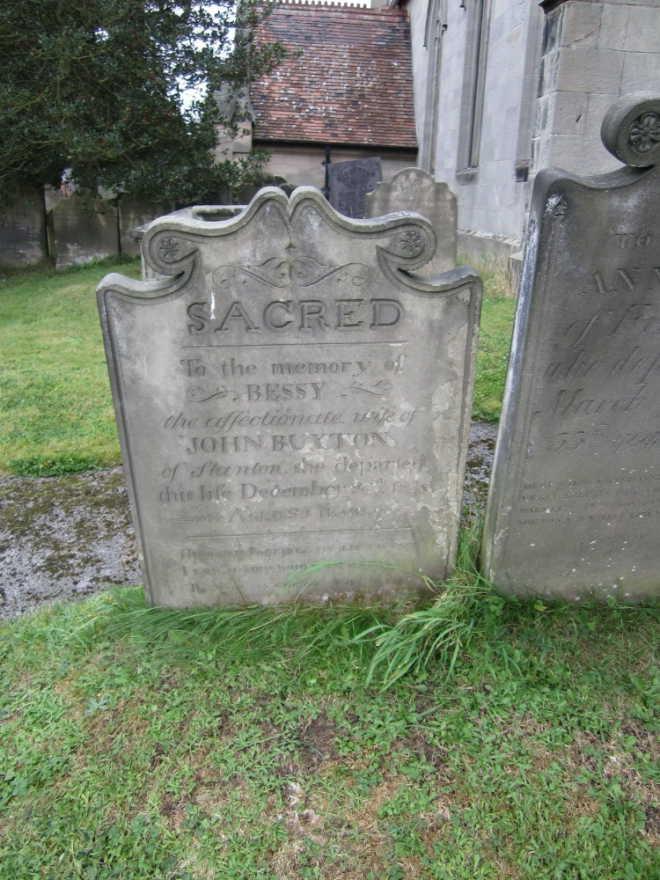
Bessy Buxton’s gravestone:
“Sacred to the memory of Bessy Buxton, the affectionate wife of John Buxton of Stanton She departed this life December 20th 1840, aged 25 years. “Husband, Farewell my life is Past, I loved you while life did last. Think on my children for my sake, And ever of them with I take.”
20 Dec 1840, Ellastone, Staffordshire
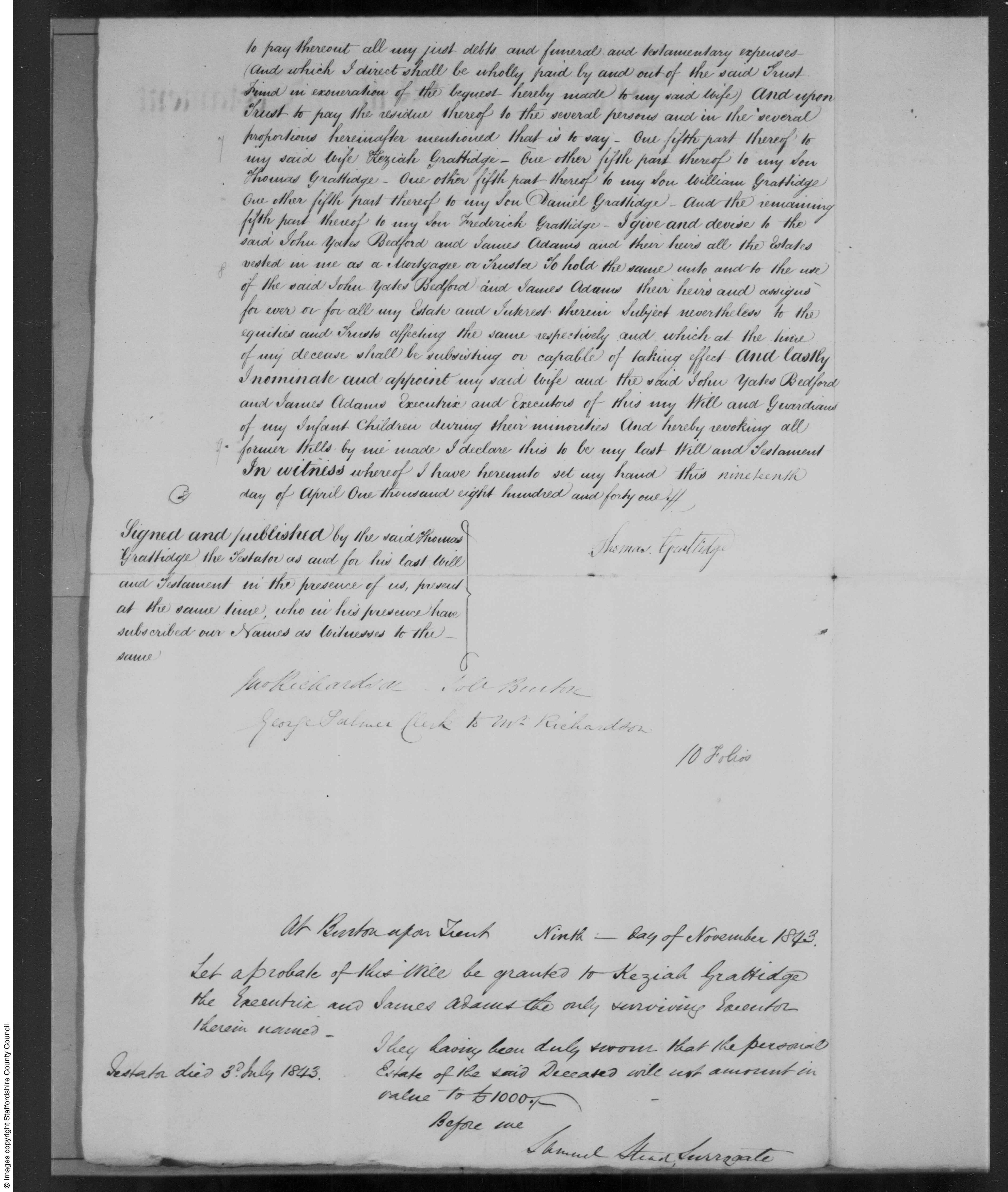
In the 1843 will of Thomas Grattidge, farmer of Foston, he leaves fifth shares of his estate, including freehold real estate at Findern, to his wife Kezia, and sons William, Daniel, Frederick and Thomas. He mentions that the children of his late daughter Bessy, wife of John Buxton, will be taken care of by their father. He leaves the farm to Keziah in confidence that she will maintain, support and educate his children with her.
An excerpt from the will:
I give and bequeath unto my dear wife Keziah Grattidge all my household goods and furniture, wearing apparel and plate and plated articles, linen, books, china, glass, and other household effects whatsoever, and also all my implements of husbandry, horses, cattle, hay, corn, crops and live and dead stock whatsoever, and also all the ready money that may be about my person or in my dwelling house at the time of my decease, …I also give my said wife the tenant right and possession of the farm in my occupation….
A page from the 1843 will of Thomas Grattidge:
William Grattidges half siblings (the offspring of Thomas Grattidge and Kezia Gibbs):
Albert Grattidge (1842-1914) was a railway engine driver in Derby. In 1884 he was driving the train when an unfortunate accident occured outside Ambergate. Three children were blackberrying and crossed the rails in front of the train, and one little girl died.
Albert Grattidge:
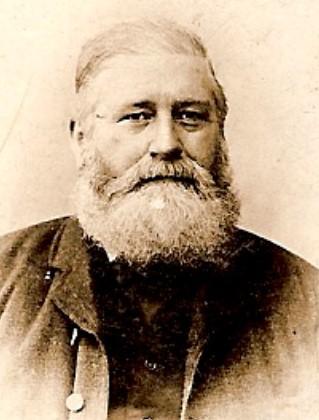
George Grattidge (1826-1876) was baptised Gibbs as this was before Thomas married Kezia. He was a police inspector in Derby.
George Grattidge:
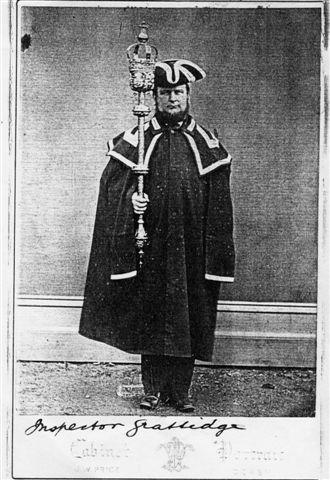
Edwin Grattidge (1837-1852) died at just 15 years old.
Ann Grattidge (1835-) married Charles Fletcher, stone mason, and lived in Derby.
Louisa Victoria Grattidge (1840-1869) was sadly another Grattidge woman who died young. Louisa married Emmanuel Brunt Cheesborough in 1860 in Derby. In 1861 Louisa and Emmanuel were living with her mother Kezia in Derby, with their two children Frederick and Ann Louisa. Emmanuel’s occupation was sawyer. (Kezia Gibbs second husband Frederick Augustus Grattidge was a timber merchant in Derby)
At the time of her death in 1869, Emmanuel was the landlord of the White Hart public house at Bridgegate in Derby.
The Derby Mercury of 17th November 1869:
“On Wednesday morning Mr Coroner Vallack held an inquest in the Grand
Jury-room, Town-hall, on the body of Louisa Victoria Cheeseborough, aged
33, the wife of the landlord of the White Hart, Bridge-gate, who committed
suicide by poisoning at an early hour on Sunday morning. The following
evidence was taken:Mr Frederick Borough, surgeon, practising in Derby, deposed that he was
called in to see the deceased about four o’clock on Sunday morning last. He
accordingly examined the deceased and found the body quite warm, but dead.
He afterwards made enquiries of the husband, who said that he was afraid
that his wife had taken poison, also giving him at the same time the
remains of some blue material in a cup. The aunt of the deceased’s husband
told him that she had seen Mrs Cheeseborough put down a cup in the
club-room, as though she had just taken it from her mouth. The witness took
the liquid home with him, and informed them that an inquest would
necessarily have to be held on Monday. He had made a post mortem
examination of the body, and found that in the stomach there was a great
deal of congestion. There were remains of food in the stomach and, having
put the contents into a bottle, he took the stomach away. He also examined
the heart and found it very pale and flabby. All the other organs were
comparatively healthy; the liver was friable.Hannah Stone, aunt of the deceased’s husband, said she acted as a servant
in the house. On Saturday evening, while they were going to bed and whilst
witness was undressing, the deceased came into the room, went up to the
bedside, awoke her daughter, and whispered to her. but what she said the
witness did not know. The child jumped out of bed, but the deceased closed
the door and went away. The child followed her mother, and she also
followed them to the deceased’s bed-room, but the door being closed, they
then went to the club-room door and opening it they saw the deceased
standing with a candle in one hand. The daughter stayed with her in the
room whilst the witness went downstairs to fetch a candle for herself, and
as she was returning up again she saw the deceased put a teacup on the
table. The little girl began to scream, saying “Oh aunt, my mother is
going, but don’t let her go”. The deceased then walked into her bed-room,
and they went and stood at the door whilst the deceased undressed herself.
The daughter and the witness then returned to their bed-room. Presently
they went to see if the deceased was in bed, but she was sitting on the
floor her arms on the bedside. Her husband was sitting in a chair fast
asleep. The witness pulled her on the bed as well as she could.
Ann Louisa Cheesborough, a little girl, said that the deceased was her
mother. On Saturday evening last, about twenty minutes before eleven
o’clock, she went to bed, leaving her mother and aunt downstairs. Her aunt
came to bed as usual. By and bye, her mother came into her room – before
the aunt had retired to rest – and awoke her. She told the witness, in a
low voice, ‘that she should have all that she had got, adding that she
should also leave her her watch, as she was going to die’. She did not tell
her aunt what her mother had said, but followed her directly into the
club-room, where she saw her drink something from a cup, which she
afterwards placed on the table. Her mother then went into her own room and
shut the door. She screamed and called her father, who was downstairs. He
came up and went into her room. The witness then went to bed and fell
asleep. She did not hear any noise or quarrelling in the house after going
to bed.Police-constable Webster was on duty in Bridge-gate on Saturday evening
last, about twenty minutes to one o’clock. He knew the White Hart
public-house in Bridge-gate, and as he was approaching that place, he heard
a woman scream as though at the back side of the house. The witness went to
the door and heard the deceased keep saying ‘Will you be quiet and go to
bed’. The reply was most disgusting, and the language which the
police-constable said was uttered by the husband of the deceased, was
immoral in the extreme. He heard the poor woman keep pressing her husband
to go to bed quietly, and eventually he saw him through the keyhole of the
door pass and go upstairs. his wife having gone up a minute or so before.
Inspector Fearn deposed that on Sunday morning last, after he had heard of
the deceased’s death from supposed poisoning, he went to Cheeseborough’s
public house, and found in the club-room two nearly empty packets of
Battie’s Lincoln Vermin Killer – each labelled poison.Several of the Jury here intimated that they had seen some marks on the
deceased’s neck, as of blows, and expressing a desire that the surgeon
should return, and re-examine the body. This was accordingly done, after
which the following evidence was taken:Mr Borough said that he had examined the body of the deceased and observed
a mark on the left side of the neck, which he considered had come on since
death. He thought it was the commencement of decomposition.
This was the evidence, after which the jury returned a verdict “that the
deceased took poison whilst of unsound mind” and requested the Coroner to
censure the deceased’s husband.The Coroner told Cheeseborough that he was a disgusting brute and that the
jury only regretted that the law could not reach his brutal conduct.
However he had had a narrow escape. It was their belief that his poor
wife, who was driven to her own destruction by his brutal treatment, would
have been a living woman that day except for his cowardly conduct towards
her.The inquiry, which had lasted a considerable time, then closed.”
In this article it says:
“it was the “fourth or fifth remarkable and tragical event – some of which were of the worst description – that has taken place within the last twelve years at the White Hart and in the very room in which the unfortunate Louisa Cheesborough drew her last breath.”
Sheffield Independent – Friday 12 November 1869:
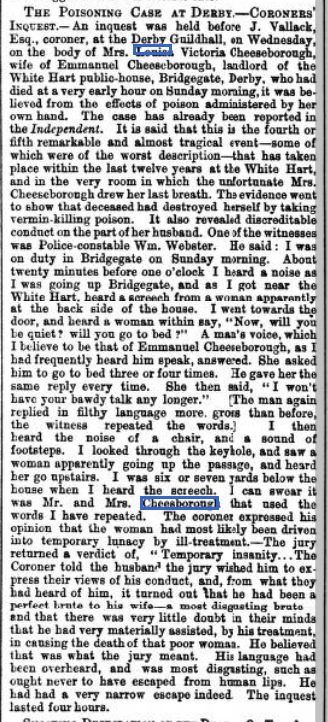 September 4, 2022 at 6:00 pm #6326
In reply to: The Sexy Wooden Leg
Stung by Egberts question, Olga reeled and almost lost her footing on the stairs. What had happened to her? That damned selfish individualism that was running rampant must have seeped into her room through the gaps in the windows or under the door. “No!” she shouted, her voice cracking.
“Say it isn’t true, Olga,” Egbert said, his voice breaking. “Not you as well.”
It took Olga a minute or two to still her racing heart. The near fall down the stairs had shaken her but with trembling hands she levered herself round to sit beside Egbert on the step.
Gripping his bony knee with her knobbly arthritic fingers, she took a deep breath.
“You are right to have said that, Egbert. If there is one thing we must hold onto, it’s our hearts. Nothing else matters, or at least nothing else matters as much as that. We are old and tired and we don’t like change. But if we escalate the importance of this frankly dreary and depressing home to the point where we lose our hearts…” she faltered and continued. “We will be homeless soon, very soon, and we know not what will happen to us. We must trust in the kindness of strangers, we must hope they have a heart.”
Egbert winced as Olga squeezed his knee. “And that is why”, Olga continued, slapping Egberts thigh with gusto, “We must have a heart…”
“If you’d just stop squeezing and hitting me, Olga…”
Olga loosened her grip on the old mans thigh bone and peered into his eyes. Quietly she thanked him. “You’ve cleared my mind and given me something to live for, and I thank you for that. But you do need to launder your clothes more often,” she added, pulling a face. She didn’t want the old coot to start blubbing, and he looked alarmingly close to tears.
“Come on, let’s go and see Obadiah. We’re all in this together. Homelessness and adventure can wait until tomorrow.” Olga heaved herself upright with a surprising burst of vitality. Noticing a weak smile trembling on Egberts lips, she said “That’s the spirit!”
July 13, 2022 at 3:09 am #6323In reply to: The Sexy Wooden Leg
“Watch where you are going, Child!” Egbert’s tone was sharp.
“Excuse me,” said Maryechka, hunching her shoulders and making herself small as a mouse so she could squeeze past Egbert’s oversized suitcase.
“To be fair, Old Man,” said Olga, glad of the excuse to pause, “you are taking up all the available space on the stairs with those bags.” She peered at Maryechka. “You are Obadiah’s girl aren’t you?”
Maryechka nodded shyly. “He’s my grandpa.” She frowned at the suitcases. “Are you going on holiday?”
“Never you mind that,” said Egbert. “You run along and see your Grandpa.”
Maryechka ducked past the bag and ran up the steps.
“Oy,” said Olga. “What I wouldn’t give for the agility of youth again.” Gripping the wooden hand rail, she stretched out her ankle and grimaced.
“Obadiah is stubborn as a mule,” said Egbert. “I tried warning him! He said he’d die in his room if it came to it.”
“Pfft,” said Olga. “That one will land on his big stinking feet. And he can hear better than he lets on. Is it him spreading the tales about me?”
Egbert dropped his bags and sat heavily on the step. He put his head in his hands and groaned. “Is it right though, Olga? Is it right that we leave our friends to their fate?”
It occurred to Olga that Egbert may be hiding his head so as not to answer her question. However, realising his mental state was fragile, she thought it prudent to keep to the matter at hand. It will keep, she thought.
“Obadiah and myself, we grew up together,” continued Egbert with what sounded like a sob. “We worked together on the farm as young men.” He raised his head and glared at Olga. “How can you expect me to leave him without a word of farewell? Have you no heart?”
July 12, 2022 at 2:00 am #6318In reply to: The Sexy Wooden Leg
“You’d better sit down,” said Olga gesturing to the end of her bed. As a rule, she did not have visitors so she saw no need to clutter up the available space in her tiny room with an extra chair. A large proportion of her life was spent in her armchair and she was content that way. While Egbert perched on the end of the bed, she lowered herself into the soft and familiar confines of her armchair and felt instantly soothed. It was true, sometimes she felt a tinge of regret when she considered how disappointed her younger self would be to see her now. But she hadn’t lived through what I’ve lived through so she can mind her own damn business,” she thought.
“It is just a story, twisted in the telling I expect.” Olga knew her voice held no conviction.
Egbert opened his mouth as though to speak. Closed it again.
“You look like a fish,” said Olga folding her arms.
“They say you and the Mayor go back a long way. Are you telling me that is not true?
“And what if we do?”
“You know he is Ursula’s uncle and a very powerful man. They say even the great president Voldomeer Zumbaskee holds him in great regard. They say …”
“Pfft! They say!” snapped Olga. “Who are these chattering fools you listen to, Egbert Gofindlevsky? I’d rather end up on the streets than ask a favour from that mountebank.”
Egbert jumped up from the bed and shook a fist at her. “And end up on the streets you will, Olga Herringbonevsky, along with the rest of us. You really want that on your conscience?”
July 10, 2022 at 2:36 am #6317In reply to: The Sexy Wooden Leg
The sharp rat-a-tat on the door startled Olga Herringbonevsky. The initial surprise quickly turned to annoyance. It was 11am and she wasn’t expecting a knock on the door at 11am. At 10am she expected a knock. It would be Larysa with the lukewarm cup of tea and a stale biscuit. Sometimes Olga complained about it and Larysa would say, Well you’re on the third floor so what do you expect? And she’d look cross and pour the tea so some of it slopped into the saucer. So the biscuits go stale on the way up do they? Olga would mutter. At 10:30am Larysa would return to collect the cup and saucer. I can’t do this much longer, she’d say. I’m not young any more and all these damn stairs. She’d been saying that for as long as Olga could remember.
For a moment, Olga contemplated ignoring the intrusion but the knocking started up again, this time accompanied by someone shouting her name.
With a very loud sigh, she put her book on the side table, face down so she would not lose her place for it was a most enjoyable whodunit, and hauled herself up from the chair. Her ankle was not good since she’d gone over on it the other day and Olga was in a very poor mood by the time she reached the door.
“Yes?” She glowered at Egbert.
“Have you seen this?” Egbert was waving a piece of paper at her.
“No,” Olga started to close the door.
“Olga stop!” Egbert’s face had reddened and Olga wondered if he might cry. Again, he waved the piece of paper in her face and then let his hand fall defeated to his side. “Olga, it’s bad news. You should have got a letter .”
Olga glanced at the pile of unopened letters on her dresser. It was never good news. She couldn’t be bothered with letters any more.
“Well, Egbert, I suppose you’d better come in”.
“That Ursula has a heart of steel,” said Olga when she’d heard the news.
“Pfft,” said Egbert. “She has no heart. This place has always been about money for her.”
“It’s bad times, Egbert. Bad times.”
Egbert nodded. “It is, Olga. But there must be something we can do.” He pursed his lips and Olga noticed that he would not meet her eyes.
“What? Spit it out, Old Man.”
He looked at her briefly before his eyes slid back to the dirty grey carpet. “I have heard stories, Olga. That you are … well connected. That you know people.”
Olga noticed that it had become difficult to breathe. Seeing Egbert looking at her with concern, she made an effort to steady herself. She took an extra big gasp of air and pointed to the book face-down on the side table. “That is a very good book I am reading. You may borrow it when I have finished.”
Egbert nodded. “Thank you.” he said and they both stared at the book.
“It was a long time ago, Egbert. And no business of anyone else.” Olga knew her voice was sharp but not sharp enough it seemed as Egbert was not done yet with all his prying words.
“Olga, you said it yourself. These are bad times. And desperate measures are needed or we will all perish.” Now he looked her in the eyes. “Old woman, swallow your pride. You must save yourself and all of us here.”
July 6, 2022 at 11:05 am #6312In reply to: The Sexy Wooden Leg
When she’d heard of the miracle happening at the Flovlinden Tree, Egna initially shrugged it off as another conman’s attempt at fooling the crowds.
“No, it’s real, my Auntie saw it.”
“Stop fretting” she’d told the little girl, as she was carefully removing the lice from her hair. “This is just someone’s idea of a smart joke. Don’t get fooled, you’re smarter than this.”
She sure wasn’t responsible for that one. If that were a true miracle, she would have known. The little calf next week being resuscitated after being dead a few minutes, well, that was her. Shame nobody was even there to notice. Most of the best miracles go about this way anyway.
So, after having lived close to a millennia in relatively rock solid health and with surprisingly unaging looks, Egna had thought she’d seen it all; at least last time the tree started to ooze sacred oil, it didn’t last for too long, people’s greed starting to sell it stopped it right in its tracks.
But maybe there was more to it this time. Egna’d often wondered why God had let her live that long. She was a useful instrument to Her for sure, but living in secrecy, claiming no ownership, most miracles were just facts of life. She somehow failed to see the point, even after 957 years of existence.
The little girl had left to go back to her nearby town. This side of the country was still quite safe from all the craziness. Egna knew well most of the branches of the ancestral trees leading to that particular little leaf. This one had probably no idea she shared a common ancestor with President Voldomeer, but Egna remembered the fellow. He was a clogmaker in the turn of the 18th century, as was his father before. That was until a rather unexpected turn of events precipitated him to a different path as his brother.
She had a book full of these records, as she’d tracked the lives of many, to keep them alive, and maybe remind people they all share so much in common. That is, if people were able to remember more than 2 generations before them.
“Well, that’s set.” she said to herself and to Her as She’s always listening “I’ll go and see for myself.”
her trusty old musty cloak at the door seemed to have been begging for the journey.July 6, 2022 at 11:02 am #6311In reply to: The Sexy Wooden Leg
Most of the pilgims, if one could call them that, flocked to the linden tree in cars, although some came on motorbikes and bicycles. Olek was grateful that they hadn’t started arriving by the bus load, like Italian tourists. But his cousin Ursula was happy with this strange new turn of events.
Her shabby hotel on the outskirts of town had never been so busy and she was already planning to refurbish the premises and evict the decrepit and motley assortment of aged permanent residents who had just about kept her head above water, financially speaking, for the last twenty years. She could charge much more per night to these new tourists, who were smartly dressed and modern and didn’t argue about the price of a room. They did complain about the damp stained wallpaper though and the threadbare bedding. Ursula reckoned she could charge even more for the rooms if she redecorated, and had an idea to approach her nephew Boris the bank manager for a business loan.
But first she had to evict the old timers. It wasn’t her problem, she reminded herself, if they had nowhere else to go. After all, plenty of charitable aid money was flying around these days, they could easily just join up with some fleeing refugees. She’d even sent some of her old dresses to the collection agency. They may have been forty years old and smelled of moth balls, but they were well made and the refugees would surely be grateful.
Ursula wasn’t looking forward to telling them. No, not at all! She rather liked some of them and was dreading their reaction. You are a business woman, Ursula, she told herself, and you have to look after your own interests! But still she quailed at the thought of knocking on their doors, or announcing it in the communal dining room at supper. Then she had an idea. She’d type up some letters instead, and sign them as if they came from her new business manager. When the residents approached her about the letter she would smile sadly and shrug, saying it wasn’t her decision and that she was terribly sorry but her hands were tied.
April 12, 2022 at 8:09 am #6289In reply to: The Precious Life and Rambles of Liz Tattler
“Ever get the feeling you’re talking to yourself?” Liz said to herself.
“YOU TART!!!”
Liz swung round, wondering where the dreadful shreik came from. The little black communication device on her desk was vibrating madly, causing the tea in her cup to slosh over the side into the saucer.
“Good Godfrey!” exclaimed Liz, visibly shaken.
“You rang?” smiled Godfrey, crawling out from under the desk.
“You were under my desk the whole time?” Liz was shocked.
“Allo allo allo!”
“Roberto! You were under my desk the entire time too?”
“Zere iz a zecret door under ze desk, madame, you did not know zis?”
“Fanella! Good lord, not you as well!”
Fanella grinned sheepishly. “I ‘ave come to ‘elp Finnley wiz ze bedding.”
Liz bent down and peered under her desk. Who else was under there? But it was dark as a black hole, and covered in cobwebs.
“Fanella, do you know where Finnley is?” asked Liz. “I miss her terribly. Everything is so dreadfully dusty without her.”
Fanella shrugged. “She was drugged, Madame. It was when she tried to put a bug under the rug, someone ‘hit ‘er on ze ‘ead wiz a mug, and lugged her to a zecret location and filled her wiz drugs.” Fanella shrugged again. “Zis is why I ‘ave come to ‘elp.”
February 2, 2022 at 12:33 pm #6266In reply to: The Elusive Samuel Housley and Other Family Stories
From Tanganyika with Love
continued part 7
With thanks to Mike Rushby.
Oldeani Hospital. 19th September 1938
Dearest Family,
George arrived today to take us home to Mbulu but Sister Marianne will not allow
me to travel for another week as I had a bit of a set back after baby’s birth. At first I was
very fit and on the third day Sister stripped the bed and, dictionary in hand, started me
off on ante natal exercises. “Now make a bridge Mrs Rushby. So. Up down, up down,’
whilst I obediently hoisted myself aloft on heels and head. By the sixth day she
considered it was time for me to be up and about but alas, I soon had to return to bed
with a temperature and a haemorrhage. I got up and walked outside for the first time this
morning.I have had lots of visitors because the local German settlers seem keen to see
the first British baby born in the hospital. They have been most kind, sending flowers
and little German cards of congratulations festooned with cherubs and rather sweet. Most
of the women, besides being pleasant, are very smart indeed, shattering my illusion that
German matrons are invariably fat and dowdy. They are all much concerned about the
Czecko-Slovakian situation, especially Sister Marianne whose home is right on the
border and has several relations who are Sudentan Germans. She is ant-Nazi and
keeps on asking me whether I think England will declare war if Hitler invades Czecko-
Slovakia, as though I had inside information.George tells me that he has had a grass ‘banda’ put up for us at Mbulu as we are
both determined not to return to those prison-like quarters in the Fort. Sister Marianne is
horrified at the idea of taking a new baby to live in a grass hut. She told George,
“No,No,Mr Rushby. I find that is not to be allowed!” She is an excellent Sister but rather
prim and George enjoys teasing her. This morning he asked with mock seriousness,
“Sister, why has my wife not received her medal?” Sister fluttered her dictionary before
asking. “What medal Mr Rushby”. “Why,” said George, “The medal that Hitler gives to
women who have borne four children.” Sister started a long and involved explanation
about the medal being only for German mothers whilst George looked at me and
grinned.Later. Great Jubilation here. By the noise in Sister Marianne’s sitting room last night it
sounded as though the whole German population had gathered to listen to the wireless
news. I heard loud exclamations of joy and then my bedroom door burst open and
several women rushed in. “Thank God “, they cried, “for Neville Chamberlain. Now there
will be no war.” They pumped me by the hand as though I were personally responsible
for the whole thing.George on the other hand is disgusted by Chamberlain’s lack of guts. Doesn’t
know what England is coming to these days. I feel too content to concern myself with
world affairs. I have a fine husband and four wonderful children and am happy, happy,
happy.Eleanor.
Mbulu. 30th September 1938
Dearest Family,
Here we are, comfortably installed in our little green house made of poles and
rushes from a nearby swamp. The house has of course, no doors or windows, but
there are rush blinds which roll up in the day time. There are two rooms and a little porch
and out at the back there is a small grass kitchen.Here we have the privacy which we prize so highly as we are screened on one
side by a Forest Department plantation and on the other three sides there is nothing but
the rolling countryside cropped bare by the far too large herds of cattle and goats of the
Wambulu. I have a lovely lazy time. I still have Kesho-Kutwa and the cook we brought
with us from the farm. They are both faithful and willing souls though not very good at
their respective jobs. As one of these Mbeya boys goes on safari with George whose
job takes him from home for three weeks out of four, I have taken on a local boy to cut
firewood and heat my bath water and generally make himself useful. His name is Saa,
which means ‘Clock’We had an uneventful but very dusty trip from Oldeani. Johnny Jo travelled in his
pram in the back of the boxbody and got covered in dust but seems none the worst for
it. As the baby now takes up much of my time and Kate was showing signs of
boredom, I have engaged a little African girl to come and play with Kate every morning.
She is the daughter of the head police Askari and a very attractive and dignified little
person she is. Her name is Kajyah. She is scrupulously clean, as all Mohammedan
Africans seem to be. Alas, Kajyah, though beautiful, is a bore. She simply does not
know how to play, so they just wander around hand in hand.There are only two drawbacks to this little house. Mbulu is a very windy spot so
our little reed house is very draughty. I have made a little tent of sheets in one corner of
the ‘bedroom’ into which I can retire with Johnny when I wish to bathe or sponge him.
The other drawback is that many insects are attracted at night by the lamp and make it
almost impossible to read or sew and they have a revolting habit of falling into the soup.
There are no dangerous wild animals in this area so I am not at all nervous in this
flimsy little house when George is on safari. Most nights hyaenas come around looking
for scraps but our dogs, Fanny and Paddy, soon see them off.Eleanor.
Mbulu. 25th October 1938
Dearest Family,
Great news! a vacancy has occurred in the Game Department. George is to
transfer to it next month. There will be an increase in salary and a brighter prospect for
the future. It will mean a change of scene and I shall be glad of that. We like Mbulu and
the people here but the rains have started and our little reed hut is anything but water
tight.Before the rain came we had very unpleasant dust storms. I think I told you that
this is a treeless area and the grass which normally covers the veldt has been cropped
to the roots by the hungry native cattle and goats. When the wind blows the dust
collects in tall black columns which sweep across the country in a most spectacular
fashion. One such dust devil struck our hut one day whilst we were at lunch. George
swept Kate up in a second and held her face against his chest whilst I rushed to Johnny
Jo who was asleep in his pram, and stooped over the pram to protect him. The hut
groaned and creaked and clouds of dust blew in through the windows and walls covering
our persons, food, and belongings in a black pall. The dogs food bowls and an empty
petrol tin outside the hut were whirled up and away. It was all over in a moment but you
should have seen what a family of sweeps we looked. George looked at our blackened
Johnny and mimicked in Sister Marianne’s primmest tones, “I find that this is not to be
allowed.”The first rain storm caught me unprepared when George was away on safari. It
was a terrific thunderstorm. The quite violent thunder and lightening were followed by a
real tropical downpour. As the hut is on a slight slope, the storm water poured through
the hut like a river, covering the entire floor, and the roof leaked like a lawn sprinkler.
Johnny Jo was snug enough in the pram with the hood raised, but Kate and I had a
damp miserable night. Next morning I had deep drains dug around the hut and when
George returned from safari he managed to borrow an enormous tarpaulin which is now
lashed down over the roof.It did not rain during the next few days George was home but the very next night
we were in trouble again. I was awakened by screams from Kate and hurriedly turned up
the lamp to see that we were in the midst of an invasion of siafu ants. Kate’s bed was
covered in them. Others appeared to be raining down from the thatch. I quickly stripped
Kate and carried her across to my bed, whilst I rushed to the pram to see whether
Johnny Jo was all right. He was fast asleep, bless him, and slept on through all the
commotion, whilst I struggled to pick all the ants out of Kate’s hair, stopping now and
again to attend to my own discomfort. These ants have a painful bite and seem to
choose all the most tender spots. Kate fell asleep eventually but I sat up for the rest of
the night to make sure that the siafu kept clear of the children. Next morning the servants
dispersed them by laying hot ash.In spite of the dampness of the hut both children are blooming. Kate has rosy
cheeks and Johnny Jo now has a fuzz of fair hair and has lost his ‘old man’ look. He
reminds me of Ann at his age.Eleanor.
Iringa. 30th November 1938
Dearest Family,
Here we are back in the Southern Highlands and installed on the second floor of
another German Fort. This one has been modernised however and though not so
romantic as the Mbulu Fort from the outside, it is much more comfortable.We are all well
and I am really proud of our two safari babies who stood up splendidly to a most trying
journey North from Mbulu to Arusha and then South down the Great North Road to
Iringa where we expect to stay for a month.At Arusha George reported to the headquarters of the Game Department and
was instructed to come on down here on Rinderpest Control. There is a great flap on in
case the rinderpest spread to Northern Rhodesia and possibly onwards to Southern
Rhodesia and South Africa. Extra veterinary officers have been sent to this area to
inoculate all the cattle against the disease whilst George and his African game Scouts will
comb the bush looking for and destroying diseased game. If the rinderpest spreads,
George says it may be necessary to shoot out all the game in a wide belt along the
border between the Southern Highlands of Tanganyika and Northern Rhodesia, to
prevent the disease spreading South. The very idea of all this destruction sickens us
both.George left on a foot safari the day after our arrival and I expect I shall be lucky if I
see him occasionally at weekends until this job is over. When rinderpest is under control
George is to be stationed at a place called Nzassa in the Eastern Province about 18
miles from Dar es Salaam. George’s orderly, who is a tall, cheerful Game Scout called
Juma, tells me that he has been stationed at Nzassa and it is a frightful place! However I
refuse to be depressed. I now have the cheering prospect of leave to England in thirty
months time when we will be able to fetch Ann and George and be a proper family
again. Both Ann and George look happy in the snapshots which mother-in-law sends
frequently. Ann is doing very well at school and loves it.To get back to our journey from Mbulu. It really was quite an experience. It
poured with rain most of the way and the road was very slippery and treacherous the
120 miles between Mbulu and Arusha. This is a little used earth road and the drains are
so blocked with silt as to be practically non existent. As usual we started our move with
the V8 loaded to capacity. I held Johnny on my knee and Kate squeezed in between
George and me. All our goods and chattels were in wooden boxes stowed in the back
and the two houseboys and the two dogs had to adjust themselves to the space that
remained. We soon ran into trouble and it took us all day to travel 47 miles. We stuck
several times in deep mud and had some most nasty skids. I simply clutched Kate in
one hand and Johnny Jo in the other and put my trust in George who never, under any
circumstances, loses his head. Poor Johnny only got his meals when circumstances
permitted. Unfortunately I had put him on a bottle only a few days before we left Mbulu
and, as I was unable to buy either a primus stove or Thermos flask there we had to
make a fire and boil water for each meal. Twice George sat out in the drizzle with a rain
coat rapped over his head to protect a miserable little fire of wet sticks drenched with
paraffin. Whilst we waited for the water to boil I pacified John by letting him suck a cube
of Tate and Lyles sugar held between my rather grubby fingers. Not at all according to
the book.That night George, the children and I slept in the car having dumped our boxes
and the two servants in a deserted native hut. The rain poured down relentlessly all night
and by morning the road was more of a morass than ever. We swerved and skidded
alarmingly till eventually one of the wheel chains broke and had to be tied together with
string which constantly needed replacing. George was so patient though he was wet
and muddy and tired and both children were very good. Shortly before reaching the Great North Road we came upon Jack Gowan, the Stock Inspector from Mbulu. His car
was bogged down to its axles in black mud. He refused George’s offer of help saying
that he had sent his messenger to a nearby village for help.I hoped that conditions would be better on the Great North Road but how over
optimistic I was. For miles the road runs through a belt of ‘black cotton soil’. which was
churned up into the consistency of chocolate blancmange by the heavy lorry traffic which
runs between Dodoma and Arusha. Soon the car was skidding more fantastically than
ever. Once it skidded around in a complete semi circle so George decided that it would
be safer for us all to walk whilst he negotiated the very bad patches. You should have
seen me plodding along in the mud and drizzle with the baby in one arm and Kate
clinging to the other. I was terrified of slipping with Johnny. Each time George reached
firm ground he would return on foot to carry Kate and in this way we covered many bad
patches.We were more fortunate than many other travellers. We passed several lorries
ditched on the side of the road and one car load of German men, all elegantly dressed in
lounge suits. One was busy with his camera so will have a record of their plight to laugh
over in the years to come. We spent another night camping on the road and next day
set out on the last lap of the journey. That also was tiresome but much better than the
previous day and we made the haven of the Arusha Hotel before dark. What a picture
we made as we walked through the hall in our mud splattered clothes! Even Johnny was
well splashed with mud but no harm was done and both he and Kate are blooming.
We rested for two days at Arusha and then came South to Iringa. Luckily the sun
came out and though for the first day the road was muddy it was no longer so slippery
and the second day found us driving through parched country and along badly
corrugated roads. The further South we came, the warmer the sun which at times blazed
through the windscreen and made us all uncomfortably hot. I have described the country
between Arusha and Dodoma before so I shan’t do it again. We reached Iringa without
mishap and after a good nights rest all felt full of beans.Eleanor.
Mchewe Estate, Mbeya. 7th January 1939.
Dearest Family,
You will be surprised to note that we are back on the farm! At least the children
and I are here. George is away near the Rhodesian border somewhere, still on
Rinderpest control.I had a pleasant time at Iringa, lots of invitations to morning tea and Kate had a
wonderful time enjoying the novelty of playing with children of her own age. She is not
shy but nevertheless likes me to be within call if not within sight. It was all very suburban
but pleasant enough. A few days before Christmas George turned up at Iringa and
suggested that, as he would be working in the Mbeya area, it might be a good idea for
the children and me to move to the farm. I agreed enthusiastically, completely forgetting
that after my previous trouble with the leopard I had vowed to myself that I would never
again live alone on the farm.Alas no sooner had we arrived when Thomas, our farm headman, brought the
news that there were now two leopards terrorising the neighbourhood, and taking dogs,
goats and sheep and chickens. Traps and poisoned bait had been tried in vain and he
was sure that the female was the same leopard which had besieged our home before.
Other leopards said Thomas, came by stealth but this one advertised her whereabouts
in the most brazen manner.George stayed with us on the farm over Christmas and all was quiet at night so I
cheered up and took the children for walks along the overgrown farm paths. However on
New Years Eve that darned leopard advertised her presence again with the most blood
chilling grunts and snarls. Horrible! Fanny and Paddy barked and growled and woke up
both children. Kate wept and kept saying, “Send it away mummy. I don’t like it.” Johnny
Jo howled in sympathy. What a picnic. So now the whole performance of bodyguards
has started again and ‘till George returns we confine our exercise to the garden.
Our little house is still cosy and sweet but the coffee plantation looks very
neglected. I wish to goodness we could sell it.Eleanor.
Nzassa 14th February 1939.
Dearest Family,
After three months of moving around with two small children it is heavenly to be
settled in our own home, even though Nzassa is an isolated spot and has the reputation
of being unhealthy.We travelled by car from Mbeya to Dodoma by now a very familiar stretch of
country, but from Dodoma to Dar es Salaam by train which made a nice change. We
spent two nights and a day in the Splendid Hotel in Dar es Salaam, George had some
official visits to make and I did some shopping and we took the children to the beach.
The bay is so sheltered that the sea is as calm as a pond and the water warm. It is
wonderful to see the sea once more and to hear tugs hooting and to watch the Arab
dhows putting out to sea with their oddly shaped sails billowing. I do love the bush, but
I love the sea best of all, as you know.We made an early start for Nzassa on the 3rd. For about four miles we bowled
along a good road. This brought us to a place called Temeke where George called on
the District Officer. His house appears to be the only European type house there. The
road between Temeke and the turn off to Nzassa is quite good, but the six mile stretch
from the turn off to Nzassa is a very neglected bush road. There is nothing to be seen
but the impenetrable bush on both sides with here and there a patch of swampy
ground where rice is planted in the wet season.After about six miles of bumpy road we reached Nzassa which is nothing more
than a sandy clearing in the bush. Our house however is a fine one. It was originally built
for the District Officer and there is a small court house which is now George’s office. The
District Officer died of blackwater fever so Nzassa was abandoned as an administrative
station being considered too unhealthy for Administrative Officers but suitable as
Headquarters for a Game Ranger. Later a bachelor Game Ranger was stationed here
but his health also broke down and he has been invalided to England. So now the
healthy Rushbys are here and we don’t mean to let the place get us down. So don’t
worry.The house consists of three very large and airy rooms with their doors opening
on to a wide front verandah which we shall use as a living room. There is also a wide
back verandah with a store room at one end and a bathroom at the other. Both
verandahs and the end windows of the house are screened my mosquito gauze wire
and further protected by a trellis work of heavy expanded metal. Hasmani, the Game
Scout, who has been acting as caretaker, tells me that the expanded metal is very
necessary because lions often come out of the bush at night and roam around the
house. Such a comforting thought!On our very first evening we discovered how necessary the mosquito gauze is.
After sunset the air outside is thick with mosquitos from the swamps. About an acre of
land has been cleared around the house. This is a sandy waste because there is no
water laid on here and absolutely nothing grows here except a rather revolting milky
desert bush called ‘Manyara’, and a few acacia trees. A little way from the house there is
a patch of citrus trees, grape fruit, I think, but whether they ever bear fruit I don’t know.
The clearing is bordered on three sides by dense dusty thorn bush which is
‘lousy with buffalo’ according to George. The open side is the road which leads down to
George’s office and the huts for the Game Scouts. Only Hasmani and George’s orderly
Juma and their wives and families live there, and the other huts provide shelter for the
Game Scouts from the bush who come to Nzassa to collect their pay and for a short
rest. I can see that my daily walk will always be the same, down the road to the huts and
back! However I don’t mind because it is far too hot to take much exercise.The climate here is really tropical and worse than on the coast because the thick
bush cuts us off from any sea breeze. George says it will be cooler when the rains start
but just now we literally drip all day. Kate wears nothing but a cotton sun suit, and Johnny
a napkin only, but still their little bodies are always moist. I have shorn off all Kate’s lovely
shoulder length curls and got George to cut my hair very short too.We simply must buy a refrigerator. The butter, and even the cheese we bought
in Dar. simply melted into pools of oil overnight, and all our meat went bad, so we are
living out of tins. However once we get organised I shall be quite happy here. I like this
spacious house and I have good servants. The cook, Hamisi Issa, is a Swahili from Lindi
whom we engaged in Dar es Salaam. He is a very dignified person, and like most
devout Mohammedan Cooks, keeps both his person and the kitchen spotless. I
engaged the house boy here. He is rather a timid little body but is very willing and quite
capable. He has an excessively plain but cheerful wife whom I have taken on as ayah. I
do not really need help with the children but feel I must have a woman around just in
case I go down with malaria when George is away on safari.Eleanor.
Nzassa 28th February 1939.
Dearest Family,
George’s birthday and we had a special tea party this afternoon which the
children much enjoyed. We have our frig now so I am able to make jellies and provide
them with really cool drinks.Our very first visitor left this morning after spending only one night here. He is Mr
Ionides, the Game Ranger from the Southern Province. He acted as stand in here for a
short while after George’s predecessor left for England on sick leave, and where he has
since died. Mr Ionides returned here to hand over the range and office formally to
George. He seems a strange man and is from all accounts a bit of a hermit. He was at
one time an Officer in the Regular Army but does not look like a soldier, he wears the
most extraordinary clothes but nevertheless contrives to look top-drawer. He was
educated at Rugby and Sandhurst and is, I should say, well read. Ionides told us that he
hated Nzassa, particularly the house which he thinks sinister and says he always slept
down in the office.The house, or at least one bedroom, seems to have the same effect on Kate.
She has been very nervous at night ever since we arrived. At first the children occupied
the bedroom which is now George’s. One night, soon after our arrival, Kate woke up
screaming to say that ‘something’ had looked at her through the mosquito net. She was
in such a hysterical state that inspite of the heat and discomfort I was obliged to crawl into
her little bed with her and remained there for the rest of the night.Next night I left a night lamp burning but even so I had to sit by her bed until she
dropped off to sleep. Again I was awakened by ear-splitting screams and this time
found Kate standing rigid on her bed. I lifted her out and carried her to a chair meaning to
comfort her but she screeched louder than ever, “Look Mummy it’s under the bed. It’s
looking at us.” In vain I pointed out that there was nothing at all there. By this time
George had joined us and he carried Kate off to his bed in the other room whilst I got into
Kate’s bed thinking she might have been frightened by a rat which might also disturb
Johnny.Next morning our houseboy remarked that he had heard Kate screaming in the
night from his room behind the kitchen. I explained what had happened and he must
have told the old Scout Hasmani who waylaid me that afternoon and informed me quite
seriously that that particular room was haunted by a ‘sheitani’ (devil) who hates children.
He told me that whilst he was acting as caretaker before our arrival he one night had his
wife and small daughter in the room to keep him company. He said that his small
daughter woke up and screamed exactly as Kate had done! Silly coincidence I
suppose, but such strange things happen in Africa that I decided to move the children
into our room and George sleeps in solitary state in the haunted room! Kate now sleeps
peacefully once she goes to sleep but I have to stay with her until she does.I like this house and it does not seem at all sinister to me. As I mentioned before,
the rooms are high ceilinged and airy, and have cool cement floors. We have made one
end of the enclosed verandah into the living room and the other end is the playroom for
the children. The space in between is a sort of no-mans land taken over by the dogs as
their special territory.Eleanor.
Nzassa 25th March 1939.
Dearest Family,
George is on safari down in the Rufigi River area. He is away for about three
weeks in the month on this job. I do hate to see him go and just manage to tick over until
he comes back. But what fun and excitement when he does come home.
Usually he returns after dark by which time the children are in bed and I have
settled down on the verandah with a book. The first warning is usually given by the
dogs, Fanny and her son Paddy. They stir, sit up, look at each other and then go and sit
side by side by the door with their noses practically pressed to the mosquito gauze and
ears pricked. Soon I can hear the hum of the car, and so can Hasmani, the old Game
Scout who sleeps on the back verandah with rifle and ammunition by his side when
George is away. When he hears the car he turns up his lamp and hurries out to rouse
Juma, the houseboy. Juma pokes up the fire and prepares tea which George always
drinks whist a hot meal is being prepared. In the meantime I hurriedly comb my hair and
powder my nose so that when the car stops I am ready to rush out and welcome
George home. The boy and Hasmani and the garden boy appear to help with the
luggage and to greet George and the cook, who always accompanies George on
Safari. The home coming is always a lively time with much shouting of greetings.
‘Jambo’, and ‘Habari ya safari’, whilst the dogs, beside themselves with excitement,
rush around like lunatics.As though his return were not happiness enough, George usually collects the
mail on his way home so there is news of Ann and young George and letters from you
and bundles of newspapers and magazines. On the day following his return home,
George has to deal with official mail in the office but if the following day is a weekday we
all, the house servants as well as ourselves, pile into the boxbody and go to Dar es
Salaam. To us this means a mornings shopping followed by an afternoon on the beach.
It is a bit cooler now that the rains are on but still very humid. Kate keeps chubby
and rosy in spite of the climate but Johnny is too pale though sturdy enough. He is such
a good baby which is just as well because Kate is a very demanding little girl though
sunny tempered and sweet. I appreciate her company very much when George is
away because we are so far off the beaten track that no one ever calls.Eleanor.
Nzassa 28th April 1939.
Dearest Family,
You all seem to wonder how I can stand the loneliness and monotony of living at
Nzassa when George is on safari, but really and truly I do not mind. Hamisi the cook
always goes on safari with George and then the houseboy Juma takes over the cooking
and I do the lighter housework. the children are great company during the day, and when
they are settled for the night I sit on the verandah and read or write letters or I just dream.
The verandah is entirely enclosed with both wire mosquito gauze and a trellis
work of heavy expanded metal, so I am safe from all intruders be they human, animal, or
insect. Outside the air is alive with mosquitos and the cicadas keep up their monotonous
singing all night long. My only companions on the verandah are the pale ghecco lizards
on the wall and the two dogs. Fanny the white bull terrier, lies always near my feet
dozing happily, but her son Paddy, who is half Airedale has a less phlegmatic
disposition. He sits alert and on guard by the metal trellis work door. Often a lion grunts
from the surrounding bush and then his hackles rise and he stands up stiffly with his nose
pressed to the door. Old Hasmani from his bedroll on the back verandah, gives a little
cough just to show he is awake. Sometimes the lions are very close and then I hear the
click of a rifle bolt as Hasmani loads his rifle – but this is usually much later at night when
the lights are out. One morning I saw large pug marks between the wall of my bedroom
and the garage but I do not fear lions like I did that beastly leopard on the farm.
A great deal of witchcraft is still practiced in the bush villages in the
neighbourhood. I must tell you about old Hasmani’s baby in connection with this. Last
week Hasmani came to me in great distress to say that his baby was ‘Ngongwa sana ‘
(very ill) and he thought it would die. I hurried down to the Game Scouts quarters to see
whether I could do anything for the child and found the mother squatting in the sun
outside her hut with the baby on her lap. The mother was a young woman but not an
attractive one. She appeared sullen and indifferent compared with old Hasmani who
was very distressed. The child was very feverish and breathing with difficulty and
seemed to me to be suffering from bronchitis if not pneumonia. I rubbed his back and
chest with camphorated oil and dosed him with aspirin and liquid quinine. I repeated the
treatment every four hours, but next day there was no apparent improvement.
In the afternoon Hasmani begged me to give him that night off duty and asked for
a loan of ten shillings. He explained to me that it seemed to him that the white man’s
medicine had failed to cure his child and now he wished to take the child to the local witch
doctor. “For ten shillings” said Hasmani, “the Maganga will drive the devil out of my
child.” “How?” asked I. “With drums”, said Hasmani confidently. I did not know what to
do. I thought the child was too ill to be exposed to the night air, yet I knew that if I
refused his request and the child were to die, Hasmani and all the other locals would hold
me responsible. I very reluctantly granted his request. I was so troubled by the matter
that I sent for George’s office clerk. Daniel, and asked him to accompany Hasmani to the
ceremony and to report to me the next morning. It started to rain after dark and all night
long I lay awake in bed listening to the drums and the light rain. Next morning when I
went out to the kitchen to order breakfast I found a beaming Hasmani awaiting me.
“Memsahib”, he said. “My child is well, the fever is now quite gone, the Maganga drove
out the devil just as I told you.” Believe it or not, when I hurried to his quarters after
breakfast I found the mother suckling a perfectly healthy child! It may be my imagination
but I thought the mother looked pretty smug.The clerk Daniel told me that after Hasmani
had presented gifts of money and food to the ‘Maganga’, the naked baby was placed
on a goat skin near the drums. Most of the time he just lay there but sometimes the witch
doctor picked him up and danced with the child in his arms. Daniel seemed reluctant to
talk about it. Whatever mumbo jumbo was used all this happened a week ago and the
baby has never looked back.Eleanor.
Nzassa 3rd July 1939.
Dearest Family,
Did I tell you that one of George’s Game Scouts was murdered last month in the
Maneromango area towards the Rufigi border. He was on routine patrol, with a porter
carrying his bedding and food, when they suddenly came across a group of African
hunters who were busy cutting up a giraffe which they had just killed. These hunters were
all armed with muzzle loaders, spears and pangas, but as it is illegal to kill giraffe without
a permit, the Scout went up to the group to take their names. Some argument ensued
and the Scout was stabbed.The District Officer went to the area to investigate and decided to call in the Police
from Dar es Salaam. A party of police went out to search for the murderers but after
some days returned without making any arrests. George was on an elephant control
safari in the Bagamoyo District and on his return through Dar es Salaam he heard of the
murder. George was furious and distressed to hear the news and called in here for an
hour on his way to Maneromango to search for the murderers himself.After a great deal of strenuous investigation he arrested three poachers, put them
in jail for the night at Maneromango and then brought them to Dar es Salaam where they
are all now behind bars. George will now have to prosecute in the Magistrate’s Court
and try and ‘make a case’ so that the prisoners may be committed to the High Court to
be tried for murder. George is convinced of their guilt and justifiably proud to have
succeeded where the police failed.George had to borrow handcuffs for the prisoners from the Chief at
Maneromango and these he brought back to Nzassa after delivering the prisoners to
Dar es Salaam so that he may return them to the Chief when he revisits the area next
week.I had not seen handcuffs before and picked up a pair to examine them. I said to
George, engrossed in ‘The Times’, “I bet if you were arrested they’d never get
handcuffs on your wrist. Not these anyway, they look too small.” “Standard pattern,”
said George still concentrating on the newspaper, but extending an enormous relaxed
left wrist. So, my dears, I put a bracelet round his wrist and as there was a wide gap I
gave a hard squeeze with both hands. There was a sharp click as the handcuff engaged
in the first notch. George dropped the paper and said, “Now you’ve done it, my love,
one set of keys are in the Dar es Salaam Police Station, and the others with the Chief at
Maneromango.” You can imagine how utterly silly I felt but George was an angel about it
and said as he would have to go to Dar es Salaam we might as well all go.So we all piled into the car, George, the children and I in the front, and the cook
and houseboy, immaculate in snowy khanzus and embroidered white caps, a Game
Scout and the ayah in the back. George never once complain of the discomfort of the
handcuff but I was uncomfortably aware that it was much too tight because his arm
above the cuff looked red and swollen and the hand unnaturally pale. As the road is so
bad George had to use both hands on the wheel and all the time the dangling handcuff
clanked against the dashboard in an accusing way.We drove straight to the Police Station and I could hear the roars of laughter as
George explained his predicament. Later I had to put up with a good deal of chaffing
and congratulations upon putting the handcuffs on George.Eleanor.
Nzassa 5th August 1939
Dearest Family,
George made a point of being here for Kate’s fourth birthday last week. Just
because our children have no playmates George and I always do all we can to make
birthdays very special occasions. We went to Dar es Salaam the day before the
birthday and bought Kate a very sturdy tricycle with which she is absolutely delighted.
You will be glad to know that your parcels arrived just in time and Kate loved all your
gifts especially the little shop from Dad with all the miniature tins and packets of
groceries. The tea set was also a great success and is much in use.We had a lively party which ended with George and me singing ‘Happy
Birthday to you’, and ended with a wild game with balloons. Kate wore her frilly white net
party frock and looked so pretty that it seemed a shame that there was no one but us to
see her. Anyway it was a good party. I wish so much that you could see the children.
Kate keeps rosy and has not yet had malaria. Johnny Jo is sturdy but pale. He
runs a temperature now and again but I am not sure whether this is due to teething or
malaria. Both children of course take quinine every day as George and I do. George
quite frequently has malaria in spite of prophylactic quinine but this is not surprising as he
got the germ thoroughly established in his system in his early elephant hunting days. I
get it too occasionally but have not been really ill since that first time a month after my
arrival in the country.Johnny is such a good baby. His chief claim to beauty is his head of soft golden
curls but these are due to come off on his first birthday as George considers them too
girlish. George left on safari the day after the party and the very next morning our wood
boy had a most unfortunate accident. He was chopping a rather tough log when a chip
flew up and split his upper lip clean through from mouth to nostril exposing teeth and
gums. A truly horrible sight and very bloody. I cleaned up the wound as best I could
and sent him off to the hospital at Dar es Salaam on the office bicycle. He wobbled
away wretchedly down the road with a white cloth tied over his mouth to keep off the
dust. He returned next day with his lip stitched and very swollen and bearing a
resemblance to my lip that time I used the hair remover.Eleanor.
Splendid Hotel. Dar es Salaam 7th September 1939
Dearest Family,
So now another war has started and it has disrupted even our lives. We have left
Nzassa for good. George is now a Lieutenant in the King’s African Rifles and the children
and I are to go to a place called Morogoro to await further developments.
I was glad to read in today’s paper that South Africa has declared war on
Germany. I would have felt pretty small otherwise in this hotel which is crammed full of
men who have been called up for service in the Army. George seems exhilarated by
the prospect of active service. He is bursting out of his uniform ( at the shoulders only!)
and all too ready for the fray.The war came as a complete surprise to me stuck out in the bush as I was without
wireless or mail. George had been away for a fortnight so you can imagine how
surprised I was when a messenger arrived on a bicycle with a note from George. The
note informed me that war had been declared and that George, as a Reserve Officer in
the KAR had been called up. I was to start packing immediately and be ready by noon
next day when George would arrive with a lorry for our goods and chattels. I started to
pack immediately with the help of the houseboy and by the time George arrived with
the lorry only the frig remained to be packed and this was soon done.Throughout the morning Game Scouts had been arriving from outlying parts of
the District. I don’t think they had the least idea where they were supposed to go or
whom they were to fight but were ready to fight anybody, anywhere, with George.
They all looked very smart in well pressed uniforms hung about with water bottles and
ammunition pouches. The large buffalo badge on their round pill box hats absolutely
glittered with polish. All of course carried rifles and when George arrived they all lined up
and they looked most impressive. I took some snaps but unfortunately it was drizzling
and they may not come out well.We left Nzassa without a backward glance. We were pretty fed up with it by
then. The children and I are spending a few days here with George but our luggage, the
dogs, and the houseboys have already left by train for Morogoro where a small house
has been found for the children and me.George tells me that all the German males in this Territory were interned without a
hitch. The whole affair must have been very well organised. In every town and
settlement special constables were sworn in to do the job. It must have been a rather
unpleasant one but seems to have gone without incident. There is a big transit camp
here at Dar for the German men. Later they are to be sent out of the country, possibly to
Rhodesia.The Indian tailors in the town are all terribly busy making Army uniforms, shorts
and tunics in khaki drill. George swears that they have muddled their orders and he has
been given the wrong things. Certainly the tunic is far too tight. His hat, a khaki slouch hat
like you saw the Australians wearing in the last war, is also too small though it is the
largest they have in stock. We had a laugh over his other equipment which includes a
small canvas haversack and a whistle on a black cord. George says he feels like he is
back in his Boy Scouting boyhood.George has just come in to say the we will be leaving for Morogoro tomorrow
afternoon.Eleanor.
Morogoro 14th September 1939
Dearest Family,
Morogoro is a complete change from Nzassa. This is a large and sprawling
township. The native town and all the shops are down on the flat land by the railway but
all the European houses are away up the slope of the high Uluguru Mountains.
Morogoro was a flourishing town in the German days and all the streets are lined with
trees for coolness as is the case in other German towns. These trees are the flamboyant
acacia which has an umbrella top and throws a wide but light shade.Most of the houses have large gardens so they cover a considerable area and it
is quite a safari for me to visit friends on foot as our house is on the edge of this area and
the furthest away from the town. Here ones house is in accordance with ones seniority in
Government service. Ours is a simple affair, just three lofty square rooms opening on to
a wide enclosed verandah. Mosquitoes are bad here so all doors and windows are
screened and we will have to carry on with our daily doses of quinine.George came up to Morogoro with us on the train. This was fortunate because I
went down with a sharp attack of malaria at the hotel on the afternoon of our departure
from Dar es Salaam. George’s drastic cure of vast doses of quinine, a pillow over my
head, and the bed heaped with blankets soon brought down the temperature so I was
fit enough to board the train but felt pretty poorly on the trip. However next day I felt
much better which was a good thing as George had to return to Dar es Salaam after two
days. His train left late at night so I did not see him off but said good-bye at home
feeling dreadful but trying to keep the traditional stiff upper lip of the wife seeing her
husband off to the wars. He hopes to go off to Abyssinia but wrote from Dar es Salaam
to say that he is being sent down to Rhodesia by road via Mbeya to escort the first
detachment of Rhodesian white troops.First he will have to select suitable camping sites for night stops and arrange for
supplies of food. I am very pleased as it means he will be safe for a while anyway. We
are both worried about Ann and George in England and wonder if it would be safer to
have them sent out.Eleanor.
Morogoro 4th November 1939
Dearest Family,
My big news is that George has been released from the Army. He is very
indignant and disappointed because he hoped to go to Abyssinia but I am terribly,
terribly glad. The Chief Secretary wrote a very nice letter to George pointing out that he
would be doing a greater service to his country by his work of elephant control, giving
crop protection during the war years when foodstuffs are such a vital necessity, than by
doing a soldiers job. The Government plan to start a huge rice scheme in the Rufiji area,
and want George to control the elephant and hippo there. First of all though. he must go
to the Southern Highlands Province where there is another outbreak of Rinderpest, to
shoot out diseased game especially buffalo, which might spread the disease.So off we go again on our travels but this time we are leaving the two dogs
behind in the care of Daniel, the Game Clerk. Fanny is very pregnant and I hate leaving
her behind but the clerk has promised to look after her well. We are taking Hamisi, our
dignified Swahili cook and the houseboy Juma and his wife whom we brought with us
from Nzassa. The boy is not very good but his wife makes a cheerful and placid ayah
and adores Johnny.Eleanor.
Iringa 8th December 1939
Dearest Family,
The children and I are staying in a small German house leased from the
Custodian of Enemy Property. I can’t help feeling sorry for the owners who must be in
concentration camps somewhere.George is away in the bush dealing with the
Rinderpest emergency and the cook has gone with him. Now I have sent the houseboy
and the ayah away too. Two days ago my houseboy came and told me that he felt
very ill and asked me to write a ‘chit’ to the Indian Doctor. In the note I asked the Doctor
to let me know the nature of his complaint and to my horror I got a note from him to say
that the houseboy had a bad case of Venereal Disease. Was I horrified! I took it for
granted that his wife must be infected too and told them both that they would have to
return to their home in Nzassa. The boy shouted and the ayah wept but I paid them in
lieu of notice and gave them money for the journey home. So there I was left servant
less with firewood to chop, a smokey wood burning stove to control, and of course, the
two children.To add to my troubles Johnny had a temperature so I sent for the European
Doctor. He diagnosed malaria and was astonished at the size of Johnny’s spleen. He
said that he must have had suppressed malaria over a long period and the poor child
must now be fed maximum doses of quinine for a long time. The Doctor is a fatherly
soul, he has been recalled from retirement to do this job as so many of the young
doctors have been called up for service with the army.I told him about my houseboy’s complaint and the way I had sent him off
immediately, and he was very amused at my haste, saying that it is most unlikely that
they would have passed the disease onto their employers. Anyway I hated the idea. I
mean to engage a houseboy locally, but will do without an ayah until we return to
Morogoro in February.Something happened today to cheer me up. A telegram came from Daniel which
read, “FLANNEL HAS FIVE CUBS.”Eleanor.
Morogoro 10th March 1940
Dearest Family,
We are having very heavy rain and the countryside is a most beautiful green. In
spite of the weather George is away on safari though it must be very wet and
unpleasant. He does work so hard at his elephant hunting job and has got very thin. I
suppose this is partly due to those stomach pains he gets and the doctors don’t seem
to diagnose the trouble.Living in Morogoro is much like living in a country town in South Africa, particularly
as there are several South African women here. I go out quite often to morning teas. We
all take our war effort knitting, and natter, and are completely suburban.
I sometimes go and see an elderly couple who have been interred here. They
are cold shouldered by almost everyone else but I cannot help feeling sorry for them.
Usually I go by invitation because I know Mrs Ruppel prefers to be prepared and
always has sandwiches and cake. They both speak English but not fluently and
conversation is confined to talking about my children and theirs. Their two sons were
students in Germany when war broke out but are now of course in the German Army.
Such nice looking chaps from their photographs but I suppose thorough Nazis. As our
conversation is limited I usually ask to hear a gramophone record or two. They have a
large collection.Janet, the ayah whom I engaged at Mbeya, is proving a great treasure. She is a
trained hospital ayah and is most dependable and capable. She is, perhaps, a little strict
but the great thing is that I can trust her with the children out of my sight.
Last week I went out at night for the first time without George. The occasion was
a farewell sundowner given by the Commissioner of Prisoners and his wife. I was driven
home by the District Officer and he stopped his car by the back door in a large puddle.
Ayah came to the back door, storm lamp in hand, to greet me. My escort prepared to
drive off but the car stuck. I thought a push from me might help, so without informing the
driver, I pushed as hard as I could on the back of the car. Unfortunately the driver
decided on other tactics. He put the engine in reverse and I was knocked flat on my back
in the puddle. The car drove forward and away without the driver having the least idea of
what happened. The ayah was in quite a state, lifting me up and scolding me for my
stupidity as though I were Kate. I was a bit shaken but non the worse and will know
better next time.Eleanor.
Morogoro 14th July 1940
Dearest Family,
How good it was of Dad to send that cable to Mother offering to have Ann and
George to live with you if they are accepted for inclusion in the list of children to be
evacuated to South Africa. It would be wonderful to know that they are safely out of the
war zone and so much nearer to us but I do dread the thought of the long sea voyage
particularly since we heard the news of the sinking of that liner carrying child evacuees to
Canada. I worry about them so much particularly as George is so often away on safari.
He is so comforting and calm and I feel brave and confident when he is home.
We have had no news from England for five weeks but, when she last wrote,
mother said the children were very well and that she was sure they would be safe in the
country with her.Kate and John are growing fast. Kate is such a pretty little girl, rosy in spite of the
rather trying climate. I have allowed her hair to grow again and it hangs on her shoulders
in shiny waves. John is a more slightly built little boy than young George was, and quite
different in looks. He has Dad’s high forehead and cleft chin, widely spaced brown eyes
that are not so dark as mine and hair that is still fair and curly though ayah likes to smooth it
down with water every time she dresses him. He is a shy child, and although he plays
happily with Kate, he does not care to play with other children who go in the late
afternoons to a lawn by the old German ‘boma’.Kate has playmates of her own age but still rather clings to me. Whilst she loves
to have friends here to play with her, she will not go to play at their houses unless I go
too and stay. She always insists on accompanying me when I go out to morning tea
and always calls Janet “John’s ayah”. One morning I went to a knitting session at a
neighbours house. We are all knitting madly for the troops. As there were several other
women in the lounge and no other children, I installed Kate in the dining room with a
colouring book and crayons. My hostess’ black dog was chained to the dining room
table leg, but as he and Kate are on friendly terms I was not bothered by this.
Some time afterwards, during a lull in conversation, I heard a strange drumming
noise coming from the dining room. I went quickly to investigate and, to my horror, found
Kate lying on her back with the dog chain looped around her neck. The frightened dog
was straining away from her as far as he could get and the chain was pulled so tightly
around her throat that she could not scream. The drumming noise came from her heels
kicking in a panic on the carpet.Even now I do not know how Kate got herself into this predicament. Luckily no
great harm was done but I think I shall do my knitting at home in future.Eleanor.
Morogoro 16th November 1940
Dearest Family,
I much prefer our little house on the hillside to the larger one we had down below.
The only disadvantage is that the garden is on three levels and both children have had
some tumbles down the steps on the tricycle. John is an extremely stoical child. He
never cries when he hurts himself.I think I have mentioned ‘Morningside’ before. It is a kind of Resthouse high up in
the Uluguru Mountains above Morogoro. Jess Howe-Browne, who runs the large
house as a Guest House, is a wonderful woman. Besides running the boarding house
she also grows vegetables, flowers and fruit for sale in Morogoro and Dar es Salaam.
Her guests are usually women and children from Dar es Salaam who come in the hot
season to escape the humidity on the coast. Often the mothers leave their children for
long periods in Jess Howe-Browne’s care. There is a road of sorts up the mountain side
to Morningside, but this is so bad that cars do not attempt it and guests are carried up
the mountain in wicker chairs lashed to poles. Four men carry an adult, and two a child,
and there are of course always spare bearers and they work in shifts.Last week the children and I went to Morningside for the day as guests. John
rode on my lap in one chair and Kate in a small chair on her own. This did not please
Kate at all. The poles are carried on the bearers shoulders and one is perched quite high.
The motion is a peculiar rocking one. The bearers chant as they go and do not seem
worried by shortness of breath! They are all hillmen of course and are, I suppose, used
to trotting up and down to the town.Morningside is well worth visiting and we spent a delightful day there. The fresh
cool air is a great change from the heavy air of the valley. A river rushes down the
mountain in a series of cascades, and the gardens are shady and beautiful. Behind the
property is a thick indigenous forest which stretches from Morningside to the top of the
mountain. The house is an old German one, rather in need of repair, but Jess has made
it comfortable and attractive, with some of her old family treasures including a fine old
Grandfather clock. We had a wonderful lunch which included large fresh strawberries and
cream. We made the return journey again in the basket chairs and got home before dark.
George returned home at the weekend with a baby elephant whom we have
called Winnie. She was rescued from a mud hole by some African villagers and, as her
mother had abandoned her, they took her home and George was informed. He went in
the truck to fetch her having first made arrangements to have her housed in a shed on the
Agriculture Department Experimental Farm here. He has written to the Game Dept
Headquarters to inform the Game Warden and I do not know what her future will be, but
in the meantime she is our pet. George is afraid she will not survive because she has
had a very trying time. She stands about waist high and is a delightful creature and quite
docile. Asian and African children as well as Europeans gather to watch her and George
encourages them to bring fruit for her – especially pawpaws which she loves.
Whilst we were there yesterday one of the local ladies came, very smartly
dressed in a linen frock, silk stockings, and high heeled shoes. She watched fascinated
whilst Winnie neatly split a pawpaw and removed the seeds with her trunk, before
scooping out the pulp and putting it in her mouth. It was a particularly nice ripe pawpaw
and Winnie enjoyed it so much that she stretched out her trunk for more. The lady took
fright and started to run with Winnie after her, sticky trunk outstretched. Quite an
entertaining sight. George managed to stop Winnie but not before she had left a gooey
smear down the back of the immaculate frock.Eleanor.
January 28, 2022 at 8:17 pm #6263In reply to: The Elusive Samuel Housley and Other Family Stories
From Tanganyika with Love
continued ~ part 4
With thanks to Mike Rushby.
Mchewe Estate. 31st January 1936
Dearest Family,
Life is very quiet just now. Our neighbours have left and I miss them all especially
Joni who was always a great bearer of news. We also grew fond of his Swedish
brother-in-law Max, whose loud ‘Hodi’ always brought a glad ‘Karibu’ from us. His wife,
Marion, I saw less often. She is not strong and seldom went visiting but has always
been friendly and kind and ready to share her books with me.Ann’s birthday is looming ahead and I am getting dreadfully anxious that her
parcels do not arrive in time. I am delighted that you were able to get a good head for
her doll, dad, but horrified to hear that it was so expensive. You would love your
‘Charming Ann’. She is a most responsible little soul and seems to have outgrown her
mischievous ways. A pity in a way, I don’t want her to grow too serious. You should see
how thoroughly Ann baths and towels herself. She is anxious to do Georgie and Kate
as well.I did not mean to teach Ann to write until after her fifth birthday but she has taught
herself by copying the large print in newspaper headlines. She would draw a letter and
ask me the name and now I find that at four Ann knows the whole alphabet. The front
cement steps is her favourite writing spot. She uses bits of white clay we use here for
whitewashing.Coffee prices are still very low and a lot of planters here and at Mbosi are in a
mess as they can no longer raise mortgages on their farms or get advances from the
Bank against their crops. We hear many are leaving their farms to try their luck on the
Diggings.George is getting fed up too. The snails are back on the shamba and doing
frightful damage. Talk of the plagues of Egypt! Once more they are being collected in
piles and bashed into pulp. The stench on the shamba is frightful! The greybeards in the
village tell George that the local Chief has put a curse on the farm because he is angry
that the Government granted George a small extension to the farm two years ago! As
the Chief was consulted at the time and was agreeable this talk of a curse is nonsense
but goes to show how the uneducated African put all disasters down to witchcraft.With much love,
Eleanor.Mchewe Estate. 9th February 1936
Dearest Family,
Ann’s birthday yesterday was not quite the gay occasion we had hoped. The
seventh was mail day so we sent a runner for the mail, hoping against hope that your
parcel containing the dolls head had arrived. The runner left for Mbeya at dawn but, as it
was a very wet day, he did not return with the mail bag until after dark by which time Ann
was fast asleep. My heart sank when I saw the parcel which contained the dolls new
head. It was squashed quite flat. I shed a few tears over that shattered head, broken
quite beyond repair, and George felt as bad about it as I did. The other parcel arrived in
good shape and Ann loves her little sewing set, especially the thimble, and the nursery
rhymes are a great success.Ann woke early yesterday and began to open her parcels. She said “But
Mummy, didn’t Barbara’s new head come?” So I had to show her the fragments.
Instead of shedding the flood of tears I expected, Ann just lifted the glass eyes in her
hand and said in a tight little voice “Oh poor Barbara.” George saved the situation. as
usual, by saying in a normal voice,”Come on Ann, get up and lets play your new
records.” So we had music and sweets before breakfast. Later I removed Barbara’s
faded old blond wig and gummed on the glossy new brown one and Ann seems quite
satisfied.Last night, after the children were tucked up in bed, we discussed our financial
situation. The coffee trees that have survived the plagues of borer beetle, mealie bugs
and snails look strong and fine, but George says it will be years before we make a living
out of the farm. He says he will simply have to make some money and he is leaving for
the Lupa on Saturday to have a look around on the Diggings. If he does decide to peg
a claim and work it he will put up a wattle and daub hut and the children and I will join him
there. But until such time as he strikes gold I shall have to remain here on the farm and
‘Keep the Home Fires Burning’.Now don’t go and waste pity on me. Women all over the country are having to
stay at home whilst their husbands search for a livelihood. I am better off than most
because I have a comfortable little home and loyal servants and we still have enough
capitol to keep the wolf from the door. Anyway this is the rainy season and hardly the
best time to drag three small children around the sodden countryside on prospecting
safaris.So I’ll stay here at home and hold thumbs that George makes a lucky strike.
Heaps of love to all,
Eleanor.Mchewe Estate. 27th February 1936
Dearest Family,
Well, George has gone but here we are quite safe and cosy. Kate is asleep and
Ann and Georgie are sprawled on the couch taking it in turns to enumerate the things
God has made. Every now and again Ann bothers me with an awkward question. “Did
God make spiders? Well what for? Did he make weeds? Isn’t He silly, mummy? She is
becoming a very practical person. She sews surprisingly well for a four year old and has
twice made cakes in the past week, very sweet and liberally coloured with cochineal and
much appreciated by Georgie.I have been without George for a fortnight and have adapted myself to my new
life. The children are great company during the day and I have arranged my evenings so
that they do not seem long. I am determined that when George comes home he will find
a transformed wife. I read an article entitled ‘Are you the girl he married?’ in a magazine
last week and took a good look in the mirror and decided that I certainly was not! Hair dry,
skin dry, and I fear, a faint shadow on the upper lip. So now I have blown the whole of
your Christmas Money Order on an order to a chemist in Dar es Salaam for hair tonic,
face cream and hair remover and am anxiously awaiting the parcel.In the meantime, after tucking the children into bed at night, I skip on the verandah
and do the series of exercises recommended in the magazine article. After this exertion I
have a leisurely bath followed by a light supper and then read or write letters to pass
the time until Kate’s ten o’clock feed. I have arranged for Janey to sleep in the house.
She comes in at 9.30 pm and makes up her bed on the living room floor by the fire.The days are by no means uneventful. The day before yesterday the biggest
troop of monkeys I have ever seen came fooling around in the trees and on the grass
only a few yards from the house. These monkeys were the common grey monkeys
with black faces. They came in all sizes and were most entertaining to watch. Ann and
Georgie had a great time copying their antics and pulling faces at the monkeys through
the bedroom windows which I hastily closed.Thomas, our headman, came running up and told me that this troop of monkeys
had just raided his maize shamba and asked me to shoot some of them. I would not of
course do this. I still cannot bear to kill any animal, but I fired a couple of shots in the air
and the monkeys just melted away. It was fantastic, one moment they were there and
the next they were not. Ann and Georgie thought I had been very unkind to frighten the
poor monkeys but honestly, when I saw what they had done to my flower garden, I
almost wished I had hardened my heart and shot one or two.The children are all well but Ann gave me a nasty fright last week. I left Ann and
Georgie at breakfast whilst I fed Fanny, our bull terrier on the back verandah. Suddenly I
heard a crash and rushed inside to find Ann’s chair lying on its back and Ann beside it on
the floor perfectly still and with a paper white face. I shouted for Janey to bring water and
laid Ann flat on the couch and bathed her head and hands. Soon she sat up with a wan
smile and said “I nearly knocked my head off that time, didn’t I.” She must have been
standing on the chair and leaning against the back. Our brick floors are so terribly hard that
she might have been seriously hurt.However she was none the worse for the fall, but Heavens, what an anxiety kids
are.Lots of love,
EleanorMchewe Estate. 12th March 1936
Dearest Family,
It was marvellous of you to send another money order to replace the one I spent
on cosmetics. With this one I intend to order boots for both children as a protection from
snake bite, though from my experience this past week the threat seems to be to the
head rather than the feet. I was sitting on the couch giving Kate her morning milk from a
cup when a long thin snake fell through the reed ceiling and landed with a thud just behind
the couch. I shouted “Nyoka, Nyoka!” (Snake,Snake!) and the houseboy rushed in with
a stick and killed the snake. I then held the cup to Kate’s mouth again but I suppose in
my agitation I tipped it too much because the baby choked badly. She gasped for
breath. I quickly gave her a sharp smack on the back and a stream of milk gushed
through her mouth and nostrils and over me. Janey took Kate from me and carried her
out into the fresh air on the verandah and as I anxiously followed her through the door,
another long snake fell from the top of the wall just missing me by an inch or so. Luckily
the houseboy still had the stick handy and dispatched this snake also.The snakes were a pair of ‘boomslangs’, not nice at all, and all day long I have
had shamba boys coming along to touch hands and say “Poli Memsahib” – “Sorry
madam”, meaning of course ‘Sorry you had a fright.’Apart from that one hectic morning this has been a quiet week. Before George
left for the Lupa he paid off most of the farm hands as we can now only afford a few
labourers for the essential work such as keeping the weeds down in the coffee shamba.
There is now no one to keep the grass on the farm roads cut so we cannot use the pram
when we go on our afternoon walks. Instead Janey carries Kate in a sling on her back.
Janey is a very clean slim woman, and her clothes are always spotless, so Kate keeps
cool and comfortable. Ann and Georgie always wear thick overalls on our walks as a
protection against thorns and possible snakes. We usually make our way to the
Mchewe River where Ann and Georgie paddle in the clear cold water and collect shiny
stones.The cosmetics parcel duly arrived by post from Dar es Salaam so now I fill the
evenings between supper and bed time attending to my face! The much advertised
cream is pink and thick and feels revolting. I smooth it on before bedtime and keep it on
all night. Just imagine if George could see me! The advertisements promise me a skin
like a rose in six weeks. What a surprise there is in store for George!You will have been wondering what has happened to George. Well on the Lupa
he heard rumours of a new gold strike somewhere in the Sumbawanga District. A couple
of hundred miles from here I think, though I am not sure where it is and have no one to
ask. You look it up on the map and tell me. John Molteno is also interested in this and
anxious to have it confirmed so he and George have come to an agreement. John
Molteno provided the porters for the journey together with prospecting tools and
supplies but as he cannot leave his claims, or his gold buying business, George is to go
on foot to the area of the rumoured gold strike and, if the strike looks promising will peg
claims in both their names.The rainy season is now at its height and the whole countryside is under water. All
roads leading to the area are closed to traffic and, as there are few Europeans who
would attempt the journey on foot, George proposes to get a head start on them by
making this uncomfortable safari. I have just had my first letter from George since he left
on this prospecting trip. It took ages to reach me because it was sent by runner to
Abercorn in Northern Rhodesia, then on by lorry to Mpika where it was put on a plane
for Mbeya. George writes the most charming letters which console me a little upon our
all too frequent separations.His letter was cheerful and optimistic, though reading between the lines I should
say he had a grim time. He has reached Sumbawanga after ‘a hell of a trip’, to find that
the rumoured strike was at Mpanda and he had a few more days of foot safari ahead.
He had found the trip from the Lupa even wetter than he had expected. The party had
three days of wading through swamps sometimes waist deep in water. Of his sixteen
porters, four deserted an the second day out and five others have had malaria and so
been unable to carry their loads. He himself is ‘thin but very fit’, and he sounds full of
beans and writes gaily of the marvellous holiday we will have if he has any decent luck! I
simply must get that mink and diamonds complexion.The frustrating thing is that I cannot write back as I have no idea where George is
now.With heaps of love,
Eleanor.Mchewe Estate. 24th March 1936
Dearest Family,
How kind you are. Another parcel from home. Although we are very short
of labourers I sent a special runner to fetch it as Ann simply couldn’t bear the suspense
of waiting to see Brenda, “My new little girl with plaits.” Thank goodness Brenda is
unbreakable. I could not have born another tragedy. She really is an exquisite little doll
and has hardly been out of Ann’s arms since arrival. She showed Brenda proudly to all
the staff. The kitchen boy’s face was a study. His eyes fairly came out on sticks when he
saw the dolls eyes not only opening and shutting, but moving from side to side in that
incredibly lifelike way. Georgie loves his little model cars which he carries around all day
and puts under his pillow at night.As for me, I am enchanted by my very smart new frock. Janey was so lavish with
her compliments when I tried the frock on, that in a burst of generosity I gave her that
rather tartish satin and lace trousseau nighty, and she was positively enthralled. She
wore it that very night when she appeared as usual to doss down by the fire.
By the way it was Janey’s turn to have a fright this week. She was in the
bathroom washing the children’s clothes in an outsize hand basin when it happened. As
she took Georgie’s overalls from the laundry basket a large centipede ran up her bare
arm. Luckily she managed to knock the centipede off into the hot water in the hand basin.
It was a brute, about six inches long of viciousness with a nasty sting. The locals say that
the bite is much worse than a scorpions so Janey had a lucky escape.Kate cut her first two teeth yesterday and will, I hope, sleep better now. I don’t
feel that pink skin food is getting a fair trial with all those broken nights. There is certainly
no sign yet of ‘The skin he loves to touch”. Kate, I may say, is rosy and blooming. She
can pull herself upright providing she has something solid to hold on to. She is so plump
I have horrible visions of future bow legs so I push her down, but she always bobs up
again.Both Ann and Georgie are mad on books. Their favourites are ‘Barbar and
Celeste” and, of all things, ‘Struvel Peter’ . They listen with absolute relish to the sad tale
of Harriet who played with matches.I have kept a laugh for the end. I am hoping that it will not be long before George
comes home and thought it was time to take the next step towards glamour, so last
Wednesday after lunch I settled the children on their beds and prepared to remove the ,
to me, obvious down on my upper lip. (George always loyally says that he can’t see
any.) Well I got out the tube of stuff and carefully followed the directions. I smoothed a
coating on my upper lip. All this was watched with great interest by the children, including
the baby, who stood up in her cot for a better view. Having no watch, I had propped
the bedroom door open so that I could time the operation by the cuckoo clock in the
living room. All the children’s surprised comments fell on deaf ears. I would neither talk
nor smile for fear of cracking the hair remover which had set hard. The set time was up
and I was just about to rinse the remover off when Kate slipped, knocking her head on
the corner of the cot. I rushed to the rescue and precious seconds ticked off whilst I
pacified her.So, my dears, when I rinsed my lip, not only the plaster and the hair came away
but the skin as well and now I really did have a Ronald Coleman moustache – a crimson
one. I bathed it, I creamed it, powdered it but all to no avail. Within half an hour my lip
had swollen until I looked like one of those Duckbilled West African women. Ann’s
comments, “Oh Mummy, you do look funny. Georgie, doesn’t Mummy look funny?”
didn’t help to soothe me and the last straw was that just then there was the sound of a car drawing up outside – the first car I had heard for months. Anyway, thank heaven, it
was not George, but the representative of a firm which sells agricultural machinery and
farm implements, looking for orders. He had come from Dar es Salaam and had not
heard that all the planters from this district had left their farms. Hospitality demanded that I
should appear and offer tea. I did not mind this man because he was a complete
stranger and fat, middle aged and comfortable. So I gave him tea, though I didn’t
attempt to drink any myself, and told him the whole sad tale.Fortunately much of the swelling had gone next day and only a brown dryness
remained. I find myself actually hoping that George is delayed a bit longer. Of one thing
I am sure. If ever I grow a moustache again, it stays!Heaps of love from a sadder but wiser,
EleanorMchewe Estate. 3rd April 1936
Dearest Family,
Sound the trumpets, beat the drums. George is home again. The safari, I am sad
to say, was a complete washout in more ways than one. Anyway it was lovely to be
together again and we don’t yet talk about the future. The home coming was not at all as
I had planned it. I expected George to return in our old A.C. car which gives ample
warning of its arrival. I had meant to wear my new frock and make myself as glamourous
as possible, with our beautiful babe on one arm and our other jewels by my side.
This however is what actually happened. Last Saturday morning at about 2 am , I
thought I heard someone whispering my name. I sat up in bed, still half asleep, and
there was George at the window. He was thin and unshaven and the tiredest looking
man I have ever seen. The car had bogged down twenty miles back along the old Lupa
Track, but as George had had no food at all that day, he decided to walk home in the
bright moonlight.This is where I should have served up a tasty hot meal but alas, there was only
the heal of a loaf and no milk because, before going to bed I had given the remaining
milk to the dog. However George seemed too hungry to care what he ate. He made a
meal off a tin of bully, a box of crustless cheese and the bread washed down with cup
after cup of black tea. Though George was tired we talked for hours and it was dawn
before we settled down to sleep.During those hours of talk George described his nightmarish journey. He started
up the flooded Rukwa Valley and there were days of wading through swamp and mud
and several swollen rivers to cross. George is a strong swimmer and the porters who
were recruited in that area, could also swim. There remained the problem of the stores
and of Kianda the houseboy who cannot swim. For these they made rough pole rafts
which they pulled across the rivers with ropes. Kianda told me later that he hopes never
to make such a journey again. He swears that the raft was submerged most of the time
and that he was dragged through the rivers underwater! You should see the state of
George’s clothes which were packed in a supposedly water tight uniform trunk. The
whole lot are mud stained and mouldy.To make matters more trying for George he was obliged to live mostly on
porters rations, rice and groundnut oil which he detests. As all the district roads were
closed the little Indian Sores in the remote villages he passed had been unable to
replenish their stocks of European groceries. George would have been thinner had it not
been for two Roman Catholic missions enroute where he had good meals and dry
nights. The Fathers are always wonderfully hospitable to wayfarers irrespective of
whether or not they are Roman Catholics. George of course is not a Catholic. One finds
the Roman Catholic missions right out in the ‘Blue’ and often on spots unhealthy to
Europeans. Most of the Fathers are German or Dutch but they all speak a little English
and in any case one can always fall back on Ki-Swahili.George reached his destination all right but it soon became apparent that reports
of the richness of the strike had been greatly exaggerated. George had decided that
prospects were brighter on the Lupa than on the new strike so he returned to the Lupa
by the way he had come and, having returned the borrowed equipment decided to
make his way home by the shortest route, the old and now rarely used road which
passes by the bottom of our farm.The old A.C. had been left for safe keeping at the Roman Catholic Galala
Mission 40 miles away, on George’s outward journey, and in this old car George, and
the houseboy Kianda , started for home. The road was indescribably awful. There were long stretches that were simply one big puddle, in others all the soil had been washed
away leaving the road like a rocky river bed. There were also patches where the tall
grass had sprung up head high in the middle of the road,
The going was slow because often the car bogged down because George had
no wheel chains and he and Kianda had the wearisome business of digging her out. It
was just growing dark when the old A.C. settled down determinedly in the mud for the
last time. They could not budge her and they were still twenty miles from home. George
decided to walk home in the moonlight to fetch help leaving Kianda in charge of the car
and its contents and with George’s shot gun to use if necessary in self defence. Kianda
was reluctant to stay but also not prepared to go for help whilst George remained with
the car as lions are plentiful in that area. So George set out unarmed in the moonlight.
Once he stopped to avoid a pride of lion coming down the road but he circled safely
around them and came home without any further alarms.Kianda said he had a dreadful night in the car, “With lions roaming around the car
like cattle.” Anyway the lions did not take any notice of the car or of Kianda, and the next
day George walked back with all our farm boys and dug and pushed the car out of the
mud. He brought car and Kianda back without further trouble but the labourers on their
way home were treed by the lions.The wet season is definitely the time to stay home.
Lots and lots of love,
EleanorMchewe Estate. 30th April 1936
Dearest Family,
Young George’s third birthday passed off very well yesterday. It started early in
the morning when he brought his pillow slip of presents to our bed. Kate was already
there and Ann soon joined us. Young George liked all the presents you sent, especially
the trumpet. It has hardly left his lips since and he is getting quite smart about the finger
action.We had quite a party. Ann and I decorated the table with Christmas tree tinsel
and hung a bunch of balloons above it. Ann also decorated young George’s chair with
roses and phlox from the garden. I had made and iced a fruit cake but Ann begged to
make a plain pink cake. She made it entirely by herself though I stood by to see that
she measured the ingredients correctly. When the cake was baked I mixed some soft
icing in a jug and she poured it carefully over the cake smoothing the gaps with her
fingers!During the party we had the gramophone playing and we pulled crackers and
wore paper hats and altogether had a good time. I forgot for a while that George is
leaving again for the Lupa tomorrow for an indefinite time. He was marvellous at making
young George’s party a gay one. You will have noticed the change from Georgie to
young George. Our son declares that he now wants to be called George, “Like Dad”.
He an Ann are a devoted couple and I am glad that there is only a fourteen
months difference in their ages. They play together extremely well and are very
independent which is just as well for little Kate now demands a lot of my attention. My
garden is a real cottage garden and looks very gay and colourful. There are hollyhocks
and Snapdragons, marigolds and phlox and of course the roses and carnations which, as
you know, are my favourites. The coffee shamba does not look so good because the
small labour force, which is all we can afford, cannot cope with all the weeds. You have
no idea how things grow during the wet season in the tropics.Nothing alarming ever seems to happen when George is home, so I’m afraid this
letter is rather dull. I wanted you to know though, that largely due to all your gifts of toys
and sweets, Georgie’s 3rd birthday party went with a bang.Your very affectionate,
EleanorMchewe Estate. 17th September 1936
Dearest Family,
I am sorry to hear that Mummy worries about me so much. “Poor Eleanor”,
indeed! I have a quite exceptional husband, three lovely children, a dear little home and
we are all well.It is true that I am in rather a rut but what else can we do? George comes
home whenever he can and what excitement there is when he does come. He cannot
give me any warning because he has to take advantage of chance lifts from the Diggings
to Mbeya, but now that he is prospecting nearer home he usually comes walking over
the hills. About 50 miles of rough going. Really and truly I am all right. Although our diet is
monotonous we have plenty to eat. Eggs and milk are cheap and fruit plentiful and I
have a good cook so can devote all my time to the children. I think it is because they are
my constant companions that Ann and Georgie are so grown up for their years.
I have no ayah at present because Janey has been suffering form rheumatism
and has gone home for one of her periodic rests. I manage very well without her except
in the matter of the afternoon walks. The outward journey is all right. George had all the
grass cut on his last visit so I am able to push the pram whilst Ann, George and Fanny
the dog run ahead. It is the uphill return trip that is so trying. Our walk back is always the
same, down the hill to the river where the children love to play and then along the car
road to the vegetable garden. I never did venture further since the day I saw a leopard
jump on a calf. I did not tell you at the time as I thought you might worry. The cattle were
grazing on a small knoll just off our land but near enough for me to have a clear view.
Suddenly the cattle scattered in all directions and we heard the shouts of the herd boys
and saw – or rather had the fleeting impression- of a large animal jumping on a calf. I
heard the herd boy shout “Chui, Chui!” (leopard) and believe me, we turned in our
tracks and made for home. To hasten things I picked up two sticks and told the children
that they were horses and they should ride them home which they did with
commendable speed.Ann no longer rides Joseph. He became increasingly bad tempered and a
nuisance besides. He took to rolling all over my flower beds though I had never seen
him roll anywhere else. Then one day he kicked Ann in the chest, not very hard but
enough to send her flying. Now George has given him to the native who sells milk to us
and he seems quite happy grazing with the cattle.With love to you all,
Eleanor.Mchewe Estate. 2nd October 1936
Dearest Family,
Since I last wrote George has been home and we had a lovely time as usual.
Whilst he was here the District Commissioner and his wife called. Mr Pollock told
George that there is to be a big bush clearing scheme in some part of the Mbeya
District to drive out Tsetse Fly. The game in the area will have to be exterminated and
there will probably be a job for George shooting out the buffalo. The pay would be
good but George says it is a beastly job. Although he is a professional hunter, he hates
slaughter.Mrs P’s real reason for visiting the farm was to invite me to stay at her home in
Mbeya whilst she and her husband are away in Tukuyu. Her English nanny and her small
daughter will remain in Mbeya and she thought it might be a pleasant change for us and
a rest for me as of course Nanny will do the housekeeping. I accepted the invitation and I
think I will go on from there to Tukuyu and visit my friend Lillian Eustace for a fortnight.
She has given us an open invitation to visit her at any time.I had a letter from Dr Eckhardt last week, telling me that at a meeting of all the
German Settlers from Mbeya, Tukuyu and Mbosi it had been decided to raise funds to
build a school at Mbeya. They want the British Settlers to co-operate in this and would
be glad of a subscription from us. I replied to say that I was unable to afford a
subscription at present but would probably be applying for a teaching job.
The Eckhardts are the leaders of the German community here and are ardent
Nazis. For this reason they are unpopular with the British community but he is the only
doctor here and I must say they have been very decent to us. Both of them admire
George. George has still not had any luck on the Lupa and until he makes a really
promising strike it is unlikely that the children and I will join him. There is no fresh milk there
and vegetables and fruit are imported from Mbeya and Iringa and are very expensive.
George says “You wouldn’t be happy on the diggings anyway with a lot of whores and
their bastards!”Time ticks away very pleasantly here. Young George and Kate are blooming
and I keep well. Only Ann does not look well. She is growing too fast and is listless and
pale. If I do go to Mbeya next week I shall take her to the doctor to be overhauled.
We do not go for our afternoon walks now that George has returned to the Lupa.
That leopard has been around again and has killed Tubbage that cowardly Alsatian. We
gave him to the village headman some months ago. There is no danger to us from the
leopard but I am terrified it might get Fanny, who is an excellent little watchdog and
dearly loved by all of us. Yesterday I sent a note to the Boma asking for a trap gun and
today the farm boys are building a trap with logs.I had a mishap this morning in the garden. I blundered into a nest of hornets and
got two stings in the left arm above the elbow. Very painful at the time and the place is
still red and swollen.Much love to you all,
Eleanor.Mchewe Estate. 10th October 1936
Dearest Family,
Well here we are at Mbeya, comfortably installed in the District Commissioner’s
house. It is one of two oldest houses in Mbeya and is a charming gabled place with tiled
roof. The garden is perfectly beautiful. I am enjoying the change very much. Nanny
Baxter is very entertaining. She has a vast fund of highly entertaining tales of the goings
on amongst the British Aristocracy, gleaned it seems over the nursery teacup in many a
Stately Home. Ann and Georgie are enjoying the company of other children.
People are very kind about inviting us out to tea and I gladly accept these
invitations but I have turned down invitations to dinner and one to a dance at the hotel. It
is no fun to go out at night without George. There are several grass widows at the pub
whose husbands are at the diggings. They have no inhibitions about parties.
I did have one night and day here with George, he got the chance of a lift and
knowing that we were staying here he thought the chance too good to miss. He was
also anxious to hear the Doctor’s verdict on Ann. I took Ann to hospital on my second
day here. Dr Eckhardt said there was nothing specifically wrong but that Ann is a highly
sensitive type with whom the tropics does not agree. He advised that Ann should
spend a year in a more temperate climate and that the sooner she goes the better. I felt
very discouraged to hear this and was most relieved when George turned up
unexpectedly that evening. He phoo-hood Dr Eckhardt’s recommendation and next
morning called in Dr Aitkin, the Government Doctor from Chunya and who happened to
be in Mbeya.Unfortunately Dr Aitkin not only confirmed Dr Eckhardt’s opinion but said that he
thought Ann should stay out of the tropics until she had passed adolescence. I just don’t
know what to do about Ann. She is a darling child, very sensitive and gentle and a
lovely companion to me. Also she and young George are inseparable and I just cannot
picture one without the other. I know that you would be glad to have Ann but how could
we bear to part with her?Your worried but affectionate,
Eleanor.Tukuyu. 23rd October 1936
Dearest Family,
As you see we have moved to Tukuyu and we are having a lovely time with
Lillian Eustace. She gave us such a warm welcome and has put herself out to give us
every comfort. She is a most capable housekeeper and I find her such a comfortable
companion because we have the same outlook in life. Both of us are strictly one man
women and that is rare here. She has a two year old son, Billy, who is enchanted with
our rolly polly Kate and there are other children on the station with whom Ann and
Georgie can play. Lillian engaged a temporary ayah for me so I am having a good rest.
All the children look well and Ann in particular seems to have benefited by the
change to a cooler climate. She has a good colour and looks so well that people all
exclaim when I tell them, that two doctors have advised us to send Ann out of the
country. Perhaps after all, this holiday in Tukuyu will set her up.We had a trying journey from Mbeya to Tukuyu in the Post Lorry. The three
children and I were squeezed together on the front seat between the African driver on
one side and a vast German on the other. Both men smoked incessantly – the driver
cigarettes, and the German cheroots. The cab was clouded with a blue haze. Not only
that! I suddenly felt a smarting sensation on my right thigh. The driver’s cigarette had
burnt a hole right through that new checked linen frock you sent me last month.
I had Kate on my lap all the way but Ann and Georgie had to stand against the
windscreen all the way. The fat German offered to take Ann on his lap but she gave him
a very cold “No thank you.” Nor did I blame her. I would have greatly enjoyed the drive
under less crowded conditions. The scenery is gorgeous. One drives through very high
country crossing lovely clear streams and at one point through rain forest. As it was I
counted the miles and how thankful I was to see the end of the journey.
In the days when Tanganyika belonged to the Germans, Tukuyu was the
administrative centre for the whole of the Southern Highlands Province. The old German
Fort is still in use as Government offices and there are many fine trees which were
planted by the Germans. There is a large prosperous native population in this area.
They go in chiefly for coffee and for bananas which form the basis of their diet.
There are five British married couples here and Lillian and I go out to tea most
mornings. In the afternoon there is tennis or golf. The gardens here are beautiful because
there is rain or at least drizzle all the year round. There are even hedge roses bordering
some of the district roads. When one walks across the emerald green golf course or
through the Boma gardens, it is hard to realise that this gentle place is Tropical Africa.
‘Such a green and pleasant land’, but I think I prefer our corner of Tanganyika.Much love,
Eleanor.Mchewe. 12th November 1936
Dearest Family,
We had a lovely holiday but it is so nice to be home again, especially as Laza,
the local Nimrod, shot that leopard whilst we were away (with his muzzleloader gun). He
was justly proud of himself, and I gave him a tip so that he could buy some native beer
for a celebration. I have never seen one of theses parties but can hear the drums and
sounds of merrymaking, especially on moonlight nights.Our house looks so fresh and uncluttered. Whilst I was away, the boys
whitewashed the house and my houseboy had washed all the curtains, bedspreads,
and loose covers and watered the garden. If only George were here it would be
heaven.Ann looked so bonny at Tukuyu that I took her to the Government Doctor there
hoping that he would find her perfectly healthy, but alas he endorsed the finding of the
other two doctors so, when an opportunity offers, I think I shall have to send Ann down
to you for a long holiday from the Tropics. Mother-in-law has offered to fetch her next
year but England seems so far away. With you she will at least be on the same
continent.I left the children for the first time ever, except for my stay in hospital when Kate
was born, to go on an outing to Lake Masoko in the Tukuyu district, with four friends.
Masoko is a beautiful, almost circular crater lake and very very deep. A detachment of
the King’s African Rifles are stationed there and occupy the old German barracks
overlooking the lake.We drove to Masoko by car and spent the afternoon there as guests of two
British Army Officers. We had a good tea and the others went bathing in the lake but i
could not as I did not have a costume. The Lake was as beautiful as I had been lead to
imagine and our hosts were pleasant but I began to grow anxious as the afternoon
advanced and my friends showed no signs of leaving. I was in agonies when they
accepted an invitation to stay for a sundowner. We had this in the old German beer
garden overlooking the Lake. It was beautiful but what did I care. I had promised the
children that I would be home to give them their supper and put them to bed. When I
did at length return to Lillian’s house I found the situation as I had expected. Ann, with her
imagination had come to the conclusion that I never would return. She had sobbed
herself into a state of exhaustion. Kate was screaming in sympathy and George 2 was
very truculent. He wouldn’t even speak to me. Poor Lillian had had a trying time.
We did not return to Mbeya by the Mail Lorry. Bill and Lillian drove us across to
Mbeya in their new Ford V8 car. The children chattered happily in the back of the car
eating chocolate and bananas all the way. I might have known what would happen! Ann
was dreadfully and messily car sick.I engaged the Mbeya Hotel taxi to drive us out to the farm the same afternoon
and I expect it will be a long time before we leave the farm again.Lots and lots of love to all,
Eleanor.Chunya 27th November 1936
Dearest Family,
You will be surprised to hear that we are all together now on the Lupa goldfields.
I have still not recovered from my own astonishment at being here. Until last Saturday
night I never dreamed of this move. At about ten o’clock I was crouched in the inglenook
blowing on the embers to make a fire so that I could heat some milk for Kate who is
cutting teeth and was very restless. Suddenly I heard a car outside. I knew it must be
George and rushed outside storm lamp in hand. Sure enough, there was George
standing by a strange car, and beaming all over his face. “Something for you my love,”
he said placing a little bundle in my hand. It was a knotted handkerchief and inside was a
fine gold nugget.George had that fire going in no time, Kate was given the milk and half an aspirin
and settles down to sleep, whilst George and I sat around for an hour chatting over our
tea. He told me that he had borrowed the car from John Molteno and had come to fetch
me and the children to join him on the diggings for a while. It seems that John, who has a
camp at Itewe, a couple of miles outside the township of Chunya, the new
Administrative Centre of the diggings, was off to the Cape to visit his family for a few
months. John had asked George to run his claims in his absence and had given us the
loan of his camp and his car.George had found the nugget on his own claim but he is not too elated because
he says that one good month on the diggings is often followed by several months of
dead loss. However, I feel hopeful, we have had such a run of bad luck that surely it is
time for the tide to change. George spent Sunday going over the farm with Thomas, the
headman, and giving him instructions about future work whilst I packed clothes and
kitchen equipment. I have brought our ex-kitchenboy Kesho Kutwa with me as cook and
also Janey, who heard that we were off to the Lupa and came to offer her services once
more as ayah. Janey’s ex-husband Abel is now cook to one of the more successful
diggers and I think she is hoping to team up with him again.The trip over the Mbeya-Chunya pass was new to me and I enjoyed it very
much indeed. The road winds over the mountains along a very high escarpment and
one looks down on the vast Usangu flats stretching far away to the horizon. At the
highest point the road rises to about 7000 feet, and this was too much for Ann who was
leaning against the back of my seat. She was very thoroughly sick, all over my hair.
This camp of John Molteno’s is very comfortable. It consists of two wattle and
daub buildings built end to end in a clearing in the miombo bush. The main building
consists of a large living room, a store and an office, and the other of one large bedroom
and a small one separated by an area for bathing. Both buildings are thatched. There are
no doors, and there are no windows, but these are not necessary because one wall of
each building is built up only a couple of feet leaving a six foot space for light and air. As
this is the dry season the weather is pleasant. The air is fresh and dry but not nearly so
hot as I expected.Water is a problem and must be carried long distances in kerosene tins.
vegetables and fresh butter are brought in a van from Iringa and Mbeya Districts about
once a fortnight. I have not yet visited Chunya but I believe it is as good a shopping
centre as Mbeya so we will be able to buy all the non perishable food stuffs we need.
What I do miss is the fresh milk. The children are accustomed to drinking at least a pint of
milk each per day but they do not care for the tinned variety.Ann and young George love being here. The camp is surrounded by old
prospecting trenches and they spend hours each day searching for gold in the heaps of gravel. Sometimes they find quartz pitted with little spots of glitter and they bring them
to me in great excitement. Alas it is only Mica. We have two neighbours. The one is a
bearded Frenchman and the other an Australian. I have not yet met any women.
George looks very sunburnt and extremely fit and the children also look well.
George and I have decided that we will keep Ann with us until my Mother-in-law comes
out next year. George says that in spite of what the doctors have said, he thinks that the
shock to Ann of being separated from her family will do her more harm than good. She
and young George are inseparable and George thinks it would be best if both
George and Ann return to England with my Mother-in-law for a couple of years. I try not
to think at all about the breaking up of the family.Much love to all,
Eleanor.December 18, 2021 at 10:02 am #6242In reply to: The Elusive Samuel Housley and Other Family Stories
The Housley Letters
We discovered that one of Samuel’s brothers, George Housley 1826-1877, emigrated to America in 1851, to Solebury, in Pennsylvania. Another brother, Charles 1823-1856, emigrated to Australia at the same time.
I wrote to the Solebury Historical Society to ask them if they had any information on the Housleys there. About a month later I had a very helpful and detailed reply from them.
There were Housley people in Solebury Township and nearby communities from 1854 to at least 1973, perhaps 1985. George Housley immigrated in 1851, arriving in New York from London in July 1851 on the ship “Senator”. George was in Solebury by 1854, when he is listed on the tax roles for the Township He didn’t own land at that time. Housley family members mostly lived in the Lumberville area, a village in Solebury, or in nearby Buckingham or Wrightstown. The second wife of Howard (aka Harry) Housley was Elsa (aka Elsie) R. Heed, the daughter of the Lumberville Postmaster. Elsie was the proprietor of the Lumberville General Store from 1939 to 1973, and may have continued to live in Lumberville until her death in 1985. The Lumberville General Store was, and still is, a focal point of the community. The store was also the official Post Office at one time, hence the connection between Elsie’s father as Postmaster, and Elsie herself as the proprietor of the store. The Post Office function at Lumberville has been reduced now to a bank of cluster mailboxes, and official U.S. Postal functions are now in Point Pleasant, PA a few miles north of Lumberville.
We’ve attached a pdf of the Housley people buried in Carversville Cemetery, which is in the town next to Lumberville, and is still in Solebury Township. We hope this list will confirm that these are your relatives.It doesn’t seem that any Housley people still live in the area. Some of George’s descendents moved to Wilkes-Barre, PA and Flemington, NJ. One descendent, Barbara Housley, lived in nearby Doylestown, PA, which is the county seat for Bucks County. She actually visited Solebury Township Historical Society looking for Housley relatives, and it would have been nice to connect you with her. Unfortunately she died in 2018. Her obituary is attached in case you want to follow up with the nieces and great nieces who are listed.
Lumberville General Store, Pennsylvania, Elsie Housley:
I noticed the name of Barbara’s brother Howard Housley in her obituary, and found him on facebook. I knew it was the right Howard Housley as I recognized Barbara’s photograph in his friends list as the same photo in the obituary. Howard didn’t reply initially to a friend request from a stranger, so I found his daughter Laura on facebook and sent her a message. She replied, spoke to her father, and we exchanged email addresses and were able to start a correspondence. I simply could not believe my luck when Howard sent me a 17 page file of Barbara’s Narrative on the Letters with numerous letter excerpts interspersed with her own research compiled on a six month trip to England.
The letters were written to George between 1851 and the 1870s, from the Housley family in Smalley.
Narrative of Historic Letters ~ Barbara Housley.
AND BELIEVE ME EVER MY DEAR BROTHER, YOUR AFFECTIONATE FAMILY
In February 1991, I took a picture of my 16 month old niece Laura Ann Housley standing near the tombstones of her great-great-great-grandparents, George and Sarah Ann Hill Housley. The occassion was the funeral of another Sarah Housley, Sarah Lord Housley, wife of Albert Kilmer Housley, youngest son of John Eley Housley (George and Sarah Ann’s first born). Laura Ann’s great-grandfather (my grandfather) was another George, John Eley’s first born. It was Aunt Sarah who brought my mother, Lois, a packet of papers which she had found in the attic. Mom spent hours transcribing the letters which had been written first horizontally and then vertically to save paper. What began to emerge was a priceless glimpse into the lives and concerns of Housleys who lived and died over a century ago. All of the letters ended with the phrase “And believe me ever my dear brother, your affectionate….”
The greeting and opening remarks of each of the letters are included in a list below. The sentence structure and speech patterns have not been altered however spelling and some punctuation has been corrected. Some typical idiosyncrasies were: as for has, were for where and vice versa, no capitals at the beginnings of sentences, occasional commas and dashes but almost no periods. Emma appears to be the best educated of the three Housley letter-writers. Sister-in-law Harriet does not appear to be as well educated as any of the others. Since their mother did not write but apparently was in good health, it must be assumed that she could not.
The people discussed and described in the following pages are for the most part known to be the family and friends of the Housleys of Smalley, Derbyshire, England. However, practically every page brings conjectures about the significance of persons who are mentioned in the letters and information about persons whose names seem to be significant but who have not yet been established as actual members of the family.To say this was a priceless addition to the family research is an understatement. I have since, with Howard’s permission, sent the file to the Derby Records Office for their family history section. We are hoping that Howard will find the actual letters in among the boxes he has of his sisters belongings. Some of the letters mention photographs that were sent. Perhaps some will be found.
December 15, 2021 at 3:37 pm #6238In reply to: The Elusive Samuel Housley and Other Family Stories
Ellen (Nellie) Purdy
My grandfathers aunt Nellie Purdy 1872-1947 grew up with his mother Mary Ann at the Gilmans in Buxton. We knew she was a nurse or a matron, and that she made a number of trips to USA.
I started looking for passenger lists and immigration lists (we had already found some of them, and my cousin Linda Marshall in Boston found some of them), and found one in 1904 with details of the “relatives address while in US”.
October 31st, 1904, Ellen Purdy sailed from Liverpool to Baltimore on the Friesland. She was a 32 year old nurse and she paid for her own ticket. The address of relatives in USA was Druid Hill and Lafayette Ave, Baltimore, Maryland.
I wondered if she stayed with relatives, perhaps they were the Housley descendants. It was her great uncle George Housley who emigrated in 1851, not so far away in Pennsylvania. I wanted to check the Baltimore census to find out the names at that address, in case they were Housley’s. So I joined a Baltimore History group on facebook, and asked how I might find out. The people were so enormously helpful! The address was the Home of the Friendless, an orphanage. (a historic landmark of some note I think), and someone even found Ellen Purdy listed in the Baltimore directory as a nurse there.
She sailed back to England in 1913. Ellen sailed in 1900 and 1920 as well but I haven’t unraveled those trips yet.
THE HOME OF THE FRIENDLESS, is situated at the corner of Lafayette and Druid Hill avenues, Baltimore. It is a large brick building, which was erected at a cost of $62,000. It was organized in 1854.The chief aim of the founders of this institution was to respond to a need for providing a home for the friendless and homeless children, orphans, and half-orphans, or the offspring of vagrants. It has been managed since its organization by a board of ladies, who, by close attention and efficient management, have made the institution one of the most prominent charitable institutions in the State. From its opening to the present time there have been received 5,000 children, and homes have been secured for nearly one thousand of this number. The institution has a capacity of about 200 inmates. The present number of beneficiaries is 165. A kindergarten and other educational facilities are successfully conducted. The home knows no demonimational creed, being non-sectarian. Its principal source of revenue is derived from private contributions. For many years the State has appropriated different sums towards it maintenance, and the General Assembly of 1892 contributed the sum of $3,000 per annum.
A later trip: The ship’s manifest from May 1920 the Baltic lists Ellen on board arriving in Ellis Island heading to Baltimore age 48. The next of kin is listed as George Purdy (her father) of 2 Gregory Blvd Forest Side, Nottingham. She’s listed as a nurse, and sailed from Liverpool May 8 1920.
Ellen eventually retired in England and married Frank Garbett, a tax collector, at the age of 51 in Herefordshire. Judging from the number of newspaper articles I found about her, she was an active member of the community and was involved in many fundraising activities for the local cottage hospital.
Her obituary in THE KINGTON TIMES, NOVEMBER 8, 1947:
Mrs. Ellen Garbett wife of Mr. F. Garbett, of Brook Cottage, Kingsland, whose funeral took place at St. Michael’s Church, Kingsland, on October 30th, was a familiar figure in the district, and by her genial manner and kindly ways had endeared herself to many.
Mrs Garbett had had a wide experience in the nursing profession. Beginning her training in this country, she went to the Italian Riviera and there continued her work, later going to the United States. In 1916 she gained the Q.A.I.M.N.S. and returned to England and was appointed sister at the Lord Derby Military Hospital, an appointment she held for four years.We didn’t know that Ellen had worked on the Italian Riviera, and hope in due course to find out more about it.
Mike Rushby, Ellen’s sister Kate’s grandson in Australia, spoke to his sister in USA recently about Nellie Purdy. She replied: I told you I remembered Auntie Nellie coming to Jacksdale. She gave me a small green leatherette covered bible which I still have ( though in a very battered condition). Here is a picture of it.
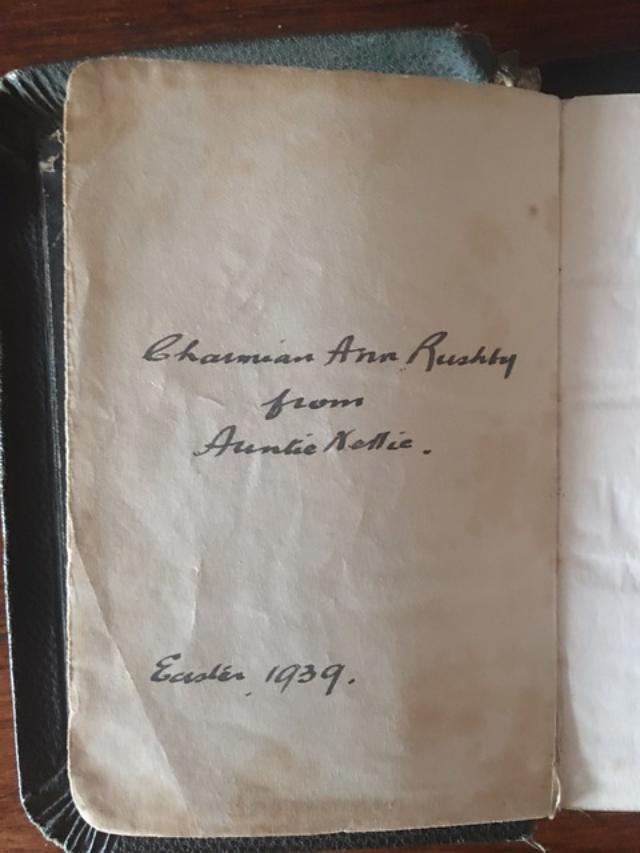 December 15, 2021 at 8:14 am #6235
In reply to: The Elusive Samuel Housley and Other Family Stories
Sydney Smith and Lawrence of Arabia
Hannah Warren 1865-1946 was my great grandfather Samuel’s sister. Hannah married Charles Smith, and their son was Sydney Smith 1888-1971, Lawrence of Arabia’s commanding officer. Sydney’s wife, Clare Sydney Smith, wrote a book about their friendship with Lawrence of Arabia called The Golden Reign.
This photograph of Sydney Smith and Clare is in our collection of family photos. Written on the back: Sydney Smith son of Hannah Smith sister of Samuel Warren married Clare Eustace Jameson, niece of Earl Haig.
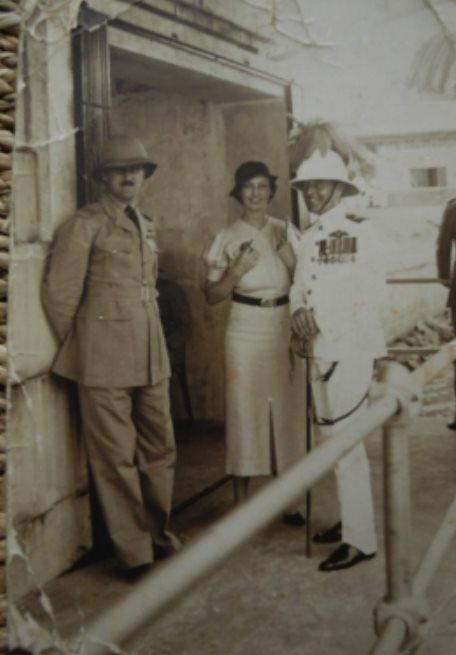
The Burton Observer and Chronicle – Thursday 19 September 1940:
BURTONIANS’ FRIENDSHIP WITH EX-ARAB LEADER. By Clare Sydney Smith (Cassell, 12s. 6d.). general interest as an intimate study of the most romantic personality on the Allied side… this volume has distinctly local appeal, for the authoress, who is a niece of the late Earl Haig, is the wife of Mr Commodore Sydney Smith, eldest son of Mr. Charles Smith (former joint managing director of Allsopp’s). Her volume, on the whole, is a fascinating record of the devoted friendship which existed between Colonel Lawrence of Arabia, her husband and herself during the latter years of the one-time Arab leader’s life. Their acquaintance with Lawrence, alias Aircraftman T. E. Shaw, commenced with the Cairo Conference in 1920.
A photograph from the book: From left to right: Lord Astor, Wing-Commander Sydney Smith, Lady Astor, George Bernard Shaw, Charlotte Shaw (hiding behind GBS’s shoulder), Sydney’s daughter Maureen Sydney Smith, an unknown man, Clare Sydney Smith, and on the ladder, T.E.’s feet.
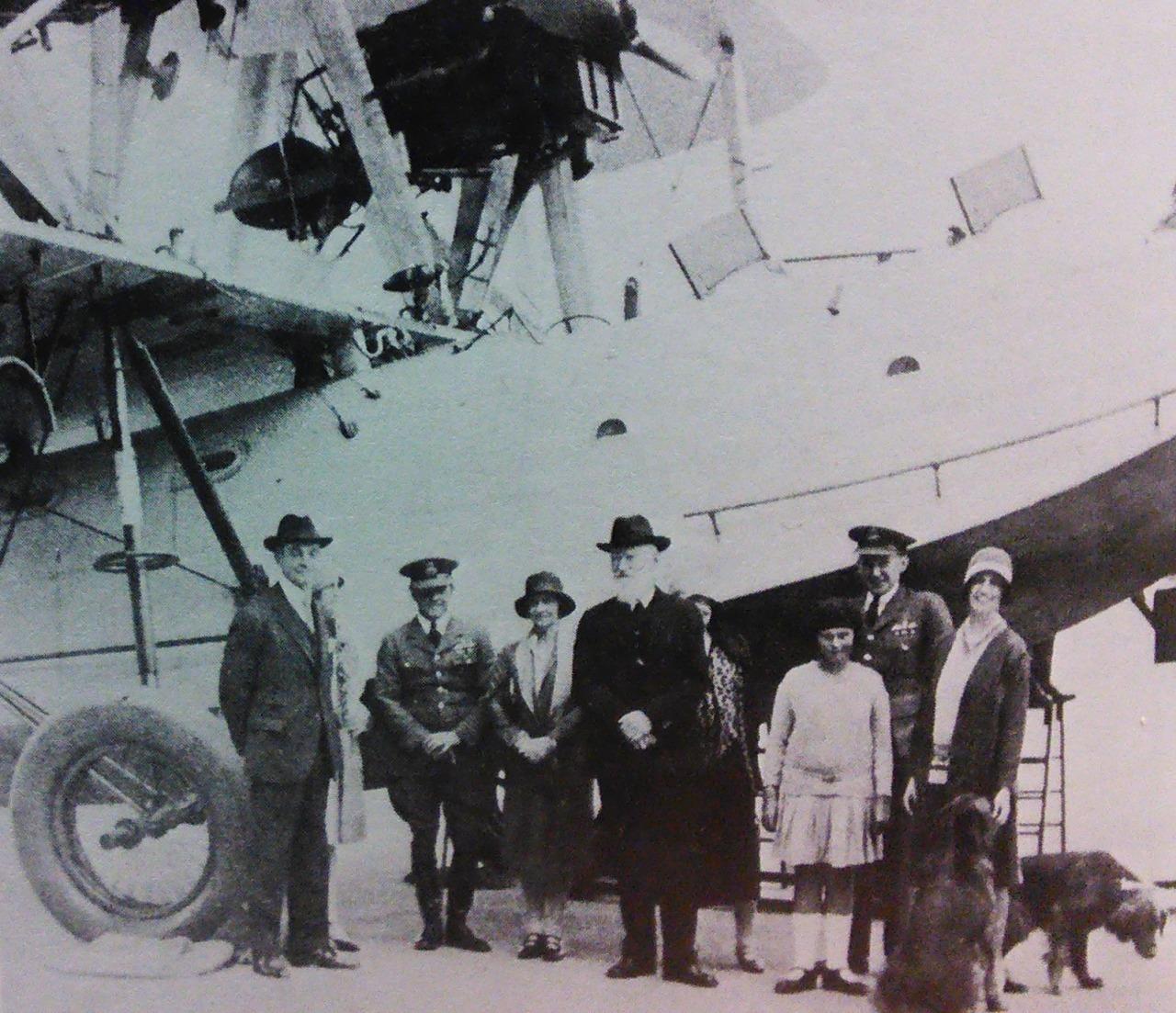
Also from Clare’s book:
Sydney Smith with Lawrence of Arabia:
 September 18, 2021 at 8:26 pm #6213
In reply to: The Precious Life and Rambles of Liz Tattler
“Well, I wish you would stop interrupting me while I fill in the empty pages of my pink notebook with gripping stories, I keep losing my thread. Most annoying!” Liz sighed. She wrote Liz snapped at first and then erased it and changed it to Liz sighed. Then she added Liz sighed with the very mildest slight irritation and then became exasperated with the whole thing and told herself to just leave it and try to move on!
But really, Finnley’s timing, as usual! Just as Liz had worked out the direct line to the characters fathers mothers fathers fathers mothers fathers mothers fathers father and mother, Finnley wafts through the scene, making herself conspicuous, and scattering Liz’s tenuous concentration like feathers in the wind.
“And I don’t want to hear a word about apostrophes either,” she added, mentally noting the one in don’t.
“Oh, now I see what you’re doing, Liz!” Gordon appeared, smoking a pipe. “Very clever!”
“Good God, Gordon, you’re smoking a pipe!” It was an astonishing sight. “What an astonishing sight! Where are your nuts?”
“Well, it’s like this,” Gordon grinned, “I’ve been eating nuts in every scene for, how long? I just can’t face another nut.”
Liz barked out a loud cackle. “You think that’s bad, have you seen what they keep dressing me in? Anyway, ” she asked, “What do you mean clever and you see what I’m doing? What am I doing?”
“The code, of course! I spotted it right away,” Gordon replied smugly.
Finnley heaved herself out of the pool and walked over to Liz and Gordon. (is it Gordon or Godfrey? Liz felt the cold tendrils of dread that she had somehow gone off the track and would have to retrace her steps and get in a fearful muddle Oh no! )
A splat of blue algae across her face, as Finnley flicked the sodden strands of dyed debris off that clung to her hair and body, halted the train of thought that Liz had embarked on, and came to an abrupt collision with a harmless wet fish, you could say, as it’s shorter than saying an abrupt collision with a bit of dyed blue algae.
Liz yawned. Finnley was already asleep.
“What was in that blue dye?”
June 12, 2021 at 9:37 pm #6208In reply to: Newsreel from the Rim of the Realm
“Not so fast!” Glor muttered grimly, grabbing a flapping retreating arm of each of her friends, and yanking them to her sides. “Now’s our chance. It’s a trap, dontcha see? They got the wind up, and they’re gonna round us all up, it don’t bear thinking about what they’ll do next!”
With her free hand Mavis felt Gloria’s forehead, her palm slipping unpleasantly over the feverish salty slick. “Her’s deplirious, Sha, not right in the ‘ead, the ‘eat’s got to her. Solar over dose or whatever they call it nowadays.”
“My life depends on going to the bloody assembly hall, Glor, let go of my arm before I give yer a Glasgow kiss,” Sharon hissed, ignoring Mavis.
“I’m trying to save you!” screeched Gloria, her head exploding in exasperation. She took a deep breath. Told herself to stop screeching like that, wasn’t helping her cause. Should she just let go of Sharon’s arm?
Mavis started trying to take the pulse on Glor’s restraining wrists, provoking Gloria beyond endurance, and she lashed out and slapped Mavis’s free hand away, unintentionally freeing Sharon from her grasp. This further upset the balance and Gloria tumbled into Mavis at the moment of slapping her hand, causing a considerably more forceful manoeuvre than was intended.
Sharon didn’t hesitate to defend Mavis from the apparently deranged attack, and dived on to Gloria, pinning her arms behind her back.
Mavis scrambled to her feet and backed away slowly, nursing her hand, wide eyed and slack jawed in astonishment.
Where was this going?
June 7, 2021 at 12:42 am #6203In reply to: Newsreel from the Rim of the Realm
“Pssst”
Glor startled. She’d been watching Mavis and Shar through the day-room window. Against her advice, they had joined the outdoor CryoChi class and it really was a hoot watching them gyrating around. All of a sudden though, like a bloody sign, there was a butterfly! Landed on the window ledge and then bumped against the glass like it were trying to get in. Most peculiar. Anyway it had got her thinking about how she was a bit like a butterfly herself. And how she was going to flit around showing off her fine new face. Soon as she got out of here anyway.
“Wot are you pissting about? Gave me a fright you did!” Glor frowned. “I was doing me meditations.”
“Sorry,” said Sophie.
“Sophie, ain’t it? You’re new here?”
Sophie nodded and looked so downcast that Glor softened.
“Well don’t you worry. A few beauty treatments and you’ll scrub up alright.” She paused, wondering if there was a kindly way of mentioning the latex. “And maybe a brand new outfit to go with the new face!” It didn’t seem to cheer Sophie up any and Glor sighed. “What were you pissting about anyway, Sophie?”
Sophie looked nervously over her shoulder. “I’m here against my will. In fact, I don’t even know where I am.”
Glor cocked her head. “Speak up, Sophie.”
“I said I’m here against my will!”
Glor nodded. “Hubby book you in did he? My first were always threatening to do that if I didn’t tidy myself up. Bastard. He’ll be sorry now though.” She smiled, thinking of the butterfly.
February 6, 2021 at 1:23 pm #6185In reply to: Twists and One Return From the Time Capsule
“I’ll be right back!” Nora told Will, who was stirring a big bubbling pot on the stove. “Need to wash my hands.”
She had a quick look around the bedroom she’d slept in for her missing phone. Nowhere to be found! Maybe she could find Will’s phone when he went out to feed the donkey, and call her phone to try and locate it. Damn, that wouldn’t work either. Will had said there was no network here. That would explain why her phone stopped working when she was alone in the dark woods.
“Smells delicious!” she said brightly, scraping a chair back across the brick floor and seating herself at the kitchen table.
The home made soup was chock full of vegetables and looked and smelled wonderful, but it had a peculiar acrid aftertaste. Nora tried to ignore it, taking gulps of wine in between each mouthful to eliminate the bitterness. She wished it wasn’t soup in a way, so that she’d be able to surreptitiously palm some of it off onto the dogs that were waiting hopefully under the table. If only Will would leave the room for a minute, but he seemed to be watching her every move.
“Very tasty, but I can’t manage another mouthful, it’s so filling,” she said, but Will looked so offended that she sighed and carried on eating. He topped up her wine glass.
By the time Nora had finished the soup, she felt quite nauseous and stood up quickly to head for the bathroom. The room started to spin and she held on to the edge of the table, but it was no good. The spinning didn’t stop and she crashed to the floor, unconscious.
Smiling with satisfaction, Will stood up and walked around the table to where she lay. Shame he’d had to put her to sleep, really she was quite a nice woman and cute, too, in a funny elfin way. He’d started to like her. Plenty of time to get to know her now, anyway. She wouldn’t be going anywhere for awhile.
He picked her up and carried her to the secret room behind his workshop on the other side of the patio. The walls and floor were thick stone, and there were no windows. He laid her on the bench, locked the door, and went back in the house to fetch blankets and bedding and a pile of books for her to read when she came round. Probably not for a good 24 hours he reckoned, somehow she’d managed to eat all the soup. He would put much less in the next batch, just enough to keep her docile and sleepy.
It would only be for a few days, just long enough for him to find that box and move it to a safer location. He’d been entrusted to make sure the contents of the box were preserved for the people in the future, and he was a man of his word.
If they had listened to him in the first place this would never have happened. Burying a box was a risk: all kinds of possibilities existed for a buried box to be accidentally unearthed. He had suggested encasing the contents inside a concrete statue, but they’d ignored him. Well, now was his chance. He was looking forward to making a new statue.
-
AuthorSearch Results