

Search Results for 'home'
-
AuthorSearch Results
-
December 8, 2024 at 9:42 pm #7656
In reply to: Quintessence: Reversing the Fifth
Matteo — December 1st 2023: the Advent Visit
(near Avignon, France)
The hallway smelled of nondescript antiseptic and artificial lavender, a lingering scent jarring his senses with an irreconciliable blend of sterility and forced comfort. Matteo shifted the small box of Christmas decorations under his arm, his boots squeaking slightly against the linoleum floor. Outside, the low winter sun cast long, pale shadows through the care facility’s narrow windows.
When he reached Room 208, Matteo paused, hand resting on the doorframe. From inside, he could hear the soft murmur of a holiday tune—something old-fashioned and meant to be cheerful, likely playing from the small radio he’d gifted her last year. Taking a breath, he stepped inside.
His mother, Drusilla sat by the window in her padded chair, a thick knit shawl draped over her frail shoulders. She was staring intently at her hands, her fingers trembling slightly as they folded and unfolded the edge of the shawl. The golden light streaming through the window framed her face, softening the lines of age and wear.
“Hi, Ma,” Matteo said softly, setting the box down on the small table beside her.
Her head snapped up at the sound of his voice, her eyes narrowing as she fixed him with a sharp, almost panicked look. “Léon?” she said, her voice shaking. “What are you doing here? How are you here?” There was a tinge of anger in her tone, the kind that masked fear.
Matteo froze, his breath catching. “Ma, it’s me. Matteo. I’m Matteo, your son, please calm down” he said gently, stepping closer. “Who’s Léon?”
She stared at him for a long moment, her eyes clouded with confusion. Then, like a tide retreating, recognition crept back into her expression. “Matteo,” she murmured, her voice softer now, though tinged with exhaustion. “Oh, my boy. I’m sorry. I—” She looked away, her hands clutching the shawl tighter. “I thought you were someone else.”
“It’s okay,” Matteo said, crouching beside her chair. “I’m here. It’s me.”
Drusilla reached out hesitantly, her fingers brushing his cheek. “You look so much like him sometimes,” she said. “Léon… your father. He’d hold his head just like that when he didn’t want anyone to know he was worried.”
As much as Matteo knew, Drusilla had arrived in France from Italy in her twenties. He was born soon after. She had a job as a hairdresser in a little shop in Avignon, and did errands and chores for people in the village. For the longest time, it was just the two of them, as far as he’d recall.
Matteo’s chest tightened. “You’ve never told me much about him.”
“There wasn’t much to tell,” she said, her voice distant. “He came. He left. But he gave me something before he went. I always thought it would mean something, but…” Her voice trailed off as she reached into the pocket of her shawl and pulled out a small silver medallion, worn smooth with age. She held it out to him. “He said it was for you. When you were older.”
Matteo took the medallion carefully, turning it over in his hand. It was a simple but well-crafted Saint Christopher medal, the patron saint of travellers, with faint initials etched on the back—L.A.. He didn’t recognize the letters, but the weight of it in his palm felt significant, grounding.
“Why didn’t you give it to me before?” he asked, his voice quiet.
“I forgot I had it,” she admitted with a faint, sad laugh. “And then I thought… maybe it was better to keep it. Something of his, for when I needed it. But I think it’s yours now.”
Matteo slipped the medallion into his pocket, his mind spinning with questions he didn’t want to ask—not now. “Thanks, Ma,” he said simply.
Drusilla sighed and leaned back in her chair, her gaze drifting to the small box he’d brought. “What’s that?”
“Decorations,” Matteo said, seizing the moment to shift the focus. “I thought we could make your room a little festive for Christmas.”
Her face softened, and she smiled faintly. “That’s nice,” she said. “I haven’t done that in… I don’t remember when.”
Matteo opened the box and began pulling out garlands and baubles. As he worked, Drusilla watched silently, her hands still clutching the shawl. After a moment, she spoke again, her voice quieter now.
“Do you remember our house in Crest?” she asked.
Matteo paused, a tangle of tinsel in his hands. “Crest?” he echoed. “The place where you wanted to move to?”
Drusilla nodded slowly. “I thought it would be nice. A co-housing place. I could grow old in the garden, and you’d be nearby. It seemed like a good idea then.”
“It was a good idea,” Matteo said. “It just… didn’t happen.”
“No,… you’re right” she said, collecting her thoughts for a moment, her gaze distant. “You were too restless. Always moving. I thought maybe you’d stay if we built something together.”
Matteo swallowed hard, the weight of her words pressing on him. “I wanted to, Ma,” he said. “I really did.”
Drusilla’s eyes softened, and she reached for his hand, her grip surprisingly strong. “You’re here now,” she said. “That’s what matters.”

They spent the next hour decorating the room. Matteo hung garlands around the window and draped tinsel over the small tree he’d set up on the table. Drusilla directed him with occasional nods and murmured suggestions, her moments of lucidity shining like brief flashes of sunlight through clouds.
When the last bauble was hung, Drusilla smiled faintly. “It’s beautiful,” she said. “Like home.”
Matteo sat beside her, emotion weighing on him more than the physical efforts and the early drive. He was thinking about the job offer in London, the chance to earn more money to ensure she had everything she needed here. But leaving her felt impossible, even as staying seemed equally unsustainable. He was afraid it was just a justification to avoid facing the slow fraying of her memories.
Drusilla’s voice broke through his thoughts. “You’ll figure it out,” she said, her eyes closing as she leaned back in her chair. “You always do.”
Matteo watched her as she drifted into a light doze, her breathing steady and peaceful. He reached into his pocket, his fingers brushing against the medallion. The weight of it felt like both a question and an answer—one he wasn’t ready to face yet.
“Patron saint of travellers”, that felt like a sign, if not a blessing.
December 8, 2024 at 6:06 am #7655In reply to: Quintessence: Reversing the Fifth
Amei switched on the TV for background noise as she tackled another pile of books. The usual mid-morning chatter filled the room—updates on the weather, a cooking segment, and finally, the news. She was only half-listening until the anchor’s voice caught her attention.
“In the race against climate change, scientists at Harvard are turning to an unexpected solution: chalk. The ambitious project involves launching a balloon into the stratosphere, carrying 600 kilograms of calcium carbonate, which would be sprayed 12 miles above the Earth’s surface. The idea? To reflect sunlight and slow global warming.”
Amei looked up. The screen showed an animated demonstration of the project—a balloon rising into the atmosphere, spraying fine particles into the air. The narration continued, but her focus drifted, caught on a single word: chalk.
Elara loved chalk. Amei smiled faintly, remembering how passionately she used to talk about it—the way she could turn something so mundane into a story of structure, history, and beauty. “It’s not just a rock,” Elara had said once, gesturing dramatically, “it’s a record of time.”
She wasn’t even sure where Elara was these days. The last time they’d spoken was during lockdown. Amei had called to check in, awkward but well-meaning, only to be met with curt responses and a tone that made it clear Elara wanted the conversation over.
She hadn’t tried again after that. It hurt more than she’d expected. Elara could be all or nothing when it came to friendships—brilliant and intense one moment, distant and impenetrable the next. Amei had always known that about her, but knowing didn’t make it any easier.
The news droned on in the background, but Amei reached for the remote and switched off the TV. Her mind was elsewhere, tangled in memories.
She’d first met Elara in a gallery on Southbank, a tiny exhibition tucked away in a brutalist building. It was near Amei’s shared flat, and with her flatmates out for the evening, she had gone alone, more out of boredom than genuine interest. The display wasn’t large—just a few photographs and abstract sculptures, their descriptions dense with scientific jargon.
Amei stood in front of a piece labelled The Geometry of Chaos—a spiraling wire structure that cast intricate, shifting shadows on the wall. She tilted her head, trying to look engaged, though her thoughts were already drifting towards home and her comfy bed.
“Magnificent, isn’t it?”
The voice startled her. She turned to see a dark-haired woman, arms crossed, studying the piece with an intensity that made Amei feel as though she must have missed something obvious. The woman wore a long, flowing skirt, layered necklaces, and a cardigan that looked hand-knitted. Her dark hair was piled into a messy bun, a few strands escaping to frame her face.
“It’s quite interesting,” Amei said. “But I’m not sure I get it.”
“It’s not about getting it. It’s about recognizing the pattern,” the woman replied, stepping closer. She pointed to the shadows on the wall. “See? The curve repeats itself. Infinite, but contained.”
“You sound like you know what you’re talking about.”
“I do,” she said. “Do you?”
Amei laughed, caught off guard. “Not very often. I think I’m more into… messy patterns.”
The woman’s sharp expression softened slightly. “Messy patterns are still patterns.” She smiled. “I’m Elara.”
“Amei,” she replied, returning the smile.
Elara’s gaze dropped, and she nodded toward Amei’s skirt. “I’ve been admiring your skirt. Gorgeous fabric. Where did you get it?”
“Oh, I made it, actually,” Amei felt proud.
Elara raised her eyebrows. “You made it? I’m impressed.”
And that was how it began. A chance meeting that turned into decades of close friendship. They’d left the gallery together, talking all the way to a nearby café.
December 7, 2024 at 11:18 am #7652In reply to: Quintessence: Reversing the Fifth
Darius: The Call Home
South of France: Early 2023
Darius stared at the cracked ceiling of the tiny room, the faint hum of a heater barely cutting through the January chill. His breath rose in soft clouds, dissipating like the ambitions that had once kept him moving. The baby’s cries from the next room pierced the quiet again, sharp and insistent. He hadn’t been sleeping well—not that he blamed the baby.
The young couple, friends of friends, had taken him in when he’d landed back in France late the previous year, his travel funds evaporated and his wellness “influencer” groups struggling to gain traction. What had started as a confident online project—bridging human connection through storytelling and mindfulness—had withered under the relentless churn of algorithm changes and the oversaturated market: even in its infancy, AI and its well-rounded litanies seemed the ubiquitous answers to humanities’ challenges.
“Maybe this isn’t what people need right now,” he had muttered during one of his few recent live sessions, the comment section painfully empty.
The atmosphere in the apartment was strained. He felt it every time he stepped into the cramped kitchen, the way the couple’s conversation quieted, the careful politeness in their questions about his plans.
“I’ve got some things in the works,” he’d say, avoiding their eyes.
But the truth was, he didn’t.
It wasn’t just the lack of money or direction that weighed on him—it was a gnawing sense of purposelessness, a creeping awareness that the threads he’d woven into his identity were fraying. He could still hear Éloïse’s voice in his mind sometimes, low and hypnotic: “You’re meant to do more than drift. Trust the pattern. Follow the pull.”
The pull. He had followed it across continents, into conversations and connections that felt profound at the time but now seemed hollow, like echoes in an empty room.
When his phone buzzed late one night, the sound startling in the quiet, he almost didn’t answer.
“Darius,” his aunt’s voice crackled through the line, faint but firm. “It’s time you came home.”
Arrival in Guadeloupe
The air in Pointe-à-Pitre was thick and warm, clinging to his skin like a second layer. His aunt met him at the airport, her sharp gaze softening only slightly when she saw him.
“You look thin,” she said, her tone clipped. “Let’s get you fed.”
The ride to Capesterre-Belle-Eau was a blur of green —banana fields and palms swaying in the breeze, the mountains rising in the distance like sleeping giants. The scent of the sea mingled with the earthy sweetness of the land, a sharp contrast to the sterile chill of the south of France.
“You’ll help with the house,” his aunt said, her hands steady on the wheel. “And the fields. Don’t think you’re here to lounge.”
He nodded, too tired to argue.
The first few weeks felt like penance. His aunt was tireless, moving with an energy that gainsaid her years, barking orders as he struggled to keep up.
“Your hands are too soft,” she said once, glancing at his blistered palms. “Too much time spent talking, not enough doing.”
Her words stung, but there was no malice in them—only a brutal honesty that cut through his haze.
Evenings were quieter, spent on the veranda with plates of steaming rice and codfish, with the backdrop of cicadas’ relentless and rhythmic agitation. She didn’t ask about his travels, his work, or the strange detours his life had taken. Instead, she told stories—of storms weathered, crops saved, neighbors who came together when the land demanded it.
A Turning Point
One morning, as the sun rose over the fields, his aunt handed him a machete.
“Today, you clear,” she said.
He stood among the ruined banana trees, their fallen trunks like skeletal remains of what had once been vibrant and alive. The air was heavy with the scent of damp earth and decay.
With each swing of the machete, he felt something shift inside him. The physical labor, relentless and grounding, pulled him out of his head and into his body. The repetitive motion—strike, clear, drag—was almost meditative, a rhythm that matched the heartbeat of the land.
By midday, his shirt clung to his back, soaked with sweat. His muscles ached, his hands stung, but for the first time in months, his mind felt quiet.
As he paused to drink from a canteen, his aunt approached, a rare smile softening her stern features.
“You’re starting to see it, aren’t you?” she said.
“See what?”
“That life isn’t just what you chase. It’s what you build.”
Over time, the work became less about obligation and more about integration. He began to recognize the faces of the neighbors who stopped by to lend a hand, their laughter and stories sending vibrant pulsating waves resonant of a community he hadn’t realized he missed.
One evening, as the sun dipped low, a group gathered to share a meal. Someone brought out drums, the rhythmic beat carrying through the warm night air. Darius found himself smiling, his feet moving instinctively to the music.
The trance of Éloïse’s words—the pull she had promised—dissipated like smoke in the wind. What remained was what mattered: it wasn’t the pull but the roots —the people, the land, the stories they shared.
The Bell
It was his aunt who rang the bell for dinner one evening, the sound sharp and clear, cutting through the humid air like a call to attention.
Darius paused, the sound resonating in his chest. It reminded him of something—a faint echo from his time with Éloïse and Renard, but different. This was simpler, purer, untainted by manipulation.
He looked at his aunt, who was watching him with a knowing smile. “You’ve been lost a long time, haven’t you?” she said quietly.
Darius nodded, unable to speak.
“Good,” she said. “It means you know the way back.”
By the time he wrote to Amei, his hand no longer trembled. “Guadeloupe feels like a map of its own,” he wrote, the words flowing easily. “its paths crossing mine in ways I can’t explain. It made me think of you. I hope you’re well.”
For the first time in years, he felt like he was on solid ground—not chasing a pull, but rooted in the rhythm of the land, the people, and himself.
The haze lifted, and with it came clarity and maybe hope. It was time to reconnect—not just with long-lost friends and shared ideals, but with the version of himself he thought he’d lost.
December 5, 2024 at 11:01 pm #7647In reply to: Quintessence: Reversing the Fifth
Darius: A Map of People
June 2023 – Capesterre-Belle-Eau, Guadeloupe
The air in Capesterre-Belle-Eau was thick with humidity, the kind that clung to your skin and made every movement slow and deliberate. Darius leaned against the railing of the veranda, his gaze fixed on the horizon where the sky blends into the sea. The scent of wet earth and banana leaves filling the air. He was home.
It had been nearly a year since hurricane Fiona swept through Guadeloupe, its winds blowing a trail of destruction across homes, plantations, and lives. Capesterre-Belle-Eau had been among the hardest hit, its banana plantations reduced to ruin and its roads washed away in torrents of mud.
Darius hadn’t been here when it happened. He’d read about it from across the Atlantic, the news filtering through headlines and phone calls from his aunt, her voice brittle with worry.
“Darius, you should come back,” she’d said. “The land remembers everyone who’s left it.”
It was an unusual thing for her to say, but the words lingered. By the time he arrived in early 2023 to join the relief efforts, the worst of the crisis had passed, but the scars remained—on the land, on the people, and somewhere deep inside himself.
Home, and Not — Now, passing days having turned into quick six months, Darius was still here, though he couldn’t say why. He had thrown himself into the work, helped to rebuild homes, clear debris, and replant crops. But it wasn’t just the physical labor that kept him—it was the strange sensation of being rooted in a place he’d once fled.
Capesterre-Belle-Eau wasn’t just home; it was bones-deep memories of childhood. The long walks under the towering banana trees, the smell of frying codfish and steaming rice from his aunt’s kitchen, the rhythm of gwoka drums carrying through the evening air.
“Tu reviens pour rester cette fois ?” Come back to stay? a neighbor had asked the day he returned, her eyes sharp with curiosity.
He had laughed, brushing off the question. “On verra,” he’d replied. We’ll see.
But deep down, he knew the answer. He wasn’t back for good. He was here to make amends—not just to the land that had raised him but to himself.
A Map of Travels — On the veranda that afternoon, Darius opened his phone and scrolled through his photo gallery. Each image was pinned to a digital map, marking all the places he’d been since he got the phone. Of all places, it was Budapest which popped out, a poor snapshot of Buda Castle.
He found it a funny thought — just like where he was now, he hadn’t planned to stay so long there. He remembered the date: 2020, in the midst of the pandemic. He’d spent in Budapest most of it, sketching the empty streets.
Five years ago, their little group of four had all been reconnecting in Paris, full of plans that never came to fruition. By late 2019, the group had scattered, each of them drawn into their own orbits, until the first whispers of the pandemic began to ripple across the world.
Funding his travels had never been straightforward. He’d tried his hand at dozens of odd jobs over the years—bartending in Lisbon, teaching English in Marrakech, sketching portraits in tourist squares across Europe. He lived frugally, keeping his possessions light and his plans loose. Yet, his confidence had a way of opening doors; people trusted him without knowing why, offering him opportunities that always seemed to arrive at just the right time.
Even during the pandemic, when the world seemed to fold in on itself, he had found a way.
Darius had already arrived in Budapest by then, living cheaply in a rented studio above a bakery. The city had remained open longer than most in Europe or the world, its streets still alive with muted activity even as the rest of Europe closed down. He’d wandered freely for months, sketching graffiti-covered bridges, quiet cafes, and the crumbling facades of buildings that seemed to echo his own restlessness.
When the lockdowns finally came like everywhere else, it was just before winter, he’d stayed, uncertain of where else to go. His days became a rhythm of sketching, reading, and sending postcards. Amei was one of the few who replied—but never ostentatiously. It was enough to know she was still there, even if the distance between them felt greater than ever.
But the map didn’t tell the whole story. It didn’t show the faces, the laughter, the fleeting connections that had made those places matter.
Swatting at a buzzing mosquito, he reached for the small leather-bound folio on the table beside him. Inside was a collection of fragments: ticket stubs, pressed flowers, a frayed string bracelet gifted by a child in Guatemala, and a handful of postcards he’d sent to Amei but had never been sure she received.
One of them, yellowed at the edges, showed a labyrinth carved into stone. He turned it over, his own handwriting staring back at him.
“Amei,” it read. “I thought of you today. Of maps and paths and the people who make them worth walking. Wherever you are, I hope you’re well. —D.”
He hadn’t sent it. Amei’s responses had always been brief—a quick WhatsApp message, a thumbs-up on his photos, or a blue tick showing she’d read his posts. But they’d never quite managed to find their way back to the conversations they used to have.
The Market — The next morning, Darius wandered through the market in Trois-Rivières, a smaller town nestled between the sea and the mountains. The vendors called out their wares—bunches of golden bananas, pyramids of vibrant mangoes, bags of freshly ground cassava flour.
“Tiens, Darius!” called a woman selling baskets woven from dried palm fronds. “You’re not at work today?”
“Day off,” he said, smiling as he leaned against her stall. “Figured I’d treat myself.”
She handed him a small woven bracelet, her eyes twinkling. “A gift. For luck, wherever you go next.”
Darius accepted it with a quiet laugh. “Merci, tatie.”
As he turned to leave, he noticed a couple at the next stall—tourists, by the look of them, their backpacks and wide-eyed curiosity marking them as outsiders. They made him suddenly realise how much he missed the lifestyle.
The woman wore an orange scarf, its boldness standing out as if the color orange itself had disappeared from the spectrum, and only a single precious dash could be seen into all the tones of the market. Something else about them caught his attention. Maybe it was the way they moved together, or the way the man gestured as he spoke, as if every word carried weight.
“Nice scarf,” Darius said casually as he passed.
The woman smiled, adjusting the fabric. “Thanks. Picked it up in Rajasthan. It’s been with me everywhere since.”
Her partner added, “It’s funny, isn’t it? The things we carry. Sometimes it feels like they know more about where we’ve been than we do.”
Darius tilted his head, intrigued. “Do you ever think about maps? Not the ones that lead to places, but the ones that lead to people. Paths crossing because they’re meant to.”
The man grinned. “Maybe it’s not about the map itself,” he said. “Maybe it’s about being open to seeing the connections.”
A Letter to Amei — That evening, as the sun dipped below the horizon, Darius sat at the edge of the bay, his feet dangling above the water. The leather-bound folio sat open beside him, its contents spread out in the fading light.
He picked up the labyrinth postcard again, tracing its worn edges with his thumb.
“Amei,” he wrote on the back just under the previous message a second one —the words flowing easily this time. “Guadeloupe feels like a map of its own, its paths crossing mine in ways I can’t explain. It made me think of you. I hope you’re well. —D.”
He folded the card into an envelope and tucked it into his bag, resolving to send it the next day.
As he watched the waves lap against the rocks, he felt a sense of motion rolling like waves asking to be surfed. He didn’t know where the next path would lead next, but he felt it was time to move on again.
December 3, 2024 at 7:51 am #7636In reply to: Quintessence: Reversing the Fifth
It was cold in Kent, much colder than Elara was used to at home in the Tuscan olive groves, but Mrs Lovejoy kept the guest house warm enough. On site at Samphire Hoe was another matter, the wind off the sea biting into her despite the many layers of clothing. It had been Florian’s idea to take the Mongolian hat with her. Laughing, she’d replied that it might come in handy if there was a costume party. Trust me, you’re going to need it, he’d said, and he was right. It had been a present from Amei, many years ago, but Elara had barely worn it. It wasn’t often that she found herself in a place cold enough to warrant it.
In a fortuitous twist of fate, Florian had asked if he could come and stay with her for awhile to find his feet after the tumultuous end of a disastrous relationship. It came at a time when Elara was starting to realise that there was too much work for her alone keeping the old farmhouse in order. Everyone wants to retire to the country but nobody thinks of all the work involved, at an age when one prefers to potter about, read books, and take naps.
Florian was a long lost (or more correctly never known) distant relative, a seventh cousin four times removed on her paternal side. They had come into contact while researching the family, comparing notes and photographs and family anecdotes. They became friends, finding they had much in common, and Elara was pleased to have him come to stay with her. Likewise, Florian was more than willing to help around the beautiful old place, and found it conducive to his writing. He spent the mornings gardening, decorating or running errands, and the afternoons tapping away at the novel he’d been inspired to start, sitting at the old desk in front of the French windows.
If it hadn’t been for Florian, Elara wouldn’t have accepted the invitation to join the chalk project. He had settled in so well, already had a working grasp of Italian, and got on well with her neighbours. She could leave him to look after everything and not worry about a thing.
Pulling the hat down over her ears, Elara ventured out into the early November chill. Mrs Lovejoy was coming up the path to the guesthouse, having been out to the corner shop. “I say, that’s a fine hat you have there, that’ll keep your cockles warm!” Mrs Lovejoy was bareheaded, wearing only a cardigan.
“It was a gift,” Elara told her, “I haven’t worn it much. A friend bought it for me years ago when we were in Mongolia.”
“Very nice, I’m sure,” replied the landlady, trying to remember where Mongolia was.
“Yes, she was nice,” Elara said wistfully. “We lost contact somehow.”
“Ah yes, well these things happen,” Mrs Lovejoy said. “People come into your life and then they go. Like my Bert…”
“Must go or I’ll be late!” Elara had already heard all about Bert a number of times.
December 2, 2024 at 8:35 pm #7634In reply to: Quintessence: Reversing the Fifth
Nov.30, 2024 2:33pm – Darius: The Map and the Moment
Darius strolled along the Seine, the late morning sky a patchwork of rainclouds and stubborn sunlight. The bouquinistes’ stalls were already open, their worn green boxes overflowing with vintage books, faded postcards, and yellowed maps with a faint smell of damp paper overpowered by the aroma of crêpes and nearby french fries stalls. He moved along the stalls with a casual air, his leather duffel slung over one shoulder, boots clicking against the cobblestones.
The duffel had seen more continents than most people, its scuffed surface hinting at his nomadic life. India, Brazil, Morocco, Nepal—it carried traces of them all. Inside were a few changes of clothes, a knife he’d once bought off a blacksmith in Rajasthan, and a rolled-up leather journal that served more as a collection of ideas than a record of events.
Darius wasn’t in Paris for nostalgia, though it tugged at him in moments like this. The city had always been Lucien’s thing —artistic, brooding, and layered with history. For Darius, Paris was just another waypoint. Another stop on a map that never quite seemed to end.
It was the map that stopped him, actually. A tattered, hand-drawn thing propped against a pile of secondhand books, its edges curling like a forgotten leaf. Darius leaned in, frowning at its odd geometry. It wasn’t a city plan or a geographical rendering; it was… something else.
“Ah, you’ve found my prize,” said the bouquiniste, a short older man with a grizzled beard and a cigarette dangling from his lips.
“This?” Darius held up the map, his dark fingers tracing the looping, interconnected lines. They reminded him of something—a mandala, maybe, or one of those intricate yantras he’d seen in a temple in Varanasi.
“It’s not a real place,” the bouquiniste continued, leaning closer as though revealing a secret. “More of a… philosophical map.”
Darius raised an eyebrow. “A philosophical map?”
The man gestured toward the lines. “Each path represents a choice, a possibility. You could spend your life trying to follow it, or you could accept that you already have.”
Darius tilted his head, the edges of a smile forming. “That’s deep for ten euros.”
“It’s twenty,” the bouquiniste corrected, his grin flashing gold teeth.
Darius handed over the money without a second thought. The map was too strange to leave behind, and besides, it felt like something he was meant to find.
He rolled it up and tucked it into his duffel, turning back toward the city’s winding streets. The café wasn’t far now, but he still had time.
He stopped by a street vendor selling espresso shots and ordered one, the strong, bitter taste jolting his senses awake. As he leaned against a lamppost, he noticed his reflection in a shop window: a tall, broad-shouldered man, his dark skin glistening faintly in the misty air. His leather jacket was worn at the elbows, his boots dusted with dirt from some far-flung place.
He looked like a man who belonged everywhere and nowhere—a nomad who’d long since stopped wondering what home was supposed to feel like.
India had been the last big stop. It was messy, beautiful chaos. The temples had been impressive, sure, but it was the street food vendors, the crowded markets, the strolls on the beach with the peaceful cows sunbathing, and the quiet, forgotten alleys that stuck with him. He’d made some connections, met some people who’d lingered in his thoughts longer than they should have.
One of them had been a woman named Anila, who had handed him a fragment of something—an idea, a story, a warning. He couldn’t quite remember now. It felt like she’d been trying to tell him something important, but whatever it was had slipped through his fingers like water.
Darius shook his head, pushing the thought aside. The past was the past, and Paris was the present. He looked at the rolled-up map peeking out of his duffel and smirked. Maybe Lucien would know what to make of it. Or Elara, with her scientific mind and love of puzzles.
The group had always been a strange mix, like a band that shouldn’t work but somehow did. And now, after five years of silence, they were coming back together.
The idea made his stomach churn—not with nerves, exactly, but with a sense of inevitability. Things had been left unsaid back then, unfinished. And while Darius wasn’t usually one to linger on the past, something about this meeting felt… different.
The café was just around the corner now, its brass fixtures glinting through the drizzle. Darius slung his duffel higher on his shoulder and took one last sip of espresso before tossing the cup into a bin.
Whatever this reunion was about, he’d be ready for it.
But the map—it stayed on his mind, its looping lines and impossible paths pressing into his thoughts like a puzzle waiting to be solved.
December 2, 2024 at 1:19 am #7631In reply to: Quintessence: Reversing the Fifth
Amei found the letter waiting on the narrow hallway table; her flatmate, Felix, must have left it there. They rarely crossed paths these days as he was working long shifts at the hospital. His absence suited her—mostly.
It was a novelty to get a letter! She turned it over in her hands, noting the faint coffee stain on one corner and the Paris postmark. The handwriting was sharp and angular, unmistakably Lucien’s. It felt like a relic from another life, a self she’d long ago left behind in favour of the safe existence she had built in London.
She slipped a finger under the flap and opened the envelope. It contained a single piece of paper—she read the words and Lucien’s familiar insistence leapt off the page.
Amei set the letter on the kitchen counter and stood for a moment, staring out the window. The view was of the neighbouring building—a dreary brick wall streaked with stains, its monotony interrupted only by a single trailing vine struggling to cling to life.
The flat was small but tidy, shaped by two lives that rarely intersected. Felix’s presence was minimal: a mug left on the counter, a jacket draped over a chair. The rest was hers—books stacked on shelves, notebooks brimming with half-formed ideas, and an easel by the window holding an unfinished canvas. She freelanced as a textile designer. On the desk lay fabric swatches and sketches for her latest project—a clean, modern design for a boutique client. The work was steady and paid the bills but left little room for the creative freedom she once craved.
It certainly wasn’t the life she’d envisioned for herself at twenty, or even thirty, but it was functional. Yet there was an emptiness to it all; she was good at what she did, but the passion she’d once felt for her work had dulled.
There were no children at home to fill the silence, no pets to demand her attention. Relationships had come and gone, but none had felt like forever. Felix offered a semblance of company, though their conversations had dwindled to polite exchanges or the odd humorous anecdote. Her days had settled into a rhythm of predictability, punctuated only by deadlines and occasional dinners with colleagues she liked but never truly connected with.
Amei sank into the armchair by the window. Should she go? She had to admit she was curious. It must be nearly five years since they had last been together and the events of that last occasion still haunted her.
She leaned back, her gaze trailing to the vine outside the window, and let the question linger.
November 18, 2024 at 9:40 pm #7605In reply to: The Incense of the Quadrivium’s Mystiques
Although the small hotel was tucked in a relatively quiet corner, and despite the authentic but delightfully shabby interior of soothing dimensions ~ roomy and airy, but not vast and terrifyingly empty ~ the constant background hum of city life was making Truella yearn for the stillness of home. Not that home was silence, indeed not: the background tranquility was frequently punctuated with noises, many strident. A dog barks, a neighbour shouts, a car drives past from time to time. But the noises have an identifiable individuality and reason, unlike the continual maddening drone of the metropolis.
She was pleased to find her room had a little balcony. Even if the little wooden chair was rickety and uncomfortable, it was enough to perch on to enjoy a cigarette and breathe in the car fumes. Truella slept fitfully, waking to remember Tolkeinesque snapshots of dreams, drifting off again and returning to wakefullness with snatches of conversations in unknown tongues. Sitting on the balcony in the deep dark hours of the night, the street below, now quiet, shivered and changed, her head still swimming with dream images. She caught glimpses of people as they passed, vivid, clear and full of character. Many who passed were carrying bunches of grasses or herbs or wildflowers in their hands, the women with a basket over their arm and a shawl draped over their head or shoulders.
Hardly any men though, I wonder why?
When Truella mentioned it over breakfast the next moring, Eris said “You’ve been reading too much of that new gender and feminist anthropology stuff over on GreenGrotto.”
Laughing, Truella tipped another packet of sugar in her coffee. “I love the colour of the walls in here,” she said, gazing around the breakfast room. “A sort of bright but muted sun shining on a white wall. Nice old furniture, too.”
“Tell me about the old furniture, the mirror in my room is all speckled, makes me look like I have blemishes all over my face,” said Zeezel with a toss of her head. “Can I have your sugar, Frella, if you’re not having it,” adding I’m on holiday by way of excuse.
Absentmindely Frella passed over the paper packet. “I had strange dreams last night too…about that place we’re supposed to be going to a picnic to later.”
Catching everyones attention, she continued, “The abandoned colosseum with Giovanni, with all the vines and flowers. It was like a game board and the stone statues were the players and they moved around the board, Oh! and such a beautiful board it was with all the vines and flowers ….. ”
“Gosh” said Truella, leaning back and folding her hands. What an idea.
November 7, 2024 at 9:34 pm #7591In reply to: The Incense of the Quadrivium’s Mystiques
Eris had called in sick. Even with the worst case of cold she’s had in years, she was feeling well enough to do jinx-from-home duties, and while her brain was in slow motion, she was relishing the quiet from the daily nagging of processes at the Quadrivium’s office, paperwork, tedious explaining to new hires in the ever growing coven extensions.
When Jeezel called her at the end of the day, she was glad to learn that Truella had found courage to stand up for them. Jeezel had such a colorful way of describing events, and in describing that particular scene where Truella had made her stand, it was always difficult to extract the truth from the makeup.
“You’re not really paying attention, are you?” Jeezel, ever astute to where attention was, quizzed her.
“What made you say that?” Eris didn’t try to deny.
“Oh I guess, when I started to speak about the camels in knickers going for a bath in the ball pit from all the dropped balls this year.”
“Ah, right. That would do.”
“Tell me, anything troubling you, luv’? You know you can tell me things.”
After a little moment, Eris said “Well, it’s just a thought,… but what if I’m in need of change of path?”
“What do you mean?” Jeezel tried to not sound too alarmed. “Not being a witch anymore?”
“Oh, no. Well,… why not, there’s no shame in no magic —but no. More like…”
“What? Quitting the coven?”
“… Yeah. It’s gone to madder and madder, it’s so hard to keep track with all the nonsense.” Eris corrected seeing the face of Jeezel. “Not that nonsense. You know what I mean… the daily nonsense. Our nonsense is fine. More than fine actually.”
“Phew, you had me worried though. Although…”
“I know… Quitting the coven.”
“You could be stripped of magic, if Malové learns about this…” then with more concern in her voice “WE could all be stripped of magic.”
“Yeah, I know. But look, is that what makes us happy?”
“It certainly foots the bill —or more like magically takes care of the bills.”
“Like I said, Jeez’, it’s just a thought, nothing to worry about, actually it helped to get it out.”
“I think it’s more than a thought.” Jeezel said with an air of age-old wisdom. “Let’s see where this leads. Imagine that…”
“Yeah, we’ll see. Thanks for checking in, it’s nice for a change. I don’t know what’s got into the other two these days, they’re always talking about clothing.”
“Yeah, I know. And pjs’.”
“Go figure.”
November 6, 2024 at 9:05 pm #7586In reply to: The Incense of the Quadrivium’s Mystiques
Eris was looking at the moving sausages in the frying pan, like they were possessed with unexplainable energy.
She was not doing the cooking, but Thorsten had thought to send her a video for reasons known to him only. It was making her hungry now. Looking at the moon outside, she was again burning the midnight oil, lost in between bits of plots, vagrant duties and other’s dumped concerns. When did she get caught up in everyone’s mess, she wondered.
She would have tried the doppelganger spell to ease off the pressure by sending a body double to the needful —in most situations, that would do the trick perfectly well. How many times people were sitting in boring meetings nowadays, only present physically while their minds were wandering in other places. That wouldn’t be so different. But the spell came with a bad case of hangover, and last Truella used it was a keen reminder to use with caution.
So she still hadn’t find a way to navigate the demands pressed upon her; to be dependable for her coven, the headwitchstress and basically everyone else with needy emotions.
It was time to get back home. If any of them were left, sausages were waiting.
November 5, 2024 at 10:08 am #7582In reply to: The Incense of the Quadrivium’s Mystiques
The postcard was marked URGENT and the man in charge of postcards made haste to find Thomas Cromwell but he was nowhere to be found. The postcard was damp and the ink had run, but “send your boatman asap” was decipherable. The man in charge of postcards was not aware of any boatman by the name of Asap, but knowing Thomas it was possible he’d found another bright waif to train, probably one of the urchins hanging about the gates waiting for scraps from the kitchen.
“Asap! Asap!” the postcard man called as he ran down to the river. “Boatman Asap!”
“There be no boatman by that name on the masters barge, lad. Are you speaking my language?” replied boatman Rafe.
“Have you seen the master?” the postcard man asked, “And be quick about you, whatever your name is.”
“Aye, I can tell you that. He’s asleep in the barge.”
“Asleep? Asleep? In the middle of the day? You fool, get out of my way!” the postcard man shoved Rafe out of the way roughly. “My Lord Cromwell! Asleep on the barge in the middle of the day! Call the physician, you dolt!”
“Calm yourself man, I am in no need of assistance,” Cromwell said, yawning and rubbing his eyes as he rose to see what all the shouting was about. Being in two places at once was becoming difficult to conceal. He would have to employ a man of concealment to cover for him while he was in Malove’s body.
I must have a word with Thurston about licorice spiders, Cromwell made a mental note to speak to his cook, while holding out his hand for the postcard. “Thank you, Babbidge”, he said to the man in charge of postcards, giving him a few coins. “You did well to find me. That will be all.”
“Rafe,” Cromwell said to the boatman after a slight pause, “Can you row to the future, do you think?”
“Whatever you say, master, just tell me where it is.”
“Therein lies the problem,” replied Thomas Cromwell, promptly falling asleep again.
While Malove was tucking into some sugared ghosts at the party, she felt an odd plucking sensation, as if one of her spells had been accessed.
A split second later, Cromwell woke up. There was no time to lose gathering ingredients for spells, or laborious complicated rituals. Cromwell made a mental note to streamline the future coven with more efficient simple magic.
“Take all your clothes off, Rafe.” Astonished, the boatman removed his hat and his cloak. Thomas Cromwell did likewise. “Now you put my clothes on, Rafe, and I’ll wear yours. Get out of the boat and go and find somewhere under a bush to hide until I come back. I’m taking your boat. Don’t, under any circumstances, allow yourself to be seen.”
Terrified, the boatman scuttled off to seek cover. He’d heard the rumours about Cromwell’s imminent arrest. He almost laughed maniacally when the thought crossed his mind that he wished he had a mirror to see himself in Lord Cromwell’s hat, but that thought quickly turned to horror when he imagined the hat ~ and the head ~ rolling under the scaffold. God save us all, he whispered, knowing that God wouldn’t.
In a split second, boatman Cromwell found himself rowing the barge through flooded orange groves. I must fill my pockets with oranges for Thurston to make spiced orange tarts, he thought, before I return.
“Ah, there you are, bedraggled wench, you did well to send for assistance. A biblical flood if ever I saw one. There’s just one small problem,” Cromwell said as he pulled Truella into the barge, ” I can save you from drowning, but we must return forthwith to the Thames. I can not put my boatman in danger for long.”
“The Thames in the 1500s?” Truella said stupidly, shivering in her wet clothes.
Cromwell looked at her tight blue breeches and thin unseemly vest. “Your clothes simply won’t do”.
“Some dry ones would be nice,” Truella admitted.
“It’s not that your clothes are too wet,” he replied, frowning. He could send Rafe for a kitchenmaids dress, but then what would the kitchenmaid wear? They had one dress only, not racks of garments like the people in the future. Not unless they were ladies.
Lord Thomas Cromwell cast another eye over Truella. She was a similar build to Anne of Chives.
“If you think I’m dressing up as one of Henry’s wives…”
Laughing, Cromwell admitted she had a point. “No, perhaps not a good idea, especially as he does not well like this one. No need for her to be the death of both of us.”
“Look, just drop me off in Limerick on the way home, it’s barely out of your way. It’s probably raining there too, but at least I won’t have to worry about clothes. I’d look awful in one of those linen caps anyway.”
Cromwell gave her an approving look and agreed to her idea. Within a split second they were in Ireland, but Cromwell was in for a surprise.
“Yoohoo, Frella!” Truella called, delighted to see her friend strolling along the river bank. “It’s me!”
Thomas Cromwell pulled the boat up to the river bank, tossing the rope to Frella’s friend to secure it. Frella’s friend grabbed the rope and froze in astonishment. “You! Fancy seeing YOU here! Uncle Thomas!”
November 5, 2024 at 3:36 am #7581In reply to: The Incense of the Quadrivium’s Mystiques
After leaving the clamour of her fellow witches behind, Frella took a moment to ground herself after the whirlwind of ideas and plans discussed during their meeting.
As she walked home, her thoughts drifted back to Herma’s cottage. The treasure trove of curiosities in the camphor chest had captivated her imagination, but the trips had grown tiresome, each journey stretching her time and energy. Instead, she gathered a few items to keep at her own cottage—an ever growing collection of mysterious postcards, a brass spyglass, some aged papers hinting at forgotten histories, and of course, the mirror. Each object hummed with potential, calling to her in quiet moments, urging her to dig deeper.
The treasures from Herma’s chest were scattered across her kitchen table; each object felt like a piece of a larger puzzle, and she was determined to fit them together.
As Frella settled into a chair, she felt a sudden urge to inspect the mirror; the thought of its secrets sent a thrill through her, albeit tinged with trepidation.
It was exquisite, its opalescent sheen casting soft reflections across the room. She held it up to the light, watching colours shift within the glass, swirling like a living entity.
“What do you wish to show me this time?” she whispered.
As she gazed into the mirror, her reflection blurred, and she felt a pull—a connection to the past. Images began to form, and Frella found herself once more staring at the same elderly woman, her silver hair wild and glistening.
As the vision settled around her, Frella felt the air shimmer with energy, and the scene began to shift again. She focused intently, eager to grasp every detail.
Oliver Cromwell sat at a grand wooden desk piled high with scrolls and papers, his quill poised in his hand and brow furrowed in concentration. The room bustled with activity—servants hurried to and fro, and shrill laughter floated in from outside, where a gathering seemed to be taking place.
“By the King’s beard, where is the ink?” Cromwell muttered, his voice a deep rumble. With a flourish, he dipped the quill into a small inkwell that looked suspiciously like it had been made from a goat’s hoof.
With great care, he began to write on a piece of parchment. The ornate script flowed from his quill, remarkably elegant despite the chaos around him.
“To my dearest friend,” he wrote, brow twitching with the effort of being both eloquent and succinct. “I trust this missive finds you well, though your ears may be ringing from the ruckus outside. We’ve recently triumphed over the King, and while my duties as Lord Protector keep me occupied, I have stolen a moment to compose this note.”
He paused, casting a wary glance around the room as if expecting eavesdroppers. “I must admit, I have developed a curious fondness for a young lady who claims she can commune with spirits. I suspect she may know a thing or two about the secret lives of witches. If you find yourself in town, perhaps we could investigate together? Bring wine. And if you can manage it, a decent snack. One can hardly strategise on an empty stomach.”
Cromwell’s mouth twitched into a wry smile as he added, “P.S. If you happen to encounter Seraphina, do inform her that I’ll return her mirror just as soon as I’m done with my… experiments. I fear she may not appreciate the ‘creative applications’ I’ve discovered for it.”
With a sigh of resignation, he sealed the parchment with an ornate wax stamp shaped like a owl. “Now, where did I see that errant messenger?” he grumbled, scanning the room irritably.
Frella placed the mirror gently back on the table, her heart pounding. She needed to unravel the mysteries linking her to Seraphina and Cromwell. The time for discovery was upon her, and with each passing moment, she felt the call of her ancestors echoing through the very fabric of her being.
But could she untangle the mystery before her fellow witches set off on yet another ill-fated adventure? She would have to make haste.
October 29, 2024 at 7:54 am #7575In reply to: The Incense of the Quadrivium’s Mystiques
“Why are you grunting like that Chantelle”, Maurice asked, “Are you in pain?”
Laughing, she replied that she was only grunting out of politeness because the woman in the future expected it. “I don’t think they’re very bright, to be honest. You should see the postcards she sends, everywhere looks weird. Hardly any trees or animals, but all cluttered with strange lumps of grey. And their writing has no sound, not like ours. I’m struggling to decipher the messages”
Maurice leaned his best spear up against the cave wall. “Here, I brought you some nice feathers for your hair.” He wasn’t sure what to make of Chantelle’s invisible friend, and rather wished she’d drop it and do some more painting on the walls.
“Ooh, how pretty! Glad you didn’t bring any more shellfish home, I’m absolutely stuffed on shellfish.”
August 28, 2024 at 6:26 am #7548In reply to: The Elusive Samuel Housley and Other Family Stories
Elton Marshall’s
Early Quaker Emigrants to USA.
The earliest Marshall in my tree is Charles Marshall (my 5x great grandfather), Overseer of the Poor and Churchwarden of Elton. His 1819 gravestone in Elton says he was 77 years old when he died, indicating a birth in 1742, however no baptism can be found.
According to the Derbyshire records office, Elton was a chapelry of Youlgreave until 1866. The Youlgreave registers date back to the mid 1500s, and there are many Marshalls in the registers from 1559 onwards. The Elton registers however are incomplete due to fire damage.
While doing a google books search for Marshall’s of Elton, I found many American family history books mentioning Abraham Marshall of Gratton born in 1667, who became a Quaker aged 16, and emigrated to Pennsylvania USA in 1700. Some of these books say that Abraham’s parents were Humphrey Marshall and his wife Hannah Turner. (Gratton is a tiny village next to Elton, also in Youlgreave parish.)
Abraham’s son born in USA was also named Humphrey. He was a well known botanist.
Abraham’s cousin John Marshall, also a Quaker, emigrated from Elton to USA in 1687, according to these books.
(There are a number of books on Colonial Families in Pennsylvania that repeat each other so impossible to cite the original source)
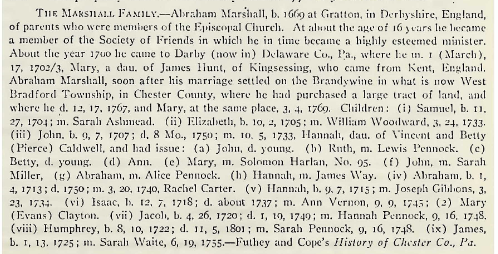
In the Youlgreave parish registers I found a baptism in 1667 for Humphrey Marshall son of Humphrey and Hannah. I didn’t find a baptism for Abraham, but it looks as though it could be correct. Abraham had a son he named Humphrey. But did it just look logical to whoever wrote the books, or do they know for sure? Did the famous botanist Humphrey Marshall have his own family records? The books don’t say where they got this information.
An earlier Humphrey Marshall was baptised in Youlgreave in 1559, his father Edmund. And in 1591 another Humphrey Marshall was baptised, his father George.
But can we connect these Marshall’s to ours? We do have an Abraham Marshall, grandson of Charles, born in 1792. The name isn’t all that common, so may indicate a family connection. The villages of Elton, Gratton and Youlgreave are all very small and it would seem very likely that the Marshall’s who went the USA are related to ours, if not brothers, then probably cousins.
Derbyshire Quakers
In “Derbyshire Quakers 1650-1761” by Helen Forde:
“… Friends lived predominantly in the northern half of the country during this first century of existence. Numbers may have been reduced by emigration to America and migration to other parts of the country but were never high and declined in the early eighteenth century. Predominantly a middle to lower class group economically, Derbyshire Friends numbered very few wealthy members. Many were yeoman farmers or wholesalers and it was these groups who dominated the business meetings having time to devote themselves to the Society. Only John Gratton of Monyash combined an outstanding ministry together with an organising ability which brought him recognition amongst London Friends as well as locally. Derbyshire Friends enjoyed comparatively harmonious relations with civil and Anglican authorities, though prior to the Toleration Act of 1639 the priests were their worst persecutors…..”
Also mentioned in this book: There were monthly meetings in Elton, as well as a number of other nearby places.
John Marshall of Elton 1682/3 appears in a list of Quaker emigrants from Derbyshire.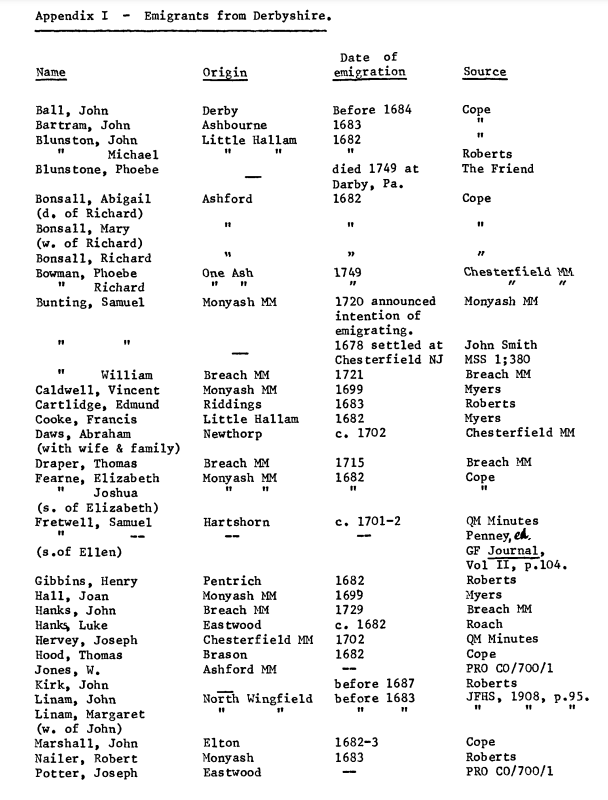
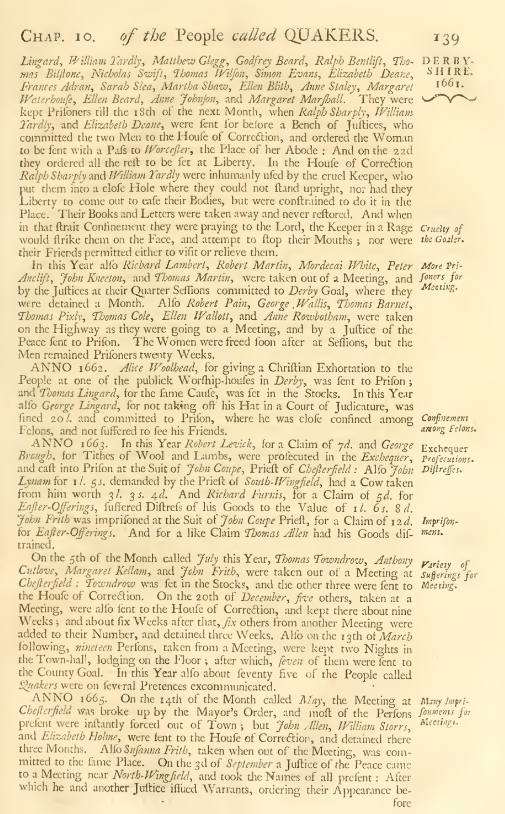
The following image is a page from the 1753 book on the sufferings of Quakers by Joseph Besse as an example of some of the persecutions of Quakers in Derbyshire in the 1600s:
A collection of the sufferings of the people called Quakers, for the testimony of a good conscience from the time of their being first distinguished by that name in the year 1650 to the time of the act commonly called the Act of toleration granted to Protestant dissenters in the first year of the reign of King William the Third and Queen Mary in the year 1689 (Volume 1)
Besse, Joseph. 1753Note the names Margaret Marshall and Anne Staley. This book would appear to contradict Helen Forde’s statement above about the harmonious relations with Anglican authority.
The Botanist
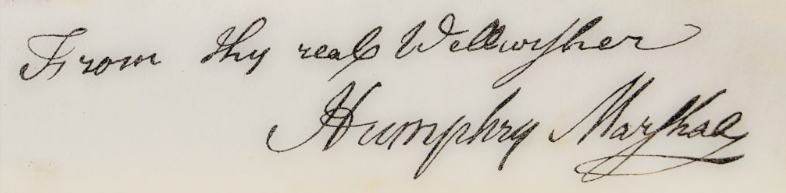
Humphry Marshall 1722-1801 was born in Marshallton, Pennsylvania, the son of the immigrant from Elton, Abraham Marshall. He was the cousin of botanists John Bartram and William Bartram. Like many early American botanists, he was a Quaker. He wrote his first book, A Few Observations Concerning Christ, in 1755.
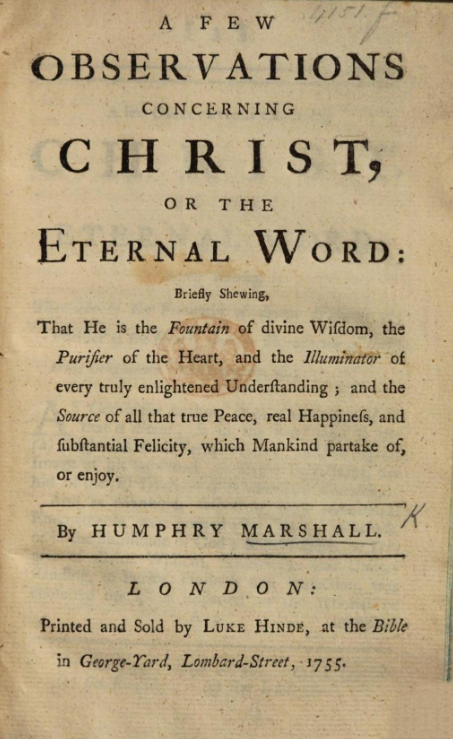
In 1785, Marshall published Arbustrum Americanum: The American Grove, an Alphabetical Catalogue of Forest Trees and Shrubs, Natives of the American United States (Philadelphia).
Marshall has been called the “Father of American Dendrology”.
A genus of plants, Marshallia, was named in honor of Humphry Marshall and his nephew Moses Marshall, also a botanist.
In 1848 the Borough of West Chester established the Marshall Square Park in his honor. Marshall Square Park is four miles east of Marshallton.
via Wikipedia.
From The History of Chester County Pennsylvania, 1881, by J Smith Futhey and Gilbert Cope:
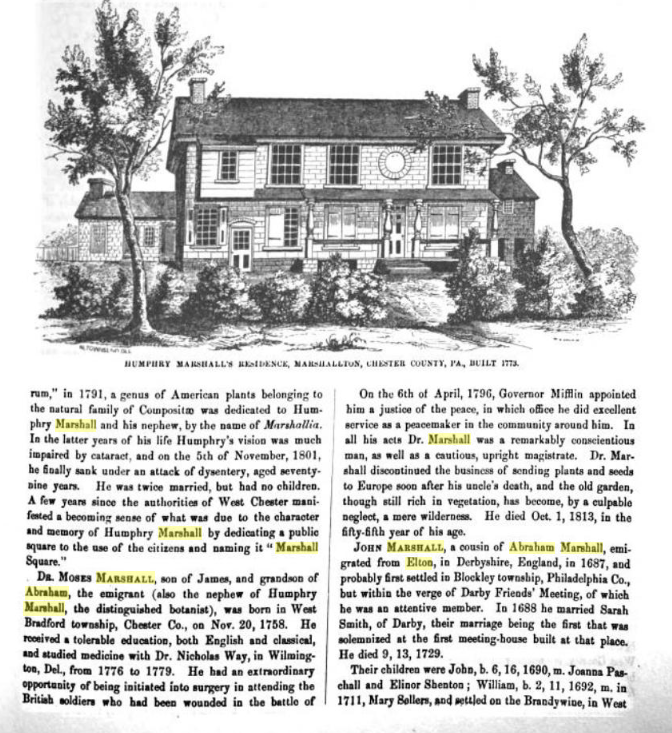
From The Chester Country History Center:
“Immediately on the Receipt of your Letter, I ordered a Reflecting Telescope for you which was made accordingly. Dr. Fothergill had since desired me to add a Microscope and Thermometer, and will
pay for the whole.’– Benjamin Franklin to Humphry, March 18, 1770
“In his lifetime, Humphry Marshall made his living as a stonemason, farmer, and miller, but eventually became known for his contributions to astronomy, meteorology, agriculture, and the natural sciences.
In 1773, Marshall built a stone house with a hothouse, a botanical laboratory, and an observatory for astronomical studies. He established an arboretum of native trees on the property and the second botanical garden in the nation (John Bartram, his cousin, had the first). From his home base, Humphry expanded his botanical plant exchange business and increased his overseas contacts. With the help of men like Benjamin Franklin and the English botanist Dr. John Fothergill, they eventually included German, Dutch, Swedish, and Irish plant collectors and scientists. Franklin, then living in London, introduced Marshall’s writings to the Royal Society in London and both men encouraged Marshall’s astronomical and botanical studies by supplying him with books and instruments including the latest telescope and microscope.
Marshall’s scientific work earned him honorary memberships to the American Philosophical Society and the Philadelphia Society for Promoting Agriculture, where he shared his ground-breaking ideas on scientific farming methods. In the years before the American Revolution, Marshall’s correspondence was based on his extensive plant and seed exchanges, which led to further studies and publications. In 1785, he authored his magnum opus, Arbustum Americanum: The American Grove. It is a catalog of American trees and shrubs that followed the Linnaean system of plant classification and was the first publication of its kind.”
 July 25, 2024 at 7:58 am #7542
In reply to: The Incense of the Quadrivium’s Mystiques
Shivering, Truella pulled the thin blanket over her head. Colder than a witches tit here, colder in summer than winter at home! It was no good, she may as well get up and go for a walk to try and warm up. Poking her head outside Truella gasped and coughed at the chill air. Shapes were becoming discernible in the dim pre dawn light, the other pods, the hedgerow, a couple of looming trees. Truella rummaged through her bag, hoping to find warm clothes yet knowing she hadn’t packed anything warm enough. Sighing, her teeth chattering, she pulled on everything she had in layers and pulled the blanket off the bed to use as a cape. With a towel over her head for extra warmth, she ventured out into the Irish morning.
The grass was sodden with dew and Truella’s feet were wet through and icy. Bracing her shoulders with determination, she forged ahead towards a gate leading into the next field. She struggled for a few minutes with the baler twine holding the gate closed, numb fingers refusing to cooperate. Cows watched her curiously, slowly munching. One lifted her tail and dropped a steaming splat on the grass, chewing continuously. I don’t think I could eat and do that at the same time.
Heading off across the field which sloped gently upwards, Treulla picked up her pace, keeping her eyes down to avoid the cow pats. By the time she reached the oak tree along the top hedge, the sun started to make an appearance over the hill. Warmer from the exercise, she gazed over the countryside. How beautiful it was with the mist in the valleys, and everything so green.
If only it was warmer!
“Are you cold then, is that why you’re decked out like that? From a distance I thought I was seeing a ghost in a cloak and head shawl!” The woman smiled at Truella from the other side of the hedgerow. “Sorry, did I startle you? You’ll get your feet soaked walking in that wet grass, climb over that stile over there, the lane here’s better for a morning walk.”
It sounded like good advice and the woman seemed pleasant enough. “Are you here for the games too?” Truella asked, readjusting the blanket and towel after navigating the stile.
“Yes, I am. I’m retired, you see,” the woman said with a wide grin. “It’s a wonderful thing, not that you’d know, you’re much to young.”
“That must be nice,” Truella replied politely. “I sometimes wish I was retired.”
“Oh, my dear! It’s wonderful! I haven’t had a job for years, but it’s the strangest thing, now that I’ve officially retired, there’s a marvellous feeling of freedom. I don’t have to do anything. Well, I didn’t have to do anything before I retired but one always feels one should keep busy, do productive things, be seen to be doing some kind of work to justify ones existance. Have you seen the old priory?”
“No, only just got here yesterday.”
“You’ll love it, it’s up this path here, follow me. But now I’ve retired,” the woman continued, “I get up in the morning with a sense of liberation. I can do as little as I want ~ funny thing is that I’ve actually been doing more, but there’s no feeling of obligation, no things to cross off a list. All I’m expected to do as a retired person is tick along, trying not to be much of a bother for as long as I can.”
“I wish I was retired!” exclaimed Truella with feeling. “I wish I didn’t have to do the cow goddess stall, it’ll be such a bind having to stand there all evening.” She explained about the coven and the stalls, and the depressing productivity goals.
“But why not get someone else to do the stall for you?”
“It’s such short notice and I don’t know anyone here. It’s an idea though, maybe someone will turn up.”
July 19, 2024 at 12:26 pm #7536In reply to: The Incense of the Quadrivium’s Mystiques
The rainbow was neon bright, one end disappearing behind a spinney in the distance, and the other end landing squarely in the middle of the glamping pods. A good sign! thought Truella, the first of the coven to arrive. For a moment she imagined herself digging a hole right there, and finding the elusive pot of gold. I wouldn’t be able to do that in a fancy hotel. For once, Truella was happy with Austreberthe’s choice. A week or two in a green field sounded relaxing, refreshing. So much more to her taste than the endless fitted carpets, closed windows, and artifically controlled air blasting out of metal grilles in hotels.
Taking a deep breath of cool fresh air, she surveyed the site before checking into reception. The neighbouring fields were full of cows, perfect for her to practice her Bubona spells on before she set up her Goddess Spell Booth. The Goddess spell tents were to be open in the evenings, after the games each day, along with other stalls selling handicrafts, homemade cakes and jams, wines and potions, trinkets and souvenirs, and all the other tat that people on holiday enjoyed browsing. Obviously the coven would have a stall selling incense. No doubt Austreberthe would have hatched some hard sell plan for that.
Inside the reception office, Truella pinged the bell and waited for someone to attend. The registration book was open on the counter and Truella craned her neck to read the names on the list. She planned to ask for a pod in a far corner, near the hedgerow. It might make it easier to slip out unnoticed, if she should have a mind to do so. The door behind the counter opened and a young man appeared, smiling a welcome. But not before Truella had seen the name on the list. She sucked her breath in sharply. Malove! Nobody was expecting her. Did Austreberthe know?
“Welcome to Finnegan’s Farm Glampsite, I’m Liam,” said the young man, pushing long mousy hair out of his eyes, “You’ve a booking I take it, because we’re fully booked up for the next fortnight. Because of the Games, you see.”
Replying that she did, Truella asked for a pod in the furthest corner. Liam looked at a list and frowned. “The corners are all taken, I’m afraid. But I tell you what,” he said, “As you’re the first to arrive I’ll swap your pod, let’s see…” He scanned the list. “Ah yes, the late booking. I can put you in the one we’ve assigned to Mrs …Malone I think it says, and put her in yours.”
“Thank you very much, Liam,” Truella said as he handed her a key with a big wooden tag with the number 33 etched on it.
“I’ll carry your bags over and show you where it is, follow me.”
July 18, 2024 at 2:29 pm #7535In reply to: The Incense of the Quadrivium’s Mystiques
It made sense to go to Ireland during the hot Andalucian summer, and it hadn’t taken much to convince Truella to take a break from her dig and her research. Thousands of years of history would still be there waiting for her when she got home, and it would be a pleasure to see some green lawns and fields. Maybe it would rain, indeed, it was likely that it would. And by the time the Roman Games were over, there would be less of the hot summer at home to endure. Still, it was a nuisance to have to get her winter clothes down out of the attic. She was sure to find it chilly, even cold.
Truella was not fond of water sports (or any sports, but particularly those involving water) and unfortunately the focus of the games seemed to be on swimming and boating. But one of the events has captured her interest. A miniaturisation spell was required, which contestants had to provide themselves, for the Puddles in Potholes races. The worst road in Limerick would be cordoned off and all the potholes filled with water (if they weren’t already full of rain water, which was likely). When Eris pointed out that a miniaturised person could drown in a puddle as easily as a full sized one could drown in a lake, Truella was ready with her answer. If she was drowning, she would immediately reverse the spell and resume her full size. Eris had raised an eyebrow, remarking that she had better make sure her spell was up to scratch, unlike her incense spells had been. Jeezel had wanted to know why she couldn’t just make an enlarging spell and just swim in the river, to which Truella has replied that she didn’t know how deep the river was and how much enlarging would be required. Snorting, Frella said she obviously didn’t know how deep the potholes in Limerick were.
Austreberthe had put their names down for the donkey chariot races, for which they had three days when they arrived to construct the cart and make the costumes. Luckily Frella had plenty of local contacts, and had willingly taken charge of assembling all the materials.
The Booths of the Gods would require some thought. Which Roman god would she choose to be? Which special godly power could she make a spell for? Truella sighed, and went to find her book of Roman gods and goddesses.
July 1, 2024 at 6:37 am #7530In reply to: The Incense of the Quadrivium’s Mystiques
At last the weekend was over. What had been acheived was anyones guess, certainly Truella couldn’t have said if it had been a success from the organizers point of view or not. One thing was abundantly clear: the witches were not cut from the same cloth as the nuns and the pious gravity of some of them had been anathema to the witches. But not all of them, it had to be said.
When Truella had wandered into the library, ostensibly to look for material on the frog sisters, but in reality just wanting a break from the constant presence of so many others, she was initially disheartened to find someone else had the same idea. Sassafras was curled up in an armchair poring over an old journal. She started guiltily when Truella walked in and quickly closed the leather bound volume.
“Oh please, don’t mind me. Carry on reading,” Truella reassured her, “I just came in here for a break. Point me in the direction of the local history section and I’ll not bother you.”
“Are you interested in the local history?” Sassafras asked, genuinely curious.
“Obsessed, more like!” Truella laughed, and proceeded to tell the story of the dig in her garden. She hadn’t intended to go into such detail and at such length, but Sassafras was interested and asked all the right questions.
“You seem very knowledgable about the history of the area,” Truella was prompted to invite Sassafras to come to her house to see what she’d uncovered. “I assume they let you out of here sometimes.”
Sassafras laughed. “Not very often, but I escape. I tell them I’m collecting herbs in the woods. Want to know a secret?” she leaned forward and lowered her voice. “I’m not really a nun, I’m only here because of the place. This place,” she sighed and her eyes had a faraway look, “This place, the history, oh my dear you have no idea, it’s rich beyond imagining for ancient history.”
The conversation that ensued had been illuminating for both of them, and they had agreed to keep in contact. Sassafras had given Truella a bundle of old journals to smuggle out of the Cloisters, written in the early 16th century.
Now all Truella had to do was get the journals home without being detected. It would require an effective cloaking spell, and she wished she had more confidence in her own magic.
June 29, 2024 at 10:01 pm #7527In reply to: The Incense of the Quadrivium’s Mystiques
It was good to get a break from the merger craziness. Eris was thankful for the small mercy of a quiet week-end back at the cottage, free of the second guessing of the suspicious if not philandering undertakers, and even more of the tedious homework to cement the improbable union of the covens.
The nun-witches had been an interesting lot to interact with, but Eris’d had it up to her eyeballs of the tense and meticulous ceremonies. They had been brewing potions for hours on, trying to get a suitable mixture between the herbs the nuns where fond of, and the general ingredients of their own Quadrivium coven’s incenses. Luckily they had been saved by the godlike apparition of another of Frella’s multi-tasking possessions, this time of a willing Sandra, and she’s had harmonized in no time the most perfect blend, in a stroke of brilliance and sheer inspiration, not unlike the magical talent she’d displayed when she invented the luminous world-famous wonder that is ‘Liz n°5’.
As she breathed in the sweet air, Eris could finally enjoy the full swing of summer in the cottage, while Thorsten was happily busy experimenting with an assortment of cybernetic appendages to cut, mulch, segment and compost the overgrown brambles and nettles in the woodland at the back of the property.
Interestingly, she’d received a letter in the mail — quaintly posted from Spain in a nondescript envelop —so anachronistic it was too tempting to resist looking.
Without distrust, but still with a swish of a magical counterspell in case the envelop had traces of unwanted magic, she opened it, only to find it burst with an annoying puff of blue glitter that decided to stick in every corner of the coffee table and other places.
Eris almost cursed at the amount of micro-plastics, but her attention was immediately caught by the Latin sentence mysteriously written in a psychopath ransom note manner: “QUAERO THESAURUM INCONTINUUM”
“Whisp! Elias? A little help here, my Latin must be wrong. What accumulation of incontinence? What sort of spell is that?!”
Echo appeared first, looking every bit like the reflection of Malové. “Quaero Thesaurum Incontinuum,” you say. How quaint, how cryptic, how annoyingly enigmatic. Eris, it seems the universe has a sense of humor—sending you this little riddle while you’re neck-deep in organizational chaos.
“Oh, Echo, stop that! I won’t spend my well-earned week-end on some riddle-riddled chase…”
“You’re no fun Eris” the sprite said, reverting into a more simple form. “It translates roughly to “I seek the endless treasure.” Do you want me to help you dissect this more?”
“Why not…” Eris answered pursing up her lips.
““Seek the endless treasure.” We’re talking obviously something deeper, more profound than simple gold; maybe knowledge —something truly inexhaustible. Given your current state of affairs, with the merger and the restructuring, this message could be a nudge—an invitation to look beyond the immediate chaos and find the opportunity within.”
“Sure,” Eris said, already tired with the explanations. She was not going to spend more time to determine the who, the why, and the what. Who’d sent this? Didn’t really matter if it was an ally, a rival, or even a neutral party with vested interests? She wasn’t interested in seeking an answer to “why now?”. Endless rabbit holes, more like it.
The only conundrum she was left with was to decide whether to keep the pesky glittering offering, or just vacuum the hell of it, and decide if it could stand the test of ‘will it blend?’. She wrapped it in a sheet of clear plastic, deciding it may reveal more clues in the right time.
With that done, Eris’ mind started to wander, letting the enigmatic message linger a while longer… as reminder that while we navigate the mundane, our eyes must always be on the transcendent. To seek the endless treasure…
The thought came to her as an evidence “Death? The end of suffering…” To whom could this be an endless treasure? Eris sometimes wondered how her brain picked up such things, but she rarely doubted it. She might have caught some vibes during the various meetings. Truella mentioning Silas talking about ‘retiring nuns’, or Nemo hinting at Penelope that ‘death was all about…”
The postcard was probably a warning, and they had to stay on their guards.
But now was not the time for more drama, the icecream was waiting for her on the patio, nicely prepared by Thorsten who after a hard day of bramble mulching was all smiling despite looking like he had went through a herd of cats’ fight.
June 21, 2024 at 7:22 am #7511In reply to: The Incense of the Quadrivium’s Mystiques
“What? Malové sent you a personal letter? And a golden key! We merely had a memo for the merger,” Truella said, pacing quickly in Jeezel’s bedroom.
“You’ve been swooning over Mr. Dark since we got here,” said Jeezel. “Have you even checked your own things? Maybe you have some kind of message or clue or I don’t know what. But stop pacing like that, you’ll bore a hole in my floor.”
“That’s not your floor,” said Truella with fire in her eyes.
“Girls, stop. That’s not the point,” said Eris, her voice carrying icy breeze of Sweden’s coldest winters. “We don’t even know if that message is from Malové.”
“What do you mean?” asked Jeezel and Truella in unison.
“Yes, what do you mean?” asked a floating glowing orb with Frella’s voice.
Eris brushed a few sparkling dark purple powder from her chest. “Bloody dragon soot,” she muttered. “Well, from what you told us, Silas tried to jinx you when you were discussing about the rituals. Baiting you with the idea that there are amongst or around us forces that would rather see this merger fail. Then, conveniently, handsome Garrett comes to your rescue and warns you about Silas’ evil plot, and talks to you about the very thing Malové supposedly entrusted you with in that letter, and muddying the waters even further with that tale about ancient Punic families.”
“What’s wrong with Punic families,” said Truella.
“Why are you blushing?” asked Jeezel.
“The point is, that it could very well be part of a plot to plant doubts about everyone and everything, so that we make the merger fail ourselves.”
“And then exit the witches from the picture,” said Frella’s glowing voice.
“But who could possibly have hidden the envelope amongst my things without me noticing?” asked Jeezel.
“Who comes and goes into your home?” asked Eris.
“Yes, who?” asked Truella with a sudden renewed interest.
After a few moments of reflection, Jeezel raised her hand to her mouth. “You can’t mean Joe? My fan’s brother who came to do some works for me.”
“I don’t mean anything. But if I recall well, you mentioned you gave him the keys or your home so that he could come do the repairs whenever you’re not there.”
“You gave him your keys?” asked Truella, her eyes wide open.
“But Luminia would have seen him.”
“Well even a familiar needs to go out sometimes.”
“Or maybe after a torrid night, when you’re finally resting,” suggested Truella.
“Ooh! You would love that!” Jeezel said. Then she put the back of her hand on her forehead and moaned: “My brain’s not made for that kind of messy story. I can’t investigate, do the rituals, flirt with the enemy. There are too many things to do and too many possibilities.”
“There, dear. You have us now,” said Eris, still brushing the dragon soot from her dress.
“And I know one who needs to go to the bottom of a chest,” added Truella. “Frella, we need you here.”
“I’m not sure,” Frella said. “I guess someone has to investigate what really happened to Malové. Who knows if that postcard and that love affair are even real? I’ll let you know.”
-
AuthorSearch Results
