-
AuthorSearch Results
-
December 4, 2024 at 6:22 am #7638
In reply to: Quintessence: Reversing the Fifth
The Bell’s Moment: Paris, Summer 2024 – Olympic Games
The bell was dangling unassumingly from the side pocket of a sports bag, its small brass frame swinging lightly with the jostle of the crowd. The bag belonged to an American tourist, a middle-aged man in a rumpled USA Basketball T-shirt, hustling through the Olympic complex with his family in tow. They were here to cheer for his niece, a rising star on the team, and the bell—a strange little heirloom from his grandmother—had been an afterthought, clipped to the bag for luck. It seemed to fit right in with the bright chaos of the Games, blending into the swirl of flags, chants, and the hum of summer excitement.
1st Ring of the Bell: Matteo
The vineyard was quiet except for the hum of cicadas and the soft rustle of leaves. Matteo leaned against the tractor, wiping sweat from his brow with the back of his hand.
“You’ve done good work,” the supervisor said, clapping Matteo on the shoulder. “We’ll be finishing this batch by Friday.”
Matteo nodded. “And after that?”
The older man shrugged. “Some go north, some go south. You? You’ve got that look—like you already know where you’re headed.”
Matteo offered a half-smile, but he couldn’t deny it. He’d felt the tug for days, like a thread pulling him toward something undefined. The idea of returning to Paris had slipped into his thoughts quietly, as if it had been waiting for the right moment.
When his phone buzzed later that evening with a job offer to do renovation work in Paris, it wasn’t a surprise. He poured himself a small glass of wine, toasting the stars overhead.
Somewhere, miles away, the bell rang its first note.
2nd Ring of the Bell: Darius
In a shaded square in Barcelona, the air was thick with the scent of jasmine and the echo of a street performer’s flamenco guitar. Darius sprawled on a wrought-iron bench, his leather-bound journal open on his lap. He sketched absentmindedly, the lines of a temple taking shape on the page.
A man wearing a scarf of brilliant orange sat down beside him, his energy magnetic. “You’re an artist,” the man said without preamble, his voice carrying the cadence of Kolkata.
“Sometimes,” Darius replied, his pen still moving.
“Then you should come to India,” the man said, grinning. “There’s art everywhere. In the streets, in the temples, even in the food.”
Darius chuckled. “You recruiting me?”
“India doesn’t need recruiters,” the man replied. “It calls people when it’s time.”
The bell rang again in Paris, its chime faint and melodic, as Darius scribbled the words “India, autumn” in the corner of his page.
3rd Ring of the Bell: Elara
The crowd at CERN’s conference hall buzzed as physicists exchanged ideas, voices overlapping like equations scribbled on whiteboards. Elara sat at a corner table, sipping lukewarm coffee and scrolling through her messages.
The voicemail notification glared at her, and she tapped it reluctantly.
“Elara, it’s Florian. I… I’m sorry to tell you this over a message, but your mother passed away last night.”
Her coffee cup trembled slightly as she set it down.
Her relationship with her mother had been fraught, full of alternating period of silences and angry reunions, and had settled lately into careful politeness that masked deeper fractures. Years of therapy had softened the edges of her resentment but hadn’t erased it. She had come to accept that they would never truly understand each other, but the finality of death still struck her with a peculiar weight.
Her mother had been living alone in Montrouge, France, refusing to leave the little house Elara had begged her to sell for years. They had drifted apart, their conversations perfunctory and strained, like the ritual of winding a clock that no longer worked.
She would have to travel to Montrouge for the funeral arrangements.
In that moment, the bell in Les Reliques rang a third time.
4th Ring of the Bell: Lucien
The train to Lausanne glided through fields of dried up sunflowers, too early for the season, but the heat had been relentless. He could imagine the golden blooms swaying with a cracking sound in the summer breeze. Lucien stared out the window, the strap of his duffel bag wrapped tightly around his wrist.
Paris had been suffocating. The tourists swarmed the city like ants, turning every café into a photo opportunity and every quiet street into a backdrop. He hadn’t needed much convincing to take his friend up on the offer of a temporary studio in Lausanne.
He reached into his bag and pulled out a sketchbook. The pages were filled with half-finished drawings, but one in particular caught his eye: a simple doorway with an ornate bell hanging above it.
He didn’t remember drawing it, but the image felt familiar, like a memory from a dream.
The bell rang again in Paris, its resonance threading through the quiet hum of the train.
5th Ring of the Bell: …. Tabitha
In the courtyard of her university residence, Tabitha swung lazily in a hammock, her phone propped precariously on her chest.
“Goa, huh?” one of her friends asked, leaning against the tree holding up the hammock. “Think your mum will freak out?”
“She’ll probably worry herself into knots,” Tabitha replied, laughing. “But she won’t say no. She’s good at the whole supportive parent thing. Or at least pretending to be.”
Her friend raised an eyebrow. “Pretending?”
“Don’t get me wrong, I love her,” Tabitha said. “But she’s got her own stuff. You know, things she never really talks about. I think it’s why she works so much. Keeps her distracted.”
The bell rang faintly in Paris, though neither of them could hear it.
“Maybe you should tell her to come with you,” the friend suggested.
Tabitha grinned. “Now that would be a trip.”
Last Ring: The Pawn
It was now sitting on the counter at Les Reliques. Its brass surface gleamed faintly in the dim shop light, polished by the waves of time. Small and unassuming, its ring held something inexplicably magnetic.
Time seemed to settle heavily around it. In the heat of the Olympic summer, it rang six times. Each chime marked a moment that mattered, though none of the characters whose lives it touched understood why. Not yet.
“Where’d you get this?” the shopkeeper asked as the American tourist placed it down.
“It was my grandma’s,” he said, shrugging. “She said it was lucky. I just think it’s old.”
The shopkeeper ran her fingers over the brass surface, her expression unreadable. “And you’re selling it?”
“Need cash to get tickets for the USA basketball game tomorrow,” the man replied. “Quarterfinals. You follow basketball?”
“Not anymore,” the shopkeeper murmured, handing him a stack of bills.
The bell rang softly as she placed it on the velvet cloth, its sound settling into the space like a secret waiting to be uncovered.
And so it sat, quiet but full of presence, waiting for someone to claim it maybe months later, drawn by invisible threads woven through the magnetic field of lives, indifferent to the heat and chaos of the Parisian streets.
December 2, 2024 at 10:50 pm #7635In reply to: Quintessence: Reversing the Fifth
Sat. Nov. 30, 2024 5:55am — Matteo’s morning
Matteo’s mornings began the same way, no matter the city, no matter the season. A pot of strong coffee brewed slowly on the stove, filling his small apartment with its familiar, sense-sharpening scent. Outside, Paris was waking up, its streets already alive with the sound of delivery trucks and the murmurs of shopkeepers rolling open shutters.
He sipped his coffee by the window, gazing down at the cobblestones glistening from last night’s rain. The new brass sign above the Sarah Bernhardt Café caught the morning light, its sheen too pristine, too new. He’d started the server job there less than a week ago, stepping into a rhythm he already knew instinctively, though he wasn’t sure why.
Matteo had always been good at fitting in. Jobs like this were placeholders—ways to blend into the scenery while he waited for whatever it was that kept pulling him forward. The café had reopened just days ago after months of being closed for renovations, but to Matteo, it felt like it had always been waiting for him.

He set his coffee mug on the counter, reaching absently for the notebook he kept nearby. The act was automatic, as natural as breathing. Flipping open to a blank page, Matteo wrote down four names without hesitation:
Lucien. Elara. Darius. Amei.
He stared at the list, his pen hovering over the page. He didn’t know why he wrote it. The names had come unbidden, as though they were whispered into his ear from somewhere just beyond his reach. He ran his thumb along the edge of the page, feeling the faint indentation of his handwriting.
The strangest part wasn’t the names— it was the certainty that he’d see them that day.
Matteo glanced at the clock. He still had time before his shift. He grabbed his jacket, tucked the notebook into the inside pocket, and stepped out into the cool Parisian air.
Matteo’s feet carried him to a side street near the Seine, one he hadn’t consciously decided to visit. The narrow alley smelled of damp stone and dogs piss. Halfway down the alley, he stopped in front of a small shop he hadn’t noticed before. The sign above the door was worn, its painted letters faded: Les Reliques. The display in the window was an eclectic mix—a chessboard missing pieces, a cracked mirror, a wooden kaleidoscope—but Matteo’s attention was drawn to a brass bell sitting alone on a velvet cloth.
The door creaked as he stepped inside, the distinctive scent of freshly burnt papier d’Arménie and old dust enveloping him. A woman emerged from the back, wiry and pale, with sharp eyes that seemed to size Matteo up in an instant.
“You’ve never come inside,” she said, her voice soft but certain.
“I’ve never had a reason to,” Matteo replied, though even as he spoke, the door closed shut the outside sounds.
“Today, you might,” the woman said, stepping forward. “Looking for something specific?”
“Not exactly,” Matteo replied. His gaze shifted back to the bell, its smooth surface gleaming faintly in the dim light.
“Ah.” The shopkeeper followed his eyes and smiled faintly. “You’re drawn to it. Not uncommon.”
“What’s uncommon about a bell?”
The woman chuckled. “It’s not the bell itself. It’s what it represents. It calls attention to what already exists—patterns you might not notice otherwise.”
Matteo frowned, stepping closer. The bell was unremarkable, small enough to fit in the palm of his hand, with a simple handle and no visible markings.
“How much?”
“For you?” The shopkeeper tilted his head. “A trade.”
Matteo raised an eyebrow. “A trade for what?”
“Your time,” the woman said cryptically, before waving her hand. “But don’t worry. You’ve already paid it.”
It didn’t make sense, but then again, it didn’t need to. Matteo handed over a few coins anyway, and the woman wrapped the bell in a square of linen.
Back on the street, Matteo slipped the bell into his pocket, its weight unfamiliar but strangely comforting. The list in his notebook felt heavier now, as though connected to the bell in a way he couldn’t quite articulate.
Walking back toward the café, Matteo’s mind wandered. The names. The bell. The shopkeeper’s words about patterns. They felt like pieces of something larger, though the shape of it remained elusive.
The day had begun to align itself, its pieces sliding into place. Matteo stepped inside, the familiar hum of the café greeting him like an old friend. He stowed his coat, slipped the bell into his bag, and picked up a tray.
Later that day, he noticed a figure standing by the window, suitcase in hand. Lucien. Matteo didn’t know how he recognized him, but the instant he saw the man’s rain-damp curls and paint-streaked scarf, he knew.
By the time Lucien settled into his seat, Matteo was already moving toward him, notebook in hand, his practiced smile masking the faint hum of inevitability coursing through him.
He didn’t need to check the list. He knew the others would come. And when they did, he’d be ready. Or so he hoped.
December 2, 2024 at 8:35 pm #7634In reply to: Quintessence: Reversing the Fifth
Nov.30, 2024 2:33pm – Darius: The Map and the Moment
Darius strolled along the Seine, the late morning sky a patchwork of rainclouds and stubborn sunlight. The bouquinistes’ stalls were already open, their worn green boxes overflowing with vintage books, faded postcards, and yellowed maps with a faint smell of damp paper overpowered by the aroma of crêpes and nearby french fries stalls. He moved along the stalls with a casual air, his leather duffel slung over one shoulder, boots clicking against the cobblestones.
The duffel had seen more continents than most people, its scuffed surface hinting at his nomadic life. India, Brazil, Morocco, Nepal—it carried traces of them all. Inside were a few changes of clothes, a knife he’d once bought off a blacksmith in Rajasthan, and a rolled-up leather journal that served more as a collection of ideas than a record of events.
Darius wasn’t in Paris for nostalgia, though it tugged at him in moments like this. The city had always been Lucien’s thing —artistic, brooding, and layered with history. For Darius, Paris was just another waypoint. Another stop on a map that never quite seemed to end.
It was the map that stopped him, actually. A tattered, hand-drawn thing propped against a pile of secondhand books, its edges curling like a forgotten leaf. Darius leaned in, frowning at its odd geometry. It wasn’t a city plan or a geographical rendering; it was… something else.
“Ah, you’ve found my prize,” said the bouquiniste, a short older man with a grizzled beard and a cigarette dangling from his lips.
“This?” Darius held up the map, his dark fingers tracing the looping, interconnected lines. They reminded him of something—a mandala, maybe, or one of those intricate yantras he’d seen in a temple in Varanasi.
“It’s not a real place,” the bouquiniste continued, leaning closer as though revealing a secret. “More of a… philosophical map.”
Darius raised an eyebrow. “A philosophical map?”
The man gestured toward the lines. “Each path represents a choice, a possibility. You could spend your life trying to follow it, or you could accept that you already have.”
Darius tilted his head, the edges of a smile forming. “That’s deep for ten euros.”
“It’s twenty,” the bouquiniste corrected, his grin flashing gold teeth.
Darius handed over the money without a second thought. The map was too strange to leave behind, and besides, it felt like something he was meant to find.
He rolled it up and tucked it into his duffel, turning back toward the city’s winding streets. The café wasn’t far now, but he still had time.
He stopped by a street vendor selling espresso shots and ordered one, the strong, bitter taste jolting his senses awake. As he leaned against a lamppost, he noticed his reflection in a shop window: a tall, broad-shouldered man, his dark skin glistening faintly in the misty air. His leather jacket was worn at the elbows, his boots dusted with dirt from some far-flung place.
He looked like a man who belonged everywhere and nowhere—a nomad who’d long since stopped wondering what home was supposed to feel like.
India had been the last big stop. It was messy, beautiful chaos. The temples had been impressive, sure, but it was the street food vendors, the crowded markets, the strolls on the beach with the peaceful cows sunbathing, and the quiet, forgotten alleys that stuck with him. He’d made some connections, met some people who’d lingered in his thoughts longer than they should have.
One of them had been a woman named Anila, who had handed him a fragment of something—an idea, a story, a warning. He couldn’t quite remember now. It felt like she’d been trying to tell him something important, but whatever it was had slipped through his fingers like water.
Darius shook his head, pushing the thought aside. The past was the past, and Paris was the present. He looked at the rolled-up map peeking out of his duffel and smirked. Maybe Lucien would know what to make of it. Or Elara, with her scientific mind and love of puzzles.
The group had always been a strange mix, like a band that shouldn’t work but somehow did. And now, after five years of silence, they were coming back together.
The idea made his stomach churn—not with nerves, exactly, but with a sense of inevitability. Things had been left unsaid back then, unfinished. And while Darius wasn’t usually one to linger on the past, something about this meeting felt… different.
The café was just around the corner now, its brass fixtures glinting through the drizzle. Darius slung his duffel higher on his shoulder and took one last sip of espresso before tossing the cup into a bin.
Whatever this reunion was about, he’d be ready for it.
But the map—it stayed on his mind, its looping lines and impossible paths pressing into his thoughts like a puzzle waiting to be solved.
December 1, 2024 at 10:36 pm #7630In reply to: Quintessence: Reversing the Fifth
Lucien pulled his suitcase through the rain-slick streets of Paris, the wheels rattling unevenly over the cobblestones. The rain fell in silver threads, blurring the city into streaks of light and shadow. His scarf, already streaked with paint, hung heavy and damp around his neck. Each step toward the café felt weighted, though he couldn’t tell if it was the suitcase behind him or the memories ahead.
The note he sent his friends had been simple. Sarah Bernhardt Café, November 30th , 4 PM. No excuses this time! Writing it had felt strange, as though summoning ghosts he wasn’t sure were ready to return. And now, with the café just blocks away, Lucien wasn’t sure if he wanted them to. Five years had passed since the four of them had last been together. He had told himself he needed this meeting—closure, perhaps—but a part of him still doubted.
He paused beneath a bookstore awning, the rain tracing fractured lines down the glass. His suitcase leaned against his leg, its weight pressing into him. Inside: a crumpled heap of clothes that smelled faintly of turpentine and the damp studio he had left behind, sketchbooks filled with forgotten drawings, and a small bundle wrapped in linen. Something he wasn’t ready to let go of—or couldn’t. He hadn’t decided yet if he was coming back or going away.
Lucien reached into his pocket and pulled out his last sketchbook. Flipping absently through its pages, he stopped at an old drawing of Darius, leaning over the edge of a rickety bridge, hand outstretched toward something unseen. He could still hear Darius’s voice: If you’re afraid of falling, you’ll never know what’s waiting. Lucien had scoffed then, but now the words lingered, uncomfortable in their truth.
The café came into view, its warm light pooling onto the wet street. Through the rain-speckled windows, he saw the familiar brass fixtures and etched glass, unchanged by time. He stepped inside, the warmth closing around him, and made his way to the corner table. Their table.
Setting the suitcase down, he folded into the chair and opened his sketchbook to a blank page. His pencil hovered. Outside, the rain fell softly, its rhythm steady against the glass. Inside, Lucien’s chest felt heavy. To make it go away, he started to scratch faint lines across the page.
December 1, 2024 at 8:26 pm #7628In reply to: Quintessence: Reversing the Fifth
The train rattled on, its rhythm almost hypnotic. Amei rested her forehead against the cool glass, watching the countryside blur into a smudge of grey fields and skeletal trees. The rain had not let up the entire trip, each station bringing her closer to Paris—and to the friends she had once thought she would never lose.
She unfolded a letter in her lap, its creased edges softened by too many readings. So old-school to have sent a letter, and yet so typical of Lucien. The message was brief, just a handful of words in his familiar scrawl: Sarah Bernhardt Cafe, November 30th , 4 PM. No excuses this time! Below the terse instruction, there was an ink smudge. Perhaps, she imagined, a moment of second-guessing himself before sealing the envelope? Vulnerability had never been Lucien’s strength.
Catching her reflection in the window, Amei frowned at her hair, unruly from the long journey. She reached for the scarf draped loosely around her neck—a gift from Elara, given years ago. It had been a token from one of their countless shared adventures, and despite everything that had unfolded since, she had never been able to let it go. She twisted the soft fabric around her fingers, its familiar texture reassuring her, before tying it over her hair.
At her feet sat a well-worn tote bag, weighed down with notebooks. It was madness to have brought so many. Maybe it was reflexive, a habit ingrained from years of recording her travels, as though every journey demanded she tell the story of her life. Or perhaps it was a subconscious offering—she couldn’t show up empty-handed, not after five years of silence.
Five years had slipped by quickly! What had started as the odd missed call or unanswered email, and one too many postponed plans had snowballed into a silence none of them seemed to know how to bridge.
Darius had tried. His postcards arrived sporadically, cryptic glimpses of his nomadic life. Amei had never written back, though she had saved the postcards, tucking them between the pages of her notebooks like fragments of a lost map.
Lucien, on the other hand, had faded into obscurity, his absence feeling strangely like betrayal. Amei had always believed he’d remain their anchor, the unspoken glue holding them together. When he didn’t, the silence felt personal, even though she knew it wasn’t. And yet, it was Lucien who had insisted on this reunion.
The train hissed into the station, jolting Amei from her thoughts. The platform was a flurry of umbrellas and hurried footsteps. Hoisting her bag onto her shoulder, she navigated the throng, letting the rhythm of the city wash over her. Paris felt foreign and familiar all at once.
By the time she reached her hotel, the rain had seeped through her boots. She stood for a long moment in the tiny room—the best she could find on her budget—and gazed at her reflection in the cracked mirror. A quiet sense of inevitability settled over her. They would have all changed, of course. How could they not? Yet there was something undeniably comforting about the fact that their paths, no matter how far they had strayed, had led them back here—to Paris, to the Sarah Bernhardt Café.
December 1, 2024 at 5:11 pm #7618Topic: Quintessence: Reversing the Fifth
in forum Yurara Fameliki’s StoriesMatteo Appears
Matteo approached the table, a tray balanced effortlessly in one hand, his dark eyes flicking over the group as though cataloging details in an invisible ledger. His waistcoat, sharp and clean, gave him a practiced professionalism, but there was something else—a casual, unspoken authority that drew attention.
“Good evening,” he began, his voice smooth and low, almost conspiratorial. Then, he froze for the briefest moment, his gaze shifting from face to face, the easy smile tightening at the corners.
“Well,” Matteo said finally, his smile broadening as if he’d just solved a riddle. “Here you all are. Together, at last.”
The group exchanged glances, each of them caught off-guard by the comment.
“You say that like you’ve been expecting us,” Elara said, her tone measured but sharp, as if probing for variables.
“Not expecting,” Matteo replied, his eyes glinting. “But hoping, perhaps. It’s… good to see you all like this. It fits, somehow.”
“What fits?” Darius asked, leaning forward. His voice was lighter than Elara’s but carried a weight that suggested he wouldn’t let the question drop easily.
Matteo’s smile deepened, though he didn’t answer immediately. Instead, he set down his tray and folded his hands in front of him, his posture relaxed but deliberate, as though he were balancing on the edge of some invisible line.
“You’ve never all been here before,” he said, a simple statement that landed like a challenge.
“Wait,” Amei said, narrowing her eyes. “You know us?”
“Oh, I know you,” Matteo replied, his tone as light as if they were discussing the weather. “Individually, yes. But together? This is new. And it’s… remarkable.”
“Remarkable how?” Lucien asked, his pencil stilled over his sketchbook.
Matteo tilted his head, considering the question as though weighing how much to say. “Let’s just call it a rarity. Things don’t often align so neatly. It’s not every day you see… well, this.”
He gestured toward them with a sweeping hand, as if the mere fact of their presence at the table was something extraordinary.
“You’re being cryptic,” Elara said, her voice edged with suspicion.
“It’s a talent,” Matteo replied smoothly.
“Alright, hold on.” Darius leaned back, his chair creaking under him. “How do you know us? I’ve never been here before. Not once.”
“Nor I,” Amei added, her voice soft but steady.
Matteo raised an eyebrow, his smile taking on a knowing tilt. “No, not here. But that’s not the only place to know someone, is it?”
The words hung in the air, unsettling and oddly satisfying at once.
“You’re saying we’ve met you before?” Elara asked.
Matteo inclined his head. “In a manner of speaking.”
“That doesn’t make sense,” Lucien said, his voice quiet but firm.
“Doesn’t it?” Matteo countered, his tone almost playful. “After all, do we ever truly remember every thread that weaves us together? Sometimes we only see the pattern when it’s complete.”
A pause settled over the table, heavy with unspoken questions. Matteo shifted his weight, breaking the silence with an easy gesture.
“It doesn’t matter how,” he said finally. “What matters is that you’re here. That’s what counts.”
“For what?” Amei asked, her eyes narrowing.
“For whatever happens next,” Matteo replied, as if the answer were obvious. Then he straightened, his professional mask sliding back into place with effortless grace.
“Now, what can I bring you?” he asked, his tone light again, as though the previous exchange hadn’t happened.
One by one, they placed their orders, though their minds were clearly elsewhere. Matteo scribbled in his notebook, his pen moving with deliberate strokes, and then he looked up once more.
“Thank you for being here,” he said, his voice quieter this time. “It’s been… a long time coming.”
And with that, he was gone, disappearing into the crowd with the same fluidity he’d arrived.
They sat in silence for a moment, his words pressing down on them like a hand on a wound, familiar and foreign all at once.
“What the hell was that?” Darius asked finally, breaking the spell.
“Does he seem… different to you?” Amei asked, her voice distant.
“He seems impossible,” Elara replied, her fingers tapping an unconscious rhythm on the table.
“He remembered me,” Lucien said, almost to himself. “Something about absinthe.”
“I’ve never even met him,” Elara said, her voice rising slightly. “But he knew… too much.”
“And he didn’t explain anything,” Darius added, shaking his head.
“Maybe he didn’t need to,” Amei said softly, her gaze fixed on the space Matteo had just vacated.
They lapsed into silence again, the noise of the café returning in fits and starts, like an orchestra warming up after a pause. Somewhere, a glass clinked against porcelain; outside, the violinist struck a note so low it hummed against the windowpane.
The four of them sat there, strangers and friends all at once, the questions left dangling between them like stars in a cloudy sky. Whatever Matteo had meant, it was clear this moment was no coincidence. It wasn’t an end, nor a beginning—it was the start of something unraveling, something they couldn’t yet see.
And though none of them said it aloud, the thought was the same: What had happened before?
Quintessence: Reversing the Fifth
November 25, 2024 at 4:28 am #7614In reply to: The Incense of the Quadrivium’s Mystiques
Frella opened her mouth to reply, but Eris clapped her hands, a mischievous grin spreading across her face.
“Right, enough lounging. Let’s play a game—something to liven things up.”
“What sort of game?” Truella asked, “Nothing that requires too much energy I trust?”
“A card game.” Eris pulled a small leather pouch from her satchel. She gave it a shake, and a deck of cards flew out, shuffling mid-air before landing neatly in her hands.
Malove smirked. “If it involves hexes, I’m in.”
Eris began to deal the cards with a flourish. Each card shimmered, pulsing faintly with magic as it landed on the rug. “Think strategy, mischief, and a touch of divination. The goal? Outsmart your opponents while dodging whatever surprises the cards throw at you.”
Frella propped herself up on one elbow, eyeing the cards warily. “Define ‘surprises.’”
“Oh, you’ll see,” Eris said with a wink, placing the deck in the centre. “Rules are simple: draw a card, play your move, and handle the consequences. Last witch standing wins.”
“Wins what?” Jeezel asked, lowering her camera.
“The satisfaction of knowing you’re the most cunning witch here.”
“Sounds like my kind of game,” Truella said, drawing the first card. She held it up to reveal a swirling vortex labelled Spell Swap. The card glowed briefly before zipping into Frella’s pile.
Frella blinked. “What just happened?”
“You’ve inherited Truella’s card,” Eris said with a grin. “And a touch of her personality for the next round.”
Frella felt an odd surge of boldness, almost manic. “Alright, my turn!” she declared, her voice sharp and bossy and much louder than she had intended. She snatched a card marked Mystic Reveal and, with a theatrical flick of her hand, unleashed a shimmering projection of her week’s questionable decisions.
“Oh, for heaven’s sake!” she cackled. “Why does everyone need to see this?”
It wasn’t long before the game descended into chaos—spells flying, laughter erupting in snorts and shrieks. Eris croaked indignantly from her frog form while Jeezel gleefully documented the mayhem with her camera, which was now a cackling raven perched on her shoulder. Malove scowled beneath a scandalous projection of her own making, and Truella lounged, flicking daisies where her cigarette had been.
Frella smiled, the madness finally something she could embrace. Winning didn’t matter. The chaos had its own pull—wild, reckless, and oddly exhilarating.
November 20, 2024 at 10:44 pm #7610In reply to: The Incense of the Quadrivium’s Mystiques
Thanks to Eris’s undeniable aptitude and professionalism for choosing the most efficacious spells and implementing them perfectly, and before Truella had got to grips with the first layer of the costumes undergarments, Cromwell was back at Austin Friars, and Malove stood before them, quivering with rage. Or was it panic?
“Fancy some of this cheese and some olives? The bread’s amazing, we’re having a picnic, and there’s some champers if Jeezel hasn’t guzzled it all,” Truella thought a casual nothing is wrong approach was worth a shot, however futile. It might delay the inevitable.
“Thanks,” replied Malove, sinking down on to the tartan picnic rug with a grateful if shuddering sigh. “That was awful, don’t even ask! I will never complain about anything ever again!”
“Really?” Truella wasn’t convinced. “What was it like?”
“No iboprufen. It was just awful. So damp, and no iboprufen.” Malove shivered. “My arthritis played me up something rotten.”
“Well, why on earth didn’t you just magic some up then?” Truella blurted out.
“Do you remember to just magic up a spell for your arthritis?” Truella quaked under the force of Malove’s terrifying glare.
“She doesn’t, but I do,” interjected Jeezel, scrolling through the images she’d just captured of the ongoing scenario and capturing a few more.
Does this mean I’m on holiday now too? Malove wondered. Jeezel caught the pensive but hopeful expression, Malove’s harsh profile softened with a fortuitous wisp of Truella’s cigarette smoke against a backdrop of bramble and vine covered ruins, an exotic foreign flower dangling lanquidly beside her ~ what a picture!
November 18, 2024 at 9:40 pm #7605In reply to: The Incense of the Quadrivium’s Mystiques
Although the small hotel was tucked in a relatively quiet corner, and despite the authentic but delightfully shabby interior of soothing dimensions ~ roomy and airy, but not vast and terrifyingly empty ~ the constant background hum of city life was making Truella yearn for the stillness of home. Not that home was silence, indeed not: the background tranquility was frequently punctuated with noises, many strident. A dog barks, a neighbour shouts, a car drives past from time to time. But the noises have an identifiable individuality and reason, unlike the continual maddening drone of the metropolis.
She was pleased to find her room had a little balcony. Even if the little wooden chair was rickety and uncomfortable, it was enough to perch on to enjoy a cigarette and breathe in the car fumes. Truella slept fitfully, waking to remember Tolkeinesque snapshots of dreams, drifting off again and returning to wakefullness with snatches of conversations in unknown tongues. Sitting on the balcony in the deep dark hours of the night, the street below, now quiet, shivered and changed, her head still swimming with dream images. She caught glimpses of people as they passed, vivid, clear and full of character. Many who passed were carrying bunches of grasses or herbs or wildflowers in their hands, the women with a basket over their arm and a shawl draped over their head or shoulders.
Hardly any men though, I wonder why?
When Truella mentioned it over breakfast the next moring, Eris said “You’ve been reading too much of that new gender and feminist anthropology stuff over on GreenGrotto.”
Laughing, Truella tipped another packet of sugar in her coffee. “I love the colour of the walls in here,” she said, gazing around the breakfast room. “A sort of bright but muted sun shining on a white wall. Nice old furniture, too.”
“Tell me about the old furniture, the mirror in my room is all speckled, makes me look like I have blemishes all over my face,” said Zeezel with a toss of her head. “Can I have your sugar, Frella, if you’re not having it,” adding I’m on holiday by way of excuse.
Absentmindely Frella passed over the paper packet. “I had strange dreams last night too…about that place we’re supposed to be going to a picnic to later.”
Catching everyones attention, she continued, “The abandoned colosseum with Giovanni, with all the vines and flowers. It was like a game board and the stone statues were the players and they moved around the board, Oh! and such a beautiful board it was with all the vines and flowers ….. ”
“Gosh” said Truella, leaning back and folding her hands. What an idea.
November 17, 2024 at 11:09 am #7600In reply to: The Incense of the Quadrivium’s Mystiques
“Actually,” Eris ventured, “There’s that spell I’ve been meaning to try for a while, but it’s not entirely safe to do on one’s own.”
“Oh, brazen Eris being cautious, paint me curious now!” tittered Truella.
“It was initially devised as a memory spell, but it soon became clear it was opening more possibilities. It can make us travel in any mentally accessible space, spend as much time as we want there with barely a second passing in the physical world.”
“You’re basically describing dreaming, aren’t you?” Jeezel interjected.
“True, in a sense, it’s like lucid dreaming, but with your physical body —and with an energetic anchoring from the coven, that means you can have a lot more control, and spend as much time there as you’d like.”
“So that means we can have more than one vacation destination at a time!” Truella was starting to see the possibilities.
“Yes, and that’s where it becomes perilous. It’s as physical as real life, so you can die there. And without converging focus, we can be propelled into alternative and unwanted mind spaces. We could spend lifetimes and grow old in realities we’d forget were only mental projections.”
“Right, if we can’t agree an a simple vacation, what could possibly go wrong.”
“Shtt, Frella,” Truella’s imagination was already getting wild. “It also means we can go to fantasy lands as well. Lothlórien, Rivendell,… oh wait! Abalone and Gazalbion, always wanted to see those places!”
“With this one, we’ll need more than one anchor to keep us tethered to reality then…” Frella added sarcastically.
November 14, 2024 at 8:01 am #7595In reply to: The Incense of the Quadrivium’s Mystiques
Jeezel was reading the ‘Love Among the Ruins‘ by famous author Liz Tatler, sitting comfortably in her favourite chair.
“Celestine, darling,” Vivienne St Clair exclaimed, her perfectly arched brow lifting as she set down her champagne glass, “you mean to tell me you’ve been lounging by your pool on what might very well be the throne of some Roman goddess? And you wouldn’t let me near it? Honestly, the nerve of you!”
She adjusted her silk scarf with a dramatic flourish, her green eyes sparkling mischievously. “Though I must say, I do admire your determination to get that pool built before I could turn it into some excavation site. Practical as ever, aren’t you, darling?”
As the mention of the mosaic came up, Vivienne St Clair froze mid-sip of her drink, her expression an artful mixture of shock and indignation. “Lost? The Aramanthus Mosaic, lost? Oh, Celestine, this is beyond belief. It’s a tragedy of epic proportions! Worse than the time Aunt Agatha’s pearls were stolen during the garden party—at least we found those under the butler’s cushion.”
She leaned in conspiratorially, her voice dropping to a whisper. “Celestine, my dear, if the Barcelona museum can’t find it, then someone must! Perhaps I should enlist one of my… shall we say… resourceful acquaintances. A charming rogue with a penchant for treasures, perhaps?”
Then, with a dramatic sigh, she sank back into her chair, looking every inch the heroine caught in a whirlwind of intrigue. “Celestine, life is simply too absurd sometimes. Roman ruins, lost mosaics, and a bench fit for an empress—I can hardly keep up.”
Jeezel almost choked on a mint leaf. What a bunch of amateurs, if they had to deal with a tenth of what her coven had been through these last few months…
November 7, 2024 at 7:36 am #7590In reply to: The Incense of the Quadrivium’s Mystiques
“Permission to speak, My Lady Malove?” Truella asked respectfully. She was still wearing Frella’s raincoat of respect as it hadn’t stopped raining the whole time she’d been in Ireland, although the respectfulness was becoming tedious. But she was inside the Quadrivium building now, facing her agitated boss. She shrugged the raincoat off and tossed it aside and squared her shoulders.
“Speak!” Malove replied, rude and abrupt.
“I say, would you like some new pyjamas by any chance? No, never mind that now. Someone needs to say this to your face, as you haven’t figured it out for yourself yet.”
Gasps of astonishment echoed around the great hall and the air quivered with tension.
“You have been so obsessed with the fact sheets of the merge and the number crunching that you’ve been blind to a more significant merge.” Truella boldly held her hand up to silence Malove whose mouth was gaping open like a goldfish, or perhaps more like a carp.
“No, you listen to me for once,” Truella almost quaked at her own impudence then, but caught the merest glimmer of amusement from the depths of Malove’s being, or rather the essence of Cromwell who was lodged there.
Don’t you dare leave me now, Thomas, stay right there until I’ve finished or I’m toast.
“You have been so outwardly focused that you’re not paying attention to your own self, or you’d have noticed. Which just goes to show the immense efficiency and subtley of Cromwell’s merge tactics. It would behoove you to admit that you needed direction, and to appreciate the help that has been provided for you. You are not entirely yourself, or rather, you are entirely yourself, but at times lately you are more than that.”
Taking a deep breath, Truella continued. “At first it may be unsettling, but you must persevere and don’t fight it. Accept that you needed help, give thanks that you received it, and work well with Cromwell’s suggestions.”
“Saints preserve us,” whispered Malove, shocked to the core. “I don’t mean papish saints though,” she added hastily, unsure how to proceed.
Truella laughed nervously, her courage suddenly evaporating. She felt a strong urge to flee.
I asked you not to leave me alone with her!
November 6, 2024 at 12:03 am #7584In reply to: The Incense of the Quadrivium’s Mystiques
Frella considered the box of props, Truella’s request still echoing in her mind. Or perhaps “command” was more accurate? She had been tempted to tell Tru to put together her own prop box. Regardless, Frella, being uncommonly good-natured, decided to indulge her friend. After all, poor Truella deserved a bit of indulgence after her recent ordeal.
It was curious, even ironic, that a witch as formidable as Truella had found herself spirited away by Thomas Cromwell. The incident left Frella baffled, but Truella, true to form, had been vague about the whole affair, refusing to provide even a brief synopsis. And any hope of clarification had been swallowed by Truella’s recent hobby: deleting gifs on her phone—a pastime that Frella was convinced had reached the level of an obsession.
Shaking her head, Frella returned to her task. The box needed to be extraordinary, full of magic tailored to delight, surprise, and assist even the most accomplished witch. With a whispered spell, she conjured a feather-light coat woven from shimmering starlight, and folded it carefully into the box. Depending on the moon’s phase, the coat could cloak its wearer in illusions or make them vanish entirely.
Next came a pair of Ug Boots enchanted with swiftness, rendering the wearer light as air and nearly impossible to catch. Beside them, she placed a midnight-blue satchel with a mind of its own—returning lost items to their rightful owners, whether or not they wanted to be found.
Frella paused, her hands hovering above the box. What else? After some thought, she conjured a delicate chemise spun from moonlight, its diaphanous fabric especially created to ward off hexes. “Truella should get plenty of use out of this one,” Frella mused, remembering past escapades. “Not that I’m calling her a tart or anything.”
She followed it with iridescent sunglasses. The lenses could decode ancient texts or, failing that, soften a cutting glare. A golden phoenix brooch came next. Pinned to fabric, it could either blaze into a protective flame or summon a fiery companion to light the way.
With a snigger, Frella crafted a magical moustache—a silky, distinguished creation. It granted the wearer an air of nobility, perfect for moments when one needed gravitas, especially if Truella found herself back in the 16th century (or whenever it was).
A string of enchanted pearls nestled into the box, each bead holding a spell: one for charm, another to quell hunger, and a third to lower prices at the supermarket. Truella was always banging on about her budget.
Frella added three wigs: a flaming red one for irresistible allure, a sleek black bob for perfect recall, and a powdered peruke for communing with spirits of the past.
For good measure, she added a selection of headgear: a knitted beanie for quick thinking and to keep warm, a velvet-trimmed bonnet to ward off insults, and a silk turban that blocked eavesdropping and mind-reading.
Finally, she included a pretty peacock-feathered fan. A mere flick of the wrist could shift the weather or create a gust strong enough to fend off any ill intentions.
The box now brimmed with marvels; would these treasures aid Truella and perhaps shield her from whatever tangled fate had ensnared her with Thomas Cromwell?
Frella could only hope so.
November 5, 2024 at 10:08 am #7582In reply to: The Incense of the Quadrivium’s Mystiques
The postcard was marked URGENT and the man in charge of postcards made haste to find Thomas Cromwell but he was nowhere to be found. The postcard was damp and the ink had run, but “send your boatman asap” was decipherable. The man in charge of postcards was not aware of any boatman by the name of Asap, but knowing Thomas it was possible he’d found another bright waif to train, probably one of the urchins hanging about the gates waiting for scraps from the kitchen.
“Asap! Asap!” the postcard man called as he ran down to the river. “Boatman Asap!”
“There be no boatman by that name on the masters barge, lad. Are you speaking my language?” replied boatman Rafe.
“Have you seen the master?” the postcard man asked, “And be quick about you, whatever your name is.”
“Aye, I can tell you that. He’s asleep in the barge.”
“Asleep? Asleep? In the middle of the day? You fool, get out of my way!” the postcard man shoved Rafe out of the way roughly. “My Lord Cromwell! Asleep on the barge in the middle of the day! Call the physician, you dolt!”
“Calm yourself man, I am in no need of assistance,” Cromwell said, yawning and rubbing his eyes as he rose to see what all the shouting was about. Being in two places at once was becoming difficult to conceal. He would have to employ a man of concealment to cover for him while he was in Malove’s body.
I must have a word with Thurston about licorice spiders, Cromwell made a mental note to speak to his cook, while holding out his hand for the postcard. “Thank you, Babbidge”, he said to the man in charge of postcards, giving him a few coins. “You did well to find me. That will be all.”
“Rafe,” Cromwell said to the boatman after a slight pause, “Can you row to the future, do you think?”
“Whatever you say, master, just tell me where it is.”
“Therein lies the problem,” replied Thomas Cromwell, promptly falling asleep again.
While Malove was tucking into some sugared ghosts at the party, she felt an odd plucking sensation, as if one of her spells had been accessed.
A split second later, Cromwell woke up. There was no time to lose gathering ingredients for spells, or laborious complicated rituals. Cromwell made a mental note to streamline the future coven with more efficient simple magic.
“Take all your clothes off, Rafe.” Astonished, the boatman removed his hat and his cloak. Thomas Cromwell did likewise. “Now you put my clothes on, Rafe, and I’ll wear yours. Get out of the boat and go and find somewhere under a bush to hide until I come back. I’m taking your boat. Don’t, under any circumstances, allow yourself to be seen.”
Terrified, the boatman scuttled off to seek cover. He’d heard the rumours about Cromwell’s imminent arrest. He almost laughed maniacally when the thought crossed his mind that he wished he had a mirror to see himself in Lord Cromwell’s hat, but that thought quickly turned to horror when he imagined the hat ~ and the head ~ rolling under the scaffold. God save us all, he whispered, knowing that God wouldn’t.
In a split second, boatman Cromwell found himself rowing the barge through flooded orange groves. I must fill my pockets with oranges for Thurston to make spiced orange tarts, he thought, before I return.
“Ah, there you are, bedraggled wench, you did well to send for assistance. A biblical flood if ever I saw one. There’s just one small problem,” Cromwell said as he pulled Truella into the barge, ” I can save you from drowning, but we must return forthwith to the Thames. I can not put my boatman in danger for long.”
“The Thames in the 1500s?” Truella said stupidly, shivering in her wet clothes.
Cromwell looked at her tight blue breeches and thin unseemly vest. “Your clothes simply won’t do”.
“Some dry ones would be nice,” Truella admitted.
“It’s not that your clothes are too wet,” he replied, frowning. He could send Rafe for a kitchenmaids dress, but then what would the kitchenmaid wear? They had one dress only, not racks of garments like the people in the future. Not unless they were ladies.
Lord Thomas Cromwell cast another eye over Truella. She was a similar build to Anne of Chives.
“If you think I’m dressing up as one of Henry’s wives…”
Laughing, Cromwell admitted she had a point. “No, perhaps not a good idea, especially as he does not well like this one. No need for her to be the death of both of us.”
“Look, just drop me off in Limerick on the way home, it’s barely out of your way. It’s probably raining there too, but at least I won’t have to worry about clothes. I’d look awful in one of those linen caps anyway.”
Cromwell gave her an approving look and agreed to her idea. Within a split second they were in Ireland, but Cromwell was in for a surprise.
“Yoohoo, Frella!” Truella called, delighted to see her friend strolling along the river bank. “It’s me!”
Thomas Cromwell pulled the boat up to the river bank, tossing the rope to Frella’s friend to secure it. Frella’s friend grabbed the rope and froze in astonishment. “You! Fancy seeing YOU here! Uncle Thomas!”
November 4, 2024 at 3:36 pm #7579In reply to: The Incense of the Quadrivium’s Mystiques
When Eris called for an urgent meeting, Malové nearly canceled. She had her own pressing concerns and little patience for the usual parade of complaints or flimsy excuses about unmet goals from her staff. Yet, feeling the weight of her own stress, she was drawn to the idea of venting a bit—and Truella or Jeezel often made for her preferred targets. Frella, though reserved, always performed consistently, leaving little room for critique. And Eris… well, Eris was always methodical, never using the word “urgent” lightly. Every meeting she arranged was meticulously planned and efficiently run, making the unexpected urgency of this gathering all the more intriguing to Malové.
Curiosity, more than duty, ultimately compelled her to step into the meeting room five minutes early. She tensed as she saw the draped dark fabrics, flickering lights, forlorn pumpkins, and the predictable stuffed creatures scattered haphazardly around. There was no mistaking the culprit behind this gaudy display and the careless use of sacred symbols.
“Speak of the devil…” she muttered as Jeezel emerged from behind a curtain, squeezed into a gown a bit too tight for her own good and wearing a witch’s hat adorned with mystical symbols and pheasant feathers. “Well, you’ve certainly outdone yourself with the meeting room,” Malové said with a subtle tone that could easily be mistaken for admiration.
Jeezel’s face lit up with joy. “Trick or treat!” she exclaimed, barely able to contain her excitement.
“What?” Malové’s eyebrows arched.
“Well, you’re supposed to say it!” Jeezel beamed. “Then I can show you the table with my carefully handcrafted Halloween treats.” She led Malové to a table heaving with treats and cauldrons bubbling with mystical mist.
Malové felt a wave of nausea at the sight of the dramatically overdone spread, brimming with sweets in unnaturally vibrant colors. “Where are the others?” she asked, pressing her lips together. “I thought this was supposed to be a meeting, not… whatever this is.”
“They should arrive shortly,” said Jeezel, gesturing grandly. “Just take your seat.”
Malové’s eyes fell on the chairs, and she stifled a sigh. Each swivel chair had been transformed into a mock throne, draped in rich, faux velvet covers of midnight blue and deep burgundy. Golden tassels dangled from the edges, and oversized, ornate backrests loomed high, adorned with intricate patterns that appeared to be hastily hand-painted in metallic hues. The armrests were festooned with faux jewels and sequins that caught the flickering light, giving the impression of a royal seat… if the royal in question had questionable taste. The final touch was a small, crowned cushion placed in the center of each seat, as if daring the occupants to take their place in this theatrical rendition of a court meeting.
When she noticed the small cards in front of each chair, neatly displaying her name and the names of her coven’s witches, Malové’s brow furrowed. So, seats had been assigned. Instinctively, her eyes darted around the room, scanning for hidden tricks or sutble charms embedded in the decor. One could never be too cautious, even among her own coven—time had taught her that lesson all too often, and not always to her liking.
Symbols, runes, sigils—even some impressively powerful ones—where scattered thoughtfully around the room. Yet none of them aligned into any coherent pattern or served any purpose beyond mild relaxation or mental clarity. Malové couldn’t help but recognize the subtlety of Jeezel’s craft. This was the work of someone who, beyond decorum, understood restraint and intention, not an amateur cobbling together spells pulled from the internet. Even her own protective amulets, attuned to detect any trace of harm, remained quiet, confirming that nothing in the room, except for those treats, posed a threat.
As the gentle aroma of burning sage and peppermint reached her nose, and Jeezel placed a hat remarkably similar to her own onto Malové’s head, the Head Witch felt herself unexpectedly beginning to relax, her initial tension and worries melting away. To her own surprise, she found herself softening to the atmosphere and, dare she admit, actually beginning to enjoy the gathering.
October 30, 2024 at 3:58 pm #7576In reply to: The Incense of the Quadrivium’s Mystiques
After the postcard craze had passed, Frella returned to Herma’s cottage several times to study the camphor chest. Every day for a week, Herma let her into the living room, where she would sit quietly in front of the chest, sometimes for hours. The wood’s glossy surface would catch the light, warm and rich, like polished honey. Frella would trace the strange curves of the mysterious engravings with her fingers, feeling the subtle dips and rises beneath her touch. The patterns felt ancient, worn smooth in places, yet sharp along certain edges, as if holding onto secrets just out of reach.
Then, as she lifted the heavy lid, a soft creak would break the silence, the hinges groaning as if they hadn’t moved in ages. A burst of cool, earthy fragrance would immediately rise, filling the air with camphor’s sharp, clean scent, mingled with faint hints of aged cedar and spice.
It didn’t take long for Frella to notice that each time she opened the chest, she would find a new object among the old papers and postcards. It was never the same. Once, it was an old brass spyglass; another time, it might be an ornate compass with seven directions marked. Yet another day, she found a teddy bear. By some odd coincidence, each item always seemed to be something she needed in her life at that particular moment.
When Eris informed them that Malove was most likely under a powerful spell, Frella found the mirror. An inscription carved clumsily on its back read, “This Mystic Mirror belongs to Seraphina.” The mirror’s metal was cold, tarnished, and in need of a good polish. Jeezel would have surely raved about the intricate vines of silver and gold, twisting in delicate patterns that seemed to shift with the viewer’s perspective. But what captivated Frella most was the glass itself. It held a faint opalescent sheen, swirling with hints of colors, like a rainbow caught in crystal.
The first time Frella looked into it, she saw, behind her own reflection, an elderly woman with silver hair handing the mirror down to a little girl who looked just like Frella had as a child. The clothes were peculiar, and the room they stood in looked as if it belonged in a fantasy movie. Then the little girl began carefully carving something on the back of the mirror with what looked like a golden chisel. When she finally turned the mirror and looked into it, her reflection replaced Frella’s. She said something, but there was no sound. Frella had the distinct impression that the girl’s lips had formed the words, “We are the same. It’s yours now; you’ll need it soon.” Then she vanished, and Frella’s own reflection reappeared.
Still filled with awe at what just happened, Frella wondered if Seraphina was a long lost ancestor. “Was that chest also yours, Seraphina?” she asked in a whisper to the ghosts of the past.
October 28, 2024 at 2:31 pm #7570In reply to: The Incense of the Quadrivium’s Mystiques
“If you’re planning on having a baby, you’d better use those droplets fast. That silvery glow? It’s already decaying,” said Jeezel, meticulously selecting twelve golden pheasant feathers from the pile in front of her. She inspected each one carefully, choosing only the finest, most vibrant feathers, free from even the slightest flaw.
Truella snorted. “I’m well aware of the effects of time on matter,” she replied, shifting back in her swivel chair. “I am, after all, an experienced amateur archaeologist. Take a look at this.” She held her hand up closer to the camera, fingers spread.
“I’m not sure what your dirty fingernails are supposed to prove,” said Jeezel, arranging her selected feathers into a fan shape. “That they’re overdue for a manicure? Natural decay has nothing to do with time travel side effects, as you’d know if you watched my YouTube series on the subject.”
“We know all about your videos,” said Eris quickly, stepping in before Jeezel could launch into one of her infamous lectures on the dangers of time travel as seen by her Gran, Linda Pol. “I’m sure those droplets can still be useful in our spell. Cromwell had to navigate treacherous political waters with an impeccable grasp of strategy, manipulation, and the darker facets of power. Those droplets could act as a metaphysical catalyst, adding depth and purpose to the spell.”
“Exactly,” said Truella, tilting her chin up proudly. “A proactive hunch on my part.”
“I get the metaphysical catalyst bit,” said Frella, “but won’t those darker facets blow up in our faces? I mean, wasn’t Cromwell a master of secrets and deception? In the rudest way possible, if you ask me.”
“He could be gentle, too,” Truella murmured, blushing slightly.
“And that’s not even mentioning the spell’s potential to tap into the collective memory of his era,” added Jeezel. “And ‘rude’ isn’t how I’d describe his atrocities and ruthlessness. I covered that in detail in the video series…”
“We know,” Eris cut in. “That’s why we need to craft this spell with precision and include safeguards. Are the fans ready?”
“All set,” said Jeezel, her eyes sparkling with pride as she held up the four finished fans. “One for each of us, crafted with care and magic. They’ll clear the space, sweep away falsehoods, and purge any misleading energies. With these, only pure, unfiltered truth will emerge.”
“I’ll bring the Mystic Mirror I found in that old camphor chest,” said Frella. “Its surface shimmers and reflects the hidden truth of the soul.”
“And I have my unusual but eminently practical container—containing Cromwell’s droplets,” Truella chimed in, holding it up.
“Perfect. Then it’s settled. I’ll send Malove a meeting invitation for tonight,” said Eris, leaning in with a knowing smile. “You all know the place.”
October 4, 2024 at 3:05 am #7559In reply to: The Incense of the Quadrivium’s Mystiques
The next day dawned gray and drizzly. Frella sat at the small wooden table in her cozy cottage, cradling a steaming mug of pumpkin soup left over from last night’s dinner. Her thoughts swirled around the mysterious postcards and their puzzling implications.
A sudden gust of wind rattled the window. Frella turned just in time to see a postcard slip through the slightly ajar window and float softly to the floor. She raced to the window and peered out but there was nobody to be seen.
She bent down to pick up the card. The picture on the front was a haunting image of a labyrinthine garden, overgrown and twisted, with shadows stretching across the path like grasping fingers. Were the shadows moving towards her? Heart racing, she flipped the card over.
In elegant script, the message read: “In the garden of secrets, the past blooms anew. Seek what is hidden beneath the roots.”
A chill ran down Frella’s spine. This card felt different. The picture of the garden resonated deeply, stirring a sense that secrets from her own life were waiting to be unearthed. The air seemed to thrum with potential as she contemplated the image before her.
August 28, 2024 at 6:26 am #7548In reply to: The Elusive Samuel Housley and Other Family Stories
Elton Marshall’s
Early Quaker Emigrants to USA.
The earliest Marshall in my tree is Charles Marshall (my 5x great grandfather), Overseer of the Poor and Churchwarden of Elton. His 1819 gravestone in Elton says he was 77 years old when he died, indicating a birth in 1742, however no baptism can be found.
According to the Derbyshire records office, Elton was a chapelry of Youlgreave until 1866. The Youlgreave registers date back to the mid 1500s, and there are many Marshalls in the registers from 1559 onwards. The Elton registers however are incomplete due to fire damage.
While doing a google books search for Marshall’s of Elton, I found many American family history books mentioning Abraham Marshall of Gratton born in 1667, who became a Quaker aged 16, and emigrated to Pennsylvania USA in 1700. Some of these books say that Abraham’s parents were Humphrey Marshall and his wife Hannah Turner. (Gratton is a tiny village next to Elton, also in Youlgreave parish.)
Abraham’s son born in USA was also named Humphrey. He was a well known botanist.
Abraham’s cousin John Marshall, also a Quaker, emigrated from Elton to USA in 1687, according to these books.
(There are a number of books on Colonial Families in Pennsylvania that repeat each other so impossible to cite the original source)
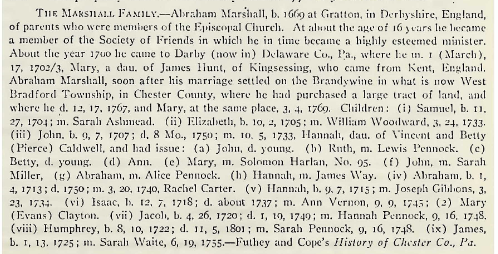
In the Youlgreave parish registers I found a baptism in 1667 for Humphrey Marshall son of Humphrey and Hannah. I didn’t find a baptism for Abraham, but it looks as though it could be correct. Abraham had a son he named Humphrey. But did it just look logical to whoever wrote the books, or do they know for sure? Did the famous botanist Humphrey Marshall have his own family records? The books don’t say where they got this information.
An earlier Humphrey Marshall was baptised in Youlgreave in 1559, his father Edmund. And in 1591 another Humphrey Marshall was baptised, his father George.
But can we connect these Marshall’s to ours? We do have an Abraham Marshall, grandson of Charles, born in 1792. The name isn’t all that common, so may indicate a family connection. The villages of Elton, Gratton and Youlgreave are all very small and it would seem very likely that the Marshall’s who went the USA are related to ours, if not brothers, then probably cousins.
Derbyshire Quakers
In “Derbyshire Quakers 1650-1761” by Helen Forde:
“… Friends lived predominantly in the northern half of the country during this first century of existence. Numbers may have been reduced by emigration to America and migration to other parts of the country but were never high and declined in the early eighteenth century. Predominantly a middle to lower class group economically, Derbyshire Friends numbered very few wealthy members. Many were yeoman farmers or wholesalers and it was these groups who dominated the business meetings having time to devote themselves to the Society. Only John Gratton of Monyash combined an outstanding ministry together with an organising ability which brought him recognition amongst London Friends as well as locally. Derbyshire Friends enjoyed comparatively harmonious relations with civil and Anglican authorities, though prior to the Toleration Act of 1639 the priests were their worst persecutors…..”
Also mentioned in this book: There were monthly meetings in Elton, as well as a number of other nearby places.
John Marshall of Elton 1682/3 appears in a list of Quaker emigrants from Derbyshire.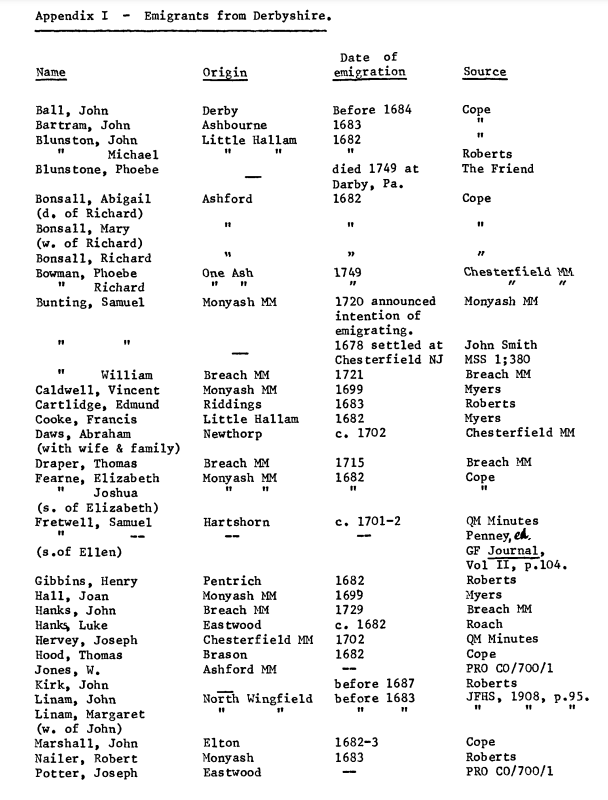
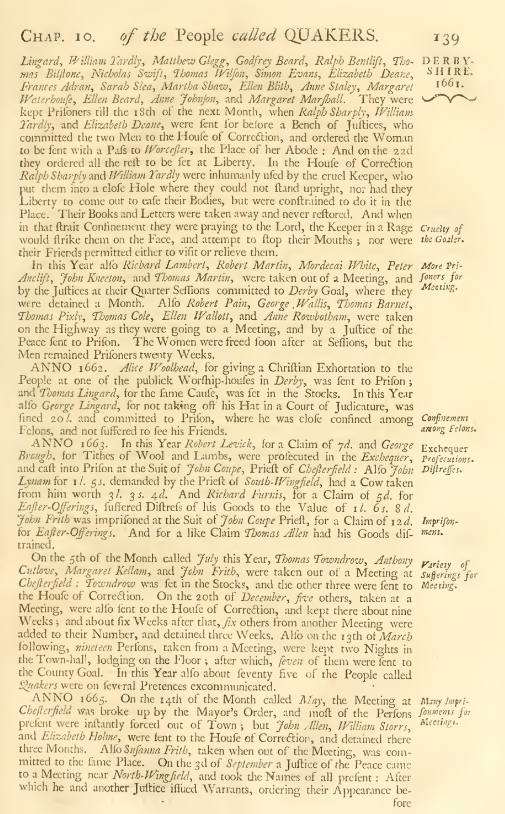
The following image is a page from the 1753 book on the sufferings of Quakers by Joseph Besse as an example of some of the persecutions of Quakers in Derbyshire in the 1600s:
A collection of the sufferings of the people called Quakers, for the testimony of a good conscience from the time of their being first distinguished by that name in the year 1650 to the time of the act commonly called the Act of toleration granted to Protestant dissenters in the first year of the reign of King William the Third and Queen Mary in the year 1689 (Volume 1)
Besse, Joseph. 1753Note the names Margaret Marshall and Anne Staley. This book would appear to contradict Helen Forde’s statement above about the harmonious relations with Anglican authority.
The Botanist
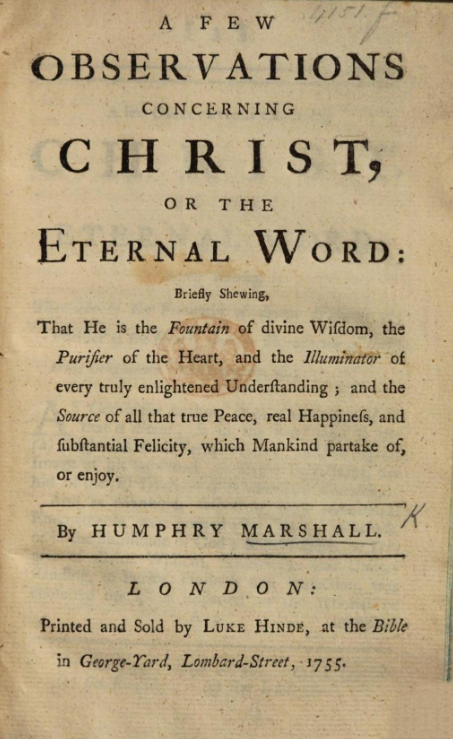
Humphry Marshall 1722-1801 was born in Marshallton, Pennsylvania, the son of the immigrant from Elton, Abraham Marshall. He was the cousin of botanists John Bartram and William Bartram. Like many early American botanists, he was a Quaker. He wrote his first book, A Few Observations Concerning Christ, in 1755.
In 1785, Marshall published Arbustrum Americanum: The American Grove, an Alphabetical Catalogue of Forest Trees and Shrubs, Natives of the American United States (Philadelphia).
Marshall has been called the “Father of American Dendrology”.
A genus of plants, Marshallia, was named in honor of Humphry Marshall and his nephew Moses Marshall, also a botanist.
In 1848 the Borough of West Chester established the Marshall Square Park in his honor. Marshall Square Park is four miles east of Marshallton.
via Wikipedia.
From The History of Chester County Pennsylvania, 1881, by J Smith Futhey and Gilbert Cope:
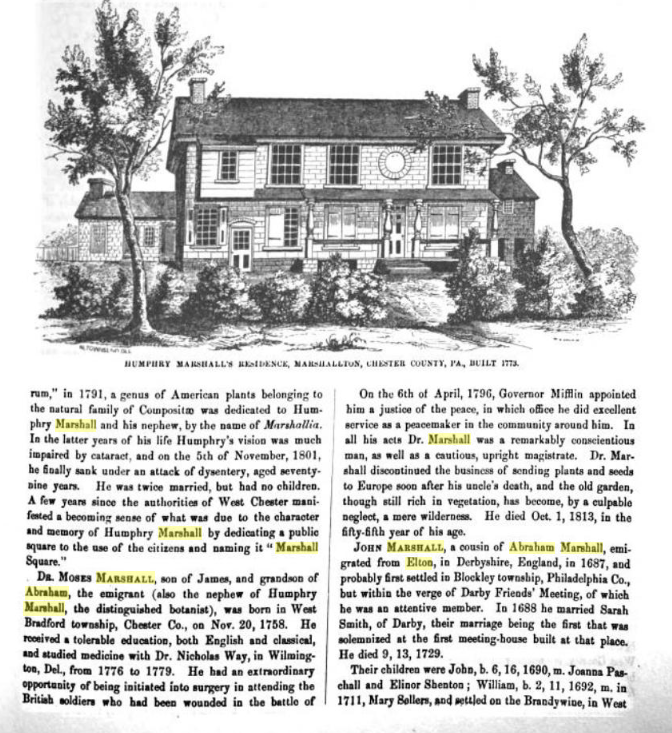
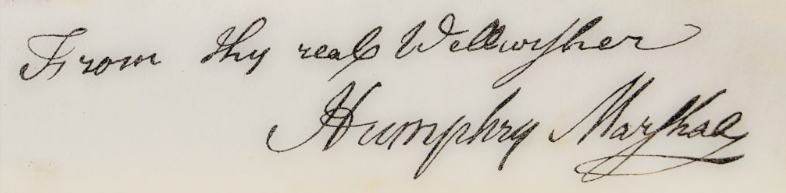
From The Chester Country History Center:
“Immediately on the Receipt of your Letter, I ordered a Reflecting Telescope for you which was made accordingly. Dr. Fothergill had since desired me to add a Microscope and Thermometer, and will
pay for the whole.’– Benjamin Franklin to Humphry, March 18, 1770
“In his lifetime, Humphry Marshall made his living as a stonemason, farmer, and miller, but eventually became known for his contributions to astronomy, meteorology, agriculture, and the natural sciences.
In 1773, Marshall built a stone house with a hothouse, a botanical laboratory, and an observatory for astronomical studies. He established an arboretum of native trees on the property and the second botanical garden in the nation (John Bartram, his cousin, had the first). From his home base, Humphry expanded his botanical plant exchange business and increased his overseas contacts. With the help of men like Benjamin Franklin and the English botanist Dr. John Fothergill, they eventually included German, Dutch, Swedish, and Irish plant collectors and scientists. Franklin, then living in London, introduced Marshall’s writings to the Royal Society in London and both men encouraged Marshall’s astronomical and botanical studies by supplying him with books and instruments including the latest telescope and microscope.
Marshall’s scientific work earned him honorary memberships to the American Philosophical Society and the Philadelphia Society for Promoting Agriculture, where he shared his ground-breaking ideas on scientific farming methods. In the years before the American Revolution, Marshall’s correspondence was based on his extensive plant and seed exchanges, which led to further studies and publications. In 1785, he authored his magnum opus, Arbustum Americanum: The American Grove. It is a catalog of American trees and shrubs that followed the Linnaean system of plant classification and was the first publication of its kind.”
 August 21, 2024 at 12:27 pm #7546
In reply to: The Elusive Samuel Housley and Other Family Stories
The Potters of Darley Bridge
Rebecca Knowles 1745-1823, my 5x great grandmother, married Charles Marshall 1742-1819, the churchwarden of Elton, in Darley, Derbyshire, in 1767. Rebecca was born in Darley in 1745, the youngest child of Roger Knowles 1695-1784, and Martha Potter 1702?-1772.
Although Roger and Martha were both from Darley, they were married in South Wingfield by licence in 1724. Roger’s occupation on the marriage licence was lead miner. (Lead miners in Derbyshire at that time usually mined their own land.) Jacob Potter signed the licence so I assumed that Jacob Potter was her father.
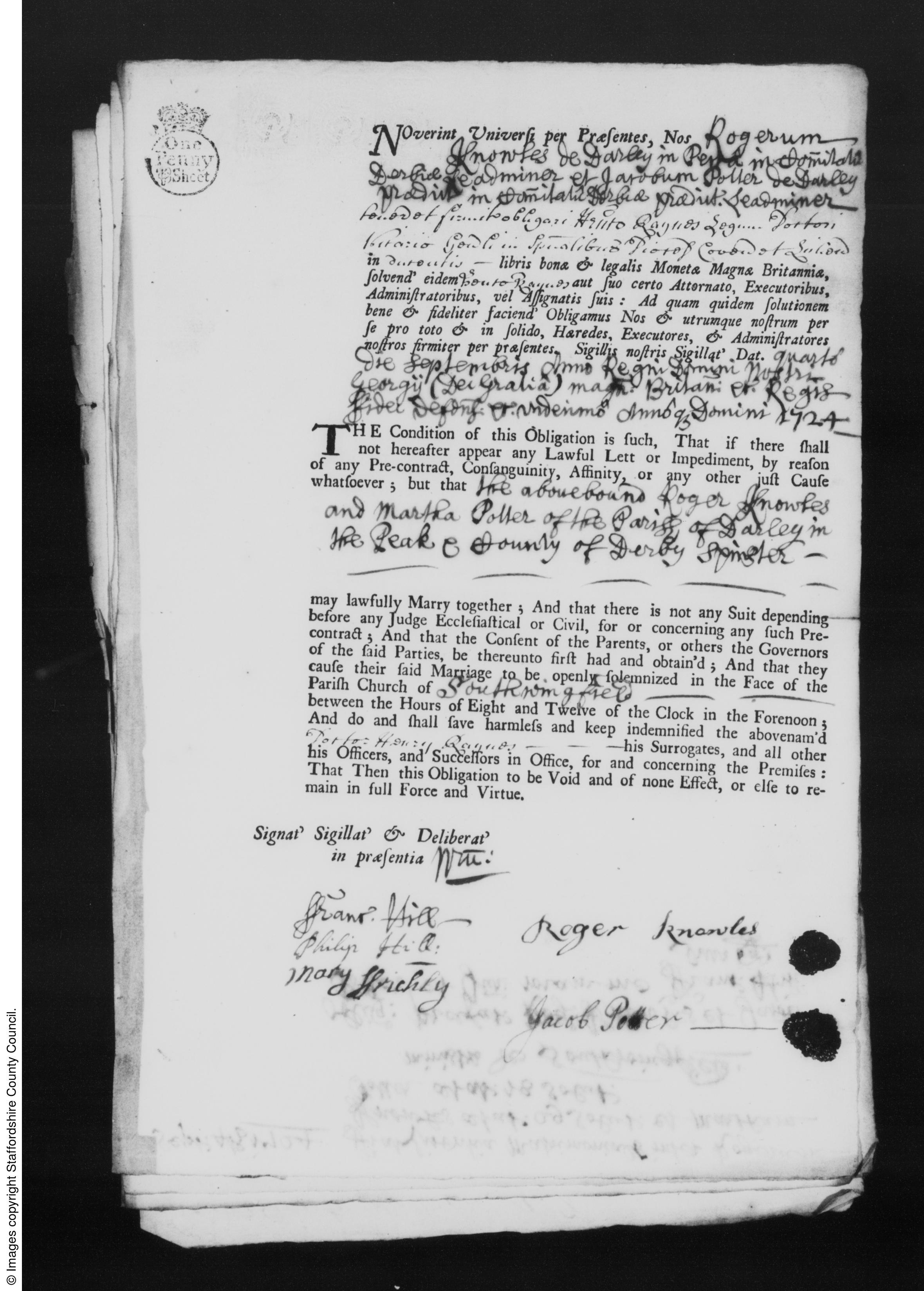
I then found the will of Jacobi Potter who died in 1719. However, he signed the will James Potter. Jacobi is latin for James. James Potter mentioned his daughter Martha in his will “when she comes of age”. Martha was the youngest child of James. James also mentioned in his will son James AND son Jacob, so there were both James’s and Jacob’s in the family, although at times in the documents James is written as Jacobi!
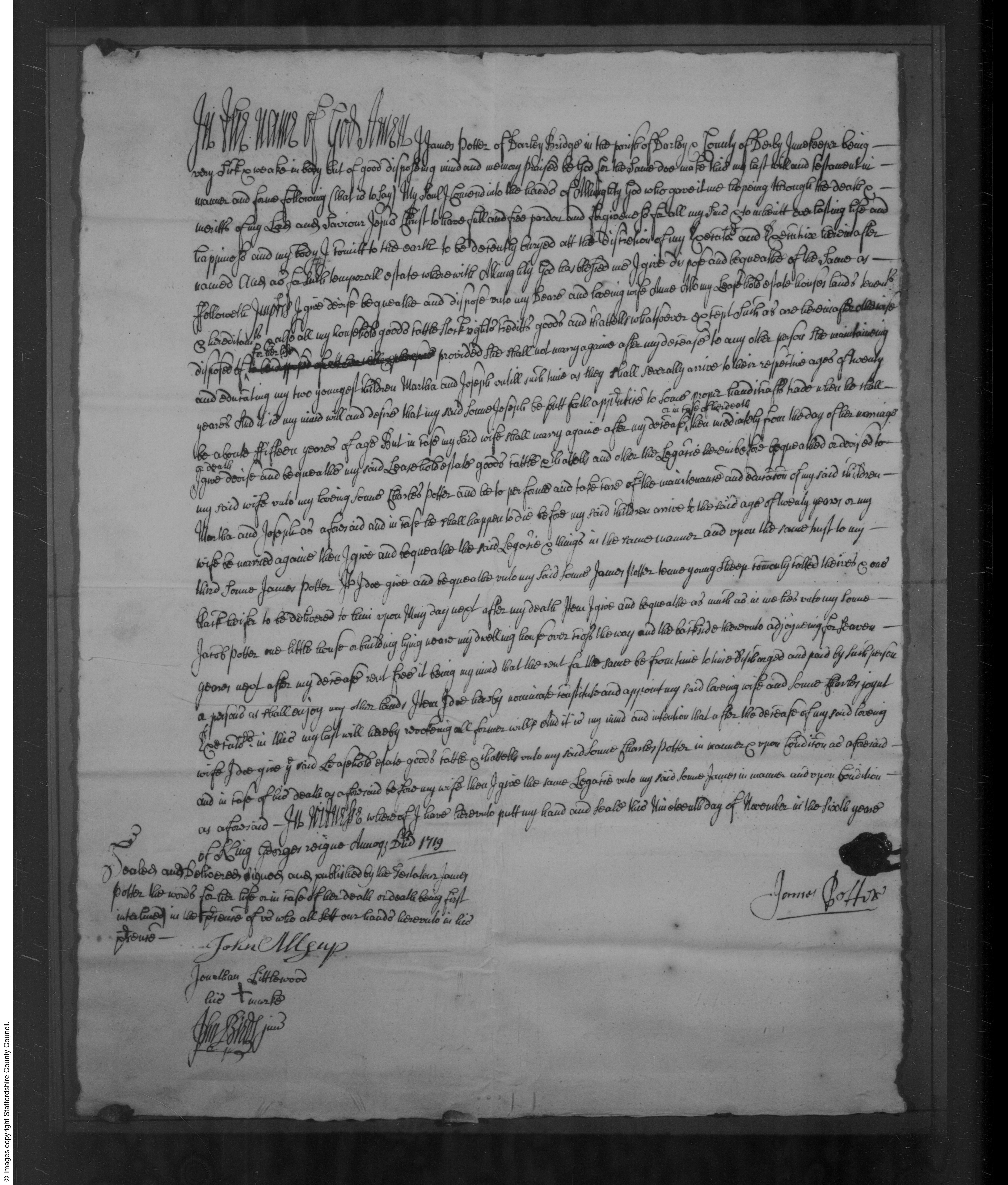
Jacob Potter who signed Martha’s marriage licence was her brother Jacob.
Martha’s brother James mentioned his sister Martha Knowles in his 1739 will, as well as his brother Jacob and his brother Joseph.
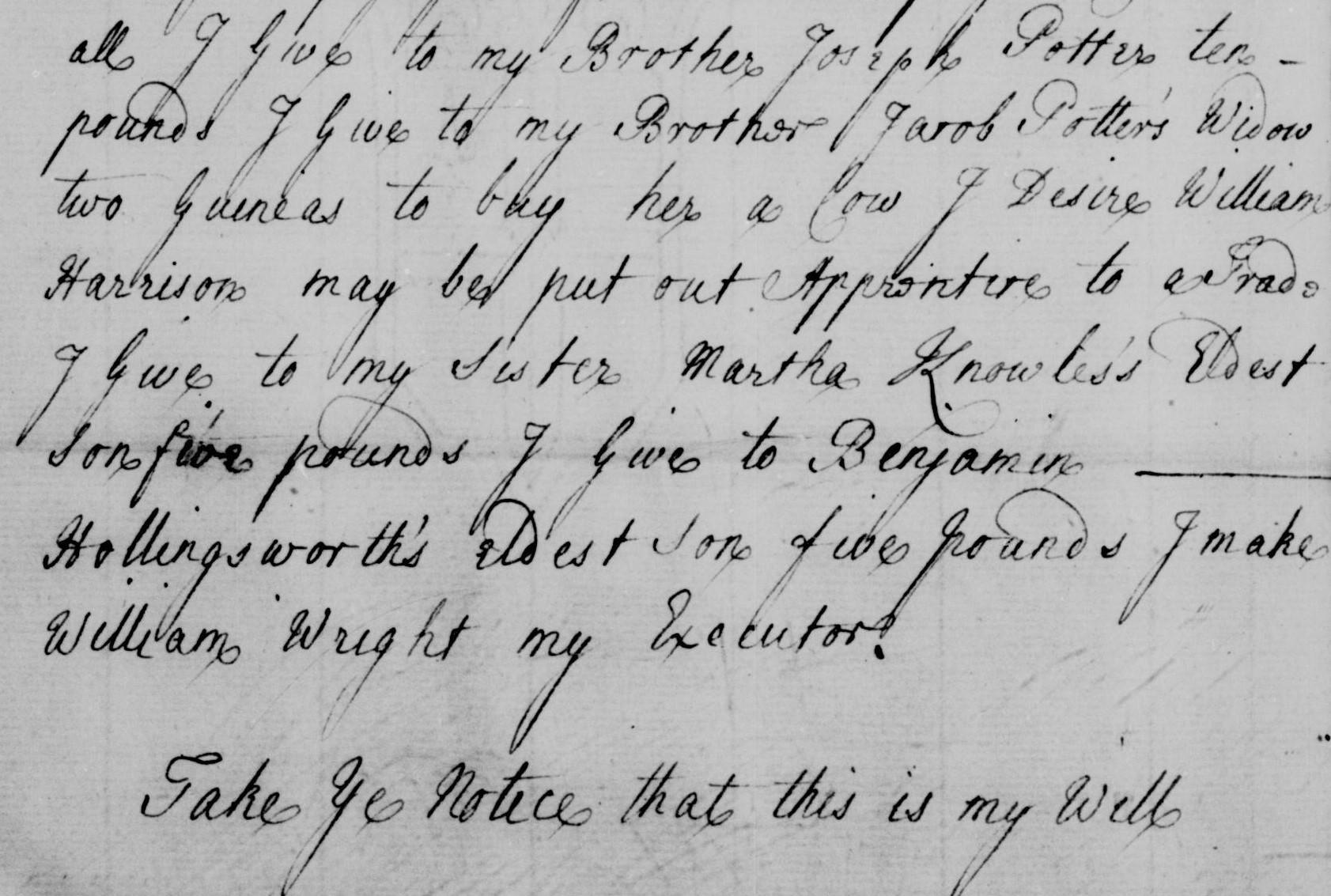
Martha’s father James Potter mentions his wife Ann in his 1719 will. James Potter married Ann Waterhurst in 1690 in Wirksworth, some seven miles from Darley. James occupation was innkeeper at Darley Bridge.
I did a search for Waterhurst (there was only a transcription available for that marriage, not a microfilm) and found no Waterhursts anywhere, but I did find many Warhursts in Derbyshire. In the older records, Warhust is also spelled Wearhurst and in a number of other ways. A Martha Warhurst died in Peak Forest, Derbyshire, in 1681. Her husbands name was missing from the deteriorated register pages. This may or may not be Martha Potter’s grandmother: the records for the 1600s are scanty if they exist at all, and often there are bits missing and illegible entries.
The only inn at Darley Bridge was The Three Stags Heads, by the bridge. It is now a listed building, and was on a medieval packhorse route. The current building was built in 1736, however there is a late 17th century section at rear of the cross wing. The Three Stags Heads was up for sale for £430,000 in 2022, the closure a result of the covid pandemic.

Another listed building in Darley Bridge is Potters Cottage, with a plaque above the door that says “Jonathan and Alice Potter 1763”. Jonathan Potter 1725-1785 was James grandson, the son of his son Charles Potter 1691-1752. His son Charles was also an innkeeper at Darley Bridge: James left the majority of his property to his son Charles.
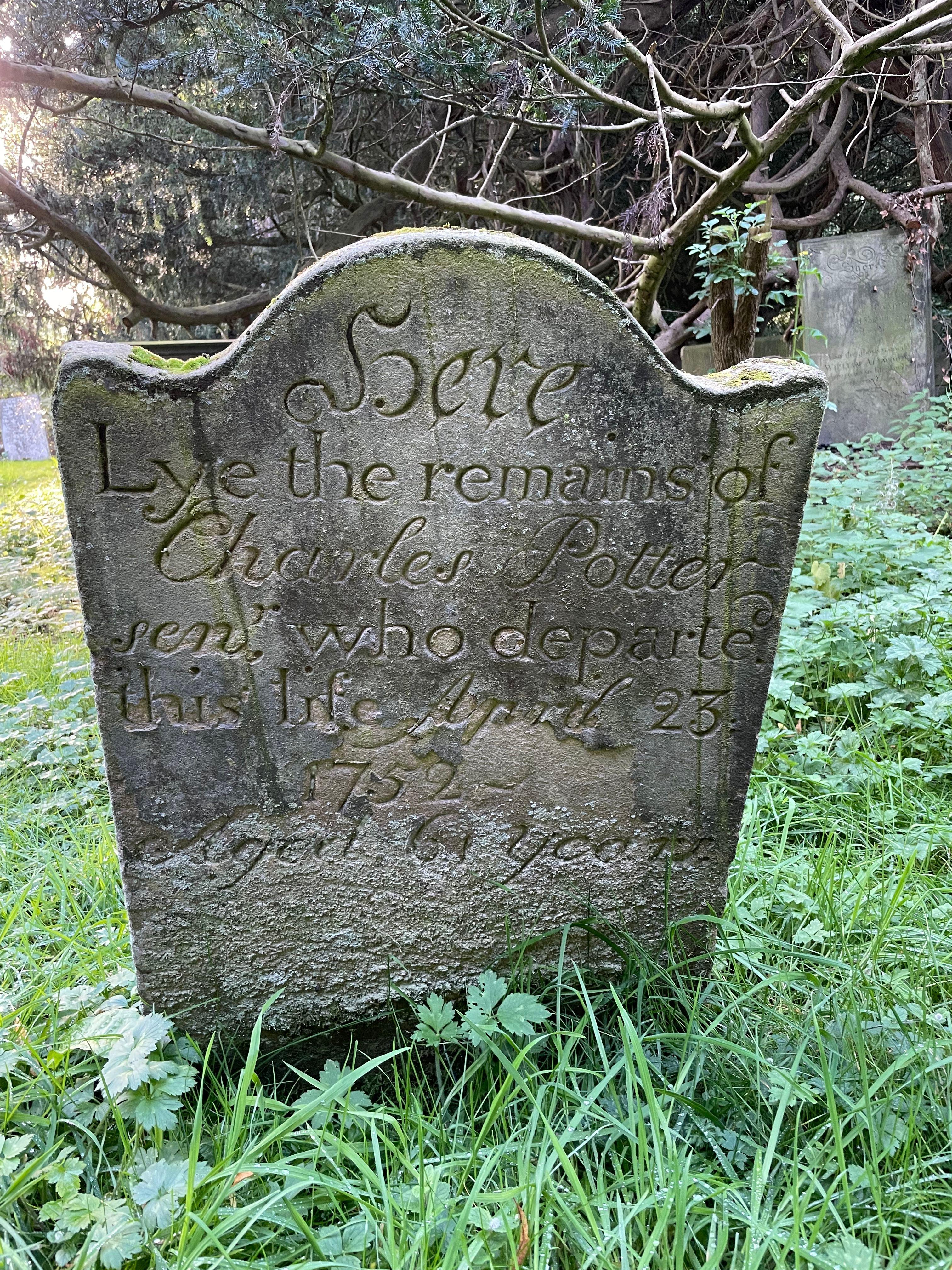
Charles is the only child of James Potter that we know the approximate date of birth, because his age was on his grave stone. I haven’t found any of their baptisms, but did note that many Potters were baptised in non conformist registers in Chesterfield.
Potters Cottage
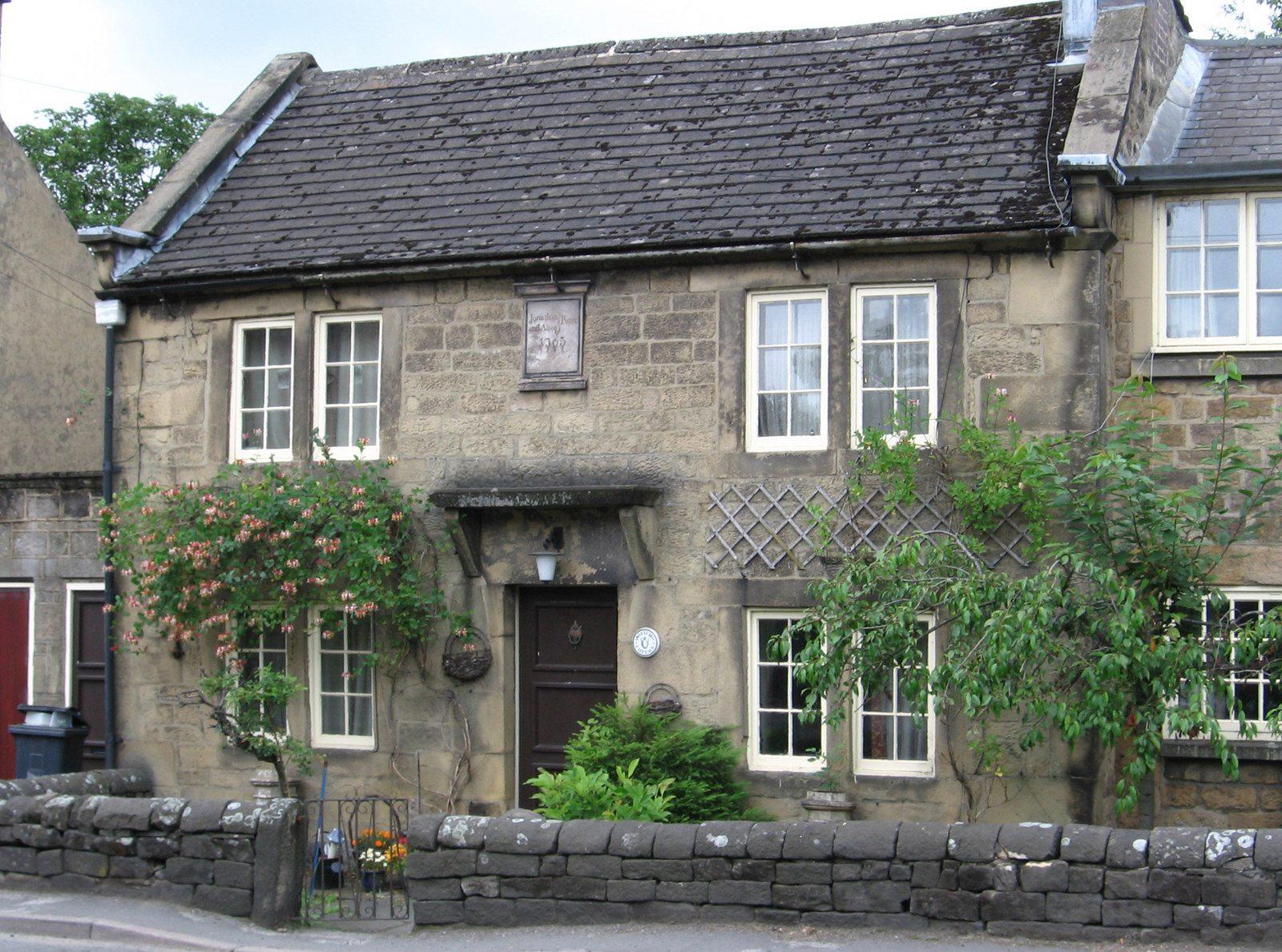
Jonathan Potter of Potters Cottage married Alice Beeley in 1748.
“Darley Bridge was an important packhorse route across the River Derwent. There was a packhorse route from here up to Beeley Moor via Darley Dale. A reference to this bridge appears in 1504… Not far to the north of the bridge at Darley Dale is Church Lane; in 1635 it was known as Ghost Lane after a Scottish pedlar was murdered there. Pedlars tended to be called Scottish only because they sold cheap Scottish linen.”
via Derbyshire Heritage website.
According to Wikipedia, the bridge dates back to the 15th century.
-
AuthorSearch Results
Search Results for 'imp'
-
Search Results
-
Matteo Appears
Matteo approached the table, a tray balanced effortlessly in one hand, his dark eyes flicking over the group as though cataloging details in an invisible ledger. His waistcoat, sharp and clean, gave him a practiced professionalism, but there was something else—a casual, unspoken authority that drew attention.
“Good evening,” he began, his voice smooth and low, almost conspiratorial. Then, he froze for the briefest moment, his gaze shifting from face to face, the easy smile tightening at the corners.
“Well,” Matteo said finally, his smile broadening as if he’d just solved a riddle. “Here you all are. Together, at last.”
The group exchanged glances, each of them caught off-guard by the comment.
“You say that like you’ve been expecting us,” Elara said, her tone measured but sharp, as if probing for variables.
“Not expecting,” Matteo replied, his eyes glinting. “But hoping, perhaps. It’s… good to see you all like this. It fits, somehow.”
“What fits?” Darius asked, leaning forward. His voice was lighter than Elara’s but carried a weight that suggested he wouldn’t let the question drop easily.
Matteo’s smile deepened, though he didn’t answer immediately. Instead, he set down his tray and folded his hands in front of him, his posture relaxed but deliberate, as though he were balancing on the edge of some invisible line.
“You’ve never all been here before,” he said, a simple statement that landed like a challenge.
“Wait,” Amei said, narrowing her eyes. “You know us?”
“Oh, I know you,” Matteo replied, his tone as light as if they were discussing the weather. “Individually, yes. But together? This is new. And it’s… remarkable.”
“Remarkable how?” Lucien asked, his pencil stilled over his sketchbook.
Matteo tilted his head, considering the question as though weighing how much to say. “Let’s just call it a rarity. Things don’t often align so neatly. It’s not every day you see… well, this.”
He gestured toward them with a sweeping hand, as if the mere fact of their presence at the table was something extraordinary.
“You’re being cryptic,” Elara said, her voice edged with suspicion.
“It’s a talent,” Matteo replied smoothly.
“Alright, hold on.” Darius leaned back, his chair creaking under him. “How do you know us? I’ve never been here before. Not once.”
“Nor I,” Amei added, her voice soft but steady.
Matteo raised an eyebrow, his smile taking on a knowing tilt. “No, not here. But that’s not the only place to know someone, is it?”
The words hung in the air, unsettling and oddly satisfying at once.
“You’re saying we’ve met you before?” Elara asked.
Matteo inclined his head. “In a manner of speaking.”
“That doesn’t make sense,” Lucien said, his voice quiet but firm.
“Doesn’t it?” Matteo countered, his tone almost playful. “After all, do we ever truly remember every thread that weaves us together? Sometimes we only see the pattern when it’s complete.”
A pause settled over the table, heavy with unspoken questions. Matteo shifted his weight, breaking the silence with an easy gesture.
“It doesn’t matter how,” he said finally. “What matters is that you’re here. That’s what counts.”
“For what?” Amei asked, her eyes narrowing.
“For whatever happens next,” Matteo replied, as if the answer were obvious. Then he straightened, his professional mask sliding back into place with effortless grace.
“Now, what can I bring you?” he asked, his tone light again, as though the previous exchange hadn’t happened.
One by one, they placed their orders, though their minds were clearly elsewhere. Matteo scribbled in his notebook, his pen moving with deliberate strokes, and then he looked up once more.
“Thank you for being here,” he said, his voice quieter this time. “It’s been… a long time coming.”
And with that, he was gone, disappearing into the crowd with the same fluidity he’d arrived.
They sat in silence for a moment, his words pressing down on them like a hand on a wound, familiar and foreign all at once.
“What the hell was that?” Darius asked finally, breaking the spell.
“Does he seem… different to you?” Amei asked, her voice distant.
“He seems impossible,” Elara replied, her fingers tapping an unconscious rhythm on the table.
“He remembered me,” Lucien said, almost to himself. “Something about absinthe.”
“I’ve never even met him,” Elara said, her voice rising slightly. “But he knew… too much.”
“And he didn’t explain anything,” Darius added, shaking his head.
“Maybe he didn’t need to,” Amei said softly, her gaze fixed on the space Matteo had just vacated.
They lapsed into silence again, the noise of the café returning in fits and starts, like an orchestra warming up after a pause. Somewhere, a glass clinked against porcelain; outside, the violinist struck a note so low it hummed against the windowpane.
The four of them sat there, strangers and friends all at once, the questions left dangling between them like stars in a cloudy sky. Whatever Matteo had meant, it was clear this moment was no coincidence. It wasn’t an end, nor a beginning—it was the start of something unraveling, something they couldn’t yet see.
And though none of them said it aloud, the thought was the same: What had happened before?
Quintessence: Reversing the Fifth



