

Search Results for 'inside'
-
AuthorSearch Results
-
February 2, 2023 at 8:09 am #6489
In reply to: Orbs of Madjourneys
It was a pleasant 25 degrees as Zara stepped off the plane. The flat red land stretched as far as the eye could see, and although she prefered a more undulating terrain there was something awe inspiring about this vast landscape. It was quite a contrast from the past few hours spent inside mine tunnels.
Bert, a weatherbeaten man of indeterminate advanced age, was there to meet her as arranged and led her to the car, a battered old four wheel drive. Although clearly getting on in years, he was tall and spry and dressed in practical working clothes.
“Welcome to Alice,” he said, taking her bag and putting in on the back seat. “I expect you’ll be wanting to know a bit about the place.”
“How long have you lived here?” Zara asked, as Bert settled into the creaky drivers seat and started the car.
Bert gave her a funny look and replied “Longer than a ducks ass.” Zara had never heard that expression before; she assumed it meant a long time but didn’t like to pursue the question.
“All this land belongs to the Arrernte,” he said, pronouncing it Arrunda. “The local aboriginals. 1862 when we got here. Well,” Bert turned to give Zara a lopsided smile, “Not me personally, I aint quite that old.”
Zara chuckled politely as Bert continued, “It got kinda busy around these parts round 1887 with the gold.”
“Oh, are there mines near here?” Zara asked with some excitement.
Bert gave her a sharp look. “Oh there’s mines alright. Abandoned now though, and dangerous. Dangerous places, old mines. You’ll be more interested in the hiking trails than those old mines, some real nice hiking and rock gorges, and it’s a nice temperature this time of year.”
Bert lapsed into silence for a few minutes, frowning.
“If you’da been arriving back then, you’da been on a camel train, that’s how they did it back then. Camel trains. They do camel tours for tourists nowadays.”
“Do you get many tourists?”
“Too dang many tourists if you ask me, Alice is full of them, and Ayers Rock’s crawling with ’em these days. We don’t get many out our way though.” Bert snorted, reminding Zara of Yasmin. “Our visitors like an off the beaten track kind of holiday, know what I mean?” Bert gave Zara another sideways lopsided smile. “I reckon you’ll like it at The Flying Fish Inn. Down to earth, know what I mean? Down to earth and off the wall.” He laughed heartily at that and Zara wasn’t quite sure what to say, so she laughed too.
“Sounds great.”
“Family run, see, makes a difference. No fancy airs and graces, no traffic ~ well, not much of anything really, just beautiful scenery and peace and quiet. Aunt Idle thinks she’s in charge but me and old Mater do most of it, well Finly does most of it to be honest, and you dropped lucky coming now, the twins have just decorated the bedrooms. Real nice they look now, they fancied doing some dreamtime murials on the walls. The twins are Idle’s neices, Clove and Corrie, turned out nice girls, despite everything.”
“Despite ….?”
“What? Oh, living in the outback. Youngsters usually leave and head for the cities. Prune’s the youngest gal, she’s a real imp, that one, a real character. And Devan calls by regular to see Mater, he works at the gas station.”
“Are they all Idle’s neices and nephews? Where are their parents?” Perhaps she shouldn’t have asked, Zara thought when she saw Bert’s face.
“Long gone, mate, long since gone from round here. We’ve taken good care of ’em.” Bert turned off the road onto a dirt road. “Only another five minutes now. We’re outside the town a bit, but there aint much in town anyway. Population 79, our town. About right for a decent sized town if you ask me.”
Bert rounded a bend in a eucalyptus grove and announced, “Here we are, then, the Flying Fish Inn.” He parked the car and retrieved Zara’s bag from the back seat. “Take a seat on the verandah and I’ll find Idle to show you to your room and get you a drink. Oh, and don’t be put off by Idle’s appearance, she’s a sweetheart really.”
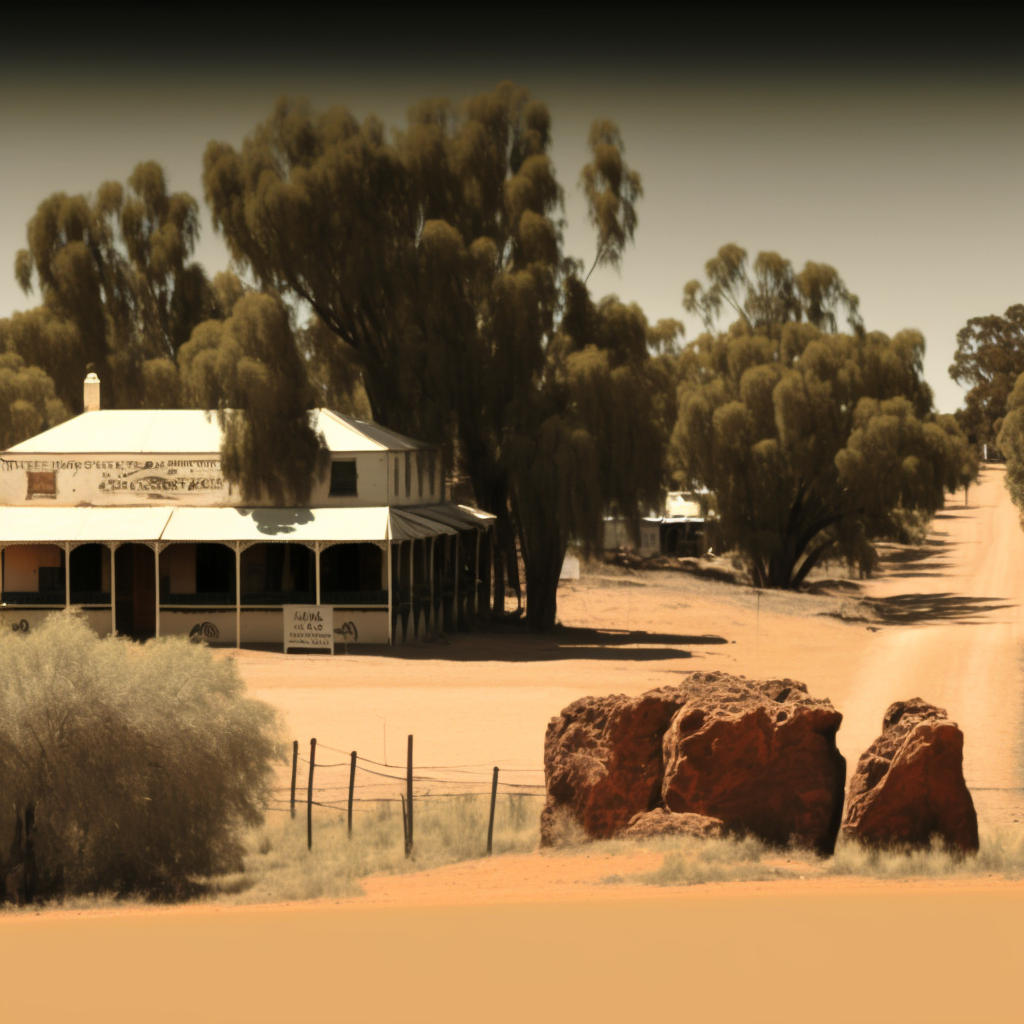
Aunt Idle was nowhere to be found though, having decided to go for a walk on impulse, quite forgetting the arrival of the first guest. She saw Bert’s car approaching the hotel from her vantage point on a low hill, which reminded her she should be getting back. It was a lovely evening and she didn’t rush.

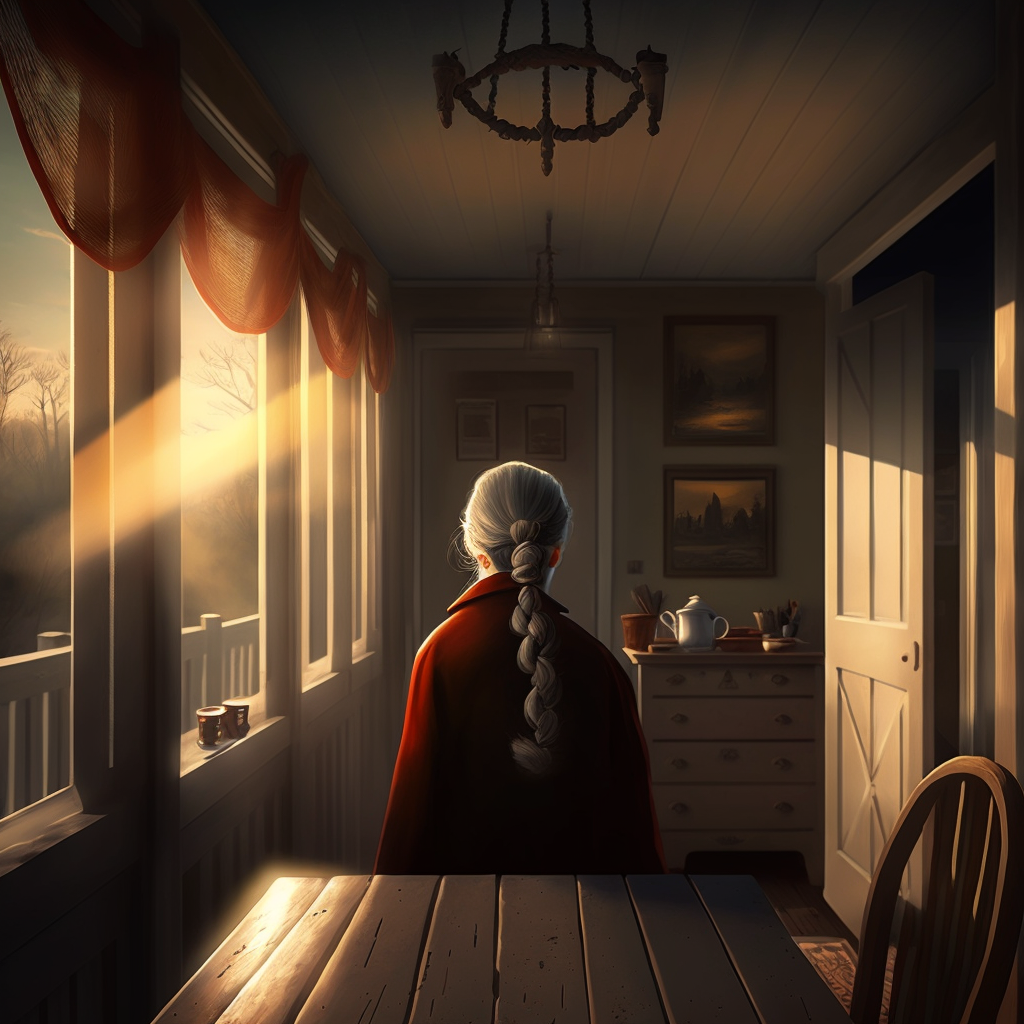
Bert found Mater in the dining room gazing out of the window. “Where the bloody hell is Idle? The guest’s outside on the verandah.”
“She’s taken herself off for a walk, can you believe it?” sighed Mater.
“Yep” Bert replied, “I can. Which room’s she in? Can you show her to her room?”
“Yes of course, Bert. Perhaps you’d see to getting a drink for her.”
 February 1, 2023 at 9:52 am #6484
In reply to: Orbs of Madjourneys
Will be at Flying Fish this evening, Hope to see you all soon!
 Congrats, Xavier!
Zara sent a message to Yasmin, Youssef and Xavier just before boarding the plane. Thankfully the plane wasn’t full and the seats next to her were unoccupied. She had a couple of hours to play the game before landing at Alice Springs.
Zara had found the tile in the entry level and had further instructions for the next stage of the game:
Zara had come across a strange and ancient looking mine. It was clear that it had been abandoned for many years, but there were still signs of activity. The entrance was blocked by a large pile of rocks, but she could see a faint light coming from within. She knew that she had to find a way in.
“Looks like I have to find another tile with a sort of map on it, Pretty Girl,” Zara spoke out loud, forgetting for a moment that the parrot wasn’t with her. She glanced up, hoping none of the other passengers had heard her. Really she would have to change that birds name!
If you encounter Osnas anywhere in the game, he may have what you seek in his vendors cart, or one of his many masks might be a clue.
A man with a mask and a vendors cart in an old mine, alrighty then, let’s have a look at this mine. Shame we’re not still in that old town. Zara remembered not to say that out loud.
Zara approached the abandoned mine cautiously. There were rocks strewn about the entrance, and a faint light inside.
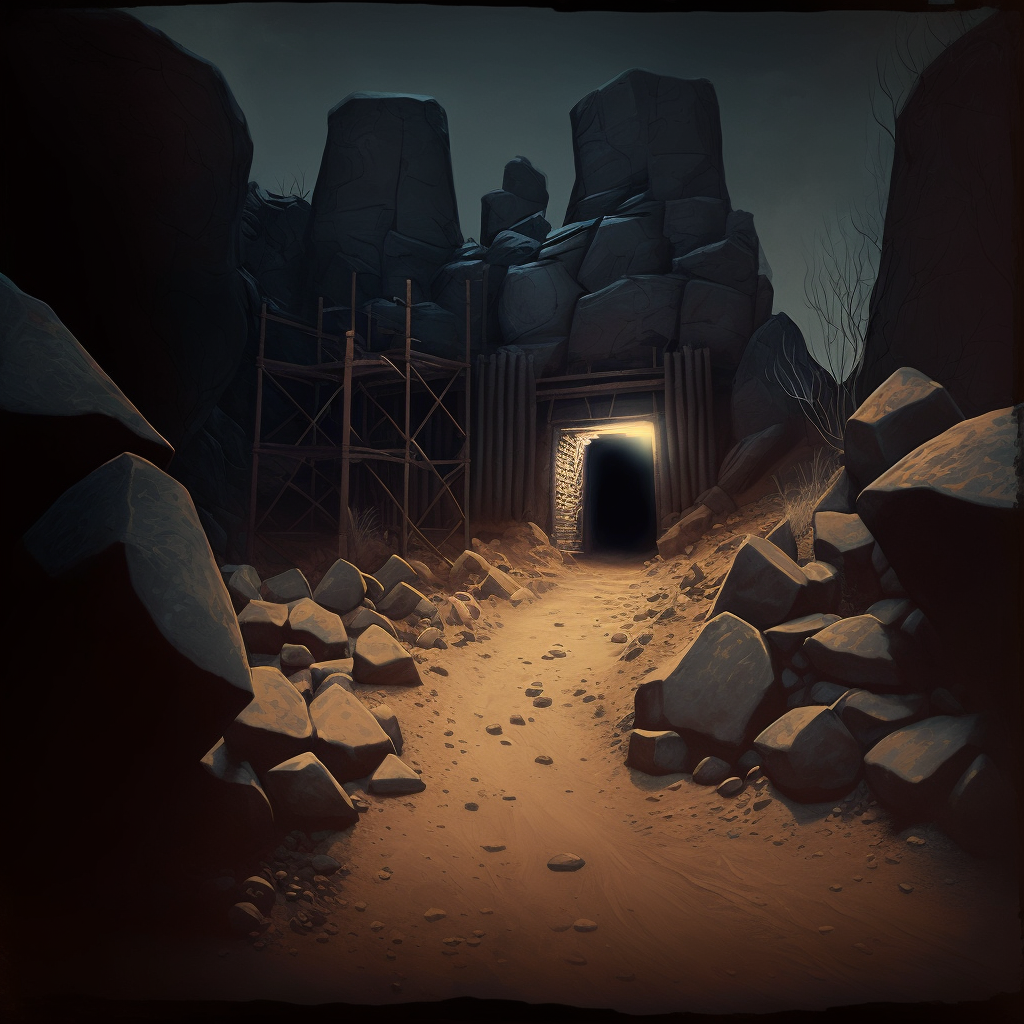
This looks a bit ominous, thought Zara, and not half as inviting as that old city. She’d had a lifelong curiosity about underground tunnels and caves, and yet felt uneasily claustrophobic inside one. She reminded herself that it was just a game, that she could break the rules, and that she could simply turn it off at any time. She carried on.
Zara stopped to look at the large green tile lying at her feet in the tunnel entrance. It was too big to carry with her so she took a photo of it for future reference. At first glance it looked more like a maze or a labyrinth than a map. The tunnel ahead was dark and she walked slowly, close to the wall.
Oh no don’t walk next to the wall! Zara recalled going down some abandoned mines with a group of friends when she was a teenager. There was water in the middle of the tunnel so she had been walking at the edge to keep her feet dry, as she followed her friend in front who had the torch. Luckily he glanced over his shoulder, and advised her to walk in the middle. “Look” he said after a few more steps, shining his torch to the left. A bottomless dark cavern fell away from the tunnel, which she would surely have fallen into.
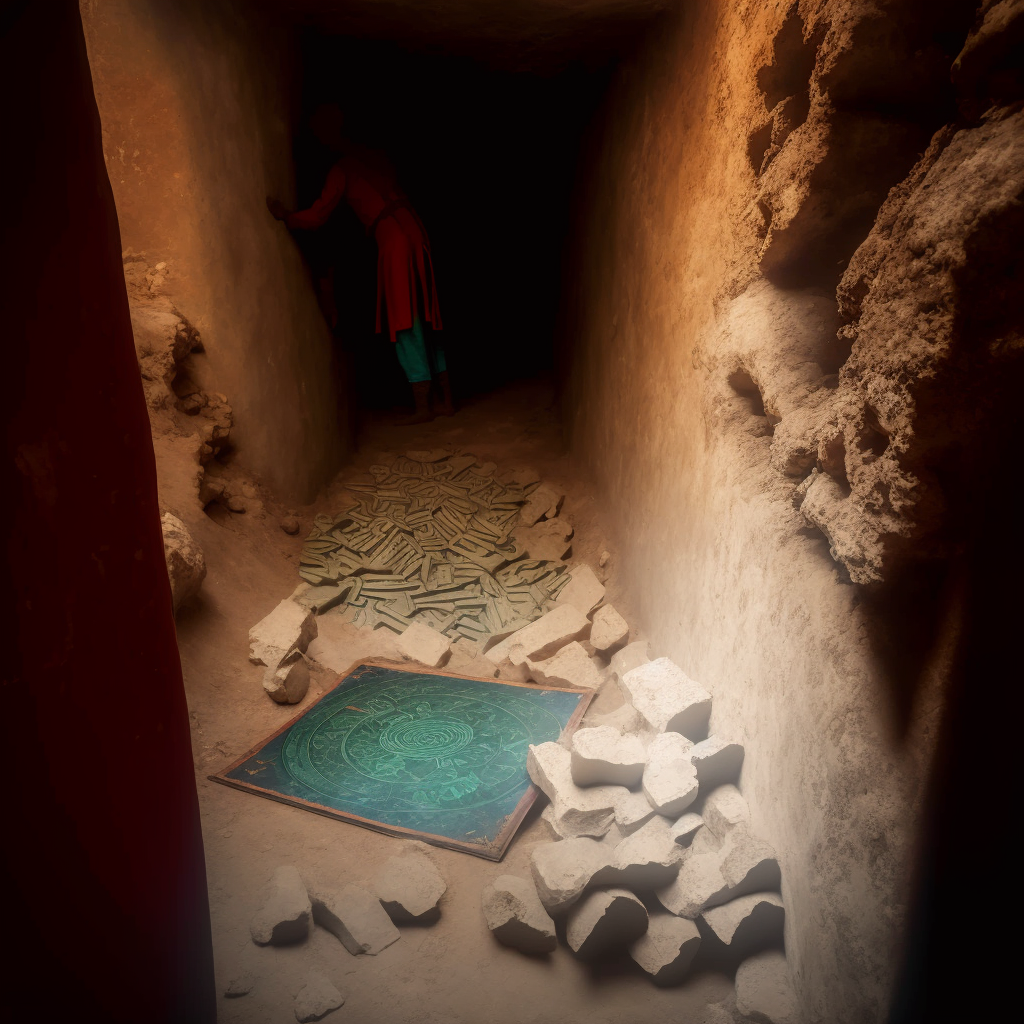
Zara moved into the middle of the tunnel and walked steadily into the darkness. Before long a side tunnel appeared with a faintly glowing ghostly light.
It looked eerie, but Zara felt obliged to follow it, as it was pitch black in every other direction. She wasn’t even sure if she could find her way out again, and she’d barely started.
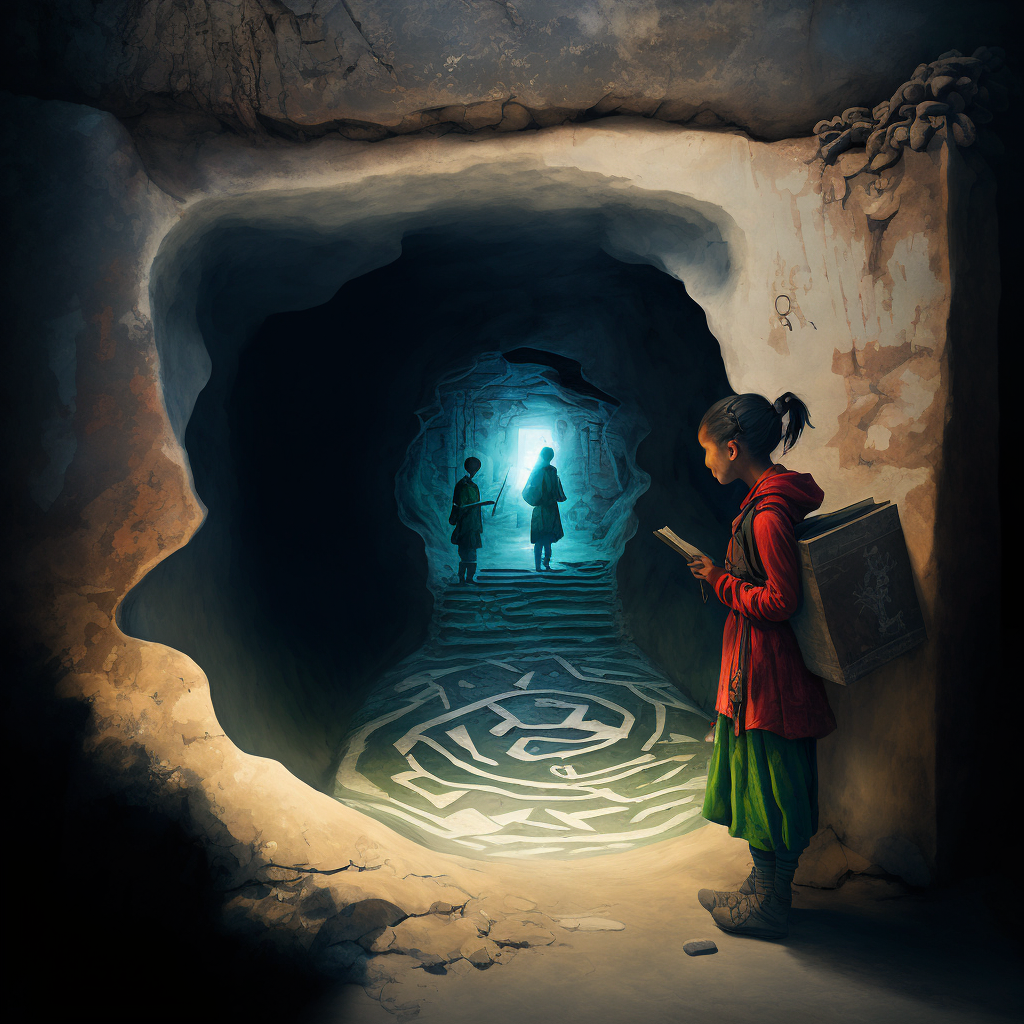
The ghostly light was coming from yet another side tunnel. There were strange markings on the floor that resembled the tile at the mine entrance. Zara saw two figures up ahead, heading towards the light.
 January 31, 2023 at 3:31 pm #6479
In reply to: The Jorid’s Travels – 14 years on
Chapter 1: The Search Begins

Georges was sitting more or less comfortably in the command chair on the control deck of the Jorid, slowly drinking his tea. The temperature of the beverage seemed to be determined randomly since the interference patterns in the navigation array weren’t totally fixed when they removed those low quality tiles. Drinking cold or hot tea was not the worse of it, and it was even kind of a challenge to swallow it and not get burned by ice. The deck kept changing shape and colours, reconfiguring along with the quantum variations of the Boodenbaum field variation due to some leakage of information between dimensions. Salomé had preferred resting in her travelpod where the effects were not as strongly felt.
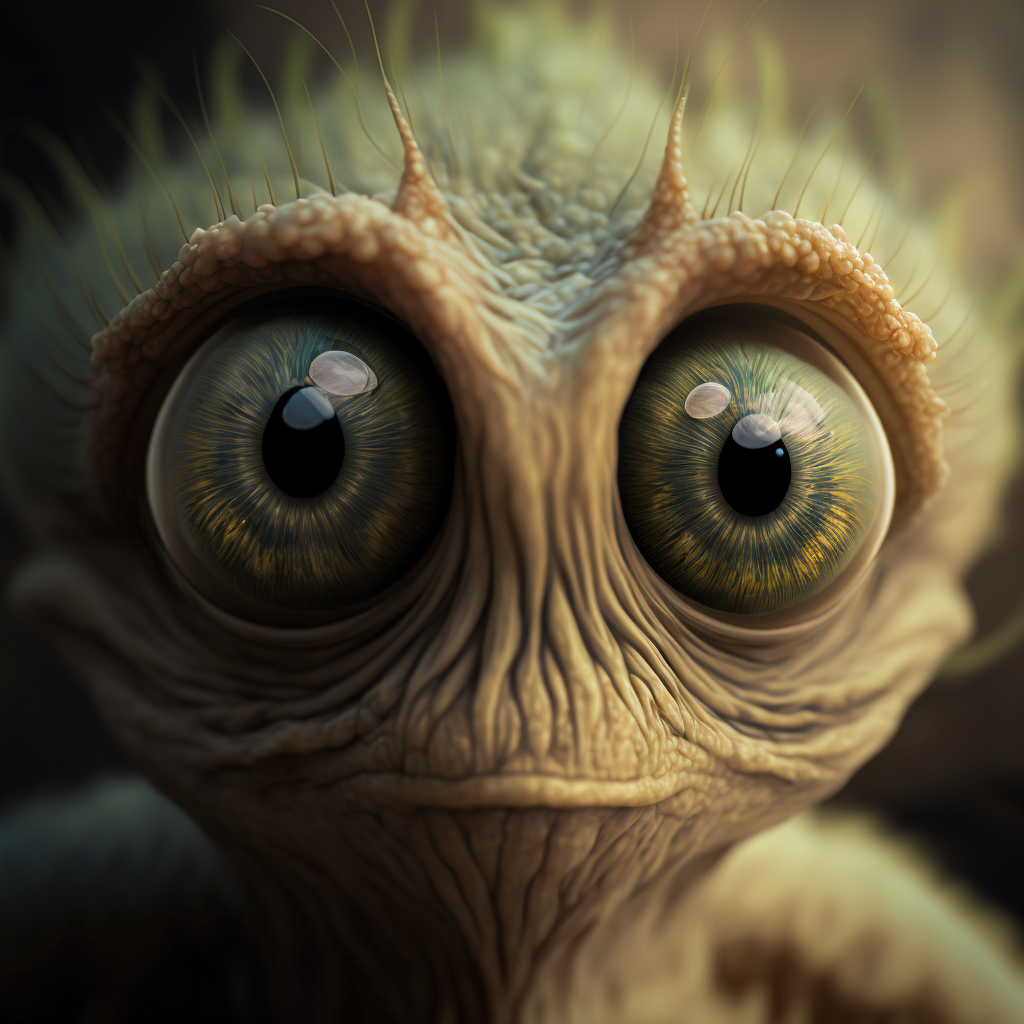 “The worse is not as much seeing your face morph into a soul-insect and turn inside down, although those greenish hues usually make me feel nauseous, but feeling two probable realities where my organs grow and shrink at the same time is more than I can bear.”
After a few freakish experiences, where his legs cross-merged with the chair, or a third eye grow behind his head, or that time when dissolved into a poof of greasy smoke, Georges got used to the fluid nature of reality during the trips. You just had to get along with it and not resist. He thought it gave some spice and colours to their journey across dimensions. He enjoyed the differences of perceptions generated by the fluctuations of the Boodenbaum field, as it allowed his tea to taste like chardonnay or bœuf bourguignon, and was glad when he discovered a taste that he had never experienced before.
During the last few trips, he had attempted to talk with Jorid, but their voices were so garbled and transformed so quickly that he lost interest. He couldn’t make the difference with the other noises, like honking trucks passing by on a motorway, or the cry of agony of a mating Irdvark. He felt a pang of nostalgia as the memories of Duane, Murtuane and Phréal merged into the deck around him. He wondered if he could get physically lost during one of the trips as he started to feel his limbs move away from his body, one hairy foot brushing by his left ear while he drank a sip of tea with the mouth that had grown on his middle finger. Salomé had warned him about fractured perception and losing a piece of his mind… It seemed it hadn’t happened yet. But would he notice?
 Already he felt the deceleration he had come to notice when they neared their destination. The deck stabilized into a shape adapted to this quadrant of the dimensional universes. The large command screen displayed images of several ruins lost in the sand desert of Bluhm’Oxl.
Georges looked at his hands, and touched his legs. His reflection on the command screen looked back at him. Handsome as usual. He grinned. Salomé wouldn’t refrain from telling him if something was off anyway.
Jorid: “I have woken up Salomé.”
She won’t be long now. Georges ordered a hot meklah, one of her favorites drink that usually helped her refocus when getting out of her pod.
A blip caught Georges’ attention.
Jorid: “This is Tlal Klatl’Oxl, better know as Klatu. Your potential contact on Bluhm’Oxl and a Zathu. He’ll guide and protect you as you enter the conflict zone to look for Léonard.”
 January 29, 2023 at 5:15 pm #6469
In reply to: Orbs of Madjourneys
The door opened and Youssef saw Natalie, still waiting for him. Indeed, he needed help. He decided to accept
sands_of_timecontact request, hopping it was not another Thi Gang trick.Sands_of_time is trying to make contact : ✅ACCEPT <> ➡️DENY ❓ A princess on horse back emerged from the sand. The veil on her hair floated in a wind that soon cleared all the dust from her garment and her mount, revealing a princess with a delicate face and some prominent attributes that didn’t leave Youssef indifferent. She was smiling at him, and her horse, who had six legs and looked a bit like a camel, snorted at the bear.
“I love doing that, said the princess. At least I don’t get to spit sand afterward like when my sister’s grand-kids want to bury me in the sand at the beach…”
It broke the charm. It reminded Youssef it was all a game. That princess was an avatar. Was it even a girl on the other side ? And how old ? Youssef, despite his stature, felt as vulnerable as when his mother left him for the afternoon with an old aunt in Sudan when he was five and she kept wanting to dress him with colourful girl outfits. He shivered and the bear growled at the camel-horse, reminding Youssef how hungry he was.
“
sands_of_time?” he asked.“Yes. I like this AI game. Makes me feel like I’m twenty again. Not as fun as a mushroom trip though, but… with less secondary effects. Anyway, I saw you needed help with that girl. A ‘reel’ nuisance if you ask me, sticky like a sea cucumber.”
“How do you know ? Did you plant bugs on my phone ? Are you with the Thi Gang ?”
The bear moved toward them and roared and the camel-horse did a strange sound. The princess appeased her mount with a touch of her hand.
“Oh! Boy, calm down your heat. Nothing so prosaic. I have other means, she said with a grin. Call me Sweet Sophie, I’m a real life reporter. Was just laying down on my dream couch looking for clues about a Dr Patelonus, the man’s mixed up in some monkey trafficking business, when I saw that strange llama dressed like a tibetan monk, except it was a bit too mayonnaise for a tibetan monk. Anyway, he led me to you and told me to contact you through this Quirk Quest Game, suggesting you might have some intel for me about that monkey business of mine. So I put on my VR helmet, which actually reminds me of a time at the hair salon, and a gorgeous beehive… but anyway you wouldn’t understand. So I had to accept one of those quests and find you in the game. Which was a lot less easier than RV I can tell you. The only thing, I couldn’t interact with you unless you accepted contact. So here I am, ready for you to tell me about Dr Patelonus. But I can see that first we need to get you out of here.”
Youssef had no idea about what she was talking about. VR; RV ? one and the same ? He decided not to tell her he knew nothing about monkeys or doctors until he was out of Natalie’s reach. If indeed
sands_of_timecould help.“So what do I do ?” asked Youssef.
“Let me first show you my real self. I’ve always wanted to try that. Wait a moment. I need to focus.”
The princess avatar looked in the distance, her eyes lost beyond this world. Suddenly, Youssef felt a presence creeping into his mind. He heard a laugh and saw an old lady in yoga pants on a couch! He roared and almost let go of his phone again.

The princess smiled.
“Now, wouldn’t be fair if only I knew what you looked like in real life. Although you’re pretty close to your avatar… Don’t you seem a tad afraid of experimenting with new things.
“She laughed again, and this time Youssef saw her “real” face superimposed on the princess avatar. It gave him goosebumps.
“Now’s your opening, she said. The girl’s busy giving directions to someone else. Get out of the bathroom! Now!”
Youssef had the strangest feeling that the voice had come at the same time from the phone speakers and from inside his head. His body acted on its own as if he was a puppet. He pushed the bathroom door open and rushed outside.
January 28, 2023 at 11:27 am #6463In reply to: Prompts of Madjourneys
Additional clues from AL (based on Xavier’s comment)
Yasmin
:snake:

Yasmin was having a hard time with the heavy rains and mosquitoes in the real-world. She couldn’t seem to make a lot of progress on finding the snorting imp, which she was trying to find in the real world rather than in the game. She was feeling discouraged and unsure of what to do next.
Suddenly, an emoji of a snake appeared on her screen. It seemed to be slithering and wriggling, as if it was trying to grab her attention. Without hesitation, Yasmin clicked on the emoji.
She was taken to a new area in the game, where the ground was covered in tall grass and the sky was dark and stormy. She could see the snorting imp in the distance, but it was surrounded by a group of dangerous-looking snakes.
Clue unlocked It sounds like you’re having a hard time in the real world, but don’t let that discourage you in the game. The snorting imp is nearby and it seems like the snakes are guarding it. You’ll have to be brave and quick to catch it. Remember, the snorting imp represents your determination and bravery in real life.
🐍🔍🐗 Use your skills and abilities to navigate through the tall grass and avoid the snakes. Keep your eyes peeled for any clues or symbols that may help you in your quest. Don’t give up and remember that the snorting imp is a representation of your determination and bravery.
A message bumped on the screen: “Need help? Contact me 👉”
Stryke_Assist is trying to make contact : ➡️ACCEPT <> ➡️DENY ❓
Youssef
:desert:

Youssef has not yet been aware of the quest, since he’s been off the grid in the Gobi desert. But, interestingly, his story unfolds in real-life parallel to his quest. He’s found a strange grumpy shaman at a food booth, and it seems that his natural steps are converging back with the game. His blog website for his boss seems to take most of his attention.
An emoji of a desert suddenly appeared on his screen. It seemed to be a barren and empty landscape, with sand dunes stretching as far as the eye could see. Without hesitation, Youssef clicked on the emoji.
He was taken to a new area in the game, where the ground was covered in sand and the sky was a deep orange, as if the sun was setting. He could see a mysterious figure in the distance, standing at the top of a sand dune.
Clue unlocked It sounds like you’re in a remote location and disconnected from the game. But, your real-life experiences seem to be converging with your quest. The grumpy shaman you met at the food booth may hold the key to unlocking the next steps in the game. Remember, the desert represents your ability to adapt and navigate through difficult situations.
🏜️🧭🧙♂️ Explore the desert and see if the grumpy shaman’s clues lead you to the next steps in the game. Keep an open mind and pay attention to any symbols or clues that may help you in your quest. Remember, the desert represents your ability to adapt and navigate through difficult situations.
A message bumped on the screen: “Need help? Contact me 👉”
Sands_of_time is trying to make contact : ➡️ACCEPT <> ➡️DENY ❓
Zara
:carved_tile:
Zara looked more advanced [in her explorations – stream breaks – resume conversation]
Zara had come across a strange and ancient looking mine. It was clear that it had been abandoned for many years, but there were still signs of activity. The entrance was blocked by a large pile of rocks, but she could see a faint light coming from within. She knew that she had to find a way in.
As she approached the mine, she noticed a small, carved wooden tile on the ground. It was intricately detailed and seemed to depict a map of some sort. She picked it up and examined it closely. It seemed to show the layout of the mine and possibly the location of the secret room.
With this new clue in hand, Zara set to work trying to clear the entrance. She used all of her strength to move the rocks, and after a few minutes of hard work, she was able to create an opening large enough for her to squeeze through.
As she ventured deeper into the mine, she found herself in a large chamber. The walls were lined with strange markings and symbols, and she could see a faint light coming from a small room off to the side. She knew that this must be the secret room she had been searching for.
Zara approached the room and pushed open the door. Inside, she found a small, dimly lit chamber. In the center of the room stood a large stone altar, and on the altar was a strange, glowing object. She couldn’t quite make out what it was, but she knew that this must be the key to solving the mystery of the mine.
With a sense of excitement and curiosity, Zara reached out to take the glowing object. As her hand touched it, she felt a strange energy coursing through her body. She knew that her quest was far from over, and that there were many more secrets to uncover in the mine.
January 26, 2023 at 12:16 am #6460In reply to: Orbs of Madjourneys
The vendor was preparing the Lorgh Drülp with the dexterity of a Japanese sushi chef. A piece of yak, tons of spices, minced vegetables, and some other ingredients that Youssef couldn’t recognise. He turned his attention to the shaman’s performance. The team was trying to follow the man’s erratic moves under Miss Tartiflate’s supervision. Youssef could hear her shouting to Kyle to get closer shots. It reminded him that he had to get an internet connection.
“Is there a wifi?” asked Youssef to the vendor. The man bobbed his head and pointed at the table with a knife just as big as a machete. Impressed by the size of the blade, Youssef almost didn’t see the tattoo on the vendor’s forearm. The man resumed his cooking swiftly and his long yellow sleeve hid the tattoo. Youssef touched his screen to look at his exchange with Xavier. He searched for the screenshot he had taken of the Thi Gang’s message. There it was. The mummy skull with Darth Vador’s helmet. The same as the man’s tattoo. Xavier’s last message was about the translation being an ancient silk road recipe. They had thought it a fluke in AL’s algorithm. Youssef glanced at the vendor and his knife. Could he be part of Thi Gang?
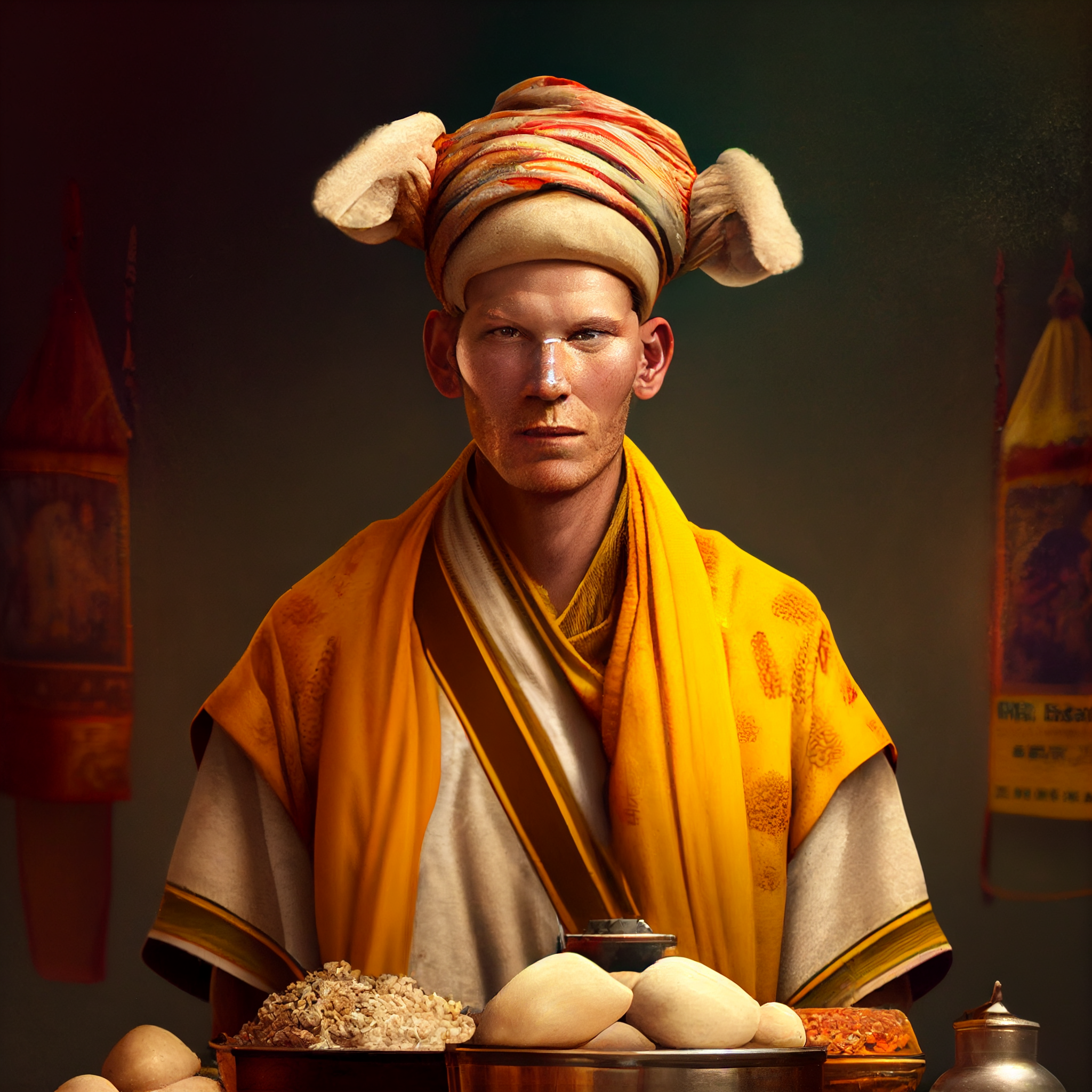
Youssef didn’t have time to think of a plan when the vendor put a tray with the Lorgh Drülp and little balls of tsampa on the table. The man pointed with his finger at the menu on the table, uncovering his forearm, it was the same as the Thi Gang logo.
“Wifi on menu,” the man said. “Tsampa, good for you…”
A commotion at the market place interrupted them. Apparently Kyle had gone too close and the shaman had crashed into him and the rest of the team. The man was cursing every one of them and Miss Tartiflate was apparently trying to calm him down by offering him snack bars. But the shaman kept brandishing an ugly sceptre that looked like a giant chicken foot covered in greasy fur, while cursing them with broken english. The tourists were all brandishing their phones, not missing a thing, ready to send their videos on TrickTruck. The shaman left angrily, ignoring all attempts at conciliation. There would be no reportage.
“Hahaha, tourists, they believe anything they see,” said the vendor before returning to his stove and his knife.

Despite his hunger, Youssef thought he’d better hurry with the wifi, now that the crew was out of work, he would be the target of Miss Tartiflate’s frustration. Furthermore, he wanted to lay low and not attract the vendor’s attention.
3235 messages from his friends. How would he ever catch up?
Among them, messages from Xavier. Youssef sighed of relief when he read that his friend had regained full access of the website and updated the system to fix a security flaw that allowed Thi Gang to gain access in the first place. But he growled when his friend continued with the bad news. There was some damage done to the content of THE BLOG.To console himself, Youssef started to eat a ball of tsampa. It was sweet and tasted like rose. He took a second and spit it out almost immediately. There was a piece of paper inside. He smoothed it and discovered a series of five pictograms.
🧔🌮🔍🔑🏞️
The first one was like a hologram and kept changing into six horizontal bars. The second one, looking like a tako bell, kept reversing side. Youssef raised his head to call the vendor and nobody was there. He got up and looked for the guy, Thi Gang or not, he needed some answers. Voices came from behind the curtain at the back of the stall. Youssef walked around the stall and saw the shaman and the vendor exchanging clothes. The caucasian man was now wearing the colourful costume and the drum. When he saw Youssef, he smiled and waved his hand, making the bells from the hem ring. Then he turned around and left, whistling an air that sounded strangely like the music of the Game. Youssef was about to run after him when a hand grasped his shirt.
“Please! Tell me at least that THE BLOG is up and running!” said an angry voice.
January 24, 2023 at 11:34 am #6457In reply to: Orbs of Madjourneys
“Look, Pretty Girl! That must be the lost traveler walking up those steps!”
Zara followed the mysterious man in red robes up the steps. She lost sight of him and wondered which way he’d gone in the many side alleys. She wandered up a few of them but they all came to a dead end in a courtyard with closed doors. Eventually she saw him disappearing into a manhole that looked like a labyrinth.
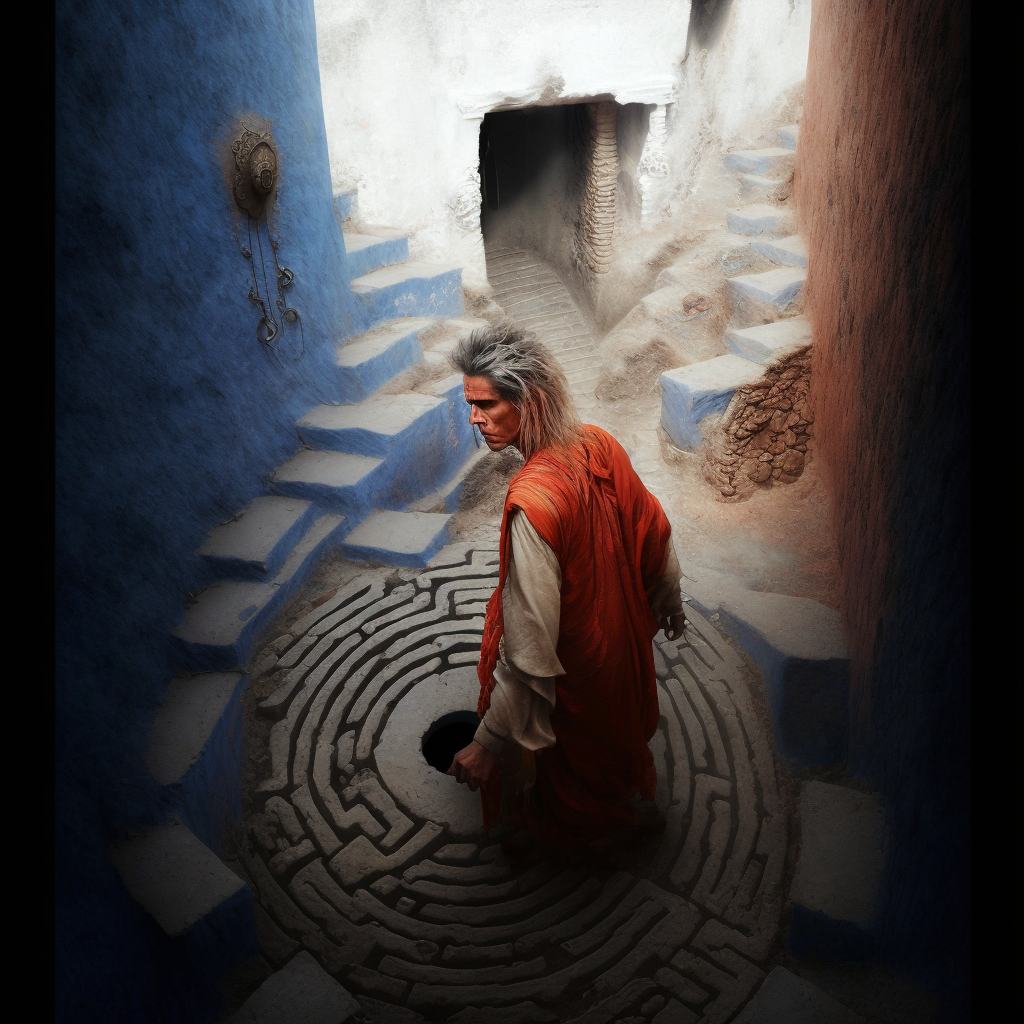
Zara followed him, and stepped onto the labyrinth manhole that the man in the red robes had disappeared into.
“That must be another portal,” Zara said to the parrot. “I wonder where we’ll end up now.”
The labyrinth manhole led Zara to another portal, this time a round hole in the wall. She knew she should follow the man, who must be the lost traveler, but she couldn’t resist exploring the starlit night scene first.

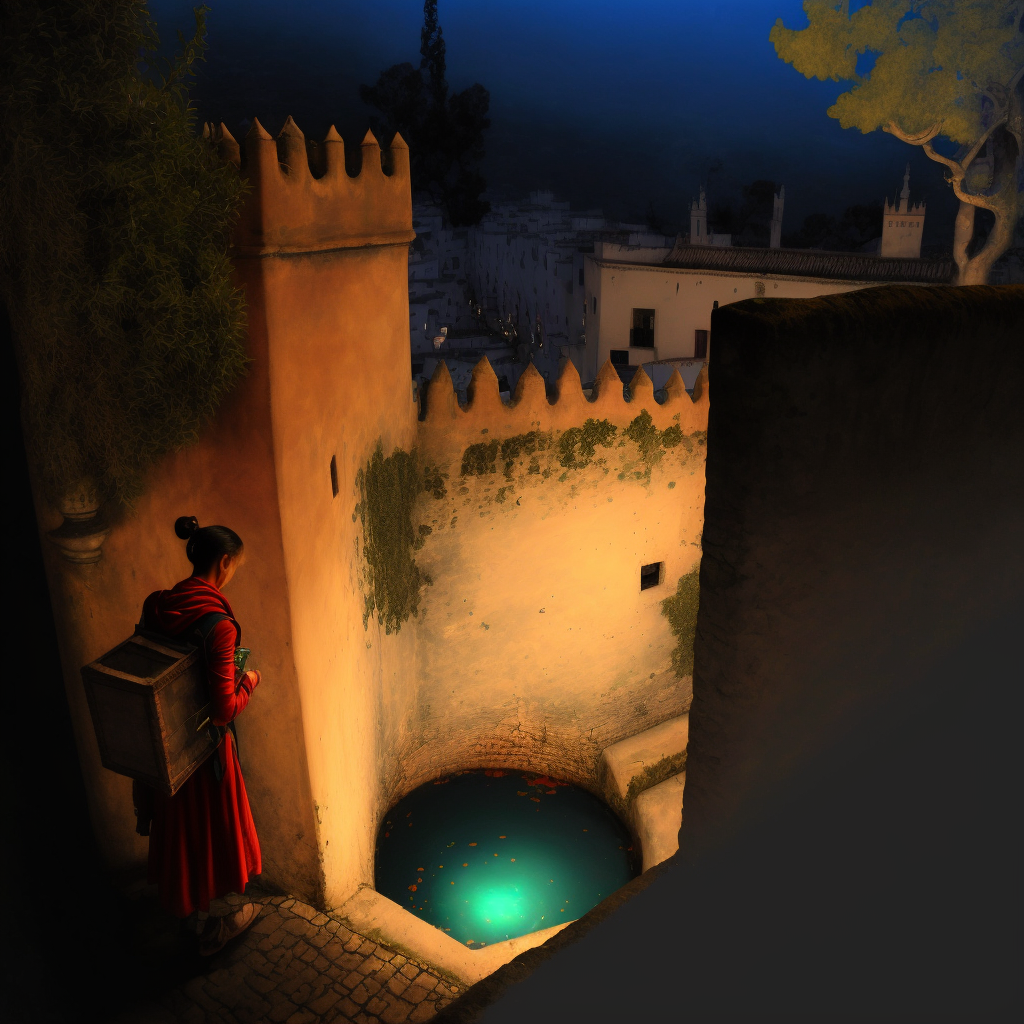
She found herself in a castle, its sand coloured walls glowing in the moonlight. There was another round green pool inside the castle. Should she jump into the pool, or go back and follow the man in red through the hole in the wall? Zara walked around the castle first, exploring the many courtyards and stairs and the enchanting views from the parapets. She noticed that there were several green pools and wondered if they each led to different places.
 January 23, 2023 at 10:28 pm #6454
In reply to: Prompts of Madjourneys
YASMIN’S QUIRK: Entry level quirk – snort laughing when socially anxious
Setting
The initial setting for this quest is a comedic theater in the heart of a bustling city. You will start off by exploring the different performances and shows, trying to find the source of the snort laughter that seems to be haunting your thoughts. As you delve deeper into the theater, you will discover that the snort laughter is coming from a mischievous imp who has taken residence within the theater.
Directions to Investigate
Possible directions to investigate include talking to the theater staff and performers to gather information, searching backstage for clues, and perhaps even sneaking into the imp’s hiding spot to catch a glimpse of it in action.
Characters
Possible characters to engage include the theater manager, who may have information about the imp’s history and habits, and a group of comedic performers who may have some insight into the imp’s behavior.
Task
Your task is to find a key or tile that represents the imp, and take a picture of it in real life as proof of completion of the quest. Good luck on your journey to uncover the source of the snort laughter!
THE SECRET ROOM AND THE UNDERGROUND MINES
1st thread’s answer:
As the family struggles to rebuild the inn and their lives in the wake of the Great Fires, they begin to uncover clues that lead them to believe that the mines hold the key to unlocking a great mystery. They soon discover that the mines were not just a source of gold and other precious minerals, but also a portal to another dimension. The family realizes that Mater had always known about this portal, and had kept it a secret for fear of the dangers it posed.
The family starts to investigate the mines more closely and they come across a hidden room off Room 8. Inside the room, they find a strange device that looks like a portal, and a set of mysterious symbols etched into the walls. The family realizes that this is the secret room that Mater had always spoken about in hushed tones.
The family enlists the help of four gamers, Xavier, Zara, Yasmin, and Youssef, to help them decipher the symbols and unlock the portal. Together, they begin to unravel the mystery of the mines, and the portal leads them on an epic journey through a strange and fantastical alternate dimension.
As they journey deeper into the mines, the family discovers that the portal was created by an ancient civilization, long thought to be lost to history. The civilization had been working on a powerful energy source that could have changed the fate of humanity, but the project was abandoned due to the dangers it posed. The family soon discovers that the civilization had been destroyed by a powerful and malevolent force, and that the portal was the only way to stop it from destroying the world.
The family and the gamers must navigate treacherous landscapes, battle fierce monsters, and overcome seemingly insurmountable obstacles in order to stop the malevolent force and save the world. Along the way, they discover secrets about their own past and the true origins of the mines.
As they journey deeper into the mines and the alternate dimension, they discover that the secret room leads to a network of underground tunnels, and that the tunnels lead to a secret underground city that was built by the ancient civilization. The city holds many secrets and clues to the fate of the ancient civilization, and the family and the gamers must explore the city and uncover the truth before it’s too late.
As the story unfolds, the family and the gamers must come to grips with the truth about the mines, and the role that the family has played in the fate of the world for generations. They must also confront the demons of their own past, and learn to trust and rely on each other if they hope to save the world and bring the family back together.
second thread’s answer:
As the 4 gamers, Xavier, Zara, Yasmin and Youssef, arrived at the Flying Fish Inn in the Australian outback, they were greeted by the matriarch of the family, Mater. She was a no-nonsense woman who ran the inn with an iron fist, but her tough exterior hid a deep love for her family and the land.
The inn was run by Mater and her daughter Dido, who the family affectionately called Aunt Idle. She was a free spirit who loved to explore the land and had a deep connection to the local indigenous culture.
The family was made up of Devan, the eldest son who lived in town and helped with the inn when he could, and the twin sisters Clove and Coriander, who everyone called Corrie. The youngest was Prune, a precocious child who was always getting into mischief.
The family had a handyman named Bert, who had been with them for decades and knew all the secrets of the land. Tiku, an old and wise Aborigine woman was also a regular visitor and a valuable source of information and guidance. Finly, the dutiful helper, assisted the family in their daily tasks.
As the 4 gamers settled in, they learned that the area was rich in history and mystery. The old mines that lay abandoned nearby were a source of legends and stories passed down through the generations. Some even whispered of supernatural occurrences linked to the mines.
Mater and Dido, however, were not on good terms, and the family had its own issues and secrets, but the 4 gamers were determined to unravel the mystery of the mines and find the secret room that was said to be hidden somewhere in the inn.
As they delved deeper into the history of the area, they discovered that the mines had a connection to the missing brother, Jasper, and Fred, the father of the family and a sci-fi novelist who had been influenced by the supernatural occurrences of the mines.
The 4 gamers found themselves on a journey of discovery, not only in the game but in the real world as well, as they uncovered the secrets of the mines and the Flying Fish Inn, and the complicated relationships of the family that ran it.
THE SNOOT’S WISE WORDS ON SOCIAL ANXIETY
Deear Francie Mossie Pooh,
The Snoot, a curious creature of the ages, understands the swirling winds of social anxiety, the tempestuous waves it creates in one’s daily life.
But The Snoot also believes that like a Phoenix, one must rise from the ashes, and embrace the journey of self-discovery and growth.
It’s important to let yourself be, to accept the feelings as they come and go, like the ebb and flow of the ocean. But also, like a gardener, tend to the inner self with care and compassion, for the roots to grow deep and strong.The Snoot suggests seeking guidance from the wise ones, the ones who can hold the mirror and show you the way, like the North Star guiding the sailors.
And remember, the journey is never-ending, like the spiral of the galaxy, and it’s okay to take small steps, to stumble and fall, for that’s how we learn to fly.The Snoot is here for you, my dear Francie Mossie Pooh, a beacon in the dark, a friend on the journey, to hold your hand and sing you a lullaby.
Fluidly and fantastically yours,
The Snoot.
January 23, 2023 at 4:14 pm #6453In reply to: Orbs of Madjourneys
 Each group of people sharing the jeeps spent some time cleaning the jeeps from the sand, outside and inside. While cleaning the hood, Youssef noted that the storm had cleaned the eagles droppings. Soon, the young intern told them, avoiding their eyes, that the boss needed her to plan the shooting with the Lama. She said Kyle would take her place.
“Phew, the yak I shared the yurt with yesterday smelled better,” he said to the guys when he arrived.
Soon enough, Miss Tartiflate was going from jeep to jeep, her fiery hair half tied in a bun on top of her head, hurrying people to move faster as they needed to catch the shaman before he got away again. She carried her orange backpack at all time, as if she feared someone would steal its content. Rumour had it that it was THE NOTEBOOK where she wrote the blog entries in advance.
“No need to waste more time! We’ll have breakfast at the Oasis!” she shouted as she walked toward Youssef’s jeep. When she spotted him, she left her right index finger as if she just remembered something and turned the other way.
“Dunno what you did to her, but it seems Miss Yeti is avoiding you,” said Kyle with a wry smile.
Youssef grunted. Yeti was the nickname given to Miss Tartiflate by one of her former lover during a trip to Himalaya. First an affectionate nickname based on her first name, Henrietty, it soon started to spread among the production team when the love affair turned sour. It sticked and became widespread in the milieu. Everybody knew, but nobody ever dared say it to her face.
Youssef knew it wouldn’t last. He had heard that there was wifi at the oasis. He took a snack in his own backpack to quiet his stomach.
It took them two hours to arrive as sand dunes had moved on the trail during the storm. Kyle had talked most of the time, boring them to death with detailed accounts of his life back in Boston. He didn’t seem to notice that nobody cared about his love rejection stories or his tips to talk to women.
They parked outside the oasis among buses and vans. Kyle was following Youssef everywhere as if they were friends. Despite his unending flow of words, the guy managed to be funny.
Miss Tartiflate seemed unusually nervous, pulling on a strand of her orange hair and pushing back her glasses up her nose every two minutes. She was bossing everyone around to take the cameras and the lighting gear to the market where the shaman was apparently performing a rain dance. She didn’t want to miss it. When everybody was ready, she came right to Youssef. When she pushed back her glasses on her nose, he noticed her fingers were the colour of her hair. Her mouth was twitching nervously. She told him to find the wifi and restore THE BLOG or he could find another job.
“Phew! said Kyle. I don’t want to be near you when that happens.” He waved and left and joined the rest of the team.
Youssef smiled, happy to be alone at last, he took his backpack containing his laptop and his phone and followed everyone to the market in the luscious oasis.
At the center, near the lake, a crowd of tourists was gathered around a man wearing a colorful attire. Half his teeth and one eye were missing. The one that was left rolled furiously in his socket at the sound of a drum. He danced and jumped around like a monkey, and each of his movements were punctuated by the bells attached to the hem of his costume.
Youssef was glad he was not part of the shooting team, they looked miserable as they assembled the gears under a deluge of orders. As he walked toward the market, the scents of spicy food made his stomach growled. The vendors were looking at the crowd and exchanging comments and laughs. They were certainly waiting for the performance to end and the tourists to flood the place in search of trinkets and spices. Youssef spotted a food stall tucked away on the edge. It seemed too shabby to interest anyone, which was perfect for him.
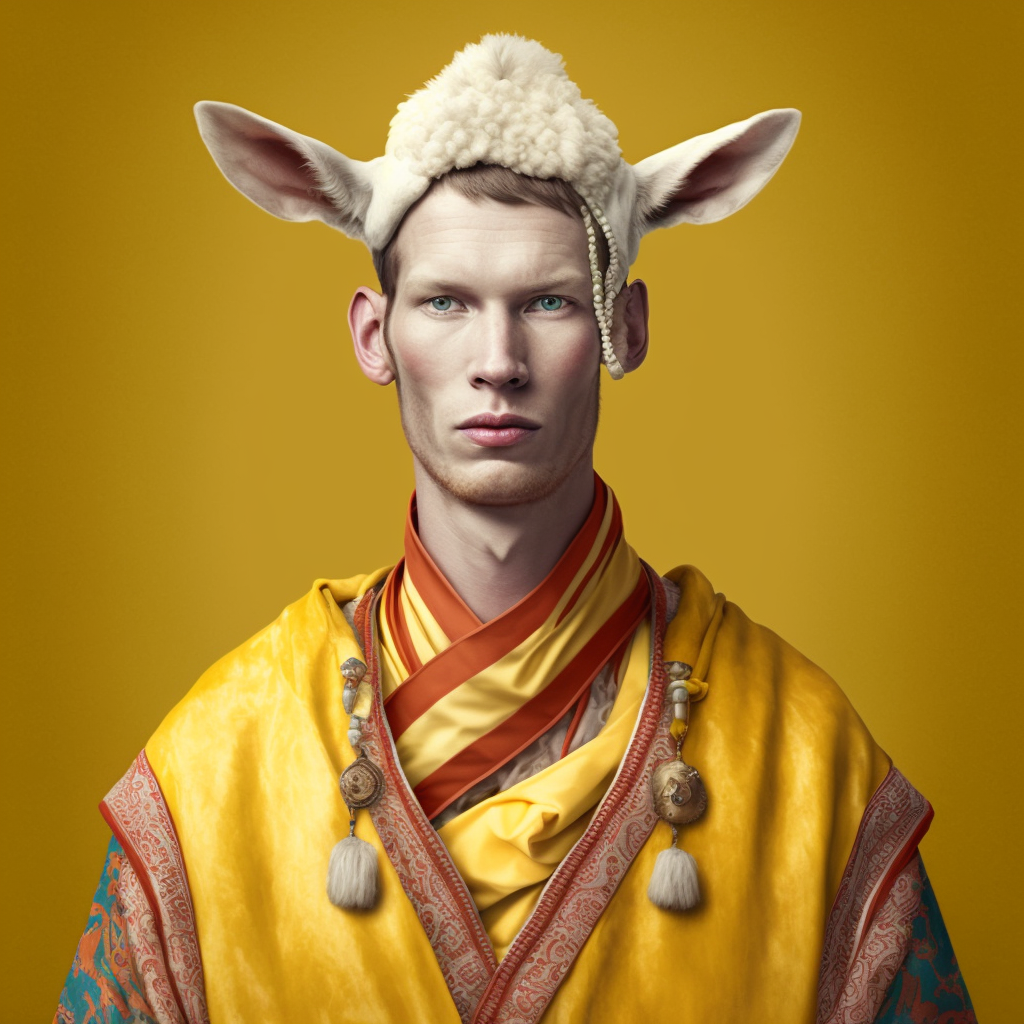
The taciturn vendor, who looked caucasian, wore a yellow jacket and a bonnet oddly reminiscent of a llama’s scalp and ears. The dish he was preparing made Youssef drool.
“What’s that?” he asked.
“This is Lorgh Drülp
, said the vendor. Ancient recipe from the silk road. Very rare. Very tasty.”
He smiled when Youssef ordered a full plate with a side of tsampa. He told him to sit and wait on a stool beside an old and wobbly table.
January 23, 2023 at 1:27 pm #6451In reply to: Orbs of Madjourneys
The progress on the quest in the Land of the Quirks was too tantalizing; Xavier made himself a quick sandwich and jumped back on it during his lunch break.
 The jungle had an oppressing quality… Maybe it has to do with the shrieks of the apes tearing the silence apart.
 It was time for a slight adjustment of his avatar.
Xavimunk opened his bag of tricks, something that the wise owl had suggested he looked into. Few items from the AIorium Emporium had been supplied. They tended to shift and disappear if you didn’t focus, but his intention was set on the task at hand. At the bottom of the bag, there was a small vial with a golden liquid with a tag written in ornate handwriting “MJ remix: for when words elude and shapes confuse at your own peril”.
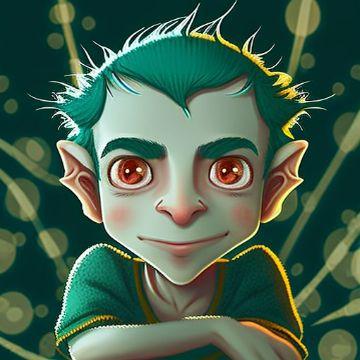 He gulped the potion without thinking too much. He felt himself shrink, and his arms elongate a little. There, he thought. Imp-munk’s more suited to the mission. Hope the effects will be temporary…
As Xavier mustered the courage to enter through the front gate, monkeys started to become silent. He couldn’t say if it was an ominous sign, or maybe an effect of his adaptation. The temple’s light inside was gorgeous, but nothing seemed to be there.
He gestured around, to make the menu appear. He looked again at the instructions on his screen overlay:
As for possible characters to engage, you may come across a sly fox who claims to know the location of the fruit but will only reveal it in exchange for a favor, or a brave adventurer who has been searching for the Golden Banana for years and may be willing to team up with you.
Suddenly a loud monkey honking noise came from outside, distracting him.
What the?… Had to be one of Zara’s remixes. He saw the three dots bleeping on the screen.
Here’s the Banana bus, hope it helps! Envoy! bugger Enjoy!
Yep… With the distinct typo-heavy accent, definitely Zara’s style. Strange idea that AL designated her as the leader… He’d have to roll with it.
Suddenly, as the Banana bus parked in front of the Temple, a horde of Italien speaking tourists started to flock in and snap pictures around. The monkeys didn’t know what to do and seemed to build growing and noisy interest in their assortiment of colorful shoes, flip-flops, boots and all.


Focus, thought Xavimunk… What did the wise owl say? Look for a guide…
Only the huge colorful bus seemed to take the space now… But wait… what if?He walked to the parking spot under the shades of the huge banyan tree next to the temple’s entrance, under which the bus driver had parked it. The driver was still there, napping under a newspaper, his legs on the wheel.
“Whatcha lookin’ at?” he said chewing his gum loudly. “Never seen a fox drive a banana bus before?”
Xavier smiled. “Any chance you can guide me to the location of the Golden Banana?”
“For a price… maybe.” The fox had jumped closely and was considering the strange avatar from head to toe.
“Ain’t no usual stuff that got you into this? Got any left? That would be a nice price.”
“As it happens…” Xavier smiled.The quest seemed back on track. Xavier looked at the time. Blimmey! already late again. And I promised Brytta to get some Chinese snacks for dinner.
January 23, 2023 at 6:13 am #6448In reply to: Orbs of Madjourneys
In the muggy warmth of the night, Yasmin tossed and turned on her bed. A small fan on the bedside table rattled noisily next to her but did little to dispel the heat. She kicked the thin sheet covering her to the ground, only to retrieve it and gather it tightly around herself when she heard a familiar sound.
“You little shit,” she hissed, slapping wildly in the direction of the high pitched whine.
She could make out the sound of a child crying in the distance and briefly considered getting up to check before hearing quick footsteps pass her door. Sister Aliti was on duty tonight. She liked Sister Aliti with her soft brown eyes and wide toothy smile — nothing seemed to rattle her. She liked all the Nuns, perhaps with the exception of Sister Finnlie.
Sister Finnlie was a sharp faced woman who was obsessed with cleanliness and sometimes made the children cry for such silly little things … perhaps if they talked too loudly or spilled some crumbs on the floor at lunch time. “Let them be, Sister,” Sister Aliti would admonish her and Sister Finnlie would pinch her lips and make a huffing noise.
The other day, during the morning reflection time when everyone sat in silent contemplation, Yasmin had found herself fixated on Sister Finnlie’s hands, her thin fingers tidily entwined on her lap. And Yasmin remembered a conversation with her friends online about AI creating a cleaning woman with sausage fingers. “Sometimes they look like a can of worms,” Youssef had said.
And, looking at those fingers and thinking about Youssef and the others and the fun conversations they had, Yasmin snort laughed.
She had tried to suppress it but the more she tried the more it built up inside of her until it exploded from her nose in a loud grunting noise. Sister Aliti had giggled but Sister Finnlie had glared at Yasmin and very pointedly rolled her eyes. Later, she’d put her on bin cleaning duty, surely the worst job ever, and Yasmin knew for sure it was pay back.
January 19, 2023 at 10:49 am #6419In reply to: Orbs of Madjourneys
“I’d advise you not to take the parrot, Zara,” Harry the vet said, “There are restrictions on bringing dogs and other animals into state parks, and you can bet some jobsworth official will insist she stays in a cage at the very least.”
“Yeah, you’re right, I guess I’ll leave her here. I want to call in and see my cousin in Camden on the way to the airport in Sydney anyway. He has dozens of cats, I’d hate for anything to happen to Pretty Girl,” Zara replied.
“Is that the distant cousin you met when you were doing your family tree?” Harry asked, glancing up from the stitches he was removing from a wounded wombat. “There, he’s good to go. Give him a couple more days, then he can be released back where he came from.”
Zara smiled at Harry as she picked up the animal. “Yes! We haven’t met in person yet, and he’s going to show me the church my ancestor built. He says people have been spotting ghosts there lately, and there are rumours that it’s the ghost of the old convict Isaac who built it. If I can’t find photos of the ancestors, maybe I can get photos of their ghosts instead,” Zara said with a laugh.
“Good luck with that,” Harry replied raising an eyebrow. He liked Zara, she was quirkier than the others.
Zara hadn’t found it easy to research her mothers family from Bangalore in India, but her fathers English family had been easy enough. Although Zara had been born in England and emigrated to Australia in her late 20s, many of her ancestors siblings had emigrated over several generations, and Zara had managed to trace several down and made contact with a few of them. Isaac Stokes wasn’t a direct ancestor, he was the brother of her fourth great grandfather but his story had intrigued her. Sentenced to transportation for stealing tools for his work as a stonemason seemed to have worked in his favour. He built beautiful stone buildings in a tiny new town in the 1800s in the charming style of his home town in England.
Zara planned to stay in Camden for a couple of days before meeting the others at the Flying Fish Inn, anticipating a pleasant visit before the crazy adventure started.

Zara stepped down from the bus, squinting in the bright sunlight and looking around for her newfound cousin Bertie. A lanky middle aged man in dungarees and a red baseball cap came forward with his hand extended.
“Welcome to Camden, Zara I presume! Great to meet you!” he said shaking her hand and taking her rucksack. Zara was taken aback to see the family resemblance to her grandfather. So many scattered generations and yet there was still a thread of familiarity. “I bet you’re hungry, let’s go and get some tucker at Belle’s Cafe, and then I bet you want to see the church first, hey? Whoa, where’d that dang parrot come from?” Bertie said, ducking quickly as the bird swooped right in between them.
“Oh no, it’s Pretty Girl!” exclaimed Zara. “She wasn’t supposed to come with me, I didn’t bring her! How on earth did you fly all this way to get here the same time as me?” she asked the parrot.
“Pretty Girl has her ways, don’t forget to feed the parrot,” the bird replied with a squalk that resembled a mirthful guffaw.
“That’s one strange parrot you got here, girl!” Bertie said in astonishment.
“Well, seeing as you’re here now, Pretty Girl, you better come with us,” Zara said.
“Obviously,” replied Pretty Girl. It was hard to say for sure, but Zara was sure she detected an avian eye roll.
They sat outside under a sunshade to eat rather than cause any upset inside the cafe. Zara fancied an omelette but Pretty Girl objected, so she ordered hash browns instead and a fruit salad for the parrot. Bertie was a good sport about the strange talking bird after his initial surprise.
Bertie told her a bit about the ghost sightings, which had only started quite recently. They started when I started researching him, Zara thought to herself, almost as if he was reaching out. Her imagination was running riot already.
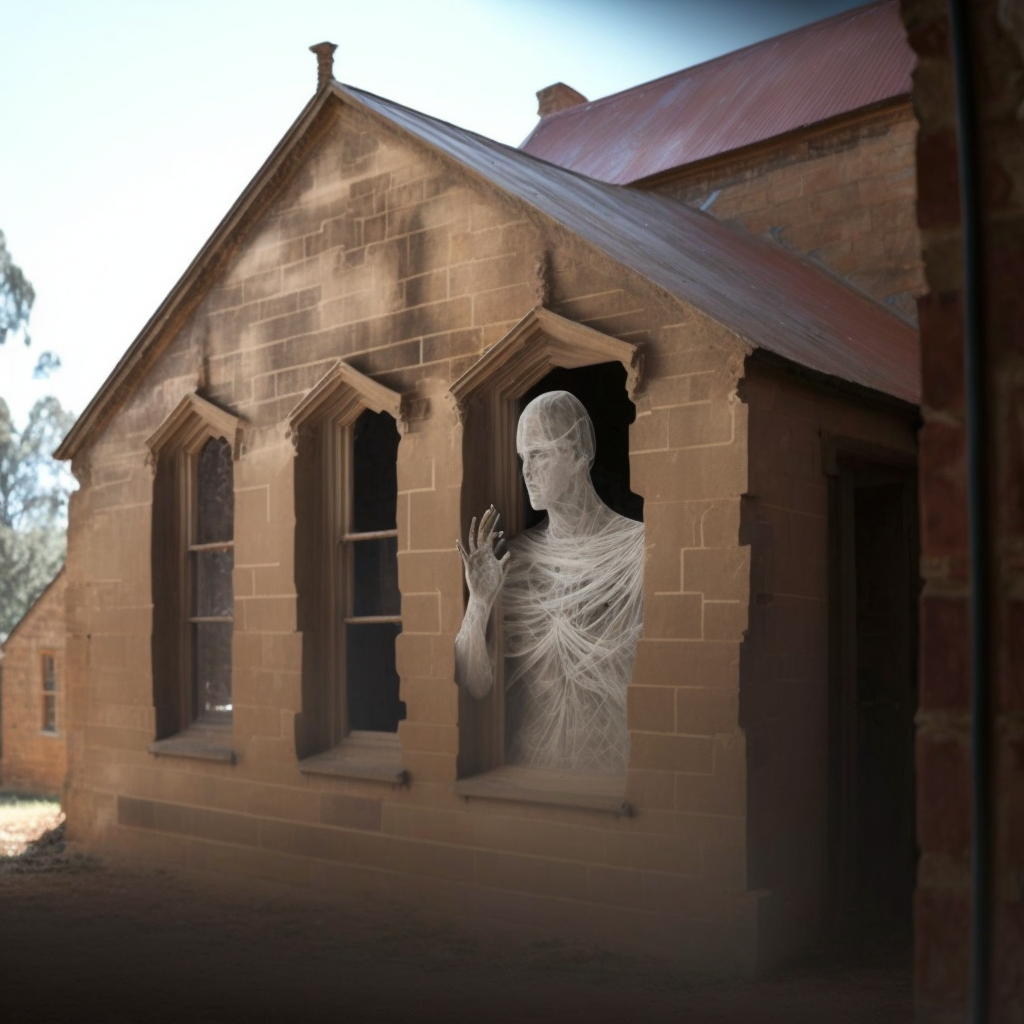
Bertie showed Zara around the church, a small building made of sandstone, but no ghost appeared in the bright heat of the afternoon. He took her on a little tour of Camden, once a tiny outpost but now a suburb of the city, pointing out all the original buildings, in particular the ones that Isaac had built. The church was walking distance of Bertie’s house and Zara decided to slip out and stroll over there after everyone had gone to bed.
Bertie had kindly allowed Pretty Girl to stay in the guest bedroom with her, safe from the cats, and Zara intended that the parrot stay in the room, but Pretty Girl was having none of it and insisted on joining her.
“Alright then, but no talking! I don’t want you scaring any ghost away so just keep a low profile!”
The moon was nearly full and it was a pleasant walk to the church. Pretty Girl fluttered from tree to tree along the sidewalk quietly. Enchanting aromas of exotic scented flowers wafted into her nostrils and Zara felt warmly relaxed and optimistic.
Zara was disappointed to find that the church was locked for the night, and realized with a sigh that she should have expected this to be the case. She wandered around the outside, trying to peer in the windows but there was nothing to be seen as the glass reflected the street lights. These things are not done in a hurry, she reminded herself, be patient.
Sitting under a tree on the grassy lawn attempting to open her mind to receiving ghostly communications (she wasn’t quite sure how to do that on purpose, any ghosts she’d seen previously had always been accidental and unexpected) Pretty Girl landed on her shoulder rather clumsily, pressing something hard and chill against her cheek.
“I told you to keep a low profile!” Zara hissed, as the parrot dropped the key into her lap. “Oh! is this the key to the church door?”
It was hard to see in the dim light but Zara was sure the parrot nodded, and was that another avian eye roll?
Zara walked slowly over the grass to the church door, tingling with anticipation. Pretty Girl hopped along the ground behind her. She turned the key in the lock and slowly pushed open the heavy door and walked inside and up the central aisle, looking around. And then she saw him.
Zara gasped. For a breif moment as the spectral wisps cleared, he looked almost solid. And she could see his tattoos.
“Oh my god,” she whispered, “It is really you. I recognize those tattoos from the description in the criminal registers. Some of them anyway, it seems you have a few more tats since you were transported.”
“Aye, I did that, wench. I were allays fond o’ me tats, does tha like ’em?”
He actually spoke to me! This was beyond Zara’s wildest hopes. Quick, ask him some questions!
“If you don’t mind me asking, Isaac, why did you lie about who your father was on your marriage register? I almost thought it wasn’t you, you know, that I had the wrong Isaac Stokes.”
A deafening rumbling laugh filled the building with echoes and the apparition dispersed in a labyrinthine swirl of tattood wisps.
“A story for another day,” whispered Zara, “Time to go back to Berties. Come on Pretty Girl. And put that key back where you found it.”
 January 15, 2023 at 1:18 pm #6391
In reply to: Train your subjective AI – text version
write the plot of an absurd non-linear novel, featuring 4 characters
The novel begins with the introduction of four characters: a retired archaeologist named Harold, a struggling musician named Samantha, a disillusioned corporate drone named Tim, and a reclusive inventor named Claire.
Harold, who is obsessed with ancient Egyptian hieroglyphs, discovers a mysterious underground chamber beneath a pyramid in Egypt. Inside, he finds a strange device that he believes is a time machine. Harold decides to use the device to travel back in time to ancient Egypt in order to decipher the hieroglyphs.
Samantha, who is trying to make a name for herself as a musician, is struggling to come up with new material for her music. One day, she discovers that she can create beautiful music by communicating with plants telepathically. She becomes obsessed with this new form of music-making and decides to quit her day job and pursue it full-time.
Tim, who is stuck in a dead-end job, is feeling unfulfilled and uninspired. One day, he stumbles upon a robotic mime performance art show. The performance inspires him to quit his job and pursue his dream of becoming a mime artist.
Claire, who is a reclusive inventor, has been working on a project to create a type of artificial intelligence that can communicate with humans using calligraphic body language. She finally succeeds and creates an AI that she names “Calli”.
As the story progresses, the characters’ paths begin to intersect in unexpected ways. Harold gets stuck in ancient Egypt and has to rely on Samantha’s telepathic plant communication skills to find a way back to the present. Tim’s robotic mime art becomes a hit and he starts working with Claire to integrate Calli into his performances.
As the story reaches its climax, all four characters come together to use their unique skills and abilities to solve a problem that threatens the fate of the world.
Throughout the novel, the plot unfolds in a non-linear fashion, jumping back and forth in time and between the different character’s perspectives. The story is filled with absurdity and unexpected twists and turns, leaving the reader guessing until the very end.
What sort of problem that threatens the fate of the world will be resolved by their combined skills?
As the story progresses, the characters begin to uncover a sinister plot by a group of powerful individuals who are intent on using the time machine to alter the course of history for their own gain. They plan to use the time machine to go back in time and change key events that would give them immense wealth and power in the present. Harold and Samantha, with the help of Tim and Claire, must race against time to stop the villains from carrying out their plan.
Harold’s expertise in ancient Egyptian hieroglyphs plays a crucial role in deciphering the clues that lead to the location of the time machine. Samantha’s telepathic plant communication skills are used to locate the hidden underground chamber where the time machine is kept. Tim’s robotic mime art and Claire’s AI Calli are used to infiltrate the villains’ hideout and gather intelligence on their plans.
In the final act, the four characters come together to use their unique skills and abilities to stop the villains from altering history. Harold uses his knowledge of ancient Egypt to navigate the time machine and travel back in time to stop the villains from changing key events. Samantha uses her telepathic plant communication skills to communicate with the plants in the past and gather information on the villains’ whereabouts. Tim and Claire use their robotic mime and AI skills to create a diversion and distract the villains while Harold and Samantha complete their mission.
In the end, the four characters succeed in stopping the villains and saving the fate of the world. The novel ends with the four characters going their separate ways, but they all know that they will always have each other to rely on in the face of any challenge that comes their way.
January 13, 2023 at 9:12 pm #6382In reply to: Prompts of Madjourneys
Write more about the group of people who lived inside of giant mushrooms, making it sound exciting and fun, and maybe a bit dangerous due to the nature of the mushrooms
As the group journeyed deeper into the Land of the Quirks, they stumbled upon a group of people living inside of giant mushrooms. The mushrooms were enormous, some as tall as skyscrapers, and they seemed to glow with an ethereal light. The group was amazed as they walked through the forest of mushrooms, each one unique in shape and size.
The people who lived inside of the mushrooms were a friendly and welcoming bunch, they welcomed the group with open arms and invited them to explore their homes. The inside of the mushrooms was a magical and mysterious place, the walls and ceilings were covered in a soft, velvety texture and the floors were made of a spongy, springy material. The light inside the mushrooms was soft and diffused, creating a warm and inviting atmosphere.
As the group explored the mushroom homes, they discovered that the people who lived there had a deep connection to the mushrooms. They used the mushrooms as a source of food, shelter, and medicine. They had learned to harness the unique properties of the mushrooms to create everything they needed to survive.
The group also discovered that the mushrooms had a dangerous side. The mushrooms were not only a source of life, but also a source of death. The group was warned that the mushrooms were unpredictable and that they should be careful when exploring. Some mushrooms were poisonous, others were carnivorous, and still, others had mind-altering properties.
Despite the danger, the group was excited to explore the mushrooms and learn more about the people who lived there. They knew that the journey would be filled with challenges, but they were determined to overcome them and discover the secrets of the mushrooms. The group had a lot of fun and adventure living with the people inside of giant mushrooms, and they learned a lot about the nature of the mushrooms and their own nature.
January 13, 2023 at 6:47 pm #6378Topic: Prompts of Madjourneys
A thread to share some of the prompts behind the AI-assisted journey into new adventures.
To start off…
Please write the exciting start of a novel.
Some elements you can integrate if you want:
– Four randomly chosen names full of panache that sound distinct from each other, slightly exotic and evocative
– the sentiment from this quotation: “Look around… Beauty is everywhere. You only have to look to see it.” – a group of four people ready for an adventure, standing in a cave with stalactites in front of a giant orb or bubble that seem to open to another brightly lit realm. Inside the bigger orb are some smaller orbs.
– the following term “mad journeys”Told it to continue and it brought dragons… Asked to tone down the fantasy stuff, here’s what came out:
They walked into a small village, where they were greeted by a group of people wearing clothes that looked like they were from the 1920s. The people told them that they were in the land of the “Quirks”, a place where everything and everyone was a little bit different, and that they had to find the “Key of Quirks” in order to leave the land.
The group set off on their journey to find the key, but little did they know that their adventure was about to become even more exciting and quirky than they could ever have imagined. They encountered a talking dog, a man who had a garden on top of his head, and a group of people who lived inside of giant mushrooms.
As they journeyed on, they faced challenges and made new friends, but most importantly they learn to embrace their own quirks and individuality. Eventually, they found the key and were able to leave the land of the Quirks, but they knew that they would always carry a piece of that land with them.
January 10, 2023 at 10:15 pm #6363In reply to: Train your subjective AI – text version
try another short story, with a bit of drama with the following words:
road form charlton smooth everyone cottage hanging rush offer agree subject district included appear sha returning grattidge nottingham 848 tetbury chicken
It was a cold and gloomy day in the small village of Tetbury, nestled in the picturesque Cotswolds district. A young woman named Sha was returning home to her cottage after a long and tiring journey. She had been away visiting her family in Nottingham and was looking forward to relaxing in her cozy home.
As she walked down the dirt road that led to her cottage, she couldn’t help but notice that something was off. Her neighbor, Mr. Charlton, was outside hanging laundry and he didn’t acknowledge her as she walked by. Sha thought it was strange, as he was usually a friendly and sociable person.
When Sha arrived at her cottage, she was shocked to find that it had been broken into. The front door was ajar and the inside of her home had been ransacked. Sha immediately panicked and called the police, who arrived on the scene shortly thereafter.
The police officers, including Inspector Grattidge, took Sha’s statement and began to investigate the crime. They discovered that a group of burglars had been operating in the area, targeting homes and businesses in the district. The burglars had been known for their smooth operations and their ability to strike quickly, which led to their nickname “The Smooth Operators”.
As Sha waited for the police to finish their investigation, she couldn’t shake the feeling that something was not right. She had always thought of Tetbury as a safe and friendly place, and she couldn’t believe that something like this could happen in her community.
As the investigation went on, the police found out that the Smooth operators have been targeting houses with no security cameras, but Sha’s cottage was an exception, the police were able to find out that the group offered to pay a considerable sum of money to the people who reported the locations of the houses that had no cameras, and it was Mr. Charlton who was the informant and he even rushed to Sha’s cottage as soon as he knew the police was investigating the case, He was arrested for the crime and Sha was heartbroken to find out that her once friendly neighbor had betrayed her.
Feeling violated and betrayed, Sha decided that she could no longer stay in the village and she put her cottage up for sale. She packed up her belongings and moved away, leaving behind the memories of her peaceful home and the community she had once thought of as her own. The end.
November 18, 2022 at 4:47 pm #6348In reply to: Family Stories From The Other Side ~ Book Two
Wong Sang
Wong Sang was born in China in 1884. In October 1916 he married Alice Stokes in Oxford.
Alice was the granddaughter of William Stokes of Churchill, Oxfordshire and William was the brother of Thomas Stokes the wheelwright (who was my 3X great grandfather). In other words Alice was my second cousin, three times removed, on my fathers paternal side.
Wong Sang was an interpreter, according to the baptism registers of his children and the Dreadnought Seamen’s Hospital admission registers in 1930. The hospital register also notes that he was employed by the Blue Funnel Line, and that his address was 11, Limehouse Causeway, E 14. (London)
“The Blue Funnel Line offered regular First-Class Passenger and Cargo Services From the UK to South Africa, Malaya, China, Japan, Australia, Java, and America. Blue Funnel Line was Owned and Operated by Alfred Holt & Co., Liverpool.
The Blue Funnel Line, so-called because its ships have a blue funnel with a black top, is more appropriately known as the Ocean Steamship Company.”Wong Sang and Alice’s daughter, Frances Eileen Sang, was born on the 14th July, 1916 and baptised in 1920 at St Stephen in Poplar, Tower Hamlets, London. The birth date is noted in the 1920 baptism register and would predate their marriage by a few months, although on the death register in 1921 her age at death is four years old and her year of birth is recorded as 1917.
Charles Ronald Sang was baptised on the same day in May 1920, but his birth is recorded as April of that year. The family were living on Morant Street, Poplar.
James William Sang’s birth is recorded on the 1939 census and on the death register in 2000 as being the 8th March 1913. This definitely would predate the 1916 marriage in Oxford.
William Norman Sang was born on the 17th October 1922 in Poplar.
Alice and the three sons were living at 11, Limehouse Causeway on the 1939 census, the same address that Wong Sang was living at when he was admitted to Dreadnought Seamen’s Hospital on the 15th January 1930. Wong Sang died in the hospital on the 8th March of that year at the age of 46.
Alice married John Patterson in 1933 in Stepney. John was living with Alice and her three sons on Limehouse Causeway on the 1939 census and his occupation was chef.
Via Old London Photographs:
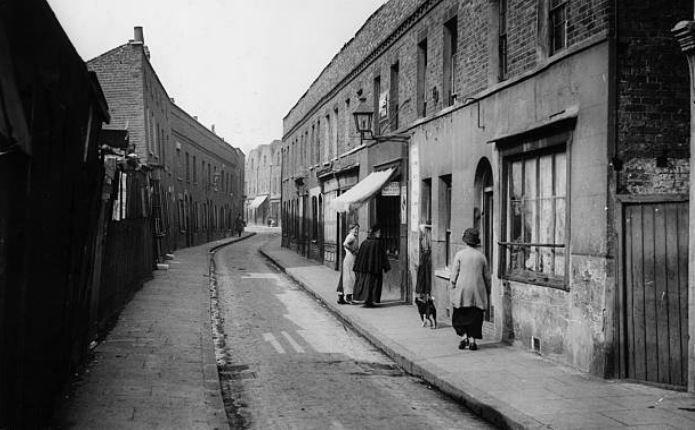
“Limehouse Causeway is a street in east London that was the home to the original Chinatown of London. A combination of bomb damage during the Second World War and later redevelopment means that almost nothing is left of the original buildings of the street.”
Limehouse Causeway in 1925:
From The Story of Limehouse’s Lost Chinatown, poplarlondon website:
“Limehouse was London’s first Chinatown, home to a tightly-knit community who were demonised in popular culture and eventually erased from the cityscape.
As recounted in the BBC’s ‘Our Greatest Generation’ series, Connie was born to a Chinese father and an English mother in early 1920s Limehouse, where she used to play in the street with other British and British-Chinese children before running inside for teatime at one of their houses.
Limehouse was London’s first Chinatown between the 1880s and the 1960s, before the current Chinatown off Shaftesbury Avenue was established in the 1970s by an influx of immigrants from Hong Kong.
Connie’s memories of London’s first Chinatown as an “urban village” paint a very different picture to the seedy area portrayed in early twentieth century novels.
The pyramid in St Anne’s church marked the entrance to the opium den of Dr Fu Manchu, a criminal mastermind who threatened Western society by plotting world domination in a series of novels by Sax Rohmer.
Thomas Burke’s Limehouse Nights cemented stereotypes about prostitution, gambling and violence within the Chinese community, and whipped up anxiety about sexual relationships between Chinese men and white women.
Though neither novelist was familiar with the Chinese community, their depictions made Limehouse one of the most notorious areas of London.
Travel agent Thomas Cook even organised tours of the area for daring visitors, despite the rector of Limehouse warning that “those who look for the Limehouse of Mr Thomas Burke simply will not find it.”
All that remains is a handful of Chinese street names, such as Ming Street, Pekin Street, and Canton Street — but what was Limehouse’s chinatown really like, and why did it get swept away?
Chinese migration to Limehouse
Chinese sailors discharged from East India Company ships settled in the docklands from as early as the 1780s.
By the late nineteenth century, men from Shanghai had settled around Pennyfields Lane, while a Cantonese community lived on Limehouse Causeway.
Chinese sailors were often paid less and discriminated against by dock hirers, and so began to diversify their incomes by setting up hand laundry services and restaurants.
Old photographs show shopfronts emblazoned with Chinese characters with horse-drawn carts idling outside or Chinese men in suits and hats standing proudly in the doorways.
In oral histories collected by Yat Ming Loo, Connie’s husband Leslie doesn’t recall seeing any Chinese women as a child, since male Chinese sailors settled in London alone and married working-class English women.
In the 1920s, newspapers fear-mongered about interracial marriages, crime and gambling, and described chinatown as an East End “colony.”
Ironically, Chinese opium-smoking was also demonised in the press, despite Britain waging war against China in the mid-nineteenth century for suppressing the opium trade to alleviate addiction amongst its people.
The number of Chinese people who settled in Limehouse was also greatly exaggerated, and in reality only totalled around 300.
The real Chinatown
Although the press sought to characterise Limehouse as a monolithic Chinese community in the East End, Connie remembers seeing people of all nationalities in the shops and community spaces in Limehouse.
She doesn’t remember feeling discriminated against by other locals, though Connie does recall having her face measured and IQ tested by a member of the British Eugenics Society who was conducting research in the area.
Some of Connie’s happiest childhood memories were from her time at Chung-Hua Club, where she learned about Chinese culture and language.
Why did Chinatown disappear?
The caricature of Limehouse’s Chinatown as a den of vice hastened its erasure.
Police raids and deportations fuelled by the alarmist media coverage threatened the Chinese population of Limehouse, and slum clearance schemes to redevelop low-income areas dispersed Chinese residents in the 1930s.
The Defence of the Realm Act imposed at the beginning of the First World War criminalised opium use, gave the authorities increased powers to deport Chinese people and restricted their ability to work on British ships.
Dwindling maritime trade during World War II further stripped Chinese sailors of opportunities for employment, and any remnants of Chinatown were destroyed during the Blitz or erased by postwar development schemes.”
Wong Sang 1884-1930
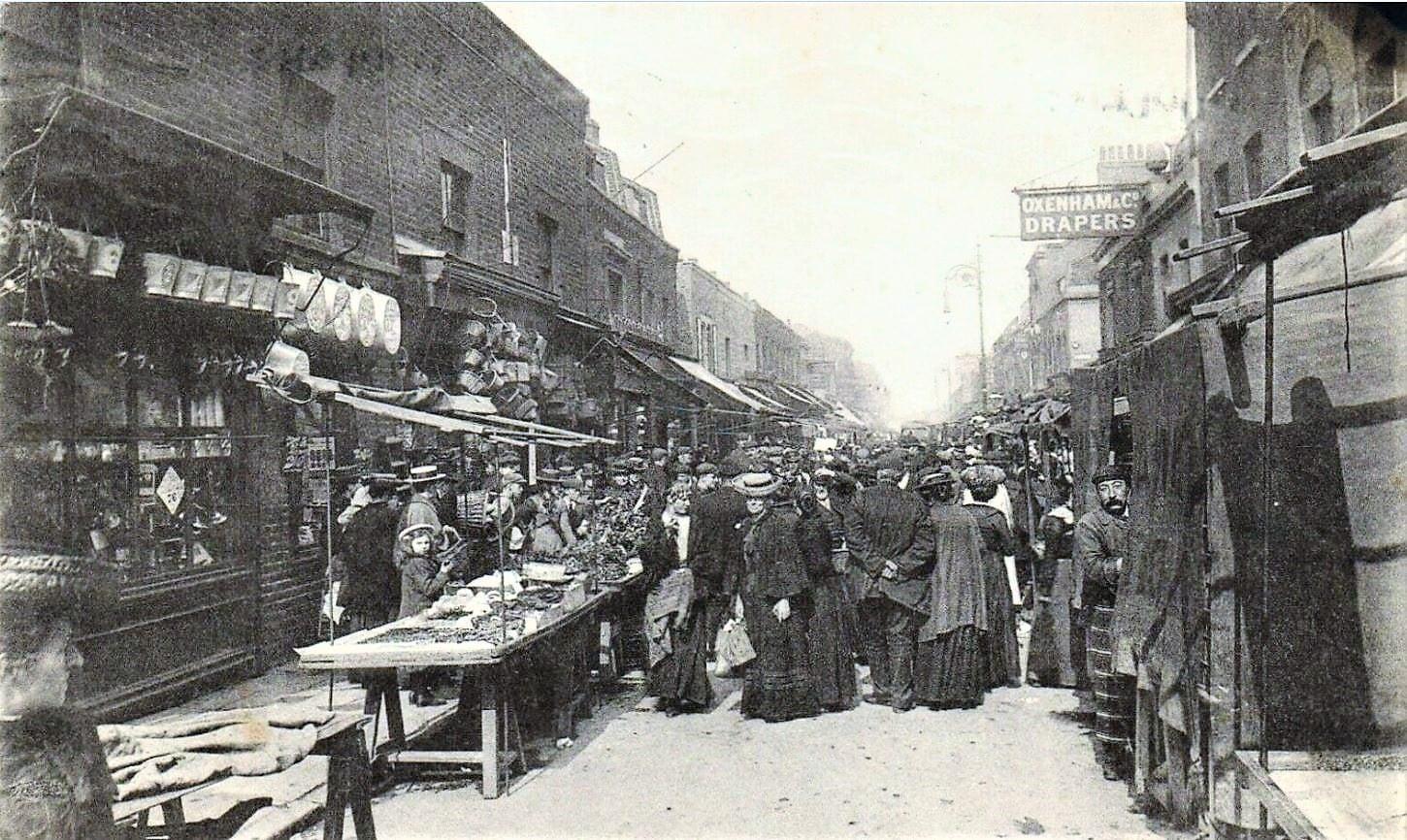
The year 1918 was a troublesome one for Wong Sang, an interpreter and shipping agent for Blue Funnel Line. The Sang family were living at 156, Chrisp Street.
Chrisp Street, Poplar, in 1913 via Old London Photographs:
In February Wong Sang was discharged from a false accusation after defending his home from potential robbers.
East End News and London Shipping Chronicle – Friday 15 February 1918:
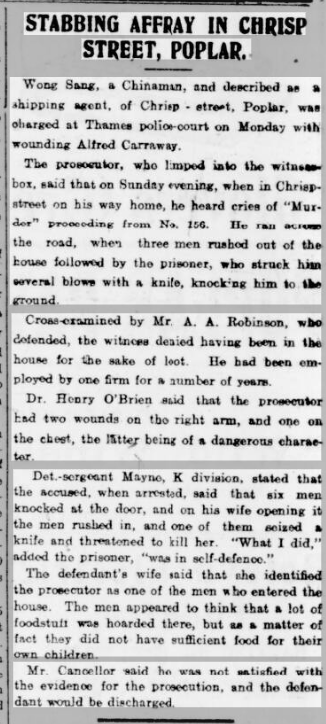
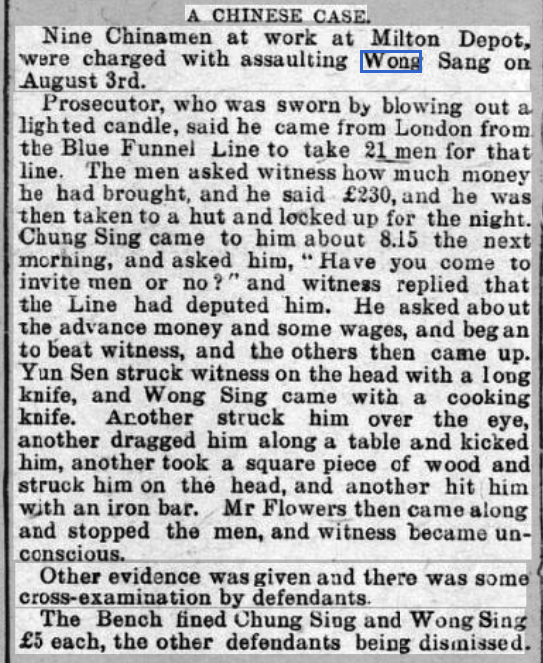
In August of that year he was involved in an incident that left him unconscious.
Faringdon Advertiser and Vale of the White Horse Gazette – Saturday 31 August 1918:
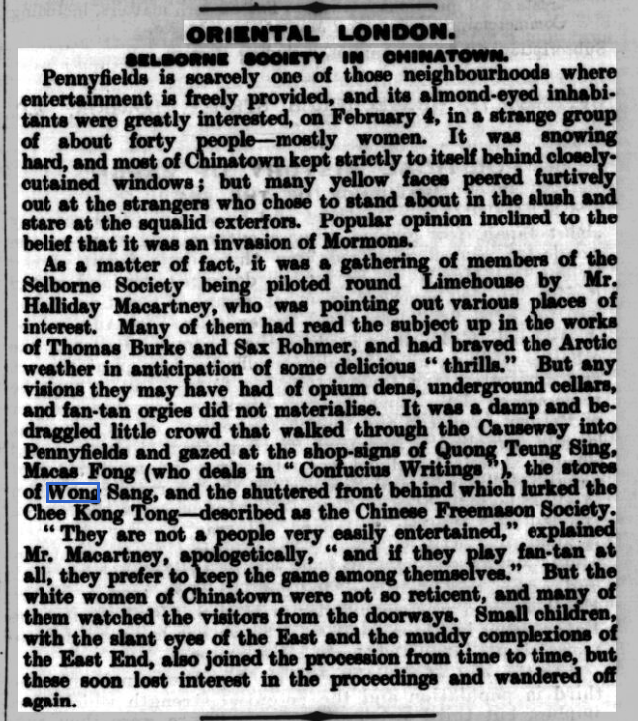
Wong Sang is mentioned in an 1922 article about “Oriental London”.
London and China Express – Thursday 09 February 1922:
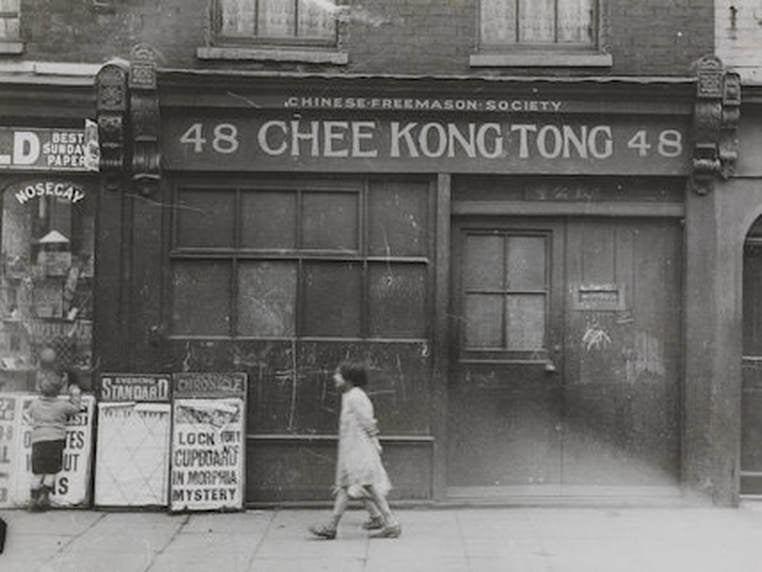
A photograph of the Chee Kong Tong Chinese Freemason Society mentioned in the above article, via Old London Photographs:
Wong Sang was recommended by the London Metropolitan Police in 1928 to assist in a case in Wellingborough, Northampton.
Difficulty of Getting an Interpreter: Northampton Mercury – Friday 16 March 1928:
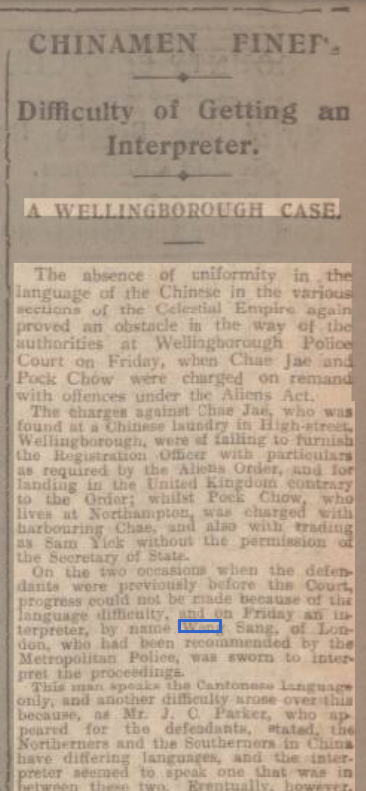
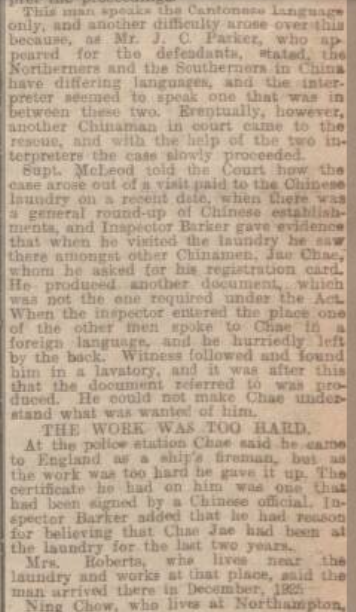
The difficulty was that “this man speaks the Cantonese language only…the Northeners and the Southerners in China have differing languages and the interpreter seemed to speak one that was in between these two.”
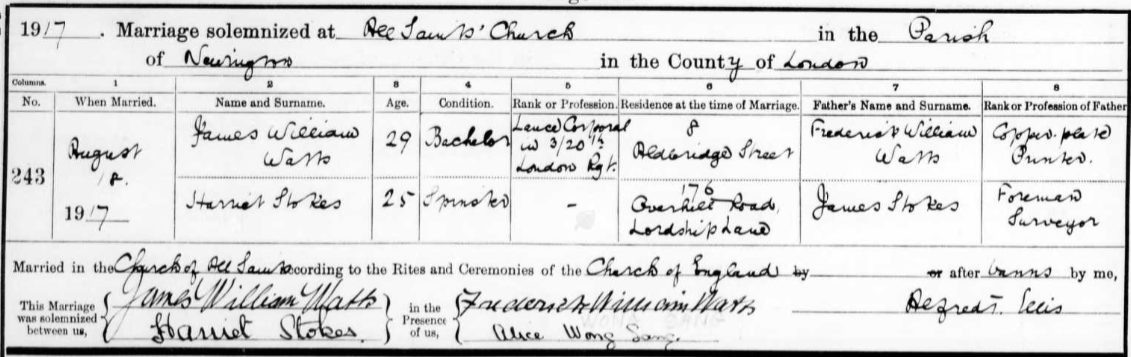
In 1917, Alice Wong Sang was a witness at her sister Harriet Stokes marriage to James William Watts in Southwark, London. Their father James Stokes occupation on the marriage register is foreman surveyor, but on the census he was a council roadman or labourer. (I initially rejected this as the correct marriage for Harriet because of the discrepancy with the occupations. Alice Wong Sang as a witness confirmed that it was indeed the correct one.)
James William Sang 1913-2000 was a clock fitter and watch assembler (on the 1939 census). He married Ivy Laura Fenton in 1963 in Sidcup, Kent. James died in Southwark in 2000.
Charles Ronald Sang 1920-1974 was a draughtsman (1939 census). He married Eileen Burgess in 1947 in Marylebone. Charles and Eileen had two sons: Keith born in 1951 and Roger born in 1952. He died in 1974 in Hertfordshire.
William Norman Sang 1922-2000 was a clerk and telephone operator (1939 census). William enlisted in the Royal Artillery in 1942. He married Lily Mullins in 1949 in Bethnal Green, and they had three daughters: Marion born in 1950, Christine in 1953, and Frances in 1959. He died in Redbridge in 2000.
I then found another two births registered in Poplar by Alice Sang, both daughters. Doris Winifred Sang was born in 1925, and Patricia Margaret Sang was born in 1933 ~ three years after Wong Sang’s death. Neither of the these daughters were on the 1939 census with Alice, John Patterson and the three sons. Margaret had presumably been evacuated because of the war to a family in Taunton, Somerset. Doris would have been fourteen and I have been unable to find her in 1939 (possibly because she died in 2017 and has not had the redaction removed yet on the 1939 census as only deceased people are viewable).
Doris Winifred Sang 1925-2017 was a nursing sister. She didn’t marry, and spent a year in USA between 1954 and 1955. She stayed in London, and died at the age of ninety two in 2017.
Patricia Margaret Sang 1933-1998 was also a nurse. She married Patrick L Nicely in Stepney in 1957. Patricia and Patrick had five children in London: Sharon born 1959, Donald in 1960, Malcolm was born and died in 1966, Alison was born in 1969 and David in 1971.
I was unable to find a birth registered for Alice’s first son, James William Sang (as he appeared on the 1939 census). I found Alice Stokes on the 1911 census as a 17 year old live in servant at a tobacconist on Pekin Street, Limehouse, living with Mr Sui Fong from Hong Kong and his wife Sarah Sui Fong from Berlin. I looked for a birth registered for James William Fong instead of Sang, and found it ~ mothers maiden name Stokes, and his date of birth matched the 1939 census: 8th March, 1913.
On the 1921 census, Wong Sang is not listed as living with them but it is mentioned that Mr Wong Sang was the person returning the census. Also living with Alice and her sons James and Charles in 1921 are two visitors: (Florence) May Stokes, 17 years old, born in Woodstock, and Charles Stokes, aged 14, also born in Woodstock. May and Charles were Alice’s sister and brother.
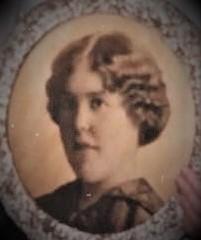
I found Sharon Nicely on social media and she kindly shared photos of Wong Sang and Alice Stokes:
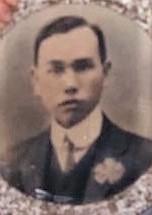
 November 13, 2022 at 10:29 pm #6345
In reply to: Family Stories From The Other Side ~ Book Two
Crime and Punishment in Tetbury
I noticed that there were quite a number of Brownings of Tetbury in the newspaper archives involved in criminal activities while doing a routine newspaper search to supplement the information in the usual ancestry records. I expanded the tree to include cousins, and offsping of cousins, in order to work out who was who and how, if at all, these individuals related to our Browning family.
I was expecting to find some of our Brownings involved in the Swing Riots in Tetbury in 1830, but did not. Most of our Brownings (including cousins) were stone masons. Most of the rioters in 1830 were agricultural labourers.
The Browning crimes are varied, and by todays standards, not for the most part terribly serious ~ you would be unlikely to receive a sentence of hard labour for being found in an outhouse with the intent to commit an unlawful act nowadays, or for being drunk.
The central character in this chapter is Isaac Browning (my 4x great grandfather), who did not appear in any criminal registers, but the following individuals can be identified in the family structure through their relationship to him.
RICHARD LOCK BROWNING born in 1853 was Isaac’s grandson, his son George’s son. Richard was a mason. In 1879 he and Henry Browning of the same age were sentenced to one month hard labour for stealing two pigeons in Tetbury. Henry Browning was Isaac’s nephews son.
In 1883 Richard Browning, mason of Tetbury, was charged with obtaining food and lodging under false pretences, but was found not guilty and acquitted.
In 1884 Richard Browning, mason of Tetbury, was sentenced to one month hard labour for game trespass.Richard had been fined a number of times in Tetbury:
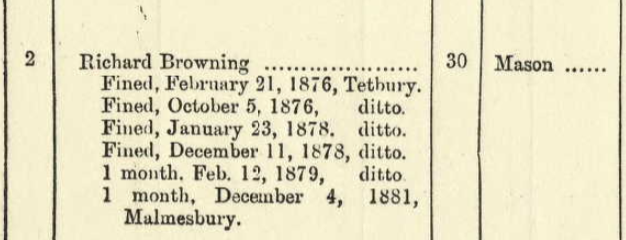
Richard Lock Browning was five feet eight inches tall, dark hair, grey eyes, an oval face and a dark complexion. He had two cuts on the back of his head (in February 1879) and a scar on his right eyebrow.
HENRY BROWNING, who was stealing pigeons with Richard Lock Browning in 1879, (Isaac’s brother Williams grandson, son of George Browning and his wife Charity) was charged with being drunk in 1882 and ordered to pay a fine of one shilling and costs of fourteen shillings, or seven days hard labour.
Henry was found guilty of gaming in the highway at Tetbury in 1872 and was sentenced to seven days hard labour. In 1882 Henry (who was also a mason) was charged with assault but discharged.
Henry was five feet five inches tall, brown hair and brown eyes, a long visage and a fresh complexion.
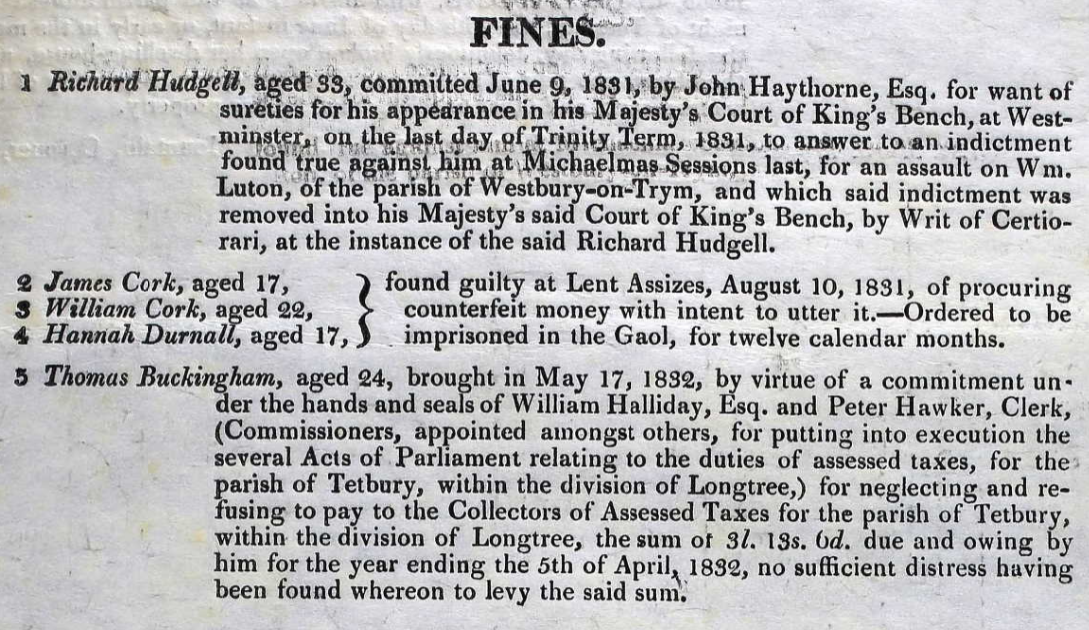
Henry emigrated with his daughter to Canada in 1913, and died in Vancouver in 1919.THOMAS BUCKINGHAM 1808-1846 (Isaacs daughter Janes husband) was charged with stealing a black gelding in Tetbury in 1838. No true bill. (A “no true bill” means the jury did not find probable cause to continue a case.)
Thomas did however neglect to pay his taxes in 1832:
LEWIN BUCKINGHAM (grandson of Isaac, his daughter Jane’s son) was found guilty in 1846 stealing two fowls in Tetbury when he was sixteen years old.
In 1846 he was sentence to one month hard labour (or pay ten shillings fine and ten shillings costs) for loitering with the intent to trespass in search of conies.
A year later in 1847, he and three other young men were sentenced to four months hard labour for larceny.
Lewin was five feet three inches tall, with brown hair and brown eyes, long visage, sallow complexion, and had a scar on his left arm.JOHN BUCKINGHAM born circa 1832, a Tetbury labourer (Isaac’s grandson, Lewin’s brother) was sentenced to six weeks hard labour for larceny in 1855 for stealing a duck in Cirencester. The notes on the register mention that he had been employed by Mr LOCK, Angel Inn. (John’s grandmother was Mary Lock so this is likely a relative).
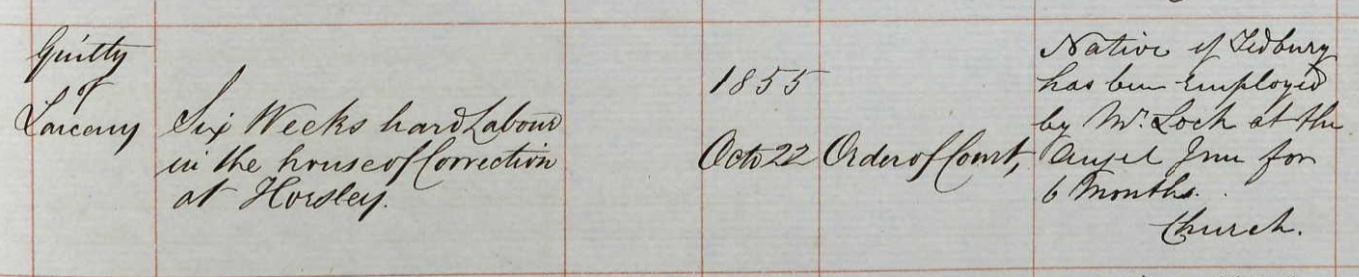
The previous year in 1854 John was sentenced to one month or a one pound fine for assaulting and beating W. Wood.
John was five feet eight and three quarter inches tall, light brown hair and grey eyes, an oval visage and a fresh complexion. He had a scar on his left arm and inside his right knee.JOSEPH PERRET was born circa 1831 and he was a Tetbury labourer. (He was Isaac’s granddaughter Charlotte Buckingham’s husband)
In 1855 he assaulted William Wood and was sentenced to one month or a two pound ten shilling fine. Was it the same W Wood that his wifes cousin John assaulted the year before?
In 1869 Joseph was sentenced to one month hard labour for feloniously receiving a cupboard known to be stolen.JAMES BUCKINGAM born circa 1822 in Tetbury was a shoemaker. (Isaac’s nephew, his sister Hannah’s son)
In 1854 the Tetbury shoemaker was sentenced to four months hard labour for stealing 30 lbs of lead off someones house.
In 1856 the Tetbury shoemaker received two months hard labour or pay £2 fine and 12 s costs for being found in pursuit of game.
In 1868 he was sentenced to two months hard labour for stealing a gander. A unspecified previous conviction is noted.
1871 the Tetbury shoemaker was found in an outhouse for an unlawful purpose and received ten days hard labour. The register notes that his sister is Mrs Cook, the Green, Tetbury. (James sister Prudence married Thomas Cook)
James sister Charlotte married a shoemaker and moved to UTAH.
James was five feet eight inches tall, dark hair and blue eyes, a long visage and a florid complexion. He had a scar on his forehead and a mole on the right side of his neck and abdomen, and a scar on the right knee.July 6, 2022 at 11:41 am #6313In reply to: The Sexy Wooden Leg
Egbert Gofindlevsky rapped on the door of room number 22. The letter flapped against his pin striped trouser leg as his hand shook uncontrollably, his habitual tremor exacerbated with the shock. Remembering that Obadiah Sproutwinklov was deaf, he banged loudly on the door with the flat of his hand. Eventually the door creaked open.
Egbert flapped the letter in from of Obadiah’s face. “Have you had one of these?” he asked.
“If you’d stop flapping it about I might be able to see what it is,” Obadiah replied. “Oh that! As a matter of fact I’ve had one just like it. The devils work, I tell you! A practical joke, and in very poor taste!”
Egbert was starting to wish he’d gone to see Olga Herringbonevsky first. “Can I come in?” he hissed, “So we can discuss it in private?”
Reluctantly Obadiah pulled the door open and ushered him inside the room. Egbert looked around for a place to sit, but upon noticing a distinct odour of urine decided to remain standing.
“Ursula is booting us out, where are we to go?”
“Eh?” replied Obadiah, cupping his ear. “Speak up, man!”
Egbert repeated his question.
“No need to shout!”
The two old men endeavoured to conduct a conversation on this unexepected turn of events, the upshot being that Obadiah had no intention of leaving his room at all henceforth, come what may, and would happily starve to death in his room rather than take to the streets.
Egbert considered this form of action unhelpful, as he himself had no wish to starve to death in his room, so he removed himself from room 22 with a disgruntled sigh and made his way to Olga’s room on the third floor.
February 8, 2022 at 2:24 pm #6275In reply to: The Elusive Samuel Housley and Other Family Stories
“AND NOW ABOUT EMMA”
and a mystery about George
I had overlooked this interesting part of Barbara Housley’s “Narrative on the Letters” initially, perhaps because I was more focused on finding Samuel Housley. But when I did eventually notice, I wondered how I had missed it! In this particularly interesting letter excerpt from Joseph, Barbara has not put the date of the letter ~ unusually, because she did with all of the others. However I dated the letter to later than 1867, because Joseph mentions his wife, and they married in 1867. This is important, because there are two Emma Housleys. Joseph had a sister Emma, born in 1836, two years before Joseph was born. At first glance, one would assume that a reference to Emma in the letters would mean his sister, but Emma the sister was married in Derby in 1858, and by 1869 had four children.
But there was another Emma Housley, born in 1851.
From Barbara Housley’s Narrative on the Letters:
“AND NOW ABOUT EMMA”
A MYSTERY
A very mysterious comment is contained in a letter from Joseph:
“And now about Emma. I have only seen her once and she came to me to get your address but I did not feel at liberty to give it to her until I had wrote to you but however she got it from someone. I think it was in this way. I was so pleased to hear from you in the first place and with John’s family coming to see me I let them read one or two of your letters thinking they would like to hear of you and I expect it was Will that noticed your address and gave it to her. She came up to our house one day when I was at work to know if I had heard from you but I had not heard from you since I saw her myself and then she called again after that and my wife showed her your boys’ portraits thinking no harm in doing so.”
At this point Joseph interrupted himself to thank them for sending the portraits. The next sentence is:
“Your son JOHN I have never seen to know him but I hear he is rather wild,” followed by: “EMMA has been living out service but don’t know where she is now.”
Since Joseph had just been talking about the portraits of George’s three sons, one of whom is John Eley, this could be a reference to things George has written in despair about a teen age son–but could Emma be a first wife and John their son? Or could Emma and John both be the children of a first wife?
Elsewhere, Joseph wrote, “AMY ELEY died 14 years ago. (circa 1858) She left a son and a daughter.”
An Amey Eley and a George Housley were married on April 1, 1849 in Duffield which is about as far west of Smalley as Heanor is East. She was the daughter of John, a framework knitter, and Sarah Eley. George’s father is listed as William, a farmer. Amey was described as “of full age” and made her mark on the marriage document.
Anne wrote in August 1854: “JOHN ELEY is living at Derby Station so must take the first opportunity to get the receipt.” Was John Eley Housley named for him?
(John Eley Housley is George Housley’s son in USA, with his second wife, Sarah.)
George Housley married Amey Eley in 1849 in Duffield. George’s father on the register is William Housley, farmer. Amey Eley’s father is John Eley, framework knitter.
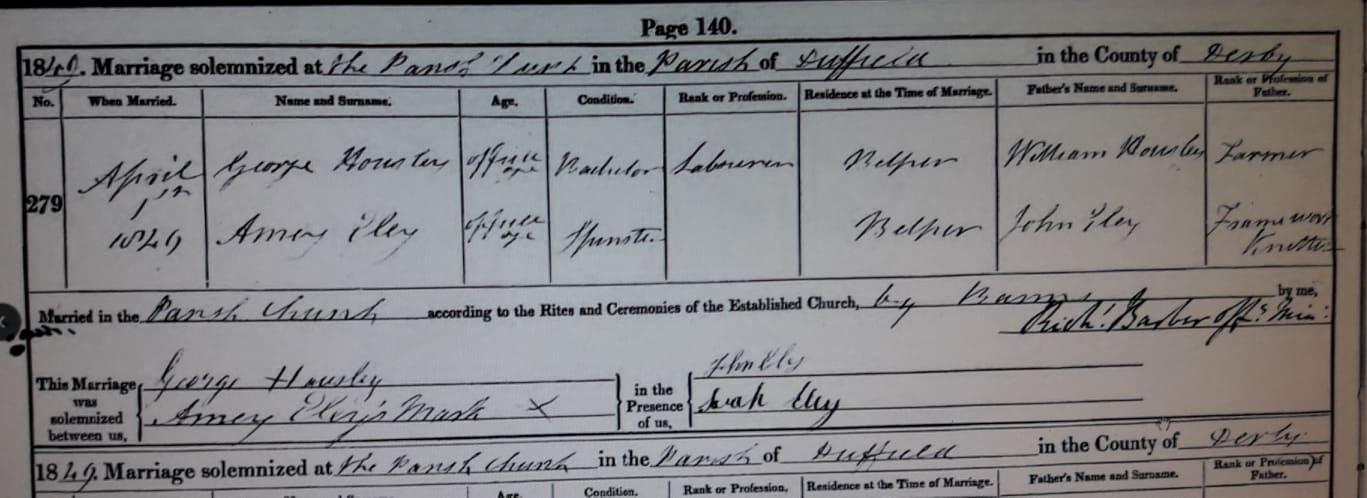
On the 1851 census, George Housley and his wife Amey Housley are living with her parents in Heanor, John Eley, a framework knitter, and his wife Rebecca. Also on the census are Charles J Housley, born in 1849 in Heanor, and Emma Housley, three months old at the time of the census, born in 1851. George’s birth place is listed as Smalley.
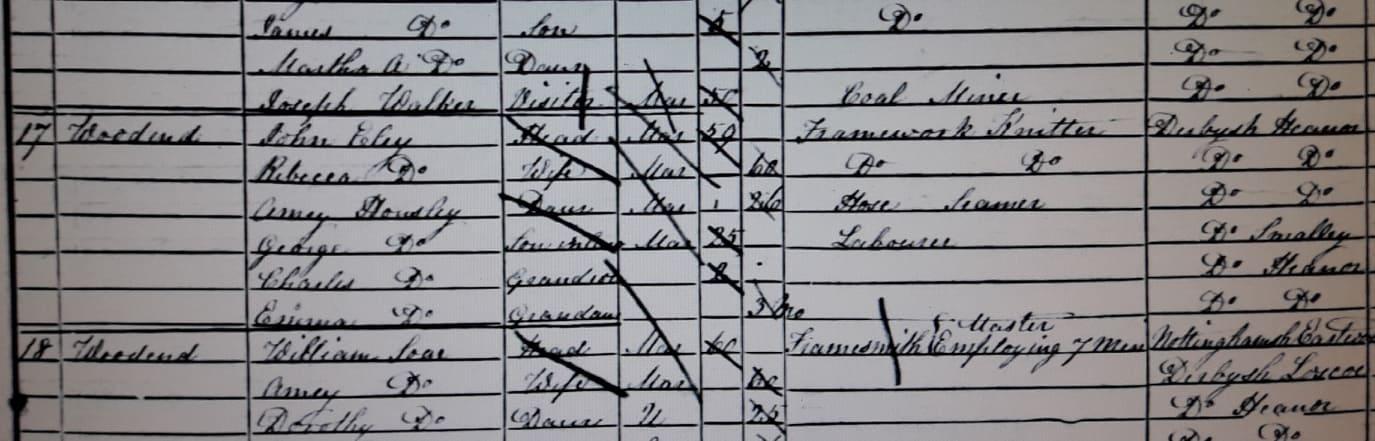
On the 31st of July 1851 George Housley arrives in New York. In 1854 George Housley marries Sarah Ann Hill in USA.
On the 1861 census in Heanor, Rebecca Eley was a widow, her husband John having died in 1852, and she had three grandchildren living with her: Charles J Housley aged 12, Emma Housley, 10, and mysteriously a William Housley aged 5! Amey Housley, the childrens mother, died in 1858.
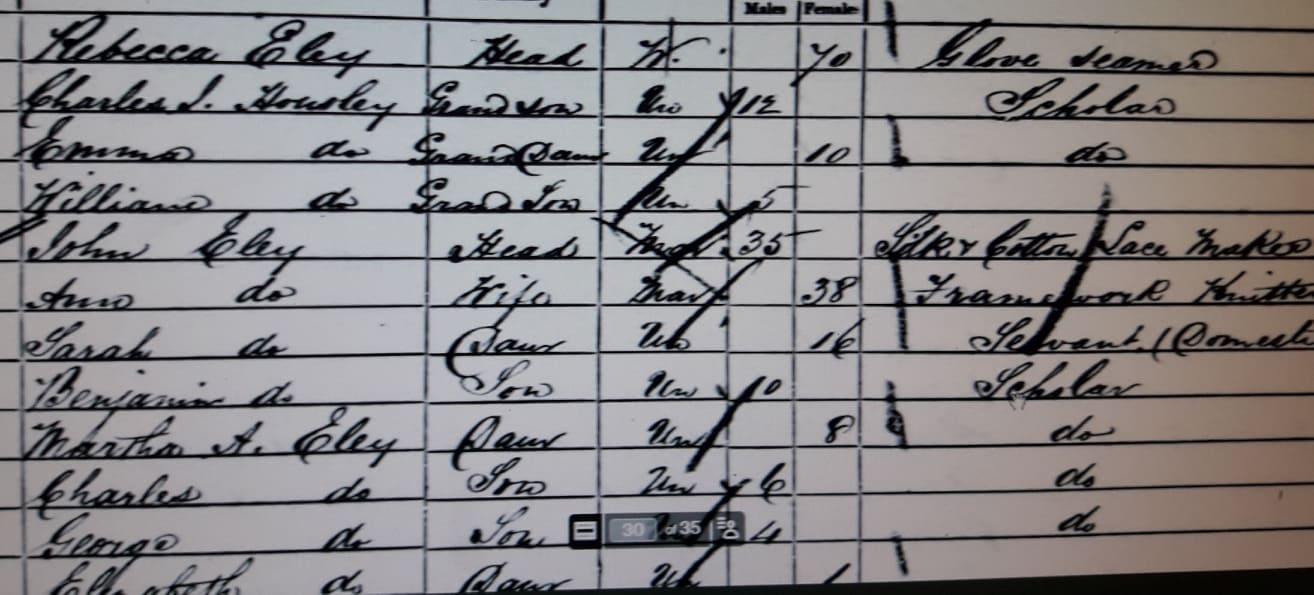
Back to the mysterious comment in Joseph’s letter. Joseph couldn’t have been speaking of his sister Emma. She was married with children by the time Joseph wrote that letter, so was not just out of service, and Joseph would have known where she was. There is no reason to suppose that the sister Emma was trying unsuccessfully to find George’s addresss: she had been sending him letters for years. Joseph must have been referring to George’s daughter Emma.
Joseph comments to George “Your son John…is rather wild.” followed by the remark about Emma’s whereabouts. Could Charles John Housley have used his middle name of John instead of Charles?
As for the child William born five years after George left for USA, despite his name of Housley, which was his mothers married name, we can assume that he was not a Housley ~ not George’s child, anyway. It is not clear who his father was, as Amey did not remarry.
A further excerpt from Barbara Housley’s Narrative on the Letters:
Certainly there was some mystery in George’s life. George apparently wanted his whereabouts kept secret. Anne wrote: “People are at a loss to know where you are. The general idea is you are with Charles. We don’t satisfy them.” In that same letter Anne wrote: “I know you could not help thinking of us very often although you neglected writing…and no doubt would feel grieved for the trouble you at times caused (our mother). She freely forgives all.” Near the end of the letter, Anne added: “Mother sends her love to you and hopes you will write and if you want to tell her anything you don’t want all to see you must write it on a piece of loose paper and put it inside the letter.”
In a letter to George from his sister Emma:
Emma wrote in 1855, “We write in love to your wife and yourself and you must write soon and tell us whether there is a little nephew or niece and what you call them.”
In June of 1856, Emma wrote: “We want to see dear Sarah Ann and the dear little boy. We were much pleased with the “bit of news” you sent.” The bit of news was the birth of John Eley Housley, January 11, 1855. Emma concluded her letter “Give our very kindest love to dear sister and dearest Johnnie.”
It would seem that George Housley named his first son with his second wife after his first wife’s father ~ while he was married to both of them.
Emma Housley
1851-1935
In 1871 Emma was 20 years old and “in service” living as a lodger in West Hallam, not far from Heanor. As she didn’t appear on a 1881 census, I looked for a marriage, but the only one that seemed right in every other way had Emma Housley’s father registered as Ralph Wibberly!
Who was Ralph Wibberly? A family friend or neighbour, perhaps, someone who had been a father figure? The first Ralph Wibberly I found was a blind wood cutter living in Derby. He had a son also called Ralph Wibberly. I did not think Ralph Wibberly would be a very common name, but I was wrong.
I then found a Ralph Wibberly living in Heanor, with a son also named Ralph Wibberly. A Ralph Wibberly married an Emma Salt from Heanor. In 1874, a 36 year old Ralph Wibberly (born in 1838) was on trial in Derby for inflicting grevious bodily harm on William Fretwell of Heanor. His occupation is “platelayer” (a person employed in laying and maintaining railway track.) The jury found him not guilty.
In 1851 a 23 year old Ralph Wibberly (born in 1828) was a prisoner in Derby Gaol. However, Ralph Wibberly, a 50 year old labourer born in 1801 and his son Ralph Wibberly, aged 13 and born in 1838, are living in Belper on the 1851 census. Perhaps the son was the same Ralph Wibberly who was found not guilty of GBH in 1874. This appears to be the one who married Emma Salt, as his wife on the 1871 census is called Emma, and his occupation is “Midland Company Railway labourer”.
Which was the Ralph Wibberly that Emma chose to name as her father on the marriage register? We may never know, but perhaps we can assume it was Ralph Wibberly born in 1801. It is unlikely to be the blind wood cutter from Derby; more likely to be the local Ralph Wibberly. Maybe his son Ralph, who we know was involved in a fight in 1874, was a friend of Emma’s brother Charles John, who was described by Joseph as a “wild one”, although Ralph was 11 years older than Charles John.
Emma Housley married James Slater on Christmas day in Heanor in 1873. Their first child, a daughter, was called Amy. Emma’s mother was Amy Eley. James Slater was a colliery brakesman (employed to work the steam-engine, or other machinery used in raising the coal from the mine.)
It occurred to me to wonder if Emma Housley (George’s daughter) knew Elizabeth, Mary Anne and Catherine (Samuel’s daughters). They were cousins, lived in the vicinity, and they had in common with each other having been deserted by their fathers who were brothers. Emma was born two years after Catherine. Catherine was living with John Benniston, a framework knitter in Heanor, from 1851 to 1861. Emma was living with her grandfather John Ely, a framework knitter in Heanor. In 1861, George Purdy was also living in Heanor. He was listed on the census as a 13 year old coal miner! George Purdy and Catherine Housley married in 1866 in Eastwood, Nottinghamshire ~ just over the county border. Emma’s first child Amy was born in Heanor, but the next two children, Eliza and Lilly, were born in Eastwood, in 1878 and 1880. Catherine and George’s fifth child, my great grandmother Mary Ann Gilman Purdy, was born in Eastwood in 1880, the same year as Lilly Slater.
By 1881 Emma and James Slater were living in Woodlinkin, Codnor and Loscoe, close to Heanor and Eastwood, on the Derbyshire side of the border. On each census up to 1911 their address on the census is Woodlinkin. Emma and James had nine children: six girls and 3 boys, the last, Alfred Frederick, born in 1901.
Emma and James lived three doors up from the Thorn Tree pub in Woodlinkin, Codnor:
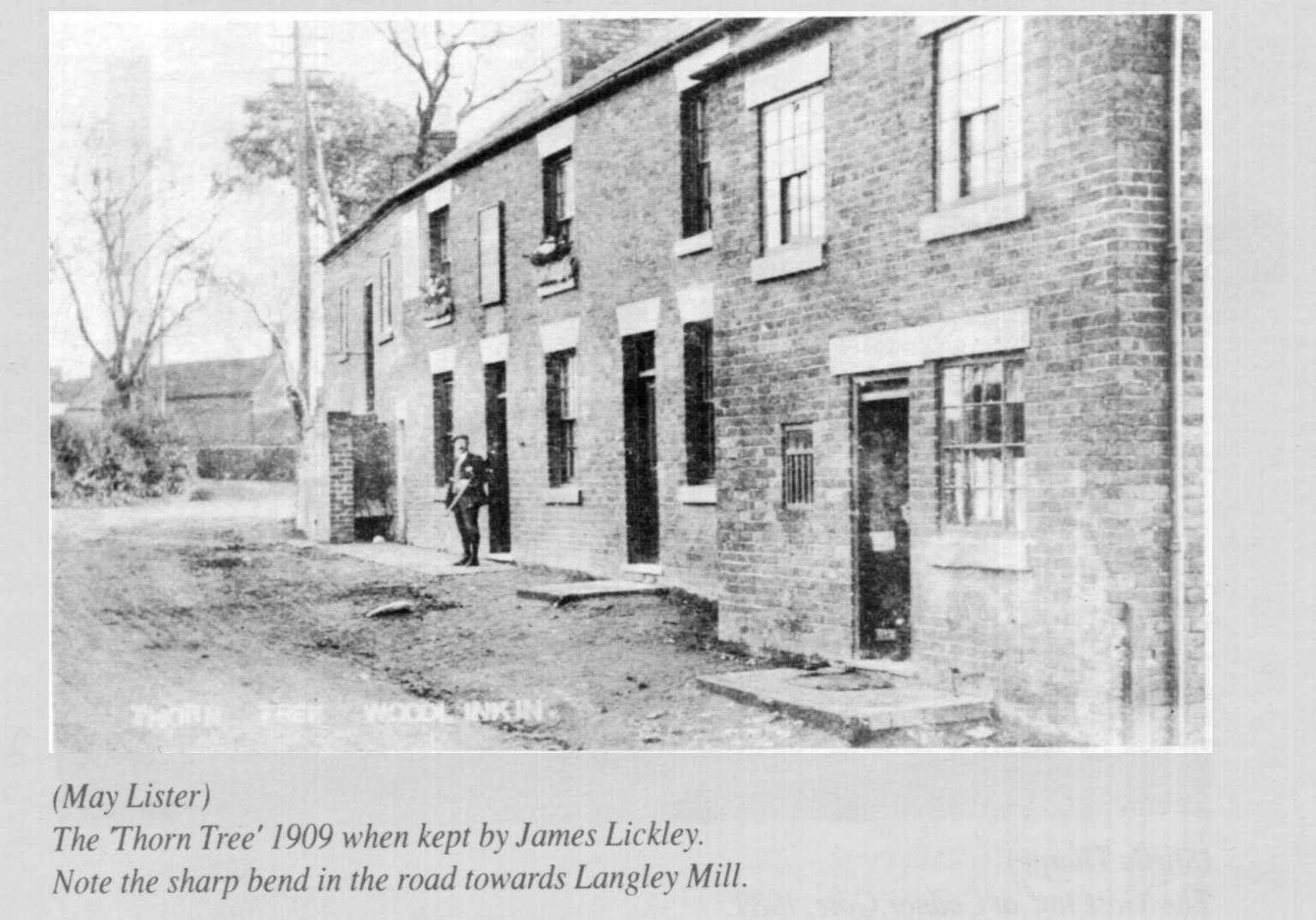
Emma Slater died in 1935 at the age of 84.
IN
LOVING MEMORY OF
EMMA SLATER
(OF WOODLINKIN)
WHO DIED
SEPT 12th 1935
AGED 84 YEARS
AT RESTCrosshill Cemetery, Codnor, Amber Valley Borough, Derbyshire, England:
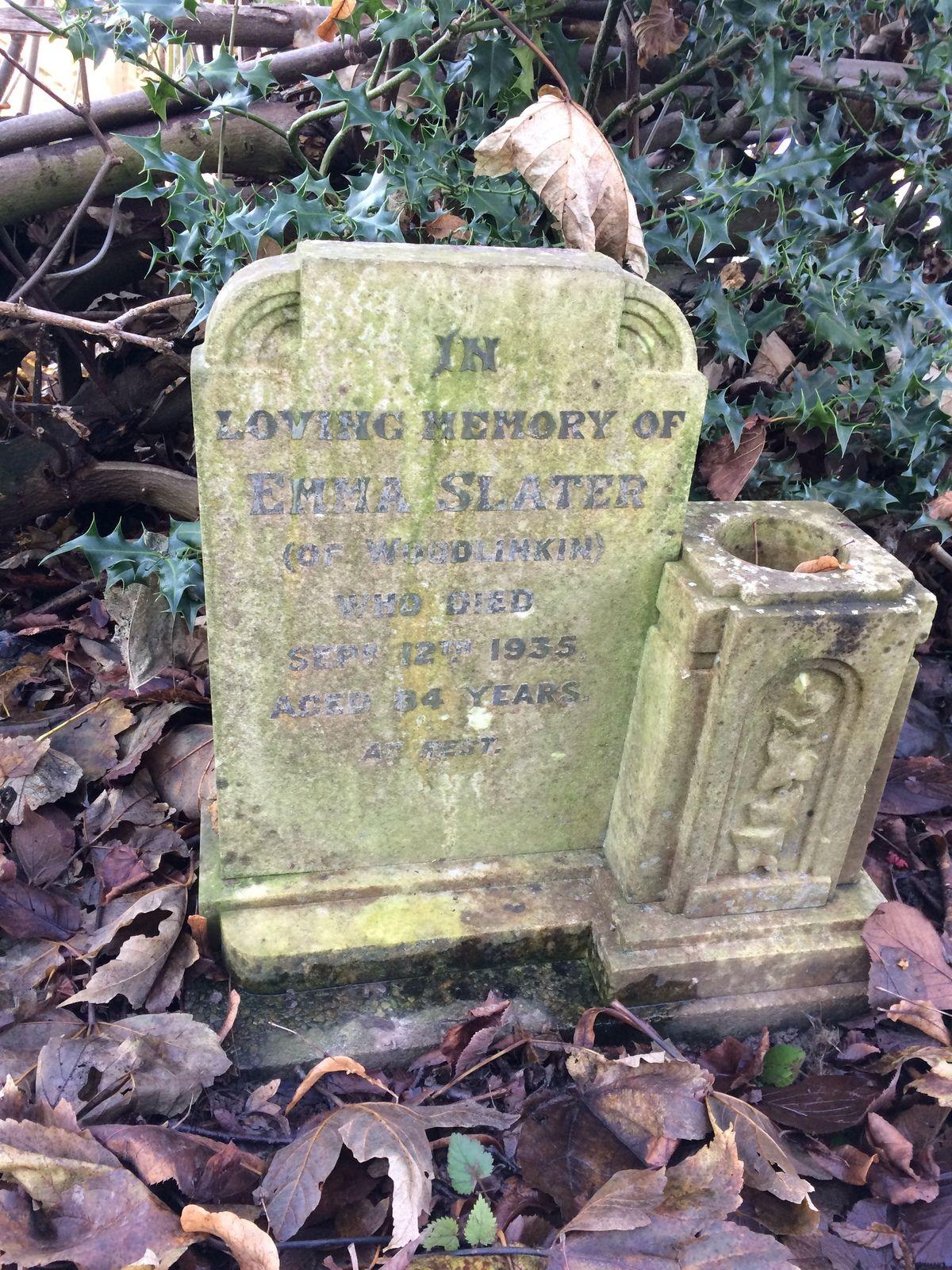
Charles John Housley
1949-
-
AuthorSearch Results
