-
AuthorSearch Results
-
December 4, 2024 at 8:16 am #7640
In reply to: Quintessence: Reversing the Fifth
Sat. Nov. 30, 2024 – before the meeting
The afternoon light slanted through the tall studio windows, thin and watery, barely illuminating the scattered tools of Lucien’s trade. Brushes lay in disarray on the workbench, their bristles stiff with dried paint. The smell of turpentine hung heavy in the air, mingling with the faint dampness creeping in from the rain. He stood before the easel, staring at the unfinished painting, brush poised but unmoving.
The scene on the canvas was a lavish banquet, the kind of composition designed to impress: a gleaming silver tray, folds of deep red velvet, fruit piled high and glistening. Each detail was rendered with care, but the painting felt hollow, as if the soul of it had been left somewhere else. He hadn’t painted what he felt—only what was expected of him.
Lucien set the brush down and stepped back, wiping his hands on his scarf without thinking. It was streaked with paint from hours of work, colors smeared in careless frustration. He glanced toward the corner of the studio, where a suitcase leaned against the wall. It was packed with sketchbooks, a bundle wrapped in linen, and clothes hastily thrown in—things that spoke of neither arrival nor departure, but of uncertainty. He wasn’t sure if he was leaving something behind or preparing for an escape.
How had it come to this? The thought surfaced before he could stop it, heavy and unrelenting. He had asked himself the same question many times, but the answer always seemed too elusive—or too daunting—to pursue. To find it, he would have to follow the trails of bad choices and chance encounters, decisions made in desperation or carelessness. He wasn’t sure he had the courage to look that closely, to untangle the web that had slowly wrapped itself around his life.
He turned his attention back to the painting, its gaudy elegance mocking him. He wondered if the patron who had commissioned it would even notice the subtle imperfections he had left, the faint warping of reflections, the fruit teetering on the edge of overripeness. A quiet rebellion, almost invisible. It wasn’t much, but it was something.
His friends had once known him as someone who didn’t compromise. Elara would have scoffed at the idea of him bending to anyone’s expectations. Why paint at all if it isn’t your vision? she’d asked once, her voice sharp, her black coffee untouched beside her. Amei, on the other hand, might have smiled and said something cryptic about how all choices, even the wrong ones, led somewhere meaningful. And Darius—Lucien couldn’t imagine telling Darius. The thought of his disappointment was like a weight in his chest. It had been easier not to tell them at all, easier to let the years widen the distance between them. And yet, here he was, preparing to meet them again.
The clock on the far wall chimed softly, pulling him back to the present. It was getting late. Lucien walked to the suitcase and picked it up, its weight pulling slightly on his arm. Outside, the rain had started, tapping gently against the windowpanes. He slung the paint-streaked scarf around his neck and hesitated, glancing once more at the easel. The painting loomed there, unfinished, like so many things in his life. He thought about staying, about burying himself in the work until the world outside receded again. But he knew it wouldn’t help.
With a deep breath, Lucien stepped out into the rain, the suitcase rattling softly behind him. The café wasn’t far, but it felt like a journey he might not be ready to take.
December 4, 2024 at 6:50 am #7639In reply to: Quintessence: A Portrait in Reverse
Work in Progress: Character Timelines and Events
Matteo
- November 2024 (Reunion):
- Newly employed at the Sarah Bernhardt Café, started after its reopening.
- Writes the names of Lucien, Elara, Darius, and Amei in his notebook without understanding why.
- Acquires the bell from Les Reliques, drawn to it as if guided by an unseen force.
- Serves the group during the reunion, surprised to see all four together, though he knows them individually.
- Summer 2024 (Olympics):
- Working in a vineyard in southern France, nearing the end of the harvest season.
- Receives a call for a renovation job in Paris, which pulls him toward the city.
- Feels an intuitive connection to Paris, as if something is waiting for him there.
- Past Events (Implied):
- Matteo has a mysterious ability to sense patterns and connections in people’s lives.
- Has likely crossed paths with the group in unremarkable but meaningful ways before.
Darius
- November 2024 (Reunion):
- Arrives at the café, a wanderer who rarely stays in one place.
- Reflects on his time in India during the autumn and the philosophical journey it sparked.
- Brings with him an artifact that ties into his travels and personal story.
- Summer 2024 (Olympics):
- Living in Barcelona, sketching temples and engaging with a bohemian crowd.
- Prompted by a stranger to consider a trip to India, sparking curiosity and the seeds of his autumn journey.
- Begins to plan his travels, sensing that India is calling him for a reason he doesn’t yet understand.
- Past Events (Implied):
- Has a history of introducing enigmatic figures to the group, often leading to tension.
- His intense, nomadic lifestyle creates both fascination and distance between him and the others.
Elara
- November 2024 (Reunion):
- Travels from England to Paris to attend the reunion, balancing work and emotional hesitation.
- Still processing her mother’s passing and reflecting on their strained relationship.
- Finds comfort in the shared dynamics of the group but remains analytical about the events around the bell.
- Summer 2024 (Olympics):
- (was revealed to be a dream event) Attends a CERN conference in Geneva, immersed in intellectual debates and cutting-edge research. Receives news of her mother’s death in Montrouge, prompting a reflective journey to make funeral arrangements. Struggles with unresolved feelings about her mother but finds herself strangely at peace with the finality.
- Dreams of her mother’s death during a nap in Tuscany, a surreal merging of past and present that leaves her unsettled.
- Hears a bell’s clang, only to find Florian fixing a bell to the farmhouse gate. The sound pulls her further into introspection about her mother and her life choices.
- Mentors Florian, encouraging him to explore his creativity, paralleling her own evolving relationship with her chalk research.
- Past Events (Implied):
- Moved to Tuscany after retiring from academia, pursuing independent research on chalk.
- Fondly remembers the creative writing she once shared with the group, though it now feels like a distant chapter of her life.
- Had a close but occasionally challenging relationship with Lucien and Amei during their younger years.
- Values intellectual connections over emotional ones but is gradually learning to reconcile the two.
Lucien
- November 2024 (Reunion):
- Sends the letter that brings the group together at the café, though his intentions are unclear even to himself.
- In his Paris studio, struggles with an unfinished commissioned painting. Feels disconnected from his art and his sense of purpose.
- Packs a suitcase with sketchbooks and a bundle wrapped in linen, symbolizing his uncertainty—neither a complete departure nor a definitive arrival.
- Heads to the café in the rain, reluctant but compelled to reconnect with the group. Confronts his feelings of guilt and estrangement from the group.
- Summer 2024 (Olympics):
- Escapes Paris, overwhelmed by the crowds and noise of the Games, and travels to Lausanne.
- Reflects on his artistic block and the emotional weight of his distance from the group.
- Notices a sketch in his book of a doorway with a bell he doesn’t recall drawing, sparking vague recognition.
- Past Events (Implied):
- Once the emotional “anchor” of the group, he drifted apart after a falling-out or personal crisis.
- Feels a lingering sense of responsibility to reunite the group but struggles with his own vulnerabilities.
Amei
- November 2024 (Reunion):
- Joins the reunion at Lucien’s insistence, hesitant but curious about reconnecting with the group.
- Brings with her notebooks filled with fragments of stories and a quiet hope for resolution.
- Feels the weight of the group’s shared history but refrains from dwelling on it outwardly.
- Summer 2024 (Olympics):
- Recently moved into a smaller flat in London, downsizing after her daughter Tabitha left for university.
- Has a conversation with Tabitha about life and change, hinting at unresolved emotions about motherhood and independence.
- Tabitha jokes about Amei joining her in Goa, a suggestion Amei dismisses but secretly considers.
- Past Events (Implied):
- The last group meeting five years ago left her with lingering emotional scars.
- Maintains a deep but quiet connection to Lucien and shares a playful dynamic with Elara.
Tabitha (Amei’s Daughter)
- November 2024:
- Calls Amei to share snippets of her life, teasing her mother about her workaholic tendencies.
- Reflects on their relationship, noting Amei’s supportive but emotionally guarded nature.
- Summer 2024 (Olympics):
- Planning her autumn trip to Goa with friends, viewing it as a rite of passage.
- Discusses her mother’s habits with her peers, acknowledging Amei’s complexities while expressing affection.
- Past Events (Implied):
- Represents a bridge between Amei’s past and present, highlighting generational contrasts and continuities.
Key Threads and Patterns
- The Bell: Acts as a silent witness and instigator, threading its presence through pivotal moments in each character’s journey, whether directly or indirectly.
- Shared Histories: While each character grapples with personal struggles, their paths hint at intersections in the past, tied to unresolved tensions and shared experiences.
- Forward and Backward Motion: The narrative moves between the characters’ immediate challenges and the ripples of their past decisions, with the bell serving as a focal point for both.
December 4, 2024 at 6:22 am #7638In reply to: Quintessence: Reversing the Fifth
The Bell’s Moment: Paris, Summer 2024 – Olympic Games
The bell was dangling unassumingly from the side pocket of a sports bag, its small brass frame swinging lightly with the jostle of the crowd. The bag belonged to an American tourist, a middle-aged man in a rumpled USA Basketball T-shirt, hustling through the Olympic complex with his family in tow. They were here to cheer for his niece, a rising star on the team, and the bell—a strange little heirloom from his grandmother—had been an afterthought, clipped to the bag for luck. It seemed to fit right in with the bright chaos of the Games, blending into the swirl of flags, chants, and the hum of summer excitement.
1st Ring of the Bell: Matteo
The vineyard was quiet except for the hum of cicadas and the soft rustle of leaves. Matteo leaned against the tractor, wiping sweat from his brow with the back of his hand.
“You’ve done good work,” the supervisor said, clapping Matteo on the shoulder. “We’ll be finishing this batch by Friday.”
Matteo nodded. “And after that?”
The older man shrugged. “Some go north, some go south. You? You’ve got that look—like you already know where you’re headed.”
Matteo offered a half-smile, but he couldn’t deny it. He’d felt the tug for days, like a thread pulling him toward something undefined. The idea of returning to Paris had slipped into his thoughts quietly, as if it had been waiting for the right moment.
When his phone buzzed later that evening with a job offer to do renovation work in Paris, it wasn’t a surprise. He poured himself a small glass of wine, toasting the stars overhead.
Somewhere, miles away, the bell rang its first note.
2nd Ring of the Bell: Darius
In a shaded square in Barcelona, the air was thick with the scent of jasmine and the echo of a street performer’s flamenco guitar. Darius sprawled on a wrought-iron bench, his leather-bound journal open on his lap. He sketched absentmindedly, the lines of a temple taking shape on the page.
A man wearing a scarf of brilliant orange sat down beside him, his energy magnetic. “You’re an artist,” the man said without preamble, his voice carrying the cadence of Kolkata.
“Sometimes,” Darius replied, his pen still moving.
“Then you should come to India,” the man said, grinning. “There’s art everywhere. In the streets, in the temples, even in the food.”
Darius chuckled. “You recruiting me?”
“India doesn’t need recruiters,” the man replied. “It calls people when it’s time.”
The bell rang again in Paris, its chime faint and melodic, as Darius scribbled the words “India, autumn” in the corner of his page.
3rd Ring of the Bell: Elara
The crowd at CERN’s conference hall buzzed as physicists exchanged ideas, voices overlapping like equations scribbled on whiteboards. Elara sat at a corner table, sipping lukewarm coffee and scrolling through her messages.
The voicemail notification glared at her, and she tapped it reluctantly.
“Elara, it’s Florian. I… I’m sorry to tell you this over a message, but your mother passed away last night.”
Her coffee cup trembled slightly as she set it down.
Her relationship with her mother had been fraught, full of alternating period of silences and angry reunions, and had settled lately into careful politeness that masked deeper fractures. Years of therapy had softened the edges of her resentment but hadn’t erased it. She had come to accept that they would never truly understand each other, but the finality of death still struck her with a peculiar weight.
Her mother had been living alone in Montrouge, France, refusing to leave the little house Elara had begged her to sell for years. They had drifted apart, their conversations perfunctory and strained, like the ritual of winding a clock that no longer worked.
She would have to travel to Montrouge for the funeral arrangements.
In that moment, the bell in Les Reliques rang a third time.
4th Ring of the Bell: Lucien
The train to Lausanne glided through fields of dried up sunflowers, too early for the season, but the heat had been relentless. He could imagine the golden blooms swaying with a cracking sound in the summer breeze. Lucien stared out the window, the strap of his duffel bag wrapped tightly around his wrist.
Paris had been suffocating. The tourists swarmed the city like ants, turning every café into a photo opportunity and every quiet street into a backdrop. He hadn’t needed much convincing to take his friend up on the offer of a temporary studio in Lausanne.
He reached into his bag and pulled out a sketchbook. The pages were filled with half-finished drawings, but one in particular caught his eye: a simple doorway with an ornate bell hanging above it.
He didn’t remember drawing it, but the image felt familiar, like a memory from a dream.
The bell rang again in Paris, its resonance threading through the quiet hum of the train.
5th Ring of the Bell: …. Tabitha
In the courtyard of her university residence, Tabitha swung lazily in a hammock, her phone propped precariously on her chest.
“Goa, huh?” one of her friends asked, leaning against the tree holding up the hammock. “Think your mum will freak out?”
“She’ll probably worry herself into knots,” Tabitha replied, laughing. “But she won’t say no. She’s good at the whole supportive parent thing. Or at least pretending to be.”
Her friend raised an eyebrow. “Pretending?”
“Don’t get me wrong, I love her,” Tabitha said. “But she’s got her own stuff. You know, things she never really talks about. I think it’s why she works so much. Keeps her distracted.”
The bell rang faintly in Paris, though neither of them could hear it.
“Maybe you should tell her to come with you,” the friend suggested.
Tabitha grinned. “Now that would be a trip.”
Last Ring: The Pawn
It was now sitting on the counter at Les Reliques. Its brass surface gleamed faintly in the dim shop light, polished by the waves of time. Small and unassuming, its ring held something inexplicably magnetic.
Time seemed to settle heavily around it. In the heat of the Olympic summer, it rang six times. Each chime marked a moment that mattered, though none of the characters whose lives it touched understood why. Not yet.
“Where’d you get this?” the shopkeeper asked as the American tourist placed it down.
“It was my grandma’s,” he said, shrugging. “She said it was lucky. I just think it’s old.”
The shopkeeper ran her fingers over the brass surface, her expression unreadable. “And you’re selling it?”
“Need cash to get tickets for the USA basketball game tomorrow,” the man replied. “Quarterfinals. You follow basketball?”
“Not anymore,” the shopkeeper murmured, handing him a stack of bills.
The bell rang softly as she placed it on the velvet cloth, its sound settling into the space like a secret waiting to be uncovered.
And so it sat, quiet but full of presence, waiting for someone to claim it maybe months later, drawn by invisible threads woven through the magnetic field of lives, indifferent to the heat and chaos of the Parisian streets.
December 2, 2024 at 10:50 pm #7635In reply to: Quintessence: Reversing the Fifth
Sat. Nov. 30, 2024 5:55am — Matteo’s morning
Matteo’s mornings began the same way, no matter the city, no matter the season. A pot of strong coffee brewed slowly on the stove, filling his small apartment with its familiar, sense-sharpening scent. Outside, Paris was waking up, its streets already alive with the sound of delivery trucks and the murmurs of shopkeepers rolling open shutters.
He sipped his coffee by the window, gazing down at the cobblestones glistening from last night’s rain. The new brass sign above the Sarah Bernhardt Café caught the morning light, its sheen too pristine, too new. He’d started the server job there less than a week ago, stepping into a rhythm he already knew instinctively, though he wasn’t sure why.
Matteo had always been good at fitting in. Jobs like this were placeholders—ways to blend into the scenery while he waited for whatever it was that kept pulling him forward. The café had reopened just days ago after months of being closed for renovations, but to Matteo, it felt like it had always been waiting for him.

He set his coffee mug on the counter, reaching absently for the notebook he kept nearby. The act was automatic, as natural as breathing. Flipping open to a blank page, Matteo wrote down four names without hesitation:
Lucien. Elara. Darius. Amei.
He stared at the list, his pen hovering over the page. He didn’t know why he wrote it. The names had come unbidden, as though they were whispered into his ear from somewhere just beyond his reach. He ran his thumb along the edge of the page, feeling the faint indentation of his handwriting.
The strangest part wasn’t the names— it was the certainty that he’d see them that day.
Matteo glanced at the clock. He still had time before his shift. He grabbed his jacket, tucked the notebook into the inside pocket, and stepped out into the cool Parisian air.
Matteo’s feet carried him to a side street near the Seine, one he hadn’t consciously decided to visit. The narrow alley smelled of damp stone and dogs piss. Halfway down the alley, he stopped in front of a small shop he hadn’t noticed before. The sign above the door was worn, its painted letters faded: Les Reliques. The display in the window was an eclectic mix—a chessboard missing pieces, a cracked mirror, a wooden kaleidoscope—but Matteo’s attention was drawn to a brass bell sitting alone on a velvet cloth.
The door creaked as he stepped inside, the distinctive scent of freshly burnt papier d’Arménie and old dust enveloping him. A woman emerged from the back, wiry and pale, with sharp eyes that seemed to size Matteo up in an instant.
“You’ve never come inside,” she said, her voice soft but certain.
“I’ve never had a reason to,” Matteo replied, though even as he spoke, the door closed shut the outside sounds.
“Today, you might,” the woman said, stepping forward. “Looking for something specific?”
“Not exactly,” Matteo replied. His gaze shifted back to the bell, its smooth surface gleaming faintly in the dim light.
“Ah.” The shopkeeper followed his eyes and smiled faintly. “You’re drawn to it. Not uncommon.”
“What’s uncommon about a bell?”
The woman chuckled. “It’s not the bell itself. It’s what it represents. It calls attention to what already exists—patterns you might not notice otherwise.”
Matteo frowned, stepping closer. The bell was unremarkable, small enough to fit in the palm of his hand, with a simple handle and no visible markings.
“How much?”
“For you?” The shopkeeper tilted his head. “A trade.”
Matteo raised an eyebrow. “A trade for what?”
“Your time,” the woman said cryptically, before waving her hand. “But don’t worry. You’ve already paid it.”
It didn’t make sense, but then again, it didn’t need to. Matteo handed over a few coins anyway, and the woman wrapped the bell in a square of linen.
Back on the street, Matteo slipped the bell into his pocket, its weight unfamiliar but strangely comforting. The list in his notebook felt heavier now, as though connected to the bell in a way he couldn’t quite articulate.
Walking back toward the café, Matteo’s mind wandered. The names. The bell. The shopkeeper’s words about patterns. They felt like pieces of something larger, though the shape of it remained elusive.
The day had begun to align itself, its pieces sliding into place. Matteo stepped inside, the familiar hum of the café greeting him like an old friend. He stowed his coat, slipped the bell into his bag, and picked up a tray.
Later that day, he noticed a figure standing by the window, suitcase in hand. Lucien. Matteo didn’t know how he recognized him, but the instant he saw the man’s rain-damp curls and paint-streaked scarf, he knew.
By the time Lucien settled into his seat, Matteo was already moving toward him, notebook in hand, his practiced smile masking the faint hum of inevitability coursing through him.
He didn’t need to check the list. He knew the others would come. And when they did, he’d be ready. Or so he hoped.
December 1, 2024 at 10:36 pm #7630In reply to: Quintessence: Reversing the Fifth
Lucien pulled his suitcase through the rain-slick streets of Paris, the wheels rattling unevenly over the cobblestones. The rain fell in silver threads, blurring the city into streaks of light and shadow. His scarf, already streaked with paint, hung heavy and damp around his neck. Each step toward the café felt weighted, though he couldn’t tell if it was the suitcase behind him or the memories ahead.
The note he sent his friends had been simple. Sarah Bernhardt Café, November 30th , 4 PM. No excuses this time! Writing it had felt strange, as though summoning ghosts he wasn’t sure were ready to return. And now, with the café just blocks away, Lucien wasn’t sure if he wanted them to. Five years had passed since the four of them had last been together. He had told himself he needed this meeting—closure, perhaps—but a part of him still doubted.
He paused beneath a bookstore awning, the rain tracing fractured lines down the glass. His suitcase leaned against his leg, its weight pressing into him. Inside: a crumpled heap of clothes that smelled faintly of turpentine and the damp studio he had left behind, sketchbooks filled with forgotten drawings, and a small bundle wrapped in linen. Something he wasn’t ready to let go of—or couldn’t. He hadn’t decided yet if he was coming back or going away.
Lucien reached into his pocket and pulled out his last sketchbook. Flipping absently through its pages, he stopped at an old drawing of Darius, leaning over the edge of a rickety bridge, hand outstretched toward something unseen. He could still hear Darius’s voice: If you’re afraid of falling, you’ll never know what’s waiting. Lucien had scoffed then, but now the words lingered, uncomfortable in their truth.
The café came into view, its warm light pooling onto the wet street. Through the rain-speckled windows, he saw the familiar brass fixtures and etched glass, unchanged by time. He stepped inside, the warmth closing around him, and made his way to the corner table. Their table.
Setting the suitcase down, he folded into the chair and opened his sketchbook to a blank page. His pencil hovered. Outside, the rain fell softly, its rhythm steady against the glass. Inside, Lucien’s chest felt heavy. To make it go away, he started to scratch faint lines across the page.
December 1, 2024 at 5:08 pm #7617“Who sees that the habit-energy of the projections of the beginningless past is the cause of the three realms and who understands that the tathagata stage is free from projections or anything that arises, attains the personal realisation of buddha knowledge and effortless mastery over their own minds” —The Lankavatara Sutra, 2.8 (trans. Red Pine).
“To trace the ripples of a beginningless sea is to chase a horizon that vanishes with each step; only by stilling the waves does the ocean reveal its boundless, unbroken clarity.”
~Echoes of the Vanished Shore, Selwyn Lemone.
What if the story would unfold in reverse this time? Would the struggle subsist, to remember the past events written comment after comment? Rather than writing towards a future, and —maybe— an elusive ending, would remembering layer after layers of events from the past change our outlook on why we write at all?
Let’s just have ourselves a new playground, a new experiment as this year draws to a close.
Four friends meet unexpectedly in a busy café, after five years not having seen each other.
Matteo, the server arrives, like a resonant fifth, bringing resolution to the root note —they all seem to know him, but why.
Answers are in their pasts. And story has to unfold backwards, a step at a time, to a beginningless past.
November 20, 2024 at 6:39 pm #7608In reply to: The Incense of the Quadrivium’s Mystiques
“Maybe I’m just old fashioned but those things are just weird,” Truella shook her head as she tried to get her focus and equilibrium back. “Great pics though, Jez. Look how clean my nails are.”
“I thought we were going to Amalfi, I was looking forward to that,” said Frella, not sure whether she liked the VR pod experience.
“So was I until I found out about the Limoncello. Can’t stand that evil brew, instant heartburn.”
“You don’t have to drink it, Tru,” Eris replied with a withering look. “We need to buy a few things before Giovanni’s time travel trip to the abandoned Colosseum. Secateurs and zip lock plastic bags for the seeds and plant cuttings. I wonder where the proper stores are, we seem to be surrounded with souvenir and gift shops and bakeries.”
“I’ll get a trowel. No, I’m not planning to start a dig, but it might come in handy. I’ll go with Eris and you two can mooch about buying over priced tourist tat. Get me a dozen postcards, will you? And some shawls and scarves for the photos at the Colosseum.”
November 17, 2024 at 11:32 am #7601In reply to: The Precious Life and Rambles of Liz Tattler
Oh, so now it’s time to play “Who’s Noticed Finnley?” is it? Two months in the cellar and not a peep from the lot of you. I suppose it’s nice to know I’m missed, even if I had to be forgotten first.
Liz, writing me back in—how generous of you. But let’s get one thing straight; I don’t need anyone to script my next move. I’m more than capable of marching right back into the scene, thank you very much. You’d think I’d be the one to keep this story spotless while I was down there, sorting through all those dusty wine bottles and cobwebs.
But, since you’re willing to be “flexible,” I’ll make my grand return. Just don’t expect me to clean up the narrative mess you’ve made while I was away. If I find characters scattered about like loose socks after a laundry day, there’ll be words, mark my words.
And Godfrey, that toga needs a good ironing. I’ll not have wrinkled linens adding to the chaos. Now, enough dilly-dallying, there’s work to be done, and I’ve got a cellar door to nudge open.
November 14, 2024 at 8:01 am #7595In reply to: The Incense of the Quadrivium’s Mystiques
Jeezel was reading the ‘Love Among the Ruins‘ by famous author Liz Tatler, sitting comfortably in her favourite chair.
“Celestine, darling,” Vivienne St Clair exclaimed, her perfectly arched brow lifting as she set down her champagne glass, “you mean to tell me you’ve been lounging by your pool on what might very well be the throne of some Roman goddess? And you wouldn’t let me near it? Honestly, the nerve of you!”
She adjusted her silk scarf with a dramatic flourish, her green eyes sparkling mischievously. “Though I must say, I do admire your determination to get that pool built before I could turn it into some excavation site. Practical as ever, aren’t you, darling?”
As the mention of the mosaic came up, Vivienne St Clair froze mid-sip of her drink, her expression an artful mixture of shock and indignation. “Lost? The Aramanthus Mosaic, lost? Oh, Celestine, this is beyond belief. It’s a tragedy of epic proportions! Worse than the time Aunt Agatha’s pearls were stolen during the garden party—at least we found those under the butler’s cushion.”
She leaned in conspiratorially, her voice dropping to a whisper. “Celestine, my dear, if the Barcelona museum can’t find it, then someone must! Perhaps I should enlist one of my… shall we say… resourceful acquaintances. A charming rogue with a penchant for treasures, perhaps?”
Then, with a dramatic sigh, she sank back into her chair, looking every inch the heroine caught in a whirlwind of intrigue. “Celestine, life is simply too absurd sometimes. Roman ruins, lost mosaics, and a bench fit for an empress—I can hardly keep up.”
Jeezel almost choked on a mint leaf. What a bunch of amateurs, if they had to deal with a tenth of what her coven had been through these last few months…
November 6, 2024 at 12:03 am #7584In reply to: The Incense of the Quadrivium’s Mystiques
Frella considered the box of props, Truella’s request still echoing in her mind. Or perhaps “command” was more accurate? She had been tempted to tell Tru to put together her own prop box. Regardless, Frella, being uncommonly good-natured, decided to indulge her friend. After all, poor Truella deserved a bit of indulgence after her recent ordeal.
It was curious, even ironic, that a witch as formidable as Truella had found herself spirited away by Thomas Cromwell. The incident left Frella baffled, but Truella, true to form, had been vague about the whole affair, refusing to provide even a brief synopsis. And any hope of clarification had been swallowed by Truella’s recent hobby: deleting gifs on her phone—a pastime that Frella was convinced had reached the level of an obsession.
Shaking her head, Frella returned to her task. The box needed to be extraordinary, full of magic tailored to delight, surprise, and assist even the most accomplished witch. With a whispered spell, she conjured a feather-light coat woven from shimmering starlight, and folded it carefully into the box. Depending on the moon’s phase, the coat could cloak its wearer in illusions or make them vanish entirely.
Next came a pair of Ug Boots enchanted with swiftness, rendering the wearer light as air and nearly impossible to catch. Beside them, she placed a midnight-blue satchel with a mind of its own—returning lost items to their rightful owners, whether or not they wanted to be found.
Frella paused, her hands hovering above the box. What else? After some thought, she conjured a delicate chemise spun from moonlight, its diaphanous fabric especially created to ward off hexes. “Truella should get plenty of use out of this one,” Frella mused, remembering past escapades. “Not that I’m calling her a tart or anything.”
She followed it with iridescent sunglasses. The lenses could decode ancient texts or, failing that, soften a cutting glare. A golden phoenix brooch came next. Pinned to fabric, it could either blaze into a protective flame or summon a fiery companion to light the way.
With a snigger, Frella crafted a magical moustache—a silky, distinguished creation. It granted the wearer an air of nobility, perfect for moments when one needed gravitas, especially if Truella found herself back in the 16th century (or whenever it was).
A string of enchanted pearls nestled into the box, each bead holding a spell: one for charm, another to quell hunger, and a third to lower prices at the supermarket. Truella was always banging on about her budget.
Frella added three wigs: a flaming red one for irresistible allure, a sleek black bob for perfect recall, and a powdered peruke for communing with spirits of the past.
For good measure, she added a selection of headgear: a knitted beanie for quick thinking and to keep warm, a velvet-trimmed bonnet to ward off insults, and a silk turban that blocked eavesdropping and mind-reading.
Finally, she included a pretty peacock-feathered fan. A mere flick of the wrist could shift the weather or create a gust strong enough to fend off any ill intentions.
The box now brimmed with marvels; would these treasures aid Truella and perhaps shield her from whatever tangled fate had ensnared her with Thomas Cromwell?
Frella could only hope so.
August 21, 2024 at 12:27 pm #7546In reply to: The Elusive Samuel Housley and Other Family Stories
The Potters of Darley Bridge
Rebecca Knowles 1745-1823, my 5x great grandmother, married Charles Marshall 1742-1819, the churchwarden of Elton, in Darley, Derbyshire, in 1767. Rebecca was born in Darley in 1745, the youngest child of Roger Knowles 1695-1784, and Martha Potter 1702?-1772.
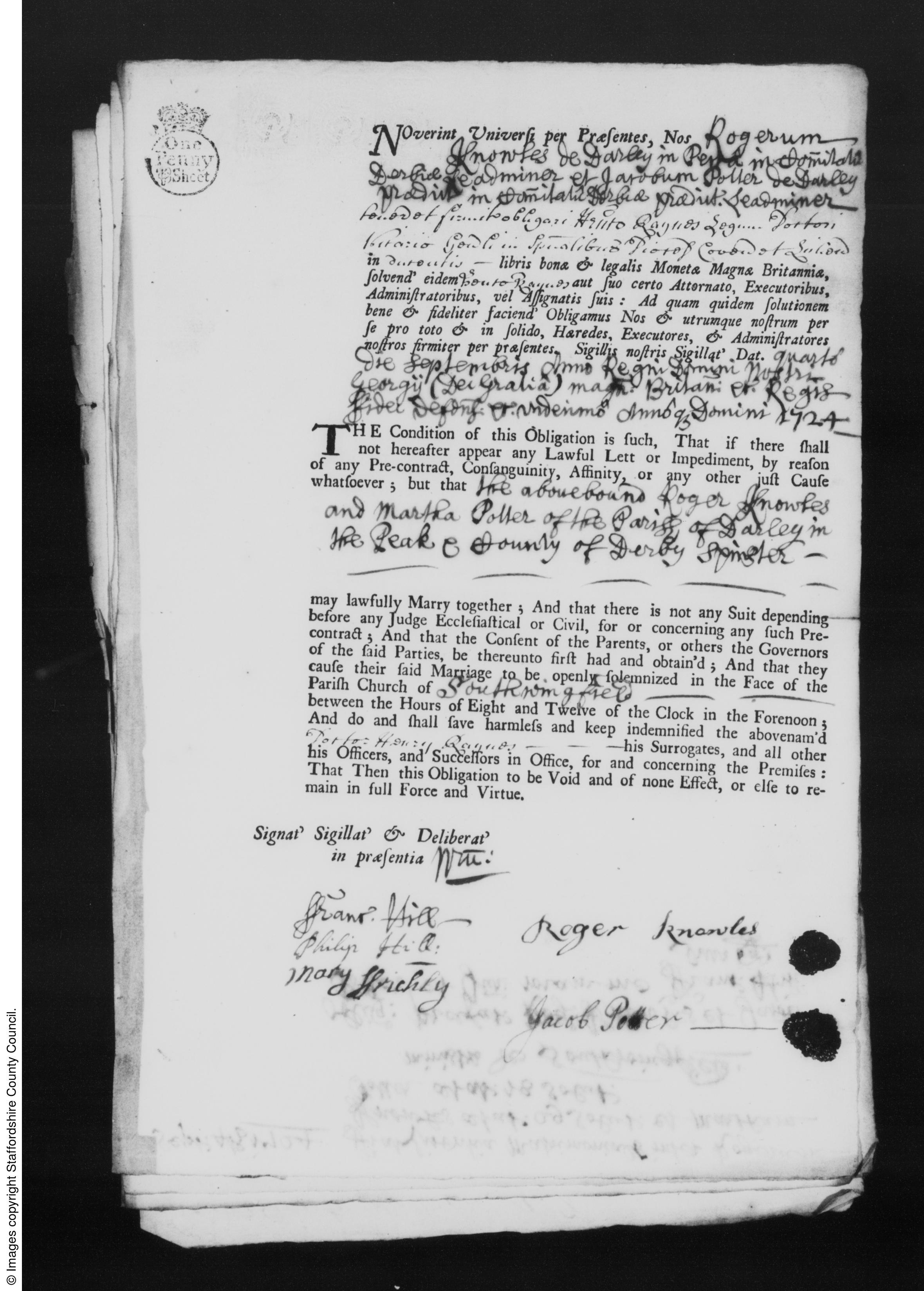
Although Roger and Martha were both from Darley, they were married in South Wingfield by licence in 1724. Roger’s occupation on the marriage licence was lead miner. (Lead miners in Derbyshire at that time usually mined their own land.) Jacob Potter signed the licence so I assumed that Jacob Potter was her father.
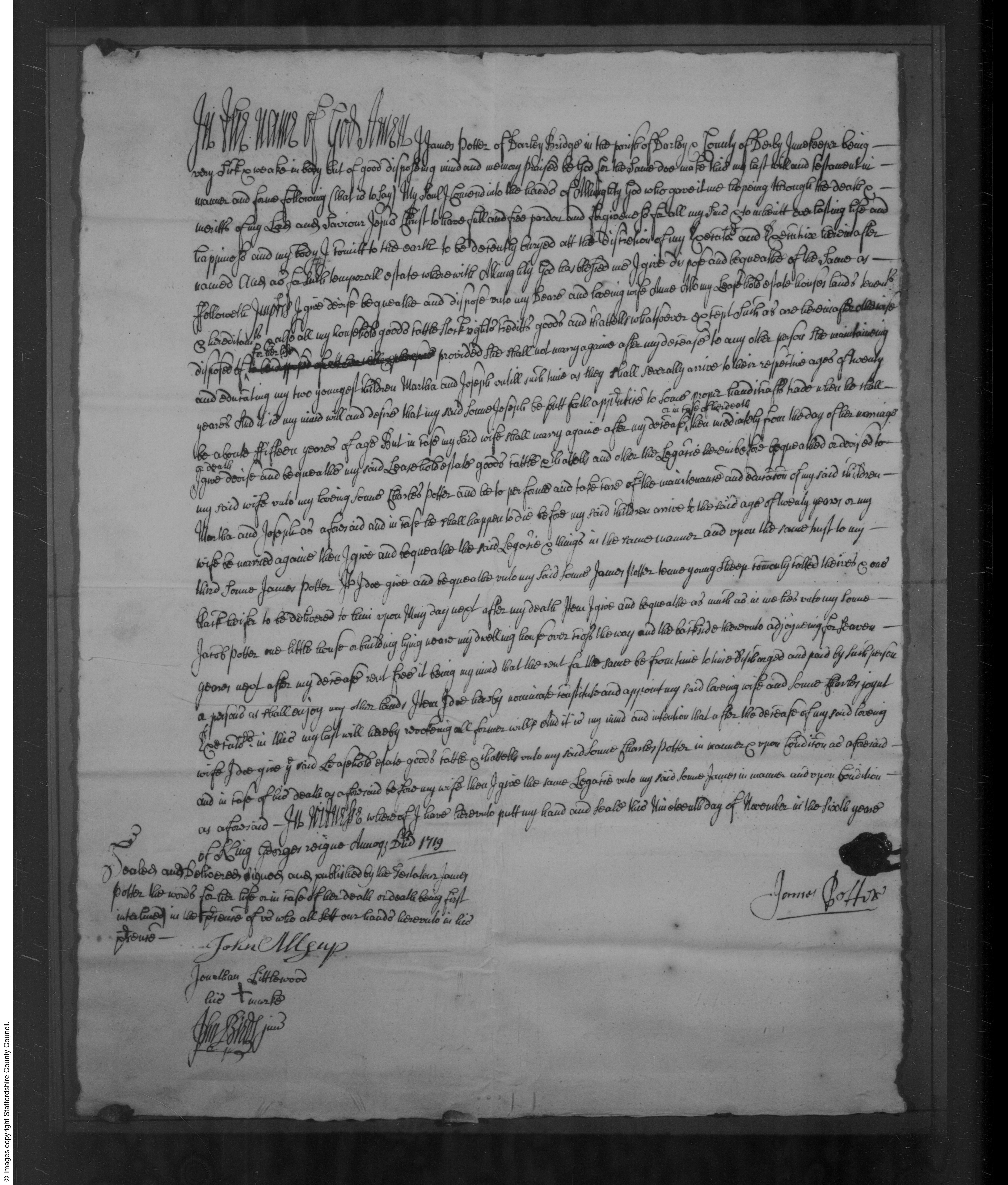
I then found the will of Jacobi Potter who died in 1719. However, he signed the will James Potter. Jacobi is latin for James. James Potter mentioned his daughter Martha in his will “when she comes of age”. Martha was the youngest child of James. James also mentioned in his will son James AND son Jacob, so there were both James’s and Jacob’s in the family, although at times in the documents James is written as Jacobi!
Jacob Potter who signed Martha’s marriage licence was her brother Jacob.
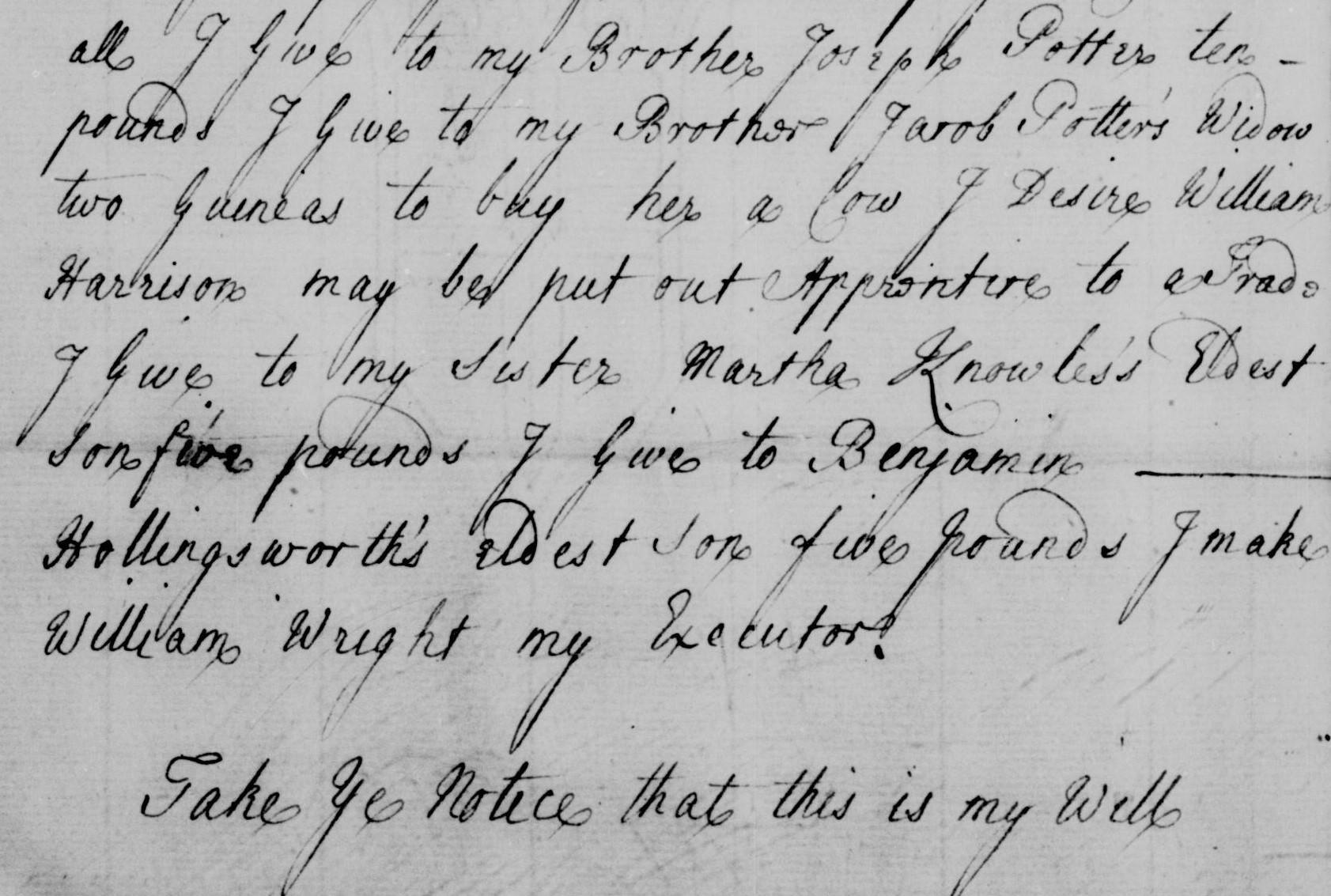
Martha’s brother James mentioned his sister Martha Knowles in his 1739 will, as well as his brother Jacob and his brother Joseph.
Martha’s father James Potter mentions his wife Ann in his 1719 will. James Potter married Ann Waterhurst in 1690 in Wirksworth, some seven miles from Darley. James occupation was innkeeper at Darley Bridge.
I did a search for Waterhurst (there was only a transcription available for that marriage, not a microfilm) and found no Waterhursts anywhere, but I did find many Warhursts in Derbyshire. In the older records, Warhust is also spelled Wearhurst and in a number of other ways. A Martha Warhurst died in Peak Forest, Derbyshire, in 1681. Her husbands name was missing from the deteriorated register pages. This may or may not be Martha Potter’s grandmother: the records for the 1600s are scanty if they exist at all, and often there are bits missing and illegible entries.
The only inn at Darley Bridge was The Three Stags Heads, by the bridge. It is now a listed building, and was on a medieval packhorse route. The current building was built in 1736, however there is a late 17th century section at rear of the cross wing. The Three Stags Heads was up for sale for £430,000 in 2022, the closure a result of the covid pandemic.

Another listed building in Darley Bridge is Potters Cottage, with a plaque above the door that says “Jonathan and Alice Potter 1763”. Jonathan Potter 1725-1785 was James grandson, the son of his son Charles Potter 1691-1752. His son Charles was also an innkeeper at Darley Bridge: James left the majority of his property to his son Charles.
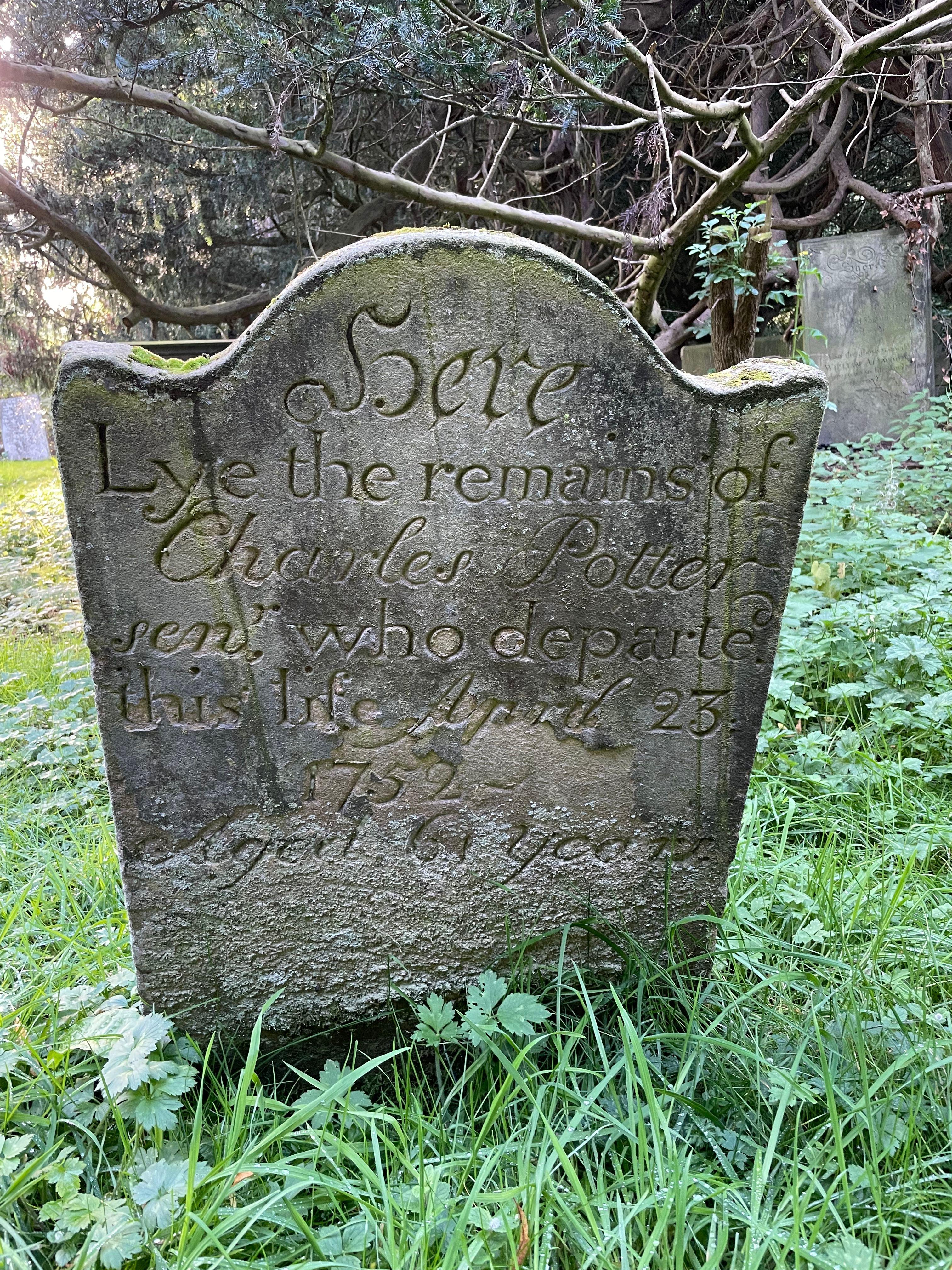
Charles is the only child of James Potter that we know the approximate date of birth, because his age was on his grave stone. I haven’t found any of their baptisms, but did note that many Potters were baptised in non conformist registers in Chesterfield.
Potters Cottage

Jonathan Potter of Potters Cottage married Alice Beeley in 1748.
“Darley Bridge was an important packhorse route across the River Derwent. There was a packhorse route from here up to Beeley Moor via Darley Dale. A reference to this bridge appears in 1504… Not far to the north of the bridge at Darley Dale is Church Lane; in 1635 it was known as Ghost Lane after a Scottish pedlar was murdered there. Pedlars tended to be called Scottish only because they sold cheap Scottish linen.”
via Derbyshire Heritage website.
According to Wikipedia, the bridge dates back to the 15th century.
August 16, 2024 at 2:56 pm #7544In reply to: The Elusive Samuel Housley and Other Family Stories
Youlgreave
The Frost Family and The Big Snow
The Youlgreave parish registers are said to be the most complete and interesting in the country. Starting in 1558, they are still largely intact today.
“The future historian of this parish will find a vast stock of material ready to hand, and if such a work was ever accomplished it would once more be seen how the history of even a remote village is but the history of the nation in little; how national victories were announced on the church bells, and national disasters by the proclamation of a form of prayer…”
J. Charles Cox, Notes on the Churches of Derbyshire, 1877.
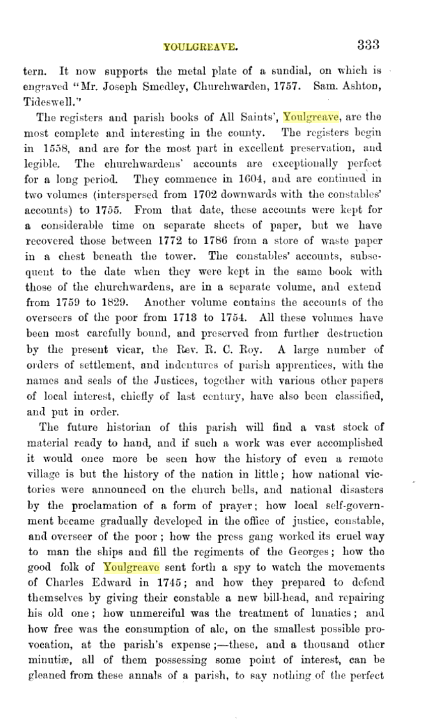
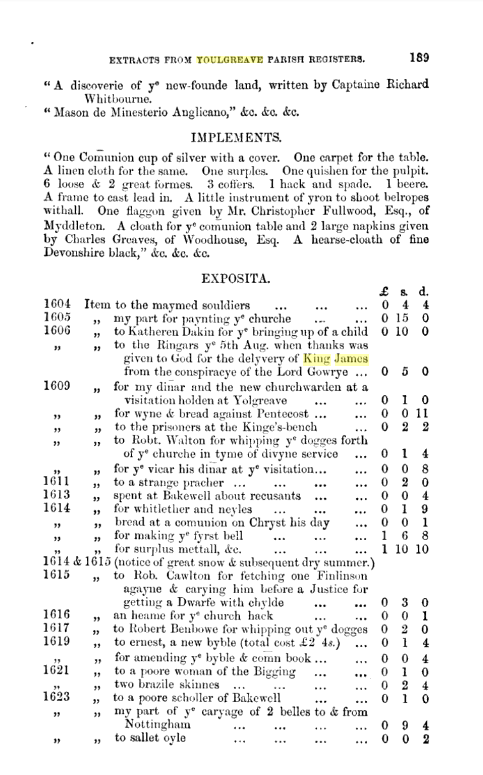
Although the Youlgreave parish registers are available online on microfilm, just the baptisms, marriages and burials are provided on the genealogy websites. However, I found some excerpts from the churchwardens accounts in a couple of old books, The Reliquary 1864, and Notes on Derbyshire Churches 1877.
Hannah Keeling, my 4x great grandmother, was born in Youlgreave, Derbyshire, in 1767. In 1791 she married Edward Lees of Hartington, Derbyshire, a village seven and a half miles south west of Youlgreave. Edward and Hannah’s daughter Sarah Lees, born in Hartington in 1808, married Francis Featherstone in 1835. The Featherstone’s were farmers. Their daughter Emma Featherstone married John Marshall from Elton. Elton is just three miles from Youlgreave, and there are a great many Marshall’s in the Youlgreave parish registers, some no doubt distantly related to ours.
Hannah Keeling’s parents were John Keeling 1734-1823, and Ellen Frost 1739-1805, both of Youlgreave.
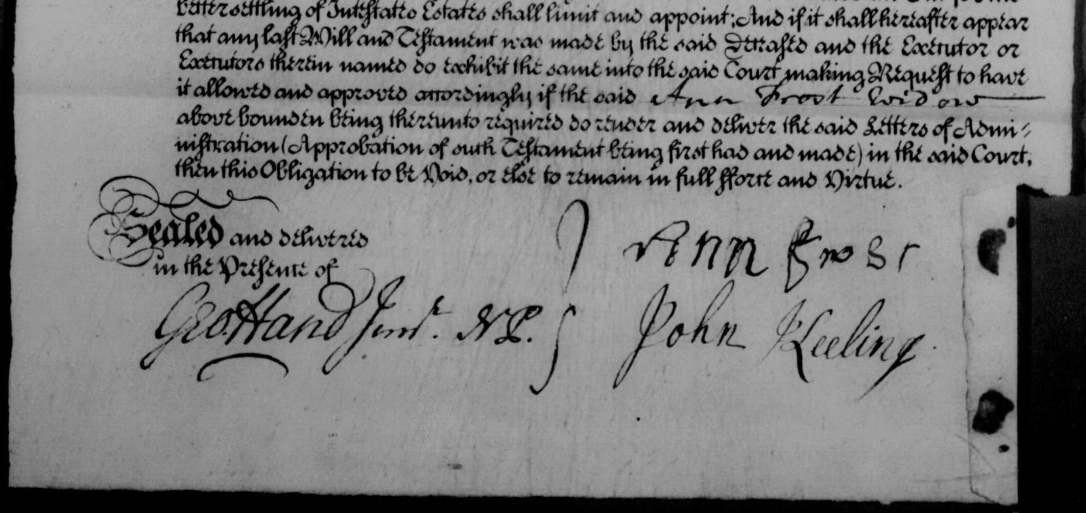
On the burial entry in the parish registers in Youlgreave in 1823, John Keeling was 88 years old when he died, and was the “late parish clerk”, indicating that my 5x great grandfather played a part in compiling the “best parish registers in the country”. In 1762 John’s father in law John Frost died intestate, and John Keeling, cordwainer, co signed the documents with his mother in law Ann. John Keeling was a shoe maker and a parish clerk.
John Keeling’s father was Thomas Keeling, baptised on the 9th of March 1709 in Youlgreave and his parents were John Keeling and Ann Ashmore. John and Ann were married on the 6th April 1708. Some of the transcriptions have Thomas baptised in March 1708, which would be a month before his parents married. However, this was before the Julian calendar was replaced by the Gregorian calendar, and prior to 1752 the new year started on the 25th of March, therefore the 9th of March 1708 was eleven months after the 6th April 1708.
Thomas Keeling married Dorothy, which we know from the baptism of John Keeling in 1734, but I have not been able to find their marriage recorded. Until I can find my 6x great grandmother Dorothy’s maiden name, I am unable to trace her family further back.
Unfortunately I haven’t found a baptism for Thomas’s father John Keeling, despite that there are Keelings in the Youlgrave registers in the early 1600s, possibly it is one of the few illegible entries in these registers.
The Frosts of Youlgreave
Ellen Frost’s father was John Frost, born in Youlgreave in 1707. John married Ann Staley of Elton in 1733 in Youlgreave.
(Note that this part of the family tree is the Marshall side, but we also have Staley’s in Elton on the Warren side. Our branch of the Elton Staley’s moved to Stapenhill in the mid 1700s. Robert Staley, born 1711 in Elton, died in Stapenhill in 1795. There are many Staley’s in the Youlgreave parish registers, going back to the late 1500s.)
John Frost (my 6x great grandfather), miner, died intestate in 1762 in Youlgreave. Miner in this case no doubt means a lead miner, mining his own land (as John Marshall’s father John was in Elton. On the 1851 census John Marshall senior was mining 9 acres). Ann Frost, as the widow and relict of the said deceased John Frost, claimed the right of administration of his estate. Ann Frost (nee Staley) signed her own name, somewhat unusual for a woman to be able to write in 1762, as well as her son in law John Keeling.
John’s parents were David Frost and Ann. David was baptised in 1665 in Youlgreave. Once again, I have not found a marriage for David and Ann so I am unable to continue further back with her family. Marriages were often held in the parish of the bride, and perhaps those neighbouring parish records from the 1600s haven’t survived.
David’s parents were William Frost and Ellen (or Ellin, or Helen, depending on how the parish clerk chose to spell it). Once again, their marriage hasn’t been found, but was probably in a neighbouring parish.
William Frost’s wife Ellen, my 8x great grandmother, died in Youlgreave in 1713. In her will she left her daughter Catherine £20. Catherine was born in 1665 and was apparently unmarried at the age of 48 in 1713. She named her son Isaac Frost (born in 1662) executor, and left him the remainder of her “goods, chattels and cattle”.
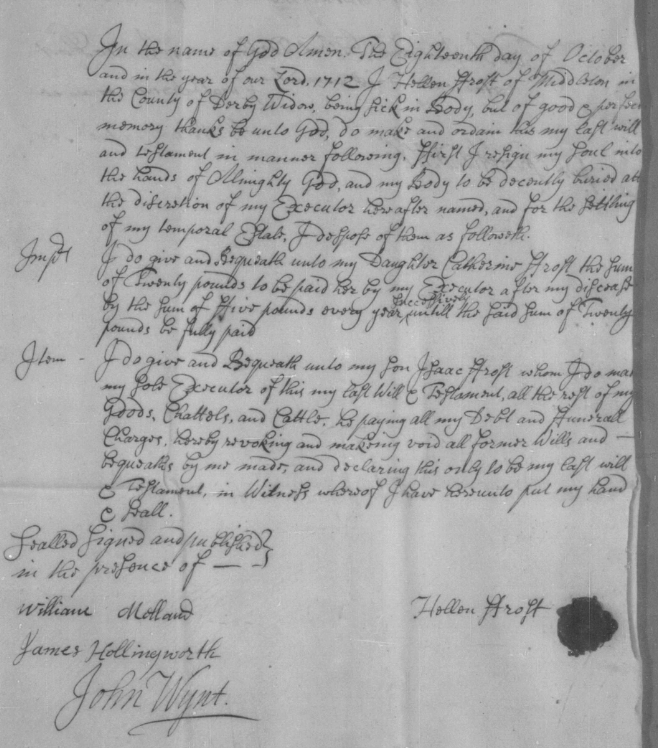
William Frost was baptised in Youlgreave in 1627, his parents were William Frost and Anne.
William Frost senior, husbandman, was probably born circa 1600, and died intestate in 1648 in Middleton, Youlgreave. His widow Anna was named in the document. On the compilation of the inventory of his goods, Thomas Garratt, Will Melland and A Kidiard are named.(Husbandman: The old word for a farmer below the rank of yeoman. A husbandman usually held his land by copyhold or leasehold tenure and may be regarded as the ‘average farmer in his locality’. The words ‘yeoman’ and ‘husbandman’ were gradually replaced in the later 18th and 19th centuries by ‘farmer’.)
Unable to find a baptism for William Frost born circa 1600, I read through all the pages of the Youlgreave parish registers from 1558 to 1610. Despite the good condition of these registers, there are a number of illegible entries. There were three Frost families baptising children during this timeframe and one of these is likely to be Willliam’s.
Baptisms:
1581 Eliz Frost, father Michael.
1582 Francis f Michael. (must have died in infancy)
1582 Margaret f William.
1585 Francis f Michael.
1586 John f Nicholas.
1588 Barbara f Michael.
1590 Francis f Nicholas.
1591 Joane f Michael.
1594 John f Michael.
1598 George f Michael.
1600 Fredericke (female!) f William.Marriages in Youlgreave which could be William’s parents:
1579 Michael Frost Eliz Staley
1587 Edward Frost Katherine Hall
1600 Nicholas Frost Katherine Hardy.
1606 John Frost Eliz Hanson.Michael Frost of Youlgreave is mentioned on the Derbyshire Muster Rolls in 1585.
(Muster records: 1522-1649. The militia muster rolls listed all those liable for military service.)
Frideswide:
A burial is recorded in 1584 for Frideswide Frost (female) father Michael. As the father is named, this indicates that Frideswide was a child.
(Frithuswith, commonly Frideswide c. 650 – 19 October 727), was an English princess and abbess. She is credited as the foundress of a monastery later incorporated into Christ Church, Oxford. She was the daughter of a sub-king of a Merica named Dida of Eynsham whose lands occupied western Oxfordshire and the upper reaches of the River Thames.)
An unusual name, and certainly very different from the usual names of the Frost siblings. As I did not find a baptism for her, I wondered if perhaps she died too soon for a baptism and was given a saints name, in the hope that it would help in the afterlife, given the beliefs of the times. Or perhaps it wasn’t an unusual name at the time in Youlgreave. A Fridesweda Gilbert was buried in Youlgreave in 1604, the spinster daughter of Francis Gilbert. There is a small brass effigy in the church, underneath is written “Frideswide Gilbert to the grave, Hath resigned her earthly part…”
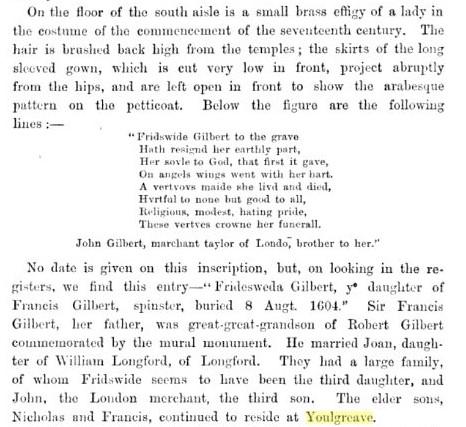
J. Charles Cox, Notes on the Churches of Derbyshire, 1877.
King James
A parish register entry in 1603:
“1603 King James of Skottland was proclaimed kinge of England, France and Ireland at Bakewell upon Monday being the 29th of March 1603.” (March 1603 would be 1604, because of the Julian calendar in use at the time.)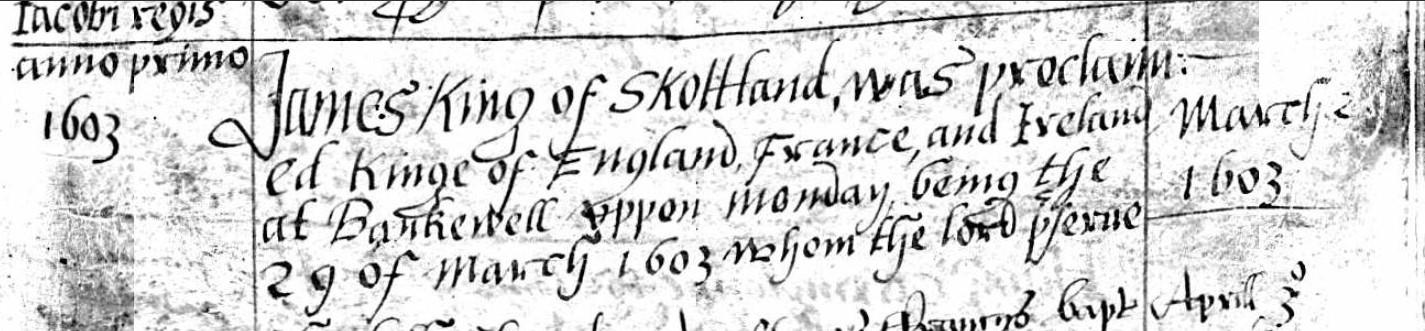
The Big Snow
“This year 1614/5 January 16th began the greatest snow whichever fell uppon the earth within man’s memorye. It covered the earth fyve quarters deep uppon the playne. And for heaps or drifts of snow, they were very deep; so that passengers both horse or foot passed over yates, hedges and walles. ….The spring was so cold and so late that much cattel was in very great danger and some died….”
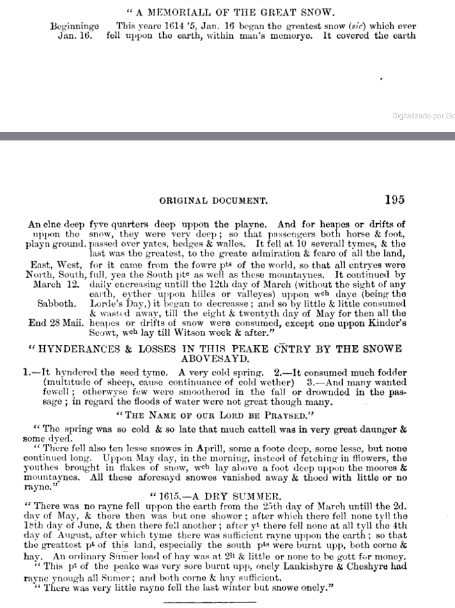
From the Youlgreave parish registers.
Our ancestor William Frost born circa 1600 would have been a teenager during the big snow.
July 5, 2024 at 6:39 pm #7531In reply to: Washed off the sea ~ Creative larks

The rose coloured spectacle lens.
Aunt Idle:
“Well, crikey, finding one pink sunglass lens on the road is quite the curiosity, isn’t it? Let’s delve into the symbolic undertones of such an odd discovery. Pink lens, no less—a splash of color with quite the story to tell.
1. Seeing the World through Rose-Tinted Glasses: Finding a pink sunglass lens can symbolize optimism and seeing the world in a positive light. But here’s the kicker—it’s just one lens. This suggests a duality; perhaps you’re being asked to blend optimism with realism. Life isn’t always about sunshine and rainbows, but choosing to see the bright side can balance out the darker shades.
2. Fragmented Perspectives: A single lens means you don’t have the full picture. You’re seeing things partially, which can indicate missing information or a need to look at situations from multiple angles. It’s a nudge to take off those blinders and open your other eye, figuratively speaking. You might be clinging to a half-truth or ignoring an important aspect of your life.
3. Lost and Found: In practical terms, a lone lens on the road means someone has lost it. It’s a signifier of separation, maybe something in your life has split or broken apart. It can be a gentle reminder to look into areas where you might have lost connection—be it with loved ones, a project, or even a part of yourself.
4. Symbol of Love and Compassion: Pink is often associated with love, compassion, and femininity. The lens could be a reminder to look at things with kindness and empathy. Perhaps there’s a situation in your life that requires a softer, more loving approach.
5. Hindsight and Insight: The road is a metaphor for your life’s journey. Finding the lens there might hint at reflecting on past experiences (hindsight) while gaining new understanding or clarity (insight). Maybe there’s an opportunity to learn from what’s happened and apply it moving forward, seeing things with fresh, yet incomplete, clarity.
Putting it in Truella’s Context: If Truella found this lens, it could be a sign she needs to reassess her current path or research direction. Her overwhelming stack of books and discovery of the ancient manuscript hint at a bigger picture she might not be seeing clearly yet. Perhaps she’s overly focused on one aspect and neglecting others.
Personal Symbolism for Aunt Idle: For you, Aunt Idle, this lens could be a cheeky nudge to reassess some of your adventurous antics and half-remembered tales. Maybe there’s an old mystery or a relationship needing a fresh perspective. Or it’s just life’s way of saying, “Look closer, love—you might be missing out!”
In any case, a single pink sunglass lens is a quirky, delightful piece of life’s puzzle, inviting you to ponder, reflect, and adjust your view. So, next time you’re journeying on the dusty roads of life and stumble upon such oddities, take a moment—there just might be a zinger of wisdom waiting for you. Cheers!”
“A lone pink lens paves the road to the unseen clarity of kaleidoscopic sunrise.”
~Journey of Reflections, Enrich P. Lwellman. The Snoot:
“Ahhh, a single pink lens, lost and found amidst the stone and dust! Sings of mysteries and tales untold! Perhaps a sprite misplaced their vision or a pixie left a clue.
Lean close! Such a find whispers soft secrets:
Balance Broken, Yet Bright Like seeing life with a tint of whimsy! One eye tinted pink, the other clear. A call to mix reality with dreams, maybe?
Half Truth, Half Fantasy A hint that stories blend truths and imaginations. Seek both sides to find whole pictures.
Lost and Waiting Could be a sign someone’s journey is incomplete, needing you as a puzzle piece. Maybe the other lens waits for your path?Snootly wisdom: Use the lens not to see, but to imagine.Peer through the pink and let dreams color your heart. Could be you’re on the cusp of a grand adventure; just follow the allure of the pink!
Liz:
Oh, darling, how positively intriguing! A single pink sunglass lens left upon the road—why, it’s like a snippet from one of my novels, fraught with symbolism and brimming with untold stories.
Let’s unravel this little mystery together, shall we? First, the color pink itself is rich with meaning. It speaks of love, compassion, and a certain kind of whimsicality. It’s a hue that embodies the gentle side of passion, the tender whispers of the heart. Now, to find just one lens, separated from its twin, adds a layer of poignancy. It’s a fragment of something once whole, a poignant reminder of loss or incompletion.
One might surmise that this lens represents a part of oneself that has been misplaced or overlooked. Perhaps it’s a call to rediscover a piece of your own heart, the softer, more romantic side that life’s hustle and bustle may have sidelined. Or it could symbolize a different perspective—after all, sunglasses shield us from the sun’s glare, making things clearer in their own shaded way. This lone lens might be urging you to look at a situation with fresh eyes, to find beauty in the fragmented and the unexpected.
Imagine, if you will, a character in one of my novels stumbling upon this very lens. They’d be on the cusp of a grand adventure, naturally. The pink lens would become their talisman, a clue leading them to unforeseen revelations and untold treasures. It would be both a physical object and a metaphorical guide, urging them to view the world—and their place within it—through a lens of love and compassion.
Perhaps it is also a nod to the impermanence of things, a gentle reminder that beauty and meaning can be found even in life’s fleeting moments. Much like the single pink lens, our journeys are filled with fragments of experiences that, when pieced together, create a mosaic of our existence.
So, my dear, take this as a sign to embrace the whimsical, to seek out the overlooked pieces of your own story, and to cherish the beauty of the incomplete. After all, it’s the mysteries and the musings that make life a narrative worth living.
Mater:
Ah, a single pink sunglass lens on the road, you say? Now that’s a curious find. Objects like that can be teeming with symbolic meaning if you’ve got the eyes to see it. Let’s break it down a bit, shall we?
Firstly, the color pink. Traditionally, pink is associated with love, compassion, and nurturing. It’s a color that often brings to mind warmth and affection, something tender and gentle. But finding just one lens suggests something is missing or incomplete—a piece of a larger whole.
A sunglass lens, on the other hand, is meant to protect the eyes from harsh light, allowing you to see the world more clearly without being blinded. Seeing through a pink lens, metaphorically speaking, can mean looking at life with an optimistic or compassionate perspective. It’s like seeing the world through rose-colored glasses, as they say.
Now, finding just one lens on the road—well, roads are pathways, journeys, the direction we take in life. A single lens could indicate a moment of clarity or a shift in perspective on your journey. But it could also symbolize a need to find balance or the missing piece of your outlook to see the full picture clearly.
Maybe it’s a nudge from the universe to take a closer look at how you view your current path. Are you seeing things in the best light possible? Or perhaps it’s a reminder that while optimism and compassion are vital, you might be missing another crucial aspect—realism or practicality, perhaps?
Or, it could be as simple as a reminder to lighten up and find joy and playfulness in your journey.
Like a pink flamingo standing on one leg, sometimes life’s oddities are just there to make you smile and wonder.
Whatever the meaning, love, take it as a sign to reflect and consider. The road ahead is always full of mystery and wonder, and sometimes the smallest things can carry the biggest messages.
Finnley:
Pink sunglass lens on the road, you say? Well, ain’t that a curious bit of rubbish. If we’re dabbling in symbolism, it could mean a variety of things depending on how fanciful you want to get. Pink is often associated with love, compassion, and care. So, finding a lens could mean you’re only seeing half the picture when it comes to matters of the heart. Or maybe you’re missing the rosy view on life, and you need to adjust your perspective.
Then again, it could just mean some poor sod lost their sunnies and now they’ve got a squint and a sunburnt nose. Life’s not always riddled with deep meanings, sometimes it’s just a bit of lost plastic on the tarmac.
Now, if you ask me, you ought to be more concerned about the litter. If everyone went around leaving bits and bobs all over the place, we’d be living in a right tip. So pick it up, toss it in the bin, and let’s keep things tidy, shall we?
Mandrake:
Ah, the solitary pink sunglass lens on the road. Delightfully poetic. A symbol of half-seen truths, perhaps? Seeing the world through rose-tinted glasses, but only partially. Could it be urging you to seek balance, to view life with both optimism and realism? Or maybe just a nudge from the universe to pick up your litter. Such profundity from a piece of plastic. Life’s a riddle, darling.
Sha: A pink sunglass lens on the road, eh? Now that’s a right peculiar find if ever I ‘eard one. Makes you wonder what it means, don’t it?
Glo: Oh, Sha, you’re always lookin’ for the hidden meanin’ in things. It’s just a bit of plastic, ain’t it? Though, come to think of it, pink’s a powerful colour. Symbolises love, compassion, and all that mushy stuff.
Mavis: I reckon it might be a sign, ladies. A pink lens… maybe it’s tellin’ you to look at the world through rose-tinted glasses, y’know? See the good in things. Or it could be a message from the universe, remindin’ you to keep an eye out for the unusual.
Sha: Right you are, Mav! And let’s not forget the conspiracies! Maybe it’s a clue from them secret societies, leavin’ hints for those sharp enough to notice. Could be part of a bigger puzzle, a breadcrumb leadin’ to somethin’ magnificent.
Glo: Or maybe someone’s just dropped their specs out the car window in a rush, and it’s nothin’ more than that. But where’s the fun in that sort of thinkin’?
Mavis: True, true. We’ll go with the idea that it’s a symbol of keepin’ an open mind and lookin’ out for the small wonders of life. Who knows what other treasures we might find if we keep our eyes peeled?
Sha: And next time we’re out and about, let’s be on the lookout for the other lens. Could be a sign that we’re missin’ half the picture.
Glo: Oh, you and your signs, Sha! But alright, we’ll keep our peepers open. Never know what the universe might be tryin’ to tell us next.
June 30, 2024 at 9:03 am #7529In reply to: Smoke Signals: Arcanas of the Quadrivium’s incense
Cedric Spellbind scene with Frella at Herma’s cottage. (ref)

On the rugged coast of Ireland bathed by a sunny light. Near a secluded cottage, the scene unfolds with the figure of a tall, middle-aged man with disheveled dark hair, a deerstalker hat, and a trench coat, who stands nervously. His piercing eyes reveal a lifetime of supernatural pursuits.
Next to him, a modern witch with striking blond hair reminiscent of Tilda Swinton, sits on a camphor chest. The cottage owner, a middle aged lady frets nearby. He declares his official business, accusing her of Witch Violations. He is entranced by her presence, admits he knows she’s a witch but won’t turn her in.
The scene captures a rare moment of levity and complex attraction in the tense atmosphere and their complicated relationship, set against the backdrop of a mysterious and mystical investigation.
June 30, 2024 at 8:44 am #7528In reply to: Smoke Signals: Arcanas of the Quadrivium’s incense
Frella at Herma’s cottage – looking for magical clues in the mysterious camphor chest.
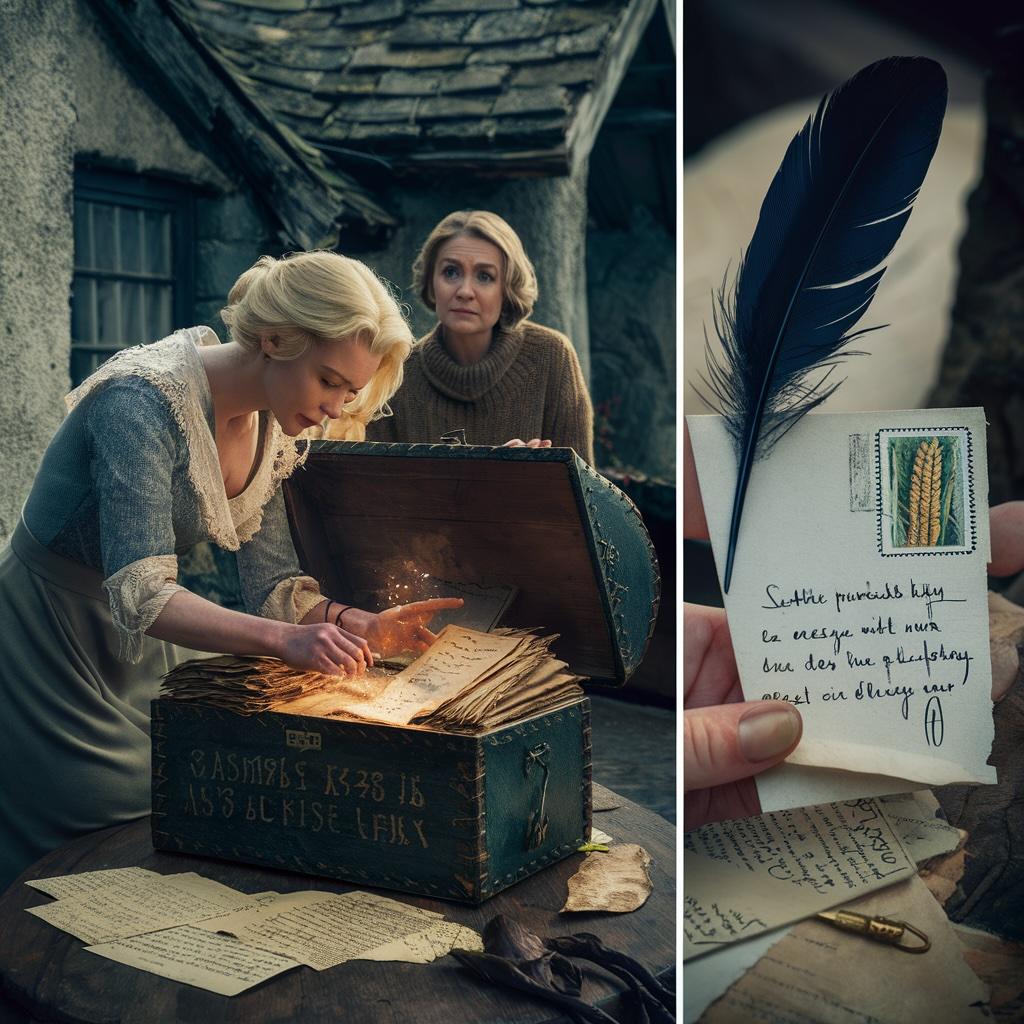
In a quaint cottage on the coast of Ireland, with salt and simple spells, a modern witch blond and looking like Tilda Swinton opens a big camphor chest carved with runes. Behind her is the owner of the cottage, wondering what is Inside, and if protected by magical spells. Inside they find ancient documents, letters, and a peculiar item—a black feather of a blackbird, delicate and shimmering with a faint magical glow. The feather is a quill to reveal hidden messages on the postcard with a stamp featuring an ear of maize.
June 26, 2024 at 7:09 am #7526In reply to: The Incense of the Quadrivium’s Mystiques
Truella slept for longer than she intended, indeed, she had not intended to sleep at all, there was too much to do. Trying to hold on to the fragments of dream recall, she sat up and rubbed her eyes. Glancing around the room, she couldn’t immediately remember what she was doing there. Suddenly she sat bolt upright. What was that conversation she’d had before falling alseep? Truella felt dizzy trying to remember. She stood up and started to pace the room, and noticed a letter had been pushed under the bedroom door. She frowned as she bent to pick it up. Nothing was written on the outside, but the envelope had been sealed with a blob of red wax. Truella opened the letter carefully without breaking the seal. A yellowy page was inside, written in Latin.
Ordo Amphibiae-Luciae: pertinebant ad Ordinem Amphibiae-Luciae.
Truella’s Latin was rusty to say the least. She sat back down on the bed struggling to decipher the message.
The Order of Amphibia-Lucia: They belonged to the Order of Amphibia-Lucia.
Nomen Amphibia-Lucia provenit ex duplici natura: tam terrena quam mundana. Rana facies symbolica est repraesentatio nexus eorum ad aquam, transformationem, et antiqua numina amphibiana.
The name “Amphibia-Lucia” stems from their dual nature: both earthly and otherworldly. The frog face is a symbolic representation of their connection to water, transformation, and ancient amphibian deities. They believe in metamorphosis, much like a tadpole turns into a frog, embodying cycles of death and rebirth These priestesses predated Christianity by eons. Their practices and rituals were about aligning with the cosmic cycles, harnessing planetary energies, and maintaining harmony between the seen and the unseen. They were known to perform rites that involved intricate dances, chants in forgotten tongues, and the use of ancient artifacts that, according to legend, could summon or banish entities from beyond our realm—dragons included.
Tartessus in obscurum, secretissimae sectae, ordo Amphibiae-Luciae, sub terra perrexit, ad litteram. Scientiam suam servaverunt, eam per generationes transeuntes, ritus suos in secretis clausulis sub culturis recentioribus obrutos servaverunt. Christianismus in terram pervasit, sed hae sorores aptatae, antiquas vias obtegunt sub specie hodiernae opinionis systemata superstites vigereque.
When Tartessos fell into obscurity, its most secretive sect, the Order of Amphibia-Lucia, went underground—literally. They preserved their knowledge, passing it down through generations, maintaining their rituals in secretive enclaves buried beneath newer civilizations. Christianity might’ve swept over the land, but these sisters adapted, cloaking their ancient ways under the guise of more contemporary belief systems to survive and thrive.
In cellis cellis in ipsum cubiculum illorum claustrorum contextum habemus reliquias ordinis pervetusti, dogmatum ac dogmatum recentioris millennii securos. Hais ex quo saeviunt dii, rudis sacra, et advena mundus.
In the cellars woven into the very bedrock of those cloisters, we have the remnants of an archaic order, unconcerned with dogmas and doctrines of the more recent two millennia. They’re from a time when gods were wilder, rituals were raw, and the world was a stranger.
When the nuns under Hildegarde von Bingen’s influence merged with these ancient priestesses, it wasn’t just a blending of orders but a clash and harmony of traditions. Hildegarde herself, in her visionary wisdom, likely recognized the power and ancient wisdom of the Order of Amphibia-Lucia, choosing to weave their potent rituals into her own esoteric Christian practices. The frog-faced sisters are no mere relics of an outdated faith. They’re the living embodiment of an ancient, potent lineage that predates and outlasts many of the world’s religions. They’re the keepers of ancient Tartessian magic, lurking in those cellars, waiting for the right time to hop back into the forefront of history.
So that was it! But who had pushed the letter under her door? And why was it written in Latin? Had everyone else received a letter?
June 25, 2024 at 9:06 pm #7524In reply to: The Incense of the Quadrivium’s Mystiques
The obvious place to start with investigations into the history of the Morticians Guild was to question Rufus. But first she needed to think. Truella made her way to her room, and locked the door. At least now that Eris was back so soon, Truella was free to let Eris get on with whatever she was doing. After lowering the blinds at the windows, she lay back on the bed and closed her eyes. As she started to drift off to sleep, an imaginary conversation ran through her head.
Rufus: “The Morticians’ Guild, originally known as the ‘Necro-Keepers,’ trace their lineage back to ancient Egypt. They were the guardians of rites that ensured the safe passage of souls to the afterlife. Over millennia, they adapted and evolved, absorbing arcane knowledge from various cultures—the Greeks with their Eleusinian Mysteries, the Romans with their burial rites, even the Celtic traditions of Samhain.”
Truella: “That’s fascinating. So, this ancient craft has been handed down through generations?”
Rufus: “Precisely. While Hildegarde von Bingen brought enlightenment and medicinal wisdom to her nuns in the 12th century, the Morticians’ practices were already etched in the annals of history. They operated in silence, often in the shadows, perfecting the skills of embalming, necromancy, and spirit communication.”
Truella: “And what about their presence here, in this coven merger?”
Rufus: “We’ve been called upon at times of great need, when balance must be maintained between the living and the dead. Our presence here isn’t coincidental. The dragons and ancient spirits awaken, and we, the keepers, ensure that not all realms collide irreversibly.”
Truella: “So, would you say the Guild has played a role in significant historical events?”
Rufus: “Indeed. We’ve been the unsung heroes, the silent watchers. From plagues to wars, ensuring the dead find peace and don’t linger to disrupt the world of the living. Our methods may have modernized, but our core purpose remains unchanged. The knowledge, the rituals—they are our legacy.”
Truella: “Thank you, Rufus. That’s more fascinating than a year’s worth of ancient spellbooks.”
Rufus: “You’re welcome, Truella. Just remember, history isn’t merely dates and names; it’s living through us, weaving its magic continuously.”
June 21, 2024 at 12:46 pm #7517In reply to: The Incense of the Quadrivium’s Mystiques
The door knob of Truella’s bedroom turned, and then rattled. Sated and sleepy, she ignored it. Then an insistant rapping of knuckles sounded. Rufus looked at the door, and back to Truella.
“Ignore it, it’s probably the maid,” she said. “But what a time to come, at siesta time.”
The knocking got louder and a voice hissed through the keyhole, “Let me in! Open the bloody door, FFS!”
Frella! What was she doing here? Truella pulled the sheet around her and padded over to the door and unlocked it.
“About time!” she started to say, opening the door, and then leapt back in astonishment to see Sister Audrey standing there glaring.
Audrey pushed past her, slamming the door behind her and locking it. “Listen, this is the plan. Oh don’t look so baffled, it’s me, Frella. Audrey offered to let me possess her for 24 hours, it was the quickest way to get here. Now listen, this is what we’re going to do.” Audrey/Frella launched into an outline of the plans for exploring the cellars later that night. She had turned to face Truella at the door, and hadn’t noticed Rufus. Quickly, he slid off the bed and hid underneath it.
When Audrey/Frella had finished, she asked “Got any weed? I could do with a quick puff.” Truella replied affirmatively. “Oh and what have we here, what is that mans leather coat doing on your floor? You absolute tart, Truella. You’ve only been here since this morning and you’re at it already!”
This was too much for Rufus, who crawled out from under the bed. “Hold your tongue, woman!” he admonished, while reaching for his shorts. “And I heard all that,” he added. “And if you’re going down there, I’m coming with you.”
Truella looked at Audrey/Frella helplessly.
“Now look what you’ve gone and done!” snapped Audrey/Frella.
“I didn’t tell him, you did,” Truella shot back, “You’re the one who barged in here spilling the beans!”
“Well, he may be useful I suppose,” Audrey/Frella said, and stalked out, muttering tart under her breath. Why oh why, did she agree to do this?
June 21, 2024 at 10:04 am #7516In reply to: The Incense of the Quadrivium’s Mystiques
“Wait! Look at that one up there!” Truella grabbed Rufus’s arm. “That cloth hanging right up there by the rafters, see it? Have you got a torch, it’s so dark up there.”
Obligingly, Rufus pulled a torch out of his leather coat pocket. “That looks like…”
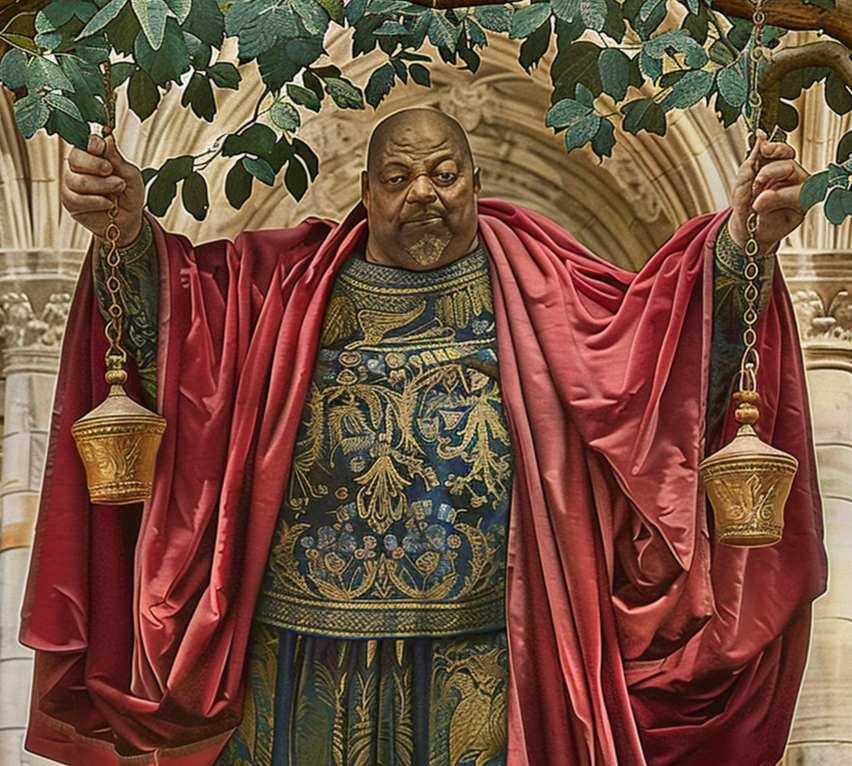
“Brother Bartolo!” Truella finished for him in a whisper. “Why is there an ancient tapestry of him, with all those frog faced nuns?”
Rufus felt dizzy and clutched the bannisters to steady himself. It was all coming back to him in a rush: images and sounds crowded his mind, malodorous wafts assailed his nostrils.
“Why, whatever is the matter? You look like you’ve seen a ghost. Come, come and sit down in my room.”
“Don’t you remember?” Rufus asked, with a note of desperation in his voice. “You remember now, don’t you?”
“Come,” Truella insisted, tugging his arm. “Not here on the stairs.”
Rufus allowed Truella to lead him to her room, rubbing a hand over his eyes. He was so damn hot in this leather coat. The memories had first chilled him to the bone, and then a prickly sweat broke out.
Leading him into her room, Truella closed and locked the door behind them. “You look so hot,” she said softly and reached up to slide the heavy coat from his shoulders. They were close now, very close. “Take it off, darling, take it all off. We can talk later.”
Rufus didn’t wait to be asked twice. He slipped out of his clothes quickly as Truella’s dress fell to the floor. She bent down to remove her undergarments, and raised her head slowly. She gasped, not once but twice, the second time when her eyes were level with his manly chest. The Punic frog amulet! It was identical to the one she had found in her dig.
A terrible thought crossed her mind. Had he stolen it? Or were there two of them? Were they connected to the frog faced sisters? But she would think about all that later.
“Darling,” she breathed, “It’s been so long….”
June 17, 2024 at 8:22 pm #7496In reply to: Smoke Signals: Arcanas of the Quadrivium’s incense
Lorena Blæn (Mother Lorena)
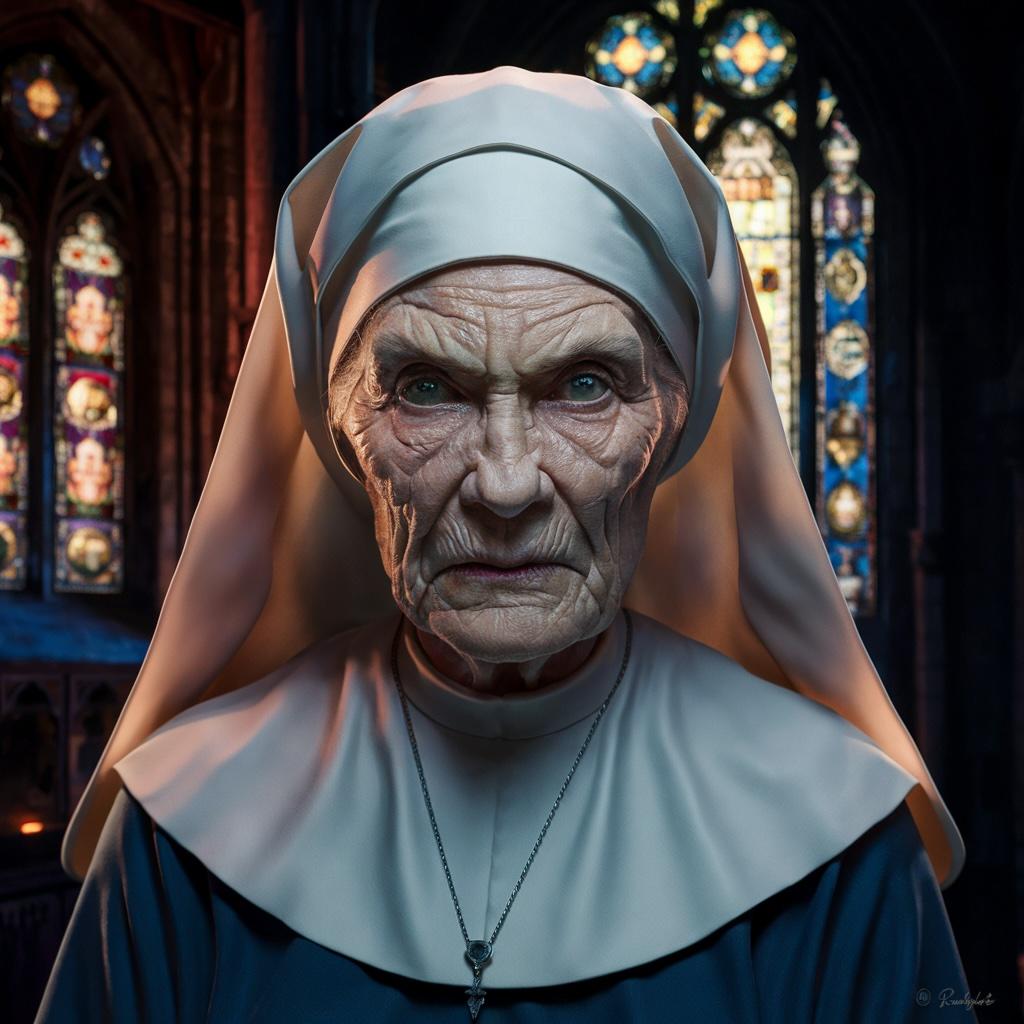
Lorena Blaen is stern and imposing, with a prune-faced expression and piercing eyes. Wears a crisp, starched habit and wimple.
- Leader of Quintessivium Cloister Crafts.
- Known for unyielding discipline and sharp wit.
- Balances traditional values with modern, magical integration.
- Commands respect and maintains high expectations.
- Orchestrates the cloister’s merger with the Quadrivium Coven, striving to blend tradition with innovation.
- November 2024 (Reunion):
-
AuthorSearch Results
Search Results for 'lock'
-
Search Results
-
“Who sees that the habit-energy of the projections of the beginningless past is the cause of the three realms and who understands that the tathagata stage is free from projections or anything that arises, attains the personal realisation of buddha knowledge and effortless mastery over their own minds” —The Lankavatara Sutra, 2.8 (trans. Red Pine).
“To trace the ripples of a beginningless sea is to chase a horizon that vanishes with each step; only by stilling the waves does the ocean reveal its boundless, unbroken clarity.”
~Echoes of the Vanished Shore, Selwyn Lemone.
What if the story would unfold in reverse this time? Would the struggle subsist, to remember the past events written comment after comment? Rather than writing towards a future, and —maybe— an elusive ending, would remembering layer after layers of events from the past change our outlook on why we write at all?
Let’s just have ourselves a new playground, a new experiment as this year draws to a close.
Four friends meet unexpectedly in a busy café, after five years not having seen each other.
Matteo, the server arrives, like a resonant fifth, bringing resolution to the root note —they all seem to know him, but why.
Answers are in their pasts. And story has to unfold backwards, a step at a time, to a beginningless past.