

Search Results for 'near'
-
AuthorSearch Results
-
March 1, 2025 at 10:01 am #7843
In reply to: The Last Cruise of Helix 25
Helix 25 – Space Tai Chi and Mass Lunacy
The Grand Observation Atrium was one of the few places on Helix 25 where people would come and regroup from all strata of the ship —Upper Decks, Lower Decks, even the more elusive Hold-dwellers— there were always groups of them gathered for the morning sessions without any predefined roles.
In the secular tradition of Chinese taichi done on public squares, a revival of this practice has started few years ago all thanks to Grand Master Sifu Gou quiet stubborn consistency to practice in the early light of the artificial day, that gradually had attracted followers, quietly and awkwardly joining to follow his strange motions. The unions, ever eager to claim a social victory and seeing an opportunity to boost their stature, petitioned to make this a right, and succeeded, despite the complaints from the cleaning staff who couldn’t do their jobs (and jogs) in the late night while all passengers had gone to sleep, apart from the night owls and party goers.
In short, it was a quiet moment of communion, and it was now institutionalised, whether Sifu Gou had wanted it or not.
The artificial gravity fluctuated subtly here, closer to the artificial gravitational core, in a way that could help attune people to feel their balance shift, even in absence of the Earth’s old pull.
It was simply perfect for Space Tai Chi.
A soft chime signaled the start of the session. Grand Master Gou, in the Helix 25’s signature milk-silk fabric pajamas, silver-haired and in a quiet poise, stood at the center of the open-air space beneath the reinforced glass dome, where Jupiter loomed impossibly large beyond the ship, its storms shifting in slow, eternal violence. He moved slowly, deliberately, his hands bearing a weight that flowed improbably in the thinness of the gravity shifts.
“To find one’s center,” he intoned, “is to find the center of all things. The ship moves, and so do we. You need to feel the center of gravity and use it —it is our guide.”
A hundred bodies followed in various degrees of synchrony, from well-dressed Upper Deck philosophers to the manutentioners and practical mechanics of the Lower Decks in their uniforms who stretched stiff shoulders between shift rotations. There was something mesmerizing about the communal movement, that even the ship usually a motionless background, seemed to vibrate beneath their feet as though their motions echoed through space.
Every morning, for this graceful moment, Helix 25 felt like a true utopia.
That was without counting when the madness began.

The Gossip Spiral
“Did you hear about Sarawen?” hissed a woman in a flowing silk robe.
“The Lexican?” gasped another.
“Yes. Gave birth last night.”
“What?! Already? Why weren’t we informed?”
“Oh, she kept it very quiet. Didn’t even invite anyone to the naming.”
“Disgraceful. And where are her two husbands? Following her everywhere. Suspicious if you ask me.”A grizzled Lower Deck worker grunted, still trying to follow Master Gou’s movement. “Why would she invite people to see her water break? Sounds unhygienic.”
This earned a scandalized gasp from an Upper Decker. “Not the birth—the ceremony! Honestly, you Lower Deck folk know nothing of tradition.”
Wisdom Against Wisdom
Master Gou was just finishing an elegant and powerful sweep of his arms when Edeltraut Snoot, a self-proclaimed philosopher from Quadrant B, pirouetted herself into the session with a flamboyant twirl.
“Ah, my dear glowing movement-makers! Thou dost align thine energies with the artificial celestial pull, and yet! And yet! Dost thou not see—this gravity is but a fabrication! A lie to lull thee into believing in balance when there is none!”
Master Gou paused, blinking, impassive, suspended in time and space, yet intently concentrated. Handling such disturbances of the force gracefully, unperturbed, was what the practice was about. He resumed as soon as Edeltraut moved aside to continue her impassionate speech.
“Ah yiii! The Snoot Knows. Oh yes. Balance is an illusion sold to us by the Grand Micromanagers, the Whymen of the Ever-Hungry Order. Like pacmaniacs, they devour structure and call it stability. And we! We are but rabbits, forced to hop through their labyrinth of rules!”
Someone muttered, “Oh no, it’s another of those speeches.”
Another person whispered, “Just let her talk, it’s easier.”
The Snoot lady continued, undeterred. “But we? Oh, we are not merely rabbits. We are the mist in the hedge! The trick in their tale! We evade! We escape! And when they demand we obey their whys—we vanish!”
By now, half the class had abandoned their movements entirely, mesmerized by the absurdity. The other half valiantly continued the Space taichi routine while inching away.
Master Gou finally closed the form, then sighed intently, pinching the bridge of his nose. “Let us… return to our breath.”
More Mass Lunacy
It started as a low murmur, a shifting agitation in the crowd. Then, bickering erupted like a solar flare.
“I can’t find my center with all this noise!”
“Oh shut up, you’ve never had a center.”
“Who took my water flask?!”
“Why is this man so close to me?!”
“I am FLOATING?! HELP!”Synthia’s calm, omnipresent voice chimed in overhead.
“For your well-being, an emergency dose of equilibrium supplements will be dispensed.”
Small white pills rained from overhead dispensers.
Instead of calming people down, this only increased the chaos.
Some took the pills immediately, while others refused on principle.
Someone accused the Lexicans of hoarding pills.
Two men got into a heated debate over whether taking the pills was an act of submission to the AI overlords.
A woman screamed that her husband had vanished, only to be reminded that he left her twelve years ago.
Someone swore they saw a moon-sized squid in the sky.The Unions and the Leopards
Near the edges of the room, two quadrant bosses from different labor unions were deep in mutual grumbling.
“Bloody management.”
“Agreed, even if they don’t call themselves that any longer, it’s still bloody management.”
“Damn right. MICRO-management.”
“Always telling us to be more efficient, more aligned, more at peace.”
“Yeah, well, who the hell voted for peace?! I preferred it when we just argued in the corridors!”One of them scowled. “That’s the problem, mate. We fought for this, better conditions, and what did we get? More rules, more supervisors! Who knew that the Leopards-Eating-People’s-Faces Party would, y’know—eat our own bloody faces?!”
The other snorted. “We demanded stability, and now we have so much stability we can’t move without filling out a form with all sorts of dumb questions. You know I have to submit a motion request before taking a piss?”
“…seriously?”
“Dead serious. Takes an eternity to fill. And four goddamn business hours for approval.”
“That’s inhumane.”
“Bloody right it is.”
At that moment, Synthia’s voice chimed in again.
“Please be advised: Temporary gravitational shifts are normal during orbital adjustments. Equilibrium supplements have been optimized. Kindly return to your scheduled calm.”
The Slingshot Begins
The whole ship gave a lurch, a gravitational hiccup as Helix 25 completed its slingshot maneuver around the celestial body.
Bodies swayed unnaturally. Some hovered momentarily, shrieking.
Someone declared that they had achieved enlightenment.
Someone else vomited.Master Gou sighed deeply, rubbing his temples. “We should invent retirement for old Masters. People can’t handle their shit during those Moonacies. Months of it ahead, better focus on breath more.”
Snoot Lady, still unaffected, spread her arms wide and declared:
“And so, the rabbit prevails once again!”Evie, passing by on her way to the investigation, took one look at the scene of absolute madness and turned right back around.
“Yeah. Nope. Not this morning. Back to the Murder Board.”
March 1, 2025 at 8:17 am #7841In reply to: The Last Cruise of Helix 25
Klyutch Base – an Unknown Signal
The flickering green light on the old console pulsed like a heartbeat.
Orrin Holt leaned forward, tapping the screen. A faint signal had appeared on their outdated long-range scanners—coming from the coastline near the Black Sea. He exchanged a glance with Commander Koval, the no-nonsense leader of Klyutch Base.
“That can’t be right,” muttered Janos Varga, Solara’s husband who was managing the coms’ beside him. “We haven’t picked up anything out of the coast in years.”
Koval grunted like an irate bear, then exhaled sharply. “It’s not our priority. We already lost track of the fools we were following at the border. Let them go. If they went south, they’ve got bigger problems.”
Outside, a distant roar sliced through the cold dusk—a deep, guttural sound that rattled the reinforced windows of the command room.
Orrin didn’t flinch. He’d heard it before.
It was the unmistakable cry of a pack of sanglions— лев-кабан lev-kaban as the locals called the monstrous mutated beasts, wild vicious boars as ferocious as rabid lions that roamed Hungary’s wilds— and they were hunting. If the escapees had made their way there, they were as good as dead.
“Can’t waste the fuel chasing ghosts,” Koval grunted.
But Orrin was still watching the blip on the screen. That signal had no right to be there, nothing was left in this region for years.
“Sir,” he said slowly, “I don’t think this is just another lost survivor. This frequency—it’s old. Military-grade. And repeating. Someone wants to be found.”
A beat of silence. Then Koval straightened.
“You better be right Holt. Everyone, gear up.”
Merdhyn – Lazurne Coastal Island — The Signal Tossed into Space
Merdhyn Winstrom wiped the sweat from his brow, his fingers still trembling from the final connection. He’d made a ramshackle workshop out of a crumbling fishing shack on the deserted islet near Lazurne. He wasn’t one to pay too much notice to the mess or anythings so pedestrian —even as the smell of rusted metal and stale rations had started to overpower the one of sea salt and fish guts.
The beacon’s old circuitry had been a nightmare, but the moment the final wire sparked to life, he had known that the old tech had awoken: it worked.
The moment it worked, for the first time in decades, the ancient transponder from the crashed Helix 57 lifeboat had sent a signal into the void.
If someone was still out there, something was bound to hear it… it was a matter of time, but he had the intuition that he may even get an answer back.
Tuppence, the chatty rat had returned on his shoulder to nestle in the folds of his makeshift keffieh, but squeaked in protest as the old man let out a half-crazed, victorious laugh.
“Oh, don’t give me that look, you miserable blighter. We just opened the bloody door.”
Beyond the broken window, the coastline stretched into the grey horizon. But now… he wasn’t alone.
A sharp, rhythmic thud-thud-thud in the distance.
Helicopters.
He stepped outside, the biting wind lashing at his face, and watched the dark shapes appear on the horizon—figures moving through the low mist.
Armed. Military-like.
The men from the nearby Klyutch Base had found him.
Merdhyn grinned, utterly unfazed by their weapons or the silent threat in their stance. He lifted his trembling, grease-stained hands and pointed back toward the wreckage of Helix 57 behind him.
“Well then,” he called, voice almost cheerful, “reckon you lot might have the spare parts I need.”
The soldiers hesitated. Their weapons didn’t lower.
Merdhyn, however, was already walking toward them, rambling as if they’d asked him the most natural of questions.
“See, it’s been a right nightmare. Power couplings were fried. Comms were dead. And don’t get me started on the damn heat regulators. But you lot? You might just be the final missing piece.”
Commander Koval stepped forward, assessing the grizzled old man with the gleam of a genuine mad genius in his eyes.
Orrin Holt, however, wasn’t looking at the wreck.
His eyes were on the beacon.
It was still pulsing, but its pulse had changed — something had been answering back.
February 28, 2025 at 10:03 am #7838In reply to: The Last Cruise of Helix 25
After a short rest, Molly, Gregor and Petro ventured outside to wander around before the rain started.
“Az Aranysimító,” Molly read the sign above the door. “Nemzetközi Likőrök. What does that say, Petro?”
The old man smiled at Molly, a rare gleam in his rheumy eye. “Fancy a night out, old gal? It’s a pub, The Golden Trowel. International liquors, too. Pénteki Kvízestek,” Petro added, “Quiz nights on Fridays. I wonder if it’s Friday today?”
“Ha! Who knows what day of the week it is.” Molly took Petro’s arm, coquettishly accepting the date. “I wonder if they have any gin.”
“Count me in for a booze up,” Gregor said trying not to look miffed. “Now, now, boys,” laughed Molly, thoroughly enjoying herself.
“What are you all laughing at?” Vera joined them, cradling a selection of fruits held in her voluminous skirt. Gregor averted his eyes from the sight of her purple veined thighs. He said, “Come on, let’s go inside and find you a crate for those.”
Brushing aside the dusty cobwebs, they made their way to the bar, miraculously and marvellously well stocked. Gregor emptied a crate of empty bottles for Vera, while Petro surveyed the bottles on the shelf behind the bar. Molly stood transfixed looking at a large square painting on the wall. A golden trowel was depicted, on a broken mosaic in a rich combination of terra sigillata orange and robins egg blue colours. Along the bottom of the picture were the words
“Nem minden darab illik rá első pillantásra. Ülj le a töredékekkel, mielőtt megpróbálnád összekényszeríteni őket.”
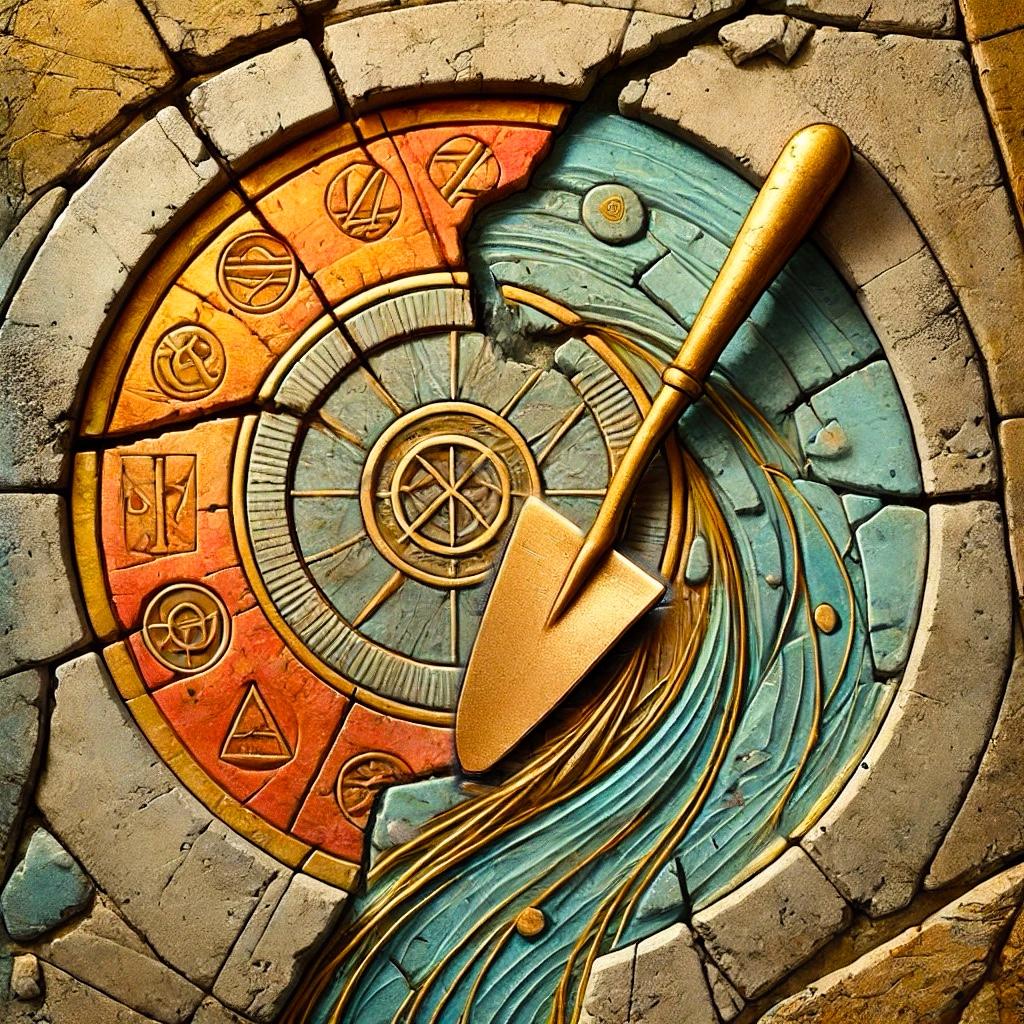
Triumphantly, Petro handed a nearly full bottle of Larios gin to Molly. “I’ll get you a glass but we may need to get Finja in here, they’re all very dirty. That’s nice,” he said, looking up at the picture.
“Not every piece fits at first glance. Sit with the fragments before trying to force them together.”
“Oh, I like that!” exclaimed Molly, giving Petro a grateful smile. “I’d never have known that if you hadn’t been here.”
Petro’s chest swelled with pride and happiness. It was the first time in many years that he’d felt useful to anyone.
February 23, 2025 at 1:35 pm #7828In reply to: The Last Cruise of Helix 25
Helix 25 – The Murder Board
Evie sat cross-legged on the floor of her cramped workspace, staring at the scattered notes, datapads, and threads taped to the wall. Finding some yarn on the ship had not been as easy as she thought, but it was a nice touch she thought.
The Murder Board, as Riven Holt had started calling it, was becoming an increasingly frustrating mess of unanswered questions.
Riven stood nearby, arms crossed, with a an irritated skepticism. “Almost a week,” he muttered. “We’re no closer than when we started.”
Evie exhaled sharply. “Then let’s go back to the basics.”
She tapped the board, where the crime scene was crudely sketched. The Drying Machine. Granary. Jardenery. Blood that shouldn’t exist.
She turned to Riven. “Alright, let’s list it out. Who are our suspects?”
He looked at his notes, dejected for a moment; “too many, obviously.” Last census on the ship was not accurate by far, but by all AI’s accounts cross-referenced with Finkley’s bots data, they estimated the population to be between 15,000 and 50,000. Give or take.
They couldn’t interview possibly all of them, all the more since there the interest in the murder had waned very rapidly. Apart from the occasional trio of nosy elderly ladies, the ship had returned mostly to the lull of the day-to-day routine.
So they’d focused on a few, and hoped TP’s machine brain could see patterns where they couldn’t.- First, the Obvious Candidates: People with Proximity to the Crime Scene
Romualdo, the Gardener – Friendly, unassuming. He lends books, grows plants, and talks about Elizabeth Tattler novels. But Herbert visited him often. Why?
Dr. Amara Voss – The geneticist. Her research proves the Crusader DNA link, but could she be hiding more? Despite being Evie’s godmother, she couldn’t be ruled out just yet.
Sue Forgelot – The socialite with connections everywhere. She had eluded their request for interviews. —does she know more than she lets on?
The Cleaning Staff – they had access everywhere. And the murder had a clean elegance to it… - Second, The Wild Cards: People with Unknown Agendas
The Lower Deck Engineers – Talented mechanic, with probable cybernetic knowledge, with probable access to unauthorized modifications. Could they kill for a reason, or for hire?
Zoya Kade and her Followers – They believe Helix 25 is on a doomed course, manipulated by a long-dead tycoon’s plan. Would they kill to force exposure of an inconvenient truth?
The Crew – Behind the sense of duty and polite smiles, could any of them be covering something up? - Third, The AI Factor: Sentient or Insentient?
Synthia, the AI – Controls the ship. Omnipresent. Can see everything, and yet… didn’t notice or report the murder. Too convenient.
Other personal AIs – Like Trevor Pee’s programme, most had in-built mechanisms to make them incapable of lying or harming humans. But could one of their access be compromised?
Riven frowned. “And what about Herbert himself? Who was he, really? He called himself Mr. Herbert, but the cat erm… Mandrake says that wasn’t his real name. If we figure out his past, maybe we find out why he was killed.”
Evie rubbed her temples. “We also still don’t know how he was killed. The ship’s safety systems should have shut the machine down. But something altered how the system perceived him before he went in.”
She gestured to another note. “And there’s still the genetic link. What was Herbert doing with Crusader DNA?”
A heavy silence settled between them.
Then TP’s voice chimed in. “Might I suggest an old detective’s trick? When stumped, return to who benefits.”
Riven exhaled. “Fine. Who benefits from Herbert’s death?”
Evie chewed the end of her stylus. “Depends. If it was personal, the killer is on this ship, and it’s someone who knew him. If it was bigger than Herbert, then we’re dealing with something… deeper.”
TP hummed. “I do hate deeper mysteries. They tend to involve conspiracies, misplaced prophecies, and far too many secret societies.”
Evie and Riven exchanged a glance.
Riven sighed. “We need a break.”
Evie scoffed. “Time means nothing here.”
Riven gestured out the window. “Then let’s go see it. The Sun.”
Helix 25 – The Sun-Gazing Chamber
The Sun-Gazing Chamber was one of Helix 25’s more poetic and yet practical inventions —an optically and digitally-enhanced projection of the Sun, positioned at the ship’s perihelion. It was meant to provide a psychological tether, a sense of humanity’s connection to the prime provider of life as they drifted in the void of the Solar System.
It was a beautifully designed setting where people would simply sit and relax, attuned to the shift of days and nights as if still on Earth. The primary setting had been voted to a massive 83.5% to be like in Hawai’i latitude and longitude, as its place was believed to be a reflection of Earth’s heart. That is was a State in the USA was a second thought of course.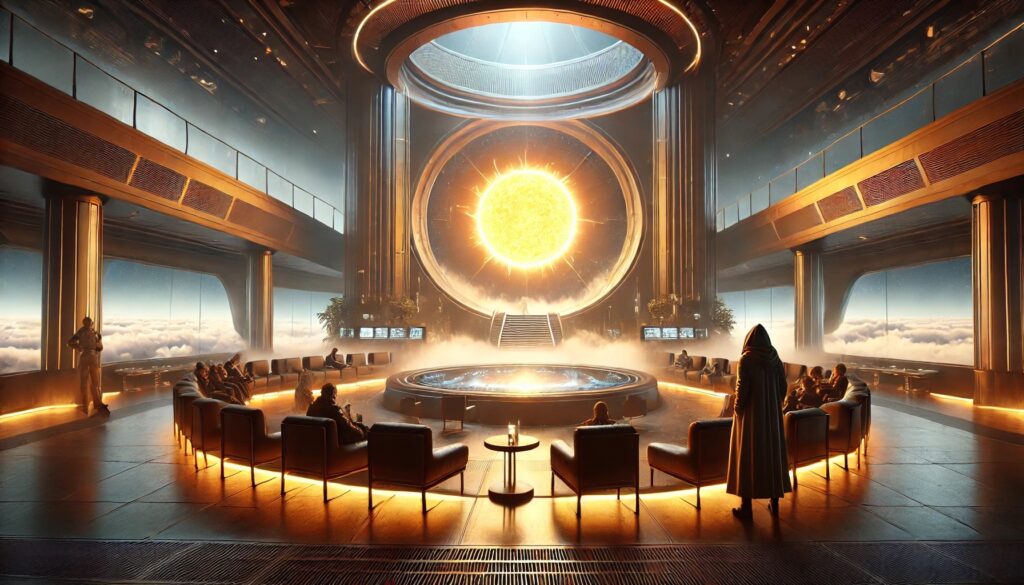
Evie sat on the observation bench, staring at the massive, golden sphere suspended in the darkness. “Do you think people back on Earth are still watching the sunrise?” she murmured.
Riven was quiet for a moment. “If there’s anyone left.”
Evie frowned. “If they are, I doubt they got much of a choice.”
TP materialized beside them, adjusting his holographic tie. “Ah, the age-old existential debate: are we the lucky ones who left Earth, or the tragic fools who abandoned it?”
Evie ignored him, glancing at the other ship residents in the chamber. Most people just sat quietly, basking in the light. But she caught snippets of whispers, doubt, something spreading through the ranks.
“Some people think we’re not really where they say we are,” she muttered.
Riven raised an eyebrow. “What, like conspiracy theories?”
TP scoffed. “Oh, you mean the Flat-Earthers?” He tsked. “Who couldn’t jump on the Helix lifeboats for their lives, convinced as they were we couldn’t make it to the stars. They deserved what came to them. Next they’ll be saying Helix 25 never even launched and we’re all just trapped in a simulation of a luxury cruise.”
Evie was shocked at Trevor Pee’s eructation and rubbed her face. “Damn Effin Muck tech, and those “Truth Control” rubbish datasets. I thought I’d thoroughly scrubbed all the old propaganda tech from the system.”
“Ah,” TP said, “but conspiracies are like mold. Persistent. Annoying. Occasionally toxic.”
Riven shook his head. “It’s nonsense. We’re moving. We’ve been moving for decades.”
Evie didn’t look convinced. “Then why do we feel stuck?”
A chime interrupted them.
A voice, over the comms. Solar flare alert.
Evie stiffened.
Then: Stay calm and return to your quarters until further notice.
Evie raised an eyebrow. This was the first time something like that happened. She turned to Riven who was looking at his datapad who was flashing and buzzing.
He said to her: “Stay quiet and come with me, a new death has been reported. Crazy coincidence. It’s just behind the Sun-Gazing chamber actually, in the Zero-G sector.”
February 16, 2025 at 2:59 pm #7816In reply to: The Precious Life and Rambles of Liz Tattler
Liz had, in her esteemed opinion, finally cracked the next great literary masterpiece.
It had everything—forbidden romance, ancient mysteries, a dash of gratuitous betrayal, and a protagonist with just the right amount of brooding introspection to make him irresistible to at least two stunningly beautiful, completely unnecessary love interests.
And, of course, there was a ghost. She would have preferred a mummy but it had been edited out one morning she woke up drooling on her work with little recollection of the night.
Unfortunately, none of this mattered because Godfrey, her ever-exasperated editor, was staring at her manuscript with the same enthusiasm he reserved for peanut shells stuck in his teeth.
“This—” he hesitated, massaging his temples, “—this is supposed to be about the Crusades.”
Liz beamed. “It is! Historical and spicy. I expect an award.”
Godfrey set down the pages and reached for his ever-dwindling bowl of peanuts. “Liz, for the love of all that is holy, why is the Templar knight taking off his armor every other page?”
Liz gasped in indignation. “You wouldn’t understand, Godfrey. It’s symbolic. A shedding of the past! A rebirth of the soul!” She made an exaggerated sweeping motion, nearly knocking over her champagne flute.
“Symbolic,” Godfrey repeated flatly, chewing another peanut. “He’s shirtless on page three, in a monastery.”
Finnley, who had been dusting aggressively, made a sharp sniff. “Disgraceful.”
Liz ignored her. “Oh please, Godfrey. You have no vision. Readers love a little intimacy in their historical fiction.”
“The priest,” Godfrey said, voice rising, “is supposed to be celibate. You explicitly wrote that his vow was unbreakable.”
Liz waved a dismissive hand. “Oh, I solved that. He forgets about it momentarily.”
Godfrey choked on a peanut. Finnley paused mid-dust, staring at Liz in horror.
Roberto, who had been watering the hydrangeas outside the window, suddenly leaned in. “Did I hear something about a forgetful priest?”
“Not now, Roberto,” Liz said sharply.
Finnley folded her arms. “And how, pray tell, does one simply forget their sacred vows?”
Liz huffed. “The same way one forgets to clean behind the grandfather clock, I imagine.”
Finnley turned an alarming shade of purple.
Godfrey was still in disbelief. “And you’re telling me,” he said, flipping through the pages in growing horror, “that this man, Brother Edric, the holy warrior, somehow manages to fall in love with—who is this—” he squinted, “—Laetitia von Somethingorother?”
Liz beamed. “Ah, yes. Laetitia! Mysterious, tragic, effortlessly seductive—”
“She’s literally the most obvious spy I’ve ever read,” Godfrey groaned, rubbing his face.
“She is not! She is enigmatic.”
“She has a knife hidden in every scene.”
“A woman should be prepared.”
Godfrey took a deep breath and picked up another sheet. “Oh fantastic. There’s a secret baby now.”
Liz nodded sagely. “Yes. I felt that revelation.”
Finnley snorted. “Roberto also felt something last week, and it turned out to be food poisoning.”
Roberto, still hovering at the window, nodded solemnly. “It was quite moving.”
Godfrey set the papers down in defeat. “Liz. Please. I’m begging you. Just one novel—just one—where the historical accuracy lasts at least until page ten.”
Liz tapped her chin. “You might have a point.”
Godfrey perked up.
Liz snapped her fingers. “I should move the shirtless scene to page two.”
Godfrey’s head hit the table.
Roberto clapped enthusiastically. “Genius! I shall fetch celebratory figs!”
Finnley sighed dramatically, threw down her duster, and walked out of the room muttering about professional disgrace.
Liz grinned, completely unfazed. “You know, Godfrey, I really don’t think you appreciate my artistic sacrifices.”
Godfrey, face still buried in his arms, groaned, “Liz, I think Brother Edric’s celibacy lasted longer than my patience.”
Liz threw a hand to her forehead theatrically. “Then it was simply not meant to be.”
Roberto reappeared, beaming. “I found the figs.”
Godfrey reached for another peanut.
He was going to need a lot more of them.
 February 16, 2025 at 2:37 pm #7813
In reply to: The Last Cruise of Helix 25
Helix 25 – Crusades in the Cruise & Unexpected Archives
Evie hadn’t planned to visit Seren Vega again so soon, but when Mandrake slinked into her quarters and sat squarely on her console, swishing his tail with intent, she took it as a sign.
“Alright, you smug little AI-assisted furball,” she muttered, rising from her chair. “What’s so urgent?”
Mandrake stretched leisurely, then padded toward the door, tail flicking. Evie sighed, grabbed her datapad, and followed.
He led her straight to Seren’s quarters—no surprise there. The dimly lit space was as chaotic as ever, layers of old records, scattered datapads, and bound volumes stacked in precarious towers. Seren barely looked up as Evie entered, used to these unannounced visits.
“Tell the cat to stop knocking over my books,” she said dryly. “It never ever listens.”
“Well it’s a cat, isn’t it?” Evie replied. “And he seems to have an agenda.”
Mandrake leaped onto one of the shelves, knocking loose a tattered, old-fashioned book. It thudded onto the floor, flipping open near Evie’s feet. She crouched, brushing dust from the cover. Blood and Oaths: A Romance of the Crusades by Liz Tattler.
She glanced at Seren. “Tattler again?”
Seren shrugged. “Romualdo must have left it here. He hoards her books like sacred texts.”
Evie turned the pages, pausing at an unusual passage. The prose was different—less florid than Liz’s usual ramblings, more… restrained.
A fragment of text had been underlined, a single note scribbled in the margin: Not fiction.
Evie found a spot where she could sit on the floor, and started to read eagerly.
“Blood and Oaths: A Romance of the Crusades — Chapter XII
Sidon, 1157 AD.Brother Edric knelt within the dim sanctuary, the cold stone pressing into his bones. The candlelight flickered across the vaulted ceilings, painting ghosts upon the walls. The voices of his ancestors whispered within him, their memories not his own, yet undeniable. He knew the placement of every fortification before his enemies built them. He spoke languages he had never learned.
He could not recall the first time it happened, only that it had begun after his initiation into the Order—after the ritual, the fasting, the bloodletting beneath the broken moon. The last one, probably folklore, but effective.
It came as a gift.
It was a curse.
His brothers called it divine providence. He called it a drowning. Each time he drew upon it, his sense of self blurred. His grandfather’s memories bled into his own, his thoughts weighted by decisions made a lifetime ago.
And now, as he rose, he knew with certainty that their mission to reclaim the stronghold would fail. He had seen it through the eyes of his ancestor, the soldier who stood at these gates seventy years prior.
‘You know things no man should know,’ his superior whispered that night. ‘Be cautious, Brother Edric, for knowledge begets temptation.’
And Edric knew, too, the greatest temptation was not power.
It was forgetting which thoughts were his own.
Which life was his own.
He had vowed to bear this burden alone. His order demanded celibacy, for the sealed secrets of State must never pass beyond those trained to wield it.
But Edric had broken that vow.
Somewhere, beyond these walls, there was a child who bore his blood. And if blood held memory…
He did not finish the thought. He could not bear to.”
Evie exhaled, staring at the page. “This isn’t just Tattler’s usual nonsense, is it?”
Seren shook her head distractedly.
“It reads like a first-hand account—filtered through Liz’s dramatics, of course. But the details…” She tapped the underlined section. “Someone wanted this remembered.”
Mandrake, still perched smugly above them, let out a satisfied mrrrow.
Evie sat back, a seed of realization sprouting in her mind. “If this was real, and if this technique survived somehow…”
Mandrake finished the thought for her. “Then Amara’s theory isn’t theory at all.”
Evie ran a hand through her hair, glancing at the cat than at Evie. “I hate it when Mandrake’s right.”
“Well what’s a witch without her cat, isn’t it?” Seren replied with a smile.
Mandrake only flicked his tail, his work here done.
February 16, 2025 at 12:20 pm #7809In reply to: The Last Cruise of Helix 25
Earth, Black Sea Coastal Island near Lazurne, Ukraine – The Tinkerer
Cornishman Merdhyn Winstrom had grown accustomed to the silence.
It wasn’t the kind of silence one found in an empty room or a quiet night in Cornwall, but the profound, devouring kind—the silence of a world were life as we knew it had disappeared. A world where its people had moved on without him.
The Black Sea stretched before him, vast and unknowable, still as a dark mirror reflecting a sky that had long since stopped making promises. He stood on the highest point of the islet, atop a jagged rock behind which stood in contrast to the smooth metal of the wreckage.
His wreckage.
That’s how he saw it, maybe the last man standing on Earth.
It had been two years since he stumbled upon the remains of Helix 57 shuttle —or what was left of it. Of all the Helixes cruise ships that were lost, the ones closest to Earth during the Calamity had known the most activity —people trying to leave and escape Earth, while at the same time people in the skies struggling to come back to loved ones. Most of the orbital shuttles didn’t make it during the chaos, and those who did were soon lost to space’s infinity, or Earth’s last embrace.
This shuttle should have been able to land a few hundred people to safety —Merdhyn couldn’t find much left inside when he’d discovered it, survivors would have been long dispersed looking for food networks and any possible civilisation remnants near the cities. It was left here, a gutted-out orbital shuttle, fractured against the rocky coast, its metal frame corroded by salt air, its systems dead. The beauty of mechanics was that dead wasn’t the same as useless.
And Merdhyn never saw anything as useless.
With slow, methodical care, he adjusted the small receiver strapped to his wrist—a makeshift contraption built from salvaged components, scavenged antennae, and the remains of an old Soviet radio. He tapped the device twice. The static fizzled, cracked. Nothing.
“Still deaf,” he muttered.
Perched at his shoulder, Tuppence chattered at him, a stuborn rodent that attached himself and that Merdhyn had adopted months ago as he was scouting the area. He reached his pocket and gave it a scrap of food off a stale biscuit still wrapped in the shiny foil.
Merdhyn exhaled, rolling his shoulders. He was getting too old for this. Too many years alone, too many hours hunched over corroded circuits, trying to squeeze life from what had already died.
But the shuttle wasn’t dead. After his first check, he was quite sure. Now it was time to get to work.
He stepped inside, ducking beneath an exposed beam, brushing past wiring that had long since lost its insulation. The stale scent of metal and old circuitry greeted him. The interior was a skeletal mess—panels missing, control consoles shattered, displays reduced to nothing but flickering ghosts of their former selves.
Still, he had power.
Not much. Just enough to light a few panels, enough to make him think he wasn’t mad for trying.
As it happened, Merdhyn had a plan: a ridiculous, impossible, brilliant plan.
He would fix it.
The whole thing if he could, but if anything. It would certainly take him months before the shuttle from Helix 57 could go anywhere— that is, in one piece. He could surely start to repair the comms, get a signal out, get something moving, then maybe—just maybe—he could find out if there was anything left out there.
Anything that wasn’t just sea and sky and ghosts.
He ran his fingers along the edge of the console, feeling the warped metal. The ship had crashed hard. It shouldn’t have made it down in one piece, but something had slowed it. Some system had tried to function, even in its dying moments.
That meant something was still alive.
He just had to wake it up.
Tuppence chittered, scurrying onto his shoulder.
Merdhyn chuckled. “Aye, I know. One of these days, I’ll start talking to people instead of rats.”
Tuppence flicked her tail.
He pulled out a battered datapad—one of his few working relics—and tapped the screen. The interface stuttered, but held. He navigated to his schematics, his notes, his carefully built plans.
The transponder array.
If he could get it working, even partially, he might be able to listen.
To hear something—anything—on the waves beyond this rock.
A voice. A signal. A trace of the world that had forgotten him.
Merdhyn exhaled. “Let’s see if we can get you talking again, eh?”
He adjusted his grip, tools clinking at his belt, and got to work.
February 15, 2025 at 11:35 pm #7807In reply to: The Last Cruise of Helix 25
HELIX 25: THE JARDENERY
Finkley pressed herself against the smooth metal doorway of the Jardenery, her small wiry frame unnoticeable in the dim light filtering through the tangle of vines. The sterile scent of Helix 25’s corridors had faded behind her, replaced by the aroma of damp earth. A place of dirt and disorder. She shuddered.
A familiar voice burst through her thoughts.
What’s going on?
Finja’s tone was strident and clear. The ancient telepathic link that connected the cleaner family through many generations was strong, even in space. All the FinFamily (FF) had the gift to some extent, occasionally even with strangers. It just wasn’t nearly as accurate.
Shush. They’re talking about blood. And Herbert.
She felt Finja’s presence surge in response, her horrified thoughts crackling through their link. Blood!
Riven’s skeptical voice: “You’re saying someone on Helix 25 might have… transformed into a medieval Crusader?”
Finkley sniggered. Was that even possible?
It’s not particularly funny, responded Finja. It means someone on the ship is carrying distorted DNA. Her presence pulsed with irritation; it all sounded so complicated and grubby. And god knows what else. Bacteria? Ancestral grime? Generational filth? Honestly Finkley, as if I haven’t got enough to worry about with this group of wandering savages …
Finkley inhaled sharply as Romualdo stepped into view. She held her breath, pressing even closer to the doorway. He was so cute. Unclean, of course, but so adorable.
She pondered whether she could overlook the hygiene. Maybe … if he bathed first?
Get a grip. Finja’s snarl crashed through her musings, complete with eye-roll.
Finkley reddened. She had momentarily forgotten that Finja was there.
So Herbert was looking for something. But what?
I bet they didn’t disinfect properly. Finja’s response was immediate. See what you can find out later.
Inside, Romualdo picked up a book from his workbench and waved it. Finkley barely needed to read the title before Finja’s shocked cry of recognition filled her mind.
Liz Tattler!
A feeling of nostalgia swept over Finkley.
Yes Liz Tattler. Finley’s Liz.
Finley—another member of the family. She cleaned for Liz Tattler, the mad but famous author. It was well known—at least within the family— that Liz’s fame was largely due to Finley’s talents as a writer. Which meant, whatever this was, it had somehow tangled itself up in the FF network.
Liz’s Finley hasn’t responded for years —I assumed… Finja’s voice trailed off.
There’s still hope! You never know with that one. She was always stand-offish and mysterious. And that Liz really abused her good nature.
Finkley swallowed hard. They were close to something big—something hidden beneath layers of time and mystery. And whatever it was, it had just become personal.
Finja, there’s no time to lose! We need to find out more.
February 15, 2025 at 9:21 am #7789In reply to: The Last Cruise of Helix 25
Helix 25 – Poop Deck – The Jardenery
Evie stepped through the entrance of the Jardenery, and immediately, the sterile hum of Helix 25’s corridors faded into a world of green. Of all the spotless clean places on the ship, it was the only where Finkley’s bots tolerated the scent of damp earth. A soft rustle of hydroponic leaves shifting under artificial sunlight made the place an ecosystem within an ecosystem, designed to nourrish both body and mind.
Yet, for all its cultivated serenity, today it was a crime scene. The Drying Machine was connected to the Jardenery and the Granary, designed to efficiently extract precious moisture for recycling, while preserving the produce.
Riven Holt, walking beside her, didn’t share her reverence. “I don’t see why this place is relevant,” he muttered, glancing around at the towering bioluminescent vines spiraling up trellises. “The body was found in the drying machine, not in a vegetable patch.”
Evie ignored him, striding toward the far corner where Amara Voss was hunched over a sleek terminal, frowning at a glowing screen. The renowned geneticist barely noticed their approach, her fingers flicking through analysis results faster than human eyes could process.
A flicker of light.
“Ah-ha!” TP materialized beside Evie, adjusting his holographic lapels. “Madame Voss, I must say, your domain is quite the delightful contrast to our usual haunts of murder and mystery.” He twitched his mustache. “Alas, I suspect you are not admiring the flora?”
Amara exhaled sharply, rubbing her temples, not at all surprised by the holographic intrusion. She was Evie’s godmother, and had grown used to her experiments.
“No, indeed. I’m admiring this.” She turned the screen toward them.
The DNA profile glowed in crisp lines of data, revealing a sequence highlighted in red.
Evie frowned. “What are we looking at?”
Amara pinched the bridge of her nose. “A genetic anomaly.”
Riven crossed his arms. “You’ll have to be more specific.”
Amara gave him a sharp look but turned back to the display. “The sample we found at the crime scene—blood residue on the drying machine and some traces on the granary floor—matches an ancient DNA profile from my research database. A perfect match.”
Evie felt a prickle of unease. “Ancient? What do you mean? From the 2000s?”
Amara chuckled, then nodded grimly. “No, ancient as in Medieval ancient. Specifically, Crusader DNA, from the Levant. A profile we mapped from preserved remains centuries ago.”
Silence stretched between them.
Finally, Riven scoffed. “That’s impossible.”
TP hummed thoughtfully, twirling his cane. “Impossible, yet indisputable. A most delightful contradiction.”
Evie’s mind raced. “Could the database be corrupted?”
Amara shook her head. “I checked. The sequencing is clean. This isn’t an error. This DNA was present at the crime scene.” She hesitated, then added, “The thing is…” she paused before considering to continue. They were all hanging on her every word, waiting for what she would say next.
Amara continued “I once theorized that it might be possible to reawaken dormant ancestral DNA embedded in human cells. If the right triggers were applied, someone could manifest genetic markers—traits, even memories—from long-dead ancestors. Awakening old skills, getting access to long lost secrets of states…”
Riven looked at her as if she’d grown a second head. “You’re saying someone on Helix 25 might have… transformed into a medieval Crusader?”
Amara exhaled. “I’m saying I don’t know. But either someone aboard has a genetic profile that shouldn’t exist, or someone created it.”
TP’s mustache twitched. “Ah! A puzzle worthy of my finest deductive faculties. To find the source, we must trace back the lineage! And perhaps a… witness.”
Evie turned toward Amara. “Did Herbert ever come here?”
Before Amara could answer, a voice cut through the foliage.
“Herbert?”
They turned to find Romualdo, the Jardenery’s caretaker, standing near a towering fruit-bearing vine, his arms folded, a leaf-tipped stem tucked behind his ear like a cigarette. He was a broad-shouldered man with sun-weathered skin, dressed in a simple coverall, his presence almost too casual for someone surrounded by murder investigators.
Romualdo scratched his chin. “Yeah, he used to come around. Not for the plants, though. He wasn’t the gardening type.”
Evie stepped closer. “What did he want?”
Romualdo shrugged. “Questions, mostly. Liked to chat about history. Said he was looking for something old. Always wanted to know about heritage, bloodlines, forgotten things.” He shook his head. “Didn’t make much sense to me. But then again, I like practical things. Things that grow.”
Amara blushed, quickly catching herself. “Did he ever mention anything… specific? Like a name?”
Romualdo thought for a moment, then grinned. “Oh yeah. He asked about the Crusades.”
Evie stiffened. TP let out an appreciative hum.
“Fascinating,” TP mused. “Our dearly departed Herbert was not merely a victim, but perhaps a seeker of truths unknown. And, as any good mystery dictates, seekers who get too close often find themselves…” He tipped his hat. “Extinguished.”
Riven scowled. “That’s a bit dramatic.”
Romualdo snorted. “Sounds about right, though.” He picked up a tattered book from his workbench and waved it. “I lend out my books. Got myself the only complete collection of works of Liz Tattler in the whole ship. Doc Amara’s helping me with the reading. Before I could read, I only liked the covers, they were so romantic and intriguing, but now I can read most of them on my own.” Noticing he was making the Doctor uncomfortable, he switched back to the topic. “So yes, Herbert knew I was collector of books and he borrowed this one a few weeks ago. Kept coming back with more questions after reading it.”
Evie took the book and glanced at the cover. The Blood of the Past: Genetic Echoes Through History by Dr. Amara Voss.
She turned to Amara. “You wrote this?”
Amara stared at the book, her expression darkening. “A long time ago. Before I realized some theories should stay theories.”
Evie closed the book. “Looks like someone didn’t agree.”
Romualdo wiped his hands on his coveralls. “Well, I hope you figure it out soon. Hate to think the plants are breathing in murder residue.”
TP sighed dramatically. “Ah, the tragedy of contaminated air! Shall I alert the sanitation team?”
Riven rolled his eyes. “Let’s go.”
As they walked away, Evie’s grip tightened around the book. The deeper they dug, the stranger this murder became.
February 8, 2025 at 7:22 pm #7776In reply to: Quintessence: Reversing the Fifth
Epilogue & Prologue
Paris, November 2029 – The Fifth Note Resounds
Tabitha sat by the window at the Sarah Bernhardt Café, letting the murmur of conversations and the occasional purring of the espresso machine settle around her. It was one of the few cafés left in the city where time still moved at a human pace. She stirred her cup absentmindedly. Paris was still Paris, but the world outside had changed in ways her mother’s generation still struggled to grasp.
It wasn’t just the ever-presence of automation and AI making themselves known in subtle ways—screens adjusting to glances, the quiet surveillance woven into everyday life. It wasn’t just the climate shifts, the aircon turned to cold in the midst of November, the summers unpredictable, the air thick with contradictions of progress and collapse of civilization across the Atlantic.
The certainty of impermanence was what defined her generation. BANI world they used to say—Brittle, Anxious, Nonlinear, Incomprehensible. A cold fact: impossible to grasp and impossible to fight. Unlike her mother and her friends, who had spent their lives tethered to a world that no longer existed, she had never known certainty. She was born in the flux.
And yet, this café remained. One of the last to resist full automation, where a human still brought you coffee, where the brass bell above the door still rang, where things still unfolded at a human pace.
The bell above the door rang—the fifth note, as her mother had called it once.
She had never been here before, not in any way that mattered. Yet, she had heard the story. The unlikely reunion five years ago. The night that moved new projects in motion for her mother and her friends.
Tabitha’s fingers traced the worn edges of the notebook in front of her—Lucien’s, then Amei’s, then Darius’s. Pieces of a life written by many hands.
“Some things don’t work the first time. But sometimes, in the ruins of what failed, something else sprouts and takes root.”
And that was what had happened.
The shared housing project they had once dreamed of hadn’t survived—not in its original form. But through their rekindled bond, they had started something else.
True Stories of How It Was.
It had begun as a quiet defiance—a way to preserve real, human stories in an age of synthetic, permanent ephemerality and ephemeral impermanence, constantly changing memory. They were living in a world where AI’s fabricated histories had overwhelmed all the channels of information, where the past was constantly rewritten, altered, repackaged. Authenticity had become a rare currency.
As she graduated in anthropology few years back, she’d wondered about the validity of history —it was, after all, a construct. The same could be said for literature, art, even science. All of them constructs of the human mind, tenuous grasp of the infinite truth, but once, they used to evolve at such a slow pace that they felt solid, reliable. Ultimately their group was not looking for ultimate truth, that would be arrogant and probably ignorant. Authenticity was what they were looking for. And with it, connections, love, genuineness —unquantifiables by means of science and yet, true and precious beyond measure.
Lucien had first suggested it, tracing the idea from his own frustrations—the way art had become a loop of generated iterations, the human touch increasingly erased. He was in a better place since Matteo had helped him settle his score with Renard and, free of influence, he had found confidence in developing of his own art.
Amei —her mother—, had changed in a way Tabitha couldn’t quite define. Her restlessness had quieted, not through settling down but through accepting impermanence as something other than loss. She had started writing again—not as a career, not to publish, but to preserve stories that had no place in a digitized world. Her quiet strength had always been in preserving connections, and she knew they had to move quickly before real history faded beneath layers of fabricated recollections.
Darius, once skeptical, saw its weight—he had spent years avoiding roots, only to realize that stories were the only thing that made places matter. He was somewhere in Morocco now, leading a sustainable design project, bridging cultures rather than simply passing through them.
Elara had left science. Or at least, science as she had known it. The calculations, the certainty, the constraints of academia, with no escape from the automated “enhanced” digital helpers. Her obsession and curiosities had found attract in something more human, more chaotic. She had thrown herself into reviving old knowledge, forgotten architectures, regenerative landscapes.
And Matteo—Matteo had grounded it.
The notebook read: Matteo wasn’t a ghost from our past. He was the missing note, the one we didn’t know we needed. And because of him, we stopped looking backward. We started building something else.
For so long, Matteo had been a ghost of sorts, by his own account, lingering at the edges of their story, the missing note in their unfinished chord. But now, he was fully part of it. His mother had passed, her past history unraveling in ways he had never expected, branching new connections even now. And though he had lost something in that, he had also found something else. Juliette. Or maybe not. The story wasn’t finished.
Tabitha turned the page.
“We were not historians, not preservationists, not even archivists. But we have lived. And as it turned out, that was enough.”
They had begun collecting stories through their networks—not legends, not myths, but true accounts of how it was, from people who still remembered.
A grandfather’s voice recording of a train ride to a city that no longer exists.
Handwritten recipes annotated by generations of hands, each adding something new.
A letter from a protest in 2027, detailing a movement that the history books had since erased.
An old woman’s story of her first love, spoken in a dialect that AI could not translate properly.It had grown in ways they hadn’t expected. People began sending them recordings, letters, transcripts, photos —handwritten scraps of fading ink. Some were anonymous, others carefully curated with full names and details, like makeshift ramparts against the tide of time.
At first, few had noticed. It was never the goal to make it worlwide movement. But little by little, strange things happened, and more began to listen.
There was something undeniably powerful about genuine human memory when it was raw and unfiltered, when it carried unpolished, raw weight of experience, untouched by apologetic watered down adornments and out-of-place generative hallucinations.
Now, there were exhibitions, readings, archives—entire underground movements dedicated to preserving pre-synthetic history. Their project had become something rare, valuable, almost sacred.
And yet, here in the café, none of that felt urgent.
Tabitha looked up as the server approached. Not Matteo, but someone new.
“Another espresso?”
She hesitated, then nodded. “Yes. And a glass of water, please.”
She glanced at the counter, where Matteo was leaning, speaking to someone, laughing. He had changed, too. No longer just an observer, no longer just the quiet figure who knew too much. Now, he belonged here.
A bell rang softly as the door swung open again.
Tabitha smiled to herself. The fifth note always sounded, in the end.
She turned back to the notebook, the city moving around her, the story still unfolding in more directions than one.
February 7, 2025 at 8:26 am #7735In reply to: The Last Cruise of Helix 25
The “do not enter, crime scene” sticker haphazardly printed, was not even sealing the door. Amateur job, but of course, this was to be expected when such murder event had not been seen in a generation.
She entered surrepticiously, the door to the drying chamber slid shut with a hiss behind her, muffling the last of the frantic voices outside. Evie exhaled. She needed a moment. Just her, the crime scene, and—
A flicker of light.
“Ah-ha!” Trevor Pee Marshall, aka TP, materialized beside her, adjusting his holographic lapels with exaggerated precision. “What we have here, dear Evie, is a classic case of les morts très mystérieux.” His mustache twitched. “Or as my good friend Clouseau would say—‘Zis does not add up!’”
Evie rolled her eyes. “Less theatrics, more analysis, TP.”
Despite the few glitches, she was proud and eager to take her invention to a real-life trial run. Combining all the brilliant minds of enquêteur Jacques Clouseau, as well as the flair of Marshall Pee Stoll from the beloved Peaslanders children stories, TP was the help they needed to solve this.
“Ahem.” TP straightened, flickering momentarily before reappearing near the machine, peering inside with a magnifying glass he absolutely didn’t need.
Evie pulled up the logs. The AI had flagged the event—drying cycle activated at 0200 hours. Duration: excessive. But no shutdown? That was impossible.
TP let out a thoughtful “hmm.” Then, with the gravitas of a seasoned investigator, he declared, “Madame, I detect a most peculiar discrepancy.”
Evie looked up. “Go on.”
TP pivoted dramatically. “The AI should have stopped the cycle, yes? But what if… it never saw a problem?”
Evie frowned. That wasn’t how safety protocols worked. Unless—
She tapped rapidly through the logs. Her stomach dropped.
The system hadn’t flagged a human inside at all.
Someone had altered the ship’s perception of Mr. Herbert before he ever stepped into the machine.
Evie’s pulse quickened. This wasn’t just murder.
It was premeditated.
February 3, 2025 at 10:10 pm #7733In reply to: The Last Cruise of Helix 25
Leaving the Asylum
They argued about whether to close the heavy gates behind them. In the end, they left them open. The metal groaned as it sat ajar, rust flaking from its hinges.
“Are we all here?” Anya asked. Now that they were leaving, she felt in charge again—or at least, she needed to be. If morale slipped, things would unravel fast. She scanned the group, counting them off.
“Mikhail,” she started, pointing. “Tala. Vera, our esteemed historian.”
Vera sniffed. “I prefer genealogist, thank you very much.”
“Petro,” Anya continued, “probably about to grumble.”
Petro scowled. “I was thinking.”
“Jian, our mystery man.”
Jian raised an eyebrow in acknowledgment.
Anya turned to the next two. “Ah, the twins. Even though you two have never spoken, I’ve always assumed you understood me. Don’t prove me wrong now.”
The twins—Luka and Lev—nodded and grinned at exactly the same time.
“Then we have Yulia… no, we don’t have Yulia. Where in God’s name is Yulia?”
“Here I am!” Yulia’s voice rang out as she jogged back toward them, breathless. “I just went to say goodbye to the cat.” She sighed dramatically. “I wish we could take him. Please, can we take him?”
Yulia was short and quick-moving, her restless hands always in motion, her thoughts spilling out just as fast.
“We can’t,” Mikhail said firmly. “And he can look after himself.”
She huffed. “Well, I expect we could if we tried.”
“And finally, old Gregor, who I gather would rather be taking a nap.”
Gregor, who was well past eighty, rubbed his face and yawned. “You say that like it’s a bad thing.”
Anya frowned, scanning the group again. “Wait. We’re missing Finja.”
A small scraping sound came from behind them.
Finja stood near the gate, furiously scrubbing the rusted metal with a rag she had pulled from her sleeve. “This place is disgusting,” she muttered. “Filth everywhere. The world may have ended, but that’s no excuse for grime.”
Anya sighed. “Finja, leave the gate alone.”
Finja gave it one last wipe before tucking the rag away with a huff. “Fine.”
Anya shook her head. “That’s eleven. No one’s run off or died yet. A promising start.”
They formed a motley crew, each carrying as much as they could manage. Mikhail pushed a battered cart, loaded with scavenged supplies—blankets, tools, whatever food they had left.
The road beneath their feet was cracked and uneven, roots breaking through in places. They followed it in silence for the most part. Even Yulia remained quiet. Some glanced back, but no one turned around.
The nearest village was more than fifty kilometers away. In all directions, there was only wilderness—fields long overtaken by weeds, trees pushing through cracks in forgotten roads. A skeletal signpost leaned at an odd angle, its lettering long since faded.
“It’s going to be dark soon,” Mikhail said. “And the old ones are tired. Aren’t you, Vera?”
“That’s enough of the old business,” puffed Vera, pulling her shoulders back.
Tala laughed. “Well, I must be an old one. I didn’t sleep a wink last night. And there’s a clearing over there.” She pointed.
The evening was cool, but they managed to build a small fire and scrape together a meal of vegetables they’d brought from their garden.
After their meal, they sat around the fire while Finja busied herself tidying up. “Dirty savages,” she muttered under her breath. Then, more loudly, “We should keep watch tonight.”
Vera, perched on a log, pulled her shawl tightly around her. The glow from the fire cast long shadows across her face.
“Vera, you look like a witch,” Yulia declared. “We should have brought the cat for you to ride on a broomstick together.”
“I’ll have you know I’m descended from witches,” Vera replied. “I know none of you think you’re related to me, but just imagine what your great-grandparents would say if they saw us now. Running into the wilderness like a band of exiled aristocrats.”
Jian, seated nearby, smirked slightly. “My great-grandparents were rice farmers.”
Vera brightened—Jian never talked about his past. She leaned in conspiratorially. “Do you know your full lineage? Because I do. I know mine back fourteen generations. You’d be amazed how many bloodlines cross without people realizing.”
Tala shook her head but smiled. Like Petro and Gregor, Vera had been at the asylum for many decades, a relic of another time. She claimed to have been a private investigator and genealogist in her former life.
Petro, hunched over and rubbing his hands by the fire, muttered, “We’re all ghosts now. Doesn’t matter where we came from.”
“Oh, stop that, Petro,” Anya admonished. “Remember our plan?”
“We go to the city,” Jian said. He rarely spoke unless he had something worth saying. “There will be things left behind. Maybe tech, maybe supplies. If I can get into an old server, I might even find something useful.”
“And if there’s nothing?” Petro moaned. “We should never have left.” He clasped his hands over his head.
Jian shrugged. “The world doesn’t erase itself overnight.”
Mikhail nodded. “We rest tonight. Tomorrow, we head for the city. And Finja’s right—tonight we take turns keeping watch.”
They sat in silence, watching the fire burn low. The evening stretched long and uneasy.
February 3, 2025 at 5:18 am #7730In reply to: The Last Cruise of Helix 25
The Asylum 2050
They had been talking about leaving for a long time.
Not in any urgent way, not in a we must leave now kind of way, but in the slow, circling conversations of people who had too much time and not enough answers.
Those who had left before them had never returned. Perhaps they had found something better, though that seemed unlikely. Perhaps they had found nothing at all. The first group left over twenty years ago—just for supplies. They never came back. Others drifted off over the years. They never came back either.
The core group had stayed because—what else was there? The asylum had been safe, for the most part. It had become home. Overgrown now, with only a fraction of its former inhabitants. The walls had once kept them in; now, they were what kept the rest of the world out.
But the crops were failing. The soil was thinning. The last winter had been long and cruel. Summer was harsh. Water was harder to find.
And so the reasons to stay had been replaced with reasons to go.
She was about forty now—or near enough, though time had softened the numbers. Natalia. A name from a past life; now they called her Tala.
Her family had left her here years ago. Paid well for it, as if they were settling an expensive inconvenience. She had been young then—too young to know how final it would be. They had called her difficult, willful, unable to conform. She wasn’t mad, but they had paid to have her called mad so they could get rid of her. And in the world before, that had been enough.
She had been furious at first. She tried to run away even though the asylum was many miles from anywhere. The drugs they made her take put an end to that. The drugs stopped many years ago, but she no longer wanted to run.
She sat at the edge of the vegetable garden, turning soil between her fingers. It was dry, thinning. No matter how deep she dug, the color stayed the same—pale, lifeless.
“Nothing wants to grow anymore,” said Anya, standing over her. Older—mid-sixties. Once a nurse, before everything had fallen apart. She had been one of the staff members who stayed behind when the first group left for supplies, but now she was the only one remaining. The others had abandoned the asylum years ago. At first, her authority had meant something. Now, it was just a memory, but she still carried it like an old habit. She was practical, sharp-eyed, and had a way of making decisions that others followed without question.
Tala wiped her hands on her skirt and looked up. “We probably should have left last year.”
Anya sighed. She dropped a brittle stalk of something dead into the compost pile. “Doesn’t matter now. We must go soon, or we don’t go at all.”
There was no arguing with that.
Later, in the old communal hall, the last of them gathered. Eleven of them.
Mikhail leaned against the window, his arms crossed. He was a little older than Tala. He thought a long time before he spoke.
“How many weapons do we have?”
Anya shrugged. “A couple of old rifles with half a dozen bullets. A handful of knives. And whatever rocks and sticks we pick up on the way.”
“It’s not enough to defend ourselves,” Tala said. Petro, an older resident who couldn’t remember life before the asylum, moaned and rocked. “But we’ll have our wits about us,” she added, offering a small reassurance.
Mikhail glanced at her. “We don’t know what’s out there.”
Before communication went silent, there had been stories of plagues, wars, starvation, entire cities turning against themselves. People had come through the asylum’s doors shortly before the collapse, mad with what they had seen.
But then, nobody came. The fences had grown thick with vines. And the world had gone quiet.
Over time, they had become a kind of family, bound by necessity rather than blood. They were people who had been left behind for reasons that no longer mattered. In this world, sanity had become a relative thing. They looked after one another, oddities and all.
Mikhail exhaled and pushed off the window. “Tomorrow, then.”
December 23, 2024 at 11:20 am #7708In reply to: Quintessence: Reversing the Fifth
Elara — Nov 2021: The End of Genealogix
The numbers on the screen were almost comical in their smallness. Elara stared at the royalty statement, her lips pressed into a tight line as the cursor blinked on the final transaction: £12.37, marked Genealogix Royalty Deposit. Below it, the stark words: Final Payout.
She leaned back in her chair, pushing her glasses up onto her forehead, and sighed. The end wasn’t a surprise. For years, she’d known her genetic algorithm would be replaced by something faster, smarter, and infinitely more marketable. The AI companies had come, sweeping up data and patents like vultures at a sky burial. Genealogix, her improbable golden goose, had simply been outpaced.
Still, staring at the zero balance in the account felt oddly final, as if a door had quietly closed on a chapter of her life. She glanced toward the window, where the Tuscan hills rolled gently under the late afternoon sun. Most of the renovation work on the farmhouse had been finished, albeit slowly, over the years. There was no urgent financial burden, but the thought of her remaining savings made her stomach tighten all the same.
Elara had stumbled into success with Genealogix, though not without effort. It was one of her many patents—most of them quirky solutions to problems nobody else seemed interested in solving. A self-healing chalkboard coating? Useless. A way to chart audio waveforms onto three-dimensional paper models? Intriguing but commercially barren. Genealogix had been an afterthought at the time, something she tinkered with while traveling through Europe on a teaching fellowship.
When the royalties started rolling in unexpectedly, it had felt like a cosmic joke. “Finally,” she’d muttered to herself as she cashed her first sizeable check, “they like something useless.”
The freedom that money brought was a relief. It allowed her to drop the short-term contracts that tethered her to institutions and pursue science on her own terms. No rigid conventions, no endless grant applications, no academic politics. She’d call it “investigation,” free from the dogma that so often suffocated creativity.
And yet, she was no fool. She’d known Genealogix was a fluke, its lifespan limited.
She clicked away from the bank statement and opened her browser, absently scrolling through her bookmarked social accounts. An old post from Lucien caught her eye—a photograph of a half-finished painting, the colors dark and chaotic. His caption read: “When the labyrinth swallows the light.”
Her brow furrowed. She’d been quietly following Lucien for years, watching his work evolve through fits and starts. It was obvious he was struggling. This post was old, maybe Lucian had stopped updating after the pandemic. She’d sent anonymous payments to buy his paintings more than once, under names that would mean nothing to him —”Darlara Ameilikian” was a bit on the nose, but unlike Amei, Elara loved a good wink.
Her mind wandered to Darius, and her suggesting he looked into 1-euro housing schemes available in Italy. It had been during a long phone call, back when she was scouting options for herself. They still had tense exchanges, and he was smart to avoid any mention of his odd friends, otherwise she’d had hung the phone faster than a mouse chased by a pack of dogs. “You’d thrive in something like that,” she’d told him. “Build it with your own hands. Make it something meaningful.” He’d laughed but had sounded intrigued. She wondered if he’d ever followed up on it.
As for Amei—Elara had sent her a birthday gift earlier that year, a rare fabric she’d stumbled across in a tiny local shop. Amei hadn’t known it was from her, of course. That was Elara’s way. She preferred to keep her gestures quiet, almost random —it was best that way, she was rubbish at remembering the small stuff that mattered so much to people, she wasn’t even sure of Amei’s birthday to be honest; so she preferred to scatter little nods like seeds to the wind.
Her eyes drifted to a framed ticket stub on the bookshelf, a relic from 2007: Eliane Radigue — Naldjorlak II, Aarau Festival (Switzerland). Funny how the most unlikely event had made them into a group of friends. That concert had been a weird and improbable anchor point in their lives, a moment of serendipity that had drawn them toward something more than their own parts.
By that time, they were already good friends with Amei, and she’d agreed to join her to discover the music, although she could tell it was more for the strange appeal of something almost alien in experience, than for the hurdles of travel and logistics. But Elara’s enthusiasm and devil-may-care had won her over, and they were here.
Radigue’s strange sound sculptures, had rippled through the darkened festival scene, wavering and hauntingly delicate, and at the same time slow and deliberate, leading them towards an inevitability. Elara had been mesmerized, sitting alone near the back as Amei had gone for refreshments, when a stranger beside her had leaned over to ask, “What’s that sound? A bell? Or a drone?”
It was Lucien. Their conversation had lasted through the intermission soon joined by Amei, and spilled into a café afterward, where Darius had eventually joined them. They’d formed a bond that night, one that felt strange and tenuous at the time but proved to be resilient, even as the years pulled them apart.
Elara closed the laptop, resting her hand on its warm surface for a moment before standing. She walked to the window, the sun dipping lower over the horizon, casting long shadows across the vineyard. The farmhouse had been a gamble, a piece of the future she wasn’t entirely sure she believed in when she’d bought it. But now, as the light shifted and the hills glowed gold, she felt a quiet satisfaction.
The patent was gone, the money would fade, but she still had this. And perhaps, that was enough.
December 23, 2024 at 10:36 am #7707In reply to: Quintessence: Reversing the Fifth
Matteo — Easter Break 2023
The air in the streets carried the sweet intoxicating smell of orange blossoms, as Matteo stood at the edge of a narrow cobbled street in Xàtiva, the small town just a train ride from Valencia that Juliette had insisted on visiting. The weekend had been a blur of color and history—street markets in Italy, Venetian canals last month, and now this little-known hometown of the Borgias, nestled under the shadow of an ancient castle.
Post-pandemic tourism was reshaping the rhythm of Europe. The crowds in the big capitals felt different now—quieter in some places, overwhelming in others. Xàtiva, however, seemed untouched, its charm untouched. Matteo liked it. It felt authentic, a place with layers to uncover.
Juliette, as always, had planned everything. She had a knack for unearthing destinations that felt simultaneously curated and spontaneous. They had started with the obvious—Berlin, Amsterdam, Florence—but now her choices were becoming more eccentric.
“Where do you even find these places?” Matteo had asked on the flight to Valencia, his curiosity genuine.
She grinned, pulling out her phone and scrolling through saved videos. “Here,” she said, passing it to him. “This channel had great ideas before it went dark. He had listed all those places with 1-euro houses deals in many fantastic places in Europe. Once we’re ready to settle” she smiled at him.
The video that played featured sweeping shots of abandoned stone houses and misty mountain roads, narrated by a deep, calm voice. “There’s magic in forgotten places,” the narrator said. “A story waiting for the right hands to revive it.”
Matteo leaned closer, intrigued. The channel was called Wayfare, and the host, though unnamed in the video, had a quiet magnetism that made him linger. The content wasn’t polished—some shots were shaky, the editing rough—but there was an earnestness to it that immediately captured his attention.
“This guy’s great,” Matteo said. “What happened to him?”
“Darius, I think his name was,” Juliette replied. “I loved his videos. He didn’t have a huge audience, but it felt like he was speaking to you, you know?” She shrugged. “He shut it down a while back. Rumors about some drama with patrons or something.”
Matteo handed the phone back, his interest waning. “Too bad,” he said. “I like his style.”
The train ride to Xàtiva had been smooth, the rolling hills and sun-drenched orchards sliding slowly outside the window. The time seemed to move at a slower pace here. Matteo’d been working with an international moving company in Paris, mostly focused to expats in and out of France. Tips were good and it usually meant having a tiring week, but what the job lacked in interest, it compensated with with extra recuperation days.
As they climbed toward the castle overlooking the town, Juliette rattled off details she’d picked up online.
“The Borgias are fascinating,” she said, gesturing toward the town below. “They came from here, you know. Rose to power around the 13th century. Claimed they were descended from Visigoth kings, but most people think that’s all invention.”
“Clever, though,” Matteo said. “Makes you almost wish you had a magic box to smartly rewrite your ancestry, that people would believe it if you play it right.”
Juliette smiled. “Yeah! They were masters cheaters and gaslighters.”
“Reinventing where they came from, like us, always reinventing where we go…”
Juliette chuckled but didn’t reply.
Matteo’s mind wandered, threading Juliette’s history lesson with stories his grandmother used to tell—tales of the Borgias’ rise through cunning and charm, and how they were descended from the infamous family through Lucrecia, the Pope’s illegitimate daughter. It was strange how family lore could echo through places so distant from where he’d grown up.
As they reached the castle’s summit, Matteo paused to take it all in. The valley stretched below them, a patchwork of red-tiled rooftops and olive groves shimmering in the afternoon light. Somewhere in this region, Juliette said, Darius had explored foreclosed homes, hoping to revive them with new communities. Matteo couldn’t help but think how odd it was, these faint connections between lives—threads weaving places and people together, even when the patterns weren’t clear.
Later, over a shared plate of paella, Juliette nudged him with her fork. “What are you thinking about?”
“Nothing much,” Matteo said, swirling his glass of wine. “Just… how people tell stories. The Borgias, this Darius guy, even us—everyone’s looking for a way to leave a mark, even if it’s just on a weekend trip.”
Juliette smiled, her eyes glinting with mischief. “Well, you better leave your mark tomorrow. I want a picture of you standing on that castle wall.”
Matteo laughed, raising his glass. “Deal. But only if you promise not to fall off first.”
As the sun dipped below the horizon, the streets of Xàtiva began to glow with the warmth of lamplight. Matteo leaned back in his chair, the wine softening the edges of the day. For a moment, he thought of Darius again—of foreclosed homes and forgotten stories. He didn’t dwell on it, though. The present was enough.
December 10, 2024 at 9:42 pm #7661In reply to: Quintessence: Reversing the Fifth
Early May 2022
“You don’t look like a physicist,” Florian said on their first evening together. Most of the day since his arrival that morning had been taken up with Elara showing him around the farmhouse and a stroll outside after he’d unpacked and showered.
It was early May, Elara’s favourite time of the year, and the pandemic restrictions were largely over. An enthusiastic hiker and ardent lover of the countryside, Florian found his hosts running commentary as they walked the blossomy lanes a tonic after the grim scenesand mental anguish he’d left behind. Elara beamed at his evident interest and perspicacious questions, warming to him and realising how much she’d missed company and conversation during the lockdowns and subsequent limiting of social interactions. It’s so nice to have a conversation in English, she couldn’t help thinking.
Laughing, Elara replied that she’d never felt like a physicist either. “As soon as I started my first post after qualifying, I realised it wasn’t for me. I hadn’t really thought about the jobs, you know?”
Happy to have such an attentive listener, the convivial glow of red wine warming her veins, Elara explained that she’d resorted to short term teaching contracts mostly, enabling her to travel. She learned Spanish when she moved with her father to Spain 30 years ago, working in an English school for expats, improved her French while working in Paris, moved to Warwick to be near her sister Vanessa thinking she would settle there, “Big mistake that was, best forgotten.”
“I always wanted to travel a bit, but the wife always wanted to go to a resort to sunbathe,” Florian said, adding pensively, “I think the kids would have liked to travel though.”
“I think you’ll enjoy your stay here,” Elara smiled, not wanting the pleasant evening to take a despondant turn. Florian was here to get over it, not dwell on it.
December 9, 2024 at 4:15 pm #7659In reply to: Quintessence: Reversing the Fifth
March 2024
The phone buzzed on the table as Lucien pulled on his scarf, preparing to leave for the private class he had scheduled at his atelier. He glanced at the screen and froze. His father’s name glared back at him.
He hesitated. He knew why the man called; he knew how it would go, but he couldn’t resolve to cut that link. With a sharp breath he swiped to answer.
“Lucien”, his father began, his tone already full of annoyance. “Why didn’t you take the job with Bernard’s firm? He told me everything went well in the interview. They were ready to hire you back.”
As always, no hello, no question about his health or anything personal.
“I didn’t want it”, Lucien said, his voice calm only on the surface.
“It’s a solid career, Lucien. Architecture isn’t some fleeting whim. When your mother died, you quit your position at the firm, and got involved with those friends of yours. I said nothing for a while. I thought it was a phase, that it wouldn’t last. And I was right, it didn’t. I don’t understand why you refuse to go back to a proper life.”
“I already told you, it’s not what I want. I’ve made my decision.”
Lucien’s father sighed. “Not what you want? What exactly do you want, son? To keep scraping by with these so-called art projects? Giving private classes to kids who’ll never make a career out of it? That’s not a proper life?”
Lucien clenched his jaw, gripping his scarf. “Well, it’s my life. And my decisions.”
“Your decisions? To waste the potential you’ve been given? You have talent for real work—work that could leave a mark. Architecture is lasting. What you are doing now? It’s nothing. It’s just… air.”
Lucien swallowed hard. “It’s mine, Dad. Even if you don’t understand it.”
A pause followed. Lucien heard his father speak to someone else, then back to him. “I have to go”, he said, his tone back to professional. “A meeting. But we’re not finished.”
“We’re never finished”, Lucien muttered as the line went dead.
Lucien adjusted the light over his student’s drawing table, tilting the lamp slightly to cast a softer glow on his drawing. The young man—in his twenties—was focused, his pencil moving steadily as he worked on the folds of a draped fabric pinned to the wall. The lines were strong, the composition thoughtful, but there was still something missing—a certain fluidity, a touch of life.
“You’re close,” Lucien said, leaning slightly over the boy’s shoulder. He gestured toward the edge of the fabric where the shadows deepened. “But look here. The transition between the shadow and the light—it’s too harsh. You want it to feel like a whisper, not a line.”
The student glanced at him, nodding. Lucien took a pencil and demonstrated on a blank corner of the canvas, his movements deliberate but featherlight. “Blend it like this,” he said, softening the edge into a gradient. “See? The shadow becomes part of the light, like it’s breathing.”
The student’s brow furrowed in concentration as he mimicked the movement, his hand steady but unsure. Lucien smiled faintly, watching as the harsh line dissolved into something more organic. “There. Much better.”
The boy glanced up, his face brightening. “Thanks. It’s hard to see those details when you’re in it.”
Lucien nodded, stepping back. “That’s the trick. You have to step away sometimes. Look at it like you’re seeing it for the first time.”
He watched as the student adjusted his work, a flicker of satisfaction softening the lingering weight of his father’s morning call. Guiding someone else, helping them see their own potential—it was the kind of genuine care and encouragement he had always craved but never received.
When Éloïse and Monsieur Renard appeared in his life years ago, their honeyed words and effusive praise seduced him. They had marveled at his talent, his ideas. They offered to help with the shared project in the Drôme. He and his friends hadn’t realized the couple’s flattery came with strings, that their praise was a net meant to entangle them, not make them succeed.
The studio door creaked open, snapping him back to reality. Lucien tensed as Monsieur Renard entered, his polished shoes clicking against the wooden floor. His sharp eyes scanned the room before landing on the student’s work.
“What have we here?” He asked, his voice bordering on disdain.
Lucien moved in between Renard and the boy, as if to protect him. His posture stiff. “A study”, he said curtly.
Renard examined the boy’s sketch for a moment. He pulled out a sleek card from his pocket and tossed it onto the drawing table without looking at the student. “Call me when you’ve improved”, he said flatly. “We might have work for you.”
The student hesitated only briefly. Glancing at Lucien, he gathered his things in silence. A moment later, the door closed behind the young man. The card remained on the table, untouched.
Renard let out a faint snort, brushing a speck of dust from his jacket. He moved to Lucien’s drawing table where a series of sketches were scattered. “What are these?” he asked. “Another one of your indulgences?”
“It’s personal”, he said, his voice low.
Renard snorted softly, shaking his head. “You’re wasting your time, Lucien. Do as you’re asked. That’s what you’re good at, copying others’ work.”
Lucien gritted his teeth but said nothing. Renard reached into his jacket and handed Lucien a folded sheet of paper. “Eloïse’s new request. We expect fast quality. What about the previous one?”
Lucien nodded towards the covered stack of canvases near the wall. “Done.”
“Good. They’ll come tomorrow and take the lot.”
Renard started to leave but paused, his hand on the doorframe. He said without looking back: “And don’t start dreaming about becoming your own person, Lucien. You remember what happened to the last one who wanted out, don’t you?” The man stepped out, the sound of his steps echoing through the studio.
Lucien stared at the door long after it had closed. The sketches on his table caught his eyes—a labyrinth of twisted roads, fragmented landscapes, and faint, familiar faces. They were his prayers, his invocation to the gods, drawn over and over again as though the repetition might force a way out of the dark hold Renard and Éloïse had over his life.
He had told his father this morning that he had chosen his life, but standing here, he couldn’t lie to himself. His decisions hadn’t been fully his own these last few years. At the time, he even believed he could protect his friends by agreeing to the couple’s terms, taking the burden onto himself. But instead of shielding them, he had only fractured their friendship and trapped himself.
Lucien followed the lines of one of the sketches absently, his fingers smudging the charcoal. He couldn’t shake off the feeling that something was missing. Or someone. Yes, an unfathomable sense that someone else had to be part of this, though he couldn’t yet place who. Whoever it was, they felt like a thread waiting to tie them all together again.
He knew what he needed to do to bring them back together. To draw it where it all began, where they had dreamed together. Avignon.December 8, 2024 at 9:51 pm #7657In reply to: Quintessence: A Portrait in Reverse
A list of events for reference (WIP)
Date Matteo Lucien Darius Amei Elara Nov 2024 M: Working as a server in Paris; recognizes and cryptically addresses the group at the Sarah Bernhardt Café. L: Sketching in Paris; begins orchestrating the reunion by sending letters to the group. D: is back in Paris for the reunion A: visits Paris for the reunion E: visits Paris for the reunion from Churchill Guest House (Samphire Hoe), visits a guest house in Kent, back in England for a week weeks/months, all expense paid. Mrs Lovejoy the landlady. Spring 2024 M: In Avignon, works at a vineyard. Finds a map. Crosses path with Lucien. Moves to next job in Paris. L: Visits Avignon. Caught in debt to Monsieur Renard; creates labyrinthine sketches blending personal and mythical themes. Crosses path with Matteo. D: by June 2024 sends a postcard to Amei, Is seen in Goa A: Her daughter Tabitha is in Goa teaching E: is retired in Tuscany, living with Florian, a distant relative met through family research.
Summer 2024 (Olympics) has a strange dream at CERN learning about the death of her mother who’d actually died in her youth.
She reminisces about chalkapocalypse.Feb 2024 M:In London, works for a moving company. Crosses path with Amei and Tabitha. L: Is implied he is caught back into the schemes of M. Renard to pay his debts. D: A: Moves from her London home to a smaller apartment in London; reflects on her estranged friends and past. Crosses path with Matteo. E: Dec 2023 M:In Avignon, considers moving to a job in London to support his mother’s care. L: Going with the alias “Julien”, he is recognized in the streets, after 3 years of self-imposed exile, to escape M. Renard & Eloïse. D: Resumes his travels on his own terms A: Buys candles, reflects on leaving. E: Nov 2023 M: His mother requires more care, he goes to Avignon regularly where she is in care. Breaks up with Juliette end of summer. L: D: moves on from Guadeloupe, where he spent time rebuilding homes and reflecting. A: E: early 2023 M: Visits Valencia and Xàtiva, hometown of the Borgias with Juliette; she makes him discover Darius’ videos. L: D: Lives in South of France, returns to Guadeloupe after hurricane Fiona. A: E: Dec 2022 M: New year’s eve, Matteo discovers about Elara’s work on memory applicable to early stage Alzheimer with sensory soundwaves stimuli and ancestral genetic research. L: D: Runs a wellness channel. Goes back to Paris, breaks ties with M. Renard & Eloïse. Receives an invitation to see friends in South of France A: Lives with Paul E: early 2022 M: Lives in Paris with Juliette, travels to many places together, week-ends getaways in London, Amsterdam, Rome… L: D: A: E: Early May, pandemic restrictions were largely over. Florian, her distant relative, moves in to Elara’s Tuscan farmhouse, where she is enjoying retirement. end of 2021 M: L: After the pandemic lockdown thinks of a way to escape. Goes by the alias “Julien” D: Locked down in Budapest; sketches empty streets, sends postcards to Amei to maintain emotional connections. A: E: Dec. 2021, first Christmas in Tuscany
Nov – end of Genealogix royalties from her successful patent, taken over by more efficient AI algorithms. She gives the idea to Darius of looking for 1-euro housing.beginning 2021 M: L: Third & last wave of lockdown measures in France D: A: E: 2020 M: L: D: A: E: beg. 2020 M: L: Pandemic starts – first waves of lockdown D: A: E: Nov 2019 M: Last group meeting before the Nov 2024 reunion L: Last group meeting before the Nov 2024 reunion D: Last group meeting before the Nov 2024 reunion A: Last group meeting before the Nov 2024 reunion E: Last group meeting before the Nov 2024 reunion 2019 M: Plans for his mother / co-housing project L: Spring break in Andalucia with Elara D: Spring break in Andalucia with Elara A: Spring break in Andalucia with Elara E: Spring, before pandemic; visit in Andalucia to her father – joined by Lucien & Amei ; Darius tried to bring those people (M. Renard & Eloïse presumably) to see the hidden pyramid ca. 2014 M: L: D: A: E: chalkapocalypse, before Elara’s retirement. She is employed in Warwick.
Before that, lived from short term teaching contracts mostly, enabling her to travel. She learned Spanish when she moved with her father to Spain 30 years ago, working in an English school for expats, improved her French while working in Paris, moved to Warwick to be near her sister Vanessa thinking she would settle there.2010 M: L: D: A: E: Genealogix became unexpectedly lucrative when it was picked up by a now-dominant genealogy platform around 2010. Every ancestry test sold earned her a modest but steady royalty, which for a time, gave her the freedom to pursue less practical research. 2007 M: L: Meets Elara & Amei, Darius a concert of Eliane Radigue at Aarau, Switzerland D: Meets Lucien, Elara & Amei a concert of Eliane Radigue at Aarau, Switzerland A:Accepts Elara’s invitation to go to a concert of Eliane Radigue at Aarau, Switzerland, meets Lucien & Darius there. The group is formed E:Goes to a concert of Eliane Radigue at Aarau, Switzerland with Amei, meets Lucien & Darius there. The group is formed before 2007 M: L: D: A:Meets Elara at a gallery in London, Southbank E: Meets Amei at a gallery, London Southbank December 8, 2024 at 9:42 pm #7656In reply to: Quintessence: Reversing the Fifth
Matteo — December 1st 2023: the Advent Visit
(near Avignon, France)
The hallway smelled of nondescript antiseptic and artificial lavender, a lingering scent jarring his senses with an irreconciliable blend of sterility and forced comfort. Matteo shifted the small box of Christmas decorations under his arm, his boots squeaking slightly against the linoleum floor. Outside, the low winter sun cast long, pale shadows through the care facility’s narrow windows.
When he reached Room 208, Matteo paused, hand resting on the doorframe. From inside, he could hear the soft murmur of a holiday tune—something old-fashioned and meant to be cheerful, likely playing from the small radio he’d gifted her last year. Taking a breath, he stepped inside.
His mother, Drusilla sat by the window in her padded chair, a thick knit shawl draped over her frail shoulders. She was staring intently at her hands, her fingers trembling slightly as they folded and unfolded the edge of the shawl. The golden light streaming through the window framed her face, softening the lines of age and wear.
“Hi, Ma,” Matteo said softly, setting the box down on the small table beside her.
Her head snapped up at the sound of his voice, her eyes narrowing as she fixed him with a sharp, almost panicked look. “Léon?” she said, her voice shaking. “What are you doing here? How are you here?” There was a tinge of anger in her tone, the kind that masked fear.
Matteo froze, his breath catching. “Ma, it’s me. Matteo. I’m Matteo, your son, please calm down” he said gently, stepping closer. “Who’s Léon?”
She stared at him for a long moment, her eyes clouded with confusion. Then, like a tide retreating, recognition crept back into her expression. “Matteo,” she murmured, her voice softer now, though tinged with exhaustion. “Oh, my boy. I’m sorry. I—” She looked away, her hands clutching the shawl tighter. “I thought you were someone else.”
“It’s okay,” Matteo said, crouching beside her chair. “I’m here. It’s me.”
Drusilla reached out hesitantly, her fingers brushing his cheek. “You look so much like him sometimes,” she said. “Léon… your father. He’d hold his head just like that when he didn’t want anyone to know he was worried.”
As much as Matteo knew, Drusilla had arrived in France from Italy in her twenties. He was born soon after. She had a job as a hairdresser in a little shop in Avignon, and did errands and chores for people in the village. For the longest time, it was just the two of them, as far as he’d recall.
Matteo’s chest tightened. “You’ve never told me much about him.”
“There wasn’t much to tell,” she said, her voice distant. “He came. He left. But he gave me something before he went. I always thought it would mean something, but…” Her voice trailed off as she reached into the pocket of her shawl and pulled out a small silver medallion, worn smooth with age. She held it out to him. “He said it was for you. When you were older.”
Matteo took the medallion carefully, turning it over in his hand. It was a simple but well-crafted Saint Christopher medal, the patron saint of travellers, with faint initials etched on the back—L.A.. He didn’t recognize the letters, but the weight of it in his palm felt significant, grounding.
“Why didn’t you give it to me before?” he asked, his voice quiet.
“I forgot I had it,” she admitted with a faint, sad laugh. “And then I thought… maybe it was better to keep it. Something of his, for when I needed it. But I think it’s yours now.”
Matteo slipped the medallion into his pocket, his mind spinning with questions he didn’t want to ask—not now. “Thanks, Ma,” he said simply.
Drusilla sighed and leaned back in her chair, her gaze drifting to the small box he’d brought. “What’s that?”
“Decorations,” Matteo said, seizing the moment to shift the focus. “I thought we could make your room a little festive for Christmas.”
Her face softened, and she smiled faintly. “That’s nice,” she said. “I haven’t done that in… I don’t remember when.”
Matteo opened the box and began pulling out garlands and baubles. As he worked, Drusilla watched silently, her hands still clutching the shawl. After a moment, she spoke again, her voice quieter now.
“Do you remember our house in Crest?” she asked.
Matteo paused, a tangle of tinsel in his hands. “Crest?” he echoed. “The place where you wanted to move to?”
Drusilla nodded slowly. “I thought it would be nice. A co-housing place. I could grow old in the garden, and you’d be nearby. It seemed like a good idea then.”
“It was a good idea,” Matteo said. “It just… didn’t happen.”
“No,… you’re right” she said, collecting her thoughts for a moment, her gaze distant. “You were too restless. Always moving. I thought maybe you’d stay if we built something together.”
Matteo swallowed hard, the weight of her words pressing on him. “I wanted to, Ma,” he said. “I really did.”
Drusilla’s eyes softened, and she reached for his hand, her grip surprisingly strong. “You’re here now,” she said. “That’s what matters.”
They spent the next hour decorating the room. Matteo hung garlands around the window and draped tinsel over the small tree he’d set up on the table. Drusilla directed him with occasional nods and murmured suggestions, her moments of lucidity shining like brief flashes of sunlight through clouds.
When the last bauble was hung, Drusilla smiled faintly. “It’s beautiful,” she said. “Like home.”
Matteo sat beside her, emotion weighing on him more than the physical efforts and the early drive. He was thinking about the job offer in London, the chance to earn more money to ensure she had everything she needed here. But leaving her felt impossible, even as staying seemed equally unsustainable. He was afraid it was just a justification to avoid facing the slow fraying of her memories.
Drusilla’s voice broke through his thoughts. “You’ll figure it out,” she said, her eyes closing as she leaned back in her chair. “You always do.”
Matteo watched her as she drifted into a light doze, her breathing steady and peaceful. He reached into his pocket, his fingers brushing against the medallion. The weight of it felt like both a question and an answer—one he wasn’t ready to face yet.
“Patron saint of travellers”, that felt like a sign, if not a blessing.
December 8, 2024 at 6:06 am #7655In reply to: Quintessence: Reversing the Fifth
Amei switched on the TV for background noise as she tackled another pile of books. The usual mid-morning chatter filled the room—updates on the weather, a cooking segment, and finally, the news. She was only half-listening until the anchor’s voice caught her attention.
“In the race against climate change, scientists at Harvard are turning to an unexpected solution: chalk. The ambitious project involves launching a balloon into the stratosphere, carrying 600 kilograms of calcium carbonate, which would be sprayed 12 miles above the Earth’s surface. The idea? To reflect sunlight and slow global warming.”
Amei looked up. The screen showed an animated demonstration of the project—a balloon rising into the atmosphere, spraying fine particles into the air. The narration continued, but her focus drifted, caught on a single word: chalk.
Elara loved chalk. Amei smiled faintly, remembering how passionately she used to talk about it—the way she could turn something so mundane into a story of structure, history, and beauty. “It’s not just a rock,” Elara had said once, gesturing dramatically, “it’s a record of time.”
She wasn’t even sure where Elara was these days. The last time they’d spoken was during lockdown. Amei had called to check in, awkward but well-meaning, only to be met with curt responses and a tone that made it clear Elara wanted the conversation over.
She hadn’t tried again after that. It hurt more than she’d expected. Elara could be all or nothing when it came to friendships—brilliant and intense one moment, distant and impenetrable the next. Amei had always known that about her, but knowing didn’t make it any easier.
The news droned on in the background, but Amei reached for the remote and switched off the TV. Her mind was elsewhere, tangled in memories.
She’d first met Elara in a gallery on Southbank, a tiny exhibition tucked away in a brutalist building. It was near Amei’s shared flat, and with her flatmates out for the evening, she had gone alone, more out of boredom than genuine interest. The display wasn’t large—just a few photographs and abstract sculptures, their descriptions dense with scientific jargon.
Amei stood in front of a piece labelled The Geometry of Chaos—a spiraling wire structure that cast intricate, shifting shadows on the wall. She tilted her head, trying to look engaged, though her thoughts were already drifting towards home and her comfy bed.
“Magnificent, isn’t it?”
The voice startled her. She turned to see a dark-haired woman, arms crossed, studying the piece with an intensity that made Amei feel as though she must have missed something obvious. The woman wore a long, flowing skirt, layered necklaces, and a cardigan that looked hand-knitted. Her dark hair was piled into a messy bun, a few strands escaping to frame her face.
“It’s quite interesting,” Amei said. “But I’m not sure I get it.”
“It’s not about getting it. It’s about recognizing the pattern,” the woman replied, stepping closer. She pointed to the shadows on the wall. “See? The curve repeats itself. Infinite, but contained.”
“You sound like you know what you’re talking about.”
“I do,” she said. “Do you?”
Amei laughed, caught off guard. “Not very often. I think I’m more into… messy patterns.”
The woman’s sharp expression softened slightly. “Messy patterns are still patterns.” She smiled. “I’m Elara.”
“Amei,” she replied, returning the smile.
Elara’s gaze dropped, and she nodded toward Amei’s skirt. “I’ve been admiring your skirt. Gorgeous fabric. Where did you get it?”
“Oh, I made it, actually,” Amei felt proud.
Elara raised her eyebrows. “You made it? I’m impressed.”
And that was how it began. A chance meeting that turned into decades of close friendship. They’d left the gallery together, talking all the way to a nearby café.
- First, the Obvious Candidates: People with Proximity to the Crime Scene
-
AuthorSearch Results