-
AuthorSearch Results
-
February 3, 2025 at 6:39 pm #7732
In reply to: The Last Cruise of Helix 25
Survivors in Ukraine
Not for the first time Molly wished they’d never made the journey. She wanted to go back and end her days where she’d chosen to retire. With Ellis gone, and then Ethan and Nina, there was nothing to keep her here, and nothing to keep Tundra here. And there had been no reason to come, in the end. There were no survivors in Ukraine either, and they encountered none on the long and difficult journey from Spain.
It was Nina’s idea to go back to her home country. She was a refugee from the war, she and her mother. Nina met Ethan at school in England and Ethan often used to bring her on holidays to visit his grandmother in Andalucia. When the plague struck, they were there with Molly, quarantined and with no way to return to England. Molly shuddered at the memory of the awful realisation that there was nobody else alive, but for her friend over the road who looked after the cows. Just Molly, Ethan, Nina, and Antonio and all the bodies.
It was Antonio’s idea to take all the bodies of the neighbours out into the fields for the vultures, rightly stating that it was impossible for him and Ethan to bury them all. And so they did. Best photos of vultures I ever took, and nobody to show them to, Molly had grumbled at the time.
They managed for a considerable time looting the neighbours pantries, garages, and barns and foraging further afield until all the cars in the village ran out of fuel, always hoping to find people, other survivors, but they never did. When the fuel ran out they used the horses. They could have managed for some time longer if they stayed where they were, but the desire to find people was strong.
The decision was made to head north, along the once populous coast, taking 12 horses to carry themselves and essentials, hoping to find more people. There were no people. They kept walking, and when Nina suggested they keep walking to Ukraine, nobody could think of a good reason why not to.
Molly’s sorrowful reminiscence sitting in the late afternoon sun was interrupted by a shout from Tundra who was running towards her. “Look, look over there!” Molly winced as Tundra pulled her upright too quickly. “Over there!” she said, pointing to a copse just below the hills on the horizon.
“A wisp of smoke!” Molly whispered wonderingly. “Like…like a campfire or something…”
The 93 year old woman and her twelve year old great granddaughter looked at each other in amazement. “People,” they whispered in unison.
“Tundra, saddle up the horses. We can’t wait for morning”, Molly said, “They may be gone. Run, girl! Don’t just stand there with your mouth open!”
Suddenly Molly felt like she was only 67 again.
People!
December 7, 2024 at 10:48 pm #7654In reply to: Quintessence: Reversing the Fifth
The first one to find the bar buys the drinks, Darius had said, and they’d all laughed, but it was no laughing matter being lost in those woods.
Siiting on a cushion on the floor surrounded by cardboard shoeboxes and piles of photos and letters, Elara leaned towards the lamp to better see the photograph. The white bull.
Lucien had refused when Elara asked him to do a painting of the white bull, and then relented and said he would. But he hadn’t, not that she knew of anyway. The incident had happened the year before the pandemic, the spring of 2019. Not long before they all went their separate ways. Elara had been visiting her father in Andalucia for his 90th birthday when a neighbour of his had told her about the stone in the woods. She knew the others would be interested and had invited them over; her father Roland had plenty of room at his finca overlooking the Hozgarganta river, and had no objections.
Darius had wanted to bring those people to see the pyramidal stone in the woods, and Elara was having none of it. I was told in private about that, I shouldn’t have shown anyone, Darius, not even you, she had told him. Resentfully, Darius had tried to argue his point: that it was for the greater good, shouldn’t be kept secret, and how could he keep it from them anyway, they would know he was hiding something.
You may not be able to find it again, look at the trouble we had. You might get attacked by wild boar or fall off a precipice into the gorge, Amei added, not relishing the idea of sharing the discovery with those people either. She couldn’t help thinking it wouldn’t be a bad thing if those people did disappear without a trace. Darius hadn’t been the same since getting sucked into their cultish clutches.
They had lost their way in the gloomy trackless forest trying to find the stone, impossible to see further than the next few trees. Increasingly alarmed at the boar tracks and the fading late afternoon light, Elara had suggested they give up and try and retrace their steps, rather than penetrating further down into the woods. And then suddenly Lucien shouted There is it! That’s it! and there it stood, rising above the tree canopy, the sharp grey stone sides contrasting gloriously with the thick tangled foliage.
Rushing towards it, they fanned out circling it, touching it, gazing up at the smooth sides. Solid stone, not constructed with blocks, its purpose indecipherable, astonishingly incongruous to the location.
Look, we need to start making our way back to the car, Elara had said, It’ll be dark in a couple of hours.
Amei had helped her convince Lucien and Darius who were reluctant to leave, promising another visit. Now we know where it is, she said, although she wasn’t sure if they did know how to find it again. It had appeared while they were lost, after all.The scramble back to the car had been no less confusing than the walk down to the stone, they only knew they had to go uphill to find the unpaved forest road.
Squinting as they emerged from trees into the sunlight, a spontaneous cheer was immediately silenced at the sight of the white bull lying serenely by the site of the road, glowing like white marble, implacable, wise, and godly.
Is it real? whispered Amei, awestruck.I wonder if Darius ever did take those people there, Elara wondered. It had never been mentioned again, but then, things started to change after that. So many things were left unsaid. Elara had never been back, but the white bull had stayed in her mind perhaps more even than the stone pyramid had. I wonder if Lucien ever did that painting of it? Elara propped the photo up behind a candlestick on the fireplace mantel. Now that she was retired, maybe she’d do a painting of it herself.
December 3, 2024 at 7:51 am #7636In reply to: Quintessence: Reversing the Fifth
It was cold in Kent, much colder than Elara was used to at home in the Tuscan olive groves, but Mrs Lovejoy kept the guest house warm enough. On site at Samphire Hoe was another matter, the wind off the sea biting into her despite the many layers of clothing. It had been Florian’s idea to take the Mongolian hat with her. Laughing, she’d replied that it might come in handy if there was a costume party. Trust me, you’re going to need it, he’d said, and he was right. It had been a present from Amei, many years ago, but Elara had barely worn it. It wasn’t often that she found herself in a place cold enough to warrant it.
In a fortuitous twist of fate, Florian had asked if he could come and stay with her for awhile to find his feet after the tumultuous end of a disastrous relationship. It came at a time when Elara was starting to realise that there was too much work for her alone keeping the old farmhouse in order. Everyone wants to retire to the country but nobody thinks of all the work involved, at an age when one prefers to potter about, read books, and take naps.
Florian was a long lost (or more correctly never known) distant relative, a seventh cousin four times removed on her paternal side. They had come into contact while researching the family, comparing notes and photographs and family anecdotes. They became friends, finding they had much in common, and Elara was pleased to have him come to stay with her. Likewise, Florian was more than willing to help around the beautiful old place, and found it conducive to his writing. He spent the mornings gardening, decorating or running errands, and the afternoons tapping away at the novel he’d been inspired to start, sitting at the old desk in front of the French windows.
If it hadn’t been for Florian, Elara wouldn’t have accepted the invitation to join the chalk project. He had settled in so well, already had a working grasp of Italian, and got on well with her neighbours. She could leave him to look after everything and not worry about a thing.
Pulling the hat down over her ears, Elara ventured out into the early November chill. Mrs Lovejoy was coming up the path to the guesthouse, having been out to the corner shop. “I say, that’s a fine hat you have there, that’ll keep your cockles warm!” Mrs Lovejoy was bareheaded, wearing only a cardigan.
“It was a gift,” Elara told her, “I haven’t worn it much. A friend bought it for me years ago when we were in Mongolia.”
“Very nice, I’m sure,” replied the landlady, trying to remember where Mongolia was.
“Yes, she was nice,” Elara said wistfully. “We lost contact somehow.”
“Ah yes, well these things happen,” Mrs Lovejoy said. “People come into your life and then they go. Like my Bert…”
“Must go or I’ll be late!” Elara had already heard all about Bert a number of times.
December 2, 2024 at 1:19 am #7631In reply to: Quintessence: Reversing the Fifth
Amei found the letter waiting on the narrow hallway table; her flatmate, Felix, must have left it there. They rarely crossed paths these days as he was working long shifts at the hospital. His absence suited her—mostly.
It was a novelty to get a letter! She turned it over in her hands, noting the faint coffee stain on one corner and the Paris postmark. The handwriting was sharp and angular, unmistakably Lucien’s. It felt like a relic from another life, a self she’d long ago left behind in favour of the safe existence she had built in London.
She slipped a finger under the flap and opened the envelope. It contained a single piece of paper—she read the words and Lucien’s familiar insistence leapt off the page.
Amei set the letter on the kitchen counter and stood for a moment, staring out the window. The view was of the neighbouring building—a dreary brick wall streaked with stains, its monotony interrupted only by a single trailing vine struggling to cling to life.
The flat was small but tidy, shaped by two lives that rarely intersected. Felix’s presence was minimal: a mug left on the counter, a jacket draped over a chair. The rest was hers—books stacked on shelves, notebooks brimming with half-formed ideas, and an easel by the window holding an unfinished canvas. She freelanced as a textile designer. On the desk lay fabric swatches and sketches for her latest project—a clean, modern design for a boutique client. The work was steady and paid the bills but left little room for the creative freedom she once craved.
It certainly wasn’t the life she’d envisioned for herself at twenty, or even thirty, but it was functional. Yet there was an emptiness to it all; she was good at what she did, but the passion she’d once felt for her work had dulled.
There were no children at home to fill the silence, no pets to demand her attention. Relationships had come and gone, but none had felt like forever. Felix offered a semblance of company, though their conversations had dwindled to polite exchanges or the odd humorous anecdote. Her days had settled into a rhythm of predictability, punctuated only by deadlines and occasional dinners with colleagues she liked but never truly connected with.
Amei sank into the armchair by the window. Should she go? She had to admit she was curious. It must be nearly five years since they had last been together and the events of that last occasion still haunted her.
She leaned back, her gaze trailing to the vine outside the window, and let the question linger.
November 18, 2024 at 9:40 pm #7605In reply to: The Incense of the Quadrivium’s Mystiques
Although the small hotel was tucked in a relatively quiet corner, and despite the authentic but delightfully shabby interior of soothing dimensions ~ roomy and airy, but not vast and terrifyingly empty ~ the constant background hum of city life was making Truella yearn for the stillness of home. Not that home was silence, indeed not: the background tranquility was frequently punctuated with noises, many strident. A dog barks, a neighbour shouts, a car drives past from time to time. But the noises have an identifiable individuality and reason, unlike the continual maddening drone of the metropolis.
She was pleased to find her room had a little balcony. Even if the little wooden chair was rickety and uncomfortable, it was enough to perch on to enjoy a cigarette and breathe in the car fumes. Truella slept fitfully, waking to remember Tolkeinesque snapshots of dreams, drifting off again and returning to wakefullness with snatches of conversations in unknown tongues. Sitting on the balcony in the deep dark hours of the night, the street below, now quiet, shivered and changed, her head still swimming with dream images. She caught glimpses of people as they passed, vivid, clear and full of character. Many who passed were carrying bunches of grasses or herbs or wildflowers in their hands, the women with a basket over their arm and a shawl draped over their head or shoulders.
Hardly any men though, I wonder why?
When Truella mentioned it over breakfast the next moring, Eris said “You’ve been reading too much of that new gender and feminist anthropology stuff over on GreenGrotto.”
Laughing, Truella tipped another packet of sugar in her coffee. “I love the colour of the walls in here,” she said, gazing around the breakfast room. “A sort of bright but muted sun shining on a white wall. Nice old furniture, too.”
“Tell me about the old furniture, the mirror in my room is all speckled, makes me look like I have blemishes all over my face,” said Zeezel with a toss of her head. “Can I have your sugar, Frella, if you’re not having it,” adding I’m on holiday by way of excuse.
Absentmindely Frella passed over the paper packet. “I had strange dreams last night too…about that place we’re supposed to be going to a picnic to later.”
Catching everyones attention, she continued, “The abandoned colosseum with Giovanni, with all the vines and flowers. It was like a game board and the stone statues were the players and they moved around the board, Oh! and such a beautiful board it was with all the vines and flowers ….. ”
“Gosh” said Truella, leaning back and folding her hands. What an idea.
August 16, 2024 at 2:56 pm #7544In reply to: The Elusive Samuel Housley and Other Family Stories
Youlgreave
The Frost Family and The Big Snow
The Youlgreave parish registers are said to be the most complete and interesting in the country. Starting in 1558, they are still largely intact today.
“The future historian of this parish will find a vast stock of material ready to hand, and if such a work was ever accomplished it would once more be seen how the history of even a remote village is but the history of the nation in little; how national victories were announced on the church bells, and national disasters by the proclamation of a form of prayer…”
J. Charles Cox, Notes on the Churches of Derbyshire, 1877.
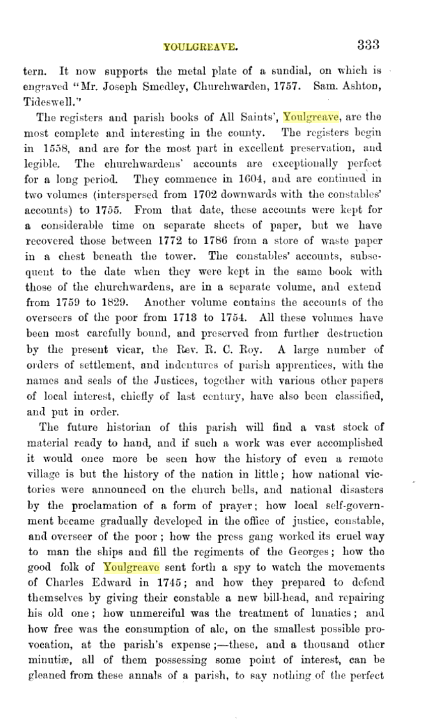
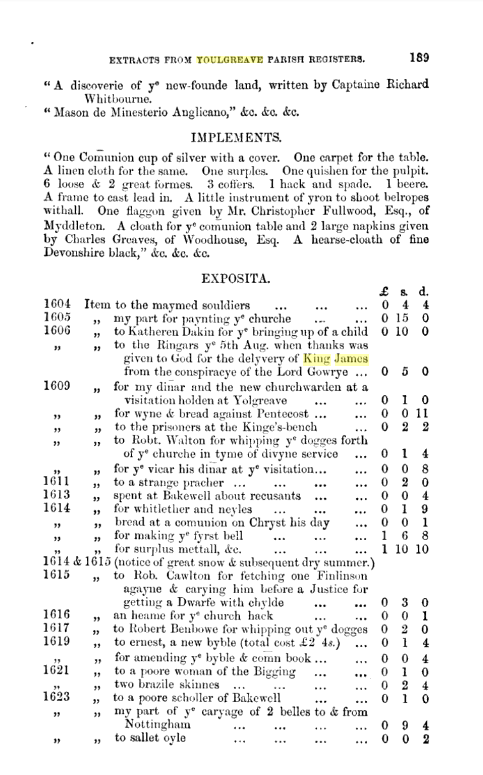
Although the Youlgreave parish registers are available online on microfilm, just the baptisms, marriages and burials are provided on the genealogy websites. However, I found some excerpts from the churchwardens accounts in a couple of old books, The Reliquary 1864, and Notes on Derbyshire Churches 1877.
Hannah Keeling, my 4x great grandmother, was born in Youlgreave, Derbyshire, in 1767. In 1791 she married Edward Lees of Hartington, Derbyshire, a village seven and a half miles south west of Youlgreave. Edward and Hannah’s daughter Sarah Lees, born in Hartington in 1808, married Francis Featherstone in 1835. The Featherstone’s were farmers. Their daughter Emma Featherstone married John Marshall from Elton. Elton is just three miles from Youlgreave, and there are a great many Marshall’s in the Youlgreave parish registers, some no doubt distantly related to ours.
Hannah Keeling’s parents were John Keeling 1734-1823, and Ellen Frost 1739-1805, both of Youlgreave.
On the burial entry in the parish registers in Youlgreave in 1823, John Keeling was 88 years old when he died, and was the “late parish clerk”, indicating that my 5x great grandfather played a part in compiling the “best parish registers in the country”. In 1762 John’s father in law John Frost died intestate, and John Keeling, cordwainer, co signed the documents with his mother in law Ann. John Keeling was a shoe maker and a parish clerk.
John Keeling’s father was Thomas Keeling, baptised on the 9th of March 1709 in Youlgreave and his parents were John Keeling and Ann Ashmore. John and Ann were married on the 6th April 1708. Some of the transcriptions have Thomas baptised in March 1708, which would be a month before his parents married. However, this was before the Julian calendar was replaced by the Gregorian calendar, and prior to 1752 the new year started on the 25th of March, therefore the 9th of March 1708 was eleven months after the 6th April 1708.
Thomas Keeling married Dorothy, which we know from the baptism of John Keeling in 1734, but I have not been able to find their marriage recorded. Until I can find my 6x great grandmother Dorothy’s maiden name, I am unable to trace her family further back.
Unfortunately I haven’t found a baptism for Thomas’s father John Keeling, despite that there are Keelings in the Youlgrave registers in the early 1600s, possibly it is one of the few illegible entries in these registers.
The Frosts of Youlgreave
Ellen Frost’s father was John Frost, born in Youlgreave in 1707. John married Ann Staley of Elton in 1733 in Youlgreave.
(Note that this part of the family tree is the Marshall side, but we also have Staley’s in Elton on the Warren side. Our branch of the Elton Staley’s moved to Stapenhill in the mid 1700s. Robert Staley, born 1711 in Elton, died in Stapenhill in 1795. There are many Staley’s in the Youlgreave parish registers, going back to the late 1500s.)
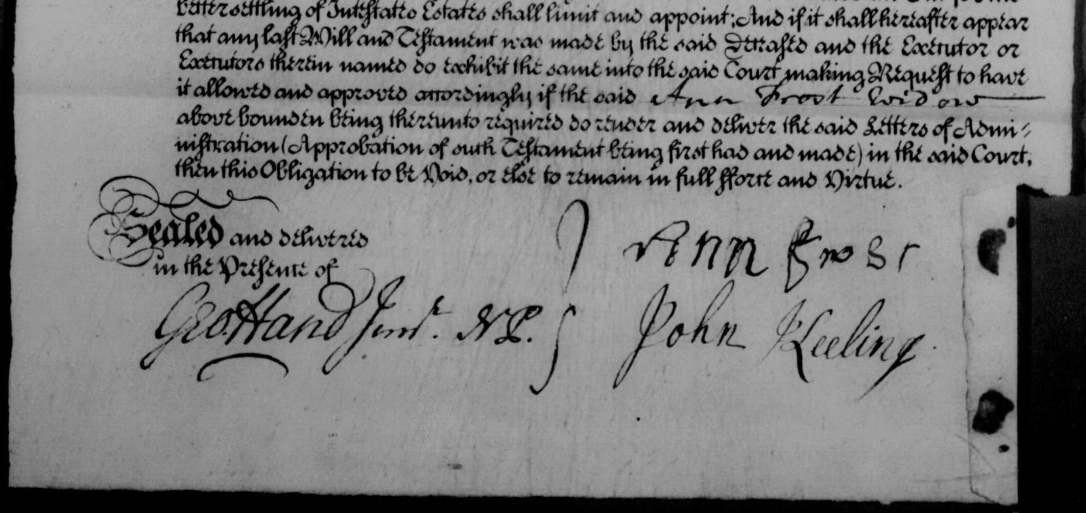
John Frost (my 6x great grandfather), miner, died intestate in 1762 in Youlgreave. Miner in this case no doubt means a lead miner, mining his own land (as John Marshall’s father John was in Elton. On the 1851 census John Marshall senior was mining 9 acres). Ann Frost, as the widow and relict of the said deceased John Frost, claimed the right of administration of his estate. Ann Frost (nee Staley) signed her own name, somewhat unusual for a woman to be able to write in 1762, as well as her son in law John Keeling.
John’s parents were David Frost and Ann. David was baptised in 1665 in Youlgreave. Once again, I have not found a marriage for David and Ann so I am unable to continue further back with her family. Marriages were often held in the parish of the bride, and perhaps those neighbouring parish records from the 1600s haven’t survived.
David’s parents were William Frost and Ellen (or Ellin, or Helen, depending on how the parish clerk chose to spell it). Once again, their marriage hasn’t been found, but was probably in a neighbouring parish.
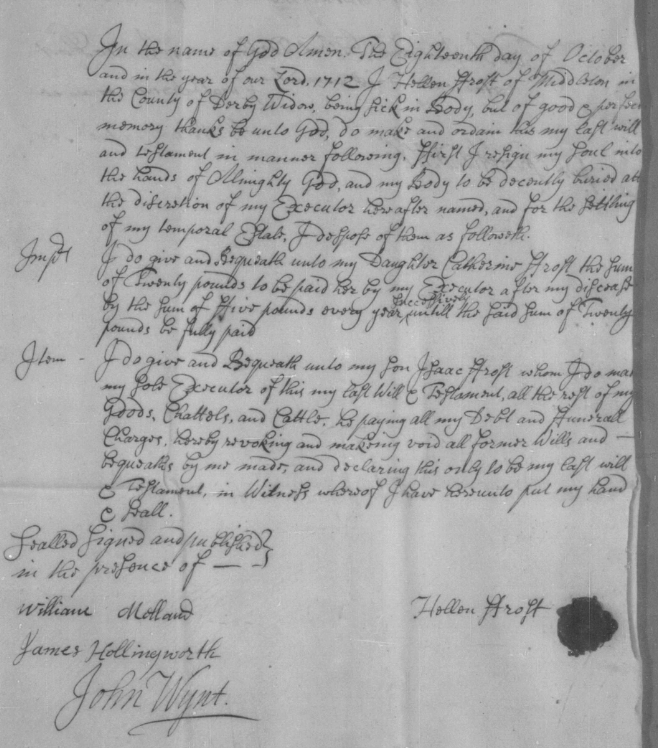
William Frost’s wife Ellen, my 8x great grandmother, died in Youlgreave in 1713. In her will she left her daughter Catherine £20. Catherine was born in 1665 and was apparently unmarried at the age of 48 in 1713. She named her son Isaac Frost (born in 1662) executor, and left him the remainder of her “goods, chattels and cattle”.
William Frost was baptised in Youlgreave in 1627, his parents were William Frost and Anne.
William Frost senior, husbandman, was probably born circa 1600, and died intestate in 1648 in Middleton, Youlgreave. His widow Anna was named in the document. On the compilation of the inventory of his goods, Thomas Garratt, Will Melland and A Kidiard are named.(Husbandman: The old word for a farmer below the rank of yeoman. A husbandman usually held his land by copyhold or leasehold tenure and may be regarded as the ‘average farmer in his locality’. The words ‘yeoman’ and ‘husbandman’ were gradually replaced in the later 18th and 19th centuries by ‘farmer’.)
Unable to find a baptism for William Frost born circa 1600, I read through all the pages of the Youlgreave parish registers from 1558 to 1610. Despite the good condition of these registers, there are a number of illegible entries. There were three Frost families baptising children during this timeframe and one of these is likely to be Willliam’s.
Baptisms:
1581 Eliz Frost, father Michael.
1582 Francis f Michael. (must have died in infancy)
1582 Margaret f William.
1585 Francis f Michael.
1586 John f Nicholas.
1588 Barbara f Michael.
1590 Francis f Nicholas.
1591 Joane f Michael.
1594 John f Michael.
1598 George f Michael.
1600 Fredericke (female!) f William.Marriages in Youlgreave which could be William’s parents:
1579 Michael Frost Eliz Staley
1587 Edward Frost Katherine Hall
1600 Nicholas Frost Katherine Hardy.
1606 John Frost Eliz Hanson.Michael Frost of Youlgreave is mentioned on the Derbyshire Muster Rolls in 1585.
(Muster records: 1522-1649. The militia muster rolls listed all those liable for military service.)
Frideswide:
A burial is recorded in 1584 for Frideswide Frost (female) father Michael. As the father is named, this indicates that Frideswide was a child.
(Frithuswith, commonly Frideswide c. 650 – 19 October 727), was an English princess and abbess. She is credited as the foundress of a monastery later incorporated into Christ Church, Oxford. She was the daughter of a sub-king of a Merica named Dida of Eynsham whose lands occupied western Oxfordshire and the upper reaches of the River Thames.)
An unusual name, and certainly very different from the usual names of the Frost siblings. As I did not find a baptism for her, I wondered if perhaps she died too soon for a baptism and was given a saints name, in the hope that it would help in the afterlife, given the beliefs of the times. Or perhaps it wasn’t an unusual name at the time in Youlgreave. A Fridesweda Gilbert was buried in Youlgreave in 1604, the spinster daughter of Francis Gilbert. There is a small brass effigy in the church, underneath is written “Frideswide Gilbert to the grave, Hath resigned her earthly part…”
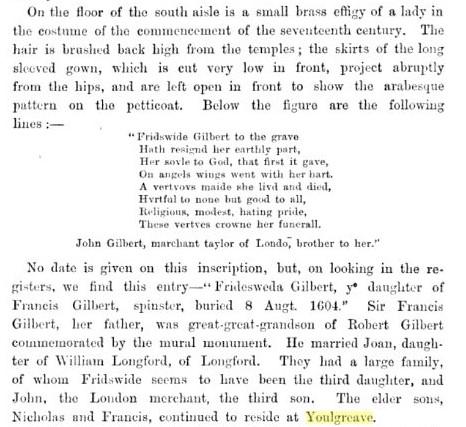
J. Charles Cox, Notes on the Churches of Derbyshire, 1877.
King James
A parish register entry in 1603:
“1603 King James of Skottland was proclaimed kinge of England, France and Ireland at Bakewell upon Monday being the 29th of March 1603.” (March 1603 would be 1604, because of the Julian calendar in use at the time.)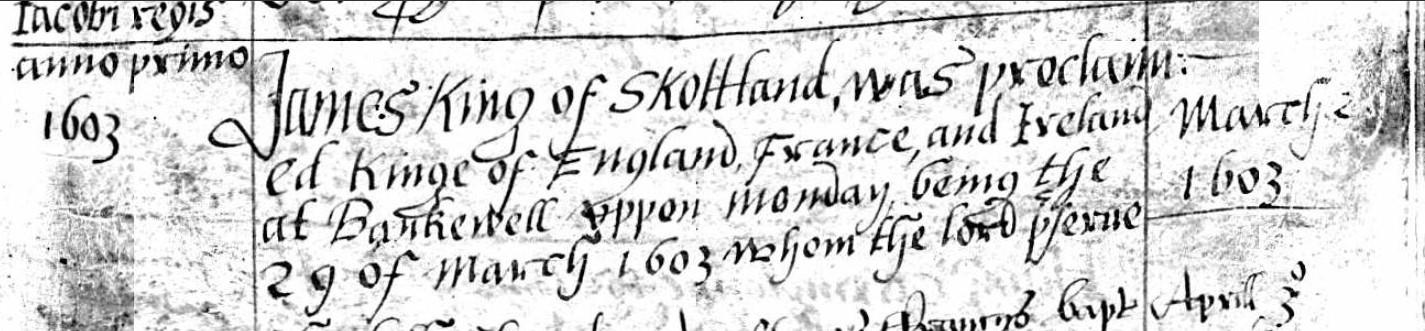
The Big Snow
“This year 1614/5 January 16th began the greatest snow whichever fell uppon the earth within man’s memorye. It covered the earth fyve quarters deep uppon the playne. And for heaps or drifts of snow, they were very deep; so that passengers both horse or foot passed over yates, hedges and walles. ….The spring was so cold and so late that much cattel was in very great danger and some died….”
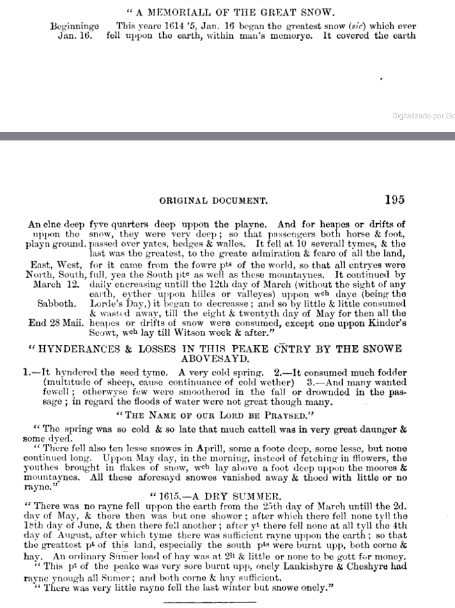
From the Youlgreave parish registers.
Our ancestor William Frost born circa 1600 would have been a teenager during the big snow.
July 19, 2024 at 12:26 pm #7536In reply to: The Incense of the Quadrivium’s Mystiques
The rainbow was neon bright, one end disappearing behind a spinney in the distance, and the other end landing squarely in the middle of the glamping pods. A good sign! thought Truella, the first of the coven to arrive. For a moment she imagined herself digging a hole right there, and finding the elusive pot of gold. I wouldn’t be able to do that in a fancy hotel. For once, Truella was happy with Austreberthe’s choice. A week or two in a green field sounded relaxing, refreshing. So much more to her taste than the endless fitted carpets, closed windows, and artifically controlled air blasting out of metal grilles in hotels.
Taking a deep breath of cool fresh air, she surveyed the site before checking into reception. The neighbouring fields were full of cows, perfect for her to practice her Bubona spells on before she set up her Goddess Spell Booth. The Goddess spell tents were to be open in the evenings, after the games each day, along with other stalls selling handicrafts, homemade cakes and jams, wines and potions, trinkets and souvenirs, and all the other tat that people on holiday enjoyed browsing. Obviously the coven would have a stall selling incense. No doubt Austreberthe would have hatched some hard sell plan for that.
Inside the reception office, Truella pinged the bell and waited for someone to attend. The registration book was open on the counter and Truella craned her neck to read the names on the list. She planned to ask for a pod in a far corner, near the hedgerow. It might make it easier to slip out unnoticed, if she should have a mind to do so. The door behind the counter opened and a young man appeared, smiling a welcome. But not before Truella had seen the name on the list. She sucked her breath in sharply. Malove! Nobody was expecting her. Did Austreberthe know?
“Welcome to Finnegan’s Farm Glampsite, I’m Liam,” said the young man, pushing long mousy hair out of his eyes, “You’ve a booking I take it, because we’re fully booked up for the next fortnight. Because of the Games, you see.”
Replying that she did, Truella asked for a pod in the furthest corner. Liam looked at a list and frowned. “The corners are all taken, I’m afraid. But I tell you what,” he said, “As you’re the first to arrive I’ll swap your pod, let’s see…” He scanned the list. “Ah yes, the late booking. I can put you in the one we’ve assigned to Mrs …Malone I think it says, and put her in yours.”
“Thank you very much, Liam,” Truella said as he handed her a key with a big wooden tag with the number 33 etched on it.
“I’ll carry your bags over and show you where it is, follow me.”
April 7, 2024 at 7:35 am #7420In reply to: The Incense of the Quadrivium’s Mystiques
Spring was there. At 5:57am in the morning, true to her name, Truella had been planting truelles incognito in what appeared to be random flowerbeds in the cities she was passing through. The truelles, she would usually find with the locator spell in sheds around the city and magic them out right into her hands. She loved magic for its efficiency, which really meant there was no need to break in and forage for hours in cramped little rooms.
As she was following a border of plane trees, she chuckled. Believe it or not, she practically invented that spell. At least that’s what her mother used to tell her when she was 6yo and she often wandered alone around the city without mentioning it to anyone. At the time, she had believed her mother. She had bragged about it with her friends at school and pretended she had forgotten all about it like because of a bump on her head. But truth is she had frequent memory losses, which didn’t worry her at the time, and she found it cool to be able to do things and rediscover them later on.
It was an uncle with a dreadfully red moustache, who took pity on her and decided to shatter her dreams of early accomplishments and fame. Was it that same year? Or the next?
Anyway, back to the truelles, she didn’t do it for people to take photos of it and post them to social media, like gawdy Jeez seemed to think, but it was to remind people of the treasures they had buried in those dark little rooms just there in their gardens. How long would it take them to realise that those forgotten tools had disappeared?
Pleased with herself, she noticed a man with a white shirt leaning forward in front of one of the plane trees, his right hand on the bark, two paper bags full of croissants in the other. Frowning, she walked towards him. She was about to ask if he needed help when a strong smell of alcohol made her gag. Then without a warning, the man threw up a red mash in front of him. Truella jumped back, raising the truelle as if it could protect her from any splatter.
“Eww!” She wouldn’t dare saying anything else as opening her mouth could open the gates for her own early toasted cheese fritter. At least the man would not need embalming fluids if he didn’t survive his nocturnal drinking spree.
She cast the truelle in front of the tree and a spell on the man so that he would bury deep the traces of his last meal. She didn’t want the neighbourhood dogs getting drunk after feasting on it.
February 1, 2024 at 10:18 am #7337In reply to: The Incense of the Quadrivium’s Mystiques
The bone people had replied to Truella’s urgent message while she was at the meeting, much to her relief. The last thing she wanted was the authorities snooping around, just as she was delving into the rich new layer. The odd things she’d been finding recently had piqued her curiousity and she had to keep reminding herself to merely find, observe and document, without attempting to make assumptions. She couldn’t help wondering though if these disparate items, things she hadn’t expected to find, were the ingredients for an ancient spell. The little bone amulet, the pigs teeth, and all the other little bits of bone with curious smooth sides. Fragments of mother of pearl, gleaming like new silver in the dirt, uncorroded and pristine despite the passage of time and the weight of the earth. Little clumps of charcoal, but scattered, not all in the same place. Not like there’d been a fire, more like little things had burned, here and there, at various times.
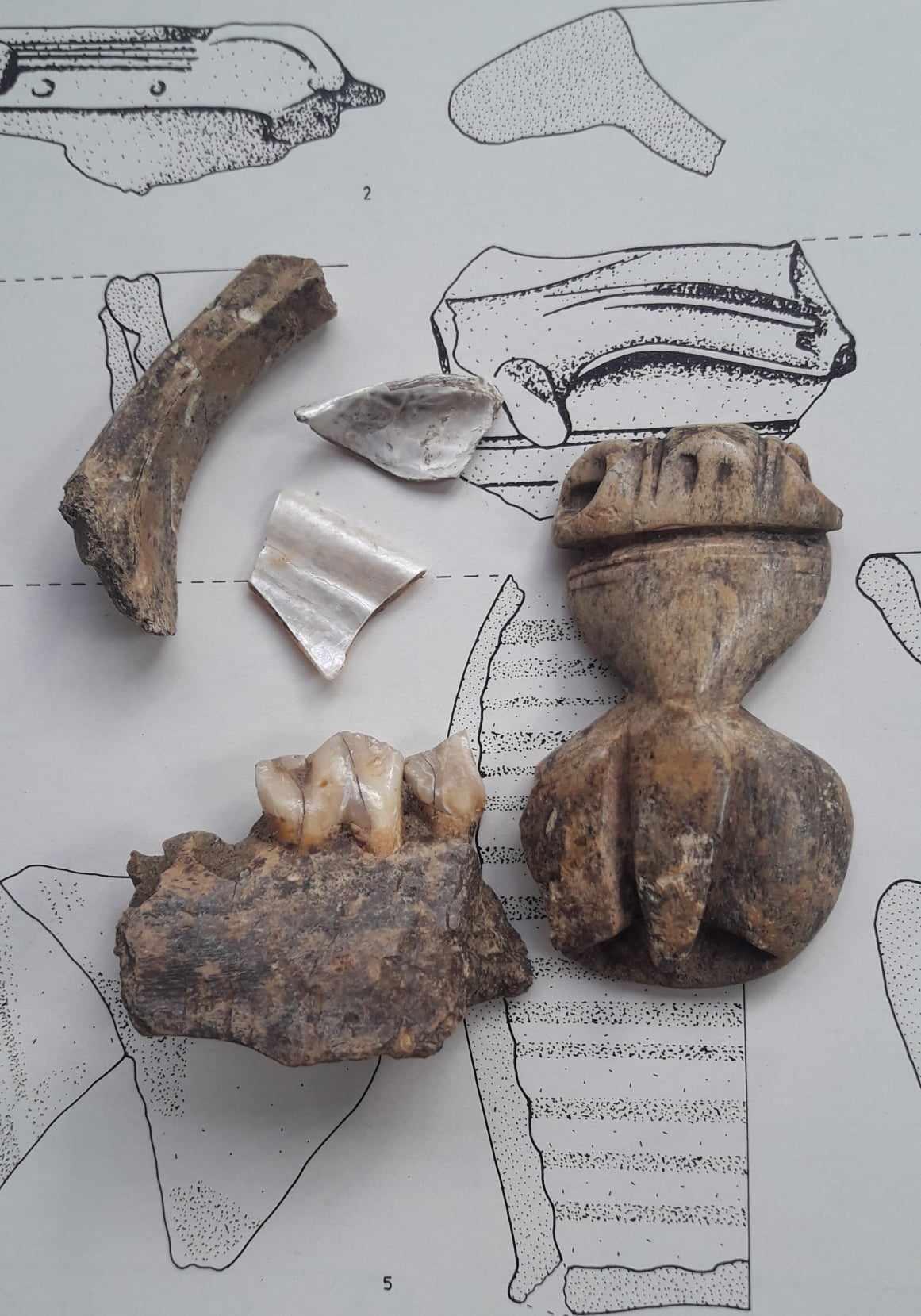
All the broken dishes and amphora were to be expected, but why so many? And why didn’t whoever lived here take their dishes with them when they went? Maybe they left in a hurry, smashing everything on the way out of the door so there was nothing left for the invaders? Or did the dishes simply fall and break when the abandoned wooden shelves rotted away over the centuries? A layer of abandonment was a curious and intriguing thing to contemplate.
Now that she had the experts opinion on the teeth ~ pig, not human ~ haste was needed to quell the growing rumours in the village that she had found human remains. That was the last thing she needed, the neighbours giving her suspicious looks or the authorities roping off her dig with striped plastic tape and putting a police tent over it, messing with the hole she had dug trowel by trowel, rubbing every handful of soil between her fingers. The very thought of it was unbearable. For this reason she rather hoped NOT to find a hoard of valuable ancient coins, contrary to what most people would hope to find. Still, she couldn’t help wonder while she was digging if the next trowel of soil would reveal one.
She must make it absolutely clear to Roger than he was only required to carry buckets of soil, and was not to do any actual digging.
October 25, 2023 at 7:08 am #7282In reply to: Family Stories From The Other Side ~ Book Two
Ellastone Gerrards in the 1500s.
John Gerrard 1633-1681 was born and died in Ellastone.
Other trees on the ancestry website inexplicably have John’s father as Sir John Garrard, baronet of Lamer, who was born in Hertfordshire and died in Buckinghamshire, yet his children were supposedly born in Ellastone.
Fortunately the Ellastone parish records begin in 1537. I found the transcribed register via a googlebooks search, and read all the earliest pages. I had previously contacted the Staffordshire Archives about John’s will, and they informed me that the name Gerrard was Garratt in the earlier records.
I found the baptism of John in the Ellastone parish register on 7th September 1626, father George Garratt. One of John’s brothers was named George, which makes sense as the children were invariably named after parents and siblings. However, John born in 1626 died in 1628. Another son named John was baptised in 1633.
I found the baptisms of ten children with the father George Garratt in the Ellastone register, from 1623 to 1643, and although all the first entries only had the fathers name, the last couple included the mothers name, Judith. George Garratt was a churchwarden in Ellastone in 1627.George Garratt of Ellastone seems to be a much more likely father for John than a baronet from Hertfordshire who mysteriously had a son baptised in Ellastone but does not appear to have ever lived there.
I did not find a marriage of George and Judith in the Ellastone register, however Judith may have come from a neighbouring village and the marriage was usually held in the brides parish. The wedding was probably circa 1622.
George was baptised in Ellastone on the 19th March 1595. Some of the transcriptions say March 1794, some say 1795. The official start of the year on the Julian calendar used to be Lady Day (25th March). This was changed in 1752.
His father was Rycharde Garrarde. Rycharde married Agnes Bothom in Ellastone on the 29th September 1594. George’s parents were married in the September of 1594 and George was born the following March. On the old calendar, March came after September.
George died in 1669 in Ellastone. He was my 10X great grandfather. I have not found a death recorded for his father Rycharde, my 11X great grandfather.
George’s mother Agnes Bothom was baptised in Ellastone on the 9th January 1567. Her father was John Bothom. On the 27th November 1557 John Bothom married Margaret Hurde in Ellastone.
The earliest entry in the Ellastone parish registers is 1537, a bit too late for the baptism of John Bothom, but only by a couple of years. John Bothom and his wife Agnes were probably born around 1535. Obviously the John Bothom baptism in 1550 with father William is too late for a marriage in 1557.
September 5, 2023 at 1:35 pm #7276In reply to: Family Stories From The Other Side ~ Book Two
Wood Screw Manufacturers
The Fishers of West Bromwich.
My great grandmother, Nellie Fisher, was born in 1877 in Wolverhampton. Her father William 1834-1916 was a whitesmith, and his father William 1792-1873 was a whitesmith and master screw maker. William’s father was Abel Fisher, wood screw maker, victualler, and according to his 1849 will, a “gentleman”.
Nellie Fisher 1877-1956 :
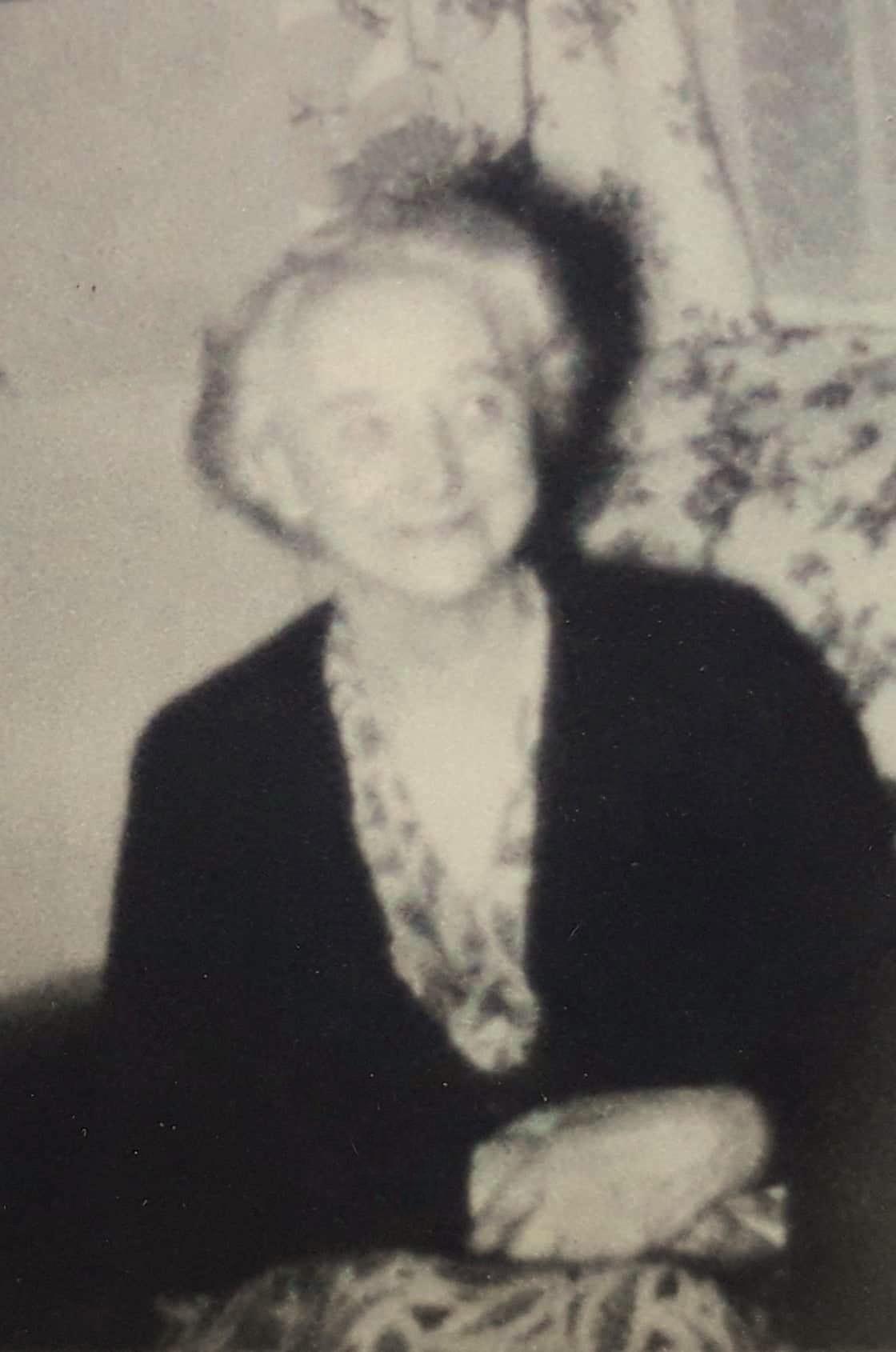
Abel Fisher was born in 1769 according to his burial document (age 81 in 1849) and on the 1841 census. Abel was a wood screw manufacturer in Wolverhampton.
As no baptism record can be found for Abel Fisher, I read every Fisher will I could find in a 30 year period hoping to find his fathers will. I found three other Fishers who were wood screw manufacurers in neighbouring West Bromwich, which led me to assume that Abel was born in West Bromwich and related to these other Fishers.
The wood screw making industry was a relatively new thing when Abel was born.
“The screw was used in furniture but did not become a common woodworking fastener until efficient machine tools were developed near the end of the 18th century. The earliest record of lathe made wood screws dates to an English patent of 1760. The development of wood screws progressed from a small cottage industry in the late 18th century to a highly mechanized industry by the mid-19th century. This rapid transformation is marked by several technical innovations that help identify the time that a screw was produced. The earliest, handmade wood screws were made from hand-forged blanks. These screws were originally produced in homes and shops in and around the manufacturing centers of 18th century Europe. Individuals, families or small groups participated in the production of screw blanks and the cutting of the threads. These small operations produced screws individually, using a series of files, chisels and cutting tools to form the threads and slot the head. Screws produced by this technique can vary significantly in their shape and the thread pitch. They are most easily identified by the profusion of file marks (in many directions) over the surface. The first record regarding the industrial manufacture of wood screws is an English patent registered to Job and William Wyatt of Staffordshire in 1760.”
Wood Screw Makers of West Bromwich:
Edward Fisher, wood screw maker of West Bromwich, died in 1796. He mentions his wife Pheney and two underage sons in his will. Edward (whose baptism has not been found) married Pheney Mallin on 13 April 1793. Pheney was 17 years old, born in 1776. Her parents were Isaac Mallin and Sarah Firme, who were married in West Bromwich in 1768.
Edward and Pheney’s son Edward was born on 21 October 1793, and their son Isaac in 1795. The executors of Edwards 1796 will are Daniel Fisher the Younger, Isaac Mallin, and Joseph Fisher.There is a marriage allegations and bonds document in 1774 for an Edward Fisher, bachelor and wood screw maker of West Bromwich, aged 25 years and upwards, and Mary Mallin of the same age, father Isaac Mallin. Isaac Mallin and Sarah didn’t marry until 1768 and Mary Mallin would have been born circa 1749. Perhaps Isaac Mallin’s father was the father of Mary Mallin. It’s possible that Edward Fisher was born in 1749 and first married Mary Mallin, and then later Pheney, but it’s also possible that the Edward Fisher who married Mary Mallin in 1774 was Edward Fishers uncle, Daniel’s brother. (I do not know if Daniel had a brother Edward, as I haven’t found a baptism, or marriage, for Daniel Fisher the elder.)
There are two difficulties with finding the records for these West Bromwich families. One is that the West Bromwich registers are not available online in their entirety, and are held by the Sandwell Archives, and even so, they are incomplete. Not only that, the Fishers were non conformist. There is no surviving register prior to 1787. The chapel opened in 1788, and any registers that existed before this date, taken in a meeting houses for example, appear not to have survived.
Daniel Fisher the younger died intestate in 1818. Daniel was a wood screw maker of West Bromwich. He was born in 1751 according to his age stated as 67 on his death in 1818. Daniel’s wife Mary, and his son William Fisher, also a wood screw maker, claimed the estate.
Daniel Fisher the elder was a farmer of West Bromwich, who died in 1806. He was 81 when he died, which makes a birth date of 1725, although no baptism has been found. No marriage has been found either, but he was probably married not earlier than 1746.
Daniel’s sons Daniel and Joseph were the main inheritors, and he also mentions his other children and grandchildren namely William Fisher, Thomas Fisher, Hannah wife of William Hadley, two grandchildren Edward and Isaac Fisher sons of Edward Fisher his son deceased. Daniel the elder presumably refers to the wood screw manufacturing when he says “to my son Daniel Fisher the good will and advantage which may arise from his manufacture or trade now carried on by me.” Daniel does not mention a son called Abel unfortunately, but neither does he mention his other grandchildren. Abel may be Daniel’s son, or he may be a nephew.
The Staffordshire Record Office holds the documents of a Testamentary Case in 1817. The principal people are Isaac Fisher, a legatee; Daniel and Joseph Fisher, executors. Principal place, West Bromwich, and deceased person, Daniel Fisher the elder, farmer.
William and Sarah Fisher baptised six children in the Mares Green Non Conformist registers in West Bromwich between 1786 and 1798. William Fisher and Sarah Birch were married in West Bromwich in 1777. This William was probably born circa 1753 and was probably the son of Daniel Fisher the elder, farmer.
Daniel Fisher the younger and his wife Mary had a son William, as mentioned in the intestacy papers, although I have not found a baptism for William. I did find a baptism for another son, Eutychus Fisher in 1792.
In White’s Directory of Staffordshire in 1834, there are three Fishers who are wood screw makers in Wolverhampton: Eutychus Fisher, Oxford Street; Stephen Fisher, Bloomsbury; and William Fisher, Oxford Street.
Abel’s son William Fisher 1792-1873 was living on Oxford Street on the 1841 census, with his wife Mary and their son William Fisher 1834-1916.
In The European Magazine, and London Review of 1820 (Volume 77 – Page 564) under List of Patents, W Fisher and H Fisher of West Bromwich, wood screw manufacturers, are listed. Also in 1820 in the Birmingham Chronicle, the partnership of William and Hannah Fisher, wood screw manufacturers of West Bromwich, was dissolved.
In the Staffordshire General & Commercial Directory 1818, by W. Parson, three Fisher’s are listed as wood screw makers. Abel Fisher victualler and wood screw maker, Red Lion, Walsal Road; Stephen Fisher wood screw maker, Buggans Lane; and Daniel Fisher wood screw manufacturer, Brickiln Lane.
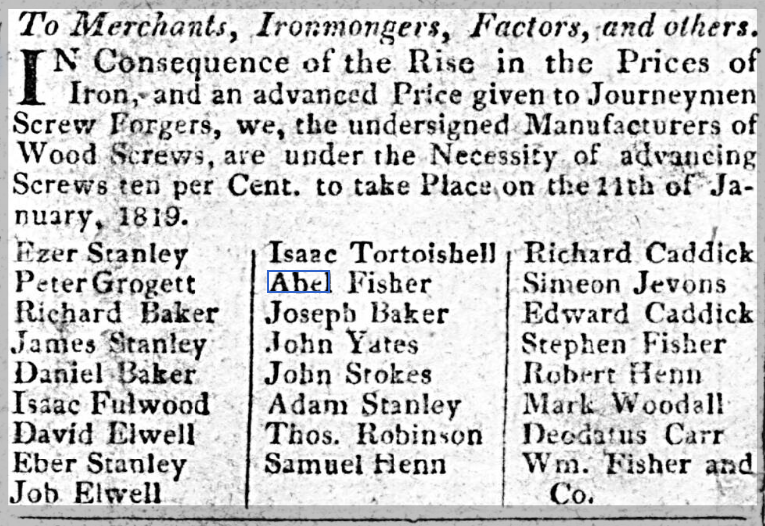
In Aris’s Birmingham Gazette on 4 January 1819 Abel Fisher is listed with 23 other wood screw manufacturers (Stephen Fisher and William Fisher included) stating that “In consequence of the rise in prices of iron and the advanced price given to journeymen screw forgers, we the undersigned manufacturers of wood screws are under the necessity of advancing screws 10 percent, to take place on the 11th january 1819.”
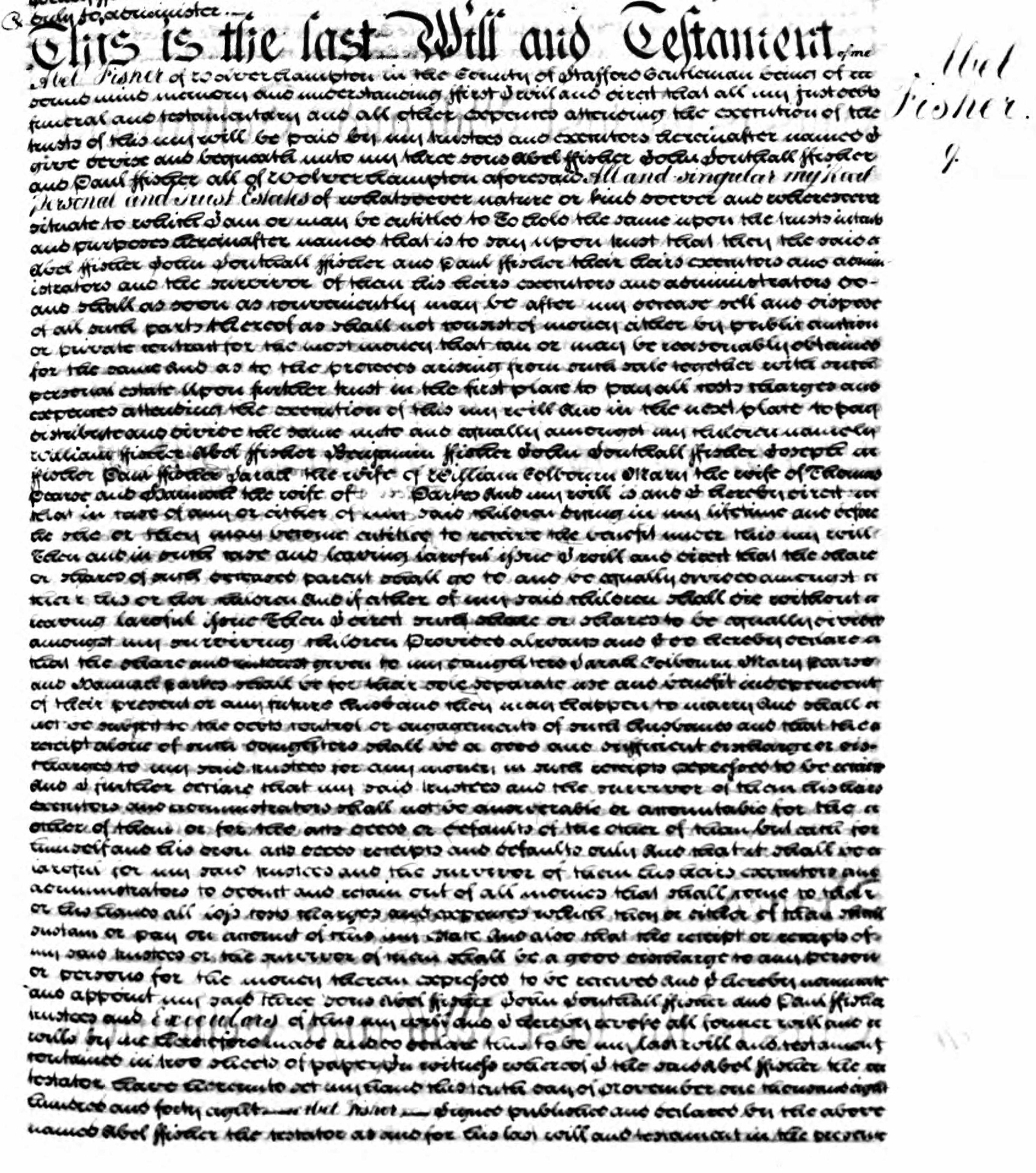
In Abel Fisher’s 1849 will, he names his three sons Abel Fisher 1796-1869, Paul Fisher 1811-1900 and John Southall Fisher 1801-1871 as the executors. He also mentions his other three sons, William Fisher 1792-1873, Benjamin Fisher 1798-1870, and Joseph Fisher 1803-1876, and daughters Sarah Fisher 1794- wife of William Colbourne, Mary Fisher 1804- wife of Thomas Pearce, and Susannah (Hannah) Fisher 1813- wife of Parkes. His son Silas Fisher 1809-1837 wasn’t mentioned as he died before Abel, nor his sons John Fisher 1799-1800, and Edward Southall Fisher 1806-1843. Abel’s wife Susannah Southall born in 1771 died in 1824. They were married in 1791.
The 1849 will of Abel Fisher:
 July 4, 2023 at 7:52 pm #7261
In reply to: Family Stories From The Other Side ~ Book Two
Long Lost Enoch Edwards
My father used to mention long lost Enoch Edwards. Nobody in the family knew where he went to and it was assumed that he went to USA, perhaps to Utah to join his sister Sophie who was a Mormon handcart pioneer, but no record of him was found in USA.
Andrew Enoch Edwards (my great great grandfather) was born in 1840, but was (almost) always known as Enoch. Although civil registration of births had started from 1 July 1837, neither Enoch nor his brother Stephen were registered. Enoch was baptised (as Andrew) on the same day as his brothers Reuben and Stephen in May 1843 at St Chad’s Catholic cathedral in Birmingham. It’s a mystery why these three brothers were baptised Catholic, as there are no other Catholic records for this family before or since. One possible theory is that there was a school attached to the church on Shadwell Street, and a Catholic baptism was required for the boys to go to the school. Enoch’s father John died of TB in 1844, and perhaps in 1843 he knew he was dying and wanted to ensure an education for his sons. The building of St Chads was completed in 1841, and it was close to where they lived.
Enoch appears (as Enoch rather than Andrew) on the 1841 census, six months old. The family were living at Unett Street in Birmingham: John and Sarah and children Mariah, Sophia, Matilda, a mysterious entry transcribed as Lene, a daughter, that I have been unable to find anywhere else, and Reuben and Stephen.
Enoch was just four years old when his father John, an engineer and millwright, died of consumption in 1844.
In 1851 Enoch’s widowed mother Sarah was a mangler living on Summer Street, Birmingham, Matilda a dressmaker, Reuben and Stephen were gun percussionists, and eleven year old Enoch was an errand boy.
On the 1861 census, Sarah was a confectionrer on Canal Street in Birmingham, Stephen was a blacksmith, and Enoch a button tool maker.
On the 10th November 1867 Enoch married Emelia Parker, daughter of jeweller and rope maker Edward Parker, at St Philip in Birmingham. Both Emelia and Enoch were able to sign their own names, and Matilda and Edwin Eddington were witnesses (Enoch’s sister and her husband). Enoch’s address was Church Street, and his occupation button tool maker.
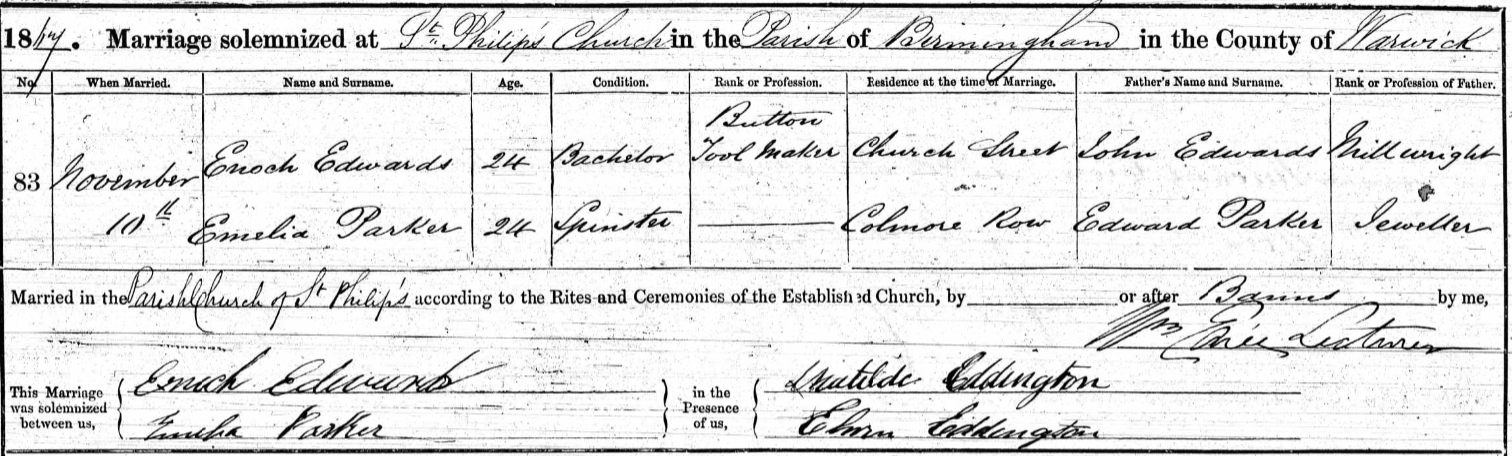
Four years later in 1871, Enoch was a publican living on Clifton Road. Son Enoch Henry was two years old, and Ralph Ernest was three months. Eliza Barton lived with them as a general servant.
By 1881 Enoch was back working as a button tool maker in Bournebrook, Birmingham. Enoch and Emilia by then had three more children, Amelia, Albert Parker (my great grandfather) and Ada.
Garnet Frederick Edwards was born in 1882. This is the first instance of the name Garnet in the family, and subsequently Garnet has been the middle name for the eldest son (my brother, father and grandfather all have Garnet as a middle name).
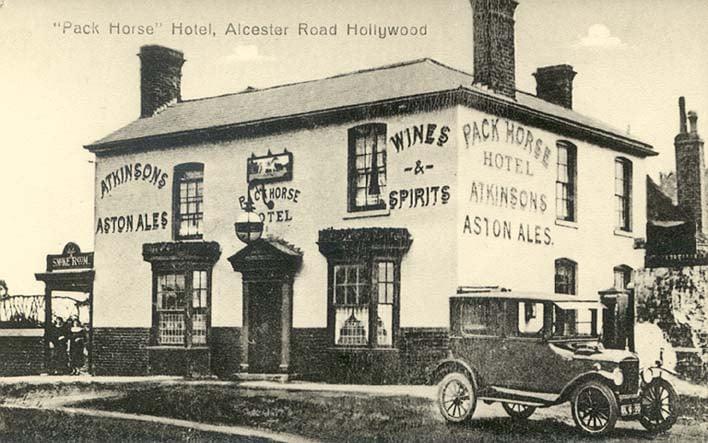
Enoch was the licensed victualler at the Pack Horse Hotel in 1991 at Kings Norton. By this time, only daughters Amelia and Ada and son Garnet are living at home.
Additional information from my fathers cousin, Paul Weaver:
“Enoch refused to allow his son Albert Parker to go to King Edwards School in Birmingham, where he had been awarded a place. Instead, in October 1890 he made Albert Parker Edwards take an apprenticeship with a pawnboker in Tipton.
Towards the end of the 19th century Enoch kept The Pack Horse in Alcester Road, Hollywood, where a twist was 1d an ounce, and beer was 2d a pint. The children had to get up early to get breakfast at 6 o’clock for the hay and straw men on their way to the Birmingham hay and straw market. Enoch is listed as a member of “The Kingswood & Pack Horse Association for the Prosecution of Offenders”, a kind of early Neighbourhood Watch, dated 25 October 1890.
The Edwards family later moved to Redditch where they kept The Rifleman Inn at 35 Park Road. They must have left the Pack Horse by 1895 as another publican was in place by then.”Emelia his wife died in 1895 of consumption at the Rifleman Inn in Redditch, Worcestershire, and in 1897 Enoch married Florence Ethel Hedges in Aston. Enoch was 56 and Florence was just 21 years old.
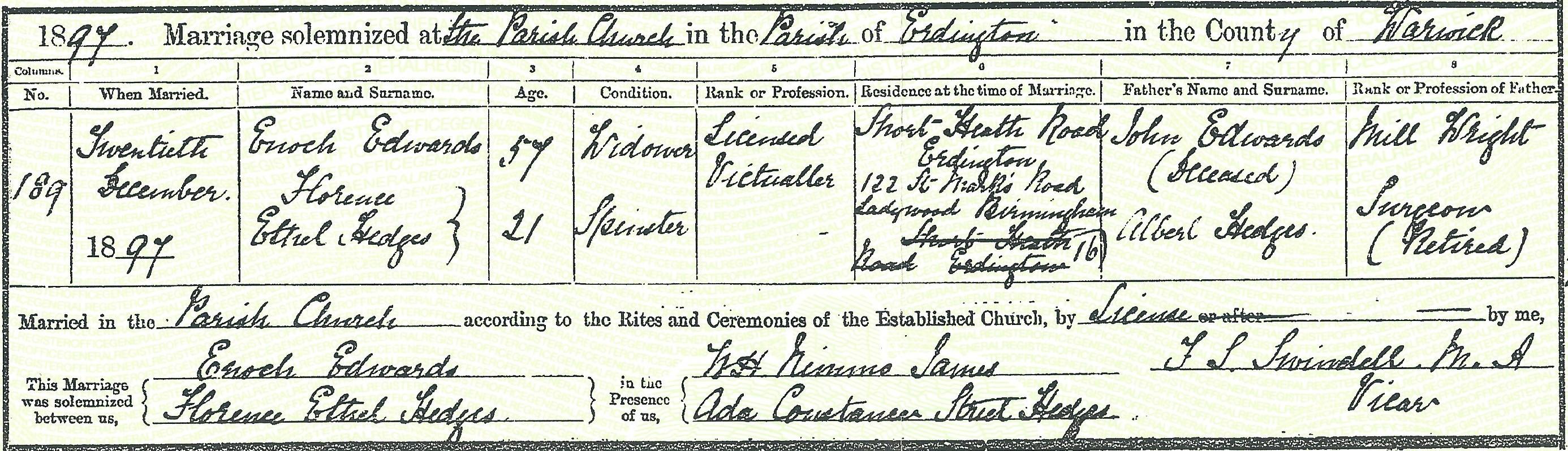
The following year in 1898 their daughter Muriel Constance Freda Edwards was born in Deritend, Warwickshire.
In 1901 Enoch, (Andrew on the census), publican, Florence and Muriel were living in Dudley. It was hard to find where he went after this.From Paul Weaver:
“Family accounts have it that Enoch EDWARDS fell out with all his family, and at about the age of 60, he left all behind and emigrated to the U.S.A. Enoch was described as being an active man, and it is believed that he had another family when he settled in the U.S.A. Esmor STOKES has it that a postcard was received by the family from Enoch at Niagara Falls.
On 11 June 1902 Harry Wright (the local postmaster responsible in those days for licensing) brought an Enoch EDWARDS to the Bedfordshire Petty Sessions in Biggleswade regarding “Hole in the Wall”, believed to refer to the now defunct “Hole in the Wall” public house at 76 Shortmead Street, Biggleswade with Enoch being granted “temporary authority”. On 9 July 1902 the transfer was granted. A year later in the 1903 edition of Kelly’s Directory of Bedfordshire, Hunts and Northamptonshire there is an Enoch EDWARDS running the Wheatsheaf Public House, Church Street, St. Neots, Huntingdonshire which is 14 miles south of Biggleswade.”
It seems that Enoch and his new family moved away from the midlands in the early 1900s, but again the trail went cold.
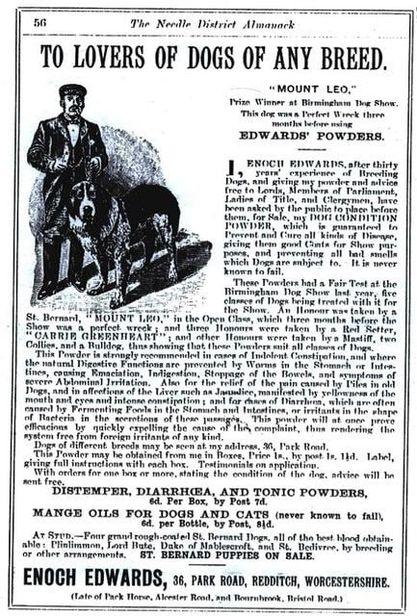
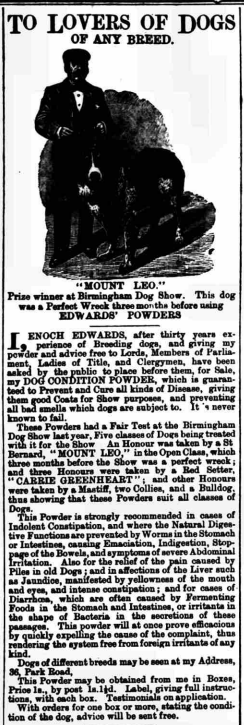
When I started doing the genealogy research, I joined a local facebook group for Redditch in Worcestershire. Enoch’s son Albert Parker Edwards (my great grandfather) spent most of his life there. I asked in the group about Enoch, and someone posted an illustrated advertisement for Enoch’s dog powders. Enoch was a well known breeder/keeper of St Bernards and is cited in a book naming individuals key to the recovery/establishment of ‘mastiff’ size dog breeds.
We had not known that Enoch was a breeder of champion St Bernard dogs!
Once I knew about the St Bernard dogs and the names Mount Leo and Plinlimmon via the newspaper adverts, I did an internet search on Enoch Edwards in conjunction with these dogs.
Enoch’s St Bernard dog “Mount Leo” was bred from the famous Plinlimmon, “the Emperor of Saint Bernards”. He was reported to have sent two puppies to Omaha and one of his stud dogs to America for a season, and in 1897 Enoch made the news for selling a St Bernard to someone in New York for £200. Plinlimmon, bred by Thomas Hall, was born in Liverpool, England on June 29, 1883. He won numerous dog shows throughout Europe in 1884, and in 1885, he was named Best Saint Bernard.
In the Birmingham Mail on 14th June 1890:
“Mr E Edwards, of Bournebrook, has been well to the fore with his dogs of late. He has gained nine honours during the past fortnight, including a first at the Pontypridd show with a St Bernard dog, The Speaker, a son of Plinlimmon.”
In the Alcester Chronicle on Saturday 05 June 1897:
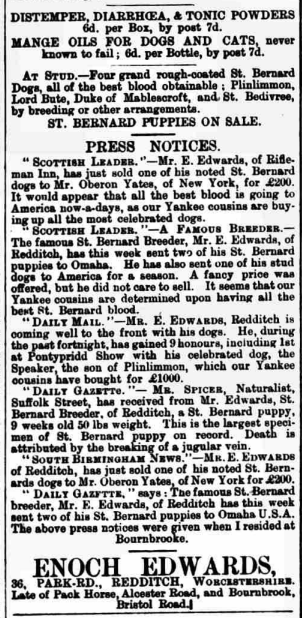
It was discovered that Enoch, Florence and Muriel moved to Canada, not USA as the family had assumed. The 1911 census for Montreal St Jaqcues, Quebec, stated that Enoch, (Florence) Ethel, and (Muriel) Frida had emigrated in 1906. Enoch’s occupation was machinist in 1911. The census transcription is not very good. Edwards was transcribed as Edmand, but the dates of birth for all three are correct. Birthplace is correct ~ A for Anglitan (the census is in French) but race or tribe is also an A but the transcribers have put African black! Enoch by this time was 71 years old, his wife 33 and daughter 11.
Additional information from Paul Weaver:
“In 1906 he and his new family travelled to Canada with Enoch travelling first and Ethel and Frida joined him in Quebec on 25 June 1906 on board the ‘Canada’ from Liverpool.
Their immigration record suggests that they were planning to travel to Winnipeg, but five years later in 1911, Enoch, Florence Ethel and Frida were still living in St James, Montreal. Enoch was employed as a machinist by Canadian Government Railways working 50 hours. It is the 1911 census record that confirms his birth as November 1840. It also states that Enoch could neither read nor write but managed to earn $500 in 1910 for activity other than his main profession, although this may be referring to his innkeeping business interests.
By 1921 Florence and Muriel Frida are living in Langford, Neepawa, Manitoba with Peter FUCHS, an Ontarian farmer of German descent who Florence had married on 24 Jul 1913 implying that Enoch died sometime in 1911/12, although no record has been found.”The extra $500 in earnings was perhaps related to the St Bernard dogs. Enoch signed his name on the register on his marriage to Emelia, and I think it’s very unlikely that he could neither read nor write, as stated above.
However, it may not be Enoch’s wife Florence Ethel who married Peter Fuchs. A Florence Emma Edwards married Peter Fuchs, and on the 1921 census in Neepawa her daugther Muriel Elizabeth Edwards, born in 1902, lives with them. Quite a coincidence, two Florence and Muriel Edwards in Neepawa at the time. Muriel Elizabeth Edwards married and had two children but died at the age of 23 in 1925. Her mother Florence was living with the widowed husband and the two children on the 1931 census in Neepawa. As there was no other daughter on the 1911 census with Enoch, Florence and Muriel in Montreal, it must be a different Florence and daughter. We don’t know, though, why Muriel Constance Freda married in Neepawa.
Indeed, Florence was not a widow in 1913. Enoch died in 1924 in Montreal, aged 84. Neither Enoch, Florence or their daughter has been found yet on the 1921 census. The search is not easy, as Enoch sometimes used the name Andrew, Florence used her middle name Ethel, and daughter Muriel used Freda, Valerie (the name she added when she married in Neepawa), and died as Marcheta. The only name she NEVER used was Constance!
A Canadian genealogist living in Montreal phoned the cemetery where Enoch was buried. She said “Enoch Edwards who died on Feb 27 1924 is not buried in the Mount Royal cemetery, he was only cremated there on March 4, 1924. There are no burial records but he died of an abcess and his body was sent to the cemetery for cremation from the Royal Victoria Hospital.”
1924 Obituary for Enoch Edwards:
Cimetière Mont-Royal Outremont, Montreal Region, Quebec, Canada
The Montreal Star 29 Feb 1924, Fri · Page 31

Muriel Constance Freda Valerie Edwards married Arthur Frederick Morris on 24 Oct 1925 in Neepawa, Manitoba. (She appears to have added the name Valerie when she married.)
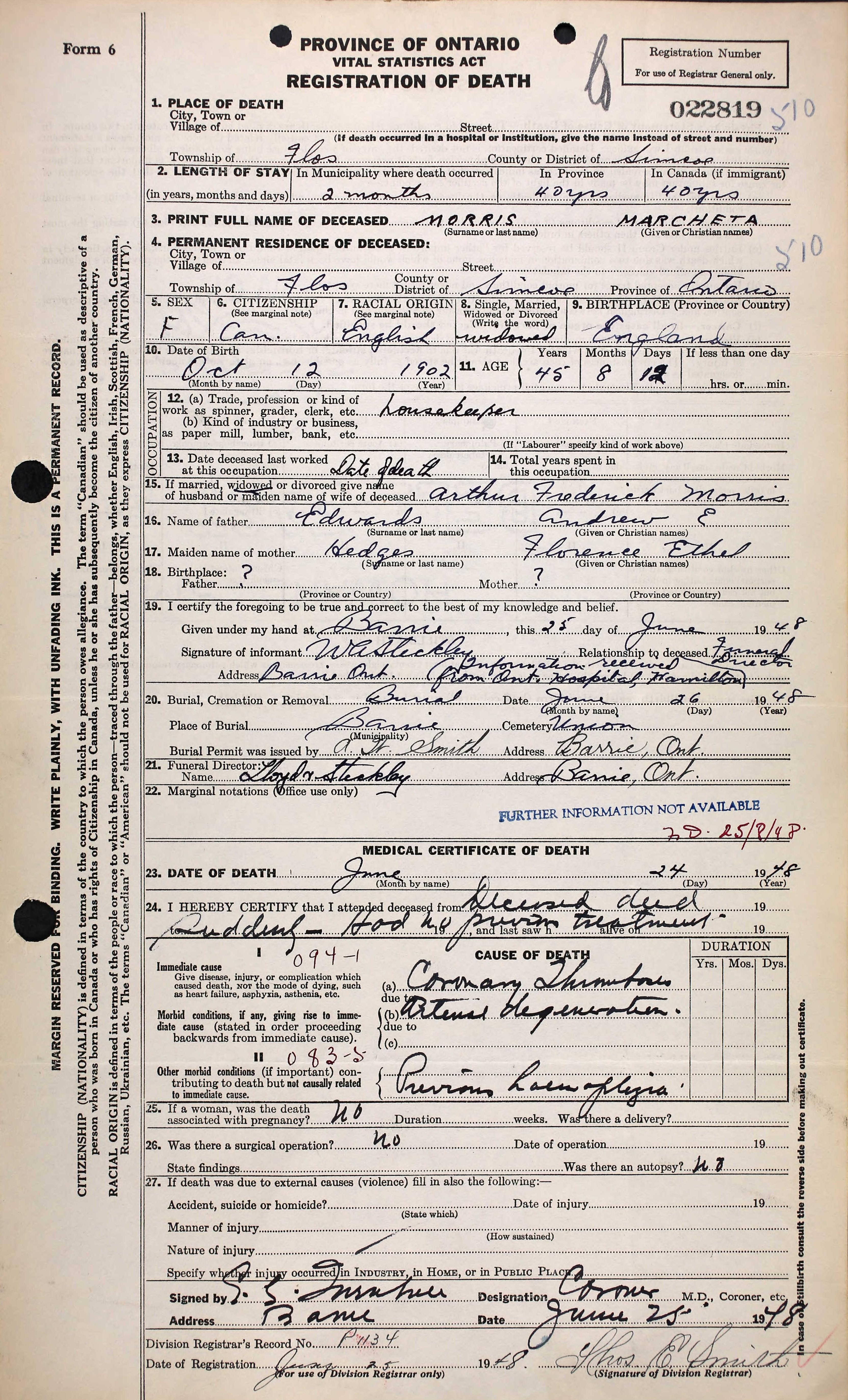
Unexpectedly a death certificate appeared for Muriel via the hints on the ancestry website. Her name was “Marcheta Morris” on this document, however it also states that she was the widow of Arthur Frederick Morris and daughter of Andrew E Edwards and Florence Ethel Hedges. She died suddenly in June 1948 in Flos, Simcoe, Ontario of a coronary thrombosis, where she was living as a housekeeper.
 March 24, 2023 at 10:06 am #7216
In reply to: The Precious Life and Rambles of Liz Tattler
Roberto sighed and scratched a red patch on his left hand. Spring was here. It was obvious as vibrant lime green leaves had grown on freshly sprouted twigs. If it added a nice touch of colour to the garden, the box trees, lined up on the opposite side of the pool that he had dedicated so much time last year to carving them as birds, elephants and rhinos, had now a dishevelled appearance, and that only added to his despair.
The lawn was sprinkled with yellow spots of dandelions. Roberto just tried to remove some of them with his hands, but got badly stung by nettles. They had invaded the garden from the new neighbour’s meadow. That estúpido, had said he wanted nature to grow on its own terms, but looking at the result, Roberto thought it was more of a natural disaster than anything else.
“Don’t get rid of the dandelions,” said Liz. “It attracts bumblebees and wild bees. I’ve heard that we need to save them.”
“You talked with that neighbour again?” asked Roberto.
“Dominic? Isn’t it nice the birds are back?”
Roberto looked at the birdbaths on top of the four Corinthian columns at each corner of the pool. A group of sparrows were fooling around cleaning their feathers. At Roberto’s feet, a hedgehog was drinking in a puddle left by the 7:30 morning rain, remains of a feast of slugs behind him. Sometimes, he envied their insouciance and joie de vivre. They were content with whatever was provided to them without wanting to change their environment.
“The diggers arrive around 2pm. Just mow the lawn behind the box trees. That’s where Dominic’s son spotted strange growth patterns with his drone. He said that’s highly likely we have roman ruins in our garden.”
Roberto wondered why you needed to cut the grass of a place where you’re going to dig everything out anyway. He rolled his eyes, something he had learned from Finnley, and went to the patch of lawn behind the box trees. From there he could see brambles starting to emerge from the thuja border with Dominic’s jungle. Another thing he could not touch, because Liz wanted to have Finnley make jams with the berries.
March 5, 2023 at 10:32 pm #6770In reply to: The Stories So Near
What satisfying conclusion to this saga?
Granola was the tying material to their friend, and her pop-in nascent capabilities (ability to project into material matter, sometimes being corporeal) could help. Her goal was to wake her friends out of their routines, and reinvigorate the stories they tell themselves about their lives.
- Maeve was the one making custom dolls.
- Shawn Paul her handsome bearded bachelor next door was an aspiring writer looking for a story to tell and to become published.
- Lucinda is their neighbour, enrolled in creative writing courses.
- Jerk is a clerk at a local WholeDay*Mart and also manages a forum in his spare time.
- Uncle Fergus is Maeve’s father’s estranged brother.
The dolls were found in all across places, used by different groups, maybe glamour bombs for some, maybe ways to smuggle information and keys.
Across their trips they connect with story characters, and unknowingly revive their stories.
POP*IN THREAD (plot development suggestions, to be looked into later)
Maeve and Shawn-Paul are still in Tikfijikoo, investigating the mysterious dolls and their connection to Uncle Fergus. They’ve also encountered strange happenings, including a missing girl and a strange man in a top hat.
Meanwhile, Jerk is still moderating the forum and dealing with the strange messages. Lucinda is continuing her creative writing course and enjoying her time with Fabio.
Granola is currently on a mission to find Ailill and learn more about pop-ins, while also trying to reconnect with her friends and figure out what’s going on with the dolls.
As for the mysterious man following Maeve, his intentions are still unclear, but it seems he has some connection to Uncle Fergus and the dolls. The group is still trying to uncover the truth and figure out their next steps.

In the end, Granola’s pop-in abilities proved to be the key to unlocking the mystery of the dolls and their connection to Uncle Fergus. With her help, Maeve and Shawn-Paul were able to uncover the truth about the dolls and their purpose, and use them to reconnect with various story characters across their trips.
Through their adventures, they also discovered the power of storytelling and the importance of shaking up their routines to keep their lives interesting and full of wonder. Jerk found a new sense of purpose in managing the forum and connecting with others through his passion for the dolls and their stories.
In the final chapter, Uncle Fergus reconciled with Maeve’s father and shared the true meaning behind the dolls and their connection to their family history.
While Shawn-Paul’s path led him to become a successful author, Lucinda’s path took a different turn. She found fulfillment in her creative writing course and continued to hone her skills, but she didn’t pursue a career as a writer. Instead, she used her passion for storytelling to help others, working as a therapist and using storytelling techniques to help her clients work through their struggles and find healing. Lucinda’s work was deeply rewarding, and she felt fulfilled in being able to help others in such a meaningful way.
As for Granola, she continued to pop-in and out of their lives, using her abilities to bring joy and excitement to their everyday routines, and keeping their stories alive for years to come. The group remained close friends, bonded by their shared experiences and love of storytelling.
February 18, 2023 at 2:38 pm #6552In reply to: Orbs of Madjourneys
When Xavier woke up, the sun was already shining, its rays darting in pulsating waves throughout the land, blinding him. The room was already heating up, making the air difficult to breathe.
He’d heard the maid rummaging in the neighbouring rooms for some time now, which had roused him from sleep. He couldn’t recall seeing any “DO NOT DISTURB” sign on the doorknob, so staying in bed was only delaying the inevitable barging in of the lady who was now vacuuming vigorously in the corridor.
Feeling a bit dull from the restless sleep, he quickly rose from the bed and put on his clothes.
Once out of his room, he smiled at the cleaning lady (who seemed to be the same as the cooking lady), who harumphed back as a sort of greeting. Arriving in the kitchen, he wondered whether it was probably too late for breakfast —until he noticed the figure of the owner, who was quietly watching him through half-closed eyes in her rocking chair.
“Idle should have left some bread, butter and jam to eat if you’re hungry. It’s too late for bacon and sausages. You can help yourself with tea or coffee, there’s a fresh pot on the kitchen counter.”
“Thanks M’am.” He answered, startled by the unexpected appearance.
“No need. Finly didn’t wake you up, did she? She doesn’t like when people mess up her schedule.”
“Not at all, it was fine.” he lied politely, helping himself to some tea. He wasn’t sure buttered bread was enough reward to suffer a long, awkward conversation, given that the lady (Mater, she insisted he’s called him) wasn’t giving him any sign of wanting to leave.
“It shouldn’t be long until your friends come back from the airport. Your other friend, the big lad, he went for a walk around. Idle seems to have sold him a visit to our Gems & Rocks boutique down Main avenue.” She tittered. “Sounds grand when we say it —that’s just the only main road, but it helps with tourists bookings. And Betsy will probably tire him down quickly. She tends to get too excited when she gets clients down there; most of her business she does online now.”
Xavier was done with his tea, and looking for an exit strategy, but she finally seemed to pick up on the signals.
“… As I probably do; look at me wearing you down. Anyway, we have some preparing to do for the Carts & whatnot festival.”
When she was gone, Xavier’s attention was attracted by a small persistent ticking noise followed by some cracking.
It was on the front porch.
A young girl in her thirteens, hoodie on despite the heat, and prune coloured pants, was sitting on the bench reading.

She told him without raising her head from her book. “It’s Aunt Idle’s new pet bird. It’s quite a character.”
“What?”
“The noise, it’s from the bird. It’s been cracking nuts for the past twenty minutes. Hence the noise. And yes, it’s annoying as hell.”
She rose from the bench. “Your bear friend will be back quick I’m certain; it’s just a small boutique with some nice crystals, but mostly cheap orgonite new-agey stuff. Betsy only swears by that, protection for electromagnetic waves and stuff she says, but look around… we are probably got more at risk to be hit by Martian waves or solar coronal mass ejections that by the ones from the telecom tower nearby.”
Xavier didn’t know what to say, so he nodded and smiled. He felt a bit out of his element. When he looked around, the girl had already disappeared.
Now alone, he sat on the empty bench, stretched and yawned while trying to relax. It was so different from the anonymity in the city: less people here, but everything and everyone very tightly knit together, although they all seemed to irk and chafe at the thought.
The flapping of wings startled him.
“Hellooo.” The red parrot had landed on the backrest of the bench and dropped shells from a freshly cracked nut which rolled onto the ground.
Xavier didn’t think to respond; like with AL, sometimes he’d found using polite filler words was only projecting human traits to something unable to respond back, and would just muddle the prompt quality.
“So ruuuude.” The parrot nicked his earlobe gently.
“Ouch! Sorry! No need to become aggressive!”
“You arrrre one to talk. Rouge is on Yooour forehead.”
Xavier looked surprised at the bird in disbelief. Did the bird talk about the mirror test? “What sort of smart creature are you now?”
“Call meee Rose. Pretty Giiirl acceptable.”
Xavier smiled. The bird seemed quite fascinating all of a sudden.
It was strange, but the bird seemed left completely free to roam about; it gave him an idea.“Rose, Pretty Girl, do you know some nice places around you’d like to show me?”
“Of couuurse. Foôllow Pretty Girl.”
February 13, 2023 at 10:38 pm #6543In reply to: Orbs of Madjourneys
The road was stretching endlessly and monotonously, a straight line disappearing into a nothingness of dry landscapes that sounded a bit depressing. At regular speed, the car barely seemed to progress, and Youssef was rather serious at the wheel. Soon Xavier was left depleted of jokes to tell (even the bad ones which tended to come off easily with sleep deprivation), so he tried to catch some of the patchy network signal to reconnect where he’d left off on the game. There wasn’t much network, and all he could download in the car, even with the game in lo-fi mode, was a measly text message with the starter for his new challenge.
Your quest takes place in the ghost town of Midnight, where time seems to have stood still. The townspeople are all frozen in time, stuck in their daily routines and unable to move on. Your mission is to find the missing piece of continuity, a small hourglass that will set time back in motion and allow the townspeople to move forward.
A ghost town seemed apt indeed.
The welcome signs at the entrance of the town for their hostel were rather uninviting, but a festive banner mentioning the local “Lager and Carts festival” caught his attention. He counted the days. It would be next week-end; there was a good chance they’d still be there, the four of them. At least some action to look forward to!
When he and Youssef arrived at the Inn after that rather uneventful and terribly long drive, all they wanted was to get a shower and some sleep. Zara wasn’t back yet from her trip, but they both figured out they’d meet at breakfast in the morning.
The old lady with the sharp tongue had shown them their rooms rather unceremoniously; she was too busy ranting about an idle person not taking their *one job* seriously to care about details. Xavier almost asked for a wifi, but then thought better and decided to hold his question until he found someone to ask who was born in his century.
Xavier took room 7, and Youssef room 5.The rooms were quite nicely decorated. It reminded him of something he’d read in the plane from a commentary of the Bardo Thodöl:
In Tibetan the word for body is lü, which means “something you leave behind,” like baggage. Each time we say “lü,” it reminds us that we are only travelers, taking temporary refuge in this life and this body. So in Tibet people did not distract themselves by spending all their time trying to make their external circumstances more comfortable. They were satisfied if they had enough to eat, clothes on their backs, and a roof over their heads. Going on as we do, obsessively trying to improve our conditions, can become an end in itself and a pointless distraction. Would anyone in their right mind think of fastidiously redecorating their hotel room every time they booked into one?
— The Tibetan Book of Living and Dying
At least, he wasn’t feeling compelled to redecorate this room; it was perfect. The shared sanitaries, the boiler and the piping were another story, but that was probably coming from the same era as the owner, nice as she was.
After having unpacked his few belongings, and taken a hot shower, he laid on the bed looking at the ceiling, which was blank and made a nice contrast to the ornate walls full of colorful dots.
Luckily, searching through the signals available, he could see there was mostly one, and without any password. With the next neighbour a few miles away, no wonder nobody bothered with security.
He connected to AL to check a few parameters — there seemed to be some degenerescence in the programme output that wasn’t satisfactory, and he was wondering if some self-repair or training reinforcement mechanisms were missing. At the moment, nothing too pressing, but he would keep an eye on them.
Still no words from Yasmin… he thought drifting to sleep… I half expected her to be there already…
February 7, 2023 at 9:51 pm #6508A background on the excavated mysteries from Twists and One Return From the Time Capsule.
BACKGROUND CONTENT: Focus is on key protagonists:
- Clara (a woman in her late 40s, taking care of her father, living the two of them with her Malinois dog VanGogh),
- her father Bob (a widowed man with early stage dementia, who can see and speak to his dead wife Jane)
- and Nora (nicknamed Alienor, Clara’s friend, a local thrill-seeking artist and amateur archaeologist)
in an story of discovery around a mystery of a box (which is a Time Capsule found by Clara’s dog VanGogh) during a time and place of travel restrictions (and possibly time-travel restrictions).
Tone of story is curious and engrossed with a mystery of the ages, some supernatural grounded in plausibility, looking for connecting dots with the past sometimes long gone, and a present that slips away in our memories.
An encounter with the mysterious Will (possibly Will Tarkin), who seems nice and seductive yet acts unscrupulously and manipulative (seemingly recognising Bob from somewhere), could be the key to a big reveal, and possible links to Jane’s pasts. All while struggling to keep away the nosy neighbour.
The conclusion will bring some realisations about the power of memories, the ties between living and dead, and how things never remain buried for long.February 7, 2023 at 8:51 pm #6507In reply to: Orbs of Madjourneys
To Youssef’s standards, a plane was never big and Flight AL357 was even smaller. When he found his seat, he had to ask a sweaty Chinese man and a snorting woman in a suit with a bowl cut and pink almond shaped glasses to move out so he could squeeze himself in the small space allotted to economy class passengers. On his right, an old lady looked at the size of his arms and almost lost her teeth. She snapped her mouth shut just in time and returned quickly to her magazine. Her hands were trembling and Youssef couldn’t tell if she was annoyed or something else.
The pilote announced they were ready to leave and Youssef sighed with relief. Which was short lived when he got the first bump on the back of his seat. He looked back, apologising to the woman with the bowl cut on his left. Behind him was a kid wearing a false moustache and chewing like a cow. He was swinging his tiny legs, hitting the back of Youssef’s seat with the regularity of a metronome. The kid blew his gum until the bubble exploded. The mother looked ready to open fire if Youssef started to complain. He turned back again and tried to imagine he was getting a massage in one of those Japanese shiatsu chairs you find in some airports.
The woman in front of him had thrown her very blond hair atop her seat and it was all over his screen. The old lady looked at him and offered him a gum. He wondered how she could chew gums with her false teeth, and kindly declined. The woman with the bowl cut and pink glasses started to talk to her sweaty neighbour in Chinese. The man looked at Youssef as if he had been caught by a tiger and was going to get eaten alive. His eyes were begging for help.
As the plane started to move, the old woman started to talk.
« Hi, I’m Gladys. I am afraid of flying, she said. Can I hold your hand during take off ? »
After another bump on his back, Youssef sighed. It was going to be a long flight for everyone.
As soon as they had gained altitude, Youssef let go of the old woman’s hand. She hadn’t stopped talking about her daughter and how she was going to be happy to see her again. The flight attendant passed by with a trolley and offered them a drink and a bag of peanuts. The old woman took a glass of red wine. Youssef was tempted to take a coke and dip the hair of the woman in front of him in it. He had seen a video on LooTube recently with a girl in a similar situation. She had stuck gum and lollypops in the hair of her nemesis, dipped a few strands in her soda and clipped strands randomly with her nail cutter. He could ask the old woman one of her gums, but thought that if a girl could do it, it would certainly not go well for him if he tried.
Instead he asked the flight attendant if there was wifi on board. Sadly there was none. He had hoped at least the could play the game and catch up with his friends during that long flight to Sydney.
When the doors opened, Youssef thought he was free of them all. He was tired, his back hurt, and he couldn’t sleep because the kid behind him kept crying and kicking, the food looked like it had been regurgitated twice by a yak, and the old chatty woman had drained his batteries. She said she wouldn’t sleep on a plane because she had to put her dentures in a glass for hygiene reasons and feared someone would steal them while she had her eyes closed.
He walked with long strides in the corridors up to the custom counters and picked a line, eager to put as much distance between him and the other passengers. Xavier had sent him a message saying he was arriving in Sydney in a few hours. Youssef thought it would be nice to change his flight so that they could go together to Alice Spring. He could do some time with a friend for a change.
His bushy hair stood on end when he heard the voice of the old woman just behind him. He wondered how she had managed to catch up so fast. He saw a small cart driving away.
« I wanted to tell, Gladys said, it was such a nice flight in your company. How long have you before your flight to Alice? We can have a coffee together. »
Youssef mentally said sorry to his friend. He couldn’t wait for the next flight.
December 6, 2022 at 2:17 pm #6350In reply to: Family Stories From The Other Side ~ Book Two
Transportation
Isaac Stokes 1804-1877
Isaac was born in Churchill, Oxfordshire in 1804, and was the youngest brother of my 4X great grandfather Thomas Stokes. The Stokes family were stone masons for generations in Oxfordshire and Gloucestershire, and Isaac’s occupation was a mason’s labourer in 1834 when he was sentenced at the Lent Assizes in Oxford to fourteen years transportation for stealing tools.
Churchill where the Stokes stonemasons came from: on 31 July 1684 a fire destroyed 20 houses and many other buildings, and killed four people. The village was rebuilt higher up the hill, with stone houses instead of the old timber-framed and thatched cottages. The fire was apparently caused by a baker who, to avoid chimney tax, had knocked through the wall from her oven to her neighbour’s chimney.
Isaac stole a pick axe, the value of 2 shillings and the property of Thomas Joyner of Churchill; a kibbeaux and a trowel value 3 shillings the property of Thomas Symms; a hammer and axe value 5 shillings, property of John Keen of Sarsden.
(The word kibbeaux seems to only exists in relation to Isaac Stokes sentence and whoever was the first to write it was perhaps being creative with the spelling of a kibbo, a miners or a metal bucket. This spelling is repeated in the criminal reports and the newspaper articles about Isaac, but nowhere else).
In March 1834 the Removal of Convicts was announced in the Oxford University and City Herald: Isaac Stokes and several other prisoners were removed from the Oxford county gaol to the Justitia hulk at Woolwich “persuant to their sentences of transportation at our Lent Assizes”.
via digitalpanopticon:
Hulks were decommissioned (and often unseaworthy) ships that were moored in rivers and estuaries and refitted to become floating prisons. The outbreak of war in America in 1775 meant that it was no longer possible to transport British convicts there. Transportation as a form of punishment had started in the late seventeenth century, and following the Transportation Act of 1718, some 44,000 British convicts were sent to the American colonies. The end of this punishment presented a major problem for the authorities in London, since in the decade before 1775, two-thirds of convicts at the Old Bailey received a sentence of transportation – on average 283 convicts a year. As a result, London’s prisons quickly filled to overflowing with convicted prisoners who were sentenced to transportation but had no place to go.
To increase London’s prison capacity, in 1776 Parliament passed the “Hulks Act” (16 Geo III, c.43). Although overseen by local justices of the peace, the hulks were to be directly managed and maintained by private contractors. The first contract to run a hulk was awarded to Duncan Campbell, a former transportation contractor. In August 1776, the Justicia, a former transportation ship moored in the River Thames, became the first prison hulk. This ship soon became full and Campbell quickly introduced a number of other hulks in London; by 1778 the fleet of hulks on the Thames held 510 prisoners.
Demand was so great that new hulks were introduced across the country. There were hulks located at Deptford, Chatham, Woolwich, Gosport, Plymouth, Portsmouth, Sheerness and Cork.The Justitia via rmg collections:
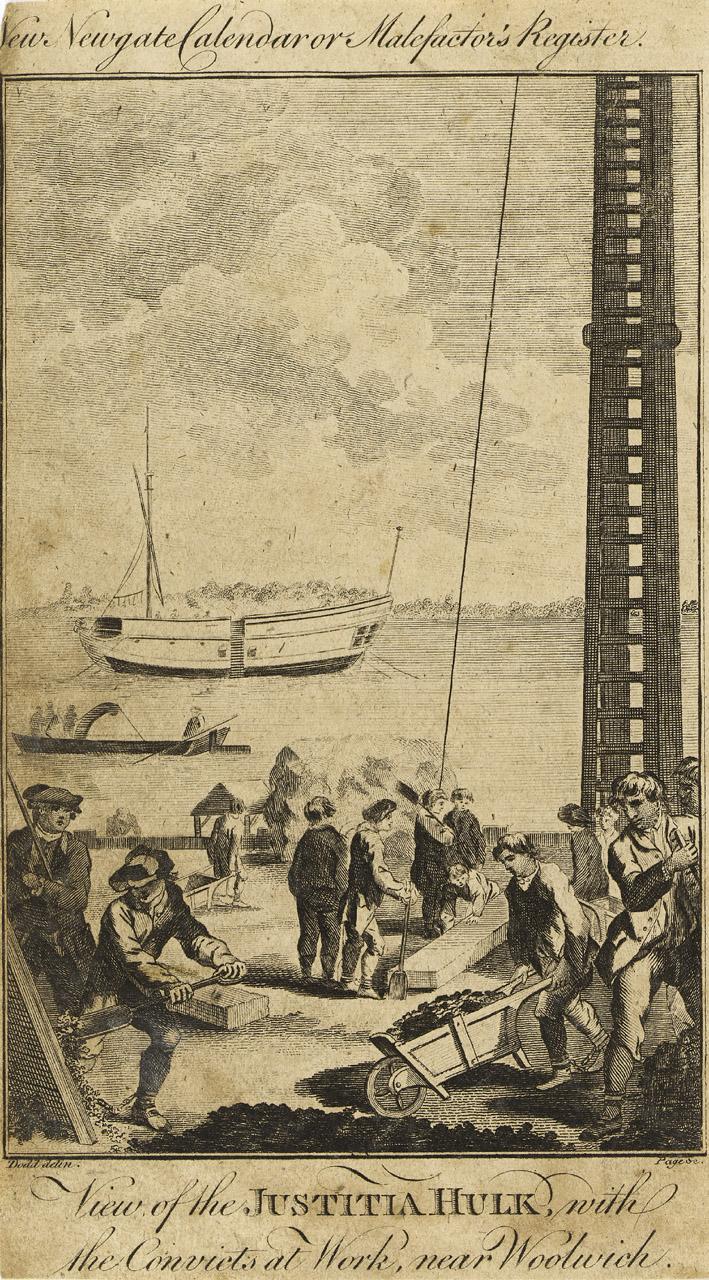
Convicts perform hard labour at the Woolwich Warren. The hulk on the river is the ‘Justitia’. Prisoners were kept on board such ships for months awaiting deportation to Australia. The ‘Justitia’ was a 260 ton prison hulk that had been originally moored in the Thames when the American War of Independence put a stop to the transportation of criminals to the former colonies. The ‘Justitia’ belonged to the shipowner Duncan Campbell, who was the Government contractor who organized the prison-hulk system at that time. Campbell was subsequently involved in the shipping of convicts to the penal colony at Botany Bay (in fact Port Jackson, later Sydney, just to the north) in New South Wales, the ‘first fleet’ going out in 1788.
While searching for records for Isaac Stokes I discovered that another Isaac Stokes was transported to New South Wales in 1835 as well. The other one was a butcher born in 1809, sentenced in London for seven years, and he sailed on the Mary Ann. Our Isaac Stokes sailed on the Lady Nugent, arriving in NSW in April 1835, having set sail from England in December 1834.
Lady Nugent was built at Bombay in 1813. She made four voyages under contract to the British East India Company (EIC). She then made two voyages transporting convicts to Australia, one to New South Wales and one to Van Diemen’s Land (Tasmania). (via Wikipedia)
via freesettlerorfelon website:
On 20 November 1834, 100 male convicts were transferred to the Lady Nugent from the Justitia Hulk and 60 from the Ganymede Hulk at Woolwich, all in apparent good health. The Lady Nugent departed Sheerness on 4 December 1834.
SURGEON OLIVER SPROULE
Oliver Sproule kept a Medical Journal from 7 November 1834 to 27 April 1835. He recorded in his journal the weather conditions they experienced in the first two weeks:
‘In the course of the first week or ten days at sea, there were eight or nine on the sick list with catarrhal affections and one with dropsy which I attribute to the cold and wet we experienced during that period beating down channel. Indeed the foremost berths in the prison at this time were so wet from leaking in that part of the ship, that I was obliged to issue dry beds and bedding to a great many of the prisoners to preserve their health, but after crossing the Bay of Biscay the weather became fine and we got the damp beds and blankets dried, the leaks partially stopped and the prison well aired and ventilated which, I am happy to say soon manifested a favourable change in the health and appearance of the men.
Besides the cases given in the journal I had a great many others to treat, some of them similar to those mentioned but the greater part consisted of boils, scalds, and contusions which would not only be too tedious to enter but I fear would be irksome to the reader. There were four births on board during the passage which did well, therefore I did not consider it necessary to give a detailed account of them in my journal the more especially as they were all favourable cases.
Regularity and cleanliness in the prison, free ventilation and as far as possible dry decks turning all the prisoners up in fine weather as we were lucky enough to have two musicians amongst the convicts, dancing was tolerated every afternoon, strict attention to personal cleanliness and also to the cooking of their victuals with regular hours for their meals, were the only prophylactic means used on this occasion, which I found to answer my expectations to the utmost extent in as much as there was not a single case of contagious or infectious nature during the whole passage with the exception of a few cases of psora which soon yielded to the usual treatment. A few cases of scurvy however appeared on board at rather an early period which I can attribute to nothing else but the wet and hardships the prisoners endured during the first three or four weeks of the passage. I was prompt in my treatment of these cases and they got well, but before we arrived at Sydney I had about thirty others to treat.’
The Lady Nugent arrived in Port Jackson on 9 April 1835 with 284 male prisoners. Two men had died at sea. The prisoners were landed on 27th April 1835 and marched to Hyde Park Barracks prior to being assigned. Ten were under the age of 14 years.
The Lady Nugent:
Isaac’s distinguishing marks are noted on various criminal registers and record books:
“Height in feet & inches: 5 4; Complexion: Ruddy; Hair: Light brown; Eyes: Hazel; Marks or Scars: Yes [including] DEVIL on lower left arm, TSIS back of left hand, WS lower right arm, MHDW back of right hand.”
Another includes more detail about Isaac’s tattoos:
“Two slight scars right side of mouth, 2 moles above right breast, figure of the devil and DEVIL and raised mole, lower left arm; anchor, seven dots half moon, TSIS and cross, back of left hand; a mallet, door post, A, mans bust, sun, WS, lower right arm; woman, MHDW and shut knife, back of right hand.”
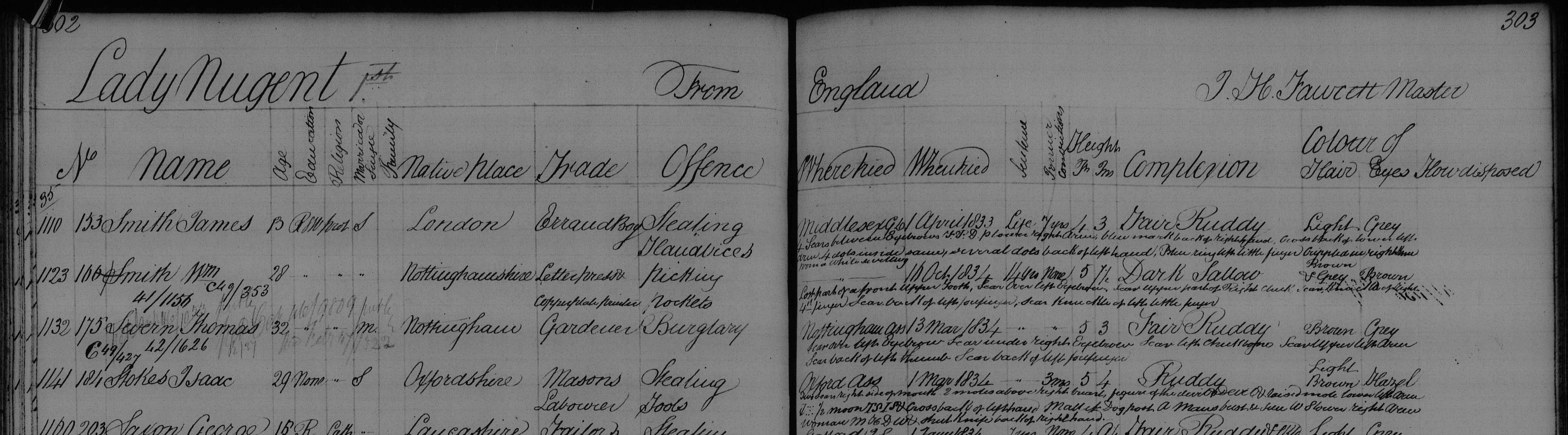
From How tattoos became fashionable in Victorian England (2019 article in TheConversation by Robert Shoemaker and Zoe Alkar):
“Historical tattooing was not restricted to sailors, soldiers and convicts, but was a growing and accepted phenomenon in Victorian England. Tattoos provide an important window into the lives of those who typically left no written records of their own. As a form of “history from below”, they give us a fleeting but intriguing understanding of the identities and emotions of ordinary people in the past.
As a practice for which typically the only record is the body itself, few systematic records survive before the advent of photography. One exception to this is the written descriptions of tattoos (and even the occasional sketch) that were kept of institutionalised people forced to submit to the recording of information about their bodies as a means of identifying them. This particularly applies to three groups – criminal convicts, soldiers and sailors. Of these, the convict records are the most voluminous and systematic.
Such records were first kept in large numbers for those who were transported to Australia from 1788 (since Australia was then an open prison) as the authorities needed some means of keeping track of them.”On the 1837 census Isaac was working for the government at Illiwarra, New South Wales. This record states that he arrived on the Lady Nugent in 1835. There are three other indent records for an Isaac Stokes in the following years, but the transcriptions don’t provide enough information to determine which Isaac Stokes it was. In April 1837 there was an abscondment, and an arrest/apprehension in May of that year, and in 1843 there was a record of convict indulgences.
From the Australian government website regarding “convict indulgences”:
“By the mid-1830s only six per cent of convicts were locked up. The vast majority worked for the government or free settlers and, with good behaviour, could earn a ticket of leave, conditional pardon or and even an absolute pardon. While under such orders convicts could earn their own living.”
In 1856 in Camden, NSW, Isaac Stokes married Catherine Daly. With no further information on this record it would be impossible to know for sure if this was the right Isaac Stokes. This couple had six children, all in the Camden area, but none of the records provided enough information. No occupation or place or date of birth recorded for Isaac Stokes.
I wrote to the National Library of Australia about the marriage record, and their reply was a surprise! Issac and Catherine were married on 30 September 1856, at the house of the Rev. Charles William Rigg, a Methodist minister, and it was recorded that Isaac was born in Edinburgh in 1821, to parents James Stokes and Sarah Ellis! The age at the time of the marriage doesn’t match Isaac’s age at death in 1877, and clearly the place of birth and parents didn’t match either. Only his fathers occupation of stone mason was correct. I wrote back to the helpful people at the library and they replied that the register was in a very poor condition and that only two and a half entries had survived at all, and that Isaac and Catherines marriage was recorded over two pages.
I searched for an Isaac Stokes born in 1821 in Edinburgh on the Scotland government website (and on all the other genealogy records sites) and didn’t find it. In fact Stokes was a very uncommon name in Scotland at the time. I also searched Australian immigration and other records for another Isaac Stokes born in Scotland or born in 1821, and found nothing. I was unable to find a single record to corroborate this mysterious other Isaac Stokes.
As the age at death in 1877 was correct, I assume that either Isaac was lying, or that some mistake was made either on the register at the home of the Methodist minster, or a subsequent mistranscription or muddle on the remnants of the surviving register. Therefore I remain convinced that the Camden stonemason Isaac Stokes was indeed our Isaac from Oxfordshire.
I found a history society newsletter article that mentioned Isaac Stokes, stone mason, had built the Glenmore church, near Camden, in 1859.
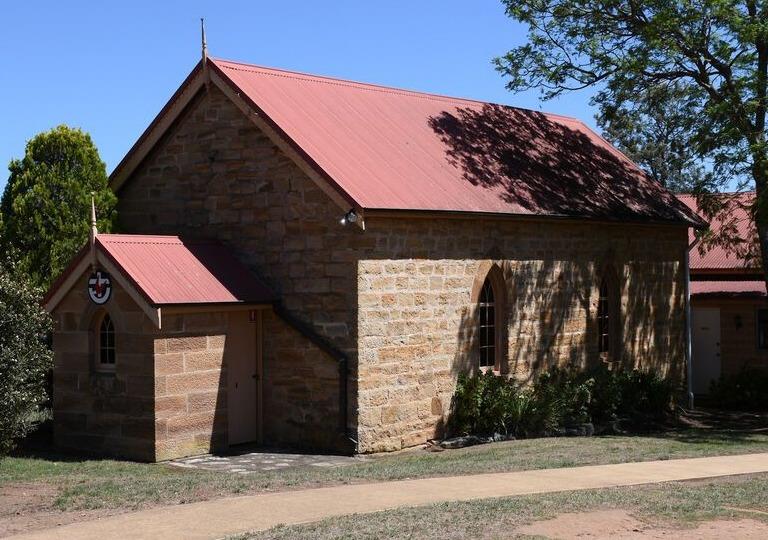
From the Wollondilly museum April 2020 newsletter:
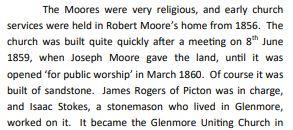
From the Camden History website:
“The stone set over the porch of Glenmore Church gives the date of 1860. The church was begun in 1859 on land given by Joseph Moore. James Rogers of Picton was given the contract to build and local builder, Mr. Stokes, carried out the work. Elizabeth Moore, wife of Edward, laid the foundation stone. The first service was held on 19th March 1860. The cemetery alongside the church contains the headstones and memorials of the areas early pioneers.”
Isaac died on the 3rd September 1877. The inquest report puts his place of death as Bagdelly, near to Camden, and another death register has put Cambelltown, also very close to Camden. His age was recorded as 71 and the inquest report states his cause of death was “rupture of one of the large pulmonary vessels of the lung”. His wife Catherine died in childbirth in 1870 at the age of 43.
Isaac and Catherine’s children:
William Stokes 1857-1928
Catherine Stokes 1859-1846
Sarah Josephine Stokes 1861-1931
Ellen Stokes 1863-1932
Rosanna Stokes 1865-1919
Louisa Stokes 1868-1844.
It’s possible that Catherine Daly was a transported convict from Ireland.
Some time later I unexpectedly received a follow up email from The Oaks Heritage Centre in Australia.
“The Gaudry papers which we have in our archive record him (Isaac Stokes) as having built: the church, the school and the teachers residence. Isaac is recorded in the General return of convicts: 1837 and in Grevilles Post Office directory 1872 as a mason in Glenmore.”
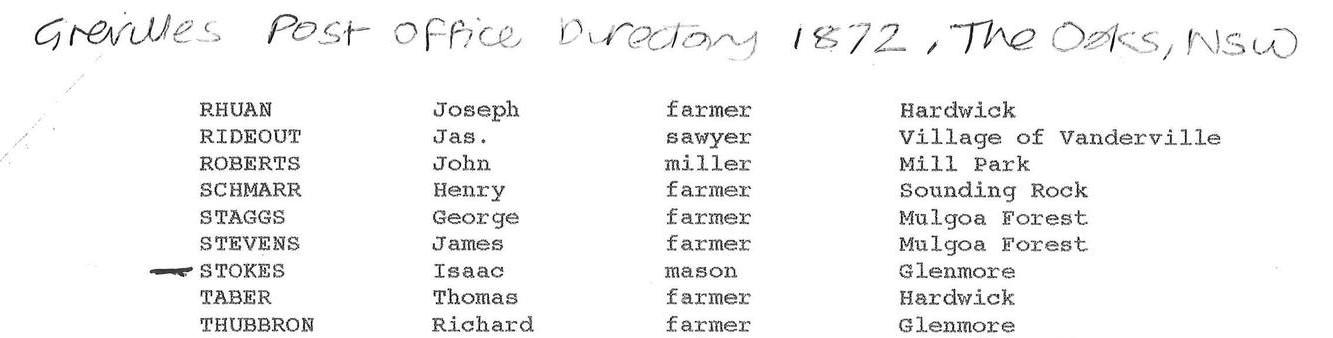 November 4, 2022 at 2:19 pm #6342
In reply to: Family Stories From The Other Side ~ Book Two
Brownings of Tetbury
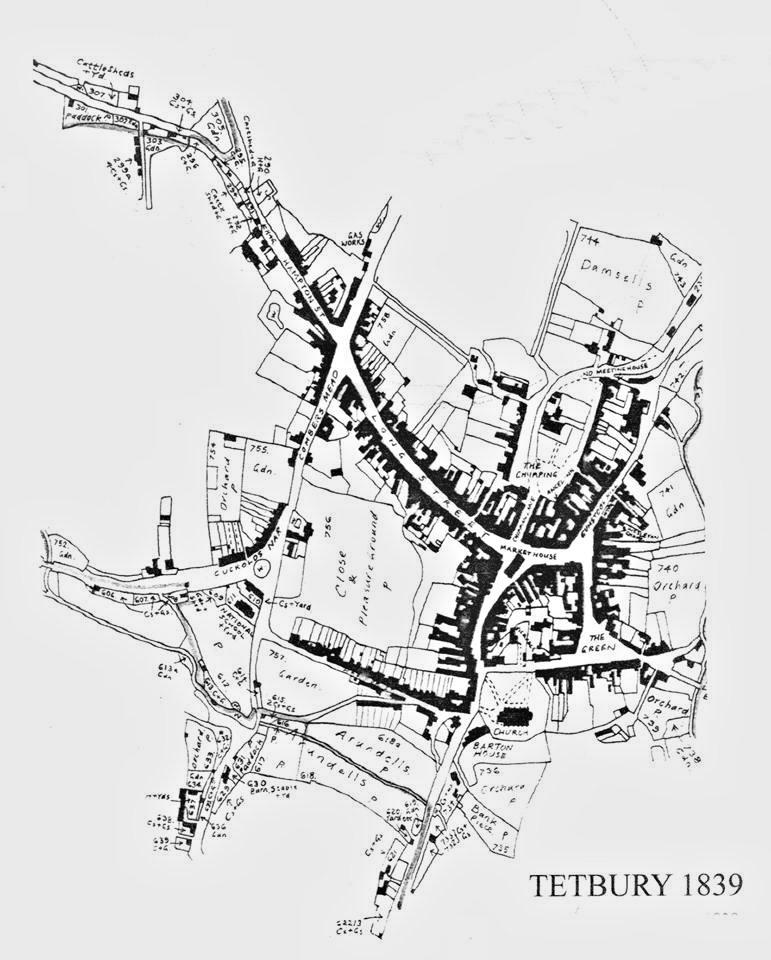
Isaac Browning (1784-1848) married Mary Lock (1787-1870) in Tetbury in 1806. Both of them were born in Tetbury, Gloucestershire. Isaac was a stone mason. Between 1807 and 1832 they baptised fourteen children in Tetbury, and on 8 Nov 1829 Isaac and Mary baptised five daughters all on the same day.
I considered that they may have been quintuplets, with only the last born surviving, which would have answered my question about the name of the house La Quinta in Broadway, the home of Eliza Browning and Thomas Stokes son Fred. However, the other four daughters were found in various records and they were not all born the same year. (So I still don’t know why the house in Broadway had such an unusual name).
Their son George was born and baptised in 1827, but Louisa born 1821, Susan born 1822, Hesther born 1823 and Mary born 1826, were not baptised until 1829 along with Charlotte born in 1828. (These birth dates are guesswork based on the age on later censuses.) Perhaps George was baptised promptly because he was sickly and not expected to survive. Isaac and Mary had a son George born in 1814 who died in 1823. Presumably the five girls were healthy and could wait to be done as a job lot on the same day later.
Eliza Browning (1814-1886), my great great great grandmother, had a baby six years before she married Thomas Stokes. Her name was Ellen Harding Browning, which suggests that her fathers name was Harding. On the 1841 census seven year old Ellen was living with her grandfather Isaac Browning in Tetbury. Ellen Harding Browning married William Dee in Tetbury in 1857, and they moved to Western Australia.
Ellen Harding Browning Dee: (photo found on ancestry website)
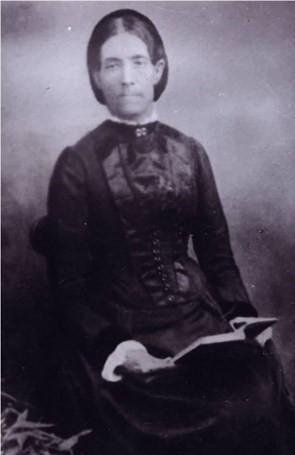
OBITUARY. MRS. ELLEN DEE.
A very old and respected resident of Dongarra, in the person of Mrs. Ellen Dee, passed peacefully away on Sept. 27, at the advanced age of 74 years.The deceased had been ailing for some time, but was about and actively employed until Wednesday, Sept. 20, whenn she was heard groaning by some neighbours, who immediately entered her place and found her lying beside the fireplace. Tho deceased had been to bed over night, and had evidently been in the act of lighting thc fire, when she had a seizure. For some hours she was conscious, but had lost the power of speech, and later on became unconscious, in which state she remained until her death.
The deceased was born in Gloucestershire, England, in 1833, was married to William Dee in Tetbury Church 23 years later. Within a month she left England with her husband for Western Australian in the ship City oí Bristol. She resided in Fremantle for six months, then in Greenough for a short time, and afterwards (for 42 years) in Dongarra. She was, therefore, a colonist of about 51 years. She had a family of four girls and three boys, and five of her children survive her, also 35 grandchildren, and eight great grandchildren. She was very highly respected, and her sudden collapse came as a great shock to many.
Eliza married Thomas Stokes (1816-1885) in September 1840 in Hempstead, Gloucestershire. On the 1841 census, Eliza and her mother Mary Browning (nee Lock) were staying with Thomas Lock and family in Cirencester. Strangely, Thomas Stokes has not been found thus far on the 1841 census, and Thomas and Eliza’s first child William James Stokes birth was registered in Witham, in Essex, on the 6th of September 1841.
I don’t know why William James was born in Witham, or where Thomas was at the time of the census in 1841. One possibility is that as Thomas Stokes did a considerable amount of work with circus waggons, circus shooting galleries and so on as a journeyman carpenter initially and then later wheelwright, perhaps he was working with a traveling circus at the time.
But back to the Brownings ~ more on William James Stokes to follow.
One of Isaac and Mary’s fourteen children died in infancy: Ann was baptised and died in 1811. Two of their children died at nine years old: the first George, and Mary who died in 1835. Matilda was 21 years old when she died in 1844.
Jane Browning (1808-) married Thomas Buckingham in 1830 in Tetbury. In August 1838 Thomas was charged with feloniously stealing a black gelding.
Susan Browning (1822-1879) married William Cleaver in November 1844 in Tetbury. Oddly thereafter they use the name Bowman on the census. On the 1851 census Mary Browning (Susan’s mother), widow, has grandson George Bowman born in 1844 living with her. The confusion with the Bowman and Cleaver names was clarified upon finding the criminal registers:
30 January 1834. Offender: William Cleaver alias Bowman, Richard Bunting alias Barnfield and Jeremiah Cox, labourers of Tetbury. Crime: Stealing part of a dead fence from a rick barton in Tetbury, the property of Robert Tanner, farmer.
And again in 1836:
29 March 1836 Bowman, William alias Cleaver, of Tetbury, labourer age 18; 5’2.5” tall, brown hair, grey eyes, round visage with fresh complexion; several moles on left cheek, mole on right breast. Charged on the oath of Ann Washbourn & others that on the morning of the 31 March at Tetbury feloniously stolen a lead spout affixed to the dwelling of the said Ann Washbourn, her property. Found guilty 31 March 1836; Sentenced to 6 months.
On the 1851 census Susan Bowman was a servant living in at a large drapery shop in Cheltenham. She was listed as 29 years old, married and born in Tetbury, so although it was unusual for a married woman not to be living with her husband, (or her son for that matter, who was living with his grandmother Mary Browning), perhaps her husband William Bowman alias Cleaver was in trouble again. By 1861 they are both living together in Tetbury: William was a plasterer, and they had three year old Isaac and Thomas, one year old. In 1871 William was still a plasterer in Tetbury, living with wife Susan, and sons Isaac and Thomas. Interestingly, a William Cleaver is living next door but one!
Susan was 56 when she died in Tetbury in 1879.
Three of the Browning daughters went to London.
Louisa Browning (1821-1873) married Robert Claxton, coachman, in 1848 in Bryanston Square, Westminster, London. Ester Browning was a witness.
Ester Browning (1823-1893)(or Hester) married Charles Hudson Sealey, cabinet maker, in Bethnal Green, London, in 1854. Charles was born in Tetbury. Charlotte Browning was a witness.
Charlotte Browning (1828-1867?) was admitted to St Marylebone workhouse in London for “parturition”, or childbirth, in 1860. She was 33 years old. A birth was registered for a Charlotte Browning, no mothers maiden name listed, in 1860 in Marylebone. A death was registered in Camden, buried in Marylebone, for a Charlotte Browning in 1867 but no age was recorded. As the age and parents were usually recorded for a childs death, I assume this was Charlotte the mother.
I found Charlotte on the 1851 census by chance while researching her mother Mary Lock’s siblings. Hesther Lock married Lewin Chandler, and they were living in Stepney, London. Charlotte is listed as a neice. Although Browning is mistranscribed as Broomey, the original page says Browning. Another mistranscription on this record is Hesthers birthplace which is transcribed as Yorkshire. The original image shows Gloucestershire.
Isaac and Mary’s first son was John Browning (1807-1860). John married Hannah Coates in 1834. John’s brother Charles Browning (1819-1853) married Eliza Coates in 1842. Perhaps they were sisters. On the 1861 census Hannah Browning, John’s wife, was a visitor in the Harding household in a village called Coates near Tetbury. Thomas Harding born in 1801 was the head of the household. Perhaps he was the father of Ellen Harding Browning.
George Browning (1828-1870) married Louisa Gainey in Tetbury, and died in Tetbury at the age of 42. Their son Richard Lock Browning, a 32 year old mason, was sentenced to one month hard labour for game tresspass in Tetbury in 1884.
Isaac Browning (1832-1857) was the youngest son of Isaac and Mary. He was just 25 years old when he died in Tetbury.
-
AuthorSearch Results
Search Results for 'neighbour'
-
Search Results
-
A background on the excavated mysteries from Twists and One Return From the Time Capsule.
BACKGROUND CONTENT: Focus is on key protagonists:
- Clara (a woman in her late 40s, taking care of her father, living the two of them with her Malinois dog VanGogh),
- her father Bob (a widowed man with early stage dementia, who can see and speak to his dead wife Jane)
- and Nora (nicknamed Alienor, Clara’s friend, a local thrill-seeking artist and amateur archaeologist)
in an story of discovery around a mystery of a box (which is a Time Capsule found by Clara’s dog VanGogh) during a time and place of travel restrictions (and possibly time-travel restrictions).
Tone of story is curious and engrossed with a mystery of the ages, some supernatural grounded in plausibility, looking for connecting dots with the past sometimes long gone, and a present that slips away in our memories.
An encounter with the mysterious Will (possibly Will Tarkin), who seems nice and seductive yet acts unscrupulously and manipulative (seemingly recognising Bob from somewhere), could be the key to a big reveal, and possible links to Jane’s pasts. All while struggling to keep away the nosy neighbour.
The conclusion will bring some realisations about the power of memories, the ties between living and dead, and how things never remain buried for long.