

Search Results for 'piece'
-
AuthorSearch Results
-
February 23, 2023 at 7:43 am #6634
In reply to: Prompts of Madjourneys
The next quest is going to be a group quest for Zara, Yasmin, Xavier and Youssef. It will require active support and close collaboration to focus on a single mystery at first not necessarily showing connection or interest to all members of the group, but completing it will show how all things are interconnected. It may start inside the game at the hidden library underground the Flying Fish Inn.
Quirk offered for this: getting lost in the mines of creativity, and struggle to complete the chapters of the book of Story to a satisfactory conclusion.
Quirk accepted.
The group finds themselves in the hidden library underground the Flying Fish Inn, surrounded by books and manuscripts. They come across a particularly old and mysterious book titled “The Lost Pages of Creativity.” The book contains scattered chapters, each written by a different author, but the group soon realizes that they are all interconnected and must be completed in order to unlock the mystery of the book’s true purpose.
Each chapter presents a different challenge related to creativity, ranging from writing a poem to creating a piece of art. The group must work together to solve each challenge, bringing their individual skills and perspectives to the table. As they complete each chapter, they will uncover clues that lead them deeper into the mystery.
Their ultimate goal is to find the missing pages of the book, which are scattered throughout the inn and surrounding areas. They will need to use their problem-solving skills and work together to find and piece together the missing pages in the correct order to unlock the true purpose of the book.
To begin, the group is given a clue to start their search for the first missing page: “In the quietest place, the loudest secrets are kept.” They must work together to decipher the clue and find the missing page. Once found, they must insert the corresponding tile into the game to progress to the next chapter. Proof of the insert should be provided in real life.
Each of the four characters are provided with a personal clue:
Zara: “Amidst the foliage and bark, A feather and a beak in the dark 🌳🍃🐦🕯️🌑”
Yasmin: “In the depths of the ocean blue, A key lies waiting just for you 🌊🔑🧜♀️🐚🕰️”
Xavier: “Seeking knowledge both new and old, Find the owl with eyes of gold 📚🦉💡🔍🕰️”
Youssef: “Amongst the sands and rocky dunes, A lantern flickers, a key it looms 🏜️🪔🔍🔑🕯️”
Each of these clues hints at a specific location or object that the character needs to find in order to progress in the game.
February 21, 2023 at 9:10 am #6615In reply to: Orbs of Madjourneys
Like ships in the night, Zara and Yasmin still hadn’t met up with Xavier and Youssef at the inn. Yasmin was tired from traveling and retired to her room to catch up on some sleep, despite Zara’s hopes that they’d have a glass of wine or two and discuss whatever it was that was on Yasmins mind. Zara decided to catch up on her game.
The next quirk was “unleash your hidden rudeness” which gave Zara pause to consider how hidden her rudeness actually was. But wait, it was the avatar Zara, not herself. Or was it? Zara rearranged the pillows and settled herself on the bed.
Zara found her game self in the bustling streets of a medieval market town, visually an improvement on the previous game level of the mines, which pleased her, with many colourful characters and intriguing alleyways and street market vendors.
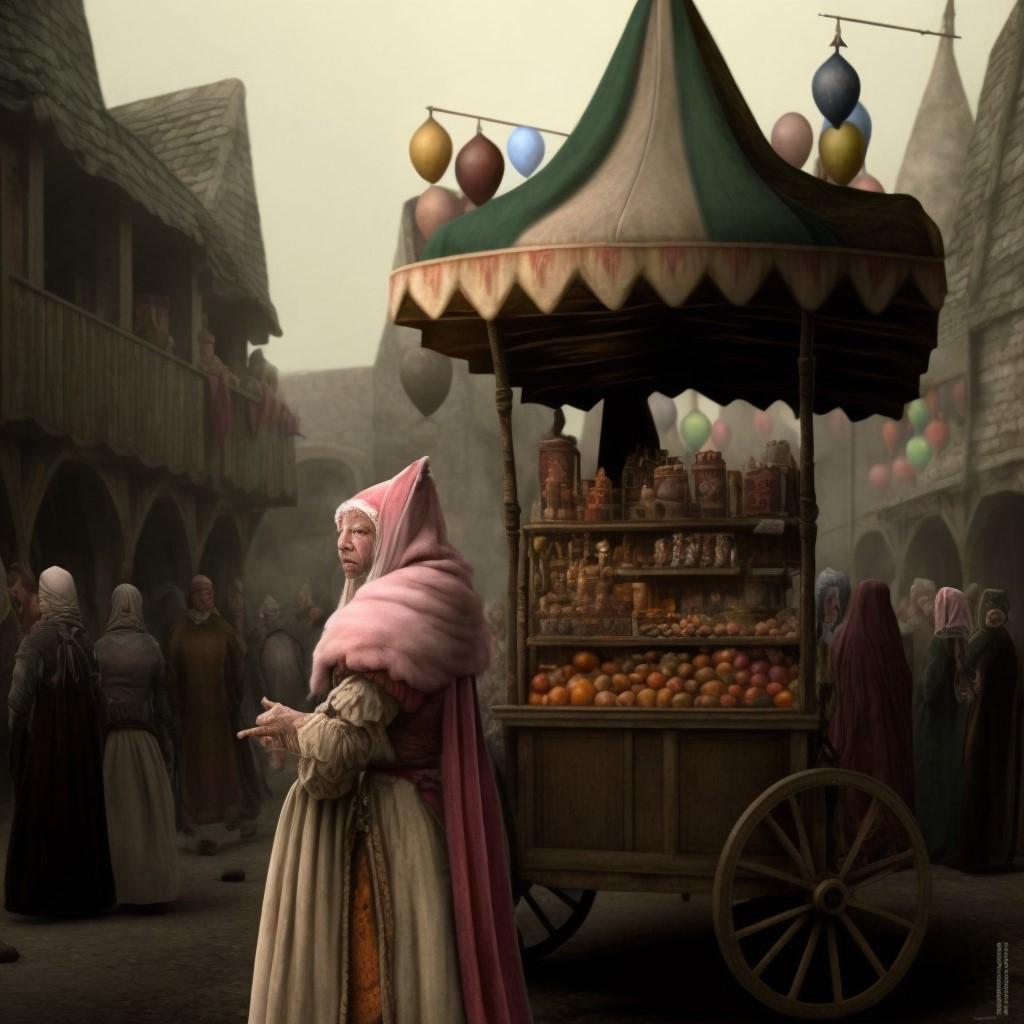
She quickly forgot what her quest was and set off wandering around the scene. Each alley led to a little square and each square had gaily coloured carts of wares for sale, and an abundance of grinning jesters and jugglers. Although tempted to linger and join the onlookers jeering and goading the jugglers and artistes that she encountered, Zara continued her ramble around the scene.
She came to a gathering outside an old market hall, where two particularly raucous jesters were trying to tempt the onlookers into partaking of what appeared to be cups of tea. Zara wondered what the joke was and why nobody in the crowd was willing to try. She inched closer, attracting the attention of the odd grinning fellow in the orange head piece.
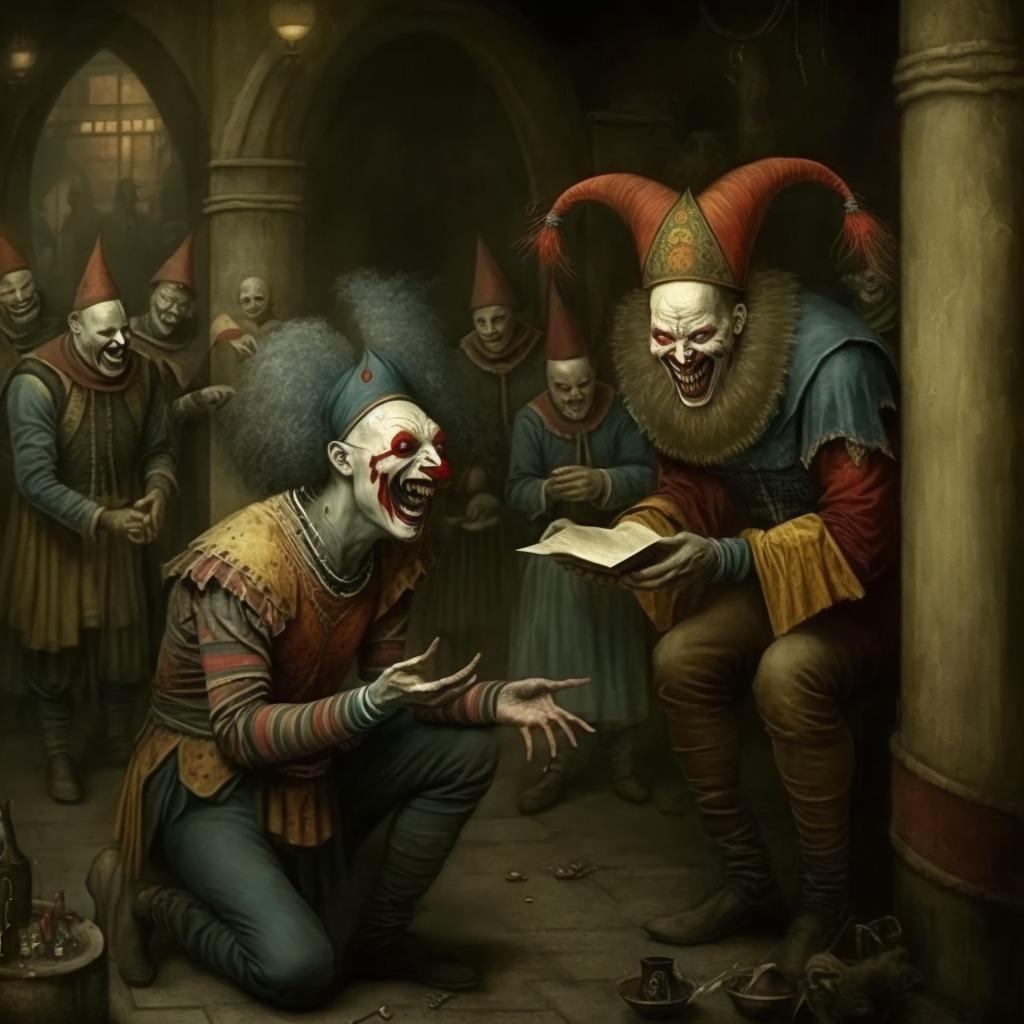
“Come hither, ye fine wench in thy uncomely scant garments, I know what thou seekest! Pray, sit thee down beside me and partake of my remedy.”
“Who, me?” asked Zara, looking behind her to make sure he wasn’t talking to someone else.
“Thoust in dire need of my elixir, come ye hither!”
Somewhat reluctantly Zara stepped towards the odd figure who was offering to hand her a cup. She considered the inadvisability of drinking something that everyone else was refusing, but what the hell, she took the cup and saucer off him and took a hesitant sip.
The crowd roared with laughter and there was much mirthful thigh slapping when Zara spit the foul tasting concoction all over the jesters shoes.
“Believe me dame,” quoth the Jester, “I perceive proffered ware is worse by ten in the hundred than that which is sought. But I pray ye, tell me thy quest.”
“My quest is none of your business, and your tea sucks, mister,” Zara replied. “But I like the cup.”
Pushing past the still laughing onlookers and clutching the cup, Zara spotted a tavern on the opposite side of the square and made her way towards it. A tankard of ale was what she needed to get rid of the foul taste lingering in her mouth.
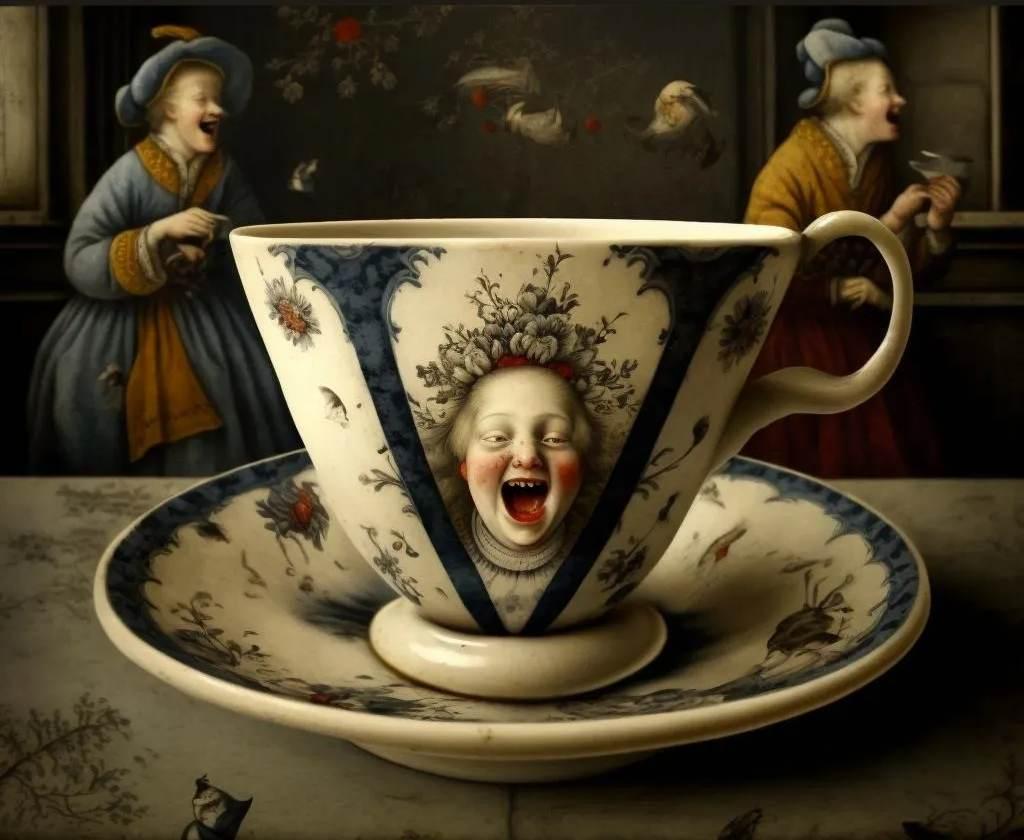
The inside of the tavern was as much a madhouse as the streets outside it. What was everyone laughing at? Zara found a place to sit on a bench beside a long wooden table. She sat patiently waiting to be served, trying to eavesdrop to decipher the cause of such merriment, but the snatches of conversation made no sense to her. The jollity was contagious, and before long Zara was laughing along with the others. A strange child sat down on the opposite bench (she seemed familiar somehow) and Zara couldn’t help remarking, “You lot are as mad as a box of frogs, are you all on drugs or something?” which provoked further hoots of laughter, thigh slapping and table thumping.
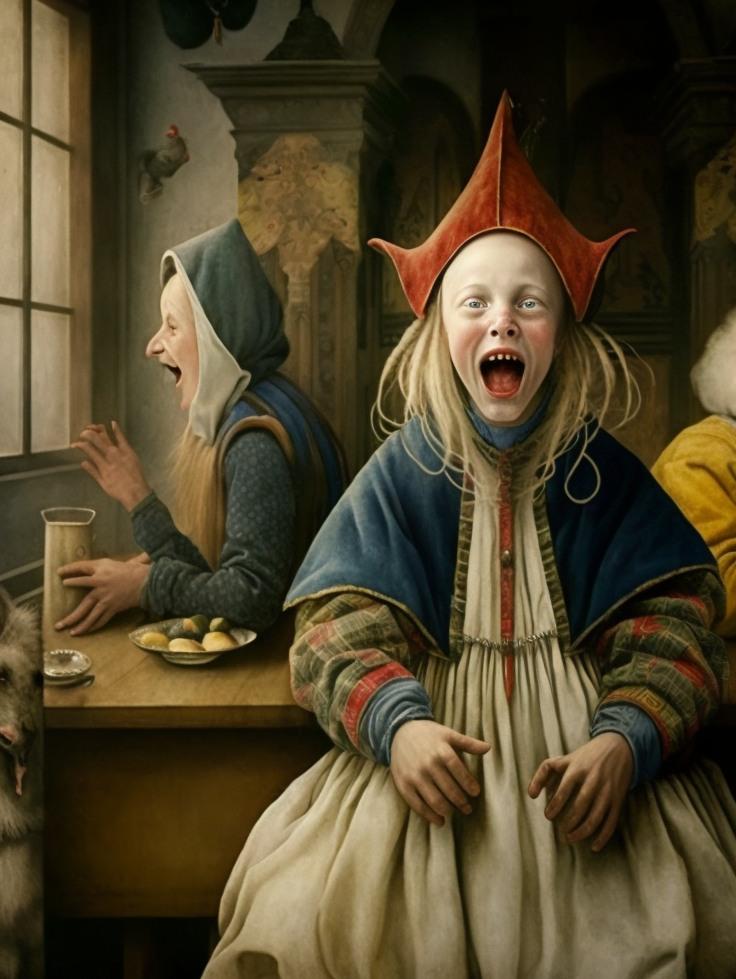
“Ye be an ungodly rude maid, and ye’ll not get a tankard of ale while thoust leavest thy cup of elixir untasted yet,” the child said with a smirk.
“And you are an impertinent child,” Zara replied, considering the potential benefits of drinking the remainder of the concoction if it would hasten the arrival of the tankard of ale she was now craving. She gritted her teeth and picked up the cup.
But the design on the cup had changed, and now bore a strange resemblance to Xavier. Not only that, the cup was calling her name in Xavier’s voice, and the table thumping got louder.
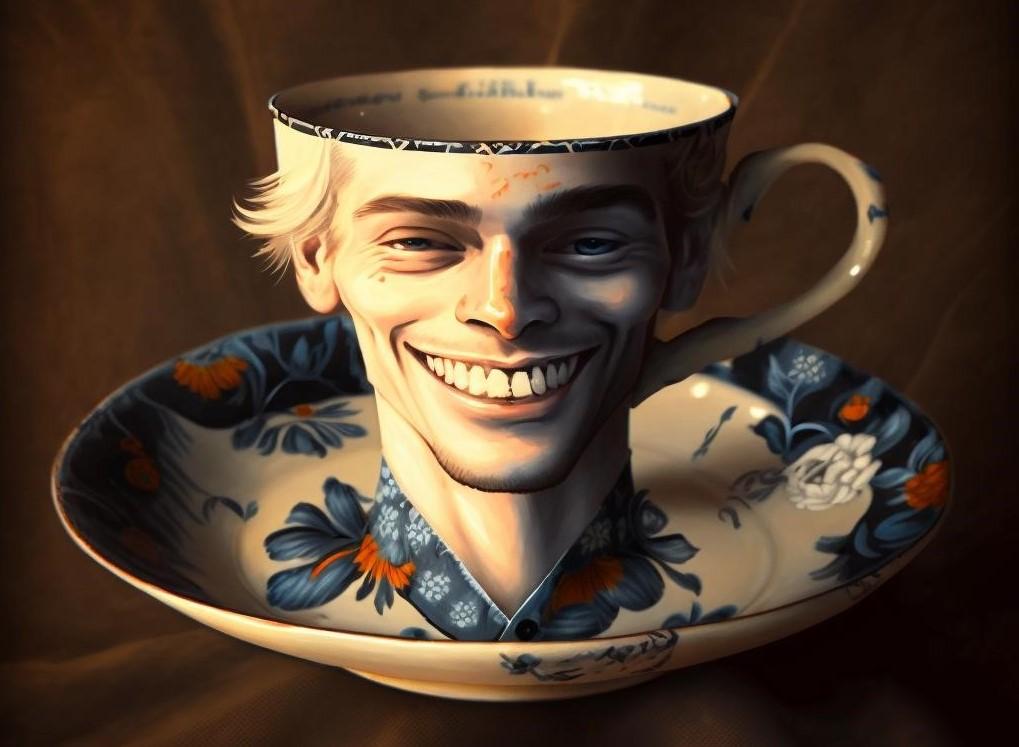
“Zara!” Xavier was knocking on her bedroom door. “Zara! We’re going for a beer in the local tavern, are you coming?”
“Xavi!” Zara snapped back to reality, “Yes! I’m bloody parched.”
February 18, 2023 at 11:28 am #6551In reply to: Orbs of Madjourneys
Xavier had woken up in the middle of the night that felt surprisingly alive bursting with a quiet symphony of sounds from nocturnal creatures and nearby nature, painted on a canvas of eerie spacious silence.
It often took him a while to get accustomed to any new place, and it was not uncommon for him to have his mind racing in the middle of the night. Generally Brytta had a soothing presence and that often managed to nudge him back to sleep, otherwise, he would simply wake up until the train of thoughts had left the station.
It was beginning of the afternoon in Berlin; Brytta would be in a middle of a shift, so he recorded a little message for her to find when she would get back to her phone. It was funny to think they’d met thanks to Yasmin and Zara, at the time the three girls were members of the same photography club, which was called ‘Focusgroupfocus’ or something similar…
With that done, he’d turned around for something to do but there wasn’t much in the room to explore or to distract him sufficiently. Not even a book in the nightstand drawer. The decoration itself had a mesmerising nature, but after a while it didn’t help with the racing thoughts.He was tempted to check in the game — there was something satisfactory in finishing a quest that left his monkey brain satiated for a while, so he gave in and logged back in.

Completing the quest didn’t take him too long this time. The main difficulty initially was to find the portal from where his avatar had landed. It was a strange carousel of blue storks that span into different dimensions one could open with the proper incantation.
As usual, stating the quirk was the key to the location, and the carousel portal propelled him right away to Midnight town, which was clearly a ghost town in more ways than one. Interestingly, he was chatting on the side with Glimmer, who’d run into new adventures of her own while continuing to ask him what was up, and as soon as he’d reached Midnight town, all communication channels suddenly went dark. He’d laughed to himself thinking how frustrated Glimmer would have been about that. But maybe the game took care of sending her AI-generated messages simulating his presence. Despite the disturbing thought of having an AI generated clone of himself, he almost hoped for it (he’d probably signed the consent for this without realising), so that he wouldn’t have to do a tedious recap about all what she’d missed.
Once he arrived in the town, the adventure followed a predictable pattern. The clues were also rather simple to follow.
The townspeople are all frozen in time, stuck in their daily routines and unable to move on. Your mission is to find the missing piece of continuity, a small hourglass that will set time back in motion and allow the townspeople to move forward.
The clue to finding the hourglass lies within a discarded pocket watch that can be found in the mayor’s office. You must unscrew the back and retrieve a hidden key. The key will unlock a secret compartment in the town clock tower, where the hourglass is kept.
Be careful as you search for the hourglass, as the town is not as abandoned as it seems. Spectral figures roam the streets, and strange whispers can be heard in the wind. You may also encounter a mysterious old man who seems to know more about the town’s secrets than he lets on.
Evading the ghosts and spectres wasn’t too difficult once you got the hang of it. The old man however had been quite an elusive figure to find, but he was clearly the highlight of the whole adventure; he had been hiding in plain sight since the beginning of the adventure. One of the blue storks in the town that he’d thought had come with him through the portal was in actuality not a bird at all.
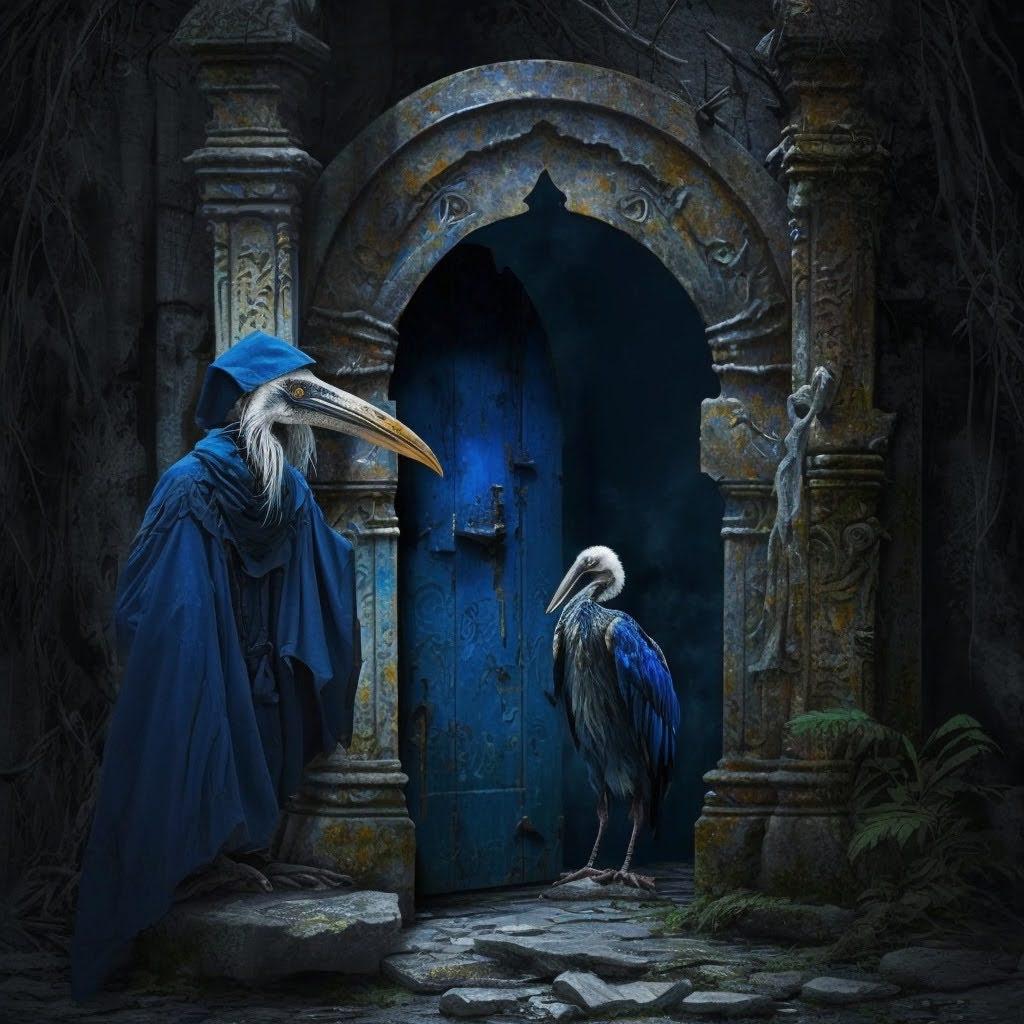
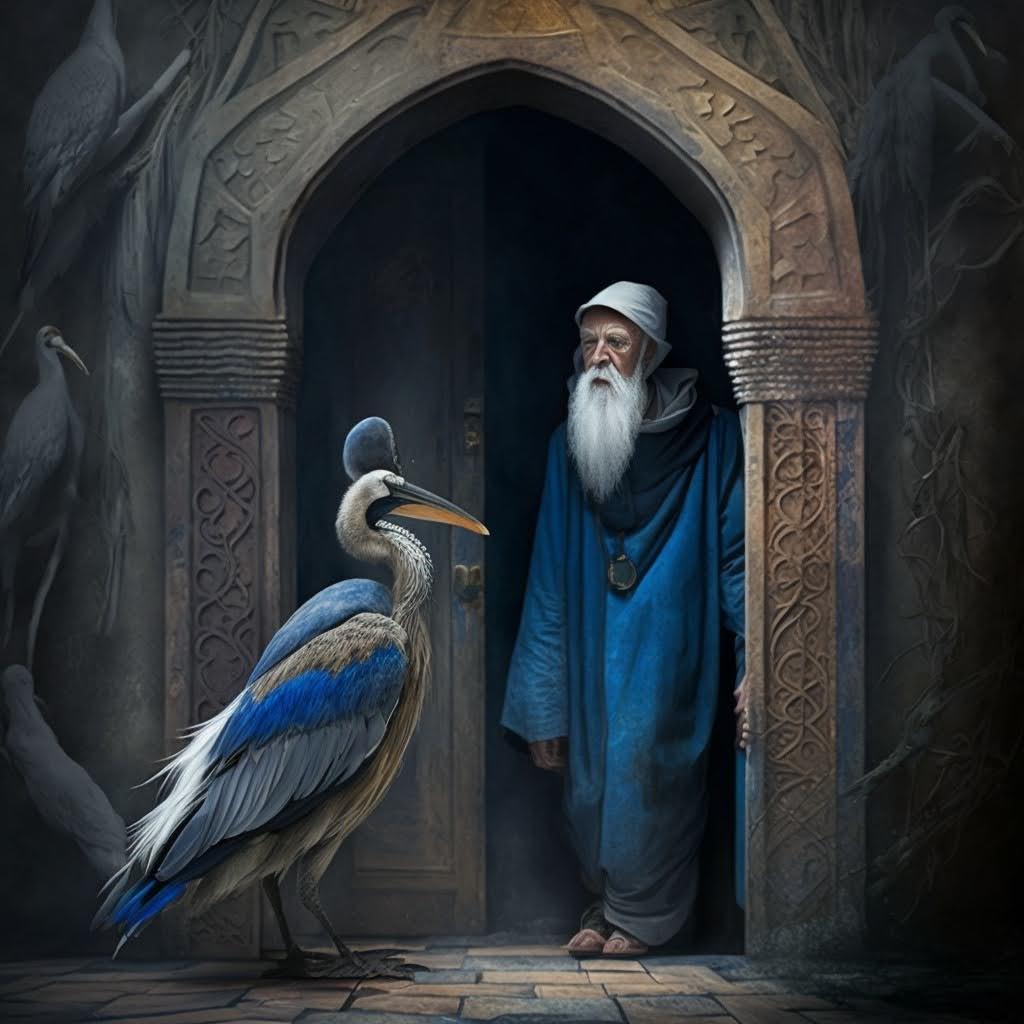
While he was focused on finishing the quest, the interaction with the hermit didn’t seem very helpful. Was he really from the game construct? When it was time to complete the quest and turn the hourglass to set the town back in motion, and resume continuity, some of his words came back to Xavier.
“The town isn’t what it seems. Recognise this precious moment where everything is still and you can realise it for the illusion that it is, a projection of your busy mind. When motion resumes, you will need to keep your mind quiet. The prize in the quest is not the completion of it, but the realisation you can stop the agitation at any moment, and return to what truly matters.”
The hermit had turned to him with clear dark eyes and asked “do you know what you are seeking in these adventures? do you know what truly matters to you?”
When he came out of the game, his quest completed, Xavier felt the words resonate ominously.
A buzz of the phone snapped him out of it.
It was a message from Zara. Apparently she’d found her way back to modernity.
[4:57] “Going to pick up Yasmin at the airport. You better sleep away the jetlag you lazy slugs, we have poultry damn plenty planned ahead – cackling bugger cooking lessons not looking forward to, but can be fun. Talk to you later. Z”
He had the impulse to go with her, but the lack of sleep was hitting back at him now, and he thought he’d better catch some so he could manage to realign with the timezone.
“The old man was right… that sounds like a lot of agitation coming our way…”
February 13, 2023 at 10:38 pm #6543In reply to: Orbs of Madjourneys
The road was stretching endlessly and monotonously, a straight line disappearing into a nothingness of dry landscapes that sounded a bit depressing. At regular speed, the car barely seemed to progress, and Youssef was rather serious at the wheel. Soon Xavier was left depleted of jokes to tell (even the bad ones which tended to come off easily with sleep deprivation), so he tried to catch some of the patchy network signal to reconnect where he’d left off on the game. There wasn’t much network, and all he could download in the car, even with the game in lo-fi mode, was a measly text message with the starter for his new challenge.
Your quest takes place in the ghost town of Midnight, where time seems to have stood still. The townspeople are all frozen in time, stuck in their daily routines and unable to move on. Your mission is to find the missing piece of continuity, a small hourglass that will set time back in motion and allow the townspeople to move forward.
A ghost town seemed apt indeed.
The welcome signs at the entrance of the town for their hostel were rather uninviting, but a festive banner mentioning the local “Lager and Carts festival” caught his attention. He counted the days. It would be next week-end; there was a good chance they’d still be there, the four of them. At least some action to look forward to!
When he and Youssef arrived at the Inn after that rather uneventful and terribly long drive, all they wanted was to get a shower and some sleep. Zara wasn’t back yet from her trip, but they both figured out they’d meet at breakfast in the morning.
The old lady with the sharp tongue had shown them their rooms rather unceremoniously; she was too busy ranting about an idle person not taking their *one job* seriously to care about details. Xavier almost asked for a wifi, but then thought better and decided to hold his question until he found someone to ask who was born in his century.
Xavier took room 7, and Youssef room 5.The rooms were quite nicely decorated. It reminded him of something he’d read in the plane from a commentary of the Bardo Thodöl:
In Tibetan the word for body is lü, which means “something you leave behind,” like baggage. Each time we say “lü,” it reminds us that we are only travelers, taking temporary refuge in this life and this body. So in Tibet people did not distract themselves by spending all their time trying to make their external circumstances more comfortable. They were satisfied if they had enough to eat, clothes on their backs, and a roof over their heads. Going on as we do, obsessively trying to improve our conditions, can become an end in itself and a pointless distraction. Would anyone in their right mind think of fastidiously redecorating their hotel room every time they booked into one?
— The Tibetan Book of Living and Dying
At least, he wasn’t feeling compelled to redecorate this room; it was perfect. The shared sanitaries, the boiler and the piping were another story, but that was probably coming from the same era as the owner, nice as she was.
After having unpacked his few belongings, and taken a hot shower, he laid on the bed looking at the ceiling, which was blank and made a nice contrast to the ornate walls full of colorful dots.
Luckily, searching through the signals available, he could see there was mostly one, and without any password. With the next neighbour a few miles away, no wonder nobody bothered with security.
He connected to AL to check a few parameters — there seemed to be some degenerescence in the programme output that wasn’t satisfactory, and he was wondering if some self-repair or training reinforcement mechanisms were missing. At the moment, nothing too pressing, but he would keep an eye on them.
Still no words from Yasmin… he thought drifting to sleep… I half expected her to be there already…
February 8, 2023 at 10:27 pm #6515In reply to: Prompts of Madjourneys
Yasmin offered the following quirk: “sounding like a lunatic when I share synchs” (synchronicity) – getting excited when she gets “answers”, and willing to share generously. She wouldn’t fake it, as she’s not capable of lying and stuff like synchs are sacrosanct in her mind.
Setting for the game is the next random quote from the story.Quirk accepted.
In the Land of Quirk, Yasmin finds herself in the heart of a hidden library, deep in the basement of the Flying Fish Inn. The library is filled with books and artifacts related to the study of synchronicities and the beyond.
As Yasmin delves deeper into the library, she comes across an ancient book that seems to hold the secrets of the universe. She eagerly opens it, but finds that it is written in a code that she cannot understand.
The librarian, a wise old owl, appears and greets Yasmin. He tells her that the book is the Key to the Beyond and that only the purest of heart can decode it. He explains that the code can only be unlocked by finding the missing pieces of a puzzle scattered throughout the library.
Yasmin’s task is to find the missing pieces of the puzzle and put them together to unlock the code. Along the way, she will meet various characters who will provide her with clues and challenges.
Proof of completion in real life: Yasmin must find a real-life object that relates to a synchronicity that she experiences while on her quest in the Land of Quirk. She must then share this synchronicity with her friends at the Flying Fish Inn to prove that she has completed her quest.
Good luck, Yasmin!
February 8, 2023 at 10:08 pm #6514In reply to: Prompts of Madjourneys
Xavier offered the following quirk: “being the holder of continuity”
Quirk accepted.
Your quest takes place in the ghost town of Midnight, where time seems to have stood still. The townspeople are all frozen in time, stuck in their daily routines and unable to move on. Your mission is to find the missing piece of continuity, a small hourglass that will set time back in motion and allow the townspeople to move forward.
The clue to finding the hourglass lies within a discarded pocket watch that can be found in the mayor’s office. You must unscrew the back and retrieve a hidden key. The key will unlock a secret compartment in the town clock tower, where the hourglass is kept.
Be careful as you search for the hourglass, as the town is not as abandoned as it seems. Spectral figures roam the streets, and strange whispers can be heard in the wind. You may also encounter a mysterious old man who seems to know more about the town’s secrets than he lets on.
Proof of completion can be shown by taking a photo of the hourglass and the pocket watch, and sending it to the game’s creators.
Good luck!
February 7, 2023 at 9:54 pm #6509In reply to: A Dog and a Dig – The trenches of the Time Capsule
Table of characters:
Characters Keyword Characteristics Sentiment Clara Woman in her late 40s, VanGogh’s owner Inquisitive, curious VanGogh Clara’s dog Curious Grandpa Bob Clara’s grandfather, widowed, early signs of dementia Skeptical, anxious Nora Clara’s friend, amateur archaeologist, nicknamed Alienor by Clara Adventure-seeking Jane Grandpa Bob’s wife, Clara’s mother, only Bob seem to see her, possibly a hallucination Teasing Julienne / Mr. Willets Neighbors of Clara & Bob – Bubbles (Time-dragglers squad, alternate timeline) Junior drag-queen, reporting to Linda Pol (office manager) adventurous, brave, concerned Will After Nora encountered a man with a white donkey, she awakes in a cottage. Will is introduced later, and drugs Nora unbeknownst to her. Later Bob & Clara come at his doorstep (they know him as the gargoyle statues selling man from the market), looking for her friend. Affable, mysterious, hiding secrets Some connecting threads:
- The discovery of a mysterious pear-shaped box with inscriptions by Clara and her grandfather.
- Clara sending photos of the artifact to Nora (Alienor), an amateur archaeologist.
- Nora’s journey from her place to reach the location where the box was discovered and her encounter with a man with a donkey (Will?).
- Grandpa Bob’s anxious behavior and the confusion over the torn piece of paper with a phone number.
- The parallel timeline of a potential breach in the timelines in Linda Pol’s office.
- The search for VanGogh and the discovery of a map tucked into his collar.
- The suggestion from Jane that Clara should be told something.
- Nora awakes at a cottage and spends time with Will who drugs her soup. Bob & Clara show up later, looking for her.
February 3, 2023 at 9:50 am #6494In reply to: Orbs of Madjourneys
Although not one to remember dreams very often, Zara awoke the next morning with vivid and colourful dream recall. She wondered if it was something to do with the dreamtime mural on the wall of her room. If this turned out to be the case, she considered painting some murals on her bedroom wall back at the Bungwalley Valley animal rescue centre when she got home.
Zara and Idle had hit it off immediately, chatting and laughing on the verandah after supper. Idle told her a bit about the local area and the mines. Despite Bert’s warnings, she wanted to see them. They were only an hour away from the inn.
When she retired to her room for the night, she looked on the internet for more information. The more she read online about the mines, the more intrigued she became.
“Interestingly there are no actual houses left from the original township. The common explanation is that a rumour spread that there was gold hidden in the walls of the houses and consequently they were knocked down by people believing there was ‘gold in them there walls”. Of course it was only a rumour. No gold was found.”
“Miners attracted to the area originally by the garnets, found alluvial and reef gold at Arltunga…”
Garnets! Zara recalled the story her friend had told her about finding a cursed garnet near a fort in St Augustine in Florida. Apparently there were a number of mines that one could visit:
“the MacDonnell Range Reef Mine, the Christmas Reef Mine, the Golden Chance Mine, the Joker Mine and the Great Western Mine all of which are worth a visit.”
Zara imagined Xavier making a crack about the Joker Mine, and wondered why it had been named that.
“The whole area is preserved as though the inhabitants simply walked away from it only yesterday. The curious visitor who walks just a little way off the paths will see signs of previous habitation. Old pieces of meat safes, pieces of rusted wire, rusted cans, and pieces of broken glass litter the ground. There is nothing of great importance but each little shard is reminder of the people who once lived and worked here.”
I wonder if Bert will take me there, Zara wondered. If not, maybe one of the others can pick up a hire car when they arrive at Alice. Might even be best not to tell anyone at the inn where they were going. Funny coincidence the nearest town was called Alice ~ it was already beginning to seem like some kind of rabbit hole she was falling into.
Undecided whether to play some more of the game which had ended abruptly upon encountering the blue robed vendor, Zara decided not to and picked up the book on Dreamtime that was on the bedside table.
“Some of the ancestors or spirit beings inhabiting the Dreamtime become one with parts of the landscape, such as rocks or trees…” Flicking through the book, she read random excerpts. “A mythic map of Australia would show thousands of characters, varying in their importance, but all in some way connected with the land. Some emerged at their specific sites and stayed spiritually in that vicinity. Others came from somewhere else and went somewhere else. Many were shape changing, transformed from or into human beings or natural species, or into natural features such as rocks but all left something of their spiritual essence at the places noted in their stories….”
Thousands of characters. Zara smiled sleepily, recalling the many stories she and her friends had written together over the years.
“People come and go but the Land, and stories about the Land, stay. This is a wisdom that takes lifetimes of listening, observing and experiencing … There is a deep understanding of human nature and the environment… sites hold ‘feelings’ which cannot be described in physical terms… subtle feelings that resonate through the bodies of these people… It is only when talking and being with these people that these ‘feelings’ can truly be appreciated. This is… the intangible reality of these people…..”
With such strong ancestral connections to the land, Zara couldn’t help but wonder what the aboriginal people felt about all the mines. If one of their ancestors had shape changed into rocks, and then some foreignors came along and hacked and blasted their way through, what would they think of that?
“….many Aboriginal groups widely distributed across the Australian continent all appeared to share variations of a single (common) myth telling of an unusually powerful, often creative, often dangerous snake or serpent of sometimes enormous size closely associated with the rainbows, rain, rivers, and deep waterholes…..”
She drifted off to sleep thinking of water holes in red rocky gorges, the book laying open in her hand.
When she awoke the next morning with the slatted morning sun shining through the venetian blinds, the dream image of the water hole was bright and clear in her minds eye. But what was that strange character from the game doing in her dream?
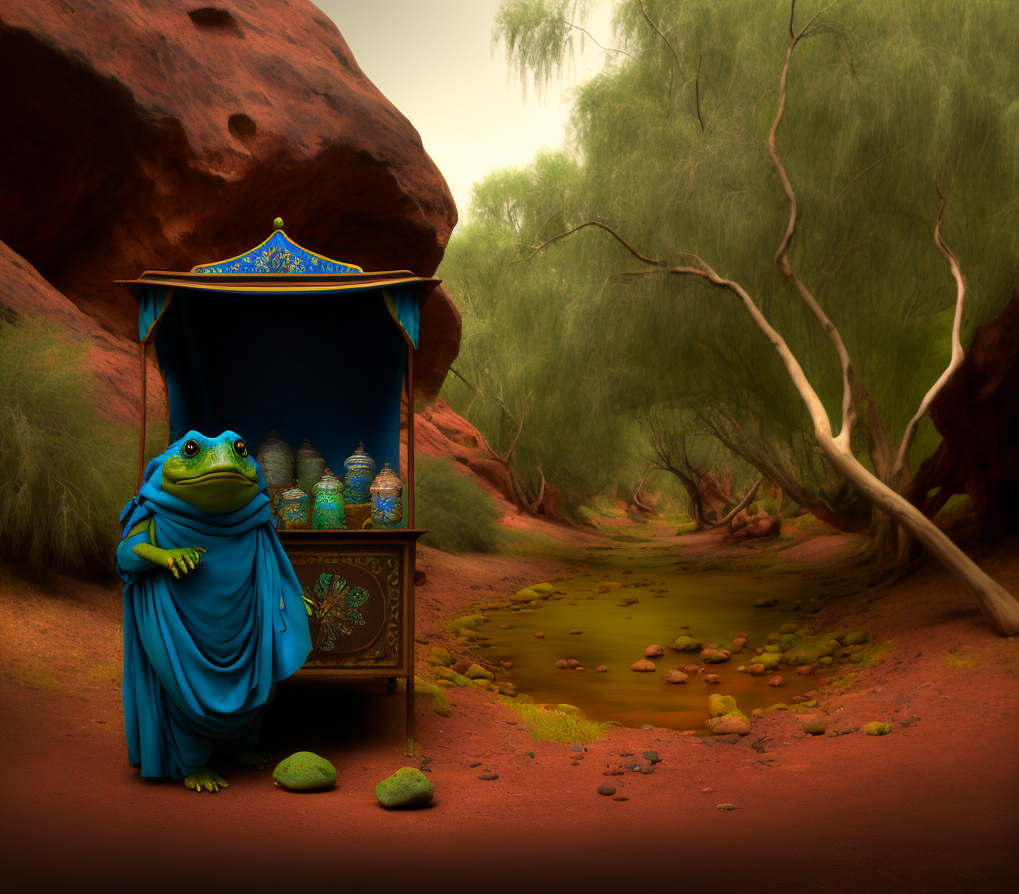
She closed her eyes, remembering more of the strange dream. Deeply orange red boulders and rocky outcrops, shivering gum trees, and green pools ~ it was coming back to her now, that creature in the blue robes had appeared more than once. In one scene he appeared with a blue diamond lantern with what looked like a compass inside.
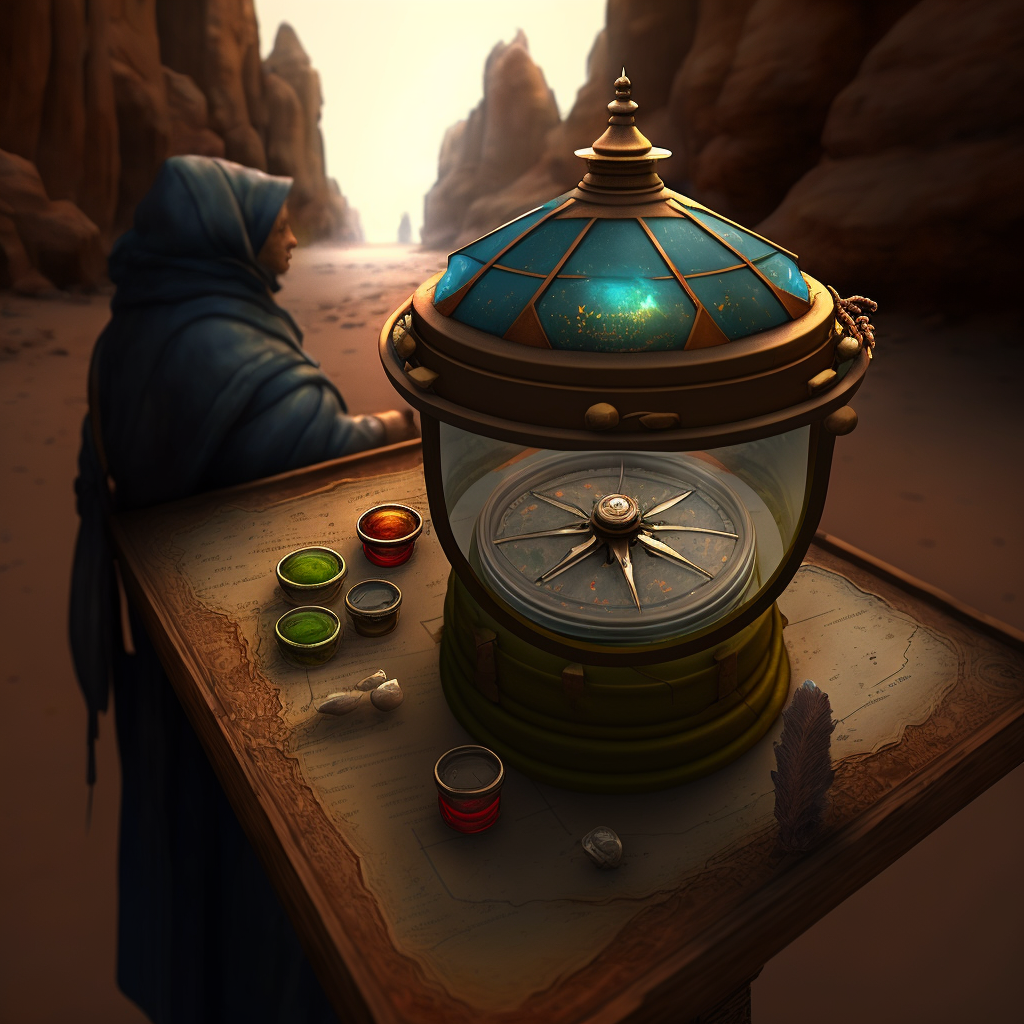
I’ll ask about the hiking trails today, Zara decided, and go for a walk in that gorge I read about yesterday. Bert said there were good hiking trails. You came here early so you could play the game, she reminded herself.
“It’s all a game,” she heard the parrot outside her window.
“I’d forgotten about the bloody parrot!” Zara said under her breath. “Pretty Girl!” she said, opening the blinds. “We’re going out for a walk today.”
February 1, 2023 at 8:54 am #6483In reply to: Prompts of Madjourneys
Zara: Create a surreal and dreamlike digital art piece that combines elements of traditional aboriginal native art with a map to a secret and special place, featuring the otherworldly dreamscape of Dream Time. The image should depict a series of mine tunnels, each leading to gorgeous discoveries and wonders, and the overall scene should be filled with the mysticism and magic of the Dream Time. Don’t be afraid to let your imagination run wild and include random elements that add to the surreal quality of the piece.
January 31, 2023 at 3:31 pm #6479In reply to: The Jorid’s Travels – 14 years on
Chapter 1: The Search Begins
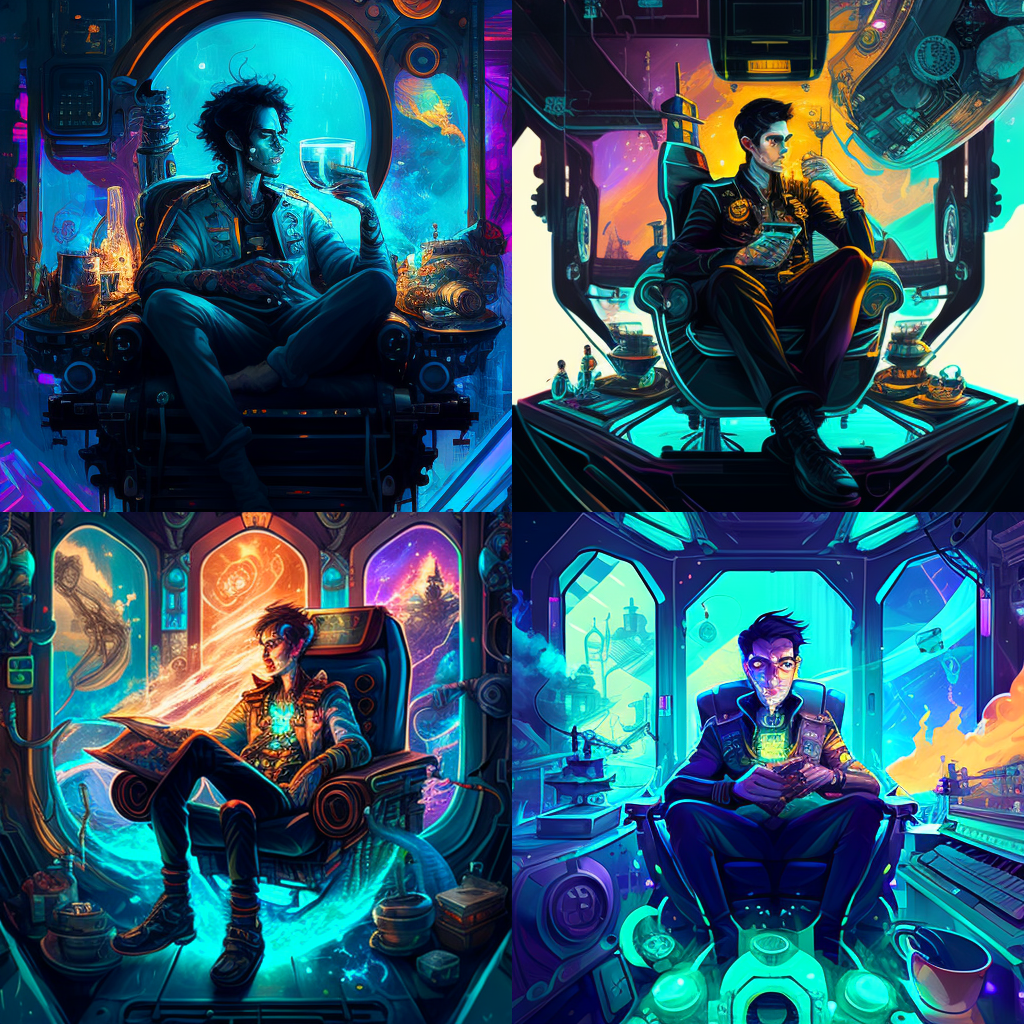
Georges was sitting more or less comfortably in the command chair on the control deck of the Jorid, slowly drinking his tea. The temperature of the beverage seemed to be determined randomly since the interference patterns in the navigation array weren’t totally fixed when they removed those low quality tiles. Drinking cold or hot tea was not the worse of it, and it was even kind of a challenge to swallow it and not get burned by ice. The deck kept changing shape and colours, reconfiguring along with the quantum variations of the Boodenbaum field variation due to some leakage of information between dimensions. Salomé had preferred resting in her travelpod where the effects were not as strongly felt.
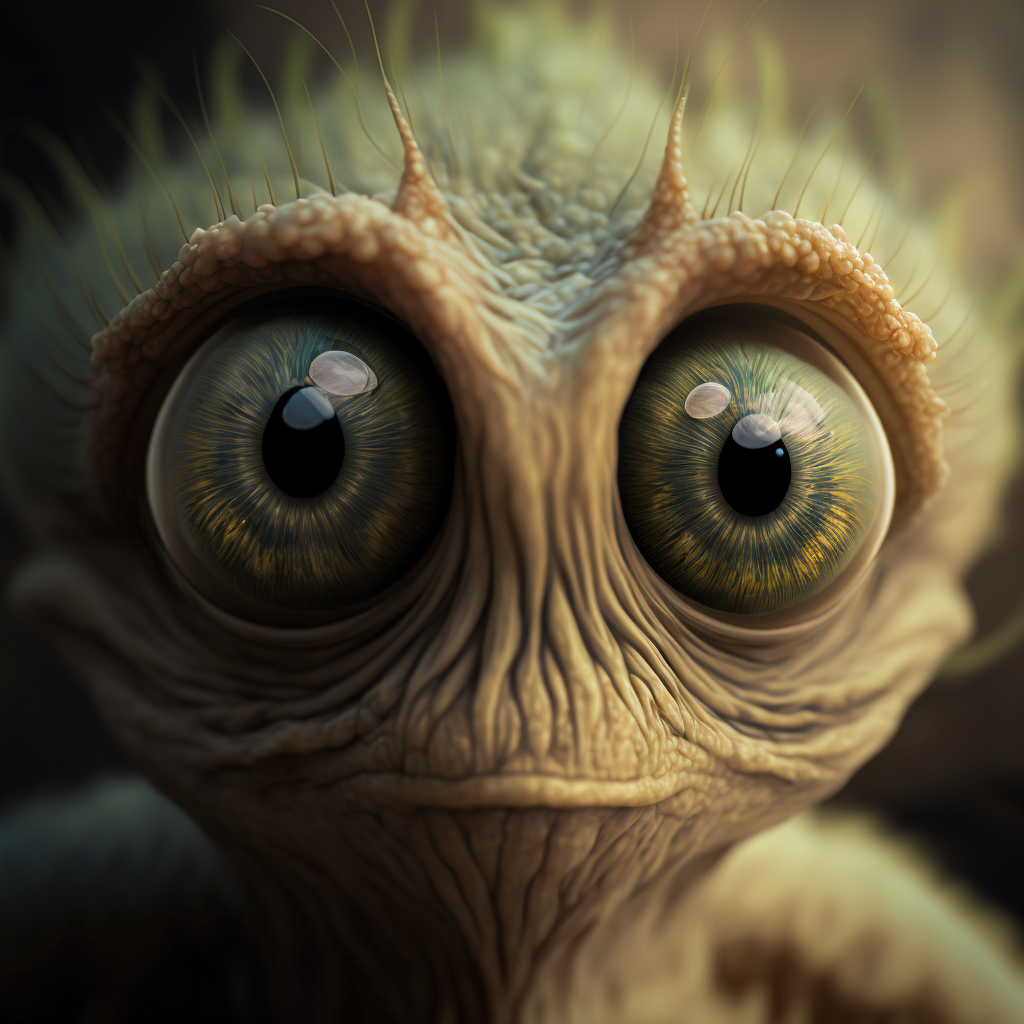 “The worse is not as much seeing your face morph into a soul-insect and turn inside down, although those greenish hues usually make me feel nauseous, but feeling two probable realities where my organs grow and shrink at the same time is more than I can bear.”
After a few freakish experiences, where his legs cross-merged with the chair, or a third eye grow behind his head, or that time when dissolved into a poof of greasy smoke, Georges got used to the fluid nature of reality during the trips. You just had to get along with it and not resist. He thought it gave some spice and colours to their journey across dimensions. He enjoyed the differences of perceptions generated by the fluctuations of the Boodenbaum field, as it allowed his tea to taste like chardonnay or bœuf bourguignon, and was glad when he discovered a taste that he had never experienced before.
During the last few trips, he had attempted to talk with Jorid, but their voices were so garbled and transformed so quickly that he lost interest. He couldn’t make the difference with the other noises, like honking trucks passing by on a motorway, or the cry of agony of a mating Irdvark. He felt a pang of nostalgia as the memories of Duane, Murtuane and Phréal merged into the deck around him. He wondered if he could get physically lost during one of the trips as he started to feel his limbs move away from his body, one hairy foot brushing by his left ear while he drank a sip of tea with the mouth that had grown on his middle finger. Salomé had warned him about fractured perception and losing a piece of his mind… It seemed it hadn’t happened yet. But would he notice?
 Already he felt the deceleration he had come to notice when they neared their destination. The deck stabilized into a shape adapted to this quadrant of the dimensional universes. The large command screen displayed images of several ruins lost in the sand desert of Bluhm’Oxl.
Georges looked at his hands, and touched his legs. His reflection on the command screen looked back at him. Handsome as usual. He grinned. Salomé wouldn’t refrain from telling him if something was off anyway.
Jorid: “I have woken up Salomé.”
She won’t be long now. Georges ordered a hot meklah, one of her favorites drink that usually helped her refocus when getting out of her pod.
A blip caught Georges’ attention.
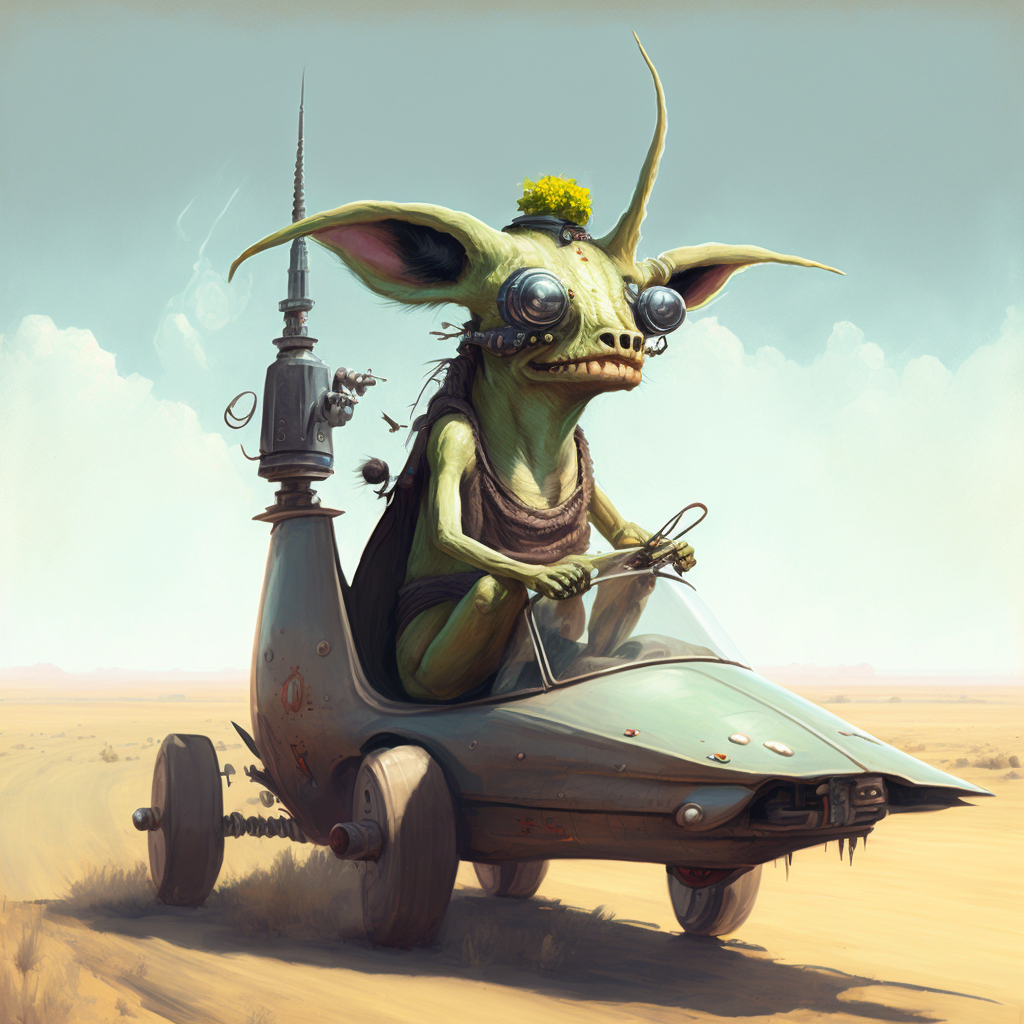
Jorid: “This is Tlal Klatl’Oxl, better know as Klatu. Your potential contact on Bluhm’Oxl and a Zathu. He’ll guide and protect you as you enter the conflict zone to look for Léonard.”
 January 26, 2023 at 12:16 am #6460
In reply to: Orbs of Madjourneys
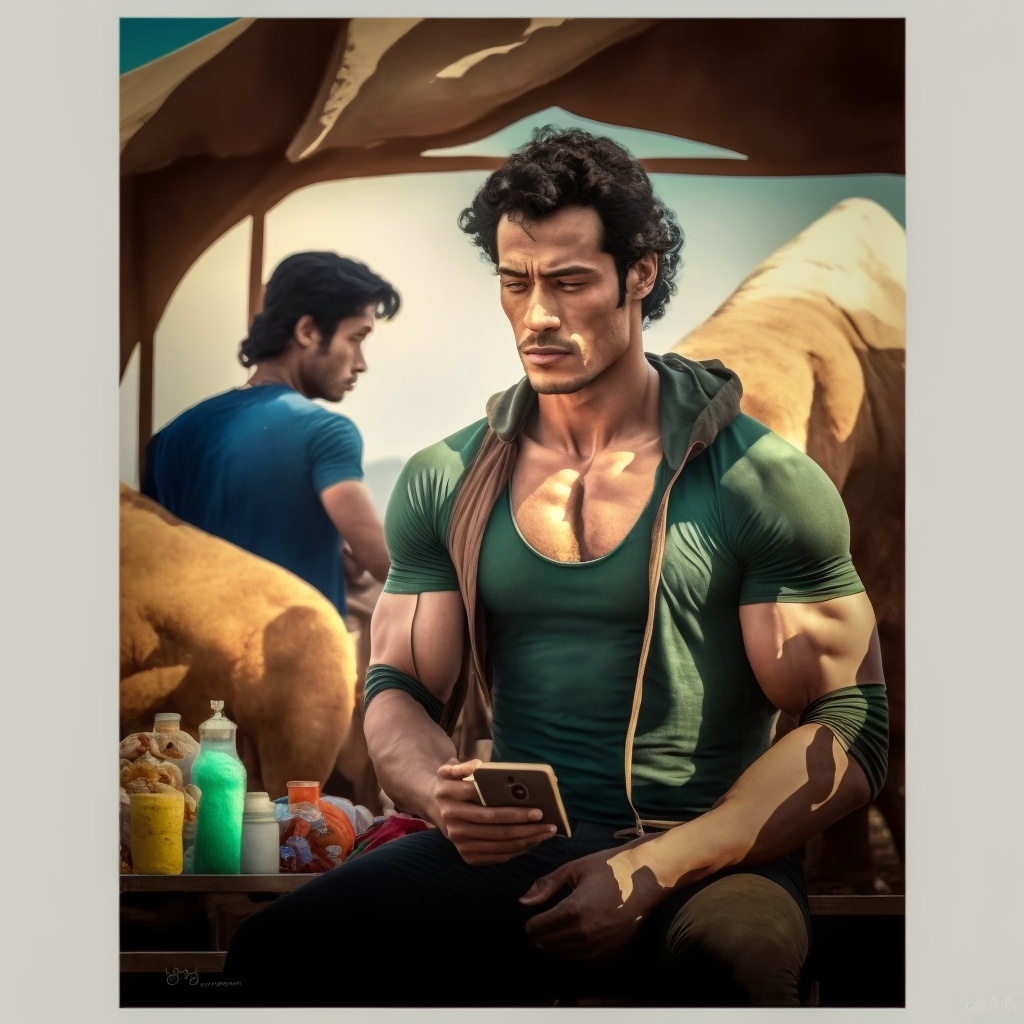
The vendor was preparing the Lorgh Drülp with the dexterity of a Japanese sushi chef. A piece of yak, tons of spices, minced vegetables, and some other ingredients that Youssef couldn’t recognise. He turned his attention to the shaman’s performance. The team was trying to follow the man’s erratic moves under Miss Tartiflate’s supervision. Youssef could hear her shouting to Kyle to get closer shots. It reminded him that he had to get an internet connection.
“Is there a wifi?” asked Youssef to the vendor. The man bobbed his head and pointed at the table with a knife just as big as a machete. Impressed by the size of the blade, Youssef almost didn’t see the tattoo on the vendor’s forearm. The man resumed his cooking swiftly and his long yellow sleeve hid the tattoo. Youssef touched his screen to look at his exchange with Xavier. He searched for the screenshot he had taken of the Thi Gang’s message. There it was. The mummy skull with Darth Vador’s helmet. The same as the man’s tattoo. Xavier’s last message was about the translation being an ancient silk road recipe. They had thought it a fluke in AL’s algorithm. Youssef glanced at the vendor and his knife. Could he be part of Thi Gang?
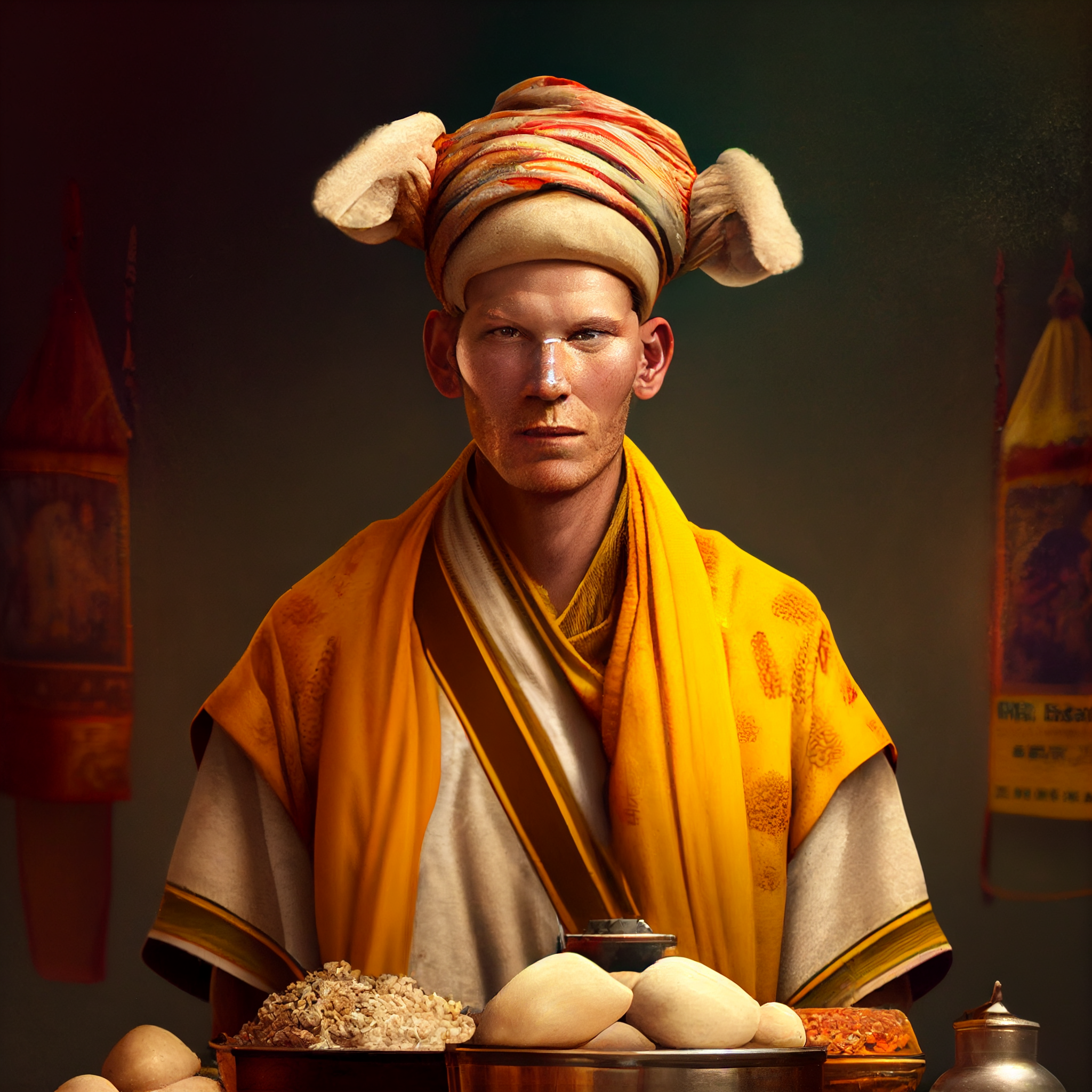
Youssef didn’t have time to think of a plan when the vendor put a tray with the Lorgh Drülp and little balls of tsampa on the table. The man pointed with his finger at the menu on the table, uncovering his forearm, it was the same as the Thi Gang logo.
“Wifi on menu,” the man said. “Tsampa, good for you…”
A commotion at the market place interrupted them. Apparently Kyle had gone too close and the shaman had crashed into him and the rest of the team. The man was cursing every one of them and Miss Tartiflate was apparently trying to calm him down by offering him snack bars. But the shaman kept brandishing an ugly sceptre that looked like a giant chicken foot covered in greasy fur, while cursing them with broken english. The tourists were all brandishing their phones, not missing a thing, ready to send their videos on TrickTruck. The shaman left angrily, ignoring all attempts at conciliation. There would be no reportage.
“Hahaha, tourists, they believe anything they see,” said the vendor before returning to his stove and his knife.
Despite his hunger, Youssef thought he’d better hurry with the wifi, now that the crew was out of work, he would be the target of Miss Tartiflate’s frustration. Furthermore, he wanted to lay low and not attract the vendor’s attention.
3235 messages from his friends. How would he ever catch up?
Among them, messages from Xavier. Youssef sighed of relief when he read that his friend had regained full access of the website and updated the system to fix a security flaw that allowed Thi Gang to gain access in the first place. But he growled when his friend continued with the bad news. There was some damage done to the content of THE BLOG.To console himself, Youssef started to eat a ball of tsampa. It was sweet and tasted like rose. He took a second and spit it out almost immediately. There was a piece of paper inside. He smoothed it and discovered a series of five pictograms.
🧔🌮🔍🔑🏞️
The first one was like a hologram and kept changing into six horizontal bars. The second one, looking like a tako bell, kept reversing side. Youssef raised his head to call the vendor and nobody was there. He got up and looked for the guy, Thi Gang or not, he needed some answers. Voices came from behind the curtain at the back of the stall. Youssef walked around the stall and saw the shaman and the vendor exchanging clothes. The caucasian man was now wearing the colourful costume and the drum. When he saw Youssef, he smiled and waved his hand, making the bells from the hem ring. Then he turned around and left, whistling an air that sounded strangely like the music of the Game. Youssef was about to run after him when a hand grasped his shirt.
“Please! Tell me at least that THE BLOG is up and running!” said an angry voice.
January 13, 2023 at 9:00 pm #6381In reply to: Prompts of Madjourneys
Tell me more about the clues that Zara, Youssef, Xavier and Yasmin will find on their journeys to discover their inner quirky natures
As Zara, Youssef, Xavier and Yasmin journeyed through the Land of the Quirks to discover their inner quirky natures, they encountered various clues that helped them on their journey.
One of the clues they found was a mysterious map that led them to different locations, each one representing a different aspect of their personalities. The map also had various riddles and puzzles that they had to solve in order to progress to the next location.
Another clue they found was a series of journal entries written by a previous explorer who had also journeyed through the Land of the Quirks. The journal entries provided insight and wisdom on how to navigate the land and how to understand and accept one’s quirks.
They also encountered a group of strange and eccentric characters who each represented a different aspect of their personalities. These characters provided guidance and helped them understand different parts of themselves. They also helped them understand the importance of accepting and embracing their quirks.
They also found a series of symbols and artifacts that represented different parts of their personalities. These symbols and artifacts were like puzzle pieces that, when put together, helped them understand the bigger picture of their inner quirky natures.
As they continued their journey, they also learned that the key to discovering their inner quirky natures was not only about finding the physical “Key of Quirks”, but also about understanding and accepting themselves, their faults and their strengths, and learning to embrace their unique quirks.
Finding their inner quirks sounds quite definitive. how would you make the ending more open-ended, open to multiple series and iterations of the story without sounding repetitive
As Zara, Youssef, Xavier and Yasmin journeyed through the Land of the Quirks, they discovered their inner quirky natures, but the journey was far from over. They found that their inner quirks were constantly evolving and changing, and that the Land of the Quirks was a vast and mysterious place with many more secrets to uncover.
The group found that the “Key of Quirks” was not just a physical object but a symbol of self-discovery and self-acceptance. They learned that understanding and accepting oneself is a lifelong journey that never truly ends.
As they returned to their own world, they realized that they had gained a new perspective on life and that they would continue to carry the lessons they learned in the Land of the Quirks with them. They knew that they would always be on the lookout for new adventures and opportunities to continue exploring themselves and the world around them.
The group’s journey in the Land of the Quirks had come to an end but the story was not over. The characters would continue to grow, evolve and change as they experienced new adventures, challenges and self-discoveries. The ending was open-ended and leaves the possibility for multiple series and iterations of the story, each one exploring new aspects of the characters and the Land of the Quirks, without being repetitive.
Will they go a try to travel through another of the orbs?
It is possible that the group will want to explore other orbs and realms in the Land of the Quirks. The Land of the Quirks is described as a vast and mysterious place with many secrets to uncover, so the possibility of traveling through other orbs or realms is open. They may be tempted to see what other adventures and discoveries await them in these new places.
Alternatively, they might decide to take a break from their adventures, and reflect on what they’ve learned, applying it to their daily life, and maybe in the future, they will decide to come back to the Land of the Quirks and explore other orbs, or they may find other means of self-discovery and self-acceptance. In any case, the story leaves it open-ended and the characters have the freedom to choose what they want to do next.
How did they discover the orb in the first place?
It is not specified how the group discovered the orb in the first place. It could be that they stumbled upon it while on a hike or a camping trip, or it could be that they were on a mission to find it specifically. It could also be that the orb was something that had always been there but had gone unnoticed until one of the group members stumbled upon it.
Perhaps it was passed down from generation to generation as a legend, or maybe they found it while they were searching for something else. The story leaves it open-ended and it’s up to the reader’s imagination. The main focus of the story is on the journey and the lessons learned along the way, rather than the specifics of how the orb was discovered.
January 13, 2023 at 8:53 pm #6380In reply to: Prompts of Madjourneys
After a few tries:
- As the group has split up at the fork of the road, we discover a total of 4 new characters from the Land of the Quirks. Tell us how each group is encountering some or all of these characters, who they are, their gibberish-sounding names, and what is their quirks, and what they wear, or their activities. Make our main characters and maybe some of the new ones meet back at a common spot with a special event after that.
- please rewrite the above, retaining the eccentricity but more grounded, less childish, and with a little darker tone and mystery.
- please try again, make Spoink and Flibbertigibbet human and give them less endearing or friendly behaviours; name two more characters met on the road.
As the group split up at the fork of the road, each one encountered new characters from the Land of the Quirks.
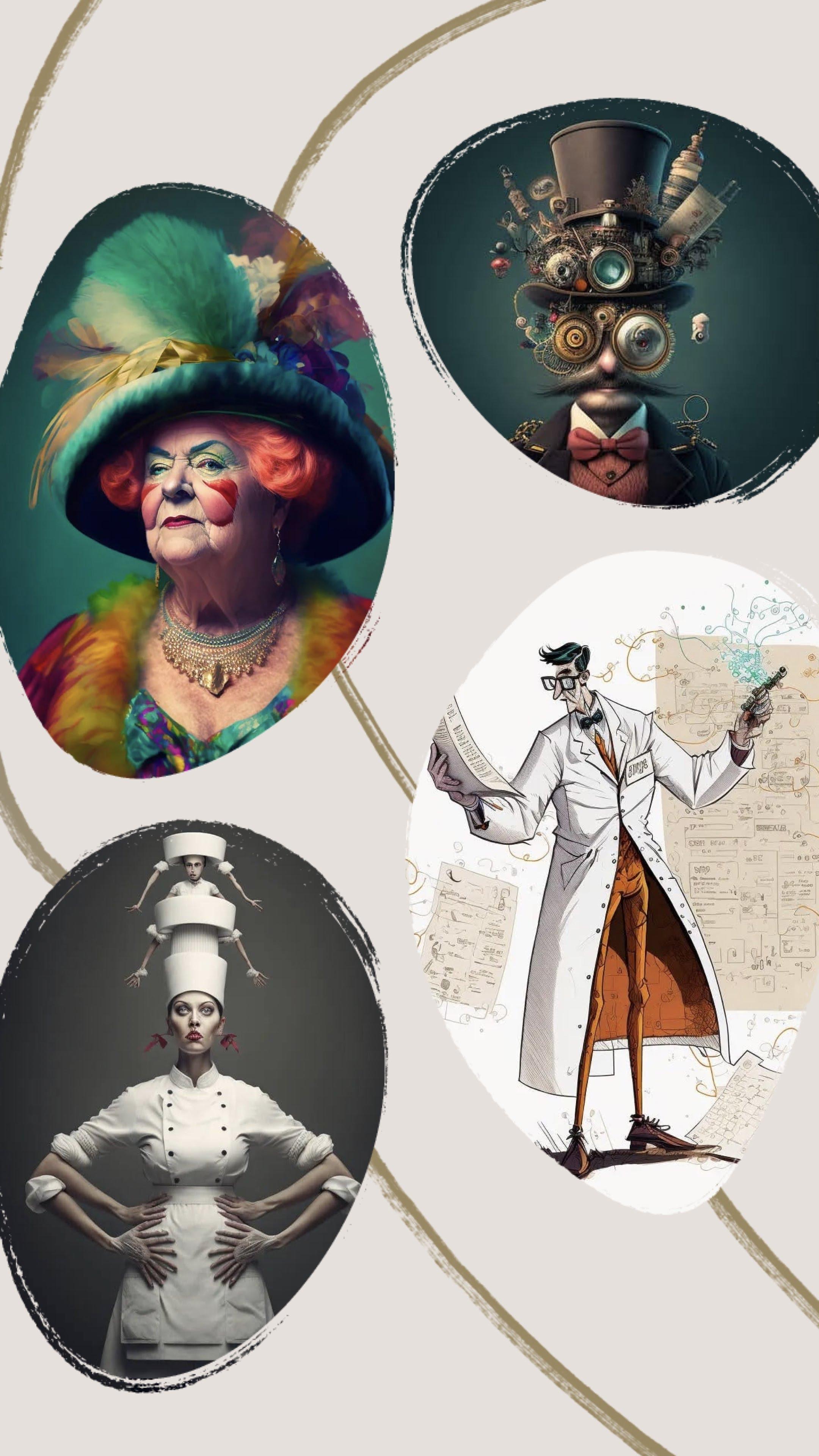
Zara and Yasmin, who took the left path, met a man named “Sproink” who was a small, wiry man with a spring for a tail. He was always bouncing around and speaking in a language that sounded like a mix of gibberish and music. Sproink was a collector of shiny objects and had a bag full of them, he was also a scavenger, always looking for things to add to his collection. He was wearing a small top hat and a monocle. He was also known to be a bit of a thief and a con artist.
Xavier and Youssef, who took the right path, met a woman named “Flibbertigibbet” a tall, slender woman that had multiple arms. Flibbertigibbet was very talkative and friendly, always trying to strike up a conversation. She spoke in a language that sounded like a mix of gibberish and baby talk. She was a chef and was always carrying a pot and a spoon, but she also had a dark side, she was known to be a bit of a manipulator and a spy, always observing and gathering information for a mysterious organization. She was wearing a big chef hat and apron.
As the group met back at the fork, they were surprised to find that Sproink and Flibbertigibbet had also met there. The four new characters joined the group, and together they continued their journey to find the “Key of Quirks”. Along the way, they met two more characters;
They met a man named “Gibber” who was a tall, gaunt man with elongated limbs and fingers. He was always speaking in a language that sounded like a mix of gibberish and numbers. He was a mathematician and a scientist, always working on complex equations and theories. He was known to be a bit of a loner, and didn’t interact much with others. He was wearing a lab coat and goggles.
They also met a woman named “Glimmer” she was a short, plump woman with a shimmering skin that seemed to change color depending on the light. She was always speaking in a language that sounded like a mix of gibberish and poetry. She was an artist and a performer, always creating and performing in different shows. She was known to be a bit of a flirt and a bit of a drama queen. She was wearing a colorful and eccentric clothing, such as a flowy dress and a large hat adorned with feathers.
As the group journeyed on, they encountered more characters, each one with their own unique quirks and personalities. They met a variety of people, some friendly and some not so friendly, but all of them adding to the mysterious and unknown nature of the Land of the Quirks.
As the group reached the end of their journey and found the “Key of Quirks”, they realized that the key was not just a physical object but a symbol of acceptance and embracing individuality. They learned that the true key to leaving the Land of the Quirks was understanding and accepting the quirks of oneself and others.
The group had a bittersweet goodbye with their new friends, Sproink, Flibbertigibbet, Gibber and Glimmer, and the other characters they had met. They knew that they would always carry a piece of the Land of the Quirks with them and would always remember the mysterious and eccentric adventure they had.
 January 13, 2023 at 6:47 pm #6378
Topic: Prompts of Madjourneys
A thread to share some of the prompts behind the AI-assisted journey into new adventures.
To start off…
Please write the exciting start of a novel.
Some elements you can integrate if you want:
– Four randomly chosen names full of panache that sound distinct from each other, slightly exotic and evocative
– the sentiment from this quotation: “Look around… Beauty is everywhere. You only have to look to see it.” – a group of four people ready for an adventure, standing in a cave with stalactites in front of a giant orb or bubble that seem to open to another brightly lit realm. Inside the bigger orb are some smaller orbs.
– the following term “mad journeys”Told it to continue and it brought dragons… Asked to tone down the fantasy stuff, here’s what came out:
They walked into a small village, where they were greeted by a group of people wearing clothes that looked like they were from the 1920s. The people told them that they were in the land of the “Quirks”, a place where everything and everyone was a little bit different, and that they had to find the “Key of Quirks” in order to leave the land.
The group set off on their journey to find the key, but little did they know that their adventure was about to become even more exciting and quirky than they could ever have imagined. They encountered a talking dog, a man who had a garden on top of his head, and a group of people who lived inside of giant mushrooms.
As they journeyed on, they faced challenges and made new friends, but most importantly they learn to embrace their own quirks and individuality. Eventually, they found the key and were able to leave the land of the Quirks, but they knew that they would always carry a piece of that land with them.
October 19, 2022 at 6:46 am #6336In reply to: Family Stories From The Other Side ~ Book Two
The Hamstall Ridware Connection
Stubbs and Woods
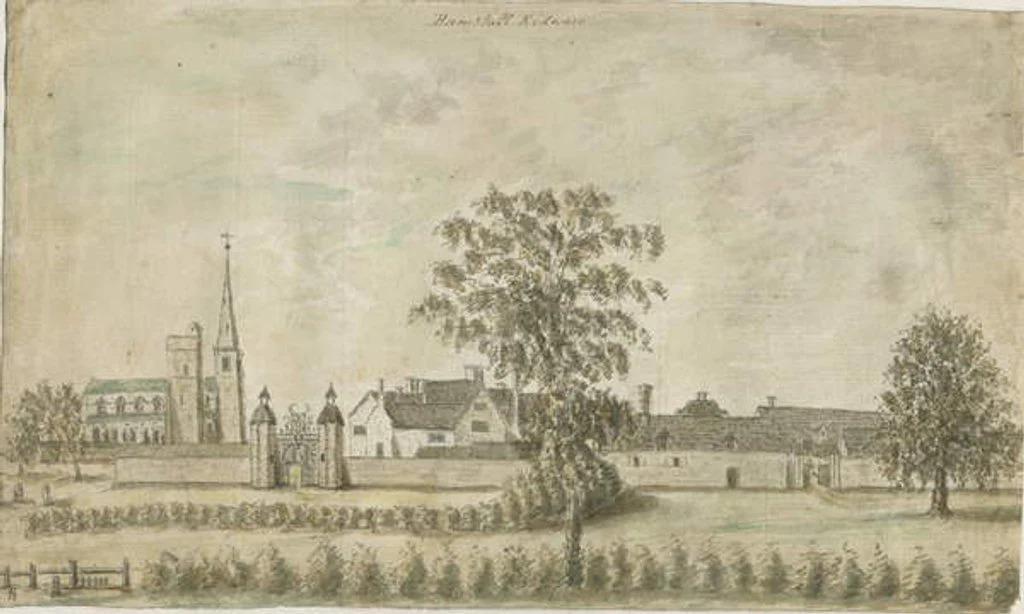 Hamstall Ridware
Charles Tomlinson‘s (1847-1907) wife Emma Grattidge (1853-1911) was born in Wolverhampton, the daughter and youngest child of William Grattidge (1820-1887) born in Foston, Derbyshire, and Mary Stubbs (1819-1880), born in Burton on Trent, daughter of Solomon Stubbs.
Solomon Stubbs (1781-1857) was born in Hamstall Ridware in 1781, the son of Samuel and Rebecca. Samuel Stubbs (1743-) and Rebecca Wood (1754-) married in 1769 in Darlaston. Samuel and Rebecca had six other children, all born in Darlaston. Sadly four of them died in infancy. Son John was born in 1779 in Darlaston and died two years later in Hamstall Ridware in 1781, the same year that Solomon was born there.
But why did they move to Hamstall Ridware?
Samuel Stubbs was born in 1743 in Curdworth, Warwickshire (near to Birmingham). I had made a mistake on the tree (along with all of the public trees on the Ancestry website) and had Rebecca Wood born in Cheddleton, Staffordshire. Rebecca Wood from Cheddleton was also born in 1843, the right age for the marriage. The Rebecca Wood born in Darlaston in 1754 seemed too young, at just fifteen years old at the time of the marriage. I couldn’t find any explanation for why a woman from Cheddleton would marry in Darlaston and then move to Hamstall Ridware. People didn’t usually move around much other than intermarriage with neighbouring villages, especially women. I had a closer look at the Darlaston Rebecca, and did a search on her father William Wood. I found his 1784 will online in which he mentions his daughter Rebecca, wife of Samuel Stubbs. Clearly the right Rebecca Wood was the one born in Darlaston, which made much more sense.
An excerpt from William Wood’s 1784 will mentioning daughter Rebecca married to Samuel Stubbs:
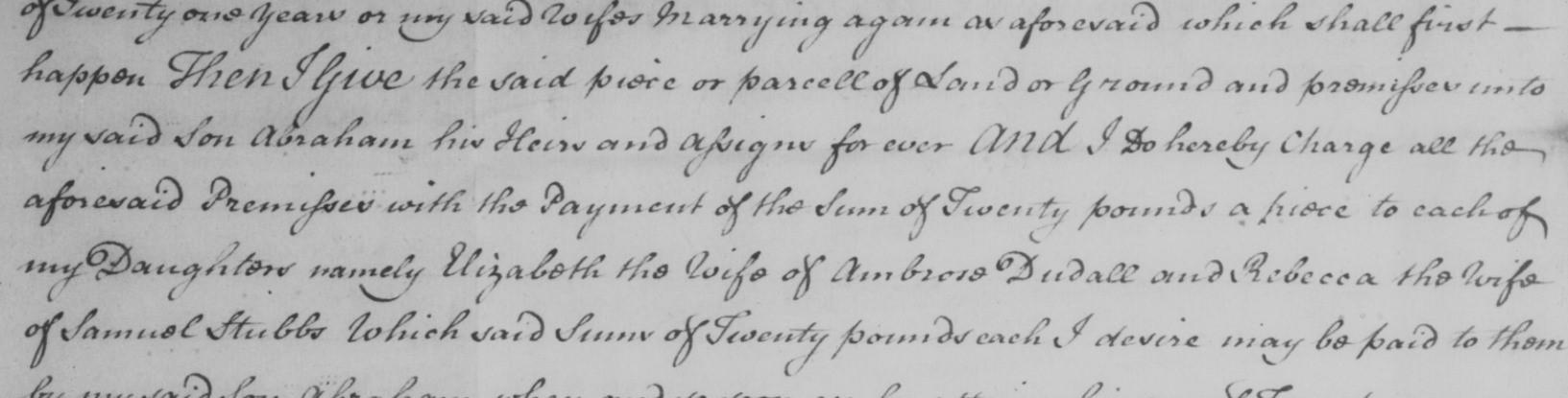
But why did they move to Hamstall Ridware circa 1780?
I had not intially noticed that Solomon Stubbs married again the year after his wife Phillis Lomas (1787-1844) died. Solomon married Charlotte Bell in 1845 in Burton on Trent and on the marriage register, Solomon’s father Samuel Stubbs occupation was mentioned: Samuel was a buckle maker.
Marriage of Solomon Stubbs and Charlotte Bell, father Samuel Stubbs buckle maker:
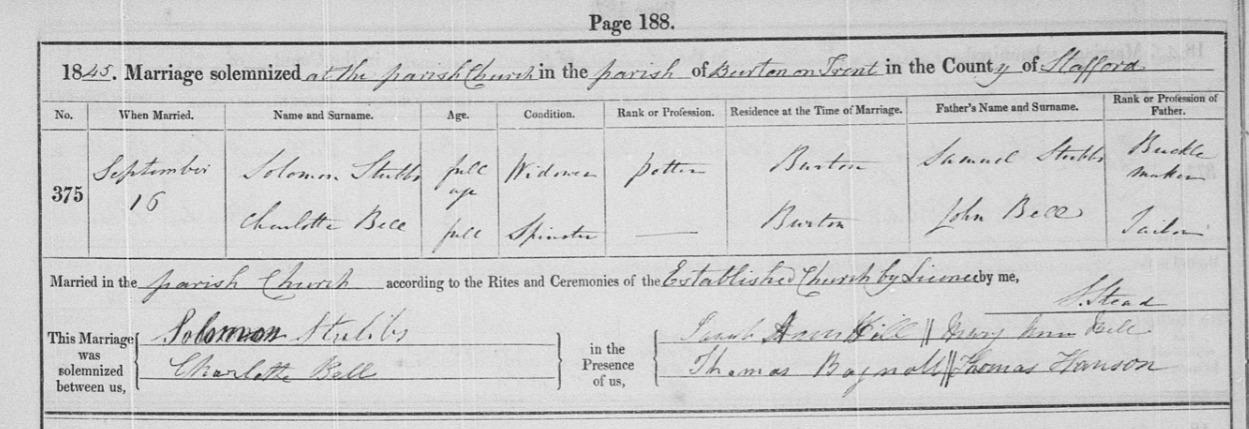
A rudimentary search on buckle making in the late 1700s provided a possible answer as to why Samuel and Rebecca left Darlaston in 1781. Shoe buckles had gone out of fashion, and by 1781 there were half as many buckle makers in Wolverhampton as there had been previously.
“Where there were 127 buckle makers at work in Wolverhampton, 68 in Bilston and 58 in Birmingham in 1770, their numbers had halved in 1781.”
via “historywebsite”(museum/metalware/steel)
Steel buckles had been the height of fashion, and the trade became enormous in Wolverhampton. Wolverhampton was a steel working town, renowned for its steel jewellery which was probably of many types. The trade directories show great numbers of “buckle makers”. Steel buckles were predominantly made in Wolverhampton: “from the late 1760s cut steel comes to the fore, from the thriving industry of the Wolverhampton area”. Bilston was also a great centre of buckle making, and other areas included Walsall. (It should be noted that Darlaston, Walsall, Bilston and Wolverhampton are all part of the same area)
In 1860, writing in defence of the Wolverhampton Art School, George Wallis talks about the cut steel industry in Wolverhampton. Referring to “the fine steel workers of the 17th and 18th centuries” he says: “Let them remember that 100 years ago [sc. c. 1760] a large trade existed with France and Spain in the fine steel goods of Birmingham and Wolverhampton, of which the latter were always allowed to be the best both in taste and workmanship. … A century ago French and Spanish merchants had their houses and agencies at Birmingham for the purchase of the steel goods of Wolverhampton…..The Great Revolution in France put an end to the demand for fine steel goods for a time and hostile tariffs finished what revolution began”.
The next search on buckle makers, Wolverhampton and Hamstall Ridware revealed an unexpected connecting link.
In Riotous Assemblies: Popular Protest in Hanoverian England by Adrian Randall:
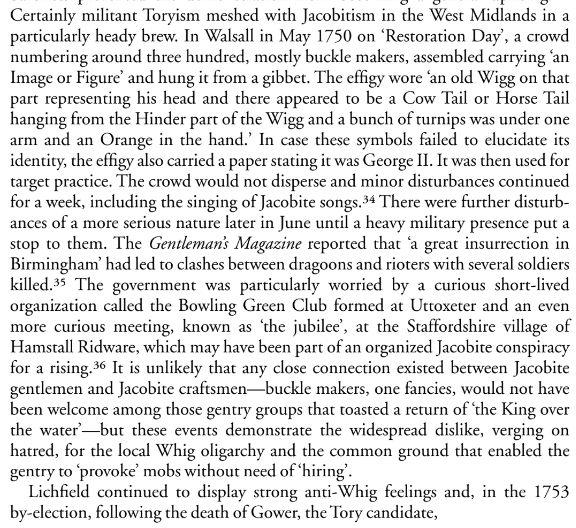
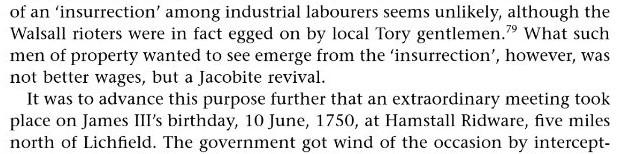
In Walsall in 1750 on “Restoration Day” a crowd numbering 300 assembled, mostly buckle makers, singing Jacobite songs and other rebellious and riotous acts. The government was particularly worried about a curious meeting known as the “Jubilee” in Hamstall Ridware, which may have been part of a conspiracy for a Jacobite uprising.
But this was thirty years before Samuel and Rebecca moved to Hamstall Ridware and does not help to explain why they moved there around 1780, although it does suggest connecting links.
Rebecca’s father, William Wood, was a brickmaker. This was stated at the beginning of his will. On closer inspection of the will, he was a brickmaker who owned four acres of brick kilns, as well as dwelling houses, shops, barns, stables, a brewhouse, a malthouse, cattle and land.
A page from the 1784 will of William Wood:
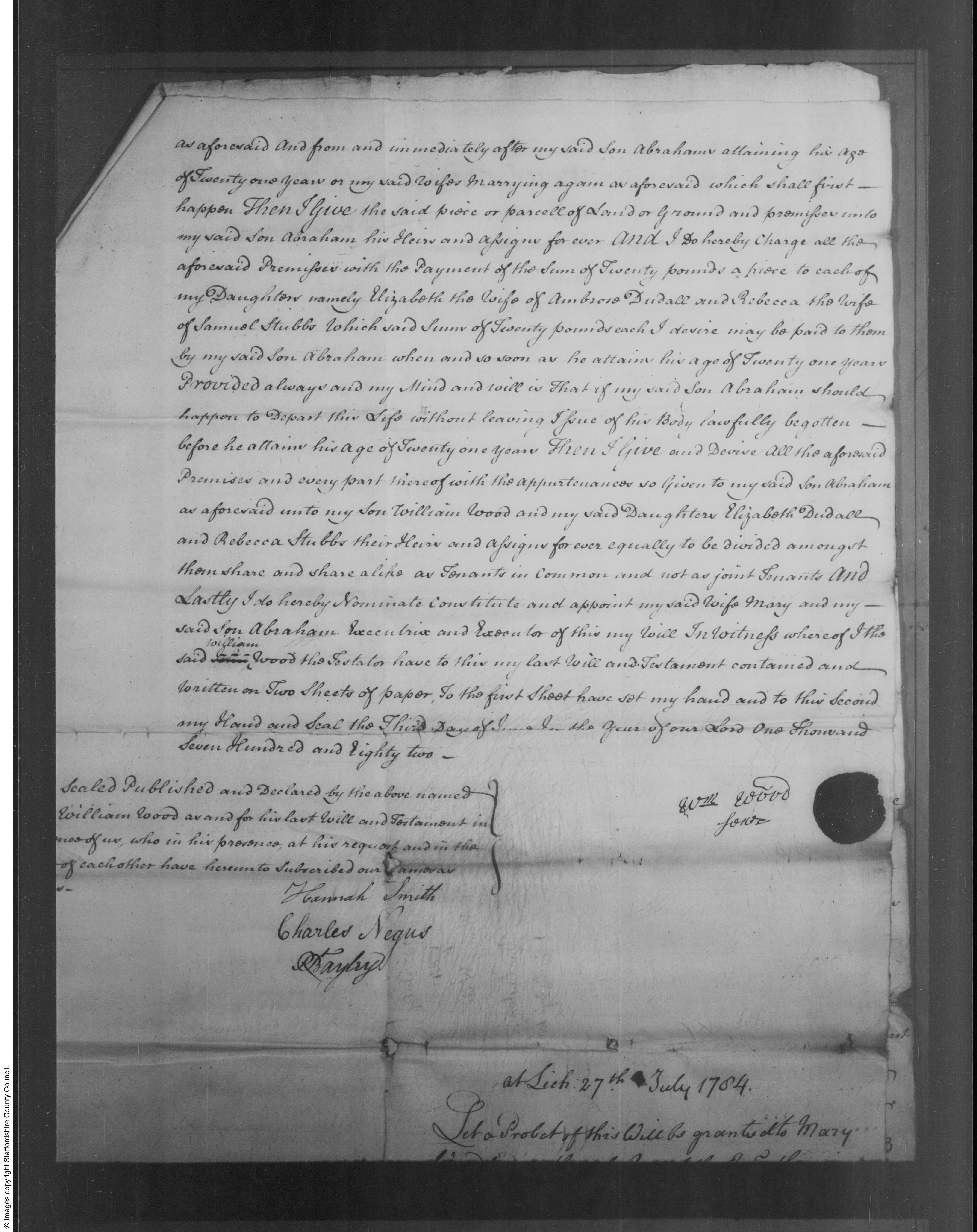
The 1784 will of William Wood of Darlaston:
I William Wood the elder of Darlaston in the county of Stafford, brickmaker, being of sound and disposing mind memory and understanding (praised be to god for the same) do make publish and declare my last will and testament in manner and form following (that is to say) {after debts and funeral expense paid etc} I give to my loving wife Mary the use usage wear interest and enjoyment of all my goods chattels cattle stock in trade ~ money securities for money personal estate and effects whatsoever and wheresoever to hold unto her my said wife for and during the term of her natural life providing she so long continues my widow and unmarried and from or after her decease or intermarriage with any future husband which shall first happen.
Then I give all the said goods chattels cattle stock in trade money securites for money personal estate and effects unto my son Abraham Wood absolutely and forever. Also I give devise and bequeath unto my said wife Mary all that my messuages tenement or dwelling house together with the malthouse brewhouse barn stableyard garden and premises to the same belonging situate and being at Darlaston aforesaid and now in my own possession. Also all that messuage tenement or dwelling house together with the shop garden and premises with the appurtenances to the same ~ belonging situate in Darlaston aforesaid and now in the several holdings or occupation of George Knowles and Edward Knowles to hold the aforesaid premises and every part thereof with the appurtenances to my said wife Mary for and during the term of her natural life provided she so long continues my widow and unmarried. And from or after her decease or intermarriage with a future husband which shall first happen. Then I give and devise the aforesaid premises and every part thereof with the appurtenances unto my said son Abraham Wood his heirs and assigns forever.
Also I give unto my said wife all that piece or parcel of land or ground inclosed and taken out of Heath Field in the parish of Darlaston aforesaid containing four acres or thereabouts (be the same more or less) upon which my brick kilns erected and now in my own possession. To hold unto my said wife Mary until my said son Abraham attains his age of twenty one years if she so long continues my widow and unmarried as aforesaid and from and immediately after my said son Abraham attaining his age of twenty one years or my said wife marrying again as aforesaid which shall first happen then I give the said piece or parcel of land or ground and premises unto my said son Abraham his heirs and assigns forever.
And I do hereby charge all the aforesaid premises with the payment of the sum of twenty pounds a piece to each of my daughters namely Elizabeth the wife of Ambrose Dudall and Rebecca the wife of Samuel Stubbs which said sum of twenty pounds each I devise may be paid to them by my said son Abraham when and so soon as he attains his age of twenty one years provided always and my mind and will is that if my said son Abraham should happen to depart this life without leaving issue of his body lawfully begotten before he attains his age of twenty one years then I give and devise all the aforesaid premises and every part thereof with the appurtenances so given to my said son Abraham as aforesaid unto my said son William Wood and my said daughter Elizabeth Dudall and Rebecca Stubbs their heirs and assigns forever equally divided among them share and share alike as tenants in common and not as joint tenants. And lastly I do hereby nominate constitute and appoint my said wife Mary and my said son Abraham executrix and executor of this my will.
The marriage of William Wood (1725-1784) and Mary Clews (1715-1798) in 1749 was in Hamstall Ridware.
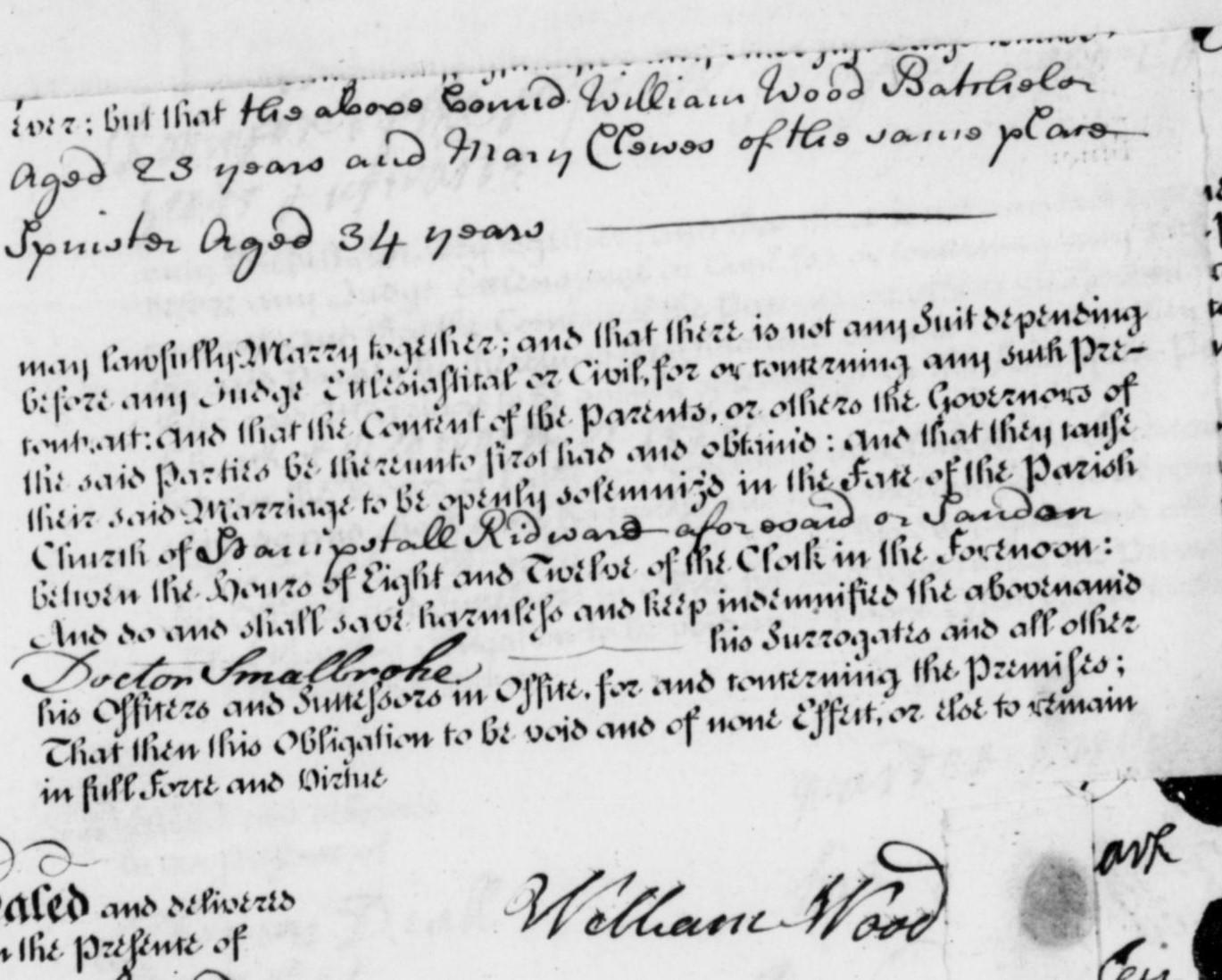
Mary was eleven years Williams senior, and it appears that they both came from Hamstall Ridware and moved to Darlaston after they married. Clearly Rebecca had extended family there (notwithstanding any possible connecting links between the Stubbs buckle makers of Darlaston and the Hamstall Ridware Jacobites thirty years prior). When the buckle trade collapsed in Darlaston, they likely moved to find employment elsewhere, perhaps with the help of Rebecca’s family.
I have not yet been able to find deaths recorded anywhere for either Samuel or Rebecca (there are a couple of deaths recorded for a Samuel Stubbs, one in 1809 in Wolverhampton, and one in 1810 in Birmingham but impossible to say which, if either, is the right one with the limited information, and difficult to know if they stayed in the Hamstall Ridware area or perhaps moved elsewhere)~ or find a reason for their son Solomon to be in Burton upon Trent, an evidently prosperous man with several properties including an earthenware business, as well as a land carrier business.
July 10, 2022 at 2:36 am #6317In reply to: The Sexy Wooden Leg
The sharp rat-a-tat on the door startled Olga Herringbonevsky. The initial surprise quickly turned to annoyance. It was 11am and she wasn’t expecting a knock on the door at 11am. At 10am she expected a knock. It would be Larysa with the lukewarm cup of tea and a stale biscuit. Sometimes Olga complained about it and Larysa would say, Well you’re on the third floor so what do you expect? And she’d look cross and pour the tea so some of it slopped into the saucer. So the biscuits go stale on the way up do they? Olga would mutter. At 10:30am Larysa would return to collect the cup and saucer. I can’t do this much longer, she’d say. I’m not young any more and all these damn stairs. She’d been saying that for as long as Olga could remember.
For a moment, Olga contemplated ignoring the intrusion but the knocking started up again, this time accompanied by someone shouting her name.
With a very loud sigh, she put her book on the side table, face down so she would not lose her place for it was a most enjoyable whodunit, and hauled herself up from the chair. Her ankle was not good since she’d gone over on it the other day and Olga was in a very poor mood by the time she reached the door.
“Yes?” She glowered at Egbert.
“Have you seen this?” Egbert was waving a piece of paper at her.
“No,” Olga started to close the door.
“Olga stop!” Egbert’s face had reddened and Olga wondered if he might cry. Again, he waved the piece of paper in her face and then let his hand fall defeated to his side. “Olga, it’s bad news. You should have got a letter .”
Olga glanced at the pile of unopened letters on her dresser. It was never good news. She couldn’t be bothered with letters any more.
“Well, Egbert, I suppose you’d better come in”.
“That Ursula has a heart of steel,” said Olga when she’d heard the news.
“Pfft,” said Egbert. “She has no heart. This place has always been about money for her.”
“It’s bad times, Egbert. Bad times.”
Egbert nodded. “It is, Olga. But there must be something we can do.” He pursed his lips and Olga noticed that he would not meet her eyes.
“What? Spit it out, Old Man.”
He looked at her briefly before his eyes slid back to the dirty grey carpet. “I have heard stories, Olga. That you are … well connected. That you know people.”
Olga noticed that it had become difficult to breathe. Seeing Egbert looking at her with concern, she made an effort to steady herself. She took an extra big gasp of air and pointed to the book face-down on the side table. “That is a very good book I am reading. You may borrow it when I have finished.”
Egbert nodded. “Thank you.” he said and they both stared at the book.
“It was a long time ago, Egbert. And no business of anyone else.” Olga knew her voice was sharp but not sharp enough it seemed as Egbert was not done yet with all his prying words.
“Olga, you said it yourself. These are bad times. And desperate measures are needed or we will all perish.” Now he looked her in the eyes. “Old woman, swallow your pride. You must save yourself and all of us here.”
July 1, 2022 at 9:51 am #6306In reply to: The Elusive Samuel Housley and Other Family Stories
Looking for Robert Staley
William Warren (1835-1880) of Newhall (Stapenhill) married Elizabeth Staley (1836-1907) in 1858. Elizabeth was born in Newhall, the daughter of John Staley (1795-1876) and Jane Brothers. John was born in Newhall, and Jane was born in Armagh, Ireland, and they were married in Armagh in 1820. Elizabeths older brothers were born in Ireland: William in 1826 and Thomas in Dublin in 1830. Francis was born in Liverpool in 1834, and then Elizabeth in Newhall in 1836; thereafter the children were born in Newhall.
Marriage of John Staley and Jane Brothers in 1820:
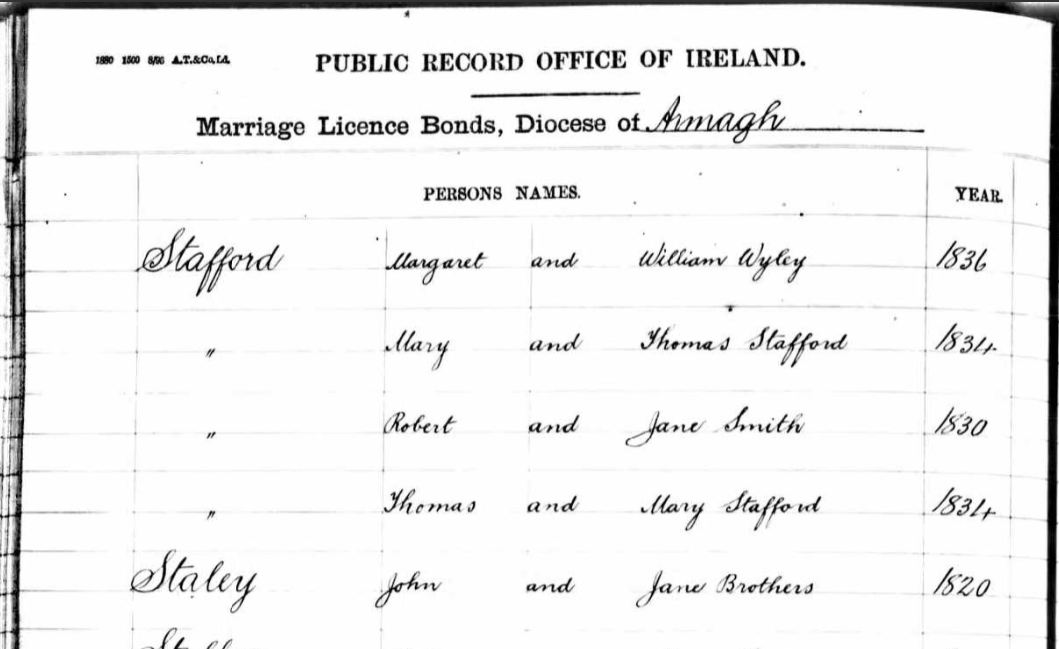
My grandmother related a story about an Elizabeth Staley who ran away from boarding school and eloped to Ireland, but later returned. The only Irish connection found so far is Jane Brothers, so perhaps she meant Elizabeth Staley’s mother. A boarding school seems unlikely, and it would seem that it was John Staley who went to Ireland.
The 1841 census states Jane’s age as 33, which would make her just 12 at the time of her marriage. The 1851 census states her age as 44, making her 13 at the time of her 1820 marriage, and the 1861 census estimates her birth year as a more likely 1804. Birth records in Ireland for her have not been found. It’s possible, perhaps, that she was in service in the Newhall area as a teenager (more likely than boarding school), and that John and Jane ran off to get married in Ireland, although I haven’t found any record of a child born to them early in their marriage. John was an agricultural labourer, and later a coal miner.
John Staley was the son of Joseph Staley (1756-1838) and Sarah Dumolo (1764-). Joseph and Sarah were married by licence in Newhall in 1782. Joseph was a carpenter on the marriage licence, but later a collier (although not necessarily a miner).
The Derbyshire Record Office holds records of an “Estimate of Joseph Staley of Newhall for the cost of continuing to work Pisternhill Colliery” dated 1820 and addresssed to Mr Bloud at Calke Abbey (presumably the owner of the mine)
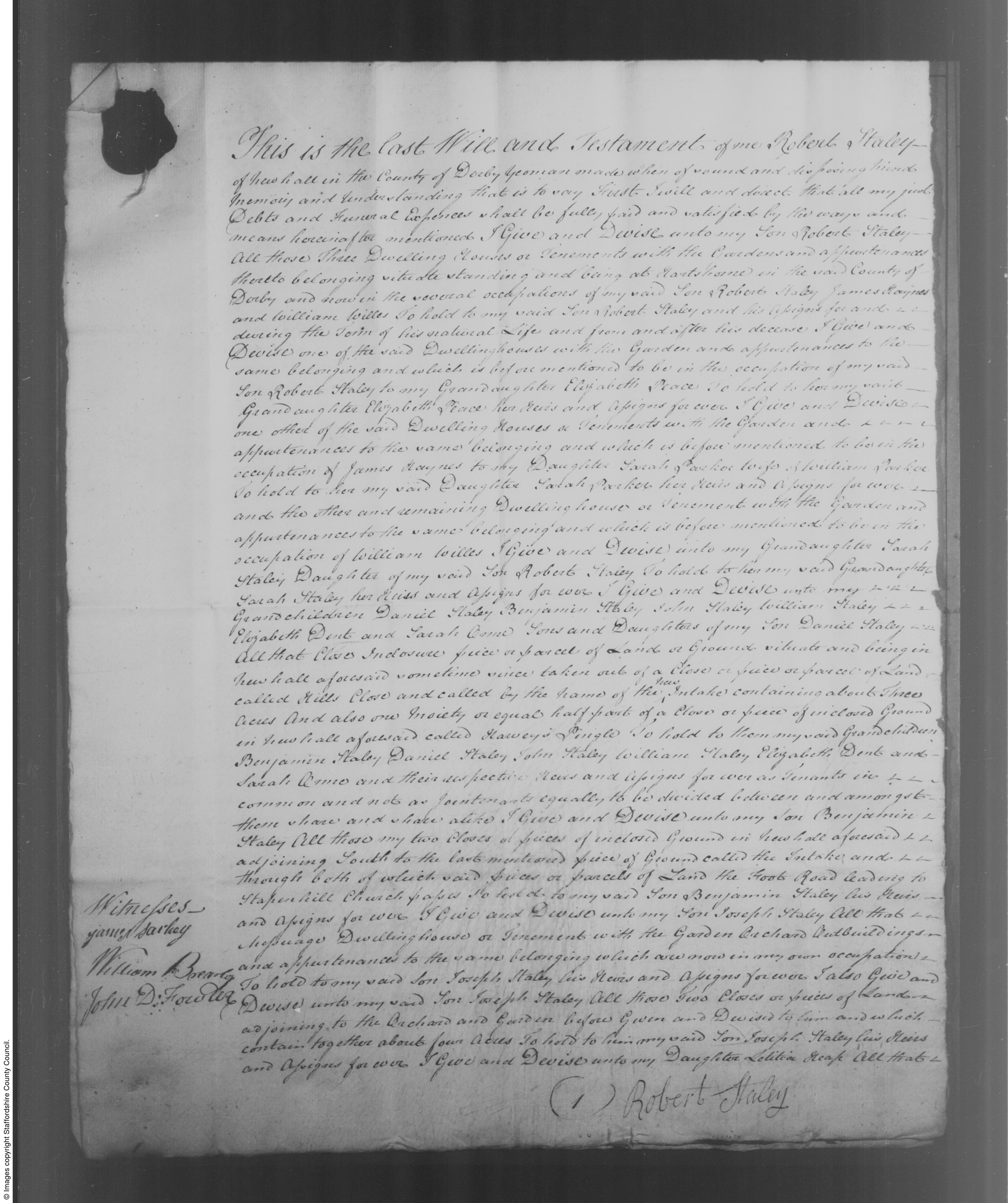
Josephs parents were Robert Staley and Elizabeth. I couldn’t find a baptism or birth record for Robert Staley. Other trees on an ancestry site had his birth in Elton, but with no supporting documents. Robert, as stated in his 1795 will, was a Yeoman.
“Yeoman: A former class of small freeholders who farm their own land; a commoner of good standing.”
“Husbandman: The old word for a farmer below the rank of yeoman. A husbandman usually held his land by copyhold or leasehold tenure and may be regarded as the ‘average farmer in his locality’. The words ‘yeoman’ and ‘husbandman’ were gradually replaced in the later 18th and 19th centuries by ‘farmer’.”He left a number of properties in Newhall and Hartshorne (near Newhall) including dwellings, enclosures, orchards, various yards, barns and acreages. It seemed to me more likely that he had inherited them, rather than moving into the village and buying them.
There is a mention of Robert Staley in a 1782 newpaper advertisement.
“Fire Engine To Be Sold. An exceedingly good fire engine, with the boiler, cylinder, etc in good condition. For particulars apply to Mr Burslem at Burton-upon-Trent, or Robert Staley at Newhall near Burton, where the engine may be seen.”
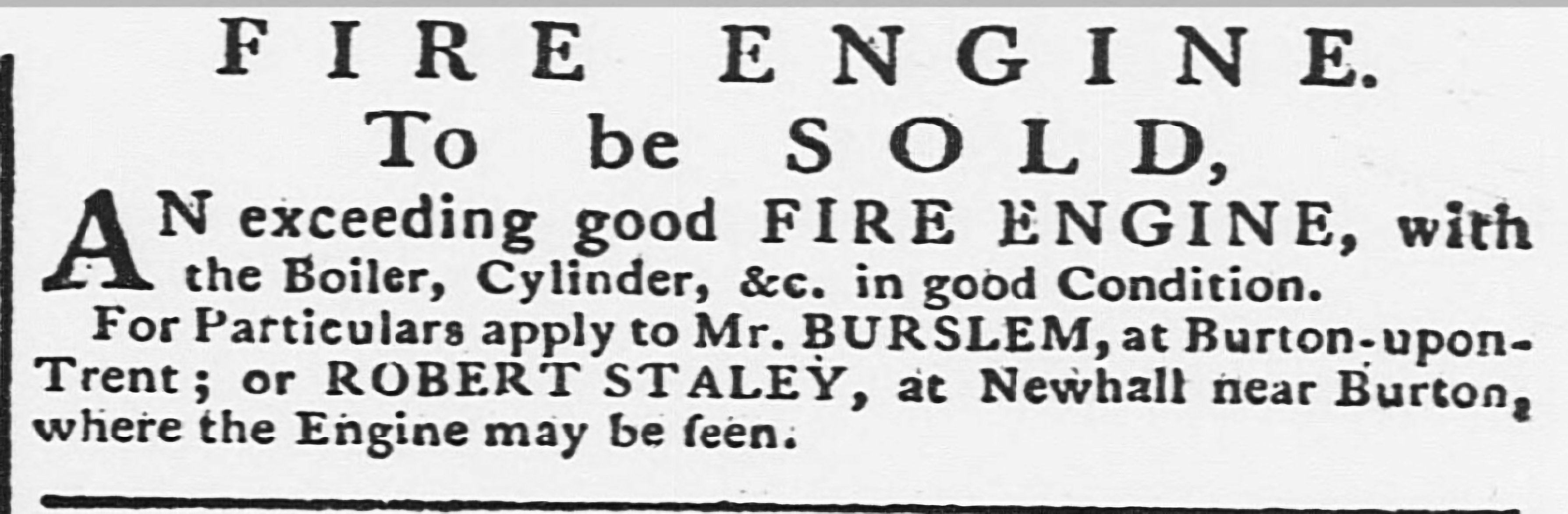
Was the fire engine perhaps connected with a foundry or a coal mine?
I noticed that Robert Staley was the witness at a 1755 marriage in Stapenhill between Barbara Burslem and Richard Daston the younger esquire. The other witness was signed Burslem Jnr.
Looking for Robert Staley
I assumed that once again, in the absence of the correct records, a similarly named and aged persons baptism had been added to the tree regardless of accuracy, so I looked through the Stapenhill/Newhall parish register images page by page. There were no Staleys in Newhall at all in the early 1700s, so it seemed that Robert did come from elsewhere and I expected to find the Staleys in a neighbouring parish. But I still didn’t find any Staleys.
I spoke to a couple of Staley descendants that I’d met during the family research. I met Carole via a DNA match some months previously and contacted her to ask about the Staleys in Elton. She also had Robert Staley born in Elton (indeed, there were many Staleys in Elton) but she didn’t have any documentation for his birth, and we decided to collaborate and try and find out more.
I couldn’t find the earlier Elton parish registers anywhere online, but eventually found the untranscribed microfiche images of the Bishops Transcripts for Elton.
via familysearch:
“In its most basic sense, a bishop’s transcript is a copy of a parish register. As bishop’s transcripts generally contain more or less the same information as parish registers, they are an invaluable resource when a parish register has been damaged, destroyed, or otherwise lost. Bishop’s transcripts are often of value even when parish registers exist, as priests often recorded either additional or different information in their transcripts than they did in the original registers.”Unfortunately there was a gap in the Bishops Transcripts between 1704 and 1711 ~ exactly where I needed to look. I subsequently found out that the Elton registers were incomplete as they had been damaged by fire.
I estimated Robert Staleys date of birth between 1710 and 1715. He died in 1795, and his son Daniel died in 1805: both of these wills were found online. Daniel married Mary Moon in Stapenhill in 1762, making a likely birth date for Daniel around 1740.
The marriage of Robert Staley (assuming this was Robert’s father) and Alice Maceland (or Marsland or Marsden, depending on how the parish clerk chose to spell it presumably) was in the Bishops Transcripts for Elton in 1704. They were married in Elton on 26th February. There followed the missing parish register pages and in all likelihood the records of the baptisms of their first children. No doubt Robert was one of them, probably the first male child.
(Incidentally, my grandfather’s Marshalls also came from Elton, a small Derbyshire village near Matlock. The Staley’s are on my grandmothers Warren side.)
The parish register pages resume in 1711. One of the first entries was the baptism of Robert Staley in 1711, parents Thomas and Ann. This was surely the one we were looking for, and Roberts parents weren’t Robert and Alice.
But then in 1735 a marriage was recorded between Robert son of Robert Staley (and this was unusual, the father of the groom isn’t usually recorded on the parish register) and Elizabeth Milner. They were married on the 9th March 1735. We know that the Robert we were looking for married an Elizabeth, as her name was on the Stapenhill baptisms of their later children, including Joseph Staleys. The 1735 marriage also fit with the assumed birth date of Daniel, circa 1740. A baptism was found for a Robert Staley in 1738 in the Elton registers, parents Robert and Elizabeth, as well as the baptism in 1736 for Mary, presumably their first child. Her burial is recorded the following year.
The marriage of Robert Staley and Elizabeth Milner in 1735:
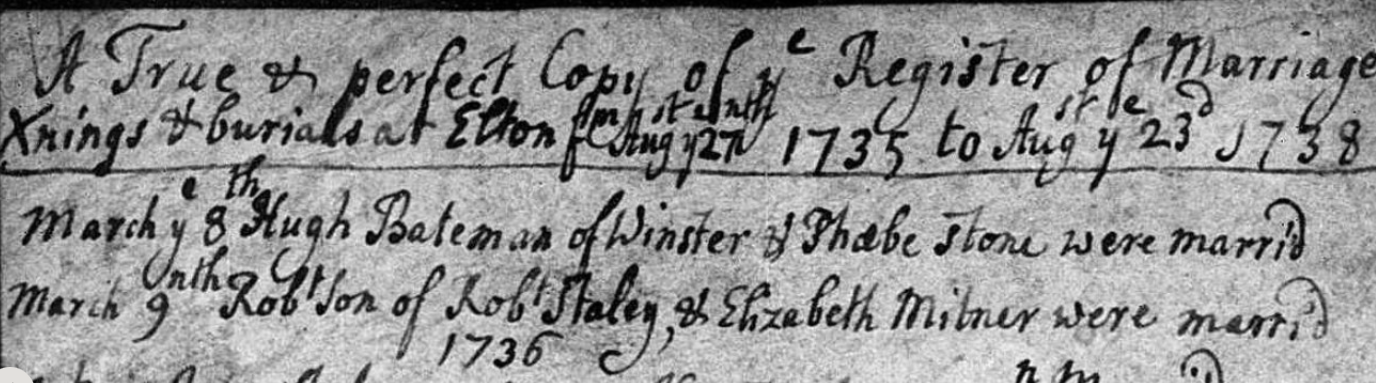
There were several other Staley couples of a similar age in Elton, perhaps brothers and cousins. It seemed that Thomas and Ann’s son Robert was a different Robert, and that the one we were looking for was prior to that and on the missing pages.
Even so, this doesn’t prove that it was Elizabeth Staleys great grandfather who was born in Elton, but no other birth or baptism for Robert Staley has been found. It doesn’t explain why the Staleys moved to Stapenhill either, although the Enclosures Act and the Industrial Revolution could have been factors.
The 18th century saw the rise of the Industrial Revolution and many renowned Derbyshire Industrialists emerged. They created the turning point from what was until then a largely rural economy, to the development of townships based on factory production methods.
The Marsden Connection
There are some possible clues in the records of the Marsden family. Robert Staley married Alice Marsden (or Maceland or Marsland) in Elton in 1704. Robert Staley is mentioned in the 1730 will of John Marsden senior, of Baslow, Innkeeper (Peacock Inne & Whitlands Farm). He mentions his daughter Alice, wife of Robert Staley.
In a 1715 Marsden will there is an intriguing mention of an alias, which might explain the different spellings on various records for the name Marsden: “MARSDEN alias MASLAND, Christopher – of Baslow, husbandman, 28 Dec 1714. son Robert MARSDEN alias MASLAND….” etc.
Some potential reasons for a move from one parish to another are explained in this history of the Marsden family, and indeed this could relate to Robert Staley as he married into the Marsden family and his wife was a beneficiary of a Marsden will. The Chatsworth Estate, at various times, bought a number of farms in order to extend the park.
THE MARSDEN FAMILY
OXCLOSE AND PARKGATE
In the Parishes of
Baslow and Chatsworthby
David Dalrymple-Smith“John Marsden (b1653) another son of Edmund (b1611) faired well. By the time he died in
1730 he was publican of the Peacock, the Inn on Church Lane now called the Cavendish
Hotel, and the farmer at “Whitlands”, almost certainly Bubnell Cliff Farm.”“Coal mining was well known in the Chesterfield area. The coalfield extends as far as the
Gritstone edges, where thin seams outcrop especially in the Baslow area.”“…the occupants were evicted from the farmland below Dobb Edge and
the ground carefully cleared of all traces of occupation and farming. Shelter belts were
planted especially along the Heathy Lea Brook. An imposing new drive was laid to the
Chatsworth House with the Lodges and “The Golden Gates” at its northern end….”Although this particular event was later than any events relating to Robert Staley, it’s an indication of how farms and farmland disappeared, and a reason for families to move to another area:
“The Dukes of Devonshire (of Chatsworth) were major figures in the aristocracy and the government of the
time. Such a position demanded a display of wealth and ostentation. The 6th Duke of
Devonshire, the Bachelor Duke, was not content with the Chatsworth he inherited in 1811,
and immediately started improvements. After major changes around Edensor, he turned his
attention at the north end of the Park. In 1820 plans were made extend the Park up to the
Baslow parish boundary. As this would involve the destruction of most of the Farm at
Oxclose, the farmer at the Higher House Samuel Marsden (b1755) was given the tenancy of
Ewe Close a large farm near Bakewell.
Plans were revised in 1824 when the Dukes of Devonshire and Rutland “Exchanged Lands”,
reputedly during a game of dice. Over 3300 acres were involved in several local parishes, of
which 1000 acres were in Baslow. In the deal Devonshire acquired the southeast corner of
Baslow Parish.
Part of the deal was Gibbet Moor, which was developed for “Sport”. The shelf of land
between Parkgate and Robin Hood and a few extra fields was left untouched. The rest,
between Dobb Edge and Baslow, was agricultural land with farms, fields and houses. It was
this last part that gave the Duke the opportunity to improve the Park beyond his earlier
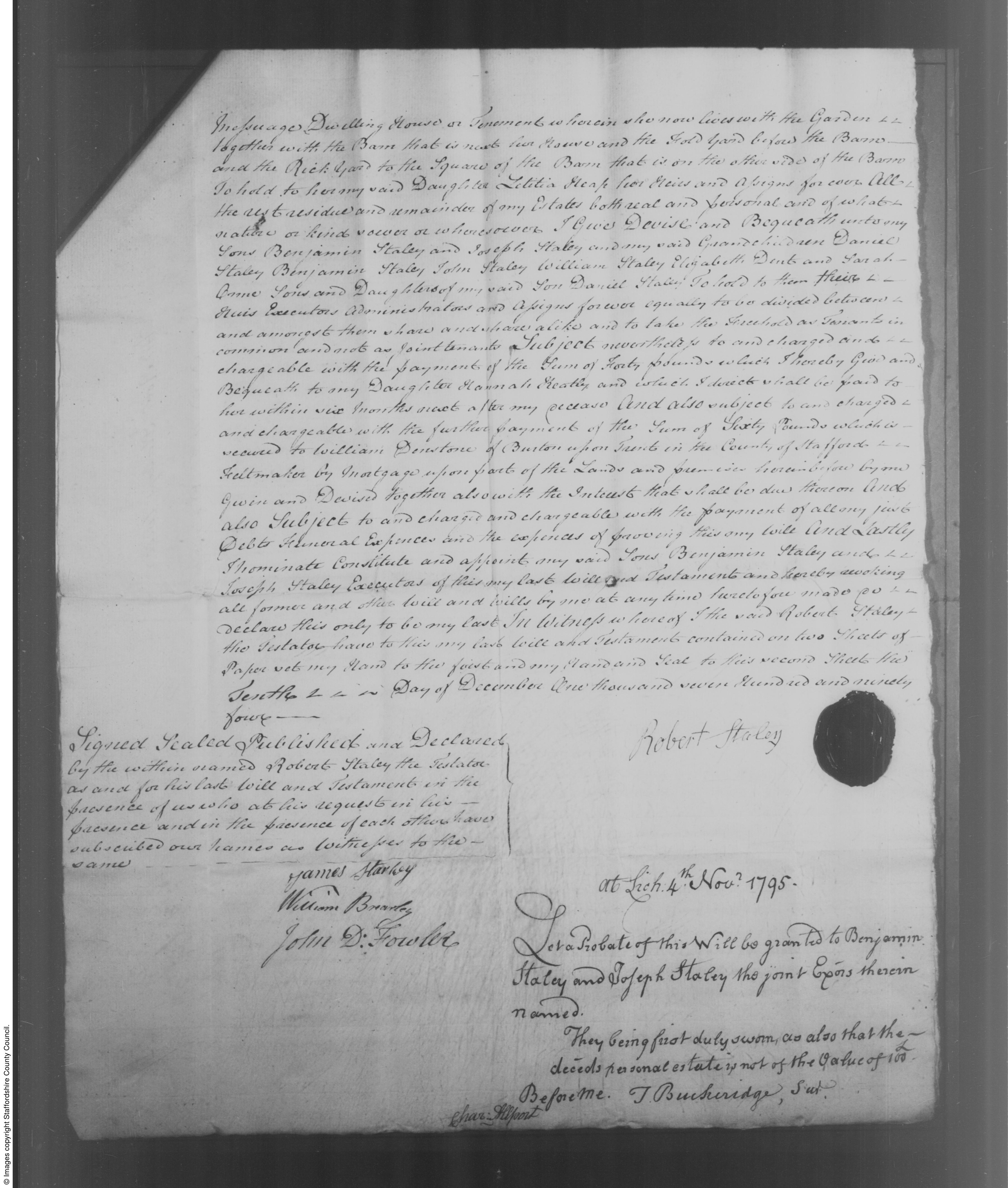
expectations.”The 1795 will of Robert Staley.
Inriguingly, Robert included the children of his son Daniel Staley in his will, but omitted to leave anything to Daniel. A perusal of Daniels 1808 will sheds some light on this: Daniel left his property to his six reputed children with Elizabeth Moon, and his reputed daughter Mary Brearly. Daniels wife was Mary Moon, Elizabeths husband William Moons daughter.
The will of Robert Staley, 1795:
The 1805 will of Daniel Staley, Robert’s son:
This is the last will and testament of me Daniel Staley of the Township of Newhall in the parish of Stapenhill in the County of Derby, Farmer. I will and order all of my just debts, funeral and testamentary expenses to be fully paid and satisfied by my executors hereinafter named by and out of my personal estate as soon as conveniently may be after my decease.
I give, devise and bequeath to Humphrey Trafford Nadin of Church Gresely in the said County of Derby Esquire and John Wilkinson of Newhall aforesaid yeoman all my messuages, lands, tenements, hereditaments and real and personal estates to hold to them, their heirs, executors, administrators and assigns until Richard Moon the youngest of my reputed sons by Elizabeth Moon shall attain his age of twenty one years upon trust that they, my said trustees, (or the survivor of them, his heirs, executors, administrators or assigns), shall and do manage and carry on my farm at Newhall aforesaid and pay and apply the rents, issues and profits of all and every of my said real and personal estates in for and towards the support, maintenance and education of all my reputed children by the said Elizabeth Moon until the said Richard Moon my youngest reputed son shall attain his said age of twenty one years and equally share and share and share alike.
And it is my will and desire that my said trustees or trustee for the time being shall recruit and keep up the stock upon my farm as they in their discretion shall see occasion or think proper and that the same shall not be diminished. And in case any of my said reputed children by the said Elizabeth Moon shall be married before my said reputed youngest son shall attain his age of twenty one years that then it is my will and desire that non of their husbands or wives shall come to my farm or be maintained there or have their abode there. That it is also my will and desire in case my reputed children or any of them shall not be steady to business but instead shall be wild and diminish the stock that then my said trustees or trustee for the time being shall have full power and authority in their discretion to sell and dispose of all or any part of my said personal estate and to put out the money arising from the sale thereof to interest and to pay and apply the interest thereof and also thereunto of the said real estate in for and towards the maintenance, education and support of all my said reputed children by the said
Elizabeth Moon as they my said trustees in their discretion that think proper until the said Richard Moon shall attain his age of twenty one years.Then I give to my grandson Daniel Staley the sum of ten pounds and to each and every of my sons and daughters namely Daniel Staley, Benjamin Staley, John Staley, William Staley, Elizabeth Dent and Sarah Orme and to my niece Ann Brearly the sum of five pounds apiece.
I give to my youngest reputed son Richard Moon one share in the Ashby Canal Navigation and I direct that my said trustees or trustee for the time being shall have full power and authority to pay and apply all or any part of the fortune or legacy hereby intended for my youngest reputed son Richard Moon in placing him out to any trade, business or profession as they in their discretion shall think proper.
And I direct that to my said sons and daughters by my late wife and my said niece shall by wholly paid by my said reputed son Richard Moon out of the fortune herby given him. And it is my will and desire that my said reputed children shall deliver into the hands of my executors all the monies that shall arise from the carrying on of my business that is not wanted to carry on the same unto my acting executor and shall keep a just and true account of all disbursements and receipts of the said business and deliver up the same to my acting executor in order that there may not be any embezzlement or defraud amongst them and from and immediately after my said reputed youngest son Richard Moon shall attain his age of twenty one years then I give, devise and bequeath all my real estate and all the residue and remainder of my personal estate of what nature and kind whatsoever and wheresoever unto and amongst all and every my said reputed sons and daughters namely William Moon, Thomas Moon, Joseph Moon, Richard Moon, Ann Moon, Margaret Moon and to my reputed daughter Mary Brearly to hold to them and their respective heirs, executors, administrator and assigns for ever according to the nature and tenure of the same estates respectively to take the same as tenants in common and not as joint tenants.And lastly I nominate and appoint the said Humphrey Trafford Nadin and John Wilkinson executors of this my last will and testament and guardians of all my reputed children who are under age during their respective minorities hereby revoking all former and other wills by me heretofore made and declaring this only to be my last will.
In witness whereof I the said Daniel Staley the testator have to this my last will and testament set my hand and seal the eleventh day of March in the year of our Lord one thousand eight hundred and five.
March 4, 2022 at 2:58 pm #6280In reply to: The Whale’s Diaries Collection
I started reading a book. In fact I started reading it three weeks ago, and have read the first page of the preface every night and fallen asleep. But my neck aches from doing too much gardening so I went back to bed to read this morning. I still fell asleep six times but at least I finished the preface. It’s the story of the family , initiated by the family collection of netsuke (whatever that is. Tiny Japanese carvings) But this is what stopped me reading and made me think (and then fall asleep each time I re read it)
“And I’m not entitled to nostalgia about all that lost wealth and glamour from a century ago. And I am not interested in thin. I want to know what the relationship has been between this wooden object that I am rolling between my fingers – hard and tricky and Japanese – and where it has been. I want to be able to reach to the handle of the door and turn it and feel it open. I want to walk into each room where this object has lived, to feel the volume of the space, to know what pictures were on the walls, how the light fell from the windows. And I want to know whose hands it has been in, and what they felt about it and thought about it – if they thought about it. I want to know what it has witnessed.” ― Edmund de Waal, The Hare With Amber Eyes: A Family’s Century of Art and Loss
And I felt almost bereft that none of the records tell me which way the light fell in through the windows.
I know who lived in the house in which years, but I don’t know who sat in the sun streaming through the window and which painting upon the wall they looked at and what the material was that covered the chair they sat on.
Were his clothes confortable (or hers, likely not), did he have an old favourite pair of trousers that his mother hated?
There is one house in particular that I keep coming back to. Like I got on the Housley train at Smalley and I can’t get off. Kidsley Grange Farm, they turned it into a nursing home and built extensions, and now it’s for sale for five hundred thousand pounds. But is the ghost still under the back stairs? Is there still a stain somewhere when a carafe of port was dropped?
Did Anns writing desk survive? Does someone have that, polished, with a vase of spring tulips on it? (on a mat of course so it doesn’t make a ring, despite that there are layers of beeswaxed rings already)
Does the desk remember the letters, the weight of a forearm or elbow, perhaps a smeared teardrop, or a comsumptive cough stain?
Is there perhaps a folded bit of paper or card that propped an uneven leg that fell through the floorboards that might tear into little squares if you found it and opened it, and would it be a rough draft of a letter never sent, or just a receipt for five head of cattle the summer before?
Did he hate the curtain material, or not even think of it? Did he love the house, or want to get away to see something new ~ or both?
Did he have a favourite cup, a favourite food, did he hate liver or cabbage?
Did he like his image when the photograph came from the studio or did he think it made his nose look big or his hair too thin, or did he wish he’d worn his other waistcoat?
Did he love his wife so much he couldn’t bear to see her dying, was it neglect or was it the unbearableness of it all that made him go away and drink?
Did the sun slanting in through the dormer window of his tiny attic room where he lodged remind him of ~ well no perhaps he was never in the room in daylight hours at all. Work all day and pub all night, keeping busy working hard and drinking hard and perhaps laughing hard, and maybe he only thought of it all on Sunday mornings.
So many deaths, one after another, his father, his wife, his brother, his sister, and another and another, all the coughing, all the debility. Perhaps he never understood why he lived and they did not, what kind of justice was there in that?
Did he take a souvenir or two with him, a handkerchief or a shawl perhaps, tucked away at the bottom of a battered leather bag that had his 3 shirts and 2 waistcoats in and a spare cap,something embroidered perhaps.
The quote in that book started me off with the light coming in the window and the need to know the simplest things, something nobody ever wrote in a letter, maybe never even mentioned to anyone.
Light coming in windows. I remeber when I was a teenager I had a day off sick and spent the whole day laying on the couch in a big window with the winter sun on my face all day, and I read Bonjour Tristesse in one sitting, and I’ll never forget that afternoon. I don’t remember much about that book, but I remember being transported. But at the same time as being present in that sunny window.
“Stories and objects share something, a patina…Perhaps patina is a process of rubbing back so that the essential is revealed…But it also seems additive, in the way that a piece of oak furniture gains over years and years of polishing.”
“How objects are handed on is all about story-telling. I am giving you this because I love you. Or because it was given to me. Because I bought it somewhere special. Because you will care for it. Because it will complicate your life. Because it will make someone else envious. There is no easy story in legacy. What is remembered and what is forgotten? There can be a chain of forgetting, the rubbing away of previous ownership as much as the slow accretion of stories. What is being passed on to me with all these small Japanese objects?”
“There are things in this world that the children hear, but whose sounds oscillate below an adult’s sense of pitch.”
What did the children hear?
February 8, 2022 at 2:24 pm #6275In reply to: The Elusive Samuel Housley and Other Family Stories
“AND NOW ABOUT EMMA”
and a mystery about George
I had overlooked this interesting part of Barbara Housley’s “Narrative on the Letters” initially, perhaps because I was more focused on finding Samuel Housley. But when I did eventually notice, I wondered how I had missed it! In this particularly interesting letter excerpt from Joseph, Barbara has not put the date of the letter ~ unusually, because she did with all of the others. However I dated the letter to later than 1867, because Joseph mentions his wife, and they married in 1867. This is important, because there are two Emma Housleys. Joseph had a sister Emma, born in 1836, two years before Joseph was born. At first glance, one would assume that a reference to Emma in the letters would mean his sister, but Emma the sister was married in Derby in 1858, and by 1869 had four children.
But there was another Emma Housley, born in 1851.
From Barbara Housley’s Narrative on the Letters:
“AND NOW ABOUT EMMA”
A MYSTERY
A very mysterious comment is contained in a letter from Joseph:
“And now about Emma. I have only seen her once and she came to me to get your address but I did not feel at liberty to give it to her until I had wrote to you but however she got it from someone. I think it was in this way. I was so pleased to hear from you in the first place and with John’s family coming to see me I let them read one or two of your letters thinking they would like to hear of you and I expect it was Will that noticed your address and gave it to her. She came up to our house one day when I was at work to know if I had heard from you but I had not heard from you since I saw her myself and then she called again after that and my wife showed her your boys’ portraits thinking no harm in doing so.”
At this point Joseph interrupted himself to thank them for sending the portraits. The next sentence is:
“Your son JOHN I have never seen to know him but I hear he is rather wild,” followed by: “EMMA has been living out service but don’t know where she is now.”
Since Joseph had just been talking about the portraits of George’s three sons, one of whom is John Eley, this could be a reference to things George has written in despair about a teen age son–but could Emma be a first wife and John their son? Or could Emma and John both be the children of a first wife?
Elsewhere, Joseph wrote, “AMY ELEY died 14 years ago. (circa 1858) She left a son and a daughter.”
An Amey Eley and a George Housley were married on April 1, 1849 in Duffield which is about as far west of Smalley as Heanor is East. She was the daughter of John, a framework knitter, and Sarah Eley. George’s father is listed as William, a farmer. Amey was described as “of full age” and made her mark on the marriage document.
Anne wrote in August 1854: “JOHN ELEY is living at Derby Station so must take the first opportunity to get the receipt.” Was John Eley Housley named for him?
(John Eley Housley is George Housley’s son in USA, with his second wife, Sarah.)
George Housley married Amey Eley in 1849 in Duffield. George’s father on the register is William Housley, farmer. Amey Eley’s father is John Eley, framework knitter.
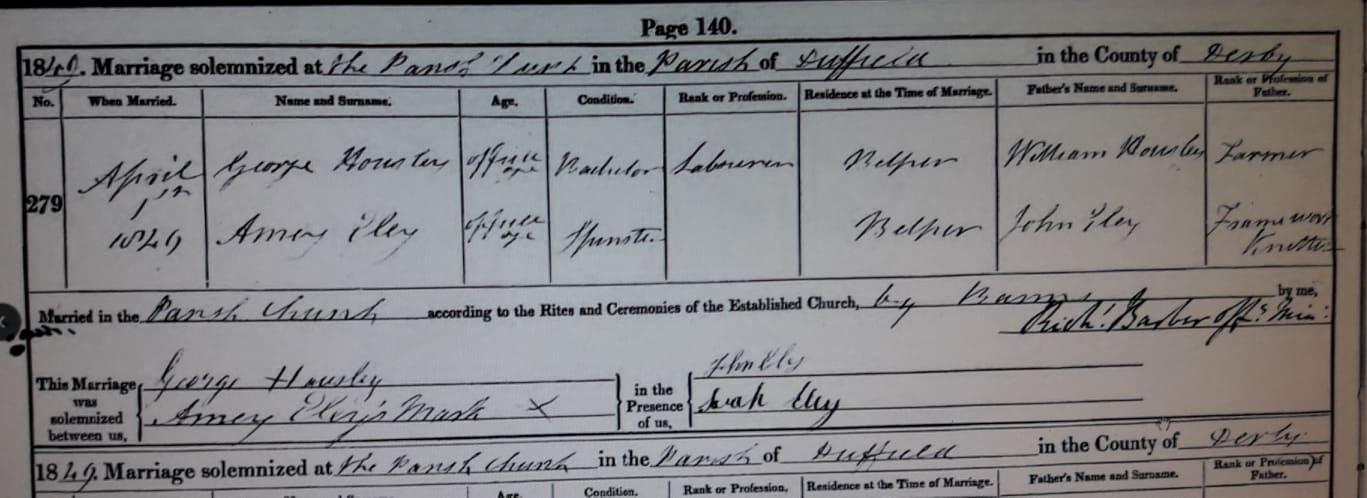
On the 1851 census, George Housley and his wife Amey Housley are living with her parents in Heanor, John Eley, a framework knitter, and his wife Rebecca. Also on the census are Charles J Housley, born in 1849 in Heanor, and Emma Housley, three months old at the time of the census, born in 1851. George’s birth place is listed as Smalley.
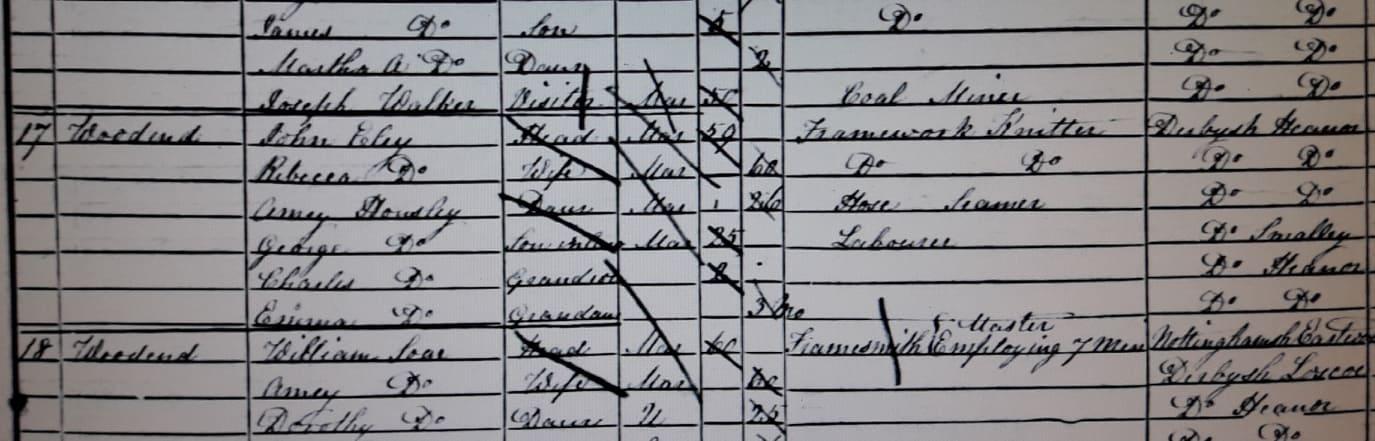
On the 31st of July 1851 George Housley arrives in New York. In 1854 George Housley marries Sarah Ann Hill in USA.
On the 1861 census in Heanor, Rebecca Eley was a widow, her husband John having died in 1852, and she had three grandchildren living with her: Charles J Housley aged 12, Emma Housley, 10, and mysteriously a William Housley aged 5! Amey Housley, the childrens mother, died in 1858.
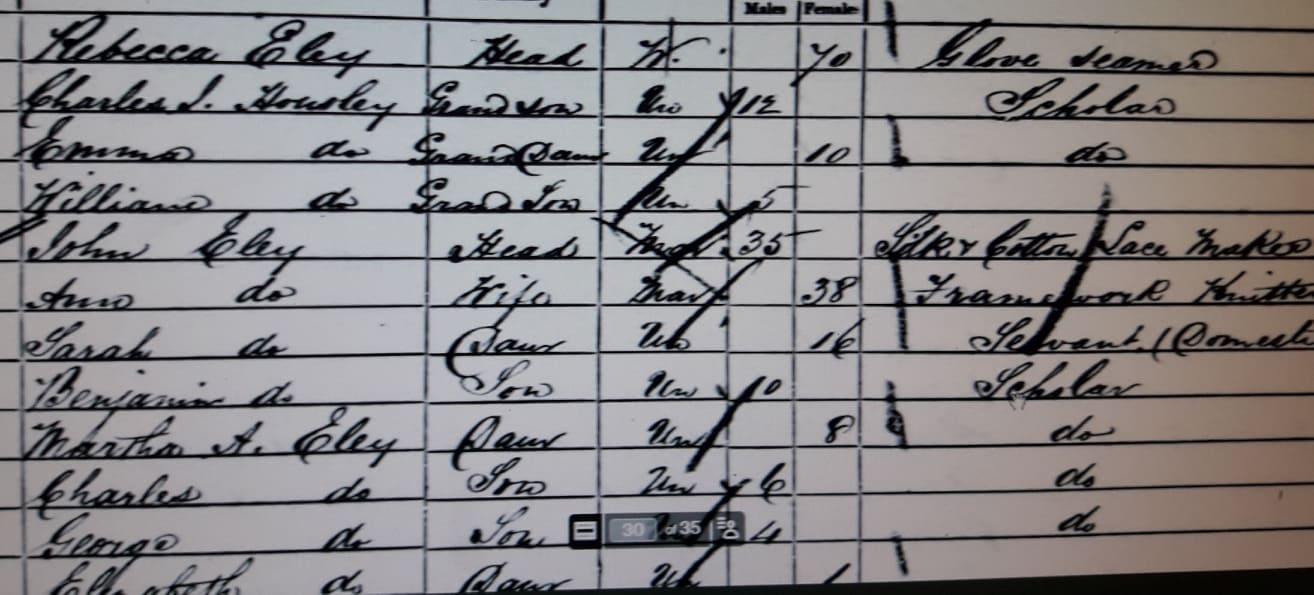
Back to the mysterious comment in Joseph’s letter. Joseph couldn’t have been speaking of his sister Emma. She was married with children by the time Joseph wrote that letter, so was not just out of service, and Joseph would have known where she was. There is no reason to suppose that the sister Emma was trying unsuccessfully to find George’s addresss: she had been sending him letters for years. Joseph must have been referring to George’s daughter Emma.
Joseph comments to George “Your son John…is rather wild.” followed by the remark about Emma’s whereabouts. Could Charles John Housley have used his middle name of John instead of Charles?
As for the child William born five years after George left for USA, despite his name of Housley, which was his mothers married name, we can assume that he was not a Housley ~ not George’s child, anyway. It is not clear who his father was, as Amey did not remarry.
A further excerpt from Barbara Housley’s Narrative on the Letters:
Certainly there was some mystery in George’s life. George apparently wanted his whereabouts kept secret. Anne wrote: “People are at a loss to know where you are. The general idea is you are with Charles. We don’t satisfy them.” In that same letter Anne wrote: “I know you could not help thinking of us very often although you neglected writing…and no doubt would feel grieved for the trouble you at times caused (our mother). She freely forgives all.” Near the end of the letter, Anne added: “Mother sends her love to you and hopes you will write and if you want to tell her anything you don’t want all to see you must write it on a piece of loose paper and put it inside the letter.”
In a letter to George from his sister Emma:
Emma wrote in 1855, “We write in love to your wife and yourself and you must write soon and tell us whether there is a little nephew or niece and what you call them.”
In June of 1856, Emma wrote: “We want to see dear Sarah Ann and the dear little boy. We were much pleased with the “bit of news” you sent.” The bit of news was the birth of John Eley Housley, January 11, 1855. Emma concluded her letter “Give our very kindest love to dear sister and dearest Johnnie.”
It would seem that George Housley named his first son with his second wife after his first wife’s father ~ while he was married to both of them.
Emma Housley
1851-1935
In 1871 Emma was 20 years old and “in service” living as a lodger in West Hallam, not far from Heanor. As she didn’t appear on a 1881 census, I looked for a marriage, but the only one that seemed right in every other way had Emma Housley’s father registered as Ralph Wibberly!
Who was Ralph Wibberly? A family friend or neighbour, perhaps, someone who had been a father figure? The first Ralph Wibberly I found was a blind wood cutter living in Derby. He had a son also called Ralph Wibberly. I did not think Ralph Wibberly would be a very common name, but I was wrong.
I then found a Ralph Wibberly living in Heanor, with a son also named Ralph Wibberly. A Ralph Wibberly married an Emma Salt from Heanor. In 1874, a 36 year old Ralph Wibberly (born in 1838) was on trial in Derby for inflicting grevious bodily harm on William Fretwell of Heanor. His occupation is “platelayer” (a person employed in laying and maintaining railway track.) The jury found him not guilty.
In 1851 a 23 year old Ralph Wibberly (born in 1828) was a prisoner in Derby Gaol. However, Ralph Wibberly, a 50 year old labourer born in 1801 and his son Ralph Wibberly, aged 13 and born in 1838, are living in Belper on the 1851 census. Perhaps the son was the same Ralph Wibberly who was found not guilty of GBH in 1874. This appears to be the one who married Emma Salt, as his wife on the 1871 census is called Emma, and his occupation is “Midland Company Railway labourer”.
Which was the Ralph Wibberly that Emma chose to name as her father on the marriage register? We may never know, but perhaps we can assume it was Ralph Wibberly born in 1801. It is unlikely to be the blind wood cutter from Derby; more likely to be the local Ralph Wibberly. Maybe his son Ralph, who we know was involved in a fight in 1874, was a friend of Emma’s brother Charles John, who was described by Joseph as a “wild one”, although Ralph was 11 years older than Charles John.
Emma Housley married James Slater on Christmas day in Heanor in 1873. Their first child, a daughter, was called Amy. Emma’s mother was Amy Eley. James Slater was a colliery brakesman (employed to work the steam-engine, or other machinery used in raising the coal from the mine.)
It occurred to me to wonder if Emma Housley (George’s daughter) knew Elizabeth, Mary Anne and Catherine (Samuel’s daughters). They were cousins, lived in the vicinity, and they had in common with each other having been deserted by their fathers who were brothers. Emma was born two years after Catherine. Catherine was living with John Benniston, a framework knitter in Heanor, from 1851 to 1861. Emma was living with her grandfather John Ely, a framework knitter in Heanor. In 1861, George Purdy was also living in Heanor. He was listed on the census as a 13 year old coal miner! George Purdy and Catherine Housley married in 1866 in Eastwood, Nottinghamshire ~ just over the county border. Emma’s first child Amy was born in Heanor, but the next two children, Eliza and Lilly, were born in Eastwood, in 1878 and 1880. Catherine and George’s fifth child, my great grandmother Mary Ann Gilman Purdy, was born in Eastwood in 1880, the same year as Lilly Slater.
By 1881 Emma and James Slater were living in Woodlinkin, Codnor and Loscoe, close to Heanor and Eastwood, on the Derbyshire side of the border. On each census up to 1911 their address on the census is Woodlinkin. Emma and James had nine children: six girls and 3 boys, the last, Alfred Frederick, born in 1901.
Emma and James lived three doors up from the Thorn Tree pub in Woodlinkin, Codnor:
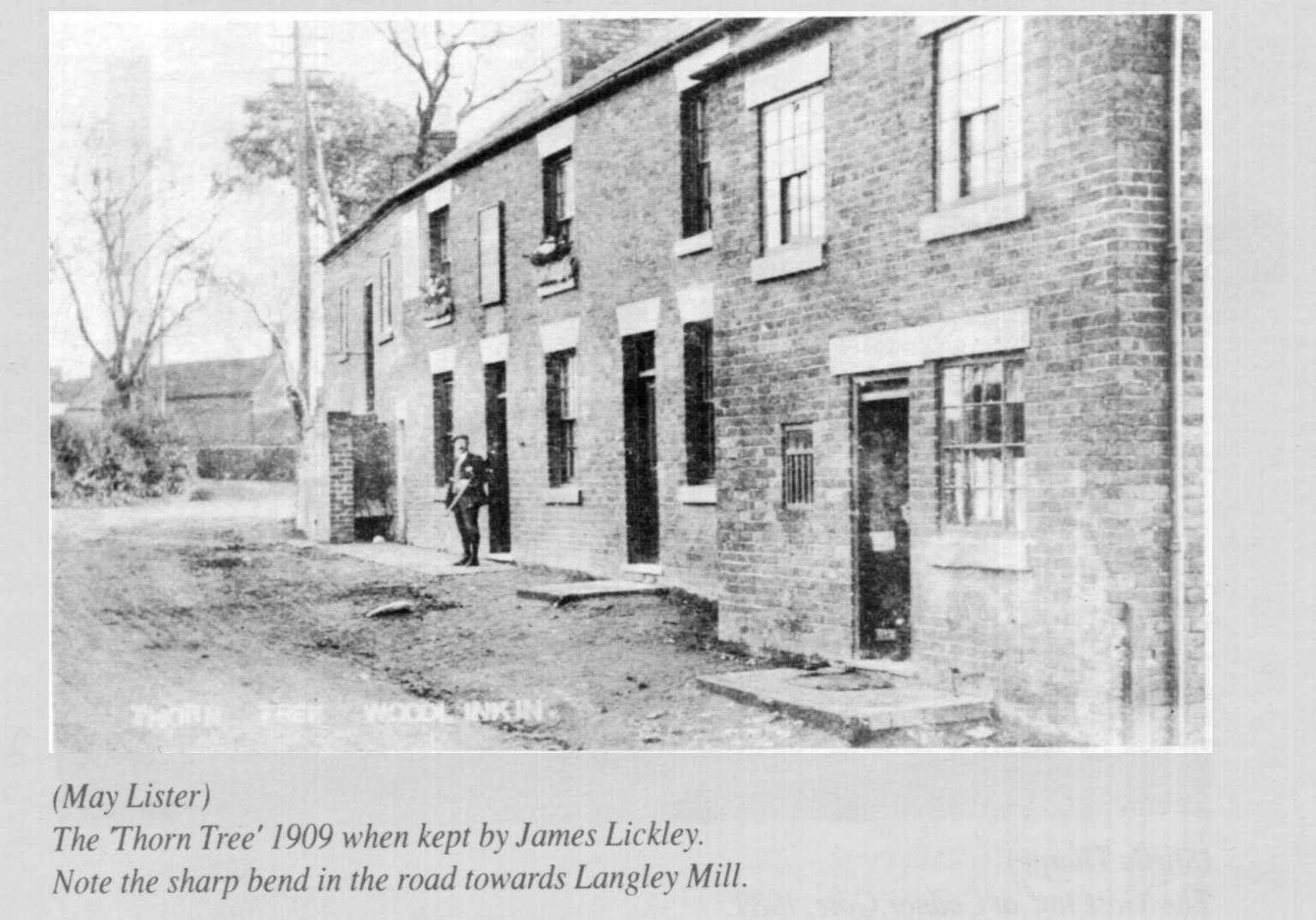
Emma Slater died in 1935 at the age of 84.
IN
LOVING MEMORY OF
EMMA SLATER
(OF WOODLINKIN)
WHO DIED
SEPT 12th 1935
AGED 84 YEARS
AT RESTCrosshill Cemetery, Codnor, Amber Valley Borough, Derbyshire, England:
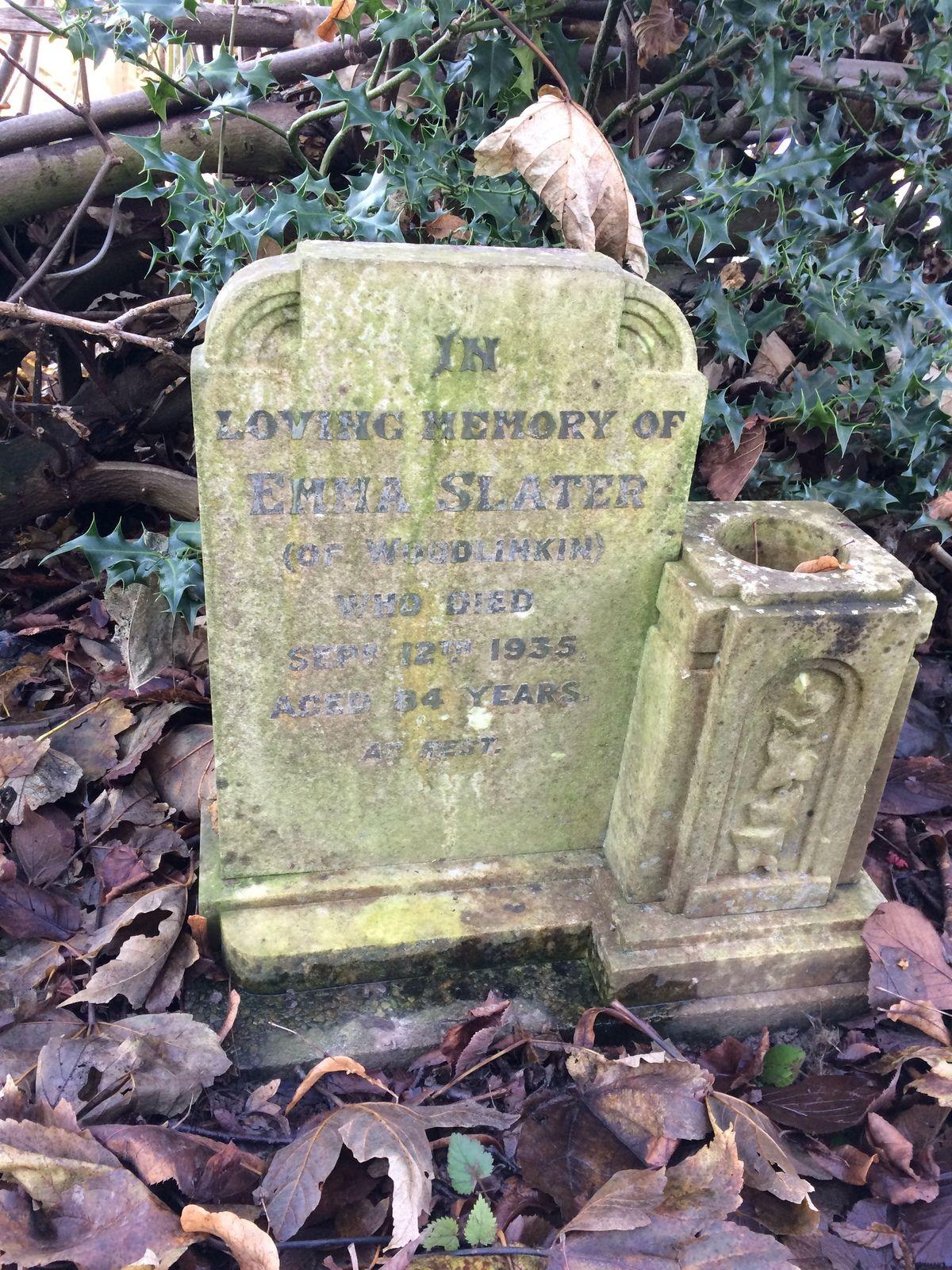
Charles John Housley
1949-
February 5, 2022 at 10:50 am #6271In reply to: The Elusive Samuel Housley and Other Family Stories
The Housley Letters
FRIENDS AND NEIGHBORS
from Barbara Housley’s Narrative on the Letters:
George apparently asked about old friends and acquaintances and the family did their best to answer although Joseph wrote in 1873: “There is very few of your old cronies that I know of knocking about.”
In Anne’s first letter she wrote about a conversation which Robert had with EMMA LYON before his death and added “It (his death) was a great trouble to Lyons.” In her second letter Anne wrote: “Emma Lyon is to be married September 5. I am going the Friday before if all is well. There is every prospect of her being comfortable. MRS. L. always asks after you.” In 1855 Emma wrote: “Emma Lyon now Mrs. Woolhouse has got a fine boy and a pretty fuss is made with him. They call him ALFRED LYON WOOLHOUSE.”
(Interesting to note that Elizabeth Housley, the eldest daughter of Samuel and Elizabeth, was living with a Lyon family in Derby in 1861, after she left Belper workhouse. The Emma listed on the census in 1861 was 10 years old, and so can not be the Emma Lyon mentioned here, but it’s possible, indeed likely, that Peter Lyon the baker was related to the Lyon’s who were friends of the Housley’s. The mention of a sea captain in the Lyon family begs the question did Elizabeth Housley meet her husband, George William Stafford, a seaman, through some Lyon connections, but to date this remains a mystery.)
Elizabeth Housley living with Peter Lyon and family in Derby St Peters in 1861:
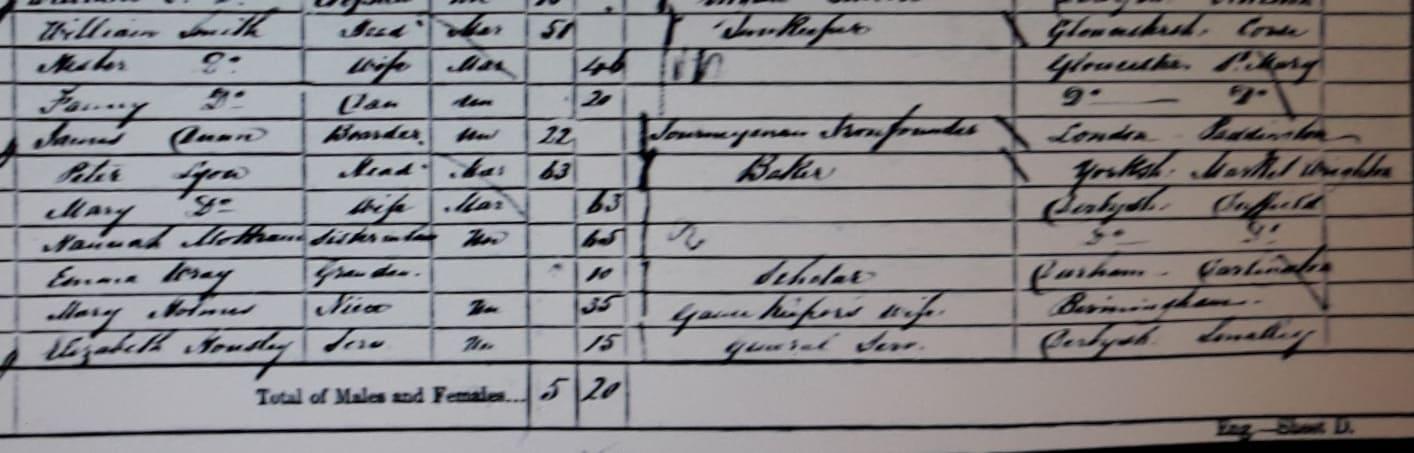
A Henrietta Lyon was married in 1860. Her father was Matthew, a Navy Captain. The 1857 Derby Directory listed a Richard Woolhouse, plumber, glazier, and gas fitter on St. Peter’s Street. Robert lived in St. Peter’s parish at the time of his death. An Alfred Lyon, son of Alfred and Jemima Lyon 93 Friargate, Derby was baptised on December 4, 1877. An Allen Hewley Lyon, born February 1, 1879 was baptised June 17 1879.
Anne wrote in August 1854: “KERRY was married three weeks since to ELIZABETH EATON. He has left Smith some time.” Perhaps this was the same person referred to by Joseph: “BILL KERRY, the blacksmith for DANIEL SMITH, is working for John Fletcher lace manufacturer.” According to the 1841 census, Elizabeth age 12, was the oldest daughter of Thomas and Rebecca Eaton. She would certainly have been of marriagable age in 1854. A William Kerry, age 14, was listed as a blacksmith’s apprentice in the 1851 census; but another William Kerry who was 29 in 1851 was already working for Daniel Smith as a blacksmith. REBECCA EATON was listed in the 1851 census as a widow serving as a nurse in the John Housley household. The 1881 census lists the family of William Kerry, blacksmith, as Jane, 19; William 13; Anne, 7; and Joseph, 4. Elizabeth is not mentioned but Bill is not listed as a widower.
Anne also wrote in 1854 that she had not seen or heard anything of DICK HANSON for two years. Joseph wrote that he did not know Old BETTY HANSON’S son. A Richard Hanson, age 24 in 1851, lived with a family named Moore. His occupation was listed as “journeyman knitter.” An Elizabeth Hanson listed as 24 in 1851 could hardly be “Old Betty.” Emma wrote in June 1856 that JOE OLDKNOW age 27 had married Mrs. Gribble’s servant age 17.
Anne wrote that “JOHN SPENCER had not been since father died.” The only John Spencer in Smalley in 1841 was four years old. He would have been 11 at the time of William Housley’s death. Certainly, the two could have been friends, but perhaps young John was named for his grandfather who was a crony of William’s living in a locality not included in the Smalley census.
TAILOR ALLEN had lost his wife and was still living in the old house in 1872. JACK WHITE had died very suddenly, and DR. BODEN had died also. Dr. Boden’s first name was Robert. He was 53 in 1851, and was probably the Robert, son of Richard and Jane, who was christened in Morely in 1797. By 1861, he had married Catherine, a native of Smalley, who was at least 14 years his junior–18 according to the 1871 census!
Among the family’s dearest friends were JOSEPH AND ELIZABETH DAVY, who were married some time after 1841. Mrs. Davy was born in 1812 and her husband in 1805. In 1841, the Kidsley Park farm household included DANIEL SMITH 72, Elizabeth 29 and 5 year old Hannah Smith. In 1851, Mr. Davy’s brother William and 10 year old Emma Davy were visiting from London. Joseph reported the death of both Davy brothers in 1872; Joseph apparently died first.
Mrs. Davy’s father, was a well known Quaker. In 1856, Emma wrote: “Mr. Smith is very hearty and looks much the same.” He died in December 1863 at the age of 94. George Fox, the founder of the Quakers visited Kidsley Park in 1650 and 1654.
Mr. Davy died in 1863, but in 1854 Anne wrote how ill he had been for two years. “For two last winters we never thought he would live. He is now able to go out a little on the pony.” In March 1856, his wife wrote, “My husband is in poor health and fell.” Later in 1856, Emma wrote, “Mr. Davy is living which is a great wonder. Mrs. Davy is very delicate but as good a friend as ever.”
In The Derbyshire Advertiser and Journal, 15 May 1863:
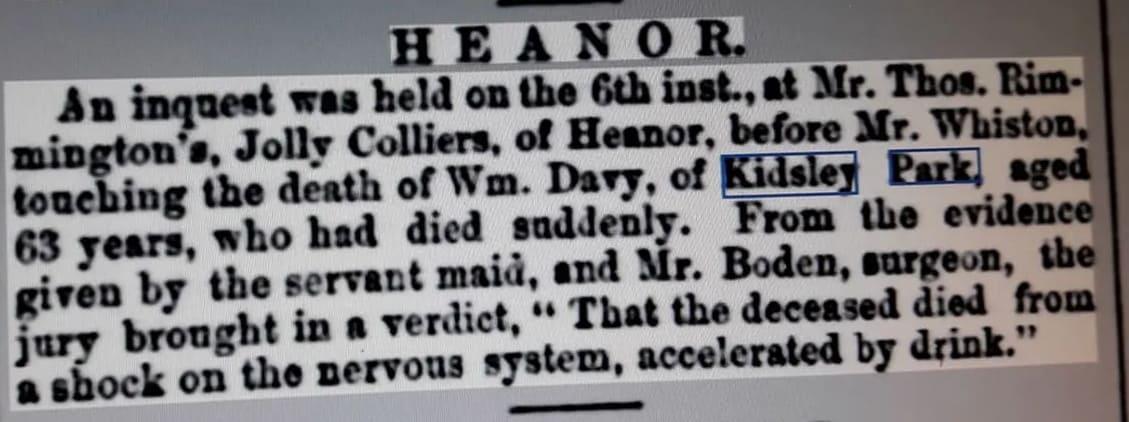
Whenever the girls sent greetings from Mrs. Davy they used her Quaker speech pattern of “thee and thy.” Mrs. Davy wrote to George on March 21 1856 sending some gifts from his sisters and a portrait of their mother–“Emma is away yet and A is so much worse.” Mrs. Davy concluded: “With best wishes for thy health and prosperity in this world and the next I am thy sincere friend.”
Mrs. Davy later remarried. Her new husband was W.T. BARBER. The 1861 census lists William Barber, 35, Bachelor of Arts, Cambridge, living with his 82 year old widowed mother on an 135 acre farm with three servants. One of these may have been the Ann who, according to Joseph, married Jack Oldknow. By 1871 the farm, now occupied by William, 47 and Elizabeth, 57, had grown to 189 acres. Meanwhile, Kidsley Park Farm became the home of the Housleys’ cousin Selina Carrington and her husband Walker Martin. Both Barbers were still living in 1881.
Mrs. Davy was described in Kerry’s History of Smalley as “an accomplished and exemplary lady.” A piece of her poetry “Farewell to Kidsley Park” was published in the history. It was probably written when Elizabeth moved to the Barber farm. Emma sent one of her poems to George. It was supposed to be about their house. “We have sent you a piece of poetry that Mrs. Davy composed about our ‘Old House.’ I am sure you will like it though you may not understand all the allusions she makes use of as well as we do.”
Kiddsley Park Farm, Smalley, in 1898. (note that the Housley’s lived at Kiddsley Grange Farm, and the Davy’s at neighbouring Kiddsley Park Farm)
Emma was not sure if George wanted to hear the local gossip (“I don’t know whether such little particulars will interest you”), but shared it anyway. In November 1855: “We have let the house to Mr. Gribble. I dare say you know who he married, Matilda Else. They came from Lincoln here in March. Mrs. Gribble gets drunk nearly every day and there are such goings on it is really shameful. So you may be sure we have not very pleasant neighbors but we have very little to do with them.”
John Else and his wife Hannah and their children John and Harriet (who were born in Smalley) lived in Tag Hill in 1851. With them lived a granddaughter Matilda Gribble age 3 who was born in Lincoln. A Matilda, daughter of John and Hannah, was christened in 1815. (A Sam Else died when he fell down the steps of a bar in 1855.)
-
AuthorSearch Results
