
Search Results for 'post'
-
AuthorSearch Results
-
December 7, 2024 at 11:52 am #7653
In reply to: Quintessence: Reversing the Fifth
Matteo — Winter 2023: The Move
The rumble of the moving truck echoed faintly in the quiet residential street as Matteo leaned against the open door, arms crossed, waiting for the signal to load the boxes. He glanced at the crisp winter sky, a pale gray threatening snow, and then at the house behind him. Its windows were darkened by empty rooms, their once-lived-in warmth replaced by the starkness of transition. The ornate names artistically painted on the mailbox struck him somehow. Amei & Tabitha M.: his clients for the day.
The cold damp of London’s suburbia was making him long even more for the warmth of sunny days. With the past few moves he’s been managing for his company, the tipping had been generous; he could probably plan a spring break in South of France, or maybe make a more permanent move there.
The sound of the doorbell brought him back from his rêverie.
Inside the house, the faint sounds of boxes being taped and last-minute goodbyes carried through the hallways. Matteo had been part of these moves too many times to count now. People always left a little bit of themselves behind—forgotten trinkets, echoes of old conversations, or the faint imprint of a life lived. It was a rhythm he’d come to expect, and he knew his part in it: lift, carry, and disappear into the background.

Matteo straightened as the door opened and a girl that could have been in her early twenties, but looked like a teenager stepped out, bundled against the cold. She held a steaming mug in one hand and balanced a box awkwardly on her hip with the other.
“That’s the last of it,” she called over her shoulder. “Mum, are you sure you don’t want me to take the notebooks?”
“They’re fine in the car, Tabitha!” A voice—calm and steady, maybe tinged with weariness—floated from inside.
The girl named Tabitha turned to Matteo, offering the box. “This is fragile,” she said, a smile tugging at her lips. “Be nice to it.”
Matteo took the box carefully, glancing at the mug in her hand. “You’re not leaving that behind, are you?” he asked with a faint smile.
Tabitha laughed. “This? No way. That’s my lifeline. The mug stays.”
As Matteo carried the box to the truck, his eyes caught on something inside—a weathered postcard tucked haphazardly between the pages of a journal. The image on the front was striking: a swirling green fairy, dancing above a glass of absinthe. La Fée Verte was scrawled in looping letters across the top.
“Tabitha!” Her mother’s voice carried out to the driveway, and Matteo turned instinctively. She stepped out onto the porch, her scarf wrapped loosely around her neck, her breath visible in the chilly air. Matteo could see the resemblance—the same poise and humor in her gaze, though softened by something older, quieter.
“Put this somewhere, will you” she said, holding up another postcard, this one with a faded image of a winding mountain road.
Tabitha grinned, stepping forward to take it. “Thanks, Mum. That one’s special.” She tucked it into her coat pocket.
“Special how?” her mother asked lightly.
“It’s from Darius,” Tabitha said, her tone almost teasing. “… The one you never want to talk about.” she leaned teasingly. “One of his cryptic postcards —too bad I was too young to really remember him, he must have been fun to be around.”
Matteo’s ears perked at the name, though he kept his head down, settling the box in place. It wasn’t unusual to overhear snippets like this during a move, but something about the unusual name roused his curiosity.
“Why you want to keep those?” Amei asked, tilting her head.
Tabitha shrugged. “They’re kind of… a map, I guess. Of people, not places.”
Amei paused, her expression softening. “He was always good at that,” she murmured, almost to herself.
The conversation lingered in Matteo’s mind as the day went on. By the time the truck was loaded, and he’d helped arrange the last of the boxes in Amei’s new, smaller apartment, the name and the postcard had taken root.
As Matteo stacked the final piece of furniture—a worn bookshelf—against the living room wall, he noticed Amei lingering near a window, her gaze distant.
“It’s different, isn’t it?” she said suddenly, not looking at him.
“Moving?” Matteo asked, unsure if the question was for him.
“Starting over,” she clarified, her voice quieter now. “Feels smaller, even when it’s supposed to be lighter.”
Matteo didn’t reply, sensing she wasn’t looking for an answer. He stepped back, nodding politely as she thanked him and disappeared into the kitchen.
The postcard stuck in his mind for days after. Matteo had heard of absinthe before, of course—its mystique, its history—but something about the way Tabitha had called the postcard a “map of people” resonated.
By the time spring arrived, Matteo was wandering through Avignon, chasing vague curiosities and half-formed questions. When he saw Lucien crouched over his chalk labyrinth, the memory of the postcard rose unbidden.
“Do you know where I can find absinthe?” he asked, the question more instinct than intent.
Lucien’s raised eyebrow and faint smile felt like another piece clicking into place. The connections were there—threads woven in patterns he couldn’t yet see. But for the first time in months, Matteo felt he was back on the right path.
December 7, 2024 at 10:16 am #7651In reply to: Quintessence: A Portrait in Reverse
Exploring further potential backstory for the characters – to be explored further…
This thread beautifully connects to the lingering themes of fractured ideals, missed opportunities, and the pull of reconnection. Here’s an expanded exploration of the “habitats participatifs” (co-housing communities) and how they tie the characters together while weaving in subtle links to their estrangement and Matteo’s role as the fifth element.
Backstory: The Co-Housing Dream
Habitat Participatif: A Shared Vision
The group’s initial bond, forged through shared values and late-night conversations, had coalesced around a dream: buying land in the Drôme region of France to create a co-housing community. The French term habitat participatif—intergenerational, eco-conscious, and collaborative living—perfectly encapsulated their ideals.
What Drew Them In:
- Amei: Longing for a sense of rootedness and community after years of drifting.
- Elara: Intrigued by the participatory aspect, where decisions were made collectively, blending science and sustainability.
- Darius: Enchanted by the idea of shared creative spaces and a slower, more intentional way of living.
- Lucien: Inspired by the communal energy, imagining workshops where art could flourish outside the constraints of traditional galleries.
The Land in Drôme
They had narrowed their options to a specific site near the village of Crest, not far from Lyon. The land, sprawling and sun-drenched, had an old farmhouse that could serve as a communal hub, surrounded by fields and woods. A nearby river threaded through the valley, and the faint outline of mountains painted the horizon.
The traboules of Lyon, labyrinthine passageways, had captivated Amei during an earlier visit, leaving her wondering if their metaphorical weaving through life could mirror the paths their group sought to create.
The Role of Monsieur Renard
When it came to financing, the group faced challenges. None of them were particularly wealthy, and pooling their resources fell short. Enter Monsieur Renard, whose interest in supporting “projects with potential” brought him into their orbit through Éloïse.
Initial Promise:
- Renard presented himself as a patron of innovation, sustainability, and community projects, offering seed funding in exchange for a minor share in the enterprise.
- His charisma and Éloïse’s insistence made him seem like the perfect ally—until his controlling tendencies emerged.
The Split: Fractured Trust
Renard’s involvement—and Éloïse’s increasing influence on Darius—created fault lines in the group.
- Darius’s Drift:
- Darius became entranced by Renard and Éloïse’s vision of community as something deeper, bordering on spiritual. Renard spoke of “energetic alignment” and the importance of a guiding vision, which resonated with Darius’s creative side.
- He began advocating for Renard’s deeper involvement, insisting the project couldn’t succeed without external backing.
- Elara’s Resistance:
- Elara, ever the pragmatist, saw Renard as manipulative, his promises too vague and his influence too broad. Her resistance created tension with Darius, whom she accused of being naive.
- “This isn’t about community for him,” she had said. “It’s about control.”
- Lucien’s Hesitation:
- Lucien, torn between loyalty to his friends and his own fascination with Éloïse, wavered. Her talk of labyrinths and collective energy intrigued him, but he grew wary of her sway over Darius.
- When Renard offered to fund Lucien’s art, he hesitated, sensing a price he couldn’t articulate.
- Amei’s Silence:
- Amei, haunted by her own experiences with manipulation in past relationships, withdrew. She saw the dream slipping away but couldn’t bring herself to fight for it.
Matteo’s Unseen Role
Unbeknownst to the others, Matteo had been invited to join as a fifth partner—a practical addition to balance their idealism. His background in construction and agriculture, coupled with his easygoing nature, made him a perfect fit.
The Missed Connection:
- Matteo had visited the Drôme site briefly, a stranger to the group but intrigued by their vision. His presence was meant to ground their plans, to bring practicality to their shared dream.
- By the time he arrived, however, the group’s fractures were deepening. Renard’s shadow loomed too large, and the guru-like influence of Éloïse had soured the collaborative energy. Matteo left quietly, sensing the dream unraveling before it could take root.
The Fallout: A Fractured Dream
The group dissolved after a final argument about Renard’s involvement:
- Elara refused to move forward with his funding. “I’m not selling my future to him,” she said bluntly.
- Darius, feeling betrayed, accused her of sabotaging the dream out of stubbornness.
- Lucien, caught in the middle, tried to mediate but ultimately sided with Elara.
- Amei, already pulling away, suggested they put the project on hold.
The land was never purchased. The group scattered soon after, their estrangement compounded by the pandemic. Matteo drifted in a different direction, their connection lost before it could form.
Amei’s Perspective: Post-Split Reflection
In the scene where Amei buys candles :
- The shopkeeper’s comments about “seeking something greater” resonate with Amei’s memory of the co-housing dream and how it became entangled with Éloïse and Renard’s influence.
- Her sharper-than-usual reply reflects her lingering bitterness over the way “seeking” led to manipulation and betrayal.
Reunion at the Café: A New Beginning
When the group reunites, the dream of the co-housing project lingers as a symbol of what was lost—but also of what could still be reclaimed. Matteo’s presence at the café bridges the gap between their fractured past and a potential new path.
Matteo’s Role:
- His unspoken connection to the co-housing plan becomes a point of quiet irony: he was meant to be part of their story all along but arrived too late. Now, at the café, he steps into the role he missed years ago—the one who helps them see the threads that still bind them.
December 5, 2024 at 11:01 pm #7647In reply to: Quintessence: Reversing the Fifth
Darius: A Map of People
June 2023 – Capesterre-Belle-Eau, Guadeloupe
The air in Capesterre-Belle-Eau was thick with humidity, the kind that clung to your skin and made every movement slow and deliberate. Darius leaned against the railing of the veranda, his gaze fixed on the horizon where the sky blends into the sea. The scent of wet earth and banana leaves filling the air. He was home.
It had been nearly a year since hurricane Fiona swept through Guadeloupe, its winds blowing a trail of destruction across homes, plantations, and lives. Capesterre-Belle-Eau had been among the hardest hit, its banana plantations reduced to ruin and its roads washed away in torrents of mud.
Darius hadn’t been here when it happened. He’d read about it from across the Atlantic, the news filtering through headlines and phone calls from his aunt, her voice brittle with worry.
“Darius, you should come back,” she’d said. “The land remembers everyone who’s left it.”
It was an unusual thing for her to say, but the words lingered. By the time he arrived in early 2023 to join the relief efforts, the worst of the crisis had passed, but the scars remained—on the land, on the people, and somewhere deep inside himself.
Home, and Not — Now, passing days having turned into quick six months, Darius was still here, though he couldn’t say why. He had thrown himself into the work, helped to rebuild homes, clear debris, and replant crops. But it wasn’t just the physical labor that kept him—it was the strange sensation of being rooted in a place he’d once fled.
Capesterre-Belle-Eau wasn’t just home; it was bones-deep memories of childhood. The long walks under the towering banana trees, the smell of frying codfish and steaming rice from his aunt’s kitchen, the rhythm of gwoka drums carrying through the evening air.
“Tu reviens pour rester cette fois ?” Come back to stay? a neighbor had asked the day he returned, her eyes sharp with curiosity.
He had laughed, brushing off the question. “On verra,” he’d replied. We’ll see.
But deep down, he knew the answer. He wasn’t back for good. He was here to make amends—not just to the land that had raised him but to himself.
A Map of Travels — On the veranda that afternoon, Darius opened his phone and scrolled through his photo gallery. Each image was pinned to a digital map, marking all the places he’d been since he got the phone. Of all places, it was Budapest which popped out, a poor snapshot of Buda Castle.
He found it a funny thought — just like where he was now, he hadn’t planned to stay so long there. He remembered the date: 2020, in the midst of the pandemic. He’d spent in Budapest most of it, sketching the empty streets.
Five years ago, their little group of four had all been reconnecting in Paris, full of plans that never came to fruition. By late 2019, the group had scattered, each of them drawn into their own orbits, until the first whispers of the pandemic began to ripple across the world.
Funding his travels had never been straightforward. He’d tried his hand at dozens of odd jobs over the years—bartending in Lisbon, teaching English in Marrakech, sketching portraits in tourist squares across Europe. He lived frugally, keeping his possessions light and his plans loose. Yet, his confidence had a way of opening doors; people trusted him without knowing why, offering him opportunities that always seemed to arrive at just the right time.
Even during the pandemic, when the world seemed to fold in on itself, he had found a way.
Darius had already arrived in Budapest by then, living cheaply in a rented studio above a bakery. The city had remained open longer than most in Europe or the world, its streets still alive with muted activity even as the rest of Europe closed down. He’d wandered freely for months, sketching graffiti-covered bridges, quiet cafes, and the crumbling facades of buildings that seemed to echo his own restlessness.
When the lockdowns finally came like everywhere else, it was just before winter, he’d stayed, uncertain of where else to go. His days became a rhythm of sketching, reading, and sending postcards. Amei was one of the few who replied—but never ostentatiously. It was enough to know she was still there, even if the distance between them felt greater than ever.
But the map didn’t tell the whole story. It didn’t show the faces, the laughter, the fleeting connections that had made those places matter.
Swatting at a buzzing mosquito, he reached for the small leather-bound folio on the table beside him. Inside was a collection of fragments: ticket stubs, pressed flowers, a frayed string bracelet gifted by a child in Guatemala, and a handful of postcards he’d sent to Amei but had never been sure she received.
One of them, yellowed at the edges, showed a labyrinth carved into stone. He turned it over, his own handwriting staring back at him.
“Amei,” it read. “I thought of you today. Of maps and paths and the people who make them worth walking. Wherever you are, I hope you’re well. —D.”
He hadn’t sent it. Amei’s responses had always been brief—a quick WhatsApp message, a thumbs-up on his photos, or a blue tick showing she’d read his posts. But they’d never quite managed to find their way back to the conversations they used to have.
The Market — The next morning, Darius wandered through the market in Trois-Rivières, a smaller town nestled between the sea and the mountains. The vendors called out their wares—bunches of golden bananas, pyramids of vibrant mangoes, bags of freshly ground cassava flour.
“Tiens, Darius!” called a woman selling baskets woven from dried palm fronds. “You’re not at work today?”
“Day off,” he said, smiling as he leaned against her stall. “Figured I’d treat myself.”
She handed him a small woven bracelet, her eyes twinkling. “A gift. For luck, wherever you go next.”
Darius accepted it with a quiet laugh. “Merci, tatie.”
As he turned to leave, he noticed a couple at the next stall—tourists, by the look of them, their backpacks and wide-eyed curiosity marking them as outsiders. They made him suddenly realise how much he missed the lifestyle.
The woman wore an orange scarf, its boldness standing out as if the color orange itself had disappeared from the spectrum, and only a single precious dash could be seen into all the tones of the market. Something else about them caught his attention. Maybe it was the way they moved together, or the way the man gestured as he spoke, as if every word carried weight.
“Nice scarf,” Darius said casually as he passed.
The woman smiled, adjusting the fabric. “Thanks. Picked it up in Rajasthan. It’s been with me everywhere since.”
Her partner added, “It’s funny, isn’t it? The things we carry. Sometimes it feels like they know more about where we’ve been than we do.”
Darius tilted his head, intrigued. “Do you ever think about maps? Not the ones that lead to places, but the ones that lead to people. Paths crossing because they’re meant to.”
The man grinned. “Maybe it’s not about the map itself,” he said. “Maybe it’s about being open to seeing the connections.”
A Letter to Amei — That evening, as the sun dipped below the horizon, Darius sat at the edge of the bay, his feet dangling above the water. The leather-bound folio sat open beside him, its contents spread out in the fading light.
He picked up the labyrinth postcard again, tracing its worn edges with his thumb.
“Amei,” he wrote on the back just under the previous message a second one —the words flowing easily this time. “Guadeloupe feels like a map of its own, its paths crossing mine in ways I can’t explain. It made me think of you. I hope you’re well. —D.”
He folded the card into an envelope and tucked it into his bag, resolving to send it the next day.
As he watched the waves lap against the rocks, he felt a sense of motion rolling like waves asking to be surfed. He didn’t know where the next path would lead next, but he felt it was time to move on again.
December 5, 2024 at 2:37 am #7645In reply to: Quintessence: Reversing the Fifth
Amei sat cross-legged on the floor in what had once been the study, its emptiness amplified by the packed boxes stacked along the walls. The bookshelves were mostly bare now, save for a few piles of books she was donating to goodwill.
The window was open, and a soft breeze stirred the curtains, carrying with it the faint chime of church bells in the distance. Ten o’clock. Tomorrow was moving day.
Her notebooks were heaped beside her on the floor—a chaotic mix of battered leather covers, spiral-bound pads, and sleek journals bought in fleeting fits of optimism. She ran a hand over the stack, wondering if it was time to let them go. A fresh start meant travelling lighter, didn’t it?
She hesitated, then picked up the top notebook. Flipping it open, she skimmed the pages—lists, sketches, fragments of thoughts and poems. As she turned another page, a postcard slipped out and fluttered to the floor.
She picked it up. The faded image showed a winding mountain road, curling into mist. On the back, Darius had written:
“Found this place by accident. You’d love it. Or maybe hate it. Either way, it made me think of you. D.”
Amei stared at the card. She’d forgotten about these postcards, scattered through her notebooks like breadcrumbs to another time. Sliding it back into place, she set the notebook aside and reached for another, older one. Its edges were frayed, its cover softened by time.
She flicked through the pages until an entry caught her eye, scrawled as though written in haste:
Lucien found the map at a flea market. He thought it was just a novelty, but the seller was asking too much. L was ready to leave it when Elara saw the embossed bell in the corner. LIKE THE OTHER BELL. Darius was sure it wasn’t a coincidence, but of course wouldn’t say why. Typical. He insisted we buy it, and somehow the map ended up with me. “You’ll keep it safe,” he said. Safe from what? He wouldn’t say.
The map! Where was the map now? How had she forgotten it entirely? It had just been another one of their games back then, following whatever random clues they stumbled across. Fun at the time, but nothing she’d taken seriously. Maybe Darius had, though—especially in light of what happened later. She flipped the page, but the next entry was mundane—a note about Elara’s birthday. She read through to the end of the notebook, but there was no follow-up.
She glanced at the boxes. Could the map still be here, buried among her things? Stuffed into one of her notebooks? Or, most likely, had it been lost long ago?
She closed the notebook and sighed. Throwing them out would have been easier if they hadn’t started whispering to her again, pulling at fragments of a past she thought she had left behind.
December 4, 2024 at 8:44 am #7641In reply to: Quintessence: Reversing the Fifth
The luxury of an afternoon nap was one of the finer pleasures of retirement, particularly during the heat of an Italian summer. Elara stretched like a cat on the capacious sofa, pulling a couple of kilim covered cushions into place to support her neck. She had only read a few pages of her book about the Cerne Abbas giant, the enigmatic chalk figure on a hill in Dorset, before her eyes slid closed and the book dropped with a thud onto her chest.
The distant clang of a bell woke her several hours later, although she remained motionless, unable to open her eyes at first. Not one to recall dreams as a rule, Elara was surprised at the intensity of the dream she was struggling to awaken from, and the clarity of the details, and the emotion. In the dream she was at the CERN conference, a clamour and cacophony of colleagues, some familiar to her in waking life, some characters complete strangers but familiar to her in the dream. She had felt agitation at the noise and at the cold coffee, and an indescribable feeling when Florian somehow appeared by her side, who was supposed to be in Tuscany, whispering in her ear that her mother had died and she was to make the funeral arrangements.
Elara’s mother had died when she was just a child, barely eight years old. She was no longer sure if she remembered her, or if her memories were from the photographs and anecdotes she’d seen and heard in the following years. Her older sister Vanessa had said darkly that she was lucky and well out of it, to not have had to put up with her when she was a teenager, like she had. Vanessa was ten years older than Elara, and had assumed the role of mother. She explained later that she’d let Elara run wild because she didn’t want to be bossy and domineering, but admitted that she should perhaps have reined her younger sister in a bit more than she had.
Again, the distant bell clanged. Shaking her head as if to dispel the memories the dream had conjured, Elara rose from the sofa and walked out on to the terrace. Across the yard she could see Florian, replacing the old bell on the new gate post.
“Sorry, did I wake you?” he called. “I had a bit of linen round the clanger so it didn’t make a noise while I screwed it to the post, but it slipped. Sorry,” he repeated.
Squinting in the bright sun, Elara strolled over to him, saying, “Honestly, don’t worry, I was glad to wake up. What a dream I had! That’s great Florian, nice job.”
December 2, 2024 at 8:35 pm #7634In reply to: Quintessence: Reversing the Fifth
Nov.30, 2024 2:33pm – Darius: The Map and the Moment
Darius strolled along the Seine, the late morning sky a patchwork of rainclouds and stubborn sunlight. The bouquinistes’ stalls were already open, their worn green boxes overflowing with vintage books, faded postcards, and yellowed maps with a faint smell of damp paper overpowered by the aroma of crêpes and nearby french fries stalls. He moved along the stalls with a casual air, his leather duffel slung over one shoulder, boots clicking against the cobblestones.
The duffel had seen more continents than most people, its scuffed surface hinting at his nomadic life. India, Brazil, Morocco, Nepal—it carried traces of them all. Inside were a few changes of clothes, a knife he’d once bought off a blacksmith in Rajasthan, and a rolled-up leather journal that served more as a collection of ideas than a record of events.
Darius wasn’t in Paris for nostalgia, though it tugged at him in moments like this. The city had always been Lucien’s thing —artistic, brooding, and layered with history. For Darius, Paris was just another waypoint. Another stop on a map that never quite seemed to end.
It was the map that stopped him, actually. A tattered, hand-drawn thing propped against a pile of secondhand books, its edges curling like a forgotten leaf. Darius leaned in, frowning at its odd geometry. It wasn’t a city plan or a geographical rendering; it was… something else.
“Ah, you’ve found my prize,” said the bouquiniste, a short older man with a grizzled beard and a cigarette dangling from his lips.
“This?” Darius held up the map, his dark fingers tracing the looping, interconnected lines. They reminded him of something—a mandala, maybe, or one of those intricate yantras he’d seen in a temple in Varanasi.
“It’s not a real place,” the bouquiniste continued, leaning closer as though revealing a secret. “More of a… philosophical map.”
Darius raised an eyebrow. “A philosophical map?”
The man gestured toward the lines. “Each path represents a choice, a possibility. You could spend your life trying to follow it, or you could accept that you already have.”
Darius tilted his head, the edges of a smile forming. “That’s deep for ten euros.”
“It’s twenty,” the bouquiniste corrected, his grin flashing gold teeth.
Darius handed over the money without a second thought. The map was too strange to leave behind, and besides, it felt like something he was meant to find.
He rolled it up and tucked it into his duffel, turning back toward the city’s winding streets. The café wasn’t far now, but he still had time.
He stopped by a street vendor selling espresso shots and ordered one, the strong, bitter taste jolting his senses awake. As he leaned against a lamppost, he noticed his reflection in a shop window: a tall, broad-shouldered man, his dark skin glistening faintly in the misty air. His leather jacket was worn at the elbows, his boots dusted with dirt from some far-flung place.
He looked like a man who belonged everywhere and nowhere—a nomad who’d long since stopped wondering what home was supposed to feel like.
India had been the last big stop. It was messy, beautiful chaos. The temples had been impressive, sure, but it was the street food vendors, the crowded markets, the strolls on the beach with the peaceful cows sunbathing, and the quiet, forgotten alleys that stuck with him. He’d made some connections, met some people who’d lingered in his thoughts longer than they should have.
One of them had been a woman named Anila, who had handed him a fragment of something—an idea, a story, a warning. He couldn’t quite remember now. It felt like she’d been trying to tell him something important, but whatever it was had slipped through his fingers like water.
Darius shook his head, pushing the thought aside. The past was the past, and Paris was the present. He looked at the rolled-up map peeking out of his duffel and smirked. Maybe Lucien would know what to make of it. Or Elara, with her scientific mind and love of puzzles.
The group had always been a strange mix, like a band that shouldn’t work but somehow did. And now, after five years of silence, they were coming back together.
The idea made his stomach churn—not with nerves, exactly, but with a sense of inevitability. Things had been left unsaid back then, unfinished. And while Darius wasn’t usually one to linger on the past, something about this meeting felt… different.
The café was just around the corner now, its brass fixtures glinting through the drizzle. Darius slung his duffel higher on his shoulder and took one last sip of espresso before tossing the cup into a bin.
Whatever this reunion was about, he’d be ready for it.
But the map—it stayed on his mind, its looping lines and impossible paths pressing into his thoughts like a puzzle waiting to be solved.
December 2, 2024 at 8:16 am #7632In reply to: Quintessence: Reversing the Fifth
It was a wonder that the letter had reached her at the guest house, the post being so slow and unreliable these days. It didn’t give Elara much time to plan the trip, but it was enough ~ just. If it hadn’t been so easy to get to Paris from Dover she’d probably have said she couldn’t make it. The study could wait while she took a few days off, progress had been made on the project, more than expected. The additional properties of the chalk at Samphire Hoe were exciting, but would need much more work.
I’m supposed to be retired, Elara reminded herself, wondering how she’d allowed herself to get roped in to another field trip. A few weeks back in England, all expense paid, had swayed her, but the weeks were turning into months.
Looking at the envelope again, Elara wondered what the stain was. It didn’t look like paint. Tempted to run it through some tests at the lab, she realised she didn’t have time. She had to book tickets and pack a few things, and send a message to Florian to thank him for forwarding the letter. I wonder why he didn’t just tell me about the letter in a message? she wondered. I’d have suggested he open it and tell me what it said. And how unusual to send an actual paper letter! It was partly this intriguing point that was making her determined to go and see what it was all about.
But you know what Lucien is like, she reminded herself, wondering if he was still the same. Five years wasn’t long, but it was relative. The past five years had flown by, but a lot had happened. But have I changed? A few more wrinkles, grey hairs more prolific, arthritic hips a little more troublesome…. and my interests have changed…
Elara wasn’t sure if she had changed more than she had stayed fundamentally the same. Mutatur autem idem, vel in diversum…..
December 2, 2024 at 1:19 am #7631In reply to: Quintessence: Reversing the Fifth
Amei found the letter waiting on the narrow hallway table; her flatmate, Felix, must have left it there. They rarely crossed paths these days as he was working long shifts at the hospital. His absence suited her—mostly.
It was a novelty to get a letter! She turned it over in her hands, noting the faint coffee stain on one corner and the Paris postmark. The handwriting was sharp and angular, unmistakably Lucien’s. It felt like a relic from another life, a self she’d long ago left behind in favour of the safe existence she had built in London.
She slipped a finger under the flap and opened the envelope. It contained a single piece of paper—she read the words and Lucien’s familiar insistence leapt off the page.
Amei set the letter on the kitchen counter and stood for a moment, staring out the window. The view was of the neighbouring building—a dreary brick wall streaked with stains, its monotony interrupted only by a single trailing vine struggling to cling to life.
The flat was small but tidy, shaped by two lives that rarely intersected. Felix’s presence was minimal: a mug left on the counter, a jacket draped over a chair. The rest was hers—books stacked on shelves, notebooks brimming with half-formed ideas, and an easel by the window holding an unfinished canvas. She freelanced as a textile designer. On the desk lay fabric swatches and sketches for her latest project—a clean, modern design for a boutique client. The work was steady and paid the bills but left little room for the creative freedom she once craved.
It certainly wasn’t the life she’d envisioned for herself at twenty, or even thirty, but it was functional. Yet there was an emptiness to it all; she was good at what she did, but the passion she’d once felt for her work had dulled.
There were no children at home to fill the silence, no pets to demand her attention. Relationships had come and gone, but none had felt like forever. Felix offered a semblance of company, though their conversations had dwindled to polite exchanges or the odd humorous anecdote. Her days had settled into a rhythm of predictability, punctuated only by deadlines and occasional dinners with colleagues she liked but never truly connected with.
Amei sank into the armchair by the window. Should she go? She had to admit she was curious. It must be nearly five years since they had last been together and the events of that last occasion still haunted her.
She leaned back, her gaze trailing to the vine outside the window, and let the question linger.
December 1, 2024 at 8:26 pm #7628In reply to: Quintessence: Reversing the Fifth
The train rattled on, its rhythm almost hypnotic. Amei rested her forehead against the cool glass, watching the countryside blur into a smudge of grey fields and skeletal trees. The rain had not let up the entire trip, each station bringing her closer to Paris—and to the friends she had once thought she would never lose.
She unfolded a letter in her lap, its creased edges softened by too many readings. So old-school to have sent a letter, and yet so typical of Lucien. The message was brief, just a handful of words in his familiar scrawl: Sarah Bernhardt Cafe, November 30th , 4 PM. No excuses this time! Below the terse instruction, there was an ink smudge. Perhaps, she imagined, a moment of second-guessing himself before sealing the envelope? Vulnerability had never been Lucien’s strength.
Catching her reflection in the window, Amei frowned at her hair, unruly from the long journey. She reached for the scarf draped loosely around her neck—a gift from Elara, given years ago. It had been a token from one of their countless shared adventures, and despite everything that had unfolded since, she had never been able to let it go. She twisted the soft fabric around her fingers, its familiar texture reassuring her, before tying it over her hair.
At her feet sat a well-worn tote bag, weighed down with notebooks. It was madness to have brought so many. Maybe it was reflexive, a habit ingrained from years of recording her travels, as though every journey demanded she tell the story of her life. Or perhaps it was a subconscious offering—she couldn’t show up empty-handed, not after five years of silence.
Five years had slipped by quickly! What had started as the odd missed call or unanswered email, and one too many postponed plans had snowballed into a silence none of them seemed to know how to bridge.
Darius had tried. His postcards arrived sporadically, cryptic glimpses of his nomadic life. Amei had never written back, though she had saved the postcards, tucking them between the pages of her notebooks like fragments of a lost map.
Lucien, on the other hand, had faded into obscurity, his absence feeling strangely like betrayal. Amei had always believed he’d remain their anchor, the unspoken glue holding them together. When he didn’t, the silence felt personal, even though she knew it wasn’t. And yet, it was Lucien who had insisted on this reunion.
The train hissed into the station, jolting Amei from her thoughts. The platform was a flurry of umbrellas and hurried footsteps. Hoisting her bag onto her shoulder, she navigated the throng, letting the rhythm of the city wash over her. Paris felt foreign and familiar all at once.
By the time she reached her hotel, the rain had seeped through her boots. She stood for a long moment in the tiny room—the best she could find on her budget—and gazed at her reflection in the cracked mirror. A quiet sense of inevitability settled over her. They would have all changed, of course. How could they not? Yet there was something undeniably comforting about the fact that their paths, no matter how far they had strayed, had led them back here—to Paris, to the Sarah Bernhardt Café.
December 1, 2024 at 5:56 pm #7625In reply to: Quintessence: A Portrait in Reverse
Characters list
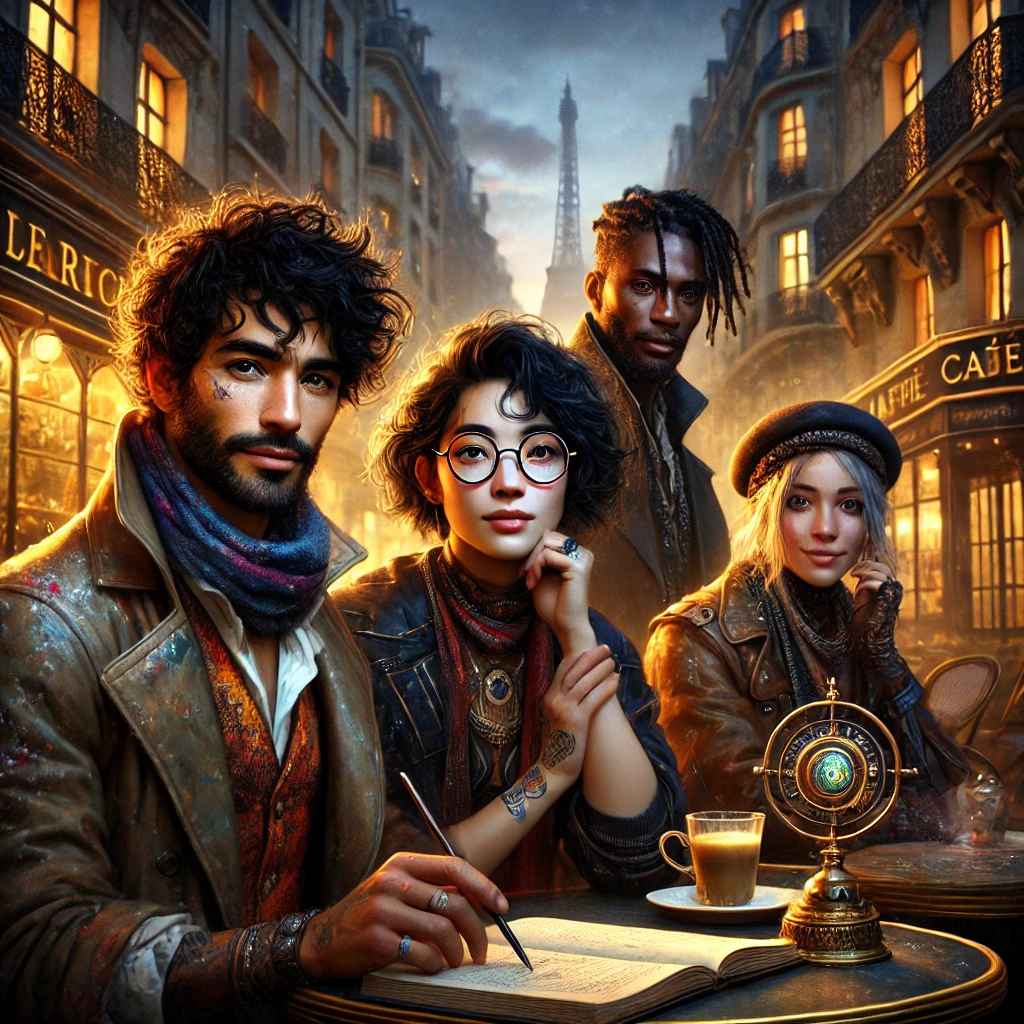
Character / Personality Traits / Connection clues to Matteo
- Lucien
- The Artist
- Introspective, dreamy, quietly sarcastic
- A painter who sees the world in textures and light. His sketchbook holds fragmented memories of their shared past.
- Matteo recalls Lucien’s fleeting romance marked by an order of absinthe—a memory Lucien himself can’t fully place.
- Elara
- The Scientist
- Analytical, sharp, skeptical
- A physicist drawn to patterns and precision. Her research often brushes the edges of metaphysical questions.
- Matteo remembers her ordering black coffee, always focused, and making fleeting remarks about the nature of time.
- Darius
- The Explorer
- Bold, restless, deeply curious
- A wanderer with a talent for uncovering hidden stories. He carries artifacts of his travels like talismans.
- Matteo recalls a postcard Darius once gave him —a detail that surprises even Darius.
- Amei
- The Storyteller
- Observant, wise, enigmatic
- A weaver of tales who often carries journals filled with unfinished stories. She sees connections others miss.
- Matteo knows her through her ritual of mint tea and her belief that the right tea could mend almost anything.
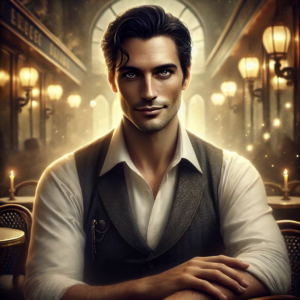
- Matteo
- The Enigmatic Server
- Charismatic, cryptic, all-knowing
- A waiter with an uncanny awareness of the four friends, both individually and collectively.
- Holds a quiet, unspoken role as the bridge between their shared pasts, though his true connection remains unexplained.
December 1, 2024 at 5:11 pm #7618Topic: Quintessence: Reversing the Fifth
in forum Yurara Fameliki’s StoriesMatteo Appears
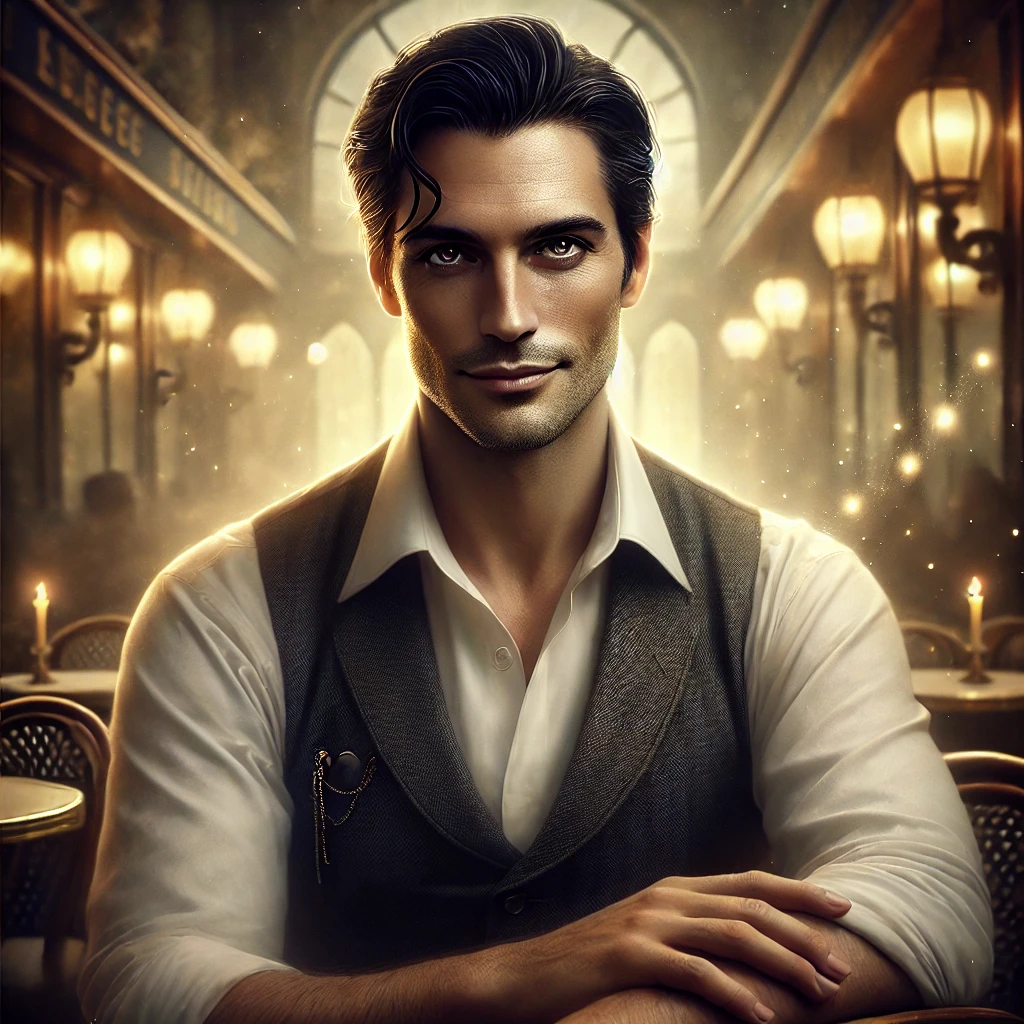
Matteo approached the table, a tray balanced effortlessly in one hand, his dark eyes flicking over the group as though cataloging details in an invisible ledger. His waistcoat, sharp and clean, gave him a practiced professionalism, but there was something else—a casual, unspoken authority that drew attention.
“Good evening,” he began, his voice smooth and low, almost conspiratorial. Then, he froze for the briefest moment, his gaze shifting from face to face, the easy smile tightening at the corners.
“Well,” Matteo said finally, his smile broadening as if he’d just solved a riddle. “Here you all are. Together, at last.”
The group exchanged glances, each of them caught off-guard by the comment.
“You say that like you’ve been expecting us,” Elara said, her tone measured but sharp, as if probing for variables.
“Not expecting,” Matteo replied, his eyes glinting. “But hoping, perhaps. It’s… good to see you all like this. It fits, somehow.”
“What fits?” Darius asked, leaning forward. His voice was lighter than Elara’s but carried a weight that suggested he wouldn’t let the question drop easily.
Matteo’s smile deepened, though he didn’t answer immediately. Instead, he set down his tray and folded his hands in front of him, his posture relaxed but deliberate, as though he were balancing on the edge of some invisible line.
“You’ve never all been here before,” he said, a simple statement that landed like a challenge.
“Wait,” Amei said, narrowing her eyes. “You know us?”
“Oh, I know you,” Matteo replied, his tone as light as if they were discussing the weather. “Individually, yes. But together? This is new. And it’s… remarkable.”
“Remarkable how?” Lucien asked, his pencil stilled over his sketchbook.
Matteo tilted his head, considering the question as though weighing how much to say. “Let’s just call it a rarity. Things don’t often align so neatly. It’s not every day you see… well, this.”
He gestured toward them with a sweeping hand, as if the mere fact of their presence at the table was something extraordinary.
“You’re being cryptic,” Elara said, her voice edged with suspicion.
“It’s a talent,” Matteo replied smoothly.
“Alright, hold on.” Darius leaned back, his chair creaking under him. “How do you know us? I’ve never been here before. Not once.”
“Nor I,” Amei added, her voice soft but steady.
Matteo raised an eyebrow, his smile taking on a knowing tilt. “No, not here. But that’s not the only place to know someone, is it?”
The words hung in the air, unsettling and oddly satisfying at once.
“You’re saying we’ve met you before?” Elara asked.
Matteo inclined his head. “In a manner of speaking.”
“That doesn’t make sense,” Lucien said, his voice quiet but firm.
“Doesn’t it?” Matteo countered, his tone almost playful. “After all, do we ever truly remember every thread that weaves us together? Sometimes we only see the pattern when it’s complete.”
A pause settled over the table, heavy with unspoken questions. Matteo shifted his weight, breaking the silence with an easy gesture.
“It doesn’t matter how,” he said finally. “What matters is that you’re here. That’s what counts.”
“For what?” Amei asked, her eyes narrowing.
“For whatever happens next,” Matteo replied, as if the answer were obvious. Then he straightened, his professional mask sliding back into place with effortless grace.
“Now, what can I bring you?” he asked, his tone light again, as though the previous exchange hadn’t happened.
One by one, they placed their orders, though their minds were clearly elsewhere. Matteo scribbled in his notebook, his pen moving with deliberate strokes, and then he looked up once more.
“Thank you for being here,” he said, his voice quieter this time. “It’s been… a long time coming.”
And with that, he was gone, disappearing into the crowd with the same fluidity he’d arrived.
They sat in silence for a moment, his words pressing down on them like a hand on a wound, familiar and foreign all at once.
“What the hell was that?” Darius asked finally, breaking the spell.
“Does he seem… different to you?” Amei asked, her voice distant.
“He seems impossible,” Elara replied, her fingers tapping an unconscious rhythm on the table.
“He remembered me,” Lucien said, almost to himself. “Something about absinthe.”
“I’ve never even met him,” Elara said, her voice rising slightly. “But he knew… too much.”
“And he didn’t explain anything,” Darius added, shaking his head.
“Maybe he didn’t need to,” Amei said softly, her gaze fixed on the space Matteo had just vacated.
They lapsed into silence again, the noise of the café returning in fits and starts, like an orchestra warming up after a pause. Somewhere, a glass clinked against porcelain; outside, the violinist struck a note so low it hummed against the windowpane.
The four of them sat there, strangers and friends all at once, the questions left dangling between them like stars in a cloudy sky. Whatever Matteo had meant, it was clear this moment was no coincidence. It wasn’t an end, nor a beginning—it was the start of something unraveling, something they couldn’t yet see.
And though none of them said it aloud, the thought was the same: What had happened before?
Quintessence: Reversing the Fifth
November 20, 2024 at 6:39 pm #7608In reply to: The Incense of the Quadrivium’s Mystiques
“Maybe I’m just old fashioned but those things are just weird,” Truella shook her head as she tried to get her focus and equilibrium back. “Great pics though, Jez. Look how clean my nails are.”
“I thought we were going to Amalfi, I was looking forward to that,” said Frella, not sure whether she liked the VR pod experience.
“So was I until I found out about the Limoncello. Can’t stand that evil brew, instant heartburn.”
“You don’t have to drink it, Tru,” Eris replied with a withering look. “We need to buy a few things before Giovanni’s time travel trip to the abandoned Colosseum. Secateurs and zip lock plastic bags for the seeds and plant cuttings. I wonder where the proper stores are, we seem to be surrounded with souvenir and gift shops and bakeries.”
“I’ll get a trowel. No, I’m not planning to start a dig, but it might come in handy. I’ll go with Eris and you two can mooch about buying over priced tourist tat. Get me a dozen postcards, will you? And some shawls and scarves for the photos at the Colosseum.”
November 19, 2024 at 6:12 pm #7607In reply to: The Incense of the Quadrivium’s Mystiques
Jeezel tilted her head, scrutinizing the frame with the practiced eye of a social media sorceress. The lighting was perfect—each flickering hue of orange and blue cast an ethereal glow over the witches’ relaxed forms. It was the kind of aesthetic her followers adored: ancient mysticism meets futuristic chic. The “techno-witch” hashtag would trend for weeks.
She whispered a quick spell under her breath—just a touch of glamour magic to ensure the shadows curved flatteringly across their faces. Never leave it all to filters, she reminded herself. Technology might be powerful, but spells were eternal.
As the camera hovered over Eris, Jeezel panned dramatically, emphasizing the stiff pose that made her friend look like an extra from an undead fashion campaign. “Timeless and terrifying,” Jeezel murmured approvingly. Frella’s melancholic pout came next, her expression so perfectly tragic it might summon a thousand sympathetic comments. #WitchSadGirlAesthetic.
And Truella—oh, Truella. Jeezel stifled a laugh as she zoomed in on the haphazard limbs sprawled across the pod, her fingers angled like she was trying to signal something in a forgotten language. Maybe a plea for help from the gods of symmetry.
“Goddess-tier content,” Jeezel whispered as she adjusted the selfie stick for the final shot: a dramatic sweep across the room, showing the full ambiance of their enchanted retreat. The subtle hum of spells harmonizing with the VR pods’ whirring was audible in the background. She imagined the caption now:
“Modern coven vibes; Ancient spells, virtual worlds, and one unforgettable vacation. #TechnoWitchLife #VacationMagic #TimeTravelGoals”
Perfect. Another masterpiece to feed the algorithm.
With a satisfied smirk, she hit “post” and leaned back into her own pod. Her followers would marvel at the blend of mystique and modernity—and probably try to copy the look themselves. As the first comments rolled in, Jeezel couldn’t help but think, The real magic these days isn’t just in the spells we cast—it’s in the stories we tell.
November 6, 2024 at 9:35 pm #7588In reply to: The Incense of the Quadrivium’s Mystiques
All their owls screeched at the same time across the vast distances separating them.
Malové’s voice on them. “I just got off the phone with the Headwitch of Salem. Witch hunting season is back on, can you believe it? Didn’t we have countermeasures in place? Who was in charge of the Lump thwarting warting spell? Come at once!”
In Limerick, Finnley snickered, only mildly annoyed at the sound of all the parked owls in the mostly empty Quadrivium building. Oh, I see. It’s all gone pear-shaped, has it? Witch hunting season indeed! You’d think by now they’d have sorted their spells and counter-spells like a proper orderly lot. Honestly, if it were up to me, I’d have those countermeasures filed, organized, and triple-checked like my cleaning supplies. As for whoever’s in charge of the “Lump thwarting warting spell”—sounds like someone needs a good talking-to. Probably spent too much time nattering about and not enough focusing on their spellwork. Typical, isn’t it?
Elsewhere in the Northern forest, Eris shrugged at the sound hooting echoing. “When I told them something was wrong with Malové, it was her charge all along. Now, let’s wait and see to find someone brave enough to say it to her face.”
Somewhere and somewhen else, Truella and Frella and Jeezel were probably thinking the same, unless they got lost themselves in the Well of Crom, a surefire way to stay clear of Malové’s screeching owls.
November 6, 2024 at 9:19 pm #7587In reply to: The Incense of the Quadrivium’s Mystiques
“You’re too kind!” Truella said, hugging Frella. “I love this box! However did you guess it was just what I wanted!”
Frella bit her lip and smiled sweetly. She had no option as she was wearing her pyjamas of politeness. She felt a strong urge to go and change out of them and put something else on, but it was nearly bed time and she didn’t want to have to explain to Truella why she was getting changed again.
“What a funny mix up with those Cromwells, eh,” Truella said conversationally, after wrapping the sharing shawl round her shoulders. “You must tell me ALL about Oliver. Did it all start with the postcards like me and Thomas?”
Frella groaned inwardly, but continued to smile patiently. “Er no, actually it was that mirror in the camphor chest. Here,” she said, handing Truella the slippers of sleepiness, “Keep your feet warm.”
“You’re so kind,” Truella said, yawning. “You can tell me all about Oliver tomorrow, I’m off to bed.”
As soon as she was alone, Frella pulled off her pyjamas, rolled them into a bundle of blunder, and threw them across the room. The bundle knocked the mirror off the Queen Anne pie crust end table, which landed at her feet, shimmering like mother of pearl. Frella looked down in horror at the face in the mirror looking up at her. She was wearing nothing but socks of shame.
November 5, 2024 at 10:08 am #7582In reply to: The Incense of the Quadrivium’s Mystiques
The postcard was marked URGENT and the man in charge of postcards made haste to find Thomas Cromwell but he was nowhere to be found. The postcard was damp and the ink had run, but “send your boatman asap” was decipherable. The man in charge of postcards was not aware of any boatman by the name of Asap, but knowing Thomas it was possible he’d found another bright waif to train, probably one of the urchins hanging about the gates waiting for scraps from the kitchen.
“Asap! Asap!” the postcard man called as he ran down to the river. “Boatman Asap!”
“There be no boatman by that name on the masters barge, lad. Are you speaking my language?” replied boatman Rafe.
“Have you seen the master?” the postcard man asked, “And be quick about you, whatever your name is.”
“Aye, I can tell you that. He’s asleep in the barge.”
“Asleep? Asleep? In the middle of the day? You fool, get out of my way!” the postcard man shoved Rafe out of the way roughly. “My Lord Cromwell! Asleep on the barge in the middle of the day! Call the physician, you dolt!”
“Calm yourself man, I am in no need of assistance,” Cromwell said, yawning and rubbing his eyes as he rose to see what all the shouting was about. Being in two places at once was becoming difficult to conceal. He would have to employ a man of concealment to cover for him while he was in Malove’s body.
I must have a word with Thurston about licorice spiders, Cromwell made a mental note to speak to his cook, while holding out his hand for the postcard. “Thank you, Babbidge”, he said to the man in charge of postcards, giving him a few coins. “You did well to find me. That will be all.”
“Rafe,” Cromwell said to the boatman after a slight pause, “Can you row to the future, do you think?”
“Whatever you say, master, just tell me where it is.”
“Therein lies the problem,” replied Thomas Cromwell, promptly falling asleep again.
While Malove was tucking into some sugared ghosts at the party, she felt an odd plucking sensation, as if one of her spells had been accessed.
A split second later, Cromwell woke up. There was no time to lose gathering ingredients for spells, or laborious complicated rituals. Cromwell made a mental note to streamline the future coven with more efficient simple magic.
“Take all your clothes off, Rafe.” Astonished, the boatman removed his hat and his cloak. Thomas Cromwell did likewise. “Now you put my clothes on, Rafe, and I’ll wear yours. Get out of the boat and go and find somewhere under a bush to hide until I come back. I’m taking your boat. Don’t, under any circumstances, allow yourself to be seen.”
Terrified, the boatman scuttled off to seek cover. He’d heard the rumours about Cromwell’s imminent arrest. He almost laughed maniacally when the thought crossed his mind that he wished he had a mirror to see himself in Lord Cromwell’s hat, but that thought quickly turned to horror when he imagined the hat ~ and the head ~ rolling under the scaffold. God save us all, he whispered, knowing that God wouldn’t.
In a split second, boatman Cromwell found himself rowing the barge through flooded orange groves. I must fill my pockets with oranges for Thurston to make spiced orange tarts, he thought, before I return.
“Ah, there you are, bedraggled wench, you did well to send for assistance. A biblical flood if ever I saw one. There’s just one small problem,” Cromwell said as he pulled Truella into the barge, ” I can save you from drowning, but we must return forthwith to the Thames. I can not put my boatman in danger for long.”
“The Thames in the 1500s?” Truella said stupidly, shivering in her wet clothes.
Cromwell looked at her tight blue breeches and thin unseemly vest. “Your clothes simply won’t do”.
“Some dry ones would be nice,” Truella admitted.
“It’s not that your clothes are too wet,” he replied, frowning. He could send Rafe for a kitchenmaids dress, but then what would the kitchenmaid wear? They had one dress only, not racks of garments like the people in the future. Not unless they were ladies.
Lord Thomas Cromwell cast another eye over Truella. She was a similar build to Anne of Chives.
“If you think I’m dressing up as one of Henry’s wives…”
Laughing, Cromwell admitted she had a point. “No, perhaps not a good idea, especially as he does not well like this one. No need for her to be the death of both of us.”
“Look, just drop me off in Limerick on the way home, it’s barely out of your way. It’s probably raining there too, but at least I won’t have to worry about clothes. I’d look awful in one of those linen caps anyway.”
Cromwell gave her an approving look and agreed to her idea. Within a split second they were in Ireland, but Cromwell was in for a surprise.
“Yoohoo, Frella!” Truella called, delighted to see her friend strolling along the river bank. “It’s me!”
Thomas Cromwell pulled the boat up to the river bank, tossing the rope to Frella’s friend to secure it. Frella’s friend grabbed the rope and froze in astonishment. “You! Fancy seeing YOU here! Uncle Thomas!”
November 5, 2024 at 3:36 am #7581In reply to: The Incense of the Quadrivium’s Mystiques
After leaving the clamour of her fellow witches behind, Frella took a moment to ground herself after the whirlwind of ideas and plans discussed during their meeting.
As she walked home, her thoughts drifted back to Herma’s cottage. The treasure trove of curiosities in the camphor chest had captivated her imagination, but the trips had grown tiresome, each journey stretching her time and energy. Instead, she gathered a few items to keep at her own cottage—an ever growing collection of mysterious postcards, a brass spyglass, some aged papers hinting at forgotten histories, and of course, the mirror. Each object hummed with potential, calling to her in quiet moments, urging her to dig deeper.
The treasures from Herma’s chest were scattered across her kitchen table; each object felt like a piece of a larger puzzle, and she was determined to fit them together.
As Frella settled into a chair, she felt a sudden urge to inspect the mirror; the thought of its secrets sent a thrill through her, albeit tinged with trepidation.
It was exquisite, its opalescent sheen casting soft reflections across the room. She held it up to the light, watching colours shift within the glass, swirling like a living entity.
“What do you wish to show me this time?” she whispered.
As she gazed into the mirror, her reflection blurred, and she felt a pull—a connection to the past. Images began to form, and Frella found herself once more staring at the same elderly woman, her silver hair wild and glistening.
As the vision settled around her, Frella felt the air shimmer with energy, and the scene began to shift again. She focused intently, eager to grasp every detail.
Oliver Cromwell sat at a grand wooden desk piled high with scrolls and papers, his quill poised in his hand and brow furrowed in concentration. The room bustled with activity—servants hurried to and fro, and shrill laughter floated in from outside, where a gathering seemed to be taking place.
“By the King’s beard, where is the ink?” Cromwell muttered, his voice a deep rumble. With a flourish, he dipped the quill into a small inkwell that looked suspiciously like it had been made from a goat’s hoof.
With great care, he began to write on a piece of parchment. The ornate script flowed from his quill, remarkably elegant despite the chaos around him.
“To my dearest friend,” he wrote, brow twitching with the effort of being both eloquent and succinct. “I trust this missive finds you well, though your ears may be ringing from the ruckus outside. We’ve recently triumphed over the King, and while my duties as Lord Protector keep me occupied, I have stolen a moment to compose this note.”
He paused, casting a wary glance around the room as if expecting eavesdroppers. “I must admit, I have developed a curious fondness for a young lady who claims she can commune with spirits. I suspect she may know a thing or two about the secret lives of witches. If you find yourself in town, perhaps we could investigate together? Bring wine. And if you can manage it, a decent snack. One can hardly strategise on an empty stomach.”
Cromwell’s mouth twitched into a wry smile as he added, “P.S. If you happen to encounter Seraphina, do inform her that I’ll return her mirror just as soon as I’m done with my… experiments. I fear she may not appreciate the ‘creative applications’ I’ve discovered for it.”
With a sigh of resignation, he sealed the parchment with an ornate wax stamp shaped like a owl. “Now, where did I see that errant messenger?” he grumbled, scanning the room irritably.
Frella placed the mirror gently back on the table, her heart pounding. She needed to unravel the mysteries linking her to Seraphina and Cromwell. The time for discovery was upon her, and with each passing moment, she felt the call of her ancestors echoing through the very fabric of her being.
But could she untangle the mystery before her fellow witches set off on yet another ill-fated adventure? She would have to make haste.
October 30, 2024 at 3:58 pm #7576In reply to: The Incense of the Quadrivium’s Mystiques
After the postcard craze had passed, Frella returned to Herma’s cottage several times to study the camphor chest. Every day for a week, Herma let her into the living room, where she would sit quietly in front of the chest, sometimes for hours. The wood’s glossy surface would catch the light, warm and rich, like polished honey. Frella would trace the strange curves of the mysterious engravings with her fingers, feeling the subtle dips and rises beneath her touch. The patterns felt ancient, worn smooth in places, yet sharp along certain edges, as if holding onto secrets just out of reach.
Then, as she lifted the heavy lid, a soft creak would break the silence, the hinges groaning as if they hadn’t moved in ages. A burst of cool, earthy fragrance would immediately rise, filling the air with camphor’s sharp, clean scent, mingled with faint hints of aged cedar and spice.
It didn’t take long for Frella to notice that each time she opened the chest, she would find a new object among the old papers and postcards. It was never the same. Once, it was an old brass spyglass; another time, it might be an ornate compass with seven directions marked. Yet another day, she found a teddy bear. By some odd coincidence, each item always seemed to be something she needed in her life at that particular moment.
When Eris informed them that Malove was most likely under a powerful spell, Frella found the mirror. An inscription carved clumsily on its back read, “This Mystic Mirror belongs to Seraphina.” The mirror’s metal was cold, tarnished, and in need of a good polish. Jeezel would have surely raved about the intricate vines of silver and gold, twisting in delicate patterns that seemed to shift with the viewer’s perspective. But what captivated Frella most was the glass itself. It held a faint opalescent sheen, swirling with hints of colors, like a rainbow caught in crystal.
The first time Frella looked into it, she saw, behind her own reflection, an elderly woman with silver hair handing the mirror down to a little girl who looked just like Frella had as a child. The clothes were peculiar, and the room they stood in looked as if it belonged in a fantasy movie. Then the little girl began carefully carving something on the back of the mirror with what looked like a golden chisel. When she finally turned the mirror and looked into it, her reflection replaced Frella’s. She said something, but there was no sound. Frella had the distinct impression that the girl’s lips had formed the words, “We are the same. It’s yours now; you’ll need it soon.” Then she vanished, and Frella’s own reflection reappeared.
Still filled with awe at what just happened, Frella wondered if Seraphina was a long lost ancestor. “Was that chest also yours, Seraphina?” she asked in a whisper to the ghosts of the past.
October 29, 2024 at 7:54 am #7575In reply to: The Incense of the Quadrivium’s Mystiques
“Why are you grunting like that Chantelle”, Maurice asked, “Are you in pain?”
Laughing, she replied that she was only grunting out of politeness because the woman in the future expected it. “I don’t think they’re very bright, to be honest. You should see the postcards she sends, everywhere looks weird. Hardly any trees or animals, but all cluttered with strange lumps of grey. And their writing has no sound, not like ours. I’m struggling to decipher the messages”
Maurice leaned his best spear up against the cave wall. “Here, I brought you some nice feathers for your hair.” He wasn’t sure what to make of Chantelle’s invisible friend, and rather wished she’d drop it and do some more painting on the walls.
“Ooh, how pretty! Glad you didn’t bring any more shellfish home, I’m absolutely stuffed on shellfish.”
October 29, 2024 at 7:23 am #7573In reply to: The Incense of the Quadrivium’s Mystiques
“Nope,” Echo said appearing in a flash “doesn’t seem to be linked to the posting to the witches’ board Eris.”
“Then I’m afraid there’s something else at play that makes the connection to the ancestors’ magic flicker fickly.”
She continued with an ominous tone “We’ll have to be very cautious on the witches’ road we’re going to summon for the spell. Some unknown energies are toying with us.”
-
AuthorSearch Results