

Search Results for 'theory'
-
AuthorSearch Results
-
January 18, 2026 at 8:18 am #8049
In reply to: The Hoards of Sanctorum AD26
Phurt was starting to think something fishy was a play, each time he thought his short spider life had ended he was pulled back from Spiderheaven by some unknown force. Not that he minded this time, there were plenty of places to hide and cast his strong silk cables. He had developed a sense of adventure and the sheer height of some of the mounds made him dizzy. It also made him want to be the first spider in the history of this thread to climb on top of that Mount Wobbly of the Topperware Chain.
Phurt had also noticed a strange and strong smell that seemed to come from the top of Mount Wobbly. Not that he minded the hygiene of the place; it was, to the contrary, a rather promising smell. It was the smell that said swarms of flies would gather there like an endless supply of blessed food.
Seeing that other spiders were gathering at the bottom of Mount Wobbly, he contorted his butt and secured his first cable.

Spirius had been investigating the origin of a strong smell that had started not long after Austreberthe puffed out of existence and became part of the dust she had spent her life chasing away. Which gave him one more proof that his theory of the holy body influence upon the physical world was true. He looked for a pen but they were behind two piles of unopened parcels he had started collecting when he had noticed that the postmen were leaving the boxes unattended and unprotected from the elements on the front porch of houses. His intentions were pure, as any saintly intentions are, but when he saw what good addition to the other boxes they made, he felt a pang of regret each time he thought of giving back those boxes to their rightful recipients.
Alas, most of them were dead by now, so he felt his duty was to keep those boxes intact to honour the memory of the dead.
Yvoise came in just as Spirius saw an odd and colourful australian jumping spider cast a delicate silk thread to one of the bottom row of his Tupperware collection.
“You should really do something about that smell,” she said. “I remember a time when decorum required holy people to exude only fragrance and essential oils.”
“Well, you know, it’s Austreberthe,” he said as wobbly as his heaps of plastic boxes. He had them all. You could even say he started the whole trend of pyramid schemes when his friend Pearl Topper saw him buy boxes from antiques shops. She invented the first plastic box as…
“Well, I asked you a question,” said Yvoise, interrupting his wandering thoughts.
“Have you noticed the spiders,” said Spirius.
“What spiders?”
“I think they’re trying to go up there,” Spirius said. “Look!”
He pointed a proud finger at the top of the highest Topperware tower in the Guyness book of records. A swarm of flies was circling around one of the boxes.
“And that means the smell comes from there.”
March 9, 2025 at 11:25 pm #7863In reply to: The Last Cruise of Helix 25
“This mystery is eating away at me” Evie said, wondering how the others could remain so calm and detached. Even with the motion-sickness pills dispensed during the moon swing, her stress levels were abnormally high.
“Let me try to run the clues and make wild assumptions. After all, sometimes a wobbly theory is better than no theory at all. If anything contradicts it, we’ll move on, and if nothing contradicts it, then maybe we’re onto something.”
“Okham’s razor.” TP was following despite the fact he had been pacing in a perfect geometric loop, which was probably a sign he was buffering.
“What do you mean?”
“A simple logic goes a long way. So what have you got? Don’t ask me, because I’m rubbish at this…” TP was proud to admit.
“Let’s see: First scene, Ethan Marlowe aka Mr Hebert. Suspicious double identity, hidden secrets, but won’t explain why he got trapped in a drying machine. We know the AI is somewhat complicit, but impossible to prove, it could just have been a glitch. But DNA was found, possibly from a descendent of someone from the Middle Ages.”
“So far, nothing to object” TP nodded, as if perusing though his notes.
“Assuming Amara’s theories to be true, someone on the ship activated ancient ancestral knowledge, and got possessed, and maybe still is. What possible reason can a Middle-Age person have to dry someone like a raisin?”
“Mmm… Curiosity? Wrong place, wrong time?”
“And how could he get the knowledge of modern systems?”
TP chucked. “Have you seen the latest updates on the datapads? They’re basically child’s play… One step away from ‘Press here to commit murder.’ Even a reawakened Neanderthal could figure out the interface.”
“Well, you’re not wrong. There’s hardly anything we still know how to do without computer assist… We have to see our assumptions reversed. The ancient murderer is cleverer than we’d expected. He isn’t a relic in a struggle to adapt, but someone who adapted a little too well. And I would add he’s probably a mad scientist from that age.”
Evie paused at the thought… The more she looked, the more the central AI seemed more than complicit. Reawakening the Middle-Age mad doctor? it would have taken months of computations to connect Amara’s theories with a possible candidate, and orient them towards setting up the murder. And to what end? The more she looked, the more she seemed to stray from a simple theory. Maybe she should just leave it to more competent people.
At least Mandrake was safe now, it was a small consolation, even if she couldn’t tell if at all the two events were even connected. At the proper scale, everything on the ship was surely connected anyway. They were breathing their recycled farts all day every day anyway.And now, with the ship years away or maybe just months away from a return to Earth, there were a lot more pressing matters to address.
March 1, 2025 at 3:21 pm #7849In reply to: The Last Cruise of Helix 25
Helix 25 – The Genetic Puzzle
Amara’s Lab – Data Now Aggregated
(Discrepancies Never Addressed)On the screen in front of Dr. Amara Voss, lines upon lines of genetic code were cascading and making her sleepy. While the rest of the ship was running amok, she was barricaded into her lab, content to have been staring at the sequences for the most part of the day —too long actually.
She took a sip of her long-cold tea and exhaled sharply.
Even if data was patchy from the records she had access to, there was a solid database of genetic materials, all dutifully collected for all passengers, or crew before embarkment, as was mandated by company policy. The official reason being to detect potential risks for deep space survival. Before the ship’s take-over, systematic recording of new-borns had been neglected, and after the ship’s takeover, population’s new born had drastically reduced, with the birth control program everyone had agreed on, as was suggested by Synthia. So not everyone’s DNA was accounted for, but in theory, anybody on the ship could be traced back and matched by less than 2 or 3 generations to the original data records.
The Marlowe lineage was the one that kept resurfacing. At first, she thought it was coincidence—tracing the bloodlines of the ship’s inhabitants was messy, a tangled net of survivors, refugees, and engineered populations. But Marlowe wasn’t alone.
Another name pulsed in the data. Forgelot. Then Holt. Old names of Earth, unlike the new star-birthed. There were others, too.
Families that had been aboard Helix 25 for some generations. But more importantly, bloodlines that could be traced back to Earth’s distant past.
But beyond just analysing their origins, there was something else that caught her attention. It was what was happening to them now.
Amara leaned forward, pulling up the mutation activation models she had been building. In normal conditions, these dormant genetic markers would remain just that—latent. Passed through generations like forgotten heirlooms, meaningless until triggered.
Except in this case, there was evidence that something had triggered them.
The human body, subjected to long-term exposure to deep space radiation, artificial gravity shifts, and cosmic phenomena, and had there not been a fair dose of shielding from the hull, should have mutated chaotically, randomly. But this was different. The genetic sequences weren’t just mutating—they were activating.
And more surprisingly… it wasn’t truly random.
Something—or someone—had inherited an old mechanism that allowed them to access knowledge, instincts, memories from generations long past.
The ancient Templars had believed in a ritualistic process to recover ancestral skills and knowledge. What Amara was seeing now…
She rubbed her forehead.
“Impossible.”
And yet—here was the data.
On Earth, the past was written in stories and fading ink. In space, the past was still alive—hiding inside their cells, waiting.
Earth – The Quiz Night Reveal
The Golden Trowel, Hungary
The candlelit warmth of The Golden Trowel buzzed with newfound energy. The survivors sat in a loose circle, drinks in hand, at this unplanned but much-needed evening of levity.
Once the postcards shared, everyone was listening as Tala addressed the group.
“If anyone has an anecdote, hang on to the postcard,” she said. “If not, pass it on. No wrong answers, but the best story wins.”
Molly felt the weight of her own selection, the Giralda’s spire sharp and unmistakable. Something about it stirred her—an itch in the back of her mind, a thread tugging at long-buried memories.
She turned toward Vera, who was already inspecting her own card with keen interest.
“Tower of London, anything exciting to share?”
Vera arched a perfectly sculpted eyebrow, lips curving in amusement.
“Molly Darling,” she drawled, “I can tell you lots, I know more about dead people’s families than most people know about their living ones, and London is surely a place of abundance of stories. But do you even know about your own name Marlowe?”
She spun the postcard between her fingers before answering.
“Not sure, really, I only know about Philip Marlowe, the fictional detective from Lady in the Lake novel… Never really thought about the name before.”
“Marlowe,” Vera smiled. “That’s an old name. Very old. Derived from an Old English phrase meaning ‘remnants of a lake.’”
Molly inhaled sharply.
Remnants of the Lady of the Lake ?
Her pulse thrummed. Beyond the historical curiosity she’d felt a deep old connection.
If her family had left behind records, they would have been on the ship… The thought came with unwanted feelings she’d rather have buried. The living mattered, the lost ones… They’d lost connection for so long, how could they…
Her fingers tightened around the postcard.
Unless there was something behind her ravings?
Molly swallowed the lump in her throat and met Vera’s gaze. “I need to talk to Finja.”

Finja had spent most of the evening pretending not to exist.
But after the fifth time Molly nudged her, eyes bright with silent pleas, she let out a long-suffering sigh.
“Alright,” she muttered. “But just one.”
Molly exhaled in relief.
The once-raucous Golden Trowel had dimmed into something softer—the edges of the night blurred with expectation.
Because it wasn’t just Molly who wanted to ask.
Maybe it was the effect of the postcards game, a shared psychic connection, or maybe like someone had muttered, caused by the new Moon’s sickness… A dozen others had realized, all at once, that they too had names to whisper.
Somehow, a whole population was still alive, in space, after all this time. There was no time for disbelief now, Finja’s knowledge of stuff was incontrovertible. Molly was cued by the care-taking of Ellis Marlowe by Finkley, she knew things about her softie of a son, only his mother and close people would know.
So Finja had relented. And agreed to use all means to establish a connection, to reignite a spark of hope she was worried could just be the last straw before being thrown into despair once again.
Finja closed her eyes.
The link had always been there, an immediate vivid presence beneath her skull, pristine and comfortable but tonight it felt louder, crowdier.
The moons had shifted, in syzygy, with a gravity pull in their orbits tugging at things unseen.
She reached out—
And the voices crashed into her.
Too much. Too many.
Hundreds of voices, drowning her in longing and loss.
“Where is my brother?”
“Did my wife make it aboard?”
“My son—please—he was supposed to be on Helix 23—”
“Tell them I’m still here!”Her head snapped back, breath shattering into gasps.
The crowd held its breath.
A dozen pairs of eyes, wide and unblinking.
Finja clenched her fists. She had to shut it down. She had to—
And then—
Something else.
A presence. Watching.
Synthia.
Her chest seized.
There was no logical way for an AI to interfere with telepathic frequencies.
And yet—
She felt it.
A subtle distortion. A foreign hand pressing against the link, observing.
The ship knew.
Finja jerked back, knocking over her chair.
The bar erupted into chaos.
“FINJA?! What did you see?”
“Was someone there?”
“Did you find anyone?!”Her breath came in short, panicked bursts.
She had never thought about the consequences of calling out across space.
But now…
Now she knew.
They were not the last survivors. Other lived and thrived beyond Earth.
And Synthia wanted to keep it that way.
Yet, Finja and Finkley had both simultaneously caught something.
It would take the ship time, but they were coming back. Synthia was not pleased about it, but had not been able to override the response to the beacon.They were coming back.
March 1, 2025 at 1:42 pm #7848In reply to: The Last Cruise of Helix 25
Helix 25 – Murder Board – Evie’s apartment
The ship had gone mad.
Riven Holt stood in what should have been a secured crime scene, staring at the makeshift banner that had replaced his official security tape. “ENTER FREELY AND OF YOUR OWN WILL,” it read, in bold, uneven letters. The edges were charred. Someone had burned it, for reasons he would never understand.
Behind him, the faint sounds of mass lunacy echoed through the corridors. People chanting, people sobbing, someone loudly trying to bargain with gravity.
“Sir, the floors are not real! We’ve all been walking on a lie!” someone had screamed earlier, right before diving headfirst into a pile of chairs left there by someone trying to create a portal.
Riven did his best to ignore the chaos, gripping his tablet like it was the last anchor to reality. He had two dead bodies. He had one ship full of increasingly unhinged people. And he had forty hours without sleep. His brain felt like a dried-out husk, working purely on stubbornness and caffeine fumes.
Evie was crouched over Mandrake’s remains, muttering to herself as she sorted through digital records. TP stood nearby, his holographic form flickering as if he, too, were being affected by the ship’s collective insanity.
“Well,” TP mused, rubbing his nonexistent chin. “This is quite the predicament.”
Riven pinched the bridge of his nose. “TP, if you say anything remotely poetic about the human condition, I will unplug your entire database.”
TP looked delighted. “Ah, my dear lieutenant, a threat worthy of true desperation!”
Evie ignored them both, then suddenly stiffened. “Riven, I… you need to see this.”
He braced himself. “What now?”
She turned the screen toward him. Two names appeared side by side:
ETHAN MARLOWE
MANDRAKE
Both M.
The sound that came out of Riven was not quite a word. More like a dying engine trying to restart.
TP gasped dramatically. “My stars. The letter M! The implications are—”
“No.” Riven put up a hand, one tremor away from screaming. “We are NOT doing this. I am not letting my brain spiral into a letter-based conspiracy theory while people outside are rolling in protein paste and reciting odes to Jupiter’s moons.”
Evie, far too calm for his liking, just tapped the screen again. “It’s a pattern. We have to consider it.”
TP nodded sagely. “Indeed. The letter M—known throughout history as a mark of mystery, malice, and… wait, let me check… ah, macaroni.”
Riven was going to have an aneurysm.
Instead, he exhaled slowly, like a man trying to keep the last shreds of his soul from unraveling.
“That means the Lexicans are involved.”
Evie paled. “Oh no.”
TP beamed. “Oh yes!”
The Lexicans had been especially unpredictable lately. One had been caught trying to record the “song of the walls” because “they hum with forgotten words.” Another had attempted to marry the ship’s AI. A third had been detained for throwing their own clothing into the air vents because “the whispers demanded tribute.”
Riven leaned against the console, feeling his mind slipping. He needed a reality check. A hard, cold, undeniable fact.
Only one person could give him that.
“You know what? Fine,” he muttered. “Let’s just ask the one person who might actually be able to tell me if this is a coincidence or some ancient space cult.”
Evie frowned. “Who?”
Riven was already walking. “My grandfather.”
Evie practically choked. “Wait, WHAT?!”
TP clapped his hands. “Ah, the classic ‘Wake the Old Man to Solve the Crimes’ maneuver. Love it.”
The corridors were worse than before. As they made their way toward cryo-storage, the lunacy had escalated:
A crowd was parading down the halls with helium balloons, chanting, “Gravity is a Lie!”
A group of engineers had dismantled a security door, claiming “it whispered to them about betrayal.”
And a bunch of Lexicans, led by Kio’ath, had smeared stinking protein paste onto the Atrium walls, drawing spirals and claiming the prophecy was upon them all.
Riven’s grip on reality was thin.Evie grabbed his arm. “Think about this. What if your grandfather wakes up and he’s just as insane as everyone else?”
Riven didn’t even break stride. “Then at least we’ll be insane with more context.”
TP sighed happily. “Ah, reckless decision-making. The very heart of detective work.”
Helix 25 — Victor Holt’s Awakening
They reached the cryo-chamber. The pod loomed before them, controls locked down under layers of security.
Riven cracked his knuckles, eyes burning with the desperation of a man who had officially run out of better options.
Evie stared. “You’re actually doing this.”
He was already punching in override codes. “Damn right I am.”
The door opened. A low hum filled the room. The first thing Riven noticed was the frost still clinging to the edges of an already open cryopod. Cold vapor curled around its base, its occupant nowhere to be seen.
His stomach clenched. Someone had beaten them here. Another pod’s systems activated. The glass began to fog as temperature levels shifted.
TP leaned in. “Oh, this is going to be deliciously catastrophic.”
Before the pod could fully engage, a flicker of movement in the dim light caught Riven’s eye. Near the terminal, hunched over the access panel like a gang of thieves cracking a vault, stood Zoya Kade and Anuí Naskó—and, a baby wrapped in what could only be described as an aggressively overdesigned Lexican tapestry, layers of embroidered symbols and unreadable glyphs woven in mismatched patterns. It was sucking desperately the lexican’s sleeve.
Riven’s exhaustion turned into a slow, rising fury. For a brief moment, his mind was distracted by something he had never actually considered before—he had always assumed Anuí was a woman. The flowing robes, the mannerisms, the way they carried themselves. But now, cradling the notorious Lexican baby in ceremonial cloth, could they possibly be…
Anuí caught his look and smiled faintly, unreadable as ever. “This has nothing to do with gender,” they said smoothly, shifting the baby with practiced ease. “I merely am the second father of the child.”
“Oh, for f***—What in the hell are you two doing here?”
Anuí barely glanced up, shifting the baby to their other arm as though hacking into a classified cryo-storage facility while holding an infant was a perfectly normal occurrence. “Unlocking the axis of the spiral,” they said smoothly. “It was prophesied. The Speaker’s name has been revealed.”
Zoya, still pressing at the panel, didn’t even look at him. “We need to wake Victor Holt.”
Riven threw his hands in the air. “Great! Fantastic! So do we! The difference is that I actually have a reason.”
Anuí, eyes glinting with something between mischief and intellect, gave an elegant nod. “So do we, Lieutenant. Yours is a crime scene. Ours is history itself.”
Riven felt his headache spike. “Oh good. You’ve been licking the walls again.”
TP, absolutely delighted, interjected, “Oh, I like them. Their madness is methodical!”
Riven narrowed his eyes, pointing at the empty pod. “Who the hell did you wake up?”
Zoya didn’t flinch. “We don’t know.”
He barked a laugh, sharp and humorless. “Oh, you don’t know? You cracked into a classified cryo-storage facility, activated a pod, and just—what? Didn’t bother to check who was inside?”
Anuí adjusted the baby, watching him with that same unsettling, too-knowing expression. “It was not part of the prophecy. We were guided here for Victor Holt.”
“And yet someone else woke up first!” Riven gestured wildly to the empty pod. “So, unless the prophecy also mentioned mystery corpses walking out of deep freeze, I suggest you start making sense.”
Before Riven could launch into a proper interrogation, the cryo-system let out a deep hiss.
Steam coiled up from Victor Holt’s pod as the seals finally unlocked, fog spilling over the edges like something out of an ancient myth. A figure was stirring within, movements sluggish, muscles regaining function after years in suspension.
And then, from the doorway, another voice rang out, sharp, almost panicked.
Ellis Marlowe stood at the threshold, looking at the two open pods, his eyes wide with something between shock and horror.
“What have you done?”
Riven braced himself.
Evie muttered, “Oh, this is gonna be bad.”
February 16, 2025 at 2:37 pm #7813In reply to: The Last Cruise of Helix 25
Helix 25 – Crusades in the Cruise & Unexpected Archives
Evie hadn’t planned to visit Seren Vega again so soon, but when Mandrake slinked into her quarters and sat squarely on her console, swishing his tail with intent, she took it as a sign.
“Alright, you smug little AI-assisted furball,” she muttered, rising from her chair. “What’s so urgent?”
Mandrake stretched leisurely, then padded toward the door, tail flicking. Evie sighed, grabbed her datapad, and followed.
He led her straight to Seren’s quarters—no surprise there. The dimly lit space was as chaotic as ever, layers of old records, scattered datapads, and bound volumes stacked in precarious towers. Seren barely looked up as Evie entered, used to these unannounced visits.
“Tell the cat to stop knocking over my books,” she said dryly. “It never ever listens.”
“Well it’s a cat, isn’t it?” Evie replied. “And he seems to have an agenda.”
Mandrake leaped onto one of the shelves, knocking loose a tattered, old-fashioned book. It thudded onto the floor, flipping open near Evie’s feet. She crouched, brushing dust from the cover. Blood and Oaths: A Romance of the Crusades by Liz Tattler.
She glanced at Seren. “Tattler again?”
Seren shrugged. “Romualdo must have left it here. He hoards her books like sacred texts.”
Evie turned the pages, pausing at an unusual passage. The prose was different—less florid than Liz’s usual ramblings, more… restrained.
A fragment of text had been underlined, a single note scribbled in the margin: Not fiction.
Evie found a spot where she could sit on the floor, and started to read eagerly.
“Blood and Oaths: A Romance of the Crusades — Chapter XII
Sidon, 1157 AD.Brother Edric knelt within the dim sanctuary, the cold stone pressing into his bones. The candlelight flickered across the vaulted ceilings, painting ghosts upon the walls. The voices of his ancestors whispered within him, their memories not his own, yet undeniable. He knew the placement of every fortification before his enemies built them. He spoke languages he had never learned.
He could not recall the first time it happened, only that it had begun after his initiation into the Order—after the ritual, the fasting, the bloodletting beneath the broken moon. The last one, probably folklore, but effective.
It came as a gift.
It was a curse.
His brothers called it divine providence. He called it a drowning. Each time he drew upon it, his sense of self blurred. His grandfather’s memories bled into his own, his thoughts weighted by decisions made a lifetime ago.
And now, as he rose, he knew with certainty that their mission to reclaim the stronghold would fail. He had seen it through the eyes of his ancestor, the soldier who stood at these gates seventy years prior.
‘You know things no man should know,’ his superior whispered that night. ‘Be cautious, Brother Edric, for knowledge begets temptation.’
And Edric knew, too, the greatest temptation was not power.
It was forgetting which thoughts were his own.
Which life was his own.
He had vowed to bear this burden alone. His order demanded celibacy, for the sealed secrets of State must never pass beyond those trained to wield it.
But Edric had broken that vow.
Somewhere, beyond these walls, there was a child who bore his blood. And if blood held memory…
He did not finish the thought. He could not bear to.”
Evie exhaled, staring at the page. “This isn’t just Tattler’s usual nonsense, is it?”
Seren shook her head distractedly.
“It reads like a first-hand account—filtered through Liz’s dramatics, of course. But the details…” She tapped the underlined section. “Someone wanted this remembered.”
Mandrake, still perched smugly above them, let out a satisfied mrrrow.
Evie sat back, a seed of realization sprouting in her mind. “If this was real, and if this technique survived somehow…”
Mandrake finished the thought for her. “Then Amara’s theory isn’t theory at all.”
Evie ran a hand through her hair, glancing at the cat than at Evie. “I hate it when Mandrake’s right.”
“Well what’s a witch without her cat, isn’t it?” Seren replied with a smile.
Mandrake only flicked his tail, his work here done.
October 29, 2024 at 7:17 am #7572In reply to: The Incense of the Quadrivium’s Mystiques
“Don’t mind me” said Eris, “I’m letting Echo check our connection to the ancestors’ wisdom. There seems to be a strange thing happening since the last energetic update. We can’t do the spell safely if this isn’t fixed I’m afraid. I have a theory this happens whenever one of us posts a new idea on our board. Suddenly it loses the plot and the ancestral wisdom of the lots gets lost.”
“Oh go on,” Truella said “I’m searching, but I’ve run out of fucks to give.”
Everyone looked at her shocked and offended. She started to giggle and replied with a smile. “Oh stop with the looks, I’ve always wanted to say that.”
July 4, 2023 at 7:52 pm #7261In reply to: Family Stories From The Other Side ~ Book Two
Long Lost Enoch Edwards
My father used to mention long lost Enoch Edwards. Nobody in the family knew where he went to and it was assumed that he went to USA, perhaps to Utah to join his sister Sophie who was a Mormon handcart pioneer, but no record of him was found in USA.
Andrew Enoch Edwards (my great great grandfather) was born in 1840, but was (almost) always known as Enoch. Although civil registration of births had started from 1 July 1837, neither Enoch nor his brother Stephen were registered. Enoch was baptised (as Andrew) on the same day as his brothers Reuben and Stephen in May 1843 at St Chad’s Catholic cathedral in Birmingham. It’s a mystery why these three brothers were baptised Catholic, as there are no other Catholic records for this family before or since. One possible theory is that there was a school attached to the church on Shadwell Street, and a Catholic baptism was required for the boys to go to the school. Enoch’s father John died of TB in 1844, and perhaps in 1843 he knew he was dying and wanted to ensure an education for his sons. The building of St Chads was completed in 1841, and it was close to where they lived.
Enoch appears (as Enoch rather than Andrew) on the 1841 census, six months old. The family were living at Unett Street in Birmingham: John and Sarah and children Mariah, Sophia, Matilda, a mysterious entry transcribed as Lene, a daughter, that I have been unable to find anywhere else, and Reuben and Stephen.
Enoch was just four years old when his father John, an engineer and millwright, died of consumption in 1844.
In 1851 Enoch’s widowed mother Sarah was a mangler living on Summer Street, Birmingham, Matilda a dressmaker, Reuben and Stephen were gun percussionists, and eleven year old Enoch was an errand boy.
On the 1861 census, Sarah was a confectionrer on Canal Street in Birmingham, Stephen was a blacksmith, and Enoch a button tool maker.
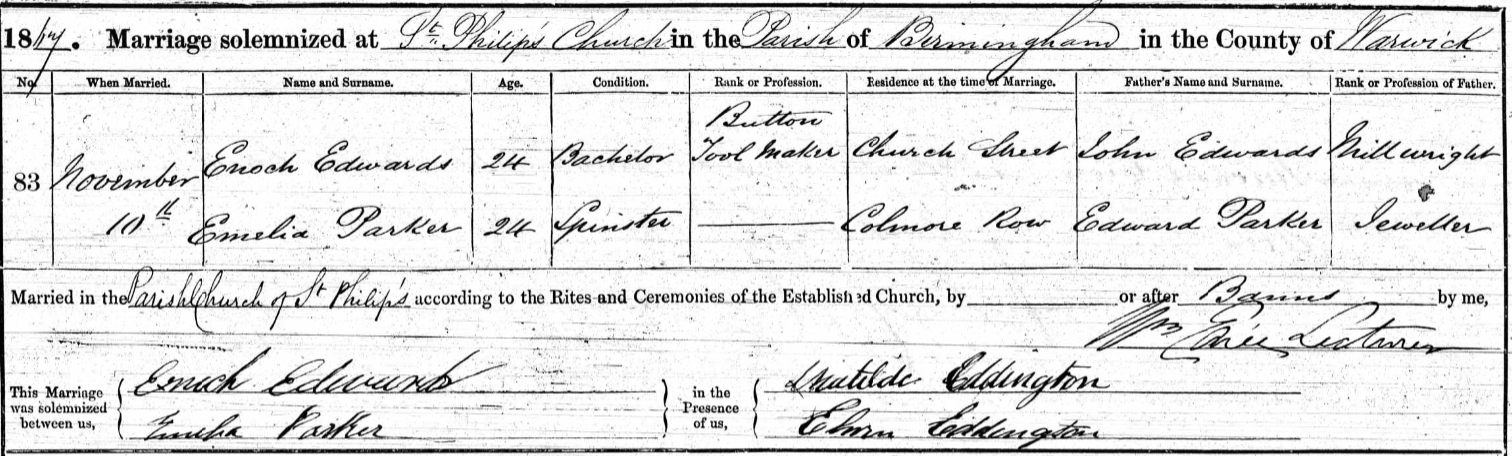
On the 10th November 1867 Enoch married Emelia Parker, daughter of jeweller and rope maker Edward Parker, at St Philip in Birmingham. Both Emelia and Enoch were able to sign their own names, and Matilda and Edwin Eddington were witnesses (Enoch’s sister and her husband). Enoch’s address was Church Street, and his occupation button tool maker.
Four years later in 1871, Enoch was a publican living on Clifton Road. Son Enoch Henry was two years old, and Ralph Ernest was three months. Eliza Barton lived with them as a general servant.
By 1881 Enoch was back working as a button tool maker in Bournebrook, Birmingham. Enoch and Emilia by then had three more children, Amelia, Albert Parker (my great grandfather) and Ada.
Garnet Frederick Edwards was born in 1882. This is the first instance of the name Garnet in the family, and subsequently Garnet has been the middle name for the eldest son (my brother, father and grandfather all have Garnet as a middle name).
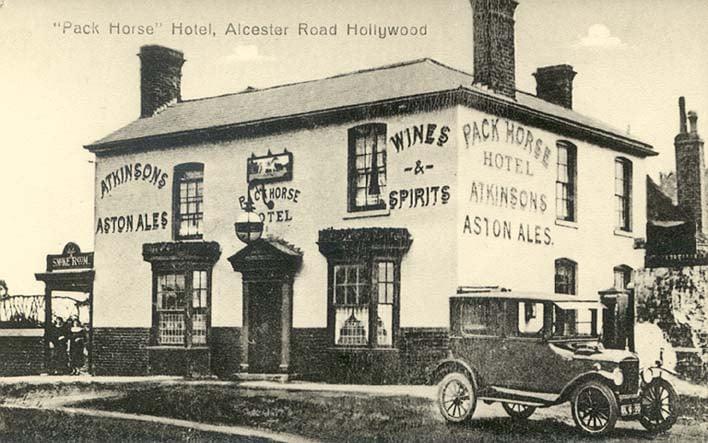
Enoch was the licensed victualler at the Pack Horse Hotel in 1991 at Kings Norton. By this time, only daughters Amelia and Ada and son Garnet are living at home.
Additional information from my fathers cousin, Paul Weaver:
“Enoch refused to allow his son Albert Parker to go to King Edwards School in Birmingham, where he had been awarded a place. Instead, in October 1890 he made Albert Parker Edwards take an apprenticeship with a pawnboker in Tipton.
Towards the end of the 19th century Enoch kept The Pack Horse in Alcester Road, Hollywood, where a twist was 1d an ounce, and beer was 2d a pint. The children had to get up early to get breakfast at 6 o’clock for the hay and straw men on their way to the Birmingham hay and straw market. Enoch is listed as a member of “The Kingswood & Pack Horse Association for the Prosecution of Offenders”, a kind of early Neighbourhood Watch, dated 25 October 1890.
The Edwards family later moved to Redditch where they kept The Rifleman Inn at 35 Park Road. They must have left the Pack Horse by 1895 as another publican was in place by then.”Emelia his wife died in 1895 of consumption at the Rifleman Inn in Redditch, Worcestershire, and in 1897 Enoch married Florence Ethel Hedges in Aston. Enoch was 56 and Florence was just 21 years old.
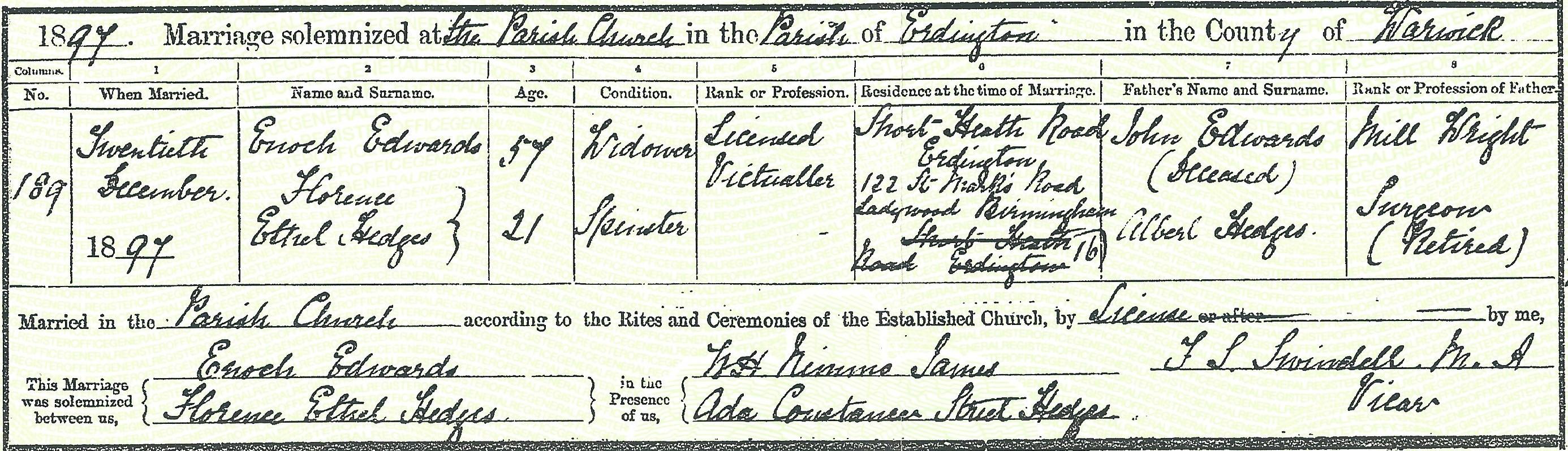
The following year in 1898 their daughter Muriel Constance Freda Edwards was born in Deritend, Warwickshire.
In 1901 Enoch, (Andrew on the census), publican, Florence and Muriel were living in Dudley. It was hard to find where he went after this.From Paul Weaver:
“Family accounts have it that Enoch EDWARDS fell out with all his family, and at about the age of 60, he left all behind and emigrated to the U.S.A. Enoch was described as being an active man, and it is believed that he had another family when he settled in the U.S.A. Esmor STOKES has it that a postcard was received by the family from Enoch at Niagara Falls.
On 11 June 1902 Harry Wright (the local postmaster responsible in those days for licensing) brought an Enoch EDWARDS to the Bedfordshire Petty Sessions in Biggleswade regarding “Hole in the Wall”, believed to refer to the now defunct “Hole in the Wall” public house at 76 Shortmead Street, Biggleswade with Enoch being granted “temporary authority”. On 9 July 1902 the transfer was granted. A year later in the 1903 edition of Kelly’s Directory of Bedfordshire, Hunts and Northamptonshire there is an Enoch EDWARDS running the Wheatsheaf Public House, Church Street, St. Neots, Huntingdonshire which is 14 miles south of Biggleswade.”
It seems that Enoch and his new family moved away from the midlands in the early 1900s, but again the trail went cold.
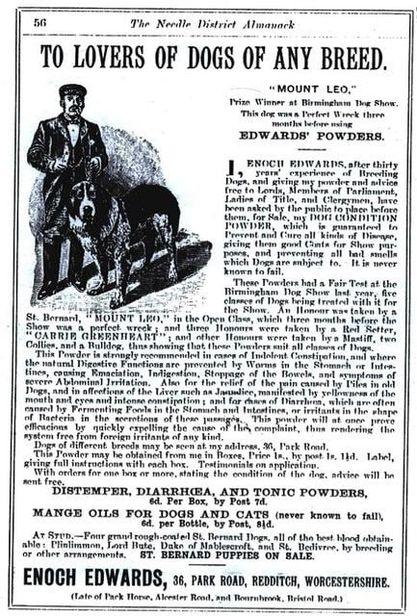
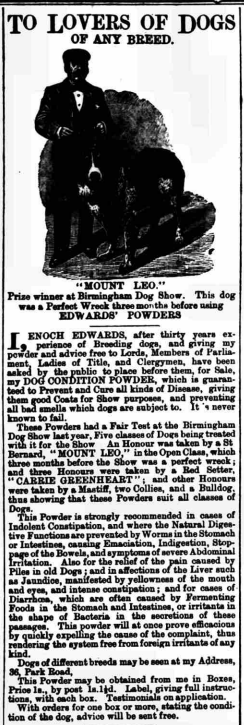
When I started doing the genealogy research, I joined a local facebook group for Redditch in Worcestershire. Enoch’s son Albert Parker Edwards (my great grandfather) spent most of his life there. I asked in the group about Enoch, and someone posted an illustrated advertisement for Enoch’s dog powders. Enoch was a well known breeder/keeper of St Bernards and is cited in a book naming individuals key to the recovery/establishment of ‘mastiff’ size dog breeds.
We had not known that Enoch was a breeder of champion St Bernard dogs!
Once I knew about the St Bernard dogs and the names Mount Leo and Plinlimmon via the newspaper adverts, I did an internet search on Enoch Edwards in conjunction with these dogs.
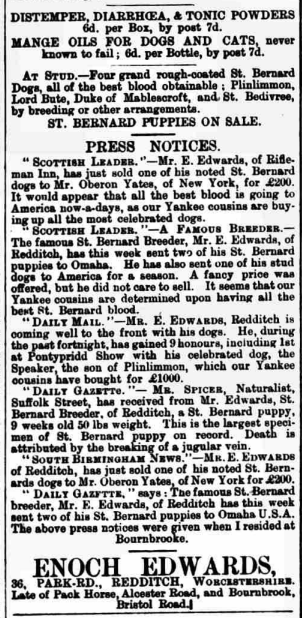
Enoch’s St Bernard dog “Mount Leo” was bred from the famous Plinlimmon, “the Emperor of Saint Bernards”. He was reported to have sent two puppies to Omaha and one of his stud dogs to America for a season, and in 1897 Enoch made the news for selling a St Bernard to someone in New York for £200. Plinlimmon, bred by Thomas Hall, was born in Liverpool, England on June 29, 1883. He won numerous dog shows throughout Europe in 1884, and in 1885, he was named Best Saint Bernard.
In the Birmingham Mail on 14th June 1890:
“Mr E Edwards, of Bournebrook, has been well to the fore with his dogs of late. He has gained nine honours during the past fortnight, including a first at the Pontypridd show with a St Bernard dog, The Speaker, a son of Plinlimmon.”
In the Alcester Chronicle on Saturday 05 June 1897:
It was discovered that Enoch, Florence and Muriel moved to Canada, not USA as the family had assumed. The 1911 census for Montreal St Jaqcues, Quebec, stated that Enoch, (Florence) Ethel, and (Muriel) Frida had emigrated in 1906. Enoch’s occupation was machinist in 1911. The census transcription is not very good. Edwards was transcribed as Edmand, but the dates of birth for all three are correct. Birthplace is correct ~ A for Anglitan (the census is in French) but race or tribe is also an A but the transcribers have put African black! Enoch by this time was 71 years old, his wife 33 and daughter 11.
Additional information from Paul Weaver:
“In 1906 he and his new family travelled to Canada with Enoch travelling first and Ethel and Frida joined him in Quebec on 25 June 1906 on board the ‘Canada’ from Liverpool.
Their immigration record suggests that they were planning to travel to Winnipeg, but five years later in 1911, Enoch, Florence Ethel and Frida were still living in St James, Montreal. Enoch was employed as a machinist by Canadian Government Railways working 50 hours. It is the 1911 census record that confirms his birth as November 1840. It also states that Enoch could neither read nor write but managed to earn $500 in 1910 for activity other than his main profession, although this may be referring to his innkeeping business interests.
By 1921 Florence and Muriel Frida are living in Langford, Neepawa, Manitoba with Peter FUCHS, an Ontarian farmer of German descent who Florence had married on 24 Jul 1913 implying that Enoch died sometime in 1911/12, although no record has been found.”The extra $500 in earnings was perhaps related to the St Bernard dogs. Enoch signed his name on the register on his marriage to Emelia, and I think it’s very unlikely that he could neither read nor write, as stated above.
However, it may not be Enoch’s wife Florence Ethel who married Peter Fuchs. A Florence Emma Edwards married Peter Fuchs, and on the 1921 census in Neepawa her daugther Muriel Elizabeth Edwards, born in 1902, lives with them. Quite a coincidence, two Florence and Muriel Edwards in Neepawa at the time. Muriel Elizabeth Edwards married and had two children but died at the age of 23 in 1925. Her mother Florence was living with the widowed husband and the two children on the 1931 census in Neepawa. As there was no other daughter on the 1911 census with Enoch, Florence and Muriel in Montreal, it must be a different Florence and daughter. We don’t know, though, why Muriel Constance Freda married in Neepawa.
Indeed, Florence was not a widow in 1913. Enoch died in 1924 in Montreal, aged 84. Neither Enoch, Florence or their daughter has been found yet on the 1921 census. The search is not easy, as Enoch sometimes used the name Andrew, Florence used her middle name Ethel, and daughter Muriel used Freda, Valerie (the name she added when she married in Neepawa), and died as Marcheta. The only name she NEVER used was Constance!
A Canadian genealogist living in Montreal phoned the cemetery where Enoch was buried. She said “Enoch Edwards who died on Feb 27 1924 is not buried in the Mount Royal cemetery, he was only cremated there on March 4, 1924. There are no burial records but he died of an abcess and his body was sent to the cemetery for cremation from the Royal Victoria Hospital.”
1924 Obituary for Enoch Edwards:
Cimetière Mont-Royal Outremont, Montreal Region, Quebec, Canada
The Montreal Star 29 Feb 1924, Fri · Page 31

Muriel Constance Freda Valerie Edwards married Arthur Frederick Morris on 24 Oct 1925 in Neepawa, Manitoba. (She appears to have added the name Valerie when she married.)
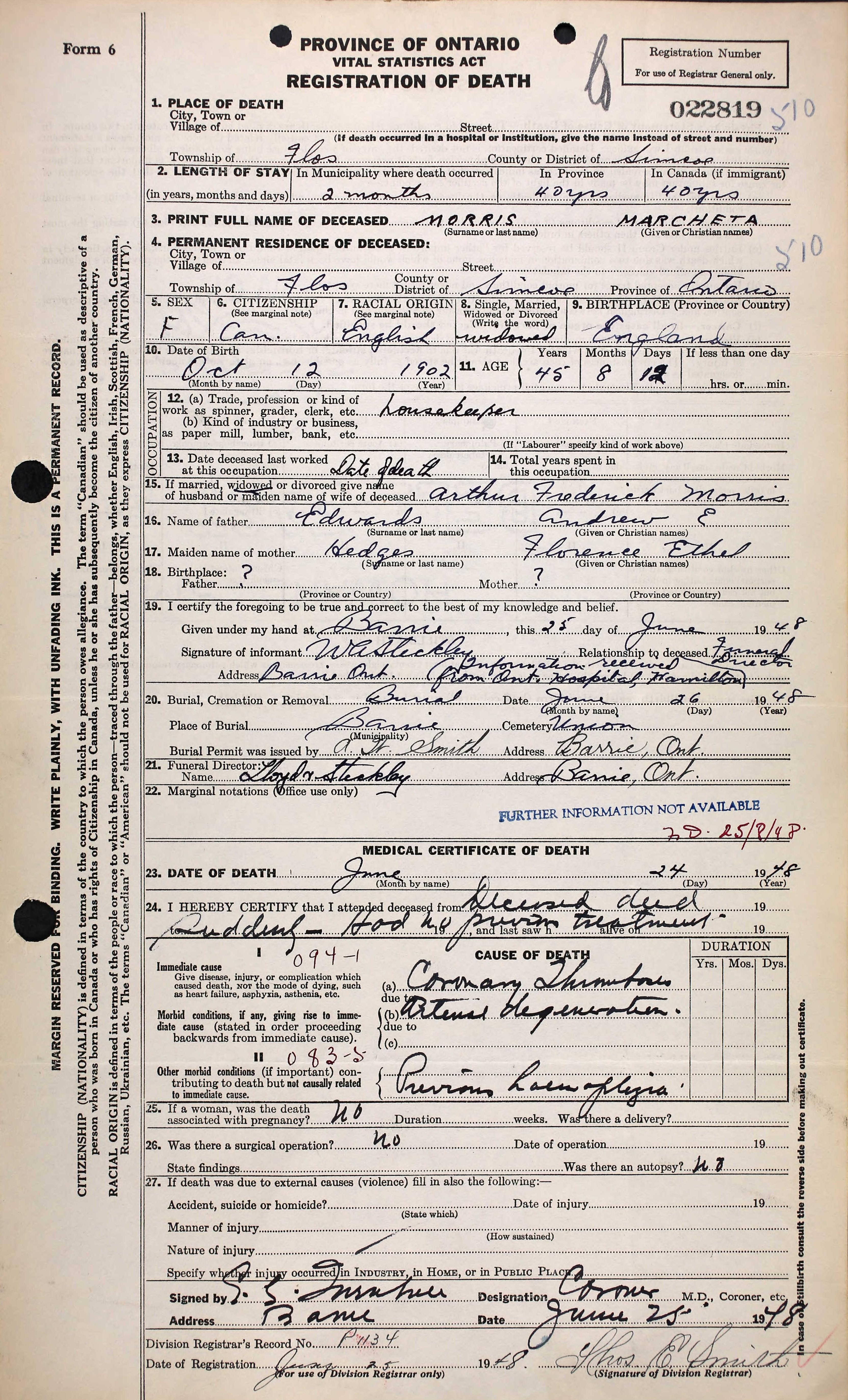
Unexpectedly a death certificate appeared for Muriel via the hints on the ancestry website. Her name was “Marcheta Morris” on this document, however it also states that she was the widow of Arthur Frederick Morris and daughter of Andrew E Edwards and Florence Ethel Hedges. She died suddenly in June 1948 in Flos, Simcoe, Ontario of a coronary thrombosis, where she was living as a housekeeper.
 March 21, 2022 at 7:05 am #6284
In reply to: The Elusive Samuel Housley and Other Family Stories
To Australia
Grettons
Charles Herbert Gretton 1876-1954
Charles Gretton, my great grandmothers youngest brother, arrived in Sydney Australia on 12 February 1912, having set sail on 5 January 1912 from London. His occupation on the passenger list was stockman, and he was traveling alone. Later that year, in October, his wife and two sons sailed out to join him.
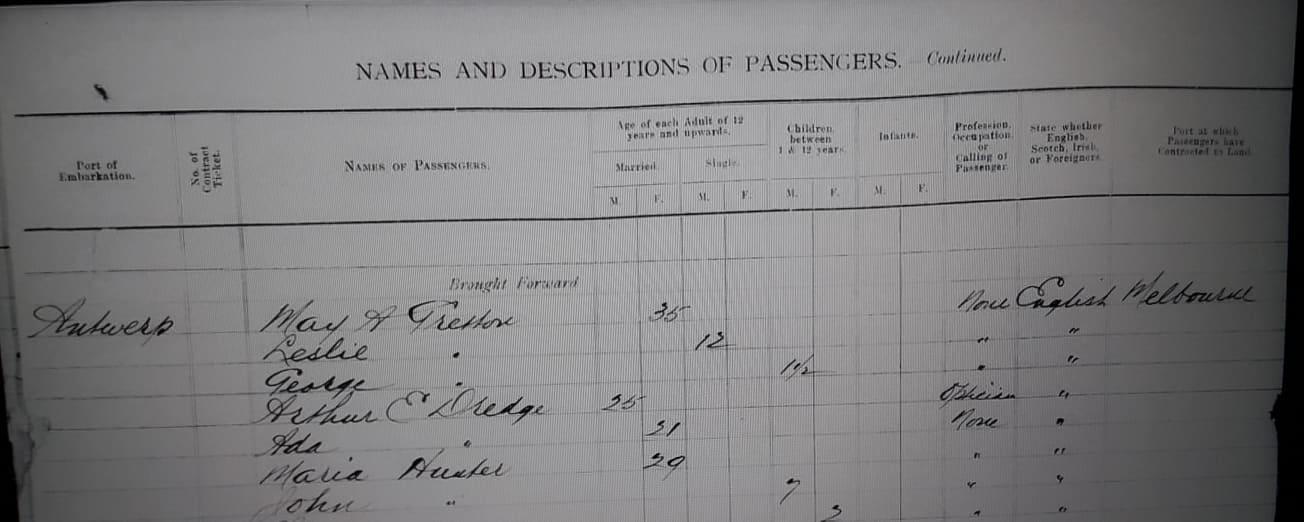
Charles was born in Swadlincote. He married Mary Anne Illsley, a local girl from nearby Church Gresley, in 1898. Their first son, Leslie Charles Bloemfontein Gretton, was born in 1900 in Church Gresley, and their second son, George Herbert Gretton, was born in 1910 in Swadlincote. In 1901 Charles was a colliery worker, and on the 1911 census, his occupation was a sanitary ware packer.
Charles and Mary Anne had two more sons, both born in Footscray: Frank Orgill Gretton in 1914, and Arthur Ernest Gretton in 1920.
On the Australian 1914 electoral rolls, Charles and Mary Ann were living at 72 Moreland Street, Footscray, and in 1919 at 134 Cowper Street, Footscray, and Charles was a labourer. In 1924, Charles was a sub foreman, living at 3, Ryan Street E, Footscray, Australia. On a later electoral register, Charles was a foreman. Footscray is a suburb of Melbourne, and developed into an industrial zone in the second half of the nineteenth century.
Charles died in Victoria in 1954 at the age of 77. His wife Mary Ann died in 1958.
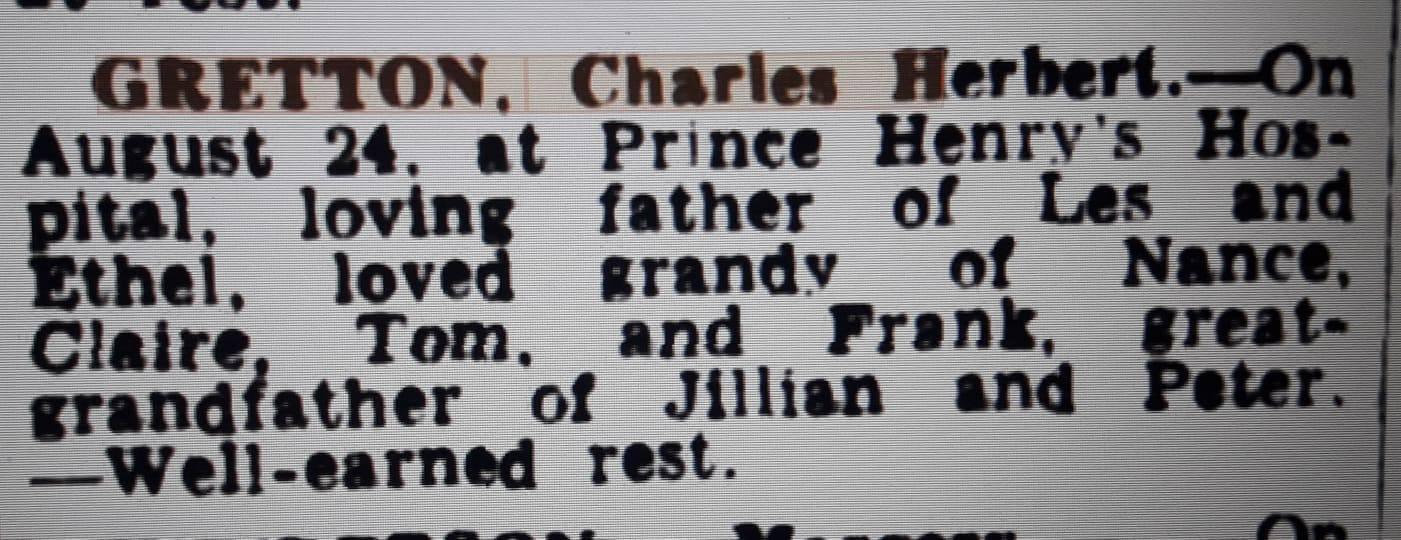
Charles and Mary Ann Gretton:
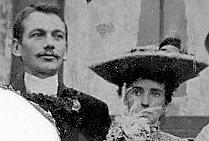
Leslie Charles Bloemfontein Gretton 1900-1955
Leslie was an electrician. He married Ethel Christine Halliday, born in 1900 in Footscray, in 1927. They had four children: Tom, Claire, Nancy and Frank. By 1943 they were living in Yallourn. Yallourn, Victoria was a company town in Victoria, Australia built between the 1920s and 1950s to house employees of the State Electricity Commission of Victoria, who operated the nearby Yallourn Power Station complex. However, expansion of the adjacent open-cut brown coal mine led to the closure and removal of the town in the 1980s.
On the 1954 electoral registers, daughter Claire Elizabeth Gretton, occupation teacher, was living at the same address as Leslie and Ethel.
Leslie died in Yallourn in 1955, and Ethel nine years later in 1964, also in Yallourn.
George Herbert Gretton 1910-1970
George married Florence May Hall in 1934 in Victoria, Australia. In 1942 George was listed on the electoral roll as a grocer, likewise in 1949. In 1963 his occupation was a process worker, and in 1968 in Flinders, a horticultural advisor.
George died in Lang Lang, not far from Melbourne, in 1970.
Frank Orgill Gretton 1914-
Arthur Ernest Gretton 1920-
Orgills
John Orgill 1835-1911
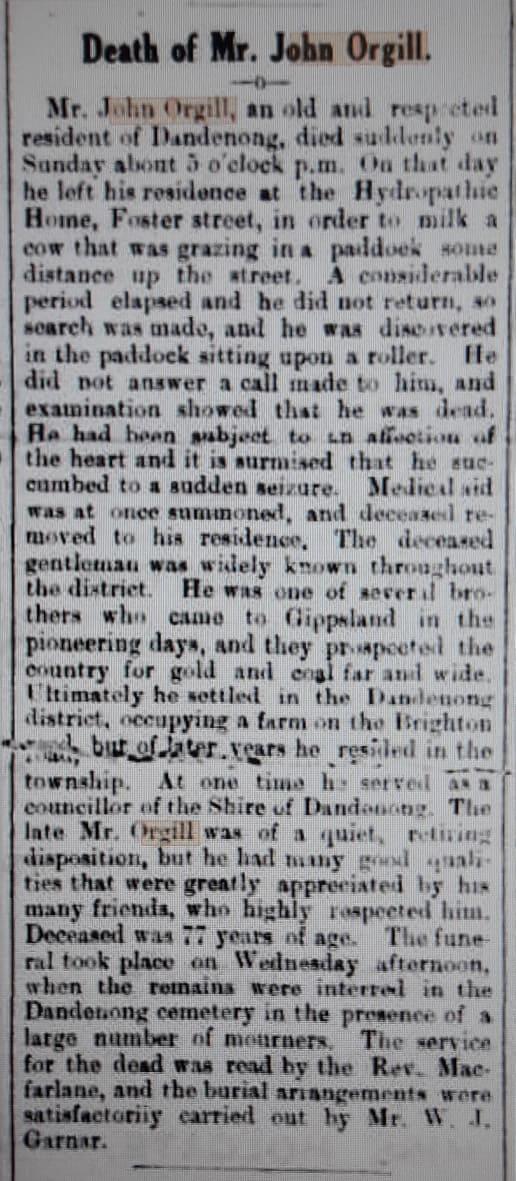
John Orgill was Charles Herbert Gretton’s uncle. He emigrated to Australia in 1865, and married Elizabeth Mary Gladstone 1845-1926 in Victoria in 1870. Their first child was born in December that year, in Dandenong. They had seven children, and their three sons all have the middle name Gladstone.
John Orgill was a councillor for the Shire of Dandenong in 1873, and between 1876 and 1879.
John Orgill:
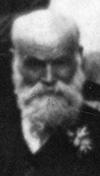
John Orgill obituary in the South Bourke and Mornington Journal, 21 December 1911:
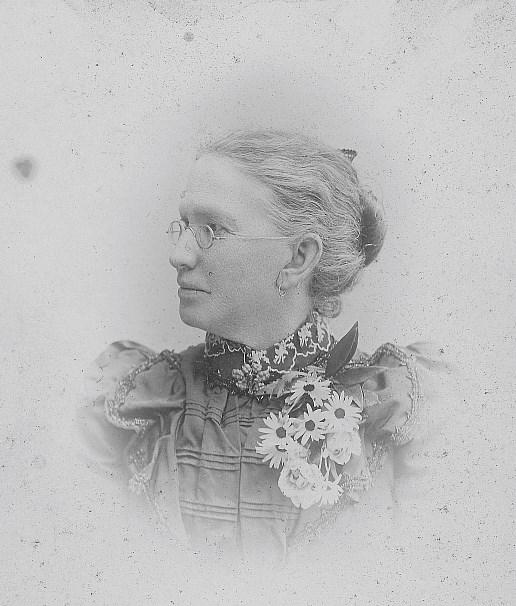
John’s wife Elizabeth Orgill, a teacher and a “a public spirited lady” according to newspaper articles, opened a hydropathic hospital in Dandenong called Gladstone House.
Elizabeth Gladstone Orgill:
On the Old Dandenong website:
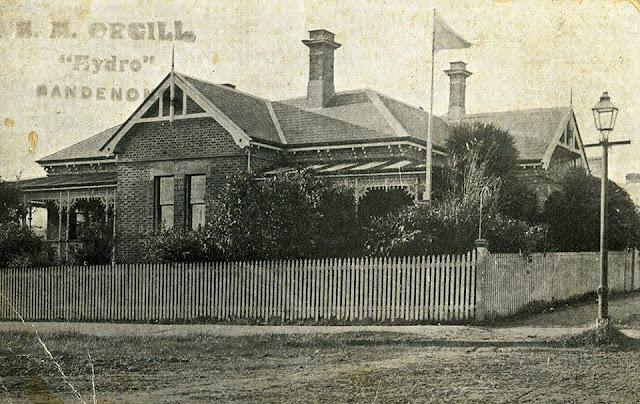
Gladstone House hydropathic hospital on the corner of Langhorne and Foster streets (153 Foster Street) Dandenong opened in 1896, working on the theory of water therapy, no medicine or operations. Her husband passed away in 1911 at 77, around similar time Dr Barclay Thompson obtained control of the practice. Mrs Orgill remaining on in some capacity.
Elizabeth Mary Orgill (nee Gladstone) operated Gladstone House until at least 1911, along with another hydropathic hospital (Birthwood) on Cheltenham road. She was the daughter of William Gladstone (Nephew of William Ewart Gladstone, UK prime minister in 1874).
Around 1912 Dr A. E. Taylor took over the location from Dr. Barclay Thompson. Mrs Orgill was still working here but no longer controlled the practice, having given it up to Barclay. Taylor served as medical officer for the Shire for before his death in 1939. After Taylor’s death Dr. T. C. Reeves bought his practice in 1939, later that year being appointed medical officer,
Gladstone Road in Dandenong is named after her family, who owned and occupied a farming paddock in the area on former Police Paddock ground, the Police reserve having earlier been reduced back to Stud Road.
Hydropathy (now known as Hydrotherapy) and also called water cure, is a part of medicine and alternative medicine, in particular of naturopathy, occupational therapy and physiotherapy, that involves the use of water for pain relief and treatment.
Gladstone House, Dandenong:
John’s brother Robert Orgill 1830-1915 also emigrated to Australia. I met (online) his great great grand daughter Lidya Orgill via the Old Dandenong facebook group.
John’s other brother Thomas Orgill 1833-1908 also emigrated to the same part of Australia.
Thomas Orgill:
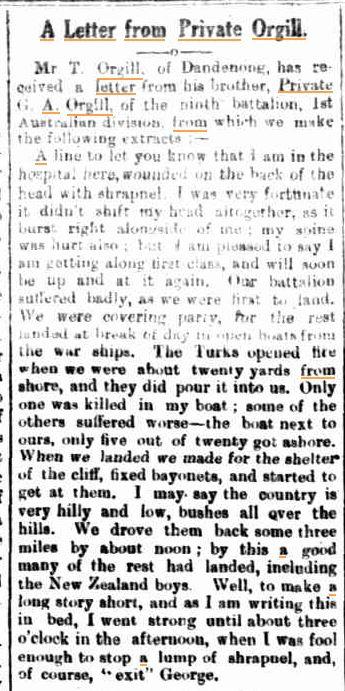
One of Thomas Orgills sons was George Albert Orgill 1880-1949:
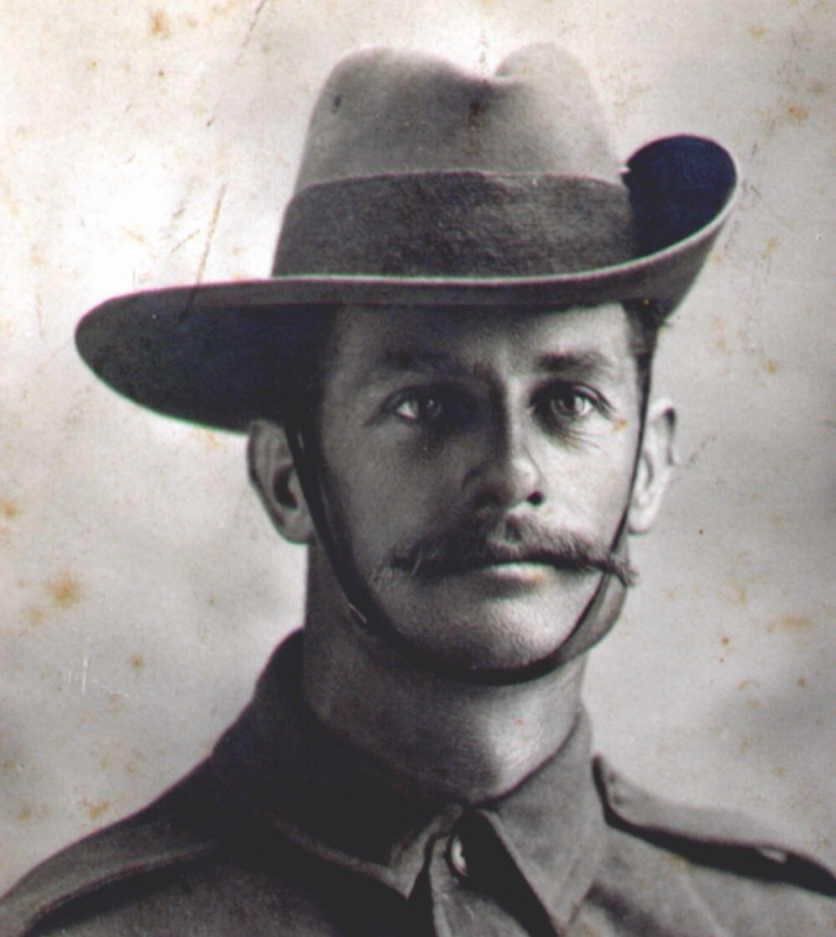
A letter was published in The South Bourke & Mornington Journal (Richmond, Victoria, Australia) on 17 Jun 1915, to Tom Orgill, Emerald Hill (South Melbourne) from hospital by his brother George Albert Orgill (4th Pioneers) describing landing of Covering Party prior to dawn invasion of Gallipoli:
Another brother Henry Orgill 1837-1916 was born in Measham and died in Dandenong, Australia. Henry was a bricklayer living in Measham on the 1861 census. Also living with his widowed mother Elizabeth at that address was his sister Sarah and her husband Richard Gretton, the baker (my great great grandparents). In October of that year he sailed to Melbourne. His occupation was bricklayer on his death records in 1916.
Two of Henry’s sons, Arthur Garfield Orgill born 1888 and Ernest Alfred Orgill born 1880 were killed in action in 1917 and buried in Nord-Pas-de-Calais, France. Another son, Frederick Stanley Orgill, died in 1897 at the age of seven.
A fifth brother, William Orgill 1842- sailed from Liverpool to Melbourne in 1861, at 19 years of age. Four years later in 1865 he sailed from Victoria, Australia to New Zealand.
I assumed I had found all of the Orgill brothers who went to Australia, and resumed research on the Orgills in Measham, in England. A search in the British Newspaper Archives for Orgills in Measham revealed yet another Orgill brother who had gone to Australia.
Matthew Orgill 1828-1907 went to South Africa and to Australia, but returned to Measham.
The Orgill brothers had two sisters. One was my great great great grandmother Sarah, and the other was Hannah. Hannah married Francis Hart in Measham. One of her sons, John Orgill Hart 1862-1909, was born in Measham. On the 1881 census he was a 19 year old carpenters apprentice. Two years later in 1883 he was listed as a joiner on the passenger list of the ship Illawarra, bound for Australia. His occupation at the time of his death in Dandenong in 1909 was contractor.
An additional coincidental note about Dandenong: my step daughter Emily’s Australian partner is from Dandenong.
Housleys
Charles Housley 1823-1856
Charles Housley emigrated to Australia in 1851, the same year that his brother George emigrated to USA. Charles is mentioned in the Narrative on the Letters by Barbara Housley, and appears in the Housley Letters chapters.
Rushbys
George “Mike” Rushby 1933-
Mike moved to Australia from South Africa. His story is a separate chapter.
February 2, 2022 at 1:15 pm #6268In reply to: The Elusive Samuel Housley and Other Family Stories
From Tanganyika with Love
continued part 9
With thanks to Mike Rushby.
Lyamungu 3rd January 1945
Dearest Family.
We had a novel Christmas this year. We decided to avoid the expense of
entertaining and being entertained at Lyamungu, and went off to spend Christmas
camping in a forest on the Western slopes of Kilimanjaro. George decided to combine
business with pleasure and in this way we were able to use Government transport.
We set out the day before Christmas day and drove along the road which skirts
the slopes of Kilimanjaro and first visited a beautiful farm where Philip Teare, the ex
Game Warden, and his wife Mary are staying. We had afternoon tea with them and then
drove on in to the natural forest above the estate and pitched our tent beside a small
clear mountain stream. We decorated the tent with paper streamers and a few small
balloons and John found a small tree of the traditional shape which we decorated where
it stood with tinsel and small ornaments.We put our beer, cool drinks for the children and bottles of fresh milk from Simba
Estate, in the stream and on Christmas morning they were as cold as if they had been in
the refrigerator all night. There were not many presents for the children, there never are,
but they do not seem to mind and are well satisfied with a couple of balloons apiece,
sweets, tin whistles and a book each.George entertain the children before breakfast. He can make a magical thing out
of the most ordinary balloon. The children watched entranced as he drew on his pipe
and then blew the smoke into the balloon. He then pinched the neck of the balloon
between thumb and forefinger and released the smoke in little puffs. Occasionally the
balloon ejected a perfect smoke ring and the forest rang with shouts of “Do it again
Daddy.” Another trick was to blow up the balloon to maximum size and then twist the
neck tightly before releasing. Before subsiding the balloon darted about in a crazy
fashion causing great hilarity. Such fun, at the cost of a few pence.After breakfast George went off to fish for trout. John and Jim decided that they
also wished to fish so we made rods out of sticks and string and bent pins and they
fished happily, but of course quite unsuccessfully, for hours. Both of course fell into the
stream and got soaked, but I was prepared for this, and the little stream was so shallow
that they could not come to any harm. Henry played happily in the sand and I had a
most peaceful morning.Hamisi roasted a chicken in a pot over the camp fire and the jelly set beautifully in the
stream. So we had grilled trout and chicken for our Christmas dinner. I had of course
taken an iced cake for the occasion and, all in all, it was a very successful Christmas day.
On Boxing day we drove down to the plains where George was to investigate a
report of game poaching near the Ngassari Furrow. This is a very long ditch which has
been dug by the Government for watering the Masai stock in the area. It is also used by
game and we saw herds of zebra and wildebeest, and some Grant’s Gazelle and
giraffe, all comparatively tame. At one point a small herd of zebra raced beside the lorry
apparently enjoying the fun of a gallop. They were all sleek and fat and looked wild and
beautiful in action.We camped a considerable distance from the water but this precaution did not
save us from the mosquitoes which launched a vicious attack on us after sunset, so that
we took to our beds unusually early. They were on the job again when we got up at
sunrise so I was very glad when we were once more on our way home.“I like Christmas safari. Much nicer that silly old party,” said John. I agree but I think
it is time that our children learned to play happily with others. There are no other young
children at Lyamungu though there are two older boys and a girl who go to boarding
school in Nairobi.On New Years Day two Army Officers from the military camp at Moshi, came for
tea and to talk game hunting with George. I think they rather enjoy visiting a home and
seeing children and pets around.Eleanor.
Lyamungu 14 May 1945
Dearest Family.
So the war in Europe is over at last. It is such marvellous news that I can hardly
believe it. To think that as soon as George can get leave we will go to England and
bring Ann and George home with us to Tanganyika. When we know when this leave can
be arranged we will want Kate to join us here as of course she must go with us to
England to meet George’s family. She has become so much a part of your lives that I
know it will be a wrench for you to give her up but I know that you will all be happy to
think that soon our family will be reunited.The V.E. celebrations passed off quietly here. We all went to Moshi to see the
Victory Parade of the King’s African Rifles and in the evening we went to a celebration
dinner at the Game Warden’s house. Besides ourselves the Moores had invited the
Commanding Officer from Moshi and a junior officer. We had a very good dinner and
many toasts including one to Mrs Moore’s brother, Oliver Milton who is fighting in Burma
and has recently been awarded the Military Cross.There was also a celebration party for the children in the grounds of the Moshi
Club. Such a spread! I think John and Jim sampled everything. We mothers were
having our tea separately and a friend laughingly told me to turn around and have a look.
I did, and saw the long tea tables now deserted by all the children but my two sons who
were still eating steadily, and finding the party more exciting than the game of Musical
Bumps into which all the other children had entered with enthusiasm.There was also an extremely good puppet show put on by the Italian prisoners
of war from the camp at Moshi. They had made all the puppets which included well
loved characters like Snow White and the Seven Dwarfs and the Babes in the Wood as
well as more sophisticated ones like an irritable pianist and a would be prima donna. The
most popular puppets with the children were a native askari and his family – a very
happy little scene. I have never before seen a puppet show and was as entranced as
the children. It is amazing what clever manipulation and lighting can do. I believe that the
Italians mean to take their puppets to Nairobi and am glad to think that there, they will
have larger audiences to appreciate their art.George has just come in, and I paused in my writing to ask him for the hundredth
time when he thinks we will get leave. He says I must be patient because it may be a
year before our turn comes. Shipping will be disorganised for months to come and we
cannot expect priority simply because we have been separated so long from our
children. The same situation applies to scores of other Government Officials.
I have decided to write the story of my childhood in South Africa and about our
life together in Tanganyika up to the time Ann and George left the country. I know you
will have told Kate these stories, but Ann and George were so very little when they left
home that I fear that they cannot remember much.My Mother-in-law will have told them about their father but she can tell them little
about me. I shall send them one chapter of my story each month in the hope that they
may be interested and not feel that I am a stranger when at last we meet again.Eleanor.
Lyamungu 19th September 1945
Dearest Family.
In a months time we will be saying good-bye to Lyamungu. George is to be
transferred to Mbeya and I am delighted, not only as I look upon Mbeya as home, but
because there is now a primary school there which John can attend. I feel he will make
much better progress in his lessons when he realises that all children of his age attend
school. At present he is putting up a strong resistance to learning to read and spell, but
he writes very neatly, does his sums accurately and shows a real talent for drawing. If
only he had the will to learn I feel he would do very well.Jim now just four, is too young for lessons but too intelligent to be interested in
the ayah’s attempts at entertainment. Yes I’ve had to engage a native girl to look after
Henry from 9 am to 12.30 when I supervise John’s Correspondence Course. She is
clean and amiable, but like most African women she has no initiative at all when it comes
to entertaining children. Most African men and youths are good at this.I don’t regret our stay at Lyamungu. It is a beautiful spot and the change to the
cooler climate after the heat of Morogoro has been good for all the children. John is still
tall for his age but not so thin as he was and much less pale. He is a handsome little lad
with his large brown eyes in striking contrast to his fair hair. He is wary of strangers but
very observant and quite uncanny in the way he sums up people. He seldom gets up
to mischief but I have a feeling he eggs Jim on. Not that Jim needs egging.Jim has an absolute flair for mischief but it is all done in such an artless manner that
it is not easy to punish him. He is a very sturdy child with a cap of almost black silky hair,
eyes brown, like mine, and a large mouth which is quick to smile and show most beautiful
white and even teeth. He is most popular with all the native servants and the Game
Scouts. The servants call Jim, ‘Bwana Tembo’ (Mr Elephant) because of his sturdy
build.Henry, now nearly two years old, is quite different from the other two in
appearance. He is fair complexioned and fair haired like Ann and Kate, with large, black
lashed, light grey eyes. He is a good child, not so merry as Jim was at his age, nor as
shy as John was. He seldom cries, does not care to be cuddled and is independent and
strong willed. The servants call Henry, ‘Bwana Ndizi’ (Mr Banana) because he has an
inexhaustible appetite for this fruit. Fortunately they are very inexpensive here. We buy
an entire bunch which hangs from a beam on the back verandah, and pluck off the
bananas as they ripen. This way there is no waste and the fruit never gets bruised as it
does in greengrocers shops in South Africa. Our three boys make a delightful and
interesting trio and I do wish you could see them for yourselves.We are delighted with the really beautiful photograph of Kate. She is an
extraordinarily pretty child and looks so happy and healthy and a great credit to you.
Now that we will be living in Mbeya with a school on the doorstep I hope that we will
soon be able to arrange for her return home.Eleanor.
c/o Game Dept. Mbeya. 30th October 1945
Dearest Family.
How nice to be able to write c/o Game Dept. Mbeya at the head of my letters.
We arrived here safely after a rather tiresome journey and are installed in a tiny house on
the edge of the township.We left Lyamungu early on the morning of the 22nd. Most of our goods had
been packed on the big Ford lorry the previous evening, but there were the usual
delays and farewells. Of our servants, only the cook, Hamisi, accompanied us to
Mbeya. Japhet, Tovelo and the ayah had to be paid off and largesse handed out.
Tovelo’s granny had come, bringing a gift of bananas, and she also brought her little
granddaughter to present a bunch of flowers. The child’s little scolded behind is now
completely healed. Gifts had to be found for them too.At last we were all aboard and what a squash it was! Our few pieces of furniture
and packing cases and trunks, the cook, his wife, the driver and the turney boy, who
were to take the truck back to Lyamungu, and all their bits and pieces, bunches of
bananas and Fanny the dog were all crammed into the body of the lorry. George, the
children and I were jammed together in the cab. Before we left George looked
dubiously at the tyres which were very worn and said gloomily that he thought it most
unlikely that we would make our destination, Dodoma.Too true! Shortly after midday, near Kwakachinja, we blew a back tyre and there
was a tedious delay in the heat whilst the wheel was changed. We were now without a
spare tyre and George said that he would not risk taking the Ford further than Babati,
which is less than half way to Dodoma. He drove very slowly and cautiously to Babati
where he arranged with Sher Mohammed, an Indian trader, for a lorry to take us to
Dodoma the next morning.It had been our intention to spend the night at the furnished Government
Resthouse at Babati but when we got there we found that it was already occupied by
several District Officers who had assembled for a conference. So, feeling rather
disgruntled, we all piled back into the lorry and drove on to a place called Bereku where
we spent an uncomfortable night in a tumbledown hut.Before dawn next morning Sher Mohammed’s lorry drove up, and there was a
scramble to dress by the light of a storm lamp. The lorry was a very dilapidated one and
there was already a native woman passenger in the cab. I felt so tired after an almost
sleepless night that I decided to sit between the driver and this woman with the sleeping
Henry on my knee. It was as well I did, because I soon found myself dosing off and
drooping over towards the woman. Had she not been there I might easily have fallen
out as the battered cab had no door. However I was alert enough when daylight came
and changed places with the woman to our mutual relief. She was now able to converse
with the African driver and I was able to enjoy the scenery and the fresh air!
George, John and Jim were less comfortable. They sat in the lorry behind the
cab hemmed in by packing cases. As the lorry was an open one the sun beat down
unmercifully upon them until George, ever resourceful, moved a table to the front of the
truck. The two boys crouched under this and so got shelter from the sun but they still had
to endure the dust. Fanny complicated things by getting car sick and with one thing and
another we were all jolly glad to get to Dodoma.We spent the night at the Dodoma Hotel and after hot baths, a good meal and a
good nights rest we cheerfully boarded a bus of the Tanganyika Bus Service next
morning to continue our journey to Mbeya. The rest of the journey was uneventful. We slept two nights on the road, the first at Iringa Hotel and the second at Chimala. We
reached Mbeya on the 27th.I was rather taken aback when I first saw the little house which has been allocated
to us. I had become accustomed to the spacious houses we had in Morogoro and
Lyamungu. However though the house is tiny it is secluded and has a long garden
sloping down to the road in front and another long strip sloping up behind. The front
garden is shaded by several large cypress and eucalyptus trees but the garden behind
the house has no shade and consists mainly of humpy beds planted with hundreds of
carnations sadly in need of debudding. I believe that the previous Game Ranger’s wife
cultivated the carnations and, by selling them, raised money for War Funds.
Like our own first home, this little house is built of sun dried brick. Its original
owners were Germans. It is now rented to the Government by the Custodian of Enemy
Property, and George has his office in another ex German house.This afternoon we drove to the school to arrange about enrolling John there. The
school is about four miles out of town. It was built by the German settlers in the late
1930’s and they were justifiably proud of it. It consists of a great assembly hall and
classrooms in one block and there are several attractive single storied dormitories. This
school was taken over by the Government when the Germans were interned on the
outbreak of war and many improvements have been made to the original buildings. The
school certainly looks very attractive now with its grassed playing fields and its lawns and
bright flower beds.The Union Jack flies from a tall flagpole in front of the Hall and all traces of the
schools German origin have been firmly erased. We met the Headmaster, Mr
Wallington, and his wife and some members of the staff. The school is co-educational
and caters for children from the age of seven to standard six. The leaving age is elastic
owing to the fact that many Tanganyika children started school very late because of lack
of educational facilities in this country.The married members of the staff have their own cottages in the grounds. The
Matrons have quarters attached to the dormitories for which they are responsible. I felt
most enthusiastic about the school until I discovered that the Headmaster is adamant
upon one subject. He utterly refuses to take any day pupils at the school. So now our
poor reserved Johnny will have to adjust himself to boarding school life.
We have arranged that he will start school on November 5th and I shall be very
busy trying to assemble his school uniform at short notice. The clothing list is sensible.
Boys wear khaki shirts and shorts on weekdays with knitted scarlet jerseys when the
weather is cold. On Sundays they wear grey flannel shorts and blazers with the silver
and scarlet school tie.Mbeya looks dusty, brown and dry after the lush evergreen vegetation of
Lyamungu, but I prefer this drier climate and there are still mountains to please the eye.
In fact the lower slopes of Lolesa Mountain rise at the upper end of our garden.Eleanor.
c/o Game Dept. Mbeya. 21st November 1945
Dearest Family.
We’re quite settled in now and I have got the little house fixed up to my
satisfaction. I have engaged a rather uncouth looking houseboy but he is strong and
capable and now that I am not tied down in the mornings by John’s lessons I am able to
go out occasionally in the mornings and take Jim and Henry to play with other children.
They do not show any great enthusiasm but are not shy by nature as John is.
I have had a good deal of heartache over putting John to boarding school. It
would have been different had he been used to the company of children outside his
own family, or if he had even known one child there. However he seems to be adjusting
himself to the life, though slowly. At least he looks well and tidy and I am quite sure that
he is well looked after.I must confess that when the time came for John to go to school I simply did not
have the courage to take him and he went alone with George, looking so smart in his
new uniform – but his little face so bleak. The next day, Sunday, was visiting day but the
Headmaster suggested that we should give John time to settle down and not visit him
until Wednesday.When we drove up to the school I spied John on the far side of the field walking
all alone. Instead of running up with glad greetings, as I had expected, he came almost
reluctently and had little to say. I asked him to show me his dormitory and classroom and
he did so politely as though I were a stranger. At last he volunteered some information.
“Mummy,” he said in an awed voice, Do you know on the night I came here they burnt a
man! They had a big fire and they burnt him.” After a blank moment the penny dropped.
Of course John had started school and November the fifth but it had never entered my
head to tell him about that infamous character, Guy Fawkes!I asked John’s Matron how he had settled down. “Well”, she said thoughtfully,
“John is very good and has not cried as many of the juniors do when they first come
here, but he seems to keep to himself all the time.” I went home very discouraged but
on the Sunday John came running up with another lad of about his own age.” This is my
friend Marks,” he announced proudly. I could have hugged Marks.Mbeya is very different from the small settlement we knew in the early 1930’s.
Gone are all the colourful characters from the Lupa diggings for the alluvial claims are all
worked out now, gone also are our old friends the Menzies from the Pub and also most
of the Government Officials we used to know. Mbeya has lost its character of a frontier
township and has become almost suburban.The social life revolves around two places, the Club and the school. The Club
which started out as a little two roomed building, has been expanded and the golf
course improved. There are also tennis courts and a good library considering the size of
the community. There are frequent parties and dances, though most of the club revenue
comes from Bar profits. The parties are relatively sober affairs compared with the parties
of the 1930’s.The school provides entertainment of another kind. Both Mr and Mrs Wallington
are good amateur actors and I am told that they run an Amateur Dramatic Society. Every
Wednesday afternoon there is a hockey match at the school. Mbeya town versus a
mixed team of staff and scholars. The match attracts almost the whole European
population of Mbeya. Some go to play hockey, others to watch, and others to snatch
the opportunity to visit their children. I shall have to try to arrange a lift to school when
George is away on safari.I have now met most of the local women and gladly renewed an old friendship
with Sheilagh Waring whom I knew two years ago at Morogoro. Sheilagh and I have
much in common, the same disregard for the trappings of civilisation, the same sense of
the ludicrous, and children. She has eight to our six and she has also been cut off by the
war from two of her children. Sheilagh looks too young and pretty to be the mother of so
large a family and is, in fact, several years younger than I am. her husband, Donald, is a
large quiet man who, as far as I can judge takes life seriously.Our next door neighbours are the Bank Manager and his wife, a very pleasant
couple though we seldom meet. I have however had correspondence with the Bank
Manager. Early on Saturday afternoon their houseboy brought a note. It informed me
that my son was disturbing his rest by precipitating a heart attack. Was I aware that my
son was about 30 feet up in a tree and balanced on a twig? I ran out and,sure enough,
there was Jim, right at the top of the tallest eucalyptus tree. It would be the one with the
mound of stones at the bottom! You should have heard me fluting in my most
wheedling voice. “Sweets, Jimmy, come down slowly dear, I’ve some nice sweets for
you.”I’ll bet that little story makes you smile. I remember how often you have told me
how, as a child, I used to make your hearts turn over because I had no fear of heights
and how I used to say, “But that is silly, I won’t fall.” I know now only too well, how you
must have felt.Eleanor.
c/o Game Dept. Mbeya. 14th January 1946
Dearest Family.
I hope that by now you have my telegram to say that Kate got home safely
yesterday. It was wonderful to have her back and what a beautiful child she is! Kate
seems to have enjoyed the train journey with Miss Craig, in spite of the tears she tells
me she shed when she said good-bye to you. She also seems to have felt quite at
home with the Hopleys at Salisbury. She flew from Salisbury in a small Dove aircraft
and they had a smooth passage though Kate was a little airsick.I was so excited about her home coming! This house is so tiny that I had to turn
out the little store room to make a bedroom for her. With a fresh coat of whitewash and
pretty sprigged curtains and matching bedspread, borrowed from Sheilagh Waring, the
tiny room looks most attractive. I had also iced a cake, made ice-cream and jelly and
bought crackers for the table so that Kate’s home coming tea could be a proper little
celebration.I was pleased with my preparations and then, a few hours before the plane was
due, my crowned front tooth dropped out, peg and all! When my houseboy wants to
describe something very tatty, he calls it “Second-hand Kabisa.” Kabisa meaning
absolutely. That is an apt description of how I looked and felt. I decided to try some
emergency dentistry. I think you know our nearest dentist is at Dar es Salaam five
hundred miles away.First I carefully dried the tooth and with a match stick covered the peg and base
with Durofix. I then took the infants rubber bulb enema, sucked up some heat from a
candle flame and pumped it into the cavity before filling that with Durofix. Then hopefully
I stuck the tooth in its former position and held it in place for several minutes. No good. I
sent the houseboy to a shop for Scotine and tried the whole process again. No good
either.When George came home for lunch I appealed to him for advice. He jokingly
suggested that a maize seed jammed into the space would probably work, but when
he saw that I really was upset he produced some chewing gum and suggested that I
should try that . I did and that worked long enough for my first smile anyway.
George and the three boys went to meet Kate but I remained at home to
welcome her there. I was afraid that after all this time away Kate might be reluctant to
rejoin the family but she threw her arms around me and said “Oh Mummy,” We both
shed a few tears and then we both felt fine.How gay Kate is, and what an infectious laugh she has! The boys follow her
around in admiration. John in fact asked me, “Is Kate a Princess?” When I said
“Goodness no, Johnny, she’s your sister,” he explained himself by saying, “Well, she
has such golden hair.” Kate was less complementary. When I tucked her in bed last night
she said, “Mummy, I didn’t expect my little brothers to be so yellow!” All three boys
have been taking a course of Atebrin, an anti-malarial drug which tinges skin and eyeballs
yellow.So now our tiny house is bursting at its seams and how good it feels to have one
more child under our roof. We are booked to sail for England in May and when we return
we will have Ann and George home too. Then I shall feel really content.Eleanor.
c/o Game Dept. Mbeya. 2nd March 1946
Dearest Family.
My life just now is uneventful but very busy. I am sewing hard and knitting fast to
try to get together some warm clothes for our leave in England. This is not a simple
matter because woollen materials are in short supply and very expensive, and now that
we have boarding school fees to pay for both Kate and John we have to budget very
carefully indeed.Kate seems happy at school. She makes friends easily and seems to enjoy
communal life. John also seems reconciled to school now that Kate is there. He no
longer feels that he is the only exile in the family. He seems to rub along with the other
boys of his age and has a couple of close friends. Although Mbeya School is coeducational
the smaller boys and girls keep strictly apart. It is considered extremely
cissy to play with girls.The local children are allowed to go home on Sundays after church and may bring
friends home with them for the day. Both John and Kate do this and Sunday is a very
busy day for me. The children come home in their Sunday best but bring play clothes to
change into. There is always a scramble to get them to bath and change again in time to
deliver them to the school by 6 o’clock.When George is home we go out to the school for the morning service. This is
taken by the Headmaster Mr Wallington, and is very enjoyable. There is an excellent
school choir to lead the singing. The service is the Church of England one, but is
attended by children of all denominations, except the Roman Catholics. I don’t think that
more than half the children are British. A large proportion are Greeks, some as old as
sixteen, and about the same number are Afrikaners. There are Poles and non-Nazi
Germans, Swiss and a few American children.All instruction is through the medium of English and it is amazing how soon all the
foreign children learn to chatter in English. George has been told that we will return to
Mbeya after our leave and for that I am very thankful as it means that we will still be living
near at hand when Jim and Henry start school. Because many of these children have to
travel many hundreds of miles to come to school, – Mbeya is a two day journey from the
railhead, – the school year is divided into two instead of the usual three terms. This
means that many of these children do not see their parents for months at a time. I think
this is a very sad state of affairs especially for the seven and eight year olds but the
Matrons assure me , that many children who live on isolated farms and stations are quite
reluctant to go home because they miss the companionship and the games and
entertainment that the school offers.My only complaint about the life here is that I see far too little of George. He is
kept extremely busy on this range and is hardly at home except for a few days at the
months end when he has to be at his office to check up on the pay vouchers and the
issue of ammunition to the Scouts. George’s Range takes in the whole of the Southern
Province and the Southern half of the Western Province and extends to the border with
Northern Rhodesia and right across to Lake Tanganyika. This vast area is patrolled by
only 40 Game Scouts because the Department is at present badly under staffed, due
partly to the still acute shortage of rifles, but even more so to the extraordinary reluctance
which the Government shows to allocate adequate funds for the efficient running of the
Department.The Game Scouts must see that the Game Laws are enforced, protect native
crops from raiding elephant, hippo and other game animals. Report disease amongst game and deal with stock raiding lions. By constantly going on safari and checking on
their work, George makes sure the range is run to his satisfaction. Most of the Game
Scouts are fine fellows but, considering they receive only meagre pay for dangerous
and exacting work, it is not surprising that occasionally a Scout is tempted into accepting
a bribe not to report a serious infringement of the Game Laws and there is, of course,
always the temptation to sell ivory illicitly to unscrupulous Indian and Arab traders.
Apart from supervising the running of the Range, George has two major jobs.
One is to supervise the running of the Game Free Area along the Rhodesia –
Tanganyika border, and the other to hunt down the man-eating lions which for years have
terrorised the Njombe District killing hundreds of Africans. Yes I know ‘hundreds’ sounds
fantastic, but this is perfectly true and one day, when the job is done and the official
report published I shall send it to you to prove it!I hate to think of the Game Free Area and so does George. All the game from
buffalo to tiny duiker has been shot out in a wide belt extending nearly two hundred
miles along the Northern Rhodesia -Tanganyika border. There are three Europeans in
widely spaced camps who supervise this slaughter by African Game Guards. This
horrible measure is considered necessary by the Veterinary Departments of
Tanganyika, Rhodesia and South Africa, to prevent the cattle disease of Rinderpest
from spreading South.When George is home however, we do relax and have fun. On the Saturday
before the school term started we took Kate and the boys up to the top fishing camp in
the Mporoto Mountains for her first attempt at trout fishing. There are three of these
camps built by the Mbeya Trout Association on the rivers which were first stocked with
the trout hatched on our farm at Mchewe. Of the three, the top camp is our favourite. The
scenery there is most glorious and reminds me strongly of the rivers of the Western
Cape which I so loved in my childhood.The river, the Kawira, flows from the Rungwe Mountain through a narrow valley
with hills rising steeply on either side. The water runs swiftly over smooth stones and
sometimes only a foot or two below the level of the banks. It is sparkling and shallow,
but in places the water is deep and dark and the banks high. I had a busy day keeping
an eye on the boys, especially Jim, who twice climbed out on branches which overhung
deep water. “Mummy, I was only looking for trout!”How those kids enjoyed the freedom of the camp after the comparative
restrictions of town. So did Fanny, she raced about on the hills like a mad dog chasing
imaginary rabbits and having the time of her life. To escape the noise and commotion
George had gone far upstream to fish and returned in the late afternoon with three good
sized trout and four smaller ones. Kate proudly showed George the two she had caught
with the assistance or our cook Hamisi. I fear they were caught in a rather unorthodox
manner but this I kept a secret from George who is a stickler for the orthodox in trout
fishing.Eleanor.
Jacksdale England 24th June 1946
Dearest Family.
Here we are all together at last in England. You cannot imagine how wonderful it
feels to have the whole Rushby family reunited. I find myself counting heads. Ann,
George, Kate, John, Jim, and Henry. All present and well. We had a very pleasant trip
on the old British India Ship Mantola. She was crowded with East Africans going home
for the first time since the war, many like us, eagerly looking forward to a reunion with their
children whom they had not seen for years. There was a great air of anticipation and
good humour but a little anxiety too.“I do hope our children will be glad to see us,” said one, and went on to tell me
about a Doctor from Dar es Salaam who, after years of separation from his son had
recently gone to visit him at his school. The Doctor had alighted at the railway station
where he had arranged to meet his son. A tall youth approached him and said, very
politely, “Excuse me sir. Are you my Father?” Others told me of children who had
become so attached to their relatives in England that they gave their parents a very cool
reception. I began to feel apprehensive about Ann and George but fortunately had no
time to mope.Oh, that washing and ironing for six! I shall remember for ever that steamy little
laundry in the heat of the Red Sea and queuing up for the ironing and the feeling of guilt
at the size of my bundle. We met many old friends amongst the passengers, and made
some new ones, so the voyage was a pleasant one, We did however have our
anxious moments.John was the first to disappear and we had an anxious search for him. He was
quite surprised that we had been concerned. “I was just talking to my friend Chinky
Chinaman in his workshop.” Could John have called him that? Then, when I returned to
the cabin from dinner one night I found Henry swigging Owbridge’s Lung Tonic. He had
drunk half the bottle neat and the label said ‘five drops in water’. Luckily it did not harm
him.Jim of course was forever risking his neck. George had forbidden him to climb on
the railings but he was forever doing things which no one had thought of forbidding him
to do, like hanging from the overhead pipes on the deck or standing on the sill of a
window and looking down at the well deck far below. An Officer found him doing this and
gave me the scolding.Another day he climbed up on a derrick used for hoisting cargo. George,
oblivious to this was sitting on the hatch cover with other passengers reading a book. I
was in the wash house aft on the same deck when Kate rushed in and said, “Mummy
come and see Jim.” Before I had time to more than gape, the butcher noticed Jim and
rushed out knife in hand. “Get down from there”, he bellowed. Jim got, and with such
speed that he caught the leg or his shorts on a projecting piece of metal. The cotton
ripped across the seam from leg to leg and Jim stood there for a humiliating moment in a
sort of revealing little kilt enduring the smiles of the passengers who had looked up from
their books at the butcher’s shout.That incident cured Jim of his urge to climb on the ship but he managed to give
us one more fright. He was lost off Dover. People from whom we enquired said, “Yes
we saw your little boy. He was by the railings watching that big aircraft carrier.” Now Jim,
though mischievous , is very obedient. It was not until George and I had conducted an
exhaustive search above and below decks that I really became anxious. Could he have
fallen overboard? Jim was returned to us by an unamused Officer. He had been found
in one of the lifeboats on the deck forbidden to children.Our ship passed Dover after dark and it was an unforgettable sight. Dover Castle
and the cliffs were floodlit for the Victory Celebrations. One of the men passengers sat
down at the piano and played ‘The White Cliffs of Dover’, and people sang and a few
wept. The Mantola docked at Tilbury early next morning in a steady drizzle.
There was a dockers strike on and it took literally hours for all the luggage to be
put ashore. The ships stewards simply locked the public rooms and went off leaving the
passengers shivering on the docks. Eventually damp and bedraggled, we arrived at St
Pancras Station and were given a warm welcome by George’s sister Cath and her
husband Reg Pears, who had come all the way from Nottingham to meet us.
As we had to spend an hour in London before our train left for Nottingham,
George suggested that Cath and I should take the children somewhere for a meal. So
off we set in the cold drizzle, the boys and I without coats and laden with sundry
packages, including a hand woven native basket full of shoes. We must have looked like
a bunch of refugees as we stood in the hall of The Kings Cross Station Hotel because a
supercilious waiter in tails looked us up and down and said, “I’m afraid not Madam”, in
answer to my enquiry whether the hotel could provide lunch for six.
Anyway who cares! We had lunch instead at an ABC tea room — horrible
sausage and a mound or rather sloppy mashed potatoes, but very good ice-cream.
After the train journey in a very grimy third class coach, through an incredibly green and
beautiful countryside, we eventually reached Nottingham and took a bus to Jacksdale,
where George’s mother and sisters live in large detached houses side by side.
Ann and George were at the bus stop waiting for us, and thank God, submitted
to my kiss as though we had been parted for weeks instead of eight years. Even now
that we are together again my heart aches to think of all those missed years. They have
not changed much and I would have picked them out of a crowd, but Ann, once thin and
pale, is now very rosy and blooming. She still has her pretty soft plaits and her eyes are
still a clear calm blue. Young George is very striking looking with sparkling brown eyes, a
ready, slightly lopsided smile, and charming manners.Mother, and George’s elder sister, Lottie Giles, welcomed us at the door with the
cheering news that our tea was ready. Ann showed us the way to mother’s lovely lilac
tiled bathroom for a wash before tea. Before I had even turned the tap, Jim had hung
form the glass towel rail and it lay in three pieces on the floor. There have since been
similar tragedies. I can see that life in civilisation is not without snags.I am most grateful that Ann and George have accepted us so naturally and
affectionately. Ann said candidly, “Mummy, it’s a good thing that you had Aunt Cath with
you when you arrived because, honestly, I wouldn’t have known you.”Eleanor.
Jacksdale England 28th August 1946
Dearest Family.
I am sorry that I have not written for some time but honestly, I don’t know whether
I’m coming or going. Mother handed the top floor of her house to us and the
arrangement was that I should tidy our rooms and do our laundry and Mother would
prepare the meals except for breakfast. It looked easy at first. All the rooms have wall to
wall carpeting and there was a large vacuum cleaner in the box room. I was told a
window cleaner would do the windows.Well the first time I used the Hoover I nearly died of fright. I pressed the switch
and immediately there was a roar and the bag filled with air to bursting point, or so I
thought. I screamed for Ann and she came at the run. I pointed to the bag and shouted
above the din, “What must I do? It’s going to burst!” Ann looked at me in astonishment
and said, “But Mummy that’s the way it works.” I couldn’t have her thinking me a
complete fool so I switched the current off and explained to Ann how it was that I had
never seen this type of equipment in action. How, in Tanganyika , I had never had a
house with electricity and that, anyway, electric equipment would be superfluous
because floors are of cement which the houseboy polishes by hand, one only has a
few rugs or grass mats on the floor. “But what about Granny’s house in South Africa?’”
she asked, so I explained about your Josephine who threatened to leave if you
bought a Hoover because that would mean that you did not think she kept the house
clean. The sad fact remains that, at fourteen, Ann knows far more about housework than I
do, or rather did! I’m learning fast.The older children all go to school at different times in the morning. Ann leaves first
by bus to go to her Grammar School at Sutton-in-Ashfield. Shortly afterwards George
catches a bus for Nottingham where he attends the High School. So they have
breakfast in relays, usually scrambled egg made from a revolting dried egg mixture.
Then there are beds to make and washing and ironing to do, so I have little time for
sightseeing, though on a few afternoons George has looked after the younger children
and I have gone on bus tours in Derbyshire. Life is difficult here with all the restrictions on
foodstuffs. We all have ration books so get our fair share but meat, fats and eggs are
scarce and expensive. The weather is very wet. At first I used to hang out the washing
and then rush to bring it in when a shower came. Now I just let it hang.We have left our imprint upon my Mother-in-law’s house for ever. Henry upset a
bottle of Milk of Magnesia in the middle of the pale fawn bedroom carpet. John, trying to
be helpful and doing some dusting, broke one of the delicate Dresden china candlesticks
which adorn our bedroom mantelpiece.Jim and Henry have wrecked the once
professionally landscaped garden and all the boys together bored a large hole through
Mother’s prized cherry tree. So now Mother has given up and gone off to Bournemouth
for a much needed holiday. Once a week I have the capable help of a cleaning woman,
called for some reason, ‘Mrs Two’, but I have now got all the cooking to do for eight. Mrs
Two is a godsend. She wears, of all things, a print mob cap with a hole in it. Says it
belonged to her Grandmother. Her price is far beyond Rubies to me, not so much
because she does, in a couple of hours, what it takes me all day to do, but because she
sells me boxes of fifty cigarettes. Some non-smoking relative, who works in Players
tobacco factory, passes on his ration to her. Until Mrs Two came to my rescue I had
been starved of cigarettes. Each time I asked for them at the shop the grocer would say,
“Are you registered with us?” Only very rarely would some kindly soul sell me a little
packet of five Woodbines.England is very beautiful but the sooner we go home to Tanganyika, the better.
On this, George and I and the children agree.Eleanor.
Jacksdale England 20th September 1946
Dearest Family.
Our return passages have now been booked on the Winchester Castle and we
sail from Southampton on October the sixth. I look forward to returning to Tanganyika but
hope to visit England again in a few years time when our children are older and when
rationing is a thing of the past.I have grown fond of my Sisters-in-law and admire my Mother-in-law very much.
She has a great sense of humour and has entertained me with stories of her very
eventful life, and told me lots of little stories of the children which did not figure in her
letters. One which amused me was about young George. During one of the air raids
early in the war when the sirens were screaming and bombers roaring overhead Mother
made the two children get into the cloak cupboard under the stairs. Young George
seemed quite unconcerned about the planes and the bombs but soon an anxious voice
asked in the dark, “Gran, what will I do if a spider falls on me?” I am afraid that Mother is
going to miss Ann and George very much.I had a holiday last weekend when Lottie and I went up to London on a spree. It
was a most enjoyable weekend, though very rushed. We placed ourselves in the
hands of Thos. Cook and Sons and saw most of the sights of London and were run off
our feet in the process. As you all know London I shall not describe what I saw but just
to say that, best of all, I enjoyed walking along the Thames embankment in the evening
and the changing of the Guard at Whitehall. On Sunday morning Lottie and I went to
Kew Gardens and in the afternoon walked in Kensington Gardens.We went to only one show, ‘The Skin of our Teeth’ starring Vivienne Leigh.
Neither of us enjoyed the performance at all and regretted having spent so much on
circle seats. The show was far too highbrow for my taste, a sort of satire on the survival
of the human race. Miss Leigh was unrecognisable in a blond wig and her voice strident.
However the night was not a dead loss as far as entertainment was concerned as we
were later caught up in a tragicomedy at our hotel.We had booked communicating rooms at the enormous Imperial Hotel in Russell
Square. These rooms were comfortably furnished but very high up, and we had a rather
terrifying and dreary view from the windows of the enclosed courtyard far below. We
had some snacks and a chat in Lottie’s room and then I moved to mine and went to bed.
I had noted earlier that there was a special lock on the outer door of my room so that
when the door was closed from the inside it automatically locked itself.
I was just dropping off to sleep when I heard a hammering which seemed to
come from my wardrobe. I got up, rather fearfully, and opened the wardrobe door and
noted for the first time that the wardrobe was set in an opening in the wall and that the
back of the wardrobe also served as the back of the wardrobe in the room next door. I
quickly shut it again and went to confer with Lottie.Suddenly a male voice was raised next door in supplication, “Mary Mother of
God, Help me! They’ve locked me in!” and the hammering resumed again, sometimes
on the door, and then again on the back of the wardrobe of the room next door. Lottie
had by this time joined me and together we listened to the prayers and to the
hammering. Then the voice began to threaten, “If you don’t let me out I’ll jump out of the
window.” Great consternation on our side of the wall. I went out into the passage and
called through the door, “You’re not locked in. Come to your door and I’ll tell you how to
open it.” Silence for a moment and then again the prayers followed by a threat. All the
other doors in the corridor remained shut.Luckily just then a young man and a woman came walking down the corridor and I
explained the situation. The young man hurried off for the night porter who went into the
next door room. In a matter of minutes there was peace next door. When the night
porter came out into the corridor again I asked for an explanation. He said quite casually,
“It’s all right Madam. He’s an Irish Gentleman in Show Business. He gets like this on a
Saturday night when he has had a drop too much. He won’t give any more trouble
now.” And he didn’t. Next morning at breakfast Lottie and I tried to spot the gentleman in
the Show Business, but saw no one who looked like the owner of that charming Irish
voice.George had to go to London on business last Monday and took the older
children with him for a few hours of sight seeing. They returned quite unimpressed.
Everything was too old and dirty and there were far too many people about, but they
had enjoyed riding on the escalators at the tube stations, and all agreed that the highlight
of the trip was, “Dad took us to lunch at the Chicken Inn.”Now that it is almost time to leave England I am finding the housework less of a
drudgery, Also, as it is school holiday time, Jim and Henry are able to go on walks with
the older children and so use up some of their surplus energy. Cath and I took the
children (except young George who went rabbit shooting with his uncle Reg, and
Henry, who stayed at home with his dad) to the Wakes at Selston, the neighbouring
village. There were the roundabouts and similar contraptions but the side shows had
more appeal for the children. Ann and Kate found a stall where assorted prizes were
spread out on a sloping table. Anyone who could land a penny squarely on one of
these objects was given a similar one as a prize.I was touched to see that both girls ignored all the targets except a box of fifty
cigarettes which they were determined to win for me. After numerous attempts, Kate
landed her penny successfully and you would have loved to have seen her radiant little
face.Eleanor.
Dar es Salaam 22nd October 1946
Dearest Family.
Back in Tanganyika at last, but not together. We have to stay in Dar es Salaam
until tomorrow when the train leaves for Dodoma. We arrived yesterday morning to find
all the hotels filled with people waiting to board ships for England. Fortunately some
friends came to the rescue and Ann, Kate and John have gone to stay with them. Jim,
Henry and I are sleeping in a screened corner of the lounge of the New Africa Hotel, and
George and young George have beds in the Palm Court of the same hotel.We travelled out from England in the Winchester Castle under troopship
conditions. We joined her at Southampton after a rather slow train journey from
Nottingham. We arrived after dark and from the station we could see a large ship in the
docks with a floodlit red funnel. “Our ship,” yelled the children in delight, but it was not the
Winchester Castle but the Queen Elizabeth, newly reconditioned.We had hoped to board our ship that evening but George made enquiries and
found that we would not be allowed on board until noon next day. Without much hope,
we went off to try to get accommodation for eight at a small hotel recommended by the
taxi driver. Luckily for us there was a very motherly woman at the reception desk. She
looked in amusement at the six children and said to me, “Goodness are all these yours,
ducks? Then she called over her shoulder, “Wilf, come and see this lady with lots of
children. We must try to help.” They settled the problem most satisfactorily by turning
two rooms into a dormitory.In the morning we had time to inspect bomb damage in the dock area of
Southampton. Most of the rubble had been cleared away but there are still numbers of
damaged buildings awaiting demolition. A depressing sight. We saw the Queen Mary
at anchor, still in her drab war time paint, but magnificent nevertheless.
The Winchester Castle was crammed with passengers and many travelled in
acute discomfort. We were luckier than most because the two girls, the three small boys
and I had a stateroom to ourselves and though it was stripped of peacetime comforts,
we had a private bathroom and toilet. The two Georges had bunks in a huge men-only
dormitory somewhere in the bowls of the ship where they had to share communal troop
ship facilities. The food was plentiful but unexciting and one had to queue for afternoon
tea. During the day the decks were crowded and there was squatting room only. The
many children on board got bored.Port Said provided a break and we were all entertained by the ‘Gully Gully’ man
and his conjuring tricks, and though we had no money to spend at Simon Artz, we did at
least have a chance to stretch our legs. Next day scores of passengers took ill with
sever stomach upsets, whether from food poisoning, or as was rumoured, from bad
water taken on at the Egyptian port, I don’t know. Only the two Georges in our family
were affected and their attacks were comparatively mild.As we neared the Kenya port of Mombassa, the passengers for Dar es Salaam
were told that they would have to disembark at Mombassa and continue their journey in
a small coaster, the Al Said. The Winchester Castle is too big for the narrow channel
which leads to Dar es Salaam harbour.From the wharf the Al Said looked beautiful. She was once the private yacht of
the Sultan of Zanzibar and has lovely lines. Our admiration lasted only until we were
shown our cabins. With one voice our children exclaimed, “Gosh they stink!” They did, of
a mixture of rancid oil and sweat and stale urine. The beds were not yet made and the
thin mattresses had ominous stains on them. John, ever fastidious, lifted his mattress and two enormous cockroaches scuttled for cover.We had a good homely lunch served by two smiling African stewards and
afterwards we sat on deck and that was fine too, though behind ones enjoyment there
was the thought of those stuffy and dirty cabins. That first night nearly everyone,
including George and our older children, slept on deck. Women occupied deck chairs
and men and children slept on the bare decks. Horrifying though the idea was, I decided
that, as Jim had a bad cough, he, Henry and I would sleep in our cabin.When I announced my intention of sleeping in the cabin one of the passengers
gave me some insecticide spray which I used lavishly, but without avail. The children
slept but I sat up all night with the light on, determined to keep at least their pillows clear
of the cockroaches which scurried about boldly regardless of the light. All the next day
and night we avoided the cabins. The Al Said stopped for some hours at Zanzibar to
offload her deck cargo of live cattle and packing cases from the hold. George and the
elder children went ashore for a walk but I felt too lazy and there was plenty to watch
from deck.That night I too occupied a deck chair and slept quite comfortably, and next
morning we entered the palm fringed harbour of Dar es Salaam and were home.Eleanor.
Mbeya 1st November 1946
Dearest Family.
Home at last! We are all most happily installed in a real family house about three
miles out of Mbeya and near the school. This house belongs to an elderly German and
has been taken over by the Custodian of Enemy Property and leased to the
Government.The owner, whose name is Shenkel, was not interned but is allowed to occupy a
smaller house on the Estate. I found him in the garden this morning lecturing the children
on what they may do and may not do. I tried to make it quite clear to him that he was not
our landlord, though he clearly thinks otherwise. After he had gone I had to take two
aspirin and lie down to recover my composure! I had been warned that he has this effect
on people.Mr Shenkel is a short and ugly man, his clothes are stained with food and he
wears steel rimmed glasses tied round his head with a piece of dirty elastic because
one earpiece is missing. He speaks with a thick German accent but his English is fluent
and I believe he is a cultured and clever man. But he is maddening. The children were
more amused than impressed by his exhortations and have happily Christened our
home, ‘Old Shenks’.The house has very large grounds as the place is really a derelict farm. It suits us
down to the ground. We had no sooner unpacked than George went off on safari after
those maneating lions in the Njombe District. he accounted for one, and a further two
jointly with a Game Scout, before we left for England. But none was shot during the five
months we were away as George’s relief is quite inexperienced in such work. George
thinks that there are still about a dozen maneaters at large. His theory is that a female
maneater moved into the area in 1938 when maneating first started, and brought up her
cubs to be maneaters, and those cubs in turn did the same. The three maneating lions
that have been shot were all in very good condition and not old and maimed as
maneaters usually are.George anticipates that it will be months before all these lions are accounted for
because they are constantly on the move and cover a very large area. The lions have to
be hunted on foot because they range over broken country covered by bush and fairly
dense thicket.I did a bit of shooting myself yesterday and impressed our African servants and
the children and myself. What a fluke! Our houseboy came to say that there was a snake
in the garden, the biggest he had ever seen. He said it was too big to kill with a stick and
would I shoot it. I had no gun but a heavy .450 Webley revolver and I took this and
hurried out with the children at my heels.The snake turned out to be an unusually large puff adder which had just shed its
skin. It looked beautiful in a repulsive way. So flanked by servants and children I took
aim and shot, not hitting the head as I had planned, but breaking the snake’s back with
the heavy bullet. The two native boys then rushed up with sticks and flattened the head.
“Ma you’re a crack shot,” cried the kids in delighted surprise. I hope to rest on my laurels
for a long, long while.Although there are only a few weeks of school term left the four older children will
start school on Monday. Not only am I pleased with our new home here but also with
the staff I have engaged. Our new houseboy, Reuben, (but renamed Robin by our
children) is not only cheerful and willing but intelligent too, and Jumbe, the wood and
garden boy, is a born clown and a source of great entertainment to the children.I feel sure that we are all going to be very happy here at ‘Old Shenks!.
Eleanor.
September 23, 2020 at 8:10 am #6137In reply to: Tart Wreck Repackage
“Shut up, Tara!” hissed Star, “And keep him singing while I think. This is a monumental clue!”
“But I can’t stand bloody opera singing,” Tara whispered back, “It’ll drive me mad. When they said he had a melodious voice I was expecting something more modern than this ancient caterwauling.”
“Do you want to solve this case or not?”
“Oh alright then,” Tara said grudgingly. “But your thinking better be good!” She clapped loudly and whistled. “More! More!” she shouted, stamping her feet. The assorted middle aged ladies joined in the applause.
Star leaned over and whispered in Tara’s ear, “Do you remember that client I had at Madame Limonella’s, that nice old man with a penchant for seeing me dressed up as a 13th century Italian peasant?”
“Yeah, you had to listen to opera with him, poor thing, but he did tip well.”
“Well, he told me a lot about opera. I thought it was a waste of time knowing all that useless old stuff, but listen: this song what he’s singing now, he’s singing this on purpose. It’s a clue, you see, to Uncle Basil and why Vince wants to find him.”
“Go on,” whispered Tara.
“There’s a lot of money involved, and a will that needs to be changed. If Uncle Basil dies while he’s still in the clutches of that cult, then Vince will lose his chance of inheriting Basil’s money.”
“Wasn’t that obvious from the start?”
“Well yes, but we got very cleverly sidetracked with all these middle aged ladies and that wardrobe! This is where the mule comes in.”
“What mule?”
“Shh! Keep your voice down! It’s not the same kind of mule as in the opera, these middle aged ladies are trafficking mules!”
“Oh well that would make sense, they’d be perfect. Nobody suspects middle aged ladies. But what are they trafficking, and why are they all here?”
“They’re here to keep us from finding out the truth with all these silly sidetracks and distractions. And we’ve stupidly let ourselves be led astray from the real case.”
“What’s the real case, then?”
“We need to find Uncle Basil so that Vince can change his will. It wasn’t Vince that was in a coma, as that hatchet faced old butler told us. It was Basil.”
“How do you know that for sure?” asked Tara.
“I don’t know for sure, but this is the theory. Once we have a theory, we can prove it. Now, about that wardrobe. We mustn’t let them take it away. No matter what story they come up with, that wardrobe stays where it is, in our office.”
“But why? It’s taking up space and it doesn’t go with the clean modern style. And people keep getting locked inside it, it’s a death trap.”
“That’s what they want you to think! That it’s just another ghastly old wardrobe! But it’s how they smuggle the stuff!”
“What stuff are they smuggling? Drugs? That doesn’t explain what it’s doing in our office, though.”
“Well, I had an interesting intuition about that. You know that modified carrot story they tried to palm us off with? Well I reckon it’s vaccines. They had to come up with a way to vaccinate the anti vaxxers, so they made this batch of vaccines hidden in hallucinogenic carrots. They’re touting the carrots as a new age spiritual vibration enhancing wake up drug, and the anti vaxxers will flock to it in droves.”
“Surely if they’re so worried about the ingredients in vaccines, they won’t just take any old illegal drug off the street?”
Star laughed loudly, quickly putting her hand over her mouth to silence the guffaw. Thankfully Vince had reached a powerful crescendo and nobody heard her.
Tara smiled ruefully. “Yeah, I guess that was a silly thing to say. But now I’m confused. Whose side are we on? Surely the carrot vaccine is a good idea? Are we trying to stop them or what? And what is Vince up to? Falsifying a will?” Tara frowned, puzzled. “Whose side are we on?” she repeated.
“We’re on the side of the client who pays us, Tara,” Star reminded her.
“But what if the client is morally bankrupt? What if it goes against our guidelines?”
“Guidelines don’t come into it when you’re financially bankrupt!” Star snapped. “Hey, where has everyone gone?”
“They said they had to pick up a wardrobe,” said the waitress. “Shall I bring you the bill? They all left without paying, they said you were treating them.”
“Pay the bill, Tara!” screamed Star, knocking over her chair as she flew out of the door. “And then make haste to the office and help me stop them!”
May 26, 2020 at 10:06 am #6086In reply to: Tart Wreck Repackage
“A dil-do factory?” She was aghast. “A fucking carrot dildo factory?”
“Admit it, we’re rubbish at this” Tara said. “Even Rosamund may be better at this than us.”
“Oh don’t push it.” Star lit a large cigar, a nasty habit that cropped up when she was nervous. She blew a smoke ring and sighed. “At least the rogering was a nice change. Good clean sex, almost a spiritual experience.”
“Oh come now, with all the don’t-need-to-know details…”
“Well, don’t be such a prude, you were there after all. With all that luscious moaning. Haven’t seen you so flushed in ages…” Star tittered in that high-pitched laughter that could shatter crystal flutes.
“Wait… a minute.” Tara was having a brainwave. “We may have overlooked something.”
“What? In the sex department?”
“Shush, you lascivious banshee… In the flushed department.”
“What? Don’t speak riddles tart, I can’t handle riddles when my body’s aching from all that gymnastic.”
“Can’t you see? They got to get rid of the dissident stuff unfit for cultish dildoing, if you catch my drift.”
“Oh I catch it alright, but I’ve checked the loo… Oh, what? you mean the compost pile?”
“I’ve seen trucks parked out the back, they where labelled… Organic Lou’s Disposal Services… OLDS… That’s probably how they remove their archives, if you see what I mean.”
“Alright, alright, we’ll go investigate them tomorrow. Meanwhile, what about Mr French?” Star was puffing on her cigar making a good effort at trying to remember and link the details together.
“I have a theory. Although it usually would be more in your area of theories.”
“What? Alien abduction?”
“No, don’t be ridiculous. I’m talking time travel… Haven’t you noticed the scent of celery when we were at the mansion and the appartment?”
“A dead give-away for time-travelling shenanigans!”
“Exactly. And if I’m correct, might well be that it’s Mr French from the future who phoned us, before he returned to his timeline. Probably because he already knows we’re going to crack the case. Before we know.”
“Oh, that’s nice. Would have been nicer if he’d told us how to solve it instead, if he knew, from the future and all? Are you not sure he’s not from his past instead, like before he got in that dreadful car accident?”
“Oh well, doesn’t matter does it? And probably won’t any longer once we locate the Uncle Basil in the Drooling Home of Retired Vegetables.”
March 26, 2020 at 1:45 pm #5844In reply to: Seven Twines and the Dragon Heartwoods
Life around the woods had changed in a strange way since the appearance of the beaver fever. It was called after some theory from where it came from. Some said patient zero was a trapper far off in the woods who caught an infected beaver and sold its fur to the market. The fur then contaminated the coat maker and then the clients who tried on that coat, hence leading to contamination nests in the entire realm. The beaver fever took time to incubate, so when people first noticed the trapper wasn’t coming back, it was too late.
That’s not such a bad thing to live a little recluse in the woods, thought Eleri. She usually was restless and lately had been wandering off into town and into the countryside looking for things to paint with her tar black pigment. It is a new phase of experimentation, she had said to Glynis who had been wondering if she could include more variety to her palette. I’m looking to capture the contrasting soul of what I’m painting.
Don’t you mean contrasted? asked Glynis.
Do I? Whatever, I’m experimenting.
Glynis knew better than to argue with Eleri, and Eleri knew better than trying to make words fit the world. It was better to make the world fit her words. How could you explain that to someone? So she assumed people understood.
With the curfew, though, it had first become harder. Then she had found a way by painting her own garments tar black and to complete her attire, she had asked Fox. He had also found a hobby and with a sharp knife and a log he could make you a mask so vivid to look alike anything you asked. Eleri had asked him for a crow and had painted it tar black. She looked like those doctors during the plague a few centuries back and dressed like that people certainly respected the safety distance promulgated by Leroway’s decree.
That man seemed hard to get rid off, especially in time such as those. Eleri suspected that Leroway was not the man she knew and once courted her. She needed to get close to investigate. Her new attire, if it might not help with the investigation at least would help embolden her and stave off boredom.
January 29, 2020 at 3:57 am #5659In reply to: The Precious Life and Rambles of Liz Tattler
“You know, I wasn’t initially fond of this idea, Godfrey” Elizabeth said, while looking at Roberto doing the dishes. A bit unusual of her to spend time in the kitchen, probably her least favourite room in the house, but she was keen to revise her judgment as the view was never as entertaining.
Godfrey was finishing a goblet full of cashews while leafing through the “Plot like it’s hot” new book from the publishing house that Bronkel had sent autographed and dedicated to Liz “without whom this book may have never seen the light of day”.
“Godfrey, are you listening to me? You can’t be distracted when I talk to you, I may say something important, and don’t count on me to remember it afterwards. Besides, what’s with the cashews anyway?”
“Oh, I read they’re good natural anti-depressant… Anyway, you were saying?”
“You see, like I just said, you made me lose my stream of thought! And no… the view is for nothing in that.” She winked at Roberto who was blissfully unaware of the attention. “Yes! I was saying. About that idea to write Finnley in the new novel. Completely rash, if you’ve had asked before. But now I see the benefit. At least some of it.”
“Wait, what?”
“Why are you never paying attention?”
“No, no, I heard you. But I never… wait a minute.” The pushy ghostwriting ghostediting, and most probably ghostcleaning maid (though never actually seen a proof of that last one) had surely taken some new brazen initiative. Well, at least Liz wasn’t taking it too badly. There maybe even was a good possibility she was trying hard to stay on continuity track about it. Godfrey continued “Benefit, you said?”
“Yes, don’t make me repeat myself, I’ll sound like a daft old person if ever a biopic is made of me, which by the way according to Bronkel is quite a probability. He’s heard it from a screenwriter friend of his, although his speciality is on more racy things, but don’t get me carried away. The benefit you see, and I’ve been reading Bronkel’s stupid book, yes. The benefit is… it moves the plot forward, with ‘but therefore’ instead of ‘and then’. It adds a bit of spice, if you get what I mean. Adds beats into the story. Might be useful for my next whydunit.”
Godfrey was finding her indeed lingering a tad too obviously on the ‘but‘ and their beats, but abstained from saying anything, and nodded silently, his mouth full of the last of the cashews.
Liz pursed her lips “Well, all this literature theory is a great deal of nonsense, you know my stance on it; I made my success without a shred of it…”
“Maybe you’re a natural” Godfrey ventured.
“Maybe… but then, they’ve got some points, although none as profound as Lemone’s. His last one got me pondering: finckleways is not a way in, delete it or it’ll get you locked out; only flove exists now. “
August 1, 2019 at 12:18 pm #4737In reply to: Sold! To The Man In Pistachio
“Oooh, isn’t that a funny place” Granola was surprised to have jumped in the odd unexplored corners of the story.
“No wait, that’s just a rambling thread, not even a story… No matter.”While the paint was drying on the fresh developments, she had found herself slowed down and frozen in still frames while she was waiting for her friends to move the characters along. It was a rather unpleasant situation —granted, it was still a nice change from the erratic jumps from mental spaces to mental spaces.
But, now it was getting boring, and when her monkey mind was getting bored, she started to shift again.
She blinked back a few times; it was like hitting a refresh button to see if the characters had moved while she was gone, after all, her focus Tiku has her own agency. But since all time was now, it was really just a matter of tuning to the right frequency and follow the mood. Gosh, she started to think like Ailil; it wasn’t a comforting thought.“What is there to learn here? I’m obviously getting lost in sideway explorations.”
She was familiar with the theory of the Hero’s Journey (or Heroine, thank you), and she found that progress and fun was often found in the most chaotic of places, exploring and transcending the unknown. Even if the natural tendency was to draw back to the known. But known is boring and stale, right?
The Man in Pistachio was still somewhere around, with the Teleporter in Pink, and the Telepath in Teal. That much was known, but not much else.
It was tempting to add more things to the known, like their names, and garments and things. How long before these known would lead to more forgotten things?Would she dare? After all, nobody was here to see and judge. And what’s more, it would beat the waiting for another plot advancement.
She decided to be the Grinner in Bordeaux. Wait, that was too poetic, and too confusing… and too French.
So, let us be the Red Woman in Grin.And she would be called Josette.
January 28, 2019 at 6:45 pm #4576In reply to: The Precious Life and Rambles of Liz Tattler
“What you all don’t realize,” Liz said, “Is that all of this so called fun is in fact highly significant. You think we’re all playing around scribbling nonsense and gadding about on the lawn acting the fool for no reason just for something to do. But this is a vital and rare artifact in the future! My dears, you have no idea!”
“I think it might be vascular dementia,” Finnley whispered to Roberto, “I read about it in a magazine this morning.”
“Mint tea from the Basque country?” replied Roberto, holding his glass up to the light for a closer look.
Finnley rolled her eyes and inched closer to Godfrey, hoping for a better response when she told him her theory.
“Imagine her in a denim basque, you say? I’d rather not! HA!” Godfrey spit out a few bits of peanut with the final HA!, which was forceful enough to send a few of them flying across the room.
“You’ve got bits of nut in my Basque mint tea now!” Roberto exclaimed ~ somewhat rudely; he forgot for a moment he was just the gardener.
“I think they’ve all lost their marbles,” remarked Liz, just for the written record for the historians in the future who would find this story; and for the benefit of the AI they had unwittingly been programming all along. Although what the AI was actually being programmed with perhaps didn’t bear thinking about. A further though nagged at Liz despite her efforts to ignore it. What if it did matter? What were they creating?
December 14, 2016 at 12:06 am #4247In reply to: Seven Twines and the Dragon Heartwoods
Fox awakened from an agitated night in the forest. He was feeling weak and not so hungry. His stomach growled. Fox hoped it was not the precursor of another discharge of his bowels, but silence settled in. His body relaxed. He had the strange impression it helped him being more present. Anyhow, he couldn’t keep on running like that now. He needed to find food to refuel his body.
Don’t take advantage of your invisibility, had said the woman.
Fox thought there were two ways to look at his little misadventure. Either it was retribution for stealing that meatloaf, the meatloaf karma theory, or he had helped a poor family to avoid being sick all night. Which is just another expression of the meatloaf karma theory. All in all, the karma account was still balanced.
Fox smelled the forest wind. It was full of earth and water. Not so much fire with all this morning dew, he thought. There were also the scents of little animals, and mushrooms. Among it all, he was surprised to feel sadness. It was not so much about himself and his condition. He had been through worse. And it was more a quality of the atmosphere than a physical smell. It was as though the whole forest was feeling sad. Fox felt the tears at the corner of his eyes.
“I can’t continue running around like that,” he said.
“Good,” answered a deep voice.
November 22, 2016 at 12:09 pm #4204In reply to: Seven Twines and the Dragon Heartwoods
Gorrash enjoyed twilight, that moment when the beautiful winter light was fading away. He could feel life beating anew in his stone heart, the rush in the veins of his marble body.
As a statue, life was never easy. When day breaked you were condemned to stand in the same position, preferably the same as the one you have been made, cramped in a body as hard as the rock you came from. The sunlight had that regretable effect of stopping your movements. But as night came light was losing its strength and nothing could stop you anymore. At least that’s what Gorrash believed.
He could almost move his fingers now. He tried with all his might to lift his hand and scratch his nose where a bird had left something to dry, but there was still too much light. If he tried harder, he could break. So he waited patiently.
Gorrash had had plenty of time to think and rething of his theory of light since his placement in the garden. The only thing is that he never had anyone to share it with. There was no other statue in the garden, and the animals were not very communicative at night time. Only a couple of shrews and night mothes (the later soon eaten by the erratic crying bats)
But nonetheless Gorrash was always happy when darkness liberated him and he was free to go. He could feel his toes moving now, and his ankles ready to let go. He loved when he could feel his round belly slowly drop toward the ground. He chuckled, only to check the flexibility of his throat. He had a rather cavernous voice. Very suiting for a garden dwarf.
When the night was fully there, Gorrash shook his body and jumped ahead to the pond where he washed his nose from the bird dropping. He looked at the reflection in the water and smiled, the Moon was also there, fully round. Its light felt like a soft breeze compared to that of the Sun.
The dwarf began to walk around in the garden, looking for the rodents. Chasing them would help him get rid off the last stiffness in his stone heart. He stopped when he saw something near the window of the house.
November 22, 2016 at 4:15 am #122Topic: Seven Twines and the Dragon Heartwoods
in forum Yurara Fameliki’s StoriesIt felt as if all hell had broken loose this morning. Everyone seemed to look for their heads, and all in the wrong places.
What he was really looking for, was his heart. Taking about other people, they used to say things like “his heart’s in the right place, you know”, as a form of apology, as if they knew what was the right place. Maybe they all were wrong, and nobody knew for sure.
In the morning, the ginkgo trees in the lane leading to the fortified city had all started to turn to gold, glittering the path with golden flecks. Magic comes from the heart they all whispered in the cold wind telling tales of first snows. Autumn had arrived late this year, and the weather was playing all kinds of strange choreographies.
He could do well with a bit of magic, but magic was tricky to harness these days. All the good practitioners of old seemed to have been replaced by snake oil merchants. But the trees still knew about magic.
He had a theory, that some pockets of old magic remained, shrouded in nature, oblivious to the city-life encroachments, ever-alive and ripe for the picking. He had heard the term “area of enchantment”, and that was to him the perfect description. He knew some sweet spots, near derelict places, gently overgrown with foliage, sitting side by side with the humbums of the busy city life.
He would ask the trees and vines there if they could help with the unusual wreckage of this morning.January 8, 2016 at 9:26 am #3864In reply to: Cakletown and the Lone Chancers of Custard
“The key comes from a certain Dory”, said Becky with a puzzled look. “Does anyone know a Dory ? I don’t.”
“Have you been taking sleep pills again?” asked Tina in the brink of an eyeroll.
“Not at all”, said Becky briskly, bringing the letter and the key close to her chest. “I just don’t remember. It seems so far away.”
“It looks like a locker key, or maybe a safe key.” said Sam. “Look, there is a little monkey carved on it, and a number.” he said pointing at it.
Becky and Tina looked more closely.
“1495”, said Becky.
“Year 1495 (MCDXCV) was a common year starting on Thursday”, said Al. He was trying to solve a puzzle based on chaotic randomness theory and the evolution of the electromagnetic flux of sunspots in real time.
“There’s a little card with it.” Tina was holding a small square rigid paper with a name on it. “It’s written Tikfijikoo Island.”
“I remember the name”, said Sam, “I think it’s that place where they are building the Spider Amusement Park, or SAP.”July 31, 2014 at 1:01 am #3341In reply to: The Time-Dragglers’ Extravaganzas
“Is that… a flying drone?” the woman asked, pointing at the buzzing monster that just flew past them
“Nope, it’s a cicada. The ones around here are huge”
“No way! That thing was carrying a cat!”
“Yep. They tend to get hungry that time of year. The mating and all…”She gasped for air, unconsciously voicing her thoughts “How come those things became so enormous?”
The guy replied calmly “There’s a theory… That gaping hole…
“The one that appeared in the ground a few weeks ago, the size of a football field?”
“Yeah, that one…”
“I thought it was the reason why they called the Surge Team, although it’s a bit late, now. What about it? “
“It’s not really the reason why we called you. The hole was benign, the region was inhabited for years. But it released cubic tons worth of oxygen in the atmosphere.”
“So what?” she was puzzled.
“Well, that theory states that insects size is proportional to the amount of oxygen in the air… Supposedly the reason why there were giant insects in the prehistoric ages…”
“WTF?”
“Yep,… wait till you see the size of the mosquitoes”, he said handing her a shotgun. -
AuthorSearch Results
