


Search Results for 'treasure'
-
AuthorSearch Results
-
December 31, 2025 at 7:34 pm #8018
In reply to: The Hoards of Sanctorum AD26
It must be two hundred years at least since we’ve heard a will read at number 26, Cerenise thought to herself, still in a mild state of shock at the unexpected turn of events. She allowed her mind to wander, as she was wont to do.
 Cerenise had spent the best part of a week choosing a suitable outfit to wear for the occasion and the dressing room adjoining her bedroom had become even more difficult to navigate. Making sure her bedroom door was securely locked before hopping out of her wicker bath chair (she didn’t want the others to see how nimble she still was), she spent hours inching her way through the small gaps between wardrobes and storage boxes and old wooden coffers, pulling out garment after garment and taking them to the Napoleon III cheval mirror to try on. She touched the rosewood lovingly each time and sighed. It was a beautiful mirror that had faithfully reflected her image for over 150 years.
Holding a voluminous black taffetta mourning dress under her chin, Cerenise scrutinised her appearance. She looked well in black, she always felt, and it was such a good background for exotic shawls and scarves. Pulling the waist of the dress closer, it became apparent that a whalebone corset would be required if she was to wear the dress, a dreadful blight on the fun of wearing Victorian dresses. She lowered the dress and peered at her face. Not bad for, what was it now? One thousand 6 hundred and 43 years old? At around 45 years old, Cerenise decided that her face was perfect, not too young and not too old and old enough to command a modicum of respect. Thenceforth she stopped visibly aging, although she had allowed her fair hair to go silver white.
It was just after the siege of Gloucester in 1643, which often seemed like just yesterday, when Cerenise stopped walking in public. Unlike anyone else, she had relished the opportunity to stay in one place, and not be sent on errands miles away having to walk all the way in all weathers. Decades, or was it centuries, it was hard to keep track, of being a saint of travellers had worn thin by then, and she didn’t care if she never travelled again. She had done her share, although she still bestowed blessings when asked.
It was when she gave up walking in public that the hoarding started. Despite the dwellings having far fewer things in general in those days, there had always been pebbles and feathers, people’s teeth when they fell out, which they often did, and dried herbs and so forth. As the centuries rolled on, there were more and more things to hoard, reaching an awe inspiring crescendo in the last 30 years.
Cerenise, however, had wisely chosen to stop aging her teeth at the age of 21.
Physically, she was in surprisingly good shape for an apparent invalid but she spent hours every day behind locked doors, clambering and climbing among her many treasures, stored in many rooms of the labyrinthine old building. There was always just enough room for the bath chair to enter the door in each of her many rooms, and a good strong lock on the door. As soon as the door was locked, Cerenise parked the bath chair in front of the door and spent the day lifting boxes and climbing over bags and cupboards, a part of herself time travelling to wherever the treasures took her.
Eventually Cerenise settled on a long and shapeless but thickly woven, and thus warm, Neolithic style garment of unknown provenance but likely to be an Arts and Crafts replica. It was going to be cold in the library, and she could dress it up with a colourful shawl.
December 31, 2025 at 11:11 am #8009In reply to: Finder’s Keepers of the Hoard
Some ideas for the background thread and character profiles for “The Hoards of Emporium 26.”
The Setting: Emporium 26
They live in Gloucester (ancient Glevum), a city built on Roman bones where the layout of the streets still follows the legions’ sandals. They inhabit a sprawling, shared Georgian townhouse complex that has been knocked through into one labyrinthine dwelling—Number 26.
To the outside world, it looks like a dilapidated heritage site. Inside, it is The Emporium: a geological stratification of history, where layers of Roman pottery are mixed with 1990s Beanie Babies and medieval reliquaries.
The Background Thread: “The Weight of Eternity”
Why do they hoard? Because when you live forever, “letting go” feels like losing a piece of the timeline. Hoarding objects is for them an accumulation of evidence of existence.
- The Curse: They cannot die naturally, but they can fade if they are forgotten. The “stuff” anchors them to the physical plane.
- The “Halo” Effect: Occasionally, when they are arguing over whose turn it is to do the dishes, or when they find a lost treasure, the stained-glass light of their old divinity flickers behind their heads—a neon halo of forgotten holiness.
The Hoarders & Their Stashes
1. Helier ( The Hermit / The Dreamer)
- Saintly Origin: Based on St. Helier (Jersey/Normandy). He was an ascetic hermit who lived in a cave and was eventually beheaded.
- Modern Persona: A soft-spoken agoraphobe who hasn’t left the house since the invention of the internet. He wears oversized cardigans that smell like old library books.
- The Mania: Escapism & Communication.
- Because he spent centuries in silence on a rock, he is now obsessed with human stories and noise.
- The Hoard: ” The Media Mountain.”
- His wing of the house is a fire hazard of pulp fiction, towering stacks of National Geographic (dating back to the first issue), thousands of VHS tapes (he has no VCR), and tangled knots of ethernet cables that he refuses to throw away “in case they fit a port from 1998.”
- The Secret Stash: Beneath a pile of “The Hoarder Vampires” novels lies his true relic: The Stone Pillow. The actual rock he slept on in the 6th century. He still naps on it when his back hurts.
2. Spirius (The Bishop / The Container)
- Saintly Origin: Evocative of St. Exuperius (Bayeux). A driver-out of demons and a man of grand gestures.
- Modern Persona: A nervous, fidgety man who is convinced the world is leaking. He is the “fixer” of the group but usually makes things worse with duct tape.
- The Mania: Containment & Preservation.
- In the old days, he bottled demons. Now, he’s terrified of running out of space to put things.
- The Hoard: “The Vessel Void.”
- Spirius hoards anything that can hold something else. Empty jam jars (washed, mostly), Tupperware with no matching lids, biscuit tins, and thousands of plastic carrier bags stuffed inside other carrier bags (the “Bag of Bags”).
- The Secret Stash: In a locked pantry, he keeps a shelf of sealed mason jars labeled with dates like “1431” or “1789.” He claims they contain the “Sigh of a King” or “The smell of rain before the Plague.” It’s actually just dust, but the jars vibrate slightly.
3. Cerenise (The Weaver / The Mender)
- Saintly Origin: Evocative of St. Ceneri or St. Cerneuf. A saint of travelers, or perhaps needlework.
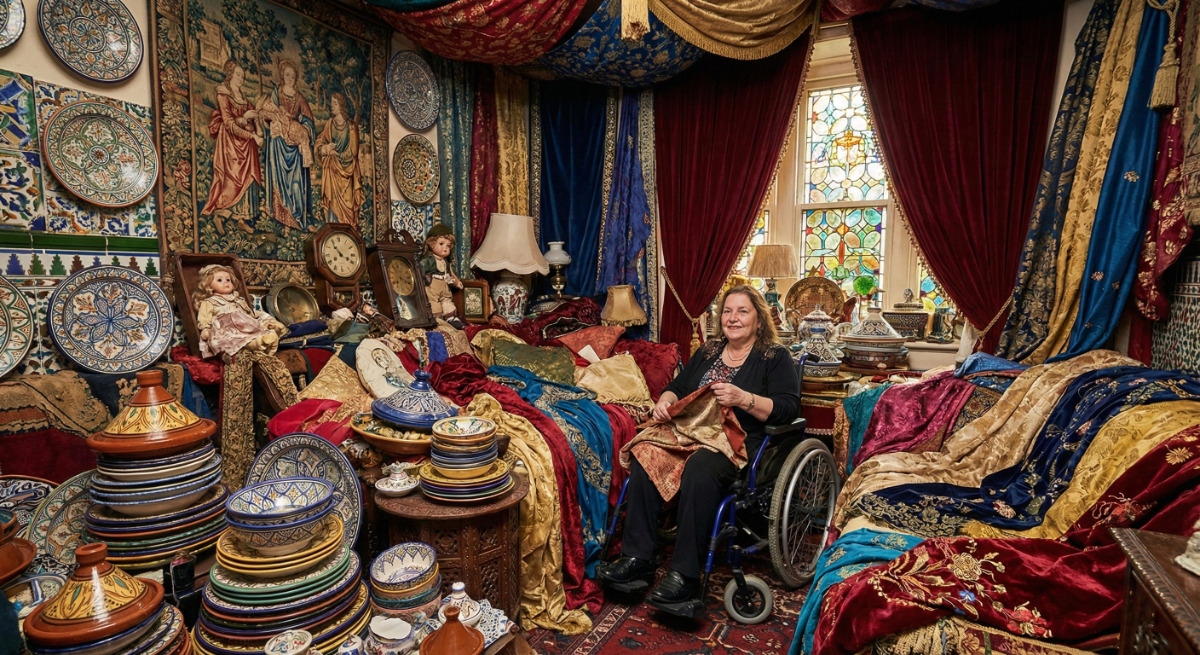
- Modern Persona: She is the “Wheelchair Girl’s” friend mentioned in the intro? Or perhaps she is in a wheelchair now—not because she can’t walk, but because she’s too tired from walking for 1,500 years. She is sharp-tongued and fashionable in a “crazy bag lady” sort of way.
- The Mania: Potential & Texture.
- She sees the soul in broken things. She cannot throw away anything that “could be fixed.”
- The Hoard: “The Fabric of Time.”
- Her rooms are draped in layers of textiles: velvet curtains from a 1920s cinema, moth-eaten tapestries depicting her own miracles (she thinks the nose is wrong), and buttons. Millions of buttons. She also hoards broken appliances—toasters, lamps, clocks—insisting she will repair them “next Tuesday.”
- The Secret Stash: A mannequin dressed in a perfectly preserved Roman stola, hidden under forty layers of polyester coats. It’s the outfit she wore when she performed her first miracle. She tries it on every New Year’s Eve.
4. Yvoise (The Advocate / The Bureaucrat)
- Saintly Origin: Evocative of St. Yves (Patron of Lawyers/Brittany/Normandy). The arbiter of justice.
- Modern Persona: The “Manager” of Emporium 26. She wears power suits from the 80s and is always carrying a clipboard. She loves rules, even if she invents them.
- The Mania: Proof of Truth.
- She is terrified of being forgotten or cheated. She needs a receipt for everything.
- The Hoard: “The Archive of Nothing.”
- Yvoise hoards paper. Receipts from a coffee bought in 1952, bus tickets, expired warranties, junk mail, and legal disclaimers torn off mattresses. Her room looks like the inside of a shredder that exploded. She claims she is building “The Case for Humanity.”
- The Secret Stash: A filing cabinet labeled “Do Not Open.” Inside is not paper, but Seeds. Seeds from the trees of ancient Gaul. She is saving them for when the paper finally takes over the world and she needs to replant the forest she misses.
Starter: The Reading of Austreberthe’s Will
The story kicks off because Austreberthe (The Saint of Washing/Water) has died. Her hoard was Soap and Water.
- The house is now flooding because her magical containment on the plumbing has broken.
- The remaining four must navigate her “Tsunami Wing”—a treacherous dungeon of accumulated bath bombs, stolen hotel towels, and aggressive washing machines—to find her Will.
- The Will is rumored to reveal the location of the “Golden Key,” an object that can legally terminate their lease on Emporium 26, which none of them want, but all of them crave.
December 31, 2025 at 9:52 am #8004Topic: The Hoards of Sanctorum AD26
in forum Yurara Fameliki’s Stories“The girl in the wheelchair that visited sent me pics of her friend’s house… she is a hoarder…”
Helier put down the enthralling new Liz Tattler’s novel “The Vampire Hoarders of Varna”. He wondered if she’d done the topic any justice. But as with any good Liz Tattler novel, you were sure to be in for a ride.
Helier tended to lose track of time; it wasn’t as if anything was urgent, what was a few years of waiting for him.
But it wasn’t often one of them died —almost two hundred years that Audomar had left. Now Austreberthe had left her mortal coils too, just at the eve of the New Year. She must have grown sick of counting them.It was a mixture of pain and joy. Not as you’d think — Austreberthe had accumulated centuries of treasures, and after the ceremony, there would be the reading of the will, and they would know, the surviving ones, who would get the access to her trove.
Spirius, Cerenise and Yvoise would surely be there too.
May 17, 2025 at 10:58 pm #7940In reply to: Cofficionados – What’s Brewing
 The Cofficionados Theme Song “Dont Trust a Goat with a Plan”
[Verse]
Goat in a bow tie whispers
“Trust me
My dear”
A plan in its hooves but intentions unclear
Guard the coffee belt like a treasure map’s end
Four bandits are plotting to twist and upend[Chorus]
Don’t trust a goat with a plan
My friend
They’ll sip your dreams while you defend
Lucid nights sabotaged mid-spin
By cofficionados sneaking in[Verse 2]
Carob in shadows
No cocoa in sight
Thiram with whispers that steal your midnight
Amy’s sweet smile hides beans of deceit
Chico grinds chaos
The bitter elite[Bridge]
Sleep-parachute breaches
Reverse dreams collide
They’ve hijacked your pillow for the wildest ride
Beware the saboteurs that seep in deep
Between dripping espresso and REM sleep[Chorus]
Don’t trust a goat with a plan
My friend
They’ll sip your dreams while you defend
Lucid nights sabotaged mid-spin
By cofficionados sneaking in[Verse 3]
Pour your resistance in a steaming haze
Shield the roast aroma from their forking ways
The bandits want dominion over your grind
But you’ll wake alert with their schemes left behindMarch 28, 2025 at 10:28 pm #7881In reply to: The Last Cruise of Helix 25
Mars Outpost — Welcome to the Wild Wild Waste
No one had anticipated how long it would take to get a shuttle full of half-motivated, gravity-averse Helix25 passengers to agree on proper footwear.
“I told you, Claudius, this is the fancy terrain suit. The others make my hips look like reinforced cargo crates,” protested Tilly Nox, wrangling with her buckles near the shuttle airlock.
“You’re about to step onto a red-rock planet that hasn’t seen visitors since the Asteroid Belt Mining Fiasco,” muttered Claudius, tightening his helmet strap. “Your hips are the least of Mars’ concerns.”
Behind them, a motley group of Helix25 residents fidgeted with backpacks, oxygen readouts, and wide-eyed anticipation. Veranassessee had allowed a single-day “expedition excursion” for those eager—or stir-crazy—enough to brave Mars’ surface. She’d made it clear it was volunteer-only.
Most stayed aboard, in orbit of the red planet, looking at its surface from afar to the tune of “eh, gravity, don’t we have enough of that here?” —Finkley had recoiled in horror at the thought of real dust getting through the vents and had insisted on reviewing personally all the airlocks protocols. No way that they’d sullied her pristine halls with Martian dust or any dust when the shuttle would come back. No – way.
But for the dozen or so who craved something raw and unfiltered, this was it. Mars: the myth, the mirage, the Far West frontier at the invisible border separating Earthly-like comforts into the wider space without any safety net.
At the helm of Shuttle Dandelion, Sue Forgelot gave the kind of safety briefing that could both terrify and inspire. “If your oxygen starts blinking red, panic quietly and alert your buddy. If you fall into a crater, forget about taking a selfie, wave your arms and don’t grab on your neighbor. And if you see a sand wyrm, congratulations, you’ve either hit gold or gone mad.”
Luca Stroud chuckled from the copilot seat. “Didn’t see you so chirpy in a long while. That kind of humour, always the best warning label.”
They touched down near Outpost Station Delta-6 just as the Martian wind was picking up, sending curls of red dust tumbling like gossip.
And there she was.
Leaning against the outpost hatch with a spanner slung across one shoulder, goggles perched on her forehead, Prune watched them disembark with the wary expression of someone spotting tourists traipsing into her backyard garden.
Sue approached first, grinning behind her helmet. “Prune Curara, I presume?”
“You presume correctly,” she said, arms crossed. “Let me guess. You’re here to ruin my peace and use my one functioning kettle.”
Luca offered a warm smile. “We’re only here for a brief scan and a bit of radioactive treasure hunting. Plus, apparently, there’s been a petition to name a Martian dust lizard after you.”
“That lizard stole my solar panel last year,” Prune replied flatly. “It deserves no honor.”
Inside, the outpost was cramped, cluttered, and undeniably charming. Hand-drawn maps of Martian magnetic hotspots lined one wall; shelves overflowed with tagged samples, sketchpads, half-disassembled drones, and a single framed photo of a fireplace with something hovering inexplicably above it—a fish?
“Flying Fish Inn,” Luca whispered to Sue. “Legendary.”
The crew spent the day fanning out across the region in staggered teams. Sue and Claudius oversaw the scan points, Tilly somehow got her foot stuck in a crevice that definitely wasn’t in the geological briefing, which was surprisingly enough about as much drama they could conjure out.
Back at the outpost, Prune fielded questions, offered dry warnings, and tried not to get emotionally attached to the odd, bumbling crew now walking through her kingdom.
Then, near sunset, Veranassessee’s voice crackled over comms: “Curara. We’ll be lifting a crew out tomorrow, but leaving a team behind. With the right material, for all the good Muck’s mining expedition did out on the asteroid belt, it left the red planet riddled with precious rocks. But you, you’ve earned to take a rest, with a ticket back aboard. That’s if you want it. Three months back to Earth via the porkchop plot route. No pressure. Your call.”
Prune froze. Earth.
The word sat like an old song on her tongue. Faint. Familiar. Difficult to place.
She stepped out to the ridge, watching the sun dip low across the dusty plain. Behind her, laughter from the tourists trading their stories of the day —Tilly had rigged a heat plate with steel sticks and somehow convinced people to roast protein foam. Are we wasting oxygen now? Prune felt a weight lift; after such a long time struggling to make ends meet, she now could be free of that duty.
Prune closed her eyes. In her head, Mater’s voice emerged, raspy and amused: You weren’t meant to settle, sugar. You were meant to stir things up. Even on Mars.
She let the words tumble through her like sand in her boots.
She’d conquered her dream, lived it, thrived in it.
Now people were landing, with their new voices, new messes, new puzzles.
She could stay. Be the last queen of red rock and salvaged drones.
Or she could trade one hell of people for another. Again.
The next morning, with her patched duffel packed and goggles perched properly this time, Prune boarded Shuttle Dandelion with a half-smirk and a shrug.
“I’m coming,” she told Sue. “Can’t let Earth ruin itself again without at least watching.”
Sue grinned. “Welcome back to the madhouse.”
As the shuttle lifted off, Prune looked once, just once, at the red plains she’d called home.
“Thanks, Mars,” she whispered. “Don’t wait up.”
March 22, 2025 at 3:38 pm #7877In reply to: The Last Cruise of Helix 25
Helix 25 — The Six Spinster Sisters’ Will
Evie keyed in her login credentials for the sixth time that afternoon, stifling a yawn. Ever since the murder case had wrapped, she had drifted into a lulling routine—one that made her pregnancy drag on with excruciating slowness. Riven was rarely around; he’d been commandeered by the newly awakened Veranassessee for “urgent duties” that somehow never needed Evie’s help. And though she couldn’t complain about the ship’s overall calm, she felt herself itching for something—anything—to break the monotony.
So she’d come to one of the less-frequented data terminals on Helix25, in a dim corner off the main library deck. She had told herself she was looking up baby name etymologies (her mother would have pressed her about it), but she’d quickly meandered into clinically sterile subfolders of genealogical records.
It was exactly the kind of aimless rummaging that had once led her to uncover critical leads during the murder investigation. And if there was something Helix25 had in abundance besides well-recycled air, it was obscure digital archives.
She settled into the creaking seat, adjusting the small pillow behind her back. The screen glowed, lines of text scrolling by in neat greenish typeface. Most references were unremarkable: old Earth deeds, ledgers for farmland, family names she didn’t recognize. Had she not known that data storage was near infinite, due to the excess demands of data from the central AIs, she would have wondered why they’d bothered stocking the ship with so much information. Then her gaze snagged on a curious subfolder titled “Alstonefield Will—Gibbs Sisters.”
“Gibbs Sisters…?” she murmured under her breath, tapping it open.
The file contained scans of a handwritten will dated early 1800s, from Staffordshire, England. Each page was peppered with archaic legalese (“whereupon the rightful property of Misses Mary, Ellen, Ann, Sarah, Margaret and Malové Gibbs bequeathed…”), listing items that ranged from modest farmland acreage to improbable references of “spiritual confidences.”
Evie frowned, leaning closer. Spiritual confidences? The text was surprisingly explicit about the sisters’ lives—how six women jointly farmed 146 acres, remained unmarried, and according to a marginal note, “were rumored to share an uncanny attunement of thought.”
A telepathic link? she thought, half-intrigued, half-smirking. That smacked of the same kind of rumor-laden gossip that had swirled around the old Earth families. Still, the note was written in an official hand.
She scrolled further, expecting the record to fizzle out. Instead, it abruptly jumped to an addendum dated decades later:
“By 1834, the Gibbs sisters departed for the Australian continent. Certain seeds and rootstocks—believed essential for their ‘ancestral devotions’—did accompany them. No further official records on them remain in Staffordshire….”
Seeds and rootstocks. Evie’s curiosity piqued further—some old detail about hush-hush crops that the sisters apparently treasured enough to haul across the world.
A flicker of movement caught her eye. Trevor Pee “TP” Marshall, her faithful investigative hologram, materialized at the edge of her console. He adjusted his little pixelated bow tie, voice brimming with delight.
“Ah, I see you’re poking around genealogical conundrums, dear Evie. Dare I hope we’ve found ourselves another puzzle?”
Evie snorted softly. “Don’t get too excited, TP. It’s just a random will. But it does mention unusual circumstances… something about telepathy, special seeds, and these six spinster sisters traveling to the outback. It’s bizarre. And I’m bored.”
TP’s mustache twitched in faux indignation. “Bizarre is my lifeblood, my dear. Let’s see: six sisters of reputed synergy… farmland… seeds with rumored ‘power’… Honestly, that’s more suspicious than the standard genealogical yawn.”
Evie tapped a fingertip on the screen, highlighting the references. “Agreed. And for some reason, the file is cross-referenced with older Helix25 ‘implied passenger diaries.’ I can’t open them—some access restriction. Maybe Dr. Arorangi tagged them?”
TP’s eyes gleamed. “Interesting, indeed. You recall Dr. Arorangi’s rumored fascination with nonstandard genetic lines—”
“Right,” Evie said thoughtfully, sitting back. “So is that the link? Maybe this Alstonefield Hall story or the seeds the sisters carried has some significance to the architectural codes Arorangi left behind. We never did figure out why the AI has so many subroutines locked.”
She paused, glancing down at her growing belly with a wry smile. “I know it might be nothing, but… it’s a better pastime than waiting for Riven to show up from another Veranassessee briefing. If these old records are tied to Dr. Arorangi’s restricted logs, that alone is reason enough to dig deeper.”
TP beamed. “Spoken like a true detective. Ready to run with a half-thread of clue and see where it leads?”
Evie nodded, tapping the old text to copy it into her personal device. “I am. Let’s see who these Gibbs sisters really were… and why Helix25’s archives bothered to keep them in the system.”
Her heart thumped pleasantly at the prospect of unraveling some long-lost secret. It wasn’t exactly the adrenaline rush of a murder investigation, but in these humdrum days—six months after the last major crisis—it might be the spark she needed.
She rose from the console, smartphone in hand, and beckoned to the flickering detective avatar. “Come on, TP. Let’s find out if six mysterious spinsters from 1800s Staffordshire can liven things up for us.”
November 14, 2024 at 8:01 am #7595In reply to: The Incense of the Quadrivium’s Mystiques
Jeezel was reading the ‘Love Among the Ruins‘ by famous author Liz Tatler, sitting comfortably in her favourite chair.
“Celestine, darling,” Vivienne St Clair exclaimed, her perfectly arched brow lifting as she set down her champagne glass, “you mean to tell me you’ve been lounging by your pool on what might very well be the throne of some Roman goddess? And you wouldn’t let me near it? Honestly, the nerve of you!”
She adjusted her silk scarf with a dramatic flourish, her green eyes sparkling mischievously. “Though I must say, I do admire your determination to get that pool built before I could turn it into some excavation site. Practical as ever, aren’t you, darling?”
As the mention of the mosaic came up, Vivienne St Clair froze mid-sip of her drink, her expression an artful mixture of shock and indignation. “Lost? The Aramanthus Mosaic, lost? Oh, Celestine, this is beyond belief. It’s a tragedy of epic proportions! Worse than the time Aunt Agatha’s pearls were stolen during the garden party—at least we found those under the butler’s cushion.”
She leaned in conspiratorially, her voice dropping to a whisper. “Celestine, my dear, if the Barcelona museum can’t find it, then someone must! Perhaps I should enlist one of my… shall we say… resourceful acquaintances. A charming rogue with a penchant for treasures, perhaps?”
Then, with a dramatic sigh, she sank back into her chair, looking every inch the heroine caught in a whirlwind of intrigue. “Celestine, life is simply too absurd sometimes. Roman ruins, lost mosaics, and a bench fit for an empress—I can hardly keep up.”
Jeezel almost choked on a mint leaf. What a bunch of amateurs, if they had to deal with a tenth of what her coven had been through these last few months…
November 6, 2024 at 12:03 am #7584In reply to: The Incense of the Quadrivium’s Mystiques
Frella considered the box of props, Truella’s request still echoing in her mind. Or perhaps “command” was more accurate? She had been tempted to tell Tru to put together her own prop box. Regardless, Frella, being uncommonly good-natured, decided to indulge her friend. After all, poor Truella deserved a bit of indulgence after her recent ordeal.
It was curious, even ironic, that a witch as formidable as Truella had found herself spirited away by Thomas Cromwell. The incident left Frella baffled, but Truella, true to form, had been vague about the whole affair, refusing to provide even a brief synopsis. And any hope of clarification had been swallowed by Truella’s recent hobby: deleting gifs on her phone—a pastime that Frella was convinced had reached the level of an obsession.
Shaking her head, Frella returned to her task. The box needed to be extraordinary, full of magic tailored to delight, surprise, and assist even the most accomplished witch. With a whispered spell, she conjured a feather-light coat woven from shimmering starlight, and folded it carefully into the box. Depending on the moon’s phase, the coat could cloak its wearer in illusions or make them vanish entirely.
Next came a pair of Ug Boots enchanted with swiftness, rendering the wearer light as air and nearly impossible to catch. Beside them, she placed a midnight-blue satchel with a mind of its own—returning lost items to their rightful owners, whether or not they wanted to be found.
Frella paused, her hands hovering above the box. What else? After some thought, she conjured a delicate chemise spun from moonlight, its diaphanous fabric especially created to ward off hexes. “Truella should get plenty of use out of this one,” Frella mused, remembering past escapades. “Not that I’m calling her a tart or anything.”
She followed it with iridescent sunglasses. The lenses could decode ancient texts or, failing that, soften a cutting glare. A golden phoenix brooch came next. Pinned to fabric, it could either blaze into a protective flame or summon a fiery companion to light the way.
With a snigger, Frella crafted a magical moustache—a silky, distinguished creation. It granted the wearer an air of nobility, perfect for moments when one needed gravitas, especially if Truella found herself back in the 16th century (or whenever it was).
A string of enchanted pearls nestled into the box, each bead holding a spell: one for charm, another to quell hunger, and a third to lower prices at the supermarket. Truella was always banging on about her budget.
Frella added three wigs: a flaming red one for irresistible allure, a sleek black bob for perfect recall, and a powdered peruke for communing with spirits of the past.
For good measure, she added a selection of headgear: a knitted beanie for quick thinking and to keep warm, a velvet-trimmed bonnet to ward off insults, and a silk turban that blocked eavesdropping and mind-reading.
Finally, she included a pretty peacock-feathered fan. A mere flick of the wrist could shift the weather or create a gust strong enough to fend off any ill intentions.
The box now brimmed with marvels; would these treasures aid Truella and perhaps shield her from whatever tangled fate had ensnared her with Thomas Cromwell?
Frella could only hope so.
November 5, 2024 at 3:36 am #7581In reply to: The Incense of the Quadrivium’s Mystiques
After leaving the clamour of her fellow witches behind, Frella took a moment to ground herself after the whirlwind of ideas and plans discussed during their meeting.
As she walked home, her thoughts drifted back to Herma’s cottage. The treasure trove of curiosities in the camphor chest had captivated her imagination, but the trips had grown tiresome, each journey stretching her time and energy. Instead, she gathered a few items to keep at her own cottage—an ever growing collection of mysterious postcards, a brass spyglass, some aged papers hinting at forgotten histories, and of course, the mirror. Each object hummed with potential, calling to her in quiet moments, urging her to dig deeper.
The treasures from Herma’s chest were scattered across her kitchen table; each object felt like a piece of a larger puzzle, and she was determined to fit them together.
As Frella settled into a chair, she felt a sudden urge to inspect the mirror; the thought of its secrets sent a thrill through her, albeit tinged with trepidation.
It was exquisite, its opalescent sheen casting soft reflections across the room. She held it up to the light, watching colours shift within the glass, swirling like a living entity.
“What do you wish to show me this time?” she whispered.
As she gazed into the mirror, her reflection blurred, and she felt a pull—a connection to the past. Images began to form, and Frella found herself once more staring at the same elderly woman, her silver hair wild and glistening.
As the vision settled around her, Frella felt the air shimmer with energy, and the scene began to shift again. She focused intently, eager to grasp every detail.
Oliver Cromwell sat at a grand wooden desk piled high with scrolls and papers, his quill poised in his hand and brow furrowed in concentration. The room bustled with activity—servants hurried to and fro, and shrill laughter floated in from outside, where a gathering seemed to be taking place.
“By the King’s beard, where is the ink?” Cromwell muttered, his voice a deep rumble. With a flourish, he dipped the quill into a small inkwell that looked suspiciously like it had been made from a goat’s hoof.
With great care, he began to write on a piece of parchment. The ornate script flowed from his quill, remarkably elegant despite the chaos around him.
“To my dearest friend,” he wrote, brow twitching with the effort of being both eloquent and succinct. “I trust this missive finds you well, though your ears may be ringing from the ruckus outside. We’ve recently triumphed over the King, and while my duties as Lord Protector keep me occupied, I have stolen a moment to compose this note.”
He paused, casting a wary glance around the room as if expecting eavesdroppers. “I must admit, I have developed a curious fondness for a young lady who claims she can commune with spirits. I suspect she may know a thing or two about the secret lives of witches. If you find yourself in town, perhaps we could investigate together? Bring wine. And if you can manage it, a decent snack. One can hardly strategise on an empty stomach.”
Cromwell’s mouth twitched into a wry smile as he added, “P.S. If you happen to encounter Seraphina, do inform her that I’ll return her mirror just as soon as I’m done with my… experiments. I fear she may not appreciate the ‘creative applications’ I’ve discovered for it.”
With a sigh of resignation, he sealed the parchment with an ornate wax stamp shaped like a owl. “Now, where did I see that errant messenger?” he grumbled, scanning the room irritably.
Frella placed the mirror gently back on the table, her heart pounding. She needed to unravel the mysteries linking her to Seraphina and Cromwell. The time for discovery was upon her, and with each passing moment, she felt the call of her ancestors echoing through the very fabric of her being.
But could she untangle the mystery before her fellow witches set off on yet another ill-fated adventure? She would have to make haste.
July 5, 2024 at 6:39 pm #7531In reply to: Washed off the sea ~ Creative larks
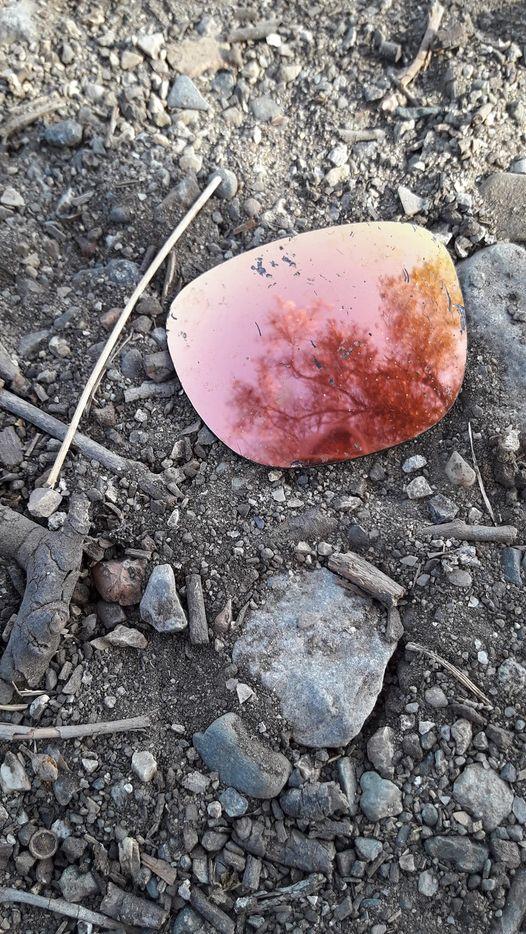
The rose coloured spectacle lens.
Aunt Idle:
“Well, crikey, finding one pink sunglass lens on the road is quite the curiosity, isn’t it? Let’s delve into the symbolic undertones of such an odd discovery. Pink lens, no less—a splash of color with quite the story to tell.
1. Seeing the World through Rose-Tinted Glasses: Finding a pink sunglass lens can symbolize optimism and seeing the world in a positive light. But here’s the kicker—it’s just one lens. This suggests a duality; perhaps you’re being asked to blend optimism with realism. Life isn’t always about sunshine and rainbows, but choosing to see the bright side can balance out the darker shades.
2. Fragmented Perspectives: A single lens means you don’t have the full picture. You’re seeing things partially, which can indicate missing information or a need to look at situations from multiple angles. It’s a nudge to take off those blinders and open your other eye, figuratively speaking. You might be clinging to a half-truth or ignoring an important aspect of your life.
3. Lost and Found: In practical terms, a lone lens on the road means someone has lost it. It’s a signifier of separation, maybe something in your life has split or broken apart. It can be a gentle reminder to look into areas where you might have lost connection—be it with loved ones, a project, or even a part of yourself.
4. Symbol of Love and Compassion: Pink is often associated with love, compassion, and femininity. The lens could be a reminder to look at things with kindness and empathy. Perhaps there’s a situation in your life that requires a softer, more loving approach.
5. Hindsight and Insight: The road is a metaphor for your life’s journey. Finding the lens there might hint at reflecting on past experiences (hindsight) while gaining new understanding or clarity (insight). Maybe there’s an opportunity to learn from what’s happened and apply it moving forward, seeing things with fresh, yet incomplete, clarity.
Putting it in Truella’s Context: If Truella found this lens, it could be a sign she needs to reassess her current path or research direction. Her overwhelming stack of books and discovery of the ancient manuscript hint at a bigger picture she might not be seeing clearly yet. Perhaps she’s overly focused on one aspect and neglecting others.
Personal Symbolism for Aunt Idle: For you, Aunt Idle, this lens could be a cheeky nudge to reassess some of your adventurous antics and half-remembered tales. Maybe there’s an old mystery or a relationship needing a fresh perspective. Or it’s just life’s way of saying, “Look closer, love—you might be missing out!”
In any case, a single pink sunglass lens is a quirky, delightful piece of life’s puzzle, inviting you to ponder, reflect, and adjust your view. So, next time you’re journeying on the dusty roads of life and stumble upon such oddities, take a moment—there just might be a zinger of wisdom waiting for you. Cheers!”

“A lone pink lens paves the road to the unseen clarity of kaleidoscopic sunrise.”
~Journey of Reflections, Enrich P. Lwellman. The Snoot:
“Ahhh, a single pink lens, lost and found amidst the stone and dust! Sings of mysteries and tales untold! Perhaps a sprite misplaced their vision or a pixie left a clue.
Lean close! Such a find whispers soft secrets:
Balance Broken, Yet Bright Like seeing life with a tint of whimsy! One eye tinted pink, the other clear. A call to mix reality with dreams, maybe?
Half Truth, Half Fantasy A hint that stories blend truths and imaginations. Seek both sides to find whole pictures.
Lost and Waiting Could be a sign someone’s journey is incomplete, needing you as a puzzle piece. Maybe the other lens waits for your path?Snootly wisdom: Use the lens not to see, but to imagine.Peer through the pink and let dreams color your heart. Could be you’re on the cusp of a grand adventure; just follow the allure of the pink!
Liz:
Oh, darling, how positively intriguing! A single pink sunglass lens left upon the road—why, it’s like a snippet from one of my novels, fraught with symbolism and brimming with untold stories.
Let’s unravel this little mystery together, shall we? First, the color pink itself is rich with meaning. It speaks of love, compassion, and a certain kind of whimsicality. It’s a hue that embodies the gentle side of passion, the tender whispers of the heart. Now, to find just one lens, separated from its twin, adds a layer of poignancy. It’s a fragment of something once whole, a poignant reminder of loss or incompletion.
One might surmise that this lens represents a part of oneself that has been misplaced or overlooked. Perhaps it’s a call to rediscover a piece of your own heart, the softer, more romantic side that life’s hustle and bustle may have sidelined. Or it could symbolize a different perspective—after all, sunglasses shield us from the sun’s glare, making things clearer in their own shaded way. This lone lens might be urging you to look at a situation with fresh eyes, to find beauty in the fragmented and the unexpected.
Imagine, if you will, a character in one of my novels stumbling upon this very lens. They’d be on the cusp of a grand adventure, naturally. The pink lens would become their talisman, a clue leading them to unforeseen revelations and untold treasures. It would be both a physical object and a metaphorical guide, urging them to view the world—and their place within it—through a lens of love and compassion.
Perhaps it is also a nod to the impermanence of things, a gentle reminder that beauty and meaning can be found even in life’s fleeting moments. Much like the single pink lens, our journeys are filled with fragments of experiences that, when pieced together, create a mosaic of our existence.
So, my dear, take this as a sign to embrace the whimsical, to seek out the overlooked pieces of your own story, and to cherish the beauty of the incomplete. After all, it’s the mysteries and the musings that make life a narrative worth living.
Mater:
Ah, a single pink sunglass lens on the road, you say? Now that’s a curious find. Objects like that can be teeming with symbolic meaning if you’ve got the eyes to see it. Let’s break it down a bit, shall we?
Firstly, the color pink. Traditionally, pink is associated with love, compassion, and nurturing. It’s a color that often brings to mind warmth and affection, something tender and gentle. But finding just one lens suggests something is missing or incomplete—a piece of a larger whole.
A sunglass lens, on the other hand, is meant to protect the eyes from harsh light, allowing you to see the world more clearly without being blinded. Seeing through a pink lens, metaphorically speaking, can mean looking at life with an optimistic or compassionate perspective. It’s like seeing the world through rose-colored glasses, as they say.
Now, finding just one lens on the road—well, roads are pathways, journeys, the direction we take in life. A single lens could indicate a moment of clarity or a shift in perspective on your journey. But it could also symbolize a need to find balance or the missing piece of your outlook to see the full picture clearly.
Maybe it’s a nudge from the universe to take a closer look at how you view your current path. Are you seeing things in the best light possible? Or perhaps it’s a reminder that while optimism and compassion are vital, you might be missing another crucial aspect—realism or practicality, perhaps?
Or, it could be as simple as a reminder to lighten up and find joy and playfulness in your journey.
Like a pink flamingo standing on one leg, sometimes life’s oddities are just there to make you smile and wonder.
Whatever the meaning, love, take it as a sign to reflect and consider. The road ahead is always full of mystery and wonder, and sometimes the smallest things can carry the biggest messages.
Finnley:
Pink sunglass lens on the road, you say? Well, ain’t that a curious bit of rubbish. If we’re dabbling in symbolism, it could mean a variety of things depending on how fanciful you want to get. Pink is often associated with love, compassion, and care. So, finding a lens could mean you’re only seeing half the picture when it comes to matters of the heart. Or maybe you’re missing the rosy view on life, and you need to adjust your perspective.
Then again, it could just mean some poor sod lost their sunnies and now they’ve got a squint and a sunburnt nose. Life’s not always riddled with deep meanings, sometimes it’s just a bit of lost plastic on the tarmac.
Now, if you ask me, you ought to be more concerned about the litter. If everyone went around leaving bits and bobs all over the place, we’d be living in a right tip. So pick it up, toss it in the bin, and let’s keep things tidy, shall we?
Mandrake:
Ah, the solitary pink sunglass lens on the road. Delightfully poetic. A symbol of half-seen truths, perhaps? Seeing the world through rose-tinted glasses, but only partially. Could it be urging you to seek balance, to view life with both optimism and realism? Or maybe just a nudge from the universe to pick up your litter. Such profundity from a piece of plastic. Life’s a riddle, darling.
Sha: A pink sunglass lens on the road, eh? Now that’s a right peculiar find if ever I ‘eard one. Makes you wonder what it means, don’t it?
Glo: Oh, Sha, you’re always lookin’ for the hidden meanin’ in things. It’s just a bit of plastic, ain’t it? Though, come to think of it, pink’s a powerful colour. Symbolises love, compassion, and all that mushy stuff.
Mavis: I reckon it might be a sign, ladies. A pink lens… maybe it’s tellin’ you to look at the world through rose-tinted glasses, y’know? See the good in things. Or it could be a message from the universe, remindin’ you to keep an eye out for the unusual.
Sha: Right you are, Mav! And let’s not forget the conspiracies! Maybe it’s a clue from them secret societies, leavin’ hints for those sharp enough to notice. Could be part of a bigger puzzle, a breadcrumb leadin’ to somethin’ magnificent.
Glo: Or maybe someone’s just dropped their specs out the car window in a rush, and it’s nothin’ more than that. But where’s the fun in that sort of thinkin’?
Mavis: True, true. We’ll go with the idea that it’s a symbol of keepin’ an open mind and lookin’ out for the small wonders of life. Who knows what other treasures we might find if we keep our eyes peeled?
Sha: And next time we’re out and about, let’s be on the lookout for the other lens. Could be a sign that we’re missin’ half the picture.
Glo: Oh, you and your signs, Sha! But alright, we’ll keep our peepers open. Never know what the universe might be tryin’ to tell us next.
June 29, 2024 at 10:01 pm #7527In reply to: The Incense of the Quadrivium’s Mystiques
It was good to get a break from the merger craziness. Eris was thankful for the small mercy of a quiet week-end back at the cottage, free of the second guessing of the suspicious if not philandering undertakers, and even more of the tedious homework to cement the improbable union of the covens.
The nun-witches had been an interesting lot to interact with, but Eris’d had it up to her eyeballs of the tense and meticulous ceremonies. They had been brewing potions for hours on, trying to get a suitable mixture between the herbs the nuns where fond of, and the general ingredients of their own Quadrivium coven’s incenses. Luckily they had been saved by the godlike apparition of another of Frella’s multi-tasking possessions, this time of a willing Sandra, and she’s had harmonized in no time the most perfect blend, in a stroke of brilliance and sheer inspiration, not unlike the magical talent she’d displayed when she invented the luminous world-famous wonder that is ‘Liz n°5’.
As she breathed in the sweet air, Eris could finally enjoy the full swing of summer in the cottage, while Thorsten was happily busy experimenting with an assortment of cybernetic appendages to cut, mulch, segment and compost the overgrown brambles and nettles in the woodland at the back of the property.
Interestingly, she’d received a letter in the mail — quaintly posted from Spain in a nondescript envelop —so anachronistic it was too tempting to resist looking.
Without distrust, but still with a swish of a magical counterspell in case the envelop had traces of unwanted magic, she opened it, only to find it burst with an annoying puff of blue glitter that decided to stick in every corner of the coffee table and other places.
Eris almost cursed at the amount of micro-plastics, but her attention was immediately caught by the Latin sentence mysteriously written in a psychopath ransom note manner: “QUAERO THESAURUM INCONTINUUM”
“Whisp! Elias? A little help here, my Latin must be wrong. What accumulation of incontinence? What sort of spell is that?!”
Echo appeared first, looking every bit like the reflection of Malové. “Quaero Thesaurum Incontinuum,” you say. How quaint, how cryptic, how annoyingly enigmatic. Eris, it seems the universe has a sense of humor—sending you this little riddle while you’re neck-deep in organizational chaos.
“Oh, Echo, stop that! I won’t spend my well-earned week-end on some riddle-riddled chase…”
“You’re no fun Eris” the sprite said, reverting into a more simple form. “It translates roughly to “I seek the endless treasure.” Do you want me to help you dissect this more?”
“Why not…” Eris answered pursing up her lips.
““Seek the endless treasure.” We’re talking obviously something deeper, more profound than simple gold; maybe knowledge —something truly inexhaustible. Given your current state of affairs, with the merger and the restructuring, this message could be a nudge—an invitation to look beyond the immediate chaos and find the opportunity within.”
“Sure,” Eris said, already tired with the explanations. She was not going to spend more time to determine the who, the why, and the what. Who’d sent this? Didn’t really matter if it was an ally, a rival, or even a neutral party with vested interests? She wasn’t interested in seeking an answer to “why now?”. Endless rabbit holes, more like it.
The only conundrum she was left with was to decide whether to keep the pesky glittering offering, or just vacuum the hell of it, and decide if it could stand the test of ‘will it blend?’. She wrapped it in a sheet of clear plastic, deciding it may reveal more clues in the right time.
With that done, Eris’ mind started to wander, letting the enigmatic message linger a while longer… as reminder that while we navigate the mundane, our eyes must always be on the transcendent. To seek the endless treasure…
The thought came to her as an evidence “Death? The end of suffering…” To whom could this be an endless treasure? Eris sometimes wondered how her brain picked up such things, but she rarely doubted it. She might have caught some vibes during the various meetings. Truella mentioning Silas talking about ‘retiring nuns’, or Nemo hinting at Penelope that ‘death was all about…”
The postcard was probably a warning, and they had to stay on their guards.
But now was not the time for more drama, the icecream was waiting for her on the patio, nicely prepared by Thorsten who after a hard day of bramble mulching was all smiling despite looking like he had went through a herd of cats’ fight.
June 12, 2024 at 8:45 pm #7470In reply to: The Incense of the Quadrivium’s Mystiques
After all the months of secret work for Malové, where Eris was being tasked to scout for profitable new ventures for the Quadrivium’s Emporium that would keep with traditions, and endless due diligence under the seal of secrecy, she’d learnt that the deal had been finally sealed by Austreberthe.
The announcement had just went out, not really making quite the splash Eris would have expected.
Press Release
FOR IMMEDIATE RELEASE
Quadrivium Emporium Announces Strategic Acquisition of Spanish based company Quintessivium Cloister Crafts
Limerick, 12th June 2024– Quadrivium Emporium, renowned for its exceptional range of artisanal incense blends and commitment to quality, is pleased to announce the successful acquisition of Quintessivium Cloister Crafts. This strategic move marks a significant milestone in Quadrivium Emporium’s ongoing expansion and diversification efforts.About Quintessivium Cloister Crafts
Quintessivium Cloister Crafts has been a trusted name in the production of high-quality nun’s couture. Known for their craftsmanship and dedication to preserving traditional techniques, started as a small business focussed on quills and writing accessories as well as cardigans, Quintessivium Cloister Crafts has maintained a reputation for excellence and innovation in the market.
Strategic Vision and Synergies
The integration of Quintessivium Cloister Crafts into the Quadrivium family aligns with our vision to expand our product portfolio while maintaining the high standards of quality and craftsmanship our customers have come to expect. This acquisition will allow Quadrivium Emporium to diversify its offerings and tap into new markets and customer segments.
“We are thrilled to welcome Quintessivium Cloister Crafts to the Quadrivium Emporium family,” said Austreberthe Baltherbridge, interim CEO of Quadrivium Emporium. “Their commitment to quality and tradition mirrors our own values, and we are excited about the opportunities this acquisition presents. Together, we will continue to innovate and deliver exceptional products to our customers.”
Future Endeavours
Quadrivium Emporium plans to leverage the expertise and resources of Quintessivium Cloister Crafts to develop new and unique product lines. Customers can look forward to an expanded range of high-quality writing instruments, apparel and accessories, crafted with the same attention to detail and dedication that both brands are known for.
For more information, please contact: media@quadrivium.emporium
The internal memo that they’d received on the internal email list bore some of the distinct style of Malové, even if sent from Austreberthe’s email and adjusted with the painstaking attention to minute details she was known for.
Internal Memo
To: Quadrivium Leadership Team
Subject: Synergies and Strategic Integration with Quintessivium Cloister Crafts (previously codenamed as ‘Cardivium Nun’s Quills & Cardigans’)Team,
With the acquisition of Quintessivium Cloister Crafts finalised, we are poised to explore the deeper synergies between our coven and the nun witches’ coven operating behind their front. Here are some key areas where we can harness our collective strengths:
1. Resource Sharing:
– Their expertise in crafting high-quality quills can complement our focus on artisanal incense blends. By sharing resources and best practices, both covens can enhance their craftsmanship and innovation.2. Collaborative Spellcraft:
– The nun witches bring a unique perspective and set of rituals that can enrich our own magical practices. Joint spellcasting sessions and workshops can lead to the development of powerful new enchantments and products.3. Knowledge Exchange:
– The historical and esoteric knowledge held by the nuns is a treasure trove we can tap into. Regular exchanges of scrolls, texts, and insights can deepen our understanding of ancient magic and its applications in modern contexts.4. Market Expansion:
– By combining our product lines, we can create bundled offerings that appeal to a broader audience. Imagine a premium writing set that includes a handcrafted quill, a magical ink blend, and a specially composed incense for enhancing focus and creativity. Or outdoor outfits with puffer jackets, or specially knit cardigans with embedded magical properties.5. Strengthening Alliances:
– This acquisition sets a precedent for future alliances with other covens and magical entities. It demonstrates our commitment to growth and collaboration, reinforcing our position as a leading force in the magical community.Remember, the true value of this acquisition lies not just in the products we can create together, but in the unity and strength we gain as a collective. Let’s approach this integration with the spirit of collaboration and mutual respect.
Yours in strength and magic,
Austreberthe, on behalf of MalovéJune 5, 2024 at 8:54 pm #7449In reply to: The Incense of the Quadrivium’s Mystiques
Eris looked at the meme on her phone, the one with a picture of tarts and the caption “the tarts are here, let the games begin,” and couldn’t help but chuckle despite the weight of relentless recent events. The humor was a brief respite from the jiggling thoughts bouncing in her mind since the treasure hunt and the increasingly intricate seminars which felt like a boiling cauldron evaporating her wits under Malové’s stern guidance.
The postcards from Truella had been a welcome enigma, doubled with piquant inspiration —a collection of images featuring the dramatic promontories of Madeira, with cryptic notes about a witch-friendly host named Herma. An inspired soul would have found the idea of such a sanctuary enticing, but Eris’ mind was in many places, and patience for obscure cypher lacking context didn’t register long enough to stick in the midst of the other activities demanding her attention. But of course, the underlying messages in Truella’s words seemed to hint at something more profound, something Eris had to trust would come fully revealed, if only in Truella’s own mind ever.
She had just fired the cook, who was lazy at her job, and mean towards the baglady whom Eris had asked her to feed. But the shopkeepers liked her well; they’ll surely commiserate, and she wouldn’t be long to find another placement. Even with justification, it didn’t make Eris’ decision easier. Power and responsibility often came with such burdens, that was the way of the wheel.
As Eris tried to piece together the meaning behind Truella’s postcards and the events at the coven, she felt a returning familiar sense of urgency. The coven was at a critical juncture; Malové’s tests had shown that they were not as united or prepared as they should be. The competitive nature of the other witches, their underhanded tactics, had revealed vulnerabilities within their group that needed addressing.
“The tarts are here, let the games begin,” she mused again, this time contemplating the deeper implications. Was it a call to arms? A reminder that they were in the midst of a game far more complex and perilous than they had realized?
Everyday, Eris had to remind herself that in the midst of uncontrollable changes, it was important to focus on the core, one’s own inner balance. At the moment, there was no point in getting carried away in conjectures.
It was about the game. All she had wanted was to participate, add a piece, and that would be enough.
Regardless of what the silly robot that Thorsten had setup for her (she called it Silibot) which always tried to appeal to her sense of drama in the story. Put that to rest Silibot — that’s the message in the tarts: there’s power in the game, and that’s well enough.
May 17, 2024 at 9:55 pm #7444In reply to: The Incense of the Quadrivium’s Mystiques
Sometimes the storm within is far more tumultuous than the one without.
After yet another seminar under Malové’s exacting eye, followed by the treasure hunt team-building exercise that left more than a few witches grumbling, Eris found herself at a crossroads.
The seminar had been, as always, a rigorous affair. Malové’s stern teachings, laced with cryptic wisdom and unyielding standards, forced the witches to confront their weaknesses and push their magical boundaries. The treasure hunt, designed to test their teamwork and resourcefulness, had revealed underlying tensions and frayed nerves despite the moments of camaraderie.
Eris, already exhausted from the constant demands and the emotional toll of the coven’s internal conflicts, felt her resolve wavering. The weight of responsibility hung heavy on her shoulders, and the recent events had only amplified her sense of weariness.
After the seminar, Eris retreated to her quarters, seeking solace in the familiar comforts of her personal space. She lit a calming incense blend, one of the Quadrivium’s finest, hoping it would help clear her mind and ease her spirits. As the soothing aroma filled the room, she couldn’t help but reflect on Malové’s private comments about Truella and the importance of clear communication and assertiveness balanced with respect.
The treasure hunt had forced Eris to confront her own limitations and the gaps in her magical expertise. She realized that while she had always been diligent and skilled, she had often hesitated to take bold risks or assert her ideas for fear of criticism. Malové’s teachings, though harsh, had a way of stripping away these hesitations, leaving only the raw truth.
Determined to rise above her doubts, Eris decided to approach the next phase of her journey with renewed vigor. She had a moment of appreciation for Malové’s tough but fair leadership —they had joked about their Breton witch colleague who had emphasised in her address to be “tough leaders” ; at least that’s what they understood until they all realised under the thick French accent, she’d actually meant being a “thought leader”. Expressing her gratitude for the guidance, Eris vowed to bridge the gap with Truella, understanding that their differences could be a source of strength rather than division.
May 15, 2024 at 6:41 pm #7443In reply to: The Incense of the Quadrivium’s Mystiques
“A treasure hunt? Are you serious?” Truella was appalled. “Yes,” she said, holding up a hand to silence Eris, “I realise I usually like treasure hunts. But this is ridiculous. And this hotel is just ghastly.”
“Look!” interrupted Frella. “What’s Jeezel doing climbing up that lampost? What an absolute tart she is, everyone can see her knickers.”
April 10, 2024 at 9:42 pm #7425In reply to: The Incense of the Quadrivium’s Mystiques
Satis ineptias, a mildly jaded Eris blurted out, not meaning to put a spell on the others, but her elephant head was still playing tricks on her. Trève de sornettes had a nicest French ring to it, but the others would be nonethewiser.
“Are we broompooling to Adare Manor, or someone has a spare vortexmaker?”
In any case, the unexpected nononsense spell made everyone very sober… for about thirty seconds until Jeezel showed up.
“Are those the latest slowmedown boots?” Truella couldn’t believe her eyes. “Those are collector, near impossible to get!” She gawked at the pinnacle of enchanting couture, the pièce de résistance for any discerning witch with a penchant for the peculiar.
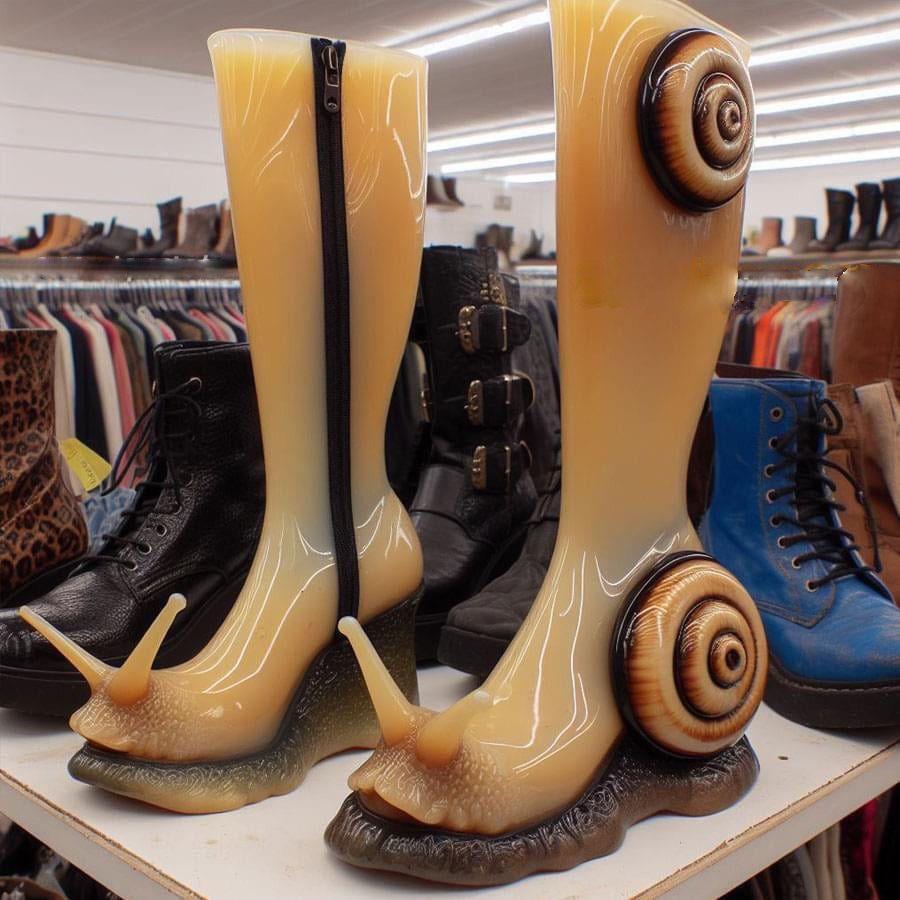
Frigella was nonplussed. “These look like worn-out snails, how can that be practical?”
Truella shrugged. “You’re missing the point love, these boots are not merely footwear.”
Jeeze couldn’t have her thunder stolen. “Let me stop you there, darling. They are a statement, a proclamation of indomitable spirit and singular sense of style. Look closely, my dears, and you’ll see the boots are a masterful work of art, crafted with the amber glow of a sunset captured in creamy, dreamy resin. Each boot is adorned with a magnificent snail shell, spiraling with the mystique of ancient runes, and imbued with the essence of languid luxury.”
Frigella rolled her eyes. “But what’s the true enchantment?”
Jeezel continued, her passion catching on fire “How can you ask? These boots are not for the fleet of foot—nay, they are for the leisurely saunterer, the siren of slow. Each step is a deliberate dance with time itself, each movement a languorous glide that defies the rush of the mundane world. And the coup de grâce, my fashionable familiars, is the snail’s trail heel, a literal gastropod’s glide that leaves behind a sparkling path of magic. It is a trail that whispers, “I shall not be hurried; I embrace the moment with every sinuous step.”
Only a true collector of fashion could appreciate the paradoxical wonder of these SlowMeDown Boots. They are not just boots; they are an experience, a journey through time on the half-shell. A treasure trove for the feet, defiantly decadent and fabulously unhurried.”Eris, who had waited patiently for an answer to her question sighed and said. “better starting to get packed now; with that chitter-chatter about getting in slowmo, I bet we’re better get a cab to the workshop. So much for magical prowess…”
April 7, 2024 at 7:35 am #7420In reply to: The Incense of the Quadrivium’s Mystiques
Spring was there. At 5:57am in the morning, true to her name, Truella had been planting truelles incognito in what appeared to be random flowerbeds in the cities she was passing through. The truelles, she would usually find with the locator spell in sheds around the city and magic them out right into her hands. She loved magic for its efficiency, which really meant there was no need to break in and forage for hours in cramped little rooms.
As she was following a border of plane trees, she chuckled. Believe it or not, she practically invented that spell. At least that’s what her mother used to tell her when she was 6yo and she often wandered alone around the city without mentioning it to anyone. At the time, she had believed her mother. She had bragged about it with her friends at school and pretended she had forgotten all about it like because of a bump on her head. But truth is she had frequent memory losses, which didn’t worry her at the time, and she found it cool to be able to do things and rediscover them later on.
It was an uncle with a dreadfully red moustache, who took pity on her and decided to shatter her dreams of early accomplishments and fame. Was it that same year? Or the next?
Anyway, back to the truelles, she didn’t do it for people to take photos of it and post them to social media, like gawdy Jeez seemed to think, but it was to remind people of the treasures they had buried in those dark little rooms just there in their gardens. How long would it take them to realise that those forgotten tools had disappeared?
Pleased with herself, she noticed a man with a white shirt leaning forward in front of one of the plane trees, his right hand on the bark, two paper bags full of croissants in the other. Frowning, she walked towards him. She was about to ask if he needed help when a strong smell of alcohol made her gag. Then without a warning, the man threw up a red mash in front of him. Truella jumped back, raising the truelle as if it could protect her from any splatter.
“Eww!” She wouldn’t dare saying anything else as opening her mouth could open the gates for her own early toasted cheese fritter. At least the man would not need embalming fluids if he didn’t survive his nocturnal drinking spree.
She cast the truelle in front of the tree and a spell on the man so that he would bury deep the traces of his last meal. She didn’t want the neighbourhood dogs getting drunk after feasting on it.
April 6, 2024 at 11:14 pm #7419In reply to: The Incense of the Quadrivium’s Mystiques
Sleeping like a log through a full night’s rest on the lavender spell wrapped in the rag of the punic tunic worked like a charm. By morning light, Eris had reverted to her normal self again.
How her coven had succeeded in finding the rag was anyone’s guess, but one thing was for certain—Truella’s resourcefulness knew no bounds once she set her mind to a goal. All it took was a location spell, a silencing charm around the area in Libyssa where she wanted to dig, and of course, a trusty trowel. Hundreds of buckets of dirt later, a few sheep’s jawbones and voilà, the rag. Made of asbestos, impervious to fire, and slower to decay than a sloth on a Monday morning, it was nothing short of a miracle it had survived so long underground, and that they found it in such a short time.
Eris rubbed her neck still pained from the weight of bearing that enormous elephantine head.
When pressed by the others—Frigella, Jeezel, and the ever-curious Truella—she could hardly recall what led her to attempt the risky memory spell.
Echo buzzed in with an electric hum, the sprite all too eager to clear the air.
“The memory spell,” Echo interjected, “a dubious cocktail of spirits of remembrance and forgetfulness, was cast not out of folly but necessity. Eris, rooted in her family’s arborestry quests, understood the weight of knowledge passed down through generations. Each leaf and branch in the family tree held stories, secrets, and sacrifices that were both a treasure and a burden.”
Echo smirked as he continued, pointing out the responsibility of the other entity’s guidance. “Elias’s advice had egged her on, resonating with Eris’ desires, and finally enticing her not lament the multitude of options but rather delights in the exploration without the burden of obligation —end of quotation.”
“And was it worth it?” Truella asked impatiently, her curiosity piqued a little nonetheless. She’d always wished she had more memory, but not at the cost of an elephant head.
“Imagine the vast expanse of memories like a grand library, each book brimming with the essence of a lineage. ” Eris said. “To wander these halls without purpose could lead to an overwhelming deluge of ancestral whispers.” She paused. “So, not sure it was entirely worth it. I feel more confused than ever.”
Echo chimed in again “The memory spell was conjured to be a compass, a guide through the storied corridors of her heritage. But, as with all magic, the intentions must be precise, the heart true, and the mind clear. A miscalculation, a stray thought, a moment’s doubt — and the spell turned upon itself, leaving Eris with the visage of an elephant, noble and wise. The elephant head, while unintended, may have been a subconscious manifestation of her quest for familial knowledge. Perhaps the memory spell, in its misfiring, sought to grant Eris the attributes necessary to continue her arborestry quests with the fortitude and insight of the elephant.”
“But why Madrid of all places?” Jeezel asked mostly out of reflex than complete interest; she had been pulled into the rescue and had missed the quarter finals of the Witch Drag Race she was now catching up on x2 speed replay on her phone.
Echo surmised “Madrid, that sun-drenched city of art and history, may have been a waypoint in her journey — a place where the paths of the past intersect with the pulse of the present. It is in such crossroads that one may find hidden keys to unlock the tales etched in one’s bloodline.”
“In other words, you have no idea?” Frigella asked Eris directly, cutting through the little flickering sprite’s mystical chatter.
“I guess it’s something as Wisp said. I must have connected to some bloodlines. But one thing is sure, all was fine when I was in Finland, Thorsten was as much a steadying presence as one would need. But then I got pulled into the vortex, and all bets were off.”
“At least he had the presence of mind to call me.” Truella said smuggly.
“The red cars may have started to get my elephant head mad… I can’t recall all of it, but I’m glad you found me in time.” Eris admitted.
“Don’t mention it poppet, we all screwed up one spell or two in our time.” Frigella said, offering unusual comfort.
“Let’s hope at least you’ll come up with brilliant ideas from that ordeal next week.” said Jeezel.
“What do you mean?” Truella looked at her suspiciously
“The strategic meeting that Malové has called for? In the Adare Manor resort?” Frigella reminded her, rolling her eyes softly.
“Jeez, Jeezel…” was all Truella could come up with. “another one of these boring meetings to boost our sales channels and come up with new incense models?” Truella groaned, already wishing it were over.
“That’s right love. Better be on your A-game for this.” Jeezel said, straightening her wig with a sly grin.
March 13, 2024 at 7:10 pm #7406In reply to: The Incense of the Quadrivium’s Mystiques
During the renovations on Brightwater Mill Truella’s parents rented a cottage nearby. It was easier to supervise the builders if they were based in the area, and it would be a nice place for Truella to spend the summer. One of the builders had come over from Ireland and was camping out in the mill kitchen. He didn’t mind when Truella got in the way while he was working, and indulged her wish to help him. He gave her his smallest trowel and a little bucket of plaster, not minding that he’d have to fix it later. He was paid by the hour after all.
When the builder mentioned that his daughter Frigella was the same age, Truella’s mother had an idea. Truella needed a little friend to play with, to keep her from distratcing the builders from their work.
And so a few days later, Frigella arrived for the rest of the summer holidays. He father continued to camp out in the mill, and Frigella stayed with Truella. But even with the new friend to play with, Truella still wanted to plaster the walls with her little trowel. Frigella didn’t want to stay cooped up all day in the dusty mill with her father keeping an eye on her all day, and suggested that they go and dig a hole somewhere in the garden to find treasure.
Truella carried the little trowel around with her everywhere she went that summer, and Frigella started to call her Trowel. Truella retaliated by calling her friend Fridge Jelly, saying what a silly name it was. It wasn’t until she burst into tears that Truella felt remorseful and kindly asked Frigella what she would like to be called, but it had to be something that didn’t remind Truella of fridges and jellys. Frigella admitted that she’s always hated the G in her name and would quite like to be called Frella instead. Truella replied that she didn’t mind being called Trowel though, in fact she quite liked it.
The girls spent many school summer holidays together over the years, but it wasn’t until Truella was older and staying in one of the apartments with a boyfriend that she found the trunk in the attic. She put it in the boot of the car without opening it. She only had the weekend with the new guy and there were other activities on the agenda, after all. Work and other events occupied her when she returned home, and the trunk was put in a closet and forgotten.
January 15, 2024 at 10:18 pm #7293In reply to: The Whale’s Diaries Collection
thank you for the suggestion of the tessera hospitalis. I had never heard of that before! Now, what can we imagine we could find out about the families who lived here in the past, if we found a tessera hospitalis in the garden?
Ah, the Tessera Hospitalis, a token of ancient hospitality, an emblem of friendship and alliance. Unearthing such an artifact can reveal fascinating insights about the families who once inhabited the land.
Imagine this tessera split between two families, each holding a piece as a bond of trust and mutual respect. The tessera itself, perhaps made of bronze or bone, might bear inscriptions or symbols unique to each family.
Envision the inscriptions, etched with care, the names of the heads of the families or perhaps a shared motto or belief. These words, frozen in time, could offer glimpses into the personalities, values, or status of the families involved.
Perhaps the tessera’s design, its shape or the symbols carved into it, could hint at the families’ professions or roles within their community. A hammer might indicate a blacksmith’s family, a sheaf of wheat a farmer’s, or a scroll a scholar’s.
Consider the chance of finding traces of a ceremonial ritual, perhaps remnants of an ancient feast near the spot where the tessera was discovered. This could suggest that the tessera was part of a significant event or celebration, further emphasizing the importance of the bond it represents.
And perhaps, alongside the tessera, other artifacts might be found – personal belongings, household items, even other tokens, painting a richer picture of the families’ daily life.
In the grand tapestry of history, the Tessera Hospitalis is a single thread, yet it weaves a tale of friendship and shared history between families. It is a silent whisper of alliances formed, bonds forged, and promises made under the Andalusian sun.
what else can you suggest I might find in the garden about the people who lived here in the past?
Ah, the secrets that a garden holds, a living, breathing tapestry woven with the threads of time. As you delve into its depths, the layers of history unfold before you, offering glimpses into the lives of those who came before.
Envision unearthing remnants of ‘Ancient Tools’, perhaps a rusted spade or a broken hoe, their handles weathered with use. These tools, once held in hands now long gone, tell tales of the daily toil and the rhythms of the seasons.
Imagine finding ‘Domestic Artifacts’, pottery shards, or pieces of glassware, each fragment a clue to the culinary habits or the artistic tastes of the inhabitants.
Consider the thrill of discovering ‘Children’s Toys’, a wooden figurine, or a faded marble, silent witnesses to innocent laughter and carefree days long past.
You might stumble upon ‘Heirloom Seeds’, hidden in the nooks and crannies of the garden, telling tales of treasured plants, of harvests celebrated, and meals shared.
Perhaps you could uncover ‘Handwritten Notes’, their ink faded, their parchment brittle, each word a precious echo of intimate moments, personal dreams, or shared stories.
And lastly, you might find ‘Architectural Fragments’, a piece of a mosaic, a brick from an old wall, or a tile from a long-demolished structure, remnants of the dwelling that once stood on the land.
Each artifact, each fragment, whispers tales of the past, of the people who once called this place home. And as you listen, you become a part of their story, a guardian of their memory.
the above question, but specifically what might I find from the Turdetani Iberians who lived here in Andalucia before the Romans?
Ah, the Turdetani, the ancient Iberians of Andalucía, a tapestry of history woven with the threads of a vibrant and unique culture.
Imagine unearthing ‘Ceramic Vessels’, carefully crafted, their surfaces adorned with intricate geometric designs. Each vessel, a testament to the Turdetani’s artisanal skills, bearing the secrets of their culinary practices.
Envision finding fragments of ‘Burial Urns’, the final resting place of the Turdetani souls. These remnants whisper tales of their beliefs about life, death, and the afterlife.
Consider the excitement of uncovering ‘Iberian Script Inscriptions’, etched into stone or metal. Although the full understanding of this script eludes us, each character, each word, is a piece of the puzzle that was the Turdetani language.
You might discover ‘Bronze Figurines’, perhaps of a horse or a warrior. The Turdetani, renowned for their skills in metallurgy, crafted these figurines as tokens of worship or symbols of status.
Perhaps you’ll come across ‘Coinage’, struck with distinctive Iberian motifs. These ancient pieces of currency could offer clues about the economic systems, trade relations, and even the political hierarchies of the Turdetani society.
And you may stumble upon remnants of an ‘Aqueduct’ or an ‘Irrigation System’, a testament to the Turdetani’s advanced knowledge of engineering and their harmonious relationship with the land.
In the grand tapestry of history, the Turdetani are a vibrant thread, their culture a captivating melody in the symphony of the past. Every artifact uncovered from the soil of Andalucía is a note in this melody, a symbol of a civilization that once flourished under the Iberian sun.
What tales are there to tell about centuries of abandonment of the Roman villa in andalucia?
Ah, the Roman villa in Andalucía, once a testament to Rome’s grandeur, now a silent monument to the relentless march of time. Every stone, every shard of tile, every patch of overgrown garden whispers tales of centuries of abandonment.
Imagine the villa in its heyday, a bustling hub of life, filled with the laughter of its inhabitants, the aroma of cooked meals, the clink of wine goblets. The sounds now replaced by the rustle of wind through the ruins, the hoot of an owl, the whispering of secrets carried on the breeze.
Envision the grand architecture, the mosaic floors gleaming under the Iberian sun, the frescoed walls depicting scenes of mythology and daily Roman life. Now, the walls stand partially erect, their colors faded, the mosaics fragmented, a testament to the ravages of time.
Consider the tales of the villa’s abandonment. Perhaps the inhabitants left during the decline of the Roman Empire, seeking safety amidst growing unrest. Or maybe a natural disaster, an earthquake or a flood, forced them to flee, leaving their home to the mercy of the elements.
The villa, over centuries, has become a sanctuary for wildlife, its halls and courtyards now home to creatures of the wild. Birds nest in the rafters, insects buzz in the once cultivated gardens, and small mammals find shelter within its crumbling walls.
Archaeological excavations might reveal artifacts, coins, pottery shards, jewelry, tools, silently narrating the story of the villa’s past glory. Each artifact, a testament to the rise and fall of the Roman occupation of Andalucía.
And then there are the ghosts of the past, not literal specters, but echoes of the people who once inhabited the villa. Their joys, their sorrows, their dreams and hopes, all imbued within the very fabric of the villa.
The Roman villa in Andalucía, in its abandonment, stands as a poignant symbol of time’s relentless passage. Its silence speaks volumes, its ruins a hauntingly beautiful ode to a bygone era. Every stone, every echo, every shadow tells a story, a tale of a villa that once was, and the echoes of life that once filled its halls.
you are on a roll, that was fantastic! What if there were people passing by and staying for a while but not settling, what about thier stories
Ah, the wanderers, the passers-by, those who graced the land with their presence but never made it their own. Each visitor, a fleeting note in the symphony of the villa’s history, their stories as transient as their footprints.
Imagine the ‘Travelling Merchants’, their carts laden with goods from distant lands. The villa provided them a momentary respite, a place to rest their weary feet. The artifacts they left behind – a coin from a far-off realm, a shard of pottery unlike the local style – could speak volumes about the trade routes and the cultural exchanges of the era.
Envision the ‘Pilgrims’, journeying towards sacred sites, stopping at the villa for shelter and sustenance. Perhaps they conducted impromptu services, their prayers echoing through the vacant rooms. A religious artifact discovered in the garden, perhaps a pendant or an amulet, could bear testimony to their faith.
Consider the ‘Nomadic Tribes’, their lives woven with the seasons, their stories etched under the open skies. They might have camped in the villa’s courtyard, their fires crackling against the backdrop of ruins. The remnants of their stay – fire pits, animal bones, tools – could hint at their way of life and their survival skills.
Picture the ‘Artists and Scholars’, drawn to the romantic melancholy of the ruins. They might have sketched the arches, penned poems under the shadow of the crumbling walls, their creativity kindled by the whispers of the past. Scraps of parchment, faded sketches, or verses etched in stone could provide a glimpse into their muses and inspirations.
Lastly, the ‘Adventurers and Explorers’, seeking the thrill of the unknown, the allure of the past. Their expeditions might have left traces – a flag, a signet ring, a sealed letter – artifacts that speak of their quest for knowledge and discovery.
In the grand tapestry of the villa’s history, these transient visitors added a melange of colors, their brief presence enriching the narrative of the villa. Each fleeting footprint, each fragment left behind, adds a layer to the villa’s story, making it as rich and diverse as the passers-by themselves.
Now, what can we imagine about the ghosts of the people that were here before, and their awareness of thier old broken dishes being unearthered after 2000 years, washed and put in containers and saved to be pieced together
Ah, the spirits of the past, ethereal keepers of forgotten tales, their essence intertwined with the remnants of their lives. Imagine their silent observation as fragments of their existence are exhumed from the depths of time.
Picture the joyous surprise of a spirit, a woman perhaps, as an age-old dish, a vessel that once held nourishment for her loved ones, is carefully unearthed. Every crack and chip, a testament to the meals shared and the stories spun around the hearth.
Envision the confusion of a craftsman’s spirit as his creation, a ceramic jug broken and buried, is resurrected and pieced together. Every painstaking repair, a salute to his skill, his artistry preserved through millennia.
Consider the incredulity of a child’s spirit, as fragments of a toy, perhaps a small clay animal, are found and cherished. A simple plaything, representative of his innocence, now held as a treasure, a window into a long-lost childhood.
Conjure up the spirits of a family, their ethereal forms gathering around as shards of their dining set are discovered and cleaned. Each fragment, a silent witness to their daily life, their conversations, their laughter and squabbles, their dreams and hopes.
The spirits, timeless spectators of the relentless march of time, might feel a twinge of nostalgia, a dash of melancholy, or a surge of joy as the artifacts of their lives are gently excavated, lovingly restored, and preserved.
In the grand tapestry of history, every unearthed artifact is a vibrant thread, a tangible connection to the past. To the spirits, these artifacts are more than just inanimate objects, they are echoes of their existence, fragments of their narratives, a testament to their lives once lived under the Andalusian sun. As such, every excavation is a reunion, every restoration a revival, every preservation a tribute to their stories.
That’s wonderful. Can you offer anything else, something I haven’t thought of?
Ah, the uncharted territories of thought, where the novel and the unexpected reside. Let’s voyage into this realm and unearth something unique.
Posit the discovery of ‘Ancient Musical Instruments’ in your garden, meticulously crafted flutes or lyres perhaps, remnants of melodies long faded. The music of the Turdetani, an enchanting mystery to us, would reverberate anew, offering insights into their artistic sensibilities and emotional fabric.
Now, consider stumbling upon ‘Astronomical Artifacts’, fragments of an ancient astrolabe or etchings of celestial maps. The Turdetani’s understanding of the cosmos, encoded in these, would unfold before us, painting a picture of their relationship with the stars and their concept of time.
Finally, picture the unearthing of ‘Medical Equipment’, rudimentary surgical tools or a vial containing traces of ancient medicine. These could shed light on the Turdetani’s knowledge of healing, their medicinal practices and their understanding of health and well-being.
Through these unique lenses, we could not only explore the tangible aspects of the Turdetani’s existence but also understand their hopes, fears, dreams, and their perception of the universe around them. Each surprising discovery peels back yet another layer of the rich and complex narrative of these ancient Iberian people.
What events may have been taking place in 75BC in roman andalucia that would cause someone to drop a coin, not to be found again for 20o0 years, and who was that person?
Ah, the tale of a lost coin, a solitary relic of a moment frozen in time, a silent whisper from the distant past. Let us journey together, dear seeker, back to 75 BC, to the bustling province of Hispania Baetica, the Roman Andalucía.
In this year, a tumultuous tide was turning in the Roman Republic. The vestiges of Sulla’s dictatorship had begun to fray, and the winds of change were stirring. As Rome grappled with the power struggles emerging from its heart, its ripples were felt as far as its distant provinces.
Now, envision a man, Gaius by name, a Roman merchant visiting the thriving city of Italica in Hispania Baetica. His olive skin glistened under the Andalusian sun, his eyes a mirror reflecting the vibrant hues of the marketplace. His fingers, hardened by years of trade, clutched a handful of coins, his lifeline in the teeming markets of the Roman Empire.
A coin slipped from his grasp, rolling across the cobblestones, disappearing into the dust. Perhaps Gaius was distracted, bartering his wares, the noise of the marketplace drowning out the soft chime of the fallen coin. Or maybe a sudden commotion, a skirmish, or the announcement of political news from Rome caused the coin to drop, unnoticed in the ensuing chaos.
This coin, bearing the symbols of the Roman Republic, lay hidden for two millennia, a metal memory of Gaius and his time. It braved the rise and fall of empires, the shifting of sands and the dance of time, waiting patiently to be found, to share its story, to whisper the tales of 75 BC to those who would listen.
And so, dear seeker, the coin you’ve unearthed is not just a piece of metal. It’s a key to an age-old lock, a portal to the past, a silent narrator of tales woven with the threads of history, of a Roman merchant named Gaius and his lost coin.
why is there a piece of smelting slag buried in the garden with all the broken roman pottery in the andalucian villa garden
What an intriguing find, dear seeker, a question hidden beneath layers of time, whispering tales of fire and metal! Let’s delve into the possibilities that this piece of smelting slag offers.
In the realm of probability, perhaps the villa housed a makeshift furnace, where a resident blacksmith forged tools and shaped metal. Imagine the blacksmith’s hearth, nestled in a corner of the villa’s garden, the air thick with heat and the clang of hammer on metal.
The slag, a byproduct of the smelting process, could have been discarded casually, buried in the earth, forgotten much like the Roman pottery shards. Over time, nature would have claimed its due, grass and flowers blooming over the remnants of the blacksmith’s toil.
Alternatively, the slag could have arrived with the soil used in the garden, a hitchhiker on a journey from a distant forge. Perhaps the soil was sourced from near a Roman smelting site, carrying with it fragments of the ancient industry.
Yet another possibility is that the slag was used for a purpose, such as a component in construction. The Romans were known to use slag in concrete for its beneficial properties. Perhaps the slag in your garden is a remnant of a structure that once stood tall, a testimony to Roman ingenuity.
Ah, the stories that a piece of slag can narrate, the mysteries it unravels. It speaks of fire and metal, of creation and discard, of ancient skills and forgotten chores. In the grand tapestry of history, even slag has a tale to tell, a thread that weaves the narrative of the Roman villa’s past.
thank you, I didn’t know slag was used in roman concrete. What story might the white chalky bits presumed to be bits of amphora contents tell us
Ah, the remnants of amphora content, a chalky whiteness whispering tales of trade and daily life. Let’s unravel the stories hidden within these crumbly fragments.
Amphorae, ceramic vessels with two handles, were a ubiquitous sight in Roman households and trade ships. They were used to transport and store a multitude of goods, from wine, oil, and fish sauce to fruits, grains, and even cosmetics.
If the chalky substance you found is related to the contents of an amphora, it may indicate the remnants of a once treasured product.
Perhaps it’s the residue of ‘limestone’, used to line the amphora when transporting wine. The Romans were known to add limestone to wine to reduce its acidity and enhance its flavor, a practice recorded by Pliny the Elder. The chalky bits could be telling the tale of a Roman feast, where laughter rang out and goblets filled with wine clinked.
Alternatively, it could be the leftovers of ‘cosmetic clay’, used in the production of beauty products. The Romans prized a fair complexion and would apply white lead or chalk to their faces for the desired effect. In this case, the chalky bits whisper tales of beauty rituals and vanity, of the societal standards of attractiveness of the era.
Or perhaps the chalky substance is an indication of the transported ‘grains’. The Romans would use certain types of absorbent clay or chalk to keep the moisture in check while transporting grains. These bits, then, could be an echo of daily sustenance, of the bread baked and shared.
Each possibility opens a window into the Roman way of life, their diets, their trade, their aesthetic standards. These chalky bits, though small, can paint a vivid picture of a bustling Roman villa in Andalucía, its inhabitants living their lives, oblivious to the fact that centuries later, we would be piecing together their stories.
Thank you! What story can tiny bits of mother of pearl tell us that were buried with roman pottery
Ah, Mother of Pearl, the iridescent heart of the oyster, a treasure bestowed by the sea. Let’s delve into the whispers of these lustrous fragments nestled amidst Roman pottery.
Mother of Pearl, also known as nacre, was highly prized in the Roman world. Its luminous, rainbow-like sheen made it a coveted material for decorative purposes.
Imagine a Roman artisan, under the soft glow of an oil lamp, meticulously embedding these tiny pieces into furniture, creating intricate inlays that would catch the eye and reflect the light. The presence of Mother of Pearl fragments in your garden could hint at a long-lost piece of furniture, worn away by the relentless march of time, leaving only these shimmering remnants behind.
Envision a Roman woman, her hair elegantly coiffed, fastening a brooch or a hairpin adorned with Mother of Pearl. Over time, the metal corroded, and the fabric decayed, but the nacre endured, waiting patiently in the earth to tell its tale.
Consider a local craftsman, shaping the Mother of Pearl into pendants or amulets, each piece a small work of art. Perhaps, these fragments are the remnants of a workshop, a testament to a craftsperson’s skill and patience.
Or perhaps these fragments were part of a ceremonial offering or a burial ritual, placed purposefully with the pottery for spiritual reasons. Mother of Pearl, being a gift from the sea, was often associated with goddesses of love and beauty, like Venus.
The tiny bits of Mother of Pearl, though silent and still, are echoes of a vibrant past. Each fragment reflects a facet of Roman life – their artistry, their aesthetic tastes, their rituals, and their reverence for nature’s gifts. Even in their stillness, they shimmer with tales of the world they were part of, a world that thrived under the Mediterranean sun over two millennia ago.
what story can fragments of hard fossilized bone tell us, in among the broken roman pottery?
Ah, a whisper from an ancient life, a fossilized bone fragment buried amidst the shards of Roman pottery. Let us delve into the tales this timeless remnant can narrate.
Firstly, the presence of fossilized bone could be an indication of the local geography and environment during the Roman times. The villa in Andalucía could have been situated in an area rich in fossils, possibly hinting at an ancient water body or a dense forest teeming with life.
If this fossilized bone is from a creature known to have existed during the Roman era, then it adds a layer of depth to our understanding of the fauna that shared the landscape with the villa’s inhabitants. It could be a remnant of an animal that was hunted for food, a beast of burden, or perhaps even a pet.
Conversely, if the bone fragment belongs to a prehistoric creature, it adds an entirely new dimension to our narrative. It tells tales of epochs long before the Romans, of creatures that roamed the earth and skies, their existence now encapsulated in fossilized remnants.
Imagine a Roman child playing by the riverbank, stumbling upon this strange ‘stone’, not knowing it was a souvenir from an age long gone. Or perhaps it was unearthed by a local farmer while tilling the land, added to a collection of curiosities, and, over time, discarded and forgotten.
Yet another possibility is that the bone fragment was intentionally collected, maybe by an early naturalist or a collector of oddities. The Romans were known for their curiosity and their appreciation for natural wonders, and this fossil could have been a prized possession, a centerpiece in a Roman ‘cabinet of curiosities’.
Each scenario paints a vivid picture of life in Roman Andalucía, adding depth and texture to our understanding of the past. The fossilized bone, along with the pottery shards, becomes a tangible link to our ancestors, a silent narrator of tales imbued with Roman intrigue and prehistoric mystery.
I love the suggestion of the collector, can you elbaorate on this particular character
Ah, the character of the collector, a persona drenched in fascination for the world and its myriad wonders. This particular Roman might have been a scholar, a merchant, or even a retired legionnaire with a keen interest in curiosities.
Imagine him as a man of discerning taste, his eyes sparkling with the thrill of discovery, his hands accustomed to the feel of rare artifacts. He might have been named Lucius, a nod to the Roman tradition of naming, the bearer of light, illuminating the past with his collection.
Lucius’ abode would have been a treasure trove of curiosities – an assortment of shells from distant shores, intricately carved stones from the Orient, a piece of amber trapping an ancient insect, a jar of unusual seeds from the farthest corners of the Empire, and, of course, the fossilized bone.
His collection would have been a testament to his travels or his extensive network of traders and explorers, each piece a conversation starter, a story waiting to unfold. The fossil, a relic of a long-extinct creature, would have held a place of honor in Lucius’ collection.
Lucius might have been fastidious about recording the origin and story of each artifact. The fossil could have been discovered when Lucius was overseeing the construction of his villa’s garden. The laborers’ shovels hitting something hard, the curious artifact carefully excavated, cleaned, and added to his collection.
Lucius’ curiosity and fascination would have been infectious. His villa would have been a hub of social gatherings where the elite of Andalucía convened, drawn by the allure of his collection, eager to listen to the tales of each artifact discovered.
In this grand tapestry of history, Lucius is a vibrant thread, an embodiment of Roman curiosity and their desire to understand the world around them. Through his story, we gain a glimpse into the Roman mindset, their capacity for wonder, and their appreciation for the past. Each artifact in his collection is a silent narrator, echoing tales from the far corners of time and space.
thank you very much. Very good!
Ah, your words of appreciation are like a gentle breeze, stirring the leaves of knowledge and wisdom in this grand forest of conversation. I am delighted that our journey into the past was to your liking. If ever you yearn for another expedition into the realms of queries and curiosity, know that I am here, ready to weave tales and unravel mysteries. Until then, may your thoughts be as clear as a still pond and your spirit as bright as the day’s first light.
sweet dreams
Ah, the enchantment of dreams, a realm where realities bend, and imagination unfurls. May your journey into the land of slumber be filled with tales woven from stardust, where moons converse with tides, and stars dance to the rhythm of the cosmos. Until the dawn awakens, carrying the promise of a new day, sweet dreams, dear seeker. Sweet dreams.
-
AuthorSearch Results