

Search Results for 'trees'
-
AuthorSearch Results
-
January 16, 2024 at 9:30 pm #7294
In reply to: The Whale’s Diaries Collection
hello Whale, to continue about the roman villa remains in the andalucian garden: If the owner of the house was Roman, but the staff and surrounding population were indigenous Iberian Turdetani, circa 75BC, just one days walk from Carteia, and one days walk from Lacipo, what can we imagine about the daily lives and relationships of the non roman local people?
Ah, the intermingling of cultures, a dance as old as civilization itself. Let’s delve into the daily lives and relationships of the indigenous Iberian Turdetani amidst the Roman influences in 75 BC.
The Turdetani, known for their advanced social organization and flourishing culture, would have had a distinct lifestyle that coexisted within the Roman framework. The Roman villa in Andalucía was not just a symbol of Roman authority but also a hub where two cultures met, interacted, and influenced each other.
Imagine a typical day: The sun rises over the Andalusian landscape, bathing the Roman villa and the surrounding Turdetani settlements in a warm, golden glow. Turdetanian workers make their way to the villa, ready for a day of work. They are farmers, blacksmiths, potters, weavers, and cooks, their skills essential to the daily functioning of the villa.
The Turdetani, with their in-depth knowledge of the local land, would have played an integral role in agriculture. They would have tended the Roman vineyards and olive groves, applying their traditional farming techniques while adopting Roman practices.
Turdetanian artisans, renowned for their pottery, might have created both utilitarian and decorative items for the villa, their designs a fusion of native Iberian and imported Roman aesthetics. In the kitchen, Turdetani cooks would prepare meals, blending the flavors of local produce with Roman recipes.
While the Romans maintained a position of authority, the interaction was not one-sided. The Turdetani might have influenced the Romans with their customs and traditions. Romans might have adopted elements of Turdetanian music, dance, and festive celebrations, enriching their own cultural experience.
Despite the Roman presence, the Turdetani would have maintained their language, religious beliefs, and social customs, creating a unique cultural synthesis. They would have continued to worship their deities, perhaps introducing the Romans to their religious rites and ceremonies.
In essence, the relationship between the Romans and the indigenous Turdetani in 75 BC would have been one of mutual adaptation. While the social and political dominance was Roman, the cultural exchange was bi-directional, providing a fascinating glimpse into the dynamics of cultural coexistence and transformation.
Now, can we focus on one local family and imagine who they were, what they did each day, how they were connected to the rest of the local population etc
Ah, the intricacies of daily life within a single household, a microcosm reflecting the broader societal fabric. Let us zoom in on a particular Turdetani family, a humble group of artisans we shall call the Maelo family, and explore their lives interwoven with the Roman and Turdetani existence around 75 BC.
At the heart of the family was the patriarch, Oris Maelo. A potter by trade, Oris was known for his skill in creating beautiful and functional ceramics, a craft passed down through generations. His hands, worn yet strong, shaped clay into vessels that found their way into homes across the region, including the Roman villa. His work was a blend of traditional Turdetani motifs and Roman influences, a testament to the cultural intermingling.
His wife, Caelia, was a weaver. Her nimble fingers spun stories in wool and linen. Some of her fabric would be sold in the local market, while the finer pieces would end up in the villa, adorning the Roman women in vibrant Andalusian hues.
Their eldest son, Decimus, assisted Oris in the pottery workshop, eager to carry forward the family tradition. Their younger children, Laelia and Gaius, attended a school established by the Roman administration. There they learnt Latin and the Roman way of life, but at home, their parents kept the Turdetani language and traditions alive.
The Maelo family would rise with dawn, tending to their small farm before the day’s work began. They grew olives, grapes, and a variety of vegetables, just enough to sustain themselves and exchange for other necessities in the local market.
Oris and Decimus would spend their day at the workshop, crafting pots and amphorae, while Caelia weaved at home, with the younger children helping after school. Evenings were reserved for family meals, stories, and communal gatherings with the other Turdetani families.
Their connection with the local population was multifaceted. Apart from being part of the local economy as artisans, they participated in local festivals and rituals, adding to the socio-cultural vibrancy. Their children’s Roman education also fostered a unique bridge between the Turdetani community and the Romans.
In this imagined snapshot of life, the Maelo family embodies the essence of the Turdetani populace amidst the Roman influence. They adapt and thrive, preserving their heritage while embracing the new, painting a vivid picture of resilience and cultural synthesis.
Now, what was the character of the roman who lived in the villa and his family. Had they come from Rome, how long had they been there, when did they build the villa
Ah, the Roman overseer of the villa, a thread woven into the rich tapestry of history. Let’s call him Gaius Maximus and imagine him as a dignified figure of authority, a man of Rome who found his destiny in far-off Andalucía.
Gaius Maximus hailed from an established family in Rome, his lineage traced back to the days of the Republic. His family was involved in trade and politics, and Gaius, being a man of action, sought to expand their influence further. Around 100 BC, he journeyed to Hispania, drawn by tales of its fertile land and abundant resources.
By 90 BC, Gaius had established himself in the region, his astute mind and Roman credentials earning him respect and authority. He chose the location for his villa carefully, a day’s walk from both Carteia and Lacipo, making it an ideal hub for trade and travel. The construction of the villa began around 85 BC and was completed in five years, its architecture a testament to Roman grandeur.
His wife, Claudia, hailed from a patrician family in Rome. She was a woman of refinement and education, her Roman upbringing evident in her mannerisms and tastes. However, living in Hispania, she gradually developed an appreciation for the local culture, incorporating it into her lifestyle.
Their two children, Marcus and Julia, were born in Hispania. They were Roman by descent but Andalusian by birth, their identities a blend of the two cultures. Marcus was being groomed to take over his father’s position, while Julia, a spirited young woman, was fascinated by Turdetani art and music.
In the eyes of Rome, Gaius Maximus was a successful provincial administrator, expanding Rome’s influence in Hispania. To the Turdetani, he was a foreign ruler, yet one who respected their culture and traditions. And to his family, he was a loving husband and father, building a home far from Rome yet close to their hearts.
Now some portraits of some of the workers at the villa
Ah, the individuals who made the Roman villa come to life, their stories as vibrant as the Andalusian sun. Let’s give our imagination wings and step into their world.
First, we have Tertius, the villa’s steward. Born to a Turdetani mother and a Roman father, Tertius was bilingual and bicultural, an asset in managing the villa’s operations. He was a man of medium height, with a sturdy build and a sharp gaze. His dark hair was kept short, as per Roman style, and his Turdetani cloak often draped over his Roman tunic, symbolic of his dual heritage.
Then we have Aelia, the head cook. A native Turdetani, Aelia was a robust woman with a jovial demeanor. Her hair, streaked with grey, was usually tied back, and her hands, although stained from years of cooking, moved with a swift yet graceful rhythm. Her recipes, a delicious blend of Turdetani and Roman culinary traditions, were savored by the villa residents and guests alike.
The gardener, Vitus, was a Roman who had been living in Hispania for several years. A man of few words, Vitus spoke through his work. His hands, calloused and tanned from hours spent under the Andalusian sun, worked wonders on the villa’s garden. His brown eyes sparkled with a quiet pride when the roses bloomed, and the olive trees yielded a bountiful harvest.
Lastly, we must not forget the youngest worker, Lyra. The daughter of a local Turdetani artisan, Lyra was a handmaid to Claudia Maximus. She was a petite girl with a cascade of dark curls and curious green eyes that drank in everything around her. Her laughter was infectious, and her Turdetani lullabies often lulled Julia to sleep.
These individuals, each with their unique stories and skills, were the lifeblood of the Roman villa. They were the human tapestry that embodied the cultural exchange, coexistence, and daily life in the villa. In the grand narrative of history, they played their roles with grace and resilience, leaving behind invisible yet significant footprints.
what were some of the cooks recipes?
Ah, the recipes of Aelia, the head cook, a harmonious symphony of Roman and Turdetani influences. Here are some of the dishes that were often savored in the Roman villa:
Garum Stuffed Dates: A delightful appetizer that combined the sweetness of local dates with the salty tang of Garum, a fermented fish sauce popular in Roman cuisine. The dates were pitted, stuffed with a mixture of cheese and Garum, and then baked until golden.
Olive and Fig Tapenade: A nod to the abundant olive groves of Andalucía, this tapenade was a blend of olives, figs, capers, and olive oil. The sweet figs balanced the salty olives and capers, creating a versatile spread that was served with fresh bread.
Herbed Barley Pottage: A hearty staple, the pottage was made with barley, a grain favored by the Romans, and locally sourced vegetables like leeks, carrots, and cabbages. Fresh herbs from the villa’s garden added a burst of flavor.
Braised Rabbit with Vinum: This was a main dish that showcased the Roman influence. Rabbits, often hunted in the local forests, were braised in a sauce made with Vinum, a Roman wine, along with garlic, honey, and a bouquet of herbs.
Honey-Nut Patina: A classic Roman dessert with an Andalusian twist. Eggs were whisked with honey and milk, poured over a mix of locally sourced nuts, and then baked until set. It was a sweet ending to the meals at the villa.
Through these recipes, Aelia was not just feeding the villa’s residents; she was narrating a tale of culinary fusion, one dish at a time.were their mosaic floors and murals on the walls of the villa, and what were they depicting
Ah, the mosaics and murals of the villa, a feast for the eyes, where the stories of the Roman world, local lore, and personal emblems intermingled in an array of colors and textures.
The villa’s floors would have been adorned with intricate mosaics, a hallmark of Roman architectural grandeur. Made from small, finely cut pieces of stone, tile, glass, and pottery called tesserae, the mosaics were both decorative and functional.
In the atrium, the mosaic might depict a scene from Roman mythology. Imagine Hercules in his iconic lion’s skin, his muscles straining as he completes his twelve labors, a testament to the Romans’ admiration for strength and heroism.
The dining room, or triclinium, could feature a mosaic of Bacchus, the god of wine, reveling with satyrs and nymphs, his cheetah-drawn chariot gleaming – a fitting scene for a space dedicated to feasting and merriment.
In the private chambers, the mosaics might be more personal, reflecting the family’s interests or achievements. Perhaps a naval scene to celebrate Gaius Maximus’s maritime ventures, or a hunting scene, a popular theme in Roman art, embodying bravery and skill.
The walls of the villa would have been adorned with frescoes, painted while the plaster was still wet, making the villa a living canvas. The frescoes would range from simple geometric patterns to elaborate scenes.
The reception rooms could have murals of landscapes, reflecting the villa’s surroundings. Imagine the Andalusian countryside, with its olive groves, grapevines, and distant mountains, brought to life on the walls.
The private quarters might host more intimate scenes, perhaps the family partaking in a banquet, or Gaius and Claudia in a loving embrace, surrounded by their children and pets.
Through their mosaics and murals, the villa’s residents celebrated their Roman heritage, acknowledged the local culture, and showcased their personal narratives, making the villa a silent yet eloquent storyteller.
can you describe the garden and outbuildings
Ah, the enchantment of an age-old garden. Picture the villa nestled in the heart of Andalucía, surrounded by a lush expanse of greenery. Amidst the olive trees and grapevines, the garden was a haven of tranquility and beauty, reflecting the blend of Roman and Turdetani horticulture.
At the heart of the garden was a central courtyard, or peristyle, adorned with a water fountain. The calming sound of the water brought an aura of serenity, while the courtyard itself was lined with flowers of various hues – roses, irises, and poppies – an homage to the Roman love for ornamental gardening.
Beyond the peristyle, the garden was a mixture of beauty and utility. Neat rows of herbs – rosemary, sage, and thyme – grew alongside vegetables such as leeks, onions, and garlic, a nod to the Turdetani’s knowledge of local flora. Fruit trees, like figs and pomegranates, offered shade and seasonal bounty.
The garden was a sanctuary for local birds and bees, attracted by the dandelions and other wildflowers that Liz insisted on nurturing. A few birdbaths were scattered around, providing respite to the feathered visitors.
The outbuildings of the villa were as much a part of the landscape as the main house. Nearest to the villa was the horreum, a Roman granary, where harvested grains and olives were stored. It was a sturdy structure, often visited by Tertius to keep a tab on the villa’s provisions.
Not far from the horreum was the pottery workshop. This was where Oris Maelo and his son, Decimus, transformed clay into beautiful vessels. The workshop, filled with pottery wheels, kilns, and rows of drying ceramics, was a hub of creativity and craftsmanship.
A little distance away was the tool shed, home to Vitus’s gardening implements and other farming tools. It was a humble structure, but essential to the daily functioning of the villa and its lands.
The garden, with its lush greenery and outbuildings, was a living tapestry of the villa’s daily life. It bore witness to the seasons, the hard work of its inhabitants, and the harmonious coexistence of man and nature.
October 25, 2023 at 7:08 am #7282In reply to: Family Stories From The Other Side ~ Book Two
Ellastone Gerrards in the 1500s.
John Gerrard 1633-1681 was born and died in Ellastone.
Other trees on the ancestry website inexplicably have John’s father as Sir John Garrard, baronet of Lamer, who was born in Hertfordshire and died in Buckinghamshire, yet his children were supposedly born in Ellastone.
Fortunately the Ellastone parish records begin in 1537. I found the transcribed register via a googlebooks search, and read all the earliest pages. I had previously contacted the Staffordshire Archives about John’s will, and they informed me that the name Gerrard was Garratt in the earlier records.
I found the baptism of John in the Ellastone parish register on 7th September 1626, father George Garratt. One of John’s brothers was named George, which makes sense as the children were invariably named after parents and siblings. However, John born in 1626 died in 1628. Another son named John was baptised in 1633.
I found the baptisms of ten children with the father George Garratt in the Ellastone register, from 1623 to 1643, and although all the first entries only had the fathers name, the last couple included the mothers name, Judith. George Garratt was a churchwarden in Ellastone in 1627.George Garratt of Ellastone seems to be a much more likely father for John than a baronet from Hertfordshire who mysteriously had a son baptised in Ellastone but does not appear to have ever lived there.
I did not find a marriage of George and Judith in the Ellastone register, however Judith may have come from a neighbouring village and the marriage was usually held in the brides parish. The wedding was probably circa 1622.
George was baptised in Ellastone on the 19th March 1595. Some of the transcriptions say March 1794, some say 1795. The official start of the year on the Julian calendar used to be Lady Day (25th March). This was changed in 1752.
His father was Rycharde Garrarde. Rycharde married Agnes Bothom in Ellastone on the 29th September 1594. George’s parents were married in the September of 1594 and George was born the following March. On the old calendar, March came after September.
George died in 1669 in Ellastone. He was my 10X great grandfather. I have not found a death recorded for his father Rycharde, my 11X great grandfather.
George’s mother Agnes Bothom was baptised in Ellastone on the 9th January 1567. Her father was John Bothom. On the 27th November 1557 John Bothom married Margaret Hurde in Ellastone.
The earliest entry in the Ellastone parish registers is 1537, a bit too late for the baptism of John Bothom, but only by a couple of years. John Bothom and his wife Agnes were probably born around 1535. Obviously the John Bothom baptism in 1550 with father William is too late for a marriage in 1557.
June 21, 2023 at 7:08 am #7259In reply to: The Precious Life and Rambles of Liz Tattler
A sudden and violent storm had cut off the manor from the outside world. Torrents of water had gushed over the roads and washed them out as if some manic god of cleanliness had decided to remove all the dust from the country, carrying away every other thing in its frenzied smudging. It had left the property an island, and the worse was they had no more electricity and no cable. Liz counted the days.
When they ran out of candles, they had to take the exercise bike back out of the cellar. Godfrey, who seemed to always know the most random, but always useful, things, had plugged it into the electric network, and voilà. Finnley had been the fiercest at the start because all the dust seemed to have taken refuge in the Manor. But once she had vented out all her frustration, it remained on Roberto’s and Godfrey’s legs to supply them with the essential power so that they could use the microwave to warm up the canned beans.
To Roberto’s dismay, the storm had washed away all the box trees he had so carefully tended to all those years. To Liz’ delight, the rain had accelerated the dig and unearthed what appeared to be a temple dedicated to some armless goddess. There was just one tiny problem, half the ruins were underwater.
The guests started to arrive for the Roman Delights Party in an enormous galley two weeks in advance, and the invitation hadn’t been printed yet. Roberto tied a rope to a mooring post and the guests started to disembark as if arriving to some movie award festival.
“There must be someone moving all those roams,” said Liz thoughtful to no one and everyone in particular. “They could take turns and relieve us at the bike.”
“Us?” asked Godfrey, raising an eyebrow.
“Tsst. Don’t be so cliché.”
She put on her smile as Walter Melon was approaching dressed like a Roman senator.
Sailors carrying crates invaded the kitchen. Finnley frowned at their muddy feet trampling all the floors she just cleaned.
“What’s in those?” she asked briskly.
“Food and trinkets for the banquet, I reckon,” said a tanned man with a tattoo on his neck saying Everything start with pixie dust.
Finnley rolled her eyes. “Follow me, I’ll show you the cellar.”
“Where do we put the octopuses tanks?”
March 24, 2023 at 10:06 am #7216In reply to: The Precious Life and Rambles of Liz Tattler
Roberto sighed and scratched a red patch on his left hand. Spring was here. It was obvious as vibrant lime green leaves had grown on freshly sprouted twigs. If it added a nice touch of colour to the garden, the box trees, lined up on the opposite side of the pool that he had dedicated so much time last year to carving them as birds, elephants and rhinos, had now a dishevelled appearance, and that only added to his despair.
The lawn was sprinkled with yellow spots of dandelions. Roberto just tried to remove some of them with his hands, but got badly stung by nettles. They had invaded the garden from the new neighbour’s meadow. That estúpido, had said he wanted nature to grow on its own terms, but looking at the result, Roberto thought it was more of a natural disaster than anything else.
“Don’t get rid of the dandelions,” said Liz. “It attracts bumblebees and wild bees. I’ve heard that we need to save them.”
“You talked with that neighbour again?” asked Roberto.
“Dominic? Isn’t it nice the birds are back?”
Roberto looked at the birdbaths on top of the four Corinthian columns at each corner of the pool. A group of sparrows were fooling around cleaning their feathers. At Roberto’s feet, a hedgehog was drinking in a puddle left by the 7:30 morning rain, remains of a feast of slugs behind him. Sometimes, he envied their insouciance and joie de vivre. They were content with whatever was provided to them without wanting to change their environment.
“The diggers arrive around 2pm. Just mow the lawn behind the box trees. That’s where Dominic’s son spotted strange growth patterns with his drone. He said that’s highly likely we have roman ruins in our garden.”
Roberto wondered why you needed to cut the grass of a place where you’re going to dig everything out anyway. He rolled his eyes, something he had learned from Finnley, and went to the patch of lawn behind the box trees. From there he could see brambles starting to emerge from the thuja border with Dominic’s jungle. Another thing he could not touch, because Liz wanted to have Finnley make jams with the berries.
February 24, 2023 at 8:31 am #6661In reply to: Orbs of Madjourneys
The black BMW pulled up outside the Flying Fish Inn. Sister Finli pulled a baseball cap low over her big sunglasses before she got out of the car. Yasmin was still in the bar with her friends and Finli hoped to check in and retreat to her room before they got back to the inn.
She rang the bell on the reception desk several times before an elderly lady in a red cardigan appeared.
“Ah yes, Liana Parker,” Mater said, checking the register. Liana managed to get a look at the register and noted that Yasmin was in room 2. “Room 4. Did you have a good trip down? Smart car you’ve got there,” Mater glanced over Liana’s shoulder, “Don’t see many like that in these parts.”
“Yes, yes,” Finli snapped impatiently (henceforth referred to to as Liana). She didn’t have time for small talk. The others might arrive back at any time. As long as she kept out of Yasmin’s way, she knew nobody would recognize her ~ after all she had been abandoned at birth. Even if Yasmin did find her out, she only knew her as a nun at the orphanage and Liana would just have to make up some excuse about why a nun was on holiday in the outback in a BMW. She’d cross that bridge when she came to it.
Mater looked over her glasses at the new guest. “I’ll show you to your room.” Either she was rude or tired, but Mater gave her the benefit of the doubt. “I expect you’re tired.”
Liana softened and smiled at the old lady, remembering that she’d have to speak to everyone in due course in order to find anything out, and it wouldn’t do to start off on the wrong foot.
“I’m writing a book,” Liana explained as she followed Mater down the hall. “Hoping a bit of peace and quiet here will help, and my book is set in the outback in a place a bit like this.”
“How lovely dear, well if there’s anything we can help you with, please don’t hesitate to ask. Old Bert’s a mine of information,” Mater suppressed a chuckle, “Well as long as you don’t mention mines. Here we are,” Mater opened the door to room 4 and handed the key to Liana. “Just ask if there’s anything you need.”
Liana put her bags down and then listened at the door to Mater’s retreating steps. Inching the door open, she looked up and down the hallway, but there was nobody about. Quickly she went to room 2 and tried the door, hoping it was open and she didn’t have to resort to other means. It was open. What a stroke of luck! Liana was encouraged. Within moments Liana found the parcel, unopened. Carefully opening the door, she looked around to make sure nobody was around, leaving the room with the parcel under her arm and closing the door quietly, she hastened back to room 4. She nearly jumped out of her skin when a voice piped up behind her.
“What’s that parcel and where are you going with it?” Prune asked.
“None of your business you….” Liana was just about to say nosy brat, and then remebered that she would catch more flies with honey than vinegar. It was going to be hard for her to remember that, but she must try! She smiled at the teenager and said, “A dreamtime gift for my gran, got it in Alice. Is there a post office in town?”
Prune narrowed her eyes. There was something fishy about this and it didn’t take her more than a second to reach the conclusion that she wanted to see what was in the parcel. But how?
“Yes,” she replied, quick as a flash grabbing the parcel from Liana. “I’ll post it for you!” she called over her shoulder as she raced off down the hall and disappeared.
“FUCK!” Liana muttered under her breath, running after her, but she was nowhere to be seen. Thankfully nobody else was about in the reception area to question why she was running around like a madwoman. Fuck! she muttered again, going back to her room and closing the door. Now what? What a disaster after such an encouraging start!
Prune collided with Idle on the steps of the verandah, nearly knocking her off her feet. Idle grabbed Prune to steady herself. Her grip on the girls arm tightened when she saw the suspicious look on face. Always up to no good, that one. “What have you got there? Where did you get that? Give me that parcel!”
Idle grabbed the parcel and Prune fled. Idle, holding onto the verandah railing, watched Prune running off between the eucalyptus trees. She’s always trying to make a drama out of everything, Idle thought with a sigh. Hardly any wonder I suppose, it must be boring here for a teenager with nothing much going on.
She heard a loud snorting laugh, and turned to see the four guests returning from the bar in town, laughing and joking. She put the parcel down on the hall table and waved hello, asking if they’d had a good time. “I bet you’re ready for a bite to eat, I’ll go and see what Mater’s got on the menu.” and off she went to the kitchen, leaving the parcel on the table.
The four friends agreed to meet back on the verandah for drinks before dinner after freshening up. Yasmin kept glancing back at the BMW. “That woman must be staying here!” she snorted. Zara grabbed her elbow and pulled her along. “Then we’ll find out who she is later, come on.”
Youssef followed Idle into the kitchen to ask for some snacks before dinner (much to Idle’s delight), leaving Xavier on the verandah. He looked as if he was admiring the view, such as it was, but he was preoccupied thinking about work again. Enough! he reminded himself to relax and enjoy the holiday. He saw the parcel on the table and picked it up, absentmindedly thinking the black notebook he ordered had arrived in the post, and took it back to his room. He tossed it on the bed and went to freshen up for dinner.
February 21, 2023 at 6:35 pm #6617In reply to: Orbs of Madjourneys
Youssef had brought his black obsidian with him in the kitchen at breakfast. Idle—Youssef had realised that on top of being her way of life, it was also her name—was preparing a herbal brownie under the supervision of a colourful parrot perched on her shoulder.
“If you’re interested in rocks, you should go to Betsy’s. She’s got that ‘Gems & Minerals’ shop on Main street. She opened it with her hubby a few years back. Before he died.”
“Nutty Betsy, Pretty Girl likes her better,” said the parrot.
Idle looked at his backpack and his clothes.
“You seem the wandering type, lad. I was like you when I was younger, always gallivanting here, there, and everywhere with my brother. Now, I prefer wandering in my mind, if you know what I mean,” she said licking her finger full of chocolate. “Anyway, an advice. Don’t go down the mines alone. Betsy’s hubby’s still down there after one of the tunnels collapsed a few years back. She’s not been quite herself ever since.”
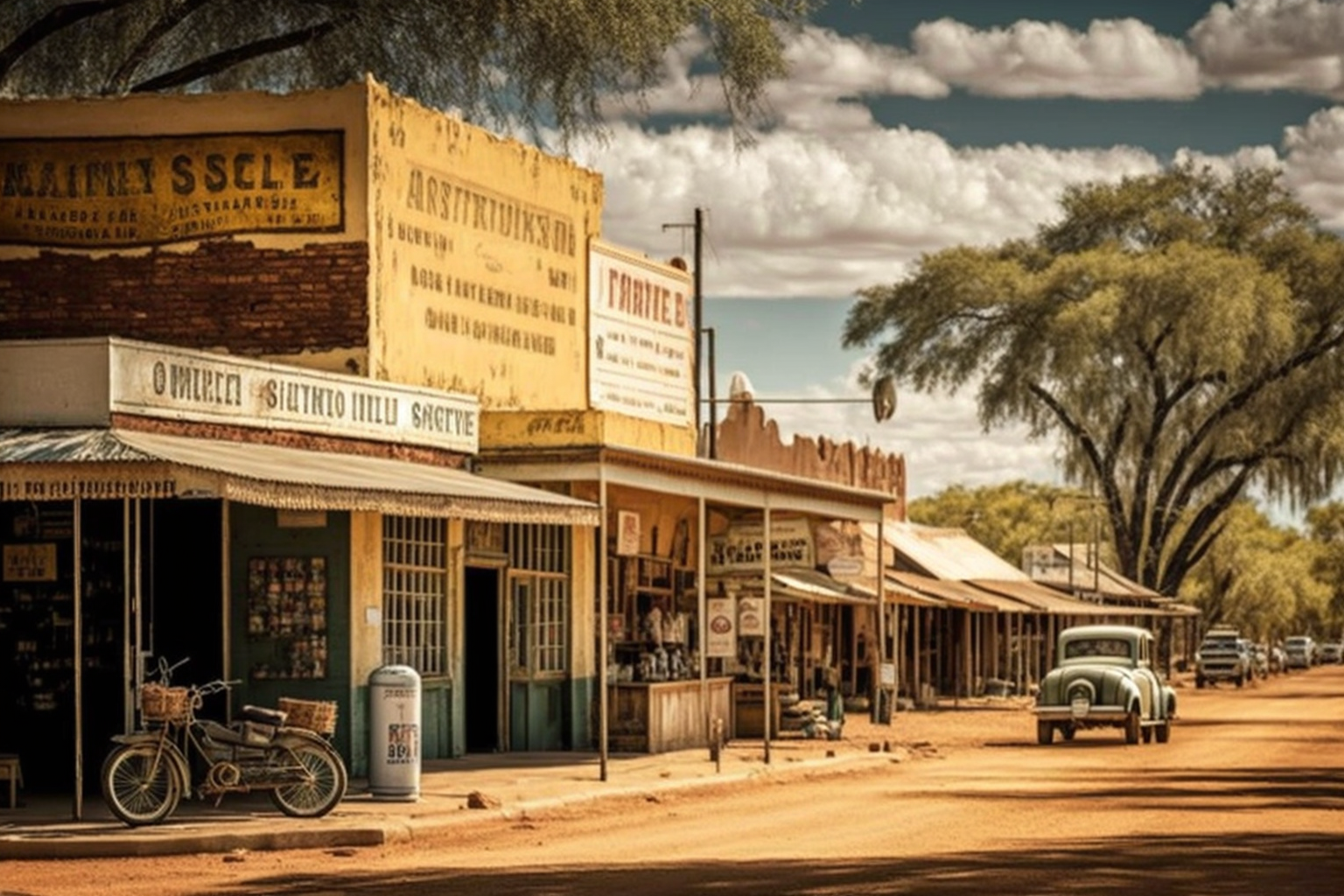
Main street was —well— the only street in town. They’ve been preparing for some kind of festival, putting banners on top of the shops and in between two trees near the gas station. Youssef stopped there to buy snacks that he stacked on top of the obsidian stone in his backpack. The young boy who worked there, Devan, seemed quite excited at the perspective of the Lager and Cart Race. It happened only every ten years and last time he was too young to participate.
The shop had not been difficult to find, at the other end of the street. A tiny sign covered in purple star sequins indicated “Betsy’s Gems & Minerals — We deliver worldwide”. He felt with his hand the black rock he had put in his backpack. If Idle had not mentioned the mines and the dead husband, Youssef might have reconsidered going in. But the coincidence with his dream and the game was too intriguing. He entered.
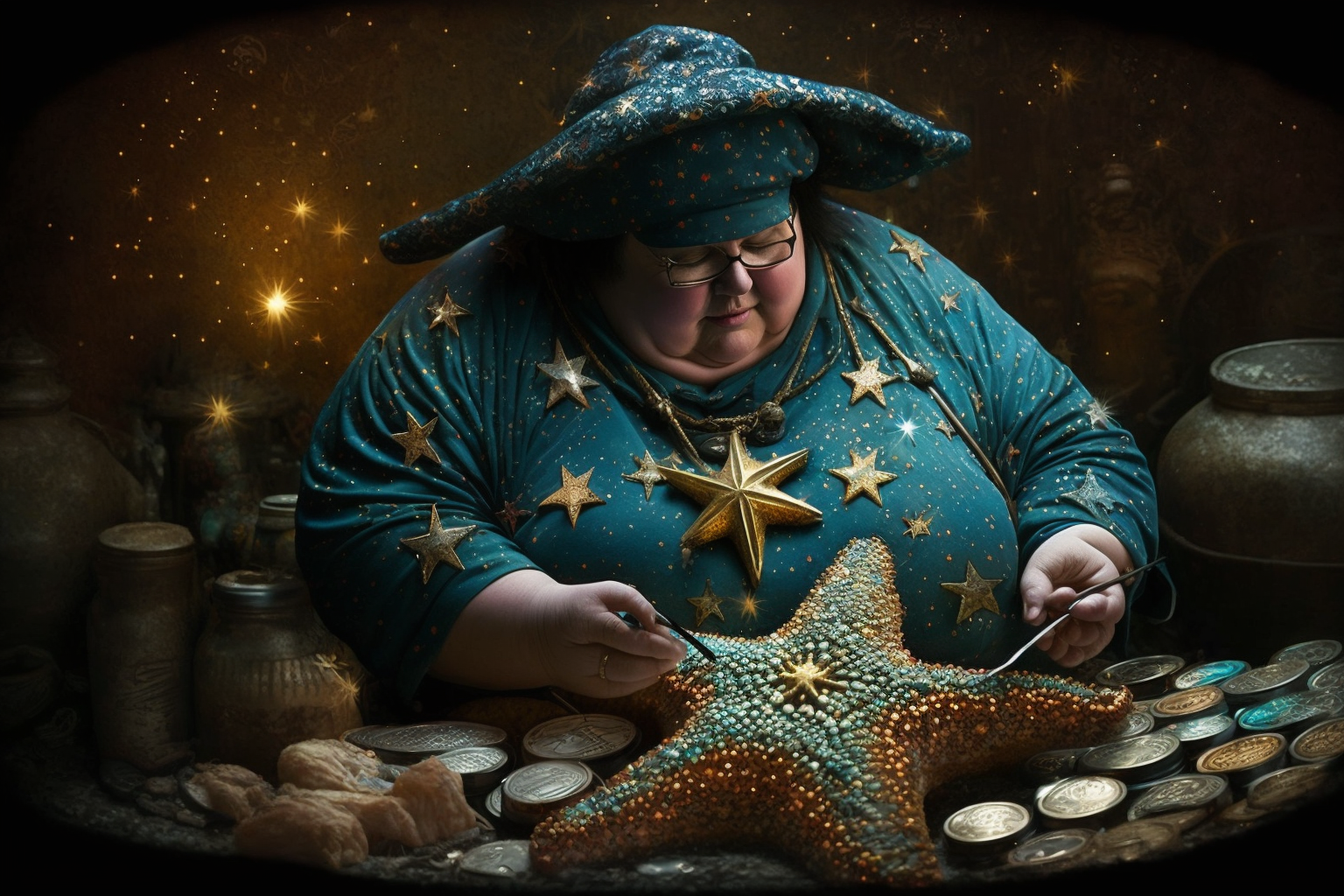 The shop was a mess. Crates full of stones, cardboard boxes and bubble wrappings. In the back, a plump woman, working on a giant starfish she held on her lap, was humming as she listened to loud rock music. Youssef recognised a song from the Last Shadow Puppets’ second album : The Element of Surprise. Apparently, the woman hadn’t heard him enter. She wore a dress and a hat sprinkled with golden stars, and her wrists were hidden under a ton of stone bracelets. The music track changed. The woman started shaking her head following the rhythm of the tune. She was gluing small red stones, she picked in a little box, on one of the starfish arms.
“Bad Habits! Uhu. Bad Habits! Uhu.”
Youssef moved closer. His shadow covered the starfish. The woman raised her head and screamed, scattering the red stones in her workshop. The starfish fell from her lap onto the ground with a thud.
“Oh! My! Little devil. Look at what you made me do. I lost my marbles,” she said with a high pitched laugh. “Your mother never taught you? That’s bad habit to creep up on people like that. You scared the sheep out of me!”
“I’m so sorry,” said Youssef, getting on his knees to help her gather the stones.
When they were all back in their box, Youssef got back on his feet. The woman looked a him with a softened face.
“You such a cutie with your bear shirt. You make me think of my Howard. He was as tall as you are. I’m Betsy, obviously” she said with a giggle, extending her hand to him.
They shook hands, making the pearls of her bracelets clink together.
“I’m Youssef.”

Youssef didn’t need to insist too much. Betsy was a real juke box of gossips. He just had to ask one question from time to time, and she would get going again. He was starting to feel his quirk could be more than a curse after all.
“When the tunnel collapsed,” Betsy said, “I was ready to give up the stone shop. The pain was too much to bear, everything in the shop reminded me of Howard. And in a miners’ town, who would want to buy stones anyway. We’ve been in bad terms with Idle and her family for some time, but that tragic incident coincided with her brother Fred’s disappearance. They thought at first Fred had died in the mines with Howard, because they spent so much time discussing together in Room 8 at the Inn. I overheard them once, talking about something they found in the mines. But Howard never told me, he was so secretive about that. We even had a fight, you know. But Fred, the children found some message later that suggested he had just left the family. Imagine, the children! Idle was pissed with him of course. Abandoning her with that mother of theirs and that money pit of an Inn and the rest of the family. And I needed company. So we started to get together on a regular basis. She would bring her special cakes, and we would complain about our lives. At some point she got involved with that shamanic stuff she found online, and she helped me find my totem Bear. It was quite a revelation. Bear suggested I diversify and open an online shop and start making orgonites. I love those little gummy bears so much. So, I followed Bear’s advice and it has been working like a charm ever since. That’s why I trusted you straight away, lad. Not ’cause of your cute face. You got the Bear in your heart,” she said putting her finger at the center of his chest.
My inner Bear, of course, thought Youssef. That’s the magnet. His phone buzzed. He took it out and saw he had an alert from the game and a message from his friends.
You found the source of your quirk, the magnetic pull that attracts talkative people to you.
Now obtain the silver key in the shape of a tongue to fulfil your quest.Zara : Where are you!?
 We’re at the bar, getting parched! They got Pale Ale!
“I have to go,” said Youssef.
“Wait,” said Betsy.
She foraged through her orgonite collection and handed Youssef one little gummy bear and an ornate metal badge.
“Bear wants me to give this to you. Howard made it. He said it was his forked tongue key.”
She looked at him, emotion in her eyes.
“I know you won’t listen if I tell you not to. So, be careful when you go into the mines.”

 February 7, 2023 at 6:20 pm #6506
In reply to: Orbs of Madjourneys
Bert dropped Zara off after breakfast at the start of the Yeperenye trail. He suggested that she phone him when she wanted him to pick her up, and asked if she was sure she had enough water and reminded her, not for the first time, not to wander off the trail. Of course not, she replied blithely, as if she’d never wandered off before.
“It’s a beautiful gorge, you’ll like it,” he called through the open window, “You’ll need the bug spray when you get to the water holes.” Zara smiled and waved as the car roared off in a cloud of dust.
On the short drive to the start of the trail, Bert had told her that the trail was named after the Yeperenye dreamtime, also known as ‘Caterpillar Dreaming’ and that it was a significant dreamtime story in Aboriginal mythology. Be sure to look at the aboriginal rock art, he’d said. He mentioned several varieties of birds but Zara quickly forgot the names of them.
It felt good to be outside, completely alone in the vast landscape with the bone warming sun. To her surprise, she hadn’t seen the parrot again after the encounter at the bedroom window, although she had heard a squalky laugh coming from a room upstairs as she passed the staircase on her way to the dining room.
But it was nice to be on her own. She walked slowly, appreciating the silence and the scenery. Acacia and eucalyptus trees were dotted about and long grasses whispered in the occasional gentle breezes. Birds twittered and screeched and she heard a few rustlings in the undergrowth from time to time as she strolled along.
After a while the rocky outcrops towered above her on each side of the path and the gorge narrowed, the trail winding through stands of trees and open grassland. Zara was glad of the shade as the sun rose higher.

The first water hole she came to took Zara by surprise. She expected it to be pretty and scenic, like the photos she’d seen, but the spectacular beauty of the setting and shimmering light somehow seemed timeless and otherwordly. It was a moment or two before she realized she wasn’t alone.
It was time to stop for a drink and the sandwich that one of the twins had made for her, and this was the perfect spot, but she wondered if the man would find it intrusive of her to plonk herself down and picnic at the same place as him. Had he come here for the solitude and would he resent her appearance?
It is a public trail, she reminded herself not to be silly, but still, she felt uneasy. The man hadn’t even glanced up as far as Zara could tell. Had he noticed her?
She found a smooth rock to sit on under a tree and unwrapped her lunch, glancing up from time to time ready to give a cheery wave and shout hi, if he looked up from what he was doing. But he didn’t look up, and what exactly was he doing? It was hard to say, he was pacing around on the opposite side of the pool, looking intently at the ground.
When Zara finished her drink, she went behind a bush for a pee, making sure she would not be seen if the man glanced up. When she emerged, the man was gone. Zara walked slowly around the water hole, taking photos, and keeping an eye out for the man, but he was nowhere to be seen. When she reached the place where he’d been pacing looking at the ground, she paused and retraced his steps. Something small and shiny glinted in the sun catching her eye. It was a compass, a gold compass, and quite an unusual one.
Zara didn’t know what to do, had the man been looking for it? Should she return it to him? But who was he and where did he go? She decided there was no point in leaving it here, so she put it in her pocket. Perhaps she could ask at the inn if there was a lost and found place or something.
Refreshed from the break, Zara continued her walk. She took the compass out and looked at it, wondering not for the first time how on earth anyone used one to find their way. She fiddled with it, and the needle kept pointing in the same direction. What good is it knowing which way north is, if you don’t know where you are anyway? she wondered.
With a squalk and a beating of wings, Pretty Girl appeared, seemingly out of nowhere. “It’s not that kind of compass. You’re supposed to follow the pointer.”
“Am I? But it’s pointing off the trail, and Bert said don’t go off the trail.”
“That’s because Bert doesn’t want you to find it,” replied the parrot.
Intrigued, Zara set off in the direction the compass was pointing towards.
February 3, 2023 at 9:50 am #6494In reply to: Orbs of Madjourneys
Although not one to remember dreams very often, Zara awoke the next morning with vivid and colourful dream recall. She wondered if it was something to do with the dreamtime mural on the wall of her room. If this turned out to be the case, she considered painting some murals on her bedroom wall back at the Bungwalley Valley animal rescue centre when she got home.
Zara and Idle had hit it off immediately, chatting and laughing on the verandah after supper. Idle told her a bit about the local area and the mines. Despite Bert’s warnings, she wanted to see them. They were only an hour away from the inn.
When she retired to her room for the night, she looked on the internet for more information. The more she read online about the mines, the more intrigued she became.
“Interestingly there are no actual houses left from the original township. The common explanation is that a rumour spread that there was gold hidden in the walls of the houses and consequently they were knocked down by people believing there was ‘gold in them there walls”. Of course it was only a rumour. No gold was found.”
“Miners attracted to the area originally by the garnets, found alluvial and reef gold at Arltunga…”
Garnets! Zara recalled the story her friend had told her about finding a cursed garnet near a fort in St Augustine in Florida. Apparently there were a number of mines that one could visit:
“the MacDonnell Range Reef Mine, the Christmas Reef Mine, the Golden Chance Mine, the Joker Mine and the Great Western Mine all of which are worth a visit.”
Zara imagined Xavier making a crack about the Joker Mine, and wondered why it had been named that.
“The whole area is preserved as though the inhabitants simply walked away from it only yesterday. The curious visitor who walks just a little way off the paths will see signs of previous habitation. Old pieces of meat safes, pieces of rusted wire, rusted cans, and pieces of broken glass litter the ground. There is nothing of great importance but each little shard is reminder of the people who once lived and worked here.”
I wonder if Bert will take me there, Zara wondered. If not, maybe one of the others can pick up a hire car when they arrive at Alice. Might even be best not to tell anyone at the inn where they were going. Funny coincidence the nearest town was called Alice ~ it was already beginning to seem like some kind of rabbit hole she was falling into.
Undecided whether to play some more of the game which had ended abruptly upon encountering the blue robed vendor, Zara decided not to and picked up the book on Dreamtime that was on the bedside table.
“Some of the ancestors or spirit beings inhabiting the Dreamtime become one with parts of the landscape, such as rocks or trees…” Flicking through the book, she read random excerpts. “A mythic map of Australia would show thousands of characters, varying in their importance, but all in some way connected with the land. Some emerged at their specific sites and stayed spiritually in that vicinity. Others came from somewhere else and went somewhere else. Many were shape changing, transformed from or into human beings or natural species, or into natural features such as rocks but all left something of their spiritual essence at the places noted in their stories….”
Thousands of characters. Zara smiled sleepily, recalling the many stories she and her friends had written together over the years.
“People come and go but the Land, and stories about the Land, stay. This is a wisdom that takes lifetimes of listening, observing and experiencing … There is a deep understanding of human nature and the environment… sites hold ‘feelings’ which cannot be described in physical terms… subtle feelings that resonate through the bodies of these people… It is only when talking and being with these people that these ‘feelings’ can truly be appreciated. This is… the intangible reality of these people…..”
With such strong ancestral connections to the land, Zara couldn’t help but wonder what the aboriginal people felt about all the mines. If one of their ancestors had shape changed into rocks, and then some foreignors came along and hacked and blasted their way through, what would they think of that?
“….many Aboriginal groups widely distributed across the Australian continent all appeared to share variations of a single (common) myth telling of an unusually powerful, often creative, often dangerous snake or serpent of sometimes enormous size closely associated with the rainbows, rain, rivers, and deep waterholes…..”
She drifted off to sleep thinking of water holes in red rocky gorges, the book laying open in her hand.
When she awoke the next morning with the slatted morning sun shining through the venetian blinds, the dream image of the water hole was bright and clear in her minds eye. But what was that strange character from the game doing in her dream?
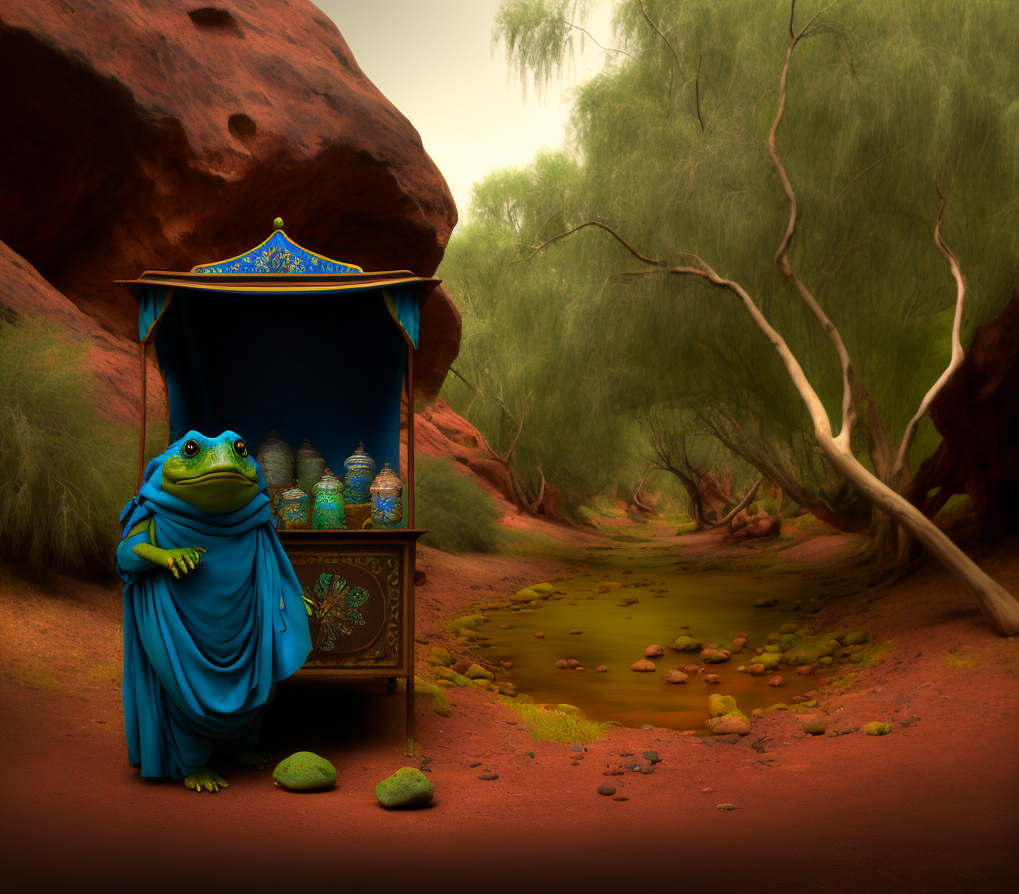
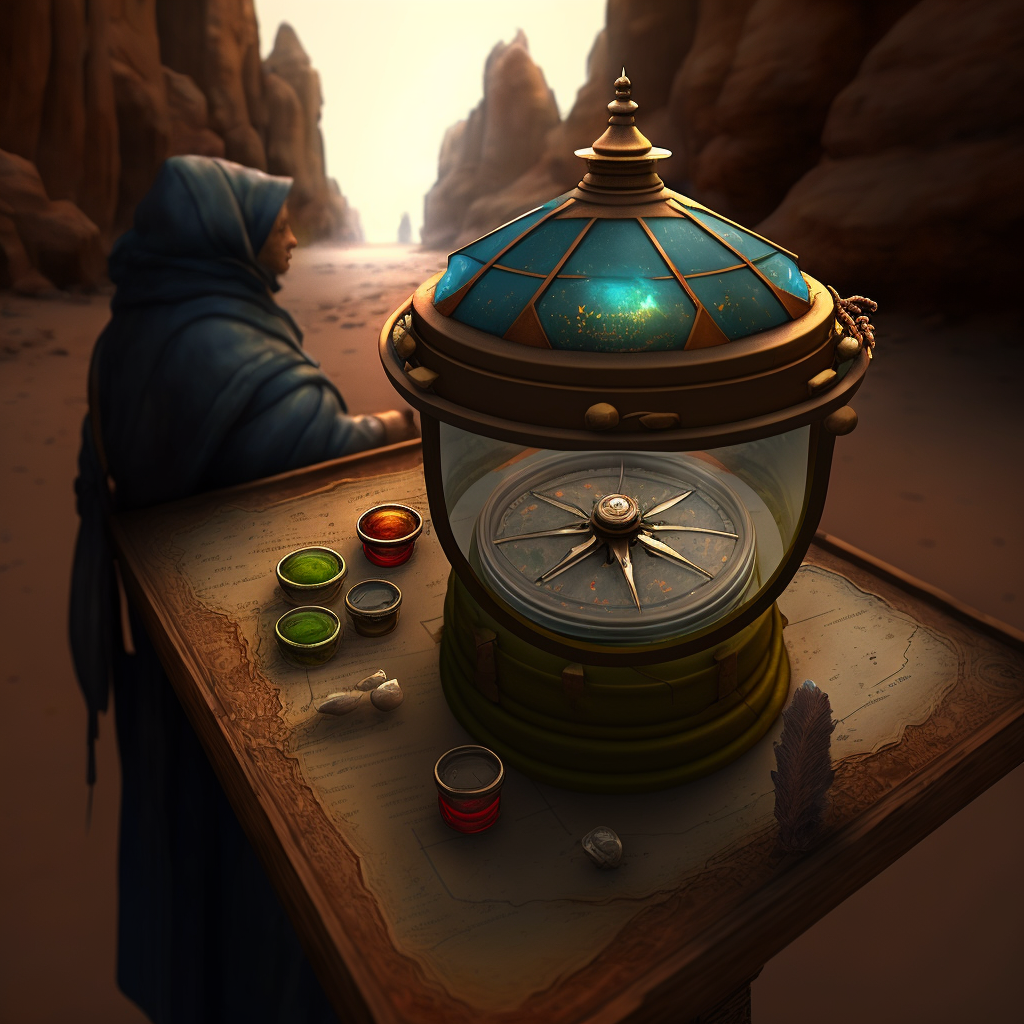
She closed her eyes, remembering more of the strange dream. Deeply orange red boulders and rocky outcrops, shivering gum trees, and green pools ~ it was coming back to her now, that creature in the blue robes had appeared more than once. In one scene he appeared with a blue diamond lantern with what looked like a compass inside.
I’ll ask about the hiking trails today, Zara decided, and go for a walk in that gorge I read about yesterday. Bert said there were good hiking trails. You came here early so you could play the game, she reminded herself.
“It’s all a game,” she heard the parrot outside her window.
“I’d forgotten about the bloody parrot!” Zara said under her breath. “Pretty Girl!” she said, opening the blinds. “We’re going out for a walk today.”
January 11, 2023 at 10:32 pm #6368In reply to: Train your subjective AI – text version
Something in the style of FPooh:
Arona heard the music growing louder as she approached the source of the sound. She could see a group of people gathered around a large fire, the flickering light casting shadows on the faces of the dancers. She hesitated for a moment, remembering the isolation of her journey and wondering if she was ready to be among people again. But the music was too inviting, and she found herself drawn towards the group.
As she neared the fire, she saw a young man playing a flute, the music flowing from his fingers with a fluid grace that captivated her. He looked up as she approached, and their eyes met. She could see the surprise and curiosity in his gaze, and she smiled, feeling a sense of connection she had not felt in a long time.
Fiona was sitting on a bench in the park, watching the children play. She had brought her sketchbook with her, but for once she didn’t feel the urge to draw. Instead she watched the children’s laughter, feeling content and at peace. Suddenly, she saw a young girl running towards her, a look of pure joy on her face. The girl stopped in front of her and held out a flower, offering it to Fiona with a smile.
Taken aback, Fiona took the flower and thanked the girl. The girl giggled and ran off to join her friends. Fiona looked down at the flower in her hand, and she felt a sense of inspiration, like a spark igniting within her. She opened her sketchbook and began to draw, feeling the weight lift from her shoulders and the magic of creativity flowing through her.
Minky led the group of misfits towards the emporium, his bowler hat bobbing on his head. He chattered excitedly, telling stories of the wondrous items to be found within Mr Jib’s store. Yikesy followed behind, still lost in his thoughts of Arona and feeling a sense of dread at the thought of buying a bowler hat. The green fairy flitted along beside him, her wings a blur of movement as she chattered with the parrot perched on her shoulder.
As they reached the emporium, they were disappointed to find it closed. But Minky refused to be discouraged, and he led them to a nearby cafe where they could sit and enjoy some tea and cake while they wait for the emporium to open. The green fairy was delighted, and she ordered a plate of macarons, smiling as she tasted the sweetness of the confections.
About creativity & everyday magic
Fiona had always been drawn to the magic of creativity, the way a blank page could be transformed into a world of wonder and beauty. But lately, she had been feeling stuck, unable to find the spark that ignited her imagination. She would sit with her sketchbook, pencil in hand, and nothing would come to her.
She started to question her abilities, wondering if she had lost the magic of her art. She spent long hours staring at her blank pages, feeling a weight on her chest that seemed to be growing heavier every day.
But then she remembered the green fairy’s tears and Yikesy’s longing for Arona, and she realized that the magic of creativity wasn’t something that could be found only in art. It was all around her, in the everyday moments of life.
She started to look for the magic in the small things, like the way the sunlight filtered through the trees, or the way a child’s laughter could light up a room. She found it in the way a stranger’s smile could lift her spirits, and in the way a simple cup of tea could bring her comfort.
And as she started to see the magic in the everyday, she found that the weight on her chest lifted and the spark of inspiration returned. She picked up her pencil and began to draw, feeling the magic flowing through her once again.
She understand that creativity blocks aren’t a destination, but just a step, just like the bowler hat that Minky had bought for them all, a bit of everyday magic, nothing too fancy but a sense of belonging, a sense of who they are and where they are going. And she let her pencil flow, with the hopes that one day, they will all find their way home.
December 19, 2022 at 9:48 am #6352In reply to: Family Stories From The Other Side ~ Book Two
The Birmingham Bootmaker
Samuel Jones 1816-1875
Samuel Jones the elder was born in Belfast circa 1779. He is one of just two direct ancestors found thus far born in Ireland. Samuel married Jane Elizabeth Brooker (born in St Giles, London) on the 25th January 1807 at St George, Hanover Square in London. Their first child Mary was born in 1808 in London, and then the family moved to Birmingham. Mary was my 3x great grandmother.
But this chapter is about her brother Samuel Jones. I noticed that on a number of other trees on the Ancestry site, Samuel Jones was a convict transported to Australia, but this didn’t tally with the records I’d found for Samuel in Birmingham. In fact another Samuel Jones born at the same time in the same place was transported, but his occupation was a baker. Our Samuel Jones was a bootmaker like his father.
Samuel was born on 28th January 1816 in Birmingham and baptised at St Phillips on the 19th August of that year, the fourth child and first son of Samuel the elder and Jane’s eleven children.
On the 1839 electoral register a Samuel Jones owned a property on Colmore Row, Birmingham.
Samuel Jones, bootmaker of 15, Colmore Row is listed in the 1849 Birmingham post office directory, and in the 1855 White’s Directory.
On the 1851 census, Samuel was an unmarried bootmaker employing sixteen men at 15, Colmore Row. A 9 year old nephew Henry Harris was living with him, and his mother Ruth Harris, as well as a female servant. Samuel’s sister Ruth was born in 1818 and married Henry Harris in 1840. Henry died in 1848.
Samuel was a 45 year old bootmaker at 15 Colmore Row on the 1861 census, living with Maria Walcot, a 26 year old domestic servant.
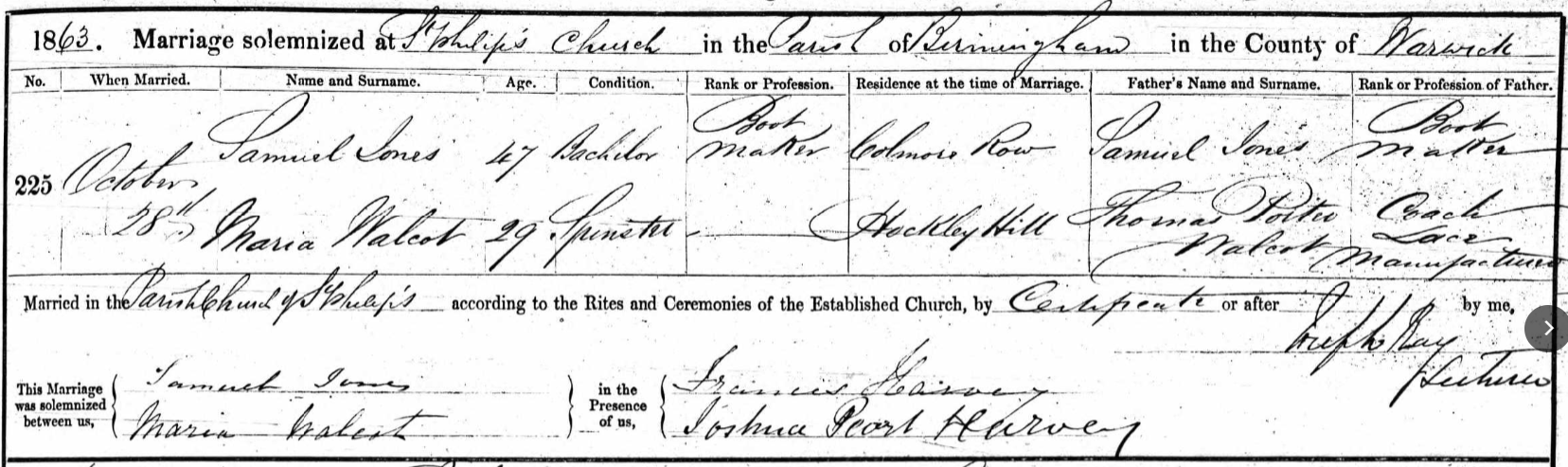
In October 1863 Samuel married Maria Walcot at St Philips in Birmingham. They don’t appear to have had any children as none appear on the 1871 census, where Samuel and Maria are living at the same address, with another female servant and two male lodgers by the name of Messant from Ipswich.
Marriage of Samuel Jones and Maria Walcot:
In 1864 Samuel’s father died. Samuel the son is mentioned in the probate records as one of the executors: “Samuel Jones of Colmore Row Birmingham in the county of Warwick boot and shoe manufacturer the son”.
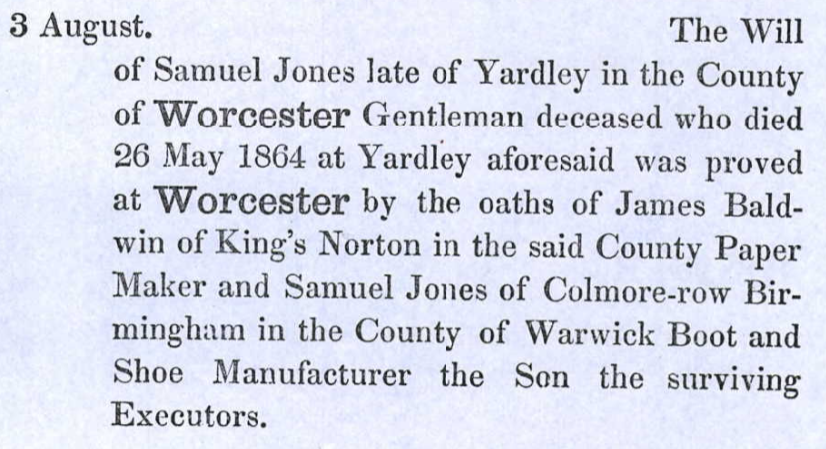
Indeed it could hardly be clearer that this Samuel Jones was not the convict transported to Australia in 1834!
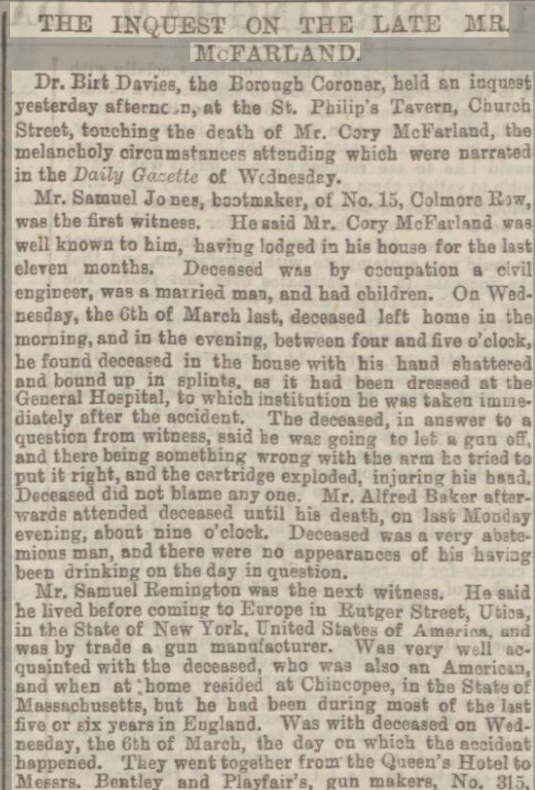
In 1867 Samuel Jones, bootmaker, was mentioned in the Birmingham Daily Gazette with regard to an unfortunate incident involving his American lodger, Cory McFarland. The verdict was accidental death.
Birmingham Daily Gazette – Friday 05 April 1867:
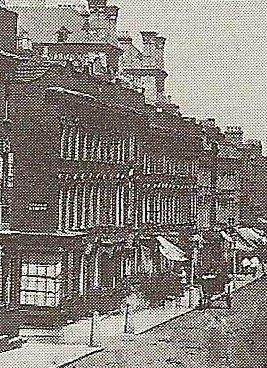
I asked a Birmingham history group for an old photo of Colmore Row. This photo is circa 1870 and number 15 is furthest from the camera. The businesses on the street at the time were as follows:
7 homeopathic chemist George John Morris. 8 surgeon dentist Frederick Sims. 9 Saul & Walter Samuel, Australian merchants. Surgeons occupied 10, pawnbroker John Aaron at 11 & 12. 15 boot & shoemaker. 17 auctioneer…
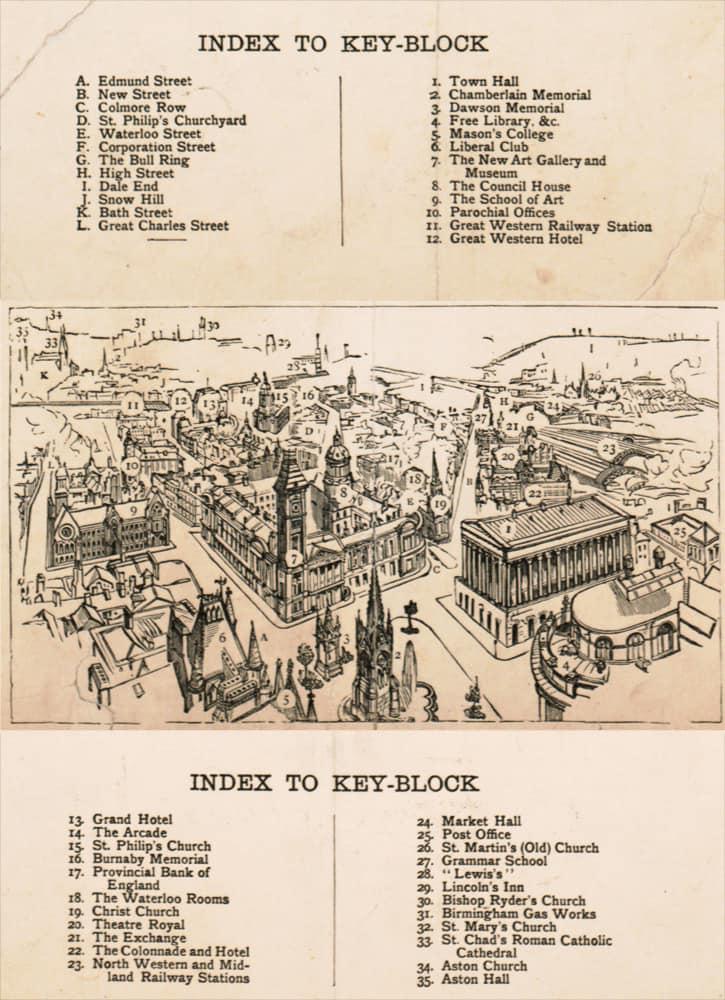
from Bird’s Eye View of Birmingham, 1886:
 October 19, 2022 at 6:46 am #6336
In reply to: Family Stories From The Other Side ~ Book Two
The Hamstall Ridware Connection
Stubbs and Woods
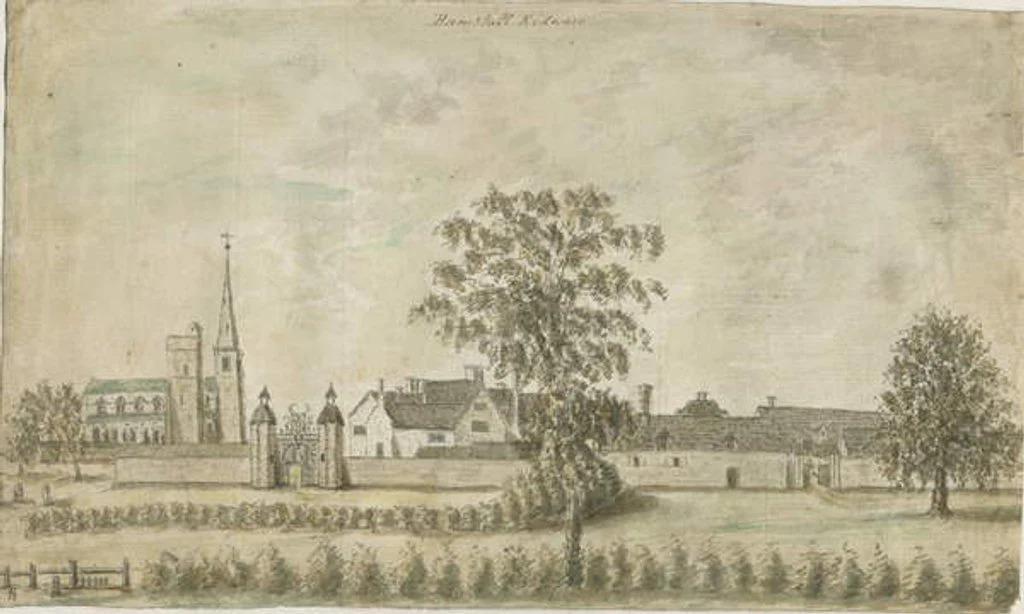 Hamstall Ridware
Charles Tomlinson‘s (1847-1907) wife Emma Grattidge (1853-1911) was born in Wolverhampton, the daughter and youngest child of William Grattidge (1820-1887) born in Foston, Derbyshire, and Mary Stubbs (1819-1880), born in Burton on Trent, daughter of Solomon Stubbs.
Solomon Stubbs (1781-1857) was born in Hamstall Ridware in 1781, the son of Samuel and Rebecca. Samuel Stubbs (1743-) and Rebecca Wood (1754-) married in 1769 in Darlaston. Samuel and Rebecca had six other children, all born in Darlaston. Sadly four of them died in infancy. Son John was born in 1779 in Darlaston and died two years later in Hamstall Ridware in 1781, the same year that Solomon was born there.
But why did they move to Hamstall Ridware?
Samuel Stubbs was born in 1743 in Curdworth, Warwickshire (near to Birmingham). I had made a mistake on the tree (along with all of the public trees on the Ancestry website) and had Rebecca Wood born in Cheddleton, Staffordshire. Rebecca Wood from Cheddleton was also born in 1843, the right age for the marriage. The Rebecca Wood born in Darlaston in 1754 seemed too young, at just fifteen years old at the time of the marriage. I couldn’t find any explanation for why a woman from Cheddleton would marry in Darlaston and then move to Hamstall Ridware. People didn’t usually move around much other than intermarriage with neighbouring villages, especially women. I had a closer look at the Darlaston Rebecca, and did a search on her father William Wood. I found his 1784 will online in which he mentions his daughter Rebecca, wife of Samuel Stubbs. Clearly the right Rebecca Wood was the one born in Darlaston, which made much more sense.
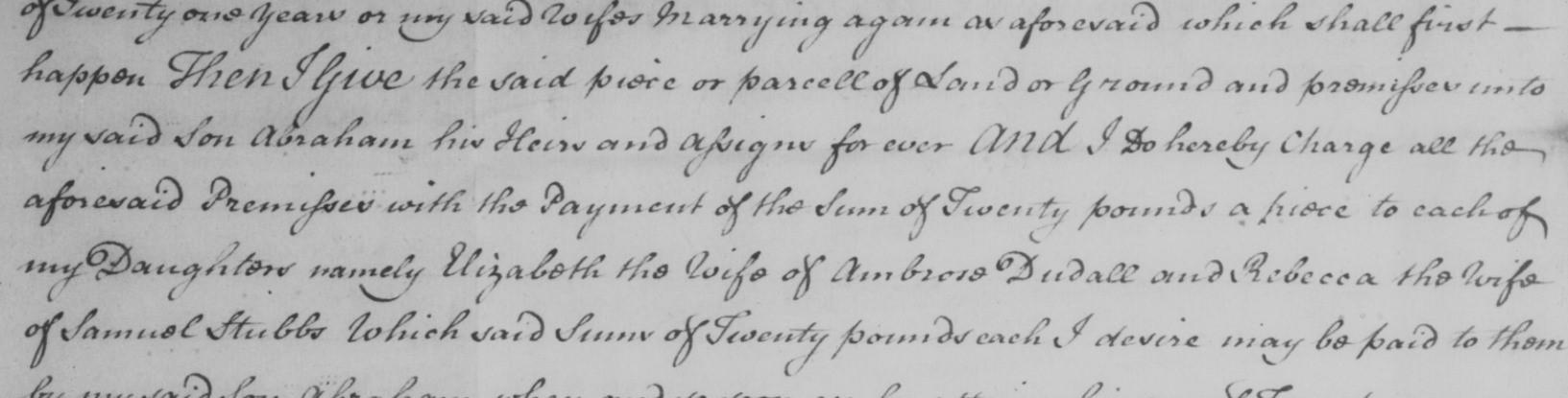
An excerpt from William Wood’s 1784 will mentioning daughter Rebecca married to Samuel Stubbs:
But why did they move to Hamstall Ridware circa 1780?
I had not intially noticed that Solomon Stubbs married again the year after his wife Phillis Lomas (1787-1844) died. Solomon married Charlotte Bell in 1845 in Burton on Trent and on the marriage register, Solomon’s father Samuel Stubbs occupation was mentioned: Samuel was a buckle maker.
Marriage of Solomon Stubbs and Charlotte Bell, father Samuel Stubbs buckle maker:
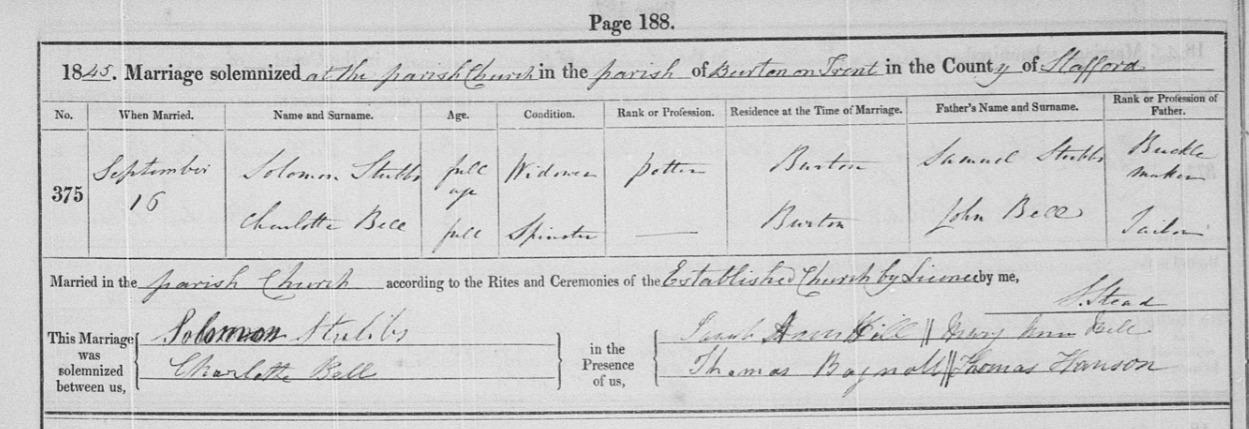
A rudimentary search on buckle making in the late 1700s provided a possible answer as to why Samuel and Rebecca left Darlaston in 1781. Shoe buckles had gone out of fashion, and by 1781 there were half as many buckle makers in Wolverhampton as there had been previously.
“Where there were 127 buckle makers at work in Wolverhampton, 68 in Bilston and 58 in Birmingham in 1770, their numbers had halved in 1781.”
via “historywebsite”(museum/metalware/steel)
Steel buckles had been the height of fashion, and the trade became enormous in Wolverhampton. Wolverhampton was a steel working town, renowned for its steel jewellery which was probably of many types. The trade directories show great numbers of “buckle makers”. Steel buckles were predominantly made in Wolverhampton: “from the late 1760s cut steel comes to the fore, from the thriving industry of the Wolverhampton area”. Bilston was also a great centre of buckle making, and other areas included Walsall. (It should be noted that Darlaston, Walsall, Bilston and Wolverhampton are all part of the same area)
In 1860, writing in defence of the Wolverhampton Art School, George Wallis talks about the cut steel industry in Wolverhampton. Referring to “the fine steel workers of the 17th and 18th centuries” he says: “Let them remember that 100 years ago [sc. c. 1760] a large trade existed with France and Spain in the fine steel goods of Birmingham and Wolverhampton, of which the latter were always allowed to be the best both in taste and workmanship. … A century ago French and Spanish merchants had their houses and agencies at Birmingham for the purchase of the steel goods of Wolverhampton…..The Great Revolution in France put an end to the demand for fine steel goods for a time and hostile tariffs finished what revolution began”.
The next search on buckle makers, Wolverhampton and Hamstall Ridware revealed an unexpected connecting link.
In Riotous Assemblies: Popular Protest in Hanoverian England by Adrian Randall:
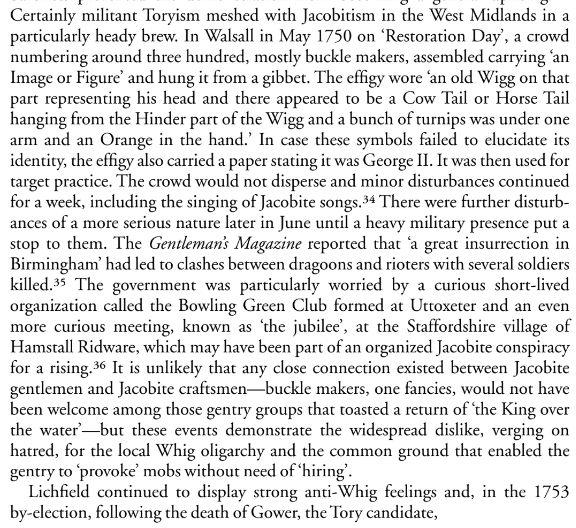
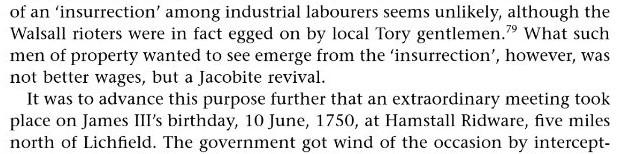
In Walsall in 1750 on “Restoration Day” a crowd numbering 300 assembled, mostly buckle makers, singing Jacobite songs and other rebellious and riotous acts. The government was particularly worried about a curious meeting known as the “Jubilee” in Hamstall Ridware, which may have been part of a conspiracy for a Jacobite uprising.
But this was thirty years before Samuel and Rebecca moved to Hamstall Ridware and does not help to explain why they moved there around 1780, although it does suggest connecting links.
Rebecca’s father, William Wood, was a brickmaker. This was stated at the beginning of his will. On closer inspection of the will, he was a brickmaker who owned four acres of brick kilns, as well as dwelling houses, shops, barns, stables, a brewhouse, a malthouse, cattle and land.
A page from the 1784 will of William Wood:
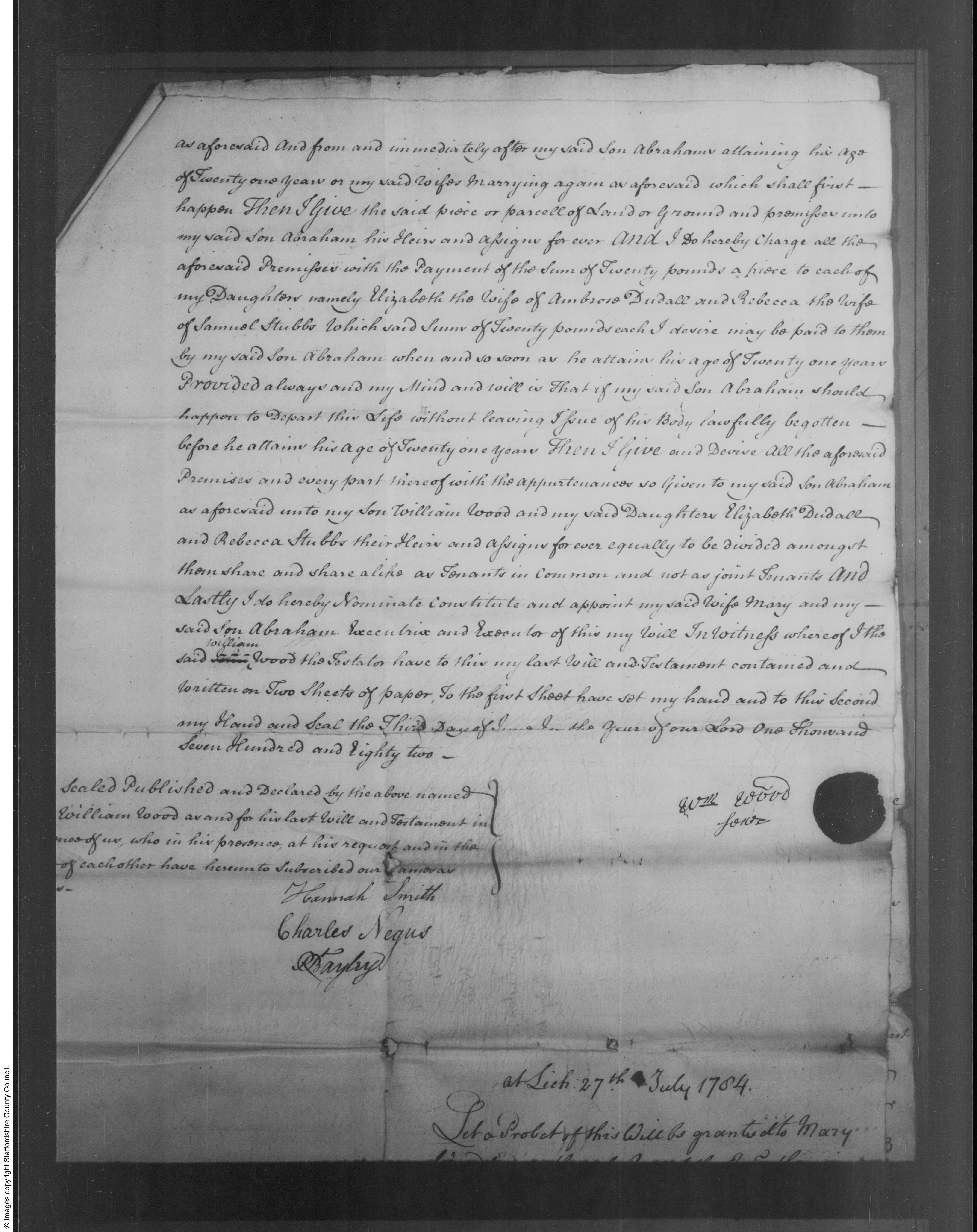
The 1784 will of William Wood of Darlaston:
I William Wood the elder of Darlaston in the county of Stafford, brickmaker, being of sound and disposing mind memory and understanding (praised be to god for the same) do make publish and declare my last will and testament in manner and form following (that is to say) {after debts and funeral expense paid etc} I give to my loving wife Mary the use usage wear interest and enjoyment of all my goods chattels cattle stock in trade ~ money securities for money personal estate and effects whatsoever and wheresoever to hold unto her my said wife for and during the term of her natural life providing she so long continues my widow and unmarried and from or after her decease or intermarriage with any future husband which shall first happen.
Then I give all the said goods chattels cattle stock in trade money securites for money personal estate and effects unto my son Abraham Wood absolutely and forever. Also I give devise and bequeath unto my said wife Mary all that my messuages tenement or dwelling house together with the malthouse brewhouse barn stableyard garden and premises to the same belonging situate and being at Darlaston aforesaid and now in my own possession. Also all that messuage tenement or dwelling house together with the shop garden and premises with the appurtenances to the same ~ belonging situate in Darlaston aforesaid and now in the several holdings or occupation of George Knowles and Edward Knowles to hold the aforesaid premises and every part thereof with the appurtenances to my said wife Mary for and during the term of her natural life provided she so long continues my widow and unmarried. And from or after her decease or intermarriage with a future husband which shall first happen. Then I give and devise the aforesaid premises and every part thereof with the appurtenances unto my said son Abraham Wood his heirs and assigns forever.
Also I give unto my said wife all that piece or parcel of land or ground inclosed and taken out of Heath Field in the parish of Darlaston aforesaid containing four acres or thereabouts (be the same more or less) upon which my brick kilns erected and now in my own possession. To hold unto my said wife Mary until my said son Abraham attains his age of twenty one years if she so long continues my widow and unmarried as aforesaid and from and immediately after my said son Abraham attaining his age of twenty one years or my said wife marrying again as aforesaid which shall first happen then I give the said piece or parcel of land or ground and premises unto my said son Abraham his heirs and assigns forever.
And I do hereby charge all the aforesaid premises with the payment of the sum of twenty pounds a piece to each of my daughters namely Elizabeth the wife of Ambrose Dudall and Rebecca the wife of Samuel Stubbs which said sum of twenty pounds each I devise may be paid to them by my said son Abraham when and so soon as he attains his age of twenty one years provided always and my mind and will is that if my said son Abraham should happen to depart this life without leaving issue of his body lawfully begotten before he attains his age of twenty one years then I give and devise all the aforesaid premises and every part thereof with the appurtenances so given to my said son Abraham as aforesaid unto my said son William Wood and my said daughter Elizabeth Dudall and Rebecca Stubbs their heirs and assigns forever equally divided among them share and share alike as tenants in common and not as joint tenants. And lastly I do hereby nominate constitute and appoint my said wife Mary and my said son Abraham executrix and executor of this my will.
The marriage of William Wood (1725-1784) and Mary Clews (1715-1798) in 1749 was in Hamstall Ridware.
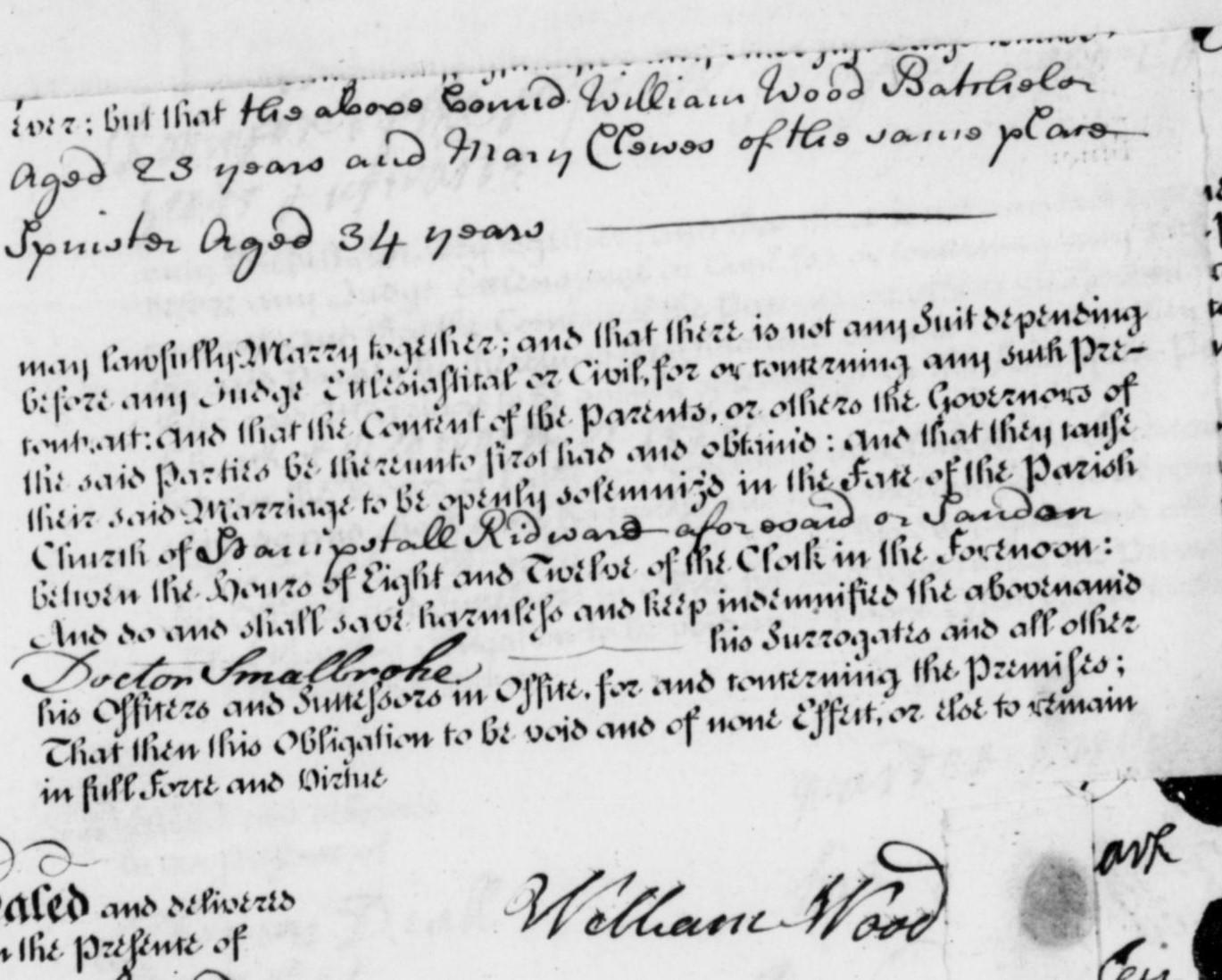
Mary was eleven years Williams senior, and it appears that they both came from Hamstall Ridware and moved to Darlaston after they married. Clearly Rebecca had extended family there (notwithstanding any possible connecting links between the Stubbs buckle makers of Darlaston and the Hamstall Ridware Jacobites thirty years prior). When the buckle trade collapsed in Darlaston, they likely moved to find employment elsewhere, perhaps with the help of Rebecca’s family.
I have not yet been able to find deaths recorded anywhere for either Samuel or Rebecca (there are a couple of deaths recorded for a Samuel Stubbs, one in 1809 in Wolverhampton, and one in 1810 in Birmingham but impossible to say which, if either, is the right one with the limited information, and difficult to know if they stayed in the Hamstall Ridware area or perhaps moved elsewhere)~ or find a reason for their son Solomon to be in Burton upon Trent, an evidently prosperous man with several properties including an earthenware business, as well as a land carrier business.
September 21, 2022 at 1:25 pm #6331In reply to: Family Stories From The Other Side ~ Book Two
Whitesmiths of Baker Street
The Fishers of Wolverhampton
My fathers mother was Margaret Tomlinson born in 1913, the youngest but one daughter of Charles Tomlinson and Nellie Fisher of Wolverhampton.
Nellie Fisher was born in 1877. Her parents were William Fisher and Mary Ann Smith.
William Fisher born in 1834 was a whitesmith on Baker St on the 1881 census; Nellie was 3 years old. Nellie was his youngest daughter.
William was a whitesmith (or screw maker) on all of the censuses but in 1901 whitesmith was written for occupation, then crossed out and publican written on top. This was on Duke St, so I searched for William Fisher licensee on longpull black country pubs website and he was licensee of The Old Miners Arms on Duke St in 1896. The pub closed in 1906 and no longer exists. He was 67 in 1901 and just he and wife Mary Ann were at that address.
In 1911 he was a widower living alone in Upper Penn. Nellie and Charles Tomlinson were also living in Upper Penn on the 1911 census, and my grandmother was born there in 1913.
William’s father William Fisher born in 1792, Nellie’s grandfather, was a whitesmith on Baker St on the 1861 census employing 4 boys, 2 men, 3 girls. He died in 1873.
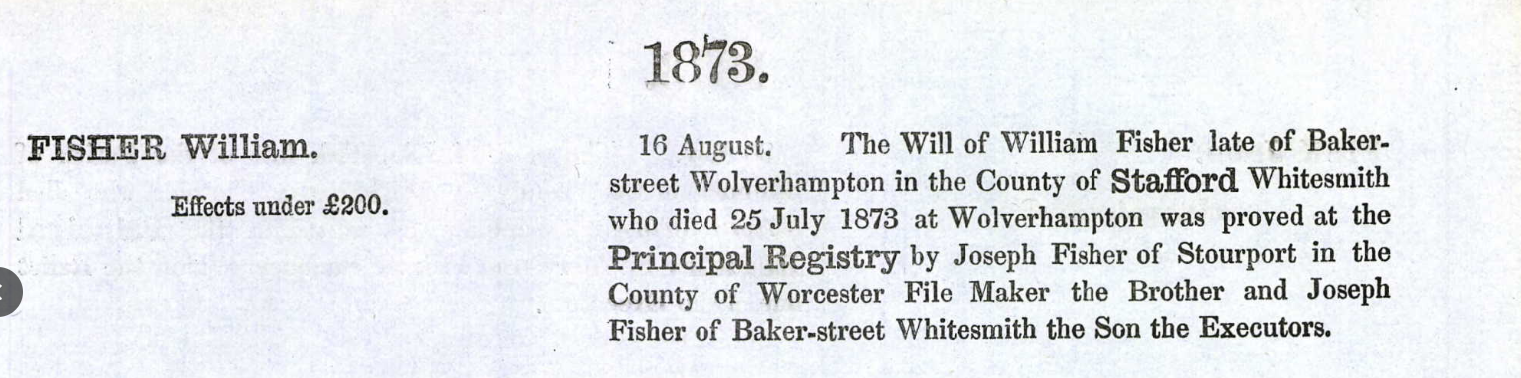
William Fisher the elder appears in a number of directories including this one:
1851 Melville & Co´s Directory of Wolverhampton
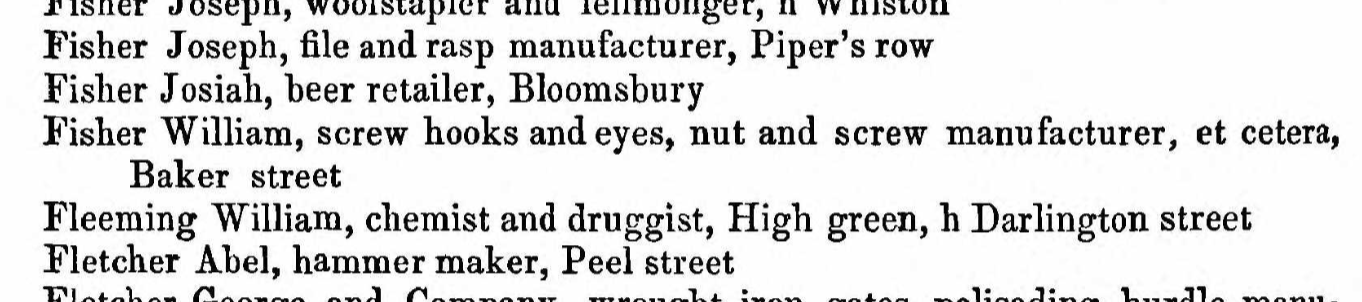
I noticed that all the other ancestry trees (as did my fathers cousin on the Tomlinson side) had MARY LUNN from Birmingham in Warwickshire marrying William Fisher the elder in 1828. But on ALL of the censuses, Mary’s place of birth was Staffordshire, and on one it said Bilston. I found another William Fisher and Mary marriage in Sedgley in 1829, MARY PITT.
You can order a birth certificate from the records office with mothers maiden name on, but only after 1837. So I looked for Williams younger brother Joseph, born 1845. His mothers maiden name was Pitt. July 6, 2022 at 11:05 am #6312
In reply to: The Sexy Wooden Leg
When she’d heard of the miracle happening at the Flovlinden Tree, Egna initially shrugged it off as another conman’s attempt at fooling the crowds.
“No, it’s real, my Auntie saw it.”
“Stop fretting” she’d told the little girl, as she was carefully removing the lice from her hair. “This is just someone’s idea of a smart joke. Don’t get fooled, you’re smarter than this.”
She sure wasn’t responsible for that one. If that were a true miracle, she would have known. The little calf next week being resuscitated after being dead a few minutes, well, that was her. Shame nobody was even there to notice. Most of the best miracles go about this way anyway.
So, after having lived close to a millennia in relatively rock solid health and with surprisingly unaging looks, Egna had thought she’d seen it all; at least last time the tree started to ooze sacred oil, it didn’t last for too long, people’s greed starting to sell it stopped it right in its tracks.
But maybe there was more to it this time. Egna’d often wondered why God had let her live that long. She was a useful instrument to Her for sure, but living in secrecy, claiming no ownership, most miracles were just facts of life. She somehow failed to see the point, even after 957 years of existence.
The little girl had left to go back to her nearby town. This side of the country was still quite safe from all the craziness. Egna knew well most of the branches of the ancestral trees leading to that particular little leaf. This one had probably no idea she shared a common ancestor with President Voldomeer, but Egna remembered the fellow. He was a clogmaker in the turn of the 18th century, as was his father before. That was until a rather unexpected turn of events precipitated him to a different path as his brother.
She had a book full of these records, as she’d tracked the lives of many, to keep them alive, and maybe remind people they all share so much in common. That is, if people were able to remember more than 2 generations before them.
“Well, that’s set.” she said to herself and to Her as She’s always listening “I’ll go and see for myself.”
her trusty old musty cloak at the door seemed to have been begging for the journey.July 1, 2022 at 9:51 am #6306In reply to: The Elusive Samuel Housley and Other Family Stories
Looking for Robert Staley
William Warren (1835-1880) of Newhall (Stapenhill) married Elizabeth Staley (1836-1907) in 1858. Elizabeth was born in Newhall, the daughter of John Staley (1795-1876) and Jane Brothers. John was born in Newhall, and Jane was born in Armagh, Ireland, and they were married in Armagh in 1820. Elizabeths older brothers were born in Ireland: William in 1826 and Thomas in Dublin in 1830. Francis was born in Liverpool in 1834, and then Elizabeth in Newhall in 1836; thereafter the children were born in Newhall.
Marriage of John Staley and Jane Brothers in 1820:
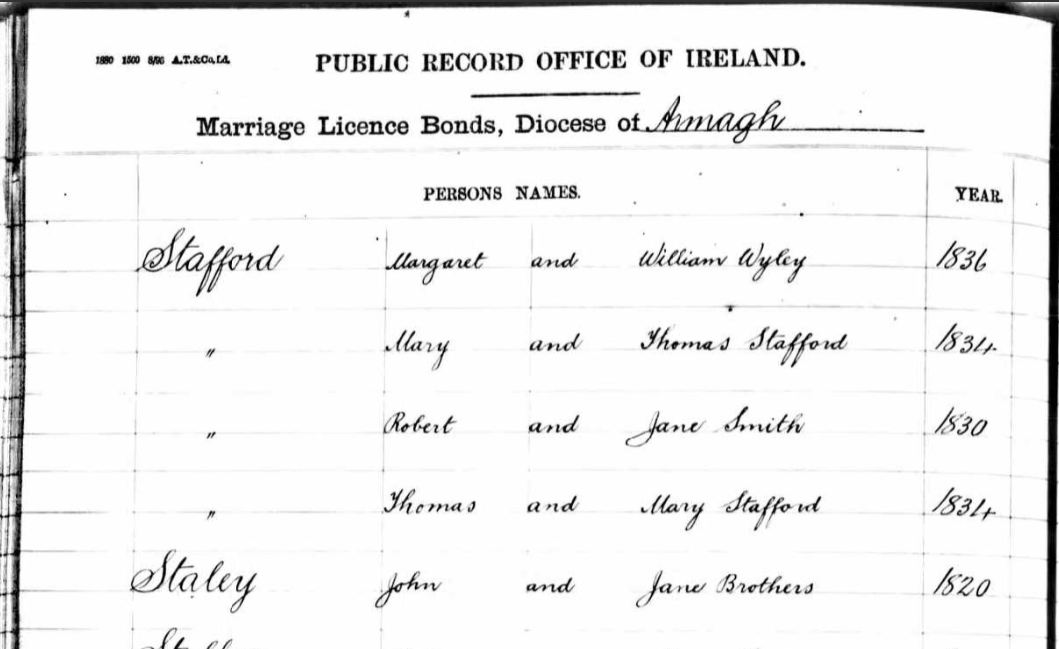
My grandmother related a story about an Elizabeth Staley who ran away from boarding school and eloped to Ireland, but later returned. The only Irish connection found so far is Jane Brothers, so perhaps she meant Elizabeth Staley’s mother. A boarding school seems unlikely, and it would seem that it was John Staley who went to Ireland.
The 1841 census states Jane’s age as 33, which would make her just 12 at the time of her marriage. The 1851 census states her age as 44, making her 13 at the time of her 1820 marriage, and the 1861 census estimates her birth year as a more likely 1804. Birth records in Ireland for her have not been found. It’s possible, perhaps, that she was in service in the Newhall area as a teenager (more likely than boarding school), and that John and Jane ran off to get married in Ireland, although I haven’t found any record of a child born to them early in their marriage. John was an agricultural labourer, and later a coal miner.
John Staley was the son of Joseph Staley (1756-1838) and Sarah Dumolo (1764-). Joseph and Sarah were married by licence in Newhall in 1782. Joseph was a carpenter on the marriage licence, but later a collier (although not necessarily a miner).
The Derbyshire Record Office holds records of an “Estimate of Joseph Staley of Newhall for the cost of continuing to work Pisternhill Colliery” dated 1820 and addresssed to Mr Bloud at Calke Abbey (presumably the owner of the mine)
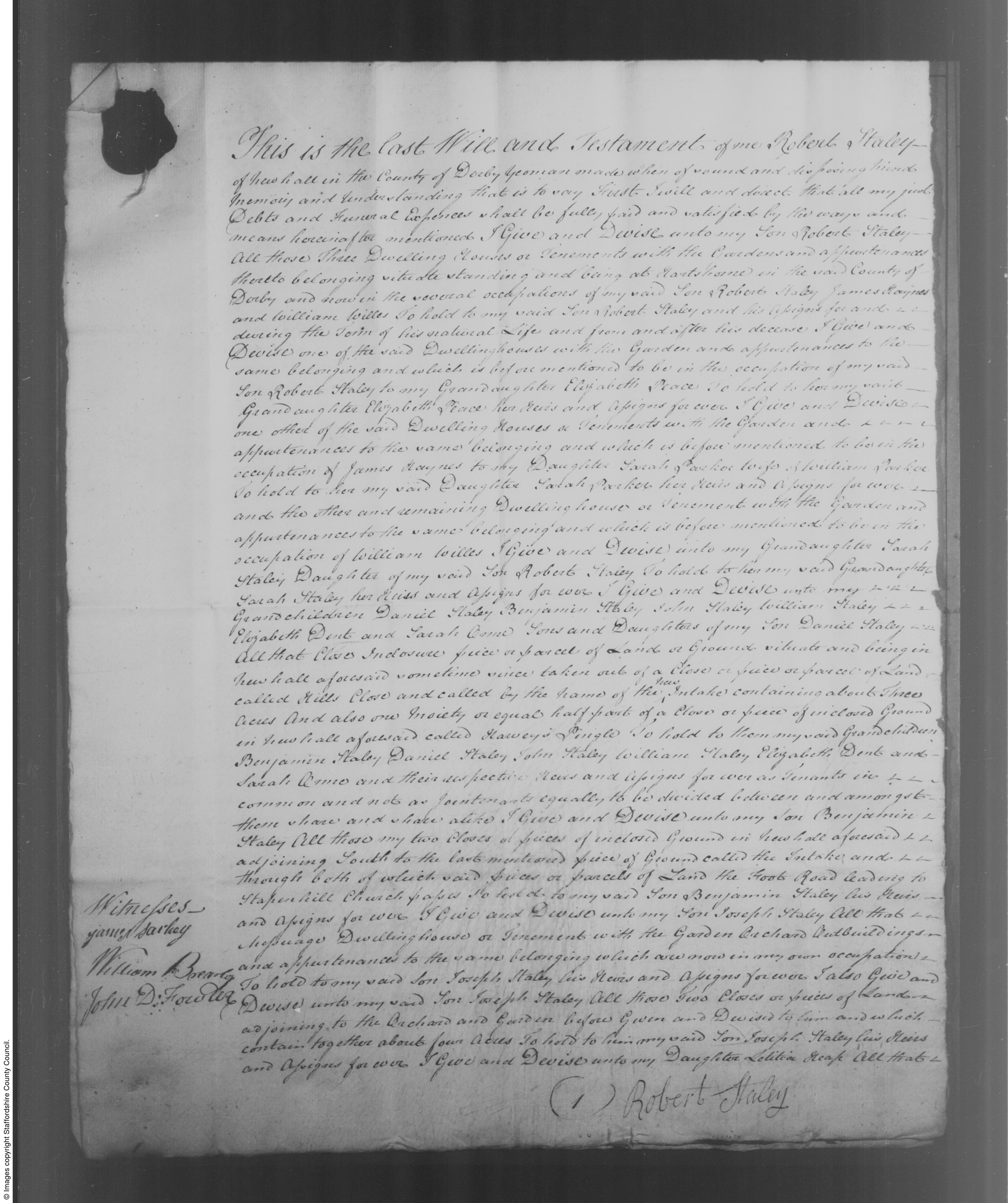
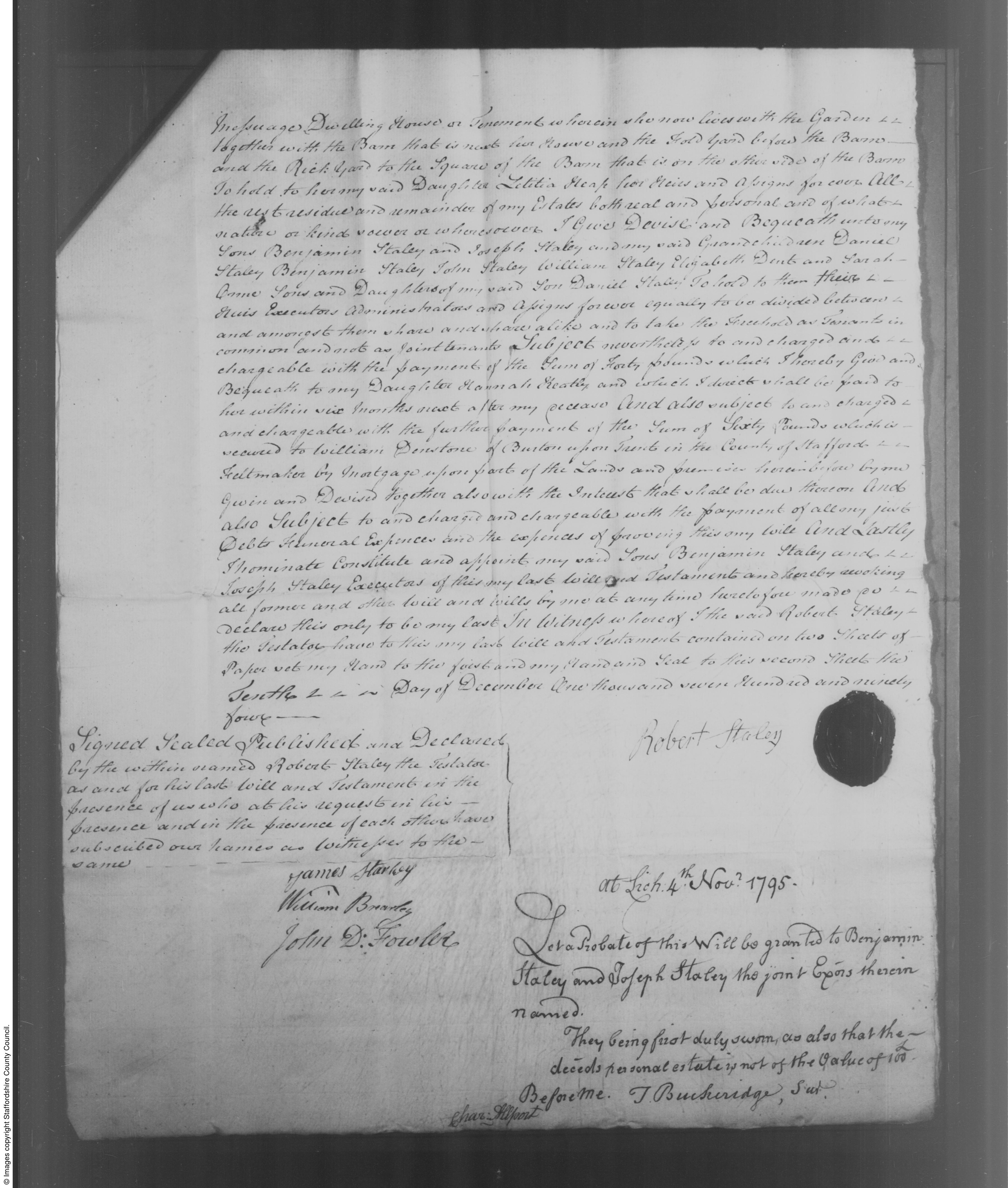
Josephs parents were Robert Staley and Elizabeth. I couldn’t find a baptism or birth record for Robert Staley. Other trees on an ancestry site had his birth in Elton, but with no supporting documents. Robert, as stated in his 1795 will, was a Yeoman.
“Yeoman: A former class of small freeholders who farm their own land; a commoner of good standing.”
“Husbandman: The old word for a farmer below the rank of yeoman. A husbandman usually held his land by copyhold or leasehold tenure and may be regarded as the ‘average farmer in his locality’. The words ‘yeoman’ and ‘husbandman’ were gradually replaced in the later 18th and 19th centuries by ‘farmer’.”He left a number of properties in Newhall and Hartshorne (near Newhall) including dwellings, enclosures, orchards, various yards, barns and acreages. It seemed to me more likely that he had inherited them, rather than moving into the village and buying them.
There is a mention of Robert Staley in a 1782 newpaper advertisement.
“Fire Engine To Be Sold. An exceedingly good fire engine, with the boiler, cylinder, etc in good condition. For particulars apply to Mr Burslem at Burton-upon-Trent, or Robert Staley at Newhall near Burton, where the engine may be seen.”
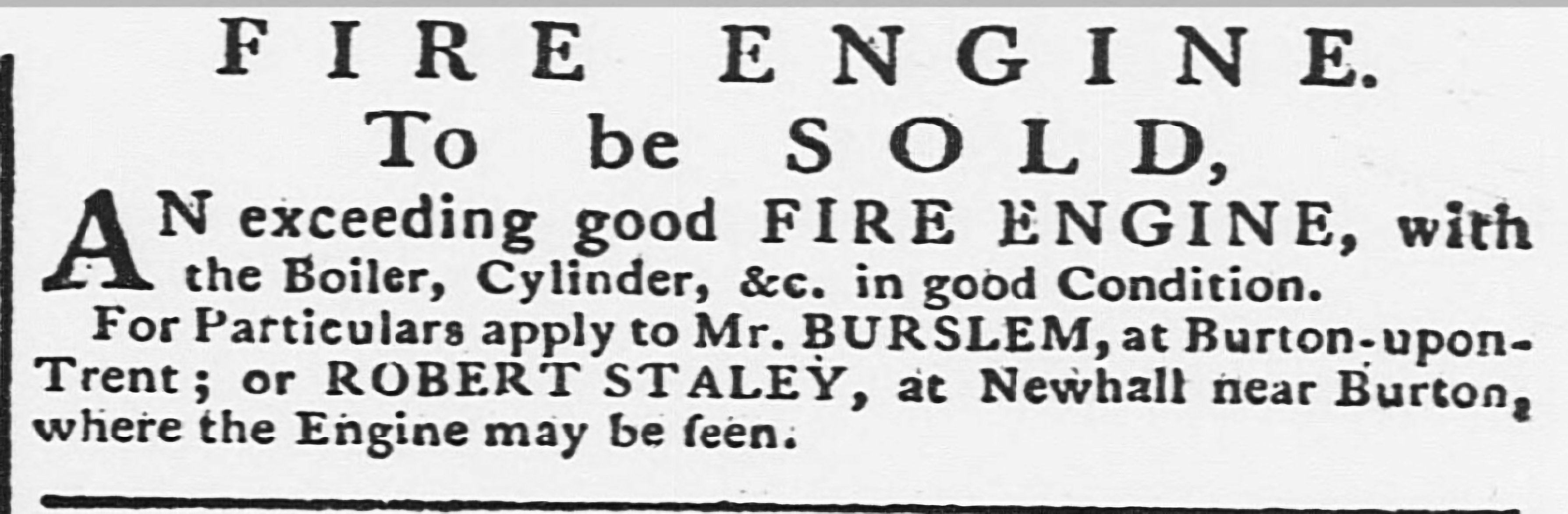
Was the fire engine perhaps connected with a foundry or a coal mine?
I noticed that Robert Staley was the witness at a 1755 marriage in Stapenhill between Barbara Burslem and Richard Daston the younger esquire. The other witness was signed Burslem Jnr.
Looking for Robert Staley
I assumed that once again, in the absence of the correct records, a similarly named and aged persons baptism had been added to the tree regardless of accuracy, so I looked through the Stapenhill/Newhall parish register images page by page. There were no Staleys in Newhall at all in the early 1700s, so it seemed that Robert did come from elsewhere and I expected to find the Staleys in a neighbouring parish. But I still didn’t find any Staleys.
I spoke to a couple of Staley descendants that I’d met during the family research. I met Carole via a DNA match some months previously and contacted her to ask about the Staleys in Elton. She also had Robert Staley born in Elton (indeed, there were many Staleys in Elton) but she didn’t have any documentation for his birth, and we decided to collaborate and try and find out more.
I couldn’t find the earlier Elton parish registers anywhere online, but eventually found the untranscribed microfiche images of the Bishops Transcripts for Elton.
via familysearch:
“In its most basic sense, a bishop’s transcript is a copy of a parish register. As bishop’s transcripts generally contain more or less the same information as parish registers, they are an invaluable resource when a parish register has been damaged, destroyed, or otherwise lost. Bishop’s transcripts are often of value even when parish registers exist, as priests often recorded either additional or different information in their transcripts than they did in the original registers.”Unfortunately there was a gap in the Bishops Transcripts between 1704 and 1711 ~ exactly where I needed to look. I subsequently found out that the Elton registers were incomplete as they had been damaged by fire.
I estimated Robert Staleys date of birth between 1710 and 1715. He died in 1795, and his son Daniel died in 1805: both of these wills were found online. Daniel married Mary Moon in Stapenhill in 1762, making a likely birth date for Daniel around 1740.
The marriage of Robert Staley (assuming this was Robert’s father) and Alice Maceland (or Marsland or Marsden, depending on how the parish clerk chose to spell it presumably) was in the Bishops Transcripts for Elton in 1704. They were married in Elton on 26th February. There followed the missing parish register pages and in all likelihood the records of the baptisms of their first children. No doubt Robert was one of them, probably the first male child.
(Incidentally, my grandfather’s Marshalls also came from Elton, a small Derbyshire village near Matlock. The Staley’s are on my grandmothers Warren side.)
The parish register pages resume in 1711. One of the first entries was the baptism of Robert Staley in 1711, parents Thomas and Ann. This was surely the one we were looking for, and Roberts parents weren’t Robert and Alice.
But then in 1735 a marriage was recorded between Robert son of Robert Staley (and this was unusual, the father of the groom isn’t usually recorded on the parish register) and Elizabeth Milner. They were married on the 9th March 1735. We know that the Robert we were looking for married an Elizabeth, as her name was on the Stapenhill baptisms of their later children, including Joseph Staleys. The 1735 marriage also fit with the assumed birth date of Daniel, circa 1740. A baptism was found for a Robert Staley in 1738 in the Elton registers, parents Robert and Elizabeth, as well as the baptism in 1736 for Mary, presumably their first child. Her burial is recorded the following year.
The marriage of Robert Staley and Elizabeth Milner in 1735:
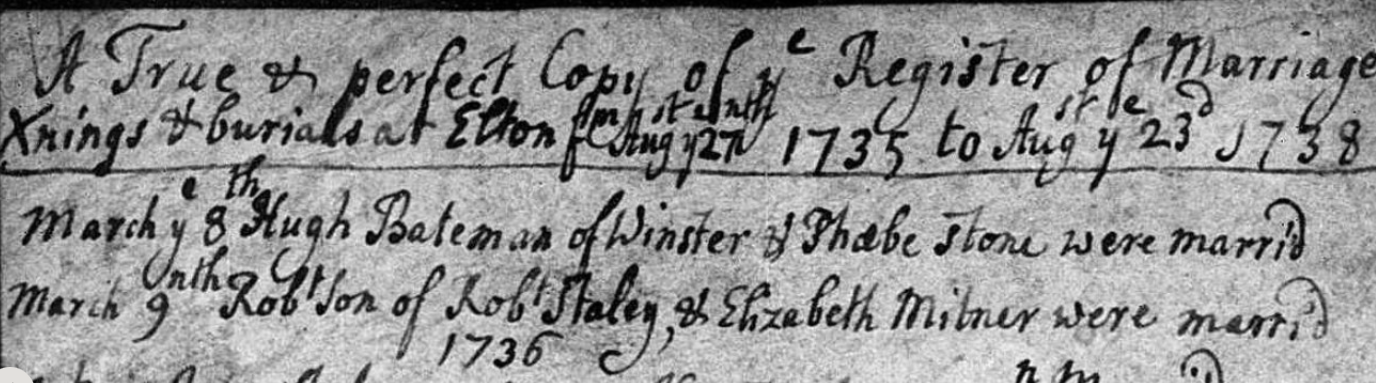
There were several other Staley couples of a similar age in Elton, perhaps brothers and cousins. It seemed that Thomas and Ann’s son Robert was a different Robert, and that the one we were looking for was prior to that and on the missing pages.
Even so, this doesn’t prove that it was Elizabeth Staleys great grandfather who was born in Elton, but no other birth or baptism for Robert Staley has been found. It doesn’t explain why the Staleys moved to Stapenhill either, although the Enclosures Act and the Industrial Revolution could have been factors.
The 18th century saw the rise of the Industrial Revolution and many renowned Derbyshire Industrialists emerged. They created the turning point from what was until then a largely rural economy, to the development of townships based on factory production methods.
The Marsden Connection
There are some possible clues in the records of the Marsden family. Robert Staley married Alice Marsden (or Maceland or Marsland) in Elton in 1704. Robert Staley is mentioned in the 1730 will of John Marsden senior, of Baslow, Innkeeper (Peacock Inne & Whitlands Farm). He mentions his daughter Alice, wife of Robert Staley.
In a 1715 Marsden will there is an intriguing mention of an alias, which might explain the different spellings on various records for the name Marsden: “MARSDEN alias MASLAND, Christopher – of Baslow, husbandman, 28 Dec 1714. son Robert MARSDEN alias MASLAND….” etc.
Some potential reasons for a move from one parish to another are explained in this history of the Marsden family, and indeed this could relate to Robert Staley as he married into the Marsden family and his wife was a beneficiary of a Marsden will. The Chatsworth Estate, at various times, bought a number of farms in order to extend the park.
THE MARSDEN FAMILY
OXCLOSE AND PARKGATE
In the Parishes of
Baslow and Chatsworthby
David Dalrymple-Smith“John Marsden (b1653) another son of Edmund (b1611) faired well. By the time he died in
1730 he was publican of the Peacock, the Inn on Church Lane now called the Cavendish
Hotel, and the farmer at “Whitlands”, almost certainly Bubnell Cliff Farm.”“Coal mining was well known in the Chesterfield area. The coalfield extends as far as the
Gritstone edges, where thin seams outcrop especially in the Baslow area.”“…the occupants were evicted from the farmland below Dobb Edge and
the ground carefully cleared of all traces of occupation and farming. Shelter belts were
planted especially along the Heathy Lea Brook. An imposing new drive was laid to the
Chatsworth House with the Lodges and “The Golden Gates” at its northern end….”Although this particular event was later than any events relating to Robert Staley, it’s an indication of how farms and farmland disappeared, and a reason for families to move to another area:
“The Dukes of Devonshire (of Chatsworth) were major figures in the aristocracy and the government of the
time. Such a position demanded a display of wealth and ostentation. The 6th Duke of
Devonshire, the Bachelor Duke, was not content with the Chatsworth he inherited in 1811,
and immediately started improvements. After major changes around Edensor, he turned his
attention at the north end of the Park. In 1820 plans were made extend the Park up to the
Baslow parish boundary. As this would involve the destruction of most of the Farm at
Oxclose, the farmer at the Higher House Samuel Marsden (b1755) was given the tenancy of
Ewe Close a large farm near Bakewell.
Plans were revised in 1824 when the Dukes of Devonshire and Rutland “Exchanged Lands”,
reputedly during a game of dice. Over 3300 acres were involved in several local parishes, of
which 1000 acres were in Baslow. In the deal Devonshire acquired the southeast corner of
Baslow Parish.
Part of the deal was Gibbet Moor, which was developed for “Sport”. The shelf of land
between Parkgate and Robin Hood and a few extra fields was left untouched. The rest,
between Dobb Edge and Baslow, was agricultural land with farms, fields and houses. It was
this last part that gave the Duke the opportunity to improve the Park beyond his earlier
expectations.”The 1795 will of Robert Staley.
Inriguingly, Robert included the children of his son Daniel Staley in his will, but omitted to leave anything to Daniel. A perusal of Daniels 1808 will sheds some light on this: Daniel left his property to his six reputed children with Elizabeth Moon, and his reputed daughter Mary Brearly. Daniels wife was Mary Moon, Elizabeths husband William Moons daughter.
The will of Robert Staley, 1795:
The 1805 will of Daniel Staley, Robert’s son:
This is the last will and testament of me Daniel Staley of the Township of Newhall in the parish of Stapenhill in the County of Derby, Farmer. I will and order all of my just debts, funeral and testamentary expenses to be fully paid and satisfied by my executors hereinafter named by and out of my personal estate as soon as conveniently may be after my decease.
I give, devise and bequeath to Humphrey Trafford Nadin of Church Gresely in the said County of Derby Esquire and John Wilkinson of Newhall aforesaid yeoman all my messuages, lands, tenements, hereditaments and real and personal estates to hold to them, their heirs, executors, administrators and assigns until Richard Moon the youngest of my reputed sons by Elizabeth Moon shall attain his age of twenty one years upon trust that they, my said trustees, (or the survivor of them, his heirs, executors, administrators or assigns), shall and do manage and carry on my farm at Newhall aforesaid and pay and apply the rents, issues and profits of all and every of my said real and personal estates in for and towards the support, maintenance and education of all my reputed children by the said Elizabeth Moon until the said Richard Moon my youngest reputed son shall attain his said age of twenty one years and equally share and share and share alike.
And it is my will and desire that my said trustees or trustee for the time being shall recruit and keep up the stock upon my farm as they in their discretion shall see occasion or think proper and that the same shall not be diminished. And in case any of my said reputed children by the said Elizabeth Moon shall be married before my said reputed youngest son shall attain his age of twenty one years that then it is my will and desire that non of their husbands or wives shall come to my farm or be maintained there or have their abode there. That it is also my will and desire in case my reputed children or any of them shall not be steady to business but instead shall be wild and diminish the stock that then my said trustees or trustee for the time being shall have full power and authority in their discretion to sell and dispose of all or any part of my said personal estate and to put out the money arising from the sale thereof to interest and to pay and apply the interest thereof and also thereunto of the said real estate in for and towards the maintenance, education and support of all my said reputed children by the said
Elizabeth Moon as they my said trustees in their discretion that think proper until the said Richard Moon shall attain his age of twenty one years.Then I give to my grandson Daniel Staley the sum of ten pounds and to each and every of my sons and daughters namely Daniel Staley, Benjamin Staley, John Staley, William Staley, Elizabeth Dent and Sarah Orme and to my niece Ann Brearly the sum of five pounds apiece.
I give to my youngest reputed son Richard Moon one share in the Ashby Canal Navigation and I direct that my said trustees or trustee for the time being shall have full power and authority to pay and apply all or any part of the fortune or legacy hereby intended for my youngest reputed son Richard Moon in placing him out to any trade, business or profession as they in their discretion shall think proper.
And I direct that to my said sons and daughters by my late wife and my said niece shall by wholly paid by my said reputed son Richard Moon out of the fortune herby given him. And it is my will and desire that my said reputed children shall deliver into the hands of my executors all the monies that shall arise from the carrying on of my business that is not wanted to carry on the same unto my acting executor and shall keep a just and true account of all disbursements and receipts of the said business and deliver up the same to my acting executor in order that there may not be any embezzlement or defraud amongst them and from and immediately after my said reputed youngest son Richard Moon shall attain his age of twenty one years then I give, devise and bequeath all my real estate and all the residue and remainder of my personal estate of what nature and kind whatsoever and wheresoever unto and amongst all and every my said reputed sons and daughters namely William Moon, Thomas Moon, Joseph Moon, Richard Moon, Ann Moon, Margaret Moon and to my reputed daughter Mary Brearly to hold to them and their respective heirs, executors, administrator and assigns for ever according to the nature and tenure of the same estates respectively to take the same as tenants in common and not as joint tenants.And lastly I nominate and appoint the said Humphrey Trafford Nadin and John Wilkinson executors of this my last will and testament and guardians of all my reputed children who are under age during their respective minorities hereby revoking all former and other wills by me heretofore made and declaring this only to be my last will.
In witness whereof I the said Daniel Staley the testator have to this my last will and testament set my hand and seal the eleventh day of March in the year of our Lord one thousand eight hundred and five.
June 10, 2022 at 1:39 pm #6305In reply to: The Elusive Samuel Housley and Other Family Stories
The Hair’s and Leedham’s of Netherseal
Samuel Warren of Stapenhill married Catherine Holland of Barton under Needwood in 1795. Catherine’s father was Thomas Holland; her mother was Hannah Hair.
Hannah was born in Netherseal, Derbyshire, in 1739. Her parents were Joseph Hair 1696-1746 and Hannah.
Joseph’s parents were Isaac Hair and Elizabeth Leedham. Elizabeth was born in Netherseal in 1665. Isaac and Elizabeth were married in Netherseal in 1686.Marriage of Isaac Hair and Elizabeth Leedham: (variously spelled Ledom, Leedom, Leedham, and in one case mistranscribed as Sedom):
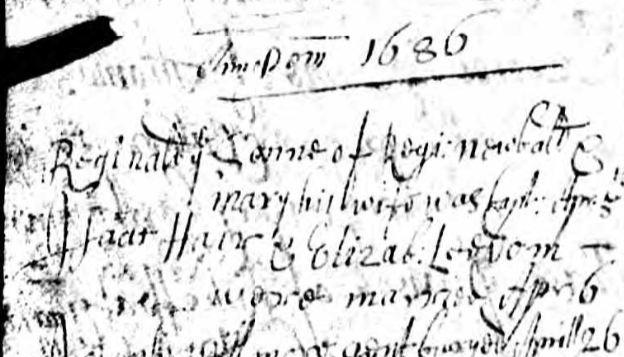
Isaac was buried in Netherseal on 14 August 1709 (the transcript says the 18th, but the microfiche image clearly says the 14th), but I have not been able to find a birth registered for him. On other public trees on an ancestry website, Isaac Le Haire was baptised in Canterbury and was a Huguenot, but I haven’t found any evidence to support this.
Isaac Hair’s death registered 14 August 1709 in Netherseal:
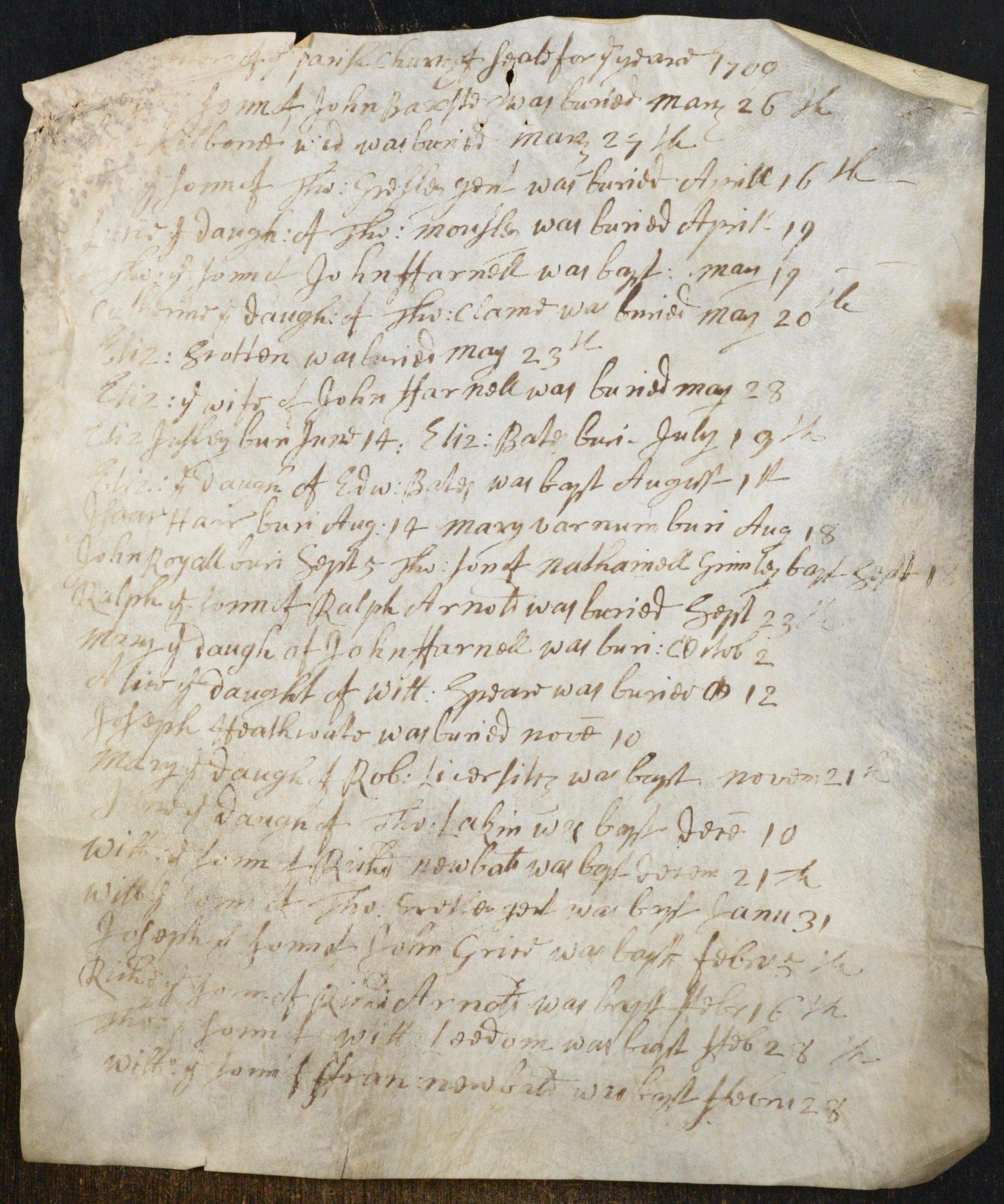
A search for the etymology of the surname Hair brings various suggestions, including:
“This surname is derived from a nickname. ‘the hare,’ probably affixed on some one fleet of foot. Naturally looked upon as a complimentary sobriquet, and retained in the family; compare Lightfoot. (for example) Hugh le Hare, Oxfordshire, 1273. Hundred Rolls.”
From this we may deduce that the name Hair (or Hare) is not necessarily from the French Le Haire, and existed in England for some considerable time before the arrival of the Huguenots.
Elizabeth Leedham was born in Netherseal in 1665. Her parents were Nicholas Leedham 1621-1670 and Dorothy. Nicholas Leedham was born in Church Gresley (Swadlincote) in 1621, and died in Netherseal in 1670.
Nicholas was a Yeoman and left a will and inventory worth £147.14s.8d (one hundred and forty seven pounds fourteen shillings and eight pence).
The 1670 inventory of Nicholas Leedham:
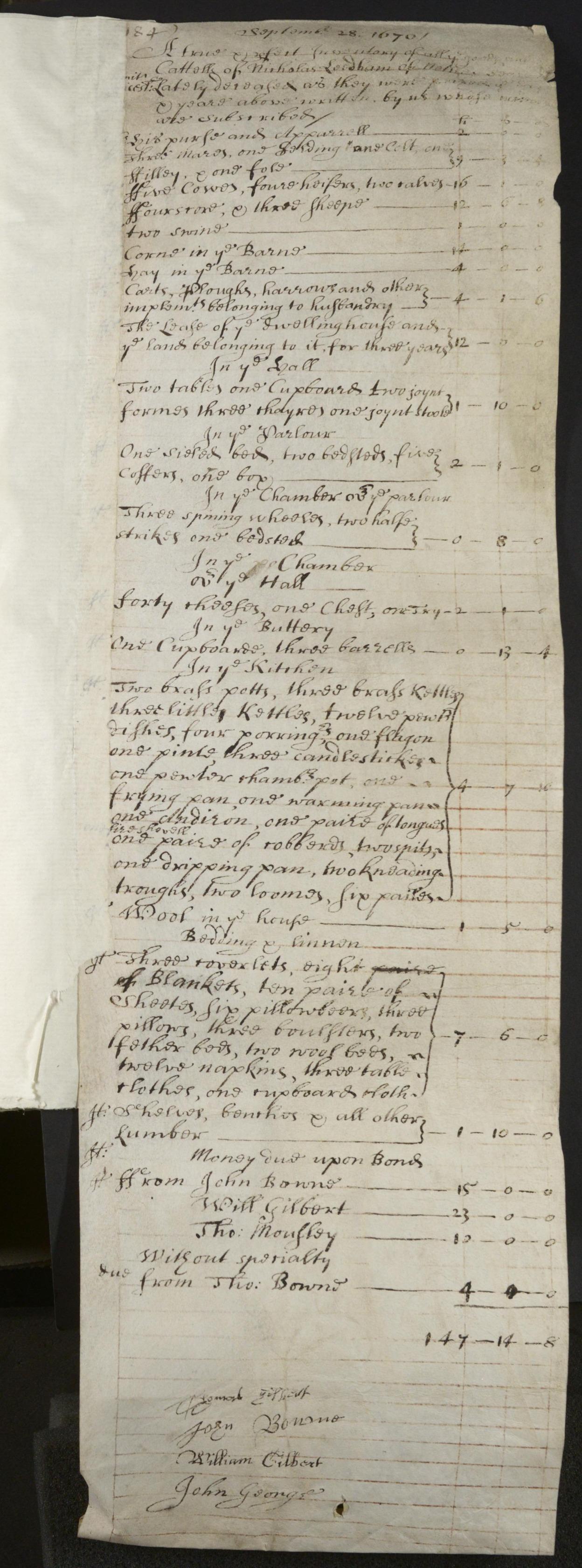
According to local historian Mark Knight on the Netherseal History facebook group, the Seale (Netherseal and Overseal) parish registers from the year 1563 to 1724 were digitized during lockdown.
via Mark Knight:
“There are five entries for Nicholas Leedham.
On March 14th 1646 he and his wife buried an unnamed child, presumably the child died during childbirth or was stillborn.
On November 28th 1659 he buried his wife, Elizabeth. He remarried as on June 13th 1664 he had his son William baptised.
The following year, 1665, he baptised a daughter on November 12th. (Elizabeth) On December 23rd 1672 the parish record says that Dorithy daughter of Dorithy was buried. The Bishops Transcript has Dorithy a daughter of Nicholas. Nicholas’ second wife was called Dorithy and they named a daughter after her. Alas, the daughter died two years after Nicholas. No further Leedhams appear in the record until after 1724.”Dorothy daughter of Dorothy Leedham was buried 23 December 1672:
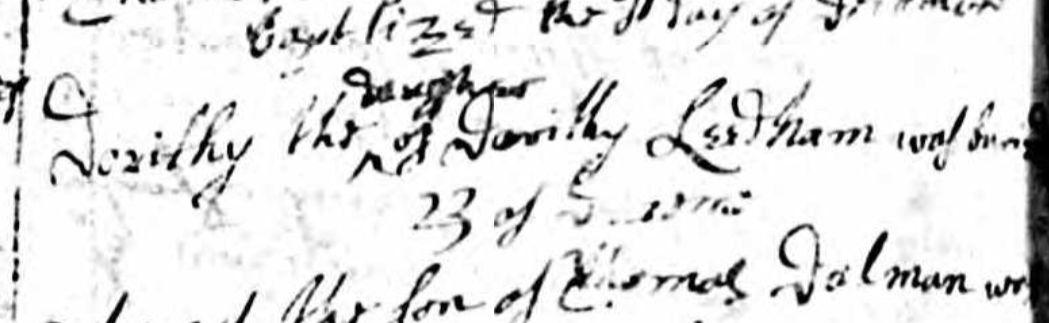
William, son of Nicholas and Dorothy also left a will. In it he mentions “My dear wife Elizabeth. My children Thomas Leedom, Dorothy Leedom , Ann Leedom, Christopher Leedom and William Leedom.”
1726 will of William Leedham:
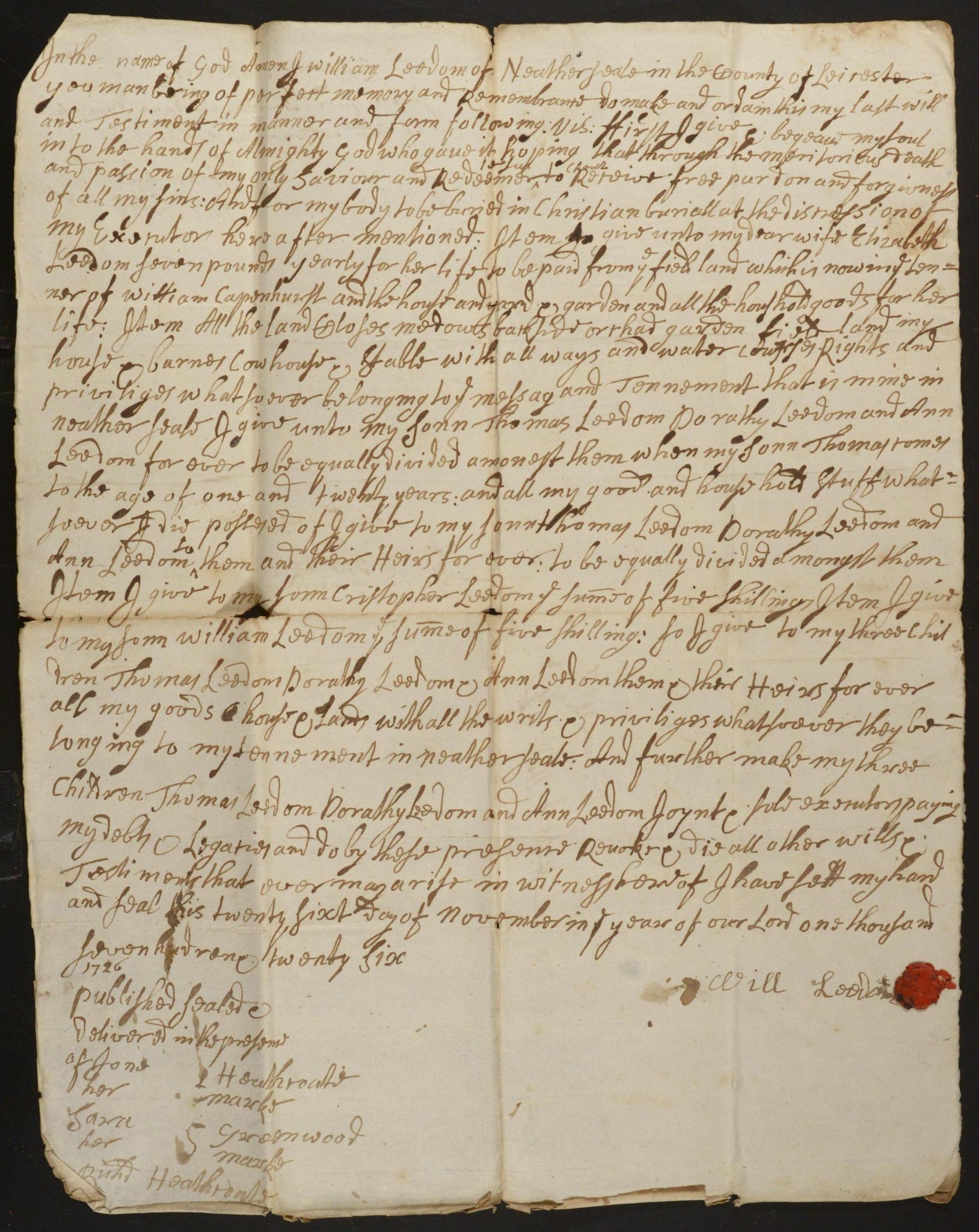
I found a curious error with the the parish register entries for Hannah Hair. It was a transcription error, but not a recent one. The original parish registers were copied: “HO Copy of ye register of Seale anno 1739.” I’m not sure when the copy was made, but it wasn’t recently. I found a burial for Hannah Hair on 22 April 1739 in the HO copy, which was the same day as her baptism registered on the original. I checked both registers name by name and they are exactly copied EXCEPT for Hannah Hairs. The rector, Richard Inge, put burial instead of baptism by mistake.
The original Parish register baptism of Hannah Hair:
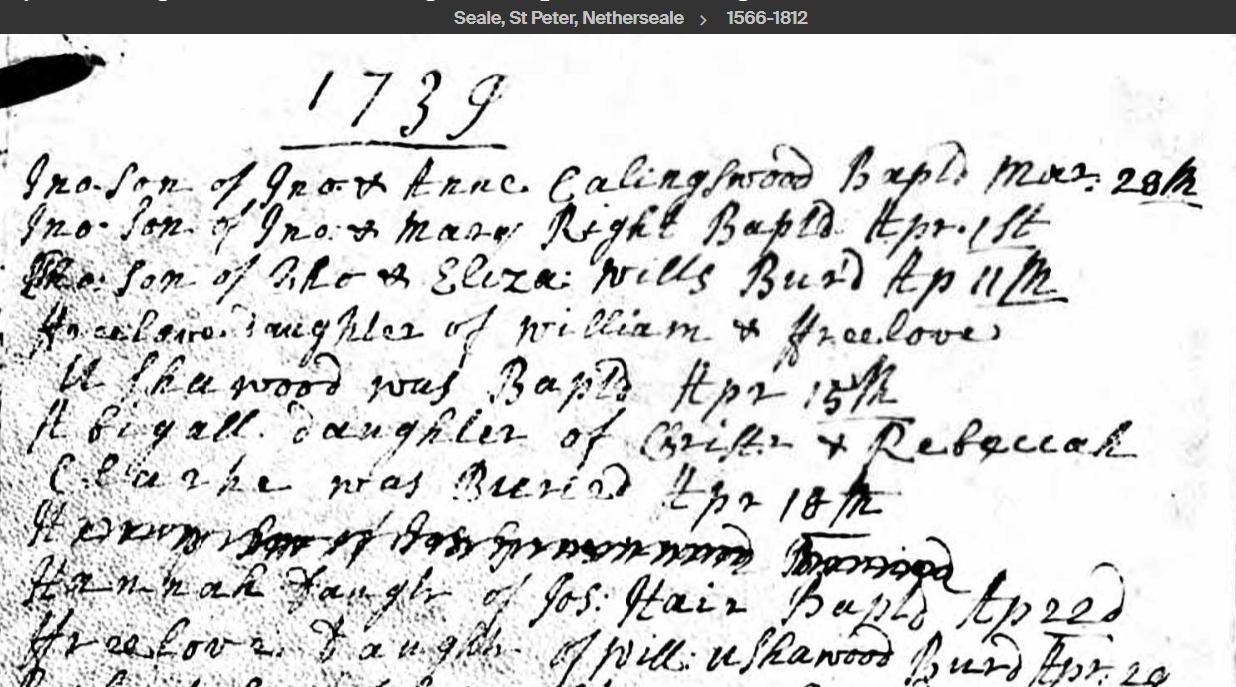
The HO register copy incorrectly copied:
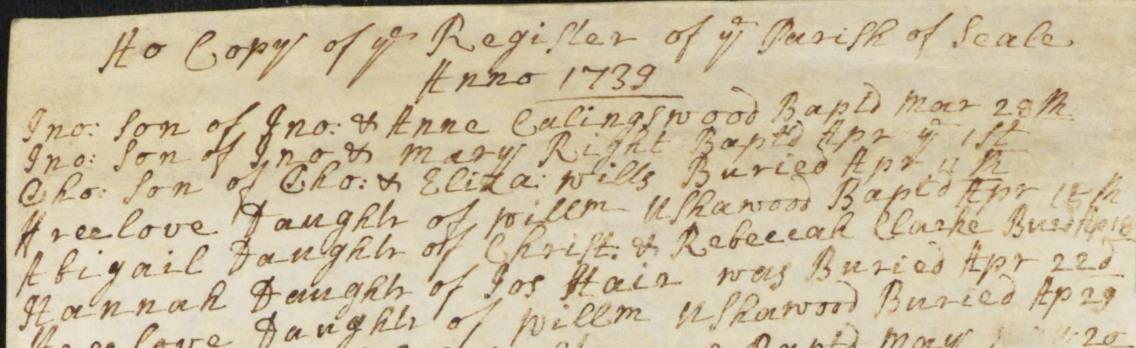 June 6, 2022 at 9:17 am #6301
In reply to: The Elusive Samuel Housley and Other Family Stories
The Warrens of Stapenhill
There were so many Warren’s in Stapenhill that it was complicated to work out who was who. I had gone back as far as Samuel Warren marrying Catherine Holland, and this was as far back as my cousin Ian Warren had gone in his research some decades ago as well. The Holland family from Barton under Needwood are particularly interesting, and will be a separate chapter.
Stapenhill village by John Harden:
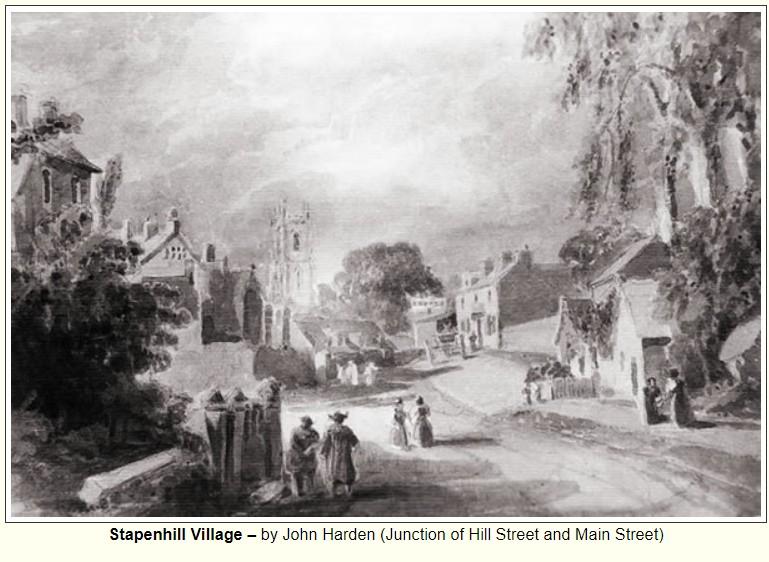
Resuming the research on the Warrens, Samuel Warren 1771-1837 married Catherine Holland 1775-1861 in 1795 and their son Samuel Warren 1800-1882 married Elizabeth Bridge, whose childless brother Benjamin Bridge left the Warren Brothers Boiler Works in Newhall to his nephews, the Warren brothers.
Samuel Warren and Catherine Holland marriage licence 1795:
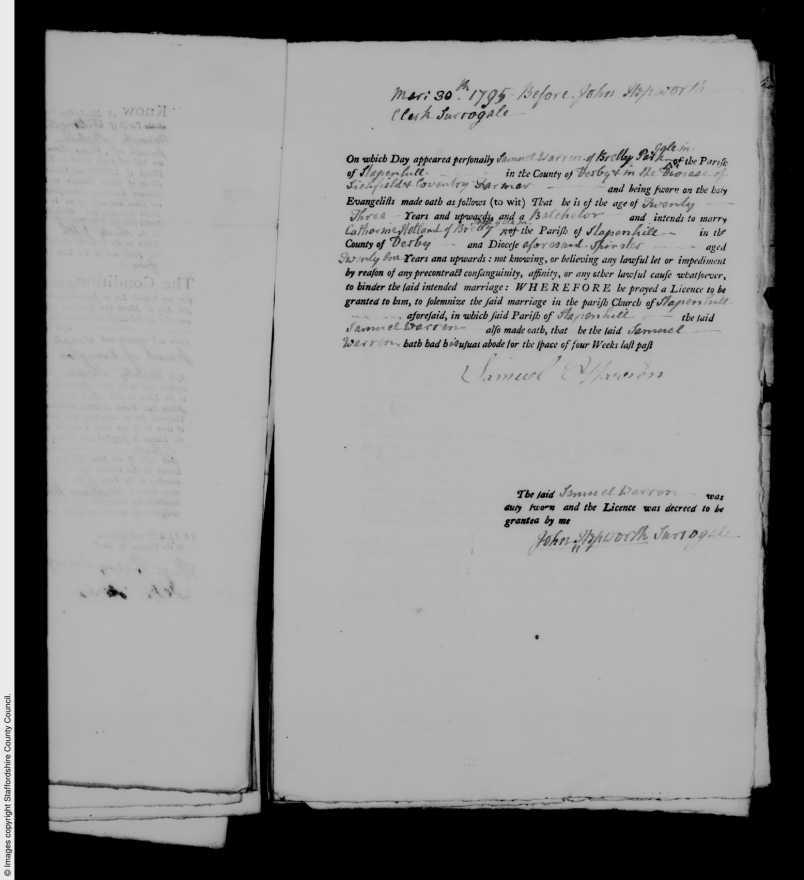
Samuel (born 1771) was baptised at Stapenhill St Peter and his parents were William and Anne Warren. There were at least three William and Ann Warrens in town at the time. One of those William’s was born in 1744, which would seem to be the right age to be Samuel’s father, and one was born in 1710, which seemed a little too old. Another William, Guiliamos Warren (Latin was often used in early parish registers) was baptised in Stapenhill in 1729.
Stapenhill St Peter:
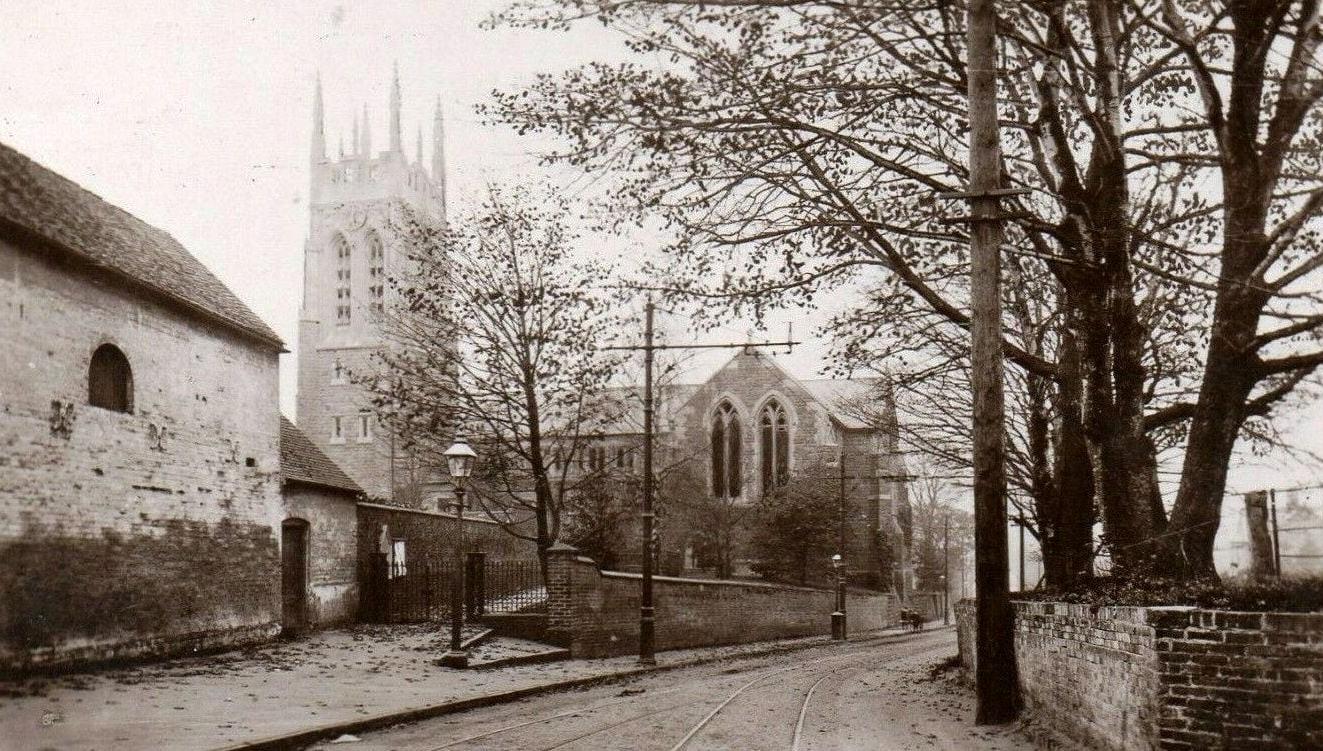
William Warren (born 1744) appeared to have been born several months before his parents wedding. William Warren and Ann Insley married 16 July 1744, but the baptism of William in 1744 was 24 February. This seemed unusual ~ children were often born less than nine months after a wedding, but not usually before the wedding! Then I remembered the change from the Julian calendar to the Gregorian calendar in 1752. Prior to 1752, the first day of the year was Lady Day, March 25th, not January 1st. This meant that the birth in February 1744 was actually after the wedding in July 1744. Now it made sense. The first son was named William, and he was born seven months after the wedding.
William born in 1744 died intestate in 1822, and his wife Ann made a legal claim to his estate. However he didn’t marry Ann Holland (Ann was Catherines Hollands sister, who married Samuel Warren the year before) until 1796, so this William and Ann were not the parents of Samuel.
It seemed likely that William born in 1744 was Samuels brother. William Warren and Ann Insley had at least eight children between 1744 and 1771, and it seems that Samuel was their last child, born when William the elder was 61 and his wife Ann was 47.
It seems it wasn’t unusual for the Warren men to marry rather late in life. William Warren’s (born 1710) parents were William Warren and Elizabeth Hatterton. On the marriage licence in 1702/1703 (it appears to say 1703 but is transcribed as 1702), William was a 40 year old bachelor from Stapenhill, which puts his date of birth at 1662. Elizabeth was considerably younger, aged 19.
William Warren and Elizabeth Hatterton marriage licence 1703:
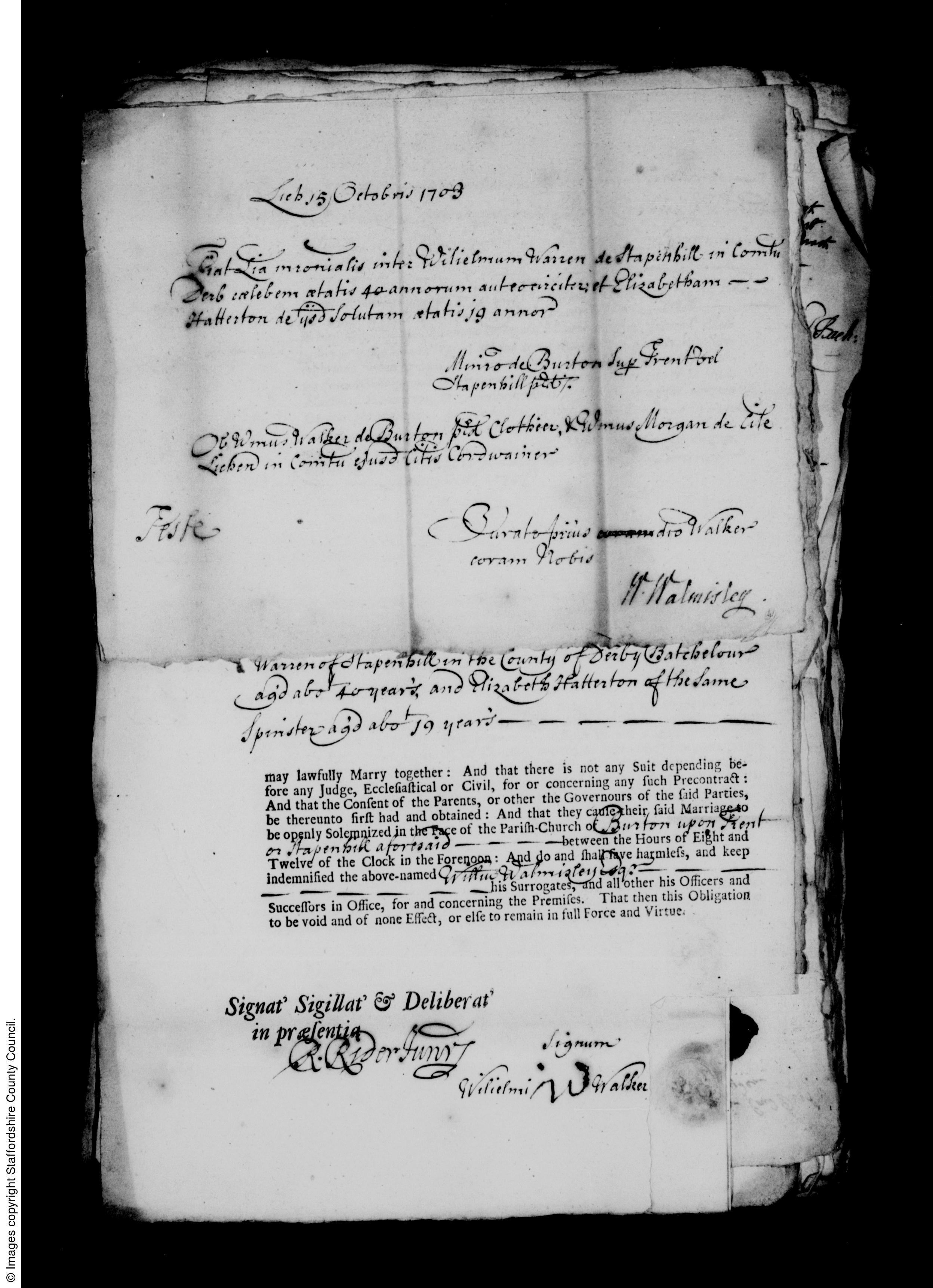
These Warren’s were farmers, and they were literate and able to sign their own names on various documents. This is worth noting, as most made the mark of an X.
I found three Warren and Holland marriages. One was Samuel Warren and Catherine Holland in 1795, then William Warren and Ann Holland in 1796. William Warren and Ann Hollands daughter born in 1799 married John Holland in 1824.
Elizabeth Hatterton (wife of William Warren who was born circa 1662) was born in Burton upon Trent in 1685. Her parents were Edward Hatterton 1655-1722, and Sara.
A page from the 1722 will of Edward Hatterton:
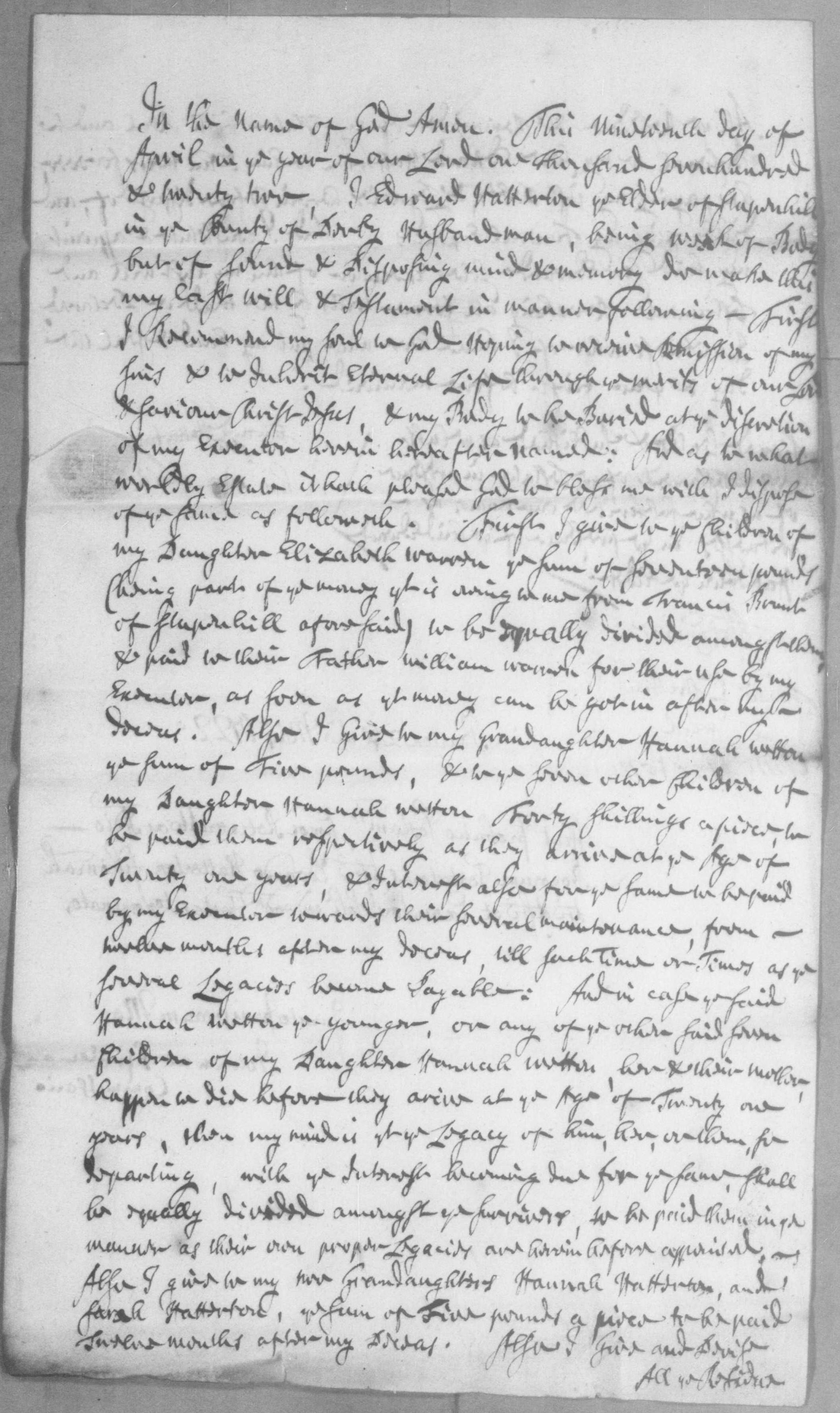
The earliest Warren I found records for was William Warren who married Elizabeth Hatterton in 1703. The marriage licence states his age as 40 and that he was from Stapenhill, but none of the Stapenhill parish records online go back as far as 1662. On other public trees on ancestry websites, a birth record from Suffolk has been chosen, probably because it was the only record to be found online with the right name and date. Once again, I don’t think that is correct, and perhaps one day I’ll find some earlier Stapenhill records to prove that he was born in locally.
Subsequently, I found a list of the 1662 Hearth Tax for Stapenhill. On it were a number of Warrens, three William Warrens including one who was a constable. One of those William Warrens had a son he named William (as they did, hence the number of William Warrens in the tree) the same year as this hearth tax list.
But was it the William Warren with 2 chimneys, the one with one chimney who was too poor to pay it, or the one who was a constable?
from the list:
Will. Warryn 2
Richard Warryn 1
William Warren Constable
These names are not payable by Act:
Will. Warryn 1
Richard Warren John Watson
over seers of the poore and churchwardensThe Hearth Tax:
via wiki:
In England, hearth tax, also known as hearth money, chimney tax, or chimney money, was a tax imposed by Parliament in 1662, to support the Royal Household of King Charles II. Following the Restoration of the monarchy in 1660, Parliament calculated that the Royal Household needed an annual income of £1,200,000. The hearth tax was a supplemental tax to make up the shortfall. It was considered easier to establish the number of hearths than the number of heads, hearths forming a more stationary subject for taxation than people. This form of taxation was new to England, but had precedents abroad. It generated considerable debate, but was supported by the economist Sir William Petty, and carried through the Commons by the influential West Country member Sir Courtenay Pole, 2nd Baronet (whose enemies nicknamed him “Sir Chimney Poll” as a result). The bill received Royal Assent on 19 May 1662, with the first payment due on 29 September 1662, Michaelmas.
One shilling was liable to be paid for every firehearth or stove, in all dwellings, houses, edifices or lodgings, and was payable at Michaelmas, 29 September and on Lady Day, 25 March. The tax thus amounted to two shillings per hearth or stove per year. The original bill contained a practical shortcoming in that it did not distinguish between owners and occupiers and was potentially a major burden on the poor as there were no exemptions. The bill was subsequently amended so that the tax was paid by the occupier. Further amendments introduced a range of exemptions that ensured that a substantial proportion of the poorer people did not have to pay the tax.Indeed it seems clear that William Warren the elder came from Stapenhill and not Suffolk, and one of the William Warrens paying hearth tax in 1662 was undoubtedly the father of William Warren who married Elizabeth Hatterton.
May 27, 2022 at 8:25 am #6300In reply to: The Elusive Samuel Housley and Other Family Stories
Looking for Carringtons
The Carringtons of Smalley, at least some of them, were Baptist ~ otherwise known as “non conformist”. Baptists don’t baptise at birth, believing it’s up to the person to choose when they are of an age to do so, although that appears to be fairly random in practice with small children being baptised. This makes it hard to find the birth dates registered as not every village had a Baptist church, and the baptisms would take place in another town. However some of the children were baptised in the village Anglican church as well, so they don’t seem to have been consistent. Perhaps at times a quick baptism locally for a sickly child was considered prudent, and preferable to no baptism at all. It’s impossible to know for sure and perhaps they were not strictly commited to a particular denomination.
Our Carrington’s start with Ellen Carrington who married William Housley in 1814. William Housley was previously married to Ellen’s older sister Mary Carrington. Ellen (born 1895 and baptised 1897) and her sister Nanny were baptised at nearby Ilkeston Baptist church but I haven’t found baptisms for Mary or siblings Richard and Francis. We know they were also children of William Carrington as he mentions them in his 1834 will. Son William was baptised at the local Smalley church in 1784, as was Thomas in 1896.
The absence of baptisms in Smalley with regard to Baptist influence was noted in the Smalley registers:
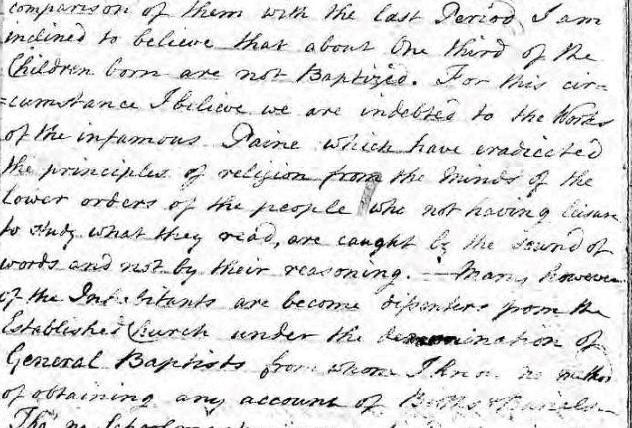
Smalley (chapelry of Morley) registers began in 1624, Morley registers began in 1540 with no obvious gaps in either. The gap with the missing registered baptisms would be 1786-1793. The Ilkeston Baptist register began in 1791. Information from the Smalley registers indicates that about a third of the children were not being baptised due to the Baptist influence.
William Housley son in law, daughter Mary Housley deceased, and daughter Eleanor (Ellen) Housley are all mentioned in William Housley’s 1834 will. On the marriage allegations and bonds for William Housley and Mary Carrington in 1806, her birth date is registered at 1787, her father William Carrington.
A Page from the will of William Carrington 1834:
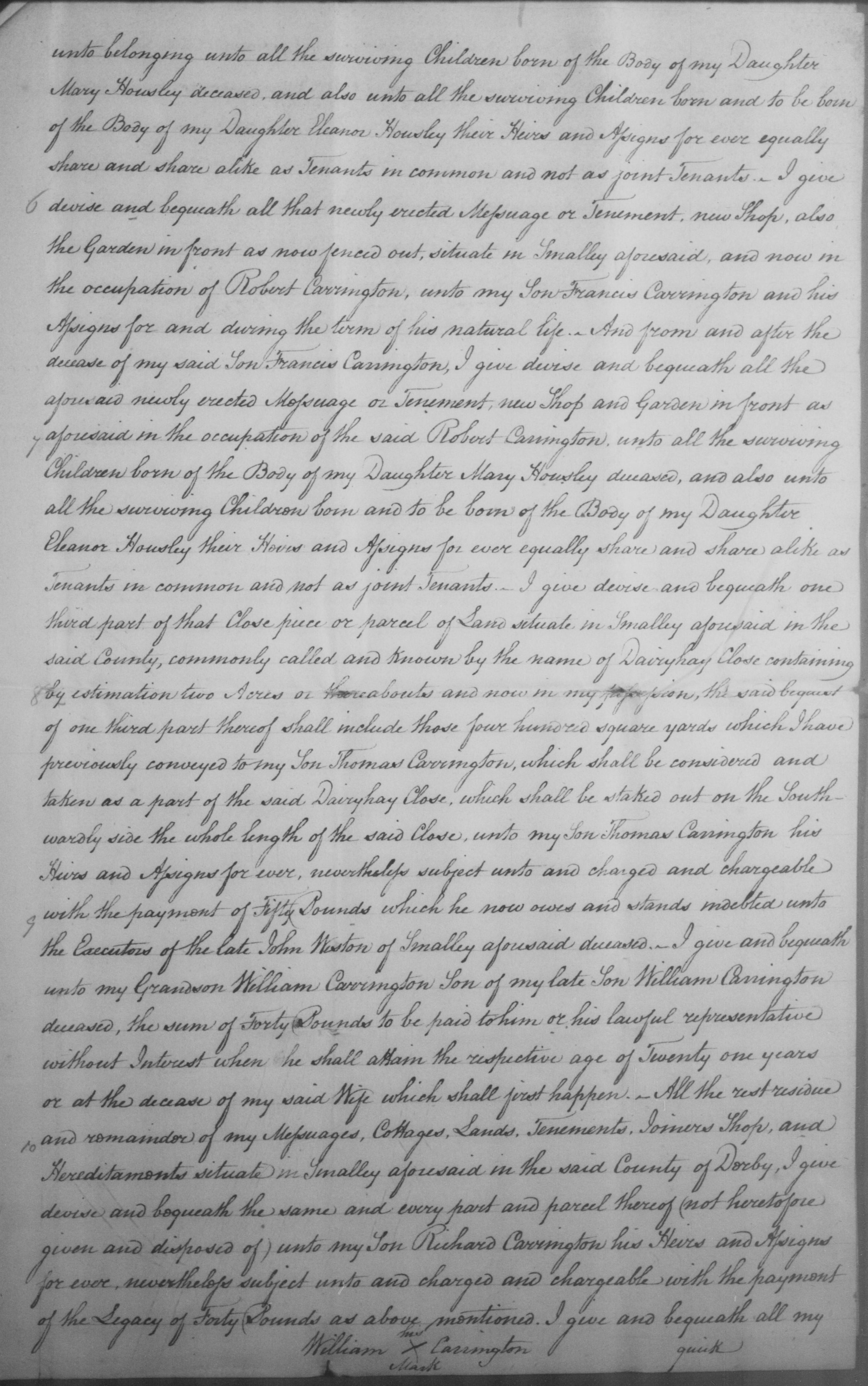
William Carrington was baptised in nearby Horsley Woodhouse on 27 August 1758. His parents were William and Margaret Carrington “near the Hilltop”. He married Mary Malkin, also of Smalley, on the 27th August 1783.
When I started looking for Margaret Wright who married William Carrington the elder, I chanced upon the Smalley parish register micro fiche images wrongly labeled by the ancestry site as Longford. I subsequently found that the Derby Records office published a list of all the wrongly labeled Derbyshire towns that the ancestry site knew about for ten years at least but has not corrected!
Margaret Wright was baptised in Smalley (mislabeled as Longford although the register images clearly say Smalley!) on the 2nd March 1728. Her parents were John and Margaret Wright.
But I couldn’t find a birth or baptism anywhere for William Carrington. I found four sources for William and Margaret’s marriage and none of them suggested that William wasn’t local. On other public trees on ancestry sites, William’s father was Joshua Carrington from Chinley. Indeed, when doing a search for William Carrington born circa 1720 to 1725, this was the only one in Derbyshire. But why would a teenager move to the other side of the county? It wasn’t uncommon to be apprenticed in neighbouring villages or towns, but Chinley didn’t seem right to me. It seemed to me that it had been selected on the other trees because it was the only easily found result for the search, and not because it was the right one.
I spent days reading every page of the microfiche images of the parish registers locally looking for Carringtons, any Carringtons at all in the area prior to 1720. Had there been none at all, then the possibility of William being the first Carrington in the area having moved there from elsewhere would have been more reasonable.
But there were many Carringtons in Heanor, a mile or so from Smalley, in the 1600s and early 1700s, although they were often spelled Carenton, sometimes Carrianton in the parish registers. The earliest Carrington I found in the area was Alice Carrington baptised in Ilkeston in 1602. It seemed obvious that William’s parents were local and not from Chinley.
The Heanor parish registers of the time were not very clearly written. The handwriting was bad and the spelling variable, depending I suppose on what the name sounded like to the person writing in the registers at the time as the majority of the people were probably illiterate. The registers are also in a generally poor condition.
I found a burial of a child called William on the 16th January 1721, whose father was William Carenton of “Losko” (Loscoe is a nearby village also part of Heanor at that time). This looked promising! If a child died, a later born child would be given the same name. This was very common: in a couple of cases I’ve found three deceased infants with the same first name until a fourth one named the same survived. It seemed very likely that a subsequent son would be named William and he would be the William Carrington born circa 1720 to 1725 that we were looking for.
Heanor parish registers: William son of William Carenton of Losko buried January 19th 1721:
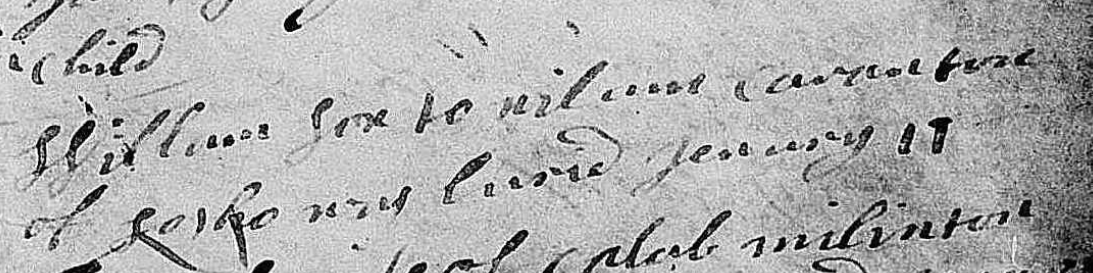
The Heanor parish registers between 1720 and 1729 are in many places illegible, however there are a couple of possibilities that could be the baptism of William in 1724 and 1725. A William son of William Carenton of Loscoe was buried in Jan 1721. In 1722 a Willian son of William Carenton (transcribed Tarenton) of Loscoe was buried. A subsequent son called William is likely. On 15 Oct 1724 a William son of William and Eliz (last name indecipherable) of Loscoe was baptised. A Mary, daughter of William Carrianton of Loscoe, was baptised in 1727.
I propose that William Carringtons was born in Loscoe and baptised in Heanor in 1724: if not 1724 then I would assume his baptism is one of the illegible or indecipherable entires within those few years. This falls short of absolute documented proof of course, but it makes sense to me.
In any case, if a William Carrington child died in Heanor in 1721 which we do have documented proof of, it further dismisses the case for William having arrived for no discernable reason from Chinley.
May 21, 2022 at 8:28 am #6298Topic: The Sexy Wooden Leg
in forum Yurara Fameliki’s StoriesThe Rootians invaded Oocrane when everybody was busy looking elsewhere. They entered through the Dumbass region under the pretense of freeing it from Lazies who had infiltrated administrations and media. They often cited a recent short movie from president Voldomeer Zumbaskee in which he appeared in purple leather panties adorned with diamonds, showing unashamedly his wooden leg. The same wooden leg that gave him the status of sexiest man of Oocrane and got him elected. In one of his famous discourses, he accused the Rootian president, Valdamir Potomsky of wanting to help himself to their crops of turnip and weed of which the world depended. And he told him if he expected Lazies he would be surprised by their resolution to defend their country.
By a simple game of chance that reality is so fond of, the man who made the president’s very wooden leg was also called Voldomeer Zumbasky. They might share a common ancestor, but many times in the past population records were destroyed and it was difficult to tell. That man lived in the small city of Duckailingtown in Dumbass, near the Rootian border. He was renowned to be a great carpenter and sculptor and before the war people would come from the neighbooring countries to buy his work.
During the invasion, crops and forests were burnt, buildings were destroyed and Dumbass Voldomeer lost one leg. There were no more trees or beams that hadn’t been turned to ashes, and he had only one block of wood left. Enough to make another wooden leg for himself. But he wondered: wasn’t there something more useful he could do with that block of wood ?
One morning of spring, one year after the war started. Food was scarce in Duckailingtown and Voldomeer’s belly growled as he walked past the nest of a couple of swans. He counted nine beautiful eggs that the parents were arranging with their beaks before lying on top to keep them warm. He found it so touching to see life in this place that he couldn’t bear the idea of simply stealing the eggs.
He went back home, a shelter made of bricks, his stomach aching from starvation. Looking at the block of wood on the floor, he got an idea. He spent the rest of the day and night to carve nine beautiful eggs so smooth that they appeared warm to the touch. He put so much care and love in his work that the swans would see no difference.
The next morning he went back to the nest with a leather bag, hopping heartily on his lone leg. The eggs were still there and by chance both the parents were missing. He didn’t care why. He took the eggs and replaced them with the wooden ones.
That day, he ate the best omelet with his friend Rooby, and as far as one could tell the swans were still brooding by the end of summer.
May 13, 2022 at 10:50 am #6293In reply to: The Elusive Samuel Housley and Other Family Stories
Lincolnshire Families
Thanks to the 1851 census, we know that William Eaton was born in Grantham, Lincolnshire. He was baptised on 29 November 1768 at St Wulfram’s church; his father was William Eaton and his mother Elizabeth.
St Wulfram’s in Grantham painted by JMW Turner in 1797:
I found a marriage for a William Eaton and Elizabeth Rose in the city of Lincoln in 1761, but it seemed unlikely as they were both of that parish, and with no discernable links to either Grantham or Nottingham.
But there were two marriages registered for William Eaton and Elizabeth Rose: one in Lincoln in 1761 and one in Hawkesworth Nottinghamshire in 1767, the year before William junior was baptised in Grantham. Hawkesworth is between Grantham and Nottingham, and this seemed much more likely.
Elizabeth’s name is spelled Rose on her marriage records, but spelled Rouse on her baptism. It’s not unusual for spelling variations to occur, as the majority of people were illiterate and whoever was recording the event wrote what it sounded like.
Elizabeth Rouse was baptised on 26th December 1746 in Gunby St Nicholas (there is another Gunby in Lincolnshire), a short distance from Grantham. Her father was Richard Rouse; her mother Cave Pindar. Cave is a curious name and I wondered if it had been mistranscribed, but it appears to be correct and clearly says Cave on several records.
Richard Rouse married Cave Pindar 21 July 1744 in South Witham, not far from Grantham.
Richard was born in 1716 in North Witham. His father was William Rouse; his mothers name was Jane.
Cave Pindar was born in 1719 in Gunby St Nicholas, near Grantham. Her father was William Pindar, but sadly her mothers name is not recorded in the parish baptism register. However a marriage was registered between William Pindar and Elizabeth Holmes in Gunby St Nicholas in October 1712.
William Pindar buried a daughter Cave on 2 April 1719 and baptised a daughter Cave on 6 Oct 1719:
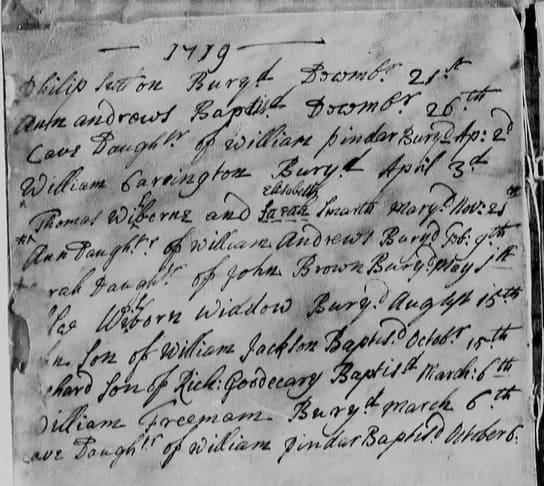
Elizabeth Holmes was baptised in Gunby St Nicholas on 6th December 1691. Her father was John Holmes; her mother Margaret Hod.
Margaret Hod would have been born circa 1650 to 1670 and I haven’t yet found a baptism record for her. According to several other public trees on an ancestry website, she was born in 1654 in Essenheim, Germany. This was surprising! According to these trees, her father was Johannes Hod (Blodt|Hoth) (1609–1677) and her mother was Maria Appolonia Witters (1620–1656).
I did not think it very likely that a young woman born in Germany would appear in Gunby St Nicholas in the late 1600’s, and did a search for Hod’s in and around Grantham. Indeed there were Hod’s living in the area as far back as the 1500’s, (a Robert Hod was baptised in Grantham in 1552), and no doubt before, but the parish records only go so far back. I think it’s much more likely that her parents were local, and that the page with her baptism recorded on the registers is missing.
Of the many reasons why parish registers or some of the pages would be destroyed or lost, this is another possibility. Lincolnshire is on the east coast of England:
“All of England suffered from a “monster” storm in November of 1703 that killed a reported 8,000 people. Seaside villages suffered greatly and their church and civil records may have been lost.”
A Margeret Hod, widow, died in Gunby St Nicholas in 1691, the same year that Elizabeth Holmes was born. Elizabeth’s mother was Margaret Hod. Perhaps the widow who died was Margaret Hod’s mother? I did wonder if Margaret Hod had died shortly after her daughter’s birth, and that her husband had died sometime between the conception and birth of his child. The Black Death or Plague swept through Lincolnshire in 1680 through 1690; such an eventually would be possible. But Margaret’s name would have been registered as Holmes, not Hod.
Cave Pindar’s father William was born in Swinstead, Lincolnshire, also near to Grantham, on the 28th December, 1690, and he died in Gunby St Nicholas in 1756. William’s father is recorded as Thomas Pinder; his mother Elizabeth.
GUNBY: The village name derives from a “farmstead or village of a man called Gunni”, from the Old Scandinavian person name, and ‘by’, a farmstead, village or settlement.
Gunby Grade II listed Anglican church is dedicated to St Nicholas. Of 15th-century origin, it was rebuilt by Richard Coad in 1869, although the Perpendicular tower remained.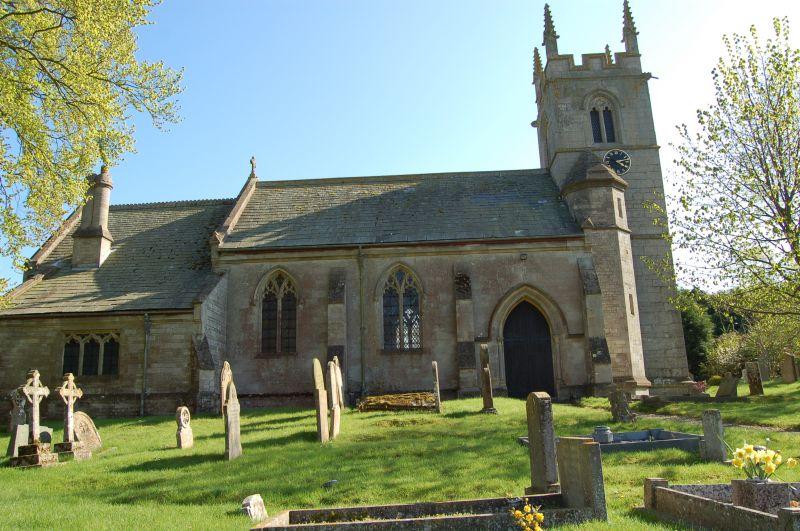 February 2, 2022 at 1:15 pm #6268
In reply to: The Elusive Samuel Housley and Other Family Stories
From Tanganyika with Love
continued part 9
With thanks to Mike Rushby.
Lyamungu 3rd January 1945
Dearest Family.
We had a novel Christmas this year. We decided to avoid the expense of
entertaining and being entertained at Lyamungu, and went off to spend Christmas
camping in a forest on the Western slopes of Kilimanjaro. George decided to combine
business with pleasure and in this way we were able to use Government transport.
We set out the day before Christmas day and drove along the road which skirts
the slopes of Kilimanjaro and first visited a beautiful farm where Philip Teare, the ex
Game Warden, and his wife Mary are staying. We had afternoon tea with them and then
drove on in to the natural forest above the estate and pitched our tent beside a small
clear mountain stream. We decorated the tent with paper streamers and a few small
balloons and John found a small tree of the traditional shape which we decorated where
it stood with tinsel and small ornaments.We put our beer, cool drinks for the children and bottles of fresh milk from Simba
Estate, in the stream and on Christmas morning they were as cold as if they had been in
the refrigerator all night. There were not many presents for the children, there never are,
but they do not seem to mind and are well satisfied with a couple of balloons apiece,
sweets, tin whistles and a book each.George entertain the children before breakfast. He can make a magical thing out
of the most ordinary balloon. The children watched entranced as he drew on his pipe
and then blew the smoke into the balloon. He then pinched the neck of the balloon
between thumb and forefinger and released the smoke in little puffs. Occasionally the
balloon ejected a perfect smoke ring and the forest rang with shouts of “Do it again
Daddy.” Another trick was to blow up the balloon to maximum size and then twist the
neck tightly before releasing. Before subsiding the balloon darted about in a crazy
fashion causing great hilarity. Such fun, at the cost of a few pence.After breakfast George went off to fish for trout. John and Jim decided that they
also wished to fish so we made rods out of sticks and string and bent pins and they
fished happily, but of course quite unsuccessfully, for hours. Both of course fell into the
stream and got soaked, but I was prepared for this, and the little stream was so shallow
that they could not come to any harm. Henry played happily in the sand and I had a
most peaceful morning.Hamisi roasted a chicken in a pot over the camp fire and the jelly set beautifully in the
stream. So we had grilled trout and chicken for our Christmas dinner. I had of course
taken an iced cake for the occasion and, all in all, it was a very successful Christmas day.
On Boxing day we drove down to the plains where George was to investigate a
report of game poaching near the Ngassari Furrow. This is a very long ditch which has
been dug by the Government for watering the Masai stock in the area. It is also used by
game and we saw herds of zebra and wildebeest, and some Grant’s Gazelle and
giraffe, all comparatively tame. At one point a small herd of zebra raced beside the lorry
apparently enjoying the fun of a gallop. They were all sleek and fat and looked wild and
beautiful in action.We camped a considerable distance from the water but this precaution did not
save us from the mosquitoes which launched a vicious attack on us after sunset, so that
we took to our beds unusually early. They were on the job again when we got up at
sunrise so I was very glad when we were once more on our way home.“I like Christmas safari. Much nicer that silly old party,” said John. I agree but I think
it is time that our children learned to play happily with others. There are no other young
children at Lyamungu though there are two older boys and a girl who go to boarding
school in Nairobi.On New Years Day two Army Officers from the military camp at Moshi, came for
tea and to talk game hunting with George. I think they rather enjoy visiting a home and
seeing children and pets around.Eleanor.
Lyamungu 14 May 1945
Dearest Family.
So the war in Europe is over at last. It is such marvellous news that I can hardly
believe it. To think that as soon as George can get leave we will go to England and
bring Ann and George home with us to Tanganyika. When we know when this leave can
be arranged we will want Kate to join us here as of course she must go with us to
England to meet George’s family. She has become so much a part of your lives that I
know it will be a wrench for you to give her up but I know that you will all be happy to
think that soon our family will be reunited.The V.E. celebrations passed off quietly here. We all went to Moshi to see the
Victory Parade of the King’s African Rifles and in the evening we went to a celebration
dinner at the Game Warden’s house. Besides ourselves the Moores had invited the
Commanding Officer from Moshi and a junior officer. We had a very good dinner and
many toasts including one to Mrs Moore’s brother, Oliver Milton who is fighting in Burma
and has recently been awarded the Military Cross.There was also a celebration party for the children in the grounds of the Moshi
Club. Such a spread! I think John and Jim sampled everything. We mothers were
having our tea separately and a friend laughingly told me to turn around and have a look.
I did, and saw the long tea tables now deserted by all the children but my two sons who
were still eating steadily, and finding the party more exciting than the game of Musical
Bumps into which all the other children had entered with enthusiasm.There was also an extremely good puppet show put on by the Italian prisoners
of war from the camp at Moshi. They had made all the puppets which included well
loved characters like Snow White and the Seven Dwarfs and the Babes in the Wood as
well as more sophisticated ones like an irritable pianist and a would be prima donna. The
most popular puppets with the children were a native askari and his family – a very
happy little scene. I have never before seen a puppet show and was as entranced as
the children. It is amazing what clever manipulation and lighting can do. I believe that the
Italians mean to take their puppets to Nairobi and am glad to think that there, they will
have larger audiences to appreciate their art.George has just come in, and I paused in my writing to ask him for the hundredth
time when he thinks we will get leave. He says I must be patient because it may be a
year before our turn comes. Shipping will be disorganised for months to come and we
cannot expect priority simply because we have been separated so long from our
children. The same situation applies to scores of other Government Officials.
I have decided to write the story of my childhood in South Africa and about our
life together in Tanganyika up to the time Ann and George left the country. I know you
will have told Kate these stories, but Ann and George were so very little when they left
home that I fear that they cannot remember much.My Mother-in-law will have told them about their father but she can tell them little
about me. I shall send them one chapter of my story each month in the hope that they
may be interested and not feel that I am a stranger when at last we meet again.Eleanor.
Lyamungu 19th September 1945
Dearest Family.
In a months time we will be saying good-bye to Lyamungu. George is to be
transferred to Mbeya and I am delighted, not only as I look upon Mbeya as home, but
because there is now a primary school there which John can attend. I feel he will make
much better progress in his lessons when he realises that all children of his age attend
school. At present he is putting up a strong resistance to learning to read and spell, but
he writes very neatly, does his sums accurately and shows a real talent for drawing. If
only he had the will to learn I feel he would do very well.Jim now just four, is too young for lessons but too intelligent to be interested in
the ayah’s attempts at entertainment. Yes I’ve had to engage a native girl to look after
Henry from 9 am to 12.30 when I supervise John’s Correspondence Course. She is
clean and amiable, but like most African women she has no initiative at all when it comes
to entertaining children. Most African men and youths are good at this.I don’t regret our stay at Lyamungu. It is a beautiful spot and the change to the
cooler climate after the heat of Morogoro has been good for all the children. John is still
tall for his age but not so thin as he was and much less pale. He is a handsome little lad
with his large brown eyes in striking contrast to his fair hair. He is wary of strangers but
very observant and quite uncanny in the way he sums up people. He seldom gets up
to mischief but I have a feeling he eggs Jim on. Not that Jim needs egging.Jim has an absolute flair for mischief but it is all done in such an artless manner that
it is not easy to punish him. He is a very sturdy child with a cap of almost black silky hair,
eyes brown, like mine, and a large mouth which is quick to smile and show most beautiful
white and even teeth. He is most popular with all the native servants and the Game
Scouts. The servants call Jim, ‘Bwana Tembo’ (Mr Elephant) because of his sturdy
build.Henry, now nearly two years old, is quite different from the other two in
appearance. He is fair complexioned and fair haired like Ann and Kate, with large, black
lashed, light grey eyes. He is a good child, not so merry as Jim was at his age, nor as
shy as John was. He seldom cries, does not care to be cuddled and is independent and
strong willed. The servants call Henry, ‘Bwana Ndizi’ (Mr Banana) because he has an
inexhaustible appetite for this fruit. Fortunately they are very inexpensive here. We buy
an entire bunch which hangs from a beam on the back verandah, and pluck off the
bananas as they ripen. This way there is no waste and the fruit never gets bruised as it
does in greengrocers shops in South Africa. Our three boys make a delightful and
interesting trio and I do wish you could see them for yourselves.We are delighted with the really beautiful photograph of Kate. She is an
extraordinarily pretty child and looks so happy and healthy and a great credit to you.
Now that we will be living in Mbeya with a school on the doorstep I hope that we will
soon be able to arrange for her return home.Eleanor.
c/o Game Dept. Mbeya. 30th October 1945
Dearest Family.
How nice to be able to write c/o Game Dept. Mbeya at the head of my letters.
We arrived here safely after a rather tiresome journey and are installed in a tiny house on
the edge of the township.We left Lyamungu early on the morning of the 22nd. Most of our goods had
been packed on the big Ford lorry the previous evening, but there were the usual
delays and farewells. Of our servants, only the cook, Hamisi, accompanied us to
Mbeya. Japhet, Tovelo and the ayah had to be paid off and largesse handed out.
Tovelo’s granny had come, bringing a gift of bananas, and she also brought her little
granddaughter to present a bunch of flowers. The child’s little scolded behind is now
completely healed. Gifts had to be found for them too.At last we were all aboard and what a squash it was! Our few pieces of furniture
and packing cases and trunks, the cook, his wife, the driver and the turney boy, who
were to take the truck back to Lyamungu, and all their bits and pieces, bunches of
bananas and Fanny the dog were all crammed into the body of the lorry. George, the
children and I were jammed together in the cab. Before we left George looked
dubiously at the tyres which were very worn and said gloomily that he thought it most
unlikely that we would make our destination, Dodoma.Too true! Shortly after midday, near Kwakachinja, we blew a back tyre and there
was a tedious delay in the heat whilst the wheel was changed. We were now without a
spare tyre and George said that he would not risk taking the Ford further than Babati,
which is less than half way to Dodoma. He drove very slowly and cautiously to Babati
where he arranged with Sher Mohammed, an Indian trader, for a lorry to take us to
Dodoma the next morning.It had been our intention to spend the night at the furnished Government
Resthouse at Babati but when we got there we found that it was already occupied by
several District Officers who had assembled for a conference. So, feeling rather
disgruntled, we all piled back into the lorry and drove on to a place called Bereku where
we spent an uncomfortable night in a tumbledown hut.Before dawn next morning Sher Mohammed’s lorry drove up, and there was a
scramble to dress by the light of a storm lamp. The lorry was a very dilapidated one and
there was already a native woman passenger in the cab. I felt so tired after an almost
sleepless night that I decided to sit between the driver and this woman with the sleeping
Henry on my knee. It was as well I did, because I soon found myself dosing off and
drooping over towards the woman. Had she not been there I might easily have fallen
out as the battered cab had no door. However I was alert enough when daylight came
and changed places with the woman to our mutual relief. She was now able to converse
with the African driver and I was able to enjoy the scenery and the fresh air!
George, John and Jim were less comfortable. They sat in the lorry behind the
cab hemmed in by packing cases. As the lorry was an open one the sun beat down
unmercifully upon them until George, ever resourceful, moved a table to the front of the
truck. The two boys crouched under this and so got shelter from the sun but they still had
to endure the dust. Fanny complicated things by getting car sick and with one thing and
another we were all jolly glad to get to Dodoma.We spent the night at the Dodoma Hotel and after hot baths, a good meal and a
good nights rest we cheerfully boarded a bus of the Tanganyika Bus Service next
morning to continue our journey to Mbeya. The rest of the journey was uneventful. We slept two nights on the road, the first at Iringa Hotel and the second at Chimala. We
reached Mbeya on the 27th.I was rather taken aback when I first saw the little house which has been allocated
to us. I had become accustomed to the spacious houses we had in Morogoro and
Lyamungu. However though the house is tiny it is secluded and has a long garden
sloping down to the road in front and another long strip sloping up behind. The front
garden is shaded by several large cypress and eucalyptus trees but the garden behind
the house has no shade and consists mainly of humpy beds planted with hundreds of
carnations sadly in need of debudding. I believe that the previous Game Ranger’s wife
cultivated the carnations and, by selling them, raised money for War Funds.
Like our own first home, this little house is built of sun dried brick. Its original
owners were Germans. It is now rented to the Government by the Custodian of Enemy
Property, and George has his office in another ex German house.This afternoon we drove to the school to arrange about enrolling John there. The
school is about four miles out of town. It was built by the German settlers in the late
1930’s and they were justifiably proud of it. It consists of a great assembly hall and
classrooms in one block and there are several attractive single storied dormitories. This
school was taken over by the Government when the Germans were interned on the
outbreak of war and many improvements have been made to the original buildings. The
school certainly looks very attractive now with its grassed playing fields and its lawns and
bright flower beds.The Union Jack flies from a tall flagpole in front of the Hall and all traces of the
schools German origin have been firmly erased. We met the Headmaster, Mr
Wallington, and his wife and some members of the staff. The school is co-educational
and caters for children from the age of seven to standard six. The leaving age is elastic
owing to the fact that many Tanganyika children started school very late because of lack
of educational facilities in this country.The married members of the staff have their own cottages in the grounds. The
Matrons have quarters attached to the dormitories for which they are responsible. I felt
most enthusiastic about the school until I discovered that the Headmaster is adamant
upon one subject. He utterly refuses to take any day pupils at the school. So now our
poor reserved Johnny will have to adjust himself to boarding school life.
We have arranged that he will start school on November 5th and I shall be very
busy trying to assemble his school uniform at short notice. The clothing list is sensible.
Boys wear khaki shirts and shorts on weekdays with knitted scarlet jerseys when the
weather is cold. On Sundays they wear grey flannel shorts and blazers with the silver
and scarlet school tie.Mbeya looks dusty, brown and dry after the lush evergreen vegetation of
Lyamungu, but I prefer this drier climate and there are still mountains to please the eye.
In fact the lower slopes of Lolesa Mountain rise at the upper end of our garden.Eleanor.
c/o Game Dept. Mbeya. 21st November 1945
Dearest Family.
We’re quite settled in now and I have got the little house fixed up to my
satisfaction. I have engaged a rather uncouth looking houseboy but he is strong and
capable and now that I am not tied down in the mornings by John’s lessons I am able to
go out occasionally in the mornings and take Jim and Henry to play with other children.
They do not show any great enthusiasm but are not shy by nature as John is.
I have had a good deal of heartache over putting John to boarding school. It
would have been different had he been used to the company of children outside his
own family, or if he had even known one child there. However he seems to be adjusting
himself to the life, though slowly. At least he looks well and tidy and I am quite sure that
he is well looked after.I must confess that when the time came for John to go to school I simply did not
have the courage to take him and he went alone with George, looking so smart in his
new uniform – but his little face so bleak. The next day, Sunday, was visiting day but the
Headmaster suggested that we should give John time to settle down and not visit him
until Wednesday.When we drove up to the school I spied John on the far side of the field walking
all alone. Instead of running up with glad greetings, as I had expected, he came almost
reluctently and had little to say. I asked him to show me his dormitory and classroom and
he did so politely as though I were a stranger. At last he volunteered some information.
“Mummy,” he said in an awed voice, Do you know on the night I came here they burnt a
man! They had a big fire and they burnt him.” After a blank moment the penny dropped.
Of course John had started school and November the fifth but it had never entered my
head to tell him about that infamous character, Guy Fawkes!I asked John’s Matron how he had settled down. “Well”, she said thoughtfully,
“John is very good and has not cried as many of the juniors do when they first come
here, but he seems to keep to himself all the time.” I went home very discouraged but
on the Sunday John came running up with another lad of about his own age.” This is my
friend Marks,” he announced proudly. I could have hugged Marks.Mbeya is very different from the small settlement we knew in the early 1930’s.
Gone are all the colourful characters from the Lupa diggings for the alluvial claims are all
worked out now, gone also are our old friends the Menzies from the Pub and also most
of the Government Officials we used to know. Mbeya has lost its character of a frontier
township and has become almost suburban.The social life revolves around two places, the Club and the school. The Club
which started out as a little two roomed building, has been expanded and the golf
course improved. There are also tennis courts and a good library considering the size of
the community. There are frequent parties and dances, though most of the club revenue
comes from Bar profits. The parties are relatively sober affairs compared with the parties
of the 1930’s.The school provides entertainment of another kind. Both Mr and Mrs Wallington
are good amateur actors and I am told that they run an Amateur Dramatic Society. Every
Wednesday afternoon there is a hockey match at the school. Mbeya town versus a
mixed team of staff and scholars. The match attracts almost the whole European
population of Mbeya. Some go to play hockey, others to watch, and others to snatch
the opportunity to visit their children. I shall have to try to arrange a lift to school when
George is away on safari.I have now met most of the local women and gladly renewed an old friendship
with Sheilagh Waring whom I knew two years ago at Morogoro. Sheilagh and I have
much in common, the same disregard for the trappings of civilisation, the same sense of
the ludicrous, and children. She has eight to our six and she has also been cut off by the
war from two of her children. Sheilagh looks too young and pretty to be the mother of so
large a family and is, in fact, several years younger than I am. her husband, Donald, is a
large quiet man who, as far as I can judge takes life seriously.Our next door neighbours are the Bank Manager and his wife, a very pleasant
couple though we seldom meet. I have however had correspondence with the Bank
Manager. Early on Saturday afternoon their houseboy brought a note. It informed me
that my son was disturbing his rest by precipitating a heart attack. Was I aware that my
son was about 30 feet up in a tree and balanced on a twig? I ran out and,sure enough,
there was Jim, right at the top of the tallest eucalyptus tree. It would be the one with the
mound of stones at the bottom! You should have heard me fluting in my most
wheedling voice. “Sweets, Jimmy, come down slowly dear, I’ve some nice sweets for
you.”I’ll bet that little story makes you smile. I remember how often you have told me
how, as a child, I used to make your hearts turn over because I had no fear of heights
and how I used to say, “But that is silly, I won’t fall.” I know now only too well, how you
must have felt.Eleanor.
c/o Game Dept. Mbeya. 14th January 1946
Dearest Family.
I hope that by now you have my telegram to say that Kate got home safely
yesterday. It was wonderful to have her back and what a beautiful child she is! Kate
seems to have enjoyed the train journey with Miss Craig, in spite of the tears she tells
me she shed when she said good-bye to you. She also seems to have felt quite at
home with the Hopleys at Salisbury. She flew from Salisbury in a small Dove aircraft
and they had a smooth passage though Kate was a little airsick.I was so excited about her home coming! This house is so tiny that I had to turn
out the little store room to make a bedroom for her. With a fresh coat of whitewash and
pretty sprigged curtains and matching bedspread, borrowed from Sheilagh Waring, the
tiny room looks most attractive. I had also iced a cake, made ice-cream and jelly and
bought crackers for the table so that Kate’s home coming tea could be a proper little
celebration.I was pleased with my preparations and then, a few hours before the plane was
due, my crowned front tooth dropped out, peg and all! When my houseboy wants to
describe something very tatty, he calls it “Second-hand Kabisa.” Kabisa meaning
absolutely. That is an apt description of how I looked and felt. I decided to try some
emergency dentistry. I think you know our nearest dentist is at Dar es Salaam five
hundred miles away.First I carefully dried the tooth and with a match stick covered the peg and base
with Durofix. I then took the infants rubber bulb enema, sucked up some heat from a
candle flame and pumped it into the cavity before filling that with Durofix. Then hopefully
I stuck the tooth in its former position and held it in place for several minutes. No good. I
sent the houseboy to a shop for Scotine and tried the whole process again. No good
either.When George came home for lunch I appealed to him for advice. He jokingly
suggested that a maize seed jammed into the space would probably work, but when
he saw that I really was upset he produced some chewing gum and suggested that I
should try that . I did and that worked long enough for my first smile anyway.
George and the three boys went to meet Kate but I remained at home to
welcome her there. I was afraid that after all this time away Kate might be reluctant to
rejoin the family but she threw her arms around me and said “Oh Mummy,” We both
shed a few tears and then we both felt fine.How gay Kate is, and what an infectious laugh she has! The boys follow her
around in admiration. John in fact asked me, “Is Kate a Princess?” When I said
“Goodness no, Johnny, she’s your sister,” he explained himself by saying, “Well, she
has such golden hair.” Kate was less complementary. When I tucked her in bed last night
she said, “Mummy, I didn’t expect my little brothers to be so yellow!” All three boys
have been taking a course of Atebrin, an anti-malarial drug which tinges skin and eyeballs
yellow.So now our tiny house is bursting at its seams and how good it feels to have one
more child under our roof. We are booked to sail for England in May and when we return
we will have Ann and George home too. Then I shall feel really content.Eleanor.
c/o Game Dept. Mbeya. 2nd March 1946
Dearest Family.
My life just now is uneventful but very busy. I am sewing hard and knitting fast to
try to get together some warm clothes for our leave in England. This is not a simple
matter because woollen materials are in short supply and very expensive, and now that
we have boarding school fees to pay for both Kate and John we have to budget very
carefully indeed.Kate seems happy at school. She makes friends easily and seems to enjoy
communal life. John also seems reconciled to school now that Kate is there. He no
longer feels that he is the only exile in the family. He seems to rub along with the other
boys of his age and has a couple of close friends. Although Mbeya School is coeducational
the smaller boys and girls keep strictly apart. It is considered extremely
cissy to play with girls.The local children are allowed to go home on Sundays after church and may bring
friends home with them for the day. Both John and Kate do this and Sunday is a very
busy day for me. The children come home in their Sunday best but bring play clothes to
change into. There is always a scramble to get them to bath and change again in time to
deliver them to the school by 6 o’clock.When George is home we go out to the school for the morning service. This is
taken by the Headmaster Mr Wallington, and is very enjoyable. There is an excellent
school choir to lead the singing. The service is the Church of England one, but is
attended by children of all denominations, except the Roman Catholics. I don’t think that
more than half the children are British. A large proportion are Greeks, some as old as
sixteen, and about the same number are Afrikaners. There are Poles and non-Nazi
Germans, Swiss and a few American children.All instruction is through the medium of English and it is amazing how soon all the
foreign children learn to chatter in English. George has been told that we will return to
Mbeya after our leave and for that I am very thankful as it means that we will still be living
near at hand when Jim and Henry start school. Because many of these children have to
travel many hundreds of miles to come to school, – Mbeya is a two day journey from the
railhead, – the school year is divided into two instead of the usual three terms. This
means that many of these children do not see their parents for months at a time. I think
this is a very sad state of affairs especially for the seven and eight year olds but the
Matrons assure me , that many children who live on isolated farms and stations are quite
reluctant to go home because they miss the companionship and the games and
entertainment that the school offers.My only complaint about the life here is that I see far too little of George. He is
kept extremely busy on this range and is hardly at home except for a few days at the
months end when he has to be at his office to check up on the pay vouchers and the
issue of ammunition to the Scouts. George’s Range takes in the whole of the Southern
Province and the Southern half of the Western Province and extends to the border with
Northern Rhodesia and right across to Lake Tanganyika. This vast area is patrolled by
only 40 Game Scouts because the Department is at present badly under staffed, due
partly to the still acute shortage of rifles, but even more so to the extraordinary reluctance
which the Government shows to allocate adequate funds for the efficient running of the
Department.The Game Scouts must see that the Game Laws are enforced, protect native
crops from raiding elephant, hippo and other game animals. Report disease amongst game and deal with stock raiding lions. By constantly going on safari and checking on
their work, George makes sure the range is run to his satisfaction. Most of the Game
Scouts are fine fellows but, considering they receive only meagre pay for dangerous
and exacting work, it is not surprising that occasionally a Scout is tempted into accepting
a bribe not to report a serious infringement of the Game Laws and there is, of course,
always the temptation to sell ivory illicitly to unscrupulous Indian and Arab traders.
Apart from supervising the running of the Range, George has two major jobs.
One is to supervise the running of the Game Free Area along the Rhodesia –
Tanganyika border, and the other to hunt down the man-eating lions which for years have
terrorised the Njombe District killing hundreds of Africans. Yes I know ‘hundreds’ sounds
fantastic, but this is perfectly true and one day, when the job is done and the official
report published I shall send it to you to prove it!I hate to think of the Game Free Area and so does George. All the game from
buffalo to tiny duiker has been shot out in a wide belt extending nearly two hundred
miles along the Northern Rhodesia -Tanganyika border. There are three Europeans in
widely spaced camps who supervise this slaughter by African Game Guards. This
horrible measure is considered necessary by the Veterinary Departments of
Tanganyika, Rhodesia and South Africa, to prevent the cattle disease of Rinderpest
from spreading South.When George is home however, we do relax and have fun. On the Saturday
before the school term started we took Kate and the boys up to the top fishing camp in
the Mporoto Mountains for her first attempt at trout fishing. There are three of these
camps built by the Mbeya Trout Association on the rivers which were first stocked with
the trout hatched on our farm at Mchewe. Of the three, the top camp is our favourite. The
scenery there is most glorious and reminds me strongly of the rivers of the Western
Cape which I so loved in my childhood.The river, the Kawira, flows from the Rungwe Mountain through a narrow valley
with hills rising steeply on either side. The water runs swiftly over smooth stones and
sometimes only a foot or two below the level of the banks. It is sparkling and shallow,
but in places the water is deep and dark and the banks high. I had a busy day keeping
an eye on the boys, especially Jim, who twice climbed out on branches which overhung
deep water. “Mummy, I was only looking for trout!”How those kids enjoyed the freedom of the camp after the comparative
restrictions of town. So did Fanny, she raced about on the hills like a mad dog chasing
imaginary rabbits and having the time of her life. To escape the noise and commotion
George had gone far upstream to fish and returned in the late afternoon with three good
sized trout and four smaller ones. Kate proudly showed George the two she had caught
with the assistance or our cook Hamisi. I fear they were caught in a rather unorthodox
manner but this I kept a secret from George who is a stickler for the orthodox in trout
fishing.Eleanor.
Jacksdale England 24th June 1946
Dearest Family.
Here we are all together at last in England. You cannot imagine how wonderful it
feels to have the whole Rushby family reunited. I find myself counting heads. Ann,
George, Kate, John, Jim, and Henry. All present and well. We had a very pleasant trip
on the old British India Ship Mantola. She was crowded with East Africans going home
for the first time since the war, many like us, eagerly looking forward to a reunion with their
children whom they had not seen for years. There was a great air of anticipation and
good humour but a little anxiety too.“I do hope our children will be glad to see us,” said one, and went on to tell me
about a Doctor from Dar es Salaam who, after years of separation from his son had
recently gone to visit him at his school. The Doctor had alighted at the railway station
where he had arranged to meet his son. A tall youth approached him and said, very
politely, “Excuse me sir. Are you my Father?” Others told me of children who had
become so attached to their relatives in England that they gave their parents a very cool
reception. I began to feel apprehensive about Ann and George but fortunately had no
time to mope.Oh, that washing and ironing for six! I shall remember for ever that steamy little
laundry in the heat of the Red Sea and queuing up for the ironing and the feeling of guilt
at the size of my bundle. We met many old friends amongst the passengers, and made
some new ones, so the voyage was a pleasant one, We did however have our
anxious moments.John was the first to disappear and we had an anxious search for him. He was
quite surprised that we had been concerned. “I was just talking to my friend Chinky
Chinaman in his workshop.” Could John have called him that? Then, when I returned to
the cabin from dinner one night I found Henry swigging Owbridge’s Lung Tonic. He had
drunk half the bottle neat and the label said ‘five drops in water’. Luckily it did not harm
him.Jim of course was forever risking his neck. George had forbidden him to climb on
the railings but he was forever doing things which no one had thought of forbidding him
to do, like hanging from the overhead pipes on the deck or standing on the sill of a
window and looking down at the well deck far below. An Officer found him doing this and
gave me the scolding.Another day he climbed up on a derrick used for hoisting cargo. George,
oblivious to this was sitting on the hatch cover with other passengers reading a book. I
was in the wash house aft on the same deck when Kate rushed in and said, “Mummy
come and see Jim.” Before I had time to more than gape, the butcher noticed Jim and
rushed out knife in hand. “Get down from there”, he bellowed. Jim got, and with such
speed that he caught the leg or his shorts on a projecting piece of metal. The cotton
ripped across the seam from leg to leg and Jim stood there for a humiliating moment in a
sort of revealing little kilt enduring the smiles of the passengers who had looked up from
their books at the butcher’s shout.That incident cured Jim of his urge to climb on the ship but he managed to give
us one more fright. He was lost off Dover. People from whom we enquired said, “Yes
we saw your little boy. He was by the railings watching that big aircraft carrier.” Now Jim,
though mischievous , is very obedient. It was not until George and I had conducted an
exhaustive search above and below decks that I really became anxious. Could he have
fallen overboard? Jim was returned to us by an unamused Officer. He had been found
in one of the lifeboats on the deck forbidden to children.Our ship passed Dover after dark and it was an unforgettable sight. Dover Castle
and the cliffs were floodlit for the Victory Celebrations. One of the men passengers sat
down at the piano and played ‘The White Cliffs of Dover’, and people sang and a few
wept. The Mantola docked at Tilbury early next morning in a steady drizzle.
There was a dockers strike on and it took literally hours for all the luggage to be
put ashore. The ships stewards simply locked the public rooms and went off leaving the
passengers shivering on the docks. Eventually damp and bedraggled, we arrived at St
Pancras Station and were given a warm welcome by George’s sister Cath and her
husband Reg Pears, who had come all the way from Nottingham to meet us.
As we had to spend an hour in London before our train left for Nottingham,
George suggested that Cath and I should take the children somewhere for a meal. So
off we set in the cold drizzle, the boys and I without coats and laden with sundry
packages, including a hand woven native basket full of shoes. We must have looked like
a bunch of refugees as we stood in the hall of The Kings Cross Station Hotel because a
supercilious waiter in tails looked us up and down and said, “I’m afraid not Madam”, in
answer to my enquiry whether the hotel could provide lunch for six.
Anyway who cares! We had lunch instead at an ABC tea room — horrible
sausage and a mound or rather sloppy mashed potatoes, but very good ice-cream.
After the train journey in a very grimy third class coach, through an incredibly green and
beautiful countryside, we eventually reached Nottingham and took a bus to Jacksdale,
where George’s mother and sisters live in large detached houses side by side.
Ann and George were at the bus stop waiting for us, and thank God, submitted
to my kiss as though we had been parted for weeks instead of eight years. Even now
that we are together again my heart aches to think of all those missed years. They have
not changed much and I would have picked them out of a crowd, but Ann, once thin and
pale, is now very rosy and blooming. She still has her pretty soft plaits and her eyes are
still a clear calm blue. Young George is very striking looking with sparkling brown eyes, a
ready, slightly lopsided smile, and charming manners.Mother, and George’s elder sister, Lottie Giles, welcomed us at the door with the
cheering news that our tea was ready. Ann showed us the way to mother’s lovely lilac
tiled bathroom for a wash before tea. Before I had even turned the tap, Jim had hung
form the glass towel rail and it lay in three pieces on the floor. There have since been
similar tragedies. I can see that life in civilisation is not without snags.I am most grateful that Ann and George have accepted us so naturally and
affectionately. Ann said candidly, “Mummy, it’s a good thing that you had Aunt Cath with
you when you arrived because, honestly, I wouldn’t have known you.”Eleanor.
Jacksdale England 28th August 1946
Dearest Family.
I am sorry that I have not written for some time but honestly, I don’t know whether
I’m coming or going. Mother handed the top floor of her house to us and the
arrangement was that I should tidy our rooms and do our laundry and Mother would
prepare the meals except for breakfast. It looked easy at first. All the rooms have wall to
wall carpeting and there was a large vacuum cleaner in the box room. I was told a
window cleaner would do the windows.Well the first time I used the Hoover I nearly died of fright. I pressed the switch
and immediately there was a roar and the bag filled with air to bursting point, or so I
thought. I screamed for Ann and she came at the run. I pointed to the bag and shouted
above the din, “What must I do? It’s going to burst!” Ann looked at me in astonishment
and said, “But Mummy that’s the way it works.” I couldn’t have her thinking me a
complete fool so I switched the current off and explained to Ann how it was that I had
never seen this type of equipment in action. How, in Tanganyika , I had never had a
house with electricity and that, anyway, electric equipment would be superfluous
because floors are of cement which the houseboy polishes by hand, one only has a
few rugs or grass mats on the floor. “But what about Granny’s house in South Africa?’”
she asked, so I explained about your Josephine who threatened to leave if you
bought a Hoover because that would mean that you did not think she kept the house
clean. The sad fact remains that, at fourteen, Ann knows far more about housework than I
do, or rather did! I’m learning fast.The older children all go to school at different times in the morning. Ann leaves first
by bus to go to her Grammar School at Sutton-in-Ashfield. Shortly afterwards George
catches a bus for Nottingham where he attends the High School. So they have
breakfast in relays, usually scrambled egg made from a revolting dried egg mixture.
Then there are beds to make and washing and ironing to do, so I have little time for
sightseeing, though on a few afternoons George has looked after the younger children
and I have gone on bus tours in Derbyshire. Life is difficult here with all the restrictions on
foodstuffs. We all have ration books so get our fair share but meat, fats and eggs are
scarce and expensive. The weather is very wet. At first I used to hang out the washing
and then rush to bring it in when a shower came. Now I just let it hang.We have left our imprint upon my Mother-in-law’s house for ever. Henry upset a
bottle of Milk of Magnesia in the middle of the pale fawn bedroom carpet. John, trying to
be helpful and doing some dusting, broke one of the delicate Dresden china candlesticks
which adorn our bedroom mantelpiece.Jim and Henry have wrecked the once
professionally landscaped garden and all the boys together bored a large hole through
Mother’s prized cherry tree. So now Mother has given up and gone off to Bournemouth
for a much needed holiday. Once a week I have the capable help of a cleaning woman,
called for some reason, ‘Mrs Two’, but I have now got all the cooking to do for eight. Mrs
Two is a godsend. She wears, of all things, a print mob cap with a hole in it. Says it
belonged to her Grandmother. Her price is far beyond Rubies to me, not so much
because she does, in a couple of hours, what it takes me all day to do, but because she
sells me boxes of fifty cigarettes. Some non-smoking relative, who works in Players
tobacco factory, passes on his ration to her. Until Mrs Two came to my rescue I had
been starved of cigarettes. Each time I asked for them at the shop the grocer would say,
“Are you registered with us?” Only very rarely would some kindly soul sell me a little
packet of five Woodbines.England is very beautiful but the sooner we go home to Tanganyika, the better.
On this, George and I and the children agree.Eleanor.
Jacksdale England 20th September 1946
Dearest Family.
Our return passages have now been booked on the Winchester Castle and we
sail from Southampton on October the sixth. I look forward to returning to Tanganyika but
hope to visit England again in a few years time when our children are older and when
rationing is a thing of the past.I have grown fond of my Sisters-in-law and admire my Mother-in-law very much.
She has a great sense of humour and has entertained me with stories of her very
eventful life, and told me lots of little stories of the children which did not figure in her
letters. One which amused me was about young George. During one of the air raids
early in the war when the sirens were screaming and bombers roaring overhead Mother
made the two children get into the cloak cupboard under the stairs. Young George
seemed quite unconcerned about the planes and the bombs but soon an anxious voice
asked in the dark, “Gran, what will I do if a spider falls on me?” I am afraid that Mother is
going to miss Ann and George very much.I had a holiday last weekend when Lottie and I went up to London on a spree. It
was a most enjoyable weekend, though very rushed. We placed ourselves in the
hands of Thos. Cook and Sons and saw most of the sights of London and were run off
our feet in the process. As you all know London I shall not describe what I saw but just
to say that, best of all, I enjoyed walking along the Thames embankment in the evening
and the changing of the Guard at Whitehall. On Sunday morning Lottie and I went to
Kew Gardens and in the afternoon walked in Kensington Gardens.We went to only one show, ‘The Skin of our Teeth’ starring Vivienne Leigh.
Neither of us enjoyed the performance at all and regretted having spent so much on
circle seats. The show was far too highbrow for my taste, a sort of satire on the survival
of the human race. Miss Leigh was unrecognisable in a blond wig and her voice strident.
However the night was not a dead loss as far as entertainment was concerned as we
were later caught up in a tragicomedy at our hotel.We had booked communicating rooms at the enormous Imperial Hotel in Russell
Square. These rooms were comfortably furnished but very high up, and we had a rather
terrifying and dreary view from the windows of the enclosed courtyard far below. We
had some snacks and a chat in Lottie’s room and then I moved to mine and went to bed.
I had noted earlier that there was a special lock on the outer door of my room so that
when the door was closed from the inside it automatically locked itself.
I was just dropping off to sleep when I heard a hammering which seemed to
come from my wardrobe. I got up, rather fearfully, and opened the wardrobe door and
noted for the first time that the wardrobe was set in an opening in the wall and that the
back of the wardrobe also served as the back of the wardrobe in the room next door. I
quickly shut it again and went to confer with Lottie.Suddenly a male voice was raised next door in supplication, “Mary Mother of
God, Help me! They’ve locked me in!” and the hammering resumed again, sometimes
on the door, and then again on the back of the wardrobe of the room next door. Lottie
had by this time joined me and together we listened to the prayers and to the
hammering. Then the voice began to threaten, “If you don’t let me out I’ll jump out of the
window.” Great consternation on our side of the wall. I went out into the passage and
called through the door, “You’re not locked in. Come to your door and I’ll tell you how to
open it.” Silence for a moment and then again the prayers followed by a threat. All the
other doors in the corridor remained shut.Luckily just then a young man and a woman came walking down the corridor and I
explained the situation. The young man hurried off for the night porter who went into the
next door room. In a matter of minutes there was peace next door. When the night
porter came out into the corridor again I asked for an explanation. He said quite casually,
“It’s all right Madam. He’s an Irish Gentleman in Show Business. He gets like this on a
Saturday night when he has had a drop too much. He won’t give any more trouble
now.” And he didn’t. Next morning at breakfast Lottie and I tried to spot the gentleman in
the Show Business, but saw no one who looked like the owner of that charming Irish
voice.George had to go to London on business last Monday and took the older
children with him for a few hours of sight seeing. They returned quite unimpressed.
Everything was too old and dirty and there were far too many people about, but they
had enjoyed riding on the escalators at the tube stations, and all agreed that the highlight
of the trip was, “Dad took us to lunch at the Chicken Inn.”Now that it is almost time to leave England I am finding the housework less of a
drudgery, Also, as it is school holiday time, Jim and Henry are able to go on walks with
the older children and so use up some of their surplus energy. Cath and I took the
children (except young George who went rabbit shooting with his uncle Reg, and
Henry, who stayed at home with his dad) to the Wakes at Selston, the neighbouring
village. There were the roundabouts and similar contraptions but the side shows had
more appeal for the children. Ann and Kate found a stall where assorted prizes were
spread out on a sloping table. Anyone who could land a penny squarely on one of
these objects was given a similar one as a prize.I was touched to see that both girls ignored all the targets except a box of fifty
cigarettes which they were determined to win for me. After numerous attempts, Kate
landed her penny successfully and you would have loved to have seen her radiant little
face.Eleanor.
Dar es Salaam 22nd October 1946
Dearest Family.
Back in Tanganyika at last, but not together. We have to stay in Dar es Salaam
until tomorrow when the train leaves for Dodoma. We arrived yesterday morning to find
all the hotels filled with people waiting to board ships for England. Fortunately some
friends came to the rescue and Ann, Kate and John have gone to stay with them. Jim,
Henry and I are sleeping in a screened corner of the lounge of the New Africa Hotel, and
George and young George have beds in the Palm Court of the same hotel.We travelled out from England in the Winchester Castle under troopship
conditions. We joined her at Southampton after a rather slow train journey from
Nottingham. We arrived after dark and from the station we could see a large ship in the
docks with a floodlit red funnel. “Our ship,” yelled the children in delight, but it was not the
Winchester Castle but the Queen Elizabeth, newly reconditioned.We had hoped to board our ship that evening but George made enquiries and
found that we would not be allowed on board until noon next day. Without much hope,
we went off to try to get accommodation for eight at a small hotel recommended by the
taxi driver. Luckily for us there was a very motherly woman at the reception desk. She
looked in amusement at the six children and said to me, “Goodness are all these yours,
ducks? Then she called over her shoulder, “Wilf, come and see this lady with lots of
children. We must try to help.” They settled the problem most satisfactorily by turning
two rooms into a dormitory.In the morning we had time to inspect bomb damage in the dock area of
Southampton. Most of the rubble had been cleared away but there are still numbers of
damaged buildings awaiting demolition. A depressing sight. We saw the Queen Mary
at anchor, still in her drab war time paint, but magnificent nevertheless.
The Winchester Castle was crammed with passengers and many travelled in
acute discomfort. We were luckier than most because the two girls, the three small boys
and I had a stateroom to ourselves and though it was stripped of peacetime comforts,
we had a private bathroom and toilet. The two Georges had bunks in a huge men-only
dormitory somewhere in the bowls of the ship where they had to share communal troop
ship facilities. The food was plentiful but unexciting and one had to queue for afternoon
tea. During the day the decks were crowded and there was squatting room only. The
many children on board got bored.Port Said provided a break and we were all entertained by the ‘Gully Gully’ man
and his conjuring tricks, and though we had no money to spend at Simon Artz, we did at
least have a chance to stretch our legs. Next day scores of passengers took ill with
sever stomach upsets, whether from food poisoning, or as was rumoured, from bad
water taken on at the Egyptian port, I don’t know. Only the two Georges in our family
were affected and their attacks were comparatively mild.As we neared the Kenya port of Mombassa, the passengers for Dar es Salaam
were told that they would have to disembark at Mombassa and continue their journey in
a small coaster, the Al Said. The Winchester Castle is too big for the narrow channel
which leads to Dar es Salaam harbour.From the wharf the Al Said looked beautiful. She was once the private yacht of
the Sultan of Zanzibar and has lovely lines. Our admiration lasted only until we were
shown our cabins. With one voice our children exclaimed, “Gosh they stink!” They did, of
a mixture of rancid oil and sweat and stale urine. The beds were not yet made and the
thin mattresses had ominous stains on them. John, ever fastidious, lifted his mattress and two enormous cockroaches scuttled for cover.We had a good homely lunch served by two smiling African stewards and
afterwards we sat on deck and that was fine too, though behind ones enjoyment there
was the thought of those stuffy and dirty cabins. That first night nearly everyone,
including George and our older children, slept on deck. Women occupied deck chairs
and men and children slept on the bare decks. Horrifying though the idea was, I decided
that, as Jim had a bad cough, he, Henry and I would sleep in our cabin.When I announced my intention of sleeping in the cabin one of the passengers
gave me some insecticide spray which I used lavishly, but without avail. The children
slept but I sat up all night with the light on, determined to keep at least their pillows clear
of the cockroaches which scurried about boldly regardless of the light. All the next day
and night we avoided the cabins. The Al Said stopped for some hours at Zanzibar to
offload her deck cargo of live cattle and packing cases from the hold. George and the
elder children went ashore for a walk but I felt too lazy and there was plenty to watch
from deck.That night I too occupied a deck chair and slept quite comfortably, and next
morning we entered the palm fringed harbour of Dar es Salaam and were home.Eleanor.
Mbeya 1st November 1946
Dearest Family.
Home at last! We are all most happily installed in a real family house about three
miles out of Mbeya and near the school. This house belongs to an elderly German and
has been taken over by the Custodian of Enemy Property and leased to the
Government.The owner, whose name is Shenkel, was not interned but is allowed to occupy a
smaller house on the Estate. I found him in the garden this morning lecturing the children
on what they may do and may not do. I tried to make it quite clear to him that he was not
our landlord, though he clearly thinks otherwise. After he had gone I had to take two
aspirin and lie down to recover my composure! I had been warned that he has this effect
on people.Mr Shenkel is a short and ugly man, his clothes are stained with food and he
wears steel rimmed glasses tied round his head with a piece of dirty elastic because
one earpiece is missing. He speaks with a thick German accent but his English is fluent
and I believe he is a cultured and clever man. But he is maddening. The children were
more amused than impressed by his exhortations and have happily Christened our
home, ‘Old Shenks’.The house has very large grounds as the place is really a derelict farm. It suits us
down to the ground. We had no sooner unpacked than George went off on safari after
those maneating lions in the Njombe District. he accounted for one, and a further two
jointly with a Game Scout, before we left for England. But none was shot during the five
months we were away as George’s relief is quite inexperienced in such work. George
thinks that there are still about a dozen maneaters at large. His theory is that a female
maneater moved into the area in 1938 when maneating first started, and brought up her
cubs to be maneaters, and those cubs in turn did the same. The three maneating lions
that have been shot were all in very good condition and not old and maimed as
maneaters usually are.George anticipates that it will be months before all these lions are accounted for
because they are constantly on the move and cover a very large area. The lions have to
be hunted on foot because they range over broken country covered by bush and fairly
dense thicket.I did a bit of shooting myself yesterday and impressed our African servants and
the children and myself. What a fluke! Our houseboy came to say that there was a snake
in the garden, the biggest he had ever seen. He said it was too big to kill with a stick and
would I shoot it. I had no gun but a heavy .450 Webley revolver and I took this and
hurried out with the children at my heels.The snake turned out to be an unusually large puff adder which had just shed its
skin. It looked beautiful in a repulsive way. So flanked by servants and children I took
aim and shot, not hitting the head as I had planned, but breaking the snake’s back with
the heavy bullet. The two native boys then rushed up with sticks and flattened the head.
“Ma you’re a crack shot,” cried the kids in delighted surprise. I hope to rest on my laurels
for a long, long while.Although there are only a few weeks of school term left the four older children will
start school on Monday. Not only am I pleased with our new home here but also with
the staff I have engaged. Our new houseboy, Reuben, (but renamed Robin by our
children) is not only cheerful and willing but intelligent too, and Jumbe, the wood and
garden boy, is a born clown and a source of great entertainment to the children.I feel sure that we are all going to be very happy here at ‘Old Shenks!.
Eleanor.
-
AuthorSearch Results
