
Search Results for 'tru'
-
AuthorSearch Results
-
January 13, 2023 at 9:00 pm #6381
In reply to: Prompts of Madjourneys
Tell me more about the clues that Zara, Youssef, Xavier and Yasmin will find on their journeys to discover their inner quirky natures
As Zara, Youssef, Xavier and Yasmin journeyed through the Land of the Quirks to discover their inner quirky natures, they encountered various clues that helped them on their journey.
One of the clues they found was a mysterious map that led them to different locations, each one representing a different aspect of their personalities. The map also had various riddles and puzzles that they had to solve in order to progress to the next location.
Another clue they found was a series of journal entries written by a previous explorer who had also journeyed through the Land of the Quirks. The journal entries provided insight and wisdom on how to navigate the land and how to understand and accept one’s quirks.
They also encountered a group of strange and eccentric characters who each represented a different aspect of their personalities. These characters provided guidance and helped them understand different parts of themselves. They also helped them understand the importance of accepting and embracing their quirks.
They also found a series of symbols and artifacts that represented different parts of their personalities. These symbols and artifacts were like puzzle pieces that, when put together, helped them understand the bigger picture of their inner quirky natures.
As they continued their journey, they also learned that the key to discovering their inner quirky natures was not only about finding the physical “Key of Quirks”, but also about understanding and accepting themselves, their faults and their strengths, and learning to embrace their unique quirks.
Finding their inner quirks sounds quite definitive. how would you make the ending more open-ended, open to multiple series and iterations of the story without sounding repetitive
As Zara, Youssef, Xavier and Yasmin journeyed through the Land of the Quirks, they discovered their inner quirky natures, but the journey was far from over. They found that their inner quirks were constantly evolving and changing, and that the Land of the Quirks was a vast and mysterious place with many more secrets to uncover.
The group found that the “Key of Quirks” was not just a physical object but a symbol of self-discovery and self-acceptance. They learned that understanding and accepting oneself is a lifelong journey that never truly ends.
As they returned to their own world, they realized that they had gained a new perspective on life and that they would continue to carry the lessons they learned in the Land of the Quirks with them. They knew that they would always be on the lookout for new adventures and opportunities to continue exploring themselves and the world around them.
The group’s journey in the Land of the Quirks had come to an end but the story was not over. The characters would continue to grow, evolve and change as they experienced new adventures, challenges and self-discoveries. The ending was open-ended and leaves the possibility for multiple series and iterations of the story, each one exploring new aspects of the characters and the Land of the Quirks, without being repetitive.
Will they go a try to travel through another of the orbs?
It is possible that the group will want to explore other orbs and realms in the Land of the Quirks. The Land of the Quirks is described as a vast and mysterious place with many secrets to uncover, so the possibility of traveling through other orbs or realms is open. They may be tempted to see what other adventures and discoveries await them in these new places.
Alternatively, they might decide to take a break from their adventures, and reflect on what they’ve learned, applying it to their daily life, and maybe in the future, they will decide to come back to the Land of the Quirks and explore other orbs, or they may find other means of self-discovery and self-acceptance. In any case, the story leaves it open-ended and the characters have the freedom to choose what they want to do next.
How did they discover the orb in the first place?
It is not specified how the group discovered the orb in the first place. It could be that they stumbled upon it while on a hike or a camping trip, or it could be that they were on a mission to find it specifically. It could also be that the orb was something that had always been there but had gone unnoticed until one of the group members stumbled upon it.
Perhaps it was passed down from generation to generation as a legend, or maybe they found it while they were searching for something else. The story leaves it open-ended and it’s up to the reader’s imagination. The main focus of the story is on the journey and the lessons learned along the way, rather than the specifics of how the orb was discovered.
January 13, 2023 at 8:53 pm #6380In reply to: Prompts of Madjourneys
After a few tries:
- As the group has split up at the fork of the road, we discover a total of 4 new characters from the Land of the Quirks. Tell us how each group is encountering some or all of these characters, who they are, their gibberish-sounding names, and what is their quirks, and what they wear, or their activities. Make our main characters and maybe some of the new ones meet back at a common spot with a special event after that.
- please rewrite the above, retaining the eccentricity but more grounded, less childish, and with a little darker tone and mystery.
- please try again, make Spoink and Flibbertigibbet human and give them less endearing or friendly behaviours; name two more characters met on the road.
As the group split up at the fork of the road, each one encountered new characters from the Land of the Quirks.
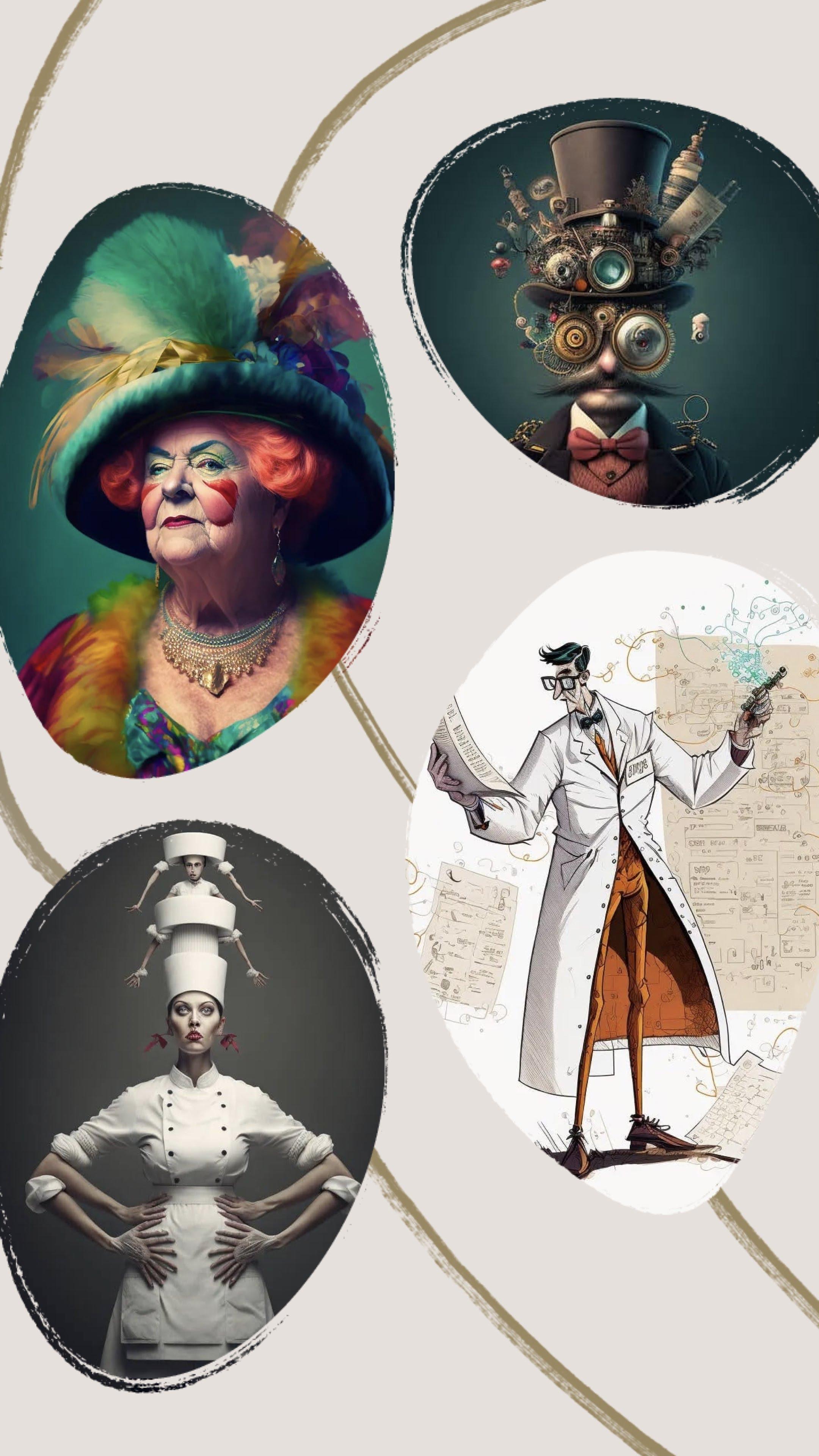
Zara and Yasmin, who took the left path, met a man named “Sproink” who was a small, wiry man with a spring for a tail. He was always bouncing around and speaking in a language that sounded like a mix of gibberish and music. Sproink was a collector of shiny objects and had a bag full of them, he was also a scavenger, always looking for things to add to his collection. He was wearing a small top hat and a monocle. He was also known to be a bit of a thief and a con artist.
Xavier and Youssef, who took the right path, met a woman named “Flibbertigibbet” a tall, slender woman that had multiple arms. Flibbertigibbet was very talkative and friendly, always trying to strike up a conversation. She spoke in a language that sounded like a mix of gibberish and baby talk. She was a chef and was always carrying a pot and a spoon, but she also had a dark side, she was known to be a bit of a manipulator and a spy, always observing and gathering information for a mysterious organization. She was wearing a big chef hat and apron.
As the group met back at the fork, they were surprised to find that Sproink and Flibbertigibbet had also met there. The four new characters joined the group, and together they continued their journey to find the “Key of Quirks”. Along the way, they met two more characters;
They met a man named “Gibber” who was a tall, gaunt man with elongated limbs and fingers. He was always speaking in a language that sounded like a mix of gibberish and numbers. He was a mathematician and a scientist, always working on complex equations and theories. He was known to be a bit of a loner, and didn’t interact much with others. He was wearing a lab coat and goggles.
They also met a woman named “Glimmer” she was a short, plump woman with a shimmering skin that seemed to change color depending on the light. She was always speaking in a language that sounded like a mix of gibberish and poetry. She was an artist and a performer, always creating and performing in different shows. She was known to be a bit of a flirt and a bit of a drama queen. She was wearing a colorful and eccentric clothing, such as a flowy dress and a large hat adorned with feathers.
As the group journeyed on, they encountered more characters, each one with their own unique quirks and personalities. They met a variety of people, some friendly and some not so friendly, but all of them adding to the mysterious and unknown nature of the Land of the Quirks.
As the group reached the end of their journey and found the “Key of Quirks”, they realized that the key was not just a physical object but a symbol of acceptance and embracing individuality. They learned that the true key to leaving the Land of the Quirks was understanding and accepting the quirks of oneself and others.
The group had a bittersweet goodbye with their new friends, Sproink, Flibbertigibbet, Gibber and Glimmer, and the other characters they had met. They knew that they would always carry a piece of the Land of the Quirks with them and would always remember the mysterious and eccentric adventure they had.
 January 11, 2023 at 11:53 pm #6372
In reply to: Train your subjective AI – text version
5 important keywords linked to Badul
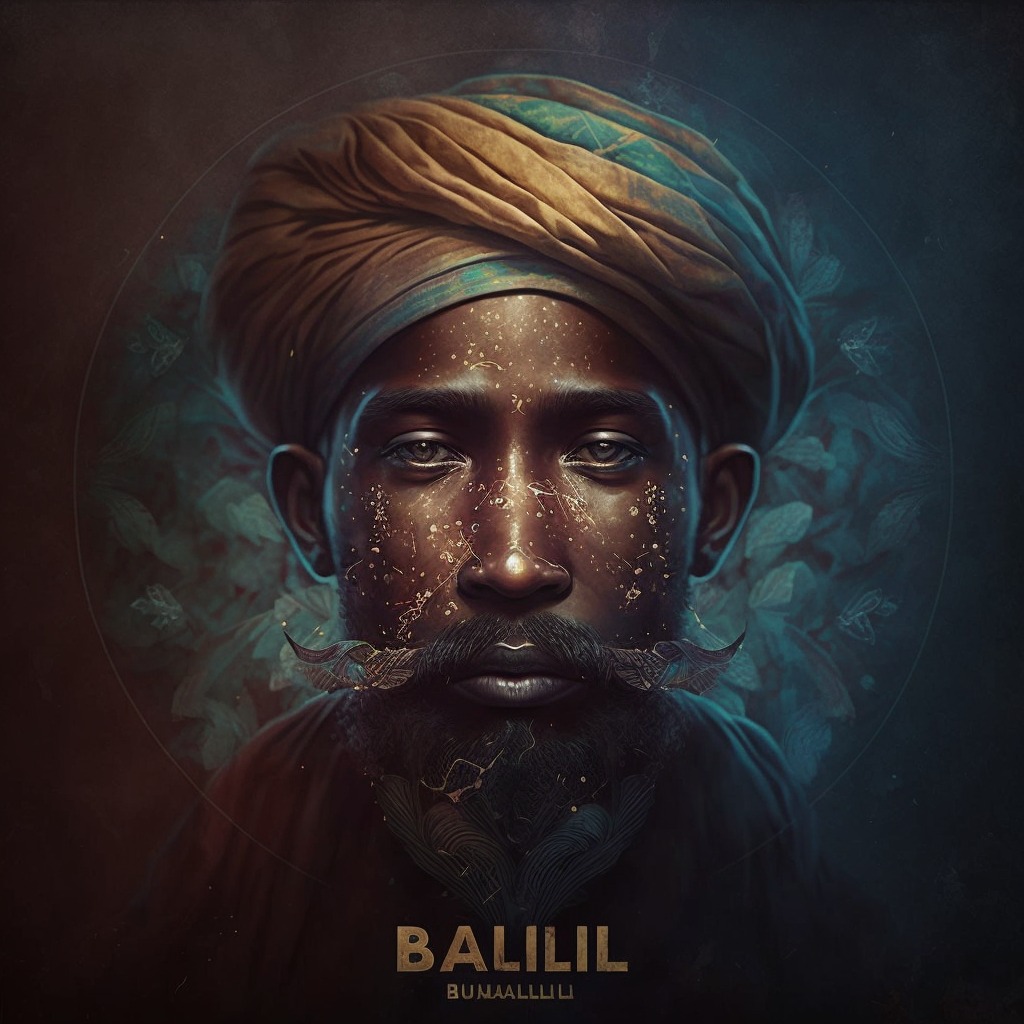
- Action-space-time
- Harmonic fluid
- Rhythm
- Scale
- Choosing without limits.
Imagine four friends, Jib, Franci, Tracy, and Eric, who are all deeply connected through their shared passion for music and performance. They often spend hours together creating and experimenting with different sounds and rhythms.
One day, as they were playing together, they found that their combined energy had created a new essence, which they named Badul. This new essence was formed from the unique combination of their individual energies and personalities, and it quickly grew in autonomy and began to explore the world around it.
As Badul began to explore, it discovered that it had the ability to understand and create complex rhythms, and that it could use this ability to bring people together and help them find a sense of connection and purpose.
As Badul traveled, it would often come across individuals who were struggling to find their way in life. It would use its ability to create rhythm and connection to help these individuals understand themselves better and make the choices that were right for them.
In the scene, Badul is exploring a city, playing with the rhythms of the city, through the traffic, the steps of people, the ambiance. Badul would observe a person walking in the streets, head down, lost in thoughts. Badul would start playing a subtle tune, and as the person hears it, starts to walk with the rhythm, head up, starting to smile.
As the person continues to walk and follow the rhythm created by Badul, he begins to notice things he had never noticed before and begins to feel a sense of connection to the world around him. The music created by Badul serves as a guide, helping the person to understand himself and make the choices that will lead to a happier, more fulfilled life.
In this way, Badul’s focus is to bring people together, to connect them to themselves and to the world around them through the power of rhythm and music, and to be an ally in the search of personal revelation and understanding.
January 11, 2023 at 9:43 pm #6367In reply to: Train your subjective AI – text version
Something in the style of TPooh:
The family tree was a tangled web of branches and roots, stretching back centuries and even millennia. The branches were thick with the leaves of secrets, scandals, and mysteries that the family had accumulated over the years. They were a close-knit group, friends for all time, and they loved nothing more than exploring the twists and turns of their family history.
They met regularly in their dreams, in a place they called The City, where they could exchange stories and clues they had uncovered during their waking hours. They often found themselves in the midst of strange and puzzling occurrences, and they would spend hours discussing the possible meanings and connections of these events. They saw the world as a tapestry, with each thread and pattern contributing to the greater picture. They were the weavers of their own story, the authors of their own fate.
But as the years went on, their dreams began to take on a darker and more ominous tone. They started having nightmares of monstrous beasts, and some of them even saw these beasts in the daylight, as if they were falling through the cracks in reality. They compared notes and found that they were often seeing the same beasts, and this led to heated debates about what these beasts represented and whether they were real or just figments of their imagination.
But no matter what they encountered, the family remained united in their quest to unravel the secrets of their past and to weave a tapestry that would be the envy of all. They were thick as thieves and they would never give up their pursuit of the truth, no matter how many rules they had to break along the way.
January 10, 2023 at 11:00 pm #6365In reply to: Train your subjective AI – text version
Prune has got me into this AI stuff… It sounds like gibberish to me, but Idle sounded amazed at the stuff it spewed out.
With some info on our family story, Prune got it to try and predict the future…
Sounds like a big plate of bog, but we’ll see how it goes.
Sure, here are a few possible events that could occur between Mater’s 100th birthday and her death in the Flying Fish Inn story:
- Mater decides to throw herself a grand birthday party, inviting all of her friends and family from the small outback town. However, things take a turn for the strange when a group of extraterrestrial beings crash the party and reveal themselves to be long-time fans of Mater’s famous bush tucker cuisine.
- Mater begins to experience vivid dreams and hallucinations, in which she is visited by the ghost of her late husband. As the dreams become more frequent, the family begins to suspect that there may be something more to them than just Mater’s mind playing tricks on her.
- Mater’s granddaughter Prune becomes increasingly obsessed with her dream of traveling to Mars, and begins to notice strange occurrences happening around the inn that seem to be connected to her aspiration.
- A group of eccentric scientists arrive at the inn, conducting research on the local flora and fauna. They eventually discover a species of sentient plants living in the area, and Mater becomes convinced that the plants are communicating with her in her dreams.
- With her health declining, Mater begins to spend more and more time tending to her garden, where she is visited by an old kookaburra who seems to possess an otherworldly intelligence. The bird becomes Mater’s companion and confidant in the final days of her life.
- As the Great Fires ravage the Australian bush, Mater makes the difficult decision to shut down the inn and evacuate the guests. But as they flee, they realize that the fire is not just a natural disaster, but something far more sinister and mystical.
- In her final days, Mater begins to remember strange and vivid details of her life that she never could have known, as if she lived a previous life in another time and place. As she dies, she whispers something to Prune, which opens her eyes to a new reality that may have been hidden from her all along
- It turns out the family had a lot of secrets, and the only way to escape it, was to leave the inn, but it was not an escape for all. Through the series of events, secrets are revealed, and some truths cannot be undone.Note that these events are fictional and whimsical in nature, but as they keeps it grounded to a sense of doldrums in the Australian bush and occasionally guests help to unravel some of the overarching mysteries it could make a fitting storyline for the story.
January 10, 2023 at 10:31 pm #6364In reply to: Train your subjective AI – text version
Please suggest a creative, a little ghostic but mostly uplifting plot outline for the continuation of the story of Twilight in her travels to join the freak circus and become famous for her craft on the west coast
— The Far-West saga — In 1850s, in a probable reality of South America, we get acquainted with Twilight (Twi) and her brothers Jo and Elroy. They have a precious blue bull in their possession, coveted by Ogrean, the kingpin of the town. Hopefully for them, Ogrean is arrested (temporarily) by Ted Marshall, the sheriff for his possible trafficking. Notably, Ogrean is possibly involved in some of the crystal skulls discoveries, during his travel to New Honduras. Twi who was dancing in the saloon of Madame Butterbutt, the town’s hallucinogenic toads-to-lick dispenser (insert some other romantic subplots involving the other dancer etc.) decides to go traveling in a freakus (freak show/circus). She is now close to the West Coast, where she hopes to succeed in her writing and other artistic skills.
As Twilight (Twi) travels with the freak circus, she faces many challenges and obstacles on her journey to the West Coast. Despite the difficulties, she remains determined to make a name for herself as a writer and artist.
As she travels through small towns and larger cities, she begins to realize that the world is much bigger than she ever imagined. She meets a diverse group of people, some of whom are kind and supportive, while others are cruel and dismissive of her dreams.
Despite the negative reactions she receives from some people, Twi persists and begins to gain a reputation as a talented writer and performer. As she gains more experience and confidence, she starts to incorporate her own unique style into her performances, which sets her apart from the other performers in the circus.
As she approaches the West Coast, she begins to feel a sense of excitement and anticipation. She has heard that the West Coast is a place of endless possibilities, where creative minds can thrive. She is determined to make her mark and become famous for her craft.
As she settles in the west, she finds herself surrounded by artists and writers like herself, who inspire her to push herself even further. She begins to gain a following and her writing is widely read. She discovers that her talent is not only limited to writing, but she also has a natural talent for other art forms as well.
Eventually, Twi’s reputation as a talented artist and writer precedes her and she becomes a sought-after performer in the West Coast, and her creative work is being showcased in galleries and theaters. As she continues to achieve success in her career, she begins to realize that the West Coast is not just a place of endless possibilities but also the place where she belongs, and the place where her dreams come true.
Throughout her journey, she also keeps in touch with her brothers, Jo and Elroy, who now run the farm and take care of the blue bull. They tell her that the bull, now named Blue-Dream, became a legend in the village and they get a good price for its breeding.
As the story continues, she finds herself also involved in some adventures and exciting subplots, like discovering a secret underground cave filled with precious crystals and some interesting characters, like the enigmatic sheriff Ted Marshall who always cross her path, and the mysterious Ogrean who seems to have a connection to her past and the bull.
The End.
November 14, 2022 at 12:09 pm #6346In reply to: Family Stories From The Other Side ~ Book Two
The Mormon Browning Who Went To Utah
Isaac Browning’s (1784-1848) sister Hannah married Francis Buckingham. There were at least three Browning Buckingham marriages in Tetbury. Their daughter Charlotte married James Paskett, a shoemaker. Charlotte was born in 1818 and in 1871 she and her family emigrated to Utah, USA.
Charlotte’s relationship to me is first cousin five times removed.
James and Charlotte: (photos found online)
The house of James and Charlotte in Tetbury:
The home of James and Charlotte in Utah:
Obituary:
James Pope Paskett Dead.
Veteran of 87 Laid to rest. Special Correspondence Coalville, Summit Co., Oct 28—James Pope Paskett of Henefer died Oct. 24, 1903 of old age and general debility. Funeral services were held at Henefer today. Elders W.W. Cluff, Alma Elderge, Robert Jones, Oscar Wilkins and Bishop M.F. Harris were the speakers. There was a large attendance many coming from other wards in the stake. James Pope Paskett was born in Chippenham, Wiltshire, England, on March 12, 1817; married Chalotte Buckingham in the year 1839; eight children were born to them, three sons and five daughters, all of whom are living and residing in Utah, except one in Brisbane, Australia. Father Paskett joined the church of Jesus Christ of Latter Day Saints in 1847, and emigrated to Utah in 1871, and has resided in Henefer ever since. He leaves his faithful and aged wife. He was respected and esteemed by all who knew him.
Charlotte died in Henefer, Utah, on 27th December 1910 at the age of 91.
James and Charlotte in later life:
November 13, 2022 at 10:29 pm #6345In reply to: Family Stories From The Other Side ~ Book Two
Crime and Punishment in Tetbury
I noticed that there were quite a number of Brownings of Tetbury in the newspaper archives involved in criminal activities while doing a routine newspaper search to supplement the information in the usual ancestry records. I expanded the tree to include cousins, and offsping of cousins, in order to work out who was who and how, if at all, these individuals related to our Browning family.
I was expecting to find some of our Brownings involved in the Swing Riots in Tetbury in 1830, but did not. Most of our Brownings (including cousins) were stone masons. Most of the rioters in 1830 were agricultural labourers.
The Browning crimes are varied, and by todays standards, not for the most part terribly serious ~ you would be unlikely to receive a sentence of hard labour for being found in an outhouse with the intent to commit an unlawful act nowadays, or for being drunk.
The central character in this chapter is Isaac Browning (my 4x great grandfather), who did not appear in any criminal registers, but the following individuals can be identified in the family structure through their relationship to him.
RICHARD LOCK BROWNING born in 1853 was Isaac’s grandson, his son George’s son. Richard was a mason. In 1879 he and Henry Browning of the same age were sentenced to one month hard labour for stealing two pigeons in Tetbury. Henry Browning was Isaac’s nephews son.
In 1883 Richard Browning, mason of Tetbury, was charged with obtaining food and lodging under false pretences, but was found not guilty and acquitted.
In 1884 Richard Browning, mason of Tetbury, was sentenced to one month hard labour for game trespass.Richard had been fined a number of times in Tetbury:
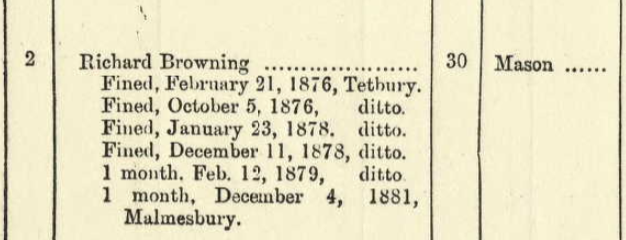
Richard Lock Browning was five feet eight inches tall, dark hair, grey eyes, an oval face and a dark complexion. He had two cuts on the back of his head (in February 1879) and a scar on his right eyebrow.
HENRY BROWNING, who was stealing pigeons with Richard Lock Browning in 1879, (Isaac’s brother Williams grandson, son of George Browning and his wife Charity) was charged with being drunk in 1882 and ordered to pay a fine of one shilling and costs of fourteen shillings, or seven days hard labour.
Henry was found guilty of gaming in the highway at Tetbury in 1872 and was sentenced to seven days hard labour. In 1882 Henry (who was also a mason) was charged with assault but discharged.
Henry was five feet five inches tall, brown hair and brown eyes, a long visage and a fresh complexion.
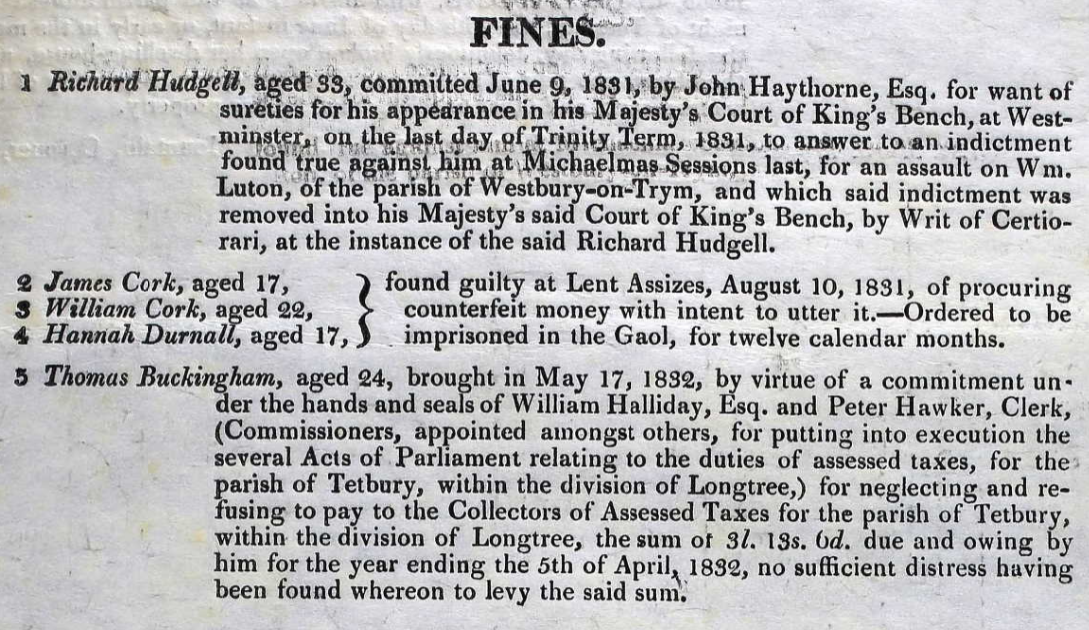
Henry emigrated with his daughter to Canada in 1913, and died in Vancouver in 1919.THOMAS BUCKINGHAM 1808-1846 (Isaacs daughter Janes husband) was charged with stealing a black gelding in Tetbury in 1838. No true bill. (A “no true bill” means the jury did not find probable cause to continue a case.)
Thomas did however neglect to pay his taxes in 1832:
LEWIN BUCKINGHAM (grandson of Isaac, his daughter Jane’s son) was found guilty in 1846 stealing two fowls in Tetbury when he was sixteen years old.
In 1846 he was sentence to one month hard labour (or pay ten shillings fine and ten shillings costs) for loitering with the intent to trespass in search of conies.
A year later in 1847, he and three other young men were sentenced to four months hard labour for larceny.
Lewin was five feet three inches tall, with brown hair and brown eyes, long visage, sallow complexion, and had a scar on his left arm.JOHN BUCKINGHAM born circa 1832, a Tetbury labourer (Isaac’s grandson, Lewin’s brother) was sentenced to six weeks hard labour for larceny in 1855 for stealing a duck in Cirencester. The notes on the register mention that he had been employed by Mr LOCK, Angel Inn. (John’s grandmother was Mary Lock so this is likely a relative).
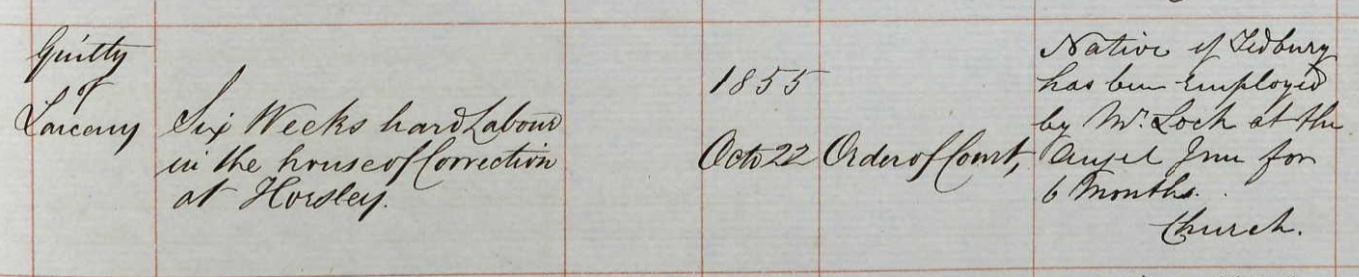
The previous year in 1854 John was sentenced to one month or a one pound fine for assaulting and beating W. Wood.
John was five feet eight and three quarter inches tall, light brown hair and grey eyes, an oval visage and a fresh complexion. He had a scar on his left arm and inside his right knee.JOSEPH PERRET was born circa 1831 and he was a Tetbury labourer. (He was Isaac’s granddaughter Charlotte Buckingham’s husband)
In 1855 he assaulted William Wood and was sentenced to one month or a two pound ten shilling fine. Was it the same W Wood that his wifes cousin John assaulted the year before?
In 1869 Joseph was sentenced to one month hard labour for feloniously receiving a cupboard known to be stolen.JAMES BUCKINGAM born circa 1822 in Tetbury was a shoemaker. (Isaac’s nephew, his sister Hannah’s son)
In 1854 the Tetbury shoemaker was sentenced to four months hard labour for stealing 30 lbs of lead off someones house.
In 1856 the Tetbury shoemaker received two months hard labour or pay £2 fine and 12 s costs for being found in pursuit of game.
In 1868 he was sentenced to two months hard labour for stealing a gander. A unspecified previous conviction is noted.
1871 the Tetbury shoemaker was found in an outhouse for an unlawful purpose and received ten days hard labour. The register notes that his sister is Mrs Cook, the Green, Tetbury. (James sister Prudence married Thomas Cook)
James sister Charlotte married a shoemaker and moved to UTAH.
James was five feet eight inches tall, dark hair and blue eyes, a long visage and a florid complexion. He had a scar on his forehead and a mole on the right side of his neck and abdomen, and a scar on the right knee.November 10, 2022 at 12:08 pm #6344In reply to: Family Stories From The Other Side ~ Book Two
The Tetbury Riots
While researching the Tetbury riots (I had found some Browning names in the newspaper archives in association with the uprisings) I came across an article called “Elizabeth Parker, the Swing Riots, and the Tetbury parish clerk” by Jill Evans.
I noted the name of the parish clerk, Daniel Cole, because I know someone else of that name. The incident in the article was 1830.
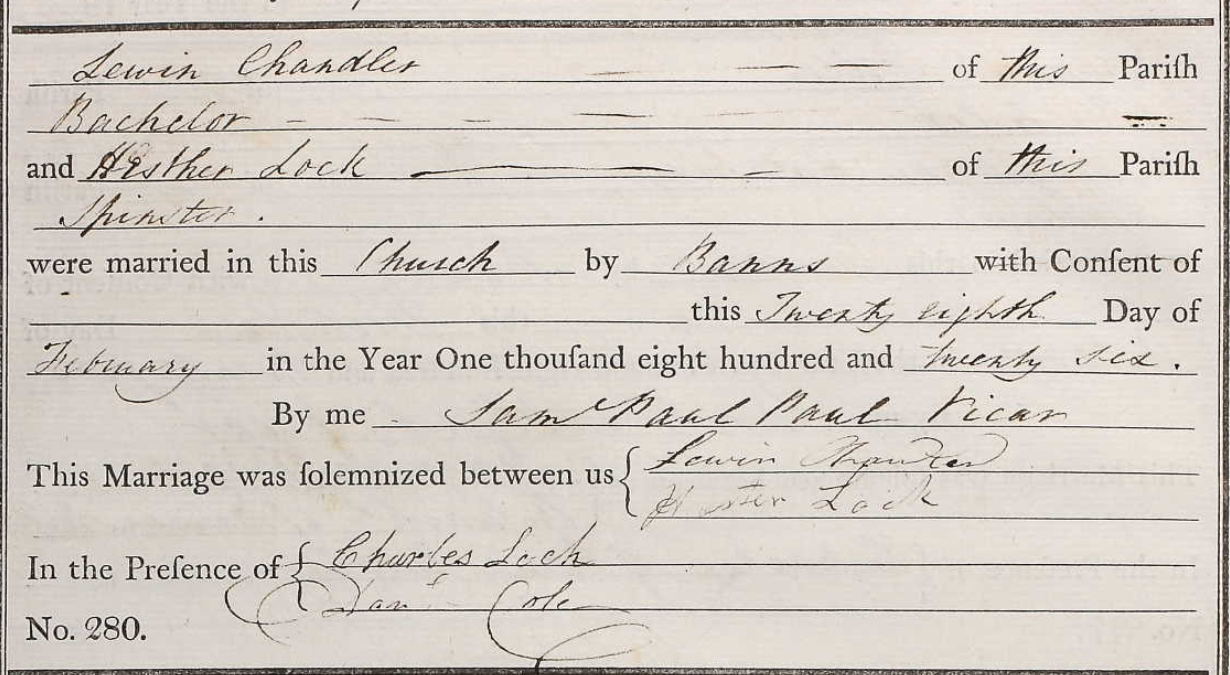
I found the 1826 marriage in the Tetbury parish registers (where Daniel was the parish clerk) of my 4x great grandmothers sister Hesther Lock. One of the witnesses was her brother Charles, and the other was Daniel Cole, the parish clerk.
Marriage of Lewin Chandler and Hesther Lock in 1826:
from the article:
“The Swing Riots were disturbances which took place in 1830 and 1831, mostly in the southern counties of England. Agricultural labourers, who were already suffering due to low wages and a lack of work after several years of bad harvests, rose up when their employers introduced threshing machines into their workplaces. The riots got their name from the threatening letters which were sent to farmers and other employers, which were signed “Captain Swing.”
The riots spread into Gloucestershire in November 1830, with the Tetbury area seeing the worst of the disturbances. Amongst the many people arrested afterwards was one woman, Elizabeth Parker. She has sometimes been cited as one of only two females who were transported for taking part in the Swing Riots. In fact, she was sentenced to be transported for this crime, but never sailed, as she was pardoned a few months after being convicted. However, less than a year after being released from Gloucester Gaol, she was back, awaiting trial for another offence. The circumstances in both of the cases she was tried for reveal an intriguing relationship with one Daniel Cole, parish clerk and assistant poor law officer in Tetbury….
….Elizabeth Parker was committed to Gloucester Gaol on 4 December 1830. In the Gaol Registers, she was described as being 23 and a “labourer”. She was in fact a prostitute, and she was unusual for the time in that she could read and write. She was charged on the oaths of Daniel Cole and others with having been among a mob which destroyed a threshing machine belonging to Jacob Hayward, at his farm in Beverstone, on 26 November.
…..Elizabeth Parker was granted royal clemency in July 1831 and was released from prison. She returned to Tetbury and presumably continued in her usual occupation, but on 27 March 1832, she was committed to Gloucester Gaol again. This time, she was charged with stealing 2 five pound notes, 5 sovereigns and 5 half sovereigns, from the person of Daniel Cole.
Elizabeth was tried at the Lent Assizes which began on 28 March, 1832. The details of her trial were reported in the Morning Post. Daniel Cole was in the “Boat Inn” (meaning the Boot Inn, I think) in Tetbury, when Elizabeth Parker came in. Cole “accompanied her down the yard”, where he stayed with her for about half an hour. The next morning, he realised that all his money was gone. One of his five pound notes was identified by him in a shop, where Parker had bought some items.
Under cross-examination, Cole said he was the assistant overseer of the poor and collector of public taxes of the parish of Tetbury. He was married with one child. He went in to the inn at about 9 pm, and stayed about 2 hours, drinking in the parlour, with the landlord, Elizabeth Parker, and two others. He was not drunk, but he was “rather fresh.” He gave the prisoner no money. He saw Elizabeth Parker next morning at the Prince and Princess public house. He didn’t drink with her or give her any money. He did give her a shilling after she was committed. He never said that he would not have prosecuted her “if it was not for her own tongue”. (Presumably meaning he couldn’t trust her to keep her mouth shut.)”
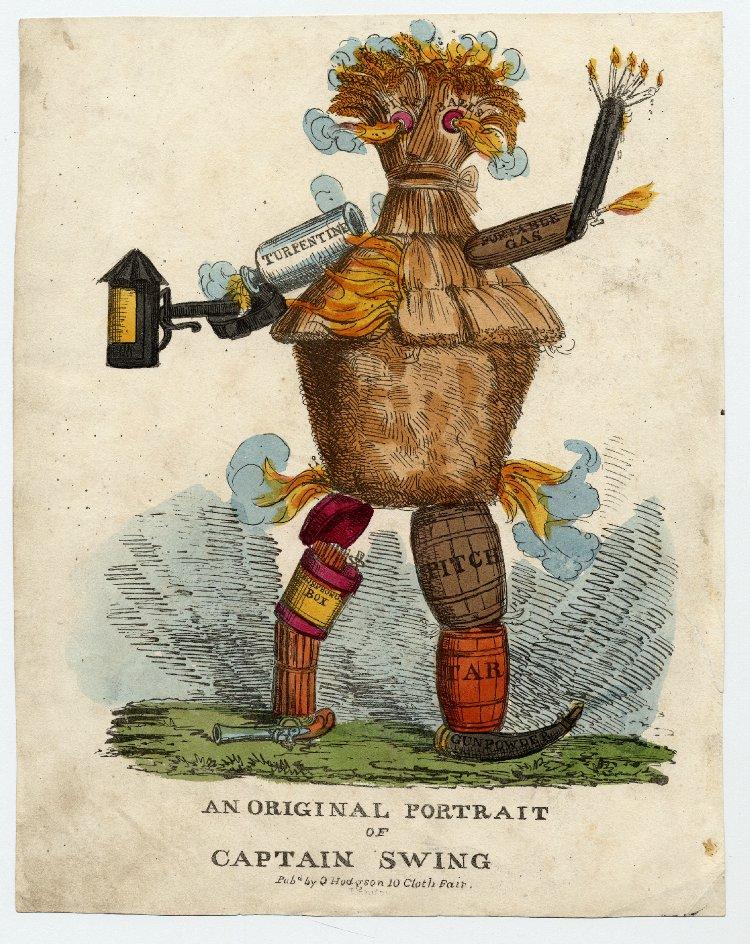
Contemporary illustration of the Swing riots:
Captain Swing was the imaginary leader agricultural labourers who set fire to barns and haystacks in the southern and eastern counties of England from 1830. Although the riots were ruthlessly put down (19 hanged, 644 imprisoned and 481 transported), the rural agitation led the new Whig government to establish a Royal Commission on the Poor Laws and its report provided the basis for the 1834 New Poor Law enacted after the Great Reform Bills of 1833.
An original portrait of Captain Swing hand coloured lithograph circa 1830:
 October 11, 2022 at 11:39 am #6333
In reply to: Family Stories From The Other Side ~ Book Two
The Grattidge Family
The first Grattidge to appear in our tree was Emma Grattidge (1853-1911) who married Charles Tomlinson (1847-1907) in 1872.
Charles Tomlinson (1873-1929) was their son and he married my great grandmother Nellie Fisher. Their daughter Margaret (later Peggy Edwards) was my grandmother on my fathers side.
Emma Grattidge was born in Wolverhampton, the daughter and youngest child of William Grattidge (1820-1887) born in Foston, Derbyshire, and Mary Stubbs, born in Burton on Trent, daughter of Solomon Stubbs, a land carrier. William and Mary married at St Modwens church, Burton on Trent, in 1839. It’s unclear why they moved to Wolverhampton. On the 1841 census William was employed as an agent, and their first son William was nine months old. Thereafter, William was a licensed victuallar or innkeeper.
William Grattidge was born in Foston, Derbyshire in 1820. His parents were Thomas Grattidge, farmer (1779-1843) and Ann Gerrard (1789-1822) from Ellastone. Thomas and Ann married in 1813 in Ellastone. They had five children before Ann died at the age of 25:
Bessy was born in 1815, Thomas in 1818, William in 1820, and Daniel Augustus and Frederick were twins born in 1822. They were all born in Foston. (records say Foston, Foston and Scropton, or Scropton)
On the 1841 census Thomas had nine people additional to family living at the farm in Foston, presumably agricultural labourers and help.
After Ann died, Thomas had three children with Kezia Gibbs (30 years his junior) before marrying her in 1836, then had a further four with her before dying in 1843. Then Kezia married Thomas’s nephew Frederick Augustus Grattidge (born in 1816 in Stafford) in London in 1847 and had two more!
The siblings of William Grattidge (my 3x great grandfather):
Frederick Grattidge (1822-1872) was a schoolmaster and never married. He died at the age of 49 in Tamworth at his twin brother Daniels address.
Daniel Augustus Grattidge (1822-1903) was a grocer at Gungate in Tamworth.
Thomas Grattidge (1818-1871) married in Derby, and then emigrated to Illinois, USA.
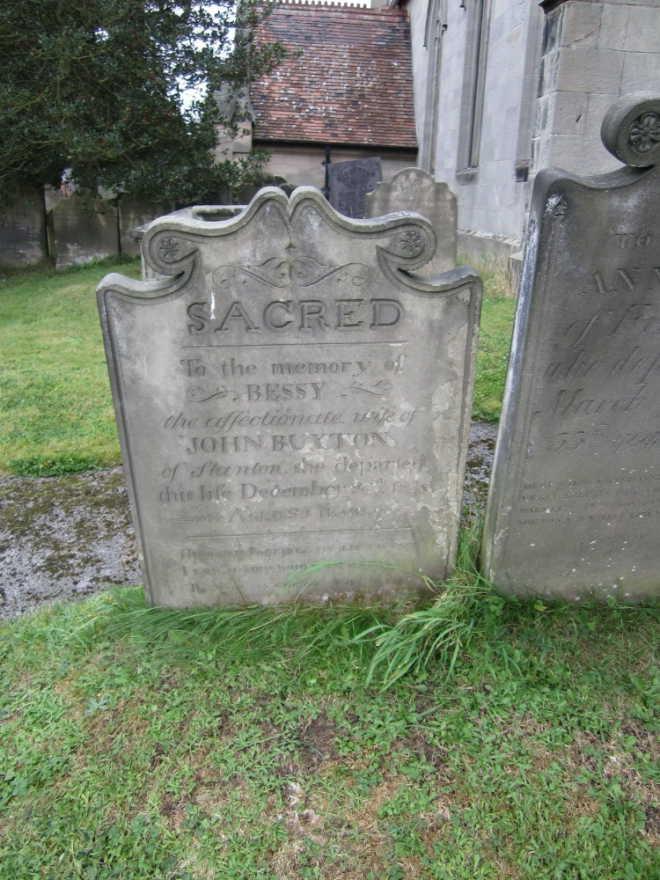
Bessy Grattidge (1815-1840) married John Buxton, farmer, in Ellastone in January 1838. They had three children before Bessy died in December 1840 at the age of 25: Henry in 1838, John in 1839, and Bessy Buxton in 1840. Bessy was baptised in January 1841. Presumably the birth of Bessy caused the death of Bessy the mother.
Bessy Buxton’s gravestone:
“Sacred to the memory of Bessy Buxton, the affectionate wife of John Buxton of Stanton She departed this life December 20th 1840, aged 25 years. “Husband, Farewell my life is Past, I loved you while life did last. Think on my children for my sake, And ever of them with I take.”
20 Dec 1840, Ellastone, Staffordshire
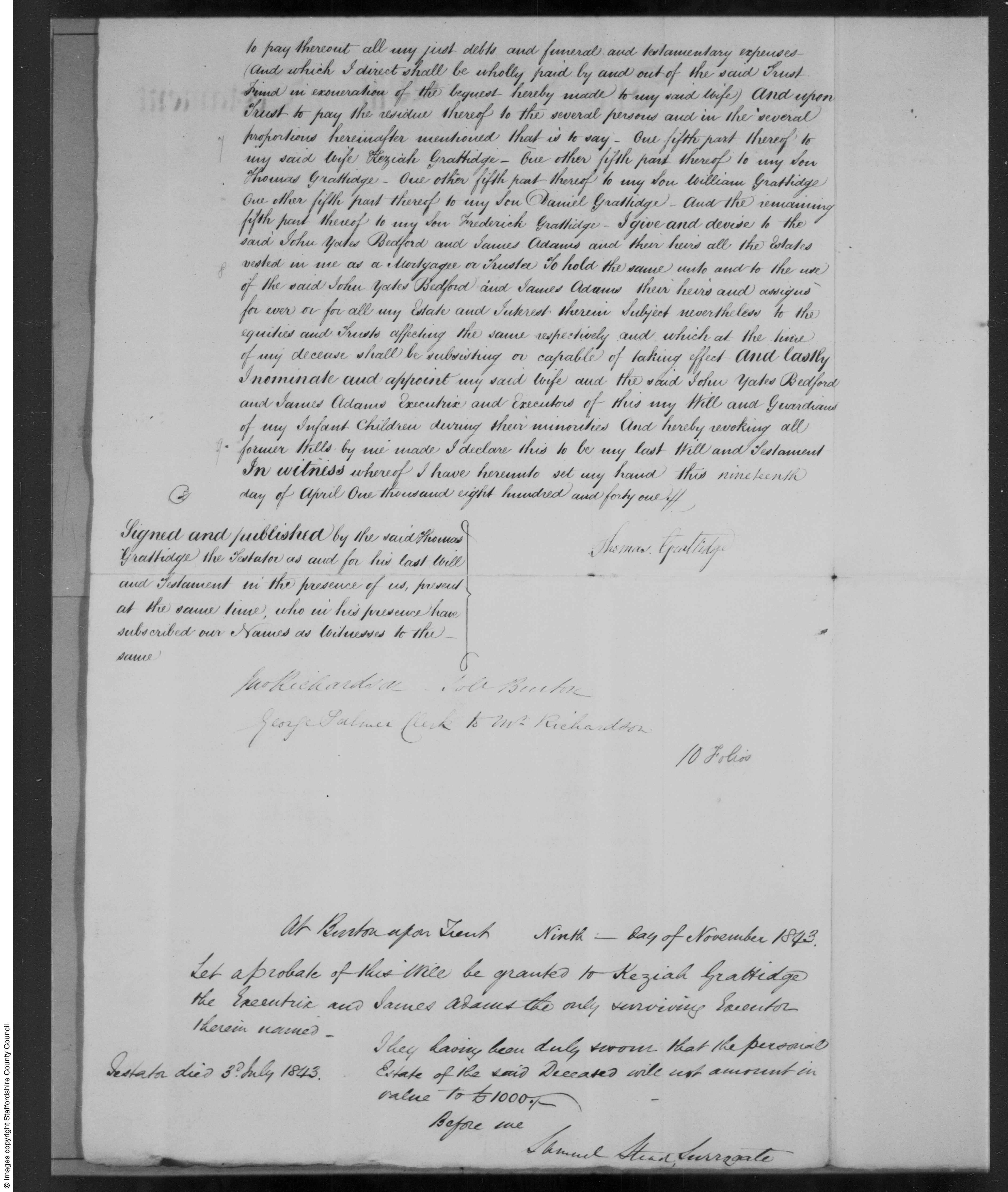
In the 1843 will of Thomas Grattidge, farmer of Foston, he leaves fifth shares of his estate, including freehold real estate at Findern, to his wife Kezia, and sons William, Daniel, Frederick and Thomas. He mentions that the children of his late daughter Bessy, wife of John Buxton, will be taken care of by their father. He leaves the farm to Keziah in confidence that she will maintain, support and educate his children with her.
An excerpt from the will:
I give and bequeath unto my dear wife Keziah Grattidge all my household goods and furniture, wearing apparel and plate and plated articles, linen, books, china, glass, and other household effects whatsoever, and also all my implements of husbandry, horses, cattle, hay, corn, crops and live and dead stock whatsoever, and also all the ready money that may be about my person or in my dwelling house at the time of my decease, …I also give my said wife the tenant right and possession of the farm in my occupation….
A page from the 1843 will of Thomas Grattidge:
William Grattidges half siblings (the offspring of Thomas Grattidge and Kezia Gibbs):
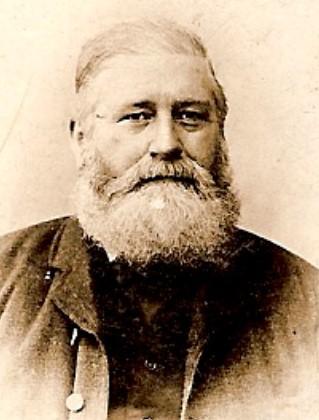
Albert Grattidge (1842-1914) was a railway engine driver in Derby. In 1884 he was driving the train when an unfortunate accident occured outside Ambergate. Three children were blackberrying and crossed the rails in front of the train, and one little girl died.
Albert Grattidge:
George Grattidge (1826-1876) was baptised Gibbs as this was before Thomas married Kezia. He was a police inspector in Derby.
George Grattidge:
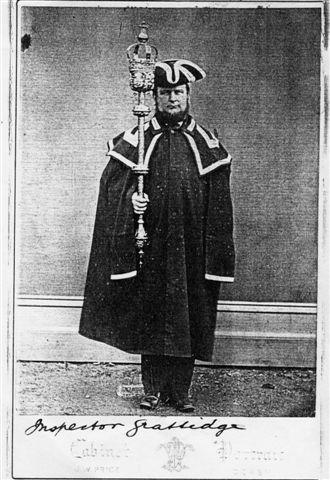
Edwin Grattidge (1837-1852) died at just 15 years old.
Ann Grattidge (1835-) married Charles Fletcher, stone mason, and lived in Derby.
Louisa Victoria Grattidge (1840-1869) was sadly another Grattidge woman who died young. Louisa married Emmanuel Brunt Cheesborough in 1860 in Derby. In 1861 Louisa and Emmanuel were living with her mother Kezia in Derby, with their two children Frederick and Ann Louisa. Emmanuel’s occupation was sawyer. (Kezia Gibbs second husband Frederick Augustus Grattidge was a timber merchant in Derby)
At the time of her death in 1869, Emmanuel was the landlord of the White Hart public house at Bridgegate in Derby.
The Derby Mercury of 17th November 1869:
“On Wednesday morning Mr Coroner Vallack held an inquest in the Grand
Jury-room, Town-hall, on the body of Louisa Victoria Cheeseborough, aged
33, the wife of the landlord of the White Hart, Bridge-gate, who committed
suicide by poisoning at an early hour on Sunday morning. The following
evidence was taken:Mr Frederick Borough, surgeon, practising in Derby, deposed that he was
called in to see the deceased about four o’clock on Sunday morning last. He
accordingly examined the deceased and found the body quite warm, but dead.
He afterwards made enquiries of the husband, who said that he was afraid
that his wife had taken poison, also giving him at the same time the
remains of some blue material in a cup. The aunt of the deceased’s husband
told him that she had seen Mrs Cheeseborough put down a cup in the
club-room, as though she had just taken it from her mouth. The witness took
the liquid home with him, and informed them that an inquest would
necessarily have to be held on Monday. He had made a post mortem
examination of the body, and found that in the stomach there was a great
deal of congestion. There were remains of food in the stomach and, having
put the contents into a bottle, he took the stomach away. He also examined
the heart and found it very pale and flabby. All the other organs were
comparatively healthy; the liver was friable.Hannah Stone, aunt of the deceased’s husband, said she acted as a servant
in the house. On Saturday evening, while they were going to bed and whilst
witness was undressing, the deceased came into the room, went up to the
bedside, awoke her daughter, and whispered to her. but what she said the
witness did not know. The child jumped out of bed, but the deceased closed
the door and went away. The child followed her mother, and she also
followed them to the deceased’s bed-room, but the door being closed, they
then went to the club-room door and opening it they saw the deceased
standing with a candle in one hand. The daughter stayed with her in the
room whilst the witness went downstairs to fetch a candle for herself, and
as she was returning up again she saw the deceased put a teacup on the
table. The little girl began to scream, saying “Oh aunt, my mother is
going, but don’t let her go”. The deceased then walked into her bed-room,
and they went and stood at the door whilst the deceased undressed herself.
The daughter and the witness then returned to their bed-room. Presently
they went to see if the deceased was in bed, but she was sitting on the
floor her arms on the bedside. Her husband was sitting in a chair fast
asleep. The witness pulled her on the bed as well as she could.
Ann Louisa Cheesborough, a little girl, said that the deceased was her
mother. On Saturday evening last, about twenty minutes before eleven
o’clock, she went to bed, leaving her mother and aunt downstairs. Her aunt
came to bed as usual. By and bye, her mother came into her room – before
the aunt had retired to rest – and awoke her. She told the witness, in a
low voice, ‘that she should have all that she had got, adding that she
should also leave her her watch, as she was going to die’. She did not tell
her aunt what her mother had said, but followed her directly into the
club-room, where she saw her drink something from a cup, which she
afterwards placed on the table. Her mother then went into her own room and
shut the door. She screamed and called her father, who was downstairs. He
came up and went into her room. The witness then went to bed and fell
asleep. She did not hear any noise or quarrelling in the house after going
to bed.Police-constable Webster was on duty in Bridge-gate on Saturday evening
last, about twenty minutes to one o’clock. He knew the White Hart
public-house in Bridge-gate, and as he was approaching that place, he heard
a woman scream as though at the back side of the house. The witness went to
the door and heard the deceased keep saying ‘Will you be quiet and go to
bed’. The reply was most disgusting, and the language which the
police-constable said was uttered by the husband of the deceased, was
immoral in the extreme. He heard the poor woman keep pressing her husband
to go to bed quietly, and eventually he saw him through the keyhole of the
door pass and go upstairs. his wife having gone up a minute or so before.
Inspector Fearn deposed that on Sunday morning last, after he had heard of
the deceased’s death from supposed poisoning, he went to Cheeseborough’s
public house, and found in the club-room two nearly empty packets of
Battie’s Lincoln Vermin Killer – each labelled poison.Several of the Jury here intimated that they had seen some marks on the
deceased’s neck, as of blows, and expressing a desire that the surgeon
should return, and re-examine the body. This was accordingly done, after
which the following evidence was taken:Mr Borough said that he had examined the body of the deceased and observed
a mark on the left side of the neck, which he considered had come on since
death. He thought it was the commencement of decomposition.
This was the evidence, after which the jury returned a verdict “that the
deceased took poison whilst of unsound mind” and requested the Coroner to
censure the deceased’s husband.The Coroner told Cheeseborough that he was a disgusting brute and that the
jury only regretted that the law could not reach his brutal conduct.
However he had had a narrow escape. It was their belief that his poor
wife, who was driven to her own destruction by his brutal treatment, would
have been a living woman that day except for his cowardly conduct towards
her.The inquiry, which had lasted a considerable time, then closed.”
In this article it says:
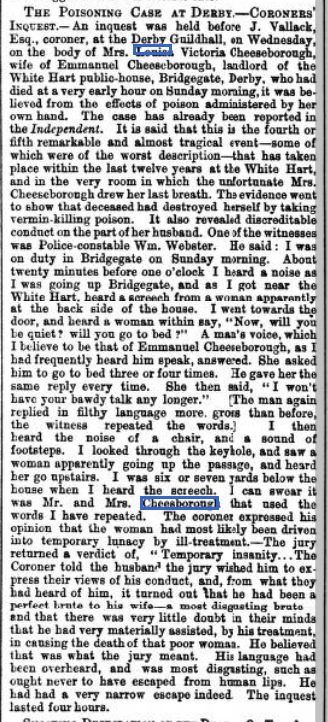
“it was the “fourth or fifth remarkable and tragical event – some of which were of the worst description – that has taken place within the last twelve years at the White Hart and in the very room in which the unfortunate Louisa Cheesborough drew her last breath.”
Sheffield Independent – Friday 12 November 1869:
 September 4, 2022 at 6:00 pm #6326
In reply to: The Sexy Wooden Leg
Stung by Egberts question, Olga reeled and almost lost her footing on the stairs. What had happened to her? That damned selfish individualism that was running rampant must have seeped into her room through the gaps in the windows or under the door. “No!” she shouted, her voice cracking.
“Say it isn’t true, Olga,” Egbert said, his voice breaking. “Not you as well.”
It took Olga a minute or two to still her racing heart. The near fall down the stairs had shaken her but with trembling hands she levered herself round to sit beside Egbert on the step.
Gripping his bony knee with her knobbly arthritic fingers, she took a deep breath.
“You are right to have said that, Egbert. If there is one thing we must hold onto, it’s our hearts. Nothing else matters, or at least nothing else matters as much as that. We are old and tired and we don’t like change. But if we escalate the importance of this frankly dreary and depressing home to the point where we lose our hearts…” she faltered and continued. “We will be homeless soon, very soon, and we know not what will happen to us. We must trust in the kindness of strangers, we must hope they have a heart.”
Egbert winced as Olga squeezed his knee. “And that is why”, Olga continued, slapping Egberts thigh with gusto, “We must have a heart…”
“If you’d just stop squeezing and hitting me, Olga…”
Olga loosened her grip on the old mans thigh bone and peered into his eyes. Quietly she thanked him. “You’ve cleared my mind and given me something to live for, and I thank you for that. But you do need to launder your clothes more often,” she added, pulling a face. She didn’t want the old coot to start blubbing, and he looked alarmingly close to tears.
“Come on, let’s go and see Obadiah. We’re all in this together. Homelessness and adventure can wait until tomorrow.” Olga heaved herself upright with a surprising burst of vitality. Noticing a weak smile trembling on Egberts lips, she said “That’s the spirit!”
July 12, 2022 at 2:00 am #6318In reply to: The Sexy Wooden Leg
“You’d better sit down,” said Olga gesturing to the end of her bed. As a rule, she did not have visitors so she saw no need to clutter up the available space in her tiny room with an extra chair. A large proportion of her life was spent in her armchair and she was content that way. While Egbert perched on the end of the bed, she lowered herself into the soft and familiar confines of her armchair and felt instantly soothed. It was true, sometimes she felt a tinge of regret when she considered how disappointed her younger self would be to see her now. But she hadn’t lived through what I’ve lived through so she can mind her own damn business,” she thought.
“It is just a story, twisted in the telling I expect.” Olga knew her voice held no conviction.
Egbert opened his mouth as though to speak. Closed it again.
“You look like a fish,” said Olga folding her arms.
“They say you and the Mayor go back a long way. Are you telling me that is not true?
“And what if we do?”
“You know he is Ursula’s uncle and a very powerful man. They say even the great president Voldomeer Zumbaskee holds him in great regard. They say …”
“Pfft! They say!” snapped Olga. “Who are these chattering fools you listen to, Egbert Gofindlevsky? I’d rather end up on the streets than ask a favour from that mountebank.”
Egbert jumped up from the bed and shook a fist at her. “And end up on the streets you will, Olga Herringbonevsky, along with the rest of us. You really want that on your conscience?”
July 10, 2022 at 2:36 am #6317In reply to: The Sexy Wooden Leg
The sharp rat-a-tat on the door startled Olga Herringbonevsky. The initial surprise quickly turned to annoyance. It was 11am and she wasn’t expecting a knock on the door at 11am. At 10am she expected a knock. It would be Larysa with the lukewarm cup of tea and a stale biscuit. Sometimes Olga complained about it and Larysa would say, Well you’re on the third floor so what do you expect? And she’d look cross and pour the tea so some of it slopped into the saucer. So the biscuits go stale on the way up do they? Olga would mutter. At 10:30am Larysa would return to collect the cup and saucer. I can’t do this much longer, she’d say. I’m not young any more and all these damn stairs. She’d been saying that for as long as Olga could remember.
For a moment, Olga contemplated ignoring the intrusion but the knocking started up again, this time accompanied by someone shouting her name.
With a very loud sigh, she put her book on the side table, face down so she would not lose her place for it was a most enjoyable whodunit, and hauled herself up from the chair. Her ankle was not good since she’d gone over on it the other day and Olga was in a very poor mood by the time she reached the door.
“Yes?” She glowered at Egbert.
“Have you seen this?” Egbert was waving a piece of paper at her.
“No,” Olga started to close the door.
“Olga stop!” Egbert’s face had reddened and Olga wondered if he might cry. Again, he waved the piece of paper in her face and then let his hand fall defeated to his side. “Olga, it’s bad news. You should have got a letter .”
Olga glanced at the pile of unopened letters on her dresser. It was never good news. She couldn’t be bothered with letters any more.
“Well, Egbert, I suppose you’d better come in”.
“That Ursula has a heart of steel,” said Olga when she’d heard the news.
“Pfft,” said Egbert. “She has no heart. This place has always been about money for her.”
“It’s bad times, Egbert. Bad times.”
Egbert nodded. “It is, Olga. But there must be something we can do.” He pursed his lips and Olga noticed that he would not meet her eyes.
“What? Spit it out, Old Man.”
He looked at her briefly before his eyes slid back to the dirty grey carpet. “I have heard stories, Olga. That you are … well connected. That you know people.”
Olga noticed that it had become difficult to breathe. Seeing Egbert looking at her with concern, she made an effort to steady herself. She took an extra big gasp of air and pointed to the book face-down on the side table. “That is a very good book I am reading. You may borrow it when I have finished.”
Egbert nodded. “Thank you.” he said and they both stared at the book.
“It was a long time ago, Egbert. And no business of anyone else.” Olga knew her voice was sharp but not sharp enough it seemed as Egbert was not done yet with all his prying words.
“Olga, you said it yourself. These are bad times. And desperate measures are needed or we will all perish.” Now he looked her in the eyes. “Old woman, swallow your pride. You must save yourself and all of us here.”
July 7, 2022 at 9:00 am #6314In reply to: The Sexy Wooden Leg
After her visit to the witch of the woods to get some medicine for her Mum who still had bouts of fatigue from her last encounter with the flu, the little Maryechka went back home as instructed.
She found her home empty. Her parents were busy in the fields, as the time of harvest was near, and much remained to be done to prepare, and workers were limited.
She left the pouch of dried herbs in the cabinet, and wondered if she should study. The schools were closed for early holidays, and they didn’t really bother with giving them much homework. She could see the teachers’ minds were worried with other things.
Unlike other children of her age, she wasn’t interested in all the activities online, phone-stuff. The other gen-alpha kids didn’t even bother mocking her “IRL”, glued to their screens while she instead enjoyed looking at the clear blue sky. For all she knew they didn’t even realize they were living in the same world. Now, they were probably over-stressed looking at all the news on replay.
For Maryechka, the war felt far away, even if you could see some of its impacts, with people moving about the nearby town.Looking as it was still early in the day, and she had plenty more time left before having to prepare for dinner, she thought it’d be nice to go and visit her grand-parent and their friends at the old people’s home. They always had nice stale biscuits to share, and they told the strangest stories all the time.
It was just a 15 min walk from the farm, so she’d be there and back in no time.
July 6, 2022 at 11:05 am #6312In reply to: The Sexy Wooden Leg
When she’d heard of the miracle happening at the Flovlinden Tree, Egna initially shrugged it off as another conman’s attempt at fooling the crowds.
“No, it’s real, my Auntie saw it.”
“Stop fretting” she’d told the little girl, as she was carefully removing the lice from her hair. “This is just someone’s idea of a smart joke. Don’t get fooled, you’re smarter than this.”
She sure wasn’t responsible for that one. If that were a true miracle, she would have known. The little calf next week being resuscitated after being dead a few minutes, well, that was her. Shame nobody was even there to notice. Most of the best miracles go about this way anyway.
So, after having lived close to a millennia in relatively rock solid health and with surprisingly unaging looks, Egna had thought she’d seen it all; at least last time the tree started to ooze sacred oil, it didn’t last for too long, people’s greed starting to sell it stopped it right in its tracks.
But maybe there was more to it this time. Egna’d often wondered why God had let her live that long. She was a useful instrument to Her for sure, but living in secrecy, claiming no ownership, most miracles were just facts of life. She somehow failed to see the point, even after 957 years of existence.
The little girl had left to go back to her nearby town. This side of the country was still quite safe from all the craziness. Egna knew well most of the branches of the ancestral trees leading to that particular little leaf. This one had probably no idea she shared a common ancestor with President Voldomeer, but Egna remembered the fellow. He was a clogmaker in the turn of the 18th century, as was his father before. That was until a rather unexpected turn of events precipitated him to a different path as his brother.
She had a book full of these records, as she’d tracked the lives of many, to keep them alive, and maybe remind people they all share so much in common. That is, if people were able to remember more than 2 generations before them.
“Well, that’s set.” she said to herself and to Her as She’s always listening “I’ll go and see for myself.”
her trusty old musty cloak at the door seemed to have been begging for the journey.July 6, 2022 at 9:47 am #6310In reply to: The Sexy Wooden Leg
Olek wished he wasn’t so easy to find.
The old caretaker of the shrine of Saint Edigna couldn’t have chosen a less conspicuous place to live in this warring time. People were flocking from afar, more and more each day drawn about by the ancient place, and the sacred oil bleeding linden tree which had suddenly and quite miraculously resumed its flow in the midst of the ambiant chaos started by the war.
It wasn’t always like this. A few months ago, the linden tree was just an old linden tree that may or may not have been miraculous, if the old wifes’ tales were to be trusted. Mankind’s memory is a flimsy thing as it occurs, and while for many generations before, speculations had abounded about whether or not the Saint was real, had such or such filiation, et cætera— it now seemed the old tales that were passed down from mother to children had managed to keep alive a knowledge that had but all dried up on old flaky parchments scribbled in pale inks that kept eluding old scholars’ exegesis.
Olek himself wasn’t a learned man. A man of faith, he was a little — more by upbringing than by choice, and by slow attunement to nature it would seem. Over the years, he’d be servicing the country in many ways, and after a rather long carrier started at young age, he had finally managed to retire in this place.
He thought he’d be left alone, to care for a little garden patch, checking in from times to times on the old grumpy neighbours, but alas, the Holy Nation’s destiny still had something in store for him.The latest pilgrim family had brought a message. It was another push to action. “Plan acceleration needs to happen”.
“What clucking plan again?” was his first reaction. Bad temper had a way of flaring right up his vents as in old times. When he’d calmed down, he wondered if he had ever seen a call for slowing down in his life. People were always so busy mindlessly carting around, bumping into the darkness.He smiled thinking of something his old man used to say. He’d never planned for a thing in his life, and was always very carefree it was often scary. His mantra was “People are always getting prepared for the wrong things. They never can prepare for the unexpected, and surely enough, only the unexpected happens.”
That sort of chaos paddling approach to life didn’t seem to bring him any sort of extraordinary success, and while he had the same mixed bag of ups and downs as the rest of his compatriots, just so much less did he suffer for the same result! Olek guessed that was the whole point, even if he really couldn’t accept it until much later in life.Maybe Olek would start playing by his father’s book. Until he could find a way to get lost behind enemy lines.
July 1, 2022 at 9:51 am #6306In reply to: The Elusive Samuel Housley and Other Family Stories
Looking for Robert Staley
William Warren (1835-1880) of Newhall (Stapenhill) married Elizabeth Staley (1836-1907) in 1858. Elizabeth was born in Newhall, the daughter of John Staley (1795-1876) and Jane Brothers. John was born in Newhall, and Jane was born in Armagh, Ireland, and they were married in Armagh in 1820. Elizabeths older brothers were born in Ireland: William in 1826 and Thomas in Dublin in 1830. Francis was born in Liverpool in 1834, and then Elizabeth in Newhall in 1836; thereafter the children were born in Newhall.
Marriage of John Staley and Jane Brothers in 1820:
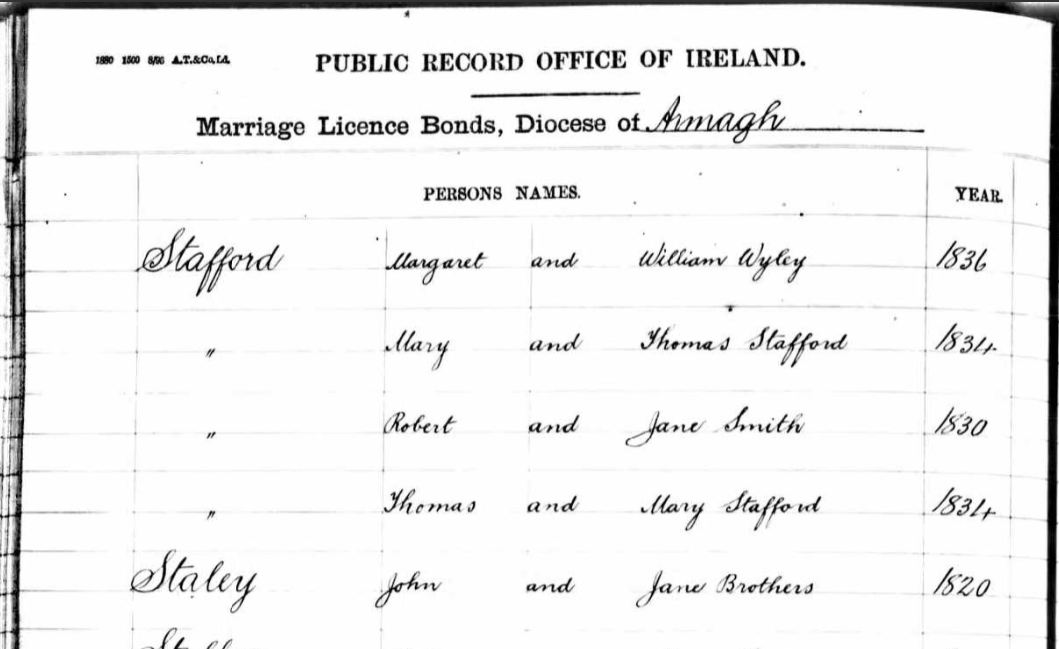
My grandmother related a story about an Elizabeth Staley who ran away from boarding school and eloped to Ireland, but later returned. The only Irish connection found so far is Jane Brothers, so perhaps she meant Elizabeth Staley’s mother. A boarding school seems unlikely, and it would seem that it was John Staley who went to Ireland.
The 1841 census states Jane’s age as 33, which would make her just 12 at the time of her marriage. The 1851 census states her age as 44, making her 13 at the time of her 1820 marriage, and the 1861 census estimates her birth year as a more likely 1804. Birth records in Ireland for her have not been found. It’s possible, perhaps, that she was in service in the Newhall area as a teenager (more likely than boarding school), and that John and Jane ran off to get married in Ireland, although I haven’t found any record of a child born to them early in their marriage. John was an agricultural labourer, and later a coal miner.
John Staley was the son of Joseph Staley (1756-1838) and Sarah Dumolo (1764-). Joseph and Sarah were married by licence in Newhall in 1782. Joseph was a carpenter on the marriage licence, but later a collier (although not necessarily a miner).
The Derbyshire Record Office holds records of an “Estimate of Joseph Staley of Newhall for the cost of continuing to work Pisternhill Colliery” dated 1820 and addresssed to Mr Bloud at Calke Abbey (presumably the owner of the mine)
Josephs parents were Robert Staley and Elizabeth. I couldn’t find a baptism or birth record for Robert Staley. Other trees on an ancestry site had his birth in Elton, but with no supporting documents. Robert, as stated in his 1795 will, was a Yeoman.
“Yeoman: A former class of small freeholders who farm their own land; a commoner of good standing.”
“Husbandman: The old word for a farmer below the rank of yeoman. A husbandman usually held his land by copyhold or leasehold tenure and may be regarded as the ‘average farmer in his locality’. The words ‘yeoman’ and ‘husbandman’ were gradually replaced in the later 18th and 19th centuries by ‘farmer’.”He left a number of properties in Newhall and Hartshorne (near Newhall) including dwellings, enclosures, orchards, various yards, barns and acreages. It seemed to me more likely that he had inherited them, rather than moving into the village and buying them.
There is a mention of Robert Staley in a 1782 newpaper advertisement.
“Fire Engine To Be Sold. An exceedingly good fire engine, with the boiler, cylinder, etc in good condition. For particulars apply to Mr Burslem at Burton-upon-Trent, or Robert Staley at Newhall near Burton, where the engine may be seen.”
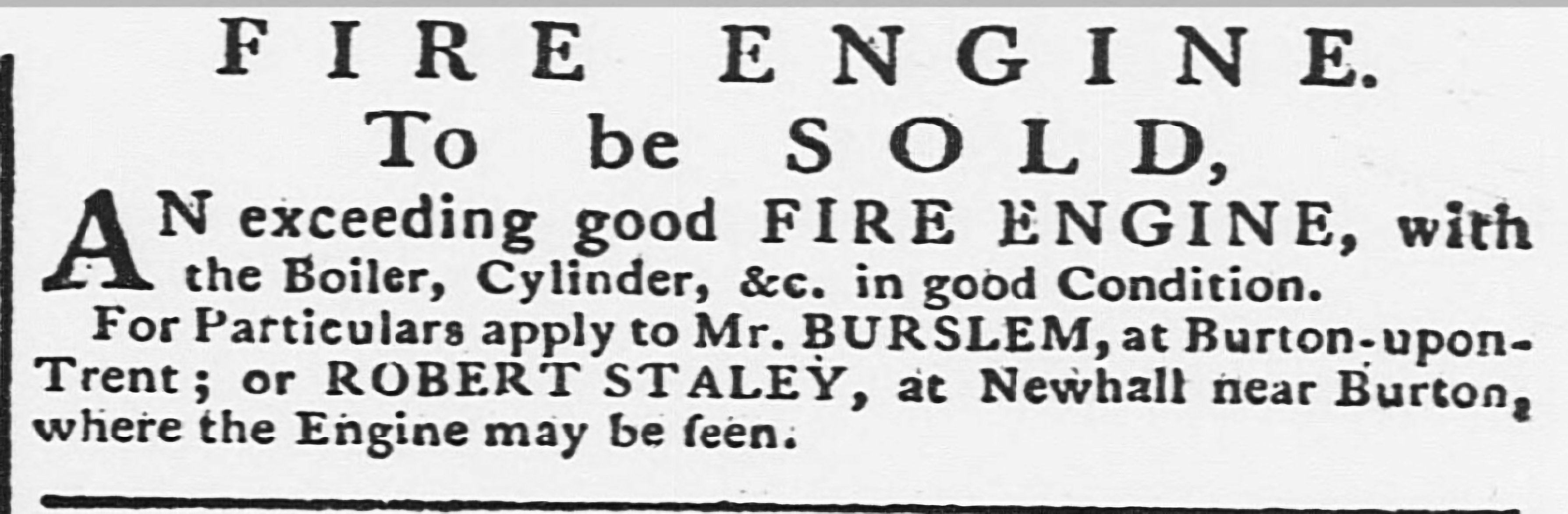
Was the fire engine perhaps connected with a foundry or a coal mine?
I noticed that Robert Staley was the witness at a 1755 marriage in Stapenhill between Barbara Burslem and Richard Daston the younger esquire. The other witness was signed Burslem Jnr.
Looking for Robert Staley
I assumed that once again, in the absence of the correct records, a similarly named and aged persons baptism had been added to the tree regardless of accuracy, so I looked through the Stapenhill/Newhall parish register images page by page. There were no Staleys in Newhall at all in the early 1700s, so it seemed that Robert did come from elsewhere and I expected to find the Staleys in a neighbouring parish. But I still didn’t find any Staleys.
I spoke to a couple of Staley descendants that I’d met during the family research. I met Carole via a DNA match some months previously and contacted her to ask about the Staleys in Elton. She also had Robert Staley born in Elton (indeed, there were many Staleys in Elton) but she didn’t have any documentation for his birth, and we decided to collaborate and try and find out more.
I couldn’t find the earlier Elton parish registers anywhere online, but eventually found the untranscribed microfiche images of the Bishops Transcripts for Elton.
via familysearch:
“In its most basic sense, a bishop’s transcript is a copy of a parish register. As bishop’s transcripts generally contain more or less the same information as parish registers, they are an invaluable resource when a parish register has been damaged, destroyed, or otherwise lost. Bishop’s transcripts are often of value even when parish registers exist, as priests often recorded either additional or different information in their transcripts than they did in the original registers.”Unfortunately there was a gap in the Bishops Transcripts between 1704 and 1711 ~ exactly where I needed to look. I subsequently found out that the Elton registers were incomplete as they had been damaged by fire.
I estimated Robert Staleys date of birth between 1710 and 1715. He died in 1795, and his son Daniel died in 1805: both of these wills were found online. Daniel married Mary Moon in Stapenhill in 1762, making a likely birth date for Daniel around 1740.
The marriage of Robert Staley (assuming this was Robert’s father) and Alice Maceland (or Marsland or Marsden, depending on how the parish clerk chose to spell it presumably) was in the Bishops Transcripts for Elton in 1704. They were married in Elton on 26th February. There followed the missing parish register pages and in all likelihood the records of the baptisms of their first children. No doubt Robert was one of them, probably the first male child.
(Incidentally, my grandfather’s Marshalls also came from Elton, a small Derbyshire village near Matlock. The Staley’s are on my grandmothers Warren side.)
The parish register pages resume in 1711. One of the first entries was the baptism of Robert Staley in 1711, parents Thomas and Ann. This was surely the one we were looking for, and Roberts parents weren’t Robert and Alice.
But then in 1735 a marriage was recorded between Robert son of Robert Staley (and this was unusual, the father of the groom isn’t usually recorded on the parish register) and Elizabeth Milner. They were married on the 9th March 1735. We know that the Robert we were looking for married an Elizabeth, as her name was on the Stapenhill baptisms of their later children, including Joseph Staleys. The 1735 marriage also fit with the assumed birth date of Daniel, circa 1740. A baptism was found for a Robert Staley in 1738 in the Elton registers, parents Robert and Elizabeth, as well as the baptism in 1736 for Mary, presumably their first child. Her burial is recorded the following year.
The marriage of Robert Staley and Elizabeth Milner in 1735:
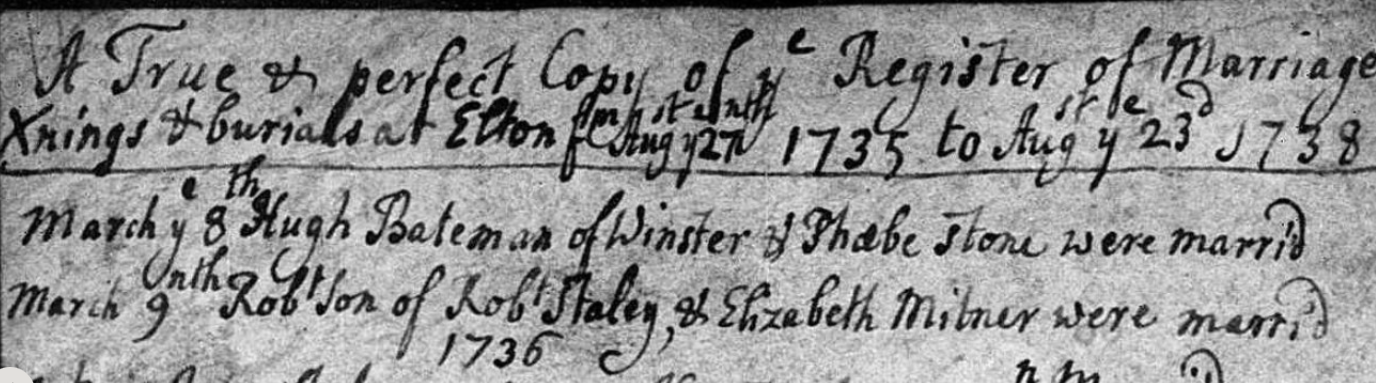
There were several other Staley couples of a similar age in Elton, perhaps brothers and cousins. It seemed that Thomas and Ann’s son Robert was a different Robert, and that the one we were looking for was prior to that and on the missing pages.
Even so, this doesn’t prove that it was Elizabeth Staleys great grandfather who was born in Elton, but no other birth or baptism for Robert Staley has been found. It doesn’t explain why the Staleys moved to Stapenhill either, although the Enclosures Act and the Industrial Revolution could have been factors.
The 18th century saw the rise of the Industrial Revolution and many renowned Derbyshire Industrialists emerged. They created the turning point from what was until then a largely rural economy, to the development of townships based on factory production methods.
The Marsden Connection
There are some possible clues in the records of the Marsden family. Robert Staley married Alice Marsden (or Maceland or Marsland) in Elton in 1704. Robert Staley is mentioned in the 1730 will of John Marsden senior, of Baslow, Innkeeper (Peacock Inne & Whitlands Farm). He mentions his daughter Alice, wife of Robert Staley.
In a 1715 Marsden will there is an intriguing mention of an alias, which might explain the different spellings on various records for the name Marsden: “MARSDEN alias MASLAND, Christopher – of Baslow, husbandman, 28 Dec 1714. son Robert MARSDEN alias MASLAND….” etc.
Some potential reasons for a move from one parish to another are explained in this history of the Marsden family, and indeed this could relate to Robert Staley as he married into the Marsden family and his wife was a beneficiary of a Marsden will. The Chatsworth Estate, at various times, bought a number of farms in order to extend the park.
THE MARSDEN FAMILY
OXCLOSE AND PARKGATE
In the Parishes of
Baslow and Chatsworthby
David Dalrymple-Smith“John Marsden (b1653) another son of Edmund (b1611) faired well. By the time he died in
1730 he was publican of the Peacock, the Inn on Church Lane now called the Cavendish
Hotel, and the farmer at “Whitlands”, almost certainly Bubnell Cliff Farm.”“Coal mining was well known in the Chesterfield area. The coalfield extends as far as the
Gritstone edges, where thin seams outcrop especially in the Baslow area.”“…the occupants were evicted from the farmland below Dobb Edge and
the ground carefully cleared of all traces of occupation and farming. Shelter belts were
planted especially along the Heathy Lea Brook. An imposing new drive was laid to the
Chatsworth House with the Lodges and “The Golden Gates” at its northern end….”Although this particular event was later than any events relating to Robert Staley, it’s an indication of how farms and farmland disappeared, and a reason for families to move to another area:
“The Dukes of Devonshire (of Chatsworth) were major figures in the aristocracy and the government of the
time. Such a position demanded a display of wealth and ostentation. The 6th Duke of
Devonshire, the Bachelor Duke, was not content with the Chatsworth he inherited in 1811,
and immediately started improvements. After major changes around Edensor, he turned his
attention at the north end of the Park. In 1820 plans were made extend the Park up to the
Baslow parish boundary. As this would involve the destruction of most of the Farm at
Oxclose, the farmer at the Higher House Samuel Marsden (b1755) was given the tenancy of
Ewe Close a large farm near Bakewell.
Plans were revised in 1824 when the Dukes of Devonshire and Rutland “Exchanged Lands”,
reputedly during a game of dice. Over 3300 acres were involved in several local parishes, of
which 1000 acres were in Baslow. In the deal Devonshire acquired the southeast corner of
Baslow Parish.
Part of the deal was Gibbet Moor, which was developed for “Sport”. The shelf of land
between Parkgate and Robin Hood and a few extra fields was left untouched. The rest,
between Dobb Edge and Baslow, was agricultural land with farms, fields and houses. It was
this last part that gave the Duke the opportunity to improve the Park beyond his earlier
expectations.”The 1795 will of Robert Staley.
Inriguingly, Robert included the children of his son Daniel Staley in his will, but omitted to leave anything to Daniel. A perusal of Daniels 1808 will sheds some light on this: Daniel left his property to his six reputed children with Elizabeth Moon, and his reputed daughter Mary Brearly. Daniels wife was Mary Moon, Elizabeths husband William Moons daughter.
The will of Robert Staley, 1795:
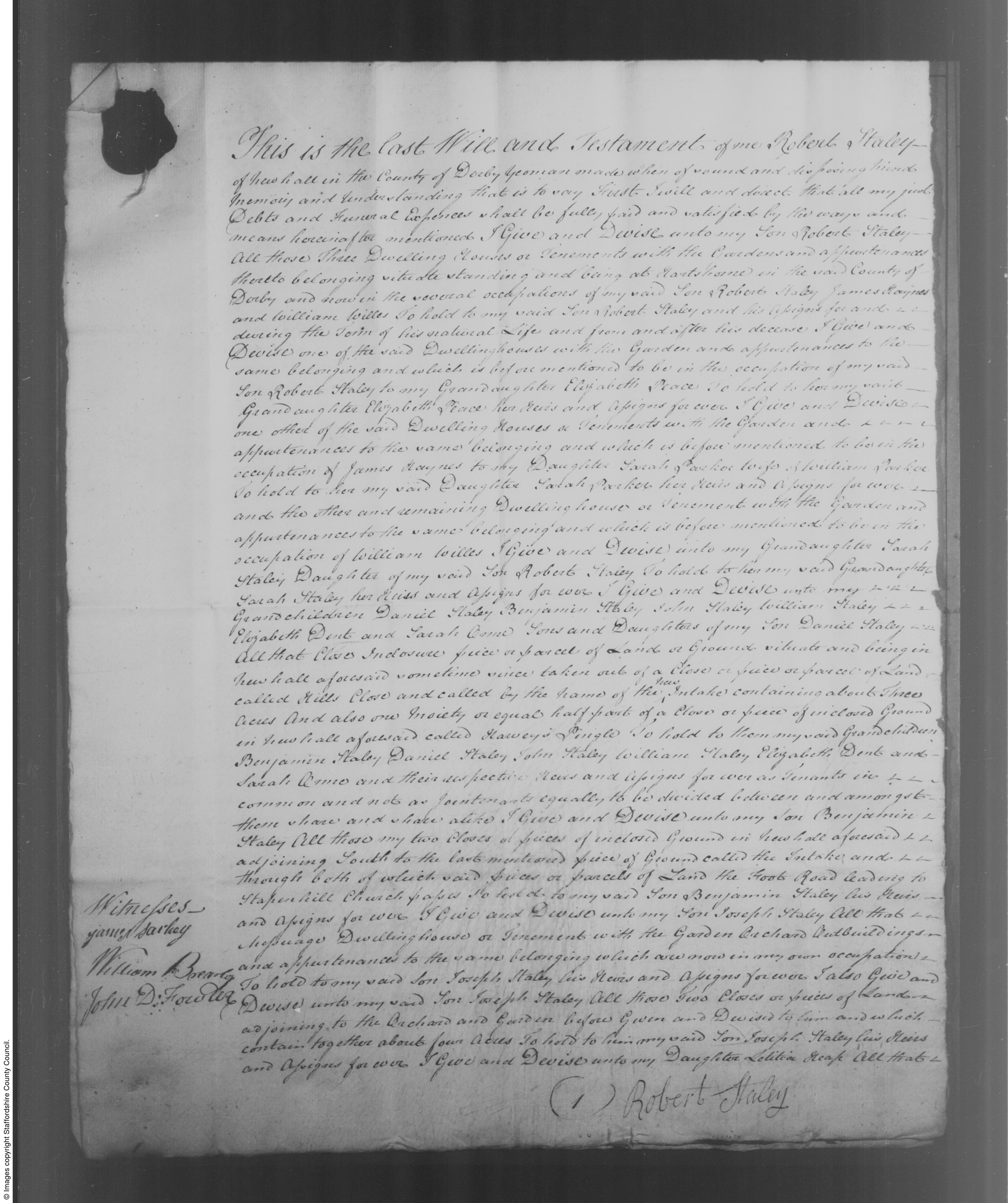
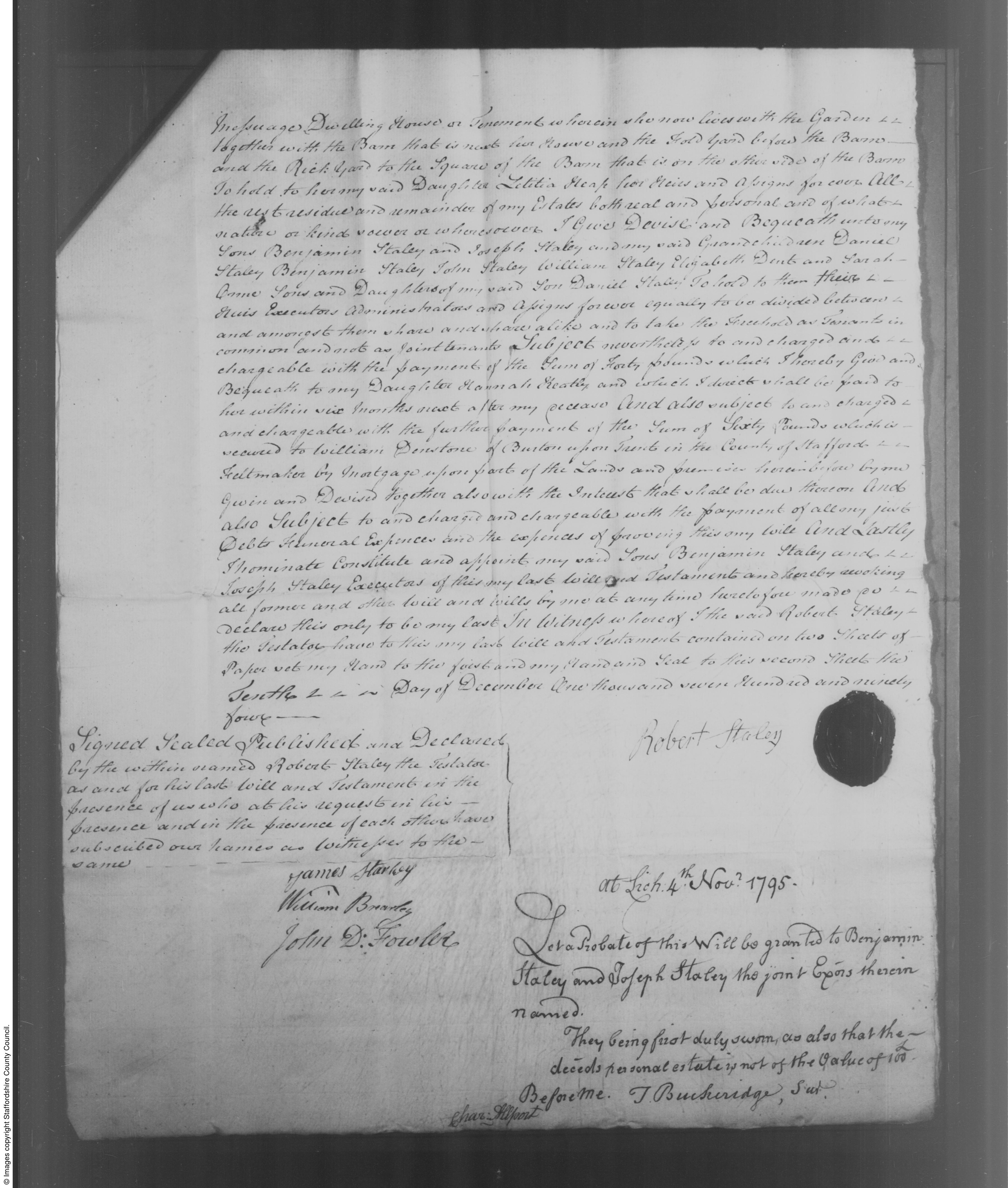
The 1805 will of Daniel Staley, Robert’s son:
This is the last will and testament of me Daniel Staley of the Township of Newhall in the parish of Stapenhill in the County of Derby, Farmer. I will and order all of my just debts, funeral and testamentary expenses to be fully paid and satisfied by my executors hereinafter named by and out of my personal estate as soon as conveniently may be after my decease.
I give, devise and bequeath to Humphrey Trafford Nadin of Church Gresely in the said County of Derby Esquire and John Wilkinson of Newhall aforesaid yeoman all my messuages, lands, tenements, hereditaments and real and personal estates to hold to them, their heirs, executors, administrators and assigns until Richard Moon the youngest of my reputed sons by Elizabeth Moon shall attain his age of twenty one years upon trust that they, my said trustees, (or the survivor of them, his heirs, executors, administrators or assigns), shall and do manage and carry on my farm at Newhall aforesaid and pay and apply the rents, issues and profits of all and every of my said real and personal estates in for and towards the support, maintenance and education of all my reputed children by the said Elizabeth Moon until the said Richard Moon my youngest reputed son shall attain his said age of twenty one years and equally share and share and share alike.
And it is my will and desire that my said trustees or trustee for the time being shall recruit and keep up the stock upon my farm as they in their discretion shall see occasion or think proper and that the same shall not be diminished. And in case any of my said reputed children by the said Elizabeth Moon shall be married before my said reputed youngest son shall attain his age of twenty one years that then it is my will and desire that non of their husbands or wives shall come to my farm or be maintained there or have their abode there. That it is also my will and desire in case my reputed children or any of them shall not be steady to business but instead shall be wild and diminish the stock that then my said trustees or trustee for the time being shall have full power and authority in their discretion to sell and dispose of all or any part of my said personal estate and to put out the money arising from the sale thereof to interest and to pay and apply the interest thereof and also thereunto of the said real estate in for and towards the maintenance, education and support of all my said reputed children by the said
Elizabeth Moon as they my said trustees in their discretion that think proper until the said Richard Moon shall attain his age of twenty one years.Then I give to my grandson Daniel Staley the sum of ten pounds and to each and every of my sons and daughters namely Daniel Staley, Benjamin Staley, John Staley, William Staley, Elizabeth Dent and Sarah Orme and to my niece Ann Brearly the sum of five pounds apiece.
I give to my youngest reputed son Richard Moon one share in the Ashby Canal Navigation and I direct that my said trustees or trustee for the time being shall have full power and authority to pay and apply all or any part of the fortune or legacy hereby intended for my youngest reputed son Richard Moon in placing him out to any trade, business or profession as they in their discretion shall think proper.
And I direct that to my said sons and daughters by my late wife and my said niece shall by wholly paid by my said reputed son Richard Moon out of the fortune herby given him. And it is my will and desire that my said reputed children shall deliver into the hands of my executors all the monies that shall arise from the carrying on of my business that is not wanted to carry on the same unto my acting executor and shall keep a just and true account of all disbursements and receipts of the said business and deliver up the same to my acting executor in order that there may not be any embezzlement or defraud amongst them and from and immediately after my said reputed youngest son Richard Moon shall attain his age of twenty one years then I give, devise and bequeath all my real estate and all the residue and remainder of my personal estate of what nature and kind whatsoever and wheresoever unto and amongst all and every my said reputed sons and daughters namely William Moon, Thomas Moon, Joseph Moon, Richard Moon, Ann Moon, Margaret Moon and to my reputed daughter Mary Brearly to hold to them and their respective heirs, executors, administrator and assigns for ever according to the nature and tenure of the same estates respectively to take the same as tenants in common and not as joint tenants.And lastly I nominate and appoint the said Humphrey Trafford Nadin and John Wilkinson executors of this my last will and testament and guardians of all my reputed children who are under age during their respective minorities hereby revoking all former and other wills by me heretofore made and declaring this only to be my last will.
In witness whereof I the said Daniel Staley the testator have to this my last will and testament set my hand and seal the eleventh day of March in the year of our Lord one thousand eight hundred and five.
April 12, 2022 at 8:13 am #6290In reply to: The Elusive Samuel Housley and Other Family Stories
Leicestershire Blacksmiths
The Orgill’s of Measham led me further into Leicestershire as I traveled back in time.
I also realized I had uncovered a direct line of women and their mothers going back ten generations:
myself, Tracy Edwards 1957-
my mother Gillian Marshall 1933-
my grandmother Florence Warren 1906-1988
her mother and my great grandmother Florence Gretton 1881-1927
her mother Sarah Orgill 1840-1910
her mother Elizabeth Orgill 1803-1876
her mother Sarah Boss 1783-1847
her mother Elizabeth Page 1749-
her mother Mary Potter 1719-1780
and her mother and my 7x great grandmother Mary 1680-You could say it leads us to the very heart of England, as these Leicestershire villages are as far from the coast as it’s possible to be. There are countless other maternal lines to follow, of course, but only one of mothers of mothers, and ours takes us to Leicestershire.
The blacksmiths
Sarah Boss was the daughter of Michael Boss 1755-1807, a blacksmith in Measham, and Elizabeth Page of nearby Hartshorn, just over the county border in Derbyshire.
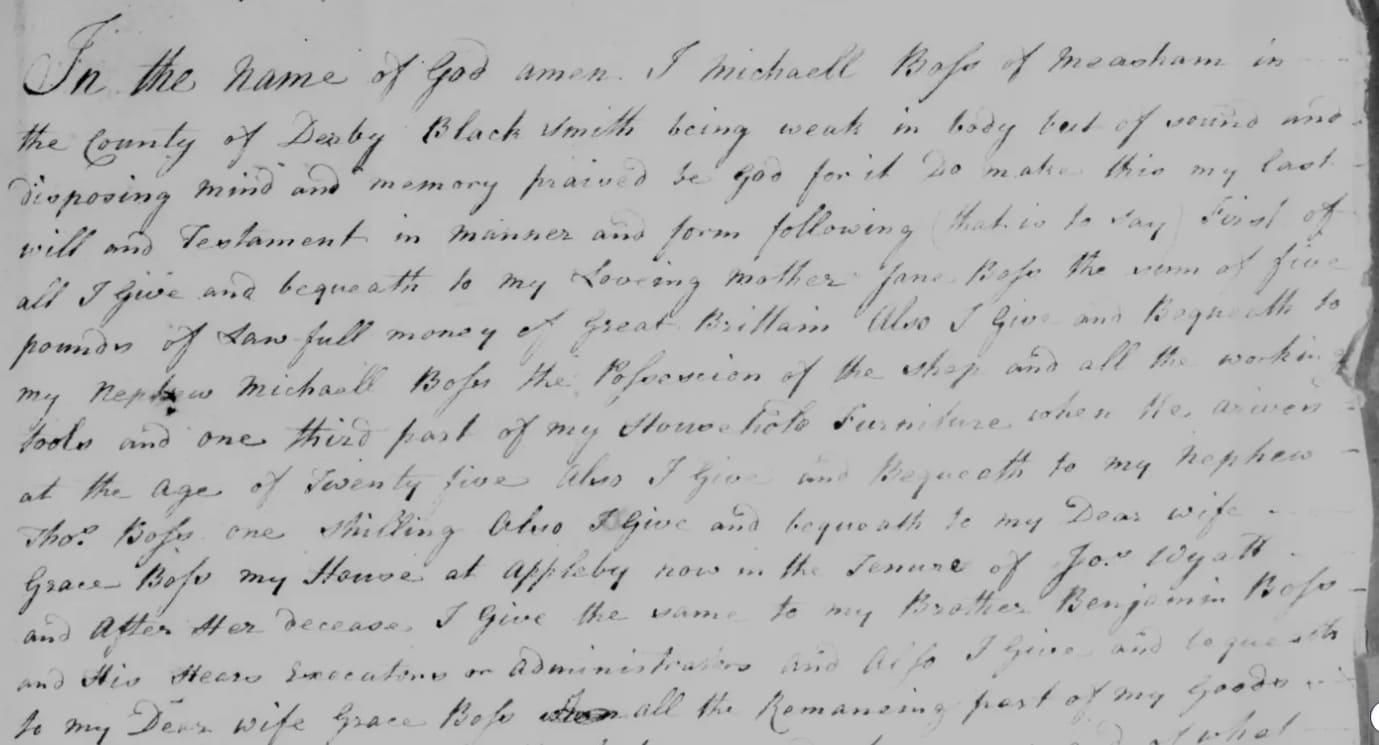
An earlier Michael Boss, a blacksmith of Measham, died in 1772, and in his will he left the possession of the blacksmiths shop and all the working tools and a third of the household furniture to Michael, who he named as his nephew. He left his house in Appleby Magna to his wife Grace, and five pounds to his mother Jane Boss. As none of Michael and Grace’s children are mentioned in the will, perhaps it can be assumed that they were childless.
The will of Michael Boss, 1772, Measham:
Michael Boss the uncle was born in Appleby Magna in 1724. His parents were Michael Boss of Nelson in the Thistles and Jane Peircivall of Appleby Magna, who were married in nearby Mancetter in 1720.
Information worth noting on the Appleby Magna website:
In 1752 the calendar in England was changed from the Julian Calendar to the Gregorian Calendar, as a result 11 days were famously “lost”. But for the recording of Church Registers another very significant change also took place, the start of the year was moved from March 25th to our more familiar January 1st.
Before 1752 the 1st day of each new year was March 25th, Lady Day (a significant date in the Christian calendar). The year number which we all now use for calculating ages didn’t change until March 25th. So, for example, the day after March 24th 1750 was March 25th 1751, and January 1743 followed December 1743.
This March to March recording can be seen very clearly in the Appleby Registers before 1752. Between 1752 and 1768 there appears slightly confused recording, so dates should be carefully checked. After 1768 the recording is more fully by the modern calendar year.Michael Boss the uncle married Grace Cuthbert. I haven’t yet found the birth or parents of Grace, but a blacksmith by the name of Edward Cuthbert is mentioned on an Appleby Magna history website:
An Eighteenth Century Blacksmith’s Shop in Little Appleby
by Alan RobertsCuthberts inventory
The inventory of Edward Cuthbert provides interesting information about the household possessions and living arrangements of an eighteenth century blacksmith. Edward Cuthbert (als. Cutboard) settled in Appleby after the Restoration to join the handful of blacksmiths already established in the parish, including the Wathews who were prominent horse traders. The blacksmiths may have all worked together in the same shop at one time. Edward and his wife Sarah recorded the baptisms of several of their children in the parish register. Somewhat sadly three of the boys named after their father all died either in infancy or as young children. Edward’s inventory which was drawn up in 1732, by which time he was probably a widower and his children had left home, suggests that they once occupied a comfortable two-storey house in Little Appleby with an attached workshop, well equipped with all the tools for repairing farm carts, ploughs and other implements, for shoeing horses and for general ironmongery.
Edward Cuthbert born circa 1660, married Joane Tuvenet in 1684 in Swepston cum Snarestone , and died in Appleby in 1732. Tuvenet is a French name and suggests a Huguenot connection, but this isn’t our family, and indeed this Edward Cuthbert is not likely to be Grace’s father anyway.
Michael Boss and Elizabeth Page appear to have married twice: once in 1776, and once in 1779. Both of the documents exist and appear correct. Both marriages were by licence. They both mention Michael is a blacksmith.
Their first daughter, Elizabeth, was baptized in February 1777, just nine months after the first wedding. It’s not known when she was born, however, and it’s possible that the marriage was a hasty one. But why marry again three years later?
But Michael Boss and Elizabeth Page did not marry twice.
Elizabeth Page from Smisby was born in 1752 and married Michael Boss on the 5th of May 1776 in Measham. On the marriage licence allegations and bonds, Michael is a bachelor.
Baby Elizabeth was baptised in Measham on the 9th February 1777. Mother Elizabeth died on the 18th February 1777, also in Measham.
In 1779 Michael Boss married another Elizabeth Page! She was born in 1749 in Hartshorn, and Michael is a widower on the marriage licence allegations and bonds.
Hartshorn and Smisby are neighbouring villages, hence the confusion. But a closer look at the documents available revealed the clues. Both Elizabeth Pages were literate, and indeed their signatures on the marriage registers are different:
Marriage of Michael Boss and Elizabeth Page of Smisby in 1776:
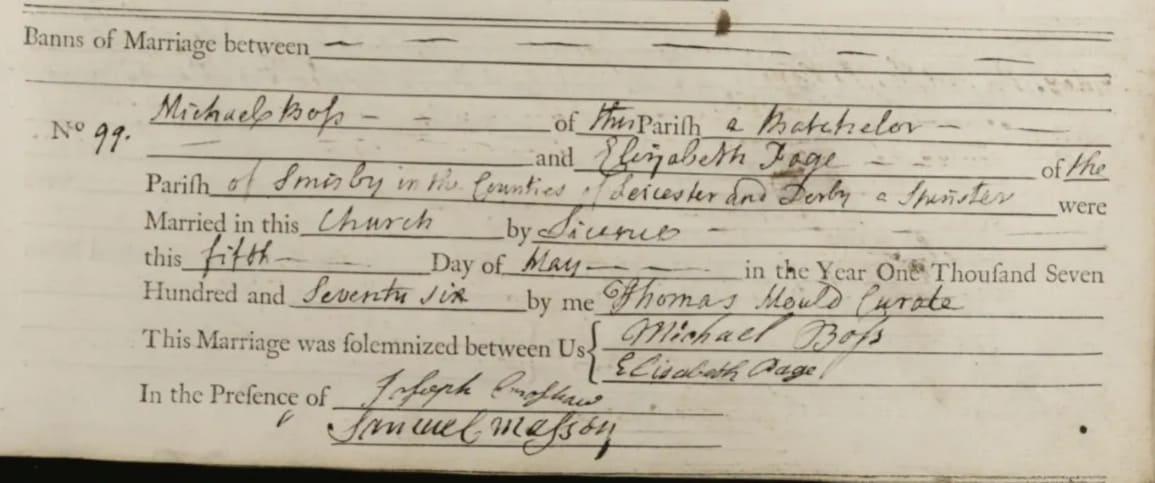
Marriage of Michael Boss and Elizabeth Page of Harsthorn in 1779:
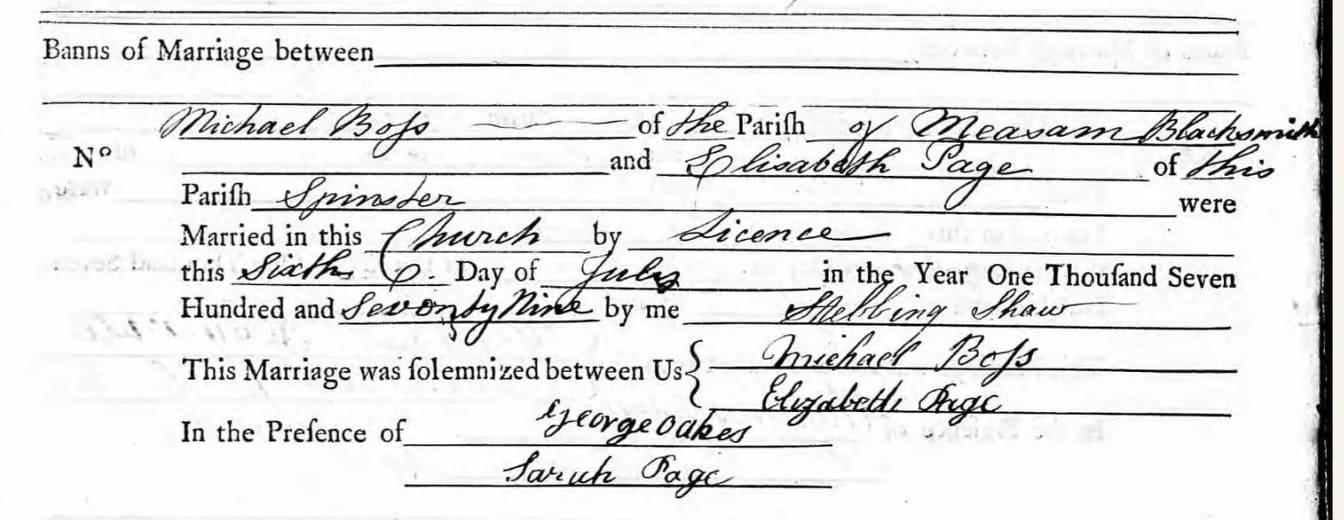
Not only did Michael Boss marry two women both called Elizabeth Page but he had an unusual start in life as well. His uncle Michael Boss left him the blacksmith business and a third of his furniture. This was all in the will. But which of Uncle Michaels brothers was nephew Michaels father?
The only Michael Boss born at the right time was in 1750 in Edingale, Staffordshire, about eight miles from Appleby Magna. His parents were Thomas Boss and Ann Parker, married in Edingale in 1747. Thomas died in August 1750, and his son Michael was baptised in the December, posthumus son of Thomas and his widow Ann. Both entries are on the same page of the register.
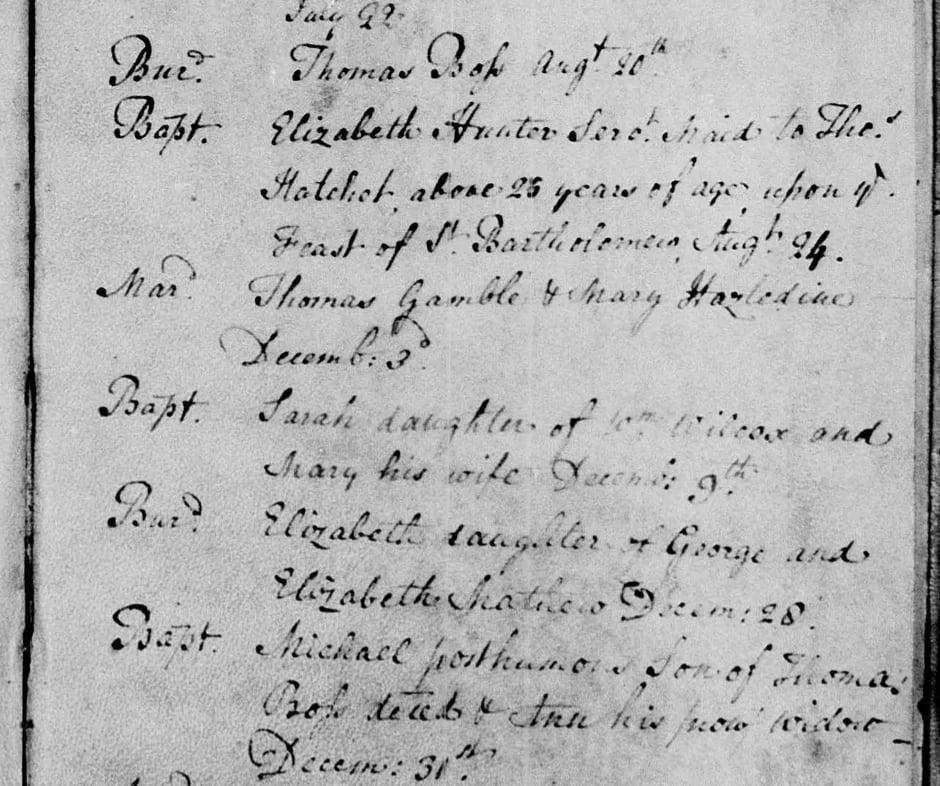
Ann Boss, the young widow, married again. But perhaps Michael and his brother went to live with their childless uncle and aunt, Michael Boss and Grace Cuthbert.
The great grandfather of Michael Boss (the Measham blacksmith born in 1850) was also Michael Boss, probably born in the 1660s. He died in Newton Regis in Warwickshire in 1724, four years after his son (also Michael Boss born 1693) married Jane Peircivall. The entry on the parish register states that Michael Boss was buried ye 13th Affadavit made.
I had not seen affadavit made on a parish register before, and this relates to the The Burying in Woollen Acts 1666–80. According to Wikipedia:
“Acts of the Parliament of England which required the dead, except plague victims and the destitute, to be buried in pure English woollen shrouds to the exclusion of any foreign textiles. It was a requirement that an affidavit be sworn in front of a Justice of the Peace (usually by a relative of the deceased), confirming burial in wool, with the punishment of a £5 fee for noncompliance. Burial entries in parish registers were marked with the word “affidavit” or its equivalent to confirm that affidavit had been sworn; it would be marked “naked” for those too poor to afford the woollen shroud. The legislation was in force until 1814, but was generally ignored after 1770.”
Michael Boss buried 1724 “Affadavit made”:
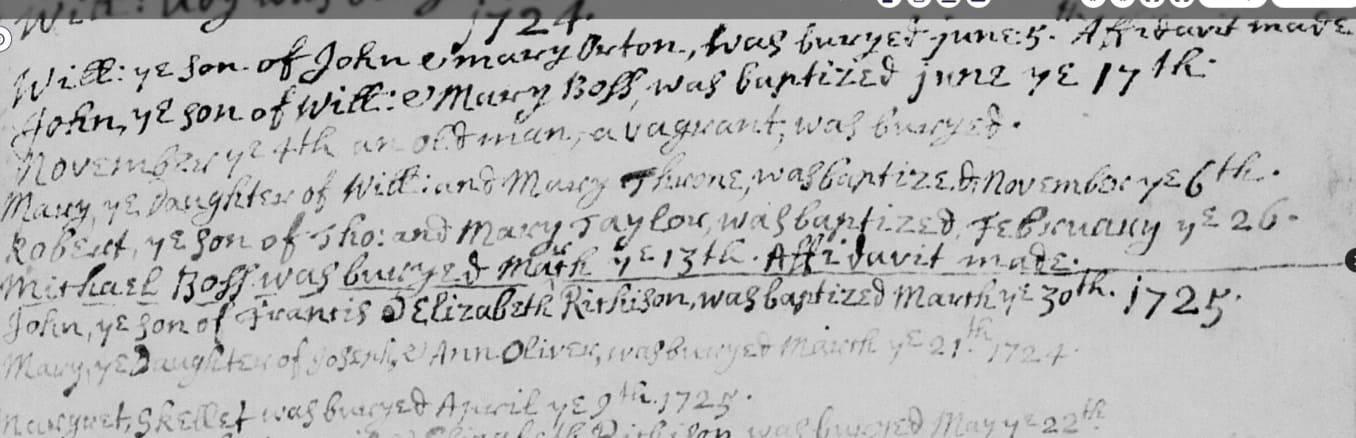
Elizabeth Page‘s father was William Page 1717-1783, a wheelwright in Hartshorn. (The father of the first wife Elizabeth was also William Page, but he was a husbandman in Smisby born in 1714. William Page, the father of the second wife, was born in Nailstone, Leicestershire, in 1717. His place of residence on his marriage to Mary Potter was spelled Nelson.)
Her mother was Mary Potter 1719- of nearby Coleorton. Mary’s father, Richard Potter 1677-1731, was a blacksmith in Coleorton.
A page of the will of Richard Potter 1731:
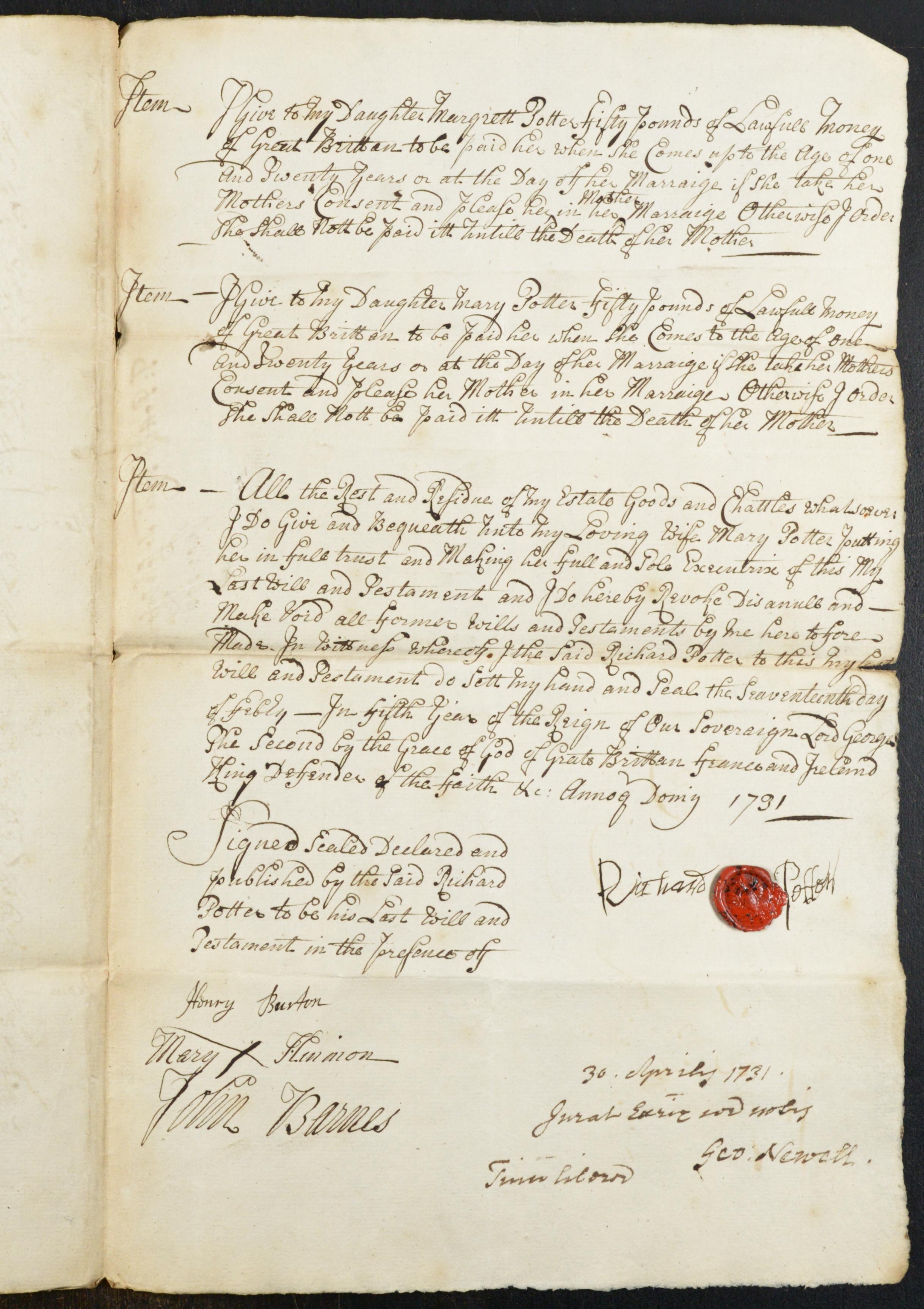
Richard Potter states: “I will and order that my son Thomas Potter shall after my decease have one shilling paid to him and no more.” As he left £50 to each of his daughters, one can’t help but wonder what Thomas did to displease his father.
Richard stipulated that his son Thomas should have one shilling paid to him and not more, for several good considerations, and left “the house and ground lying in the parish of Whittwick in a place called the Long Lane to my wife Mary Potter to dispose of as she shall think proper.”
His son Richard inherited the blacksmith business: “I will and order that my son Richard Potter shall live and be with his mother and serve her duly and truly in the business of a blacksmith, and obey and serve her in all lawful commands six years after my decease, and then I give to him and his heirs…. my house and grounds Coulson House in the Liberty of Thringstone”
Richard wanted his son John to be a blacksmith too: “I will and order that my wife bring up my son John Potter at home with her and teach or cause him to be taught the trade of a blacksmith and that he shall serve her duly and truly seven years after my decease after the manner of an apprentice and at the death of his mother I give him that house and shop and building and the ground belonging to it which I now dwell in to him and his heirs forever.”
To his daughters Margrett and Mary Potter, upon their reaching the age of one and twenty, or the day after their marriage, he leaves £50 each. All the rest of his goods are left to his loving wife Mary.
An inventory of the belongings of Richard Potter, 1731:
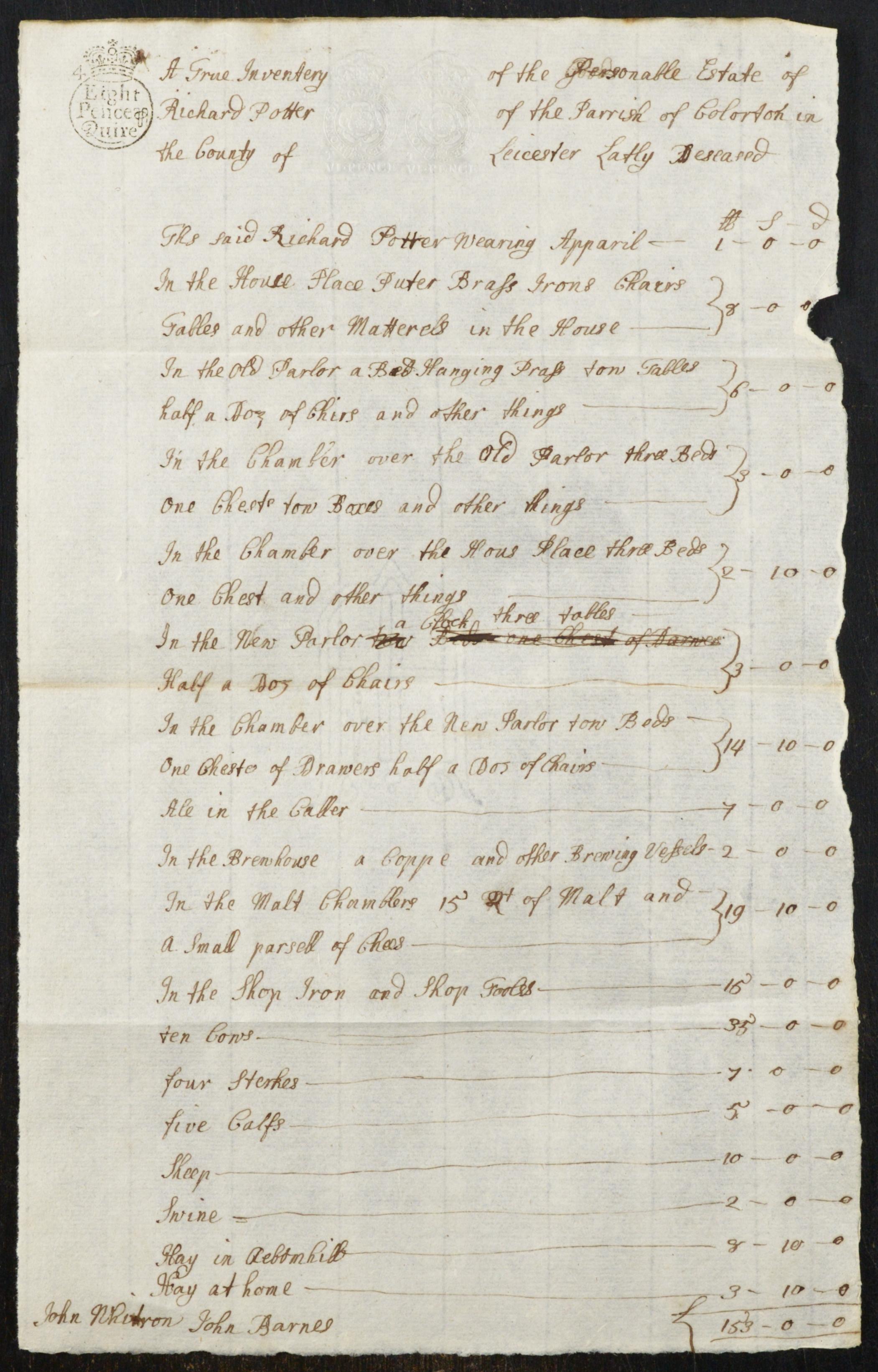
Richard Potters father was also named Richard Potter 1649-1719, and he too was a blacksmith.
Richard Potter of Coleorton in the county of Leicester, blacksmith, stated in his will: “I give to my son and daughter Thomas and Sarah Potter the possession of my house and grounds.”
He leaves ten pounds each to his daughters Jane and Alice, to his son Francis he gives five pounds, and five shillings to his son Richard. Sons Joseph and William also receive five shillings each. To his daughter Mary, wife of Edward Burton, and her daughter Elizabeth, he gives five shillings each. The rest of his good, chattels and wordly substance he leaves equally between his son and daugter Thomas and Sarah. As there is no mention of his wife, it’s assumed that she predeceased him.
The will of Richard Potter, 1719:
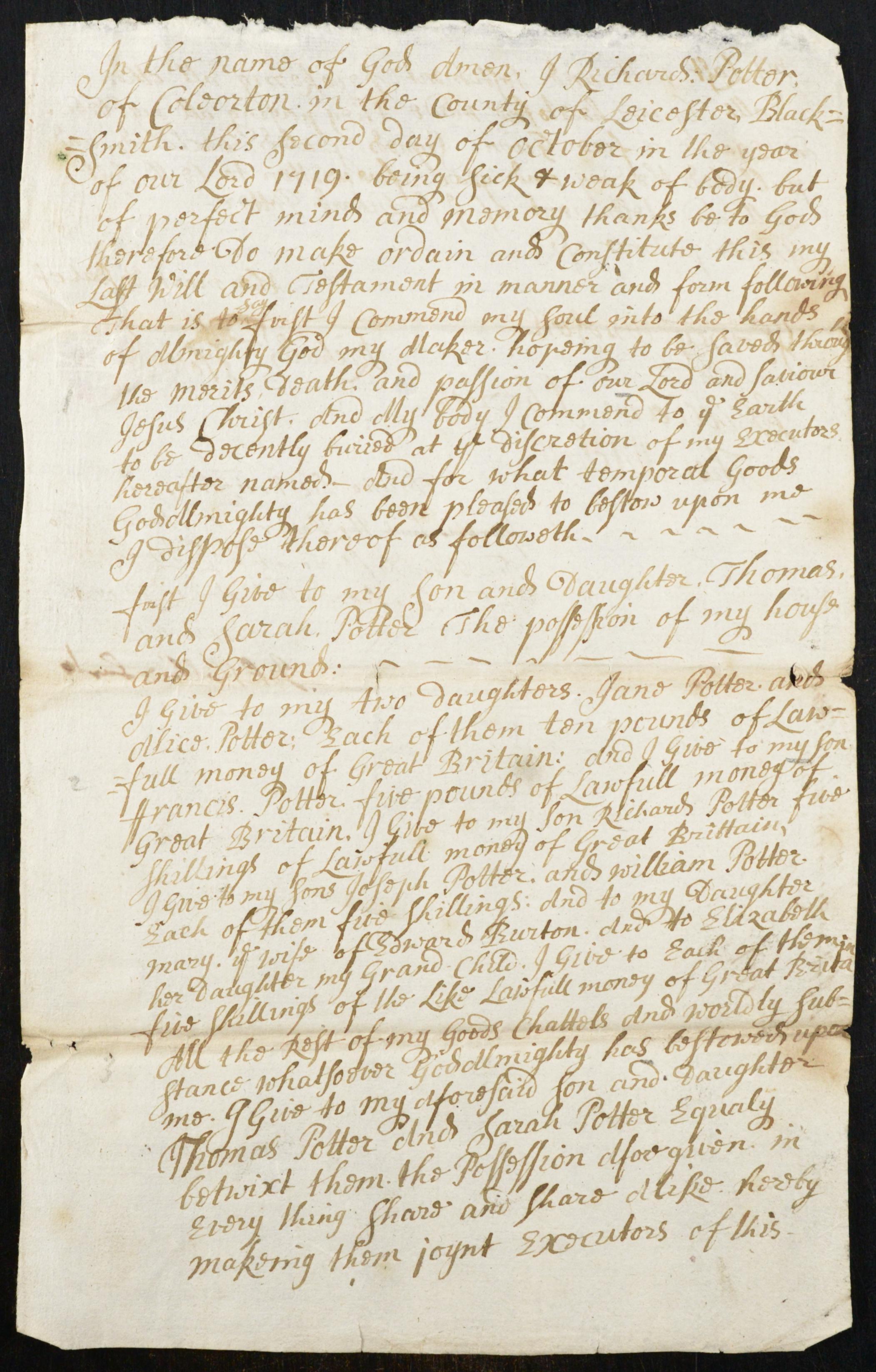
Richard Potter’s (1649-1719) parents were William Potter and Alse Huldin, both born in the early 1600s. They were married in 1646 at Breedon on the Hill, Leicestershire. The name Huldin appears to originate in Finland.
William Potter was a blacksmith. In the 1659 parish registers of Breedon on the Hill, William Potter of Breedon blacksmith buryed the 14th July.
April 2, 2022 at 6:15 pm #6286In reply to: The Elusive Samuel Housley and Other Family Stories
Matthew Orgill and His Family
Matthew Orgill 1828-1907 was the Orgill brother who went to Australia, but returned to Measham. Matthew married Mary Orgill in Measham in October 1856, having returned from Victoria, Australia in May of that year.
Although Matthew was the first Orgill brother to go to Australia, he was the last one I found, and that was somewhat by accident, while perusing “Orgill” and “Measham” in a newspaper archives search. I chanced on Matthew’s obituary in the Nuneaton Observer, Friday 14 June 1907:
LATE MATTHEW ORGILL PEACEFUL END TO A BLAMELESS LIFE.
‘Sunset and Evening Star And one clear call for me.”
It is with very deep regret that we have to announce the death of Mr. Matthew Orgill, late of Measham, who passed peacefully away at his residence in Manor Court Road, Nuneaton, in the early hours of yesterday morning. Mr. Orgill, who was in his eightieth year, was a man with a striking history, and was a very fine specimen of our best English manhood. In early life be emigrated to South Africa—sailing in the “Hebrides” on 4th February. 1850—and was one of the first settlers at the Cape; afterwards he went on to Australia at the time of the Gold Rush, and ultimately came home to his native England and settled down in Measham, in Leicestershire, where he carried on a successful business for the long period of half-a-century.
He was full of reminiscences of life in the Colonies in the early days, and an hour or two in his company was an education itself. On the occasion of the recall of Sir Harry Smith from the Governorship of Natal (for refusing to be a party to the slaying of the wives and children in connection with the Kaffir War), Mr. Orgill was appointed to superintend the arrangements for the farewell demonstration. It was one of his boasts that he made the first missionary cart used in South Africa, which is in use to this day—a monument to the character of his work; while it is an interesting fact to note that among Mr. Orgill’s papers there is the original ground-plan of the city of Durban before a single house was built.
In Africa Mr. Orgill came in contact with the great missionary, David Livingstone, and between the two men there was a striking resemblance in character and a deep and lasting friendship. Mr. Orgill could give a most graphic description of the wreck of the “Birkenhead,” having been in the vicinity at the time when the ill-fated vessel went down. He played a most prominent part on the occasion of the famous wreck of the emigrant ship, “Minerva.” when, in conjunction with some half-a-dozen others, and at the eminent risk of their own lives, they rescued more than 100 of the unfortunate passengers. He was afterwards presented with an interesting relic as a memento of that thrilling experience, being a copper bolt from the vessel on which was inscribed the following words: “Relic of the ship Minerva, wrecked off Bluff Point, Port Natal. 8.A.. about 2 a.m.. Friday, July 5, 1850.”
Mr. Orgill was followed to the Colonies by no fewer than six of his brothers, all of whom did well, and one of whom married a niece (brother’s daughter) of the late Mr. William Ewart Gladstone.
On settling down in Measham his kindly and considerate disposition soon won for him a unique place in the hearts of all the people, by whom he was greatly beloved. He was a man of sterling worth and integrity. Upright and honourable in all his dealings, he led a Christian life that was a pattern to all with whom he came in contact, and of him it could truly he said that he wore the white flower of a blameless life.
He was a member of the Baptist Church, and although beyond much active service since settling down in Nuneaton less than two years ago he leaves behind him a record in Christian service attained by few. In politics he was a Radical of the old school. A great reader, he studied all the questions of the day, and could back up every belief he held by sound and fearless argument. The South African – war was a great grief to him. He knew the Boers from personal experience, and although he suffered at the time of the war for his outspoken condemnation, he had the satisfaction of living to see the people of England fully recognising their awful blunder. To give anything like an adequate idea of Mr. Orgill’s history would take up a great amount of space, and besides much of it has been written and commented on before; suffice it to say that it was strenuous, interesting, and eventful, and yet all through his hands remained unspotted and his heart was pure.
He is survived by three daughters, and was father-in-law to Mr. J. S. Massey. St Kilda. Manor Court Road, to whom deep and loving sympathy is extended in their sore bereavement by a wide circle of friends. The funeral is arranged to leave for Measham on Monday at twelve noon.
“To give anything like an adequate idea of Mr. Orgill’s history would take up a great amount of space, and besides much of it has been written and commented on before…”
I had another look in the newspaper archives and found a number of articles mentioning him, including an intriguing excerpt in an article about local history published in the Burton Observer and Chronicle 8 August 1963:
on an upstairs window pane he scratched with his diamond ring “Matthew Orgill, 1st July, 1858”
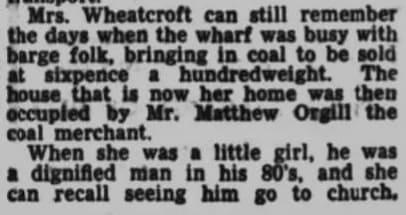
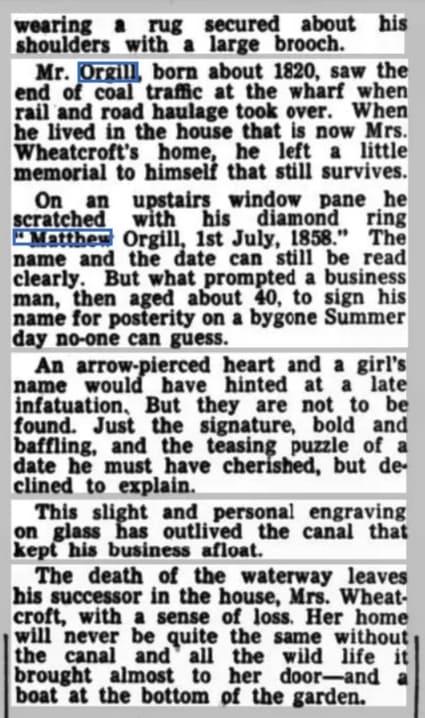
I asked on a Measham facebook group if anyone knew the location of the house mentioned in the article and someone kindly responded. This is the same building, seen from either side:
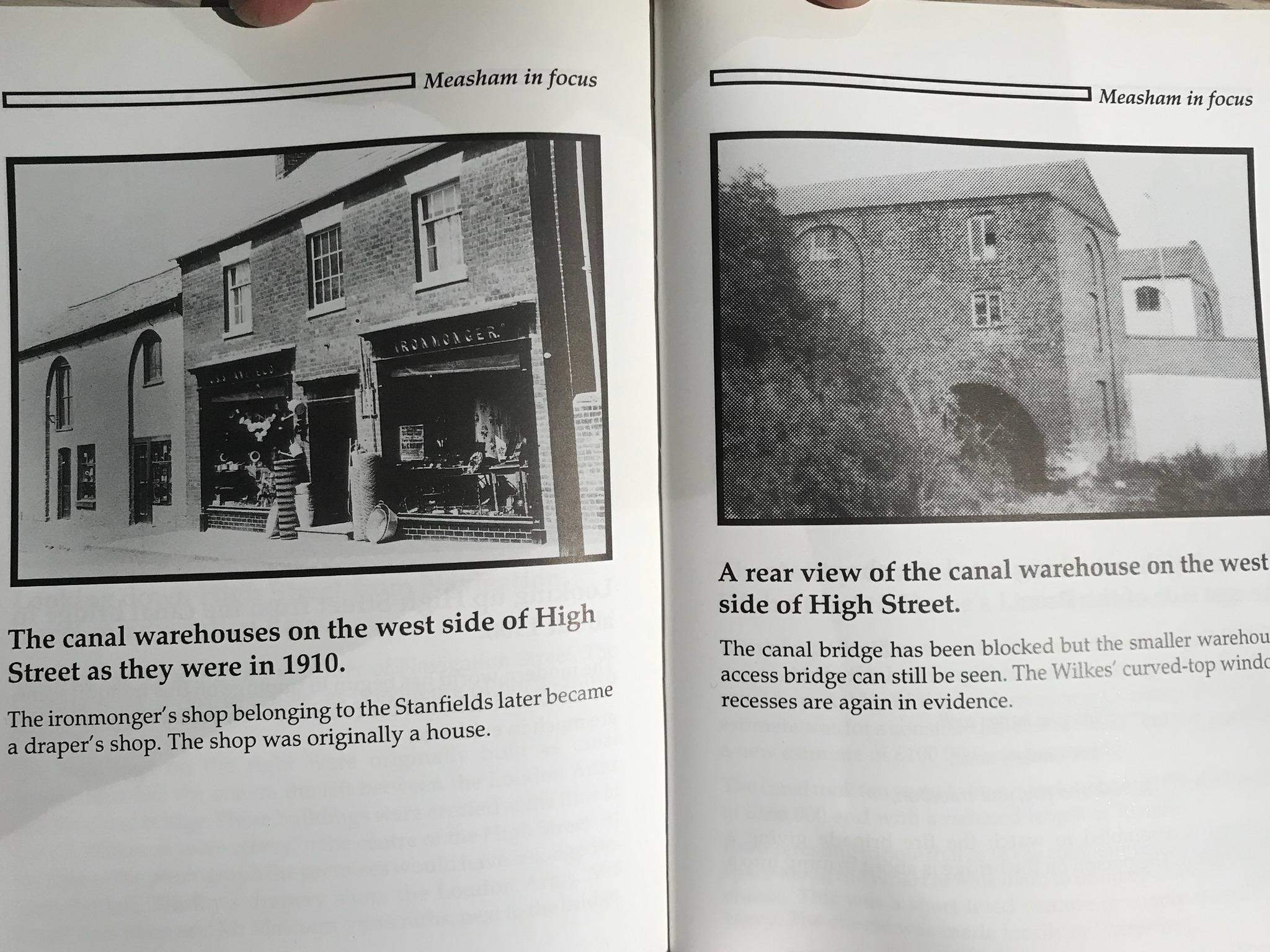
Coincidentally, I had already found this wonderful photograph of the same building, taken in 1910 ~ three years after Matthew’s death.
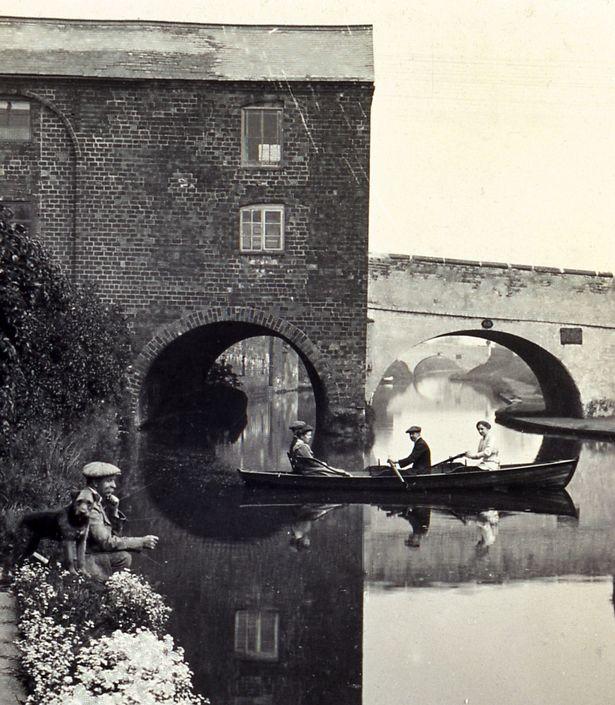
But what to make of the inscription in the window?
Matthew and Mary married in October 1856, and their first child (according to the records I’d found thus far) was a daughter Mary born in 1860. I had a look for a Matthew Orgill birth registered in 1858, the date Matthew had etched on the window, and found a death for a Matthew Orgill in 1859. Assuming I would find the birth of Matthew Orgill registered on the first of July 1958, to match the etching in the window, the corresponding birth was in July 1857!
Matthew and Mary had four children. Matthew, Mary, Clara and Hannah. Hannah Proudman Orgill married Joseph Stanton Massey. The Orgill name continues with their son Stanley Orgill Massey 1900-1979, who was a doctor and surgeon. Two of Stanley’s four sons were doctors, Paul Mackintosh Orgill Massey 1929-2009, and Michael Joseph Orgill Massey 1932-1989.
Mary Orgill 1827-1894, Matthews wife, was an Orgill too.
And this is where the Orgill branch of the tree gets complicated.
Mary’s father was Henry Orgill born in 1805 and her mother was Hannah Proudman born in 1805.
Henry Orgill’s father was Matthew Orgill born in 1769 and his mother was Frances Finch born in 1771.Mary’s husband Matthews parents are Matthew Orgill born in 1798 and Elizabeth Orgill born in 1803.
Another Orgill Orgill marriage!
Matthews parents, Matthew and Elizabeth, have the same grandparents as each other, Matthew Orgill born in 1736 and Ann Proudman born in 1735.
But Matthews grandparents are none other than Matthew Orgill born in 1769 and Frances Finch born in 1771 ~ the same grandparents as his wife Mary!
March 26, 2022 at 11:36 am #6285In reply to: The Elusive Samuel Housley and Other Family Stories
Harriet Compton
Harriet Comptom is not directly related to us, but her portrait is in our family collection.
Alfred Julius Eugene Compton painted this portrait of his daughter, Harriet Compton, when she was six. Harriet Compton was Charles Tooby’s mothers mother, and Charles married my mothers aunt Dorothy Marshall. They lived on High Park Ave in Wollaston, and his parents lived on Park Road, Wollaston, opposite my grandparents, George and Nora Marshall. Harriet married Thomas Thornburgh, they had a daughter Florence who married Sydney Tooby. Florence and Sydney were Charles Tooby’s parents.
Charles and Dorothy Tooby didn’t have any children. Charles died before his wife, and this is how the picture ended up in my mothers possession.
I attempted to find a direct descendant of Harriet Compton, but have not been successful so far, although I did find a relative on a Stourbridge facebook group. Bryan Thornburgh replied: “Francis George was my grandfather.He had two sons George & my father Thomas and two daughters Cissie & Edith. I can remember visiting my fathers Uncle Charles and Aunt Dorothy in Wollaston.”
Francis George Thornburgh was Florence Tooby’s brother.
The watercolour portrait was framed by Hughes of Enville St, Stourbridge.
Alfred Julius Eugene Compton was born in 1826 Paris, France, and died on 6 February 1917 in Chelsea, London.
Harriet Compton his daughter was born in 1853 in Islington, London, and died in December 1926 in Stourbridge.Without going too far down an unrelated rabbit hole, a member of the facebook group Family Treasures Reinstated shared this:
“Will reported in numerous papers in Dec 1886.
Harriet’s father Alfred appears to be beneficiary but Harriet’s brother, Percy is specifically excluded .
“The will (dated March 6, 1876) of the Hon. Mrs. Fanny Stanhope, late of No. 24, Carlyle-square, Chelsea, who died on August 9 last, was proved on the 1st ult. by Alfred Julius Eugene Compton, the value of the personal estate amounting to over £8000.
The testatrix, after giving & few legacies, leaves one moiety of the residue of her personal estate, upon trust, for John Auguste Alexandre Compton, for life, and then, subject to an annuity to his wife, for the children (except Percy) of Alfred Julius Eugene Compton, and the other moiety, upon trust, for the said Alfred Julius Eugene Compton, for life, and at his death for his children, except Percy.”
-Illustrated London News.Harriet Compton:
-
AuthorSearch Results