

Search Results for 'water'
-
AuthorSearch Results
-
January 14, 2022 at 3:06 pm #6253
In reply to: The Elusive Samuel Housley and Other Family Stories
My Grandparents Kitchen
My grandmother used to have golden syrup in her larder, hanging on the white plastic coated storage rack that was screwed to the inside of the larder door. Mostly the larder door was left propped open with an old flat iron, so you could see the Heinz ketchup and home made picallilli (she made a particularly good picallili), the Worcester sauce and the jar of pickled onions, as you sat at the kitchen table.
If you were sitting to the right of the kitchen table you could see an assortment of mismatched crockery, cups and bowls, shoe cleaning brushes, and at the back, tiny tins of baked beans and big ones of plum tomatoes, and normal sized tins of vegetable and mushroom soup. Underneath the little shelves that housed the tins was a blue plastic washing up bowl with a few onions, some in, some out of the yellow string bag they came home from the expensive little village supermarket in.
There was much more to the left in the awkward triangular shape under the stairs, but you couldn’t see under there from your seat at the kitchen table. You could see the shelf above the larder door which held an ugly china teapot of graceless modern lines, gazed with metallic silver which was wearing off in places. Beside the teapot sat a serving bowl, squat and shapely with little handles, like a flattened Greek urn, in white and reddish brown with flecks of faded gilt. A plain white teapot completed the trio, a large cylindrical one with neat vertical ridges and grooves.
There were two fridges under the high shallow wooden wall cupboard. A waist high bulbous old green one with a big handle that pulled out with a clunk, and a chest high sleek white one with a small freezer at the top with a door of its own. On the top of the fridges were biscuit and cracker tins, big black keys, pencils and brittle yellow notepads, rubber bands and aspirin value packs and a bottle of Brufen. There was a battered old maroon spectacle case and a whicker letter rack, letters crammed in and fanning over the top. There was always a pile of glossy advertising pamphlets and flyers on top of the fridges, of the sort that were best put straight into the tiny pedal bin.
My grandmother never lined the pedal bin with a used plastic bag, nor with a specially designed plastic bin liner. The bin was so small that the flip top lid was often gaping, resting on a mound of cauliflower greens and soup tins. Behind the pedal bin, but on the outer aspect of the kitchen wall, was the big black dustbin with the rubbery lid. More often than not, the lid was thrust upwards. If Thursday when the dustbin men came was several days away, you’d wish you hadn’t put those newspapers in, or those old shoes! You stood in the softly drizzling rain in your slippers, the rubbery sheild of a lid in your left hand and the overflowing pedal bin in the other. The contents of the pedal bin are not going to fit into the dustbin. You sigh, put the pedal bin and the dustbin lid down, and roll up your sleeves ~ carefully, because you’ve poked your fingers into a porridge covered teabag. You grab the sides of the protruding black sack and heave. All being well, the contents should settle and you should have several inches more of plastic bag above the rim of the dustbin. Unless of course it’s a poor quality plastic bag in which case your fingernail will go through and a horizontal slash will appear just below rubbish level. Eventually you upend the pedal bin and scrape the cigarette ash covered potato peelings into the dustbin with your fingers. By now the fibres of your Shetland wool jumper are heavy with damp, just like the fuzzy split ends that curl round your pale frowning brow. You may push back your hair with your forearm causing the moisture to bead and trickle down your face, as you turn the brass doorknob with your palm and wrist, tea leaves and cigarette ash clinging unpleasantly to your fingers.
The pedal bin needs rinsing in the kitchen sink, but the sink is full of mismatched saucepans, some new in shades of harvest gold, some battered and mishapen in stainless steel and aluminium, bits of mashed potato stuck to them like concrete pebbledash. There is a pale pink octagonally ovoid shallow serving dish and a little grey soup bowl with a handle like a miniature pottery saucepan decorated with kitcheny motifs.
The water for the coffee bubbles in a suacepan on the cream enamelled gas cooker. My grandmother never used a kettle, although I do remember a heavy flame orange one. The little pan for boiling water had a lip for easy pouring and a black plastic handle.
The steam has caused the condensation on the window over the sink to race in rivulets down to the fablon coated windowsill. The yellow gingham curtains hang limply, the left one tucked behind the back of the cooker.
You put the pedal bin back it it’s place below the tea towel holder, and rinse your mucky fingers under the tap. The gas water heater on the wall above you roars into life just as you turn the tap off, and disappointed, subsides.
As you lean over to turn the cooker knob, the heat from the oven warms your arm. The gas oven was almost always on, the oven door open with clean tea towels and sometimes large white pants folded over it to air.
The oven wasn’t the only heat in my grandparents kitchen. There was an electric bar fire near the red formica table which used to burn your legs. The kitchen table was extended by means of a flap at each side. When I was small I wasn’t allowed to snap the hinge underneath shut as my grandmother had pinched the skin of her palm once.
The electric fire was plugged into the same socket as the radio. The radio took a minute or two to warm up when you switched it on, a bulky thing with sharp seventies edges and a reddish wood effect veneer and big knobs. The light for my grandfathers workshop behind the garage (where he made dentures) was plugged into the same socket, which had a big heavy white three way adaptor in. The plug for the washing machine was hooked by means of a bit of string onto a nail or hook so that it didn’t fall down behing the washing machine when it wasn’t plugged in. Everything was unplugged when it wasn’t in use. Sometimes there was a shrivelled Christmas cactus on top of the radio, but it couldn’t hide the adaptor and all those plugs.
Above the washing machine was a rhomboid wooden wall cupboard with sliding frsoted glass doors. It was painted creamy gold, the colour of a nicotine stained pub ceiling, and held packets of Paxo stuffing and little jars of Bovril and Marmite, packets of Bisto and a jar of improbably red Maraschino cherries.
The nicotine coloured cupboard on the opposite wall had half a dozen large hooks screwed under the bottom shelf. A variety of mugs and cups hung there when they weren’t in the bowl waiting to be washed up. Those cupboard doors seemed flimsy for their size, and the thin beading on the edge of one door had come unstuck at the bottom and snapped back if you caught it with your sleeve. The doors fastened with a little click in the centre, and the bottom of the door reverberated slightly as you yanked it open. There were always crumbs in the cupboard from the numerous packets of bisucits and crackers and there was always an Allbran packet with the top folded over to squeeze it onto the shelf. The sugar bowl was in there, sticky grains like sandpaper among the biscuit crumbs.
Half of one of the shelves was devoted to medicines: grave looking bottles of codeine linctus with no nonsense labels, brown glass bottles with pills for rheumatism and angina. Often you would find a large bottle, nearly full, of Brewers yeast or vitamin supplements with a dollar price tag, souvenirs of the familys last visit. Above the medicines you’d find a faded packet of Napolitana pasta bows or a dusty packet of muesli. My grandparents never used them but she left them in the cupboard. Perhaps the dollar price tags and foreign foods reminded her of her children.
If there had been a recent visit you would see monstrous jars of Sanka and Maxwell House coffee in there too, but they always used the coffee. They liked evaporated milk in their coffee, and used tins and tins of “evap” as they called it. They would pour it over tinned fruit, or rhubard crumble or stewed apples.
When there was just the two of them, or when I was there as well, they’d eat at the kitchen table. The table would be covered in a white embroidered cloth and the food served in mismatched serving dishes. The cutlery was large and bent, the knife handles in varying shades of bone. My grandfathers favourite fork had the tip of each prong bent in a different direction. He reckoned it was more efficient that way to spear his meat. He often used to chew his meat and then spit it out onto the side of his plate. Not in company, of course. I can understand why he did that, not having eaten meat myself for so long. You could chew a piece of meat for several hours and still have a stringy lump between your cheek and your teeth.
My grandfather would always have a bowl of Allbran with some Froment wheat germ for his breakfast, while reading the Daily Mail at the kitchen table. He never worse slippers, always shoes indoors, and always wore a tie. He had lots of ties but always wore a plain maroon one. His shirts were always cream and buttoned at throat and cuff, and eventually started wearing shirts without detachable collars. He wore greeny grey trousers and a cardigan of the same shade most of the time, the same colour as a damp English garden.
The same colour as the slimy green wooden clothes pegs that I threw away and replaced with mauve and fuschia pink plastic ones. “They’re a bit bright for up the garden, aren’t they,” he said. He was right. I should have ignored the green peg stains on the laundry. An English garden should be shades of moss and grassy green, rich umber soil and brick red walls weighed down with an atmosphere of dense and heavy greyish white.
After Grandma died and Mop had retired (I always called him Mop, nobody knows why) at 10:00am precisely Mop would have a cup of instant coffee with evap. At lunch, a bowl of tinned vegetable soup in his special soup bowl, and a couple of Krackawheat crackers and a lump of mature Cheddar. It was a job these days to find a tasty cheddar, he’d say.
When he was working, and he worked until well into his seventies, he took sandwiches. Every day he had the same sandwich filling: a combination of cheese, peanut butter and marmite. It was an unusal choice for an otherwise conventional man. He loved my grandmothers cooking, which wasn’t brilliant but was never awful. She was always generous with the cheese in cheese sauces and the meat in meat pies. She overcooked the cauliflower, but everyone did then. She made her gravy in the roasting pan, and made onion sauce, bread sauce, parsley sauce and chestnut stuffing. She had her own version of cosmopolitan favourites, and called her quiche a quiche when everyone was still calling it egg and bacon pie. She used to like Auntie Daphne’s ratatouille, rather exotic back then, and pronounced it Ratta Twa. She made pizza unlike any other, with shortcrust pastry smeared with tomato puree from a tube, sprinkled with oregano and great slabs of cheddar.
The roast was always overdone. “We like our meat well done” she’d say. She’d walk up the garden to get fresh mint for the mint sauce and would announce with pride “these runner beans are out of the garding”. They always grew vegetables at the top of the garden, behind the lawn and the silver birch tree. There was always a pudding: a slice of almond tart (always with home made pastry), a crumble or stewed fruit. Topped with evap, of course.
December 25, 2021 at 10:47 am #6248In reply to: The Elusive Samuel Housley and Other Family Stories
Bakewell Not Eyam
The Elton Marshalls
Some years ago I read a book about Eyam, the Derbyshire village devastated by the plague in 1665, and about how the villagers quarantined themselves to prevent further spread. It was quite a story. Each year on ‘Plague Sunday’, at the end of August, residents of Eyam mark the bubonic plague epidemic that devastated their small rural community in the years 1665–6. They wear the traditional costume of the day and attend a memorial service to remember how half the village sacrificed themselves to avoid spreading the disease further.
My 4X great grandfather James Marshall married Ann Newton in 1792 in Elton. On a number of other people’s trees on an online ancestry site, Ann Newton was from Eyam. Wouldn’t that have been interesting, to find ancestors from Eyam, perhaps going back to the days of the plague. Perhaps that is what the people who put Ann Newton’s birthplace as Eyam thought, without a proper look at the records.
But I didn’t think Ann Newton was from Eyam. I found she was from Over Haddon, near Bakewell ~ much closer to Elton than Eyam. On the marriage register, it says that James was from Elton parish, and she was from Darley parish. Her birth in 1770 says Bakewell, which was the registration district for the villages of Over Haddon and Darley. Her parents were George Newton and Dorothy Wipperley of Over Haddon,which is incidentally very near to Nether Haddon, and Haddon Hall. I visited Haddon Hall many years ago, as well as Chatsworth (and much preferred Haddon Hall).
I looked in the Eyam registers for Ann Newton, and found a couple of them around the time frame, but the men they married were not James Marshall.
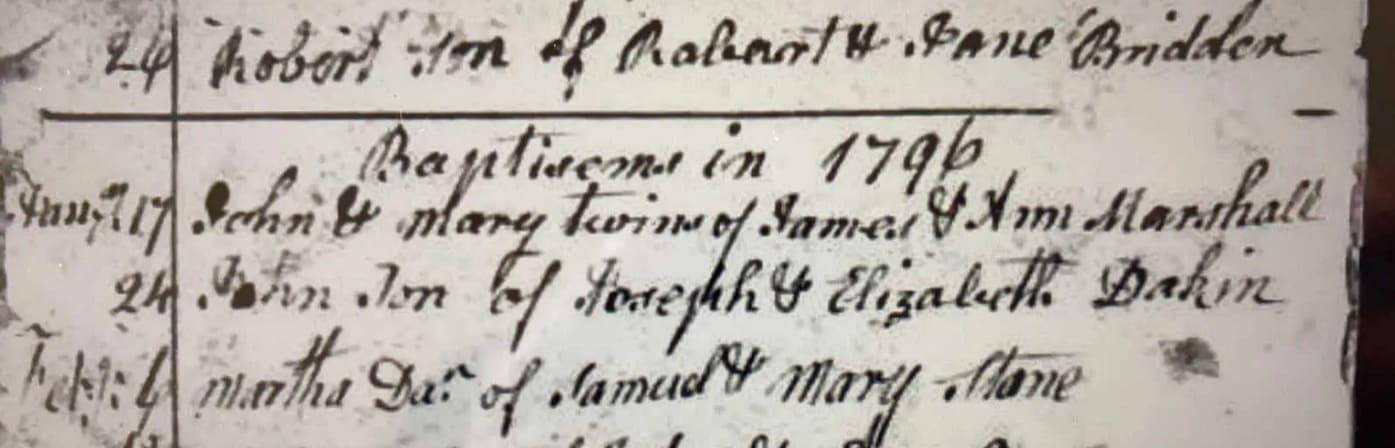
Ann died in 1806 in Elton (a small village just outside Matlock) at the age of 36 within days of her newborn twins, Ann and James. James and Ann had two sets of twins. John and Mary were twins as well, but Mary died in 1799 at the age of three.
1796 baptism of twins John and Mary of James and Ann Marshall
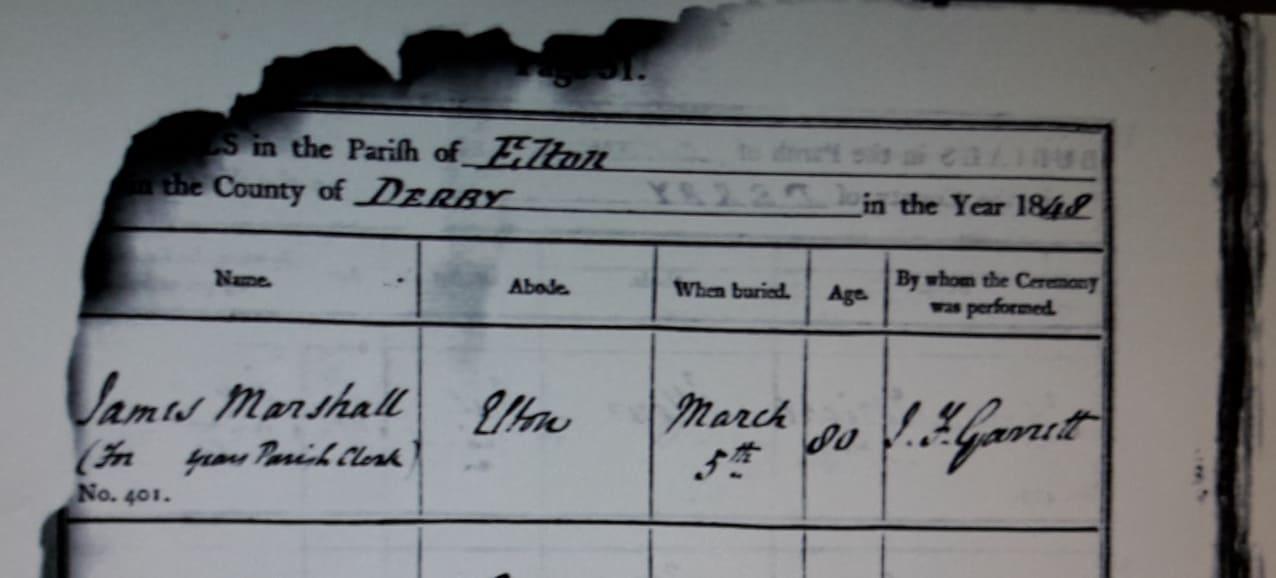
Ann’s husband James died 42 years later at the age of eighty, in Elton in 1848. It was noted in the parish register that he was for years parish clerk.
On the 1851 census John Marshall born in 1796, the son of James Marshall the parish clerk, was a lead miner occupying six acres in Elton, Derbyshire.
His son, also John, was registered on the census as a lead miner at just eight years old.
The mining of lead was the most important industry in the Peak district of Derbyshire from Roman times until the 19th century – with only agriculture being more important for the livelihood of local people. The height of lead mining in Derbyshire came in the 17th and 18th centuries, and the evidence is still visible today – most obviously in the form of lines of hillocks from the more than 25,000 mineshafts which once existed.
Peak District Mines Historical Society
Smelting, or extracting the lead from the ore by melting it, was carried out in a small open hearth. Lead was cast in layers as each batch of ore was smelted; the blocks of lead thus produced were referred to as “pigs”. Examples of early smelting-hearths found within the county were stone lined, with one side open facing the prevailing wind to create the draught needed. The hilltops of the Matlocks would have provided very suitable conditions.
The miner used a tool called a mattock or a pick, and hammers and iron wedges in harder veins, to loosen the ore. They threw the ore onto ridges on each side of the vein, going deeper where the ore proved richer.
Many mines were very shallow and, once opened, proved too poor to develop. Benjamin Bryan cited the example of “Ember Hill, on the shoulder of Masson, above Matlock Bath” where there are hollows in the surface showing where there had been fruitless searches for lead.
There were small buildings, called “coes”, near each mine shaft which were used for tool storage, to provide shelter and as places for changing into working clothes. It was here that the lead was smelted and stored until ready for sale.
Lead is, of course, very poisonous. As miners washed lead-bearing material, great care was taken with the washing vats, which had to be covered. If cattle accidentally drank the poisoned water they would die from something called “belland”.
Cornish and Welsh miners introduced the practice of buddling for ore into Derbyshire about 1747. Buddling involved washing the heaps of rubbish in the slag heaps, the process of separating the very small particles from the dirt and spar with which they are mixed, by means of a small stream of water. This method of extraction was a major pollutant, affecting farmers and their animals (poisoned by Belland from drinking the waste water), the brooks and streams and even the River Derwent.
Women also worked in the mines. An unattributed account from 1829, says: “The head is much enwrapped, and the features nearly hidden in a muffling of handkerchiefs, over which is put a man’s hat, in the manner of the paysannes of Wales”. He also describes their gowns, usually red, as being “tucked up round the waist in a sort of bag, and set off by a bright green petticoat”. They also wore a man’s grey or dark blue coat and shoes with 3″ thick soles that were tied round with cords. The 1829 writer called them “complete harridans!”
Lead Mining in Matlock & Matlock Bath, The Andrews Pages
John’s wife Margaret died at the age of 42 in 1847. I don’t know the cause of death, but perhaps it was lead poisoning. John’s son John, despite a very early start in the lead mine, became a carter and lived to the ripe old age of 88.
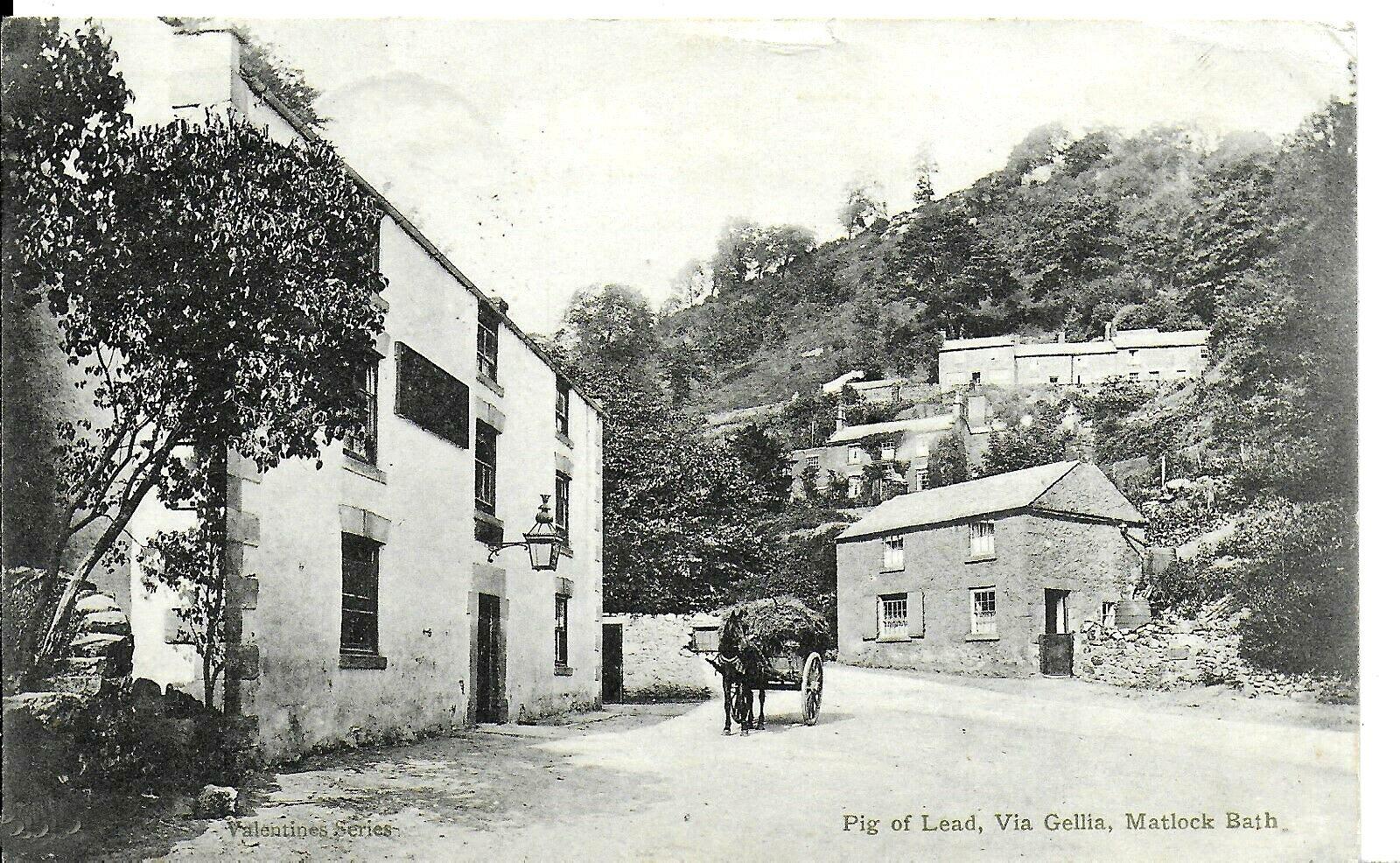
The Pig of Lead pub, 1904:
The earliest Marshall I’ve found so far is Charles, born in 1742. Charles married Rebecca Knowles, 1775-1823. I don’t know what his occupation was but when he died in 1819 he left a not inconsiderable sum to his wife.
1819 Charles Marshall probate:
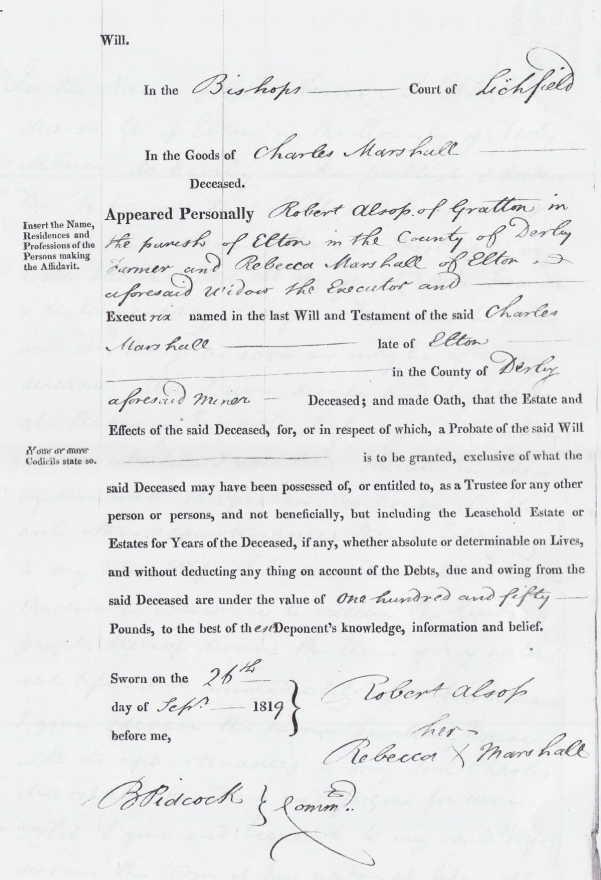
There are still Marshall’s living in Elton and Matlock, not our immediate known family, but probably distantly related. I asked a Matlock group on facebook:
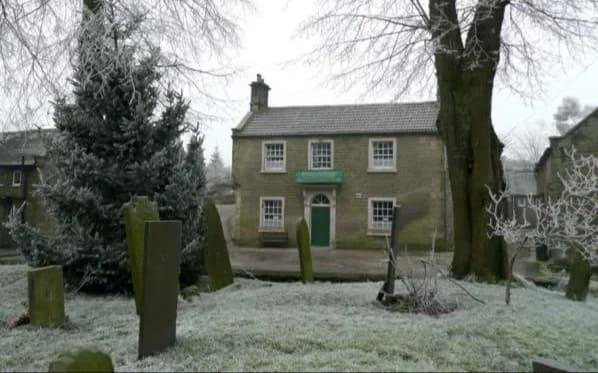
“…there are Marshall’s still in the village. There are certainly families who live here who have done generation after generation & have many memories & stories to tell. Visit The Duke on a Friday night…”
The Duke, Elton:
 December 17, 2021 at 10:36 am #6241
In reply to: The Elusive Samuel Housley and Other Family Stories
Kidsley Grange Farm and The Quakers Next Door
Kidsley Grange Farm in Smalley, Derbyshire, was the home of the Housleys in the 1800s. William Housley 1781-1848 was born in nearby Selston. His wife Ellen Carrington 1795-1872 was from a long line of Carringtons in Smalley. They had ten children between 1815 and 1838. Samuel, my 3x great grandfather, was the second son born in 1816.
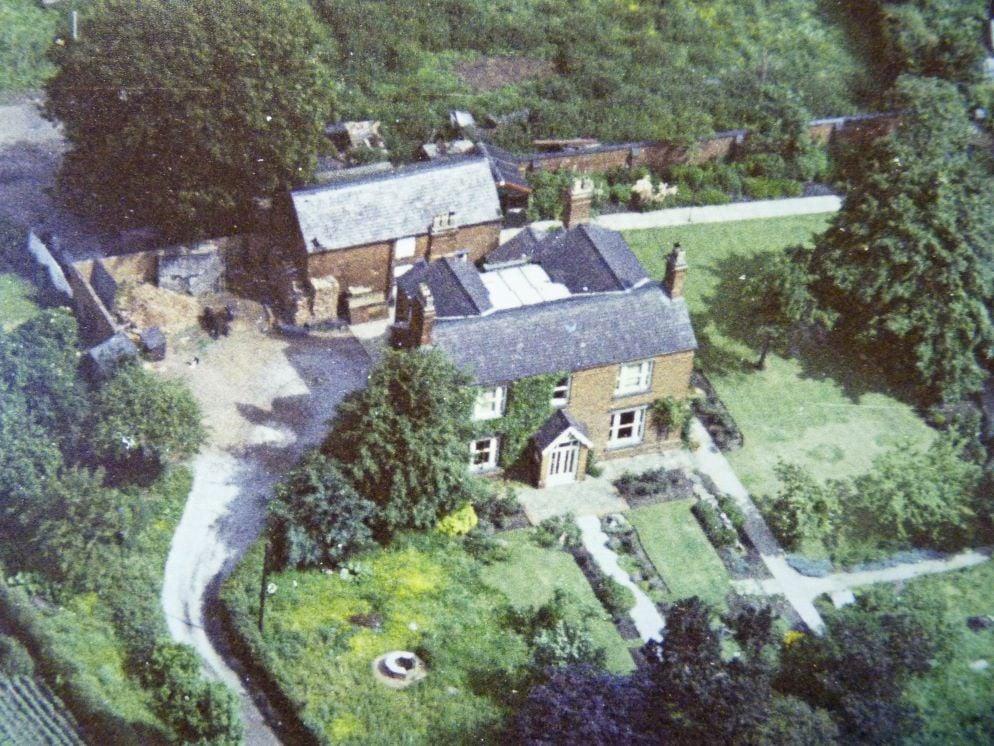
The original farm has been made into a nursing home in recent years, which at the time of writing is up for sale at £500,000. Sadly none of the original farm appears visible with all the new additions.
The farm before it was turned into a nursing home:
Kidsley Grange Farm and Kidsley Park, a neighbouring farm, are mentioned in a little book about the history of Smalley. The neighbours at Kidsley Park, the Davy’s, were friends of the Housleys. They were Quakers.
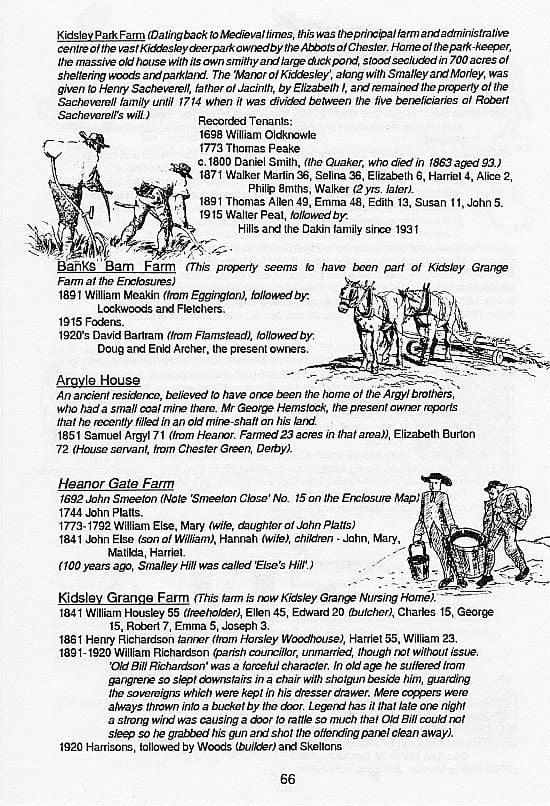
In Kerry’s History of Smalley:
Kidsley Park Farm was owned by Daniel Smith, a prominent Quaker and the last of the Quakers at Kidsley. His daughter, Elizabeth Davy, widow of William Davis, married WH Barber MB of Smalley. Elizabeth was the author of the poem “Farewell to Kidsley Park”.
Emma Housley sent one of Elizabeth Davy’s poems to her brother George in USA.
“We have sent you a piece of poetry that Mrs. Davy composed about our ‘Old House.’ I am sure you will like it though you may not understand all the allusions she makes use of as well as we do.”
Farewell to Kidsley Park
Farewell, Farewell, Thy pathways now by strangers feet are trod,
And other hands and horses strange henceforth shall turn thy sod,
Yes, other eyes may watch the buds expanding in the spring.
And other children round the hearth the coming years may bring,
But mine will be the memory of cares and pleasures there,
Intenser ~ that no living thing in some of them can share,
Commencing with the loved, and lost, in days of long ago,
When one was present on whose head Atlantic’s breezes blow,
Long years ago he left that roof, and made a home afar ~
For that is really only “home” where life’s affections are!
How many thoughts come o’er me, for old Kidsley has “a name
And memory” ~ in the hearts of some not unknown to fame.
We dream not, in those happy times, that I should be the last,
Alone, to leave my native place ~ alone, to meet the blast,
I loved each nook and corner there, each leaf and blade of grass,
Each moonlight shadow on the pond I loved: but let it pass,
For mine is still the memory that only death can mar;
I fancy I shall see it reflecting every star.
The graves of buried quadrupeds, affectionate and true,
Will have the olden sunshine, and the same bright morning dew,
But the birds that sang at even when the autumn leaves were seer,
Will miss the crumbs they used to get, in winters long and drear.
Will the poor down-trodden miss me? God help them if they do!
Some manna in the wilderness, His goodness guide them to!
Farewell to those who love me! I shall bear them still in mind,
And hope to be remembered by those I left behind:
Do not forget the aged man ~ though another fills his place ~
Another, bearing not his name, nor coming of his race.
His creed might be peculiar; but there was much of good
Successors will not imitate, because not understood.
Two hundred years have come and past since George Fox ~ first of “Friends” ~
Established his religion there ~ which my departure ends.
Then be it so: God prosper these in basket and in store,
And make them happy in my place ~ my dwelling, never more!
For I may be a wanderer ~ no roof nor hearthstone mine:
May light that cometh from above my resting place define.
Gloom hovers o’er the prospect now, but He who was my friend,
In the midst of troubled waters, will see me to the end.Elizabeth Davy, June 6th, 1863, Derby.
Another excerpt from Barbara Housley’s Narrative on the Letters from the family in Smalley to George in USA mentions the Davy’s:
Anne’s will was probated October 14, 1856. Mr. William Davy of Kidsley Park appeared for the family. Her estate was valued at under £20. Emma was to receive fancy needlework, a four post bedstead, feather bed and bedding, a mahogany chest of drawers, plates, linen and china. Emma was also to receive Anne’s writing desk! There was a condition that Ellen would have use of these items until her death.
The money that Anne was to receive from her grandfather, William Carrington, and her father, William Housley was to be distributed one third to Joseph, one third to Emma, and one third to be divided between her four neices: John’s daughter Elizabeth, 18, and Sam’s daughters Elizabeth, 10, Mary Anne, 9 and Catherine, age 7 to be paid by the trustees as they think “most useful and proper.” Emma Lyon and Elizabeth Davy were the witnesses.Mrs. Davy wrote to George on March 21 1856 sending some gifts from his sisters and a portrait of their mother–“Emma is away yet and A is so much worse.” Mrs. Davy concluded: “With best wishes
for thy health and prosperity in this world and the next I am thy sincere friend.” Whenever the girls sent greetings from Mrs. Davy they used her Quaker speech pattern of “thee and thy.”December 16, 2021 at 1:51 pm #6240In reply to: The Elusive Samuel Housley and Other Family Stories
Phyllis Ellen Marshall
1909 – 1983
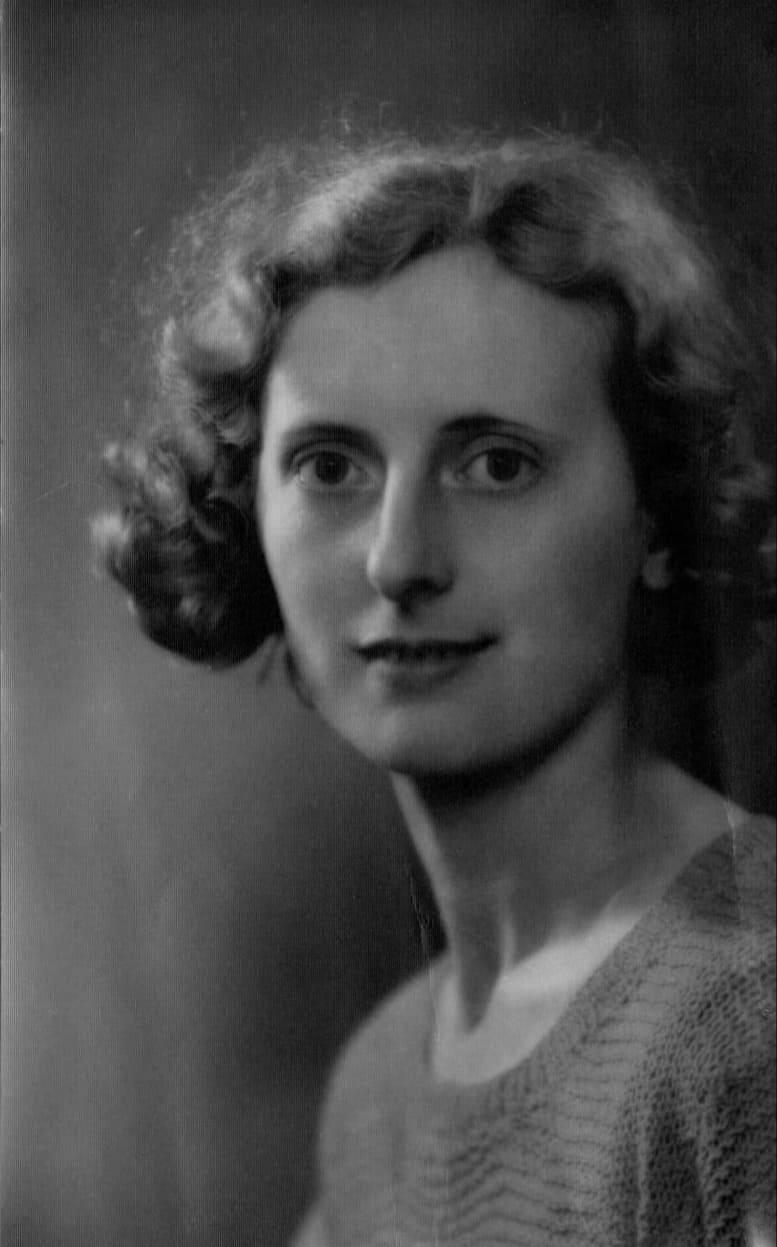
Phyllis, my grandfather George Marshall’s sister, never married. She lived in her parents home in Love Lane, and spent decades of her later life bedridden, living alone and crippled with rheumatoid arthritis. She had her bed in the front downstairs room, and had cords hanging by her bed to open the curtains, turn on the tv and so on, and she had carers and meals on wheels visit her daily. The room was dark and grim, but Phyllis was always smiling and cheerful. Phyllis loved the Degas ballerinas and had a couple of prints on the walls.
I remember visiting her, but it has only recently registered that this was my great grandparents house. When I was a child, we visited her and she indicated a tin on a chest of drawers and said I could take a biscuit. It was a lemon puff, and was the stalest biscuit I’d ever had. To be polite I ate it. Then she offered me another one! I declined, but she thought I was being polite and said “Go on! You can have another!” I ate another one, and have never eaten a lemon puff since that day.
Phyllis’s nephew Bryan Marshall used to visit her regularly. I didn’t realize how close they were until recently, when I resumed contact with Bryan, who emigrated to USA in the 1970s following a successful application for a job selling stained glass windows and church furnishings.
I asked on a Stourbridge facebook group if anyone remembered her.
AF Yes I remember her. My friend and I used to go up from Longlands school every Friday afternoon to do jobs for her. I remember she had a record player and we used to put her 45rpm record on Send in the Clowns for her. Such a lovely lady. She had her bed in the front room.
KW I remember very clearly a lady in a small house in Love Lane with alley at the left hand. I was intrigued by this lady who used to sit with the front door open and she was in a large chair of some sort. I used to see people going in and out and the lady was smiling. I was young then (31) and wondered how she coped but my sense was she had lots of help. I’ve never forgotten that lady in Love Lane sitting in the open door way I suppose when it was warm enough.
LR I used to deliver meals on wheels to her lovely lady.
I sent Bryan the comments from the Stourbridge group and he replied:
Thanks Tracy. I don’t recognize the names here but lovely to see such kind comments.
In the early 70’s neighbors on Corser Street, Mr. & Mrs. Walter Braithwaite would pop around with occasional visits and meals. Walter was my piano teacher for awhile when I was in my early twenties. He was a well known music teacher at Rudolph Steiner School (former Elmfield School) on Love Lane. A very fine school. I seem to recall seeing a good article on Walter recently…perhaps on the Stourbridge News website. He was very well known.
I’m ruminating about life with my Aunt Phyllis. We were very close. Our extra special time was every Saturday at 5pm (I seem to recall) we’d watch Doctor Who. Right from the first episode. We loved it. Likewise I’d do the children’s crossword out of Woman’s Realm magazine…always looking to win a camera but never did ! She opened my mind to the Bible, music and ballet. She once got tickets and had a taxi take us into Birmingham to see the Bolshoi Ballet…at a time when they rarely left their country. It was a very big deal in the early 60’s. ! I’ve many fond memories about her and grandad which I’ll share in due course. I’d change the steel needle on the old record player, following each play of the 78rpm records…oh my…another world.Bryan continues reminiscing about Phyllis in further correspondence:
Yes, I can recall those two Degas prints. I don’t know much of Phyllis’ early history other than she was a hairdresser in Birmingham. I want to say at John Lewis, for some reason (so there must have been a connection and being such a large store I bet they did have a salon?)
You will know that she had severe and debilitating rheumatoid arthritis that eventually gnarled her hands and moved through her body. I remember strapping on her leg/foot braces and hearing her writhe in pain as I did so but she wanted to continue walking standing/ getting up as long as she could. I’d take her out in the wheelchair and I can’t believe I say it along …but down Stanley Road!! (I had subsequent nightmares about what could have happened to her, had I tripped or let go!) She loved Mary Stevens Park, the swans, ducks and of course Canadian geese. Was grateful for everything in creation. As I used to go over Hanbury Hill on my visit to Love Lane, she would always remind me to smell the “sea-air” as I crested the hill.
In the earlier days she smoked cigarettes with one of those long filters…looking like someone from the twenties.I’ll check on “Send in the clowns”. I do recall that music. I remember also she loved to hear Neil Diamond. Her favorites in classical music gave me an appreciation of Elgar and Delius especially. She also loved ballet music such as Swan Lake and Nutcracker. Scheherazade and La Boutique Fantastic also other gems.
When grandad died she and aunt Dorothy shared more about grandma (who died I believe when John and I were nine-months old…therefore early 1951). Grandma (Mary Ann Gilman Purdy) played the piano and loved Strauss and Offenbach. The piano in the picture you sent had a bad (wonky) leg which would fall off and when we had the piano at 4, Mount Road it was rather dangerous. In any event my parents didn’t want me or others “banging on it” for fear of waking the younger brothers so it disappeared at sometime.
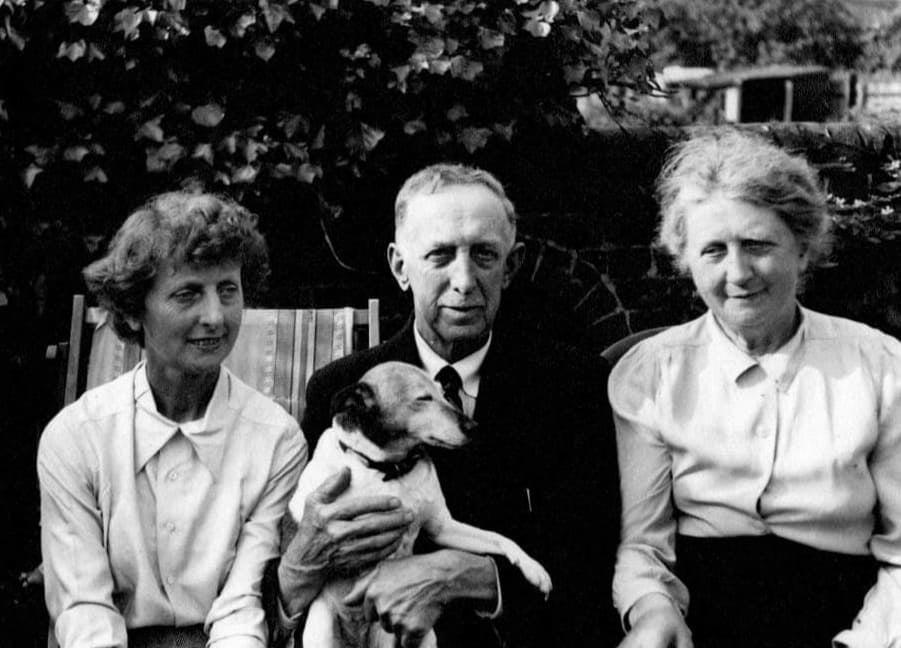
By the way, the dog, Flossy was always so rambunctious (of course, she was a JRT!) she was put on the stairway which fortunately had a door on it. Having said that I’ve always loved dogs so was very excited to see her and disappointed when she was not around.Phyllis with her parents William and Mary Marshall, and Flossie the dog in the garden at Love Lane:
Bryan continues:
I’ll always remember the early days with the outside toilet with the overhead cistern caked in active BIG spider webs. I used to have to light a candle to go outside, shielding the flame until destination. In that space I’d set the candle down and watch the eery shadows move from side to side whilst…well anyway! Then I’d run like hell back into the house. Eventually the kitchen wall was broken through so it became an indoor loo. Phew!
In the early days the house was rented for ten-shillings a week…I know because I used to take over a ten-bob-note to a grumpy lady next door who used to sign the receipt in the rent book. Then, I think she died and it became available for $600.00 yes…the whole house for $600.00 but it wasn’t purchased then. Eventually aunt Phyllis purchased it some years later…perhaps when grandad died.I used to work much in the back garden which was a lovely walled garden with arch-type decorations in the brickwork and semicircular shaped capping bricks. The abundant apple tree. Raspberry and loganberry canes. A gooseberry bush and huge Victoria plum tree on the wall at the bottom of the garden which became a wonderful attraction for wasps! (grandad called the “whasps”). He would stew apples and fruit daily.
Do you remember their black and white cat Twinky? Always sat on the pink-screen TV and when she died they were convinced that “that’s wot got ‘er”. Grandad of course loved all his cats and as he aged, he named them all “Billy”.Have you come across the name “Featherstone” in grandma’s name. I don’t recall any details but Dorothy used to recall this. She did much searching of the family history Such a pity she didn’t hand anything on to anyone. She also said that we had a member of the family who worked with James Watt….but likewise I don’t have details.
Gifts of chocolates to Phyllis were regular and I became the recipient of the overflow!What a pity Dorothy’s family history research has disappeared! I have found the Featherstone’s, and the Purdy who worked with James Watt, but I wonder what else Dorothy knew.
I mentioned DH Lawrence to Bryan, and the connection to Eastwood, where Bryan’s grandma (and Phyllis’s mother) Mary Ann Gilman Purdy was born, and shared with him the story about Francis Purdy, the Primitive Methodist minister, and about Francis’s son William who invented the miners lamp.
He replied:
As a nosy young man I was looking through the family bookcase in Love Lane and came across a brown paper covered book. Intrigued, I found “Sons and Lovers” D.H. Lawrence. I knew it was a taboo book (in those days) as I was growing up but now I see the deeper connection. Of course! I know that Phyllis had I think an earlier boyfriend by the name of Maurice who lived in Perry Barr, Birmingham. I think he later married but was always kind enough to send her a book and fond message each birthday (Feb.12). I guess you know grandad’s birthday – July 28. We’d always celebrate those days. I’d usually be the one to go into Oldswinford and get him a cardigan or pullover and later on, his 2oz tins of St. Bruno tobacco for his pipe (I recall the room filled with smoke as he puffed away).
Dorothy and Phyllis always spoke of their ancestor’s vocation as a Minister. So glad to have this history! Wow, what a story too. The Lord rescued him from mischief indeed. Just goes to show how God can change hearts…one at a time.
So interesting to hear about the Miner’s Lamp. My vicar whilst growing up at St. John’s in Stourbridge was from Durham and each Harvest Festival, there would be a miner’s lamp placed upon the altar as a symbol of the colliery and the bountiful harvest.More recollections from Bryan about the house and garden at Love Lane:
I always recall tea around the three legged oak table bedecked with a colorful seersucker cloth. Battenburg cake. Jam Roll. Rich Tea and Digestive biscuits. Mr. Kipling’s exceedingly good cakes! Home-made jam. Loose tea from the Coronation tin cannister. The ancient mangle outside the back door and the galvanized steel wash tub with hand-operated agitator on the underside of the lid. The hand operated water pump ‘though modernisation allowed for a cold tap only inside, above the single sink and wooden draining board. A small gas stove and very little room for food preparation. Amazing how the Marshalls (×7) managed in this space!
The small window over the sink in the kitchen brought in little light since the neighbor built on a bathroom annex at the back of their house, leaving #47 with limited light, much to to upset of grandad and Phyllis. I do recall it being a gloomy place..i.e.the kitchen and back room.
The garden was lovely. Long and narrow with privet hedge dividing the properties on the right and the lovely wall on the left. Dorothy planted spectacular lilac bushes against the wall. Vivid blues, purples and whites. Double-flora. Amazing…and with stunning fragrance. Grandad loved older victorian type plants such as foxgloves and comfrey. Forget-me-nots and marigolds (calendulas) in abundance. Rhubarb stalks. Always plantings of lettuce and other vegetables. Lots of mint too! A large varigated laurel bush outside the front door!
Such a pleasant walk through the past.
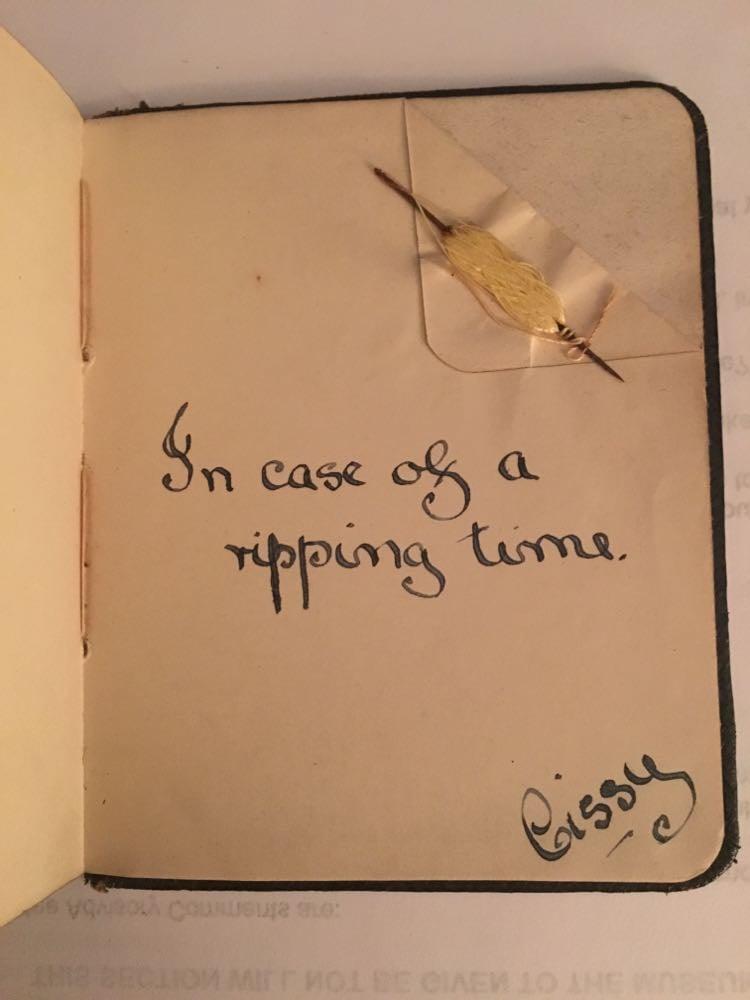
An autograph book belonging to Phyllis from the 1920s has survived in which each friend painted a little picture, drew a cartoon, or wrote a verse. This entry is perhaps my favourite:
 December 13, 2021 at 2:34 pm #6227
In reply to: The Elusive Samuel Housley and Other Family Stories
The Scottish Connection
My grandfather always used to say we had some Scottish blood because his “mother was a Purdy”, and that they were from the low counties of Scotland near to the English border.
My mother had a Scottish hat in among the boxes of souvenirs and old photographs. In one of her recent house moves, she finally threw it away, not knowing why we had it or where it came from, and of course has since regretted it! It probably came from one of her aunts, either Phyllis or Dorothy. Neither of them had children, and they both died in 1983. My grandfather was executor of the estate in both cases, and it’s assumed that the portraits, the many photographs, the booklet on Primitive Methodists, and the Scottish hat, all relating to his mother’s side of the family, came into his possession then. His sister Phyllis never married and was living in her parents home until she died, and is the likeliest candidate for the keeper of the family souvenirs.
Catherine Housley married George Purdy, and his father was Francis Purdy, the Primitive Methodist preacher. William Purdy was the father of Francis.
Record searches find William Purdy was born on 16 July 1767 in Carluke, Lanarkshire, near Glasgow in Scotland. He worked for James Watt, the inventor of the steam engine, and moved to Derbyshire for the purpose of installing steam driven pumps to remove the water from the collieries in the area.
Another descendant of Francis Purdy found the following in a book in a library in Eastwood:
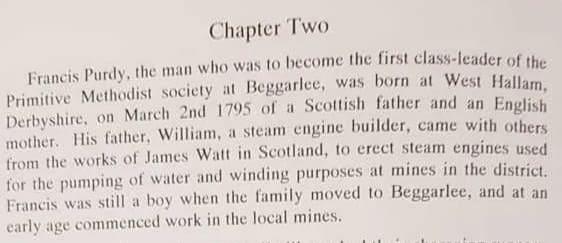
William married a local girl, Ruth Clarke, in Duffield in Derbyshire in 1786. William and Ruth had nine children, and the seventh was Francis who was born at West Hallam in 1795.
Perhaps the Scottish hat came from William Purdy, but there is another story of Scottish connections in Smalley: Bonnie Prince Charlie and the Jacobite Rebellion of 1745. Although the Purdy’s were not from Smalley, Catherine Housley was.
From an article on the Heanor and District Local History Society website:
The Jacobites in Smalley
Few people would readily associate the village of Smalley, situated about two miles west of Heanor, with Bonnie Prince Charlie and the Jacobite Rebellion of 1745 – but there is a clear link.
During the winter of 1745, Charles Edward Stuart, the “Bonnie Prince” or “The Young Pretender”, marched south from Scotland. His troops reached Derby on 4 December, and looted the town, staying for two days before they commenced a fateful retreat as the Duke of Cumberland’s army approached.
While staying in Derby, or during the retreat, some of the Jacobites are said to have visited some of the nearby villages, including Smalley.
A history of the local aspects of this escapade was written in 1933 by L. Eardley-Simpson, entitled “Derby and the ‘45,” from which the following is an extract:
“The presence of a party at Smalley is attested by several local traditions and relics. Not long ago there were people living who remember to have seen at least a dozen old pikes in a room adjoining the stables at Smalley Hall, and these were stated to have been left by a party of Highlanders who came to exchange their ponies for horses belonging to the then owner, Mrs Richardson; in 1907, one of these pikes still remained. Another resident of Smalley had a claymore which was alleged to have been found on Drumhill, Breadsall Moor, while the writer of the History of Smalley himself (Reverend C. Kerry) had a magnificent Andrew Ferrara, with a guard of finely wrought iron, engraved with two heads in Tudor helmets, of the same style, he states, as the one left at Wingfield Manor, though why the outlying bands of Army should have gone so far afield, he omits to mention. Smalley is also mentioned in another strange story as to the origin of the family of Woolley of Collingham who attained more wealth and a better position in the world than some of their relatives. The story is to the effect that when the Scots who had visited Mrs Richardson’s stables were returning to Derby, they fell in with one Woolley of Smalley, a coal carrier, and impressed him with horse and cart for the conveyance of certain heavy baggage. On the retreat, the party with Woolley was surprised by some of the Elector’s troopers (the Royal army) who pursued the Scots, leaving Woolley to shift for himself. This he did, and, his suspicion that the baggage he was carrying was part of the Prince’s treasure turning out to be correct, he retired to Collingham, and spent the rest of his life there in the enjoyment of his luckily acquired gains. Another story of a similar sort was designed to explain the rise of the well-known Derbyshire family of Cox of Brailsford, but the dates by no means agree with the family pedigree, and in any event the suggestion – for it is little more – is entirely at variance with the views as to the rights of the Royal House of Stuart which were expressed by certain members of the Cox family who were alive not many years ago.”
A letter from Charles Kerry, dated 30 July 1903, narrates another strange twist to the tale. When the Highlanders turned up in Smalley, a large crowd, mainly women, gathered. “On a command in Gaelic, the regiment stooped, and throwing their kilts over their backs revealed to the astonished ladies and all what modesty is careful to conceal. Father, who told me, said they were not any more troubled with crowds of women.”
Folklore or fact? We are unlikely to know, but the Scottish artefacts in the Smalley area certainly suggest that some of the story is based on fact.
We are unlikely to know where that Scottish hat came from, but we did find the Scottish connection. William Purdy’s mother was Grizel Gibson, and her mother was Grizel Murray, both of Lanarkshire in Scotland. The name Grizel is a Scottish form of the name Griselda, and means “grey battle maiden”. But with the exception of the name Murray, The Purdy and Gibson names are not traditionally Scottish, so there is not much of a Scottish connection after all. But the mystery of the Scottish hat remains unsolved.
December 13, 2021 at 11:29 am #6222In reply to: The Elusive Samuel Housley and Other Family Stories
George Gilman Rushby: The Cousin Who Went To Africa
The portrait of the woman has “mother of Catherine Housley, Smalley” written on the back, and one of the family photographs has “Francis Purdy” written on the back. My first internet search was “Catherine Housley Smalley Francis Purdy”. Easily found was the family tree of George (Mike) Rushby, on one of the genealogy websites. It seemed that it must be our family, but the African lion hunter seemed unlikely until my mother recalled her father had said that he had a cousin who went to Africa. I also noticed that the lion hunter’s middle name was Gilman ~ the name that Catherine Housley’s daughter ~ my great grandmother, Mary Ann Gilman Purdy ~ adopted, from her aunt and uncle who brought her up.
I tried to contact George (Mike) Rushby via the ancestry website, but got no reply. I searched for his name on Facebook and found a photo of a wildfire in a place called Wardell, in Australia, and he was credited with taking the photograph. A comment on the photo, which was a few years old, got no response, so I found a Wardell Community group on Facebook, and joined it. A very small place, population some 700 or so, and I had an immediate response on the group to my question. They knew Mike, exchanged messages, and we were able to start emailing. I was in the chair at the dentist having an exceptionally long canine root canal at the time that I got the message with his email address, and at that moment the song Down in Africa started playing.
Mike said it was clever of me to track him down which amused me, coming from the son of an elephant and lion hunter. He didn’t know why his father’s middle name was Gilman, and was not aware that Catherine Housley’s sister married a Gilman.
Mike Rushby kindly gave me permission to include his family history research in my book. This is the story of my grandfather George Marshall’s cousin. A detailed account of George Gilman Rushby’s years in Africa can be found in another chapter called From Tanganyika With Love; the letters Eleanor wrote to her family.
George Gilman Rushby:
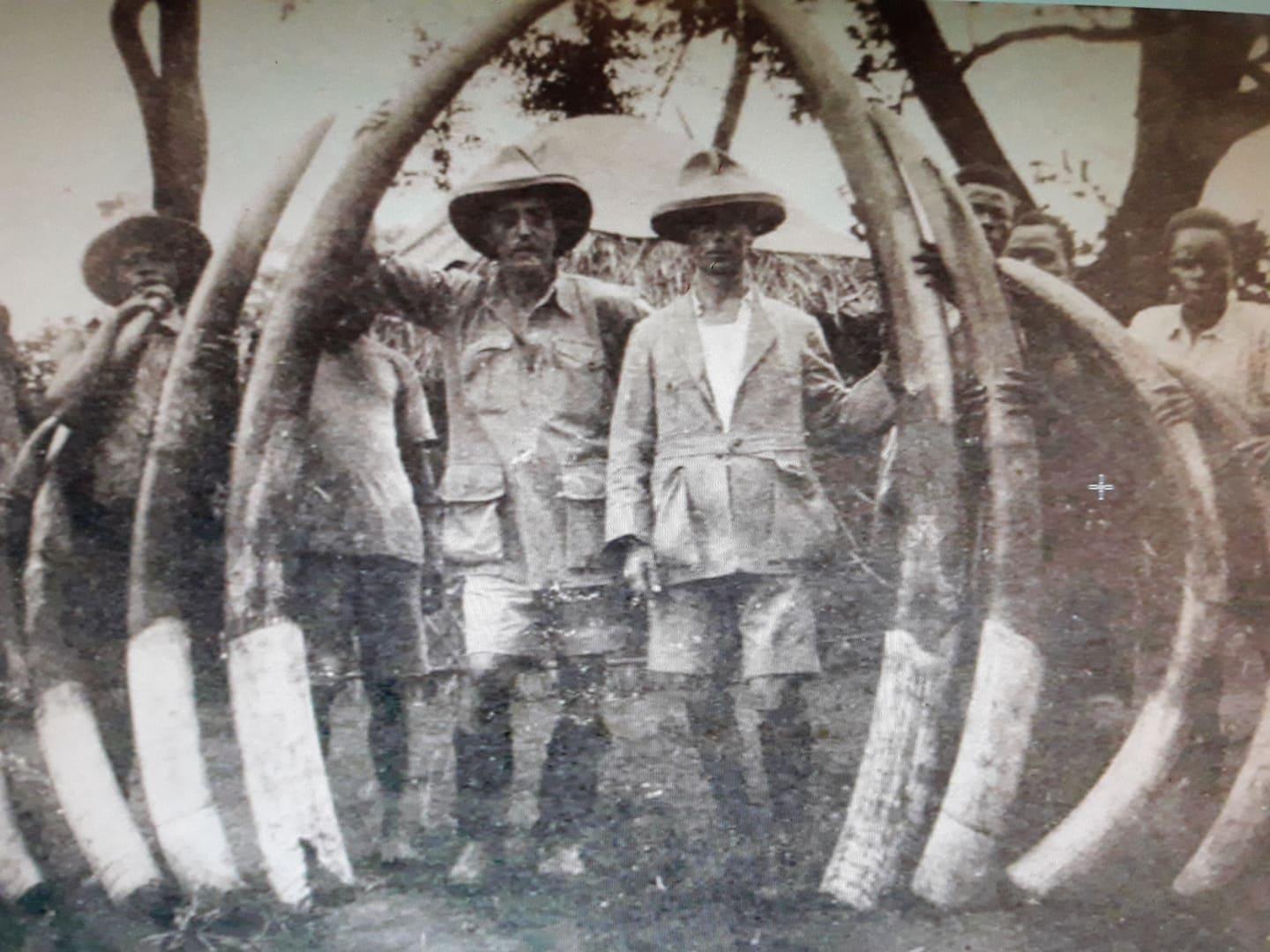
The story of George Gilman Rushby 1900-1969, as told by his son Mike:
George Gilman Rushby:
Elephant hunter,poacher, prospector, farmer, forestry officer, game ranger, husband to Eleanor, and father of 6 children who now live around the world.George Gilman Rushby was born in Nottingham on 28 Feb 1900 the son of Catherine Purdy and John Henry Payling Rushby. But John Henry died when his son was only one and a half years old, and George shunned his drunken bullying stepfather Frank Freer and was brought up by Gypsies who taught him how to fight and took him on regular poaching trips. His love of adventure and his ability to hunt were nurtured at an early stage of his life.
The family moved to Eastwood, where his mother Catherine owned and managed The Three Tuns Inn, but when his stepfather died in mysterious circumstances, his mother married a wealthy bookmaker named Gregory Simpson. He could afford to send George to Worksop College and to Rugby School. This was excellent schooling for George, but the boarding school environment, and the lack of a stable home life, contributed to his desire to go out in the world and do his own thing. When he finished school his first job was as a trainee electrician with Oaks & Co at Pye Bridge. He also worked part time as a motor cycle mechanic and as a professional boxer to raise the money for a voyage to South Africa.In May 1920 George arrived in Durban destitute and, like many others, living on the beach and dependant upon the Salvation Army for a daily meal. However he soon got work as an electrical mechanic, and after a couple of months had earned enough money to make the next move North. He went to Lourenco Marques where he was appointed shift engineer for the town’s power station. However he was still restless and left the comfort of Lourenco Marques for Beira in August 1921.
Beira was the start point of the new railway being built from the coast to Nyasaland. George became a professional hunter providing essential meat for the gangs of construction workers building the railway. He was a self employed contractor with his own support crew of African men and began to build up a satisfactory business. However, following an incident where he had to shoot and kill a man who attacked him with a spear in middle of the night whilst he was sleeping, George left the lower Zambezi and took a paddle steamer to Nyasaland (Malawi). On his arrival in Karongo he was encouraged to shoot elephant which had reached plague proportions in the area – wrecking African homes and crops, and threatening the lives of those who opposed them.
His next move was to travel by canoe the five hundred kilometre length of Lake Nyasa to Tanganyika, where he hunted for a while in the Lake Rukwa area, before walking through Northern Rhodesia (Zambia) to the Congo. Hunting his way he overachieved his quota of ivory resulting in his being charged with trespass, the confiscation of his rifles, and a fine of one thousand francs. He hunted his way through the Congo to Leopoldville then on to the Portuguese enclave, near the mouth of the mighty river, where he worked as a barman in a rough and tough bar until he received a message that his old friend Lumb had found gold at Lupa near Chunya. George set sail on the next boat for Antwerp in Belgium, then crossed to England and spent a few weeks with his family in Jacksdale before returning by sea to Dar es Salaam. Arriving at the gold fields he pegged his claim and almost immediately went down with blackwater fever – an illness that used to kill three out of four within a week.
When he recovered from his fever, George exchanged his gold lease for a double barrelled .577 elephant rifle and took out a special elephant control licence with the Tanganyika Government. He then headed for the Congo again and poached elephant in Northern Rhodesia from a base in the Congo. He was known by the Africans as “iNyathi”, or the Buffalo, because he was the most dangerous in the long grass. After a profitable hunting expedition in his favourite hunting ground of the Kilombera River he returned to the Congo via Dar es Salaam and Mombassa. He was after the Kabalo district elephant, but hunting was restricted, so he set up his base in The Central African Republic at a place called Obo on the Congo tributary named the M’bomu River. From there he could make poaching raids into the Congo and the Upper Nile regions of the Sudan. He hunted there for two and a half years. He seldom came across other Europeans; hunters kept their own districts and guarded their own territories. But they respected one another and he made good and lasting friendships with members of that small select band of adventurers.
Leaving for Europe via the Congo, George enjoyed a short holiday in Jacksdale with his mother. On his return trip to East Africa he met his future bride in Cape Town. She was 24 year old Eleanor Dunbar Leslie; a high school teacher and daughter of a magistrate who spent her spare time mountaineering, racing ocean yachts, and riding horses. After a whirlwind romance, they were betrothed within 36 hours.
On 25 July 1930 George landed back in Dar es Salaam. He went directly to the Mbeya district to find a home. For one hundred pounds he purchased the Waizneker’s farm on the banks of the Mntshewe Stream. Eleanor, who had been delayed due to her contract as a teacher, followed in November. Her ship docked in Dar es Salaam on 7 Nov 1930, and they were married that day. At Mchewe Estate, their newly acquired farm, they lived in a tent whilst George with some help built their first home – a lovely mud-brick cottage with a thatched roof. George and Eleanor set about developing a coffee plantation out of a bush block. It was a very happy time for them. There was no electricity, no radio, and no telephone. Newspapers came from London every two months. There were a couple of neighbours within twenty miles, but visitors were seldom seen. The farm was a haven for wild life including snakes, monkeys and leopards. Eleanor had to go South all the way to Capetown for the birth of her first child Ann, but with the onset of civilisation, their first son George was born at a new German Mission hospital that had opened in Mbeya.
Occasionally George had to leave the farm in Eleanor’s care whilst he went off hunting to make his living. Having run the coffee plantation for five years with considerable establishment costs and as yet no return, George reluctantly started taking paying clients on hunting safaris as a “white hunter”. This was an occupation George didn’t enjoy. but it brought him an income in the days when social security didn’t exist. Taking wealthy clients on hunting trips to kill animals for trophies and for pleasure didn’t amuse George who hunted for a business and for a way of life. When one of George’s trackers was killed by a leopard that had been wounded by a careless client, George was particularly upset.
The coffee plantation was approaching the time of its first harvest when it was suddenly attacked by plagues of borer beetles and ring barking snails. At the same time severe hail storms shredded the crop. The pressure of the need for an income forced George back to the Lupa gold fields. He was unlucky in his gold discoveries, but luck came in a different form when he was offered a job with the Forestry Department. The offer had been made in recognition of his initiation and management of Tanganyika’s rainbow trout project. George spent most of his short time with the Forestry Department encouraging the indigenous people to conserve their native forests.In November 1938 he transferred to the Game Department as Ranger for the Eastern Province of Tanganyika, and over several years was based at Nzasa near Dar es Salaam, at the old German town of Morogoro, and at lovely Lyamungu on the slopes of Kilimanjaro. Then the call came for him to be transferred to Mbeya in the Southern Province for there was a serious problem in the Njombe district, and George was selected by the Department as the only man who could possibly fix the problem.
Over a period of several years, people were being attacked and killed by marauding man-eating lions. In the Wagingombe area alone 230 people were listed as having been killed. In the Njombe district, which covered an area about 200 km by 300 km some 1500 people had been killed. Not only was the rural population being decimated, but the morale of the survivors was so low, that many of them believed that the lions were not real. Many thought that evil witch doctors were controlling the lions, or that lion-men were changing form to kill their enemies. Indeed some wichdoctors took advantage of the disarray to settle scores and to kill for reward.
By hunting down and killing the man-eaters, and by showing the flesh and blood to the doubting tribes people, George was able to instil some confidence into the villagers. However the Africans attributed the return of peace and safety, not to the efforts of George Rushby, but to the reinstallation of their deposed chief Matamula Mangera who had previously been stood down for corruption. It was Matamula , in their eyes, who had called off the lions.
Soon after this adventure, George was appointed Deputy Game Warden for Tanganyika, and was based in Arusha. He retired in 1956 to the Njombe district where he developed a coffee plantation, and was one of the first in Tanganyika to plant tea as a major crop. However he sensed a swing in the political fortunes of his beloved Tanganyika, and so sold the plantation and settled in a cottage high on a hill overlooking the Navel Base at Simonstown in the Cape. It was whilst he was there that TV Bulpin wrote his biography “The Hunter is Death” and George wrote his book “No More The Tusker”. He died in the Cape, and his youngest son Henry scattered his ashes at the Southern most tip of Africa where the currents of the Atlantic and Indian Oceans meet .
George Gilman Rushby:
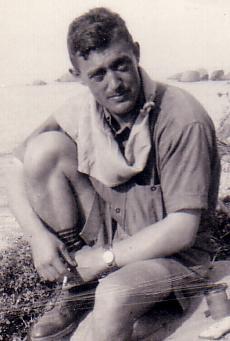 September 20, 2021 at 5:51 pm #6214
In reply to: The Precious Life and Rambles of Liz Tattler
When Finnley got out of her full body bathing suit, Liz gaped at her.
“It appears your suit wasn’t that waterproof after all. You should have kept the receipt. Now you can’t ask for a refund.”
Finnley rolled her eyes while sending daggers. Liz caught them in extremis with her pen and put them down in writing at the end of her pink notebook for later reference. She thought maybe they could be an appropriate prop for the family betrayal she planned to write about in her next chapter. Daggers between the shoulder blades were always a nice effect.
“I don’t need a receipt, I ordered them online.”
“What do you mean? What does she mean Gordon? She looks so mad, she won’t answer me… and stop eating those bloody nuts. That’s not good for your cholesterol.”
“Actually that’s the reverse,” said Gordon.
“Stop eating them! I find the crunching noise and the movement of your tongue on your teeth disturbing.”
“She means she kept the email with the e-receipt. Knowing her she’s probably kept it in the trash for safekeeping.”
Finnley threw another pair of daggers.
“Ouch!” Gordon said.
“You deserved that,” said Liz. “You were mean. Now I need to talk to Godfrey. He’ll know the answers, he always know. Where is he?”
“Just behind you. I’m always behind you.”
“Don’t say that, it can be misinterpreted. Anyway, can you answer the question?”
“She kept the email with the e-receipt in her trash can. You know, it’s an internet thing. Like the writing workshop you asked me to help you organise.”
“Oh! I totally forgot about that.”
“You have 57 inscriptions. The chat session starts in 5, no 7 minutes. Should I be worried?”
“No you shouldn’t. Just do the typing for me please. You type faster than me, I’m still doing it with one finger, well two actually, now I can use both hands.”
“Okay, you’ll speak to me as if you were speaking to them and I shall write down your words faithfully.”
“You can do the speaking too, dear. Godfrey, you’ve known me for so long, you know better than me what I’m going to say.”
Liz looked at Finnley’s blue hands and turned back to Godfrey. “Oh, and before you do that, prepare some cucumbers slice, I need a power nap.”
September 14, 2021 at 3:38 pm #6211In reply to: The Precious Life and Rambles of Liz Tattler
Today the planets are aligned, thought Liz as she looked at the blue sky out the French door. The frills of her glitter pink Charnel bathing suit wiggled with excitement.
It was one of those rare days of this summer where rain wasn’t pouring somewhere in the garden. Every single day: clouds, clouds, clouds. If they weren’t above the mansion, they were above the pool. If they weren’t above the pool, they were flooding the lawn in between the mansion and the pool.
But today, the sun had risen in a sky free of clouds and Liz was determined to have that dip in the newly repaired swimming pool with a watermelon mojito served by Roberto in his shiny leather speedo. The pool had been half frozen half boiling for so long that they had forgotten the swimming part. Once fixed, the summer had turned into a mid season rainy weather.
‘I don’t want to get wet before I get into the pool’, Liz had said to Finnley.
Liz looked at her pink notebook lying on the coffee table. Resisting the temptation to fill in the empty pages with gripping stories, she hopped on the patio, flounces bouncing and her goocci flip-flops clacking. With a sparkling foot, Liz tested the grass. It was dry enough, which meant she would not inadvertently walk on a slug or a snail. She particularly hated the cracking noise and the wetness afterward under her feet.
Roberto was bent forward. Liz frowned. He was not wearing his leather speedo. And his hands and pants were covered in green goo.
‘What happened?’ she asked in front of the disaster.
Roberto shrugged, obviously overwhelmed by the goo.
‘Green algae’, said Godfrey popping up out of nowhere with a handful of cashews. ‘The ice and fire had kept it at bay for some time. But once it was back to normal the pool was a perfect environment for their development. I already called the maintenance company. They come next week.’
‘What? Next week?’
‘Yes. That’s sad. It’s the season. We are not the only ones to have that problem.’
That said he threw a cashew in his mouth and popped back to nowhere he came from.
May 30, 2021 at 8:19 am #6197In reply to: The Precious Life and Rambles of Liz Tattler
“We need fun silly comments like watermelon in the woodshed and cork bums,” said Liz, to anyone who was listening. “More of that sort of thing.”
“You start,” said Finnley.
February 21, 2021 at 8:09 pm #6188In reply to: Twists and One Return From the Time Capsule
Reddening, Bob stammered, “Yeah, yes, uh, yeah. Um…”
Clara squeezed her grandfathers arm reassuringly. “We’re looking for my friend Nora.” she interrupted, to give him time to compose himself. Poor dear was easily flustered these days. Turning to Will, “She was hiking over to visit us and should have arrived yesterday and she’d have passed right by here, but her phone seems to be dead.”
Will had to think quickly. If he could keep them both here with Nora long enough to get the box ~ or better yet, replace the contents with something else. Yes, that was it! He could take a sack of random stuff to put in the box, and they’d never suspect a thing. He was going to hide the contents in a statue anyway, so he didn’t even need the box.
Spreading his arms wide in welcome and smiling broadly, he said “This is your lucky day! Come inside and I’ll put the kettle on, Nora’s gone up to take some photos of the old ruin, she’ll be back soon.”
Bob and Clara relaxed and returned the smile and allowed themselves to be ushered into the kitchen and seated at the table.
Will lit the gas flame under the soup before filling the kettle with water. They’d be too polite to refuse, if he put a bowl in front of them, and if they didn’t drink it, well then he’d have to resort to plan B. He put a little pinch of powder from a tiny jar into each cup of tea; it wouldn’t hurt and would likely make them more biddable. Then the soup would do the trick.
Will steered the conversation to pleasant banter about the wildflowers on the way up to the ruins that he’d said Nora was visiting, and the birds that were migrating at this time of year, keeping the topics off anything potentially agitating. The tea was starting to take effect and Clara and Bob relaxed and enjoyed the conversation. They sipped the soup without protest, although Bob did grimace a bit at the thought of eating on an agitated stomach. He’d have indigestion for days, but didn’t want to be rude and refuse. He was enjoying the respite from all the vexation, though, and was quite happy for the moment just to let the man prattle on while he ate the damn soup.
“Oh, I think Nora must be back! I just heard her voice!” exclaimed Clara.
Will had heard it too, but he said, “That wasn’t Nora, that was the parrot! It’s a fast leaner, and Nora’s been training it to say things….I tell you what, you stay here and finish your soup, and I’ll go and fetch the parrot.”
“Parrot? What parrot?” Clara and Bob said in unison. They both found it inordinately funny and by the time Will had exited the kitchen, locking the door from the outside, they were hooting and wiping the tears of laughter from their cheeks.
“What the hell was in that tea!” Clara joked, finishing her soup.
What was Nora doing awake already? Will didn’t have to keep her quiet for long, but he needed to keep her quiet now, just until the soup took effect on the others.
Either that or find a parrot.
January 5, 2021 at 9:03 pm #6175In reply to: Twists and One Return From the Time Capsule
“”Sorry, I’m only just telling you this about the note now, lovie. Your Grandma’s been on at me to tell you. Just in my thoughts I mean!” he added quickly.
Jane smirked and tapped her forehead. “Careful, Old Man. She’ll think you’ve completely lost it!”
Clara stared at him, a small frown creasing her brow. “So, the note said you were to call him?”
Bob nodded uneasily. Clara had that look on her face. The one that means she aren’t happy with the way things are proceeding.
“And then what?” asked Clara slowly.
“I dunno.” Bob shrugged. “Guess they’d bury it again? They was pretty clear they didn’t want it found. Now, how about I put the kettle on?” Bob stood quickly and began to busy himself filling the jug with water from the tap.
Clara shook her head firmly. “No.”
“No to a cup of tea?”
“No we can’t call this man.”
“I don’t know Clara. It’s getting odd it is. Strangers leaving maps in collars and whatnot. It’s not right.”
“Well, I agree it needs further investigation. But we can’t call him … not without knowing why and what’s in it.” She tapped her fingers on the table. “I’ll try and get hold of Nora again.”
December 18, 2020 at 9:23 pm #6166In reply to: Twists and One Return From the Time Capsule
“Grandpa,” Clara said, partly to distract him ~ poor dear was looking a little anxious ~ and partly because she was starting to get twangs of gilt about Nora, “Grandpa, do you remember that guy who used to make sculptures? I can’t recall his name and need his phone number. Do you remember, used to see him driving around with gargoyles in the back of his truck. You look awfully pale, are you alright?”
“No idea,” Bob replied weakly.
Tell her! said Jane.
“No!” Bob exclaimed, feeling vexed. He wasn’t sure why, but he didn’t want to rush into anything. Why was Clara asking about the man whose phone number was on the note? What did she know about all this? What did he, Bob, know for that matter!
“I only asked!” replied Clara, then seeing his face, patted his arm gently and said “It’s ok, Grandpa.”
For the love of god will you just tell her!
“Tell who what?” asked Clara.
“What! What did you say?” Bob wondered where this was going and if it would ever end. It began to feel surreal.
They were both relieved when the door bell rang, shattering the unaccustomed tension between them.
“Who can that be?” they asked in unison, as Clara rose from the table.
Bob waited expectantly, pushing his plate away. It would take days to settle his digestive system down after all this upset at a meal time.
“You look like you’ve just seen a ghost, Clara! Who was it?” Bob said as Clara returned from the front door. “Not the water board again to cut us off I hope!”
“It’s the neighbour, Mr Willets, he says he’s ever so sorry but his dogs, they got loose and got into some kind of a box on your property. He said…”
May 11, 2020 at 6:29 pm #6081In reply to: The Chronicles of the Flying Fish Inn
Aunt Idle:
I’ll admit Mater did well with the get back into shape programme, despite my skepticism. She did hone her muscles a bit, but she was still harping on about wanting plastic surgery. I probably shouldn’t have asked her if she was showing off her biceps or her bingo wings the other day, because that started her off again. I tried to make it up by complimenting her thigh muscles, but spoiled it by saying it was a shame the skin hung down past her kneecaps. Bert said maybe she could hold the skin up with some suspenders and made me spit my eucalyptus tea out and nearly choke to death. Mater was all set to take offence until she saw me choking, and then she started laughing too. I’m smiling remembering it, because we all saw the funny side then and couldn’t stop laughing for ages. God knows we needed a good laugh.
I’d had another one of those telepathic chats with Corrie the day before. If I’d known those silly girls were going to navigate their way here via that route I’d have said something, but I never thought they’d be so daft. There’s me envisioning a pleasant drift through the Mediterranean, and an unexpected sail across an immense shallow lake that had appeared in the middle east with crystal clear waters and a sandy bottom (I could picture it all, I tell you) and then an invitingly tropical trip along the Indian coast with ports of call at virgin new coastlines ~ but no, they’d gone the other way. Across the Atlantic. And now they were fighting off bandits every step of the way and having to go miles out of their way to avoid plague ridden slums. They hadn’t even made their way past the eastern seaboard yet, despite it being considerably narrower now.
They lost Pan for days in one of those half submerged coastal cities, rife with lawless floating shanties. I hope my impressions are wrong, I do really, but it seemed like he’d been kidnapped for a barbecue. Tender and juicy.
His ability to stay submerged under the water for so long saved him, that and Corrie’s ability to stay in telepathic contact with him.
They left the coastline and headed south after that and didn’t head back towards land for awhile but when they did, they found the lagoons and inlets were infested with alligators and some kind of water pig. Not sure if I picked that up right, but seems like the hogs had escaped from the farms during the Great Floods and taken to the water. Pan was forbidden to waterlark in these waters and had to stay confined to the raft.
I don’t know if they’ll get here in time for Mater’s birthday. Might be my hundredth birthday by the time they get here at this rate.
April 27, 2020 at 4:08 pm #6076In reply to: Newsreel from the Rim of the Realm
“Let’s begin,” said the teacher. She was short and seemed around sixty seven. She walked around the room like a tamer surrounded by wild beasts in a circus. Her dark hair was tied into a long braid falling on her straight back like an I. She wore a sari wrapped around her neatly. “I’m Ms Anika Koskinen, your cryogurt teacher today. You’ve got the recipe in front of you on the benches right with the glass and a bottle of water. The ingredients will be in the cabinets on your left and everything is referenced and written big enough for everyone to see.”
“Those benches look like the ones in chemistry class when I was in college,” said Glo. “I have bad memories of thoses.”
“You have bad memories, that’s all,” said Sha making them both laugh.
“But where’s Mavis?” whispered Glo after looking around the room at the other participants. A majority of women, wrapped in colourful sarongs and a few older men.
“How do you want me to know? I was with you since we left the bungalow,” said Sharon who was trying to decipher the blurry letters on the recipe. “Their printer must be malfunctioning, it’s unreadable.”
“You should try putting on your glasses.”
“I didn’t bring’em, didn’t think we’d need to see anything.”
“Oh! There she is,” said Glo as Mavis just entered the room with her beach bag. “Mav! Weehoo! We’re here!”
“I saw you! no need to shout,” whispered Mavis loudly. She muttered some excuse to the teacher who had been giving them a stern look.
“I’m afraid you’ll have to go with your friends,” said Ms Koskinen, “We don’t have enough material for everyone.”
“Oh! That’ll be perfect,” said Mavis with a broad smile. “Hi girls,” she said while installing herself near Sha and Glo.
The teacher resumed her explanations of the procedure of making frozen yogurt, checking regularly if everyone had understood. She took everyone bobbing their head as a yes.
“Is he good looking?” asked Sha, showing one of the men who had been looking at them since Mavis arrival.
“You shouldn’t ask us,” said Glo, “our eyes are like wrinkles remover apps.”
“I think he looks better without glasses,” said Mavis.
After Ms Koskinen had finished giving them instructions, she told everyone to go take the ingredients and bring them back to their benches.
“I’m going,” said Sha who wanted to have a better look at the man.
“Don’t forget the recipe with the list of ingredients,” said Mavis waving the paper at her.
“Oh! Yes.”
She came back with the man helping her carry the tray of ingredients.
“Thank you Andrew,” said Sha when he put the tray on their bench.
“Oh you’re welcome. And those are your friend you told me about?”
“Yes! This is Gloria and this is Mavis.”
“Pleased to meet you,” said Andrew. “I’m Andrew Anderson. I suggested Sharon we could have lunch together after the workshop. I’d like you to meet my friends.”
“Of course!” said Sha. She winked at her friends who were too flabbergasted to speak.
“That’s settled then. We’ll meet at 1pm at my bungalow.”
“See you later,” said Sharon with a dulcet voice.
“What the butt was that all about?” asked Glo.
“Oh! You’ll thank me. I pretexted not to be able to find everything on the list and Andrew was very helpful. The man is charming, and his yacht makes you forget about his Australian accent. We’re going to have lunch on a yacht girls! That means we’re not stuck on the beach and can have some fun exploring around.”
Sha looked quite pleased with herself. She put a bottle of orange powder among the ingredients and said :”Now! Let’s make some wrinkle flattener ice cream, ladies. I took some extra tightener.”
April 23, 2020 at 4:16 pm #6066In reply to: The Pistil Maze
“It’s funny,” he said, squinting his eyes. “Looks like the maze kind of fades out.”
“Oh yeah, that happens all the time. People lose interest you see, then it all but vanishes from their experience. Quaint, I know.”
Kahurangi, nicknamed Kahu, was trying hard to get interested, see if the structure would come back into focus. But there were more fun things around. He asked again to the guy who was selling pop corn at the entrance.
“T’is normal that people wander around with… well, pets? Look at this guy, with a piglet on a leash. It’s cute, don’t get me wrong, and probably more useful when you’re looking for truffles…”
“Pretty normal. Seems animal have a sense around this thing, or so it’s believed. Many will bring one and try again. Look, I buried my snake not long ago, it was getting tired I think. Not sure they make the best animals to cover ground there.” He continued “Are you buying me something or what?”
“Oh sure, give me that, and a bottle of water.”
He handed a crumpled bill of 5 and thanked.
“A word of unsollicited advice?”
Kahu noded “Sure.”
“See those piles of rocks over there, along the way?”
“Looks like inukshuks, are they? Strange place to find them though.”
“Yeah, you’ll tend to see more as you get along. People started to build them to pinpoint places they’d been, but over time, they became encampments, and people lost the will to move on.”
“So what?”
“Don’t stay too long around them.”
Kahu shrugged and moved along. The maze was starting to get in focus again, there was not a minute to spare.
April 18, 2020 at 7:08 pm #6062In reply to: The Pistil Maze
The journey to the Pistil itself would have been worth its own story, thought Charlton. They had to avoid road blocks, crowds of chanting christians that had certainly vowed to spread the virus as fast as possible, and howlers who you were never sure weren’t the real thing from Teen Wolf. They had to be, in such a landscape. Once arid, it had turned greener in just a few weeks. Rain was now weekly when drops of water used to only show up with the bottles of water from the tourists.
Despite Kady’s advice not to take anything, he’d still brought the book of drawings. Kady had said nothing about the book, nor the clothes, or the snacks. Charlton was sometimes literal about what people told him, but he also knew it. So he didn’t say anything when he saw Kady had her own backpack with clothes, some money and food. During the trip, he tried to reproduce the experience with the drawings and the dreams —but nothing happened. Charlton felt a little disappointed.
They saw the pistil long before they arrived at its foot. It was at the end of the day and the sunset was splashing its reds and purples all around it. Charlton had had time to get used to its tall presence in the landscape. Yet, seeing it at a close range from below was a strange experience. Taller than the tallest man-made tower. He wondered what he was supposed to feel in its presence. Awe? Electricity? Enlightenment? Bursts of inspiration? This should at least be a mystical moment, but all he could feel was annoyance at the crowd of people crawling around like aphids avid to suck its sap.
Kady looked more annoyed than surprised. She was walking past the flock as if she knew exactly where to go. Charlton followed, feeling dizzy by the sudden increase of activity and smells. He soon got nauseous at the mix of incense and fried sausages.
“There are so many of them,” he eventually said. “How come? It was so difficult just for the two of us to avoid police controls. Do we have to wait with them?”
“Nah! They’re just the usual bunch of weirdoes,” Kady said. “They’ve been here a long time. I bet some of them aren’t even aware there have been a virus. But stay close. I don’t want to lose you, it’s a maze before the maze. I just need to see someone before we go in.”
They walked for about another ten minutes before stopping in front of a big tent. There, a big man with a boxer’s face was repairing all kind of electronics on a table with the application of a surgeon. Phones, cameras, coffee machines… Charlton wondered how they got electricity to make it all work.
“Hey, Kady!” said the man. “You’re back. Did you give it to her?” His face looked anxious.
“Of course Max! I even got an answer,” Kady said handing him a pink envelope. Max smelled it.
“Her favourite perfume,” he said with a broad smile.
“I told you she still loves you. I also brought you something else.” Kady dropped a box on the table among the electronics. Charlton didn’t think it could be possible to witness the expression of a ten year old child on such a hard face, but what was inside the box certainly did magic.
“You brought chocolate?”
“Yep.”
“Did you find the chestnut one?”
“Yep.”
“My favourite,” said Max to Charlton. “Is this your friend?”
“Max, meet Charlton. Charlton, Max. Listen, we plan on going in tomorrow, but tonight we need a place to get some rest.”
“I told you, you’re always welcome. Did you know she saved my life in there?”
“Saved your life?” asked Charlton looking hesitantly at Kady. “No, I didn’t know.”
April 15, 2020 at 11:21 pm #6017In reply to: Story Bored
Inter-dimensional fancy dress party
picture one:
Irina peruses costumes for the fancy dress party using her latest blue-crystal activated hologram. “I loooove the parrot headwear,” she says to the nervously hovering Mr R, “but the question is, will my bum look big in the unicorn dress?”
picture two:
Fox, embarrassed by his lack of costume, over-compensates. “This is where the party is, you nerds!” he shouts. “Last one in the water is a rotten egg!”
picture three:
Sanso (dressed as a thought-form and rather put out to find that everyone thought he was a common garden slug) was waxing lyrical to a Pig he thought was Arona. “Sometimes those things which tie us down are more mental than physical, but in your case, I think not.”
“Hey, leave me out of this,” says the Pig, “I just wandered over from the farm yonder to see what all the racket was.”
April 9, 2020 at 3:45 pm #5976In reply to: Story Bored
Board 1, Story 2
Sanso, emerging from the cave, wonders if he’s in the right place; but Zhaana seems happy so he decides to wait and play it by ear.
Clove and Pan’s father await the return of their son from a waterlark outing. They may have to send the waterdog to find him.
It was a lonely job being a time travelling absinthe salesman in the Elsespace Arrangement
April 1, 2020 at 9:50 am #5950In reply to: The Whale’s Diaries Collection
Helle Jorid, my Whale friend.
I dreamt I sailed on one of those ancient ships made of wood with no engine other than the wind and man power.
In the dream we were very few and not all there by choice. Chased after by some kind of police force we, a motley bunch of people found ourselves on that ship by chance. I saw one man on the dock pass by and cut the big rope that held the ship still.
As the rope limply hanged from the mooring post, I watched the ship being guided away by the backwash from its mooring place to the ocean. At that moment someone wanted to disembark and I heard myself say : In your dreams! It’s too late we’re on the open sea now.
I think someone mentioned a captain Cook, but I’m not sure as I never saw the guy. Maybe it was merely a cook, but did we really need it? As I went deeper into the ship I found a wonderful meeting room with all the technological comfort of TV sets embedded in the walls and loads of electrical plugs at the end of mechanical arms coming out of these same walls. Surely there were microwave oven and tons of dehydrated food.
But our attention was still on the discovery of the treasures hidden in the heart of that ship. There was a circular sofa set around a nice coffee table. And we all settled comfortably there for a get together, happy we had escaped and seemed safe. None of us thought one second about where the wind and the gulf stream were taking us. I guess anywhere was better than what those men had in store for us.
I woke up. Alone at night. It was dark. My heart was pounding. Is that how we feel when we are in a lock down? I almost wrote placed under house arrest. What’s the difference apart the name to make us think it’s different?
Was the ship the symbol of our longing for freedom? It’s still the same place moving around on water. Even if the place move around, we can’t move away from it and from the flatness of the ocean. I wonder. I wonder if I stayed longer in that dream what would have happened? A storm? An interesting encounter? Like a whale. How would I know unless I write the rest of the story?
March 26, 2020 at 2:08 pm #5845In reply to: Scrying the Word Cloud
Some whale random cloud :
Toilet needs seems makes takes
Happens lost died passing sister
Forgive nodded barely strange water
Everybody inspiration weather aunt forget
Fraud writer forgotten speed topic
Talked mostly mars dusted previous
Couch gargoyles couponsIt certainly is talking about something to be found at Jiborium’s Emporium with the coupons.
-
AuthorSearch Results


