

Search Results for 'week'
-
AuthorSearch Results
-
January 14, 2022 at 7:27 am #6252
In reply to: The Elusive Samuel Housley and Other Family Stories
The USA Housley’s
This chapter is copied from Barbara Housley’s Narrative on Historic Letters, with thanks to her brother Howard Housley for sharing it with me. Interesting to note that Housley descendants (on the Marshall paternal side) and Gretton descendants (on the Warren maternal side) were both living in Trenton, New Jersey at the same time.
GEORGE HOUSLEY 1824-1877
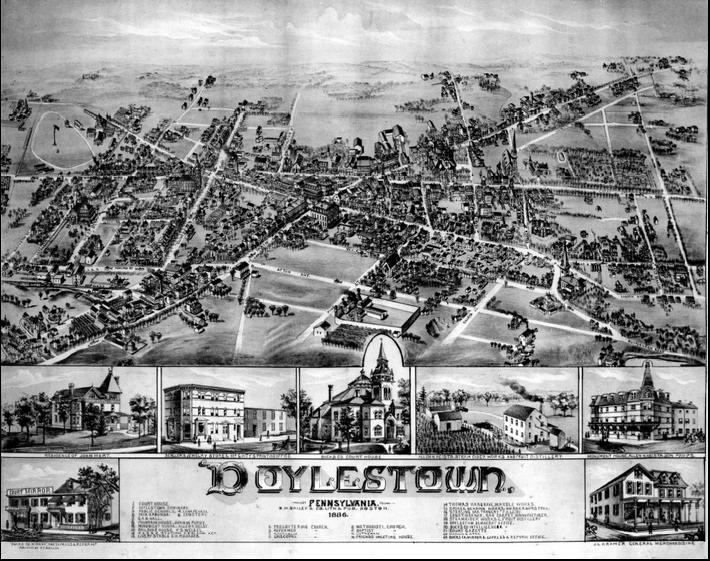
George emigrated to the United states in 1851, arriving in July. The solicitor Abraham John Flint referred in a letter to a 15-pound advance which was made to George on June 9, 1851. This certainly was connected to his journey. George settled along the Delaware River in Bucks County, Pennsylvania. The letters from the solicitor were addressed to: Lahaska Post Office, Bucks County, Pennsylvania. George married Sarah Ann Hill on May 6, 1854 in Doylestown, Bucks County, Pennsylvania. The service was performed by Attorney James Gilkyson.
In her first letter (February 1854), Anne (George’s sister in Smalley, Derbyshire) wrote: “We want to know who and what is this Miss Hill you name in your letter. What age is she? Send us all the particulars but I would advise you not to get married until you have sufficient to make a comfortable home.”
Upon learning of George’s marriage, Anne wrote: “I hope dear brother you may be happy with your wife….I hope you will be as a son to her parents. Mother unites with me in kind love to you both and to your father and mother with best wishes for your health and happiness.” In 1872 (December) Joseph (George’s brother) wrote: “I am sorry to hear that sister’s father is so ill. It is what we must all come to some time and hope we shall meet where there is no more trouble.”
Emma (George’s sister) wrote in 1855, “We write in love to your wife and yourself and you must write soon and tell us whether there is a little nephew or niece and what you call them.” In June of 1856, Emma wrote: “We want to see dear Sarah Ann and the dear little boy. We were much pleased with the “bit of news” you sent.” The bit of news was the birth of John Eley Housley, January 11, 1855. Emma concluded her letter “Give our very kindest love to dear sister and dearest Johnnie.”
According to his obituary, John Eley was born at Wrightstown and “removed” to Lumberville at the age of 19. John was married first to Lucy Wilson with whom he had three sons: George Wilson (1883), Howard (1893) and Raymond (1895); and then to Elizabeth Kilmer with whom he had one son Albert Kilmer (1907). John Eley Housley died November 20, 1926 at the age of 71. For many years he had worked for John R. Johnson who owned a store. According to his son Albert, John was responsible for caring for Johnson’s horses. One named Rex was considered to be quite wild, but was docile in John’s hands. When John would take orders, he would leave the wagon at the first house and walk along the backs of the houses so that he would have access to the kitchens. When he reached the seventh house he would climb back over the fence to the road and whistle for the horses who would come to meet him. John could not attend church on Sunday mornings because he was working with the horses and occasionally Albert could convince his mother that he was needed also. According to Albert, John was regular in attendance at church on Sunday evenings.
John was a member of the Carversville Lodge 261 IOOF and the Carversville Lodge Knights of Pythias. Internment was in the Carversville cemetery; not, however, in the plot owned by his father. In addition to his sons, he was survived by his second wife Elizabeth who lived to be 80 and three grandchildren: George’s sons, Kenneth Worman and Morris Wilson and Raymond’s daughter Miriam Louise. George had married Katie Worman about the time John Eley married Elizabeth Kilmer. Howard’s first wife Mary Brink and daughter Florence had died and he remarried Elsa Heed who also lived into her eighties. Raymond’s wife was Fanny Culver.
Two more sons followed: Joseph Sackett, who was known as Sackett, September 12, 1856 and Edwin or Edward Rose, November 11, 1858. Joseph Sackett Housley married Anna Hubbs of Plumsteadville on January 17, 1880. They had one son Nelson DeC. who in turn had two daughters, Eleanor Mary and Ruth Anna, and lived on Bert Avenue in Trenton N.J. near St. Francis Hospital. Nelson, who was an engineer and built the first cement road in New Jersey, died at the age of 51. His daughters were both single at the time of his death. However, when his widow, the former Eva M. Edwards, died some years later, her survivors included daughters, Mrs. Herbert D. VanSciver and Mrs. James J. McCarrell and four grandchildren. One of the daughters (the younger) was quite crippled in later years and would come to visit her great-aunt Elizabeth (John’s widow) in a chauffeur driven car. Sackett died in 1929 at the age of 70. He was a member of the Warrington Lodge IOOF of Jamison PA, the Uncas tribe and the Uncas Hayloft 102 ORM of Trenton, New Jersey. The interment was in Greenwood cemetery where he had been caretaker since his retirement from one of the oldest manufacturing plants in Trenton (made milk separators for one thing). Sackett also was the caretaker for two other cemeteries one located near the Clinton Street station and the other called Riverside.
Ed’s wife was named Lydia. They had two daughters, Mary and Margaret and a third child who died in infancy. Mary had seven children–one was named for his grandfather–and settled in lower Bucks county. Margaret never married. She worked for Woolworths in Flemington, N. J. and then was made manager in Somerville, N.J., where she lived until her death. Ed survived both of his brothers, and at the time of Sackett’s death was living in Flemington, New Jersey where he had worked as a grocery clerk.
In September 1872, Joseph wrote, “I was very sorry to hear that John your oldest had met with such a sad accident but I hope he is got alright again by this time.” In the same letter, Joseph asked: “Now I want to know what sort of a town you are living in or village. How far is it from New York? Now send me all particulars if you please.”
In March 1873 Harriet asked Sarah Ann: “And will you please send me all the news at the place and what it is like for it seems to me that it is a wild place but you must tell me what it is like….” The question of whether she was referring to Bucks County, Pennsylvania or some other place is raised in Joseph’s letter of the same week.
On March 17, 1873, Joseph wrote: “I was surprised to hear that you had gone so far away west. Now dear brother what ever are you doing there so far away from home and family–looking out for something better I suppose.” The solicitor wrote on May 23, 1874: “Lately I have not written because I was not certain of your address and because I doubted I had much interesting news to tell you.” Later, Joseph wrote concerning the problems settling the estate, “You see dear brother there is only me here on our side and I cannot do much. I wish you were here to help me a bit and if you think of going for another summer trip this turn you might as well run over here.”
Apparently, George had indicated he might return to England for a visit in 1856. Emma wrote concerning the portrait of their mother which had been sent to George: “I hope you like mother’s portrait. I did not see it but I suppose it was not quite perfect about the eyes….Joseph and I intend having ours taken for you when you come over….Do come over before very long.”
In March 1873, Joseph wrote: “You ask me what I think of you coming to England. I think as you have given the trustee power to sign for you I think you could do no good but I should like to see you once again for all that. I can’t say whether there would be anything amiss if you did come as you say it would be throwing good money after bad.”
On June 10, 1875, the solicitor wrote: “I have been expecting to hear from you for some time past. Please let me hear what you are doing and where you are living and how I must send you your money.” George’s big news at that time was that on May 3, 1875, he had become a naturalized citizen “renouncing and abjuring all allegiance and fidelity to every foreign prince, potentate, state and sovereignity whatsoever, and particularly to Victoria Queen of Great Britain of whom he was before a subject.”
Another matter which George took care of during the years the estate was being settled was the purchase of a cemetery plot! On March 24, 1873, George purchased plot 67 section 19 division 2 in the Carversville (Bucks County PA) Cemetery (incorporated 1859). The plot cost $15.00, and was located at the very edge of the cemetery. It was in this cemetery, in 1991, while attending the funeral of Sarah Lord Housley, wife of Albert Kilmer Housley, that sixteen month old Laura Ann visited the graves of her great-great-great grandparents, George and Sarah Ann Hill Housley.
George died on August 13, 1877 and was buried three days later. The text for the funeral sermon was Proverbs 27:1: “Do not boast about tomorrow, for you do not know what a day may bring forth.”
December 18, 2021 at 12:59 pm #6243In reply to: The Elusive Samuel Housley and Other Family Stories
William Housley’s Will and the Court Case
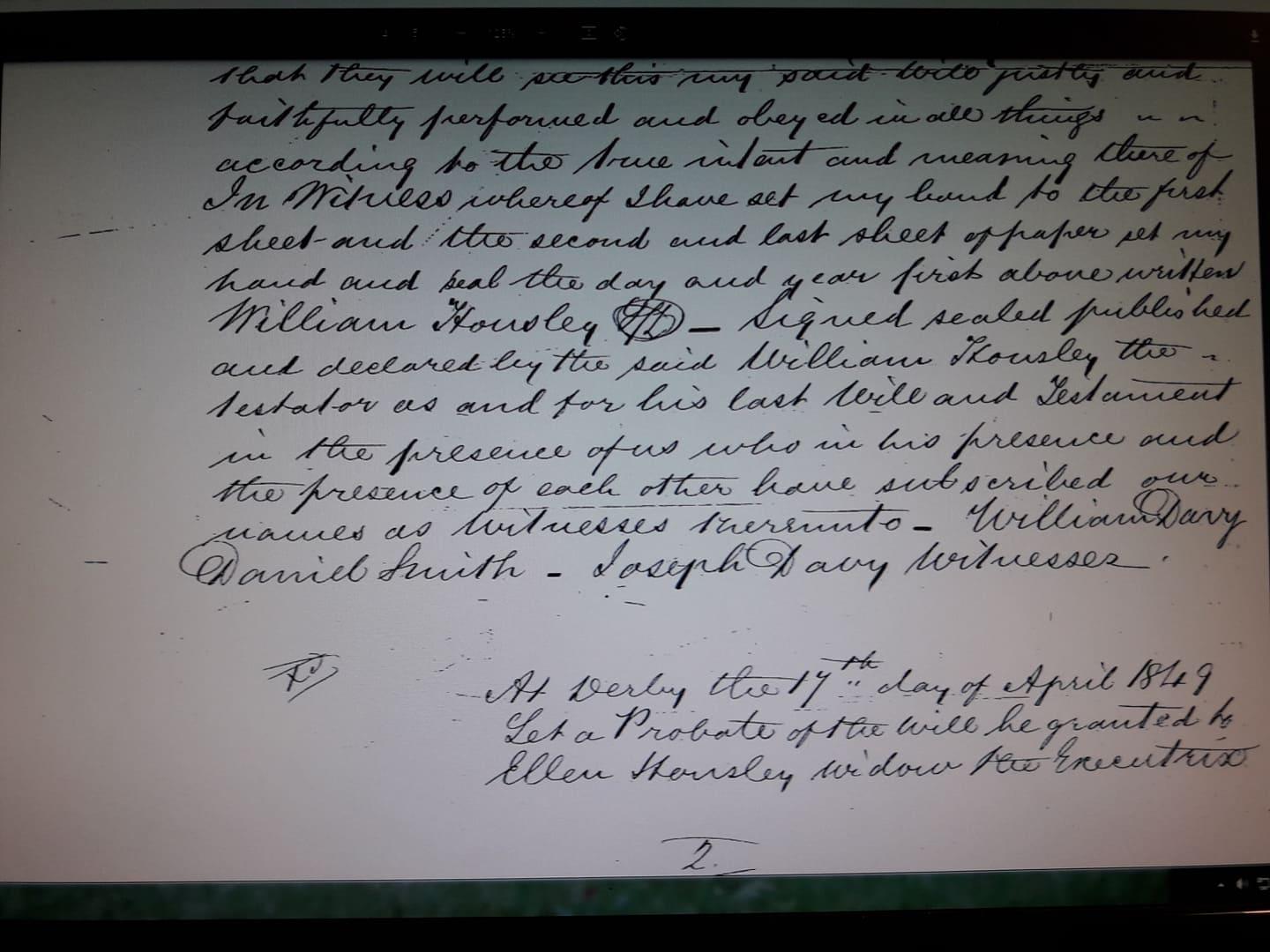
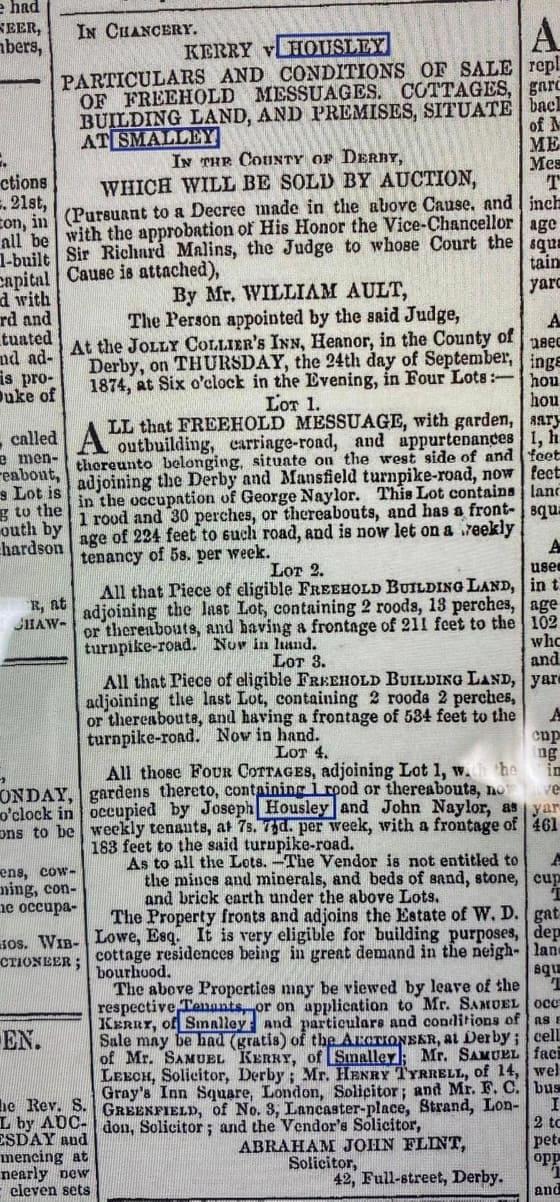
William Housley died in 1848, but his widow Ellen didn’t die until 1872. The court case was in 1873. Details about the court case are archived at the National Archives at Kew, in London, but are not available online. They can be viewed in person, but that hasn’t been possible thus far. However, there are a great many references to it in the letters.
William Housley’s first wife was Mary Carrington 1787-1813. They had three children, Mary Anne, Elizabeth and William. When Mary died, William married Mary’s sister Ellen, not in their own parish church at Smalley but in Ashbourne. Although not uncommon for a widower to marry a deceased wife’s sister, it wasn’t legal. This point is mentioned in one of the letters.
One of the pages of William Housley’s will:
An excerpt from Barbara Housley’s Narrative on the Letters:
A comment in a letter from Joseph (August 6, 1873) indicated that William was married twice and that his wives were sisters: “What do you think that I believe that Mary Ann is trying to make our father’s will of no account as she says that my father’s marriage with our mother was not lawful he marrying two sisters. What do you think of her? I have heard my mother say something about paying a fine at the time of the marriage to make it legal.” Markwell and Saul in The A-Z Guide to Tracing Ancestors in Britain explain that marriage to a deceased wife’s sister was not permissible under Canon law as the relationship was within the prohibited degrees. However, such marriages did take place–usually well away from the couple’s home area. Up to 1835 such marriages were not void but were voidable by legal action. Few such actions were instituted but the risk was always there.
Joseph wrote that when Emma was married, Ellen “broke up the comfortable home and the things went to Derby and she went to live with them but Derby didn’t agree with her so she left again leaving her things behind and came to live with John in the new house where she died.” Ellen was listed with John’s household in the 1871 census.
In May 1872, the Ilkeston Pioneer carried this notice: “Mr. Hopkins will sell by auction on Saturday next the eleventh of May 1872 the whole of the useful furniture, sewing machine, etc. nearly new on the premises of the late Mrs. Housley at Smalley near Heanor in the county of Derby. Sale at one o’clock in the afternoon.”There were hard feelings between Mary Ann and Ellen and her children. Anne wrote: “If you remember we were not very friendly when you left. They never came and nothing was too bad for Mary Ann to say of Mother and me, but when Robert died Mother sent for her to the funeral but she did not think well to come so we took no more notice. She would not allow her children to come either.”
Mary Ann was still living in May 1872. Joseph implied that she and her brother, Will “intend making a bit of bother about the settlement of the bit of property” left by their mother. The 1871 census listed Mary Ann’s occupation as “income from houses.”In July 1872, Joseph introduced Ruth’s husband: “No doubt he is a bad lot. He is one of the Heath’s of Stanley Common a miller and he lives at Smalley Mill” (Ruth Heath was Mary Anne Housley’s daughter)
In 1873 Joseph wrote, “He is nothing but a land shark both Heath and his wife and his wife is the worst of the two. You will think these is hard words but they are true dear brother.” The solicitor, Abraham John Flint, was not at all pleased with Heath’s obstruction of the settlement of the estate. He wrote on June 30, 1873: “Heath agreed at first and then because I would not pay his expenses he refused and has since instructed another solicitor for his wife and Mrs. Weston who have been opposing us to the utmost. I am concerned for all parties interested except these two….The judge severely censured Heath for his conduct and wanted to make an order for sale there and then but Heath’s council would not consent….” In June 1875, the solicitor wrote: “Heath bid for the property but it fetched more money than he could give for it. He has been rather quieter lately.”In May 1872, Joseph wrote: “For what do you think, John has sold his share and he has acted very bad since his wife died and at the same time he sold all his furniture. You may guess I have never seen him but once since poor mother’s funeral and he is gone now no one knows where.”
In 1876, the solicitor wrote to George: “Have you heard of John Housley? He is entitled to Robert’s share and I want him to claim it.”
Anne intended that one third of the inheritance coming to her from her father and her grandfather, William Carrington, be divided between her four nieces: Sam’s three daughters and John’s daughter Elizabeth.
In the same letter (December 15, 1872), Joseph wrote:
“I think we have now found all out now that is concerned in the matter for there was only Sam that we did not know his whereabouts but I was informed a week ago that he is dead–died about three years ago in Birmingham Union. Poor Sam. He ought to have come to a better end than that”However, Samuel was still alive was on the 1871 census in Henley in Arden, and no record of his death can be found. Samuel’s brother in law said he was dead: we do not know why he lied, or perhaps the brothers were lying to keep his share, or another possibility is that Samuel himself told his brother in law to tell them that he was dead. I am inclined to think it was the latter.
Excerpts from Barbara Housley’s Narrative on the Letters continued:
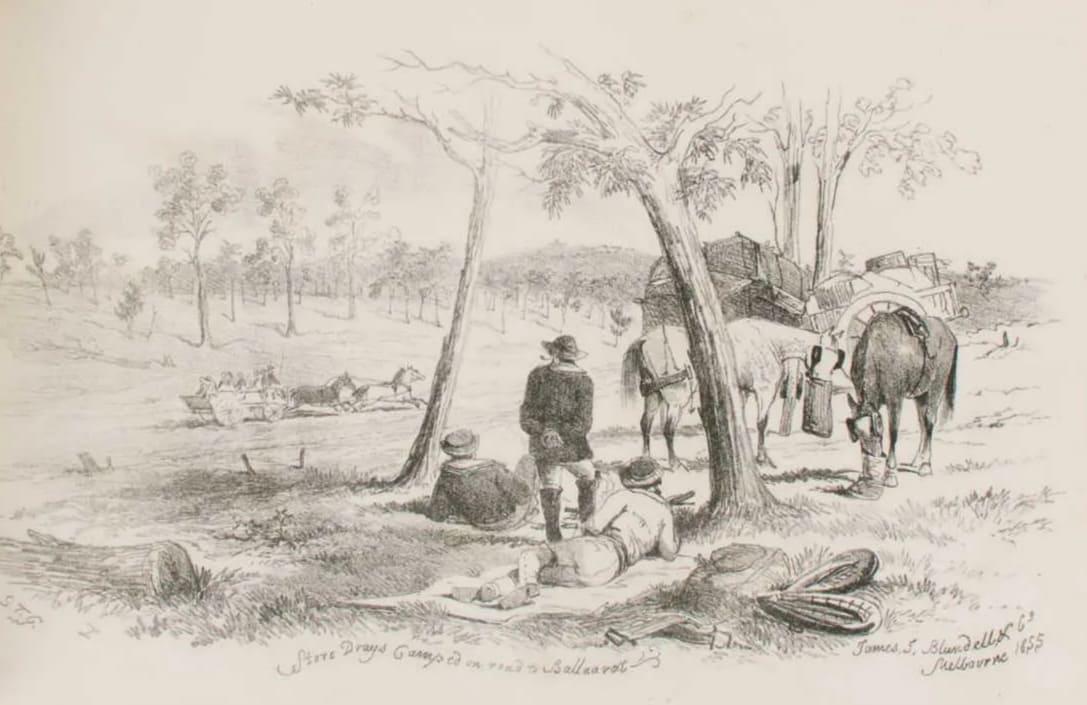
Charles went to Australia in 1851, and was last heard from in January 1853. According to the solicitor, who wrote to George on June 3, 1874, Charles had received advances on the settlement of their parent’s estate. “Your promissory note with the two signed by your brother Charles for 20 pounds he received from his father and 20 pounds he received from his mother are now in the possession of the court.”
In December 1872, Joseph wrote: “I’m told that Charles two daughters has wrote to Smalley post office making inquiries about his share….” In January 1876, the solicitor wrote: “Charles Housley’s children have claimed their father’s share.”
In the Adelaide Observer 28 Aug 1875
HOUSLEY – wanted information
as to the Death, Will, or Intestacy, and
Children of Charles Housley, formerly of
Smalley, Derbyshire, England, who died at
Geelong or Creewick Creek Diggings, Victoria
August, 1855. His children will hear of something to their advantage by communicating with
Mr. A J. Flint, solicitor, Derby, England.
June 16,1875.The Diggers & Diggings of Victoria in 1855. Drawn on Stone by S.T. Gill:
The court case:
Kerry v Housley.
Documents: Bill, demurrer.
Plaintiffs: Samuel Kerry and Joseph Housley.
Defendants: William Housley, Joseph Housley (deleted), Edwin Welch Harvey, Eleanor Harvey (deleted), Ernest Harvey infant, William Stafford, Elizabeth Stafford his wife, Mary Ann Housley, George Purdy and Catherine Purdy his wife, Elizabeth Housley, Mary Ann Weston widow and William Heath and Ruth Heath his wife (deleted).
Provincial solicitor employed in Derbyshire.
Date: 1873From the Narrative on the Letters:
The solicitor wrote on May 23, 1874: “Lately I have not written because I was not certain of your address and because I doubted I had much interesting news to tell you.” Later, Joseph wrote concerning the problems settling the estate, “You see dear brother there is only me here on our side and I cannot do much. I wish you were here to help me a bit and if you think of going for another summer trip this turn you might as well run over here.”
In March 1873, Joseph wrote: “You ask me what I think of you coming to England. I think as you have given the trustee power to sign for you I think you could do no good but I should like to see you once again for all that. I can’t say whether there would be anything amiss if you did come as you say it would be throwing good money after bad.”
In September 1872 Joseph wrote; “My wife is anxious to come. I hope it will suit her health for she is not over strong.” Elsewhere Joseph wrote that Harriet was “middling sometimes. She is subject to sick headaches. It knocks her up completely when they come on.” In December 1872 Joseph wrote, “Now dear brother about us coming to America you know we shall have to wait until this affair is settled and if it is not settled and thrown into Chancery I’m afraid we shall have to stay in England for I shall never be able to save money enough to bring me out and my family but I hope of better things.”
On July 19, 1875 Abraham Flint (the solicitor) wrote: “Joseph Housley has removed from Smalley and is working on some new foundry buildings at Little Chester near Derby. He lives at a village called Little Eaton near Derby. If you address your letter to him as Joseph Housley, carpenter, Little Eaton near Derby that will no doubt find him.”In his last letter (February 11, 1874), Joseph sounded very discouraged and wrote that Harriet’s parents were very poorly and both had been “in bed for a long time.” In addition, Harriet and the children had been ill.
The move to Little Eaton may indicate that Joseph received his settlement because in August, 1873, he wrote: “I think this is bad news enough and bad luck too, but I have had little else since I came to live at Kiddsley cottages but perhaps it is all for the best if one could only think so. I have begun to think there will be no chance for us coming over to you for I am afraid there will not be so much left as will bring us out without it is settled very shortly but I don’t intend leaving this house until it is settled either one way or the other. ”Joseph’s letters were much concerned with the settling of their mother’s estate. In 1854, Anne wrote, “As for my mother coming (to America) I think not at all likely. She is tied here with her property.” A solicitor, Abraham John Flint of 42 Full Street Derby, was engaged by John following the death of their mother. On June 30, 1873 the solicitor wrote: “Dear sir, On the death of your mother I was consulted by your brother John. I acted for him with reference to the sale and division of your father’s property at Smalley. Mr. Kerry was very unwilling to act as trustee being over 73 years of age but owing to the will being a badly drawn one we could not appoint another trustee in his place nor could the property be sold without a decree of chancery. Therefore Mr. Kerry consented and after a great deal of trouble with Heath who has opposed us all throughout whenever matters did not suit him, we found the title deeds and offered the property for sale by public auction on the 15th of July last. Heath could not find his purchase money without mortaging his property the solicitor which the mortgagee employed refused to accept Mr. Kerry’s title and owing to another defect in the will we could not compel them.”
In July 1872, Joseph wrote, “I do not know whether you can remember who the trustee was to my father’s will. It was Thomas Watson and Samuel Kerry of Smalley Green. Mr. Watson is dead (died a fortnight before mother) so Mr. Kerry has had to manage the affair.”
On Dec. 15, 1972, Joseph wrote, “Now about this property affair. It seems as far off of being settled as ever it was….” and in the following March wrote: “I think we are as far off as ever and farther I think.”
Concerning the property which was auctioned on July 15, 1872 and brought 700 pounds, Joseph wrote: “It was sold in five lots for building land and this man Heath bought up four lots–that is the big house, the croft and the cottages. The croft was made into two lots besides the piece belonging to the big house and the cottages and gardens was another lot and the little intake was another. William Richardson bought that.” Elsewhere Richardson’s purchase was described as “the little croft against Smith’s lane.” Smith’s Lane was probably named for their neighbor Daniel Smith, Mrs. Davy’s father.
But in December 1872, Joseph wrote that they had not received any money because “Mr. Heath is raising all kinds of objections to the will–something being worded wrong in the will.” In March 1873, Joseph “clarified” matters in this way: “His objection was that one trustee could not convey the property that his signature was not guarantee sufficient as it states in the will that both trustees has to sign the conveyance hence this bother.”
Joseph indicated that six shares were to come out of the 700 pounds besides Will’s 20 pounds. Children were to come in for the parents shares if dead. The solicitor wrote in 1873, “This of course refers to the Kidsley property in which you take a one seventh share and which if the property sells well may realize you about 60-80 pounds.” In March 1873 Joseph wrote: “You have an equal share with the rest in both lots of property, but I am afraid there will be but very little for any of us.”The other “lot of property” was “property in Smalley left under another will.” On July 17, 1872, Joseph wrote: “It was left by my grandfather Carrington and Uncle Richard is trustee. He seems very backward in bringing the property to a sale but I saw him and told him that I for one expect him to proceed with it.” George seemed to have difficulty understanding that there were two pieces of property so Joseph explained further: “It was left by my grandfather Carrington not by our father and Uncle Richard is the trustee for it but the will does not give him power to sell without the signatures of the parties concerned.” In June 1873 the solicitor Abraham John Flint asked: “Nothing has been done about the other property at Smalley at present. It wants attention and the other parties have asked me to attend to it. Do you authorize me to see to it for you as well?”
After Ellen’s death, the rent was divided between Joseph, Will, Mary Ann and Mr. Heath who bought John’s share and was married to Mary Ann’s daughter, Ruth. Joseph said that Mr. Heath paid 40 pounds for John’s share and that John had drawn 110 pounds in advance. The solicitor said Heath said he paid 60. The solicitor said that Heath was trying to buy the shares of those at home to get control of the property and would have defied the absent ones to get anything.
In September 1872 Joseph wrote that the lawyer said the trustee cannot sell the property at the bottom of Smalley without the signatures of all parties concerned in it and it will have to go through chancery court which will be a great expense. He advised Joseph to sell his share and Joseph advised George to do the same.George sent a “portrait” so that it could be established that it was really him–still living and due a share. Joseph wrote (July 1872): “the trustee was quite willing to (acknowledge you) for the portrait I think is a very good one.” Several letters later in response to an inquiry from George, Joseph wrote: “The trustee recognized you in a minute…I have not shown it to Mary Ann for we are not on good terms….Parties that I have shown it to own you again but they say it is a deal like John. It is something like him, but I think is more like myself.”
In September 1872 Joseph wrote that the lawyer required all of their ages and they would have to pay “succession duty”. Joseph requested that George send a list of birth dates.On May 23, 1874, the solicitor wrote: “I have been offered 240 pounds for the three cottages and the little house. They sold for 200 pounds at the last sale and then I was offered 700 pounds for the whole lot except Richardson’s Heanor piece for which he is still willing to give 58 pounds. Thus you see that the value of the estate has very materially increased since the last sale so that this delay has been beneficial to your interests than other-wise. Coal has become much dearer and they suppose there is coal under this estate. There are many enquiries about it and I believe it will realize 800 pounds or more which increase will more than cover all expenses.” Eventually the solicitor wrote that the property had been sold for 916 pounds and George would take a one-ninth share.
January 14, 1876: “I am very sorry to hear of your lameness and illness but I trust that you are now better. This matter as I informed you had to stand over until December since when all the costs and expenses have been taxed and passed by the court and I am expecting to receive the order for these this next week, then we have to pay the legacy duty and them divide the residue which I doubt won’t come to very much amongst so many of you. But you will hear from me towards the end of the month or early next month when I shall have to send you the papers to sign for your share. I can’t tell you how much it will be at present as I shall have to deduct your share with the others of the first sale made of the property before it went to court.
Wishing you a Happy New Year, I am Dear Sir, Yours truly
Abram J. Flint”September 15, 1876 (the last letter)
“I duly received your power of attorney which appears to have been properly executed on Thursday last and I sent it on to my London agent, Mr. Henry Lyvell, who happens just now to be away for his annual vacation and will not return for 14 or 20 days and as his signature is required by the Paymaster General before he will pay out your share, it must consequently stand over and await his return home. It shall however receive immediate attention as soon as he returns and I hope to be able to send your checque for the balance very shortly.”1874 in chancery:
 December 16, 2021 at 1:51 pm #6240
In reply to: The Elusive Samuel Housley and Other Family Stories
Phyllis Ellen Marshall
1909 – 1983
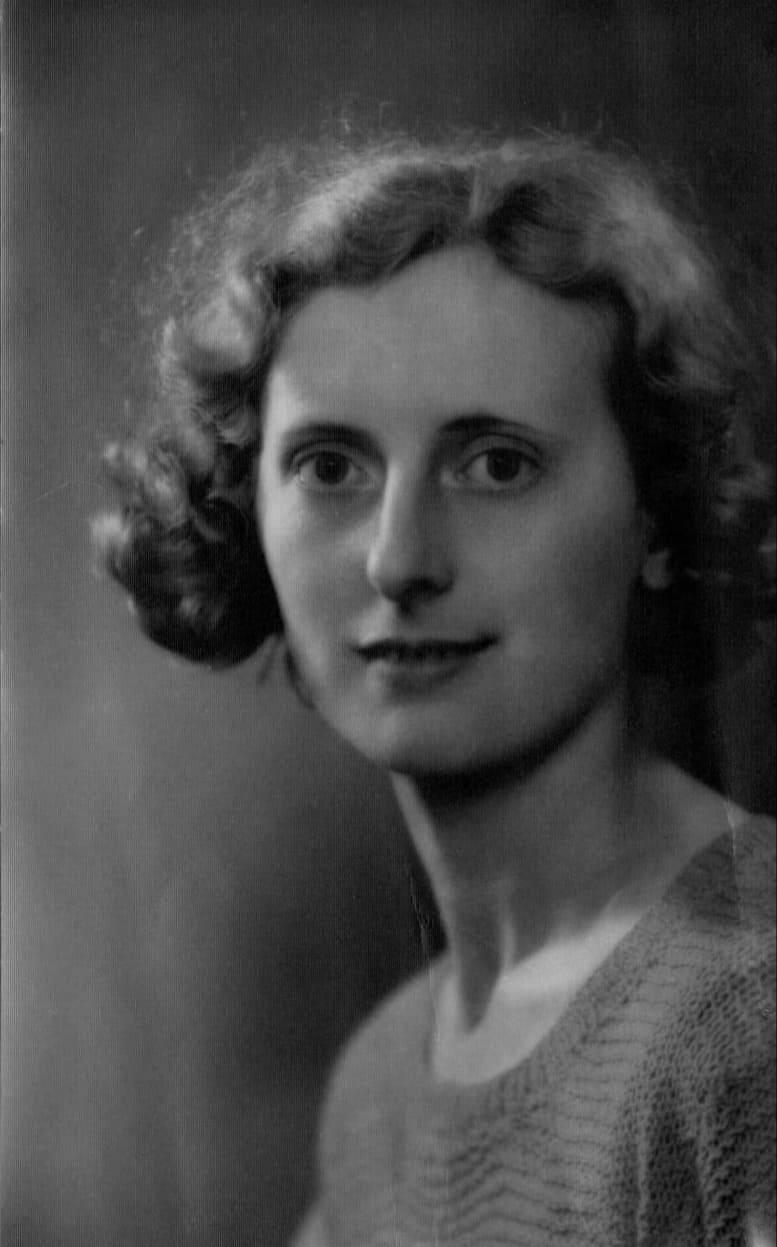
Phyllis, my grandfather George Marshall’s sister, never married. She lived in her parents home in Love Lane, and spent decades of her later life bedridden, living alone and crippled with rheumatoid arthritis. She had her bed in the front downstairs room, and had cords hanging by her bed to open the curtains, turn on the tv and so on, and she had carers and meals on wheels visit her daily. The room was dark and grim, but Phyllis was always smiling and cheerful. Phyllis loved the Degas ballerinas and had a couple of prints on the walls.
I remember visiting her, but it has only recently registered that this was my great grandparents house. When I was a child, we visited her and she indicated a tin on a chest of drawers and said I could take a biscuit. It was a lemon puff, and was the stalest biscuit I’d ever had. To be polite I ate it. Then she offered me another one! I declined, but she thought I was being polite and said “Go on! You can have another!” I ate another one, and have never eaten a lemon puff since that day.
Phyllis’s nephew Bryan Marshall used to visit her regularly. I didn’t realize how close they were until recently, when I resumed contact with Bryan, who emigrated to USA in the 1970s following a successful application for a job selling stained glass windows and church furnishings.
I asked on a Stourbridge facebook group if anyone remembered her.
AF Yes I remember her. My friend and I used to go up from Longlands school every Friday afternoon to do jobs for her. I remember she had a record player and we used to put her 45rpm record on Send in the Clowns for her. Such a lovely lady. She had her bed in the front room.
KW I remember very clearly a lady in a small house in Love Lane with alley at the left hand. I was intrigued by this lady who used to sit with the front door open and she was in a large chair of some sort. I used to see people going in and out and the lady was smiling. I was young then (31) and wondered how she coped but my sense was she had lots of help. I’ve never forgotten that lady in Love Lane sitting in the open door way I suppose when it was warm enough.
LR I used to deliver meals on wheels to her lovely lady.
I sent Bryan the comments from the Stourbridge group and he replied:
Thanks Tracy. I don’t recognize the names here but lovely to see such kind comments.
In the early 70’s neighbors on Corser Street, Mr. & Mrs. Walter Braithwaite would pop around with occasional visits and meals. Walter was my piano teacher for awhile when I was in my early twenties. He was a well known music teacher at Rudolph Steiner School (former Elmfield School) on Love Lane. A very fine school. I seem to recall seeing a good article on Walter recently…perhaps on the Stourbridge News website. He was very well known.
I’m ruminating about life with my Aunt Phyllis. We were very close. Our extra special time was every Saturday at 5pm (I seem to recall) we’d watch Doctor Who. Right from the first episode. We loved it. Likewise I’d do the children’s crossword out of Woman’s Realm magazine…always looking to win a camera but never did ! She opened my mind to the Bible, music and ballet. She once got tickets and had a taxi take us into Birmingham to see the Bolshoi Ballet…at a time when they rarely left their country. It was a very big deal in the early 60’s. ! I’ve many fond memories about her and grandad which I’ll share in due course. I’d change the steel needle on the old record player, following each play of the 78rpm records…oh my…another world.Bryan continues reminiscing about Phyllis in further correspondence:
Yes, I can recall those two Degas prints. I don’t know much of Phyllis’ early history other than she was a hairdresser in Birmingham. I want to say at John Lewis, for some reason (so there must have been a connection and being such a large store I bet they did have a salon?)
You will know that she had severe and debilitating rheumatoid arthritis that eventually gnarled her hands and moved through her body. I remember strapping on her leg/foot braces and hearing her writhe in pain as I did so but she wanted to continue walking standing/ getting up as long as she could. I’d take her out in the wheelchair and I can’t believe I say it along …but down Stanley Road!! (I had subsequent nightmares about what could have happened to her, had I tripped or let go!) She loved Mary Stevens Park, the swans, ducks and of course Canadian geese. Was grateful for everything in creation. As I used to go over Hanbury Hill on my visit to Love Lane, she would always remind me to smell the “sea-air” as I crested the hill.
In the earlier days she smoked cigarettes with one of those long filters…looking like someone from the twenties.I’ll check on “Send in the clowns”. I do recall that music. I remember also she loved to hear Neil Diamond. Her favorites in classical music gave me an appreciation of Elgar and Delius especially. She also loved ballet music such as Swan Lake and Nutcracker. Scheherazade and La Boutique Fantastic also other gems.
When grandad died she and aunt Dorothy shared more about grandma (who died I believe when John and I were nine-months old…therefore early 1951). Grandma (Mary Ann Gilman Purdy) played the piano and loved Strauss and Offenbach. The piano in the picture you sent had a bad (wonky) leg which would fall off and when we had the piano at 4, Mount Road it was rather dangerous. In any event my parents didn’t want me or others “banging on it” for fear of waking the younger brothers so it disappeared at sometime.
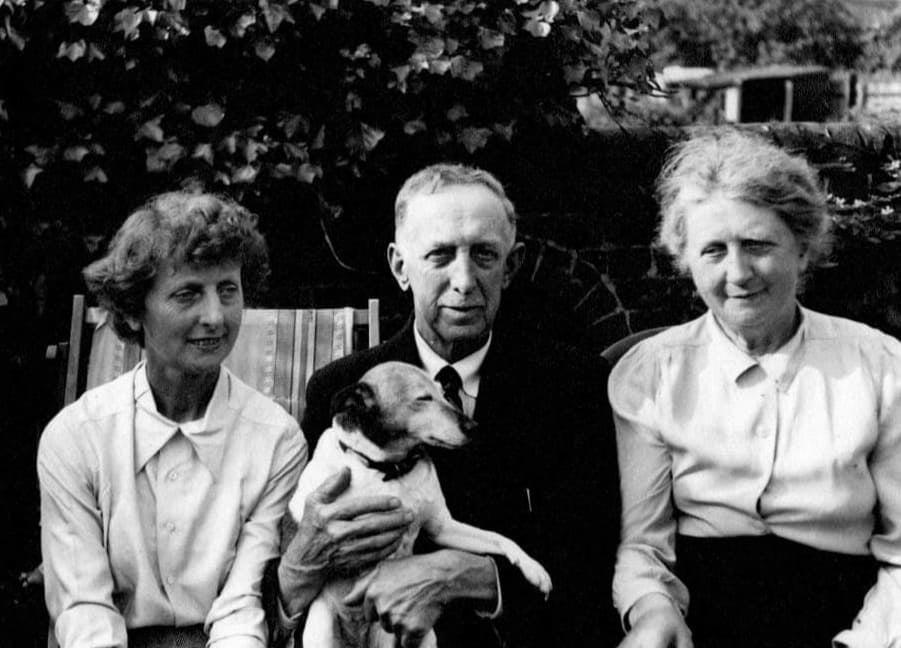
By the way, the dog, Flossy was always so rambunctious (of course, she was a JRT!) she was put on the stairway which fortunately had a door on it. Having said that I’ve always loved dogs so was very excited to see her and disappointed when she was not around.Phyllis with her parents William and Mary Marshall, and Flossie the dog in the garden at Love Lane:
Bryan continues:
I’ll always remember the early days with the outside toilet with the overhead cistern caked in active BIG spider webs. I used to have to light a candle to go outside, shielding the flame until destination. In that space I’d set the candle down and watch the eery shadows move from side to side whilst…well anyway! Then I’d run like hell back into the house. Eventually the kitchen wall was broken through so it became an indoor loo. Phew!
In the early days the house was rented for ten-shillings a week…I know because I used to take over a ten-bob-note to a grumpy lady next door who used to sign the receipt in the rent book. Then, I think she died and it became available for $600.00 yes…the whole house for $600.00 but it wasn’t purchased then. Eventually aunt Phyllis purchased it some years later…perhaps when grandad died.I used to work much in the back garden which was a lovely walled garden with arch-type decorations in the brickwork and semicircular shaped capping bricks. The abundant apple tree. Raspberry and loganberry canes. A gooseberry bush and huge Victoria plum tree on the wall at the bottom of the garden which became a wonderful attraction for wasps! (grandad called the “whasps”). He would stew apples and fruit daily.
Do you remember their black and white cat Twinky? Always sat on the pink-screen TV and when she died they were convinced that “that’s wot got ‘er”. Grandad of course loved all his cats and as he aged, he named them all “Billy”.Have you come across the name “Featherstone” in grandma’s name. I don’t recall any details but Dorothy used to recall this. She did much searching of the family history Such a pity she didn’t hand anything on to anyone. She also said that we had a member of the family who worked with James Watt….but likewise I don’t have details.
Gifts of chocolates to Phyllis were regular and I became the recipient of the overflow!What a pity Dorothy’s family history research has disappeared! I have found the Featherstone’s, and the Purdy who worked with James Watt, but I wonder what else Dorothy knew.
I mentioned DH Lawrence to Bryan, and the connection to Eastwood, where Bryan’s grandma (and Phyllis’s mother) Mary Ann Gilman Purdy was born, and shared with him the story about Francis Purdy, the Primitive Methodist minister, and about Francis’s son William who invented the miners lamp.
He replied:
As a nosy young man I was looking through the family bookcase in Love Lane and came across a brown paper covered book. Intrigued, I found “Sons and Lovers” D.H. Lawrence. I knew it was a taboo book (in those days) as I was growing up but now I see the deeper connection. Of course! I know that Phyllis had I think an earlier boyfriend by the name of Maurice who lived in Perry Barr, Birmingham. I think he later married but was always kind enough to send her a book and fond message each birthday (Feb.12). I guess you know grandad’s birthday – July 28. We’d always celebrate those days. I’d usually be the one to go into Oldswinford and get him a cardigan or pullover and later on, his 2oz tins of St. Bruno tobacco for his pipe (I recall the room filled with smoke as he puffed away).
Dorothy and Phyllis always spoke of their ancestor’s vocation as a Minister. So glad to have this history! Wow, what a story too. The Lord rescued him from mischief indeed. Just goes to show how God can change hearts…one at a time.
So interesting to hear about the Miner’s Lamp. My vicar whilst growing up at St. John’s in Stourbridge was from Durham and each Harvest Festival, there would be a miner’s lamp placed upon the altar as a symbol of the colliery and the bountiful harvest.More recollections from Bryan about the house and garden at Love Lane:
I always recall tea around the three legged oak table bedecked with a colorful seersucker cloth. Battenburg cake. Jam Roll. Rich Tea and Digestive biscuits. Mr. Kipling’s exceedingly good cakes! Home-made jam. Loose tea from the Coronation tin cannister. The ancient mangle outside the back door and the galvanized steel wash tub with hand-operated agitator on the underside of the lid. The hand operated water pump ‘though modernisation allowed for a cold tap only inside, above the single sink and wooden draining board. A small gas stove and very little room for food preparation. Amazing how the Marshalls (×7) managed in this space!
The small window over the sink in the kitchen brought in little light since the neighbor built on a bathroom annex at the back of their house, leaving #47 with limited light, much to to upset of grandad and Phyllis. I do recall it being a gloomy place..i.e.the kitchen and back room.
The garden was lovely. Long and narrow with privet hedge dividing the properties on the right and the lovely wall on the left. Dorothy planted spectacular lilac bushes against the wall. Vivid blues, purples and whites. Double-flora. Amazing…and with stunning fragrance. Grandad loved older victorian type plants such as foxgloves and comfrey. Forget-me-nots and marigolds (calendulas) in abundance. Rhubarb stalks. Always plantings of lettuce and other vegetables. Lots of mint too! A large varigated laurel bush outside the front door!
Such a pleasant walk through the past.
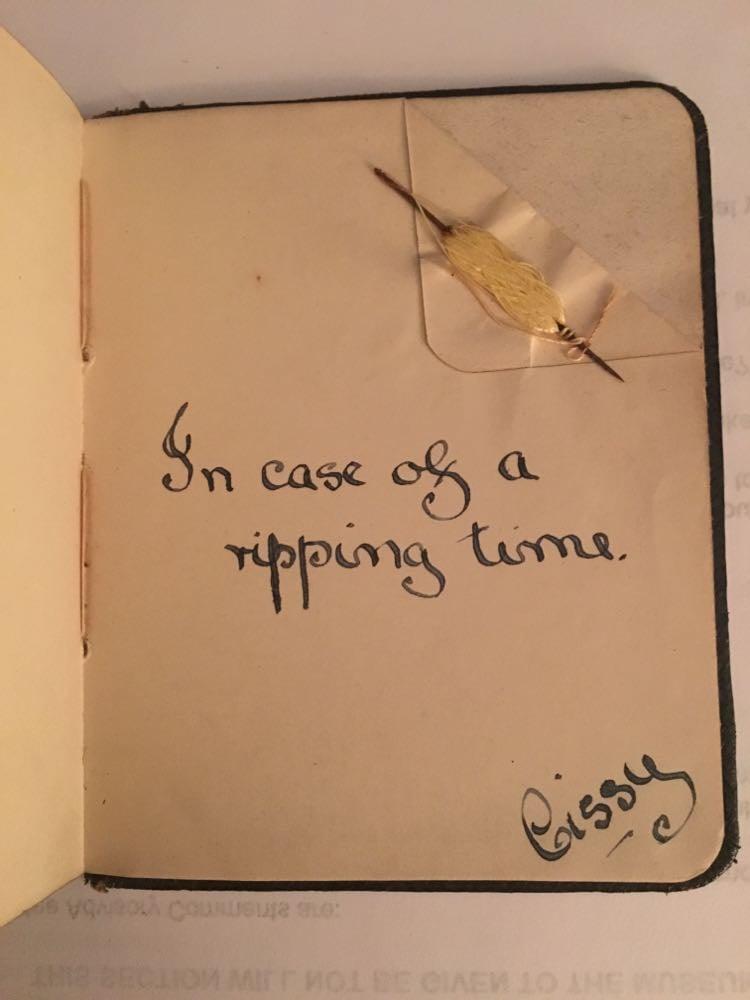
An autograph book belonging to Phyllis from the 1920s has survived in which each friend painted a little picture, drew a cartoon, or wrote a verse. This entry is perhaps my favourite:
 December 15, 2021 at 1:16 pm #6237
In reply to: The Elusive Samuel Housley and Other Family Stories
Murder At The Bennistons
We don’t know exactly what happened immediately after the death of Catherine Housley’s mother in 1849, but by 1850 the two older daughters Elizabeth and Mary Anne were inmates in Belper Workhouse. Catherine was just six weeks old, so presumably she was with a wet nurse, possibly even prior to her mothers death. By 1851, according to the census, she was living in Heanor, a small town near to Smalley, with John Benniston, a framework knitter, and his family. Framework knitters (abbreviated to FWK should you happen to see it on a census) rented a large loom and made stockings and everyone in the family helped. Often the occupation of other household members would be “seamer”: they would stitch the stocking seams together. Catherine was still living with the Bennistons ten years later in 1861.
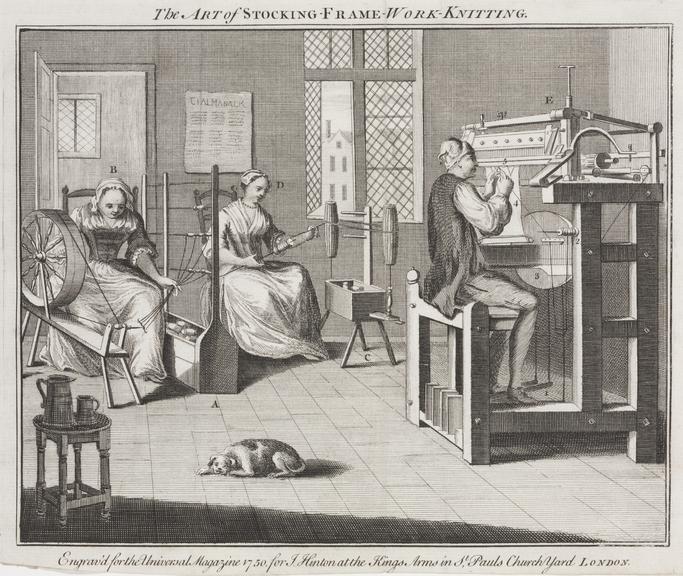
I read some chapters of a thesis on the south Derbyshire poor in the 1800s and found some illuminating information about indentured apprenticeship of children especially if one parent died. It was not at all uncommon, and framework knitters in particular often had indentured apprentices. It was a way to ensure the child was fed and learned a skill. Children commonly worked from the age of ten or 12 anyway. They were usually placed walking distance of the family home and maintained contact. The indenture could be paid by the parish poor fund, which cost them slightly less than sending them to the poorhouse, and could be paid off by a parent if circumstances improved to release the child from the apprenticeship.
A child who was an indentured apprentice would continue a normal life after the term of apprenticeship, usually still in contact with family locally.I found a newspaper article titled “Child Murder at Heanor” dated 1858.
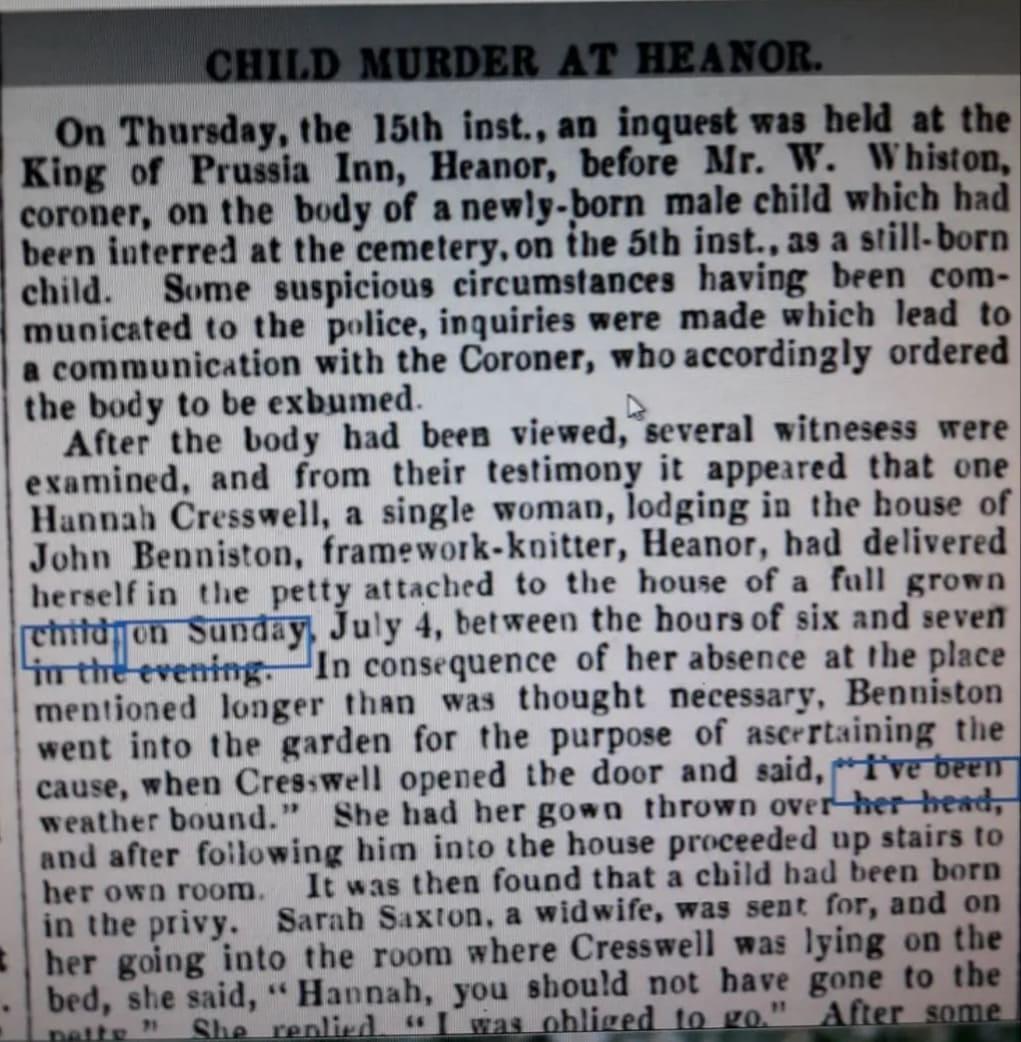
A 23 year old lodger at the Bennistons, Hannah Cresswell, apparently murdered a new born baby that she gave birth to in the privy, which the midwife took away and had buried as a still birth. The baby was exhumed after an anonymous tip off from a neighbour, citing that it was the 4th such incident. Catherine Housley would have been nine years old at the time.
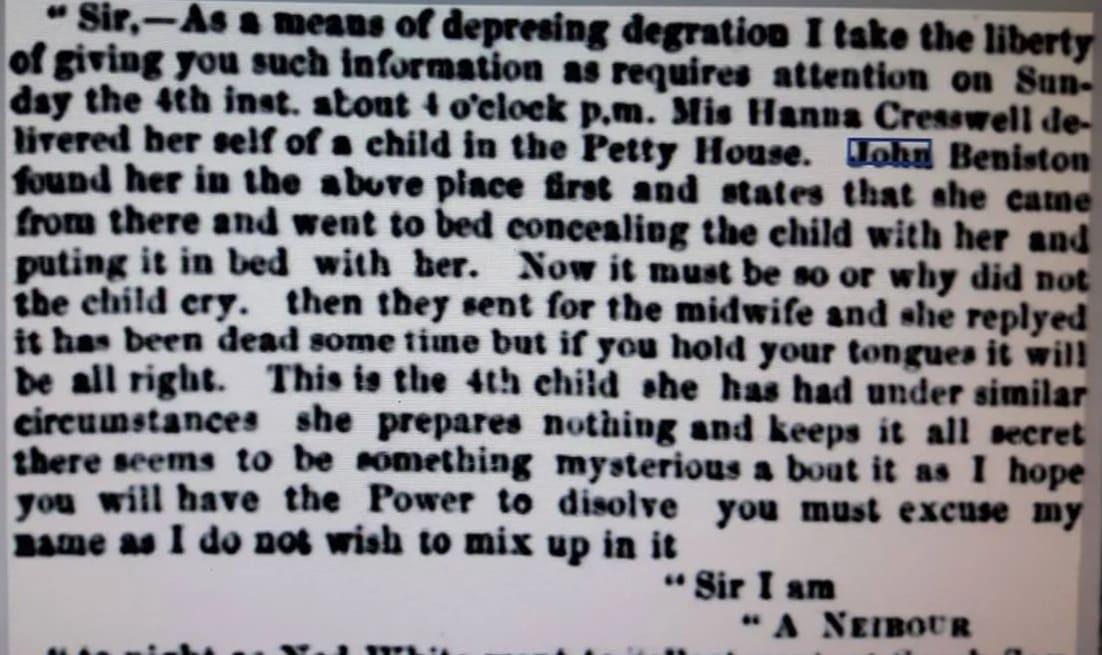
Subsequent newspaper articles indicate that the case was thrown out, despite the doctors evidence that the baby had been beaten to death.
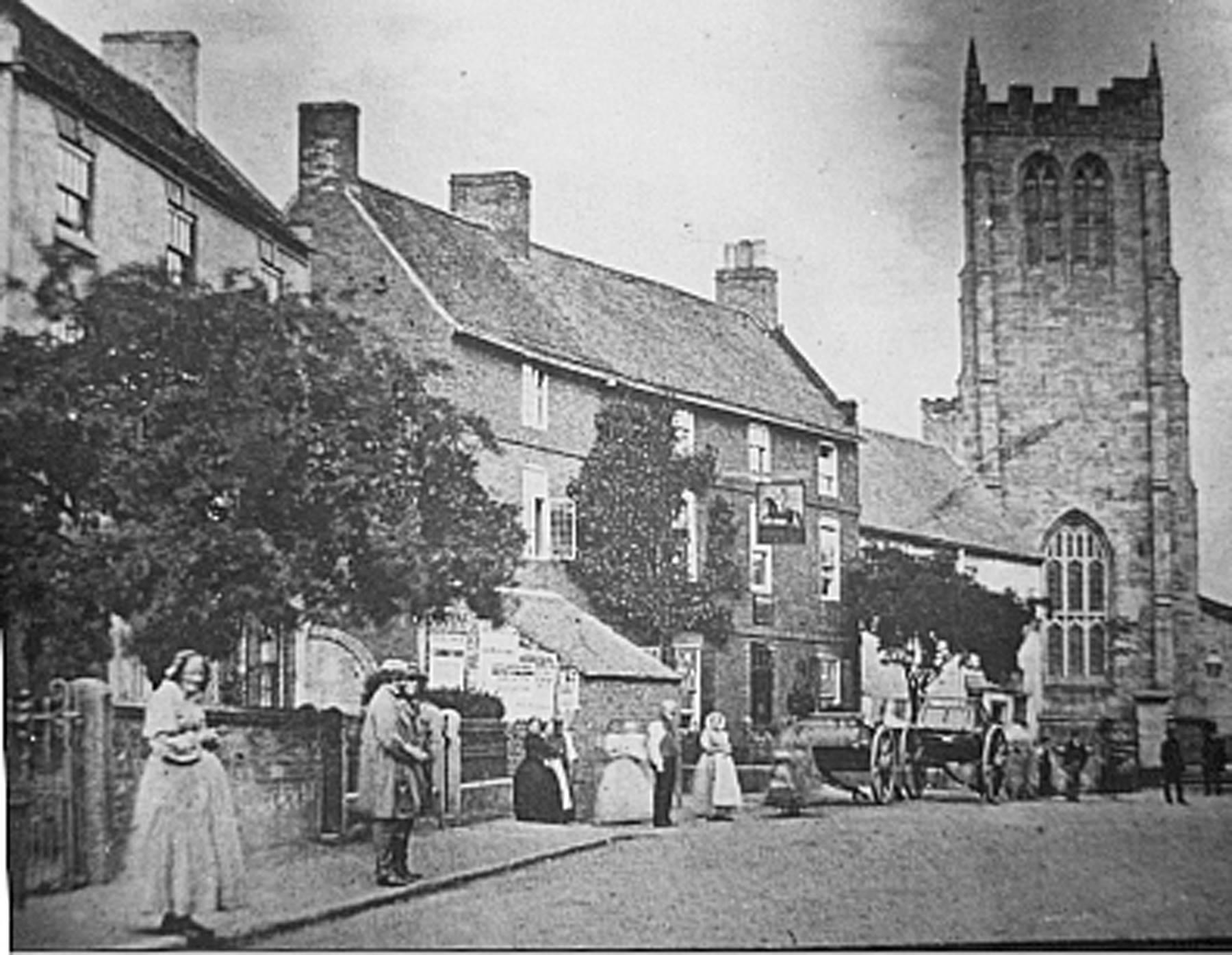
In July 1858 the inquest was held in the King of Prussia, on the Hannah Cresswell baby murder at the Bennistons.
The King of Prussia, Heanor, in 1860:
 December 15, 2021 at 7:53 am #6234
In reply to: The Elusive Samuel Housley and Other Family Stories
Ben Warren
Derby County and England football legend who died aged 37 penniless and ‘insane’
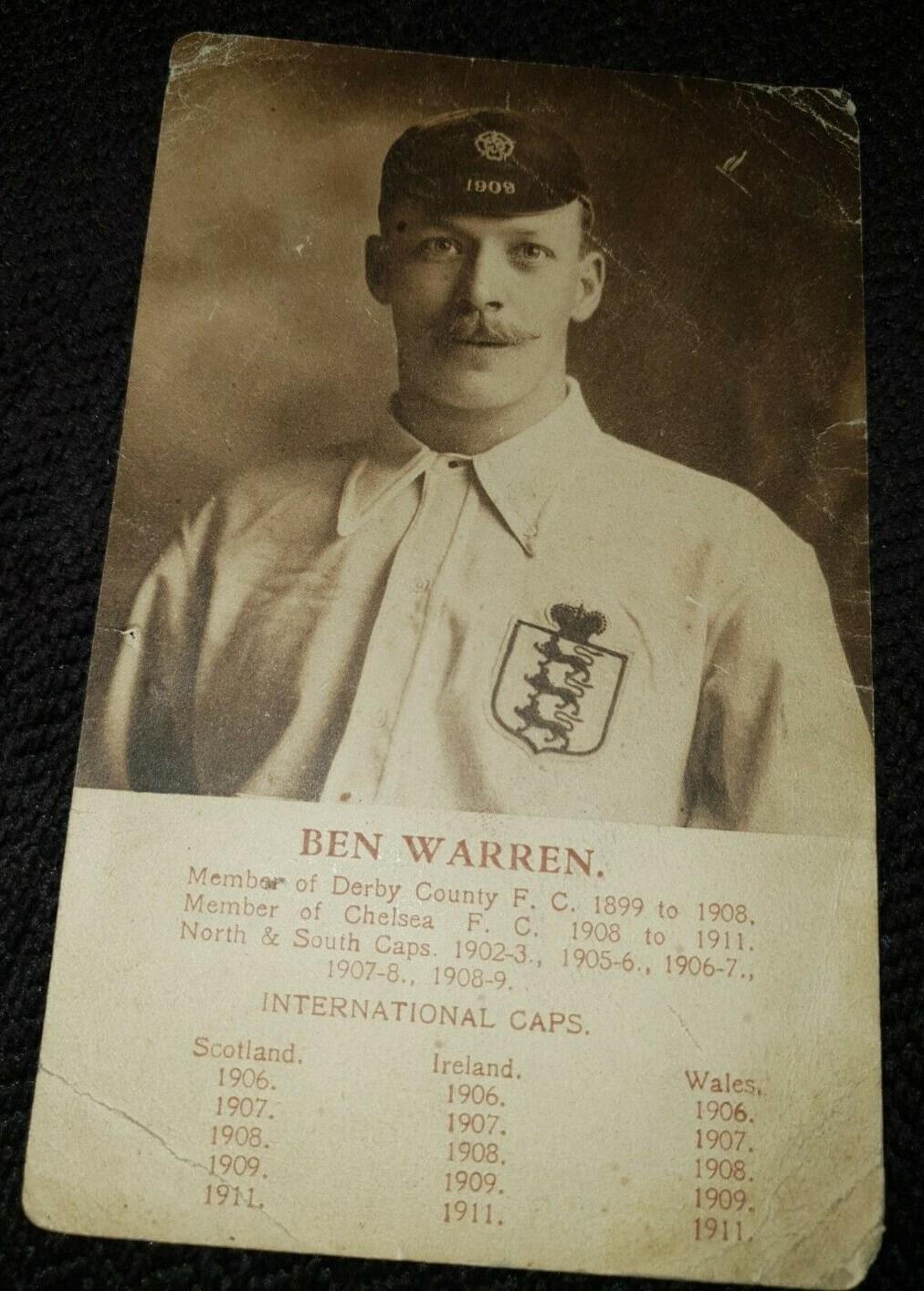
Ben Warren 1879 – 1917 was Samuel Warren’s (my great grandfather) cousin.
From the Derby Telegraph:
Just 17 months after earning his 22nd England cap, against Scotland at Everton on April 1, 1911, he was certified insane. What triggered his decline was no more than a knock on the knee while playing for Chelsea against Clapton Orient.
The knee would not heal and the longer he was out, the more he fretted about how he’d feed his wife and four children. In those days, if you didn’t play, there was no pay.
…..he had developed “brain fever” and this mild-mannered man had “become very strange and, at times, violent”. The coverage reflected his celebrity status.
On December 15, 1911, as Rick Glanvill records in his Official Biography of Chelsea FC: “He was admitted to a private clinic in Nottingham, suffering from acute mania, delusions that he was being poisoned and hallucinations of hearing and vision.”
He received another blow in February, 1912, when his mother, Emily, died. She had congestion of the lungs and caught influenza, her condition not helped, it was believed, by worrying about Ben.
She had good reason: her famous son would soon be admitted to the unfortunately named Derby County Lunatic Asylum.
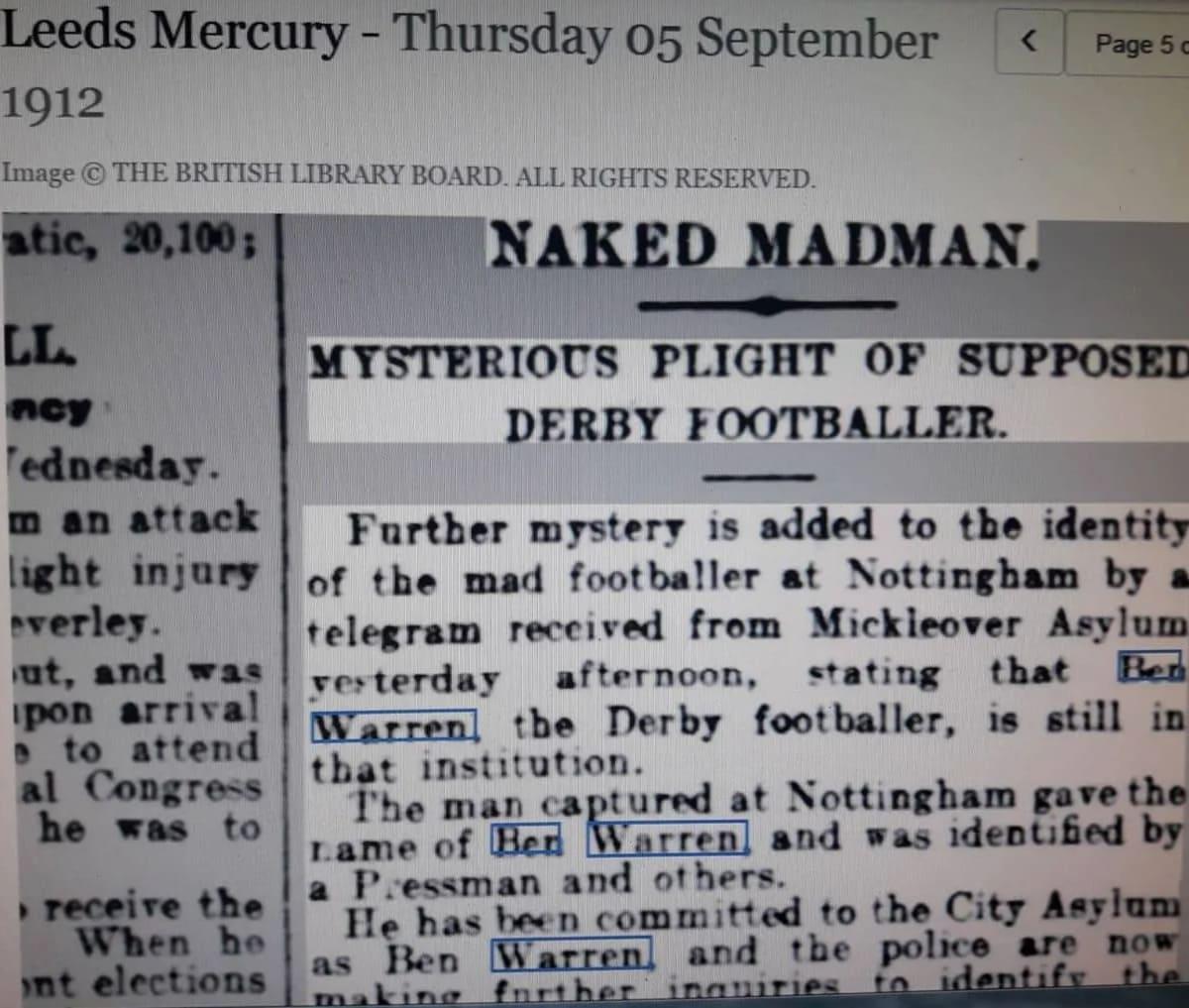
As Britain sleepwalked towards the First World War, Ben’s condition deteriorated. Glanvill writes: “His case notes from what would be a five-year stay, catalogue a devastating decline in which he is at various times described as incoherent, restless, destructive, ‘stuporose’ and ‘a danger to himself’.’”
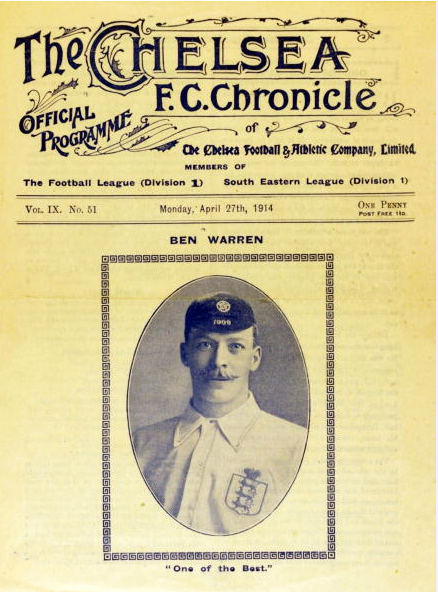
photo: Football 27th April 1914. A souvenir programme for the testimonial game for Chelsea and England’s Ben Warren, (pictured) who had been declared insane and sent to a lunatic asylum. The game was a select XI for the North playing a select XI from The South proceeds going to Warren’s family.
In September, that decline reached a new and pitiable low. The following is an abridged account of what The Courier called “an amazing incident” that took place on September 4.
“Spotted by a group of men while walking down Derby Road in Nottingham, a man was acting strangely, smoking a cigarette and had nothing on but a collar and tie.
“He jumped about the pavement and roadway, as though playing an imaginary game of football. When approached, he told them he was going to Trent Bridge to play in a match and had to be there by 3.30.”
Eventually he was taken to a police station and recognised by a reporter as England’s erstwhile right-half. What made the story even harder to digest was that Ben had escaped from the asylum and walked the 20 miles to Nottingham apparently unnoticed.
He had played at “Trent Bridge” many times – at least on Nottingham Forest’s adjacent City Ground.
As a shocked nation came to terms with the desperate plight of one of its finest footballers, some papers suggested his career was not yet over. And his relatives claimed that he had been suffering from nothing more than a severe nervous breakdown.
He would never be the same again – as a player or a man. He wasn’t even a shadow of the weird “footballer” who had walked 20 miles to Nottingham.
Then, he had nothing on, now he just had nothing – least of all self-respect. He ripped sheets into shreds and attempted suicide, saying: “I’m no use to anyone – and ought to be out of the way.”
“A year before his suicide attempt in 1916 the ominous symptom of ‘dry cough’ had been noted. Two months after it, in October 1916, the unmistakable signs of tuberculosis were noted and his enfeebled body rapidly succumbed.
At 11.30pm on 15 January 1917, international footballer Ben Warren was found dead by a night attendant.
He was 37 and when they buried him the records described him as a “pauper’.”
However you look at it, it is the salutary tale of a footballer worrying about money. And it began with a knock on the knee.
On 14th November 2021, Gill Castle posted on the Newhall and Swadlincote group:
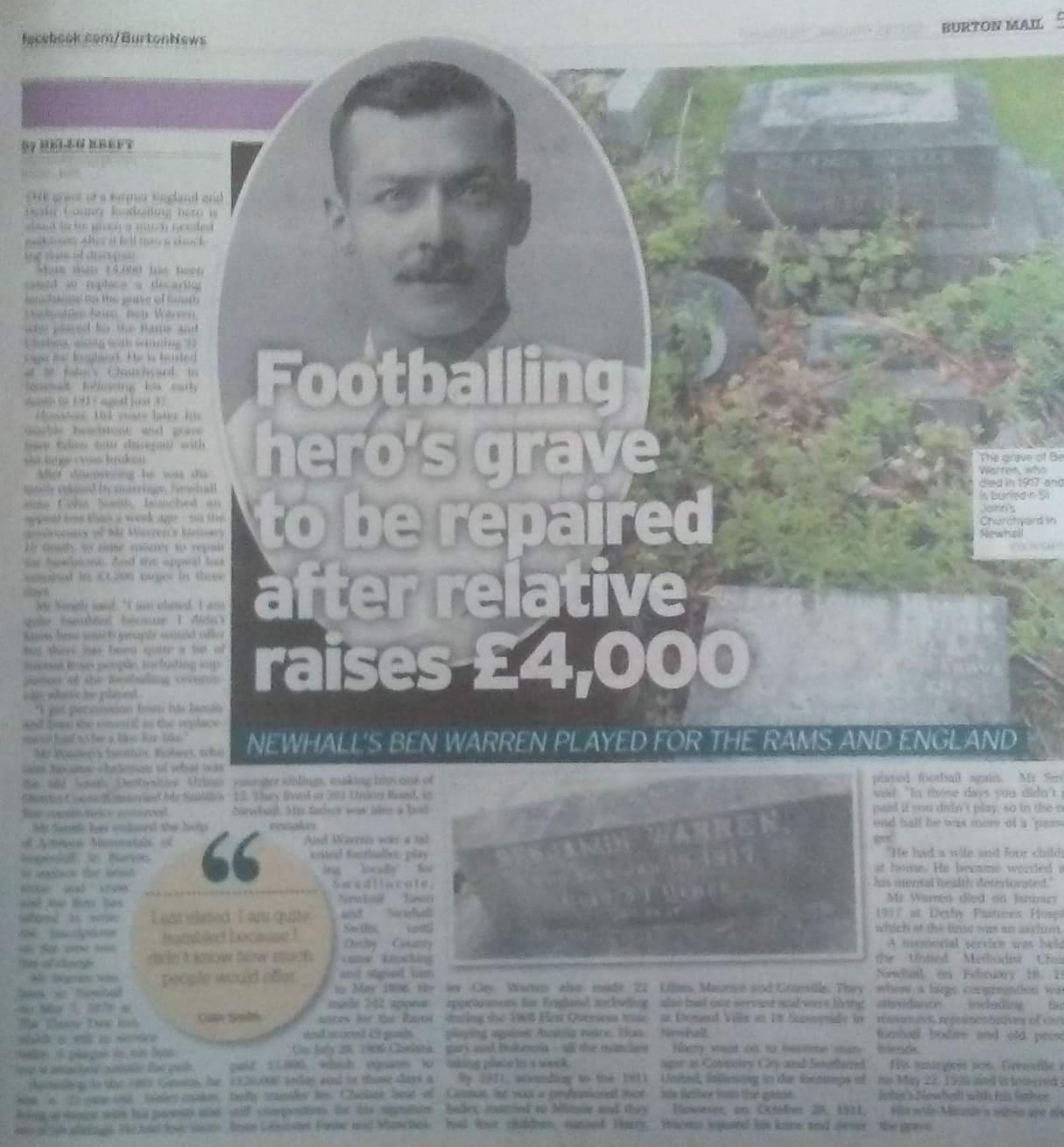
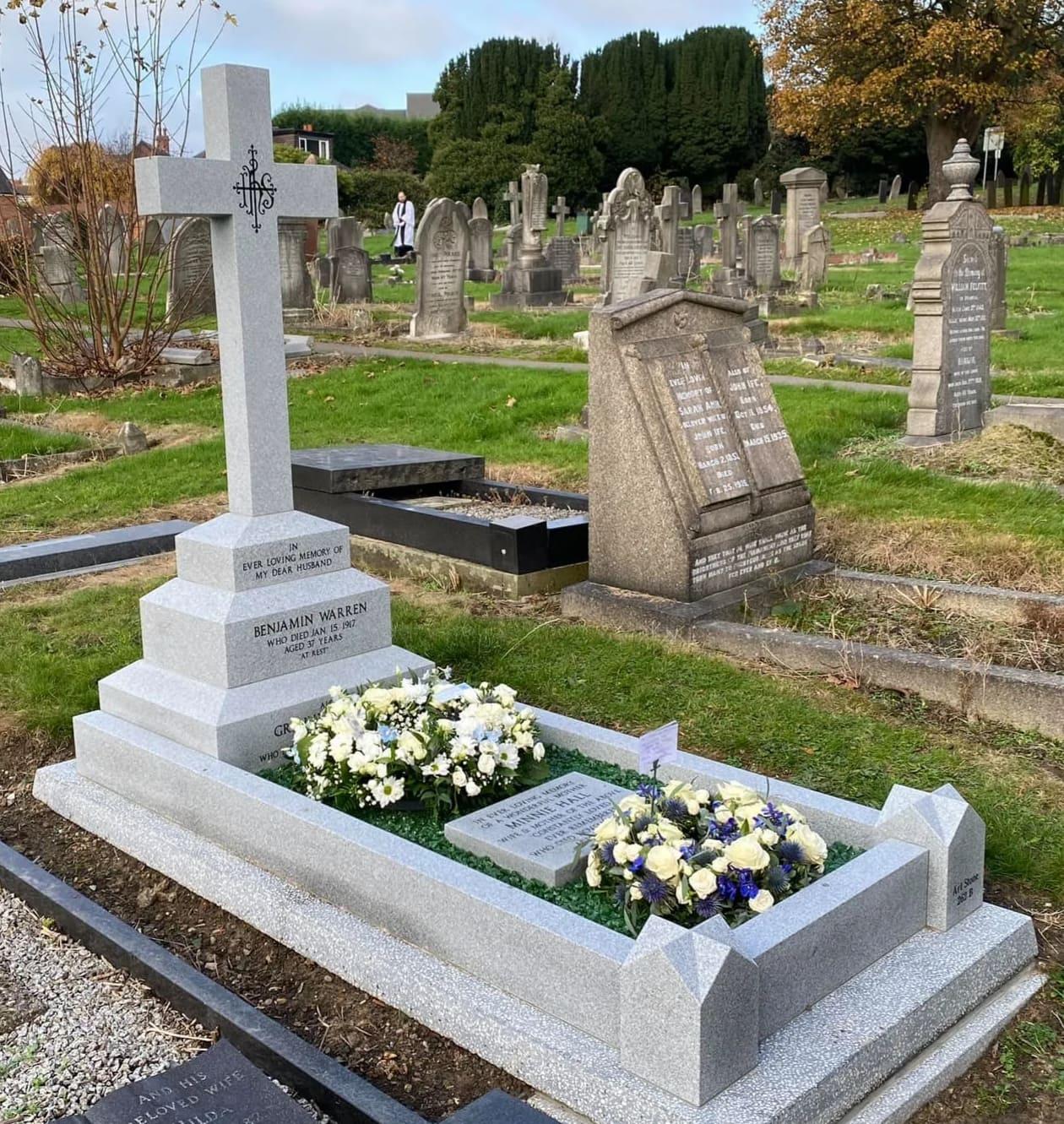
I would like to thank Colin Smith and everyone who supported him in getting my great grandfather’s grave restored (Ben Warren who played for Derby, Chelsea and England)
The month before, Colin Smith posted:
My Ben Warren Journey is nearly complete.
It started two years ago when I was sent a family wedding photograph asking if I recognised anyone. My Great Great Grandmother was on there. But soon found out it was the wedding of Ben’s brother Robert to my 1st cousin twice removed, Eveline in 1910.
I researched Ben and his football career and found his resting place in St Johns Newhall, all overgrown and in a poor state with the large cross all broken off. I stood there and decided he needed to new memorial & headstone. He was our local hero, playing Internationally for England 22 times. He needs to be remembered.
After seeking family permission and Council approval, I had a quote from Art Stone Memorials, Burton on Trent to undertake the work. Fundraising then started and the memorial ordered.
Covid came along and slowed the process of getting materials etc. But we have eventually reached the final installation today.
I am deeply humbled for everyone who donated in January this year to support me and finally a massive thank you to everyone, local people, football supporters of Newhall, Derby County & Chelsea and football clubs for their donations.
Ben will now be remembered more easily when anyone walks through St Johns and see this beautiful memorial just off the pathway.
Finally a huge thank you for Art Stone Memorials Team in everything they have done from the first day I approached them. The team have worked endlessly on this project to provide this for Ben and his family as a lasting memorial. Thank you again Alex, Pat, Matt & Owen for everything. Means a lot to me.
The final chapter is when we have a dedication service at the grave side in a few weeks time,
Ben was born in The Thorntree Inn Newhall South Derbyshire and lived locally all his life.
He played local football for Swadlincote, Newhall Town and Newhall Swifts until Derby County signed Ben in May 1898. He made 242 appearances and scored 19 goals at Derby County.
28th July 1908 Chelsea won the bidding beating Leicester Fosse & Manchester City bids.
Ben also made 22 appearance’s for England including the 1908 First Overseas tour playing Austria twice, Hungary and Bohemia all in a week.
28 October 1911 Ben Injured his knee and never played football again
Ben is often compared with Steven Gerard for his style of play and team ethic in the modern era.
Herbert Chapman ( Player & Manager ) comments “ Warren was a human steam engine who played through 90 minutes with intimidating strength and speed”.
Charles Buchan comments “I am certain that a better half back could not be found, Part of the Best England X1 of all time”
Chelsea allowed Ben to live in Sunnyside Newhall, he used to run 5 miles every day round Bretby Park and had his own gym at home. He was compared to the likes of a Homing Pigeon, as he always came back to Newhall after his football matches.
Ben married Minnie Staley 21st October 1902 at Emmanuel Church Swadlincote and had four children, Harry, Lillian, Maurice & Grenville. Harry went on to be Manager at Coventry & Southend following his father in his own career as football Manager.
After Ben’s football career ended in 1911 his health deteriorated until his passing at Derby Pastures Hospital aged 37yrs
Ben’s youngest son, Grenville passed away 22nd May 1929 and is interred together in St John’s Newhall with his Father
His wife, Minnie’s ashes are also with Ben & Grenville.
Thank you again everyone.
RIP Ben Warren, our local Newhall Hero. You are remembered.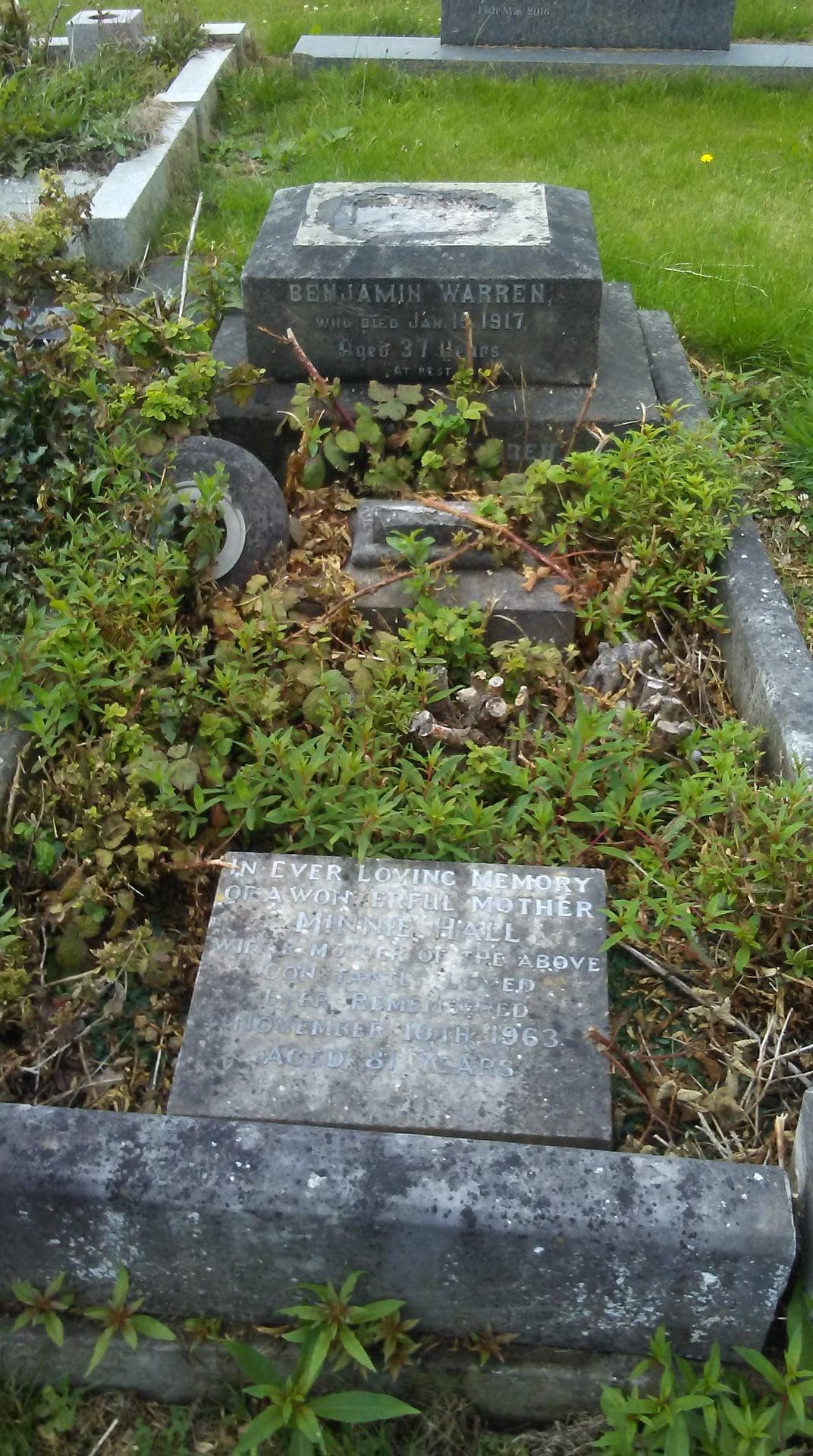
 December 13, 2021 at 11:29 am #6222
In reply to: The Elusive Samuel Housley and Other Family Stories
George Gilman Rushby: The Cousin Who Went To Africa
The portrait of the woman has “mother of Catherine Housley, Smalley” written on the back, and one of the family photographs has “Francis Purdy” written on the back. My first internet search was “Catherine Housley Smalley Francis Purdy”. Easily found was the family tree of George (Mike) Rushby, on one of the genealogy websites. It seemed that it must be our family, but the African lion hunter seemed unlikely until my mother recalled her father had said that he had a cousin who went to Africa. I also noticed that the lion hunter’s middle name was Gilman ~ the name that Catherine Housley’s daughter ~ my great grandmother, Mary Ann Gilman Purdy ~ adopted, from her aunt and uncle who brought her up.
I tried to contact George (Mike) Rushby via the ancestry website, but got no reply. I searched for his name on Facebook and found a photo of a wildfire in a place called Wardell, in Australia, and he was credited with taking the photograph. A comment on the photo, which was a few years old, got no response, so I found a Wardell Community group on Facebook, and joined it. A very small place, population some 700 or so, and I had an immediate response on the group to my question. They knew Mike, exchanged messages, and we were able to start emailing. I was in the chair at the dentist having an exceptionally long canine root canal at the time that I got the message with his email address, and at that moment the song Down in Africa started playing.
Mike said it was clever of me to track him down which amused me, coming from the son of an elephant and lion hunter. He didn’t know why his father’s middle name was Gilman, and was not aware that Catherine Housley’s sister married a Gilman.
Mike Rushby kindly gave me permission to include his family history research in my book. This is the story of my grandfather George Marshall’s cousin. A detailed account of George Gilman Rushby’s years in Africa can be found in another chapter called From Tanganyika With Love; the letters Eleanor wrote to her family.
George Gilman Rushby:
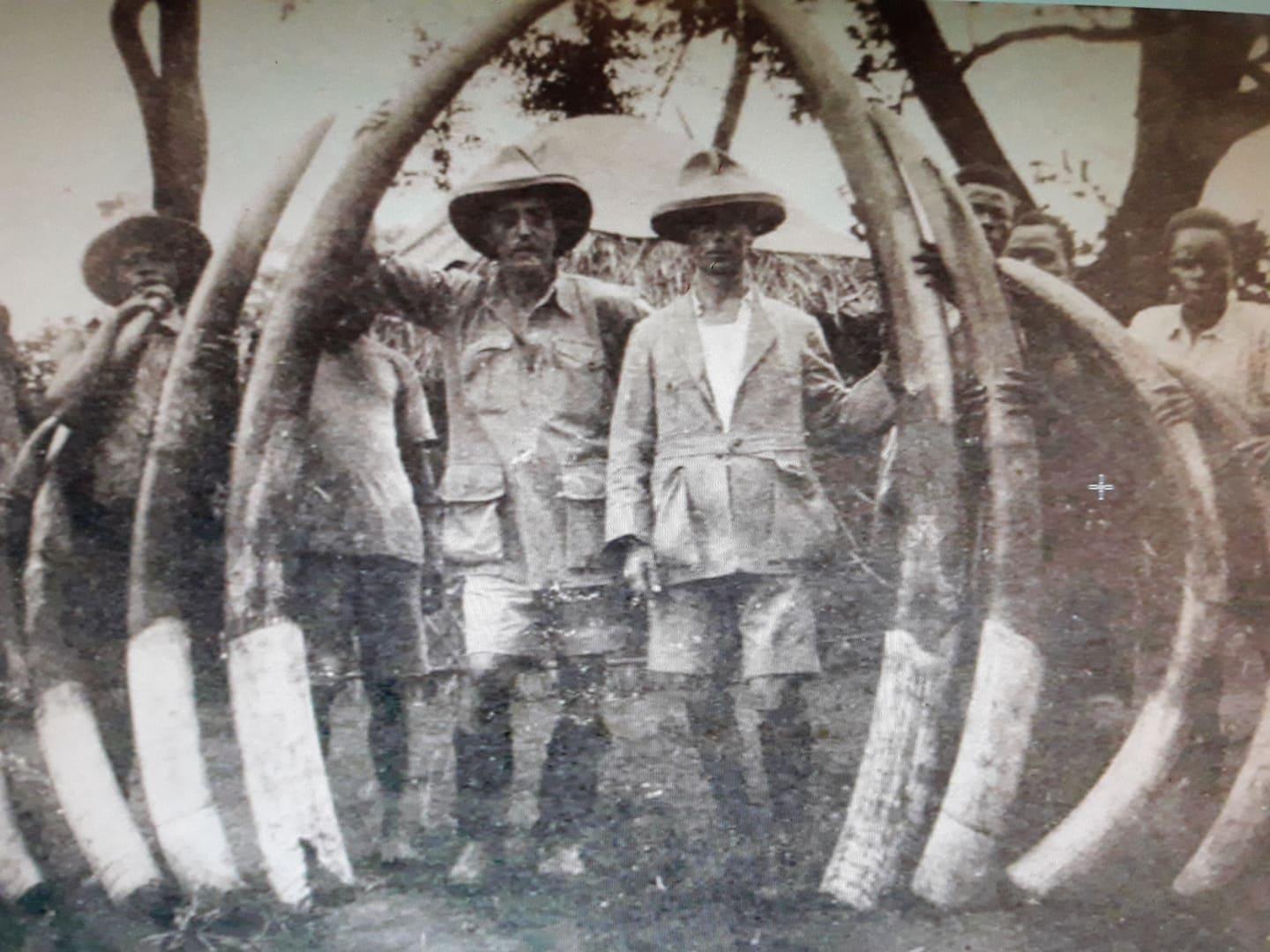
The story of George Gilman Rushby 1900-1969, as told by his son Mike:
George Gilman Rushby:
Elephant hunter,poacher, prospector, farmer, forestry officer, game ranger, husband to Eleanor, and father of 6 children who now live around the world.George Gilman Rushby was born in Nottingham on 28 Feb 1900 the son of Catherine Purdy and John Henry Payling Rushby. But John Henry died when his son was only one and a half years old, and George shunned his drunken bullying stepfather Frank Freer and was brought up by Gypsies who taught him how to fight and took him on regular poaching trips. His love of adventure and his ability to hunt were nurtured at an early stage of his life.
The family moved to Eastwood, where his mother Catherine owned and managed The Three Tuns Inn, but when his stepfather died in mysterious circumstances, his mother married a wealthy bookmaker named Gregory Simpson. He could afford to send George to Worksop College and to Rugby School. This was excellent schooling for George, but the boarding school environment, and the lack of a stable home life, contributed to his desire to go out in the world and do his own thing. When he finished school his first job was as a trainee electrician with Oaks & Co at Pye Bridge. He also worked part time as a motor cycle mechanic and as a professional boxer to raise the money for a voyage to South Africa.In May 1920 George arrived in Durban destitute and, like many others, living on the beach and dependant upon the Salvation Army for a daily meal. However he soon got work as an electrical mechanic, and after a couple of months had earned enough money to make the next move North. He went to Lourenco Marques where he was appointed shift engineer for the town’s power station. However he was still restless and left the comfort of Lourenco Marques for Beira in August 1921.
Beira was the start point of the new railway being built from the coast to Nyasaland. George became a professional hunter providing essential meat for the gangs of construction workers building the railway. He was a self employed contractor with his own support crew of African men and began to build up a satisfactory business. However, following an incident where he had to shoot and kill a man who attacked him with a spear in middle of the night whilst he was sleeping, George left the lower Zambezi and took a paddle steamer to Nyasaland (Malawi). On his arrival in Karongo he was encouraged to shoot elephant which had reached plague proportions in the area – wrecking African homes and crops, and threatening the lives of those who opposed them.
His next move was to travel by canoe the five hundred kilometre length of Lake Nyasa to Tanganyika, where he hunted for a while in the Lake Rukwa area, before walking through Northern Rhodesia (Zambia) to the Congo. Hunting his way he overachieved his quota of ivory resulting in his being charged with trespass, the confiscation of his rifles, and a fine of one thousand francs. He hunted his way through the Congo to Leopoldville then on to the Portuguese enclave, near the mouth of the mighty river, where he worked as a barman in a rough and tough bar until he received a message that his old friend Lumb had found gold at Lupa near Chunya. George set sail on the next boat for Antwerp in Belgium, then crossed to England and spent a few weeks with his family in Jacksdale before returning by sea to Dar es Salaam. Arriving at the gold fields he pegged his claim and almost immediately went down with blackwater fever – an illness that used to kill three out of four within a week.
When he recovered from his fever, George exchanged his gold lease for a double barrelled .577 elephant rifle and took out a special elephant control licence with the Tanganyika Government. He then headed for the Congo again and poached elephant in Northern Rhodesia from a base in the Congo. He was known by the Africans as “iNyathi”, or the Buffalo, because he was the most dangerous in the long grass. After a profitable hunting expedition in his favourite hunting ground of the Kilombera River he returned to the Congo via Dar es Salaam and Mombassa. He was after the Kabalo district elephant, but hunting was restricted, so he set up his base in The Central African Republic at a place called Obo on the Congo tributary named the M’bomu River. From there he could make poaching raids into the Congo and the Upper Nile regions of the Sudan. He hunted there for two and a half years. He seldom came across other Europeans; hunters kept their own districts and guarded their own territories. But they respected one another and he made good and lasting friendships with members of that small select band of adventurers.
Leaving for Europe via the Congo, George enjoyed a short holiday in Jacksdale with his mother. On his return trip to East Africa he met his future bride in Cape Town. She was 24 year old Eleanor Dunbar Leslie; a high school teacher and daughter of a magistrate who spent her spare time mountaineering, racing ocean yachts, and riding horses. After a whirlwind romance, they were betrothed within 36 hours.
On 25 July 1930 George landed back in Dar es Salaam. He went directly to the Mbeya district to find a home. For one hundred pounds he purchased the Waizneker’s farm on the banks of the Mntshewe Stream. Eleanor, who had been delayed due to her contract as a teacher, followed in November. Her ship docked in Dar es Salaam on 7 Nov 1930, and they were married that day. At Mchewe Estate, their newly acquired farm, they lived in a tent whilst George with some help built their first home – a lovely mud-brick cottage with a thatched roof. George and Eleanor set about developing a coffee plantation out of a bush block. It was a very happy time for them. There was no electricity, no radio, and no telephone. Newspapers came from London every two months. There were a couple of neighbours within twenty miles, but visitors were seldom seen. The farm was a haven for wild life including snakes, monkeys and leopards. Eleanor had to go South all the way to Capetown for the birth of her first child Ann, but with the onset of civilisation, their first son George was born at a new German Mission hospital that had opened in Mbeya.
Occasionally George had to leave the farm in Eleanor’s care whilst he went off hunting to make his living. Having run the coffee plantation for five years with considerable establishment costs and as yet no return, George reluctantly started taking paying clients on hunting safaris as a “white hunter”. This was an occupation George didn’t enjoy. but it brought him an income in the days when social security didn’t exist. Taking wealthy clients on hunting trips to kill animals for trophies and for pleasure didn’t amuse George who hunted for a business and for a way of life. When one of George’s trackers was killed by a leopard that had been wounded by a careless client, George was particularly upset.
The coffee plantation was approaching the time of its first harvest when it was suddenly attacked by plagues of borer beetles and ring barking snails. At the same time severe hail storms shredded the crop. The pressure of the need for an income forced George back to the Lupa gold fields. He was unlucky in his gold discoveries, but luck came in a different form when he was offered a job with the Forestry Department. The offer had been made in recognition of his initiation and management of Tanganyika’s rainbow trout project. George spent most of his short time with the Forestry Department encouraging the indigenous people to conserve their native forests.In November 1938 he transferred to the Game Department as Ranger for the Eastern Province of Tanganyika, and over several years was based at Nzasa near Dar es Salaam, at the old German town of Morogoro, and at lovely Lyamungu on the slopes of Kilimanjaro. Then the call came for him to be transferred to Mbeya in the Southern Province for there was a serious problem in the Njombe district, and George was selected by the Department as the only man who could possibly fix the problem.
Over a period of several years, people were being attacked and killed by marauding man-eating lions. In the Wagingombe area alone 230 people were listed as having been killed. In the Njombe district, which covered an area about 200 km by 300 km some 1500 people had been killed. Not only was the rural population being decimated, but the morale of the survivors was so low, that many of them believed that the lions were not real. Many thought that evil witch doctors were controlling the lions, or that lion-men were changing form to kill their enemies. Indeed some wichdoctors took advantage of the disarray to settle scores and to kill for reward.
By hunting down and killing the man-eaters, and by showing the flesh and blood to the doubting tribes people, George was able to instil some confidence into the villagers. However the Africans attributed the return of peace and safety, not to the efforts of George Rushby, but to the reinstallation of their deposed chief Matamula Mangera who had previously been stood down for corruption. It was Matamula , in their eyes, who had called off the lions.
Soon after this adventure, George was appointed Deputy Game Warden for Tanganyika, and was based in Arusha. He retired in 1956 to the Njombe district where he developed a coffee plantation, and was one of the first in Tanganyika to plant tea as a major crop. However he sensed a swing in the political fortunes of his beloved Tanganyika, and so sold the plantation and settled in a cottage high on a hill overlooking the Navel Base at Simonstown in the Cape. It was whilst he was there that TV Bulpin wrote his biography “The Hunter is Death” and George wrote his book “No More The Tusker”. He died in the Cape, and his youngest son Henry scattered his ashes at the Southern most tip of Africa where the currents of the Atlantic and Indian Oceans meet .
George Gilman Rushby:
 December 13, 2021 at 10:09 am #6219
Topic: The Elusive Samuel Housley and Other Family Stories
in forum TP’s Family BooksThe following stories started with a single question.
Who was Catherine Housley’s mother?
But one question leads to another, and another, and so this book will never be finished. This is the first in a collection of stories of a family history research project, not a complete family history. There will always be more questions and more searches, and each new find presents more questions.
A list of names and dates is only moderately interesting, and doesn’t mean much unless you get to know the characters along the way. For example, a cousin on my fathers side has already done a great deal of thorough and accurate family research. I copied one branch of the family onto my tree, going back to the 1500’s, but lost interest in it after about an hour or so, because I didn’t feel I knew any of the individuals.
Parish registers, the census every ten years, birth, death and marriage certificates can tell you so much, but they can’t tell you why. They don’t tell you why parents chose the names they did for their children, or why they moved, or why they married in another town. They don’t tell you why a person lived in another household, or for how long. The census every ten years doesn’t tell you what people were doing in the intervening years, and in the case of the UK and the hundred year privacy rule, we can’t even use those for the past century. The first census was in 1831 in England, prior to that all we have are parish registers. An astonishing amount of them have survived and have been transcribed and are one way or another available to see, both transcriptions and microfiche images. Not all of them survived, however. Sometimes the writing has faded to white, sometimes pages are missing, and in some case the entire register is lost or damaged.
Sometimes if you are lucky, you may find mention of an ancestor in an obscure little local history book or a journal or diary. Wills, court cases, and newspaper archives often provide interesting information. Town memories and history groups on social media are another excellent source of information, from old photographs of the area, old maps, local history, and of course, distantly related relatives still living in the area. Local history societies can be useful, and some if not all are very helpful.
If you’re very lucky indeed, you might find a distant relative in another country whose grandparents saved and transcribed bundles of old letters found in the attic, from the family in England to the brother who emigrated, written in the 1800s. More on this later, as it merits its own chapter as the most exciting find so far.
The social history of the time and place is important and provides many clues as to why people moved and why the family professions and occupations changed over generations. The Enclosures Act and the Industrial Revolution in England created difficulties for rural farmers, factories replaced cottage industries, and the sons of land owning farmers became shop keepers and miners in the local towns. For the most part (at least in my own research) people didn’t move around much unless there was a reason. There are no reasons mentioned in the various registers, records and documents, but with a little reading of social history you can sometimes make a good guess. Samuel Housley, for example, a plumber, probably moved from rural Derbyshire to urban Wolverhampton, when there was a big project to install indoor plumbing to areas of the city in the early 1800s. Derbyshire nailmakers were offered a job and a house if they moved to Wolverhampton a generation earlier.
Occasionally a couple would marry in another parish, although usually they married in their own. Again, there was often a reason. William Housley and Ellen Carrington married in Ashbourne, not in Smalley. In this case, William’s first wife was Mary Carrington, Ellen’s sister. It was not uncommon for a man to marry a deceased wife’s sister, but it wasn’t strictly speaking legal. This caused some problems later when William died, as the children of the first wife contested the will, on the grounds of the second marriage being illegal.
Needless to say, there are always questions remaining, and often a fresh pair of eyes can help find a vital piece of information that has escaped you. In one case, I’d been looking for the death of a widow, Mary Anne Gilman, and had failed to notice that she remarried at a late age. Her death was easy to find, once I searched for it with her second husbands name.
This brings me to the topic of maternal family lines. One tends to think of their lineage with the focus on paternal surnames, but very quickly the number of surnames increases, and all of the maternal lines are directly related as much as the paternal name. This is of course obvious, if you start from the beginning with yourself and work back. In other words, there is not much point in simply looking for your fathers name hundreds of years ago because there are hundreds of other names that are equally your own family ancestors. And in my case, although not intentionally, I’ve investigated far more maternal lines than paternal.
This book, which I hope will be the first of several, will concentrate on my mothers family: The story so far that started with the portrait of Catherine Housley’s mother.
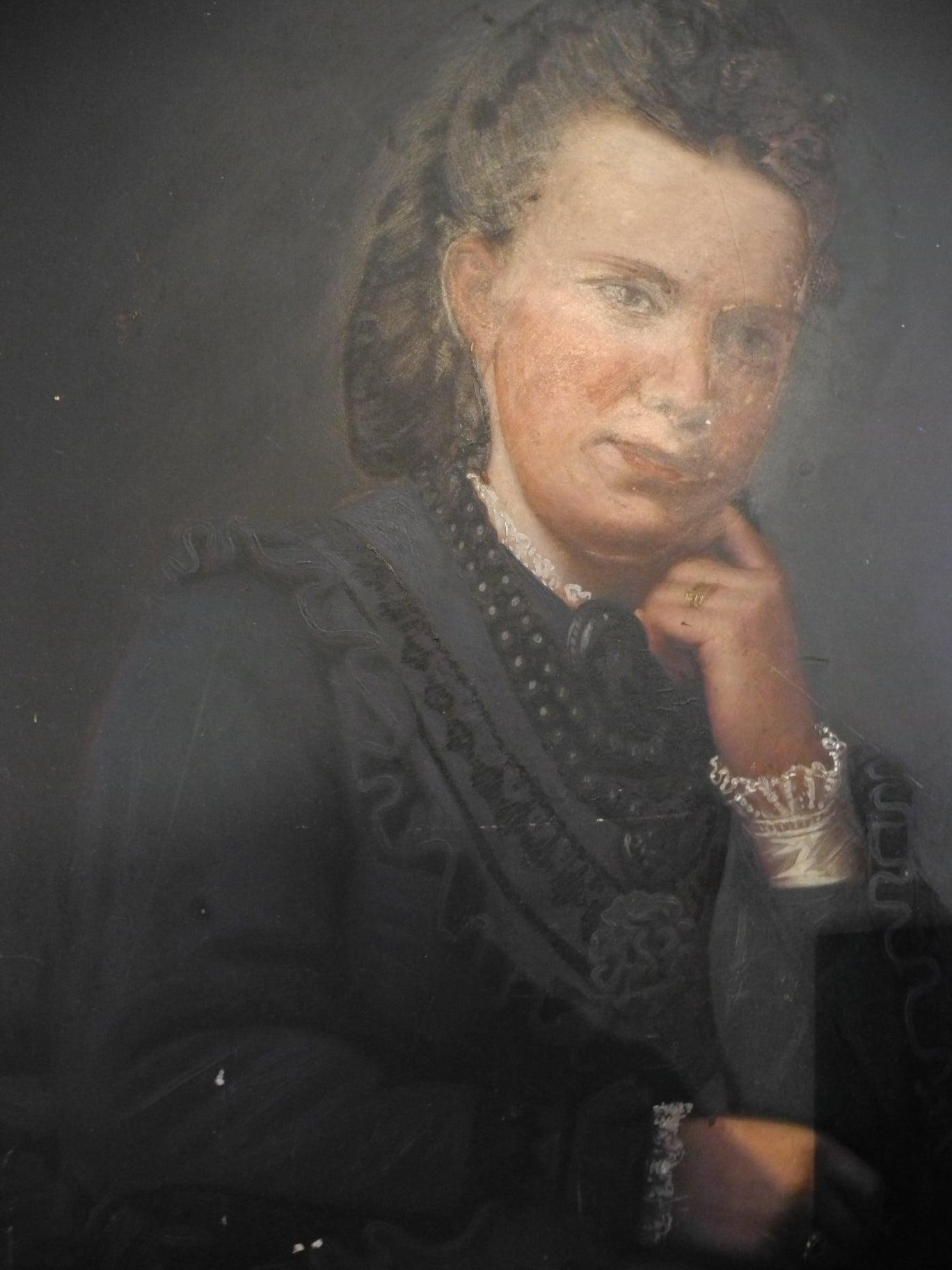
This painting, now in my mothers house, used to hang over the piano in the home of her grandparents. It says on the back “Catherine Housley’s mother, Smalley”.
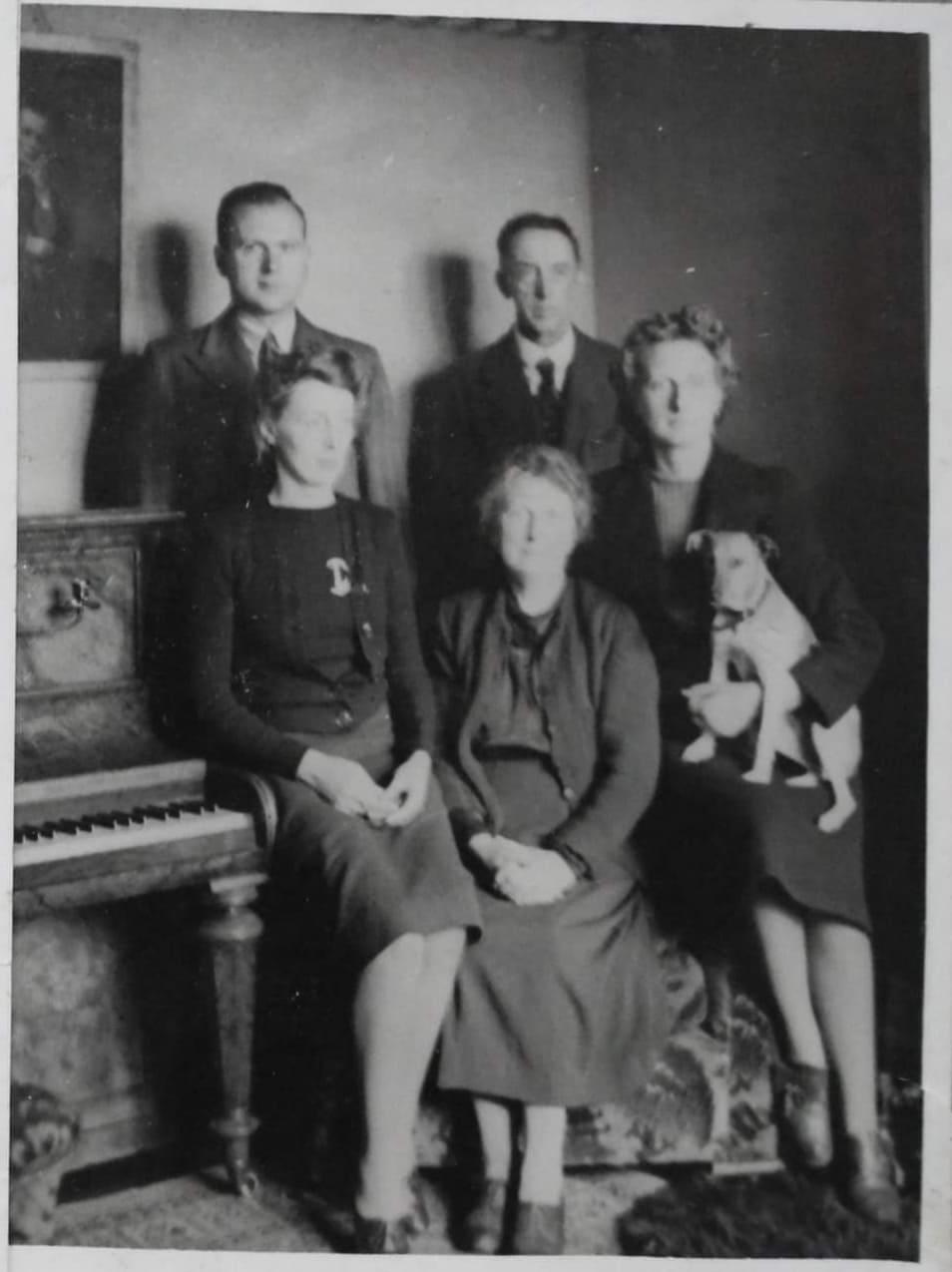
The portrait of Catherine Housley’s mother can be seen above the piano. Back row Ronald Marshall, my grandfathers brother, William Marshall, my great grandfather, Mary Ann Gilman Purdy Marshall in the middle, my great grandmother, with her daughters Dorothy on the left and Phyllis on the right, at the Marshall’s house on Love Lane in Stourbridge.
The Search for Samuel Housley
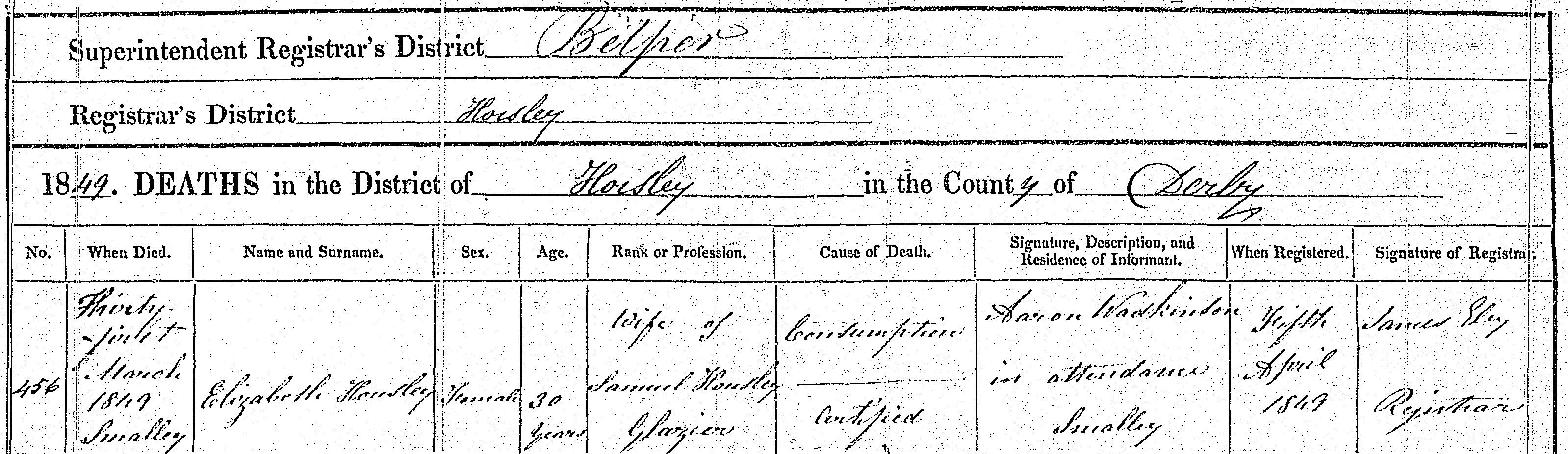
As soon as the search for Catherine Housley’s mother was resolved, achieved by ordering a paper copy of her birth certificate, the search for Catherine Housley’s father commenced. We know he was born in Smalley in 1816, son of William Housley and Ellen Carrington, and that he married Elizabeth Brookes in Wolverhampton in 1844. He was a plumber and glazier. His three daughters born between 1845 and 1849 were born in Smalley. Elizabeth died in 1849 of consumption, but Samuel didn’t register her death. A 20 year old neighbour called Aaron Wadkinson did.
Where was Samuel?
On the 1851 census, two of Samuel’s daughters were listed as inmates in the Belper Workhouse, and the third, 2 year old Catherine, was listed as living with John Benniston and his family in nearby Heanor. Benniston was a framework knitter.
Where was Samuel?
A long search through the microfiche workhouse registers provided an answer. The reason for Elizabeth and Mary Anne’s admission in June 1850 was given as “father in prison”. In May 1850, Samuel Housley was sentenced to one month hard labour at Derby Gaol for failing to maintain his three children. What happened to those little girls in the year after their mothers death, before their father was sentenced, and they entered the workhouse? Where did Catherine go, a six week old baby? We have yet to find out.
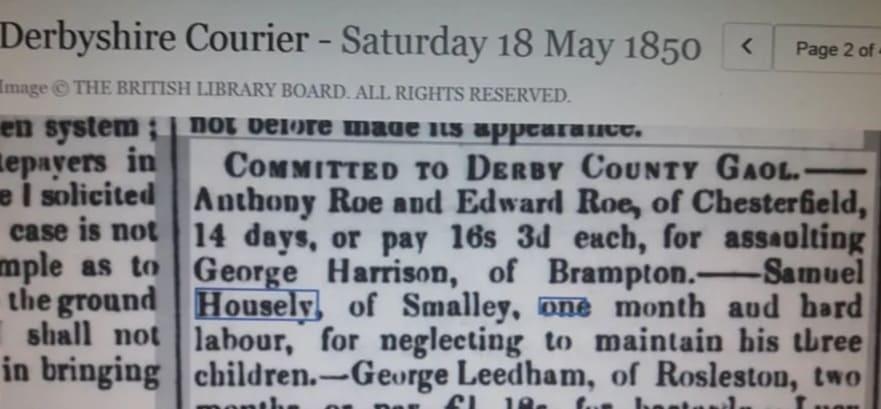
And where was Samuel Housley in 1851? He hasn’t appeared on any census.
According to the Belper workhouse registers, Mary Anne was discharged on trial as a servant February 1860. She was readmitted a month later in March 1860, the reason given: unwell.
Belper Workhouse:
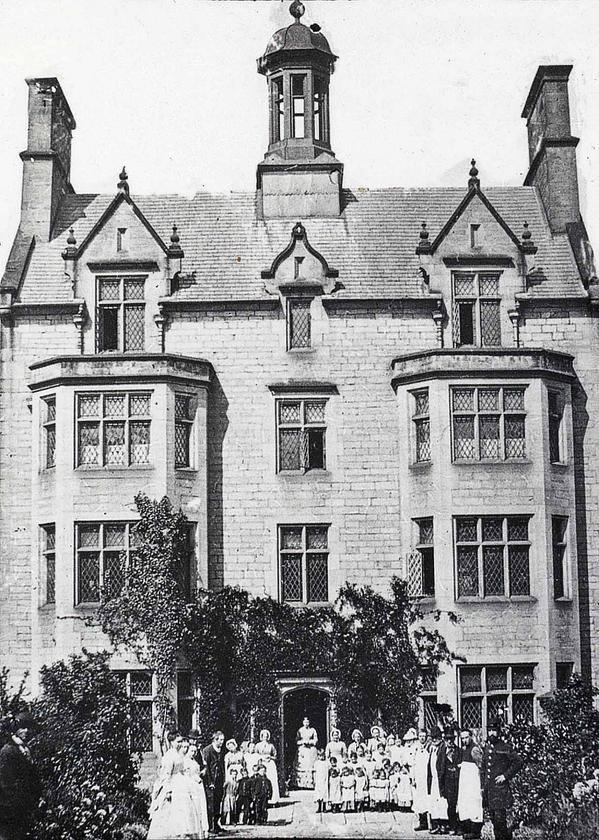
Eventually, Mary Anne and Elizabeth were discharged, in April 1860, with an aunt and uncle. The workhouse register doesn’t name the aunt and uncle. One can only wonder why it took them so long.
On the 1861 census, Elizabeth, 16 years old, is a servant in St Peters, Derby, and Mary Anne, 15 years old, is a servant in St Werburghs, Derby.But where was Samuel?
After some considerable searching, we found him, despite a mistranscription of his name, on the 1861 census, living as a lodger and plumber in Darlaston, Walsall.
Eventually we found him on a 1871 census living as a lodger at the George and Dragon in Henley in Arden. The age is not exactly right, but close enough, he is listed as an unmarried painter, also close enough, and his birth is listed as Kidsley, Derbyshire. He was born at Kidsley Grange Farm. We can assume that he was probably alive in 1872, the year his mother died, and the following year, 1873, during the Kerry vs Housley court case.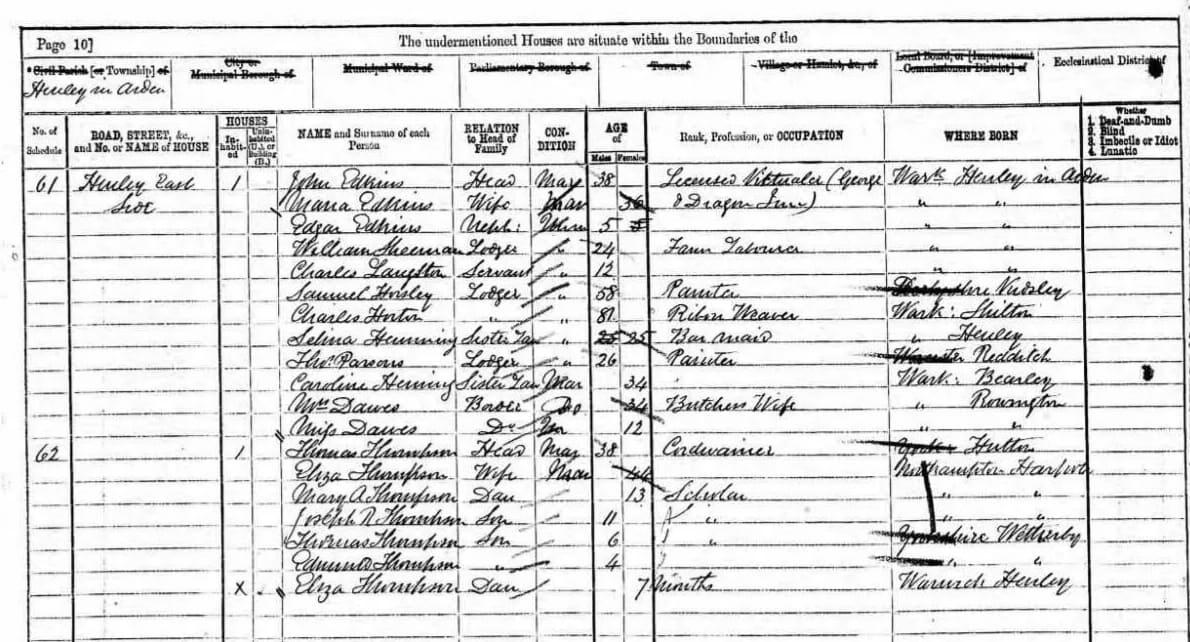
I found some living Housley descendants in USA. Samuel Housley’s brother George emigrated there in 1851. The Housley’s in USA found letters in the attic, from the family in Smalley ~ written between 1851 and 1870s. They sent me a “Narrative on the Letters” with many letter excerpts.
The Housley family were embroiled in a complicated will and court case in the early 1870s. In December 15, 1872, Joseph (Samuel’s brother) wrote to George:
“I think we have now found all out now that is concerned in the matter for there was only Sam that we did not know his whereabouts but I was informed a week ago that he is dead–died about three years ago in Birmingham Union. Poor Sam. He ought to have come to a better end than that….His daughter and her husband went to Birmingham and also to Sutton Coldfield that is where he married his wife from and found out his wife’s brother. It appears he has been there and at Birmingham ever since he went away but ever fond of drink.”
No record of Samuel Housley’s death can be found for the Birmingham Union in 1869 or thereabouts.
But if he was alive in 1871 in Henley In Arden…..
Did Samuel tell his wife’s brother to tell them he was dead? Or did the brothers say he was dead so they could have his share?We still haven’t found a death for Samuel Housley.
September 14, 2021 at 3:38 pm #6211In reply to: The Precious Life and Rambles of Liz Tattler
Today the planets are aligned, thought Liz as she looked at the blue sky out the French door. The frills of her glitter pink Charnel bathing suit wiggled with excitement.
It was one of those rare days of this summer where rain wasn’t pouring somewhere in the garden. Every single day: clouds, clouds, clouds. If they weren’t above the mansion, they were above the pool. If they weren’t above the pool, they were flooding the lawn in between the mansion and the pool.
But today, the sun had risen in a sky free of clouds and Liz was determined to have that dip in the newly repaired swimming pool with a watermelon mojito served by Roberto in his shiny leather speedo. The pool had been half frozen half boiling for so long that they had forgotten the swimming part. Once fixed, the summer had turned into a mid season rainy weather.
‘I don’t want to get wet before I get into the pool’, Liz had said to Finnley.
Liz looked at her pink notebook lying on the coffee table. Resisting the temptation to fill in the empty pages with gripping stories, she hopped on the patio, flounces bouncing and her goocci flip-flops clacking. With a sparkling foot, Liz tested the grass. It was dry enough, which meant she would not inadvertently walk on a slug or a snail. She particularly hated the cracking noise and the wetness afterward under her feet.
Roberto was bent forward. Liz frowned. He was not wearing his leather speedo. And his hands and pants were covered in green goo.
‘What happened?’ she asked in front of the disaster.
Roberto shrugged, obviously overwhelmed by the goo.
‘Green algae’, said Godfrey popping up out of nowhere with a handful of cashews. ‘The ice and fire had kept it at bay for some time. But once it was back to normal the pool was a perfect environment for their development. I already called the maintenance company. They come next week.’
‘What? Next week?’
‘Yes. That’s sad. It’s the season. We are not the only ones to have that problem.’
That said he threw a cashew in his mouth and popped back to nowhere he came from.
February 19, 2021 at 11:49 am #6187In reply to: The Chronicles of the Flying Fish Inn
Aunt Idle:
You can’t blame me for not updating my diary because bugger all has happened all year. Borders closed, no tourists allowed in. How are bespoke bijou boutique establishments like ours supposed to survive? But we’re still here. Somehow we’ve managed to keep the wolf from the door, but only just barely. I get a bit muddled up these days and can’t remember the dates. Sometimes I find myself living in the past for weeks on end: things change so little around her that it’s easy to do. But what does it matter anyway?
Mater went into a sulk the likes of which I hope never to see again, when her 100th birthday party was cancelled. I thought she might give up the will to live, but oh no. She’s determined now to have a 110th birthday party now. She says the bloody pandemic ought to be over by then. I hope she’s right. She changes her health food and exercise regimes as often as she changes her knickers. Well more often than that, probably, she doesn’t bother much with personal hygiene. She says the germs keep her immune system in good shape. I think the smell of her would keep any plague ridden body well away from her, but whatever works, I always say. At least she isn’t sulking anymore, she’s grimly stoic now and tediously determined to outlive me.
I had some worrying news through the telepathic grapevine about the twins and Pan, they’d gotten into the clutches of a strange cult over there. I’ve got a feeling they weren’t really sucked into it though, I think they needed to use it as a cover, or to keep themselves safe. I say cult but it was huge, took over the entire country and even started spreading to other countries. As if the pandemic wasn’t enough to deal with. I knew they shouldn’t have gone there. There’s been a peculiar blockage with the telepathic messages for ages now. It’s a worry, but what can I do. I keep sending them messages, but get nothing in return.
Ah, well. We carry on as best we can. What I wouldn’t give for an unexpected visitor to brighten things up a bit. Fat chance of that.
September 17, 2020 at 7:31 am #6131In reply to: Tart Wreck Repackage
“It’s Thursday today,” remarked Star.
“Special subject the bloody obvious?” Tara replied rudely. “You should be on Mastermind.”
“Well, we were wondering what we were going to do to pass the time until Thursday, and here we are. It’s Thursday!”
“Are you losing your marbles?”
“Actually it’s you losing your memory,” Star sighed. “Remember the case?”
“What case?”
“The case we were working on!”
“Oh, that case! Well you can hardly expect me to remember that when it’s been such a strange week!” Tara was starting to get tearful and agitated.
“Look, Tara, the tests came back negative. You can stop worrying about it now. We can go back to normal now and carry on. And just in time for the rendezvous at the cafe on Main Street.” Star patted Tara’s arm encouragingly. “And what timing! If the results hadn’t come back yet, or we’d tested positive, we wouldn’t have been able to go to the cafe.”
“Well we could have gone and just not said anything about the tests,” sniffed Tara. “Everyone else seems to be doing what they want regardless.”
“Yes, but we’re not as morally bankrupt as them,” retorted Star.
Tara giggled. “But we used to work for Madame Limonella.”
“That’s an entirely different kind of morals,” Star replied, but chose not to pursue the issue. She was relieved to see Tara’s mood lighten. “What are you going to wear to the cafe?”
“Is it a fancy dress party? I could wear my plague doctor outfit.”
Star rolled her eyes. “No! We have to dress appropriately, something subtle and serious. A dark suit perhaps.”
“Oh like my Ace of Spades T shirt?”
This is going nowhere fast, Star thought, but then had a revelation. A moment later, she had forgotten what the revelation was when the door burst open.
“Ta Da!” shouted Rosamund, entering the office with two middle aged ladies in tow. “I nabbed them both, they were lurking in the queue for the food bank! And I single handedly brought then back. Can we talk about my bonus now?”
Both Tara and Star were frowning at the two unfamiliar ladies. “Yes but who are these two middle aged ladies?”
One of the ladies piped up, “She said you’d be taking us out for afternoon tea at a nice cafe!”
The other one added, “We haven’t eaten for days, we’re starving!”
“But neither of you is April!” exclaimed Tara.
The first middle aged lady said, “Oh no dear, it’s September. I’m quite sure of that.”
September 9, 2020 at 9:29 pm #6128In reply to: Tart Wreck Repackage
“Never again,” said Tara, pouring her second black coffee. “I’m done with these hangovers. You’ll have to find someone else to drink with from now on.”
“You say that every week, Tara. What are we going to do next? We’re floundering. We don’t even have a plan. Everything we do takes us further away from the case. I don’t even remember what the case is!”
“Here, have some more coffee. Don’t roll your eyes at me like that, cases are always like this, they always go through this phase.” Tara wasn’t in the mood for this kind of depressing talk, it was much too complicated. Surely it was simply a matter of drinking another coffee, until everything fell back into place.
“Cases do, do they?” Star asked, “Do they really? And what phase would that be, and how would you know?”
“Snarky tart, yes they do. I’ve been researching things you know, not just swanning around. We’ve reached the part of the case where nothing makes sense and the investigators don’t know what to do next. It’s an essential part of the process, everyone knows that. The important thing is not to try and work things out too early. The danger is preconceived ideas, you see,” Tara pontificated, warming to the theme.
“I can assure you that I have no preconceived ideas because I have no clue what’s going to happen next,” replied Star, trying not to roll her eyes too obviously. She knew from experience not to provoke Tara too much until at least the third cup of coffee.
“Precisely!” Tara said triumphantly. “Now it will all start to come together and make sense. ”
Star didn’t look convinced. “What are we going to do about the middle aged lady we locked in the wardrobe last night, though?”
“What did we do that for?!” asked Tara in astonishment.
“I can’t remember. Maybe we thought it was Aunt April?”
“Wait, if Aunt April isn’t in the wardrobe, then where is she?”
“That’s what I”m saying!” cried Star in exasperation. “What do we do next?”
August 31, 2020 at 8:15 pm #6117In reply to: The Whale’s Diaries Collection
Well. I did it. I made my escape. I had to! Nobody came for three days and I’d run out of biscuits. Thank the lord my hip wasn’t playing up. I decided not to take anything with me, figuring I could just steal things off washing lines when I wanted a change of clothes. I’ve always hated carrying heavy bags. I reckoned it would look less conspicuous, too. Just an old dear popping out for digestive perambulation. Nobody suspects old dears of anything, not unless they’re dragging a suitcase round, and I had no intention of doing that. I did put a couple of spare masks in my pocket though, you can’t be too careful these days. And it would help with the disguise. I didn’t want any do gooders trying to catch me and take me back to that place.
I had the presence of mind to wear good stout walking shoes and not my pink feather mules, even though it was a wrench to say goodbye to them. I used to love to see them peeping out from under my bath robe. One day I might strike lucky and find another pair.
I’ve been eating like a king, better than ever! I accidentally coughed on someones burger one day, and they dropped it and ran away, and I thought to myself, well there’s an idea. I stuck to random snacks in the street at first and then one day I fancied a Chinese so I thought, well why not give it a try. Coughed all over his brown bag of prawn crackers as he walked out of the restaurant and he put the whole takeaway in the nearest bin. Piping hot meal for six! Even had that expensive crispy duck!
Tonight I fancy sushi. Wish I’d thought of this trick years ago, I said to myself the other day, then my other self said, yeah but it wouldn’t have worked so well before the plague.
Not having much luck with the washing lines though, lazy sods either not doing any laundry or putting it all in the dryer. Weeks of sunny weather as well, the lazy bastards. Lazy and wasteful! You should see the clothes they throw in the clothes bank bins! If the bins are full you can get your arm in and pull out the ones on the top. I change outfits a dozen times a day some days if I’m in the mood. I do sometimes get an urge to keep something if I like it but I’m sticking to my guns and being ruthless about not carrying anything with me.
August 27, 2020 at 9:28 am #6102In reply to: Tart Wreck Repackage
“That damn cult is going from strength to strength and not a damn thing we can do about it,” said Star. “What bloody awful timing for a lockdown, just as we were getting started!”
“I know,” replied Tara sadly. “At this rate we’ll have to go back to work for Madame Limonella.”
“Don’t be silly, she’ll have had to close down too!”
“Don’t you believe it!” retorted Tara, “She’d find a way to keep her clients happy.”
“But we’re not keeping our clients happy are we? We haven’t found a way. We’re pretty useless, aren’t we?”
“Not just our clients. Well client, really, we only had one. We could have saved the world from the Zanone cult if it hadn’t been for this quarantine. Hey, maybe that cult started all this, just so we couldn’t stop them.”
Star barked out a bitter laugh. “Now you sound like one of them parroting out conspiracy theories.”
“We could find a way to break the quarantine, sneak out at night dressed as urban kangaroos or something.”
Star was shocked. “Tara, that’s morally reprehensible! Where is your community spirit!”
“I don’t think the kangaroos would mind all that much,” Tara replied huffily.
“I didn’t mean the kangaroos, good lord! But you know what, you might be on to something. Remember that kangaroo dressed in a mans overcoat that tried to break someones car window the other day?”
Tara had a feeling Star had got her wires crossed somehow, but didn’t question it. Star was getting excited and it was a welcome change from the weeks of despondent boredom.
“Well never mind that,” Star continued, who had started to wonder herself, “The point is, we can use a disguise. And it’s a matter of grave social responsibility to expose the cult. In the fullness of time, we will be exonerated, hailed as heroic, even.”
The excitement was contagious and Tara found herself sitting upright instead of slumped in despair. “Let’s do it!”
April 18, 2020 at 7:08 pm #6062In reply to: The Pistil Maze
The journey to the Pistil itself would have been worth its own story, thought Charlton. They had to avoid road blocks, crowds of chanting christians that had certainly vowed to spread the virus as fast as possible, and howlers who you were never sure weren’t the real thing from Teen Wolf. They had to be, in such a landscape. Once arid, it had turned greener in just a few weeks. Rain was now weekly when drops of water used to only show up with the bottles of water from the tourists.
Despite Kady’s advice not to take anything, he’d still brought the book of drawings. Kady had said nothing about the book, nor the clothes, or the snacks. Charlton was sometimes literal about what people told him, but he also knew it. So he didn’t say anything when he saw Kady had her own backpack with clothes, some money and food. During the trip, he tried to reproduce the experience with the drawings and the dreams —but nothing happened. Charlton felt a little disappointed.
They saw the pistil long before they arrived at its foot. It was at the end of the day and the sunset was splashing its reds and purples all around it. Charlton had had time to get used to its tall presence in the landscape. Yet, seeing it at a close range from below was a strange experience. Taller than the tallest man-made tower. He wondered what he was supposed to feel in its presence. Awe? Electricity? Enlightenment? Bursts of inspiration? This should at least be a mystical moment, but all he could feel was annoyance at the crowd of people crawling around like aphids avid to suck its sap.
Kady looked more annoyed than surprised. She was walking past the flock as if she knew exactly where to go. Charlton followed, feeling dizzy by the sudden increase of activity and smells. He soon got nauseous at the mix of incense and fried sausages.
“There are so many of them,” he eventually said. “How come? It was so difficult just for the two of us to avoid police controls. Do we have to wait with them?”
“Nah! They’re just the usual bunch of weirdoes,” Kady said. “They’ve been here a long time. I bet some of them aren’t even aware there have been a virus. But stay close. I don’t want to lose you, it’s a maze before the maze. I just need to see someone before we go in.”
They walked for about another ten minutes before stopping in front of a big tent. There, a big man with a boxer’s face was repairing all kind of electronics on a table with the application of a surgeon. Phones, cameras, coffee machines… Charlton wondered how they got electricity to make it all work.
“Hey, Kady!” said the man. “You’re back. Did you give it to her?” His face looked anxious.
“Of course Max! I even got an answer,” Kady said handing him a pink envelope. Max smelled it.
“Her favourite perfume,” he said with a broad smile.
“I told you she still loves you. I also brought you something else.” Kady dropped a box on the table among the electronics. Charlton didn’t think it could be possible to witness the expression of a ten year old child on such a hard face, but what was inside the box certainly did magic.
“You brought chocolate?”
“Yep.”
“Did you find the chestnut one?”
“Yep.”
“My favourite,” said Max to Charlton. “Is this your friend?”
“Max, meet Charlton. Charlton, Max. Listen, we plan on going in tomorrow, but tonight we need a place to get some rest.”
“I told you, you’re always welcome. Did you know she saved my life in there?”
“Saved your life?” asked Charlton looking hesitantly at Kady. “No, I didn’t know.”
April 18, 2020 at 10:23 am #6026In reply to: The Whale’s Diaries Collection
Dear Jorid Whale,
My hands are shaking while I type this on the keyboard.
I’m not sure which of last night’s dreams is the bizarrest. Bizarre in a fantastic way, although for certain people it might be called grotesque. I’m certain it has something to do with that book I ordered online last week. I don’t usually read books and certainly not like this one. But the confinement, it makes you consider making things out of your ordinary.
It’s called The Enchanted Forest of Changes, by a Chinese artist Níngméng (柠檬). They say his artist name means lemon, but that some of his friends call him Níng mèng 凝梦 (curdle dreams), which to my ears sound exactly the same except a little bit angrier. I found out about him on a forum about creepy dolls abandoned in forests all around the world. Yeah exactly, the confinement effect again. Apparently it started with a few dolls in a forest in Michigan, and then suddenly people started to find them everywhere. I wonder if some people are really into the confinement thing or if it’s just me using that as a reason to stay home.
Anyway, someone on that forum posted one of the picture of that book and it caught my eye. So much so that I dreamt of it the following night. So I bought the book and it’s mostly ink drawings, but they seem to speak directly to some part of you that you were not even aware you had. I almost hear whispers when I look at the drawings. And then I have those dreams.
Last night I dreamt of a cat that had been raised as a boy. He even had the shape of one, but shorter maybe. He had learned to talk and use his paws as hands, his claws had grown into fingers, had lost most of his fur and he was wearing clothes. If I was amazed by such a feat, it kinda seemed normal for the people I met in that dream. It just took a lot of efforts, love and dedication to raise this kind of children.
And Whale, I feel tingling in my arms. This morning you showed me the picture of a kitten! That’s not a mere coincidence. I’m feeling so excited, my hands are too slow to type what I want to write. I fear I’m going to forget an important detail.
About the second dream. The world was in shock, there was this giant… thing that looked like a pistil and that had grown during the night in some arid area. It was taller than the tallest human made tower. Its extremity was cone shaped, and I confess that the whole thing looked like some kind of dick to me.
Plants and trees had followed in the following days as if the pistil had changed the climatic conditions (autocorrect wanted to write climactic, is that you playing around?).
The pistil was protected by some kind of field and it couldn’t be approached by everyone. Governments had tried, pharmaceutical companies had tried. People who wanted to make gold out of it, they were all rejected. But for some reason some people could approach. Anyone, not just the pure of hearts or the noble ones. Actually a whole bunch of weirdoes started to take their chances. Some were allowed in and some where not. Nobody knew what was the deciding factor.
A friend of mine that I have not seen in years during my waking life, she came back and asked me to come with her. So we went and were allowed in. My recall of the events after that is fuzzy. But I get the strange impression that I will spend more time in there later on.
[Edited in the afternoon]
I don’t believe it! It’s on the news everywhere. It has even replaced the news about the virus and the confinement.
Giant pistils have appeared around the world, but it seems only people who had been infected can see them.
Crazy rumours run on the internet. Giant mass hallucination caused by the virus. Some people say it’s alien technology, spores engineered to control our brains.
There is one not so far from where I live. Should I wait for Kady to call me?
April 13, 2020 at 8:26 am #5995In reply to: Two Aunties au Pair and Their Pert Carouses
Fanella was frantic, trying to think of a way to escape with her baby. The atmosphere in this city was unbearable at the best of times, and especially in this house, but now it was excruciating. It wasn’t that she was afraid of the plague that was terrorizing people, it was the way the people were reacting that was so alarming. They were howling like wolves, a sure sign of lunacy since time immemorial. The sound of it made her blood run cold.
Nobody had seen the president for over a week and rumours were rife. Many said that he’d died, and they were keeping it secret to avoid civil unrest. An office junior was continuing his tweets to the nation, using a random predictive text algorithm. Nobody had noticed. That wasn’t strictly true of course as many had commented that the messages now made marginally more sense.
Fanella could sense the swelling chaos in the air, both inside the house and beyond, in the city and in the nation. Everyone was losing their minds. She had to escape.
She consulted the U Chong:
晉 (Chin / Jin) : Progress / Advance. It represents Prospering, as well as Progress. It is symbolic of meeting the great man.
The great man! Of course! Lazuli Galore would come to rescue her! But how would he know where to find her? Would he be able to travel freely? He’d find a way, surely! But how would he know she needed help? It was so complicated. So hard to know what to do!
But first things first. Fanella crept down to the kitchen, in the dead of the night while everyone was tucked up in their beds with their fitful nightmares, and filled a rucksack with provisions. Then she crept up the back stairs to her hideout in the attic of the west wing. The baby was still sleeping soundly. Fanella lay down and pulled a blanket round them both. Maybe the answer would come in a dream. If not, she’d think about it again tomorrow.
April 12, 2020 at 11:31 am #5988In reply to: Pop﹡in People Tribulations
Shawn Paul looked suspiciously at the pictures of the dolls in the Michigan forest on Maeve’s phone. He had heard about the Cottingley Fairies pictures, supposedly taken a long time ago by two little girls. The two little girls came out long after confessing they had staged the whole thing. Some said they had been coerced into it to keep the world from knowing the truth. It could well be the same thing with the whole dollmania, and Shawn Paul thought one was never dubious enough.
He noded politely to Maeve and decided to hide his doubts for now. They were resting on sunbeds near the hotel swimming pool.
“Do you want another cocktail?” asked a waitress dressed up in the local costume. Not much really, and so close-fitting. She was presenting them with a tray of colourful drinks and a candid smile. Her bosom was on the brink of spilling over the band of cloth she had around her chest. It was decorated with a pair of parrots stretched in such a way their lubricious eyes threatening to pop out at any moment.
Shawn Paul, who had the talent to see the odd and misplaced, forced himself to look at the tray and spotted the strangest one. He pushed his glasses back up on his nose and asked without looking at the waitress.
“What’s that strange bluish blob under the layers of alcohol and fruits?”
Maeve raised one eyebrow and looked at her companion with disapproval, but the waitress answered as if she heard that all the time.
“That’s a spoonful of honey from the blue bees. We feed them a special treat and they make us honey with remarkable properties that we have learned to use for the treatments we offer.”
“Oh,” said Shawn Paul who did not dare ask more about the treatments.
They had arrived to Tikfidjikoo just before the confinement had been declared all over the world, and they had a moment of hesitation to take the last plane with the other tourists and go back safely to Canada. But after the inconclusive adventure in Australia, Maeve had convinced him they had to stay to find out more about the dolls.
They had met those three old ladies and one of them had one of the dolls. Sharon, Mavis and Gloria, they were called and they were going to a smaller island of the archipelago, one that was not even on the maps apparently. That should have given them suspicions, but it seemed so important to Maeve that Shawn Paul hadn’t had the heart to leave her alone.
“I have a plan,” had said Maeve, “We’re going to follow them, befriend them and learn more about how they came to have the doll and try and get the key that’s inside of it.”
“You’re here for the beauty treatment?” had asked the girl at the counter. “You’re lucky, with the confinement a lot of our reservations have been canceled. We have plenty of vacancy and some fantastic deals.”
Maeve had enrolled them for a free week treatment before Shawn Paul could say anything. They hadn’t seen the ladies much since they had arrived on the island, and now there were no way in or out of the island. They had been assured they had plenty of food and alcohol and a lot of activities that could be fitted to everyone’s taste.
April 8, 2020 at 2:36 pm #5971In reply to: Story Bored
BOARD 3BOARD 3 Story 1:
Sha, Glo, Mav after a week of beauty treatment while Sophie is having a hard time.
Escape game turned wrong down in the Wrick’s manor crypt.
Rukshan marrying Margoritt and Mr Minn with a few guests in the enchanted forest.April 7, 2020 at 2:04 pm #5964In reply to: Newsreel from the Rim of the Realm
They walked through a labyrinth of tunnels which seemed to have been carved into a rocky mountain. The clicks and clacks of their high heels echoed in the cold silence meeting all of Sophie’s questions, leaving her wondering where they could be. Tightly held by her rompers she felt her fat mass wobbling like jelly around her skeleton. It didn’t help clear her mind which was still confused by the environment and the apparent memory loss concerning how she arrived there.
Sophie couldn’t tell how many turns they took before Barbara put her six fingers hand on a flat rock at shoulders height. The rock around the hand turned green and glowed for two seconds; then a big chunk of rock slid to the side revealing a well designed modern style room.
“Doctor, Sophie is here,” said Barbara when they entered.
A little man was working at his desk. At least Sophie assumed it was his desk and that he was working. He was wearing a Hawaiian shirt and bermudas. The computer screen he was looking at projected a greenish tint onto his face, and it made him look just like the green man icon. Sophie cackled, a little at first.
The Doctor’s hand tensed on the mouse and his eyebrows gathered like angry caterpillars ready to fight. He must have made a wrong move because a cascade of sound ending in a flop indicated he just died a death, most certainly on one of those facegoat addictive games.
That certainly didn’t help muffle Sophie’s cackle until she felt Barbara’s six fingers seizing her shoulders as if for a Vulcan nerve pinch. Sophie expected to lose consciousness, but the hand was mostly warm, except for that extra finger which was cold and buzzing. The contact of the hand upon the latex gave off little squeaky sounds that made Sophie feel uncomfortable. She swallowed her anxiety and wished for the woman to remove her hand. But as she had noticed more than once, wishes could take time and twists before they could be fulfilled.
“Why do you have to ruin everything every time?” asked the Doctor. His face was now red and distorted.
“Every time?” said Sophie confused.
“Yes! You took your sleeper agent role too seriously. We couldn’t get any valuable intel and the whole doll operation was a fiasco. We almost lost the magpies. And now, your taste for uncharted drugs, which as a parenthesis I confess I admire your dedication to explore unknown territories for science… Anyway, you were all day locked up into your boudoir trying to contact me while I just needed you to look at computer screens and attend to meetings.”
Sophie was too shocked to believe it. How could the man be so misinformed. She never liked computers and meetings, except maybe while looking online for conspiracy theories and aliens and going to comiccons. But…
“Now you’re so addict to the drugs that you’re useless until you follow our rehab program.”
“A rehab program?” asked Sophie, her voice shaking. “But…” That certainly was the spookiest thing she had heard since she had arrived to this place, and this made her speechless, but certainly not optionless. Without thinking she tried a move she had seen in movies. She turned and threw her mass into Barbara. The two women fell on the cold floor. Sophie heard a crack before she felt the pain in her right arm. She thought she ought to have persevered in her combat training course after the first week. But life is never perfect.
“Suffice!” said the Doctor from above. “You’ll like it with the other guests, you’ll see. All you have to do is follow the protocol we’ll give you each day and read the documentation that Barbara will give you.”
Sophie tried a witty answer but the pain was too much and it ended in a desperate moan.
March 10, 2020 at 5:48 pm #5826In reply to: The Whale’s Diaries Collection
Day 12What was I thinking. That all will be good and all, and forever after.
Lord, sometimes I miss that bloated boat, and its ordeal felt like an old familiar pain that distance makes bearable in retrospect.
A week back into life, and all goes to hell. Good thing I’m not a trader, looking at the stock market would make you want to jump from a tall building.
Since all is in chaos, I’ve been noticing them more. The synchronicities. Seems like the voices have found other ways to reach at me. Talks of forest and trees, arcane words spoken in different contexts.
If only I weren’t paying attention. But then there are the dreams. Last ones have been insane. And not just those after a heavy meal, you know. The kind that gets you more tired when you wake up, as if you’ve spend the whole night piling up mountains upon mountains.
I’d rather just pop a pill and see the elephants dance from branch to branch, if you see what I mean. But the voices wouldn’t let me go. Now they are egging me on to do something I don’t want to do.
A book opened at random, summarizes it all: “Our heart is anxious about being sent here.“
Next line is a tease: “Gathering the resources of all under heaven as in a storehouse.”
But when did I sign up to be the bloody storehouse manager? -
AuthorSearch Results