


Search Results for 'white'
-
AuthorSearch Results
-
January 14, 2022 at 3:06 pm #6253
In reply to: The Elusive Samuel Housley and Other Family Stories
My Grandparents Kitchen
My grandmother used to have golden syrup in her larder, hanging on the white plastic coated storage rack that was screwed to the inside of the larder door. Mostly the larder door was left propped open with an old flat iron, so you could see the Heinz ketchup and home made picallilli (she made a particularly good picallili), the Worcester sauce and the jar of pickled onions, as you sat at the kitchen table.
If you were sitting to the right of the kitchen table you could see an assortment of mismatched crockery, cups and bowls, shoe cleaning brushes, and at the back, tiny tins of baked beans and big ones of plum tomatoes, and normal sized tins of vegetable and mushroom soup. Underneath the little shelves that housed the tins was a blue plastic washing up bowl with a few onions, some in, some out of the yellow string bag they came home from the expensive little village supermarket in.
There was much more to the left in the awkward triangular shape under the stairs, but you couldn’t see under there from your seat at the kitchen table. You could see the shelf above the larder door which held an ugly china teapot of graceless modern lines, gazed with metallic silver which was wearing off in places. Beside the teapot sat a serving bowl, squat and shapely with little handles, like a flattened Greek urn, in white and reddish brown with flecks of faded gilt. A plain white teapot completed the trio, a large cylindrical one with neat vertical ridges and grooves.
There were two fridges under the high shallow wooden wall cupboard. A waist high bulbous old green one with a big handle that pulled out with a clunk, and a chest high sleek white one with a small freezer at the top with a door of its own. On the top of the fridges were biscuit and cracker tins, big black keys, pencils and brittle yellow notepads, rubber bands and aspirin value packs and a bottle of Brufen. There was a battered old maroon spectacle case and a whicker letter rack, letters crammed in and fanning over the top. There was always a pile of glossy advertising pamphlets and flyers on top of the fridges, of the sort that were best put straight into the tiny pedal bin.
My grandmother never lined the pedal bin with a used plastic bag, nor with a specially designed plastic bin liner. The bin was so small that the flip top lid was often gaping, resting on a mound of cauliflower greens and soup tins. Behind the pedal bin, but on the outer aspect of the kitchen wall, was the big black dustbin with the rubbery lid. More often than not, the lid was thrust upwards. If Thursday when the dustbin men came was several days away, you’d wish you hadn’t put those newspapers in, or those old shoes! You stood in the softly drizzling rain in your slippers, the rubbery sheild of a lid in your left hand and the overflowing pedal bin in the other. The contents of the pedal bin are not going to fit into the dustbin. You sigh, put the pedal bin and the dustbin lid down, and roll up your sleeves ~ carefully, because you’ve poked your fingers into a porridge covered teabag. You grab the sides of the protruding black sack and heave. All being well, the contents should settle and you should have several inches more of plastic bag above the rim of the dustbin. Unless of course it’s a poor quality plastic bag in which case your fingernail will go through and a horizontal slash will appear just below rubbish level. Eventually you upend the pedal bin and scrape the cigarette ash covered potato peelings into the dustbin with your fingers. By now the fibres of your Shetland wool jumper are heavy with damp, just like the fuzzy split ends that curl round your pale frowning brow. You may push back your hair with your forearm causing the moisture to bead and trickle down your face, as you turn the brass doorknob with your palm and wrist, tea leaves and cigarette ash clinging unpleasantly to your fingers.
The pedal bin needs rinsing in the kitchen sink, but the sink is full of mismatched saucepans, some new in shades of harvest gold, some battered and mishapen in stainless steel and aluminium, bits of mashed potato stuck to them like concrete pebbledash. There is a pale pink octagonally ovoid shallow serving dish and a little grey soup bowl with a handle like a miniature pottery saucepan decorated with kitcheny motifs.
The water for the coffee bubbles in a suacepan on the cream enamelled gas cooker. My grandmother never used a kettle, although I do remember a heavy flame orange one. The little pan for boiling water had a lip for easy pouring and a black plastic handle.
The steam has caused the condensation on the window over the sink to race in rivulets down to the fablon coated windowsill. The yellow gingham curtains hang limply, the left one tucked behind the back of the cooker.
You put the pedal bin back it it’s place below the tea towel holder, and rinse your mucky fingers under the tap. The gas water heater on the wall above you roars into life just as you turn the tap off, and disappointed, subsides.
As you lean over to turn the cooker knob, the heat from the oven warms your arm. The gas oven was almost always on, the oven door open with clean tea towels and sometimes large white pants folded over it to air.
The oven wasn’t the only heat in my grandparents kitchen. There was an electric bar fire near the red formica table which used to burn your legs. The kitchen table was extended by means of a flap at each side. When I was small I wasn’t allowed to snap the hinge underneath shut as my grandmother had pinched the skin of her palm once.
The electric fire was plugged into the same socket as the radio. The radio took a minute or two to warm up when you switched it on, a bulky thing with sharp seventies edges and a reddish wood effect veneer and big knobs. The light for my grandfathers workshop behind the garage (where he made dentures) was plugged into the same socket, which had a big heavy white three way adaptor in. The plug for the washing machine was hooked by means of a bit of string onto a nail or hook so that it didn’t fall down behing the washing machine when it wasn’t plugged in. Everything was unplugged when it wasn’t in use. Sometimes there was a shrivelled Christmas cactus on top of the radio, but it couldn’t hide the adaptor and all those plugs.
Above the washing machine was a rhomboid wooden wall cupboard with sliding frsoted glass doors. It was painted creamy gold, the colour of a nicotine stained pub ceiling, and held packets of Paxo stuffing and little jars of Bovril and Marmite, packets of Bisto and a jar of improbably red Maraschino cherries.
The nicotine coloured cupboard on the opposite wall had half a dozen large hooks screwed under the bottom shelf. A variety of mugs and cups hung there when they weren’t in the bowl waiting to be washed up. Those cupboard doors seemed flimsy for their size, and the thin beading on the edge of one door had come unstuck at the bottom and snapped back if you caught it with your sleeve. The doors fastened with a little click in the centre, and the bottom of the door reverberated slightly as you yanked it open. There were always crumbs in the cupboard from the numerous packets of bisucits and crackers and there was always an Allbran packet with the top folded over to squeeze it onto the shelf. The sugar bowl was in there, sticky grains like sandpaper among the biscuit crumbs.
Half of one of the shelves was devoted to medicines: grave looking bottles of codeine linctus with no nonsense labels, brown glass bottles with pills for rheumatism and angina. Often you would find a large bottle, nearly full, of Brewers yeast or vitamin supplements with a dollar price tag, souvenirs of the familys last visit. Above the medicines you’d find a faded packet of Napolitana pasta bows or a dusty packet of muesli. My grandparents never used them but she left them in the cupboard. Perhaps the dollar price tags and foreign foods reminded her of her children.
If there had been a recent visit you would see monstrous jars of Sanka and Maxwell House coffee in there too, but they always used the coffee. They liked evaporated milk in their coffee, and used tins and tins of “evap” as they called it. They would pour it over tinned fruit, or rhubard crumble or stewed apples.
When there was just the two of them, or when I was there as well, they’d eat at the kitchen table. The table would be covered in a white embroidered cloth and the food served in mismatched serving dishes. The cutlery was large and bent, the knife handles in varying shades of bone. My grandfathers favourite fork had the tip of each prong bent in a different direction. He reckoned it was more efficient that way to spear his meat. He often used to chew his meat and then spit it out onto the side of his plate. Not in company, of course. I can understand why he did that, not having eaten meat myself for so long. You could chew a piece of meat for several hours and still have a stringy lump between your cheek and your teeth.
My grandfather would always have a bowl of Allbran with some Froment wheat germ for his breakfast, while reading the Daily Mail at the kitchen table. He never worse slippers, always shoes indoors, and always wore a tie. He had lots of ties but always wore a plain maroon one. His shirts were always cream and buttoned at throat and cuff, and eventually started wearing shirts without detachable collars. He wore greeny grey trousers and a cardigan of the same shade most of the time, the same colour as a damp English garden.
The same colour as the slimy green wooden clothes pegs that I threw away and replaced with mauve and fuschia pink plastic ones. “They’re a bit bright for up the garden, aren’t they,” he said. He was right. I should have ignored the green peg stains on the laundry. An English garden should be shades of moss and grassy green, rich umber soil and brick red walls weighed down with an atmosphere of dense and heavy greyish white.
After Grandma died and Mop had retired (I always called him Mop, nobody knows why) at 10:00am precisely Mop would have a cup of instant coffee with evap. At lunch, a bowl of tinned vegetable soup in his special soup bowl, and a couple of Krackawheat crackers and a lump of mature Cheddar. It was a job these days to find a tasty cheddar, he’d say.
When he was working, and he worked until well into his seventies, he took sandwiches. Every day he had the same sandwich filling: a combination of cheese, peanut butter and marmite. It was an unusal choice for an otherwise conventional man. He loved my grandmothers cooking, which wasn’t brilliant but was never awful. She was always generous with the cheese in cheese sauces and the meat in meat pies. She overcooked the cauliflower, but everyone did then. She made her gravy in the roasting pan, and made onion sauce, bread sauce, parsley sauce and chestnut stuffing. She had her own version of cosmopolitan favourites, and called her quiche a quiche when everyone was still calling it egg and bacon pie. She used to like Auntie Daphne’s ratatouille, rather exotic back then, and pronounced it Ratta Twa. She made pizza unlike any other, with shortcrust pastry smeared with tomato puree from a tube, sprinkled with oregano and great slabs of cheddar.
The roast was always overdone. “We like our meat well done” she’d say. She’d walk up the garden to get fresh mint for the mint sauce and would announce with pride “these runner beans are out of the garding”. They always grew vegetables at the top of the garden, behind the lawn and the silver birch tree. There was always a pudding: a slice of almond tart (always with home made pastry), a crumble or stewed fruit. Topped with evap, of course.
December 21, 2021 at 1:47 pm #6247In reply to: The Elusive Samuel Housley and Other Family Stories
Warren Brothers Boiler Makers
Samuel Warren, my great grandfather, and husband of Florence Nightingale Gretton, worked with the family company of boiler makers in Newhall in his early years. He developed an interest in motor cars, and left the family business to start up on his own. By all accounts, he made some bad decisions and borrowed a substantial amount of money from his sister. It was because of this disastrous state of affairs that the impoverished family moved from Swadlincote/Newhall to Stourbridge.
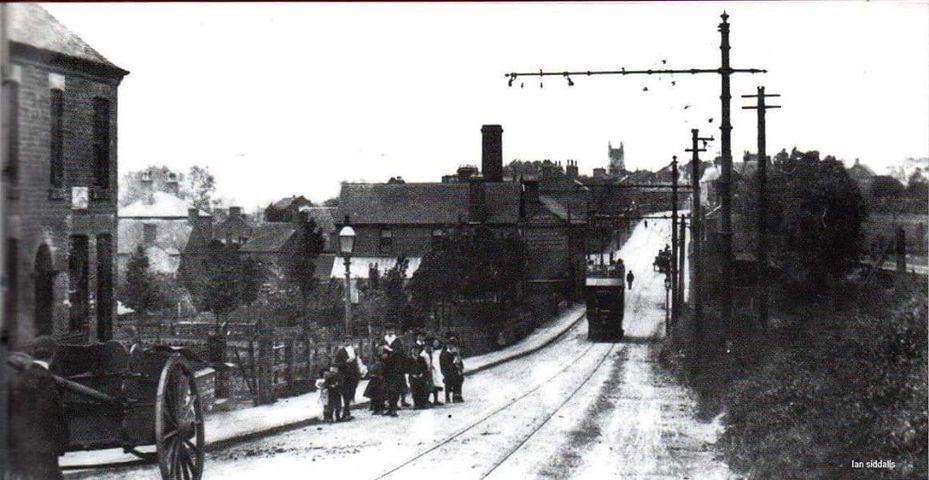
1914: Tram no 10 on Union Road going towards High Street Newhall. On the left Henry Harvey Engineer, on the right Warren Bros Boiler Manufacturers & Engineers:
I found a newspaper article in the Derbyshire Advertiser and Journal dated the 2nd October 1915 about a Samuel Warren of Warren Brothers Boilermakers, but it was about my great grandfathers uncle, also called Samuel.
DEATH OF MR. SAMUEL WARREN, OF NEWHALL. Samuel Warren, of Rose Villa, Newhall, passed away on Saturday evening at the age of 85.. Of somewhat retiring disposition, he took little or no active part in public affairs, but for many years was trustee of the loyal British Oak Lodge of the M.U. of Oddfellows, and in many other ways served His community when opportunity permitted. He was member of the firm of Warren Bros., of the Boiler Works, Newhall. This thriving business was established by the late Mr. Benjamin Bridge, over 60 years ago, and on his death it was taken over by his four nephews. Mr. William Warren died several years ago, and with the demise Mr. Samuel Warren, two brothers remain, Messrs. Henry and Benjamin Warren. He leaves widow, six daughters, and three sons to mourn his loss.
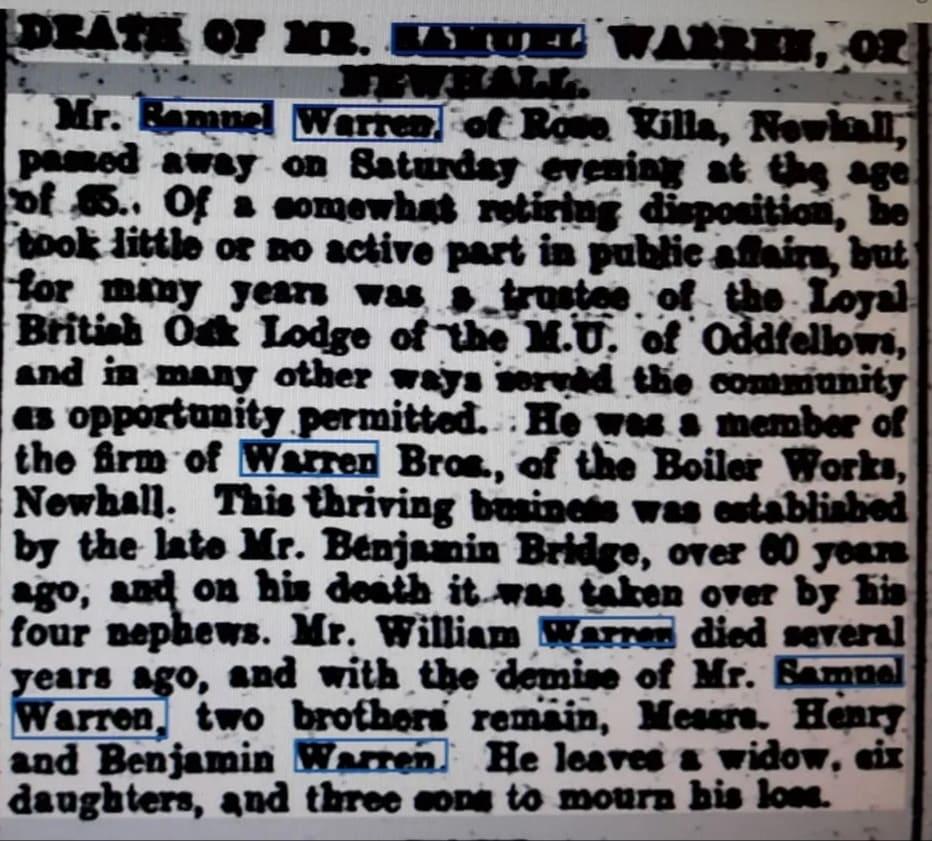
This was the first I’d heard of Benjamin Bridge. William Warren mentioned in the article as having died previously was Samuel’s father, my great great grandfather. William’s brother Henry was the father of Ben Warren, the footballer.
But who was Benjamin Bridge?
Samuel’s father was William Warren 1835-1881. He had a brother called Samuel, mentioned above, and William’s father was also named Samuel. Samuel Warren 1800-1882 married Elizabeth Bridge 1813-1872. Benjamin Bridge 1811-1898 was Elizabeth’s brother.
Burton Chronicle 28 July 1898:
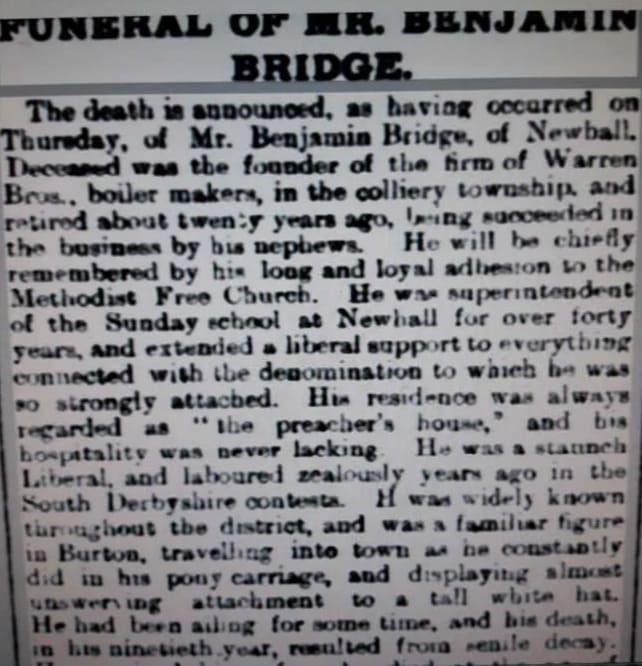
Benjamin and his wife Jane had no children. According to the obituary in the newspaper, the couple were fondly remembered for their annual tea’s for the widows of the town. Benjamin Bridge’s house was known as “the preachers house”. He was superintendent of Newhall Sunday School and member of Swadlincote’s board of health. And apparently very fond of a tall white hat!
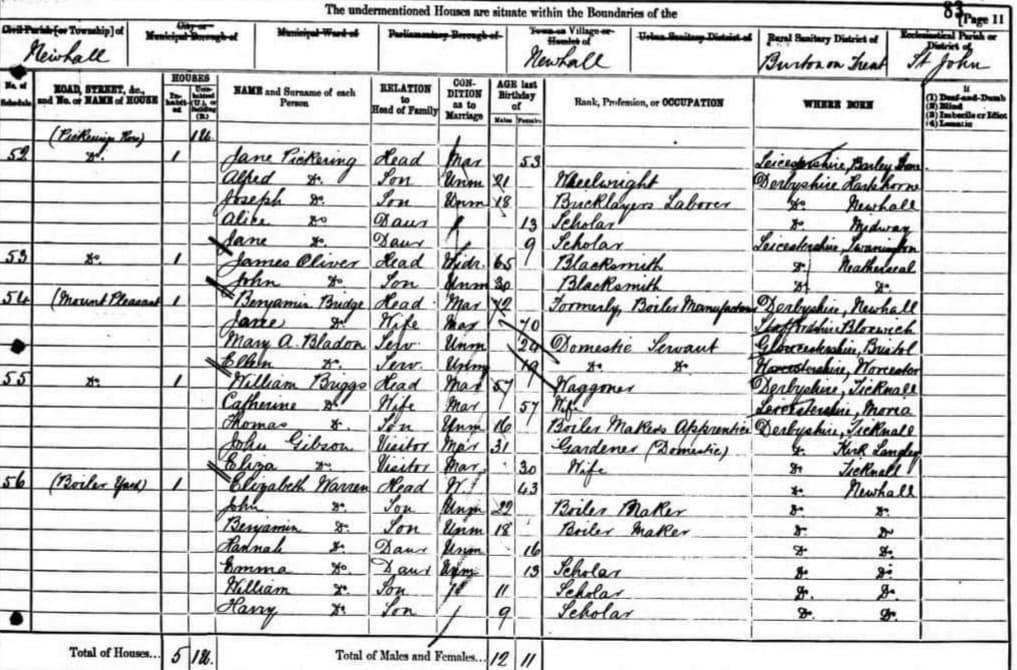
On the 1881 census, Benjamin Bridge and his wife live near to the Warren family in Newhall. The Warren’s live in the “boiler yard” and the family living in between the Bridge’s and the Warren’s include an apprentice boiler maker, so we can assume these were houses incorporated in the boiler works property. Benjamin is a 72 year old retired boiler maker. Elizabeth Warren is a widow (William died in 1881), two of her sons are boiler makers, and Samuel, my great grandfather, is on the next page of the census, at seven years old.
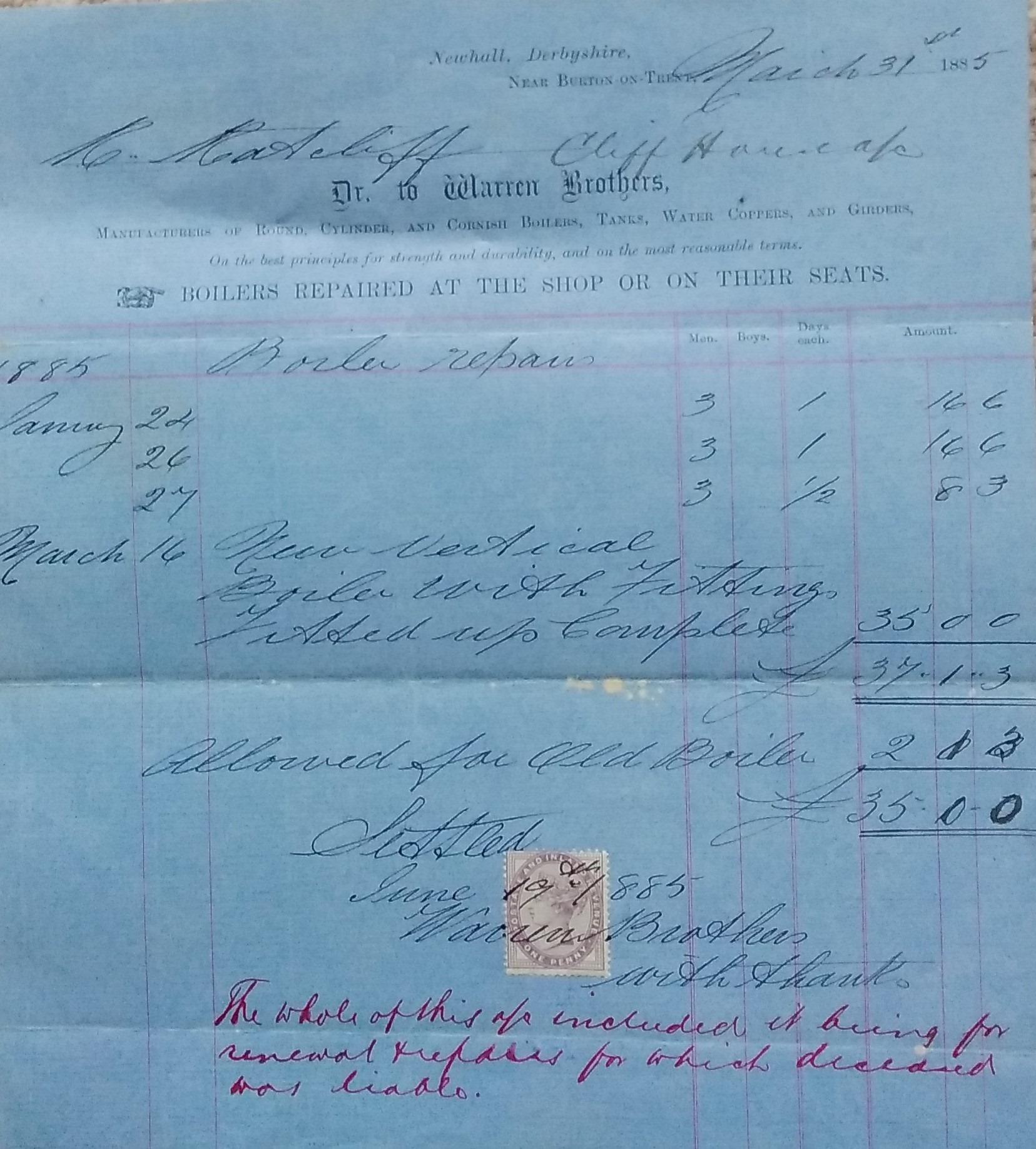
Warren Brothers made boilers for the Burton breweries, including Bass, Ratcliff and Gretton.
This receipt from Warrens Boiler yard for a new boiler in 1885 was purchased off Ebay by Colin Smith. He gave it to one of the grandsons of Robert Adolphus Warren, to keep in the Warren family. It is in his safe at home, and he promised Colin that it will stay in the family forever.
 December 16, 2021 at 1:51 pm #6240
In reply to: The Elusive Samuel Housley and Other Family Stories
Phyllis Ellen Marshall
1909 – 1983
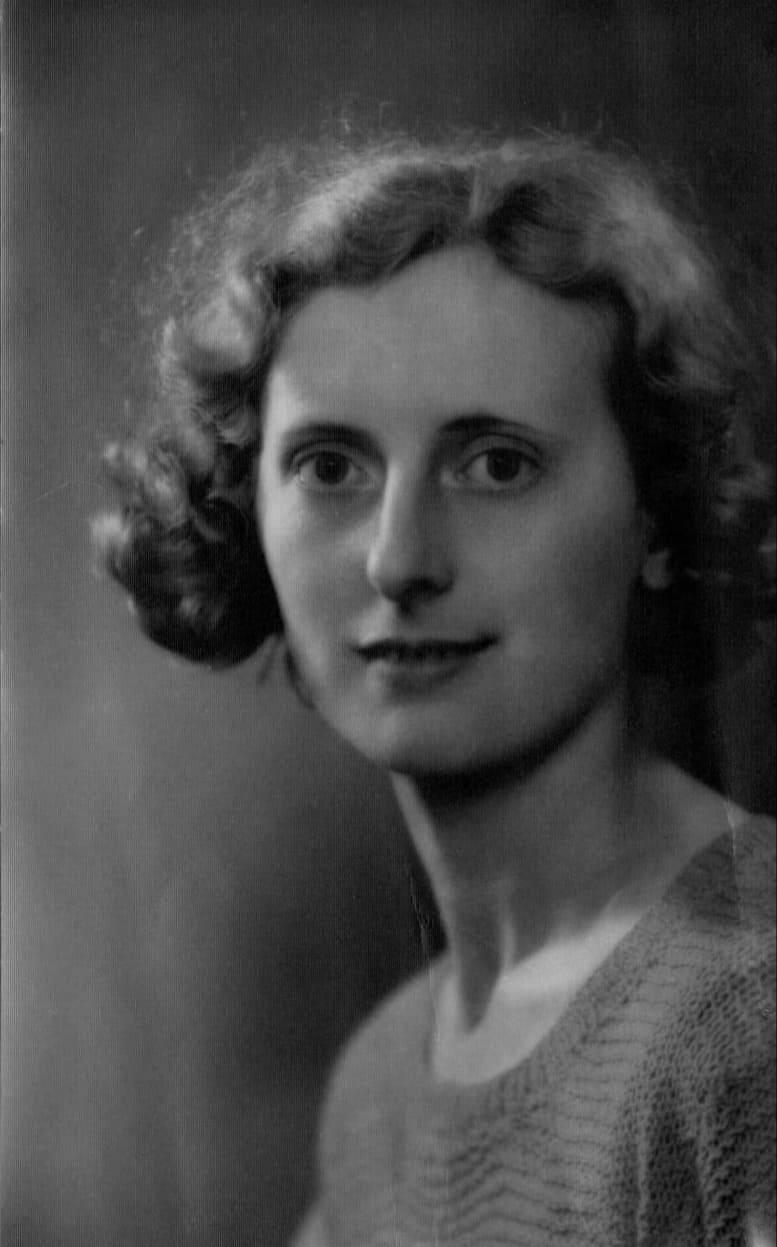
Phyllis, my grandfather George Marshall’s sister, never married. She lived in her parents home in Love Lane, and spent decades of her later life bedridden, living alone and crippled with rheumatoid arthritis. She had her bed in the front downstairs room, and had cords hanging by her bed to open the curtains, turn on the tv and so on, and she had carers and meals on wheels visit her daily. The room was dark and grim, but Phyllis was always smiling and cheerful. Phyllis loved the Degas ballerinas and had a couple of prints on the walls.
I remember visiting her, but it has only recently registered that this was my great grandparents house. When I was a child, we visited her and she indicated a tin on a chest of drawers and said I could take a biscuit. It was a lemon puff, and was the stalest biscuit I’d ever had. To be polite I ate it. Then she offered me another one! I declined, but she thought I was being polite and said “Go on! You can have another!” I ate another one, and have never eaten a lemon puff since that day.
Phyllis’s nephew Bryan Marshall used to visit her regularly. I didn’t realize how close they were until recently, when I resumed contact with Bryan, who emigrated to USA in the 1970s following a successful application for a job selling stained glass windows and church furnishings.
I asked on a Stourbridge facebook group if anyone remembered her.
AF Yes I remember her. My friend and I used to go up from Longlands school every Friday afternoon to do jobs for her. I remember she had a record player and we used to put her 45rpm record on Send in the Clowns for her. Such a lovely lady. She had her bed in the front room.
KW I remember very clearly a lady in a small house in Love Lane with alley at the left hand. I was intrigued by this lady who used to sit with the front door open and she was in a large chair of some sort. I used to see people going in and out and the lady was smiling. I was young then (31) and wondered how she coped but my sense was she had lots of help. I’ve never forgotten that lady in Love Lane sitting in the open door way I suppose when it was warm enough.
LR I used to deliver meals on wheels to her lovely lady.
I sent Bryan the comments from the Stourbridge group and he replied:
Thanks Tracy. I don’t recognize the names here but lovely to see such kind comments.
In the early 70’s neighbors on Corser Street, Mr. & Mrs. Walter Braithwaite would pop around with occasional visits and meals. Walter was my piano teacher for awhile when I was in my early twenties. He was a well known music teacher at Rudolph Steiner School (former Elmfield School) on Love Lane. A very fine school. I seem to recall seeing a good article on Walter recently…perhaps on the Stourbridge News website. He was very well known.
I’m ruminating about life with my Aunt Phyllis. We were very close. Our extra special time was every Saturday at 5pm (I seem to recall) we’d watch Doctor Who. Right from the first episode. We loved it. Likewise I’d do the children’s crossword out of Woman’s Realm magazine…always looking to win a camera but never did ! She opened my mind to the Bible, music and ballet. She once got tickets and had a taxi take us into Birmingham to see the Bolshoi Ballet…at a time when they rarely left their country. It was a very big deal in the early 60’s. ! I’ve many fond memories about her and grandad which I’ll share in due course. I’d change the steel needle on the old record player, following each play of the 78rpm records…oh my…another world.Bryan continues reminiscing about Phyllis in further correspondence:
Yes, I can recall those two Degas prints. I don’t know much of Phyllis’ early history other than she was a hairdresser in Birmingham. I want to say at John Lewis, for some reason (so there must have been a connection and being such a large store I bet they did have a salon?)
You will know that she had severe and debilitating rheumatoid arthritis that eventually gnarled her hands and moved through her body. I remember strapping on her leg/foot braces and hearing her writhe in pain as I did so but she wanted to continue walking standing/ getting up as long as she could. I’d take her out in the wheelchair and I can’t believe I say it along …but down Stanley Road!! (I had subsequent nightmares about what could have happened to her, had I tripped or let go!) She loved Mary Stevens Park, the swans, ducks and of course Canadian geese. Was grateful for everything in creation. As I used to go over Hanbury Hill on my visit to Love Lane, she would always remind me to smell the “sea-air” as I crested the hill.
In the earlier days she smoked cigarettes with one of those long filters…looking like someone from the twenties.I’ll check on “Send in the clowns”. I do recall that music. I remember also she loved to hear Neil Diamond. Her favorites in classical music gave me an appreciation of Elgar and Delius especially. She also loved ballet music such as Swan Lake and Nutcracker. Scheherazade and La Boutique Fantastic also other gems.
When grandad died she and aunt Dorothy shared more about grandma (who died I believe when John and I were nine-months old…therefore early 1951). Grandma (Mary Ann Gilman Purdy) played the piano and loved Strauss and Offenbach. The piano in the picture you sent had a bad (wonky) leg which would fall off and when we had the piano at 4, Mount Road it was rather dangerous. In any event my parents didn’t want me or others “banging on it” for fear of waking the younger brothers so it disappeared at sometime.
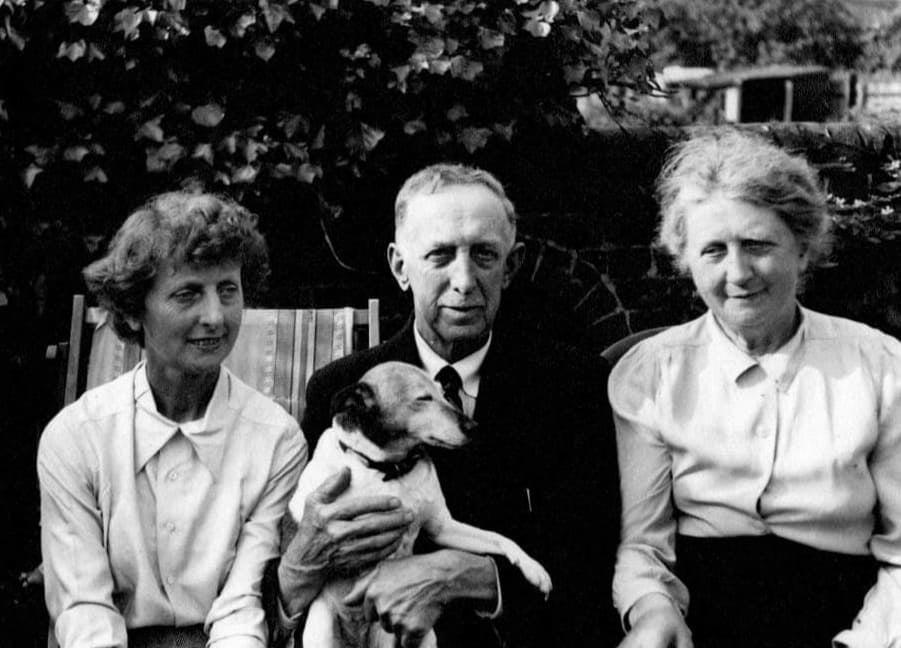
By the way, the dog, Flossy was always so rambunctious (of course, she was a JRT!) she was put on the stairway which fortunately had a door on it. Having said that I’ve always loved dogs so was very excited to see her and disappointed when she was not around.Phyllis with her parents William and Mary Marshall, and Flossie the dog in the garden at Love Lane:
Bryan continues:
I’ll always remember the early days with the outside toilet with the overhead cistern caked in active BIG spider webs. I used to have to light a candle to go outside, shielding the flame until destination. In that space I’d set the candle down and watch the eery shadows move from side to side whilst…well anyway! Then I’d run like hell back into the house. Eventually the kitchen wall was broken through so it became an indoor loo. Phew!
In the early days the house was rented for ten-shillings a week…I know because I used to take over a ten-bob-note to a grumpy lady next door who used to sign the receipt in the rent book. Then, I think she died and it became available for $600.00 yes…the whole house for $600.00 but it wasn’t purchased then. Eventually aunt Phyllis purchased it some years later…perhaps when grandad died.I used to work much in the back garden which was a lovely walled garden with arch-type decorations in the brickwork and semicircular shaped capping bricks. The abundant apple tree. Raspberry and loganberry canes. A gooseberry bush and huge Victoria plum tree on the wall at the bottom of the garden which became a wonderful attraction for wasps! (grandad called the “whasps”). He would stew apples and fruit daily.
Do you remember their black and white cat Twinky? Always sat on the pink-screen TV and when she died they were convinced that “that’s wot got ‘er”. Grandad of course loved all his cats and as he aged, he named them all “Billy”.Have you come across the name “Featherstone” in grandma’s name. I don’t recall any details but Dorothy used to recall this. She did much searching of the family history Such a pity she didn’t hand anything on to anyone. She also said that we had a member of the family who worked with James Watt….but likewise I don’t have details.
Gifts of chocolates to Phyllis were regular and I became the recipient of the overflow!What a pity Dorothy’s family history research has disappeared! I have found the Featherstone’s, and the Purdy who worked with James Watt, but I wonder what else Dorothy knew.
I mentioned DH Lawrence to Bryan, and the connection to Eastwood, where Bryan’s grandma (and Phyllis’s mother) Mary Ann Gilman Purdy was born, and shared with him the story about Francis Purdy, the Primitive Methodist minister, and about Francis’s son William who invented the miners lamp.
He replied:
As a nosy young man I was looking through the family bookcase in Love Lane and came across a brown paper covered book. Intrigued, I found “Sons and Lovers” D.H. Lawrence. I knew it was a taboo book (in those days) as I was growing up but now I see the deeper connection. Of course! I know that Phyllis had I think an earlier boyfriend by the name of Maurice who lived in Perry Barr, Birmingham. I think he later married but was always kind enough to send her a book and fond message each birthday (Feb.12). I guess you know grandad’s birthday – July 28. We’d always celebrate those days. I’d usually be the one to go into Oldswinford and get him a cardigan or pullover and later on, his 2oz tins of St. Bruno tobacco for his pipe (I recall the room filled with smoke as he puffed away).
Dorothy and Phyllis always spoke of their ancestor’s vocation as a Minister. So glad to have this history! Wow, what a story too. The Lord rescued him from mischief indeed. Just goes to show how God can change hearts…one at a time.
So interesting to hear about the Miner’s Lamp. My vicar whilst growing up at St. John’s in Stourbridge was from Durham and each Harvest Festival, there would be a miner’s lamp placed upon the altar as a symbol of the colliery and the bountiful harvest.More recollections from Bryan about the house and garden at Love Lane:
I always recall tea around the three legged oak table bedecked with a colorful seersucker cloth. Battenburg cake. Jam Roll. Rich Tea and Digestive biscuits. Mr. Kipling’s exceedingly good cakes! Home-made jam. Loose tea from the Coronation tin cannister. The ancient mangle outside the back door and the galvanized steel wash tub with hand-operated agitator on the underside of the lid. The hand operated water pump ‘though modernisation allowed for a cold tap only inside, above the single sink and wooden draining board. A small gas stove and very little room for food preparation. Amazing how the Marshalls (×7) managed in this space!
The small window over the sink in the kitchen brought in little light since the neighbor built on a bathroom annex at the back of their house, leaving #47 with limited light, much to to upset of grandad and Phyllis. I do recall it being a gloomy place..i.e.the kitchen and back room.
The garden was lovely. Long and narrow with privet hedge dividing the properties on the right and the lovely wall on the left. Dorothy planted spectacular lilac bushes against the wall. Vivid blues, purples and whites. Double-flora. Amazing…and with stunning fragrance. Grandad loved older victorian type plants such as foxgloves and comfrey. Forget-me-nots and marigolds (calendulas) in abundance. Rhubarb stalks. Always plantings of lettuce and other vegetables. Lots of mint too! A large varigated laurel bush outside the front door!
Such a pleasant walk through the past.
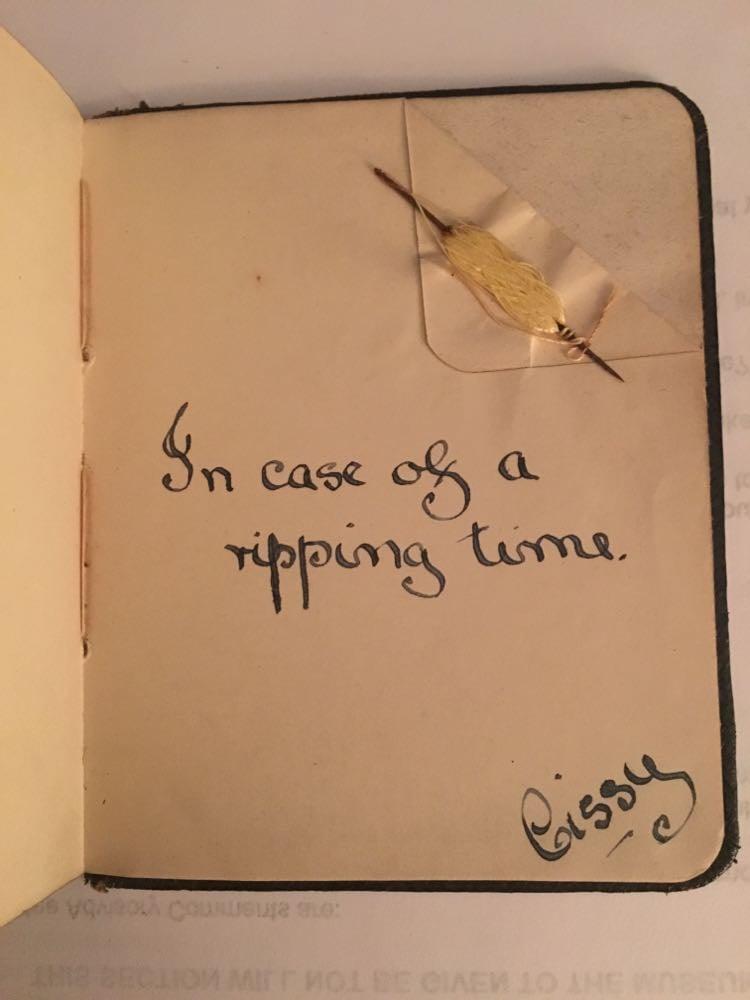
An autograph book belonging to Phyllis from the 1920s has survived in which each friend painted a little picture, drew a cartoon, or wrote a verse. This entry is perhaps my favourite:
 December 14, 2021 at 9:28 pm #6231
In reply to: The Elusive Samuel Housley and Other Family Stories
Gladstone Road
My mother remembers her grandfather Samuel Warren’s house at 3 Gladstone Road, Stourbridge. She was born in 1933, so this would be late 1930s early 1940s.
“Opening a big wooden gate in a high brick wall off the sidewalk I went down a passage with a very high hedge to the main house which was entered on this side through a sort of glassed-in lean-to then into the dark and damp scullery and then into a large room with a fireplace which was dining room and living room for most of the time. The house was Georgian and had wooden interior shutters at the windows. My Grandad sat by the fire probably most of the day. The fireplace may have had an oven built over or to the side of the fire which was common in those days and was used for cooking.
That room led into a hall going three ways and the main front door was here. One hall went to the pantry which had stone slabs for keeping food cool, such a long way from the kitchen! Opposite the pantry was the door to the cellar. One hall led to two large rooms with big windows overlooking the garden. There was also a door at the end of this hallway which opened into the garden. The stairs went up opposite the front door with a box room at the top then along a landing to another hall going right and left with two bedrooms down each hall.
The toilet got to from the scullery and lean-to was outside down another passage all overgrown near the pigsty. No outside lights!
On Christmas day the families would all have the day here. I think the menfolk went over to the pub {Gate Hangs Well?} for a drink while the women cooked dinner. Chris would take all the children down the dark, damp cellar steps and tell us ghost stories scaring us all. A fire would be lit in one of the big main rooms {probably only used once a year} and we’d sit in there and dinner was served in the other big main room. When the house was originally built the servants would have used the other room and scullery.
I have a recollection of going upstairs and into a bedroom off the right hand hall and someone was in bed, I thought an old lady but I was uncomfortable in there and never went in again. Seemed that person was there a long time. I did go upstairs with Betty to her room which was the opposite way down the hall and loved it. She was dating lots of soldiers during the war years. One in particular I remember was an American Army Officer that she was fond of but he was killed when he left England to fight in Germany.
I wonder if the person in bed that nobody spoke about was an old housekeeper?
My mother used to say there was a white lady who floated around in the garden. I think Kay died at Gladstone Road!”Samuel Warren, born in 1874 in Newhall, Derbyshire, was my grandmothers father. This is the only photograph we’ve seen of him (seated on right with cap). Kay, who died of TB in 1938, is holding the teddy bear. Samuel died in 1950, in Stourbridge, at the age of 76.
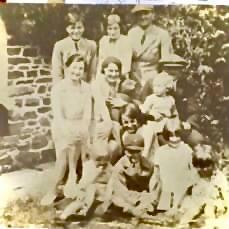
Left to right: back row: Leslie Warren. Hildred Williams / Griffiths (Nee Warren). Billy Warren. 2nd row: Gladys (Gary) Warren. Kay Warren (holding teddy bear). Samuel Warren (father). Hildred’s son Chris Williams (on knee). Lorna Warren. Joan Williams. Peggy Williams (Hildreds daughters). Jack Warren. Betty Warren.
December 13, 2021 at 3:06 pm #6228In reply to: The Elusive Samuel Housley and Other Family Stories
Francis Purdy: The Beggarlea Bulldog and Primitive Methodist Preacher
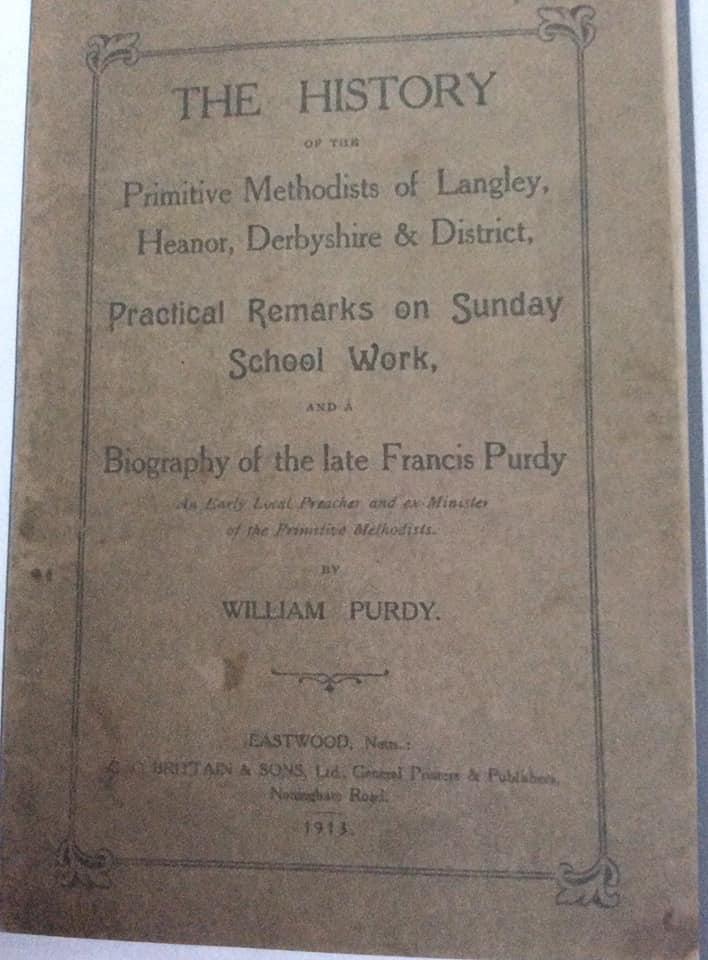
Francis Purdy was my great great grandfather. We did not know anything about the Primitive Methodists prior to this family research project, but my mother had another look through the family souvenirs and photographs and found a little book dated 1913, by William Purdy called: The History of The Primitive Methodists of Langley, Heanor, Derbyshire and District. Practical remarks on Sunday school work and a biography of the late Francis Purdy, an early local preacher. Printed by GC Brittain and sons. William Purdy was Francis son, and George’s brother.
Francis Purdy:
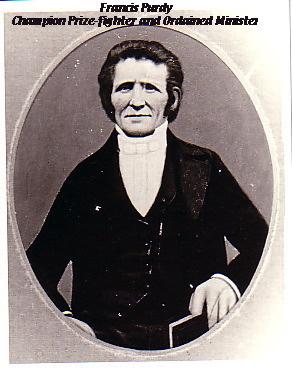
The following can be found online from various sources but I am unable to find the original source to credit with this information:
“In spite of having pious parents, Francis was a great prize-fighter and owner of champion dogs. He was known as the Beggarlee Bulldog, and fought many pitched battles. It was in 1823 that he fought on Nottingham Forest for the championship of three counties. After the fight going eleven rounds, which continued one hour and twenty minutes, he was declared victorious.”
The Primitive Methodists under the Rev Richard Whitechurch began a regular mission in Beggarlee. The locals tried to dismiss the Methodist “Ranters” by the use of intimidating tactics. Francis was prepared to release his fighting dogs during their prayer meeting, but became so interested in their faith that he instead joined them. The Methodist Church wrote: ”A strong feeling came over him, while his mates incited him to slip his dogs from the leads. He refused, and decided to return home. After concealing himself in a dyke, to listen to the Missioners on the following Sunday, he stole into the house of a Mrs Church, where a service was being held. Shortly after this, a society was formed with Francis Purdy as leader, and he was also the superintendent of the first Sunday School. After a short spell as local preacher at Beauvale, Tag Hill, Awsworth, Kimberly, Brinsley, etc., Mr Francis Purdy was ordained a minister by the Rev. Thomas King, of Nottingham, on the 17th December, 1827.”
December 13, 2021 at 11:29 am #6222In reply to: The Elusive Samuel Housley and Other Family Stories
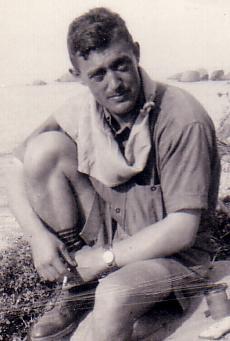
George Gilman Rushby: The Cousin Who Went To Africa
The portrait of the woman has “mother of Catherine Housley, Smalley” written on the back, and one of the family photographs has “Francis Purdy” written on the back. My first internet search was “Catherine Housley Smalley Francis Purdy”. Easily found was the family tree of George (Mike) Rushby, on one of the genealogy websites. It seemed that it must be our family, but the African lion hunter seemed unlikely until my mother recalled her father had said that he had a cousin who went to Africa. I also noticed that the lion hunter’s middle name was Gilman ~ the name that Catherine Housley’s daughter ~ my great grandmother, Mary Ann Gilman Purdy ~ adopted, from her aunt and uncle who brought her up.
I tried to contact George (Mike) Rushby via the ancestry website, but got no reply. I searched for his name on Facebook and found a photo of a wildfire in a place called Wardell, in Australia, and he was credited with taking the photograph. A comment on the photo, which was a few years old, got no response, so I found a Wardell Community group on Facebook, and joined it. A very small place, population some 700 or so, and I had an immediate response on the group to my question. They knew Mike, exchanged messages, and we were able to start emailing. I was in the chair at the dentist having an exceptionally long canine root canal at the time that I got the message with his email address, and at that moment the song Down in Africa started playing.
Mike said it was clever of me to track him down which amused me, coming from the son of an elephant and lion hunter. He didn’t know why his father’s middle name was Gilman, and was not aware that Catherine Housley’s sister married a Gilman.
Mike Rushby kindly gave me permission to include his family history research in my book. This is the story of my grandfather George Marshall’s cousin. A detailed account of George Gilman Rushby’s years in Africa can be found in another chapter called From Tanganyika With Love; the letters Eleanor wrote to her family.
George Gilman Rushby:
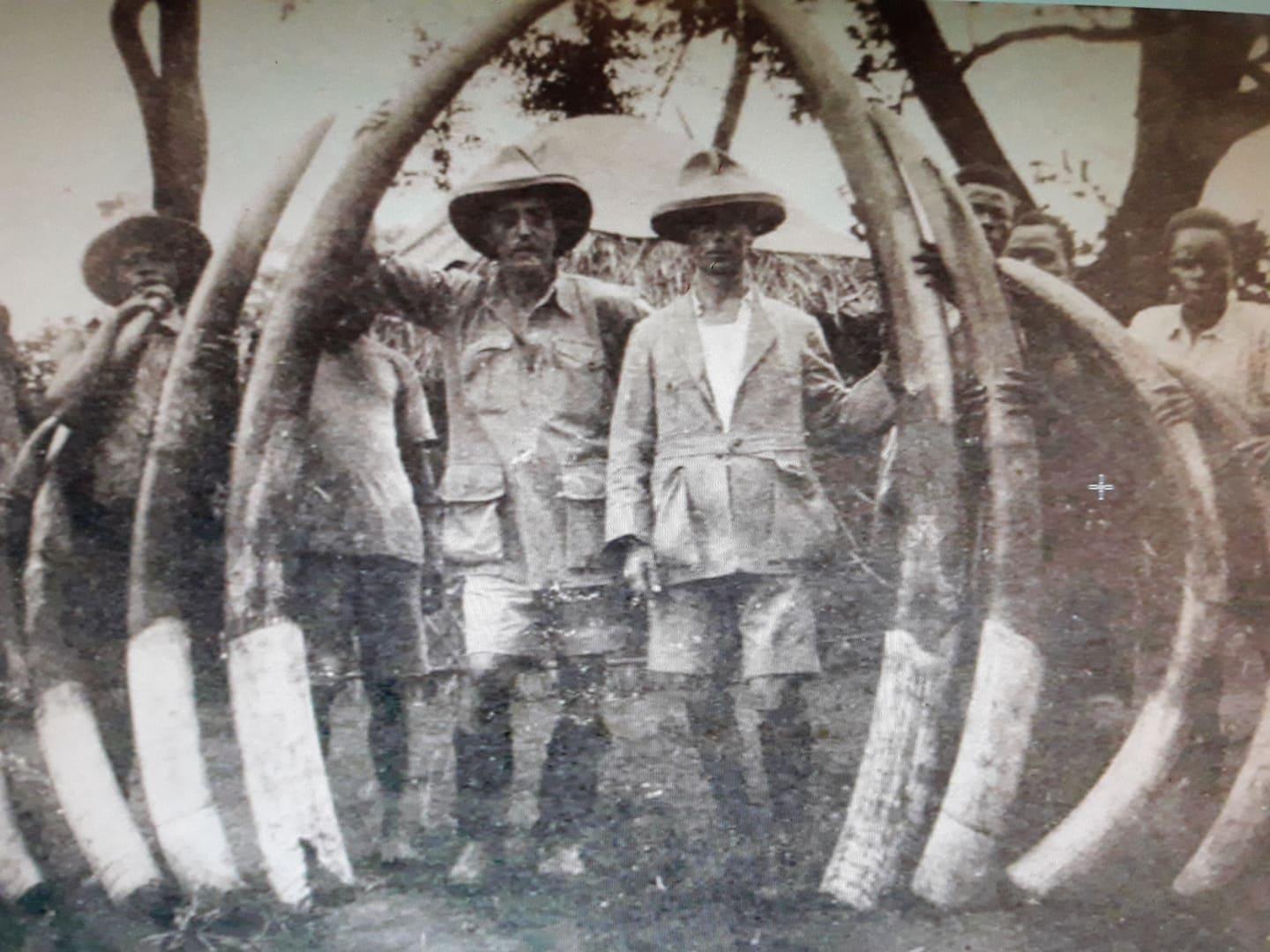
The story of George Gilman Rushby 1900-1969, as told by his son Mike:
George Gilman Rushby:
Elephant hunter,poacher, prospector, farmer, forestry officer, game ranger, husband to Eleanor, and father of 6 children who now live around the world.George Gilman Rushby was born in Nottingham on 28 Feb 1900 the son of Catherine Purdy and John Henry Payling Rushby. But John Henry died when his son was only one and a half years old, and George shunned his drunken bullying stepfather Frank Freer and was brought up by Gypsies who taught him how to fight and took him on regular poaching trips. His love of adventure and his ability to hunt were nurtured at an early stage of his life.
The family moved to Eastwood, where his mother Catherine owned and managed The Three Tuns Inn, but when his stepfather died in mysterious circumstances, his mother married a wealthy bookmaker named Gregory Simpson. He could afford to send George to Worksop College and to Rugby School. This was excellent schooling for George, but the boarding school environment, and the lack of a stable home life, contributed to his desire to go out in the world and do his own thing. When he finished school his first job was as a trainee electrician with Oaks & Co at Pye Bridge. He also worked part time as a motor cycle mechanic and as a professional boxer to raise the money for a voyage to South Africa.In May 1920 George arrived in Durban destitute and, like many others, living on the beach and dependant upon the Salvation Army for a daily meal. However he soon got work as an electrical mechanic, and after a couple of months had earned enough money to make the next move North. He went to Lourenco Marques where he was appointed shift engineer for the town’s power station. However he was still restless and left the comfort of Lourenco Marques for Beira in August 1921.
Beira was the start point of the new railway being built from the coast to Nyasaland. George became a professional hunter providing essential meat for the gangs of construction workers building the railway. He was a self employed contractor with his own support crew of African men and began to build up a satisfactory business. However, following an incident where he had to shoot and kill a man who attacked him with a spear in middle of the night whilst he was sleeping, George left the lower Zambezi and took a paddle steamer to Nyasaland (Malawi). On his arrival in Karongo he was encouraged to shoot elephant which had reached plague proportions in the area – wrecking African homes and crops, and threatening the lives of those who opposed them.
His next move was to travel by canoe the five hundred kilometre length of Lake Nyasa to Tanganyika, where he hunted for a while in the Lake Rukwa area, before walking through Northern Rhodesia (Zambia) to the Congo. Hunting his way he overachieved his quota of ivory resulting in his being charged with trespass, the confiscation of his rifles, and a fine of one thousand francs. He hunted his way through the Congo to Leopoldville then on to the Portuguese enclave, near the mouth of the mighty river, where he worked as a barman in a rough and tough bar until he received a message that his old friend Lumb had found gold at Lupa near Chunya. George set sail on the next boat for Antwerp in Belgium, then crossed to England and spent a few weeks with his family in Jacksdale before returning by sea to Dar es Salaam. Arriving at the gold fields he pegged his claim and almost immediately went down with blackwater fever – an illness that used to kill three out of four within a week.
When he recovered from his fever, George exchanged his gold lease for a double barrelled .577 elephant rifle and took out a special elephant control licence with the Tanganyika Government. He then headed for the Congo again and poached elephant in Northern Rhodesia from a base in the Congo. He was known by the Africans as “iNyathi”, or the Buffalo, because he was the most dangerous in the long grass. After a profitable hunting expedition in his favourite hunting ground of the Kilombera River he returned to the Congo via Dar es Salaam and Mombassa. He was after the Kabalo district elephant, but hunting was restricted, so he set up his base in The Central African Republic at a place called Obo on the Congo tributary named the M’bomu River. From there he could make poaching raids into the Congo and the Upper Nile regions of the Sudan. He hunted there for two and a half years. He seldom came across other Europeans; hunters kept their own districts and guarded their own territories. But they respected one another and he made good and lasting friendships with members of that small select band of adventurers.
Leaving for Europe via the Congo, George enjoyed a short holiday in Jacksdale with his mother. On his return trip to East Africa he met his future bride in Cape Town. She was 24 year old Eleanor Dunbar Leslie; a high school teacher and daughter of a magistrate who spent her spare time mountaineering, racing ocean yachts, and riding horses. After a whirlwind romance, they were betrothed within 36 hours.
On 25 July 1930 George landed back in Dar es Salaam. He went directly to the Mbeya district to find a home. For one hundred pounds he purchased the Waizneker’s farm on the banks of the Mntshewe Stream. Eleanor, who had been delayed due to her contract as a teacher, followed in November. Her ship docked in Dar es Salaam on 7 Nov 1930, and they were married that day. At Mchewe Estate, their newly acquired farm, they lived in a tent whilst George with some help built their first home – a lovely mud-brick cottage with a thatched roof. George and Eleanor set about developing a coffee plantation out of a bush block. It was a very happy time for them. There was no electricity, no radio, and no telephone. Newspapers came from London every two months. There were a couple of neighbours within twenty miles, but visitors were seldom seen. The farm was a haven for wild life including snakes, monkeys and leopards. Eleanor had to go South all the way to Capetown for the birth of her first child Ann, but with the onset of civilisation, their first son George was born at a new German Mission hospital that had opened in Mbeya.
Occasionally George had to leave the farm in Eleanor’s care whilst he went off hunting to make his living. Having run the coffee plantation for five years with considerable establishment costs and as yet no return, George reluctantly started taking paying clients on hunting safaris as a “white hunter”. This was an occupation George didn’t enjoy. but it brought him an income in the days when social security didn’t exist. Taking wealthy clients on hunting trips to kill animals for trophies and for pleasure didn’t amuse George who hunted for a business and for a way of life. When one of George’s trackers was killed by a leopard that had been wounded by a careless client, George was particularly upset.
The coffee plantation was approaching the time of its first harvest when it was suddenly attacked by plagues of borer beetles and ring barking snails. At the same time severe hail storms shredded the crop. The pressure of the need for an income forced George back to the Lupa gold fields. He was unlucky in his gold discoveries, but luck came in a different form when he was offered a job with the Forestry Department. The offer had been made in recognition of his initiation and management of Tanganyika’s rainbow trout project. George spent most of his short time with the Forestry Department encouraging the indigenous people to conserve their native forests.In November 1938 he transferred to the Game Department as Ranger for the Eastern Province of Tanganyika, and over several years was based at Nzasa near Dar es Salaam, at the old German town of Morogoro, and at lovely Lyamungu on the slopes of Kilimanjaro. Then the call came for him to be transferred to Mbeya in the Southern Province for there was a serious problem in the Njombe district, and George was selected by the Department as the only man who could possibly fix the problem.
Over a period of several years, people were being attacked and killed by marauding man-eating lions. In the Wagingombe area alone 230 people were listed as having been killed. In the Njombe district, which covered an area about 200 km by 300 km some 1500 people had been killed. Not only was the rural population being decimated, but the morale of the survivors was so low, that many of them believed that the lions were not real. Many thought that evil witch doctors were controlling the lions, or that lion-men were changing form to kill their enemies. Indeed some wichdoctors took advantage of the disarray to settle scores and to kill for reward.
By hunting down and killing the man-eaters, and by showing the flesh and blood to the doubting tribes people, George was able to instil some confidence into the villagers. However the Africans attributed the return of peace and safety, not to the efforts of George Rushby, but to the reinstallation of their deposed chief Matamula Mangera who had previously been stood down for corruption. It was Matamula , in their eyes, who had called off the lions.
Soon after this adventure, George was appointed Deputy Game Warden for Tanganyika, and was based in Arusha. He retired in 1956 to the Njombe district where he developed a coffee plantation, and was one of the first in Tanganyika to plant tea as a major crop. However he sensed a swing in the political fortunes of his beloved Tanganyika, and so sold the plantation and settled in a cottage high on a hill overlooking the Navel Base at Simonstown in the Cape. It was whilst he was there that TV Bulpin wrote his biography “The Hunter is Death” and George wrote his book “No More The Tusker”. He died in the Cape, and his youngest son Henry scattered his ashes at the Southern most tip of Africa where the currents of the Atlantic and Indian Oceans meet .
George Gilman Rushby:
 December 13, 2021 at 10:09 am #6219
Topic: The Elusive Samuel Housley and Other Family Stories
in forum TP’s Family BooksThe following stories started with a single question.
Who was Catherine Housley’s mother?
But one question leads to another, and another, and so this book will never be finished. This is the first in a collection of stories of a family history research project, not a complete family history. There will always be more questions and more searches, and each new find presents more questions.
A list of names and dates is only moderately interesting, and doesn’t mean much unless you get to know the characters along the way. For example, a cousin on my fathers side has already done a great deal of thorough and accurate family research. I copied one branch of the family onto my tree, going back to the 1500’s, but lost interest in it after about an hour or so, because I didn’t feel I knew any of the individuals.
Parish registers, the census every ten years, birth, death and marriage certificates can tell you so much, but they can’t tell you why. They don’t tell you why parents chose the names they did for their children, or why they moved, or why they married in another town. They don’t tell you why a person lived in another household, or for how long. The census every ten years doesn’t tell you what people were doing in the intervening years, and in the case of the UK and the hundred year privacy rule, we can’t even use those for the past century. The first census was in 1831 in England, prior to that all we have are parish registers. An astonishing amount of them have survived and have been transcribed and are one way or another available to see, both transcriptions and microfiche images. Not all of them survived, however. Sometimes the writing has faded to white, sometimes pages are missing, and in some case the entire register is lost or damaged.
Sometimes if you are lucky, you may find mention of an ancestor in an obscure little local history book or a journal or diary. Wills, court cases, and newspaper archives often provide interesting information. Town memories and history groups on social media are another excellent source of information, from old photographs of the area, old maps, local history, and of course, distantly related relatives still living in the area. Local history societies can be useful, and some if not all are very helpful.
If you’re very lucky indeed, you might find a distant relative in another country whose grandparents saved and transcribed bundles of old letters found in the attic, from the family in England to the brother who emigrated, written in the 1800s. More on this later, as it merits its own chapter as the most exciting find so far.
The social history of the time and place is important and provides many clues as to why people moved and why the family professions and occupations changed over generations. The Enclosures Act and the Industrial Revolution in England created difficulties for rural farmers, factories replaced cottage industries, and the sons of land owning farmers became shop keepers and miners in the local towns. For the most part (at least in my own research) people didn’t move around much unless there was a reason. There are no reasons mentioned in the various registers, records and documents, but with a little reading of social history you can sometimes make a good guess. Samuel Housley, for example, a plumber, probably moved from rural Derbyshire to urban Wolverhampton, when there was a big project to install indoor plumbing to areas of the city in the early 1800s. Derbyshire nailmakers were offered a job and a house if they moved to Wolverhampton a generation earlier.
Occasionally a couple would marry in another parish, although usually they married in their own. Again, there was often a reason. William Housley and Ellen Carrington married in Ashbourne, not in Smalley. In this case, William’s first wife was Mary Carrington, Ellen’s sister. It was not uncommon for a man to marry a deceased wife’s sister, but it wasn’t strictly speaking legal. This caused some problems later when William died, as the children of the first wife contested the will, on the grounds of the second marriage being illegal.
Needless to say, there are always questions remaining, and often a fresh pair of eyes can help find a vital piece of information that has escaped you. In one case, I’d been looking for the death of a widow, Mary Anne Gilman, and had failed to notice that she remarried at a late age. Her death was easy to find, once I searched for it with her second husbands name.
This brings me to the topic of maternal family lines. One tends to think of their lineage with the focus on paternal surnames, but very quickly the number of surnames increases, and all of the maternal lines are directly related as much as the paternal name. This is of course obvious, if you start from the beginning with yourself and work back. In other words, there is not much point in simply looking for your fathers name hundreds of years ago because there are hundreds of other names that are equally your own family ancestors. And in my case, although not intentionally, I’ve investigated far more maternal lines than paternal.
This book, which I hope will be the first of several, will concentrate on my mothers family: The story so far that started with the portrait of Catherine Housley’s mother.
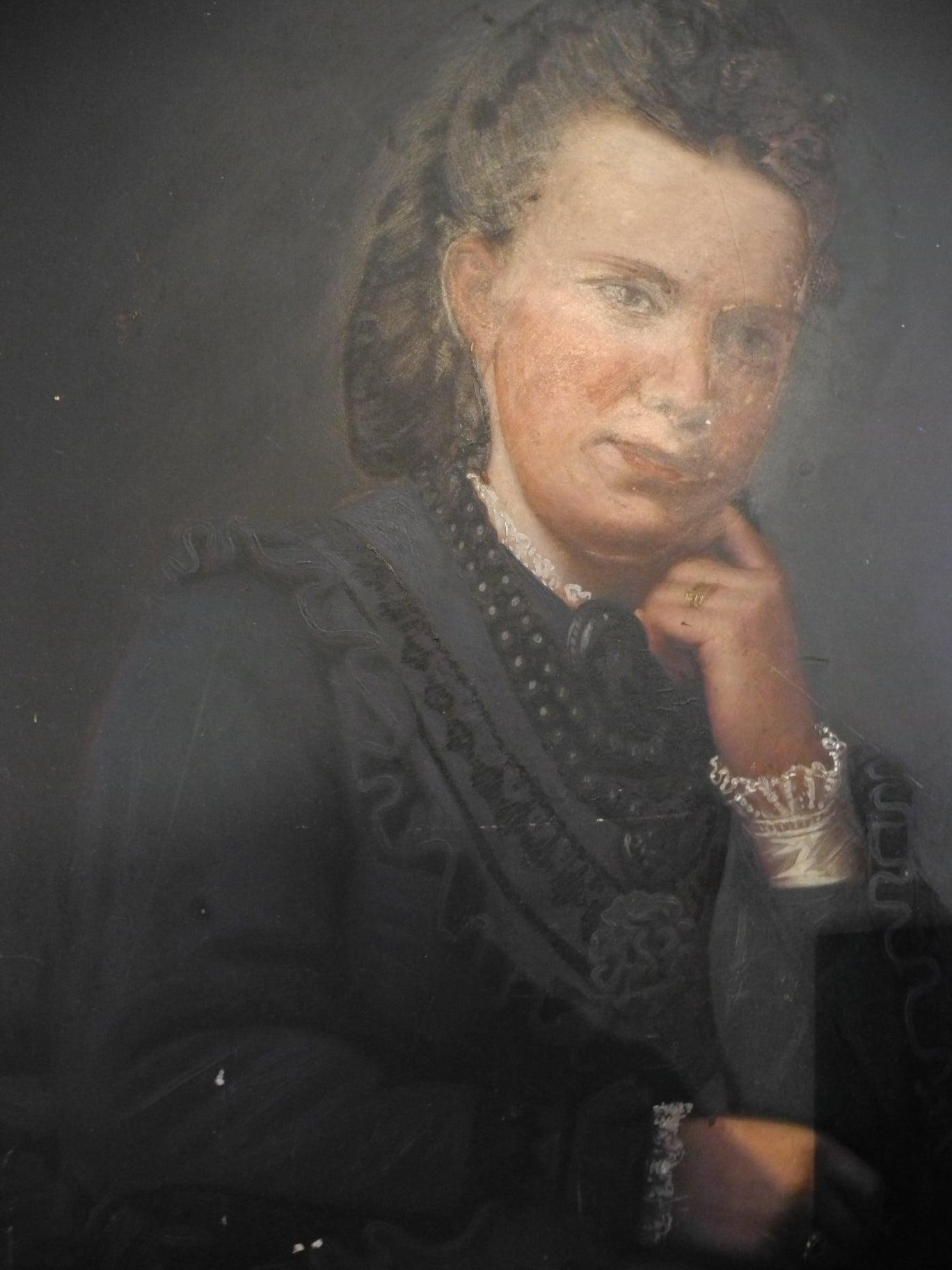
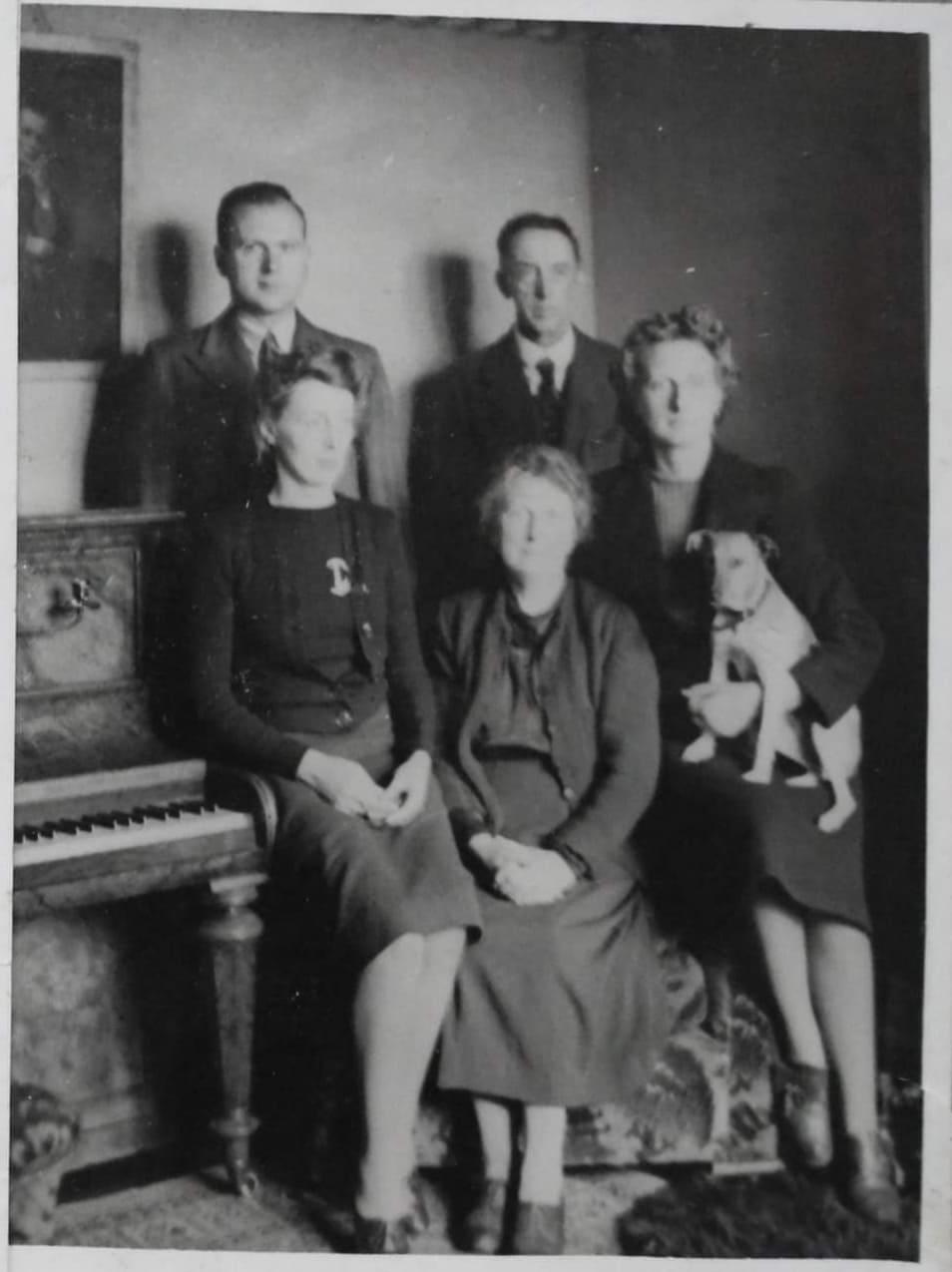
This painting, now in my mothers house, used to hang over the piano in the home of her grandparents. It says on the back “Catherine Housley’s mother, Smalley”.
The portrait of Catherine Housley’s mother can be seen above the piano. Back row Ronald Marshall, my grandfathers brother, William Marshall, my great grandfather, Mary Ann Gilman Purdy Marshall in the middle, my great grandmother, with her daughters Dorothy on the left and Phyllis on the right, at the Marshall’s house on Love Lane in Stourbridge.
The Search for Samuel Housley
As soon as the search for Catherine Housley’s mother was resolved, achieved by ordering a paper copy of her birth certificate, the search for Catherine Housley’s father commenced. We know he was born in Smalley in 1816, son of William Housley and Ellen Carrington, and that he married Elizabeth Brookes in Wolverhampton in 1844. He was a plumber and glazier. His three daughters born between 1845 and 1849 were born in Smalley. Elizabeth died in 1849 of consumption, but Samuel didn’t register her death. A 20 year old neighbour called Aaron Wadkinson did.
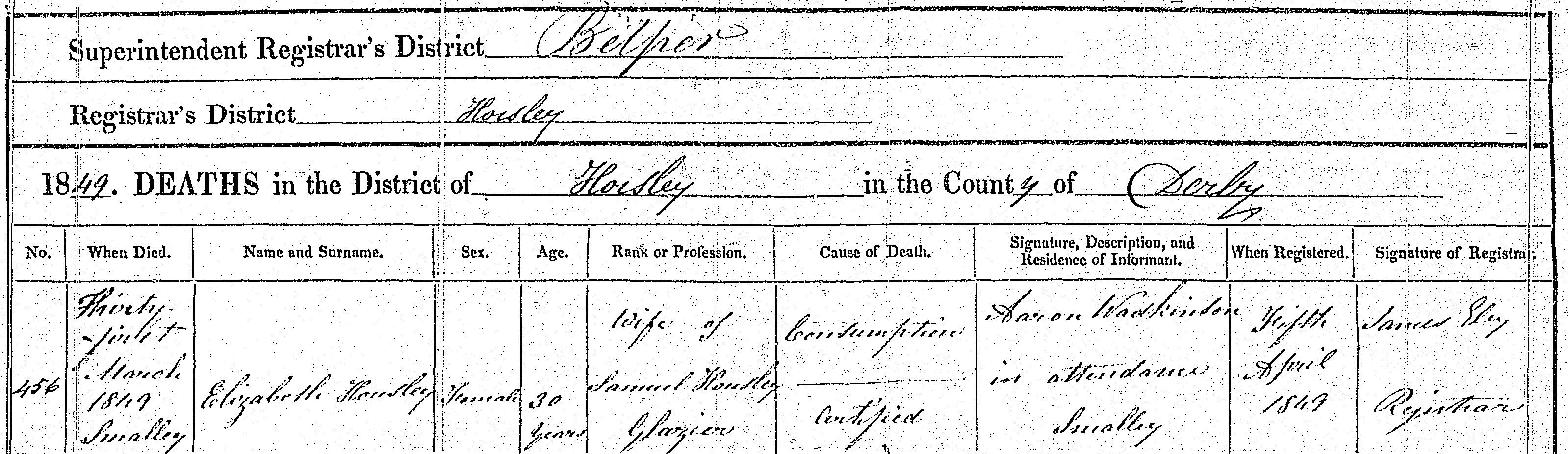
Where was Samuel?
On the 1851 census, two of Samuel’s daughters were listed as inmates in the Belper Workhouse, and the third, 2 year old Catherine, was listed as living with John Benniston and his family in nearby Heanor. Benniston was a framework knitter.
Where was Samuel?
A long search through the microfiche workhouse registers provided an answer. The reason for Elizabeth and Mary Anne’s admission in June 1850 was given as “father in prison”. In May 1850, Samuel Housley was sentenced to one month hard labour at Derby Gaol for failing to maintain his three children. What happened to those little girls in the year after their mothers death, before their father was sentenced, and they entered the workhouse? Where did Catherine go, a six week old baby? We have yet to find out.
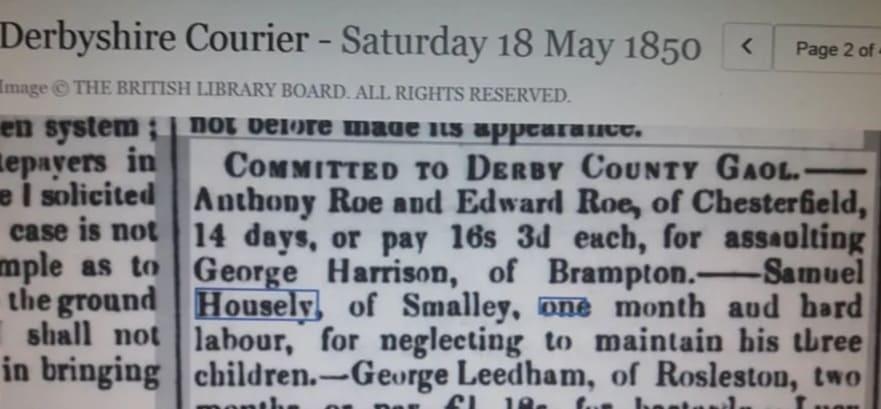
And where was Samuel Housley in 1851? He hasn’t appeared on any census.
According to the Belper workhouse registers, Mary Anne was discharged on trial as a servant February 1860. She was readmitted a month later in March 1860, the reason given: unwell.
Belper Workhouse:
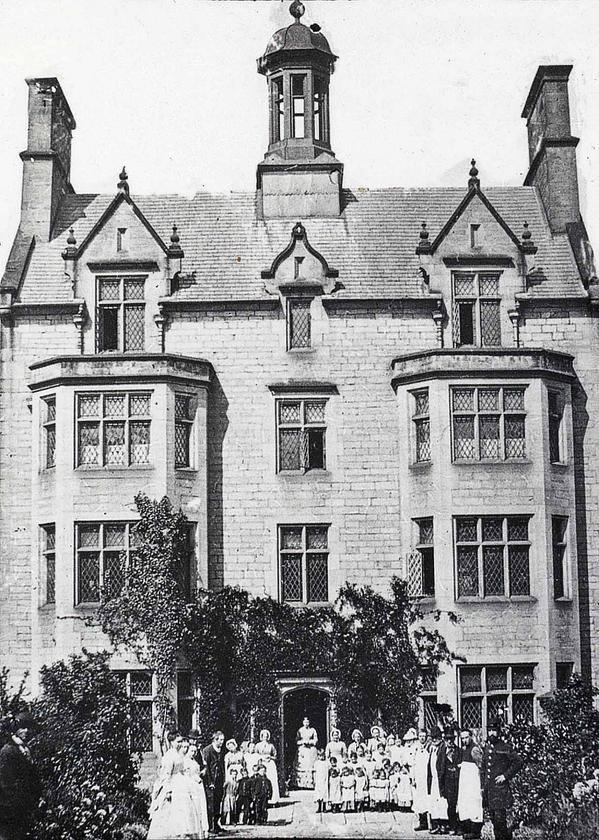
Eventually, Mary Anne and Elizabeth were discharged, in April 1860, with an aunt and uncle. The workhouse register doesn’t name the aunt and uncle. One can only wonder why it took them so long.
On the 1861 census, Elizabeth, 16 years old, is a servant in St Peters, Derby, and Mary Anne, 15 years old, is a servant in St Werburghs, Derby.But where was Samuel?
After some considerable searching, we found him, despite a mistranscription of his name, on the 1861 census, living as a lodger and plumber in Darlaston, Walsall.
Eventually we found him on a 1871 census living as a lodger at the George and Dragon in Henley in Arden. The age is not exactly right, but close enough, he is listed as an unmarried painter, also close enough, and his birth is listed as Kidsley, Derbyshire. He was born at Kidsley Grange Farm. We can assume that he was probably alive in 1872, the year his mother died, and the following year, 1873, during the Kerry vs Housley court case.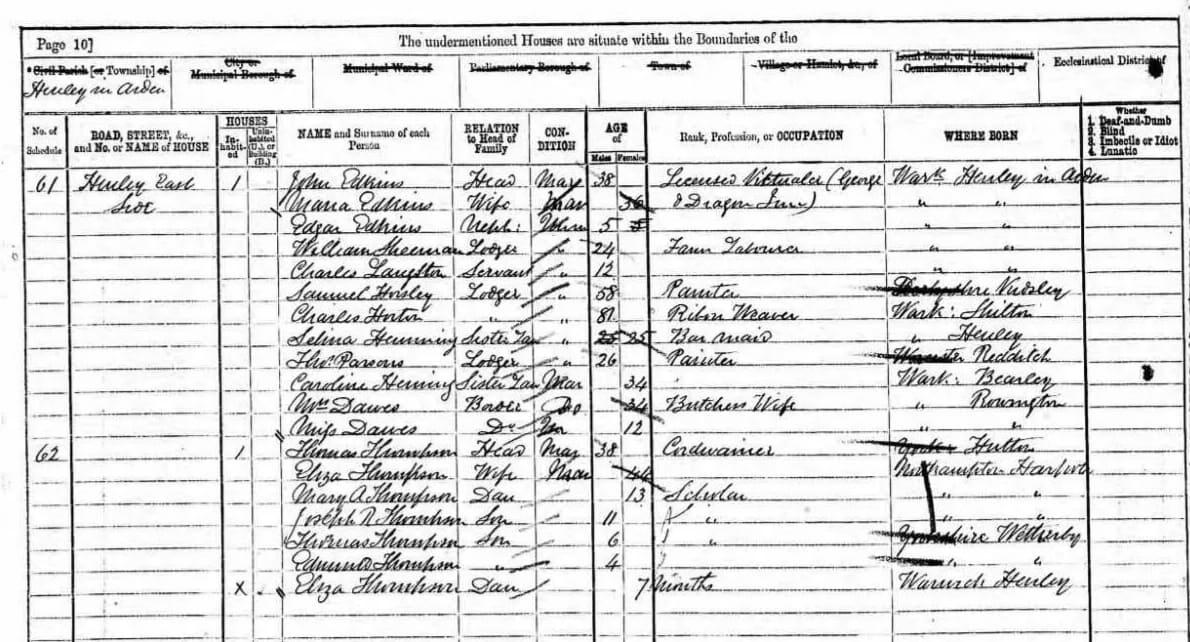
I found some living Housley descendants in USA. Samuel Housley’s brother George emigrated there in 1851. The Housley’s in USA found letters in the attic, from the family in Smalley ~ written between 1851 and 1870s. They sent me a “Narrative on the Letters” with many letter excerpts.
The Housley family were embroiled in a complicated will and court case in the early 1870s. In December 15, 1872, Joseph (Samuel’s brother) wrote to George:
“I think we have now found all out now that is concerned in the matter for there was only Sam that we did not know his whereabouts but I was informed a week ago that he is dead–died about three years ago in Birmingham Union. Poor Sam. He ought to have come to a better end than that….His daughter and her husband went to Birmingham and also to Sutton Coldfield that is where he married his wife from and found out his wife’s brother. It appears he has been there and at Birmingham ever since he went away but ever fond of drink.”
No record of Samuel Housley’s death can be found for the Birmingham Union in 1869 or thereabouts.
But if he was alive in 1871 in Henley In Arden…..
Did Samuel tell his wife’s brother to tell them he was dead? Or did the brothers say he was dead so they could have his share?We still haven’t found a death for Samuel Housley.
February 4, 2021 at 4:47 pm #6183In reply to: Twists and One Return From the Time Capsule
Nora commented favourably on the view, relieved to have been given a clue about what she was supposed to have noticed. It was a splendid panorama, and Will seemed pleased with her response. She asked if it was possible to see the old smugglers path from their vantage point, and he pointed to a dirt road in the valley below that disappeared from view behind a stand of eucalyptus trees. Will indicated a tiny white speck of an old farm ruin, and said the smugglers path went over the hill behind it.
Shading her eyes from the sun, Nora peered into the distance beyond the hill, wondering how far it was to Clara’s grandfathers house. Of course she knew it was 25 kilometers or so, but wasn’t sure how many hills behind that one, or if the path veered off at some point in another direction.
Wondering where Clara was reminded Nora that her friend would be waiting for her, and quite possibly worrying that she hadn’t yet arrived. She sighed, making her mind up to leave first thing the next morning. She didn’t mention this to Will though, and wondered briefly why she hesitated. Something about the violent sweep of his arm when she asked about her phone had made her uneasy, such a contrast to his usual easy going grins.
Then she reminded herself that she had only just met him, and barely knew anything about him at all, despite all the stories they’d shared. When she thought about it, none of the stories had given her any information ~ they had mostly been anecdotes that had a similarity to her own, and although pleasant, were inconsequential. And she kept forgetting to ask him about all the statues at his place.
Wishing she could at least send a text message to Clara, Nora remembered the remote viewing practice they’d done together over the years, and realized she could at least attempt a telepathic communication. Then later, if Clara gave her a hard time about not staying in contact, she could always act surprised and say, Why, didn’t you get the message?
She found a flat stone to sit on, and focused on the smugglers path below. Then she closed her eyes and said clearly in her mind, “I’ll be there tomorrow evening, Clara. All is well. I am safe.”
She opened her eyes and saw that Will had started to head back down the path. “Come on!” he called, “Time for lunch!”
December 14, 2020 at 9:33 pm #6162In reply to: Twists and One Return From the Time Capsule
When Clara remembered who it was she knew in that little village, she realized she didn’t know how to contact him. She didn’t even know his name; he made gargoyles and stone heads and statues, that was all she knew, and all the strange rumours and stories surrounding some of those statues, quite a local legend in a way. But what was his name? He had a white donkey….
Clara assured Nora that her friend was expecting her, keeping her fingers crossed that she would be able to find out who it was, contact him and ask for his assistance, before Nora arrived there. It was a long shot, admittedly.
By nightfall, Clara had not made contact, and was forced to rely on a miracle; or even to wash her hands of the whole thing: it was Noras’s trip after all.
December 14, 2020 at 9:10 pm #6161In reply to: Twists and One Return From the Time Capsule
Dispersee sat on a fallen tree trunk, lost in thought. A long walk in the woods had seemed just the ticket……
Nora wasn’t surprised to encounter a fallen tree trunk no more than 22 seconds after the random thought wafted through her mind ~ if thought was was the word for it ~ about Dispersee sitting on a fallen tree trunk. Nora sat on the tree trunk ~ of course she had to sit on it; how could she not ~ simultaneously stretching her aching back and wondering who Dispersee might be. Was it a Roman name? Something to do with the garum on the shopping receipt?
Nora knew she wasn’t going to get to the little village before night fall. Her attempts to consult the map failed. It was like a black hole. No signal, no connection, just a blank screen. She looked up at the sky. The lowering dark clouds were turning orange and red as the sun went down behind the mountains, etching the tree skeletons in charcoal black in the middle distance.
In a sudden flash of wordless alarm, Nora realized she was going to be out alone in the woods at night and wild boars are nocturnal and a long challenging walk in broad daylight was one thing but alone at night in the woods with the wild boars was quite another, and in a very short time indeed had worked herself up into a state approaching panic, and then had another flash of alarm when she realized she felt she would swoon in any moment and fall off the fallen trunk. The pounding of her, by then racing, heartbeats was yet further cause for alarm, and as is often the case, the combination of factors was sufficiently noteworthy to initiate a thankfully innate ability to re establish a calm lucidity, and pragmatic attention to soothe the beating physical heart as a matter of priority.
It was at the blessed moment of restored equilibrium and curiosity (and the dissipation of the alarm and associated malfunctions) that the man appeared with the white donkey.
December 9, 2020 at 1:18 am #6157In reply to: Twists and One Return From the Time Capsule
Bob sighed loudly as he rummaged through the odds and ends drawer: old menus from the takeaways in town, pens, rubber bands, a button, reading glasses, newspaper clippings. He’d never expected to need the phone number; now he did and what do you know? He can’t find the damn thing.
“What a shameful mess that drawer is in,” said Jane. She was seated at the kitchen table, arms folded, shaking her head at him. She looked about twenty today with her dark hair cascading prettily over a lacy pink mini dress.
Bob frowned at her though his heart did a leap. The way it always did when he saw her. “You were the one who kept it clean and you jumped ship. And I’ve said, can’t you look your age?”
“Don’t I look pretty?” She pouted and fluttered long eyelashes at him.
“Makes me feel old. And I don’t recognise you like that.”
“You are old,” she said as her hair turned white. “And bad-tempered as ever. What are you hunting for?”
“The phone number. You know the one he said to call if the box was ever unearthed. Can’t find it anywhere.”
“You’d lose your head …” said Jane as her head lifted off her body.
Bob jumped. “Darn it, Jane. I’ve said don’t do that! Why do you always do that and go giving me the heebie jeebies?”
“Cos I can, love.” She grinned mischievously before settling her head back on her shoulders. “Just a bit of fun. Now think hard, where else might you have put it? The shoe-box under our bed? The safe in the pantry?”
Bob flung a hand to his head. “The shoe-box! That’s where it will be!”
Jane grinned. “Well, get a move-along, old man. Before our Clara gets in more deep than what’s good for her. She won’t let it go now she’s found it. Stubborn as a mule my grandchild,” she added proudly.
Bob reached a hand to her. “Come with me while I look? I miss you, Jane. You never stay long enough.”
“Oh stop with all the sweet talk!” She poked her tongue out at him. “Anyway I’ve told you before, it takes too much energy.” She was fading and Bob felt his chest tighten. “Don’t worry, I’m keeping an eye on you, old man.” She was vibrating air now, sparkly and pink.
October 21, 2020 at 9:23 am #6142In reply to: The Whale’s Diaries Collection
Everyone seems happy about the rain, and I don’t blame them. I’m not daft, I know we need rain but it’s not so easy when you don’t have a home. But I am nothing if not stalwart and stoic, resourceful and adaptable, and I found a good way to keep warm and dry during the downpours. It’s amazing how much heat an animal gives off, so I camp down in stables or kennels when it’s cold and wet. It can get a bit smelly, but it’s warm and dry and when my clothes are damp and stinking I just throw them all away and get some new ones out of the recycling bins. Just to clarify, I find the new clothes first before throwing the ones I’m wearing away. I’m not daft, I know walking around naked would catch attention and I try to stay under the radar. Nobody really notices smelly old ladies wandering around these days anyway, but naked would be another matter.
There’s a stable I really like just outside of town, lots of nice deep clean straw. There’s a white horse in there that knows me now and the gentle whicker of recognition when she sees me warms my heart. I don’t stay there any two nights running though. One thing I’ve learned is don’t do anything too regular, keep it random and varied. I don’t want anyone plotting my movements and interfering with me in any way.
There’s not much to do in a stable when it rains for days and nights on end but remember things, so I may as well write them down. I’m never quite sure if the things I remember are my memories or someone elses, a past life of my own perhaps, or another person entirely. I used to worry a bit about that, but not anymore. Nobody cares and there’s nobody to flag my memories as false, and if there was, I wouldn’t care if they did.
Anyway, the other day while I was nestled in a pile of sweet hay listening to the thunder, I recalled that day when someone offered me a fortune for that old mirror I’d bought at the flea market. I know I hadn’t paid much for it, because I never did pay much for anything. Never have done. I bought it because it was unusual (hideous is what everyone said about it, but people have got very strangely ordinary taste, I’ve found) and because it was cheap enough that I could buy it without over thinking the whole thing. At the end of the day you can’t beat the magic of spontaneity, it out performs long winded assessment every time.
So this man was a friend of a friend who happened to visit and made me an offer I couldn’t refuse so of course I sold the mirror to him. He was so delighted about it that I’d have given him the mirror for nothing if I knew he wanted it that much, but I’m not daft, I took the money. I found out later that he’d won the lottery, so I never felt guilty about it.
Well, after he’d gone I sat there looking at this pile of money in my hands and knew exactly what I was going to do. But first I had to find them. They’d moved again and we’d lost contact but I knew I’d find a way. And I did. They’d given up all hope of ever getting that money back that I’d borrowed, but they said the timing was perfect, couldn’t have been better, they said. It wouldn’t have meant all that much to them if I’d paid it back right away, they said, because they didn’t need it then as much as they did when they finally got it back.
They were strange times back then, and one thing after another was happening all over the world, what with the strange weather, and all the pandemics and refugees. Hard to keep food on the table, let alone make plans or pay debts back. But debt is a funny thing. I felt stung when I realized they didn’t think I intended to pay them back but the fact was, I couldn’t do it at the time. And I wanted it to be a magical perfect timing surprise when I did. I suppose in a way I wanted it to be like it was when they loaned me the money. I remember I wept at the kindness of it. Well I didn’t want them to weep necessarily, but I wanted it to mean something wonderful, somehow. And timing is everything and you can’t plan that kind of thing, not really.
It was a happy ending in the end though, I gave them the whole amount I got for that old mirror, which was considerably more than the loan.
The rain has stopped now and the sun is shining. My damp clothes are steaming and probably much smellier than I think. Time to find a recycling bin and a fresh new look.
April 24, 2020 at 9:27 am #6067In reply to: Two Aunties au Pair and Their Pert Carouses
Since the sudden disappearance of the two au pair maids, a lot had happened. But for August Finest it has been a lot of the same routine going on.
He wakes up in the early, early morning, his eyelids rubs on his eyeballs as if they are made of sandpaper. He seizes his belly with his hands, feels a little guilty about the nice meals prepared by Noor Mary especially for him since the start of the confinement. His six packs have started to fade away under a layer of fatty insulation and he tries to compensate by a daily routine in white T-shirt and underwear.
The coffee machine has detected his movements and starts to make what it does. It’s always cleaned and replenished by the discrete Mary. The noise and the smell creates an ambiance and when it rings he eats breakfast before taking his shower.
When he’s dressed up, his real work starts. It had not been easy for a man of his origins to appear as the best choice for the job under the Lump administration. President Lump was known to make bad jokes about his tan and him having spent too much time at the beach, and other worse things. But his worth was in the network he could connect the president with, his high discretion, which Lump was in dire need to compensate his innate tendency to boasting, and a strong adaptability to fix the president’s frequent messing around.
If August Finest had once admired the man and accepted the job for him, it soon changed when he realised there was nothing more underneath the boasting than more boasting and unpredictability. At the moment the only thing that make him continue was his ability to go stealth when the president had a fit of nerves, and the imposed confinement that made it impossible to leave the Beige House.
After the morning meeting during which the president asked him to fire a few members of the staff, August had to prepare a press conference. President Lump said he had thought about a few remarks about China and making a connection with the Mexican immigrants threatening the country by stealing the masks of the American People. After which, he had to plan a charity with first Lady Mellie Noma and redefine what a Masquerade meant. He had been asked to invite nurses and medical personnel, meaning republican and good looking in a blouse with a medical mask to make the promotion of the new mask industry Made in America. One of Mr Lump’s friend had just started a brand and was in need of some media promotion.
August reread the memo to be addressed to the director of the FBI, a good friend of his. A special cell at the FBI had been created especially since Lump came to power. For this particular occasion, agents posing as patients victims of the virus would be sent in the best ranked hospitals in the country with the task to look for the best nurse and doctor candidates and send them an invitation printed by Lump’s nephew’s printing company.
As Lump always said: “America Fist! And don’t forget people, I am America.”
August hit the enter button and closed the window of his professional mail account, leaving the draft of a personal mail on screen. He wasn’t sure if he could send this one. It was addressed to Noor Mary and he feared she would misunderstand the meaning of it.
April 19, 2020 at 11:27 am #6064In reply to: The Whale’s Diaries Collection
I’ve been up since god knows what time. Got up for the loo and couldn’t face going back to the awful nightmares. That girl that came yesterday said she’d been having nightmares, she said it was common now, people having nightmares, what with the quarantine. I think I might have just snorted at the silly girl, but when I woke up last night I wondered if it was true. Or maybe I’m just a suggestible old fool.
Anyway, I stayed up because lord knows I don’t want to be in a city in America at night, not waking and not dreaming either. I’ve had a feeling for a long time, and much longer than this virus, that it was like a horror movie and it would behoove me not to watch it anymore or I’d be having nightmares. I didn’t stop watching though, sort of a horrified fascination, like I’d watched this far so why stop now.
In the dream I was on a dark city street at a bus stop, it was night time and the lights were bright in a shop window on the other side of the sidewalk. I had a bunch of tickets in my hand all stapled together, but they were indecipherable. I had no idea where I was going or how to get there. Then I noticed the man that was by my side, a stranger that seemed to have latched on to me, had stolen all my tickets and replaced them with the rolled up used ticket stubs. I made him give me back my tickets but then I knew I couldn’t trust him.
Then I realized I hadn’t finished packing properly and only had a ragged orange towel with bloodstains on it. So I go back home (I say home but I don’t know what house it was) to pack my bags properly, and find a stack of nice new black towels, and replace the bloody orange one.
I’m walking around the house, wondering what else I should pack, and one room leads into another, and then another, and then another, in a sort of spiral direction (highly improbable because you’d have ended up back in the same room, in real life) and then I found a lovely room and thought to myself, What a nice room! You’d never have known it was there because it wasn’t on the way to anywhere and didn’t seem to have a function as a room.
It was familiar and I remembered I’d been there before, in another dream, years ago. It had lovely furniture in it, big old polished wooden pieces, but not cluttered, the room was white and bright and spacious. Lovely big old bureau on one wall, I remember that piece quite clearly. Not a speck of dust on it and the lovely dark sheen of ancient polished oak.
Anyway in the dream I didn’t take anything from the room, and probably should have just stayed there but the next thing I know, I’m in a car with my mother and she races off down the fast lane of an empty motorway. I’m thinking, surely she doesn’t know how to take me where I have to go? She seemed so confident, so out of character the way she was driving.
I got up for the loo and all I kept thinking about was that awful scene in the city street, which admittedly doesn’t sound that bad. I won’t bother telling the girl about it when she comes to do my breakfast, it loses a little in the telling, I think.
But the more I think about that lovely room at the end of the spiral of rooms, the more I’m trying to wrack my brains to remember where I’ve seen that room before. I’ve half a mind to go back there and open that dark oak bureau and see what’s inside.
April 18, 2020 at 1:42 pm #6044In reply to: Seven Twines and the Dragon Heartwoods
They had to stop to get some rest. Rukshan knew the signs, the song of a black swan, a nesting bear in the forest, cubic clouds… All strange omens not to be taken lightly. He told the others they’d better find shelter somewhere and not spend the night outside.
As soon had he make the announcement that he saw the relief on their faces. They’d been enthusiastic for half a day, but the monotony of walking got the better of their motivation, especially the kids who were not used to such long journeys out of the cottage’s safety.
Fortunately they were not far from the Sooricat Inn, a place lost in the woods, it still had four walls, warm food and almost certainly a hot bath. Let’s just hope they’re open, thought the Fae.
When they arrived, the owner, an old man from Sina, looked at them suspiciously.
“Ya’ll have your attestation? I can’t believe ya’re all family. Don’t think I’m a fool, ya’re a Fae, and this little fella there, he’s smaller than the children but has a beard. Never saw anything like him,” he said with rumbling r’s pointing at the children and Gorrash with his chin. The dwarf seemed offended but a stern look from Rukshan prevented him from speaking.
“Anyway,” continued the innkeeper, “I can just sell ya food. Not’ing parsonal. That’s rooles, ya’know with the all stayin’at home thing from Gavernor Leraway, I can not even let ya’in. Ya can buy food and eat it outside if ya want.”
“Look, it’s almost twilight,” said Rukshan. “We’ve walked the whole day, the children are exhausted.”
Tak and Nesy showed their best puppy face, risking to make Fox burst into laughter. That seemed to soften the man a little.
“Oh! I really shouldn’t. I don’t like breaking rooles.”
“I knew you more daring, Admirable Fuyi,” said a booming voice coming from behind them. They all turned around to see Kumihimo. She was wearing a cloak made of green and yellow gingko leaves, her silvery white hair, almost glowing in the dark, cascading beautifully on her shoulders. A grey cat strode alongside her.
“Oh! that’s just the donkey, Ronaldo. It got transformed into a cat after walking directly into a trap to get one of those darn carrots. He knew better, don’t pity him. He got what he deserved.” Kumihimo’s rant got a indignant meow, close to a heehaw, from Ronaldo.
“Kumi! I can’t believe it’s ya!” said the innkeeper.
“You two know each others?” asked Rukshan.
“It’s a long story,” said the innkeeper, “From when I was serving in Sina’s army, we had conquered the high plateaus. I gave up the title of Admirable when I left the army. After Kumi opened my eyes.” Fuyi’s eyes got wet. “Ah! I’m sure I’ll regret it, but come on in, ya’ll. Let me hear yar story after you taste the soup.”
February 29, 2020 at 5:29 pm #5812In reply to: The Whale’s Diaries Collection
They keep calling me Belinda, I don’t know why. They’re all nice enough, the ones who come and bring my meals and keep the place tidy, so don’t make a fuss when they do. If I’m honest, I don’t always remember their names either.
Today they had white paper face masks on, which seems a bit rude if you ask me. I asked the morning one, do I smell or something? and she said, no, it’s the bolona virus, hadn’t I seen it on the news? My dear, I said, if you only knew how many times I’ve died of the plague! She laughed at me and said don’t you worry, you’re not dying of the plague, as if I didn’t know that. They sound patronizing at times but they do it to cover up how dense they are, some of these helpers.
The plague was long a-coming to our parish, I said, ignoring her remark, and when it did come, there was no parish in or about London where it raged with such violence. By the time the cart came for you to dump you in the pit, you were glad to be out of it, I tell you.
She gave me a funny look and reminded me to eat my toast.
February 27, 2020 at 11:36 am #5804In reply to: The Whale’s Diaries Collection
11:11. If that’s not a good time to start a new journal, I don’t know what is. Four Ones.
It’s a good job I hid all my old journals before all those scavengers looted all my stuff. Downsizing they called it. De cluttering. As if a lifelong collection of mementos and treasures was clutter. No finesse, this lot, no imagination. Clean sweep, bare white, sanitary, efficient. God help us.
They didn’t get their hands on all of it though. I hid things. Don’t ask me where though! ha ha. They’ll turn up when they need to. At least some of it didn’t end up on the trash heap.
No room to swing a cat in here. No pets allowed. Inhuman, I tell you. They don’t know about the mouse I’ve been feeding. They call it sheltered accommodation, and it’s a downright lie, I tell you. I get the full brunt of the westerly wind right through that pokey window because they keep trimming the bushes flat outside. Flat topped bushes, I ask you. Those young gardener fellows cut the flower buds right off, just to get the flat top.
I’ll be hiding this journal, I don’t want any of them reading it. It won’t be easy, they snoop around everything with their incessant cleaning. They don’t even give the dust a chance to settle before they wipe, wipe, wipe with their rubber gloves and disposable cloths. I have to cover my nose with my hanky after they’ve been, stinking the place out with air fresheners that make me sneeze. Not what I call fresh air. Maybe that draught through the window isn’t so bad after all.
Anyway, I won’t be staying here, but they don’t know that. Just as soon as my hip stops playing up and I can make a run for it.
February 19, 2020 at 12:35 pm #5797In reply to: Two Aunties au Pair and Their Pert Carouses
“This is the life, eh!” June said, stretching out on the sun lounger sipping a fruity cocktail. “Turquoise sea and a salty breeze, this is the life for me!” she said, kicking off her new deck shoes in nautical blue and white, and hitching her dress hem up to expose her thighs to the sun.
The skipper raised an eyebrow and smiled sardonically, while simultaneously averting his eyes from the unappetizing sight of the doughy flesh. He could imagine this one rolling around below decks looking green as soon as the weather changed.
“Sure beats that jail. That had me worried, I’ll admit it. I wasn’t sure we were ever gonna make it outta there,” replied April, smiling fondly at Ella Marie and giving her hand an affectionate squeeze. “You saved our bacon, honey.”
“If it weren’t for that there Lord Wrick turning up, even the money might not have got you out.” Arthur chimed in. “Promising ole president Lump that land for the golf course if’n he pardoned you. Jacqui, you done wonders there.”
“Ah well, the young Lord Wrick owed me a favour, you might say. But that’s another story,” Jacqui replied. “The main thing was we had to get out of the country fast before Lump finds out about that land in Scotland.”
June sniggered. “Can’t imagine him in a kilt, can you? I wonder if he’s orange down there as well.”
“Oh, please! You really know how to lower the tone, dontcha? Gawd, what a thought!” April started to feel queasy. Changing the subject, she said, “Hey, did I tell you our Joanie’s going to meet us in Australia too?”
January 9, 2020 at 3:10 pm #5376In reply to: The Chronicles of the Flying Fish Inn
Aunt Idle:
I don’t know how I restrained myself from throttling Finly when she finally handed me the letter from Corrie. A whole week she’d had it, and wouldn’t share it until she’d cleaned every last window. Some peoples priorities, I ask you! The funny thing was that even when I had it in my hand I didn’t open it right away. Even with Mater and Bert breathing down my neck.
It was something to savour, the feeling of having an unopened letter in ones hand. Not that this looked like the letters we used to get years ago, all crisp and slim on white paper, addressed in fine blue ink. This was a bundle tied with a bit of wool pulled out of an old jumper by the look of it, all squiggly, holding together several layers of yellowed thin cardboard and written on with a beetroot colour dye and a makeshift brush by the look of it. The kind of thing that used to be considered natural and artistic, long ago, when such things were the fashion. I suppose the fashion now, in such places where fashion still exists, is for retro plastic. They said plastic litter wouldn’t decompose for hundreds of years, how wrong they were! I’d give my right arm now for a cupboard full of tupperware with lids. Or even without lids. Plastic bottles and shopping bags ~ when I think back to how we used to hate them, and they’re like gold now. Better than gold, nobody has any interest in gold nowadays, but people would sell their soul for a plastic bucket.
I waited until the sun was going down, and sat on the porch with the golden rays of the lowering sun slanting across the yard. I clasped the bundle to my heart and squinted into the sun and sighed with joyful anticipation.
“For the love of god, will you get on with it!” said Bert, rudely interrupting the moment.
Gently I pulled the faded red woolen string, and stopped for a moment, imaging the old cardigan that it might have been.
I didn’t have to look at Mater to know what the expression on her face was, but I wasn’t going to be rushed. The string fell into my lap and I turned the first piece of card over.
There was a washed out picture of a rooster on it and a big fancy K.
“Cornflakes!” I started to weep. “Look, cornflakes!”
“You always hated cornflakes,” Mater said, missing the point as usual. “You never liked packet cereal.”
The look I gave her was withering, although she didn’t seem to wither, not one bit.
“I used to like rice krispies,” Bert said.
By the time we’d finished discussing cereal, the sun had gone down and it was too dark to read the letter.
September 13, 2019 at 8:30 am #4818In reply to: Eight Turns of the Wheel
“Don’t you want to stay a little longer here?” Vincentius said to Arona after his bath in the hot springs of the Doline. Arona’s attention was caught by the dripping drops of water on the chiseled muscles, and took a while to answer.
She stretched lazily on the deck chair, slightly disturbing Mandrake who was napping by her side. He rolled on his side and resumed his nap.
“I don’t know, the place is nice enough. To speak true, it lacks a bit in decor and natural light; still… you wouldn’t find a nicer place to rest. Look at this white sandy beach… And to think that this pool connects to virtually anywhere, anywhen. Endless opportunities of explorations and travels are drawing you towards an adventure, don’t you think.”
“I think I only live to please you, just say the word, and I’ll follow you anywhere.”
“Aw, you’ve always been good at sweet-talking me. Don’t get me wrong, I like our occasional flings… for lack of a better word, but I like my independence. I have to keep exploring myself.”
Seeing a sadness fleeting in his eyes, she added “if only to meet you again and again.”
-
AuthorSearch Results
