

Search Results for 'winter'
-
AuthorSearch Results
-
February 4, 2022 at 3:17 pm #6269
In reply to: The Elusive Samuel Housley and Other Family Stories
The Housley Letters
From Barbara Housley’s Narrative on the Letters.
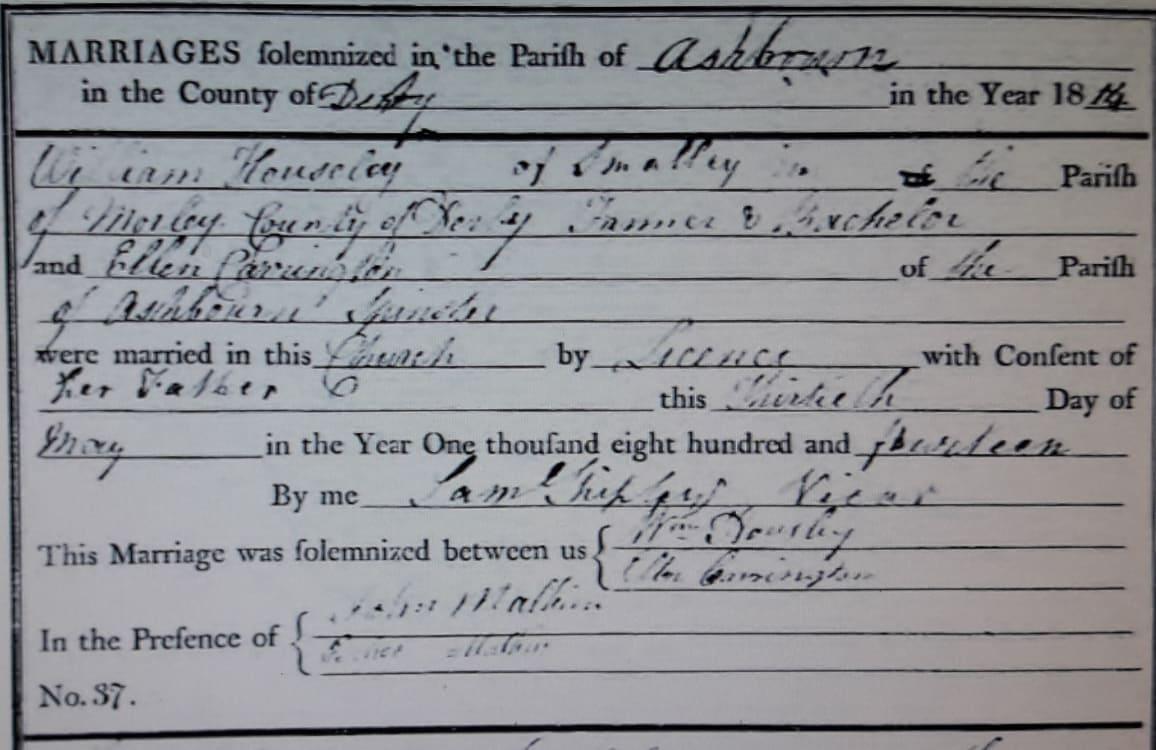
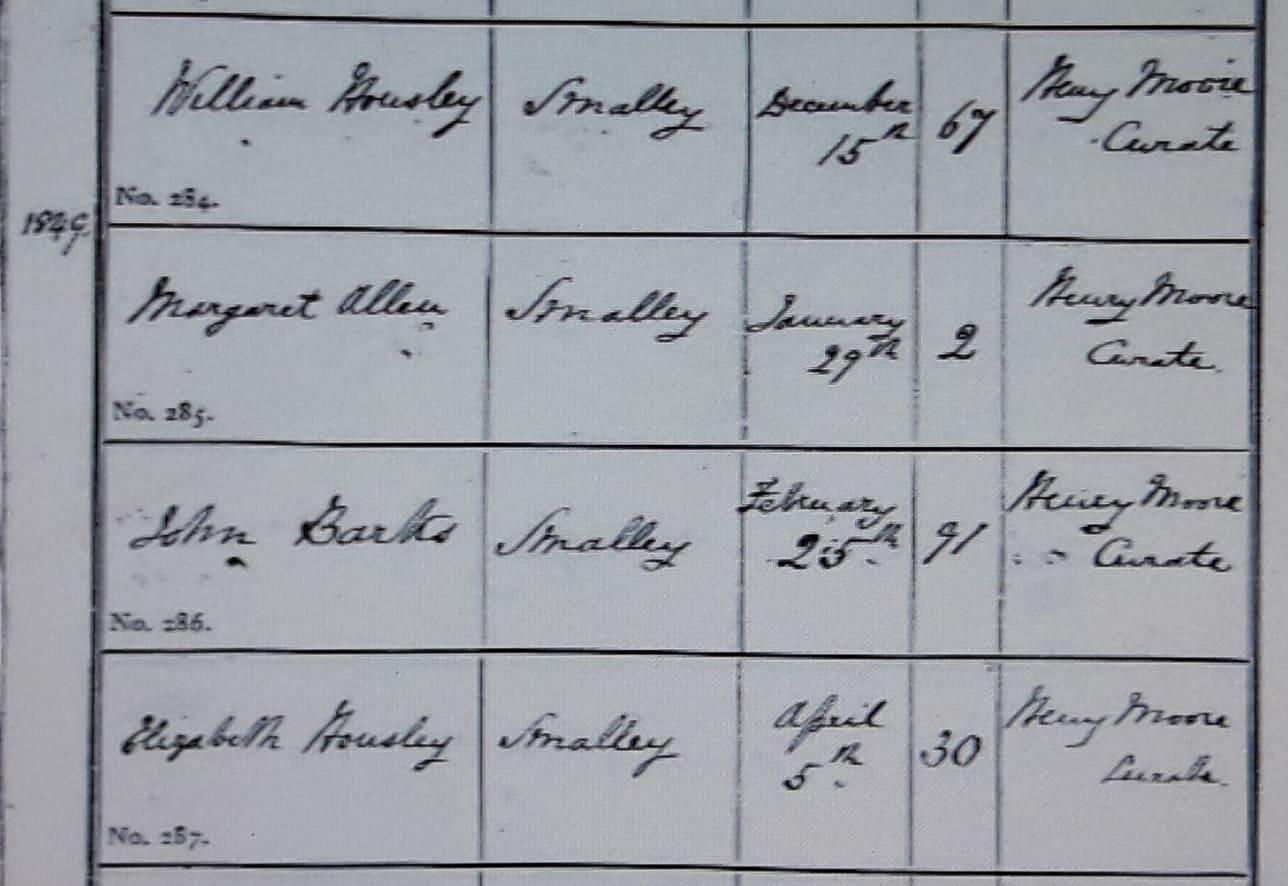
William Housley (1781-1848) and Ellen Carrington were married on May 30, 1814 at St. Oswald’s church in Ashbourne. William died in 1848 at the age of 67 of “disease of lungs and general debility”. Ellen died in 1872.
Marriage of William Housley and Ellen Carrington in Ashbourne in 1814:
Parish records show three children for William and his first wife, Mary, Ellens’ sister, who were married December 29, 1806: Mary Ann, christened in 1808 and mentioned frequently in the letters; Elizabeth, christened in 1810, but never mentioned in any letters; and William, born in 1812, probably referred to as Will in the letters. Mary died in 1813.
William and Ellen had ten children: John, Samuel, Edward, Anne, Charles, George, Joseph, Robert, Emma, and Joseph. The first Joseph died at the age of four, and the last son was also named Joseph. Anne never married, Charles emigrated to Australia in 1851, and George to USA, also in 1851. The letters are to George, from his sisters and brothers in England.
The following are excerpts of those letters, including excerpts of Barbara Housley’s “Narrative on Historic Letters”. They are grouped according to who they refer to, rather than chronological order.
ELLEN HOUSLEY 1795-1872
Joseph wrote that when Emma was married, Ellen “broke up the comfortable home and the things went to Derby and she went to live with them but Derby didn’t agree with her so she left again leaving her things behind and came to live with John in the new house where she died.” Ellen was listed with John’s household in the 1871 census.
In May 1872, the Ilkeston Pioneer carried this notice: “Mr. Hopkins will sell by auction on Saturday next the eleventh of May 1872 the whole of the useful furniture, sewing machine, etc. nearly new on the premises of the late Mrs. Housley at Smalley near Heanor in the county of Derby. Sale at one o’clock in the afternoon.”Ellen’s family was evidently rather prominant in Smalley. Two Carringtons (John and William) served on the Parish Council in 1794. Parish records are full of Carrington marriages and christenings; census records confirm many of the family groupings.
In June of 1856, Emma wrote: “Mother looks as well as ever and was told by a lady the other day that she looked handsome.” Later she wrote: “Mother is as stout as ever although she sometimes complains of not being able to do as she used to.”
Mary’s children:
MARY ANN HOUSLEY 1808-1878
There were hard feelings between Mary Ann and Ellen and her children. Anne wrote: “If you remember we were not very friendly when you left. They never came and nothing was too bad for Mary Ann to say of Mother and me, but when Robert died Mother sent for her to the funeral but she did not think well to come so we took no more notice. She would not allow her children to come either.”
Mary Ann was unlucky in love! In Anne’s second letter she wrote: “William Carrington is paying Mary Ann great attention. He is living in London but they write to each other….We expect it will be a match.” Apparantly the courtship was stormy for in 1855, Emma wrote: “Mary Ann’s wedding with William Carrington has dropped through after she had prepared everything, dresses and all for the occassion.” Then in 1856, Emma wrote: “William Carrington and Mary Ann are separated. They wore him out with their nonsense.” Whether they ever married is unclear. Joseph wrote in 1872: “Mary Ann was married but her husband has left her. She is in very poor health. She has one daughter and they are living with their mother at Smalley.”
Regarding William Carrington, Emma supplied this bit of news: “His sister, Mrs. Lily, has eloped with a married man. Is she not a nice person!”
WILLIAM HOUSLEY JR. 1812-1890
According to a letter from Anne, Will’s two sons and daughter were sent to learn dancing so they would be “fit for any society.” Will’s wife was Dorothy Palfry. They were married in Denby on October 20, 1836 when Will was 24. According to the 1851 census, Will and Dorothy had three sons: Alfred 14, Edwin 12, and William 10. All three boys were born in Denby.
In his letter of May 30, 1872, after just bemoaning that all of his brothers and sisters are gone except Sam and John, Joseph added: “Will is living still.” In another 1872 letter Joseph wrote, “Will is living at Heanor yet and carrying on his cattle dealing.” The 1871 census listed Will, 59, and his son William, 30, of Lascoe Road, Heanor, as cattle dealers.
Ellen’s children:
JOHN HOUSLEY 1815-1893
John married Sarah Baggally in Morely in 1838. They had at least six children. Elizabeth (born 2 May 1838) was “out service” in 1854. In her “third year out,” Elizabeth was described by Anne as “a very nice steady girl but quite a woman in appearance.” One of her positions was with a Mrs. Frearson in Heanor. Emma wrote in 1856: “Elizabeth is still at Mrs. Frearson. She is such a fine stout girl you would not know her.” Joseph wrote in 1872 that Elizabeth was in service with Mrs. Eliza Sitwell at Derby. (About 1850, Miss Eliza Wilmot-Sitwell provided for a small porch with a handsome Norman doorway at the west end of the St. John the Baptist parish church in Smalley.)
According to Elizabeth’s birth certificate and the 1841 census, John was a butcher. By 1851, the household included a nurse and a servant, and John was listed as a “victular.” Anne wrote in February 1854, “John has left the Public House a year and a half ago. He is living where Plumbs (Ann Plumb witnessed William’s death certificate with her mark) did and Thomas Allen has the land. He has been working at James Eley’s all winter.” In 1861, Ellen lived with John and Sarah and the three boys.
John sold his share in the inheritance from their mother and disappeared after her death. (He died in Doncaster, Yorkshire, in 1893.) At that time Charles, the youngest would have been 21. Indeed, Joseph wrote in July 1872: “John’s children are all grown up”.
In May 1872, Joseph wrote: “For what do you think, John has sold his share and he has acted very bad since his wife died and at the same time he sold all his furniture. You may guess I have never seen him but once since poor mother’s funeral and he is gone now no one knows where.”
In February 1874 Joseph wrote: “You want to know what made John go away. Well, I will give you one reason. I think I told you that when his wife died he persuaded me to leave Derby and come to live with him. Well so we did and dear Harriet to keep his house. Well he insulted my wife and offered things to her that was not proper and my dear wife had the power to resist his unmanly conduct. I did not think he could of served me such a dirty trick so that is one thing dear brother. He could not look me in the face when we met. Then after we left him he got a woman in the house and I suppose they lived as man and wife. She caught the small pox and died and there he was by himself like some wild man. Well dear brother I could not go to him again after he had served me and mine as he had and I believe he was greatly in debt too so that he sold his share out of the property and when he received the money at Belper he went away and has never been seen by any of us since but I have heard of him being at Sheffield enquiring for Sam Caldwell. You will remember him. He worked in the Nag’s Head yard but I have heard nothing no more of him.”
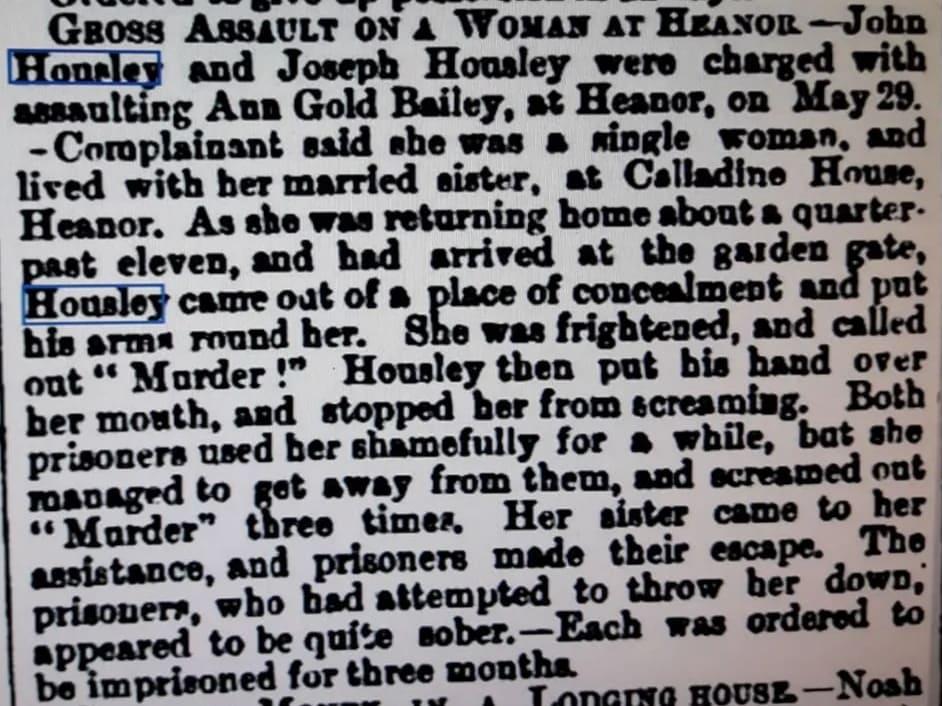
A mention of a John Housley of Heanor in the Nottinghma Journal 1875. I don’t know for sure if the John mentioned here is the brother John who Joseph describes above as behaving improperly to his wife. John Housley had a son Joseph, born in 1840, and John’s wife Sarah died in 1870.
In 1876, the solicitor wrote to George: “Have you heard of John Housley? He is entitled to Robert’s share and I want him to claim it.”
SAMUEL HOUSLEY 1816-
Sam married Elizabeth Brookes of Sutton Coldfield, and they had three daughters: Elizabeth, Mary Anne and Catherine. Elizabeth his wife died in 1849, a few months after Samuel’s father William died in 1848. The particular circumstances relating to these individuals have been discussed in previous chapters; the following are letter excerpts relating to them.
Death of William Housley 15 Dec 1848, and Elizabeth Housley 5 April 1849, Smalley:
Joseph wrote in December 1872: “I saw one of Sam’s daughters, the youngest Kate, you would remember her a baby I dare say. She is very comfortably married.”
In the same letter (December 15, 1872), Joseph wrote: “I think we have now found all out now that is concerned in the matter for there was only Sam that we did not know his whereabouts but I was informed a week ago that he is dead–died about three years ago in Birmingham Union. Poor Sam. He ought to have come to a better end than that….His daughter and her husband went to Brimingham and also to Sutton Coldfield that is where he married his wife from and found out his wife’s brother. It appears he has been there and at Birmingham ever since he went away but ever fond of drink.”
(Sam, however, was still alive in 1871, living as a lodger at the George and Dragon Inn, Henley in Arden. And no trace of Sam has been found since. It would appear that Sam did not want to be found.)
EDWARD HOUSLEY 1819-1843
Edward died before George left for USA in 1851, and as such there is no mention of him in the letters.
ANNE HOUSLEY 1821-1856
Anne wrote two letters to her brother George between February 1854 and her death in 1856. Apparently she suffered from a lung disease for she wrote: “I can say you will be surprised I am still living and better but still cough and spit a deal. Can do nothing but sit and sew.” According to the 1851 census, Anne, then 29, was a seamstress. Their friend, Mrs. Davy, wrote in March 1856: “This I send in a box to my Brother….The pincushion cover and pen wiper are Anne’s work–are for thy wife. She would have made it up had she been able.” Anne was not living at home at the time of the 1841 census. She would have been 19 or 20 and perhaps was “out service.”
In her second letter Anne wrote: “It is a great trouble now for me to write…as the body weakens so does the mind often. I have been very weak all summer. That I continue is a wonder to all and to spit so much although much better than when you left home.” She also wrote: “You know I had a desire for America years ago. Were I in health and strength, it would be the land of my adoption.”
In November 1855, Emma wrote, “Anne has been very ill all summer and has not been able to write or do anything.” Their neighbor Mrs. Davy wrote on March 21, 1856: “I fear Anne will not be long without a change.” In a black-edged letter the following June, Emma wrote: “I need not tell you how happy she was and how calmly and peacefully she died. She only kept in bed two days.”
Certainly Anne was a woman of deep faith and strong religious convictions. When she wrote that they were hoping to hear of Charles’ success on the gold fields she added: “But I would rather hear of him having sought and found the Pearl of great price than all the gold Australia can produce, (For what shall it profit a man if he gain the whole world and lose his soul?).” Then she asked George: “I should like to learn how it was you were first led to seek pardon and a savior. I do feel truly rejoiced to hear you have been led to seek and find this Pearl through the workings of the Holy Spirit and I do pray that He who has begun this good work in each of us may fulfill it and carry it on even unto the end and I can never doubt the willingness of Jesus who laid down his life for us. He who said whoever that cometh unto me I will in no wise cast out.”
Anne’s will was probated October 14, 1856. Mr. William Davy of Kidsley Park appeared for the family. Her estate was valued at under £20. Emma was to receive fancy needlework, a four post bedstead, feather bed and bedding, a mahogany chest of drawers, plates, linen and china. Emma was also to receive Anne’s writing desk. There was a condition that Ellen would have use of these items until her death.
The money that Anne was to receive from her grandfather, William Carrington, and her father, William Housley was to be distributed one third to Joseph, one third to Emma, and one third to be divided between her four neices: John’s daughter Elizabeth, 18, and Sam’s daughters Elizabeth, 10, Mary Ann, 9 and Catharine, age 7 to be paid by the trustees as they think “most useful and proper.” Emma Lyon and Elizabeth Davy were the witnesses.
The Carrington Farm:
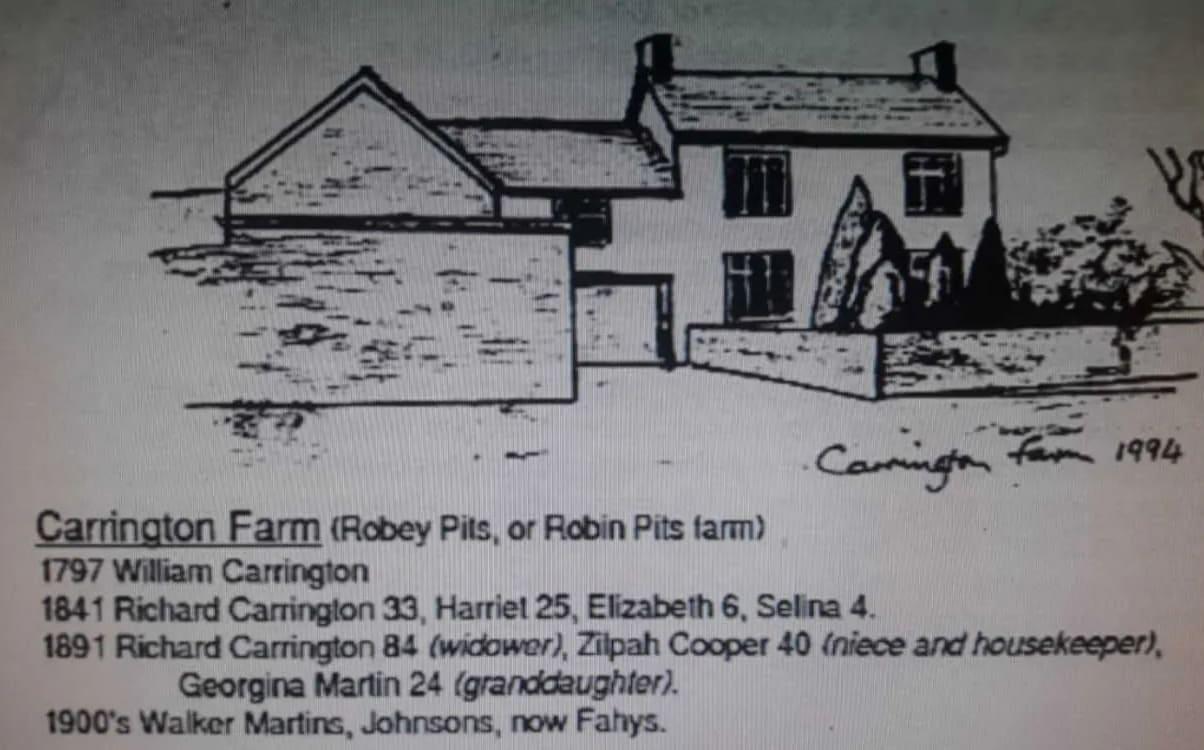
CHARLES HOUSLEY 1823-1855
Charles went to Australia in 1851, and was last heard from in January 1853. According to the solicitor, who wrote to George on June 3, 1874, Charles had received advances on the settlement of their parent’s estate. “Your promissory note with the two signed by your brother Charles for 20 pounds he received from his father and 20 pounds he received from his mother are now in the possession of the court.”
Charles and George were probably quite close friends. Anne wrote in 1854: “Charles inquired very particularly in both his letters after you.”
According to Anne, Charles and a friend married two sisters. He and his father-in-law had a farm where they had 130 cows and 60 pigs. Whatever the trade he learned in England, he never worked at it once he reached Australia. While it does not seem that Charles went to Australia because gold had been discovered there, he was soon caught up in “gold fever”. Anne wrote: “I dare say you have heard of the immense gold fields of Australia discovered about the time he went. Thousands have since then emigrated to Australia, both high and low. Such accounts we heard in the papers of people amassing fortunes we could not believe. I asked him when I wrote if it was true. He said this was no exaggeration for people were making their fortune daily and he intended going to the diggings in six weeks for he could stay away no longer so that we are hoping to hear of his success if he is alive.”
In March 1856, Mrs. Davy wrote: “I am sorry to tell thee they have had a letter from Charles’s wife giving account of Charles’s death of 6 months consumption at the Victoria diggings. He has left 2 children a boy and a girl William and Ellen.” In June of the same year in a black edged letter, Emma wrote: “I think Mrs. Davy mentioned Charles’s death in her note. His wife wrote to us. They have two children Helen and William. Poor dear little things. How much I should like to see them all. She writes very affectionately.”
In December 1872, Joseph wrote: “I’m told that Charles two daughters has wrote to Smalley post office making inquiries about his share….” In January 1876, the solicitor wrote: “Charles Housley’s children have claimed their father’s share.”
GEORGE HOUSLEY 1824-1877
George emigrated to the United states in 1851, arriving in July. The solicitor Abraham John Flint referred in a letter to a 15-pound advance which was made to George on June 9, 1851. This certainly was connected to his journey. George settled along the Delaware River in Bucks County, Pennsylvania. The letters from the solicitor were addressed to: Lahaska Post Office, Bucks County, Pennsylvania.
George married Sarah Ann Hill on May 6, 1854 in Doylestown, Bucks County, Pennsylvania. In her first letter (February 1854), Anne wrote: “We want to know who and what is this Miss Hill you name in your letter. What age is she? Send us all the particulars but I would advise you not to get married until you have sufficient to make a comfortable home.”
Upon learning of George’s marriage, Anne wrote: “I hope dear brother you may be happy with your wife….I hope you will be as a son to her parents. Mother unites with me in kind love to you both and to your father and mother with best wishes for your health and happiness.” In 1872 (December) Joseph wrote: “I am sorry to hear that sister’s father is so ill. It is what we must all come to some time and hope we shall meet where there is no more trouble.”
Emma wrote in 1855, “We write in love to your wife and yourself and you must write soon and tell us whether there is a little nephew or niece and what you call them.” In June of 1856, Emma wrote: “We want to see dear Sarah Ann and the dear little boy. We were much pleased with the “bit of news” you sent.” The bit of news was the birth of John Eley Housley, January 11, 1855. Emma concluded her letter “Give our very kindest love to dear sister and dearest Johnnie.”
In September 1872, Joseph wrote, “I was very sorry to hear that John your oldest had met with such a sad accident but I hope he is got alright again by this time.” In the same letter, Joseph asked: “Now I want to know what sort of a town you are living in or village. How far is it from New York? Now send me all particulars if you please.”
In March 1873 Harriet asked Sarah Ann: “And will you please send me all the news at the place and what it is like for it seems to me that it is a wild place but you must tell me what it is like….”. The question of whether she was referring to Bucks County, Pennsylvania or some other place is raised in Joseph’s letter of the same week.
On March 17, 1873, Joseph wrote: “I was surprised to hear that you had gone so far away west. Now dear brother what ever are you doing there so far away from home and family–looking out for something better I suppose.”The solicitor wrote on May 23, 1874: “Lately I have not written because I was not certain of your address and because I doubted I had much interesting news to tell you.” Later, Joseph wrote concerning the problems settling the estate, “You see dear brother there is only me here on our side and I cannot do much. I wish you were here to help me a bit and if you think of going for another summer trip this turn you might as well run over here.”
Apparently, George had indicated he might return to England for a visit in 1856. Emma wrote concerning the portrait of their mother which had been sent to George: “I hope you like mother’s portrait. I did not see it but I suppose it was not quite perfect about the eyes….Joseph and I intend having ours taken for you when you come over….Do come over before very long.”
In March 1873, Joseph wrote: “You ask me what I think of you coming to England. I think as you have given the trustee power to sign for you I think you could do no good but I should like to see you once again for all that. I can’t say whether there would be anything amiss if you did come as you say it would be throwing good money after bad.”
On June 10, 1875, the solicitor wrote: “I have been expecting to hear from you for some time past. Please let me hear what you are doing and where you are living and how I must send you your money.” George’s big news at that time was that on May 3, 1875, he had become a naturalized citizen “renouncing and abjuring all allegiance and fidelity to every foreign prince, potentate, state and sovereignity whatsoever, and particularly to Victoria Queen of Great Britain of whom he was before a subject.”
ROBERT HOUSLEY 1832-1851
In 1854, Anne wrote: “Poor Robert. He died in August after you left he broke a blood vessel in the lung.”
From Joseph’s first letter we learn that Robert was 19 when he died: “Dear brother there have been a great many changes in the family since you left us. All is gone except myself and John and Sam–we have heard nothing of him since he left. Robert died first when he was 19 years of age. Then Anne and Charles too died in Australia and then a number of years elapsed before anyone else. Then John lost his wife, then Emma, and last poor dear mother died last January on the 11th.”Anne described Robert’s death in this way: “He had thrown up blood many times before in the spring but the last attack weakened him that he only lived a fortnight after. He died at Derby. Mother was with him. Although he suffered much he never uttered a murmur or regret and always a smile on his face for everyone that saw him. He will be regretted by all that knew him”.
Robert died a resident of St. Peter’s Parish, Derby, but was buried in Smalley on August 16, 1851.
Apparently Robert was apprenticed to be a joiner for, according to Anne, Joseph took his place: “Joseph wanted to be a joiner. We thought we could do no better than let him take Robert’s place which he did the October after and is there still.”In 1876, the solicitor wrote to George: “Have you heard of John Housley? He is entitled to Robert’s share and I want him to claim it.”
EMMA HOUSLEY 1836-1871
Emma was not mentioned in Anne’s first letter. In the second, Anne wrote that Emma was living at Spondon with two ladies in her “third situation,” and added, “She is grown a bouncing woman.” Anne described her sister well. Emma wrote in her first letter (November 12, 1855): “I must tell you that I am just 21 and we had my pudding last Sunday. I wish I could send you a piece.”
From Emma’s letters we learn that she was living in Derby from May until November 1855 with Mr. Haywood, an iron merchant. She explained, “He has failed and I have been obliged to leave,” adding, “I expect going to a new situation very soon. It is at Belper.” In 1851 records, William Haywood, age 22, was listed as an iron foundry worker. In the 1857 Derby Directory, James and George were listed as iron and brass founders and ironmongers with an address at 9 Market Place, Derby.
In June 1856, Emma wrote from “The Cedars, Ashbourne Road” where she was working for Mr. Handysides.
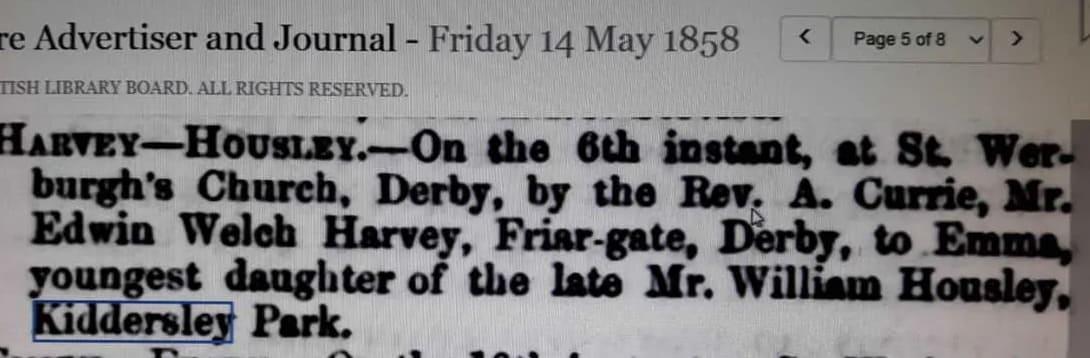
While she was working for Mr. Handysides, Emma wrote: “Mother is thinking of coming to live at Derby. That will be nice for Joseph and I.”Friargate and Ashbourne Road were located in St. Werburgh’s Parish. (In fact, St. Werburgh’s vicarage was at 185 Surrey Street. This clue led to the discovery of the record of Emma’s marriage on May 6, 1858, to Edwin Welch Harvey, son of Samuel Harvey in St. Werburgh’s.)
In 1872, Joseph wrote: “Our sister Emma, she died at Derby at her own home for she was married. She has left two young children behind. The husband was the son of the man that I went apprentice to and has caused a great deal of trouble to our family and I believe hastened poor Mother’s death….”. Joseph added that he believed Emma’s “complaint” was consumption and that she was sick a good bit. Joseph wrote: “Mother was living with John when I came home (from Ascension Island around 1867? or to Smalley from Derby around 1870?) for when Emma was married she broke up the comfortable home and the things went to Derby and she went to live with them but Derby did not agree with her so she had to leave it again but left all her things there.”
Emma Housley and Edwin Welch Harvey wedding, 1858:
JOSEPH HOUSLEY 1838-1893
We first hear of Joseph in a letter from Anne to George in 1854. “Joseph wanted to be a joiner. We thought we could do no better than let him take Robert’s place which he did the October after (probably 1851) and is there still. He is grown as tall as you I think quite a man.” Emma concurred in her first letter: “He is quite a man in his appearance and quite as tall as you.”
From Emma we learn in 1855: “Joseph has left Mr. Harvey. He had not work to employ him. So mother thought he had better leave his indenture and be at liberty at once than wait for Harvey to be a bankrupt. He has got a very good place of work now and is very steady.” In June of 1856, Emma wrote “Joseph and I intend to have our portraits taken for you when you come over….Mother is thinking of coming to Derby. That will be nice for Joseph and I. Joseph is very hearty I am happy to say.”
According to Joseph’s letters, he was married to Harriet Ballard. Joseph described their miraculous reunion in this way: “I must tell you that I have been abroad myself to the Island of Ascension. (Elsewhere he wrote that he was on the island when the American civil war broke out). I went as a Royal Marine and worked at my trade and saved a bit of money–enough to buy my discharge and enough to get married with but while I was out on the island who should I meet with there but my dear wife’s sister. (On two occasions Joseph and Harriet sent George the name and address of Harriet’s sister, Mrs. Brooks, in Susquehanna Depot, Pennsylvania, but it is not clear whether this was the same sister.) She was lady’s maid to the captain’s wife. Though I had never seen her before we got to know each other somehow so from that me and my wife recommenced our correspondence and you may be sure I wanted to get home to her. But as soon as I did get home that is to England I was not long before I was married and I have not regretted yet for we are very comfortable as well as circumstances will allow for I am only a journeyman joiner.”
Proudly, Joseph wrote: “My little family consists of three nice children–John, Joseph and Susy Annie.” On her birth certificate, Susy Ann’s birthdate is listed as 1871. Parish records list a Lucy Annie christened in 1873. The boys were born in Derby, John in 1868 and Joseph in 1869. In his second letter, Joseph repeated: “I have got three nice children, a good wife and I often think is more than I have deserved.” On August 6, 1873, Joseph and Harriet wrote: “We both thank you dear sister for the pieces of money you sent for the children. I don’t know as I have ever see any before.” Joseph ended another letter: “Now I must close with our kindest love to you all and kisses from the children.”
In Harriet’s letter to Sarah Ann (March 19, 1873), she promised: “I will send you myself and as soon as the weather gets warm as I can take the children to Derby, I will have them taken and send them, but it is too cold yet for we have had a very cold winter and a great deal of rain.” At this time, the children were all under 6 and the baby was not yet two.
In March 1873 Joseph wrote: “I have been working down at Heanor gate there is a joiner shop there where Kings used to live I have been working there this winter and part of last summer but the wages is very low but it is near home that is one comfort.” (Heanor Gate is about 1/4 mile from Kidsley Grange. There was a school and industrial park there in 1988.) At this time Joseph and his family were living in “the big house–in Old Betty Hanson’s house.” The address in the 1871 census was Smalley Lane.
A glimpse into Joseph’s personality is revealed by this remark to George in an 1872 letter: “Many thanks for your portrait and will send ours when we can get them taken for I never had but one taken and that was in my old clothes and dear Harriet is not willing to part with that. I tell her she ought to be satisfied with the original.”
On one occasion Joseph and Harriet both sent seeds. (Marks are still visible on the paper.) Joseph sent “the best cow cabbage seed in the country–Robinson Champion,” and Harriet sent red cabbage–Shaw’s Improved Red. Possibly cow cabbage was also known as ox cabbage: “I hope you will have some good cabbages for the Ox cabbage takes all the prizes here. I suppose you will be taking the prizes out there with them.” Joseph wrote that he would put the name of the seeds by each “but I should think that will not matter. You will tell the difference when they come up.”
George apparently would have liked Joseph to come to him as early as 1854. Anne wrote: “As to his coming to you that must be left for the present.” In 1872, Joseph wrote: “I have been thinking of making a move from here for some time before I heard from you for it is living from hand to mouth and never certain of a job long either.” Joseph then made plans to come to the United States in the spring of 1873. “For I intend all being well leaving England in the spring. Many thanks for your kind offer but I hope we shall be able to get a comfortable place before we have been out long.” Joseph promised to bring some things George wanted and asked: “What sort of things would be the best to bring out there for I don’t want to bring a lot that is useless.” Joseph’s plans are confirmed in a letter from the solicitor May 23, 1874: “I trust you are prospering and in good health. Joseph seems desirous of coming out to you when this is settled.”
George must have been reminiscing about gooseberries (Heanor has an annual gooseberry show–one was held July 28, 1872) and Joseph promised to bring cuttings when they came: “Dear Brother, I could not get the gooseberries for they was all gathered when I received your letter but we shall be able to get some seed out the first chance and I shall try to bring some cuttings out along.” In the same letter that he sent the cabbage seeds Joseph wrote: “I have got some gooseberries drying this year for you. They are very fine ones but I have only four as yet but I was promised some more when they were ripe.” In another letter Joseph sent gooseberry seeds and wrote their names: Victoria, Gharibaldi and Globe.
In September 1872 Joseph wrote; “My wife is anxious to come. I hope it will suit her health for she is not over strong.” Elsewhere Joseph wrote that Harriet was “middling sometimes. She is subject to sick headaches. It knocks her up completely when they come on.” In December 1872 Joseph wrote, “Now dear brother about us coming to America you know we shall have to wait until this affair is settled and if it is not settled and thrown into Chancery I’m afraid we shall have to stay in England for I shall never be able to save money enough to bring me out and my family but I hope of better things.”
On July 19, 1875 Abraham Flint (the solicitor) wrote: “Joseph Housley has removed from Smalley and is working on some new foundry buildings at Little Chester near Derby. He lives at a village called Little Eaton near Derby. If you address your letter to him as Joseph Housley, carpenter, Little Eaton near Derby that will no doubt find him.”
George did not save any letters from Joseph after 1874, hopefully he did reach him at Little Eaton. Joseph and his family are not listed in either Little Eaton or Derby on the 1881 census.
In his last letter (February 11, 1874), Joseph sounded very discouraged and wrote that Harriet’s parents were very poorly and both had been “in bed for a long time.” In addition, Harriet and the children had been ill.
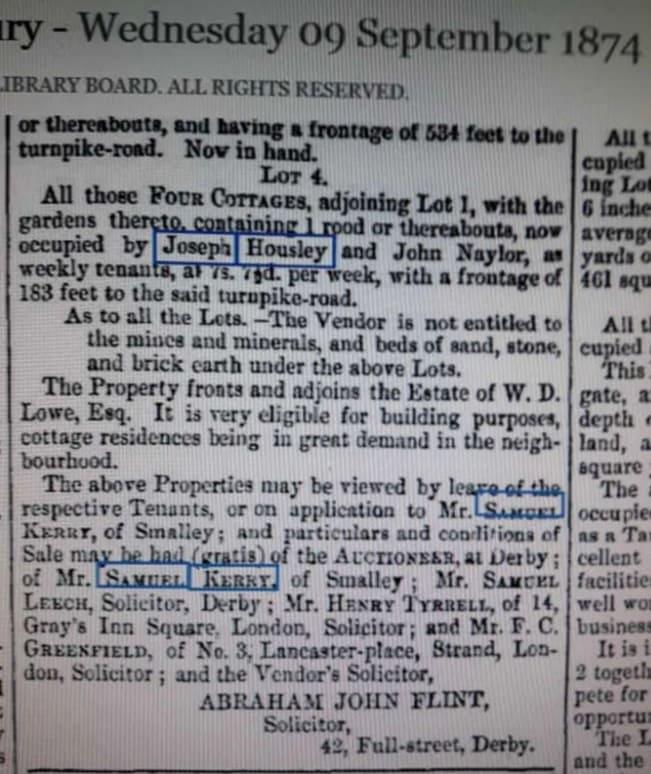
The move to Little Eaton may indicate that Joseph received his settlement because in August, 1873, he wrote: “I think this is bad news enough and bad luck too, but I have had little else since I came to live at Kiddsley cottages but perhaps it is all for the best if one could only think so. I have begun to think there will be no chance for us coming over to you for I am afraid there will not be so much left as will bring us out without it is settled very shortly but I don’t intend leaving this house until it is settled either one way or the other. “Joseph Housley and the Kiddsley cottages:
 January 28, 2022 at 7:57 am #6259
In reply to: The Elusive Samuel Housley and Other Family Stories
George “Mike” Rushby
A short autobiography of George Gilman Rushby’s son, published in the Blackwall Bugle, Australia.
Early in 2009, Ballina Shire Council Strategic and
Community Services Group Manager, Steve Barnier,
suggested that it would be a good idea for the Wardell
and District community to put out a bi-monthly
newsletter. I put my hand up to edit the publication and
since then, over 50 issues of “The Blackwall Bugle”
have been produced, encouraged by Ballina Shire
Council who host the newsletter on their website.
Because I usually write the stories that other people
generously share with me, I have been asked by several
community members to let them know who I am. Here is
my attempt to let you know!My father, George Gilman Rushby was born in England
in 1900. An Electrician, he migrated to Africa as a young
man to hunt and to prospect for gold. He met Eleanor
Dunbar Leslie who was a high school teacher in Cape
Town. They later married in Dar es Salaam, Tanganyika.
I was the second child and first son and was born in a
mud hut in Tanganyika in 1933. I spent my first years on
a coffee plantation. When four years old, and with
parents and elder sister on a remote goldfield, I caught
typhoid fever. I was seriously ill and had no access to
proper medical facilities. My paternal grandmother
sailed out to Africa from England on a steam ship and
took me back to England for medical treatment. My
sister Ann came too. Then Adolf Hitler started WWII and
Ann and I were separated from our parents for 9 years.Sister Ann and I were not to see him or our mother for
nine years because of the war. Dad served as a Captain in
the King’s African Rifles operating in the North African
desert, while our Mum managed the coffee plantation at
home in Tanganyika.Ann and I lived with our Grandmother and went to
school in Nottingham England. In 1946 the family was
reunited. We lived in Mbeya in Southern Tanganyika
where my father was then the District Manager of the
National Parks and Wildlife Authority. There was no
high school in Tanganyika so I had to go to school in
Nairobi, Kenya. It took five days travelling each way by
train and bus including two days on a steamer crossing
Lake Victoria.However, the school year was only two terms with long
holidays in between.When I was seventeen, I left high school. There was
then no university in East Africa. There was no work
around as Tanganyika was about to become
independent of the British Empire and become
Tanzania. Consequently jobs were reserved for
Africans.A war had broken out in Korea. I took a day off from
high school and visited the British Army headquarters
in Nairobi. I signed up for military service intending to
go to Korea. The army flew me to England. During
Army basic training I was nicknamed ‘Mike’ and have
been called Mike ever since. I never got to Korea!
After my basic training I volunteered for the Parachute
Regiment and the army sent me to Egypt where the
Suez Canal was under threat. I carried out parachute
operations in the Sinai Desert and in Cyprus and
Jordan. I was then selected for officer training and was
sent to England to the Eaton Hall Officer Cadet School
in Cheshire. Whilst in Cheshire, I met my future wife
Jeanette. I graduated as a Second Lieutenant in the
Royal Lincolnshire Regiment and was posted to West
Berlin, which was then one hundred miles behind the
Iron Curtain. My duties included patrolling the
demarcation line that separated the allies from the
Russian forces. The Berlin Wall was yet to be built. I
also did occasional duty as guard commander of the
guard at Spandau Prison where Adolf Hitler’s deputy
Rudolf Hess was the only prisoner.From Berlin, my Regiment was sent to Malaya to
undertake deep jungle operations against communist
terrorists that were attempting to overthrow the
Malayan Government. I was then a Lieutenant in
command of a platoon of about 40 men which would go
into the jungle for three weeks to a month with only air
re-supply to keep us going. On completion of my jungle
service, I returned to England and married Jeanette. I
had to stand up throughout the church wedding
ceremony because I had damaged my right knee in a
competitive cross-country motorcycle race and wore a
splint and restrictive bandage for the occasion!
At this point I took a career change and transferred
from the infantry to the Royal Military Police. I was in
charge of the security of British, French and American
troops using the autobahn link from West Germany to
the isolated Berlin. Whilst in Germany and Austria I
took up snow skiing as a sport.Jeanette and I seemed to attract unusual little
adventures along the way — each adventure trivial in
itself but adding up to give us a ‘different’ path through
life. Having climbed Mount Snowdon up the ‘easy way’
we were witness to a serious climbing accident where a
member of the staff of a Cunard Shipping Line
expedition fell and suffered serious injury. It was
Sunday a long time ago. The funicular railway was
closed. There was no telephone. So I ran all the way
down Mount Snowdon to raise the alarm.On a road trip from Verden in Germany to Berlin with
our old Opel Kapitan motor car stacked to the roof with
all our worldly possessions, we broke down on the ice and snow covered autobahn. We still had a hundred kilometres to go.A motorcycle patrolman flagged down a B-Double
tanker. He hooked us to the tanker with a very short tow
cable and off we went. The truck driver couldn’t see us
because we were too close and his truck threw up a
constant deluge of ice and snow so we couldn’t see
anyway. We survived the hundred kilometre ‘sleigh
ride!’I then went back to the other side of the world where I
carried out military police duties in Singapore and
Malaya for three years. I took up scuba diving and
loved the ocean. Jeanette and I, with our two little
daughters, took a holiday to South Africa to see my
parents. We sailed on a ship of the Holland-Afrika Line.
It broke down for four days and drifted uncontrollably
in dangerous waters off the Skeleton Coast of Namibia
until the crew could get the ship’s motor running again.
Then, in Cape Town, we were walking the beach near
Hermanus with my youngest brother and my parents,
when we found the dead body of a man who had thrown
himself off a cliff. The police came and secured the site.
Back with the army, I was promoted to Major and
appointed Provost Marshal of the ACE Mobile Force
(Allied Command Europe) with dual headquarters in
Salisbury, England and Heidelberg, Germany. The cold
war was at its height and I was on operations in Greece,
Denmark and Norway including the Arctic. I had
Norwegian, Danish, Italian and American troops in my
unit and I was then also the Winter Warfare Instructor
for the British contingent to the Allied Command
Europe Mobile Force that operated north of the Arctic
Circle.The reason for being in the Arctic Circle? From there
our special forces could look down into northern
Russia.I was not seeing much of my two young daughters. A
desk job was looming my way and I decided to leave
the army and migrate to Australia. Why Australia?
Well, I didn’t want to go back to Africa, which
seemed politically unstable and the people I most
liked working with in the army, were the Australian
troops I had met in Malaya.I migrated to Brisbane, Australia in 1970 and started
working for Woolworths. After management training,
I worked at Garden City and Brookside then became
the manager in turn of Woolworths stores at
Paddington, George Street and Redcliff. I was also the
first Director of FAUI Queensland (The Federation of
Underwater Diving Instructors) and spent my spare
time on the Great Barrier Reef. After 8 years with
Woollies, I opted for a sea change.I moved with my family to Evans Head where I
converted a convenience store into a mini
supermarket. When IGA moved into town, I decided
to take up beef cattle farming and bought a cattle
property at Collins Creek Kyogle in 1990. I loved
everything about the farm — the Charolais cattle, my
horses, my kelpie dogs, the open air, fresh water
creek, the freedom, the lifestyle. I also became a
volunteer fire fighter with the Green Pigeon Brigade.
In 2004 I sold our farm and moved to Wardell.
My wife Jeanette and I have been married for 60 years
and are now retired. We have two lovely married
daughters and three fine grandchildren. We live in the
greatest part of the world where we have been warmly
welcomed by the Wardell community and by the
Wardell Brigade of the Rural Fire Service. We are
very happy here.Mike Rushby
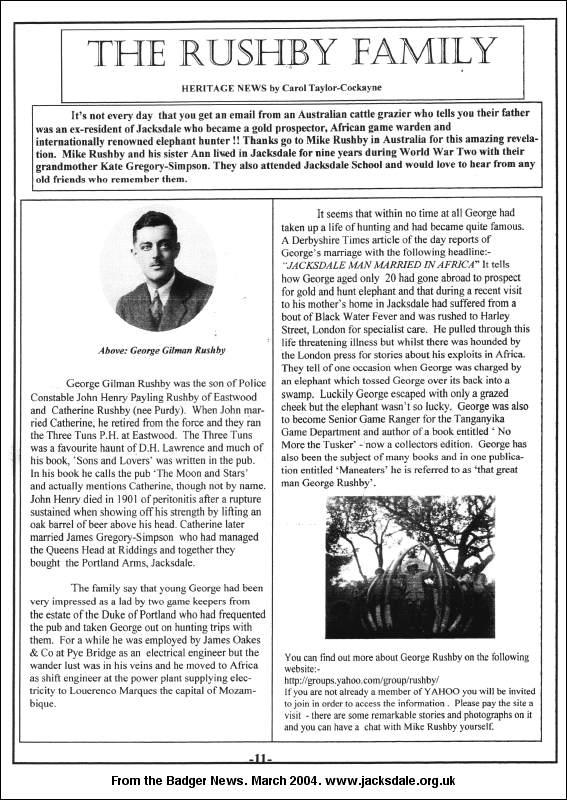
A short article sent to Jacksdale in England from Mike Rushby in Australia:
 December 17, 2021 at 10:36 am #6241
In reply to: The Elusive Samuel Housley and Other Family Stories
Kidsley Grange Farm and The Quakers Next Door
Kidsley Grange Farm in Smalley, Derbyshire, was the home of the Housleys in the 1800s. William Housley 1781-1848 was born in nearby Selston. His wife Ellen Carrington 1795-1872 was from a long line of Carringtons in Smalley. They had ten children between 1815 and 1838. Samuel, my 3x great grandfather, was the second son born in 1816.
The original farm has been made into a nursing home in recent years, which at the time of writing is up for sale at £500,000. Sadly none of the original farm appears visible with all the new additions.
The farm before it was turned into a nursing home:
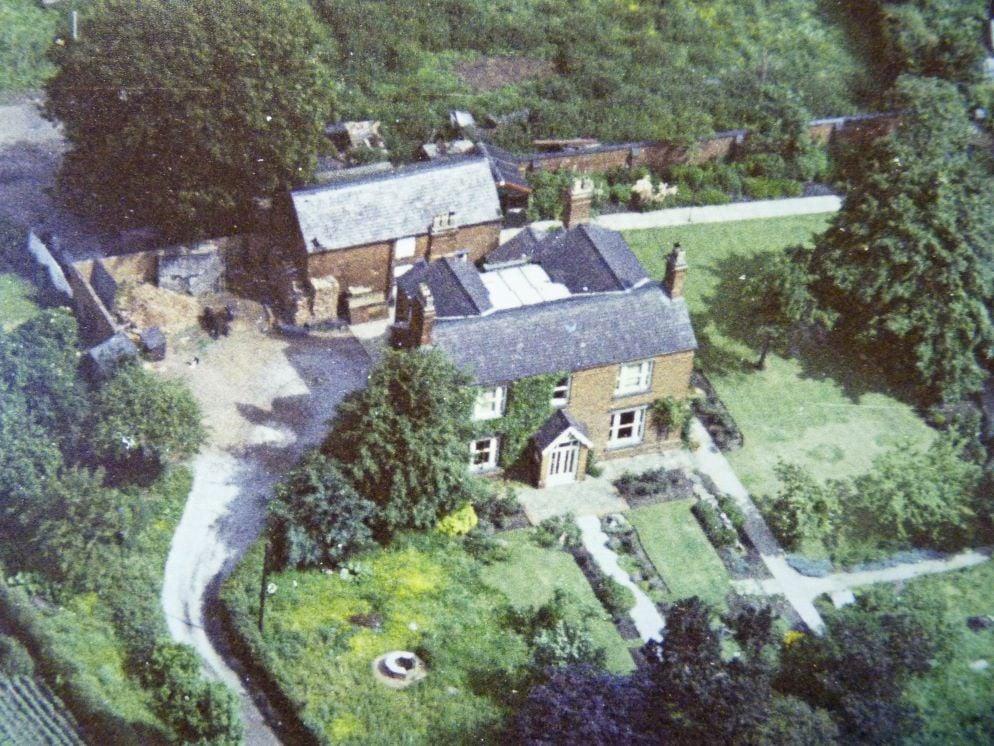
Kidsley Grange Farm and Kidsley Park, a neighbouring farm, are mentioned in a little book about the history of Smalley. The neighbours at Kidsley Park, the Davy’s, were friends of the Housleys. They were Quakers.
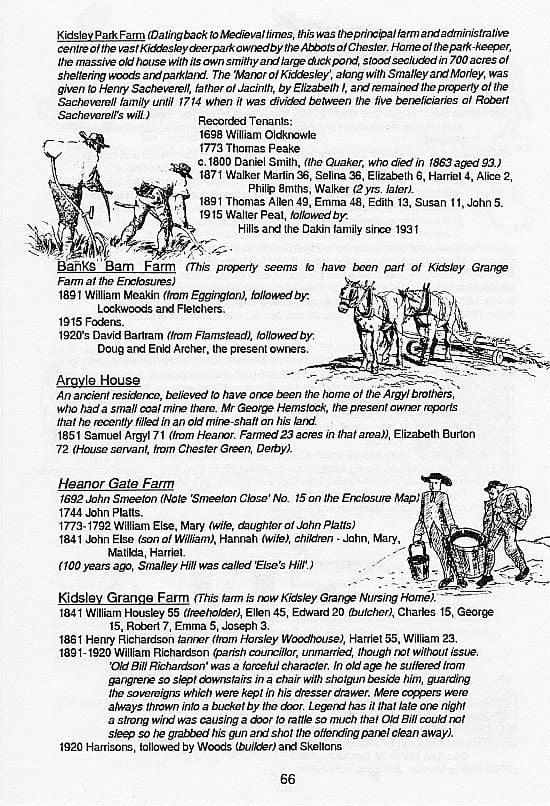
In Kerry’s History of Smalley:
Kidsley Park Farm was owned by Daniel Smith, a prominent Quaker and the last of the Quakers at Kidsley. His daughter, Elizabeth Davy, widow of William Davis, married WH Barber MB of Smalley. Elizabeth was the author of the poem “Farewell to Kidsley Park”.
Emma Housley sent one of Elizabeth Davy’s poems to her brother George in USA.
“We have sent you a piece of poetry that Mrs. Davy composed about our ‘Old House.’ I am sure you will like it though you may not understand all the allusions she makes use of as well as we do.”
Farewell to Kidsley Park
Farewell, Farewell, Thy pathways now by strangers feet are trod,
And other hands and horses strange henceforth shall turn thy sod,
Yes, other eyes may watch the buds expanding in the spring.
And other children round the hearth the coming years may bring,
But mine will be the memory of cares and pleasures there,
Intenser ~ that no living thing in some of them can share,
Commencing with the loved, and lost, in days of long ago,
When one was present on whose head Atlantic’s breezes blow,
Long years ago he left that roof, and made a home afar ~
For that is really only “home” where life’s affections are!
How many thoughts come o’er me, for old Kidsley has “a name
And memory” ~ in the hearts of some not unknown to fame.
We dream not, in those happy times, that I should be the last,
Alone, to leave my native place ~ alone, to meet the blast,
I loved each nook and corner there, each leaf and blade of grass,
Each moonlight shadow on the pond I loved: but let it pass,
For mine is still the memory that only death can mar;
I fancy I shall see it reflecting every star.
The graves of buried quadrupeds, affectionate and true,
Will have the olden sunshine, and the same bright morning dew,
But the birds that sang at even when the autumn leaves were seer,
Will miss the crumbs they used to get, in winters long and drear.
Will the poor down-trodden miss me? God help them if they do!
Some manna in the wilderness, His goodness guide them to!
Farewell to those who love me! I shall bear them still in mind,
And hope to be remembered by those I left behind:
Do not forget the aged man ~ though another fills his place ~
Another, bearing not his name, nor coming of his race.
His creed might be peculiar; but there was much of good
Successors will not imitate, because not understood.
Two hundred years have come and past since George Fox ~ first of “Friends” ~
Established his religion there ~ which my departure ends.
Then be it so: God prosper these in basket and in store,
And make them happy in my place ~ my dwelling, never more!
For I may be a wanderer ~ no roof nor hearthstone mine:
May light that cometh from above my resting place define.
Gloom hovers o’er the prospect now, but He who was my friend,
In the midst of troubled waters, will see me to the end.Elizabeth Davy, June 6th, 1863, Derby.
Another excerpt from Barbara Housley’s Narrative on the Letters from the family in Smalley to George in USA mentions the Davy’s:
Anne’s will was probated October 14, 1856. Mr. William Davy of Kidsley Park appeared for the family. Her estate was valued at under £20. Emma was to receive fancy needlework, a four post bedstead, feather bed and bedding, a mahogany chest of drawers, plates, linen and china. Emma was also to receive Anne’s writing desk! There was a condition that Ellen would have use of these items until her death.
The money that Anne was to receive from her grandfather, William Carrington, and her father, William Housley was to be distributed one third to Joseph, one third to Emma, and one third to be divided between her four neices: John’s daughter Elizabeth, 18, and Sam’s daughters Elizabeth, 10, Mary Anne, 9 and Catherine, age 7 to be paid by the trustees as they think “most useful and proper.” Emma Lyon and Elizabeth Davy were the witnesses.Mrs. Davy wrote to George on March 21 1856 sending some gifts from his sisters and a portrait of their mother–“Emma is away yet and A is so much worse.” Mrs. Davy concluded: “With best wishes
for thy health and prosperity in this world and the next I am thy sincere friend.” Whenever the girls sent greetings from Mrs. Davy they used her Quaker speech pattern of “thee and thy.”December 13, 2021 at 2:34 pm #6227In reply to: The Elusive Samuel Housley and Other Family Stories
The Scottish Connection
My grandfather always used to say we had some Scottish blood because his “mother was a Purdy”, and that they were from the low counties of Scotland near to the English border.
My mother had a Scottish hat in among the boxes of souvenirs and old photographs. In one of her recent house moves, she finally threw it away, not knowing why we had it or where it came from, and of course has since regretted it! It probably came from one of her aunts, either Phyllis or Dorothy. Neither of them had children, and they both died in 1983. My grandfather was executor of the estate in both cases, and it’s assumed that the portraits, the many photographs, the booklet on Primitive Methodists, and the Scottish hat, all relating to his mother’s side of the family, came into his possession then. His sister Phyllis never married and was living in her parents home until she died, and is the likeliest candidate for the keeper of the family souvenirs.
Catherine Housley married George Purdy, and his father was Francis Purdy, the Primitive Methodist preacher. William Purdy was the father of Francis.
Record searches find William Purdy was born on 16 July 1767 in Carluke, Lanarkshire, near Glasgow in Scotland. He worked for James Watt, the inventor of the steam engine, and moved to Derbyshire for the purpose of installing steam driven pumps to remove the water from the collieries in the area.
Another descendant of Francis Purdy found the following in a book in a library in Eastwood:
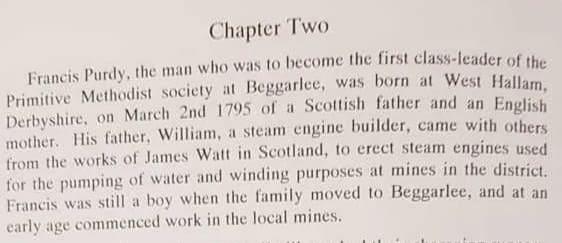
William married a local girl, Ruth Clarke, in Duffield in Derbyshire in 1786. William and Ruth had nine children, and the seventh was Francis who was born at West Hallam in 1795.
Perhaps the Scottish hat came from William Purdy, but there is another story of Scottish connections in Smalley: Bonnie Prince Charlie and the Jacobite Rebellion of 1745. Although the Purdy’s were not from Smalley, Catherine Housley was.
From an article on the Heanor and District Local History Society website:
The Jacobites in Smalley
Few people would readily associate the village of Smalley, situated about two miles west of Heanor, with Bonnie Prince Charlie and the Jacobite Rebellion of 1745 – but there is a clear link.
During the winter of 1745, Charles Edward Stuart, the “Bonnie Prince” or “The Young Pretender”, marched south from Scotland. His troops reached Derby on 4 December, and looted the town, staying for two days before they commenced a fateful retreat as the Duke of Cumberland’s army approached.
While staying in Derby, or during the retreat, some of the Jacobites are said to have visited some of the nearby villages, including Smalley.
A history of the local aspects of this escapade was written in 1933 by L. Eardley-Simpson, entitled “Derby and the ‘45,” from which the following is an extract:
“The presence of a party at Smalley is attested by several local traditions and relics. Not long ago there were people living who remember to have seen at least a dozen old pikes in a room adjoining the stables at Smalley Hall, and these were stated to have been left by a party of Highlanders who came to exchange their ponies for horses belonging to the then owner, Mrs Richardson; in 1907, one of these pikes still remained. Another resident of Smalley had a claymore which was alleged to have been found on Drumhill, Breadsall Moor, while the writer of the History of Smalley himself (Reverend C. Kerry) had a magnificent Andrew Ferrara, with a guard of finely wrought iron, engraved with two heads in Tudor helmets, of the same style, he states, as the one left at Wingfield Manor, though why the outlying bands of Army should have gone so far afield, he omits to mention. Smalley is also mentioned in another strange story as to the origin of the family of Woolley of Collingham who attained more wealth and a better position in the world than some of their relatives. The story is to the effect that when the Scots who had visited Mrs Richardson’s stables were returning to Derby, they fell in with one Woolley of Smalley, a coal carrier, and impressed him with horse and cart for the conveyance of certain heavy baggage. On the retreat, the party with Woolley was surprised by some of the Elector’s troopers (the Royal army) who pursued the Scots, leaving Woolley to shift for himself. This he did, and, his suspicion that the baggage he was carrying was part of the Prince’s treasure turning out to be correct, he retired to Collingham, and spent the rest of his life there in the enjoyment of his luckily acquired gains. Another story of a similar sort was designed to explain the rise of the well-known Derbyshire family of Cox of Brailsford, but the dates by no means agree with the family pedigree, and in any event the suggestion – for it is little more – is entirely at variance with the views as to the rights of the Royal House of Stuart which were expressed by certain members of the Cox family who were alive not many years ago.”
A letter from Charles Kerry, dated 30 July 1903, narrates another strange twist to the tale. When the Highlanders turned up in Smalley, a large crowd, mainly women, gathered. “On a command in Gaelic, the regiment stooped, and throwing their kilts over their backs revealed to the astonished ladies and all what modesty is careful to conceal. Father, who told me, said they were not any more troubled with crowds of women.”
Folklore or fact? We are unlikely to know, but the Scottish artefacts in the Smalley area certainly suggest that some of the story is based on fact.
We are unlikely to know where that Scottish hat came from, but we did find the Scottish connection. William Purdy’s mother was Grizel Gibson, and her mother was Grizel Murray, both of Lanarkshire in Scotland. The name Grizel is a Scottish form of the name Griselda, and means “grey battle maiden”. But with the exception of the name Murray, The Purdy and Gibson names are not traditionally Scottish, so there is not much of a Scottish connection after all. But the mystery of the Scottish hat remains unsolved.
April 3, 2020 at 2:12 pm #5956In reply to: The Whale’s Diaries Collection
I woke up this morning with a stiff neck. I do not mention it too much with my friend because some of them have a tendency to look for a reason behind anything like you have a choice that you don’t want to make, or you don’t listen your truth, or whatever one can invent in such a case. I’m sure someone would even mention a past life when my head was cut off. Today I don’t want other people’s opinion about me so I just say it’s a way for me to take care of myself.
Today I take things one at a time. I called a few friends to take news, and only one of them answered. Which is fine by me because I didn’t really want to talk, only to make the effort to connect. I went into the garden, the grass is tall and it looks like a prairie. I’m sure wild mice enjoy it, and the neighbour’s cats also. One of them has a roof full of them redheads and black ones. I see them cross the wild grass one at a time, each has their own habitual path.
I love looking at them. It’s quieting.
There was an argument somewhere. I heard people shout. A man and a woman. It sounded like a soap, so I’m not sure it wasn’t someone’s TV on. The air was so clear, the absence of the cars and normal conversations gave it enough place to express. Each silence they left in between their arguments was filled with sounds of nature.
I have a new family of birds coming into the garden. I baked them some wild rice with carrots and some fat. Someone told me it’s the last day you can feed them, afterwards it’s best they look for food for themselves as spring is here. So I’ve made the stew although I haven’t fed them during winter. I can tell they enjoyed it as nothing was left when I came back two hours ago.
January 17, 2020 at 11:15 am #5598In reply to: The Chronicles of the Flying Fish Inn
Mater, already centenarian! I didn’t even realize how time flies.
We’ll have to organize a big party; I know she isn’t fond of those big sappy reunions, but it’s not every day you turn 100.
Forget about flying her to some place, we’ll have no choice but to return to the Inn, all of us. Good thing we have time to plan. Mater being a 🦁 Leo and all, we still have until next winter down under.
September 2, 2019 at 4:01 pm #4787In reply to: The Precious Life and Rambles of Liz Tattler
The sun was high in the sky and birds were chirping in the trees by the pool. Roberto was facing a conundrum as the biseasonal pool had started acting strangely. Well even more strangely than one part being frozen in winter and one part stuck in the dog days of who knew what year.
It had already been hard to manage an even level between the iced layer, which tended to get brittle near the seasonal line, and the warm waters evaporating too quickly. When it first happened the water pump had been stuck in winter and they had to break some ice to move it to the summer part. Everything had been fine until the last Roman party and they could enjoy ice skating and warm spring like pool in any season. Roberto especially liked the winter season when the steam would create a nice and cozy mist, conducive to some intimate bathing together.
Now, after that party, something weird…er was happening. The line between winter and summer had started to shift around the center of the pool. -ish. And now the pump was stuck in ice again and the summer pool was being evaporated too quickly. Roberto had to save two mandarin ducks who had their legs caught in by the ice while bathing in the warm pool. Breaking the ice layer without hurting the tiny bird legs had been quite a challenge, but Roberto was proud to say that they were now safe and sound. One of the unforeseen consequences was that they had been following him everywhere ever since and he had to install two boxes for them to sleep near his bed.
Roberto and the ducks were looking at the summer half-pool. It was half empty, even if Ma’am Liz would certainly entertain the idea that it was half full, it was certainly not going stay that way very long if nothing was done.
What had happened was some mystery and Roberto was not very good at solving mysteries. He wished that that inspector with the melon hat had not left in such a hurry during the party, he could have asked him some advice.
“You want some French pastries?” It was the new French maid, Mirabelle. Roberto had been calling her Marbella and she seemed to like it. She held a silver plate of what she called creamy nuns and chocolate eclairs.
“Thanks,” he said.August 2, 2019 at 6:00 am #4744In reply to: The Stories So Near
Newer developments
POP-IN THREAD (Maeve, Lucinda, Shawn-Paul, Jerk, [Granola])
Granola is popping in and out of the stories, exploring interacting more physically with her friends through Tiku, a bush lady focus of hers.
Luckily (not so coincidentally) Maeve and Shawn-Paul were given coupons to travel from their rural Canada town to the middle of Australia. Maeve is suspicious of being followed by a strange man, and tags along with Shawn-Paul to keep a cover of a young couple. Maeve is trying to find the key to the doll that she made in her secret mission for Uncle Fergus, which has suddenly reappeared at her friend Lucinda’s place. She’ll probably is going to have to check on the other dolls that she made as well.
Jerk continues to administrate some forum where among other things, special dolls are found and exchanged, and he moderates some strange messages.
Lucinda is enjoying Fabio’s company, Maeve’s dog, that she has in her care while Maeve is travelling.FLYING FISH INN THREAD (Mater/Finly, Idle/Coriander/Clove, Devan, Prune, [Tiku])
The mysteries of the Flying Fish Inn seem to unravel slowly, like Idle’s wits.
Long time family member are being drawn inexplicably, such as Prune and brother Devan. The local bush lady Tiku is helping Finly with the catering, although Finly would rather do everything by herself. The totemic Fish was revealed to be a talisman placed here against bad luck – “for all the good it did” (Mater).
Bert, thought to be an old flame of Mater, who’s acted for the longest time as gardener, handyman and the likes, is revealed to be the father of Prune, Devan, Coriander and Clove’s mother. Mater knew of course and kept him around. He was trained in codes during his time with the military, and has a stash of potentially dangerous books. He may be the key to the mystery of the underground tunnels leading to the mines, and hidden chests of gold. Devan is onto a mystery that a guy on a motorbike (thought to be Uncle Fergus of Maeve’s story) told him about.DOLINE THREAD (Arona, Sanso/Lottie, Ugo, Albie)
Mandrake & Albie after a trip in the bayou, and looking for the dragon Leormn’s pearls and the sabulmantium, have finally found Arona after they have emerged from the interdimentional water network from the Doline, to the coast of Australia in our reality, where cats don’t usually talk.
Albie is expecting a quest, while the others are just following Arona’s lead, as she is in possession of a mysterious key with 3 words engraved.
After some traveling in hot air balloon, and with a local jeep, they have arrived at a local Inn in the bush, with a rather peculiar family of owners, and quite colorful roster of guests. That’s not even counting the all-you-can-eat lizard meat buffet. What joy.NEWSREEL THREAD (Ms Bossy, Hilda/Connie, Sophie, Ricardo)
Ms Bossy is looking to uncover the Doctor’s surely nefarious plans while her newspaper business isn’t doing so well. She’s got some help from Ricardo the intern. They have found out that the elderly temp worker who’s fascinated by the future, Sophie (aka Sweet Sophie) had been the first subject of the Doctor’s experiments. Sophie has been trying to uncover clues in the dreams, but it’s just likely she is still a sleeper agent of the Doctor.
Despite all common sense and SMS threats, Hilda & Connie have gone in Australia to chase a trail (from a flimsy tip-off from Superjerk that may have gone to Lucinda to her friend journalist). They are in touch with Lucinda, and post their updates on social media, flirting with the risk of being uncovered and having trouble come at their door.
Sha, Glo and Mavis are considering reaching out for a vacation of the nursing home to get new free beauty treatments.
In his secret lair, the Doctor is reviving his team of brazen teafing operatives: the magpies.LIZ THREAD (Finnley, Liz, Roberto, Godfrey)
Not much happened as usual, mostly an entertaining night with Inspector Melon who is quizzing Liz’ about her last novel about mysterious messages hidden in dolls with secret keys, which may be her best novel yet…
DRAGON 💚 WOOD THREAD (Glynnis, Eleri, Fox/Gorrash, Rukshan)
Before Rukshan goes to the underworld land of Giants, he’s going to the cottage to gather some of his team of friends, Fox, Ollie etc. Glynis is taking care of Tak during Margoritt’s winter time in the city. Margoritt’s sister, Muriel is an uninvited and unpleasant guest at the cottage.
Tak is making friends with a young girl who may have special powers (Nesy).
The biggest mystery now is… is the loo going to get fixed in time?July 23, 2019 at 3:17 pm #4714In reply to: Pop﹡in People Tribulations
Fourty four hours and 3 stopovers later, Maeve was glad to have arrived at Alice Springs airport. It was fun to see that the further she went, the smallest the aircraft became. Until it wasn’t too funny, and got almost downright scary with the last small propeller plane, that shook so much it seemed out of an old Indiana Jones movie, sans flying chicken.
The airport was quaint and small, the way she liked, with a passageway shaded by large swathes of fabric reminiscent of Seville’s streets. The air was surprisingly fresh, and she wondered if she’d been too optimistic about the weather and her choice of clothes, considering it was still winter down here.
While she was waiting at the luggage belt, she discreetly observed the other waiting people.
Uncle Fergus always said she had to be observant. Besides, she had a natural eye for details.Apart from the few Crocodile Dundees that screamed tourists who were waiting for their oversized luggage, she could spot a few out-of-place people. One in particular, that seemed to have followed the very same route since the first layover in Vancouver. Too strange a coincidence, and the fellow was too unassuming too.
“Maeve! MAH-EH-VEH” She jumped at the sounds. Almost didn’t recognized her own name, if she hadn’t recognized her neighbour’s voice first, and his peculiar way to pronounce it like she was a precious wahine.
“Shawn-Paul?! What on earth are you doing here?” She frowned at him “Have you been stalking me?”
“No, no! It’s not like that! I’ve received those funny-looking coupons, you see…”
“What? You too?”Now, a second person following on her tracks even through a different combination of flights was more than a coincidence. It meant danger was afoot.
“Shouldn’t we carpool? I looked up the trail to the inn, it’s a long drive and by the looks of it, not at all too safe for a lone woman travelling.”
Maeve shrugged. That may keep the other creep off her trail. “I don’t mind, but if you insist on being so chivalrous, you’re paying for the taxi.”
Before he could say anything, she handed him her piece of luggage to carry.July 18, 2019 at 3:31 pm #4693In reply to: The Stories So Near
Some updates on the Heartwoods Weave
So far, there were loosely 2 chapters in this story, and we’re entering the 3rd.
Let’s call them:- Ch. 1 – The Curses of the Stolen Shards
- Ch. 2 – The Flight to the Desert Mountains
- Ch. 3 – Down the Lands of Giants
Ch. 1 – The Curses of the Stolen Shards
In Chapter One, we get acquainted with the main characters as their destinies intertwine (Rukshan, Glynis, Eleri, Gorrash, Fox, Olliver and Tak).
In a long past, the Forest held a powerful artifact created and left behind as a seal by the Gods now departed in their World: a Gem of Creation. It was defiled by thieves (the 7 characters in their previous incarnations of Dark Fae (Ru), Toothless Dragon (Gl), Laughing Crone (El), Mapster Dwarf (Go), Glade Troll (Fo), Trickster Dryad (Ol), Tricked Girl (Ta)), and they all took a shard of the Gem, although the innocent girl was tricked to open the woods by a promise of resurrecting a loved one, and resented all the others for it. She unwittingly created the curse all characters were suffering from, as an eternal punishment. Removing the Gem from the center of the Forest and breaking it started a chain of events, leading to many changes in the World. The Forest continued to grow and claim land, and around the (Dragon) Heartwoods at the center, grew many other woods – the Haunted Bamboo Forest, the Enchanted Forest, the Hermit’s Forest, the Fae’s Forest etc. At the other side, Cities had developed, and at the moment of the story, started to gain control over the magical world of Old.
From the special abilities the Seven gained, some changes were triggered too. One God left behind was turned into stone by the now young Crone (E).
Due to the curse, their memories were lost, and they were born again in many places and other forms.
During the course of Ch.1, they got healed with the help of Master Gibbon, and the Braider Shaman Kumihimo, who directed Rukshan how to use the Vanishing Book, which once completed by all, and burnt as an offering, lifted the curse. Tak (the Girl of the origin story), now a shapeshifting Gibbon boy, learned to let go of the pain, and to start to live as a young orphan under the gentle care of the writer Margoritt Loursenoir and her goat Emma, in a cottage in the woods.
Glynis, a powerful healer with a knack for potions, still haven’t found a way to undo the curse of her scales, which she accepts, has found residency and new friends and a funny parrot named Sunshine. Eleri besides her exploration of anti-gravity, learnt to make peace with the reawakened God Hasamelis no longer vengeful but annoyed at being ignored for a mortal Yorath. Eleri continues to love to butt heads with the iniquities of the world, which are never in lack, often embodied by Leroway and his thugs. Gorrash, who adopted the little baby Snoots activated by Glynis’ potions seemed simply happy to have found a community. Fox, a fox which under the tutelage of Master Gibbon, learnt to shapeshift as a human for all his work and accumulation of good karma. Olliver, a young man with potential, found his power by activating the teleporting egg Rukshan gave him. As for Rukshan, who was plagued by ghosts and dark forces, he found a way to relieve the Forest and the world of their curse, but his world is torn between his duties towards his Fae family in the woods, his impossible love for his Queen, and his wants for a different life of exploration, especially now knowing his past is more than what he thought he knew.
At the end of the chapter, the Door to the God’s realm, at the center of the Forest seems to have reopened.Ch. 2 – The Flight to the Desert Mountains
In the second Chapter, strange sightings of light beams in the mountains prompt some of our friends to go investigate, while in the cottage, the others stay to repel encroachments by brutal modernity embodied by Leroway and his minions. Glynis has found a way to be rid of her scales, but almost failed due to Tak’s appetite for untested potions. Remaking the potion, and succeeding at last, she often still keeps her burka as fond token of her trials. Eleri is spreading glamour bomb concrete statues in the woods, and trying her hand with Glynis supervision at potions to camouflage the cottage through an invisibility spell. Muriel, Margoritt’s sister, comes for a visit.
In the mountains, the venturing heroes are caught in a sand storm and discover spirits trapped in mystical objects. Pushing forward through the mountain, they are tracked and hunted by packs of hellhounds, and dark energy released from an earthquake. Rukshan works on a magical mandala with the help and protection of his friends. Olliver discovers a new teleportation trick making him appear two places at once. Kumihimo rejoins the friends in trouble, and they all try to leave through the magical portal, while Fox baits the dogs and the Shadow. Eerily, only Fox emerges from the portal, to find a desolated, burnt Forest and his friends all gone. They had been too late, and the Shadow went with them through the portal instead of being destroyed. Luckily, a last potion left by Glynis is able to rewind Fox in time, and succeed in undoing the disaster. The beaming lights were only honeypots for wandering travellers, it turned out.
Shaken by the ordeal, Rukshan leaves the party for some R&R time in the parallel world of the Faes, which is now mostly abandoned.Ch. 3 – Down the Lands of Giants
In Chapter 3, which has only just begun, some time has passed, and Margoritt has come back to the City, at the beginning of winter for some special kneedle treatments. Glynis and Margoritt are in turn taking care of Tak, who has joined a local school, where he seems to have befriended a mysterious girl Nesingwarys (Nesy). Gorrash seems to have been hurt, broken whilst in his statue form by Leroway’s thugs, but the Snoot babies are still staying with him, so there is hope. Fox is always hungry, and helps with the reconstruction work for the cottage, which was damaged in a fire (we suppose during Leroway’s men foray in the woods).
Rukshan emerges from his retreat after an encounter with a mad Fae, babbling about a Dark Lord’s return. Piecing clues together, he finds a long lost World Map and connection with a renegade magician who may have been the Maker of Gorrash (and maybe linked to the trapped spirits in the mountain after all). He sends a pigeon to his friends before he returns to the thick of the Heartwoods.
Now, it seems the Door to the God’s realm has reopened the ancient Realms of the Underworld too, all accessible through the central pillar of the World, intersecting their World precisely at the Heartwoods, were the Gem of Creation originally was. He’s planning to go to the long lost Underworld of the Giants, were he suspects the so-called Dark Lord is hiding.July 8, 2019 at 7:50 pm #4632In reply to: Seven Twines and the Dragon Heartwoods
Sometimes, you have to go underground to uncover the truth.
Rukshan thought it meant taking the new underground carts once only.
Frankly, he’d preferred to travel through the familiar Shadow Maps, the ones Dark Faes like him could draw, that would give them access to a secret parallel world of mist and phantoms, shadows and secrets. It was the true world the Faes originated from, long ago, in a time before history.
It wasn’t used much nowadays, most Centenial Faes having lost the capacity, or the interest in the place, leaving only bitter unsavoury people creeping there, spying on secrets, and trading in for favours, while being too afraid to leave the known parallel world, too afraid that if they left it, they’d lose the way back.
For Rukshan and a few in the Queen’s lineage, the place was still more or less of a familiar dwelling, a winter residence of sorts, for when solace and retreat was required.Only the Shadow Maps weren’t safe any longer, something had crept along the lay lines and was lurking at every corner, keeping guard at most of the known entrances and reporting to some unknown power.
Few moons back, Rukshan was still meditating in the Shadow world, not very far from the work at the cottage, which he could hear at times through the thin dimensional walls, when he came across Konrad. Konrad, another Fae from the Old Houses, one with a heavy secret. “I’ve hidden her from him” he told him in short broken sentences. “His daughter, Nesingwarys, she is hidden for now, but He’ll be looking for her, once He recovers, and she won’t be safe. He can’t find her, I have to protect her, she holds power to bring his reign of terror back.”
Truly, it didn’t make a lot of sense, but it had picked his curiosity. Rukshan left the other Fae to his apparent madness, but wondered about the coincidence. That Garl, the name Konrad gave to the dark fallen monarch, according to what he could piece together, seemed to have been vanquished or disappeared about the same time they’d all managed to repel the Shadow in the Forest.
He would usually have left it at that, but then, a few days later, started to realize something was wrong in the Shadow world, and that this very something was growing.
“And now, I’m stuck in an underground cart crammed full of people to go to the city. And they call that progress…”
A bearded guy smelling of piss and wine, was doing acrobatics with his crutches and what was left of his left leg. He was looking at people with a half-toothed grin and a blissful face while muttering things Rukshan couldn’t figure. His face reminded him of a thespian he’d known. Rukshan couldn’t shake the feeling there was message in that. When the underground cart dinged to announce the Grand Belfrey Station, Rukshan was relieved to finally be out for fresh air. Magnificent craftsmanship he would say to the gnomes in charge of the tunnels, but really, underground cart wasn’t his thing.
May 4, 2018 at 1:33 pm #4471In reply to: Seven Twines and the Dragon Heartwoods
Fox sat back on the wooden chair in Margoritt’s kitchen, and crossed his arms, a little unnerved by the heat and his growing desire to go out in the woods and let go of all restraints. He had been struggling daily to control it and he had noticed it was particularly difficult during the new moon.
“If we have to do it in the house,” said Fox, “Can’t we at least open the windows? It’ll let in some fresh air.” He wrinkled his nose at the heavy scents of sweat mingled with that of fermented goat milk, irritating his delicate sense of smell. Rukshan had gathered their little group and they were waiting for Gorrash to wake up.
“The purpose of meeting here is that nobody can hear what we are saying,” said Rukshan with a hint of exasperation in his tone. “If we open the windows it’ll just…”
“Isn’t it rather because of the mosquitos?” started Fox feeling a little argumentative.
Glynis cleared her throat and got up, mumbling that she might have a solution. She came back a few moment later carrying a big bottle with a big sticker. Rukshan and Mr Minn helped her lift it while Eleri and Margoritt cleared a space on the table where they put the bottle.
The sticker had something written on it : AIR CONDITIONED, winter quality. Handle with caution.
Glynis turned the cap a few turns and a wooshing sound escaped from the neck of the bottle, followed by a gentle and continuous breeze of fresh air which provoked a murmur of appreciation from everyone.
“What’s this?” asked Gorrash who had just woken up.
“It’s what the sticker says. Cooling the atmosphere is just one way to use it. One has to be careful not to turn the wheel too much though or you could get frost bite.”
The fae looked at the bottle appreciatively, impressed at Glynis’ many talents. He was already thinking about a few other ways to put this frozen air bottle to use when Glynis cleared her throat again.
“It’s not infinite content and I only get a few of them, so if we could start the meeting.”
“Of course. I’ve received words from Lhamom. Her father has passed away and they are sending him to the sea during the week-end.” He allowed a moment of silence, sending a silent prayer toward their dear friend. Then he continued : “That means she’ll be able to join us for our trip in the mountains. We only have to decide who’s going and who’s staying to help Margoritt.”
Rukshan looked at each of them intently and Fox felt uneasy when his friend’s eyes fall upon him.
January 19, 2018 at 12:54 pm #4432In reply to: The Precious Life and Rambles of Liz Tattler
Roberto had gone to the swimming pool. He was mostly puzzled by how reality had shifted into those broken pieces that didn’t seem to fit together since he had come back from that strange tunnel with all the roots spawning strange characters from glowing pink bubbly growth.
It must have something to do with the pink liquid leaking frrrrom those strrrange pouches, he thought.He looked pensively at the swimming pool. Half of it was covered by thick ice while the other half was boiling with micro bubbles rising from the bottom and the walls, and steam slowly rising in the cool spring air.
Roberto had first thought there might be something wrong with the water cleaning mechanism of the swimming pool, but he had checked it and nothing was wrong, except the cleaning bot was stuck in the icy part of the swimming pool.
His second thought had been that it was a fancy pool cover installed by la señora Liz. But he didn’t find the retracting mechanism. La señora Liz and la muchacha Finnley, his colleague, seemed busy with the man with the moustache. Roberto had the impression the man wanted to find a wife, he didn’t want to intrude and say anything. He had tried to talk to el mayordomo Geoffrey, but he was busy again preparing another viaje de negocios for la señora.
So Roberto was there pondering in front of the swimming pool. That’s when he noticed the entrance of the green maze just on the other side of the pool, at the junction between summer and winter. He didn’t remember if it was there before.
January 15, 2018 at 1:42 am #4409In reply to: The Precious Life and Rambles of Liz Tattler
“Pssst.”
Finnley turned to her right, swift as a ninja. She was relieved to see Roberto, full of twigs and hay in his dark bushy hair. He had panda eyes.
“What happened to you?” she asked in a hush before realising she only reacted to the way he prompted her. “Is that the new…”
“No,” he said, “I just woke up from that strange cave with the moving roots and birth place of new characters,” he said rolling his ‘R’s like only he could. “It took me that long to come back into this thread. I just wanted to tell you the back door is open. I need to take a shower and clean the pool. Half of it is in summer, but the other seems to be stuck in winter.”
January 3, 2018 at 4:58 am #4404In reply to: The Precious Life and Rambles of Liz Tattler
Liz left her bed at 8:30am, wearing only her pink and blue doubled cotton night gown, a perfect hair and her fluffy pink blue mules. She had been thinking about her characters while the sun was trying to rise with great difficulty. Liz couldn’t blame the Sun as temperatures had dropped dramatically since the beginning of winter and the air outside was really cold.
When Liz was thinking about her writings and her characters, she usually felt hungry. Someone had told her once that the brain was a hungry organ and that you needed fuel to make it work properly. She didn’t have a sweet tooth, but she wouldn’t say no to some cheesy toast, any time of the day.
She had heard some noise coming from the kitchen, certainly Finnley doing who knows what, although certainly not cleaning. It might be the association between thinking about her characters and the noise in the kitchen that triggered her sudden craving for a melted slice of cheese on top of a perfectly burnished toast. The idea sufficed to make her stomach growl.
She chuckled as she thought of inventing a new genre, the toast opera. Or was it a cackle?
As she was lost in her morning musings, her mules gave that muffled slippery sound on the floor that Finnley found so unladylike. Liz didn’t care, she even deliberately slowed her pace. The slippery sound took on another dimension, extended and stretched to the limit of what was bearable even for herself. Liz grinned, thinking about Finnley’s slight twitching right eye as she certainly was trying to keep her composure in the kitchen.
Liz, all cheerful, was testing the differences between a chuckle and a cackle when she entered the kitchen. She was about to ask Finnley what she thought about it when she saw a small person in a yellow tunic and green pants, washing the dishes.
Liz stopped right there, forgetting all about chuckles and cackles and even toasts.
“Where is Finnley?” she asked, not wanting to appear the least surprised. The small person turned her head toward Liz, still managing to keep on washing the dishes. It was a girl, obviously from India.
“Good morning, Ma’am. I’m Anna, the new maid only.”
“The new… maid?”
Liz suddenly felt panic crawling behind her perfectly still face. She didn’t want to think about the implications.
“Why don’t you use the dishwasher?” she asked, proud that she could keep the control of her voice despite her hunger, her questions about chuckles and cackles, and…
“The dirty dishes are very less, there is no need to use the dishwasher only.”
Liz looked at her bobbing her head sideways as if the spring had been mounted the wrong way.
“Are you alright?” asked Anna with a worried look.
“Of course, dear. Make me a toast with a slice of cheese will you?”
“How do I do that?”
“Well you take the toaster and you put the slice of bread inside and pushed the lever down… Have you never prepared toasts before?”
“No, but yes, but I need to know how you like it only. I want to make it perfect for your liking, otherwise you won’t be satisfied.” The maid suddenly looked lost and anxious.
“Just do as you usually do,” said Liz. “Goddfrey?” she called, leaving the kitchen before the maid could ask anymore questions.
Where was Goddfrey when she needed him to explain everything?
“You need me?” asked a voice behind her. He had appeared from nowhere, as if he could walk through the walls or teleport. Anyway, she never thought she would be so relieved to see him.
“What’s that in the kitchen?”
“What’s what? Oh! You mean her. The new maid.”
He knew! Liz felt a strange blend of frustration, despair and anger. She took mental note to remember it for her next chapter, and came back to her emotional turmoil. Was she the only one unaware of such a bit change in her home?
“Well, she followed us when we were in India. We don’t know how, but she managed to find a place in one of your trunks. Finnley found her as she had the porter unpacked the load. It seems she wants to help.”
June 1, 2017 at 3:03 am #4329In reply to: The Precious Life and Rambles of Liz Tattler
Not particularly pleased with himself for that inelegant distraction, Godfrey swiftly used the opportunity to usher Melon and Liz out of the way of the glass shards, and into the next room, a gloomy winter garden kept moist and dark by all the vines and carnivorous plants covering the walls.
“Now, it makes me wonder sometimes, when I see you and the fine inspector here, you always seem to have trouble with your endings Liz’ —not that I am judging…”
“Are we talking about literature or my sex life here?” Liz’ raised an eyebrow fine as a line in the sands of her fury.The Inspector, nicely framed in a corner by colorful and dangling carnivorous plants, started to lose his legendary composure by the minute, wondering if he shouldn’t hand over the case to a less interest-conflicted party.
April 17, 2017 at 1:16 am #4306In reply to: Seven Twines and the Dragon Heartwoods
The drizzle wasn’t meant to last. At least that’s what the smell in the air was telling Fox. With the night it was getting colder and the drizzle would soon turn into small ice crystals, and maybe worse.
“We should get going,” Fox said, enjoying the last pieces of rabbit stew. The dwarf had been busy looking around in the leafless bushes and behind the tree trunks. He had been silent the whole time and Fox was beginning to worry.
“What have you been doing anyway?” he asked. “Are you hunting? You can still have a piece of that stew before I swallow it.” He handed his bowl toward the dwarf, who grumpfed without looking at Fox.
“I don’t eat. I’m a stone dwarf. I think I get recharged by daylight.”
Gorash kept on looking around very intently.
“We should get going,” repeated Fox. The weather is going to be worse.
“Grmpf. I don’t care. I’m made to stay outside. I’m a stone statue.”
“Well even stone gets cracked with the help of ice when temperature drops below zero. How am I supposed to carry you if you fall into pieces,” said Fox. He thought his idea rather cunning, but he had no idea if Gorash would be affected by the bad weather or not, since he was not really like stone during the night.“And what are you looking for? It’s winter, there’s not much of anything behind those naked bushes.”
“It’s Easter. You had your rabbit. I want my eggs,” said the dwarf.
“Oh.” Fox was speechless for a few moments. He too had been thinking of the colourful eggs of the dwarf’s friend they had left in the witch’s garden. He wondered what had happened to it? Gorash had been gloomier and gloomier since they had left the garden and Fox didn’t understand why. He had thought his friend happy to go on a quest and see the outside world. But something was missing, and now Fox realised what it was.He didn’t really know what to say to comfort the dwarf, so he said nothing. Instead he thought about the strange seasonal pattern shifts. If it was Easter then it should be spring time, but the temperatures were still a havoc. And the trees had no leaves in that part of the forest. Fox remembered the clock tower of the city had had some problems functioning recently, maybe it was all connected. The problems with the bad smell around the city, the nonsensical seasonal changes and that gloomy quest… maybe it was all connected.
Fox gulped the last pieces of rabbit stew without enjoying it. He licked the inside of the bowl and put it in his backpack without further cleaning. He had suddenly realised that it was not much use to ask Gorash’s permission to leave as Fox was doing all the walk during the day anyway. So he could as well do it at night. He didn’t have as much difficulties to put out the fire as he had lighting it up. He cleaned the place as much as he could and then looked around him. The night was dark, the drizzle had turned into small snow flakes. Fox smelled the air. It would soon turn into bigger flakes. The dwarf could stay outside if he wanted, but Fox needed to move. Let him follow if he wants to.
December 14, 2016 at 1:49 am #4249In reply to: Seven Twines and the Dragon Heartwoods
Margoritt Loursenoir wrapped a thick blanket around her shoulders. The window of her lodge was open to the chill outside, but she would keep the windows open as much as she could bear, for she’d missed the fresh air for a long time inside the city.
The view of the forest was also a renewed pleasure, she could stay in meditation in front of the window for hours, as if looking at a moving picture, a better work than any painter from the city would ever accomplish.
Besides, she liked being wrapped in a shawl like these women from the far away east she admired so much for their strength and independence.She’d come there to rekindle her inspiration. In the City of the Seven Hills, she had risen to quite a fame with her literary works, even though her works were deemed fictional, and that she was a woman.
To her, they weren’t fictions. They were just the order of things revealed, the natural evolution of things, a glimpse of what was to come if the civilisation were to keep its greedy pace.That rheumatism is killing me she looked at her hands, swollen after yesterday’s rain. An old lady like me, and that lifestyle… for how long… She would need to return for a needle session in the City. Already the supplies she’d brought were becoming scarce. She would go find some mushrooms and roots later, but for now she didn’t want to worry about that.
There was something irremediably irreconcilable about life here and life there. She was aware of the artificial nature of her escapades, but every time she moved out of the bustling city, into the enchanted woods, she would see it. Magic was still alive here, not as strong as before, but still very much alive.Rising from her chair, she put the last of her bread’s crumbs on the windowsill. The crumbs she’d put yesterday were still there, untouched. There were hardly any birds left during winter, merely a few suspicious crows who never came too close.
It was time for her morning writing session.
December 14, 2016 at 1:48 am #4248In reply to: Seven Twines and the Dragon Heartwoods
The small fire had died during the night. There wasn’t a lot of firewood in the forest, so he’d used all the dry leaves he could find. The child was quiet, and sleeping peacefully.
Waiting for the sun to rise, Rukshan was carving a piece of bamboo into a flute.The night had been cold, and a lot of the smaller bamboos had turned yellow. He thought about the ginkgo trees in the town, guessing they would have left all their golden leaves to the ground by now, going into the winter sleep, falling silent for a little while.
He didn’t have a clear plan, but some twirling leaves on the ground seemed to invite him in another direction than he had planned. He gazed into the last of the fire’s smoke, and saw there was a small lodge he didn’t know about, close to the Dragon Heartwood. Something he didn’t expect. There was an old woman there, to whom he could entrust the care of the boy, while he would go to the mountains.
They would go there, another little detour, at the first crack of the pale sunlight above the bamboos’ tops.
December 13, 2016 at 1:30 am #4246In reply to: Seven Twines and the Dragon Heartwoods
Rukshan woke up early. A fine drizzle was almost in suspension in the air, and already the sounds of nature were heard all around the inn.
They shared breakfast with Lahmom who was packing to join a group for a trek high in the mountains. He wasn’t going in the same direction —the rain shadow and high plateaus of the mountainous ranges were not as attractive as the green slopes, and in winter, the treks were perilous.The inn-keeper fed them an honest and nourishing breakfast, and after eating it in silent contentment, they went on their separate way, happy for the moment of companionship.
The entrance to the bamboo forest was easy to find, there were many stone sculptures almost all made from the same molds on either sides, many were propitiation offerings, that were clothed in red more often than not.
Once inside the bamboos, it was as though all sounds from outside had disappeared. It was only the omnipresent forest breathing slowly.The path was narrow, and required some concentration to not miss the fading marks along the way. It had not been trodden for a while, it was obvious from the thick layers of brown leaves covering the ground.
After an hour or so of walking, he was already deep inside the forest, slowly on his way up to the slopes of the mountain forest where the Hermit and some relatives lived.
There was a soft cry that caught his attention. It wasn’t unusual to find all sorts of creatures in the woods, normally they would leave you alone if you did the same. But the sounds were like a calling for help, full of sadness.
It would surely mean a detour, but again, after that fence business, he may as well have been guided here for some unfathomable purpose. He walked resolutely toward the sound, and after a short walk in the sodden earth, he found the origin of the sound.There was a small hole made of bamboo leaves, and in it he could see that there was a dying mother gibbon. Rukshan knew some stories about them, and his people had great respect for the peaceful apes. He move calmly to the side of the ape so as not to frighten her. She had an infant cradled in her arms, and she didn’t seem surprised to see him.
There were no words between them, but with her touch she told him all he needed to know. She was dying, and he could do nothing about it. She wanted for her boy to be taken care of. He already knew how to change his appearance to that of a young boy, but would need to be taught in the ways of humans. That was what many gibbons were doing, trying to live among humans. There was no turning back to the old ways, it was the way for her kind to survive, and she was too old for it.Rukshan waited at her side, until she was ready to peacefully go. He closed her eyes gently, and when he was done, turned around to notice the baby ape had turned into a little silent boy with deep sad eyes and a thick mop of silvery hair. As he was standing naked in the misty forest, Rukshan’s first thought was to tear a piece of cloth from his cape to make a sort of tunic for the boy. Braiding some dry leaves of bamboos made a small rope he could use as a belt.
With that done, and last silent respects paid to the mother, he took the boy’s hand into his own, and went back to find the path he’d left.
-
AuthorSearch Results