

Search Results for 'year'
-
AuthorSearch Results
-
December 1, 2024 at 5:08 pm #7617
“Who sees that the habit-energy of the projections of the beginningless past is the cause of the three realms and who understands that the tathagata stage is free from projections or anything that arises, attains the personal realisation of buddha knowledge and effortless mastery over their own minds” —The Lankavatara Sutra, 2.8 (trans. Red Pine).
“To trace the ripples of a beginningless sea is to chase a horizon that vanishes with each step; only by stilling the waves does the ocean reveal its boundless, unbroken clarity.”
~Echoes of the Vanished Shore, Selwyn Lemone.
What if the story would unfold in reverse this time? Would the struggle subsist, to remember the past events written comment after comment? Rather than writing towards a future, and —maybe— an elusive ending, would remembering layer after layers of events from the past change our outlook on why we write at all?
Let’s just have ourselves a new playground, a new experiment as this year draws to a close.
Four friends meet unexpectedly in a busy café, after five years not having seen each other.
Matteo, the server arrives, like a resonant fifth, bringing resolution to the root note —they all seem to know him, but why.
Answers are in their pasts. And story has to unfold backwards, a step at a time, to a beginningless past.
November 20, 2024 at 9:21 pm #7609In reply to: The Incense of the Quadrivium’s Mystiques
“You! I never expected to see you here!” What was Thomas Cromwell doing in the colosseum in the year 1507? “Oh, of course, you were in Italy…what on earth are you wearing?” Truella asked, in some confusion. Never had she seen such an elaborate codpiece, and nobody else was wearing one.
He took his feathered cap off and ran a hand through his hair. “I’ve been to the very gates of purgatory trying to get back to Austin Friars, I unintentionally left Malove there.”
“In what year?” Truella was aghast. “How long has she been there? Who is she with? Is she safe?”
“There is no time to lose, how do I make this ~ this ~ thing go where and when I want?”
“Never mind that now, you had better come with us,” Trella was looking around to see where the others were. “We’ll all have to go. What’s the weather like? What are we going to do about clothes?”
“Clothes?” asked Jeezel, sneaking up behind them through some exotic foreign bushes, “Just you leave that to me! I’ve already found a marvellous museum costume shop. Did you get that codpiece there?” she said to Cromwell. ” I saw one in there similar to that, but with less padding.”
“Here you are,” announced Frella, suddenly appearing out of nowhere with her arms draped in costumes. “No time for shopping, so I did a quick spell.”
Why didn’t I think of just doing a spell? Truella wondered, not for the first time.
You never do was the unspoken reply that entered the scene with the appearance of Eris, armed with the approriate spells. “Right then. Here we go.”
November 18, 2024 at 9:40 pm #7605In reply to: The Incense of the Quadrivium’s Mystiques
Although the small hotel was tucked in a relatively quiet corner, and despite the authentic but delightfully shabby interior of soothing dimensions ~ roomy and airy, but not vast and terrifyingly empty ~ the constant background hum of city life was making Truella yearn for the stillness of home. Not that home was silence, indeed not: the background tranquility was frequently punctuated with noises, many strident. A dog barks, a neighbour shouts, a car drives past from time to time. But the noises have an identifiable individuality and reason, unlike the continual maddening drone of the metropolis.
She was pleased to find her room had a little balcony. Even if the little wooden chair was rickety and uncomfortable, it was enough to perch on to enjoy a cigarette and breathe in the car fumes. Truella slept fitfully, waking to remember Tolkeinesque snapshots of dreams, drifting off again and returning to wakefullness with snatches of conversations in unknown tongues. Sitting on the balcony in the deep dark hours of the night, the street below, now quiet, shivered and changed, her head still swimming with dream images. She caught glimpses of people as they passed, vivid, clear and full of character. Many who passed were carrying bunches of grasses or herbs or wildflowers in their hands, the women with a basket over their arm and a shawl draped over their head or shoulders.
Hardly any men though, I wonder why?
When Truella mentioned it over breakfast the next moring, Eris said “You’ve been reading too much of that new gender and feminist anthropology stuff over on GreenGrotto.”
Laughing, Truella tipped another packet of sugar in her coffee. “I love the colour of the walls in here,” she said, gazing around the breakfast room. “A sort of bright but muted sun shining on a white wall. Nice old furniture, too.”
“Tell me about the old furniture, the mirror in my room is all speckled, makes me look like I have blemishes all over my face,” said Zeezel with a toss of her head. “Can I have your sugar, Frella, if you’re not having it,” adding I’m on holiday by way of excuse.
Absentmindely Frella passed over the paper packet. “I had strange dreams last night too…about that place we’re supposed to be going to a picnic to later.”
Catching everyones attention, she continued, “The abandoned colosseum with Giovanni, with all the vines and flowers. It was like a game board and the stone statues were the players and they moved around the board, Oh! and such a beautiful board it was with all the vines and flowers ….. ”
“Gosh” said Truella, leaning back and folding her hands. What an idea.
November 7, 2024 at 9:34 pm #7591In reply to: The Incense of the Quadrivium’s Mystiques
Eris had called in sick. Even with the worst case of cold she’s had in years, she was feeling well enough to do jinx-from-home duties, and while her brain was in slow motion, she was relishing the quiet from the daily nagging of processes at the Quadrivium’s office, paperwork, tedious explaining to new hires in the ever growing coven extensions.
When Jeezel called her at the end of the day, she was glad to learn that Truella had found courage to stand up for them. Jeezel had such a colorful way of describing events, and in describing that particular scene where Truella had made her stand, it was always difficult to extract the truth from the makeup.
“You’re not really paying attention, are you?” Jeezel, ever astute to where attention was, quizzed her.
“What made you say that?” Eris didn’t try to deny.
“Oh I guess, when I started to speak about the camels in knickers going for a bath in the ball pit from all the dropped balls this year.”
“Ah, right. That would do.”
“Tell me, anything troubling you, luv’? You know you can tell me things.”
After a little moment, Eris said “Well, it’s just a thought,… but what if I’m in need of change of path?”
“What do you mean?” Jeezel tried to not sound too alarmed. “Not being a witch anymore?”
“Oh, no. Well,… why not, there’s no shame in no magic —but no. More like…”
“What? Quitting the coven?”
“… Yeah. It’s gone to madder and madder, it’s so hard to keep track with all the nonsense.” Eris corrected seeing the face of Jeezel. “Not that nonsense. You know what I mean… the daily nonsense. Our nonsense is fine. More than fine actually.”
“Phew, you had me worried though. Although…”
“I know… Quitting the coven.”
“You could be stripped of magic, if Malové learns about this…” then with more concern in her voice “WE could all be stripped of magic.”
“Yeah, I know. But look, is that what makes us happy?”
“It certainly foots the bill —or more like magically takes care of the bills.”
“Like I said, Jeez’, it’s just a thought, nothing to worry about, actually it helped to get it out.”
“I think it’s more than a thought.” Jeezel said with an air of age-old wisdom. “Let’s see where this leads. Imagine that…”
“Yeah, we’ll see. Thanks for checking in, it’s nice for a change. I don’t know what’s got into the other two these days, they’re always talking about clothing.”
“Yeah, I know. And pjs’.”
“Go figure.”
November 6, 2024 at 8:48 pm #7585In reply to: Two Aunties au Pair and Their Pert Carouses
“Oh sweet revenge…” November was looking gleeful, and truth be told, too smug. With a tinge of orange anticipating a delectable tapestry of chaos.
The results had come as cold as an early winter for a world standing on the precipice of another era under President Lump’s reign.
“The winds of change rustling the curtains of the Beige House once more. And amidst this swirling tempest of political intrigue, our story unfurls with the maids au pair at its heart.”
“Liz, are you sure this is wise to pursue?”
“Oh stop, it Godfrey, the harm is done, November was written already in that story; I knew she would spell trouble from the beginning. And please, don’t interrupt.”
As April and June departed to pursue their ventures—perhaps April embarked on a global crusade for environmental stewardship while June disappeared into the realms of espionage, her whereabouts known only to the shadows—November emerged, a true force of nature. With an iron will and a meticulous attention to detail, she transformed the Beige House into a bastion of order amid political disarray under old Joe Mitten—bless his bumbling heart. Her reign as the clandestine conductor of this domestic symphony was nothing short of legendary.
During those four years, November proved herself indispensable. She orchestrated everything from state dinners to covert intelligence briefings, all while maintaining the perfect façade of domestic tranquility. The press would whisper her name, speculating on her true influence behind the scenes. Little did they know that November had eyes and ears in every corner of the Beige House, including a network of whispering portraits and eavesdropping sconces.
And now, with President Lump’s reelection, November faces her most formidable challenge yet. The political climate is rife with unpredictability—alliances shift like sand, loyalties waver, and secrets simmer beneath the surface. November must navigate this labyrinth with the precision of a masterful chess player, anticipating every move and countermove.
October 24, 2024 at 7:56 am #7568In reply to: The Incense of the Quadrivium’s Mystiques
The year 480 AD. It was there hovering in her mind the moment she woke up the morning after Eris had mentioned the DNA spell idea. 480 AD. But why? And it seemed strangely familiar, as if she’d dreamed of that date before. Mumbling the date over and over, Truella pushed the bed covers back, noted the welcome slight chill of the October morning, and made her way blindly to the kitchen to make coffee. 480 AD. Why, though?
Eris’s change of tune yesterday about the paperwork had given her a slight inward chuckle, but it was a good sign. And Eris had been right: Truella did like the DNA idea. At first she’d wondered if she would find something containing DNA. Then she reminded herself that she herself contained DNA available to use. But what was the year 480 AD to do with it?
Taking her steaming mug of coffee outside, Truella sat down under the porch and lit a cigarette. Too late for Romans but then what was next after Romans? It would have made more sense if it was 1480 AD, when Cromwell was born.
Oh, but what an idea! Yes! The DNA of Cromwell! She was reminded of the pieces of Hannibals tunic, and the efficacy of that spell. If they could find a bit of that old tunic, they could surely time travel back to gather some DNA from old Thomas. Truella giggled, imagining herself appearing in Cromwell’s chamber, armed with a cotton swab. “If you please, my Lord, open wide, this will only take a moment.”
He would rub his eyes, wondering if the fever had returned. What was this unseemly wench doing in here, bearing an uncanny resemblance to Lizzie, his dead wife. “Open wide,” she would say, for all the world as if she was the one giving the orders. “My lady, if you please to explain your purpose?” he would replied calmly, rather amused at the incomprehensible interlude.
“Well if you must know, we need some of your DNA. Yes, yes, I know you don’t know what that is yet, I’ve come from the future you see, and we know a lot more. Well, that’s not strictly true or I wouldn’t be here now. We know more about some things, but other things haven’t changed much. It’s the sea of paperwork we’re drowning in. Nobody could have more paperwork than you, my Lord Cromwell, but you have a particularly efficient way of dealing with it.”
“Are you referring to the Tower and the …”
“Gosh, no! No, we don’t plan to execute anyone. We just need a bit, a tiny bit, of your DNA to use in a spell…”
Suddenly Cromwell understood who this woman was. He didn’t need to call for the man who dealt with postcards from the future: everyone knows that Cromwell never forgets any paperwork he’s ever seen. In the future they called it photographic memory, but of course it wasn’t called that in his time.
“You, my lady, are one of those witches from the future, are you not? And why, pray, would I be willing to assist with witchcraft?”
“Well, why not?” retorted Truella. “You won’t be around to be executed for heresy, you were already..” She clapped her hand to her mouth. He didn’t know about that yet, obviously.
Cromwell merely raised a sardonic eyebrow. “I don’t want to know when,” he said calmly. He knew his days were numbered.
“Now, there a number of ways we can collect a bit of your DNA, sir, any bodily fluid will do,” Truella said, and then blushed deeply. Well, why not? she asked herself, and then wondered, What if he hasn’t had a bath for six months?
October 12, 2024 at 10:55 pm #7565In reply to: The Incense of the Quadrivium’s Mystiques
When Cromwell ran it by his postcard deciphering department, he realised his mistake. It was from Truella, not Frella. A second postcard from Truella provided more information.
Truella had been at the fair in Ireland when she sent the postcard. There had been a Tudor Camphor Magic stall that she was drawn to, partly because of Frella’s mysterious camphor chest, but not just because of that. Her encounter with Lovelace Maraschal and his souvenirs and 16th century postcards and paraphernalia was a fleeting obsession.
Five hundred years later the staff at the National Archives would roll their eyes at the sheer volume of postcards from Truella there were in the Thomas Cromwell collections.
October 9, 2024 at 6:38 pm #7562In reply to: The Incense of the Quadrivium’s Mystiques
It was good to be digging again. The relentless heat of the summer over, the days were perfect for excavating the next hole in her garden. It was hard work and slow hacking off bits of earth almost as hard and dry as concrete, but each day the promise of new finds became more tantalizing and encouraged her to keep working at it. There was not much more of the top layer to remove now before Truella could expect to start seeing bits of pottery and whatever else the deep dark earth had to reveal about its past.
Unable to see any particular connecting link to the dig (and Truella was usually good at that), she had become obsessed with Cromwell. Maybe she’d find a postcard from Cromwell; everyone seemed to be getting strange postcards these days. The idea of a postcard from Cromwell had wafted into her mind, but it lingered. What would he say on a postcard? She could imagine him sanding the ink, the candlelight flickering. Smiling to himself, with a stray thought wafting into his mind that someone centuries from now would find it, and wonder.
“Let them make of that what they will,” he might say, as he handed it to the man in charge of sending postcards to other centuries. “I have one here for you,” the man in charge of the postcards might say by way of reply, “Just arrived. It’s from the future by the look of it, from Ireland.”
Cromwell may take the postcard in his hand with a feeling of satisfaction ~ all information was potentially useful after all, if not in this life, in the next. Time traveling spies, you could say. He would take a moment to decipher the unfamiliarly written letters in order to read the message. His eyebrows would raise in mild astonishment to see witches sending messages so openly, so shamelessly, so fearlessly! Five hundred years from now, Ireland would be a heathen primitive nest of superstition controlled by the devils strumpets. It may not be perfect in England now, he might think, but we do try to keep some order. Frella, he said to himself. Frella. What do you look like, Frella? God’s teeth, why didn’t you send me your likeness, a portrait, on the postcard! For reasons he couldn’t explain, Cromwell couldn’t stop thinking about the mysterious witch in Ireland many centuries from now.
September 20, 2024 at 10:13 pm #7557In reply to: The Incense of the Quadrivium’s Mystiques
The whole summer had been a blur. So much so it felt at times to Eris she’d woken up from a dream to enter another one; carefully crafted illusions as heavy as an obfuscating spell.
She could remember the fair, vaguely the Games too —each event felt like another layer of enchantment, casting a surreal pallor over everything. Indeed, the summer was a blur of fleeting images and half-remembered events, like how everyone quickly disbanded to go for a respite and a salutary holiday. Truth be told, the witches of the Quadrivium all needed it after the utter chaotic year they’d been through.
The resurgence of Malové at the fair, left unexplained, had appeared as an evidence. They all needed the tough love that only she as a head of Coven could provide, rather than the micro-management of the well-meaning but people-inapt Austreberthe. To be fair, Eris wasn’t sure Malové was still in charge or not —Eris had never as much struggled with continuity as now; she could feel they were all flipping through and sliding into potential realities opened by the incoming Samhain doorways on the horizons.
Standing on the cusp of autumn, Eris décided to prepare herself for a clarity spell under the iridescent harvest moon.
As the leaves began to turn and the air grew crisp, Eris stood poised to harness the energies of the propitious harvest moon. Preparation for a clarity spell required ascertained precision and intention waved into the elements.
Eris began by setting her space. The clearing near Lake Saimaa was her sanctum, a place where the natural energies converged seamlessly with her own. She laid out a circle of stones, each one representing a different aspect of clarity—vision, truth, focus, and discernment. In the center, she placed a mirror, a symbolic portal to the inner self and higher understanding.
Mandrake, her Norwegian Forest cat, watched with a knowing gaze, his presence grounding her as she moved through the rituals. Echo, the familiar sprite, flitted about, ensuring everything was in place.
“Mandrake, guard the perimeter,” Eris instructed. The cat slinked off into the shadows, his eyes glowing with an otherworldly light.
Eris took a deep breath and began to chant, her voice steady and resonant:
“By the light of the harvest moon,
I call forth clarity, swift and soon.
Let fog disperse and shadows flee,
Reveal the truth, illuminate me.”She sprinkled dried hellebores around the mirror, their protective and healing properties amplifying the spell’s potency. The hellebores, collected from Normandy, held within them the strength of her Viking ancestors and the promise of Imbolc’s rebirth. They were not just flowers; they were talismans of resilience and transformation.
As the moon reached its zenith, Eris held a vial of enchanted water. She poured it over the mirror, watching as the surface shimmered and rippled, reflecting the moonlight with an ethereal glow. The water, drawn from the depths of Lake Saimaa, was imbued with the ancient magic of the land.
Eris closed her eyes and focused on her intentions. She saw the faces of her sisters at the Quadrivium Emporium, each one struggling with their own burdens. Stalkers, postcards, camphor chests, ever prancing reindeers high on mushrooms. She saw the chaotic energies of early spring, swirling, and the potential and peril they carried. She saw Malové’s stern visage, a reminder of the standards they were meant to uphold, and a reminder to make more magical rejuvenating cream.
“Show me the path,” she whispered. “Guide me through the haze.”
The mirror began to clear, the ripples settling into a smooth, reflective surface. Images started to form—visions of the future, hints of what lay ahead. She saw herself within the coven with renewed purpose, her objectives clear and her drive rekindled. She saw her sisters working in harmony, each one contributing their unique strengths to the collective power.
The clarity spell was working, the fog lifting to reveal the roadmap she needed. Decisions that once seemed insurmountable now appeared manageable, their resolutions within grasp. The inefficiencies plaguing their organization were laid bare, offering a blueprint for the reforms necessary to streamline their efforts.
Eris opened her eyes, the vision fading yet leaving an indelible mark on her mind. She felt a surge of confidence, a sense of direction that had been sorely lacking.
“Thank you,” she murmured to the moon, to the elements, to the spirits that had guided her.
As she began to dismantle the circle, Echo fluttered down to her shoulder, a small smile on her ethereal face. Mandrake emerged from the shadows, his eyes reflecting the calm and order Eris had sought to instill.
“Well done, Eris,” Echo said softly. “The road ahead is clearer now. The harvest moon has gifted you its wisdom.”
Eris nodded, feeling ready as autumn would be a season of action, of turning vision into reality.
August 28, 2024 at 1:31 pm #7549In reply to: The Elusive Samuel Housley and Other Family Stories
The Tailor of Haddon
Wibberly and Newton of Over HaddonIt was noted in the Bakewell parish register in 1782 that John Wibberly 1705?-1782 (my 6x great grandfather) was “taylor of Haddon”.
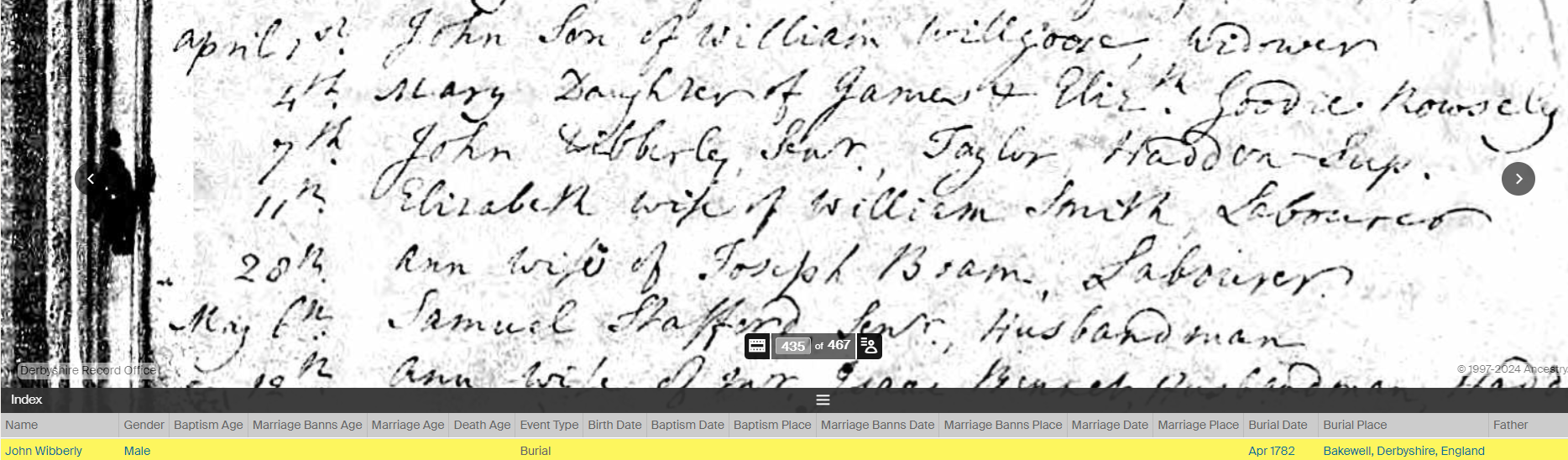
James Marshall 1767-1848 (my 4x great grandfather), parish clerk of Elton, married Ann Newton 1770-1806 in Elton in 1792. In the Bakewell parish register, Ann was baptised on the 2rd of June 1770, her parents George and Dorothy Newton of Upper Haddon. The Bakewell registers at the time covered several smaller villages in the area, although what is currently known as Over Haddon was referred to as Upper Haddon in the earlier entries.
Newton:
George Newton 1728-1798 was the son of George Newton 1706- of Upper Haddon and Jane Sailes, who were married in 1727, both of Upper Haddon.
George Newton born in 1706 was the son of George Newton 1676- and Anne Carr, who were married in 1701, both of Upper Haddon.
George Newton born in 1676 was the son of John Newton 1647- and Alice who were married in 1673 in Bakewell. There is no last name for Alice on the marriage transcription.
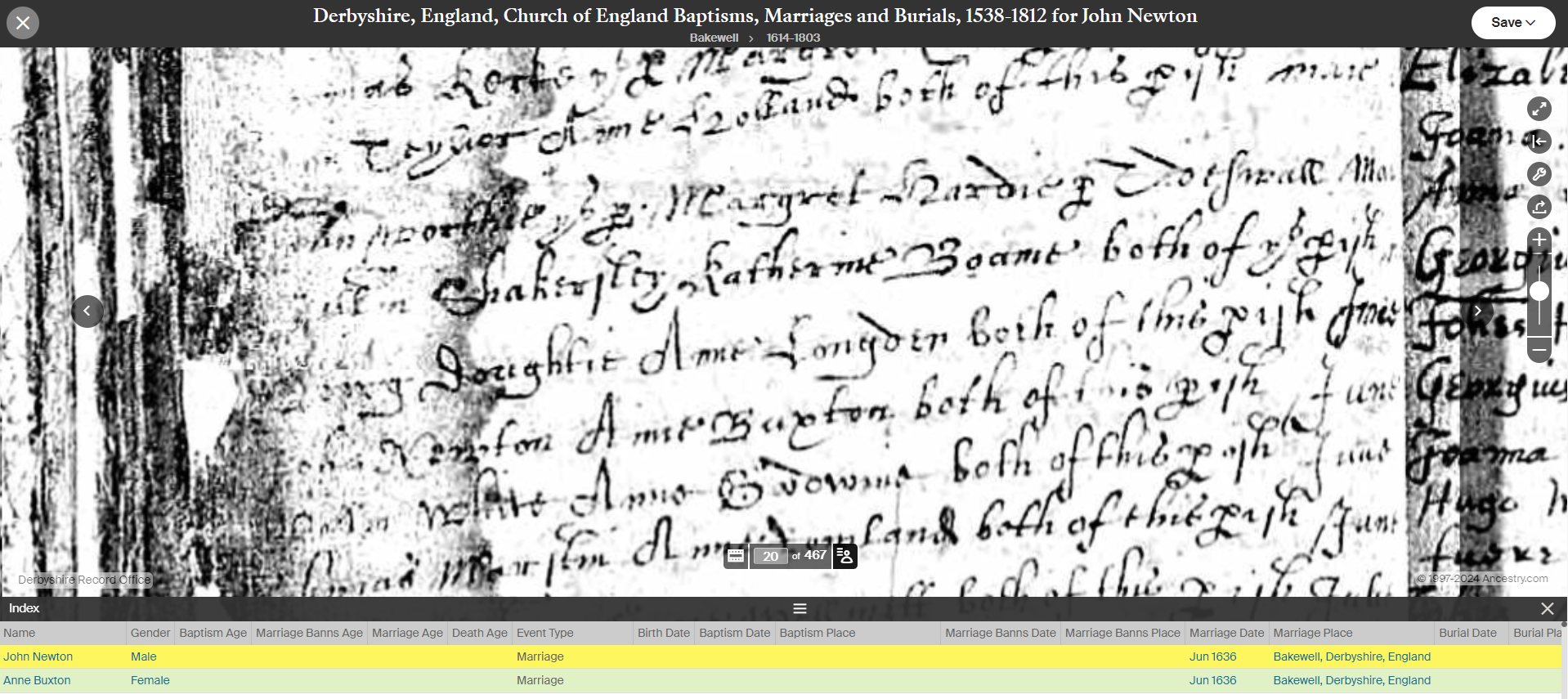
John Newton born in 1647 (my 9x great grandfather) was the son of John Newton and Anne Buxton (my 10x great grandparents), who were married in Bakewell in 1636.
1636 marriage of John Newton and Anne Buxton:
Wibberly
Dorothy Wibberly 1731-1827 married George Newton in 1755 in Bakewell. The entry in the parish registers says that they were both of Over Haddon. Dorothy was baptised in Bakewell on the 25th June 1731, her parents were John and Mary of Over Haddon.

John Wibberly and Mary his wife baptised nine children in Bakewell between 1730 and 1750, and on all of the entries in the parish registers it is stated that they were from Over Haddon. A parish register entry for John and Mary’s marriage has not yet been found, but a marriage in Beeley, a tiny nearby village, in 1728 to Mary Mellor looks likely.
John Wibberly died in Over Haddon in 1782. The entry in the Bakewell parish register notes that he was “taylor of Haddon”.
The tiny village of Over Haddon was historically associated with Haddon Hall.
A baptism for John Wibberly has not yet been found, however, there were Wibersley’s in the Bakewell registers from the early 1600s:
1619 Joyce Wibersley married Raphe Cowper.
1621 Jocosa Wibersley married Radulphus Cowper
1623 Agnes Wibersley married Richard Palfreyman
1635 Cisley Wibberlsy married ? Mr. Mason
1653 John Wibbersly married Grace DaykenHaddon Hall
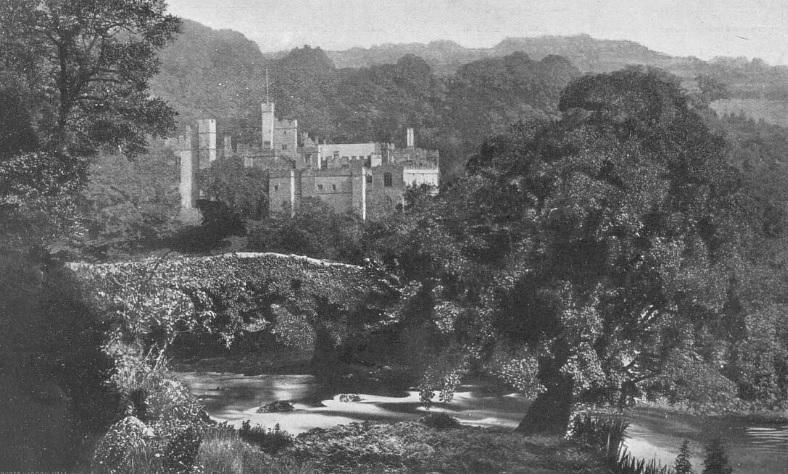
Sir Richard Vernon (c. 1390 – 1451) of Haddon Hall.
Vernon’s property was widespread and varied. From his parents he inherited the manors of Marple and Wibersley, in Cheshire. Perhaps the Over Haddon Wibersley’s origins were from Sir Richard Vernon’s property in Cheshire. There is, however, a medieval wayside cross called Whibbersley Cross situated on Leash Fen in the East Moors of the Derbyshire Peak District. It may have served as a boundary cross marking the estate of Beauchief Abbey. Wayside crosses such as this mostly date from the 9th to 15th centuries.Found in both The History and Antiquities of Haddon Hall by S Raynor, 1836, and the 1663 household accounts published by Lysons, Haddon Hall had 140 domestic staff.
In the book Haddon Hall, an Illustrated Guide, 1871, an example from the 1663 Christmas accounts:
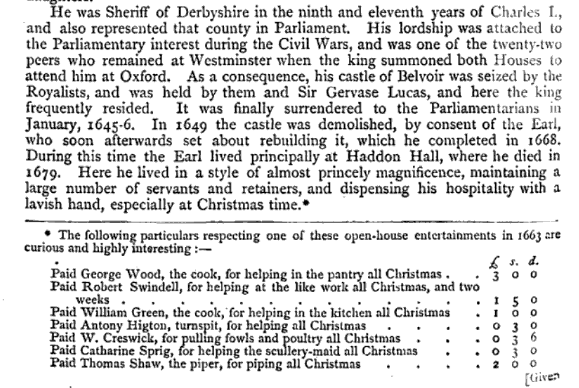
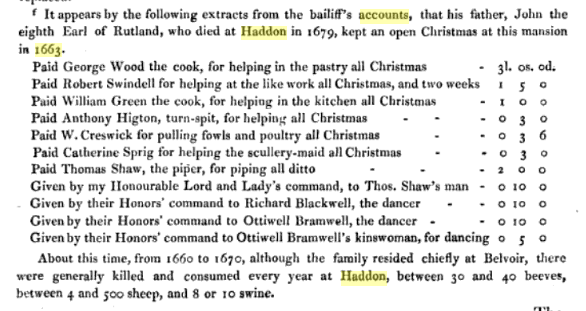
Also in this book, an early 1600s “washing tally” from Haddon Hall:
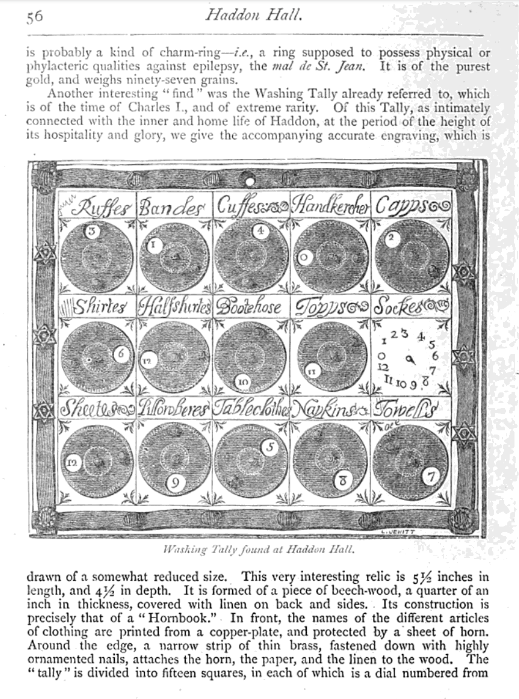
Over Haddon
Martha Taylor, “the fasting damsel”, was born in Over Haddon in 1649. She didn’t eat for almost two years before her death in 1684. One of the Quakers associated with the Marshall Quakers of Elton, John Gratton, visited the fasting damsel while he was living at Monyash, and occasionally “went two miles to see a woman at Over Haddon who pretended to live without meat.” from The Reliquary, 1861.
August 28, 2024 at 6:26 am #7548In reply to: The Elusive Samuel Housley and Other Family Stories
Elton Marshall’s
Early Quaker Emigrants to USA.
The earliest Marshall in my tree is Charles Marshall (my 5x great grandfather), Overseer of the Poor and Churchwarden of Elton. His 1819 gravestone in Elton says he was 77 years old when he died, indicating a birth in 1742, however no baptism can be found.
According to the Derbyshire records office, Elton was a chapelry of Youlgreave until 1866. The Youlgreave registers date back to the mid 1500s, and there are many Marshalls in the registers from 1559 onwards. The Elton registers however are incomplete due to fire damage.
While doing a google books search for Marshall’s of Elton, I found many American family history books mentioning Abraham Marshall of Gratton born in 1667, who became a Quaker aged 16, and emigrated to Pennsylvania USA in 1700. Some of these books say that Abraham’s parents were Humphrey Marshall and his wife Hannah Turner. (Gratton is a tiny village next to Elton, also in Youlgreave parish.)
Abraham’s son born in USA was also named Humphrey. He was a well known botanist.
Abraham’s cousin John Marshall, also a Quaker, emigrated from Elton to USA in 1687, according to these books.
(There are a number of books on Colonial Families in Pennsylvania that repeat each other so impossible to cite the original source)
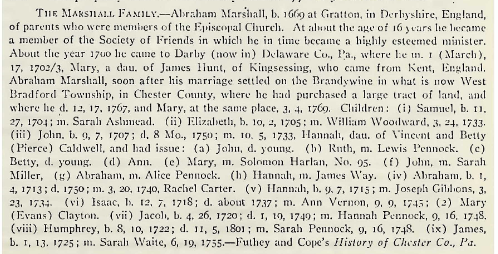
In the Youlgreave parish registers I found a baptism in 1667 for Humphrey Marshall son of Humphrey and Hannah. I didn’t find a baptism for Abraham, but it looks as though it could be correct. Abraham had a son he named Humphrey. But did it just look logical to whoever wrote the books, or do they know for sure? Did the famous botanist Humphrey Marshall have his own family records? The books don’t say where they got this information.
An earlier Humphrey Marshall was baptised in Youlgreave in 1559, his father Edmund. And in 1591 another Humphrey Marshall was baptised, his father George.
But can we connect these Marshall’s to ours? We do have an Abraham Marshall, grandson of Charles, born in 1792. The name isn’t all that common, so may indicate a family connection. The villages of Elton, Gratton and Youlgreave are all very small and it would seem very likely that the Marshall’s who went the USA are related to ours, if not brothers, then probably cousins.
Derbyshire Quakers
In “Derbyshire Quakers 1650-1761” by Helen Forde:
“… Friends lived predominantly in the northern half of the country during this first century of existence. Numbers may have been reduced by emigration to America and migration to other parts of the country but were never high and declined in the early eighteenth century. Predominantly a middle to lower class group economically, Derbyshire Friends numbered very few wealthy members. Many were yeoman farmers or wholesalers and it was these groups who dominated the business meetings having time to devote themselves to the Society. Only John Gratton of Monyash combined an outstanding ministry together with an organising ability which brought him recognition amongst London Friends as well as locally. Derbyshire Friends enjoyed comparatively harmonious relations with civil and Anglican authorities, though prior to the Toleration Act of 1639 the priests were their worst persecutors…..”
Also mentioned in this book: There were monthly meetings in Elton, as well as a number of other nearby places.
John Marshall of Elton 1682/3 appears in a list of Quaker emigrants from Derbyshire.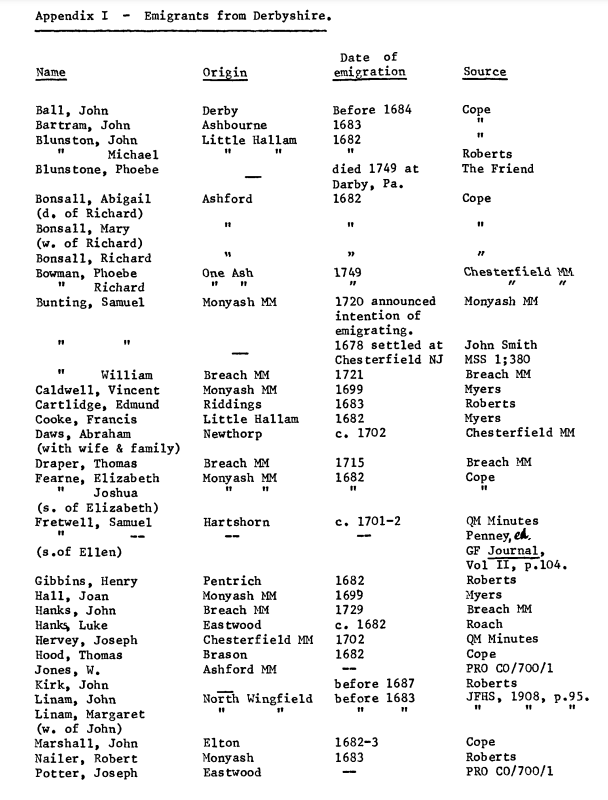
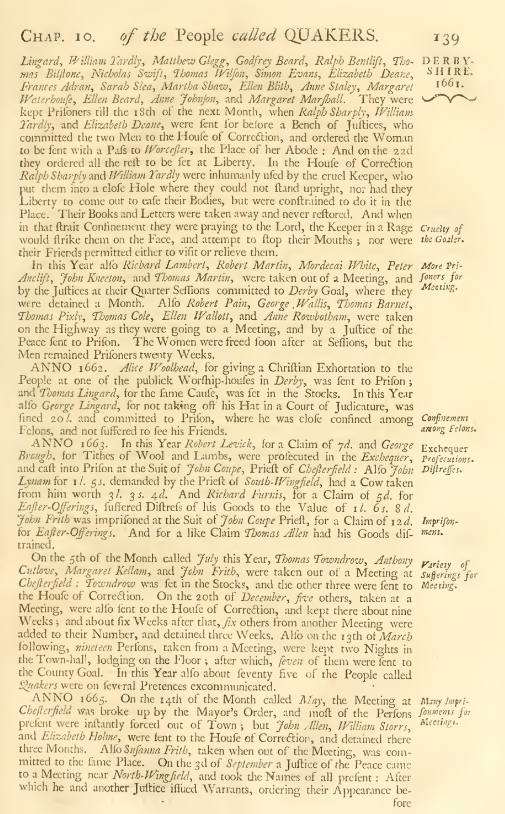
The following image is a page from the 1753 book on the sufferings of Quakers by Joseph Besse as an example of some of the persecutions of Quakers in Derbyshire in the 1600s:
A collection of the sufferings of the people called Quakers, for the testimony of a good conscience from the time of their being first distinguished by that name in the year 1650 to the time of the act commonly called the Act of toleration granted to Protestant dissenters in the first year of the reign of King William the Third and Queen Mary in the year 1689 (Volume 1)
Besse, Joseph. 1753Note the names Margaret Marshall and Anne Staley. This book would appear to contradict Helen Forde’s statement above about the harmonious relations with Anglican authority.
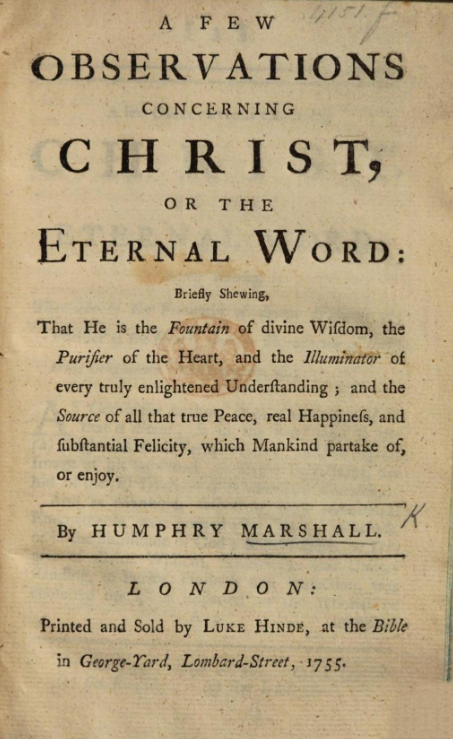
The Botanist
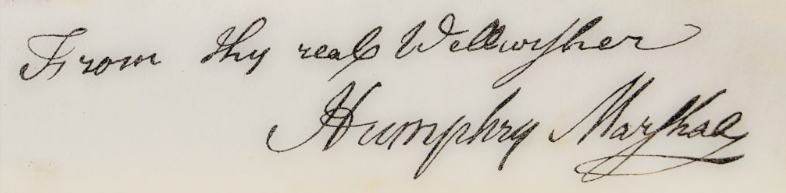
Humphry Marshall 1722-1801 was born in Marshallton, Pennsylvania, the son of the immigrant from Elton, Abraham Marshall. He was the cousin of botanists John Bartram and William Bartram. Like many early American botanists, he was a Quaker. He wrote his first book, A Few Observations Concerning Christ, in 1755.
In 1785, Marshall published Arbustrum Americanum: The American Grove, an Alphabetical Catalogue of Forest Trees and Shrubs, Natives of the American United States (Philadelphia).
Marshall has been called the “Father of American Dendrology”.
A genus of plants, Marshallia, was named in honor of Humphry Marshall and his nephew Moses Marshall, also a botanist.
In 1848 the Borough of West Chester established the Marshall Square Park in his honor. Marshall Square Park is four miles east of Marshallton.
via Wikipedia.
From The History of Chester County Pennsylvania, 1881, by J Smith Futhey and Gilbert Cope:
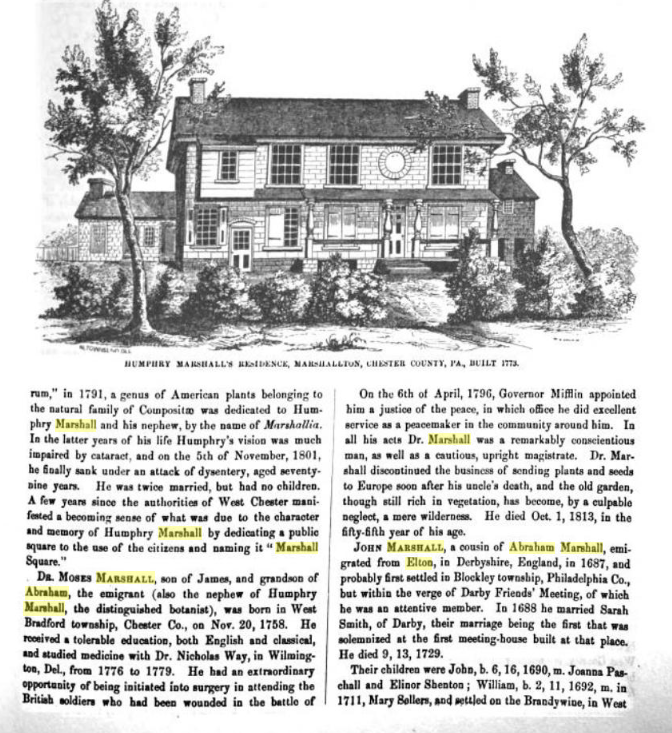
From The Chester Country History Center:
“Immediately on the Receipt of your Letter, I ordered a Reflecting Telescope for you which was made accordingly. Dr. Fothergill had since desired me to add a Microscope and Thermometer, and will
pay for the whole.’– Benjamin Franklin to Humphry, March 18, 1770
“In his lifetime, Humphry Marshall made his living as a stonemason, farmer, and miller, but eventually became known for his contributions to astronomy, meteorology, agriculture, and the natural sciences.
In 1773, Marshall built a stone house with a hothouse, a botanical laboratory, and an observatory for astronomical studies. He established an arboretum of native trees on the property and the second botanical garden in the nation (John Bartram, his cousin, had the first). From his home base, Humphry expanded his botanical plant exchange business and increased his overseas contacts. With the help of men like Benjamin Franklin and the English botanist Dr. John Fothergill, they eventually included German, Dutch, Swedish, and Irish plant collectors and scientists. Franklin, then living in London, introduced Marshall’s writings to the Royal Society in London and both men encouraged Marshall’s astronomical and botanical studies by supplying him with books and instruments including the latest telescope and microscope.
Marshall’s scientific work earned him honorary memberships to the American Philosophical Society and the Philadelphia Society for Promoting Agriculture, where he shared his ground-breaking ideas on scientific farming methods. In the years before the American Revolution, Marshall’s correspondence was based on his extensive plant and seed exchanges, which led to further studies and publications. In 1785, he authored his magnum opus, Arbustum Americanum: The American Grove. It is a catalog of American trees and shrubs that followed the Linnaean system of plant classification and was the first publication of its kind.”
 August 16, 2024 at 2:56 pm #7544
In reply to: The Elusive Samuel Housley and Other Family Stories
Youlgreave
The Frost Family and The Big Snow
The Youlgreave parish registers are said to be the most complete and interesting in the country. Starting in 1558, they are still largely intact today.
“The future historian of this parish will find a vast stock of material ready to hand, and if such a work was ever accomplished it would once more be seen how the history of even a remote village is but the history of the nation in little; how national victories were announced on the church bells, and national disasters by the proclamation of a form of prayer…”
J. Charles Cox, Notes on the Churches of Derbyshire, 1877.
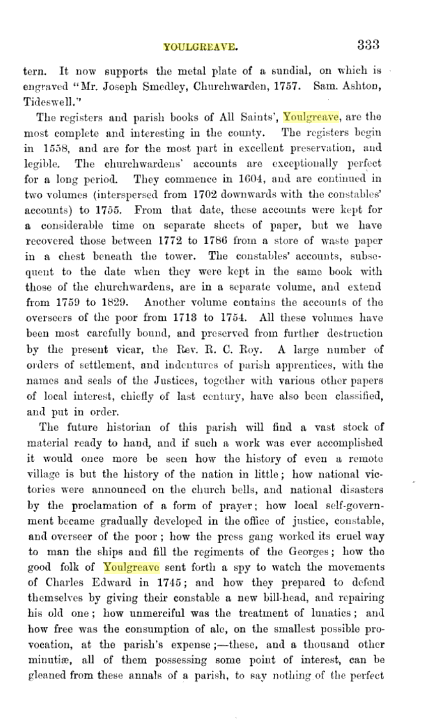
Although the Youlgreave parish registers are available online on microfilm, just the baptisms, marriages and burials are provided on the genealogy websites. However, I found some excerpts from the churchwardens accounts in a couple of old books, The Reliquary 1864, and Notes on Derbyshire Churches 1877.
Hannah Keeling, my 4x great grandmother, was born in Youlgreave, Derbyshire, in 1767. In 1791 she married Edward Lees of Hartington, Derbyshire, a village seven and a half miles south west of Youlgreave. Edward and Hannah’s daughter Sarah Lees, born in Hartington in 1808, married Francis Featherstone in 1835. The Featherstone’s were farmers. Their daughter Emma Featherstone married John Marshall from Elton. Elton is just three miles from Youlgreave, and there are a great many Marshall’s in the Youlgreave parish registers, some no doubt distantly related to ours.
Hannah Keeling’s parents were John Keeling 1734-1823, and Ellen Frost 1739-1805, both of Youlgreave.
On the burial entry in the parish registers in Youlgreave in 1823, John Keeling was 88 years old when he died, and was the “late parish clerk”, indicating that my 5x great grandfather played a part in compiling the “best parish registers in the country”. In 1762 John’s father in law John Frost died intestate, and John Keeling, cordwainer, co signed the documents with his mother in law Ann. John Keeling was a shoe maker and a parish clerk.
John Keeling’s father was Thomas Keeling, baptised on the 9th of March 1709 in Youlgreave and his parents were John Keeling and Ann Ashmore. John and Ann were married on the 6th April 1708. Some of the transcriptions have Thomas baptised in March 1708, which would be a month before his parents married. However, this was before the Julian calendar was replaced by the Gregorian calendar, and prior to 1752 the new year started on the 25th of March, therefore the 9th of March 1708 was eleven months after the 6th April 1708.
Thomas Keeling married Dorothy, which we know from the baptism of John Keeling in 1734, but I have not been able to find their marriage recorded. Until I can find my 6x great grandmother Dorothy’s maiden name, I am unable to trace her family further back.
Unfortunately I haven’t found a baptism for Thomas’s father John Keeling, despite that there are Keelings in the Youlgrave registers in the early 1600s, possibly it is one of the few illegible entries in these registers.
The Frosts of Youlgreave
Ellen Frost’s father was John Frost, born in Youlgreave in 1707. John married Ann Staley of Elton in 1733 in Youlgreave.
(Note that this part of the family tree is the Marshall side, but we also have Staley’s in Elton on the Warren side. Our branch of the Elton Staley’s moved to Stapenhill in the mid 1700s. Robert Staley, born 1711 in Elton, died in Stapenhill in 1795. There are many Staley’s in the Youlgreave parish registers, going back to the late 1500s.)
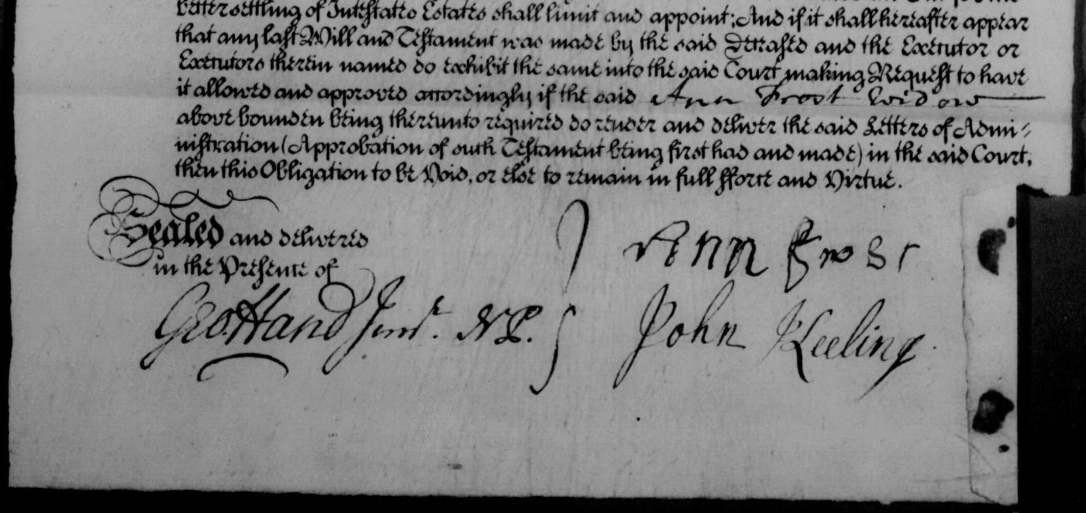
John Frost (my 6x great grandfather), miner, died intestate in 1762 in Youlgreave. Miner in this case no doubt means a lead miner, mining his own land (as John Marshall’s father John was in Elton. On the 1851 census John Marshall senior was mining 9 acres). Ann Frost, as the widow and relict of the said deceased John Frost, claimed the right of administration of his estate. Ann Frost (nee Staley) signed her own name, somewhat unusual for a woman to be able to write in 1762, as well as her son in law John Keeling.
John’s parents were David Frost and Ann. David was baptised in 1665 in Youlgreave. Once again, I have not found a marriage for David and Ann so I am unable to continue further back with her family. Marriages were often held in the parish of the bride, and perhaps those neighbouring parish records from the 1600s haven’t survived.
David’s parents were William Frost and Ellen (or Ellin, or Helen, depending on how the parish clerk chose to spell it). Once again, their marriage hasn’t been found, but was probably in a neighbouring parish.
William Frost’s wife Ellen, my 8x great grandmother, died in Youlgreave in 1713. In her will she left her daughter Catherine £20. Catherine was born in 1665 and was apparently unmarried at the age of 48 in 1713. She named her son Isaac Frost (born in 1662) executor, and left him the remainder of her “goods, chattels and cattle”.
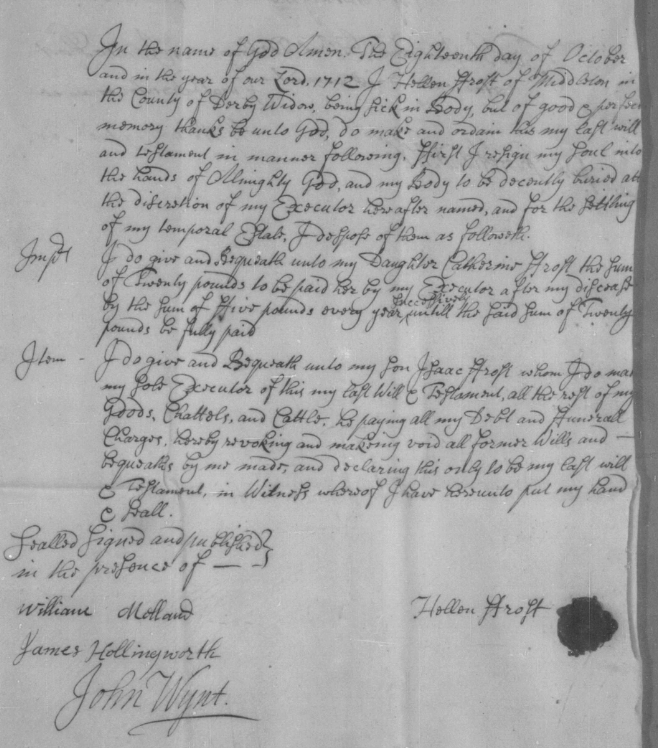
William Frost was baptised in Youlgreave in 1627, his parents were William Frost and Anne.
William Frost senior, husbandman, was probably born circa 1600, and died intestate in 1648 in Middleton, Youlgreave. His widow Anna was named in the document. On the compilation of the inventory of his goods, Thomas Garratt, Will Melland and A Kidiard are named.(Husbandman: The old word for a farmer below the rank of yeoman. A husbandman usually held his land by copyhold or leasehold tenure and may be regarded as the ‘average farmer in his locality’. The words ‘yeoman’ and ‘husbandman’ were gradually replaced in the later 18th and 19th centuries by ‘farmer’.)
Unable to find a baptism for William Frost born circa 1600, I read through all the pages of the Youlgreave parish registers from 1558 to 1610. Despite the good condition of these registers, there are a number of illegible entries. There were three Frost families baptising children during this timeframe and one of these is likely to be Willliam’s.
Baptisms:
1581 Eliz Frost, father Michael.
1582 Francis f Michael. (must have died in infancy)
1582 Margaret f William.
1585 Francis f Michael.
1586 John f Nicholas.
1588 Barbara f Michael.
1590 Francis f Nicholas.
1591 Joane f Michael.
1594 John f Michael.
1598 George f Michael.
1600 Fredericke (female!) f William.Marriages in Youlgreave which could be William’s parents:
1579 Michael Frost Eliz Staley
1587 Edward Frost Katherine Hall
1600 Nicholas Frost Katherine Hardy.
1606 John Frost Eliz Hanson.Michael Frost of Youlgreave is mentioned on the Derbyshire Muster Rolls in 1585.
(Muster records: 1522-1649. The militia muster rolls listed all those liable for military service.)
Frideswide:
A burial is recorded in 1584 for Frideswide Frost (female) father Michael. As the father is named, this indicates that Frideswide was a child.
(Frithuswith, commonly Frideswide c. 650 – 19 October 727), was an English princess and abbess. She is credited as the foundress of a monastery later incorporated into Christ Church, Oxford. She was the daughter of a sub-king of a Merica named Dida of Eynsham whose lands occupied western Oxfordshire and the upper reaches of the River Thames.)
An unusual name, and certainly very different from the usual names of the Frost siblings. As I did not find a baptism for her, I wondered if perhaps she died too soon for a baptism and was given a saints name, in the hope that it would help in the afterlife, given the beliefs of the times. Or perhaps it wasn’t an unusual name at the time in Youlgreave. A Fridesweda Gilbert was buried in Youlgreave in 1604, the spinster daughter of Francis Gilbert. There is a small brass effigy in the church, underneath is written “Frideswide Gilbert to the grave, Hath resigned her earthly part…”
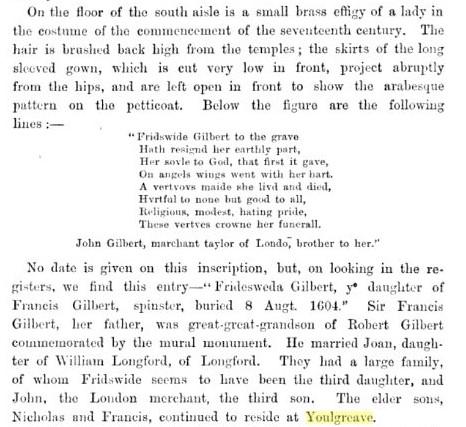
J. Charles Cox, Notes on the Churches of Derbyshire, 1877.
King James
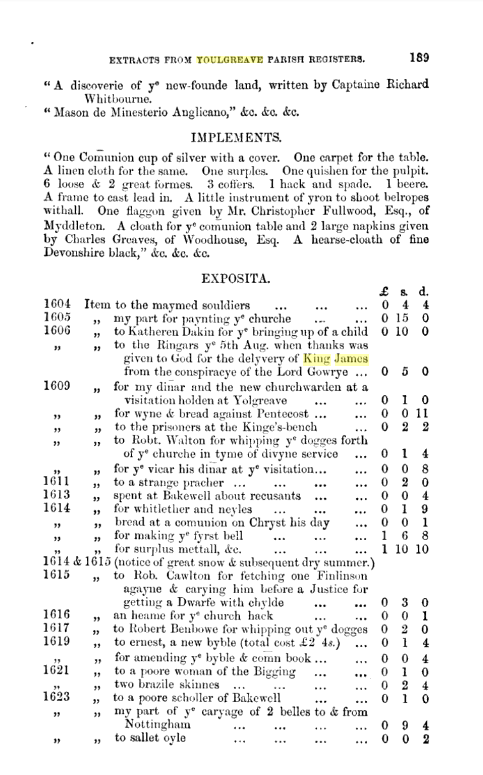
A parish register entry in 1603:
“1603 King James of Skottland was proclaimed kinge of England, France and Ireland at Bakewell upon Monday being the 29th of March 1603.” (March 1603 would be 1604, because of the Julian calendar in use at the time.)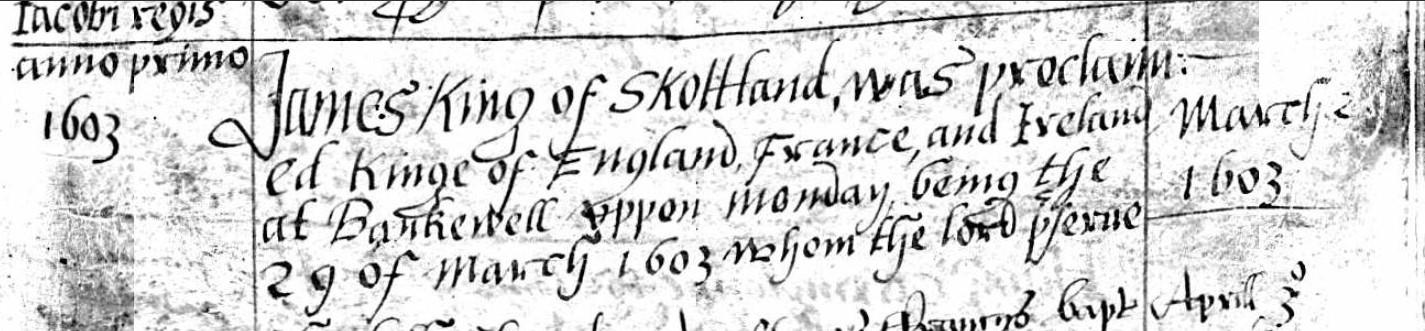
The Big Snow
“This year 1614/5 January 16th began the greatest snow whichever fell uppon the earth within man’s memorye. It covered the earth fyve quarters deep uppon the playne. And for heaps or drifts of snow, they were very deep; so that passengers both horse or foot passed over yates, hedges and walles. ….The spring was so cold and so late that much cattel was in very great danger and some died….”
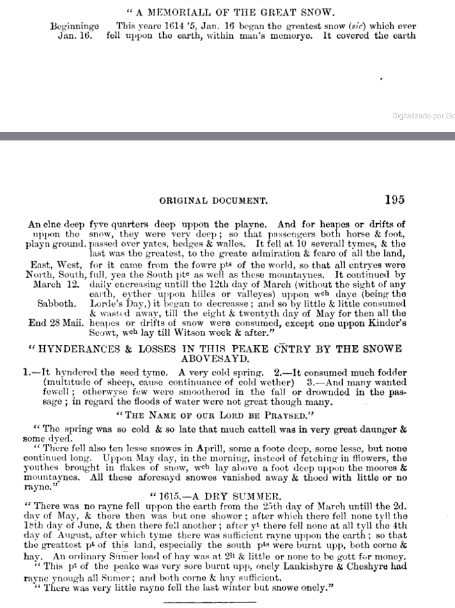
From the Youlgreave parish registers.
Our ancestor William Frost born circa 1600 would have been a teenager during the big snow.
July 25, 2024 at 7:58 am #7542In reply to: The Incense of the Quadrivium’s Mystiques
Shivering, Truella pulled the thin blanket over her head. Colder than a witches tit here, colder in summer than winter at home! It was no good, she may as well get up and go for a walk to try and warm up. Poking her head outside Truella gasped and coughed at the chill air. Shapes were becoming discernible in the dim pre dawn light, the other pods, the hedgerow, a couple of looming trees. Truella rummaged through her bag, hoping to find warm clothes yet knowing she hadn’t packed anything warm enough. Sighing, her teeth chattering, she pulled on everything she had in layers and pulled the blanket off the bed to use as a cape. With a towel over her head for extra warmth, she ventured out into the Irish morning.
The grass was sodden with dew and Truella’s feet were wet through and icy. Bracing her shoulders with determination, she forged ahead towards a gate leading into the next field. She struggled for a few minutes with the baler twine holding the gate closed, numb fingers refusing to cooperate. Cows watched her curiously, slowly munching. One lifted her tail and dropped a steaming splat on the grass, chewing continuously. I don’t think I could eat and do that at the same time.
Heading off across the field which sloped gently upwards, Treulla picked up her pace, keeping her eyes down to avoid the cow pats. By the time she reached the oak tree along the top hedge, the sun started to make an appearance over the hill. Warmer from the exercise, she gazed over the countryside. How beautiful it was with the mist in the valleys, and everything so green.
If only it was warmer!
“Are you cold then, is that why you’re decked out like that? From a distance I thought I was seeing a ghost in a cloak and head shawl!” The woman smiled at Truella from the other side of the hedgerow. “Sorry, did I startle you? You’ll get your feet soaked walking in that wet grass, climb over that stile over there, the lane here’s better for a morning walk.”
It sounded like good advice and the woman seemed pleasant enough. “Are you here for the games too?” Truella asked, readjusting the blanket and towel after navigating the stile.
“Yes, I am. I’m retired, you see,” the woman said with a wide grin. “It’s a wonderful thing, not that you’d know, you’re much to young.”
“That must be nice,” Truella replied politely. “I sometimes wish I was retired.”
“Oh, my dear! It’s wonderful! I haven’t had a job for years, but it’s the strangest thing, now that I’ve officially retired, there’s a marvellous feeling of freedom. I don’t have to do anything. Well, I didn’t have to do anything before I retired but one always feels one should keep busy, do productive things, be seen to be doing some kind of work to justify ones existance. Have you seen the old priory?”
“No, only just got here yesterday.”
“You’ll love it, it’s up this path here, follow me. But now I’ve retired,” the woman continued, “I get up in the morning with a sense of liberation. I can do as little as I want ~ funny thing is that I’ve actually been doing more, but there’s no feeling of obligation, no things to cross off a list. All I’m expected to do as a retired person is tick along, trying not to be much of a bother for as long as I can.”
“I wish I was retired!” exclaimed Truella with feeling. “I wish I didn’t have to do the cow goddess stall, it’ll be such a bind having to stand there all evening.” She explained about the coven and the stalls, and the depressing productivity goals.
“But why not get someone else to do the stall for you?”
“It’s such short notice and I don’t know anyone here. It’s an idea though, maybe someone will turn up.”
July 18, 2024 at 2:29 pm #7535In reply to: The Incense of the Quadrivium’s Mystiques
It made sense to go to Ireland during the hot Andalucian summer, and it hadn’t taken much to convince Truella to take a break from her dig and her research. Thousands of years of history would still be there waiting for her when she got home, and it would be a pleasure to see some green lawns and fields. Maybe it would rain, indeed, it was likely that it would. And by the time the Roman Games were over, there would be less of the hot summer at home to endure. Still, it was a nuisance to have to get her winter clothes down out of the attic. She was sure to find it chilly, even cold.
Truella was not fond of water sports (or any sports, but particularly those involving water) and unfortunately the focus of the games seemed to be on swimming and boating. But one of the events has captured her interest. A miniaturisation spell was required, which contestants had to provide themselves, for the Puddles in Potholes races. The worst road in Limerick would be cordoned off and all the potholes filled with water (if they weren’t already full of rain water, which was likely). When Eris pointed out that a miniaturised person could drown in a puddle as easily as a full sized one could drown in a lake, Truella was ready with her answer. If she was drowning, she would immediately reverse the spell and resume her full size. Eris had raised an eyebrow, remarking that she had better make sure her spell was up to scratch, unlike her incense spells had been. Jeezel had wanted to know why she couldn’t just make an enlarging spell and just swim in the river, to which Truella has replied that she didn’t know how deep the river was and how much enlarging would be required. Snorting, Frella said she obviously didn’t know how deep the potholes in Limerick were.
Austreberthe had put their names down for the donkey chariot races, for which they had three days when they arrived to construct the cart and make the costumes. Luckily Frella had plenty of local contacts, and had willingly taken charge of assembling all the materials.
The Booths of the Gods would require some thought. Which Roman god would she choose to be? Which special godly power could she make a spell for? Truella sighed, and went to find her book of Roman gods and goddesses.
June 25, 2024 at 9:06 pm #7524In reply to: The Incense of the Quadrivium’s Mystiques
The obvious place to start with investigations into the history of the Morticians Guild was to question Rufus. But first she needed to think. Truella made her way to her room, and locked the door. At least now that Eris was back so soon, Truella was free to let Eris get on with whatever she was doing. After lowering the blinds at the windows, she lay back on the bed and closed her eyes. As she started to drift off to sleep, an imaginary conversation ran through her head.
Rufus: “The Morticians’ Guild, originally known as the ‘Necro-Keepers,’ trace their lineage back to ancient Egypt. They were the guardians of rites that ensured the safe passage of souls to the afterlife. Over millennia, they adapted and evolved, absorbing arcane knowledge from various cultures—the Greeks with their Eleusinian Mysteries, the Romans with their burial rites, even the Celtic traditions of Samhain.”
Truella: “That’s fascinating. So, this ancient craft has been handed down through generations?”
Rufus: “Precisely. While Hildegarde von Bingen brought enlightenment and medicinal wisdom to her nuns in the 12th century, the Morticians’ practices were already etched in the annals of history. They operated in silence, often in the shadows, perfecting the skills of embalming, necromancy, and spirit communication.”
Truella: “And what about their presence here, in this coven merger?”
Rufus: “We’ve been called upon at times of great need, when balance must be maintained between the living and the dead. Our presence here isn’t coincidental. The dragons and ancient spirits awaken, and we, the keepers, ensure that not all realms collide irreversibly.”
Truella: “So, would you say the Guild has played a role in significant historical events?”
Rufus: “Indeed. We’ve been the unsung heroes, the silent watchers. From plagues to wars, ensuring the dead find peace and don’t linger to disrupt the world of the living. Our methods may have modernized, but our core purpose remains unchanged. The knowledge, the rituals—they are our legacy.”
Truella: “Thank you, Rufus. That’s more fascinating than a year’s worth of ancient spellbooks.”
Rufus: “You’re welcome, Truella. Just remember, history isn’t merely dates and names; it’s living through us, weaving its magic continuously.”
June 17, 2024 at 8:18 pm #7495In reply to: Smoke Signals: Arcanas of the Quadrivium’s incense
Cedric Spellbind:

Cedric Spellbind stood tall, though not imposing, with a wiry frame that belied his years of rigorous witch-hunting. His eyes, a piercing green, darted nervously beneath the brim of his deerstalker hat, giving him the appearance of a man constantly on edge. A seasoned agent of MAMA, he carried an air of determined resolve, despite his recent demotion to desk duty in Limerick.
With a face that seemed perpetually caught between youthful eagerness and a weariness beyond his years, Cedric was a man marked by his contradictions. His dark hair, often disheveled from restless nights, framed a face etched with the lines of a life spent in pursuit of the arcane and the elusive.
Clad in a trench coat that had seen better days, Cedric’s attire was a patchwork of practicality and the remnants of a more distinguished past. Despite his amateurish attempts at stealth and the financial strains of his profession, Cedric’s spirit remained unbroken. He was a man driven by a fascination with the unknown and a cautious curiosity, particularly when it came to the enigmatic Frigella O’Green.
Yet, beneath the veneer of a bumbling spy, there lay a heart of determination and a mind constantly strategizing, always ready to seize the next opportunity to prove his worth in the clandestine world of witch hunting.
June 16, 2024 at 7:00 am #7485In reply to: The Incense of the Quadrivium’s Mystiques
The Quintessivium Cloister Crafts was busying getting ready to complete this year’s midsummer fashion tour.
Mother Blaen (Lorena in private), started to clap bossily to line up all the sisters for the rehearsal.
“Yes, Sister Maria, you start, Black habit and white wimple, Roman Catholic timeless elegance, perfect. And think to wipe that smile off your face. You need to show spirit of devotion.”
She swiftly moved to her right.
“Now, Sister Ananda.”
Sassafrass was starting to argue about the naming convention that felt a bit too Actors studio for her taste, but was promptly shushed. Mother Blaen took a closer look, adjusting her half-rimmed glasses. “Oh… dear, I thought for a moment you’d gotten fat. Must be the lighting. So, in the vibrant orange of bhikkhunis, you glide gracefully… well, as much as you can. Peace and calm, that’s you. Yes, and don’t make a scene please. Be content I’m not asking you to shave this hair to get more in character with the robes.”
She pursued:
“Sister Amina!”
Penelope Pomfrett raised her hand silently, visibly displeased too at the name.
“Good, now. Mystical and poetic nature of Sufism, that’s your cue. Beautiful, beautiful. That modest and pure white chola and headscarf will be resplendent on the catwalk.”
After she went through all the attires in detail, down to the long black riassa and epanokamelavkion of the Eastern Orthodox nun garb, all were getting ready for the grand finale.
“Now, all of us, walking together to symbolize the unity and diversity of spiritual paths. One, two, one two. Sassafrass! Focus please!”
Mother Blaen clapped, visibly pleased at the full on display of their Coven’s couture arts. That would put a good show for the smoking witches. She thought “Let them bring the money, but one thing is sure, we bring the talent.”
June 11, 2024 at 6:51 am #7467In reply to: The Incense of the Quadrivium’s Mystiques
As the crow flies, the Airbnb was about 500 meters from Herma’s cottage. Frella had been too exhausted yesterday to appreciate how pretty the mossy brick path was, lined either side with a profusion of colourful flowers. But was it really just yesterday, she wondered? So much had happened back at the coven — as recounted in a relentless flow of messages from Truella. Time was a funny beast.
As they walked the winding path, Herma explained that, many years ago now, the prior owner of the cottage had left behind a number of his belongings with the promise he would return for them as soon as he was settled. “But the blighter never did come back and I never heard from him again.” She stopped just short of the gate to her cottage and waved an arm towards a big old shed with a tractor parked outside and a couple of sheep grazing contentedly. “We stuck his stuff in there in the end when he didn’t come back. I know there’s a camphor chest — it nearly broke my back — but I don’t know what’s in it. Do you think that might be it?”
Unfortunately Frella was distracted from replying right away by another volley of messages from Truella with the latest mind boggling developments.
June 5, 2024 at 11:18 pm #7451In reply to: The Incense of the Quadrivium’s Mystiques
Madeira! Good grief,” murmured Frella when she read Truella’s message. Of course Madeira! Not some godforsaken Airbnb on a gloomy coast that smelt of rotting fish and doom … and just because Malove recommended it! She felt the familiar wave of anxiety which thoughts of Malove tended to evoke in her and took a couple of deep steadying breaths. Why Malove had recommended this place was beyond her comprehension but there had surely been strange undercurrents in the coven of late.
Frella was still wondering how to respond to Truella’s message; it was galling to have to admit she was right, when there was a sharp knock on the door. In no mood for visitors of any description, Frella considered ignoring it. Next moment there was a sound of the key rattling in the lock.
“Look at that! You are here!” cried Herma as she burst into the room. Her voice held a hint of reproach and Frella stuttered awkwardly that she’d been about to answer.
“Oh tut tut don’t you worry!” She plonked down next to Frella on the sofa causing it to creak under her not inconsiderable weight. “Ah, that’s better, haven’t I been racing around all morning.” She smiled at Frella. “Lordy, but I know what you witches are like; I’ve had enough of you lot stay here through the years. I’m surprised you didn’t cast one of them invisibility spells you’re all so good at!” She laughed heartily and Frella forced herself to chuckle in response. Then they lapsed into silence.
“Can I get you a cup of tea?” asked Frella eventually, much as she was loath to encourage Herma who appeared to be fixated on the mat. Frella couldn’t see anything amiss although the mat was arguably a little garish with its multi-coloured checkerboard pattern.
“It’s not tea I’m after,” said Herma. “It’s your help I need.”
April 12, 2024 at 7:59 pm #7430In reply to: The Incense of the Quadrivium’s Mystiques
“Of course I know,” said Eris, looking worn out by the excess of social interaction, or maybe that was her latest goth make-up. “Have I been the only one paying attention?”
“Shtt, don’t speak too loud, my head is pounding…” Jeezel moaned softly. “And what is happening with us?”
“You haven’t got it, have you? Should I spell it out loud?” Eris glanced sideways, wary of Malové being within earshot. “It was all a test… but I don’t see us getting in the good graces of the Coven with was has transpired so far.”
Truella tugged at Frigella’s sleeve, as she went to refill her plate and had noticed the impromptu discussion which was suspiciously conspirational. Frigella groaned “don’t wake up Yikes, look how cutie pooh he is.”
Truella motioned for them to join Eris and Jeezel, who grimaced at the sight of Truella’s questionable cheese selection. “What’s going on? We want in.”
Eris sighed. “Fine, but not here. Let’s get some fresh air.” As discreetly as a herd of elephant in a dry savanah, they made their way to the terrace, escaping the breakfast room which was getting crowded, to bask in the morning sunlight.
As they settled in, Eris began to explain. “I think it’s a side-effect of my memory spell, that unexpectedly, I still remember most of it.”
“Spill it already, they’re about to close the buffet, and the morning sessions are starting soon, and we can’t be late,” Truella urged, fidgeting impatiently.
“You see, that’s exactly it, Tru’. None of us have been ourselves. And do you really think that baby is a coincidence?” She nodded towards Frigella, who was cooing over the sleeping infant.
“First off, have you noticed, this workshop is meant for the top brass. Only the high-rank witches of the Coven have been invited, and you don’t even think twice about why we’re here. Malové has been setting us to a test amongst her next in line. We’ve been in competition since the start with the other witches, and you didn’t even notice! They were apparently more prepared than us lot. They managed to honeypot Frigella with a baby which I’m pretty sure is nothing more than a transformed rodent. As for Truella, the spell on her must have started on the Octobus; not sure you’ve noticed, but when we stopped on our way to collect the other ones, that’s when she started to get sick and get all sorts of strange cravings.”
“But… what’s the point?” Jeezel asked, still bewildered. “Is that why I can’t get my hair right, and my eye makeup is a disaster, and… and…” She choked back tears.
“These witches are fiercely competitive. And probably less skilled that us, which is why they will not play fair; we’ve got to step up ladies. Otherwise, we’ll be on tuspellware duties for years until some opportunity like that happens again.” Eris was getting fired up, an unusual sight for someone generally mildly interested in office politics.
“Truella!” Eris called out as Truella was starting to gorge on the cornichons she’d piled up next to the fromages assemblage. “You’re presenting in the morning session! Malové is counting on you to update us on the vaping venture… new sales channels, market studies, double-digit growth, you know the drill.”
Truella seemed to snap out of her daze. “Don’t tell me,” Eris sighed, “you forgot… Luckily, I have a memory for all of us, and I brewed some ginkgo potion this morning.” She produced an orange flask with black tea stains around the edges, and poured it into glasses she conjured.
“Now bottoms up, ladies. We’ve got a presentation to nail and some witches to put in their place.”
-
AuthorSearch Results