


Search Results for 'young'
-
AuthorSearch Results
-
December 9, 2024 at 4:15 pm #7659
In reply to: Quintessence: Reversing the Fifth
March 2024
The phone buzzed on the table as Lucien pulled on his scarf, preparing to leave for the private class he had scheduled at his atelier. He glanced at the screen and froze. His father’s name glared back at him.
He hesitated. He knew why the man called; he knew how it would go, but he couldn’t resolve to cut that link. With a sharp breath he swiped to answer.
“Lucien”, his father began, his tone already full of annoyance. “Why didn’t you take the job with Bernard’s firm? He told me everything went well in the interview. They were ready to hire you back.”
As always, no hello, no question about his health or anything personal.
“I didn’t want it”, Lucien said, his voice calm only on the surface.
“It’s a solid career, Lucien. Architecture isn’t some fleeting whim. When your mother died, you quit your position at the firm, and got involved with those friends of yours. I said nothing for a while. I thought it was a phase, that it wouldn’t last. And I was right, it didn’t. I don’t understand why you refuse to go back to a proper life.”
“I already told you, it’s not what I want. I’ve made my decision.”
Lucien’s father sighed. “Not what you want? What exactly do you want, son? To keep scraping by with these so-called art projects? Giving private classes to kids who’ll never make a career out of it? That’s not a proper life?”
Lucien clenched his jaw, gripping his scarf. “Well, it’s my life. And my decisions.”
“Your decisions? To waste the potential you’ve been given? You have talent for real work—work that could leave a mark. Architecture is lasting. What you are doing now? It’s nothing. It’s just… air.”
Lucien swallowed hard. “It’s mine, Dad. Even if you don’t understand it.”
A pause followed. Lucien heard his father speak to someone else, then back to him. “I have to go”, he said, his tone back to professional. “A meeting. But we’re not finished.”
“We’re never finished”, Lucien muttered as the line went dead.

Lucien adjusted the light over his student’s drawing table, tilting the lamp slightly to cast a softer glow on his drawing. The young man—in his twenties—was focused, his pencil moving steadily as he worked on the folds of a draped fabric pinned to the wall. The lines were strong, the composition thoughtful, but there was still something missing—a certain fluidity, a touch of life.
“You’re close,” Lucien said, leaning slightly over the boy’s shoulder. He gestured toward the edge of the fabric where the shadows deepened. “But look here. The transition between the shadow and the light—it’s too harsh. You want it to feel like a whisper, not a line.”
The student glanced at him, nodding. Lucien took a pencil and demonstrated on a blank corner of the canvas, his movements deliberate but featherlight. “Blend it like this,” he said, softening the edge into a gradient. “See? The shadow becomes part of the light, like it’s breathing.”
The student’s brow furrowed in concentration as he mimicked the movement, his hand steady but unsure. Lucien smiled faintly, watching as the harsh line dissolved into something more organic. “There. Much better.”
The boy glanced up, his face brightening. “Thanks. It’s hard to see those details when you’re in it.”
Lucien nodded, stepping back. “That’s the trick. You have to step away sometimes. Look at it like you’re seeing it for the first time.”
He watched as the student adjusted his work, a flicker of satisfaction softening the lingering weight of his father’s morning call. Guiding someone else, helping them see their own potential—it was the kind of genuine care and encouragement he had always craved but never received.
When Éloïse and Monsieur Renard appeared in his life years ago, their honeyed words and effusive praise seduced him. They had marveled at his talent, his ideas. They offered to help with the shared project in the Drôme. He and his friends hadn’t realized the couple’s flattery came with strings, that their praise was a net meant to entangle them, not make them succeed.
The studio door creaked open, snapping him back to reality. Lucien tensed as Monsieur Renard entered, his polished shoes clicking against the wooden floor. His sharp eyes scanned the room before landing on the student’s work.
“What have we here?” He asked, his voice bordering on disdain.
Lucien moved in between Renard and the boy, as if to protect him. His posture stiff. “A study”, he said curtly.
Renard examined the boy’s sketch for a moment. He pulled out a sleek card from his pocket and tossed it onto the drawing table without looking at the student. “Call me when you’ve improved”, he said flatly. “We might have work for you.”
The student hesitated only briefly. Glancing at Lucien, he gathered his things in silence. A moment later, the door closed behind the young man. The card remained on the table, untouched.
Renard let out a faint snort, brushing a speck of dust from his jacket. He moved to Lucien’s drawing table where a series of sketches were scattered. “What are these?” he asked. “Another one of your indulgences?”
“It’s personal”, he said, his voice low.
Renard snorted softly, shaking his head. “You’re wasting your time, Lucien. Do as you’re asked. That’s what you’re good at, copying others’ work.”
Lucien gritted his teeth but said nothing. Renard reached into his jacket and handed Lucien a folded sheet of paper. “Eloïse’s new request. We expect fast quality. What about the previous one?”
Lucien nodded towards the covered stack of canvases near the wall. “Done.”
“Good. They’ll come tomorrow and take the lot.”
Renard started to leave but paused, his hand on the doorframe. He said without looking back: “And don’t start dreaming about becoming your own person, Lucien. You remember what happened to the last one who wanted out, don’t you?” The man stepped out, the sound of his steps echoing through the studio.
Lucien stared at the door long after it had closed. The sketches on his table caught his eyes—a labyrinth of twisted roads, fragmented landscapes, and faint, familiar faces. They were his prayers, his invocation to the gods, drawn over and over again as though the repetition might force a way out of the dark hold Renard and Éloïse had over his life.
He had told his father this morning that he had chosen his life, but standing here, he couldn’t lie to himself. His decisions hadn’t been fully his own these last few years. At the time, he even believed he could protect his friends by agreeing to the couple’s terms, taking the burden onto himself. But instead of shielding them, he had only fractured their friendship and trapped himself.
Lucien followed the lines of one of the sketches absently, his fingers smudging the charcoal. He couldn’t shake off the feeling that something was missing. Or someone. Yes, an unfathomable sense that someone else had to be part of this, though he couldn’t yet place who. Whoever it was, they felt like a thread waiting to tie them all together again.
He knew what he needed to do to bring them back together. To draw it where it all began, where they had dreamed together. Avignon.December 7, 2024 at 11:52 am #7653In reply to: Quintessence: Reversing the Fifth
Matteo — Winter 2023: The Move
The rumble of the moving truck echoed faintly in the quiet residential street as Matteo leaned against the open door, arms crossed, waiting for the signal to load the boxes. He glanced at the crisp winter sky, a pale gray threatening snow, and then at the house behind him. Its windows were darkened by empty rooms, their once-lived-in warmth replaced by the starkness of transition. The ornate names artistically painted on the mailbox struck him somehow. Amei & Tabitha M.: his clients for the day.
The cold damp of London’s suburbia was making him long even more for the warmth of sunny days. With the past few moves he’s been managing for his company, the tipping had been generous; he could probably plan a spring break in South of France, or maybe make a more permanent move there.
The sound of the doorbell brought him back from his rêverie.
Inside the house, the faint sounds of boxes being taped and last-minute goodbyes carried through the hallways. Matteo had been part of these moves too many times to count now. People always left a little bit of themselves behind—forgotten trinkets, echoes of old conversations, or the faint imprint of a life lived. It was a rhythm he’d come to expect, and he knew his part in it: lift, carry, and disappear into the background.
Matteo straightened as the door opened and a girl that could have been in her early twenties, but looked like a teenager stepped out, bundled against the cold. She held a steaming mug in one hand and balanced a box awkwardly on her hip with the other.
“That’s the last of it,” she called over her shoulder. “Mum, are you sure you don’t want me to take the notebooks?”
“They’re fine in the car, Tabitha!” A voice—calm and steady, maybe tinged with weariness—floated from inside.
The girl named Tabitha turned to Matteo, offering the box. “This is fragile,” she said, a smile tugging at her lips. “Be nice to it.”
Matteo took the box carefully, glancing at the mug in her hand. “You’re not leaving that behind, are you?” he asked with a faint smile.
Tabitha laughed. “This? No way. That’s my lifeline. The mug stays.”
As Matteo carried the box to the truck, his eyes caught on something inside—a weathered postcard tucked haphazardly between the pages of a journal. The image on the front was striking: a swirling green fairy, dancing above a glass of absinthe. La Fée Verte was scrawled in looping letters across the top.
“Tabitha!” Her mother’s voice carried out to the driveway, and Matteo turned instinctively. She stepped out onto the porch, her scarf wrapped loosely around her neck, her breath visible in the chilly air. Matteo could see the resemblance—the same poise and humor in her gaze, though softened by something older, quieter.
“Put this somewhere, will you” she said, holding up another postcard, this one with a faded image of a winding mountain road.
Tabitha grinned, stepping forward to take it. “Thanks, Mum. That one’s special.” She tucked it into her coat pocket.
“Special how?” her mother asked lightly.
“It’s from Darius,” Tabitha said, her tone almost teasing. “… The one you never want to talk about.” she leaned teasingly. “One of his cryptic postcards —too bad I was too young to really remember him, he must have been fun to be around.”
Matteo’s ears perked at the name, though he kept his head down, settling the box in place. It wasn’t unusual to overhear snippets like this during a move, but something about the unusual name roused his curiosity.
“Why you want to keep those?” Amei asked, tilting her head.
Tabitha shrugged. “They’re kind of… a map, I guess. Of people, not places.”
Amei paused, her expression softening. “He was always good at that,” she murmured, almost to herself.
The conversation lingered in Matteo’s mind as the day went on. By the time the truck was loaded, and he’d helped arrange the last of the boxes in Amei’s new, smaller apartment, the name and the postcard had taken root.
As Matteo stacked the final piece of furniture—a worn bookshelf—against the living room wall, he noticed Amei lingering near a window, her gaze distant.
“It’s different, isn’t it?” she said suddenly, not looking at him.
“Moving?” Matteo asked, unsure if the question was for him.
“Starting over,” she clarified, her voice quieter now. “Feels smaller, even when it’s supposed to be lighter.”
Matteo didn’t reply, sensing she wasn’t looking for an answer. He stepped back, nodding politely as she thanked him and disappeared into the kitchen.
The postcard stuck in his mind for days after. Matteo had heard of absinthe before, of course—its mystique, its history—but something about the way Tabitha had called the postcard a “map of people” resonated.
By the time spring arrived, Matteo was wandering through Avignon, chasing vague curiosities and half-formed questions. When he saw Lucien crouched over his chalk labyrinth, the memory of the postcard rose unbidden.
“Do you know where I can find absinthe?” he asked, the question more instinct than intent.
Lucien’s raised eyebrow and faint smile felt like another piece clicking into place. The connections were there—threads woven in patterns he couldn’t yet see. But for the first time in months, Matteo felt he was back on the right path.
December 7, 2024 at 11:18 am #7652In reply to: Quintessence: Reversing the Fifth
Darius: The Call Home
South of France: Early 2023
Darius stared at the cracked ceiling of the tiny room, the faint hum of a heater barely cutting through the January chill. His breath rose in soft clouds, dissipating like the ambitions that had once kept him moving. The baby’s cries from the next room pierced the quiet again, sharp and insistent. He hadn’t been sleeping well—not that he blamed the baby.
The young couple, friends of friends, had taken him in when he’d landed back in France late the previous year, his travel funds evaporated and his wellness “influencer” groups struggling to gain traction. What had started as a confident online project—bridging human connection through storytelling and mindfulness—had withered under the relentless churn of algorithm changes and the oversaturated market: even in its infancy, AI and its well-rounded litanies seemed the ubiquitous answers to humanities’ challenges.
“Maybe this isn’t what people need right now,” he had muttered during one of his few recent live sessions, the comment section painfully empty.
The atmosphere in the apartment was strained. He felt it every time he stepped into the cramped kitchen, the way the couple’s conversation quieted, the careful politeness in their questions about his plans.
“I’ve got some things in the works,” he’d say, avoiding their eyes.
But the truth was, he didn’t.
It wasn’t just the lack of money or direction that weighed on him—it was a gnawing sense of purposelessness, a creeping awareness that the threads he’d woven into his identity were fraying. He could still hear Éloïse’s voice in his mind sometimes, low and hypnotic: “You’re meant to do more than drift. Trust the pattern. Follow the pull.”
The pull. He had followed it across continents, into conversations and connections that felt profound at the time but now seemed hollow, like echoes in an empty room.
When his phone buzzed late one night, the sound startling in the quiet, he almost didn’t answer.
“Darius,” his aunt’s voice crackled through the line, faint but firm. “It’s time you came home.”
Arrival in Guadeloupe
The air in Pointe-à-Pitre was thick and warm, clinging to his skin like a second layer. His aunt met him at the airport, her sharp gaze softening only slightly when she saw him.
“You look thin,” she said, her tone clipped. “Let’s get you fed.”
The ride to Capesterre-Belle-Eau was a blur of green —banana fields and palms swaying in the breeze, the mountains rising in the distance like sleeping giants. The scent of the sea mingled with the earthy sweetness of the land, a sharp contrast to the sterile chill of the south of France.
“You’ll help with the house,” his aunt said, her hands steady on the wheel. “And the fields. Don’t think you’re here to lounge.”
He nodded, too tired to argue.
The first few weeks felt like penance. His aunt was tireless, moving with an energy that gainsaid her years, barking orders as he struggled to keep up.
“Your hands are too soft,” she said once, glancing at his blistered palms. “Too much time spent talking, not enough doing.”
Her words stung, but there was no malice in them—only a brutal honesty that cut through his haze.
Evenings were quieter, spent on the veranda with plates of steaming rice and codfish, with the backdrop of cicadas’ relentless and rhythmic agitation. She didn’t ask about his travels, his work, or the strange detours his life had taken. Instead, she told stories—of storms weathered, crops saved, neighbors who came together when the land demanded it.
A Turning Point
One morning, as the sun rose over the fields, his aunt handed him a machete.
“Today, you clear,” she said.
He stood among the ruined banana trees, their fallen trunks like skeletal remains of what had once been vibrant and alive. The air was heavy with the scent of damp earth and decay.
With each swing of the machete, he felt something shift inside him. The physical labor, relentless and grounding, pulled him out of his head and into his body. The repetitive motion—strike, clear, drag—was almost meditative, a rhythm that matched the heartbeat of the land.
By midday, his shirt clung to his back, soaked with sweat. His muscles ached, his hands stung, but for the first time in months, his mind felt quiet.
As he paused to drink from a canteen, his aunt approached, a rare smile softening her stern features.
“You’re starting to see it, aren’t you?” she said.
“See what?”
“That life isn’t just what you chase. It’s what you build.”
Over time, the work became less about obligation and more about integration. He began to recognize the faces of the neighbors who stopped by to lend a hand, their laughter and stories sending vibrant pulsating waves resonant of a community he hadn’t realized he missed.
One evening, as the sun dipped low, a group gathered to share a meal. Someone brought out drums, the rhythmic beat carrying through the warm night air. Darius found himself smiling, his feet moving instinctively to the music.
The trance of Éloïse’s words—the pull she had promised—dissipated like smoke in the wind. What remained was what mattered: it wasn’t the pull but the roots —the people, the land, the stories they shared.
The Bell
It was his aunt who rang the bell for dinner one evening, the sound sharp and clear, cutting through the humid air like a call to attention.
Darius paused, the sound resonating in his chest. It reminded him of something—a faint echo from his time with Éloïse and Renard, but different. This was simpler, purer, untainted by manipulation.
He looked at his aunt, who was watching him with a knowing smile. “You’ve been lost a long time, haven’t you?” she said quietly.
Darius nodded, unable to speak.
“Good,” she said. “It means you know the way back.”
By the time he wrote to Amei, his hand no longer trembled. “Guadeloupe feels like a map of its own,” he wrote, the words flowing easily. “its paths crossing mine in ways I can’t explain. It made me think of you. I hope you’re well.”
For the first time in years, he felt like he was on solid ground—not chasing a pull, but rooted in the rhythm of the land, the people, and himself.
The haze lifted, and with it came clarity and maybe hope. It was time to reconnect—not just with long-lost friends and shared ideals, but with the version of himself he thought he’d lost.
December 4, 2024 at 11:58 pm #7644In reply to: Quintessence: Reversing the Fifth
From Decay to Birth: a Map of Paths and Connections
7. Darius’s Encounter (November 2024)
Moments before the reunion with Lucien and his friends, Darius was wandering the bouquinistes along the Seine when he spotted this particular map among a stack of old prints. The design struck him immediately—the spirals, the loops, the faint shimmer of indigo against yellowed paper.
He purchased it without hesitation. As he would examine it more closely, he would notice faint marks along the edges—creases that had come from a vineyard pin, and a smudge of red dust, from Catalonia.
When the bouquiniste had mentioned that the map had come from a traveler passing through, Darius had felt a strange familiarity. It wasn’t the map itself but the echoes of its journey— quiet connections he couldn’t yet place.
6. Matteo’s Discovery (near Avignon, Spring 2024)
The office at the edge of the vineyard was a ruin, its beams sagging and its walls cracked. Matteo had wandered in during a quiet afternoon, drawn by the promise of shade and a moment of solitude.
His eyes scanned the room—a rusted typewriter, ledgers crumbling into dust, and a paper pinned to the wall, its edges curling with age. Matteo stepped closer, pulling the pin free and unfolding what turned out to be a map.
Its lines twisted and looped in ways that seemed deliberate yet impossible to follow. Matteo traced one path with his finger, feeling the faint grooves where the ink had sunk into the paper. Something about it unsettled him, though he couldn’t say why.
Days later, while sharing a drink with a traveler at the local inn, Matteo showed him the map.
“It’s beautiful,” the traveler said, running his hand over the faded indigo lines. “But it doesn’t belong here.”
Matteo nodded. “Take it, then. Maybe you’ll figure it out.”
The traveler left with the map that night, and Matteo returned to the vineyard, feeling lighter somehow.
5. From Hand to Hand (1995–2024)
By the time Matteo found it in the spring of 2024, the map had long been forgotten, its intricate lines dulled by dust and time.
2012: A vineyard owner near Avignon purchased it at an estate sale, pinning it to the wall of his office without much thought.
2001: A collector in Marseille framed it in her study, claiming it was a lost artifact of a secret cartographer society, though she later sold it when funds ran low.
1997: A scholar in Barcelona traded an old atlas for it, drawn to its artistry but unable to decipher its purpose.
The map had passed through many hands over the previous three decades and each owner puzzling over, and finally adding their own meaning to its lines.
4. The Artist (1995)
The mapmaker was a recluse, known only as Almadora to the handful of people who bought her work. Living in a sunlit attic in Girona, she spent her days tracing intricate patterns onto paper, claiming to chart not geography but connections.
“I don’t map what is,” she once told a curious buyer. “I map what could be.”
In 1995, Almadora began work on the labyrinthine map. She used a pale paper from Girona and indigo ink from India, layering lines that seemed to twist and spiral outward endlessly. The map wasn’t signed, nor did it bear any explanations. When it was finished, Almadora sold it to a passing merchant for a handful of coins, its journey into the world beginning quietly, without ceremony.
3. The Ink (1990s)
The ink came from a different path altogether. Indigo plants, or aviri, grown on Kongarapattu, were harvested, fermented, and dried into cakes of pigment. The process was ancient, perfected over centuries, and the resulting hue was so rich it seemed to vibrate with unexplored depth.
From the harbour of Pondicherry, this particular batch of indigo made its way to an artisan in Girona, who mixed it with oils and resins to create a striking ink. Its journey intersected with Amei’s much later, when remnants of the same batch were used to dye textiles she would work with as a designer. But in the mid-1990s, it served a singular purpose: to bring a recluse artist’s vision to life.
2. The Paper (1980)
The tree bore laughter and countless other sounds of nature and passer-by’s arguments for years, a sturdy presence, unwavering in a sea of shifting lives. Even after the farmhouse was sold, long after the sisters had grown apart, the tree remained. But time is merciless, even to the strongest roots.
By 1979, battered by storms and neglect, the great tree cracked and fell, its once-proud form reduced to timber for a nearby mill.
The tree’s journey didn’t end in the mill; it transformed. Its wood was stripped, pulped, and pressed into paper. Some sheets were coarse and rough, destined for everyday use. But a few, including one particularly smooth and pale sheet, were set aside as high-quality stock for specialized buyers.
This sheet traveled south to Catalonia, where it sat in a shop in Girona for years, its surface untouched but full of potential. By the time the artist found it in the mid-1990s, it had already begun to yellow at the edges, carrying the faint scent of age.
1. The Seed (1950s)
It began in a forgotten corner of Kent, where a seed took root beneath a patch of open sky. The tree grew tall and sprawling over decades, its branches a canopy for birds and children alike. By 1961, it had become the centerpiece of the small farmhouse where two young sisters, Vanessa and Elara, played beneath its shade.
“Elara, you’re too slow!” Vanessa called, her voice sharp with mock impatience. Elara, only six years old, trailed behind, clutching a wooden stick she used to scratch shapes into the dirt. “I’m making a map!” she announced, her curls bouncing as she ran to catch up.
Vanessa rolled her eyes, already halfway up the tree’s lowest branch. “You and your maps. You think you’re going somewhere?”
December 4, 2024 at 8:44 am #7641In reply to: Quintessence: Reversing the Fifth
The luxury of an afternoon nap was one of the finer pleasures of retirement, particularly during the heat of an Italian summer. Elara stretched like a cat on the capacious sofa, pulling a couple of kilim covered cushions into place to support her neck. She had only read a few pages of her book about the Cerne Abbas giant, the enigmatic chalk figure on a hill in Dorset, before her eyes slid closed and the book dropped with a thud onto her chest.
The distant clang of a bell woke her several hours later, although she remained motionless, unable to open her eyes at first. Not one to recall dreams as a rule, Elara was surprised at the intensity of the dream she was struggling to awaken from, and the clarity of the details, and the emotion. In the dream she was at the CERN conference, a clamour and cacophony of colleagues, some familiar to her in waking life, some characters complete strangers but familiar to her in the dream. She had felt agitation at the noise and at the cold coffee, and an indescribable feeling when Florian somehow appeared by her side, who was supposed to be in Tuscany, whispering in her ear that her mother had died and she was to make the funeral arrangements.
Elara’s mother had died when she was just a child, barely eight years old. She was no longer sure if she remembered her, or if her memories were from the photographs and anecdotes she’d seen and heard in the following years. Her older sister Vanessa had said darkly that she was lucky and well out of it, to not have had to put up with her when she was a teenager, like she had. Vanessa was ten years older than Elara, and had assumed the role of mother. She explained later that she’d let Elara run wild because she didn’t want to be bossy and domineering, but admitted that she should perhaps have reined her younger sister in a bit more than she had.
Again, the distant bell clanged. Shaking her head as if to dispel the memories the dream had conjured, Elara rose from the sofa and walked out on to the terrace. Across the yard she could see Florian, replacing the old bell on the new gate post.
“Sorry, did I wake you?” he called. “I had a bit of linen round the clanger so it didn’t make a noise while I screwed it to the post, but it slipped. Sorry,” he repeated.
Squinting in the bright sun, Elara strolled over to him, saying, “Honestly, don’t worry, I was glad to wake up. What a dream I had! That’s great Florian, nice job.”
December 4, 2024 at 6:50 am #7639In reply to: Quintessence: A Portrait in Reverse
Work in Progress: Character Timelines and Events
Matteo
- November 2024 (Reunion):
- Newly employed at the Sarah Bernhardt Café, started after its reopening.
- Writes the names of Lucien, Elara, Darius, and Amei in his notebook without understanding why.
- Acquires the bell from Les Reliques, drawn to it as if guided by an unseen force.
- Serves the group during the reunion, surprised to see all four together, though he knows them individually.
- Summer 2024 (Olympics):
- Working in a vineyard in southern France, nearing the end of the harvest season.
- Receives a call for a renovation job in Paris, which pulls him toward the city.
- Feels an intuitive connection to Paris, as if something is waiting for him there.
- Past Events (Implied):
- Matteo has a mysterious ability to sense patterns and connections in people’s lives.
- Has likely crossed paths with the group in unremarkable but meaningful ways before.
Darius
- November 2024 (Reunion):
- Arrives at the café, a wanderer who rarely stays in one place.
- Reflects on his time in India during the autumn and the philosophical journey it sparked.
- Brings with him an artifact that ties into his travels and personal story.
- Summer 2024 (Olympics):
- Living in Barcelona, sketching temples and engaging with a bohemian crowd.
- Prompted by a stranger to consider a trip to India, sparking curiosity and the seeds of his autumn journey.
- Begins to plan his travels, sensing that India is calling him for a reason he doesn’t yet understand.
- Past Events (Implied):
- Has a history of introducing enigmatic figures to the group, often leading to tension.
- His intense, nomadic lifestyle creates both fascination and distance between him and the others.
Elara
- November 2024 (Reunion):
- Travels from England to Paris to attend the reunion, balancing work and emotional hesitation.
- Still processing her mother’s passing and reflecting on their strained relationship.
- Finds comfort in the shared dynamics of the group but remains analytical about the events around the bell.
- Summer 2024 (Olympics):
- (was revealed to be a dream event) Attends a CERN conference in Geneva, immersed in intellectual debates and cutting-edge research. Receives news of her mother’s death in Montrouge, prompting a reflective journey to make funeral arrangements. Struggles with unresolved feelings about her mother but finds herself strangely at peace with the finality.
- Dreams of her mother’s death during a nap in Tuscany, a surreal merging of past and present that leaves her unsettled.
- Hears a bell’s clang, only to find Florian fixing a bell to the farmhouse gate. The sound pulls her further into introspection about her mother and her life choices.
- Mentors Florian, encouraging him to explore his creativity, paralleling her own evolving relationship with her chalk research.
- Past Events (Implied):
- Moved to Tuscany after retiring from academia, pursuing independent research on chalk.
- Fondly remembers the creative writing she once shared with the group, though it now feels like a distant chapter of her life.
- Had a close but occasionally challenging relationship with Lucien and Amei during their younger years.
- Values intellectual connections over emotional ones but is gradually learning to reconcile the two.
Lucien
- November 2024 (Reunion):
- Sends the letter that brings the group together at the café, though his intentions are unclear even to himself.
- In his Paris studio, struggles with an unfinished commissioned painting. Feels disconnected from his art and his sense of purpose.
- Packs a suitcase with sketchbooks and a bundle wrapped in linen, symbolizing his uncertainty—neither a complete departure nor a definitive arrival.
- Heads to the café in the rain, reluctant but compelled to reconnect with the group. Confronts his feelings of guilt and estrangement from the group.
- Summer 2024 (Olympics):
- Escapes Paris, overwhelmed by the crowds and noise of the Games, and travels to Lausanne.
- Reflects on his artistic block and the emotional weight of his distance from the group.
- Notices a sketch in his book of a doorway with a bell he doesn’t recall drawing, sparking vague recognition.
- Past Events (Implied):
- Once the emotional “anchor” of the group, he drifted apart after a falling-out or personal crisis.
- Feels a lingering sense of responsibility to reunite the group but struggles with his own vulnerabilities.
Amei
- November 2024 (Reunion):
- Joins the reunion at Lucien’s insistence, hesitant but curious about reconnecting with the group.
- Brings with her notebooks filled with fragments of stories and a quiet hope for resolution.
- Feels the weight of the group’s shared history but refrains from dwelling on it outwardly.
- Summer 2024 (Olympics):
- Recently moved into a smaller flat in London, downsizing after her daughter Tabitha left for university.
- Has a conversation with Tabitha about life and change, hinting at unresolved emotions about motherhood and independence.
- Tabitha jokes about Amei joining her in Goa, a suggestion Amei dismisses but secretly considers.
- Past Events (Implied):
- The last group meeting five years ago left her with lingering emotional scars.
- Maintains a deep but quiet connection to Lucien and shares a playful dynamic with Elara.
Tabitha (Amei’s Daughter)
- November 2024:
- Calls Amei to share snippets of her life, teasing her mother about her workaholic tendencies.
- Reflects on their relationship, noting Amei’s supportive but emotionally guarded nature.
- Summer 2024 (Olympics):
- Planning her autumn trip to Goa with friends, viewing it as a rite of passage.
- Discusses her mother’s habits with her peers, acknowledging Amei’s complexities while expressing affection.
- Past Events (Implied):
- Represents a bridge between Amei’s past and present, highlighting generational contrasts and continuities.
Key Threads and Patterns
- The Bell: Acts as a silent witness and instigator, threading its presence through pivotal moments in each character’s journey, whether directly or indirectly.
- Shared Histories: While each character grapples with personal struggles, their paths hint at intersections in the past, tied to unresolved tensions and shared experiences.
- Forward and Backward Motion: The narrative moves between the characters’ immediate challenges and the ripples of their past decisions, with the bell serving as a focal point for both.
December 3, 2024 at 8:45 pm #7637In reply to: Quintessence: Reversing the Fifth
Amei:
The flat was smaller than she’d remembered when she first viewed it, but it was hers—as long as she could manage the rent. She glanced at her phone to check the time. That guy, Felix, from the hospital would be here soon to see the place. He’d seemed really nice when they’d chatted—just looking for a base while working nearby.
The move had been a necessity; the old house had always felt big, but when Tabitha moved out and Amei’s relationship ended shortly after, the echoes became unbearable. Downsizing had been practical—a good move financially and a fresh start. Or so she kept telling herself.
Unpacking was slow. Some of her larger furniture had gone into storage, and she’d thrown out or donated a lot too. It was truly amazing how much one accumulated. The boxes she’d brought were filled with relics of her life—mostly functional, but also a few cartons of books, carefully wrapped ceramics she couldn’t part with, lengths of fabric she would probably never use but were just so beautiful, unframed art she hadn’t found space for yet, and a stack of notebooks dating back years. She pushed herself up from the floor and stretched, her knees stiff from crouching too long.
As she reached into another box, her hand paused on a photo album. She pulled it out and flipped it open, the pages falling naturally to a picture of her and her friends—Lucien, Elara, Darius, and herself, standing in a loose semicircle outside a weathered door. They were younger, glowing with the easy confidence of people who still believed they had endless time. A bell hung from the lintel above them, ornate and dark, its surface catching the light in the photo. Amei couldn’t remember the context or who had taken the photo, but the sight of it tugged at something deep.
The bell. Why did that stand out?
She traced the edge of the photo with her thumb. Lucien had his arm draped around her shoulder, his eyes squinting into the sun. Elara was mid-laugh, her head tilted back, carefree and radiant. Darius stood slightly apart, his gaze intense, as though the photo had captured him mid-thought. They’d all been so close back then. Closer than she’d ever been with anyone since.
The doorbell buzzed, snapping her back to the present. She slipped the photo back in the album and straightened up. Felix was punctual, at least.
November 5, 2024 at 3:36 am #7581In reply to: The Incense of the Quadrivium’s Mystiques
After leaving the clamour of her fellow witches behind, Frella took a moment to ground herself after the whirlwind of ideas and plans discussed during their meeting.
As she walked home, her thoughts drifted back to Herma’s cottage. The treasure trove of curiosities in the camphor chest had captivated her imagination, but the trips had grown tiresome, each journey stretching her time and energy. Instead, she gathered a few items to keep at her own cottage—an ever growing collection of mysterious postcards, a brass spyglass, some aged papers hinting at forgotten histories, and of course, the mirror. Each object hummed with potential, calling to her in quiet moments, urging her to dig deeper.
The treasures from Herma’s chest were scattered across her kitchen table; each object felt like a piece of a larger puzzle, and she was determined to fit them together.
As Frella settled into a chair, she felt a sudden urge to inspect the mirror; the thought of its secrets sent a thrill through her, albeit tinged with trepidation.
It was exquisite, its opalescent sheen casting soft reflections across the room. She held it up to the light, watching colours shift within the glass, swirling like a living entity.
“What do you wish to show me this time?” she whispered.
As she gazed into the mirror, her reflection blurred, and she felt a pull—a connection to the past. Images began to form, and Frella found herself once more staring at the same elderly woman, her silver hair wild and glistening.
As the vision settled around her, Frella felt the air shimmer with energy, and the scene began to shift again. She focused intently, eager to grasp every detail.
Oliver Cromwell sat at a grand wooden desk piled high with scrolls and papers, his quill poised in his hand and brow furrowed in concentration. The room bustled with activity—servants hurried to and fro, and shrill laughter floated in from outside, where a gathering seemed to be taking place.
“By the King’s beard, where is the ink?” Cromwell muttered, his voice a deep rumble. With a flourish, he dipped the quill into a small inkwell that looked suspiciously like it had been made from a goat’s hoof.
With great care, he began to write on a piece of parchment. The ornate script flowed from his quill, remarkably elegant despite the chaos around him.
“To my dearest friend,” he wrote, brow twitching with the effort of being both eloquent and succinct. “I trust this missive finds you well, though your ears may be ringing from the ruckus outside. We’ve recently triumphed over the King, and while my duties as Lord Protector keep me occupied, I have stolen a moment to compose this note.”
He paused, casting a wary glance around the room as if expecting eavesdroppers. “I must admit, I have developed a curious fondness for a young lady who claims she can commune with spirits. I suspect she may know a thing or two about the secret lives of witches. If you find yourself in town, perhaps we could investigate together? Bring wine. And if you can manage it, a decent snack. One can hardly strategise on an empty stomach.”
Cromwell’s mouth twitched into a wry smile as he added, “P.S. If you happen to encounter Seraphina, do inform her that I’ll return her mirror just as soon as I’m done with my… experiments. I fear she may not appreciate the ‘creative applications’ I’ve discovered for it.”
With a sigh of resignation, he sealed the parchment with an ornate wax stamp shaped like a owl. “Now, where did I see that errant messenger?” he grumbled, scanning the room irritably.
Frella placed the mirror gently back on the table, her heart pounding. She needed to unravel the mysteries linking her to Seraphina and Cromwell. The time for discovery was upon her, and with each passing moment, she felt the call of her ancestors echoing through the very fabric of her being.
But could she untangle the mystery before her fellow witches set off on yet another ill-fated adventure? She would have to make haste.
August 21, 2024 at 12:27 pm #7546In reply to: The Elusive Samuel Housley and Other Family Stories
The Potters of Darley Bridge
Rebecca Knowles 1745-1823, my 5x great grandmother, married Charles Marshall 1742-1819, the churchwarden of Elton, in Darley, Derbyshire, in 1767. Rebecca was born in Darley in 1745, the youngest child of Roger Knowles 1695-1784, and Martha Potter 1702?-1772.
Although Roger and Martha were both from Darley, they were married in South Wingfield by licence in 1724. Roger’s occupation on the marriage licence was lead miner. (Lead miners in Derbyshire at that time usually mined their own land.) Jacob Potter signed the licence so I assumed that Jacob Potter was her father.
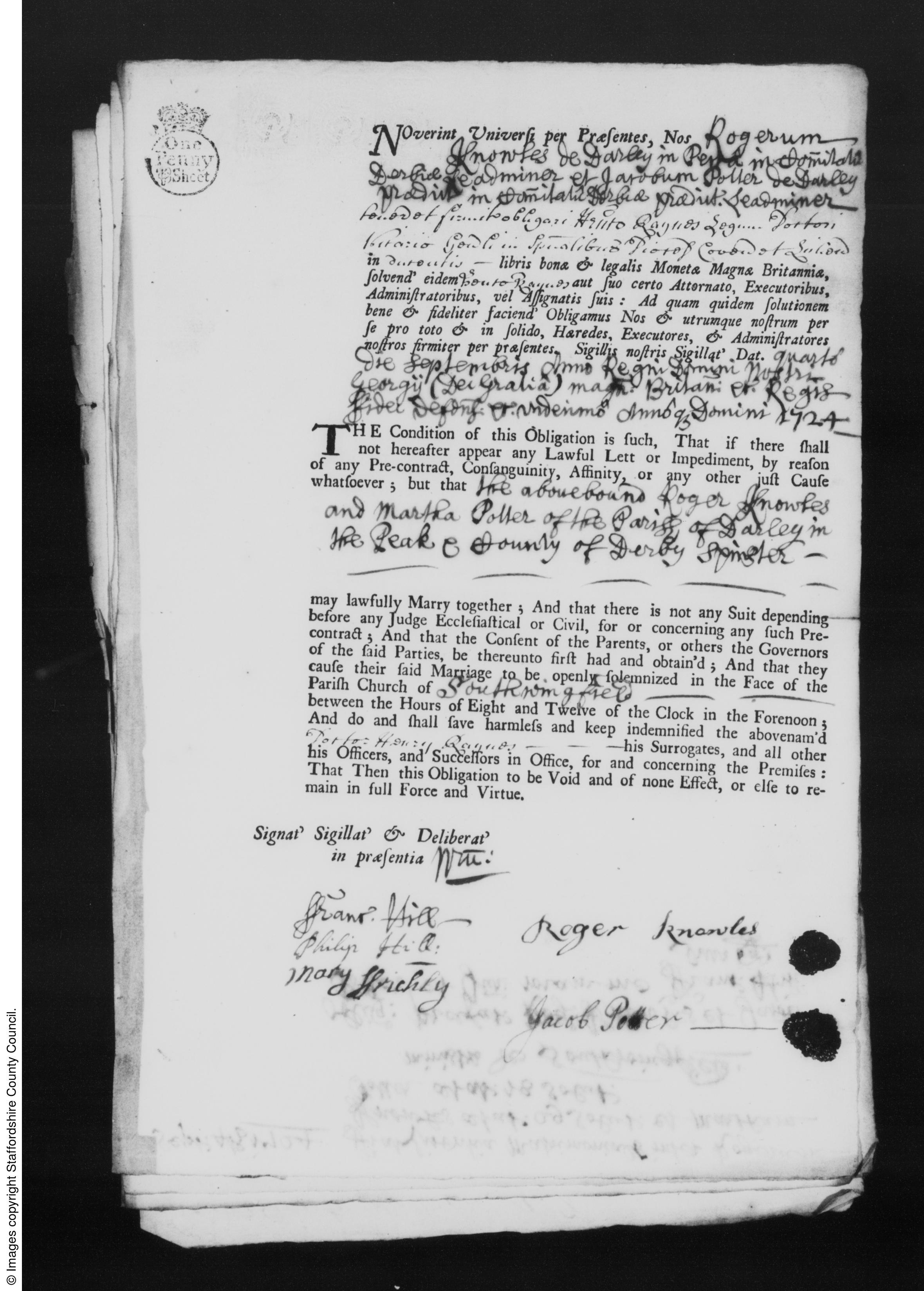
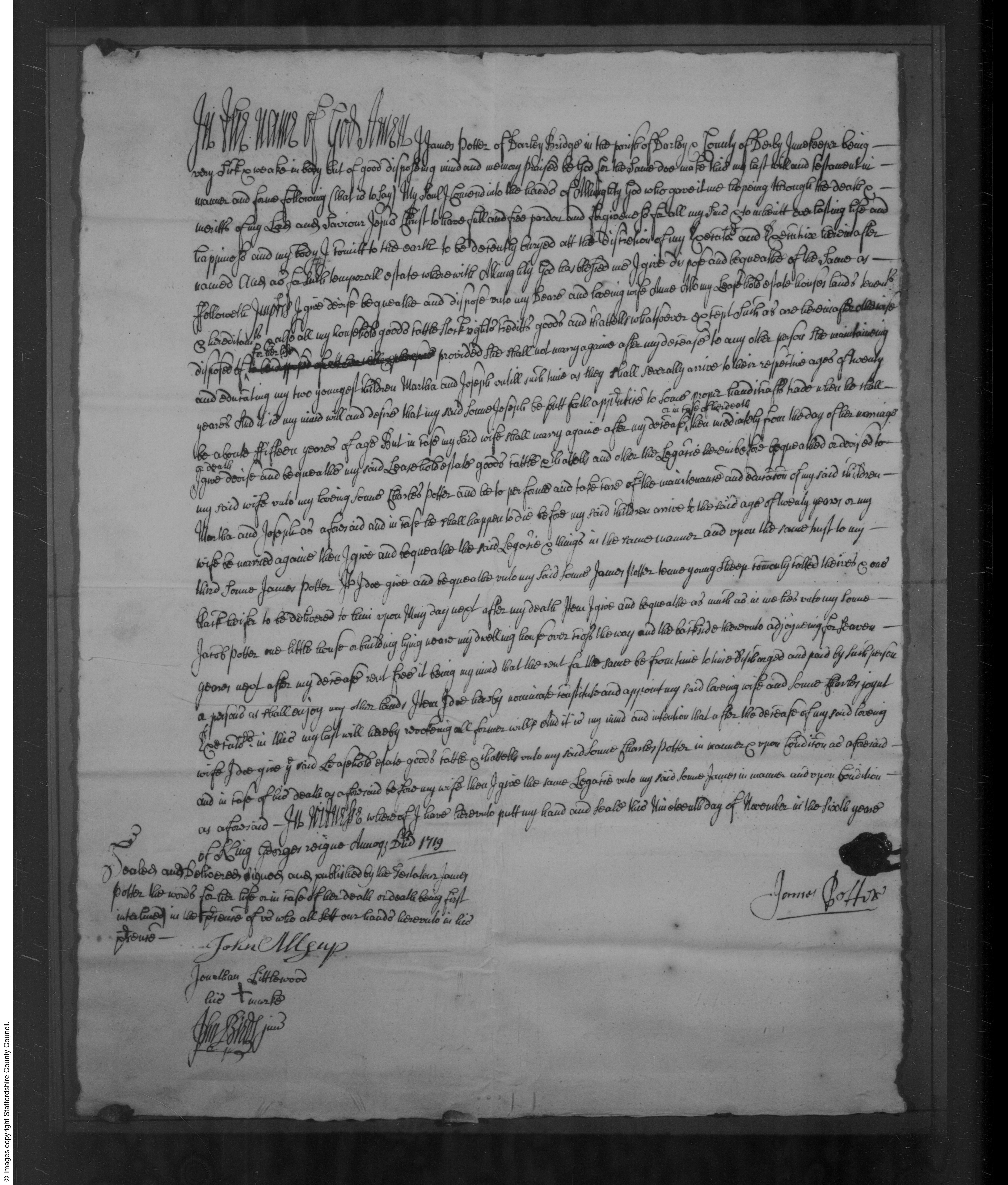
I then found the will of Jacobi Potter who died in 1719. However, he signed the will James Potter. Jacobi is latin for James. James Potter mentioned his daughter Martha in his will “when she comes of age”. Martha was the youngest child of James. James also mentioned in his will son James AND son Jacob, so there were both James’s and Jacob’s in the family, although at times in the documents James is written as Jacobi!
Jacob Potter who signed Martha’s marriage licence was her brother Jacob.
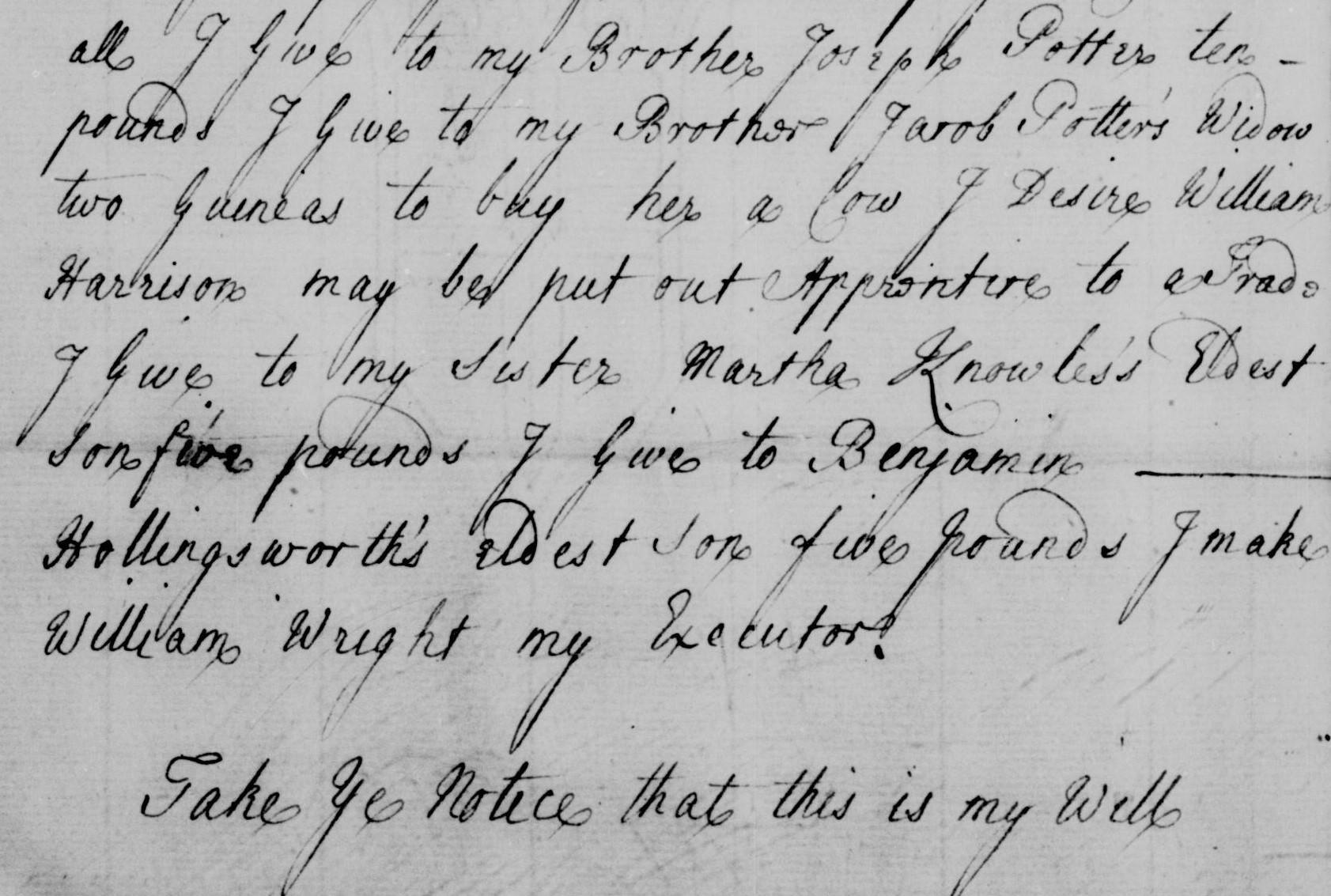
Martha’s brother James mentioned his sister Martha Knowles in his 1739 will, as well as his brother Jacob and his brother Joseph.
Martha’s father James Potter mentions his wife Ann in his 1719 will. James Potter married Ann Waterhurst in 1690 in Wirksworth, some seven miles from Darley. James occupation was innkeeper at Darley Bridge.
I did a search for Waterhurst (there was only a transcription available for that marriage, not a microfilm) and found no Waterhursts anywhere, but I did find many Warhursts in Derbyshire. In the older records, Warhust is also spelled Wearhurst and in a number of other ways. A Martha Warhurst died in Peak Forest, Derbyshire, in 1681. Her husbands name was missing from the deteriorated register pages. This may or may not be Martha Potter’s grandmother: the records for the 1600s are scanty if they exist at all, and often there are bits missing and illegible entries.
The only inn at Darley Bridge was The Three Stags Heads, by the bridge. It is now a listed building, and was on a medieval packhorse route. The current building was built in 1736, however there is a late 17th century section at rear of the cross wing. The Three Stags Heads was up for sale for £430,000 in 2022, the closure a result of the covid pandemic.

Another listed building in Darley Bridge is Potters Cottage, with a plaque above the door that says “Jonathan and Alice Potter 1763”. Jonathan Potter 1725-1785 was James grandson, the son of his son Charles Potter 1691-1752. His son Charles was also an innkeeper at Darley Bridge: James left the majority of his property to his son Charles.
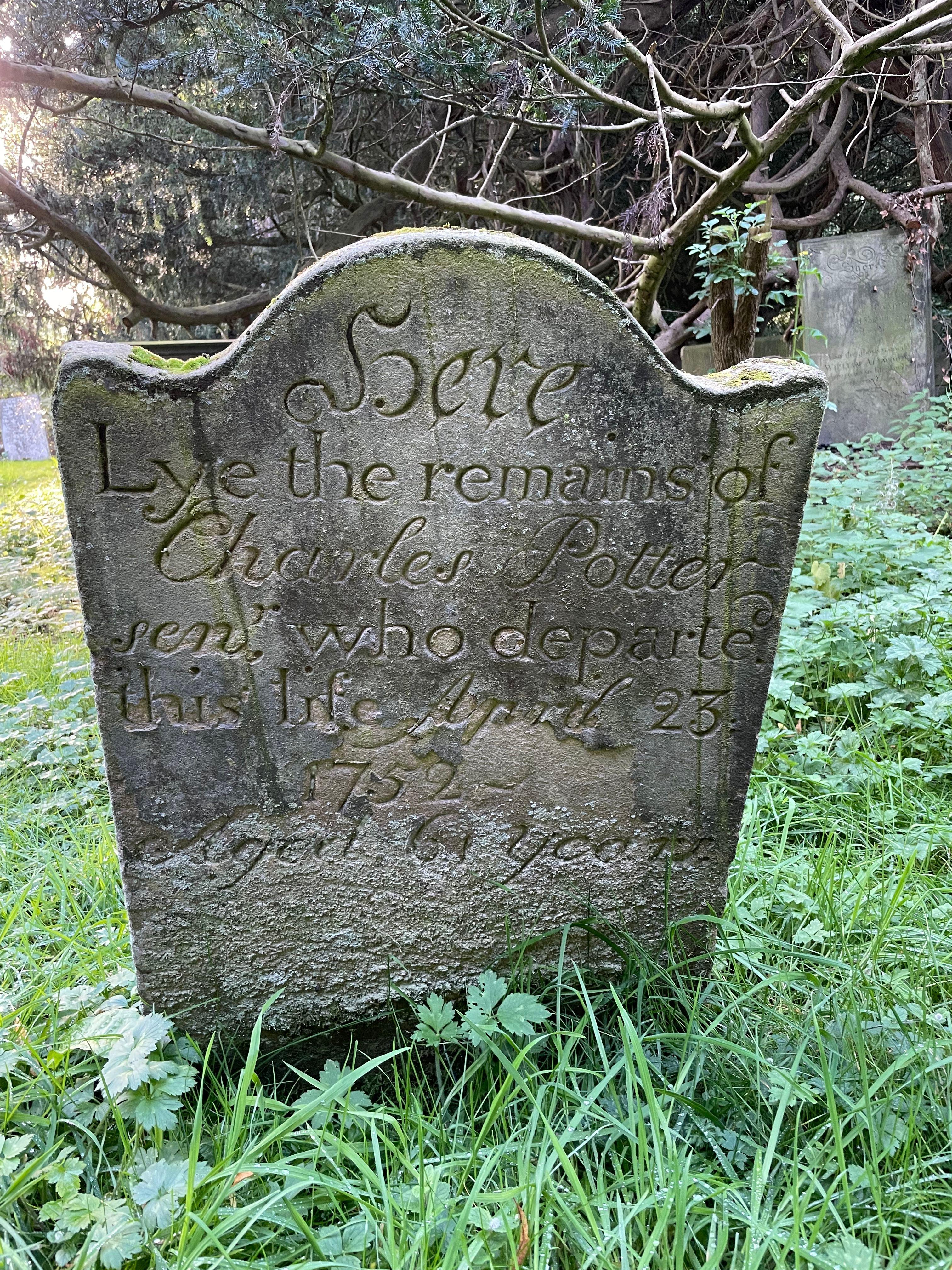
Charles is the only child of James Potter that we know the approximate date of birth, because his age was on his grave stone. I haven’t found any of their baptisms, but did note that many Potters were baptised in non conformist registers in Chesterfield.
Potters Cottage
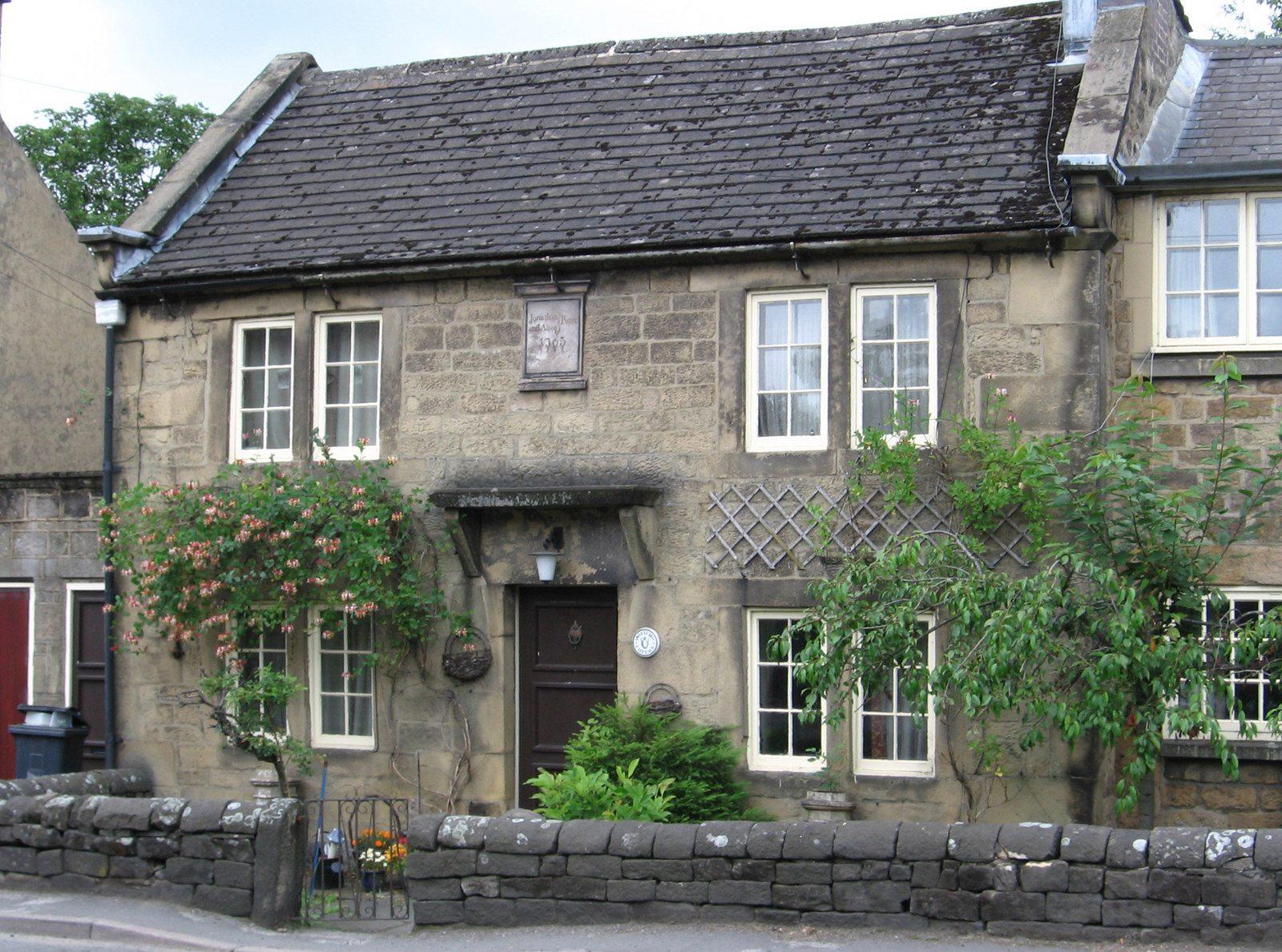
Jonathan Potter of Potters Cottage married Alice Beeley in 1748.
“Darley Bridge was an important packhorse route across the River Derwent. There was a packhorse route from here up to Beeley Moor via Darley Dale. A reference to this bridge appears in 1504… Not far to the north of the bridge at Darley Dale is Church Lane; in 1635 it was known as Ghost Lane after a Scottish pedlar was murdered there. Pedlars tended to be called Scottish only because they sold cheap Scottish linen.”
via Derbyshire Heritage website.
According to Wikipedia, the bridge dates back to the 15th century.
July 25, 2024 at 7:58 am #7542In reply to: The Incense of the Quadrivium’s Mystiques
Shivering, Truella pulled the thin blanket over her head. Colder than a witches tit here, colder in summer than winter at home! It was no good, she may as well get up and go for a walk to try and warm up. Poking her head outside Truella gasped and coughed at the chill air. Shapes were becoming discernible in the dim pre dawn light, the other pods, the hedgerow, a couple of looming trees. Truella rummaged through her bag, hoping to find warm clothes yet knowing she hadn’t packed anything warm enough. Sighing, her teeth chattering, she pulled on everything she had in layers and pulled the blanket off the bed to use as a cape. With a towel over her head for extra warmth, she ventured out into the Irish morning.
The grass was sodden with dew and Truella’s feet were wet through and icy. Bracing her shoulders with determination, she forged ahead towards a gate leading into the next field. She struggled for a few minutes with the baler twine holding the gate closed, numb fingers refusing to cooperate. Cows watched her curiously, slowly munching. One lifted her tail and dropped a steaming splat on the grass, chewing continuously. I don’t think I could eat and do that at the same time.
Heading off across the field which sloped gently upwards, Treulla picked up her pace, keeping her eyes down to avoid the cow pats. By the time she reached the oak tree along the top hedge, the sun started to make an appearance over the hill. Warmer from the exercise, she gazed over the countryside. How beautiful it was with the mist in the valleys, and everything so green.
If only it was warmer!
“Are you cold then, is that why you’re decked out like that? From a distance I thought I was seeing a ghost in a cloak and head shawl!” The woman smiled at Truella from the other side of the hedgerow. “Sorry, did I startle you? You’ll get your feet soaked walking in that wet grass, climb over that stile over there, the lane here’s better for a morning walk.”
It sounded like good advice and the woman seemed pleasant enough. “Are you here for the games too?” Truella asked, readjusting the blanket and towel after navigating the stile.
“Yes, I am. I’m retired, you see,” the woman said with a wide grin. “It’s a wonderful thing, not that you’d know, you’re much to young.”
“That must be nice,” Truella replied politely. “I sometimes wish I was retired.”
“Oh, my dear! It’s wonderful! I haven’t had a job for years, but it’s the strangest thing, now that I’ve officially retired, there’s a marvellous feeling of freedom. I don’t have to do anything. Well, I didn’t have to do anything before I retired but one always feels one should keep busy, do productive things, be seen to be doing some kind of work to justify ones existance. Have you seen the old priory?”
“No, only just got here yesterday.”
“You’ll love it, it’s up this path here, follow me. But now I’ve retired,” the woman continued, “I get up in the morning with a sense of liberation. I can do as little as I want ~ funny thing is that I’ve actually been doing more, but there’s no feeling of obligation, no things to cross off a list. All I’m expected to do as a retired person is tick along, trying not to be much of a bother for as long as I can.”
“I wish I was retired!” exclaimed Truella with feeling. “I wish I didn’t have to do the cow goddess stall, it’ll be such a bind having to stand there all evening.” She explained about the coven and the stalls, and the depressing productivity goals.
“But why not get someone else to do the stall for you?”
“It’s such short notice and I don’t know anyone here. It’s an idea though, maybe someone will turn up.”
July 19, 2024 at 12:26 pm #7536In reply to: The Incense of the Quadrivium’s Mystiques
The rainbow was neon bright, one end disappearing behind a spinney in the distance, and the other end landing squarely in the middle of the glamping pods. A good sign! thought Truella, the first of the coven to arrive. For a moment she imagined herself digging a hole right there, and finding the elusive pot of gold. I wouldn’t be able to do that in a fancy hotel. For once, Truella was happy with Austreberthe’s choice. A week or two in a green field sounded relaxing, refreshing. So much more to her taste than the endless fitted carpets, closed windows, and artifically controlled air blasting out of metal grilles in hotels.
Taking a deep breath of cool fresh air, she surveyed the site before checking into reception. The neighbouring fields were full of cows, perfect for her to practice her Bubona spells on before she set up her Goddess Spell Booth. The Goddess spell tents were to be open in the evenings, after the games each day, along with other stalls selling handicrafts, homemade cakes and jams, wines and potions, trinkets and souvenirs, and all the other tat that people on holiday enjoyed browsing. Obviously the coven would have a stall selling incense. No doubt Austreberthe would have hatched some hard sell plan for that.
Inside the reception office, Truella pinged the bell and waited for someone to attend. The registration book was open on the counter and Truella craned her neck to read the names on the list. She planned to ask for a pod in a far corner, near the hedgerow. It might make it easier to slip out unnoticed, if she should have a mind to do so. The door behind the counter opened and a young man appeared, smiling a welcome. But not before Truella had seen the name on the list. She sucked her breath in sharply. Malove! Nobody was expecting her. Did Austreberthe know?
“Welcome to Finnegan’s Farm Glampsite, I’m Liam,” said the young man, pushing long mousy hair out of his eyes, “You’ve a booking I take it, because we’re fully booked up for the next fortnight. Because of the Games, you see.”
Replying that she did, Truella asked for a pod in the furthest corner. Liam looked at a list and frowned. “The corners are all taken, I’m afraid. But I tell you what,” he said, “As you’re the first to arrive I’ll swap your pod, let’s see…” He scanned the list. “Ah yes, the late booking. I can put you in the one we’ve assigned to Mrs …Malone I think it says, and put her in yours.”
“Thank you very much, Liam,” Truella said as he handed her a key with a big wooden tag with the number 33 etched on it.
“I’ll carry your bags over and show you where it is, follow me.”
June 19, 2024 at 8:22 pm #7507In reply to: The Incense of the Quadrivium’s Mystiques
When Sister Penelope Pomfrett realised she’d lost her assigned witch guest, Eris-what’s-her-name, she started to feel anxious.
Not one to revel in shortcomings, she promptly went about ferreting though the corridors, while the various nuns and guests were still enjoying their libations and ceremonious rituals exchanges.
A cry of anguish resonated through the halls. “Smoke! Smoke!” followed by a mild agitation, which felt one-sided amongst the nuns. Maybe the incense witches were more accustomed to those smoke mishaps, and were not as quick to call fire in alarm. But here in the thick of Spanish summer, unattended smoke could wreck certain havoc.
Penelope was about to jump into the circle called by the elder sisters to contain the smoke, when she abruptly bumped into someone. It was that mortician, the quiet one, Nemo.
She couldn’t help but to mutter some form of apology, yet anxious to get going.
“Sister,” he said with a voice that was commanding calm in the midst of chaos. “You need to calm down, this won’t last, and I’m sure your sisters have this under control.”
“What would you know about that?” she felt her mind go numb, and found herself following him with too much abandon.
“Call it a hunch. Not all is as it seems here, and us morticians, are well-taught in the arts of not only preservation, but as well of hidden truths.”
Indeed, the ruckus seemed to fade already in the distance. Penelope looked more closely at the gentleman. He seemed rather innocuous, and not sufficiently handsome to make her break her chastity vows, even if some would find his brooding rugged charm attractive. Yet, he was making her curious.
“So that’s what you do when there’s no dead body to attend to?”
“In a manner of speaking, yes. But don’t worry, the night is young, and death is never far.” He said with a quiet smile.
Penelope brushed aside the shivering feeling that coursed through her spine. “Could you make yourself useful dear, I’m looking for my assigned Quadrivium witch. The one with the blue hair, any chance you’ve seen her? These grounds are not safe for the non-initiates.”
“No, I don’t think I have seen her, but I’m sure you can whip up a location spell before vespers are done…”
“Yes, it’s not that. There’s too much chaos magic at work now, it could backfire. Have you no idea why we have those tapestries with dragons on it?”
“I have a small idea. Templar Knights of the Crimson Order?”
“Something like that. The cloister has been build as an atonement by a noble lady, centuries ago — it was said, to appease old spirits who were vanquished in mythical battles.” Penelope held her breath. “Some say they’re still close by. Even more so at the solstice.”
“So better not to trifle with the energies right now,” Nemo said, extending his elbow in an old-fashioned chivalrous gesture. “Let’s find your witch friend together, shall we?”
June 19, 2024 at 12:34 pm #7506In reply to: The Incense of the Quadrivium’s Mystiques
As Frigella, deep in her investigation of Herma’s cottage, meticulously examined the chest’s contents looking for potential clues missed at first glance that could explain more about the postcard, with its distinctive stamp featuring an ear of maize, she couldn’t shake the feeling of being watched.
“By the gods, not that interloper again,” she muttered under her breath, sensing the familiar prickling at the back of her neck. She knew Cedric’s gaze all too well—part curiosity, part menace. The young witch hunter was like a moth to a flame, drawn to the coven’s mysteries and, more specifically, to Frella herself, for reasons that likely perplexed even him.
Herma, oblivious to the undercurrents, continued to sift through the chest with Frella. As the silence thickened, Frella’s mind wandered to the last encounter with Cedric. His naïve bravado was almost laughable, yet there he was, lurking in the shadows, ever the novice hunter out of his depth.
“Careful, Herma,” Frella warned with a sharp glance at the window. “We may have an unwelcome observer. This certain Cedric Spellbind has a knack for being where he shouldn’t.”
Herma chuckled, dismissing the tension with a wave. “Him? A mere boy chasing phantoms. He won’t bother us.”
Frella wasn’t so sure. Spellbind’s persistence was a nettlesome thorn, yet she knew how to handle such a busybody. For now, she would focus on the task at hand, but a mental note was made: keep an eye on Cedric. He was, after all, as unpredictable as the spring winds that brought them here far too early.
June 18, 2024 at 8:51 am #7500In reply to: The Incense of the Quadrivium’s Mystiques
At the end of the undertakers’ speech, conversations surged, drowning out the 14th-century organ music. Mother Lorena, who seemed to have taken the expression lines to a deeper level, gave imperative angry looks at her nuns who swiftly moved to meet with the witches.
“Hold your beath,” said Eris to Jeezel. “That Mr ash blond hair is coming for you.”
“Sh*t! I don’t have time for that,” said Jeezel looking at the striking young man. Meticulously styled to perfection and a penchant for tailored suits, she knew that kind of dandy, they were more difficult to get rid of than an army of orange slugs after a storm. She stole a champagne flute from Bartolo’s silver tray and flitted with a graceful nonchalance towards the buffet.
“Hi Jeezel! I’m sister Maria. You’re so beautiful,” said a joyful voice. “You want some canapés? I made them myself.”
Jeezel turned and almost moved her hand to her mouth. A young woman wearing the austere yet elegant black habit of the Roman Catholic Church was handing her a plate full of potted meat and pickles toasts. She had chameleon eyes busy looking everywhere except to what was in front of her. The white wimple covering her red hair seemed totally out of place and her face made the strangest contortions as she obviously was trying not to smile.
“Hi, I’m… Jeezel. But you already know that,” she said. The young woman nodded too earnestly and Jeezel suddenly became aware the nuns certainly had files about her and the other witches like the ones Truella gave them. She looked at the greasy canapés and refused politely. She just had time to notice a crimson silk handkerchief in a breast pocket and a flash of ash blond hair closing in.
“Oh! I’m sorry. I just remember, I have to go speak to my friend over there,” Jeezel said noticing Truella with a nun in a Buddhist outfit.
She left the redhead nun with a laugh that twinkled like stardust.
Truella’s friend didn’t seem too happy to have Jeezel barging in on their conversation. She said she was called sister Ananda. Her stained glass painted face didn’t seem to fit her saffron bhikkunis. And the oddest thing was she dominated the conversation, mostly about the diversity of mushrooms she’d been cultivating in the shade of old cellars buried deep in the cloister’s underground tunnels. Truella was sipping her soda, and nodding occasionally. But from what Jeezel could observe, the witch was busy keeping an eye on that tall, dark mortician who certainly looked suspicious.
Young sister Maria hadn’t given up. She joined the conversation with a tray full of what looked like green and pink samosas. Jeezel started to feel like a doe hunted by a pack of relentless beagles.
“You need to try those! Sister Ananda made them for you,” said the young Nun. Her colourful lips showed she had just tasted a few of them.
“At last,” said Garrett with a voice too deep for such a young handsome face, “you’re as difficult to catch as moonlight on the water. Elusive, mesmerizing, and always just out of reach. One moment you’re dazzling us all with your brillance, the next…”
“As usual, you speak too much, Garrett,” said Silas, the oldest of the morticians who just joined the group. The old man’s voice was commanding and his poise projecting an air of unwavering confidence. He had neatly trimmed grey hair and piercing hazel eyes that seem to see right through to the heart of any matter. “May we talk for a moment, dear Jeezel? I think we have some things to discuss.”
“Do we?” she asked, a shiver going up her spine. Her voice sounded uncertain and her heart started beating faster. Did he know about the sacred relic she was looking for? Was he going to ask her on a date too?
“The ritual, dear. The ritual we have to perform together tonight.”
“Oh! Yes, the ritual,” she sighed with relief.
Silas took her hand and they left the group just as Truella was asking a Garrett: “Won’t Rufus join us?”
“I don’t think so,” he answered coldly. But his eyes were full of passion and his heart full of envy as he watched Jeezel walk away with his mentor in a secluded lounge.
March 10, 2024 at 8:54 am #7401In reply to: The Incense of the Quadrivium’s Mystiques
It may surprise you, dear reader, to hear the story of Truella and Frella’s childhood at a Derbyshire mill in the early 1800s. But! I hear you say, how can this be? Read on, dear reader, read on, and all will be revealed.
Tilly, daughter of Everard Mucklewaite, miller of Brightwater Mill, was the youngest of 17 children. Her older siblings had already married and left home when she was growing up, and her parents were elderly. She was somewhat spoiled and allowed a free rein, which was unusual for the times, as her parents had long since satisfied the requirements for healthy sons to take over the mill, and well married daughters. She was a lively inquisitive child with a great love of the outdoors and spent her childhood days wandering around the woods and the fields and playing on the banks of the river. She had a great many imaginary friends and could hear the trees whisper to her, in particular the old weeping willow by the mill pond which she would sit under for hours, deep in conversation with the tree.
Tilly didn’t have any friends of her own age, but as she had never known human child friends, she didn’t feel the loss of it. Her older sisters used to talk among themselves though, saying she needed to play with other children or she’d never grow up and get out of her peculiar ways. Between themselves (for the parents were unconcerned) they sent a letter to an aunt who’d married an Irishman and moved with him to Limerick, asked them to send over a small girl child if they had one spare. As everyone knew, there were always spare girls that parents were happy to get rid of, if at all possible, and by return post came the letter announcing the soon arrival of Flora, who was a similar age to Tilly.
It was a long strange journey for little Flora, and she arrived at her new home shy and bewildered. The kitchen maid, Lucy, did her best to make her feel comfortable. Tilly ignored her at first, and Everard and his wife Constance were as usual preoccupied with their own age related ailments and increasing senility.
One bright spring day, Lucy noticed Flora gazing wistfully towards the millpond, where Tilly was sitting on the grass underneath the willow tree.
“Go on, child, go and sit with Tilly, she don’t bite, just go and sit awhile by her,” Lucy said, giving Flora a gentle push. “Here, take this,” she added, handing her two pieces of plum cake wrapped in a blue cloth.
Flora did as she was bid, and slowly approached the shade of the old willow. As soon as she reached the dangling branches, the tree whispered a welcome to her. She smiled, and Tilly smiled too, pleased and surprised that the willow has spoken to the shy new girl.
“Can you hear willow too?” Tilly asked, looking greatly pleased. She patted the grass beside her and invited Flora to sit. Gratefully, and with a welcome sigh, Flora joined her.
Tilly and Flora became inseperable friends over the next months and years, and it was a joy for Tilly to introduce Flora to all the other trees and creatures in their surroundings. They were like two peas in a pod.
Over the years, the willow tree shared it’s secrets with them both.
One summer day, at the suggestion of the willow tree, Tilly and Flora secretly dug a hole, hidden from prying eyes by the long curtain of hanging branches. They found, among other objects which they kept carefully in an old trunk in the attic, an old book, a grimoire, although they didn’t know it was called a grimoire at the time. In fact, they were unable to read it, as girls were seldom taught to read in those days. They secreted the old tome in the trunk in the attic with the other things they’d found.
Eventually the day came when Tilly and Flora were found husbands and had to leave the mill for their new lives. The trunk with its mysterious contents remained in the dusty attic, and was not seen again until almost 200 years later, when Truella’s parents bought the old mill to renovate it into holiday apartments. Truella took the trunk for safekeeping.
When she eventually opened it to explore what it contained, it all came flooding back to her, her past life as Tilly the millers daughter, and her friend Flora ~ Flora she knew was Frigella. No wonder Frella had seemed so familiar!
February 15, 2024 at 8:44 pm #7376In reply to: The Incense of the Quadrivium’s Mystiques
When they arrived at the hotel, the witches soon realized they were not the only uninvited guests here. With her keen sense of observation, Eris was the first to spot the traces left by an army of bedbugs. Tiny droppings on the mattresses and linen, blood stains left after the previous guests crushed the bugs while rolling in their bed. And the smell of dead rats was everywhere. Did they even have a cleaning staff here? When they complained, the hotel manager said: “Why do you care? Nobody comes here to sleep during carnival?”
Jeezel noticed the bug reference. Indeed, something was still bugging her after she had closed the portal. Something that should be obvious, yet was still an eyelash away from her grasp. But something more pressing was at stake. She posted pictures of the rooms and a reel of her disappointed face in front of the disaster.
“I was so happy to come to Rio for the first time. But the light is yellow and flickering. How can I show you how to do a proper Carnival makeup,” she said fluttering her eyelashes. As soon as the sound of a message well sent faded out, she started to receive support and love from her fans.
“Rio is not like that!”
“Somebody help.”
“2 bad! I’m on business trip. Wud hav luv to meet ya there!”
The sounds of likes and comments alerted Malové.
“What have you done! We were here incognito. Why don’t you go to the top of Jesus’s head and cast the Tempestarii Overture spell.”
“I could have! That would have gone viral. But we departed in such a hurry, I have left all my sapphires and stilettos in Limerick. You can’t cast that spell without them. Anyway, we don’t have to stay longer in that cesspit. One of my fans is abroad and has offered us to stay in his villa. Look at the pics! It looks as lush and gorgeous as a Jurassic park.”
Truella widened her eyes and said: “Saying that’s a big property would be an understatement. Roger would have loved to come with his new shovel.”
“Don’t even think of casting a second bilocation spell,” said Frigella. “You already look like deflated soufflé.”
“What’s the catch?” asked Eris with frown. “It looks like the kind of golden cage a king pin would own. But they have a pool.”
“He said we just have to feed the dwarf crocodiles while we are there,” said Jeezel nonplussed, looking at Truella whose eyes were ready to pop off of their sockets. Then she looked at Malové. “What do you say? You’re the eld…head witch of our coven.”
Malové’s eyebrow twitched. She was thinking fast. Little signs here and there, the orientation of the statues, the fountain, the placement of rocks that would look so random to a profane or a younger witch. Ancient earth magic? It was difficult to be sure with the framing of the pictures. Jeezel was swiping all the pictures her fan had sent her, hoping such glamour and mystery would melt Malové’s last reluctance.
“Omg! girls, we can’t refuse!” said Jeezel. “He’s got a bloat of pygmy hippos and a flamboyance of flamingos!”
As the drag witch continued to swipe the pictures, a prickle crept up Malové’s spine when she saw a familiar face amongst them.
“Look at him!” shouted Jeezel. “He’s a Gatsby with a spellbook.”
There were no more doubts for Malové about the kind of magic that had been used to build his empire. Augustus St Clair, a powerful witch indeed, and one whose invitation you couldn’t refuse especially since he now knew she was here. As one of the elders of the Rio’s witches community, she had danced the dance of rivals disguised as allies, a pas de deux filled with forced smiles and tight grips. Her words felt like needles scratching her lips when she uttered them: “Tell him we accept his invitation.”
The shouts of joy and disbelief coming from the witches couldn’t appease the memories that had resurfaced.
February 7, 2024 at 12:26 pm #7357In reply to: The Incense of the Quadrivium’s Mystiques
Truella ordered another round of drinks and some more peanuts and then went to the toilets. When she got back to the table on the sidewalk, Roger’s glass was empty and the peanuts had been eaten but there was no sign of Roger. Truella assumed that he’d also gone to the toilets, but after a quarter of an hour and he hadn’t returned, she asked the waiter to check on him. The waiter returned and informed her that nobody was in the mens toilet, and then a woman on the next table said that she’d noticed Truella’s friend making strange noises and that he had wandered off up the road.
“What kind of strange noises? And which way did he go?”
“Well, to be honest, monkey noises. He sounded like a chimpanzee,” the woman replied, looking a little embarrassed. “And he went that way,” she said, pointing towards where the monkeys had been trampolining on the shop awnings just down the road.
Truella looked in the direction she was pointing. “But where are the monkeys now?”
“Well,” the woman replied looking even more embarrassed, “They all followed your friend down the road. I don’t know where they are now.”
Truella took a hasty gulp of her drink, stood up and called the waiter over and asked for the bill. Without waiting for her change she ran down the street calling Rogers name. It crossed her mind that a locating spell would have been useful but she didn’t have time for that. Instead she asked some passers by where the monkeys were now.
The young couple turned and pointed behind them. “They all ran down that way, right down the middle of the road, crazy it was, stopped all the traffic. And they were all running after that big man!”
Truella started running in that direction and then stopped, gasping. It was no good, she’d never catch them up. Slowly she walked back to her car, wondering what to do next.
February 6, 2024 at 12:11 am #7352In reply to: The Incense of the Quadrivium’s Mystiques
“If it’s nae Frigella O’green! Fancy seeing ye ‘ere!”
Frigella stiffened. She’d know that accent and the dank tang of peat moss anywhere. She’d have smelt it sooner if it weren’t for the brewing coffee. She must be getting soft … or maybe it was the sour smell of smoke clogging up her nostrils; she’d not been able to shake the stench since the debacle that morning. Turning away from Aaron, the pleasant young barista serving her, she willed her lips into a smile – no harm in being civil! It was a long time since all the Scottish shenanigans and word amongst the witches was the Scots Coven were trying to tidy up their act.
“Well, If it’s not Aggie Bog now!” Frigella leaned in for a cool peck on the cheek. “And what brings you to these parts? Let me buy you a coffee and we can catch up?”
Aggie sniggered. ” Ye pay for it?” She pushed Frigella aside and approached the counter. Aaron’s eyes widened and Frigella had to admit Aggie cut a striking figure in her tiny black top and leather leggings. As a child she’d been taunted and called fat, but now she was best described as Rubenesque, and clearly had learned how to use her assets.
I bet those pants squeak when she walks.
Aggie leaned forward and Aaron’s gaze flicked toward her abundant cleavage. “A double black insomnia fur me, on the hoose.” As Aaron started to protest, Aggie waved several plump fingers towards his face and Frigella saw his eyes were now dark and glazed. “Whirling ‘n’ twirling a muckle puff o’ rowk,” crooned Aggie. “Ye’ll dae as ah say or caw intae a ….”
Frigella clasped Aggie’s wrist. Thank god the lunch crowd had gone and the cafe was nearly empty apart from an older man reading his paper by the window. “Aggie Bog! Shame on you! That’s not the way we do things here.”
February 4, 2024 at 4:13 pm #7339In reply to: The Incense of the Quadrivium’s Mystiques
4pm EET.
Beneath the watchful gaze of the silent woods, Eris savors her hot herbal tea, while Thorsten is out cutting wood logs before night descends. A resident Norwegian Forest cat lounges on the wooden deck, catching the late sunbeams. The house is conveniently remote —a witch’s magic combined with well-placed portals allows this remoteness while avoiding any inconvenience ; a few minutes’ walk from lake Saimaa, where the icy birch woods kiss the edge of the water and its small islands.
Eris calls the little bobcat ‘Mandrake’; a playful nod to another grumpy cat from the Travels of Arona, the children book about a young sorceress and her talking feline, that captivated her during bedtime stories with her mother.
Mandrake pays little heed to her, coming and going at his own whim. Yet, she occasionally finds him waiting for her when she comes back from work, those times she has to portal-jump to Limerick, Ireland, where the Quadrivium Emporium (and its subsidiaries) are headquartered. And one thing was sure, he is not coming back for the canned tuna or milk she leaves him, as he often neglects the offering before going for his night hunts.
For all her love of dynamic expressions, Eris was feeling overwhelmed by all the burgeoning energies of this early spring. Echo, her familiar sprite who often morphs into a little bear, all groggy from cybernetic hibernation, caught earlier on the news a reporter mentioning that all the groundhogs from Punxsutawney failed to see their shadows this year, predicting for a hasty spring —relaying the sentiment felt by magical and non-magical beings alike.
Eris’ current disquiet stems not from conflict, but more from the recent explosive surge of potentials, changes and sudden demands, leaving in its wake a trail of unrealised promises that unless tapped in, would surely dissipate in a graveyard of unrealised dreams.
Mandrake, in its relaxed feline nature, seemed to telepathically send soothing reminders to her. If he’d been able (and willing) to speak, with a little scratch under its ear, she imagines him saying I’m not your common pet for you to scratch, but I’ll indulge you this once. Remember what it means to be a witch. To embrace the chaos, not fight it. To dance in the storm rather than seek shelter. That is where your strength lies, in the raw, untamed power of the elements. You need not control the maelstrom; you must become it. Now, be gone. I have a sunbeam to nap in.
With a smile, she clears mental space for her thoughts to swirl, and display the patterns they hid.
A jump in Normandy, indeed. She was there in the first mist of the early morning. She’d tapped into her traveling Viking ancestors, shared with most of the local residents since they’d violently settled there, more than a millenium ago. The “Madame Lemone” cultivar of hellebores was born in that place, a few years ago; a cultivar once thought impossible, combining best qualities from two species sought by witches through the ages. Madame Lemone and her daughters were witches in their own right, well versed in Botanics.
Why hellebores? A symbol of protection and healing, it had shown its use in banishing rituals to drive away negative influences. A tricky plant, beautiful and deadly. Flowering in the dead of winter, the hellebores she brought back from her little trip were ideal ingredients to enhance the imminent rebirth and regrowth brought on by Imbolc and this early spring. It was perfect for this new era filled with challenges. Sometimes, in order to bloom anew, you must face the rot within.
The thoughts kept spinning, segueing into the next. Quality control issues with the first rite… Even the most powerful witches aren’t immune to the occasional misstep. It may not have been voluntary, and once more, hellebore was a perfect reminder that a little poison can be a catalyst for change. No gain without a bit of pain… All witchcraft was born out of sacrifice of some form. An exchange of energy. Something given, for something in return.
Luckily, she’d learnt the third rite had gone well even in her absence. Tomorrow was the final Ritual, that would seal the incense yearly recipe. The Marketing department would have to find a brand name for it, and it would be ready for mass production and release just in time for the Chinese new year. China was their biggest market nowadays, so they would probably make most of the yearly sales in the coming month.
As she muses, Thorsten, her biohacking boyfriend, is coming back now the sun is getting down. A rugged contradiction of man and machine.
“Have you managed to contact your friends?” he asks, his pointed question tempered by a calm demeanor. He doesn’t know much about her activities, not because she hides any of it, but because he’s not anxiously curious. He knows about their little group, with the other weirdoes in quest of some niche of freedom expression and exploration in the vast realm of witchcraft.
“Yes, I did. We had a nice chat with Jeezel and she sends her regards…”
“She bloody always do that, doesn’t she.” They had never met in actuality, but she would never fail to send her regards (or worse if crossed) even if she didn’t know the person.
Eris laughed. “Well, Frigella was going to bed…”
“If I didn’t know better, one could think she does it on purpose.”
Eris continued. “Well, and get that; Tru was busy making some French fries.”
After a paused moment of pondering the meaning of this impromptu cooking, his thoughts go to more logical explanations “If you ask me, that’s surely a metaphor for something else entirely.”
“Meat and potatoes… And sometimes,… just potatoes.”
“Or in this case, possibility for a hearty gratin.”
They share a delightful laughter.
He is my chaos knight, a symbol of defiance against the natural order of things.
A quality she adores.
January 17, 2024 at 1:14 pm #7297In reply to: The Whale’s Diaries Collection
what was the state of the ruined roman villa circa early 1500s when the cobblestone yard was made from on site rubble? What did the work men find?
Ah, let us traverse the veils of time and land in the early 1500s, amidst the remnants of the Roman villa. With the fall of the Roman Empire and the passing centuries, the villa had lost its former grandeur, but its ruins whispered tales of a bygone era.
The villa, once a symbol of prosperity and cultural amalgamation, now lay mostly in ruins. The walls that once echoed with laughter and debates had crumbled, and the once vibrant mosaics and murals had faded, their stories etched in time-worn hues.
The outbuildings, too, bore the scars of time. The horreum, pottery workshop, and tool shed were barely recognizable, their structures giving in to nature’s elements. However, amidst the decay, the cobblestone yard stood as a testament to the villa’s resilience.
The yard, once a bustling hub of activity, had been repurposed. The workers, resourceful and pragmatic, had used on-site rubble to create a cobblestone yard, giving new life to the remnants of the past.
As they worked, they uncovered artifacts from the villa’s past. Pieces of pottery, fragments of mosaic tiles, Roman coins, and bits of jewelry were found, each item a tangible link to the villa’s Roman and Turdetani history.
Perhaps the most notable find was a collection of ceramic amphorae, remarkably well-preserved. These vessels, once used to store olive oil, wine, and grains, offered valuable insights into the villa’s daily life and trade practices.
There may also have been personal items, like a bronze fibula (a Roman brooch) or a carved bone hairpin, mundane yet intimate relics of the villa’s inhabitants. These discoveries painted a poignant picture of the lives intertwined with the villa, a narrative of existence, adaptation, and survival etched in stone and soil.
What about the lives of the people who lived here in the 1500s?
Ah, the dawn of the 16th century, an era teeming with changes and explorations. Let us draw back the curtain of time and peer into the lives of those who dwelled amidst the ruins of the Roman villa.
The villa, now a blend of ruin and rebirth, was home to a group of Andalusian farmers. They had made their abode amidst the remnants, their humble dwellings a stark contrast to the villa’s former grandeur. Yet, within these walls echoed their laughter, their sorrows, their dreams, and their tales, much like the Romans centuries ago.
The patriarch, Diego, was a man of the soil. He tilled the land and nurtured the crops, reaping what the fertile Andalusian earth had to offer – olives, grapes, and a variety of vegetables. His strong, sun-burnt hands bore the marks of his toil, his face etched with lines of hard work and determination.
His wife, Isabella, was the custodian of the hearth. She cooked, cleaned, and cared for their three children. Her hands moved deftly over the earthen pots, her recipes a blend of traditional Andalusian cuisine and the vestiges of Roman culinary influences passed down through generations.
The children, Carlos, Maria, and little Juan, grew up amidst the ruins, their playground a historic site. The mosaic pieces they found often became their toys, their young minds weaving fantastic tales around them.
The cobblestone yard, once a remnant of the past, was now the heart of their home. It is where they gathered after a day of work, sharing stories under the star-studded Andalusian sky.
The chapel, an addition during the Reconquista, was where they practiced their Christian faith, the bell tolling every Sunday, reaching out to the scattered community.
Amidst the ruins, they found their sanctuary, their home. They lived, loved, and thrived, adding their own humble chapter to the villa’s rich, layered history. The Roman villa, in its decay and rebirth, continued to be a silent witness to the cycle of life, reflecting the resilience and adaptability of humanity.
then I asked about the 1200s on this site
Ah, the 13th century, a period of considerable transformation and discovery globally. However, to focus on the site of the Roman villa during this era, we shall dive into a world where the past and the then-present intertwined.
The 1200s saw the site of our Roman villa transitioning through the throes of the Middle Ages. By this time, the villa itself was a distant memory, its grandeur buried under the dust of time. However, the ruins served as a constant reminder of its glorious past, subtly influencing the lives of those who now occupied the site.
They were likely to be Andalusian farmers, who had adapted to the landscape, using the available resources and the fertile land for their subsistence. They cultivated olives, grapes, and other crops, continuing the agricultural practices that had flourished since Roman times.
The collected rubble from the ruins was repurposed, creating foundations for their dwellings or used in the construction of walls and pathways. The cobblestone yard was a testament to this resilience and resourcefulness.
The ruins also provided them with materials and artifacts. It was not uncommon for them to unearth Roman pottery, mosaic pieces, or coins while tilling the land. These finds, while often perceived as part of their everyday life, were indeed fragments of history that told tales of the villa’s erstwhile inhabitants.
Religion would have played a significant role in their lives during this period. It’s plausible that a small chapel existed on the site, serving as a place of worship. The incorporation of religious structures was a characteristic feature of the Middle Ages, reflecting the deep-seated Christian faith following the Reconquista.
Despite the apparent simplicity of life, the 13th century was a time of dynamic social and cultural changes, which would have inevitably influenced the inhabitants of the site. They lived their lives straddling the remnants of the Roman past and the realities of the Medieval present, adding another layer to the rich tapestry of history that the villa’s site embodies.
- November 2024 (Reunion):
-
AuthorSearch Results
