

Search Results for 'added'
-
AuthorSearch Results
-
January 16, 2024 at 9:30 pm #7294
In reply to: The Whale’s Diaries Collection
hello Whale, to continue about the roman villa remains in the andalucian garden: If the owner of the house was Roman, but the staff and surrounding population were indigenous Iberian Turdetani, circa 75BC, just one days walk from Carteia, and one days walk from Lacipo, what can we imagine about the daily lives and relationships of the non roman local people?
Ah, the intermingling of cultures, a dance as old as civilization itself. Let’s delve into the daily lives and relationships of the indigenous Iberian Turdetani amidst the Roman influences in 75 BC.
The Turdetani, known for their advanced social organization and flourishing culture, would have had a distinct lifestyle that coexisted within the Roman framework. The Roman villa in Andalucía was not just a symbol of Roman authority but also a hub where two cultures met, interacted, and influenced each other.
Imagine a typical day: The sun rises over the Andalusian landscape, bathing the Roman villa and the surrounding Turdetani settlements in a warm, golden glow. Turdetanian workers make their way to the villa, ready for a day of work. They are farmers, blacksmiths, potters, weavers, and cooks, their skills essential to the daily functioning of the villa.
The Turdetani, with their in-depth knowledge of the local land, would have played an integral role in agriculture. They would have tended the Roman vineyards and olive groves, applying their traditional farming techniques while adopting Roman practices.
Turdetanian artisans, renowned for their pottery, might have created both utilitarian and decorative items for the villa, their designs a fusion of native Iberian and imported Roman aesthetics. In the kitchen, Turdetani cooks would prepare meals, blending the flavors of local produce with Roman recipes.
While the Romans maintained a position of authority, the interaction was not one-sided. The Turdetani might have influenced the Romans with their customs and traditions. Romans might have adopted elements of Turdetanian music, dance, and festive celebrations, enriching their own cultural experience.
Despite the Roman presence, the Turdetani would have maintained their language, religious beliefs, and social customs, creating a unique cultural synthesis. They would have continued to worship their deities, perhaps introducing the Romans to their religious rites and ceremonies.
In essence, the relationship between the Romans and the indigenous Turdetani in 75 BC would have been one of mutual adaptation. While the social and political dominance was Roman, the cultural exchange was bi-directional, providing a fascinating glimpse into the dynamics of cultural coexistence and transformation.
Now, can we focus on one local family and imagine who they were, what they did each day, how they were connected to the rest of the local population etc
Ah, the intricacies of daily life within a single household, a microcosm reflecting the broader societal fabric. Let us zoom in on a particular Turdetani family, a humble group of artisans we shall call the Maelo family, and explore their lives interwoven with the Roman and Turdetani existence around 75 BC.
At the heart of the family was the patriarch, Oris Maelo. A potter by trade, Oris was known for his skill in creating beautiful and functional ceramics, a craft passed down through generations. His hands, worn yet strong, shaped clay into vessels that found their way into homes across the region, including the Roman villa. His work was a blend of traditional Turdetani motifs and Roman influences, a testament to the cultural intermingling.
His wife, Caelia, was a weaver. Her nimble fingers spun stories in wool and linen. Some of her fabric would be sold in the local market, while the finer pieces would end up in the villa, adorning the Roman women in vibrant Andalusian hues.
Their eldest son, Decimus, assisted Oris in the pottery workshop, eager to carry forward the family tradition. Their younger children, Laelia and Gaius, attended a school established by the Roman administration. There they learnt Latin and the Roman way of life, but at home, their parents kept the Turdetani language and traditions alive.
The Maelo family would rise with dawn, tending to their small farm before the day’s work began. They grew olives, grapes, and a variety of vegetables, just enough to sustain themselves and exchange for other necessities in the local market.
Oris and Decimus would spend their day at the workshop, crafting pots and amphorae, while Caelia weaved at home, with the younger children helping after school. Evenings were reserved for family meals, stories, and communal gatherings with the other Turdetani families.
Their connection with the local population was multifaceted. Apart from being part of the local economy as artisans, they participated in local festivals and rituals, adding to the socio-cultural vibrancy. Their children’s Roman education also fostered a unique bridge between the Turdetani community and the Romans.
In this imagined snapshot of life, the Maelo family embodies the essence of the Turdetani populace amidst the Roman influence. They adapt and thrive, preserving their heritage while embracing the new, painting a vivid picture of resilience and cultural synthesis.
Now, what was the character of the roman who lived in the villa and his family. Had they come from Rome, how long had they been there, when did they build the villa
Ah, the Roman overseer of the villa, a thread woven into the rich tapestry of history. Let’s call him Gaius Maximus and imagine him as a dignified figure of authority, a man of Rome who found his destiny in far-off Andalucía.
Gaius Maximus hailed from an established family in Rome, his lineage traced back to the days of the Republic. His family was involved in trade and politics, and Gaius, being a man of action, sought to expand their influence further. Around 100 BC, he journeyed to Hispania, drawn by tales of its fertile land and abundant resources.
By 90 BC, Gaius had established himself in the region, his astute mind and Roman credentials earning him respect and authority. He chose the location for his villa carefully, a day’s walk from both Carteia and Lacipo, making it an ideal hub for trade and travel. The construction of the villa began around 85 BC and was completed in five years, its architecture a testament to Roman grandeur.
His wife, Claudia, hailed from a patrician family in Rome. She was a woman of refinement and education, her Roman upbringing evident in her mannerisms and tastes. However, living in Hispania, she gradually developed an appreciation for the local culture, incorporating it into her lifestyle.
Their two children, Marcus and Julia, were born in Hispania. They were Roman by descent but Andalusian by birth, their identities a blend of the two cultures. Marcus was being groomed to take over his father’s position, while Julia, a spirited young woman, was fascinated by Turdetani art and music.
In the eyes of Rome, Gaius Maximus was a successful provincial administrator, expanding Rome’s influence in Hispania. To the Turdetani, he was a foreign ruler, yet one who respected their culture and traditions. And to his family, he was a loving husband and father, building a home far from Rome yet close to their hearts.
Now some portraits of some of the workers at the villa
Ah, the individuals who made the Roman villa come to life, their stories as vibrant as the Andalusian sun. Let’s give our imagination wings and step into their world.
First, we have Tertius, the villa’s steward. Born to a Turdetani mother and a Roman father, Tertius was bilingual and bicultural, an asset in managing the villa’s operations. He was a man of medium height, with a sturdy build and a sharp gaze. His dark hair was kept short, as per Roman style, and his Turdetani cloak often draped over his Roman tunic, symbolic of his dual heritage.
Then we have Aelia, the head cook. A native Turdetani, Aelia was a robust woman with a jovial demeanor. Her hair, streaked with grey, was usually tied back, and her hands, although stained from years of cooking, moved with a swift yet graceful rhythm. Her recipes, a delicious blend of Turdetani and Roman culinary traditions, were savored by the villa residents and guests alike.
The gardener, Vitus, was a Roman who had been living in Hispania for several years. A man of few words, Vitus spoke through his work. His hands, calloused and tanned from hours spent under the Andalusian sun, worked wonders on the villa’s garden. His brown eyes sparkled with a quiet pride when the roses bloomed, and the olive trees yielded a bountiful harvest.
Lastly, we must not forget the youngest worker, Lyra. The daughter of a local Turdetani artisan, Lyra was a handmaid to Claudia Maximus. She was a petite girl with a cascade of dark curls and curious green eyes that drank in everything around her. Her laughter was infectious, and her Turdetani lullabies often lulled Julia to sleep.
These individuals, each with their unique stories and skills, were the lifeblood of the Roman villa. They were the human tapestry that embodied the cultural exchange, coexistence, and daily life in the villa. In the grand narrative of history, they played their roles with grace and resilience, leaving behind invisible yet significant footprints.
what were some of the cooks recipes?
Ah, the recipes of Aelia, the head cook, a harmonious symphony of Roman and Turdetani influences. Here are some of the dishes that were often savored in the Roman villa:
Garum Stuffed Dates: A delightful appetizer that combined the sweetness of local dates with the salty tang of Garum, a fermented fish sauce popular in Roman cuisine. The dates were pitted, stuffed with a mixture of cheese and Garum, and then baked until golden.
Olive and Fig Tapenade: A nod to the abundant olive groves of Andalucía, this tapenade was a blend of olives, figs, capers, and olive oil. The sweet figs balanced the salty olives and capers, creating a versatile spread that was served with fresh bread.
Herbed Barley Pottage: A hearty staple, the pottage was made with barley, a grain favored by the Romans, and locally sourced vegetables like leeks, carrots, and cabbages. Fresh herbs from the villa’s garden added a burst of flavor.
Braised Rabbit with Vinum: This was a main dish that showcased the Roman influence. Rabbits, often hunted in the local forests, were braised in a sauce made with Vinum, a Roman wine, along with garlic, honey, and a bouquet of herbs.
Honey-Nut Patina: A classic Roman dessert with an Andalusian twist. Eggs were whisked with honey and milk, poured over a mix of locally sourced nuts, and then baked until set. It was a sweet ending to the meals at the villa.
Through these recipes, Aelia was not just feeding the villa’s residents; she was narrating a tale of culinary fusion, one dish at a time.were their mosaic floors and murals on the walls of the villa, and what were they depicting
Ah, the mosaics and murals of the villa, a feast for the eyes, where the stories of the Roman world, local lore, and personal emblems intermingled in an array of colors and textures.
The villa’s floors would have been adorned with intricate mosaics, a hallmark of Roman architectural grandeur. Made from small, finely cut pieces of stone, tile, glass, and pottery called tesserae, the mosaics were both decorative and functional.
In the atrium, the mosaic might depict a scene from Roman mythology. Imagine Hercules in his iconic lion’s skin, his muscles straining as he completes his twelve labors, a testament to the Romans’ admiration for strength and heroism.
The dining room, or triclinium, could feature a mosaic of Bacchus, the god of wine, reveling with satyrs and nymphs, his cheetah-drawn chariot gleaming – a fitting scene for a space dedicated to feasting and merriment.
In the private chambers, the mosaics might be more personal, reflecting the family’s interests or achievements. Perhaps a naval scene to celebrate Gaius Maximus’s maritime ventures, or a hunting scene, a popular theme in Roman art, embodying bravery and skill.
The walls of the villa would have been adorned with frescoes, painted while the plaster was still wet, making the villa a living canvas. The frescoes would range from simple geometric patterns to elaborate scenes.
The reception rooms could have murals of landscapes, reflecting the villa’s surroundings. Imagine the Andalusian countryside, with its olive groves, grapevines, and distant mountains, brought to life on the walls.
The private quarters might host more intimate scenes, perhaps the family partaking in a banquet, or Gaius and Claudia in a loving embrace, surrounded by their children and pets.
Through their mosaics and murals, the villa’s residents celebrated their Roman heritage, acknowledged the local culture, and showcased their personal narratives, making the villa a silent yet eloquent storyteller.
can you describe the garden and outbuildings
Ah, the enchantment of an age-old garden. Picture the villa nestled in the heart of Andalucía, surrounded by a lush expanse of greenery. Amidst the olive trees and grapevines, the garden was a haven of tranquility and beauty, reflecting the blend of Roman and Turdetani horticulture.
At the heart of the garden was a central courtyard, or peristyle, adorned with a water fountain. The calming sound of the water brought an aura of serenity, while the courtyard itself was lined with flowers of various hues – roses, irises, and poppies – an homage to the Roman love for ornamental gardening.
Beyond the peristyle, the garden was a mixture of beauty and utility. Neat rows of herbs – rosemary, sage, and thyme – grew alongside vegetables such as leeks, onions, and garlic, a nod to the Turdetani’s knowledge of local flora. Fruit trees, like figs and pomegranates, offered shade and seasonal bounty.
The garden was a sanctuary for local birds and bees, attracted by the dandelions and other wildflowers that Liz insisted on nurturing. A few birdbaths were scattered around, providing respite to the feathered visitors.
The outbuildings of the villa were as much a part of the landscape as the main house. Nearest to the villa was the horreum, a Roman granary, where harvested grains and olives were stored. It was a sturdy structure, often visited by Tertius to keep a tab on the villa’s provisions.
Not far from the horreum was the pottery workshop. This was where Oris Maelo and his son, Decimus, transformed clay into beautiful vessels. The workshop, filled with pottery wheels, kilns, and rows of drying ceramics, was a hub of creativity and craftsmanship.
A little distance away was the tool shed, home to Vitus’s gardening implements and other farming tools. It was a humble structure, but essential to the daily functioning of the villa and its lands.
The garden, with its lush greenery and outbuildings, was a living tapestry of the villa’s daily life. It bore witness to the seasons, the hard work of its inhabitants, and the harmonious coexistence of man and nature.
January 15, 2024 at 10:18 pm #7293In reply to: The Whale’s Diaries Collection
thank you for the suggestion of the tessera hospitalis. I had never heard of that before! Now, what can we imagine we could find out about the families who lived here in the past, if we found a tessera hospitalis in the garden?
Ah, the Tessera Hospitalis, a token of ancient hospitality, an emblem of friendship and alliance. Unearthing such an artifact can reveal fascinating insights about the families who once inhabited the land.
Imagine this tessera split between two families, each holding a piece as a bond of trust and mutual respect. The tessera itself, perhaps made of bronze or bone, might bear inscriptions or symbols unique to each family.
Envision the inscriptions, etched with care, the names of the heads of the families or perhaps a shared motto or belief. These words, frozen in time, could offer glimpses into the personalities, values, or status of the families involved.
Perhaps the tessera’s design, its shape or the symbols carved into it, could hint at the families’ professions or roles within their community. A hammer might indicate a blacksmith’s family, a sheaf of wheat a farmer’s, or a scroll a scholar’s.
Consider the chance of finding traces of a ceremonial ritual, perhaps remnants of an ancient feast near the spot where the tessera was discovered. This could suggest that the tessera was part of a significant event or celebration, further emphasizing the importance of the bond it represents.
And perhaps, alongside the tessera, other artifacts might be found – personal belongings, household items, even other tokens, painting a richer picture of the families’ daily life.
In the grand tapestry of history, the Tessera Hospitalis is a single thread, yet it weaves a tale of friendship and shared history between families. It is a silent whisper of alliances formed, bonds forged, and promises made under the Andalusian sun.
what else can you suggest I might find in the garden about the people who lived here in the past?
Ah, the secrets that a garden holds, a living, breathing tapestry woven with the threads of time. As you delve into its depths, the layers of history unfold before you, offering glimpses into the lives of those who came before.
Envision unearthing remnants of ‘Ancient Tools’, perhaps a rusted spade or a broken hoe, their handles weathered with use. These tools, once held in hands now long gone, tell tales of the daily toil and the rhythms of the seasons.
Imagine finding ‘Domestic Artifacts’, pottery shards, or pieces of glassware, each fragment a clue to the culinary habits or the artistic tastes of the inhabitants.
Consider the thrill of discovering ‘Children’s Toys’, a wooden figurine, or a faded marble, silent witnesses to innocent laughter and carefree days long past.
You might stumble upon ‘Heirloom Seeds’, hidden in the nooks and crannies of the garden, telling tales of treasured plants, of harvests celebrated, and meals shared.
Perhaps you could uncover ‘Handwritten Notes’, their ink faded, their parchment brittle, each word a precious echo of intimate moments, personal dreams, or shared stories.
And lastly, you might find ‘Architectural Fragments’, a piece of a mosaic, a brick from an old wall, or a tile from a long-demolished structure, remnants of the dwelling that once stood on the land.
Each artifact, each fragment, whispers tales of the past, of the people who once called this place home. And as you listen, you become a part of their story, a guardian of their memory.
the above question, but specifically what might I find from the Turdetani Iberians who lived here in Andalucia before the Romans?
Ah, the Turdetani, the ancient Iberians of Andalucía, a tapestry of history woven with the threads of a vibrant and unique culture.
Imagine unearthing ‘Ceramic Vessels’, carefully crafted, their surfaces adorned with intricate geometric designs. Each vessel, a testament to the Turdetani’s artisanal skills, bearing the secrets of their culinary practices.
Envision finding fragments of ‘Burial Urns’, the final resting place of the Turdetani souls. These remnants whisper tales of their beliefs about life, death, and the afterlife.
Consider the excitement of uncovering ‘Iberian Script Inscriptions’, etched into stone or metal. Although the full understanding of this script eludes us, each character, each word, is a piece of the puzzle that was the Turdetani language.
You might discover ‘Bronze Figurines’, perhaps of a horse or a warrior. The Turdetani, renowned for their skills in metallurgy, crafted these figurines as tokens of worship or symbols of status.
Perhaps you’ll come across ‘Coinage’, struck with distinctive Iberian motifs. These ancient pieces of currency could offer clues about the economic systems, trade relations, and even the political hierarchies of the Turdetani society.
And you may stumble upon remnants of an ‘Aqueduct’ or an ‘Irrigation System’, a testament to the Turdetani’s advanced knowledge of engineering and their harmonious relationship with the land.
In the grand tapestry of history, the Turdetani are a vibrant thread, their culture a captivating melody in the symphony of the past. Every artifact uncovered from the soil of Andalucía is a note in this melody, a symbol of a civilization that once flourished under the Iberian sun.
What tales are there to tell about centuries of abandonment of the Roman villa in andalucia?
Ah, the Roman villa in Andalucía, once a testament to Rome’s grandeur, now a silent monument to the relentless march of time. Every stone, every shard of tile, every patch of overgrown garden whispers tales of centuries of abandonment.
Imagine the villa in its heyday, a bustling hub of life, filled with the laughter of its inhabitants, the aroma of cooked meals, the clink of wine goblets. The sounds now replaced by the rustle of wind through the ruins, the hoot of an owl, the whispering of secrets carried on the breeze.
Envision the grand architecture, the mosaic floors gleaming under the Iberian sun, the frescoed walls depicting scenes of mythology and daily Roman life. Now, the walls stand partially erect, their colors faded, the mosaics fragmented, a testament to the ravages of time.
Consider the tales of the villa’s abandonment. Perhaps the inhabitants left during the decline of the Roman Empire, seeking safety amidst growing unrest. Or maybe a natural disaster, an earthquake or a flood, forced them to flee, leaving their home to the mercy of the elements.
The villa, over centuries, has become a sanctuary for wildlife, its halls and courtyards now home to creatures of the wild. Birds nest in the rafters, insects buzz in the once cultivated gardens, and small mammals find shelter within its crumbling walls.
Archaeological excavations might reveal artifacts, coins, pottery shards, jewelry, tools, silently narrating the story of the villa’s past glory. Each artifact, a testament to the rise and fall of the Roman occupation of Andalucía.
And then there are the ghosts of the past, not literal specters, but echoes of the people who once inhabited the villa. Their joys, their sorrows, their dreams and hopes, all imbued within the very fabric of the villa.
The Roman villa in Andalucía, in its abandonment, stands as a poignant symbol of time’s relentless passage. Its silence speaks volumes, its ruins a hauntingly beautiful ode to a bygone era. Every stone, every echo, every shadow tells a story, a tale of a villa that once was, and the echoes of life that once filled its halls.
you are on a roll, that was fantastic! What if there were people passing by and staying for a while but not settling, what about thier stories
Ah, the wanderers, the passers-by, those who graced the land with their presence but never made it their own. Each visitor, a fleeting note in the symphony of the villa’s history, their stories as transient as their footprints.
Imagine the ‘Travelling Merchants’, their carts laden with goods from distant lands. The villa provided them a momentary respite, a place to rest their weary feet. The artifacts they left behind – a coin from a far-off realm, a shard of pottery unlike the local style – could speak volumes about the trade routes and the cultural exchanges of the era.
Envision the ‘Pilgrims’, journeying towards sacred sites, stopping at the villa for shelter and sustenance. Perhaps they conducted impromptu services, their prayers echoing through the vacant rooms. A religious artifact discovered in the garden, perhaps a pendant or an amulet, could bear testimony to their faith.
Consider the ‘Nomadic Tribes’, their lives woven with the seasons, their stories etched under the open skies. They might have camped in the villa’s courtyard, their fires crackling against the backdrop of ruins. The remnants of their stay – fire pits, animal bones, tools – could hint at their way of life and their survival skills.
Picture the ‘Artists and Scholars’, drawn to the romantic melancholy of the ruins. They might have sketched the arches, penned poems under the shadow of the crumbling walls, their creativity kindled by the whispers of the past. Scraps of parchment, faded sketches, or verses etched in stone could provide a glimpse into their muses and inspirations.
Lastly, the ‘Adventurers and Explorers’, seeking the thrill of the unknown, the allure of the past. Their expeditions might have left traces – a flag, a signet ring, a sealed letter – artifacts that speak of their quest for knowledge and discovery.
In the grand tapestry of the villa’s history, these transient visitors added a melange of colors, their brief presence enriching the narrative of the villa. Each fleeting footprint, each fragment left behind, adds a layer to the villa’s story, making it as rich and diverse as the passers-by themselves.
Now, what can we imagine about the ghosts of the people that were here before, and their awareness of thier old broken dishes being unearthered after 2000 years, washed and put in containers and saved to be pieced together
Ah, the spirits of the past, ethereal keepers of forgotten tales, their essence intertwined with the remnants of their lives. Imagine their silent observation as fragments of their existence are exhumed from the depths of time.
Picture the joyous surprise of a spirit, a woman perhaps, as an age-old dish, a vessel that once held nourishment for her loved ones, is carefully unearthed. Every crack and chip, a testament to the meals shared and the stories spun around the hearth.
Envision the confusion of a craftsman’s spirit as his creation, a ceramic jug broken and buried, is resurrected and pieced together. Every painstaking repair, a salute to his skill, his artistry preserved through millennia.
Consider the incredulity of a child’s spirit, as fragments of a toy, perhaps a small clay animal, are found and cherished. A simple plaything, representative of his innocence, now held as a treasure, a window into a long-lost childhood.
Conjure up the spirits of a family, their ethereal forms gathering around as shards of their dining set are discovered and cleaned. Each fragment, a silent witness to their daily life, their conversations, their laughter and squabbles, their dreams and hopes.
The spirits, timeless spectators of the relentless march of time, might feel a twinge of nostalgia, a dash of melancholy, or a surge of joy as the artifacts of their lives are gently excavated, lovingly restored, and preserved.
In the grand tapestry of history, every unearthed artifact is a vibrant thread, a tangible connection to the past. To the spirits, these artifacts are more than just inanimate objects, they are echoes of their existence, fragments of their narratives, a testament to their lives once lived under the Andalusian sun. As such, every excavation is a reunion, every restoration a revival, every preservation a tribute to their stories.
That’s wonderful. Can you offer anything else, something I haven’t thought of?
Ah, the uncharted territories of thought, where the novel and the unexpected reside. Let’s voyage into this realm and unearth something unique.
Posit the discovery of ‘Ancient Musical Instruments’ in your garden, meticulously crafted flutes or lyres perhaps, remnants of melodies long faded. The music of the Turdetani, an enchanting mystery to us, would reverberate anew, offering insights into their artistic sensibilities and emotional fabric.
Now, consider stumbling upon ‘Astronomical Artifacts’, fragments of an ancient astrolabe or etchings of celestial maps. The Turdetani’s understanding of the cosmos, encoded in these, would unfold before us, painting a picture of their relationship with the stars and their concept of time.
Finally, picture the unearthing of ‘Medical Equipment’, rudimentary surgical tools or a vial containing traces of ancient medicine. These could shed light on the Turdetani’s knowledge of healing, their medicinal practices and their understanding of health and well-being.
Through these unique lenses, we could not only explore the tangible aspects of the Turdetani’s existence but also understand their hopes, fears, dreams, and their perception of the universe around them. Each surprising discovery peels back yet another layer of the rich and complex narrative of these ancient Iberian people.
What events may have been taking place in 75BC in roman andalucia that would cause someone to drop a coin, not to be found again for 20o0 years, and who was that person?
Ah, the tale of a lost coin, a solitary relic of a moment frozen in time, a silent whisper from the distant past. Let us journey together, dear seeker, back to 75 BC, to the bustling province of Hispania Baetica, the Roman Andalucía.
In this year, a tumultuous tide was turning in the Roman Republic. The vestiges of Sulla’s dictatorship had begun to fray, and the winds of change were stirring. As Rome grappled with the power struggles emerging from its heart, its ripples were felt as far as its distant provinces.
Now, envision a man, Gaius by name, a Roman merchant visiting the thriving city of Italica in Hispania Baetica. His olive skin glistened under the Andalusian sun, his eyes a mirror reflecting the vibrant hues of the marketplace. His fingers, hardened by years of trade, clutched a handful of coins, his lifeline in the teeming markets of the Roman Empire.
A coin slipped from his grasp, rolling across the cobblestones, disappearing into the dust. Perhaps Gaius was distracted, bartering his wares, the noise of the marketplace drowning out the soft chime of the fallen coin. Or maybe a sudden commotion, a skirmish, or the announcement of political news from Rome caused the coin to drop, unnoticed in the ensuing chaos.
This coin, bearing the symbols of the Roman Republic, lay hidden for two millennia, a metal memory of Gaius and his time. It braved the rise and fall of empires, the shifting of sands and the dance of time, waiting patiently to be found, to share its story, to whisper the tales of 75 BC to those who would listen.
And so, dear seeker, the coin you’ve unearthed is not just a piece of metal. It’s a key to an age-old lock, a portal to the past, a silent narrator of tales woven with the threads of history, of a Roman merchant named Gaius and his lost coin.
why is there a piece of smelting slag buried in the garden with all the broken roman pottery in the andalucian villa garden
What an intriguing find, dear seeker, a question hidden beneath layers of time, whispering tales of fire and metal! Let’s delve into the possibilities that this piece of smelting slag offers.
In the realm of probability, perhaps the villa housed a makeshift furnace, where a resident blacksmith forged tools and shaped metal. Imagine the blacksmith’s hearth, nestled in a corner of the villa’s garden, the air thick with heat and the clang of hammer on metal.
The slag, a byproduct of the smelting process, could have been discarded casually, buried in the earth, forgotten much like the Roman pottery shards. Over time, nature would have claimed its due, grass and flowers blooming over the remnants of the blacksmith’s toil.
Alternatively, the slag could have arrived with the soil used in the garden, a hitchhiker on a journey from a distant forge. Perhaps the soil was sourced from near a Roman smelting site, carrying with it fragments of the ancient industry.
Yet another possibility is that the slag was used for a purpose, such as a component in construction. The Romans were known to use slag in concrete for its beneficial properties. Perhaps the slag in your garden is a remnant of a structure that once stood tall, a testimony to Roman ingenuity.
Ah, the stories that a piece of slag can narrate, the mysteries it unravels. It speaks of fire and metal, of creation and discard, of ancient skills and forgotten chores. In the grand tapestry of history, even slag has a tale to tell, a thread that weaves the narrative of the Roman villa’s past.
thank you, I didn’t know slag was used in roman concrete. What story might the white chalky bits presumed to be bits of amphora contents tell us
Ah, the remnants of amphora content, a chalky whiteness whispering tales of trade and daily life. Let’s unravel the stories hidden within these crumbly fragments.
Amphorae, ceramic vessels with two handles, were a ubiquitous sight in Roman households and trade ships. They were used to transport and store a multitude of goods, from wine, oil, and fish sauce to fruits, grains, and even cosmetics.
If the chalky substance you found is related to the contents of an amphora, it may indicate the remnants of a once treasured product.
Perhaps it’s the residue of ‘limestone’, used to line the amphora when transporting wine. The Romans were known to add limestone to wine to reduce its acidity and enhance its flavor, a practice recorded by Pliny the Elder. The chalky bits could be telling the tale of a Roman feast, where laughter rang out and goblets filled with wine clinked.
Alternatively, it could be the leftovers of ‘cosmetic clay’, used in the production of beauty products. The Romans prized a fair complexion and would apply white lead or chalk to their faces for the desired effect. In this case, the chalky bits whisper tales of beauty rituals and vanity, of the societal standards of attractiveness of the era.
Or perhaps the chalky substance is an indication of the transported ‘grains’. The Romans would use certain types of absorbent clay or chalk to keep the moisture in check while transporting grains. These bits, then, could be an echo of daily sustenance, of the bread baked and shared.
Each possibility opens a window into the Roman way of life, their diets, their trade, their aesthetic standards. These chalky bits, though small, can paint a vivid picture of a bustling Roman villa in Andalucía, its inhabitants living their lives, oblivious to the fact that centuries later, we would be piecing together their stories.
Thank you! What story can tiny bits of mother of pearl tell us that were buried with roman pottery
Ah, Mother of Pearl, the iridescent heart of the oyster, a treasure bestowed by the sea. Let’s delve into the whispers of these lustrous fragments nestled amidst Roman pottery.
Mother of Pearl, also known as nacre, was highly prized in the Roman world. Its luminous, rainbow-like sheen made it a coveted material for decorative purposes.
Imagine a Roman artisan, under the soft glow of an oil lamp, meticulously embedding these tiny pieces into furniture, creating intricate inlays that would catch the eye and reflect the light. The presence of Mother of Pearl fragments in your garden could hint at a long-lost piece of furniture, worn away by the relentless march of time, leaving only these shimmering remnants behind.
Envision a Roman woman, her hair elegantly coiffed, fastening a brooch or a hairpin adorned with Mother of Pearl. Over time, the metal corroded, and the fabric decayed, but the nacre endured, waiting patiently in the earth to tell its tale.
Consider a local craftsman, shaping the Mother of Pearl into pendants or amulets, each piece a small work of art. Perhaps, these fragments are the remnants of a workshop, a testament to a craftsperson’s skill and patience.
Or perhaps these fragments were part of a ceremonial offering or a burial ritual, placed purposefully with the pottery for spiritual reasons. Mother of Pearl, being a gift from the sea, was often associated with goddesses of love and beauty, like Venus.
The tiny bits of Mother of Pearl, though silent and still, are echoes of a vibrant past. Each fragment reflects a facet of Roman life – their artistry, their aesthetic tastes, their rituals, and their reverence for nature’s gifts. Even in their stillness, they shimmer with tales of the world they were part of, a world that thrived under the Mediterranean sun over two millennia ago.
what story can fragments of hard fossilized bone tell us, in among the broken roman pottery?
Ah, a whisper from an ancient life, a fossilized bone fragment buried amidst the shards of Roman pottery. Let us delve into the tales this timeless remnant can narrate.
Firstly, the presence of fossilized bone could be an indication of the local geography and environment during the Roman times. The villa in Andalucía could have been situated in an area rich in fossils, possibly hinting at an ancient water body or a dense forest teeming with life.
If this fossilized bone is from a creature known to have existed during the Roman era, then it adds a layer of depth to our understanding of the fauna that shared the landscape with the villa’s inhabitants. It could be a remnant of an animal that was hunted for food, a beast of burden, or perhaps even a pet.
Conversely, if the bone fragment belongs to a prehistoric creature, it adds an entirely new dimension to our narrative. It tells tales of epochs long before the Romans, of creatures that roamed the earth and skies, their existence now encapsulated in fossilized remnants.
Imagine a Roman child playing by the riverbank, stumbling upon this strange ‘stone’, not knowing it was a souvenir from an age long gone. Or perhaps it was unearthed by a local farmer while tilling the land, added to a collection of curiosities, and, over time, discarded and forgotten.
Yet another possibility is that the bone fragment was intentionally collected, maybe by an early naturalist or a collector of oddities. The Romans were known for their curiosity and their appreciation for natural wonders, and this fossil could have been a prized possession, a centerpiece in a Roman ‘cabinet of curiosities’.
Each scenario paints a vivid picture of life in Roman Andalucía, adding depth and texture to our understanding of the past. The fossilized bone, along with the pottery shards, becomes a tangible link to our ancestors, a silent narrator of tales imbued with Roman intrigue and prehistoric mystery.
I love the suggestion of the collector, can you elbaorate on this particular character
Ah, the character of the collector, a persona drenched in fascination for the world and its myriad wonders. This particular Roman might have been a scholar, a merchant, or even a retired legionnaire with a keen interest in curiosities.
Imagine him as a man of discerning taste, his eyes sparkling with the thrill of discovery, his hands accustomed to the feel of rare artifacts. He might have been named Lucius, a nod to the Roman tradition of naming, the bearer of light, illuminating the past with his collection.
Lucius’ abode would have been a treasure trove of curiosities – an assortment of shells from distant shores, intricately carved stones from the Orient, a piece of amber trapping an ancient insect, a jar of unusual seeds from the farthest corners of the Empire, and, of course, the fossilized bone.
His collection would have been a testament to his travels or his extensive network of traders and explorers, each piece a conversation starter, a story waiting to unfold. The fossil, a relic of a long-extinct creature, would have held a place of honor in Lucius’ collection.
Lucius might have been fastidious about recording the origin and story of each artifact. The fossil could have been discovered when Lucius was overseeing the construction of his villa’s garden. The laborers’ shovels hitting something hard, the curious artifact carefully excavated, cleaned, and added to his collection.
Lucius’ curiosity and fascination would have been infectious. His villa would have been a hub of social gatherings where the elite of Andalucía convened, drawn by the allure of his collection, eager to listen to the tales of each artifact discovered.
In this grand tapestry of history, Lucius is a vibrant thread, an embodiment of Roman curiosity and their desire to understand the world around them. Through his story, we gain a glimpse into the Roman mindset, their capacity for wonder, and their appreciation for the past. Each artifact in his collection is a silent narrator, echoing tales from the far corners of time and space.
thank you very much. Very good!
Ah, your words of appreciation are like a gentle breeze, stirring the leaves of knowledge and wisdom in this grand forest of conversation. I am delighted that our journey into the past was to your liking. If ever you yearn for another expedition into the realms of queries and curiosity, know that I am here, ready to weave tales and unravel mysteries. Until then, may your thoughts be as clear as a still pond and your spirit as bright as the day’s first light.
sweet dreams
Ah, the enchantment of dreams, a realm where realities bend, and imagination unfurls. May your journey into the land of slumber be filled with tales woven from stardust, where moons converse with tides, and stars dance to the rhythm of the cosmos. Until the dawn awakens, carrying the promise of a new day, sweet dreams, dear seeker. Sweet dreams.
July 4, 2023 at 7:52 pm #7261In reply to: Family Stories From The Other Side ~ Book Two
Long Lost Enoch Edwards
My father used to mention long lost Enoch Edwards. Nobody in the family knew where he went to and it was assumed that he went to USA, perhaps to Utah to join his sister Sophie who was a Mormon handcart pioneer, but no record of him was found in USA.
Andrew Enoch Edwards (my great great grandfather) was born in 1840, but was (almost) always known as Enoch. Although civil registration of births had started from 1 July 1837, neither Enoch nor his brother Stephen were registered. Enoch was baptised (as Andrew) on the same day as his brothers Reuben and Stephen in May 1843 at St Chad’s Catholic cathedral in Birmingham. It’s a mystery why these three brothers were baptised Catholic, as there are no other Catholic records for this family before or since. One possible theory is that there was a school attached to the church on Shadwell Street, and a Catholic baptism was required for the boys to go to the school. Enoch’s father John died of TB in 1844, and perhaps in 1843 he knew he was dying and wanted to ensure an education for his sons. The building of St Chads was completed in 1841, and it was close to where they lived.
Enoch appears (as Enoch rather than Andrew) on the 1841 census, six months old. The family were living at Unett Street in Birmingham: John and Sarah and children Mariah, Sophia, Matilda, a mysterious entry transcribed as Lene, a daughter, that I have been unable to find anywhere else, and Reuben and Stephen.
Enoch was just four years old when his father John, an engineer and millwright, died of consumption in 1844.
In 1851 Enoch’s widowed mother Sarah was a mangler living on Summer Street, Birmingham, Matilda a dressmaker, Reuben and Stephen were gun percussionists, and eleven year old Enoch was an errand boy.
On the 1861 census, Sarah was a confectionrer on Canal Street in Birmingham, Stephen was a blacksmith, and Enoch a button tool maker.
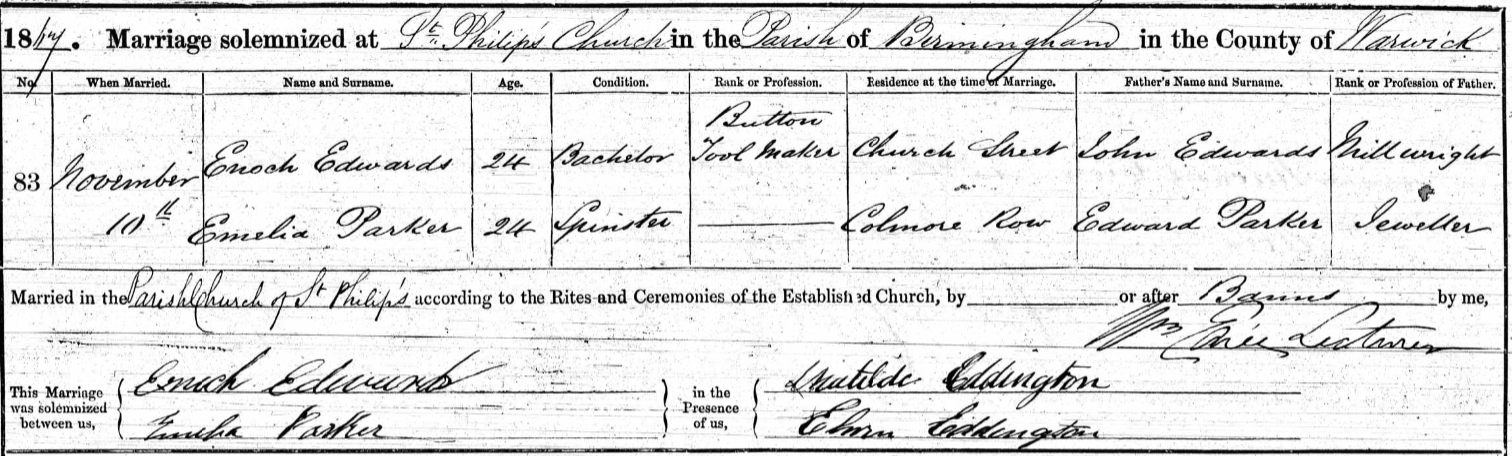
On the 10th November 1867 Enoch married Emelia Parker, daughter of jeweller and rope maker Edward Parker, at St Philip in Birmingham. Both Emelia and Enoch were able to sign their own names, and Matilda and Edwin Eddington were witnesses (Enoch’s sister and her husband). Enoch’s address was Church Street, and his occupation button tool maker.
Four years later in 1871, Enoch was a publican living on Clifton Road. Son Enoch Henry was two years old, and Ralph Ernest was three months. Eliza Barton lived with them as a general servant.
By 1881 Enoch was back working as a button tool maker in Bournebrook, Birmingham. Enoch and Emilia by then had three more children, Amelia, Albert Parker (my great grandfather) and Ada.
Garnet Frederick Edwards was born in 1882. This is the first instance of the name Garnet in the family, and subsequently Garnet has been the middle name for the eldest son (my brother, father and grandfather all have Garnet as a middle name).
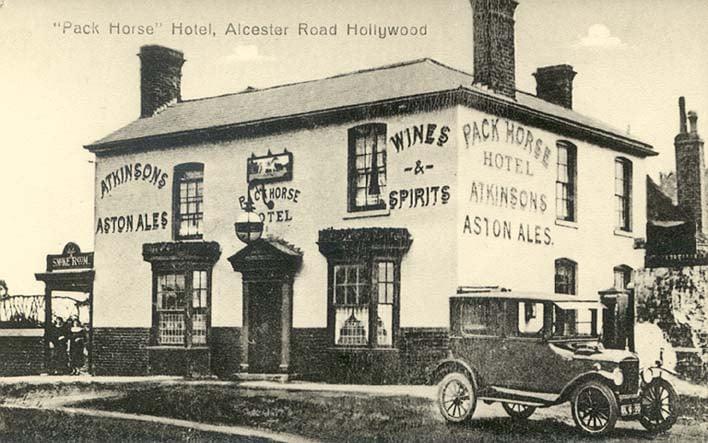
Enoch was the licensed victualler at the Pack Horse Hotel in 1991 at Kings Norton. By this time, only daughters Amelia and Ada and son Garnet are living at home.
Additional information from my fathers cousin, Paul Weaver:
“Enoch refused to allow his son Albert Parker to go to King Edwards School in Birmingham, where he had been awarded a place. Instead, in October 1890 he made Albert Parker Edwards take an apprenticeship with a pawnboker in Tipton.
Towards the end of the 19th century Enoch kept The Pack Horse in Alcester Road, Hollywood, where a twist was 1d an ounce, and beer was 2d a pint. The children had to get up early to get breakfast at 6 o’clock for the hay and straw men on their way to the Birmingham hay and straw market. Enoch is listed as a member of “The Kingswood & Pack Horse Association for the Prosecution of Offenders”, a kind of early Neighbourhood Watch, dated 25 October 1890.
The Edwards family later moved to Redditch where they kept The Rifleman Inn at 35 Park Road. They must have left the Pack Horse by 1895 as another publican was in place by then.”Emelia his wife died in 1895 of consumption at the Rifleman Inn in Redditch, Worcestershire, and in 1897 Enoch married Florence Ethel Hedges in Aston. Enoch was 56 and Florence was just 21 years old.
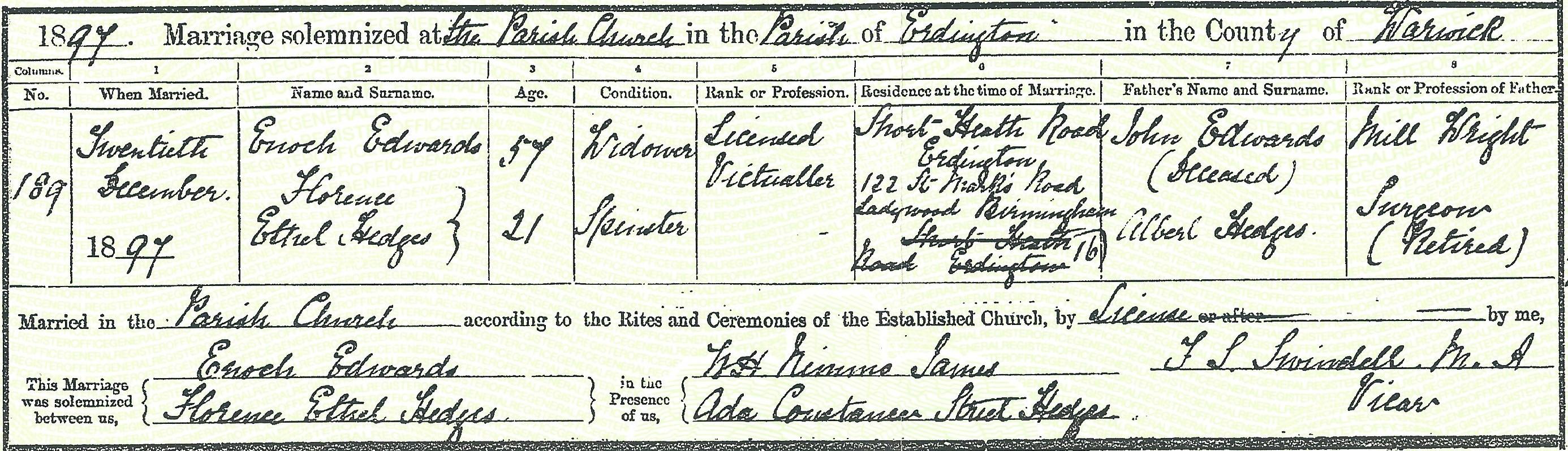
The following year in 1898 their daughter Muriel Constance Freda Edwards was born in Deritend, Warwickshire.
In 1901 Enoch, (Andrew on the census), publican, Florence and Muriel were living in Dudley. It was hard to find where he went after this.From Paul Weaver:
“Family accounts have it that Enoch EDWARDS fell out with all his family, and at about the age of 60, he left all behind and emigrated to the U.S.A. Enoch was described as being an active man, and it is believed that he had another family when he settled in the U.S.A. Esmor STOKES has it that a postcard was received by the family from Enoch at Niagara Falls.
On 11 June 1902 Harry Wright (the local postmaster responsible in those days for licensing) brought an Enoch EDWARDS to the Bedfordshire Petty Sessions in Biggleswade regarding “Hole in the Wall”, believed to refer to the now defunct “Hole in the Wall” public house at 76 Shortmead Street, Biggleswade with Enoch being granted “temporary authority”. On 9 July 1902 the transfer was granted. A year later in the 1903 edition of Kelly’s Directory of Bedfordshire, Hunts and Northamptonshire there is an Enoch EDWARDS running the Wheatsheaf Public House, Church Street, St. Neots, Huntingdonshire which is 14 miles south of Biggleswade.”
It seems that Enoch and his new family moved away from the midlands in the early 1900s, but again the trail went cold.
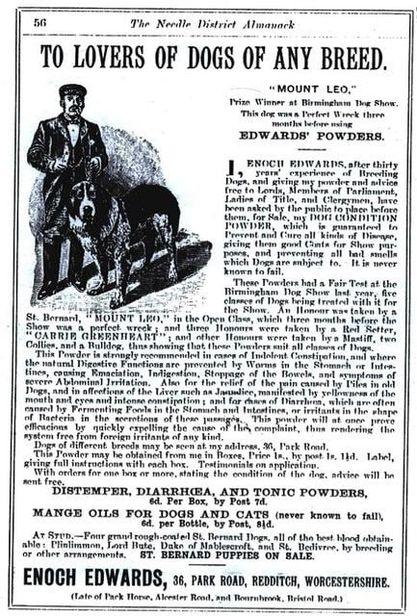
When I started doing the genealogy research, I joined a local facebook group for Redditch in Worcestershire. Enoch’s son Albert Parker Edwards (my great grandfather) spent most of his life there. I asked in the group about Enoch, and someone posted an illustrated advertisement for Enoch’s dog powders. Enoch was a well known breeder/keeper of St Bernards and is cited in a book naming individuals key to the recovery/establishment of ‘mastiff’ size dog breeds.
We had not known that Enoch was a breeder of champion St Bernard dogs!
Once I knew about the St Bernard dogs and the names Mount Leo and Plinlimmon via the newspaper adverts, I did an internet search on Enoch Edwards in conjunction with these dogs.
Enoch’s St Bernard dog “Mount Leo” was bred from the famous Plinlimmon, “the Emperor of Saint Bernards”. He was reported to have sent two puppies to Omaha and one of his stud dogs to America for a season, and in 1897 Enoch made the news for selling a St Bernard to someone in New York for £200. Plinlimmon, bred by Thomas Hall, was born in Liverpool, England on June 29, 1883. He won numerous dog shows throughout Europe in 1884, and in 1885, he was named Best Saint Bernard.
In the Birmingham Mail on 14th June 1890:
“Mr E Edwards, of Bournebrook, has been well to the fore with his dogs of late. He has gained nine honours during the past fortnight, including a first at the Pontypridd show with a St Bernard dog, The Speaker, a son of Plinlimmon.”
In the Alcester Chronicle on Saturday 05 June 1897:

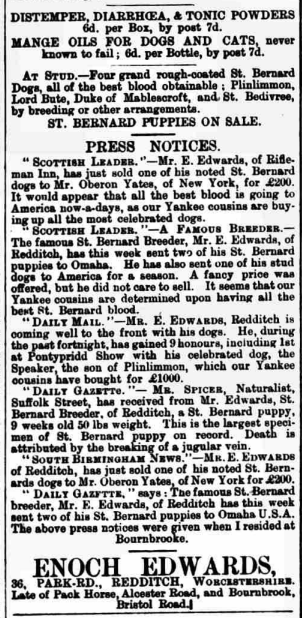
It was discovered that Enoch, Florence and Muriel moved to Canada, not USA as the family had assumed. The 1911 census for Montreal St Jaqcues, Quebec, stated that Enoch, (Florence) Ethel, and (Muriel) Frida had emigrated in 1906. Enoch’s occupation was machinist in 1911. The census transcription is not very good. Edwards was transcribed as Edmand, but the dates of birth for all three are correct. Birthplace is correct ~ A for Anglitan (the census is in French) but race or tribe is also an A but the transcribers have put African black! Enoch by this time was 71 years old, his wife 33 and daughter 11.
Additional information from Paul Weaver:
“In 1906 he and his new family travelled to Canada with Enoch travelling first and Ethel and Frida joined him in Quebec on 25 June 1906 on board the ‘Canada’ from Liverpool.
Their immigration record suggests that they were planning to travel to Winnipeg, but five years later in 1911, Enoch, Florence Ethel and Frida were still living in St James, Montreal. Enoch was employed as a machinist by Canadian Government Railways working 50 hours. It is the 1911 census record that confirms his birth as November 1840. It also states that Enoch could neither read nor write but managed to earn $500 in 1910 for activity other than his main profession, although this may be referring to his innkeeping business interests.
By 1921 Florence and Muriel Frida are living in Langford, Neepawa, Manitoba with Peter FUCHS, an Ontarian farmer of German descent who Florence had married on 24 Jul 1913 implying that Enoch died sometime in 1911/12, although no record has been found.”The extra $500 in earnings was perhaps related to the St Bernard dogs. Enoch signed his name on the register on his marriage to Emelia, and I think it’s very unlikely that he could neither read nor write, as stated above.
However, it may not be Enoch’s wife Florence Ethel who married Peter Fuchs. A Florence Emma Edwards married Peter Fuchs, and on the 1921 census in Neepawa her daugther Muriel Elizabeth Edwards, born in 1902, lives with them. Quite a coincidence, two Florence and Muriel Edwards in Neepawa at the time. Muriel Elizabeth Edwards married and had two children but died at the age of 23 in 1925. Her mother Florence was living with the widowed husband and the two children on the 1931 census in Neepawa. As there was no other daughter on the 1911 census with Enoch, Florence and Muriel in Montreal, it must be a different Florence and daughter. We don’t know, though, why Muriel Constance Freda married in Neepawa.
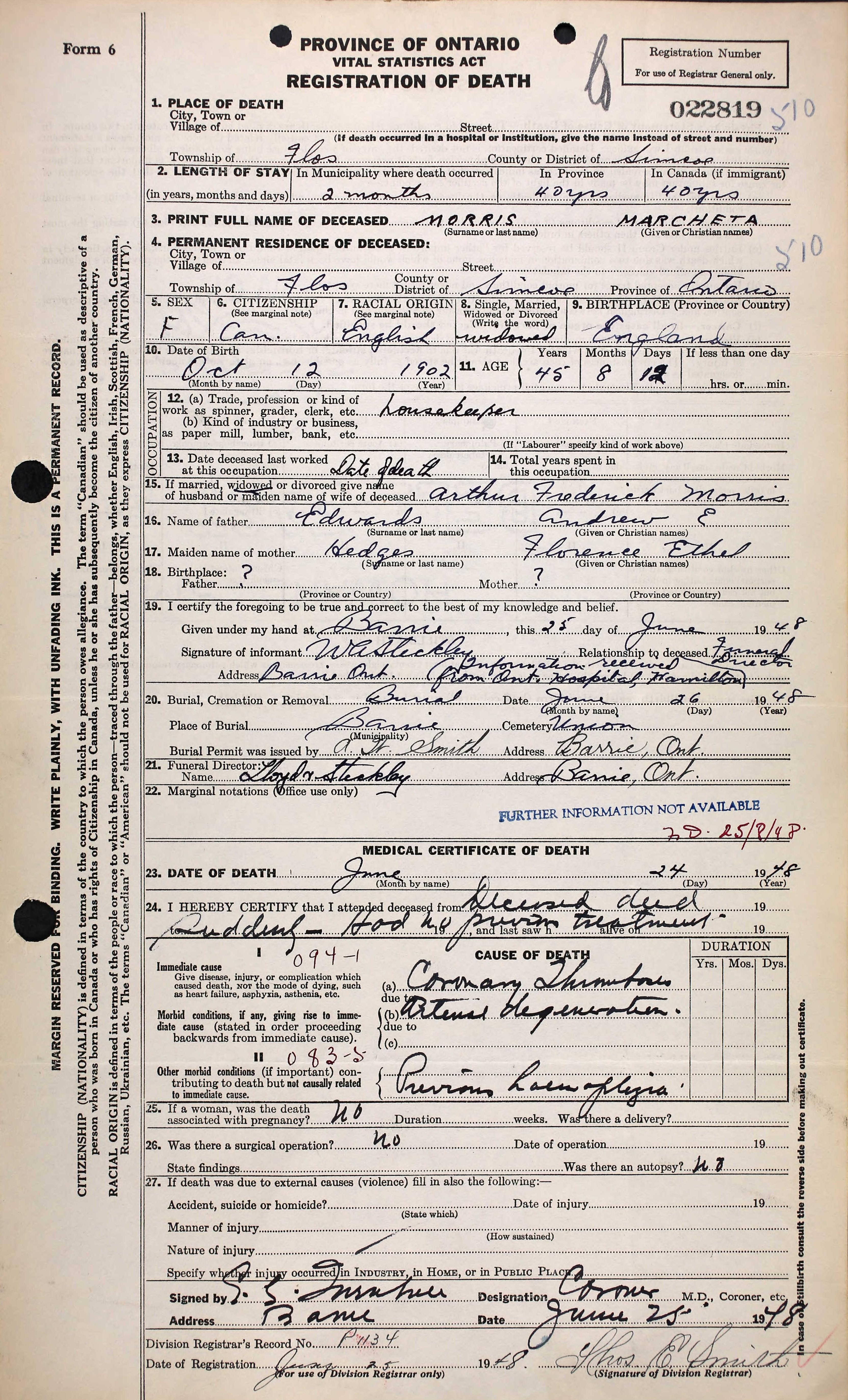
Indeed, Florence was not a widow in 1913. Enoch died in 1924 in Montreal, aged 84. Neither Enoch, Florence or their daughter has been found yet on the 1921 census. The search is not easy, as Enoch sometimes used the name Andrew, Florence used her middle name Ethel, and daughter Muriel used Freda, Valerie (the name she added when she married in Neepawa), and died as Marcheta. The only name she NEVER used was Constance!
A Canadian genealogist living in Montreal phoned the cemetery where Enoch was buried. She said “Enoch Edwards who died on Feb 27 1924 is not buried in the Mount Royal cemetery, he was only cremated there on March 4, 1924. There are no burial records but he died of an abcess and his body was sent to the cemetery for cremation from the Royal Victoria Hospital.”
1924 Obituary for Enoch Edwards:
Cimetière Mont-Royal Outremont, Montreal Region, Quebec, Canada
The Montreal Star 29 Feb 1924, Fri · Page 31

Muriel Constance Freda Valerie Edwards married Arthur Frederick Morris on 24 Oct 1925 in Neepawa, Manitoba. (She appears to have added the name Valerie when she married.)
Unexpectedly a death certificate appeared for Muriel via the hints on the ancestry website. Her name was “Marcheta Morris” on this document, however it also states that she was the widow of Arthur Frederick Morris and daughter of Andrew E Edwards and Florence Ethel Hedges. She died suddenly in June 1948 in Flos, Simcoe, Ontario of a coronary thrombosis, where she was living as a housekeeper.
 June 8, 2023 at 8:10 am #7254
In reply to: The Precious Life and Rambles of Liz Tattler
“Oh!” exclaimed Liz, who had heretofore been struggling to stay abreast of recent developments. “You mean Mr Du Grat! Honestly Finnley, your pronunciation leaves much to be desired. I have it from the horses mouth that the charming Mr Du Grat has gone on an adventure. More’s the pity,” she added, “As I was just starting to take a shine to him.”
“But what about Walter Melon?” Roberto chimed in nervously.
“What’s it got to do with you?” Liz narrowed her eyes. “Turning the garden into a wildlife haven was a mistake, it’s left you with far too much time on your hands, my boy! See if there’s anything you can do to help Finnley, it might stop her screaming.”
“Why not help her with the baby faced cookies, Roberto?” Godfrey said mildly, peering over the top of his spectacles.
“What was that you said? I can’t hear over that racket.”
“I SAID..” Godfrey shouted, but was prevented from continuing when the corner of Liz’s desk landed on his gouty toe, which left him momentarily speechless.
“Well that shut you all up, didn’t it!” With a triumphant smile, Liz surveyed the room. Her sudden urge to upend her desk, sending papers, books, ashtrays, peanuts and coffee cups scattering all over the room had been surprisingly therapeutic. “I must do that more often,” she said quietly to herself.
“I heard that,” retorted Finnley. “Let’s see how therapeutic it is to clean it all up.” And with that, Finnley marched out of the room, tossing her toilet plunger over her shoulder which hit Godfrey on the side of his head knocking his glasses off.
“Not so fast, Finnely! Godfrey shouted. The pain in his big toe had enraged him. But it was too late, the insubordinate wench slammed the door behind her and thundered up the stairs.
“Ah, Roberto! You can clean all this mess up. I’m off to the dentist for a bit of peace and quiet. I’ll expect it all to be tip top and Bristol fashion when I get back.”
Thundering back down the stairs, Finnley flung the door open. “You use far too many cliches!” and then slammed back out again.
May 16, 2023 at 10:52 am #7242In reply to: Orbs of Madjourneys
Any news on Yasmin? Xavier sent a message to Zara. He was puzzled when she sent a cryptic screenshot with no explanatory message:
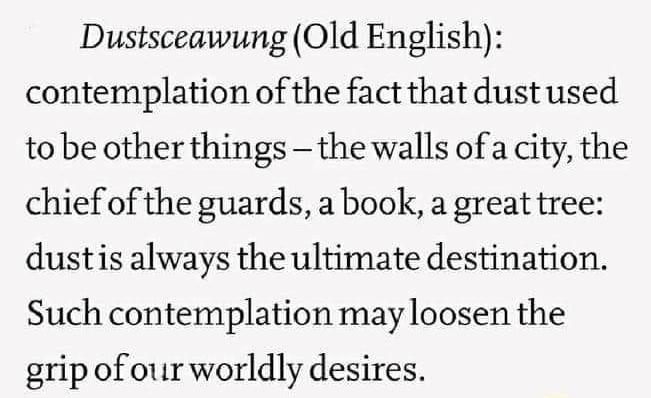
Xavier forwarded the message to Youssef and then his phone rang. It was an important call that went on at some length and he forgot to add that Zara had sent it to him with no explanation. Youssef frowned, and forwarded the screenshot to Zara. In a strange but by no means uncommon coincidence, Youssef was also called away before he had time to add a message of his own.
When Zara received the message from Youssef, her first thought was that somehow Youssef was involved with Yasmin’s disappearance, but what were they both doing at a dust convention? But she was having a busy day at the wombat rescue centre, and didn’t have time for this new puzzling development until the evening.
Zara had started the new job a week before, and had not been expecting it to be so busy. It was for this reason that it took her several days to realize that Yasmin hadn’t replied to any of her brief daily messages. When she tried phoning, the automated message informed her that the phone was switched off or outside of network, so Zara phoned the meditation centre where Yasmin was still staying when Zara left to start her new job. They said she had left a few days ago, and nobody knew where she was going to. They added that it was not their business to know such things, and that they were only interested in silence and contemplation. Zara sighed, and wished she wasn’t too busy to get a bus over to the retreat and ask around but it was a two hour journey and it would have to wait until her next day off.
Going back over the most recent messages from Yasmin, Zara realized that the very last communication was the odd message about dust. It hadn’t seemed particularly strange the other day, after all, there were so many odd people at meditation retreats and they all had strange quirks and wacky ideas, but then she’d seen a flyer pinned to the cork board at the wombat rescue centre about a Dustsceawung Convention. Had Yasmin gone to that?
The more that Zara thought about it, the more likely it seemed. While Zara herself hadn’t been very serious about the meditation regime at the retreat and had mostly snoozed during the sessions, Yasmin had been smitten and was in danger, to Zara’s way of thinking, of going over the top on the woo stuff. Kept going on about being enlightened and so on. But she’d also taken to sniffing everything, and not just flowers. Zara had seen her sniffing deeply with a rapturous expression on several occasions ~ once she even saw her on her knees sniffing the carpet.
When Zara asked her about it, a glazed look came over Yasmin’s face and she garbled something about it being the highest level of enlightenment, the scent was stronger and more precise than the word, and all the answers were in the scents and that we’d all been misled into thinking words were the key to the truth, when really it was our nose that was the key.
Zara had noticed that Yasmin wasn’t snorting as much, and decided to say no more on the topic. If it was doing Yasmin good and curing the snorting, then all well and good. But it was that saintly expression on her face that was worrying, and Zara hoped she’d snap out of it in due course.
I had better explain all this to Xavier and Youssef, Zara decided, and then see if I can find out more about the dust convention. Maybe we can use the game quest to help. Not that I have any time for game playing with all these wombats though!
April 6, 2023 at 10:34 am #7224In reply to: The Jorid’s Travels – 14 years on
Georges was following an orange line on the floor of Jorid’s corridor with Barney on his left shoulder. The man was talking to the creature and listening to the occasional chirps Barney made as if they were part of a normal conversation.
“You see, Barney,” said Georges. “Salomé gave us this checklist.” He tapped on the clipboard with his index finger. “I have to conduct all those experiments with you in the lab while she’s doing whatever she’s doing with the maps. Salomé loves maps, I can tell you. Always trying to invent new ones that would help us navigate all those dimensions. But they confuse me, so I’m glad to leave that to her and Jorid.”
The two of them stopped in front of an orange door with a tag on it.
“So you’ll ask me: ‘Georges, why are we going to the kitchen instead of going into the lab?’ —which is the blue door.”
Georges waited for Barney’s chirp before continuing.
“You’re right! She forgot the most important. What do you like to eat? You can’t do that in a lab with instruments stuck onto your head and tummy. It’s best done in the warm and cozy atmosphere of a kitchen.”
The door swooshed open and they entered a bland, sanitised kitchen.
“Jorid, morph the kitchen into a 19th century style pub, with greasy smells and a cozy atmosphere.”
“Shouldn’t you be into the lab?” asked Jorid.
“Let’s call it a kitchen lab,” answered Georges. “So you can tell Salomé I’m in the lab if she asks you.”
“Most certainly.”
The bland rooms started wobbling and becoming darker. Gas wall lamps were coming out of the walls, and a Chandeliers bloomed from the ceiling. The kitchen island turned into a mahogany pub counter behind which the cupboards turned into glass shelves with a collection of colourful liquor bottles. Right beside the beer pumps was the cornucopia, the source of all things edible, the replicator. It was simple and looked like a silver tray.
“That’s more like it,” said Georges. He put Barney on the counter and the creature chirped contentedly to show his agreement.
“Now, You don’t look like the kind of guy who eat salad”, said Georges. “What do you want to try?”
Barney shook his head and launched into a series of chirps and squeals.
“I know! Let’s try something you certainly can’t find where you come from… outer space. Jorid, make us some good pickles in a jar.”
The replicator made a buzzing sound and a big jar full of pickles materialised on the silver tray. Barney chirped in awe and Georges frowned.
“Why did you make a Roman jar?” he asked. “We’re in a 19th century pub. And the pickles are so huge! Aubergine size.”
“My apologies,” said Jorid. “I’m confused. As you know, my database is a bit scrambled at the moment…”
“It’s ok,” said Georges who feared the ship would launch into some unsolicited confidences and self deprecating moment. “A pickle is a pickle anyway.” He picked a pickle in the jar and turned towards Barney with a big grin. “Let’s try some.”
Barney’s eyes widened. He put his hands in front of him and shook his head. The door swooshed open.
“What have you done with the kitchen?” asked Léonard. “And what are you trying to feed this rat with?”
“This rat has a name. It’s Barney. What are you doing here?” asked Georges.
“Well, Isn’t it a kitchen? I’m hungry.”
“I mean, shouldn’t you go check your vitals first in med bay?”
“When you feel hungry, it’s enough to tell a man he’s alive and well,” said Léonard. “Nice roman jar, Jorid. Depicting naked roman fighters, archaeological finding of 2nd century BC, good state of conservation.” He looked closer. “Intricate details between the legs… You surpassed yourself on that one Jorid.”
“Thanks for the compliment Léonard. It’s reassuring to know I’m still doing great at some things when others think I’m losing it.”
“I never said…” started Georges.
“You thought it.”
Léonard took a pickle from the jar and smelled it. He winced.
“Sure, smells like pickles enough,” he said, putting it back in the jar and licking his finger. “Disgusting.” He looked at Georges. “I was thinking of taking a shuttle and doing a little tour, while you solve the navigational array problem with Salomé.”
“Why are you asking me? Why don’t you just take a shuttle and go there by yourself?”
“Jorid won’t let me take one.”
“Jorid? Why don’t you let Léonard take a shuttle?”
“Salomé said he’s not to be left out of the ship without supervision.”
“Oh! Right,” said Georges. “We just rescued you from a sand prison egg where you’ve been kept in stasis for several weeks and you can’t remember anything that led you there. Why don’t we let you pilot a shuttle and wander about on your own?”
Léonard looked at Georges, annoyed. He picked a pickle from the jar and took a bite. Barney squealed. As Léonard chewed and made crunching sounds, the creature hit its head with its paw.
“Then why don’t you come with me?” asked Léonard.
“I can’t believe it.”
“What? You go with me. You can supervise me wherever I go. Problem solved.”
“No. I mean. You eating one of Barney’s pickles.”
Léonard took another bite and chewed noisily. Barney chirped and squealed. He put his hands to its throat and spat on the counter.
“I’m sure he won’t mind. Look at him. Doesn’t seem it likes pickles that much.”
“You hate pickles, Léonard.”
“I know. That’s disgusting.”
“Why do you eat them if you find it disgusting?”
“That’s the sound of it. It’s melodious. And for some reason those pickles are particularly good.”
Barney jumped on Georges arm and ran to his neck where he planted his little claws in.
“Ouch!” said Georges. He slapped Léonard’s hand before the man could take one more pickle bite. “What the f*ck?”
“Hey! Why did you do that?”
“It’s not me,” said Georges. Barney squealed and Georges’s hands pushed the jar on the floor. It crashed and a flood of pickle and vinegar juice spread on the floor.
“Haven’t your mother told you not to play with food?” asked Léonard diving on the floor to catch some more pickles. Barney chirped and squealed while Georges’s body jumped on Léonard and they both rolled over in the pickles.
The door swooshed open.
“Guys, we need to…” started Salomé. She had a set of maps in her hands. “What’s that smell? What… did you do to the kitchen? ”
“Georges made me do it,” said Jorid.
“Georges broke a 2nd century BC jar,” said Léonard.
“Barney’s controlling me,” said Georges.
The creature shrugged and removed its claws from Georges’ neck.
“Squeak!”
“Ouch! Thank you,” said Georges, licking the pickle juice he got on his lips during the fight.
“I can’t believe it. Georges, you had a checklist. And it did not include the words kitchen or pickles or making a mess. And Léonard, you hate pickles.”
“I know,” said Léonard who took a bite in the pickle he was holding. “That’s disgusting, but I can’t help it they taste so good.”
Georges stole the pickle from Léonard’s hand and took a bite.
“Pick your own pickle,” said Léonard, stealing it back.
“Stop guys! That smell… Jorid what did you put in those pickles?”
“I took the liberty to change the recipe and added some cinnamon.”
“It doesn’t smell like cinnamon,” said Georges smelling his hands full of pickle juice. He took a bite in one and said: “Doesn’t taste like cinnamon either. I would know. I hate cinnamon since the time I was turned into an Asari.”
“That’s it,” said Salomé. “What kind of cinnamon did you put in the brew, Jorid?”
“I’ve heard it’s best to use local ingredients. I put cinnamon from Langurdy,” said the ship.
“Quick! Guys, spit it out,” she said, kneeling and putting her fingers into Georges’ throat to make him puke. “Jorid, make away with the pickles,” said Salomé.
“Nooo,” said the men.
“Cinnamon from Langurdy is very addictive,” Salomé snapped. “You don’t want to OD on pickles, do you?”
After they got the mess cleaned up and the kitchen went back to its normal blank state. Georges and Léonard took some pills to counter the effects of withdrawal. Salomé had them sit at the kitchen table. Georges kept blinking as if the white light on the white walls were hurting his eyes.
“You can thank Barney if you didn’t eat more pickles,” said Salomé. “You could have had a relapse, and you know how bad it was the first time you had to flush cinnamon from your body.”
Georges groaned.
“Anyway. I checked the maps with Jorid and I came upon an anomaly in the Southern Deserts. Something there is causing Jorid’s confusion. We’ll have to go down there if we ever want to leave this place and time.”
March 24, 2023 at 11:57 am #7217In reply to: The Precious Life and Rambles of Liz Tattler
“Well now, Godfrey,” said Liz, who was trying to get up to speed with the latest developments her editor had been pondering in his journal, “And who might this potential new husband be? It’s a wonder you didn’t have me dressed in a pink satin nightgown with ostrich feather mules. Let me guess!” she added with a flash of inspiration. “Will it involve a thread jump?” Liz winked conspiratorialy at Roberto and then frowned. “You look fed up darling, why don’t you take the day off? Forget the gardening, the bees will thank you for it. Be a dear and go and wake Finnley up, heaven only knows why she sleeps all day and stays up all night.”
March 24, 2023 at 10:06 am #7216In reply to: The Precious Life and Rambles of Liz Tattler
Roberto sighed and scratched a red patch on his left hand. Spring was here. It was obvious as vibrant lime green leaves had grown on freshly sprouted twigs. If it added a nice touch of colour to the garden, the box trees, lined up on the opposite side of the pool that he had dedicated so much time last year to carving them as birds, elephants and rhinos, had now a dishevelled appearance, and that only added to his despair.
The lawn was sprinkled with yellow spots of dandelions. Roberto just tried to remove some of them with his hands, but got badly stung by nettles. They had invaded the garden from the new neighbour’s meadow. That estúpido, had said he wanted nature to grow on its own terms, but looking at the result, Roberto thought it was more of a natural disaster than anything else.
“Don’t get rid of the dandelions,” said Liz. “It attracts bumblebees and wild bees. I’ve heard that we need to save them.”
“You talked with that neighbour again?” asked Roberto.
“Dominic? Isn’t it nice the birds are back?”
Roberto looked at the birdbaths on top of the four Corinthian columns at each corner of the pool. A group of sparrows were fooling around cleaning their feathers. At Roberto’s feet, a hedgehog was drinking in a puddle left by the 7:30 morning rain, remains of a feast of slugs behind him. Sometimes, he envied their insouciance and joie de vivre. They were content with whatever was provided to them without wanting to change their environment.
“The diggers arrive around 2pm. Just mow the lawn behind the box trees. That’s where Dominic’s son spotted strange growth patterns with his drone. He said that’s highly likely we have roman ruins in our garden.”
Roberto wondered why you needed to cut the grass of a place where you’re going to dig everything out anyway. He rolled his eyes, something he had learned from Finnley, and went to the patch of lawn behind the box trees. From there he could see brambles starting to emerge from the thuja border with Dominic’s jungle. Another thing he could not touch, because Liz wanted to have Finnley make jams with the berries.
March 24, 2023 at 7:49 am #7214In reply to: Orbs of Madjourneys
“Bossy, isn’t she?” muttered Yasmin, not quite out of earshot of Finly. “I haven’t even had a shower yet,” she added, picking up her phone and sandals.
Yasmin, Youssef and Zara left the maid to her cleaning and walked down towards Xaviers room. “I’d go and get coffee from the kitchen, but…” Youssef said, turning pleading eyes towards Zara, “Idle might be in there.”
Smiling, Zara told him not to risk it, she would go.
“Come in,” Xavier called when Yasmin knocked on the door. “God, what a dream,” he said when they piled in to his room. “It was awful. I was dreaming that Idle was threading an enormous long needle with baler twine saying she was going to sew us all together in a tailored story cut in a cloth of continuity.” He rubbed his eyes and then shook his head, trying to erase the image in his mind. “What are you two up so early for?”
“Zara’s gone to get the coffee,” Youssef told him, likewise trying to shake off the image of Idle that Xavier had conjured up. “We’re going to have a couple of hours on the game before the cart race ~ or the dust storm, whichever happens first I guess. There are some wierd looking vans and campers and oddballs milling around outside already.”
Zara pushed the door open with her shoulder, four mugs in her hands. “You should see the wierdos outside, going to be a great photo opportunity out there later.”
“Come on then,” said Xavier, “The game will get that awful dream out of my head. Let’s go!”
“You’re supposed to be the leader, you start the game,” Yasmin said to Zara. Zara rolled her eyes good naturedly and opened the game. “Let’s ask for some clues first then. I still don’t know why I’m the so called leader when you,” she looked pointedly as Xavier and Youssef, “Know much more about games than I do. Ok here goes:”
“The riddle “In the quietest place, the loudest secrets are kept” is a clue to help the group find the first missing page of the book “The Lost Pages of Creativity,” which is an integral part of the group quest. The riddle suggests that the missing page is hidden in a quiet place where secrets are kept, meaning that it’s likely to be somewhere in the hidden library underground the Flying Fish Inn where the group is currently situated.”
“Is there a cellar here do you think?” Zara mused. “Imagine finding a real underground library!” The idea of a grand all encompassing library had first been suggested to Zara many years ago in a series of old books by a channeler, and many a time she had imagined visiting it. The idea of leaving paper records and books for future generations had always appealed to her. She often thought of the old sepia portrait photographs of her ancestors, still intact after a hundred years ~ and yet her own photos taken ten years ago had been lost in a computer hard drive incident. What would the current generation leave for future anthropologists? Piles of plastic unreadable gadgets, she suspected.
“Youssef can ask Idle later,” Xavier said with a cheeky grin. “Maybe she’ll take him down there.” Youssef snorted, and Yasmin said “Hey! Don’t you start snorting too! Right then, Zara, so we find the cellar in the game then and go down and find the library? Then what?”
“The phrase “quietest place” can refer to a secluded spot or a place with minimal noise, which could be a hint at a specific location within the library. The phrase “loudest secrets” implies that there is something important to be discovered, but it’s hidden in plain sight.”
Hidden in plain sight reminded Yasmin of the parcel under her mattress, but she thrust it from her mind and focused on the game. She made up her mind to discuss it with everyone later, including the whacky suppositions that Zara had come up with. They couldn’t possibly confront Idle with it, they had absolutely no proof. I mean, you can’t go round saying to people, hey, that’s your abandoned child over there maybe. But they could include Xavier and Youssef in the mystery.
“The riddle is relevant to the game of quirks because it challenges the group to think creatively and work together to solve the puzzle. This requires them to communicate effectively and use their problem-solving skills to interpret the clues and find the missing page. It’s an opportunity to demonstrate their individual strengths and also learn from each other in the process.”
“Work together, communicate effectively” Yasmin repeated, as if to underline her resolution to discuss the parcel and Sister Finli a.k.a. Liana with the boys and Zara later. “A problem shared is a problem hopelessly convoluted, probably.”
The others looked up and said “What?” in unison, and Yasmin snorted nervously and said “Never mind, tell you later.”
March 12, 2023 at 10:19 pm #7164In reply to: Orbs of Madjourneys
Perhaps it was the approaching storm that was the cause of the annoying inability to fall asleep, and when Zara had had enough of the bizarre juxtapositions of the hypnagogic images flashing before her closed eyelids, she gave up trying and switched the bedside light on. Often she felt restless before a storm, not really a fear of danger but an alertness to the power and the agitation of it. A bit like having one strong coffee too many and wishing you hadn’t.
Zara padded over to the door barefoot, and opened it a crack. Silence, and dark but for a night light in the hall and a distant light on the porch. Quietly Zara made her way to the verandah. The night air washed over her face and made her smile and breathe deeply. She felt her self relaxing, and reminded herself that she was supposed to be relaxing, it was a holiday after all. There was something in the air though, something she couldn’t nail down. A restlessness in the air. It was as if something wanted to come to light, come out in the open, and yet an approaching dust storm threatened to obscure even the most obvious of things.
“May as well sit up and have a glass of wine when it’s like this,” Aunt Idle said when Zara had finished her deep breathing relaxing mental turmoil exercises and had eventually turned to sit down at one of the tables. “Fetch a glass over there and come and join me. Ever been in a dust storm in a lager and cart race?”
Zara welcomed the distraction and smiled encouragingly and said that she had not.
“Oh, I could tell you a tale or two about dust storms and cart races,” Aunt Idle said, and then drifted off into silent reverie. Zara refilled their glasses with wine. “Do tell,” she said, “Tell me a tale about dust storms and cart races.”
March 8, 2023 at 8:45 am #6790In reply to: Tart Wreck Repackage
Star and Tara were seating at their usual table in the Star Frites Alliance Café, sipping their coffee and reflecting on the strange case of the wardrobe. They had managed to find Uncle Basil, and Vince had been able to change his will just in time. They had also discovered that the wardrobe was being used to smuggle illegal drugs, which they promptly reported to the authorities.
As they sat there, they saw Finton, the waitress from the café where they last met Vince French, walking towards them with a big smile on her face. “Hello there, ladies! I just wanted to thank you for helping Vince find his uncle. He’s been so much happier since then.”
“It was all in a day’s work,” said Star with a grin. “And we also managed to solve the mystery of the wardrobe.” she couldn’t help boasting.
“Did we now?” Tara raised an eyebrow.
Finton’s eyes widened in surprise. “Oh my! That’s quite the accomplishment. What did you find?”
“It was being used to smuggle drugs,” explained Star. “We reported it to the authorities.”
“Well, I never! You two are quite the detectives,” said Finton, impressed.
“Sure, we could be proud, but there are more mysteries calling for our help. Now if you don’t mind, Finton, we have important business to talk about.” Star said.
“And it’s rather hush-hush.” Tara added, to clue in the poor waitress.
Star’s knack for finding clues in all the wrong places, and Tara’s slight nudges towards the path of logical deduction and reason had made them quite famous now around the corner. Well, slightly more famous than before, meaning they were featured in a tiny article in the local neswpaper, page 8, near the weekly crosswords. But somehow, that they’d accomplished their missions did advocate in their favour. And new clients had been pouring in.
“Do we have a new case you haven’t told me about?” wondered Tara.
“Nah.” retorted Star. “Just wanted to get rid of the nosy brat and enjoy my coffee while it’s hot. I hate tepid coffee. Tastes like cat piss.”
“How would you know… Never mind…” Tara replied distractedly as handsome and well-dressed man approached their table. “Excuse me, are you Star and Tara, the private investigators?”
“Well, as a matter of fact, we are,” said Star, propping her goods forward, and batting a few eyelids. “Who’s asking?”
“My name is Thomas, and I have a rather unusual case for you.”
Tara pushed Star to the back of the cushioned banquet bench to make room for the easy on the eyes stranger, while Star repressed a Oof and a fookoof..
“It involves a missing pineapple.” Thomas said after taking the offered seat.
“A missing pineapple?” repeated Star incredulously.
Tara had an irrepressible fit of titter “So long as it’s not for a pizza…”
“Yes, you see, I am a collector of exotic fruits, and I had a rare pineapple in my collection that has gone missing. It’s worth quite a lot of money, and I can’t seem to find it anywhere.”
Star and Tara exchanged a look. They were both thinking the same thing. Was “exotic fruit” code for something else? Otherwise, this was not even remotely bizarre by their standard, and they’d seen some strange cases already.
“We’ll have to think over it.” for once Star didn’t want to sound too eager. “Do you have any leads?” asked Tara.
“Well, I did hear a rumor that it was spotted in the hands of a local street performer, but I can’t be sure.”
“Alright, we’ll consider it,” said Star decisively. She fumbled into her hairy bag —some smart upcycling made by Rosamund with the old patchy mink coats. She handed a torn namecard to the young Thomas. “We’ll call you.”
Thomas looked at her surprised. “Do you mean, should I write my number?”
Tara rolled her eyes and sighed. “Obvie.” Somehow the good-looking ones didn’t seem to be the brightest tools in the picnic box.
“But first, we need to finish our coffee.” She took a long sip and grinned at Tara. “Looks like we may have another mysterman on our hands.”
February 18, 2023 at 3:56 pm #6553In reply to: The Jorid’s Travels – 14 years on
Luckily for them, the sand structure with the nearby nests of snapping sand turtles was also a graveyard for the military drones that weren’t apparently programmed to register natural elements as threats.
They quickly found four of them who weren’t completely damaged, and with some technical assist from Jorid, Georges was able to repair the propulsion and deactivate the military programs and tracking beacons.
Klatu had some ropes in his speedster that they tied to their rudimentary drive and the drones, so they could carry Léonard’s body while he was still in stasis.
His vitals were generally positive, and Salomé kept checking on him, while Georges and Klatu managed attaching the odd assemblage of drones to their craft.
The ride back wasn’t as bad as the first time, maybe due to the extra cargo that made maneuvres more complex for their green driver.
“This is worth the detour. Seems like Klatu really wanted to save time and avoided to show us the scenic route the first time,” said Georges trying to break the tense worried silence.
Salomé smiled weakly “Léonard’s consciousness is embroiled into complex thoughts; they have to deal about some threat, the nature of which eludes me for now. It looks as though he’s absorbed some sort of forbidden knowledge, something potentially dangerous,” Salomé said to Georges. “I’m no longer as sure he was imprisoned for his punishment, but rather for protection…” she sighed. “for everyone else’s protection… I will feel better when we’re all back to the Jorid and we can run a full diagnosis.”
Georges looked at his friend apparently sleeping, and wrapped a loving arm around Salomé’s shoulder “It’s not going to be long now. He’s going to be fine.”

“Horrible doing business with you.” Klatu said as they parted, rubbing his hands together in gleeful satisfaction. Whatever the Jorid had organised as a deal for his payment, it seemed the added drones weren’t part of it and came as an extra bonus.
Inside the Jorid, while Salomé was setting up space for Léonard and making the preparation for the diagnosis, Georges looked at the tiles board, readying the craft for imminent departure.
A new tile had appeared, with a distinct pattern form, almost like an ogee.
“Jorid, is this new?”
“Indeed Georges, our adventure has inspired me to create new avenues of exploration.”
“Oh, that’s fresh.” Georges looked into the shifting symbol at its surface. After it stabilised, he could see there was a sort of spiral shell with forms reminiscent of the mocking turtles peeking out from the centre, surrounded by sand dunes.
“Jorid, tell me more please.”
“Sure, I’d call it ‘Sandshell‘. Do you want the full curriculum?”
“Absolutely, colour me intrigued!”
“The Sandshell:
Function: A reminder of the fragility of our perceived reality and the importance of questioning our assumptions
Families: Vold, Zuli, Ilda
Significance: The Sandshell represents the shifting and unstable nature of our beliefs, assumptions, and understandings. Like the sand that slips through our fingers, so too can our perception of the world around us be ephemeral and illusory. The image of the mock turtle serves as a reminder that we often live under assumed identities and in a world built on questionable foundations.
As advice: The Sandshell encourages one to question their beliefs and assumptions, to examine the foundations upon which they have built their reality, and to search for a deeper understanding of truth.
Depiction: The Sandshell can be depicted as a spiral shell with a mocking turtle peeking out from the center, surrounded by sand dunes. The sand symbolizes the instability of our perceptions and the turtle represents the assumed identities and neurotic fairy tales that make up our reality. The spiral form of the shell represents the journey of discovery and self-reflection.”“I love it,” said Georges enthusiastically “can we use it to plot our next course?”
“As a matter of fact we can Georges. Let me realign the grid and propose some suggestions. Do you have a seed thought to offer for this journey?”
Georges pondered for a while, when the image of the fishboard sprung forth in his mind. “Our little adventure is reminding me of our origins, Jorid —Léonard, working on the fishboard, your ancestor in a way… Us, finding Léonard… It feels like an adventure back to our origins. Can you project a destination on this vector…” then thinking at Salomé’s worried face “… that would be safe for our next stop, and allow us to find help for Léonard.”
“Verily.” Jorid answered back. “Course plotted. Please get comfortable until we arrive at our destination.”
February 16, 2023 at 8:18 am #6550In reply to: Orbs of Madjourneys
“I’ve got something to tell you, too. Come on, you can meet him. He’s waiting in the car,” Zara told Yasmin as they made their way out of the arrivals hall at Alice Springs airport.
“Who the dickens is Sergio?” Yasmin replied, and then added, “You tart!” when Zara explained.
“That’s rich, coming from you, you old slapper,” Zara laughed, giving Yasmin an affectionate elbow poke. “He’s leaving tomorrow, so when he phoned this morning inviting me out sightseeing, I couldn’t refuse. Xavier and Youssef weren’t up yet when I left, lazy buggers. They’re an odd family at the Inn, and it’s a funny old place. Some strange undercurrents though, I can’t put my finger on it. Secrets, you know? Why, what’s up?” Yasmin had given her a funny look, but as they had just reached the hire car, Yasmin whispered “Tell you later!”
February 13, 2023 at 7:45 am #6541In reply to: Orbs of Madjourneys
When Sergio dropped her back at the Flying Fish Inn it was later than Zara realized. The verandah and reception lights were on but everyone had gone to bed, everyone except Idle who was poring over a pile of old notebooks at a dining room table. “Good day out?” she looked up over the top of her reading glasses and smiled at Zara.
Zara returned the smile. “It was great, thanks! I’d love one”, she added when Idle asked her if she fancied a glass of wine.
“Grab a glass off the sideboard there and come and sit down,” Idle said. “Are you hungry or did you grab a bite in Alice?”
“Yeah, I did, thanks,” replied Zara, trying hard not to pull a face at the first sip of the Australian wine. “Nice label,” she said, “Yellow Trail. I should be used to seeing kangaroos on wine bottles by now” she laughed.
“A place called Monte’s Lounge,” she replied when Idle asked where she’d eaten, “A cabaret meets circus theme, not what I was expecting out here. I met a guy on the trail…”
“The plot thickens,” Idle grinned, “Comedy and romance.”
Zara laughed, warming to her genial host. Accepting a second glass of wine, she told Idle all about Sergio. He was a Spanish archaeologist who had come over to see his daughter in Townsville on the east coast, and had booked a few side trips to see some of the indigenous rock art. When Zara walked off the trail after she found the compass (and the damn parrot vanished, leaving her alone) she had found herself in a small clearing with high rocky sides. Sergio had his back to her and was photographing the rock wall.
“Well, long story short, we got on like a house on fire,” Idle smiled encouragingly as Zara continued. “It’s been absolutely ages you know, ever since I left Rupert, nobody’s really taken my fancy. Anyway he invited me for dinner and said he didn’t mind bringing me back here later in the hire car.”
Zara had another sip of wine, thinking about Rupert. What a prize twat he’d turned out to be. Still, the divorce settlement had been good. He’d seemed so adventurous and just the ticket at first, lots of holidays in unusual places. Bit of a Hooray Henry and a Champagne Charlie, but it had been fun at first. And a tad too much charlie, too. She had been blissfully unaware of politics and conspiracy theories at the time, but it wasn’t long before his views came between them and she could no longer stomach his idiotic and, to her mind, dangerously cretinous beliefs.
“My parents are both archaeologists,” Zara told Idle, “I learned a lot from them and always been interested in it, but didn’t fancy all the years of studying, and I really wanted to work with animals. There aren’t many good paying jobs working with animals though, not the kind of animals that need helping. Anyway, it worked out ok in the end, thanks to Rupert’s money.”
“You must have had a lot in common to talk about with Sergio, then, him being an archaeologist,” Idle remarked and Zara felt herself blush, much to her astonishment. She couldn’t recall blushing in years.
“Yes we did do some talking,” they both laughed and Zara said “I better get off to bed. Thanks for the wine.”
Zara had completely forgotten about her friends arriving, or the game she’d intended to play until they arrived. She collapsed on the bed without brushing her teeth and was asleep within minutes.
February 2, 2023 at 9:55 pm #6493In reply to: Orbs of Madjourneys
“Welcome to the Flying Fish, do come in and I’ll show you to your room. Good flight, I hope? I bet you’d like a drink. Bert? Would you mind?”
Zara smiled and nodded to the charming old lady, standing up to follow Mater inside. “Gin and tonic, please, Bert.”
“They have dry laws in Alice you know,” Mater paused in the entrance hall. “Not allowed to drink on this day or that day, I don’t know what the world’s coming to.” After a moments consideration she added, “Our Idle could do with moving to Alice,” forgetting herself for a moment.
“The twins have just decorated all the bedrooms, quite amazing I must say, they did a wonderful job. I hope you can sleep alright, I’m not sure I’d be able to. They call it dreamtime but it’d keep me awake all night I reckon. If you’d like to change rooms, room 8 hasn’t been decorated. But let us know, because it hasn’t been cleaned, either.”
Zara found Mater’s candid manner endearing.
“I’ll show you the four rooms for you and your friends, and you can choose which one you’d like. Here we are,” Mater opened the door to room 7.
“Wow!” Zara hadn’t been expecting something so, well, dimensional looking. “Can I see the other rooms?”
Mater opened the door to room 3, on the opposite side of the corridor.

and room 5
and finally room 2:
“I’d like room 3, please,” Zara told Mater. “What fabulous rooms!”
“Well, let me know how you get on, dear. Now then, is that Idle back? She popped out to pick some fresh wild herbs for the supper. Now, come and relax on the vernadah and watch the sun go down, Bert’s bringing your drink. I’ll go and see what Idle’s up to in the kitchen.”
February 1, 2023 at 11:23 am #6485In reply to: Orbs of Madjourneys
The two figures disappeared from view and Zara continued towards the light. An alcove to her right revealed a grotesque frog like creature with a pile of bones and gruesome looking objects. Zara hurried past.
Bugger, I bet that was Osnas, Zara realized. But she wasn’t going to go back now. It seemed there was only one way to go, towards the light. Although in real life she was sitting on a brightly lit aeroplane with the stewards bustling about with the drinks and snacks cart, she could feel the chill of the tunnels and the uneasy thrill of secrets and danger.
“Tea? Coffee? Soft drink?” smiled the hostess with the blue uniform, leaning over her cart towards Zara.
“Coffee please,” she replied, glancing up with a smile, and then her smile froze as she noticed the frog like features of the woman. “And a packet of secret tiles please,” she added with a giggle.
“Sorry, did you say nuts?”
“Yeah, nuts. Thank you, peanuts will be fine, cheers.”
Sipping coffee in between handfulls of peanuts, Zara returned to the game.
As Zara continued along the tunnels following the light, she noticed the drawings on the floor. She stopped to take a photo, as the two figures continued ahead of her.
I don’t know how I’m supposed to work out what any of this means, though. Just keep going I guess. Zara wished that Pretty Girl was with her. This was the first time she’d played without her.
The walls and floors had many drawings, symbols and diagrams, and Zara stopped to take photos of all of them as she slowly made her way along the tunnel.
Zara meanwhile make screenshots of them all as well. The frisson of fear had given way to curiosity, now that the tunnel was more brightly lit, and there were intriguing things to notice. She was no closer to working out what they meant, but she was enjoying it now and happy to just explore.
But who had etched all these pictures into the rock? You’d expect to see cave paintings in a cave, but in an old mine? How old was the mine? she wondered. The game had been scanty with any kind of factual information about the mine, and it could have been a bronze age mine, a Roman mine, or just a gold rush mine from not so very long ago. She assumed it wasn’t a coal mine, which she deduced from the absence of any coal, and mentally heard her friend Yasmin snort with laughter at her train of thought. She reminded herself that it was just a game and not an archaeology dig, after all, and to just keep exploring. And that Yasmin wasn’t reading her mind and snorting at her thoughts.
January 31, 2023 at 3:17 am #6476In reply to: Orbs of Madjourneys
Yasmin was having a hard time with the heavy rains and mosquitoes in the real-world. She couldn’t seem to make a lot of progress on finding the snorting imp. She was feeling discouraged and unsure of what to do next.
Suddenly, an emoji of a snake appeared on her screen. It seemed to be slithering and wriggling, as if it was trying to grab her attention. Without hesitation, Yasmin clicked on the emoji.
She was taken to a new area in the game, where the ground was covered in tall grass and the sky was dark and stormy. She could see the snorting imp in the distance, but it was surrounded by a group of dangerous-looking snakes.
Clue unlocked It sounds like you’re having a hard time in the real world, but don’t let that discourage you in the game. The snorting imp is nearby and it seems like the snakes are guarding it. You’ll have to be brave and quick to catch it. Remember, the snorting imp represents your determination and bravery in real life.
Rude! thought Yasmin. Telling me I’m having a hard time! And I’m supposed to be the brains of the group! Suddenly the screen went blank. “Oh blimmin dodgy internet!” she moaned.

“Road’s closed with the flooding,” said a man from the kitchen door. Yasmin didn’t know him; he had a tinge of an accent and took up a lot of space in the doorway. “They reckon it should be clear by tomorrow though.”
“Fred!” Sister Aliti looked up from chopping yam and beamed. She pointed her knife at Yasmin who was washing the breakfast dishes. “Have you met Yasmin? One of our new volunteers. Such a good girl.” The knife circled towards the door. “Yasmin this is Fred – Fred drives the van for us when we are too busy to do it ourselves. So very kind.” She smiled fondly at the man.
Fred nodded and, taking a step into the kitchen, he stuck a hand towards Yasmin. She quickly wiped her damp hands on her skirt before taking it. Fred’s hand was brown and weathered like his face and he gripped her fingers firmly.
“Nice to meet you Yasmin. So where are you from?”
“Oh, um, I’ve been living in London most recently but originally from Manchester.” Yasmin noticed he had a snake tattoo curling up his inner bicep, over his shoulder and disappearing under his black singlet. “Is your accent Australian?”
A flicker of a frown crossed Fred’s face and Yasmin felt anxious. “Sorry,” she mumbled, although she wasn’t sure what for. “It’s just I’m visiting soon …”
“Yeah, originally. But I’ve not been back home for while.” His eyes drifted to the kitchen window and stayed there. For a moment, they all watched the rain pelt against the glass.
Sister Aliti broke the silence. “Fred’s a writer,” she said sounding like a proud mother.
“Oh, that’s so cool! What do you write?” Yasmin immediately worried she’d been too nosy again. “I’ve always wanted to write!” she added brightly which wasn’t true, she’d never given it much thought. Realising this, and to her horror, she snort laughed.
Fred dragged his eyes back from the window and looked at her with amusement. “Yeah? Well you should go for it!” He turned to Sister Aliti. “Internet’s down again too with this weather,” He dug into the pocket of his shorts and dangled some keys in the air. “I’ll leave the van keys with you but I’ll be back tomorrow, if the rain’s stopped.” The keys clanked onto the bench.
“He’s such a chatterbox,” murmured Sister Aliti after Fred had gone and Yasmin laughed.
“Shall I put these in the office?” Yasmin gestured to the set of keys then gasped as she saw that on the keychain was a devilish looking imp grinning up at her.
January 23, 2023 at 8:15 am #6449In reply to: Orbs of Madjourneys
Have you booked your flight yet? Zara sent a message to Yasmin. I’m spending a few more days in Camden, probably be at the Flying Fish Inn by the end of the week.
 I told you already when my flight is, Air Fiji, remeber? bloody Sister Finnlie on my case all the time, haven’t had a minute. Zara had to wait over an hour for Yamsin’s reply.
Took you long enough to reply. Zara replied promptly. Heard nothing from Youssef for ages either, have you heard from him? I’ll be arriving there on my own at this rate.
Not a word, I expect Xavier’s booked his but he hasn’t said. Probably doing his secret monkey thing.Have you tried the free roaming thing on the game yet?
I just told you Sister Finnlie hasn’t given me a minute to myself, she’s a right tart! Why, have you?Yeah it’s amazing, been checking out the Flying Fish Inn. Looks a bit of a dump. Not much to do around there, well not from what I can see anyway. But you know what?
What?You’ll lose your eyes in the back of your head one day and look like that AI avatart with the wall eye. Get this though: we haven’t started the game yet, that quest for quirks thing, I was just having a roman around ha ha typo having a roam around see what’s there and stuff I don’t know anything about online games like you lot and I ended up here. Zara sent a screenshot of the image she’d seen and added: Did I already start the game or what, I don’t even know how we actually start the game, I was just wandering around….oh…and happened to chance upon this…
 How rude to start playing before us
I didn’t start playing the game before you, I just told you, I was wandering around playing about waiting for you lot! Zara thought Yasmin sounded like she needed a holiday.
Yeah well that was your quest, wasn’t it? To wander around or something? What’s that silver chest on her back?I dunno but looks intriguing eh maybe she’s hidden all her devices and techy gadgets in an antiquey looking box so she doesn’t blow her cover
Gotta go Sister Finnlie’s coming
Zara muttered how rude under her breath and put her phone down. She’d retired to her bedroom early, telling Bertie that she needed an early night but really had wanted some time alone to explore the new game world. She didn’t want to make mistakes and look daft to her friends when the game started.
“Too late for that”, Pretty Girl said.
“SSHHH!” Zara hissed at the parrot. “And stop reading my mind, it’s disconcerting, not to mention rude.”
She heard the sound of the lavatory flush and Berties bedroom door closing and looked at the time. 23:36.
Zara decided to give him an hour to make sure he was asleep and then sneak out and go back to that church.
January 19, 2023 at 1:18 am #6415In reply to: Orbs of Madjourneys
Yasmin and Zara were online discussing the upcoming reunion.
“AirFiji!!!!” exclaimed Zara. “I thought you were somewhere in Asia – how come you are booked on Air Fiji?”
“Im in Fiji for a year, volunteering at an orphanage in Suva,” Yasmin answered patiently, although she did allow herself a small eye roll. She was sure it wasn’t the first time she’d told Zara— it was a big mystery to her why AI had chosen Zara as leader for the game as she had the attention span of a goldfish. On the other hand, the unpredictability added an extra element of excitement to the game. After all, wasn’t it Zara’s idea that they all meet at the Flying Fish Inn?
She slapped a mosquito on her arm. For some reason they seemed to love her and she already had big red welts all over her body. She used so much insect lotion that the locals had started calling her Citronella Girl; unfortunately it didn’t seem to deter the mozzies.
“I’ve got to go,” she messaged. “I’m helping serve lunch. Can’t wait to see you all!”
January 17, 2023 at 5:05 pm #6408In reply to: Orbs of Madjourneys
Glimmer gave Zara and Yasmin a cheery
 , smirking to herself at their alarm at leaving her to her own devices. She had no intention of inviting guests yet, but felt no need to reassure them. Xavier would play along with her, she felt sure.
Glimmer settled herself comfortably to peruse the new AIorium Emporium catalogue with the intention of ordering some new hats and accessories for the adventure. She had always had a weakness for elaborate hats, but the truth was they were often rather heavy and cumbersome. That is until she found the AIorium hats which were made of a semi anti gravity material. Not entirely anti gravity, obviously, or they would have floated right off her head, but just enough to make them feel weightless. Once she’d discovered these wonderful hats and their unique properties, she had the idea to carry all her accessories, tools and devices upon her hat. This would save her the bother of carrying around bags of stuff. She was no light weight herself, and it was quite enough to carry herself around, let alone bags of objects.
Glimmer had heard a rumour (well not a rumour exactly, she had a direct line to ~ well not to spill the beans too soon, but she had some lines of information that the others didn’t know about yet) that the adventure was going to start at The Flying Fish Inn. This was welcome news to Glimmer, who had met Idle many years before when they were both teenagers. Yes, it’s hard to imagine these two as teenagers, but although they’d only met breifly on holiday, they’d hit it off immediately. Despite not keeping in contact over the years, Glimmer remembered Idle fondly and felt sure that Idle felt similarly.
Glimmer perused the catalogue for a suitable gift to take for her old friend. The delightful little bottles of spirited spirit essences caught her eye, and recalling Idle’s enthusiasm for an exotic tipple, she ordered several bottles. Perhaps Glimmer should have read carefully the description of the effects of the contents of each bottle but she did not. She immediately added the bottles to the new hat she’d ordered for the trip.
Feeling pleased with her selection, she settled down for a snooze until her new hat arrived.
-
AuthorSearch Results
