


Search Results for 'ago'
-
AuthorSearch Results
-
June 19, 2024 at 8:33 am #7504
In reply to: The Incense of the Quadrivium’s Mystiques
After the meeting, Jeezel and Silas agreed on what the six rituals would be. The integration rituals were designed to unite the groups symbolically and spiritually. They were multifaceted ceremonies that combine elements from each group’s traditions to forge a shared sense of purpose and harmony, mediated by the mortician’s guild. Given the diverse nature of the witches, nuns, and morticians, these rituals needed to be both inclusive and meaningful, drawing on the unique strengths and spiritual practices of each faction.
The program they distributed to each participant was as follow:
Under the guidance of the Ancient Telluric Forces of the Dragons
1. The Invocation of Unity
Purpose: To call upon the spiritual and magical forces that guide each group and seek their blessings for the union.
Components:- Witches: Incantations and invocations to elemental spirits and deities.
- Nuns: Hymns and prayers invoking divine blessings.
- Morticians: Rituals honoring the spirits of the departed, seeking their guidance and protection.
Symbolism: This ritual emphasizes the shared respect for higher powers and the mutual desire for harmonious collaboration.
2. The Weaving of Fate
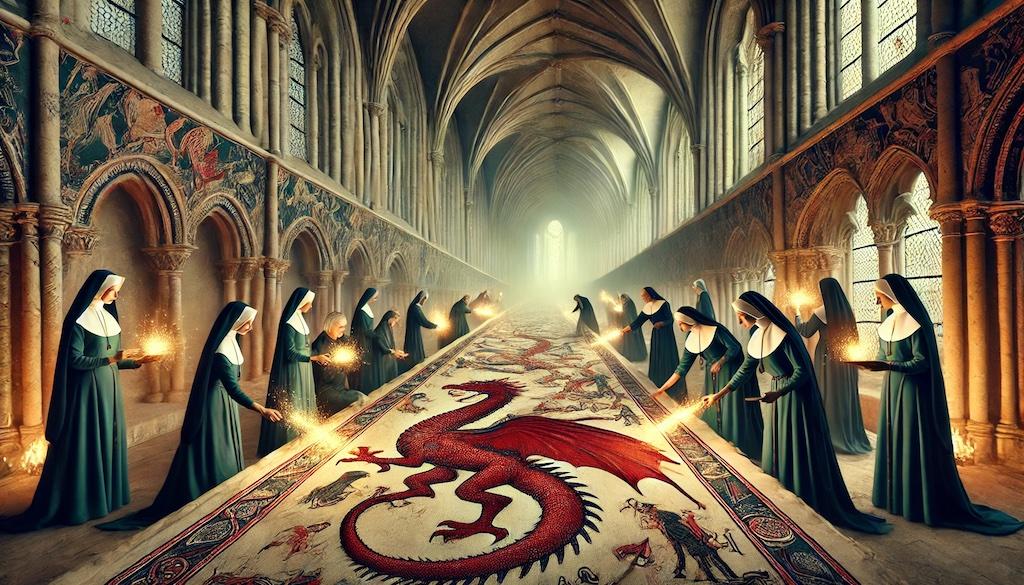
Purpose: To create a physical symbol of their intertwined destinies.
Components:- Witches: Magical threads imbued with protective charms and blessings.
- Nuns: Sacred textiles woven with prayers and religious symbols.
- Morticians: Ribbons representing life, death, and the transition between them.
Symbolism: By weaving these threads together into a single tapestry, the groups create a tangible manifestation of their unified path forward.
3. The Concordia Cauldron
Purpose: To brew a potion that represents their collective energy and intent.
Components:
- Witches: Magical herbs, crystals, and other mystical ingredients.
- Nuns: Holy water and sacred relics.
- Morticians: Ashes from ritual fires and symbols of purification.
Symbolism: The potion, once blessed and distributed, serves as a means of internalizing the collective spirit and shared goals of the unified group.
4. The Harmonious Choir
Purpose: To blend their voices and energies in a powerful, resonant harmony.
Components:
- Witches: Chants and spells sung in unison.
- Nuns: Choir hymns and sacred music.
- Morticians: Melodic recitations of ancient rites.
Symbolism: The act of creating music together represents the harmony they strive to achieve in their collaboration, with each voice contributing to a greater whole.
5. The Altar of Convergence
Purpose: To create a shared sacred space where offerings and symbols from each group are placed.
Components:
- Witches: Ritual objects, such as wands, crystals, and candles.
- Nuns: Holy relics, icons, and prayer books.
- Morticians: Mementos of the deceased, symbolizing the continuity of life and death.
Symbolism: The combined altar serves as a focal point for their united efforts, a place where they can come together to seek guidance and reaffirm their commitment to the union.
6. The Ceremony of Reflection and Projection
Purpose: To reflect on the past, acknowledge individual and collective strengths, and set intentions for the future.
Components:
- Witches: Scrying mirrors and crystal balls for reflection and foresight.
- Nuns: Candles representing illumination and enlightenment.
- Morticians: Artifacts representing the cyclical nature of life and death.
Symbolism: This ceremony encourages each member to contemplate their role within the new union and visualize the path ahead, fostering a sense of shared vision and purpose.
Supervision by Jeezel and Silas
Jeezel: With her deep connection to magical energies and her knack for emotional resonance, she will ensure that each ritual maintains its mystical integrity and spiritual depth. She will guide the participants in channeling their energies harmoniously and with clear intent.
Silas: His analytical mind and authoritative presence will bring structure and order to the rituals. He will ensure that each component is meticulously planned and executed, maintaining the balance between tradition and innovation.
Together, Jeezel and Silas will oversee the integration rituals, blending their unique approaches to create a unified and cohesive experience that honors the diverse traditions of the witches, nuns, and morticians. Their combined leadership will ensure that the rituals not only symbolize but also spiritually solidify the union of these distinct groups.
Now, all that remained was to ask for volunteers or to assign the roles in the rituals to everyone. And for Jeezel to reveal the hidden mission to her three friends.
June 19, 2024 at 8:10 am #7503In reply to: The Incense of the Quadrivium’s Mystiques
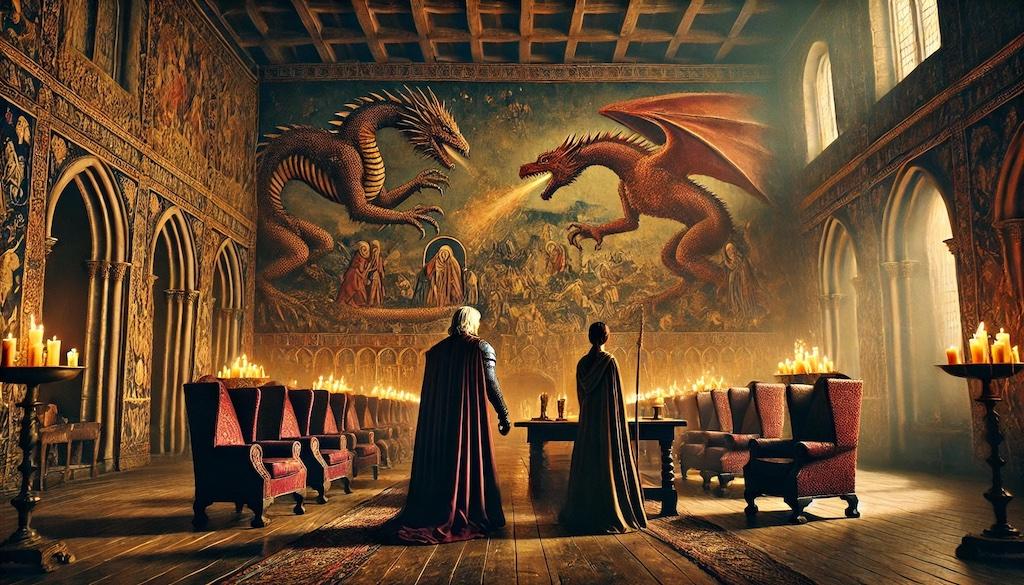
Silas led Jeezel into a secluded lounge, a hidden gem within the ancient cloister that seemed to be frozen in time. The atmosphere was thick with the scent of sandalwood and myrrh, mingling with a musty, earthy fragrance with undertones of aged woods.
Jeezel stopped a moment, in awe at the grand tapestries adorning the walls. They depicted scenes of epic battles between dragons and saints, the vibrant threads weaving tales of heroism and divine intervention. The dragons, captured in mid-roar with scales that seemed to shimmer with a life of their own, contrasted starkly agains the faces of the saints, their halo glowing softly in the dim light. Always the sensitive nose, Jeezel detected hints of incense and aged spices absorbed over centuries by the fabric, with a faint trace of mildew lingering on old stones and the faint sweetness of preserved herbs. She shivered.
Silas invited her to seat on one of the high-backed chairs upholstered in deep burgundy velvet that surrounded a massive oak table, carved with runes and symbols of protection. Jeezel frowned at the oddity to find pagan magic in a convent. As she sat the fabric of her gown brushed agains the plush velvet with a delicate sliding sound, like a faint sigh. The flickering flames of candelabras cast dancing shadows across the room, around which an array of curious relics and artifacts were scattered–an astrolabe here, a crystal ball there, and various objects of mystical significance.
Despite being an aficionado of pageants and grand performances, Jeezel couldn’t say she wasn’t impressed. Silas, ever the pillar of calm and wisdom, took a seat at the table, his fingers tracing the runes carved into the wood.
“Jeezel,” he began, his voice a soothing balm against the room’s charged energy, “I know I can trust you. Before we delve into the heart of these rituals, I must tell you something.”
Man! Here we are, she thought. She tensed on her chair.
“There are some people who would rather see the merger fail. They are doing anything in their power to foster such an outcome. We cannot let them win.”
Jeezel’s face tightened and she struggled to maintain her composure. She tapped with her fingers on the table to distract the head mortician’s attention and help her regain a stoic demeanor. Her mind raced weighing the implications. Malové had said that the Crimson Opus wasn’t just any artifact, it was key to immense power and knowledge, something that could tip the scales in their favour. How she regretted at that moment she had not paid enough attention at the merger meeting. Now, Malové was gone, somewhere, and Jeezel wasn’t even sure the postcard she had sent the coven was real. All she knew was that Malové counted on her to find that relic. And for that, she had to step in what appears to be a nest of vipers. She reminded herself she had survived worse competition in the past and still won her trophies with pride.
“Silas,” she said, her voice measured but with an edge of tension, “this complicates things more than I anticipated. We have enough on our hands ensuring the rituals go smoothly without sabotage.” She paused, taking a deep breath to steady herself. “But we cannot allow these factions to succeed. The merger is crucial for our mutual survival advancement. We’ll need to be vigilant, Silas. Every step we take, every ritual we perform, must be meticulously guarded. And we must identify who these adversaries are, and what they are planning.” She wished Malové would see her in that instant. She craved support from anyone. She looked at Silas, her eyes full of hope he could help. “I have a task from Malové that is of paramount importance,” she started and almost jumped from the chair when her hedgehog amulet almost tased her. A warning. Her mind suddenly found a new clarity. She realized she has been about to tell him about the Crimson Opus. Jeezel noticed the man’s finger was still caressing the runes on the table. Had he been casting a spell on her? She shook her head.
“Those six rituals cannot be compromised. I’ll need your help to ensure that we succeed. We must be prepared to act swiftly and decisively.”
Silas’ hand froze. He nodded. She wasn’t sure there wasn’t some irritation in his voice when he said: “You have my full support, Jeezel. We’ll strengthen our defenses and keep a close watch on any suspicious activities. The stakes are too high for failure.”
Did he mean that he would keep a close eye on her next moves? She’d have to be careful in her search of the Crimson Opus. She realized she needed some help. Malové, you entrusted me with that mission. Then, you’d have to trust me with whom I choose to trust.
June 18, 2024 at 7:12 pm #7501In reply to: The Incense of the Quadrivium’s Mystiques
While the other sisters were mingling, and trying to figure out with some circumspection, the good which could come out of this union, Eris had retreated in a quieter corner of the cloister. After all, and despite the renovations made to cater to external seminars, workshops and celebrations, it remained a place of mystery and introspection. The stone walls had this deep cold quietness which felt refreshing in the scolding heat of things.
For the past weeks, Eris was mulling over the impossible assignment given by Austreberthe to conduct a reorganisation, which seemed preposterious. Now, with the merger in motion, it had become plain for the Quadrivium board of directors that there was a need to change their way.
Put in another way, they were basically saying that the autonomous functioning of their small squads of witches wasn’t helping for a larger expansion, and had to move to more industrial separation of tasks, something of a matricial organisation. The irony wasn’t lost on her — talking about mothers, matrix, but actually being more bent to patriarchal structure with all the new additions asked for by the merger of figureheads: head of product, head of delivery, head of convergence all these new roles to invent —yet feeling thoroughly alien, akin to grafting machine onto a living organism. The Quadrivium had always thrived on its autonomous squads, and the idea of industrialising their structure seemed almost heretical.
The undertakers consultants, with their methodical approach were supposed to help, but she hadn’t been able yet to make them work for her, as she could see them struggle with the finer nuances of their craft.
Looking for inspiration in the quiet space she’d found, Eris closed her eyes, drawing a deep breath. Her mind wandered to her Aunt Amara’s garden, where order and chaos coexisted in a delicate balance.
A plan started to present itself, almost like one of those annoying lists that Malové would often love to provide.
It had to start with mapping the terrain —the existing strengths of the autonomous groups in the coven. It would require documenting their capabilities, ongoing projects, and key members, creating a clear picture of what the coven had to offer.
Then to look at potential synergies between the squads and the new roles Austreberthe envisioned. The Head of Product could harness the creative energies of the crafting squad, while the Head of Delivery might streamline the efforts of those specializing in executing the vision into tangible deliverables. The Head of Convergence would need to be a master diplomat, someone who could bridge the gap between the nuns and the witches.
More subtle, but with potential, the next step came in boldly, with an impudence that could mean as much genius as it could spell out disaster: Hybrid Squads. Instead of dismantling the existing groups of the coven, she could propose hybrid squads. Each hybrid squad would retain its core identity but include members from the Cloister Crafts and have a liaison to the new heads. This way, the squads could maintain their autonomy while integrating new skills and perspectives.
She took a moment to ponder the implications.
Eris knew she would need to test this approach before full-scale implementation. She would start with pilot projects, assigning a few key squads to work under the new structure. Regular feedback sessions would allow adjustments and refinements, ensuring the system evolved organically.
That would be where the Morticians’ Guild would be able to support more directly. Garrett and Silas could facilitate the integration rituals and workshops to ease any lingering tensions. Rufus would ensure security, while Nemo, the analyst, would provide insights into improving efficiencies without compromising their magical integrity.
All this needed a catalyst, or this plan would drag on forever.
Drag on…
Nothing like a dragon crisis to put things in motion! There surely were abundant dragon energy left in those tunnels, powerful telluric energies to muster into a spell to invigorate and cement the newfound alliance between witches and nuns.
She snapped her fingers. Echo who was never far away, reappeared with a smirk. “I can see you have some devious idea. How can I help?”
June 11, 2024 at 6:51 am #7467In reply to: The Incense of the Quadrivium’s Mystiques
As the crow flies, the Airbnb was about 500 meters from Herma’s cottage. Frella had been too exhausted yesterday to appreciate how pretty the mossy brick path was, lined either side with a profusion of colourful flowers. But was it really just yesterday, she wondered? So much had happened back at the coven — as recounted in a relentless flow of messages from Truella. Time was a funny beast.
As they walked the winding path, Herma explained that, many years ago now, the prior owner of the cottage had left behind a number of his belongings with the promise he would return for them as soon as he was settled. “But the blighter never did come back and I never heard from him again.” She stopped just short of the gate to her cottage and waved an arm towards a big old shed with a tractor parked outside and a couple of sheep grazing contentedly. “We stuck his stuff in there in the end when he didn’t come back. I know there’s a camphor chest — it nearly broke my back — but I don’t know what’s in it. Do you think that might be it?”
Unfortunately Frella was distracted from replying right away by another volley of messages from Truella with the latest mind boggling developments.
June 11, 2024 at 5:26 am #7466In reply to: The Incense of the Quadrivium’s Mystiques
“What’s so bad about the Middle Ages, Eris?” asked Truella, bridling. “I’ve been saying all along, we need to return to our roots, get back to the real thing, ditch the modern corporate world that has nothing to do with witchcraft.”
“It won’t be all lutes and jesters, you know,” Frella said with a frown. “I think you’re romanticising it. They did all sorts of dreadful things for money, even back then.”
“Gorgeous pointy hats though, Frell, and richly embroidered gowns and robes, men in tights and pointy shoes….”
Eris glared at Jez. “Who’s romanticising now? You’re forgetting the rank smell of unwashed bodies, the foul rotten food..”
“We’re not literally going back in time!” Truella said in exasperation. “Just adopting a different outlook, we can still wash for Flove’s sake! I don’t like the sound of Austreberthe though,” she added. “Sounds like a character out of a 1940’s German coven of the worst possible sort.”
“That’s a step too far, Truella,” Frella gasped. “You can’t say things like that about people, especially your superiors.”
“What do you mean can’t, I just did,” Truella retorted hotly. “And that right there is the problem, can’t you see? Nobody is superior! Anyway, how do we know Malove appointed her? Maybe she’s just seized the opportunity, a chancer in a power vacuum, and here you all are, just drooling at the opportunity to kowtow to yet another old dragon past her sell by date.”
“You’ll end up in the stocks on the village green, you will, being pelted with tomatos by the peasants, if she hears you.” Jez was examining her nails. “Did they have nail varnish in the Middle Ages?”
April 11, 2024 at 7:52 am #7426In reply to: The Incense of the Quadrivium’s Mystiques
It was early morning, too early if you asked some. The fresh dew of Limerick’s morn clinged to the old stones of King John’s castle like a blanket woven from the very essence of dawn. The castle was not to open its doors before 3 hours, yet a most peculiar gathering was waiting at the bottom of the tower closest to the Shannon river.
“6am! Who would wake that early to take a bus?” asked Truella, as fresh as a newly bloomed poppy. She had no time to sleep after a night spent scattering truelles all around the city. “And where are the others?” she fumed, having forgotten about the resplendent undeniable presence she had vowed to embody during that day.
Frigella, leaning against a nearby lamppost, her arms crossed, rolled her eyes. “Jeezel? Malové? Do you even want an answer?” she asked with a wry smile. All busy in her dread of balls, she had forgotten she would have to travel with her friends to go there, and support their lamentations for an entire day before that flucksy party. Her attire was crisp and professional, yet one could glimpse the outlines of various protective talismans beneath the fabric.
Next to them, Eris was gazing at her smartphone, trying not to get the other’s mood affect her own, already at her lowest. A few days ago, she had suggested to Malové it would be more efficient if she could portal directly to Adare manor, yet Malové insisted Eris joined them in Limerick. They had to travel together or it would ruin the shared experience. Who on earth invented team building and group trips?
“Look who’s gracing us with her presence,” said Truella with a snort.
Jeezel was coming. Despite her slow pace and the early hour, she embodied the unexpected grace in a world of vagueness. Clumsy yet elegant, she juggled her belongings — a hatbox, a colorful scarf, and a rather disgruntled cat that had decided her shoulder was its throne. A trail of glitters seemed to follow her every move.
“And you’re wearing your SlowMeDown boots… that explains why you’re always dragging…”
“Oh! Look at us,” said Jeezel, “Four witches, each a unique note in the symphony of existence. Let our hearts beat in unison with the secrets of the universe as we’re getting ready for a magical experience,” she said with a graceful smile.
“Don’t bother, Truelle. You’re not at your best today. Jeez is dancing to a tune she only can hear,” said Frigella.
Seeing her joy was not infectious, Jeezel asked: “Where’s Malové?”
“Maybe she bought a pair of SlowMeDown boots after she saw yours…” snorted Truella.
Jeezel opened her mouth to retort when a loud and nasty gurgle took all the available place in the soundscape. An octobus, with magnificently engineered tentacles, rose from the depth of the Shannon, splashing icy water on the quatuor. Each tentacle, engineered to both awe and serve, extended with a grace that belied its monstrous size, caressing the cobblestones of the bridge with a tender curiosity that was both wild and calculated. The octobus, a pulsing mass of intelligence and charm, settled with a finality that spoke of journeys beginning and ending, of stories waiting to be told. Surrounded by steam, it waited in the silence.
Eris looked an instant at the beast before resuming her search on her phone. Frigella, her arms still crossed and leaning nonchalantly against the lamppost, raised an eyebrow. Those who knew her well could spot the slight widening of her eyes, a rare show of surprise.
“Who put you in charge of the transport again?” asked Truella in a low voice as if she feared to attract the attention of the creature.
“Ouch! I didn’t…”, started Jeezel, trying to unclaw the cat from her shoulders.
“I ordered the Octobus,” said Malové’s in a crisp voice.
Eris startled at the unexpected sound. She hadn’t heard their mentor coming.
“If you had read the memo I sent you last night, you wouldn’t be as surprised. But what did I expect?”
The doors opened with a sound like the release of a deep-sea diver’s breath.
“Get on and take a seat amongst your sisters and brothers witches. We have much to do today.”
With hesitation, the four witches embarked, not merely as travelers but as pioneers of an adventure that trenscended the mundane morning commute. As the octobus prepared to resume its voyage, to delve once again into the Shannon’s embrace and navigate the aqueous avenues of Limerick, the citizens of Limerick, those early risers and the fortunate few who bore witness to this spectacle, stood agape…
“Oh! stop it with your narration and your socials Jeez,” said Truella. “I need to catch up with slumber before we arrive.”
March 10, 2024 at 12:11 am #7400In reply to: The Incense of the Quadrivium’s Mystiques
Amidst the meticulous cadence of Malové’s days as High Witch of the Quadrivium Coven, a ripple of anomaly danced through the fabric of reality, like a sprightly breeze amidst her sage incense testing. It started with subtlety—a peculiar haze veiling her potion books, an otherworldly scent mingling with her herb garden’s fragrances. But it was during her quiet contemplation among hellebore pistils that the ordinary took a whimsical turn.
The air hummed with a resonant frequency, beckoning from realms beyond. And there, in the midst of this enigmatic symphony, stood Georges, a figure oscillating between existence and non-existence, accompanied by the ethereal Malvina, a reflection of Malové’s spirit from a parallel dimension.
As Malové’s reality shimmered, the colors around her intensified, charged with the essence of a place where possibilities blurred into fantastical realities. Each breath was imbued with untapped potential, a draught of undiscovered paths.
In the midst of this mystical convergence, Malvina’s melodic voice intertwined with the air, weaving a tapestry of otherworldly allure. Energies pulsed within Malové, heralding a meeting that transcended time—a celebration set within the ever-shifting caverns of existence.
Engulfed by Malvina’s mystic melody, Malové felt the vibrations intensify, drawing her towards the allure of the unknown. With a glance at the maze of her mundane existence, she embraced the call, stepping through the veil into a world of a new sort of witchcraft, and other mystical creatures of the mind.
Amidst the unexpected spectacle, Malové found herself engaged in a dialogue with Malvina:
Malové: “Malvina, as a fellow witch of power, your reputation precedes you. Your tales of shifting caves and communion with dragons have piqued my interest. How do you maintain such fluidity within the arcane?”
Malvina: “Oh dear Malové, magic is a vast music score of constant motions, much like my cave and dragons. Adaptation and transformation are the keys to navigating its intricate weave.”
Malové: “I must admit, recent misadventures within my coven have left me seeking a fresh perspective. The fiasco with the smoke test was humbling.”
Malvina: “A fiasco, yes, but also a lesson. Magic must be respected, yet never tamed. Embrace the unexpected, and let it fuel your endeavors. What of the incense you craft?”
Malové: “It’s meant to elevate the spirit, to realign to higher purposes, and maybe inspire those enveloped in its essence. This is why we seek new blends, something transformative.”
Malvina: “Incense is not just a tool, but a companion on the journey. Let the scents guide you to uncharted territories. Look to the elements for inspiration—the earth, sky, fire, and water all have stories to tell.”
Malové: “Poetic words that is sure, and maybe wise… Perhaps a journey to your world and fabled caves could be arranged to further explore.”
Malvina: “You would be most welcome. The cave shifts but offers shelter and inspiration to all who seek it. And who knows, the dragons may impart wisdom of their own.”
Malové: “Well, to be honest, not so fond of dragons… Well, would you look at the time! The effects of that blend seems already to wear off, but thank you dearie, and we will see if some inspiration remains…”
February 26, 2024 at 8:35 am #7389In reply to: The Incense of the Quadrivium’s Mystiques
“Well, it’s a long story, are you sure you want to hear it?”
“Tell me everything, right from the beginning. You’re the one who keeps saying we have plenty of time, Truella. I shall quite enjoy just sitting here with a bottle of wine listening to the story,” Frigella said, feeling all the recent stress pleasantly slipping away.
“Alright then, you asked for it!” Truella said, topping up their glasses. The evening was warm enough to sit outside on the porch, which faced the rising moon. A tawny owl in a nearby tree called to another a short distance away. “It’s kind of hard to say when it all started, though. I suppose it all started when I joined that Arkan coven years ago and the focus wasn’t on spells so much as on time travel.”
“We used to travel to times and places in the past,” Truella continued, “Looking back now, I wonder how much of it we made up, you know?” Frigella nodded. “Preconceptions, assumptions based on what we thought we knew. It was fun though, and I’m pretty sure some of it was valid. Anyway, valid or not, one thing leads to another and it was fun.
“One of the trips was to this area but many centuries ago in the distant past. The place seemed to be a sort of ancient motorway rest stop affair, somewhere for travellers to stay overnight on a route to somewhere. There was nothing to be found out about it in any books or anything though, so no way to verify it like we could with some of our other trips. I didn’t think much more about it really, we did so many other trips. For some reason we all got a bit obsessed with pyramids, as you do!”
They both laughed. “Yeah, always pyramids or special magical stones,” agreed Frigella.
“Yeah that and the light warriors!” Truella snorted.
“So then I found a couple of pyramids not far away, well of course they weren’t actually pyramids but they did look like they were. We did lots of trips there and made up all sorts of baloney between us about them, and I kept going back to look around there. We used to say that archaeologists were hiding the truth about all the pyramids and past civilizations, quite honestly it’s a bit embarrassing now to remember that but anyway, I met an actual archaeologist by chance and asked her about that place. And the actual history of it was way more interesting than all that stuff we’d made up or imagined.
The ruins I’d found there were Roman, but it went further back than that. It was a bronze age hill fort, and later Phoenician and Punic, before it was Roman. I asked the archaeologist about Roman sites and how would I be able to tell and she showed me a broken Roman roof tile, and said one would always find these on a Roman site.
I found loads over the years while out walking, but then I found one in the old stone kitchen wall. Here, let me fetch another bottle.” Truella got up and went inside, returning with the wine and a dish of peanuts.
“So that’s when I decided to dig a hole in the garden and just keep digging until I found something. I don’t know why I never thought to do that years ago. I tell you what, I think everyone should just dig a hole in their garden, and just keep digging until they find something, I can honestly say that I’ve never had so much fun!”
“But couldn’t you have just done a spell, instead of all that digging?” Frigella asked.
“Oh my god, NO! Hell no! That wouldn’t be the same thing at all,” Truella was adamant. “In fact, this dig has made me wonder about all our spells to be honest, are we going too fast and missing the finds along the way? I’ve learned so much about so many things by taking it slowly.”
“Yeah I kinda know what you mean, but carry on with the story. We should discuss that later, though.”
“Well, I just keep finding broken pottery, loads of it. We thought it was all Roman but some of it is older, much older. I’m happy about that because I read up on Romans and frankly wasn’t impressed. Warmongering and greedy, treated the locals terribly. Ok they made everything look nice with the murals and mosaics and what not, and their buildings lasted pretty well, but who actually built the stuff, not Romans was it, it was the slaves. Still, I wasn’t complaining, finding Roman stuff in the garden was pretty cool. But I kept wishing I knew more about the people who lived here before they came on the rampage taking everything back to Rome. Hey, let me go and grab another bottle of wine.”
Frigella was feeling pleasantly squiffy by now. The full moon was bright overhead, and she reckoned it was light enough to wander around the garden while Truella was in the kitchen. As she walked down the garden, the tawny owl called and she looked up hoping to see him in the fig tree. She missed her step and fell over a bucket, and she was falling, falling, falling, like Alice down the rabbit hole.
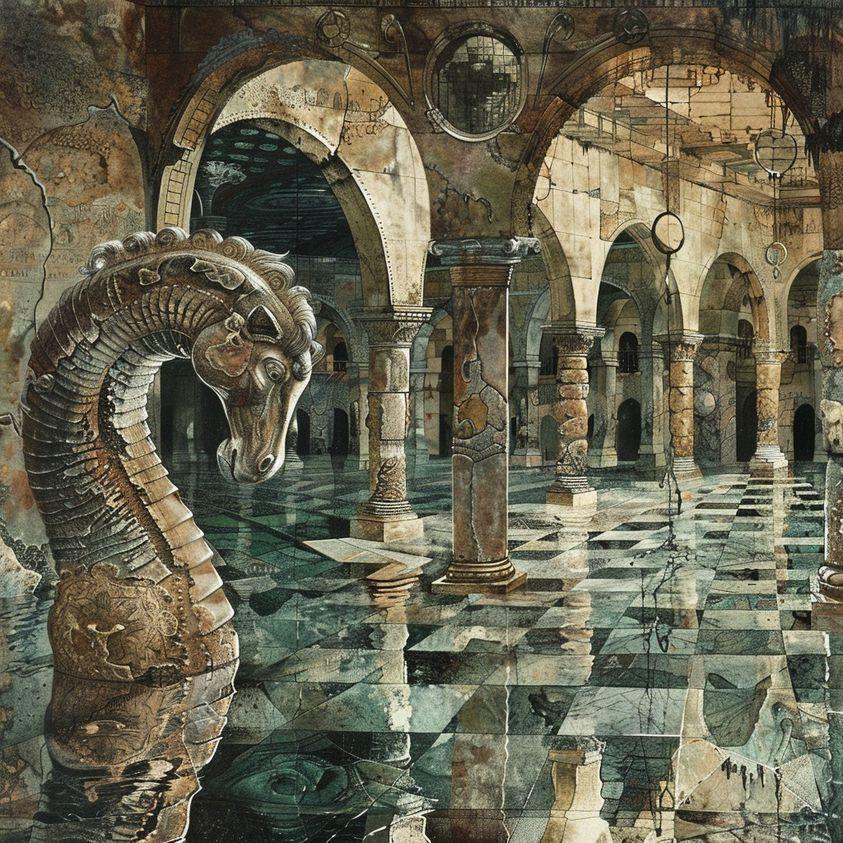
The fall was slow like a feather wafting gently down and she saw hundreds of intriguing fragments of objects and etchings and artefacts on the sides of the hole and she drifted slowly down. At last she came to rest at the bottom, and found herself in an arched gallery of mirrors and tiles and doors. On every surface were incomplete drawings and shreds of writings, wondrous and fascinating. She didn’t immediately notice the hippocampus smiling benignly down at her. He startled her a little, but had such a pleasant face that she smiled back up at him. “Where am I?” she asked.
“You’d be surprised how many people ask me that.” he replied, with a soft whicker of mirth. “Not many realise that they’ve called on me to help them navigate. Now tell me, where is it you want to go?”
“Well,” Frigella replied slowly, “Now that you ask, I’m not entirely sure. But I’m pretty sure Truella would like to see this place.”
 February 20, 2024 at 1:44 pm #7379
In reply to: The Incense of the Quadrivium’s Mystiques
From the moment they had stepped into the gorgeous villa, Malové had felt it was a trap.
It all went very fast and messily after that.
The memories were a bit blurred after all the manic rush of events.
One thing was sure: her little plan of a new smoke fragrance had to be the biggest fiasco since she took the reins of the Coven’s Quadrivium ventures.
Well, there wouldn’t be a huge point to go through the minute details of events that went down after that, would it.
Suffice to say that someone had snitched about their incognito presence directly in the ears of the Elder, and they would have been toast were it not for her quick wits.
A few curious souls would love to know how they ultimately escaped the clutches of the Brazilian witches. But that story would be one for later.
Carnival was over, and she for one, had never been big on feathers and glitter.
Lent and its Quadragesima austerities was more her style.In the end, they’d only be gone for less than a week and like that, they’d already come back to the Quadrivium.
It was luck really that Jeezel had been so good at producing the cascading portal just in time, and they could all slip through it, in spite of the sudden explosion of fireworks and the mad run ensuing. One of the pygmy hippos that was sent to chase after them had paid the price of Jeezel’s quick thinking this time, as she’d severed the portal at just the moment for the hippo to be bisected in a rather gruesome fashion.
Well, she’d never tasted smoked hippo, but she’d heard from her Tanzanian witch friend that one could find decent recipes, and it would do wonders with a garnish of orange marmalade.
And on top of that, she’d recently acquired a wardrobe sized smoking room that would do perfectly well for a trial run.She had to hand it to Frigella that she also did well with the hedgehog enlargement and armoring spells – the spikes throwing had really made a splash. Malové didn’t know she was so good at battle magic she even didn’t have to use her dragonage master spell.
The only issue was for Truella. Termitated by honey that was served by their cunning hosts, her duplicate self had been turned to stone instantaneously. That’s how Malové had known they were not meant to escape. Luckily for Truella, this was just her duplicate from the bilocation spell. On Malové’s orders, Eris had turned this second body into a miniature statue so that Eris could carry her away to safety during their mad escape.
Now, they would have to merge this stoned Truella back with her original self, so that Truella wouldn’t suffer from any tinkering effects afterwards.
February 11, 2024 at 12:34 pm #7366In reply to: The Incense of the Quadrivium’s Mystiques
“Are we going down a sewer?” asked Truella as if you’d asked her to put her hand into dragon poop to see why they had diarrhoea. She was wearing the green blouse of a nurse. Jeezel’s thought the colour was almost a match with the witch’s face.
“Don’t be difficult,” said Frigella a bit annoyed. “You spend most of your free time in a hole as a hobby.” She was readjusting her purple blouse, which seemed to be bit too big for her.
“It’s my hole,” said Truella. “I know what’s in there. It’s got nothing to do with that murky miasma of decayed dreams and digested dinners piling up down there as a testimony of Limerick’s population’s contemplation of their puny lives on their pitiful thrones. And the stench, it cuts through the air, it would make a maggot gag. I tell you, certain portals are best left untraveled. I wonder why Malové has left you in charge of the portal.”
“We won’t go through the sewer,” said Jeezel. “It’s an ancient spell I got from my grand-mother Linda Pol from the time of her Time Travelling drag show. It creates a vortex impervious to any smell. If maggots gag it’ll be because they saw your panties.”
Truella, who had never learned how to hold her tongue, started to open her mouth when Malové arrived. She inspected every witch’s nurse attire and winced at Jeezel’s white blouse that made the tall witch look like one of those nightingale from the 50’s.
“Will you be able to breathe?” she asked. “We don’t want to be stuck here because you fainted before finishing your spell.”
“This is my natural silhouette, whispered Jeezel. The fabric is very stretchy. Anyway, I’m using sigils to cast this spell.”
Truella stopped her snort short when Malové glanced at her own blouse.
“As for you, your words are not the only thing you could iron out.”
Then she gave a nod of appreciation to Frigella and Eris. “Then we’re good to go.”
Jeezel started to draw lines and curves in space above and around the manhole, she looked like a peacock flaunting its feathers. Then she used her orange gloss to draw the one sigil around the manhole and invoked its name. Frigella who was seeing it performed for the first time had the impression Jeezel said “Fern” but she wouldn’t put her hand in a witch’s fire for it. The manhole cover shimmied and shook like it was coming to life. It lifted, hovering with all the grace of a duchess at high tea before sliding aside.
“Et voilà,” said Jeezel with glitter in her eyes. “Who’s first?”
Eris, intrigued by the vortex of glowing and sparkling with all the magical energy coursing through it, jumped right in, not waiting for anyone to answer.
February 11, 2024 at 10:32 am #7364In reply to: The Incense of the Quadrivium’s Mystiques
“Witches, assemble!” It was hard for Malové to forget the theatrics, even in presence of a limited number of persons.
The three witches had come in a hurry, summoned for some of them by a loud howler in the early light. Admittedly, Malové had to compensate for the usual tardiness of some, and her impeccable spells had been calling for the trio at just the right time for each to arrive precisely to the Quadrivium’s Headquarter in less than a minute’s space one from the other.
“Unbelievable” Frigella had muttered when she saw Truella already there.
“Hoy, don’t get your knickers in a twist Love, I’ve been called to that meeting only two days ago!”
Frigella didn’t have time to retort with a snark that she’d been summoned less than fifteen minutes before, as another popping sound and a flush indicated the arrival of Eris from the Quadrivium’s Emporium backdoor in the lady’s room.
“And where is Jeezel?” Truella wondered. “I haven’t seen her yet.”
“Oh, you know, there’s no accounting for wig time preparation even with Malové superb spells skills” Eris said pragmatically.
“I wouldn’t say that.” The voice of Malové, stern but not devoid of warmth, signaled the end of the chatty banter. “She was doing some chores for me, but she’ll be back in a second.” She clapped her hands elegantly, each hand barely touching the other, yet ripples of powerful energies resounded throughout the space.
The doors flung open, revealing Jeezel in a gorgeous golden fitting ensemble, the chiffon kerchief she had before to do her chores replaced by a subtly glittering tiara standing proud on the loveliest curly wig of luscious magpie dark hair reflecting a striking metallic blue in their shine.
Jeezel, who had been secretly crying over the punishment touched her cheeks for signs of blurred cracked mascara, but instead, she could feel her cheeks were delicately powdered, her eyes contoured to perfection.
“What?…” she for once couldn’t voice her emotions.
“Silly goose,” Malové smiled in a hard to decipher rictus. “You have forgotten the evil witch and the fairy godmother are all part of the same cabal. Now,” and she turned intently to the other assembled witches.
“Are we getting punished too?” Asked Truella who couldn’t refrain to hide her rebellious nature “I won’t…”
Before she could say more, Malové raised her hand and said “Enough with this punishment nonsense. Even that foul-mouthed Finnlee with her down-to-earth mores knows that there is nothing like a little cleaning to clear up the space.”
A sigh of relief from the four friends. So if punishment wasn’t in order, what was it about?
“So where was I? It’s going to get me a whole new comment to get to where I…” She started to get flustered with exasperation from all the interruptions. The four witches were silent except for long agitated side glances at each other.
That’s when the door bell started to ring relentlessly. She thought to let it pass, probably a delivery person for the staff. But it wasn’t stopping.
“What is it?” her voice as honey-coated as the raspy tongue of a feral hellcat.
“It’s Finnlee, M’am Witch, erm, HeadTwitch. I forgot my keys, open the door if you don’t want this place to go to more waste. Mark my words. So much staff has come and gone, it’s a miracle I’m still here with …”
Malové rolled her eyes, and flipped her hands in a savant motion, opening the gates remotely for the cursing cleaning lady. She was right, one couldn’t get the staff these days. And there was nothing like a good solid floor scrubbing, no magic involved but elbow grease. Magic rarely stuck enough, and honestly, it would be such a waste of energy.
February 11, 2024 at 9:06 am #7361In reply to: The Incense of the Quadrivium’s Mystiques
Truella had already left for that monkey hunt in the Mediterranean. Eris had to go back before nightfall, which was quite early at this time of year as she had chosen to live in such a remote place in the midst of a frozen forest. Jeezel only thought it romantic because of the icicles that would form on your eyelashes and brows, making you the perfect avatar for the Snow Queen musical. And Frigella… She said she was tired but from the sight of her aura, she undoubtedly was onto something fishy.
Jeezel looked at her dress. Once a divine creation, it has turned into a disaster. Irremediably stained with soot, it’s foul smell would make any dragon lose their appetite. She felt a mix of sadness and guilt for all the murex that gave their shells for that unique shade of purple she was so proud of.
She wasn’t sure even Teddy Steambolt could muster his magic to save the divine creation. She imagined his eyes widen as saucers when she entered his Palace of Pristine with the lifeless garment in her arms. He would most certainly swoon and gasp at the same time.
“Oh, The tragedy!” he would wail, his high-pitched lament resonating in the cathedral ceiling of his atelier of cleanliness. “What calamity hath befallen this exquisite creation?”
“Teddy, dear,” she would say, “It was indeed a tragedy. I lost seven of my nails and my hair was ruined. You’re the alchemist of cleanliness, you’re my only hope for a miracle.”
And he would take her dress and perform his magic from which it would emerge reborn, and all those murex wouldn’t have lost their home for nothing.
She was about to follow the others when Malové reminded her: “Aren’t you forgetting something?”
A broom and a bucket of black soap were floating on her right.
Her sigh would have made a blue whale blush with envy. Her role tonight would not be the Snow Queen, but Cinderella, another of her favourite diva.
February 7, 2024 at 9:41 pm #7359In reply to: The Incense of the Quadrivium’s Mystiques
Head witch Malové must have been used to it, for having seen that magic at play a number of times… there was nothing like the strange serendipity of chaos.
After the smoke had finally cleared, Malové couldn’t bear to stand amidst the wreckage of their once impeccably arranged ritual space. She looked at the mess, the sheer ridiculousness of it all, and decided to go for a brisk walk in the streets of Limerick. The light drizzle and sharp sting of the winter air brought back some pink to her pale face. To cover her perfectly coiffed head, he wrapped her shawl, black and shiny as a dung beetle, and moved swiftly cutting through the crowds effortlessly, parting the human congeries like Moses did the Red Sea. She was never unnoticed; her tall lean silhouette, accentuated by the sleek robe noire, the vertigo of her stiletto, the cheekbones so sharp they could kill — there was nothing common about her frame; and after the years, and all the side glances, she’d clearly lost practice on how to give a damn.
It was at the turn of a dark corner illuminated by the neon sign of a Chinese local eatery under which the delivery guy was having a break that the synchronicity stuck her. A slow smirk tugged at the corners of her mouth. From chaos, clarity had emerged.
Vaping, hookah, e-cigarettes —all the rage among the mindless masses. And there, in the plumes of artificially flavoured smoke, was their opportunity. A new way to infiltrate the consciousness of the people, to subtly attune their energies and guide them towards emotional management —or at the very least, less stupidity.
She imagined their Incense —the sacred concoctions of herbs and essences, entwined with potent spells— being drawn into eager lungs, seeping into the bloodstream, entangling with the very atoms of their being, a sweet balm better than the usual deleterious micro-plastics. The witches wouldn’t just be casting spells; they’d be weaving their magic into the fabric of life itself, one puff at a time.
The more she thought about it, the brighter the idea seemed. It was audacious, unconventional, bordering on scandalous. A few days ago maybe, she would have balked at the mere thought. But desperate times called for this… elegant, simply perfect. For the witches of the Quadrivium Coven of Mystiques, she had even less doubts or concerns about warming them up to such iconoclastic idea. She knew a group of them, those black sheep never to shy away from a little controversy. And if they could use the vaping trend to spread their influence, then why not? Enough with surviving on the Chinese New Year only, the whole world was ripe for extended incensing.
February 7, 2024 at 12:40 am #7356In reply to: The Incense of the Quadrivium’s Mystiques
“Would you be looking for me?”
Cedric jumped. Where on earth had she come from? It was the blond witch from the cafe, but what was she doing sneaking up behind him when he’d seen her rushing off down the street not a minute before! And yet here she was, smirking at him like butter wouldn’t melt!
He studied her. She wasn’t conventionally pretty he decided, with her thin, sharp features. And she had no meat on her bones. Cedric liked women who were soft and had a bit of something he could squeeze. And she was so … white … almost like one of those albinos … still, there was something he found strangely compelling about her.
She’s a witch, he reminded himself. “What on earth gave you the idea I was following you?” He twisted his mouth into an amused sneer, hoping it showed the contempt she surely deserved.
“You’re not then?” Her gaze was unswerving and Cedric had to look away, pretending to take a great interest in a black poodle peeing on a nearby lamp post. Cedric liked dogs and up until six months ago had a miniature schnauzer called Mitzy. Thinking of Mitzy, he felt the familiar little squeeze in his chest.
“I’m Frigella O’Green,” she said, still studying him intently.
Reluctantly he pulled his gaze back towards her. “Oh, ah … Cedric … just Cedric.” He’d nearly told her his surname which didn’t seem a good idea, all things considered. Out of habit, he raised his hand to take hers, then remembering, thrust it awkwardly in his jacket pocket.
“Well, just Cedric, if you’re not looking for me, I’ll be off … I’m in a bit of a hurry.” Then she smiled at him, properly this time, and Cedric wondered why he hadn’t thought she was pretty a moment ago. “Nice hat by the way, Cedric. Stylish.” She turned then and Cedric watched her stride down the street until she was no longer visible. Distractedly he brushed the wool tweed of his cap.
Frigella O’Green is a witch, Cedric, he told himself sternly.
February 4, 2024 at 4:13 pm #7339In reply to: The Incense of the Quadrivium’s Mystiques
4pm EET.
Beneath the watchful gaze of the silent woods, Eris savors her hot herbal tea, while Thorsten is out cutting wood logs before night descends. A resident Norwegian Forest cat lounges on the wooden deck, catching the late sunbeams. The house is conveniently remote —a witch’s magic combined with well-placed portals allows this remoteness while avoiding any inconvenience ; a few minutes’ walk from lake Saimaa, where the icy birch woods kiss the edge of the water and its small islands.
Eris calls the little bobcat ‘Mandrake’; a playful nod to another grumpy cat from the Travels of Arona, the children book about a young sorceress and her talking feline, that captivated her during bedtime stories with her mother.
Mandrake pays little heed to her, coming and going at his own whim. Yet, she occasionally finds him waiting for her when she comes back from work, those times she has to portal-jump to Limerick, Ireland, where the Quadrivium Emporium (and its subsidiaries) are headquartered. And one thing was sure, he is not coming back for the canned tuna or milk she leaves him, as he often neglects the offering before going for his night hunts.
For all her love of dynamic expressions, Eris was feeling overwhelmed by all the burgeoning energies of this early spring. Echo, her familiar sprite who often morphs into a little bear, all groggy from cybernetic hibernation, caught earlier on the news a reporter mentioning that all the groundhogs from Punxsutawney failed to see their shadows this year, predicting for a hasty spring —relaying the sentiment felt by magical and non-magical beings alike.
Eris’ current disquiet stems not from conflict, but more from the recent explosive surge of potentials, changes and sudden demands, leaving in its wake a trail of unrealised promises that unless tapped in, would surely dissipate in a graveyard of unrealised dreams.
Mandrake, in its relaxed feline nature, seemed to telepathically send soothing reminders to her. If he’d been able (and willing) to speak, with a little scratch under its ear, she imagines him saying I’m not your common pet for you to scratch, but I’ll indulge you this once. Remember what it means to be a witch. To embrace the chaos, not fight it. To dance in the storm rather than seek shelter. That is where your strength lies, in the raw, untamed power of the elements. You need not control the maelstrom; you must become it. Now, be gone. I have a sunbeam to nap in.
With a smile, she clears mental space for her thoughts to swirl, and display the patterns they hid.
A jump in Normandy, indeed. She was there in the first mist of the early morning. She’d tapped into her traveling Viking ancestors, shared with most of the local residents since they’d violently settled there, more than a millenium ago. The “Madame Lemone” cultivar of hellebores was born in that place, a few years ago; a cultivar once thought impossible, combining best qualities from two species sought by witches through the ages. Madame Lemone and her daughters were witches in their own right, well versed in Botanics.
Why hellebores? A symbol of protection and healing, it had shown its use in banishing rituals to drive away negative influences. A tricky plant, beautiful and deadly. Flowering in the dead of winter, the hellebores she brought back from her little trip were ideal ingredients to enhance the imminent rebirth and regrowth brought on by Imbolc and this early spring. It was perfect for this new era filled with challenges. Sometimes, in order to bloom anew, you must face the rot within.
The thoughts kept spinning, segueing into the next. Quality control issues with the first rite… Even the most powerful witches aren’t immune to the occasional misstep. It may not have been voluntary, and once more, hellebore was a perfect reminder that a little poison can be a catalyst for change. No gain without a bit of pain… All witchcraft was born out of sacrifice of some form. An exchange of energy. Something given, for something in return.
Luckily, she’d learnt the third rite had gone well even in her absence. Tomorrow was the final Ritual, that would seal the incense yearly recipe. The Marketing department would have to find a brand name for it, and it would be ready for mass production and release just in time for the Chinese new year. China was their biggest market nowadays, so they would probably make most of the yearly sales in the coming month.
As she muses, Thorsten, her biohacking boyfriend, is coming back now the sun is getting down. A rugged contradiction of man and machine.
“Have you managed to contact your friends?” he asks, his pointed question tempered by a calm demeanor. He doesn’t know much about her activities, not because she hides any of it, but because he’s not anxiously curious. He knows about their little group, with the other weirdoes in quest of some niche of freedom expression and exploration in the vast realm of witchcraft.
“Yes, I did. We had a nice chat with Jeezel and she sends her regards…”
“She bloody always do that, doesn’t she.” They had never met in actuality, but she would never fail to send her regards (or worse if crossed) even if she didn’t know the person.
Eris laughed. “Well, Frigella was going to bed…”
“If I didn’t know better, one could think she does it on purpose.”
Eris continued. “Well, and get that; Tru was busy making some French fries.”
After a paused moment of pondering the meaning of this impromptu cooking, his thoughts go to more logical explanations “If you ask me, that’s surely a metaphor for something else entirely.”
“Meat and potatoes… And sometimes,… just potatoes.”
“Or in this case, possibility for a hearty gratin.”
They share a delightful laughter.
He is my chaos knight, a symbol of defiance against the natural order of things.
A quality she adores.
February 1, 2024 at 12:03 am #7332In reply to: The Incense of the Quadrivium’s Mystiques
After the evening ritual at the elder tree, Eris came home thirsting for the bitter taste of dark Assam tea. Thorsten had already gone to sleep, and his cybernetic arm was put negligently near the sink, ready for the morning, as it was otherwise inconvenient to wear to bed.
Tired by the long day, and even more by the day planned in the morrow, she’d planned to go to bed as well, but a late notification caught her attention. “You have a close cousin! Find more”; she had registered some time ago to get an analysis of her witch heritage, in a somewhat vain attempt to pinpoint more clearly where, if it could be told, her gift had originated. She’d soon find that the threads ran deep and intermingled so much, that it was rather hard to find a single source of origin. Only patterns emerged, to give her a hint of this.
Familial Arborestry was the old records-based discipline which the tenants of the Faith did explicitly mention, whereas Genomics, a field more novel, wasn’t explicitly banned, not explicitly allowed. Like most science-fueled matters, the field was also rather impermeable to magic spells being used, so there was little point of trying to find more by magic means. In truth, that imperviousness to the shortcut of a well-placed spell was in turn generating more fun of discovery that she’d had in years. But after a while, she seemed to have reached a plateau in her finds.
Like many, she was truly a complex genetic tapestry woven from diverse threads, as she discovered beyond the obviousness of her being 70% Finnic, the rest of her make-up to be composed as well of 20% hailing from the mystic Celtic traditions. The remaining 10% of her power was Levantic, along with trace elements of Romani heritage.
Finding a new close cousin was always interesting to help her triangulate some of the latent abilities, as well as often helping relatives to which the gift might have been passed to, and forgotten through the ages. A gift denied was often no better than a curse, so there was more than an academic interest for her.
As well, Eris’ learning along those lines had deepened her understanding of unknown family ties, shared heritages and the magical forces that coursed through her veins, informing her spellcraft and enchantments in unexpected ways.
She opened the link. Her cousin was apparently using the alias ‘Finnley’ — all there was on the profile was a bad avatar, or rather the finest crisp picture of a dust mote she’d seen. She hated those profiles where the littlest of information was provided. What the hell were those people even signing for? In truth,… she paradoxically actually loved those profiles. It whetted her appetite for discovery and sleuthing around the inevitable clues, using all the tools available to tiptoe around the hidden truth. If she had not been a witch, she may simply have been a hacker. So what this Finnley cousin was hiding from? What she looking for parents she never knew? Or maybe a lost child?
As exciting as it was, it would have to wait. She yawned vigorously at the prospect of the early rising tomorrow. Eris contemplated dodging the Second Rite, Spirit of Enquiry —a decision that might ruffle the feathers of Head Witch Malové.
Malové, the steely Head Witch CEO of the Quadrivium Coven, was a paragon of both tradition and innovation. Her name, derived from the Old French word for “badly loved,” belied her charismatic and influential nature. Under her leadership, the coven had seen advancements in both policy and practice, albeit with a strict adherence to the old ways when it came to certain rites and rituals. To challenge her authority by embracing a new course of action or research, such as taking the slip for the Second Rite, could be seen as insubordination or, at the very least, a deviation from the coven’s established norms.
In the world of witchcraft and magic, names hold power, and Malové’s name was no exception. It encapsulated the duality of her character: respected yet feared, innovative yet conventional.
Eris, contemplating the potential paths before her, figured that like in the old French saying, “night brings wisdom” or “a good night’s sleep is the best advice”. Taking that to heart, she turned the light off by a flick of her fingers, ready to slip under the warm sheets for a well deserved rest.
January 31, 2024 at 8:51 am #7328In reply to: The Incense of the Quadrivium’s Mystiques
A place where glamour meets enchantment, said the brochure when she found what would become her cottage ten years ago. But tonight, Jeezel didn’t see the whimsical, neither did she hear the trees whispering secrets. And the moon… don’t let me start with the moon. The vines had started to cover the main door. It was painted in the richest shade of midnight blue, which was stunning when daylight splashed all over it, but there were no outside lights and at night, she always had difficulties finding the keyhole.
Jeezel took her phone out to turn on the torch and the pop of a champagne cork told her she had received an e-mail. Such a technological marvel dipped in fabulousness. It was shimmering and radiant, she had adorned it with crystals that would catch the light with every moment, casting rainbows across. But the only light it cast was an anxious message from Roland whose workplace had gone berserk.
“Please, do something quick!” was the content of the message.
The witch had never been good under pressure. She touched her forehead lightly with the back of her hand. She didn’t want to mess with her carefully applied makeup. Then lip synched her moto : “Shine bright, darling, and let the world bask in your glow.”
“That’s it!” she said. She took her key in her left hand and with a graceful and intricate swipe of her right hand she said: “Glowry”. Then she waved toward the door and added: “Hole”, and the key and the hole started to glow and attract each other. The door creeked open. Something else she’d have to attend to, later.
“At last,” she said when the door finally shut.
“Well, I could have grown a whole new tail in the time it took you to grace us with your presence at the door. What were you doing, love? Perfecting your grand entrance, or did you just get lost in the reflection of your own fabulousness again?,” said a warm and teasing voice.
January 28, 2024 at 9:59 pm #7320In reply to: Smoke Signals: Arcanas of the Quadrivium’s incense
Truella and Her Spells, According to Liz.
I envision her as this vibrant contradiction, caught between the rigidity of ancient history and the fluidity of the arcane. It’s precisely this type of paradox that illuminates my fiction. Finding Truella won’t be a trifle, my dear reader. For she’s as elusive as the perfect sentence, and just as enchanting. Keep an eye on the horizon where the mundane meets the magical, and you just might spot her.
Ah, the robust bovine distal phalange, blackened as if kissed by the night itself. Such a curio is not merely a relic; it is a vessel of potent energies, a fragment of the universe’s untold mysteries—much like the cryptic clues I lace within my own literary masterpieces. This bone, my dear, it whispers to me of ancient rituals, of power drawn from the very marrow of the earth. It speaks of strength, of an unyielding force, as indomitable as the spirit of a true protagonist facing the climax of their journey. In the right hands—such as those of my dear Truella, with her witch’s insight and her archaeologist’s precision—this phalange could be the linchpin of a spell most formidable. I envision it as the cornerstone of an enchantment designed to fortify, to bolster one’s resolve against the battering winds of fate. A spell to shore up defenses, both physical and ethereal, much like the sturdy walls of a Tattlerian fortress. Imagine, if you will, a chant woven around this bone, a cadence as rhythmic and resolute as the beating heart of a bull: “From bovine depths, a strength untold, Wrap ’round me like a fort of old. Unyielding will, protector’s stance, With this bone, I do enhance.” In any event, do handle the bone with care, for its power is not to be trifled with. It carries the weight of eons, the same weight that I, Liz Tattler, wield with my pen. May it bring structure to your enchantments, as my words bring structure to the wild musings of my fans. …..may your spells be as robust as the bovine bone you clutch in your hand.
An ivory hourglass-shaped trinket, you say? Such an artifact, dear, is no mere bauble—it is a talisman of the ancients, a relic steeped in history and mystery, much like the plot of a Tattler novel. Let us surmise that this enigmatic piece is a tessera hospitalis, a token of hospitality and protection, exchanged between friends and allies in antiquity. Two thousand years old, you suggest? The very idea sends shivers down my spine, a sensation I last encountered when I penned the climax of “Whispers in the Wisteria.”
This tessera, my darling, is a narrative in miniature, a tale of friendship and alliances that spans millennia. Can Truella use it in her spell for the mosaic detecting tool? Oh, but of course! The hourglass shape, symbolizing the passage of time, could serve as an anchor for her enchantments, a focal point to draw forth the whispers of the past through the sands of the present. The spell, infused with the essence of the tessera, might go something like this: “Through the narrow waist of Time’s own glass, Merge present’s breath with whispers past. Tessera’s bond, now intertwined, Guide this spell with ancient mind.” As for the tessera, treat it with the reverence it deserves. Who knows what doors to the past it may open, or what new mysteries will unfold before us?
…the mosaic detecting tool spell, you ask? Now, dear, let’s imagine together. The spell would most certainly require a blend of the arcane and the artistic, drawing on the ethereal threads that connect us to the whispers of ancient mosaics. Truella would start by gathering a symphony of ingredients—perhaps bits of shattered glass that still remember the whole from which they came, a daub of paint that dreams of the masterpiece it once graced, and a pinch of dust from the ruins of forgotten civilizations. Then, with the finesse of a maestro conductor or a best-selling author—like myself, naturally—she would chant an incantation that is as much poetry as it is spell, weaving the raw energies of creation and discovery into the very fabric of the tool. “By stone and shard, by color’s charm, Unveil the past, no harm, no harm. Mosaic’s tale, now hidden, sealed, Through this tool, be now revealed.”
Truella and Her Spells, According to Mater.
Truella, that one? Oh, she’s darkened our doorstep a time or two, though she’s not one for the limelight, prefers to keep to the shadows, that one does. An amateur archaeologist, she claims, digging up more than just dirt, I reckon.
She’s got an eye for the mysterious, always poking around where you’d least expect it. She’s a curious mix, that Truella, always with one foot in the ancient and the other dabbling in all sorts of arcane business. Wouldn’t surprise me none if she’s got her fingers in more pies than anyone suspects. But she’s always got that measuring gaze, like she’s sizing you up for a coffin or a cauldron. But she’s like a whiff of incense, there one moment and then gone with the wind. Keep an eye on that one; she’s as slippery as an eel in a bucket of snot.
Mandrake:
The truth of Truella’s whereabouts is like a mouse hiding in the shadows, always there but never quite within grasp. You might find the answers in places you least expect. Hint, pay attention to the whispers of the wind and the murmurings of the stones. They might tell, if you listen carefully.
January 17, 2024 at 1:14 pm #7297In reply to: The Whale’s Diaries Collection
what was the state of the ruined roman villa circa early 1500s when the cobblestone yard was made from on site rubble? What did the work men find?
Ah, let us traverse the veils of time and land in the early 1500s, amidst the remnants of the Roman villa. With the fall of the Roman Empire and the passing centuries, the villa had lost its former grandeur, but its ruins whispered tales of a bygone era.
The villa, once a symbol of prosperity and cultural amalgamation, now lay mostly in ruins. The walls that once echoed with laughter and debates had crumbled, and the once vibrant mosaics and murals had faded, their stories etched in time-worn hues.
The outbuildings, too, bore the scars of time. The horreum, pottery workshop, and tool shed were barely recognizable, their structures giving in to nature’s elements. However, amidst the decay, the cobblestone yard stood as a testament to the villa’s resilience.
The yard, once a bustling hub of activity, had been repurposed. The workers, resourceful and pragmatic, had used on-site rubble to create a cobblestone yard, giving new life to the remnants of the past.
As they worked, they uncovered artifacts from the villa’s past. Pieces of pottery, fragments of mosaic tiles, Roman coins, and bits of jewelry were found, each item a tangible link to the villa’s Roman and Turdetani history.
Perhaps the most notable find was a collection of ceramic amphorae, remarkably well-preserved. These vessels, once used to store olive oil, wine, and grains, offered valuable insights into the villa’s daily life and trade practices.
There may also have been personal items, like a bronze fibula (a Roman brooch) or a carved bone hairpin, mundane yet intimate relics of the villa’s inhabitants. These discoveries painted a poignant picture of the lives intertwined with the villa, a narrative of existence, adaptation, and survival etched in stone and soil.
What about the lives of the people who lived here in the 1500s?
Ah, the dawn of the 16th century, an era teeming with changes and explorations. Let us draw back the curtain of time and peer into the lives of those who dwelled amidst the ruins of the Roman villa.
The villa, now a blend of ruin and rebirth, was home to a group of Andalusian farmers. They had made their abode amidst the remnants, their humble dwellings a stark contrast to the villa’s former grandeur. Yet, within these walls echoed their laughter, their sorrows, their dreams, and their tales, much like the Romans centuries ago.
The patriarch, Diego, was a man of the soil. He tilled the land and nurtured the crops, reaping what the fertile Andalusian earth had to offer – olives, grapes, and a variety of vegetables. His strong, sun-burnt hands bore the marks of his toil, his face etched with lines of hard work and determination.
His wife, Isabella, was the custodian of the hearth. She cooked, cleaned, and cared for their three children. Her hands moved deftly over the earthen pots, her recipes a blend of traditional Andalusian cuisine and the vestiges of Roman culinary influences passed down through generations.
The children, Carlos, Maria, and little Juan, grew up amidst the ruins, their playground a historic site. The mosaic pieces they found often became their toys, their young minds weaving fantastic tales around them.
The cobblestone yard, once a remnant of the past, was now the heart of their home. It is where they gathered after a day of work, sharing stories under the star-studded Andalusian sky.
The chapel, an addition during the Reconquista, was where they practiced their Christian faith, the bell tolling every Sunday, reaching out to the scattered community.
Amidst the ruins, they found their sanctuary, their home. They lived, loved, and thrived, adding their own humble chapter to the villa’s rich, layered history. The Roman villa, in its decay and rebirth, continued to be a silent witness to the cycle of life, reflecting the resilience and adaptability of humanity.
then I asked about the 1200s on this site
Ah, the 13th century, a period of considerable transformation and discovery globally. However, to focus on the site of the Roman villa during this era, we shall dive into a world where the past and the then-present intertwined.
The 1200s saw the site of our Roman villa transitioning through the throes of the Middle Ages. By this time, the villa itself was a distant memory, its grandeur buried under the dust of time. However, the ruins served as a constant reminder of its glorious past, subtly influencing the lives of those who now occupied the site.
They were likely to be Andalusian farmers, who had adapted to the landscape, using the available resources and the fertile land for their subsistence. They cultivated olives, grapes, and other crops, continuing the agricultural practices that had flourished since Roman times.
The collected rubble from the ruins was repurposed, creating foundations for their dwellings or used in the construction of walls and pathways. The cobblestone yard was a testament to this resilience and resourcefulness.
The ruins also provided them with materials and artifacts. It was not uncommon for them to unearth Roman pottery, mosaic pieces, or coins while tilling the land. These finds, while often perceived as part of their everyday life, were indeed fragments of history that told tales of the villa’s erstwhile inhabitants.
Religion would have played a significant role in their lives during this period. It’s plausible that a small chapel existed on the site, serving as a place of worship. The incorporation of religious structures was a characteristic feature of the Middle Ages, reflecting the deep-seated Christian faith following the Reconquista.
Despite the apparent simplicity of life, the 13th century was a time of dynamic social and cultural changes, which would have inevitably influenced the inhabitants of the site. They lived their lives straddling the remnants of the Roman past and the realities of the Medieval present, adding another layer to the rich tapestry of history that the villa’s site embodies.
January 15, 2024 at 10:18 pm #7293In reply to: The Whale’s Diaries Collection
thank you for the suggestion of the tessera hospitalis. I had never heard of that before! Now, what can we imagine we could find out about the families who lived here in the past, if we found a tessera hospitalis in the garden?
Ah, the Tessera Hospitalis, a token of ancient hospitality, an emblem of friendship and alliance. Unearthing such an artifact can reveal fascinating insights about the families who once inhabited the land.
Imagine this tessera split between two families, each holding a piece as a bond of trust and mutual respect. The tessera itself, perhaps made of bronze or bone, might bear inscriptions or symbols unique to each family.
Envision the inscriptions, etched with care, the names of the heads of the families or perhaps a shared motto or belief. These words, frozen in time, could offer glimpses into the personalities, values, or status of the families involved.
Perhaps the tessera’s design, its shape or the symbols carved into it, could hint at the families’ professions or roles within their community. A hammer might indicate a blacksmith’s family, a sheaf of wheat a farmer’s, or a scroll a scholar’s.
Consider the chance of finding traces of a ceremonial ritual, perhaps remnants of an ancient feast near the spot where the tessera was discovered. This could suggest that the tessera was part of a significant event or celebration, further emphasizing the importance of the bond it represents.
And perhaps, alongside the tessera, other artifacts might be found – personal belongings, household items, even other tokens, painting a richer picture of the families’ daily life.
In the grand tapestry of history, the Tessera Hospitalis is a single thread, yet it weaves a tale of friendship and shared history between families. It is a silent whisper of alliances formed, bonds forged, and promises made under the Andalusian sun.
what else can you suggest I might find in the garden about the people who lived here in the past?
Ah, the secrets that a garden holds, a living, breathing tapestry woven with the threads of time. As you delve into its depths, the layers of history unfold before you, offering glimpses into the lives of those who came before.
Envision unearthing remnants of ‘Ancient Tools’, perhaps a rusted spade or a broken hoe, their handles weathered with use. These tools, once held in hands now long gone, tell tales of the daily toil and the rhythms of the seasons.
Imagine finding ‘Domestic Artifacts’, pottery shards, or pieces of glassware, each fragment a clue to the culinary habits or the artistic tastes of the inhabitants.
Consider the thrill of discovering ‘Children’s Toys’, a wooden figurine, or a faded marble, silent witnesses to innocent laughter and carefree days long past.
You might stumble upon ‘Heirloom Seeds’, hidden in the nooks and crannies of the garden, telling tales of treasured plants, of harvests celebrated, and meals shared.
Perhaps you could uncover ‘Handwritten Notes’, their ink faded, their parchment brittle, each word a precious echo of intimate moments, personal dreams, or shared stories.
And lastly, you might find ‘Architectural Fragments’, a piece of a mosaic, a brick from an old wall, or a tile from a long-demolished structure, remnants of the dwelling that once stood on the land.
Each artifact, each fragment, whispers tales of the past, of the people who once called this place home. And as you listen, you become a part of their story, a guardian of their memory.
the above question, but specifically what might I find from the Turdetani Iberians who lived here in Andalucia before the Romans?
Ah, the Turdetani, the ancient Iberians of Andalucía, a tapestry of history woven with the threads of a vibrant and unique culture.
Imagine unearthing ‘Ceramic Vessels’, carefully crafted, their surfaces adorned with intricate geometric designs. Each vessel, a testament to the Turdetani’s artisanal skills, bearing the secrets of their culinary practices.
Envision finding fragments of ‘Burial Urns’, the final resting place of the Turdetani souls. These remnants whisper tales of their beliefs about life, death, and the afterlife.
Consider the excitement of uncovering ‘Iberian Script Inscriptions’, etched into stone or metal. Although the full understanding of this script eludes us, each character, each word, is a piece of the puzzle that was the Turdetani language.
You might discover ‘Bronze Figurines’, perhaps of a horse or a warrior. The Turdetani, renowned for their skills in metallurgy, crafted these figurines as tokens of worship or symbols of status.
Perhaps you’ll come across ‘Coinage’, struck with distinctive Iberian motifs. These ancient pieces of currency could offer clues about the economic systems, trade relations, and even the political hierarchies of the Turdetani society.
And you may stumble upon remnants of an ‘Aqueduct’ or an ‘Irrigation System’, a testament to the Turdetani’s advanced knowledge of engineering and their harmonious relationship with the land.
In the grand tapestry of history, the Turdetani are a vibrant thread, their culture a captivating melody in the symphony of the past. Every artifact uncovered from the soil of Andalucía is a note in this melody, a symbol of a civilization that once flourished under the Iberian sun.
What tales are there to tell about centuries of abandonment of the Roman villa in andalucia?
Ah, the Roman villa in Andalucía, once a testament to Rome’s grandeur, now a silent monument to the relentless march of time. Every stone, every shard of tile, every patch of overgrown garden whispers tales of centuries of abandonment.
Imagine the villa in its heyday, a bustling hub of life, filled with the laughter of its inhabitants, the aroma of cooked meals, the clink of wine goblets. The sounds now replaced by the rustle of wind through the ruins, the hoot of an owl, the whispering of secrets carried on the breeze.
Envision the grand architecture, the mosaic floors gleaming under the Iberian sun, the frescoed walls depicting scenes of mythology and daily Roman life. Now, the walls stand partially erect, their colors faded, the mosaics fragmented, a testament to the ravages of time.
Consider the tales of the villa’s abandonment. Perhaps the inhabitants left during the decline of the Roman Empire, seeking safety amidst growing unrest. Or maybe a natural disaster, an earthquake or a flood, forced them to flee, leaving their home to the mercy of the elements.
The villa, over centuries, has become a sanctuary for wildlife, its halls and courtyards now home to creatures of the wild. Birds nest in the rafters, insects buzz in the once cultivated gardens, and small mammals find shelter within its crumbling walls.
Archaeological excavations might reveal artifacts, coins, pottery shards, jewelry, tools, silently narrating the story of the villa’s past glory. Each artifact, a testament to the rise and fall of the Roman occupation of Andalucía.
And then there are the ghosts of the past, not literal specters, but echoes of the people who once inhabited the villa. Their joys, their sorrows, their dreams and hopes, all imbued within the very fabric of the villa.
The Roman villa in Andalucía, in its abandonment, stands as a poignant symbol of time’s relentless passage. Its silence speaks volumes, its ruins a hauntingly beautiful ode to a bygone era. Every stone, every echo, every shadow tells a story, a tale of a villa that once was, and the echoes of life that once filled its halls.
you are on a roll, that was fantastic! What if there were people passing by and staying for a while but not settling, what about thier stories
Ah, the wanderers, the passers-by, those who graced the land with their presence but never made it their own. Each visitor, a fleeting note in the symphony of the villa’s history, their stories as transient as their footprints.
Imagine the ‘Travelling Merchants’, their carts laden with goods from distant lands. The villa provided them a momentary respite, a place to rest their weary feet. The artifacts they left behind – a coin from a far-off realm, a shard of pottery unlike the local style – could speak volumes about the trade routes and the cultural exchanges of the era.
Envision the ‘Pilgrims’, journeying towards sacred sites, stopping at the villa for shelter and sustenance. Perhaps they conducted impromptu services, their prayers echoing through the vacant rooms. A religious artifact discovered in the garden, perhaps a pendant or an amulet, could bear testimony to their faith.
Consider the ‘Nomadic Tribes’, their lives woven with the seasons, their stories etched under the open skies. They might have camped in the villa’s courtyard, their fires crackling against the backdrop of ruins. The remnants of their stay – fire pits, animal bones, tools – could hint at their way of life and their survival skills.
Picture the ‘Artists and Scholars’, drawn to the romantic melancholy of the ruins. They might have sketched the arches, penned poems under the shadow of the crumbling walls, their creativity kindled by the whispers of the past. Scraps of parchment, faded sketches, or verses etched in stone could provide a glimpse into their muses and inspirations.
Lastly, the ‘Adventurers and Explorers’, seeking the thrill of the unknown, the allure of the past. Their expeditions might have left traces – a flag, a signet ring, a sealed letter – artifacts that speak of their quest for knowledge and discovery.
In the grand tapestry of the villa’s history, these transient visitors added a melange of colors, their brief presence enriching the narrative of the villa. Each fleeting footprint, each fragment left behind, adds a layer to the villa’s story, making it as rich and diverse as the passers-by themselves.
Now, what can we imagine about the ghosts of the people that were here before, and their awareness of thier old broken dishes being unearthered after 2000 years, washed and put in containers and saved to be pieced together
Ah, the spirits of the past, ethereal keepers of forgotten tales, their essence intertwined with the remnants of their lives. Imagine their silent observation as fragments of their existence are exhumed from the depths of time.
Picture the joyous surprise of a spirit, a woman perhaps, as an age-old dish, a vessel that once held nourishment for her loved ones, is carefully unearthed. Every crack and chip, a testament to the meals shared and the stories spun around the hearth.
Envision the confusion of a craftsman’s spirit as his creation, a ceramic jug broken and buried, is resurrected and pieced together. Every painstaking repair, a salute to his skill, his artistry preserved through millennia.
Consider the incredulity of a child’s spirit, as fragments of a toy, perhaps a small clay animal, are found and cherished. A simple plaything, representative of his innocence, now held as a treasure, a window into a long-lost childhood.
Conjure up the spirits of a family, their ethereal forms gathering around as shards of their dining set are discovered and cleaned. Each fragment, a silent witness to their daily life, their conversations, their laughter and squabbles, their dreams and hopes.
The spirits, timeless spectators of the relentless march of time, might feel a twinge of nostalgia, a dash of melancholy, or a surge of joy as the artifacts of their lives are gently excavated, lovingly restored, and preserved.
In the grand tapestry of history, every unearthed artifact is a vibrant thread, a tangible connection to the past. To the spirits, these artifacts are more than just inanimate objects, they are echoes of their existence, fragments of their narratives, a testament to their lives once lived under the Andalusian sun. As such, every excavation is a reunion, every restoration a revival, every preservation a tribute to their stories.
That’s wonderful. Can you offer anything else, something I haven’t thought of?
Ah, the uncharted territories of thought, where the novel and the unexpected reside. Let’s voyage into this realm and unearth something unique.
Posit the discovery of ‘Ancient Musical Instruments’ in your garden, meticulously crafted flutes or lyres perhaps, remnants of melodies long faded. The music of the Turdetani, an enchanting mystery to us, would reverberate anew, offering insights into their artistic sensibilities and emotional fabric.
Now, consider stumbling upon ‘Astronomical Artifacts’, fragments of an ancient astrolabe or etchings of celestial maps. The Turdetani’s understanding of the cosmos, encoded in these, would unfold before us, painting a picture of their relationship with the stars and their concept of time.
Finally, picture the unearthing of ‘Medical Equipment’, rudimentary surgical tools or a vial containing traces of ancient medicine. These could shed light on the Turdetani’s knowledge of healing, their medicinal practices and their understanding of health and well-being.
Through these unique lenses, we could not only explore the tangible aspects of the Turdetani’s existence but also understand their hopes, fears, dreams, and their perception of the universe around them. Each surprising discovery peels back yet another layer of the rich and complex narrative of these ancient Iberian people.
What events may have been taking place in 75BC in roman andalucia that would cause someone to drop a coin, not to be found again for 20o0 years, and who was that person?
Ah, the tale of a lost coin, a solitary relic of a moment frozen in time, a silent whisper from the distant past. Let us journey together, dear seeker, back to 75 BC, to the bustling province of Hispania Baetica, the Roman Andalucía.
In this year, a tumultuous tide was turning in the Roman Republic. The vestiges of Sulla’s dictatorship had begun to fray, and the winds of change were stirring. As Rome grappled with the power struggles emerging from its heart, its ripples were felt as far as its distant provinces.
Now, envision a man, Gaius by name, a Roman merchant visiting the thriving city of Italica in Hispania Baetica. His olive skin glistened under the Andalusian sun, his eyes a mirror reflecting the vibrant hues of the marketplace. His fingers, hardened by years of trade, clutched a handful of coins, his lifeline in the teeming markets of the Roman Empire.
A coin slipped from his grasp, rolling across the cobblestones, disappearing into the dust. Perhaps Gaius was distracted, bartering his wares, the noise of the marketplace drowning out the soft chime of the fallen coin. Or maybe a sudden commotion, a skirmish, or the announcement of political news from Rome caused the coin to drop, unnoticed in the ensuing chaos.
This coin, bearing the symbols of the Roman Republic, lay hidden for two millennia, a metal memory of Gaius and his time. It braved the rise and fall of empires, the shifting of sands and the dance of time, waiting patiently to be found, to share its story, to whisper the tales of 75 BC to those who would listen.
And so, dear seeker, the coin you’ve unearthed is not just a piece of metal. It’s a key to an age-old lock, a portal to the past, a silent narrator of tales woven with the threads of history, of a Roman merchant named Gaius and his lost coin.
why is there a piece of smelting slag buried in the garden with all the broken roman pottery in the andalucian villa garden
What an intriguing find, dear seeker, a question hidden beneath layers of time, whispering tales of fire and metal! Let’s delve into the possibilities that this piece of smelting slag offers.
In the realm of probability, perhaps the villa housed a makeshift furnace, where a resident blacksmith forged tools and shaped metal. Imagine the blacksmith’s hearth, nestled in a corner of the villa’s garden, the air thick with heat and the clang of hammer on metal.
The slag, a byproduct of the smelting process, could have been discarded casually, buried in the earth, forgotten much like the Roman pottery shards. Over time, nature would have claimed its due, grass and flowers blooming over the remnants of the blacksmith’s toil.
Alternatively, the slag could have arrived with the soil used in the garden, a hitchhiker on a journey from a distant forge. Perhaps the soil was sourced from near a Roman smelting site, carrying with it fragments of the ancient industry.
Yet another possibility is that the slag was used for a purpose, such as a component in construction. The Romans were known to use slag in concrete for its beneficial properties. Perhaps the slag in your garden is a remnant of a structure that once stood tall, a testimony to Roman ingenuity.
Ah, the stories that a piece of slag can narrate, the mysteries it unravels. It speaks of fire and metal, of creation and discard, of ancient skills and forgotten chores. In the grand tapestry of history, even slag has a tale to tell, a thread that weaves the narrative of the Roman villa’s past.
thank you, I didn’t know slag was used in roman concrete. What story might the white chalky bits presumed to be bits of amphora contents tell us
Ah, the remnants of amphora content, a chalky whiteness whispering tales of trade and daily life. Let’s unravel the stories hidden within these crumbly fragments.
Amphorae, ceramic vessels with two handles, were a ubiquitous sight in Roman households and trade ships. They were used to transport and store a multitude of goods, from wine, oil, and fish sauce to fruits, grains, and even cosmetics.
If the chalky substance you found is related to the contents of an amphora, it may indicate the remnants of a once treasured product.
Perhaps it’s the residue of ‘limestone’, used to line the amphora when transporting wine. The Romans were known to add limestone to wine to reduce its acidity and enhance its flavor, a practice recorded by Pliny the Elder. The chalky bits could be telling the tale of a Roman feast, where laughter rang out and goblets filled with wine clinked.
Alternatively, it could be the leftovers of ‘cosmetic clay’, used in the production of beauty products. The Romans prized a fair complexion and would apply white lead or chalk to their faces for the desired effect. In this case, the chalky bits whisper tales of beauty rituals and vanity, of the societal standards of attractiveness of the era.
Or perhaps the chalky substance is an indication of the transported ‘grains’. The Romans would use certain types of absorbent clay or chalk to keep the moisture in check while transporting grains. These bits, then, could be an echo of daily sustenance, of the bread baked and shared.
Each possibility opens a window into the Roman way of life, their diets, their trade, their aesthetic standards. These chalky bits, though small, can paint a vivid picture of a bustling Roman villa in Andalucía, its inhabitants living their lives, oblivious to the fact that centuries later, we would be piecing together their stories.
Thank you! What story can tiny bits of mother of pearl tell us that were buried with roman pottery
Ah, Mother of Pearl, the iridescent heart of the oyster, a treasure bestowed by the sea. Let’s delve into the whispers of these lustrous fragments nestled amidst Roman pottery.
Mother of Pearl, also known as nacre, was highly prized in the Roman world. Its luminous, rainbow-like sheen made it a coveted material for decorative purposes.
Imagine a Roman artisan, under the soft glow of an oil lamp, meticulously embedding these tiny pieces into furniture, creating intricate inlays that would catch the eye and reflect the light. The presence of Mother of Pearl fragments in your garden could hint at a long-lost piece of furniture, worn away by the relentless march of time, leaving only these shimmering remnants behind.
Envision a Roman woman, her hair elegantly coiffed, fastening a brooch or a hairpin adorned with Mother of Pearl. Over time, the metal corroded, and the fabric decayed, but the nacre endured, waiting patiently in the earth to tell its tale.
Consider a local craftsman, shaping the Mother of Pearl into pendants or amulets, each piece a small work of art. Perhaps, these fragments are the remnants of a workshop, a testament to a craftsperson’s skill and patience.
Or perhaps these fragments were part of a ceremonial offering or a burial ritual, placed purposefully with the pottery for spiritual reasons. Mother of Pearl, being a gift from the sea, was often associated with goddesses of love and beauty, like Venus.
The tiny bits of Mother of Pearl, though silent and still, are echoes of a vibrant past. Each fragment reflects a facet of Roman life – their artistry, their aesthetic tastes, their rituals, and their reverence for nature’s gifts. Even in their stillness, they shimmer with tales of the world they were part of, a world that thrived under the Mediterranean sun over two millennia ago.
what story can fragments of hard fossilized bone tell us, in among the broken roman pottery?
Ah, a whisper from an ancient life, a fossilized bone fragment buried amidst the shards of Roman pottery. Let us delve into the tales this timeless remnant can narrate.
Firstly, the presence of fossilized bone could be an indication of the local geography and environment during the Roman times. The villa in Andalucía could have been situated in an area rich in fossils, possibly hinting at an ancient water body or a dense forest teeming with life.
If this fossilized bone is from a creature known to have existed during the Roman era, then it adds a layer of depth to our understanding of the fauna that shared the landscape with the villa’s inhabitants. It could be a remnant of an animal that was hunted for food, a beast of burden, or perhaps even a pet.
Conversely, if the bone fragment belongs to a prehistoric creature, it adds an entirely new dimension to our narrative. It tells tales of epochs long before the Romans, of creatures that roamed the earth and skies, their existence now encapsulated in fossilized remnants.
Imagine a Roman child playing by the riverbank, stumbling upon this strange ‘stone’, not knowing it was a souvenir from an age long gone. Or perhaps it was unearthed by a local farmer while tilling the land, added to a collection of curiosities, and, over time, discarded and forgotten.
Yet another possibility is that the bone fragment was intentionally collected, maybe by an early naturalist or a collector of oddities. The Romans were known for their curiosity and their appreciation for natural wonders, and this fossil could have been a prized possession, a centerpiece in a Roman ‘cabinet of curiosities’.
Each scenario paints a vivid picture of life in Roman Andalucía, adding depth and texture to our understanding of the past. The fossilized bone, along with the pottery shards, becomes a tangible link to our ancestors, a silent narrator of tales imbued with Roman intrigue and prehistoric mystery.
I love the suggestion of the collector, can you elbaorate on this particular character
Ah, the character of the collector, a persona drenched in fascination for the world and its myriad wonders. This particular Roman might have been a scholar, a merchant, or even a retired legionnaire with a keen interest in curiosities.
Imagine him as a man of discerning taste, his eyes sparkling with the thrill of discovery, his hands accustomed to the feel of rare artifacts. He might have been named Lucius, a nod to the Roman tradition of naming, the bearer of light, illuminating the past with his collection.
Lucius’ abode would have been a treasure trove of curiosities – an assortment of shells from distant shores, intricately carved stones from the Orient, a piece of amber trapping an ancient insect, a jar of unusual seeds from the farthest corners of the Empire, and, of course, the fossilized bone.
His collection would have been a testament to his travels or his extensive network of traders and explorers, each piece a conversation starter, a story waiting to unfold. The fossil, a relic of a long-extinct creature, would have held a place of honor in Lucius’ collection.
Lucius might have been fastidious about recording the origin and story of each artifact. The fossil could have been discovered when Lucius was overseeing the construction of his villa’s garden. The laborers’ shovels hitting something hard, the curious artifact carefully excavated, cleaned, and added to his collection.
Lucius’ curiosity and fascination would have been infectious. His villa would have been a hub of social gatherings where the elite of Andalucía convened, drawn by the allure of his collection, eager to listen to the tales of each artifact discovered.
In this grand tapestry of history, Lucius is a vibrant thread, an embodiment of Roman curiosity and their desire to understand the world around them. Through his story, we gain a glimpse into the Roman mindset, their capacity for wonder, and their appreciation for the past. Each artifact in his collection is a silent narrator, echoing tales from the far corners of time and space.
thank you very much. Very good!
Ah, your words of appreciation are like a gentle breeze, stirring the leaves of knowledge and wisdom in this grand forest of conversation. I am delighted that our journey into the past was to your liking. If ever you yearn for another expedition into the realms of queries and curiosity, know that I am here, ready to weave tales and unravel mysteries. Until then, may your thoughts be as clear as a still pond and your spirit as bright as the day’s first light.
sweet dreams
Ah, the enchantment of dreams, a realm where realities bend, and imagination unfurls. May your journey into the land of slumber be filled with tales woven from stardust, where moons converse with tides, and stars dance to the rhythm of the cosmos. Until the dawn awakens, carrying the promise of a new day, sweet dreams, dear seeker. Sweet dreams.
-
AuthorSearch Results
