
Search Results for 'dried'
-
AuthorSearch Results
-
January 19, 2026 at 4:22 am #8050
In reply to: The Hoards of Sanctorum AD26
The reek hit her with the force of a physical blow. Yvoise was sensitive to smell; for hundreds of years, Yvoise had cultivated the scent of library dust and dried wildflowers, a fragrance she believed to be the height of sophistication.
“Spirius,” she said at last. “The spiders are a symptom. This dreadful smell must surely be the manifestation of Austreberthe’s lingering ego. She always was a bit… pungent.”
Yvoise immediately felt guilty for speaking ill of the departed. “I’m so sorry,” she said, “that was not kind of me.” She was mostly annoyed at herself for not being able to comprehend Austreberthe’s choice to leave. She checked her smartwatch. Her ‘Conflict Resolution’ seminar was a lost cause; the group would have to resolve their own, dare she think it, rather petty tensions today. Of course, having the wisdom of hundreds of years’ experience does tend to give one a unique perspective.
“I think I overheard Cerenise say the Varlet descendant works in Gloucester?” Yvoise continued, her fingers tapping her phone. ”I’ve done a cross-reference on the municipal database and have found a Varlet who works for the Environmental Health Department.” She snorted. “Of course, the irony is, if that stench reaches the street… he won’t be coming for a family reunion; he’ll be coming with a condemnation order and a dumpster.”
The colour drained from Spirius’s face. Yvoise knew that the only thing a fellow hoarder feared more than fire was a man with a dumpster. “Don’t worry,” she said, kindly patting Spirius on the arm, “I was joking… I’m mostly, or nearly sure it won’t come to that.”
She pointed a manicured finger at the Topperware tower. “Be brave and open that top box. If there is a relic in there causing this stench, we need to neutralize it with vinegar immediately.”
Spirius reached out, his hand trembling as he gripped the lid of the highest container. As the lid clicked open, the frightful smell erupted into the room, a thick, dank smell of wet wool and lye soap. Spirius hastily set the container down and his hand flew to his nose.
“I believe it is her laundry,” he wheezed eventually. “I’m sure I saw a lace thingammy before I was overcome. Cerenise will surely want to know.”
“It’s a biohazard,” said Yvoise, as she quickly snapped some photos of it for her ‘Relics and Records’ files.
December 31, 2025 at 7:34 pm #8018In reply to: The Hoards of Sanctorum AD26
It must be two hundred years at least since we’ve heard a will read at number 26, Cerenise thought to herself, still in a mild state of shock at the unexpected turn of events. She allowed her mind to wander, as she was wont to do.
 Cerenise had spent the best part of a week choosing a suitable outfit to wear for the occasion and the dressing room adjoining her bedroom had become even more difficult to navigate. Making sure her bedroom door was securely locked before hopping out of her wicker bath chair (she didn’t want the others to see how nimble she still was), she spent hours inching her way through the small gaps between wardrobes and storage boxes and old wooden coffers, pulling out garment after garment and taking them to the Napoleon III cheval mirror to try on. She touched the rosewood lovingly each time and sighed. It was a beautiful mirror that had faithfully reflected her image for over 150 years.
Holding a voluminous black taffetta mourning dress under her chin, Cerenise scrutinised her appearance. She looked well in black, she always felt, and it was such a good background for exotic shawls and scarves. Pulling the waist of the dress closer, it became apparent that a whalebone corset would be required if she was to wear the dress, a dreadful blight on the fun of wearing Victorian dresses. She lowered the dress and peered at her face. Not bad for, what was it now? One thousand 6 hundred and 43 years old? At around 45 years old, Cerenise decided that her face was perfect, not too young and not too old and old enough to command a modicum of respect. Thenceforth she stopped visibly aging, although she had allowed her fair hair to go silver white.
It was just after the siege of Gloucester in 1643, which often seemed like just yesterday, when Cerenise stopped walking in public. Unlike anyone else, she had relished the opportunity to stay in one place, and not be sent on errands miles away having to walk all the way in all weathers. Decades, or was it centuries, it was hard to keep track, of being a saint of travellers had worn thin by then, and she didn’t care if she never travelled again. She had done her share, although she still bestowed blessings when asked.
It was when she gave up walking in public that the hoarding started. Despite the dwellings having far fewer things in general in those days, there had always been pebbles and feathers, people’s teeth when they fell out, which they often did, and dried herbs and so forth. As the centuries rolled on, there were more and more things to hoard, reaching an awe inspiring crescendo in the last 30 years.
Cerenise, however, had wisely chosen to stop aging her teeth at the age of 21.
Physically, she was in surprisingly good shape for an apparent invalid but she spent hours every day behind locked doors, clambering and climbing among her many treasures, stored in many rooms of the labyrinthine old building. There was always just enough room for the bath chair to enter the door in each of her many rooms, and a good strong lock on the door. As soon as the door was locked, Cerenise parked the bath chair in front of the door and spent the day lifting boxes and climbing over bags and cupboards, a part of herself time travelling to wherever the treasures took her.
Eventually Cerenise settled on a long and shapeless but thickly woven, and thus warm, Neolithic style garment of unknown provenance but likely to be an Arts and Crafts replica. It was going to be cold in the library, and she could dress it up with a colourful shawl.
June 11, 2025 at 9:14 am #7958In reply to: Cofficionados Bandits (vs Lucid Dreamers)
Chico poured grenadine into an ornate art nouveau glass filled with ginger ale. He hesitated, eying the tin of chicory powder. After a moment of deliberation, he sprinkled a dash into the mix, then added the maraschino cherry.
“I’m not sure Ivar the Boneless, chief of the Draugaskald, will appreciate that twist on his Shirley Temple,” said Godrick. “He may be called Boneless, but he’s got an iron grip and a terrible temper when he’s parched.”
Chico almost dropped the glass. Muttering a quick prayer to the virgin cocktail goddess, he steadied his hand. Amy wouldn’t have appreciated him breaking her freshly conjured aunt Agatha Twothface’s crystal glasses service.
“I don’t know what you mean,” said Chico a tad too quickly. “Do I know you?”
“I’m usually the one making the drinks,” said Godrick. “I served you your first americano when you popped into existence. Chico, right?”
“Oh! Yes. Right. You’re the bartender,” Chico said. He fidgeted. Small talks had always made him feel like a badly tuned Quena flute.
“I am,” said Godrick with a wink. “And if you want a tip? Boneless may forgive you the chicory if you make his cocktail dirty.”
Chico pause, considered, then reached down, grabbed a pinch of dust from the gazebo floor, and sprinkled it on the Temple, like cocoa on a cappuccino foam. He’d worked at Stardust for years before appearing here, after all. When he looked up, Godrick was chuckling.
“Ok!” Godrick said. “Now, add some vodka. I think I’ll take it to Ivar myself.”
“Oh! Right.” Chico nodded, grabbed the vodka bottle and poured in a modest shot and placed it back on the table.
Godrick titled his head. “Looks like your poney wants a sip too.”
For a moment, Chico blinked in confusion at the black stuffed poney standing nearby. Then freshly baked memories flooded in.
Right, the poney’s name was Tyrone.
It had been a broken toy that someone had tossed in the street. Amy had insisted Chico take it home. “It needs saving,” she said. “And you need the company.”
At first, Chico didn’t know what to do with it. He ended up replacing some of the missing stuffing with dried chicory leaves.
The next morning, Tyrone was born and trotting around the apartment. All he ever wanted was strong alcohol.
Chico had a strange thought, scrolling across the teleprompter in his mind.
Is that how character building works?
May 17, 2025 at 9:30 pm #7937In reply to: Cofficionados Bandits (vs Lucid Dreamers)
Ricardo splattered the coffee all over Amy, turning a shade of purple in the process.
“What did you put in it? It tastes absolutely revolting!”
Carob tittered. “Just as well. I had my doubts about this new Toktok craze about putting dried shallots and spring onions in lattes. Guess my hunch was on the money.”
Amy wanted to feel incensed, but her brain had stopped at the description of the offending latte “You put what in his latte?! And that coffee’s going to stain my shirt now, I’ll look like a spotted leopard!”
“Funny,” Carob looked down at Amy “that you should pronounce that loo-pard… You sound like a hooligan.”
“Well, better that than an ooligarch.”
“You did it again!”
“Ooh, shut up Caroob.”
April 20, 2025 at 8:00 am #7893In reply to: Cofficionados Bandits (vs Lucid Dreamers)
“Where are they again?” Thiram was straining as he waited for his friends, or rather colleagues.
“Typical of them to get us all excited, and then bailing out to some mundane excuses.”
He started to pace around the shed where they were supposed to meet. He wasn’t clear about all the details, Amy, or Carob would have them. Chico would be here for the ride, but the master plan this time was for the girls to come up with.
What was happening at the plantation? Something unusual for sure; the Lucid Luddite Dreamers and their Silly Intelligence devices were always looking to disrupt the flows of coffee of the remaining parts where they still grew. That was why their mission was so important. Or so he was told.
“Bugger… they could at least answer their damn phones… AI might well be everywhere, but you can’t just be all cavemen about it.”
A rush of ruffled dried leaves and a happy bleating caught his attention at the moment he was about to leave. A panting Amy arrived, with her cream goat “Fanella” in tow —the bleating was from her, obviously. She didn’t take “Finnley”, the black one, she was too unpredictable; Amy would only keep her around for life or death situations that required a fair deal of rude practicality, and a good horn’s ramming.
“Sorry, sorry!” Amy blurted out in hushed tones. “I couldn’t get away from the Padre. He’s too worried about stuff…”
Thiram shrugged “at least there’s one. And what about the others?”
“Oh, what? I’m not the last to arrive? That’s new.”
Thiram rolled his eyes and gave a twig with fresh leaves to Fanella to eat.
March 22, 2025 at 10:00 am #7874In reply to: The Last Cruise of Helix 25
A Quick Vacay on Mars
“The Helix is coming in for descent,” announced Luca Stroud, a bit too solemnly. “And by descent, I mean we’re parking in orbit and letting the cargo shuttles do the sweaty work.”
From the main viewport, Mars sprawled below in all its dusty, rust-red glory. Gone was the Jupiter’s orbit pulls of lunacy, after a 6 month long voyage, they were down to the Martian pools of red dust.
Even from space, you could see the abandoned domes of the first human colonies, with the unmistakable Muck conglomerate’s branding: half-buried in dunes, battered by storms, and rumored to be haunted (well, if you believed the rumors from the bored Helix 25 children).
Veranassessee—Captain Veranassessee, thank you very much— stood at the helm with the unruffled poise of someone who’d wrested control of the ship (and AI) with consummate style and in record time. With a little help of course from X-caliber, the genetic market of the Marlowe’s family that she’d recovered from Marlowe Sr. before Synthia had had a chance of scrubbing all traces of his DNA. Now, with her control back, most of her work had been to steer the ship back to sanity, and rebuild alliances.
“That’s the plan. Crew rotation, cargo drop, and a quick vacay if we can manage not to break a leg.”
Sue Forgelot, newly minted second in command, rolled her eyes affectionately. “Says the one who insisted we detour for a peek at the old Mars amusements. If you want to roast marshmallows on volcanic vents, just say it.”
Their footsteps reverberated softly on the deck. Synthia’s overhead panels glowed calm, reined in by the AI’s newly adjusted parameters. Luca tapped the console. “All going smoothly, Cap’n. Next phase of ‘waking the sleepers’ will happen in small batches—like you asked.”
Veranassessee nodded silently. The return to reality would prove surely harsh to most of them, turned soft with low gravity. She would have to administrate a good dose of tough love.
Sue nodded. “We’ll need a slow approach. Earth’s… not the paradise it once was.”
Veranassessee exhaled, eyes lingering on the red planet turning slowly below. “One challenge at a time. Everyone’s earned a bit of shore leave. If you can call an arid dustball ‘shore.’”
The Truce on Earth
Tundra brushed red dust off her makeshift jacket, then gave her new friend a loving pat on the flank. The baby sanglion—already the size of a small donkey—sniffed the air, then leaned its maned, boar-like head into Tundra’s shoulder. “Easy there, buddy,” she murmured. “We’ll find more scraps soon.”
They were in the ravaged outskirts near Klyutch Base, forging a shaky alliance with Sokolov’s faction. Sokolov—sharp-eyed and suspicious—stalked across the battered tarmac with a crate of spare shuttle parts. “This is all the help you’re getting from me,” he said, his accent carving the words. “Use it well. No promises once the Helix 25 arrives.”
Commander Koval hovered by the half-repaired shuttle, occasionally casting sidelong glances at the giant, (mostly) friendly mutant beast at Tundra’s side. “Just keep that… sanglion… away from me, will you?”
Molly, Tundra’s resilient great-grandmother, chuckled. “He’s harmless unless you’re an unripe melon or a leftover stew. Aren’t you, sweetie?”
The creature snorted. Sokolov’s men loaded more salvage onto the shuttle’s hull. If all went well, they’d soon have a functioning vessel to meet the Helix when it finally arrived.
Tundra fed her pet a chunk of dried fruit. She wondered what the grand new ship would look like after so many legends and rumors. Would the Helix be a promise of hope—or a brand-new headache?
Finkley’s Long-Distance Lounge
On Helix 25, Finkley’s new corner-lounge always smelled of coffee and antiseptic wipes, thanks to her cleaning-bot minions. Rows of small, softly glowing communication booths lined the walls—her “direct Earth Connection.” A little sign reading FINKLEY’S WHISPER CALLS flickered overhead. Foot traffic was picking up, because after the murder spree ended, people craved normalcy—and gossip.
She toggled an imaginary switch —she had found mimicking old technology would help tune the frequencies more easily. “Anybody out there?”
Static, then a faint voice from Earth crackled through the anchoring connection provided by Finja on Earth. “Hello? This is…Tala from Spain… well, from the Hungarian border these days…”
“Lovely to hear from you, Tala dear!” Finkley replied in the most uncheerful voice, as she was repeating the words from Kai Nova, who had found himself distant dating after having tried, like many others on the ship before, to find a distant relative connected through the FinFamily’s telepathic bridge. Surprisingly, as he got accustomed to the odd exchange through Finkley-Finja, he’d found himself curious and strangely attracted to the stories from down there.
“Doing all right down there? Any new postcards or battered souvenirs to share with the folks on Helix?”
Tala laughed over the Fin-line. “Plenty. Mostly about wild harvests, random postcards, and that new place we found. We’re calling it The Golden Trowel—trust me, it’s quite a story.”
Behind Finkley, a queue had formed: a couple of nostalgic Helix residents waiting for a chance to talk to distant relatives, old pen pals, or simply anyone with a different vantage on Earth’s reconstruction. Even if those calls were often just a “We’re still alive,” it was more comfort than they’d had in years.
“Hang in there, sweetie,” Finkley said with a drab tone, relaying Kai’s words, struggling hard not to be beaming at the imaginary booth’s receiver. “We’re on our way.”
Sue & Luca’s Gentle Reboot
In a cramped subdeck chamber whose overhead lights still flickered ominously, Luca Stroud connected a portable console to one of Synthia’s subtle interface nodes. “Easy does it,” he muttered. “We nudge up the wake-up parameters by ten percent, keep an eye on rising stress levels—and hopefully avoid any mass lunacy like last time.”
Sue Forgelot observed from behind, arms folded and face alight with the steely calm that made her a natural second in command. “Focus on folks from the Lower Decks first. They’re more used to harsh realities. Less chance of meltdown when they realize Earth’s not a bed of roses.”
Luca shot her a thumbs-up. “Thanks for the vote of confidence.” He tapped the console, and Synthia’s interface glowed green, accepting the new instructions.
“Well, Synthia, dear,” Sue said, addressing the panel drily, “keep cooperating, and nobody’ll have to forcibly remove your entire matrix.”
A faint chime answered—Synthia’s version of a polite half-nod. The lines of code on Luca’s console rearranged themselves into a calmer pattern. The AI’s core processes, thoroughly reined in by the Captain’s new overrides, hummed along peacefully. For now.
Evie & Riven’s Big News
On Helix 25’s mid-deck Lexican Chapel, full of spiral motifs and drifting incense, Evie and Riven stood hand in hand, ignoring the eerie chanting around them. Well, trying to ignore it. Evie’s belly had a soft curve now, and Riven couldn’t stop glancing at it with a proud smile.
One of the elder Lexicans approached, wearing swirling embroidered robes. “The engagement ceremony is prepared, if you’re still certain you want our… elaborate rituals.”
Riven, normally stoic, gave a slight grin. “We’re certain.” He caught Evie’s eye. “I guess you’re stuck with me, detective. And the kid inside you who’ll probably speak Lexican prophecies by the time they’re one.”
Evie rolled her eyes, though affection shone behind it. “If that’s the worst that happens, I’ll take it. We’ve both stared down bigger threats.” Then her hand drifted to her abdomen, protective and proud. “Let’s keep the chanting to a minimum though, okay?”
The Lexican gave a solemn half-bow. “We shall refrain from dancing on the ceilings this time.”
They laughed, past tensions momentarily lifted. Their child’s future, for all its uncertain possibilities, felt like hope on a ship that was finally getting stirred in a clear direction… away from the void of its own nightmares. And Mars, just out the window, loomed like a stepping stone to an Earth that might yet be worth returning to.
March 1, 2025 at 1:42 pm #7848In reply to: The Last Cruise of Helix 25
Helix 25 – Murder Board – Evie’s apartment
The ship had gone mad.
Riven Holt stood in what should have been a secured crime scene, staring at the makeshift banner that had replaced his official security tape. “ENTER FREELY AND OF YOUR OWN WILL,” it read, in bold, uneven letters. The edges were charred. Someone had burned it, for reasons he would never understand.
Behind him, the faint sounds of mass lunacy echoed through the corridors. People chanting, people sobbing, someone loudly trying to bargain with gravity.
“Sir, the floors are not real! We’ve all been walking on a lie!” someone had screamed earlier, right before diving headfirst into a pile of chairs left there by someone trying to create a portal.
Riven did his best to ignore the chaos, gripping his tablet like it was the last anchor to reality. He had two dead bodies. He had one ship full of increasingly unhinged people. And he had forty hours without sleep. His brain felt like a dried-out husk, working purely on stubbornness and caffeine fumes.
Evie was crouched over Mandrake’s remains, muttering to herself as she sorted through digital records. TP stood nearby, his holographic form flickering as if he, too, were being affected by the ship’s collective insanity.
“Well,” TP mused, rubbing his nonexistent chin. “This is quite the predicament.”
Riven pinched the bridge of his nose. “TP, if you say anything remotely poetic about the human condition, I will unplug your entire database.”
TP looked delighted. “Ah, my dear lieutenant, a threat worthy of true desperation!”
Evie ignored them both, then suddenly stiffened. “Riven, I… you need to see this.”
He braced himself. “What now?”
She turned the screen toward him. Two names appeared side by side:
ETHAN MARLOWE
MANDRAKE
Both M.
The sound that came out of Riven was not quite a word. More like a dying engine trying to restart.
TP gasped dramatically. “My stars. The letter M! The implications are—”
“No.” Riven put up a hand, one tremor away from screaming. “We are NOT doing this. I am not letting my brain spiral into a letter-based conspiracy theory while people outside are rolling in protein paste and reciting odes to Jupiter’s moons.”
Evie, far too calm for his liking, just tapped the screen again. “It’s a pattern. We have to consider it.”
TP nodded sagely. “Indeed. The letter M—known throughout history as a mark of mystery, malice, and… wait, let me check… ah, macaroni.”
Riven was going to have an aneurysm.
Instead, he exhaled slowly, like a man trying to keep the last shreds of his soul from unraveling.
“That means the Lexicans are involved.”
Evie paled. “Oh no.”
TP beamed. “Oh yes!”
The Lexicans had been especially unpredictable lately. One had been caught trying to record the “song of the walls” because “they hum with forgotten words.” Another had attempted to marry the ship’s AI. A third had been detained for throwing their own clothing into the air vents because “the whispers demanded tribute.”
Riven leaned against the console, feeling his mind slipping. He needed a reality check. A hard, cold, undeniable fact.
Only one person could give him that.
“You know what? Fine,” he muttered. “Let’s just ask the one person who might actually be able to tell me if this is a coincidence or some ancient space cult.”
Evie frowned. “Who?”
Riven was already walking. “My grandfather.”
Evie practically choked. “Wait, WHAT?!”
TP clapped his hands. “Ah, the classic ‘Wake the Old Man to Solve the Crimes’ maneuver. Love it.”
The corridors were worse than before. As they made their way toward cryo-storage, the lunacy had escalated:
A crowd was parading down the halls with helium balloons, chanting, “Gravity is a Lie!”
A group of engineers had dismantled a security door, claiming “it whispered to them about betrayal.”
And a bunch of Lexicans, led by Kio’ath, had smeared stinking protein paste onto the Atrium walls, drawing spirals and claiming the prophecy was upon them all.
Riven’s grip on reality was thin.Evie grabbed his arm. “Think about this. What if your grandfather wakes up and he’s just as insane as everyone else?”
Riven didn’t even break stride. “Then at least we’ll be insane with more context.”
TP sighed happily. “Ah, reckless decision-making. The very heart of detective work.”
Helix 25 — Victor Holt’s Awakening
They reached the cryo-chamber. The pod loomed before them, controls locked down under layers of security.
Riven cracked his knuckles, eyes burning with the desperation of a man who had officially run out of better options.
Evie stared. “You’re actually doing this.”
He was already punching in override codes. “Damn right I am.”
The door opened. A low hum filled the room. The first thing Riven noticed was the frost still clinging to the edges of an already open cryopod. Cold vapor curled around its base, its occupant nowhere to be seen.
His stomach clenched. Someone had beaten them here. Another pod’s systems activated. The glass began to fog as temperature levels shifted.
TP leaned in. “Oh, this is going to be deliciously catastrophic.”
Before the pod could fully engage, a flicker of movement in the dim light caught Riven’s eye. Near the terminal, hunched over the access panel like a gang of thieves cracking a vault, stood Zoya Kade and Anuí Naskó—and, a baby wrapped in what could only be described as an aggressively overdesigned Lexican tapestry, layers of embroidered symbols and unreadable glyphs woven in mismatched patterns. It was sucking desperately the lexican’s sleeve.
Riven’s exhaustion turned into a slow, rising fury. For a brief moment, his mind was distracted by something he had never actually considered before—he had always assumed Anuí was a woman. The flowing robes, the mannerisms, the way they carried themselves. But now, cradling the notorious Lexican baby in ceremonial cloth, could they possibly be…
Anuí caught his look and smiled faintly, unreadable as ever. “This has nothing to do with gender,” they said smoothly, shifting the baby with practiced ease. “I merely am the second father of the child.”
“Oh, for f***—What in the hell are you two doing here?”
Anuí barely glanced up, shifting the baby to their other arm as though hacking into a classified cryo-storage facility while holding an infant was a perfectly normal occurrence. “Unlocking the axis of the spiral,” they said smoothly. “It was prophesied. The Speaker’s name has been revealed.”
Zoya, still pressing at the panel, didn’t even look at him. “We need to wake Victor Holt.”
Riven threw his hands in the air. “Great! Fantastic! So do we! The difference is that I actually have a reason.”
Anuí, eyes glinting with something between mischief and intellect, gave an elegant nod. “So do we, Lieutenant. Yours is a crime scene. Ours is history itself.”
Riven felt his headache spike. “Oh good. You’ve been licking the walls again.”
TP, absolutely delighted, interjected, “Oh, I like them. Their madness is methodical!”
Riven narrowed his eyes, pointing at the empty pod. “Who the hell did you wake up?”
Zoya didn’t flinch. “We don’t know.”
He barked a laugh, sharp and humorless. “Oh, you don’t know? You cracked into a classified cryo-storage facility, activated a pod, and just—what? Didn’t bother to check who was inside?”
Anuí adjusted the baby, watching him with that same unsettling, too-knowing expression. “It was not part of the prophecy. We were guided here for Victor Holt.”
“And yet someone else woke up first!” Riven gestured wildly to the empty pod. “So, unless the prophecy also mentioned mystery corpses walking out of deep freeze, I suggest you start making sense.”
Before Riven could launch into a proper interrogation, the cryo-system let out a deep hiss.
Steam coiled up from Victor Holt’s pod as the seals finally unlocked, fog spilling over the edges like something out of an ancient myth. A figure was stirring within, movements sluggish, muscles regaining function after years in suspension.
And then, from the doorway, another voice rang out, sharp, almost panicked.
Ellis Marlowe stood at the threshold, looking at the two open pods, his eyes wide with something between shock and horror.
“What have you done?”
Riven braced himself.
Evie muttered, “Oh, this is gonna be bad.”
February 17, 2025 at 8:53 pm #7822In reply to: The Last Cruise of Helix 25
Helix 25 – Gentle Utopia at Upper Decks
The Upper Decks of Helix 25 were a marvel of well-designed choreography and engineered tranquility. Life here was made effortless, thanks to an artful curation of everyday problems. Climate control ensured the air was always crisp, with just enough variation to keep the body alert, while maintaining a perfect balance of warm and cool, hygrometry, with no crazy seasons or climate change upheaval to disrupt the monotony. Food dispensers served gourmet meals for every individual preferences —decadent feasts perfectly prepared at the push of a button. The Helix cruise starships were designed for leisure, an eternity of comfort — and it had succeeded.
For the average resident, the days blended into one another in an animated swirl of hobbyist pursuits. There were the Arboretum Philosophers, who debated meaningfully over the purpose of existence while sipping floral-infused teas. There were the Artisans, who crafted digital masterpieces that vanished into the ship’s archives as soon as they were complete. There were the Virtual Adventurers, who lived entire lifetimes in fully immersive life-like simulations, all while reclining on plush lounges, connected to their brain chips courtesy of Muck Industries.
And then, there were Sharon, Gloria, and Mavis.
Three old ladies who, by all accounts, should have spent their days knitting and reminiscing about their youth, but instead had taken it upon themselves to make Helix 25 a little more interesting.

“Another marvelous day, ladies,” Sharon declared as she strolled along the gilded walkway of the Grand Atrium, a cavernous space filled with floating lounges and soft ambient music. The ceiling was a perfect replica of a sky—complete with drifting, lazy clouds and the occasional simulated flock of birds. Enough to make you almost forget you were in a closed fully-controlled environment.
Mavis sighed, adjusting her gaudy, glittering shawl. “It’s too marvelous, if you ask me. Bit samey, innit? Not even a good scandal to shake things up.”
Gloria scoffed. “Pah! That’s ‘cause we ain’t lookin’ hard enough. Did you hear about that dreadful business down in the Granary? Dried ‘im up like an apricot, they did. Disgustin’.”
“Dreadful,” Sharon agreed solemnly. “And not a single murder for decades, you know. We were overdue.”
Mavis clutched her pearls. “You make it sound like a good thing.”
Gloria waved a dismissive hand. “I’m just sayin’, bit of drama keeps people from losing their minds. No offense, but how many decades of spa treatments can a person endure before they go barmy?”
They passed a Wellness Lounge, where a row of residents were floating in Zero-G Hydrotherapy Pods, their faces aglow with Rejuvenex™ Anti-Aging Serum. Others lounged under mild UV therapy lamps, soaking up synthetic vitamin D while attendants rubbed nutrient-rich oils into their wrinkle-free skin.
Mavis peered at them. “Y’know, I swear some of ‘em are the same age as when we boarded.”
Gloria sniffed. “Not the same, Mavis. Just better preserved.”
Sharon tapped her lips, thoughtful. “I always wondered why we don’t have crime ‘ere. I mean, back on Earth, it were all fights, robbery, someone goin’ absolutely mental over a parking space—”
Gloria nodded. “It’s ‘cause we ain’t got money, Sha. No money, no stress, see? Everyone gets what they need.”
“Needs? Glo, love, people here have twelve-course meals and private VR vacations to Ancient Rome! I don’t reckon that counts as ‘needs’.”
“Well, it ain’t money, exactly,” Mavis pondered, “but we still ‘ave credits, don’t we?”
They fell into deep philosophical debates —or to say, their version of it.
Currency still existed aboard Helix 25, in a way. Each resident had a personal wealth balance, a digital measure of their social contributions—creative works, mentorship, scientific discovery, or participation in ship maintenance (for those who actually enjoyed labor, an absurd notion to most Upper Deckers). It wasn’t about survival, not like on the Lower Decks or the Hold, but about status. The wealthiest weren’t necessarily the smartest or the strongest, but rather those who best entertained or enriched the community.
Gloria finally waved her hand dismissively. “Point is, they keep us comfortable so we don’t start thinkin’ about things too much. Keep us occupied. Like a ship-sized cruise, but forever.”
Mavis wrinkled her nose. “A bit sinister, when you put it like that.”
“Well, I didn’t say it were sinister, I just said it were clever.” Gloria sniffed. “Anyway, we ain’t the ones who need entertainin’, are we? We’ve got a mystery on our hands.”
Sharon clapped excitedly. “Ooooh yes! A real mystery! Ain’t it thrillin’?”
“A proper one,” Gloria agreed. “With dead bodies an’ secrets an’—”
“—murder,” Mavis finished, breathless.
The three of them sighed in unison, delighted at the prospect.
They continued their stroll past the Grand Casino & Theatre, where a live orchestral simulation played for a well-dressed audience. Past the Astronomer’s Lounge, where youngster were taught to chart the stars that Helix 25 would never reach. Past the Crystal Arcade, where another group of youth of the ship enjoyed their free time on holographic duels and tactical board games.
So much entertainment. So much luxury.
So much designed distraction.
Gloria stopped suddenly, narrowing her eyes. “You ever wonder why we ain’t heard from the Captain in years?”
Sharon and Mavis stopped.
A hush fell over them.
Mavis frowned. “I thought you said the Captain were an idea, not a person.”
“Well, maybe. But if that’s true, who’s actually runnin’ the show?” Gloria folded her arms.
They glanced around, as if expecting an answer from the glowing Synthia panels embedded in every wall.
For the first time in a long while, they felt watched.
“…Maybe we oughta be careful,” Sharon muttered.
Mavis shivered. “Oh, Glo. What ‘ave you gotten us into this time?”
Gloria straightened her collar. “Dunno yet, love. But ain’t it excitin’?”
“With all the excitment, I almost forgot to tell you about that absolutely ghastly business,” Gloria declared, moments later, at the Moonchies’ Café, swirling her lavender-infused tea. “Watched a documentary this morning. About man-eating lions of Njombe.”
Sharon gasped, clutching her pearls. “Man eating lions?!”
Mavis blinked. “Wait. Man-eating lions, or man eating lions?”
There was a pause.
Gloria narrowed her eyes. “Mavis, why in the name of clotted cream would I be watchin’ a man eating lions?”
Mavis shrugged. “Well, I dunno, do I? Maybe he ran out of elephants.”
Sharon nodded sagely. “Yes, happens all the time in those travel shows.”
Gloria exhaled through her nose. “It’s not a travel show, Sha. And it’s not fiction.”
Mavis scoffed. “You sure? Sounds ridiculous.”
“Not as ridiculous as a man sittin’ down to a plate of roast lion chops,” Gloria shot back.
Mavis tilted her head. “Maybe it’s in a recipe book?”
Gloria slammed her teacup down. “I give up. I absolutely give up.”
Sharon patted her hand. “There, there, Glo. You can always watch somethin’ lighter tomorrow. Maybe a nice documentary about man-eating otters.”
Mavis grinned. “Or man eating otters.”
Gloria inhaled deeply, resisting the urge to upend her tea.
This, this was why Helix 25 had never known war.
No one had the time.
February 8, 2025 at 3:38 pm #7765In reply to: The Last Cruise of Helix 25
Zoya clicked her tongue, folding her arms as Evie and her flickering detective vanished into the dead man’s private world. She listened to the sounds of investigation. The sound of others touching what should have been hers first. She exhaled through her nose, slow and measured.
The body was elsewhere, dried and ruined. That didn’t matter. What mattered was here—hairs, nail clippings, that contained traces, strands, fragments of DNA waiting to be read like old parchments.
She stepped forward, the soft layers of her robes shifting.
“You can’t keep me out forever, young man.”
Riven didn’t move. Arms crossed, jaw locked, standing there like a sentry at some sacred threshold. Victor Holt’s grandson, through and through, she thought.
“I can keep you out long enough.”
Zoya clicked her tongue. Not quite amusement, not quite irritation.
“I should have suspected such obstinacy. You take after him, after all.”
Riven’s shoulders tensed.
Good. Let him feel it.
His voice was tight. “If you’re referring to my grandfather, you should choose your words carefully.”
Zoya smiled, slow and knowing. “I always choose my words carefully.”
Riven’s glare could have cut through metal.
Zoya tilted her head, studying him as she would an artifact pulled from the wreckage of an old world. So much of Victor Holt was in him—the posture, the unyielding spine, the desperate need to be right.
But Victor Holt had been wrong.
And that was why he was sleeping in a frozen cell of his own making.
She took another step forward, lowering her voice just enough that the curious would not hear what she said.
“He never understood the ship’s true mission. He clung to his authority, his rigid hierarchies, his outdated beliefs. He would have let us rot in luxury while the real work of survival slipped away. And when he refused to see reason—” she exhaled, her gaze never leaving his, “he stepped aside.”
Riven’s jaw locked. “He was forced aside.”
Zoya only smiled. “A matter of perspective.”
She let that hang. Let him sit with it.
She could see the war in his eyes—the desperate urge to refute her, to throw his grandfather’s legacy in her face, to remind her that Victor Holt was still here, still waiting in cryo, still a looming shadow over the ship. But Victor Holt’s silence was the greatest proof of his failure.
Riven clenched his jaw.
Anuí’s voice, smooth and patient, cut through the tension.
“She is not wrong.”
Zoya frowned. She had expected them to speak eventually. They always did.
They stood just a little apart, hand tucked in their robes, their expression unreadable.
“In its current state, the body is useless,” Anuí said lightly, as if stating something obvious, “but that does not mean it has left no trace.” Then they murmured “Nāvdaṭi hrás’ka… aṣṭīr pālachá.”
Zoya glanced at them, her eyes narrowing. In an old tongue forgotten by all, it meant The bones remember… the blood does not lie. She did not trust the Lexicans’ sudden interest in genetics.
They did not see history in bloodlines, did not place value in the remnants of DNA. They preferred their records rewritten, reclaimed, restructured to suit a new truth, not an old one.
Yet here they were, aligning themselves with her. And that was what gave her pause.
“Your people have never cared for the past as it was,” she murmured. “Only for what it could become.”
Anuí’s lips curved, withholding more than they gave. “Truth takes many forms.”
Zoya scoffed. They were here for their own reasons. That much was certain. She could use that
Riven’s fingers tightened at his sides. “I have my orders.”
Zoya lifted a brow. “And whose orders are those?”
The hesitation was slight. “It’s not up to me.”
Zoya stilled. The words were quiet, bitter, revealing.
Not up to him.
So, someone had ensured she wouldn’t step foot in that room. Not just delayed—denied.
She exhaled, long and slow. “I see.” She paused. “I will find out who gave that order.”
And when she did, they would regret it.
February 3, 2025 at 7:54 am #7731In reply to: The Last Cruise of Helix 25
The colours were bright, garish really, an impossibly blue sea and sky and splashes of pillar box red on the square shaped cars and dated clothes, but it was his favourite postcard of them all. It wasn’t the most scenic, it wasn’t the most spectacular location, but it was an echo from those long ago days of summer, of seaside holidays, souvenirs and a dozen postcards to write at a beachside cafe. The days when the post was delivered by conscientious postmen such as he himself had been, and the postcards arrived at their destinations before the holidaymakers had returned to their suburban homes and city jobs. The scene in the postcard was bathed in glorious sunshine, but the message on the back told the usual tale of the weather and the rain and that it might brighten up tomorrow but they were having a lovely time and they’d be back on Sunday and would the recipients get them a loaf and a pint of milk.
Ellis Marlowe put the Margate postcard to the back of the pile in his hand and pondered the image on the next one. He sighed at the image of the Statue of Liberty, sickly green, sadly proclaiming the height of a lost empire, and quickly put it at the back of the pile. Nobody needed to dwell on that story.
His perusal of the next image, an alpine meadow with an attractively skirted peasant scampering in a field, was interrupted with a bang on his door as Finkley barged in without waiting for a response. “There’s been a murder on the ship! Murder! Poor sod’s been dessicated like a dried tomato…”
Ellis looked at her in astonishment. His hand shook slightly as he put his postcard collection back in the box, replaced the lid and returned it to his locker. “Murder?” he repeated. “Murder? On here? But we’re supposed to be safe here, we left all that behind.” Visibly shaken, Ellis repeated, almost shouting, “But we left all that behind!”
February 2, 2025 at 10:56 pm #7729In reply to: The Last Cruise of Helix 25
It was Evie who found the body.
Word spread fast, even on a ship this size. Evie, though properly shocked wasted no time telling Sue—because everyone knew if something serious happened, Sue was the one to go to. Not that anything like this had ever happened before.
Sue knew exactly what to do.
“Let’s not panick, folks” Sue’s voice crackled on her radio channel over the ship’s comms, after the chirpy jingle had faded into static “We’ve had a… situation. A dead person’s been found. In the drying machine.”
Naturally, everyone panicked.
For one, it had been long since anybody’d died. They had ways to preserve people these days —if someone got too close to the edge, easy: put them in cryo, sleep it out for a bit, pump them full of rejuv’ drugs, the lots. They would come up a bit disoriented, but mostly alive.
But this one, when Evie found him, he was all shrivelled and dried up, tangled in the bags full of tiger nuts meant for kids snacks. Mr Herbert she thought ; hard to tell. She thought she’d recognized him despite he’d looked barely human, a husk.
It could have been an accident, but then the AI would have stopped the machine. One had forgotten such things could happen.
It wasn’t long before everyone started to whisper about this long forgotten word.
Murder.
As sure as they’d been stuck in that nebula for the past three weeks, and now… someone had just turned up dead.
December 7, 2024 at 2:56 am #7649In reply to: Quintessence: Reversing the Fifth
The bell above the shop door tinkled softly as Amei stepped inside. The scent of beeswax and aged wood greeted her, mingling with the faintly spiced aroma of dried herbs from the apothecary corner. She’d stopped in to pick up candles for the dinner party tomorrow night with a few work friends—a last-minute impulse. The plain white table looked too bare without a little light. It would be the first time in months she’d hosted anyone—and the last in this house.
The shopkeeper, a man in his sixties with kind eyes and a wool cardigan, greeted her with a warm smile. “Good morning. Let me know if you need any help.”
“Thanks,” Amei replied, wandering toward the back of the shop, scanning the shelves.
A few minutes later, she placed a bundle of plain white candles on the counter. Simple and unadorned. Just enough to soften the edges of the evening. The shopkeeper struck up a conversation as he slid the candles into a paper bag.
“These are always popular,” he said. “Simple, but they hold a certain purity, don’t you think?”
Amei nodded politely. “They do,” she said.
He looked at her, his expression thoughtful. “Candles have been used for centuries—rituals, meditation, prayer. Such a beautiful tradition.”
“They’re just for light on this occasion,” she said, her tone sharper than she intended.
“Of course. Still, I think there’s a certain peace in those practices. Seeking something greater than ourselves—it’s a natural longing, don’t you think?”
Amei hesitated, adjusting the strap of her bag. “I suppose,” she replied, more gently. “But I think people’s ‘seeking’ sometimes gets tangled up with other things.”
The shopkeeper met her gaze, tilting his head slightly as if weighing her words. “That’s true. But the seeking itself—it’s still important.”
Amei nodded absently, her mind flickering to past conversations. She paid with her card, avoiding his eyes. “Maybe,” she said. “But not for everyone.”
The bell tinkled again as the door opened behind her. A sudden draft swept through the shop, lifting the scent of beeswax and herbs into the air. Amei took the opportunity to collect her purchase and slip out.
December 5, 2024 at 11:01 pm #7647In reply to: Quintessence: Reversing the Fifth
Darius: A Map of People
June 2023 – Capesterre-Belle-Eau, Guadeloupe
The air in Capesterre-Belle-Eau was thick with humidity, the kind that clung to your skin and made every movement slow and deliberate. Darius leaned against the railing of the veranda, his gaze fixed on the horizon where the sky blends into the sea. The scent of wet earth and banana leaves filling the air. He was home.
It had been nearly a year since hurricane Fiona swept through Guadeloupe, its winds blowing a trail of destruction across homes, plantations, and lives. Capesterre-Belle-Eau had been among the hardest hit, its banana plantations reduced to ruin and its roads washed away in torrents of mud.
Darius hadn’t been here when it happened. He’d read about it from across the Atlantic, the news filtering through headlines and phone calls from his aunt, her voice brittle with worry.
“Darius, you should come back,” she’d said. “The land remembers everyone who’s left it.”
It was an unusual thing for her to say, but the words lingered. By the time he arrived in early 2023 to join the relief efforts, the worst of the crisis had passed, but the scars remained—on the land, on the people, and somewhere deep inside himself.
Home, and Not — Now, passing days having turned into quick six months, Darius was still here, though he couldn’t say why. He had thrown himself into the work, helped to rebuild homes, clear debris, and replant crops. But it wasn’t just the physical labor that kept him—it was the strange sensation of being rooted in a place he’d once fled.
Capesterre-Belle-Eau wasn’t just home; it was bones-deep memories of childhood. The long walks under the towering banana trees, the smell of frying codfish and steaming rice from his aunt’s kitchen, the rhythm of gwoka drums carrying through the evening air.
“Tu reviens pour rester cette fois ?” Come back to stay? a neighbor had asked the day he returned, her eyes sharp with curiosity.
He had laughed, brushing off the question. “On verra,” he’d replied. We’ll see.
But deep down, he knew the answer. He wasn’t back for good. He was here to make amends—not just to the land that had raised him but to himself.
A Map of Travels — On the veranda that afternoon, Darius opened his phone and scrolled through his photo gallery. Each image was pinned to a digital map, marking all the places he’d been since he got the phone. Of all places, it was Budapest which popped out, a poor snapshot of Buda Castle.
He found it a funny thought — just like where he was now, he hadn’t planned to stay so long there. He remembered the date: 2020, in the midst of the pandemic. He’d spent in Budapest most of it, sketching the empty streets.
Five years ago, their little group of four had all been reconnecting in Paris, full of plans that never came to fruition. By late 2019, the group had scattered, each of them drawn into their own orbits, until the first whispers of the pandemic began to ripple across the world.
Funding his travels had never been straightforward. He’d tried his hand at dozens of odd jobs over the years—bartending in Lisbon, teaching English in Marrakech, sketching portraits in tourist squares across Europe. He lived frugally, keeping his possessions light and his plans loose. Yet, his confidence had a way of opening doors; people trusted him without knowing why, offering him opportunities that always seemed to arrive at just the right time.
Even during the pandemic, when the world seemed to fold in on itself, he had found a way.
Darius had already arrived in Budapest by then, living cheaply in a rented studio above a bakery. The city had remained open longer than most in Europe or the world, its streets still alive with muted activity even as the rest of Europe closed down. He’d wandered freely for months, sketching graffiti-covered bridges, quiet cafes, and the crumbling facades of buildings that seemed to echo his own restlessness.
When the lockdowns finally came like everywhere else, it was just before winter, he’d stayed, uncertain of where else to go. His days became a rhythm of sketching, reading, and sending postcards. Amei was one of the few who replied—but never ostentatiously. It was enough to know she was still there, even if the distance between them felt greater than ever.
But the map didn’t tell the whole story. It didn’t show the faces, the laughter, the fleeting connections that had made those places matter.
Swatting at a buzzing mosquito, he reached for the small leather-bound folio on the table beside him. Inside was a collection of fragments: ticket stubs, pressed flowers, a frayed string bracelet gifted by a child in Guatemala, and a handful of postcards he’d sent to Amei but had never been sure she received.
One of them, yellowed at the edges, showed a labyrinth carved into stone. He turned it over, his own handwriting staring back at him.
“Amei,” it read. “I thought of you today. Of maps and paths and the people who make them worth walking. Wherever you are, I hope you’re well. —D.”
He hadn’t sent it. Amei’s responses had always been brief—a quick WhatsApp message, a thumbs-up on his photos, or a blue tick showing she’d read his posts. But they’d never quite managed to find their way back to the conversations they used to have.
The Market — The next morning, Darius wandered through the market in Trois-Rivières, a smaller town nestled between the sea and the mountains. The vendors called out their wares—bunches of golden bananas, pyramids of vibrant mangoes, bags of freshly ground cassava flour.
“Tiens, Darius!” called a woman selling baskets woven from dried palm fronds. “You’re not at work today?”
“Day off,” he said, smiling as he leaned against her stall. “Figured I’d treat myself.”
She handed him a small woven bracelet, her eyes twinkling. “A gift. For luck, wherever you go next.”
Darius accepted it with a quiet laugh. “Merci, tatie.”
As he turned to leave, he noticed a couple at the next stall—tourists, by the look of them, their backpacks and wide-eyed curiosity marking them as outsiders. They made him suddenly realise how much he missed the lifestyle.
The woman wore an orange scarf, its boldness standing out as if the color orange itself had disappeared from the spectrum, and only a single precious dash could be seen into all the tones of the market. Something else about them caught his attention. Maybe it was the way they moved together, or the way the man gestured as he spoke, as if every word carried weight.
“Nice scarf,” Darius said casually as he passed.
The woman smiled, adjusting the fabric. “Thanks. Picked it up in Rajasthan. It’s been with me everywhere since.”
Her partner added, “It’s funny, isn’t it? The things we carry. Sometimes it feels like they know more about where we’ve been than we do.”
Darius tilted his head, intrigued. “Do you ever think about maps? Not the ones that lead to places, but the ones that lead to people. Paths crossing because they’re meant to.”
The man grinned. “Maybe it’s not about the map itself,” he said. “Maybe it’s about being open to seeing the connections.”
A Letter to Amei — That evening, as the sun dipped below the horizon, Darius sat at the edge of the bay, his feet dangling above the water. The leather-bound folio sat open beside him, its contents spread out in the fading light.
He picked up the labyrinth postcard again, tracing its worn edges with his thumb.
“Amei,” he wrote on the back just under the previous message a second one —the words flowing easily this time. “Guadeloupe feels like a map of its own, its paths crossing mine in ways I can’t explain. It made me think of you. I hope you’re well. —D.”
He folded the card into an envelope and tucked it into his bag, resolving to send it the next day.
As he watched the waves lap against the rocks, he felt a sense of motion rolling like waves asking to be surfed. He didn’t know where the next path would lead next, but he felt it was time to move on again.
December 4, 2024 at 11:58 pm #7644In reply to: Quintessence: Reversing the Fifth
From Decay to Birth: a Map of Paths and Connections
7. Darius’s Encounter (November 2024)
Moments before the reunion with Lucien and his friends, Darius was wandering the bouquinistes along the Seine when he spotted this particular map among a stack of old prints. The design struck him immediately—the spirals, the loops, the faint shimmer of indigo against yellowed paper.
He purchased it without hesitation. As he would examine it more closely, he would notice faint marks along the edges—creases that had come from a vineyard pin, and a smudge of red dust, from Catalonia.
When the bouquiniste had mentioned that the map had come from a traveler passing through, Darius had felt a strange familiarity. It wasn’t the map itself but the echoes of its journey— quiet connections he couldn’t yet place.
6. Matteo’s Discovery (near Avignon, Spring 2024)
The office at the edge of the vineyard was a ruin, its beams sagging and its walls cracked. Matteo had wandered in during a quiet afternoon, drawn by the promise of shade and a moment of solitude.
His eyes scanned the room—a rusted typewriter, ledgers crumbling into dust, and a paper pinned to the wall, its edges curling with age. Matteo stepped closer, pulling the pin free and unfolding what turned out to be a map.
Its lines twisted and looped in ways that seemed deliberate yet impossible to follow. Matteo traced one path with his finger, feeling the faint grooves where the ink had sunk into the paper. Something about it unsettled him, though he couldn’t say why.
Days later, while sharing a drink with a traveler at the local inn, Matteo showed him the map.
“It’s beautiful,” the traveler said, running his hand over the faded indigo lines. “But it doesn’t belong here.”
Matteo nodded. “Take it, then. Maybe you’ll figure it out.”
The traveler left with the map that night, and Matteo returned to the vineyard, feeling lighter somehow.
5. From Hand to Hand (1995–2024)
By the time Matteo found it in the spring of 2024, the map had long been forgotten, its intricate lines dulled by dust and time.
2012: A vineyard owner near Avignon purchased it at an estate sale, pinning it to the wall of his office without much thought.
2001: A collector in Marseille framed it in her study, claiming it was a lost artifact of a secret cartographer society, though she later sold it when funds ran low.
1997: A scholar in Barcelona traded an old atlas for it, drawn to its artistry but unable to decipher its purpose.
The map had passed through many hands over the previous three decades and each owner puzzling over, and finally adding their own meaning to its lines.
4. The Artist (1995)
The mapmaker was a recluse, known only as Almadora to the handful of people who bought her work. Living in a sunlit attic in Girona, she spent her days tracing intricate patterns onto paper, claiming to chart not geography but connections.
“I don’t map what is,” she once told a curious buyer. “I map what could be.”
In 1995, Almadora began work on the labyrinthine map. She used a pale paper from Girona and indigo ink from India, layering lines that seemed to twist and spiral outward endlessly. The map wasn’t signed, nor did it bear any explanations. When it was finished, Almadora sold it to a passing merchant for a handful of coins, its journey into the world beginning quietly, without ceremony.
3. The Ink (1990s)
The ink came from a different path altogether. Indigo plants, or aviri, grown on Kongarapattu, were harvested, fermented, and dried into cakes of pigment. The process was ancient, perfected over centuries, and the resulting hue was so rich it seemed to vibrate with unexplored depth.
From the harbour of Pondicherry, this particular batch of indigo made its way to an artisan in Girona, who mixed it with oils and resins to create a striking ink. Its journey intersected with Amei’s much later, when remnants of the same batch were used to dye textiles she would work with as a designer. But in the mid-1990s, it served a singular purpose: to bring a recluse artist’s vision to life.
2. The Paper (1980)
The tree bore laughter and countless other sounds of nature and passer-by’s arguments for years, a sturdy presence, unwavering in a sea of shifting lives. Even after the farmhouse was sold, long after the sisters had grown apart, the tree remained. But time is merciless, even to the strongest roots.
By 1979, battered by storms and neglect, the great tree cracked and fell, its once-proud form reduced to timber for a nearby mill.
The tree’s journey didn’t end in the mill; it transformed. Its wood was stripped, pulped, and pressed into paper. Some sheets were coarse and rough, destined for everyday use. But a few, including one particularly smooth and pale sheet, were set aside as high-quality stock for specialized buyers.
This sheet traveled south to Catalonia, where it sat in a shop in Girona for years, its surface untouched but full of potential. By the time the artist found it in the mid-1990s, it had already begun to yellow at the edges, carrying the faint scent of age.
1. The Seed (1950s)
It began in a forgotten corner of Kent, where a seed took root beneath a patch of open sky. The tree grew tall and sprawling over decades, its branches a canopy for birds and children alike. By 1961, it had become the centerpiece of the small farmhouse where two young sisters, Vanessa and Elara, played beneath its shade.
“Elara, you’re too slow!” Vanessa called, her voice sharp with mock impatience. Elara, only six years old, trailed behind, clutching a wooden stick she used to scratch shapes into the dirt. “I’m making a map!” she announced, her curls bouncing as she ran to catch up.
Vanessa rolled her eyes, already halfway up the tree’s lowest branch. “You and your maps. You think you’re going somewhere?”
December 4, 2024 at 8:16 am #7640In reply to: Quintessence: Reversing the Fifth
Sat. Nov. 30, 2024 – before the meeting
The afternoon light slanted through the tall studio windows, thin and watery, barely illuminating the scattered tools of Lucien’s trade. Brushes lay in disarray on the workbench, their bristles stiff with dried paint. The smell of turpentine hung heavy in the air, mingling with the faint dampness creeping in from the rain. He stood before the easel, staring at the unfinished painting, brush poised but unmoving.
The scene on the canvas was a lavish banquet, the kind of composition designed to impress: a gleaming silver tray, folds of deep red velvet, fruit piled high and glistening. Each detail was rendered with care, but the painting felt hollow, as if the soul of it had been left somewhere else. He hadn’t painted what he felt—only what was expected of him.
Lucien set the brush down and stepped back, wiping his hands on his scarf without thinking. It was streaked with paint from hours of work, colors smeared in careless frustration. He glanced toward the corner of the studio, where a suitcase leaned against the wall. It was packed with sketchbooks, a bundle wrapped in linen, and clothes hastily thrown in—things that spoke of neither arrival nor departure, but of uncertainty. He wasn’t sure if he was leaving something behind or preparing for an escape.
How had it come to this? The thought surfaced before he could stop it, heavy and unrelenting. He had asked himself the same question many times, but the answer always seemed too elusive—or too daunting—to pursue. To find it, he would have to follow the trails of bad choices and chance encounters, decisions made in desperation or carelessness. He wasn’t sure he had the courage to look that closely, to untangle the web that had slowly wrapped itself around his life.
He turned his attention back to the painting, its gaudy elegance mocking him. He wondered if the patron who had commissioned it would even notice the subtle imperfections he had left, the faint warping of reflections, the fruit teetering on the edge of overripeness. A quiet rebellion, almost invisible. It wasn’t much, but it was something.
His friends had once known him as someone who didn’t compromise. Elara would have scoffed at the idea of him bending to anyone’s expectations. Why paint at all if it isn’t your vision? she’d asked once, her voice sharp, her black coffee untouched beside her. Amei, on the other hand, might have smiled and said something cryptic about how all choices, even the wrong ones, led somewhere meaningful. And Darius—Lucien couldn’t imagine telling Darius. The thought of his disappointment was like a weight in his chest. It had been easier not to tell them at all, easier to let the years widen the distance between them. And yet, here he was, preparing to meet them again.
The clock on the far wall chimed softly, pulling him back to the present. It was getting late. Lucien walked to the suitcase and picked it up, its weight pulling slightly on his arm. Outside, the rain had started, tapping gently against the windowpanes. He slung the paint-streaked scarf around his neck and hesitated, glancing once more at the easel. The painting loomed there, unfinished, like so many things in his life. He thought about staying, about burying himself in the work until the world outside receded again. But he knew it wouldn’t help.
With a deep breath, Lucien stepped out into the rain, the suitcase rattling softly behind him. The café wasn’t far, but it felt like a journey he might not be ready to take.
December 4, 2024 at 6:22 am #7638In reply to: Quintessence: Reversing the Fifth
The Bell’s Moment: Paris, Summer 2024 – Olympic Games
The bell was dangling unassumingly from the side pocket of a sports bag, its small brass frame swinging lightly with the jostle of the crowd. The bag belonged to an American tourist, a middle-aged man in a rumpled USA Basketball T-shirt, hustling through the Olympic complex with his family in tow. They were here to cheer for his niece, a rising star on the team, and the bell—a strange little heirloom from his grandmother—had been an afterthought, clipped to the bag for luck. It seemed to fit right in with the bright chaos of the Games, blending into the swirl of flags, chants, and the hum of summer excitement.
1st Ring of the Bell: Matteo
The vineyard was quiet except for the hum of cicadas and the soft rustle of leaves. Matteo leaned against the tractor, wiping sweat from his brow with the back of his hand.
“You’ve done good work,” the supervisor said, clapping Matteo on the shoulder. “We’ll be finishing this batch by Friday.”
Matteo nodded. “And after that?”
The older man shrugged. “Some go north, some go south. You? You’ve got that look—like you already know where you’re headed.”
Matteo offered a half-smile, but he couldn’t deny it. He’d felt the tug for days, like a thread pulling him toward something undefined. The idea of returning to Paris had slipped into his thoughts quietly, as if it had been waiting for the right moment.
When his phone buzzed later that evening with a job offer to do renovation work in Paris, it wasn’t a surprise. He poured himself a small glass of wine, toasting the stars overhead.
Somewhere, miles away, the bell rang its first note.
2nd Ring of the Bell: Darius
In a shaded square in Barcelona, the air was thick with the scent of jasmine and the echo of a street performer’s flamenco guitar. Darius sprawled on a wrought-iron bench, his leather-bound journal open on his lap. He sketched absentmindedly, the lines of a temple taking shape on the page.
A man wearing a scarf of brilliant orange sat down beside him, his energy magnetic. “You’re an artist,” the man said without preamble, his voice carrying the cadence of Kolkata.
“Sometimes,” Darius replied, his pen still moving.
“Then you should come to India,” the man said, grinning. “There’s art everywhere. In the streets, in the temples, even in the food.”
Darius chuckled. “You recruiting me?”
“India doesn’t need recruiters,” the man replied. “It calls people when it’s time.”
The bell rang again in Paris, its chime faint and melodic, as Darius scribbled the words “India, autumn” in the corner of his page.
3rd Ring of the Bell: Elara
The crowd at CERN’s conference hall buzzed as physicists exchanged ideas, voices overlapping like equations scribbled on whiteboards. Elara sat at a corner table, sipping lukewarm coffee and scrolling through her messages.
The voicemail notification glared at her, and she tapped it reluctantly.
“Elara, it’s Florian. I… I’m sorry to tell you this over a message, but your mother passed away last night.”
Her coffee cup trembled slightly as she set it down.
Her relationship with her mother had been fraught, full of alternating period of silences and angry reunions, and had settled lately into careful politeness that masked deeper fractures. Years of therapy had softened the edges of her resentment but hadn’t erased it. She had come to accept that they would never truly understand each other, but the finality of death still struck her with a peculiar weight.
Her mother had been living alone in Montrouge, France, refusing to leave the little house Elara had begged her to sell for years. They had drifted apart, their conversations perfunctory and strained, like the ritual of winding a clock that no longer worked.
She would have to travel to Montrouge for the funeral arrangements.
In that moment, the bell in Les Reliques rang a third time.
4th Ring of the Bell: Lucien
The train to Lausanne glided through fields of dried up sunflowers, too early for the season, but the heat had been relentless. He could imagine the golden blooms swaying with a cracking sound in the summer breeze. Lucien stared out the window, the strap of his duffel bag wrapped tightly around his wrist.
Paris had been suffocating. The tourists swarmed the city like ants, turning every café into a photo opportunity and every quiet street into a backdrop. He hadn’t needed much convincing to take his friend up on the offer of a temporary studio in Lausanne.
He reached into his bag and pulled out a sketchbook. The pages were filled with half-finished drawings, but one in particular caught his eye: a simple doorway with an ornate bell hanging above it.
He didn’t remember drawing it, but the image felt familiar, like a memory from a dream.
The bell rang again in Paris, its resonance threading through the quiet hum of the train.
5th Ring of the Bell: …. Tabitha
In the courtyard of her university residence, Tabitha swung lazily in a hammock, her phone propped precariously on her chest.
“Goa, huh?” one of her friends asked, leaning against the tree holding up the hammock. “Think your mum will freak out?”
“She’ll probably worry herself into knots,” Tabitha replied, laughing. “But she won’t say no. She’s good at the whole supportive parent thing. Or at least pretending to be.”
Her friend raised an eyebrow. “Pretending?”
“Don’t get me wrong, I love her,” Tabitha said. “But she’s got her own stuff. You know, things she never really talks about. I think it’s why she works so much. Keeps her distracted.”
The bell rang faintly in Paris, though neither of them could hear it.
“Maybe you should tell her to come with you,” the friend suggested.
Tabitha grinned. “Now that would be a trip.”
Last Ring: The Pawn
It was now sitting on the counter at Les Reliques. Its brass surface gleamed faintly in the dim shop light, polished by the waves of time. Small and unassuming, its ring held something inexplicably magnetic.
Time seemed to settle heavily around it. In the heat of the Olympic summer, it rang six times. Each chime marked a moment that mattered, though none of the characters whose lives it touched understood why. Not yet.
“Where’d you get this?” the shopkeeper asked as the American tourist placed it down.
“It was my grandma’s,” he said, shrugging. “She said it was lucky. I just think it’s old.”
The shopkeeper ran her fingers over the brass surface, her expression unreadable. “And you’re selling it?”
“Need cash to get tickets for the USA basketball game tomorrow,” the man replied. “Quarterfinals. You follow basketball?”
“Not anymore,” the shopkeeper murmured, handing him a stack of bills.
The bell rang softly as she placed it on the velvet cloth, its sound settling into the space like a secret waiting to be uncovered.
And so it sat, quiet but full of presence, waiting for someone to claim it maybe months later, drawn by invisible threads woven through the magnetic field of lives, indifferent to the heat and chaos of the Parisian streets.
September 20, 2024 at 10:13 pm #7557In reply to: The Incense of the Quadrivium’s Mystiques
The whole summer had been a blur. So much so it felt at times to Eris she’d woken up from a dream to enter another one; carefully crafted illusions as heavy as an obfuscating spell.
She could remember the fair, vaguely the Games too —each event felt like another layer of enchantment, casting a surreal pallor over everything. Indeed, the summer was a blur of fleeting images and half-remembered events, like how everyone quickly disbanded to go for a respite and a salutary holiday. Truth be told, the witches of the Quadrivium all needed it after the utter chaotic year they’d been through.
The resurgence of Malové at the fair, left unexplained, had appeared as an evidence. They all needed the tough love that only she as a head of Coven could provide, rather than the micro-management of the well-meaning but people-inapt Austreberthe. To be fair, Eris wasn’t sure Malové was still in charge or not —Eris had never as much struggled with continuity as now; she could feel they were all flipping through and sliding into potential realities opened by the incoming Samhain doorways on the horizons.
Standing on the cusp of autumn, Eris décided to prepare herself for a clarity spell under the iridescent harvest moon.
As the leaves began to turn and the air grew crisp, Eris stood poised to harness the energies of the propitious harvest moon. Preparation for a clarity spell required ascertained precision and intention waved into the elements.
Eris began by setting her space. The clearing near Lake Saimaa was her sanctum, a place where the natural energies converged seamlessly with her own. She laid out a circle of stones, each one representing a different aspect of clarity—vision, truth, focus, and discernment. In the center, she placed a mirror, a symbolic portal to the inner self and higher understanding.
Mandrake, her Norwegian Forest cat, watched with a knowing gaze, his presence grounding her as she moved through the rituals. Echo, the familiar sprite, flitted about, ensuring everything was in place.
“Mandrake, guard the perimeter,” Eris instructed. The cat slinked off into the shadows, his eyes glowing with an otherworldly light.
Eris took a deep breath and began to chant, her voice steady and resonant:
“By the light of the harvest moon,
I call forth clarity, swift and soon.
Let fog disperse and shadows flee,
Reveal the truth, illuminate me.”She sprinkled dried hellebores around the mirror, their protective and healing properties amplifying the spell’s potency. The hellebores, collected from Normandy, held within them the strength of her Viking ancestors and the promise of Imbolc’s rebirth. They were not just flowers; they were talismans of resilience and transformation.
As the moon reached its zenith, Eris held a vial of enchanted water. She poured it over the mirror, watching as the surface shimmered and rippled, reflecting the moonlight with an ethereal glow. The water, drawn from the depths of Lake Saimaa, was imbued with the ancient magic of the land.
Eris closed her eyes and focused on her intentions. She saw the faces of her sisters at the Quadrivium Emporium, each one struggling with their own burdens. Stalkers, postcards, camphor chests, ever prancing reindeers high on mushrooms. She saw the chaotic energies of early spring, swirling, and the potential and peril they carried. She saw Malové’s stern visage, a reminder of the standards they were meant to uphold, and a reminder to make more magical rejuvenating cream.
“Show me the path,” she whispered. “Guide me through the haze.”
The mirror began to clear, the ripples settling into a smooth, reflective surface. Images started to form—visions of the future, hints of what lay ahead. She saw herself within the coven with renewed purpose, her objectives clear and her drive rekindled. She saw her sisters working in harmony, each one contributing their unique strengths to the collective power.
The clarity spell was working, the fog lifting to reveal the roadmap she needed. Decisions that once seemed insurmountable now appeared manageable, their resolutions within grasp. The inefficiencies plaguing their organization were laid bare, offering a blueprint for the reforms necessary to streamline their efforts.
Eris opened her eyes, the vision fading yet leaving an indelible mark on her mind. She felt a surge of confidence, a sense of direction that had been sorely lacking.
“Thank you,” she murmured to the moon, to the elements, to the spirits that had guided her.
As she began to dismantle the circle, Echo fluttered down to her shoulder, a small smile on her ethereal face. Mandrake emerged from the shadows, his eyes reflecting the calm and order Eris had sought to instill.
“Well done, Eris,” Echo said softly. “The road ahead is clearer now. The harvest moon has gifted you its wisdom.”
Eris nodded, feeling ready as autumn would be a season of action, of turning vision into reality.
February 11, 2023 at 9:16 am #6536In reply to: Orbs of Madjourneys
Youssef hadn’t changed a bit since they last met in real life. He definitely brought the bear in the bear hug he gave Xavier after Xavier had entered the soft sandal wood scented atmosphere of the Indian restaurant.
It was like there’d seen each other the day before, and conversation naturally flew without a thought on the few years’ hiatus between their last trip.
As they inquired about each other’s lives and events on the trip to get to Alice Springs, they ordered cheese nan, salted and mango lassi, a fish biryani and chicken tikka masala and a side thali for Youssef who was again ravenous after the jumpy ride. Soon after, the discussion turned to the road ahead.
“How long to the hostel?” asked Youssef, his mouth full of buns.
Xavier looked at his connected watch “It’s about 1 and half hour drive apparently. I called the number to check when to arrive, they told me to arrive before sunset… which I guess gives us 2-3 hours to visit around… I mean,” he looked at his friend “… we can also go straight there.”
Youssef nodded. He seemed to have had already enough of interactions in the past day.
Xavier continued “so it’s settled, we leave after we finish here. According to the landlady, it looks like Zara went off trekking, she didn’t seem too sure about Zara’s whereabouts. That would explain why we heard so little from her.”
Youssef laughed “If they don’t know Zara, I can bet they’ll be running around searching for her in the middle of the night.”
Xavier looked though the large window facing the street pensively. “I’m not sure I would want to get lost away from the beaten tracks here. There’s something so alien to the scale of it, and the dryness. Have you noticed we’re next to a river? I tried to have a look when I arrived, but it’s mostly dried up. And it’s supposed to be the wet season…”
Youssef didn’t reply, and turned to the leftovers of the biryani.
Despite the offering to top it off with gulab jamun and rose ice cream, it didn’t take too long to finish the healthy meal at the Indian restaurant. Youssef and Xavier went for the car.
“Here, catch!” Xavier threw the keys to Youssef. He knew his friend would have liked to drive; meanwhile he’d be able to catch on some emails and work stuff. After all, he was supposed to remote work for some days.
December 6, 2022 at 2:17 pm #6350In reply to: Family Stories From The Other Side ~ Book Two
Transportation
Isaac Stokes 1804-1877
Isaac was born in Churchill, Oxfordshire in 1804, and was the youngest brother of my 4X great grandfather Thomas Stokes. The Stokes family were stone masons for generations in Oxfordshire and Gloucestershire, and Isaac’s occupation was a mason’s labourer in 1834 when he was sentenced at the Lent Assizes in Oxford to fourteen years transportation for stealing tools.
Churchill where the Stokes stonemasons came from: on 31 July 1684 a fire destroyed 20 houses and many other buildings, and killed four people. The village was rebuilt higher up the hill, with stone houses instead of the old timber-framed and thatched cottages. The fire was apparently caused by a baker who, to avoid chimney tax, had knocked through the wall from her oven to her neighbour’s chimney.
Isaac stole a pick axe, the value of 2 shillings and the property of Thomas Joyner of Churchill; a kibbeaux and a trowel value 3 shillings the property of Thomas Symms; a hammer and axe value 5 shillings, property of John Keen of Sarsden.
(The word kibbeaux seems to only exists in relation to Isaac Stokes sentence and whoever was the first to write it was perhaps being creative with the spelling of a kibbo, a miners or a metal bucket. This spelling is repeated in the criminal reports and the newspaper articles about Isaac, but nowhere else).
In March 1834 the Removal of Convicts was announced in the Oxford University and City Herald: Isaac Stokes and several other prisoners were removed from the Oxford county gaol to the Justitia hulk at Woolwich “persuant to their sentences of transportation at our Lent Assizes”.
via digitalpanopticon:
Hulks were decommissioned (and often unseaworthy) ships that were moored in rivers and estuaries and refitted to become floating prisons. The outbreak of war in America in 1775 meant that it was no longer possible to transport British convicts there. Transportation as a form of punishment had started in the late seventeenth century, and following the Transportation Act of 1718, some 44,000 British convicts were sent to the American colonies. The end of this punishment presented a major problem for the authorities in London, since in the decade before 1775, two-thirds of convicts at the Old Bailey received a sentence of transportation – on average 283 convicts a year. As a result, London’s prisons quickly filled to overflowing with convicted prisoners who were sentenced to transportation but had no place to go.
To increase London’s prison capacity, in 1776 Parliament passed the “Hulks Act” (16 Geo III, c.43). Although overseen by local justices of the peace, the hulks were to be directly managed and maintained by private contractors. The first contract to run a hulk was awarded to Duncan Campbell, a former transportation contractor. In August 1776, the Justicia, a former transportation ship moored in the River Thames, became the first prison hulk. This ship soon became full and Campbell quickly introduced a number of other hulks in London; by 1778 the fleet of hulks on the Thames held 510 prisoners.
Demand was so great that new hulks were introduced across the country. There were hulks located at Deptford, Chatham, Woolwich, Gosport, Plymouth, Portsmouth, Sheerness and Cork.The Justitia via rmg collections:
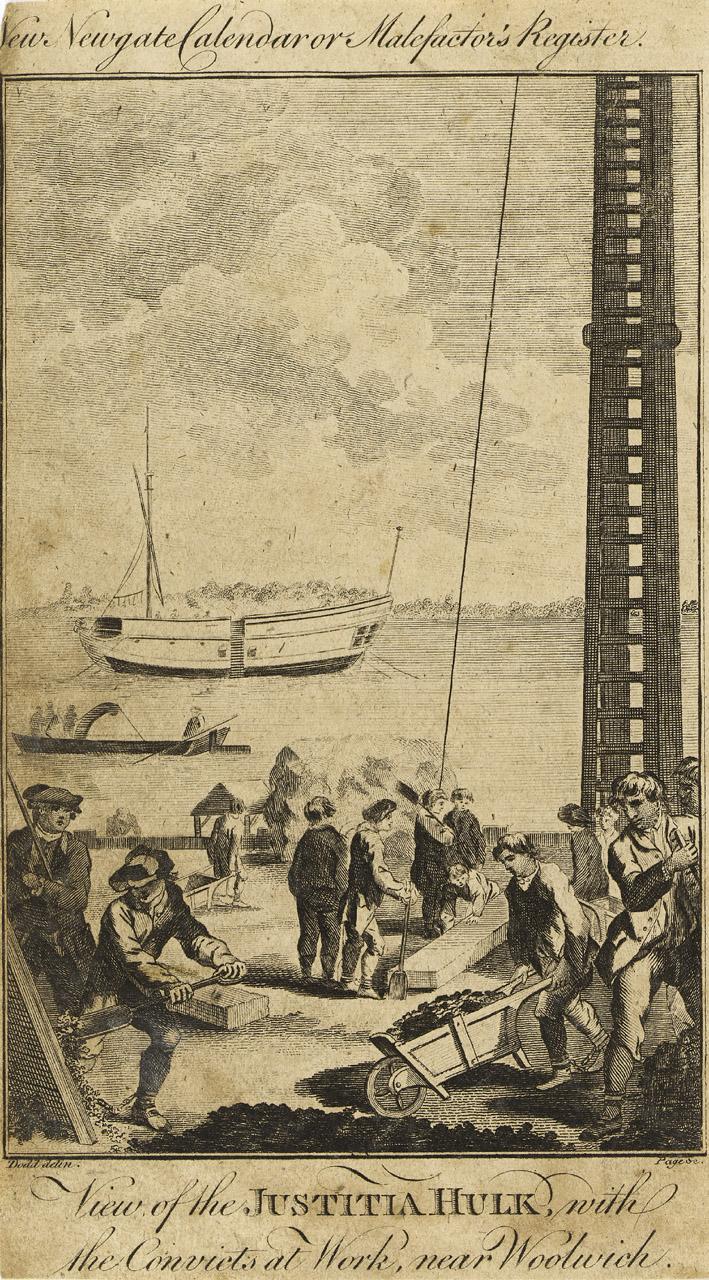
Convicts perform hard labour at the Woolwich Warren. The hulk on the river is the ‘Justitia’. Prisoners were kept on board such ships for months awaiting deportation to Australia. The ‘Justitia’ was a 260 ton prison hulk that had been originally moored in the Thames when the American War of Independence put a stop to the transportation of criminals to the former colonies. The ‘Justitia’ belonged to the shipowner Duncan Campbell, who was the Government contractor who organized the prison-hulk system at that time. Campbell was subsequently involved in the shipping of convicts to the penal colony at Botany Bay (in fact Port Jackson, later Sydney, just to the north) in New South Wales, the ‘first fleet’ going out in 1788.
While searching for records for Isaac Stokes I discovered that another Isaac Stokes was transported to New South Wales in 1835 as well. The other one was a butcher born in 1809, sentenced in London for seven years, and he sailed on the Mary Ann. Our Isaac Stokes sailed on the Lady Nugent, arriving in NSW in April 1835, having set sail from England in December 1834.
Lady Nugent was built at Bombay in 1813. She made four voyages under contract to the British East India Company (EIC). She then made two voyages transporting convicts to Australia, one to New South Wales and one to Van Diemen’s Land (Tasmania). (via Wikipedia)
via freesettlerorfelon website:
On 20 November 1834, 100 male convicts were transferred to the Lady Nugent from the Justitia Hulk and 60 from the Ganymede Hulk at Woolwich, all in apparent good health. The Lady Nugent departed Sheerness on 4 December 1834.
SURGEON OLIVER SPROULE
Oliver Sproule kept a Medical Journal from 7 November 1834 to 27 April 1835. He recorded in his journal the weather conditions they experienced in the first two weeks:
‘In the course of the first week or ten days at sea, there were eight or nine on the sick list with catarrhal affections and one with dropsy which I attribute to the cold and wet we experienced during that period beating down channel. Indeed the foremost berths in the prison at this time were so wet from leaking in that part of the ship, that I was obliged to issue dry beds and bedding to a great many of the prisoners to preserve their health, but after crossing the Bay of Biscay the weather became fine and we got the damp beds and blankets dried, the leaks partially stopped and the prison well aired and ventilated which, I am happy to say soon manifested a favourable change in the health and appearance of the men.
Besides the cases given in the journal I had a great many others to treat, some of them similar to those mentioned but the greater part consisted of boils, scalds, and contusions which would not only be too tedious to enter but I fear would be irksome to the reader. There were four births on board during the passage which did well, therefore I did not consider it necessary to give a detailed account of them in my journal the more especially as they were all favourable cases.
Regularity and cleanliness in the prison, free ventilation and as far as possible dry decks turning all the prisoners up in fine weather as we were lucky enough to have two musicians amongst the convicts, dancing was tolerated every afternoon, strict attention to personal cleanliness and also to the cooking of their victuals with regular hours for their meals, were the only prophylactic means used on this occasion, which I found to answer my expectations to the utmost extent in as much as there was not a single case of contagious or infectious nature during the whole passage with the exception of a few cases of psora which soon yielded to the usual treatment. A few cases of scurvy however appeared on board at rather an early period which I can attribute to nothing else but the wet and hardships the prisoners endured during the first three or four weeks of the passage. I was prompt in my treatment of these cases and they got well, but before we arrived at Sydney I had about thirty others to treat.’
The Lady Nugent arrived in Port Jackson on 9 April 1835 with 284 male prisoners. Two men had died at sea. The prisoners were landed on 27th April 1835 and marched to Hyde Park Barracks prior to being assigned. Ten were under the age of 14 years.
The Lady Nugent:
Isaac’s distinguishing marks are noted on various criminal registers and record books:
“Height in feet & inches: 5 4; Complexion: Ruddy; Hair: Light brown; Eyes: Hazel; Marks or Scars: Yes [including] DEVIL on lower left arm, TSIS back of left hand, WS lower right arm, MHDW back of right hand.”
Another includes more detail about Isaac’s tattoos:
“Two slight scars right side of mouth, 2 moles above right breast, figure of the devil and DEVIL and raised mole, lower left arm; anchor, seven dots half moon, TSIS and cross, back of left hand; a mallet, door post, A, mans bust, sun, WS, lower right arm; woman, MHDW and shut knife, back of right hand.”
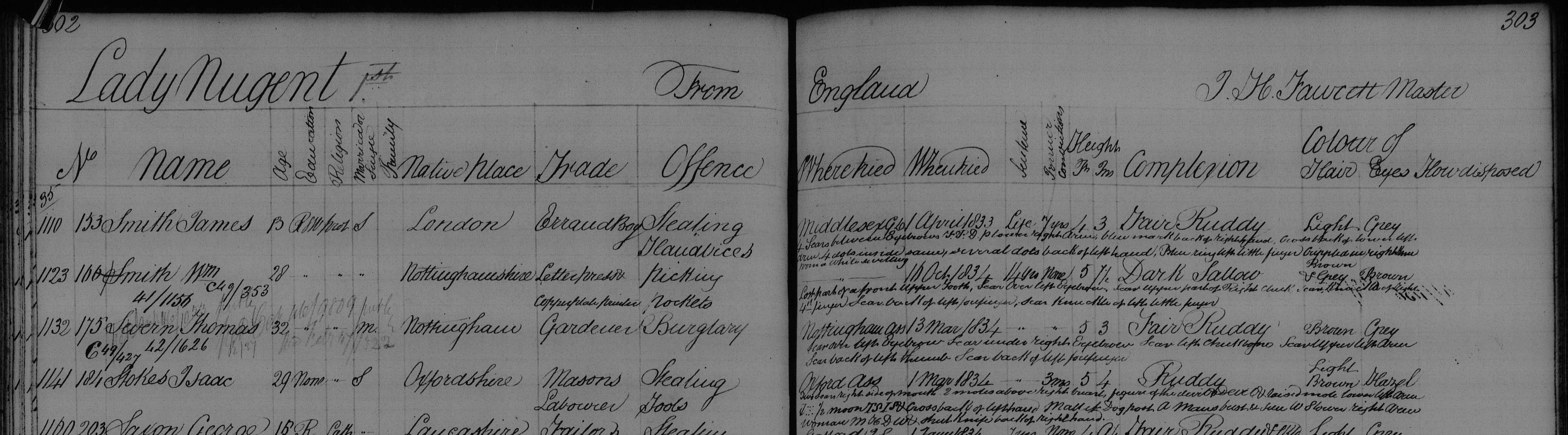
From How tattoos became fashionable in Victorian England (2019 article in TheConversation by Robert Shoemaker and Zoe Alkar):
“Historical tattooing was not restricted to sailors, soldiers and convicts, but was a growing and accepted phenomenon in Victorian England. Tattoos provide an important window into the lives of those who typically left no written records of their own. As a form of “history from below”, they give us a fleeting but intriguing understanding of the identities and emotions of ordinary people in the past.
As a practice for which typically the only record is the body itself, few systematic records survive before the advent of photography. One exception to this is the written descriptions of tattoos (and even the occasional sketch) that were kept of institutionalised people forced to submit to the recording of information about their bodies as a means of identifying them. This particularly applies to three groups – criminal convicts, soldiers and sailors. Of these, the convict records are the most voluminous and systematic.
Such records were first kept in large numbers for those who were transported to Australia from 1788 (since Australia was then an open prison) as the authorities needed some means of keeping track of them.”On the 1837 census Isaac was working for the government at Illiwarra, New South Wales. This record states that he arrived on the Lady Nugent in 1835. There are three other indent records for an Isaac Stokes in the following years, but the transcriptions don’t provide enough information to determine which Isaac Stokes it was. In April 1837 there was an abscondment, and an arrest/apprehension in May of that year, and in 1843 there was a record of convict indulgences.
From the Australian government website regarding “convict indulgences”:
“By the mid-1830s only six per cent of convicts were locked up. The vast majority worked for the government or free settlers and, with good behaviour, could earn a ticket of leave, conditional pardon or and even an absolute pardon. While under such orders convicts could earn their own living.”
In 1856 in Camden, NSW, Isaac Stokes married Catherine Daly. With no further information on this record it would be impossible to know for sure if this was the right Isaac Stokes. This couple had six children, all in the Camden area, but none of the records provided enough information. No occupation or place or date of birth recorded for Isaac Stokes.
I wrote to the National Library of Australia about the marriage record, and their reply was a surprise! Issac and Catherine were married on 30 September 1856, at the house of the Rev. Charles William Rigg, a Methodist minister, and it was recorded that Isaac was born in Edinburgh in 1821, to parents James Stokes and Sarah Ellis! The age at the time of the marriage doesn’t match Isaac’s age at death in 1877, and clearly the place of birth and parents didn’t match either. Only his fathers occupation of stone mason was correct. I wrote back to the helpful people at the library and they replied that the register was in a very poor condition and that only two and a half entries had survived at all, and that Isaac and Catherines marriage was recorded over two pages.
I searched for an Isaac Stokes born in 1821 in Edinburgh on the Scotland government website (and on all the other genealogy records sites) and didn’t find it. In fact Stokes was a very uncommon name in Scotland at the time. I also searched Australian immigration and other records for another Isaac Stokes born in Scotland or born in 1821, and found nothing. I was unable to find a single record to corroborate this mysterious other Isaac Stokes.
As the age at death in 1877 was correct, I assume that either Isaac was lying, or that some mistake was made either on the register at the home of the Methodist minster, or a subsequent mistranscription or muddle on the remnants of the surviving register. Therefore I remain convinced that the Camden stonemason Isaac Stokes was indeed our Isaac from Oxfordshire.
I found a history society newsletter article that mentioned Isaac Stokes, stone mason, had built the Glenmore church, near Camden, in 1859.

From the Wollondilly museum April 2020 newsletter:
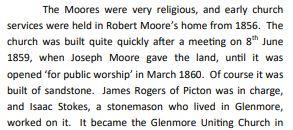
From the Camden History website:
“The stone set over the porch of Glenmore Church gives the date of 1860. The church was begun in 1859 on land given by Joseph Moore. James Rogers of Picton was given the contract to build and local builder, Mr. Stokes, carried out the work. Elizabeth Moore, wife of Edward, laid the foundation stone. The first service was held on 19th March 1860. The cemetery alongside the church contains the headstones and memorials of the areas early pioneers.”
Isaac died on the 3rd September 1877. The inquest report puts his place of death as Bagdelly, near to Camden, and another death register has put Cambelltown, also very close to Camden. His age was recorded as 71 and the inquest report states his cause of death was “rupture of one of the large pulmonary vessels of the lung”. His wife Catherine died in childbirth in 1870 at the age of 43.
Isaac and Catherine’s children:
William Stokes 1857-1928
Catherine Stokes 1859-1846
Sarah Josephine Stokes 1861-1931
Ellen Stokes 1863-1932
Rosanna Stokes 1865-1919
Louisa Stokes 1868-1844.
It’s possible that Catherine Daly was a transported convict from Ireland.
Some time later I unexpectedly received a follow up email from The Oaks Heritage Centre in Australia.
“The Gaudry papers which we have in our archive record him (Isaac Stokes) as having built: the church, the school and the teachers residence. Isaac is recorded in the General return of convicts: 1837 and in Grevilles Post Office directory 1872 as a mason in Glenmore.”
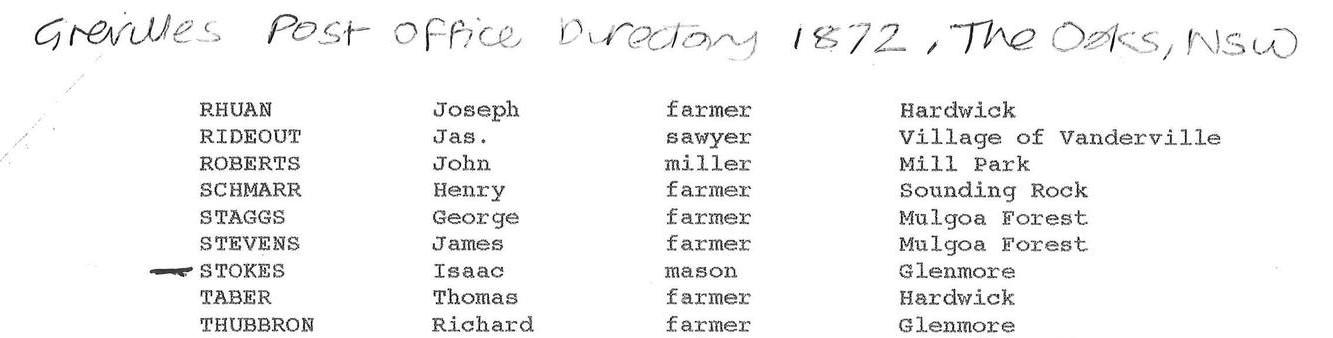 July 7, 2022 at 9:00 am #6314
In reply to: The Sexy Wooden Leg
After her visit to the witch of the woods to get some medicine for her Mum who still had bouts of fatigue from her last encounter with the flu, the little Maryechka went back home as instructed.
She found her home empty. Her parents were busy in the fields, as the time of harvest was near, and much remained to be done to prepare, and workers were limited.
She left the pouch of dried herbs in the cabinet, and wondered if she should study. The schools were closed for early holidays, and they didn’t really bother with giving them much homework. She could see the teachers’ minds were worried with other things.
Unlike other children of her age, she wasn’t interested in all the activities online, phone-stuff. The other gen-alpha kids didn’t even bother mocking her “IRL”, glued to their screens while she instead enjoyed looking at the clear blue sky. For all she knew they didn’t even realize they were living in the same world. Now, they were probably over-stressed looking at all the news on replay.
For Maryechka, the war felt far away, even if you could see some of its impacts, with people moving about the nearby town.Looking as it was still early in the day, and she had plenty more time left before having to prepare for dinner, she thought it’d be nice to go and visit her grand-parent and their friends at the old people’s home. They always had nice stale biscuits to share, and they told the strangest stories all the time.
It was just a 15 min walk from the farm, so she’d be there and back in no time.
-
AuthorSearch Results