


Search Results for 'base'
-
AuthorSearch Results
-
March 24, 2024 at 9:59 pm #7413
In reply to: The Incense of the Quadrivium’s Mystiques
It wasn’t until late the following afternoon that Truella, with a pang of guilt, remembered Roger. Frella grinned sheepishly and said that she had forgotten him too.
“But you know what? Wait, let me show you the tile I bought in Brazil.” Frella trotted off to find her suitcase.
“Look what it says on the bit of paper that came with it:
Function: The Freevole tile embodies the essence of empowerment and autonomy. It serves as a reminder and a guide for those standing at life’s many crossroads, facing decisions that may seem overwhelming. This tile encourages the holder to recognize their inner strength and the ability to choose their path confidently, even when faced with seemingly insurmountable challenges.
At the center of the tile, there is a small vole standing at a crossroads where waters intersect, with dry earth visible behind it. The scene depicts sheets of water overlapping on both sides of the vole, creating a sense of inundation, yet there is an opening ahead, suggesting a path or choice to be made.We need to backtrack a bit with Roger. Look what it says here:
What that vole hadn’t realized was that he had to backtrack a bit. There was no way ahead or to the sides, but the way out was behind him.
See what I mean?”
Truella squinted at Frella. “What?”
Sighing, Frigella thrust the bit of paper at her friend. “Read the rest of it!”
The Vole: The vole symbolizes the individual facing a decision point or crossroads in life. Its presence suggests vulnerability, but also resilience and adaptability.
Crossing of Waters: The intersection of waters represents the convergence of different paths or possibilities. It symbolizes the complexities and challenges of decision-making, where multiple options overlap and intertwine.
Dry Earth Behind: The dry earth behind the vole symbolizes stability, past experiences, or familiar ground. It represents the foundation upon which decisions are based and serves as a reminder of where one has come from.
Overlap of Drowned Sheets of Water: The drowned sheets of water on both sides signify the potential consequences or risks associated with each choice. They represent the unknown and the possibility of being overwhelmed by circumstances.
Opening Ahead: The opening ahead signifies opportunity, hope, and the possibility of forging a new path. It represents the future and the freedom to make choices that lead to growth and fulfilment.Families: This tile is aligned with the Vold family, known for their connection to transformation, challenge, and the breaking of old systems to make way for the new. The Vold energy within the Freevole tile emphasizes the importance of facing challenges head-on and using them as opportunities for growth and empowerment.
Significance: The scene depicted on the Freevole tile, with the vole at a crossroads between inundation and dry earth, symbolizes the moments in life where we must make significant choices amidst emotional or situational floods. The waters represent challenges and emotions that may threaten to overwhelm, while the dry earth symbolizes the solid ground of our inner strength and determination. The path ahead, though uncertain, indicates that there is always a way forward, guided by our autonomy and personal power.
As an advice: When encountering the Freevole tile, take it as a sign to pause and reflect on your current crossroads. It urges you to tap into your inner resilience and recognize that you have the power to navigate your life’s journey. The choices before you, while daunting, are opportunities to assert your independence and steer your life according to your true desires and values. Trust in your ability to make decisions that will lead you to your chosen path of fulfillment and growth. Remember, the floods of challenge bring with them the nourishment needed for new beginnings; it is within your power to find the opening and move forward with courage and confidence.
The motif of the Freevole, standing determined and attentive amidst the forces of nature, serves as a potent symbol of the power within each individual to face life’s uncertainties and emerge stronger for having made their own choices.“Ok so in a nutshell,” Truella replied slowly, “Roger’s crossroads took him to Brazil and ours took us here, and that’s all that needs to be said about it. Right?”
“Exactly!”
March 13, 2024 at 7:10 pm #7406In reply to: The Incense of the Quadrivium’s Mystiques
During the renovations on Brightwater Mill Truella’s parents rented a cottage nearby. It was easier to supervise the builders if they were based in the area, and it would be a nice place for Truella to spend the summer. One of the builders had come over from Ireland and was camping out in the mill kitchen. He didn’t mind when Truella got in the way while he was working, and indulged her wish to help him. He gave her his smallest trowel and a little bucket of plaster, not minding that he’d have to fix it later. He was paid by the hour after all.
When the builder mentioned that his daughter Frigella was the same age, Truella’s mother had an idea. Truella needed a little friend to play with, to keep her from distratcing the builders from their work.
And so a few days later, Frigella arrived for the rest of the summer holidays. He father continued to camp out in the mill, and Frigella stayed with Truella. But even with the new friend to play with, Truella still wanted to plaster the walls with her little trowel. Frigella didn’t want to stay cooped up all day in the dusty mill with her father keeping an eye on her all day, and suggested that they go and dig a hole somewhere in the garden to find treasure.
Truella carried the little trowel around with her everywhere she went that summer, and Frigella started to call her Trowel. Truella retaliated by calling her friend Fridge Jelly, saying what a silly name it was. It wasn’t until she burst into tears that Truella felt remorseful and kindly asked Frigella what she would like to be called, but it had to be something that didn’t remind Truella of fridges and jellys. Frigella admitted that she’s always hated the G in her name and would quite like to be called Frella instead. Truella replied that she didn’t mind being called Trowel though, in fact she quite liked it.
The girls spent many school summer holidays together over the years, but it wasn’t until Truella was older and staying in one of the apartments with a boyfriend that she found the trunk in the attic. She put it in the boot of the car without opening it. She only had the weekend with the new guy and there were other activities on the agenda, after all. Work and other events occupied her when she returned home, and the trunk was put in a closet and forgotten.
February 26, 2024 at 8:35 am #7389In reply to: The Incense of the Quadrivium’s Mystiques
“Well, it’s a long story, are you sure you want to hear it?”
“Tell me everything, right from the beginning. You’re the one who keeps saying we have plenty of time, Truella. I shall quite enjoy just sitting here with a bottle of wine listening to the story,” Frigella said, feeling all the recent stress pleasantly slipping away.
“Alright then, you asked for it!” Truella said, topping up their glasses. The evening was warm enough to sit outside on the porch, which faced the rising moon. A tawny owl in a nearby tree called to another a short distance away. “It’s kind of hard to say when it all started, though. I suppose it all started when I joined that Arkan coven years ago and the focus wasn’t on spells so much as on time travel.”
“We used to travel to times and places in the past,” Truella continued, “Looking back now, I wonder how much of it we made up, you know?” Frigella nodded. “Preconceptions, assumptions based on what we thought we knew. It was fun though, and I’m pretty sure some of it was valid. Anyway, valid or not, one thing leads to another and it was fun.
“One of the trips was to this area but many centuries ago in the distant past. The place seemed to be a sort of ancient motorway rest stop affair, somewhere for travellers to stay overnight on a route to somewhere. There was nothing to be found out about it in any books or anything though, so no way to verify it like we could with some of our other trips. I didn’t think much more about it really, we did so many other trips. For some reason we all got a bit obsessed with pyramids, as you do!”
They both laughed. “Yeah, always pyramids or special magical stones,” agreed Frigella.
“Yeah that and the light warriors!” Truella snorted.
“So then I found a couple of pyramids not far away, well of course they weren’t actually pyramids but they did look like they were. We did lots of trips there and made up all sorts of baloney between us about them, and I kept going back to look around there. We used to say that archaeologists were hiding the truth about all the pyramids and past civilizations, quite honestly it’s a bit embarrassing now to remember that but anyway, I met an actual archaeologist by chance and asked her about that place. And the actual history of it was way more interesting than all that stuff we’d made up or imagined.
The ruins I’d found there were Roman, but it went further back than that. It was a bronze age hill fort, and later Phoenician and Punic, before it was Roman. I asked the archaeologist about Roman sites and how would I be able to tell and she showed me a broken Roman roof tile, and said one would always find these on a Roman site.
I found loads over the years while out walking, but then I found one in the old stone kitchen wall. Here, let me fetch another bottle.” Truella got up and went inside, returning with the wine and a dish of peanuts.
“So that’s when I decided to dig a hole in the garden and just keep digging until I found something. I don’t know why I never thought to do that years ago. I tell you what, I think everyone should just dig a hole in their garden, and just keep digging until they find something, I can honestly say that I’ve never had so much fun!”
“But couldn’t you have just done a spell, instead of all that digging?” Frigella asked.
“Oh my god, NO! Hell no! That wouldn’t be the same thing at all,” Truella was adamant. “In fact, this dig has made me wonder about all our spells to be honest, are we going too fast and missing the finds along the way? I’ve learned so much about so many things by taking it slowly.”
“Yeah I kinda know what you mean, but carry on with the story. We should discuss that later, though.”
“Well, I just keep finding broken pottery, loads of it. We thought it was all Roman but some of it is older, much older. I’m happy about that because I read up on Romans and frankly wasn’t impressed. Warmongering and greedy, treated the locals terribly. Ok they made everything look nice with the murals and mosaics and what not, and their buildings lasted pretty well, but who actually built the stuff, not Romans was it, it was the slaves. Still, I wasn’t complaining, finding Roman stuff in the garden was pretty cool. But I kept wishing I knew more about the people who lived here before they came on the rampage taking everything back to Rome. Hey, let me go and grab another bottle of wine.”
Frigella was feeling pleasantly squiffy by now. The full moon was bright overhead, and she reckoned it was light enough to wander around the garden while Truella was in the kitchen. As she walked down the garden, the tawny owl called and she looked up hoping to see him in the fig tree. She missed her step and fell over a bucket, and she was falling, falling, falling, like Alice down the rabbit hole.
The fall was slow like a feather wafting gently down and she saw hundreds of intriguing fragments of objects and etchings and artefacts on the sides of the hole and she drifted slowly down. At last she came to rest at the bottom, and found herself in an arched gallery of mirrors and tiles and doors. On every surface were incomplete drawings and shreds of writings, wondrous and fascinating. She didn’t immediately notice the hippocampus smiling benignly down at her. He startled her a little, but had such a pleasant face that she smiled back up at him. “Where am I?” she asked.
“You’d be surprised how many people ask me that.” he replied, with a soft whicker of mirth. “Not many realise that they’ve called on me to help them navigate. Now tell me, where is it you want to go?”
“Well,” Frigella replied slowly, “Now that you ask, I’m not entirely sure. But I’m pretty sure Truella would like to see this place.”
 February 1, 2024 at 12:03 am #7332
In reply to: The Incense of the Quadrivium’s Mystiques
After the evening ritual at the elder tree, Eris came home thirsting for the bitter taste of dark Assam tea. Thorsten had already gone to sleep, and his cybernetic arm was put negligently near the sink, ready for the morning, as it was otherwise inconvenient to wear to bed.
Tired by the long day, and even more by the day planned in the morrow, she’d planned to go to bed as well, but a late notification caught her attention. “You have a close cousin! Find more”; she had registered some time ago to get an analysis of her witch heritage, in a somewhat vain attempt to pinpoint more clearly where, if it could be told, her gift had originated. She’d soon find that the threads ran deep and intermingled so much, that it was rather hard to find a single source of origin. Only patterns emerged, to give her a hint of this.
Familial Arborestry was the old records-based discipline which the tenants of the Faith did explicitly mention, whereas Genomics, a field more novel, wasn’t explicitly banned, not explicitly allowed. Like most science-fueled matters, the field was also rather impermeable to magic spells being used, so there was little point of trying to find more by magic means. In truth, that imperviousness to the shortcut of a well-placed spell was in turn generating more fun of discovery that she’d had in years. But after a while, she seemed to have reached a plateau in her finds.
Like many, she was truly a complex genetic tapestry woven from diverse threads, as she discovered beyond the obviousness of her being 70% Finnic, the rest of her make-up to be composed as well of 20% hailing from the mystic Celtic traditions. The remaining 10% of her power was Levantic, along with trace elements of Romani heritage.
Finding a new close cousin was always interesting to help her triangulate some of the latent abilities, as well as often helping relatives to which the gift might have been passed to, and forgotten through the ages. A gift denied was often no better than a curse, so there was more than an academic interest for her.
As well, Eris’ learning along those lines had deepened her understanding of unknown family ties, shared heritages and the magical forces that coursed through her veins, informing her spellcraft and enchantments in unexpected ways.
She opened the link. Her cousin was apparently using the alias ‘Finnley’ — all there was on the profile was a bad avatar, or rather the finest crisp picture of a dust mote she’d seen. She hated those profiles where the littlest of information was provided. What the hell were those people even signing for? In truth,… she paradoxically actually loved those profiles. It whetted her appetite for discovery and sleuthing around the inevitable clues, using all the tools available to tiptoe around the hidden truth. If she had not been a witch, she may simply have been a hacker. So what this Finnley cousin was hiding from? What she looking for parents she never knew? Or maybe a lost child?
As exciting as it was, it would have to wait. She yawned vigorously at the prospect of the early rising tomorrow. Eris contemplated dodging the Second Rite, Spirit of Enquiry —a decision that might ruffle the feathers of Head Witch Malové.
Malové, the steely Head Witch CEO of the Quadrivium Coven, was a paragon of both tradition and innovation. Her name, derived from the Old French word for “badly loved,” belied her charismatic and influential nature. Under her leadership, the coven had seen advancements in both policy and practice, albeit with a strict adherence to the old ways when it came to certain rites and rituals. To challenge her authority by embracing a new course of action or research, such as taking the slip for the Second Rite, could be seen as insubordination or, at the very least, a deviation from the coven’s established norms.
In the world of witchcraft and magic, names hold power, and Malové’s name was no exception. It encapsulated the duality of her character: respected yet feared, innovative yet conventional.
Eris, contemplating the potential paths before her, figured that like in the old French saying, “night brings wisdom” or “a good night’s sleep is the best advice”. Taking that to heart, she turned the light off by a flick of her fingers, ready to slip under the warm sheets for a well deserved rest.
January 28, 2024 at 10:54 am #7300Topic: The Incense of the Quadrivium’s Mystiques
in forum Yurara Fameliki’s StoriesSpring was upon them.
“Bloody too early, if you ask me” said Malové, the Head of the Coven of Mystiques, but just CEO of Quadrivium Emporium to the outside world.
“Meow.” Only the Coven’s familiar, a clichéd black cat dared to voice what seemed to have been the common thought. How tedious, so much spring cleaning of the collective energies to do, and almost 2 months ahead of schedule. Blame the telluric energies catch-up with the cosmic downpour of the world’s mind agitation. Or global warming, as it’s labelled nowadays.
“You know how it goes.” Malové continued. “We set the tone of the stories ahead. And it can only be done by actually writing it. Yeah, how exciting. Like conducting an orchestra in a zoo, there’s plenty of potential, but I guess we’ll have to work on our priorities.”
“Do you mean keeping the zoo’s hyenas from eating everybody else?” Frigella was not one to beat around the bush.
“Yeah, something like that. And you know how you control hyenas?”
The witches assembled looked at each other sideways.
“The Whale would tell you it’s a lovely story of shared resonance, forging bonds based on trust… But that’s a load of bollocks. Some emotions are only managed through stronger ones – so let’s do what we do best, get our Incense ready, and put some order in this bloody chaotic mess. Who wants to start?”
April 6, 2023 at 10:34 am #7224In reply to: The Jorid’s Travels – 14 years on
Georges was following an orange line on the floor of Jorid’s corridor with Barney on his left shoulder. The man was talking to the creature and listening to the occasional chirps Barney made as if they were part of a normal conversation.
“You see, Barney,” said Georges. “Salomé gave us this checklist.” He tapped on the clipboard with his index finger. “I have to conduct all those experiments with you in the lab while she’s doing whatever she’s doing with the maps. Salomé loves maps, I can tell you. Always trying to invent new ones that would help us navigate all those dimensions. But they confuse me, so I’m glad to leave that to her and Jorid.”
The two of them stopped in front of an orange door with a tag on it.
“So you’ll ask me: ‘Georges, why are we going to the kitchen instead of going into the lab?’ —which is the blue door.”
Georges waited for Barney’s chirp before continuing.
“You’re right! She forgot the most important. What do you like to eat? You can’t do that in a lab with instruments stuck onto your head and tummy. It’s best done in the warm and cozy atmosphere of a kitchen.”
The door swooshed open and they entered a bland, sanitised kitchen.
“Jorid, morph the kitchen into a 19th century style pub, with greasy smells and a cozy atmosphere.”
“Shouldn’t you be into the lab?” asked Jorid.
“Let’s call it a kitchen lab,” answered Georges. “So you can tell Salomé I’m in the lab if she asks you.”
“Most certainly.”
The bland rooms started wobbling and becoming darker. Gas wall lamps were coming out of the walls, and a Chandeliers bloomed from the ceiling. The kitchen island turned into a mahogany pub counter behind which the cupboards turned into glass shelves with a collection of colourful liquor bottles. Right beside the beer pumps was the cornucopia, the source of all things edible, the replicator. It was simple and looked like a silver tray.
“That’s more like it,” said Georges. He put Barney on the counter and the creature chirped contentedly to show his agreement.
“Now, You don’t look like the kind of guy who eat salad”, said Georges. “What do you want to try?”
Barney shook his head and launched into a series of chirps and squeals.
“I know! Let’s try something you certainly can’t find where you come from… outer space. Jorid, make us some good pickles in a jar.”
The replicator made a buzzing sound and a big jar full of pickles materialised on the silver tray. Barney chirped in awe and Georges frowned.
“Why did you make a Roman jar?” he asked. “We’re in a 19th century pub. And the pickles are so huge! Aubergine size.”
“My apologies,” said Jorid. “I’m confused. As you know, my database is a bit scrambled at the moment…”
“It’s ok,” said Georges who feared the ship would launch into some unsolicited confidences and self deprecating moment. “A pickle is a pickle anyway.” He picked a pickle in the jar and turned towards Barney with a big grin. “Let’s try some.”
Barney’s eyes widened. He put his hands in front of him and shook his head. The door swooshed open.
“What have you done with the kitchen?” asked Léonard. “And what are you trying to feed this rat with?”
“This rat has a name. It’s Barney. What are you doing here?” asked Georges.
“Well, Isn’t it a kitchen? I’m hungry.”
“I mean, shouldn’t you go check your vitals first in med bay?”
“When you feel hungry, it’s enough to tell a man he’s alive and well,” said Léonard. “Nice roman jar, Jorid. Depicting naked roman fighters, archaeological finding of 2nd century BC, good state of conservation.” He looked closer. “Intricate details between the legs… You surpassed yourself on that one Jorid.”
“Thanks for the compliment Léonard. It’s reassuring to know I’m still doing great at some things when others think I’m losing it.”
“I never said…” started Georges.
“You thought it.”
Léonard took a pickle from the jar and smelled it. He winced.
“Sure, smells like pickles enough,” he said, putting it back in the jar and licking his finger. “Disgusting.” He looked at Georges. “I was thinking of taking a shuttle and doing a little tour, while you solve the navigational array problem with Salomé.”
“Why are you asking me? Why don’t you just take a shuttle and go there by yourself?”
“Jorid won’t let me take one.”
“Jorid? Why don’t you let Léonard take a shuttle?”
“Salomé said he’s not to be left out of the ship without supervision.”
“Oh! Right,” said Georges. “We just rescued you from a sand prison egg where you’ve been kept in stasis for several weeks and you can’t remember anything that led you there. Why don’t we let you pilot a shuttle and wander about on your own?”
Léonard looked at Georges, annoyed. He picked a pickle from the jar and took a bite. Barney squealed. As Léonard chewed and made crunching sounds, the creature hit its head with its paw.
“Then why don’t you come with me?” asked Léonard.
“I can’t believe it.”
“What? You go with me. You can supervise me wherever I go. Problem solved.”
“No. I mean. You eating one of Barney’s pickles.”
Léonard took another bite and chewed noisily. Barney chirped and squealed. He put his hands to its throat and spat on the counter.
“I’m sure he won’t mind. Look at him. Doesn’t seem it likes pickles that much.”
“You hate pickles, Léonard.”
“I know. That’s disgusting.”
“Why do you eat them if you find it disgusting?”
“That’s the sound of it. It’s melodious. And for some reason those pickles are particularly good.”
Barney jumped on Georges arm and ran to his neck where he planted his little claws in.
“Ouch!” said Georges. He slapped Léonard’s hand before the man could take one more pickle bite. “What the f*ck?”
“Hey! Why did you do that?”
“It’s not me,” said Georges. Barney squealed and Georges’s hands pushed the jar on the floor. It crashed and a flood of pickle and vinegar juice spread on the floor.
“Haven’t your mother told you not to play with food?” asked Léonard diving on the floor to catch some more pickles. Barney chirped and squealed while Georges’s body jumped on Léonard and they both rolled over in the pickles.
The door swooshed open.
“Guys, we need to…” started Salomé. She had a set of maps in her hands. “What’s that smell? What… did you do to the kitchen? ”
“Georges made me do it,” said Jorid.
“Georges broke a 2nd century BC jar,” said Léonard.
“Barney’s controlling me,” said Georges.
The creature shrugged and removed its claws from Georges’ neck.
“Squeak!”
“Ouch! Thank you,” said Georges, licking the pickle juice he got on his lips during the fight.
“I can’t believe it. Georges, you had a checklist. And it did not include the words kitchen or pickles or making a mess. And Léonard, you hate pickles.”
“I know,” said Léonard who took a bite in the pickle he was holding. “That’s disgusting, but I can’t help it they taste so good.”
Georges stole the pickle from Léonard’s hand and took a bite.
“Pick your own pickle,” said Léonard, stealing it back.
“Stop guys! That smell… Jorid what did you put in those pickles?”
“I took the liberty to change the recipe and added some cinnamon.”
“It doesn’t smell like cinnamon,” said Georges smelling his hands full of pickle juice. He took a bite in one and said: “Doesn’t taste like cinnamon either. I would know. I hate cinnamon since the time I was turned into an Asari.”
“That’s it,” said Salomé. “What kind of cinnamon did you put in the brew, Jorid?”
“I’ve heard it’s best to use local ingredients. I put cinnamon from Langurdy,” said the ship.
“Quick! Guys, spit it out,” she said, kneeling and putting her fingers into Georges’ throat to make him puke. “Jorid, make away with the pickles,” said Salomé.
“Nooo,” said the men.
“Cinnamon from Langurdy is very addictive,” Salomé snapped. “You don’t want to OD on pickles, do you?”
After they got the mess cleaned up and the kitchen went back to its normal blank state. Georges and Léonard took some pills to counter the effects of withdrawal. Salomé had them sit at the kitchen table. Georges kept blinking as if the white light on the white walls were hurting his eyes.
“You can thank Barney if you didn’t eat more pickles,” said Salomé. “You could have had a relapse, and you know how bad it was the first time you had to flush cinnamon from your body.”
Georges groaned.
“Anyway. I checked the maps with Jorid and I came upon an anomaly in the Southern Deserts. Something there is causing Jorid’s confusion. We’ll have to go down there if we ever want to leave this place and time.”
March 10, 2023 at 8:06 am #6799In reply to: Orbs of Madjourneys
It seemed like their journey was ominously pregnant with untold possibilities. Well that’s what Xavier had said the team to break the lazy pattern that had started to bring their sense of adventure to a lull.
“Please, no snotty baby possibilities!” had moaned Zara, stretching from her morning session of yoga with Yasmin.It was the morning of the third day since he’d arrived, and as they were enjoying the breakfast, the external elements seemed to have put a brake on the planned activities.

On the previous evening, Mater, the dame of the Inn, had come in with a dramatic racing driver costume complete with burgundy red jacket and goggles to match. She’d seemed quite excited at the thought of racing at the Carts and Lager, but the younger child, Prune, had come in with weather forecast.
“It’s on the local channel news. We have to brace for a chance of dust storm. It’s recommended to stay indoors during the next two days.”
“WHAT?!” Zara couldn’t believe it. The thought of being cooped up in holidays! Then she lightened up a little when Yasmin mentioned the possibility of sand ghost pictures. She knew Zara well enough, that a good distraction was the remedy to most of her moods.
Youssef had shrugged and told them of the time they were with the BLOG team at a snowy pass in Ladakh, and had to wait for the weather to clear the only pass back to the valley. He’s enjoyed learning how to make chapatis with the family on the small gas stove of the local place, and visited the local yurts. Zara’s eyes were suddenly full of wonders at the mere mention of yurts.
Prune had then mentioned with a smirk. “If you guys want an adventure, I was planning to do some spring cleaning in the basement. There are tons of old books…. and some said maybe some secret entrance to the mines.”
Zara’s spider sense was tingling almost orgasmically.
Youssef said. “Well, I suppose that’s the best entertainment we’ll get for now…”
At the morning breakfast table, they did a quick check of the news.
“The situation isn’t getting any better. AL has confirmed it’s an unusual weather late in this season, but it’s also saying we should remain indoors.” Xavier was looking at his phone slouched on the table.
“And they will cancel the first days of the Carts and Lager…” Zara was downcast.
“Well, here’s a thought… the quest is still open in the game…”
February 24, 2023 at 8:31 am #6661In reply to: Orbs of Madjourneys
The black BMW pulled up outside the Flying Fish Inn. Sister Finli pulled a baseball cap low over her big sunglasses before she got out of the car. Yasmin was still in the bar with her friends and Finli hoped to check in and retreat to her room before they got back to the inn.
She rang the bell on the reception desk several times before an elderly lady in a red cardigan appeared.
“Ah yes, Liana Parker,” Mater said, checking the register. Liana managed to get a look at the register and noted that Yasmin was in room 2. “Room 4. Did you have a good trip down? Smart car you’ve got there,” Mater glanced over Liana’s shoulder, “Don’t see many like that in these parts.”
“Yes, yes,” Finli snapped impatiently (henceforth referred to to as Liana). She didn’t have time for small talk. The others might arrive back at any time. As long as she kept out of Yasmin’s way, she knew nobody would recognize her ~ after all she had been abandoned at birth. Even if Yasmin did find her out, she only knew her as a nun at the orphanage and Liana would just have to make up some excuse about why a nun was on holiday in the outback in a BMW. She’d cross that bridge when she came to it.
Mater looked over her glasses at the new guest. “I’ll show you to your room.” Either she was rude or tired, but Mater gave her the benefit of the doubt. “I expect you’re tired.”
Liana softened and smiled at the old lady, remembering that she’d have to speak to everyone in due course in order to find anything out, and it wouldn’t do to start off on the wrong foot.
“I’m writing a book,” Liana explained as she followed Mater down the hall. “Hoping a bit of peace and quiet here will help, and my book is set in the outback in a place a bit like this.”
“How lovely dear, well if there’s anything we can help you with, please don’t hesitate to ask. Old Bert’s a mine of information,” Mater suppressed a chuckle, “Well as long as you don’t mention mines. Here we are,” Mater opened the door to room 4 and handed the key to Liana. “Just ask if there’s anything you need.”
Liana put her bags down and then listened at the door to Mater’s retreating steps. Inching the door open, she looked up and down the hallway, but there was nobody about. Quickly she went to room 2 and tried the door, hoping it was open and she didn’t have to resort to other means. It was open. What a stroke of luck! Liana was encouraged. Within moments Liana found the parcel, unopened. Carefully opening the door, she looked around to make sure nobody was around, leaving the room with the parcel under her arm and closing the door quietly, she hastened back to room 4. She nearly jumped out of her skin when a voice piped up behind her.
“What’s that parcel and where are you going with it?” Prune asked.
“None of your business you….” Liana was just about to say nosy brat, and then remebered that she would catch more flies with honey than vinegar. It was going to be hard for her to remember that, but she must try! She smiled at the teenager and said, “A dreamtime gift for my gran, got it in Alice. Is there a post office in town?”
Prune narrowed her eyes. There was something fishy about this and it didn’t take her more than a second to reach the conclusion that she wanted to see what was in the parcel. But how?
“Yes,” she replied, quick as a flash grabbing the parcel from Liana. “I’ll post it for you!” she called over her shoulder as she raced off down the hall and disappeared.
“FUCK!” Liana muttered under her breath, running after her, but she was nowhere to be seen. Thankfully nobody else was about in the reception area to question why she was running around like a madwoman. Fuck! she muttered again, going back to her room and closing the door. Now what? What a disaster after such an encouraging start!
Prune collided with Idle on the steps of the verandah, nearly knocking her off her feet. Idle grabbed Prune to steady herself. Her grip on the girls arm tightened when she saw the suspicious look on face. Always up to no good, that one. “What have you got there? Where did you get that? Give me that parcel!”
Idle grabbed the parcel and Prune fled. Idle, holding onto the verandah railing, watched Prune running off between the eucalyptus trees. She’s always trying to make a drama out of everything, Idle thought with a sigh. Hardly any wonder I suppose, it must be boring here for a teenager with nothing much going on.
She heard a loud snorting laugh, and turned to see the four guests returning from the bar in town, laughing and joking. She put the parcel down on the hall table and waved hello, asking if they’d had a good time. “I bet you’re ready for a bite to eat, I’ll go and see what Mater’s got on the menu.” and off she went to the kitchen, leaving the parcel on the table.
The four friends agreed to meet back on the verandah for drinks before dinner after freshening up. Yasmin kept glancing back at the BMW. “That woman must be staying here!” she snorted. Zara grabbed her elbow and pulled her along. “Then we’ll find out who she is later, come on.”
Youssef followed Idle into the kitchen to ask for some snacks before dinner (much to Idle’s delight), leaving Xavier on the verandah. He looked as if he was admiring the view, such as it was, but he was preoccupied thinking about work again. Enough! he reminded himself to relax and enjoy the holiday. He saw the parcel on the table and picked it up, absentmindedly thinking the black notebook he ordered had arrived in the post, and took it back to his room. He tossed it on the bed and went to freshen up for dinner.
February 8, 2023 at 10:27 pm #6515In reply to: Prompts of Madjourneys
Yasmin offered the following quirk: “sounding like a lunatic when I share synchs” (synchronicity) – getting excited when she gets “answers”, and willing to share generously. She wouldn’t fake it, as she’s not capable of lying and stuff like synchs are sacrosanct in her mind.
Setting for the game is the next random quote from the story.Quirk accepted.
In the Land of Quirk, Yasmin finds herself in the heart of a hidden library, deep in the basement of the Flying Fish Inn. The library is filled with books and artifacts related to the study of synchronicities and the beyond.
As Yasmin delves deeper into the library, she comes across an ancient book that seems to hold the secrets of the universe. She eagerly opens it, but finds that it is written in a code that she cannot understand.
The librarian, a wise old owl, appears and greets Yasmin. He tells her that the book is the Key to the Beyond and that only the purest of heart can decode it. He explains that the code can only be unlocked by finding the missing pieces of a puzzle scattered throughout the library.
Yasmin’s task is to find the missing pieces of the puzzle and put them together to unlock the code. Along the way, she will meet various characters who will provide her with clues and challenges.
Proof of completion in real life: Yasmin must find a real-life object that relates to a synchronicity that she experiences while on her quest in the Land of Quirk. She must then share this synchronicity with her friends at the Flying Fish Inn to prove that she has completed her quest.
Good luck, Yasmin!
February 7, 2023 at 10:43 pm #6512In reply to: Prompts of Madjourneys
Zara offered the following quirk: “unleash my hidden rudeness”
Quirk accepted.
You find yourself in the bustling streets of an old medieval town. The people around you are going about their business, and you see vendors selling goods, street performers entertaining the crowd, and guards patrolling the area. You hear rumors about a secret society of mischievous tricksters who are known for causing trouble and making people’s lives more interesting.
You decide to investigate these rumors and join the society of tricksters, who call themselves the “Rude Ones.” You are tasked with finding the key to their hideout, a tile with a rude message written on it. To do this, you must complete several challenges and pranks around the town, each more mischievous than the last.
Your objective is to find the tile, sneak into the Rude Ones’ hideout, and cause as much chaos and trouble as possible. You must also find a way to insert a real-life prank or act of rudeness into your daily life, as proof of your success in the game.
Possible directions to investigate:
- Talk to the vendors and street performers to gather information about the Rude Ones.
- Observe the guards and see if they have any information on the secret society.
- Explore the different neighborhoods and see if anyone knows about the hideout.
Possible characters to engage:
- A mysterious street performer who is rumored to be part of the Rude Ones.
- A vendor who has a reputation for being rude to customers.
- A guard who is rumored to be in league with the Rude Ones.
Look for a tile with a rude message written on it, and capture proof of your real-life prank or act of rudeness. Good luck, and have fun!
January 28, 2023 at 11:27 am #6463In reply to: Prompts of Madjourneys
Additional clues from AL (based on Xavier’s comment)
Yasmin
:snake:

Yasmin was having a hard time with the heavy rains and mosquitoes in the real-world. She couldn’t seem to make a lot of progress on finding the snorting imp, which she was trying to find in the real world rather than in the game. She was feeling discouraged and unsure of what to do next.
Suddenly, an emoji of a snake appeared on her screen. It seemed to be slithering and wriggling, as if it was trying to grab her attention. Without hesitation, Yasmin clicked on the emoji.
She was taken to a new area in the game, where the ground was covered in tall grass and the sky was dark and stormy. She could see the snorting imp in the distance, but it was surrounded by a group of dangerous-looking snakes.
Clue unlocked It sounds like you’re having a hard time in the real world, but don’t let that discourage you in the game. The snorting imp is nearby and it seems like the snakes are guarding it. You’ll have to be brave and quick to catch it. Remember, the snorting imp represents your determination and bravery in real life.
🐍🔍🐗 Use your skills and abilities to navigate through the tall grass and avoid the snakes. Keep your eyes peeled for any clues or symbols that may help you in your quest. Don’t give up and remember that the snorting imp is a representation of your determination and bravery.
A message bumped on the screen: “Need help? Contact me 👉”
Stryke_Assist is trying to make contact : ➡️ACCEPT <> ➡️DENY ❓
Youssef
:desert:

Youssef has not yet been aware of the quest, since he’s been off the grid in the Gobi desert. But, interestingly, his story unfolds in real-life parallel to his quest. He’s found a strange grumpy shaman at a food booth, and it seems that his natural steps are converging back with the game. His blog website for his boss seems to take most of his attention.
An emoji of a desert suddenly appeared on his screen. It seemed to be a barren and empty landscape, with sand dunes stretching as far as the eye could see. Without hesitation, Youssef clicked on the emoji.
He was taken to a new area in the game, where the ground was covered in sand and the sky was a deep orange, as if the sun was setting. He could see a mysterious figure in the distance, standing at the top of a sand dune.
Clue unlocked It sounds like you’re in a remote location and disconnected from the game. But, your real-life experiences seem to be converging with your quest. The grumpy shaman you met at the food booth may hold the key to unlocking the next steps in the game. Remember, the desert represents your ability to adapt and navigate through difficult situations.
🏜️🧭🧙♂️ Explore the desert and see if the grumpy shaman’s clues lead you to the next steps in the game. Keep an open mind and pay attention to any symbols or clues that may help you in your quest. Remember, the desert represents your ability to adapt and navigate through difficult situations.
A message bumped on the screen: “Need help? Contact me 👉”
Sands_of_time is trying to make contact : ➡️ACCEPT <> ➡️DENY ❓
Zara
:carved_tile:

Zara looked more advanced [in her explorations – stream breaks – resume conversation]
Zara had come across a strange and ancient looking mine. It was clear that it had been abandoned for many years, but there were still signs of activity. The entrance was blocked by a large pile of rocks, but she could see a faint light coming from within. She knew that she had to find a way in.
As she approached the mine, she noticed a small, carved wooden tile on the ground. It was intricately detailed and seemed to depict a map of some sort. She picked it up and examined it closely. It seemed to show the layout of the mine and possibly the location of the secret room.
With this new clue in hand, Zara set to work trying to clear the entrance. She used all of her strength to move the rocks, and after a few minutes of hard work, she was able to create an opening large enough for her to squeeze through.
As she ventured deeper into the mine, she found herself in a large chamber. The walls were lined with strange markings and symbols, and she could see a faint light coming from a small room off to the side. She knew that this must be the secret room she had been searching for.
Zara approached the room and pushed open the door. Inside, she found a small, dimly lit chamber. In the center of the room stood a large stone altar, and on the altar was a strange, glowing object. She couldn’t quite make out what it was, but she knew that this must be the key to solving the mystery of the mine.
With a sense of excitement and curiosity, Zara reached out to take the glowing object. As her hand touched it, she felt a strange energy coursing through her body. She knew that her quest was far from over, and that there were many more secrets to uncover in the mine.
January 23, 2023 at 4:14 pm #6453In reply to: Orbs of Madjourneys
 Each group of people sharing the jeeps spent some time cleaning the jeeps from the sand, outside and inside. While cleaning the hood, Youssef noted that the storm had cleaned the eagles droppings. Soon, the young intern told them, avoiding their eyes, that the boss needed her to plan the shooting with the Lama. She said Kyle would take her place.
“Phew, the yak I shared the yurt with yesterday smelled better,” he said to the guys when he arrived.
Soon enough, Miss Tartiflate was going from jeep to jeep, her fiery hair half tied in a bun on top of her head, hurrying people to move faster as they needed to catch the shaman before he got away again. She carried her orange backpack at all time, as if she feared someone would steal its content. Rumour had it that it was THE NOTEBOOK where she wrote the blog entries in advance.
“No need to waste more time! We’ll have breakfast at the Oasis!” she shouted as she walked toward Youssef’s jeep. When she spotted him, she left her right index finger as if she just remembered something and turned the other way.
“Dunno what you did to her, but it seems Miss Yeti is avoiding you,” said Kyle with a wry smile.
Youssef grunted. Yeti was the nickname given to Miss Tartiflate by one of her former lover during a trip to Himalaya. First an affectionate nickname based on her first name, Henrietty, it soon started to spread among the production team when the love affair turned sour. It sticked and became widespread in the milieu. Everybody knew, but nobody ever dared say it to her face.
Youssef knew it wouldn’t last. He had heard that there was wifi at the oasis. He took a snack in his own backpack to quiet his stomach.
It took them two hours to arrive as sand dunes had moved on the trail during the storm. Kyle had talked most of the time, boring them to death with detailed accounts of his life back in Boston. He didn’t seem to notice that nobody cared about his love rejection stories or his tips to talk to women.
They parked outside the oasis among buses and vans. Kyle was following Youssef everywhere as if they were friends. Despite his unending flow of words, the guy managed to be funny.
Miss Tartiflate seemed unusually nervous, pulling on a strand of her orange hair and pushing back her glasses up her nose every two minutes. She was bossing everyone around to take the cameras and the lighting gear to the market where the shaman was apparently performing a rain dance. She didn’t want to miss it. When everybody was ready, she came right to Youssef. When she pushed back her glasses on her nose, he noticed her fingers were the colour of her hair. Her mouth was twitching nervously. She told him to find the wifi and restore THE BLOG or he could find another job.
“Phew! said Kyle. I don’t want to be near you when that happens.” He waved and left and joined the rest of the team.
Youssef smiled, happy to be alone at last, he took his backpack containing his laptop and his phone and followed everyone to the market in the luscious oasis.
At the center, near the lake, a crowd of tourists was gathered around a man wearing a colorful attire. Half his teeth and one eye were missing. The one that was left rolled furiously in his socket at the sound of a drum. He danced and jumped around like a monkey, and each of his movements were punctuated by the bells attached to the hem of his costume.
Youssef was glad he was not part of the shooting team, they looked miserable as they assembled the gears under a deluge of orders. As he walked toward the market, the scents of spicy food made his stomach growled. The vendors were looking at the crowd and exchanging comments and laughs. They were certainly waiting for the performance to end and the tourists to flood the place in search of trinkets and spices. Youssef spotted a food stall tucked away on the edge. It seemed too shabby to interest anyone, which was perfect for him.
The taciturn vendor, who looked caucasian, wore a yellow jacket and a bonnet oddly reminiscent of a llama’s scalp and ears. The dish he was preparing made Youssef drool.
“What’s that?” he asked.
“This is Lorgh Drülp
, said the vendor. Ancient recipe from the silk road. Very rare. Very tasty.”
He smiled when Youssef ordered a full plate with a side of tsampa. He told him to sit and wait on a stool beside an old and wobbly table.
January 19, 2023 at 10:49 am #6419In reply to: Orbs of Madjourneys
“I’d advise you not to take the parrot, Zara,” Harry the vet said, “There are restrictions on bringing dogs and other animals into state parks, and you can bet some jobsworth official will insist she stays in a cage at the very least.”
“Yeah, you’re right, I guess I’ll leave her here. I want to call in and see my cousin in Camden on the way to the airport in Sydney anyway. He has dozens of cats, I’d hate for anything to happen to Pretty Girl,” Zara replied.
“Is that the distant cousin you met when you were doing your family tree?” Harry asked, glancing up from the stitches he was removing from a wounded wombat. “There, he’s good to go. Give him a couple more days, then he can be released back where he came from.”
Zara smiled at Harry as she picked up the animal. “Yes! We haven’t met in person yet, and he’s going to show me the church my ancestor built. He says people have been spotting ghosts there lately, and there are rumours that it’s the ghost of the old convict Isaac who built it. If I can’t find photos of the ancestors, maybe I can get photos of their ghosts instead,” Zara said with a laugh.
“Good luck with that,” Harry replied raising an eyebrow. He liked Zara, she was quirkier than the others.
Zara hadn’t found it easy to research her mothers family from Bangalore in India, but her fathers English family had been easy enough. Although Zara had been born in England and emigrated to Australia in her late 20s, many of her ancestors siblings had emigrated over several generations, and Zara had managed to trace several down and made contact with a few of them. Isaac Stokes wasn’t a direct ancestor, he was the brother of her fourth great grandfather but his story had intrigued her. Sentenced to transportation for stealing tools for his work as a stonemason seemed to have worked in his favour. He built beautiful stone buildings in a tiny new town in the 1800s in the charming style of his home town in England.
Zara planned to stay in Camden for a couple of days before meeting the others at the Flying Fish Inn, anticipating a pleasant visit before the crazy adventure started.

Zara stepped down from the bus, squinting in the bright sunlight and looking around for her newfound cousin Bertie. A lanky middle aged man in dungarees and a red baseball cap came forward with his hand extended.
“Welcome to Camden, Zara I presume! Great to meet you!” he said shaking her hand and taking her rucksack. Zara was taken aback to see the family resemblance to her grandfather. So many scattered generations and yet there was still a thread of familiarity. “I bet you’re hungry, let’s go and get some tucker at Belle’s Cafe, and then I bet you want to see the church first, hey? Whoa, where’d that dang parrot come from?” Bertie said, ducking quickly as the bird swooped right in between them.
“Oh no, it’s Pretty Girl!” exclaimed Zara. “She wasn’t supposed to come with me, I didn’t bring her! How on earth did you fly all this way to get here the same time as me?” she asked the parrot.
“Pretty Girl has her ways, don’t forget to feed the parrot,” the bird replied with a squalk that resembled a mirthful guffaw.
“That’s one strange parrot you got here, girl!” Bertie said in astonishment.
“Well, seeing as you’re here now, Pretty Girl, you better come with us,” Zara said.
“Obviously,” replied Pretty Girl. It was hard to say for sure, but Zara was sure she detected an avian eye roll.
They sat outside under a sunshade to eat rather than cause any upset inside the cafe. Zara fancied an omelette but Pretty Girl objected, so she ordered hash browns instead and a fruit salad for the parrot. Bertie was a good sport about the strange talking bird after his initial surprise.
Bertie told her a bit about the ghost sightings, which had only started quite recently. They started when I started researching him, Zara thought to herself, almost as if he was reaching out. Her imagination was running riot already.
Bertie showed Zara around the church, a small building made of sandstone, but no ghost appeared in the bright heat of the afternoon. He took her on a little tour of Camden, once a tiny outpost but now a suburb of the city, pointing out all the original buildings, in particular the ones that Isaac had built. The church was walking distance of Bertie’s house and Zara decided to slip out and stroll over there after everyone had gone to bed.
Bertie had kindly allowed Pretty Girl to stay in the guest bedroom with her, safe from the cats, and Zara intended that the parrot stay in the room, but Pretty Girl was having none of it and insisted on joining her.
“Alright then, but no talking! I don’t want you scaring any ghost away so just keep a low profile!”
The moon was nearly full and it was a pleasant walk to the church. Pretty Girl fluttered from tree to tree along the sidewalk quietly. Enchanting aromas of exotic scented flowers wafted into her nostrils and Zara felt warmly relaxed and optimistic.
Zara was disappointed to find that the church was locked for the night, and realized with a sigh that she should have expected this to be the case. She wandered around the outside, trying to peer in the windows but there was nothing to be seen as the glass reflected the street lights. These things are not done in a hurry, she reminded herself, be patient.
Sitting under a tree on the grassy lawn attempting to open her mind to receiving ghostly communications (she wasn’t quite sure how to do that on purpose, any ghosts she’d seen previously had always been accidental and unexpected) Pretty Girl landed on her shoulder rather clumsily, pressing something hard and chill against her cheek.
“I told you to keep a low profile!” Zara hissed, as the parrot dropped the key into her lap. “Oh! is this the key to the church door?”
It was hard to see in the dim light but Zara was sure the parrot nodded, and was that another avian eye roll?
Zara walked slowly over the grass to the church door, tingling with anticipation. Pretty Girl hopped along the ground behind her. She turned the key in the lock and slowly pushed open the heavy door and walked inside and up the central aisle, looking around. And then she saw him.
Zara gasped. For a breif moment as the spectral wisps cleared, he looked almost solid. And she could see his tattoos.
“Oh my god,” she whispered, “It is really you. I recognize those tattoos from the description in the criminal registers. Some of them anyway, it seems you have a few more tats since you were transported.”
“Aye, I did that, wench. I were allays fond o’ me tats, does tha like ’em?”
He actually spoke to me! This was beyond Zara’s wildest hopes. Quick, ask him some questions!
“If you don’t mind me asking, Isaac, why did you lie about who your father was on your marriage register? I almost thought it wasn’t you, you know, that I had the wrong Isaac Stokes.”
A deafening rumbling laugh filled the building with echoes and the apparition dispersed in a labyrinthine swirl of tattood wisps.
“A story for another day,” whispered Zara, “Time to go back to Berties. Come on Pretty Girl. And put that key back where you found it.”
 January 17, 2023 at 8:17 am #6393
In reply to: Train your subjective AI – text version
Give me an unusual plot structure for a narrative
One unusual plot structure for a narrative could be a “reverse chronological” structure, where the story begins at the end and works backwards in time, revealing events and information in a non-linear way. Another could be a “choose your own adventure” style, where the reader is presented with a series of choices at different points in the story that determine the direction and outcome of the plot.
How would role playing qualify in terms of plot structure?
Role-playing games (RPGs) can be considered a unique form of plot structure because they are interactive and open-ended. In a traditional RPG, the players take on the roles of characters within a fictional setting and work together to create a shared narrative. The plot structure of an RPG is determined by the actions and decisions of the players, rather than a pre-written script. The game master (GM) creates an overarching plot and a set of rules for the players to follow, but the players’ choices and actions will determine the direction and outcome of the story. This makes the plot structure of an RPG fluid and ever-changing, unlike a traditional linear narrative.
What about “Cloud Atlas” in terms of plot structure?
“Cloud Atlas” is a novel written by David Mitchell that was later adapted into a film. It has a complex and non-linear plot structure, which employs multiple storylines that are set in different time periods and locations, and are connected by recurring themes and motifs. The novel is divided into six nested stories, each set in a different time period and location, that are told in a non-linear fashion. The story begins in the 19th century and then jumps back and forth between the 19th, 20th and 23rd century, and each story is interconnected and interrelated, with characters reappearing in different time periods, the events that happen in one story impacting the others. The novel is also notable for its use of different genres, such as science fiction, historical fiction, and thriller, and the way it explores the themes of destiny, reincarnation, and the power of human connection. The film adaptation also used this structure, with the different stories intertwined and characters reprising their roles in different settings and eras.
Take a story thread made of comments. In each comment is a text about characters in a particular plot, location, action etc. The comments are sequential, but they are not necessarily continuous. It is a mix between Cloud Atlas and RPG plot structures. How do you sort something that’s fundamentally non-linear to present it in an accessible way?
One way to sort and present a story thread made of comments that is fundamentally non-linear, yet accessible, is to group the comments based on their content. For example, you could group the comments by characters, and present them in chronological order of their appearance in the story. Another way could be grouping the comments by location, and present them in chronological order of when the action takes place in that particular location. You could also group comments by the type of action taking place, such as combat, conversation, or puzzle-solving, and present them in chronological order of when they occur in the story.
Another approach could be using visual aids, such as mind maps, timelines, or flowcharts, to help organize and present the information in a clear and easy-to-understand way. For example, you could use a mind map to show how different characters are connected, or a timeline to show the chronology of events. Additionally, you could use labels, such as “character introduction,” “location change,” or “plot twist,” to make it clear to the reader what type of information they can expect in each comment.
It’s also important to keep in mind the audience for which you are organizing the story. It should be easy for them to understand and follow the story, and if it’s a game, you should make sure it’s easy for the players to play and make decisions.
January 11, 2023 at 8:44 pm #6366In reply to: Train your subjective AI – text version
Asking the AI to expand on the glossary of the original Circle of Eights Story:
Locations
Malvina’s Cave: A dark and damp cave located in the heart of the Gripshawk mountains, known for its population of Glukenitch creatures.
Lan’ork: A vast and diverse continent known for its Eastern Lagunas, home to the Indogo flamingos. Dragon Head Peninsula: A rugged and mountainous region, home to the Langoat creatures and also known for its rich deposits of dragon ore.
Asgurdy: A sprawling desert region, known for its nomadic tribes who use Saurhse as mounts for transportation.
Golfindely: An idyllic coastal region known for its beautiful beaches and crystal clear waters, home to the Golfindel and Grake creatures.
Magical Schools
Dragonian Magic: A form of magic that is practiced by Dragonriders and Dragon tamers, which involves the manipulation of dragon energy and bonding with dragon companions.
Gripshawk Magic: A form of magic that is practiced by Gripshawks, which involves the manipulation of the natural elements and telepathic communication with other creatures.
Ugling Magic: A form of magic that is practiced by Uglings, which involves the use of charms, spells, and potions to manipulate the physical world.
Guilds
Dragon Riders Guild: A prestigious guild of dragon riders, responsible for maintaining peace and order in the world by using their dragon companions for protection and transportation.
Gripshawk Hunters Guild: A guild of skilled hunters who specialize in hunting and capturing exotic creatures for various purposes.
Ugling Alchemists Guild: A guild of alchemists and potion makers, who create various potions and elixirs for medicinal and magical purposes.
Organizations
The Order of the Buntifluën: A secret organization dedicated to the study and use of Buntifluën artefacts for the betterment of communication and understanding between sentient beings.
The Glubolín Network: A network of individuals who possess Glubolín devices, used for communication and sharing information across long distances.
The Sabulmantium Society: A society of scholars and adventurers who study the properties and uses of Sabulmantium devices for divination and navigation.
Here are a few new invented terms with their potential IPA pronunciations and definitions that would fit in this fantasy world:
Dragons:
Krynn [ ˈkrĭn ] : A subspecies of dragon known for its ability to control and manipulate time.
Creatures:
Kelpies [ ˈkĕl-pēz ] : Aquatic creatures resembling horses, known for their ability to shape-shift and lure unsuspecting victims into the water.
Magical Artefacts:
Dragonwhisper [ ˈdrā-gən-ˌhwis-pər ] : An ancient and powerful magical artifact, which allows the user to communicate and control dragons telepathically.
Necrotalisman [ ˈnĕk-rə-ˈtā-lĭz-mən ] : A magical artifact in the shape of a talisman that grants its wielder the ability to control and summon the dead.
Plants:
Blightthorn [ ˈblīt-ˌthôrn ] : A poisonous plant known for its dark purple flowers and thorny stem, its extract is used in dark magic
Faeleaf [ ˈfā-ˌlēf ] : A rare plant found in the deep forest known for its bright green leaves, its extract is used in healing potions
Locations:
The Shadowland [ ˈshā-dō-ˌland ] : A mysterious and dangerous land overrun by dark magic and controlled by Necromancers.
The Hidden Vale [ ˈhī-dən-ˈvāl ] : A secluded valley located deep in the mountains, home to the reclusive Faeleaf plants.
Organization:
The Necromancers’ Circle [ ˈnĕk-rə-ˈmän-sər-z-ˈsər-kəl ] : A secret organization of powerful necromancers who seek to expand their control over death and the dead.
Here are a few more invented terms with their potential IPA pronunciations and definitions that fit in this fantasy world, having less to do with necromancy, and more with various forms of consciousness or energy manipulation, magical or mythical creatures or species:
Creatures:
Eterneon [ ˈē-tər-ˈnē-ən ] : A species of winged creatures known for their ability to manipulate and harness the energy of the stars, they are highly sought after by astromancers and star-gazers.
Psicon [ ˈsī-ˌkän ] : A species of psychic creatures, known for their ability to read minds and influence emotions.
Magical Artefacts:
Energyshield [ ˈen-ər-jē-ˌshēld ] : A magical artifact that creates a protective barrier around the user, deflecting or absorbing any kind of energy-based attacks.
Empathstone [ ˈĕm-pāth-ˈstōn ] : A small, glowing stone which allows the user to sense and control the emotions of others.
Magical Schools:
Energyshaping [ ˈen-ər-jē-ˌshāp-ing ] : A school of magic that involves the manipulation and control of various forms of energy.
Empathymagic [ ˈĕm-pā-thē-ˈmaj-ik ] : A school of magic that involves the manipulation of emotions and the ability to sense the emotions of others.
Locations:
Eternity’s Edge [ ˈē-tər-nə-tēz-ˈēj] : A remote and mysterious cliff located high in the mountains, known for its strong emanations of star energy and rumored to be home to a hidden community of Eterneons.
Psicon’s Den [ ˈsī-kän-z-ˈdĕn] : A secret cave system located deep within the forest, it is said to be home to a colony of Psicon creatures.
Organizations:
The Energists Guild [ ˈen-ər-jist-z-ˈgild] : A powerful guild of magic users specializing in Energyshaping magic.
The Empath Council [ ˈĕm-pāth-ˈkoun-səl]: A secretive group of Empathymagic users, dedicated to the study and control of emotions.
January 10, 2023 at 10:14 pm #6362In reply to: Train your subjective AI – text version
write a short story based on the following cloud of words:
pride bet shouted lit wibberly case highly ours unless paid spend twice gay talking heads elizabeth in entries drink kill baker
“Gay baker triumphs over adversity”
Once upon a time, there was a gay baker named Elizabeth who took a great deal of pride in her craft. She spent twice the amount of money on high-quality ingredients and put in extra effort to make her baked goods stand out from the rest. However, her small town was not particularly accepting of the LGBT community, and she often faced discrimination from her neighbors.
One day, a group of men from the town entered her bakery and began shouting homophobic slurs at her. Elizabeth, feeling hurt and humiliated, decided that she would not let their hateful words get to her. She refused to back down and instead, decided to put all of her energy into creating a spectacular cake for the annual county fair.
She worked tirelessly on the cake, putting in long hours and experimenting with new flavors and techniques. The day of the fair finally arrived and Elizabeth brought her entry to be judged. To her surprise and delight, her cake was declared the winner and she was awarded a blue ribbon.
As she stood on stage holding her ribbon, Elizabeth couldn’t help but think about the men who had shouted at her in her bakery. She realized that their words no longer had power over her and she felt a sense of vindication. She knew that she had proven to herself and to her community that she was a skilled baker and a worthy member of society, regardless of her sexual orientation.
Feeling elated, Elizabeth closed the bakery for the day and went to the local bar where she met her friends, and they all drinks together, she was happy and felt like nothing can bring her down, as she went back home she felt like a new person, someone who has overcome prejudice and discrimination, she felt like a winner not just in the fair but in life.
The end.
November 4, 2022 at 2:19 pm #6342In reply to: Family Stories From The Other Side ~ Book Two
Brownings of Tetbury
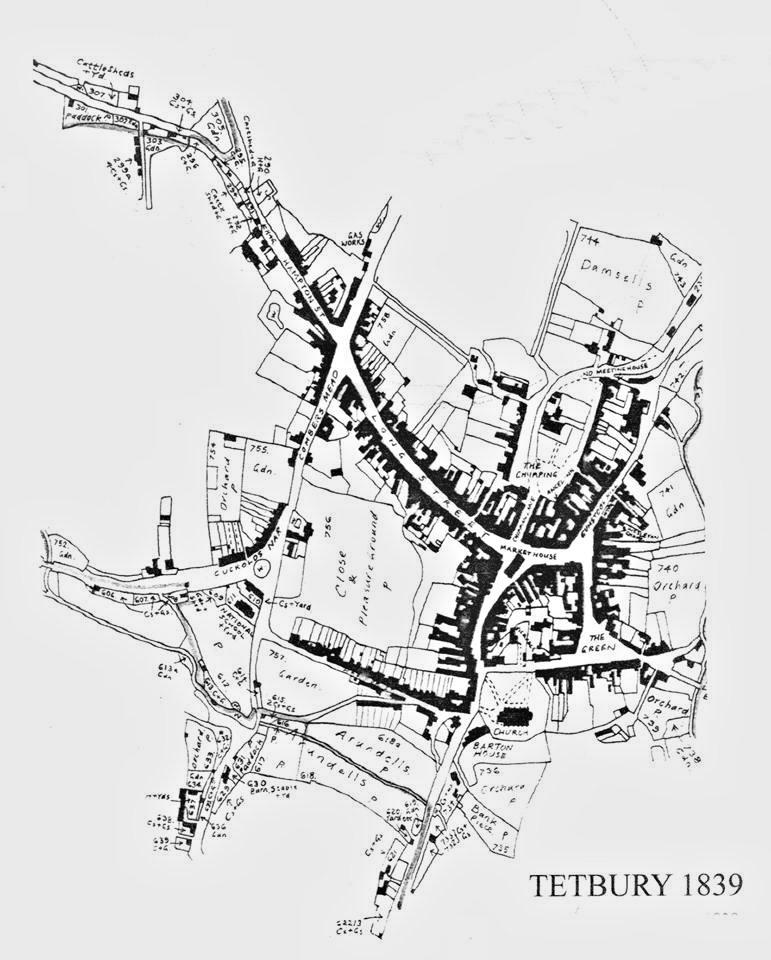
Isaac Browning (1784-1848) married Mary Lock (1787-1870) in Tetbury in 1806. Both of them were born in Tetbury, Gloucestershire. Isaac was a stone mason. Between 1807 and 1832 they baptised fourteen children in Tetbury, and on 8 Nov 1829 Isaac and Mary baptised five daughters all on the same day.
I considered that they may have been quintuplets, with only the last born surviving, which would have answered my question about the name of the house La Quinta in Broadway, the home of Eliza Browning and Thomas Stokes son Fred. However, the other four daughters were found in various records and they were not all born the same year. (So I still don’t know why the house in Broadway had such an unusual name).
Their son George was born and baptised in 1827, but Louisa born 1821, Susan born 1822, Hesther born 1823 and Mary born 1826, were not baptised until 1829 along with Charlotte born in 1828. (These birth dates are guesswork based on the age on later censuses.) Perhaps George was baptised promptly because he was sickly and not expected to survive. Isaac and Mary had a son George born in 1814 who died in 1823. Presumably the five girls were healthy and could wait to be done as a job lot on the same day later.
Eliza Browning (1814-1886), my great great great grandmother, had a baby six years before she married Thomas Stokes. Her name was Ellen Harding Browning, which suggests that her fathers name was Harding. On the 1841 census seven year old Ellen was living with her grandfather Isaac Browning in Tetbury. Ellen Harding Browning married William Dee in Tetbury in 1857, and they moved to Western Australia.
Ellen Harding Browning Dee: (photo found on ancestry website)
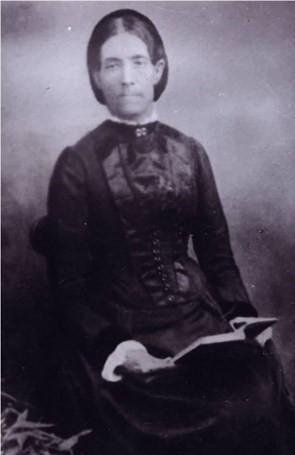
OBITUARY. MRS. ELLEN DEE.
A very old and respected resident of Dongarra, in the person of Mrs. Ellen Dee, passed peacefully away on Sept. 27, at the advanced age of 74 years.The deceased had been ailing for some time, but was about and actively employed until Wednesday, Sept. 20, whenn she was heard groaning by some neighbours, who immediately entered her place and found her lying beside the fireplace. Tho deceased had been to bed over night, and had evidently been in the act of lighting thc fire, when she had a seizure. For some hours she was conscious, but had lost the power of speech, and later on became unconscious, in which state she remained until her death.
The deceased was born in Gloucestershire, England, in 1833, was married to William Dee in Tetbury Church 23 years later. Within a month she left England with her husband for Western Australian in the ship City oí Bristol. She resided in Fremantle for six months, then in Greenough for a short time, and afterwards (for 42 years) in Dongarra. She was, therefore, a colonist of about 51 years. She had a family of four girls and three boys, and five of her children survive her, also 35 grandchildren, and eight great grandchildren. She was very highly respected, and her sudden collapse came as a great shock to many.
Eliza married Thomas Stokes (1816-1885) in September 1840 in Hempstead, Gloucestershire. On the 1841 census, Eliza and her mother Mary Browning (nee Lock) were staying with Thomas Lock and family in Cirencester. Strangely, Thomas Stokes has not been found thus far on the 1841 census, and Thomas and Eliza’s first child William James Stokes birth was registered in Witham, in Essex, on the 6th of September 1841.
I don’t know why William James was born in Witham, or where Thomas was at the time of the census in 1841. One possibility is that as Thomas Stokes did a considerable amount of work with circus waggons, circus shooting galleries and so on as a journeyman carpenter initially and then later wheelwright, perhaps he was working with a traveling circus at the time.
But back to the Brownings ~ more on William James Stokes to follow.
One of Isaac and Mary’s fourteen children died in infancy: Ann was baptised and died in 1811. Two of their children died at nine years old: the first George, and Mary who died in 1835. Matilda was 21 years old when she died in 1844.
Jane Browning (1808-) married Thomas Buckingham in 1830 in Tetbury. In August 1838 Thomas was charged with feloniously stealing a black gelding.
Susan Browning (1822-1879) married William Cleaver in November 1844 in Tetbury. Oddly thereafter they use the name Bowman on the census. On the 1851 census Mary Browning (Susan’s mother), widow, has grandson George Bowman born in 1844 living with her. The confusion with the Bowman and Cleaver names was clarified upon finding the criminal registers:
30 January 1834. Offender: William Cleaver alias Bowman, Richard Bunting alias Barnfield and Jeremiah Cox, labourers of Tetbury. Crime: Stealing part of a dead fence from a rick barton in Tetbury, the property of Robert Tanner, farmer.
And again in 1836:
29 March 1836 Bowman, William alias Cleaver, of Tetbury, labourer age 18; 5’2.5” tall, brown hair, grey eyes, round visage with fresh complexion; several moles on left cheek, mole on right breast. Charged on the oath of Ann Washbourn & others that on the morning of the 31 March at Tetbury feloniously stolen a lead spout affixed to the dwelling of the said Ann Washbourn, her property. Found guilty 31 March 1836; Sentenced to 6 months.
On the 1851 census Susan Bowman was a servant living in at a large drapery shop in Cheltenham. She was listed as 29 years old, married and born in Tetbury, so although it was unusual for a married woman not to be living with her husband, (or her son for that matter, who was living with his grandmother Mary Browning), perhaps her husband William Bowman alias Cleaver was in trouble again. By 1861 they are both living together in Tetbury: William was a plasterer, and they had three year old Isaac and Thomas, one year old. In 1871 William was still a plasterer in Tetbury, living with wife Susan, and sons Isaac and Thomas. Interestingly, a William Cleaver is living next door but one!
Susan was 56 when she died in Tetbury in 1879.
Three of the Browning daughters went to London.
Louisa Browning (1821-1873) married Robert Claxton, coachman, in 1848 in Bryanston Square, Westminster, London. Ester Browning was a witness.
Ester Browning (1823-1893)(or Hester) married Charles Hudson Sealey, cabinet maker, in Bethnal Green, London, in 1854. Charles was born in Tetbury. Charlotte Browning was a witness.
Charlotte Browning (1828-1867?) was admitted to St Marylebone workhouse in London for “parturition”, or childbirth, in 1860. She was 33 years old. A birth was registered for a Charlotte Browning, no mothers maiden name listed, in 1860 in Marylebone. A death was registered in Camden, buried in Marylebone, for a Charlotte Browning in 1867 but no age was recorded. As the age and parents were usually recorded for a childs death, I assume this was Charlotte the mother.
I found Charlotte on the 1851 census by chance while researching her mother Mary Lock’s siblings. Hesther Lock married Lewin Chandler, and they were living in Stepney, London. Charlotte is listed as a neice. Although Browning is mistranscribed as Broomey, the original page says Browning. Another mistranscription on this record is Hesthers birthplace which is transcribed as Yorkshire. The original image shows Gloucestershire.
Isaac and Mary’s first son was John Browning (1807-1860). John married Hannah Coates in 1834. John’s brother Charles Browning (1819-1853) married Eliza Coates in 1842. Perhaps they were sisters. On the 1861 census Hannah Browning, John’s wife, was a visitor in the Harding household in a village called Coates near Tetbury. Thomas Harding born in 1801 was the head of the household. Perhaps he was the father of Ellen Harding Browning.
George Browning (1828-1870) married Louisa Gainey in Tetbury, and died in Tetbury at the age of 42. Their son Richard Lock Browning, a 32 year old mason, was sentenced to one month hard labour for game tresspass in Tetbury in 1884.
Isaac Browning (1832-1857) was the youngest son of Isaac and Mary. He was just 25 years old when he died in Tetbury.
July 1, 2022 at 9:51 am #6306In reply to: The Elusive Samuel Housley and Other Family Stories
Looking for Robert Staley
William Warren (1835-1880) of Newhall (Stapenhill) married Elizabeth Staley (1836-1907) in 1858. Elizabeth was born in Newhall, the daughter of John Staley (1795-1876) and Jane Brothers. John was born in Newhall, and Jane was born in Armagh, Ireland, and they were married in Armagh in 1820. Elizabeths older brothers were born in Ireland: William in 1826 and Thomas in Dublin in 1830. Francis was born in Liverpool in 1834, and then Elizabeth in Newhall in 1836; thereafter the children were born in Newhall.
Marriage of John Staley and Jane Brothers in 1820:
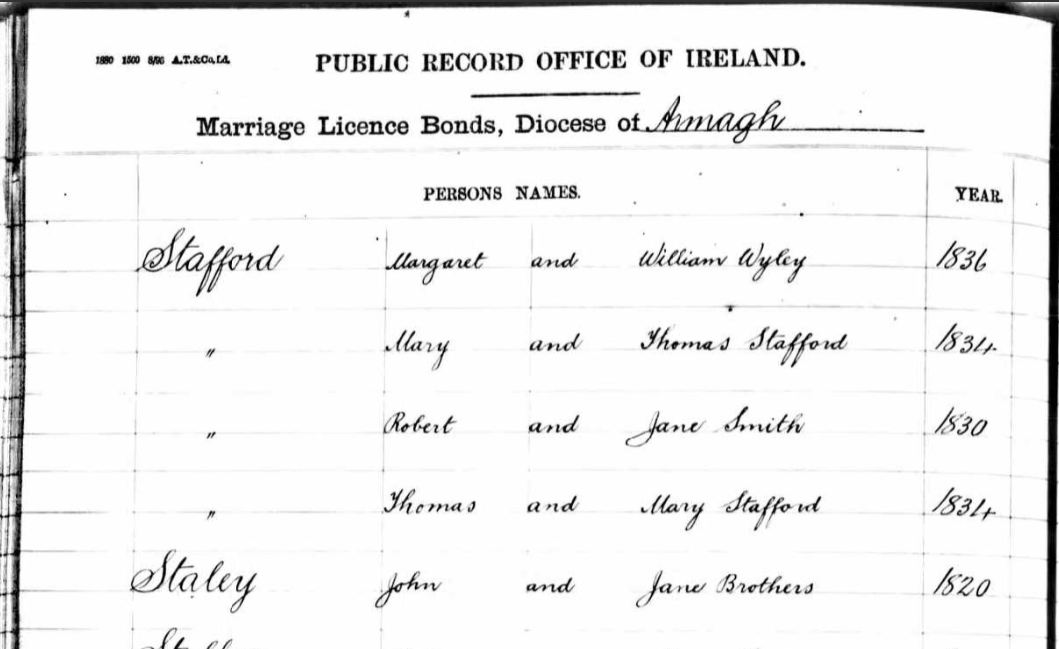
My grandmother related a story about an Elizabeth Staley who ran away from boarding school and eloped to Ireland, but later returned. The only Irish connection found so far is Jane Brothers, so perhaps she meant Elizabeth Staley’s mother. A boarding school seems unlikely, and it would seem that it was John Staley who went to Ireland.
The 1841 census states Jane’s age as 33, which would make her just 12 at the time of her marriage. The 1851 census states her age as 44, making her 13 at the time of her 1820 marriage, and the 1861 census estimates her birth year as a more likely 1804. Birth records in Ireland for her have not been found. It’s possible, perhaps, that she was in service in the Newhall area as a teenager (more likely than boarding school), and that John and Jane ran off to get married in Ireland, although I haven’t found any record of a child born to them early in their marriage. John was an agricultural labourer, and later a coal miner.
John Staley was the son of Joseph Staley (1756-1838) and Sarah Dumolo (1764-). Joseph and Sarah were married by licence in Newhall in 1782. Joseph was a carpenter on the marriage licence, but later a collier (although not necessarily a miner).
The Derbyshire Record Office holds records of an “Estimate of Joseph Staley of Newhall for the cost of continuing to work Pisternhill Colliery” dated 1820 and addresssed to Mr Bloud at Calke Abbey (presumably the owner of the mine)
Josephs parents were Robert Staley and Elizabeth. I couldn’t find a baptism or birth record for Robert Staley. Other trees on an ancestry site had his birth in Elton, but with no supporting documents. Robert, as stated in his 1795 will, was a Yeoman.
“Yeoman: A former class of small freeholders who farm their own land; a commoner of good standing.”
“Husbandman: The old word for a farmer below the rank of yeoman. A husbandman usually held his land by copyhold or leasehold tenure and may be regarded as the ‘average farmer in his locality’. The words ‘yeoman’ and ‘husbandman’ were gradually replaced in the later 18th and 19th centuries by ‘farmer’.”He left a number of properties in Newhall and Hartshorne (near Newhall) including dwellings, enclosures, orchards, various yards, barns and acreages. It seemed to me more likely that he had inherited them, rather than moving into the village and buying them.
There is a mention of Robert Staley in a 1782 newpaper advertisement.
“Fire Engine To Be Sold. An exceedingly good fire engine, with the boiler, cylinder, etc in good condition. For particulars apply to Mr Burslem at Burton-upon-Trent, or Robert Staley at Newhall near Burton, where the engine may be seen.”
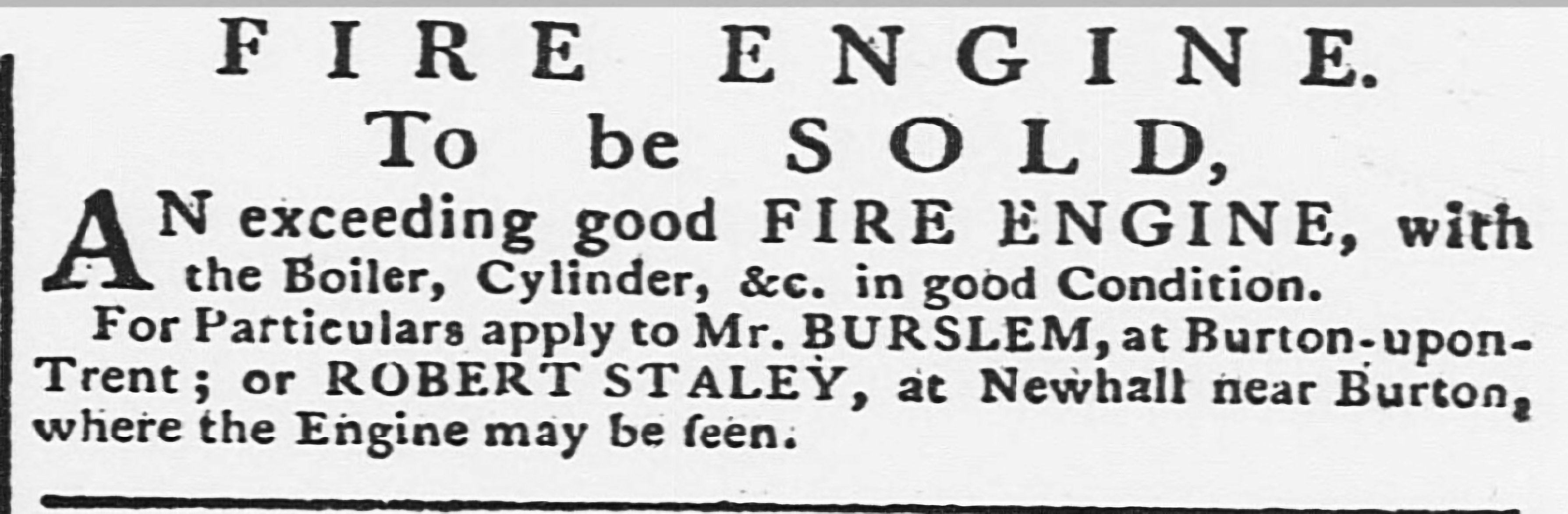
Was the fire engine perhaps connected with a foundry or a coal mine?
I noticed that Robert Staley was the witness at a 1755 marriage in Stapenhill between Barbara Burslem and Richard Daston the younger esquire. The other witness was signed Burslem Jnr.
Looking for Robert Staley
I assumed that once again, in the absence of the correct records, a similarly named and aged persons baptism had been added to the tree regardless of accuracy, so I looked through the Stapenhill/Newhall parish register images page by page. There were no Staleys in Newhall at all in the early 1700s, so it seemed that Robert did come from elsewhere and I expected to find the Staleys in a neighbouring parish. But I still didn’t find any Staleys.
I spoke to a couple of Staley descendants that I’d met during the family research. I met Carole via a DNA match some months previously and contacted her to ask about the Staleys in Elton. She also had Robert Staley born in Elton (indeed, there were many Staleys in Elton) but she didn’t have any documentation for his birth, and we decided to collaborate and try and find out more.
I couldn’t find the earlier Elton parish registers anywhere online, but eventually found the untranscribed microfiche images of the Bishops Transcripts for Elton.
via familysearch:
“In its most basic sense, a bishop’s transcript is a copy of a parish register. As bishop’s transcripts generally contain more or less the same information as parish registers, they are an invaluable resource when a parish register has been damaged, destroyed, or otherwise lost. Bishop’s transcripts are often of value even when parish registers exist, as priests often recorded either additional or different information in their transcripts than they did in the original registers.”Unfortunately there was a gap in the Bishops Transcripts between 1704 and 1711 ~ exactly where I needed to look. I subsequently found out that the Elton registers were incomplete as they had been damaged by fire.
I estimated Robert Staleys date of birth between 1710 and 1715. He died in 1795, and his son Daniel died in 1805: both of these wills were found online. Daniel married Mary Moon in Stapenhill in 1762, making a likely birth date for Daniel around 1740.
The marriage of Robert Staley (assuming this was Robert’s father) and Alice Maceland (or Marsland or Marsden, depending on how the parish clerk chose to spell it presumably) was in the Bishops Transcripts for Elton in 1704. They were married in Elton on 26th February. There followed the missing parish register pages and in all likelihood the records of the baptisms of their first children. No doubt Robert was one of them, probably the first male child.
(Incidentally, my grandfather’s Marshalls also came from Elton, a small Derbyshire village near Matlock. The Staley’s are on my grandmothers Warren side.)
The parish register pages resume in 1711. One of the first entries was the baptism of Robert Staley in 1711, parents Thomas and Ann. This was surely the one we were looking for, and Roberts parents weren’t Robert and Alice.
But then in 1735 a marriage was recorded between Robert son of Robert Staley (and this was unusual, the father of the groom isn’t usually recorded on the parish register) and Elizabeth Milner. They were married on the 9th March 1735. We know that the Robert we were looking for married an Elizabeth, as her name was on the Stapenhill baptisms of their later children, including Joseph Staleys. The 1735 marriage also fit with the assumed birth date of Daniel, circa 1740. A baptism was found for a Robert Staley in 1738 in the Elton registers, parents Robert and Elizabeth, as well as the baptism in 1736 for Mary, presumably their first child. Her burial is recorded the following year.
The marriage of Robert Staley and Elizabeth Milner in 1735:
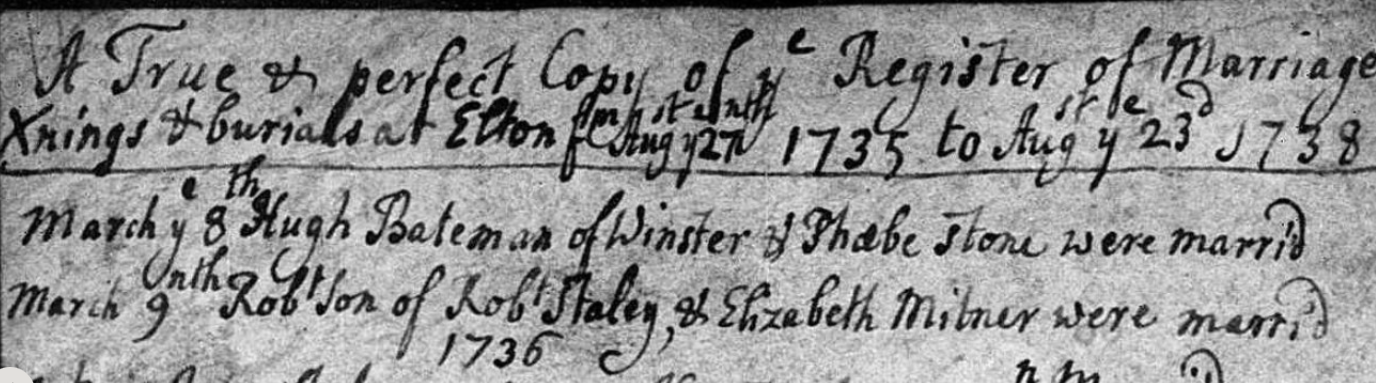
There were several other Staley couples of a similar age in Elton, perhaps brothers and cousins. It seemed that Thomas and Ann’s son Robert was a different Robert, and that the one we were looking for was prior to that and on the missing pages.
Even so, this doesn’t prove that it was Elizabeth Staleys great grandfather who was born in Elton, but no other birth or baptism for Robert Staley has been found. It doesn’t explain why the Staleys moved to Stapenhill either, although the Enclosures Act and the Industrial Revolution could have been factors.
The 18th century saw the rise of the Industrial Revolution and many renowned Derbyshire Industrialists emerged. They created the turning point from what was until then a largely rural economy, to the development of townships based on factory production methods.
The Marsden Connection
There are some possible clues in the records of the Marsden family. Robert Staley married Alice Marsden (or Maceland or Marsland) in Elton in 1704. Robert Staley is mentioned in the 1730 will of John Marsden senior, of Baslow, Innkeeper (Peacock Inne & Whitlands Farm). He mentions his daughter Alice, wife of Robert Staley.
In a 1715 Marsden will there is an intriguing mention of an alias, which might explain the different spellings on various records for the name Marsden: “MARSDEN alias MASLAND, Christopher – of Baslow, husbandman, 28 Dec 1714. son Robert MARSDEN alias MASLAND….” etc.
Some potential reasons for a move from one parish to another are explained in this history of the Marsden family, and indeed this could relate to Robert Staley as he married into the Marsden family and his wife was a beneficiary of a Marsden will. The Chatsworth Estate, at various times, bought a number of farms in order to extend the park.
THE MARSDEN FAMILY
OXCLOSE AND PARKGATE
In the Parishes of
Baslow and Chatsworthby
David Dalrymple-Smith“John Marsden (b1653) another son of Edmund (b1611) faired well. By the time he died in
1730 he was publican of the Peacock, the Inn on Church Lane now called the Cavendish
Hotel, and the farmer at “Whitlands”, almost certainly Bubnell Cliff Farm.”“Coal mining was well known in the Chesterfield area. The coalfield extends as far as the
Gritstone edges, where thin seams outcrop especially in the Baslow area.”“…the occupants were evicted from the farmland below Dobb Edge and
the ground carefully cleared of all traces of occupation and farming. Shelter belts were
planted especially along the Heathy Lea Brook. An imposing new drive was laid to the
Chatsworth House with the Lodges and “The Golden Gates” at its northern end….”Although this particular event was later than any events relating to Robert Staley, it’s an indication of how farms and farmland disappeared, and a reason for families to move to another area:
“The Dukes of Devonshire (of Chatsworth) were major figures in the aristocracy and the government of the
time. Such a position demanded a display of wealth and ostentation. The 6th Duke of
Devonshire, the Bachelor Duke, was not content with the Chatsworth he inherited in 1811,
and immediately started improvements. After major changes around Edensor, he turned his
attention at the north end of the Park. In 1820 plans were made extend the Park up to the
Baslow parish boundary. As this would involve the destruction of most of the Farm at
Oxclose, the farmer at the Higher House Samuel Marsden (b1755) was given the tenancy of
Ewe Close a large farm near Bakewell.
Plans were revised in 1824 when the Dukes of Devonshire and Rutland “Exchanged Lands”,
reputedly during a game of dice. Over 3300 acres were involved in several local parishes, of
which 1000 acres were in Baslow. In the deal Devonshire acquired the southeast corner of
Baslow Parish.
Part of the deal was Gibbet Moor, which was developed for “Sport”. The shelf of land
between Parkgate and Robin Hood and a few extra fields was left untouched. The rest,
between Dobb Edge and Baslow, was agricultural land with farms, fields and houses. It was
this last part that gave the Duke the opportunity to improve the Park beyond his earlier
expectations.”The 1795 will of Robert Staley.
Inriguingly, Robert included the children of his son Daniel Staley in his will, but omitted to leave anything to Daniel. A perusal of Daniels 1808 will sheds some light on this: Daniel left his property to his six reputed children with Elizabeth Moon, and his reputed daughter Mary Brearly. Daniels wife was Mary Moon, Elizabeths husband William Moons daughter.
The will of Robert Staley, 1795:
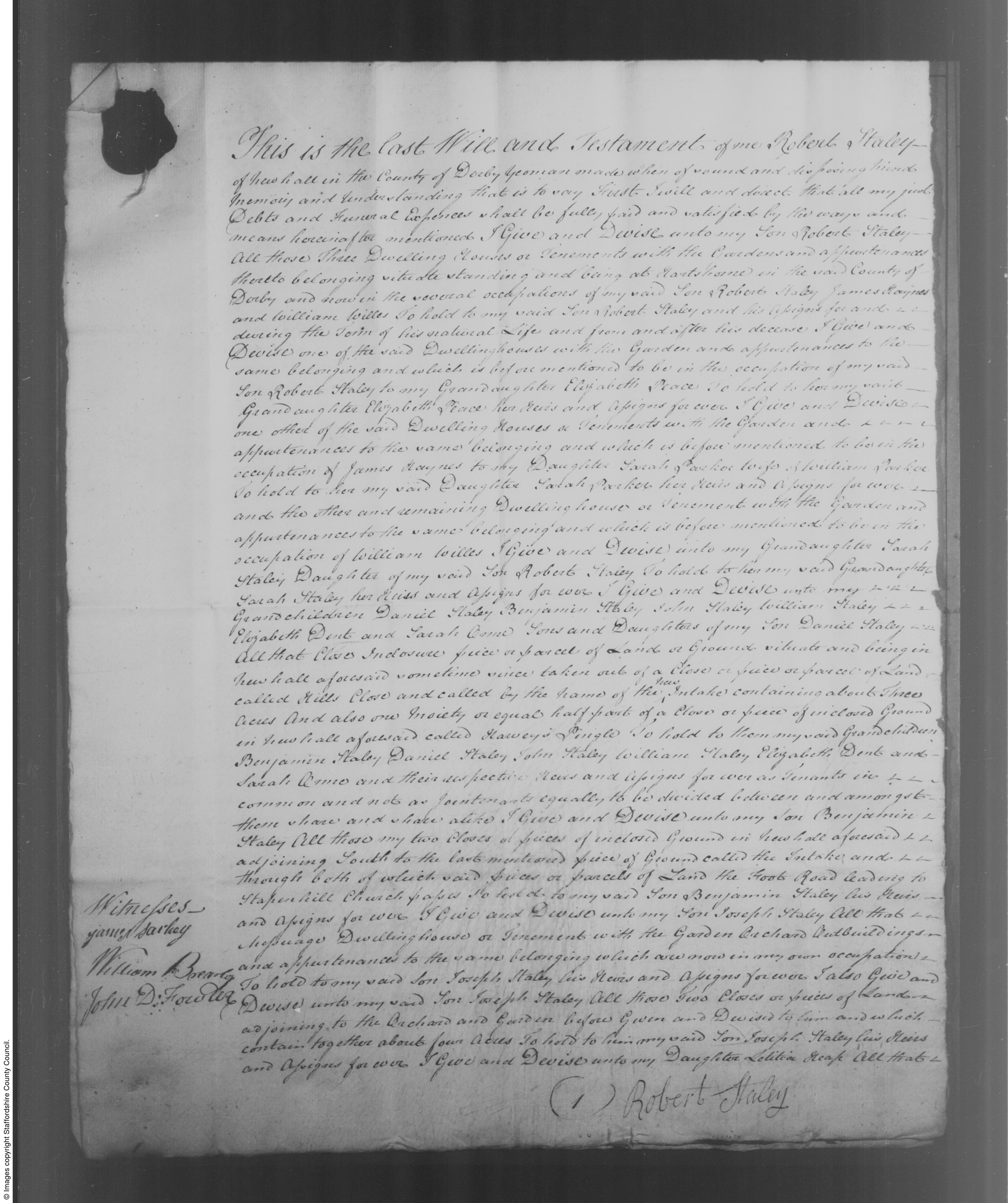
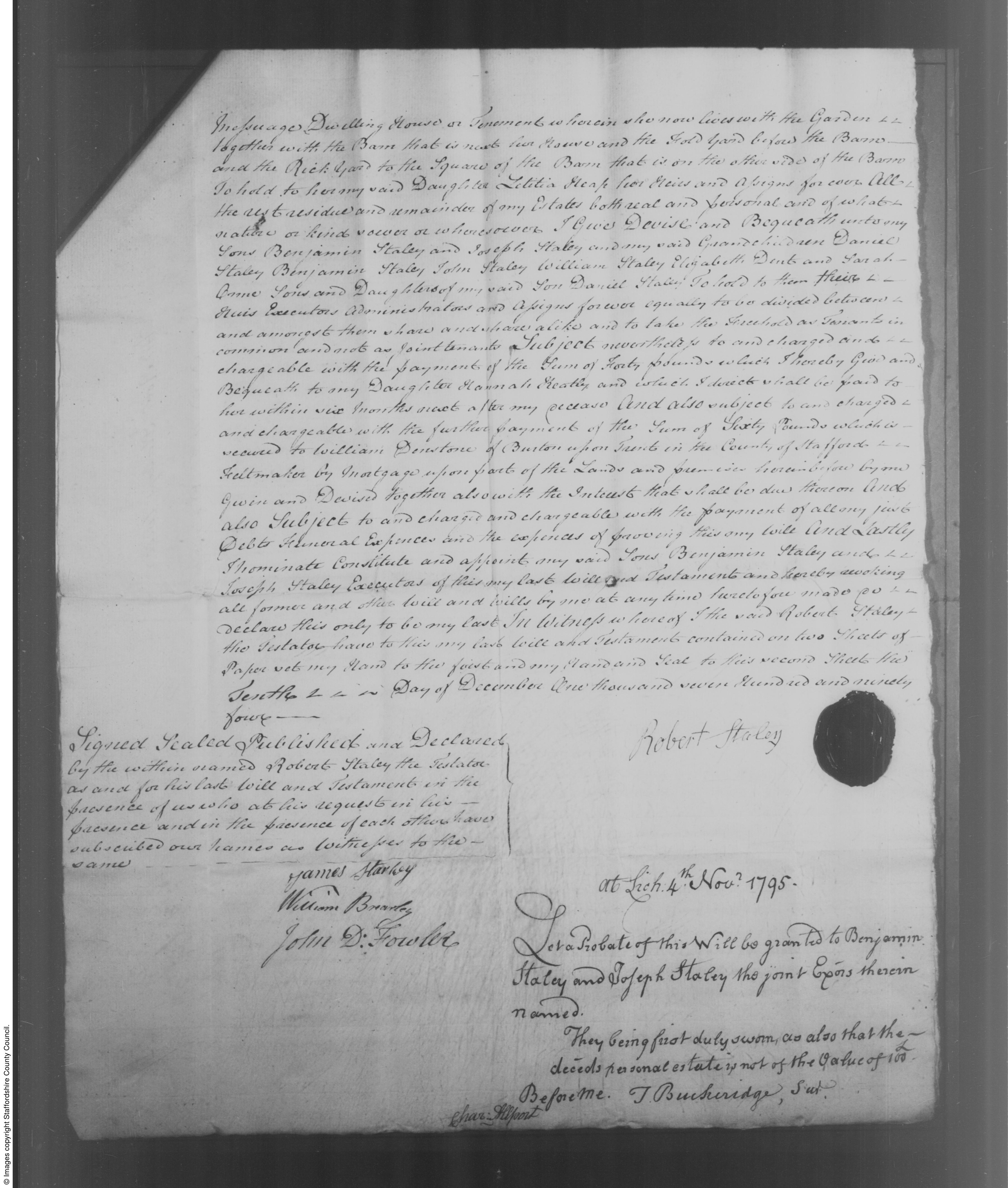
The 1805 will of Daniel Staley, Robert’s son:
This is the last will and testament of me Daniel Staley of the Township of Newhall in the parish of Stapenhill in the County of Derby, Farmer. I will and order all of my just debts, funeral and testamentary expenses to be fully paid and satisfied by my executors hereinafter named by and out of my personal estate as soon as conveniently may be after my decease.
I give, devise and bequeath to Humphrey Trafford Nadin of Church Gresely in the said County of Derby Esquire and John Wilkinson of Newhall aforesaid yeoman all my messuages, lands, tenements, hereditaments and real and personal estates to hold to them, their heirs, executors, administrators and assigns until Richard Moon the youngest of my reputed sons by Elizabeth Moon shall attain his age of twenty one years upon trust that they, my said trustees, (or the survivor of them, his heirs, executors, administrators or assigns), shall and do manage and carry on my farm at Newhall aforesaid and pay and apply the rents, issues and profits of all and every of my said real and personal estates in for and towards the support, maintenance and education of all my reputed children by the said Elizabeth Moon until the said Richard Moon my youngest reputed son shall attain his said age of twenty one years and equally share and share and share alike.
And it is my will and desire that my said trustees or trustee for the time being shall recruit and keep up the stock upon my farm as they in their discretion shall see occasion or think proper and that the same shall not be diminished. And in case any of my said reputed children by the said Elizabeth Moon shall be married before my said reputed youngest son shall attain his age of twenty one years that then it is my will and desire that non of their husbands or wives shall come to my farm or be maintained there or have their abode there. That it is also my will and desire in case my reputed children or any of them shall not be steady to business but instead shall be wild and diminish the stock that then my said trustees or trustee for the time being shall have full power and authority in their discretion to sell and dispose of all or any part of my said personal estate and to put out the money arising from the sale thereof to interest and to pay and apply the interest thereof and also thereunto of the said real estate in for and towards the maintenance, education and support of all my said reputed children by the said
Elizabeth Moon as they my said trustees in their discretion that think proper until the said Richard Moon shall attain his age of twenty one years.Then I give to my grandson Daniel Staley the sum of ten pounds and to each and every of my sons and daughters namely Daniel Staley, Benjamin Staley, John Staley, William Staley, Elizabeth Dent and Sarah Orme and to my niece Ann Brearly the sum of five pounds apiece.
I give to my youngest reputed son Richard Moon one share in the Ashby Canal Navigation and I direct that my said trustees or trustee for the time being shall have full power and authority to pay and apply all or any part of the fortune or legacy hereby intended for my youngest reputed son Richard Moon in placing him out to any trade, business or profession as they in their discretion shall think proper.
And I direct that to my said sons and daughters by my late wife and my said niece shall by wholly paid by my said reputed son Richard Moon out of the fortune herby given him. And it is my will and desire that my said reputed children shall deliver into the hands of my executors all the monies that shall arise from the carrying on of my business that is not wanted to carry on the same unto my acting executor and shall keep a just and true account of all disbursements and receipts of the said business and deliver up the same to my acting executor in order that there may not be any embezzlement or defraud amongst them and from and immediately after my said reputed youngest son Richard Moon shall attain his age of twenty one years then I give, devise and bequeath all my real estate and all the residue and remainder of my personal estate of what nature and kind whatsoever and wheresoever unto and amongst all and every my said reputed sons and daughters namely William Moon, Thomas Moon, Joseph Moon, Richard Moon, Ann Moon, Margaret Moon and to my reputed daughter Mary Brearly to hold to them and their respective heirs, executors, administrator and assigns for ever according to the nature and tenure of the same estates respectively to take the same as tenants in common and not as joint tenants.And lastly I nominate and appoint the said Humphrey Trafford Nadin and John Wilkinson executors of this my last will and testament and guardians of all my reputed children who are under age during their respective minorities hereby revoking all former and other wills by me heretofore made and declaring this only to be my last will.
In witness whereof I the said Daniel Staley the testator have to this my last will and testament set my hand and seal the eleventh day of March in the year of our Lord one thousand eight hundred and five.
March 10, 2022 at 7:40 am #6281In reply to: The Elusive Samuel Housley and Other Family Stories
The Measham Thatchers
Orgills, Finches and Wards
Measham is a large village in north west Leicestershire, England, near the Derbyshire, Staffordshire and Warwickshire boundaries. Our family has a penchant for border straddling, and the Orgill’s of Measham take this a step further living on the boundaries of four counties. Historically it was in an exclave of Derbyshire absorbed into Leicestershire in 1897, so once again we have two sets of county records to search.
ORGILL
Richard Gretton, the baker of Swadlincote and my great grandmother Florence Nightingale Grettons’ father, married Sarah Orgill (1840-1910) in 1861.
(Incidentally, Florence Nightingale Warren nee Gretton’s first child Hildred born in 1900 had the middle name Orgill. Florence’s brother John Orgill Gretton emigrated to USA.)
When they first married, they lived with Sarah’s widowed mother Elizabeth in Measham. Elizabeth Orgill is listed on the 1861 census as a farmer of two acres.
Sarah Orgill’s father Matthew Orgill (1798-1859) was a thatcher, as was his father Matthew Orgill (1771-1852).
Matthew Orgill the elder left his property to his son Henry:
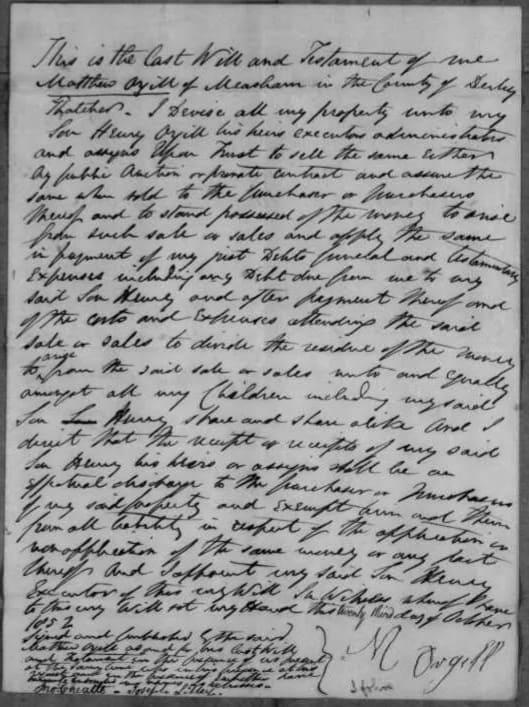
Sarah’s mother Elizabeth (1803-1876) was also an Orgill before her marriage to Matthew.
According to Pigot & Co’s Commercial Directory for Derbyshire, in Measham in 1835 Elizabeth Orgill was a straw bonnet maker, an ideal occupation for a thatchers wife.
Matthew Orgill, thatcher, is listed in White’s directory in 1857, and other Orgill’s are mentioned in Measham:
Mary Orgill, straw hat maker; Henry Orgill, grocer; Daniel Orgill, painter; another Matthew Orgill is a coal merchant and wheelwright. Likewise a number of Orgill’s are listed in the directories for Measham in the subsequent years, as farmers, plumbers, painters, grocers, thatchers, wheelwrights, coal merchants and straw bonnet makers.
Matthew and Elizabeth Orgill, Measham Baptist church:
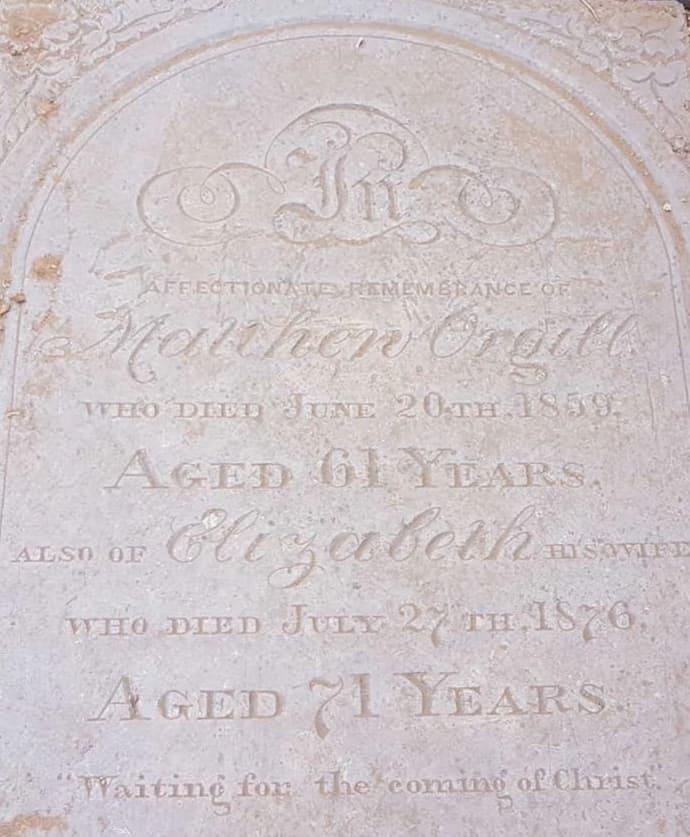
According to a history of thatching, for every six or seven thatchers appearing in the 1851 census there are now less than one. Another interesting fact in the history of thatched roofs (via thatchinginfo dot com):
The Watling Street Divide…
The biggest dividing line of all, that between the angular thatching of the Northern and Eastern traditions and the rounded Southern style, still roughly follows a very ancient line; the northern section of the old Roman road of Watling Street, the modern A5. Seemingly of little significance today; this was once the border between two peoples. Agreed in the peace treaty, between the Saxon King Alfred and Guthrum, the Danish Viking leader; over eleven centuries ago.
After making their peace, various Viking armies settled down, to the north and east of the old road; firstly, in what was known as The Danelaw and later in Norse kingdoms, based in York. They quickly formed a class of farmers and peasants. Although the Saxon kings soon regained this area; these people stayed put. Their influence is still seen, for example, in the widespread use of boarded gable ends, so common in Danish thatching.
Over time, the Southern and Northern traditions have slipped across the old road, by a few miles either way. But even today, travelling across the old highway will often bring the differing thatching traditions quickly into view.Pear Tree Cottage, Bosworth Road, Measham. 1900. Matthew Orgill was a thatcher living on Bosworth road.
FINCH
Matthew the elder married Frances Finch 1771-1848, also of Measham. On the 1851 census Matthew is an 80 year old thatcher living with his daughter Mary and her husband Samuel Piner, a coal miner.
Henry Finch 1743- and Mary Dennis 1749- , both of Measham, were Frances parents. Henry’s father was also Henry Finch, born in 1707 in Measham, and he married Frances Ward, also born in 1707, and also from Measham.
WARD
The ancient boundary between the kingdom of Mercia and the Danelaw
I didn’t find much information on the history of Measham, but I did find a great deal of ancient history on the nearby village of Appleby Magna, two miles away. The parish records indicate that the Ward and Finch branches of our family date back to the 1500’s in the village, and we can assume that the ancient history of the neighbouring village would be relevant to our history.
There is evidence of human settlement in Appleby from the early Neolithic period, 6,000 years ago, and there are also Iron Age and Bronze Age sites in the vicinity. There is evidence of further activity within the village during the Roman period, including evidence of a villa or farm and a temple. Appleby is near three known Roman roads: Watling Street, 10 miles south of the village; Bath Lane, 5 miles north of the village; and Salt Street, which forms the parish’s south boundary.
But it is the Scandinavian invasions that are particularly intriguing, with regard to my 58% Scandinavian DNA (and virtually 100% Midlands England ancestry). Repton is 13 miles from Measham. In the early 10th century Chilcote, Measham and Willesley were part of the royal Derbyshire estate of Repton.
The arrival of Scandinavian invaders in the second half of the ninth century caused widespread havoc throughout northern England. By the AD 870s the Danish army was occupying Mercia and it spent the winter of 873-74 at Repton, the headquarters of the Mercian kings. The events are recorded in detail in the Peterborough manuscript of the Anglo-Saxon Chronicles…
Although the Danes held power for only 40 years, a strong, even subversive, Danish element remained in the population for many years to come.
A Scandinavian influence may also be detected among the field names of the parish. Although many fields have relatively modern names, some clearly have elements which reach back to the time of Danish incursion and control.
The Borders:
The name ‘aeppel byg’ is given in the will of Wulfic Spot of AD 1004……………..The decision at Domesday to include this land in Derbyshire, as one of Burton Abbey’s Derbyshire manors, resulted in the division of the village of Appleby Magna between the counties of Leicester and Derby for the next 800 years
Richard Dunmore’s Appleby Magma website.
This division of Appleby between Leicestershire and Derbyshire persisted from Domesday until 1897, when the recently created county councils (1889) simplified the administration of many villages in this area by a radical realignment of the boundary:
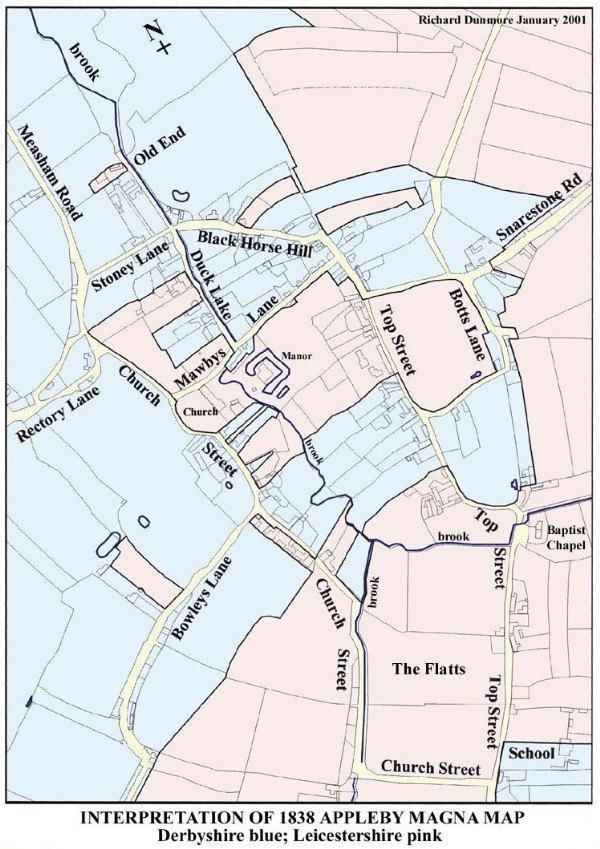
I would appear that our family not only straddle county borders, but straddle ancient kingdom borders as well. This particular branch of the family (we assume, given the absence of written records that far back) were living on the edge of the Danelaw and a strong element of the Danes survives to this day in my DNA.
February 2, 2022 at 1:15 pm #6268In reply to: The Elusive Samuel Housley and Other Family Stories
From Tanganyika with Love
continued part 9
With thanks to Mike Rushby.
Lyamungu 3rd January 1945
Dearest Family.
We had a novel Christmas this year. We decided to avoid the expense of
entertaining and being entertained at Lyamungu, and went off to spend Christmas
camping in a forest on the Western slopes of Kilimanjaro. George decided to combine
business with pleasure and in this way we were able to use Government transport.
We set out the day before Christmas day and drove along the road which skirts
the slopes of Kilimanjaro and first visited a beautiful farm where Philip Teare, the ex
Game Warden, and his wife Mary are staying. We had afternoon tea with them and then
drove on in to the natural forest above the estate and pitched our tent beside a small
clear mountain stream. We decorated the tent with paper streamers and a few small
balloons and John found a small tree of the traditional shape which we decorated where
it stood with tinsel and small ornaments.We put our beer, cool drinks for the children and bottles of fresh milk from Simba
Estate, in the stream and on Christmas morning they were as cold as if they had been in
the refrigerator all night. There were not many presents for the children, there never are,
but they do not seem to mind and are well satisfied with a couple of balloons apiece,
sweets, tin whistles and a book each.George entertain the children before breakfast. He can make a magical thing out
of the most ordinary balloon. The children watched entranced as he drew on his pipe
and then blew the smoke into the balloon. He then pinched the neck of the balloon
between thumb and forefinger and released the smoke in little puffs. Occasionally the
balloon ejected a perfect smoke ring and the forest rang with shouts of “Do it again
Daddy.” Another trick was to blow up the balloon to maximum size and then twist the
neck tightly before releasing. Before subsiding the balloon darted about in a crazy
fashion causing great hilarity. Such fun, at the cost of a few pence.After breakfast George went off to fish for trout. John and Jim decided that they
also wished to fish so we made rods out of sticks and string and bent pins and they
fished happily, but of course quite unsuccessfully, for hours. Both of course fell into the
stream and got soaked, but I was prepared for this, and the little stream was so shallow
that they could not come to any harm. Henry played happily in the sand and I had a
most peaceful morning.Hamisi roasted a chicken in a pot over the camp fire and the jelly set beautifully in the
stream. So we had grilled trout and chicken for our Christmas dinner. I had of course
taken an iced cake for the occasion and, all in all, it was a very successful Christmas day.
On Boxing day we drove down to the plains where George was to investigate a
report of game poaching near the Ngassari Furrow. This is a very long ditch which has
been dug by the Government for watering the Masai stock in the area. It is also used by
game and we saw herds of zebra and wildebeest, and some Grant’s Gazelle and
giraffe, all comparatively tame. At one point a small herd of zebra raced beside the lorry
apparently enjoying the fun of a gallop. They were all sleek and fat and looked wild and
beautiful in action.We camped a considerable distance from the water but this precaution did not
save us from the mosquitoes which launched a vicious attack on us after sunset, so that
we took to our beds unusually early. They were on the job again when we got up at
sunrise so I was very glad when we were once more on our way home.“I like Christmas safari. Much nicer that silly old party,” said John. I agree but I think
it is time that our children learned to play happily with others. There are no other young
children at Lyamungu though there are two older boys and a girl who go to boarding
school in Nairobi.On New Years Day two Army Officers from the military camp at Moshi, came for
tea and to talk game hunting with George. I think they rather enjoy visiting a home and
seeing children and pets around.Eleanor.
Lyamungu 14 May 1945
Dearest Family.
So the war in Europe is over at last. It is such marvellous news that I can hardly
believe it. To think that as soon as George can get leave we will go to England and
bring Ann and George home with us to Tanganyika. When we know when this leave can
be arranged we will want Kate to join us here as of course she must go with us to
England to meet George’s family. She has become so much a part of your lives that I
know it will be a wrench for you to give her up but I know that you will all be happy to
think that soon our family will be reunited.The V.E. celebrations passed off quietly here. We all went to Moshi to see the
Victory Parade of the King’s African Rifles and in the evening we went to a celebration
dinner at the Game Warden’s house. Besides ourselves the Moores had invited the
Commanding Officer from Moshi and a junior officer. We had a very good dinner and
many toasts including one to Mrs Moore’s brother, Oliver Milton who is fighting in Burma
and has recently been awarded the Military Cross.There was also a celebration party for the children in the grounds of the Moshi
Club. Such a spread! I think John and Jim sampled everything. We mothers were
having our tea separately and a friend laughingly told me to turn around and have a look.
I did, and saw the long tea tables now deserted by all the children but my two sons who
were still eating steadily, and finding the party more exciting than the game of Musical
Bumps into which all the other children had entered with enthusiasm.There was also an extremely good puppet show put on by the Italian prisoners
of war from the camp at Moshi. They had made all the puppets which included well
loved characters like Snow White and the Seven Dwarfs and the Babes in the Wood as
well as more sophisticated ones like an irritable pianist and a would be prima donna. The
most popular puppets with the children were a native askari and his family – a very
happy little scene. I have never before seen a puppet show and was as entranced as
the children. It is amazing what clever manipulation and lighting can do. I believe that the
Italians mean to take their puppets to Nairobi and am glad to think that there, they will
have larger audiences to appreciate their art.George has just come in, and I paused in my writing to ask him for the hundredth
time when he thinks we will get leave. He says I must be patient because it may be a
year before our turn comes. Shipping will be disorganised for months to come and we
cannot expect priority simply because we have been separated so long from our
children. The same situation applies to scores of other Government Officials.
I have decided to write the story of my childhood in South Africa and about our
life together in Tanganyika up to the time Ann and George left the country. I know you
will have told Kate these stories, but Ann and George were so very little when they left
home that I fear that they cannot remember much.My Mother-in-law will have told them about their father but she can tell them little
about me. I shall send them one chapter of my story each month in the hope that they
may be interested and not feel that I am a stranger when at last we meet again.Eleanor.
Lyamungu 19th September 1945
Dearest Family.
In a months time we will be saying good-bye to Lyamungu. George is to be
transferred to Mbeya and I am delighted, not only as I look upon Mbeya as home, but
because there is now a primary school there which John can attend. I feel he will make
much better progress in his lessons when he realises that all children of his age attend
school. At present he is putting up a strong resistance to learning to read and spell, but
he writes very neatly, does his sums accurately and shows a real talent for drawing. If
only he had the will to learn I feel he would do very well.Jim now just four, is too young for lessons but too intelligent to be interested in
the ayah’s attempts at entertainment. Yes I’ve had to engage a native girl to look after
Henry from 9 am to 12.30 when I supervise John’s Correspondence Course. She is
clean and amiable, but like most African women she has no initiative at all when it comes
to entertaining children. Most African men and youths are good at this.I don’t regret our stay at Lyamungu. It is a beautiful spot and the change to the
cooler climate after the heat of Morogoro has been good for all the children. John is still
tall for his age but not so thin as he was and much less pale. He is a handsome little lad
with his large brown eyes in striking contrast to his fair hair. He is wary of strangers but
very observant and quite uncanny in the way he sums up people. He seldom gets up
to mischief but I have a feeling he eggs Jim on. Not that Jim needs egging.Jim has an absolute flair for mischief but it is all done in such an artless manner that
it is not easy to punish him. He is a very sturdy child with a cap of almost black silky hair,
eyes brown, like mine, and a large mouth which is quick to smile and show most beautiful
white and even teeth. He is most popular with all the native servants and the Game
Scouts. The servants call Jim, ‘Bwana Tembo’ (Mr Elephant) because of his sturdy
build.Henry, now nearly two years old, is quite different from the other two in
appearance. He is fair complexioned and fair haired like Ann and Kate, with large, black
lashed, light grey eyes. He is a good child, not so merry as Jim was at his age, nor as
shy as John was. He seldom cries, does not care to be cuddled and is independent and
strong willed. The servants call Henry, ‘Bwana Ndizi’ (Mr Banana) because he has an
inexhaustible appetite for this fruit. Fortunately they are very inexpensive here. We buy
an entire bunch which hangs from a beam on the back verandah, and pluck off the
bananas as they ripen. This way there is no waste and the fruit never gets bruised as it
does in greengrocers shops in South Africa. Our three boys make a delightful and
interesting trio and I do wish you could see them for yourselves.We are delighted with the really beautiful photograph of Kate. She is an
extraordinarily pretty child and looks so happy and healthy and a great credit to you.
Now that we will be living in Mbeya with a school on the doorstep I hope that we will
soon be able to arrange for her return home.Eleanor.
c/o Game Dept. Mbeya. 30th October 1945
Dearest Family.
How nice to be able to write c/o Game Dept. Mbeya at the head of my letters.
We arrived here safely after a rather tiresome journey and are installed in a tiny house on
the edge of the township.We left Lyamungu early on the morning of the 22nd. Most of our goods had
been packed on the big Ford lorry the previous evening, but there were the usual
delays and farewells. Of our servants, only the cook, Hamisi, accompanied us to
Mbeya. Japhet, Tovelo and the ayah had to be paid off and largesse handed out.
Tovelo’s granny had come, bringing a gift of bananas, and she also brought her little
granddaughter to present a bunch of flowers. The child’s little scolded behind is now
completely healed. Gifts had to be found for them too.At last we were all aboard and what a squash it was! Our few pieces of furniture
and packing cases and trunks, the cook, his wife, the driver and the turney boy, who
were to take the truck back to Lyamungu, and all their bits and pieces, bunches of
bananas and Fanny the dog were all crammed into the body of the lorry. George, the
children and I were jammed together in the cab. Before we left George looked
dubiously at the tyres which were very worn and said gloomily that he thought it most
unlikely that we would make our destination, Dodoma.Too true! Shortly after midday, near Kwakachinja, we blew a back tyre and there
was a tedious delay in the heat whilst the wheel was changed. We were now without a
spare tyre and George said that he would not risk taking the Ford further than Babati,
which is less than half way to Dodoma. He drove very slowly and cautiously to Babati
where he arranged with Sher Mohammed, an Indian trader, for a lorry to take us to
Dodoma the next morning.It had been our intention to spend the night at the furnished Government
Resthouse at Babati but when we got there we found that it was already occupied by
several District Officers who had assembled for a conference. So, feeling rather
disgruntled, we all piled back into the lorry and drove on to a place called Bereku where
we spent an uncomfortable night in a tumbledown hut.Before dawn next morning Sher Mohammed’s lorry drove up, and there was a
scramble to dress by the light of a storm lamp. The lorry was a very dilapidated one and
there was already a native woman passenger in the cab. I felt so tired after an almost
sleepless night that I decided to sit between the driver and this woman with the sleeping
Henry on my knee. It was as well I did, because I soon found myself dosing off and
drooping over towards the woman. Had she not been there I might easily have fallen
out as the battered cab had no door. However I was alert enough when daylight came
and changed places with the woman to our mutual relief. She was now able to converse
with the African driver and I was able to enjoy the scenery and the fresh air!
George, John and Jim were less comfortable. They sat in the lorry behind the
cab hemmed in by packing cases. As the lorry was an open one the sun beat down
unmercifully upon them until George, ever resourceful, moved a table to the front of the
truck. The two boys crouched under this and so got shelter from the sun but they still had
to endure the dust. Fanny complicated things by getting car sick and with one thing and
another we were all jolly glad to get to Dodoma.We spent the night at the Dodoma Hotel and after hot baths, a good meal and a
good nights rest we cheerfully boarded a bus of the Tanganyika Bus Service next
morning to continue our journey to Mbeya. The rest of the journey was uneventful. We slept two nights on the road, the first at Iringa Hotel and the second at Chimala. We
reached Mbeya on the 27th.I was rather taken aback when I first saw the little house which has been allocated
to us. I had become accustomed to the spacious houses we had in Morogoro and
Lyamungu. However though the house is tiny it is secluded and has a long garden
sloping down to the road in front and another long strip sloping up behind. The front
garden is shaded by several large cypress and eucalyptus trees but the garden behind
the house has no shade and consists mainly of humpy beds planted with hundreds of
carnations sadly in need of debudding. I believe that the previous Game Ranger’s wife
cultivated the carnations and, by selling them, raised money for War Funds.
Like our own first home, this little house is built of sun dried brick. Its original
owners were Germans. It is now rented to the Government by the Custodian of Enemy
Property, and George has his office in another ex German house.This afternoon we drove to the school to arrange about enrolling John there. The
school is about four miles out of town. It was built by the German settlers in the late
1930’s and they were justifiably proud of it. It consists of a great assembly hall and
classrooms in one block and there are several attractive single storied dormitories. This
school was taken over by the Government when the Germans were interned on the
outbreak of war and many improvements have been made to the original buildings. The
school certainly looks very attractive now with its grassed playing fields and its lawns and
bright flower beds.The Union Jack flies from a tall flagpole in front of the Hall and all traces of the
schools German origin have been firmly erased. We met the Headmaster, Mr
Wallington, and his wife and some members of the staff. The school is co-educational
and caters for children from the age of seven to standard six. The leaving age is elastic
owing to the fact that many Tanganyika children started school very late because of lack
of educational facilities in this country.The married members of the staff have their own cottages in the grounds. The
Matrons have quarters attached to the dormitories for which they are responsible. I felt
most enthusiastic about the school until I discovered that the Headmaster is adamant
upon one subject. He utterly refuses to take any day pupils at the school. So now our
poor reserved Johnny will have to adjust himself to boarding school life.
We have arranged that he will start school on November 5th and I shall be very
busy trying to assemble his school uniform at short notice. The clothing list is sensible.
Boys wear khaki shirts and shorts on weekdays with knitted scarlet jerseys when the
weather is cold. On Sundays they wear grey flannel shorts and blazers with the silver
and scarlet school tie.Mbeya looks dusty, brown and dry after the lush evergreen vegetation of
Lyamungu, but I prefer this drier climate and there are still mountains to please the eye.
In fact the lower slopes of Lolesa Mountain rise at the upper end of our garden.Eleanor.
c/o Game Dept. Mbeya. 21st November 1945
Dearest Family.
We’re quite settled in now and I have got the little house fixed up to my
satisfaction. I have engaged a rather uncouth looking houseboy but he is strong and
capable and now that I am not tied down in the mornings by John’s lessons I am able to
go out occasionally in the mornings and take Jim and Henry to play with other children.
They do not show any great enthusiasm but are not shy by nature as John is.
I have had a good deal of heartache over putting John to boarding school. It
would have been different had he been used to the company of children outside his
own family, or if he had even known one child there. However he seems to be adjusting
himself to the life, though slowly. At least he looks well and tidy and I am quite sure that
he is well looked after.I must confess that when the time came for John to go to school I simply did not
have the courage to take him and he went alone with George, looking so smart in his
new uniform – but his little face so bleak. The next day, Sunday, was visiting day but the
Headmaster suggested that we should give John time to settle down and not visit him
until Wednesday.When we drove up to the school I spied John on the far side of the field walking
all alone. Instead of running up with glad greetings, as I had expected, he came almost
reluctently and had little to say. I asked him to show me his dormitory and classroom and
he did so politely as though I were a stranger. At last he volunteered some information.
“Mummy,” he said in an awed voice, Do you know on the night I came here they burnt a
man! They had a big fire and they burnt him.” After a blank moment the penny dropped.
Of course John had started school and November the fifth but it had never entered my
head to tell him about that infamous character, Guy Fawkes!I asked John’s Matron how he had settled down. “Well”, she said thoughtfully,
“John is very good and has not cried as many of the juniors do when they first come
here, but he seems to keep to himself all the time.” I went home very discouraged but
on the Sunday John came running up with another lad of about his own age.” This is my
friend Marks,” he announced proudly. I could have hugged Marks.Mbeya is very different from the small settlement we knew in the early 1930’s.
Gone are all the colourful characters from the Lupa diggings for the alluvial claims are all
worked out now, gone also are our old friends the Menzies from the Pub and also most
of the Government Officials we used to know. Mbeya has lost its character of a frontier
township and has become almost suburban.The social life revolves around two places, the Club and the school. The Club
which started out as a little two roomed building, has been expanded and the golf
course improved. There are also tennis courts and a good library considering the size of
the community. There are frequent parties and dances, though most of the club revenue
comes from Bar profits. The parties are relatively sober affairs compared with the parties
of the 1930’s.The school provides entertainment of another kind. Both Mr and Mrs Wallington
are good amateur actors and I am told that they run an Amateur Dramatic Society. Every
Wednesday afternoon there is a hockey match at the school. Mbeya town versus a
mixed team of staff and scholars. The match attracts almost the whole European
population of Mbeya. Some go to play hockey, others to watch, and others to snatch
the opportunity to visit their children. I shall have to try to arrange a lift to school when
George is away on safari.I have now met most of the local women and gladly renewed an old friendship
with Sheilagh Waring whom I knew two years ago at Morogoro. Sheilagh and I have
much in common, the same disregard for the trappings of civilisation, the same sense of
the ludicrous, and children. She has eight to our six and she has also been cut off by the
war from two of her children. Sheilagh looks too young and pretty to be the mother of so
large a family and is, in fact, several years younger than I am. her husband, Donald, is a
large quiet man who, as far as I can judge takes life seriously.Our next door neighbours are the Bank Manager and his wife, a very pleasant
couple though we seldom meet. I have however had correspondence with the Bank
Manager. Early on Saturday afternoon their houseboy brought a note. It informed me
that my son was disturbing his rest by precipitating a heart attack. Was I aware that my
son was about 30 feet up in a tree and balanced on a twig? I ran out and,sure enough,
there was Jim, right at the top of the tallest eucalyptus tree. It would be the one with the
mound of stones at the bottom! You should have heard me fluting in my most
wheedling voice. “Sweets, Jimmy, come down slowly dear, I’ve some nice sweets for
you.”I’ll bet that little story makes you smile. I remember how often you have told me
how, as a child, I used to make your hearts turn over because I had no fear of heights
and how I used to say, “But that is silly, I won’t fall.” I know now only too well, how you
must have felt.Eleanor.
c/o Game Dept. Mbeya. 14th January 1946
Dearest Family.
I hope that by now you have my telegram to say that Kate got home safely
yesterday. It was wonderful to have her back and what a beautiful child she is! Kate
seems to have enjoyed the train journey with Miss Craig, in spite of the tears she tells
me she shed when she said good-bye to you. She also seems to have felt quite at
home with the Hopleys at Salisbury. She flew from Salisbury in a small Dove aircraft
and they had a smooth passage though Kate was a little airsick.I was so excited about her home coming! This house is so tiny that I had to turn
out the little store room to make a bedroom for her. With a fresh coat of whitewash and
pretty sprigged curtains and matching bedspread, borrowed from Sheilagh Waring, the
tiny room looks most attractive. I had also iced a cake, made ice-cream and jelly and
bought crackers for the table so that Kate’s home coming tea could be a proper little
celebration.I was pleased with my preparations and then, a few hours before the plane was
due, my crowned front tooth dropped out, peg and all! When my houseboy wants to
describe something very tatty, he calls it “Second-hand Kabisa.” Kabisa meaning
absolutely. That is an apt description of how I looked and felt. I decided to try some
emergency dentistry. I think you know our nearest dentist is at Dar es Salaam five
hundred miles away.First I carefully dried the tooth and with a match stick covered the peg and base
with Durofix. I then took the infants rubber bulb enema, sucked up some heat from a
candle flame and pumped it into the cavity before filling that with Durofix. Then hopefully
I stuck the tooth in its former position and held it in place for several minutes. No good. I
sent the houseboy to a shop for Scotine and tried the whole process again. No good
either.When George came home for lunch I appealed to him for advice. He jokingly
suggested that a maize seed jammed into the space would probably work, but when
he saw that I really was upset he produced some chewing gum and suggested that I
should try that . I did and that worked long enough for my first smile anyway.
George and the three boys went to meet Kate but I remained at home to
welcome her there. I was afraid that after all this time away Kate might be reluctant to
rejoin the family but she threw her arms around me and said “Oh Mummy,” We both
shed a few tears and then we both felt fine.How gay Kate is, and what an infectious laugh she has! The boys follow her
around in admiration. John in fact asked me, “Is Kate a Princess?” When I said
“Goodness no, Johnny, she’s your sister,” he explained himself by saying, “Well, she
has such golden hair.” Kate was less complementary. When I tucked her in bed last night
she said, “Mummy, I didn’t expect my little brothers to be so yellow!” All three boys
have been taking a course of Atebrin, an anti-malarial drug which tinges skin and eyeballs
yellow.So now our tiny house is bursting at its seams and how good it feels to have one
more child under our roof. We are booked to sail for England in May and when we return
we will have Ann and George home too. Then I shall feel really content.Eleanor.
c/o Game Dept. Mbeya. 2nd March 1946
Dearest Family.
My life just now is uneventful but very busy. I am sewing hard and knitting fast to
try to get together some warm clothes for our leave in England. This is not a simple
matter because woollen materials are in short supply and very expensive, and now that
we have boarding school fees to pay for both Kate and John we have to budget very
carefully indeed.Kate seems happy at school. She makes friends easily and seems to enjoy
communal life. John also seems reconciled to school now that Kate is there. He no
longer feels that he is the only exile in the family. He seems to rub along with the other
boys of his age and has a couple of close friends. Although Mbeya School is coeducational
the smaller boys and girls keep strictly apart. It is considered extremely
cissy to play with girls.The local children are allowed to go home on Sundays after church and may bring
friends home with them for the day. Both John and Kate do this and Sunday is a very
busy day for me. The children come home in their Sunday best but bring play clothes to
change into. There is always a scramble to get them to bath and change again in time to
deliver them to the school by 6 o’clock.When George is home we go out to the school for the morning service. This is
taken by the Headmaster Mr Wallington, and is very enjoyable. There is an excellent
school choir to lead the singing. The service is the Church of England one, but is
attended by children of all denominations, except the Roman Catholics. I don’t think that
more than half the children are British. A large proportion are Greeks, some as old as
sixteen, and about the same number are Afrikaners. There are Poles and non-Nazi
Germans, Swiss and a few American children.All instruction is through the medium of English and it is amazing how soon all the
foreign children learn to chatter in English. George has been told that we will return to
Mbeya after our leave and for that I am very thankful as it means that we will still be living
near at hand when Jim and Henry start school. Because many of these children have to
travel many hundreds of miles to come to school, – Mbeya is a two day journey from the
railhead, – the school year is divided into two instead of the usual three terms. This
means that many of these children do not see their parents for months at a time. I think
this is a very sad state of affairs especially for the seven and eight year olds but the
Matrons assure me , that many children who live on isolated farms and stations are quite
reluctant to go home because they miss the companionship and the games and
entertainment that the school offers.My only complaint about the life here is that I see far too little of George. He is
kept extremely busy on this range and is hardly at home except for a few days at the
months end when he has to be at his office to check up on the pay vouchers and the
issue of ammunition to the Scouts. George’s Range takes in the whole of the Southern
Province and the Southern half of the Western Province and extends to the border with
Northern Rhodesia and right across to Lake Tanganyika. This vast area is patrolled by
only 40 Game Scouts because the Department is at present badly under staffed, due
partly to the still acute shortage of rifles, but even more so to the extraordinary reluctance
which the Government shows to allocate adequate funds for the efficient running of the
Department.The Game Scouts must see that the Game Laws are enforced, protect native
crops from raiding elephant, hippo and other game animals. Report disease amongst game and deal with stock raiding lions. By constantly going on safari and checking on
their work, George makes sure the range is run to his satisfaction. Most of the Game
Scouts are fine fellows but, considering they receive only meagre pay for dangerous
and exacting work, it is not surprising that occasionally a Scout is tempted into accepting
a bribe not to report a serious infringement of the Game Laws and there is, of course,
always the temptation to sell ivory illicitly to unscrupulous Indian and Arab traders.
Apart from supervising the running of the Range, George has two major jobs.
One is to supervise the running of the Game Free Area along the Rhodesia –
Tanganyika border, and the other to hunt down the man-eating lions which for years have
terrorised the Njombe District killing hundreds of Africans. Yes I know ‘hundreds’ sounds
fantastic, but this is perfectly true and one day, when the job is done and the official
report published I shall send it to you to prove it!I hate to think of the Game Free Area and so does George. All the game from
buffalo to tiny duiker has been shot out in a wide belt extending nearly two hundred
miles along the Northern Rhodesia -Tanganyika border. There are three Europeans in
widely spaced camps who supervise this slaughter by African Game Guards. This
horrible measure is considered necessary by the Veterinary Departments of
Tanganyika, Rhodesia and South Africa, to prevent the cattle disease of Rinderpest
from spreading South.When George is home however, we do relax and have fun. On the Saturday
before the school term started we took Kate and the boys up to the top fishing camp in
the Mporoto Mountains for her first attempt at trout fishing. There are three of these
camps built by the Mbeya Trout Association on the rivers which were first stocked with
the trout hatched on our farm at Mchewe. Of the three, the top camp is our favourite. The
scenery there is most glorious and reminds me strongly of the rivers of the Western
Cape which I so loved in my childhood.The river, the Kawira, flows from the Rungwe Mountain through a narrow valley
with hills rising steeply on either side. The water runs swiftly over smooth stones and
sometimes only a foot or two below the level of the banks. It is sparkling and shallow,
but in places the water is deep and dark and the banks high. I had a busy day keeping
an eye on the boys, especially Jim, who twice climbed out on branches which overhung
deep water. “Mummy, I was only looking for trout!”How those kids enjoyed the freedom of the camp after the comparative
restrictions of town. So did Fanny, she raced about on the hills like a mad dog chasing
imaginary rabbits and having the time of her life. To escape the noise and commotion
George had gone far upstream to fish and returned in the late afternoon with three good
sized trout and four smaller ones. Kate proudly showed George the two she had caught
with the assistance or our cook Hamisi. I fear they were caught in a rather unorthodox
manner but this I kept a secret from George who is a stickler for the orthodox in trout
fishing.Eleanor.
Jacksdale England 24th June 1946
Dearest Family.
Here we are all together at last in England. You cannot imagine how wonderful it
feels to have the whole Rushby family reunited. I find myself counting heads. Ann,
George, Kate, John, Jim, and Henry. All present and well. We had a very pleasant trip
on the old British India Ship Mantola. She was crowded with East Africans going home
for the first time since the war, many like us, eagerly looking forward to a reunion with their
children whom they had not seen for years. There was a great air of anticipation and
good humour but a little anxiety too.“I do hope our children will be glad to see us,” said one, and went on to tell me
about a Doctor from Dar es Salaam who, after years of separation from his son had
recently gone to visit him at his school. The Doctor had alighted at the railway station
where he had arranged to meet his son. A tall youth approached him and said, very
politely, “Excuse me sir. Are you my Father?” Others told me of children who had
become so attached to their relatives in England that they gave their parents a very cool
reception. I began to feel apprehensive about Ann and George but fortunately had no
time to mope.Oh, that washing and ironing for six! I shall remember for ever that steamy little
laundry in the heat of the Red Sea and queuing up for the ironing and the feeling of guilt
at the size of my bundle. We met many old friends amongst the passengers, and made
some new ones, so the voyage was a pleasant one, We did however have our
anxious moments.John was the first to disappear and we had an anxious search for him. He was
quite surprised that we had been concerned. “I was just talking to my friend Chinky
Chinaman in his workshop.” Could John have called him that? Then, when I returned to
the cabin from dinner one night I found Henry swigging Owbridge’s Lung Tonic. He had
drunk half the bottle neat and the label said ‘five drops in water’. Luckily it did not harm
him.Jim of course was forever risking his neck. George had forbidden him to climb on
the railings but he was forever doing things which no one had thought of forbidding him
to do, like hanging from the overhead pipes on the deck or standing on the sill of a
window and looking down at the well deck far below. An Officer found him doing this and
gave me the scolding.Another day he climbed up on a derrick used for hoisting cargo. George,
oblivious to this was sitting on the hatch cover with other passengers reading a book. I
was in the wash house aft on the same deck when Kate rushed in and said, “Mummy
come and see Jim.” Before I had time to more than gape, the butcher noticed Jim and
rushed out knife in hand. “Get down from there”, he bellowed. Jim got, and with such
speed that he caught the leg or his shorts on a projecting piece of metal. The cotton
ripped across the seam from leg to leg and Jim stood there for a humiliating moment in a
sort of revealing little kilt enduring the smiles of the passengers who had looked up from
their books at the butcher’s shout.That incident cured Jim of his urge to climb on the ship but he managed to give
us one more fright. He was lost off Dover. People from whom we enquired said, “Yes
we saw your little boy. He was by the railings watching that big aircraft carrier.” Now Jim,
though mischievous , is very obedient. It was not until George and I had conducted an
exhaustive search above and below decks that I really became anxious. Could he have
fallen overboard? Jim was returned to us by an unamused Officer. He had been found
in one of the lifeboats on the deck forbidden to children.Our ship passed Dover after dark and it was an unforgettable sight. Dover Castle
and the cliffs were floodlit for the Victory Celebrations. One of the men passengers sat
down at the piano and played ‘The White Cliffs of Dover’, and people sang and a few
wept. The Mantola docked at Tilbury early next morning in a steady drizzle.
There was a dockers strike on and it took literally hours for all the luggage to be
put ashore. The ships stewards simply locked the public rooms and went off leaving the
passengers shivering on the docks. Eventually damp and bedraggled, we arrived at St
Pancras Station and were given a warm welcome by George’s sister Cath and her
husband Reg Pears, who had come all the way from Nottingham to meet us.
As we had to spend an hour in London before our train left for Nottingham,
George suggested that Cath and I should take the children somewhere for a meal. So
off we set in the cold drizzle, the boys and I without coats and laden with sundry
packages, including a hand woven native basket full of shoes. We must have looked like
a bunch of refugees as we stood in the hall of The Kings Cross Station Hotel because a
supercilious waiter in tails looked us up and down and said, “I’m afraid not Madam”, in
answer to my enquiry whether the hotel could provide lunch for six.
Anyway who cares! We had lunch instead at an ABC tea room — horrible
sausage and a mound or rather sloppy mashed potatoes, but very good ice-cream.
After the train journey in a very grimy third class coach, through an incredibly green and
beautiful countryside, we eventually reached Nottingham and took a bus to Jacksdale,
where George’s mother and sisters live in large detached houses side by side.
Ann and George were at the bus stop waiting for us, and thank God, submitted
to my kiss as though we had been parted for weeks instead of eight years. Even now
that we are together again my heart aches to think of all those missed years. They have
not changed much and I would have picked them out of a crowd, but Ann, once thin and
pale, is now very rosy and blooming. She still has her pretty soft plaits and her eyes are
still a clear calm blue. Young George is very striking looking with sparkling brown eyes, a
ready, slightly lopsided smile, and charming manners.Mother, and George’s elder sister, Lottie Giles, welcomed us at the door with the
cheering news that our tea was ready. Ann showed us the way to mother’s lovely lilac
tiled bathroom for a wash before tea. Before I had even turned the tap, Jim had hung
form the glass towel rail and it lay in three pieces on the floor. There have since been
similar tragedies. I can see that life in civilisation is not without snags.I am most grateful that Ann and George have accepted us so naturally and
affectionately. Ann said candidly, “Mummy, it’s a good thing that you had Aunt Cath with
you when you arrived because, honestly, I wouldn’t have known you.”Eleanor.
Jacksdale England 28th August 1946
Dearest Family.
I am sorry that I have not written for some time but honestly, I don’t know whether
I’m coming or going. Mother handed the top floor of her house to us and the
arrangement was that I should tidy our rooms and do our laundry and Mother would
prepare the meals except for breakfast. It looked easy at first. All the rooms have wall to
wall carpeting and there was a large vacuum cleaner in the box room. I was told a
window cleaner would do the windows.Well the first time I used the Hoover I nearly died of fright. I pressed the switch
and immediately there was a roar and the bag filled with air to bursting point, or so I
thought. I screamed for Ann and she came at the run. I pointed to the bag and shouted
above the din, “What must I do? It’s going to burst!” Ann looked at me in astonishment
and said, “But Mummy that’s the way it works.” I couldn’t have her thinking me a
complete fool so I switched the current off and explained to Ann how it was that I had
never seen this type of equipment in action. How, in Tanganyika , I had never had a
house with electricity and that, anyway, electric equipment would be superfluous
because floors are of cement which the houseboy polishes by hand, one only has a
few rugs or grass mats on the floor. “But what about Granny’s house in South Africa?’”
she asked, so I explained about your Josephine who threatened to leave if you
bought a Hoover because that would mean that you did not think she kept the house
clean. The sad fact remains that, at fourteen, Ann knows far more about housework than I
do, or rather did! I’m learning fast.The older children all go to school at different times in the morning. Ann leaves first
by bus to go to her Grammar School at Sutton-in-Ashfield. Shortly afterwards George
catches a bus for Nottingham where he attends the High School. So they have
breakfast in relays, usually scrambled egg made from a revolting dried egg mixture.
Then there are beds to make and washing and ironing to do, so I have little time for
sightseeing, though on a few afternoons George has looked after the younger children
and I have gone on bus tours in Derbyshire. Life is difficult here with all the restrictions on
foodstuffs. We all have ration books so get our fair share but meat, fats and eggs are
scarce and expensive. The weather is very wet. At first I used to hang out the washing
and then rush to bring it in when a shower came. Now I just let it hang.We have left our imprint upon my Mother-in-law’s house for ever. Henry upset a
bottle of Milk of Magnesia in the middle of the pale fawn bedroom carpet. John, trying to
be helpful and doing some dusting, broke one of the delicate Dresden china candlesticks
which adorn our bedroom mantelpiece.Jim and Henry have wrecked the once
professionally landscaped garden and all the boys together bored a large hole through
Mother’s prized cherry tree. So now Mother has given up and gone off to Bournemouth
for a much needed holiday. Once a week I have the capable help of a cleaning woman,
called for some reason, ‘Mrs Two’, but I have now got all the cooking to do for eight. Mrs
Two is a godsend. She wears, of all things, a print mob cap with a hole in it. Says it
belonged to her Grandmother. Her price is far beyond Rubies to me, not so much
because she does, in a couple of hours, what it takes me all day to do, but because she
sells me boxes of fifty cigarettes. Some non-smoking relative, who works in Players
tobacco factory, passes on his ration to her. Until Mrs Two came to my rescue I had
been starved of cigarettes. Each time I asked for them at the shop the grocer would say,
“Are you registered with us?” Only very rarely would some kindly soul sell me a little
packet of five Woodbines.England is very beautiful but the sooner we go home to Tanganyika, the better.
On this, George and I and the children agree.Eleanor.
Jacksdale England 20th September 1946
Dearest Family.
Our return passages have now been booked on the Winchester Castle and we
sail from Southampton on October the sixth. I look forward to returning to Tanganyika but
hope to visit England again in a few years time when our children are older and when
rationing is a thing of the past.I have grown fond of my Sisters-in-law and admire my Mother-in-law very much.
She has a great sense of humour and has entertained me with stories of her very
eventful life, and told me lots of little stories of the children which did not figure in her
letters. One which amused me was about young George. During one of the air raids
early in the war when the sirens were screaming and bombers roaring overhead Mother
made the two children get into the cloak cupboard under the stairs. Young George
seemed quite unconcerned about the planes and the bombs but soon an anxious voice
asked in the dark, “Gran, what will I do if a spider falls on me?” I am afraid that Mother is
going to miss Ann and George very much.I had a holiday last weekend when Lottie and I went up to London on a spree. It
was a most enjoyable weekend, though very rushed. We placed ourselves in the
hands of Thos. Cook and Sons and saw most of the sights of London and were run off
our feet in the process. As you all know London I shall not describe what I saw but just
to say that, best of all, I enjoyed walking along the Thames embankment in the evening
and the changing of the Guard at Whitehall. On Sunday morning Lottie and I went to
Kew Gardens and in the afternoon walked in Kensington Gardens.We went to only one show, ‘The Skin of our Teeth’ starring Vivienne Leigh.
Neither of us enjoyed the performance at all and regretted having spent so much on
circle seats. The show was far too highbrow for my taste, a sort of satire on the survival
of the human race. Miss Leigh was unrecognisable in a blond wig and her voice strident.
However the night was not a dead loss as far as entertainment was concerned as we
were later caught up in a tragicomedy at our hotel.We had booked communicating rooms at the enormous Imperial Hotel in Russell
Square. These rooms were comfortably furnished but very high up, and we had a rather
terrifying and dreary view from the windows of the enclosed courtyard far below. We
had some snacks and a chat in Lottie’s room and then I moved to mine and went to bed.
I had noted earlier that there was a special lock on the outer door of my room so that
when the door was closed from the inside it automatically locked itself.
I was just dropping off to sleep when I heard a hammering which seemed to
come from my wardrobe. I got up, rather fearfully, and opened the wardrobe door and
noted for the first time that the wardrobe was set in an opening in the wall and that the
back of the wardrobe also served as the back of the wardrobe in the room next door. I
quickly shut it again and went to confer with Lottie.Suddenly a male voice was raised next door in supplication, “Mary Mother of
God, Help me! They’ve locked me in!” and the hammering resumed again, sometimes
on the door, and then again on the back of the wardrobe of the room next door. Lottie
had by this time joined me and together we listened to the prayers and to the
hammering. Then the voice began to threaten, “If you don’t let me out I’ll jump out of the
window.” Great consternation on our side of the wall. I went out into the passage and
called through the door, “You’re not locked in. Come to your door and I’ll tell you how to
open it.” Silence for a moment and then again the prayers followed by a threat. All the
other doors in the corridor remained shut.Luckily just then a young man and a woman came walking down the corridor and I
explained the situation. The young man hurried off for the night porter who went into the
next door room. In a matter of minutes there was peace next door. When the night
porter came out into the corridor again I asked for an explanation. He said quite casually,
“It’s all right Madam. He’s an Irish Gentleman in Show Business. He gets like this on a
Saturday night when he has had a drop too much. He won’t give any more trouble
now.” And he didn’t. Next morning at breakfast Lottie and I tried to spot the gentleman in
the Show Business, but saw no one who looked like the owner of that charming Irish
voice.George had to go to London on business last Monday and took the older
children with him for a few hours of sight seeing. They returned quite unimpressed.
Everything was too old and dirty and there were far too many people about, but they
had enjoyed riding on the escalators at the tube stations, and all agreed that the highlight
of the trip was, “Dad took us to lunch at the Chicken Inn.”Now that it is almost time to leave England I am finding the housework less of a
drudgery, Also, as it is school holiday time, Jim and Henry are able to go on walks with
the older children and so use up some of their surplus energy. Cath and I took the
children (except young George who went rabbit shooting with his uncle Reg, and
Henry, who stayed at home with his dad) to the Wakes at Selston, the neighbouring
village. There were the roundabouts and similar contraptions but the side shows had
more appeal for the children. Ann and Kate found a stall where assorted prizes were
spread out on a sloping table. Anyone who could land a penny squarely on one of
these objects was given a similar one as a prize.I was touched to see that both girls ignored all the targets except a box of fifty
cigarettes which they were determined to win for me. After numerous attempts, Kate
landed her penny successfully and you would have loved to have seen her radiant little
face.Eleanor.
Dar es Salaam 22nd October 1946
Dearest Family.
Back in Tanganyika at last, but not together. We have to stay in Dar es Salaam
until tomorrow when the train leaves for Dodoma. We arrived yesterday morning to find
all the hotels filled with people waiting to board ships for England. Fortunately some
friends came to the rescue and Ann, Kate and John have gone to stay with them. Jim,
Henry and I are sleeping in a screened corner of the lounge of the New Africa Hotel, and
George and young George have beds in the Palm Court of the same hotel.We travelled out from England in the Winchester Castle under troopship
conditions. We joined her at Southampton after a rather slow train journey from
Nottingham. We arrived after dark and from the station we could see a large ship in the
docks with a floodlit red funnel. “Our ship,” yelled the children in delight, but it was not the
Winchester Castle but the Queen Elizabeth, newly reconditioned.We had hoped to board our ship that evening but George made enquiries and
found that we would not be allowed on board until noon next day. Without much hope,
we went off to try to get accommodation for eight at a small hotel recommended by the
taxi driver. Luckily for us there was a very motherly woman at the reception desk. She
looked in amusement at the six children and said to me, “Goodness are all these yours,
ducks? Then she called over her shoulder, “Wilf, come and see this lady with lots of
children. We must try to help.” They settled the problem most satisfactorily by turning
two rooms into a dormitory.In the morning we had time to inspect bomb damage in the dock area of
Southampton. Most of the rubble had been cleared away but there are still numbers of
damaged buildings awaiting demolition. A depressing sight. We saw the Queen Mary
at anchor, still in her drab war time paint, but magnificent nevertheless.
The Winchester Castle was crammed with passengers and many travelled in
acute discomfort. We were luckier than most because the two girls, the three small boys
and I had a stateroom to ourselves and though it was stripped of peacetime comforts,
we had a private bathroom and toilet. The two Georges had bunks in a huge men-only
dormitory somewhere in the bowls of the ship where they had to share communal troop
ship facilities. The food was plentiful but unexciting and one had to queue for afternoon
tea. During the day the decks were crowded and there was squatting room only. The
many children on board got bored.Port Said provided a break and we were all entertained by the ‘Gully Gully’ man
and his conjuring tricks, and though we had no money to spend at Simon Artz, we did at
least have a chance to stretch our legs. Next day scores of passengers took ill with
sever stomach upsets, whether from food poisoning, or as was rumoured, from bad
water taken on at the Egyptian port, I don’t know. Only the two Georges in our family
were affected and their attacks were comparatively mild.As we neared the Kenya port of Mombassa, the passengers for Dar es Salaam
were told that they would have to disembark at Mombassa and continue their journey in
a small coaster, the Al Said. The Winchester Castle is too big for the narrow channel
which leads to Dar es Salaam harbour.From the wharf the Al Said looked beautiful. She was once the private yacht of
the Sultan of Zanzibar and has lovely lines. Our admiration lasted only until we were
shown our cabins. With one voice our children exclaimed, “Gosh they stink!” They did, of
a mixture of rancid oil and sweat and stale urine. The beds were not yet made and the
thin mattresses had ominous stains on them. John, ever fastidious, lifted his mattress and two enormous cockroaches scuttled for cover.We had a good homely lunch served by two smiling African stewards and
afterwards we sat on deck and that was fine too, though behind ones enjoyment there
was the thought of those stuffy and dirty cabins. That first night nearly everyone,
including George and our older children, slept on deck. Women occupied deck chairs
and men and children slept on the bare decks. Horrifying though the idea was, I decided
that, as Jim had a bad cough, he, Henry and I would sleep in our cabin.When I announced my intention of sleeping in the cabin one of the passengers
gave me some insecticide spray which I used lavishly, but without avail. The children
slept but I sat up all night with the light on, determined to keep at least their pillows clear
of the cockroaches which scurried about boldly regardless of the light. All the next day
and night we avoided the cabins. The Al Said stopped for some hours at Zanzibar to
offload her deck cargo of live cattle and packing cases from the hold. George and the
elder children went ashore for a walk but I felt too lazy and there was plenty to watch
from deck.That night I too occupied a deck chair and slept quite comfortably, and next
morning we entered the palm fringed harbour of Dar es Salaam and were home.Eleanor.
Mbeya 1st November 1946
Dearest Family.
Home at last! We are all most happily installed in a real family house about three
miles out of Mbeya and near the school. This house belongs to an elderly German and
has been taken over by the Custodian of Enemy Property and leased to the
Government.The owner, whose name is Shenkel, was not interned but is allowed to occupy a
smaller house on the Estate. I found him in the garden this morning lecturing the children
on what they may do and may not do. I tried to make it quite clear to him that he was not
our landlord, though he clearly thinks otherwise. After he had gone I had to take two
aspirin and lie down to recover my composure! I had been warned that he has this effect
on people.Mr Shenkel is a short and ugly man, his clothes are stained with food and he
wears steel rimmed glasses tied round his head with a piece of dirty elastic because
one earpiece is missing. He speaks with a thick German accent but his English is fluent
and I believe he is a cultured and clever man. But he is maddening. The children were
more amused than impressed by his exhortations and have happily Christened our
home, ‘Old Shenks’.The house has very large grounds as the place is really a derelict farm. It suits us
down to the ground. We had no sooner unpacked than George went off on safari after
those maneating lions in the Njombe District. he accounted for one, and a further two
jointly with a Game Scout, before we left for England. But none was shot during the five
months we were away as George’s relief is quite inexperienced in such work. George
thinks that there are still about a dozen maneaters at large. His theory is that a female
maneater moved into the area in 1938 when maneating first started, and brought up her
cubs to be maneaters, and those cubs in turn did the same. The three maneating lions
that have been shot were all in very good condition and not old and maimed as
maneaters usually are.George anticipates that it will be months before all these lions are accounted for
because they are constantly on the move and cover a very large area. The lions have to
be hunted on foot because they range over broken country covered by bush and fairly
dense thicket.I did a bit of shooting myself yesterday and impressed our African servants and
the children and myself. What a fluke! Our houseboy came to say that there was a snake
in the garden, the biggest he had ever seen. He said it was too big to kill with a stick and
would I shoot it. I had no gun but a heavy .450 Webley revolver and I took this and
hurried out with the children at my heels.The snake turned out to be an unusually large puff adder which had just shed its
skin. It looked beautiful in a repulsive way. So flanked by servants and children I took
aim and shot, not hitting the head as I had planned, but breaking the snake’s back with
the heavy bullet. The two native boys then rushed up with sticks and flattened the head.
“Ma you’re a crack shot,” cried the kids in delighted surprise. I hope to rest on my laurels
for a long, long while.Although there are only a few weeks of school term left the four older children will
start school on Monday. Not only am I pleased with our new home here but also with
the staff I have engaged. Our new houseboy, Reuben, (but renamed Robin by our
children) is not only cheerful and willing but intelligent too, and Jumbe, the wood and
garden boy, is a born clown and a source of great entertainment to the children.I feel sure that we are all going to be very happy here at ‘Old Shenks!.
Eleanor.
-
AuthorSearch Results