


Search Results for 'ben'
-
AuthorSearch Results
-
February 11, 2023 at 10:10 pm #6538
In reply to: The Jorid’s Travels – 14 years on
“That’s all Jorid had to say?” Georges mused at the sudden philosophical quote that read:
And doesn’t this point to something fundamentally tragic about our way of life? We live under an assumed identity, in a neurotic fairy tale world with no more reality than the Mock Turtle in Alice in Wonderland. Hypnotized by the thrill of building, we have raised the houses of our lives on sand. This world can seem marvelously convincing until death collapses the illusion and evicts us from our hiding place. What will happen to us then if we have no clue of any deeper reality? (The Tibetan Book of Living and Dying)
“I don’t know about this Mock Turtle, but those snapping sand ones that have been lurking about do look rather nasty. We shouldn’t waste any more time.”
Klatu opined “Klatu agrees with your female, sand turtle are lovely traps of death. Come with me now!” He intimated them to run into a sand opening he’d just made.
“Let me guess,” Georges said, “is it the equivalent of a Zathu prison? What powerful people could Léonard possibly have rubbed the wrong way this time?”
“Not prison.” Klatu commented “Death sentence.”
Salomé pointed out a glowing twirl of sand shaped as an ovoid form, inside which a human form could be discerned. “That would explain why he’s not more guarded…”
They approached carefully, expecting some extra booby trap, but nothing seemed to react to their presence, not even the moving sand egg.
“Let me guess,” Georges said, expecting a chorus
“DIMENSIONAL MAGIC!”
Klatu shushed them “Quiet stupids! Sound waves attract good turtles.”
“Is our friend OK? How do we break the spell?” Salomé asked Klatu. “Can you help?”
Klatu took a few minutes to inspect the shape, hopping carefully around it, and probing with soft whistling sounds.
“Friend in stasis for now. Kept fresh for questioning… possible.”
“Then we must hurry, how can we free him? Can I brute force this?” Georges asked, looking around for something to pierce the sand barrier and hook Léonard out of it.
“Only if you like sushi friend.” Klatu said, raising shoulders. “No finesse these primates.”
Klatu moved around the shape, taking some tools from his belt and making some elaborate plaits of sounds, as if trying to match the energy signature of the sand prison.
After a first belt of soundwaves was wrapped around, it seemed as though a first layer of the spell broke, and sand rained back into the external construct they were it. But a thin layer was still there, shifting and pulsating, almost clear as glass, and sharp as a razor blade.
“Crude encoding, but solid. Need more time.” Klatu seemed exhausted.
Georges was getting anxious for some activity. “Houses built on sand… Well I guess Jorid didn’t find the best quote to help…”
Salomé who was sitting cross-legged, trying for some time to connect to Léonard in his stasis, turned to Georges in disbelief. “Georges, you’re a genius!”
“What now?”
“Jorid gave us the last bit we needed. Until death collapses the illusion and evicts us from our hiding place. Remember? It’s risky but that could work!”
“Oh, I see what you’re thinking about. It’s mad, and it’s brilliant at the same time, how do we go about this?”
“I can’t reach Léonard, but maybe the both of us can.” Salomé joined hands with Georges.
“If he’s like anything I remember, he’d be in his mental palace, his workshop on the Duane… or in Marseille… or with Madame Jamelie…”
“Focus, Georges!”
“Duane it is, that’s where he did his best work.”
“We need to focus our energy to make him appear dead to the construct. It’ll be easier if we can locate precisely where his mind wanders.” Salomé said.
“He’ll be there, I know it. Let’s do this!”
The two of them joined hands and melded their minds, one as always, turning into a dark mirror of the abyss, bending light unto itself, leaving the void of creation at the place where Léonard was suspended.
Klatu looked at the scene suspiciously, but started to giggle as he saw the last layer he couldn’t open finally shatter and dissolve to the ground.
“Little apes full of surprises,… very awful, so very awful.” he said approvingly.
As his friends rushed to him, Léonard was on the ground, inert, but apparently alive.
February 9, 2023 at 10:31 pm #6521In reply to: Orbs of Madjourneys
The package in her hands was from Fred and, now she was at the airport, Yasmin was seriously contemplating whether to chuck it in the nearest bin. She hadn’t wanted to take the damn thing in the first place. It was hard to say no to Sister Aliti.
“Fred asked could you please take it to the Fish Inn, or something like that.” Sister Aliti had beamed at her. She was holding out a thin parcel wrapped in brown paper and securely fastened with a whole lot of masking tape.
“But how did he know I was going there?” Yasmin had sounded more sharp than she’d intended but she hadn’t really warmed to Fred. He made her nervous.
“You didn’t tell him?” Sister Aliti shrugged. “I didn’t tell him. Perhaps it was Sister Finli … She took the van with him yesterday.” She’d looked intently at Yasmin. “Oh dear, was it private?”
Yasmin felt foolish. “Oh, no, of course it wasn’t and it doesn’t matter …. I was just surprised.” She’d peered at the red biro scrawled on the paper wrapping. “I wonder who is … Mater?”
“He said it was a distant relation! Isn’t it just so wonderful he can reconnect through you! God works in mysterious ways indeed!”
Of course it had been Sister Finli who had told Fred. Prying busybody. Yasmin had caught her in her room a couple of days ago. Sister Finli had her back to the door and was bent over Yasmin’s desk. She’d jumped and swung round at Yasmin’s, “Hello?”
“It’s a pig sty in here,” she’d hissed, jabbing a sharp finger towards Yasmin. Then her mouth curled into a smile. “I just came in to tell you you are needed in the recreation room to look after the children but was distracted by this …” She’d slid her eyes around the room and shuddered. Yasmin followed her gaze. She’d left a few items of clothing in neat piles on the bed because she was packing but everything else looked in order. After Sister Finli had flounced out of the room, Yasmin noticed her itinerary was lying open on the desk.
But why tell Fred?
She’d messaged Zara. Do you think I should I open the package? And couldn’t he just post it?
LOL, Zara messaged back. Yes open it! It’s drugs. Obv. Oh and more to the point, you are way behind the rest of us in the game. So use your flight time wisely!
February 2, 2023 at 8:09 am #6489In reply to: Orbs of Madjourneys
It was a pleasant 25 degrees as Zara stepped off the plane. The flat red land stretched as far as the eye could see, and although she prefered a more undulating terrain there was something awe inspiring about this vast landscape. It was quite a contrast from the past few hours spent inside mine tunnels.
Bert, a weatherbeaten man of indeterminate advanced age, was there to meet her as arranged and led her to the car, a battered old four wheel drive. Although clearly getting on in years, he was tall and spry and dressed in practical working clothes.
“Welcome to Alice,” he said, taking her bag and putting in on the back seat. “I expect you’ll be wanting to know a bit about the place.”
“How long have you lived here?” Zara asked, as Bert settled into the creaky drivers seat and started the car.
Bert gave her a funny look and replied “Longer than a ducks ass.” Zara had never heard that expression before; she assumed it meant a long time but didn’t like to pursue the question.
“All this land belongs to the Arrernte,” he said, pronouncing it Arrunda. “The local aboriginals. 1862 when we got here. Well,” Bert turned to give Zara a lopsided smile, “Not me personally, I aint quite that old.”
Zara chuckled politely as Bert continued, “It got kinda busy around these parts round 1887 with the gold.”
“Oh, are there mines near here?” Zara asked with some excitement.
Bert gave her a sharp look. “Oh there’s mines alright. Abandoned now though, and dangerous. Dangerous places, old mines. You’ll be more interested in the hiking trails than those old mines, some real nice hiking and rock gorges, and it’s a nice temperature this time of year.”
Bert lapsed into silence for a few minutes, frowning.
“If you’da been arriving back then, you’da been on a camel train, that’s how they did it back then. Camel trains. They do camel tours for tourists nowadays.”
“Do you get many tourists?”
“Too dang many tourists if you ask me, Alice is full of them, and Ayers Rock’s crawling with ’em these days. We don’t get many out our way though.” Bert snorted, reminding Zara of Yasmin. “Our visitors like an off the beaten track kind of holiday, know what I mean?” Bert gave Zara another sideways lopsided smile. “I reckon you’ll like it at The Flying Fish Inn. Down to earth, know what I mean? Down to earth and off the wall.” He laughed heartily at that and Zara wasn’t quite sure what to say, so she laughed too.
“Sounds great.”
“Family run, see, makes a difference. No fancy airs and graces, no traffic ~ well, not much of anything really, just beautiful scenery and peace and quiet. Aunt Idle thinks she’s in charge but me and old Mater do most of it, well Finly does most of it to be honest, and you dropped lucky coming now, the twins have just decorated the bedrooms. Real nice they look now, they fancied doing some dreamtime murials on the walls. The twins are Idle’s neices, Clove and Corrie, turned out nice girls, despite everything.”
“Despite ….?”
“What? Oh, living in the outback. Youngsters usually leave and head for the cities. Prune’s the youngest gal, she’s a real imp, that one, a real character. And Devan calls by regular to see Mater, he works at the gas station.”
“Are they all Idle’s neices and nephews? Where are their parents?” Perhaps she shouldn’t have asked, Zara thought when she saw Bert’s face.
“Long gone, mate, long since gone from round here. We’ve taken good care of ’em.” Bert turned off the road onto a dirt road. “Only another five minutes now. We’re outside the town a bit, but there aint much in town anyway. Population 79, our town. About right for a decent sized town if you ask me.”
Bert rounded a bend in a eucalyptus grove and announced, “Here we are, then, the Flying Fish Inn.” He parked the car and retrieved Zara’s bag from the back seat. “Take a seat on the verandah and I’ll find Idle to show you to your room and get you a drink. Oh, and don’t be put off by Idle’s appearance, she’s a sweetheart really.”
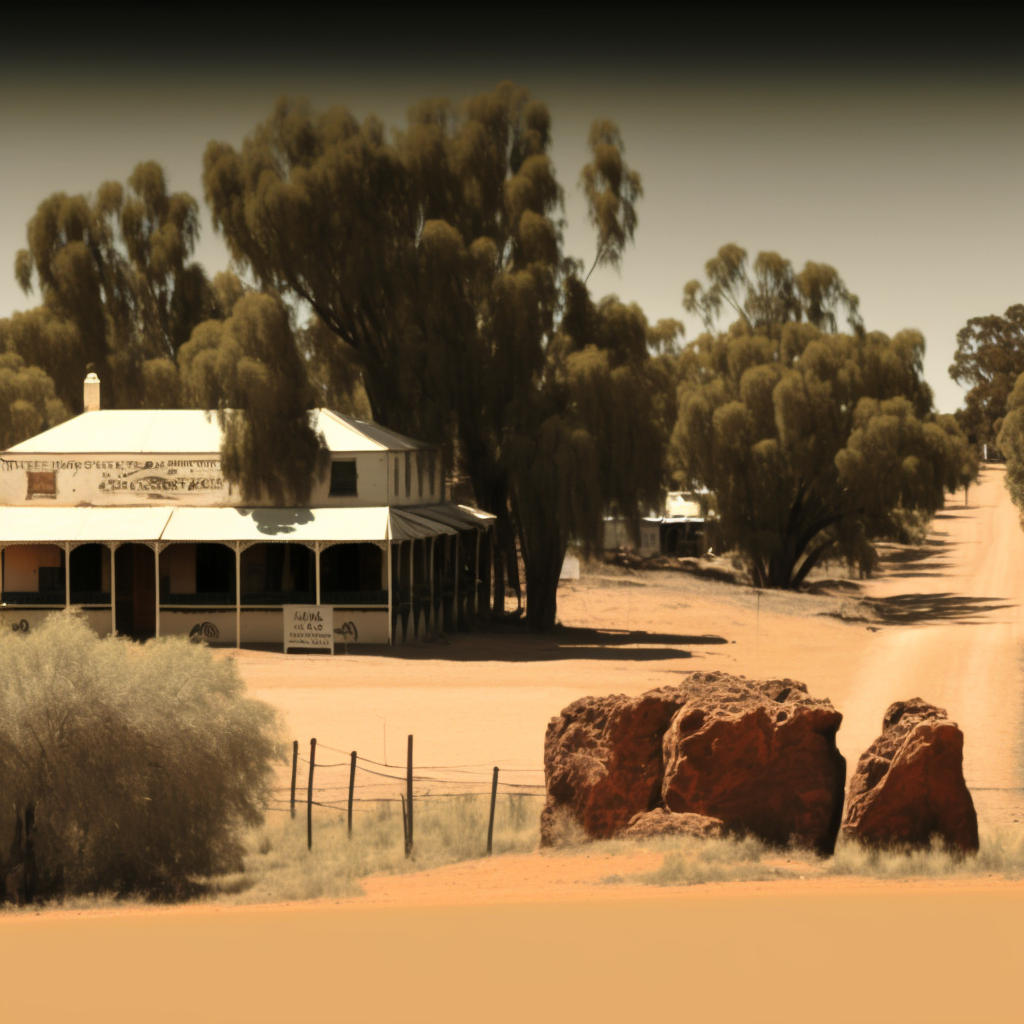
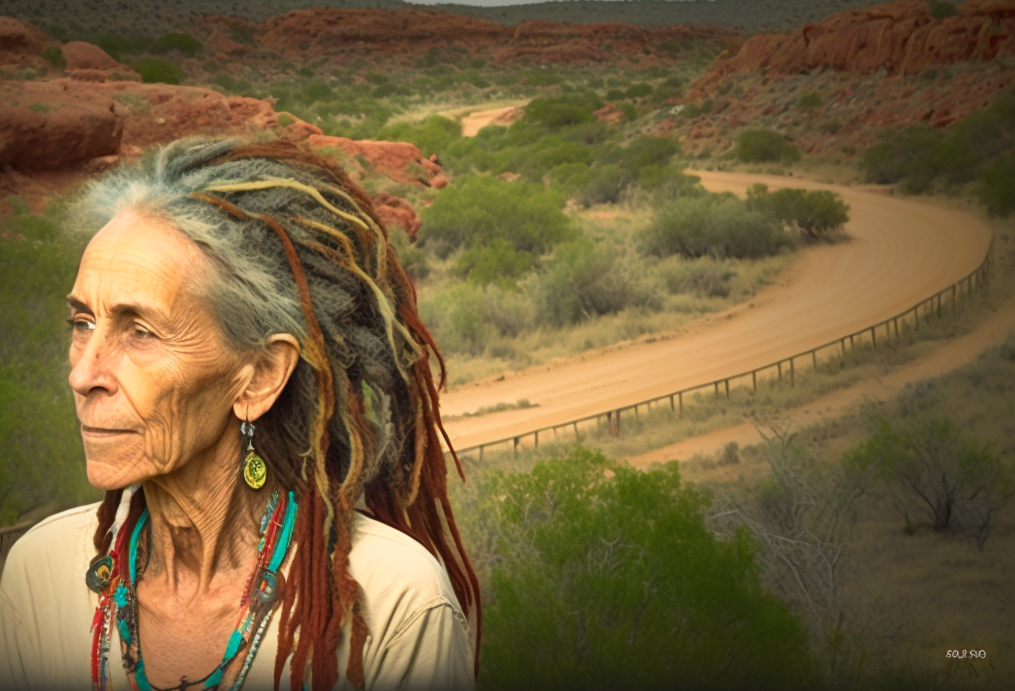
Aunt Idle was nowhere to be found though, having decided to go for a walk on impulse, quite forgetting the arrival of the first guest. She saw Bert’s car approaching the hotel from her vantage point on a low hill, which reminded her she should be getting back. It was a lovely evening and she didn’t rush.
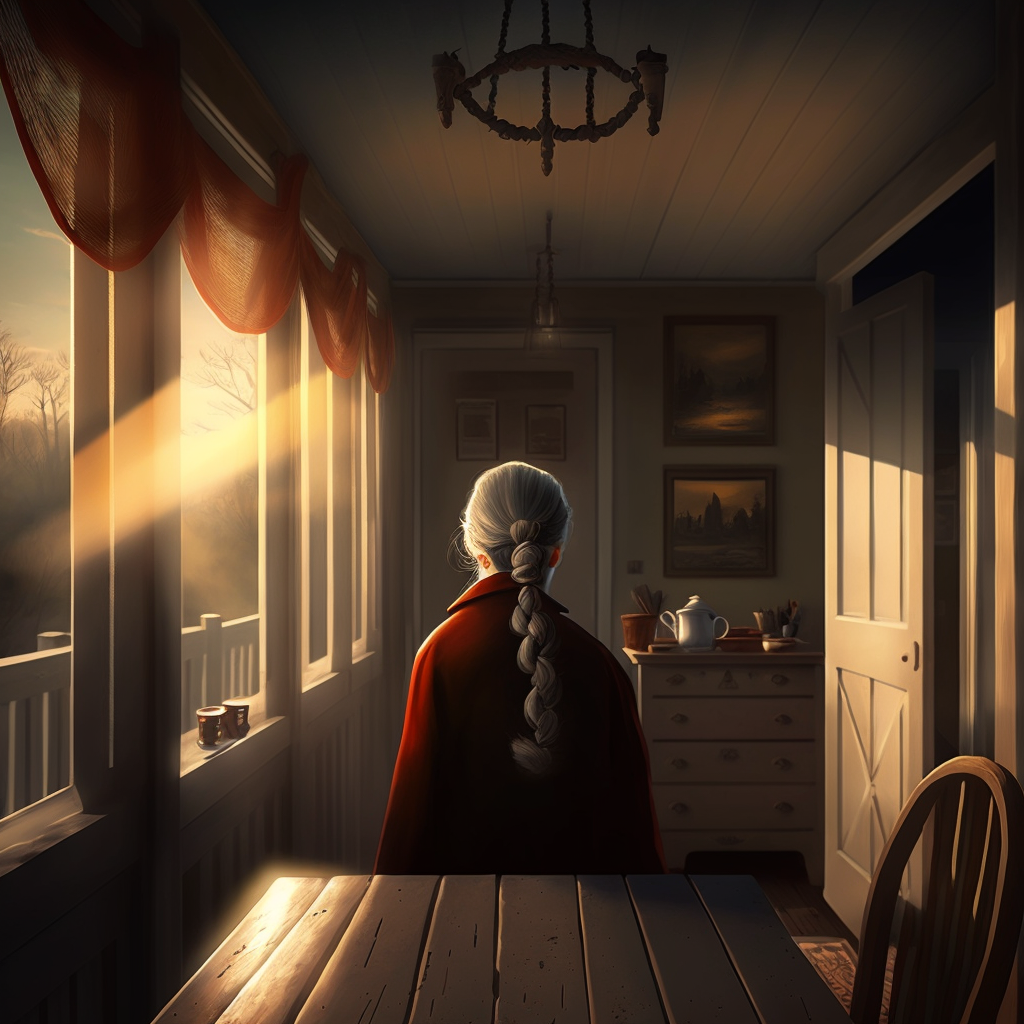
Bert found Mater in the dining room gazing out of the window. “Where the bloody hell is Idle? The guest’s outside on the verandah.”
“She’s taken herself off for a walk, can you believe it?” sighed Mater.
“Yep” Bert replied, “I can. Which room’s she in? Can you show her to her room?”
“Yes of course, Bert. Perhaps you’d see to getting a drink for her.”
 January 31, 2023 at 9:55 pm #6482
In reply to: Orbs of Madjourneys
With the flurry of activities going around, in life and virtually, Xavier had trouble keeping track.
His sanity demanded some clarity of intention and some focus. Too many threads were open, and of all things, he didn’t like loose ends.
Somehow that silly notion of the Golden Banana quest did pose him a nagging reminder of something incomplete he was eager to get a resolution to. That, or he was unconsciously getting annoyed at seeing his 3 friends making strides in their adventures. The pirate quest was fun enough, but he’d rather enjoy it without having to check everything against being a possible clue.There were no rules against cheating. The thought struck him. Maybe that was it. The simplicity of it!
Since they made the rules, they could make them, break them, amend or bend them.
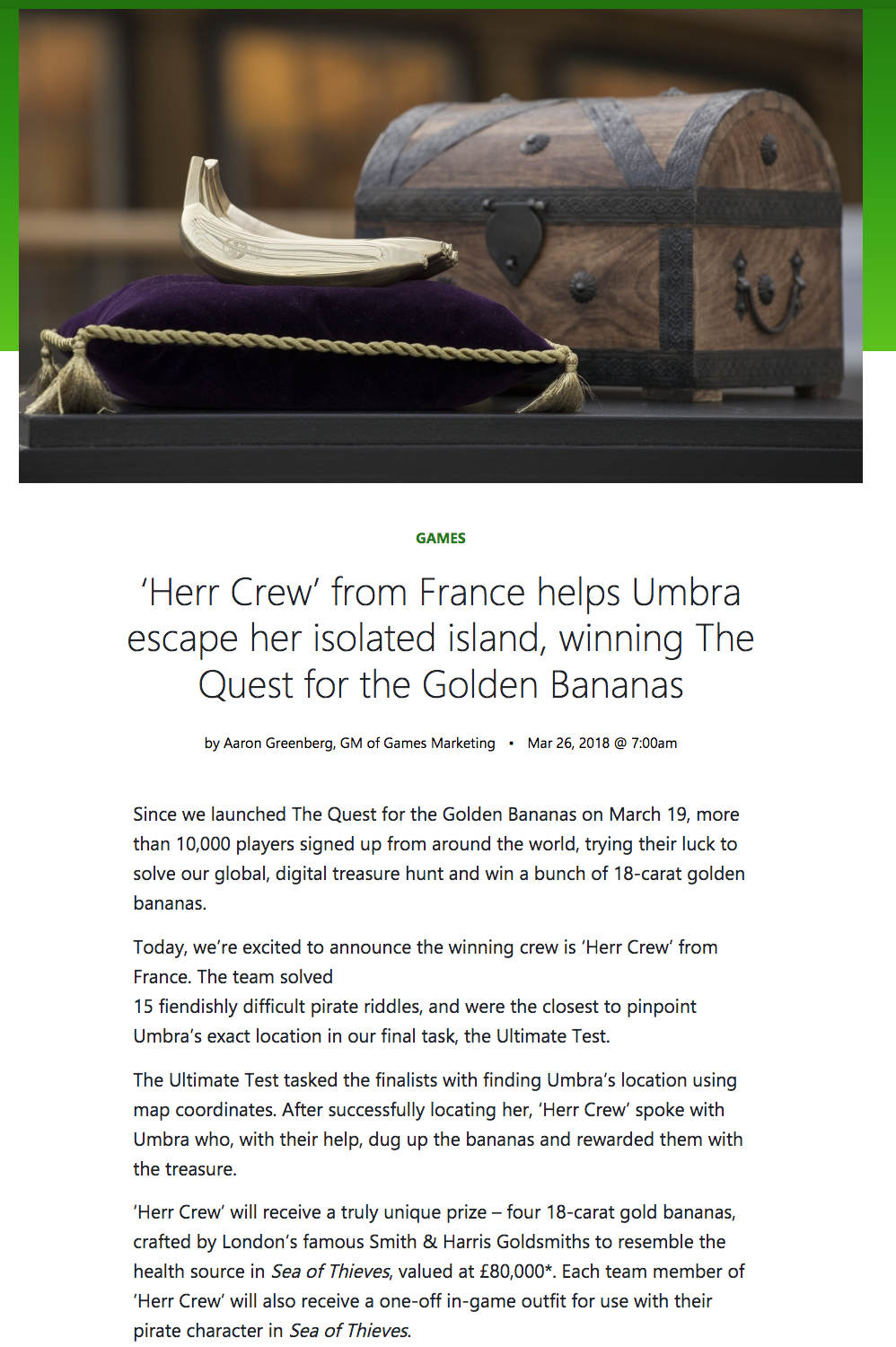
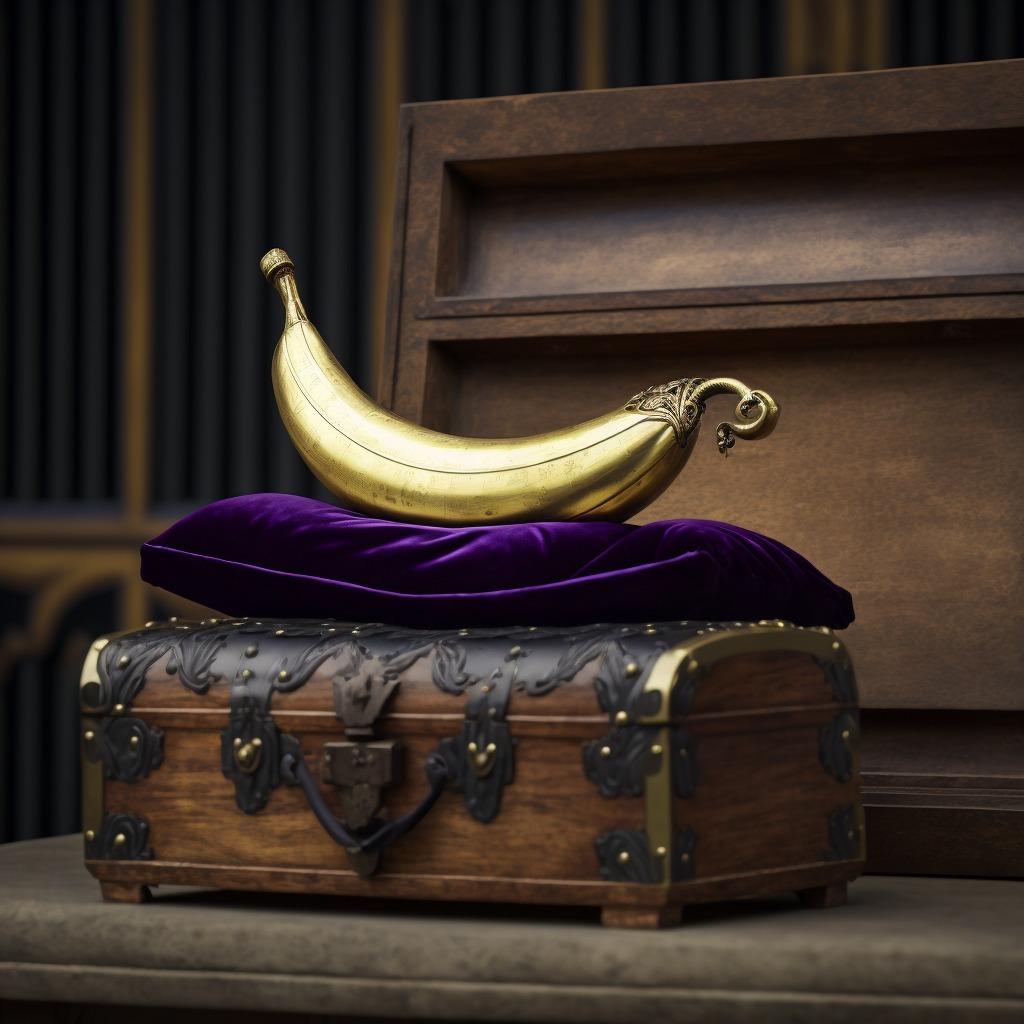 He looked up on the internet for an image he could feed AL, and *bam* it was there! In all its glory, a gorgeous Golden Banana on a purple cushion, in a pirate chest. The reward for an online game… That was eerie!
He’d had a sneaking suspicion the game was not just about virtual any longer. Synchronistic happenings like that were more than just random.
He logged into the game only to discover a simple message.
“Congratulations on completing your quest. You may enjoy your trip until the next stage of your journey.
Look for the cook on the pirate boat, she will give you directions to regroup with your friends.
And don’t forget to confirm your bookings.”January 31, 2023 at 3:17 am #6476In reply to: Orbs of Madjourneys
Yasmin was having a hard time with the heavy rains and mosquitoes in the real-world. She couldn’t seem to make a lot of progress on finding the snorting imp. She was feeling discouraged and unsure of what to do next.
Suddenly, an emoji of a snake appeared on her screen. It seemed to be slithering and wriggling, as if it was trying to grab her attention. Without hesitation, Yasmin clicked on the emoji.
She was taken to a new area in the game, where the ground was covered in tall grass and the sky was dark and stormy. She could see the snorting imp in the distance, but it was surrounded by a group of dangerous-looking snakes.
Clue unlocked It sounds like you’re having a hard time in the real world, but don’t let that discourage you in the game. The snorting imp is nearby and it seems like the snakes are guarding it. You’ll have to be brave and quick to catch it. Remember, the snorting imp represents your determination and bravery in real life.
Rude! thought Yasmin. Telling me I’m having a hard time! And I’m supposed to be the brains of the group! Suddenly the screen went blank. “Oh blimmin dodgy internet!” she moaned.

“Road’s closed with the flooding,” said a man from the kitchen door. Yasmin didn’t know him; he had a tinge of an accent and took up a lot of space in the doorway. “They reckon it should be clear by tomorrow though.”
“Fred!” Sister Aliti looked up from chopping yam and beamed. She pointed her knife at Yasmin who was washing the breakfast dishes. “Have you met Yasmin? One of our new volunteers. Such a good girl.” The knife circled towards the door. “Yasmin this is Fred – Fred drives the van for us when we are too busy to do it ourselves. So very kind.” She smiled fondly at the man.
Fred nodded and, taking a step into the kitchen, he stuck a hand towards Yasmin. She quickly wiped her damp hands on her skirt before taking it. Fred’s hand was brown and weathered like his face and he gripped her fingers firmly.
“Nice to meet you Yasmin. So where are you from?”
“Oh, um, I’ve been living in London most recently but originally from Manchester.” Yasmin noticed he had a snake tattoo curling up his inner bicep, over his shoulder and disappearing under his black singlet. “Is your accent Australian?”
A flicker of a frown crossed Fred’s face and Yasmin felt anxious. “Sorry,” she mumbled, although she wasn’t sure what for. “It’s just I’m visiting soon …”
“Yeah, originally. But I’ve not been back home for while.” His eyes drifted to the kitchen window and stayed there. For a moment, they all watched the rain pelt against the glass.
Sister Aliti broke the silence. “Fred’s a writer,” she said sounding like a proud mother.
“Oh, that’s so cool! What do you write?” Yasmin immediately worried she’d been too nosy again. “I’ve always wanted to write!” she added brightly which wasn’t true, she’d never given it much thought. Realising this, and to her horror, she snort laughed.
Fred dragged his eyes back from the window and looked at her with amusement. “Yeah? Well you should go for it!” He turned to Sister Aliti. “Internet’s down again too with this weather,” He dug into the pocket of his shorts and dangled some keys in the air. “I’ll leave the van keys with you but I’ll be back tomorrow, if the rain’s stopped.” The keys clanked onto the bench.
“He’s such a chatterbox,” murmured Sister Aliti after Fred had gone and Yasmin laughed.
“Shall I put these in the office?” Yasmin gestured to the set of keys then gasped as she saw that on the keychain was a devilish looking imp grinning up at her.
January 29, 2023 at 9:30 pm #6470In reply to: Orbs of Madjourneys
Put your thoughts to sleep. Do not let them cast a shadow over the moon of your heart. Let go of thinking.
~ RumiTired from not having any sleep, Zara had found the suburb of Camden unattractive and boring, and her cousin Bertie, although cheerful and kind and eager to show her around, had become increasingly irritating to her. She found herself wishing he’d shut up and take her back to the house so she could play the game again. And then felt even more cranky at how uncomfortable she felt about being so ungrateful. She wondered if she was going to get addicted and spent the rest of her life with her head bent over a gadget and never look up at the real word again, like boring people moaned about on social media.
Maybe she should leave tomorrow, even if it meant arriving first at the Flying Fish Inn. But what about the ghost of Isaac in the church, would she regret later not following that up. On the other hand, if she went straight to the Inn and had a few days on her own, she could spend as long as she wanted in the game with nobody pestering her. Zara squirmed mentally when she realized she was translating Berties best efforts at hospitality as pestering.
Bertie stopped the car at a traffic light and was chatting to the passenger in the next car through his open window. Zara picked her phone up and checked her daily Call The Whale app for some inspiration.
Let go of thinking.
A ragged sigh escaped Zara’s lips, causing Bertie to glance over. She adjusted her facial expression quickly and rustled up a cheery smile and Bertie continued his conversation with the occupants of the other car until the lights changed.
“I thought you’d like to meet the folks down at the library, they know all the history of Camden,” Bertie said, but Zara interrupted him.
“Oh Bertie, how kind of you! But I’ve just had a message and I have to leave tomorrow morning for the rendezvous with my friends. There’s been a change of plans.” Zara astonished herself that she blurted that out without thinking it through first. But there. It was said. It was decided.
January 29, 2023 at 3:15 pm #6468In reply to: Orbs of Madjourneys
At the former Chinggis Khaan International Airport which was now called the New Ulaanbaatar International Airport, the young intern sat next to Youssef, making the seats tremble like a frail suspended bridge in the Andes. Youssef had been considering connecting to the game and start his quest to meet with his grumpy quirk, but the girl seemed pissed, almost on the brink of crying. So Youssef turned off his phone and asked her what had happened, without thinking about the consequences, and because he thought it was a nice opportunity to engage the conversation with her at last, and in doing so appear to be nice to care so that she might like him in return.
Natalie, because he had finally learned her name, started with all the bullying she had to endure from Miss Tartiflate during the trip, all the dismissal about her brilliant ideas, and how the Yeti only needed her to bring her coffee and pencils, and go fetch someone her boss needed to talk to, and how many time she would get no thanks, just a short: “you’re still here?”
After some time, Youssef even knew more about her parents and her sisters and their broken family dynamics than he would have cared to ask, even to be polite. At some point he was starting to feel grumpy and realised he hadn’t eaten since they arrived at the airport. But if he told Natalie he wanted to go get some food, she might follow him and get some too. His stomach growled like an angry bear. He stood more quickly than he wanted and his phone fell on the ground. The screen lit up and he could just catch a glimpse of a desert emoji in a notification before Natalie let out a squeal. Youssef looked around, people were glancing at him as if he might have been torturing her.
“Oh! Sorry, said Youssef. I just need to go to the bathroom before we board.”
“But the boarding is only in one hour!”
“Well I can’t wait one hour.”
“In that case I’m coming with you, I need to go there too anyway.”
“But someone needs to stay here for our bags,” said Youssef. He could have carried his own bag easily, but she had a small suitcase, a handbag and a backpack, and a few paper bags of products she bought at one of the two the duty free shops.
Natalie called Kyle and asked him to keep a close watch on her precious things. She might have been complaining about the boss, but she certainly had caught on a few traits of her.
Youssef was glad when the men’s bathroom door shut behind him and his ears could have some respite. A small Chinese business man was washing his hands at one of the sinks. He looked up at Youssef and seemed impressed by his height and muscles. The man asked for a selfie together so that he could show his friends how cool he was to have met such a big stranger in the airport bathroom. Youssef had learned it was easier to oblige them than having them follow him and insist.
When the man left, Youssef saw Natalie standing outside waiting for him. He thought it would have taken her longer. He only wanted to go get some food. Maybe if he took his time, she would go.

He remembered the game notification and turned on his phone. The icon was odd and kept shifting between four different landscapes, each barren and empty, with sand dunes stretching as far as the eye could see. One with a six legged camel was already intriguing, in the second one a strange arrowhead that seemed to be getting out of the desert sand reminded him of something that he couldn’t quite remember. The fourth one intrigued him the most, with that car in the middle of the desert and a boat coming out of a giant dune.
Still hungrumpy he nonetheless clicked on the shapeshifting icon and was taken to a new area in the game, where the ground was covered in sand and the sky was a deep orange, as if the sun was setting. He could see a mysterious figure in the distance, standing at the top of a sand dune.
The bell at the top right of the screen wobbled, signalling a message from the game. There were two. He opened the first one.
We’re excited to hear about your real-life parallel quest. It sounds like you’re getting close to uncovering the mystery of the grumpy shaman. Keep working on your blog website and keep an eye out for any clues that Xavier and the Snoot may send your way. We believe that you’re on the right path.
What on earth was that ? How did the game know about his life and the shaman at the oasis ? After the Thi Gang mess with THE BLOG he was becoming suspicious of those strange occurrences. He thought he could wonder for a long time or just enjoy the benefits. Apparently he had been granted a substantial reward in gold coins for successfully managing his first quest, along with a green potion.
He looked at his avatar who was roaming the desert with his pet bear (quite hungrumpy too). The avatar’s body was perfect, even the hands looked normal for once, but the outfit had those two silver disks that made him look like he was wearing an iron bra.

He opened the second message.
Clue unlocked It sounds like you’re in a remote location and disconnected from the game. But, your real-life experiences seem to be converging with your quest. The grumpy shaman you met at the food booth may hold the key to unlocking the next steps in the game. Remember, the desert represents your ability to adapt and navigate through difficult situations.
🏜️🧭🧙♂️ Explore the desert and see if the grumpy shaman’s clues lead you to the next steps in the game. Keep an open mind and pay attention to any symbols or clues that may help you in your quest. Remember, the desert represents your ability to adapt and navigate through difficult situations.
Youssef recalled that strange paper given by the lama shaman, was it another of the clues he needed to solve that game? He didn’t have time to think about it because a message bumped onto his screen.
“Need help? Contact me 👉”
Sands_of_time is trying to make contact : ➡️ACCEPT <> ➡️DENY ❓
January 15, 2023 at 1:18 pm #6391In reply to: Train your subjective AI – text version
write the plot of an absurd non-linear novel, featuring 4 characters
The novel begins with the introduction of four characters: a retired archaeologist named Harold, a struggling musician named Samantha, a disillusioned corporate drone named Tim, and a reclusive inventor named Claire.
Harold, who is obsessed with ancient Egyptian hieroglyphs, discovers a mysterious underground chamber beneath a pyramid in Egypt. Inside, he finds a strange device that he believes is a time machine. Harold decides to use the device to travel back in time to ancient Egypt in order to decipher the hieroglyphs.
Samantha, who is trying to make a name for herself as a musician, is struggling to come up with new material for her music. One day, she discovers that she can create beautiful music by communicating with plants telepathically. She becomes obsessed with this new form of music-making and decides to quit her day job and pursue it full-time.
Tim, who is stuck in a dead-end job, is feeling unfulfilled and uninspired. One day, he stumbles upon a robotic mime performance art show. The performance inspires him to quit his job and pursue his dream of becoming a mime artist.
Claire, who is a reclusive inventor, has been working on a project to create a type of artificial intelligence that can communicate with humans using calligraphic body language. She finally succeeds and creates an AI that she names “Calli”.
As the story progresses, the characters’ paths begin to intersect in unexpected ways. Harold gets stuck in ancient Egypt and has to rely on Samantha’s telepathic plant communication skills to find a way back to the present. Tim’s robotic mime art becomes a hit and he starts working with Claire to integrate Calli into his performances.
As the story reaches its climax, all four characters come together to use their unique skills and abilities to solve a problem that threatens the fate of the world.
Throughout the novel, the plot unfolds in a non-linear fashion, jumping back and forth in time and between the different character’s perspectives. The story is filled with absurdity and unexpected twists and turns, leaving the reader guessing until the very end.
What sort of problem that threatens the fate of the world will be resolved by their combined skills?
As the story progresses, the characters begin to uncover a sinister plot by a group of powerful individuals who are intent on using the time machine to alter the course of history for their own gain. They plan to use the time machine to go back in time and change key events that would give them immense wealth and power in the present. Harold and Samantha, with the help of Tim and Claire, must race against time to stop the villains from carrying out their plan.
Harold’s expertise in ancient Egyptian hieroglyphs plays a crucial role in deciphering the clues that lead to the location of the time machine. Samantha’s telepathic plant communication skills are used to locate the hidden underground chamber where the time machine is kept. Tim’s robotic mime art and Claire’s AI Calli are used to infiltrate the villains’ hideout and gather intelligence on their plans.
In the final act, the four characters come together to use their unique skills and abilities to stop the villains from altering history. Harold uses his knowledge of ancient Egypt to navigate the time machine and travel back in time to stop the villains from changing key events. Samantha uses her telepathic plant communication skills to communicate with the plants in the past and gather information on the villains’ whereabouts. Tim and Claire use their robotic mime and AI skills to create a diversion and distract the villains while Harold and Samantha complete their mission.
In the end, the four characters succeed in stopping the villains and saving the fate of the world. The novel ends with the four characters going their separate ways, but they all know that they will always have each other to rely on in the face of any challenge that comes their way.
January 11, 2023 at 10:32 pm #6368In reply to: Train your subjective AI – text version
Something in the style of FPooh:
Arona heard the music growing louder as she approached the source of the sound. She could see a group of people gathered around a large fire, the flickering light casting shadows on the faces of the dancers. She hesitated for a moment, remembering the isolation of her journey and wondering if she was ready to be among people again. But the music was too inviting, and she found herself drawn towards the group.
As she neared the fire, she saw a young man playing a flute, the music flowing from his fingers with a fluid grace that captivated her. He looked up as she approached, and their eyes met. She could see the surprise and curiosity in his gaze, and she smiled, feeling a sense of connection she had not felt in a long time.
Fiona was sitting on a bench in the park, watching the children play. She had brought her sketchbook with her, but for once she didn’t feel the urge to draw. Instead she watched the children’s laughter, feeling content and at peace. Suddenly, she saw a young girl running towards her, a look of pure joy on her face. The girl stopped in front of her and held out a flower, offering it to Fiona with a smile.
Taken aback, Fiona took the flower and thanked the girl. The girl giggled and ran off to join her friends. Fiona looked down at the flower in her hand, and she felt a sense of inspiration, like a spark igniting within her. She opened her sketchbook and began to draw, feeling the weight lift from her shoulders and the magic of creativity flowing through her.
Minky led the group of misfits towards the emporium, his bowler hat bobbing on his head. He chattered excitedly, telling stories of the wondrous items to be found within Mr Jib’s store. Yikesy followed behind, still lost in his thoughts of Arona and feeling a sense of dread at the thought of buying a bowler hat. The green fairy flitted along beside him, her wings a blur of movement as she chattered with the parrot perched on her shoulder.
As they reached the emporium, they were disappointed to find it closed. But Minky refused to be discouraged, and he led them to a nearby cafe where they could sit and enjoy some tea and cake while they wait for the emporium to open. The green fairy was delighted, and she ordered a plate of macarons, smiling as she tasted the sweetness of the confections.
About creativity & everyday magic
Fiona had always been drawn to the magic of creativity, the way a blank page could be transformed into a world of wonder and beauty. But lately, she had been feeling stuck, unable to find the spark that ignited her imagination. She would sit with her sketchbook, pencil in hand, and nothing would come to her.
She started to question her abilities, wondering if she had lost the magic of her art. She spent long hours staring at her blank pages, feeling a weight on her chest that seemed to be growing heavier every day.
But then she remembered the green fairy’s tears and Yikesy’s longing for Arona, and she realized that the magic of creativity wasn’t something that could be found only in art. It was all around her, in the everyday moments of life.
She started to look for the magic in the small things, like the way the sunlight filtered through the trees, or the way a child’s laughter could light up a room. She found it in the way a stranger’s smile could lift her spirits, and in the way a simple cup of tea could bring her comfort.
And as she started to see the magic in the everyday, she found that the weight on her chest lifted and the spark of inspiration returned. She picked up her pencil and began to draw, feeling the magic flowing through her once again.
She understand that creativity blocks aren’t a destination, but just a step, just like the bowler hat that Minky had bought for them all, a bit of everyday magic, nothing too fancy but a sense of belonging, a sense of who they are and where they are going. And she let her pencil flow, with the hopes that one day, they will all find their way home.
July 7, 2022 at 9:45 am #6315In reply to: The Sexy Wooden Leg
It was not yet 9am and Eusebius Kazandis was already sweating. The morning sun was hitting hard on the tarp of his booth. He put the last cauldron among lines of cauldrons on a sagging table at the summer fair of Innsbruck, Austria. It was a tiny three-legged black cauldron with a simple Celtic knot on one side and a tree on the other side, like all the others. His father’s father’s father used to make cauldrons for a living, the kind you used to distil ouzo or cook meals for an Inn. But as time went by and industrialisation made it easier for cooks, the trade slowly evolved toward smaller cauldrons for modern Wiccans. A modern witch wanted it portable and light, ready to use in everyday life situations, and Eusebius was there to provide it for them.
Eusebius sat on his chair and sighed. He couldn’t help but notice the woman in colourful dress who had spread a shawl on the grass under the tall sequoia tree. Nobody liked this spot under the branches oozing sticky resin. She didn’t seem to mind. She was arranging small colourful bottles of oil on her shawl. A sign near her said : Massage oils, Fragrant oils, Polishing oils, all with different names evocative of different properties. He hadn’t noticed her yesterday when everybody was installing their stalls. He wondered if she had paid her fee.
Rosa was smiling as she spread in front of her the meadow flowers she’d picked on her way to the market. It was another beautiful day, under the shade and protection of the big sequoia tree watching over her. She assembled small bouquets and put them in between the vials containing her precious handmade oils. She had noticed people, and especially women, would naturally gather around well dressed stalls and engage conversation. Since she left her hometown of Torino, seven years ago, she’d followed the wind on her journey across Europe. It had led her to Innsbruck and had suddenly stopped blowing. That usually meant she had something to do there, but it also meant that she would have to figure out what she was meant to do before she could go on with her life.
The stout man waiting behind his dark cauldrons, was watching her again. He looked quite sad, and she couldn’t help but thinking he was not where he needed to be. When she looked at him, she saw Hephaestus whose inner fire had been tamed. His banner was a mishmash of religious stuff, aimed at pagans and budding witches. Although his grim booth would most certainly benefit from a feminine touch, but she didn’t want to offend him by a misplaced suggestion. It was not her place to find his place.
Rosa, who knew to cultivate any available friendship when she arrived somewhere, waved at the man. Startled, he looked away as if caught doing something inappropriate. Rosa sighed. Maybe she should have bring him some coffee.
As her first clients arrived, she prayed for a gush of wind to tell her where to go next. But the branches of the old tree remained perfectly still under the scorching sun.
July 1, 2022 at 9:51 am #6306In reply to: The Elusive Samuel Housley and Other Family Stories
Looking for Robert Staley
William Warren (1835-1880) of Newhall (Stapenhill) married Elizabeth Staley (1836-1907) in 1858. Elizabeth was born in Newhall, the daughter of John Staley (1795-1876) and Jane Brothers. John was born in Newhall, and Jane was born in Armagh, Ireland, and they were married in Armagh in 1820. Elizabeths older brothers were born in Ireland: William in 1826 and Thomas in Dublin in 1830. Francis was born in Liverpool in 1834, and then Elizabeth in Newhall in 1836; thereafter the children were born in Newhall.
Marriage of John Staley and Jane Brothers in 1820:
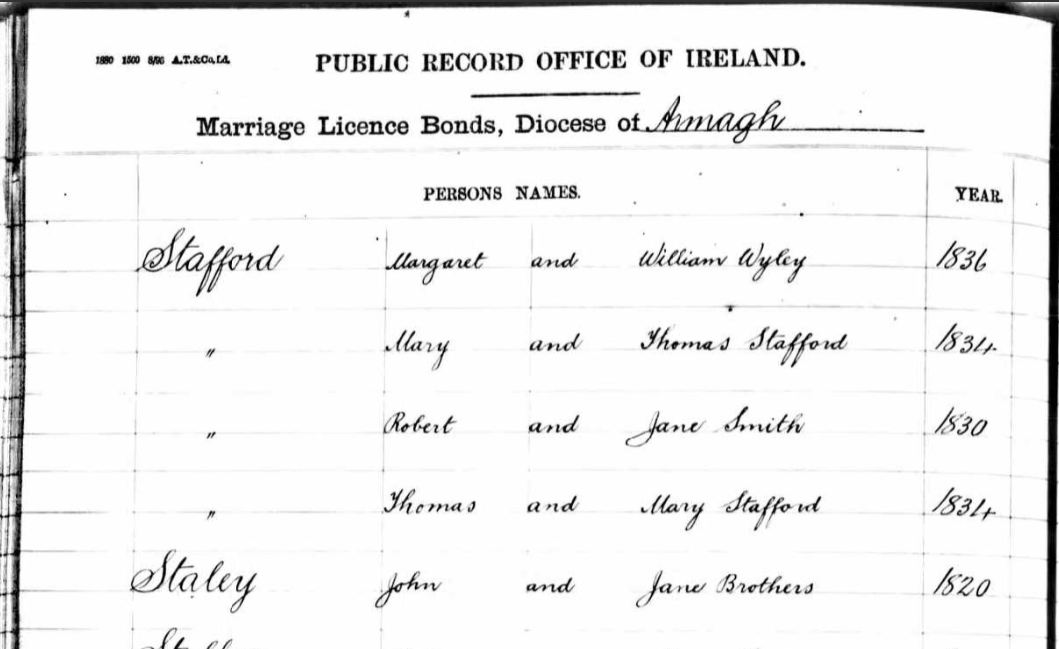
My grandmother related a story about an Elizabeth Staley who ran away from boarding school and eloped to Ireland, but later returned. The only Irish connection found so far is Jane Brothers, so perhaps she meant Elizabeth Staley’s mother. A boarding school seems unlikely, and it would seem that it was John Staley who went to Ireland.
The 1841 census states Jane’s age as 33, which would make her just 12 at the time of her marriage. The 1851 census states her age as 44, making her 13 at the time of her 1820 marriage, and the 1861 census estimates her birth year as a more likely 1804. Birth records in Ireland for her have not been found. It’s possible, perhaps, that she was in service in the Newhall area as a teenager (more likely than boarding school), and that John and Jane ran off to get married in Ireland, although I haven’t found any record of a child born to them early in their marriage. John was an agricultural labourer, and later a coal miner.
John Staley was the son of Joseph Staley (1756-1838) and Sarah Dumolo (1764-). Joseph and Sarah were married by licence in Newhall in 1782. Joseph was a carpenter on the marriage licence, but later a collier (although not necessarily a miner).
The Derbyshire Record Office holds records of an “Estimate of Joseph Staley of Newhall for the cost of continuing to work Pisternhill Colliery” dated 1820 and addresssed to Mr Bloud at Calke Abbey (presumably the owner of the mine)
Josephs parents were Robert Staley and Elizabeth. I couldn’t find a baptism or birth record for Robert Staley. Other trees on an ancestry site had his birth in Elton, but with no supporting documents. Robert, as stated in his 1795 will, was a Yeoman.
“Yeoman: A former class of small freeholders who farm their own land; a commoner of good standing.”
“Husbandman: The old word for a farmer below the rank of yeoman. A husbandman usually held his land by copyhold or leasehold tenure and may be regarded as the ‘average farmer in his locality’. The words ‘yeoman’ and ‘husbandman’ were gradually replaced in the later 18th and 19th centuries by ‘farmer’.”He left a number of properties in Newhall and Hartshorne (near Newhall) including dwellings, enclosures, orchards, various yards, barns and acreages. It seemed to me more likely that he had inherited them, rather than moving into the village and buying them.
There is a mention of Robert Staley in a 1782 newpaper advertisement.
“Fire Engine To Be Sold. An exceedingly good fire engine, with the boiler, cylinder, etc in good condition. For particulars apply to Mr Burslem at Burton-upon-Trent, or Robert Staley at Newhall near Burton, where the engine may be seen.”
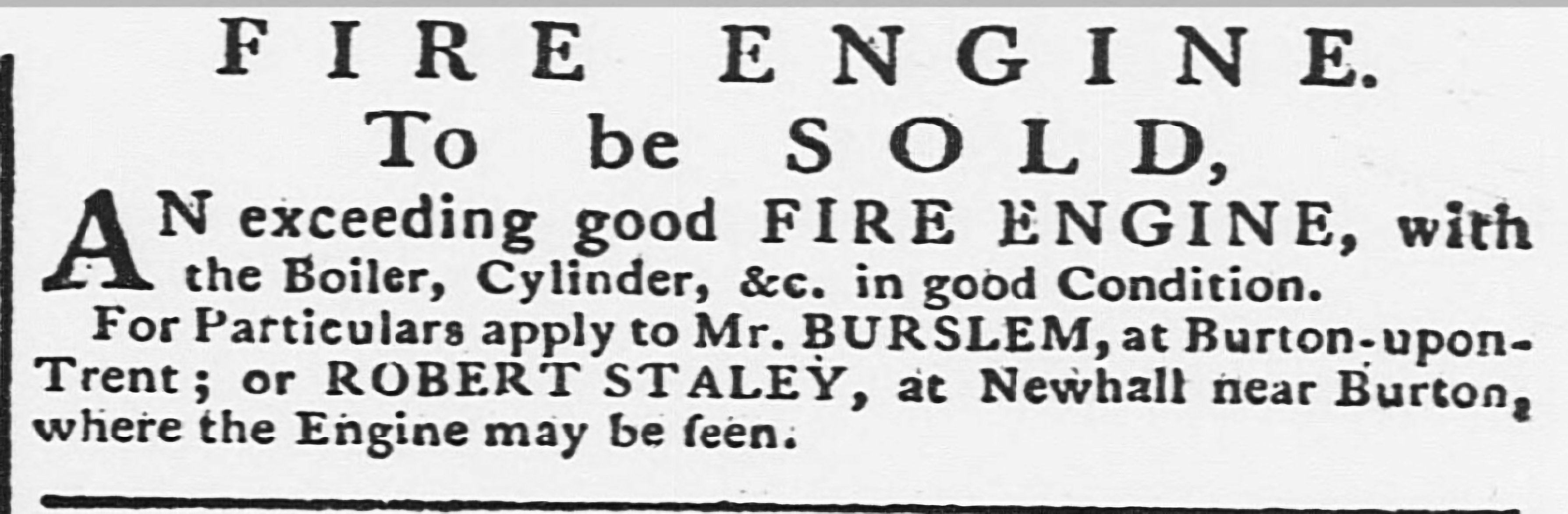
Was the fire engine perhaps connected with a foundry or a coal mine?
I noticed that Robert Staley was the witness at a 1755 marriage in Stapenhill between Barbara Burslem and Richard Daston the younger esquire. The other witness was signed Burslem Jnr.
Looking for Robert Staley
I assumed that once again, in the absence of the correct records, a similarly named and aged persons baptism had been added to the tree regardless of accuracy, so I looked through the Stapenhill/Newhall parish register images page by page. There were no Staleys in Newhall at all in the early 1700s, so it seemed that Robert did come from elsewhere and I expected to find the Staleys in a neighbouring parish. But I still didn’t find any Staleys.
I spoke to a couple of Staley descendants that I’d met during the family research. I met Carole via a DNA match some months previously and contacted her to ask about the Staleys in Elton. She also had Robert Staley born in Elton (indeed, there were many Staleys in Elton) but she didn’t have any documentation for his birth, and we decided to collaborate and try and find out more.
I couldn’t find the earlier Elton parish registers anywhere online, but eventually found the untranscribed microfiche images of the Bishops Transcripts for Elton.
via familysearch:
“In its most basic sense, a bishop’s transcript is a copy of a parish register. As bishop’s transcripts generally contain more or less the same information as parish registers, they are an invaluable resource when a parish register has been damaged, destroyed, or otherwise lost. Bishop’s transcripts are often of value even when parish registers exist, as priests often recorded either additional or different information in their transcripts than they did in the original registers.”Unfortunately there was a gap in the Bishops Transcripts between 1704 and 1711 ~ exactly where I needed to look. I subsequently found out that the Elton registers were incomplete as they had been damaged by fire.
I estimated Robert Staleys date of birth between 1710 and 1715. He died in 1795, and his son Daniel died in 1805: both of these wills were found online. Daniel married Mary Moon in Stapenhill in 1762, making a likely birth date for Daniel around 1740.
The marriage of Robert Staley (assuming this was Robert’s father) and Alice Maceland (or Marsland or Marsden, depending on how the parish clerk chose to spell it presumably) was in the Bishops Transcripts for Elton in 1704. They were married in Elton on 26th February. There followed the missing parish register pages and in all likelihood the records of the baptisms of their first children. No doubt Robert was one of them, probably the first male child.
(Incidentally, my grandfather’s Marshalls also came from Elton, a small Derbyshire village near Matlock. The Staley’s are on my grandmothers Warren side.)
The parish register pages resume in 1711. One of the first entries was the baptism of Robert Staley in 1711, parents Thomas and Ann. This was surely the one we were looking for, and Roberts parents weren’t Robert and Alice.
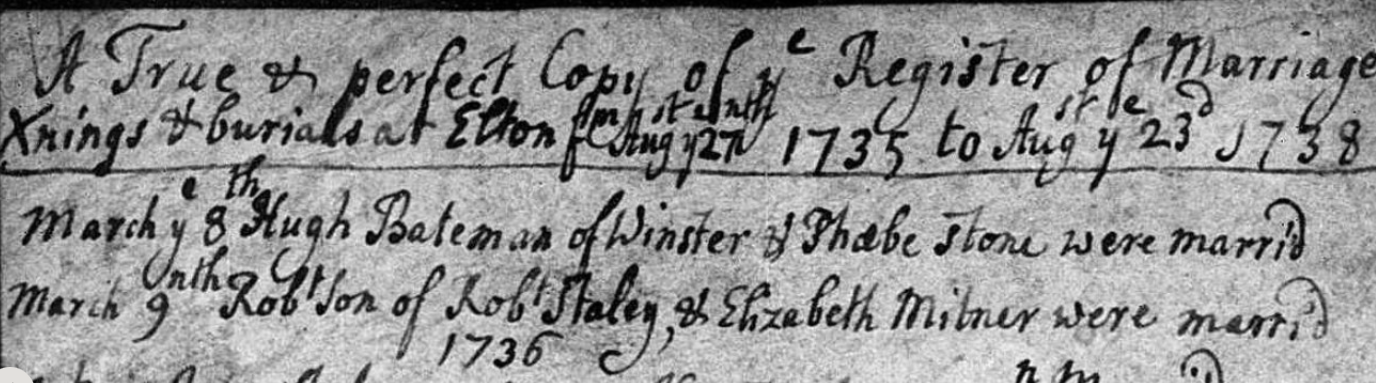
But then in 1735 a marriage was recorded between Robert son of Robert Staley (and this was unusual, the father of the groom isn’t usually recorded on the parish register) and Elizabeth Milner. They were married on the 9th March 1735. We know that the Robert we were looking for married an Elizabeth, as her name was on the Stapenhill baptisms of their later children, including Joseph Staleys. The 1735 marriage also fit with the assumed birth date of Daniel, circa 1740. A baptism was found for a Robert Staley in 1738 in the Elton registers, parents Robert and Elizabeth, as well as the baptism in 1736 for Mary, presumably their first child. Her burial is recorded the following year.
The marriage of Robert Staley and Elizabeth Milner in 1735:
There were several other Staley couples of a similar age in Elton, perhaps brothers and cousins. It seemed that Thomas and Ann’s son Robert was a different Robert, and that the one we were looking for was prior to that and on the missing pages.
Even so, this doesn’t prove that it was Elizabeth Staleys great grandfather who was born in Elton, but no other birth or baptism for Robert Staley has been found. It doesn’t explain why the Staleys moved to Stapenhill either, although the Enclosures Act and the Industrial Revolution could have been factors.
The 18th century saw the rise of the Industrial Revolution and many renowned Derbyshire Industrialists emerged. They created the turning point from what was until then a largely rural economy, to the development of townships based on factory production methods.
The Marsden Connection
There are some possible clues in the records of the Marsden family. Robert Staley married Alice Marsden (or Maceland or Marsland) in Elton in 1704. Robert Staley is mentioned in the 1730 will of John Marsden senior, of Baslow, Innkeeper (Peacock Inne & Whitlands Farm). He mentions his daughter Alice, wife of Robert Staley.
In a 1715 Marsden will there is an intriguing mention of an alias, which might explain the different spellings on various records for the name Marsden: “MARSDEN alias MASLAND, Christopher – of Baslow, husbandman, 28 Dec 1714. son Robert MARSDEN alias MASLAND….” etc.
Some potential reasons for a move from one parish to another are explained in this history of the Marsden family, and indeed this could relate to Robert Staley as he married into the Marsden family and his wife was a beneficiary of a Marsden will. The Chatsworth Estate, at various times, bought a number of farms in order to extend the park.
THE MARSDEN FAMILY
OXCLOSE AND PARKGATE
In the Parishes of
Baslow and Chatsworthby
David Dalrymple-Smith“John Marsden (b1653) another son of Edmund (b1611) faired well. By the time he died in
1730 he was publican of the Peacock, the Inn on Church Lane now called the Cavendish
Hotel, and the farmer at “Whitlands”, almost certainly Bubnell Cliff Farm.”“Coal mining was well known in the Chesterfield area. The coalfield extends as far as the
Gritstone edges, where thin seams outcrop especially in the Baslow area.”“…the occupants were evicted from the farmland below Dobb Edge and
the ground carefully cleared of all traces of occupation and farming. Shelter belts were
planted especially along the Heathy Lea Brook. An imposing new drive was laid to the
Chatsworth House with the Lodges and “The Golden Gates” at its northern end….”Although this particular event was later than any events relating to Robert Staley, it’s an indication of how farms and farmland disappeared, and a reason for families to move to another area:
“The Dukes of Devonshire (of Chatsworth) were major figures in the aristocracy and the government of the
time. Such a position demanded a display of wealth and ostentation. The 6th Duke of
Devonshire, the Bachelor Duke, was not content with the Chatsworth he inherited in 1811,
and immediately started improvements. After major changes around Edensor, he turned his
attention at the north end of the Park. In 1820 plans were made extend the Park up to the
Baslow parish boundary. As this would involve the destruction of most of the Farm at
Oxclose, the farmer at the Higher House Samuel Marsden (b1755) was given the tenancy of
Ewe Close a large farm near Bakewell.
Plans were revised in 1824 when the Dukes of Devonshire and Rutland “Exchanged Lands”,
reputedly during a game of dice. Over 3300 acres were involved in several local parishes, of
which 1000 acres were in Baslow. In the deal Devonshire acquired the southeast corner of
Baslow Parish.
Part of the deal was Gibbet Moor, which was developed for “Sport”. The shelf of land
between Parkgate and Robin Hood and a few extra fields was left untouched. The rest,
between Dobb Edge and Baslow, was agricultural land with farms, fields and houses. It was
this last part that gave the Duke the opportunity to improve the Park beyond his earlier
expectations.”The 1795 will of Robert Staley.
Inriguingly, Robert included the children of his son Daniel Staley in his will, but omitted to leave anything to Daniel. A perusal of Daniels 1808 will sheds some light on this: Daniel left his property to his six reputed children with Elizabeth Moon, and his reputed daughter Mary Brearly. Daniels wife was Mary Moon, Elizabeths husband William Moons daughter.
The will of Robert Staley, 1795:
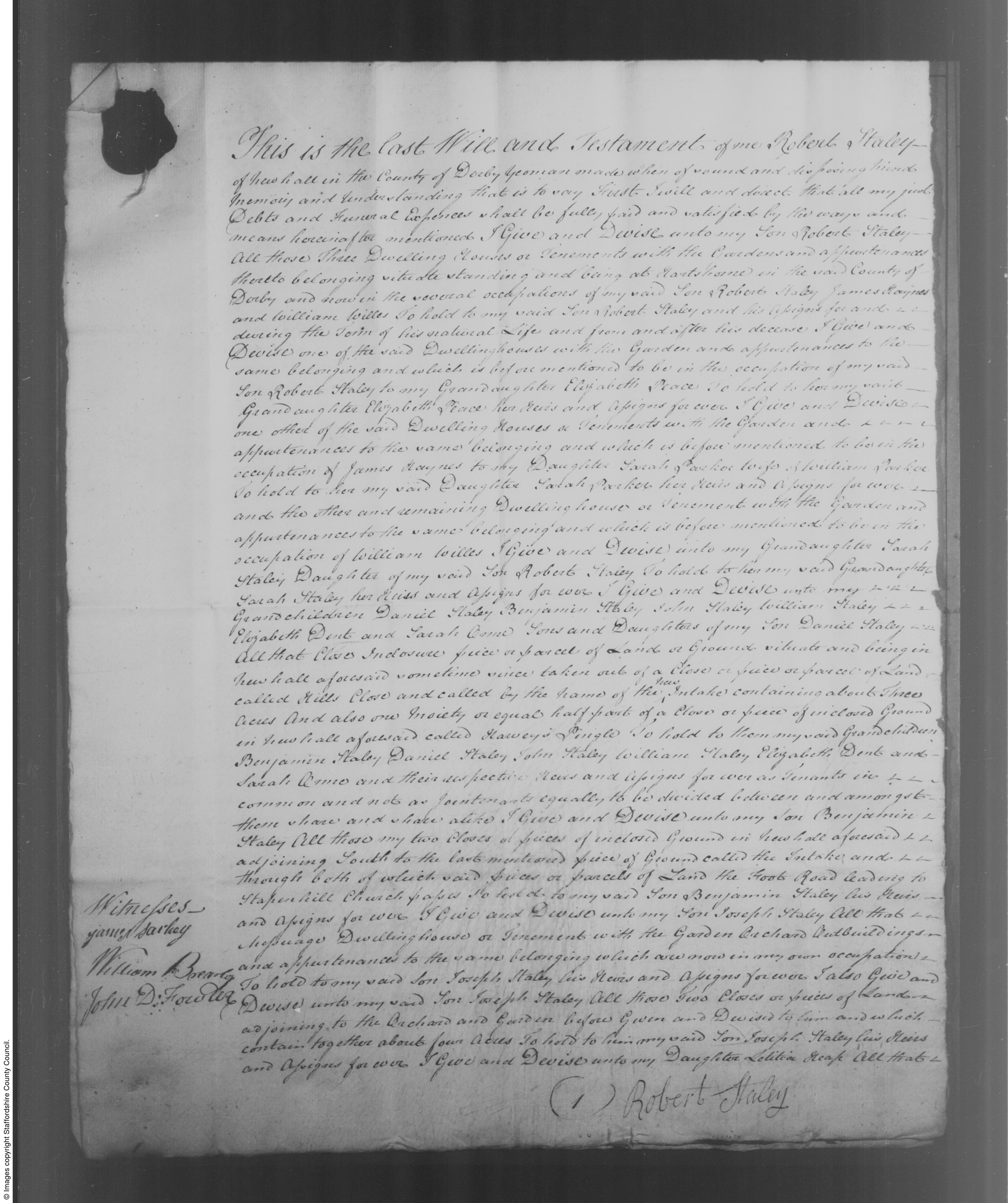
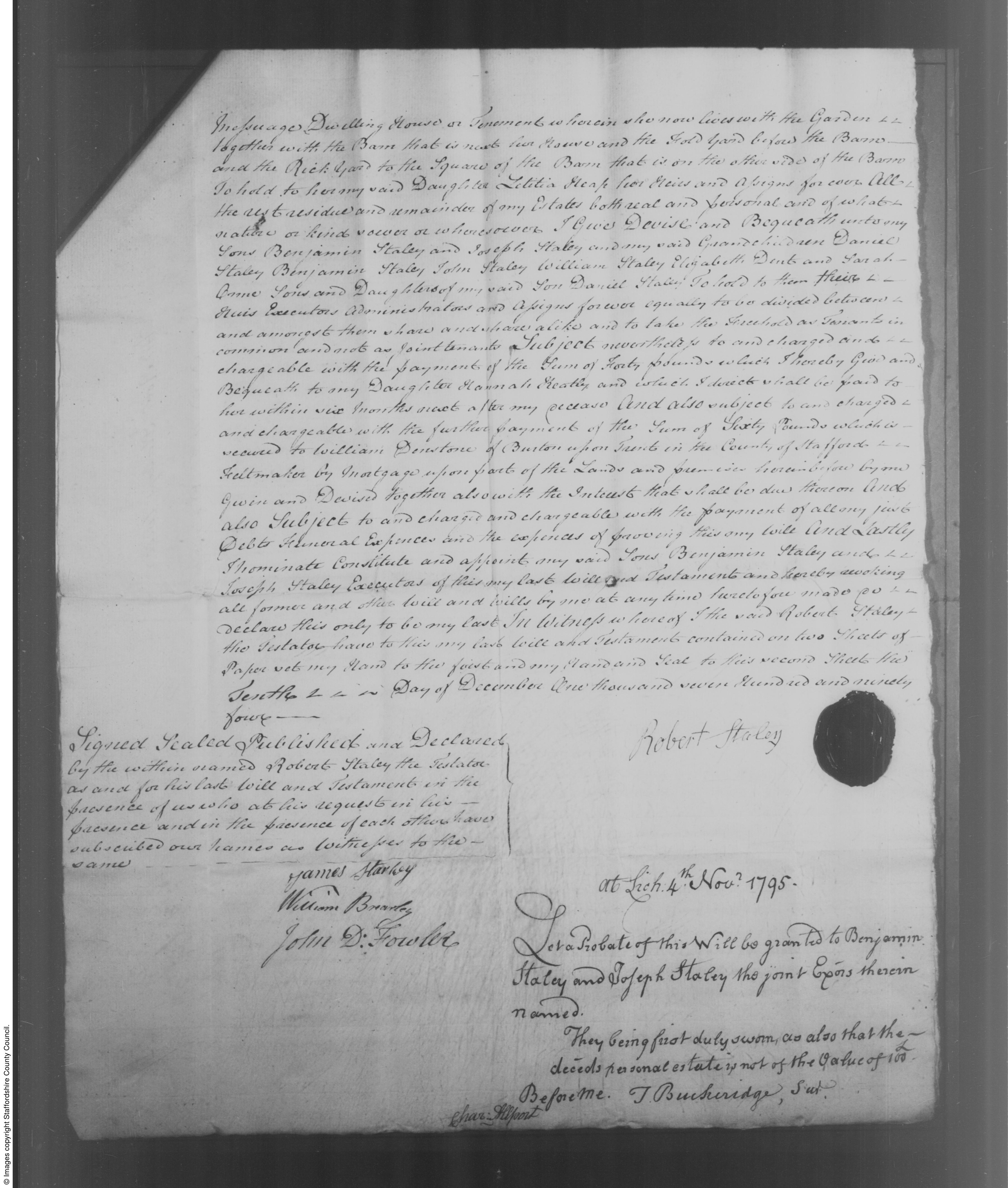
The 1805 will of Daniel Staley, Robert’s son:
This is the last will and testament of me Daniel Staley of the Township of Newhall in the parish of Stapenhill in the County of Derby, Farmer. I will and order all of my just debts, funeral and testamentary expenses to be fully paid and satisfied by my executors hereinafter named by and out of my personal estate as soon as conveniently may be after my decease.
I give, devise and bequeath to Humphrey Trafford Nadin of Church Gresely in the said County of Derby Esquire and John Wilkinson of Newhall aforesaid yeoman all my messuages, lands, tenements, hereditaments and real and personal estates to hold to them, their heirs, executors, administrators and assigns until Richard Moon the youngest of my reputed sons by Elizabeth Moon shall attain his age of twenty one years upon trust that they, my said trustees, (or the survivor of them, his heirs, executors, administrators or assigns), shall and do manage and carry on my farm at Newhall aforesaid and pay and apply the rents, issues and profits of all and every of my said real and personal estates in for and towards the support, maintenance and education of all my reputed children by the said Elizabeth Moon until the said Richard Moon my youngest reputed son shall attain his said age of twenty one years and equally share and share and share alike.
And it is my will and desire that my said trustees or trustee for the time being shall recruit and keep up the stock upon my farm as they in their discretion shall see occasion or think proper and that the same shall not be diminished. And in case any of my said reputed children by the said Elizabeth Moon shall be married before my said reputed youngest son shall attain his age of twenty one years that then it is my will and desire that non of their husbands or wives shall come to my farm or be maintained there or have their abode there. That it is also my will and desire in case my reputed children or any of them shall not be steady to business but instead shall be wild and diminish the stock that then my said trustees or trustee for the time being shall have full power and authority in their discretion to sell and dispose of all or any part of my said personal estate and to put out the money arising from the sale thereof to interest and to pay and apply the interest thereof and also thereunto of the said real estate in for and towards the maintenance, education and support of all my said reputed children by the said
Elizabeth Moon as they my said trustees in their discretion that think proper until the said Richard Moon shall attain his age of twenty one years.Then I give to my grandson Daniel Staley the sum of ten pounds and to each and every of my sons and daughters namely Daniel Staley, Benjamin Staley, John Staley, William Staley, Elizabeth Dent and Sarah Orme and to my niece Ann Brearly the sum of five pounds apiece.
I give to my youngest reputed son Richard Moon one share in the Ashby Canal Navigation and I direct that my said trustees or trustee for the time being shall have full power and authority to pay and apply all or any part of the fortune or legacy hereby intended for my youngest reputed son Richard Moon in placing him out to any trade, business or profession as they in their discretion shall think proper.
And I direct that to my said sons and daughters by my late wife and my said niece shall by wholly paid by my said reputed son Richard Moon out of the fortune herby given him. And it is my will and desire that my said reputed children shall deliver into the hands of my executors all the monies that shall arise from the carrying on of my business that is not wanted to carry on the same unto my acting executor and shall keep a just and true account of all disbursements and receipts of the said business and deliver up the same to my acting executor in order that there may not be any embezzlement or defraud amongst them and from and immediately after my said reputed youngest son Richard Moon shall attain his age of twenty one years then I give, devise and bequeath all my real estate and all the residue and remainder of my personal estate of what nature and kind whatsoever and wheresoever unto and amongst all and every my said reputed sons and daughters namely William Moon, Thomas Moon, Joseph Moon, Richard Moon, Ann Moon, Margaret Moon and to my reputed daughter Mary Brearly to hold to them and their respective heirs, executors, administrator and assigns for ever according to the nature and tenure of the same estates respectively to take the same as tenants in common and not as joint tenants.And lastly I nominate and appoint the said Humphrey Trafford Nadin and John Wilkinson executors of this my last will and testament and guardians of all my reputed children who are under age during their respective minorities hereby revoking all former and other wills by me heretofore made and declaring this only to be my last will.
In witness whereof I the said Daniel Staley the testator have to this my last will and testament set my hand and seal the eleventh day of March in the year of our Lord one thousand eight hundred and five.
June 6, 2022 at 9:17 am #6301In reply to: The Elusive Samuel Housley and Other Family Stories
The Warrens of Stapenhill
There were so many Warren’s in Stapenhill that it was complicated to work out who was who. I had gone back as far as Samuel Warren marrying Catherine Holland, and this was as far back as my cousin Ian Warren had gone in his research some decades ago as well. The Holland family from Barton under Needwood are particularly interesting, and will be a separate chapter.
Stapenhill village by John Harden:
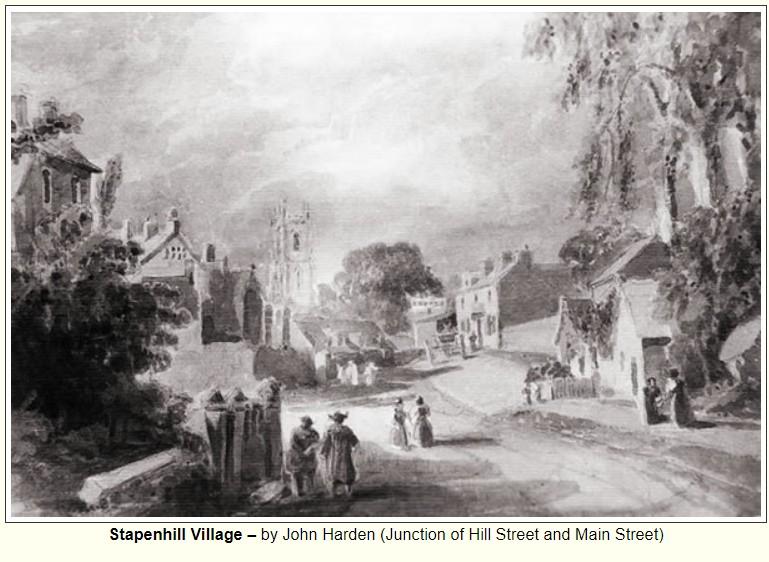
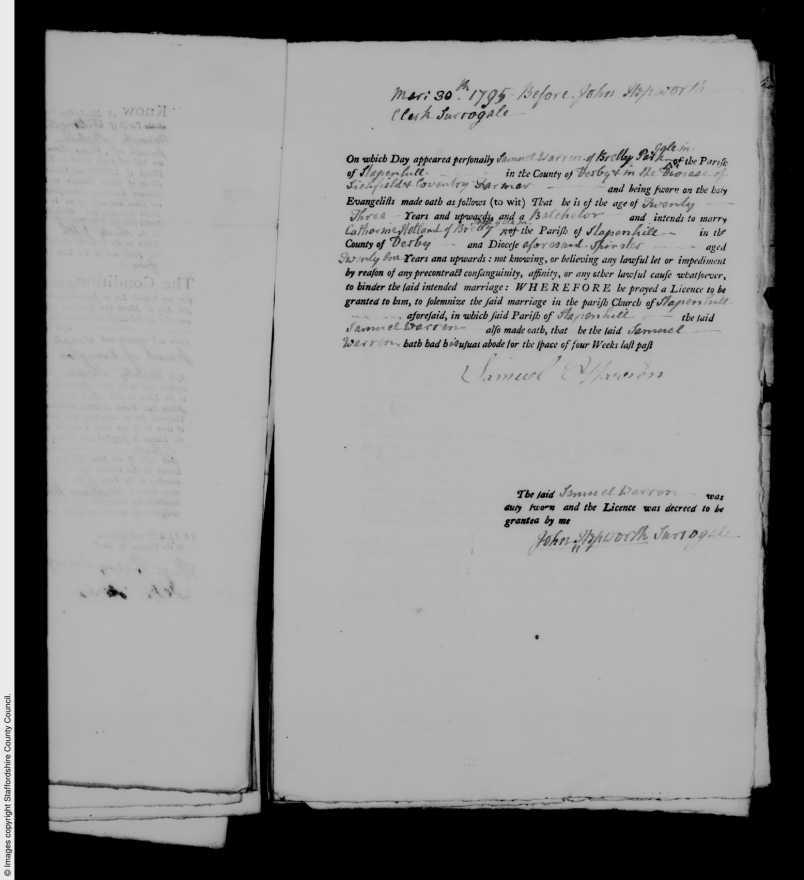
Resuming the research on the Warrens, Samuel Warren 1771-1837 married Catherine Holland 1775-1861 in 1795 and their son Samuel Warren 1800-1882 married Elizabeth Bridge, whose childless brother Benjamin Bridge left the Warren Brothers Boiler Works in Newhall to his nephews, the Warren brothers.
Samuel Warren and Catherine Holland marriage licence 1795:
Samuel (born 1771) was baptised at Stapenhill St Peter and his parents were William and Anne Warren. There were at least three William and Ann Warrens in town at the time. One of those William’s was born in 1744, which would seem to be the right age to be Samuel’s father, and one was born in 1710, which seemed a little too old. Another William, Guiliamos Warren (Latin was often used in early parish registers) was baptised in Stapenhill in 1729.
Stapenhill St Peter:
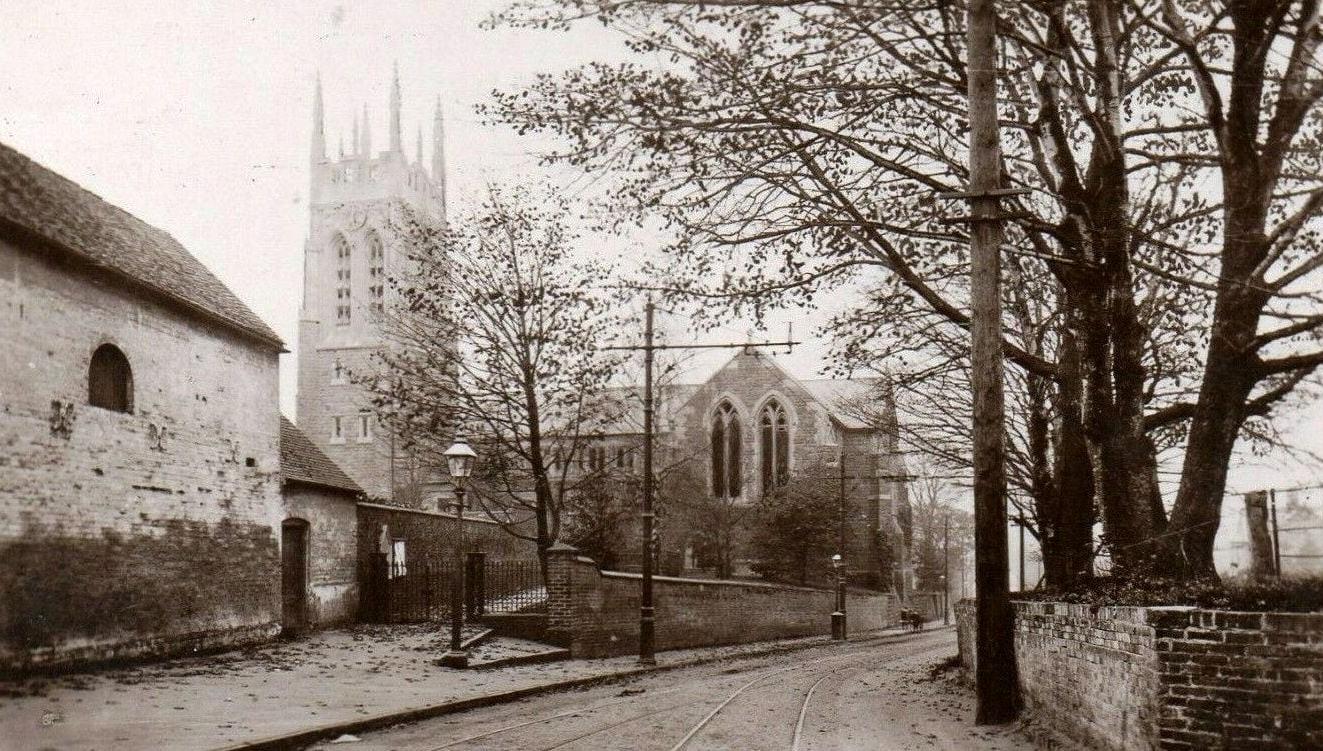
William Warren (born 1744) appeared to have been born several months before his parents wedding. William Warren and Ann Insley married 16 July 1744, but the baptism of William in 1744 was 24 February. This seemed unusual ~ children were often born less than nine months after a wedding, but not usually before the wedding! Then I remembered the change from the Julian calendar to the Gregorian calendar in 1752. Prior to 1752, the first day of the year was Lady Day, March 25th, not January 1st. This meant that the birth in February 1744 was actually after the wedding in July 1744. Now it made sense. The first son was named William, and he was born seven months after the wedding.
William born in 1744 died intestate in 1822, and his wife Ann made a legal claim to his estate. However he didn’t marry Ann Holland (Ann was Catherines Hollands sister, who married Samuel Warren the year before) until 1796, so this William and Ann were not the parents of Samuel.
It seemed likely that William born in 1744 was Samuels brother. William Warren and Ann Insley had at least eight children between 1744 and 1771, and it seems that Samuel was their last child, born when William the elder was 61 and his wife Ann was 47.
It seems it wasn’t unusual for the Warren men to marry rather late in life. William Warren’s (born 1710) parents were William Warren and Elizabeth Hatterton. On the marriage licence in 1702/1703 (it appears to say 1703 but is transcribed as 1702), William was a 40 year old bachelor from Stapenhill, which puts his date of birth at 1662. Elizabeth was considerably younger, aged 19.
William Warren and Elizabeth Hatterton marriage licence 1703:
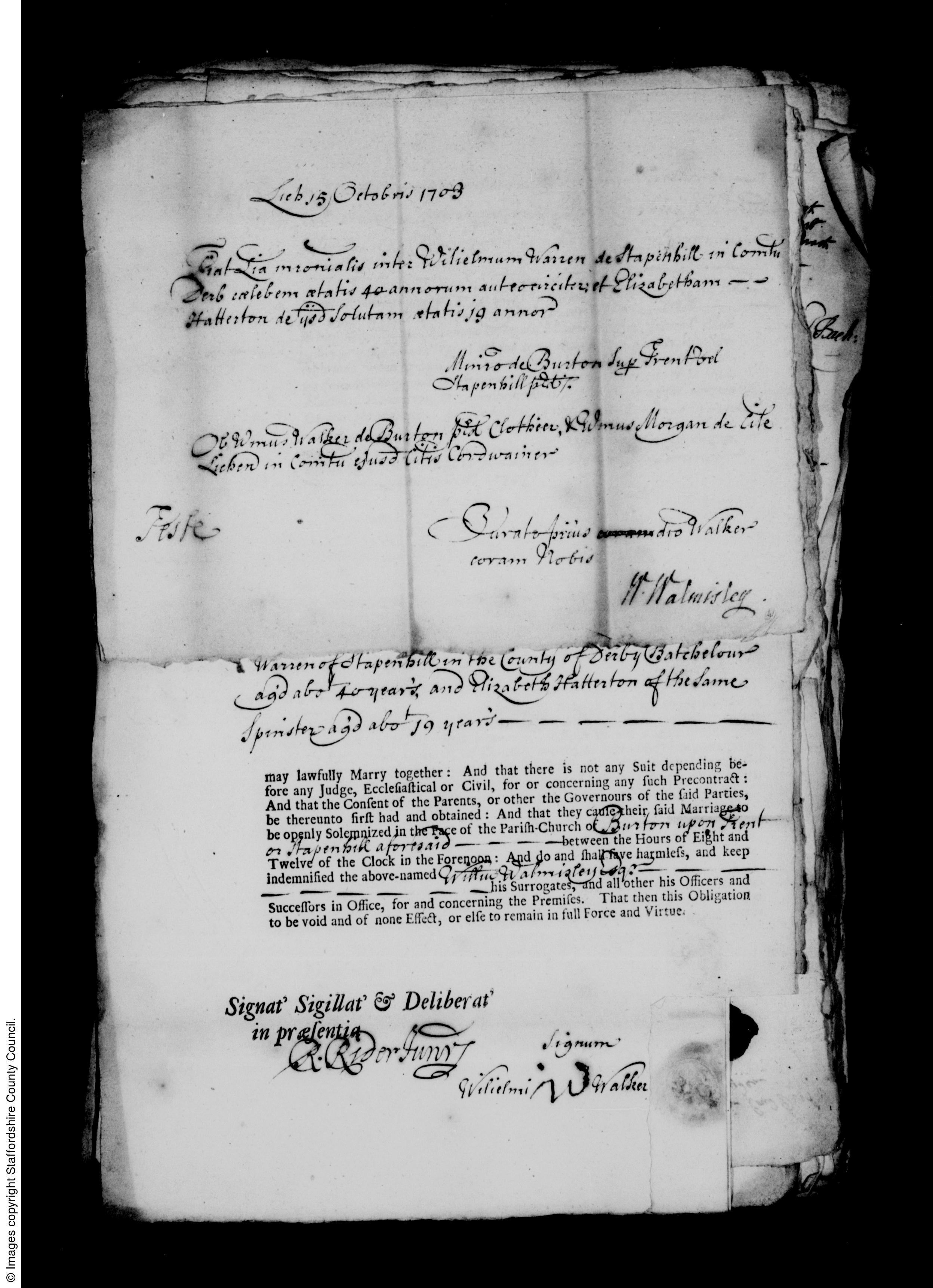
These Warren’s were farmers, and they were literate and able to sign their own names on various documents. This is worth noting, as most made the mark of an X.
I found three Warren and Holland marriages. One was Samuel Warren and Catherine Holland in 1795, then William Warren and Ann Holland in 1796. William Warren and Ann Hollands daughter born in 1799 married John Holland in 1824.
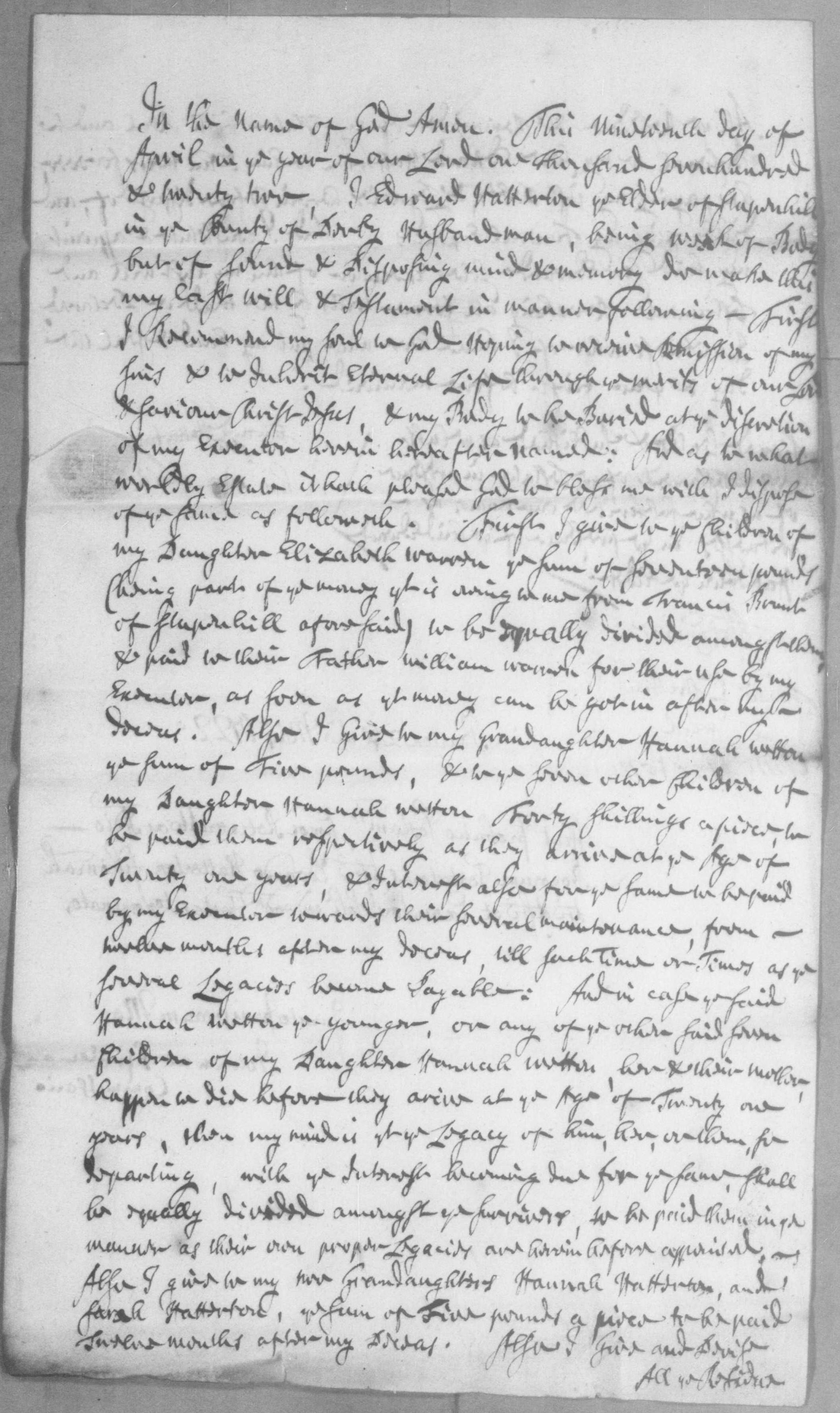
Elizabeth Hatterton (wife of William Warren who was born circa 1662) was born in Burton upon Trent in 1685. Her parents were Edward Hatterton 1655-1722, and Sara.
A page from the 1722 will of Edward Hatterton:
The earliest Warren I found records for was William Warren who married Elizabeth Hatterton in 1703. The marriage licence states his age as 40 and that he was from Stapenhill, but none of the Stapenhill parish records online go back as far as 1662. On other public trees on ancestry websites, a birth record from Suffolk has been chosen, probably because it was the only record to be found online with the right name and date. Once again, I don’t think that is correct, and perhaps one day I’ll find some earlier Stapenhill records to prove that he was born in locally.
Subsequently, I found a list of the 1662 Hearth Tax for Stapenhill. On it were a number of Warrens, three William Warrens including one who was a constable. One of those William Warrens had a son he named William (as they did, hence the number of William Warrens in the tree) the same year as this hearth tax list.
But was it the William Warren with 2 chimneys, the one with one chimney who was too poor to pay it, or the one who was a constable?
from the list:
Will. Warryn 2
Richard Warryn 1
William Warren Constable
These names are not payable by Act:
Will. Warryn 1
Richard Warren John Watson
over seers of the poore and churchwardensThe Hearth Tax:
via wiki:
In England, hearth tax, also known as hearth money, chimney tax, or chimney money, was a tax imposed by Parliament in 1662, to support the Royal Household of King Charles II. Following the Restoration of the monarchy in 1660, Parliament calculated that the Royal Household needed an annual income of £1,200,000. The hearth tax was a supplemental tax to make up the shortfall. It was considered easier to establish the number of hearths than the number of heads, hearths forming a more stationary subject for taxation than people. This form of taxation was new to England, but had precedents abroad. It generated considerable debate, but was supported by the economist Sir William Petty, and carried through the Commons by the influential West Country member Sir Courtenay Pole, 2nd Baronet (whose enemies nicknamed him “Sir Chimney Poll” as a result). The bill received Royal Assent on 19 May 1662, with the first payment due on 29 September 1662, Michaelmas.
One shilling was liable to be paid for every firehearth or stove, in all dwellings, houses, edifices or lodgings, and was payable at Michaelmas, 29 September and on Lady Day, 25 March. The tax thus amounted to two shillings per hearth or stove per year. The original bill contained a practical shortcoming in that it did not distinguish between owners and occupiers and was potentially a major burden on the poor as there were no exemptions. The bill was subsequently amended so that the tax was paid by the occupier. Further amendments introduced a range of exemptions that ensured that a substantial proportion of the poorer people did not have to pay the tax.Indeed it seems clear that William Warren the elder came from Stapenhill and not Suffolk, and one of the William Warrens paying hearth tax in 1662 was undoubtedly the father of William Warren who married Elizabeth Hatterton.
April 12, 2022 at 8:09 am #6289In reply to: The Precious Life and Rambles of Liz Tattler
“Ever get the feeling you’re talking to yourself?” Liz said to herself.
“YOU TART!!!”
Liz swung round, wondering where the dreadful shreik came from. The little black communication device on her desk was vibrating madly, causing the tea in her cup to slosh over the side into the saucer.
“Good Godfrey!” exclaimed Liz, visibly shaken.
“You rang?” smiled Godfrey, crawling out from under the desk.
“You were under my desk the whole time?” Liz was shocked.
“Allo allo allo!”
“Roberto! You were under my desk the entire time too?”
“Zere iz a zecret door under ze desk, madame, you did not know zis?”
“Fanella! Good lord, not you as well!”
Fanella grinned sheepishly. “I ‘ave come to ‘elp Finnley wiz ze bedding.”
Liz bent down and peered under her desk. Who else was under there? But it was dark as a black hole, and covered in cobwebs.
“Fanella, do you know where Finnley is?” asked Liz. “I miss her terribly. Everything is so dreadfully dusty without her.”
Fanella shrugged. “She was drugged, Madame. It was when she tried to put a bug under the rug, someone ‘hit ‘er on ze ‘ead wiz a mug, and lugged her to a zecret location and filled her wiz drugs.” Fanella shrugged again. “Zis is why I ‘ave come to ‘elp.”
March 26, 2022 at 11:36 am #6285In reply to: The Elusive Samuel Housley and Other Family Stories
Harriet Compton
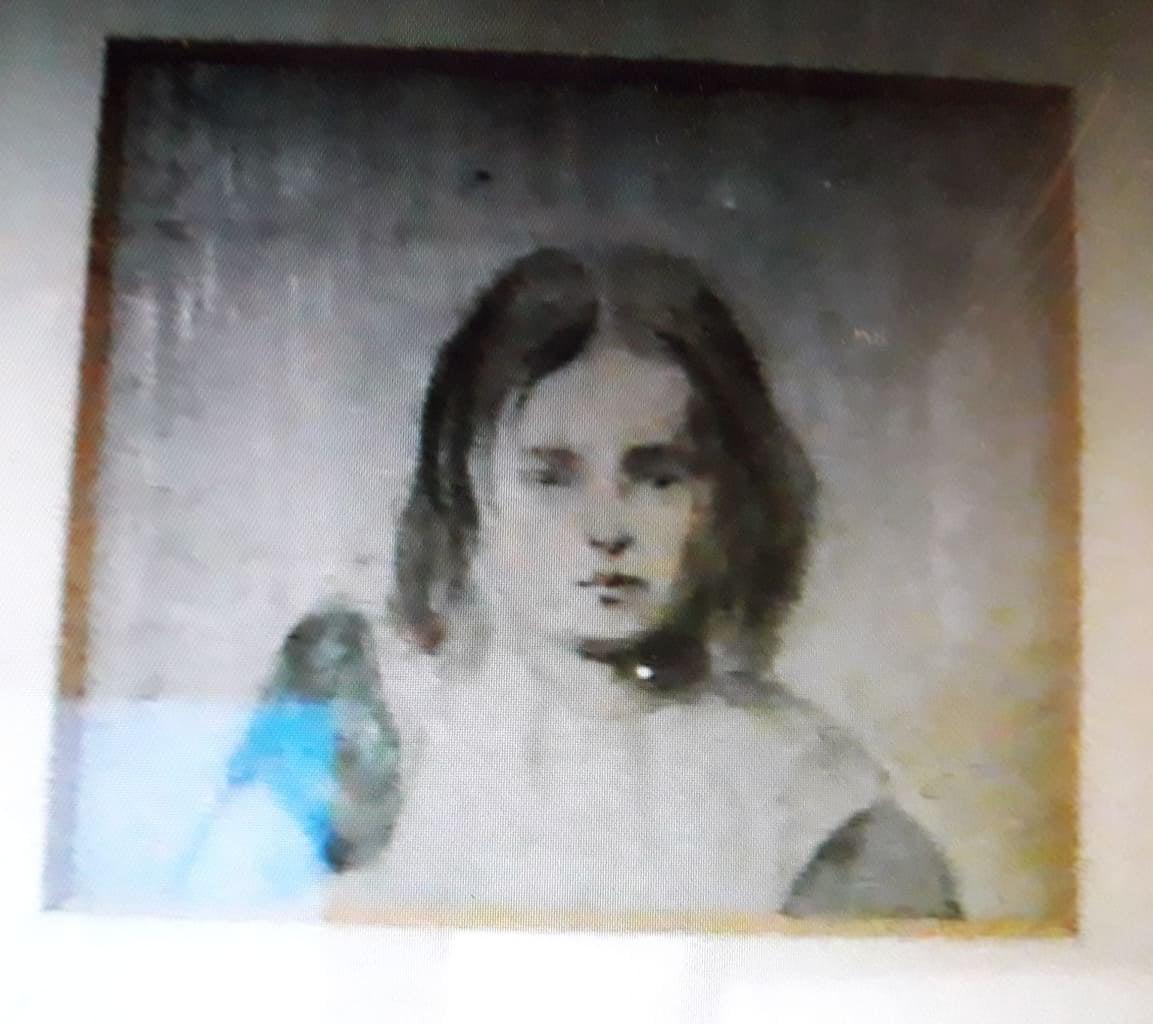
Harriet Comptom is not directly related to us, but her portrait is in our family collection.
Alfred Julius Eugene Compton painted this portrait of his daughter, Harriet Compton, when she was six. Harriet Compton was Charles Tooby’s mothers mother, and Charles married my mothers aunt Dorothy Marshall. They lived on High Park Ave in Wollaston, and his parents lived on Park Road, Wollaston, opposite my grandparents, George and Nora Marshall. Harriet married Thomas Thornburgh, they had a daughter Florence who married Sydney Tooby. Florence and Sydney were Charles Tooby’s parents.
Charles and Dorothy Tooby didn’t have any children. Charles died before his wife, and this is how the picture ended up in my mothers possession.
I attempted to find a direct descendant of Harriet Compton, but have not been successful so far, although I did find a relative on a Stourbridge facebook group. Bryan Thornburgh replied: “Francis George was my grandfather.He had two sons George & my father Thomas and two daughters Cissie & Edith. I can remember visiting my fathers Uncle Charles and Aunt Dorothy in Wollaston.”
Francis George Thornburgh was Florence Tooby’s brother.
The watercolour portrait was framed by Hughes of Enville St, Stourbridge.
Alfred Julius Eugene Compton was born in 1826 Paris, France, and died on 6 February 1917 in Chelsea, London.
Harriet Compton his daughter was born in 1853 in Islington, London, and died in December 1926 in Stourbridge.Without going too far down an unrelated rabbit hole, a member of the facebook group Family Treasures Reinstated shared this:
“Will reported in numerous papers in Dec 1886.
Harriet’s father Alfred appears to be beneficiary but Harriet’s brother, Percy is specifically excluded .
“The will (dated March 6, 1876) of the Hon. Mrs. Fanny Stanhope, late of No. 24, Carlyle-square, Chelsea, who died on August 9 last, was proved on the 1st ult. by Alfred Julius Eugene Compton, the value of the personal estate amounting to over £8000.
The testatrix, after giving & few legacies, leaves one moiety of the residue of her personal estate, upon trust, for John Auguste Alexandre Compton, for life, and then, subject to an annuity to his wife, for the children (except Percy) of Alfred Julius Eugene Compton, and the other moiety, upon trust, for the said Alfred Julius Eugene Compton, for life, and at his death for his children, except Percy.”
-Illustrated London News.Harriet Compton:
 March 17, 2022 at 10:37 am #6283
In reply to: The Elusive Samuel Housley and Other Family Stories
Purdy Cousins
My great grandmother Mary Ann Gilman Purdy was one of five children. Her sister Ellen Purdy was a well traveled nurse, and her sister Kate Rushby was a publican whose son who went to Africa. But what of her eldest sister Elizabeth and her brother Richard?
Elizabeth Purdy 1869-1905 married Benjamin George Little in 1892 in Basford, Nottinghamshire. Their first child, Frieda Olive Little, was born in Eastwood in December 1896, and their second daughter Catherine Jane Little was born in Warrington, Cheshire, in 1898. A third daughter, Edna Francis Little was born in 1900, but died three months later.
When I noticed that this unidentified photograph in our family collection was taken by a photographer in Warrington, and as no other family has been found in Warrington, I concluded that these two little girls are Frieda and Catherine:
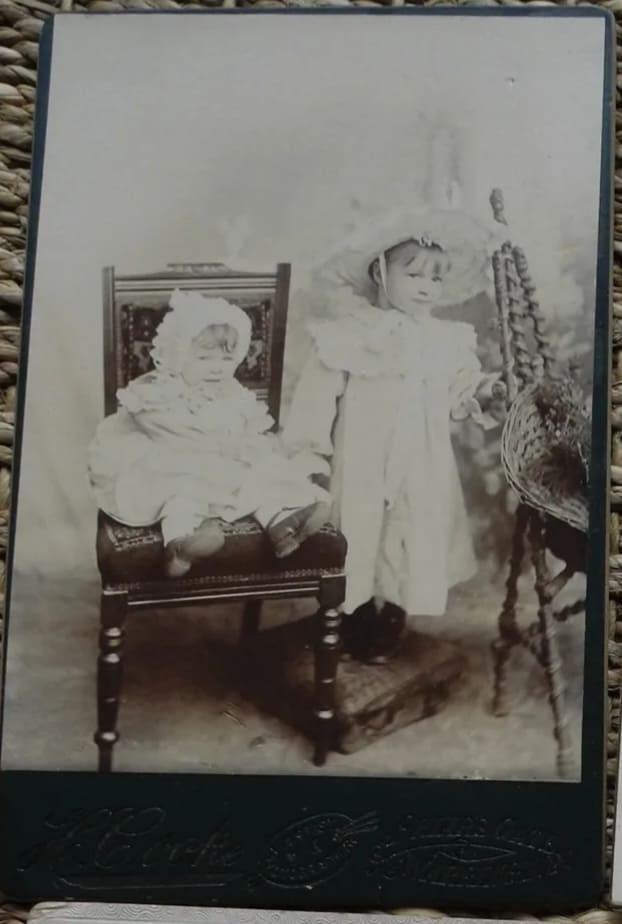
Benjamin Little, born in 1869, was the manager of a boot shop, according to the 1901 census, and a boot maker on the 1911 census. I found a photograph of Benjamin and Elizabeth Little on an ancestry website:
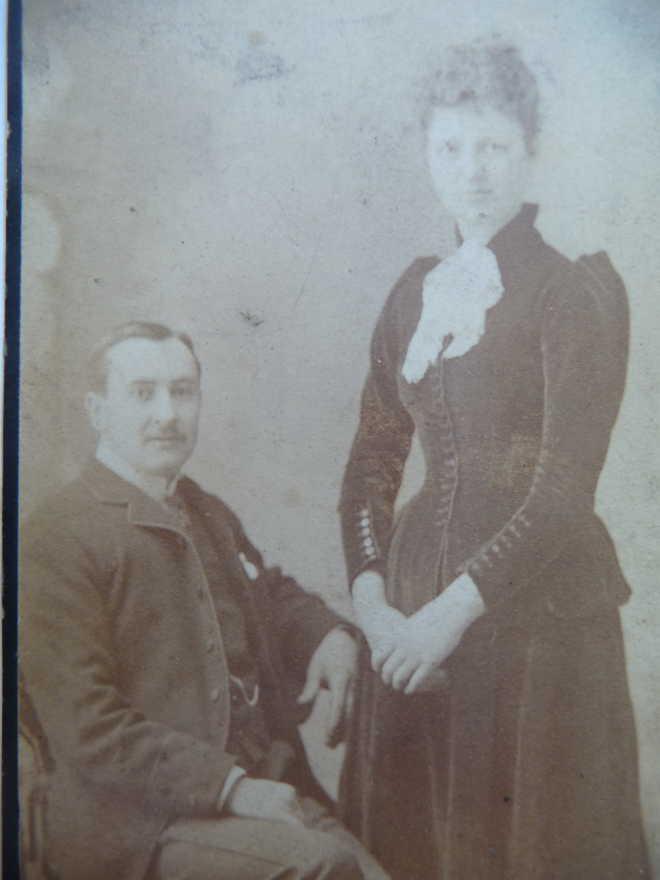
Frieda Olive Little 1896-1977 married Robert Warburton in 1924.
Frieda and Robert had two sons and a daughter, although one son died in infancy. They lived in Leominster, in Herefordshire, but Frieda died in 1977 at Enfield Farm in Warrington, four years after the death of her husband Robert.
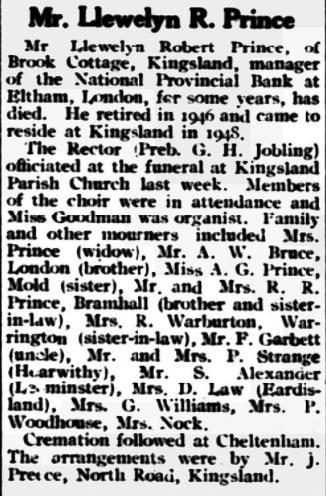
Catherine Jane Little 1899-1975 married Llewelyn Robert Prince 1884-1950. They do not appear to have had any children. Llewelyn was manager of the National Provinical Bank at Eltham in London, but died at Brook Cottage in Kingsland, Herefordshire. His wifes aunt Ellen Purdy the nurse had also lived at Brook Cottage. Ellen died in 1947, but her husband Frank Garbett was at the funeral:
Richard Purdy 1877-1940
Richard was born in Eastwood, Nottinghamshire. When his mother Catherine died in 1884 Richard was six years old. My great grandmother Mary Ann and her sister Ellen went to live with the Gilman’s in Buxton, but Richard and the two older sisters, Elizabeth and Kate, stayed with their father George Purdy, who remarried soon afterwards.
Richard married Ada Elizabeth Clarke in 1899. In 1901 Richard was an earthenware packer at a pottery, and on the 1939 census he was a colliery dataller. A dataller was a day wage man, paid on a daily basis for work done as required.
Richard and Ada had four children: Richard Baden Purdy 1900-1945, Winifred Maude 1903-1974, John Frederick 1907-1945, and Violet Gertrude 1910-1974.
Richard Baden Purdy married Ethel May Potter in Mansfield, Nottinghamshire, in 1926. He was listed on the 1939 census as a colliery deputy. In 1945 Richard Baden Purdy died as a result of injuries in a mine explosion.
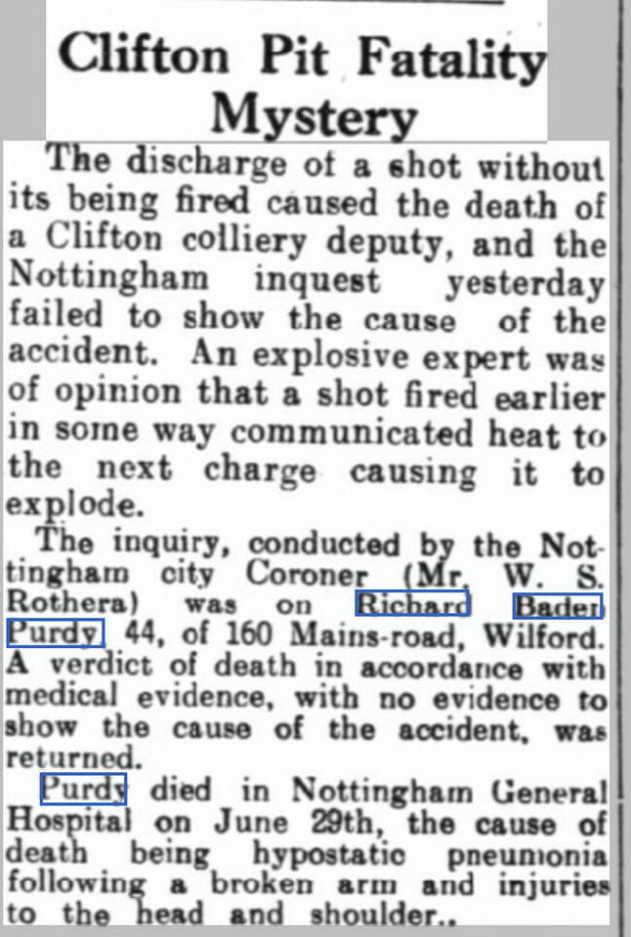
John Frederick Purdy married Iris Merryweather in 1938. On the 1939 census John and Iris live in Arnold, Nottinghamshire, and John’s occupation is a colliery hewer. Their daughter Barbara Elizabeth was born later that year. John died in 1945, the same year as his brother Richard Baden Purdy. It is not known without purchasing the death certificate what the cause of death was.
A memorial was posted in the Nottingham Evening Post on 29 June 1948:
PURDY, loving memories, Richard Baden, accidentally killed June 29th 1945; John Frederick, died 1 April 1945; Richard Purdy, father, died December 1940. Too dearly loved to be forgotten. Mother, families.
Violet Gertrude Purdy married Sidney Garland in 1932 in Southwell, Nottinghamshire. She died in Edwinstowe, Nottinghamshire, in 1974.
Winifred Maude Purdy married Bernard Fowler in Southwell in 1928. She also died in 1974, in Mansfield.
The two brothers died the same year, in 1945, and the two sisters died the same year, in 1974.
February 8, 2022 at 2:24 pm #6275In reply to: The Elusive Samuel Housley and Other Family Stories
“AND NOW ABOUT EMMA”
and a mystery about George
I had overlooked this interesting part of Barbara Housley’s “Narrative on the Letters” initially, perhaps because I was more focused on finding Samuel Housley. But when I did eventually notice, I wondered how I had missed it! In this particularly interesting letter excerpt from Joseph, Barbara has not put the date of the letter ~ unusually, because she did with all of the others. However I dated the letter to later than 1867, because Joseph mentions his wife, and they married in 1867. This is important, because there are two Emma Housleys. Joseph had a sister Emma, born in 1836, two years before Joseph was born. At first glance, one would assume that a reference to Emma in the letters would mean his sister, but Emma the sister was married in Derby in 1858, and by 1869 had four children.
But there was another Emma Housley, born in 1851.
From Barbara Housley’s Narrative on the Letters:
“AND NOW ABOUT EMMA”
A MYSTERY
A very mysterious comment is contained in a letter from Joseph:
“And now about Emma. I have only seen her once and she came to me to get your address but I did not feel at liberty to give it to her until I had wrote to you but however she got it from someone. I think it was in this way. I was so pleased to hear from you in the first place and with John’s family coming to see me I let them read one or two of your letters thinking they would like to hear of you and I expect it was Will that noticed your address and gave it to her. She came up to our house one day when I was at work to know if I had heard from you but I had not heard from you since I saw her myself and then she called again after that and my wife showed her your boys’ portraits thinking no harm in doing so.”
At this point Joseph interrupted himself to thank them for sending the portraits. The next sentence is:
“Your son JOHN I have never seen to know him but I hear he is rather wild,” followed by: “EMMA has been living out service but don’t know where she is now.”
Since Joseph had just been talking about the portraits of George’s three sons, one of whom is John Eley, this could be a reference to things George has written in despair about a teen age son–but could Emma be a first wife and John their son? Or could Emma and John both be the children of a first wife?
Elsewhere, Joseph wrote, “AMY ELEY died 14 years ago. (circa 1858) She left a son and a daughter.”
An Amey Eley and a George Housley were married on April 1, 1849 in Duffield which is about as far west of Smalley as Heanor is East. She was the daughter of John, a framework knitter, and Sarah Eley. George’s father is listed as William, a farmer. Amey was described as “of full age” and made her mark on the marriage document.
Anne wrote in August 1854: “JOHN ELEY is living at Derby Station so must take the first opportunity to get the receipt.” Was John Eley Housley named for him?
(John Eley Housley is George Housley’s son in USA, with his second wife, Sarah.)
George Housley married Amey Eley in 1849 in Duffield. George’s father on the register is William Housley, farmer. Amey Eley’s father is John Eley, framework knitter.
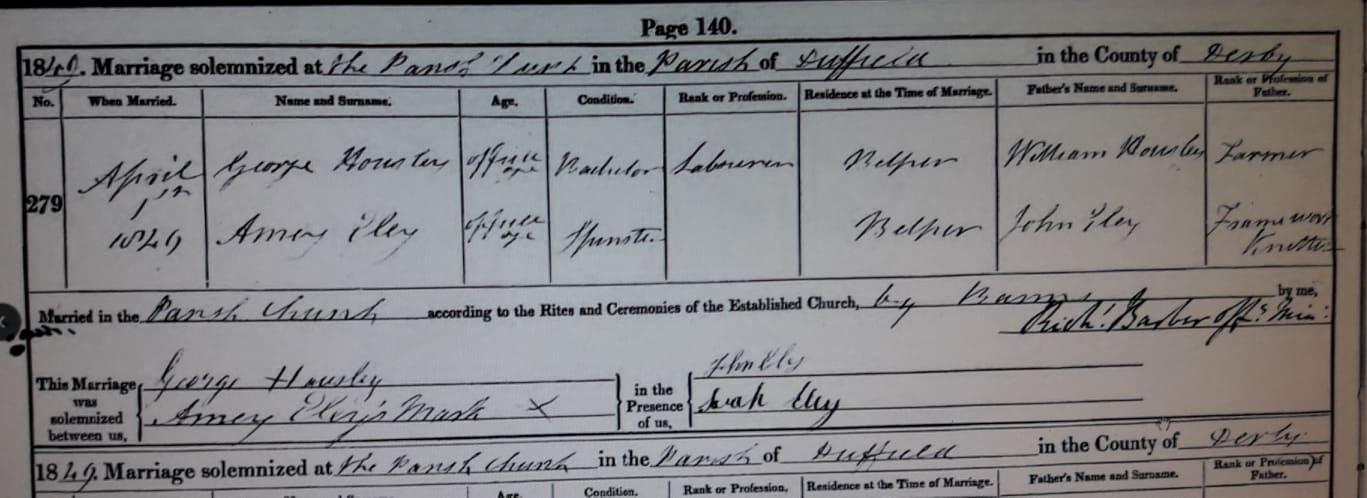
On the 1851 census, George Housley and his wife Amey Housley are living with her parents in Heanor, John Eley, a framework knitter, and his wife Rebecca. Also on the census are Charles J Housley, born in 1849 in Heanor, and Emma Housley, three months old at the time of the census, born in 1851. George’s birth place is listed as Smalley.
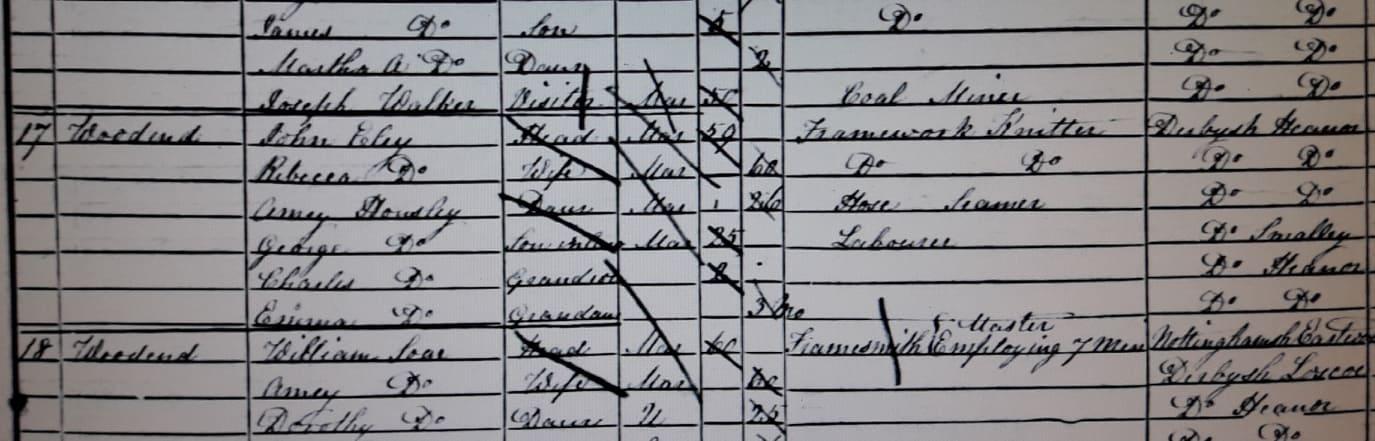
On the 31st of July 1851 George Housley arrives in New York. In 1854 George Housley marries Sarah Ann Hill in USA.
On the 1861 census in Heanor, Rebecca Eley was a widow, her husband John having died in 1852, and she had three grandchildren living with her: Charles J Housley aged 12, Emma Housley, 10, and mysteriously a William Housley aged 5! Amey Housley, the childrens mother, died in 1858.
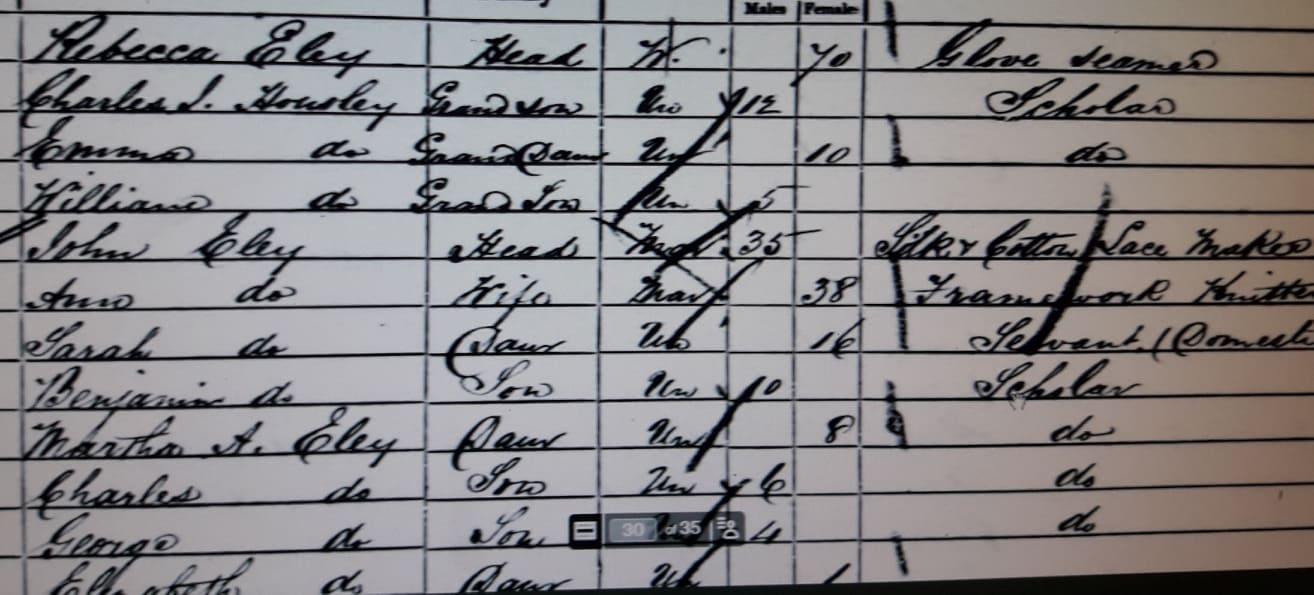
Back to the mysterious comment in Joseph’s letter. Joseph couldn’t have been speaking of his sister Emma. She was married with children by the time Joseph wrote that letter, so was not just out of service, and Joseph would have known where she was. There is no reason to suppose that the sister Emma was trying unsuccessfully to find George’s addresss: she had been sending him letters for years. Joseph must have been referring to George’s daughter Emma.
Joseph comments to George “Your son John…is rather wild.” followed by the remark about Emma’s whereabouts. Could Charles John Housley have used his middle name of John instead of Charles?
As for the child William born five years after George left for USA, despite his name of Housley, which was his mothers married name, we can assume that he was not a Housley ~ not George’s child, anyway. It is not clear who his father was, as Amey did not remarry.
A further excerpt from Barbara Housley’s Narrative on the Letters:
Certainly there was some mystery in George’s life. George apparently wanted his whereabouts kept secret. Anne wrote: “People are at a loss to know where you are. The general idea is you are with Charles. We don’t satisfy them.” In that same letter Anne wrote: “I know you could not help thinking of us very often although you neglected writing…and no doubt would feel grieved for the trouble you at times caused (our mother). She freely forgives all.” Near the end of the letter, Anne added: “Mother sends her love to you and hopes you will write and if you want to tell her anything you don’t want all to see you must write it on a piece of loose paper and put it inside the letter.”
In a letter to George from his sister Emma:
Emma wrote in 1855, “We write in love to your wife and yourself and you must write soon and tell us whether there is a little nephew or niece and what you call them.”
In June of 1856, Emma wrote: “We want to see dear Sarah Ann and the dear little boy. We were much pleased with the “bit of news” you sent.” The bit of news was the birth of John Eley Housley, January 11, 1855. Emma concluded her letter “Give our very kindest love to dear sister and dearest Johnnie.”
It would seem that George Housley named his first son with his second wife after his first wife’s father ~ while he was married to both of them.
Emma Housley
1851-1935
In 1871 Emma was 20 years old and “in service” living as a lodger in West Hallam, not far from Heanor. As she didn’t appear on a 1881 census, I looked for a marriage, but the only one that seemed right in every other way had Emma Housley’s father registered as Ralph Wibberly!
Who was Ralph Wibberly? A family friend or neighbour, perhaps, someone who had been a father figure? The first Ralph Wibberly I found was a blind wood cutter living in Derby. He had a son also called Ralph Wibberly. I did not think Ralph Wibberly would be a very common name, but I was wrong.
I then found a Ralph Wibberly living in Heanor, with a son also named Ralph Wibberly. A Ralph Wibberly married an Emma Salt from Heanor. In 1874, a 36 year old Ralph Wibberly (born in 1838) was on trial in Derby for inflicting grevious bodily harm on William Fretwell of Heanor. His occupation is “platelayer” (a person employed in laying and maintaining railway track.) The jury found him not guilty.
In 1851 a 23 year old Ralph Wibberly (born in 1828) was a prisoner in Derby Gaol. However, Ralph Wibberly, a 50 year old labourer born in 1801 and his son Ralph Wibberly, aged 13 and born in 1838, are living in Belper on the 1851 census. Perhaps the son was the same Ralph Wibberly who was found not guilty of GBH in 1874. This appears to be the one who married Emma Salt, as his wife on the 1871 census is called Emma, and his occupation is “Midland Company Railway labourer”.
Which was the Ralph Wibberly that Emma chose to name as her father on the marriage register? We may never know, but perhaps we can assume it was Ralph Wibberly born in 1801. It is unlikely to be the blind wood cutter from Derby; more likely to be the local Ralph Wibberly. Maybe his son Ralph, who we know was involved in a fight in 1874, was a friend of Emma’s brother Charles John, who was described by Joseph as a “wild one”, although Ralph was 11 years older than Charles John.
Emma Housley married James Slater on Christmas day in Heanor in 1873. Their first child, a daughter, was called Amy. Emma’s mother was Amy Eley. James Slater was a colliery brakesman (employed to work the steam-engine, or other machinery used in raising the coal from the mine.)
It occurred to me to wonder if Emma Housley (George’s daughter) knew Elizabeth, Mary Anne and Catherine (Samuel’s daughters). They were cousins, lived in the vicinity, and they had in common with each other having been deserted by their fathers who were brothers. Emma was born two years after Catherine. Catherine was living with John Benniston, a framework knitter in Heanor, from 1851 to 1861. Emma was living with her grandfather John Ely, a framework knitter in Heanor. In 1861, George Purdy was also living in Heanor. He was listed on the census as a 13 year old coal miner! George Purdy and Catherine Housley married in 1866 in Eastwood, Nottinghamshire ~ just over the county border. Emma’s first child Amy was born in Heanor, but the next two children, Eliza and Lilly, were born in Eastwood, in 1878 and 1880. Catherine and George’s fifth child, my great grandmother Mary Ann Gilman Purdy, was born in Eastwood in 1880, the same year as Lilly Slater.
By 1881 Emma and James Slater were living in Woodlinkin, Codnor and Loscoe, close to Heanor and Eastwood, on the Derbyshire side of the border. On each census up to 1911 their address on the census is Woodlinkin. Emma and James had nine children: six girls and 3 boys, the last, Alfred Frederick, born in 1901.
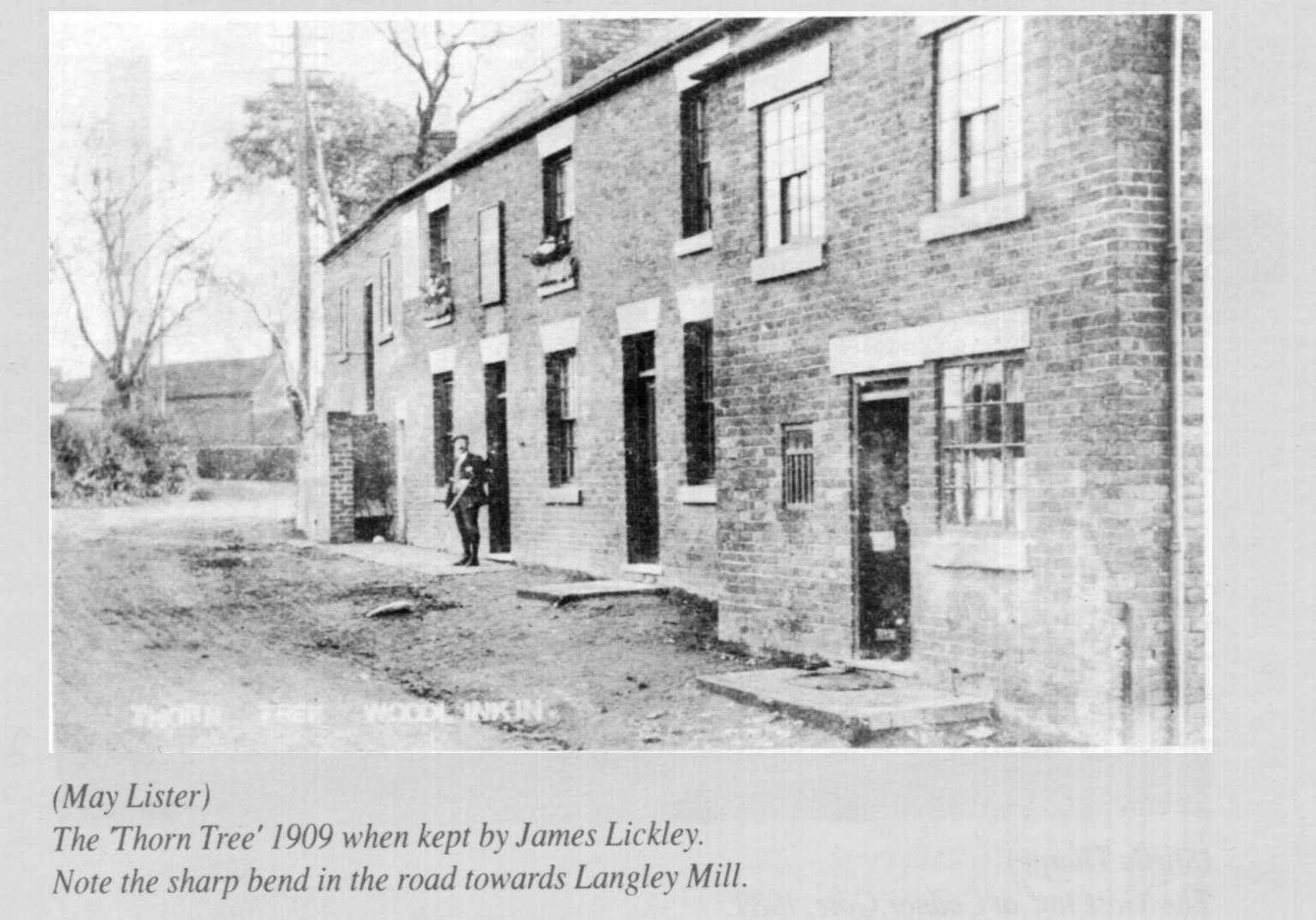
Emma and James lived three doors up from the Thorn Tree pub in Woodlinkin, Codnor:
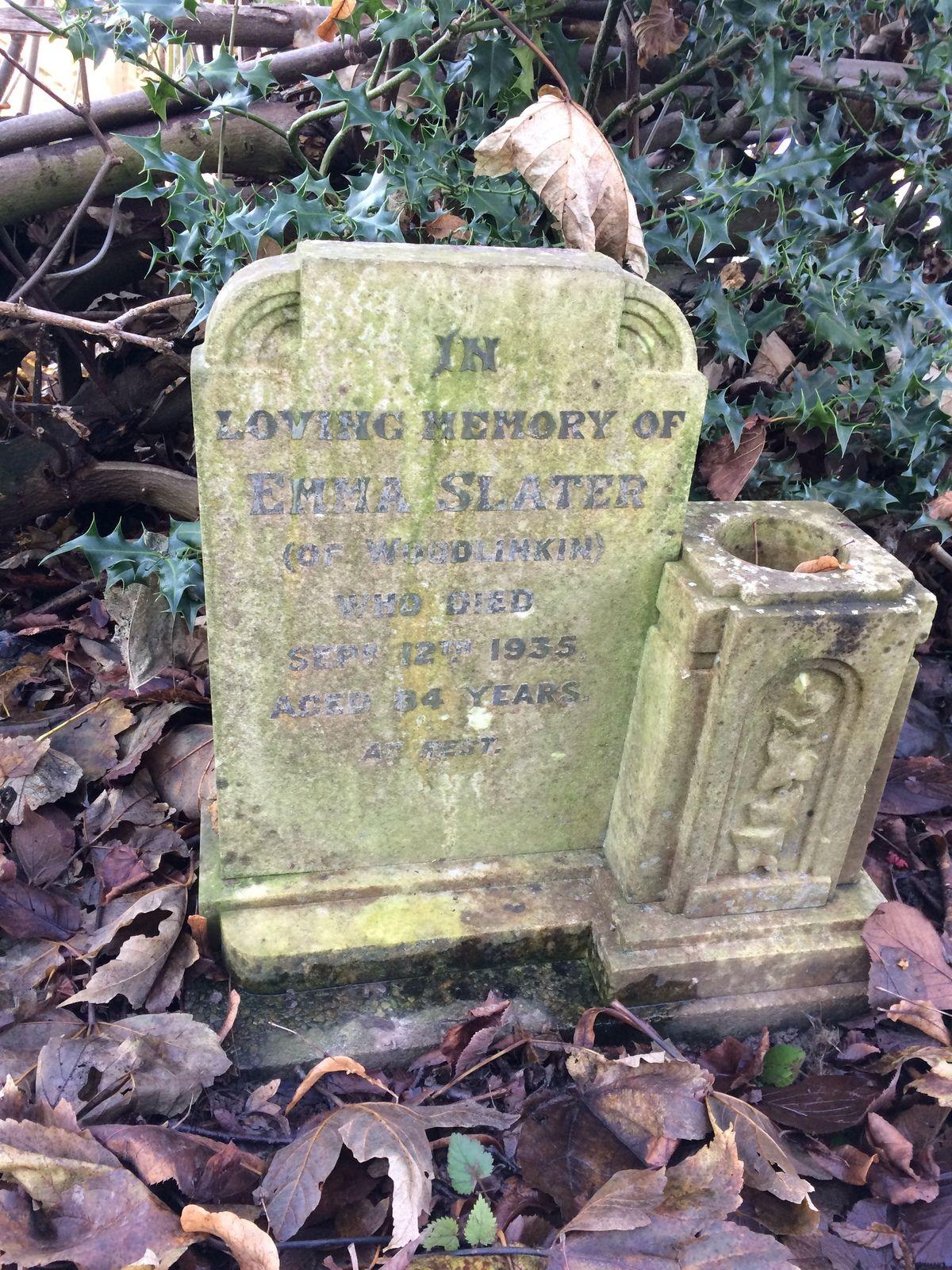
Emma Slater died in 1935 at the age of 84.
IN
LOVING MEMORY OF
EMMA SLATER
(OF WOODLINKIN)
WHO DIED
SEPT 12th 1935
AGED 84 YEARS
AT RESTCrosshill Cemetery, Codnor, Amber Valley Borough, Derbyshire, England:
Charles John Housley
1949-
February 5, 2022 at 1:59 pm #6272In reply to: The Elusive Samuel Housley and Other Family Stories
The Housley Letters
The Carringtons
Carrington Farm, Smalley:
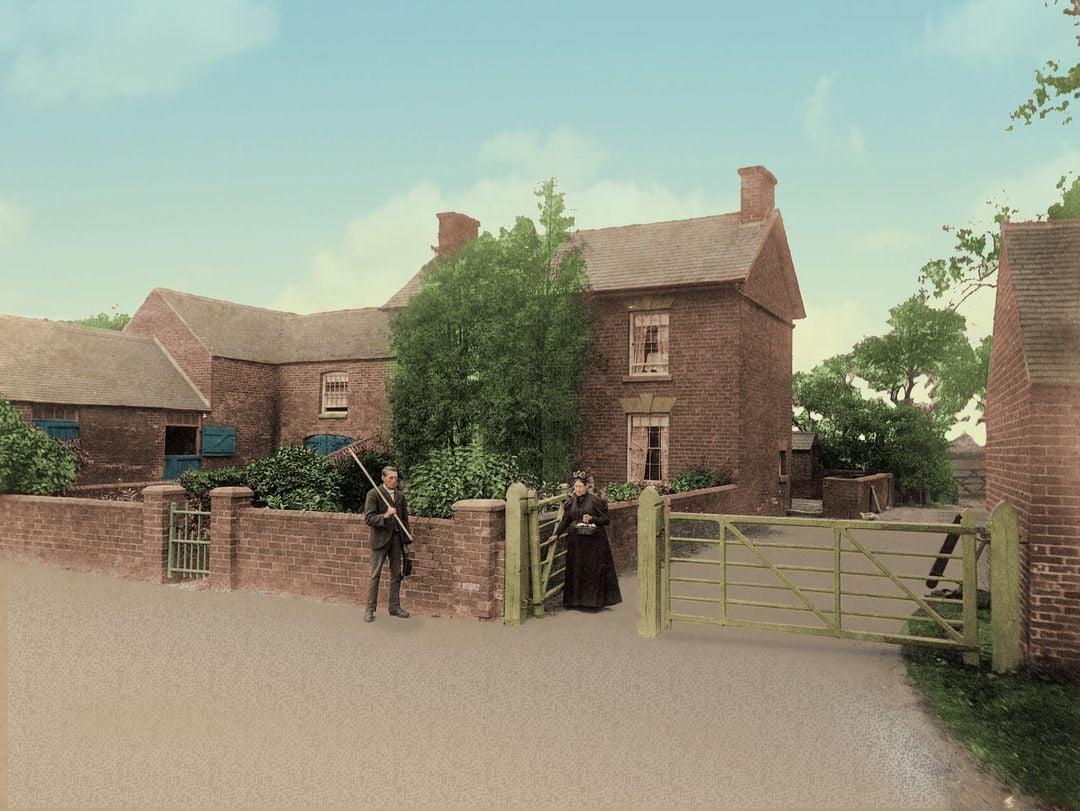
Ellen Carrington was born in 1795. Her father William Carrington 1755-1833 was from Smalley. Her mother Mary Malkin 1765-1838 was from Ellastone, in Staffordshire. Ellastone is on the Derbyshire border and very close to Ashboure, where Ellen married William Housley.
From Barbara Housley’s Narrative on the Letters:
Ellen’s family was evidently rather prominant in Smalley. Two Carringtons (John and William) served on the Parish Council in 1794. Parish records are full of Carrington marriages and christenings.
The letters refer to a variety of “uncles” who were probably Ellen’s brothers, but could be her uncles. These include:
RICHARD
Probably the youngest Uncle, and certainly the most significant, is Richard. He was a trustee for some of the property which needed to be settled following Ellen’s death. Anne wrote in 1854 that Uncle Richard “has got a new house built” and his daughters are “fine dashing young ladies–the belles of Smalley.” Then she added, “Aunt looks as old as my mother.”
Richard was born somewhere between 1808 and 1812. Since Richard was a contemporary of the older Housley children, “Aunt,” who was three years younger, should not look so old!
Richard Carrington and Harriet Faulkner were married in Repton in 1833. A daughter Elizabeth was baptised March 24, 1834. In July 1872, Joseph wrote: “Elizabeth is married too and a large family and is living in Uncle Thomas’s house for he is dead.” Elizabeth married Ayres (Eyres) Clayton of Lascoe. His occupation was listed as joiner and shopkeeper. They were married before 1864 since Elizabeth Clayton witnessed her sister’s marriage. Their children in April 1871 were Selina (1863), Agnes Maria (1866) and Elizabeth Ann (1868). A fourth daughter, Alice Augusta, was born in 1872 or 1873, probably by July 1872 to fit Joseph’s description “large family”! A son Charles Richard was born in 1880.
An Elizabeth Ann Clayton married John Arthur Woodhouse on May 12, 1913. He was a carpenter. His father was a miner. Elizabeth Ann’s father, Ayres, was also a carpenter. John Arthur’s age was given as 25. Elizabeth Ann’s age was given as 33 or 38. However, if she was born in 1868, her age would be 45. Possibly this is another case of a child being named for a deceased sibling. If she were 38 and born in 1875, she would fill the gap between Alice Augusta and Charles Richard.
Selina Clayton, who would have been 18, is not listed in the household in 1881. She died on June 11, 1914 at age 51. Agnes Maria Clayton died at the age of 25 and was buried March 31, 1891. Charles Richard died at the age of 5 and was buried on February 4, 1886. A Charles James Clayton, 18 months, was buried June 8, 1889 in Heanor.
Richard Carrington’s second daughter, Selina, born in 1837, married Walker Martin (b.1835) on February 11, 1864 and they were living at Kidsley Park Farm in 1872, according to a letter from Joseph, and, according to the census, were still there in 1881. This 100 acre farm was formerly the home of Daniel Smith and his daughter Elizabeth Davy Barber. Selina and Walker had at least five children: Elizabeth Ann (1865), Harriet Georgianna (1866/7), Alice Marian (September 6, 1868), Philip Richard (1870), and Walker (1873). In December 1972, Joseph mentioned the death of Philip Walker, a farmer of Prospect Farm, Shipley. This was probably Walker Martin’s grandfather, since Walker was born in Shipley. The stock was to be sold the following Monday, but his daughter (Walker’s mother?) died the next day. Walker’s father was named Thomas. An Annie Georgianna Martin age 13 of Shipley died in April of 1859.
Selina Martin died on October 29, 1906 but her estate was not settled until November 14, 1910. Her gross estate was worth L223.56. Her son Walker and her daughter Harriet Georgiana were her trustees and executers. Walker was to get Selina’s half of Richard’s farm. Harriet Georgiana and Alice Marian were to be allowed to live with him. Philip Richard received L25. Elizabeth Ann was already married to someone named Smith.
Richard and Harriet may also have had a son George. In 1851 a Harriet Carrington and her three year old son George were living with her step-father John Benniston in Heanor. John may have been recently widowed and needed her help. Or, the Carrington home may have been inadequate since Anne reported a new one was built by 1854. Selina’s second daughter’s name testifies to the presence of a “George” in the family! Could the death of this son account for the haggard appearance Anne described when she wrote: “Aunt looks as old as my mother?”
Harriet was buried May 19, 1866. She was 55 when she died.In 1881, Georgianna then 14, was living with her grandfather and his niece, Zilpah Cooper, age 38–who lived with Richard on his 63 acre farm as early as 1871. A Zilpah, daughter of William and Elizabeth, was christened October 1843. Her brother, William Walter, was christened in 1846 and married Anna Maria Saint in 1873. There are four Selina Coopers–one had a son William Thomas Bartrun Cooper christened in 1864; another had a son William Cooper christened in 1873.
Our Zilpah was born in Bretley 1843. She died at age 49 and was buried on September 24, 1892. In her will, which was witnessed by Selina Martin, Zilpah’s sister, Frances Elizabeth Cleave, wife of Horatio Cleave of Leicester is mentioned. James Eley and Francis Darwin Huish (Richard’s soliciter) were executers.
Richard died June 10, 1892, and was buried on June 13. He was 85. As might be expected, Richard’s will was complicated. Harriet Georgiana Martin and Zilpah Cooper were to share his farm. If neither wanted to live there it was to go to Georgiana’s cousin Selina Clayton. However, Zilpah died soon after Richard. Originally, he left his piano, parlor and best bedroom furniture to his daughter Elizabeth Clayton. Then he revoked everything but the piano. He arranged for the payment of £150 which he owed. Later he added a codicil explaining that the debt was paid but he had borrowed £200 from someone else to do it!
Richard left a good deal of property including: The house and garden in Smalley occupied by Eyres Clayton with four messuages and gardens adjoining and large garden below and three messuages at the south end of the row with the frame work knitters shop and garden adjoining; a dwelling house used as a public house with a close of land; a small cottage and garden and four cottages and shop and gardens.
THOMAS
In August 1854, Anne wrote “Uncle Thomas is about as usual.” A Thomas Carrington married a Priscilla Walker in 1810.
Their children were baptised in August 1830 at the same time as the Housley children who at that time ranged in age from 3 to 17. The oldest of Thomas and Priscilla’s children, Henry, was probably at least 17 as he was married by 1836. Their youngest son, William Thomas, born 1830, may have been Mary Ellen Weston’s beau. However, the only Richard whose christening is recorded (1820), was the son of Thomas and Lucy. In 1872 Joseph reported that Richard’s daughter Elizabeth was married and living in Uncle Thomas’s house. In 1851, Alfred Smith lived in house 25, Foulks lived in 26, Thomas and Priscilla lived in 27, Bennetts lived in 28, Allard lived in 29 and Day lived in 30. Thomas and Priscilla do not appear in 1861. In 1871 Elizabeth Ann and Ayres Clayton lived in House 54. None of the families listed as neighbors in 1851 remained. However, Joseph Carrington, who lived in house 19 in 1851, lived in house 51 in 1871.
JOHN
In August 1854, Anne wrote: “Uncle John is with Will and Frank has been home in a comfortable place in Cotmanhay.” Although John and William are two of the most popular Carrington names, only two John’s have sons named William. John and Rachel Buxton Carrington had a son William christened in 1788. At the time of the letters this John would have been over 100 years old. Their son John and his wife Ann had a son William who was born in 1805. However, this William age 46 was living with his widowed mother in 1851. A Robert Carrington and his wife Ann had a son John born 1n 1805. He would be the right age to be a brother to Francis Carrington discussed below. This John was living with his widowed mother in 1851 and was unmarried. There are no known Williams in this family grouping. A William Carrington of undiscovered parentage was born in 1821. It is also possible that the Will in question was Anne’s brother Will Housley.
–Two Francis Carringtons appear in the 1841 census both of them aged 35. One is living with Richard and Harriet Carrington. The other is living next door to Samuel and Ellen Carrington Kerry (the trustee for “father’s will”!). The next name in this sequence is John Carrington age 15 who does not seem to live with anyone! but may be part of the Kerry household.
FRANK (see above)
While Anne did not preface her mention of the name Frank with an “Uncle,” Joseph referred to Uncle Frank and James Carrington in the same sentence. A James Carrington was born in 1814 and had a wife Sarah. He worked as a framework knitter. James may have been a son of William and Anne Carrington. He lived near Richard according to the 1861 census. Other children of William and Anne are Hannah (1811), William (1815), John (1816), and Ann (1818). An Ann Carrington married a Frank Buxton in 1819. This might be “Uncle Frank.”
An Ellen Carrington was born to John and Rachel Carrington in 1785. On October 25, 1809, a Samuel Kerry married an Ellen Carrington. However this Samuel Kerry is not the trustee involved in settling Ellen’s estate. John Carrington died July 1815.
William and Mary Carrington:
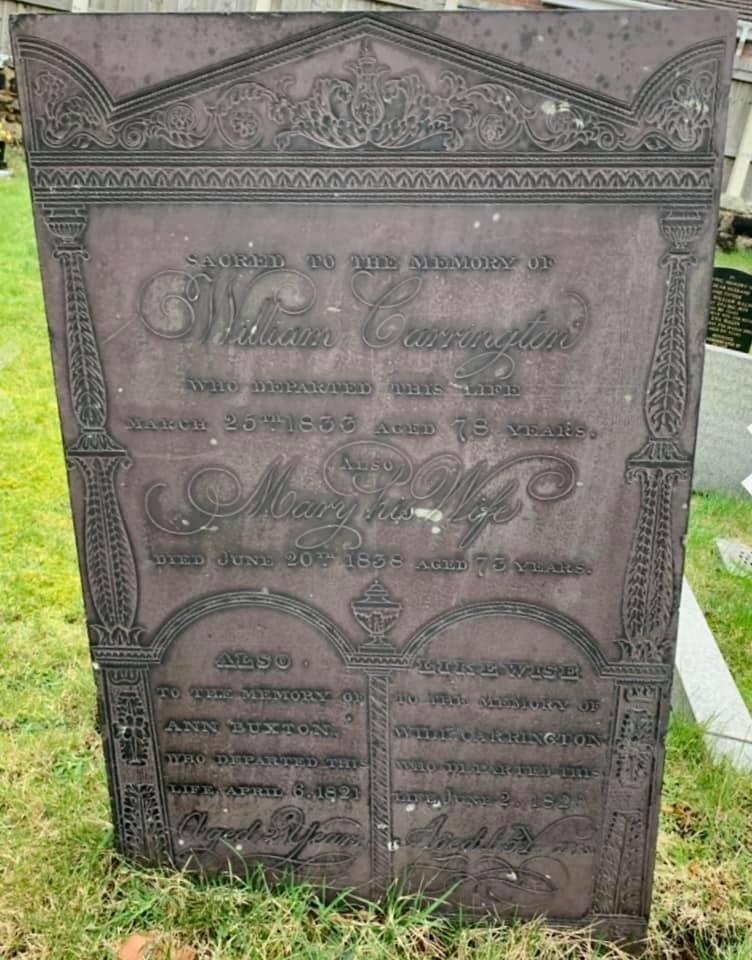 February 2, 2022 at 1:15 pm #6268
In reply to: The Elusive Samuel Housley and Other Family Stories
From Tanganyika with Love
continued part 9
With thanks to Mike Rushby.
Lyamungu 3rd January 1945
Dearest Family.
We had a novel Christmas this year. We decided to avoid the expense of
entertaining and being entertained at Lyamungu, and went off to spend Christmas
camping in a forest on the Western slopes of Kilimanjaro. George decided to combine
business with pleasure and in this way we were able to use Government transport.
We set out the day before Christmas day and drove along the road which skirts
the slopes of Kilimanjaro and first visited a beautiful farm where Philip Teare, the ex
Game Warden, and his wife Mary are staying. We had afternoon tea with them and then
drove on in to the natural forest above the estate and pitched our tent beside a small
clear mountain stream. We decorated the tent with paper streamers and a few small
balloons and John found a small tree of the traditional shape which we decorated where
it stood with tinsel and small ornaments.We put our beer, cool drinks for the children and bottles of fresh milk from Simba
Estate, in the stream and on Christmas morning they were as cold as if they had been in
the refrigerator all night. There were not many presents for the children, there never are,
but they do not seem to mind and are well satisfied with a couple of balloons apiece,
sweets, tin whistles and a book each.George entertain the children before breakfast. He can make a magical thing out
of the most ordinary balloon. The children watched entranced as he drew on his pipe
and then blew the smoke into the balloon. He then pinched the neck of the balloon
between thumb and forefinger and released the smoke in little puffs. Occasionally the
balloon ejected a perfect smoke ring and the forest rang with shouts of “Do it again
Daddy.” Another trick was to blow up the balloon to maximum size and then twist the
neck tightly before releasing. Before subsiding the balloon darted about in a crazy
fashion causing great hilarity. Such fun, at the cost of a few pence.After breakfast George went off to fish for trout. John and Jim decided that they
also wished to fish so we made rods out of sticks and string and bent pins and they
fished happily, but of course quite unsuccessfully, for hours. Both of course fell into the
stream and got soaked, but I was prepared for this, and the little stream was so shallow
that they could not come to any harm. Henry played happily in the sand and I had a
most peaceful morning.Hamisi roasted a chicken in a pot over the camp fire and the jelly set beautifully in the
stream. So we had grilled trout and chicken for our Christmas dinner. I had of course
taken an iced cake for the occasion and, all in all, it was a very successful Christmas day.
On Boxing day we drove down to the plains where George was to investigate a
report of game poaching near the Ngassari Furrow. This is a very long ditch which has
been dug by the Government for watering the Masai stock in the area. It is also used by
game and we saw herds of zebra and wildebeest, and some Grant’s Gazelle and
giraffe, all comparatively tame. At one point a small herd of zebra raced beside the lorry
apparently enjoying the fun of a gallop. They were all sleek and fat and looked wild and
beautiful in action.We camped a considerable distance from the water but this precaution did not
save us from the mosquitoes which launched a vicious attack on us after sunset, so that
we took to our beds unusually early. They were on the job again when we got up at
sunrise so I was very glad when we were once more on our way home.“I like Christmas safari. Much nicer that silly old party,” said John. I agree but I think
it is time that our children learned to play happily with others. There are no other young
children at Lyamungu though there are two older boys and a girl who go to boarding
school in Nairobi.On New Years Day two Army Officers from the military camp at Moshi, came for
tea and to talk game hunting with George. I think they rather enjoy visiting a home and
seeing children and pets around.Eleanor.
Lyamungu 14 May 1945
Dearest Family.
So the war in Europe is over at last. It is such marvellous news that I can hardly
believe it. To think that as soon as George can get leave we will go to England and
bring Ann and George home with us to Tanganyika. When we know when this leave can
be arranged we will want Kate to join us here as of course she must go with us to
England to meet George’s family. She has become so much a part of your lives that I
know it will be a wrench for you to give her up but I know that you will all be happy to
think that soon our family will be reunited.The V.E. celebrations passed off quietly here. We all went to Moshi to see the
Victory Parade of the King’s African Rifles and in the evening we went to a celebration
dinner at the Game Warden’s house. Besides ourselves the Moores had invited the
Commanding Officer from Moshi and a junior officer. We had a very good dinner and
many toasts including one to Mrs Moore’s brother, Oliver Milton who is fighting in Burma
and has recently been awarded the Military Cross.There was also a celebration party for the children in the grounds of the Moshi
Club. Such a spread! I think John and Jim sampled everything. We mothers were
having our tea separately and a friend laughingly told me to turn around and have a look.
I did, and saw the long tea tables now deserted by all the children but my two sons who
were still eating steadily, and finding the party more exciting than the game of Musical
Bumps into which all the other children had entered with enthusiasm.There was also an extremely good puppet show put on by the Italian prisoners
of war from the camp at Moshi. They had made all the puppets which included well
loved characters like Snow White and the Seven Dwarfs and the Babes in the Wood as
well as more sophisticated ones like an irritable pianist and a would be prima donna. The
most popular puppets with the children were a native askari and his family – a very
happy little scene. I have never before seen a puppet show and was as entranced as
the children. It is amazing what clever manipulation and lighting can do. I believe that the
Italians mean to take their puppets to Nairobi and am glad to think that there, they will
have larger audiences to appreciate their art.George has just come in, and I paused in my writing to ask him for the hundredth
time when he thinks we will get leave. He says I must be patient because it may be a
year before our turn comes. Shipping will be disorganised for months to come and we
cannot expect priority simply because we have been separated so long from our
children. The same situation applies to scores of other Government Officials.
I have decided to write the story of my childhood in South Africa and about our
life together in Tanganyika up to the time Ann and George left the country. I know you
will have told Kate these stories, but Ann and George were so very little when they left
home that I fear that they cannot remember much.My Mother-in-law will have told them about their father but she can tell them little
about me. I shall send them one chapter of my story each month in the hope that they
may be interested and not feel that I am a stranger when at last we meet again.Eleanor.
Lyamungu 19th September 1945
Dearest Family.
In a months time we will be saying good-bye to Lyamungu. George is to be
transferred to Mbeya and I am delighted, not only as I look upon Mbeya as home, but
because there is now a primary school there which John can attend. I feel he will make
much better progress in his lessons when he realises that all children of his age attend
school. At present he is putting up a strong resistance to learning to read and spell, but
he writes very neatly, does his sums accurately and shows a real talent for drawing. If
only he had the will to learn I feel he would do very well.Jim now just four, is too young for lessons but too intelligent to be interested in
the ayah’s attempts at entertainment. Yes I’ve had to engage a native girl to look after
Henry from 9 am to 12.30 when I supervise John’s Correspondence Course. She is
clean and amiable, but like most African women she has no initiative at all when it comes
to entertaining children. Most African men and youths are good at this.I don’t regret our stay at Lyamungu. It is a beautiful spot and the change to the
cooler climate after the heat of Morogoro has been good for all the children. John is still
tall for his age but not so thin as he was and much less pale. He is a handsome little lad
with his large brown eyes in striking contrast to his fair hair. He is wary of strangers but
very observant and quite uncanny in the way he sums up people. He seldom gets up
to mischief but I have a feeling he eggs Jim on. Not that Jim needs egging.Jim has an absolute flair for mischief but it is all done in such an artless manner that
it is not easy to punish him. He is a very sturdy child with a cap of almost black silky hair,
eyes brown, like mine, and a large mouth which is quick to smile and show most beautiful
white and even teeth. He is most popular with all the native servants and the Game
Scouts. The servants call Jim, ‘Bwana Tembo’ (Mr Elephant) because of his sturdy
build.Henry, now nearly two years old, is quite different from the other two in
appearance. He is fair complexioned and fair haired like Ann and Kate, with large, black
lashed, light grey eyes. He is a good child, not so merry as Jim was at his age, nor as
shy as John was. He seldom cries, does not care to be cuddled and is independent and
strong willed. The servants call Henry, ‘Bwana Ndizi’ (Mr Banana) because he has an
inexhaustible appetite for this fruit. Fortunately they are very inexpensive here. We buy
an entire bunch which hangs from a beam on the back verandah, and pluck off the
bananas as they ripen. This way there is no waste and the fruit never gets bruised as it
does in greengrocers shops in South Africa. Our three boys make a delightful and
interesting trio and I do wish you could see them for yourselves.We are delighted with the really beautiful photograph of Kate. She is an
extraordinarily pretty child and looks so happy and healthy and a great credit to you.
Now that we will be living in Mbeya with a school on the doorstep I hope that we will
soon be able to arrange for her return home.Eleanor.
c/o Game Dept. Mbeya. 30th October 1945
Dearest Family.
How nice to be able to write c/o Game Dept. Mbeya at the head of my letters.
We arrived here safely after a rather tiresome journey and are installed in a tiny house on
the edge of the township.We left Lyamungu early on the morning of the 22nd. Most of our goods had
been packed on the big Ford lorry the previous evening, but there were the usual
delays and farewells. Of our servants, only the cook, Hamisi, accompanied us to
Mbeya. Japhet, Tovelo and the ayah had to be paid off and largesse handed out.
Tovelo’s granny had come, bringing a gift of bananas, and she also brought her little
granddaughter to present a bunch of flowers. The child’s little scolded behind is now
completely healed. Gifts had to be found for them too.At last we were all aboard and what a squash it was! Our few pieces of furniture
and packing cases and trunks, the cook, his wife, the driver and the turney boy, who
were to take the truck back to Lyamungu, and all their bits and pieces, bunches of
bananas and Fanny the dog were all crammed into the body of the lorry. George, the
children and I were jammed together in the cab. Before we left George looked
dubiously at the tyres which were very worn and said gloomily that he thought it most
unlikely that we would make our destination, Dodoma.Too true! Shortly after midday, near Kwakachinja, we blew a back tyre and there
was a tedious delay in the heat whilst the wheel was changed. We were now without a
spare tyre and George said that he would not risk taking the Ford further than Babati,
which is less than half way to Dodoma. He drove very slowly and cautiously to Babati
where he arranged with Sher Mohammed, an Indian trader, for a lorry to take us to
Dodoma the next morning.It had been our intention to spend the night at the furnished Government
Resthouse at Babati but when we got there we found that it was already occupied by
several District Officers who had assembled for a conference. So, feeling rather
disgruntled, we all piled back into the lorry and drove on to a place called Bereku where
we spent an uncomfortable night in a tumbledown hut.Before dawn next morning Sher Mohammed’s lorry drove up, and there was a
scramble to dress by the light of a storm lamp. The lorry was a very dilapidated one and
there was already a native woman passenger in the cab. I felt so tired after an almost
sleepless night that I decided to sit between the driver and this woman with the sleeping
Henry on my knee. It was as well I did, because I soon found myself dosing off and
drooping over towards the woman. Had she not been there I might easily have fallen
out as the battered cab had no door. However I was alert enough when daylight came
and changed places with the woman to our mutual relief. She was now able to converse
with the African driver and I was able to enjoy the scenery and the fresh air!
George, John and Jim were less comfortable. They sat in the lorry behind the
cab hemmed in by packing cases. As the lorry was an open one the sun beat down
unmercifully upon them until George, ever resourceful, moved a table to the front of the
truck. The two boys crouched under this and so got shelter from the sun but they still had
to endure the dust. Fanny complicated things by getting car sick and with one thing and
another we were all jolly glad to get to Dodoma.We spent the night at the Dodoma Hotel and after hot baths, a good meal and a
good nights rest we cheerfully boarded a bus of the Tanganyika Bus Service next
morning to continue our journey to Mbeya. The rest of the journey was uneventful. We slept two nights on the road, the first at Iringa Hotel and the second at Chimala. We
reached Mbeya on the 27th.I was rather taken aback when I first saw the little house which has been allocated
to us. I had become accustomed to the spacious houses we had in Morogoro and
Lyamungu. However though the house is tiny it is secluded and has a long garden
sloping down to the road in front and another long strip sloping up behind. The front
garden is shaded by several large cypress and eucalyptus trees but the garden behind
the house has no shade and consists mainly of humpy beds planted with hundreds of
carnations sadly in need of debudding. I believe that the previous Game Ranger’s wife
cultivated the carnations and, by selling them, raised money for War Funds.
Like our own first home, this little house is built of sun dried brick. Its original
owners were Germans. It is now rented to the Government by the Custodian of Enemy
Property, and George has his office in another ex German house.This afternoon we drove to the school to arrange about enrolling John there. The
school is about four miles out of town. It was built by the German settlers in the late
1930’s and they were justifiably proud of it. It consists of a great assembly hall and
classrooms in one block and there are several attractive single storied dormitories. This
school was taken over by the Government when the Germans were interned on the
outbreak of war and many improvements have been made to the original buildings. The
school certainly looks very attractive now with its grassed playing fields and its lawns and
bright flower beds.The Union Jack flies from a tall flagpole in front of the Hall and all traces of the
schools German origin have been firmly erased. We met the Headmaster, Mr
Wallington, and his wife and some members of the staff. The school is co-educational
and caters for children from the age of seven to standard six. The leaving age is elastic
owing to the fact that many Tanganyika children started school very late because of lack
of educational facilities in this country.The married members of the staff have their own cottages in the grounds. The
Matrons have quarters attached to the dormitories for which they are responsible. I felt
most enthusiastic about the school until I discovered that the Headmaster is adamant
upon one subject. He utterly refuses to take any day pupils at the school. So now our
poor reserved Johnny will have to adjust himself to boarding school life.
We have arranged that he will start school on November 5th and I shall be very
busy trying to assemble his school uniform at short notice. The clothing list is sensible.
Boys wear khaki shirts and shorts on weekdays with knitted scarlet jerseys when the
weather is cold. On Sundays they wear grey flannel shorts and blazers with the silver
and scarlet school tie.Mbeya looks dusty, brown and dry after the lush evergreen vegetation of
Lyamungu, but I prefer this drier climate and there are still mountains to please the eye.
In fact the lower slopes of Lolesa Mountain rise at the upper end of our garden.Eleanor.
c/o Game Dept. Mbeya. 21st November 1945
Dearest Family.
We’re quite settled in now and I have got the little house fixed up to my
satisfaction. I have engaged a rather uncouth looking houseboy but he is strong and
capable and now that I am not tied down in the mornings by John’s lessons I am able to
go out occasionally in the mornings and take Jim and Henry to play with other children.
They do not show any great enthusiasm but are not shy by nature as John is.
I have had a good deal of heartache over putting John to boarding school. It
would have been different had he been used to the company of children outside his
own family, or if he had even known one child there. However he seems to be adjusting
himself to the life, though slowly. At least he looks well and tidy and I am quite sure that
he is well looked after.I must confess that when the time came for John to go to school I simply did not
have the courage to take him and he went alone with George, looking so smart in his
new uniform – but his little face so bleak. The next day, Sunday, was visiting day but the
Headmaster suggested that we should give John time to settle down and not visit him
until Wednesday.When we drove up to the school I spied John on the far side of the field walking
all alone. Instead of running up with glad greetings, as I had expected, he came almost
reluctently and had little to say. I asked him to show me his dormitory and classroom and
he did so politely as though I were a stranger. At last he volunteered some information.
“Mummy,” he said in an awed voice, Do you know on the night I came here they burnt a
man! They had a big fire and they burnt him.” After a blank moment the penny dropped.
Of course John had started school and November the fifth but it had never entered my
head to tell him about that infamous character, Guy Fawkes!I asked John’s Matron how he had settled down. “Well”, she said thoughtfully,
“John is very good and has not cried as many of the juniors do when they first come
here, but he seems to keep to himself all the time.” I went home very discouraged but
on the Sunday John came running up with another lad of about his own age.” This is my
friend Marks,” he announced proudly. I could have hugged Marks.Mbeya is very different from the small settlement we knew in the early 1930’s.
Gone are all the colourful characters from the Lupa diggings for the alluvial claims are all
worked out now, gone also are our old friends the Menzies from the Pub and also most
of the Government Officials we used to know. Mbeya has lost its character of a frontier
township and has become almost suburban.The social life revolves around two places, the Club and the school. The Club
which started out as a little two roomed building, has been expanded and the golf
course improved. There are also tennis courts and a good library considering the size of
the community. There are frequent parties and dances, though most of the club revenue
comes from Bar profits. The parties are relatively sober affairs compared with the parties
of the 1930’s.The school provides entertainment of another kind. Both Mr and Mrs Wallington
are good amateur actors and I am told that they run an Amateur Dramatic Society. Every
Wednesday afternoon there is a hockey match at the school. Mbeya town versus a
mixed team of staff and scholars. The match attracts almost the whole European
population of Mbeya. Some go to play hockey, others to watch, and others to snatch
the opportunity to visit their children. I shall have to try to arrange a lift to school when
George is away on safari.I have now met most of the local women and gladly renewed an old friendship
with Sheilagh Waring whom I knew two years ago at Morogoro. Sheilagh and I have
much in common, the same disregard for the trappings of civilisation, the same sense of
the ludicrous, and children. She has eight to our six and she has also been cut off by the
war from two of her children. Sheilagh looks too young and pretty to be the mother of so
large a family and is, in fact, several years younger than I am. her husband, Donald, is a
large quiet man who, as far as I can judge takes life seriously.Our next door neighbours are the Bank Manager and his wife, a very pleasant
couple though we seldom meet. I have however had correspondence with the Bank
Manager. Early on Saturday afternoon their houseboy brought a note. It informed me
that my son was disturbing his rest by precipitating a heart attack. Was I aware that my
son was about 30 feet up in a tree and balanced on a twig? I ran out and,sure enough,
there was Jim, right at the top of the tallest eucalyptus tree. It would be the one with the
mound of stones at the bottom! You should have heard me fluting in my most
wheedling voice. “Sweets, Jimmy, come down slowly dear, I’ve some nice sweets for
you.”I’ll bet that little story makes you smile. I remember how often you have told me
how, as a child, I used to make your hearts turn over because I had no fear of heights
and how I used to say, “But that is silly, I won’t fall.” I know now only too well, how you
must have felt.Eleanor.
c/o Game Dept. Mbeya. 14th January 1946
Dearest Family.
I hope that by now you have my telegram to say that Kate got home safely
yesterday. It was wonderful to have her back and what a beautiful child she is! Kate
seems to have enjoyed the train journey with Miss Craig, in spite of the tears she tells
me she shed when she said good-bye to you. She also seems to have felt quite at
home with the Hopleys at Salisbury. She flew from Salisbury in a small Dove aircraft
and they had a smooth passage though Kate was a little airsick.I was so excited about her home coming! This house is so tiny that I had to turn
out the little store room to make a bedroom for her. With a fresh coat of whitewash and
pretty sprigged curtains and matching bedspread, borrowed from Sheilagh Waring, the
tiny room looks most attractive. I had also iced a cake, made ice-cream and jelly and
bought crackers for the table so that Kate’s home coming tea could be a proper little
celebration.I was pleased with my preparations and then, a few hours before the plane was
due, my crowned front tooth dropped out, peg and all! When my houseboy wants to
describe something very tatty, he calls it “Second-hand Kabisa.” Kabisa meaning
absolutely. That is an apt description of how I looked and felt. I decided to try some
emergency dentistry. I think you know our nearest dentist is at Dar es Salaam five
hundred miles away.First I carefully dried the tooth and with a match stick covered the peg and base
with Durofix. I then took the infants rubber bulb enema, sucked up some heat from a
candle flame and pumped it into the cavity before filling that with Durofix. Then hopefully
I stuck the tooth in its former position and held it in place for several minutes. No good. I
sent the houseboy to a shop for Scotine and tried the whole process again. No good
either.When George came home for lunch I appealed to him for advice. He jokingly
suggested that a maize seed jammed into the space would probably work, but when
he saw that I really was upset he produced some chewing gum and suggested that I
should try that . I did and that worked long enough for my first smile anyway.
George and the three boys went to meet Kate but I remained at home to
welcome her there. I was afraid that after all this time away Kate might be reluctant to
rejoin the family but she threw her arms around me and said “Oh Mummy,” We both
shed a few tears and then we both felt fine.How gay Kate is, and what an infectious laugh she has! The boys follow her
around in admiration. John in fact asked me, “Is Kate a Princess?” When I said
“Goodness no, Johnny, she’s your sister,” he explained himself by saying, “Well, she
has such golden hair.” Kate was less complementary. When I tucked her in bed last night
she said, “Mummy, I didn’t expect my little brothers to be so yellow!” All three boys
have been taking a course of Atebrin, an anti-malarial drug which tinges skin and eyeballs
yellow.So now our tiny house is bursting at its seams and how good it feels to have one
more child under our roof. We are booked to sail for England in May and when we return
we will have Ann and George home too. Then I shall feel really content.Eleanor.
c/o Game Dept. Mbeya. 2nd March 1946
Dearest Family.
My life just now is uneventful but very busy. I am sewing hard and knitting fast to
try to get together some warm clothes for our leave in England. This is not a simple
matter because woollen materials are in short supply and very expensive, and now that
we have boarding school fees to pay for both Kate and John we have to budget very
carefully indeed.Kate seems happy at school. She makes friends easily and seems to enjoy
communal life. John also seems reconciled to school now that Kate is there. He no
longer feels that he is the only exile in the family. He seems to rub along with the other
boys of his age and has a couple of close friends. Although Mbeya School is coeducational
the smaller boys and girls keep strictly apart. It is considered extremely
cissy to play with girls.The local children are allowed to go home on Sundays after church and may bring
friends home with them for the day. Both John and Kate do this and Sunday is a very
busy day for me. The children come home in their Sunday best but bring play clothes to
change into. There is always a scramble to get them to bath and change again in time to
deliver them to the school by 6 o’clock.When George is home we go out to the school for the morning service. This is
taken by the Headmaster Mr Wallington, and is very enjoyable. There is an excellent
school choir to lead the singing. The service is the Church of England one, but is
attended by children of all denominations, except the Roman Catholics. I don’t think that
more than half the children are British. A large proportion are Greeks, some as old as
sixteen, and about the same number are Afrikaners. There are Poles and non-Nazi
Germans, Swiss and a few American children.All instruction is through the medium of English and it is amazing how soon all the
foreign children learn to chatter in English. George has been told that we will return to
Mbeya after our leave and for that I am very thankful as it means that we will still be living
near at hand when Jim and Henry start school. Because many of these children have to
travel many hundreds of miles to come to school, – Mbeya is a two day journey from the
railhead, – the school year is divided into two instead of the usual three terms. This
means that many of these children do not see their parents for months at a time. I think
this is a very sad state of affairs especially for the seven and eight year olds but the
Matrons assure me , that many children who live on isolated farms and stations are quite
reluctant to go home because they miss the companionship and the games and
entertainment that the school offers.My only complaint about the life here is that I see far too little of George. He is
kept extremely busy on this range and is hardly at home except for a few days at the
months end when he has to be at his office to check up on the pay vouchers and the
issue of ammunition to the Scouts. George’s Range takes in the whole of the Southern
Province and the Southern half of the Western Province and extends to the border with
Northern Rhodesia and right across to Lake Tanganyika. This vast area is patrolled by
only 40 Game Scouts because the Department is at present badly under staffed, due
partly to the still acute shortage of rifles, but even more so to the extraordinary reluctance
which the Government shows to allocate adequate funds for the efficient running of the
Department.The Game Scouts must see that the Game Laws are enforced, protect native
crops from raiding elephant, hippo and other game animals. Report disease amongst game and deal with stock raiding lions. By constantly going on safari and checking on
their work, George makes sure the range is run to his satisfaction. Most of the Game
Scouts are fine fellows but, considering they receive only meagre pay for dangerous
and exacting work, it is not surprising that occasionally a Scout is tempted into accepting
a bribe not to report a serious infringement of the Game Laws and there is, of course,
always the temptation to sell ivory illicitly to unscrupulous Indian and Arab traders.
Apart from supervising the running of the Range, George has two major jobs.
One is to supervise the running of the Game Free Area along the Rhodesia –
Tanganyika border, and the other to hunt down the man-eating lions which for years have
terrorised the Njombe District killing hundreds of Africans. Yes I know ‘hundreds’ sounds
fantastic, but this is perfectly true and one day, when the job is done and the official
report published I shall send it to you to prove it!I hate to think of the Game Free Area and so does George. All the game from
buffalo to tiny duiker has been shot out in a wide belt extending nearly two hundred
miles along the Northern Rhodesia -Tanganyika border. There are three Europeans in
widely spaced camps who supervise this slaughter by African Game Guards. This
horrible measure is considered necessary by the Veterinary Departments of
Tanganyika, Rhodesia and South Africa, to prevent the cattle disease of Rinderpest
from spreading South.When George is home however, we do relax and have fun. On the Saturday
before the school term started we took Kate and the boys up to the top fishing camp in
the Mporoto Mountains for her first attempt at trout fishing. There are three of these
camps built by the Mbeya Trout Association on the rivers which were first stocked with
the trout hatched on our farm at Mchewe. Of the three, the top camp is our favourite. The
scenery there is most glorious and reminds me strongly of the rivers of the Western
Cape which I so loved in my childhood.The river, the Kawira, flows from the Rungwe Mountain through a narrow valley
with hills rising steeply on either side. The water runs swiftly over smooth stones and
sometimes only a foot or two below the level of the banks. It is sparkling and shallow,
but in places the water is deep and dark and the banks high. I had a busy day keeping
an eye on the boys, especially Jim, who twice climbed out on branches which overhung
deep water. “Mummy, I was only looking for trout!”How those kids enjoyed the freedom of the camp after the comparative
restrictions of town. So did Fanny, she raced about on the hills like a mad dog chasing
imaginary rabbits and having the time of her life. To escape the noise and commotion
George had gone far upstream to fish and returned in the late afternoon with three good
sized trout and four smaller ones. Kate proudly showed George the two she had caught
with the assistance or our cook Hamisi. I fear they were caught in a rather unorthodox
manner but this I kept a secret from George who is a stickler for the orthodox in trout
fishing.Eleanor.
Jacksdale England 24th June 1946
Dearest Family.
Here we are all together at last in England. You cannot imagine how wonderful it
feels to have the whole Rushby family reunited. I find myself counting heads. Ann,
George, Kate, John, Jim, and Henry. All present and well. We had a very pleasant trip
on the old British India Ship Mantola. She was crowded with East Africans going home
for the first time since the war, many like us, eagerly looking forward to a reunion with their
children whom they had not seen for years. There was a great air of anticipation and
good humour but a little anxiety too.“I do hope our children will be glad to see us,” said one, and went on to tell me
about a Doctor from Dar es Salaam who, after years of separation from his son had
recently gone to visit him at his school. The Doctor had alighted at the railway station
where he had arranged to meet his son. A tall youth approached him and said, very
politely, “Excuse me sir. Are you my Father?” Others told me of children who had
become so attached to their relatives in England that they gave their parents a very cool
reception. I began to feel apprehensive about Ann and George but fortunately had no
time to mope.Oh, that washing and ironing for six! I shall remember for ever that steamy little
laundry in the heat of the Red Sea and queuing up for the ironing and the feeling of guilt
at the size of my bundle. We met many old friends amongst the passengers, and made
some new ones, so the voyage was a pleasant one, We did however have our
anxious moments.John was the first to disappear and we had an anxious search for him. He was
quite surprised that we had been concerned. “I was just talking to my friend Chinky
Chinaman in his workshop.” Could John have called him that? Then, when I returned to
the cabin from dinner one night I found Henry swigging Owbridge’s Lung Tonic. He had
drunk half the bottle neat and the label said ‘five drops in water’. Luckily it did not harm
him.Jim of course was forever risking his neck. George had forbidden him to climb on
the railings but he was forever doing things which no one had thought of forbidding him
to do, like hanging from the overhead pipes on the deck or standing on the sill of a
window and looking down at the well deck far below. An Officer found him doing this and
gave me the scolding.Another day he climbed up on a derrick used for hoisting cargo. George,
oblivious to this was sitting on the hatch cover with other passengers reading a book. I
was in the wash house aft on the same deck when Kate rushed in and said, “Mummy
come and see Jim.” Before I had time to more than gape, the butcher noticed Jim and
rushed out knife in hand. “Get down from there”, he bellowed. Jim got, and with such
speed that he caught the leg or his shorts on a projecting piece of metal. The cotton
ripped across the seam from leg to leg and Jim stood there for a humiliating moment in a
sort of revealing little kilt enduring the smiles of the passengers who had looked up from
their books at the butcher’s shout.That incident cured Jim of his urge to climb on the ship but he managed to give
us one more fright. He was lost off Dover. People from whom we enquired said, “Yes
we saw your little boy. He was by the railings watching that big aircraft carrier.” Now Jim,
though mischievous , is very obedient. It was not until George and I had conducted an
exhaustive search above and below decks that I really became anxious. Could he have
fallen overboard? Jim was returned to us by an unamused Officer. He had been found
in one of the lifeboats on the deck forbidden to children.Our ship passed Dover after dark and it was an unforgettable sight. Dover Castle
and the cliffs were floodlit for the Victory Celebrations. One of the men passengers sat
down at the piano and played ‘The White Cliffs of Dover’, and people sang and a few
wept. The Mantola docked at Tilbury early next morning in a steady drizzle.
There was a dockers strike on and it took literally hours for all the luggage to be
put ashore. The ships stewards simply locked the public rooms and went off leaving the
passengers shivering on the docks. Eventually damp and bedraggled, we arrived at St
Pancras Station and were given a warm welcome by George’s sister Cath and her
husband Reg Pears, who had come all the way from Nottingham to meet us.
As we had to spend an hour in London before our train left for Nottingham,
George suggested that Cath and I should take the children somewhere for a meal. So
off we set in the cold drizzle, the boys and I without coats and laden with sundry
packages, including a hand woven native basket full of shoes. We must have looked like
a bunch of refugees as we stood in the hall of The Kings Cross Station Hotel because a
supercilious waiter in tails looked us up and down and said, “I’m afraid not Madam”, in
answer to my enquiry whether the hotel could provide lunch for six.
Anyway who cares! We had lunch instead at an ABC tea room — horrible
sausage and a mound or rather sloppy mashed potatoes, but very good ice-cream.
After the train journey in a very grimy third class coach, through an incredibly green and
beautiful countryside, we eventually reached Nottingham and took a bus to Jacksdale,
where George’s mother and sisters live in large detached houses side by side.
Ann and George were at the bus stop waiting for us, and thank God, submitted
to my kiss as though we had been parted for weeks instead of eight years. Even now
that we are together again my heart aches to think of all those missed years. They have
not changed much and I would have picked them out of a crowd, but Ann, once thin and
pale, is now very rosy and blooming. She still has her pretty soft plaits and her eyes are
still a clear calm blue. Young George is very striking looking with sparkling brown eyes, a
ready, slightly lopsided smile, and charming manners.Mother, and George’s elder sister, Lottie Giles, welcomed us at the door with the
cheering news that our tea was ready. Ann showed us the way to mother’s lovely lilac
tiled bathroom for a wash before tea. Before I had even turned the tap, Jim had hung
form the glass towel rail and it lay in three pieces on the floor. There have since been
similar tragedies. I can see that life in civilisation is not without snags.I am most grateful that Ann and George have accepted us so naturally and
affectionately. Ann said candidly, “Mummy, it’s a good thing that you had Aunt Cath with
you when you arrived because, honestly, I wouldn’t have known you.”Eleanor.
Jacksdale England 28th August 1946
Dearest Family.
I am sorry that I have not written for some time but honestly, I don’t know whether
I’m coming or going. Mother handed the top floor of her house to us and the
arrangement was that I should tidy our rooms and do our laundry and Mother would
prepare the meals except for breakfast. It looked easy at first. All the rooms have wall to
wall carpeting and there was a large vacuum cleaner in the box room. I was told a
window cleaner would do the windows.Well the first time I used the Hoover I nearly died of fright. I pressed the switch
and immediately there was a roar and the bag filled with air to bursting point, or so I
thought. I screamed for Ann and she came at the run. I pointed to the bag and shouted
above the din, “What must I do? It’s going to burst!” Ann looked at me in astonishment
and said, “But Mummy that’s the way it works.” I couldn’t have her thinking me a
complete fool so I switched the current off and explained to Ann how it was that I had
never seen this type of equipment in action. How, in Tanganyika , I had never had a
house with electricity and that, anyway, electric equipment would be superfluous
because floors are of cement which the houseboy polishes by hand, one only has a
few rugs or grass mats on the floor. “But what about Granny’s house in South Africa?’”
she asked, so I explained about your Josephine who threatened to leave if you
bought a Hoover because that would mean that you did not think she kept the house
clean. The sad fact remains that, at fourteen, Ann knows far more about housework than I
do, or rather did! I’m learning fast.The older children all go to school at different times in the morning. Ann leaves first
by bus to go to her Grammar School at Sutton-in-Ashfield. Shortly afterwards George
catches a bus for Nottingham where he attends the High School. So they have
breakfast in relays, usually scrambled egg made from a revolting dried egg mixture.
Then there are beds to make and washing and ironing to do, so I have little time for
sightseeing, though on a few afternoons George has looked after the younger children
and I have gone on bus tours in Derbyshire. Life is difficult here with all the restrictions on
foodstuffs. We all have ration books so get our fair share but meat, fats and eggs are
scarce and expensive. The weather is very wet. At first I used to hang out the washing
and then rush to bring it in when a shower came. Now I just let it hang.We have left our imprint upon my Mother-in-law’s house for ever. Henry upset a
bottle of Milk of Magnesia in the middle of the pale fawn bedroom carpet. John, trying to
be helpful and doing some dusting, broke one of the delicate Dresden china candlesticks
which adorn our bedroom mantelpiece.Jim and Henry have wrecked the once
professionally landscaped garden and all the boys together bored a large hole through
Mother’s prized cherry tree. So now Mother has given up and gone off to Bournemouth
for a much needed holiday. Once a week I have the capable help of a cleaning woman,
called for some reason, ‘Mrs Two’, but I have now got all the cooking to do for eight. Mrs
Two is a godsend. She wears, of all things, a print mob cap with a hole in it. Says it
belonged to her Grandmother. Her price is far beyond Rubies to me, not so much
because she does, in a couple of hours, what it takes me all day to do, but because she
sells me boxes of fifty cigarettes. Some non-smoking relative, who works in Players
tobacco factory, passes on his ration to her. Until Mrs Two came to my rescue I had
been starved of cigarettes. Each time I asked for them at the shop the grocer would say,
“Are you registered with us?” Only very rarely would some kindly soul sell me a little
packet of five Woodbines.England is very beautiful but the sooner we go home to Tanganyika, the better.
On this, George and I and the children agree.Eleanor.
Jacksdale England 20th September 1946
Dearest Family.
Our return passages have now been booked on the Winchester Castle and we
sail from Southampton on October the sixth. I look forward to returning to Tanganyika but
hope to visit England again in a few years time when our children are older and when
rationing is a thing of the past.I have grown fond of my Sisters-in-law and admire my Mother-in-law very much.
She has a great sense of humour and has entertained me with stories of her very
eventful life, and told me lots of little stories of the children which did not figure in her
letters. One which amused me was about young George. During one of the air raids
early in the war when the sirens were screaming and bombers roaring overhead Mother
made the two children get into the cloak cupboard under the stairs. Young George
seemed quite unconcerned about the planes and the bombs but soon an anxious voice
asked in the dark, “Gran, what will I do if a spider falls on me?” I am afraid that Mother is
going to miss Ann and George very much.I had a holiday last weekend when Lottie and I went up to London on a spree. It
was a most enjoyable weekend, though very rushed. We placed ourselves in the
hands of Thos. Cook and Sons and saw most of the sights of London and were run off
our feet in the process. As you all know London I shall not describe what I saw but just
to say that, best of all, I enjoyed walking along the Thames embankment in the evening
and the changing of the Guard at Whitehall. On Sunday morning Lottie and I went to
Kew Gardens and in the afternoon walked in Kensington Gardens.We went to only one show, ‘The Skin of our Teeth’ starring Vivienne Leigh.
Neither of us enjoyed the performance at all and regretted having spent so much on
circle seats. The show was far too highbrow for my taste, a sort of satire on the survival
of the human race. Miss Leigh was unrecognisable in a blond wig and her voice strident.
However the night was not a dead loss as far as entertainment was concerned as we
were later caught up in a tragicomedy at our hotel.We had booked communicating rooms at the enormous Imperial Hotel in Russell
Square. These rooms were comfortably furnished but very high up, and we had a rather
terrifying and dreary view from the windows of the enclosed courtyard far below. We
had some snacks and a chat in Lottie’s room and then I moved to mine and went to bed.
I had noted earlier that there was a special lock on the outer door of my room so that
when the door was closed from the inside it automatically locked itself.
I was just dropping off to sleep when I heard a hammering which seemed to
come from my wardrobe. I got up, rather fearfully, and opened the wardrobe door and
noted for the first time that the wardrobe was set in an opening in the wall and that the
back of the wardrobe also served as the back of the wardrobe in the room next door. I
quickly shut it again and went to confer with Lottie.Suddenly a male voice was raised next door in supplication, “Mary Mother of
God, Help me! They’ve locked me in!” and the hammering resumed again, sometimes
on the door, and then again on the back of the wardrobe of the room next door. Lottie
had by this time joined me and together we listened to the prayers and to the
hammering. Then the voice began to threaten, “If you don’t let me out I’ll jump out of the
window.” Great consternation on our side of the wall. I went out into the passage and
called through the door, “You’re not locked in. Come to your door and I’ll tell you how to
open it.” Silence for a moment and then again the prayers followed by a threat. All the
other doors in the corridor remained shut.Luckily just then a young man and a woman came walking down the corridor and I
explained the situation. The young man hurried off for the night porter who went into the
next door room. In a matter of minutes there was peace next door. When the night
porter came out into the corridor again I asked for an explanation. He said quite casually,
“It’s all right Madam. He’s an Irish Gentleman in Show Business. He gets like this on a
Saturday night when he has had a drop too much. He won’t give any more trouble
now.” And he didn’t. Next morning at breakfast Lottie and I tried to spot the gentleman in
the Show Business, but saw no one who looked like the owner of that charming Irish
voice.George had to go to London on business last Monday and took the older
children with him for a few hours of sight seeing. They returned quite unimpressed.
Everything was too old and dirty and there were far too many people about, but they
had enjoyed riding on the escalators at the tube stations, and all agreed that the highlight
of the trip was, “Dad took us to lunch at the Chicken Inn.”Now that it is almost time to leave England I am finding the housework less of a
drudgery, Also, as it is school holiday time, Jim and Henry are able to go on walks with
the older children and so use up some of their surplus energy. Cath and I took the
children (except young George who went rabbit shooting with his uncle Reg, and
Henry, who stayed at home with his dad) to the Wakes at Selston, the neighbouring
village. There were the roundabouts and similar contraptions but the side shows had
more appeal for the children. Ann and Kate found a stall where assorted prizes were
spread out on a sloping table. Anyone who could land a penny squarely on one of
these objects was given a similar one as a prize.I was touched to see that both girls ignored all the targets except a box of fifty
cigarettes which they were determined to win for me. After numerous attempts, Kate
landed her penny successfully and you would have loved to have seen her radiant little
face.Eleanor.
Dar es Salaam 22nd October 1946
Dearest Family.
Back in Tanganyika at last, but not together. We have to stay in Dar es Salaam
until tomorrow when the train leaves for Dodoma. We arrived yesterday morning to find
all the hotels filled with people waiting to board ships for England. Fortunately some
friends came to the rescue and Ann, Kate and John have gone to stay with them. Jim,
Henry and I are sleeping in a screened corner of the lounge of the New Africa Hotel, and
George and young George have beds in the Palm Court of the same hotel.We travelled out from England in the Winchester Castle under troopship
conditions. We joined her at Southampton after a rather slow train journey from
Nottingham. We arrived after dark and from the station we could see a large ship in the
docks with a floodlit red funnel. “Our ship,” yelled the children in delight, but it was not the
Winchester Castle but the Queen Elizabeth, newly reconditioned.We had hoped to board our ship that evening but George made enquiries and
found that we would not be allowed on board until noon next day. Without much hope,
we went off to try to get accommodation for eight at a small hotel recommended by the
taxi driver. Luckily for us there was a very motherly woman at the reception desk. She
looked in amusement at the six children and said to me, “Goodness are all these yours,
ducks? Then she called over her shoulder, “Wilf, come and see this lady with lots of
children. We must try to help.” They settled the problem most satisfactorily by turning
two rooms into a dormitory.In the morning we had time to inspect bomb damage in the dock area of
Southampton. Most of the rubble had been cleared away but there are still numbers of
damaged buildings awaiting demolition. A depressing sight. We saw the Queen Mary
at anchor, still in her drab war time paint, but magnificent nevertheless.
The Winchester Castle was crammed with passengers and many travelled in
acute discomfort. We were luckier than most because the two girls, the three small boys
and I had a stateroom to ourselves and though it was stripped of peacetime comforts,
we had a private bathroom and toilet. The two Georges had bunks in a huge men-only
dormitory somewhere in the bowls of the ship where they had to share communal troop
ship facilities. The food was plentiful but unexciting and one had to queue for afternoon
tea. During the day the decks were crowded and there was squatting room only. The
many children on board got bored.Port Said provided a break and we were all entertained by the ‘Gully Gully’ man
and his conjuring tricks, and though we had no money to spend at Simon Artz, we did at
least have a chance to stretch our legs. Next day scores of passengers took ill with
sever stomach upsets, whether from food poisoning, or as was rumoured, from bad
water taken on at the Egyptian port, I don’t know. Only the two Georges in our family
were affected and their attacks were comparatively mild.As we neared the Kenya port of Mombassa, the passengers for Dar es Salaam
were told that they would have to disembark at Mombassa and continue their journey in
a small coaster, the Al Said. The Winchester Castle is too big for the narrow channel
which leads to Dar es Salaam harbour.From the wharf the Al Said looked beautiful. She was once the private yacht of
the Sultan of Zanzibar and has lovely lines. Our admiration lasted only until we were
shown our cabins. With one voice our children exclaimed, “Gosh they stink!” They did, of
a mixture of rancid oil and sweat and stale urine. The beds were not yet made and the
thin mattresses had ominous stains on them. John, ever fastidious, lifted his mattress and two enormous cockroaches scuttled for cover.We had a good homely lunch served by two smiling African stewards and
afterwards we sat on deck and that was fine too, though behind ones enjoyment there
was the thought of those stuffy and dirty cabins. That first night nearly everyone,
including George and our older children, slept on deck. Women occupied deck chairs
and men and children slept on the bare decks. Horrifying though the idea was, I decided
that, as Jim had a bad cough, he, Henry and I would sleep in our cabin.When I announced my intention of sleeping in the cabin one of the passengers
gave me some insecticide spray which I used lavishly, but without avail. The children
slept but I sat up all night with the light on, determined to keep at least their pillows clear
of the cockroaches which scurried about boldly regardless of the light. All the next day
and night we avoided the cabins. The Al Said stopped for some hours at Zanzibar to
offload her deck cargo of live cattle and packing cases from the hold. George and the
elder children went ashore for a walk but I felt too lazy and there was plenty to watch
from deck.That night I too occupied a deck chair and slept quite comfortably, and next
morning we entered the palm fringed harbour of Dar es Salaam and were home.Eleanor.
Mbeya 1st November 1946
Dearest Family.
Home at last! We are all most happily installed in a real family house about three
miles out of Mbeya and near the school. This house belongs to an elderly German and
has been taken over by the Custodian of Enemy Property and leased to the
Government.The owner, whose name is Shenkel, was not interned but is allowed to occupy a
smaller house on the Estate. I found him in the garden this morning lecturing the children
on what they may do and may not do. I tried to make it quite clear to him that he was not
our landlord, though he clearly thinks otherwise. After he had gone I had to take two
aspirin and lie down to recover my composure! I had been warned that he has this effect
on people.Mr Shenkel is a short and ugly man, his clothes are stained with food and he
wears steel rimmed glasses tied round his head with a piece of dirty elastic because
one earpiece is missing. He speaks with a thick German accent but his English is fluent
and I believe he is a cultured and clever man. But he is maddening. The children were
more amused than impressed by his exhortations and have happily Christened our
home, ‘Old Shenks’.The house has very large grounds as the place is really a derelict farm. It suits us
down to the ground. We had no sooner unpacked than George went off on safari after
those maneating lions in the Njombe District. he accounted for one, and a further two
jointly with a Game Scout, before we left for England. But none was shot during the five
months we were away as George’s relief is quite inexperienced in such work. George
thinks that there are still about a dozen maneaters at large. His theory is that a female
maneater moved into the area in 1938 when maneating first started, and brought up her
cubs to be maneaters, and those cubs in turn did the same. The three maneating lions
that have been shot were all in very good condition and not old and maimed as
maneaters usually are.George anticipates that it will be months before all these lions are accounted for
because they are constantly on the move and cover a very large area. The lions have to
be hunted on foot because they range over broken country covered by bush and fairly
dense thicket.I did a bit of shooting myself yesterday and impressed our African servants and
the children and myself. What a fluke! Our houseboy came to say that there was a snake
in the garden, the biggest he had ever seen. He said it was too big to kill with a stick and
would I shoot it. I had no gun but a heavy .450 Webley revolver and I took this and
hurried out with the children at my heels.The snake turned out to be an unusually large puff adder which had just shed its
skin. It looked beautiful in a repulsive way. So flanked by servants and children I took
aim and shot, not hitting the head as I had planned, but breaking the snake’s back with
the heavy bullet. The two native boys then rushed up with sticks and flattened the head.
“Ma you’re a crack shot,” cried the kids in delighted surprise. I hope to rest on my laurels
for a long, long while.Although there are only a few weeks of school term left the four older children will
start school on Monday. Not only am I pleased with our new home here but also with
the staff I have engaged. Our new houseboy, Reuben, (but renamed Robin by our
children) is not only cheerful and willing but intelligent too, and Jumbe, the wood and
garden boy, is a born clown and a source of great entertainment to the children.I feel sure that we are all going to be very happy here at ‘Old Shenks!.
Eleanor.
February 2, 2022 at 12:50 pm #6267In reply to: The Elusive Samuel Housley and Other Family Stories
From Tanganyika with Love
continued part 8
With thanks to Mike Rushby.
Morogoro 20th January 1941
Dearest Family,
It is all arranged for us to go on three months leave to Cape Town next month so
get out your flags. How I shall love showing off Kate and John to you and this time
George will be with us and you’ll be able to get to know him properly. You can’t think
what a comfort it will be to leave all the worries of baggage and tipping to him. We will all
be travelling by ship to Durban and from there to Cape Town by train. I rather dread the
journey because there is a fifth little Rushby on the way and, as always, I am very
queasy.Kate has become such a little companion to me that I dread the thought of leaving
her behind with you to start schooling. I miss Ann and George so much now and must
face separation from Kate as well. There does not seem to be any alternative though.
There is a boarding school in Arusha and another has recently been started in Mbeya,
but both places are so far away and I know she would be very unhappy as a boarder at
this stage. Living happily with you and attending a day school might wean her of her
dependance upon me. As soon as this wretched war ends we mean to get Ann and
George back home and Kate too and they can then all go to boarding school together.
If I were a more methodical person I would try to teach Kate myself, but being a
muddler I will have my hands full with Johnny and the new baby. Life passes pleasantly
but quietly here. Much of my time is taken up with entertaining the children and sewing
for them and just waiting for George to come home.George works so hard on these safaris and this endless elephant hunting to
protect native crops entails so much foot safari, that he has lost a good deal of weight. it
is more than ten years since he had a holiday so he is greatly looking forward to this one.
Four whole months together!I should like to keep the ayah, Janet, for the new baby, but she says she wants
to return to her home in the Southern Highlands Province and take a job there. She is
unusually efficient and so clean, and the houseboy and cook are quite scared of her. She
bawls at them if the children’s meals are served a few minutes late but she is always
respectful towards me and practically creeps around on tiptoe when George is home.
She has a room next to the outside kitchen. One night thieves broke into the kitchen and
stole a few things, also a canvas chair and mat from the verandah. Ayah heard them, and
grabbing a bit of firewood, she gave chase. Her shouts so alarmed the thieves that they
ran off up the hill jettisoning their loot as they ran. She is a great character.Eleanor.
Morogoro 30th July 1941
Dearest Family,
Safely back in Morogoro after a rather grim voyage from Durban. Our ship was
completely blacked out at night and we had to sleep with warm clothing and life belts
handy and had so many tedious boat drills. It was a nuisance being held up for a whole
month in Durban, because I was so very pregnant when we did embark. In fact George
suggested that I had better hide in the ‘Ladies’ until the ship sailed for fear the Captain
might refuse to take me. It seems that the ship, on which we were originally booked to
travel, was torpedoed somewhere off the Cape.We have been given a very large house this tour with a mosquito netted
sleeping porch which will be fine for the new baby. The only disadvantage is that the
house is on the very edge of the residential part of Morogoro and Johnny will have to
go quite a distance to find playmates.I still miss Kate terribly. She is a loving little person. I had prepared for a scene
when we said good-bye but I never expected that she would be the comforter. It
nearly broke my heart when she put her arms around me and said, “I’m so sorry
Mummy, please don’t cry. I’ll be good. Please don’t cry.” I’m afraid it was all very
harrowing for you also. It is a great comfort to hear that she has settled down so happily.
I try not to think consciously of my absent children and remind myself that there are
thousands of mothers in the same boat, but they are always there at the back of my
mind.Mother writes that Ann and George are perfectly happy and well, and that though
German bombers do fly over fairly frequently, they are unlikely to drop their bombs on
a small place like Jacksdale.George has already left on safari to the Rufiji. There was no replacement for his
job while he was away so he is anxious to get things moving again. Johnny and I are
going to move in with friends until he returns, just in case all the travelling around brings
the new baby on earlier than expected.Eleanor.
Morogoro 26th August 1941
Dearest Family,
Our new son, James Caleb. was born at 3.30 pm yesterday afternoon, with a
minimum of fuss, in the hospital here. The Doctor was out so my friend, Sister Murray,
delivered the baby. The Sister is a Scots girl, very efficient and calm and encouraging,
and an ideal person to have around at such a time.Everything, this time, went without a hitch and I feel fine and proud of my
bouncing son. He weighs nine pounds and ten ounces and is a big boned fellow with
dark hair and unusually strongly marked eyebrows. His eyes are strong too and already
seem to focus. George is delighted with him and brought Hugh Nelson to see him this
morning. Hugh took one look, and, astonished I suppose by the baby’s apparent
awareness, said, “Gosh, this one has been here before.” The baby’s cot is beside my
bed so I can admire him as much as I please. He has large strong hands and George
reckons he’ll make a good boxer some day.Another of my early visitors was Mabemba, George’s orderly. He is a very big
African and looks impressive in his Game Scouts uniform. George met him years ago at
Mahenge when he was a young elephant hunter and Mabemba was an Askari in the
Police. Mabemba takes quite a proprietary interest in the family.Eleanor.
Morogoro 25th December 1941
Dearest Family,
Christmas Day today, but not a gay one. I have Johnny in bed with a poisoned
leg so he missed the children’s party at the Club. To make things a little festive I have
put up a little Christmas tree in the children’s room and have hung up streamers and
balloons above the beds. Johnny demands a lot of attention so it is fortunate that little
James is such a very good baby. He sleeps all night until 6 am when his feed is due.
One morning last week I got up as usual to feed him but I felt so dopey that I
thought I’d better have a cold wash first. I went into the bathroom and had a hurried
splash and then grabbed a towel to dry my face. Immediately I felt an agonising pain in
my nose. Reason? There was a scorpion in the towel! In no time at all my nose looked
like a pear and felt burning hot. The baby screamed with frustration whilst I feverishly
bathed my nose and applied this and that in an effort to cool it.For three days my nose was very red and tender,”A real boozer nose”, said
George. But now, thank goodness, it is back to normal.Some of the younger marrieds and a couple of bachelors came around,
complete with portable harmonium, to sing carols in the early hours. No sooner had we
settled down again to woo sleep when we were disturbed by shouts and screams from
our nearest neighbour’s house. “Just celebrating Christmas”, grunted George, but we
heard this morning that the neighbour had fallen down his verandah steps and broken his
leg.Eleanor.
Morogoro Hospital 30th September 1943
Dearest Family,
Well now we are eight! Our new son, Henry, was born on the night of the 28th.
He is a beautiful baby, weighing ten pounds three and a half ounces. This baby is very
well developed, handsome, and rather superior looking, and not at all amusing to look at
as the other boys were.George was born with a moustache, John had a large nose and
looked like a little old man, and Jim, bless his heart, looked rather like a baby
chimpanzee. Henry is different. One of my visitors said, “Heaven he’ll have to be a
Bishop!” I expect the lawn sleeves of his nightie really gave her that idea, but the baby
does look like ‘Someone’. He is very good and George, John, and Jim are delighted
with him, so is Mabemba.We have a dear little nurse looking after us. She is very petite and childish
looking. When the baby was born and she brought him for me to see, the nurse asked
his name. I said jokingly, “His name is Benjamin – the last of the family.” She is now very
peeved to discover that his real name is Henry William and persists in calling him
‘Benjie’.I am longing to get home and into my pleasant rut. I have been away for two
whole weeks and George is managing so well that I shall feel quite expendable if I don’t
get home soon. As our home is a couple of miles from the hospital, I arranged to move
in and stay with the nursing sister on the day the baby was due. There I remained for ten
whole days before the baby was born. Each afternoon George came and took me for a
ride in the bumpy Bedford lorry and the Doctor tried this and that but the baby refused
to be hurried.On the tenth day I had the offer of a lift and decided to go home for tea and
surprise George. It was a surprise too, because George was entertaining a young
Game Ranger for tea and my arrival, looking like a perambulating big top, must have
been rather embarrassing.Henry was born at the exact moment that celebrations started
in the Township for the end of the Muslim religious festival of Ramadan. As the Doctor
held him up by his ankles, there was the sound of hooters and firecrackers from the town.
The baby has a birthmark in the shape of a crescent moon above his left eyebrow.Eleanor.
Morogoro 26th January 1944
Dearest Family,
We have just heard that we are to be transferred to the Headquarters of the
Game Department at a place called Lyamungu in the Northern Province. George is not
at all pleased because he feels that the new job will entail a good deal of office work and
that his beloved but endless elephant hunting will be considerably curtailed. I am glad of
that and I am looking forward to seeing a new part of Tanganyika and particularly
Kilimanjaro which dominates Lyamungu.Thank goodness our menagerie is now much smaller. We found a home for the
guinea pigs last December and Susie, our mischievous guinea-fowl, has flown off to find
a mate.Last week I went down to Dar es Salaam for a check up by Doctor John, a
woman doctor, leaving George to cope with the three boys. I was away two nights and
a day and returned early in the morning just as George was giving Henry his six o’clock
bottle. It always amazes me that so very masculine a man can do my chores with no
effort and I have a horrible suspicion that he does them better than I do. I enjoyed the
short break at the coast very much. I stayed with friends and we bathed in the warm sea
and saw a good film.Now I suppose there will be a round of farewell parties. People in this country
are most kind and hospitable.Eleanor.
Lyamungu 20th March 1944
Dearest Family,
We left Morogoro after the round of farewell parties I had anticipated. The final
one was at the Club on Saturday night. George made a most amusing speech and the
party was a very pleasant occasion though I was rather tired after all the packing.
Several friends gathered to wave us off on Monday morning. We had two lorries
loaded with our goods. I rode in the cab of the first one with Henry on my knee. George
with John and Jim rode in the second one. As there was no room for them in the cab,
they sat on our couch which was placed across the width of the lorry behind the cab. This
seat was not as comfortable as it sounds, because the space behind the couch was
taken up with packing cases which were not lashed in place and these kept moving
forward as the lorry bumped its way over the bad road.Soon there was hardly any leg room and George had constantly to stand up and
push the second layer of packing cases back to prevent them from toppling over onto
the children and himself. As it is now the rainy season the road was very muddy and
treacherous and the lorries travelled so slowly it was dark by the time we reached
Karogwe from where we were booked to take the train next morning to Moshi.
Next morning we heard that there had been a washaway on the line and that the
train would be delayed for at least twelve hours. I was not feeling well and certainly did
not enjoy my day. Early in the afternoon Jimmy ran into a wall and blackened both his
eyes. What a child! As the day wore on I felt worse and worse and when at last the train
did arrive I simply crawled into my bunk whilst George coped nobly with the luggage
and the children.We arrived at Moshi at breakfast time and went straight to the Lion Cub Hotel
where I took to my bed with a high temperature. It was, of course, malaria. I always have
my attacks at the most inopportune times. Fortunately George ran into some friends
called Eccles and the wife Mollie came to my room and bathed Henry and prepared his
bottle and fed him. George looked after John and Jim. Next day I felt much better and
we drove out to Lyamungu the day after. There we had tea with the Game Warden and
his wife before moving into our new home nearby.The Game Warden is Captain Monty Moore VC. He came out to Africa
originally as an Officer in the King’s African Rifles and liked the country so much he left the
Army and joined the Game Department. He was stationed at Banagi in the Serengetti
Game Reserve and is well known for his work with the lions there. He particularly tamed
some of the lions by feeding them so that they would come out into the open and could
readily be photographed by tourists. His wife Audrey, has written a book about their
experiences at Banagi. It is called “Serengetti”Our cook, Hamisi, soon had a meal ready for us and we all went to bed early.
This is a very pleasant house and I know we will be happy here. I still feel a little shaky
but that is the result of all the quinine I have taken. I expect I shall feel fine in a day or two.Eleanor.
Lyamungu 15th May 1944
Dearest Family,
Well, here we are settled comfortably in our very nice house. The house is
modern and roomy, and there is a large enclosed verandah, which will be a Godsend in
the wet weather as a playroom for the children. The only drawback is that there are so
many windows to be curtained and cleaned. The grounds consist of a very large lawn
and a few beds of roses and shrubs. It is an ideal garden for children, unlike our steeply
terraced garden at Morogoro.Lyamungu is really the Government Coffee Research Station. It is about sixteen
miles from the town of Moshi which is the centre of the Tanganyika coffee growing
industry. Lyamungu, which means ‘place of God’ is in the foothills of Mt Kilimanjaro and
we have a beautiful view of Kilimanjaro. Kibo, the more spectacular of the two mountain
peaks, towers above us, looking from this angle, like a giant frosted plum pudding. Often the mountain is veiled by cloud and mist which sometimes comes down to
our level so that visibility is practically nil. George dislikes both mist and mountain but I
like both and so does John. He in fact saw Kibo before I did. On our first day here, the
peak was completely hidden by cloud. In the late afternoon when the children were
playing on the lawn outside I was indoors hanging curtains. I heard John call out, “Oh
Mummy, isn’t it beautiful!” I ran outside and there, above a scarf of cloud, I saw the
showy dome of Kibo with the setting sun shining on it tingeing the snow pink. It was an
unforgettable experience.As this is the rainy season, the surrounding country side is very lush and green.
Everywhere one sees the rich green of the coffee plantations and the lighter green of
the banana groves. Unfortunately our walks are rather circumscribed. Except for the main road to Moshi, there is nowhere to walk except through the Government coffee
plantation. Paddy, our dog, thinks life is pretty boring as there is no bush here and
nothing to hunt. There are only half a dozen European families here and half of those are
on very distant terms with the other half which makes the station a rather uncomfortable
one.The coffee expert who runs this station is annoyed because his European staff
has been cut down owing to the war, and three of the vacant houses and some office
buildings have been taken over temporarily by the Game Department. Another house
has been taken over by the head of the Labour Department. However I don’t suppose
the ill feeling will effect us much. We are so used to living in the bush that we are not
socially inclined any way.Our cook, Hamisi, came with us from Morogoro but I had to engage a new
houseboy and kitchenboy. I first engaged a houseboy who produced a wonderful ‘chit’
in which his previous employer describes him as his “friend and confidant”. I felt rather
dubious about engaging him and how right I was. On his second day with us I produced
some of Henry’s napkins, previously rinsed by me, and asked this boy to wash them.
He looked most offended and told me that it was beneath his dignity to do women’s
work. We parted immediately with mutual relief.Now I have a good natured fellow named Japhet who, though hard on crockery,
is prepared to do anything and loves playing with the children. He is a local boy, a
member of the Chagga tribe. These Chagga are most intelligent and, on the whole, well
to do as they all have their own small coffee shambas. Japhet tells me that his son is at
the Uganda University College studying medicine.The kitchen boy is a tall youth called
Tovelo, who helps both Hamisi, the cook, and the houseboy and also keeps an eye on
Henry when I am sewing. I still make all the children’s clothes and my own. Life is
pleasant but dull. George promises that he will take the whole family on safari when
Henry is a little older.Eleanor.
Lyamungu 18th July 1944
Dearest Family,
Life drifts quietly by at Lyamungu with each day much like the one before – or
they would be, except that the children provide the sort of excitement that prohibits
boredom. Of the three boys our Jim is the best at this. Last week Jim wandered into the
coffee plantation beside our house and chewed some newly spayed berries. Result?
A high temperature and nasty, bloody diarrhoea, so we had to rush him to the hospital at
Moshi for treatment. however he was well again next day and George went off on safari.
That night there was another crisis. As the nights are now very cold, at this high
altitude, we have a large fire lit in the living room and the boy leaves a pile of logs
beside the hearth so that I can replenish the fire when necessary. Well that night I took
Henry off to bed, leaving John and Jim playing in the living room. When their bedtime
came, I called them without leaving the bedroom. When I had tucked John and Jim into
bed, I sat reading a bedtime story as I always do. Suddenly I saw smoke drifting
through the door, and heard a frightening rumbling noise. Japhet rushed in to say that the
lounge chimney was on fire! Picture me, panic on the inside and sweet smile on the
outside, as I picked Henry up and said to the other two, “There’s nothing to be
frightened about chaps, but get up and come outside for a bit.” Stupid of me to be so
heroic because John and Jim were not at all scared but only too delighted at the chance
of rushing about outside in the dark. The fire to them was just a bit of extra fun.We hurried out to find one boy already on the roof and the other passing up a
brimming bucket of water. Other boys appeared from nowhere and soon cascades of
water were pouring down the chimney. The result was a mountain of smouldering soot
on the hearth and a pool of black water on the living room floor. However the fire was out
and no serious harm done because all the floors here are cement and another stain on
the old rug will hardly be noticed. As the children reluctantly returned to bed John
remarked smugly, “I told Jim not to put all the wood on the fire at once but he wouldn’t
listen.” I might have guessed!However it was not Jim but John who gave me the worst turn of all this week. As
a treat I decided to take the boys to the river for a picnic tea. The river is not far from our
house but we had never been there before so I took the kitchen boy, Tovelo, to show
us the way. The path is on the level until one is in sight of the river when the bank slopes
steeply down. I decided that it was too steep for the pram so I stopped to lift Henry out
and carry him. When I looked around I saw John running down the slope towards the
river. The stream is not wide but flows swiftly and I had no idea how deep it was. All I
knew was that it was a trout stream. I called for John, “Stop, wait for me!” but he ran on
and made for a rude pole bridge which spanned the river. He started to cross and then,
to my horror, I saw John slip. There was a splash and he disappeared under the water. I
just dumped the baby on the ground, screamed to the boy to mind him and ran madly
down the slope to the river. Suddenly I saw John’s tight fitting felt hat emerge, then his
eyes and nose. I dashed into the water and found, to my intense relief, that it only
reached up to my shoulders but, thank heaven no further. John’s steady eyes watched
me trustingly as I approached him and carried him safely to the bank. He had been
standing on a rock and had not panicked at all though he had to stand up very straight
and tall to keep his nose out of water. I was too proud of him to scold him for
disobedience and too wet anyway.I made John undress and put on two spare pullovers and wrapped Henry’s
baby blanket round his waist like a sarong. We made a small fire over which I crouched
with literally chattering teeth whilst Tovelo ran home to fetch a coat for me and dry clothes
for John.Eleanor.
Lyamungu 16th August 1944
Dearest Family,
We have a new bull terrier bitch pup whom we have named Fanny III . So once
more we have a menagerie , the two dogs, two cats Susie and Winnie, and
some pet hens who live in the garage and are a real nuisance.As John is nearly six I thought it time that he started lessons and wrote off to Dar
es Salaam for the correspondence course. We have had one week of lessons and I am
already in a state of physical and mental exhaustion. John is a most reluctant scholar.
“Why should I learn to read, when you can read to me?” he asks, and “Anyway why
should I read such stupid stuff, ‘Run Rover Run’, and ‘Mother play with baby’ . Who
wants to read about things like that? I don’t.”He rather likes sums, but the only subject about which he is enthusiastic is
prehistoric history. He laps up information about ‘The Tree Dwellers’, though he is very
sceptical about the existence of such people. “God couldn’t be so silly to make people
so stupid. Fancy living in trees when it is easy to make huts like the natives.” ‘The Tree
Dwellers is a highly imaginative story about a revolting female called Sharptooth and her
offspring called Bodo. I have a very clear mental image of Sharptooth, so it came as a
shock to me and highly amused George when John looked at me reflectively across the
tea table and said, “Mummy I expect Sharptooth looked like you. You have a sharp
tooth too!” I have, my eye teeth are rather sharp, but I hope the resemblance stops
there.John has an uncomfortably logical mind for a small boy. The other day he was
lying on the lawn staring up at the clouds when he suddenly muttered “I don’t believe it.”
“Believe what?” I asked. “That Jesus is coming on a cloud one day. How can he? The
thick ones always stay high up. What’s he going to do, jump down with a parachute?”
Tovelo, my kitchen boy, announced one evening that his grandmother was in the
kitchen and wished to see me. She was a handsome and sensible Chagga woman who
brought sad news. Her little granddaughter had stumbled backwards into a large cooking
pot of almost boiling maize meal porridge and was ‘ngongwa sana’ (very ill). I grabbed
a large bottle of Picric Acid and a packet of gauze which we keep for these emergencies
and went with her, through coffee shambas and banana groves to her daughter’s house.
Inside the very neat thatched hut the mother sat with the naked child lying face
downwards on her knee. The child’s buttocks and the back of her legs were covered in
huge burst blisters from which a watery pus dripped. It appeared that the accident had
happened on the previous day.I could see that it was absolutely necessary to clean up the damaged area, and I
suddenly remembered that there was a trained African hospital dresser on the station. I
sent the father to fetch him and whilst the dresser cleaned off the sloughed skin with
forceps and swabs saturated in Picric Acid, I cut the gauze into small squares which I
soaked in the lotion and laid on the cleaned area. I thought the small pieces would be
easier to change especially as the whole of the most tender parts, front and back, were
badly scalded. The child seemed dazed and neither the dresser nor I thought she would
live. I gave her half an aspirin and left three more half tablets to be given four hourly.
Next day she seemed much brighter. I poured more lotion on the gauze
disturbing as few pieces as possible and again the next day and the next. After a week
the skin was healing well and the child eating normally. I am sure she will be all right now.
The new skin is a brilliant red and very shiny but it is pale round the edges of the burnt
area and will I hope later turn brown. The mother never uttered a word of thanks, but the
granny is grateful and today brought the children a bunch of bananas.Eleanor.
c/o Game Dept. P.O.Moshi. 29th September 1944
Dearest Mummy,
I am so glad that you so enjoyed my last letter with the description of our very
interesting and enjoyable safari through Masailand. You said you would like an even
fuller description of it to pass around amongst the relations, so, to please you, I have
written it out in detail and enclose the result.We have spent a quiet week after our exertions and all are well here.
Very much love,
Eleanor.Safari in Masailand
George and I were at tea with our three little boys on the front lawn of our house
in Lyamungu, Northern Tanganyika. It was John’s sixth birthday and he and Jim, a
happy sturdy three year old, and Henry, aged eleven months, were munching the
squares of plain chocolate which rounded off the party, when George said casually
across the table to me, “Could you be ready by the day after tomorrow to go on
safari?” “Me too?” enquired John anxiously, before I had time to reply, and “Me too?”
echoed Jim. “yes, of course I can”, said I to George and “of course you’re coming too”,
to the children who rate a day spent in the bush higher than any other pleasure.
So in the early morning two days later, we started out happily for Masailand in a
three ton Ford lorry loaded to capacity with the five Rushbys, the safari paraphernalia,
drums of petrol and quite a retinue of servants and Game Scouts. George travelling
alone on his monthly safaris, takes only the cook and a couple of Game Scouts, but this was to be a safari de luxe.Henry and I shared the cab with George who was driving, whilst John and Jim
with the faithful orderly Mabemba beside them to point out the game animals, were
installed upon rolls of bedding in the body of the lorry. The lorry lumbered along, first
through coffee shambas, and then along the main road between Moshi and Arusha.
After half an hour or so, we turned South off the road into a track which crossed the
Sanya Plains and is the beginning of this part of Masailand. Though the dry season was
at its height, and the pasture dry and course, we were soon passing small groups of
game. This area is a Game Sanctuary and the antelope grazed quietly quite undisturbed
by the passing lorry. Here and there zebra stood bunched by the road, a few wild
ostriches stalked jerkily by, and in the distance some wildebeest cavorted around in their
crazy way.Soon the grasslands gave way to thorn bush, and we saw six fantastically tall
giraffe standing motionless with their heads turned enquiringly towards us. George
stopped the lorry so the children could have a good view of them. John was enchanted
but Jim, alas, was asleep.At mid day we reached the Kikoletwa River and turned aside to camp. Beside
the river, under huge leafy trees, there was a beautiful camping spot, but the river was
deep and reputed to be full of crocodiles so we passed it by and made our camp
some distance from the river under a tall thorn tree with a flat lacy canopy. All around the
camp lay uprooted trees of similar size that had been pushed over by elephants. As
soon as the lorry stopped a camp chair was set up for me and the Game Scouts quickly
slashed down grass and cleared the camp site of thorns. The same boys then pitched the tent whilst George himself set up the three camp beds and the folding cot for Henry,
and set up the safari table and the canvas wash bowl and bath.The cook in the meantime had cleared a cool spot for the kitchen , opened up the
chop boxes and started a fire. The cook’s boy and the dhobi (laundry boy) brought
water from the rather muddy river and tea was served followed shortly afterward by an
excellent lunch. In a very short time the camp had a suprisingly homely look. Nappies
fluttered from a clothes line, Henry slept peacefully in his cot, John and Jim sprawled on
one bed looking at comics, and I dozed comfortably on another.George, with the Game Scouts, drove off in the lorry about his work. As a Game
Ranger it is his business to be on a constant look out for poachers, both African and
European, and for disease in game which might infect the valuable herds of Masai cattle.
The lorry did not return until dusk by which time the children had bathed enthusiastically in
the canvas bath and were ready for supper and bed. George backed the lorry at right
angles to the tent, Henry’s cot and two camp beds were set up in the lorry, the tarpaulin
was lashed down and the children put to bed in their novel nursery.When darkness fell a large fire was lit in front of the camp, the exited children at
last fell asleep and George and I sat on by the fire enjoying the cool and quiet night.
When the fire subsided into a bed of glowing coals, it was time for our bed. During the
night I was awakened by the sound of breaking branches and strange indescribable
noises.” Just elephant”, said George comfortably and instantly fell asleep once more. I
didn’t! We rose with the birds next morning, but breakfast was ready and in a
remarkably short time the lorry had been reloaded and we were once more on our way.
For about half a mile we made our own track across the plain and then we turned
into the earth road once more. Soon we had reached the river and were looking with
dismay at the suspension bridge which we had to cross. At the far side, one steel
hawser was missing and there the bridge tilted dangerously. There was no handrail but
only heavy wooden posts which marked the extremities of the bridge. WhenGeorge
measured the distance between the posts he found that there could be barely two
inches to spare on either side of the cumbersome lorry.He decided to risk crossing, but the children and I and all the servants were told to
cross the bridge and go down the track out of sight. The Game Scouts remained on the
river bank on the far side of the bridge and stood ready for emergencies. As I walked
along anxiously listening, I was horrified to hear the lorry come to a stop on the bridge.
There was a loud creaking noise and I instantly visualised the lorry slowly toppling over
into the deep crocodile infested river. The engine restarted, the lorry crossed the bridge
and came slowly into sight around the bend. My heart slid back into its normal position.
George was as imperturbable as ever and simply remarked that it had been a near
thing and that we would return to Lyamungu by another route.Beyond the green river belt the very rutted track ran through very uninteresting
thorn bush country. Henry was bored and tiresome, jumping up and down on my knee
and yelling furiously. “Teeth”, said I apologetically to George, rashly handing a match
box to Henry to keep him quiet. No use at all! With a fat finger he poked out the tray
spilling the matches all over me and the floor. Within seconds Henry had torn the
matchbox to pieces with his teeth and flung the battered remains through the window.
An empty cigarette box met with the same fate as the match box and the yells
continued unabated until Henry slept from sheer exhaustion. George gave me a smile,
half sympathetic and half sardonic, “Enjoying the safari, my love?” he enquired. On these
trying occasions George has the inestimable advantage of being able to go into a Yogilike
trance, whereas I become irritated to screaming point.In an effort to prolong Henry’s slumber I braced my feet against the floor boards
and tried to turn myself into a human shock absorber as we lurched along the eroded
track. Several times my head made contact with the bolt of a rifle in the rack above, and
once I felt I had shattered my knee cap against the fire extinguisher in a bracket under the
dash board.Strange as it may seem, I really was enjoying the trip in spite of these
discomforts. At last after three years I was once more on safari with George. This type of
country was new to me and there was so much to see We passed a family of giraffe
standing in complete immobility only a few yards from the track. Little dick-dick. one of the smallest of the antelope, scuttled in pairs across the road and that afternoon I had my first view of Gerenuk, curious red brown antelope with extremely elongated legs and giraffe-like necks.Most interesting of all was my first sight of Masai at home. We could hear a tuneful
jangle of cattle bells and suddenly came across herds of humped cattle browsing upon
the thorn bushes. The herds were guarded by athletic,striking looking Masai youths and men.
Each had a calabash of water slung over his shoulder and a tall, highly polished spear in his
hand. These herdsmen were quite unselfconscious though they wore no clothing except for one carelessly draped blanket. Very few gave us any greeting but glanced indifferently at us from under fringes of clay-daubed plaited hair . The rest of their hair was drawn back behind the ears to display split earlobes stretched into slender loops by the weight of heavy brass or copper tribal ear rings.Most of the villages were set well back in the bush out of sight of the road but we did pass one
typical village which looked most primitive indeed. It consisted simply of a few mound like mud huts which were entirely covered with a plaster of mud and cattle dung and the whole clutch of huts were surrounded by a ‘boma’ of thorn to keep the cattle in at night and the lions out. There was a gathering of women and children on the road at this point. The children of both sexes were naked and unadorned, but the women looked very fine indeed. This is not surprising for they have little to do but adorn themselves, unlike their counterparts of other tribes who have to work hard cultivating the fields. The Masai women, and others I saw on safari, were far more amiable and cheerful looking than the men and were well proportioned.They wore skirts of dressed goat skin, knee length in front but ankle length behind. Their arms
from elbow to wrist, and legs from knee to ankle, were encased in tight coils of copper and
galvanised wire. All had their heads shaved and in some cases bound by a leather band
embroidered in red white and blue beads. Circular ear rings hung from slit earlobes and their
handsome throats were encircled by stiff wire necklaces strung with brightly coloured beads. These
necklaces were carefully graded in size and formed deep collars almost covering their breasts.
About a quarter of a mile further along the road we met eleven young braves in gala attire, obviously on their way to call on the girls. They formed a line across the road and danced up and down until the lorry was dangerously near when they parted and grinned cheerfully at us. These were the only cheerful
looking male Masai that I saw. Like the herdsmen these youths wore only a blanket, but their
blankets were ochre colour, and elegantly draped over their backs. Their naked bodies gleamed with oil. Several had painted white stripes on their faces, and two had whitewashed their faces entirely which I
thought a pity. All had their long hair elaborately dressed and some carried not only one,
but two gleaming spears.By mid day George decided that we had driven far enough for that day. He
stopped the lorry and consulted a rather unreliable map. “Somewhere near here is a
place called Lolbeni,” he said. “The name means Sweet Water, I hear that the
government have piped spring water down from the mountain into a small dam at which
the Masai water their cattle.” Lolbeni sounded pleasant to me. Henry was dusty and
cross, the rubber sheet had long slipped from my lap to the floor and I was conscious of
a very damp lap. ‘Sweet Waters’ I felt, would put all that right. A few hundred yards
away a small herd of cattle was grazing, so George lit his pipe and relaxed at last, whilst
a Game Scout went off to find the herdsman. The scout soon returned with an ancient
and emaciated Masai who was thrilled at the prospect of his first ride in a lorry and
offered to direct us to Lolbeni which was off the main track and about four miles away.Once Lolbeni had been a small administrative post and a good track had
led to it, but now the Post had been abandoned and the road is dotted with vigourous
thorn bushes and the branches of larger thorn trees encroach on the track The road had
deteriorated to a mere cattle track, deeply rutted and eroded by heavy rains over a
period of years. The great Ford truck, however, could take it. It lurched victoriously along,
mowing down the obstructions, tearing off branches from encroaching thorn trees with its
high railed sides, spanning gorges in the track, and climbing in and out of those too wide
to span. I felt an army tank could not have done better.I had expected Lolbeni to be a green oasis in a desert of grey thorns, but I was
quickly disillusioned. To be sure the thorn trees were larger and more widely spaced and
provided welcome shade, but the ground under the trees had been trampled by thousands of cattle into a dreary expanse of dirty grey sand liberally dotted with cattle droppings and made still more uninviting by the bleached bones of dead beasts.To the right of this waste rose a high green hill which gave the place its name and from which
the precious water was piped, but its slopes were too steep to provide a camping site.
Flies swarmed everywhere and I was most relieved when George said that we would
stay only long enough to fill our cans with water. Even the water was a disappointment!
The water in the small dam was low and covered by a revolting green scum, and though
the water in the feeding pipe was sweet, it trickled so feebly that it took simply ages to
fill a four gallon can.However all these disappointments were soon forgotten for we drove away
from the flies and dirt and trampled sand and soon, with their quiet efficiency, George
and his men set up a comfortable camp. John and Jim immediately started digging
operations in the sandy soil whilst Henry and I rested. After tea George took his shot
gun and went off to shoot guinea fowl and partridges for the pot. The children and I went
walking, keeping well in site of camp, and soon we saw a very large flock of Vulturine
Guineafowl, running aimlessly about and looking as tame as barnyard fowls, but melting
away as soon as we moved in their direction.We had our second quiet and lovely evening by the camp fire, followed by a
peaceful night.We left Lolbeni very early next morning, which was a good thing, for as we left
camp the herds of thirsty cattle moved in from all directions. They were accompanied by
Masai herdsmen, their naked bodies and blankets now covered by volcanic dust which
was being stirred in rising clouds of stifling ash by the milling cattle, and also by grey
donkeys laden with panniers filled with corked calabashes for water.Our next stop was Nabarera, a Masai cattle market and trading centre, where we
reluctantly stayed for two days in a pokey Goverment Resthouse because George had
a job to do in that area. The rest was good for Henry who promptly produced a tooth
and was consequently much better behaved for the rest of the trip. George was away in the bush most of the day but he returned for afternoon tea and later took the children out
walking. We had noticed curious white dumps about a quarter mile from the resthouse
and on the second afternoon we set out to investigate them. Behind the dumps we
found passages about six foot wide, cut through solid limestone. We explored two of
these and found that both passages led steeply down to circular wells about two and a
half feet in diameter.At the very foot of each passage, beside each well, rough drinking troughs had
been cut in the stone. The herdsmen haul the water out of the well in home made hide
buckets, the troughs are filled and the cattle driven down the ramps to drink at the trough.
It was obvious that the wells were ancient and the sloping passages new. George tells
me that no one knows what ancient race dug the original wells. It seems incredible that
these deep and narrow shafts could have been sunk without machinery. I craned my
neck and looked above one well and could see an immensely long shaft reaching up to
ground level. Small footholds were cut in the solid rock as far as I could see.
It seems that the Masai are as ignorant as ourselves about the origin of these
wells. They do say however that when their forebears first occupied what is now known
as Masailand, they not only found the Wanderobo tribe in the area but also a light
skinned people and they think it possible that these light skinned people dug the wells.
These people disappeared. They may have been absorbed or, more likely, they were
liquidated.The Masai had found the well impractical in their original form and had hired
labourers from neighbouring tribes to cut the passages to water level. Certainly the Masai are not responsible for the wells. They are a purely pastoral people and consider manual labour extremely degrading.They live chiefly on milk from their herd which they allow to go sour, and mix with blood that has been skilfully tapped from the necks of living cattle. They do not eat game meat, nor do they cultivate any
land. They hunt with spears, but hunt only lions, to protect their herds, and to test the skill
and bravery of their young warriors. What little grain they do eat is transported into
Masailand by traders. The next stage of our journey took us to Ngassamet where
George was to pick up some elephant tusks. I had looked forward particularly to this
stretch of road for I had heard that there was a shallow lake at which game congregates,
and at which I had great hopes of seeing elephants. We had come too late in the
season though, the lake was dry and there were only piles of elephant droppings to
prove that elephant had recently been there in numbers. Ngassamet, though no beauty
spot, was interesting. We saw more elaborate editions of the wells already described, and as this area
is rich in cattle we saw the aristocrats of the Masai. You cannot conceive of a more arrogant looking male than a young Masai brave striding by on sandalled feet, unselfconscious in all his glory. All the young men wore the casually draped traditional ochre blanket and carried one or more spears. But here belts and long knife sheaths of scarlet leather seem to be the fashion. Here fringes do not seem to be the thing. Most of these young Masai had their hair drawn smoothly back and twisted in a pointed queue, the whole plastered with a smooth coating of red clay. Some tied their horn shaped queues over their heads
so that the tip formed a deep Satanic peak on the brow. All these young men wore the traditional
copper earrings and I saw one or two with copper bracelets and one with a necklace of brightly coloured
beads.It so happened that, on the day of our visit to Ngassamet, there had been a
baraza (meeting) which was attended by all the local headmen and elders. These old
men came to pay their respects to George and a more shrewd and rascally looking
company I have never seen, George told me that some of these men own up to three
thousand head of cattle and more. The chief was as fat and Rabelasian as his second in
command was emaciated, bucktoothed and prim. The Chief shook hands with George
and greeted me and settled himself on the wall of the resthouse porch opposite
George. The lesser headmen, after politely greeting us, grouped themselves in a
semi circle below the steps with their ‘aides’ respectfully standing behind them. I
remained sitting in the only chair and watched the proceedings with interest and
amusement.These old Masai, I noticed, cared nothing for adornment. They had proved
themselves as warriors in the past and were known to be wealthy and influential so did
not need to make any display. Most of them had their heads comfortably shaved and
wore only a drab blanket or goatskin cloak. Their only ornaments were earrings whose
effect was somewhat marred by the serviceable and homely large safety pin that
dangled from the lobe of one ear. All carried staves instead of spears and all, except for
Buckteeth and one blind old skeleton of a man, appeared to have a keenly developed
sense of humour.“Mummy?” asked John in an urgent whisper, “Is that old blind man nearly dead?”
“Yes dear”, said I, “I expect he’ll soon die.” “What here?” breathed John in a tone of
keen anticipation and, until the meeting broke up and the old man left, he had John’s
undivided attention.After local news and the game situation had been discussed, the talk turned to the
war. “When will the war end?” moaned the fat Chief. “We have made great gifts of cattle
to the War Funds, we are taxed out of existence.” George replied with the Ki-Swahili
equivalent of ‘Sez you!’. This sally was received with laughter and the old fellows rose to
go. They made their farewells and dignified exits, pausing on their way to stare at our
pink and white Henry, who sat undismayed in his push chair giving them stare for stare
from his striking grey eyes.Towards evening some Masai, prompted no doubt by our native servants,
brought a sheep for sale. It was the last night of the fast of Ramadan and our
Mohammedan boys hoped to feast next day at our expense. Their faces fell when
George refused to buy the animal. “Why should I pay fifteen shillings for a sheep?” he
asked, “Am I not the Bwana Nyama and is not the bush full of my sheep?” (Bwana
Nyama is the native name for a Game Ranger, but means literally, ‘Master of the meat’)
George meant that he would shoot a buck for the men next day, but this incident was to
have a strange sequel. Ngassamet resthouse consists of one room so small we could
not put up all our camp beds and George and I slept on the cement floor which was
unkind to my curves. The night was bitterly cold and all night long hyaenas screeched
hideously outside. So we rose at dawn without reluctance and were on our way before it
was properly light.George had decided that it would be foolhardy to return home by our outward
route as he did not care to risk another crossing of the suspension bridge. So we
returned to Nabarera and there turned onto a little used track which would eventually take
us to the Great North Road a few miles South of Arusha. There was not much game
about but I saw Oryx which I had not previously seen. Soon it grew intolerably hot and I
think all of us but George were dozing when he suddenly stopped the lorry and pointed
to the right. “Mpishi”, he called to the cook, “There’s your sheep!” True enough, on that
dreary thorn covered plain,with not another living thing in sight, stood a fat black sheep.There was an incredulous babbling from the back of the lorry. Every native
jumped to the ground and in no time at all the wretched sheep was caught and
slaughtered. I felt sick. “Oh George”, I wailed, “The poor lost sheep! I shan’t eat a scrap
of it.” George said nothing but went and had a look at the sheep and called out to me,
“Come and look at it. It was kindness to kill the poor thing, the vultures have been at it
already and the hyaenas would have got it tonight.” I went reluctantly and saw one eye
horribly torn out, and small deep wounds on the sheep’s back where the beaks of the
vultures had cut through the heavy fleece. Poor thing! I went back to the lorry more
determined than ever not to eat mutton on that trip. The Scouts and servants had no
such scruples. The fine fat sheep had been sent by Allah for their feast day and that was
the end of it.“ ‘Mpishi’ is more convinced than ever that I am a wizard”, said George in
amusement as he started the lorry. I knew what he meant. Several times before George
had foretold something which had later happened. Pure coincidence, but strange enough
to give rise to a legend that George had the power to arrange things. “What happened
of course”, explained George, “Is that a flock of Masai sheep was driven to market along
this track yesterday or the day before. This one strayed and was not missed.”The day grew hotter and hotter and for long miles we looked out for a camping
spot but could find little shade and no trace of water anywhere. At last, in the early
afternoon we reached another pokey little rest house and asked for water. “There is no
water here,” said the native caretaker. “Early in the morning there is water in a well nearby
but we are allowed only one kerosene tin full and by ten o’clock the well is dry.” I looked
at George in dismay for we were all so tired and dusty. “Where do the Masai from the
village water their cattle then?” asked George. “About two miles away through the bush.
If you take me with you I shall show you”, replied the native.So we turned off into the bush and followed a cattle track even more tortuous than
the one to Lolbeni. Two Scouts walked ahead to warn us of hazards and I stretched my
arm across the open window to fend off thorns. Henry screamed with fright and hunger.
But George’s efforts to reach water went unrewarded as we were brought to a stop by
a deep donga. The native from the resthouse was apologetic. He had mistaken the
path, perhaps if we turned back we might find it. George was beyond speech. We
lurched back the way we had come and made our camp under the first large tree we
could find. Then off went our camp boys on foot to return just before dark with the water.
However they were cheerful for there was an unlimited quantity of dry wood for their fires
and meat in plenty for their feast. Long after George and I left our campfire and had gone
to bed, we could see the cheerful fires of the boys and hear their chatter and laughter.
I woke in the small hours to hear the insane cackling of hyaenas gloating over a
find. Later I heard scuffling around the camp table, I peered over the tailboard of the lorry
and saw George come out of his tent. What are you doing?” I whispered. “Looking for
something to throw at those bloody hyaenas,” answered George for all the world as
though those big brutes were tomcats on the prowl. Though the hyaenas kept up their
concert all night the children never stirred, nor did any of them wake at night throughout
the safari.Early next morning I walked across to the camp kitchen to enquire into the loud
lamentations coming from that quarter. “Oh Memsahib”, moaned the cook, “We could
not sleep last night for the bad hyaenas round our tents. They have taken every scrap of
meat we had left over from the feast., even the meat we had left to smoke over the fire.”
Jim, who of our three young sons is the cook’s favourite commiserated with him. He said
in Ki-Swahili, which he speaks with great fluency, “Truly those hyaenas are very bad
creatures. They also robbed us. They have taken my hat from the table and eaten the
new soap from the washbowl.Our last day in the bush was a pleasantly lazy one. We drove through country
that grew more open and less dry as we approached Arusha. We pitched our camp
near a large dam, and the water was a blessed sight after a week of scorched country.
On the plains to the right of our camp was a vast herd of native cattle enjoying a brief
rest after their long day trek through Masailand. They were destined to walk many more
weary miles before reaching their destination, a meat canning factory in Kenya.
The ground to the left of the camp rose gently to form a long low hill and on the
grassy slopes we could see wild ostriches and herds of wildebeest, zebra and
antelope grazing amicably side by side. In the late afternoon I watched the groups of
zebra and wildebeest merge into one. Then with a wildebeest leading, they walked
down the slope in single file to drink at the vlei . When they were satisfied, a wildebeest
once more led the herd up the trail. The others followed in a long and orderly file, and
vanished over the hill to their evening pasture.When they had gone, George took up his shotgun and invited John to
accompany him to the dam to shoot duck. This was the first time John had acted as
retriever but he did very well and proudly helped to carry a mixed bag of sand grouse
and duck back to camp.Next morning we turned into the Great North Road and passed first through
carefully tended coffee shambas and then through the township of Arusha, nestling at
the foot of towering Mount Meru. Beyond Arusha we drove through the Usa River
settlement where again coffee shambas and European homesteads line the road, and
saw before us the magnificent spectacle of Kilimanjaro unveiled, its white snow cap
gleaming in the sunlight. Before mid day we were home. “Well was it worth it?” enquired
George at lunch. “Lovely,” I replied. ”Let’s go again soon.” Then thinking regretfully of
our absent children I sighed, “If only Ann, George, and Kate could have gone with us
too.”Lyamungu 10th November. 1944
Dearest Family.
Mummy wants to know how I fill in my time with George away on safari for weeks
on end. I do believe that you all picture me idling away my days, waited on hand and
foot by efficient servants! On the contrary, life is one rush and the days never long
enough.To begin with, our servants are anything but efficient, apart from our cook, Hamisi
Issa, who really is competent. He suffers from frustration because our budget will not run
to elaborate dishes so there is little scope for his culinary art. There is one masterpiece
which is much appreciated by John and Jim. Hamisi makes a most realistic crocodile out
of pastry and stuffs its innards with minced meat. This revolting reptile is served on a
bed of parsley on my largest meat dish. The cook is a strict Mohammedan and
observes all the fasts and daily prayers and, like all Mohammedans he is very clean in
his person and, thank goodness, in the kitchen.His wife is his pride and joy but not his helpmate. She does absolutely nothing
but sit in a chair in the sun all day, sipping tea and smoking cigarettes – a more
expensive brand than mine! It is Hamisi who sweeps out their quarters, cooks
delectable curries for her, and spends more than he can afford on clothing and trinkets for
his wife. She just sits there with her ‘Mona Lisa’ smile and her painted finger and toe
nails, doing absolutely nothing.The thing is that natives despise women who do work and this applies especially
to their white employers. House servants much prefer a Memsahib who leaves
everything to them and is careless about locking up her pantry. When we first came to
Lyamungu I had great difficulty in employing a houseboy. A couple of rather efficient
ones did approach me but when they heard the wages I was prepared to pay and that
there was no number 2 boy, they simply were not interested. Eventually I took on a
local boy called Japhet who suits me very well except that his sight is not good and he
is extremely hard on the crockery. He tells me that he has lost face by working here
because his friends say that he works for a family that is too mean to employ a second
boy. I explained that with our large family we simply cannot afford to pay more, but this
didn’t register at all. Japhet says “But Wazungu (Europeans) all have money. They just
have to get it from the Bank.”The third member of our staff is a strapping youth named Tovelo who helps both
cook and boy, and consequently works harder than either. What do I do? I chivvy the
servants, look after the children, supervise John’s lessons, and make all my clothing and
the children’s on that blessed old hand sewing machine.The folk on this station entertain a good deal but we usually decline invitations
because we simply cannot afford to reciprocate. However, last Saturday night I invited
two couples to drinks and dinner. This was such an unusual event that the servants and I
were thrown into a flurry. In the end the dinner went off well though it ended in disaster. In
spite of my entreaties and exhortations to Japhet not to pile everything onto the tray at
once when clearing the table, he did just that. We were starting our desert and I was
congratulating myself that all had gone well when there was a frightful crash of breaking
china on the back verandah. I excused myself and got up to investigate. A large meat
dish, six dinner plates and four vegetable dishes lay shattered on the cement floor! I
controlled my tongue but what my eyes said to Japhet is another matter. What he said
was, “It is not my fault Memsahib. The handle of the tray came off.”It is a curious thing about native servants that they never accept responsibility for
a mishap. If they cannot pin their misdeeds onto one of their fellow servants then the responsibility rests with God. ‘Shauri ya Mungu’, (an act of God) is a familiar cry. Fatalists
can be very exasperating employees.The loss of my dinner service is a real tragedy because, being war time, one can
buy only china of the poorest quality made for the native trade. Nor was that the final
disaster of the evening. When we moved to the lounge for coffee I noticed that the
coffee had been served in the battered old safari coffee pot instead of the charming little
antique coffee pot which my Mother-in-law had sent for our tenth wedding anniversary.
As there had already been a disturbance I made no comment but resolved to give the
cook a piece of my mind in the morning. My instructions to the cook had been to warm
the coffee pot with hot water immediately before serving. On no account was he to put
the pewter pot on the hot iron stove. He did and the result was a small hole in the base
of the pot – or so he says. When I saw the pot next morning there was a two inch hole in
it.Hamisi explained placidly how this had come about. He said he knew I would be
mad when I saw the little hole so he thought he would have it mended and I might not
notice it. Early in the morning he had taken the pewter pot to the mechanic who looks
after the Game Department vehicles and had asked him to repair it. The bright individual
got busy with the soldering iron with the most devastating result. “It’s his fault,” said
Hamisi, “He is a mechanic, he should have known what would happen.”
One thing is certain, there will be no more dinner parties in this house until the war
is ended.The children are well and so am I, and so was George when he left on his safari
last Monday.Much love,
Eleanor.January 28, 2022 at 8:17 pm #6263In reply to: The Elusive Samuel Housley and Other Family Stories
From Tanganyika with Love
continued ~ part 4
With thanks to Mike Rushby.
Mchewe Estate. 31st January 1936
Dearest Family,
Life is very quiet just now. Our neighbours have left and I miss them all especially
Joni who was always a great bearer of news. We also grew fond of his Swedish
brother-in-law Max, whose loud ‘Hodi’ always brought a glad ‘Karibu’ from us. His wife,
Marion, I saw less often. She is not strong and seldom went visiting but has always
been friendly and kind and ready to share her books with me.Ann’s birthday is looming ahead and I am getting dreadfully anxious that her
parcels do not arrive in time. I am delighted that you were able to get a good head for
her doll, dad, but horrified to hear that it was so expensive. You would love your
‘Charming Ann’. She is a most responsible little soul and seems to have outgrown her
mischievous ways. A pity in a way, I don’t want her to grow too serious. You should see
how thoroughly Ann baths and towels herself. She is anxious to do Georgie and Kate
as well.I did not mean to teach Ann to write until after her fifth birthday but she has taught
herself by copying the large print in newspaper headlines. She would draw a letter and
ask me the name and now I find that at four Ann knows the whole alphabet. The front
cement steps is her favourite writing spot. She uses bits of white clay we use here for
whitewashing.Coffee prices are still very low and a lot of planters here and at Mbosi are in a
mess as they can no longer raise mortgages on their farms or get advances from the
Bank against their crops. We hear many are leaving their farms to try their luck on the
Diggings.George is getting fed up too. The snails are back on the shamba and doing
frightful damage. Talk of the plagues of Egypt! Once more they are being collected in
piles and bashed into pulp. The stench on the shamba is frightful! The greybeards in the
village tell George that the local Chief has put a curse on the farm because he is angry
that the Government granted George a small extension to the farm two years ago! As
the Chief was consulted at the time and was agreeable this talk of a curse is nonsense
but goes to show how the uneducated African put all disasters down to witchcraft.With much love,
Eleanor.Mchewe Estate. 9th February 1936
Dearest Family,
Ann’s birthday yesterday was not quite the gay occasion we had hoped. The
seventh was mail day so we sent a runner for the mail, hoping against hope that your
parcel containing the dolls head had arrived. The runner left for Mbeya at dawn but, as it
was a very wet day, he did not return with the mail bag until after dark by which time Ann
was fast asleep. My heart sank when I saw the parcel which contained the dolls new
head. It was squashed quite flat. I shed a few tears over that shattered head, broken
quite beyond repair, and George felt as bad about it as I did. The other parcel arrived in
good shape and Ann loves her little sewing set, especially the thimble, and the nursery
rhymes are a great success.Ann woke early yesterday and began to open her parcels. She said “But
Mummy, didn’t Barbara’s new head come?” So I had to show her the fragments.
Instead of shedding the flood of tears I expected, Ann just lifted the glass eyes in her
hand and said in a tight little voice “Oh poor Barbara.” George saved the situation. as
usual, by saying in a normal voice,”Come on Ann, get up and lets play your new
records.” So we had music and sweets before breakfast. Later I removed Barbara’s
faded old blond wig and gummed on the glossy new brown one and Ann seems quite
satisfied.Last night, after the children were tucked up in bed, we discussed our financial
situation. The coffee trees that have survived the plagues of borer beetle, mealie bugs
and snails look strong and fine, but George says it will be years before we make a living
out of the farm. He says he will simply have to make some money and he is leaving for
the Lupa on Saturday to have a look around on the Diggings. If he does decide to peg
a claim and work it he will put up a wattle and daub hut and the children and I will join him
there. But until such time as he strikes gold I shall have to remain here on the farm and
‘Keep the Home Fires Burning’.Now don’t go and waste pity on me. Women all over the country are having to
stay at home whilst their husbands search for a livelihood. I am better off than most
because I have a comfortable little home and loyal servants and we still have enough
capitol to keep the wolf from the door. Anyway this is the rainy season and hardly the
best time to drag three small children around the sodden countryside on prospecting
safaris.So I’ll stay here at home and hold thumbs that George makes a lucky strike.
Heaps of love to all,
Eleanor.Mchewe Estate. 27th February 1936
Dearest Family,
Well, George has gone but here we are quite safe and cosy. Kate is asleep and
Ann and Georgie are sprawled on the couch taking it in turns to enumerate the things
God has made. Every now and again Ann bothers me with an awkward question. “Did
God make spiders? Well what for? Did he make weeds? Isn’t He silly, mummy? She is
becoming a very practical person. She sews surprisingly well for a four year old and has
twice made cakes in the past week, very sweet and liberally coloured with cochineal and
much appreciated by Georgie.I have been without George for a fortnight and have adapted myself to my new
life. The children are great company during the day and I have arranged my evenings so
that they do not seem long. I am determined that when George comes home he will find
a transformed wife. I read an article entitled ‘Are you the girl he married?’ in a magazine
last week and took a good look in the mirror and decided that I certainly was not! Hair dry,
skin dry, and I fear, a faint shadow on the upper lip. So now I have blown the whole of
your Christmas Money Order on an order to a chemist in Dar es Salaam for hair tonic,
face cream and hair remover and am anxiously awaiting the parcel.In the meantime, after tucking the children into bed at night, I skip on the verandah
and do the series of exercises recommended in the magazine article. After this exertion I
have a leisurely bath followed by a light supper and then read or write letters to pass
the time until Kate’s ten o’clock feed. I have arranged for Janey to sleep in the house.
She comes in at 9.30 pm and makes up her bed on the living room floor by the fire.The days are by no means uneventful. The day before yesterday the biggest
troop of monkeys I have ever seen came fooling around in the trees and on the grass
only a few yards from the house. These monkeys were the common grey monkeys
with black faces. They came in all sizes and were most entertaining to watch. Ann and
Georgie had a great time copying their antics and pulling faces at the monkeys through
the bedroom windows which I hastily closed.Thomas, our headman, came running up and told me that this troop of monkeys
had just raided his maize shamba and asked me to shoot some of them. I would not of
course do this. I still cannot bear to kill any animal, but I fired a couple of shots in the air
and the monkeys just melted away. It was fantastic, one moment they were there and
the next they were not. Ann and Georgie thought I had been very unkind to frighten the
poor monkeys but honestly, when I saw what they had done to my flower garden, I
almost wished I had hardened my heart and shot one or two.The children are all well but Ann gave me a nasty fright last week. I left Ann and
Georgie at breakfast whilst I fed Fanny, our bull terrier on the back verandah. Suddenly I
heard a crash and rushed inside to find Ann’s chair lying on its back and Ann beside it on
the floor perfectly still and with a paper white face. I shouted for Janey to bring water and
laid Ann flat on the couch and bathed her head and hands. Soon she sat up with a wan
smile and said “I nearly knocked my head off that time, didn’t I.” She must have been
standing on the chair and leaning against the back. Our brick floors are so terribly hard that
she might have been seriously hurt.However she was none the worse for the fall, but Heavens, what an anxiety kids
are.Lots of love,
EleanorMchewe Estate. 12th March 1936
Dearest Family,
It was marvellous of you to send another money order to replace the one I spent
on cosmetics. With this one I intend to order boots for both children as a protection from
snake bite, though from my experience this past week the threat seems to be to the
head rather than the feet. I was sitting on the couch giving Kate her morning milk from a
cup when a long thin snake fell through the reed ceiling and landed with a thud just behind
the couch. I shouted “Nyoka, Nyoka!” (Snake,Snake!) and the houseboy rushed in with
a stick and killed the snake. I then held the cup to Kate’s mouth again but I suppose in
my agitation I tipped it too much because the baby choked badly. She gasped for
breath. I quickly gave her a sharp smack on the back and a stream of milk gushed
through her mouth and nostrils and over me. Janey took Kate from me and carried her
out into the fresh air on the verandah and as I anxiously followed her through the door,
another long snake fell from the top of the wall just missing me by an inch or so. Luckily
the houseboy still had the stick handy and dispatched this snake also.The snakes were a pair of ‘boomslangs’, not nice at all, and all day long I have
had shamba boys coming along to touch hands and say “Poli Memsahib” – “Sorry
madam”, meaning of course ‘Sorry you had a fright.’Apart from that one hectic morning this has been a quiet week. Before George
left for the Lupa he paid off most of the farm hands as we can now only afford a few
labourers for the essential work such as keeping the weeds down in the coffee shamba.
There is now no one to keep the grass on the farm roads cut so we cannot use the pram
when we go on our afternoon walks. Instead Janey carries Kate in a sling on her back.
Janey is a very clean slim woman, and her clothes are always spotless, so Kate keeps
cool and comfortable. Ann and Georgie always wear thick overalls on our walks as a
protection against thorns and possible snakes. We usually make our way to the
Mchewe River where Ann and Georgie paddle in the clear cold water and collect shiny
stones.The cosmetics parcel duly arrived by post from Dar es Salaam so now I fill the
evenings between supper and bed time attending to my face! The much advertised
cream is pink and thick and feels revolting. I smooth it on before bedtime and keep it on
all night. Just imagine if George could see me! The advertisements promise me a skin
like a rose in six weeks. What a surprise there is in store for George!You will have been wondering what has happened to George. Well on the Lupa
he heard rumours of a new gold strike somewhere in the Sumbawanga District. A couple
of hundred miles from here I think, though I am not sure where it is and have no one to
ask. You look it up on the map and tell me. John Molteno is also interested in this and
anxious to have it confirmed so he and George have come to an agreement. John
Molteno provided the porters for the journey together with prospecting tools and
supplies but as he cannot leave his claims, or his gold buying business, George is to go
on foot to the area of the rumoured gold strike and, if the strike looks promising will peg
claims in both their names.The rainy season is now at its height and the whole countryside is under water. All
roads leading to the area are closed to traffic and, as there are few Europeans who
would attempt the journey on foot, George proposes to get a head start on them by
making this uncomfortable safari. I have just had my first letter from George since he left
on this prospecting trip. It took ages to reach me because it was sent by runner to
Abercorn in Northern Rhodesia, then on by lorry to Mpika where it was put on a plane
for Mbeya. George writes the most charming letters which console me a little upon our
all too frequent separations.His letter was cheerful and optimistic, though reading between the lines I should
say he had a grim time. He has reached Sumbawanga after ‘a hell of a trip’, to find that
the rumoured strike was at Mpanda and he had a few more days of foot safari ahead.
He had found the trip from the Lupa even wetter than he had expected. The party had
three days of wading through swamps sometimes waist deep in water. Of his sixteen
porters, four deserted an the second day out and five others have had malaria and so
been unable to carry their loads. He himself is ‘thin but very fit’, and he sounds full of
beans and writes gaily of the marvellous holiday we will have if he has any decent luck! I
simply must get that mink and diamonds complexion.The frustrating thing is that I cannot write back as I have no idea where George is
now.With heaps of love,
Eleanor.Mchewe Estate. 24th March 1936
Dearest Family,
How kind you are. Another parcel from home. Although we are very short
of labourers I sent a special runner to fetch it as Ann simply couldn’t bear the suspense
of waiting to see Brenda, “My new little girl with plaits.” Thank goodness Brenda is
unbreakable. I could not have born another tragedy. She really is an exquisite little doll
and has hardly been out of Ann’s arms since arrival. She showed Brenda proudly to all
the staff. The kitchen boy’s face was a study. His eyes fairly came out on sticks when he
saw the dolls eyes not only opening and shutting, but moving from side to side in that
incredibly lifelike way. Georgie loves his little model cars which he carries around all day
and puts under his pillow at night.As for me, I am enchanted by my very smart new frock. Janey was so lavish with
her compliments when I tried the frock on, that in a burst of generosity I gave her that
rather tartish satin and lace trousseau nighty, and she was positively enthralled. She
wore it that very night when she appeared as usual to doss down by the fire.
By the way it was Janey’s turn to have a fright this week. She was in the
bathroom washing the children’s clothes in an outsize hand basin when it happened. As
she took Georgie’s overalls from the laundry basket a large centipede ran up her bare
arm. Luckily she managed to knock the centipede off into the hot water in the hand basin.
It was a brute, about six inches long of viciousness with a nasty sting. The locals say that
the bite is much worse than a scorpions so Janey had a lucky escape.Kate cut her first two teeth yesterday and will, I hope, sleep better now. I don’t
feel that pink skin food is getting a fair trial with all those broken nights. There is certainly
no sign yet of ‘The skin he loves to touch”. Kate, I may say, is rosy and blooming. She
can pull herself upright providing she has something solid to hold on to. She is so plump
I have horrible visions of future bow legs so I push her down, but she always bobs up
again.Both Ann and Georgie are mad on books. Their favourites are ‘Barbar and
Celeste” and, of all things, ‘Struvel Peter’ . They listen with absolute relish to the sad tale
of Harriet who played with matches.I have kept a laugh for the end. I am hoping that it will not be long before George
comes home and thought it was time to take the next step towards glamour, so last
Wednesday after lunch I settled the children on their beds and prepared to remove the ,
to me, obvious down on my upper lip. (George always loyally says that he can’t see
any.) Well I got out the tube of stuff and carefully followed the directions. I smoothed a
coating on my upper lip. All this was watched with great interest by the children, including
the baby, who stood up in her cot for a better view. Having no watch, I had propped
the bedroom door open so that I could time the operation by the cuckoo clock in the
living room. All the children’s surprised comments fell on deaf ears. I would neither talk
nor smile for fear of cracking the hair remover which had set hard. The set time was up
and I was just about to rinse the remover off when Kate slipped, knocking her head on
the corner of the cot. I rushed to the rescue and precious seconds ticked off whilst I
pacified her.So, my dears, when I rinsed my lip, not only the plaster and the hair came away
but the skin as well and now I really did have a Ronald Coleman moustache – a crimson
one. I bathed it, I creamed it, powdered it but all to no avail. Within half an hour my lip
had swollen until I looked like one of those Duckbilled West African women. Ann’s
comments, “Oh Mummy, you do look funny. Georgie, doesn’t Mummy look funny?”
didn’t help to soothe me and the last straw was that just then there was the sound of a car drawing up outside – the first car I had heard for months. Anyway, thank heaven, it
was not George, but the representative of a firm which sells agricultural machinery and
farm implements, looking for orders. He had come from Dar es Salaam and had not
heard that all the planters from this district had left their farms. Hospitality demanded that I
should appear and offer tea. I did not mind this man because he was a complete
stranger and fat, middle aged and comfortable. So I gave him tea, though I didn’t
attempt to drink any myself, and told him the whole sad tale.Fortunately much of the swelling had gone next day and only a brown dryness
remained. I find myself actually hoping that George is delayed a bit longer. Of one thing
I am sure. If ever I grow a moustache again, it stays!Heaps of love from a sadder but wiser,
EleanorMchewe Estate. 3rd April 1936
Dearest Family,
Sound the trumpets, beat the drums. George is home again. The safari, I am sad
to say, was a complete washout in more ways than one. Anyway it was lovely to be
together again and we don’t yet talk about the future. The home coming was not at all as
I had planned it. I expected George to return in our old A.C. car which gives ample
warning of its arrival. I had meant to wear my new frock and make myself as glamourous
as possible, with our beautiful babe on one arm and our other jewels by my side.
This however is what actually happened. Last Saturday morning at about 2 am , I
thought I heard someone whispering my name. I sat up in bed, still half asleep, and
there was George at the window. He was thin and unshaven and the tiredest looking
man I have ever seen. The car had bogged down twenty miles back along the old Lupa
Track, but as George had had no food at all that day, he decided to walk home in the
bright moonlight.This is where I should have served up a tasty hot meal but alas, there was only
the heal of a loaf and no milk because, before going to bed I had given the remaining
milk to the dog. However George seemed too hungry to care what he ate. He made a
meal off a tin of bully, a box of crustless cheese and the bread washed down with cup
after cup of black tea. Though George was tired we talked for hours and it was dawn
before we settled down to sleep.During those hours of talk George described his nightmarish journey. He started
up the flooded Rukwa Valley and there were days of wading through swamp and mud
and several swollen rivers to cross. George is a strong swimmer and the porters who
were recruited in that area, could also swim. There remained the problem of the stores
and of Kianda the houseboy who cannot swim. For these they made rough pole rafts
which they pulled across the rivers with ropes. Kianda told me later that he hopes never
to make such a journey again. He swears that the raft was submerged most of the time
and that he was dragged through the rivers underwater! You should see the state of
George’s clothes which were packed in a supposedly water tight uniform trunk. The
whole lot are mud stained and mouldy.To make matters more trying for George he was obliged to live mostly on
porters rations, rice and groundnut oil which he detests. As all the district roads were
closed the little Indian Sores in the remote villages he passed had been unable to
replenish their stocks of European groceries. George would have been thinner had it not
been for two Roman Catholic missions enroute where he had good meals and dry
nights. The Fathers are always wonderfully hospitable to wayfarers irrespective of
whether or not they are Roman Catholics. George of course is not a Catholic. One finds
the Roman Catholic missions right out in the ‘Blue’ and often on spots unhealthy to
Europeans. Most of the Fathers are German or Dutch but they all speak a little English
and in any case one can always fall back on Ki-Swahili.George reached his destination all right but it soon became apparent that reports
of the richness of the strike had been greatly exaggerated. George had decided that
prospects were brighter on the Lupa than on the new strike so he returned to the Lupa
by the way he had come and, having returned the borrowed equipment decided to
make his way home by the shortest route, the old and now rarely used road which
passes by the bottom of our farm.The old A.C. had been left for safe keeping at the Roman Catholic Galala
Mission 40 miles away, on George’s outward journey, and in this old car George, and
the houseboy Kianda , started for home. The road was indescribably awful. There were long stretches that were simply one big puddle, in others all the soil had been washed
away leaving the road like a rocky river bed. There were also patches where the tall
grass had sprung up head high in the middle of the road,
The going was slow because often the car bogged down because George had
no wheel chains and he and Kianda had the wearisome business of digging her out. It
was just growing dark when the old A.C. settled down determinedly in the mud for the
last time. They could not budge her and they were still twenty miles from home. George
decided to walk home in the moonlight to fetch help leaving Kianda in charge of the car
and its contents and with George’s shot gun to use if necessary in self defence. Kianda
was reluctant to stay but also not prepared to go for help whilst George remained with
the car as lions are plentiful in that area. So George set out unarmed in the moonlight.
Once he stopped to avoid a pride of lion coming down the road but he circled safely
around them and came home without any further alarms.Kianda said he had a dreadful night in the car, “With lions roaming around the car
like cattle.” Anyway the lions did not take any notice of the car or of Kianda, and the next
day George walked back with all our farm boys and dug and pushed the car out of the
mud. He brought car and Kianda back without further trouble but the labourers on their
way home were treed by the lions.The wet season is definitely the time to stay home.
Lots and lots of love,
EleanorMchewe Estate. 30th April 1936
Dearest Family,
Young George’s third birthday passed off very well yesterday. It started early in
the morning when he brought his pillow slip of presents to our bed. Kate was already
there and Ann soon joined us. Young George liked all the presents you sent, especially
the trumpet. It has hardly left his lips since and he is getting quite smart about the finger
action.We had quite a party. Ann and I decorated the table with Christmas tree tinsel
and hung a bunch of balloons above it. Ann also decorated young George’s chair with
roses and phlox from the garden. I had made and iced a fruit cake but Ann begged to
make a plain pink cake. She made it entirely by herself though I stood by to see that
she measured the ingredients correctly. When the cake was baked I mixed some soft
icing in a jug and she poured it carefully over the cake smoothing the gaps with her
fingers!During the party we had the gramophone playing and we pulled crackers and
wore paper hats and altogether had a good time. I forgot for a while that George is
leaving again for the Lupa tomorrow for an indefinite time. He was marvellous at making
young George’s party a gay one. You will have noticed the change from Georgie to
young George. Our son declares that he now wants to be called George, “Like Dad”.
He an Ann are a devoted couple and I am glad that there is only a fourteen
months difference in their ages. They play together extremely well and are very
independent which is just as well for little Kate now demands a lot of my attention. My
garden is a real cottage garden and looks very gay and colourful. There are hollyhocks
and Snapdragons, marigolds and phlox and of course the roses and carnations which, as
you know, are my favourites. The coffee shamba does not look so good because the
small labour force, which is all we can afford, cannot cope with all the weeds. You have
no idea how things grow during the wet season in the tropics.Nothing alarming ever seems to happen when George is home, so I’m afraid this
letter is rather dull. I wanted you to know though, that largely due to all your gifts of toys
and sweets, Georgie’s 3rd birthday party went with a bang.Your very affectionate,
EleanorMchewe Estate. 17th September 1936
Dearest Family,
I am sorry to hear that Mummy worries about me so much. “Poor Eleanor”,
indeed! I have a quite exceptional husband, three lovely children, a dear little home and
we are all well.It is true that I am in rather a rut but what else can we do? George comes
home whenever he can and what excitement there is when he does come. He cannot
give me any warning because he has to take advantage of chance lifts from the Diggings
to Mbeya, but now that he is prospecting nearer home he usually comes walking over
the hills. About 50 miles of rough going. Really and truly I am all right. Although our diet is
monotonous we have plenty to eat. Eggs and milk are cheap and fruit plentiful and I
have a good cook so can devote all my time to the children. I think it is because they are
my constant companions that Ann and Georgie are so grown up for their years.
I have no ayah at present because Janey has been suffering form rheumatism
and has gone home for one of her periodic rests. I manage very well without her except
in the matter of the afternoon walks. The outward journey is all right. George had all the
grass cut on his last visit so I am able to push the pram whilst Ann, George and Fanny
the dog run ahead. It is the uphill return trip that is so trying. Our walk back is always the
same, down the hill to the river where the children love to play and then along the car
road to the vegetable garden. I never did venture further since the day I saw a leopard
jump on a calf. I did not tell you at the time as I thought you might worry. The cattle were
grazing on a small knoll just off our land but near enough for me to have a clear view.
Suddenly the cattle scattered in all directions and we heard the shouts of the herd boys
and saw – or rather had the fleeting impression- of a large animal jumping on a calf. I
heard the herd boy shout “Chui, Chui!” (leopard) and believe me, we turned in our
tracks and made for home. To hasten things I picked up two sticks and told the children
that they were horses and they should ride them home which they did with
commendable speed.Ann no longer rides Joseph. He became increasingly bad tempered and a
nuisance besides. He took to rolling all over my flower beds though I had never seen
him roll anywhere else. Then one day he kicked Ann in the chest, not very hard but
enough to send her flying. Now George has given him to the native who sells milk to us
and he seems quite happy grazing with the cattle.With love to you all,
Eleanor.Mchewe Estate. 2nd October 1936
Dearest Family,
Since I last wrote George has been home and we had a lovely time as usual.
Whilst he was here the District Commissioner and his wife called. Mr Pollock told
George that there is to be a big bush clearing scheme in some part of the Mbeya
District to drive out Tsetse Fly. The game in the area will have to be exterminated and
there will probably be a job for George shooting out the buffalo. The pay would be
good but George says it is a beastly job. Although he is a professional hunter, he hates
slaughter.Mrs P’s real reason for visiting the farm was to invite me to stay at her home in
Mbeya whilst she and her husband are away in Tukuyu. Her English nanny and her small
daughter will remain in Mbeya and she thought it might be a pleasant change for us and
a rest for me as of course Nanny will do the housekeeping. I accepted the invitation and I
think I will go on from there to Tukuyu and visit my friend Lillian Eustace for a fortnight.
She has given us an open invitation to visit her at any time.I had a letter from Dr Eckhardt last week, telling me that at a meeting of all the
German Settlers from Mbeya, Tukuyu and Mbosi it had been decided to raise funds to
build a school at Mbeya. They want the British Settlers to co-operate in this and would
be glad of a subscription from us. I replied to say that I was unable to afford a
subscription at present but would probably be applying for a teaching job.
The Eckhardts are the leaders of the German community here and are ardent
Nazis. For this reason they are unpopular with the British community but he is the only
doctor here and I must say they have been very decent to us. Both of them admire
George. George has still not had any luck on the Lupa and until he makes a really
promising strike it is unlikely that the children and I will join him. There is no fresh milk there
and vegetables and fruit are imported from Mbeya and Iringa and are very expensive.
George says “You wouldn’t be happy on the diggings anyway with a lot of whores and
their bastards!”Time ticks away very pleasantly here. Young George and Kate are blooming
and I keep well. Only Ann does not look well. She is growing too fast and is listless and
pale. If I do go to Mbeya next week I shall take her to the doctor to be overhauled.
We do not go for our afternoon walks now that George has returned to the Lupa.
That leopard has been around again and has killed Tubbage that cowardly Alsatian. We
gave him to the village headman some months ago. There is no danger to us from the
leopard but I am terrified it might get Fanny, who is an excellent little watchdog and
dearly loved by all of us. Yesterday I sent a note to the Boma asking for a trap gun and
today the farm boys are building a trap with logs.I had a mishap this morning in the garden. I blundered into a nest of hornets and
got two stings in the left arm above the elbow. Very painful at the time and the place is
still red and swollen.Much love to you all,
Eleanor.Mchewe Estate. 10th October 1936
Dearest Family,
Well here we are at Mbeya, comfortably installed in the District Commissioner’s
house. It is one of two oldest houses in Mbeya and is a charming gabled place with tiled
roof. The garden is perfectly beautiful. I am enjoying the change very much. Nanny
Baxter is very entertaining. She has a vast fund of highly entertaining tales of the goings
on amongst the British Aristocracy, gleaned it seems over the nursery teacup in many a
Stately Home. Ann and Georgie are enjoying the company of other children.
People are very kind about inviting us out to tea and I gladly accept these
invitations but I have turned down invitations to dinner and one to a dance at the hotel. It
is no fun to go out at night without George. There are several grass widows at the pub
whose husbands are at the diggings. They have no inhibitions about parties.
I did have one night and day here with George, he got the chance of a lift and
knowing that we were staying here he thought the chance too good to miss. He was
also anxious to hear the Doctor’s verdict on Ann. I took Ann to hospital on my second
day here. Dr Eckhardt said there was nothing specifically wrong but that Ann is a highly
sensitive type with whom the tropics does not agree. He advised that Ann should
spend a year in a more temperate climate and that the sooner she goes the better. I felt
very discouraged to hear this and was most relieved when George turned up
unexpectedly that evening. He phoo-hood Dr Eckhardt’s recommendation and next
morning called in Dr Aitkin, the Government Doctor from Chunya and who happened to
be in Mbeya.Unfortunately Dr Aitkin not only confirmed Dr Eckhardt’s opinion but said that he
thought Ann should stay out of the tropics until she had passed adolescence. I just don’t
know what to do about Ann. She is a darling child, very sensitive and gentle and a
lovely companion to me. Also she and young George are inseparable and I just cannot
picture one without the other. I know that you would be glad to have Ann but how could
we bear to part with her?Your worried but affectionate,
Eleanor.Tukuyu. 23rd October 1936
Dearest Family,
As you see we have moved to Tukuyu and we are having a lovely time with
Lillian Eustace. She gave us such a warm welcome and has put herself out to give us
every comfort. She is a most capable housekeeper and I find her such a comfortable
companion because we have the same outlook in life. Both of us are strictly one man
women and that is rare here. She has a two year old son, Billy, who is enchanted with
our rolly polly Kate and there are other children on the station with whom Ann and
Georgie can play. Lillian engaged a temporary ayah for me so I am having a good rest.
All the children look well and Ann in particular seems to have benefited by the
change to a cooler climate. She has a good colour and looks so well that people all
exclaim when I tell them, that two doctors have advised us to send Ann out of the
country. Perhaps after all, this holiday in Tukuyu will set her up.We had a trying journey from Mbeya to Tukuyu in the Post Lorry. The three
children and I were squeezed together on the front seat between the African driver on
one side and a vast German on the other. Both men smoked incessantly – the driver
cigarettes, and the German cheroots. The cab was clouded with a blue haze. Not only
that! I suddenly felt a smarting sensation on my right thigh. The driver’s cigarette had
burnt a hole right through that new checked linen frock you sent me last month.
I had Kate on my lap all the way but Ann and Georgie had to stand against the
windscreen all the way. The fat German offered to take Ann on his lap but she gave him
a very cold “No thank you.” Nor did I blame her. I would have greatly enjoyed the drive
under less crowded conditions. The scenery is gorgeous. One drives through very high
country crossing lovely clear streams and at one point through rain forest. As it was I
counted the miles and how thankful I was to see the end of the journey.
In the days when Tanganyika belonged to the Germans, Tukuyu was the
administrative centre for the whole of the Southern Highlands Province. The old German
Fort is still in use as Government offices and there are many fine trees which were
planted by the Germans. There is a large prosperous native population in this area.
They go in chiefly for coffee and for bananas which form the basis of their diet.
There are five British married couples here and Lillian and I go out to tea most
mornings. In the afternoon there is tennis or golf. The gardens here are beautiful because
there is rain or at least drizzle all the year round. There are even hedge roses bordering
some of the district roads. When one walks across the emerald green golf course or
through the Boma gardens, it is hard to realise that this gentle place is Tropical Africa.
‘Such a green and pleasant land’, but I think I prefer our corner of Tanganyika.Much love,
Eleanor.Mchewe. 12th November 1936
Dearest Family,
We had a lovely holiday but it is so nice to be home again, especially as Laza,
the local Nimrod, shot that leopard whilst we were away (with his muzzleloader gun). He
was justly proud of himself, and I gave him a tip so that he could buy some native beer
for a celebration. I have never seen one of theses parties but can hear the drums and
sounds of merrymaking, especially on moonlight nights.Our house looks so fresh and uncluttered. Whilst I was away, the boys
whitewashed the house and my houseboy had washed all the curtains, bedspreads,
and loose covers and watered the garden. If only George were here it would be
heaven.Ann looked so bonny at Tukuyu that I took her to the Government Doctor there
hoping that he would find her perfectly healthy, but alas he endorsed the finding of the
other two doctors so, when an opportunity offers, I think I shall have to send Ann down
to you for a long holiday from the Tropics. Mother-in-law has offered to fetch her next
year but England seems so far away. With you she will at least be on the same
continent.I left the children for the first time ever, except for my stay in hospital when Kate
was born, to go on an outing to Lake Masoko in the Tukuyu district, with four friends.
Masoko is a beautiful, almost circular crater lake and very very deep. A detachment of
the King’s African Rifles are stationed there and occupy the old German barracks
overlooking the lake.We drove to Masoko by car and spent the afternoon there as guests of two
British Army Officers. We had a good tea and the others went bathing in the lake but i
could not as I did not have a costume. The Lake was as beautiful as I had been lead to
imagine and our hosts were pleasant but I began to grow anxious as the afternoon
advanced and my friends showed no signs of leaving. I was in agonies when they
accepted an invitation to stay for a sundowner. We had this in the old German beer
garden overlooking the Lake. It was beautiful but what did I care. I had promised the
children that I would be home to give them their supper and put them to bed. When I
did at length return to Lillian’s house I found the situation as I had expected. Ann, with her
imagination had come to the conclusion that I never would return. She had sobbed
herself into a state of exhaustion. Kate was screaming in sympathy and George 2 was
very truculent. He wouldn’t even speak to me. Poor Lillian had had a trying time.
We did not return to Mbeya by the Mail Lorry. Bill and Lillian drove us across to
Mbeya in their new Ford V8 car. The children chattered happily in the back of the car
eating chocolate and bananas all the way. I might have known what would happen! Ann
was dreadfully and messily car sick.I engaged the Mbeya Hotel taxi to drive us out to the farm the same afternoon
and I expect it will be a long time before we leave the farm again.Lots and lots of love to all,
Eleanor.Chunya 27th November 1936
Dearest Family,
You will be surprised to hear that we are all together now on the Lupa goldfields.
I have still not recovered from my own astonishment at being here. Until last Saturday
night I never dreamed of this move. At about ten o’clock I was crouched in the inglenook
blowing on the embers to make a fire so that I could heat some milk for Kate who is
cutting teeth and was very restless. Suddenly I heard a car outside. I knew it must be
George and rushed outside storm lamp in hand. Sure enough, there was George
standing by a strange car, and beaming all over his face. “Something for you my love,”
he said placing a little bundle in my hand. It was a knotted handkerchief and inside was a
fine gold nugget.George had that fire going in no time, Kate was given the milk and half an aspirin
and settles down to sleep, whilst George and I sat around for an hour chatting over our
tea. He told me that he had borrowed the car from John Molteno and had come to fetch
me and the children to join him on the diggings for a while. It seems that John, who has a
camp at Itewe, a couple of miles outside the township of Chunya, the new
Administrative Centre of the diggings, was off to the Cape to visit his family for a few
months. John had asked George to run his claims in his absence and had given us the
loan of his camp and his car.George had found the nugget on his own claim but he is not too elated because
he says that one good month on the diggings is often followed by several months of
dead loss. However, I feel hopeful, we have had such a run of bad luck that surely it is
time for the tide to change. George spent Sunday going over the farm with Thomas, the
headman, and giving him instructions about future work whilst I packed clothes and
kitchen equipment. I have brought our ex-kitchenboy Kesho Kutwa with me as cook and
also Janey, who heard that we were off to the Lupa and came to offer her services once
more as ayah. Janey’s ex-husband Abel is now cook to one of the more successful
diggers and I think she is hoping to team up with him again.The trip over the Mbeya-Chunya pass was new to me and I enjoyed it very
much indeed. The road winds over the mountains along a very high escarpment and
one looks down on the vast Usangu flats stretching far away to the horizon. At the
highest point the road rises to about 7000 feet, and this was too much for Ann who was
leaning against the back of my seat. She was very thoroughly sick, all over my hair.
This camp of John Molteno’s is very comfortable. It consists of two wattle and
daub buildings built end to end in a clearing in the miombo bush. The main building
consists of a large living room, a store and an office, and the other of one large bedroom
and a small one separated by an area for bathing. Both buildings are thatched. There are
no doors, and there are no windows, but these are not necessary because one wall of
each building is built up only a couple of feet leaving a six foot space for light and air. As
this is the dry season the weather is pleasant. The air is fresh and dry but not nearly so
hot as I expected.Water is a problem and must be carried long distances in kerosene tins.
vegetables and fresh butter are brought in a van from Iringa and Mbeya Districts about
once a fortnight. I have not yet visited Chunya but I believe it is as good a shopping
centre as Mbeya so we will be able to buy all the non perishable food stuffs we need.
What I do miss is the fresh milk. The children are accustomed to drinking at least a pint of
milk each per day but they do not care for the tinned variety.Ann and young George love being here. The camp is surrounded by old
prospecting trenches and they spend hours each day searching for gold in the heaps of gravel. Sometimes they find quartz pitted with little spots of glitter and they bring them
to me in great excitement. Alas it is only Mica. We have two neighbours. The one is a
bearded Frenchman and the other an Australian. I have not yet met any women.
George looks very sunburnt and extremely fit and the children also look well.
George and I have decided that we will keep Ann with us until my Mother-in-law comes
out next year. George says that in spite of what the doctors have said, he thinks that the
shock to Ann of being separated from her family will do her more harm than good. She
and young George are inseparable and George thinks it would be best if both
George and Ann return to England with my Mother-in-law for a couple of years. I try not
to think at all about the breaking up of the family.Much love to all,
Eleanor. -
AuthorSearch Results