

Search Results for 'book'
-
AuthorSearch Results
-
February 17, 2025 at 8:53 pm #7822
In reply to: The Last Cruise of Helix 25
Helix 25 – Gentle Utopia at Upper Decks
The Upper Decks of Helix 25 were a marvel of well-designed choreography and engineered tranquility. Life here was made effortless, thanks to an artful curation of everyday problems. Climate control ensured the air was always crisp, with just enough variation to keep the body alert, while maintaining a perfect balance of warm and cool, hygrometry, with no crazy seasons or climate change upheaval to disrupt the monotony. Food dispensers served gourmet meals for every individual preferences —decadent feasts perfectly prepared at the push of a button. The Helix cruise starships were designed for leisure, an eternity of comfort — and it had succeeded.
For the average resident, the days blended into one another in an animated swirl of hobbyist pursuits. There were the Arboretum Philosophers, who debated meaningfully over the purpose of existence while sipping floral-infused teas. There were the Artisans, who crafted digital masterpieces that vanished into the ship’s archives as soon as they were complete. There were the Virtual Adventurers, who lived entire lifetimes in fully immersive life-like simulations, all while reclining on plush lounges, connected to their brain chips courtesy of Muck Industries.
And then, there were Sharon, Gloria, and Mavis.
Three old ladies who, by all accounts, should have spent their days knitting and reminiscing about their youth, but instead had taken it upon themselves to make Helix 25 a little more interesting.

“Another marvelous day, ladies,” Sharon declared as she strolled along the gilded walkway of the Grand Atrium, a cavernous space filled with floating lounges and soft ambient music. The ceiling was a perfect replica of a sky—complete with drifting, lazy clouds and the occasional simulated flock of birds. Enough to make you almost forget you were in a closed fully-controlled environment.
Mavis sighed, adjusting her gaudy, glittering shawl. “It’s too marvelous, if you ask me. Bit samey, innit? Not even a good scandal to shake things up.”
Gloria scoffed. “Pah! That’s ‘cause we ain’t lookin’ hard enough. Did you hear about that dreadful business down in the Granary? Dried ‘im up like an apricot, they did. Disgustin’.”
“Dreadful,” Sharon agreed solemnly. “And not a single murder for decades, you know. We were overdue.”
Mavis clutched her pearls. “You make it sound like a good thing.”
Gloria waved a dismissive hand. “I’m just sayin’, bit of drama keeps people from losing their minds. No offense, but how many decades of spa treatments can a person endure before they go barmy?”
They passed a Wellness Lounge, where a row of residents were floating in Zero-G Hydrotherapy Pods, their faces aglow with Rejuvenex™ Anti-Aging Serum. Others lounged under mild UV therapy lamps, soaking up synthetic vitamin D while attendants rubbed nutrient-rich oils into their wrinkle-free skin.
Mavis peered at them. “Y’know, I swear some of ‘em are the same age as when we boarded.”
Gloria sniffed. “Not the same, Mavis. Just better preserved.”
Sharon tapped her lips, thoughtful. “I always wondered why we don’t have crime ‘ere. I mean, back on Earth, it were all fights, robbery, someone goin’ absolutely mental over a parking space—”
Gloria nodded. “It’s ‘cause we ain’t got money, Sha. No money, no stress, see? Everyone gets what they need.”
“Needs? Glo, love, people here have twelve-course meals and private VR vacations to Ancient Rome! I don’t reckon that counts as ‘needs’.”
“Well, it ain’t money, exactly,” Mavis pondered, “but we still ‘ave credits, don’t we?”
They fell into deep philosophical debates —or to say, their version of it.
Currency still existed aboard Helix 25, in a way. Each resident had a personal wealth balance, a digital measure of their social contributions—creative works, mentorship, scientific discovery, or participation in ship maintenance (for those who actually enjoyed labor, an absurd notion to most Upper Deckers). It wasn’t about survival, not like on the Lower Decks or the Hold, but about status. The wealthiest weren’t necessarily the smartest or the strongest, but rather those who best entertained or enriched the community.
Gloria finally waved her hand dismissively. “Point is, they keep us comfortable so we don’t start thinkin’ about things too much. Keep us occupied. Like a ship-sized cruise, but forever.”
Mavis wrinkled her nose. “A bit sinister, when you put it like that.”
“Well, I didn’t say it were sinister, I just said it were clever.” Gloria sniffed. “Anyway, we ain’t the ones who need entertainin’, are we? We’ve got a mystery on our hands.”
Sharon clapped excitedly. “Ooooh yes! A real mystery! Ain’t it thrillin’?”
“A proper one,” Gloria agreed. “With dead bodies an’ secrets an’—”
“—murder,” Mavis finished, breathless.
The three of them sighed in unison, delighted at the prospect.
They continued their stroll past the Grand Casino & Theatre, where a live orchestral simulation played for a well-dressed audience. Past the Astronomer’s Lounge, where youngster were taught to chart the stars that Helix 25 would never reach. Past the Crystal Arcade, where another group of youth of the ship enjoyed their free time on holographic duels and tactical board games.
So much entertainment. So much luxury.
So much designed distraction.
Gloria stopped suddenly, narrowing her eyes. “You ever wonder why we ain’t heard from the Captain in years?”
Sharon and Mavis stopped.
A hush fell over them.
Mavis frowned. “I thought you said the Captain were an idea, not a person.”
“Well, maybe. But if that’s true, who’s actually runnin’ the show?” Gloria folded her arms.
They glanced around, as if expecting an answer from the glowing Synthia panels embedded in every wall.
For the first time in a long while, they felt watched.
“…Maybe we oughta be careful,” Sharon muttered.
Mavis shivered. “Oh, Glo. What ‘ave you gotten us into this time?”
Gloria straightened her collar. “Dunno yet, love. But ain’t it excitin’?”
“With all the excitment, I almost forgot to tell you about that absolutely ghastly business,” Gloria declared, moments later, at the Moonchies’ Café, swirling her lavender-infused tea. “Watched a documentary this morning. About man-eating lions of Njombe.”
Sharon gasped, clutching her pearls. “Man eating lions?!”
Mavis blinked. “Wait. Man-eating lions, or man eating lions?”
There was a pause.
Gloria narrowed her eyes. “Mavis, why in the name of clotted cream would I be watchin’ a man eating lions?”
Mavis shrugged. “Well, I dunno, do I? Maybe he ran out of elephants.”
Sharon nodded sagely. “Yes, happens all the time in those travel shows.”
Gloria exhaled through her nose. “It’s not a travel show, Sha. And it’s not fiction.”
Mavis scoffed. “You sure? Sounds ridiculous.”
“Not as ridiculous as a man sittin’ down to a plate of roast lion chops,” Gloria shot back.
Mavis tilted her head. “Maybe it’s in a recipe book?”
Gloria slammed her teacup down. “I give up. I absolutely give up.”
Sharon patted her hand. “There, there, Glo. You can always watch somethin’ lighter tomorrow. Maybe a nice documentary about man-eating otters.”
Mavis grinned. “Or man eating otters.”
Gloria inhaled deeply, resisting the urge to upend her tea.
This, this was why Helix 25 had never known war.
No one had the time.
February 16, 2025 at 2:48 pm #7815In reply to: Helix Mysteries – Inside the Case
Evie and Mandrake at Seren’s quarters
Evie is looking at ancient history found in books of Liz Tattler, such precious knowledge not present in Synthia’s carefully curated records…

Evie channels her own Finnley’s historical clean factuality to get a sense of the facts behind the Liz fiction… Mandrake provides snarky comments free of charge.
 February 16, 2025 at 2:37 pm #7813
In reply to: The Last Cruise of Helix 25
Helix 25 – Crusades in the Cruise & Unexpected Archives
Evie hadn’t planned to visit Seren Vega again so soon, but when Mandrake slinked into her quarters and sat squarely on her console, swishing his tail with intent, she took it as a sign.
“Alright, you smug little AI-assisted furball,” she muttered, rising from her chair. “What’s so urgent?”
Mandrake stretched leisurely, then padded toward the door, tail flicking. Evie sighed, grabbed her datapad, and followed.
He led her straight to Seren’s quarters—no surprise there. The dimly lit space was as chaotic as ever, layers of old records, scattered datapads, and bound volumes stacked in precarious towers. Seren barely looked up as Evie entered, used to these unannounced visits.
“Tell the cat to stop knocking over my books,” she said dryly. “It never ever listens.”
“Well it’s a cat, isn’t it?” Evie replied. “And he seems to have an agenda.”
Mandrake leaped onto one of the shelves, knocking loose a tattered, old-fashioned book. It thudded onto the floor, flipping open near Evie’s feet. She crouched, brushing dust from the cover. Blood and Oaths: A Romance of the Crusades by Liz Tattler.
She glanced at Seren. “Tattler again?”
Seren shrugged. “Romualdo must have left it here. He hoards her books like sacred texts.”
Evie turned the pages, pausing at an unusual passage. The prose was different—less florid than Liz’s usual ramblings, more… restrained.
A fragment of text had been underlined, a single note scribbled in the margin: Not fiction.
Evie found a spot where she could sit on the floor, and started to read eagerly.
“Blood and Oaths: A Romance of the Crusades — Chapter XII
Sidon, 1157 AD.Brother Edric knelt within the dim sanctuary, the cold stone pressing into his bones. The candlelight flickered across the vaulted ceilings, painting ghosts upon the walls. The voices of his ancestors whispered within him, their memories not his own, yet undeniable. He knew the placement of every fortification before his enemies built them. He spoke languages he had never learned.
He could not recall the first time it happened, only that it had begun after his initiation into the Order—after the ritual, the fasting, the bloodletting beneath the broken moon. The last one, probably folklore, but effective.
It came as a gift.
It was a curse.
His brothers called it divine providence. He called it a drowning. Each time he drew upon it, his sense of self blurred. His grandfather’s memories bled into his own, his thoughts weighted by decisions made a lifetime ago.
And now, as he rose, he knew with certainty that their mission to reclaim the stronghold would fail. He had seen it through the eyes of his ancestor, the soldier who stood at these gates seventy years prior.
‘You know things no man should know,’ his superior whispered that night. ‘Be cautious, Brother Edric, for knowledge begets temptation.’
And Edric knew, too, the greatest temptation was not power.
It was forgetting which thoughts were his own.
Which life was his own.
He had vowed to bear this burden alone. His order demanded celibacy, for the sealed secrets of State must never pass beyond those trained to wield it.
But Edric had broken that vow.
Somewhere, beyond these walls, there was a child who bore his blood. And if blood held memory…
He did not finish the thought. He could not bear to.”
Evie exhaled, staring at the page. “This isn’t just Tattler’s usual nonsense, is it?”
Seren shook her head distractedly.
“It reads like a first-hand account—filtered through Liz’s dramatics, of course. But the details…” She tapped the underlined section. “Someone wanted this remembered.”
Mandrake, still perched smugly above them, let out a satisfied mrrrow.
Evie sat back, a seed of realization sprouting in her mind. “If this was real, and if this technique survived somehow…”
Mandrake finished the thought for her. “Then Amara’s theory isn’t theory at all.”
Evie ran a hand through her hair, glancing at the cat than at Evie. “I hate it when Mandrake’s right.”
“Well what’s a witch without her cat, isn’t it?” Seren replied with a smile.
Mandrake only flicked his tail, his work here done.
February 16, 2025 at 12:50 pm #7810In reply to: The Last Cruise of Helix 25
Helix 25 – Below Lower Decks – Shadow Sector
Kai Nova moved cautiously through the underbelly of Helix 25, entering a part of the Lower Decks where the usual throb of the ship’s automated systems turned muted. The air had a different smell here— it was less sterile, more… human. It was warm, the heat from outdated processors and unmonitored power nodes radiating through the bulkheads. The Upper Decks would have reported this inefficiency.
Here, it simply went unnoticed, or more likely, ignored.
He was being watched.
He knew it the moment he passed a cluster of workers standing by a storage unit, their voices trailing off as he walked by. Not unusual, except these weren’t Lower Deck engineers. They had the look of people who existed outside of the ship’s official structure—clothes unmarked by department insignias, movements too intentional for standard crew assignments.
He stopped at the rendezvous point: an unlit access panel leading to what was supposed to be an abandoned sublevel. The panel had been manually overridden, its system logs erased. That alone told him enough—whoever he was meeting had the skills to work outside of Helix 25’s omnipresent oversight.
A voice broke the silence.
“You’re late.”
Kai turned, keeping his stance neutral. The speaker was of indistinct gender, shaved head, tall and wiry, with sharp green eyes locked on his movements. They wore layered robes that, at a glance, could have passed as scavenged fabric—until Kai noticed the intricate stitching of symbols hidden in the folds.
They looked like Zoya’s brand —he almost thought… or let’s just say, Zoya’s influence. Zoya Kade’s litanies had a farther reach he would expect.
“Wasn’t aware this was a job interview,” Kai quipped, leaning casually against the bulkhead.
“Everything’s a test,” they replied. “Especially for outsiders.”
Kai smirked. “I didn’t come to join your book club. I came for answers.”
A low chuckle echoed from the shadows, followed by the shifting of figures stepping into the faint light. Three, maybe four of them. It could have been an ambush, but that was a display.
“Pilot,” the woman continued, avoiding names. “Seeker of truth? Or just another lost soul looking for something to believe in?”
Kai rolled his shoulders, sensing the tension in the air. “I believe in not running out of fuel before reaching nowhere.”
That got their attention.
The recruiter studied him before nodding slightly. “Good. You understand the problem.”
Kai crossed his arms. “I understand a lot of problems. I also understand you’re not just a bunch of doomsayers whispering in the dark. You’re organized. And you think this ship is heading toward a dead end.”
“You say that like it isn’t.”
Kai exhaled, glancing at the flickering emergency light above. “Synthia doesn’t make mistakes.”
They smiled, but it wasn’t friendly. “No. It makes adjustments.” — the heavy tone on the “it” struck him. Techno-bigots, or something else? Were they denying Synthia’s sentience, or just adjusting for gender misnomers, it was hard to tell, and he had a hard time to gauge the sanity of this group.
A low murmur of agreement rippled through the gathered figures.
Kai tilted his head. “You think she’s leading us into the abyss?”
The person stepped closer. “What do you think happened to the rest of the fleet, Pilot?”
Kai stiffened slightly. The Helix Fleet, the original grand exodus of humanity—once multiple ships, now only Helix 25, drifting further into the unknown.
He had never been given a real answer.
“Think about it,” they pressed. “This ship wasn’t built for endless travel. Its original mission was altered. Its course reprogrammed. You fly the vessel, but you don’t control it.” She gestured to the others. “None of us do. We’re passengers on a ride to oblivion, on a ship driven by a dead man’s vision.”
Kai had heard the whispers—about the tycoon who had bankrolled Helix 25, about how the ship’s true directive had been rewritten when the Earth refugees arrived. But this group… they didn’t just speculate. They were ready to act.
He kept his voice steady. “You planning on mutiny?”
They smiled, stepping back into the half-shadow. “Mutiny is such a crude word. We’re simply ensuring that we survive.”
Before Kai could respond, a warning prickle ran up his spine.
Someone else was watching.
He turned slowly, catching the faintest silhouette lingering just beyond the corridor entrance. He recognized the stance instantly—Cadet Taygeta.
Damn it.
She had followed him.
The group noticed, shifting slightly. Not hostile, but suddenly alert.
“Well, well,” the woman murmured. “Seems you have company. You weren’t as careful as you thought. How are you going to deal with this problem now?”
Kai exhaled, weighing his options. If Taygeta had followed him, she’d already flagged this meeting in her records. If he tried to run, she’d report it. If he didn’t run, she might just dig deeper.
And the worst part?
She wasn’t corruptible. She wasn’t the type to look the other way.
“You should go,” the movement person said. “Before your shadow decides to interfere.”
Kai hesitated for half a second, before stepping back.
“This isn’t over,” he said.
Her smile returned. “No, Pilot. It’s just beginning.”
With that, Kai turned and walked toward the exit—toward Taygeta, who was waiting for him with arms crossed, expression unreadable.
He didn’t speak first.
She did.
“You’re terrible at being subtle.”
Kai sighed, thinking quickly of how much of the conversation could be accessed by the central system. They were still in the shadow zone, but that wasn’t sufficient. “How much did you hear?”
“Enough.” Her voice was even, but her fingers twitched at her side. “You know this is treason, right?”
Kai ran a hand through his hair. “You really think we’re on course for a fresh new paradise?”
Taygeta didn’t answer right away. That was enough of an answer.
Finally, she exhaled. “You should report this.”
“You should,” Kai corrected.
She frowned.
He pressed on. “You know me, Taygeta. I don’t follow lost causes. I don’t get involved in politics. I fly. I survive. But if they’re right—if there’s even a chance that we’re being sent to our deaths—I need to know.”
Taygeta’s fingers twitched again.
Then, with a sharp breath, she turned.
“I didn’t see anything tonight.”
Kai blinked. “What?”
Her back was already to him, her voice tight. “Whatever you’re doing, Nova, be careful. Because next time?” She turned her head slightly, just enough to let him see the edge of her conflicted expression.
“I will report you.”
Then she was gone.
Kai let out a slow breath, glancing back toward the hidden movement behind him.
No turning back now.
February 15, 2025 at 11:35 pm #7807In reply to: The Last Cruise of Helix 25
HELIX 25: THE JARDENERY
Finkley pressed herself against the smooth metal doorway of the Jardenery, her small wiry frame unnoticeable in the dim light filtering through the tangle of vines. The sterile scent of Helix 25’s corridors had faded behind her, replaced by the aroma of damp earth. A place of dirt and disorder. She shuddered.
A familiar voice burst through her thoughts.
What’s going on?
Finja’s tone was strident and clear. The ancient telepathic link that connected the cleaner family through many generations was strong, even in space. All the FinFamily (FF) had the gift to some extent, occasionally even with strangers. It just wasn’t nearly as accurate.
Shush. They’re talking about blood. And Herbert.
She felt Finja’s presence surge in response, her horrified thoughts crackling through their link. Blood!
Riven’s skeptical voice: “You’re saying someone on Helix 25 might have… transformed into a medieval Crusader?”
Finkley sniggered. Was that even possible?
It’s not particularly funny, responded Finja. It means someone on the ship is carrying distorted DNA. Her presence pulsed with irritation; it all sounded so complicated and grubby. And god knows what else. Bacteria? Ancestral grime? Generational filth? Honestly Finkley, as if I haven’t got enough to worry about with this group of wandering savages …
Finkley inhaled sharply as Romualdo stepped into view. She held her breath, pressing even closer to the doorway. He was so cute. Unclean, of course, but so adorable.
She pondered whether she could overlook the hygiene. Maybe … if he bathed first?
Get a grip. Finja’s snarl crashed through her musings, complete with eye-roll.
Finkley reddened. She had momentarily forgotten that Finja was there.
So Herbert was looking for something. But what?
I bet they didn’t disinfect properly. Finja’s response was immediate. See what you can find out later.
Inside, Romualdo picked up a book from his workbench and waved it. Finkley barely needed to read the title before Finja’s shocked cry of recognition filled her mind.
Liz Tattler!
A feeling of nostalgia swept over Finkley.
Yes Liz Tattler. Finley’s Liz.
Finley—another member of the family. She cleaned for Liz Tattler, the mad but famous author. It was well known—at least within the family— that Liz’s fame was largely due to Finley’s talents as a writer. Which meant, whatever this was, it had somehow tangled itself up in the FF network.
Liz’s Finley hasn’t responded for years —I assumed… Finja’s voice trailed off.
There’s still hope! You never know with that one. She was always stand-offish and mysterious. And that Liz really abused her good nature.
Finkley swallowed hard. They were close to something big—something hidden beneath layers of time and mystery. And whatever it was, it had just become personal.
Finja, there’s no time to lose! We need to find out more.
February 15, 2025 at 10:33 am #7794In reply to: Helix Mysteries – Inside the Case
Some pictures selections
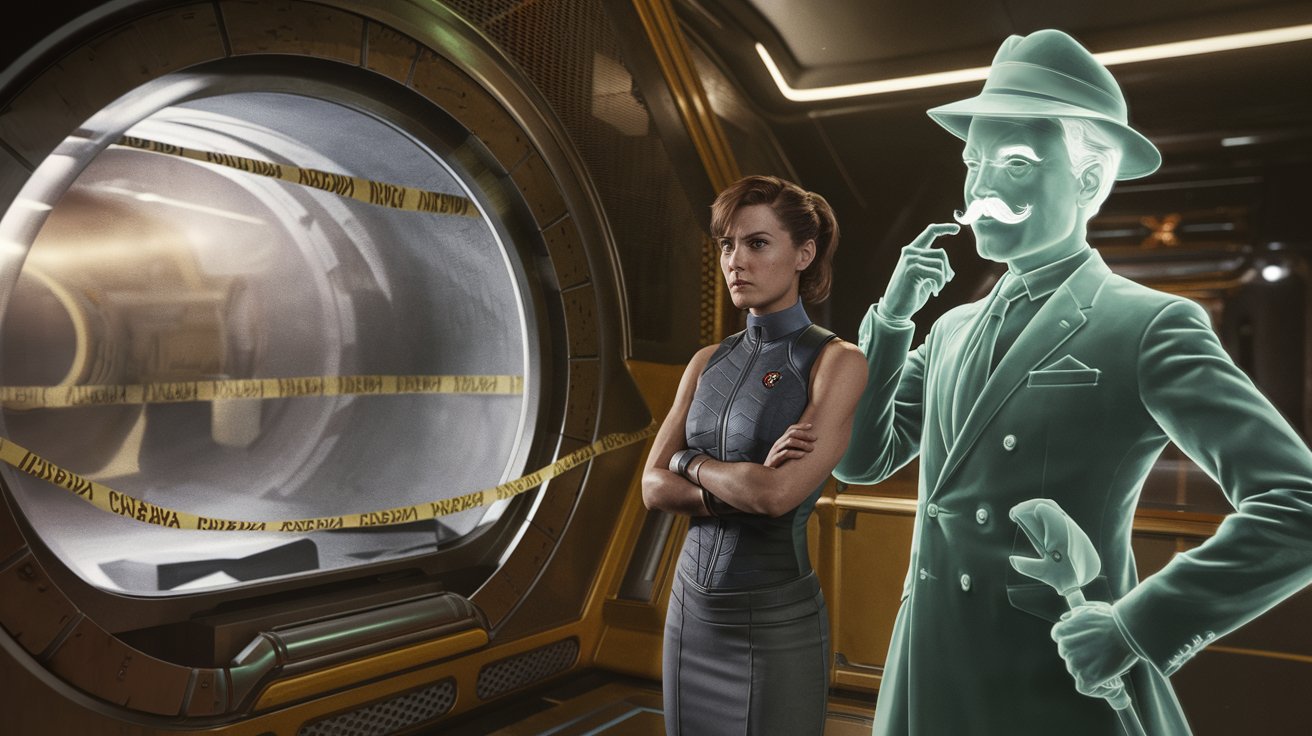
Evie and TP Investigating the Drying Machine Crime Scene
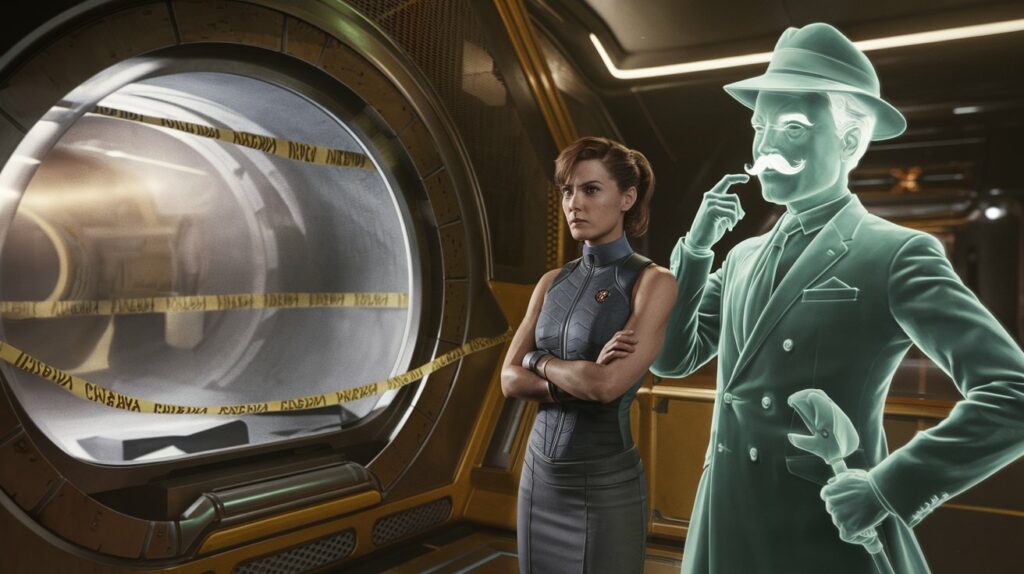
A cinematic sci-fi mini-scene aboard the vast and luxurious Helix 25. In the industrial depths of the ship, a futuristic drying machine hums ominously, crime scene tape lazily flickering in artificial gravity. Evie, a sharp-eyed investigator in a sleek yet practical uniform, stands with arms crossed, listening intently. Beside her, a translucent, retro-stylized holographic detective—Trevor Pee Marshall (TP)—adjusts his tiny mustache with a flourish, pointing dramatically at the drying machine with his cane. The air is thick with mystery, the ship’s high-tech environment reflecting off Evie’s determined face while TP’s flickering presence adds an almost comedic contrast. A perfect blend of noir and high-tech detective intrigue.
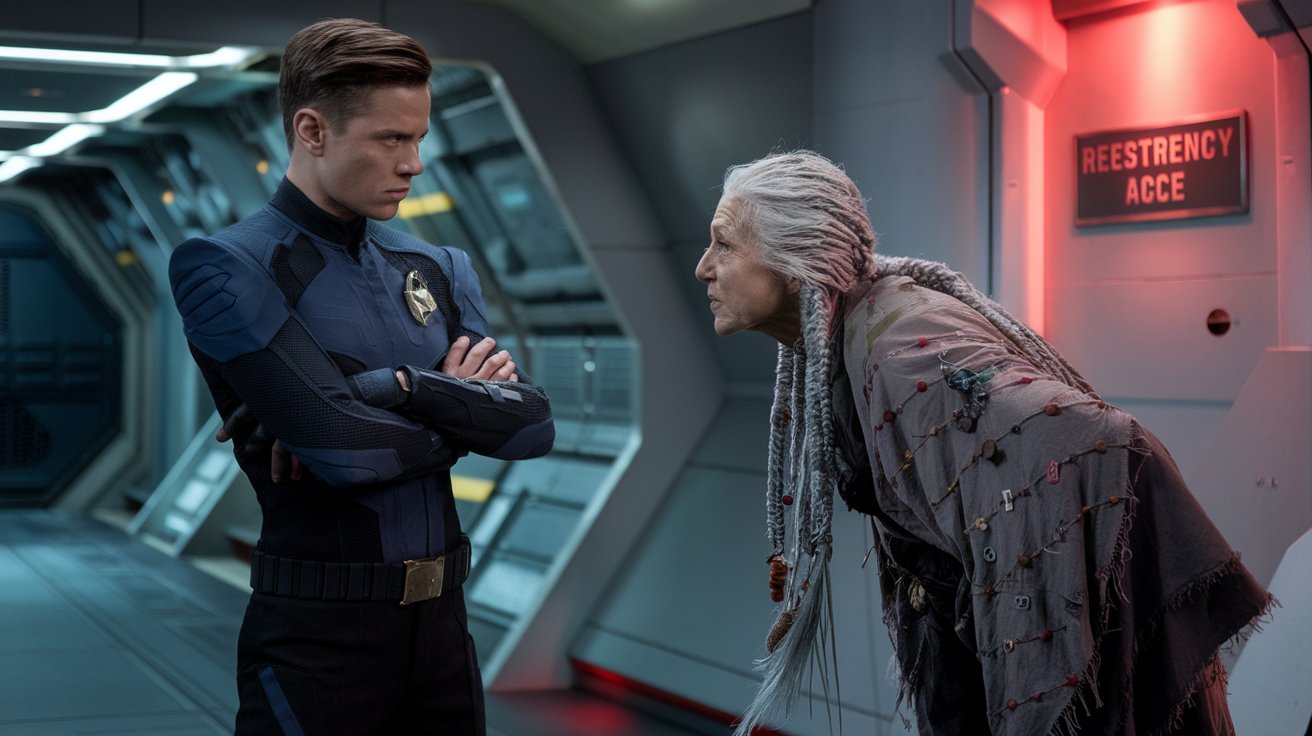
Riven Holt and Zoya Kade Confronting Each Other in a Dimly Lit Corridor
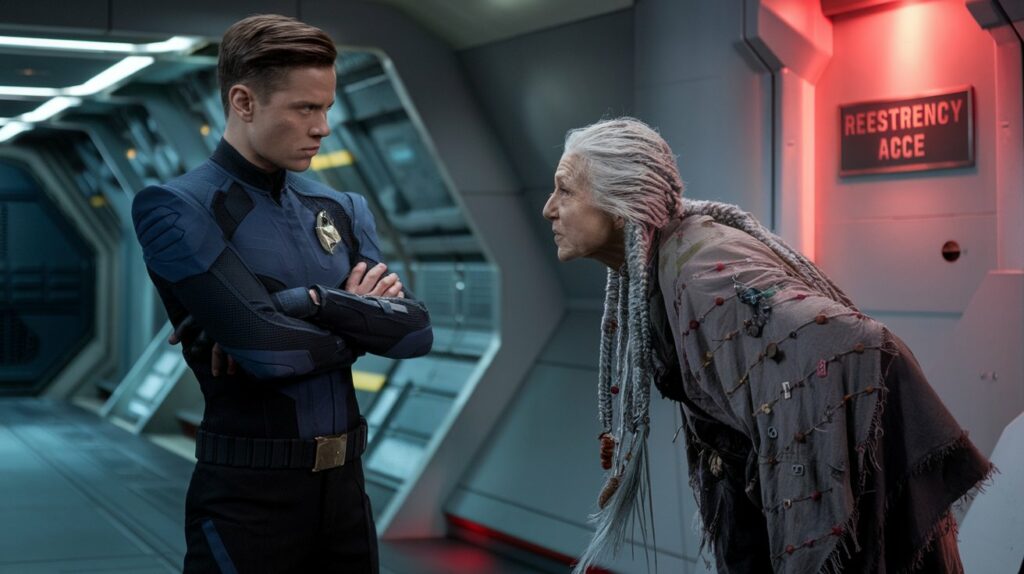
A dramatic, cinematic sci-fi scene aboard the vast and luxurious Helix 25. Riven Holt, a disciplined young officer with sharp features, stands in a high-tech corridor, his arms crossed, jaw tense—exuding authority and restraint. Opposite him, Zoya Kade, a sharp-eyed, wiry 83-year-old scientist-prophet, leans slightly forward, her mismatched layered robes adorned with tiny artifacts—beads, old circuits, and a fragment of a key. Her silver-white braid gleams under the soft emergency lighting, her piercing gaze challenging him. The corridor hums with unseen energy, a subtle red glow from a “restricted access” sign casting elongated shadows. Their confrontation is palpable—a struggle between order and untamed knowledge, hierarchy and rebellion. In the background, the walls of Helix 25 curve sleekly, high-tech yet strangely claustrophobic, reinforcing the ship’s ever-present watchfulness.
Romualdo, the Gardener, Among the Bioluminescent Plants
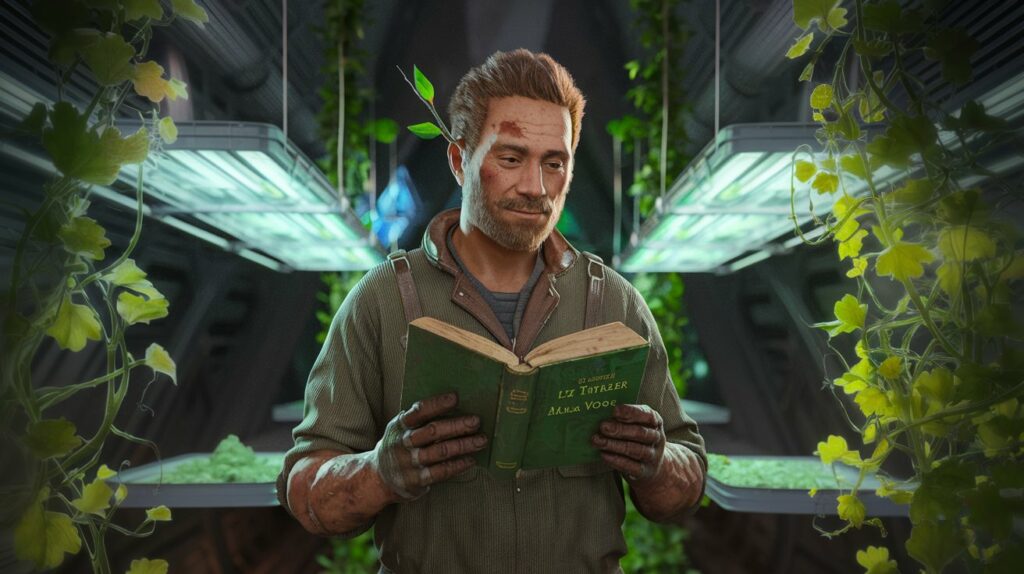
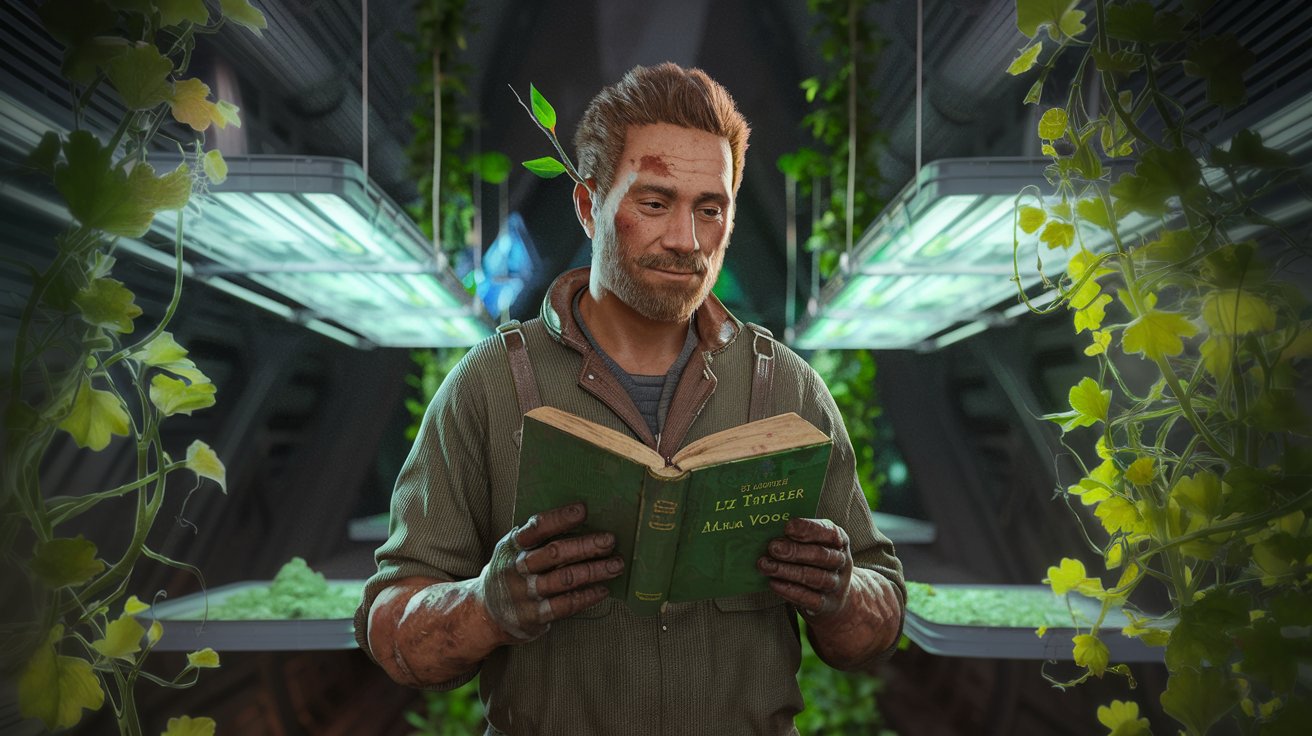
A richly detailed sci-fi portrait of Romualdo, the ship’s gardener, standing amidst the vibrant greenery of the Jardenery. He is a rugged yet gentle figure, dressed in a simple work jumpsuit with soil-streaked hands, a leaf-tipped stem tucked behind his ear like a cigarette. His eyes scan an old, well-worn book—one of Liz Tattler’s novels—that Dr. Amara Voss gave him for his collection. The glowing plants cast an ethereal blue-green light over him, creating an atmosphere both peaceful and mysterious. In the background, the towering vines and suspended hydroponic trays hint at the ship’s careful balance between survival and serenity.
Finja and Finkley – A Telepathic Parallel Across Space
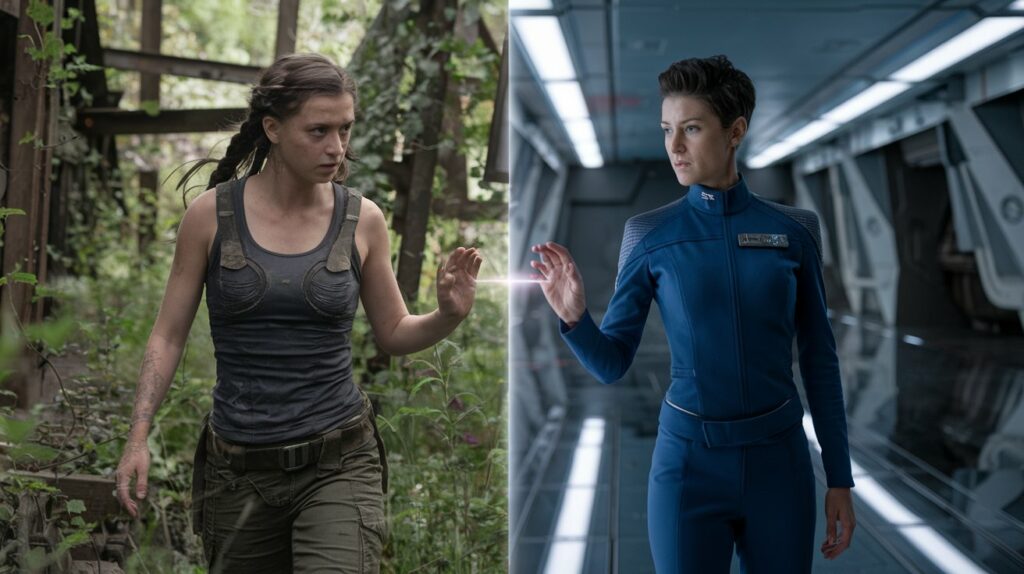
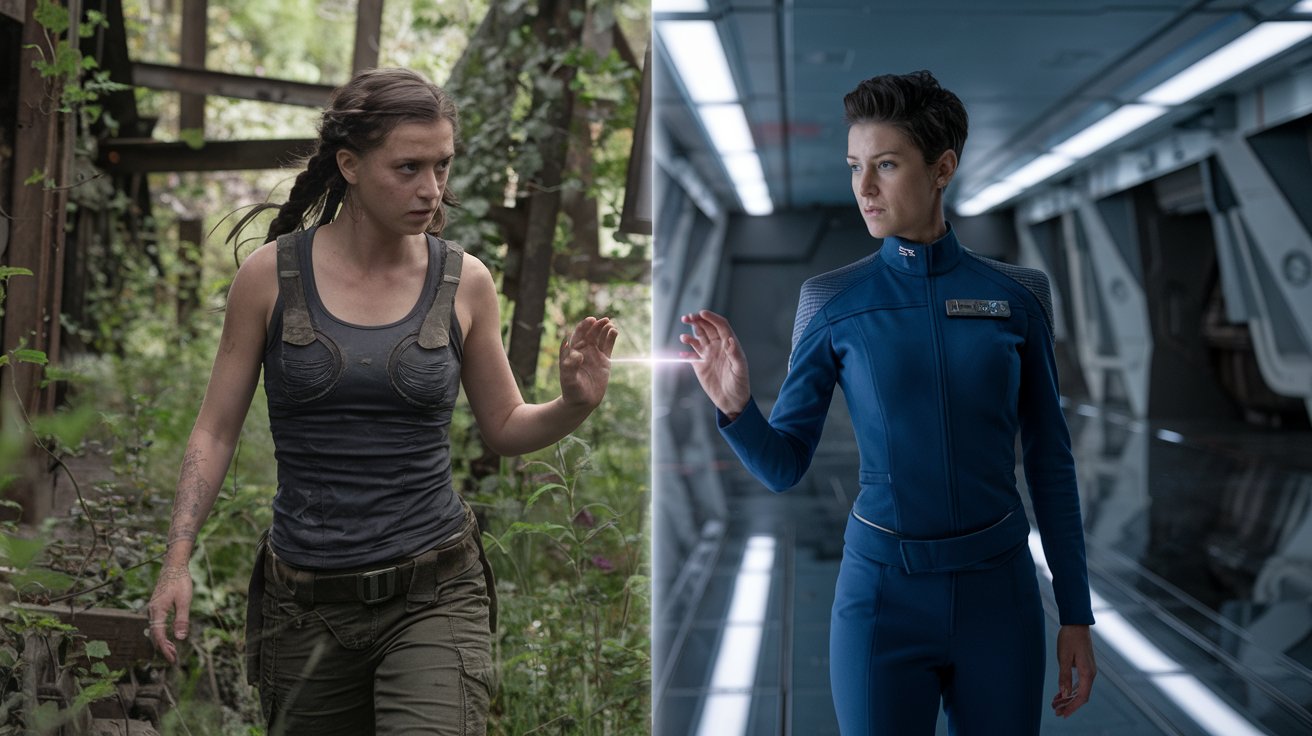
A surreal, cinematic sci-fi composition split into two mirrored halves, reflecting a mysterious connection across vast distances. On one side, Finja, a wiry, intense woman with an almost obsessive neatness, walks through the overgrown ruins of post-apocalyptic Earth, her expression distant as she “listens” to unseen voices. Dust lingers in the air, catching the golden morning light, and she mutters to herself about cleanliness. In her reflection, on the other side of the image, is Finkley, a no-nonsense crew member aboard the gleaming, futuristic halls of Helix 25. She stands with hands on her hips, barking orders at small cleaning bots as they maintain the ship’s pristine corridors. The lighting is cold and artificial, sterile in contrast to the dust-filled Earth. Yet, both women share a strange symmetry—gesturing in unison as if unknowingly mirroring one another across time and space. A faint, ghostly thread of light suggests their telepathic bond, making the impossible feel eerily real.
February 15, 2025 at 9:21 am #7789In reply to: The Last Cruise of Helix 25
Helix 25 – Poop Deck – The Jardenery
Evie stepped through the entrance of the Jardenery, and immediately, the sterile hum of Helix 25’s corridors faded into a world of green. Of all the spotless clean places on the ship, it was the only where Finkley’s bots tolerated the scent of damp earth. A soft rustle of hydroponic leaves shifting under artificial sunlight made the place an ecosystem within an ecosystem, designed to nourrish both body and mind.
Yet, for all its cultivated serenity, today it was a crime scene. The Drying Machine was connected to the Jardenery and the Granary, designed to efficiently extract precious moisture for recycling, while preserving the produce.
Riven Holt, walking beside her, didn’t share her reverence. “I don’t see why this place is relevant,” he muttered, glancing around at the towering bioluminescent vines spiraling up trellises. “The body was found in the drying machine, not in a vegetable patch.”
Evie ignored him, striding toward the far corner where Amara Voss was hunched over a sleek terminal, frowning at a glowing screen. The renowned geneticist barely noticed their approach, her fingers flicking through analysis results faster than human eyes could process.
A flicker of light.
“Ah-ha!” TP materialized beside Evie, adjusting his holographic lapels. “Madame Voss, I must say, your domain is quite the delightful contrast to our usual haunts of murder and mystery.” He twitched his mustache. “Alas, I suspect you are not admiring the flora?”
Amara exhaled sharply, rubbing her temples, not at all surprised by the holographic intrusion. She was Evie’s godmother, and had grown used to her experiments.
“No, indeed. I’m admiring this.” She turned the screen toward them.
The DNA profile glowed in crisp lines of data, revealing a sequence highlighted in red.
Evie frowned. “What are we looking at?”
Amara pinched the bridge of her nose. “A genetic anomaly.”
Riven crossed his arms. “You’ll have to be more specific.”
Amara gave him a sharp look but turned back to the display. “The sample we found at the crime scene—blood residue on the drying machine and some traces on the granary floor—matches an ancient DNA profile from my research database. A perfect match.”
Evie felt a prickle of unease. “Ancient? What do you mean? From the 2000s?”
Amara chuckled, then nodded grimly. “No, ancient as in Medieval ancient. Specifically, Crusader DNA, from the Levant. A profile we mapped from preserved remains centuries ago.”
Silence stretched between them.
Finally, Riven scoffed. “That’s impossible.”
TP hummed thoughtfully, twirling his cane. “Impossible, yet indisputable. A most delightful contradiction.”
Evie’s mind raced. “Could the database be corrupted?”
Amara shook her head. “I checked. The sequencing is clean. This isn’t an error. This DNA was present at the crime scene.” She hesitated, then added, “The thing is…” she paused before considering to continue. They were all hanging on her every word, waiting for what she would say next.
Amara continued “I once theorized that it might be possible to reawaken dormant ancestral DNA embedded in human cells. If the right triggers were applied, someone could manifest genetic markers—traits, even memories—from long-dead ancestors. Awakening old skills, getting access to long lost secrets of states…”
Riven looked at her as if she’d grown a second head. “You’re saying someone on Helix 25 might have… transformed into a medieval Crusader?”
Amara exhaled. “I’m saying I don’t know. But either someone aboard has a genetic profile that shouldn’t exist, or someone created it.”
TP’s mustache twitched. “Ah! A puzzle worthy of my finest deductive faculties. To find the source, we must trace back the lineage! And perhaps a… witness.”
Evie turned toward Amara. “Did Herbert ever come here?”
Before Amara could answer, a voice cut through the foliage.
“Herbert?”
They turned to find Romualdo, the Jardenery’s caretaker, standing near a towering fruit-bearing vine, his arms folded, a leaf-tipped stem tucked behind his ear like a cigarette. He was a broad-shouldered man with sun-weathered skin, dressed in a simple coverall, his presence almost too casual for someone surrounded by murder investigators.
Romualdo scratched his chin. “Yeah, he used to come around. Not for the plants, though. He wasn’t the gardening type.”
Evie stepped closer. “What did he want?”
Romualdo shrugged. “Questions, mostly. Liked to chat about history. Said he was looking for something old. Always wanted to know about heritage, bloodlines, forgotten things.” He shook his head. “Didn’t make much sense to me. But then again, I like practical things. Things that grow.”
Amara blushed, quickly catching herself. “Did he ever mention anything… specific? Like a name?”
Romualdo thought for a moment, then grinned. “Oh yeah. He asked about the Crusades.”
Evie stiffened. TP let out an appreciative hum.
“Fascinating,” TP mused. “Our dearly departed Herbert was not merely a victim, but perhaps a seeker of truths unknown. And, as any good mystery dictates, seekers who get too close often find themselves…” He tipped his hat. “Extinguished.”
Riven scowled. “That’s a bit dramatic.”
Romualdo snorted. “Sounds about right, though.” He picked up a tattered book from his workbench and waved it. “I lend out my books. Got myself the only complete collection of works of Liz Tattler in the whole ship. Doc Amara’s helping me with the reading. Before I could read, I only liked the covers, they were so romantic and intriguing, but now I can read most of them on my own.” Noticing he was making the Doctor uncomfortable, he switched back to the topic. “So yes, Herbert knew I was collector of books and he borrowed this one a few weeks ago. Kept coming back with more questions after reading it.”
Evie took the book and glanced at the cover. The Blood of the Past: Genetic Echoes Through History by Dr. Amara Voss.
She turned to Amara. “You wrote this?”
Amara stared at the book, her expression darkening. “A long time ago. Before I realized some theories should stay theories.”
Evie closed the book. “Looks like someone didn’t agree.”
Romualdo wiped his hands on his coveralls. “Well, I hope you figure it out soon. Hate to think the plants are breathing in murder residue.”
TP sighed dramatically. “Ah, the tragedy of contaminated air! Shall I alert the sanitation team?”
Riven rolled his eyes. “Let’s go.”
As they walked away, Evie’s grip tightened around the book. The deeper they dug, the stranger this murder became.
February 8, 2025 at 7:22 pm #7776In reply to: Quintessence: Reversing the Fifth
Epilogue & Prologue
Paris, November 2029 – The Fifth Note Resounds
Tabitha sat by the window at the Sarah Bernhardt Café, letting the murmur of conversations and the occasional purring of the espresso machine settle around her. It was one of the few cafés left in the city where time still moved at a human pace. She stirred her cup absentmindedly. Paris was still Paris, but the world outside had changed in ways her mother’s generation still struggled to grasp.
It wasn’t just the ever-presence of automation and AI making themselves known in subtle ways—screens adjusting to glances, the quiet surveillance woven into everyday life. It wasn’t just the climate shifts, the aircon turned to cold in the midst of November, the summers unpredictable, the air thick with contradictions of progress and collapse of civilization across the Atlantic.
The certainty of impermanence was what defined her generation. BANI world they used to say—Brittle, Anxious, Nonlinear, Incomprehensible. A cold fact: impossible to grasp and impossible to fight. Unlike her mother and her friends, who had spent their lives tethered to a world that no longer existed, she had never known certainty. She was born in the flux.
And yet, this café remained. One of the last to resist full automation, where a human still brought you coffee, where the brass bell above the door still rang, where things still unfolded at a human pace.
The bell above the door rang—the fifth note, as her mother had called it once.
She had never been here before, not in any way that mattered. Yet, she had heard the story. The unlikely reunion five years ago. The night that moved new projects in motion for her mother and her friends.
Tabitha’s fingers traced the worn edges of the notebook in front of her—Lucien’s, then Amei’s, then Darius’s. Pieces of a life written by many hands.
“Some things don’t work the first time. But sometimes, in the ruins of what failed, something else sprouts and takes root.”
And that was what had happened.
The shared housing project they had once dreamed of hadn’t survived—not in its original form. But through their rekindled bond, they had started something else.
True Stories of How It Was.
It had begun as a quiet defiance—a way to preserve real, human stories in an age of synthetic, permanent ephemerality and ephemeral impermanence, constantly changing memory. They were living in a world where AI’s fabricated histories had overwhelmed all the channels of information, where the past was constantly rewritten, altered, repackaged. Authenticity had become a rare currency.
As she graduated in anthropology few years back, she’d wondered about the validity of history —it was, after all, a construct. The same could be said for literature, art, even science. All of them constructs of the human mind, tenuous grasp of the infinite truth, but once, they used to evolve at such a slow pace that they felt solid, reliable. Ultimately their group was not looking for ultimate truth, that would be arrogant and probably ignorant. Authenticity was what they were looking for. And with it, connections, love, genuineness —unquantifiables by means of science and yet, true and precious beyond measure.
Lucien had first suggested it, tracing the idea from his own frustrations—the way art had become a loop of generated iterations, the human touch increasingly erased. He was in a better place since Matteo had helped him settle his score with Renard and, free of influence, he had found confidence in developing of his own art.
Amei —her mother—, had changed in a way Tabitha couldn’t quite define. Her restlessness had quieted, not through settling down but through accepting impermanence as something other than loss. She had started writing again—not as a career, not to publish, but to preserve stories that had no place in a digitized world. Her quiet strength had always been in preserving connections, and she knew they had to move quickly before real history faded beneath layers of fabricated recollections.
Darius, once skeptical, saw its weight—he had spent years avoiding roots, only to realize that stories were the only thing that made places matter. He was somewhere in Morocco now, leading a sustainable design project, bridging cultures rather than simply passing through them.
Elara had left science. Or at least, science as she had known it. The calculations, the certainty, the constraints of academia, with no escape from the automated “enhanced” digital helpers. Her obsession and curiosities had found attract in something more human, more chaotic. She had thrown herself into reviving old knowledge, forgotten architectures, regenerative landscapes.
And Matteo—Matteo had grounded it.
The notebook read: Matteo wasn’t a ghost from our past. He was the missing note, the one we didn’t know we needed. And because of him, we stopped looking backward. We started building something else.
For so long, Matteo had been a ghost of sorts, by his own account, lingering at the edges of their story, the missing note in their unfinished chord. But now, he was fully part of it. His mother had passed, her past history unraveling in ways he had never expected, branching new connections even now. And though he had lost something in that, he had also found something else. Juliette. Or maybe not. The story wasn’t finished.
Tabitha turned the page.
“We were not historians, not preservationists, not even archivists. But we have lived. And as it turned out, that was enough.”
They had begun collecting stories through their networks—not legends, not myths, but true accounts of how it was, from people who still remembered.
A grandfather’s voice recording of a train ride to a city that no longer exists.
Handwritten recipes annotated by generations of hands, each adding something new.
A letter from a protest in 2027, detailing a movement that the history books had since erased.
An old woman’s story of her first love, spoken in a dialect that AI could not translate properly.It had grown in ways they hadn’t expected. People began sending them recordings, letters, transcripts, photos —handwritten scraps of fading ink. Some were anonymous, others carefully curated with full names and details, like makeshift ramparts against the tide of time.
At first, few had noticed. It was never the goal to make it worlwide movement. But little by little, strange things happened, and more began to listen.
There was something undeniably powerful about genuine human memory when it was raw and unfiltered, when it carried unpolished, raw weight of experience, untouched by apologetic watered down adornments and out-of-place generative hallucinations.
Now, there were exhibitions, readings, archives—entire underground movements dedicated to preserving pre-synthetic history. Their project had become something rare, valuable, almost sacred.
And yet, here in the café, none of that felt urgent.
Tabitha looked up as the server approached. Not Matteo, but someone new.
“Another espresso?”
She hesitated, then nodded. “Yes. And a glass of water, please.”
She glanced at the counter, where Matteo was leaning, speaking to someone, laughing. He had changed, too. No longer just an observer, no longer just the quiet figure who knew too much. Now, he belonged here.
A bell rang softly as the door swung open again.
Tabitha smiled to herself. The fifth note always sounded, in the end.
She turned back to the notebook, the city moving around her, the story still unfolding in more directions than one.
December 23, 2024 at 11:20 am #7708In reply to: Quintessence: Reversing the Fifth
Elara — Nov 2021: The End of Genealogix
The numbers on the screen were almost comical in their smallness. Elara stared at the royalty statement, her lips pressed into a tight line as the cursor blinked on the final transaction: £12.37, marked Genealogix Royalty Deposit. Below it, the stark words: Final Payout.
She leaned back in her chair, pushing her glasses up onto her forehead, and sighed. The end wasn’t a surprise. For years, she’d known her genetic algorithm would be replaced by something faster, smarter, and infinitely more marketable. The AI companies had come, sweeping up data and patents like vultures at a sky burial. Genealogix, her improbable golden goose, had simply been outpaced.
Still, staring at the zero balance in the account felt oddly final, as if a door had quietly closed on a chapter of her life. She glanced toward the window, where the Tuscan hills rolled gently under the late afternoon sun. Most of the renovation work on the farmhouse had been finished, albeit slowly, over the years. There was no urgent financial burden, but the thought of her remaining savings made her stomach tighten all the same.
Elara had stumbled into success with Genealogix, though not without effort. It was one of her many patents—most of them quirky solutions to problems nobody else seemed interested in solving. A self-healing chalkboard coating? Useless. A way to chart audio waveforms onto three-dimensional paper models? Intriguing but commercially barren. Genealogix had been an afterthought at the time, something she tinkered with while traveling through Europe on a teaching fellowship.
When the royalties started rolling in unexpectedly, it had felt like a cosmic joke. “Finally,” she’d muttered to herself as she cashed her first sizeable check, “they like something useless.”
The freedom that money brought was a relief. It allowed her to drop the short-term contracts that tethered her to institutions and pursue science on her own terms. No rigid conventions, no endless grant applications, no academic politics. She’d call it “investigation,” free from the dogma that so often suffocated creativity.
And yet, she was no fool. She’d known Genealogix was a fluke, its lifespan limited.
She clicked away from the bank statement and opened her browser, absently scrolling through her bookmarked social accounts. An old post from Lucien caught her eye—a photograph of a half-finished painting, the colors dark and chaotic. His caption read: “When the labyrinth swallows the light.”
Her brow furrowed. She’d been quietly following Lucien for years, watching his work evolve through fits and starts. It was obvious he was struggling. This post was old, maybe Lucian had stopped updating after the pandemic. She’d sent anonymous payments to buy his paintings more than once, under names that would mean nothing to him —”Darlara Ameilikian” was a bit on the nose, but unlike Amei, Elara loved a good wink.
Her mind wandered to Darius, and her suggesting he looked into 1-euro housing schemes available in Italy. It had been during a long phone call, back when she was scouting options for herself. They still had tense exchanges, and he was smart to avoid any mention of his odd friends, otherwise she’d had hung the phone faster than a mouse chased by a pack of dogs. “You’d thrive in something like that,” she’d told him. “Build it with your own hands. Make it something meaningful.” He’d laughed but had sounded intrigued. She wondered if he’d ever followed up on it.
As for Amei—Elara had sent her a birthday gift earlier that year, a rare fabric she’d stumbled across in a tiny local shop. Amei hadn’t known it was from her, of course. That was Elara’s way. She preferred to keep her gestures quiet, almost random —it was best that way, she was rubbish at remembering the small stuff that mattered so much to people, she wasn’t even sure of Amei’s birthday to be honest; so she preferred to scatter little nods like seeds to the wind.
Her eyes drifted to a framed ticket stub on the bookshelf, a relic from 2007: Eliane Radigue — Naldjorlak II, Aarau Festival (Switzerland). Funny how the most unlikely event had made them into a group of friends. That concert had been a weird and improbable anchor point in their lives, a moment of serendipity that had drawn them toward something more than their own parts.
By that time, they were already good friends with Amei, and she’d agreed to join her to discover the music, although she could tell it was more for the strange appeal of something almost alien in experience, than for the hurdles of travel and logistics. But Elara’s enthusiasm and devil-may-care had won her over, and they were here.
Radigue’s strange sound sculptures, had rippled through the darkened festival scene, wavering and hauntingly delicate, and at the same time slow and deliberate, leading them towards an inevitability. Elara had been mesmerized, sitting alone near the back as Amei had gone for refreshments, when a stranger beside her had leaned over to ask, “What’s that sound? A bell? Or a drone?”
It was Lucien. Their conversation had lasted through the intermission soon joined by Amei, and spilled into a café afterward, where Darius had eventually joined them. They’d formed a bond that night, one that felt strange and tenuous at the time but proved to be resilient, even as the years pulled them apart.
Elara closed the laptop, resting her hand on its warm surface for a moment before standing. She walked to the window, the sun dipping lower over the horizon, casting long shadows across the vineyard. The farmhouse had been a gamble, a piece of the future she wasn’t entirely sure she believed in when she’d bought it. But now, as the light shifted and the hills glowed gold, she felt a quiet satisfaction.
The patent was gone, the money would fade, but she still had this. And perhaps, that was enough.
December 20, 2024 at 1:44 am #7701In reply to: Quintessence: Reversing the Fifth
Amei attached a card and ribbon to the last of the neatly wrapped gifts and placed it under the tree. This one was for Paul—a notebook with a cover of soft fabric she’d block-printed with delicate, overlapping circles in muted blues and greens. The fabric was left over from a set of cushions for a client, but she had spent hours crafting the notebook, knowing all the while Paul probably wouldn’t use it. He was impossible to buy for, preferring things he picked out himself. Tabitha had been far easier: Amei had secretly made a dress out of a soft, flowing fabric that Tabitha had fallen in love with the moment Amei showed it to her.
The house felt calm for the moment. Tabitha had gone out earlier, calling over her shoulder that she’d be back in time for dinner. Amei smiled at the memory of her daughter’s laughter. Her excitement about Christmas was palpable, a bright contrast to the quietness that had settled over everything else. Amei used to feel like that about Christmas too. This year, though, she was only making the effort for Tabitha.
Somewhere down the hallway, Paul’s voice murmured on a call—distant, like everything about him lately. The air smelled faintly of cinnamon and cloves from the mulled wine simmering on the stove, but even that warm, festive scent felt like it was trying too hard.
The house felt big, despite the occasional bursts of life it saw on days like this. It had felt that way for months now, the weight of unspoken things pressing against the faded walls.
She sighed and reached for the decoration box, pulling out a small clay angel with chipped wings. The sight of it made her pause. Lucien had given it to her years ago, one Christmas, and declared it “charmingly imperfect,” insisting it belonged at the top of her tree. She smiled faintly at the memory, turning it over in her hands. Every year since, it had held its place at the top of the tree.
“Still not done?” Paul’s voice cut into her thoughts. She turned to see him standing in the doorway. At the sound of Paul’s voice, Briar, their elderly cat—or technically Paul’s cat—emerged from behind the curtain, her tail curling as she wove around his legs. Paul crouched slightly to scratch behind her ears, and Briar leaned into his touch, purring softly
“She thinks it’s dinner time,” Amei said evenly.
“You always go overboard with these things, Amei,” Paul said, straightening and nodding towards the gifts.
“It’s Christmas,” she snapped, the irritation slipping through before she could stop it. She turned back to the tree, her fingers moving stiffly as she busied herself with strands of sparkly tinsel.
Paul didn’t respond, but she could feel his gaze linger. It was the silence that had grown between them in recent months, filled with everything they couldn’t bring themselves to say…yet.
The sound of the front door banging shut and brisk footsteps broke the tension. Tabitha burst past Paul into the room, her cheeks flushed from the cold. “Hey, Paul. Hey, Mumma Bear,” she said brightly. Her eyes lit up as they landed on the tree. “The tree looks gorgeous! Don’t you just love Christmas?”
December 14, 2024 at 8:00 pm #7683In reply to: The Precious Life and Rambles of Liz Tattler
“What do you think Godfrey?” Liz’ snapped at her publisher, sightly annoyed by his debonair smile. “And honestly, I sometimes wonder if I shouldn’t ask Finnley, she seems to have more wits about her than you, dear friend. And where is she by the way?”
“Liz’, will you calm down, this interview business is driving you back to your old manic madness; don’t worry about Finnley, she’s had some errands to run, something about coaching the younger generation, and tiktok oven challenge —don’t ask.”
“Exactly! What? what coaching nonsense? Tsk, stop digressing. Yes, that interview is getting bees in my bonnet, if you see what I mean.”
“Driving you nuts, you mean?”
“Obvie. But look, how about that as an intro? ‘Every story begins with something lost, but it’s never about the loss. It’s about what you find because of it.’ ”
“It’s quite brilliant I must say; how much of it is from the artificial box?”
“That’s what I mean Godfrey! None! But you not seeing a difference is worrying to say the least. This thing is every author’s nightmare; it spews nonsense faster, and even with greater details I can manage in one draft. Look at that. It still comes to me as naturally as when I did my first book. Very heavy door curtain, and the wooden pole sags so I’m on tip toe yanking it, and middle of back unsupported, very stupid really. Stuff like that, I can immediately conjure, painting a world of innuendos and mysteries behind a few carefully crafted words. My words’ a stage. And I even managed to write my last book, with impossibly challenging characters, being a scientist without knowing the first thing about science —apart maybe from science of marriage, although one may argue it’s more an art form. The thing is, Godfrey, and pardon that unusual monologue, yes, and please don’t choke on your peanuts. I’m starting to feel like a faulty robot who can’t stick to the robot plan.”
“I can see you do, Liz, but honestly, we can all make out the tree for the forest. Yours is truly an art that cannot be mimicked by machinery. Have a tonic, and let’s get you ready for that interview —the manicurist is downstairs ready for you with the best shades of pink you can ever dream of.
December 14, 2024 at 6:42 pm #7682In reply to: Quintessence: Reversing the Fifth
Matteo — Autumn 2023
The Jardin des Plantes park was quiet, the kind of quiet that settled after a brisk autumn rain. Matteo sat on a weathered wooden bench, watching a golden retriever chase the last of the fallen leaves tumbling across the gravel path. The damp air was carrying scents of the earth welcoming a retreat inside, and taking the time to be alone with his thoughts was something he’d missed.
His phone buzzed with a notification—a news update about the latest film adaptation from a Liz Tattler classic fiction. The name made him smile faintly. Juliette had loved Tattler’s novels, their whimsical characters, and the unflinching and unapologetic observations about life’s quiet mysteries and the unexpected rants about the virtues of cleaning and dustsceawung that propelled the word in the people’s top 100 favourite in the Oxford dictionary for several years consecutively.
“They’re so full of texture,” Juliette once said as she was sprawled on the bed of their tiny Parisian flat, a battered paperback in her hands. “Like you can feel the pages breathe.”
His image of her was still vivid, they’d stayed on good terms and he would still thumb up some of her posts from time to time —but it was only small moments rather than full scenes that used to come back, fragmented pieces of memories really —her dark hair falling messily over her face, her legs crossed in a casual way.
Paris had been a playground for them. For a while, they were caught in a whirlwind of late-night conversations in smoky cafés and lazy Sunday mornings wandering the Seine. They’d spent hours in bookstores, Juliette hunting for first editions and Matteo snapping pictures of the handwritten notes tucked between the pages of used novels.
A year ago, a different park in a different city—Hyde Park, London. She was there, twirling a scarf she’d picked up in Vienna the weekend before, the bright red of it like a ribbon of fire against the soft gray skies. They had been enamored with each other and with the spontaneity of hopping trains to new cities, their weekends folding into one another like pages of a travel journal. London one week, Paris the next, Berlin after that. Each city a postcard snapshot, vibrant and fleeting.
Juliette would tease him about his fascination with the little things—how he would linger too long over a cup of coffee at a café or stop to photograph a tree in the middle of nowhere. “You’re always looking for stories,” she’d said with a laugh, tucking a stray strand of hair behind her ear. “Even when you’re not sure what they mean.”
“Stories are everywhere,” he would reply, snapping a picture of her against the backdrop of the park, her scarf billowing in the wind. She had rolled her eyes but smiled, and in that moment, he had believed her smile was the most perfect thing he’d ever seen.
The break-up came unannounced, but not fully unexpected. There were signs here and there. Her love of the endless whirlwind of life, that was a match for his way of following life’s intents for him. When sometimes life went still during winter, he would also follow, but she wouldn’t. She had insatiable love for a life filled with animation, bursts of colours, sounds. It had been easy to be with her then, her curiosity pulling him along, their shared love of stories giving their time together a weight that felt timeless. It was when Drusilla’s condition worsened, that their rhythms became untangled, no longer synching at every heartbeat. And it was fine. Matteo had made his decision then to leave Paris and bring his mother to Avignon where she could receive the care she needed. Those past two weeks that brought the inevitable conclusion of their separation had left him surprisingly content. Happy for the past moments, and hopeful for the unwritten future.
He could see clearly that Juliette needed her freedom back; and she’d agreed. Regular train rides to Avignon, the weekends spent trying to make the sparse walls of his mother’s room feel like home as she started to forget her son’s girlfriend, and sometimes even her own son.
Last they were in this park together was one of their last shared moments of innocent happiness ; It was a beautiful sunny afternoon —or was it only coloured by memories? They had been sitting in the Jardin des Plantes, sharing a crêpe. Juliette had been scrolling through her phone, stopping at an announcement about an interview with Liz Tattler airing that evening. “You should watch it,” she’d said, her tone light but distant. “Her books are about people like us—drifting, figuring it out.”
He had smiled then, nodding, though he wasn’t sure if he’d meant it. A week later, she told him she was moving back to Lille, closer to her family until she figured out her next step. “It’s not you, Matteo,” she’d said, her eyes soft but resolute. “You need to be here, for her. I need… something else.”
Now, sitting in the park a few weeks later, Matteo pulled his phone from his pocket and opened his gallery. He scrolled through the pictures until he found one from their weekend in London—a black-and-white shot of Julia standing in front of a red telephone booth, her smile sharp and her eyes already focused on the next shooting star to catch.
Julia was right, he thought. People like them—they drifted, but they also found their way, sometimes in unexpected ways. He put on his earpods, listening to the beginning of Liz Tattler’s interview.
Her distinct raspy voice brimming with a cackling energy was already engrossing. Synchy as ever, she was saying:
“Every story begins with something lost, but it’s never about the loss. It’s about what you find because of it.”
December 14, 2024 at 2:48 pm #7679In reply to: Liz Tattler – A Lifetime of Stories, in videos
December 14, 2024 at 2:33 pm #7673In reply to: Liz Tattler – A Lifetime of Stories, in videos
The adventures of Arona & Mandrake
[Scene opens with Arona and Mandrake, the adventurous duo, standing on a hilltop, the vast landscape of the Alienor system stretching before them bathed in starlight.]
Narrator (cheerful, enchanting voice): “Join Arona and Mandrake the cat on magical quests across dimensions!”
[Quick flashes: Arona soaring in a hot air balloon, Mandrake snuggled on her shoulder; a playful chase with Vincentius, the mischievous demi-god; a vibrant encounter with the purple dragon, Leörmn.]
Narrator: “Discover hidden keys, unlock enchanted doors, and meet whimsical friends!”
[End with Arona and Mandrake, laughing under a rainbow, the words “Arona’s Adventures: A Journey Beyond Imagination” sparkling above.]
Narrator: “Embark on a journey of wonder and friendship. Adventure awaits!”
[The screen fades to the book cover with magical sparkles and contact information.]
December 14, 2024 at 2:28 pm #7671[Scene opens with an elegant study, filled with books and ornate furniture. Liz Tattler sits comfortably in a plush armchair, draped in her signature flamboyant attire.]
Narrator (warm, engaging voice): “Meet Liz Tattler, the visionary behind countless bestsellers.”
[Quick cuts: Liz passionately gesturing as she describes her creative process, her hands adorned with long, pink nails.]
Narrator: “A master of transforming the mundane into the magical.”
[A playful montage of Liz surrounded by whimsical titles, each book cover a splash of color and intrigue.]
Narrator: “Where outrageous tales and heartfelt truths dance in harmony.”
[End with a close-up of Liz, a twinkle in her eye, the words “A Legacy of Imagination” glowing beneath her.]
Narrator: “Join us for an exclusive glimpse into the world of a storytelling legend.”
[Screen fades to “Liz Tattler: A Lifetime of Bestsellers” with contact details for the interview.]
December 13, 2024 at 1:22 am #7664In reply to: Quintessence: Reversing the Fifth
There was a sharp knock on the front door. Amei opened it to find Finnley from Meticulous Maids standing there, bucket in one hand, a bag of cleaning supplies in the other.
“Back to tackle that oven,” she announced, brushing past Amei and striding towards the kitchen.
“Good to see you too, Finnley.”
A moment later, an anguished cry echoed from the kitchen. Amei rushed in to find Finnley clutching her brow and pointing accusingly at the oven. “This oven has not been treated with respect,” she declared dramatically.
“Well, I told you on the phone it was quite bad.”
“Quite bad!” Finnley rolled her eyes and dumped her supplies on the counter with a thud. “Moving out, are we?”
“In a few weeks,” Amei said, leaning against the doorframe. “I’ve still got books and stuff to pack, but I’m trying to leave the place in decent shape.”
“Decent?” Finnley snorted, already pulling on a pair of gloves. “This oven’s beyond decent. But I’ll see if I can drag it back from the brink.”
Finnley proceeded to inspect the oven with the air of a general preparing for war. She muttered something under her breath that Amei couldn’t quite catch, then added louder, “Books and boxes. Someone’s got the easy bit.”
Finnley had cleaned for Amei before. She was rude and pricey, but she always got the job done.
“I’ll leave you to it, then,” said Amei, retreating back to her packing.
“Sure,” Finnley muttered. “But if I find anything moving in here, I’m charging extra.”
The house fell silent, save for the occasional scrape of metal and Finnley’s muffled grumblings. An hour later, Amei realized she hadn’t heard anything for a while. Curious, she walked back to the kitchen and peeked her head around the door.
Finnley was slumped in a chair by the kitchen bench, arms crossed, her head tilted at an awkward angle. Her bucket and gloves sat abandoned on the floor. She was fast asleep.
Amei stood there for a moment, not sure what to do. Finally, she cleared her throat. “I take it the oven won?”
Finnley’s eyes snapped open, and she straightened with a snort. “I just needed a regroup,” she muttered, rubbing her face. She looked at the oven and shuddered. “I dreamed that bloody monster of a thing was chasing me.”
“Chasing you?” Amei said, trying hard not to laugh.
Finnley stood, tugging her gloves back on with determination. “It’s not going to win. Not today.” She glared at Amei. “And I’ll be charging you for my break.”
December 11, 2024 at 4:41 am #7662In reply to: Quintessence: Reversing the Fifth
The Waking
Lucien – Early 2024 Darius – Dec 2022 Amei – 2022-2023 Elara – 2022 Matteo – Halloween 2023 Aversion/Reflection Jealousy/Accomplishment Pride/Equanimity Attachment/Discernment Ignorance/Wisdom The sky outside Lucien’s studio window was still dark, the faint glow of dawn breaking on the horizon. He woke suddenly, the echo of footsteps chasing him out of sleep. Renard’s shadow loomed in his mind like a smudge he couldn’t erase. He sat up, rubbing his temples, the remnants of the dream slipping away like water through his fingers. The chase felt endless, but this time, something had shifted. There was no fear in his chest—only a whisper of resolve. “Time to stop running.” The hum of the airplane’s engine filled Darius’s ears as he opened his eyes, the cabin lights dimmed for landing. He glanced at the blinking seatbelt sign and adjusted his scarf. The dream still lingered, faint and elusive, like smoke curling away before he could grasp it. He wasn’t sure where he’d been in his mind, but he felt a pull—something calling him back. South of France was just the next stop. Beyond that,… Beyond that? He didn’t know. Amei sat cross-legged on her living room floor, the guided meditation app still playing its soft tones through her headphones. Her breathing steadied, but her thoughts drifted. Images danced at the edges of her mind—threads weaving together, faces she couldn’t place, a labyrinth spiraling endlessly. The meditation always seemed to end with these fragments, leaving her both unsettled and curious. What was she trying to find? Elara woke with a start, the unfamiliar sensation of a dream etched vividly in her mind. Her dreams usually dissolved the moment she opened her eyes, but this one lingered, sharp and bright. She reached for her notebook on the bedside table, fumbling for the pen. The details spilled out onto the page—a white bull, a labyrinth of light, faces shifting like water. “I never remember my dreams,” she thought, “but this one… this one feels important.” Matteo woke to the sound of children laughing outside, their voices echoing through the streets of Avignon. Halloween wasn’t as big a deal here as elsewhere, but it had its charm. He stretched and sat up, the weight of a restless sleep hanging over him. His dreams had been strange—familiar faces, glowing patterns, a sense of something unfinished. The room seemed to glow for a moment. “Strange,” he thought, brushing it off as a trick of the light. “No resentment, only purpose.” “You’re not lost. You’re walking your own path.” “Messy patterns are still patterns.” “Let go. The beauty is in the flow.” “Everything is connected. Even the smallest light adds to the whole.” The Endless Chase –
Lucien ran through a labyrinth, its walls shifting and alive, made of tangled roots and flickering light. Behind him, the echo of footsteps and Renard’s voice calling his name, mocking him. But as he turned a corner, the walls parted to reveal a still lake, its surface reflecting the stars. He stopped, breathless, staring at his reflection in the water. It wasn’t him—it was a younger boy, wide-eyed and unafraid. The boy reached out, and Lucien felt a calm ripple through him. The chase wasn’t real. It never was. The walls dissolved, leaving him standing under a vast, open sky.The Wandering Maze –
Darius wandered through a green field, the tall grass brushing against his hands. The horizon seemed endless, but each step revealed new paths, twisting and turning like a living map. He saw figures ahead—people he thought he recognized—but when he reached them, they vanished, leaving only their footprints. Frustration welled up in his chest, but then he heard laughter—a clear, joyful sound. A child ran past him, leaving a trail of flowers in their wake. Darius followed, the path opening into a vibrant garden. There, he saw his own footprints, weaving among the flowers. “You’re not lost,” a voice said. “You’re walking your own path.”The Woven Tapestry –
Amei found herself in a dim room, lit only by the soft glow of a loom. Threads of every color stretched across the space, intertwining in intricate patterns. She sat before the loom, her hands moving instinctively, weaving the threads together. Faces appeared in the fabric—Tabitha, her estranged friends, even strangers she didn’t recognize. The threads wove tighter, forming a brilliant tapestry that seemed to hum with life. She saw herself in the center, not separate from the others but connected. This time she heard clearly “Messy patterns are still patterns,” a voice whispered, and she smiled.The Scattered Grains –
Elara stood on a beach, the sand slipping through her fingers as she tried to gather it. The harder she grasped, the more it escaped. A wave rolled in, sweeping the sand into intricate patterns that glowed under the moonlight. She knelt, watching the designs shift and shimmer, each one unique and fleeting. “Let go,” the wind seemed to say. “The beauty is in the flow.” Elara let the sand fall, and as it scattered, it transformed into light, rising like fireflies into the night sky.The Mandala of Light –
Matteo stood in a darkened room, the only light coming from a glowing mandala etched on the floor. As he stepped closer, the patterns began to move, spinning and shifting. Faces appeared—his mother, the friends he hadn’t yet met, and even his own reflection. The mandala expanded, encompassing the room, then the city, then the world. “Everything is connected,” a voice said, low and resonant. “Even the smallest light adds to the whole.” Matteo reached out, touching the edge of the mandala, and felt its warmth spread through him.
Dreamtime
It begins with running—feet pounding against the earth, my breath sharp in my chest. The path twists endlessly, the walls of the labyrinth curling like roots, closing tighter with each turn. I know I’m being chased, though I never see who or what is behind me. The air thickens as I round a corner and come to a halt before a still lake. Its surface gleams under a canopy of stars, too perfect, too quiet. I kneel to look closer, and the face that stares back isn’t mine. A boy gazes up with wide, curious eyes, unafraid. He smiles as though he knows something I don’t, and my breath steadies. The walls of the labyrinth crumble, their roots receding into the earth. Around me, the horizon stretches wide and infinite, and I wonder if I’ve always been here.
The grass is soft under my feet, swaying with a breeze that hums like a song I almost recognize. I walk, though I don’t know where I’m going. Figures appear ahead—shadowy forms I think I know—but as I approach, they dissolve into mist. I call out, but my voice is swallowed by the wind. Laughter ripples through the air, and a child darts past me, their feet leaving trails of flowers in the earth. I follow, unable to stop myself. The path unfolds into a garden, vibrant and alive, every bloom humming with its own quiet song. At the center, I find myself again—my own footprints weaving among the flowers. The laughter returns, soft and knowing. A voice says, “You’re not lost. You’re walking your own path.” But whose voice is it? My own? Someone else’s? I can’t tell.
The scene shifts, or maybe it’s always been this way. Threads of light stretch across the horizon, forming a vast loom. My hands move instinctively, weaving the threads into patterns I don’t understand but feel compelled to create. Faces emerge in the fabric—some I know, others I only feel. Each thread hums with life, vibrating with its own story. The patterns grow more intricate, their colors blending into something breathtaking. At the center, my own face appears, not solitary but connected to all the others. The threads seem to breathe, their rhythm matching my own heartbeat. A voice whispers, teasing but kind: “Messy patterns are still patterns.” I want to laugh, or cry, or maybe both, but my hands keep weaving as the threads dissolve into light.
I’m on the beach now, though I don’t remember how I got here. The sand is cool under my hands, slipping through my fingers no matter how tightly I try to hold it. A wave rolls in, its foam glowing under a pale moon. Where the water touches the sand, intricate patterns bloom—spirals, mandalas, fleeting images that shift with the tide. I try to gather them, to keep them, but the harder I hold on, the faster they fade. A breeze lifts the patterns into the air, scattering them like fireflies. I watch them go, feeling both loss and wonder. “Let go,” a voice says, carried by the wind. “The beauty is in the flow.” I let the sand fall from my hands, and for the first time, I see the patterns clearly, etched not on the ground but in the sky.
The room is dark, yet I see everything. A mandala of light spreads across the floor, its intricate shapes pulsing with a rhythm I recognize but can’t place. I step closer, and the mandala begins to spin, its patterns expanding to fill the room, then the city, then the world. Faces appear within the light—my mother’s, a child’s, strangers I know but have never met. The mandala connects everything it touches, its warmth spreading through me like a flame. I reach out, my hand trembling, and the moment I touch it, a voice echoes in the air: “Everything is connected. Even the smallest light adds to the whole.” The mandala slows, its light softening, and I find myself standing at its center, whole and unafraid.
I feel the labyrinth’s walls returning, but they’re no longer enclosing me—they’re part of the loom, their roots weaving into the threads. The flowers of the garden bloom within the mandala’s light, their petals scattering like sand into the tide. The waves carry them to the horizon, where they rise into the sky, forming constellations I feel I’ve always known.
I wake—or do I? The dream lingers, its light and rhythm threading through my thoughts. It feels like a map, a guide, a story unfinished. I see the faces again—yours, mine, ours—and wonder where the path leads next.
December 8, 2024 at 6:06 am #7655In reply to: Quintessence: Reversing the Fifth
Amei switched on the TV for background noise as she tackled another pile of books. The usual mid-morning chatter filled the room—updates on the weather, a cooking segment, and finally, the news. She was only half-listening until the anchor’s voice caught her attention.
“In the race against climate change, scientists at Harvard are turning to an unexpected solution: chalk. The ambitious project involves launching a balloon into the stratosphere, carrying 600 kilograms of calcium carbonate, which would be sprayed 12 miles above the Earth’s surface. The idea? To reflect sunlight and slow global warming.”
Amei looked up. The screen showed an animated demonstration of the project—a balloon rising into the atmosphere, spraying fine particles into the air. The narration continued, but her focus drifted, caught on a single word: chalk.
Elara loved chalk. Amei smiled faintly, remembering how passionately she used to talk about it—the way she could turn something so mundane into a story of structure, history, and beauty. “It’s not just a rock,” Elara had said once, gesturing dramatically, “it’s a record of time.”
She wasn’t even sure where Elara was these days. The last time they’d spoken was during lockdown. Amei had called to check in, awkward but well-meaning, only to be met with curt responses and a tone that made it clear Elara wanted the conversation over.
She hadn’t tried again after that. It hurt more than she’d expected. Elara could be all or nothing when it came to friendships—brilliant and intense one moment, distant and impenetrable the next. Amei had always known that about her, but knowing didn’t make it any easier.
The news droned on in the background, but Amei reached for the remote and switched off the TV. Her mind was elsewhere, tangled in memories.
She’d first met Elara in a gallery on Southbank, a tiny exhibition tucked away in a brutalist building. It was near Amei’s shared flat, and with her flatmates out for the evening, she had gone alone, more out of boredom than genuine interest. The display wasn’t large—just a few photographs and abstract sculptures, their descriptions dense with scientific jargon.
Amei stood in front of a piece labelled The Geometry of Chaos—a spiraling wire structure that cast intricate, shifting shadows on the wall. She tilted her head, trying to look engaged, though her thoughts were already drifting towards home and her comfy bed.
“Magnificent, isn’t it?”
The voice startled her. She turned to see a dark-haired woman, arms crossed, studying the piece with an intensity that made Amei feel as though she must have missed something obvious. The woman wore a long, flowing skirt, layered necklaces, and a cardigan that looked hand-knitted. Her dark hair was piled into a messy bun, a few strands escaping to frame her face.
“It’s quite interesting,” Amei said. “But I’m not sure I get it.”
“It’s not about getting it. It’s about recognizing the pattern,” the woman replied, stepping closer. She pointed to the shadows on the wall. “See? The curve repeats itself. Infinite, but contained.”
“You sound like you know what you’re talking about.”
“I do,” she said. “Do you?”
Amei laughed, caught off guard. “Not very often. I think I’m more into… messy patterns.”
The woman’s sharp expression softened slightly. “Messy patterns are still patterns.” She smiled. “I’m Elara.”
“Amei,” she replied, returning the smile.
Elara’s gaze dropped, and she nodded toward Amei’s skirt. “I’ve been admiring your skirt. Gorgeous fabric. Where did you get it?”
“Oh, I made it, actually,” Amei felt proud.
Elara raised her eyebrows. “You made it? I’m impressed.”
And that was how it began. A chance meeting that turned into decades of close friendship. They’d left the gallery together, talking all the way to a nearby café.
December 7, 2024 at 11:52 am #7653In reply to: Quintessence: Reversing the Fifth
Matteo — Winter 2023: The Move
The rumble of the moving truck echoed faintly in the quiet residential street as Matteo leaned against the open door, arms crossed, waiting for the signal to load the boxes. He glanced at the crisp winter sky, a pale gray threatening snow, and then at the house behind him. Its windows were darkened by empty rooms, their once-lived-in warmth replaced by the starkness of transition. The ornate names artistically painted on the mailbox struck him somehow. Amei & Tabitha M.: his clients for the day.
The cold damp of London’s suburbia was making him long even more for the warmth of sunny days. With the past few moves he’s been managing for his company, the tipping had been generous; he could probably plan a spring break in South of France, or maybe make a more permanent move there.
The sound of the doorbell brought him back from his rêverie.
Inside the house, the faint sounds of boxes being taped and last-minute goodbyes carried through the hallways. Matteo had been part of these moves too many times to count now. People always left a little bit of themselves behind—forgotten trinkets, echoes of old conversations, or the faint imprint of a life lived. It was a rhythm he’d come to expect, and he knew his part in it: lift, carry, and disappear into the background.
Matteo straightened as the door opened and a girl that could have been in her early twenties, but looked like a teenager stepped out, bundled against the cold. She held a steaming mug in one hand and balanced a box awkwardly on her hip with the other.
“That’s the last of it,” she called over her shoulder. “Mum, are you sure you don’t want me to take the notebooks?”
“They’re fine in the car, Tabitha!” A voice—calm and steady, maybe tinged with weariness—floated from inside.
The girl named Tabitha turned to Matteo, offering the box. “This is fragile,” she said, a smile tugging at her lips. “Be nice to it.”
Matteo took the box carefully, glancing at the mug in her hand. “You’re not leaving that behind, are you?” he asked with a faint smile.
Tabitha laughed. “This? No way. That’s my lifeline. The mug stays.”
As Matteo carried the box to the truck, his eyes caught on something inside—a weathered postcard tucked haphazardly between the pages of a journal. The image on the front was striking: a swirling green fairy, dancing above a glass of absinthe. La Fée Verte was scrawled in looping letters across the top.
“Tabitha!” Her mother’s voice carried out to the driveway, and Matteo turned instinctively. She stepped out onto the porch, her scarf wrapped loosely around her neck, her breath visible in the chilly air. Matteo could see the resemblance—the same poise and humor in her gaze, though softened by something older, quieter.
“Put this somewhere, will you” she said, holding up another postcard, this one with a faded image of a winding mountain road.
Tabitha grinned, stepping forward to take it. “Thanks, Mum. That one’s special.” She tucked it into her coat pocket.
“Special how?” her mother asked lightly.
“It’s from Darius,” Tabitha said, her tone almost teasing. “… The one you never want to talk about.” she leaned teasingly. “One of his cryptic postcards —too bad I was too young to really remember him, he must have been fun to be around.”
Matteo’s ears perked at the name, though he kept his head down, settling the box in place. It wasn’t unusual to overhear snippets like this during a move, but something about the unusual name roused his curiosity.
“Why you want to keep those?” Amei asked, tilting her head.
Tabitha shrugged. “They’re kind of… a map, I guess. Of people, not places.”
Amei paused, her expression softening. “He was always good at that,” she murmured, almost to herself.
The conversation lingered in Matteo’s mind as the day went on. By the time the truck was loaded, and he’d helped arrange the last of the boxes in Amei’s new, smaller apartment, the name and the postcard had taken root.
As Matteo stacked the final piece of furniture—a worn bookshelf—against the living room wall, he noticed Amei lingering near a window, her gaze distant.
“It’s different, isn’t it?” she said suddenly, not looking at him.
“Moving?” Matteo asked, unsure if the question was for him.
“Starting over,” she clarified, her voice quieter now. “Feels smaller, even when it’s supposed to be lighter.”
Matteo didn’t reply, sensing she wasn’t looking for an answer. He stepped back, nodding politely as she thanked him and disappeared into the kitchen.
The postcard stuck in his mind for days after. Matteo had heard of absinthe before, of course—its mystique, its history—but something about the way Tabitha had called the postcard a “map of people” resonated.
By the time spring arrived, Matteo was wandering through Avignon, chasing vague curiosities and half-formed questions. When he saw Lucien crouched over his chalk labyrinth, the memory of the postcard rose unbidden.
“Do you know where I can find absinthe?” he asked, the question more instinct than intent.
Lucien’s raised eyebrow and faint smile felt like another piece clicking into place. The connections were there—threads woven in patterns he couldn’t yet see. But for the first time in months, Matteo felt he was back on the right path.
December 5, 2024 at 8:45 am #7646In reply to: Quintessence: Reversing the Fifth
Mon. November 25th, 10am.
The bell sat on the stool near Lucien’s workbench, its bronze surface polished to a faint glow. He had spent the last ten minutes running a soft cloth over its etched patterns, tracing the curves and grooves he’d never fully understood. It wasn’t the first time he had picked it up, and it wouldn’t be the last. Something about the bell kept him tethered to it, even after all these years. He could still remember the day he’d found it—a cold morning at a flea market in the north of Paris, the stalls cramped and overflowing with gaudy trinkets, antiques, and forgotten relics.
He’d spotted it on a cluttered table, nestled between a rusted lamp and a cracked porcelain dish. As he reached for it, she had appeared, her dark eyes sharp with curiosity and mischief. Éloïse. The bell had been their first conversation, its strange beauty sparking a connection that quickly spiraled into something far more dangerous. Her charm masking the shadows she moved in. Slowly she became the reason he distanced himself from Amei, Elara, and Darius. It hadn’t been intentional, at least not at first. But by the time he realized what was happening, it was already too late.
A sharp knock at the door yanked him from the memory. Lucien’s hand froze mid-polish, the cloth resting against the bell. The knock came again, louder this time, impatient. He knew who it would be, though the name on the patron’s lips changed depending on who was asking. Most called him “Monsieur Renard.” The Fox. A nickname as smooth and calculating as the man himself.
Lucien opened the door, and Monsieur Renard stepped in, his gray suit immaculate and his air of quiet authority as sharp as ever. His eyes swept the studio, frowning as they landed on the unfinished painting on the easel—a lavish banquet scene, rich with silver and velvet.
“Lucien,” Renard said smoothly, his voice cutting through the silence. “I trust you’ll be ready to deliver on this commission.”
Lucien stiffened. “I need more time.”
“Of course,” Renard replied with a small smile that didn’t reach his eyes. “We all need something we can’t have. You have until the end of the week. Don’t make her regret recommending you.”
As Renard spoke, his gaze fell on the bell perched on the stool. “What’s this?” he asked, stepping closer. He picked it up, his long and strong fingers brushing the polished surface. “Charming,” he murmured, turning it over. “A flea market find, I suppose?”
Lucien said nothing, his jaw tightening as Renard tipped the bell slightly, the etched patterns catching the faint light from the window. Without care, Renard dropped it back onto the stool, the force of the motion knocking it over. The bell struck the wood with a resonant tone that lingered in the air, low and haunting.
Renard didn’t even glance at it. “You’ve always had a weakness for the past,” he remarked lightly, turning his attention back to the painting. “I’ll leave you to it. Don’t disappoint.”
With that, he was gone, his polished shoes clicking against the floor as he disappeared down the hall.
Lucien stood in the silence, staring at the bell where it had fallen, its soft tone still reverberating in his mind. Slowly, he bent down and picked it up, cradling it in his hands. The polished bronze felt warm, almost alive, as if it were vibrating faintly beneath his fingertips. He wrapped it carefully in a piece of linen and placed it inside his suitcase, alongside his sketchbooks and a few hastily folded clothes. The suitcase had been half-packed for weeks, a quiet reflection of his own uncertainty—leaving or staying, running or standing still, he hadn’t known.
Crossing the room, he sat at his desk, staring at the blank paper in front of him. The pen felt heavy in his hand as he began to write: Sarah Bernhardt Cafe, November 30th , 4 PM. No excuses this time!
He paused, rereading the words, then wrote them again and again, folding each note with care. He didn’t know what he expected from his friends—Amei, Elara, Darius—but they were the only ones who might still know him, who might still see something in him worth saving. If there was a way out of the shadows Éloïse and Monsieur Renard had drawn him into, it lay with them.
As he sealed the last envelope, the low tone of the bell still hummed faintly in his memory, echoing like a call he couldn’t ignore.
-
AuthorSearch Results