Search Results for 'dar'

Forums Search Search Results for 'dar'

Viewing 20 results - 221 through 240 (of 805 total)
  • Author
    Search Results
  • #6231
    TracyTracy
    Participant

      Gladstone Road

      My mother remembers her grandfather Samuel Warren’s house at 3 Gladstone Road, Stourbridge. She was born in 1933, so this would be late 1930s early 1940s.

      “Opening a big wooden gate in a high brick wall off the sidewalk I went down a passage with a very high hedge to the main house which was entered on this side through a sort of glassed-in lean-to then into the dark and damp scullery and then into a large room with a fireplace which was dining room and living room for most of the time. The house was Georgian and had wooden interior shutters at the windows. My Grandad sat by the fire probably most of the day. The fireplace may have had an oven built over or to the side of the fire which was common in those days and was used for cooking.
      That room led into a hall going three ways and the main front door was here. One hall went to the pantry which had stone slabs for keeping food cool, such a long way from the kitchen! Opposite the pantry was the door to the cellar. One hall led to two large rooms with big windows overlooking the garden. There was also a door at the end of this hallway which opened into the garden. The stairs went up opposite the front door with a box room at the top then along a landing to another hall going right and left with two bedrooms down each hall.
      The toilet got to from the scullery and lean-to was outside down another passage all overgrown near the pigsty. No outside lights!
      On Christmas day the families would all have the day here. I think the menfolk went over to the pub {Gate Hangs Well?} for a drink while the women cooked dinner. Chris would take all the children down the dark, damp cellar steps and tell us ghost stories scaring us all. A fire would be lit in one of the big main rooms {probably only used once a year} and we’d sit in there and dinner was served in the other big main room. When the house was originally built the servants would have used the other room and scullery.
      I have a recollection of going upstairs and into a bedroom off the right hand hall and someone was in bed, I thought an old lady but I was uncomfortable in there and never went in again. Seemed that person was there a long time. I did go upstairs with Betty to her room which was the opposite way down the hall and loved it. She was dating lots of soldiers during the war years. One in particular I remember was an American Army Officer that she was fond of but he was killed when he left England to fight in Germany.
      I wonder if the person in bed that nobody spoke about was an old housekeeper?
      My mother used to say there was a white lady who floated around in the garden. I think Kay died at Gladstone Road!”

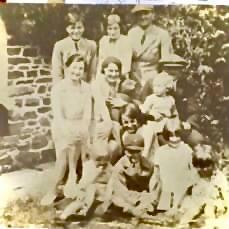
      Samuel Warren, born in 1874 in Newhall, Derbyshire, was my grandmothers father.  This is the only photograph we’ve seen of him (seated on right with cap).  Kay, who died of TB in 1938, is holding the teddy bear. Samuel died in 1950, in Stourbridge, at the age of 76.

      Samuel Warren Kay Warren

      Left to right: back row: Leslie Warren. Hildred Williams / Griffiths (Nee Warren). Billy Warren. 2nd row: Gladys (Gary) Warren. Kay Warren (holding teddy bear). Samuel Warren (father). Hildred’s son Chris Williams (on knee). Lorna Warren. Joan Williams. Peggy Williams (Hildreds daughters). Jack Warren. Betty Warren.

      #6226
      TracyTracy
      Participant

        Border Straddlers of The Midlands

        It has become obvious while doing my family tree that I come from a long line of border straddlers.  We seem to like to live right on the edge of a county, sometimes living on one side of the border, sometimes on the other.  What this means is that for every record search, one must do separate searches in both counties.

        The Purdy’s and Housley’s of Eastwood and Smalley are on the Derbyshire Nottinghamshire border.   The Brookes in Sutton Coldfield are on the Staffordshire Warwickshire border.  The Malkins of Ellastone and Ashbourne are on the Staffordshire Derbyshire border, as are the Grettons and Warrens of Burton Upon Trent. The Warrens and Grettons of  Swadlincote are also on the Leicestershire border, and cross over into Ashby de la Zouch.

        I noticed while doing the family research during the covid restrictions that I am a border straddler too.  My village is half in Cadiz province and half in Malaga, and if I turn right on my morning walk along the dirt roads, I cross the town boundary into Castellar, and if I turn left, I cross into San Roque.  Not to mention at the southern tip of Spain, I’m on the edge of Europe as well.

        More recent generations of the family have emigrated to Canada, USA, South Africa, Australia, and Spain, but researching further back, the family on all sides seems to have stuck to the midlands, like a dart board in the middle of England, the majority in Derbyshire, although there is one family story of Scottish blood.

        #6222
        TracyTracy
        Participant

          George Gilman Rushby: The Cousin Who Went To Africa

          The portrait of the woman has “mother of Catherine Housley, Smalley” written on the back, and one of the family photographs has “Francis Purdy” written on the back. My first internet search was “Catherine Housley Smalley Francis Purdy”. Easily found was the family tree of George (Mike) Rushby, on one of the genealogy websites. It seemed that it must be our family, but the African lion hunter seemed unlikely until my mother recalled her father had said that he had a cousin who went to Africa. I also noticed that the lion hunter’s middle name was Gilman ~ the name that Catherine Housley’s daughter ~ my great grandmother, Mary Ann Gilman Purdy ~ adopted, from her aunt and uncle who brought her up.

          I tried to contact George (Mike) Rushby via the ancestry website, but got no reply. I searched for his name on Facebook and found a photo of a wildfire in a place called Wardell, in Australia, and he was credited with taking the photograph. A comment on the photo, which was a few years old, got no response, so I found a Wardell Community group on Facebook, and joined it. A very small place, population some 700 or so, and I had an immediate response on the group to my question. They knew Mike, exchanged messages, and we were able to start emailing. I was in the chair at the dentist having an exceptionally long canine root canal at the time that I got the message with his email address, and at that moment the song Down in Africa started playing.

          Mike said it was clever of me to track him down which amused me, coming from the son of an elephant and lion hunter.  He didn’t know why his father’s middle name was Gilman, and was not aware that Catherine Housley’s sister married a Gilman.

          Mike Rushby kindly gave me permission to include his family history research in my book.  This is the story of my grandfather George Marshall’s cousin.  A detailed account of George Gilman Rushby’s years in Africa can be found in another chapter called From Tanganyika With Love; the letters Eleanor wrote to her family.

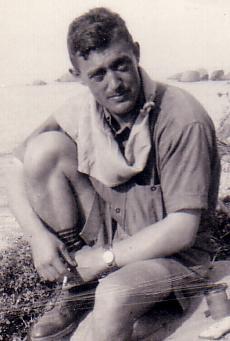
          George Gilman Rushby:

          George Gilman Rushby


          The story of George Gilman Rushby 1900-1969, as told by his son Mike:

          George Gilman Rushby:
          Elephant hunter,poacher, prospector, farmer, forestry officer, game ranger, husband to Eleanor, and father of 6 children who now live around the world.

          George Gilman Rushby was born in Nottingham on 28 Feb 1900 the son of Catherine Purdy and John Henry Payling Rushby. But John Henry died when his son was only one and a half years old, and George shunned his drunken bullying stepfather Frank Freer and was brought up by Gypsies who taught him how to fight and took him on regular poaching trips. His love of adventure and his ability to hunt were nurtured at an early stage of his life.
          The family moved to Eastwood, where his mother Catherine owned and managed The Three Tuns Inn, but when his stepfather died in mysterious circumstances, his mother married a wealthy bookmaker named Gregory Simpson. He could afford to send George to Worksop College and to Rugby School. This was excellent schooling for George, but the boarding school environment, and the lack of a stable home life, contributed to his desire to go out in the world and do his own thing. When he finished school his first job was as a trainee electrician with Oaks & Co at Pye Bridge. He also worked part time as a motor cycle mechanic and as a professional boxer to raise the money for a voyage to South Africa.

          In May 1920 George arrived in Durban destitute and, like many others, living on the beach and dependant upon the Salvation Army for a daily meal. However he soon got work as an electrical mechanic, and after a couple of months had earned enough money to make the next move North. He went to Lourenco Marques where he was appointed shift engineer for the town’s power station. However he was still restless and left the comfort of Lourenco Marques for Beira in August 1921.

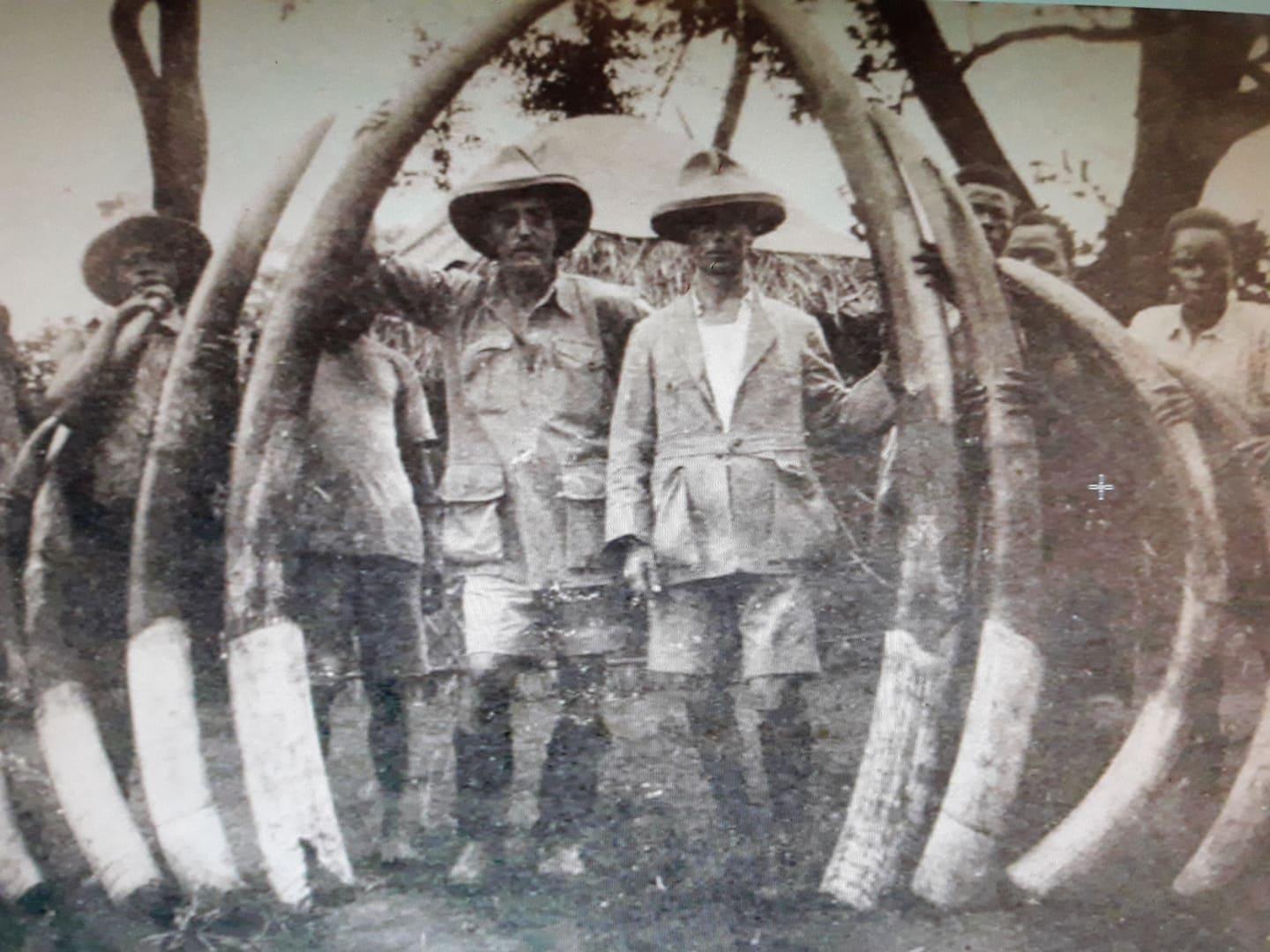
          Beira was the start point of the new railway being built from the coast to Nyasaland. George became a professional hunter providing essential meat for the gangs of construction workers building the railway. He was a self employed contractor with his own support crew of African men and began to build up a satisfactory business. However, following an incident where he had to shoot and kill a man who attacked him with a spear in middle of the night whilst he was sleeping, George left the lower Zambezi and took a paddle steamer to Nyasaland (Malawi). On his arrival in Karongo he was encouraged to shoot elephant which had reached plague proportions in the area – wrecking African homes and crops, and threatening the lives of those who opposed them.

          His next move was to travel by canoe the five hundred kilometre length of Lake Nyasa to Tanganyika, where he hunted for a while in the Lake Rukwa area, before walking through Northern Rhodesia (Zambia) to the Congo. Hunting his way he overachieved his quota of ivory resulting in his being charged with trespass, the confiscation of his rifles, and a fine of one thousand francs. He hunted his way through the Congo to Leopoldville then on to the Portuguese enclave, near the mouth of the mighty river, where he worked as a barman in a rough and tough bar until he received a message that his old friend Lumb had found gold at Lupa near Chunya. George set sail on the next boat for Antwerp in Belgium, then crossed to England and spent a few weeks with his family in Jacksdale before returning by sea to Dar es Salaam. Arriving at the gold fields he pegged his claim and almost immediately went down with blackwater fever – an illness that used to kill three out of four within a week.

          When he recovered from his fever, George exchanged his gold lease for a double barrelled .577 elephant rifle and took out a special elephant control licence with the Tanganyika Government. He then headed for the Congo again and poached elephant in Northern Rhodesia from a base in the Congo. He was known by the Africans as “iNyathi”, or the Buffalo, because he was the most dangerous in the long grass. After a profitable hunting expedition in his favourite hunting ground of the Kilombera River he returned to the Congo via Dar es Salaam and Mombassa. He was after the Kabalo district elephant, but hunting was restricted, so he set up his base in The Central African Republic at a place called Obo on the Congo tributary named the M’bomu River. From there he could make poaching raids into the Congo and the Upper Nile regions of the Sudan. He hunted there for two and a half years. He seldom came across other Europeans; hunters kept their own districts and guarded their own territories. But they respected one another and he made good and lasting friendships with members of that small select band of adventurers.

          Leaving for Europe via the Congo, George enjoyed a short holiday in Jacksdale with his mother. On his return trip to East Africa he met his future bride in Cape Town. She was 24 year old Eleanor Dunbar Leslie; a high school teacher and daughter of a magistrate who spent her spare time mountaineering, racing ocean yachts, and riding horses. After a whirlwind romance, they were betrothed within 36 hours.

          On 25 July 1930 George landed back in Dar es Salaam. He went directly to the Mbeya district to find a home. For one hundred pounds he purchased the Waizneker’s farm on the banks of the Mntshewe Stream. Eleanor, who had been delayed due to her contract as a teacher, followed in November. Her ship docked in Dar es Salaam on 7 Nov 1930, and they were married that day. At Mchewe Estate, their newly acquired farm, they lived in a tent whilst George with some help built their first home – a lovely mud-brick cottage with a thatched roof. George and Eleanor set about developing a coffee plantation out of a bush block. It was a very happy time for them. There was no electricity, no radio, and no telephone. Newspapers came from London every two months. There were a couple of neighbours within twenty miles, but visitors were seldom seen. The farm was a haven for wild life including snakes, monkeys and leopards. Eleanor had to go South all the way to Capetown for the birth of her first child Ann, but with the onset of civilisation, their first son George was born at a new German Mission hospital that had opened in Mbeya.

          Occasionally George had to leave the farm in Eleanor’s care whilst he went off hunting to make his living. Having run the coffee plantation for five years with considerable establishment costs and as yet no return, George reluctantly started taking paying clients on hunting safaris as a “white hunter”. This was an occupation George didn’t enjoy. but it brought him an income in the days when social security didn’t exist. Taking wealthy clients on hunting trips to kill animals for trophies and for pleasure didn’t amuse George who hunted for a business and for a way of life. When one of George’s trackers was killed by a leopard that had been wounded by a careless client, George was particularly upset.
          The coffee plantation was approaching the time of its first harvest when it was suddenly attacked by plagues of borer beetles and ring barking snails. At the same time severe hail storms shredded the crop. The pressure of the need for an income forced George back to the Lupa gold fields. He was unlucky in his gold discoveries, but luck came in a different form when he was offered a job with the Forestry Department. The offer had been made in recognition of his initiation and management of Tanganyika’s rainbow trout project. George spent most of his short time with the Forestry Department encouraging the indigenous people to conserve their native forests.

          In November 1938 he transferred to the Game Department as Ranger for the Eastern Province of Tanganyika, and over several years was based at Nzasa near Dar es Salaam, at the old German town of Morogoro, and at lovely Lyamungu on the slopes of Kilimanjaro. Then the call came for him to be transferred to Mbeya in the Southern Province for there was a serious problem in the Njombe district, and George was selected by the Department as the only man who could possibly fix the problem.

          Over a period of several years, people were being attacked and killed by marauding man-eating lions. In the Wagingombe area alone 230 people were listed as having been killed. In the Njombe district, which covered an area about 200 km by 300 km some 1500 people had been killed. Not only was the rural population being decimated, but the morale of the survivors was so low, that many of them believed that the lions were not real. Many thought that evil witch doctors were controlling the lions, or that lion-men were changing form to kill their enemies. Indeed some wichdoctors took advantage of the disarray to settle scores and to kill for reward.

          By hunting down and killing the man-eaters, and by showing the flesh and blood to the doubting tribes people, George was able to instil some confidence into the villagers. However the Africans attributed the return of peace and safety, not to the efforts of George Rushby, but to the reinstallation of their deposed chief Matamula Mangera who had previously been stood down for corruption. It was Matamula , in their eyes, who had called off the lions.

          Soon after this adventure, George was appointed Deputy Game Warden for Tanganyika, and was based in Arusha. He retired in 1956 to the Njombe district where he developed a coffee plantation, and was one of the first in Tanganyika to plant tea as a major crop. However he sensed a swing in the political fortunes of his beloved Tanganyika, and so sold the plantation and settled in a cottage high on a hill overlooking the Navel Base at Simonstown in the Cape. It was whilst he was there that TV Bulpin wrote his biography “The Hunter is Death” and George wrote his book “No More The Tusker”. He died in the Cape, and his youngest son Henry scattered his ashes at the Southern most tip of Africa where the currents of the Atlantic and Indian Oceans meet .

          George Gilman Rushby:

          #6219
          TracyTracy
          Participant

            The following stories started with a single question.

            Who was Catherine Housley’s mother?

            But one question leads to another, and another, and so this book will never be finished.  This is the first in a collection of stories of a family history research project, not a complete family history.  There will always be more questions and more searches, and each new find presents more questions.

            A list of names and dates is only moderately interesting, and doesn’t mean much unless you get to know the characters along the way.   For example, a cousin on my fathers side has already done a great deal of thorough and accurate family research. I copied one branch of the family onto my tree, going back to the 1500’s, but lost interest in it after about an hour or so, because I didn’t feel I knew any of the individuals.

            Parish registers, the census every ten years, birth, death and marriage certificates can tell you so much, but they can’t tell you why.  They don’t tell you why parents chose the names they did for their children, or why they moved, or why they married in another town.  They don’t tell you why a person lived in another household, or for how long. The census every ten years doesn’t tell you what people were doing in the intervening years, and in the case of the UK and the hundred year privacy rule, we can’t even use those for the past century.  The first census was in 1831 in England, prior to that all we have are parish registers. An astonishing amount of them have survived and have been transcribed and are one way or another available to see, both transcriptions and microfiche images.  Not all of them survived, however. Sometimes the writing has faded to white, sometimes pages are missing, and in some case the entire register is lost or damaged.

            Sometimes if you are lucky, you may find mention of an ancestor in an obscure little local history book or a journal or diary.  Wills, court cases, and newspaper archives often provide interesting information. Town memories and history groups on social media are another excellent source of information, from old photographs of the area, old maps, local history, and of course, distantly related relatives still living in the area.  Local history societies can be useful, and some if not all are very helpful.

            If you’re very lucky indeed, you might find a distant relative in another country whose grandparents saved and transcribed bundles of old letters found in the attic, from the family in England to the brother who emigrated, written in the 1800s.  More on this later, as it merits its own chapter as the most exciting find so far.

            The social history of the time and place is important and provides many clues as to why people moved and why the family professions and occupations changed over generations.  The Enclosures Act and the Industrial Revolution in England created difficulties for rural farmers, factories replaced cottage industries, and the sons of land owning farmers became shop keepers and miners in the local towns.  For the most part (at least in my own research) people didn’t move around much unless there was a reason.  There are no reasons mentioned in the various registers, records and documents, but with a little reading of social history you can sometimes make a good guess.  Samuel Housley, for example, a plumber, probably moved from rural Derbyshire to urban Wolverhampton, when there was a big project to install indoor plumbing to areas of the city in the early 1800s.  Derbyshire nailmakers were offered a job and a house if they moved to Wolverhampton a generation earlier.

            Occasionally a couple would marry in another parish, although usually they married in their own. Again, there was often a reason.  William Housley and Ellen Carrington married in Ashbourne, not in Smalley.  In this case, William’s first wife was Mary Carrington, Ellen’s sister.  It was not uncommon for a man to marry a deceased wife’s sister, but it wasn’t strictly speaking legal.  This caused some problems later when William died, as the children of the first wife contested the will, on the grounds of the second marriage being illegal.

            Needless to say, there are always questions remaining, and often a fresh pair of eyes can help find a vital piece of information that has escaped you.  In one case, I’d been looking for the death of a widow, Mary Anne Gilman, and had failed to notice that she remarried at a late age. Her death was easy to find, once I searched for it with her second husbands name.

            This brings me to the topic of maternal family lines. One tends to think of their lineage with the focus on paternal surnames, but very quickly the number of surnames increases, and all of the maternal lines are directly related as much as the paternal name.  This is of course obvious, if you start from the beginning with yourself and work back.  In other words, there is not much point in simply looking for your fathers name hundreds of years ago because there are hundreds of other names that are equally your own family ancestors. And in my case, although not intentionally, I’ve investigated far more maternal lines than paternal.

            This book, which I hope will be the first of several, will concentrate on my mothers family: The story so far that started with the portrait of Catherine Housley’s mother.
            Elizabeth Brookes


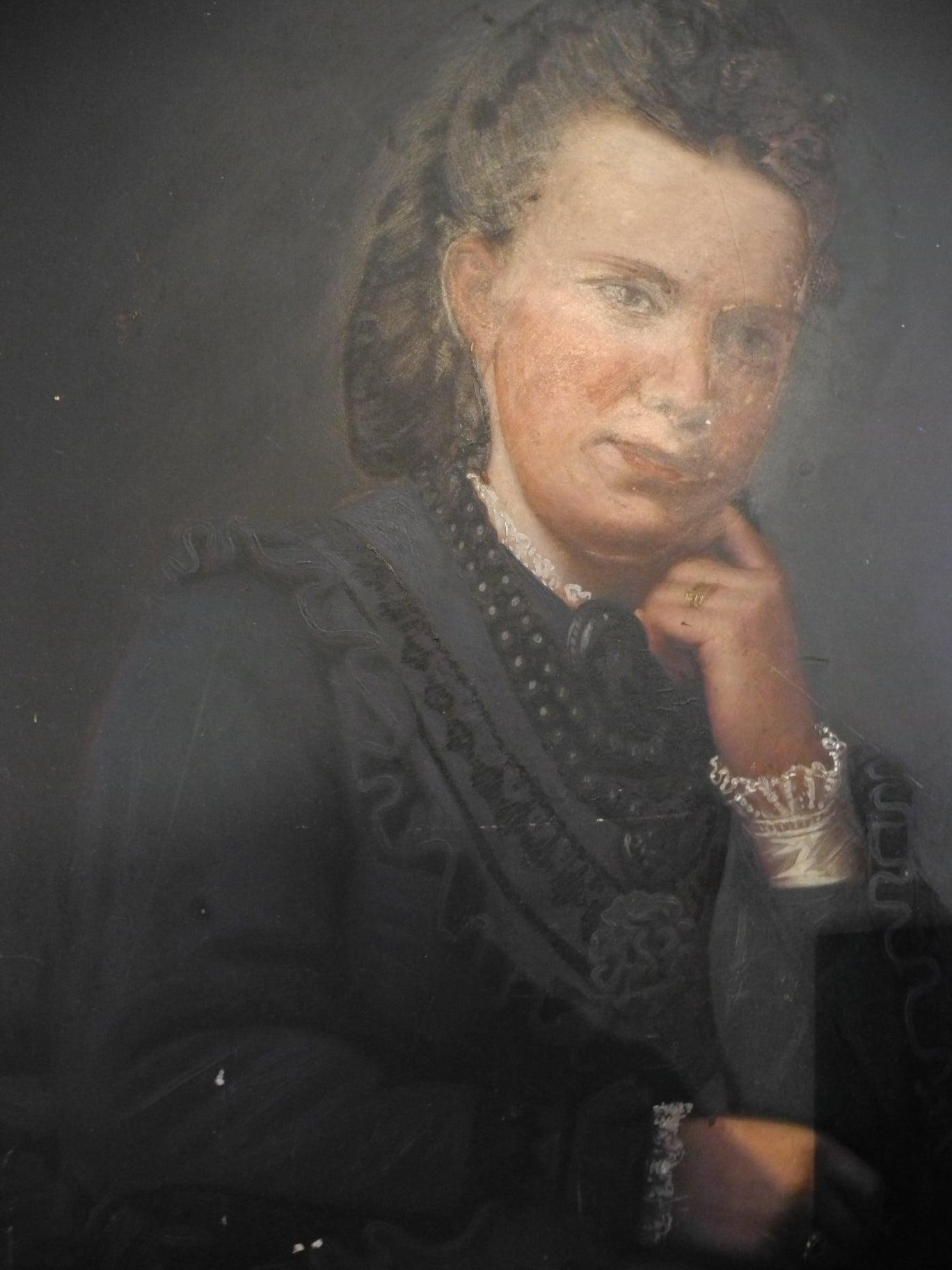
            This painting, now in my mothers house, used to hang over the piano in the home of her grandparents.   It says on the back “Catherine Housley’s mother, Smalley”.

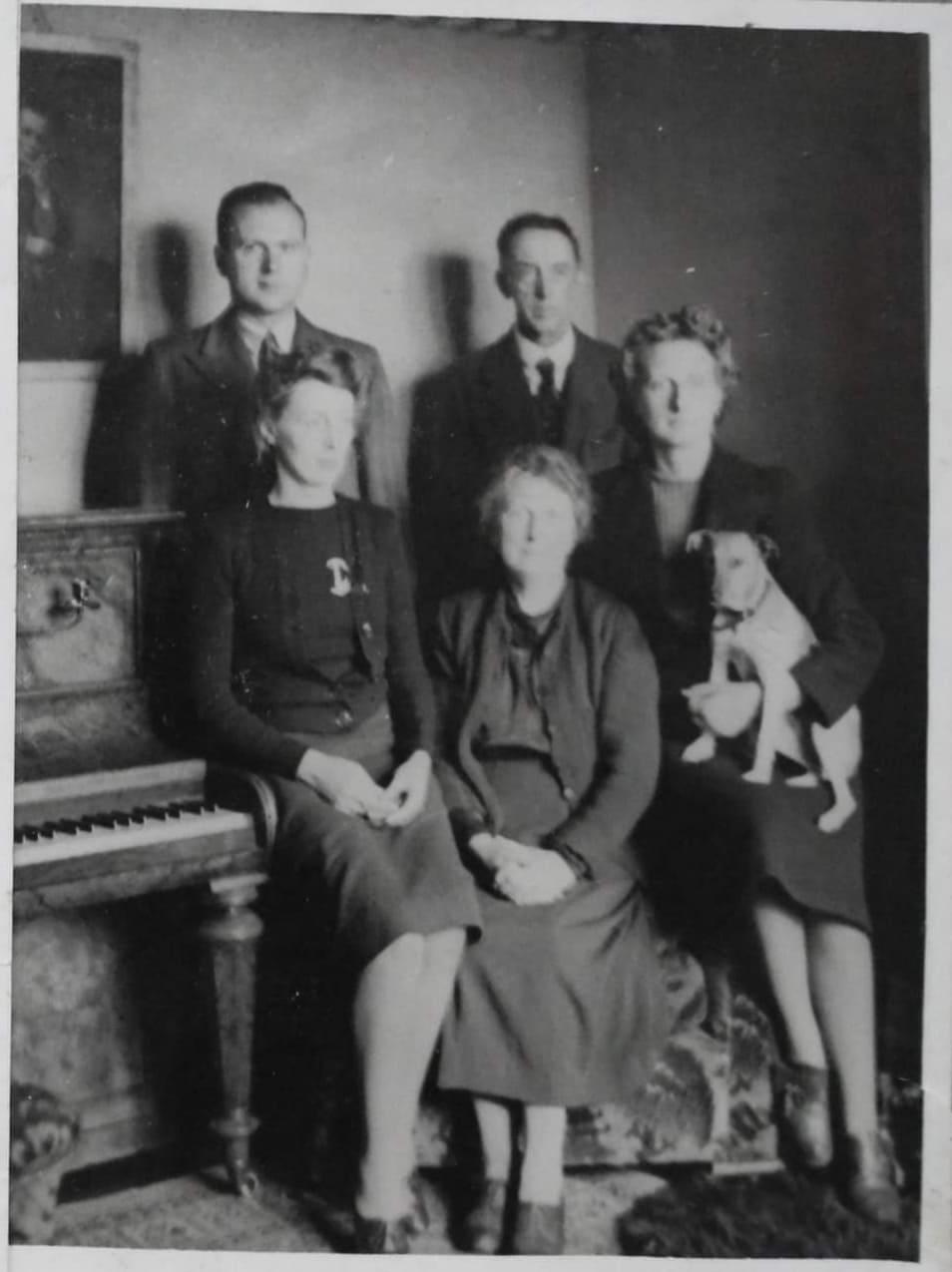
            The portrait of Catherine Housley’s mother can be seen above the piano. Back row Ronald Marshall, my grandfathers brother, William Marshall, my great grandfather, Mary Ann Gilman Purdy Marshall in the middle, my great grandmother, with her daughters Dorothy on the left and Phyllis on the right, at the Marshall’s house on Love Lane in Stourbridge.
            Marshalls


            The Search for Samuel Housley

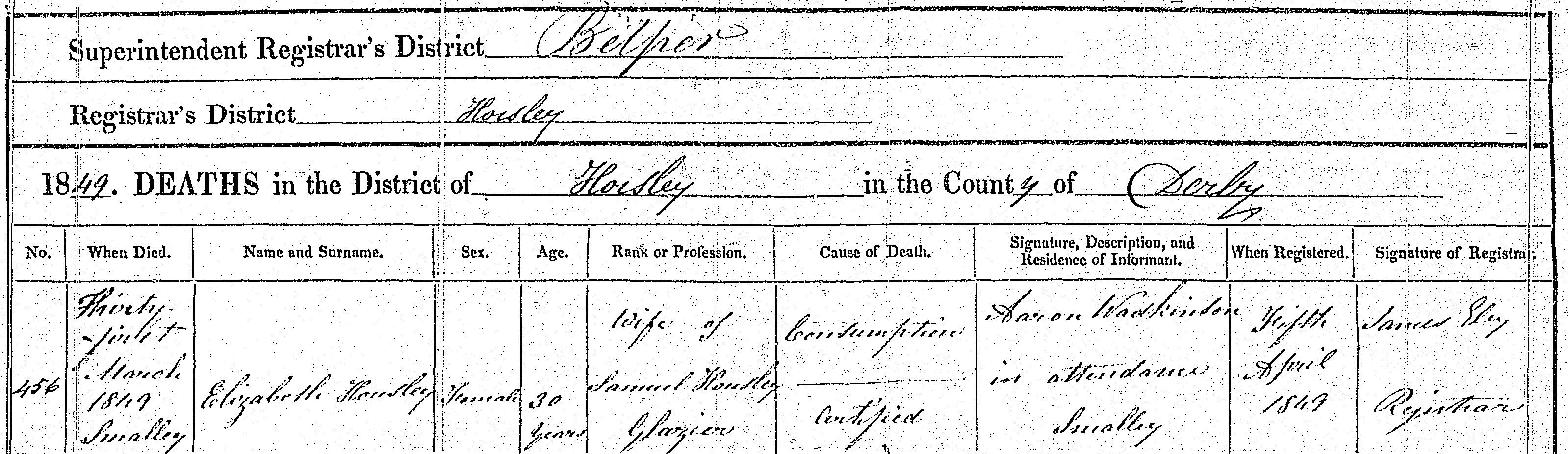
            As soon as the search for Catherine Housley’s mother was resolved, achieved by ordering a paper copy of her birth certificate, the search for Catherine Housley’s father commenced. We know he was born in Smalley in 1816, son of William Housley and Ellen Carrington, and that he married Elizabeth Brookes in Wolverhampton in 1844. He was a plumber and glazier. His three daughters born between 1845 and 1849 were born in Smalley. Elizabeth died in 1849 of consumption, but Samuel didn’t register her death. A 20 year old neighbour called Aaron Wadkinson did.
            Elizabeth death


            Where was Samuel?

            On the 1851 census, two of Samuel’s daughters were listed as inmates in the Belper Workhouse, and the third, 2 year old Catherine, was listed as living with John Benniston and his family in nearby Heanor.  Benniston was a framework knitter.

            Where was Samuel?

            A long search through the microfiche workhouse registers provided an answer. The reason for Elizabeth and Mary Anne’s admission in June 1850 was given as “father in prison”. In May 1850, Samuel Housley was sentenced to one month hard labour at Derby Gaol for failing to maintain his three children. What happened to those little girls in the year after their mothers death, before their father was sentenced, and they entered the workhouse? Where did Catherine go, a six week old baby? We have yet to find out.
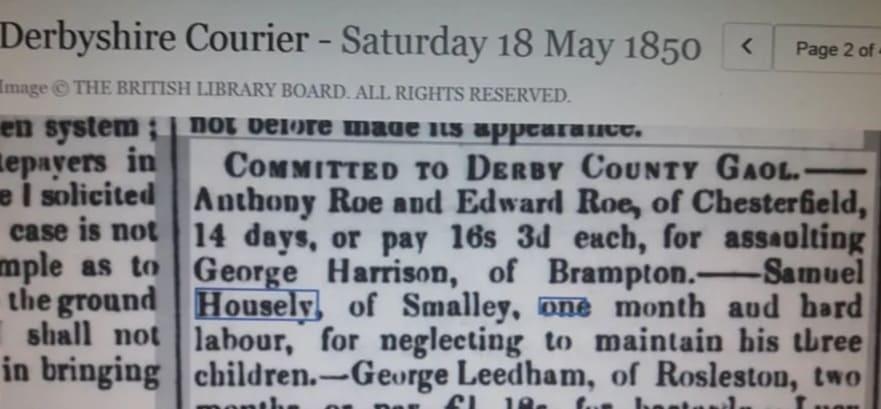
            Samuel Housley 1850


            And where was Samuel Housley in 1851? He hasn’t appeared on any census.

            According to the Belper workhouse registers, Mary Anne was discharged on trial as a servant February 1860. She was readmitted a month later in March 1860, the reason given: unwell.

            Belper Workhouse:
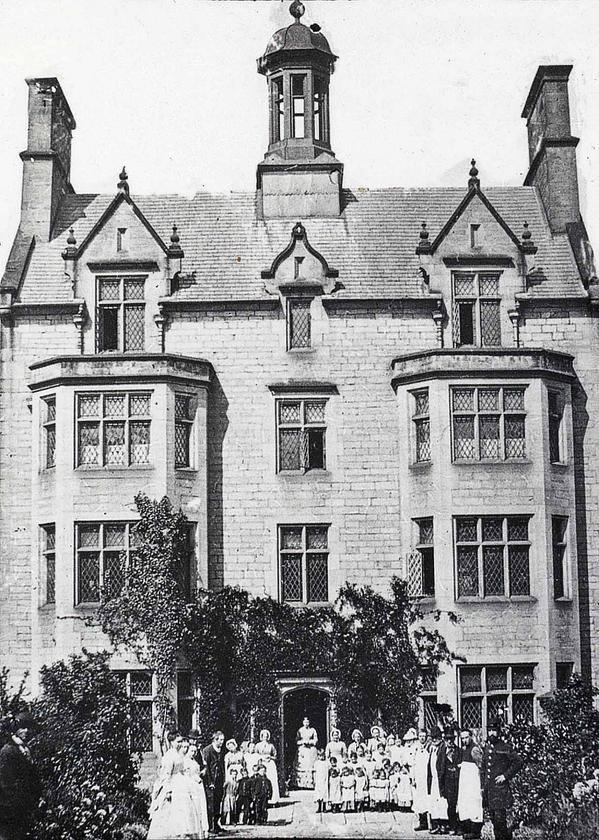
            Belper Workhouse

            Eventually, Mary Anne and Elizabeth were discharged, in April 1860, with an aunt and uncle. The workhouse register doesn’t name the aunt and uncle. One can only wonder why it took them so long.
            On the 1861 census, Elizabeth, 16 years old, is a servant in St Peters, Derby, and Mary Anne, 15 years old, is a servant in St Werburghs, Derby.

            But where was Samuel?

            After some considerable searching, we found him, despite a mistranscription of his name, on the 1861 census, living as a lodger and plumber in Darlaston, Walsall.
            Eventually we found him on a 1871 census living as a lodger at the George and Dragon in Henley in Arden. The age is not exactly right, but close enough, he is listed as an unmarried painter, also close enough, and his birth is listed as Kidsley, Derbyshire. He was born at Kidsley Grange Farm. We can assume that he was probably alive in 1872, the year his mother died, and the following year, 1873, during the Kerry vs Housley court case.
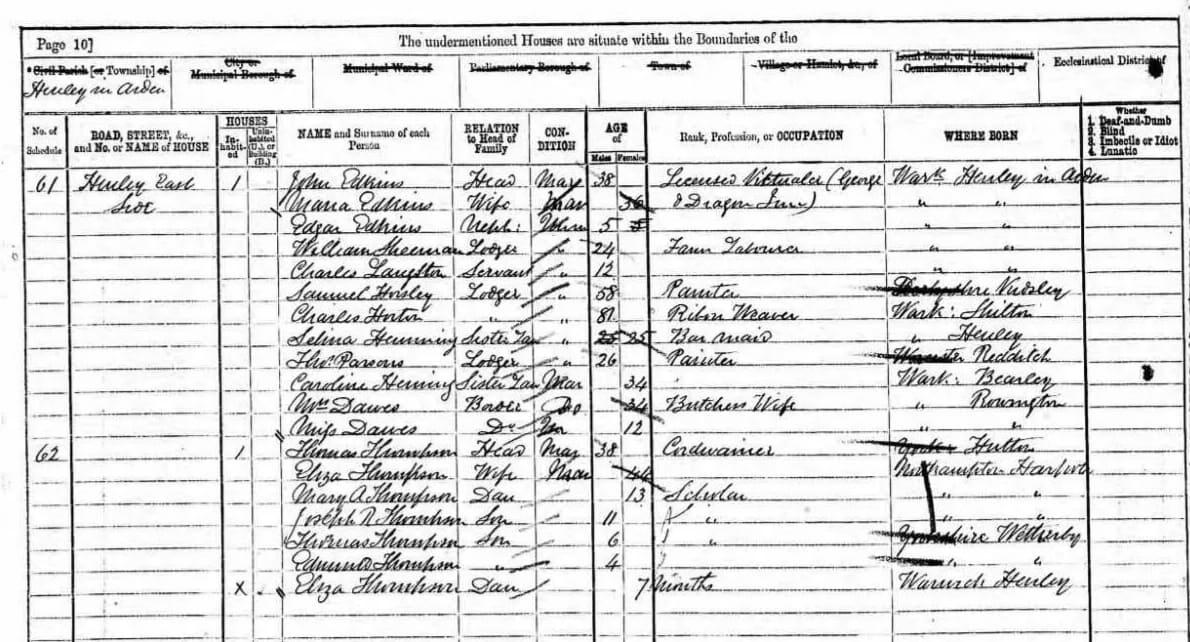
            Samuel Housley 1871


            I found some living Housley descendants in USA. Samuel Housley’s brother George emigrated there in 1851. The Housley’s in USA found letters in the attic, from the family in Smalley ~ written between 1851 and 1870s. They sent me a “Narrative on the Letters” with many letter excerpts.

            The Housley family were embroiled in a complicated will and court case in the early 1870s. In December 15, 1872, Joseph (Samuel’s brother) wrote to George:

            “I think we have now found all out now that is concerned in the matter for there was only Sam that we did not know his whereabouts but I was informed a week ago that he is dead–died about three years ago in Birmingham Union. Poor Sam. He ought to have come to a better end than that….His daughter and her husband went to Birmingham and also to Sutton Coldfield that is where he married his wife from and found out his wife’s brother. It appears he has been there and at Birmingham ever since he went away but ever fond of drink.”

            No record of Samuel Housley’s death can be found for the Birmingham Union in 1869 or thereabouts.

            But if he was alive in 1871 in Henley In Arden…..
            Did Samuel tell his wife’s brother to tell them he was dead? Or did the brothers say he was dead so they could have his share?

            We still haven’t found a death for Samuel Housley.



            #6191

            VanGogh darted toward the cypress fence and when close enough started to bark.

            “Good dog!” said a feminine voice, “You recognised me?” It was Julienne, she was about the same age as Bob and lived in the old vicarage not far from Bob’s house. “I was tending to my raspberry trees and I thought I could bring you some of the offshoots”, she said showing her pink plastic bag. “Hi Clara, I didn’t know you were there,” she added as if she should have.

            Clara looked at Bob. Not a word, he said with his lips.

            #6185

            “I’ll be right back!” Nora told Will, who was stirring a big bubbling pot on the stove. “Need to wash my hands.”

            She had a quick look around the bedroom she’d slept in for her missing phone. Nowhere to be found!  Maybe she could find Will’s phone when he went out to feed the donkey, and call her phone to try and locate it. Damn, that wouldn’t work either. Will had said there was no network here. That would explain why her phone stopped working when she was alone in the dark woods.

            “Smells delicious!” she said brightly, scraping a chair back across the brick floor and seating herself at the kitchen table.

            The home made soup was chock full of vegetables and looked and smelled wonderful, but it had a peculiar acrid aftertaste.  Nora tried to ignore it, taking gulps of wine in between each mouthful to eliminate the bitterness.  She wished it wasn’t soup in a way, so that she’d be able to surreptitiously palm some of it off onto the dogs that were waiting hopefully under the table.  If only Will would leave the room for a minute, but he seemed to be watching her every move.

            “Very tasty, but I can’t manage another mouthful, it’s so filling,” she said, but Will looked so offended that she sighed and carried on eating. He topped up her wine glass.

            By the time Nora had finished the soup, she felt quite nauseous and stood up quickly to head for the bathroom. The room started to spin and she held on to the edge of the table, but it was no good. The spinning didn’t stop and she crashed to the floor, unconscious.

            Smiling with satisfaction, Will stood up and walked around the table to where she lay. Shame he’d had to put her to sleep, really she was quite a nice woman and cute, too, in a funny elfin way.  He’d started to like her.  Plenty of time to get to know her now, anyway. She wouldn’t be going anywhere for awhile.

            He picked her up and carried her to the secret room behind his workshop on the other side of the patio.  The walls and floor were thick stone, and there were no windows.  He laid her on the bench, locked the door, and went back in the house to fetch blankets and bedding and a pile of books for her to read when she came round.  Probably not for a good 24 hours he reckoned, somehow she’d managed to eat all the soup.  He would put much less in the next batch, just enough to keep her docile and sleepy.

            It would only be for a few days, just long enough for him to find that box and move it to a safer location. He’d been entrusted to make sure the contents of the box were preserved for the people in the future, and he was a man of his word.

            If they had listened to him in the first place this would never have happened.  Burying a box was a risk: all kinds of possibilities existed for a buried box to be accidentally unearthed.   He had suggested encasing the contents inside a concrete statue, but they’d ignored him. Well, now was his chance.  He was looking forward to making a new statue.

            #6176
            ÉricÉric
            Keymaster

              Godfrey was getting itchy. The hazmat suit with built-in peanut dispenser was getting stickier by the minute, but he needed it to stay in the room, and provide the moral support Liz’ needed during her bout of glowid.

              She’d caught a mean streak, some said a Tartessian variant, which like all version caused the subject to gradually lose sense of inhibition (which in the case of Liz’ made the changes in her normal behaviour so subtle, it could have explain why it wasn’t detected until much later). After that, the usual symptoms of glowing started to display themselves. At first, Liz’ had dismissed them as hot flashes, but when she started to faintly glow in the dark, there was no longer room for hesitation. She had to be put in solitary confinement and monitored to keep her from sparkling, which was the severe form of the malady.

              “Bronkel has called” Godfrey said in between mouthfuls. “Actually his secretary did. He sent a list of words to inspire you back into writing.”

              “Trend surfing keywords now?” Liz’ was inflamed and started to blink like a police siren. “I AM setting the future trends, so he’d rather let me do my job, or I’ll publish elsewhere.”

              “And…” Godfrey ventured softly “… care to share what new trends you’ve been blazing lately?”

              Finnley chuckled at the inappropriate choice of words.

              #6167

              “Box?” said Bob placing a hand on his chest. “Not the … ”

              “Not box, Grandpa. Crops.” Clara spoke loudly. Poor old Grandpa must be going a bit deaf as well—he’d gone downhill since Grandma died. “His dogs got into your garden and dug up the crops. He says he’ll come by in the morning and fix up the damage. ”

              “No, need to shout, Clara. I swear you said box. I thought you meant the box in the garage.”

              “Oh, no that would be awful!” Clara shuddered at the thought of anything happening to her precious treasure. “Maybe we should bring the box inside, Grandpa? Make sure it’s safe.”

              Bob sighed. Last thing he wanted was the damn box inside the house. But Clara had that look on her face, the one that means she’s made up her mind. He glanced around, wondering where they could put it so it was out of the way.

              “Hey!” exclaimed Clara. “Where’s VanGogh gone? Did he sneak outside when Mr Willets came.” She went to the door and peered out into the darkness. “VanGogh! Here, Boy!” she shouted. “VanGogh!”

              #6164

              VanGogh was sniffing frantically on the patio outside the house, a usual indication that he’d found the perfect spot for a healthy stool, but this time, as soon as Clara had looked the other way to take care of the sautéed mushrooms on the stove, he darted for the shed where the odd big toy had been unearthed and stored out of sight.

              His tail wagged frantically as he pushed the door open, and slid underneath the tarpaulin behind the sleeping lawn-eater.

              He started to scratch the box, the way he usually tried to open the puzzle ball Clara would fill with some kibble. It didn’t roll like the ball-that-dispensed-kibble. In frustration, VanGogh started to push his paws on the sleek smooth surface, near the curious indentations.

              Something clicked open.

              “VanGogh! Where are you boy?! Come!”

              Suddenly distracted from this puzzling quest, he rushed to the kitchen for dinner.

              #6161

              Dispersee sat on a fallen tree trunk, lost in thought. A long walk in the woods had seemed just the ticket……

              Nora wasn’t surprised to encounter a fallen tree trunk no more than 22 seconds after the random thought wafted through her mind ~ if thought was was the word for it ~ about Dispersee sitting on a fallen tree trunk.  Nora sat on the tree trunk ~ of course she had to sit on it; how could she not ~  simultaneously stretching her aching back and wondering who Dispersee might be.  Was it a Roman name?  Something to do with the garum on the shopping receipt?

              Nora knew she wasn’t going to get to the little village before night fall. Her attempts to consult the map failed. It was like a black hole.  No signal, no connection, just a blank screen.  She looked up at the sky.  The lowering dark clouds were turning orange and red as the sun went down behind the mountains, etching the tree skeletons in charcoal black in the middle distance.

              In a sudden flash of wordless alarm, Nora realized she was going to be out alone in the woods at night and wild boars are nocturnal and a long challenging walk in broad daylight was one thing but alone at night in the woods with the wild boars was quite another, and in a very short time indeed had worked herself up into a state approaching panic, and then had another flash of alarm when she realized she felt she would swoon in any moment and fall off the fallen trunk. The pounding of her, by then racing, heartbeats was yet further cause for alarm, and as is often the case, the combination of factors was sufficiently noteworthy to initiate a thankfully innate ability to re establish a calm lucidity, and pragmatic attention to soothe the beating physical heart as a matter of priority.

              It was at the blessed moment of restored equilibrium and curiosity (and the dissipation of the alarm and associated malfunctions) that the man appeared with the white donkey.

              #6157

              Bob sighed loudly as he rummaged through the odds and ends drawer: old menus from the takeaways in town, pens, rubber bands, a button, reading glasses, newspaper clippings. He’d never expected to need the phone number; now he did and what do you know? He can’t find the damn thing.

              “What a shameful mess that drawer is in,” said Jane. She was seated at the kitchen table, arms folded, shaking her head at him. She looked about twenty today with her dark hair cascading prettily over a lacy pink mini dress.

              Bob  frowned at her though his heart did a leap. The way it always did when he saw her. “You were the one who kept it clean and you jumped ship.  And I’ve said, can’t you look your age?”

              “Don’t I look pretty?” She pouted and fluttered long eyelashes at him.

              “Makes me feel old. And I don’t recognise you like that.”

              “You are old,” she said as her hair turned white. “And bad-tempered as ever. What are you hunting for?”

              “The phone number. You know the one he said to call if the box was ever unearthed. Can’t find it anywhere.”

              “You’d lose your head …”  said Jane as her head lifted off her body.

              Bob jumped. “Darn it, Jane. I’ve said don’t do that! Why do you always do that and go giving me the heebie jeebies?”

              “Cos I can, love.” She grinned mischievously before settling her head back on her shoulders. “Just a bit of fun. Now think hard, where else might you have put it? The shoe-box under our bed? The safe in the pantry?”

              Bob flung a hand to his head. “The shoe-box! That’s where it will be!”

              Jane grinned. “Well, get a move-along, old man. Before our Clara gets in more deep than what’s good for her. She won’t let it go now she’s found it. Stubborn as a mule my grandchild,” she added proudly.

              Bob reached a hand to her. “Come with me while I look? I miss you, Jane. You never stay long enough.”

              “Oh stop with all the sweet talk!” She poked her tongue out at him. “Anyway I’ve told you before, it takes too much energy.” She was fading and Bob felt his chest tighten. “Don’t worry, I’m keeping an eye on you, old man.” She was vibrating air now, sparkly and pink.

              #6156

              Clara couldn’t sleep. Alienor’s message asking if she knew anyone in the little village was playing on her mind. She knew she knew someone there, but couldn’t remember who it was. The more she tried to remember, the more frustrated she became. It wasn’t that her mind was blank: it was a tense conglomeration of out of focus wisps, if a wisp could be described as tense.

              Clara glanced at the time ~ almost half past three. Grandpa would be up in a few hours.  She climbed out of bed and padded over to her suitcase, half unpacked on the floor under the window, and extracted the book from the jumble of garments.

              A stranger had handed her a book in the petrol station forecourt, a woman in a stylish black hat and a long coat.  Wait! What is it? Clara called, but the woman was already inside the back seat of a long sleek car, soundlessly closing the door. Obliged to attend to her transaction, the car slipped away behind Clara’s back.  Thank you, she whispered into the distance of the dark night in the direction the woman had gone.  When she opened her car door, the interior light shone on the book and the word Albina caught her eye. She put the book on the passenger seat and started the car. Her thoughts returned to her journey, and she thought no more about it.

              Returning to her bed and propping her pillows up behind her head, Clara started to read.

              This Chrysoprase was a real gargoyle; he even did not need to be described. I just could not understand how he moved if he was made of stone, not to mention how he was able to speak. He was like the Stone Guest from the story Don Juan, though the Stone Guest was a giant statue, and Chrysoprase was only about a meter tall.

              Chrysoprase said: But we want to pay you honor and Gerard is very hungry.

              “Most important is wine, don’t forget wine!” – Gerard jumped up.

              “I’ll call the kitchen” – here the creature named Chrysoprase gets from the depth of his pocket an Iphone and calls.
              I was absolutely shocked. The Iphone! The latest model! It was not just the latest model, it was a model of the future, which was in the hands of this creature. I said that he was made of stone, no, now he was made of flesh and he was already dressed in wide striped trousers. What is going on? Is it a dream? Only in dreams such metamorphosis can happen.

              He was made of stone, now he is made of flesh. He was in his natural form, that is, he was not dressed, and now he is wearing designer’s trousers. A phrase came to my mind: “Everything was in confusion in the Oblonsky house.”

              Contrary to Clara’s expectations ~ reading in bed invariably sent her to sleep after a few paragraphs ~ she found she was wide awake and sitting bolt upright.

              Of course! Now she remembered who lived in that little village!

              #6155

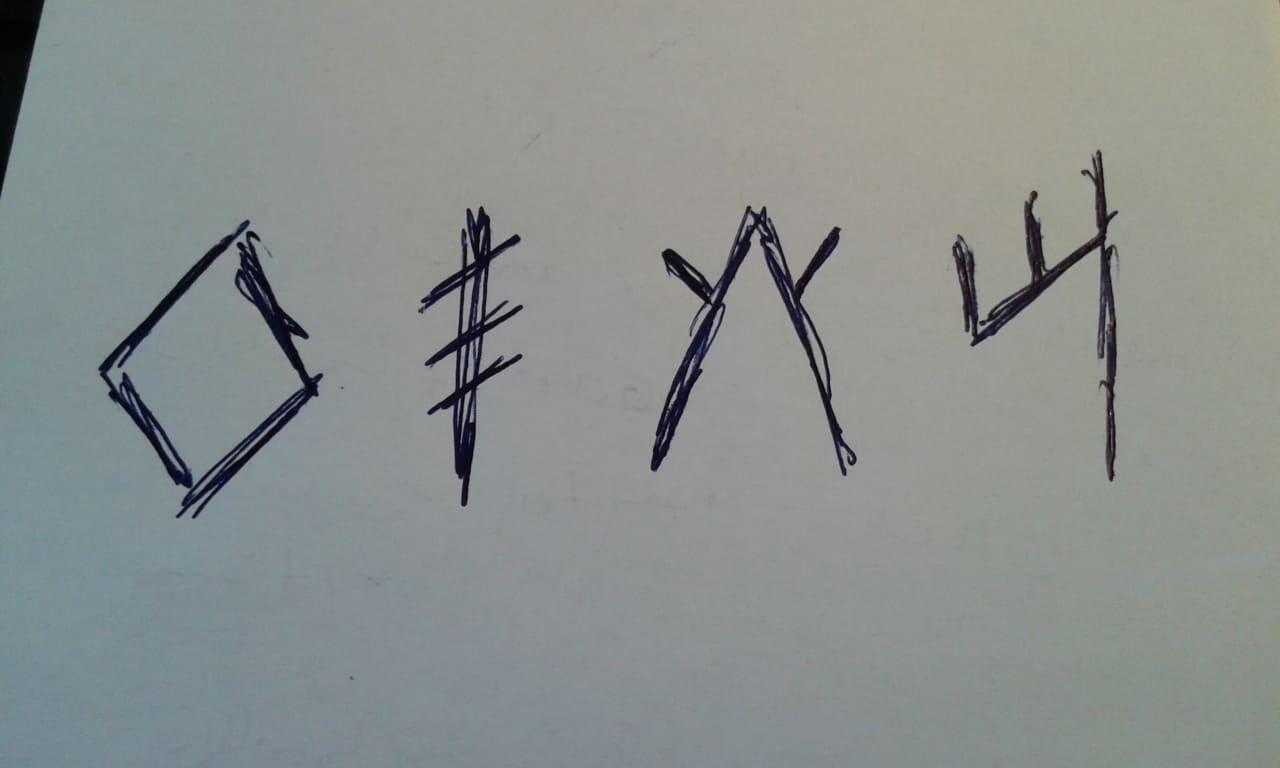
              Damn these municipal restrictions! Frustrated, Nora looked again at the photo of the inscriptions on the mysterious pear shaped box that Clara had found.  She picked up a pen and copied the symbols onto a piece of paper. Glancing back over the message her friend had sent, her face softened at Clara’s pet name for her, Alienor.  Clara had started called her that years ago, when she found out about the ouija board incident and the aliens Nora had been talking to.  Was it really an alien, or….? Clara had asked, and Nora had laughed and said Of course it was an alien or! and the name had stuck.

              Nora’s mood had changed with the reminiscence, and she had an idea. She was working from home, but all that really meant was that she had to have internet access. Nobody would have to know which home she was working from, if she could just make it past the town barriers.  But she didn’t have to go by road: the barriers were only on the roads.  There was nothing stopping her walking cross country.

              Putting aside the paper with the symbols on, she perused a map.  She had to cross three town boundaries, and by road it was quite a distance. But as the crow flies, not that far.  And if she took the old smugglers track, it was surprisingly direct.  Nora calculated the distance: forty nine kilometers.  Frowning, she wondered if she could walk that distance in a single day and thought it unlikely.   Three days more like, but maybe she could do it in two, at a push.  That would mean one overnight stay somewhere. What a pity it was so cold!  It would mean carrying a warm sleeping bag, and she hated carrying things.

              Nora looked at the map again, and found the halfway point: it was a tiny hamlet. A perfect place to spend the night. If only she knew someone who lived there, somebody who wouldn’t object to her breaking the restrictions.

              Nora yawned. It was late. She would finalize the plan tomorrow, but first she sent a message to Clara, asking her if she knew anyone in the little village.

              #6152

              By now, the trench had been dug deeply around the mysterious artefact. It was surprisingly not rusty at all, and the box was large and oddly pear-shaped. There was no obvious lid nor hinge. Nothing that seemed ancient per say, and yet, given the depth of the dig, it was probably coming from a past long gone.

              Clara had posted some pics to Alienor, her friend and amateur archeologist, and she’d been immediately intrigued (an slightly jealous at the find). There were still strict restriction in place, so she couldn’t come immediately, but you could hear from the tone of her voice messages, she was dying to become an outlaw to see the wonder in situ.

              “Come on Clare, it’s going to be dark soon, we should go home or you’ll catch a cold.”

              “Alright Granpa, but help me first get that out in the garage, we can’t let it outside unprotected.”

              VanGogh barked approvedly.

              #6142

              Everyone seems happy about the rain, and I don’t blame them. I’m not daft, I know we need rain but it’s not so easy when you don’t have a home.  But I am nothing if not stalwart and stoic, resourceful and adaptable, and I found a good way to keep warm and dry during the downpours.  It’s amazing how much heat an animal gives off, so I camp down in stables or kennels when it’s cold and wet.  It can get a bit smelly, but it’s warm and dry and when my clothes are damp and stinking I just throw them all away and get some new ones out of the recycling bins. Just to clarify, I find the new clothes first before throwing the ones I’m wearing away. I’m not daft, I know walking around naked would catch attention and I try to stay under the radar. Nobody really notices smelly old ladies wandering around these days anyway, but naked would be another matter.

              There’s a stable I really like just outside of town, lots of nice deep clean straw. There’s a white horse in there that knows me now and the gentle whicker of recognition when she sees me warms my heart. I don’t stay there any two nights running though.  One thing I’ve learned is don’t do anything too regular, keep it random and varied.  I don’t want anyone plotting my movements and interfering with me in any way.

              There’s not much to do in a stable when it rains for days and nights on end but remember things, so I may as well write them down. I’m never quite sure if the things I remember are my memories or someone elses, a past life of my own perhaps, or another person entirely.  I used to worry a bit about that, but not anymore. Nobody cares and there’s nobody to flag my memories as false, and if there was, I wouldn’t care if they did.

              Anyway, the other day while I was nestled in a pile of sweet hay listening to the thunder, I recalled that day when someone offered me a fortune for that old mirror I’d bought at the flea market. I know I hadn’t paid much for it, because I never did pay much for anything. Never have done.  I bought it because it was unusual (hideous is what everyone said about it, but people have got very strangely ordinary taste, I’ve found) and because it was cheap enough that I could buy it without over thinking the whole thing.  At the end of the day you can’t beat the magic of spontaneity, it out performs long winded assessment every time.

              So this man was a friend of a friend who happened to visit and made me an offer I couldn’t refuse so of course I sold the mirror to him. He was so delighted about it that I’d have given him the mirror for nothing if I knew he wanted it that much, but I’m not daft, I took the money.  I found out later that he’d won the lottery, so I never felt guilty about it.

              Well, after he’d gone I sat there looking at this pile of money in my hands and knew exactly what I was going to do. But first I had to find them.  They’d moved again and we’d lost contact but I knew I’d find a way. And I did.  They’d given up all hope of ever getting that money back that I’d borrowed, but they said the timing was perfect, couldn’t have been better, they said. It wouldn’t have meant all that much to them if I’d paid it back right away, they said, because they didn’t need it then as much as they did when they finally got it back.

              They were strange times back then, and one thing after another was happening all over the world, what with the strange weather, and all the pandemics and refugees.  Hard to keep food on the table, let alone make plans or pay debts back.  But debt is a funny thing. I felt stung when I realized they didn’t think I intended to pay them back but the fact was, I couldn’t do it at the time. And I wanted it to be a magical perfect timing surprise when I did.  I suppose in a way I wanted it to be like it was when they loaned me the money. I remember I wept at the kindness of it.  Well I didn’t want them to weep necessarily, but I wanted it to mean something wonderful, somehow.  And timing is everything and you can’t plan that kind of thing, not really.

              It was a happy ending in the end though, I gave them the whole amount I got for that old mirror, which was considerably more than the loan.

              The rain has stopped now and the sun is shining. My damp clothes are steaming and probably much smellier than I think. Time to find a recycling bin and a fresh new look.

              #6131

              In reply to: Tart Wreck Repackage

              “It’s Thursday today,” remarked Star.

              “Special subject the bloody obvious?” Tara replied rudely.   “You should be on Mastermind.”

              “Well, we were wondering what we were going to do to pass the time until Thursday, and here we are. It’s Thursday!”

              “Are you losing your marbles?”

              “Actually it’s you losing your memory,” Star sighed.  “Remember the case?”

              “What case?”

              “The case we were working on!”

              “Oh, that case! Well you can hardly expect me to remember that when it’s been such a strange week!” Tara was starting to get tearful and agitated.

              “Look, Tara, the tests came back negative. You can stop worrying about it now.  We can go back to normal now and carry on. And just in time for the rendezvous at the cafe on Main Street.” Star patted Tara’s arm encouragingly.  “And what timing! If the results hadn’t come back yet, or we’d tested positive, we wouldn’t have been able to go to the cafe.”

              “Well we could have gone and just not said anything about the tests,” sniffed Tara.  “Everyone else seems to be doing what they want regardless.”

              “Yes, but we’re not as morally bankrupt as them,” retorted Star.

              Tara giggled. “But we used to work for Madame Limonella.”

              “That’s an entirely different kind of morals,” Star replied, but chose not to pursue the issue. She was relieved to see Tara’s mood lighten.  “What are you going to wear to the cafe?”

              “Is it a fancy dress party? I could wear my plague doctor outfit.”

              Star rolled her eyes. “No! We have to dress appropriately, something subtle and serious.  A dark suit perhaps.”

              “Oh like my Ace of Spades T shirt?”

              This is going nowhere fast, Star thought, but then had a revelation.  A moment later, she had forgotten what the revelation was when the door burst open.

              “Ta Da!” shouted Rosamund, entering the office with two middle aged ladies in tow.  “I nabbed them both, they were lurking in the queue for the food bank! And I single handedly brought then back.  Can we talk about my bonus now?”

              Both Tara and Star were frowning at the two unfamiliar ladies. “Yes but who are these two middle aged ladies?”

              One of the ladies piped up, “She said you’d be taking us out for afternoon tea at a nice cafe!”

              The other one added, “We haven’t eaten for days, we’re starving!”

              “But neither of you is April!” exclaimed Tara.

              The first middle aged lady said, “Oh no dear, it’s September. I’m quite sure of that.”

              #6129

              In reply to: Tart Wreck Repackage

              “Clearly,what we do next, my friend, is free the middle-aged lady,” Tara smiled smugly.”First rule, notwithstanding that I hate rules, if you don’t know what to do, do what you do know what to do, even if you don’t want to do it because at least you’ve done something.”

              “Is that a Lemone quote?” asked Star. “Haven’t heard much of him lately.”

              “No, I made it up myself.”

              “Oh, well … I’m too tired to do anything.You do it, Tara.”

              “No, you do it! Lazy tart.”

              “I’ll do it!” says Rosamund, appearing from nowhere and bounding over to the wardrobe. “I want to borrow her lippy again.” She tugged at the door. “It seems to be stuck.”

              “Let Star try,” said Tara. “She goes to the gym.”

              “It does seem to be rather stuck,” said Star said after a few minutes of fruitless tugging. She knocked on the door of the wardrobe. “Excuse me, are you there? Excuse me … dreadfully sorry about all this.” There was no reply.

              “Dead,” said Tara. “Darn it.”

              Undaunted, Star tried again. After a particularly spirited tug, the door flew open and Star fell backwards. “She’s gone! But she left a note. Thank you, Ladies for your hospitality. This is a clue. At 4pm Thursday, go to the cafe on Main street. Vince French will be there..”

              Tara gasped. “Who was she? That seemingly innocuous middle-aged lady.”

              “Perhaps we will never know,” said Star.

              #6120

              In reply to: Tart Wreck Repackage

              After a minute or two of Tara banging on about morse code, Star gave up. “Okay, have it your way, Tara. I’ve got important stuff to do.”

              “Bugger off, then,” said Tara. “I’m going to have a few more gin and tonics before my hair appointment. Wish me luck!”

              As Star turned to leave, she tripped on Tara’s oversized handbag—goodness only knows what she kept in it— and crashed into an ornamental pot-plant revealing none other than Auntie April.

              “Oh, my!” said April with an embarrassed titter. “Fancy meeting you two here!”

              Tara leapt up. “You were spying on us! We are the spies!” She jabbed an accusing finger at April. “How dare you be the spy!”

              “How dare YOU!” said April, scrambling over the fallen pot-plant in her haste to get away.

              “HOW DARE YOU!” shouted Tara. She lunged at the fleeing April and managed to grab hold of her jacket.

              “Look!” cried Star. “On her shoulder! A bell-bird.”

              #6100
              TracyTracy
              Participant

                Time indeed has told the story, notwithstanding no story was told during the time.

                Eleven long years ago this story was told:

                The writer wanted to write, full stop. The problem was that the writer’s desire to write was continually interrupted with things in brackets assuming monstrous and all comsuming proportions. Endless chains of things in brackets that always seemed to have priority.

                “You could always write about the things in brackets, Ann,” remarked her new friend Lavender. “Might be fun. A thrilling blast, even.”

                The era would later be known as the Bracket Age, a dark mysterious age lost in the mists of time when nothing was recorded, no story told, as the Things In Brackets took over what was left of the known world.

                #6092

                There’s nobody at all coming to see to my supper anymore, the girl that brought my lunch (a stale cheese sandwich again) said it was because of the curfew. I said, Oh the quarantine and she said, Oh no, not that anymore so I said Oh, is the virus over then, and she said Oh no, far from it, but that’s not what the curfew is for now, and I looked at her and wondered if they’d all lost their marbles.

                She said it’s Marshall law out there now and I smiled at that, I used to know a nice girl by the name of Marshall, can’t recall where from mind you, but anyway then I realized she meant martial law when she showed me her arm. Great big bruise there was, she said it was from a rubber bullet.   Seems to me they’re getting senile young these days and I wonder where it will all end.

                Then she starts telling me about piles of bricks everywhere, and I’m wondering where this is going because it makes no sense to me.  She says some people say there are piles of bricks appearing everywhere, but she can’t be sure, she said, because lots of other people are saying there aren’t any piles of bricks at all, and I’m thinking, who the hell cares so much about piles of bricks anyway?  Then she looks at me as if I’m the daft one.

                It’s a pity we don’t see piles of decent food appearing, I said, instead of bricks, looking pointedly at the cheese sandwich.  She said,  Think yourself lucky, with what can only be described as a dark look.

                I thought I’d change the subject, as we didn’t seem to be getting anywhere, and asked her if she’d be kind enough to pick me up some embroidery thread on her way past the emporium, and she made a peculiar noise and said Aint no shops open, they’re all boarded up. I was about to ask why, and she must have read my mind because she said, Riots, that’s why.

                It’s a good job my hip’s so much better now that the weather’s dry, because I’m going to have to make my escape soon and see what the hell’s going on out there.

              Viewing 20 results - 221 through 240 (of 805 total)