

Search Results for 'dead'
-
AuthorSearch Results
-
February 20, 2023 at 4:02 pm #6613
In reply to: Orbs of Madjourneys
Despite the old man’s endless flow of words, Youssef couldn’t get him to explain what he meant about the abandoned mine and why the town’s people didn’t like people sneaking around and asking questions.
Not wanting to waste more time, Youssef walked to the brick building where the twins had disappeared. It was crammed between the telegraph station and a grocery store. The door had been walled with red bricks. They were covered in faded graffitis and layers of torn-up posters. It seemed obvious the wall had been there for quite some time already.
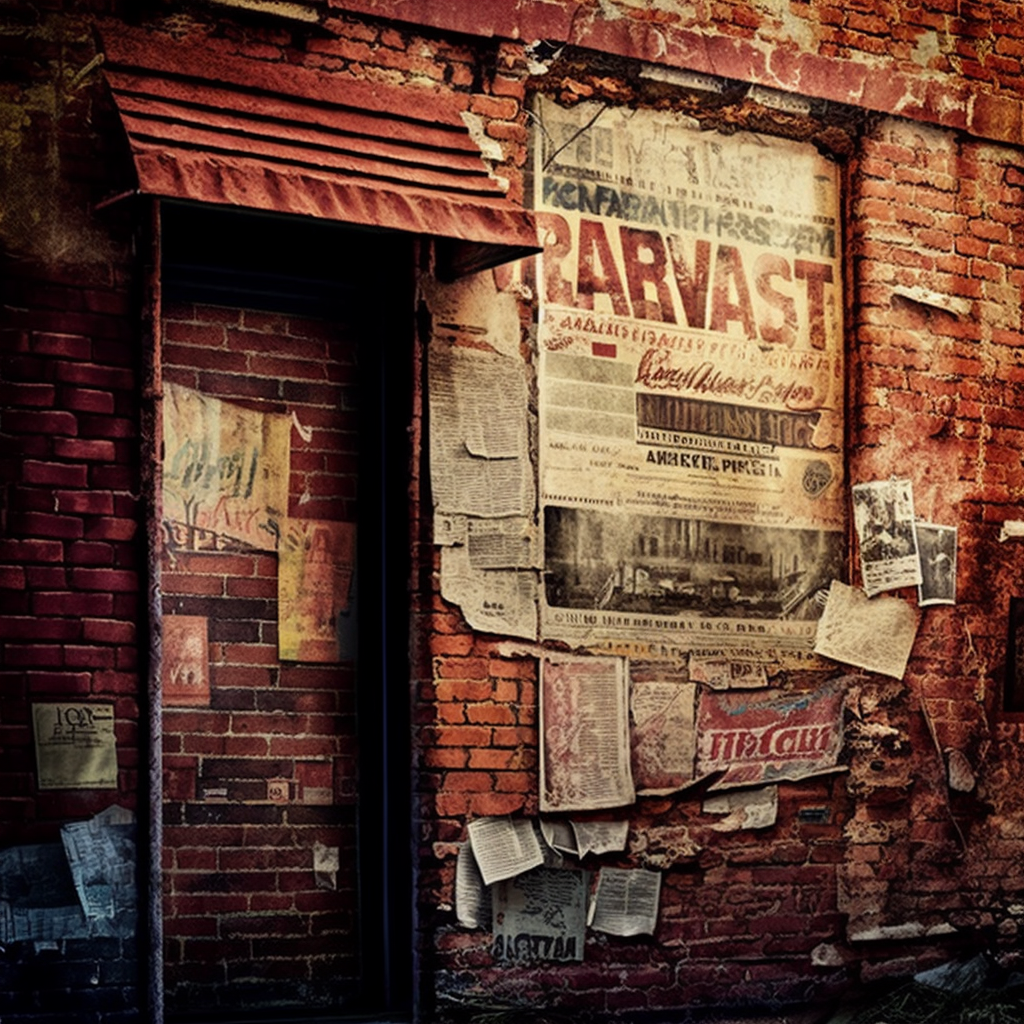
The old man was sticking to Youssef like glue, talking about that time when his now dead brother took in an old cat he called Phineas. Youssef tried to growl him away, but the man always came back, persistent as a cloud of mosquitoes over the promise of a blood feast.
Youssef tried not to pay attention to him. What did AL said about that quest ? Go ask questions around to town’s people about odd things happening ? Well there were plenty of those things happening. Maybe the clerk at the telegraph station would know something, especially how to get rid of that old man.
Youssef pushed the door and entered the telegraph station, leaving the old man outside. The interior was lit with a collection of old style tungsten lamps hanging in a random pattern from the ceiling.
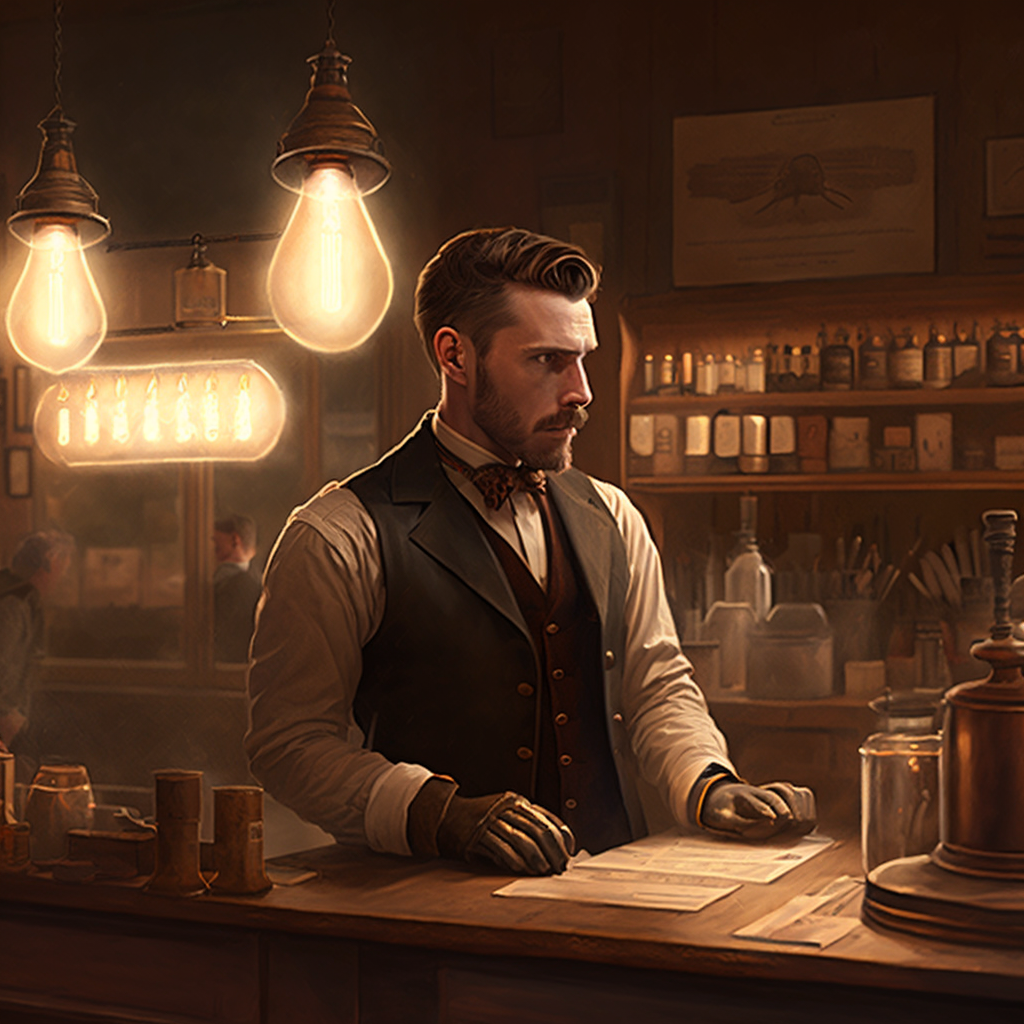 The clerk was busy sorting out a pile of telegrams. Clickety-clack. Clickety-clack. He lifted his head up. The noise stopped and Youssef realised the young man had mechanical hands.
“Welcome, welcome, welcome! What can I do for you today, my friend?” asked the clerk.
“I just wanted to…” started Youssef.
“Wait! Don’t tell me. I’m a bit of a psychic myself and I already know what you’re here for.”
“Really?”
The man foraged through his pile of telegram with his mechanical hands and picked one. He looked at it for a few seconds.
“My friend, you’re in luck today!” he said, looking intently at Youssef. “I just received this telegram that I think might interest you. Here, take a look!”
Youssef took the paper and started to read aloud : “Words spoken by the talkative will unlock the path. Seek those who chatter and unravel the clue. What the…?”
“Interesting, isn’t it? That’s a real head-scratcher, if you ask me!”
The door bell rang and the old man entered, holding his sore ribs.
“Get out, Phineas. You’re not welcome here.” said the clerk with a frown.
The old man looked at the clerk with an air of confusion before turning to Youssef. “What did he say? Who’s Phineas?” he asked.
Ignoring the question, Youssef tried to steer the conversation back to the telegram. “What does this mean?” he asked the clerk.
The clerk stroked his chin, looking thoughtful. “Hmm, well, it seems to me that you have a certain magnetism for talkative people. Perhaps that’s the key to unlocking this riddle.”
Youssef’s eyes widened in surprise. “What do you mean, magnetism?”
The old man interjected, “For sure! You’re like a magnet, my boy. I can’t seem to stop talking when I’m around you.”
Youssef rolled his eyes. “So, what do I do? Just wander around town and wait for someone to start talking?”
The clerk nodded. “That could be a good start. But if you’re looking for something specific, you might want to try Betsy when you wake up. She’s got a boutique of Gems and Rocks. You seem to like them rocks,” he said pointing at the black obsidian. “Found it in a mine?”
The old man’s eyes lit up. “Ah, the old mine! I’ve been there before, you know. My brother used to work there before he died. Strange things happening there.”
Youssef’s interest was piqued. “What kind of strange things?”
The old man leaned in conspiratorially. “There’s a magnetar hidden in that mine, my boy.”
“Shut up! Phineas,” interrupted the clerk. “If you want my advice, stranger, don’t go near the old mine. ‘Curiosity killed the cat’ if you know what I mean.”
The telegraph receiver started to make clicketing sounds. The clerk read it and looked at Youssef.
“You’ve got a message man. Time to wake up.”
“Wake up?”

Youssef opened his eyes and looked at a black mass in front of his eyes. He had been sleeping with the stone just beside his head on the pillow. No wonder he had had weird dreams. He heard his phone buzz. He sat up reluctantly and looked at his phone. 8am. A notification that his game progression had been saved and several messages from Miss Tartiflate, the last one saying :
Don’t think you can dodge work. I’m still expecting the last blog post you’ve been paid to write!!!”
He groaned as reality was starting to catch up.
February 11, 2023 at 10:10 pm #6538In reply to: The Jorid’s Travels – 14 years on
“That’s all Jorid had to say?” Georges mused at the sudden philosophical quote that read:
And doesn’t this point to something fundamentally tragic about our way of life? We live under an assumed identity, in a neurotic fairy tale world with no more reality than the Mock Turtle in Alice in Wonderland. Hypnotized by the thrill of building, we have raised the houses of our lives on sand. This world can seem marvelously convincing until death collapses the illusion and evicts us from our hiding place. What will happen to us then if we have no clue of any deeper reality? (The Tibetan Book of Living and Dying)
“I don’t know about this Mock Turtle, but those snapping sand ones that have been lurking about do look rather nasty. We shouldn’t waste any more time.”
Klatu opined “Klatu agrees with your female, sand turtle are lovely traps of death. Come with me now!” He intimated them to run into a sand opening he’d just made.
“Let me guess,” Georges said, “is it the equivalent of a Zathu prison? What powerful people could Léonard possibly have rubbed the wrong way this time?”
“Not prison.” Klatu commented “Death sentence.”
Salomé pointed out a glowing twirl of sand shaped as an ovoid form, inside which a human form could be discerned. “That would explain why he’s not more guarded…”
They approached carefully, expecting some extra booby trap, but nothing seemed to react to their presence, not even the moving sand egg.
“Let me guess,” Georges said, expecting a chorus
“DIMENSIONAL MAGIC!”
Klatu shushed them “Quiet stupids! Sound waves attract good turtles.”
“Is our friend OK? How do we break the spell?” Salomé asked Klatu. “Can you help?”
Klatu took a few minutes to inspect the shape, hopping carefully around it, and probing with soft whistling sounds.
“Friend in stasis for now. Kept fresh for questioning… possible.”
“Then we must hurry, how can we free him? Can I brute force this?” Georges asked, looking around for something to pierce the sand barrier and hook Léonard out of it.
“Only if you like sushi friend.” Klatu said, raising shoulders. “No finesse these primates.”
Klatu moved around the shape, taking some tools from his belt and making some elaborate plaits of sounds, as if trying to match the energy signature of the sand prison.
After a first belt of soundwaves was wrapped around, it seemed as though a first layer of the spell broke, and sand rained back into the external construct they were it. But a thin layer was still there, shifting and pulsating, almost clear as glass, and sharp as a razor blade.
“Crude encoding, but solid. Need more time.” Klatu seemed exhausted.
Georges was getting anxious for some activity. “Houses built on sand… Well I guess Jorid didn’t find the best quote to help…”
Salomé who was sitting cross-legged, trying for some time to connect to Léonard in his stasis, turned to Georges in disbelief. “Georges, you’re a genius!”
“What now?”
“Jorid gave us the last bit we needed. Until death collapses the illusion and evicts us from our hiding place. Remember? It’s risky but that could work!”
“Oh, I see what you’re thinking about. It’s mad, and it’s brilliant at the same time, how do we go about this?”
“I can’t reach Léonard, but maybe the both of us can.” Salomé joined hands with Georges.
“If he’s like anything I remember, he’d be in his mental palace, his workshop on the Duane… or in Marseille… or with Madame Jamelie…”
“Focus, Georges!”
“Duane it is, that’s where he did his best work.”
“We need to focus our energy to make him appear dead to the construct. It’ll be easier if we can locate precisely where his mind wanders.” Salomé said.
“He’ll be there, I know it. Let’s do this!”
The two of them joined hands and melded their minds, one as always, turning into a dark mirror of the abyss, bending light unto itself, leaving the void of creation at the place where Léonard was suspended.
Klatu looked at the scene suspiciously, but started to giggle as he saw the last layer he couldn’t open finally shatter and dissolve to the ground.
“Little apes full of surprises,… very awful, so very awful.” he said approvingly.
As his friends rushed to him, Léonard was on the ground, inert, but apparently alive.
February 7, 2023 at 10:25 pm #6511In reply to: A Dog and a Dig – The trenches of the Time Capsule
Potential Plot Arch
The uncovered box in the garden of Bob & Clara is a Time Capsule which was actually buried in the future, but mistakenly sent to the past. It has symbols etched on it, that activate some nano-technology.
Due to its contact with it, Bob starts recovering his memories, while retaining the hallucinations of his dead wife Jane, which actually become more credible and intense.Will Tarkin is actually a time traveler from the future, who came to live a simple life in the past, selling stone gargoyles at the local supermarket and rediscovering the ways of his ancestors.
With the box being found and opened at the wrong time, it creates unwanted attention from the Time Dragglers who need to intervene to prevent alterations of the timeline.
Contents of the box are in part encoded books of stories from local families and would have revealed important things about the past, Jane’s death, and Clara’s future.With Bob recovering his memories, it’s revealed Jane and Bob were actually also refugees from the future, but had aged naturally in the past, which is why Will seemed to recognize Bob. Bob was living in hiding from the Time Police, but with the box discovery, it changes everything. The box being opened at the wrong time disrupts the natural flow of events and starts causing unexpected consequences. This creates a complex web of relationships and events that must be untangled and understood in order to move forward.
With his recovering of mental capacities, Bob partners with Will in order to restore the natural flow of time, even if it means his mental health will deteriorate again, which he is happy to do while continuing to live the rest of his life span with his daughter.
Potential developments
Clara Meets the Mysterious Will
Nora finally reaches the little village where Clara and Bob live and is greeted by a man named Will
Will seems to know Bob from somewhere
Clara starts to feel suspicious of Will’s intentions and begins to investigateThe Power of Memories
Bob starts to have flashbacks of his past and begins to remember the connection between him, Will, and the mysterious time capsule
Bob realizes that Jane, his wife, had been keeping something from him and that the time capsule holds the key to unlocking the truth
Jane appears to Bob and urges him to tell Clara about their past and the significance of the time capsuleThe Truth Behind the Capsule
Nora, Clara, and Bob finally find the answers they’ve been searching for by opening the time capsule
The contents of the capsule reveal a shocking truth about Jane’s past and the reason behind her death
They learn that Jane was part of a secret society that protected ancient knowledge and artifacts and that the time capsule was meant to be opened at a specific time
The group realizes that they were meant to find the capsule and continue Jane’s work in protecting the knowledge and artifactsThe Ties Between Living and Dead
Bob comes to terms with Jane’s death and the role she played in their lives
Clara and Bob grow closer as they work together to continue Jane’s work and preserve the knowledge and artifacts
The group encounters obstacles but with the help of the spirits of the past, they are able to overcome them and succeed in their missionA Realization of the Past and Present
Clara, Bob, and Nora come to realize the power of memories and how they shape our present and future
They also learn that things never truly remain buried and that the past always finds a way to resurface
The group successfully preserves the knowledge and artifacts, ensuring that they will be passed down for generations to come
The story ends with Clara, Bob, and Nora sitting by the fire, reflecting on their journey and the lessons they’ve learned.February 7, 2023 at 9:51 pm #6508A background on the excavated mysteries from Twists and One Return From the Time Capsule.
BACKGROUND CONTENT: Focus is on key protagonists:
- Clara (a woman in her late 40s, taking care of her father, living the two of them with her Malinois dog VanGogh),
- her father Bob (a widowed man with early stage dementia, who can see and speak to his dead wife Jane)
- and Nora (nicknamed Alienor, Clara’s friend, a local thrill-seeking artist and amateur archaeologist)
in an story of discovery around a mystery of a box (which is a Time Capsule found by Clara’s dog VanGogh) during a time and place of travel restrictions (and possibly time-travel restrictions).
Tone of story is curious and engrossed with a mystery of the ages, some supernatural grounded in plausibility, looking for connecting dots with the past sometimes long gone, and a present that slips away in our memories.
An encounter with the mysterious Will (possibly Will Tarkin), who seems nice and seductive yet acts unscrupulously and manipulative (seemingly recognising Bob from somewhere), could be the key to a big reveal, and possible links to Jane’s pasts. All while struggling to keep away the nosy neighbour.
The conclusion will bring some realisations about the power of memories, the ties between living and dead, and how things never remain buried for long.January 24, 2023 at 11:34 am #6457In reply to: Orbs of Madjourneys
“Look, Pretty Girl! That must be the lost traveler walking up those steps!”
Zara followed the mysterious man in red robes up the steps. She lost sight of him and wondered which way he’d gone in the many side alleys. She wandered up a few of them but they all came to a dead end in a courtyard with closed doors. Eventually she saw him disappearing into a manhole that looked like a labyrinth.
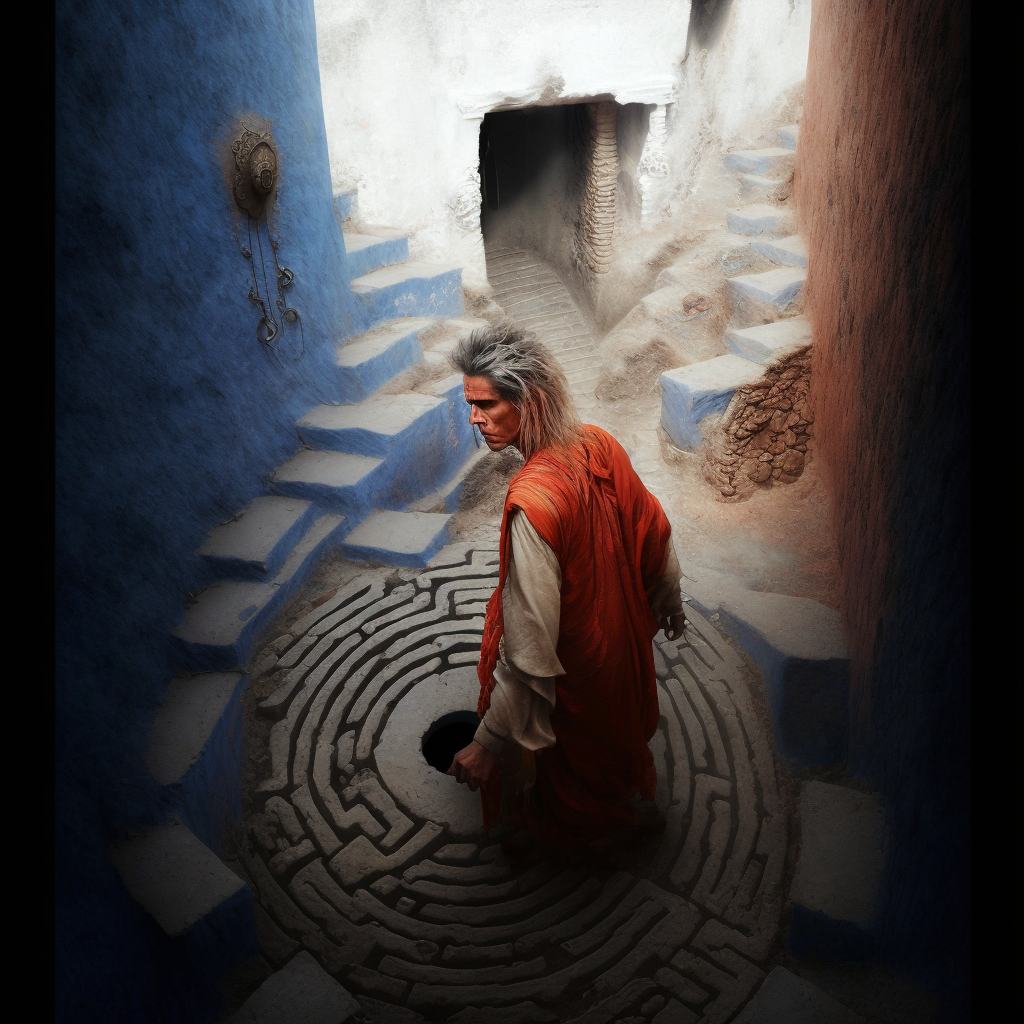
Zara followed him, and stepped onto the labyrinth manhole that the man in the red robes had disappeared into.
“That must be another portal,” Zara said to the parrot. “I wonder where we’ll end up now.”
The labyrinth manhole led Zara to another portal, this time a round hole in the wall. She knew she should follow the man, who must be the lost traveler, but she couldn’t resist exploring the starlit night scene first.
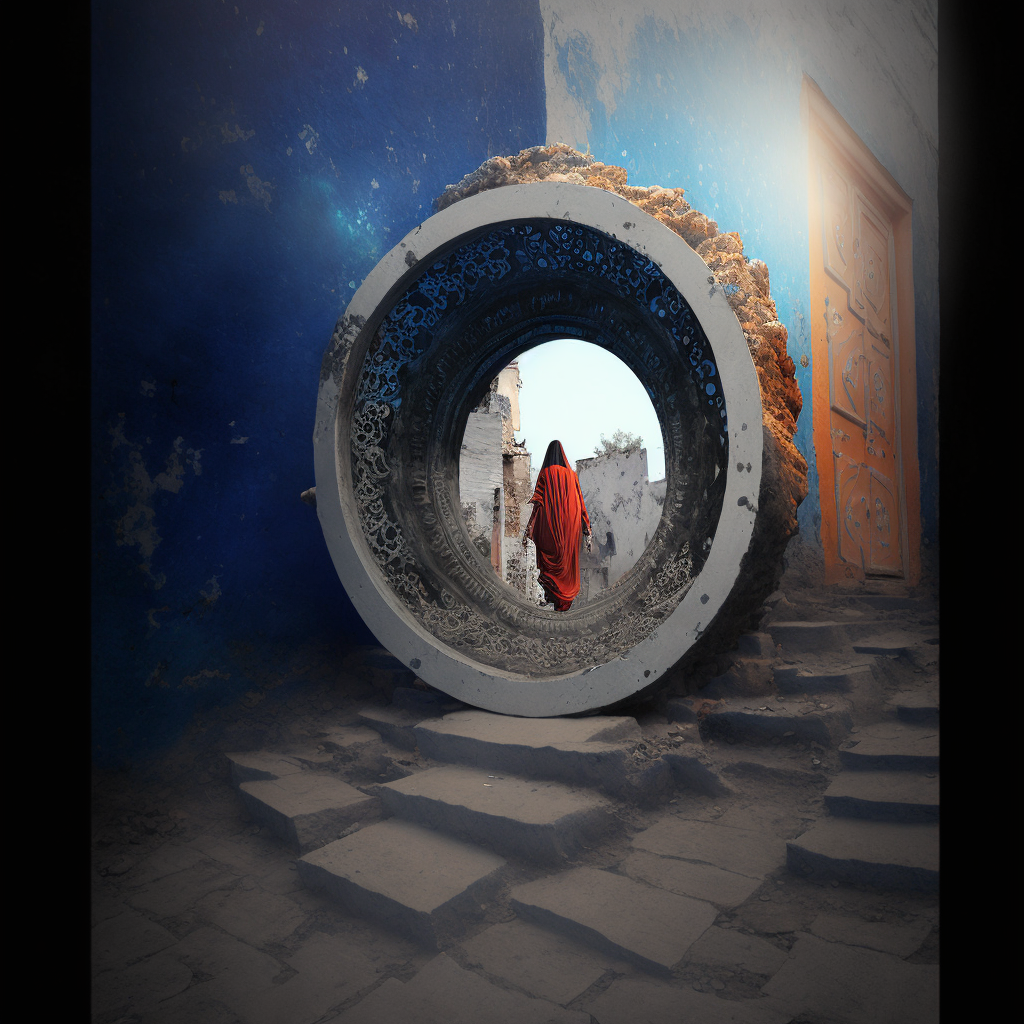
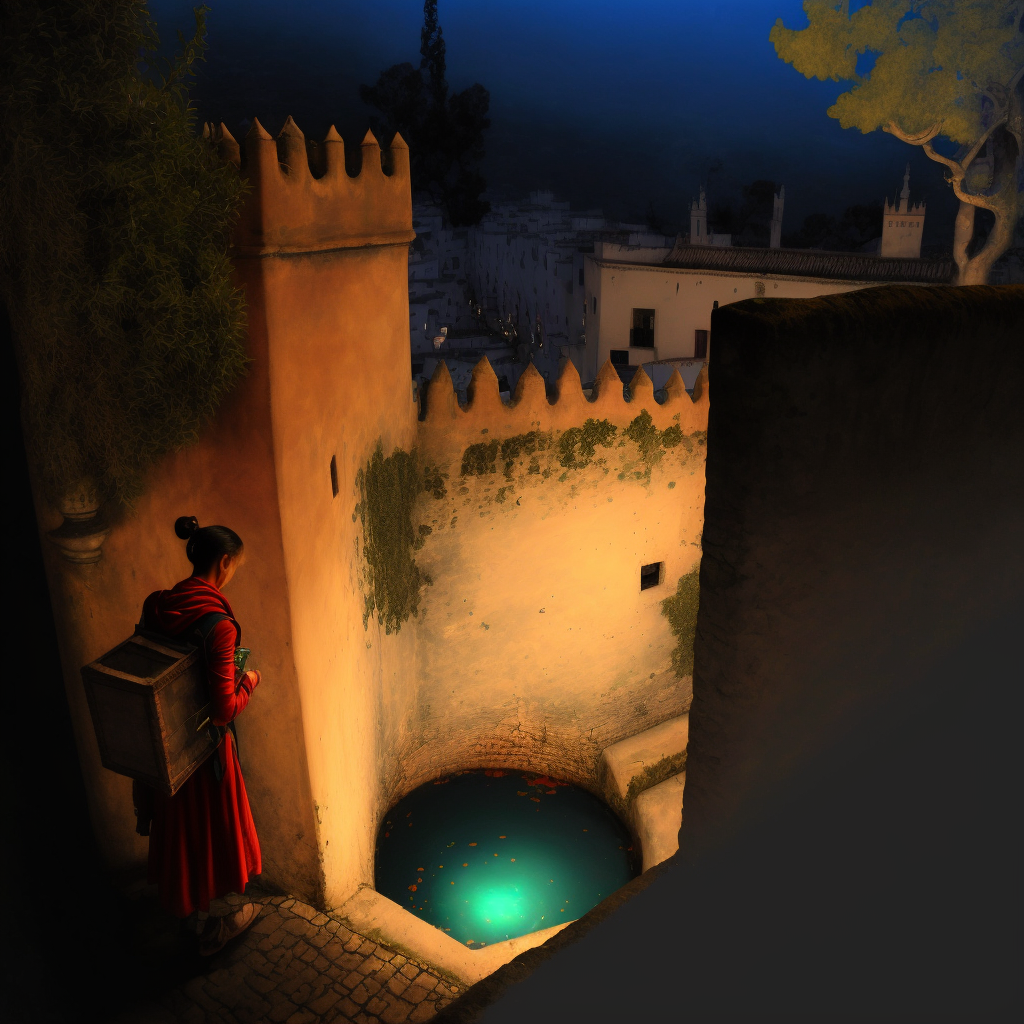
She found herself in a castle, its sand coloured walls glowing in the moonlight. There was another round green pool inside the castle. Should she jump into the pool, or go back and follow the man in red through the hole in the wall? Zara walked around the castle first, exploring the many courtyards and stairs and the enchanting views from the parapets. She noticed that there were several green pools and wondered if they each led to different places.
 January 19, 2023 at 9:38 am #6416
In reply to: Orbs of Madjourneys
The team had to stop when a sandstorm hit them in the middle of the desert. They only had an hour drive left to reach the oasis where Lama Yoneze had been seen last and Miss Tartiflate insisted, like she always did, against the guides advice that they kept on going. She feared the last shaman would be lost in the storm, maybe croak stuffed with that damn dust. But when they lost the satellite dish and a jeep almost rolled down a sand dune, she finally listened to the guides. They had them park the cars close to each other, then checked the straps and urged everyone to stay in their cars until the storm was over.
Youssef at first thought he was lucky. He managed to get into the same car as Tiff, the young intern he had discussed with the other day. But despite all their precautions, they couldn’t stop the dust to come in. It was everywhere and you had to kept your mouth and eyes shut if you didn’t want to grind your teeth with fine sand. So instead he enjoyed this unexpected respite from his trying to save THE BLOG from the evil Thi Gang, and from Miss Tartiflate’s continuous flow of criticism.
The storm blew off the dish just after Xavier had sent him AL’s answer to the strange glyphs he had received on his phone. When Youssef read the message, he sighed. He had forgotten hope was an illusion. AL was in its infancy and was not a dead language expert. He gave them something fitting Youssef’s current location and the questions about famous alien dishes they asked him last week. It was just an old pot luck recipe from when the Silk Road was passing through the Gobi desert. He just hoped Xavier would have some luck until Youssef found a way to restore the connexion.
 January 15, 2023 at 1:18 pm #6391
In reply to: Train your subjective AI – text version
write the plot of an absurd non-linear novel, featuring 4 characters
The novel begins with the introduction of four characters: a retired archaeologist named Harold, a struggling musician named Samantha, a disillusioned corporate drone named Tim, and a reclusive inventor named Claire.
Harold, who is obsessed with ancient Egyptian hieroglyphs, discovers a mysterious underground chamber beneath a pyramid in Egypt. Inside, he finds a strange device that he believes is a time machine. Harold decides to use the device to travel back in time to ancient Egypt in order to decipher the hieroglyphs.
Samantha, who is trying to make a name for herself as a musician, is struggling to come up with new material for her music. One day, she discovers that she can create beautiful music by communicating with plants telepathically. She becomes obsessed with this new form of music-making and decides to quit her day job and pursue it full-time.
Tim, who is stuck in a dead-end job, is feeling unfulfilled and uninspired. One day, he stumbles upon a robotic mime performance art show. The performance inspires him to quit his job and pursue his dream of becoming a mime artist.
Claire, who is a reclusive inventor, has been working on a project to create a type of artificial intelligence that can communicate with humans using calligraphic body language. She finally succeeds and creates an AI that she names “Calli”.
As the story progresses, the characters’ paths begin to intersect in unexpected ways. Harold gets stuck in ancient Egypt and has to rely on Samantha’s telepathic plant communication skills to find a way back to the present. Tim’s robotic mime art becomes a hit and he starts working with Claire to integrate Calli into his performances.
As the story reaches its climax, all four characters come together to use their unique skills and abilities to solve a problem that threatens the fate of the world.
Throughout the novel, the plot unfolds in a non-linear fashion, jumping back and forth in time and between the different character’s perspectives. The story is filled with absurdity and unexpected twists and turns, leaving the reader guessing until the very end.
What sort of problem that threatens the fate of the world will be resolved by their combined skills?
As the story progresses, the characters begin to uncover a sinister plot by a group of powerful individuals who are intent on using the time machine to alter the course of history for their own gain. They plan to use the time machine to go back in time and change key events that would give them immense wealth and power in the present. Harold and Samantha, with the help of Tim and Claire, must race against time to stop the villains from carrying out their plan.
Harold’s expertise in ancient Egyptian hieroglyphs plays a crucial role in deciphering the clues that lead to the location of the time machine. Samantha’s telepathic plant communication skills are used to locate the hidden underground chamber where the time machine is kept. Tim’s robotic mime art and Claire’s AI Calli are used to infiltrate the villains’ hideout and gather intelligence on their plans.
In the final act, the four characters come together to use their unique skills and abilities to stop the villains from altering history. Harold uses his knowledge of ancient Egypt to navigate the time machine and travel back in time to stop the villains from changing key events. Samantha uses her telepathic plant communication skills to communicate with the plants in the past and gather information on the villains’ whereabouts. Tim and Claire use their robotic mime and AI skills to create a diversion and distract the villains while Harold and Samantha complete their mission.
In the end, the four characters succeed in stopping the villains and saving the fate of the world. The novel ends with the four characters going their separate ways, but they all know that they will always have each other to rely on in the face of any challenge that comes their way.
January 11, 2023 at 8:44 pm #6366In reply to: Train your subjective AI – text version
Asking the AI to expand on the glossary of the original Circle of Eights Story:
Locations
Malvina’s Cave: A dark and damp cave located in the heart of the Gripshawk mountains, known for its population of Glukenitch creatures.
Lan’ork: A vast and diverse continent known for its Eastern Lagunas, home to the Indogo flamingos. Dragon Head Peninsula: A rugged and mountainous region, home to the Langoat creatures and also known for its rich deposits of dragon ore.
Asgurdy: A sprawling desert region, known for its nomadic tribes who use Saurhse as mounts for transportation.
Golfindely: An idyllic coastal region known for its beautiful beaches and crystal clear waters, home to the Golfindel and Grake creatures.
Magical Schools
Dragonian Magic: A form of magic that is practiced by Dragonriders and Dragon tamers, which involves the manipulation of dragon energy and bonding with dragon companions.
Gripshawk Magic: A form of magic that is practiced by Gripshawks, which involves the manipulation of the natural elements and telepathic communication with other creatures.
Ugling Magic: A form of magic that is practiced by Uglings, which involves the use of charms, spells, and potions to manipulate the physical world.
Guilds
Dragon Riders Guild: A prestigious guild of dragon riders, responsible for maintaining peace and order in the world by using their dragon companions for protection and transportation.
Gripshawk Hunters Guild: A guild of skilled hunters who specialize in hunting and capturing exotic creatures for various purposes.
Ugling Alchemists Guild: A guild of alchemists and potion makers, who create various potions and elixirs for medicinal and magical purposes.
Organizations
The Order of the Buntifluën: A secret organization dedicated to the study and use of Buntifluën artefacts for the betterment of communication and understanding between sentient beings.
The Glubolín Network: A network of individuals who possess Glubolín devices, used for communication and sharing information across long distances.
The Sabulmantium Society: A society of scholars and adventurers who study the properties and uses of Sabulmantium devices for divination and navigation.
Here are a few new invented terms with their potential IPA pronunciations and definitions that would fit in this fantasy world:
Dragons:
Krynn [ ˈkrĭn ] : A subspecies of dragon known for its ability to control and manipulate time.
Creatures:
Kelpies [ ˈkĕl-pēz ] : Aquatic creatures resembling horses, known for their ability to shape-shift and lure unsuspecting victims into the water.
Magical Artefacts:
Dragonwhisper [ ˈdrā-gən-ˌhwis-pər ] : An ancient and powerful magical artifact, which allows the user to communicate and control dragons telepathically.
Necrotalisman [ ˈnĕk-rə-ˈtā-lĭz-mən ] : A magical artifact in the shape of a talisman that grants its wielder the ability to control and summon the dead.
Plants:
Blightthorn [ ˈblīt-ˌthôrn ] : A poisonous plant known for its dark purple flowers and thorny stem, its extract is used in dark magic
Faeleaf [ ˈfā-ˌlēf ] : A rare plant found in the deep forest known for its bright green leaves, its extract is used in healing potions
Locations:
The Shadowland [ ˈshā-dō-ˌland ] : A mysterious and dangerous land overrun by dark magic and controlled by Necromancers.
The Hidden Vale [ ˈhī-dən-ˈvāl ] : A secluded valley located deep in the mountains, home to the reclusive Faeleaf plants.
Organization:
The Necromancers’ Circle [ ˈnĕk-rə-ˈmän-sər-z-ˈsər-kəl ] : A secret organization of powerful necromancers who seek to expand their control over death and the dead.
Here are a few more invented terms with their potential IPA pronunciations and definitions that fit in this fantasy world, having less to do with necromancy, and more with various forms of consciousness or energy manipulation, magical or mythical creatures or species:
Creatures:
Eterneon [ ˈē-tər-ˈnē-ən ] : A species of winged creatures known for their ability to manipulate and harness the energy of the stars, they are highly sought after by astromancers and star-gazers.
Psicon [ ˈsī-ˌkän ] : A species of psychic creatures, known for their ability to read minds and influence emotions.
Magical Artefacts:
Energyshield [ ˈen-ər-jē-ˌshēld ] : A magical artifact that creates a protective barrier around the user, deflecting or absorbing any kind of energy-based attacks.
Empathstone [ ˈĕm-pāth-ˈstōn ] : A small, glowing stone which allows the user to sense and control the emotions of others.
Magical Schools:
Energyshaping [ ˈen-ər-jē-ˌshāp-ing ] : A school of magic that involves the manipulation and control of various forms of energy.
Empathymagic [ ˈĕm-pā-thē-ˈmaj-ik ] : A school of magic that involves the manipulation of emotions and the ability to sense the emotions of others.
Locations:
Eternity’s Edge [ ˈē-tər-nə-tēz-ˈēj] : A remote and mysterious cliff located high in the mountains, known for its strong emanations of star energy and rumored to be home to a hidden community of Eterneons.
Psicon’s Den [ ˈsī-kän-z-ˈdĕn] : A secret cave system located deep within the forest, it is said to be home to a colony of Psicon creatures.
Organizations:
The Energists Guild [ ˈen-ər-jist-z-ˈgild] : A powerful guild of magic users specializing in Energyshaping magic.
The Empath Council [ ˈĕm-pāth-ˈkoun-səl]: A secretive group of Empathymagic users, dedicated to the study and control of emotions.
November 14, 2022 at 12:09 pm #6346In reply to: Family Stories From The Other Side ~ Book Two
The Mormon Browning Who Went To Utah
Isaac Browning’s (1784-1848) sister Hannah married Francis Buckingham. There were at least three Browning Buckingham marriages in Tetbury. Their daughter Charlotte married James Paskett, a shoemaker. Charlotte was born in 1818 and in 1871 she and her family emigrated to Utah, USA.
Charlotte’s relationship to me is first cousin five times removed.
James and Charlotte: (photos found online)
The house of James and Charlotte in Tetbury:
The home of James and Charlotte in Utah:
Obituary:
James Pope Paskett Dead.
Veteran of 87 Laid to rest. Special Correspondence Coalville, Summit Co., Oct 28—James Pope Paskett of Henefer died Oct. 24, 1903 of old age and general debility. Funeral services were held at Henefer today. Elders W.W. Cluff, Alma Elderge, Robert Jones, Oscar Wilkins and Bishop M.F. Harris were the speakers. There was a large attendance many coming from other wards in the stake. James Pope Paskett was born in Chippenham, Wiltshire, England, on March 12, 1817; married Chalotte Buckingham in the year 1839; eight children were born to them, three sons and five daughters, all of whom are living and residing in Utah, except one in Brisbane, Australia. Father Paskett joined the church of Jesus Christ of Latter Day Saints in 1847, and emigrated to Utah in 1871, and has resided in Henefer ever since. He leaves his faithful and aged wife. He was respected and esteemed by all who knew him.
Charlotte died in Henefer, Utah, on 27th December 1910 at the age of 91.
James and Charlotte in later life:
November 10, 2022 at 10:59 am #6343In reply to: Family Stories From The Other Side ~ Book Two
Colney Hatch Lunatic Asylum
William James Stokes
William James Stokes was the first son of Thomas Stokes and Eliza Browning. Oddly, his birth was registered in Witham in Essex, on the 6th September 1841.
Birth certificate of William James Stokes:
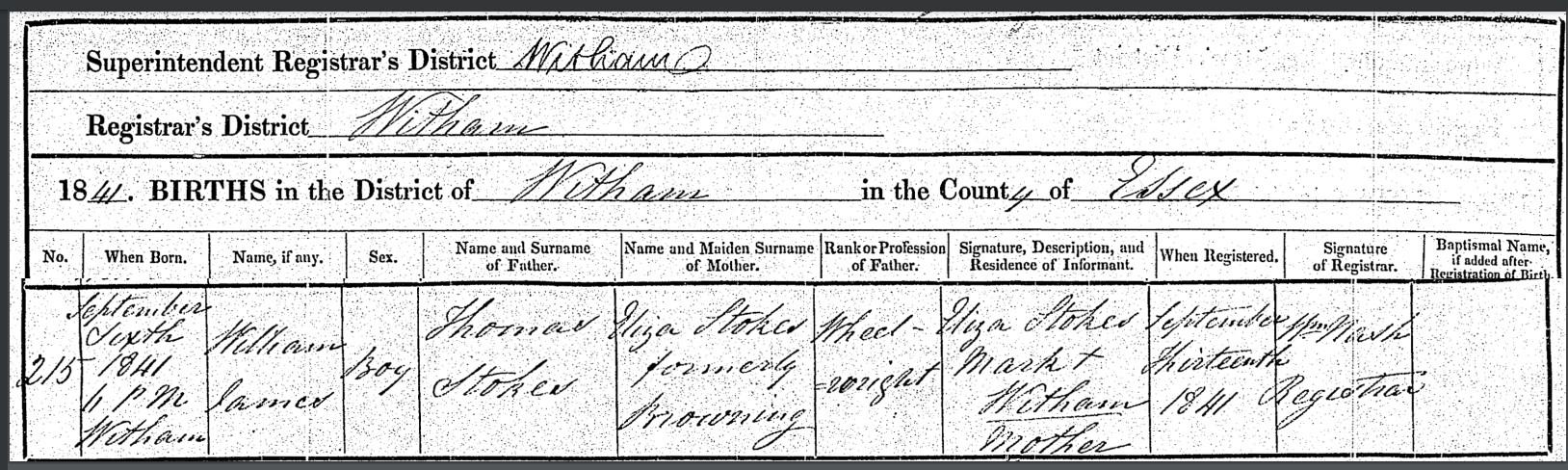
His father Thomas Stokes has not yet been found on the 1841 census, and his mother Eliza was staying with her uncle Thomas Lock in Cirencester in 1841. Eliza’s mother Mary Browning (nee Lock) was staying there too. Thomas and Eliza were married in September 1840 in Hempstead in Gloucestershire.
It’s a mystery why William was born in Essex but one possibility is that his father Thomas, who later worked with the Chipperfields making circus wagons, was staying with the Chipperfields who were wheelwrights in Witham in 1841. Or perhaps even away with a traveling circus at the time of the census, learning the circus waggon wheelwright trade. But this is a guess and it’s far from clear why Eliza would make the journey to Witham to have the baby when she was staying in Cirencester a few months prior.
In 1851 Thomas and Eliza, William and four younger siblings were living in Bledington in Oxfordshire.
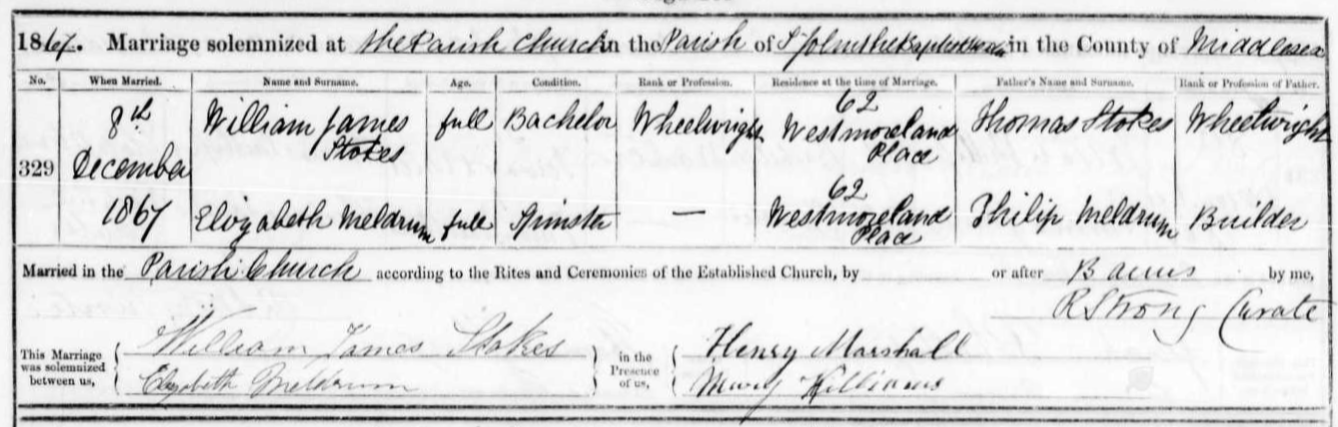
William was a 19 year old wheelwright living with his parents in Evesham in 1861. He married Elizabeth Meldrum in December 1867 in Hackney, London. He and his father are both wheelwrights on the marriage register.
Marriage of William James Stokes and Elizabeth Meldrum in 1867:
William and Elizabeth had a daughter, Elizabeth Emily Stokes, in 1868 in Shoreditch, London.
On the 3rd of December 1870, William James Stokes was admitted to Colney Hatch Lunatic Asylum. One week later on the 10th of December, he was dead.
On his death certificate the cause of death was “general paralysis and exhaustion, certified. MD Edgar Sheppard in attendance.” William was just 29 years old.
Death certificate William James Stokes:
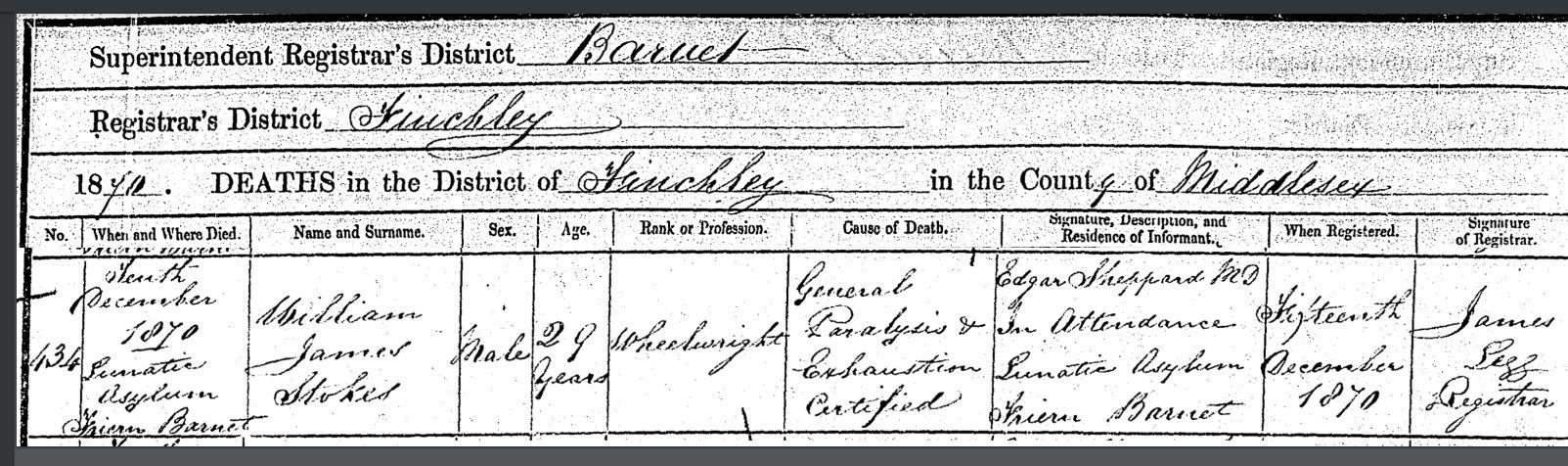
I asked on a genealogy forum what could possibly have caused this death at such a young age. A retired pathology professor replied that “in medicine the term General Paralysis is only used in one context – that of Tertiary Syphilis.”
“Tertiary syphilis is the third and final stage of syphilis, a sexually transmitted disease that unfolds in stages when the individual affected doesn’t receive appropriate treatment.”From the article “Looking back: This fascinating and fatal disease” by Jennifer Wallis:
“……in asylums across Britain in the late 19th century, with hundreds of people receiving the diagnosis of general paralysis of the insane (GPI). The majority of these were men in their 30s and 40s, all exhibiting one or more of the disease’s telltale signs: grandiose delusions, a staggering gait, disturbed reflexes, asymmetrical pupils, tremulous voice, and muscular weakness. Their prognosis was bleak, most dying within months, weeks, or sometimes days of admission.
The fatal nature of GPI made it of particular concern to asylum superintendents, who became worried that their institutions were full of incurable cases requiring constant care. The social effects of the disease were also significant, attacking men in the prime of life whose admission to the asylum frequently left a wife and children at home. Compounding the problem was the erratic behaviour of the general paralytic, who might get themselves into financial or legal difficulties. Delusions about their vast wealth led some to squander scarce family resources on extravagant purchases – one man’s wife reported he had bought ‘a quantity of hats’ despite their meagre income – and doctors pointed to the frequency of thefts by general paralytics who imagined that everything belonged to them.”
The London Archives hold the records for Colney Hatch, but they informed me that the particular records for the dates that William was admitted and died were in too poor a condition to be accessed without causing further damage.
Colney Hatch Lunatic Asylum gained such notoriety that the name “Colney Hatch” appeared in various terms of abuse associated with the concept of madness. Infamous inmates that were institutionalized at Colney Hatch (later called Friern Hospital) include Jack the Ripper suspect Aaron Kosminski from 1891, and from 1911 the wife of occultist Aleister Crowley. In 1993 the hospital grounds were sold and the exclusive apartment complex called Princess Park Manor was built.
Colney Hatch:
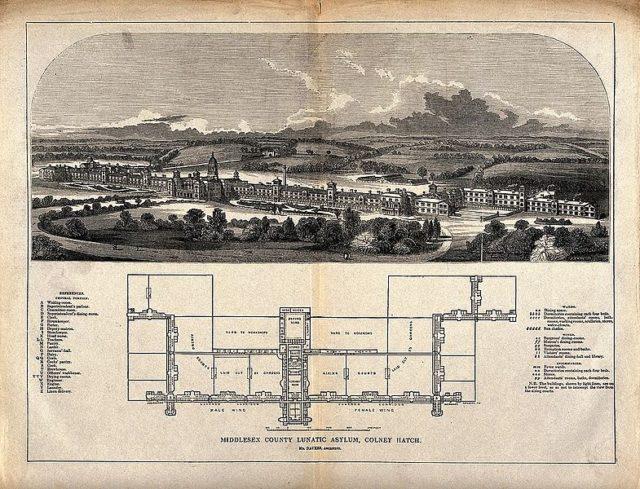
In 1873 Williams widow married William Hallam in Limehouse in London. Elizabeth died in 1930, apparently unaffected by her first husbands ailment.
November 4, 2022 at 2:19 pm #6342In reply to: Family Stories From The Other Side ~ Book Two
Brownings of Tetbury
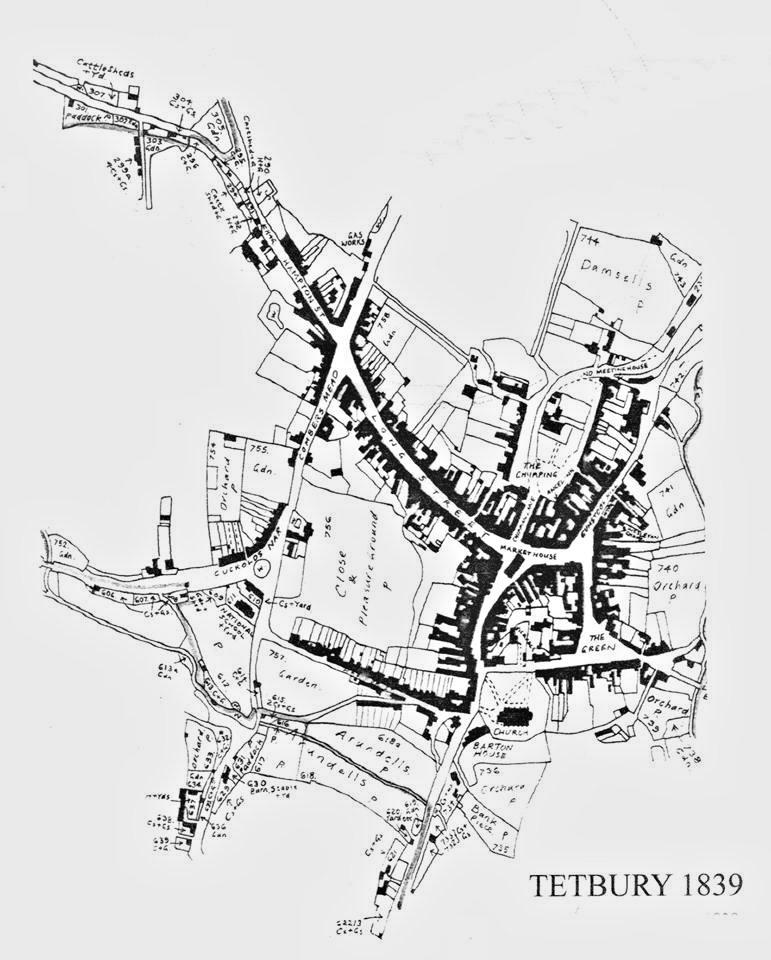
Isaac Browning (1784-1848) married Mary Lock (1787-1870) in Tetbury in 1806. Both of them were born in Tetbury, Gloucestershire. Isaac was a stone mason. Between 1807 and 1832 they baptised fourteen children in Tetbury, and on 8 Nov 1829 Isaac and Mary baptised five daughters all on the same day.
I considered that they may have been quintuplets, with only the last born surviving, which would have answered my question about the name of the house La Quinta in Broadway, the home of Eliza Browning and Thomas Stokes son Fred. However, the other four daughters were found in various records and they were not all born the same year. (So I still don’t know why the house in Broadway had such an unusual name).
Their son George was born and baptised in 1827, but Louisa born 1821, Susan born 1822, Hesther born 1823 and Mary born 1826, were not baptised until 1829 along with Charlotte born in 1828. (These birth dates are guesswork based on the age on later censuses.) Perhaps George was baptised promptly because he was sickly and not expected to survive. Isaac and Mary had a son George born in 1814 who died in 1823. Presumably the five girls were healthy and could wait to be done as a job lot on the same day later.
Eliza Browning (1814-1886), my great great great grandmother, had a baby six years before she married Thomas Stokes. Her name was Ellen Harding Browning, which suggests that her fathers name was Harding. On the 1841 census seven year old Ellen was living with her grandfather Isaac Browning in Tetbury. Ellen Harding Browning married William Dee in Tetbury in 1857, and they moved to Western Australia.
Ellen Harding Browning Dee: (photo found on ancestry website)
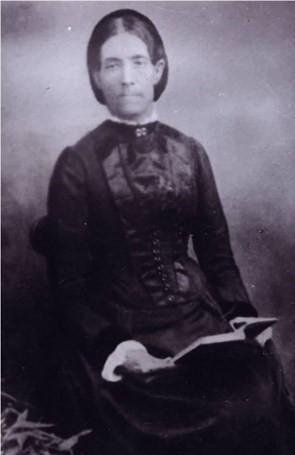
OBITUARY. MRS. ELLEN DEE.
A very old and respected resident of Dongarra, in the person of Mrs. Ellen Dee, passed peacefully away on Sept. 27, at the advanced age of 74 years.The deceased had been ailing for some time, but was about and actively employed until Wednesday, Sept. 20, whenn she was heard groaning by some neighbours, who immediately entered her place and found her lying beside the fireplace. Tho deceased had been to bed over night, and had evidently been in the act of lighting thc fire, when she had a seizure. For some hours she was conscious, but had lost the power of speech, and later on became unconscious, in which state she remained until her death.
The deceased was born in Gloucestershire, England, in 1833, was married to William Dee in Tetbury Church 23 years later. Within a month she left England with her husband for Western Australian in the ship City oí Bristol. She resided in Fremantle for six months, then in Greenough for a short time, and afterwards (for 42 years) in Dongarra. She was, therefore, a colonist of about 51 years. She had a family of four girls and three boys, and five of her children survive her, also 35 grandchildren, and eight great grandchildren. She was very highly respected, and her sudden collapse came as a great shock to many.
Eliza married Thomas Stokes (1816-1885) in September 1840 in Hempstead, Gloucestershire. On the 1841 census, Eliza and her mother Mary Browning (nee Lock) were staying with Thomas Lock and family in Cirencester. Strangely, Thomas Stokes has not been found thus far on the 1841 census, and Thomas and Eliza’s first child William James Stokes birth was registered in Witham, in Essex, on the 6th of September 1841.
I don’t know why William James was born in Witham, or where Thomas was at the time of the census in 1841. One possibility is that as Thomas Stokes did a considerable amount of work with circus waggons, circus shooting galleries and so on as a journeyman carpenter initially and then later wheelwright, perhaps he was working with a traveling circus at the time.
But back to the Brownings ~ more on William James Stokes to follow.
One of Isaac and Mary’s fourteen children died in infancy: Ann was baptised and died in 1811. Two of their children died at nine years old: the first George, and Mary who died in 1835. Matilda was 21 years old when she died in 1844.
Jane Browning (1808-) married Thomas Buckingham in 1830 in Tetbury. In August 1838 Thomas was charged with feloniously stealing a black gelding.
Susan Browning (1822-1879) married William Cleaver in November 1844 in Tetbury. Oddly thereafter they use the name Bowman on the census. On the 1851 census Mary Browning (Susan’s mother), widow, has grandson George Bowman born in 1844 living with her. The confusion with the Bowman and Cleaver names was clarified upon finding the criminal registers:
30 January 1834. Offender: William Cleaver alias Bowman, Richard Bunting alias Barnfield and Jeremiah Cox, labourers of Tetbury. Crime: Stealing part of a dead fence from a rick barton in Tetbury, the property of Robert Tanner, farmer.
And again in 1836:
29 March 1836 Bowman, William alias Cleaver, of Tetbury, labourer age 18; 5’2.5” tall, brown hair, grey eyes, round visage with fresh complexion; several moles on left cheek, mole on right breast. Charged on the oath of Ann Washbourn & others that on the morning of the 31 March at Tetbury feloniously stolen a lead spout affixed to the dwelling of the said Ann Washbourn, her property. Found guilty 31 March 1836; Sentenced to 6 months.
On the 1851 census Susan Bowman was a servant living in at a large drapery shop in Cheltenham. She was listed as 29 years old, married and born in Tetbury, so although it was unusual for a married woman not to be living with her husband, (or her son for that matter, who was living with his grandmother Mary Browning), perhaps her husband William Bowman alias Cleaver was in trouble again. By 1861 they are both living together in Tetbury: William was a plasterer, and they had three year old Isaac and Thomas, one year old. In 1871 William was still a plasterer in Tetbury, living with wife Susan, and sons Isaac and Thomas. Interestingly, a William Cleaver is living next door but one!
Susan was 56 when she died in Tetbury in 1879.
Three of the Browning daughters went to London.
Louisa Browning (1821-1873) married Robert Claxton, coachman, in 1848 in Bryanston Square, Westminster, London. Ester Browning was a witness.
Ester Browning (1823-1893)(or Hester) married Charles Hudson Sealey, cabinet maker, in Bethnal Green, London, in 1854. Charles was born in Tetbury. Charlotte Browning was a witness.
Charlotte Browning (1828-1867?) was admitted to St Marylebone workhouse in London for “parturition”, or childbirth, in 1860. She was 33 years old. A birth was registered for a Charlotte Browning, no mothers maiden name listed, in 1860 in Marylebone. A death was registered in Camden, buried in Marylebone, for a Charlotte Browning in 1867 but no age was recorded. As the age and parents were usually recorded for a childs death, I assume this was Charlotte the mother.
I found Charlotte on the 1851 census by chance while researching her mother Mary Lock’s siblings. Hesther Lock married Lewin Chandler, and they were living in Stepney, London. Charlotte is listed as a neice. Although Browning is mistranscribed as Broomey, the original page says Browning. Another mistranscription on this record is Hesthers birthplace which is transcribed as Yorkshire. The original image shows Gloucestershire.
Isaac and Mary’s first son was John Browning (1807-1860). John married Hannah Coates in 1834. John’s brother Charles Browning (1819-1853) married Eliza Coates in 1842. Perhaps they were sisters. On the 1861 census Hannah Browning, John’s wife, was a visitor in the Harding household in a village called Coates near Tetbury. Thomas Harding born in 1801 was the head of the household. Perhaps he was the father of Ellen Harding Browning.
George Browning (1828-1870) married Louisa Gainey in Tetbury, and died in Tetbury at the age of 42. Their son Richard Lock Browning, a 32 year old mason, was sentenced to one month hard labour for game tresspass in Tetbury in 1884.
Isaac Browning (1832-1857) was the youngest son of Isaac and Mary. He was just 25 years old when he died in Tetbury.
October 11, 2022 at 11:39 am #6333In reply to: Family Stories From The Other Side ~ Book Two
The Grattidge Family
The first Grattidge to appear in our tree was Emma Grattidge (1853-1911) who married Charles Tomlinson (1847-1907) in 1872.
Charles Tomlinson (1873-1929) was their son and he married my great grandmother Nellie Fisher. Their daughter Margaret (later Peggy Edwards) was my grandmother on my fathers side.
Emma Grattidge was born in Wolverhampton, the daughter and youngest child of William Grattidge (1820-1887) born in Foston, Derbyshire, and Mary Stubbs, born in Burton on Trent, daughter of Solomon Stubbs, a land carrier. William and Mary married at St Modwens church, Burton on Trent, in 1839. It’s unclear why they moved to Wolverhampton. On the 1841 census William was employed as an agent, and their first son William was nine months old. Thereafter, William was a licensed victuallar or innkeeper.
William Grattidge was born in Foston, Derbyshire in 1820. His parents were Thomas Grattidge, farmer (1779-1843) and Ann Gerrard (1789-1822) from Ellastone. Thomas and Ann married in 1813 in Ellastone. They had five children before Ann died at the age of 25:
Bessy was born in 1815, Thomas in 1818, William in 1820, and Daniel Augustus and Frederick were twins born in 1822. They were all born in Foston. (records say Foston, Foston and Scropton, or Scropton)
On the 1841 census Thomas had nine people additional to family living at the farm in Foston, presumably agricultural labourers and help.
After Ann died, Thomas had three children with Kezia Gibbs (30 years his junior) before marrying her in 1836, then had a further four with her before dying in 1843. Then Kezia married Thomas’s nephew Frederick Augustus Grattidge (born in 1816 in Stafford) in London in 1847 and had two more!
The siblings of William Grattidge (my 3x great grandfather):
Frederick Grattidge (1822-1872) was a schoolmaster and never married. He died at the age of 49 in Tamworth at his twin brother Daniels address.
Daniel Augustus Grattidge (1822-1903) was a grocer at Gungate in Tamworth.
Thomas Grattidge (1818-1871) married in Derby, and then emigrated to Illinois, USA.
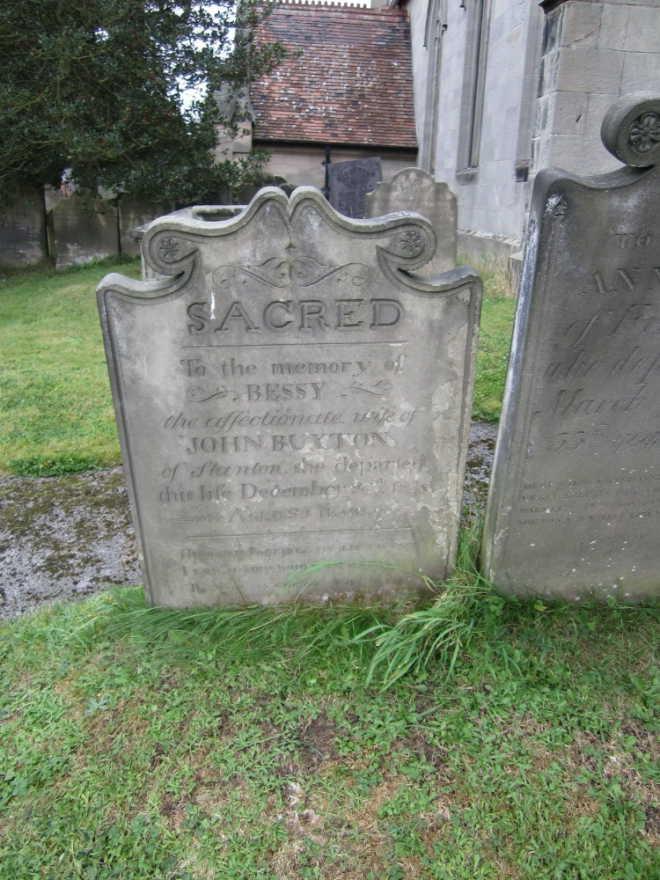
Bessy Grattidge (1815-1840) married John Buxton, farmer, in Ellastone in January 1838. They had three children before Bessy died in December 1840 at the age of 25: Henry in 1838, John in 1839, and Bessy Buxton in 1840. Bessy was baptised in January 1841. Presumably the birth of Bessy caused the death of Bessy the mother.
Bessy Buxton’s gravestone:
“Sacred to the memory of Bessy Buxton, the affectionate wife of John Buxton of Stanton She departed this life December 20th 1840, aged 25 years. “Husband, Farewell my life is Past, I loved you while life did last. Think on my children for my sake, And ever of them with I take.”
20 Dec 1840, Ellastone, Staffordshire
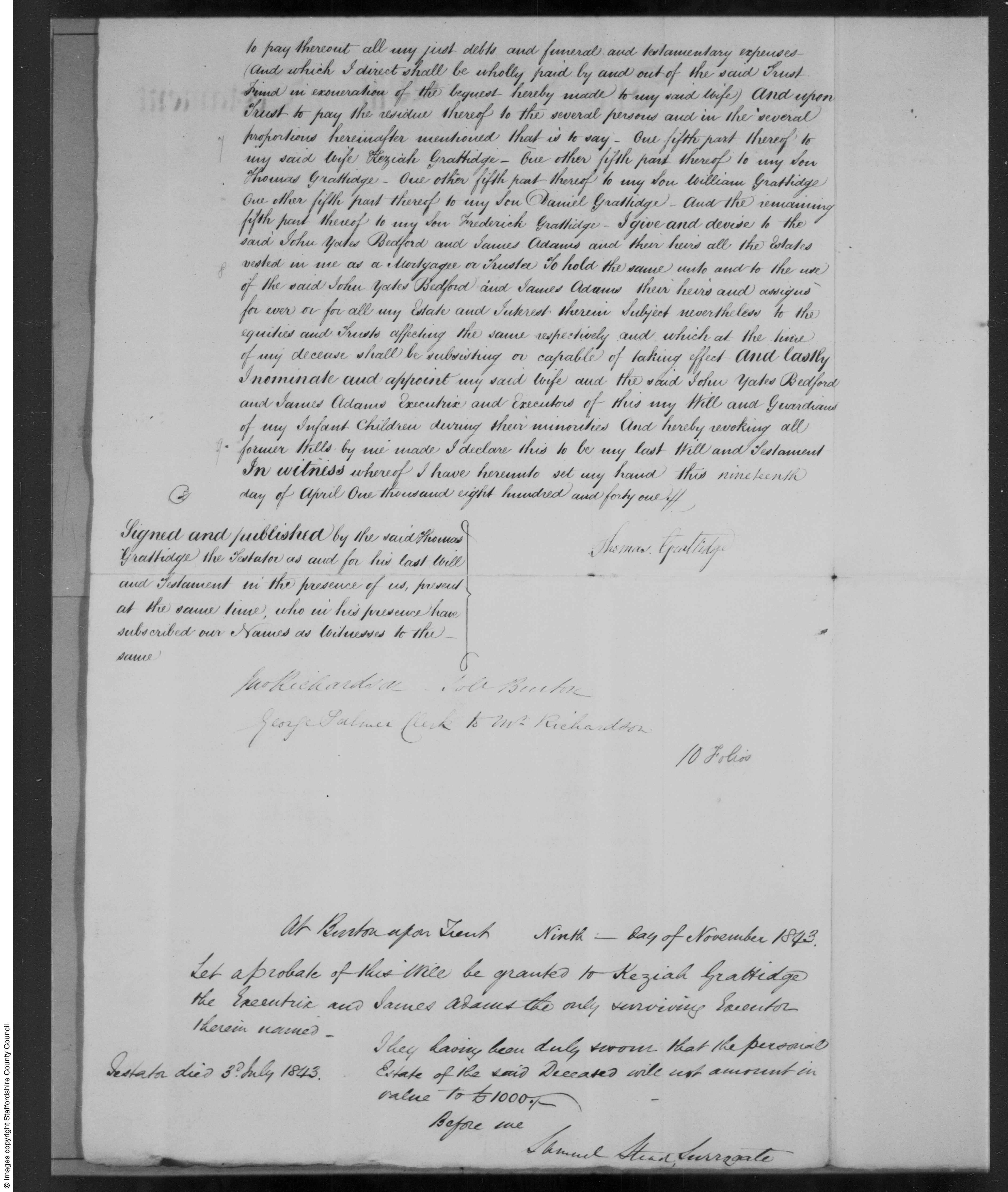
In the 1843 will of Thomas Grattidge, farmer of Foston, he leaves fifth shares of his estate, including freehold real estate at Findern, to his wife Kezia, and sons William, Daniel, Frederick and Thomas. He mentions that the children of his late daughter Bessy, wife of John Buxton, will be taken care of by their father. He leaves the farm to Keziah in confidence that she will maintain, support and educate his children with her.
An excerpt from the will:
I give and bequeath unto my dear wife Keziah Grattidge all my household goods and furniture, wearing apparel and plate and plated articles, linen, books, china, glass, and other household effects whatsoever, and also all my implements of husbandry, horses, cattle, hay, corn, crops and live and dead stock whatsoever, and also all the ready money that may be about my person or in my dwelling house at the time of my decease, …I also give my said wife the tenant right and possession of the farm in my occupation….
A page from the 1843 will of Thomas Grattidge:
William Grattidges half siblings (the offspring of Thomas Grattidge and Kezia Gibbs):
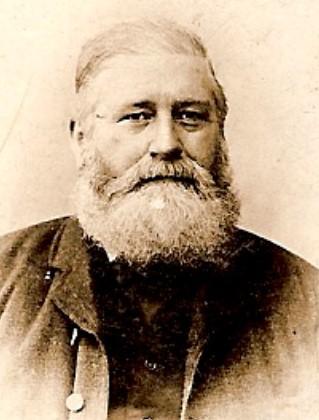
Albert Grattidge (1842-1914) was a railway engine driver in Derby. In 1884 he was driving the train when an unfortunate accident occured outside Ambergate. Three children were blackberrying and crossed the rails in front of the train, and one little girl died.
Albert Grattidge:
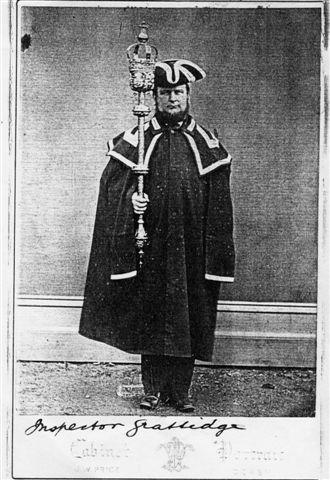
George Grattidge (1826-1876) was baptised Gibbs as this was before Thomas married Kezia. He was a police inspector in Derby.
George Grattidge:
Edwin Grattidge (1837-1852) died at just 15 years old.
Ann Grattidge (1835-) married Charles Fletcher, stone mason, and lived in Derby.
Louisa Victoria Grattidge (1840-1869) was sadly another Grattidge woman who died young. Louisa married Emmanuel Brunt Cheesborough in 1860 in Derby. In 1861 Louisa and Emmanuel were living with her mother Kezia in Derby, with their two children Frederick and Ann Louisa. Emmanuel’s occupation was sawyer. (Kezia Gibbs second husband Frederick Augustus Grattidge was a timber merchant in Derby)
At the time of her death in 1869, Emmanuel was the landlord of the White Hart public house at Bridgegate in Derby.
The Derby Mercury of 17th November 1869:
“On Wednesday morning Mr Coroner Vallack held an inquest in the Grand
Jury-room, Town-hall, on the body of Louisa Victoria Cheeseborough, aged
33, the wife of the landlord of the White Hart, Bridge-gate, who committed
suicide by poisoning at an early hour on Sunday morning. The following
evidence was taken:Mr Frederick Borough, surgeon, practising in Derby, deposed that he was
called in to see the deceased about four o’clock on Sunday morning last. He
accordingly examined the deceased and found the body quite warm, but dead.
He afterwards made enquiries of the husband, who said that he was afraid
that his wife had taken poison, also giving him at the same time the
remains of some blue material in a cup. The aunt of the deceased’s husband
told him that she had seen Mrs Cheeseborough put down a cup in the
club-room, as though she had just taken it from her mouth. The witness took
the liquid home with him, and informed them that an inquest would
necessarily have to be held on Monday. He had made a post mortem
examination of the body, and found that in the stomach there was a great
deal of congestion. There were remains of food in the stomach and, having
put the contents into a bottle, he took the stomach away. He also examined
the heart and found it very pale and flabby. All the other organs were
comparatively healthy; the liver was friable.Hannah Stone, aunt of the deceased’s husband, said she acted as a servant
in the house. On Saturday evening, while they were going to bed and whilst
witness was undressing, the deceased came into the room, went up to the
bedside, awoke her daughter, and whispered to her. but what she said the
witness did not know. The child jumped out of bed, but the deceased closed
the door and went away. The child followed her mother, and she also
followed them to the deceased’s bed-room, but the door being closed, they
then went to the club-room door and opening it they saw the deceased
standing with a candle in one hand. The daughter stayed with her in the
room whilst the witness went downstairs to fetch a candle for herself, and
as she was returning up again she saw the deceased put a teacup on the
table. The little girl began to scream, saying “Oh aunt, my mother is
going, but don’t let her go”. The deceased then walked into her bed-room,
and they went and stood at the door whilst the deceased undressed herself.
The daughter and the witness then returned to their bed-room. Presently
they went to see if the deceased was in bed, but she was sitting on the
floor her arms on the bedside. Her husband was sitting in a chair fast
asleep. The witness pulled her on the bed as well as she could.
Ann Louisa Cheesborough, a little girl, said that the deceased was her
mother. On Saturday evening last, about twenty minutes before eleven
o’clock, she went to bed, leaving her mother and aunt downstairs. Her aunt
came to bed as usual. By and bye, her mother came into her room – before
the aunt had retired to rest – and awoke her. She told the witness, in a
low voice, ‘that she should have all that she had got, adding that she
should also leave her her watch, as she was going to die’. She did not tell
her aunt what her mother had said, but followed her directly into the
club-room, where she saw her drink something from a cup, which she
afterwards placed on the table. Her mother then went into her own room and
shut the door. She screamed and called her father, who was downstairs. He
came up and went into her room. The witness then went to bed and fell
asleep. She did not hear any noise or quarrelling in the house after going
to bed.Police-constable Webster was on duty in Bridge-gate on Saturday evening
last, about twenty minutes to one o’clock. He knew the White Hart
public-house in Bridge-gate, and as he was approaching that place, he heard
a woman scream as though at the back side of the house. The witness went to
the door and heard the deceased keep saying ‘Will you be quiet and go to
bed’. The reply was most disgusting, and the language which the
police-constable said was uttered by the husband of the deceased, was
immoral in the extreme. He heard the poor woman keep pressing her husband
to go to bed quietly, and eventually he saw him through the keyhole of the
door pass and go upstairs. his wife having gone up a minute or so before.
Inspector Fearn deposed that on Sunday morning last, after he had heard of
the deceased’s death from supposed poisoning, he went to Cheeseborough’s
public house, and found in the club-room two nearly empty packets of
Battie’s Lincoln Vermin Killer – each labelled poison.Several of the Jury here intimated that they had seen some marks on the
deceased’s neck, as of blows, and expressing a desire that the surgeon
should return, and re-examine the body. This was accordingly done, after
which the following evidence was taken:Mr Borough said that he had examined the body of the deceased and observed
a mark on the left side of the neck, which he considered had come on since
death. He thought it was the commencement of decomposition.
This was the evidence, after which the jury returned a verdict “that the
deceased took poison whilst of unsound mind” and requested the Coroner to
censure the deceased’s husband.The Coroner told Cheeseborough that he was a disgusting brute and that the
jury only regretted that the law could not reach his brutal conduct.
However he had had a narrow escape. It was their belief that his poor
wife, who was driven to her own destruction by his brutal treatment, would
have been a living woman that day except for his cowardly conduct towards
her.The inquiry, which had lasted a considerable time, then closed.”
In this article it says:
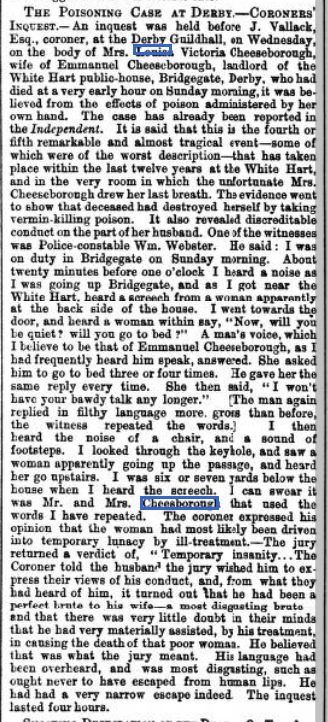
“it was the “fourth or fifth remarkable and tragical event – some of which were of the worst description – that has taken place within the last twelve years at the White Hart and in the very room in which the unfortunate Louisa Cheesborough drew her last breath.”
Sheffield Independent – Friday 12 November 1869:
 August 18, 2022 at 8:26 am #6324
In reply to: The Elusive Samuel Housley and Other Family Stories
STONE MANOR
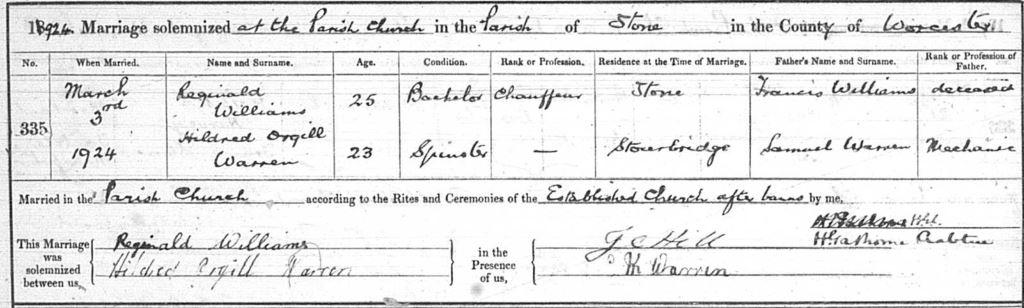
Hildred Orgill Warren born in 1900, my grandmothers sister, married Reginald Williams in Stone, Worcestershire in March 1924. Their daughter Joan was born there in October of that year.
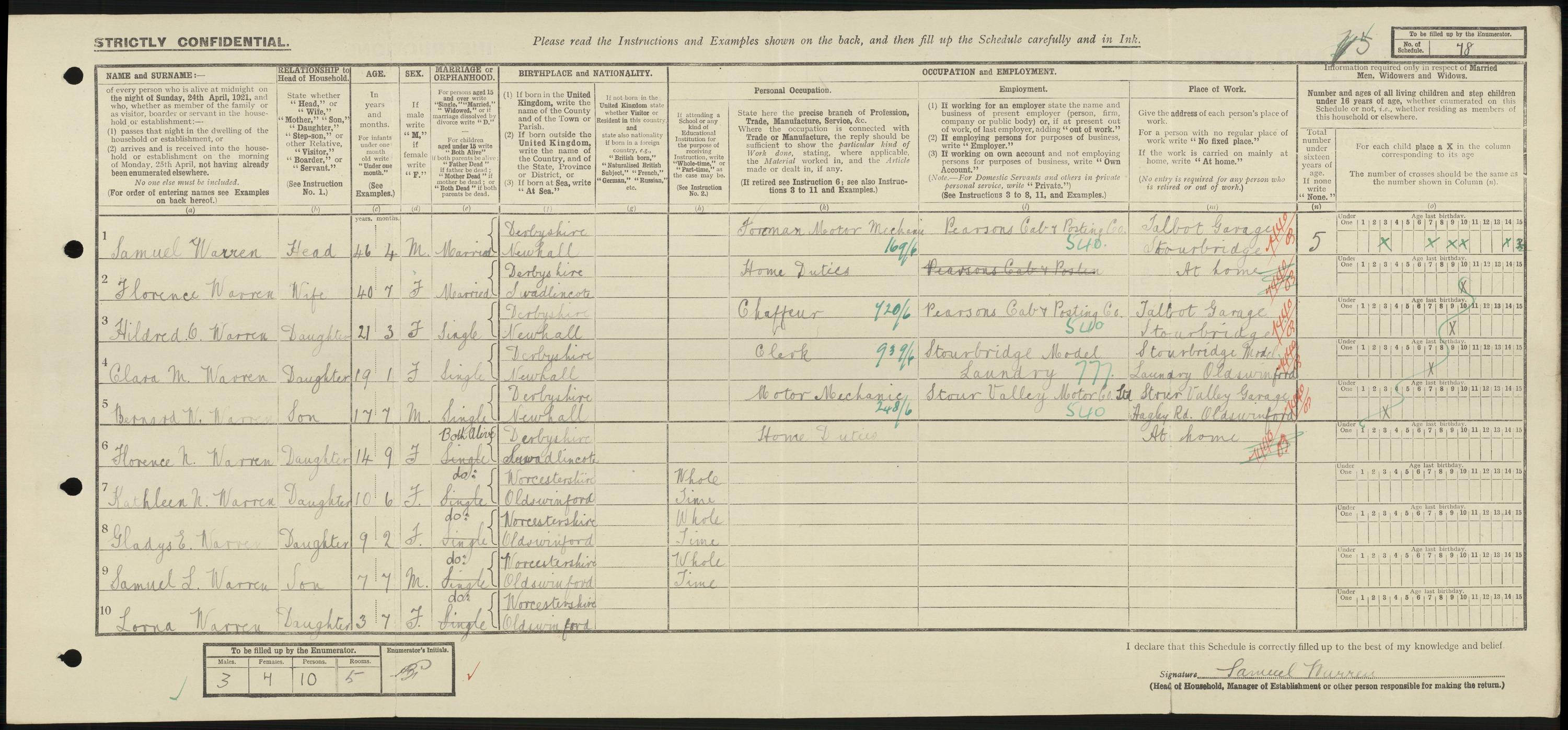
Hildred was a chaffeur on the 1921 census, living at home in Stourbridge with her father (my great grandfather) Samuel Warren, mechanic. I recall my grandmother saying that Hildred was one of the first lady chauffeurs. On their wedding certificate, Reginald is also a chauffeur.
1921 census, Stourbridge:
Hildred and Reg worked at Stone Manor. There is a family story of Hildred being involved in a car accident involving a fatality and that she had to go to court.
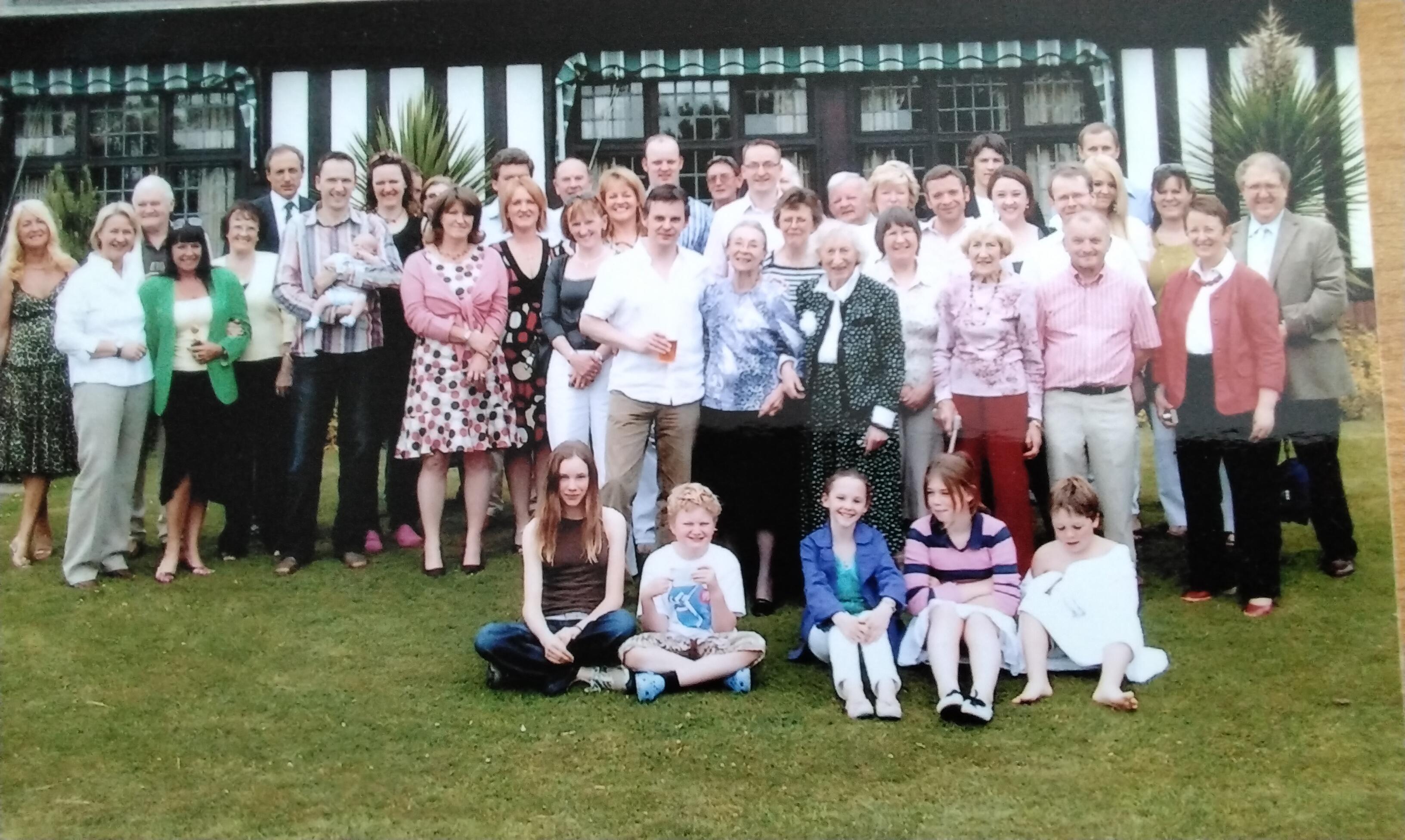
Stone Manor is in a tiny village called Stone, near Kidderminster, Worcestershire. It used to be a private house, but has been a hotel and nightclub for some years. We knew in the family that Hildred and Reg worked at Stone Manor and that Joan was born there. Around 2007 Joan held a family party there.
Stone Manor, Stone, Worcestershire:
I asked on a Kidderminster Family Research group about Stone Manor in the 1920s:
“the original Stone Manor burnt down and the current building dates from the early 1920’s and was built for James Culcheth Hill, completed in 1926”
But was there a fire at Stone Manor?
“I’m not sure there was a fire at the Stone Manor… there seems to have been a fire at another big house a short distance away and it looks like stories have crossed over… as the dates are the same…”JC Hill was one of the witnesses at Hildred and Reginalds wedding in Stone in 1924. K Warren, Hildreds sister Kay, was the other:
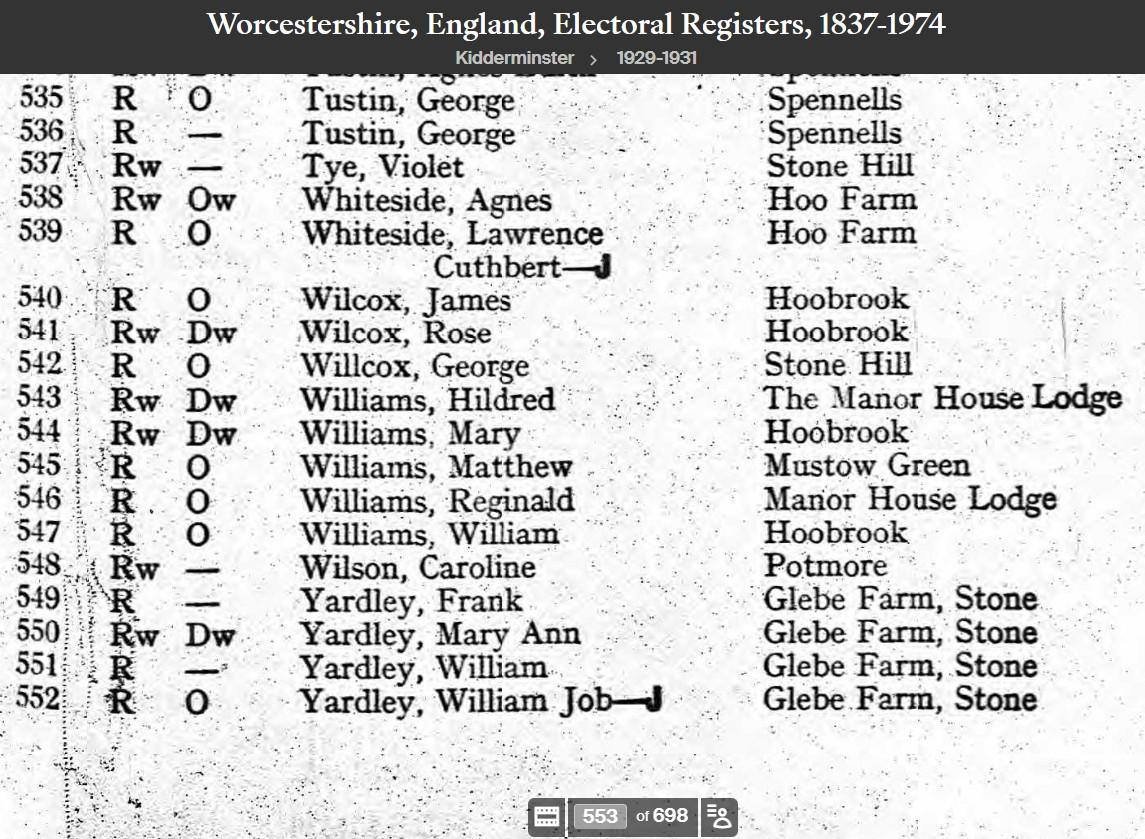
I searched the census and electoral rolls for James Culcheth Hill and found him at the Stone Manor on the 1929-1931 electoral rolls for Stone, and Hildred and Reginald living at The Manor House Lodge, Stone:
On the 1911 census James Culcheth Hill was a 12 year old student at Eastmans Royal Naval Academy, Northwood Park, Crawley, Winchester. He was born in Kidderminster in 1899. On the same census page, also a student at the school, is Reginald Culcheth Holcroft, born in 1900 in Stourbridge. The unusual middle name would seem to indicate that they might be related.
A member of the Kidderminster Family Research group kindly provided this article:
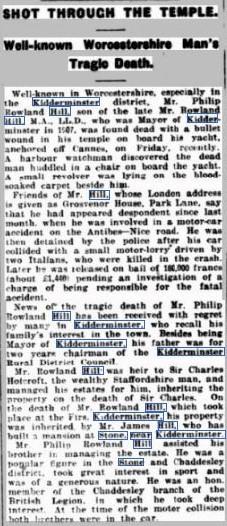
SHOT THROUGH THE TEMPLE
Well known Worcestershire man’s tragic death.
Dudley Chronicle 27 March 1930.
Well known in Worcestershire, especially the Kidderminster district, Mr Philip Rowland Hill MA LLD who was mayor of Kidderminster in 1907 was found dead with a bullet wound through his temple on board his yacht, anchored off Cannes, on Friday, recently. A harbour watchman discovered the dead man huddled in a chair on board the yacht. A small revolver was lying on the blood soaked carpet beside him.
Friends of Mr Hill, whose London address is given as Grosvenor House, Park Lane, say that he appeared despondent since last month when he was involved in a motor car accident on the Antibes ~ Nice road. He was then detained by the police after his car collided with a small motor lorry driven by two Italians, who were killed in the crash. Later he was released on bail of 180,000 francs (£1440) pending an investigation of a charge of being responsible for the fatal accident. …….
Mr Rowland Hill (Philips father) was heir to Sir Charles Holcroft, the wealthy Staffordshire man, and managed his estates for him, inheriting the property on the death of Sir Charles. On the death of Mr Rowland HIll, which took place at the Firs, Kidderminster, his property was inherited by Mr James (Culcheth) Hill who had built a mansion at Stone, near Kidderminster. Mr Philip Rowland Hill assisted his brother in managing the estate. …….
At the time of the collison both brothers were in the car.
This article doesn’t mention who was driving the car ~ could the family story of a car accident be this one? Hildred and Reg were working at Stone Manor, both were (or at least previously had been) chauffeurs, and Philip Hill was helping James Culcheth Hill manage the Stone Manor estate at the time.
This photograph was taken circa 1931 in Llanaeron, Wales. Hildred is in the middle on the back row:
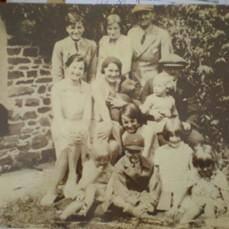
Sally Gray sent the photo with this message:
“Joan gave me a short note: Photo was taken when they lived in Wales, at Llanaeron, before Janet was born, & Aunty Lorna (my mother) lived with them, to take Joan to school in Aberaeron, as they only spoke Welsh at the local school.”
Hildred and Reginalds daughter Janet was born in 1932 in Stratford. It would appear that Hildred and Reg moved to Wales just after the car accident, and shortly afterwards moved to Stratford.
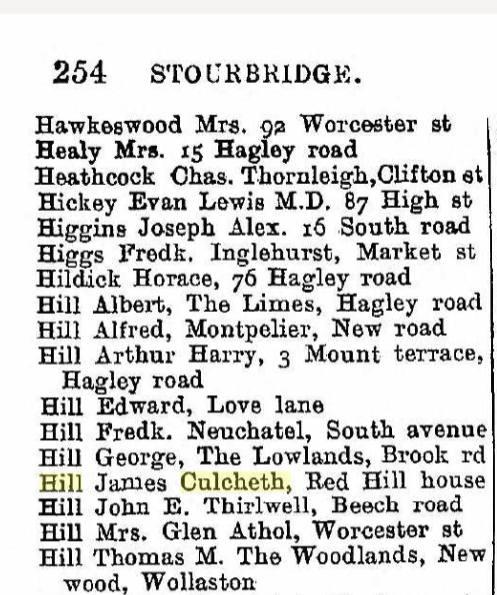
In 1921 James Culcheth Hill was living at Red Hill House in Stourbridge. Although I have not been able to trace Reginald Williams yet, perhaps this Stourbridge connection with his employer explains how Hildred met Reginald.
Sir Reginald Culcheth Holcroft, the other pupil at the school in Winchester with James Culcheth Hill, was indeed related, as Sir Holcroft left his estate to James Culcheth Hill’s father. Sir Reginald was born in 1899 in Upper Swinford, Stourbridge. Hildred also lived in that part of Stourbridge in the early 1900s.
1921 Red Hill House:
The 2007 family reunion organized by Joan Williams at Stone Manor: Joan in black and white at the front.
Unrelated to the Warrens, my fathers friends (and customers at The Fox when my grandmother Peggy Edwards owned it) Geoff and Beryl Lamb later bought Stone Manor.
July 12, 2022 at 9:46 am #6320In reply to: The Sexy Wooden Leg
When Maryechka arrived at the front gate of the Vyriy hotel with its gaudy plaster storks at the entrance, she sneaked into the side gate leading to the kitchens.
She had to be careful not to to be noticed by Larysa who often had her cigarette break hidden under the pine tree. Larysa didn’t like children, or at least, she disliked them slightly less than the elderly residents, whoever was the loudest and the uncleanliest was sure to suffer her disapproval.
Larysa was basically single-handedly managing the hotel, doing most of the chores to keep it afloat. The only thing she didn’t do was the catering, and packaged trays arrived every day for the residents. Maryechka’s grand-pa was no picky eater, and made a point of clearing his tray of food, but she suspected most of the other residents didn’t.
The only other employee she was told, was the gardener who would have been old enough to be a resident himself, and had died of a stroke before the summer. The small garden was clearly in need of tending after.Maryechka could see the coast was clear, and was making her ways to the stairs when she heard clanking in the stairs and voices arguing.
“Keep your voice down, you’re going to wake the dragon.”
“That’s your fault, you don’t pack light for your adventures. You really needed to take all these suitcases? How can we make a run for it with all that dead weight!”
July 6, 2022 at 11:05 am #6312In reply to: The Sexy Wooden Leg
When she’d heard of the miracle happening at the Flovlinden Tree, Egna initially shrugged it off as another conman’s attempt at fooling the crowds.
“No, it’s real, my Auntie saw it.”
“Stop fretting” she’d told the little girl, as she was carefully removing the lice from her hair. “This is just someone’s idea of a smart joke. Don’t get fooled, you’re smarter than this.”
She sure wasn’t responsible for that one. If that were a true miracle, she would have known. The little calf next week being resuscitated after being dead a few minutes, well, that was her. Shame nobody was even there to notice. Most of the best miracles go about this way anyway.
So, after having lived close to a millennia in relatively rock solid health and with surprisingly unaging looks, Egna had thought she’d seen it all; at least last time the tree started to ooze sacred oil, it didn’t last for too long, people’s greed starting to sell it stopped it right in its tracks.
But maybe there was more to it this time. Egna’d often wondered why God had let her live that long. She was a useful instrument to Her for sure, but living in secrecy, claiming no ownership, most miracles were just facts of life. She somehow failed to see the point, even after 957 years of existence.
The little girl had left to go back to her nearby town. This side of the country was still quite safe from all the craziness. Egna knew well most of the branches of the ancestral trees leading to that particular little leaf. This one had probably no idea she shared a common ancestor with President Voldomeer, but Egna remembered the fellow. He was a clogmaker in the turn of the 18th century, as was his father before. That was until a rather unexpected turn of events precipitated him to a different path as his brother.
She had a book full of these records, as she’d tracked the lives of many, to keep them alive, and maybe remind people they all share so much in common. That is, if people were able to remember more than 2 generations before them.
“Well, that’s set.” she said to herself and to Her as She’s always listening “I’ll go and see for myself.”
her trusty old musty cloak at the door seemed to have been begging for the journey.June 6, 2022 at 12:58 pm #6303In reply to: The Elusive Samuel Housley and Other Family Stories
The Hollands of Barton under Needwood
Samuel Warren of Stapenhill married Catherine Holland of Barton under Needwood in 1795.
I joined a Barton under Needwood History group and found an incredible amount of information on the Holland family, but first I wanted to make absolutely sure that our Catherine Holland was one of them as there were also Hollands in Newhall. Not only that, on the marriage licence it says that Catherine Holland was from Bretby Park Gate, Stapenhill.
Then I noticed that one of the witnesses on Samuel’s brother Williams marriage to Ann Holland in 1796 was John Hair. Hannah Hair was the wife of Thomas Holland, and they were the Barton under Needwood parents of Catherine. Catherine was born in 1775, and Ann was born in 1767.
The 1851 census clinched it: Catherine Warren 74 years old, widow and formerly a farmers wife, was living in the household of her son John Warren, and her place of birth is listed as Barton under Needwood. In 1841 Catherine was a 64 year old widow, her husband Samuel having died in 1837, and she was living with her son Samuel, a farmer. The 1841 census did not list place of birth, however. Catherine died on 31 March 1861 and does not appear on the 1861 census.
Once I had established that our Catherine Holland was from Barton under Needwood, I had another look at the information available on the Barton under Needwood History group, compiled by local historian Steve Gardner.
Catherine’s parents were Thomas Holland 1737-1828 and Hannah Hair 1739-1822.
Steve Gardner had posted a long list of the dates, marriages and children of the Holland family. The earliest entries in parish registers were Thomae Holland 1562-1626 and his wife Eunica Edwardes 1565-1632. They married on 10th July 1582. They were born, married and died in Barton under Needwood. They were direct ancestors of Catherine Holland, and as such my direct ancestors too.
The known history of the Holland family in Barton under Needwood goes back to Richard De Holland. (Thanks once again to Steve Gardner of the Barton under Needwood History group for this information.)
“Richard de Holland was the first member of the Holland family to become resident in Barton under Needwood (in about 1312) having been granted lands by the Earl of Lancaster (for whom Richard served as Stud and Stock Keeper of the Peak District) The Holland family stemmed from Upholland in Lancashire and had many family connections working for the Earl of Lancaster, who was one of the biggest Barons in England. Lancaster had his own army and lived at Tutbury Castle, from where he ruled over most of the Midlands area. The Earl of Lancaster was one of the main players in the ‘Barons Rebellion’ and the ensuing Battle of Burton Bridge in 1322. Richard de Holland was very much involved in the proceedings which had so angered Englands King. Holland narrowly escaped with his life, unlike the Earl who was executed.
From the arrival of that first Holland family member, the Hollands were a mainstay family in the community, and were in Barton under Needwood for over 600 years.”Continuing with various items of information regarding the Hollands, thanks to Steve Gardner’s Barton under Needwood history pages:
“PART 6 (Final Part)
Some mentions of The Manor of Barton in the Ancient Staffordshire Rolls:
1330. A Grant was made to Herbert de Ferrars, at le Newland in the Manor of Barton.
1378. The Inquisitio bonorum – Johannis Holand — an interesting Inventory of his goods and their value and his debts.
1380. View of Frankpledge ; the Jury found that Richard Holland was feloniously murdered by his wife Joan and Thomas Graunger, who fled. The goods of the deceased were valued at iiij/. iijj. xid. ; one-third went to the dead man, one-third to his son, one- third to the Lord for the wife’s share. Compare 1 H. V. Indictments. (1413.)
That Thomas Graunger of Barton smyth and Joan the wife of Richard de Holond of Barton on the Feast of St. John the Baptist 10 H. II. (1387) had traitorously killed and murdered at night, at Barton, Richard, the husband of the said Joan. (m. 22.)
The names of various members of the Holland family appear constantly among the listed Jurors on the manorial records printed below : —
1539. Richard Holland and Richard Holland the younger are on the Muster Roll of Barton
1583. Thomas Holland and Unica his wife are living at Barton.
1663-4. Visitations. — Barton under Needword. Disclaimers. William Holland, Senior, William Holland, Junior.
1609. Richard Holland, Clerk and Alice, his wife.
1663-4. Disclaimers at the Visitation. William Holland, Senior, William Holland, Junior.”I was able to find considerably more information on the Hollands in the book “Some Records of the Holland Family (The Hollands of Barton under Needwood, Staffordshire, and the Hollands in History)” by William Richard Holland. Luckily the full text of this book can be found online.
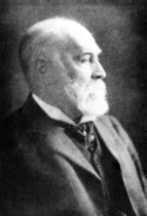
William Richard Holland (Died 1915) An early local Historian and author of the book:
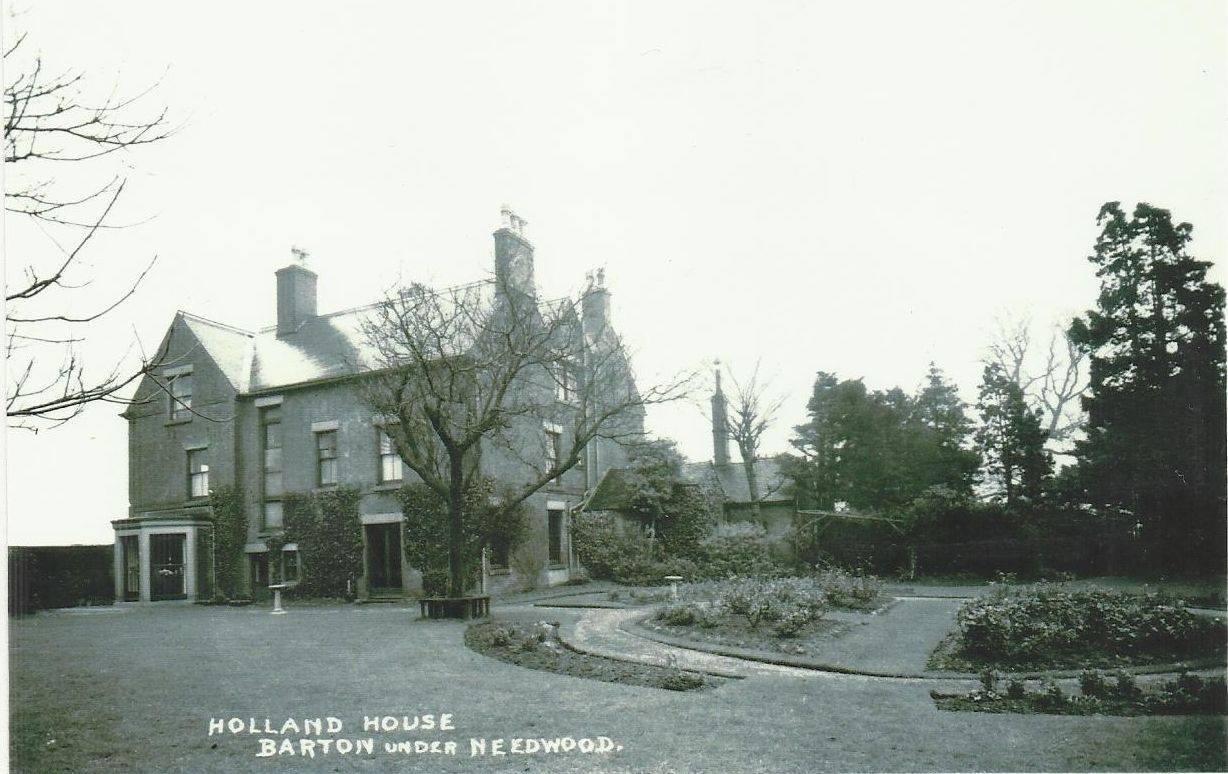
‘Holland House’ taken from the Gardens (sadly demolished in the early 60’s):
Excerpt from the book:
“The charter, dated 1314, granting Richard rights and privileges in Needwood Forest, reads as follows:
“Thomas Earl of Lancaster and Leicester, high-steward of England, to whom all these present shall come, greeting: Know ye, that we have given, &c., to Richard Holland of Barton, and his heirs, housboot, heyboot, and fireboot, and common of pasture, in our forest of Needwood, for all his beasts, as well in places fenced as lying open, with 40 hogs, quit of pawnage in our said forest at all times in the year (except hogs only in fence month). All which premises we will warrant, &c. to the said Richard and his heirs against all people for ever”
“The terms “housboot” “heyboot” and “fireboot” meant that Richard and his heirs were to have the privilege of taking from the Forest, wood needed for house repair and building, hedging material for the repairing of fences, and what was needful for purposes of fuel.”
Further excerpts from the book:
“It may here be mentioned that during the renovation of Barton Church, when the stone pillars were being stripped of the plaster which covered them, “William Holland 1617” was found roughly carved on a pillar near to the belfry gallery, obviously the work of a not too devout member of the family, who, seated in the gallery of that time, occupied himself thus during the service. The inscription can still be seen.”
“The earliest mention of a Holland of Upholland occurs in the reign of John in a Final Concord, made at the Lancashire Assizes, dated November 5th, 1202, in which Uchtred de Chryche, who seems to have had some right in the manor of Upholland, releases his right in fourteen oxgangs* of land to Matthew de Holland, in consideration of the sum of six marks of silver. Thus was planted the Holland Tree, all the early information of which is found in The Victoria County History of Lancaster.
As time went on, the family acquired more land, and with this, increased position. Thus, in the reign of Edward I, a Robert de Holland, son of Thurstan, son of Robert, became possessed of the manor of Orrell adjoining Upholland and of the lordship of Hale in the parish of Childwall, and, through marriage with Elizabeth de Samlesbury (co-heiress of Sir Wm. de Samlesbury of Samlesbury, Hall, near to Preston), of the moiety of that manor….
* An oxgang signified the amount of land that could be ploughed by one ox in one day”
“This Robert de Holland, son of Thurstan, received Knighthood in the reign of Edward I, as did also his brother William, ancestor of that branch of the family which later migrated to Cheshire. Belonging to this branch are such noteworthy personages as Mrs. Gaskell, the talented authoress, her mother being a Holland of this branch, Sir Henry Holland, Physician to Queen Victoria, and his two sons, the first Viscount Knutsford, and Canon Francis Holland ; Sir Henry’s grandson (the present Lord Knutsford), Canon Scott Holland, etc. Captain Frederick Holland, R.N., late of Ashbourne Hall, Derbyshire, may also be mentioned here.*”
Thanks to the Barton under Needwood history group for the following:
WALES END FARM:
In 1509 it was owned and occupied by Mr Johannes Holland De Wallass end who was a well to do Yeoman Farmer (the origin of the areas name – Wales End). Part of the building dates to 1490 making it probably the oldest building still standing in the Village: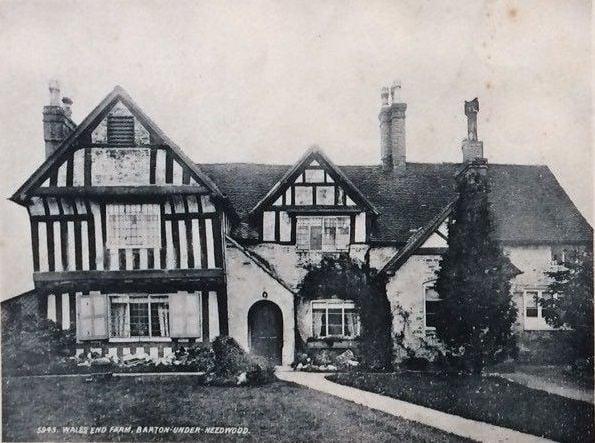
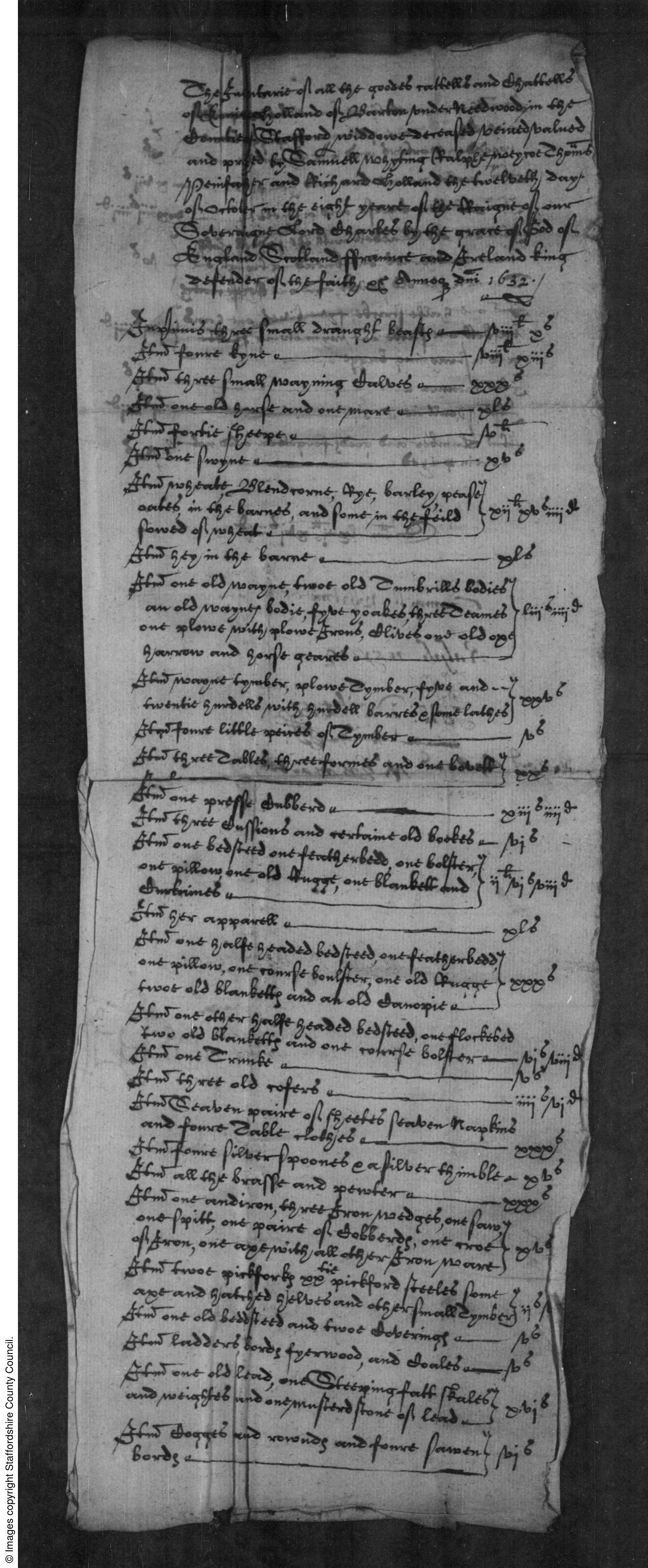
I found records for all of the Holland’s listed on the Barton under Needwood History group and added them to my ancestry tree. The earliest will I found was for Eunica Edwardes, then Eunica Holland, who died in 1632.
A page from the 1632 will and inventory of Eunica (Unice) Holland:
I’d been reading about “pedigree collapse” just before I found out her maiden name of Edwardes. Edwards is my own maiden name.
“In genealogy, pedigree collapse describes how reproduction between two individuals who knowingly or unknowingly share an ancestor causes the family tree of their offspring to be smaller than it would otherwise be.
Without pedigree collapse, a person’s ancestor tree is a binary tree, formed by the person, the parents, grandparents, and so on. However, the number of individuals in such a tree grows exponentially and will eventually become impossibly high. For example, a single individual alive today would, over 30 generations going back to the High Middle Ages, have roughly a billion ancestors, more than the total world population at the time. This apparent paradox occurs because the individuals in the binary tree are not distinct: instead, a single individual may occupy multiple places in the binary tree. This typically happens when the parents of an ancestor are cousins (sometimes unbeknownst to themselves). For example, the offspring of two first cousins has at most only six great-grandparents instead of the normal eight. This reduction in the number of ancestors is pedigree collapse. It collapses the binary tree into a directed acyclic graph with two different, directed paths starting from the ancestor who in the binary tree would occupy two places.” via wikipediaThere is nothing to suggest, however, that Eunica’s family were related to my fathers family, and the only evidence so far in my tree of pedigree collapse are the marriages of Orgill cousins, where two sets of grandparents are repeated.
A list of Holland ancestors:
Catherine Holland 1775-1861
her parents:
Thomas Holland 1737-1828 Hannah Hair 1739-1832
Thomas’s parents:
William Holland 1696-1756 Susannah Whiteing 1715-1752
William’s parents:
William Holland 1665- Elizabeth Higgs 1675-1720
William’s parents:
Thomas Holland 1634-1681 Katherine Owen 1634-1728
Thomas’s parents:
Thomas Holland 1606-1680 Margaret Belcher 1608-1664
Thomas’s parents:
Thomas Holland 1562-1626 Eunice Edwardes 1565- 1632April 12, 2022 at 8:13 am #6290In reply to: The Elusive Samuel Housley and Other Family Stories
Leicestershire Blacksmiths
The Orgill’s of Measham led me further into Leicestershire as I traveled back in time.
I also realized I had uncovered a direct line of women and their mothers going back ten generations:
myself, Tracy Edwards 1957-
my mother Gillian Marshall 1933-
my grandmother Florence Warren 1906-1988
her mother and my great grandmother Florence Gretton 1881-1927
her mother Sarah Orgill 1840-1910
her mother Elizabeth Orgill 1803-1876
her mother Sarah Boss 1783-1847
her mother Elizabeth Page 1749-
her mother Mary Potter 1719-1780
and her mother and my 7x great grandmother Mary 1680-You could say it leads us to the very heart of England, as these Leicestershire villages are as far from the coast as it’s possible to be. There are countless other maternal lines to follow, of course, but only one of mothers of mothers, and ours takes us to Leicestershire.
The blacksmiths
Sarah Boss was the daughter of Michael Boss 1755-1807, a blacksmith in Measham, and Elizabeth Page of nearby Hartshorn, just over the county border in Derbyshire.
An earlier Michael Boss, a blacksmith of Measham, died in 1772, and in his will he left the possession of the blacksmiths shop and all the working tools and a third of the household furniture to Michael, who he named as his nephew. He left his house in Appleby Magna to his wife Grace, and five pounds to his mother Jane Boss. As none of Michael and Grace’s children are mentioned in the will, perhaps it can be assumed that they were childless.
The will of Michael Boss, 1772, Measham:
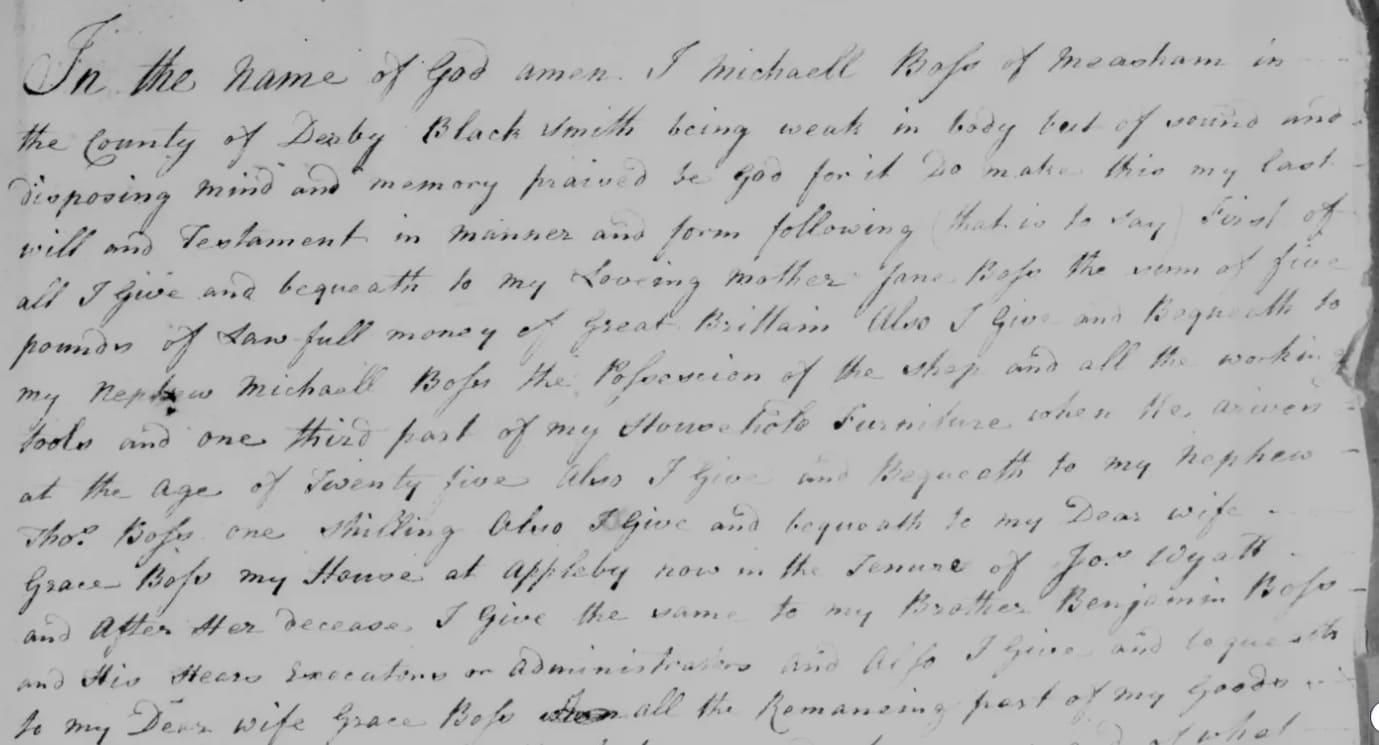
Michael Boss the uncle was born in Appleby Magna in 1724. His parents were Michael Boss of Nelson in the Thistles and Jane Peircivall of Appleby Magna, who were married in nearby Mancetter in 1720.
Information worth noting on the Appleby Magna website:
In 1752 the calendar in England was changed from the Julian Calendar to the Gregorian Calendar, as a result 11 days were famously “lost”. But for the recording of Church Registers another very significant change also took place, the start of the year was moved from March 25th to our more familiar January 1st.
Before 1752 the 1st day of each new year was March 25th, Lady Day (a significant date in the Christian calendar). The year number which we all now use for calculating ages didn’t change until March 25th. So, for example, the day after March 24th 1750 was March 25th 1751, and January 1743 followed December 1743.
This March to March recording can be seen very clearly in the Appleby Registers before 1752. Between 1752 and 1768 there appears slightly confused recording, so dates should be carefully checked. After 1768 the recording is more fully by the modern calendar year.Michael Boss the uncle married Grace Cuthbert. I haven’t yet found the birth or parents of Grace, but a blacksmith by the name of Edward Cuthbert is mentioned on an Appleby Magna history website:
An Eighteenth Century Blacksmith’s Shop in Little Appleby
by Alan RobertsCuthberts inventory
The inventory of Edward Cuthbert provides interesting information about the household possessions and living arrangements of an eighteenth century blacksmith. Edward Cuthbert (als. Cutboard) settled in Appleby after the Restoration to join the handful of blacksmiths already established in the parish, including the Wathews who were prominent horse traders. The blacksmiths may have all worked together in the same shop at one time. Edward and his wife Sarah recorded the baptisms of several of their children in the parish register. Somewhat sadly three of the boys named after their father all died either in infancy or as young children. Edward’s inventory which was drawn up in 1732, by which time he was probably a widower and his children had left home, suggests that they once occupied a comfortable two-storey house in Little Appleby with an attached workshop, well equipped with all the tools for repairing farm carts, ploughs and other implements, for shoeing horses and for general ironmongery.
Edward Cuthbert born circa 1660, married Joane Tuvenet in 1684 in Swepston cum Snarestone , and died in Appleby in 1732. Tuvenet is a French name and suggests a Huguenot connection, but this isn’t our family, and indeed this Edward Cuthbert is not likely to be Grace’s father anyway.
Michael Boss and Elizabeth Page appear to have married twice: once in 1776, and once in 1779. Both of the documents exist and appear correct. Both marriages were by licence. They both mention Michael is a blacksmith.
Their first daughter, Elizabeth, was baptized in February 1777, just nine months after the first wedding. It’s not known when she was born, however, and it’s possible that the marriage was a hasty one. But why marry again three years later?
But Michael Boss and Elizabeth Page did not marry twice.
Elizabeth Page from Smisby was born in 1752 and married Michael Boss on the 5th of May 1776 in Measham. On the marriage licence allegations and bonds, Michael is a bachelor.
Baby Elizabeth was baptised in Measham on the 9th February 1777. Mother Elizabeth died on the 18th February 1777, also in Measham.
In 1779 Michael Boss married another Elizabeth Page! She was born in 1749 in Hartshorn, and Michael is a widower on the marriage licence allegations and bonds.
Hartshorn and Smisby are neighbouring villages, hence the confusion. But a closer look at the documents available revealed the clues. Both Elizabeth Pages were literate, and indeed their signatures on the marriage registers are different:
Marriage of Michael Boss and Elizabeth Page of Smisby in 1776:
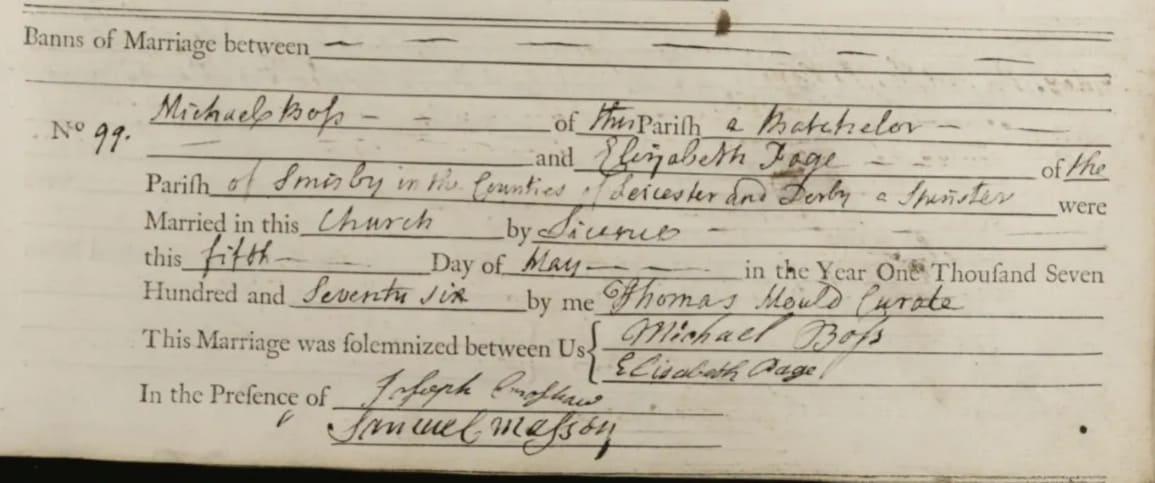
Marriage of Michael Boss and Elizabeth Page of Harsthorn in 1779:
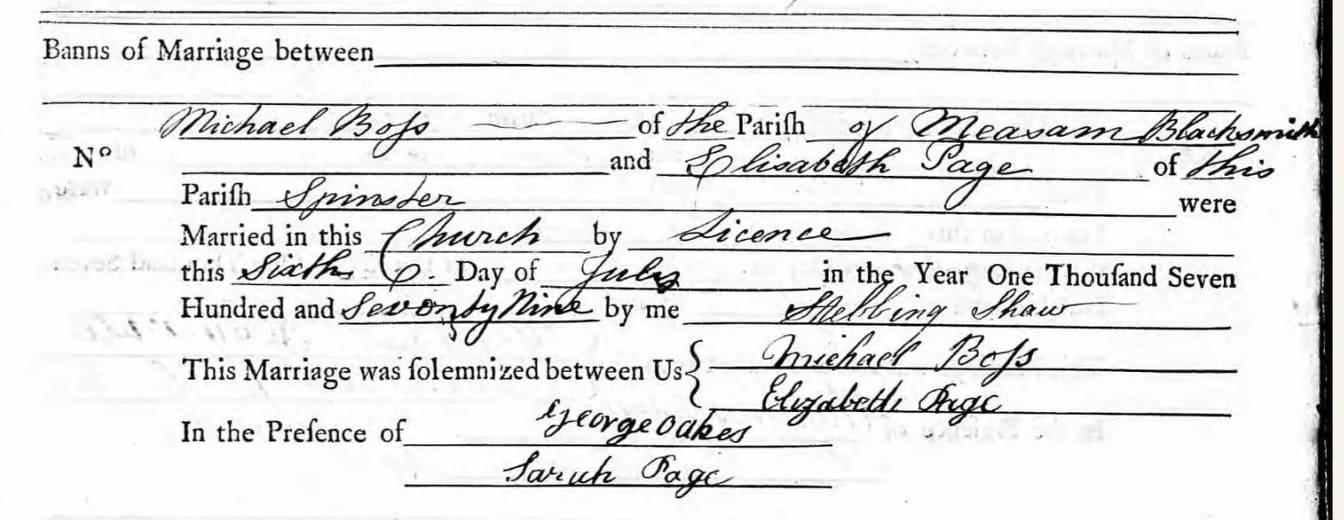
Not only did Michael Boss marry two women both called Elizabeth Page but he had an unusual start in life as well. His uncle Michael Boss left him the blacksmith business and a third of his furniture. This was all in the will. But which of Uncle Michaels brothers was nephew Michaels father?
The only Michael Boss born at the right time was in 1750 in Edingale, Staffordshire, about eight miles from Appleby Magna. His parents were Thomas Boss and Ann Parker, married in Edingale in 1747. Thomas died in August 1750, and his son Michael was baptised in the December, posthumus son of Thomas and his widow Ann. Both entries are on the same page of the register.
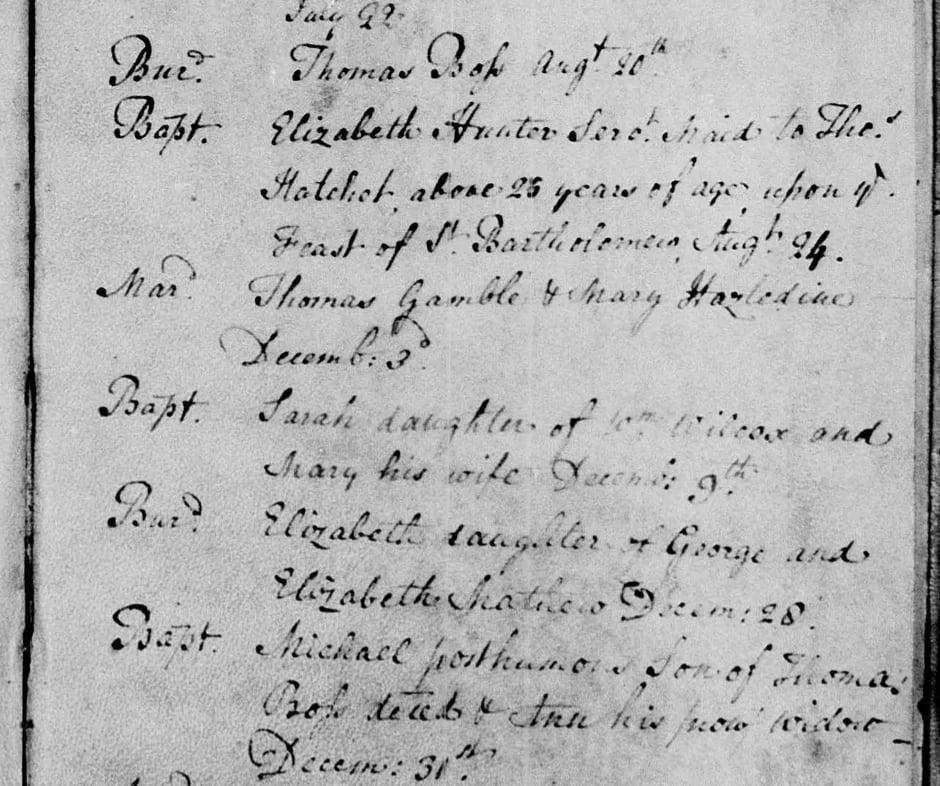
Ann Boss, the young widow, married again. But perhaps Michael and his brother went to live with their childless uncle and aunt, Michael Boss and Grace Cuthbert.
The great grandfather of Michael Boss (the Measham blacksmith born in 1850) was also Michael Boss, probably born in the 1660s. He died in Newton Regis in Warwickshire in 1724, four years after his son (also Michael Boss born 1693) married Jane Peircivall. The entry on the parish register states that Michael Boss was buried ye 13th Affadavit made.
I had not seen affadavit made on a parish register before, and this relates to the The Burying in Woollen Acts 1666–80. According to Wikipedia:
“Acts of the Parliament of England which required the dead, except plague victims and the destitute, to be buried in pure English woollen shrouds to the exclusion of any foreign textiles. It was a requirement that an affidavit be sworn in front of a Justice of the Peace (usually by a relative of the deceased), confirming burial in wool, with the punishment of a £5 fee for noncompliance. Burial entries in parish registers were marked with the word “affidavit” or its equivalent to confirm that affidavit had been sworn; it would be marked “naked” for those too poor to afford the woollen shroud. The legislation was in force until 1814, but was generally ignored after 1770.”
Michael Boss buried 1724 “Affadavit made”:
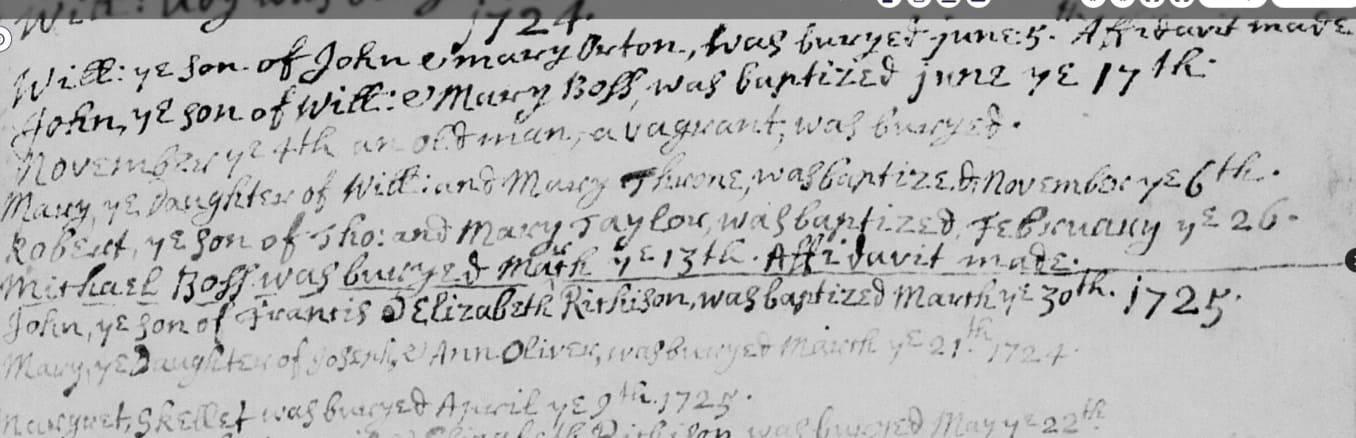
Elizabeth Page‘s father was William Page 1717-1783, a wheelwright in Hartshorn. (The father of the first wife Elizabeth was also William Page, but he was a husbandman in Smisby born in 1714. William Page, the father of the second wife, was born in Nailstone, Leicestershire, in 1717. His place of residence on his marriage to Mary Potter was spelled Nelson.)
Her mother was Mary Potter 1719- of nearby Coleorton. Mary’s father, Richard Potter 1677-1731, was a blacksmith in Coleorton.
A page of the will of Richard Potter 1731:
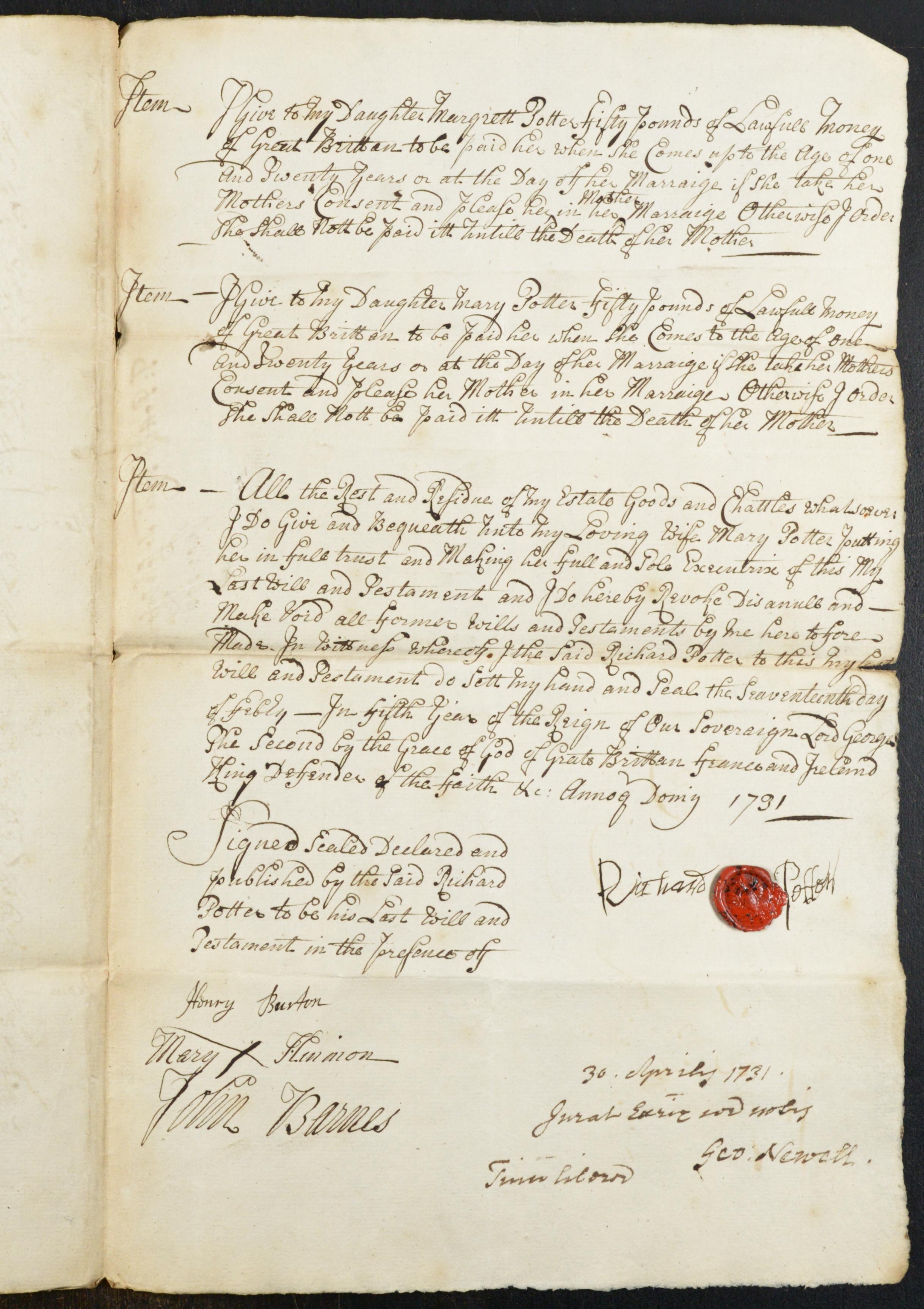
Richard Potter states: “I will and order that my son Thomas Potter shall after my decease have one shilling paid to him and no more.” As he left £50 to each of his daughters, one can’t help but wonder what Thomas did to displease his father.
Richard stipulated that his son Thomas should have one shilling paid to him and not more, for several good considerations, and left “the house and ground lying in the parish of Whittwick in a place called the Long Lane to my wife Mary Potter to dispose of as she shall think proper.”
His son Richard inherited the blacksmith business: “I will and order that my son Richard Potter shall live and be with his mother and serve her duly and truly in the business of a blacksmith, and obey and serve her in all lawful commands six years after my decease, and then I give to him and his heirs…. my house and grounds Coulson House in the Liberty of Thringstone”
Richard wanted his son John to be a blacksmith too: “I will and order that my wife bring up my son John Potter at home with her and teach or cause him to be taught the trade of a blacksmith and that he shall serve her duly and truly seven years after my decease after the manner of an apprentice and at the death of his mother I give him that house and shop and building and the ground belonging to it which I now dwell in to him and his heirs forever.”
To his daughters Margrett and Mary Potter, upon their reaching the age of one and twenty, or the day after their marriage, he leaves £50 each. All the rest of his goods are left to his loving wife Mary.
An inventory of the belongings of Richard Potter, 1731:
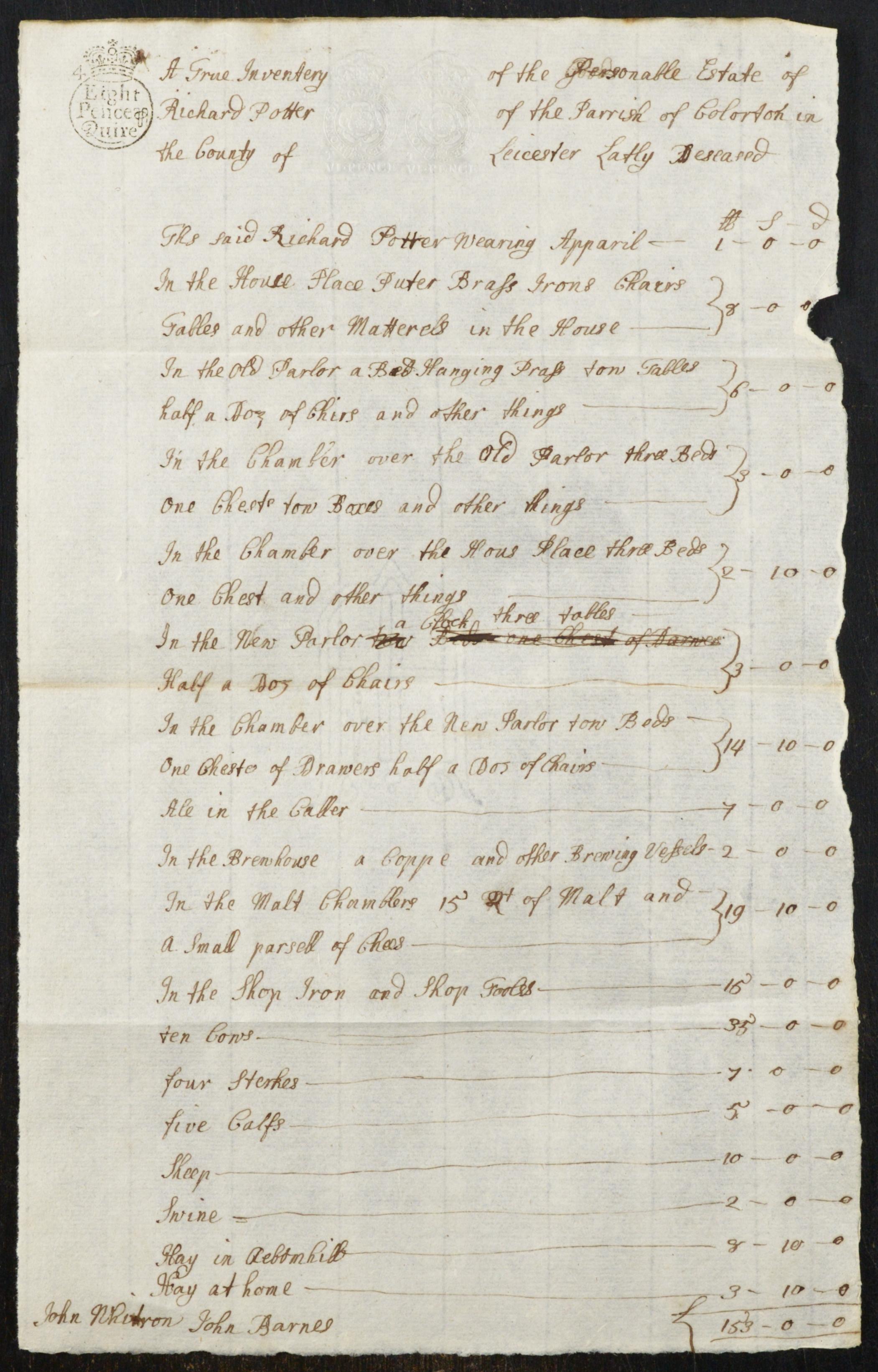
Richard Potters father was also named Richard Potter 1649-1719, and he too was a blacksmith.
Richard Potter of Coleorton in the county of Leicester, blacksmith, stated in his will: “I give to my son and daughter Thomas and Sarah Potter the possession of my house and grounds.”
He leaves ten pounds each to his daughters Jane and Alice, to his son Francis he gives five pounds, and five shillings to his son Richard. Sons Joseph and William also receive five shillings each. To his daughter Mary, wife of Edward Burton, and her daughter Elizabeth, he gives five shillings each. The rest of his good, chattels and wordly substance he leaves equally between his son and daugter Thomas and Sarah. As there is no mention of his wife, it’s assumed that she predeceased him.
The will of Richard Potter, 1719:
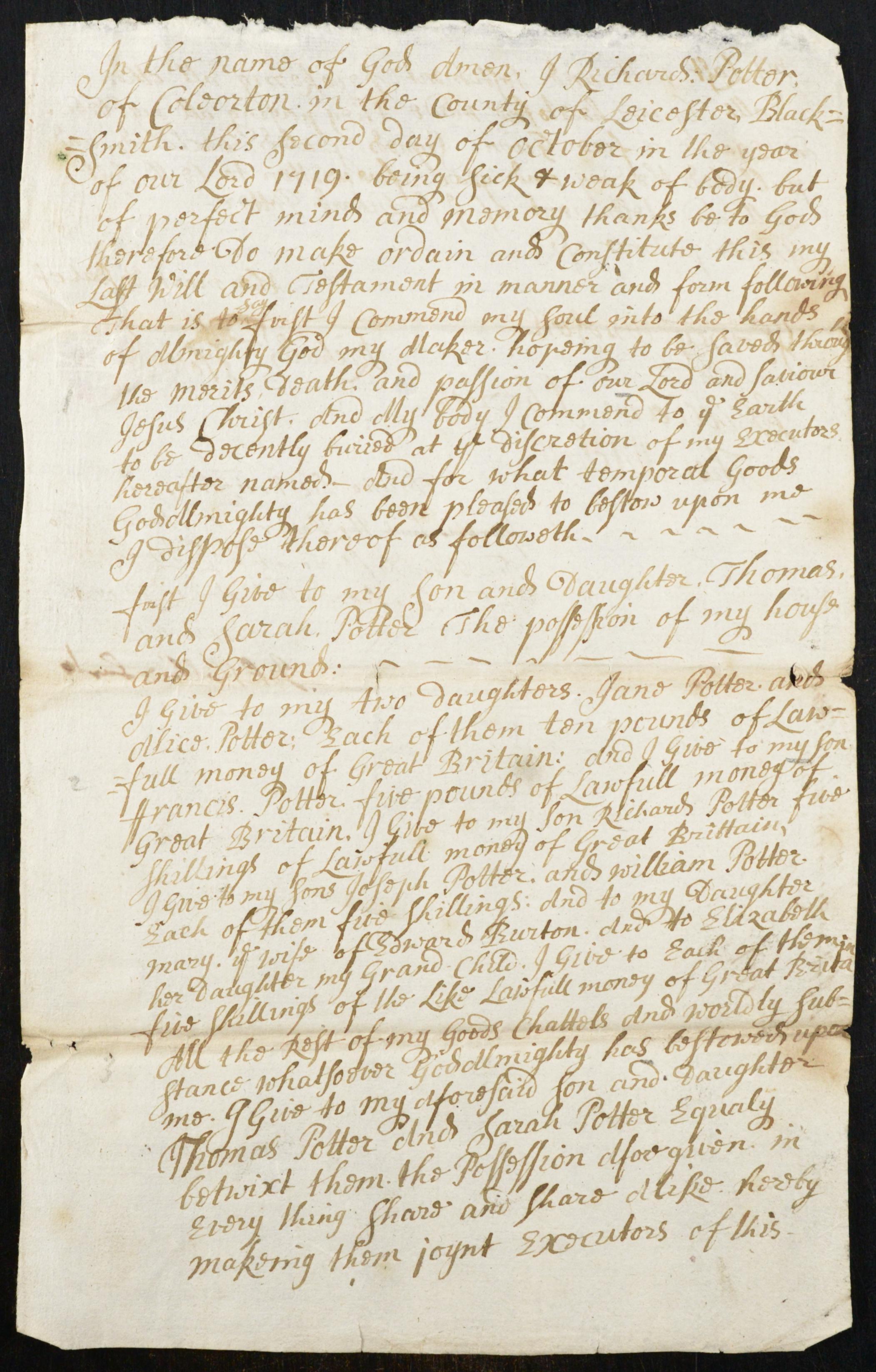
Richard Potter’s (1649-1719) parents were William Potter and Alse Huldin, both born in the early 1600s. They were married in 1646 at Breedon on the Hill, Leicestershire. The name Huldin appears to originate in Finland.
William Potter was a blacksmith. In the 1659 parish registers of Breedon on the Hill, William Potter of Breedon blacksmith buryed the 14th July.
February 5, 2022 at 2:16 pm #6273In reply to: The Elusive Samuel Housley and Other Family Stories
The Housley Letters
THE NEIGHBORHOODFrom Barbara Housley’s Narrative on the Letters:
In July 1872, Joseph wrote to George who had been gone for 21 years: “You would not know Heanor now. It has got such a large place. They have got a town hall built where Charles’ stone yard was.”
Then Joseph took George on a tour from Smalley to Heanor pointing out all the changes:
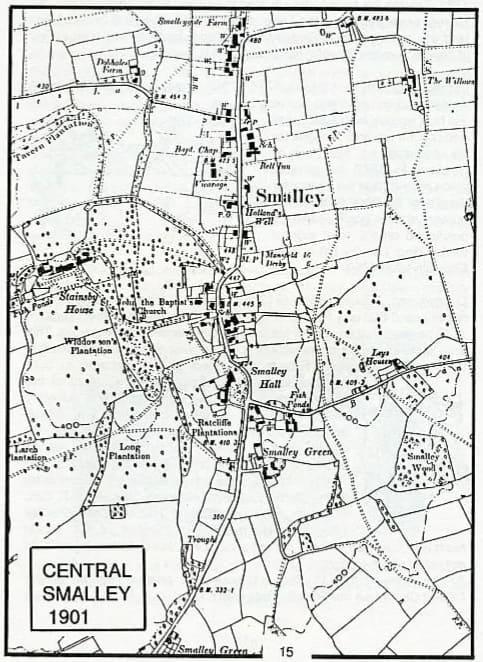
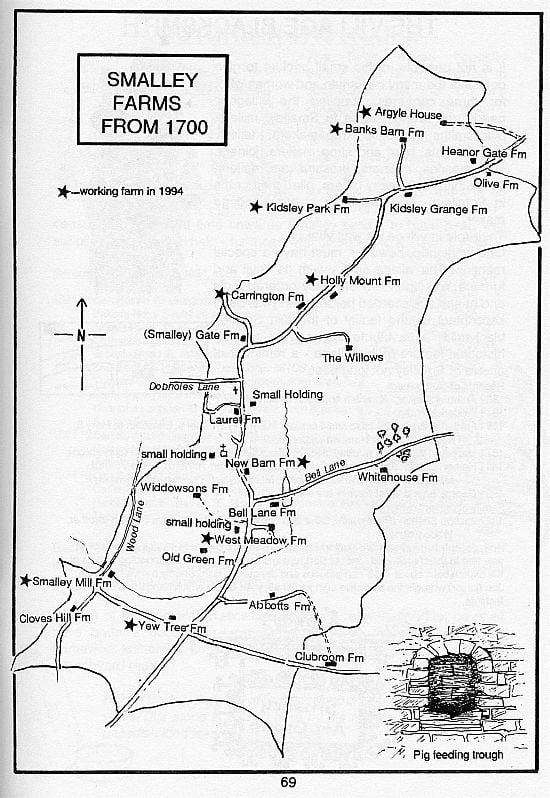
“Now we commence at Firby Brook. There is no public house there. It is turned into a market gardener’s place. Morley smithy stands as it did. You would know Chris Shepperd that used to keep the farm opposite. He is dead and the farm is got into other hands.” (In 1851, Chris Shepherd, age 39, and his widowed mother, Mary, had a farm of 114 acres. Charles Carrington, age 14, worked for them as a “cow boy.” In 1851 Hollingsworths also lived at Morely smithy.) “The Rose and Crown stands and Antony Kerry keeps that yet.” (In 1851, the census listed Kerry as a mason, builder, victicular, and farmer. He lived with his wife and four sons and numerous servants.) “They have pulled down Samuel Kerry’s farm house down and built him one in another place. Now we come to the Bell that was but they have pulled the old one down and made Isaac Potters House into the new Bell.” (In 1851, The Bell was run by Ann Weston, a widow.)
Smalley Roundhouse:
“The old Round House is standing yet but they have took the machine away. The Public House at the top end is kept by Mrs. Turton. I don’t know who she was before she married. Now we get to old Tom Oldknow. The old house is pulled down and a new one is put up but it is gone out of the family altogether. Now Jack is living at Stanley. He married Ann that used to live at Barbers at Smalley. That finishes Smalley. Now for Taghill. The old Jolly Collier is standing yet and a man of the name of Remmington keeps the new one opposite. Jack Foulkes son Jack used to keep that but has left just lately. There is the Nottingham House, Nags Head, Cross Keys and then the Red Lion but houses built on both sides all the way down Taghill. Then we get to the town hall that is built on the ground that Charles’ Stone Yard used to be. There is Joseph Watson’s shop standing yet in the old place. The King of Prussia, the White Lion and Hanks that is the Public House. You see there are more than there used to be. The Magistrate sits at the Town Hall and tries cases there every fortnight.”
.
February 5, 2022 at 1:59 pm #6272In reply to: The Elusive Samuel Housley and Other Family Stories
The Housley Letters
The Carringtons
Carrington Farm, Smalley:
Ellen Carrington was born in 1795. Her father William Carrington 1755-1833 was from Smalley. Her mother Mary Malkin 1765-1838 was from Ellastone, in Staffordshire. Ellastone is on the Derbyshire border and very close to Ashboure, where Ellen married William Housley.
From Barbara Housley’s Narrative on the Letters:
Ellen’s family was evidently rather prominant in Smalley. Two Carringtons (John and William) served on the Parish Council in 1794. Parish records are full of Carrington marriages and christenings.
The letters refer to a variety of “uncles” who were probably Ellen’s brothers, but could be her uncles. These include:
RICHARD
Probably the youngest Uncle, and certainly the most significant, is Richard. He was a trustee for some of the property which needed to be settled following Ellen’s death. Anne wrote in 1854 that Uncle Richard “has got a new house built” and his daughters are “fine dashing young ladies–the belles of Smalley.” Then she added, “Aunt looks as old as my mother.”
Richard was born somewhere between 1808 and 1812. Since Richard was a contemporary of the older Housley children, “Aunt,” who was three years younger, should not look so old!
Richard Carrington and Harriet Faulkner were married in Repton in 1833. A daughter Elizabeth was baptised March 24, 1834. In July 1872, Joseph wrote: “Elizabeth is married too and a large family and is living in Uncle Thomas’s house for he is dead.” Elizabeth married Ayres (Eyres) Clayton of Lascoe. His occupation was listed as joiner and shopkeeper. They were married before 1864 since Elizabeth Clayton witnessed her sister’s marriage. Their children in April 1871 were Selina (1863), Agnes Maria (1866) and Elizabeth Ann (1868). A fourth daughter, Alice Augusta, was born in 1872 or 1873, probably by July 1872 to fit Joseph’s description “large family”! A son Charles Richard was born in 1880.
An Elizabeth Ann Clayton married John Arthur Woodhouse on May 12, 1913. He was a carpenter. His father was a miner. Elizabeth Ann’s father, Ayres, was also a carpenter. John Arthur’s age was given as 25. Elizabeth Ann’s age was given as 33 or 38. However, if she was born in 1868, her age would be 45. Possibly this is another case of a child being named for a deceased sibling. If she were 38 and born in 1875, she would fill the gap between Alice Augusta and Charles Richard.
Selina Clayton, who would have been 18, is not listed in the household in 1881. She died on June 11, 1914 at age 51. Agnes Maria Clayton died at the age of 25 and was buried March 31, 1891. Charles Richard died at the age of 5 and was buried on February 4, 1886. A Charles James Clayton, 18 months, was buried June 8, 1889 in Heanor.
Richard Carrington’s second daughter, Selina, born in 1837, married Walker Martin (b.1835) on February 11, 1864 and they were living at Kidsley Park Farm in 1872, according to a letter from Joseph, and, according to the census, were still there in 1881. This 100 acre farm was formerly the home of Daniel Smith and his daughter Elizabeth Davy Barber. Selina and Walker had at least five children: Elizabeth Ann (1865), Harriet Georgianna (1866/7), Alice Marian (September 6, 1868), Philip Richard (1870), and Walker (1873). In December 1972, Joseph mentioned the death of Philip Walker, a farmer of Prospect Farm, Shipley. This was probably Walker Martin’s grandfather, since Walker was born in Shipley. The stock was to be sold the following Monday, but his daughter (Walker’s mother?) died the next day. Walker’s father was named Thomas. An Annie Georgianna Martin age 13 of Shipley died in April of 1859.
Selina Martin died on October 29, 1906 but her estate was not settled until November 14, 1910. Her gross estate was worth L223.56. Her son Walker and her daughter Harriet Georgiana were her trustees and executers. Walker was to get Selina’s half of Richard’s farm. Harriet Georgiana and Alice Marian were to be allowed to live with him. Philip Richard received L25. Elizabeth Ann was already married to someone named Smith.
Richard and Harriet may also have had a son George. In 1851 a Harriet Carrington and her three year old son George were living with her step-father John Benniston in Heanor. John may have been recently widowed and needed her help. Or, the Carrington home may have been inadequate since Anne reported a new one was built by 1854. Selina’s second daughter’s name testifies to the presence of a “George” in the family! Could the death of this son account for the haggard appearance Anne described when she wrote: “Aunt looks as old as my mother?”
Harriet was buried May 19, 1866. She was 55 when she died.In 1881, Georgianna then 14, was living with her grandfather and his niece, Zilpah Cooper, age 38–who lived with Richard on his 63 acre farm as early as 1871. A Zilpah, daughter of William and Elizabeth, was christened October 1843. Her brother, William Walter, was christened in 1846 and married Anna Maria Saint in 1873. There are four Selina Coopers–one had a son William Thomas Bartrun Cooper christened in 1864; another had a son William Cooper christened in 1873.
Our Zilpah was born in Bretley 1843. She died at age 49 and was buried on September 24, 1892. In her will, which was witnessed by Selina Martin, Zilpah’s sister, Frances Elizabeth Cleave, wife of Horatio Cleave of Leicester is mentioned. James Eley and Francis Darwin Huish (Richard’s soliciter) were executers.
Richard died June 10, 1892, and was buried on June 13. He was 85. As might be expected, Richard’s will was complicated. Harriet Georgiana Martin and Zilpah Cooper were to share his farm. If neither wanted to live there it was to go to Georgiana’s cousin Selina Clayton. However, Zilpah died soon after Richard. Originally, he left his piano, parlor and best bedroom furniture to his daughter Elizabeth Clayton. Then he revoked everything but the piano. He arranged for the payment of £150 which he owed. Later he added a codicil explaining that the debt was paid but he had borrowed £200 from someone else to do it!
Richard left a good deal of property including: The house and garden in Smalley occupied by Eyres Clayton with four messuages and gardens adjoining and large garden below and three messuages at the south end of the row with the frame work knitters shop and garden adjoining; a dwelling house used as a public house with a close of land; a small cottage and garden and four cottages and shop and gardens.
THOMAS
In August 1854, Anne wrote “Uncle Thomas is about as usual.” A Thomas Carrington married a Priscilla Walker in 1810.
Their children were baptised in August 1830 at the same time as the Housley children who at that time ranged in age from 3 to 17. The oldest of Thomas and Priscilla’s children, Henry, was probably at least 17 as he was married by 1836. Their youngest son, William Thomas, born 1830, may have been Mary Ellen Weston’s beau. However, the only Richard whose christening is recorded (1820), was the son of Thomas and Lucy. In 1872 Joseph reported that Richard’s daughter Elizabeth was married and living in Uncle Thomas’s house. In 1851, Alfred Smith lived in house 25, Foulks lived in 26, Thomas and Priscilla lived in 27, Bennetts lived in 28, Allard lived in 29 and Day lived in 30. Thomas and Priscilla do not appear in 1861. In 1871 Elizabeth Ann and Ayres Clayton lived in House 54. None of the families listed as neighbors in 1851 remained. However, Joseph Carrington, who lived in house 19 in 1851, lived in house 51 in 1871.
JOHN
In August 1854, Anne wrote: “Uncle John is with Will and Frank has been home in a comfortable place in Cotmanhay.” Although John and William are two of the most popular Carrington names, only two John’s have sons named William. John and Rachel Buxton Carrington had a son William christened in 1788. At the time of the letters this John would have been over 100 years old. Their son John and his wife Ann had a son William who was born in 1805. However, this William age 46 was living with his widowed mother in 1851. A Robert Carrington and his wife Ann had a son John born 1n 1805. He would be the right age to be a brother to Francis Carrington discussed below. This John was living with his widowed mother in 1851 and was unmarried. There are no known Williams in this family grouping. A William Carrington of undiscovered parentage was born in 1821. It is also possible that the Will in question was Anne’s brother Will Housley.
–Two Francis Carringtons appear in the 1841 census both of them aged 35. One is living with Richard and Harriet Carrington. The other is living next door to Samuel and Ellen Carrington Kerry (the trustee for “father’s will”!). The next name in this sequence is John Carrington age 15 who does not seem to live with anyone! but may be part of the Kerry household.
FRANK (see above)
While Anne did not preface her mention of the name Frank with an “Uncle,” Joseph referred to Uncle Frank and James Carrington in the same sentence. A James Carrington was born in 1814 and had a wife Sarah. He worked as a framework knitter. James may have been a son of William and Anne Carrington. He lived near Richard according to the 1861 census. Other children of William and Anne are Hannah (1811), William (1815), John (1816), and Ann (1818). An Ann Carrington married a Frank Buxton in 1819. This might be “Uncle Frank.”
An Ellen Carrington was born to John and Rachel Carrington in 1785. On October 25, 1809, a Samuel Kerry married an Ellen Carrington. However this Samuel Kerry is not the trustee involved in settling Ellen’s estate. John Carrington died July 1815.
William and Mary Carrington:
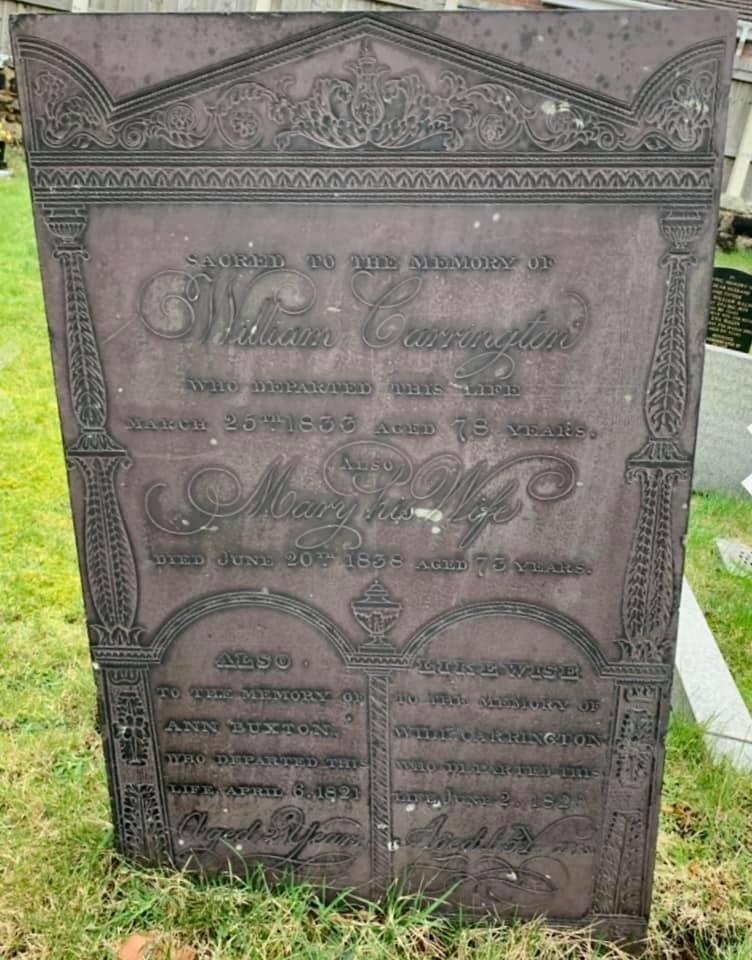 February 4, 2022 at 3:17 pm #6269
In reply to: The Elusive Samuel Housley and Other Family Stories
The Housley Letters
From Barbara Housley’s Narrative on the Letters.
William Housley (1781-1848) and Ellen Carrington were married on May 30, 1814 at St. Oswald’s church in Ashbourne. William died in 1848 at the age of 67 of “disease of lungs and general debility”. Ellen died in 1872.
Marriage of William Housley and Ellen Carrington in Ashbourne in 1814:
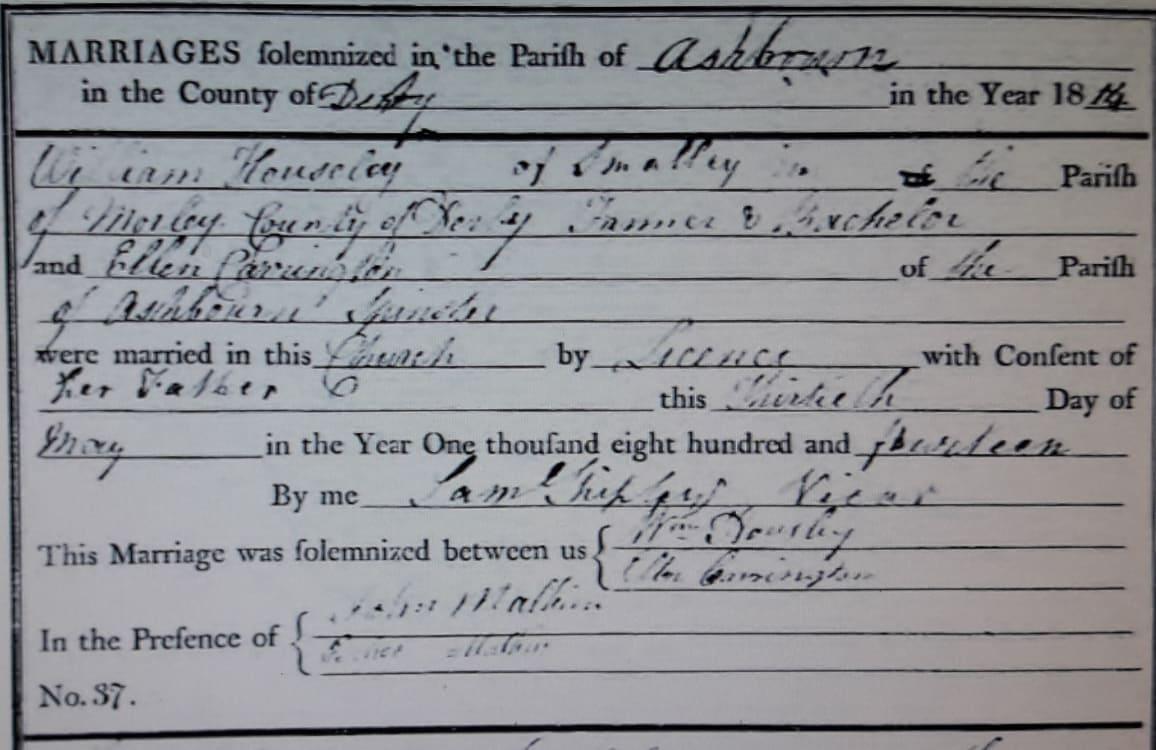
Parish records show three children for William and his first wife, Mary, Ellens’ sister, who were married December 29, 1806: Mary Ann, christened in 1808 and mentioned frequently in the letters; Elizabeth, christened in 1810, but never mentioned in any letters; and William, born in 1812, probably referred to as Will in the letters. Mary died in 1813.
William and Ellen had ten children: John, Samuel, Edward, Anne, Charles, George, Joseph, Robert, Emma, and Joseph. The first Joseph died at the age of four, and the last son was also named Joseph. Anne never married, Charles emigrated to Australia in 1851, and George to USA, also in 1851. The letters are to George, from his sisters and brothers in England.
The following are excerpts of those letters, including excerpts of Barbara Housley’s “Narrative on Historic Letters”. They are grouped according to who they refer to, rather than chronological order.
ELLEN HOUSLEY 1795-1872
Joseph wrote that when Emma was married, Ellen “broke up the comfortable home and the things went to Derby and she went to live with them but Derby didn’t agree with her so she left again leaving her things behind and came to live with John in the new house where she died.” Ellen was listed with John’s household in the 1871 census.
In May 1872, the Ilkeston Pioneer carried this notice: “Mr. Hopkins will sell by auction on Saturday next the eleventh of May 1872 the whole of the useful furniture, sewing machine, etc. nearly new on the premises of the late Mrs. Housley at Smalley near Heanor in the county of Derby. Sale at one o’clock in the afternoon.”Ellen’s family was evidently rather prominant in Smalley. Two Carringtons (John and William) served on the Parish Council in 1794. Parish records are full of Carrington marriages and christenings; census records confirm many of the family groupings.
In June of 1856, Emma wrote: “Mother looks as well as ever and was told by a lady the other day that she looked handsome.” Later she wrote: “Mother is as stout as ever although she sometimes complains of not being able to do as she used to.”
Mary’s children:
MARY ANN HOUSLEY 1808-1878
There were hard feelings between Mary Ann and Ellen and her children. Anne wrote: “If you remember we were not very friendly when you left. They never came and nothing was too bad for Mary Ann to say of Mother and me, but when Robert died Mother sent for her to the funeral but she did not think well to come so we took no more notice. She would not allow her children to come either.”
Mary Ann was unlucky in love! In Anne’s second letter she wrote: “William Carrington is paying Mary Ann great attention. He is living in London but they write to each other….We expect it will be a match.” Apparantly the courtship was stormy for in 1855, Emma wrote: “Mary Ann’s wedding with William Carrington has dropped through after she had prepared everything, dresses and all for the occassion.” Then in 1856, Emma wrote: “William Carrington and Mary Ann are separated. They wore him out with their nonsense.” Whether they ever married is unclear. Joseph wrote in 1872: “Mary Ann was married but her husband has left her. She is in very poor health. She has one daughter and they are living with their mother at Smalley.”
Regarding William Carrington, Emma supplied this bit of news: “His sister, Mrs. Lily, has eloped with a married man. Is she not a nice person!”
WILLIAM HOUSLEY JR. 1812-1890
According to a letter from Anne, Will’s two sons and daughter were sent to learn dancing so they would be “fit for any society.” Will’s wife was Dorothy Palfry. They were married in Denby on October 20, 1836 when Will was 24. According to the 1851 census, Will and Dorothy had three sons: Alfred 14, Edwin 12, and William 10. All three boys were born in Denby.
In his letter of May 30, 1872, after just bemoaning that all of his brothers and sisters are gone except Sam and John, Joseph added: “Will is living still.” In another 1872 letter Joseph wrote, “Will is living at Heanor yet and carrying on his cattle dealing.” The 1871 census listed Will, 59, and his son William, 30, of Lascoe Road, Heanor, as cattle dealers.
Ellen’s children:
JOHN HOUSLEY 1815-1893
John married Sarah Baggally in Morely in 1838. They had at least six children. Elizabeth (born 2 May 1838) was “out service” in 1854. In her “third year out,” Elizabeth was described by Anne as “a very nice steady girl but quite a woman in appearance.” One of her positions was with a Mrs. Frearson in Heanor. Emma wrote in 1856: “Elizabeth is still at Mrs. Frearson. She is such a fine stout girl you would not know her.” Joseph wrote in 1872 that Elizabeth was in service with Mrs. Eliza Sitwell at Derby. (About 1850, Miss Eliza Wilmot-Sitwell provided for a small porch with a handsome Norman doorway at the west end of the St. John the Baptist parish church in Smalley.)
According to Elizabeth’s birth certificate and the 1841 census, John was a butcher. By 1851, the household included a nurse and a servant, and John was listed as a “victular.” Anne wrote in February 1854, “John has left the Public House a year and a half ago. He is living where Plumbs (Ann Plumb witnessed William’s death certificate with her mark) did and Thomas Allen has the land. He has been working at James Eley’s all winter.” In 1861, Ellen lived with John and Sarah and the three boys.
John sold his share in the inheritance from their mother and disappeared after her death. (He died in Doncaster, Yorkshire, in 1893.) At that time Charles, the youngest would have been 21. Indeed, Joseph wrote in July 1872: “John’s children are all grown up”.
In May 1872, Joseph wrote: “For what do you think, John has sold his share and he has acted very bad since his wife died and at the same time he sold all his furniture. You may guess I have never seen him but once since poor mother’s funeral and he is gone now no one knows where.”
In February 1874 Joseph wrote: “You want to know what made John go away. Well, I will give you one reason. I think I told you that when his wife died he persuaded me to leave Derby and come to live with him. Well so we did and dear Harriet to keep his house. Well he insulted my wife and offered things to her that was not proper and my dear wife had the power to resist his unmanly conduct. I did not think he could of served me such a dirty trick so that is one thing dear brother. He could not look me in the face when we met. Then after we left him he got a woman in the house and I suppose they lived as man and wife. She caught the small pox and died and there he was by himself like some wild man. Well dear brother I could not go to him again after he had served me and mine as he had and I believe he was greatly in debt too so that he sold his share out of the property and when he received the money at Belper he went away and has never been seen by any of us since but I have heard of him being at Sheffield enquiring for Sam Caldwell. You will remember him. He worked in the Nag’s Head yard but I have heard nothing no more of him.”
A mention of a John Housley of Heanor in the Nottinghma Journal 1875. I don’t know for sure if the John mentioned here is the brother John who Joseph describes above as behaving improperly to his wife. John Housley had a son Joseph, born in 1840, and John’s wife Sarah died in 1870.
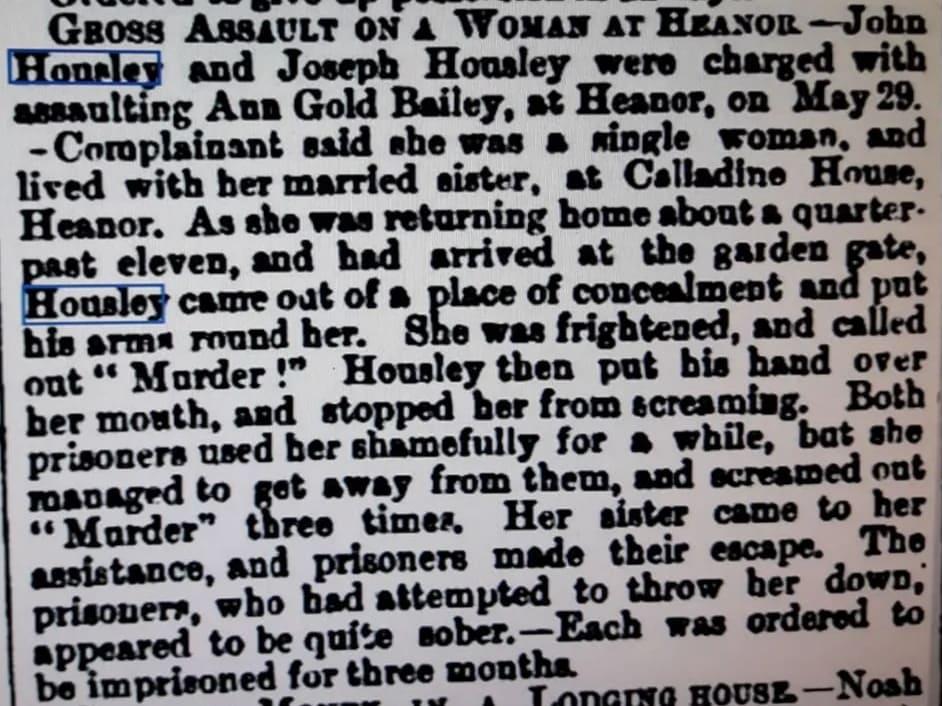
In 1876, the solicitor wrote to George: “Have you heard of John Housley? He is entitled to Robert’s share and I want him to claim it.”
SAMUEL HOUSLEY 1816-
Sam married Elizabeth Brookes of Sutton Coldfield, and they had three daughters: Elizabeth, Mary Anne and Catherine. Elizabeth his wife died in 1849, a few months after Samuel’s father William died in 1848. The particular circumstances relating to these individuals have been discussed in previous chapters; the following are letter excerpts relating to them.
Death of William Housley 15 Dec 1848, and Elizabeth Housley 5 April 1849, Smalley:
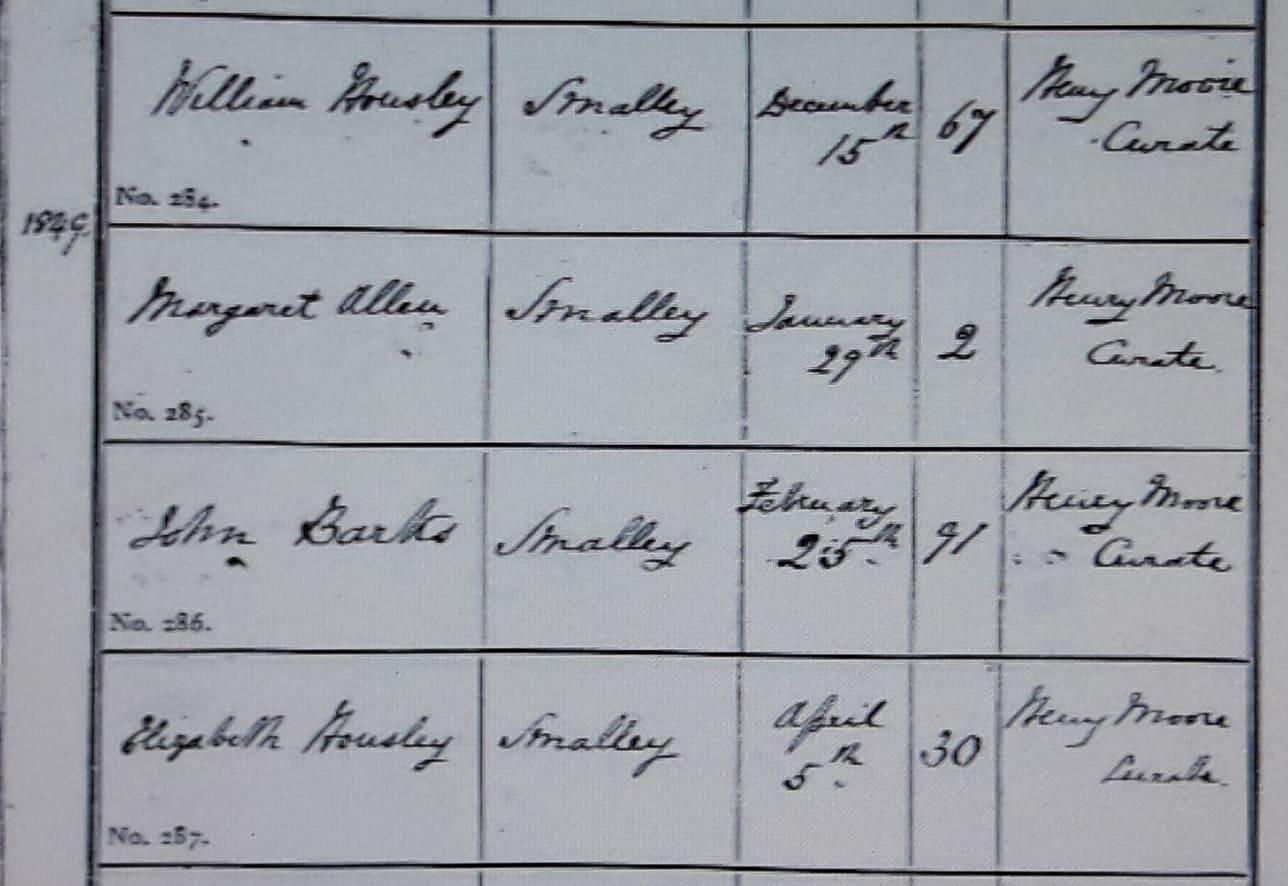
Joseph wrote in December 1872: “I saw one of Sam’s daughters, the youngest Kate, you would remember her a baby I dare say. She is very comfortably married.”
In the same letter (December 15, 1872), Joseph wrote: “I think we have now found all out now that is concerned in the matter for there was only Sam that we did not know his whereabouts but I was informed a week ago that he is dead–died about three years ago in Birmingham Union. Poor Sam. He ought to have come to a better end than that….His daughter and her husband went to Brimingham and also to Sutton Coldfield that is where he married his wife from and found out his wife’s brother. It appears he has been there and at Birmingham ever since he went away but ever fond of drink.”
(Sam, however, was still alive in 1871, living as a lodger at the George and Dragon Inn, Henley in Arden. And no trace of Sam has been found since. It would appear that Sam did not want to be found.)
EDWARD HOUSLEY 1819-1843
Edward died before George left for USA in 1851, and as such there is no mention of him in the letters.
ANNE HOUSLEY 1821-1856
Anne wrote two letters to her brother George between February 1854 and her death in 1856. Apparently she suffered from a lung disease for she wrote: “I can say you will be surprised I am still living and better but still cough and spit a deal. Can do nothing but sit and sew.” According to the 1851 census, Anne, then 29, was a seamstress. Their friend, Mrs. Davy, wrote in March 1856: “This I send in a box to my Brother….The pincushion cover and pen wiper are Anne’s work–are for thy wife. She would have made it up had she been able.” Anne was not living at home at the time of the 1841 census. She would have been 19 or 20 and perhaps was “out service.”
In her second letter Anne wrote: “It is a great trouble now for me to write…as the body weakens so does the mind often. I have been very weak all summer. That I continue is a wonder to all and to spit so much although much better than when you left home.” She also wrote: “You know I had a desire for America years ago. Were I in health and strength, it would be the land of my adoption.”
In November 1855, Emma wrote, “Anne has been very ill all summer and has not been able to write or do anything.” Their neighbor Mrs. Davy wrote on March 21, 1856: “I fear Anne will not be long without a change.” In a black-edged letter the following June, Emma wrote: “I need not tell you how happy she was and how calmly and peacefully she died. She only kept in bed two days.”
Certainly Anne was a woman of deep faith and strong religious convictions. When she wrote that they were hoping to hear of Charles’ success on the gold fields she added: “But I would rather hear of him having sought and found the Pearl of great price than all the gold Australia can produce, (For what shall it profit a man if he gain the whole world and lose his soul?).” Then she asked George: “I should like to learn how it was you were first led to seek pardon and a savior. I do feel truly rejoiced to hear you have been led to seek and find this Pearl through the workings of the Holy Spirit and I do pray that He who has begun this good work in each of us may fulfill it and carry it on even unto the end and I can never doubt the willingness of Jesus who laid down his life for us. He who said whoever that cometh unto me I will in no wise cast out.”
Anne’s will was probated October 14, 1856. Mr. William Davy of Kidsley Park appeared for the family. Her estate was valued at under £20. Emma was to receive fancy needlework, a four post bedstead, feather bed and bedding, a mahogany chest of drawers, plates, linen and china. Emma was also to receive Anne’s writing desk. There was a condition that Ellen would have use of these items until her death.
The money that Anne was to receive from her grandfather, William Carrington, and her father, William Housley was to be distributed one third to Joseph, one third to Emma, and one third to be divided between her four neices: John’s daughter Elizabeth, 18, and Sam’s daughters Elizabeth, 10, Mary Ann, 9 and Catharine, age 7 to be paid by the trustees as they think “most useful and proper.” Emma Lyon and Elizabeth Davy were the witnesses.
The Carrington Farm:
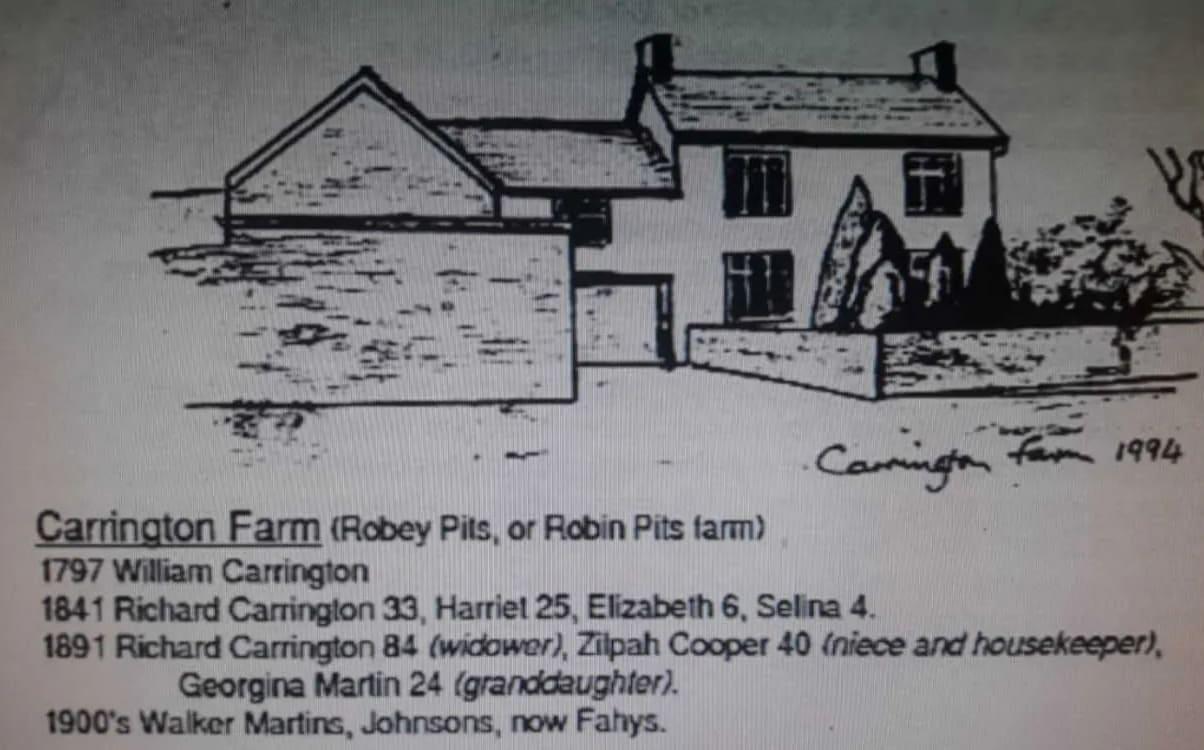
CHARLES HOUSLEY 1823-1855
Charles went to Australia in 1851, and was last heard from in January 1853. According to the solicitor, who wrote to George on June 3, 1874, Charles had received advances on the settlement of their parent’s estate. “Your promissory note with the two signed by your brother Charles for 20 pounds he received from his father and 20 pounds he received from his mother are now in the possession of the court.”
Charles and George were probably quite close friends. Anne wrote in 1854: “Charles inquired very particularly in both his letters after you.”
According to Anne, Charles and a friend married two sisters. He and his father-in-law had a farm where they had 130 cows and 60 pigs. Whatever the trade he learned in England, he never worked at it once he reached Australia. While it does not seem that Charles went to Australia because gold had been discovered there, he was soon caught up in “gold fever”. Anne wrote: “I dare say you have heard of the immense gold fields of Australia discovered about the time he went. Thousands have since then emigrated to Australia, both high and low. Such accounts we heard in the papers of people amassing fortunes we could not believe. I asked him when I wrote if it was true. He said this was no exaggeration for people were making their fortune daily and he intended going to the diggings in six weeks for he could stay away no longer so that we are hoping to hear of his success if he is alive.”
In March 1856, Mrs. Davy wrote: “I am sorry to tell thee they have had a letter from Charles’s wife giving account of Charles’s death of 6 months consumption at the Victoria diggings. He has left 2 children a boy and a girl William and Ellen.” In June of the same year in a black edged letter, Emma wrote: “I think Mrs. Davy mentioned Charles’s death in her note. His wife wrote to us. They have two children Helen and William. Poor dear little things. How much I should like to see them all. She writes very affectionately.”
In December 1872, Joseph wrote: “I’m told that Charles two daughters has wrote to Smalley post office making inquiries about his share….” In January 1876, the solicitor wrote: “Charles Housley’s children have claimed their father’s share.”
GEORGE HOUSLEY 1824-1877
George emigrated to the United states in 1851, arriving in July. The solicitor Abraham John Flint referred in a letter to a 15-pound advance which was made to George on June 9, 1851. This certainly was connected to his journey. George settled along the Delaware River in Bucks County, Pennsylvania. The letters from the solicitor were addressed to: Lahaska Post Office, Bucks County, Pennsylvania.
George married Sarah Ann Hill on May 6, 1854 in Doylestown, Bucks County, Pennsylvania. In her first letter (February 1854), Anne wrote: “We want to know who and what is this Miss Hill you name in your letter. What age is she? Send us all the particulars but I would advise you not to get married until you have sufficient to make a comfortable home.”
Upon learning of George’s marriage, Anne wrote: “I hope dear brother you may be happy with your wife….I hope you will be as a son to her parents. Mother unites with me in kind love to you both and to your father and mother with best wishes for your health and happiness.” In 1872 (December) Joseph wrote: “I am sorry to hear that sister’s father is so ill. It is what we must all come to some time and hope we shall meet where there is no more trouble.”
Emma wrote in 1855, “We write in love to your wife and yourself and you must write soon and tell us whether there is a little nephew or niece and what you call them.” In June of 1856, Emma wrote: “We want to see dear Sarah Ann and the dear little boy. We were much pleased with the “bit of news” you sent.” The bit of news was the birth of John Eley Housley, January 11, 1855. Emma concluded her letter “Give our very kindest love to dear sister and dearest Johnnie.”
In September 1872, Joseph wrote, “I was very sorry to hear that John your oldest had met with such a sad accident but I hope he is got alright again by this time.” In the same letter, Joseph asked: “Now I want to know what sort of a town you are living in or village. How far is it from New York? Now send me all particulars if you please.”
In March 1873 Harriet asked Sarah Ann: “And will you please send me all the news at the place and what it is like for it seems to me that it is a wild place but you must tell me what it is like….”. The question of whether she was referring to Bucks County, Pennsylvania or some other place is raised in Joseph’s letter of the same week.
On March 17, 1873, Joseph wrote: “I was surprised to hear that you had gone so far away west. Now dear brother what ever are you doing there so far away from home and family–looking out for something better I suppose.”The solicitor wrote on May 23, 1874: “Lately I have not written because I was not certain of your address and because I doubted I had much interesting news to tell you.” Later, Joseph wrote concerning the problems settling the estate, “You see dear brother there is only me here on our side and I cannot do much. I wish you were here to help me a bit and if you think of going for another summer trip this turn you might as well run over here.”
Apparently, George had indicated he might return to England for a visit in 1856. Emma wrote concerning the portrait of their mother which had been sent to George: “I hope you like mother’s portrait. I did not see it but I suppose it was not quite perfect about the eyes….Joseph and I intend having ours taken for you when you come over….Do come over before very long.”
In March 1873, Joseph wrote: “You ask me what I think of you coming to England. I think as you have given the trustee power to sign for you I think you could do no good but I should like to see you once again for all that. I can’t say whether there would be anything amiss if you did come as you say it would be throwing good money after bad.”
On June 10, 1875, the solicitor wrote: “I have been expecting to hear from you for some time past. Please let me hear what you are doing and where you are living and how I must send you your money.” George’s big news at that time was that on May 3, 1875, he had become a naturalized citizen “renouncing and abjuring all allegiance and fidelity to every foreign prince, potentate, state and sovereignity whatsoever, and particularly to Victoria Queen of Great Britain of whom he was before a subject.”
ROBERT HOUSLEY 1832-1851
In 1854, Anne wrote: “Poor Robert. He died in August after you left he broke a blood vessel in the lung.”
From Joseph’s first letter we learn that Robert was 19 when he died: “Dear brother there have been a great many changes in the family since you left us. All is gone except myself and John and Sam–we have heard nothing of him since he left. Robert died first when he was 19 years of age. Then Anne and Charles too died in Australia and then a number of years elapsed before anyone else. Then John lost his wife, then Emma, and last poor dear mother died last January on the 11th.”Anne described Robert’s death in this way: “He had thrown up blood many times before in the spring but the last attack weakened him that he only lived a fortnight after. He died at Derby. Mother was with him. Although he suffered much he never uttered a murmur or regret and always a smile on his face for everyone that saw him. He will be regretted by all that knew him”.
Robert died a resident of St. Peter’s Parish, Derby, but was buried in Smalley on August 16, 1851.
Apparently Robert was apprenticed to be a joiner for, according to Anne, Joseph took his place: “Joseph wanted to be a joiner. We thought we could do no better than let him take Robert’s place which he did the October after and is there still.”In 1876, the solicitor wrote to George: “Have you heard of John Housley? He is entitled to Robert’s share and I want him to claim it.”
EMMA HOUSLEY 1836-1871
Emma was not mentioned in Anne’s first letter. In the second, Anne wrote that Emma was living at Spondon with two ladies in her “third situation,” and added, “She is grown a bouncing woman.” Anne described her sister well. Emma wrote in her first letter (November 12, 1855): “I must tell you that I am just 21 and we had my pudding last Sunday. I wish I could send you a piece.”
From Emma’s letters we learn that she was living in Derby from May until November 1855 with Mr. Haywood, an iron merchant. She explained, “He has failed and I have been obliged to leave,” adding, “I expect going to a new situation very soon. It is at Belper.” In 1851 records, William Haywood, age 22, was listed as an iron foundry worker. In the 1857 Derby Directory, James and George were listed as iron and brass founders and ironmongers with an address at 9 Market Place, Derby.
In June 1856, Emma wrote from “The Cedars, Ashbourne Road” where she was working for Mr. Handysides.
While she was working for Mr. Handysides, Emma wrote: “Mother is thinking of coming to live at Derby. That will be nice for Joseph and I.”Friargate and Ashbourne Road were located in St. Werburgh’s Parish. (In fact, St. Werburgh’s vicarage was at 185 Surrey Street. This clue led to the discovery of the record of Emma’s marriage on May 6, 1858, to Edwin Welch Harvey, son of Samuel Harvey in St. Werburgh’s.)
In 1872, Joseph wrote: “Our sister Emma, she died at Derby at her own home for she was married. She has left two young children behind. The husband was the son of the man that I went apprentice to and has caused a great deal of trouble to our family and I believe hastened poor Mother’s death….”. Joseph added that he believed Emma’s “complaint” was consumption and that she was sick a good bit. Joseph wrote: “Mother was living with John when I came home (from Ascension Island around 1867? or to Smalley from Derby around 1870?) for when Emma was married she broke up the comfortable home and the things went to Derby and she went to live with them but Derby did not agree with her so she had to leave it again but left all her things there.”
Emma Housley and Edwin Welch Harvey wedding, 1858:
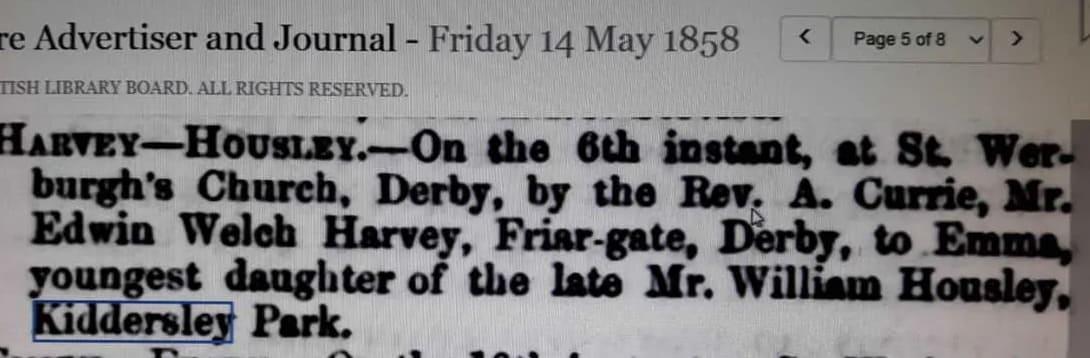
JOSEPH HOUSLEY 1838-1893
We first hear of Joseph in a letter from Anne to George in 1854. “Joseph wanted to be a joiner. We thought we could do no better than let him take Robert’s place which he did the October after (probably 1851) and is there still. He is grown as tall as you I think quite a man.” Emma concurred in her first letter: “He is quite a man in his appearance and quite as tall as you.”
From Emma we learn in 1855: “Joseph has left Mr. Harvey. He had not work to employ him. So mother thought he had better leave his indenture and be at liberty at once than wait for Harvey to be a bankrupt. He has got a very good place of work now and is very steady.” In June of 1856, Emma wrote “Joseph and I intend to have our portraits taken for you when you come over….Mother is thinking of coming to Derby. That will be nice for Joseph and I. Joseph is very hearty I am happy to say.”
According to Joseph’s letters, he was married to Harriet Ballard. Joseph described their miraculous reunion in this way: “I must tell you that I have been abroad myself to the Island of Ascension. (Elsewhere he wrote that he was on the island when the American civil war broke out). I went as a Royal Marine and worked at my trade and saved a bit of money–enough to buy my discharge and enough to get married with but while I was out on the island who should I meet with there but my dear wife’s sister. (On two occasions Joseph and Harriet sent George the name and address of Harriet’s sister, Mrs. Brooks, in Susquehanna Depot, Pennsylvania, but it is not clear whether this was the same sister.) She was lady’s maid to the captain’s wife. Though I had never seen her before we got to know each other somehow so from that me and my wife recommenced our correspondence and you may be sure I wanted to get home to her. But as soon as I did get home that is to England I was not long before I was married and I have not regretted yet for we are very comfortable as well as circumstances will allow for I am only a journeyman joiner.”
Proudly, Joseph wrote: “My little family consists of three nice children–John, Joseph and Susy Annie.” On her birth certificate, Susy Ann’s birthdate is listed as 1871. Parish records list a Lucy Annie christened in 1873. The boys were born in Derby, John in 1868 and Joseph in 1869. In his second letter, Joseph repeated: “I have got three nice children, a good wife and I often think is more than I have deserved.” On August 6, 1873, Joseph and Harriet wrote: “We both thank you dear sister for the pieces of money you sent for the children. I don’t know as I have ever see any before.” Joseph ended another letter: “Now I must close with our kindest love to you all and kisses from the children.”
In Harriet’s letter to Sarah Ann (March 19, 1873), she promised: “I will send you myself and as soon as the weather gets warm as I can take the children to Derby, I will have them taken and send them, but it is too cold yet for we have had a very cold winter and a great deal of rain.” At this time, the children were all under 6 and the baby was not yet two.
In March 1873 Joseph wrote: “I have been working down at Heanor gate there is a joiner shop there where Kings used to live I have been working there this winter and part of last summer but the wages is very low but it is near home that is one comfort.” (Heanor Gate is about 1/4 mile from Kidsley Grange. There was a school and industrial park there in 1988.) At this time Joseph and his family were living in “the big house–in Old Betty Hanson’s house.” The address in the 1871 census was Smalley Lane.
A glimpse into Joseph’s personality is revealed by this remark to George in an 1872 letter: “Many thanks for your portrait and will send ours when we can get them taken for I never had but one taken and that was in my old clothes and dear Harriet is not willing to part with that. I tell her she ought to be satisfied with the original.”
On one occasion Joseph and Harriet both sent seeds. (Marks are still visible on the paper.) Joseph sent “the best cow cabbage seed in the country–Robinson Champion,” and Harriet sent red cabbage–Shaw’s Improved Red. Possibly cow cabbage was also known as ox cabbage: “I hope you will have some good cabbages for the Ox cabbage takes all the prizes here. I suppose you will be taking the prizes out there with them.” Joseph wrote that he would put the name of the seeds by each “but I should think that will not matter. You will tell the difference when they come up.”
George apparently would have liked Joseph to come to him as early as 1854. Anne wrote: “As to his coming to you that must be left for the present.” In 1872, Joseph wrote: “I have been thinking of making a move from here for some time before I heard from you for it is living from hand to mouth and never certain of a job long either.” Joseph then made plans to come to the United States in the spring of 1873. “For I intend all being well leaving England in the spring. Many thanks for your kind offer but I hope we shall be able to get a comfortable place before we have been out long.” Joseph promised to bring some things George wanted and asked: “What sort of things would be the best to bring out there for I don’t want to bring a lot that is useless.” Joseph’s plans are confirmed in a letter from the solicitor May 23, 1874: “I trust you are prospering and in good health. Joseph seems desirous of coming out to you when this is settled.”
George must have been reminiscing about gooseberries (Heanor has an annual gooseberry show–one was held July 28, 1872) and Joseph promised to bring cuttings when they came: “Dear Brother, I could not get the gooseberries for they was all gathered when I received your letter but we shall be able to get some seed out the first chance and I shall try to bring some cuttings out along.” In the same letter that he sent the cabbage seeds Joseph wrote: “I have got some gooseberries drying this year for you. They are very fine ones but I have only four as yet but I was promised some more when they were ripe.” In another letter Joseph sent gooseberry seeds and wrote their names: Victoria, Gharibaldi and Globe.
In September 1872 Joseph wrote; “My wife is anxious to come. I hope it will suit her health for she is not over strong.” Elsewhere Joseph wrote that Harriet was “middling sometimes. She is subject to sick headaches. It knocks her up completely when they come on.” In December 1872 Joseph wrote, “Now dear brother about us coming to America you know we shall have to wait until this affair is settled and if it is not settled and thrown into Chancery I’m afraid we shall have to stay in England for I shall never be able to save money enough to bring me out and my family but I hope of better things.”
On July 19, 1875 Abraham Flint (the solicitor) wrote: “Joseph Housley has removed from Smalley and is working on some new foundry buildings at Little Chester near Derby. He lives at a village called Little Eaton near Derby. If you address your letter to him as Joseph Housley, carpenter, Little Eaton near Derby that will no doubt find him.”
George did not save any letters from Joseph after 1874, hopefully he did reach him at Little Eaton. Joseph and his family are not listed in either Little Eaton or Derby on the 1881 census.
In his last letter (February 11, 1874), Joseph sounded very discouraged and wrote that Harriet’s parents were very poorly and both had been “in bed for a long time.” In addition, Harriet and the children had been ill.
The move to Little Eaton may indicate that Joseph received his settlement because in August, 1873, he wrote: “I think this is bad news enough and bad luck too, but I have had little else since I came to live at Kiddsley cottages but perhaps it is all for the best if one could only think so. I have begun to think there will be no chance for us coming over to you for I am afraid there will not be so much left as will bring us out without it is settled very shortly but I don’t intend leaving this house until it is settled either one way or the other. “Joseph Housley and the Kiddsley cottages:
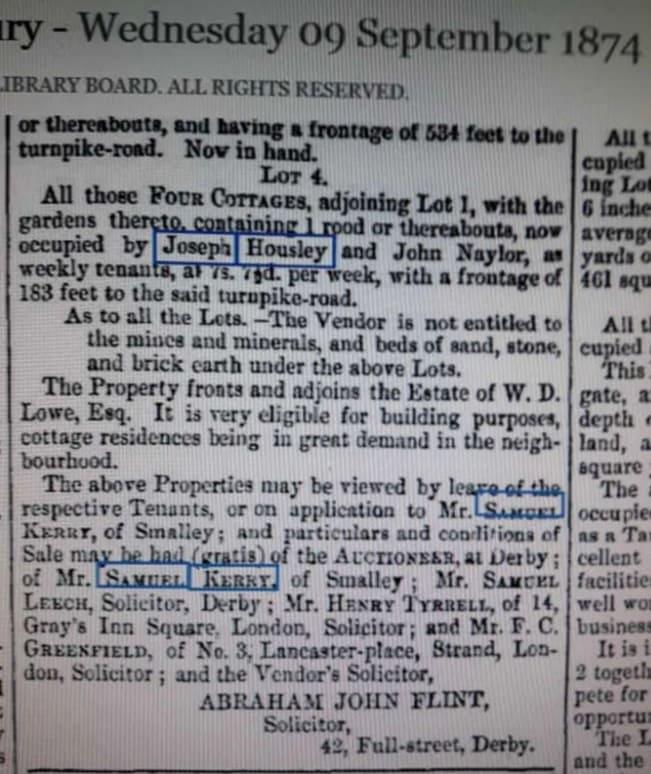
-
AuthorSearch Results
