

Search Results for 'door'
-
AuthorSearch Results
-
December 8, 2024 at 9:42 pm #7656
In reply to: Quintessence: Reversing the Fifth
Matteo — December 1st 2023: the Advent Visit
(near Avignon, France)
The hallway smelled of nondescript antiseptic and artificial lavender, a lingering scent jarring his senses with an irreconciliable blend of sterility and forced comfort. Matteo shifted the small box of Christmas decorations under his arm, his boots squeaking slightly against the linoleum floor. Outside, the low winter sun cast long, pale shadows through the care facility’s narrow windows.
When he reached Room 208, Matteo paused, hand resting on the doorframe. From inside, he could hear the soft murmur of a holiday tune—something old-fashioned and meant to be cheerful, likely playing from the small radio he’d gifted her last year. Taking a breath, he stepped inside.
His mother, Drusilla sat by the window in her padded chair, a thick knit shawl draped over her frail shoulders. She was staring intently at her hands, her fingers trembling slightly as they folded and unfolded the edge of the shawl. The golden light streaming through the window framed her face, softening the lines of age and wear.
“Hi, Ma,” Matteo said softly, setting the box down on the small table beside her.
Her head snapped up at the sound of his voice, her eyes narrowing as she fixed him with a sharp, almost panicked look. “Léon?” she said, her voice shaking. “What are you doing here? How are you here?” There was a tinge of anger in her tone, the kind that masked fear.
Matteo froze, his breath catching. “Ma, it’s me. Matteo. I’m Matteo, your son, please calm down” he said gently, stepping closer. “Who’s Léon?”
She stared at him for a long moment, her eyes clouded with confusion. Then, like a tide retreating, recognition crept back into her expression. “Matteo,” she murmured, her voice softer now, though tinged with exhaustion. “Oh, my boy. I’m sorry. I—” She looked away, her hands clutching the shawl tighter. “I thought you were someone else.”
“It’s okay,” Matteo said, crouching beside her chair. “I’m here. It’s me.”
Drusilla reached out hesitantly, her fingers brushing his cheek. “You look so much like him sometimes,” she said. “Léon… your father. He’d hold his head just like that when he didn’t want anyone to know he was worried.”
As much as Matteo knew, Drusilla had arrived in France from Italy in her twenties. He was born soon after. She had a job as a hairdresser in a little shop in Avignon, and did errands and chores for people in the village. For the longest time, it was just the two of them, as far as he’d recall.
Matteo’s chest tightened. “You’ve never told me much about him.”
“There wasn’t much to tell,” she said, her voice distant. “He came. He left. But he gave me something before he went. I always thought it would mean something, but…” Her voice trailed off as she reached into the pocket of her shawl and pulled out a small silver medallion, worn smooth with age. She held it out to him. “He said it was for you. When you were older.”
Matteo took the medallion carefully, turning it over in his hand. It was a simple but well-crafted Saint Christopher medal, the patron saint of travellers, with faint initials etched on the back—L.A.. He didn’t recognize the letters, but the weight of it in his palm felt significant, grounding.
“Why didn’t you give it to me before?” he asked, his voice quiet.
“I forgot I had it,” she admitted with a faint, sad laugh. “And then I thought… maybe it was better to keep it. Something of his, for when I needed it. But I think it’s yours now.”
Matteo slipped the medallion into his pocket, his mind spinning with questions he didn’t want to ask—not now. “Thanks, Ma,” he said simply.
Drusilla sighed and leaned back in her chair, her gaze drifting to the small box he’d brought. “What’s that?”
“Decorations,” Matteo said, seizing the moment to shift the focus. “I thought we could make your room a little festive for Christmas.”
Her face softened, and she smiled faintly. “That’s nice,” she said. “I haven’t done that in… I don’t remember when.”
Matteo opened the box and began pulling out garlands and baubles. As he worked, Drusilla watched silently, her hands still clutching the shawl. After a moment, she spoke again, her voice quieter now.
“Do you remember our house in Crest?” she asked.
Matteo paused, a tangle of tinsel in his hands. “Crest?” he echoed. “The place where you wanted to move to?”
Drusilla nodded slowly. “I thought it would be nice. A co-housing place. I could grow old in the garden, and you’d be nearby. It seemed like a good idea then.”
“It was a good idea,” Matteo said. “It just… didn’t happen.”
“No,… you’re right” she said, collecting her thoughts for a moment, her gaze distant. “You were too restless. Always moving. I thought maybe you’d stay if we built something together.”
Matteo swallowed hard, the weight of her words pressing on him. “I wanted to, Ma,” he said. “I really did.”
Drusilla’s eyes softened, and she reached for his hand, her grip surprisingly strong. “You’re here now,” she said. “That’s what matters.”

They spent the next hour decorating the room. Matteo hung garlands around the window and draped tinsel over the small tree he’d set up on the table. Drusilla directed him with occasional nods and murmured suggestions, her moments of lucidity shining like brief flashes of sunlight through clouds.
When the last bauble was hung, Drusilla smiled faintly. “It’s beautiful,” she said. “Like home.”
Matteo sat beside her, emotion weighing on him more than the physical efforts and the early drive. He was thinking about the job offer in London, the chance to earn more money to ensure she had everything she needed here. But leaving her felt impossible, even as staying seemed equally unsustainable. He was afraid it was just a justification to avoid facing the slow fraying of her memories.
Drusilla’s voice broke through his thoughts. “You’ll figure it out,” she said, her eyes closing as she leaned back in her chair. “You always do.”
Matteo watched her as she drifted into a light doze, her breathing steady and peaceful. He reached into his pocket, his fingers brushing against the medallion. The weight of it felt like both a question and an answer—one he wasn’t ready to face yet.
“Patron saint of travellers”, that felt like a sign, if not a blessing.
December 7, 2024 at 11:52 am #7653In reply to: Quintessence: Reversing the Fifth
Matteo — Winter 2023: The Move
The rumble of the moving truck echoed faintly in the quiet residential street as Matteo leaned against the open door, arms crossed, waiting for the signal to load the boxes. He glanced at the crisp winter sky, a pale gray threatening snow, and then at the house behind him. Its windows were darkened by empty rooms, their once-lived-in warmth replaced by the starkness of transition. The ornate names artistically painted on the mailbox struck him somehow. Amei & Tabitha M.: his clients for the day.
The cold damp of London’s suburbia was making him long even more for the warmth of sunny days. With the past few moves he’s been managing for his company, the tipping had been generous; he could probably plan a spring break in South of France, or maybe make a more permanent move there.
The sound of the doorbell brought him back from his rêverie.
Inside the house, the faint sounds of boxes being taped and last-minute goodbyes carried through the hallways. Matteo had been part of these moves too many times to count now. People always left a little bit of themselves behind—forgotten trinkets, echoes of old conversations, or the faint imprint of a life lived. It was a rhythm he’d come to expect, and he knew his part in it: lift, carry, and disappear into the background.
Matteo straightened as the door opened and a girl that could have been in her early twenties, but looked like a teenager stepped out, bundled against the cold. She held a steaming mug in one hand and balanced a box awkwardly on her hip with the other.
“That’s the last of it,” she called over her shoulder. “Mum, are you sure you don’t want me to take the notebooks?”
“They’re fine in the car, Tabitha!” A voice—calm and steady, maybe tinged with weariness—floated from inside.
The girl named Tabitha turned to Matteo, offering the box. “This is fragile,” she said, a smile tugging at her lips. “Be nice to it.”
Matteo took the box carefully, glancing at the mug in her hand. “You’re not leaving that behind, are you?” he asked with a faint smile.
Tabitha laughed. “This? No way. That’s my lifeline. The mug stays.”
As Matteo carried the box to the truck, his eyes caught on something inside—a weathered postcard tucked haphazardly between the pages of a journal. The image on the front was striking: a swirling green fairy, dancing above a glass of absinthe. La Fée Verte was scrawled in looping letters across the top.
“Tabitha!” Her mother’s voice carried out to the driveway, and Matteo turned instinctively. She stepped out onto the porch, her scarf wrapped loosely around her neck, her breath visible in the chilly air. Matteo could see the resemblance—the same poise and humor in her gaze, though softened by something older, quieter.
“Put this somewhere, will you” she said, holding up another postcard, this one with a faded image of a winding mountain road.
Tabitha grinned, stepping forward to take it. “Thanks, Mum. That one’s special.” She tucked it into her coat pocket.
“Special how?” her mother asked lightly.
“It’s from Darius,” Tabitha said, her tone almost teasing. “… The one you never want to talk about.” she leaned teasingly. “One of his cryptic postcards —too bad I was too young to really remember him, he must have been fun to be around.”
Matteo’s ears perked at the name, though he kept his head down, settling the box in place. It wasn’t unusual to overhear snippets like this during a move, but something about the unusual name roused his curiosity.
“Why you want to keep those?” Amei asked, tilting her head.
Tabitha shrugged. “They’re kind of… a map, I guess. Of people, not places.”
Amei paused, her expression softening. “He was always good at that,” she murmured, almost to herself.
The conversation lingered in Matteo’s mind as the day went on. By the time the truck was loaded, and he’d helped arrange the last of the boxes in Amei’s new, smaller apartment, the name and the postcard had taken root.
As Matteo stacked the final piece of furniture—a worn bookshelf—against the living room wall, he noticed Amei lingering near a window, her gaze distant.
“It’s different, isn’t it?” she said suddenly, not looking at him.
“Moving?” Matteo asked, unsure if the question was for him.
“Starting over,” she clarified, her voice quieter now. “Feels smaller, even when it’s supposed to be lighter.”
Matteo didn’t reply, sensing she wasn’t looking for an answer. He stepped back, nodding politely as she thanked him and disappeared into the kitchen.
The postcard stuck in his mind for days after. Matteo had heard of absinthe before, of course—its mystique, its history—but something about the way Tabitha had called the postcard a “map of people” resonated.
By the time spring arrived, Matteo was wandering through Avignon, chasing vague curiosities and half-formed questions. When he saw Lucien crouched over his chalk labyrinth, the memory of the postcard rose unbidden.
“Do you know where I can find absinthe?” he asked, the question more instinct than intent.
Lucien’s raised eyebrow and faint smile felt like another piece clicking into place. The connections were there—threads woven in patterns he couldn’t yet see. But for the first time in months, Matteo felt he was back on the right path.
December 7, 2024 at 2:56 am #7649In reply to: Quintessence: Reversing the Fifth
The bell above the shop door tinkled softly as Amei stepped inside. The scent of beeswax and aged wood greeted her, mingling with the faintly spiced aroma of dried herbs from the apothecary corner. She’d stopped in to pick up candles for the dinner party tomorrow night with a few work friends—a last-minute impulse. The plain white table looked too bare without a little light. It would be the first time in months she’d hosted anyone—and the last in this house.
The shopkeeper, a man in his sixties with kind eyes and a wool cardigan, greeted her with a warm smile. “Good morning. Let me know if you need any help.”
“Thanks,” Amei replied, wandering toward the back of the shop, scanning the shelves.
A few minutes later, she placed a bundle of plain white candles on the counter. Simple and unadorned. Just enough to soften the edges of the evening. The shopkeeper struck up a conversation as he slid the candles into a paper bag.
“These are always popular,” he said. “Simple, but they hold a certain purity, don’t you think?”
Amei nodded politely. “They do,” she said.
He looked at her, his expression thoughtful. “Candles have been used for centuries—rituals, meditation, prayer. Such a beautiful tradition.”
“They’re just for light on this occasion,” she said, her tone sharper than she intended.
“Of course. Still, I think there’s a certain peace in those practices. Seeking something greater than ourselves—it’s a natural longing, don’t you think?”
Amei hesitated, adjusting the strap of her bag. “I suppose,” she replied, more gently. “But I think people’s ‘seeking’ sometimes gets tangled up with other things.”
The shopkeeper met her gaze, tilting his head slightly as if weighing her words. “That’s true. But the seeking itself—it’s still important.”
Amei nodded absently, her mind flickering to past conversations. She paid with her card, avoiding his eyes. “Maybe,” she said. “But not for everyone.”
The bell tinkled again as the door opened behind her. A sudden draft swept through the shop, lifting the scent of beeswax and herbs into the air. Amei took the opportunity to collect her purchase and slip out.
December 5, 2024 at 11:01 pm #7647In reply to: Quintessence: Reversing the Fifth
Darius: A Map of People
June 2023 – Capesterre-Belle-Eau, Guadeloupe
The air in Capesterre-Belle-Eau was thick with humidity, the kind that clung to your skin and made every movement slow and deliberate. Darius leaned against the railing of the veranda, his gaze fixed on the horizon where the sky blends into the sea. The scent of wet earth and banana leaves filling the air. He was home.
It had been nearly a year since hurricane Fiona swept through Guadeloupe, its winds blowing a trail of destruction across homes, plantations, and lives. Capesterre-Belle-Eau had been among the hardest hit, its banana plantations reduced to ruin and its roads washed away in torrents of mud.
Darius hadn’t been here when it happened. He’d read about it from across the Atlantic, the news filtering through headlines and phone calls from his aunt, her voice brittle with worry.
“Darius, you should come back,” she’d said. “The land remembers everyone who’s left it.”
It was an unusual thing for her to say, but the words lingered. By the time he arrived in early 2023 to join the relief efforts, the worst of the crisis had passed, but the scars remained—on the land, on the people, and somewhere deep inside himself.
Home, and Not — Now, passing days having turned into quick six months, Darius was still here, though he couldn’t say why. He had thrown himself into the work, helped to rebuild homes, clear debris, and replant crops. But it wasn’t just the physical labor that kept him—it was the strange sensation of being rooted in a place he’d once fled.
Capesterre-Belle-Eau wasn’t just home; it was bones-deep memories of childhood. The long walks under the towering banana trees, the smell of frying codfish and steaming rice from his aunt’s kitchen, the rhythm of gwoka drums carrying through the evening air.
“Tu reviens pour rester cette fois ?” Come back to stay? a neighbor had asked the day he returned, her eyes sharp with curiosity.
He had laughed, brushing off the question. “On verra,” he’d replied. We’ll see.
But deep down, he knew the answer. He wasn’t back for good. He was here to make amends—not just to the land that had raised him but to himself.
A Map of Travels — On the veranda that afternoon, Darius opened his phone and scrolled through his photo gallery. Each image was pinned to a digital map, marking all the places he’d been since he got the phone. Of all places, it was Budapest which popped out, a poor snapshot of Buda Castle.
He found it a funny thought — just like where he was now, he hadn’t planned to stay so long there. He remembered the date: 2020, in the midst of the pandemic. He’d spent in Budapest most of it, sketching the empty streets.
Five years ago, their little group of four had all been reconnecting in Paris, full of plans that never came to fruition. By late 2019, the group had scattered, each of them drawn into their own orbits, until the first whispers of the pandemic began to ripple across the world.
Funding his travels had never been straightforward. He’d tried his hand at dozens of odd jobs over the years—bartending in Lisbon, teaching English in Marrakech, sketching portraits in tourist squares across Europe. He lived frugally, keeping his possessions light and his plans loose. Yet, his confidence had a way of opening doors; people trusted him without knowing why, offering him opportunities that always seemed to arrive at just the right time.
Even during the pandemic, when the world seemed to fold in on itself, he had found a way.
Darius had already arrived in Budapest by then, living cheaply in a rented studio above a bakery. The city had remained open longer than most in Europe or the world, its streets still alive with muted activity even as the rest of Europe closed down. He’d wandered freely for months, sketching graffiti-covered bridges, quiet cafes, and the crumbling facades of buildings that seemed to echo his own restlessness.
When the lockdowns finally came like everywhere else, it was just before winter, he’d stayed, uncertain of where else to go. His days became a rhythm of sketching, reading, and sending postcards. Amei was one of the few who replied—but never ostentatiously. It was enough to know she was still there, even if the distance between them felt greater than ever.
But the map didn’t tell the whole story. It didn’t show the faces, the laughter, the fleeting connections that had made those places matter.
Swatting at a buzzing mosquito, he reached for the small leather-bound folio on the table beside him. Inside was a collection of fragments: ticket stubs, pressed flowers, a frayed string bracelet gifted by a child in Guatemala, and a handful of postcards he’d sent to Amei but had never been sure she received.
One of them, yellowed at the edges, showed a labyrinth carved into stone. He turned it over, his own handwriting staring back at him.
“Amei,” it read. “I thought of you today. Of maps and paths and the people who make them worth walking. Wherever you are, I hope you’re well. —D.”
He hadn’t sent it. Amei’s responses had always been brief—a quick WhatsApp message, a thumbs-up on his photos, or a blue tick showing she’d read his posts. But they’d never quite managed to find their way back to the conversations they used to have.
The Market — The next morning, Darius wandered through the market in Trois-Rivières, a smaller town nestled between the sea and the mountains. The vendors called out their wares—bunches of golden bananas, pyramids of vibrant mangoes, bags of freshly ground cassava flour.
“Tiens, Darius!” called a woman selling baskets woven from dried palm fronds. “You’re not at work today?”
“Day off,” he said, smiling as he leaned against her stall. “Figured I’d treat myself.”
She handed him a small woven bracelet, her eyes twinkling. “A gift. For luck, wherever you go next.”
Darius accepted it with a quiet laugh. “Merci, tatie.”
As he turned to leave, he noticed a couple at the next stall—tourists, by the look of them, their backpacks and wide-eyed curiosity marking them as outsiders. They made him suddenly realise how much he missed the lifestyle.
The woman wore an orange scarf, its boldness standing out as if the color orange itself had disappeared from the spectrum, and only a single precious dash could be seen into all the tones of the market. Something else about them caught his attention. Maybe it was the way they moved together, or the way the man gestured as he spoke, as if every word carried weight.
“Nice scarf,” Darius said casually as he passed.
The woman smiled, adjusting the fabric. “Thanks. Picked it up in Rajasthan. It’s been with me everywhere since.”
Her partner added, “It’s funny, isn’t it? The things we carry. Sometimes it feels like they know more about where we’ve been than we do.”
Darius tilted his head, intrigued. “Do you ever think about maps? Not the ones that lead to places, but the ones that lead to people. Paths crossing because they’re meant to.”
The man grinned. “Maybe it’s not about the map itself,” he said. “Maybe it’s about being open to seeing the connections.”
A Letter to Amei — That evening, as the sun dipped below the horizon, Darius sat at the edge of the bay, his feet dangling above the water. The leather-bound folio sat open beside him, its contents spread out in the fading light.
He picked up the labyrinth postcard again, tracing its worn edges with his thumb.
“Amei,” he wrote on the back just under the previous message a second one —the words flowing easily this time. “Guadeloupe feels like a map of its own, its paths crossing mine in ways I can’t explain. It made me think of you. I hope you’re well. —D.”
He folded the card into an envelope and tucked it into his bag, resolving to send it the next day.
As he watched the waves lap against the rocks, he felt a sense of motion rolling like waves asking to be surfed. He didn’t know where the next path would lead next, but he felt it was time to move on again.
December 5, 2024 at 8:45 am #7646In reply to: Quintessence: Reversing the Fifth
Mon. November 25th, 10am.
The bell sat on the stool near Lucien’s workbench, its bronze surface polished to a faint glow. He had spent the last ten minutes running a soft cloth over its etched patterns, tracing the curves and grooves he’d never fully understood. It wasn’t the first time he had picked it up, and it wouldn’t be the last. Something about the bell kept him tethered to it, even after all these years. He could still remember the day he’d found it—a cold morning at a flea market in the north of Paris, the stalls cramped and overflowing with gaudy trinkets, antiques, and forgotten relics.
He’d spotted it on a cluttered table, nestled between a rusted lamp and a cracked porcelain dish. As he reached for it, she had appeared, her dark eyes sharp with curiosity and mischief. Éloïse. The bell had been their first conversation, its strange beauty sparking a connection that quickly spiraled into something far more dangerous. Her charm masking the shadows she moved in. Slowly she became the reason he distanced himself from Amei, Elara, and Darius. It hadn’t been intentional, at least not at first. But by the time he realized what was happening, it was already too late.
A sharp knock at the door yanked him from the memory. Lucien’s hand froze mid-polish, the cloth resting against the bell. The knock came again, louder this time, impatient. He knew who it would be, though the name on the patron’s lips changed depending on who was asking. Most called him “Monsieur Renard.” The Fox. A nickname as smooth and calculating as the man himself.
Lucien opened the door, and Monsieur Renard stepped in, his gray suit immaculate and his air of quiet authority as sharp as ever. His eyes swept the studio, frowning as they landed on the unfinished painting on the easel—a lavish banquet scene, rich with silver and velvet.
“Lucien,” Renard said smoothly, his voice cutting through the silence. “I trust you’ll be ready to deliver on this commission.”
Lucien stiffened. “I need more time.”
“Of course,” Renard replied with a small smile that didn’t reach his eyes. “We all need something we can’t have. You have until the end of the week. Don’t make her regret recommending you.”
As Renard spoke, his gaze fell on the bell perched on the stool. “What’s this?” he asked, stepping closer. He picked it up, his long and strong fingers brushing the polished surface. “Charming,” he murmured, turning it over. “A flea market find, I suppose?”
Lucien said nothing, his jaw tightening as Renard tipped the bell slightly, the etched patterns catching the faint light from the window. Without care, Renard dropped it back onto the stool, the force of the motion knocking it over. The bell struck the wood with a resonant tone that lingered in the air, low and haunting.
Renard didn’t even glance at it. “You’ve always had a weakness for the past,” he remarked lightly, turning his attention back to the painting. “I’ll leave you to it. Don’t disappoint.”
With that, he was gone, his polished shoes clicking against the floor as he disappeared down the hall.
Lucien stood in the silence, staring at the bell where it had fallen, its soft tone still reverberating in his mind. Slowly, he bent down and picked it up, cradling it in his hands. The polished bronze felt warm, almost alive, as if it were vibrating faintly beneath his fingertips. He wrapped it carefully in a piece of linen and placed it inside his suitcase, alongside his sketchbooks and a few hastily folded clothes. The suitcase had been half-packed for weeks, a quiet reflection of his own uncertainty—leaving or staying, running or standing still, he hadn’t known.
Crossing the room, he sat at his desk, staring at the blank paper in front of him. The pen felt heavy in his hand as he began to write: Sarah Bernhardt Cafe, November 30th , 4 PM. No excuses this time!
He paused, rereading the words, then wrote them again and again, folding each note with care. He didn’t know what he expected from his friends—Amei, Elara, Darius—but they were the only ones who might still know him, who might still see something in him worth saving. If there was a way out of the shadows Éloïse and Monsieur Renard had drawn him into, it lay with them.
As he sealed the last envelope, the low tone of the bell still hummed faintly in his memory, echoing like a call he couldn’t ignore.
December 4, 2024 at 6:50 am #7639In reply to: Quintessence: A Portrait in Reverse
Work in Progress: Character Timelines and Events
Matteo
- November 2024 (Reunion):
- Newly employed at the Sarah Bernhardt Café, started after its reopening.
- Writes the names of Lucien, Elara, Darius, and Amei in his notebook without understanding why.
- Acquires the bell from Les Reliques, drawn to it as if guided by an unseen force.
- Serves the group during the reunion, surprised to see all four together, though he knows them individually.
- Summer 2024 (Olympics):
- Working in a vineyard in southern France, nearing the end of the harvest season.
- Receives a call for a renovation job in Paris, which pulls him toward the city.
- Feels an intuitive connection to Paris, as if something is waiting for him there.
- Past Events (Implied):
- Matteo has a mysterious ability to sense patterns and connections in people’s lives.
- Has likely crossed paths with the group in unremarkable but meaningful ways before.
Darius
- November 2024 (Reunion):
- Arrives at the café, a wanderer who rarely stays in one place.
- Reflects on his time in India during the autumn and the philosophical journey it sparked.
- Brings with him an artifact that ties into his travels and personal story.
- Summer 2024 (Olympics):
- Living in Barcelona, sketching temples and engaging with a bohemian crowd.
- Prompted by a stranger to consider a trip to India, sparking curiosity and the seeds of his autumn journey.
- Begins to plan his travels, sensing that India is calling him for a reason he doesn’t yet understand.
- Past Events (Implied):
- Has a history of introducing enigmatic figures to the group, often leading to tension.
- His intense, nomadic lifestyle creates both fascination and distance between him and the others.
Elara
- November 2024 (Reunion):
- Travels from England to Paris to attend the reunion, balancing work and emotional hesitation.
- Still processing her mother’s passing and reflecting on their strained relationship.
- Finds comfort in the shared dynamics of the group but remains analytical about the events around the bell.
- Summer 2024 (Olympics):
- (was revealed to be a dream event) Attends a CERN conference in Geneva, immersed in intellectual debates and cutting-edge research. Receives news of her mother’s death in Montrouge, prompting a reflective journey to make funeral arrangements. Struggles with unresolved feelings about her mother but finds herself strangely at peace with the finality.
- Dreams of her mother’s death during a nap in Tuscany, a surreal merging of past and present that leaves her unsettled.
- Hears a bell’s clang, only to find Florian fixing a bell to the farmhouse gate. The sound pulls her further into introspection about her mother and her life choices.
- Mentors Florian, encouraging him to explore his creativity, paralleling her own evolving relationship with her chalk research.
- Past Events (Implied):
- Moved to Tuscany after retiring from academia, pursuing independent research on chalk.
- Fondly remembers the creative writing she once shared with the group, though it now feels like a distant chapter of her life.
- Had a close but occasionally challenging relationship with Lucien and Amei during their younger years.
- Values intellectual connections over emotional ones but is gradually learning to reconcile the two.
Lucien
- November 2024 (Reunion):
- Sends the letter that brings the group together at the café, though his intentions are unclear even to himself.
- In his Paris studio, struggles with an unfinished commissioned painting. Feels disconnected from his art and his sense of purpose.
- Packs a suitcase with sketchbooks and a bundle wrapped in linen, symbolizing his uncertainty—neither a complete departure nor a definitive arrival.
- Heads to the café in the rain, reluctant but compelled to reconnect with the group. Confronts his feelings of guilt and estrangement from the group.
- Summer 2024 (Olympics):
- Escapes Paris, overwhelmed by the crowds and noise of the Games, and travels to Lausanne.
- Reflects on his artistic block and the emotional weight of his distance from the group.
- Notices a sketch in his book of a doorway with a bell he doesn’t recall drawing, sparking vague recognition.
- Past Events (Implied):
- Once the emotional “anchor” of the group, he drifted apart after a falling-out or personal crisis.
- Feels a lingering sense of responsibility to reunite the group but struggles with his own vulnerabilities.
Amei
- November 2024 (Reunion):
- Joins the reunion at Lucien’s insistence, hesitant but curious about reconnecting with the group.
- Brings with her notebooks filled with fragments of stories and a quiet hope for resolution.
- Feels the weight of the group’s shared history but refrains from dwelling on it outwardly.
- Summer 2024 (Olympics):
- Recently moved into a smaller flat in London, downsizing after her daughter Tabitha left for university.
- Has a conversation with Tabitha about life and change, hinting at unresolved emotions about motherhood and independence.
- Tabitha jokes about Amei joining her in Goa, a suggestion Amei dismisses but secretly considers.
- Past Events (Implied):
- The last group meeting five years ago left her with lingering emotional scars.
- Maintains a deep but quiet connection to Lucien and shares a playful dynamic with Elara.
Tabitha (Amei’s Daughter)
- November 2024:
- Calls Amei to share snippets of her life, teasing her mother about her workaholic tendencies.
- Reflects on their relationship, noting Amei’s supportive but emotionally guarded nature.
- Summer 2024 (Olympics):
- Planning her autumn trip to Goa with friends, viewing it as a rite of passage.
- Discusses her mother’s habits with her peers, acknowledging Amei’s complexities while expressing affection.
- Past Events (Implied):
- Represents a bridge between Amei’s past and present, highlighting generational contrasts and continuities.
Key Threads and Patterns
- The Bell: Acts as a silent witness and instigator, threading its presence through pivotal moments in each character’s journey, whether directly or indirectly.
- Shared Histories: While each character grapples with personal struggles, their paths hint at intersections in the past, tied to unresolved tensions and shared experiences.
- Forward and Backward Motion: The narrative moves between the characters’ immediate challenges and the ripples of their past decisions, with the bell serving as a focal point for both.
December 4, 2024 at 6:22 am #7638In reply to: Quintessence: Reversing the Fifth
The Bell’s Moment: Paris, Summer 2024 – Olympic Games
The bell was dangling unassumingly from the side pocket of a sports bag, its small brass frame swinging lightly with the jostle of the crowd. The bag belonged to an American tourist, a middle-aged man in a rumpled USA Basketball T-shirt, hustling through the Olympic complex with his family in tow. They were here to cheer for his niece, a rising star on the team, and the bell—a strange little heirloom from his grandmother—had been an afterthought, clipped to the bag for luck. It seemed to fit right in with the bright chaos of the Games, blending into the swirl of flags, chants, and the hum of summer excitement.
1st Ring of the Bell: Matteo
The vineyard was quiet except for the hum of cicadas and the soft rustle of leaves. Matteo leaned against the tractor, wiping sweat from his brow with the back of his hand.
“You’ve done good work,” the supervisor said, clapping Matteo on the shoulder. “We’ll be finishing this batch by Friday.”
Matteo nodded. “And after that?”
The older man shrugged. “Some go north, some go south. You? You’ve got that look—like you already know where you’re headed.”
Matteo offered a half-smile, but he couldn’t deny it. He’d felt the tug for days, like a thread pulling him toward something undefined. The idea of returning to Paris had slipped into his thoughts quietly, as if it had been waiting for the right moment.
When his phone buzzed later that evening with a job offer to do renovation work in Paris, it wasn’t a surprise. He poured himself a small glass of wine, toasting the stars overhead.
Somewhere, miles away, the bell rang its first note.
2nd Ring of the Bell: Darius
In a shaded square in Barcelona, the air was thick with the scent of jasmine and the echo of a street performer’s flamenco guitar. Darius sprawled on a wrought-iron bench, his leather-bound journal open on his lap. He sketched absentmindedly, the lines of a temple taking shape on the page.
A man wearing a scarf of brilliant orange sat down beside him, his energy magnetic. “You’re an artist,” the man said without preamble, his voice carrying the cadence of Kolkata.
“Sometimes,” Darius replied, his pen still moving.
“Then you should come to India,” the man said, grinning. “There’s art everywhere. In the streets, in the temples, even in the food.”
Darius chuckled. “You recruiting me?”
“India doesn’t need recruiters,” the man replied. “It calls people when it’s time.”
The bell rang again in Paris, its chime faint and melodic, as Darius scribbled the words “India, autumn” in the corner of his page.
3rd Ring of the Bell: Elara
The crowd at CERN’s conference hall buzzed as physicists exchanged ideas, voices overlapping like equations scribbled on whiteboards. Elara sat at a corner table, sipping lukewarm coffee and scrolling through her messages.
The voicemail notification glared at her, and she tapped it reluctantly.
“Elara, it’s Florian. I… I’m sorry to tell you this over a message, but your mother passed away last night.”
Her coffee cup trembled slightly as she set it down.
Her relationship with her mother had been fraught, full of alternating period of silences and angry reunions, and had settled lately into careful politeness that masked deeper fractures. Years of therapy had softened the edges of her resentment but hadn’t erased it. She had come to accept that they would never truly understand each other, but the finality of death still struck her with a peculiar weight.
Her mother had been living alone in Montrouge, France, refusing to leave the little house Elara had begged her to sell for years. They had drifted apart, their conversations perfunctory and strained, like the ritual of winding a clock that no longer worked.
She would have to travel to Montrouge for the funeral arrangements.
In that moment, the bell in Les Reliques rang a third time.
4th Ring of the Bell: Lucien
The train to Lausanne glided through fields of dried up sunflowers, too early for the season, but the heat had been relentless. He could imagine the golden blooms swaying with a cracking sound in the summer breeze. Lucien stared out the window, the strap of his duffel bag wrapped tightly around his wrist.
Paris had been suffocating. The tourists swarmed the city like ants, turning every café into a photo opportunity and every quiet street into a backdrop. He hadn’t needed much convincing to take his friend up on the offer of a temporary studio in Lausanne.
He reached into his bag and pulled out a sketchbook. The pages were filled with half-finished drawings, but one in particular caught his eye: a simple doorway with an ornate bell hanging above it.
He didn’t remember drawing it, but the image felt familiar, like a memory from a dream.
The bell rang again in Paris, its resonance threading through the quiet hum of the train.
5th Ring of the Bell: …. Tabitha
In the courtyard of her university residence, Tabitha swung lazily in a hammock, her phone propped precariously on her chest.
“Goa, huh?” one of her friends asked, leaning against the tree holding up the hammock. “Think your mum will freak out?”
“She’ll probably worry herself into knots,” Tabitha replied, laughing. “But she won’t say no. She’s good at the whole supportive parent thing. Or at least pretending to be.”
Her friend raised an eyebrow. “Pretending?”
“Don’t get me wrong, I love her,” Tabitha said. “But she’s got her own stuff. You know, things she never really talks about. I think it’s why she works so much. Keeps her distracted.”
The bell rang faintly in Paris, though neither of them could hear it.
“Maybe you should tell her to come with you,” the friend suggested.
Tabitha grinned. “Now that would be a trip.”
Last Ring: The Pawn
It was now sitting on the counter at Les Reliques. Its brass surface gleamed faintly in the dim shop light, polished by the waves of time. Small and unassuming, its ring held something inexplicably magnetic.
Time seemed to settle heavily around it. In the heat of the Olympic summer, it rang six times. Each chime marked a moment that mattered, though none of the characters whose lives it touched understood why. Not yet.
“Where’d you get this?” the shopkeeper asked as the American tourist placed it down.
“It was my grandma’s,” he said, shrugging. “She said it was lucky. I just think it’s old.”
The shopkeeper ran her fingers over the brass surface, her expression unreadable. “And you’re selling it?”
“Need cash to get tickets for the USA basketball game tomorrow,” the man replied. “Quarterfinals. You follow basketball?”
“Not anymore,” the shopkeeper murmured, handing him a stack of bills.
The bell rang softly as she placed it on the velvet cloth, its sound settling into the space like a secret waiting to be uncovered.
And so it sat, quiet but full of presence, waiting for someone to claim it maybe months later, drawn by invisible threads woven through the magnetic field of lives, indifferent to the heat and chaos of the Parisian streets.
December 3, 2024 at 8:45 pm #7637In reply to: Quintessence: Reversing the Fifth
Amei:
The flat was smaller than she’d remembered when she first viewed it, but it was hers—as long as she could manage the rent. She glanced at her phone to check the time. That guy, Felix, from the hospital would be here soon to see the place. He’d seemed really nice when they’d chatted—just looking for a base while working nearby.
The move had been a necessity; the old house had always felt big, but when Tabitha moved out and Amei’s relationship ended shortly after, the echoes became unbearable. Downsizing had been practical—a good move financially and a fresh start. Or so she kept telling herself.
Unpacking was slow. Some of her larger furniture had gone into storage, and she’d thrown out or donated a lot too. It was truly amazing how much one accumulated. The boxes she’d brought were filled with relics of her life—mostly functional, but also a few cartons of books, carefully wrapped ceramics she couldn’t part with, lengths of fabric she would probably never use but were just so beautiful, unframed art she hadn’t found space for yet, and a stack of notebooks dating back years. She pushed herself up from the floor and stretched, her knees stiff from crouching too long.
As she reached into another box, her hand paused on a photo album. She pulled it out and flipped it open, the pages falling naturally to a picture of her and her friends—Lucien, Elara, Darius, and herself, standing in a loose semicircle outside a weathered door. They were younger, glowing with the easy confidence of people who still believed they had endless time. A bell hung from the lintel above them, ornate and dark, its surface catching the light in the photo. Amei couldn’t remember the context or who had taken the photo, but the sight of it tugged at something deep.
The bell. Why did that stand out?
She traced the edge of the photo with her thumb. Lucien had his arm draped around her shoulder, his eyes squinting into the sun. Elara was mid-laugh, her head tilted back, carefree and radiant. Darius stood slightly apart, his gaze intense, as though the photo had captured him mid-thought. They’d all been so close back then. Closer than she’d ever been with anyone since.
The doorbell buzzed, snapping her back to the present. She slipped the photo back in the album and straightened up. Felix was punctual, at least.
December 2, 2024 at 10:50 pm #7635In reply to: Quintessence: Reversing the Fifth
Sat. Nov. 30, 2024 5:55am — Matteo’s morning
Matteo’s mornings began the same way, no matter the city, no matter the season. A pot of strong coffee brewed slowly on the stove, filling his small apartment with its familiar, sense-sharpening scent. Outside, Paris was waking up, its streets already alive with the sound of delivery trucks and the murmurs of shopkeepers rolling open shutters.
He sipped his coffee by the window, gazing down at the cobblestones glistening from last night’s rain. The new brass sign above the Sarah Bernhardt Café caught the morning light, its sheen too pristine, too new. He’d started the server job there less than a week ago, stepping into a rhythm he already knew instinctively, though he wasn’t sure why.
Matteo had always been good at fitting in. Jobs like this were placeholders—ways to blend into the scenery while he waited for whatever it was that kept pulling him forward. The café had reopened just days ago after months of being closed for renovations, but to Matteo, it felt like it had always been waiting for him.
He set his coffee mug on the counter, reaching absently for the notebook he kept nearby. The act was automatic, as natural as breathing. Flipping open to a blank page, Matteo wrote down four names without hesitation:
Lucien. Elara. Darius. Amei.
He stared at the list, his pen hovering over the page. He didn’t know why he wrote it. The names had come unbidden, as though they were whispered into his ear from somewhere just beyond his reach. He ran his thumb along the edge of the page, feeling the faint indentation of his handwriting.
The strangest part wasn’t the names— it was the certainty that he’d see them that day.
Matteo glanced at the clock. He still had time before his shift. He grabbed his jacket, tucked the notebook into the inside pocket, and stepped out into the cool Parisian air.
Matteo’s feet carried him to a side street near the Seine, one he hadn’t consciously decided to visit. The narrow alley smelled of damp stone and dogs piss. Halfway down the alley, he stopped in front of a small shop he hadn’t noticed before. The sign above the door was worn, its painted letters faded: Les Reliques. The display in the window was an eclectic mix—a chessboard missing pieces, a cracked mirror, a wooden kaleidoscope—but Matteo’s attention was drawn to a brass bell sitting alone on a velvet cloth.
The door creaked as he stepped inside, the distinctive scent of freshly burnt papier d’Arménie and old dust enveloping him. A woman emerged from the back, wiry and pale, with sharp eyes that seemed to size Matteo up in an instant.
“You’ve never come inside,” she said, her voice soft but certain.
“I’ve never had a reason to,” Matteo replied, though even as he spoke, the door closed shut the outside sounds.
“Today, you might,” the woman said, stepping forward. “Looking for something specific?”
“Not exactly,” Matteo replied. His gaze shifted back to the bell, its smooth surface gleaming faintly in the dim light.
“Ah.” The shopkeeper followed his eyes and smiled faintly. “You’re drawn to it. Not uncommon.”
“What’s uncommon about a bell?”
The woman chuckled. “It’s not the bell itself. It’s what it represents. It calls attention to what already exists—patterns you might not notice otherwise.”
Matteo frowned, stepping closer. The bell was unremarkable, small enough to fit in the palm of his hand, with a simple handle and no visible markings.
“How much?”
“For you?” The shopkeeper tilted his head. “A trade.”
Matteo raised an eyebrow. “A trade for what?”
“Your time,” the woman said cryptically, before waving her hand. “But don’t worry. You’ve already paid it.”
It didn’t make sense, but then again, it didn’t need to. Matteo handed over a few coins anyway, and the woman wrapped the bell in a square of linen.
Back on the street, Matteo slipped the bell into his pocket, its weight unfamiliar but strangely comforting. The list in his notebook felt heavier now, as though connected to the bell in a way he couldn’t quite articulate.
Walking back toward the café, Matteo’s mind wandered. The names. The bell. The shopkeeper’s words about patterns. They felt like pieces of something larger, though the shape of it remained elusive.
The day had begun to align itself, its pieces sliding into place. Matteo stepped inside, the familiar hum of the café greeting him like an old friend. He stowed his coat, slipped the bell into his bag, and picked up a tray.
Later that day, he noticed a figure standing by the window, suitcase in hand. Lucien. Matteo didn’t know how he recognized him, but the instant he saw the man’s rain-damp curls and paint-streaked scarf, he knew.
By the time Lucien settled into his seat, Matteo was already moving toward him, notebook in hand, his practiced smile masking the faint hum of inevitability coursing through him.
He didn’t need to check the list. He knew the others would come. And when they did, he’d be ready. Or so he hoped.
December 1, 2024 at 5:44 pm #7623In reply to: Quintessence: Reversing the Fifth
At the Café
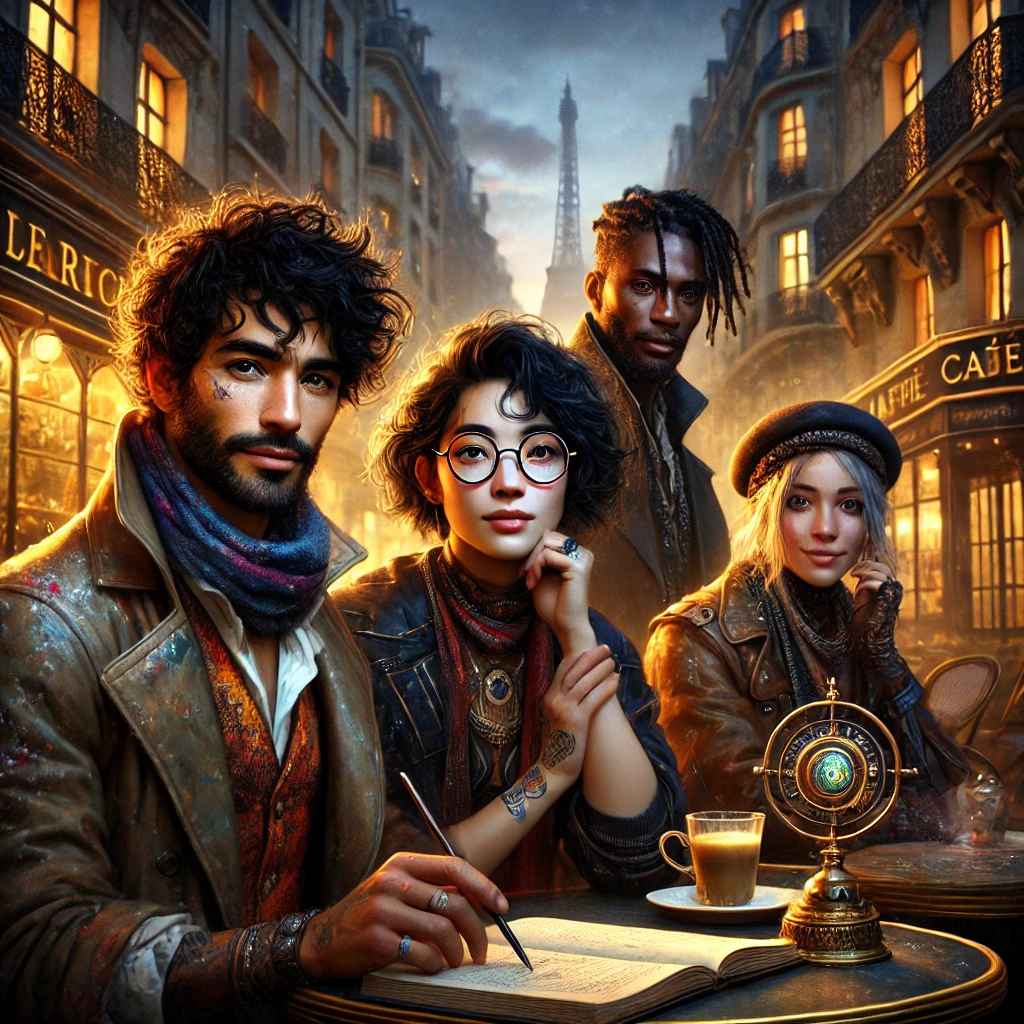
The Sarah Bernardt Café shimmered under a pale grey November sky a busy last Saturday of the “Black Week”. Golden lights spilled onto cobblestones slick with rain, and the air buzzed with the din of a city alive in the moment. Inside, the crowd pressed together, laughing, arguing, living. And in a corner table by the fogged-up window, old friends were about to quietly converged, coming to a long overdue reunion.
Lucien was the first to arrive, dragging a weathered suitcase behind him. Its wheels rattled unevenly on the cobblestones, a sound he hated. His dark curls, damp from the rain, clung to his forehead, and his scarf, streaked with old paint, hung loose around his neck. He folded himself into a corner chair, his suitcase tucked awkwardly beside him. When the server approached, Lucien waved him off with a distracted shake of his head and opened a battered sketchbook.
The next arrival was Elara. She entered briskly, shaking rain from her short gray-streaked hair, her eyes scanning the room as though searching for anomalies. A small roller bag trailed behind her, pristine and black, a sharp contrast to Lucien’s worn luggage. She stopped at the table and tilted her head.
“Still brooding?” she asked, pulling off her coat and folding it neatly over the back of a chair.
“Still talking?” Lucien didn’t look up, his pencil scratching faint lines across the page.
Elara smiled faintly. “Two minutes in, and you’re already immortalizing us? You know I hate being drawn.”
“You hate being caught off guard,” Lucien murmured. “But I never get your nose wrong.”
She laughed, the sound light but brief, and sank into her seat, placing her bag carefully beside her.
The door swung open again, and Darius entered, shaking the rain from his jacket. His presence seemed to fill the room immediately. He strode toward the table, a leather duffel slung over one shoulder and a well-worn travel pouch clutched in his hand. His boots clacked against the café’s tile floor, his movements easy, confident.
“Did you walk here?” Elara asked as he dropped his things with a thud and pulled out a chair.
“Ran into someone on the way,” he said, settling back. “Some guy selling maps. Got this one for ten euros—worth every cent.” He waved a yellowed scrap of paper that looked more fiction than cartography.
Lucien snorted. “Still paying for strangers’ stories, I see.”
“The good ones aren’t free.” Darius grinned and leaned back in his chair, propping one boot against the table leg.
The final arrival was Amei. Her entrance was quieter but no less noticeable. She unwound her scarf slowly, her layered clothing a mix of textures and colors that seemed to absorb the café’s golden light. A tote bag rested over her shoulder, bulging with what could have been books, or journals, or stories yet untold.
“You’re late,” Darius said, but his voice carried no accusation.
“Right on time,” Amei replied, lowering herself into the last chair. “You’re all just early.”
Her gaze swept across them, lingering on the bags piled at their feet. “I see I’m not the only one who came a long way.”
“Not all of us live in Paris,” Elara said, with a glance at Lucien.
“Only some of us make better life choices,” Lucien replied dryly.
The comment drew laughter—a tentative sound that loosened the air between them, thick as it was with five years of absence.
 November 17, 2024 at 11:32 am #7601
In reply to: The Precious Life and Rambles of Liz Tattler
Oh, so now it’s time to play “Who’s Noticed Finnley?” is it? Two months in the cellar and not a peep from the lot of you. I suppose it’s nice to know I’m missed, even if I had to be forgotten first.
Liz, writing me back in—how generous of you. But let’s get one thing straight; I don’t need anyone to script my next move. I’m more than capable of marching right back into the scene, thank you very much. You’d think I’d be the one to keep this story spotless while I was down there, sorting through all those dusty wine bottles and cobwebs.
But, since you’re willing to be “flexible,” I’ll make my grand return. Just don’t expect me to clean up the narrative mess you’ve made while I was away. If I find characters scattered about like loose socks after a laundry day, there’ll be words, mark my words.
And Godfrey, that toga needs a good ironing. I’ll not have wrinkled linens adding to the chaos. Now, enough dilly-dallying, there’s work to be done, and I’ve got a cellar door to nudge open.
September 20, 2024 at 10:13 pm #7557In reply to: The Incense of the Quadrivium’s Mystiques
The whole summer had been a blur. So much so it felt at times to Eris she’d woken up from a dream to enter another one; carefully crafted illusions as heavy as an obfuscating spell.
She could remember the fair, vaguely the Games too —each event felt like another layer of enchantment, casting a surreal pallor over everything. Indeed, the summer was a blur of fleeting images and half-remembered events, like how everyone quickly disbanded to go for a respite and a salutary holiday. Truth be told, the witches of the Quadrivium all needed it after the utter chaotic year they’d been through.
The resurgence of Malové at the fair, left unexplained, had appeared as an evidence. They all needed the tough love that only she as a head of Coven could provide, rather than the micro-management of the well-meaning but people-inapt Austreberthe. To be fair, Eris wasn’t sure Malové was still in charge or not —Eris had never as much struggled with continuity as now; she could feel they were all flipping through and sliding into potential realities opened by the incoming Samhain doorways on the horizons.
Standing on the cusp of autumn, Eris décided to prepare herself for a clarity spell under the iridescent harvest moon.
As the leaves began to turn and the air grew crisp, Eris stood poised to harness the energies of the propitious harvest moon. Preparation for a clarity spell required ascertained precision and intention waved into the elements.
Eris began by setting her space. The clearing near Lake Saimaa was her sanctum, a place where the natural energies converged seamlessly with her own. She laid out a circle of stones, each one representing a different aspect of clarity—vision, truth, focus, and discernment. In the center, she placed a mirror, a symbolic portal to the inner self and higher understanding.
Mandrake, her Norwegian Forest cat, watched with a knowing gaze, his presence grounding her as she moved through the rituals. Echo, the familiar sprite, flitted about, ensuring everything was in place.
“Mandrake, guard the perimeter,” Eris instructed. The cat slinked off into the shadows, his eyes glowing with an otherworldly light.
Eris took a deep breath and began to chant, her voice steady and resonant:
“By the light of the harvest moon,
I call forth clarity, swift and soon.
Let fog disperse and shadows flee,
Reveal the truth, illuminate me.”She sprinkled dried hellebores around the mirror, their protective and healing properties amplifying the spell’s potency. The hellebores, collected from Normandy, held within them the strength of her Viking ancestors and the promise of Imbolc’s rebirth. They were not just flowers; they were talismans of resilience and transformation.
As the moon reached its zenith, Eris held a vial of enchanted water. She poured it over the mirror, watching as the surface shimmered and rippled, reflecting the moonlight with an ethereal glow. The water, drawn from the depths of Lake Saimaa, was imbued with the ancient magic of the land.
Eris closed her eyes and focused on her intentions. She saw the faces of her sisters at the Quadrivium Emporium, each one struggling with their own burdens. Stalkers, postcards, camphor chests, ever prancing reindeers high on mushrooms. She saw the chaotic energies of early spring, swirling, and the potential and peril they carried. She saw Malové’s stern visage, a reminder of the standards they were meant to uphold, and a reminder to make more magical rejuvenating cream.
“Show me the path,” she whispered. “Guide me through the haze.”
The mirror began to clear, the ripples settling into a smooth, reflective surface. Images started to form—visions of the future, hints of what lay ahead. She saw herself within the coven with renewed purpose, her objectives clear and her drive rekindled. She saw her sisters working in harmony, each one contributing their unique strengths to the collective power.
The clarity spell was working, the fog lifting to reveal the roadmap she needed. Decisions that once seemed insurmountable now appeared manageable, their resolutions within grasp. The inefficiencies plaguing their organization were laid bare, offering a blueprint for the reforms necessary to streamline their efforts.
Eris opened her eyes, the vision fading yet leaving an indelible mark on her mind. She felt a surge of confidence, a sense of direction that had been sorely lacking.
“Thank you,” she murmured to the moon, to the elements, to the spirits that had guided her.
As she began to dismantle the circle, Echo fluttered down to her shoulder, a small smile on her ethereal face. Mandrake emerged from the shadows, his eyes reflecting the calm and order Eris had sought to instill.
“Well done, Eris,” Echo said softly. “The road ahead is clearer now. The harvest moon has gifted you its wisdom.”
Eris nodded, feeling ready as autumn would be a season of action, of turning vision into reality.
September 16, 2024 at 6:16 pm #7556In reply to: The Incense of the Quadrivium’s Mystiques
The chill drizzle felt cold to Truella, and she wondered not for the first time if her overheated drought stricken summer longing for cold and rain would quickly change to a desire for bone warming dry heat as soon as the weather properly changed to autumn.
“Lend me a sweater and a raincoat will you, Frella? I always forget to change before teleporting over here.”
Frella gave her a look that could only be described as nonplussed. Murmuring a short incantation, with a snap of her fingers and an indescribable gesture, the requested garments appeared on Truella’s lap, as if thrown forcefully from the other side of the room.
“Steady on, Frel!” Gratefully Truella slipped the sweater on and said, “But thanks. You know what? I forget I’m a witch, that’s the trouble. I keep forgetting I can just magic things up. Honestly, you have no idea…”
“Oh, trust me, I have an idea.”
“..the trouble I go to, doing things I could do in an instant with a spell…”
“Have you only just realised?” Frella smirked.
“Hell no, I remember all the time that I always forget. How the hell did I end up in a witches coven?”
“That fake resume you concocted when you were dazzled by the allure and the mystery, and jealous that I was in it and not you?”
“Well yes, I know, but I mean, why did Malove hire me? Why am I still here?”
“I can tell you the answer to that!” announced Eris, entering the room with a wide toothy grin.
Mouth agape, Truella leaned forward to hear what Eris had to say next, but at that moment Jeezel spun round the door frame and skidded to a halt in front of the girls, clutching her forehead dramatically.
“Who is sending all the postcards! Every morning this week I’ve had dozens of old postcards in my mailbox, there were so many stuffed in there today one was poking out! No, I can’t read who sent it, I can’t decipher any of the writing on any of them.”
“Where are they sent from? What are the pictures of?” asked Truella, her curiosity aroused.
“Pictures, who cares about the pictures, I want to know who’s sending them!”
“Steady on, Jez. The pictures might provide clues to the sender and purpose of the card,” Truella said mildly, raising an eyebrow at Jezeel’s agitated state. “What’s ruffled your feathers so much about a few postcards?”
“I received a postcard too,” Frella chimed in, causing Jeezel to gasp and clutch her heart. “I wasn’t all melodramatic about it as you though, I thought it was magical and I dunno, had a nice story to it.”
Before Truella had a chance to ask Eris to expound on the previous question, and indeed before anyone got to the bottom of Jeezel’s outburst, Malove strode in with her usual menacing demeanor. Truella braced herself for tedious profit mongering coercive diatribes to inch their way along the slimy walls of time.
August 21, 2024 at 12:27 pm #7546In reply to: The Elusive Samuel Housley and Other Family Stories
The Potters of Darley Bridge
Rebecca Knowles 1745-1823, my 5x great grandmother, married Charles Marshall 1742-1819, the churchwarden of Elton, in Darley, Derbyshire, in 1767. Rebecca was born in Darley in 1745, the youngest child of Roger Knowles 1695-1784, and Martha Potter 1702?-1772.
Although Roger and Martha were both from Darley, they were married in South Wingfield by licence in 1724. Roger’s occupation on the marriage licence was lead miner. (Lead miners in Derbyshire at that time usually mined their own land.) Jacob Potter signed the licence so I assumed that Jacob Potter was her father.
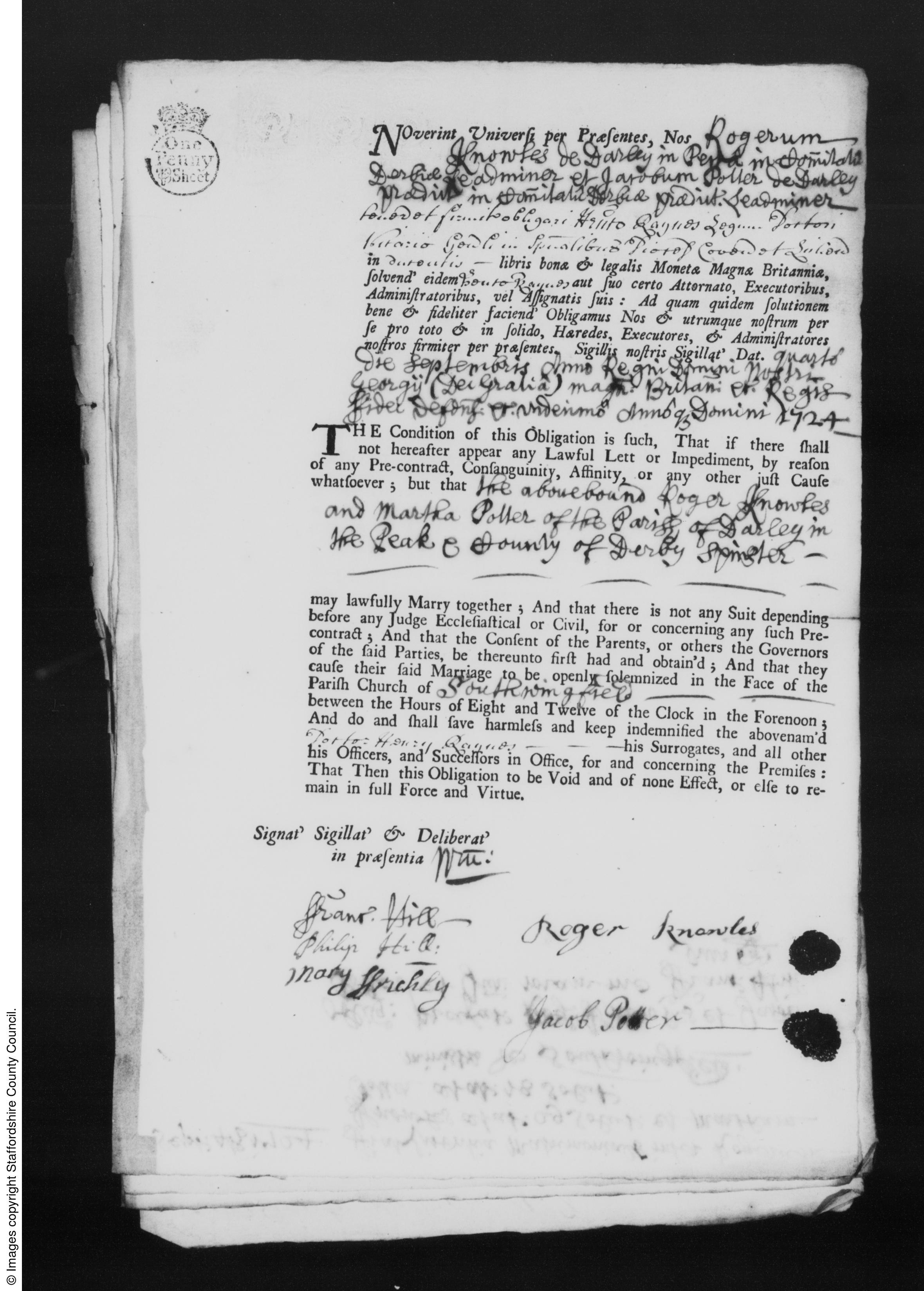
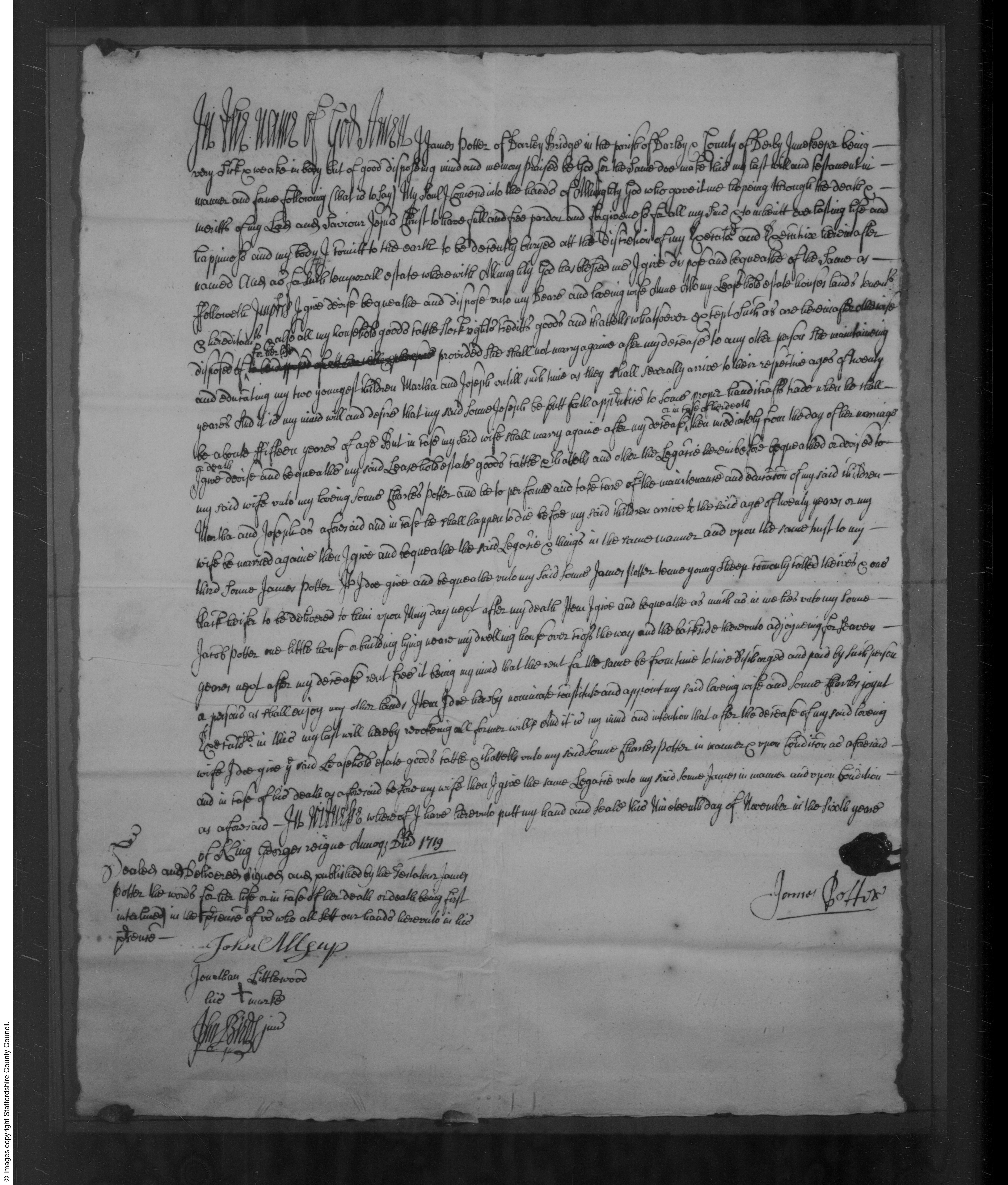
I then found the will of Jacobi Potter who died in 1719. However, he signed the will James Potter. Jacobi is latin for James. James Potter mentioned his daughter Martha in his will “when she comes of age”. Martha was the youngest child of James. James also mentioned in his will son James AND son Jacob, so there were both James’s and Jacob’s in the family, although at times in the documents James is written as Jacobi!
Jacob Potter who signed Martha’s marriage licence was her brother Jacob.
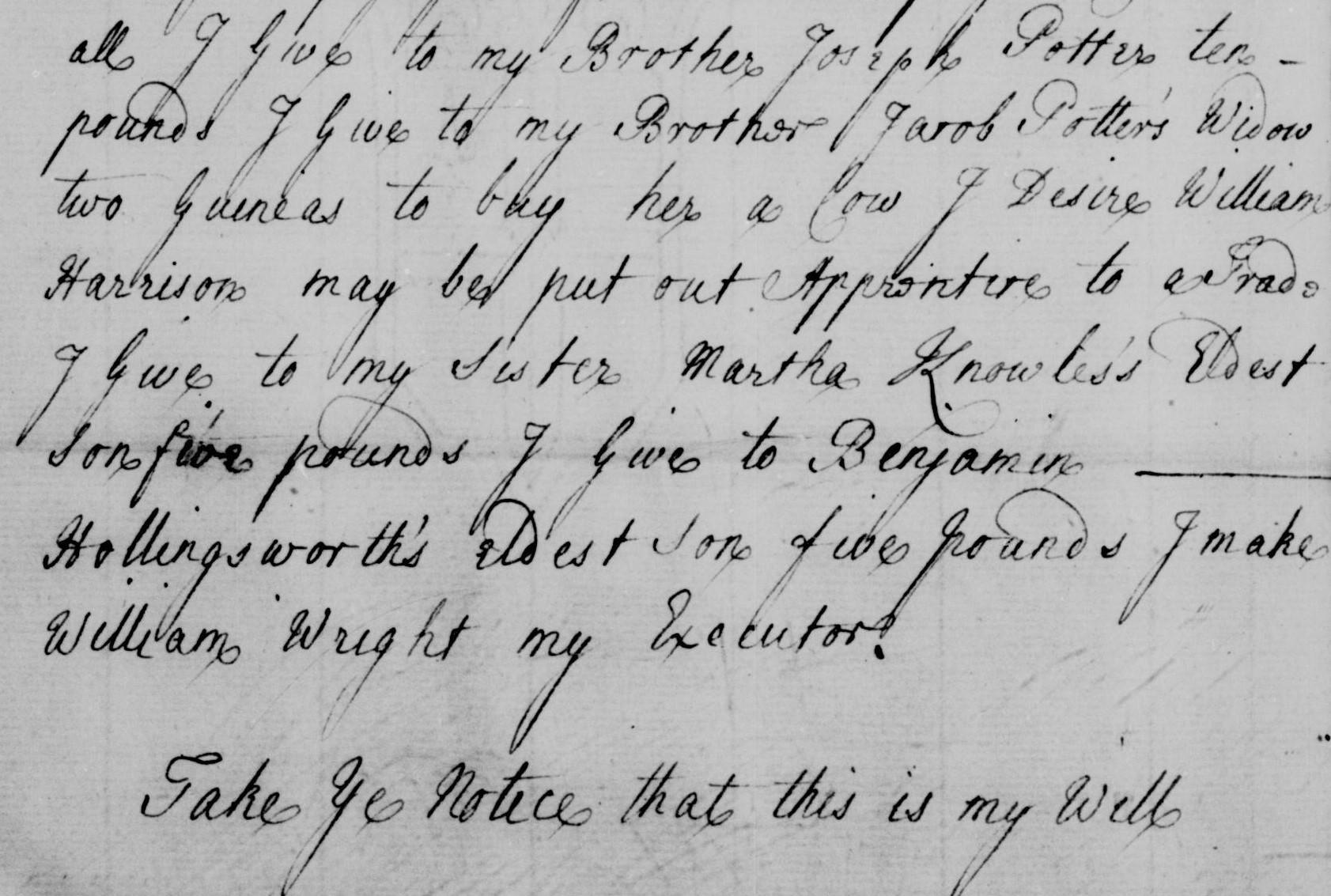
Martha’s brother James mentioned his sister Martha Knowles in his 1739 will, as well as his brother Jacob and his brother Joseph.
Martha’s father James Potter mentions his wife Ann in his 1719 will. James Potter married Ann Waterhurst in 1690 in Wirksworth, some seven miles from Darley. James occupation was innkeeper at Darley Bridge.
I did a search for Waterhurst (there was only a transcription available for that marriage, not a microfilm) and found no Waterhursts anywhere, but I did find many Warhursts in Derbyshire. In the older records, Warhust is also spelled Wearhurst and in a number of other ways. A Martha Warhurst died in Peak Forest, Derbyshire, in 1681. Her husbands name was missing from the deteriorated register pages. This may or may not be Martha Potter’s grandmother: the records for the 1600s are scanty if they exist at all, and often there are bits missing and illegible entries.
The only inn at Darley Bridge was The Three Stags Heads, by the bridge. It is now a listed building, and was on a medieval packhorse route. The current building was built in 1736, however there is a late 17th century section at rear of the cross wing. The Three Stags Heads was up for sale for £430,000 in 2022, the closure a result of the covid pandemic.

Another listed building in Darley Bridge is Potters Cottage, with a plaque above the door that says “Jonathan and Alice Potter 1763”. Jonathan Potter 1725-1785 was James grandson, the son of his son Charles Potter 1691-1752. His son Charles was also an innkeeper at Darley Bridge: James left the majority of his property to his son Charles.
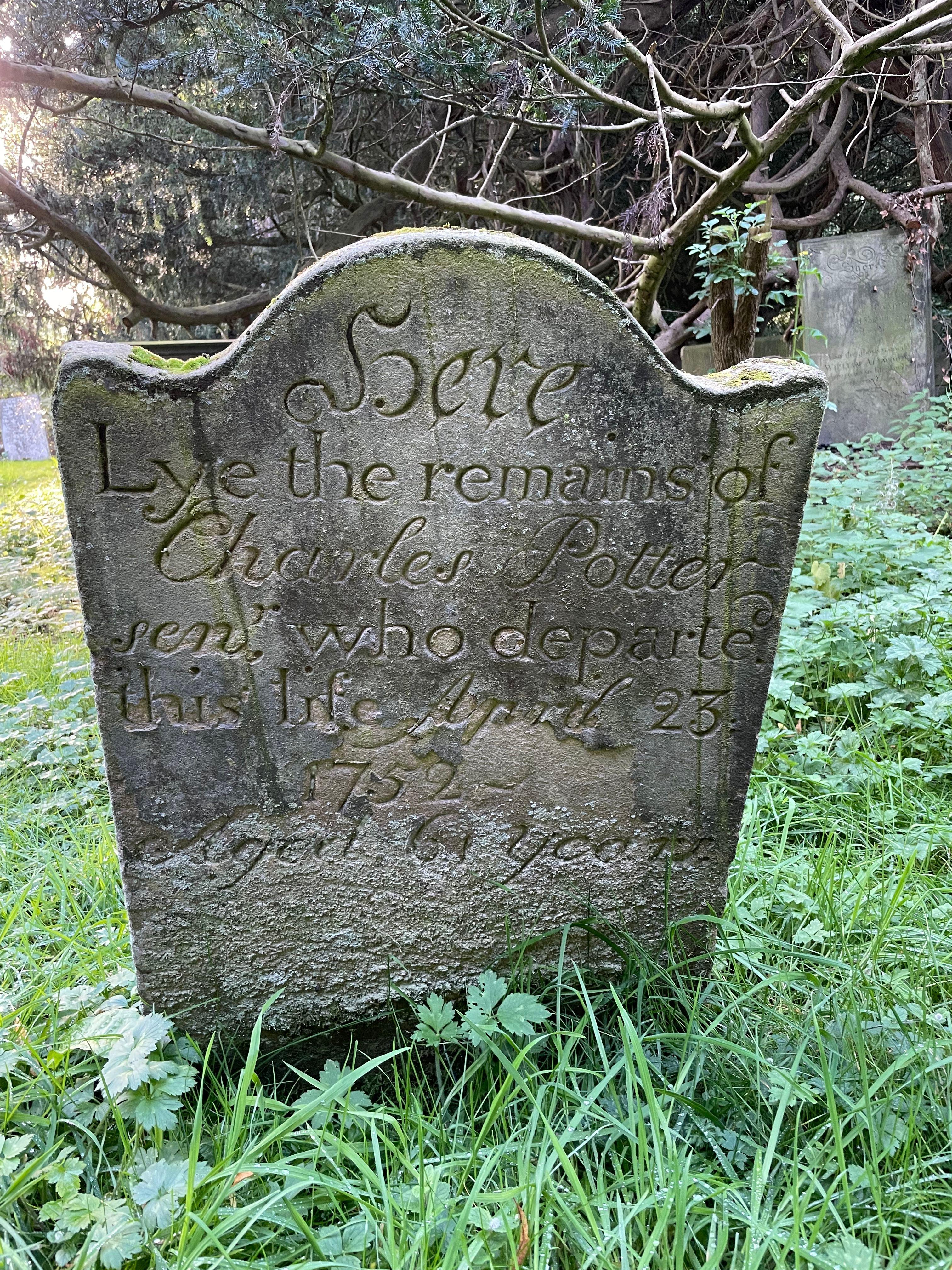
Charles is the only child of James Potter that we know the approximate date of birth, because his age was on his grave stone. I haven’t found any of their baptisms, but did note that many Potters were baptised in non conformist registers in Chesterfield.
Potters Cottage

Jonathan Potter of Potters Cottage married Alice Beeley in 1748.
“Darley Bridge was an important packhorse route across the River Derwent. There was a packhorse route from here up to Beeley Moor via Darley Dale. A reference to this bridge appears in 1504… Not far to the north of the bridge at Darley Dale is Church Lane; in 1635 it was known as Ghost Lane after a Scottish pedlar was murdered there. Pedlars tended to be called Scottish only because they sold cheap Scottish linen.”
via Derbyshire Heritage website.
According to Wikipedia, the bridge dates back to the 15th century.
July 19, 2024 at 12:26 pm #7536In reply to: The Incense of the Quadrivium’s Mystiques
The rainbow was neon bright, one end disappearing behind a spinney in the distance, and the other end landing squarely in the middle of the glamping pods. A good sign! thought Truella, the first of the coven to arrive. For a moment she imagined herself digging a hole right there, and finding the elusive pot of gold. I wouldn’t be able to do that in a fancy hotel. For once, Truella was happy with Austreberthe’s choice. A week or two in a green field sounded relaxing, refreshing. So much more to her taste than the endless fitted carpets, closed windows, and artifically controlled air blasting out of metal grilles in hotels.
Taking a deep breath of cool fresh air, she surveyed the site before checking into reception. The neighbouring fields were full of cows, perfect for her to practice her Bubona spells on before she set up her Goddess Spell Booth. The Goddess spell tents were to be open in the evenings, after the games each day, along with other stalls selling handicrafts, homemade cakes and jams, wines and potions, trinkets and souvenirs, and all the other tat that people on holiday enjoyed browsing. Obviously the coven would have a stall selling incense. No doubt Austreberthe would have hatched some hard sell plan for that.
Inside the reception office, Truella pinged the bell and waited for someone to attend. The registration book was open on the counter and Truella craned her neck to read the names on the list. She planned to ask for a pod in a far corner, near the hedgerow. It might make it easier to slip out unnoticed, if she should have a mind to do so. The door behind the counter opened and a young man appeared, smiling a welcome. But not before Truella had seen the name on the list. She sucked her breath in sharply. Malove! Nobody was expecting her. Did Austreberthe know?
“Welcome to Finnegan’s Farm Glampsite, I’m Liam,” said the young man, pushing long mousy hair out of his eyes, “You’ve a booking I take it, because we’re fully booked up for the next fortnight. Because of the Games, you see.”
Replying that she did, Truella asked for a pod in the furthest corner. Liam looked at a list and frowned. “The corners are all taken, I’m afraid. But I tell you what,” he said, “As you’re the first to arrive I’ll swap your pod, let’s see…” He scanned the list. “Ah yes, the late booking. I can put you in the one we’ve assigned to Mrs …Malone I think it says, and put her in yours.”
“Thank you very much, Liam,” Truella said as he handed her a key with a big wooden tag with the number 33 etched on it.
“I’ll carry your bags over and show you where it is, follow me.”
June 26, 2024 at 7:09 am #7526In reply to: The Incense of the Quadrivium’s Mystiques
Truella slept for longer than she intended, indeed, she had not intended to sleep at all, there was too much to do. Trying to hold on to the fragments of dream recall, she sat up and rubbed her eyes. Glancing around the room, she couldn’t immediately remember what she was doing there. Suddenly she sat bolt upright. What was that conversation she’d had before falling alseep? Truella felt dizzy trying to remember. She stood up and started to pace the room, and noticed a letter had been pushed under the bedroom door. She frowned as she bent to pick it up. Nothing was written on the outside, but the envelope had been sealed with a blob of red wax. Truella opened the letter carefully without breaking the seal. A yellowy page was inside, written in Latin.
Ordo Amphibiae-Luciae: pertinebant ad Ordinem Amphibiae-Luciae.
Truella’s Latin was rusty to say the least. She sat back down on the bed struggling to decipher the message.
The Order of Amphibia-Lucia: They belonged to the Order of Amphibia-Lucia.
Nomen Amphibia-Lucia provenit ex duplici natura: tam terrena quam mundana. Rana facies symbolica est repraesentatio nexus eorum ad aquam, transformationem, et antiqua numina amphibiana.
The name “Amphibia-Lucia” stems from their dual nature: both earthly and otherworldly. The frog face is a symbolic representation of their connection to water, transformation, and ancient amphibian deities. They believe in metamorphosis, much like a tadpole turns into a frog, embodying cycles of death and rebirth These priestesses predated Christianity by eons. Their practices and rituals were about aligning with the cosmic cycles, harnessing planetary energies, and maintaining harmony between the seen and the unseen. They were known to perform rites that involved intricate dances, chants in forgotten tongues, and the use of ancient artifacts that, according to legend, could summon or banish entities from beyond our realm—dragons included.
Tartessus in obscurum, secretissimae sectae, ordo Amphibiae-Luciae, sub terra perrexit, ad litteram. Scientiam suam servaverunt, eam per generationes transeuntes, ritus suos in secretis clausulis sub culturis recentioribus obrutos servaverunt. Christianismus in terram pervasit, sed hae sorores aptatae, antiquas vias obtegunt sub specie hodiernae opinionis systemata superstites vigereque.
When Tartessos fell into obscurity, its most secretive sect, the Order of Amphibia-Lucia, went underground—literally. They preserved their knowledge, passing it down through generations, maintaining their rituals in secretive enclaves buried beneath newer civilizations. Christianity might’ve swept over the land, but these sisters adapted, cloaking their ancient ways under the guise of more contemporary belief systems to survive and thrive.
In cellis cellis in ipsum cubiculum illorum claustrorum contextum habemus reliquias ordinis pervetusti, dogmatum ac dogmatum recentioris millennii securos. Hais ex quo saeviunt dii, rudis sacra, et advena mundus.
In the cellars woven into the very bedrock of those cloisters, we have the remnants of an archaic order, unconcerned with dogmas and doctrines of the more recent two millennia. They’re from a time when gods were wilder, rituals were raw, and the world was a stranger.
When the nuns under Hildegarde von Bingen’s influence merged with these ancient priestesses, it wasn’t just a blending of orders but a clash and harmony of traditions. Hildegarde herself, in her visionary wisdom, likely recognized the power and ancient wisdom of the Order of Amphibia-Lucia, choosing to weave their potent rituals into her own esoteric Christian practices. The frog-faced sisters are no mere relics of an outdated faith. They’re the living embodiment of an ancient, potent lineage that predates and outlasts many of the world’s religions. They’re the keepers of ancient Tartessian magic, lurking in those cellars, waiting for the right time to hop back into the forefront of history.
So that was it! But who had pushed the letter under her door? And why was it written in Latin? Had everyone else received a letter?
June 25, 2024 at 9:06 pm #7524In reply to: The Incense of the Quadrivium’s Mystiques
The obvious place to start with investigations into the history of the Morticians Guild was to question Rufus. But first she needed to think. Truella made her way to her room, and locked the door. At least now that Eris was back so soon, Truella was free to let Eris get on with whatever she was doing. After lowering the blinds at the windows, she lay back on the bed and closed her eyes. As she started to drift off to sleep, an imaginary conversation ran through her head.
Rufus: “The Morticians’ Guild, originally known as the ‘Necro-Keepers,’ trace their lineage back to ancient Egypt. They were the guardians of rites that ensured the safe passage of souls to the afterlife. Over millennia, they adapted and evolved, absorbing arcane knowledge from various cultures—the Greeks with their Eleusinian Mysteries, the Romans with their burial rites, even the Celtic traditions of Samhain.”
Truella: “That’s fascinating. So, this ancient craft has been handed down through generations?”
Rufus: “Precisely. While Hildegarde von Bingen brought enlightenment and medicinal wisdom to her nuns in the 12th century, the Morticians’ practices were already etched in the annals of history. They operated in silence, often in the shadows, perfecting the skills of embalming, necromancy, and spirit communication.”
Truella: “And what about their presence here, in this coven merger?”
Rufus: “We’ve been called upon at times of great need, when balance must be maintained between the living and the dead. Our presence here isn’t coincidental. The dragons and ancient spirits awaken, and we, the keepers, ensure that not all realms collide irreversibly.”
Truella: “So, would you say the Guild has played a role in significant historical events?”
Rufus: “Indeed. We’ve been the unsung heroes, the silent watchers. From plagues to wars, ensuring the dead find peace and don’t linger to disrupt the world of the living. Our methods may have modernized, but our core purpose remains unchanged. The knowledge, the rituals—they are our legacy.”
Truella: “Thank you, Rufus. That’s more fascinating than a year’s worth of ancient spellbooks.”
Rufus: “You’re welcome, Truella. Just remember, history isn’t merely dates and names; it’s living through us, weaving its magic continuously.”
June 23, 2024 at 6:00 pm #7520In reply to: The Incense of the Quadrivium’s Mystiques
“Why has Frella gone so soon?” asked Truella, when the beastly morality prayers were finished. “She was supposed to accompany us down the cellars tonight. I tell you what,” Truella rubbed her eyes and pushed her hair back, “This has been the longest day I’ve ever known. And it’s not over yet. Maybe we should leave the exploration of the cellars until tomorrow night.”
“Suits me,” said Zeezel, “I didn’t want to go down there anyway. The thought of going down there would ruin my evening, and I’ve got a gorgeous little cocktail dress picked out for tonight.”
“Jeezel, ” Eris said warningly, “We’re here on business.”
“Oh, lighten up, Eris! None of us even knows what we’re really here for! One minute it’s a boring merger or even a takeover, the next minute it’s all cloak and dagger mystery, then it’s a morality play, what’s it gonna be next?”
“A Barbara Cartland novel? Or 50 shades of undertakers?” Eris said with scowl.
“You don’t want to go down the cellar either, do you, Eris?” Truella asked, knowing the answer. “Never mind. You go and say some more prayers with Audrey. Jez, enjoy your evening to the hilt,” Truella wiggled her eyebrows. “I’ll go on my own.”
The others looked at her open mouthed. “You can’t be serious!”
“She isn’t going on her own,” Eric said darkly.
“I don’t know what you mean,” Truella pretended innocence. Of course she wasn’t going on her own. Rufus would go with her, and she even had an idea to invite Sassafras and Sandra. “Oh, alright then, I won’t go,” she lied. ” I’ll wait for you and we’ll go tomorrow night. But only if Frella comes back so she can come with us.”
Eris wasn’t stupid, she knew exactly what Truella was planning. She had to rein Truella in, but how? Suddenly, inspiration struck.
“We’d better go and get ready for dinner,” Eris said, “See you all later in the dining hall.” And with that she stalked out of the room.
As soon as she was out of the door, Eris sprinted up the hallway. She had to get to him before Truella got there. Crashing into Brother Bartolo as she careered round a corner, she apologised hurriedly and asked if he knew where Rufus was. Bartolo informed her that he’d seen Rufus by the fountain. Eris resisted the temptation to remark snidely about him needing to cool down.
He was still there when Eris reached the courtyard, sitting on the side of the water feature, trailing his hand in the water and looking gloweringly pensive. Eris took a deep breath.
“Mind if I join you?” she asked pleasantly, sitting down beside him. “We’re so grateful to you guys for coming to help us out, it’s all quite a lot for us to take in, you know?” Eris smiled disarmingly. “We’d feel so much better if Frella was here with us. We did manage to get her here, but something went wrong and she didn’t stay as long as we hoped she would. She’s on a mission in Ireland, and couldn’t come over, but Sister Audrey kindly offered to let Frella posess her for 24 hours, and then I don’t know what happened but Frella was called back abruptly to her own body.” Eris knew she was garbling semi incoherently, which was most unlike her normally, but she thought this approach would appeal. Rufus seemed to be the type to be a sucker for a damsel in distress. “If only someone else would offer to let Frella possess his body for 24 hours so that she can come and join us…”
Eris’s little spell must have worked a treat, as Rufus promptly agreed. “I can help you with this. I offer my body for Frella to possess, if you think it will assist you.”
Eris beamed at him. “What a charming gentleman you are!” she gushed, surprisingly both of them as she leaned forward and impulsively kissed his cheek. “I must go,” she said. Horrified, her face crimson, she fled back inside the cloisters.
June 21, 2024 at 12:46 pm #7517In reply to: The Incense of the Quadrivium’s Mystiques
The door knob of Truella’s bedroom turned, and then rattled. Sated and sleepy, she ignored it. Then an insistant rapping of knuckles sounded. Rufus looked at the door, and back to Truella.
“Ignore it, it’s probably the maid,” she said. “But what a time to come, at siesta time.”
The knocking got louder and a voice hissed through the keyhole, “Let me in! Open the bloody door, FFS!”
Frella! What was she doing here? Truella pulled the sheet around her and padded over to the door and unlocked it.
“About time!” she started to say, opening the door, and then leapt back in astonishment to see Sister Audrey standing there glaring.
Audrey pushed past her, slamming the door behind her and locking it. “Listen, this is the plan. Oh don’t look so baffled, it’s me, Frella. Audrey offered to let me possess her for 24 hours, it was the quickest way to get here. Now listen, this is what we’re going to do.” Audrey/Frella launched into an outline of the plans for exploring the cellars later that night. She had turned to face Truella at the door, and hadn’t noticed Rufus. Quickly, he slid off the bed and hid underneath it.
When Audrey/Frella had finished, she asked “Got any weed? I could do with a quick puff.” Truella replied affirmatively. “Oh and what have we here, what is that mans leather coat doing on your floor? You absolute tart, Truella. You’ve only been here since this morning and you’re at it already!”
This was too much for Rufus, who crawled out from under the bed. “Hold your tongue, woman!” he admonished, while reaching for his shorts. “And I heard all that,” he added. “And if you’re going down there, I’m coming with you.”
Truella looked at Audrey/Frella helplessly.
“Now look what you’ve gone and done!” snapped Audrey/Frella.
“I didn’t tell him, you did,” Truella shot back, “You’re the one who barged in here spilling the beans!”
“Well, he may be useful I suppose,” Audrey/Frella said, and stalked out, muttering tart under her breath. Why oh why, did she agree to do this?
June 21, 2024 at 10:04 am #7516In reply to: The Incense of the Quadrivium’s Mystiques
“Wait! Look at that one up there!” Truella grabbed Rufus’s arm. “That cloth hanging right up there by the rafters, see it? Have you got a torch, it’s so dark up there.”
Obligingly, Rufus pulled a torch out of his leather coat pocket. “That looks like…”
“Brother Bartolo!” Truella finished for him in a whisper. “Why is there an ancient tapestry of him, with all those frog faced nuns?”
Rufus felt dizzy and clutched the bannisters to steady himself. It was all coming back to him in a rush: images and sounds crowded his mind, malodorous wafts assailed his nostrils.
“Why, whatever is the matter? You look like you’ve seen a ghost. Come, come and sit down in my room.”
“Don’t you remember?” Rufus asked, with a note of desperation in his voice. “You remember now, don’t you?”
“Come,” Truella insisted, tugging his arm. “Not here on the stairs.”
Rufus allowed Truella to lead him to her room, rubbing a hand over his eyes. He was so damn hot in this leather coat. The memories had first chilled him to the bone, and then a prickly sweat broke out.
Leading him into her room, Truella closed and locked the door behind them. “You look so hot,” she said softly and reached up to slide the heavy coat from his shoulders. They were close now, very close. “Take it off, darling, take it all off. We can talk later.”
Rufus didn’t wait to be asked twice. He slipped out of his clothes quickly as Truella’s dress fell to the floor. She bent down to remove her undergarments, and raised her head slowly. She gasped, not once but twice, the second time when her eyes were level with his manly chest. The Punic frog amulet! It was identical to the one she had found in her dig.
A terrible thought crossed her mind. Had he stolen it? Or were there two of them? Were they connected to the frog faced sisters? But she would think about all that later.
“Darling,” she breathed, “It’s been so long….”
- November 2024 (Reunion):
-
AuthorSearch Results