
Daily Random Quote

  • The world didn’t end that day. But maybe it should have, or at least the endless list of senseless rules, silly obligations, half-compromises and clever-yet-too-often-outdone-by-stupidity ploys to defeat them. Stuck in the middle of his twelfth failed attempt at booking a flight for the Land of the Long Cloud, he found himself dreaming of buying… well, no— ... · ID #2870 (continued)
    (next in 15h 49min…)

Latest Activity

Search Results for 'early'

Forums Search Search Results for 'early'

Viewing 20 results - 161 through 180 (of 468 total)
  • Author
    Search Results
  • #6225
    TracyTracy
    Participant

      William Marshall’s Parents

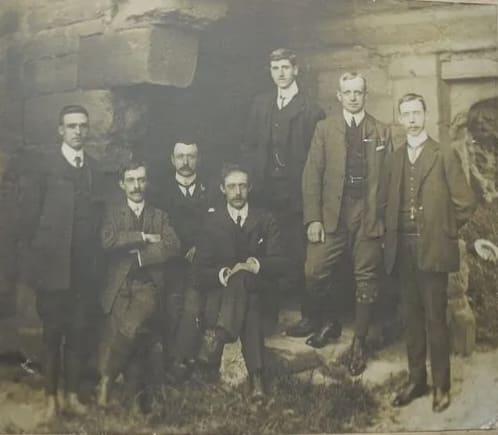
      William Marshall  1876-1968, my great grandfather, married Mary Ann Gilman Purdy in Buxton. We assumed that both their families came from Buxton, but this was not the case.  The Marshall’s came from Elton, near Matlock; the Purdy’s from Eastwood, Nottinghamshire.

      William Marshall, seated in centre, with colleagues from the insurance company:

      William Marshall


      William and all his siblings were born in Fairfield in Buxton. But both Emma Featherstone 1847-1928, his mother, and John Marshall 1842-1930, his father, came from rural Derbyshire. Emma from Ashbourne (or Biggin, Newhaven, or Hartington, depending on what she chose to put on the census, which are all tiny rural places in the same area).

      Emma and John Marshall in the middle, photo says “William Marshall’s parents” on the back:

      Emma and John Marshall


      John Marshall was a carter, later a coal carter, and was born in Elton, Derbyshire. Elton is a rural village near to Matlock. He was unable to write (at least at the time of his wedding) but Emma signed her own name.

      In 1851 Emma is 3 or 4 years old living with family at the Jug and Glass Inn, Hartington. In 1861 Emma was a 14 year old servant at a 112 acre farm, Heathcote, but her parents were still living at the Jug and Glass. Emma Featherstone’s parents both died when she was 18, in 1865.
      In 1871 she was a servant at Old House Farm, Nether Hartington Quarter, Ashborne.

      On the census, a female apprentice was listed as a servant, a boy as an apprentice. It seems to have been quite normal, at least that’s what I’ve found so far,  for all teenagers to go and live in another household to learn a trade, to be independent from the parents, and so doesn’t necessarily mean a servant as we would think of it. Often they stayed with family friends, and usually married in their early twenties and had their own household ~ often with a “servant” or teenager from someone else’s family.

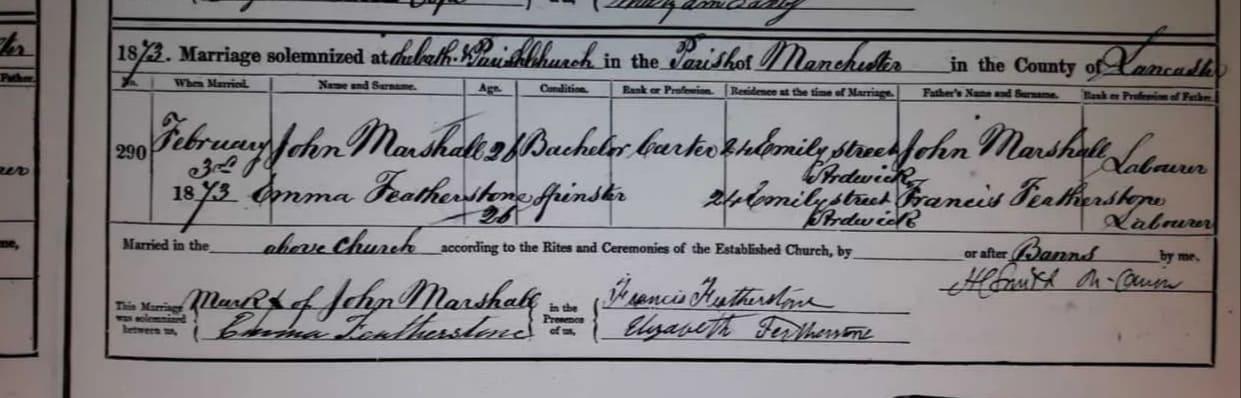
      The only marriage I could find for Emma and John was in Manchester in 1873, which didn’t make much sense. If Emma was single on the 1871 census, and her first child James was born in 1873, her marriage had to be between those dates. But the marriage register in Manchester appears to be correct, John was a carter, Emma’s father was Francis Featherstone. But why Manchester?

      Marshall Featherstone marriage

      I noticed that the witnesses to the marriage were Francis and Elizabeth Featherstone. He father was Francis, but who was Elizabeth? Emma’s mother was Sarah. Then I found that Emma’s brother Francis married Elizabeth, and they lived in Manchester on the 1871 census. Henry Street, Ardwick. Emma and John’s address on the marriage register is Emily Street, Ardwick. Both of them at the same address.

      The marriage was in February 1873, and James, the first child was born in July, 1873, in Buxton.

      It would seem that Emma and John had to get married, hence the move to Manchester where her brother was, and then quickly moved to Buxton for the birth of the child.  It was far from uncommon, I’ve found while making notes of dates in registers, for a first child to be born six or 7 months after the wedding.

      Emma died in 1928 at the age of 80, two years before her husband John. She left him a little money in her will! This seems unusual so perhaps she had her own money, possibly from the death of her parents before she married, and perhaps from the sale of the Jug and Glass.

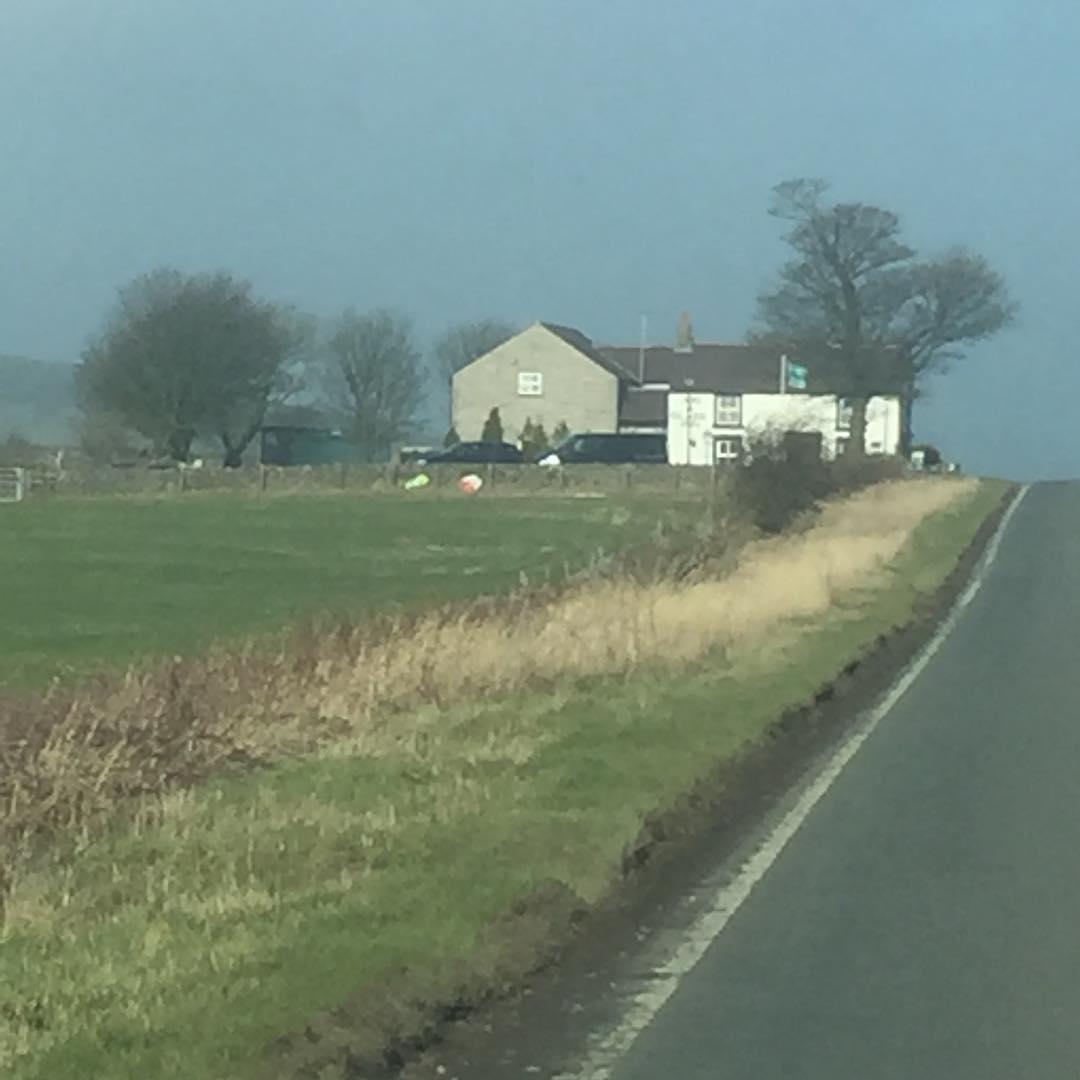
      I found a photo of the Jug and Glass online.  It looks just like the pub I’d seen in my family history meditations on a number of occasions:

      Jug and Glass

      #6222
      TracyTracy
      Participant

        George Gilman Rushby: The Cousin Who Went To Africa

        The portrait of the woman has “mother of Catherine Housley, Smalley” written on the back, and one of the family photographs has “Francis Purdy” written on the back. My first internet search was “Catherine Housley Smalley Francis Purdy”. Easily found was the family tree of George (Mike) Rushby, on one of the genealogy websites. It seemed that it must be our family, but the African lion hunter seemed unlikely until my mother recalled her father had said that he had a cousin who went to Africa. I also noticed that the lion hunter’s middle name was Gilman ~ the name that Catherine Housley’s daughter ~ my great grandmother, Mary Ann Gilman Purdy ~ adopted, from her aunt and uncle who brought her up.

        I tried to contact George (Mike) Rushby via the ancestry website, but got no reply. I searched for his name on Facebook and found a photo of a wildfire in a place called Wardell, in Australia, and he was credited with taking the photograph. A comment on the photo, which was a few years old, got no response, so I found a Wardell Community group on Facebook, and joined it. A very small place, population some 700 or so, and I had an immediate response on the group to my question. They knew Mike, exchanged messages, and we were able to start emailing. I was in the chair at the dentist having an exceptionally long canine root canal at the time that I got the message with his email address, and at that moment the song Down in Africa started playing.

        Mike said it was clever of me to track him down which amused me, coming from the son of an elephant and lion hunter.  He didn’t know why his father’s middle name was Gilman, and was not aware that Catherine Housley’s sister married a Gilman.

        Mike Rushby kindly gave me permission to include his family history research in my book.  This is the story of my grandfather George Marshall’s cousin.  A detailed account of George Gilman Rushby’s years in Africa can be found in another chapter called From Tanganyika With Love; the letters Eleanor wrote to her family.

        George Gilman Rushby:

        George Gilman Rushby


        The story of George Gilman Rushby 1900-1969, as told by his son Mike:

        George Gilman Rushby:
        Elephant hunter,poacher, prospector, farmer, forestry officer, game ranger, husband to Eleanor, and father of 6 children who now live around the world.

        George Gilman Rushby was born in Nottingham on 28 Feb 1900 the son of Catherine Purdy and John Henry Payling Rushby. But John Henry died when his son was only one and a half years old, and George shunned his drunken bullying stepfather Frank Freer and was brought up by Gypsies who taught him how to fight and took him on regular poaching trips. His love of adventure and his ability to hunt were nurtured at an early stage of his life.
        The family moved to Eastwood, where his mother Catherine owned and managed The Three Tuns Inn, but when his stepfather died in mysterious circumstances, his mother married a wealthy bookmaker named Gregory Simpson. He could afford to send George to Worksop College and to Rugby School. This was excellent schooling for George, but the boarding school environment, and the lack of a stable home life, contributed to his desire to go out in the world and do his own thing. When he finished school his first job was as a trainee electrician with Oaks & Co at Pye Bridge. He also worked part time as a motor cycle mechanic and as a professional boxer to raise the money for a voyage to South Africa.

        In May 1920 George arrived in Durban destitute and, like many others, living on the beach and dependant upon the Salvation Army for a daily meal. However he soon got work as an electrical mechanic, and after a couple of months had earned enough money to make the next move North. He went to Lourenco Marques where he was appointed shift engineer for the town’s power station. However he was still restless and left the comfort of Lourenco Marques for Beira in August 1921.

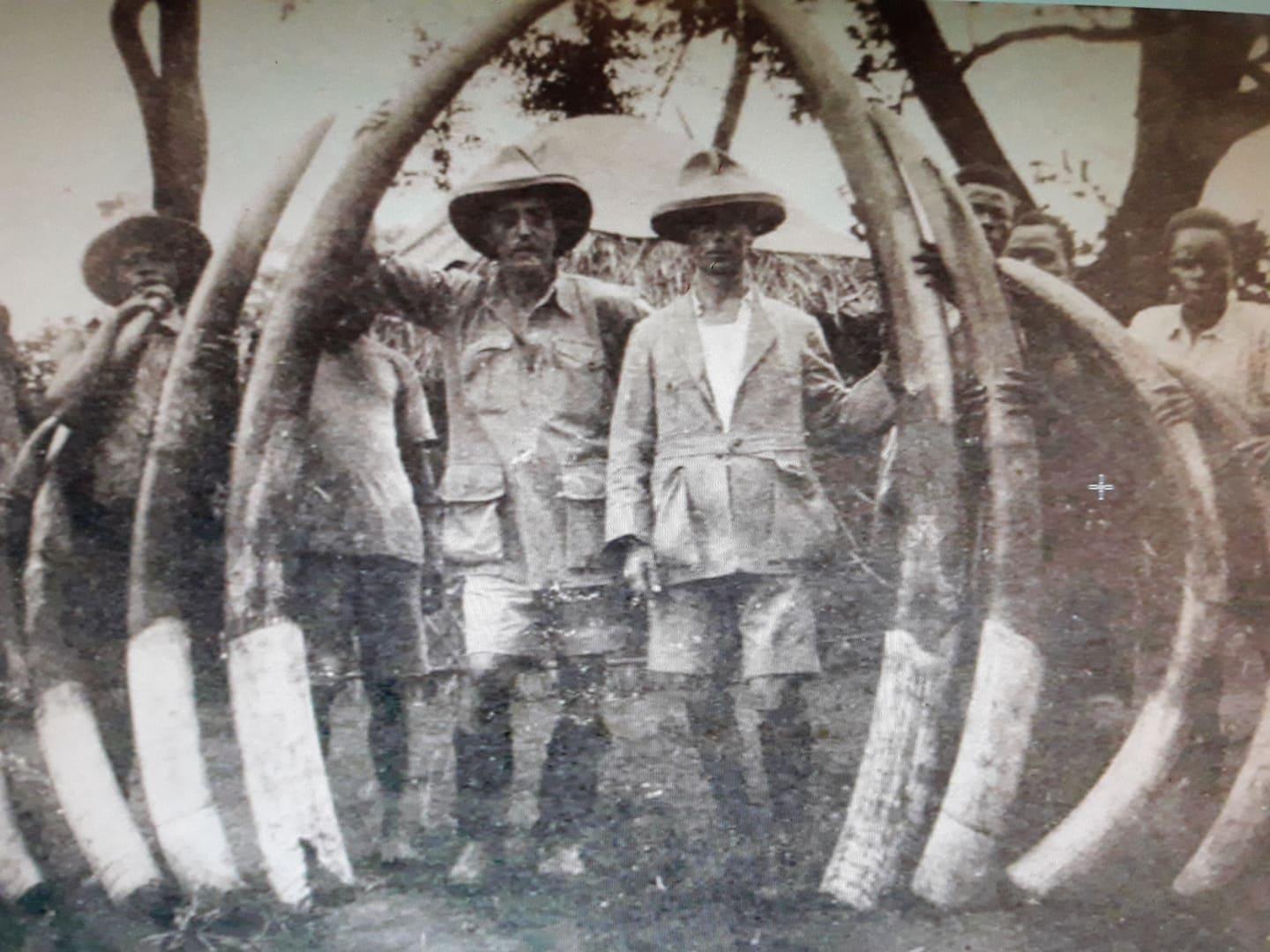
        Beira was the start point of the new railway being built from the coast to Nyasaland. George became a professional hunter providing essential meat for the gangs of construction workers building the railway. He was a self employed contractor with his own support crew of African men and began to build up a satisfactory business. However, following an incident where he had to shoot and kill a man who attacked him with a spear in middle of the night whilst he was sleeping, George left the lower Zambezi and took a paddle steamer to Nyasaland (Malawi). On his arrival in Karongo he was encouraged to shoot elephant which had reached plague proportions in the area – wrecking African homes and crops, and threatening the lives of those who opposed them.

        His next move was to travel by canoe the five hundred kilometre length of Lake Nyasa to Tanganyika, where he hunted for a while in the Lake Rukwa area, before walking through Northern Rhodesia (Zambia) to the Congo. Hunting his way he overachieved his quota of ivory resulting in his being charged with trespass, the confiscation of his rifles, and a fine of one thousand francs. He hunted his way through the Congo to Leopoldville then on to the Portuguese enclave, near the mouth of the mighty river, where he worked as a barman in a rough and tough bar until he received a message that his old friend Lumb had found gold at Lupa near Chunya. George set sail on the next boat for Antwerp in Belgium, then crossed to England and spent a few weeks with his family in Jacksdale before returning by sea to Dar es Salaam. Arriving at the gold fields he pegged his claim and almost immediately went down with blackwater fever – an illness that used to kill three out of four within a week.

        When he recovered from his fever, George exchanged his gold lease for a double barrelled .577 elephant rifle and took out a special elephant control licence with the Tanganyika Government. He then headed for the Congo again and poached elephant in Northern Rhodesia from a base in the Congo. He was known by the Africans as “iNyathi”, or the Buffalo, because he was the most dangerous in the long grass. After a profitable hunting expedition in his favourite hunting ground of the Kilombera River he returned to the Congo via Dar es Salaam and Mombassa. He was after the Kabalo district elephant, but hunting was restricted, so he set up his base in The Central African Republic at a place called Obo on the Congo tributary named the M’bomu River. From there he could make poaching raids into the Congo and the Upper Nile regions of the Sudan. He hunted there for two and a half years. He seldom came across other Europeans; hunters kept their own districts and guarded their own territories. But they respected one another and he made good and lasting friendships with members of that small select band of adventurers.

        Leaving for Europe via the Congo, George enjoyed a short holiday in Jacksdale with his mother. On his return trip to East Africa he met his future bride in Cape Town. She was 24 year old Eleanor Dunbar Leslie; a high school teacher and daughter of a magistrate who spent her spare time mountaineering, racing ocean yachts, and riding horses. After a whirlwind romance, they were betrothed within 36 hours.

        On 25 July 1930 George landed back in Dar es Salaam. He went directly to the Mbeya district to find a home. For one hundred pounds he purchased the Waizneker’s farm on the banks of the Mntshewe Stream. Eleanor, who had been delayed due to her contract as a teacher, followed in November. Her ship docked in Dar es Salaam on 7 Nov 1930, and they were married that day. At Mchewe Estate, their newly acquired farm, they lived in a tent whilst George with some help built their first home – a lovely mud-brick cottage with a thatched roof. George and Eleanor set about developing a coffee plantation out of a bush block. It was a very happy time for them. There was no electricity, no radio, and no telephone. Newspapers came from London every two months. There were a couple of neighbours within twenty miles, but visitors were seldom seen. The farm was a haven for wild life including snakes, monkeys and leopards. Eleanor had to go South all the way to Capetown for the birth of her first child Ann, but with the onset of civilisation, their first son George was born at a new German Mission hospital that had opened in Mbeya.

        Occasionally George had to leave the farm in Eleanor’s care whilst he went off hunting to make his living. Having run the coffee plantation for five years with considerable establishment costs and as yet no return, George reluctantly started taking paying clients on hunting safaris as a “white hunter”. This was an occupation George didn’t enjoy. but it brought him an income in the days when social security didn’t exist. Taking wealthy clients on hunting trips to kill animals for trophies and for pleasure didn’t amuse George who hunted for a business and for a way of life. When one of George’s trackers was killed by a leopard that had been wounded by a careless client, George was particularly upset.
        The coffee plantation was approaching the time of its first harvest when it was suddenly attacked by plagues of borer beetles and ring barking snails. At the same time severe hail storms shredded the crop. The pressure of the need for an income forced George back to the Lupa gold fields. He was unlucky in his gold discoveries, but luck came in a different form when he was offered a job with the Forestry Department. The offer had been made in recognition of his initiation and management of Tanganyika’s rainbow trout project. George spent most of his short time with the Forestry Department encouraging the indigenous people to conserve their native forests.

        In November 1938 he transferred to the Game Department as Ranger for the Eastern Province of Tanganyika, and over several years was based at Nzasa near Dar es Salaam, at the old German town of Morogoro, and at lovely Lyamungu on the slopes of Kilimanjaro. Then the call came for him to be transferred to Mbeya in the Southern Province for there was a serious problem in the Njombe district, and George was selected by the Department as the only man who could possibly fix the problem.

        Over a period of several years, people were being attacked and killed by marauding man-eating lions. In the Wagingombe area alone 230 people were listed as having been killed. In the Njombe district, which covered an area about 200 km by 300 km some 1500 people had been killed. Not only was the rural population being decimated, but the morale of the survivors was so low, that many of them believed that the lions were not real. Many thought that evil witch doctors were controlling the lions, or that lion-men were changing form to kill their enemies. Indeed some wichdoctors took advantage of the disarray to settle scores and to kill for reward.

        By hunting down and killing the man-eaters, and by showing the flesh and blood to the doubting tribes people, George was able to instil some confidence into the villagers. However the Africans attributed the return of peace and safety, not to the efforts of George Rushby, but to the reinstallation of their deposed chief Matamula Mangera who had previously been stood down for corruption. It was Matamula , in their eyes, who had called off the lions.

        Soon after this adventure, George was appointed Deputy Game Warden for Tanganyika, and was based in Arusha. He retired in 1956 to the Njombe district where he developed a coffee plantation, and was one of the first in Tanganyika to plant tea as a major crop. However he sensed a swing in the political fortunes of his beloved Tanganyika, and so sold the plantation and settled in a cottage high on a hill overlooking the Navel Base at Simonstown in the Cape. It was whilst he was there that TV Bulpin wrote his biography “The Hunter is Death” and George wrote his book “No More The Tusker”. He died in the Cape, and his youngest son Henry scattered his ashes at the Southern most tip of Africa where the currents of the Atlantic and Indian Oceans meet .

        George Gilman Rushby:

        #6219
        TracyTracy
        Participant

          The following stories started with a single question.

          Who was Catherine Housley’s mother?

          But one question leads to another, and another, and so this book will never be finished.  This is the first in a collection of stories of a family history research project, not a complete family history.  There will always be more questions and more searches, and each new find presents more questions.

          A list of names and dates is only moderately interesting, and doesn’t mean much unless you get to know the characters along the way.   For example, a cousin on my fathers side has already done a great deal of thorough and accurate family research. I copied one branch of the family onto my tree, going back to the 1500’s, but lost interest in it after about an hour or so, because I didn’t feel I knew any of the individuals.

          Parish registers, the census every ten years, birth, death and marriage certificates can tell you so much, but they can’t tell you why.  They don’t tell you why parents chose the names they did for their children, or why they moved, or why they married in another town.  They don’t tell you why a person lived in another household, or for how long. The census every ten years doesn’t tell you what people were doing in the intervening years, and in the case of the UK and the hundred year privacy rule, we can’t even use those for the past century.  The first census was in 1831 in England, prior to that all we have are parish registers. An astonishing amount of them have survived and have been transcribed and are one way or another available to see, both transcriptions and microfiche images.  Not all of them survived, however. Sometimes the writing has faded to white, sometimes pages are missing, and in some case the entire register is lost or damaged.

          Sometimes if you are lucky, you may find mention of an ancestor in an obscure little local history book or a journal or diary.  Wills, court cases, and newspaper archives often provide interesting information. Town memories and history groups on social media are another excellent source of information, from old photographs of the area, old maps, local history, and of course, distantly related relatives still living in the area.  Local history societies can be useful, and some if not all are very helpful.

          If you’re very lucky indeed, you might find a distant relative in another country whose grandparents saved and transcribed bundles of old letters found in the attic, from the family in England to the brother who emigrated, written in the 1800s.  More on this later, as it merits its own chapter as the most exciting find so far.

          The social history of the time and place is important and provides many clues as to why people moved and why the family professions and occupations changed over generations.  The Enclosures Act and the Industrial Revolution in England created difficulties for rural farmers, factories replaced cottage industries, and the sons of land owning farmers became shop keepers and miners in the local towns.  For the most part (at least in my own research) people didn’t move around much unless there was a reason.  There are no reasons mentioned in the various registers, records and documents, but with a little reading of social history you can sometimes make a good guess.  Samuel Housley, for example, a plumber, probably moved from rural Derbyshire to urban Wolverhampton, when there was a big project to install indoor plumbing to areas of the city in the early 1800s.  Derbyshire nailmakers were offered a job and a house if they moved to Wolverhampton a generation earlier.

          Occasionally a couple would marry in another parish, although usually they married in their own. Again, there was often a reason.  William Housley and Ellen Carrington married in Ashbourne, not in Smalley.  In this case, William’s first wife was Mary Carrington, Ellen’s sister.  It was not uncommon for a man to marry a deceased wife’s sister, but it wasn’t strictly speaking legal.  This caused some problems later when William died, as the children of the first wife contested the will, on the grounds of the second marriage being illegal.

          Needless to say, there are always questions remaining, and often a fresh pair of eyes can help find a vital piece of information that has escaped you.  In one case, I’d been looking for the death of a widow, Mary Anne Gilman, and had failed to notice that she remarried at a late age. Her death was easy to find, once I searched for it with her second husbands name.

          This brings me to the topic of maternal family lines. One tends to think of their lineage with the focus on paternal surnames, but very quickly the number of surnames increases, and all of the maternal lines are directly related as much as the paternal name.  This is of course obvious, if you start from the beginning with yourself and work back.  In other words, there is not much point in simply looking for your fathers name hundreds of years ago because there are hundreds of other names that are equally your own family ancestors. And in my case, although not intentionally, I’ve investigated far more maternal lines than paternal.

          This book, which I hope will be the first of several, will concentrate on my mothers family: The story so far that started with the portrait of Catherine Housley’s mother.
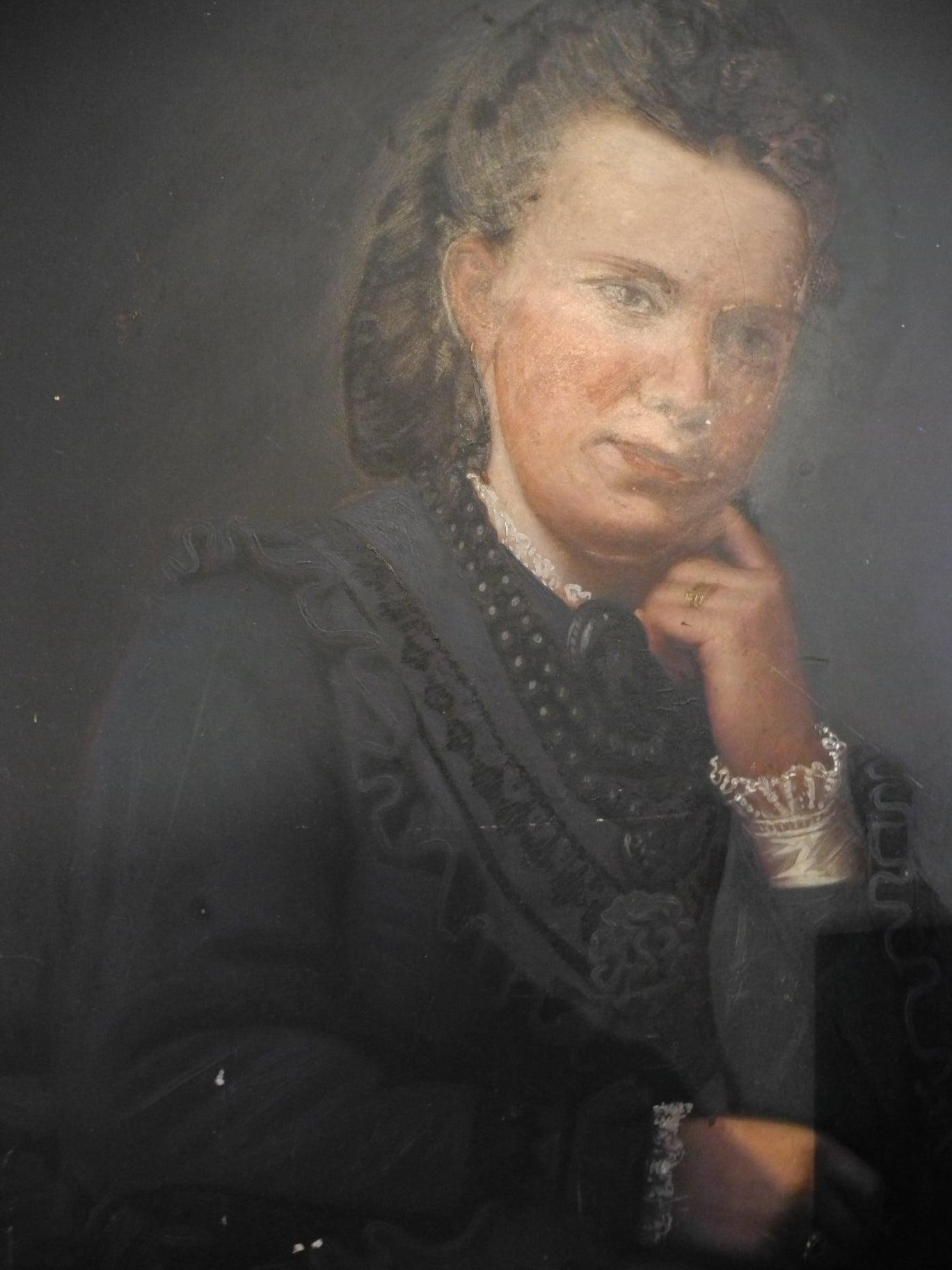
          Elizabeth Brookes


          This painting, now in my mothers house, used to hang over the piano in the home of her grandparents.   It says on the back “Catherine Housley’s mother, Smalley”.

          The portrait of Catherine Housley’s mother can be seen above the piano. Back row Ronald Marshall, my grandfathers brother, William Marshall, my great grandfather, Mary Ann Gilman Purdy Marshall in the middle, my great grandmother, with her daughters Dorothy on the left and Phyllis on the right, at the Marshall’s house on Love Lane in Stourbridge.
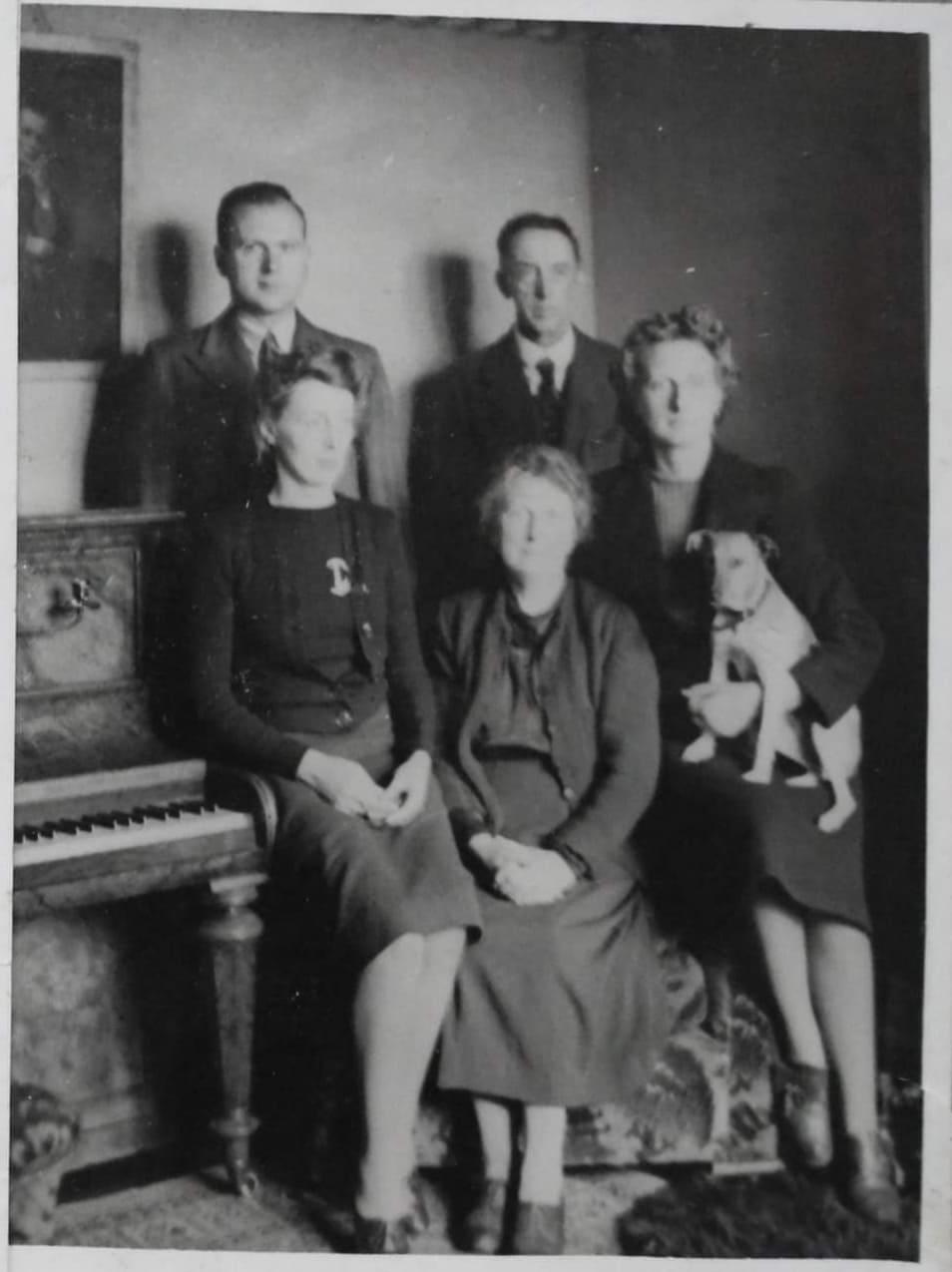
          Marshalls


          The Search for Samuel Housley

          As soon as the search for Catherine Housley’s mother was resolved, achieved by ordering a paper copy of her birth certificate, the search for Catherine Housley’s father commenced. We know he was born in Smalley in 1816, son of William Housley and Ellen Carrington, and that he married Elizabeth Brookes in Wolverhampton in 1844. He was a plumber and glazier. His three daughters born between 1845 and 1849 were born in Smalley. Elizabeth died in 1849 of consumption, but Samuel didn’t register her death. A 20 year old neighbour called Aaron Wadkinson did.
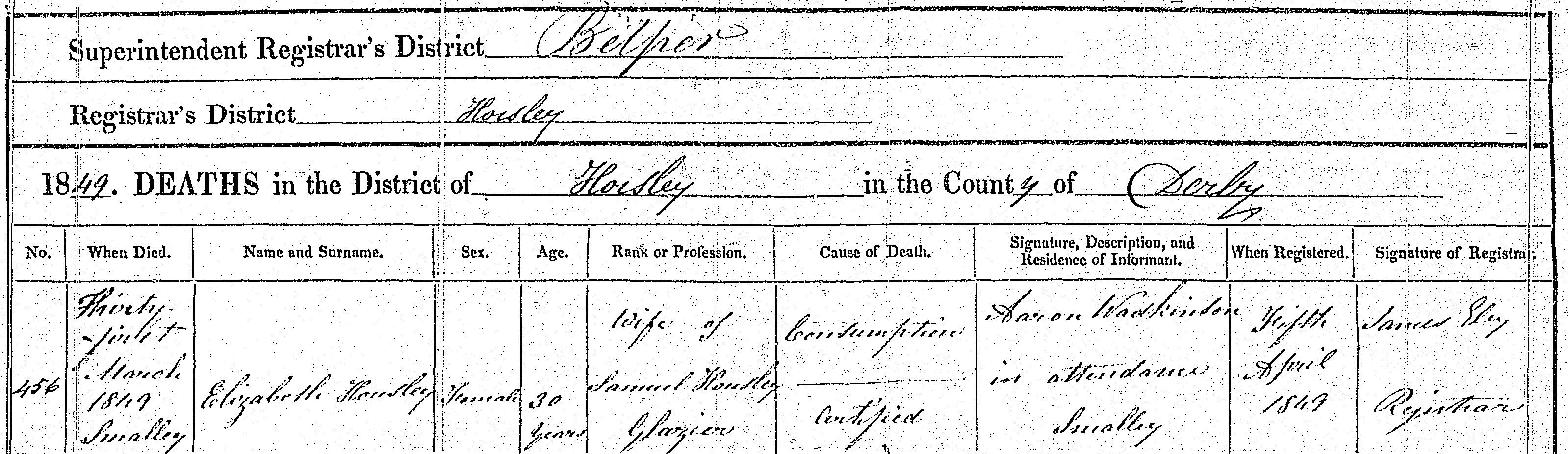
          Elizabeth death


          Where was Samuel?

          On the 1851 census, two of Samuel’s daughters were listed as inmates in the Belper Workhouse, and the third, 2 year old Catherine, was listed as living with John Benniston and his family in nearby Heanor.  Benniston was a framework knitter.

          Where was Samuel?

          A long search through the microfiche workhouse registers provided an answer. The reason for Elizabeth and Mary Anne’s admission in June 1850 was given as “father in prison”. In May 1850, Samuel Housley was sentenced to one month hard labour at Derby Gaol for failing to maintain his three children. What happened to those little girls in the year after their mothers death, before their father was sentenced, and they entered the workhouse? Where did Catherine go, a six week old baby? We have yet to find out.
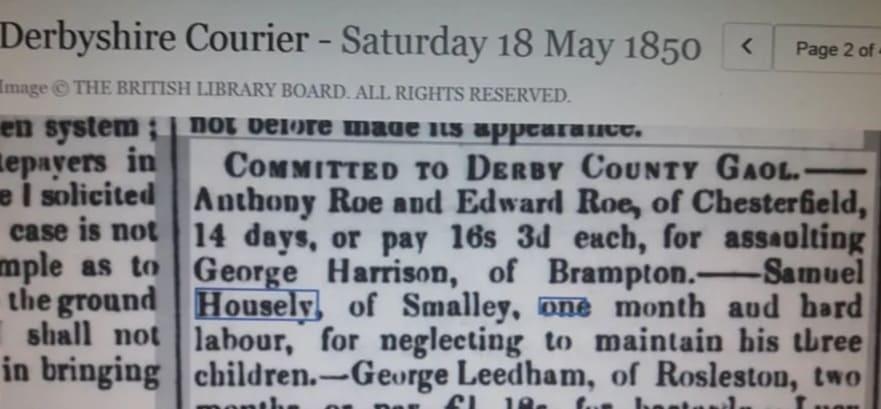
          Samuel Housley 1850


          And where was Samuel Housley in 1851? He hasn’t appeared on any census.

          According to the Belper workhouse registers, Mary Anne was discharged on trial as a servant February 1860. She was readmitted a month later in March 1860, the reason given: unwell.

          Belper Workhouse:
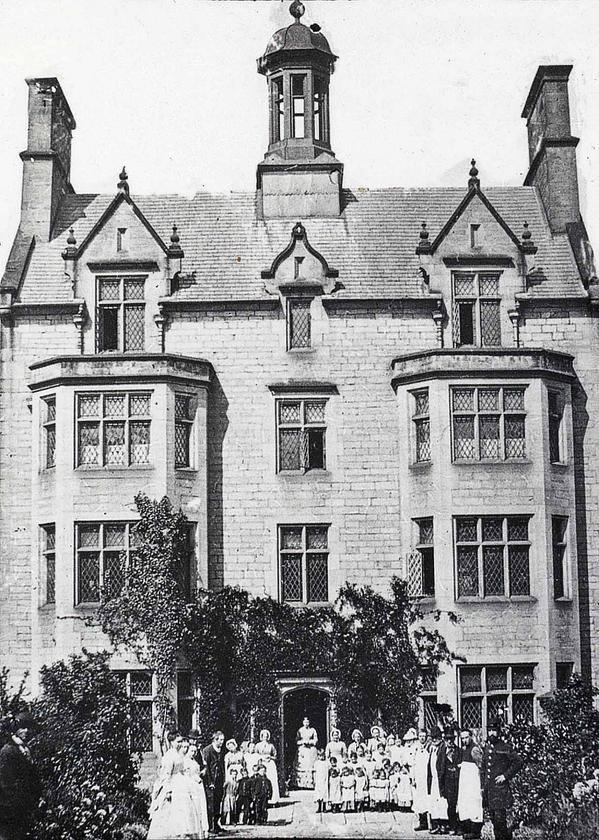
          Belper Workhouse

          Eventually, Mary Anne and Elizabeth were discharged, in April 1860, with an aunt and uncle. The workhouse register doesn’t name the aunt and uncle. One can only wonder why it took them so long.
          On the 1861 census, Elizabeth, 16 years old, is a servant in St Peters, Derby, and Mary Anne, 15 years old, is a servant in St Werburghs, Derby.

          But where was Samuel?

          After some considerable searching, we found him, despite a mistranscription of his name, on the 1861 census, living as a lodger and plumber in Darlaston, Walsall.
          Eventually we found him on a 1871 census living as a lodger at the George and Dragon in Henley in Arden. The age is not exactly right, but close enough, he is listed as an unmarried painter, also close enough, and his birth is listed as Kidsley, Derbyshire. He was born at Kidsley Grange Farm. We can assume that he was probably alive in 1872, the year his mother died, and the following year, 1873, during the Kerry vs Housley court case.
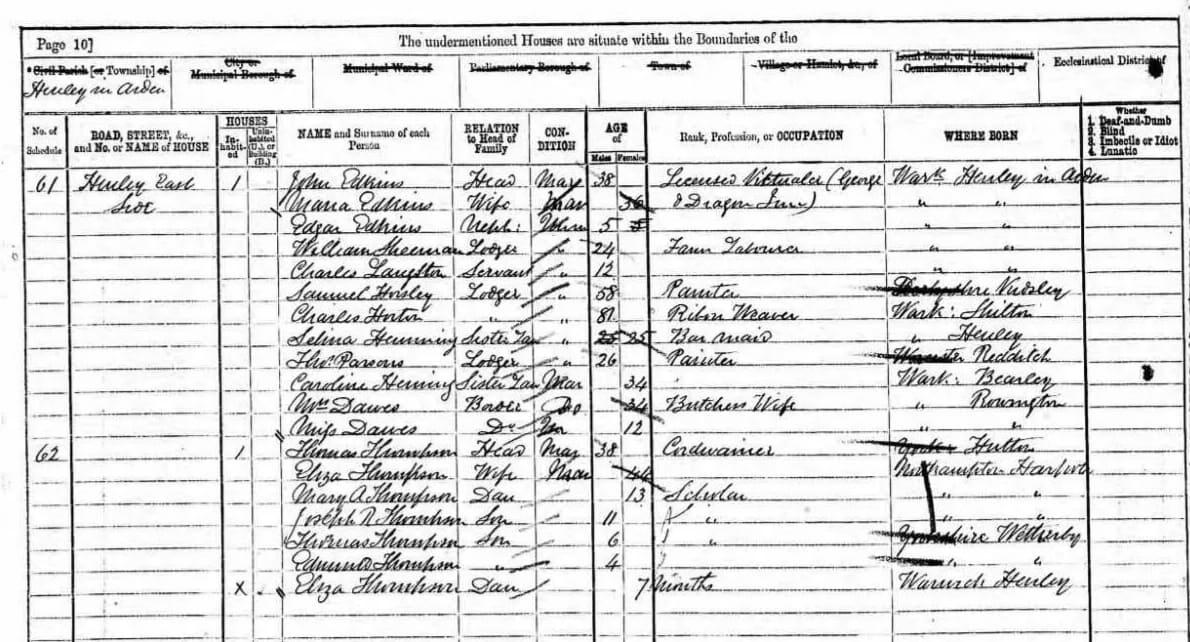
          Samuel Housley 1871


          I found some living Housley descendants in USA. Samuel Housley’s brother George emigrated there in 1851. The Housley’s in USA found letters in the attic, from the family in Smalley ~ written between 1851 and 1870s. They sent me a “Narrative on the Letters” with many letter excerpts.

          The Housley family were embroiled in a complicated will and court case in the early 1870s. In December 15, 1872, Joseph (Samuel’s brother) wrote to George:

          “I think we have now found all out now that is concerned in the matter for there was only Sam that we did not know his whereabouts but I was informed a week ago that he is dead–died about three years ago in Birmingham Union. Poor Sam. He ought to have come to a better end than that….His daughter and her husband went to Birmingham and also to Sutton Coldfield that is where he married his wife from and found out his wife’s brother. It appears he has been there and at Birmingham ever since he went away but ever fond of drink.”

          No record of Samuel Housley’s death can be found for the Birmingham Union in 1869 or thereabouts.

          But if he was alive in 1871 in Henley In Arden…..
          Did Samuel tell his wife’s brother to tell them he was dead? Or did the brothers say he was dead so they could have his share?

          We still haven’t found a death for Samuel Housley.


          #6183

          Nora commented favourably on the view, relieved to have been given a clue about what she was supposed to have noticed.  It was a splendid panorama, and Will seemed pleased with her response.  She asked if it was possible to see the old smugglers path from their vantage point, and he pointed to a dirt road in the valley below that disappeared from view behind a stand of eucalyptus trees.  Will indicated a tiny white speck of an old farm ruin, and said the smugglers path went over the hill behind it.

          Shading her eyes from the sun, Nora peered into the distance beyond the hill, wondering how far it was to Clara’s grandfathers house. Of course she knew it was 25 kilometers or so, but wasn’t sure how many hills behind that one, or if the path veered off at some point in another direction.

          Wondering where Clara was reminded Nora that her friend would be waiting for her, and quite possibly worrying that she hadn’t yet arrived.  She sighed, making her mind up to leave first thing the next morning.  She didn’t mention this to Will though, and wondered briefly why she hesitated.  Something about the violent sweep of his arm when she asked about her phone had made her uneasy, such a contrast to his usual easy going grins.

          Then she reminded herself that she had only just met him, and barely knew anything about him at all, despite all the stories they’d shared.  When she thought about it, none of the stories had given her any information ~ they had mostly been anecdotes that had a similarity to her own, and although pleasant, were inconsequential.  And she kept forgetting to ask him about all the statues at his place.

          Wishing she could at least send a text message to Clara, Nora remembered the remote viewing practice they’d done together over the years, and realized she could at least attempt a telepathic communication. Then later, if Clara gave her a hard time about not staying in contact, she could always act surprised and say, Why, didn’t you get the message?

          She found a flat stone to sit on, and focused on the smugglers path below. Then she closed her eyes and said clearly in her mind, “I’ll be there tomorrow evening, Clara. All is well. I am safe.”

          She opened her eyes and saw that Will had started to head back down the path.  “Come on!” he called, “Time for lunch!”

          #6171

          Nora was relieved when  the man with the donkey knew her name and was expecting her.  She assumed that Clara had made contact with him, but when she mentioned her friend, he shook his head with a puzzled frown. I don’t know anyone called Clara, he said.  Here, get yourself up on Manolete, it’ll be easier if you ride.  We’ll be home in half an hour.

          The gentle rhythmic rocking astride the donkey soothed her as she relaxed and observed her surroundings. The woods had opened out into a wide path beside an orchard. Nora felt the innocuous hospitability of the orchard in comparison to the unpredictability of the woods, although she felt that idea would require further consideration at a later date.  One never knew how much influence films and stories and the like had on one’s ideas, likely substantial, Nora thought ~ another consideration not lost on Nora was the feeling of safety she had now that she wasn’t alone, and that she was with someone who clearly knew where he was going.

          Notwithstanding simultaneous time, Nora wondered which came first ~ the orchard, the man with the donkey, or the feeling of safety and hospitability itself?

          It was me, said the man leading the donkey, turning round with a smile. I came first. Remember?

          #6160

          The message was scrawled in pencil on a roughly torn off piece of note paper. Bob had to squint to make out some of the words.

          Hopefully you won’t need this but put this somewhere safe, just in case. The  man i introduced you to today will know what to do. 

          And then there was a phone number. Bob wondered if the man would still be there. It was nearly 15 years ago and Bob’s memory was sketchy. He frowned, trying to remember. When the receptacle had been unearthed in the bad flooding of that year, he had contacted someone … how he got onto him he can no longer recall … some number from the archeological thingamajigs maybe. The person he spoke to came round, him and another fellow, said he shouldn’t tell anyone about the receptacle. Said it should be put back in the ground. Said it was important. The other fellow, the one he is supposed to call, made sculptures—Bob remembered that because there had been some sitting on the back of his truck.

          Bob sat on the side of the bed and rubbed his head. He couldn’t really be bothered with all this carry on. It all seemed a bit crazy now, having to keep the damn thing buried. What’s all that about? And Clara was so excited, contacting her archeological friend and whatnot. Strange girl though, that Nora. He wished Jane were still here. She’d know what to do.

          #6151

          Grandpa Bob loved the sound of the kettle whistling. Cheery, he thought as he turned the flame off. Companionable.
          He shuffled to the kitchen door. “Clara, cuppa?” he shouted down the hallway but there was no reply. Maybe she wasn’t up yet—it had been a long trip for her yesterday. Perhaps he could make her up a tray, although she’d probably say he was fussing.
          Just then he heard VanGogh barking from the garden. He drew back the curtain and peered out the kitchen window. There she was! Way down the back digging in the vegetable garden. Bless her soul. Must have got started early on that weeding. She was saying she would last night. Grandpa, you really need to get some help around the place! she’d scolded.
          “Clara, love!” he shouted. Damn dog was making such a racket she didn’t hear him. Nothing for it but to go out there. He chuckled, thinking how she’d probably scold him again for wandering around outside in his pyjamas. Bossy little thing she could be. But a good girl coming all this way to visit him.
          He slipped on his outdoor shoes and slowly made his way down the path to the vegetable garden. VanGogh bounded over to him and Grandpa Bob gave him a pat. “What are you two up to out here, eh VanGogh?” But Clara was so engrossed on her phone she didn’t even glance up. He was about to call out to her again when he saw what she’d dug up and the words stuck in his throat. He let out a small cry.

          This year, Christmas has come a month early for Clara.

          VanGogh, her Malinois with the lopsided ear had dug a hole in the garden of Grandpa’s home in the countryside. She usually wouldn’t have given it second thought, but the hole was big this time, and the dog unusually excited. Looking at it, that’s when she noticed the shiny corner of what seemed to be a very large metal box.

          There was something buried there, apparently since a long time. Her archaeologist senses were all tingly. What, why, how, and how far back in time could she go… She couldn’t wait to tell the others.
          #6129

          In reply to: Tart Wreck Repackage

          “Clearly,what we do next, my friend, is free the middle-aged lady,” Tara smiled smugly.”First rule, notwithstanding that I hate rules, if you don’t know what to do, do what you do know what to do, even if you don’t want to do it because at least you’ve done something.”

          “Is that a Lemone quote?” asked Star. “Haven’t heard much of him lately.”

          “No, I made it up myself.”

          “Oh, well … I’m too tired to do anything.You do it, Tara.”

          “No, you do it! Lazy tart.”

          “I’ll do it!” says Rosamund, appearing from nowhere and bounding over to the wardrobe. “I want to borrow her lippy again.” She tugged at the door. “It seems to be stuck.”

          “Let Star try,” said Tara. “She goes to the gym.”

          “It does seem to be rather stuck,” said Star said after a few minutes of fruitless tugging. She knocked on the door of the wardrobe. “Excuse me, are you there? Excuse me … dreadfully sorry about all this.” There was no reply.

          “Dead,” said Tara. “Darn it.”

          Undaunted, Star tried again. After a particularly spirited tug, the door flew open and Star fell backwards. “She’s gone! But she left a note. Thank you, Ladies for your hospitality. This is a clue. At 4pm Thursday, go to the cafe on Main street. Vince French will be there..”

          Tara gasped. “Who was she? That seemingly innocuous middle-aged lady.”

          “Perhaps we will never know,” said Star.

          #6128

          In reply to: Tart Wreck Repackage

          “Never again,” said Tara, pouring her second black coffee.  “I’m done with these hangovers. You’ll have to find someone else to drink with from now on.”

          “You say that every week, Tara.  What are we going to do next? We’re floundering. We don’t even have a plan. Everything we do takes us further away from the case. I don’t even remember what the case is!”

          “Here, have some more coffee.  Don’t roll your eyes at me like that, cases are always like this, they always go through this phase.”  Tara wasn’t in the mood for this kind of depressing talk, it was much too complicated. Surely it was simply a matter of drinking another coffee, until everything fell back into place.

          “Cases do, do they?” Star asked, “Do they really? And what phase would that be, and how would you know?”

          “Snarky tart, yes they do. I’ve been researching things you know, not just swanning around.  We’ve reached the part of the case where nothing makes sense and the investigators don’t know what to do next. It’s an essential part of the process, everyone knows that.  The important thing is not to try and work things out too early. The danger is preconceived ideas, you see,” Tara pontificated, warming to the theme.

          “I can assure you that I have no preconceived ideas because I have no clue what’s going to happen next,” replied Star, trying not to roll her eyes too obviously.  She knew from experience not to provoke Tara too much until at least the third cup of coffee.

          “Precisely!” Tara said triumphantly. “Now it will all start to come together and make sense. ”

          Star didn’t look convinced.  “What are we going to do about the middle aged lady we locked in the wardrobe last night, though?”

          “What did we do that for?!” asked Tara in astonishment.

          “I can’t remember.  Maybe we thought it was Aunt April?”

          “Wait, if Aunt April isn’t in the wardrobe, then where is she?”

          “That’s what I”m saying!” cried Star in exasperation. “What do we do next?”

          #6122

          In reply to: Tart Wreck Repackage

          “Wait!” said Star. “Have we unwittingly stumbled upon a secret meeting of the bellbird cult?”

          The bouncer laughed. “Not exactly a secret meeting. It’s more of our monthly get-together. We have drinks and what-not and a bit of a sing-song”

          “Sound great! Where do I sign up?” asked Tara, mesmerised by the burly bouncer’s biceps.

          “Tara!” hissed Star. “I think you’ve had a few too many!” Just then, she noticed April trying to make a sneaky getaway.”NOT SO FAST, APRIL!” she shouted.”Grab her, Burly Bouncer!”

          The BB grinned charmingly and grabbed hold of April. “Anything to oblige,” he said, flirtatiously winking at Star.

          “Now, April,” said Star sternly, “you are not going anywhere until you have told us exactly what is going on?”

          April sighed crossly. “I came to the get-together tonight to find out if anyone had seen or heard from Vince. It was mere chance I stumbled upon you two.”

          Tara sneered at the obvious lie. “Then why did you run? Huh?”

          “If you must know, and it appears you must, I believe I saw him.” She pointed to the entrance. “He was wearing a disguise of course. When he saw me, he ran, clearly fearing I would see through his disguise and reveal to the world that he is not in a coma.”

          Star scratched her head. “I see,” she said.

          “So much for New Zealand and your remote viewing skills,” sneered Tara.

          “Why is Vince French pretending to be in a coma? And, if it is not him, then who is in a coma?” asked Star, ignoring Tara’s rudeness. She had always been a nasty drunk.

          April shook her head. “Those are questions only Vincent French can answer.”

          “Going around in circles a bit, aren’t you?” said BB with a kindly smile. “Cheer up! Look around you! Beauty is everywhere and drinks are on the house!”

          #6105

          In reply to: Tart Wreck Repackage

          “It’s surprisingly roomy that wardrobe, isn’t it?” said Aunt April, somewhat placated by pizza.

          Rosamund nearly choked on an olive. Poor old auntie has lost it! “Roomy…what are you on about, Auntie eh?” she asked gently. After all got to be kind to the old dear—she is filthy rich.

          They both looked at the wardrobe.

          “Hmmm …I admit it doesn’t look that big from the outside but there’s that door at the back …”

          “Right, a door is there, Aunt April … how about a nice cuppa?”

          “Now, Rosamund, don’t you talk down to me, Young Lady. Once you get past all those coats … “ she paused to stroke the fur lovingly … “there is a door and behind the door is a room with a nice comfy sofa. I slept there last night.“

          #6087

          In reply to: Tart Wreck Repackage

          “I knew it!” Tara had gone to investigate early, disguised as an elderly jogger in a velvet teal jogging. “Seemed clear enough that that retirement home was a front…”

          Later when she came back to the office, she was quizzed by Star, who was still yawning despite the bright sunlight.

          “So tell me, a front for what?”

          “Can’t you guess?” Tara said, removing her false teeth.

          “Nooo?” her hand flew at Star’s mouth and incredulous face.

          “Yes, hmm-hmm; you guessed right: a time travel agency.”

          “Oh dangit, they stole my idea! After all the virus pandemic thing, they sure know how to surf the crisis to make a buck. The buying carrots alibi traffic, and now that!”

          “Yep, guess that people unable to go anywhere for holidays make up for a good clientele. You can imagine the slogans: Celerity: Why go anywhere? When we can send you anywhen! “

          “And a convenient way of disposing of nosy people too. I hope they didn’t send Uncle Basil to the Dinosaurs, can’t imagine the stench of those Time sewers.”

          “Oh no, don’t think he was affluent enough, you see. Apparently you pay by the time meter. The further in time, the pricier. And I guess the surest way to dispose of someone would be in the past rather than in the future…”

          “So Uncle Basil is in the past!”

          “Exactly.”

          “Well, I could have told you that from the start. No wonder Mr French paid us in advance then, he already knew we’d crack that case. Our first case’s closed, dear! If Mr French ever wakes up and calls, we’ll just redirect him to our Time Dragglers friends in Marseille for their ‘relative lost in time’ retrieval package. Now, anyone for mojitos?”

          #6081
          TracyTracy
          Participant

            Aunt Idle:

            I’ll admit Mater did well with the get back into shape programme, despite my skepticism.  She did hone her muscles a bit, but she was still harping on about wanting plastic surgery.  I probably shouldn’t have asked her if she was showing off her biceps or her bingo wings the other day, because that started her off again. I tried to make it up by complimenting her thigh muscles, but spoiled it by saying it was a shame the skin hung down past her kneecaps. Bert said maybe she could hold the skin up with some suspenders and made me spit my eucalyptus tea out and nearly choke to death. Mater was all set to take offence until she saw me choking, and then she started laughing too. I’m smiling remembering it, because we all saw the funny side then and couldn’t stop laughing for ages. God knows we needed a good laugh.

            I’d had another one of those telepathic chats with Corrie the day before. If I’d known those silly girls were going to navigate their way here via that route I’d have said something, but I never thought they’d be so daft.  There’s me envisioning a pleasant drift through the Mediterranean, and an unexpected sail across an immense shallow lake that had appeared in the middle east with crystal clear waters and a sandy bottom (I could picture it all, I tell you) and then an invitingly tropical trip along the Indian coast with ports of call at virgin new coastlines  ~ but no, they’d gone the other way.  Across the Atlantic. And now they were fighting off bandits every step of the way and having to go miles out of their way to avoid plague ridden slums.  They hadn’t even made their way past the eastern seaboard yet, despite it being considerably narrower now.

            They lost Pan for days in one of those half submerged coastal cities, rife with lawless floating shanties.  I hope my impressions are wrong, I do really, but it seemed like he’d been kidnapped for a barbecue.  Tender and juicy.

            His ability to stay submerged under the water for so long saved him, that and Corrie’s ability to stay in telepathic contact with him.

            They left the coastline and headed south after that and didn’t head back towards land for awhile but when they did, they found the lagoons and inlets were infested with alligators and some kind of water pig. Not sure if I picked that up right, but seems like the hogs had escaped from the farms during the Great Floods and taken to the water. Pan was forbidden to waterlark in these waters and had to stay confined to the raft.

            I don’t know if they’ll get here in time for Mater’s birthday. Might be my hundredth birthday by the time they get here at this rate.

            #6067
            Jib
            Participant

              Since the sudden disappearance of the two au pair maids, a lot had happened. But for August Finest it has been a lot of the same routine going on.

              He wakes up in the early, early morning, his eyelids rubs on his eyeballs as if they are made of sandpaper. He seizes his belly with his hands, feels a little guilty about the nice meals prepared by Noor Mary especially for him since the start of the confinement. His six packs have started to fade away under a layer of fatty insulation and he tries to compensate by a daily routine in white T-shirt and underwear.

              The coffee machine has detected his movements and starts to make what it does. It’s always cleaned and replenished by the discrete Mary. The noise and the smell creates an ambiance and when it rings he eats breakfast before taking his shower.

              When he’s dressed up, his real work starts. It had not been easy for a man of his origins to appear as the best choice for the job under the Lump administration. President Lump was known to make bad jokes about his tan and him having spent too much time at the beach, and other worse things. But his worth was in the network he could connect the president with, his high discretion, which Lump was in dire need to compensate his innate tendency to boasting, and a strong adaptability to fix the president’s frequent messing around.

              If August Finest had once admired the man and accepted the job for him, it soon changed when he realised there was nothing more underneath the boasting than more boasting and unpredictability. At the moment the only thing that make him continue was his ability to go stealth when the president had a fit of nerves, and the imposed confinement that made it impossible to leave the Beige House.

              After the morning meeting during which the president asked him to fire a few members of the staff, August had to prepare a press conference. President Lump said he had thought about a few remarks about China and making a connection with the Mexican immigrants threatening the country by stealing the masks of the American People. After which, he had to plan a charity with first Lady Mellie Noma and redefine what a Masquerade meant. He had been asked to invite nurses and medical personnel, meaning republican and good looking in a blouse with a medical mask to make the promotion of the new mask industry Made in America. One of Mr Lump’s friend had just started a brand and was in need of some media promotion.

              August reread the memo to be addressed to the director of the FBI, a good friend of his. A special cell at the FBI had been created especially since Lump came to power. For this particular occasion, agents posing as patients victims of the virus would be sent in the best ranked hospitals in the country with the task to look for the best nurse and doctor candidates and send them an invitation printed by Lump’s nephew’s printing company.

              As Lump always said: “America Fist! And don’t forget people, I am America.”

              August hit the enter button and closed the window of his professional mail account, leaving the draft of a personal mail on screen. He wasn’t sure if he could send this one. It was addressed to Noor Mary and he feared she would misunderstand the meaning of it.

              #6064

              I’ve been up since god knows what time. Got up for the loo and couldn’t face going back to the awful nightmares.  That girl that came yesterday said she’d been having nightmares, she said it was common now, people having nightmares, what with the quarantine. I think I might have just snorted at the silly girl, but when I woke up last night I wondered if it was true. Or maybe I’m just a suggestible old fool.

              Anyway, I stayed up because lord knows I don’t want to be in a city in America at night, not waking and not dreaming either. I’ve had a feeling for a long time, and much longer than this virus, that it was like a horror movie and it would behoove me not to watch it anymore or I’d be having nightmares.  I didn’t stop watching though, sort of a horrified fascination, like I’d watched this far so why stop now.

              In the dream I was on a dark city street at a bus stop, it was night time and the lights were bright in a shop window on the other side of the sidewalk.  I had a bunch of tickets in my hand all stapled together, but they were indecipherable. I had no idea where I was going or how to get there.  Then I noticed the man that was by my side,  a stranger that seemed to have latched on to me, had stolen all my tickets and replaced them with the rolled up used ticket stubs.  I made him give me back my tickets but then I knew I couldn’t trust him.

              Then I realized I hadn’t finished packing properly and only had a ragged orange towel with bloodstains on it.  So I go back home (I say home but I don’t know what house it was) to pack my bags properly, and find a stack of nice new black towels, and replace the bloody orange one.

              I’m walking around the house, wondering what else I should pack, and one room leads into another, and then another, and then another, in a sort of spiral direction (highly improbable because you’d have ended up back in the same room, in real life) and then I found a lovely room and thought to myself, What a nice room! You’d never have known it was there because it wasn’t on the way to anywhere and didn’t seem to have a function as a room.

              It was familiar and I remembered I’d been there before, in another dream, years ago.  It had lovely furniture in it, big old polished wooden pieces, but not cluttered, the room was white and bright and spacious. Lovely big old bureau on one wall, I remember that piece quite clearly. Not a speck of dust on it and the lovely dark sheen of ancient polished oak.

              Anyway in the dream I didn’t take anything from the room, and probably should have just stayed there but the next thing I know, I’m in a car with my mother and she races off down the fast lane of an empty motorway. I’m thinking, surely she doesn’t know how to take me where I have to go? She seemed so confident, so out of character the way she was driving.

              I got up for the loo and all I kept thinking about was that awful scene in the  city street, which admittedly doesn’t sound that bad. I won’t bother telling the girl about it when she comes to do my breakfast, it loses a little in the telling, I think.

              But the more I think about that lovely room at the end of the spiral of rooms, the more I’m trying to wrack my brains to remember where I’ve seen that room before.  I’ve half a mind to go back there and open that dark oak bureau and see what’s inside.

              #6019

              In reply to: Story Bored

              TracyTracy
              Participant

                Board 8, Story 2

                Margit, the maudlin woman on the beach, was clearly the mad doctors mother. The old snapshot Aunt Idle found of the boy Brynjúlfursdóttir a.k.a. Bronklehampton proved that he was indulging in strange experiments even as a young child.

                Becky regretted marrying Sean but was glad she kept the wedding presents, especially that YouDo doll.  Who knew what that YouDo doll was capable of at the time, but it’s ability to teleport items during the quarantine was proving extremely useful.

                Sam wasn’t impressed with the  Spider Amusement Park.  “It may have a spider, but it’s not much of a park and certainly doesn’t look very amusing,” he said while perusing the holiday brochures.

                #5993
                TracyTracy
                Participant

                  “Do you think I should go back and get those dolls?” Dillie asked.

                  Lucinda hadn’t hesitated.  “Yes. Go back and get them.” She nearly said, and look inside.  “And look for more dolls.”

                  Then she changed the subject, not wanting to sound too pushy or eager. Or desperate, god forbid. It was important to ensure that Dilly didn’t give the dolls away on impulse or something, she was like that. Somehow Lucinda had to make sure Dillie would keep them safe and well hidden until such time as she could travel again, but without her having to spill the beans entirely. She decided to play it by ear.

                  Then she realized she didn’t remember what the beans were anyway.

                  #5959

                  Dear Whale,

                  Boredom rang the bell in the morning and I made the mistake of opening the door. I should have known better in this confinement time, they said the postman should leave the package at the door, or be at least at 2 to 3 meters from it when we open. Apparently boredom didn’t receive the notice, and I opened the door and let it in.

                  Once it was there, nothing seemed interesting enough. I tried to show my guest a movie, or a series. New ones, old ones, none seemed to satisfy its taste. Even the expensive tea I opened just for the occasion and made for my guest tasted duller than gnat’s pee. I thought gnat’s pee might have been more exciting as I would have welcomed it as a new experience, but I’m certain it wasn’t that new to boredom.

                  Boredom is like a crowd, it amplifies the bad mood, and paint dull all that it touches. I had received a set of twelve chromo therapy glasses, all making a beautiful rainbow in the box. I remembered being so excited when I had received that set, all those moments I would spend looking at the world in different colours. Why did I wait? Now I couldn’t even get close to the box. Boredom seemed so comfortable now that I felt tired at the idea of driving it out of my couch, not to mention driving it out of my apartment entirely.

                  Boredom had not been passive as one could have thought. It had diligently painted everything in a shade of dull which made it hard for anything to catch my attention. Everything looked the same, I had become fun blind. Only the window started to look like a satisfactory exit. I had to trick my mind in thinking it too would be boring.

                  But at the end of the afternoon the phone rang. I looked boredom into the dull of its eyes. I almost got drowned in it again almost losing any interest to answer. It made it drop its guard and I seized the moment to jump on my mobile. It was a friend from Spain.

                  “You won’t believe it!” she said.

                  I looked boredom in the eyes and I clearly could see it was afraid of what was coming. It was begging for mercy.

                  “Try me,” I said to my friend.

                  “I got a swarm of bees gathering on the top of my roof patio! I swear there are hundreds of them.”

                  “What?” I was so surprised that I looked away through the window and lost sight of boredom. When I looked back at the couch, boredom was not there. I looked around trying to see if it could have hidden somewhere while my friend was talking about having put the dogs in the shed, not daring go feed the cats on the rooftop with all those bees swarming around. I could hear her hubbie in the background “Oh my! I think they are building something.

                  My imagination worked faster than a pandemic and it had already built a manhattan beehive project. Despite my disbelief I had to face the fact that there were no traces of dull places anymore around me. I could almost see the swarm of bees getting the last touch in cleaning the dull-art boredom had crafted around so plainly while it was there.

                  “Send me some pictures,” I said. “I want pictures!”

                  #5924

                  In reply to: Scrying the Word Cloud

                  ÉricÉric
                  Keymaster

                    Sense rolled case diary himself
                    Distance says travelling nearly happens
                    Lots wanted ignoring suddenly mass
                    Slammed search rukshan messages locking
                    Dusty careful liked floating ailill
                    Vision jasper habit became lavatory
                    Thick fair landed olli gold
                    Love enjoying mavis shape lived
                    Anxiety doubts army gecko

                  Viewing 20 results - 161 through 180 (of 468 total)

                  Daily Random Quote

                  • The world didn’t end that day. But maybe it should have, or at least the endless list of senseless rules, silly obligations, half-compromises and clever-yet-too-often-outdone-by-stupidity ploys to defeat them. Stuck in the middle of his twelfth failed attempt at booking a flight for the Land of the Long Cloud, he found himself dreaming of buying… well, no— ... · ID #2870 (continued)
                    (next in 15h 49min…)

                  Recent Replies

                  WordCloud says