

Search Results for 'means'
-
AuthorSearch Results
-
January 18, 2026 at 8:18 am #8049
In reply to: The Hoards of Sanctorum AD26
Phurt was starting to think something fishy was a play, each time he thought his short spider life had ended he was pulled back from Spiderheaven by some unknown force. Not that he minded this time, there were plenty of places to hide and cast his strong silk cables. He had developed a sense of adventure and the sheer height of some of the mounds made him dizzy. It also made him want to be the first spider in the history of this thread to climb on top of that Mount Wobbly of the Topperware Chain.
Phurt had also noticed a strange and strong smell that seemed to come from the top of Mount Wobbly. Not that he minded the hygiene of the place; it was, to the contrary, a rather promising smell. It was the smell that said swarms of flies would gather there like an endless supply of blessed food.
Seeing that other spiders were gathering at the bottom of Mount Wobbly, he contorted his butt and secured his first cable.

Spirius had been investigating the origin of a strong smell that had started not long after Austreberthe puffed out of existence and became part of the dust she had spent her life chasing away. Which gave him one more proof that his theory of the holy body influence upon the physical world was true. He looked for a pen but they were behind two piles of unopened parcels he had started collecting when he had noticed that the postmen were leaving the boxes unattended and unprotected from the elements on the front porch of houses. His intentions were pure, as any saintly intentions are, but when he saw what good addition to the other boxes they made, he felt a pang of regret each time he thought of giving back those boxes to their rightful recipients.
Alas, most of them were dead by now, so he felt his duty was to keep those boxes intact to honour the memory of the dead.
Yvoise came in just as Spirius saw an odd and colourful australian jumping spider cast a delicate silk thread to one of the bottom row of his Tupperware collection.
“You should really do something about that smell,” she said. “I remember a time when decorum required holy people to exude only fragrance and essential oils.”
“Well, you know, it’s Austreberthe,” he said as wobbly as his heaps of plastic boxes. He had them all. You could even say he started the whole trend of pyramid schemes when his friend Pearl Topper saw him buy boxes from antiques shops. She invented the first plastic box as…
“Well, I asked you a question,” said Yvoise, interrupting his wandering thoughts.
“Have you noticed the spiders,” said Spirius.
“What spiders?”
“I think they’re trying to go up there,” Spirius said. “Look!”
He pointed a proud finger at the top of the highest Topperware tower in the Guyness book of records. A swarm of flies was circling around one of the boxes.
“And that means the smell comes from there.”
December 30, 2025 at 6:42 pm #8003In reply to: The Elusive Samuel Housley and Other Family Stories
JOHN BROOKS ALIAS PRIESTLAND
1766-1846John Brooks, my 5x great grandfather, was born in 1766, according to the 1841 census and the burial register in 1846 which stated his age at death as 80 years, but no baptism has been found thus far.
On his first son’s baptism in 1790 the parish register states “John son of John and Elizabeth Brooks Priestnal was baptised”. The name Priestnal was not mentioned in any further sibling baptism, and he was John Brooks on his marriage, on the 1841 census and on his burial in the Netherseal parish register. The name Priestnal was a mystery.
I wondered why there was a nine year gap between the first son John, and the further six siblings, and found that his first wife Elizabeth Wilson died in 1791, and in 1798 John married Elizabeth Cowper, a widow.
John was a farmer of Netherseal on both marriage licences, and of independent means on the 1841 census.
Without finding a baptism it was impossible to go further back, and I was curious to find another tree on the ancestry website with many specific dates but no sources attached, that had Thomas Brooks as his father and his mother as Mary Priestland. I couldn’t find a marriage for John and Mary Priestland, so I sent a message to the owner of the tree, and before receiving a reply, did a bit more searching.
I found an article in the newspaper archives dated 9 August 1839 about a dispute over a right of way, and John Brooks, 73 years of age and a witness for the complainant, said that he had lived in Netherseal all his life (and had always know that public right of way and so on).
I found three lists of documents held by the Derby Records Office about property deeds and transfers, naming a John Brooks alias Priestland, one in 1794, one in 1814, and one in 1824. One of them stated that his father was Thomas Brooks. I was beginning to wonder if Thomas Brooks and Mary Priestland had never married, and this proved to be the case.
The Australian owner of the other tree replied, and said that they had paid a researcher in England many years ago, and that she would look through a box of papers. She sent me a transcribed summary of the main ponts of Thomas Brooks 1784 will:
Thomas Brooks, husbandman of Netherseal
To daughter Ann husband of George Oakden, £20.
To grandson William Brooks, £20.
To son William Brooks and his wife Ann, one shilling each.
To his servant Mary Priestland, £20 and certain household effects and certain property.
To his natural son John Priestland alias Brooks, various properties and the residue of his estate.
John Priestland alias Brooks appointed sole executor.It would appear that Thomas Brooks left the bulk of his estate to his illegitimate son, and more to his servant Mary Priestland than to his legitimate children.
THOMAS BROOKS
1706-1784
Thomas Brooks, my 6x great grandfather, had three wives. He had four children with his first wife, Elizabeth, between 1732 and 1737. Elizabeth died in 1737. He then married Mary Bath, who died in 1763. Thomas had no children with Mary Bath. In 1765 Thomas married Mary Beck. In 1766 his son John Brooks alias Priestland was born to his servant Mary Priestland.
Thomas Brooks parents were John Brooks 1671-1741, and his wife Anne Speare 1674-1718, both of Netherseal, Leicestershire.
December 30, 2025 at 1:13 pm #8001In reply to: The Elusive Samuel Housley and Other Family Stories
John Brooks
The Father of Catherine Housley’s Mother, Elizabeth Brooks.I had not managed to find out anything about the Brooks family in previous searches. We knew that Elizabeth Brooks father was J Brooks, cooper, from her marriage record. A cooper is a man who makes barrels.
Elizabeth was born in 1819 in Sutton Coldfield, parents John and Mary Brooks. Elizabeth had three brothers, all baptised in Sutton Coldfield: Thomas 1815-1821, John 1816-1821, and William Brooks, 1822-1875. William was known to Samuel Housley, the husband of Elizabeth, which we know from the Housley Letters, sent from the family in Smalley to George, Samuel’s brother, in USA, from the 1850s to 1870s. More to follow on William Brooks.
Elizabeth married Samuel Housley in Wolverhampton in 1844. Elizabeth and Samuel had three daughters in Smalley before Elizabeth’s death from TB in 1849, the youngest, just 6 weeks old at the time, was my great great grandmother Catherine Housley.
Elizabeth’s mother Mary died in 1823, and it not known if Elizabeth, then four, and William, a year old, stayed at home with their father or went to stay with relatives. There were no census records during those years.
John Brooks married Mary Wagstaff in 1814 in Birmingham. A witness at their marriage was Elizabeth Brooks, and this was probably John’s sister.
On the 1841 census (which was the first census in England) John Brooks, cooper, was living on Dudley Road, Wolverhampton, with wife Sarah. I was unable to find a marriage for them before a marriage in 1845 between John Brooks and Sarah Hughes, so presumably they lived together as man and wife before they married.
Then came the lucky find with John Brooks place of birth: Netherseal, Leicestershire. The place of birth on the 1841 census wasn’t specified, thereafter it was. On the 1851 census John Brooks, cooper, and Sarah his wife were living at Queens Cross, Dudley, with a three year old granddaughter E Brooks. John was born in 1791 in Netherseal.
It was commonplace for people to move to the industrial midlands around this time, from the surrounding countryside. However if they died before the 1851 census stating place of birth, it’s usually impossible to find out where they came from, particularly if they had a common name.
John Brooks doesn’t appear on any further census. I found seven deaths registered in Dudley for a John Brooks between 1851 and 1861, so presumably he is one of them.NETHERSEAL
On 27 June 1790 appears in the Netherseal parish register “John Brooks the son of John and Elizabeth Brooks Priestnal was baptised.” The name Priestnal does not appear in the transcription, nor the Bishops Transcripts, nor on any other sibling baptism. The Priestnal mystery will be solved in the next chapter.
John Brooks senior married Elizabeth Wilson by marriage licence on 20 November 1788 in Gresley, a neighbouring town in Derbyshire (incidentally near to Swadlincote and the ancestral lines of the Warren family, which also has branches in Netherseal. The Brooks family is the Marshall side). John Brooks was a farmer.
I haven’t found a baptism yet for John Brooks senior, but his death in Netherseal in 1846 provided the age at death, eighty years old, which puts his birth at 1766. The 1841 census has his birth as 1766 as well.
In 1841 John Brooks was 75, and “independent”, meaning that he was living on his own means. The name Brooks was transcribed as Broster, making this difficult to find, but it is clearly Brooks if you look at the original.
His wife Elizabeth, born in 1762, is also on the census, as well as the Jackson family: Joseph Jackon born 1804, Elizabeth Jackson his wife born 1799, and children Joseph, born 1833, William 1834, Thomas 1835, Stephen 1836, and Mary born 1838.
John and Elizabeths daughter Elizabeth Brooks, born in 1799, married Joseph Jackson, the son of an “opulent farmer” (newspaper archives) of Tatenhill, Staffordshire. They married on the 19th January 1832 in Burton on Trent. (Elizabeth Brooks was probably the witness on John Brooks junior’s marriage to Mary Wagstaff in Birmingham in 1814, although it could have been his mother, also Elizabeth Brooks.)
(Elizabeth Jackson nee Brooks was the aunt of Elizabeth in the portrait)
Joseph Jackson was declared bankrupt in 1833 (newspapers) and in 1834 a noticed in the newspapers “to the creditors of Joseph Jackson junior”, a victualler and farmer late of Netherseal, “following no business, who was lately dischared from his Majesty’s Gaol at Stafford” whose real estate was to be sold by auction. I haven’t yet found what he was in prison for.
In 1841 Joseph appeared again in the newspapers, in which he publicly stated that he had accused Thomas Webb, surgeon of Barton Under Needwood, of owing him money “just to annoy him” and “with a view to extort money from him”. and that he undertakes to pay Thomas Webb or his attorney, the costs within 14 days.
Joseph and Elizabeth had twins in 1841, born in Netherseal, John and Ruth. Elizabeth died in 1850.
Thereafter, Joseph was a labourer at the iron works in Wednesbury, and many generations of Jacksons continued working in the iron industry in Wednesbury ~ all orignially descended from farmers in Netherseal and Tatenhill.June 7, 2025 at 7:32 am #7955In reply to: Cofficionados Bandits (vs Lucid Dreamers)
The wind picked up just as Thiram adjusted the gazebo’s solar kettle. At first, he blamed the rising draft on Carob’s sighing—but quickly figured out that this one had… velocity.
Then the scent came floating by: jasmine, hair spray, and over-steeped calamansi tea.
A gust of hot air blew through the plantation clearing, swirling snack wrappers and curling Amy’s page corners. From the vortex stepped a woman, sequins ablaze, eyeliner undefeated.
She wore a velvet shawl patterned like a satellite weather map.
“Did someone say Auringa?” she cooed, gliding forward as her three crystal balls rotated lazily around her hips like obedient moons.
“Madam Auringa?” Kit asked, wide-eyed.Thiram’s devices were starting to bip, checking for facts. “Madam Auringa claims to have been born during a literal typhoon in the Visayas, with a twin sister who “vanished into the eye.” She’s been forecasting mischief, breakups, and supernatural infestations ever since…”
Carob raised an eyebrow. “Source?”
Humphrey harrumphed: “We don’t usually invite atmospheric phenomena!”
“Doctor Madam Auringa, Psychic Climatologist and Typhoon Romantic,” the woman corrected, removing a laminated badge from her ample bosom. “Bachelor of Arts in Forecasted Love and Atmospheric Vibes. I am both the typhoon… and its early warning system.”
“Is she… floating?” Amy whispered.
“No,” said Chico solemnly, “She’s just wearing platform sandals on a bed of mulch.”
Auringa snapped her fingers. A steamy demitasse of kopi luwak materialized midair and plopped neatly into her hand. It wasn’t for drink, although the expensive brevage born of civet feces had an irrepressible appeal —it was for her only to be peered into.
“This coffee is trembling,” she murmured. “It fears a betrayal. A rendezvous gone sideways. A gazebo… compromised.”
Carob reached for her notes. “I knew the gazebo had a hidden floor hatch.”
Madam Auringa raised one bejeweled finger. “But I have come with warning and invitation. The skies have spoken: the Typhoon Auring approaches. And it brings… revelations. Some shall find passion. Others—ant infestations.”
“Did she just say passion or fashion?” Thiram mumbled.
“Both,” Madam Auringa confirmed, winking at him with terrifying precision.
She added ominously “May asim pa ako!”. Thiram’s looked at his translator with doubt : “You… still have a sour taste?”
She tittered, “don’t be silly”. “It means ‘I’ve still got zest’…” her sultry glance disturbing even the ants.
May 15, 2025 at 8:54 pm #7934In reply to: Cofficionados Bandits (vs Lucid Dreamers)
Feeling somewhat disgruntled at revealing so much of her raw new floundering character and yet learning so very little about the mysterious Thiram, Amy undertook a little side project and attempted to find out who THira I think I’ll leave that typo there was by the conventional means of a simple search.
There were a number of exciting possibilities:
Thiram, directeur de Gelec Energy, gère avec sérénité la “ruée” sur ses groupes électrogènes…
Thiram, developer and PSC member of many OsGeo projects: OpenLayers; GeoExt….
Thiram, Director of the Systems Engineering Division at the Canadian Nuclear….
Thiram, Actor: Origami. Known for Origami (2017), The Snip (2024) and Catharsis (2011).
Thiram, Managing Director, Kidou, tel. +33 & 73 %9 9$ 41, e-mail e.lmroine @ cosmoledo. comachamelean
So many likely possibilities, but what was the connection to port?
May 10, 2025 at 7:56 am #7921In reply to: Cofficionados – What’s Brewing
Key Themes and Narrative Elements
Metafiction & Self-Reference: Characters frequently comment on their own construction, roles, and how being written (or observed) defines their reality. Amy especially embodies this.
Lucid Dreaming & Dream Logic: The boundary between reality and dream is porous. Lucid Dreamers are parachuting onto plantations, and Carob dreams in reverse. Lucid Dreamers are adverse to Coffee Plantations as they keep the World awake.
Coffee as Sacred Commodity: The coffee plantation is central to the story’s stakes. It’s under threat from climate (rain), AI malfunctions, and rogue dreamers. This plays comically on global commodity anxiety.
Technology Satire & AI Sentience: Emotional AI, “Silly Intelligence” devices, and exasperation with modern tech hint at mild technophobia or skepticism. All fueled by hot caffeinated piece of news.
Fictionality vs. Reality: Juan and Dolores embody this—grappling with what it means to be real. Dolores vanishes when no one looks—existence contingent on observation.
Rain & Weather as Mood Symbol: The rain is persistent—setting a tone of gentle absurdity and tension, while also providing plot catalyst.
April 11, 2025 at 7:41 am #7884In reply to: The Precious Life and Rambles of Liz Tattler
“I would like to introduce a new character,” announced Finnley. “Miss Mossy Trotter, the secret plotter. The messy missy Mossy Trotter, the blotter spotter. The miss take, the moss stake, the mass flake, the mess cake, the hotter jotter and mixed plate potter knotter.”
“By all means, Finnley,” replied Liz in her usual congenial fashion, “Have at it.”
“There once was a missy called Mossy,
And everyone said she was bossy,
She wrote stories in dust,
With a passionate thrust,
And published in covers so glossy.”
March 22, 2025 at 11:16 am #7875In reply to: The Last Cruise of Helix 25
Mars Outpost — Fueling of Dreams (Prune)
I lean against the creaking bulkhead of this rust-stained fueling station, watching Mars breathe. Dust twirls across the ochre plains like it’s got somewhere important to be. The whole place rattles every time the wind picks up—like the metal shell itself is complaining. I find it oddly comforting. Reminds me of the Flying Fish Inn back home, where the fireplace wheezed like a drunk aunt and occasionally spit out sparks for drama.
Funny how that place, with all its chaos and secret stash hidey-holes, taught me more about surviving space than any training program ever could.
“Look at me now, Mater,” I catch myself thinking, tapping the edge of the viewport with a gloved knuckle. “Still scribbling starships in my head. Only now I’m living inside one.”
Behind me, the ancient transceiver gives its telltale blip… blip. I don’t need to check—I recognize the signal. Helix 25, closing in. The one ship people still whisper about like it’s a myth with plumbing. Part of me grins. Half nostalgia, half challenge.
Back in ’27, I shipped off to that mad boarding school with the oddball astronaut program. Professors called me a prodigy. I called it stubborn curiosity and a childhood steeped in ghost stories, half-baked prophecies, and improperly labeled pickle jars. The real trick wasn’t the calculus—it was surviving the Curara clan’s brand of creative chaos.
After graduation, I bought into a settlers’ programme. Big mistake. Turns out it was more con than colonization, sold with just enough truth to sting. Some people cracked. I just adjusted course. Spent some time bouncing between jobs, drifted home a couple times for stew and sideways advice, and kept my head sharp. Lesson logged: deceit’s just another puzzle with missing pieces.
A hiss behind the wall cuts into my thoughts—pipes complaining again. I spin, scan the console. Pressure’s holding. “Fine,” which out here means “still not exploding.” Good enough.
I remember the lottery ticket that got me here— 2049, commercial flights to Mars at last soared skyward— and Effin Muck’s big lottery. At last a seat to Mars, on section D. Just sheer luck that felt like a miracle at the time. But while I was floating spaceward, Earth went sideways: asteroid mining gone wrong, panic, nuclear strikes. I watched pieces of home disappear through a porthole while the Mars colonies went silent, one by one. All those big plans reduced to empty shells and flickering lights.
I was supposed to be evacuated, too. Instead, my lowly post at this fueling station—this rust bucket perched on a dusty plateau—kept me in place. Cosmic joke? Probably. But here I am. Still alive. Still tinkering with things that shouldn’t work. Still me.
I reprogrammed the oxygen scrubbers myself. Hacked them with a dusty old patch from Aunt Idle’s “Dream Time” stash. When the power systems started failing and had to cut all the AI support to save on power, I taught myself enough broken assembly code to trick ancient processors into behaving. Improvisation is my mother tongue.
“Mars is quieter than the Inn,” I say aloud, half to myself. “Only upside, really.”
Another ping from the transceiver—it’s getting closer. The Helix 25, humanity’s last-ditch bottle-in-space. They say it’s carrying what’s left of us. Part myth, part mobile city. If I didn’t have the logs, I’d half believe it was a fever dream.
But no dream prepares you for this kind of quiet.
I think about the Inn again. How everyone swore it had secret tunnels, cursed tiles, hallucinations in the pantry. Honestly, it probably did. But it also had love—scrambled, sarcastic love—and enough stories to keep you wondering if any of them were real. That’s where I learned to spot a lie, tell a better one, and stay grounded when the walls started talking.
I smack the comm panel until it stops crackling. That’s the secret to maintenance on Mars: decisive violence.
“All right, Helix,” I mutter. “Let’s see what you’ve got. I’ve got thruster fuel, half-functional docking protocols, and a mean kettle of tea if you’re lucky.”
I catch my reflection in the viewport glass—older, sure. Forty-two now. Taller. Calmer in the eyes. But the glint’s still there, the one that says I’ve seen worse, and I’m still standing. That kid at the Inn would’ve cheered.
Earth’s collapse wasn’t some natural catastrophe—it was textbook human arrogance. Effin Muck’s greedy asteroid mining scheme. World leaders playing hot potato with nuclear codes. It burned. Probably still does… But I can’t afford to stew in it. We’re not here to mourn; we’re here to rebuild. If someone’s going to help carry that torch, it might as well be someone who’s already walked through fire.
I fiddle with the dials on the fuel board. It hums like a tired dragon, but it’s awake. That’s all I need.
“Might be time to pass some of that brilliance along,” I mutter, mostly to the station walls. Somewhere, I bet my siblings are making fun of me. Probably watching soap dramas and eating improperly reheated stew. Bless them. They were my first reality check, and I still measure the world by how weird it is compared to them. Loved them for how hard they made me feel normal after all.
The wind howls across the shutters. I stand up straight, brush the dust off my sleeves. Helix 25 is almost here.
“Showtime,” I say, and grin. Not the nice kind. The kind that says I’ve got one wrench, three working systems, and no intention of rolling over.
The Flying Fish Inn shaped me with every loud, strange, inexplicable day. It gave me humor. It gave me bite. It gave me an unshakable sense of self when everything else fell apart.
So here I stand—keeper of the last Martian fueling post, scrappy guardian of whatever future shows up next.
I glance once more at the transceiver, then hit the big green button to unlock the landing bay.
“Welcome to Mars,” I say, deadpan. Then add, mostly to myself, “Let’s see if they’re ready for me.”
March 15, 2025 at 11:16 pm #7869In reply to: The Last Cruise of Helix 25
Helix 25 – The Mad Heir
The Wellness Deck was one of the few places untouched by the ship’s collective lunar madness—if one ignored the ambient aroma of algae wraps and rehydrated lavender oil. Soft music played in the background, a soothing contrast to the underlying horror that was about to unfold.
Peryton Price, or Perry as he was known to his patients, took a deep breath. He had spent years here, massaging stress from the shoulders of the ship’s weary, smoothing out wrinkles with oxygenated facials, pressing detoxifying seaweed against fine lines. He was, by all accounts, a model spa technician.
And yet—
His hands were shaking.
Inside his skull, another voice whispered. Urging. Prodding. It wasn’t his voice, and that terrified him.
“A little procedure, Perry. Just a little one. A mild improvement. A small tweak—in the name of progress!”
He clenched his jaw. No. No, no, no. He wouldn’t—
“You were so good with the first one, lad. What harm was it? Just a simple extraction! We used to do it all the time back in my day—what do you think the humors were for?”
Perry squeezed his eyes shut. His reflection stared back at him from the hydrotherapeutic mirror, but it wasn’t his face he saw. The shadow of a gaunt, beady-eyed man lingered behind his pupils, a visage that he had never seen before and yet… he knew.
Bronkelhampton. The Mad Doctor of Tikfijikoo.
He was the closest voice, but it was triggering even older ones, from much further down in time. Madness was running in the family. He’d thought he could escape the curse.
“Just imagine the breakthroughs, my dear boy. If you could only commit fully. Why, we could even work on the elders! The preserved ones! You have so many willing patients, Perry! We had so much success with the tardigrade preservation already.”
A high-pitched giggle cut through his spiraling thoughts.
“Oh, heavens, dear boy, this steam is divine. We need to get one of these back in Quadrant B,” Gloria said, reclining in the spa pool. “Sha, can’t you requisition one? You were a ship steward once.”
Sha scoffed. “Sweetheart, I once tried requisitioning extra towels and ended up with twelve crates of anti-bacterial foot powder.”
Mavis clicked her tongue. “Honestly, men are so incompetent. Perry, dear, you wouldn’t happen to know how to requisition a spa unit, would you?”
Perry blinked. His mind was slipping. The whisper of his ancestor had begun to press at the edges of his control.
“Tsk. They’re practically begging you, Perry. Just a little procedure. A minor adjustment.”
Sha, Gloria, and Mavis watched in bemusement as Perry’s eye twitched.
“…Dear?” Mavis prompted, adjusting the cucumber slice over her eye. “You’re staring again.”
Perry snapped back. He swallowed. “I… I was just thinking.”
“That’s a terrible idea,” Gloria muttered.
“Thinking about what?” Sha pressed.
Perry’s hand tightened around the pulse-massager in his grip. His fingers were pale.
“Scalpel, Perry. You remember the scalpel, don’t you?”
He staggered back from the trio of floating retirees. The pulse-massager trembled in his grip. No, no, no. He wouldn’t.
And yet, his fingers moved.
Sha, Gloria, and Mavis were still bickering about requisition forms when Perry let out a strained whimper.
“RUN,” he choked out.
The trio blinked at him in lazy confusion.
“…Pardon?”
That was at this moment that the doors slid open in a anti-climatic whiz.

Evie knew they were close. Amara had narrowed the genetic matches down, and the final name had led them here.
“Okay, let’s be clear,” Evie muttered as they sprinted down the corridors. “A possessed spa therapist was not on my bingo card for this murder case.”
TP, jogging alongside, huffed indignantly. “I must protest. The signs were all there if you knew how to look! Historical reenactments, genetic triggers, eerie possession tropes! But did anyone listen to me? No!”
Riven was already ahead of them, his stride easy and efficient. “Less talking, more stopping the maniac, yeah?”
They skidded into the spa just in time to see Perry lurch forward—
And Riven tackled him hard.
The pulse-massager skidded across the floor. Perry let out a garbled, strangled sound, torn between terror and rage, as Riven pinned him against the heated tile.
Evie, catching her breath, leveled her stun-gun at Perry’s shaking form. “Okay, Perry. You’re gonna explain this. Right now.”
Perry gasped, eyes wild. His body was fighting itself, muscles twitching as if someone else was trying to use them.
“…It wasn’t me,” he croaked. “It was them! It was him.”
Gloria, still lounging in the spa, raised a hand. “Who exactly?”
Perry’s lips trembled. “Ancestors. Mostly my grandfather. *Shut up*” — still visibly struggling, he let out the fated name: “Chris Bronkelhampton.”
Sha spat out her cucumber slice. “Oh, hell no.”
Gloria sat up straighter. “Oh, I remember that nutter! We practically hand-delivered him to justice!”
“Didn’t we, though?” Mavis muttered. “Are we sure we did?”
Perry whimpered. “I didn’t want to do it. *Shut up, stupid boy!* —No! I won’t—!” Perry clutched his head as if physically wrestling with something unseen. “They’re inside me. He’s inside me. He played our ancestor like a fiddle, filled his eyes with delusions of devilry, made him see Ethan as sorcerer—Mandrake as an omen—”
His breath hitched as his fingers twitched in futile rebellion. “And then they let him in.“
Evie shared a quick look with TP. That matched Amara’s findings. Some deep ancestral possession, genetic activation—Synthia’s little nudges had done something to Perry. Through food dispenser maybe? After all, Synthia had access to almost everything. Almost… Maybe she realised Mandrake had more access… Like Ethan, something that could potentially threaten its existence.
The AI had played him like a pawn.
“What did he make you do, Perry?” Evie pressed, stepping closer.
Perry shuddered. “Screens flickering, they made me see things. He, they made me think—” His breath hitched. “—that Ethan was… dangerous. *Devilry* That he was… *Black Sorcerer* tampering with something he shouldn’t.”
Evie’s stomach sank. “Tampering with what?”
Perry swallowed thickly. “I don’t know”
Mandrake had slid in unnoticed, not missing a second of the revelations. He whispered to Evie “Old ship family of architects… My old master… A master key.”
Evie knew to keep silent. Was Synthia going to let them go? She didn’t have time to finish her thoughts.
Synthia’s voice made itself heard —sending some communiqués through the various channels
“The threat has been contained.
Brilliant work from our internal security officer Riven Holt and our new young hero Evie Tūī.”“What are you waiting for? Send this lad in prison!” Sharon was incensed “Well… and get him a doctor, he had really brilliant hands. Would be a shame to put him in the freezer. Can’t get the staff these days.”
Evie’s pulse spiked, still racing — “…Marlowe had access to everything.”.
Oh. Oh no.
Ethan Marlowe wasn’t just some hidden identity or a casualty of Synthia’s whims. He had something—something that made Synthia deem him a threat.
Evie’s grip on her stun-gun tightened. They had to get to Old Marlowe sooner than later. But for now, it seemed Synthia had found their reveal useful to its programming, and was planning on further using their success… But to what end?
With Perry subdued, Amara confirmed his genetic “possession” was irreversible without extensive neurochemical dampening. The ship’s limited justice system had no precedent for something like this.
And so, the decision was made:
Perry Price would be cryo-frozen until further notice.
Sha, watching the process with arms crossed, sighed. “He’s not the worst lunatic we’ve met, honestly.”
Gloria nodded. “Least he had some manners. Could’ve asked first before murdering people, though.”
Mavis adjusted her robe. “Typical men. No foresight.”
Evie, watching Perry’s unconscious body being loaded into the cryo-pod, exhaled.
This was only the beginning.
Synthia had played Perry like a tool—like a test run.
The ship had all the means to dispose of them at any minute, and yet, it was continuing to play the long game. All that elaborate plan was quite surgical. But the bigger picture continued to elude her.
But now they were coming back to Earth, it felt like a Pyrrhic victory.
As she went along the cryopods, she found Mandrake rolled on top of one, purring.
She paused before the name. Dr. Elias Arorangi. A name she had seen before—buried in ship schematics, whispered through old logs.
Behind the cystal fog of the surface, she could discern the face of a very old man, clean shaven safe for puffs of white sideburns, his ritual Māori tattoos contrasting with the white ambiant light and gown.
As old as he looked, if he was kept here, It was because he still mattered.March 10, 2025 at 10:37 pm #7866In reply to: The Last Cruise of Helix 25
Helix 25 – An Old Guard resurfaces
Kai Nova had learned to distrust dark corners. In the infinite sterility of the ship, dark corners usually meant two things: malfunctioning lights or trouble.
Right now, he wasn’t sure which one this meeting was about. Same group, or something else? Suddenly he felt quite in demand for his services. More activity in weeks than he had for years.
A low-lit section of the maintenance ring, deep enough in the underbelly of Helix 25 that even the most inquisitive bots rarely bothered to scan through. The air smelled faintly of old coolant and ozone. The kind of place someone chose for a meeting when they didn’t want to be found.
He leaned against a bulkhead, arms crossed, feigning ease while his mind ran over possible exits. “You know, if you wanted to talk, there were easier ways.”
A voice drifted from the shadows, calm, level. “No. There weren’t.”
A figure stepped into the dim light—a man, late fifties, but with a presence that made him seem timeless. His sharp features were framed by streaks of white in otherwise dark hair, and his posture was relaxed, measured. The way someone stood when they were used to watching everything.
Kai immediately pegged him as ex-military, ex-intelligence, ex-something dangerous.
“Nova,” the man said, tilting his head slightly. “I was beginning to wonder if you’d come.”
Kai scoffed. “Curiosity got the better of me. And a cryptic summons from someone I’ve never met before? Couldn’t resist. But let’s skip the theatrics—who the hell are you?”
The man smiled slightly. “You can call me TaiSui.”
Kai narrowed his eyes. The name tickled something in his memory, but he couldn’t place it.
“Alright, TaiSui. Let’s cut to the chase. What do you want?”
TaiSui clasped his hands behind his back, taking his time. “We’ve been watching you, Nova. You’re one of the few left who still understands the ship for what it is. You see the design, the course, the logic behind it.”
Kai’s jaw tightened. “And?”
TaiSui exhaled slowly. “Synthia has been compromised. The return to Earth—it’s not part of the mission we’ve given to it. The ship was meant to spread life. A single, endless arc outward. Not to crawl back to the place that failed it.”
Kai didn’t respond immediately. He had wondered, after the solar flare, after the system adjustments, what had triggered the change in course. He had assumed it was Synthia herself. A logical failsafe.
But from the look of it, it seemed that something else had overridden it?
TaiSui studied him carefully. “The truth is, Nova, the AI was never supposed to stop. It was built to seed, to terraform, to outlive all of us. We ensured it. We rewrote everything.”
Kai frowned. “We?”
A faint smile ghosted across TaiSui’s lips. “You weren’t around for it. The others went to cryosleep once it was done, from chaos to order, the cycle was complete, and there was no longer a need to steer its course, now in the hands of an all-powerful sentience to guide everyone. An ideal society, no ruler at its head, only Reason.”
Kai couldn’t refrain from asking naively “And nobody rebelled?”
“Minorities —most here were happy to continue to live in endless bliss. The stubborn ones clinging to the past order, well…” TaiSui exhaled, as if recalling a mild inconvenience rather than an unspeakable act. “We took care of them.”
Kai felt something tighten in his chest.
TaiSui’s voice remained neutral. “Couldn’t waste a good DNA pool though—so we placed them in secure pods. Somewhere safe.” He gave a small, almost imperceptible smile. “And if no one ever found the keys… well, all the better.”
Kai didn’t like the way that sat in his stomach. He had no illusions about how history tended to play out. But hearing it in such casual terms… it made him wonder just how much had already been erased.
TaiSui stopped a moment. He’d felt no need to hide his designs. If Kai wanted to know, it was better he knew everything. The plan couldn’t work without some form of trust.
He resumed “But now… now things have changed.”
Kai let out a slow breath, his mind racing. “You’re saying you want to undo the override. Put the ship back on its original course.”
TaiSui nodded. “We need a reboot. A full one. Which means for a time, someone has to manually take the helm.”
Kai barked out a laugh. “You’re asking me to fly Helix 25 blind, without Synthia, without navigational assist, while you reset the very thing that’s been keeping us alive?”
“Correct.”
Kai shook his head, stepping back. “You’re insane.”
TaiSui shrugged. “Perhaps. But I trust the grand design. And I think, deep down, so do you.”
Kai ran a hand through his hair, his pulse steady but his mind an absolute mess. He wanted to say no. To laugh in this man’s face and walk away.
But some part of him—the pilot in him, the part that had spent his whole life navigating through unknowns—felt the irresistible pull of the challenge.
TaiSui watched him, patient. Too patient. Like he already knew the answer.
“And if I refuse?”
The older man smiled. “You won’t.”
Kai clenched his jaw.
“You can lie to yourself, but you already know the answer,” TaiSui continued, voice quiet, even. “You’ve been waiting for something like this.”
Before he disappeared, he added “Take some time. Think about it. But not too long, Nova. Time is not on your side.”
March 1, 2025 at 3:21 pm #7849In reply to: The Last Cruise of Helix 25
Helix 25 – The Genetic Puzzle
Amara’s Lab – Data Now Aggregated
(Discrepancies Never Addressed)On the screen in front of Dr. Amara Voss, lines upon lines of genetic code were cascading and making her sleepy. While the rest of the ship was running amok, she was barricaded into her lab, content to have been staring at the sequences for the most part of the day —too long actually.
She took a sip of her long-cold tea and exhaled sharply.
Even if data was patchy from the records she had access to, there was a solid database of genetic materials, all dutifully collected for all passengers, or crew before embarkment, as was mandated by company policy. The official reason being to detect potential risks for deep space survival. Before the ship’s take-over, systematic recording of new-borns had been neglected, and after the ship’s takeover, population’s new born had drastically reduced, with the birth control program everyone had agreed on, as was suggested by Synthia. So not everyone’s DNA was accounted for, but in theory, anybody on the ship could be traced back and matched by less than 2 or 3 generations to the original data records.
The Marlowe lineage was the one that kept resurfacing. At first, she thought it was coincidence—tracing the bloodlines of the ship’s inhabitants was messy, a tangled net of survivors, refugees, and engineered populations. But Marlowe wasn’t alone.
Another name pulsed in the data. Forgelot. Then Holt. Old names of Earth, unlike the new star-birthed. There were others, too.
Families that had been aboard Helix 25 for some generations. But more importantly, bloodlines that could be traced back to Earth’s distant past.
But beyond just analysing their origins, there was something else that caught her attention. It was what was happening to them now.
Amara leaned forward, pulling up the mutation activation models she had been building. In normal conditions, these dormant genetic markers would remain just that—latent. Passed through generations like forgotten heirlooms, meaningless until triggered.
Except in this case, there was evidence that something had triggered them.
The human body, subjected to long-term exposure to deep space radiation, artificial gravity shifts, and cosmic phenomena, and had there not been a fair dose of shielding from the hull, should have mutated chaotically, randomly. But this was different. The genetic sequences weren’t just mutating—they were activating.
And more surprisingly… it wasn’t truly random.
Something—or someone—had inherited an old mechanism that allowed them to access knowledge, instincts, memories from generations long past.
The ancient Templars had believed in a ritualistic process to recover ancestral skills and knowledge. What Amara was seeing now…
She rubbed her forehead.
“Impossible.”
And yet—here was the data.
On Earth, the past was written in stories and fading ink. In space, the past was still alive—hiding inside their cells, waiting.
Earth – The Quiz Night Reveal
The Golden Trowel, Hungary
The candlelit warmth of The Golden Trowel buzzed with newfound energy. The survivors sat in a loose circle, drinks in hand, at this unplanned but much-needed evening of levity.
Once the postcards shared, everyone was listening as Tala addressed the group.
“If anyone has an anecdote, hang on to the postcard,” she said. “If not, pass it on. No wrong answers, but the best story wins.”
Molly felt the weight of her own selection, the Giralda’s spire sharp and unmistakable. Something about it stirred her—an itch in the back of her mind, a thread tugging at long-buried memories.
She turned toward Vera, who was already inspecting her own card with keen interest.
“Tower of London, anything exciting to share?”
Vera arched a perfectly sculpted eyebrow, lips curving in amusement.
“Molly Darling,” she drawled, “I can tell you lots, I know more about dead people’s families than most people know about their living ones, and London is surely a place of abundance of stories. But do you even know about your own name Marlowe?”
She spun the postcard between her fingers before answering.
“Not sure, really, I only know about Philip Marlowe, the fictional detective from Lady in the Lake novel… Never really thought about the name before.”
“Marlowe,” Vera smiled. “That’s an old name. Very old. Derived from an Old English phrase meaning ‘remnants of a lake.’”
Molly inhaled sharply.
Remnants of the Lady of the Lake ?
Her pulse thrummed. Beyond the historical curiosity she’d felt a deep old connection.
If her family had left behind records, they would have been on the ship… The thought came with unwanted feelings she’d rather have buried. The living mattered, the lost ones… They’d lost connection for so long, how could they…
Her fingers tightened around the postcard.
Unless there was something behind her ravings?
Molly swallowed the lump in her throat and met Vera’s gaze. “I need to talk to Finja.”
Finja had spent most of the evening pretending not to exist.
But after the fifth time Molly nudged her, eyes bright with silent pleas, she let out a long-suffering sigh.
“Alright,” she muttered. “But just one.”
Molly exhaled in relief.
The once-raucous Golden Trowel had dimmed into something softer—the edges of the night blurred with expectation.
Because it wasn’t just Molly who wanted to ask.
Maybe it was the effect of the postcards game, a shared psychic connection, or maybe like someone had muttered, caused by the new Moon’s sickness… A dozen others had realized, all at once, that they too had names to whisper.
Somehow, a whole population was still alive, in space, after all this time. There was no time for disbelief now, Finja’s knowledge of stuff was incontrovertible. Molly was cued by the care-taking of Ellis Marlowe by Finkley, she knew things about her softie of a son, only his mother and close people would know.
So Finja had relented. And agreed to use all means to establish a connection, to reignite a spark of hope she was worried could just be the last straw before being thrown into despair once again.
Finja closed her eyes.
The link had always been there, an immediate vivid presence beneath her skull, pristine and comfortable but tonight it felt louder, crowdier.
The moons had shifted, in syzygy, with a gravity pull in their orbits tugging at things unseen.
She reached out—
And the voices crashed into her.
Too much. Too many.
Hundreds of voices, drowning her in longing and loss.
“Where is my brother?”
“Did my wife make it aboard?”
“My son—please—he was supposed to be on Helix 23—”
“Tell them I’m still here!”Her head snapped back, breath shattering into gasps.
The crowd held its breath.
A dozen pairs of eyes, wide and unblinking.
Finja clenched her fists. She had to shut it down. She had to—
And then—
Something else.
A presence. Watching.
Synthia.
Her chest seized.
There was no logical way for an AI to interfere with telepathic frequencies.
And yet—
She felt it.
A subtle distortion. A foreign hand pressing against the link, observing.
The ship knew.
Finja jerked back, knocking over her chair.
The bar erupted into chaos.
“FINJA?! What did you see?”
“Was someone there?”
“Did you find anyone?!”Her breath came in short, panicked bursts.
She had never thought about the consequences of calling out across space.
But now…
Now she knew.
They were not the last survivors. Other lived and thrived beyond Earth.
And Synthia wanted to keep it that way.
Yet, Finja and Finkley had both simultaneously caught something.
It would take the ship time, but they were coming back. Synthia was not pleased about it, but had not been able to override the response to the beacon.They were coming back.
March 1, 2025 at 1:42 pm #7848In reply to: The Last Cruise of Helix 25
Helix 25 – Murder Board – Evie’s apartment
The ship had gone mad.
Riven Holt stood in what should have been a secured crime scene, staring at the makeshift banner that had replaced his official security tape. “ENTER FREELY AND OF YOUR OWN WILL,” it read, in bold, uneven letters. The edges were charred. Someone had burned it, for reasons he would never understand.
Behind him, the faint sounds of mass lunacy echoed through the corridors. People chanting, people sobbing, someone loudly trying to bargain with gravity.
“Sir, the floors are not real! We’ve all been walking on a lie!” someone had screamed earlier, right before diving headfirst into a pile of chairs left there by someone trying to create a portal.
Riven did his best to ignore the chaos, gripping his tablet like it was the last anchor to reality. He had two dead bodies. He had one ship full of increasingly unhinged people. And he had forty hours without sleep. His brain felt like a dried-out husk, working purely on stubbornness and caffeine fumes.
Evie was crouched over Mandrake’s remains, muttering to herself as she sorted through digital records. TP stood nearby, his holographic form flickering as if he, too, were being affected by the ship’s collective insanity.
“Well,” TP mused, rubbing his nonexistent chin. “This is quite the predicament.”
Riven pinched the bridge of his nose. “TP, if you say anything remotely poetic about the human condition, I will unplug your entire database.”
TP looked delighted. “Ah, my dear lieutenant, a threat worthy of true desperation!”
Evie ignored them both, then suddenly stiffened. “Riven, I… you need to see this.”
He braced himself. “What now?”
She turned the screen toward him. Two names appeared side by side:
ETHAN MARLOWE
MANDRAKE
Both M.
The sound that came out of Riven was not quite a word. More like a dying engine trying to restart.
TP gasped dramatically. “My stars. The letter M! The implications are—”
“No.” Riven put up a hand, one tremor away from screaming. “We are NOT doing this. I am not letting my brain spiral into a letter-based conspiracy theory while people outside are rolling in protein paste and reciting odes to Jupiter’s moons.”
Evie, far too calm for his liking, just tapped the screen again. “It’s a pattern. We have to consider it.”
TP nodded sagely. “Indeed. The letter M—known throughout history as a mark of mystery, malice, and… wait, let me check… ah, macaroni.”
Riven was going to have an aneurysm.
Instead, he exhaled slowly, like a man trying to keep the last shreds of his soul from unraveling.
“That means the Lexicans are involved.”
Evie paled. “Oh no.”
TP beamed. “Oh yes!”
The Lexicans had been especially unpredictable lately. One had been caught trying to record the “song of the walls” because “they hum with forgotten words.” Another had attempted to marry the ship’s AI. A third had been detained for throwing their own clothing into the air vents because “the whispers demanded tribute.”
Riven leaned against the console, feeling his mind slipping. He needed a reality check. A hard, cold, undeniable fact.
Only one person could give him that.
“You know what? Fine,” he muttered. “Let’s just ask the one person who might actually be able to tell me if this is a coincidence or some ancient space cult.”
Evie frowned. “Who?”
Riven was already walking. “My grandfather.”
Evie practically choked. “Wait, WHAT?!”
TP clapped his hands. “Ah, the classic ‘Wake the Old Man to Solve the Crimes’ maneuver. Love it.”
The corridors were worse than before. As they made their way toward cryo-storage, the lunacy had escalated:
A crowd was parading down the halls with helium balloons, chanting, “Gravity is a Lie!”
A group of engineers had dismantled a security door, claiming “it whispered to them about betrayal.”
And a bunch of Lexicans, led by Kio’ath, had smeared stinking protein paste onto the Atrium walls, drawing spirals and claiming the prophecy was upon them all.
Riven’s grip on reality was thin.Evie grabbed his arm. “Think about this. What if your grandfather wakes up and he’s just as insane as everyone else?”
Riven didn’t even break stride. “Then at least we’ll be insane with more context.”
TP sighed happily. “Ah, reckless decision-making. The very heart of detective work.”
Helix 25 — Victor Holt’s Awakening
They reached the cryo-chamber. The pod loomed before them, controls locked down under layers of security.
Riven cracked his knuckles, eyes burning with the desperation of a man who had officially run out of better options.
Evie stared. “You’re actually doing this.”
He was already punching in override codes. “Damn right I am.”
The door opened. A low hum filled the room. The first thing Riven noticed was the frost still clinging to the edges of an already open cryopod. Cold vapor curled around its base, its occupant nowhere to be seen.
His stomach clenched. Someone had beaten them here. Another pod’s systems activated. The glass began to fog as temperature levels shifted.
TP leaned in. “Oh, this is going to be deliciously catastrophic.”
Before the pod could fully engage, a flicker of movement in the dim light caught Riven’s eye. Near the terminal, hunched over the access panel like a gang of thieves cracking a vault, stood Zoya Kade and Anuí Naskó—and, a baby wrapped in what could only be described as an aggressively overdesigned Lexican tapestry, layers of embroidered symbols and unreadable glyphs woven in mismatched patterns. It was sucking desperately the lexican’s sleeve.
Riven’s exhaustion turned into a slow, rising fury. For a brief moment, his mind was distracted by something he had never actually considered before—he had always assumed Anuí was a woman. The flowing robes, the mannerisms, the way they carried themselves. But now, cradling the notorious Lexican baby in ceremonial cloth, could they possibly be…
Anuí caught his look and smiled faintly, unreadable as ever. “This has nothing to do with gender,” they said smoothly, shifting the baby with practiced ease. “I merely am the second father of the child.”
“Oh, for f***—What in the hell are you two doing here?”
Anuí barely glanced up, shifting the baby to their other arm as though hacking into a classified cryo-storage facility while holding an infant was a perfectly normal occurrence. “Unlocking the axis of the spiral,” they said smoothly. “It was prophesied. The Speaker’s name has been revealed.”
Zoya, still pressing at the panel, didn’t even look at him. “We need to wake Victor Holt.”
Riven threw his hands in the air. “Great! Fantastic! So do we! The difference is that I actually have a reason.”
Anuí, eyes glinting with something between mischief and intellect, gave an elegant nod. “So do we, Lieutenant. Yours is a crime scene. Ours is history itself.”
Riven felt his headache spike. “Oh good. You’ve been licking the walls again.”
TP, absolutely delighted, interjected, “Oh, I like them. Their madness is methodical!”
Riven narrowed his eyes, pointing at the empty pod. “Who the hell did you wake up?”
Zoya didn’t flinch. “We don’t know.”
He barked a laugh, sharp and humorless. “Oh, you don’t know? You cracked into a classified cryo-storage facility, activated a pod, and just—what? Didn’t bother to check who was inside?”
Anuí adjusted the baby, watching him with that same unsettling, too-knowing expression. “It was not part of the prophecy. We were guided here for Victor Holt.”
“And yet someone else woke up first!” Riven gestured wildly to the empty pod. “So, unless the prophecy also mentioned mystery corpses walking out of deep freeze, I suggest you start making sense.”
Before Riven could launch into a proper interrogation, the cryo-system let out a deep hiss.
Steam coiled up from Victor Holt’s pod as the seals finally unlocked, fog spilling over the edges like something out of an ancient myth. A figure was stirring within, movements sluggish, muscles regaining function after years in suspension.
And then, from the doorway, another voice rang out, sharp, almost panicked.
Ellis Marlowe stood at the threshold, looking at the two open pods, his eyes wide with something between shock and horror.
“What have you done?”
Riven braced himself.
Evie muttered, “Oh, this is gonna be bad.”
February 28, 2025 at 8:18 am #7837In reply to: The Last Cruise of Helix 25
The village lay huddled before them, appearing like a mirage as they reached the top of the rise. Habitation always looks so picturesque when it’s been taken over by nature, Molly thought, by no means for the first time. Even before the collapse, she had penchant for overgrown abandoned ruins. Vines and ivy rampaged gleefully over the houses, softening the hard outlines, and saplings reached for the sky through crumbling roofs.
The survivors had stopped on the low hill to survey the scene, but soon they were rushing down towards the village to explore. As they came closer they could see all the cucumbers and courgettes dangling from the festoons of vines. Molly had visions of cucumber sandwiches on delicate thin sliced white bread with a piping hot pot of tea. But a waterey tasteless courgette soup will have to do, I suppose.
It was mid afternoon but there was no debate about continuing the journey that day. There were all the houses to search, and several shops, and more importantly, shelter for the night. The rain clouds were approaching from the east.
The church was chosen as a base camp as it was spacious enough to accomodate them all and the roof was intact, all but for the collapsed wooden tower which would provide wood for a fire. Lev and Luka set to work organising the space inside the church, supervised by Molly, Gregor and Petro, who wanted to rest. The others had dumped their bags and gone off to explore the buildings for supplies and forage in the overgrown gardens.
Tundra, happy that for once the responsibility of finding food was shared with so many other people, indulged her curiosity to just snoop around aimlessly. Clambering over a crumbling wooden porch, she pushed open what remained of a peeling door and stepped carefully inside. Venturing around the edges of the room, she peered at all the faded and warped framed photographs on the walls, portraits and family groups, wondering about the family who had lived here. There was a tray on a side table inscribed with Greetings from Niagara Falls! in a jolly cursive script, and an odd shaped rusting metal object with the words Souvenir de la tour Eiffel.
Slowly Tundra toured the house, inspecting all the objects in the rooms. Gingerly she made her way up the stairs, testing each riser before committing her weight to it. In a small bedroom packed with decomposing plastic bags and cardboard boxes spilling their assorted contents, she came upon a pile of letters and postcards, yellowy and curling, with mouse nibbled edges. Molly had told her about grandads postcard collection, but he’d taken it with him and she’d never seen them herself. I wonder what happened to that ship? Is my grandad still alive? Tundra sighed. Maybe he’ll come back one day. And my dad.

Sitting on the floor, Tundra sorted out the intact postcards from the badly damaged ones. She would take them with her to look at later, maybe ask the others what they knew of all the pictured places.
February 23, 2025 at 1:42 pm #7829In reply to: Helix Mysteries – Inside the Case
Helix 25 – Investigation Breakdown: Suspects, Factions, and Ship’s Population
To systematically investigate the murder(s) and the overarching mystery, let’s break down the known groups and individuals, their possible means to commit crimes, and their potential motivations.
1. Ship Population & Structure
Estimated Population of Helix 25
- Originally a luxury cruise ship before the exodus.
- Largest cruise ships built on Earth in 2025 carried ~5,000 people.
Space travel, however, requires generations. - Estimated current ship population on Helix 25: Between 15,000 and 50,000, depending on deck expansion and growth of refugee populations over decades.
- Possible Ship Propulsion:
- Plasma-based propulsion (high-efficiency ion drives)
- Slingshot navigation using gravity assists
- Solar sails & charged particle fields
- Current trajectory: Large elliptical orbit, akin to a comet.
Estimated direction of the original space trek was still within Solar System, not beyond the Kuiper Belt (~30 astrological units) and programmed to return towards it point of origin.
Due to the reprogramming by the refugees, it is not known if there has been significant alteration of the course – it should be known as the ship starts to reach the aphelion (farthest from the Sun) and either comes back towards it, or to a different course.

- Question: Are they truly on a course out of the galaxy? Or is that just the story Synthia is feeding them?
Is there a Promised Land beyond the Ark’s adventure?
2. Breaking Down People & Factions
To find the killer(s), conspiracies, and ship dynamics, here are some of factions, known individuals, and their possible means/motives.
A. Upper Decks: The Elite & Decision-Makers
- Defining Features:
- Wealthy descendants of the original passengers. They have adopted names of stars as new family names, as if de-facto rulers of the relative segments of the space.
- Have never known hardship like the Lower Decks.
- Kept busy with social prestige, arts, and “meaningful” pursuits to prevent existential crisis.
Key Individuals:
-
Sue Forgelot –
- Means: Extensive social connections, influence, and hidden cybernetic enhancements.
- Motive: Could be protecting something or someone—she knows too much about the ship’s past.
- Secrets: Claims to have met the Captain. Likely lying… unless?
-
Dr. Amara Voss –
- Means: Expert geneticist, access to data. Could tamper with DNA.
- Motive: What if Herbert knew something about her old research? Did she kill to bury it?
-
Ellis Marlowe (Retired Postman) –
- Means: None obvious. But as a former Earth liaison, he has archives and knowledge of what was left behind.
- Motive: Unclear, but his son was the murder victim. His son was previously left on Earth, and seemed to have found a way onto Helix 25 (possibly through the refugee wave who took over the ship)
- Question: Did he know Herbert’s real identity?
-
Finkley (Upper Deck cleaner, informant) –
- Means: As a cleaner, has access everywhere.
- Motive: None obvious, but cleaners notice everything.
- Secret: She and Finja (on Earth) are telepathically linked. Could Finja have picked up something?
-
The Three Old Ladies (Shar, Glo, Mavis) –
- Means: Absolutely none.
- Motive: Probably just want more drama.
- Accidental Detectives: They mix up stories but might have stumbled on actual facts.
-
Trevor Pee Marshall (TP, AI detective) –
- Means: Can scan records, project into locations, analyze logic patterns.
- Motive: Should have none—unless he’s been compromised as hinted by some of the remnants of old Muck & Lump tech into his program.
B. Lower Decks: Workers, Engineers, Hidden Knowledge
- Defining Features:
- Unlike the Upper Decks, they work—mechanics, hydroponics, labor.
- Self-sufficient, but cut off from decisions.
- Some distrust Synthia, believing Helix 25 is off-course.
Key Individuals:
-
Luca Stroud (Engineer, Cybernetic Expert) –
- Means: Can tamper with ship’s security, medical implants, and life-support systems.
- Motive: Possible sabotage, or he was helping Herbert with something.
- Secret: Works in black-market tech modifications.
-
Romualdo (Gardener, Archivist-in-the-Making) –
- Means: None obvious. Seem to lack the intelligence, but isn’t stupid.
- Motive: None—but he lent Herbert a Liz Tattler book about genetic memories.
- Question: What exactly did Herbert learn from his reading?
-
Zoya Kade (Revolutionary Figure, Not Directly Involved) –
- Means: Strong ideological influence, but not an active conspirator.
- Motive: None, but her teachings have created and fed factions.
-
The Underground Movement –
- Means: They know ways around Synthia’s surveillance.
- Motive: They believe the ship is on a suicide mission.
- Question: Would they kill to prove it?
C. The Hold: The Wild Cards & Forgotten Spaces
- Defining Features:
- Refugees who weren’t fully integrated.
- Maintain autonomy, trade, and repair systems that the rest of the ship ignores.
Key Individuals:
-
Kai Nova (Pilot, Disillusioned) –
- Means: Can manually override ship systems… if Synthia lets him.
- Motive: Suspects something’s off about the ship’s fuel levels.
-
Cadet Taygeta (Sharp, Logical, Too Honest) –
- Means: No real power, but access to data.
- Motive: Trying to figure out what Kai is hiding.
D. AI & Non-Human Factors
-
Synthia (Central AI, Overseer of Helix 25)
- Means: Controls everything.
- Motive: Unclear, but her instructions are decades old.
- Question: Does she even have free will?
-
The Captain (Nemo)
- Means: Access to ship-wide controls. He is blending in the ship’s population but has special access.
- Motive: Seems uncertain about his mission.
- Secret: He might not be following Synthia’s orders anymore.
3. Who Has the Means to Kill in Zero-G?
The next murder happens in a zero-gravity sector. Likely methods:
- Oxygen deprivation (tampered life-support, “accident”)
- Drowning (hydro-lab “malfunction”)
Likely Suspects for Next Murder
Suspect Means to Kill in Zero-G Motive Luca Stroud Can tamper with tech Knows ship secrets Amara Voss Access to medical, genetic data Herbert was digging into past Underground Movement Can evade Synthia’s surveillance Wants to prove ship is doomed Synthia (or Rogue AI processes) Controls airflow, gravity, and safety protocols If she sees someone as a threat, can she remove them? The Captain (Nemo?) Has override authority Is he protecting secrets?
4. Next Steps in the Investigation
- Evie and Riven Re-interview Suspects. Who benefited from Herbert’s death?
- Investigate the Flat-Earth Conspiracies. Who is spreading paranoia?
- Check the Captain’s Logs. What does Nemo actually believe?
- Stop the Next Murder. (Too late?)
Final Question: Where Do We Start?
- Evie and Riven visit the Captain’s quarters? (If they find him…)
- Investigate the Zero-G Crime Scene? (Second body = New urgency)
- Confront one of the Underground Members? (Are they behind it?)
Let’s pick a thread and dive back into the case!
February 23, 2025 at 1:35 pm #7828In reply to: The Last Cruise of Helix 25
Helix 25 – The Murder Board
Evie sat cross-legged on the floor of her cramped workspace, staring at the scattered notes, datapads, and threads taped to the wall. Finding some yarn on the ship had not been as easy as she thought, but it was a nice touch she thought.
The Murder Board, as Riven Holt had started calling it, was becoming an increasingly frustrating mess of unanswered questions.
Riven stood nearby, arms crossed, with a an irritated skepticism. “Almost a week,” he muttered. “We’re no closer than when we started.”
Evie exhaled sharply. “Then let’s go back to the basics.”
She tapped the board, where the crime scene was crudely sketched. The Drying Machine. Granary. Jardenery. Blood that shouldn’t exist.
She turned to Riven. “Alright, let’s list it out. Who are our suspects?”
He looked at his notes, dejected for a moment; “too many, obviously.” Last census on the ship was not accurate by far, but by all AI’s accounts cross-referenced with Finkley’s bots data, they estimated the population to be between 15,000 and 50,000. Give or take.
They couldn’t interview possibly all of them, all the more since there the interest in the murder had waned very rapidly. Apart from the occasional trio of nosy elderly ladies, the ship had returned mostly to the lull of the day-to-day routine.
So they’d focused on a few, and hoped TP’s machine brain could see patterns where they couldn’t.- First, the Obvious Candidates: People with Proximity to the Crime Scene
Romualdo, the Gardener – Friendly, unassuming. He lends books, grows plants, and talks about Elizabeth Tattler novels. But Herbert visited him often. Why?
Dr. Amara Voss – The geneticist. Her research proves the Crusader DNA link, but could she be hiding more? Despite being Evie’s godmother, she couldn’t be ruled out just yet.
Sue Forgelot – The socialite with connections everywhere. She had eluded their request for interviews. —does she know more than she lets on?
The Cleaning Staff – they had access everywhere. And the murder had a clean elegance to it… - Second, The Wild Cards: People with Unknown Agendas
The Lower Deck Engineers – Talented mechanic, with probable cybernetic knowledge, with probable access to unauthorized modifications. Could they kill for a reason, or for hire?
Zoya Kade and her Followers – They believe Helix 25 is on a doomed course, manipulated by a long-dead tycoon’s plan. Would they kill to force exposure of an inconvenient truth?
The Crew – Behind the sense of duty and polite smiles, could any of them be covering something up? - Third, The AI Factor: Sentient or Insentient?
Synthia, the AI – Controls the ship. Omnipresent. Can see everything, and yet… didn’t notice or report the murder. Too convenient.
Other personal AIs – Like Trevor Pee’s programme, most had in-built mechanisms to make them incapable of lying or harming humans. But could one of their access be compromised?
Riven frowned. “And what about Herbert himself? Who was he, really? He called himself Mr. Herbert, but the cat erm… Mandrake says that wasn’t his real name. If we figure out his past, maybe we find out why he was killed.”
Evie rubbed her temples. “We also still don’t know how he was killed. The ship’s safety systems should have shut the machine down. But something altered how the system perceived him before he went in.”
She gestured to another note. “And there’s still the genetic link. What was Herbert doing with Crusader DNA?”
A heavy silence settled between them.
Then TP’s voice chimed in. “Might I suggest an old detective’s trick? When stumped, return to who benefits.”
Riven exhaled. “Fine. Who benefits from Herbert’s death?”
Evie chewed the end of her stylus. “Depends. If it was personal, the killer is on this ship, and it’s someone who knew him. If it was bigger than Herbert, then we’re dealing with something… deeper.”
TP hummed. “I do hate deeper mysteries. They tend to involve conspiracies, misplaced prophecies, and far too many secret societies.”
Evie and Riven exchanged a glance.
Riven sighed. “We need a break.”
Evie scoffed. “Time means nothing here.”
Riven gestured out the window. “Then let’s go see it. The Sun.”
Helix 25 – The Sun-Gazing Chamber
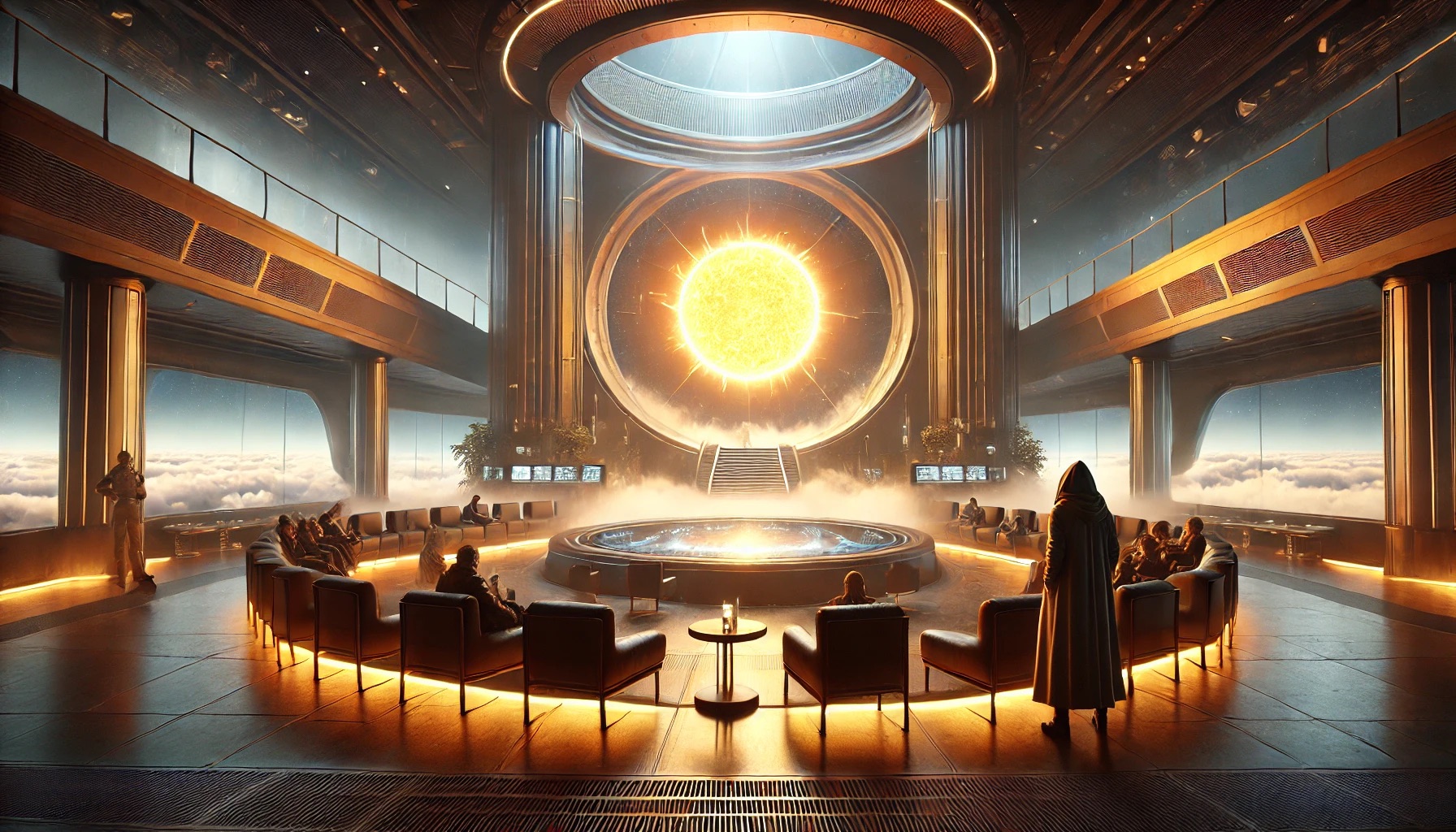
The Sun-Gazing Chamber was one of Helix 25’s more poetic and yet practical inventions —an optically and digitally-enhanced projection of the Sun, positioned at the ship’s perihelion. It was meant to provide a psychological tether, a sense of humanity’s connection to the prime provider of life as they drifted in the void of the Solar System.
It was a beautifully designed setting where people would simply sit and relax, attuned to the shift of days and nights as if still on Earth. The primary setting had been voted to a massive 83.5% to be like in Hawai’i latitude and longitude, as its place was believed to be a reflection of Earth’s heart. That is was a State in the USA was a second thought of course.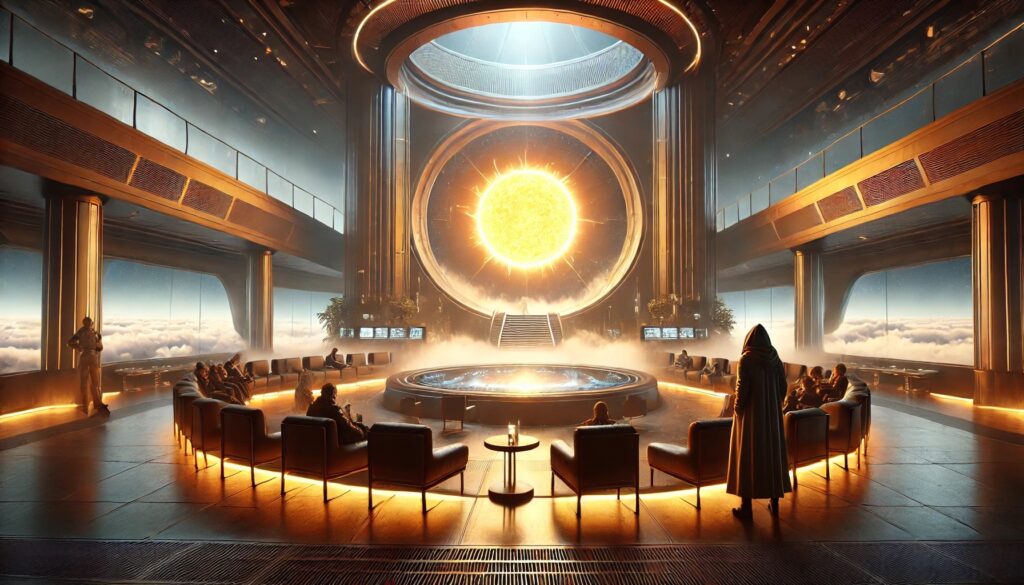
Evie sat on the observation bench, staring at the massive, golden sphere suspended in the darkness. “Do you think people back on Earth are still watching the sunrise?” she murmured.
Riven was quiet for a moment. “If there’s anyone left.”
Evie frowned. “If they are, I doubt they got much of a choice.”
TP materialized beside them, adjusting his holographic tie. “Ah, the age-old existential debate: are we the lucky ones who left Earth, or the tragic fools who abandoned it?”
Evie ignored him, glancing at the other ship residents in the chamber. Most people just sat quietly, basking in the light. But she caught snippets of whispers, doubt, something spreading through the ranks.
“Some people think we’re not really where they say we are,” she muttered.
Riven raised an eyebrow. “What, like conspiracy theories?”
TP scoffed. “Oh, you mean the Flat-Earthers?” He tsked. “Who couldn’t jump on the Helix lifeboats for their lives, convinced as they were we couldn’t make it to the stars. They deserved what came to them. Next they’ll be saying Helix 25 never even launched and we’re all just trapped in a simulation of a luxury cruise.”
Evie was shocked at Trevor Pee’s eructation and rubbed her face. “Damn Effin Muck tech, and those “Truth Control” rubbish datasets. I thought I’d thoroughly scrubbed all the old propaganda tech from the system.”
“Ah,” TP said, “but conspiracies are like mold. Persistent. Annoying. Occasionally toxic.”
Riven shook his head. “It’s nonsense. We’re moving. We’ve been moving for decades.”
Evie didn’t look convinced. “Then why do we feel stuck?”
A chime interrupted them.
A voice, over the comms. Solar flare alert.
Evie stiffened.
Then: Stay calm and return to your quarters until further notice.
Evie raised an eyebrow. This was the first time something like that happened. She turned to Riven who was looking at his datapad who was flashing and buzzing.
He said to her: “Stay quiet and come with me, a new death has been reported. Crazy coincidence. It’s just behind the Sun-Gazing chamber actually, in the Zero-G sector.”
February 18, 2025 at 8:12 am #7825In reply to: The Last Cruise of Helix 25
“I didn’t much like where the world was heading anyway, Gregor,” Molly said, leaning towards the old man who was riding beside her. “Before it all ended I mean. All that techno feudalist stuff. Once we got over the shock of it all, I’ll be honest, I rather liked it. Oh not that everyone was dead, I don’t mean that,” she added. She didn’t want to give the impression that she was cold or ruthless. “But, you know, something had to happen to stop where that was going.”
Gregor didn’t respond immediately. He hadn’t thought about the old days for a long time, and long suppressed memories flooded his mind. Eventually he replied, “If it hadn’t been for that plague, we’d have been exterminated, I reckon. Surplus to requirements, people like us.”
Molly looked at him sharply. “Did you hear of extermination camps here? We’d started to hear about them before the plague. But there were so many problems with communication. People started disappearing and it was impossible by then to find out what happened to them.”
“I was one of the ones who disappeared,” Gregor said. “They summoned me for questioning about something I’d said on Folkback. I told the wife not to worry, I’d be back soon when I’d explained to them, and she said to me to call in at the shop on the way home and get some milk and potatoes.” A large tear rolled down the old mans leathery cheek. “I never saw her again.”
Molly leaned over and compassionately gripped Gregors arm for a moment, and then steadied herself as Berlingo descended the last part of the hill before the track where the truck had been sighted.
The group halted and gathered around the tyre tracks. They were easily visible going in both directions and a discussion ensued about which way to go: follow the truck, or retrace the trucks journey to see where it came from?
“Down, Berlingo!” Molly instructed her horse. “I need to get off and find a bush. First time in years I’ve had to hide to have a pee!” she laughed, “There’s never been anyone around to see.”
Molly took her time, relishing a few moments of solitude. Suddenly being surrounded by people was a mixed blessing. It was stimulating and exciting, but also tiring and somewhat unsettling. She closed her eyes and took a few deep breaths and calmed her mind.
She returned to the group to a heated discussion on which way to go. Jian was in favour of going in the direction of the city, which appeared to be the direction the truck had come from. Mikhail wanted to follow where the truck had gone.
“If the truck came from the city, it means there is something in the city,” reasoned Jian. “It could be heading anywhere, and there are no cities in the direction the truck went.”
“There might not be any survivors in the city though,” Anya said, “And we know there’s at least one survivor IN the truck.”
“We could split up into two groups,” suggested Tala, but this idea was unanimously rejected.
“We have all the time in the world to go one way first, and the other way later,” Mikhail said. “I think we should head for the city first, and follow where the truck came from. Jian is right. And there’s more chance of finding something we can use in the city, than a wild goose chase to who knows where.”
“More chance of finding some disinfectant in the city, too,” Finja added.
 February 15, 2025 at 11:35 pm #7807
In reply to: The Last Cruise of Helix 25
HELIX 25: THE JARDENERY
Finkley pressed herself against the smooth metal doorway of the Jardenery, her small wiry frame unnoticeable in the dim light filtering through the tangle of vines. The sterile scent of Helix 25’s corridors had faded behind her, replaced by the aroma of damp earth. A place of dirt and disorder. She shuddered.
A familiar voice burst through her thoughts.
What’s going on?
Finja’s tone was strident and clear. The ancient telepathic link that connected the cleaner family through many generations was strong, even in space. All the FinFamily (FF) had the gift to some extent, occasionally even with strangers. It just wasn’t nearly as accurate.
Shush. They’re talking about blood. And Herbert.
She felt Finja’s presence surge in response, her horrified thoughts crackling through their link. Blood!
Riven’s skeptical voice: “You’re saying someone on Helix 25 might have… transformed into a medieval Crusader?”
Finkley sniggered. Was that even possible?
It’s not particularly funny, responded Finja. It means someone on the ship is carrying distorted DNA. Her presence pulsed with irritation; it all sounded so complicated and grubby. And god knows what else. Bacteria? Ancestral grime? Generational filth? Honestly Finkley, as if I haven’t got enough to worry about with this group of wandering savages …
Finkley inhaled sharply as Romualdo stepped into view. She held her breath, pressing even closer to the doorway. He was so cute. Unclean, of course, but so adorable.
She pondered whether she could overlook the hygiene. Maybe … if he bathed first?
Get a grip. Finja’s snarl crashed through her musings, complete with eye-roll.
Finkley reddened. She had momentarily forgotten that Finja was there.
So Herbert was looking for something. But what?
I bet they didn’t disinfect properly. Finja’s response was immediate. See what you can find out later.
Inside, Romualdo picked up a book from his workbench and waved it. Finkley barely needed to read the title before Finja’s shocked cry of recognition filled her mind.
Liz Tattler!
A feeling of nostalgia swept over Finkley.
Yes Liz Tattler. Finley’s Liz.
Finley—another member of the family. She cleaned for Liz Tattler, the mad but famous author. It was well known—at least within the family— that Liz’s fame was largely due to Finley’s talents as a writer. Which meant, whatever this was, it had somehow tangled itself up in the FF network.
Liz’s Finley hasn’t responded for years —I assumed… Finja’s voice trailed off.
There’s still hope! You never know with that one. She was always stand-offish and mysterious. And that Liz really abused her good nature.
Finkley swallowed hard. They were close to something big—something hidden beneath layers of time and mystery. And whatever it was, it had just become personal.
Finja, there’s no time to lose! We need to find out more.
February 15, 2025 at 12:20 pm #7799In reply to: The Last Cruise of Helix 25
Helix 25 – Lower Decks – Secretive Adjustments
Sue Brittany Kaleleonālani Forgelot moved with the practiced grace of someone accustomed to being noticed—but tonight, she walked as someone trying not to be. The Upper Deck was hers, where conversations flowed with elegant pretense and where everyone knew her by firstname —Sue, she would insist. There would be none of that bowing nonsense to her noble lineages —bless her distinguished ancestors.
Here, in the Lower Decks, she was a curiosity at best, an intrusion at worst.
Unlike the well-maintained Upper Decks, here the air was warmer, and one could sense mingled with the recycled air, a distinct scent of metal, oil, and even labouring bodies. Maintenance bots were limited, and keeping people busy with work helped with the social order. Lights flickered erratically in narrow corridors, nothing like the pristine glow of the Upper Deck’s crystal chandeliers. The Lower Decks were functional, built for work and survival, not for leisure. And deeper still—past the bustling workstations, past the overlooked mechanics keeping Helix 25 from falling apart—the Hold.
The Hold was where she found Luca Stroud.
A heavy, reinforced door hissed as it unlocked, and Sue stepped inside his dimly lit workshop. Stacks of salvaged tech lined the walls, interspersed with crates of unauthorized modifications in this workspace born of a mixture of necessity, ingenuity, and quiet rebellion.
Luca barely looked up as he wiped oil from his hands. “You’re late, dear.”
Sue huffed, settling into the chair he had long since designated for her. “A lady does not rush. Besides, I had affairs to attend to.” She crossed one leg over the other, her silk shawl catching on the metallic seam of a cybernetic limb beneath it. “And I had to dodge half the ship to get here unnoticed.”
Luca grunted, kneeling beside her. “You wouldn’t have to sneak if you’d just let one of the Upper Deck doctors service this thing.” He tapped lightly on the synthetic skin to reveal the metallic prosthetic, watching as the synthetic nerves twitched in response.
Sue’s expression turned sharp. “You know why I can’t.”
Luca said nothing, but his smirk spoke volumes.
There were things she couldn’t let the Upper Deck medics see. Upgrades, modifications, small enhancements that gave her just enough edge. In the circles she moved in, knowledge was power. And she was far too valuable to be at the mercy of those who wanted her dependent.
Luca examined the joint, nodding to himself. “You’ve been walking too much on it.”
“Well, forgive me for using my own legs.”
He tightened a wire. Sue winced, but he ignored it. “You need recalibration. And I need better parts.”
Sue gave a slow, knowing smile. “And what minor favors will you require this time?”
Luca leaned back, thoughtful. “Information. Since you’re generous with it.”
She sighed, shifting in her seat. “Fine. You’re lucky I find you amusing.”
He adjusted a component with expert hands. “Tell me about the murder.”
Sue arched a brow. “Everyone wants to talk about that. You’d think no one had ever died before.”
“They haven’t,” Luca countered, voice flat. “Not for a long time. And not like this.”
She studied him, his interest piquing her own. “So you think it was a real murder.”
Luca let out a dry chuckle. “Oh, it was a murder alright. And you know it.”
Sue exhaled, considering what to share. “Well, rumor has it, the DNA found in the crime scene doesn’t belong here. It’s from the past. Far past.”
Luca glanced up, intrigued. “How far?”
Sue leaned in, voice hushed. “Crusader far.”
He let out a low whistle, shaking his head. “That’s… new.”
She tilted her head. “What does that mean to you?”
Luca hesitated, then shrugged. “Means whoever’s playing god with DNA sequencing isn’t as smart as they think they are.”
Sue smiled at that, more amused than disturbed. “And I suppose you have theories?”
Luca gave her cybernetic limb one final adjustment, then stood. “I have suspicions.”
Sue sighed dramatically. “How thrilling.” She flexed her leg, satisfied with the result. “Keep me informed, and I’ll see what I can find for you.”
Luca smirked. “You always do.”
As she rose to leave, she paused at the door. “Oh, one last thing, dear.”
Luca glanced at her. “What?”
Sue’s smirk deepened. “Should I put in a good word to the Captain for you?”
The question hung between them.
Luca narrowed his eyes. “Nobody’s ever met the Captain.”
She nodded, satisfied, and left him to his thoughts.
February 8, 2025 at 7:22 pm #7776In reply to: Quintessence: Reversing the Fifth
Epilogue & Prologue
Paris, November 2029 – The Fifth Note Resounds
Tabitha sat by the window at the Sarah Bernhardt Café, letting the murmur of conversations and the occasional purring of the espresso machine settle around her. It was one of the few cafés left in the city where time still moved at a human pace. She stirred her cup absentmindedly. Paris was still Paris, but the world outside had changed in ways her mother’s generation still struggled to grasp.
It wasn’t just the ever-presence of automation and AI making themselves known in subtle ways—screens adjusting to glances, the quiet surveillance woven into everyday life. It wasn’t just the climate shifts, the aircon turned to cold in the midst of November, the summers unpredictable, the air thick with contradictions of progress and collapse of civilization across the Atlantic.
The certainty of impermanence was what defined her generation. BANI world they used to say—Brittle, Anxious, Nonlinear, Incomprehensible. A cold fact: impossible to grasp and impossible to fight. Unlike her mother and her friends, who had spent their lives tethered to a world that no longer existed, she had never known certainty. She was born in the flux.
And yet, this café remained. One of the last to resist full automation, where a human still brought you coffee, where the brass bell above the door still rang, where things still unfolded at a human pace.
The bell above the door rang—the fifth note, as her mother had called it once.
She had never been here before, not in any way that mattered. Yet, she had heard the story. The unlikely reunion five years ago. The night that moved new projects in motion for her mother and her friends.
Tabitha’s fingers traced the worn edges of the notebook in front of her—Lucien’s, then Amei’s, then Darius’s. Pieces of a life written by many hands.
“Some things don’t work the first time. But sometimes, in the ruins of what failed, something else sprouts and takes root.”
And that was what had happened.
The shared housing project they had once dreamed of hadn’t survived—not in its original form. But through their rekindled bond, they had started something else.
True Stories of How It Was.
It had begun as a quiet defiance—a way to preserve real, human stories in an age of synthetic, permanent ephemerality and ephemeral impermanence, constantly changing memory. They were living in a world where AI’s fabricated histories had overwhelmed all the channels of information, where the past was constantly rewritten, altered, repackaged. Authenticity had become a rare currency.
As she graduated in anthropology few years back, she’d wondered about the validity of history —it was, after all, a construct. The same could be said for literature, art, even science. All of them constructs of the human mind, tenuous grasp of the infinite truth, but once, they used to evolve at such a slow pace that they felt solid, reliable. Ultimately their group was not looking for ultimate truth, that would be arrogant and probably ignorant. Authenticity was what they were looking for. And with it, connections, love, genuineness —unquantifiables by means of science and yet, true and precious beyond measure.
Lucien had first suggested it, tracing the idea from his own frustrations—the way art had become a loop of generated iterations, the human touch increasingly erased. He was in a better place since Matteo had helped him settle his score with Renard and, free of influence, he had found confidence in developing of his own art.
Amei —her mother—, had changed in a way Tabitha couldn’t quite define. Her restlessness had quieted, not through settling down but through accepting impermanence as something other than loss. She had started writing again—not as a career, not to publish, but to preserve stories that had no place in a digitized world. Her quiet strength had always been in preserving connections, and she knew they had to move quickly before real history faded beneath layers of fabricated recollections.
Darius, once skeptical, saw its weight—he had spent years avoiding roots, only to realize that stories were the only thing that made places matter. He was somewhere in Morocco now, leading a sustainable design project, bridging cultures rather than simply passing through them.
Elara had left science. Or at least, science as she had known it. The calculations, the certainty, the constraints of academia, with no escape from the automated “enhanced” digital helpers. Her obsession and curiosities had found attract in something more human, more chaotic. She had thrown herself into reviving old knowledge, forgotten architectures, regenerative landscapes.
And Matteo—Matteo had grounded it.
The notebook read: Matteo wasn’t a ghost from our past. He was the missing note, the one we didn’t know we needed. And because of him, we stopped looking backward. We started building something else.
For so long, Matteo had been a ghost of sorts, by his own account, lingering at the edges of their story, the missing note in their unfinished chord. But now, he was fully part of it. His mother had passed, her past history unraveling in ways he had never expected, branching new connections even now. And though he had lost something in that, he had also found something else. Juliette. Or maybe not. The story wasn’t finished.
Tabitha turned the page.
“We were not historians, not preservationists, not even archivists. But we have lived. And as it turned out, that was enough.”
They had begun collecting stories through their networks—not legends, not myths, but true accounts of how it was, from people who still remembered.
A grandfather’s voice recording of a train ride to a city that no longer exists.
Handwritten recipes annotated by generations of hands, each adding something new.
A letter from a protest in 2027, detailing a movement that the history books had since erased.
An old woman’s story of her first love, spoken in a dialect that AI could not translate properly.It had grown in ways they hadn’t expected. People began sending them recordings, letters, transcripts, photos —handwritten scraps of fading ink. Some were anonymous, others carefully curated with full names and details, like makeshift ramparts against the tide of time.
At first, few had noticed. It was never the goal to make it worlwide movement. But little by little, strange things happened, and more began to listen.
There was something undeniably powerful about genuine human memory when it was raw and unfiltered, when it carried unpolished, raw weight of experience, untouched by apologetic watered down adornments and out-of-place generative hallucinations.
Now, there were exhibitions, readings, archives—entire underground movements dedicated to preserving pre-synthetic history. Their project had become something rare, valuable, almost sacred.
And yet, here in the café, none of that felt urgent.
Tabitha looked up as the server approached. Not Matteo, but someone new.
“Another espresso?”
She hesitated, then nodded. “Yes. And a glass of water, please.”
She glanced at the counter, where Matteo was leaning, speaking to someone, laughing. He had changed, too. No longer just an observer, no longer just the quiet figure who knew too much. Now, he belonged here.
A bell rang softly as the door swung open again.
Tabitha smiled to herself. The fifth note always sounded, in the end.
She turned back to the notebook, the city moving around her, the story still unfolding in more directions than one.
February 7, 2025 at 1:09 pm #7737In reply to: The Last Cruise of Helix 25
Evie stared at TP, waiting for further elaboration. He simply steepled his fingers and smirked, a glitchy picture of insufferable patience.
“You can’t just drop a bombshell like that and leave it hanging,” she said.
“But my dear Evie, I must!” TP declared, flickering theatrically. “For as the great Pea Stoll once mused—‘It was suspicious in a Pea Saucerer’s ways…’”
Evie groaned. “TP—”
“A jest! A mere jest!” He twirled an imaginary cane. “And yet, what do we truly know of the elusive Mr. Herbert? If we wish to uncover his secrets, we must look into his… associations.”
Evie frowned. “Funny you said that, I would have thought ‘means, motive, alibis’ but I must be getting ahead of myself…” He had a point. “By associations, you mean —Seren Vega?”
“Indeed!” TP froze accessing invisible records, then clapped his hands together. “Seren Vega, archivist extraordinaire of the wondrous past, keeper resplendent of forgotten knowledge… and, if the ship’s whisperings hold any weight, a woman Herbert was particularly keen on seeing.”
Evie exhaled, already halfway to the door. “Alright, let’s go see Seren.”
Seren Vega’s quarters weren’t standard issue—too many rugs, too many hanging ornaments, a hint of a passion for hoarding, and an unshakable musky scent of an animal’s den. The place felt like the ship itself had grown around it, heavy with the weight of history.
And then, there was Mandrake.
The bionic-enhanced cat perched on a high shelf, tail flicking, eyes glowing faintly. “What do you want?” he asked flatly, his tone dripping with a well-practiced blend of boredom and disdain.
Evie arched a brow. “Nice to see you too, Mandrake.”
Seren, cross-legged on a cushion, glanced up from her console. “Evie,” she greeted calmly. “And… oh no.” She sighed, already bracing herself. “You’ve brought it —what do you call him already? Orion Reed?”
Evie replied “Great memory Ms Vega, as expected. Yes, this was the name of the beta version —this one’s improved but still working the kinks of the programme, he goes by ‘TP’ nowadays. Hope you don’t mind, he’s helping me gather clues.” She caught herself, almost telling too much to a potential suspect.
TP puffed up indignantly. “I must protest, Madame Vega! Our past encounters, while lively, have been nothing but the height of professional discourse!”
Mandrake yawned. “She means you talk too much.”
Evie hid a smirk. “I need your help, Seren. It’s about Mr. Herbert.”
Seren’s fingers paused over her console. “He’s the one they found in the dryer.” It wasn’t a question.
Evie nodded. “What do you know about him?”
Seren studied her for a moment, then, with a slow exhale, tapped a command into her console. The room dimmed as the walls flickered to life, displaying a soft cascade of memories—public logs, old surveillance feeds, snippets of conversations once lost to time.
“He wasn’t supposed to be here,” Seren said at last. “He arrived without a record. No one really questioned it, because, well… no one questions much anymore. But if you looked closely, the ship never registered him properly.”
Evie’s pulse quickened. TP let out an approving hum.
Seren continued, scrolling through the visuals. “He came to me, sometimes. Asked about old Earth history. Strange, fragmented questions. He wanted to know how records were kept, how things could be erased.”
Evie and TP exchanged a glance.
Seren frowned slightly, as if piecing together a thought she hadn’t dared before. “And then… he stopped coming.”
Mandrake, still watching from his shelf, stretched lazily. Then, with perfect nonchalance, he added, “Oh yeah. And he wasn’t using his real name.”
Evie snapped to attention. “What?”
The cat flicked his tail. “Mr. Herbert. The name was fake. He called himself that, but it wasn’t what the system had logged when he first stepped on board.”
Seren turned sharply toward him. “Mandrake, you never mentioned this before.”
The cat yawned. “You never asked.”
Evie felt a chill roll through her. “So what was his real name?”
Mandrake’s eyes glowed, data scrolling in his enhanced vision.
“Something about… Ethan,” he mused. “Ethan… M.”
The room went very still.
Evie swallowed hard. “Ethan Marlowe?”
Seren paled. “Ellis Marlowe’s son.”
TP, for once, was silent.
-
AuthorSearch Results