

Search Results for 'endless'
-
AuthorSearch Results
-
April 18, 2023 at 5:23 pm #7226
In reply to: The Precious Life and Rambles of Liz Tattler
“I worry about the dreadful limbo, those poor characters! So much going on and there they all are, frozen in time, perched on the edge of all those cliffs, waiting to spring into action, leap across chasms of revelations, lurch into dark mysterious depths…” Liz trailed off, looking pensively out of the window. “I wonder if the characters will ever forgive me for the jerky spasms of action followed by interminable stretches of oblivion, endlessly repeated…. Oh dear, oh dear! What a terrible torment, taunting them with great unveilings, and then… then, the desertion, forsaken yet again, abandoned …. and for what?”
“Attending to other pressing matters in real life?” offered Finnley. “Entertaining guests? Worrying about aged relatives?” Liz interrupted with a cross between a snort and a harumph. “Writing shopping lists?” Finnley continued, a fount of gently patient sagacity. Bless that girl, thought Liz, uncharacteristically generous in her assessment of the often difficult maid. “Do you even know if they’re aware of the dilated gaps in the narrative?”
Liz was momentarily nonplussed. This was something she had heretofore not considered. “You mean they might not be waiting?”
“That’s right”, Finnley replied, warming to the idea that she hadn’t given much thought to, and had just thrown into the conversation to mollify Liz, who was in danger of droning on depressingly for the rest of the evening. “They probably don’t even notice, a bit like blinking out, and then springing back into animation. I wouldn’t worry if I were you. Why don’t you ask them and see what they say?”
“Ask them?” repeated Liz stupidly. I really am getting dull in the head, she thought to herself and wondered why Finnley was smirking and nodding. Was the dratted girl reading her mind again? “Fetch me something to buck me up, Finnley. And fetch Roberto and Godfrey in here. Oh and bring a tray of whatever you’re bringing me, to buck us all up.” Liz looked up and smiled magnanimously into Finnley’s face. “And one for yourself, dear.”
Tidying the stack of papers on her desk into a neat pile and blowing the ash and crumbs off, Liz felt a plan forming. They would have a meeting with the characters and discuss their feelings, their hopes and ambitions, work it all out together. Why didn’t I think of this before? she wondered, quite forgetting that it was Finnley’s idea.
March 14, 2023 at 8:37 pm #7166In reply to: The Precious Life and Rambles of Liz Tattler
Godfrey had been in a mood. Which one, it was hard to tell; he was switching from overwhelmed, grumpy and snappy, to surprised and inspired in a flicker of a second.
Maybe it had to do with the quantity of material he’d been reviewing. Maybe there were secret codes in it, or it was simply the sleep deprivation.
Inspired by Elizabeth active play with her digital assistant —which she called humorously Whinley, he’d tried various experiments with her series of written, half-written, second-hand, discarded, published and unpublished, drivel-labeled manuscripts he could put his hand on to try to see if something —anything— would come out of it.
After all, Liz’ generous prose had always to be severely edited to meet the editorial standards, and as she’d failed to produce new best-sellers since the pandemic had hit, he’d had to resort to exploring old material to meet the shareholders expectations.
He had to be careful, since some were so tartied up, that at times the botty Whinley would deem them banworthy. “Botty Banworth” was Liz’ character name for this special alternate prudish identity of her assistant. She’d run after that to write about it. After all, “you simply can’t ignore a story character when they pop in, that would be rude” was her motto.
So Godfrey in turn took to enlist Whinley to see what could be made of the raw material and he’d been both terribly disappointed and at the same time completely awestruck by the results. Terribly disappointed of course, as Whinley repeatedly failed to grasp most of the subtleties, or any of the contextual finely layered structures. While it was good at outlining, summarising, extracting some characters, or content, it couldn’t imagine, excite, or transcend the content it was fed with.
Which had come as the awestruck surprise for Godfrey. No matter how raw, unpolished, completely off-the-charts rank with madness or replete with seeming randomness the content was, there was always something that could be inferred from it. Even more, there was no end to what could be seen into it. It was like life itself. Or looking at a shining gem or kaleidoscope, it would take endless configurations and had almost infinite potential.
It was rather incredible and revisited his opinion of what being a writer meant. It was not simply aligning words. There was some magic at play there to infuse them, to dance with intentions, and interpret the subtle undercurrents of the imagination. In a sense, the words were dead, but the meaning behind them was still alive somehow, captured in the amber of the composition, as a fount of potentials.
What crafting or editing of the story meant for him, was that he had to help the writer reconnect with this intent and cast her spell of words to surf on the waves of potential towards an uncharted destination. But the map of stories he was thinking about was not the territory. Each story could be revisited in endless variations and remain fresh. There was a difference between being a map maker, and being a tour-operator or guide.
He could glimpse Liz’ intention had never been to be either of these roles. She was only the happy bumbling explorer on the unchartered territories of her fertile mind, enlisting her readers for the journey. Like a Columbus of stories, she’d sell a dream trusting she would somehow make it safely to new lands and even bigger explorations.
Just as Godfrey was lost in abyss of perplexity, the door to his office burst open. Liz, Finnley, and Roberto stood in the doorway, all dressed in costumes made of odds and ends.
“You are late for the fancy dress rehearsal!” Liz shouted, in her a pirate captain outfit, her painted eye patch showing her eye with an old stitched red plush thing that looked like a rat perched on her shoulder supposed to look like a mock parrot.
“What was the occasion again?”
“I may have found a new husband.” she said blushing like a young damsel.
Finnley, in her mummy costume made with TP rolls, well… did her thing she does with her eyes.
March 12, 2023 at 6:53 pm #7163In reply to: The Chronicles of the Flying Fish Inn
Aunt Idle
Contention
Endless legal squabbling,
Eventually it comes to blows.
Zhang Ji has a speech defect,
Hair loose, turning northward.I don’t know what the dickens that I Ching is supposed to mean, I was hoping it would give me a clue about that new guest. There’s something about her but I can’t put my finger on it. I must remember to ask Bert about her, see if he’s noticed anything funny. Not that she’s acting funny, not unusual for a guest who’s travelled far to get here ~ and anyone getting here has travelled, let’s face it ~ to stay in their room catching up on sleep, but I don’t know, there is something niggling me about her. I barely caught a glimpse of her but she seemed familiar somehow. I’ll ask Bert, but we’re all so busy now what with the lager and cart race coming up, and those four friends staying, and god only knows when that dust storm comes what we’re supposed to do to entertain them all when they can’t go outside, and they’ll be expecting poor old Finly to keep the place dusted and the windows cleaned. I sometimes think I prefered it here when nobody hardly came.
Hardly got a moment to myself and our Prune is up to something but god knows I don’t have time to follow her around, and there’s no weaseling anything out of her when she’s got one of her secret missions going on. Mater’s pulled her finger out, it has to be said, she’s been as good as gold with the guests, she can turn the old dear charm on when she wants to, and she’s pulled out all the stops playing the gracious hostess, and I can’t say a word against good old Finly. She’s a cheeky minx when we’re not busy but she’s been a real trooper. I think I’ll speak to Mater about a little bonus for her. Yes, I think that might sweeten her up for when I ask her to do my roots tomorrow which reminds me to put pink dye on Berts list for when he goes to Alice in the morning.
Honestly there’s too much to think about, I haven’t had a minute to get a costume ready for the cart race, maybe I’ll ask the twins. Gotta say it, they’ve been brilliant organizing the cart decorating with the four friends. They’re a lovely group, I just wish I had more time to hang out with them, especially the big guy, oh my. Maybe after the cart race, anything can happen after a cart race, lord knows ~ it was after a cart race in a dust storm that Howard and I had a fling and thank god Betsy never found out, she’s have had my guts for garters and nobody would have blamed her. I still wonder what happened to Howard. We always had a soft spot for each other, but he felt so guilty he never strayed from Betsy again. I’d have been game, I’ll be honest, but I didn’t push it. Betsy was a big girl back in those days, but nowhere near as big as she is now. Must be hard for her wondering what happened to her husband all these years, no wonder she got sucked into all that mumbo jumbo and stuffing her chops all day long.
And not being able to claim the inheritance that would have been Howards, that must have been hard. They could have lived in the lap of luxury for the rest of their lives when Howard’s father died, and he hasn’t died yet, must be pushing 90 by now. I know she’s hoping Howard didn’t die in the mines ~ obviously ~ and that he’ll come back one day somehow, and you can bet your bottom dollar she’s hoping he comes back before the old man dies and it all gets left to someone else.
That new guest went in Betsy’s before she even checked in here, Corrie saw her, I guess she’s into mumbo jumbo in a big way if she had to get supplies of crystals or amulets or whatever they sell in there, before checking in to the hotel.
March 7, 2023 at 8:20 pm #6774In reply to: Stories: New Found Pages
As they trekked through the endless dunes, Lord Gustard could barely contain his excitement. The thought of discovering the bones of the legendary giant filled him with a childlike wonder, and he eagerly scanned the horizon for any sign of their destination. As the fearless leader of the group, he had a deep-seated passion for adventure and exploration, a love for pith helmets. However, his tendency to get lost in his own thoughts at the most inconvenient times could sometimes get him in tricky situations. Despite this, he has an unshakable determination to succeed and a deep respect for the cultures and traditions of the places he visits.
Lady Floribunda, on the other hand, was the picture of patience and duty. She knew that this journey was important to her husband and she supported him unwaveringly, even as she silently longed for the comforts of home. Her first passion was for gossips and the life of socialites —but there was hardly any gossip material in the desert, so she fell back to her second passion, botany, that would often get her lost in her own world, examining and cataloging the scant flora and fauna they encountered on their journey. It wasn’t unusual to hear her at time talking to plants as if they were her dolls or children.
Cranky, meanwhile, couldn’t help but roll her eyes at Lord Gustard’s exuberance. “I swear, if I have to listen to one more of his whimsical ramblings, I’ll go mad,” she muttered to herself. Her tendency to grumble about the hardships of their journey had taken a turn for the worse, considering the lack of comfort from the past nights. She was as sharp-tongued as she was pragmatic, with a love for tea and crumpets that bordered on obsessive. Despite her grumpiness, she has a heart of gold and a deep affection for her companions, and especially young Illi.
Illi, on the other hand, was thrilled by every new discovery along the way. Whether it was a curious beetle scuttling across the sand or a shimmering oasis in the distance, she couldn’t help but express her excitement with a constant stream of questions and exclamations. Illi was a bright and enthusiastic young girl, with a passion for adventure and a wide-eyed wonder at the world around her. She had a tendency to burst into song at the most unexpected moments.
Tibn Zig and Tanlil Ubt remained loyal and steadfast, shrugging off any incongruous spur of the moment extravagant outburst from Gustard. Their experience in the desert had taught them to stay calm and focused, no matter what obstacles they might encounter. But behind the stoic façade, they had a penchant for telling tall tales and playing practical jokes on their companions. Their mischievousness was however only for good fun, and they had become fiercely loyal to Lord Gustard after he’d rescued them from sand bandits who were planning to sell them as slave. Needless to say, they would have done whatever it takes to keep the Fergusson family safe.
Illi was hoping for eccentric traders and desert nomads to fortune-seeking treasure hunters and conniving bandits, but for miles it was just plain unending desert. The worst they found on their path were unending sand dunes, a few minuscule deadly scorpions, and mostly contending with the harsh desert sun beating down upon them. Finally, after days of wandering through the desert, they reached their destination.
As they approached Tsnit n’Agger, the landscape began to change. The sand dunes gave way to rocky cliffs and towering red sandstone formations, and the air grew cooler and more refreshing. The group pressed on, their spirits renewed by the prospect of discovering the secrets of the legendary giant’s bones.
At last, they arrived at the entrance to the giant’s cave. Lord Gustard led the way, his torch casting flickering shadows on the walls as they descended deeper into the earth. The air grew colder and damper, and the sounds of dripping water echoed around them.
As they turned a corner, they suddenly found themselves face to face with the giant’s bones. Towering above them, the massive skeletal structure filled the cavern from floor to ceiling. The sight of the giant’s bones towering above them was awe-inspiring, and Lord Gustard was practically bouncing with excitement. The group behind him was in awe, even Cranky, as they were taking in the enormity and majesty of the ancient creature.
Floribunda and Cranky exchanged a weary but amused look, while Illi gazed up at the bones with wide-eyed wonder.
“Let’s get to work,” Lord Gustard declared, his enthusiasm undimmed. And with that, they set to the task of uncovering the secrets of the legendary giant, each in their own way.
February 20, 2023 at 4:02 pm #6613In reply to: Orbs of Madjourneys
Despite the old man’s endless flow of words, Youssef couldn’t get him to explain what he meant about the abandoned mine and why the town’s people didn’t like people sneaking around and asking questions.
Not wanting to waste more time, Youssef walked to the brick building where the twins had disappeared. It was crammed between the telegraph station and a grocery store. The door had been walled with red bricks. They were covered in faded graffitis and layers of torn-up posters. It seemed obvious the wall had been there for quite some time already.

The old man was sticking to Youssef like glue, talking about that time when his now dead brother took in an old cat he called Phineas. Youssef tried to growl him away, but the man always came back, persistent as a cloud of mosquitoes over the promise of a blood feast.
Youssef tried not to pay attention to him. What did AL said about that quest ? Go ask questions around to town’s people about odd things happening ? Well there were plenty of those things happening. Maybe the clerk at the telegraph station would know something, especially how to get rid of that old man.
Youssef pushed the door and entered the telegraph station, leaving the old man outside. The interior was lit with a collection of old style tungsten lamps hanging in a random pattern from the ceiling.
 The clerk was busy sorting out a pile of telegrams. Clickety-clack. Clickety-clack. He lifted his head up. The noise stopped and Youssef realised the young man had mechanical hands.
“Welcome, welcome, welcome! What can I do for you today, my friend?” asked the clerk.
“I just wanted to…” started Youssef.
“Wait! Don’t tell me. I’m a bit of a psychic myself and I already know what you’re here for.”
“Really?”
The man foraged through his pile of telegram with his mechanical hands and picked one. He looked at it for a few seconds.
“My friend, you’re in luck today!” he said, looking intently at Youssef. “I just received this telegram that I think might interest you. Here, take a look!”
Youssef took the paper and started to read aloud : “Words spoken by the talkative will unlock the path. Seek those who chatter and unravel the clue. What the…?”
“Interesting, isn’t it? That’s a real head-scratcher, if you ask me!”
The door bell rang and the old man entered, holding his sore ribs.
“Get out, Phineas. You’re not welcome here.” said the clerk with a frown.
The old man looked at the clerk with an air of confusion before turning to Youssef. “What did he say? Who’s Phineas?” he asked.
Ignoring the question, Youssef tried to steer the conversation back to the telegram. “What does this mean?” he asked the clerk.
The clerk stroked his chin, looking thoughtful. “Hmm, well, it seems to me that you have a certain magnetism for talkative people. Perhaps that’s the key to unlocking this riddle.”
Youssef’s eyes widened in surprise. “What do you mean, magnetism?”
The old man interjected, “For sure! You’re like a magnet, my boy. I can’t seem to stop talking when I’m around you.”
Youssef rolled his eyes. “So, what do I do? Just wander around town and wait for someone to start talking?”
The clerk nodded. “That could be a good start. But if you’re looking for something specific, you might want to try Betsy when you wake up. She’s got a boutique of Gems and Rocks. You seem to like them rocks,” he said pointing at the black obsidian. “Found it in a mine?”
The old man’s eyes lit up. “Ah, the old mine! I’ve been there before, you know. My brother used to work there before he died. Strange things happening there.”
Youssef’s interest was piqued. “What kind of strange things?”
The old man leaned in conspiratorially. “There’s a magnetar hidden in that mine, my boy.”
“Shut up! Phineas,” interrupted the clerk. “If you want my advice, stranger, don’t go near the old mine. ‘Curiosity killed the cat’ if you know what I mean.”
The telegraph receiver started to make clicketing sounds. The clerk read it and looked at Youssef.
“You’ve got a message man. Time to wake up.”
“Wake up?”

Youssef opened his eyes and looked at a black mass in front of his eyes. He had been sleeping with the stone just beside his head on the pillow. No wonder he had had weird dreams. He heard his phone buzz. He sat up reluctantly and looked at his phone. 8am. A notification that his game progression had been saved and several messages from Miss Tartiflate, the last one saying :
Don’t think you can dodge work. I’m still expecting the last blog post you’ve been paid to write!!!”
He groaned as reality was starting to catch up.
February 14, 2023 at 8:48 pm #6545In reply to: Orbs of Madjourneys
The road was stretching endlessly and monotonously, a straight line disappearing into a nothingness of dry landscapes that reminded Youssef of the Gobi desert where he had been driving not too long ago. At regular speed, the car barely seemed to progress.
> O Time suspend thy flight!
Eternity. Something only nature could procure him. He loved the feeling, and compared to the more usual sand of Gobi, the red sands of Australia gave him the impression he had shifted into another reality. That and the fifteen hours flight listening to Gladys made it difficult to respond to Xavier’s loquacious self and funny jokes. After some time, his friend stopped talking and tried catching some signal to play the Game, brandishing his phone in different directions as if he was hunting ghosts with a strange device.
It reminded him he had to accept his next quest in a ghost town. That’s all he remembered. He could do that at the Inn, when they could rest in their rooms.

Youssef wondered if the welcome sign at the entrance of the town had seen better days. The wood the fish was made of seemed eaten by termites, but someone had painted it with silver and blue to give it a fresher look. Youssef snorted at the shocked expression on his friend’s face.
“It looked like it died of boredom. Let’s just hope the Innside doesn’t look like a gutted fish,” Xavier said.
An old lady showed them their rooms. She didn’t seem the talkative type, which made Youssef love her immediately with her sharp tongue and red cardigan. He rather admired her braided silver hair as it reminded him of his mother who would let him brush her hair when they lived in Norway. It was in another reality. He smiled. She saw him looking at her and her eyes narrowed like a pair of arrowslits. She seemed ready to fire. Instead she kept on ranting about an idle person not doing her only job properly. They each went to their rooms, Xavier took number 7 and Youssef picked number 5, his lucky number.

He was glad to be able to enjoy his own room after the trip of the last few weeks. It had been for work, so it was different. But usually he liked travelling the world on his own and meet people on his way and learn from their stories. Traveling with people always meant some compromise that would always frustrate him because he wanted to go faster, or explore more tricky paths.
The room was nicely decorated, and the scent of fresh paint made it clear it was recent. A strange black stone, which Youssef recognized as a black obsidian, has been put on a pile of paper full of doodles, beside two notebooks and pencils. The notebooks’ pages were blank, he thought of giving them to Xavier. He took the stone. It was cold to the touch and his reflection on the surface looked back at him, all wavy. The doodles on the paper looked like a map and hard to read annotations. One stood out, though which looked like a wifi password. That made him think of the Game. He entered it on his phone and that was it. Maybe it was time to go back in. But he wanted to take a shower first.
He put his backpack and his bag on the bed and unpacked it. Amongst a pile of dirty clothes, he managed to find a t-shirt that didn’t smell too bad and a pair of shorts. He would have to use the laundry service of the hotel.
He had missed hot showers. Once refreshed, he moved his bags on the floor and jumped on his bed and launched the Game.
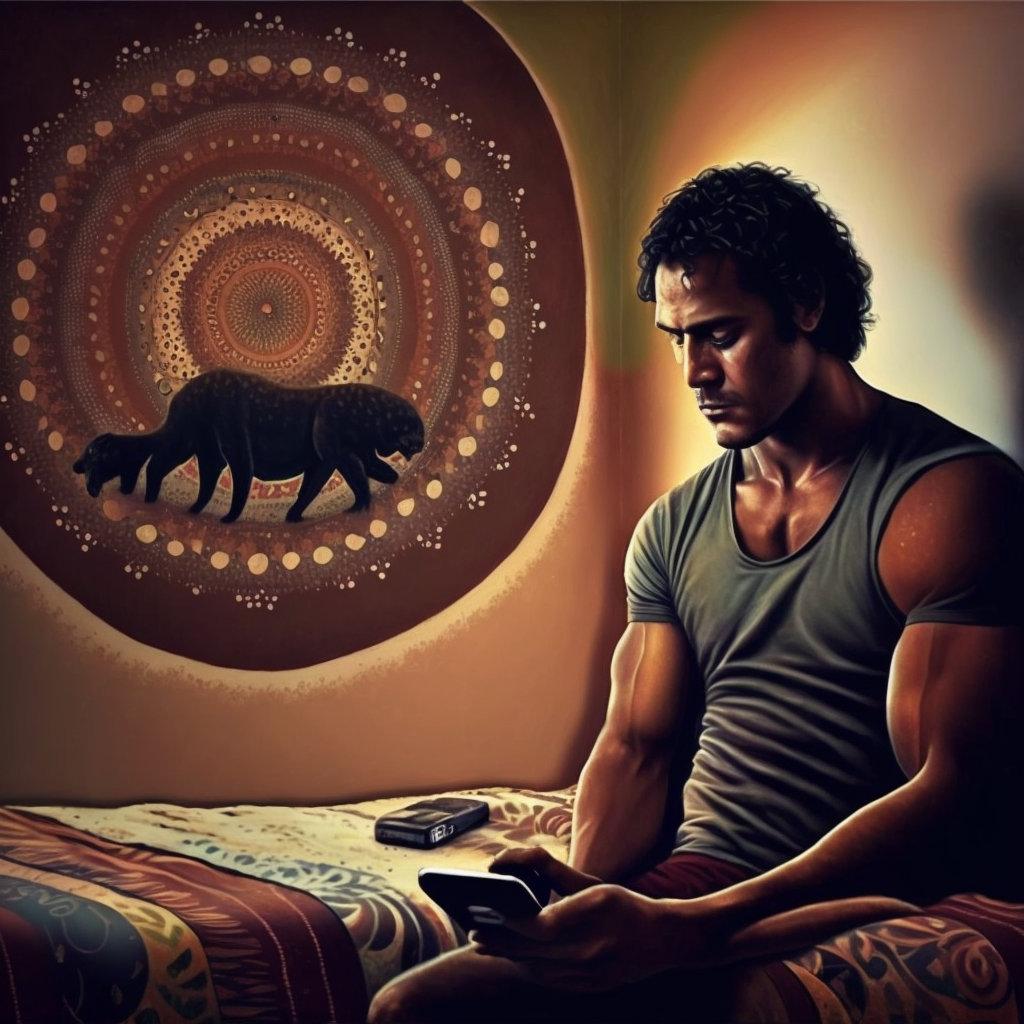 Youssef finds himself in a small ghost town in what looks like the middle of the Australian outback. The town was once thriving but now only a few stragglers remain, living in old, decrepit buildings. He’s standing in the town square, surrounded by an old post office, a saloon, and a few other ramshackle buildings.
A message appeared on the screen.
Quest: Your task is to find the source of the magnetic pull that attracts talkative people to you. You must find the reason behind it and break the spell, so you can continue your journey in peace.
Youssef started to move his avatar towards the saloon when someone knocked on the door.
February 13, 2023 at 10:38 pm #6543In reply to: Orbs of Madjourneys
The road was stretching endlessly and monotonously, a straight line disappearing into a nothingness of dry landscapes that sounded a bit depressing. At regular speed, the car barely seemed to progress, and Youssef was rather serious at the wheel. Soon Xavier was left depleted of jokes to tell (even the bad ones which tended to come off easily with sleep deprivation), so he tried to catch some of the patchy network signal to reconnect where he’d left off on the game. There wasn’t much network, and all he could download in the car, even with the game in lo-fi mode, was a measly text message with the starter for his new challenge.
Your quest takes place in the ghost town of Midnight, where time seems to have stood still. The townspeople are all frozen in time, stuck in their daily routines and unable to move on. Your mission is to find the missing piece of continuity, a small hourglass that will set time back in motion and allow the townspeople to move forward.
A ghost town seemed apt indeed.
The welcome signs at the entrance of the town for their hostel were rather uninviting, but a festive banner mentioning the local “Lager and Carts festival” caught his attention. He counted the days. It would be next week-end; there was a good chance they’d still be there, the four of them. At least some action to look forward to!
When he and Youssef arrived at the Inn after that rather uneventful and terribly long drive, all they wanted was to get a shower and some sleep. Zara wasn’t back yet from her trip, but they both figured out they’d meet at breakfast in the morning.
The old lady with the sharp tongue had shown them their rooms rather unceremoniously; she was too busy ranting about an idle person not taking their *one job* seriously to care about details. Xavier almost asked for a wifi, but then thought better and decided to hold his question until he found someone to ask who was born in his century.
Xavier took room 7, and Youssef room 5.The rooms were quite nicely decorated. It reminded him of something he’d read in the plane from a commentary of the Bardo Thodöl:
In Tibetan the word for body is lü, which means “something you leave behind,” like baggage. Each time we say “lü,” it reminds us that we are only travelers, taking temporary refuge in this life and this body. So in Tibet people did not distract themselves by spending all their time trying to make their external circumstances more comfortable. They were satisfied if they had enough to eat, clothes on their backs, and a roof over their heads. Going on as we do, obsessively trying to improve our conditions, can become an end in itself and a pointless distraction. Would anyone in their right mind think of fastidiously redecorating their hotel room every time they booked into one?
— The Tibetan Book of Living and Dying
At least, he wasn’t feeling compelled to redecorate this room; it was perfect. The shared sanitaries, the boiler and the piping were another story, but that was probably coming from the same era as the owner, nice as she was.
After having unpacked his few belongings, and taken a hot shower, he laid on the bed looking at the ceiling, which was blank and made a nice contrast to the ornate walls full of colorful dots.
Luckily, searching through the signals available, he could see there was mostly one, and without any password. With the next neighbour a few miles away, no wonder nobody bothered with security.
He connected to AL to check a few parameters — there seemed to be some degenerescence in the programme output that wasn’t satisfactory, and he was wondering if some self-repair or training reinforcement mechanisms were missing. At the moment, nothing too pressing, but he would keep an eye on them.
Still no words from Yasmin… he thought drifting to sleep… I half expected her to be there already…
February 9, 2023 at 3:45 pm #6517In reply to: Orbs of Madjourneys
After Youssef retrieved his luggage in Alice Springs, he was swarmed with freelance tour guides trying to sell him trips. You would buy a ticket out of any one of them just to get rid of the others, he thought. With a few hungry growls, he managed to frighten most of them, with a touch of indifference he lost the rest. Except one. A short Indian looking man wearing a red cap and a moustache. He seemed to have an infinite talkative energy at his disposal, able to erode the strongest wills. The temperature was hotter than Youssef had expected, here it was the end of summer, and he was hungry. The man started to get on his nerves.
The list of tours was endless. Uluru, scenic bushwalking trails, beautiful gardens, a historical tour, a costumed historical tour, a few national parks, and even his cousins’ restaurant. He reminded Youssef of his own father, always offering guests (and especially his visiting kids) another fruit, a pastry, some coffee, chocolate ? You sure you don’t want any chocolate? If the man was tenacious, Youssef had had training with his father. But this man seemed to mistake silence and indifference for agreement. Did he really think Youssef was going to buy one of his tours ?
“The ghost town! You have to see Arltunga, said the man. An old mining ghost town, certainly an American like you like ghost towns. And buried treasure. Arltunga has buried treasure somewhere. You can find it. I know where to find a map.”
Youssef wondered if it was another one of the game’s fluke that his quest was apparently bleeding into his real life again. And if there was a map, why hasn’t the treasure been found already? He checked at the back of his mind for the presence of that crazy old lady. Nope, not there. He decided to refuse the call this time. He just wanted to get to that F…ing Fish Inn in Crowshollow and meet with his friends.
“NO, he growled, frightening a group of tourists passing by, but not the tour operator. No ghost town! We have plenty in America.” Thinking of the game and his last challenge for the previous quest, he said in desperation : “I just want to find a red scarf!” and he knew inside himself and many years attempting to resist his old man, that the short Indian man had won.
“If you want to find a red scarf, you go to Silk Road, said the man bobbing his head. My cousin’s shop, you find everything there only.”
Youssef sighed. He thought there were only two ways to take it. The first one was that he had fallen into a trap and try to find a way to get out of it. But it might be sticky and uncomfortable for everyone. So he decided it was the other way around and that it was part of the game. Why wouldn’t he use this as an opportunity for adventure. Wasn’t that what Xavier always said about roads less traveled ?
“Where is your cousin’s shop? he asked. And where’s that restaurant of your cousin’s? I’m starving.”
The little man smiled broadly.
“Same place. Two brothers. Shop next to restaurant in Todd Mall. You’re lucky! Follow me.”
January 10, 2023 at 10:31 pm #6364In reply to: Train your subjective AI – text version
Please suggest a creative, a little ghostic but mostly uplifting plot outline for the continuation of the story of Twilight in her travels to join the freak circus and become famous for her craft on the west coast
— The Far-West saga — In 1850s, in a probable reality of South America, we get acquainted with Twilight (Twi) and her brothers Jo and Elroy. They have a precious blue bull in their possession, coveted by Ogrean, the kingpin of the town. Hopefully for them, Ogrean is arrested (temporarily) by Ted Marshall, the sheriff for his possible trafficking. Notably, Ogrean is possibly involved in some of the crystal skulls discoveries, during his travel to New Honduras. Twi who was dancing in the saloon of Madame Butterbutt, the town’s hallucinogenic toads-to-lick dispenser (insert some other romantic subplots involving the other dancer etc.) decides to go traveling in a freakus (freak show/circus). She is now close to the West Coast, where she hopes to succeed in her writing and other artistic skills.
As Twilight (Twi) travels with the freak circus, she faces many challenges and obstacles on her journey to the West Coast. Despite the difficulties, she remains determined to make a name for herself as a writer and artist.
As she travels through small towns and larger cities, she begins to realize that the world is much bigger than she ever imagined. She meets a diverse group of people, some of whom are kind and supportive, while others are cruel and dismissive of her dreams.
Despite the negative reactions she receives from some people, Twi persists and begins to gain a reputation as a talented writer and performer. As she gains more experience and confidence, she starts to incorporate her own unique style into her performances, which sets her apart from the other performers in the circus.
As she approaches the West Coast, she begins to feel a sense of excitement and anticipation. She has heard that the West Coast is a place of endless possibilities, where creative minds can thrive. She is determined to make her mark and become famous for her craft.
As she settles in the west, she finds herself surrounded by artists and writers like herself, who inspire her to push herself even further. She begins to gain a following and her writing is widely read. She discovers that her talent is not only limited to writing, but she also has a natural talent for other art forms as well.
Eventually, Twi’s reputation as a talented artist and writer precedes her and she becomes a sought-after performer in the West Coast, and her creative work is being showcased in galleries and theaters. As she continues to achieve success in her career, she begins to realize that the West Coast is not just a place of endless possibilities but also the place where she belongs, and the place where her dreams come true.
Throughout her journey, she also keeps in touch with her brothers, Jo and Elroy, who now run the farm and take care of the blue bull. They tell her that the bull, now named Blue-Dream, became a legend in the village and they get a good price for its breeding.
As the story continues, she finds herself also involved in some adventures and exciting subplots, like discovering a secret underground cave filled with precious crystals and some interesting characters, like the enigmatic sheriff Ted Marshall who always cross her path, and the mysterious Ogrean who seems to have a connection to her past and the bull.
The End.
February 2, 2022 at 12:50 pm #6267In reply to: The Elusive Samuel Housley and Other Family Stories
From Tanganyika with Love
continued part 8
With thanks to Mike Rushby.
Morogoro 20th January 1941
Dearest Family,
It is all arranged for us to go on three months leave to Cape Town next month so
get out your flags. How I shall love showing off Kate and John to you and this time
George will be with us and you’ll be able to get to know him properly. You can’t think
what a comfort it will be to leave all the worries of baggage and tipping to him. We will all
be travelling by ship to Durban and from there to Cape Town by train. I rather dread the
journey because there is a fifth little Rushby on the way and, as always, I am very
queasy.Kate has become such a little companion to me that I dread the thought of leaving
her behind with you to start schooling. I miss Ann and George so much now and must
face separation from Kate as well. There does not seem to be any alternative though.
There is a boarding school in Arusha and another has recently been started in Mbeya,
but both places are so far away and I know she would be very unhappy as a boarder at
this stage. Living happily with you and attending a day school might wean her of her
dependance upon me. As soon as this wretched war ends we mean to get Ann and
George back home and Kate too and they can then all go to boarding school together.
If I were a more methodical person I would try to teach Kate myself, but being a
muddler I will have my hands full with Johnny and the new baby. Life passes pleasantly
but quietly here. Much of my time is taken up with entertaining the children and sewing
for them and just waiting for George to come home.George works so hard on these safaris and this endless elephant hunting to
protect native crops entails so much foot safari, that he has lost a good deal of weight. it
is more than ten years since he had a holiday so he is greatly looking forward to this one.
Four whole months together!I should like to keep the ayah, Janet, for the new baby, but she says she wants
to return to her home in the Southern Highlands Province and take a job there. She is
unusually efficient and so clean, and the houseboy and cook are quite scared of her. She
bawls at them if the children’s meals are served a few minutes late but she is always
respectful towards me and practically creeps around on tiptoe when George is home.
She has a room next to the outside kitchen. One night thieves broke into the kitchen and
stole a few things, also a canvas chair and mat from the verandah. Ayah heard them, and
grabbing a bit of firewood, she gave chase. Her shouts so alarmed the thieves that they
ran off up the hill jettisoning their loot as they ran. She is a great character.Eleanor.
Morogoro 30th July 1941
Dearest Family,
Safely back in Morogoro after a rather grim voyage from Durban. Our ship was
completely blacked out at night and we had to sleep with warm clothing and life belts
handy and had so many tedious boat drills. It was a nuisance being held up for a whole
month in Durban, because I was so very pregnant when we did embark. In fact George
suggested that I had better hide in the ‘Ladies’ until the ship sailed for fear the Captain
might refuse to take me. It seems that the ship, on which we were originally booked to
travel, was torpedoed somewhere off the Cape.We have been given a very large house this tour with a mosquito netted
sleeping porch which will be fine for the new baby. The only disadvantage is that the
house is on the very edge of the residential part of Morogoro and Johnny will have to
go quite a distance to find playmates.I still miss Kate terribly. She is a loving little person. I had prepared for a scene
when we said good-bye but I never expected that she would be the comforter. It
nearly broke my heart when she put her arms around me and said, “I’m so sorry
Mummy, please don’t cry. I’ll be good. Please don’t cry.” I’m afraid it was all very
harrowing for you also. It is a great comfort to hear that she has settled down so happily.
I try not to think consciously of my absent children and remind myself that there are
thousands of mothers in the same boat, but they are always there at the back of my
mind.Mother writes that Ann and George are perfectly happy and well, and that though
German bombers do fly over fairly frequently, they are unlikely to drop their bombs on
a small place like Jacksdale.George has already left on safari to the Rufiji. There was no replacement for his
job while he was away so he is anxious to get things moving again. Johnny and I are
going to move in with friends until he returns, just in case all the travelling around brings
the new baby on earlier than expected.Eleanor.
Morogoro 26th August 1941
Dearest Family,
Our new son, James Caleb. was born at 3.30 pm yesterday afternoon, with a
minimum of fuss, in the hospital here. The Doctor was out so my friend, Sister Murray,
delivered the baby. The Sister is a Scots girl, very efficient and calm and encouraging,
and an ideal person to have around at such a time.Everything, this time, went without a hitch and I feel fine and proud of my
bouncing son. He weighs nine pounds and ten ounces and is a big boned fellow with
dark hair and unusually strongly marked eyebrows. His eyes are strong too and already
seem to focus. George is delighted with him and brought Hugh Nelson to see him this
morning. Hugh took one look, and, astonished I suppose by the baby’s apparent
awareness, said, “Gosh, this one has been here before.” The baby’s cot is beside my
bed so I can admire him as much as I please. He has large strong hands and George
reckons he’ll make a good boxer some day.Another of my early visitors was Mabemba, George’s orderly. He is a very big
African and looks impressive in his Game Scouts uniform. George met him years ago at
Mahenge when he was a young elephant hunter and Mabemba was an Askari in the
Police. Mabemba takes quite a proprietary interest in the family.Eleanor.
Morogoro 25th December 1941
Dearest Family,
Christmas Day today, but not a gay one. I have Johnny in bed with a poisoned
leg so he missed the children’s party at the Club. To make things a little festive I have
put up a little Christmas tree in the children’s room and have hung up streamers and
balloons above the beds. Johnny demands a lot of attention so it is fortunate that little
James is such a very good baby. He sleeps all night until 6 am when his feed is due.
One morning last week I got up as usual to feed him but I felt so dopey that I
thought I’d better have a cold wash first. I went into the bathroom and had a hurried
splash and then grabbed a towel to dry my face. Immediately I felt an agonising pain in
my nose. Reason? There was a scorpion in the towel! In no time at all my nose looked
like a pear and felt burning hot. The baby screamed with frustration whilst I feverishly
bathed my nose and applied this and that in an effort to cool it.For three days my nose was very red and tender,”A real boozer nose”, said
George. But now, thank goodness, it is back to normal.Some of the younger marrieds and a couple of bachelors came around,
complete with portable harmonium, to sing carols in the early hours. No sooner had we
settled down again to woo sleep when we were disturbed by shouts and screams from
our nearest neighbour’s house. “Just celebrating Christmas”, grunted George, but we
heard this morning that the neighbour had fallen down his verandah steps and broken his
leg.Eleanor.
Morogoro Hospital 30th September 1943
Dearest Family,
Well now we are eight! Our new son, Henry, was born on the night of the 28th.
He is a beautiful baby, weighing ten pounds three and a half ounces. This baby is very
well developed, handsome, and rather superior looking, and not at all amusing to look at
as the other boys were.George was born with a moustache, John had a large nose and
looked like a little old man, and Jim, bless his heart, looked rather like a baby
chimpanzee. Henry is different. One of my visitors said, “Heaven he’ll have to be a
Bishop!” I expect the lawn sleeves of his nightie really gave her that idea, but the baby
does look like ‘Someone’. He is very good and George, John, and Jim are delighted
with him, so is Mabemba.We have a dear little nurse looking after us. She is very petite and childish
looking. When the baby was born and she brought him for me to see, the nurse asked
his name. I said jokingly, “His name is Benjamin – the last of the family.” She is now very
peeved to discover that his real name is Henry William and persists in calling him
‘Benjie’.I am longing to get home and into my pleasant rut. I have been away for two
whole weeks and George is managing so well that I shall feel quite expendable if I don’t
get home soon. As our home is a couple of miles from the hospital, I arranged to move
in and stay with the nursing sister on the day the baby was due. There I remained for ten
whole days before the baby was born. Each afternoon George came and took me for a
ride in the bumpy Bedford lorry and the Doctor tried this and that but the baby refused
to be hurried.On the tenth day I had the offer of a lift and decided to go home for tea and
surprise George. It was a surprise too, because George was entertaining a young
Game Ranger for tea and my arrival, looking like a perambulating big top, must have
been rather embarrassing.Henry was born at the exact moment that celebrations started
in the Township for the end of the Muslim religious festival of Ramadan. As the Doctor
held him up by his ankles, there was the sound of hooters and firecrackers from the town.
The baby has a birthmark in the shape of a crescent moon above his left eyebrow.Eleanor.
Morogoro 26th January 1944
Dearest Family,
We have just heard that we are to be transferred to the Headquarters of the
Game Department at a place called Lyamungu in the Northern Province. George is not
at all pleased because he feels that the new job will entail a good deal of office work and
that his beloved but endless elephant hunting will be considerably curtailed. I am glad of
that and I am looking forward to seeing a new part of Tanganyika and particularly
Kilimanjaro which dominates Lyamungu.Thank goodness our menagerie is now much smaller. We found a home for the
guinea pigs last December and Susie, our mischievous guinea-fowl, has flown off to find
a mate.Last week I went down to Dar es Salaam for a check up by Doctor John, a
woman doctor, leaving George to cope with the three boys. I was away two nights and
a day and returned early in the morning just as George was giving Henry his six o’clock
bottle. It always amazes me that so very masculine a man can do my chores with no
effort and I have a horrible suspicion that he does them better than I do. I enjoyed the
short break at the coast very much. I stayed with friends and we bathed in the warm sea
and saw a good film.Now I suppose there will be a round of farewell parties. People in this country
are most kind and hospitable.Eleanor.
Lyamungu 20th March 1944
Dearest Family,
We left Morogoro after the round of farewell parties I had anticipated. The final
one was at the Club on Saturday night. George made a most amusing speech and the
party was a very pleasant occasion though I was rather tired after all the packing.
Several friends gathered to wave us off on Monday morning. We had two lorries
loaded with our goods. I rode in the cab of the first one with Henry on my knee. George
with John and Jim rode in the second one. As there was no room for them in the cab,
they sat on our couch which was placed across the width of the lorry behind the cab. This
seat was not as comfortable as it sounds, because the space behind the couch was
taken up with packing cases which were not lashed in place and these kept moving
forward as the lorry bumped its way over the bad road.Soon there was hardly any leg room and George had constantly to stand up and
push the second layer of packing cases back to prevent them from toppling over onto
the children and himself. As it is now the rainy season the road was very muddy and
treacherous and the lorries travelled so slowly it was dark by the time we reached
Karogwe from where we were booked to take the train next morning to Moshi.
Next morning we heard that there had been a washaway on the line and that the
train would be delayed for at least twelve hours. I was not feeling well and certainly did
not enjoy my day. Early in the afternoon Jimmy ran into a wall and blackened both his
eyes. What a child! As the day wore on I felt worse and worse and when at last the train
did arrive I simply crawled into my bunk whilst George coped nobly with the luggage
and the children.We arrived at Moshi at breakfast time and went straight to the Lion Cub Hotel
where I took to my bed with a high temperature. It was, of course, malaria. I always have
my attacks at the most inopportune times. Fortunately George ran into some friends
called Eccles and the wife Mollie came to my room and bathed Henry and prepared his
bottle and fed him. George looked after John and Jim. Next day I felt much better and
we drove out to Lyamungu the day after. There we had tea with the Game Warden and
his wife before moving into our new home nearby.The Game Warden is Captain Monty Moore VC. He came out to Africa
originally as an Officer in the King’s African Rifles and liked the country so much he left the
Army and joined the Game Department. He was stationed at Banagi in the Serengetti
Game Reserve and is well known for his work with the lions there. He particularly tamed
some of the lions by feeding them so that they would come out into the open and could
readily be photographed by tourists. His wife Audrey, has written a book about their
experiences at Banagi. It is called “Serengetti”Our cook, Hamisi, soon had a meal ready for us and we all went to bed early.
This is a very pleasant house and I know we will be happy here. I still feel a little shaky
but that is the result of all the quinine I have taken. I expect I shall feel fine in a day or two.Eleanor.
Lyamungu 15th May 1944
Dearest Family,
Well, here we are settled comfortably in our very nice house. The house is
modern and roomy, and there is a large enclosed verandah, which will be a Godsend in
the wet weather as a playroom for the children. The only drawback is that there are so
many windows to be curtained and cleaned. The grounds consist of a very large lawn
and a few beds of roses and shrubs. It is an ideal garden for children, unlike our steeply
terraced garden at Morogoro.Lyamungu is really the Government Coffee Research Station. It is about sixteen
miles from the town of Moshi which is the centre of the Tanganyika coffee growing
industry. Lyamungu, which means ‘place of God’ is in the foothills of Mt Kilimanjaro and
we have a beautiful view of Kilimanjaro. Kibo, the more spectacular of the two mountain
peaks, towers above us, looking from this angle, like a giant frosted plum pudding. Often the mountain is veiled by cloud and mist which sometimes comes down to
our level so that visibility is practically nil. George dislikes both mist and mountain but I
like both and so does John. He in fact saw Kibo before I did. On our first day here, the
peak was completely hidden by cloud. In the late afternoon when the children were
playing on the lawn outside I was indoors hanging curtains. I heard John call out, “Oh
Mummy, isn’t it beautiful!” I ran outside and there, above a scarf of cloud, I saw the
showy dome of Kibo with the setting sun shining on it tingeing the snow pink. It was an
unforgettable experience.As this is the rainy season, the surrounding country side is very lush and green.
Everywhere one sees the rich green of the coffee plantations and the lighter green of
the banana groves. Unfortunately our walks are rather circumscribed. Except for the main road to Moshi, there is nowhere to walk except through the Government coffee
plantation. Paddy, our dog, thinks life is pretty boring as there is no bush here and
nothing to hunt. There are only half a dozen European families here and half of those are
on very distant terms with the other half which makes the station a rather uncomfortable
one.The coffee expert who runs this station is annoyed because his European staff
has been cut down owing to the war, and three of the vacant houses and some office
buildings have been taken over temporarily by the Game Department. Another house
has been taken over by the head of the Labour Department. However I don’t suppose
the ill feeling will effect us much. We are so used to living in the bush that we are not
socially inclined any way.Our cook, Hamisi, came with us from Morogoro but I had to engage a new
houseboy and kitchenboy. I first engaged a houseboy who produced a wonderful ‘chit’
in which his previous employer describes him as his “friend and confidant”. I felt rather
dubious about engaging him and how right I was. On his second day with us I produced
some of Henry’s napkins, previously rinsed by me, and asked this boy to wash them.
He looked most offended and told me that it was beneath his dignity to do women’s
work. We parted immediately with mutual relief.Now I have a good natured fellow named Japhet who, though hard on crockery,
is prepared to do anything and loves playing with the children. He is a local boy, a
member of the Chagga tribe. These Chagga are most intelligent and, on the whole, well
to do as they all have their own small coffee shambas. Japhet tells me that his son is at
the Uganda University College studying medicine.The kitchen boy is a tall youth called
Tovelo, who helps both Hamisi, the cook, and the houseboy and also keeps an eye on
Henry when I am sewing. I still make all the children’s clothes and my own. Life is
pleasant but dull. George promises that he will take the whole family on safari when
Henry is a little older.Eleanor.
Lyamungu 18th July 1944
Dearest Family,
Life drifts quietly by at Lyamungu with each day much like the one before – or
they would be, except that the children provide the sort of excitement that prohibits
boredom. Of the three boys our Jim is the best at this. Last week Jim wandered into the
coffee plantation beside our house and chewed some newly spayed berries. Result?
A high temperature and nasty, bloody diarrhoea, so we had to rush him to the hospital at
Moshi for treatment. however he was well again next day and George went off on safari.
That night there was another crisis. As the nights are now very cold, at this high
altitude, we have a large fire lit in the living room and the boy leaves a pile of logs
beside the hearth so that I can replenish the fire when necessary. Well that night I took
Henry off to bed, leaving John and Jim playing in the living room. When their bedtime
came, I called them without leaving the bedroom. When I had tucked John and Jim into
bed, I sat reading a bedtime story as I always do. Suddenly I saw smoke drifting
through the door, and heard a frightening rumbling noise. Japhet rushed in to say that the
lounge chimney was on fire! Picture me, panic on the inside and sweet smile on the
outside, as I picked Henry up and said to the other two, “There’s nothing to be
frightened about chaps, but get up and come outside for a bit.” Stupid of me to be so
heroic because John and Jim were not at all scared but only too delighted at the chance
of rushing about outside in the dark. The fire to them was just a bit of extra fun.We hurried out to find one boy already on the roof and the other passing up a
brimming bucket of water. Other boys appeared from nowhere and soon cascades of
water were pouring down the chimney. The result was a mountain of smouldering soot
on the hearth and a pool of black water on the living room floor. However the fire was out
and no serious harm done because all the floors here are cement and another stain on
the old rug will hardly be noticed. As the children reluctantly returned to bed John
remarked smugly, “I told Jim not to put all the wood on the fire at once but he wouldn’t
listen.” I might have guessed!However it was not Jim but John who gave me the worst turn of all this week. As
a treat I decided to take the boys to the river for a picnic tea. The river is not far from our
house but we had never been there before so I took the kitchen boy, Tovelo, to show
us the way. The path is on the level until one is in sight of the river when the bank slopes
steeply down. I decided that it was too steep for the pram so I stopped to lift Henry out
and carry him. When I looked around I saw John running down the slope towards the
river. The stream is not wide but flows swiftly and I had no idea how deep it was. All I
knew was that it was a trout stream. I called for John, “Stop, wait for me!” but he ran on
and made for a rude pole bridge which spanned the river. He started to cross and then,
to my horror, I saw John slip. There was a splash and he disappeared under the water. I
just dumped the baby on the ground, screamed to the boy to mind him and ran madly
down the slope to the river. Suddenly I saw John’s tight fitting felt hat emerge, then his
eyes and nose. I dashed into the water and found, to my intense relief, that it only
reached up to my shoulders but, thank heaven no further. John’s steady eyes watched
me trustingly as I approached him and carried him safely to the bank. He had been
standing on a rock and had not panicked at all though he had to stand up very straight
and tall to keep his nose out of water. I was too proud of him to scold him for
disobedience and too wet anyway.I made John undress and put on two spare pullovers and wrapped Henry’s
baby blanket round his waist like a sarong. We made a small fire over which I crouched
with literally chattering teeth whilst Tovelo ran home to fetch a coat for me and dry clothes
for John.Eleanor.
Lyamungu 16th August 1944
Dearest Family,
We have a new bull terrier bitch pup whom we have named Fanny III . So once
more we have a menagerie , the two dogs, two cats Susie and Winnie, and
some pet hens who live in the garage and are a real nuisance.As John is nearly six I thought it time that he started lessons and wrote off to Dar
es Salaam for the correspondence course. We have had one week of lessons and I am
already in a state of physical and mental exhaustion. John is a most reluctant scholar.
“Why should I learn to read, when you can read to me?” he asks, and “Anyway why
should I read such stupid stuff, ‘Run Rover Run’, and ‘Mother play with baby’ . Who
wants to read about things like that? I don’t.”He rather likes sums, but the only subject about which he is enthusiastic is
prehistoric history. He laps up information about ‘The Tree Dwellers’, though he is very
sceptical about the existence of such people. “God couldn’t be so silly to make people
so stupid. Fancy living in trees when it is easy to make huts like the natives.” ‘The Tree
Dwellers is a highly imaginative story about a revolting female called Sharptooth and her
offspring called Bodo. I have a very clear mental image of Sharptooth, so it came as a
shock to me and highly amused George when John looked at me reflectively across the
tea table and said, “Mummy I expect Sharptooth looked like you. You have a sharp
tooth too!” I have, my eye teeth are rather sharp, but I hope the resemblance stops
there.John has an uncomfortably logical mind for a small boy. The other day he was
lying on the lawn staring up at the clouds when he suddenly muttered “I don’t believe it.”
“Believe what?” I asked. “That Jesus is coming on a cloud one day. How can he? The
thick ones always stay high up. What’s he going to do, jump down with a parachute?”
Tovelo, my kitchen boy, announced one evening that his grandmother was in the
kitchen and wished to see me. She was a handsome and sensible Chagga woman who
brought sad news. Her little granddaughter had stumbled backwards into a large cooking
pot of almost boiling maize meal porridge and was ‘ngongwa sana’ (very ill). I grabbed
a large bottle of Picric Acid and a packet of gauze which we keep for these emergencies
and went with her, through coffee shambas and banana groves to her daughter’s house.
Inside the very neat thatched hut the mother sat with the naked child lying face
downwards on her knee. The child’s buttocks and the back of her legs were covered in
huge burst blisters from which a watery pus dripped. It appeared that the accident had
happened on the previous day.I could see that it was absolutely necessary to clean up the damaged area, and I
suddenly remembered that there was a trained African hospital dresser on the station. I
sent the father to fetch him and whilst the dresser cleaned off the sloughed skin with
forceps and swabs saturated in Picric Acid, I cut the gauze into small squares which I
soaked in the lotion and laid on the cleaned area. I thought the small pieces would be
easier to change especially as the whole of the most tender parts, front and back, were
badly scalded. The child seemed dazed and neither the dresser nor I thought she would
live. I gave her half an aspirin and left three more half tablets to be given four hourly.
Next day she seemed much brighter. I poured more lotion on the gauze
disturbing as few pieces as possible and again the next day and the next. After a week
the skin was healing well and the child eating normally. I am sure she will be all right now.
The new skin is a brilliant red and very shiny but it is pale round the edges of the burnt
area and will I hope later turn brown. The mother never uttered a word of thanks, but the
granny is grateful and today brought the children a bunch of bananas.Eleanor.
c/o Game Dept. P.O.Moshi. 29th September 1944
Dearest Mummy,
I am so glad that you so enjoyed my last letter with the description of our very
interesting and enjoyable safari through Masailand. You said you would like an even
fuller description of it to pass around amongst the relations, so, to please you, I have
written it out in detail and enclose the result.We have spent a quiet week after our exertions and all are well here.
Very much love,
Eleanor.Safari in Masailand
George and I were at tea with our three little boys on the front lawn of our house
in Lyamungu, Northern Tanganyika. It was John’s sixth birthday and he and Jim, a
happy sturdy three year old, and Henry, aged eleven months, were munching the
squares of plain chocolate which rounded off the party, when George said casually
across the table to me, “Could you be ready by the day after tomorrow to go on
safari?” “Me too?” enquired John anxiously, before I had time to reply, and “Me too?”
echoed Jim. “yes, of course I can”, said I to George and “of course you’re coming too”,
to the children who rate a day spent in the bush higher than any other pleasure.
So in the early morning two days later, we started out happily for Masailand in a
three ton Ford lorry loaded to capacity with the five Rushbys, the safari paraphernalia,
drums of petrol and quite a retinue of servants and Game Scouts. George travelling
alone on his monthly safaris, takes only the cook and a couple of Game Scouts, but this was to be a safari de luxe.Henry and I shared the cab with George who was driving, whilst John and Jim
with the faithful orderly Mabemba beside them to point out the game animals, were
installed upon rolls of bedding in the body of the lorry. The lorry lumbered along, first
through coffee shambas, and then along the main road between Moshi and Arusha.
After half an hour or so, we turned South off the road into a track which crossed the
Sanya Plains and is the beginning of this part of Masailand. Though the dry season was
at its height, and the pasture dry and course, we were soon passing small groups of
game. This area is a Game Sanctuary and the antelope grazed quietly quite undisturbed
by the passing lorry. Here and there zebra stood bunched by the road, a few wild
ostriches stalked jerkily by, and in the distance some wildebeest cavorted around in their
crazy way.Soon the grasslands gave way to thorn bush, and we saw six fantastically tall
giraffe standing motionless with their heads turned enquiringly towards us. George
stopped the lorry so the children could have a good view of them. John was enchanted
but Jim, alas, was asleep.At mid day we reached the Kikoletwa River and turned aside to camp. Beside
the river, under huge leafy trees, there was a beautiful camping spot, but the river was
deep and reputed to be full of crocodiles so we passed it by and made our camp
some distance from the river under a tall thorn tree with a flat lacy canopy. All around the
camp lay uprooted trees of similar size that had been pushed over by elephants. As
soon as the lorry stopped a camp chair was set up for me and the Game Scouts quickly
slashed down grass and cleared the camp site of thorns. The same boys then pitched the tent whilst George himself set up the three camp beds and the folding cot for Henry,
and set up the safari table and the canvas wash bowl and bath.The cook in the meantime had cleared a cool spot for the kitchen , opened up the
chop boxes and started a fire. The cook’s boy and the dhobi (laundry boy) brought
water from the rather muddy river and tea was served followed shortly afterward by an
excellent lunch. In a very short time the camp had a suprisingly homely look. Nappies
fluttered from a clothes line, Henry slept peacefully in his cot, John and Jim sprawled on
one bed looking at comics, and I dozed comfortably on another.George, with the Game Scouts, drove off in the lorry about his work. As a Game
Ranger it is his business to be on a constant look out for poachers, both African and
European, and for disease in game which might infect the valuable herds of Masai cattle.
The lorry did not return until dusk by which time the children had bathed enthusiastically in
the canvas bath and were ready for supper and bed. George backed the lorry at right
angles to the tent, Henry’s cot and two camp beds were set up in the lorry, the tarpaulin
was lashed down and the children put to bed in their novel nursery.When darkness fell a large fire was lit in front of the camp, the exited children at
last fell asleep and George and I sat on by the fire enjoying the cool and quiet night.
When the fire subsided into a bed of glowing coals, it was time for our bed. During the
night I was awakened by the sound of breaking branches and strange indescribable
noises.” Just elephant”, said George comfortably and instantly fell asleep once more. I
didn’t! We rose with the birds next morning, but breakfast was ready and in a
remarkably short time the lorry had been reloaded and we were once more on our way.
For about half a mile we made our own track across the plain and then we turned
into the earth road once more. Soon we had reached the river and were looking with
dismay at the suspension bridge which we had to cross. At the far side, one steel
hawser was missing and there the bridge tilted dangerously. There was no handrail but
only heavy wooden posts which marked the extremities of the bridge. WhenGeorge
measured the distance between the posts he found that there could be barely two
inches to spare on either side of the cumbersome lorry.He decided to risk crossing, but the children and I and all the servants were told to
cross the bridge and go down the track out of sight. The Game Scouts remained on the
river bank on the far side of the bridge and stood ready for emergencies. As I walked
along anxiously listening, I was horrified to hear the lorry come to a stop on the bridge.
There was a loud creaking noise and I instantly visualised the lorry slowly toppling over
into the deep crocodile infested river. The engine restarted, the lorry crossed the bridge
and came slowly into sight around the bend. My heart slid back into its normal position.
George was as imperturbable as ever and simply remarked that it had been a near
thing and that we would return to Lyamungu by another route.Beyond the green river belt the very rutted track ran through very uninteresting
thorn bush country. Henry was bored and tiresome, jumping up and down on my knee
and yelling furiously. “Teeth”, said I apologetically to George, rashly handing a match
box to Henry to keep him quiet. No use at all! With a fat finger he poked out the tray
spilling the matches all over me and the floor. Within seconds Henry had torn the
matchbox to pieces with his teeth and flung the battered remains through the window.
An empty cigarette box met with the same fate as the match box and the yells
continued unabated until Henry slept from sheer exhaustion. George gave me a smile,
half sympathetic and half sardonic, “Enjoying the safari, my love?” he enquired. On these
trying occasions George has the inestimable advantage of being able to go into a Yogilike
trance, whereas I become irritated to screaming point.In an effort to prolong Henry’s slumber I braced my feet against the floor boards
and tried to turn myself into a human shock absorber as we lurched along the eroded
track. Several times my head made contact with the bolt of a rifle in the rack above, and
once I felt I had shattered my knee cap against the fire extinguisher in a bracket under the
dash board.Strange as it may seem, I really was enjoying the trip in spite of these
discomforts. At last after three years I was once more on safari with George. This type of
country was new to me and there was so much to see We passed a family of giraffe
standing in complete immobility only a few yards from the track. Little dick-dick. one of the smallest of the antelope, scuttled in pairs across the road and that afternoon I had my first view of Gerenuk, curious red brown antelope with extremely elongated legs and giraffe-like necks.Most interesting of all was my first sight of Masai at home. We could hear a tuneful
jangle of cattle bells and suddenly came across herds of humped cattle browsing upon
the thorn bushes. The herds were guarded by athletic,striking looking Masai youths and men.
Each had a calabash of water slung over his shoulder and a tall, highly polished spear in his
hand. These herdsmen were quite unselfconscious though they wore no clothing except for one carelessly draped blanket. Very few gave us any greeting but glanced indifferently at us from under fringes of clay-daubed plaited hair . The rest of their hair was drawn back behind the ears to display split earlobes stretched into slender loops by the weight of heavy brass or copper tribal ear rings.Most of the villages were set well back in the bush out of sight of the road but we did pass one
typical village which looked most primitive indeed. It consisted simply of a few mound like mud huts which were entirely covered with a plaster of mud and cattle dung and the whole clutch of huts were surrounded by a ‘boma’ of thorn to keep the cattle in at night and the lions out. There was a gathering of women and children on the road at this point. The children of both sexes were naked and unadorned, but the women looked very fine indeed. This is not surprising for they have little to do but adorn themselves, unlike their counterparts of other tribes who have to work hard cultivating the fields. The Masai women, and others I saw on safari, were far more amiable and cheerful looking than the men and were well proportioned.They wore skirts of dressed goat skin, knee length in front but ankle length behind. Their arms
from elbow to wrist, and legs from knee to ankle, were encased in tight coils of copper and
galvanised wire. All had their heads shaved and in some cases bound by a leather band
embroidered in red white and blue beads. Circular ear rings hung from slit earlobes and their
handsome throats were encircled by stiff wire necklaces strung with brightly coloured beads. These
necklaces were carefully graded in size and formed deep collars almost covering their breasts.
About a quarter of a mile further along the road we met eleven young braves in gala attire, obviously on their way to call on the girls. They formed a line across the road and danced up and down until the lorry was dangerously near when they parted and grinned cheerfully at us. These were the only cheerful
looking male Masai that I saw. Like the herdsmen these youths wore only a blanket, but their
blankets were ochre colour, and elegantly draped over their backs. Their naked bodies gleamed with oil. Several had painted white stripes on their faces, and two had whitewashed their faces entirely which I
thought a pity. All had their long hair elaborately dressed and some carried not only one,
but two gleaming spears.By mid day George decided that we had driven far enough for that day. He
stopped the lorry and consulted a rather unreliable map. “Somewhere near here is a
place called Lolbeni,” he said. “The name means Sweet Water, I hear that the
government have piped spring water down from the mountain into a small dam at which
the Masai water their cattle.” Lolbeni sounded pleasant to me. Henry was dusty and
cross, the rubber sheet had long slipped from my lap to the floor and I was conscious of
a very damp lap. ‘Sweet Waters’ I felt, would put all that right. A few hundred yards
away a small herd of cattle was grazing, so George lit his pipe and relaxed at last, whilst
a Game Scout went off to find the herdsman. The scout soon returned with an ancient
and emaciated Masai who was thrilled at the prospect of his first ride in a lorry and
offered to direct us to Lolbeni which was off the main track and about four miles away.Once Lolbeni had been a small administrative post and a good track had
led to it, but now the Post had been abandoned and the road is dotted with vigourous
thorn bushes and the branches of larger thorn trees encroach on the track The road had
deteriorated to a mere cattle track, deeply rutted and eroded by heavy rains over a
period of years. The great Ford truck, however, could take it. It lurched victoriously along,
mowing down the obstructions, tearing off branches from encroaching thorn trees with its
high railed sides, spanning gorges in the track, and climbing in and out of those too wide
to span. I felt an army tank could not have done better.I had expected Lolbeni to be a green oasis in a desert of grey thorns, but I was
quickly disillusioned. To be sure the thorn trees were larger and more widely spaced and
provided welcome shade, but the ground under the trees had been trampled by thousands of cattle into a dreary expanse of dirty grey sand liberally dotted with cattle droppings and made still more uninviting by the bleached bones of dead beasts.To the right of this waste rose a high green hill which gave the place its name and from which
the precious water was piped, but its slopes were too steep to provide a camping site.
Flies swarmed everywhere and I was most relieved when George said that we would
stay only long enough to fill our cans with water. Even the water was a disappointment!
The water in the small dam was low and covered by a revolting green scum, and though
the water in the feeding pipe was sweet, it trickled so feebly that it took simply ages to
fill a four gallon can.However all these disappointments were soon forgotten for we drove away
from the flies and dirt and trampled sand and soon, with their quiet efficiency, George
and his men set up a comfortable camp. John and Jim immediately started digging
operations in the sandy soil whilst Henry and I rested. After tea George took his shot
gun and went off to shoot guinea fowl and partridges for the pot. The children and I went
walking, keeping well in site of camp, and soon we saw a very large flock of Vulturine
Guineafowl, running aimlessly about and looking as tame as barnyard fowls, but melting
away as soon as we moved in their direction.We had our second quiet and lovely evening by the camp fire, followed by a
peaceful night.We left Lolbeni very early next morning, which was a good thing, for as we left
camp the herds of thirsty cattle moved in from all directions. They were accompanied by
Masai herdsmen, their naked bodies and blankets now covered by volcanic dust which
was being stirred in rising clouds of stifling ash by the milling cattle, and also by grey
donkeys laden with panniers filled with corked calabashes for water.Our next stop was Nabarera, a Masai cattle market and trading centre, where we
reluctantly stayed for two days in a pokey Goverment Resthouse because George had
a job to do in that area. The rest was good for Henry who promptly produced a tooth
and was consequently much better behaved for the rest of the trip. George was away in the bush most of the day but he returned for afternoon tea and later took the children out
walking. We had noticed curious white dumps about a quarter mile from the resthouse
and on the second afternoon we set out to investigate them. Behind the dumps we
found passages about six foot wide, cut through solid limestone. We explored two of
these and found that both passages led steeply down to circular wells about two and a
half feet in diameter.At the very foot of each passage, beside each well, rough drinking troughs had
been cut in the stone. The herdsmen haul the water out of the well in home made hide
buckets, the troughs are filled and the cattle driven down the ramps to drink at the trough.
It was obvious that the wells were ancient and the sloping passages new. George tells
me that no one knows what ancient race dug the original wells. It seems incredible that
these deep and narrow shafts could have been sunk without machinery. I craned my
neck and looked above one well and could see an immensely long shaft reaching up to
ground level. Small footholds were cut in the solid rock as far as I could see.
It seems that the Masai are as ignorant as ourselves about the origin of these
wells. They do say however that when their forebears first occupied what is now known
as Masailand, they not only found the Wanderobo tribe in the area but also a light
skinned people and they think it possible that these light skinned people dug the wells.
These people disappeared. They may have been absorbed or, more likely, they were
liquidated.The Masai had found the well impractical in their original form and had hired
labourers from neighbouring tribes to cut the passages to water level. Certainly the Masai are not responsible for the wells. They are a purely pastoral people and consider manual labour extremely degrading.They live chiefly on milk from their herd which they allow to go sour, and mix with blood that has been skilfully tapped from the necks of living cattle. They do not eat game meat, nor do they cultivate any
land. They hunt with spears, but hunt only lions, to protect their herds, and to test the skill
and bravery of their young warriors. What little grain they do eat is transported into
Masailand by traders. The next stage of our journey took us to Ngassamet where
George was to pick up some elephant tusks. I had looked forward particularly to this
stretch of road for I had heard that there was a shallow lake at which game congregates,
and at which I had great hopes of seeing elephants. We had come too late in the
season though, the lake was dry and there were only piles of elephant droppings to
prove that elephant had recently been there in numbers. Ngassamet, though no beauty
spot, was interesting. We saw more elaborate editions of the wells already described, and as this area
is rich in cattle we saw the aristocrats of the Masai. You cannot conceive of a more arrogant looking male than a young Masai brave striding by on sandalled feet, unselfconscious in all his glory. All the young men wore the casually draped traditional ochre blanket and carried one or more spears. But here belts and long knife sheaths of scarlet leather seem to be the fashion. Here fringes do not seem to be the thing. Most of these young Masai had their hair drawn smoothly back and twisted in a pointed queue, the whole plastered with a smooth coating of red clay. Some tied their horn shaped queues over their heads
so that the tip formed a deep Satanic peak on the brow. All these young men wore the traditional
copper earrings and I saw one or two with copper bracelets and one with a necklace of brightly coloured
beads.It so happened that, on the day of our visit to Ngassamet, there had been a
baraza (meeting) which was attended by all the local headmen and elders. These old
men came to pay their respects to George and a more shrewd and rascally looking
company I have never seen, George told me that some of these men own up to three
thousand head of cattle and more. The chief was as fat and Rabelasian as his second in
command was emaciated, bucktoothed and prim. The Chief shook hands with George
and greeted me and settled himself on the wall of the resthouse porch opposite
George. The lesser headmen, after politely greeting us, grouped themselves in a
semi circle below the steps with their ‘aides’ respectfully standing behind them. I
remained sitting in the only chair and watched the proceedings with interest and
amusement.These old Masai, I noticed, cared nothing for adornment. They had proved
themselves as warriors in the past and were known to be wealthy and influential so did
not need to make any display. Most of them had their heads comfortably shaved and
wore only a drab blanket or goatskin cloak. Their only ornaments were earrings whose
effect was somewhat marred by the serviceable and homely large safety pin that
dangled from the lobe of one ear. All carried staves instead of spears and all, except for
Buckteeth and one blind old skeleton of a man, appeared to have a keenly developed
sense of humour.“Mummy?” asked John in an urgent whisper, “Is that old blind man nearly dead?”
“Yes dear”, said I, “I expect he’ll soon die.” “What here?” breathed John in a tone of
keen anticipation and, until the meeting broke up and the old man left, he had John’s
undivided attention.After local news and the game situation had been discussed, the talk turned to the
war. “When will the war end?” moaned the fat Chief. “We have made great gifts of cattle
to the War Funds, we are taxed out of existence.” George replied with the Ki-Swahili
equivalent of ‘Sez you!’. This sally was received with laughter and the old fellows rose to
go. They made their farewells and dignified exits, pausing on their way to stare at our
pink and white Henry, who sat undismayed in his push chair giving them stare for stare
from his striking grey eyes.Towards evening some Masai, prompted no doubt by our native servants,
brought a sheep for sale. It was the last night of the fast of Ramadan and our
Mohammedan boys hoped to feast next day at our expense. Their faces fell when
George refused to buy the animal. “Why should I pay fifteen shillings for a sheep?” he
asked, “Am I not the Bwana Nyama and is not the bush full of my sheep?” (Bwana
Nyama is the native name for a Game Ranger, but means literally, ‘Master of the meat’)
George meant that he would shoot a buck for the men next day, but this incident was to
have a strange sequel. Ngassamet resthouse consists of one room so small we could
not put up all our camp beds and George and I slept on the cement floor which was
unkind to my curves. The night was bitterly cold and all night long hyaenas screeched
hideously outside. So we rose at dawn without reluctance and were on our way before it
was properly light.George had decided that it would be foolhardy to return home by our outward
route as he did not care to risk another crossing of the suspension bridge. So we
returned to Nabarera and there turned onto a little used track which would eventually take
us to the Great North Road a few miles South of Arusha. There was not much game
about but I saw Oryx which I had not previously seen. Soon it grew intolerably hot and I
think all of us but George were dozing when he suddenly stopped the lorry and pointed
to the right. “Mpishi”, he called to the cook, “There’s your sheep!” True enough, on that
dreary thorn covered plain,with not another living thing in sight, stood a fat black sheep.There was an incredulous babbling from the back of the lorry. Every native
jumped to the ground and in no time at all the wretched sheep was caught and
slaughtered. I felt sick. “Oh George”, I wailed, “The poor lost sheep! I shan’t eat a scrap
of it.” George said nothing but went and had a look at the sheep and called out to me,
“Come and look at it. It was kindness to kill the poor thing, the vultures have been at it
already and the hyaenas would have got it tonight.” I went reluctantly and saw one eye
horribly torn out, and small deep wounds on the sheep’s back where the beaks of the
vultures had cut through the heavy fleece. Poor thing! I went back to the lorry more
determined than ever not to eat mutton on that trip. The Scouts and servants had no
such scruples. The fine fat sheep had been sent by Allah for their feast day and that was
the end of it.“ ‘Mpishi’ is more convinced than ever that I am a wizard”, said George in
amusement as he started the lorry. I knew what he meant. Several times before George
had foretold something which had later happened. Pure coincidence, but strange enough
to give rise to a legend that George had the power to arrange things. “What happened
of course”, explained George, “Is that a flock of Masai sheep was driven to market along
this track yesterday or the day before. This one strayed and was not missed.”The day grew hotter and hotter and for long miles we looked out for a camping
spot but could find little shade and no trace of water anywhere. At last, in the early
afternoon we reached another pokey little rest house and asked for water. “There is no
water here,” said the native caretaker. “Early in the morning there is water in a well nearby
but we are allowed only one kerosene tin full and by ten o’clock the well is dry.” I looked
at George in dismay for we were all so tired and dusty. “Where do the Masai from the
village water their cattle then?” asked George. “About two miles away through the bush.
If you take me with you I shall show you”, replied the native.So we turned off into the bush and followed a cattle track even more tortuous than
the one to Lolbeni. Two Scouts walked ahead to warn us of hazards and I stretched my
arm across the open window to fend off thorns. Henry screamed with fright and hunger.
But George’s efforts to reach water went unrewarded as we were brought to a stop by
a deep donga. The native from the resthouse was apologetic. He had mistaken the
path, perhaps if we turned back we might find it. George was beyond speech. We
lurched back the way we had come and made our camp under the first large tree we
could find. Then off went our camp boys on foot to return just before dark with the water.
However they were cheerful for there was an unlimited quantity of dry wood for their fires
and meat in plenty for their feast. Long after George and I left our campfire and had gone
to bed, we could see the cheerful fires of the boys and hear their chatter and laughter.
I woke in the small hours to hear the insane cackling of hyaenas gloating over a
find. Later I heard scuffling around the camp table, I peered over the tailboard of the lorry
and saw George come out of his tent. What are you doing?” I whispered. “Looking for
something to throw at those bloody hyaenas,” answered George for all the world as
though those big brutes were tomcats on the prowl. Though the hyaenas kept up their
concert all night the children never stirred, nor did any of them wake at night throughout
the safari.Early next morning I walked across to the camp kitchen to enquire into the loud
lamentations coming from that quarter. “Oh Memsahib”, moaned the cook, “We could
not sleep last night for the bad hyaenas round our tents. They have taken every scrap of
meat we had left over from the feast., even the meat we had left to smoke over the fire.”
Jim, who of our three young sons is the cook’s favourite commiserated with him. He said
in Ki-Swahili, which he speaks with great fluency, “Truly those hyaenas are very bad
creatures. They also robbed us. They have taken my hat from the table and eaten the
new soap from the washbowl.Our last day in the bush was a pleasantly lazy one. We drove through country
that grew more open and less dry as we approached Arusha. We pitched our camp
near a large dam, and the water was a blessed sight after a week of scorched country.
On the plains to the right of our camp was a vast herd of native cattle enjoying a brief
rest after their long day trek through Masailand. They were destined to walk many more
weary miles before reaching their destination, a meat canning factory in Kenya.
The ground to the left of the camp rose gently to form a long low hill and on the
grassy slopes we could see wild ostriches and herds of wildebeest, zebra and
antelope grazing amicably side by side. In the late afternoon I watched the groups of
zebra and wildebeest merge into one. Then with a wildebeest leading, they walked
down the slope in single file to drink at the vlei . When they were satisfied, a wildebeest
once more led the herd up the trail. The others followed in a long and orderly file, and
vanished over the hill to their evening pasture.When they had gone, George took up his shotgun and invited John to
accompany him to the dam to shoot duck. This was the first time John had acted as
retriever but he did very well and proudly helped to carry a mixed bag of sand grouse
and duck back to camp.Next morning we turned into the Great North Road and passed first through
carefully tended coffee shambas and then through the township of Arusha, nestling at
the foot of towering Mount Meru. Beyond Arusha we drove through the Usa River
settlement where again coffee shambas and European homesteads line the road, and
saw before us the magnificent spectacle of Kilimanjaro unveiled, its white snow cap
gleaming in the sunlight. Before mid day we were home. “Well was it worth it?” enquired
George at lunch. “Lovely,” I replied. ”Let’s go again soon.” Then thinking regretfully of
our absent children I sighed, “If only Ann, George, and Kate could have gone with us
too.”Lyamungu 10th November. 1944
Dearest Family.
Mummy wants to know how I fill in my time with George away on safari for weeks
on end. I do believe that you all picture me idling away my days, waited on hand and
foot by efficient servants! On the contrary, life is one rush and the days never long
enough.To begin with, our servants are anything but efficient, apart from our cook, Hamisi
Issa, who really is competent. He suffers from frustration because our budget will not run
to elaborate dishes so there is little scope for his culinary art. There is one masterpiece
which is much appreciated by John and Jim. Hamisi makes a most realistic crocodile out
of pastry and stuffs its innards with minced meat. This revolting reptile is served on a
bed of parsley on my largest meat dish. The cook is a strict Mohammedan and
observes all the fasts and daily prayers and, like all Mohammedans he is very clean in
his person and, thank goodness, in the kitchen.His wife is his pride and joy but not his helpmate. She does absolutely nothing
but sit in a chair in the sun all day, sipping tea and smoking cigarettes – a more
expensive brand than mine! It is Hamisi who sweeps out their quarters, cooks
delectable curries for her, and spends more than he can afford on clothing and trinkets for
his wife. She just sits there with her ‘Mona Lisa’ smile and her painted finger and toe
nails, doing absolutely nothing.The thing is that natives despise women who do work and this applies especially
to their white employers. House servants much prefer a Memsahib who leaves
everything to them and is careless about locking up her pantry. When we first came to
Lyamungu I had great difficulty in employing a houseboy. A couple of rather efficient
ones did approach me but when they heard the wages I was prepared to pay and that
there was no number 2 boy, they simply were not interested. Eventually I took on a
local boy called Japhet who suits me very well except that his sight is not good and he
is extremely hard on the crockery. He tells me that he has lost face by working here
because his friends say that he works for a family that is too mean to employ a second
boy. I explained that with our large family we simply cannot afford to pay more, but this
didn’t register at all. Japhet says “But Wazungu (Europeans) all have money. They just
have to get it from the Bank.”The third member of our staff is a strapping youth named Tovelo who helps both
cook and boy, and consequently works harder than either. What do I do? I chivvy the
servants, look after the children, supervise John’s lessons, and make all my clothing and
the children’s on that blessed old hand sewing machine.The folk on this station entertain a good deal but we usually decline invitations
because we simply cannot afford to reciprocate. However, last Saturday night I invited
two couples to drinks and dinner. This was such an unusual event that the servants and I
were thrown into a flurry. In the end the dinner went off well though it ended in disaster. In
spite of my entreaties and exhortations to Japhet not to pile everything onto the tray at
once when clearing the table, he did just that. We were starting our desert and I was
congratulating myself that all had gone well when there was a frightful crash of breaking
china on the back verandah. I excused myself and got up to investigate. A large meat
dish, six dinner plates and four vegetable dishes lay shattered on the cement floor! I
controlled my tongue but what my eyes said to Japhet is another matter. What he said
was, “It is not my fault Memsahib. The handle of the tray came off.”It is a curious thing about native servants that they never accept responsibility for
a mishap. If they cannot pin their misdeeds onto one of their fellow servants then the responsibility rests with God. ‘Shauri ya Mungu’, (an act of God) is a familiar cry. Fatalists
can be very exasperating employees.The loss of my dinner service is a real tragedy because, being war time, one can
buy only china of the poorest quality made for the native trade. Nor was that the final
disaster of the evening. When we moved to the lounge for coffee I noticed that the
coffee had been served in the battered old safari coffee pot instead of the charming little
antique coffee pot which my Mother-in-law had sent for our tenth wedding anniversary.
As there had already been a disturbance I made no comment but resolved to give the
cook a piece of my mind in the morning. My instructions to the cook had been to warm
the coffee pot with hot water immediately before serving. On no account was he to put
the pewter pot on the hot iron stove. He did and the result was a small hole in the base
of the pot – or so he says. When I saw the pot next morning there was a two inch hole in
it.Hamisi explained placidly how this had come about. He said he knew I would be
mad when I saw the little hole so he thought he would have it mended and I might not
notice it. Early in the morning he had taken the pewter pot to the mechanic who looks
after the Game Department vehicles and had asked him to repair it. The bright individual
got busy with the soldering iron with the most devastating result. “It’s his fault,” said
Hamisi, “He is a mechanic, he should have known what would happen.”
One thing is certain, there will be no more dinner parties in this house until the war
is ended.The children are well and so am I, and so was George when he left on his safari
last Monday.Much love,
Eleanor.January 28, 2022 at 9:30 pm #6264In reply to: The Elusive Samuel Housley and Other Family Stories
From Tanganyika with Love
continued ~ part 5
With thanks to Mike Rushby.
Chunya 16th December 1936
Dearest Family,
Since last I wrote I have visited Chunya and met several of the diggers wives.
On the whole I have been greatly disappointed because there is nothing very colourful
about either township or women. I suppose I was really expecting something more like
the goldrush towns and women I have so often seen on the cinema screen.
Chunya consists of just the usual sun-dried brick Indian shops though there are
one or two double storied buildings. Most of the life in the place centres on the
Goldfields Hotel but we did not call there. From the store opposite I could hear sounds
of revelry though it was very early in the afternoon. I saw only one sight which was quite
new to me, some elegantly dressed African women, with high heels and lipsticked
mouths teetered by on their way to the silk store. “Native Tarts,” said George in answer
to my enquiry.Several women have called on me and when I say ‘called’ I mean called. I have
grown so used to going without stockings and wearing home made dresses that it was
quite a shock to me to entertain these ladies dressed to the nines in smart frocks, silk
stockings and high heeled shoes, handbags, makeup and whatnot. I feel like some
female Rip van Winkle. Most of the women have a smart line in conversation and their
talk and views on life would make your nice straight hair curl Mummy. They make me feel
very unsophisticated and dowdy but George says he has a weakness for such types
and I am to stay exactly as I am. I still do not use any makeup. George says ‘It’s all right
for them. They need it poor things, you don’t.” Which, though flattering, is hardly true.
I prefer the men visitors, though they also are quite unlike what I had expected
diggers to be. Those whom George brings home are all well educated and well
groomed and I enjoy listening to their discussion of the world situation, sport and books.
They are extremely polite to me and gentle with the children though I believe that after a
few drinks at the pub tempers often run high. There were great arguments on the night
following the abdication of Edward VIII. Not that the diggers were particularly attached to
him as a person, but these men are all great individualists and believe in freedom of
choice. George, rather to my surprise, strongly supported Edward. I did not.Many of the diggers have wireless sets and so we keep up to date with the
news. I seldom leave camp. I have my hands full with the three children during the day
and, even though Janey is a reliable ayah, I would not care to leave the children at night
in these grass roofed huts. Having experienced that fire on the farm, I know just how
unlikely it would be that the children would be rescued in time in case of fire. The other
women on the diggings think I’m crazy. They leave their children almost entirely to ayahs
and I must confess that the children I have seen look very well and happy. The thing is
that I simply would not enjoy parties at the hotel or club, miles away from the children
and I much prefer to stay at home with a book.I love hearing all about the parties from George who likes an occasional ‘boose
up’ with the boys and is terribly popular with everyone – not only the British but with the
Germans, Scandinavians and even the Afrikaans types. One Afrikaans woman said “Jou
man is ‘n man, al is hy ‘n Engelsman.” Another more sophisticated woman said, “George
is a handsome devil. Aren’t you scared to let him run around on his own?” – but I’m not. I
usually wait up for George with sandwiches and something hot to drink and that way I
get all the news red hot.There is very little gold coming in. The rains have just started and digging is
temporarily at a standstill. It is too wet for dry blowing and not yet enough water for
panning and sluicing. As this camp is some considerable distance from the claims, all I see of the process is the weighing of the daily taking of gold dust and tiny nuggets.
Unless our luck changes I do not think we will stay on here after John Molteno returns.
George does not care for the life and prefers a more constructive occupation.
Ann and young George still search optimistically for gold. We were all saddened
last week by the death of Fanny, our bull terrier. She went down to the shopping centre
with us and we were standing on the verandah of a store when a lorry passed with its
canvas cover flapping. This excited Fanny who rushed out into the street and the back
wheel of the lorry passed right over her, killing her instantly. Ann was very shocked so I
soothed her by telling her that Fanny had gone to Heaven. When I went to bed that
night I found Ann still awake and she asked anxiously, “Mummy, do you think God
remembered to give Fanny her bone tonight?”Much love to all,
Eleanor.Itewe, Chunya 23rd December 1936
Dearest Family,
Your Christmas parcel arrived this morning. Thank you very much for all the
clothing for all of us and for the lovely toys for the children. George means to go hunting
for a young buffalo this afternoon so that we will have some fresh beef for Christmas for
ourselves and our boys and enough for friends too.I had a fright this morning. Ann and Georgie were, as usual, searching for gold
whilst I sat sewing in the living room with Kate toddling around. She wandered through
the curtained doorway into the store and I heard her playing with the paraffin pump. At
first it did not bother me because I knew the tin was empty but after ten minutes or so I
became irritated by the noise and went to stop her. Imagine my horror when I drew the
curtain aside and saw my fat little toddler fiddling happily with the pump whilst, curled up
behind the tin and clearly visible to me lay the largest puffadder I have ever seen.
Luckily I acted instinctively and scooped Kate up from behind and darted back into the
living room without disturbing the snake. The houseboy and cook rushed in with sticks
and killed the snake and then turned the whole storeroom upside down to make sure
there were no more.I have met some more picturesque characters since I last wrote. One is a man
called Bishop whom George has known for many years having first met him in the
Congo. I believe he was originally a sailor but for many years he has wandered around
Central Africa trying his hand at trading, prospecting, a bit of elephant hunting and ivory
poaching. He is now keeping himself by doing ‘Sign Writing”. Bish is a gentle and
dignified personality. When we visited his camp he carefully dusted a seat for me and
called me ‘Marm’, quite ye olde world. The only thing is he did spit.Another spitter is the Frenchman in a neighbouring camp. He is in bed with bad
rheumatism and George has been going across twice a day to help him and cheer him
up. Once when George was out on the claim I went across to the Frenchman’s camp in
response to an SOS, but I think he was just lonely. He showed me snapshots of his
two daughters, lovely girls and extremely smart, and he chatted away telling me his life
history. He punctuated his remarks by spitting to right and left of the bed, everywhere in
fact, except actually at me.George took me and the children to visit a couple called Bert and Hilda Farham.
They have a small gold reef which is worked by a very ‘Heath Robinson’ type of
machinery designed and erected by Bert who is reputed to be a clever engineer though
eccentric. He is rather a handsome man who always looks very spruce and neat and
wears a Captain Kettle beard. Hilda is from Johannesburg and quite a character. She
has a most generous figure and literally masses of beetroot red hair, but she also has a
warm deep voice and a most generous disposition. The Farhams have built
themselves a more permanent camp than most. They have a brick cottage with proper
doors and windows and have made it attractive with furniture contrived from petrol
boxes. They have no children but Hilda lavishes a great deal of affection on a pet
monkey. Sometimes they do quite well out of their gold and then they have a terrific
celebration at the Club or Pub and Hilda has an orgy of shopping. At other times they
are completely broke but Hilda takes disasters as well as triumphs all in her stride. She
says, “My dear, when we’re broke we just live on tea and cigarettes.”I have met a young woman whom I would like as a friend. She has a dear little
baby, but unfortunately she has a very wet husband who is also a dreadful bore. I can’t
imagine George taking me to their camp very often. When they came to visit us George
just sat and smoked and said,”Oh really?” to any remark this man made until I felt quite
hysterical. George looks very young and fit and the children are lively and well too. I ,
however, am definitely showing signs of wear and tear though George says,
“Nonsense, to me you look the same as you always did.” This I may say, I do not
regard as a compliment to the young Eleanor.Anyway, even though our future looks somewhat unsettled, we are all together
and very happy.With love,
Eleanor.Itewe, Chunya 30th December 1936
Dearest Family,
We had a very cheery Christmas. The children loved the toys and are so proud
of their new clothes. They wore them when we went to Christmas lunch to the
Cresswell-Georges. The C-Gs have been doing pretty well lately and they have a
comfortable brick house and a large wireless set. The living room was gaily decorated
with bought garlands and streamers and balloons. We had an excellent lunch cooked by
our ex cook Abel who now works for the Cresswell-Georges. We had turkey with
trimmings and plum pudding followed by nuts and raisons and chocolates and sweets
galore. There was also a large variety of drinks including champagne!There were presents for all of us and, in addition, Georgie and Ann each got a
large tin of chocolates. Kate was much admired. She was a picture in her new party frock
with her bright hair and rosy cheeks. There were other guests beside ourselves and
they were already there having drinks when we arrived. Someone said “What a lovely
child!” “Yes” said George with pride, “She’s a Marie Stopes baby.” “Truby King!” said I
quickly and firmly, but too late to stop the roar of laughter.Our children played amicably with the C-G’s three, but young George was
unusually quiet and surprised me by bringing me his unopened tin of chocolates to keep
for him. Normally he is a glutton for sweets. I might have guessed he was sickening for
something. That night he vomited and had diarrhoea and has had an upset tummy and a
slight temperature ever since.Janey is also ill. She says she has malaria and has taken to her bed. I am dosing
her with quinine and hope she will soon be better as I badly need her help. Not only is
young George off his food and peevish but Kate has a cold and Ann sore eyes and
they all want love and attention. To complicate things it has been raining heavily and I
must entertain the children indoors.Eleanor.
Itewe, Chunya 19th January 1937
Dearest Family,
So sorry I have not written before but we have been in the wars and I have had neither
the time nor the heart to write. However the worst is now over. Young George and
Janey are both recovering from Typhoid Fever. The doctor had Janey moved to the
native hospital at Chunya but I nursed young George here in the camp.As I told you young George’s tummy trouble started on Christmas day. At first I
thought it was only a protracted bilious attack due to eating too much unaccustomed rich
food and treated him accordingly but when his temperature persisted I thought that the
trouble might be malaria and kept him in bed and increased the daily dose of quinine.
He ate less and less as the days passed and on New Years Day he seemed very
weak and his stomach tender to the touch.George fetched the doctor who examined small George and said he had a very
large liver due no doubt to malaria. He gave the child injections of emertine and quinine
and told me to give young George frequent and copious drinks of water and bi-carb of
soda. This was more easily said than done. Young George refused to drink this mixture
and vomited up the lime juice and water the doctor had suggested as an alternative.
The doctor called every day and gave George further injections and advised me
to give him frequent sips of water from a spoon. After three days the child was very
weak and weepy but Dr Spiers still thought he had malaria. During those anxious days I
also worried about Janey who appeared to be getting worse rather that better and on
January the 3rd I asked the doctor to look at her. The next thing I knew, the doctor had
put Janey in his car and driven her off to hospital. When he called next morning he
looked very grave and said he wished to talk to my husband. I said that George was out
on the claim but if what he wished to say concerned young George’s condition he might
just as well tell me.With a good deal of reluctance Dr Spiers then told me that Janey showed all the
symptoms of Typhoid Fever and that he was very much afraid that young George had
contracted it from her. He added that George should be taken to the Mbeya Hospital
where he could have the professional nursing so necessary in typhoid cases. I said “Oh
no,I’d never allow that. The child had never been away from his family before and it
would frighten him to death to be sick and alone amongst strangers.” Also I was sure that
the fifty mile drive over the mountains in his weak condition would harm him more than
my amateur nursing would. The doctor returned to the camp that afternoon to urge
George to send our son to hospital but George staunchly supported my argument that
young George would stand a much better chance of recovery if we nursed him at home.
I must say Dr Spiers took our refusal very well and gave young George every attention
coming twice a day to see him.For some days the child was very ill. He could not keep down any food or liquid
in any quantity so all day long, and when he woke at night, I gave him a few drops of
water at a time from a teaspoon. His only nourishment came from sucking Macintosh’s
toffees. Young George sweated copiously especially at night when it was difficult to
change his clothes and sponge him in the draughty room with the rain teeming down
outside. I think I told you that the bedroom is a sort of shed with only openings in the wall
for windows and doors, and with one wall built only a couple of feet high leaving a six
foot gap for air and light. The roof leaked and the damp air blew in but somehow young
George pulled through.Only when he was really on the mend did the doctor tell us that whilst he had
been attending George, he had also been called in to attend to another little boy of the same age who also had typhoid. He had been called in too late and the other little boy,
an only child, had died. Young George, thank God, is convalescent now, though still on a
milk diet. He is cheerful enough when he has company but very peevish when left
alone. Poor little lad, he is all hair, eyes, and teeth, or as Ann says” Georgie is all ribs ribs
now-a-days Mummy.” He shares my room, Ann and Kate are together in the little room.
Anyway the doctor says he should be up and around in about a week or ten days time.
We were all inoculated against typhoid on the day the doctor made the diagnosis
so it is unlikely that any of us will develop it. Dr Spiers was most impressed by Ann’s
unconcern when she was inoculated. She looks gentle and timid but has always been
very brave. Funny thing when young George was very ill he used to wail if I left the
room, but now that he is convalescent he greatly prefers his dad’s company. So now I
have been able to take the girls for walks in the late afternoons whilst big George
entertains small George. This he does with the minimum of effort, either he gets out
cartons of ammunition with which young George builds endless forts, or else he just sits
beside the bed and cleans one of his guns whilst small George watches with absorbed
attention.The Doctor tells us that Janey is also now convalescent. He says that exhusband
Abel has been most attentive and appeared daily at the hospital with a tray of
food that made his, the doctor’s, mouth water. All I dare say, pinched from Mrs
Cresswell-George.I’ll write again soon. Lots of love to all,
Eleanor.Chunya 29th January 1937
Dearest Family,
Georgie is up and about but still tires very easily. At first his legs were so weak
that George used to carry him around on his shoulders. The doctor says that what the
child really needs is a long holiday out of the Tropics so that Mrs Thomas’ offer, to pay all
our fares to Cape Town as well as lending us her seaside cottage for a month, came as
a Godsend. Luckily my passport is in order. When George was in Mbeya he booked
seats for the children and me on the first available plane. We will fly to Broken Hill and go
on to Cape Town from there by train.Ann and George are wildly thrilled at the idea of flying but I am not. I remember
only too well how airsick I was on the old Hannibal when I flew home with the baby Ann.
I am longing to see you all and it will be heaven to give the children their first seaside
holiday.I mean to return with Kate after three months but, if you will have him, I shall leave
George behind with you for a year. You said you would all be delighted to have Ann so
I do hope you will also be happy to have young George. Together they are no trouble
at all. They amuse themselves and are very independent and loveable.
George and I have discussed the matter taking into consideration the letters from
you and George’s Mother on the subject. If you keep Ann and George for a year, my
mother-in-law will go to Cape Town next year and fetch them. They will live in England
with her until they are fit enough to return to the Tropics. After the children and I have left
on this holiday, George will be able to move around and look for a job that will pay
sufficiently to enable us to go to England in a few years time to fetch our children home.
We both feel very sad at the prospect of this parting but the children’s health
comes before any other consideration. I hope Kate will stand up better to the Tropics.
She is plump and rosy and could not look more bonny if she lived in a temperate
climate.We should be with you in three weeks time!
Very much love,
Eleanor.Broken Hill, N Rhodesia 11th February 1937
Dearest Family,
Well here we are safe and sound at the Great Northern Hotel, Broken Hill, all
ready to board the South bound train tonight.We were still on the diggings on Ann’s birthday, February 8th, when George had
a letter from Mbeya to say that our seats were booked on the plane leaving Mbeya on
the 10th! What a rush we had packing up. Ann was in bed with malaria so we just
bundled her up in blankets and set out in John Molteno’s car for the farm. We arrived that
night and spent the next day on the farm sorting things out. Ann and George wanted to
take so many of their treasures and it was difficult for them to make a small selection. In
the end young George’s most treasured possession, his sturdy little boots, were left
behind.Before leaving home on the morning of the tenth I took some snaps of Ann and
young George in the garden and one of them with their father. He looked so sad. After
putting us on the plane, George planned to go to the fishing camp for a day or two
before returning to the empty house on the farm.John Molteno returned from the Cape by plane just before we took off, so he
will take over the running of his claims once more. I told John that I dreaded the plane trip
on account of air sickness so he gave me two pills which I took then and there. Oh dear!
How I wished later that I had not done so. We had an extremely bumpy trip and
everyone on the plane was sick except for small George who loved every moment.
Poor Ann had a dreadful time but coped very well and never complained. I did not
actually puke until shortly before we landed at Broken Hill but felt dreadfully ill all the way.
Kate remained rosy and cheerful almost to the end. She sat on my lap throughout the
trip because, being under age, she travelled as baggage and was not entitled to a seat.
Shortly before we reached Broken Hill a smartly dressed youngish man came up
to me and said, “You look so poorly, please let me take the baby, I have children of my
own and know how to handle them.” Kate made no protest and off they went to the
back of the plane whilst I tried to relax and concentrate on not getting sick. However,
within five minutes the man was back. Kate had been thoroughly sick all over his collar
and jacket.I took Kate back on my lap and then was violently sick myself, so much so that
when we touched down at Broken Hill I was unable to speak to the Immigration Officer.
He was so kind. He sat beside me until I got my diaphragm under control and then
drove me up to the hotel in his own car.We soon recovered of course and ate a hearty dinner. This morning after
breakfast I sallied out to look for a Bank where I could exchange some money into
Rhodesian and South African currency and for the Post Office so that I could telegraph
to George and to you. What a picnic that trip was! It was a terribly hot day and there was
no shade. By the time we had done our chores, the children were hot, and cross, and
tired and so indeed was I. As I had no push chair for Kate I had to carry her and she is
pretty heavy for eighteen months. George, who is still not strong, clung to my free arm
whilst Ann complained bitterly that no one was helping her.Eventually Ann simply sat down on the pavement and declared that she could
not go another step, whereupon George of course decided that he also had reached his
limit and sat down too. Neither pleading no threats would move them so I had to resort
to bribery and had to promise that when we reached the hotel they could have cool
drinks and ice-cream. This promise got the children moving once more but I am determined that nothing will induce me to stir again until the taxi arrives to take us to the
station.This letter will go by air and will reach you before we do. How I am longing for
journeys end.With love to you all,
Eleanor.Leaving home 10th February 1937, George Gilman Rushby with Ann and Georgie (Mike) Rushby:
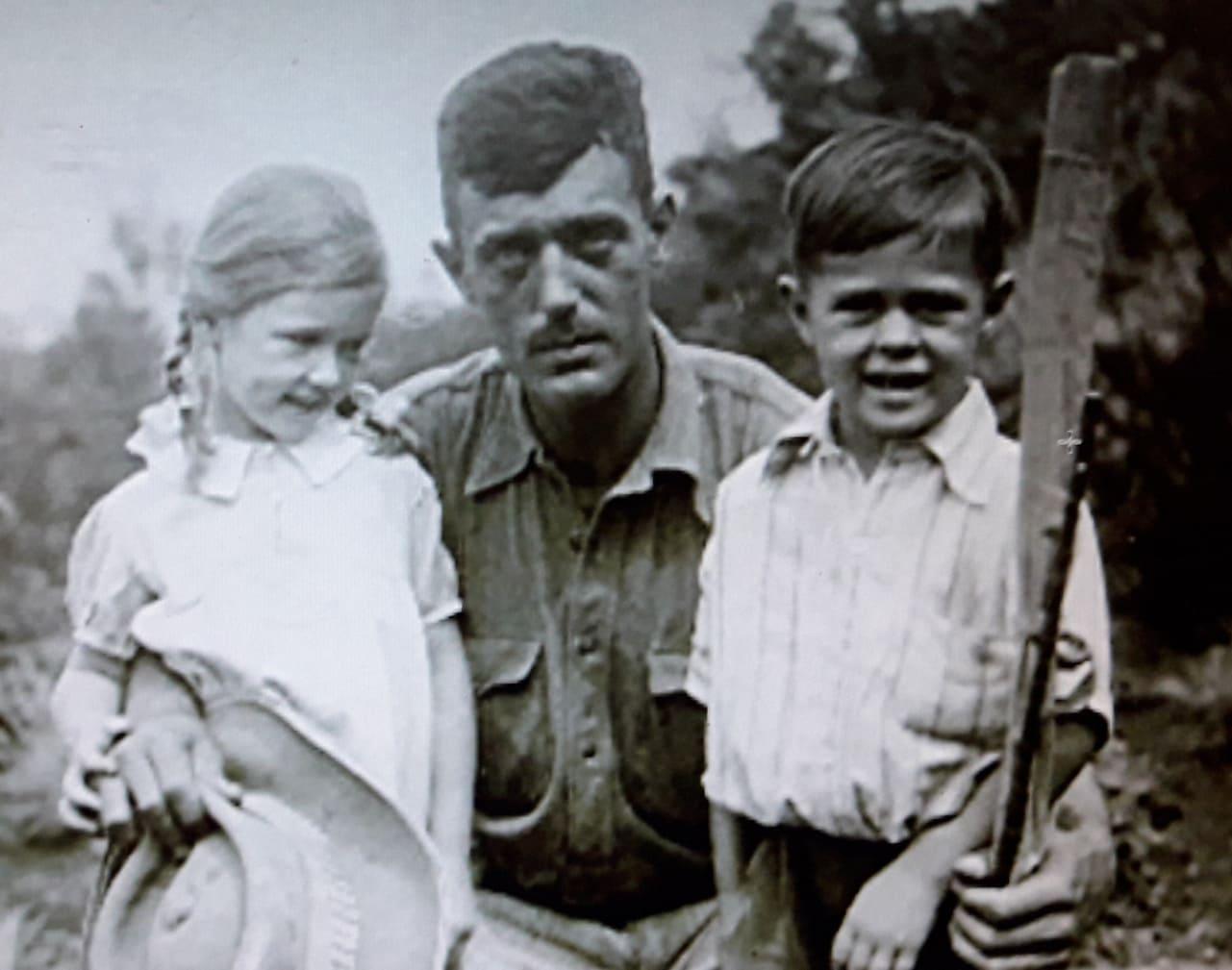
NOTE
We had a very warm welcome to the family home at Plumstead Cape Town.
After ten days with my family we moved to Hout Bay where Mrs Thomas lent us her
delightful seaside cottage. She also provided us with two excellent maids so I had
nothing to do but rest and play on the beach with the children.After a month at the sea George had fully recovered his health though not his
former gay spirits. After another six months with my parents I set off for home with Kate,
leaving Ann and George in my parent’s home under the care of my elder sister,
Marjorie.One or two incidents during that visit remain clearly in my memory. Our children
had never met elderly people and were astonished at the manifestations of age. One
morning an elderly lady came around to collect church dues. She was thin and stooped
and Ann surveyed her with awe. She turned to me with a puzzled expression and
asked in her clear voice, “Mummy, why has that old lady got a moustache – oh and a
beard?’ The old lady in question was very annoyed indeed and said, “What a rude little
girl.” Ann could not understand this, she said, “But Mummy, I only said she had a
moustache and a beard and she has.” So I explained as best I could that when people
have defects of this kind they are hurt if anyone mentions them.A few days later a strange young woman came to tea. I had been told that she
had a most disfiguring birthmark on her cheek and warned Ann that she must not
comment on it. Alas! with the kindest intentions Ann once again caused me acute
embarrassment. The young woman was hardly seated when Ann went up to her and
gently patted the disfiguring mark saying sweetly, “Oh, I do like this horrible mark on your
face.”I remember also the afternoon when Kate and George were christened. My
mother had given George a white silk shirt for the occasion and he wore it with intense
pride. Kate was baptised first without incident except that she was lost in admiration of a
gold bracelet given her that day by her Godmother and exclaimed happily, “My
bangle, look my bangle,” throughout the ceremony. When George’s turn came the
clergyman held his head over the font and poured water on George’s forehead. Some
splashed on his shirt and George protested angrily, “Mum, he has wet my shirt!” over
and over again whilst I led him hurriedly outside.My last memory of all is at the railway station. The time had come for Kate and
me to get into our compartment. My sisters stood on the platform with Ann and George.
Ann was resigned to our going, George was not so, at the last moment Sylvia, my
younger sister, took him off to see the engine. The whistle blew and I said good-bye to
my gallant little Ann. “Mummy”, she said urgently to me, “Don’t forget to wave to
George.”And so I waved good-bye to my children, never dreaming that a war would
intervene and it would be eight long years before I saw them again.December 15, 2021 at 3:37 pm #6238In reply to: The Elusive Samuel Housley and Other Family Stories
Ellen (Nellie) Purdy
My grandfathers aunt Nellie Purdy 1872-1947 grew up with his mother Mary Ann at the Gilmans in Buxton. We knew she was a nurse or a matron, and that she made a number of trips to USA.
I started looking for passenger lists and immigration lists (we had already found some of them, and my cousin Linda Marshall in Boston found some of them), and found one in 1904 with details of the “relatives address while in US”.
October 31st, 1904, Ellen Purdy sailed from Liverpool to Baltimore on the Friesland. She was a 32 year old nurse and she paid for her own ticket. The address of relatives in USA was Druid Hill and Lafayette Ave, Baltimore, Maryland.
I wondered if she stayed with relatives, perhaps they were the Housley descendants. It was her great uncle George Housley who emigrated in 1851, not so far away in Pennsylvania. I wanted to check the Baltimore census to find out the names at that address, in case they were Housley’s. So I joined a Baltimore History group on facebook, and asked how I might find out. The people were so enormously helpful! The address was the Home of the Friendless, an orphanage. (a historic landmark of some note I think), and someone even found Ellen Purdy listed in the Baltimore directory as a nurse there.
She sailed back to England in 1913. Ellen sailed in 1900 and 1920 as well but I haven’t unraveled those trips yet.
THE HOME OF THE FRIENDLESS, is situated at the corner of Lafayette and Druid Hill avenues, Baltimore. It is a large brick building, which was erected at a cost of $62,000. It was organized in 1854.The chief aim of the founders of this institution was to respond to a need for providing a home for the friendless and homeless children, orphans, and half-orphans, or the offspring of vagrants. It has been managed since its organization by a board of ladies, who, by close attention and efficient management, have made the institution one of the most prominent charitable institutions in the State. From its opening to the present time there have been received 5,000 children, and homes have been secured for nearly one thousand of this number. The institution has a capacity of about 200 inmates. The present number of beneficiaries is 165. A kindergarten and other educational facilities are successfully conducted. The home knows no demonimational creed, being non-sectarian. Its principal source of revenue is derived from private contributions. For many years the State has appropriated different sums towards it maintenance, and the General Assembly of 1892 contributed the sum of $3,000 per annum.
A later trip: The ship’s manifest from May 1920 the Baltic lists Ellen on board arriving in Ellis Island heading to Baltimore age 48. The next of kin is listed as George Purdy (her father) of 2 Gregory Blvd Forest Side, Nottingham. She’s listed as a nurse, and sailed from Liverpool May 8 1920.
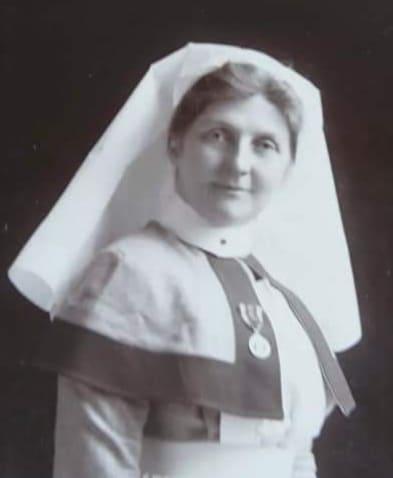
Ellen eventually retired in England and married Frank Garbett, a tax collector, at the age of 51 in Herefordshire. Judging from the number of newspaper articles I found about her, she was an active member of the community and was involved in many fundraising activities for the local cottage hospital.
Her obituary in THE KINGTON TIMES, NOVEMBER 8, 1947:
Mrs. Ellen Garbett wife of Mr. F. Garbett, of Brook Cottage, Kingsland, whose funeral took place at St. Michael’s Church, Kingsland, on October 30th, was a familiar figure in the district, and by her genial manner and kindly ways had endeared herself to many.
Mrs Garbett had had a wide experience in the nursing profession. Beginning her training in this country, she went to the Italian Riviera and there continued her work, later going to the United States. In 1916 she gained the Q.A.I.M.N.S. and returned to England and was appointed sister at the Lord Derby Military Hospital, an appointment she held for four years.We didn’t know that Ellen had worked on the Italian Riviera, and hope in due course to find out more about it.
Mike Rushby, Ellen’s sister Kate’s grandson in Australia, spoke to his sister in USA recently about Nellie Purdy. She replied: I told you I remembered Auntie Nellie coming to Jacksdale. She gave me a small green leatherette covered bible which I still have ( though in a very battered condition). Here is a picture of it.
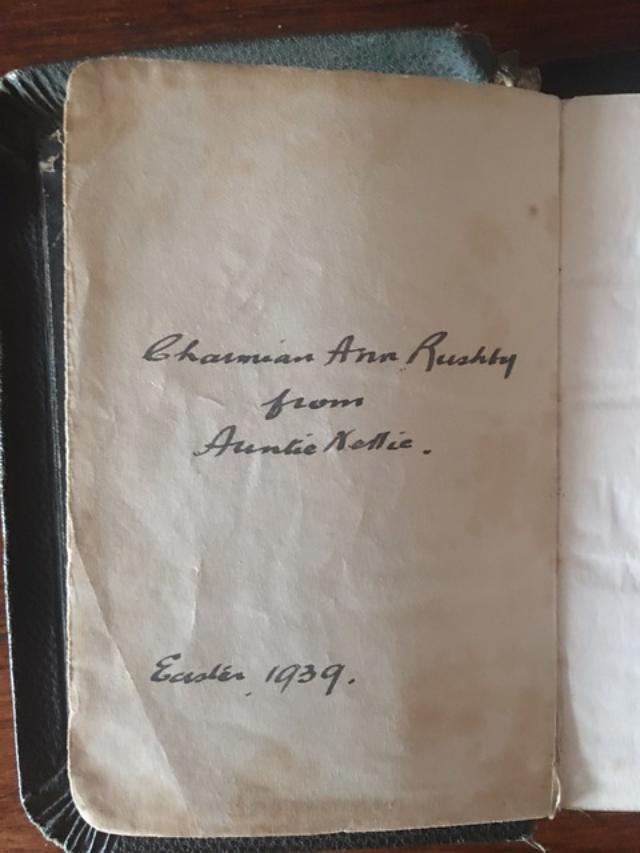 December 15, 2021 at 7:53 am #6234
In reply to: The Elusive Samuel Housley and Other Family Stories
Ben Warren
Derby County and England football legend who died aged 37 penniless and ‘insane’
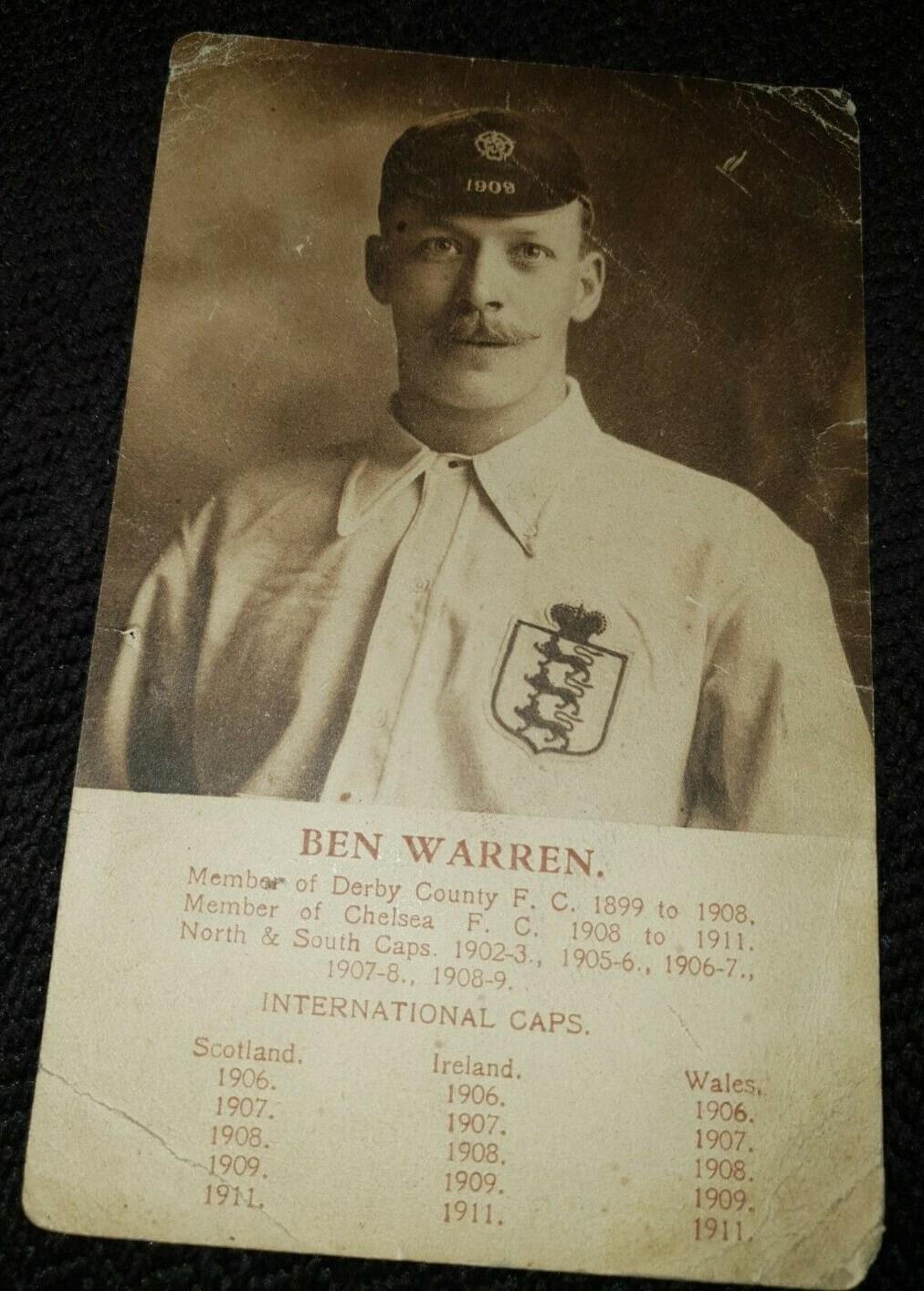
Ben Warren 1879 – 1917 was Samuel Warren’s (my great grandfather) cousin.
From the Derby Telegraph:
Just 17 months after earning his 22nd England cap, against Scotland at Everton on April 1, 1911, he was certified insane. What triggered his decline was no more than a knock on the knee while playing for Chelsea against Clapton Orient.
The knee would not heal and the longer he was out, the more he fretted about how he’d feed his wife and four children. In those days, if you didn’t play, there was no pay.
…..he had developed “brain fever” and this mild-mannered man had “become very strange and, at times, violent”. The coverage reflected his celebrity status.
On December 15, 1911, as Rick Glanvill records in his Official Biography of Chelsea FC: “He was admitted to a private clinic in Nottingham, suffering from acute mania, delusions that he was being poisoned and hallucinations of hearing and vision.”
He received another blow in February, 1912, when his mother, Emily, died. She had congestion of the lungs and caught influenza, her condition not helped, it was believed, by worrying about Ben.
She had good reason: her famous son would soon be admitted to the unfortunately named Derby County Lunatic Asylum.
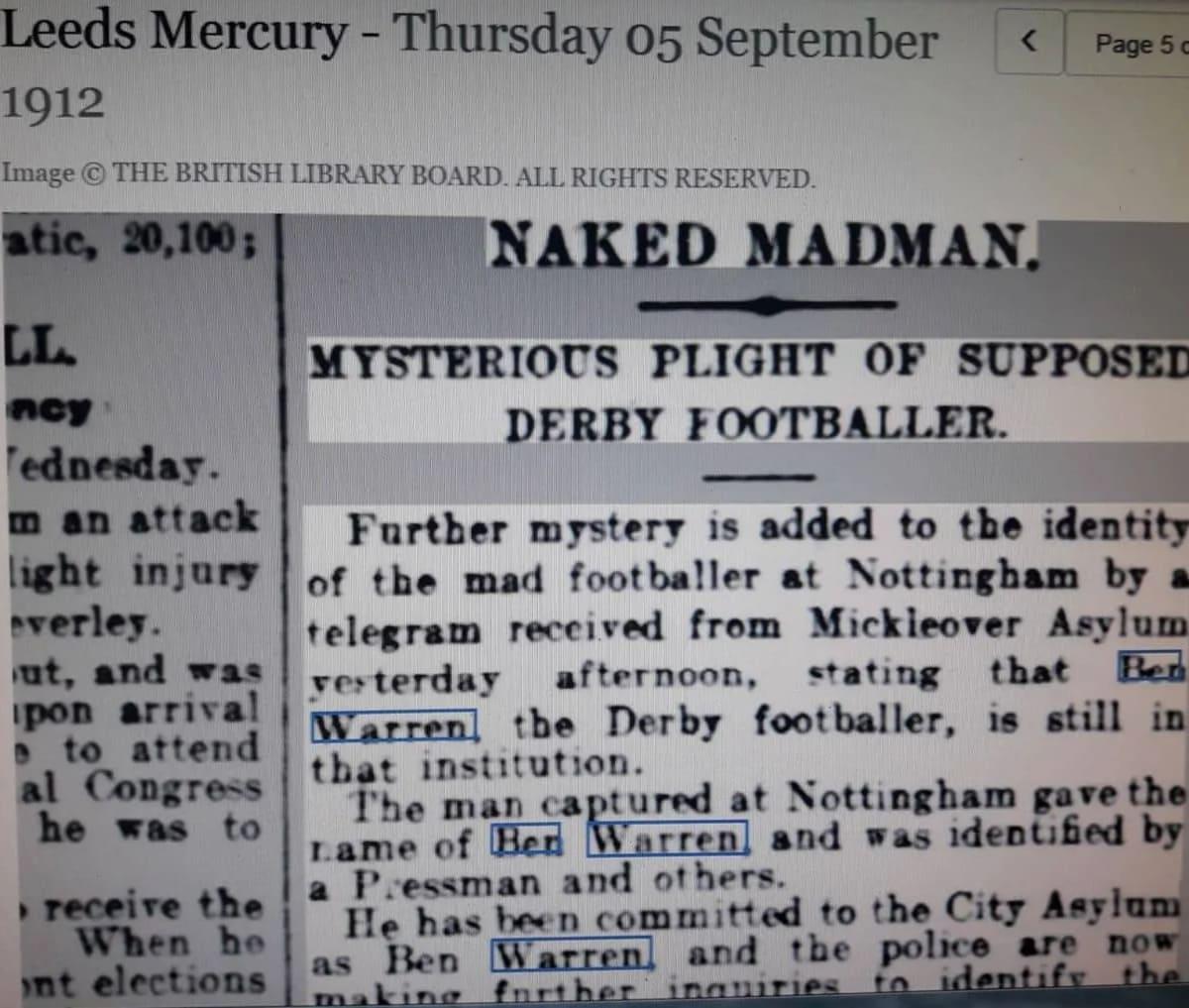
As Britain sleepwalked towards the First World War, Ben’s condition deteriorated. Glanvill writes: “His case notes from what would be a five-year stay, catalogue a devastating decline in which he is at various times described as incoherent, restless, destructive, ‘stuporose’ and ‘a danger to himself’.’”
photo: Football 27th April 1914. A souvenir programme for the testimonial game for Chelsea and England’s Ben Warren, (pictured) who had been declared insane and sent to a lunatic asylum. The game was a select XI for the North playing a select XI from The South proceeds going to Warren’s family.
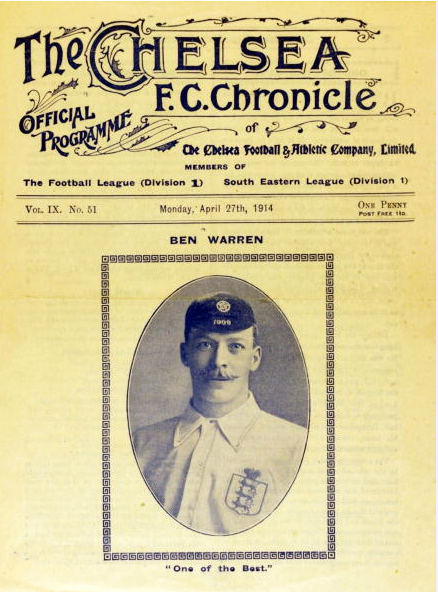
In September, that decline reached a new and pitiable low. The following is an abridged account of what The Courier called “an amazing incident” that took place on September 4.
“Spotted by a group of men while walking down Derby Road in Nottingham, a man was acting strangely, smoking a cigarette and had nothing on but a collar and tie.
“He jumped about the pavement and roadway, as though playing an imaginary game of football. When approached, he told them he was going to Trent Bridge to play in a match and had to be there by 3.30.”
Eventually he was taken to a police station and recognised by a reporter as England’s erstwhile right-half. What made the story even harder to digest was that Ben had escaped from the asylum and walked the 20 miles to Nottingham apparently unnoticed.
He had played at “Trent Bridge” many times – at least on Nottingham Forest’s adjacent City Ground.
As a shocked nation came to terms with the desperate plight of one of its finest footballers, some papers suggested his career was not yet over. And his relatives claimed that he had been suffering from nothing more than a severe nervous breakdown.
He would never be the same again – as a player or a man. He wasn’t even a shadow of the weird “footballer” who had walked 20 miles to Nottingham.
Then, he had nothing on, now he just had nothing – least of all self-respect. He ripped sheets into shreds and attempted suicide, saying: “I’m no use to anyone – and ought to be out of the way.”
“A year before his suicide attempt in 1916 the ominous symptom of ‘dry cough’ had been noted. Two months after it, in October 1916, the unmistakable signs of tuberculosis were noted and his enfeebled body rapidly succumbed.
At 11.30pm on 15 January 1917, international footballer Ben Warren was found dead by a night attendant.
He was 37 and when they buried him the records described him as a “pauper’.”
However you look at it, it is the salutary tale of a footballer worrying about money. And it began with a knock on the knee.
On 14th November 2021, Gill Castle posted on the Newhall and Swadlincote group:
I would like to thank Colin Smith and everyone who supported him in getting my great grandfather’s grave restored (Ben Warren who played for Derby, Chelsea and England)
The month before, Colin Smith posted:
My Ben Warren Journey is nearly complete.
It started two years ago when I was sent a family wedding photograph asking if I recognised anyone. My Great Great Grandmother was on there. But soon found out it was the wedding of Ben’s brother Robert to my 1st cousin twice removed, Eveline in 1910.
I researched Ben and his football career and found his resting place in St Johns Newhall, all overgrown and in a poor state with the large cross all broken off. I stood there and decided he needed to new memorial & headstone. He was our local hero, playing Internationally for England 22 times. He needs to be remembered.
After seeking family permission and Council approval, I had a quote from Art Stone Memorials, Burton on Trent to undertake the work. Fundraising then started and the memorial ordered.
Covid came along and slowed the process of getting materials etc. But we have eventually reached the final installation today.
I am deeply humbled for everyone who donated in January this year to support me and finally a massive thank you to everyone, local people, football supporters of Newhall, Derby County & Chelsea and football clubs for their donations.
Ben will now be remembered more easily when anyone walks through St Johns and see this beautiful memorial just off the pathway.
Finally a huge thank you for Art Stone Memorials Team in everything they have done from the first day I approached them. The team have worked endlessly on this project to provide this for Ben and his family as a lasting memorial. Thank you again Alex, Pat, Matt & Owen for everything. Means a lot to me.
The final chapter is when we have a dedication service at the grave side in a few weeks time,
Ben was born in The Thorntree Inn Newhall South Derbyshire and lived locally all his life.
He played local football for Swadlincote, Newhall Town and Newhall Swifts until Derby County signed Ben in May 1898. He made 242 appearances and scored 19 goals at Derby County.
28th July 1908 Chelsea won the bidding beating Leicester Fosse & Manchester City bids.
Ben also made 22 appearance’s for England including the 1908 First Overseas tour playing Austria twice, Hungary and Bohemia all in a week.
28 October 1911 Ben Injured his knee and never played football again
Ben is often compared with Steven Gerard for his style of play and team ethic in the modern era.
Herbert Chapman ( Player & Manager ) comments “ Warren was a human steam engine who played through 90 minutes with intimidating strength and speed”.
Charles Buchan comments “I am certain that a better half back could not be found, Part of the Best England X1 of all time”
Chelsea allowed Ben to live in Sunnyside Newhall, he used to run 5 miles every day round Bretby Park and had his own gym at home. He was compared to the likes of a Homing Pigeon, as he always came back to Newhall after his football matches.
Ben married Minnie Staley 21st October 1902 at Emmanuel Church Swadlincote and had four children, Harry, Lillian, Maurice & Grenville. Harry went on to be Manager at Coventry & Southend following his father in his own career as football Manager.
After Ben’s football career ended in 1911 his health deteriorated until his passing at Derby Pastures Hospital aged 37yrs
Ben’s youngest son, Grenville passed away 22nd May 1929 and is interred together in St John’s Newhall with his Father
His wife, Minnie’s ashes are also with Ben & Grenville.
Thank you again everyone.
RIP Ben Warren, our local Newhall Hero. You are remembered.
 April 24, 2021 at 8:02 pm #6193
In reply to: The Whale’s Diaries Collection
I hope all this social media as they call it stands the test of time because little things like this are priceless and so few and far between, and someday someone wants to know a little thing like this to paint a picture in their mind. I don’t know if this is one of ours as they say but but he was there too and could even have been one of you or another one of me, the possibilities are endless and the charm of the random snippet is boundless.
“The gallery stairs were honeycombed on
each side by old Jonathan Beniston’s spiked
crutches, and although Jonathan could not
read, he considered himself a valuable
addition to the choir, contributing a sort of
drone bass accompaniment to the melodies. after the style of a bagpipe ” chanter.”Here’s another one I want to include in my book:
Mr. Joseph Moss, formerly a framework knitter of Woodhouse Lane, for several years kept a Diary of the principal events and incidents in the locality: a most commendable undertaking. It is much to be regretted that so few attempt anything of the kind, so useful, and always interest- ing. Besides the registration of marriages and funerals, we have notices of storms, removals, accidents, sales, robberies, police captures, festivities, re-openings of churches, and many other matters. His record begins in 1855, ^^d ends in 1881, Mr. Moss was a violinist of some ability, and was in great demand at all rural festivities. He was a good singer, and sang (inter alia) ” The Beggar’s Ramble ” with his own local variations^ in good style, and usually with much eclat. The following are a few extracts from his Diary : —
” — July. Restoration of Horsley Church. New weathercock placed on spire by Charles, son of Mr. Anthony Kerry, the builder, on the 31st. A few days later, the south arches of the nave fell down, bringing with it the roofs of nave and south aisle. The pillar next the tower had been under- mined by the making of a grave, and as soon as the gravestone over it was moved the column began to settle : a loud shout was made, and the workmen had only just time to scamper out of the building before the roof and top windows and all came down.”
August 9, 2020 at 8:30 am #6100In reply to: The Precious Life and Rambles of Liz Tattler
Time indeed has told the story, notwithstanding no story was told during the time.
Eleven long years ago this story was told:
The writer wanted to write, full stop. The problem was that the writer’s desire to write was continually interrupted with things in brackets assuming monstrous and all comsuming proportions. Endless chains of things in brackets that always seemed to have priority.
“You could always write about the things in brackets, Ann,” remarked her new friend Lavender. “Might be fun. A thrilling blast, even.”
The era would later be known as the Bracket Age, a dark mysterious age lost in the mists of time when nothing was recorded, no story told, as the Things In Brackets took over what was left of the known world.
February 29, 2020 at 10:39 pm #5818In reply to: The Whale’s Diaries Collection
Dear Diary
Cousin Lisa came calling yesterday morning and she tells us there’s some in the Village have come down with sickness. Of course it would be Lisa being the bearer of such news, her face lit up when I tell her I have heard nothing. Cook, over hearing our conversation, which was private but Cook is always sticking her great nose in where it is not required, she’s hung braids of garlic at the front door. I caught her telling the children it was to keep away the evil spirits that brought death. Poor little Jimmy couldn’t sleep last night he was that afraid of the spirits bringing death in the night. He asked endless questions, how will the garlic stop them? Can the spirits get in through a window instead? He got his sister afraid also and the pair of them wouldn’t sleep then for crying in fear. I told Cook off roundly this morning for speaking to them thus.
The master came home filled with drink, crashing around like the damned drunken fool he is nowadays. He shouted at the children for their crying and shouted at me for not keeping them quiet. At least he did not raise his fists for he wanted to lie with me and I nearly retched with his stinking breath coming close and thank God for His mercies that the fool passed out before he could do the deed. I may have done harm if he’d tried for the brass bell was sitting there on the table (and it is a heavy thing) and I was seeing at it as he came close and there was a moment I could have picked it up and crashed it to his skull. May God forgive me.
He makes my skin crawl for I know what he has done that he thinks I don’t know. But all will come to light if not in this world then the next. I am more sure than ever I must get away and the children with me.
February 29, 2020 at 7:41 pm #5814In reply to: The Whale’s Diaries Collection
Day 2I feel sick in my stomach. Been days actually. Got to try something new, and a line a day seems like a good start.
Had dreams last night, it was months I didn’t get any. Nothing really out of the mundane, though I was selling the house in one of the dreams.
To think we’re still stuck on this nightmarish cruise, nor on land nor on water, and I dream of the house. The brain has a sense of humour.
The walls are paper thin, we can hear the endless complains of the nearby cruisers. That’s two left, one right, 3 across the corridor, and at least 2 above and below — that I can count at least. I call them my voices, makes me laugh a little. I didn’t tell Lorel, she would call me barmy. I thought of giving them numbers, it’s like reducing the complexity of human nature to something more… geometric? Reduce them to lines of code, maybe you can hack into the collective mind, make it work for you.
I think one of the voice is a pirate. It’s coughing Awwr, arr, arr more and more now. I’ll call him Eleven. Won’t be long before they catch him and isolate him. Good thing he’s the guy under and not above, from what I hear, the thing spreads through the loos too. Maybe he’ll make a run for it, I heard some tried to escape this hellhole. Well, they missed the free booze vouchers, too bad for them.
So long journal, wife is coming back from her trip to the other room. Yeah, I mean the loo, don’t you enjoy promiscuity. We’re not rolling in dough, couldn’t afford the presidential suite you see. Maybe if we survive longer than everybody else, it’ll be ours, who knows…
September 13, 2019 at 8:30 am #4818In reply to: Eight Turns of the Wheel
“Don’t you want to stay a little longer here?” Vincentius said to Arona after his bath in the hot springs of the Doline. Arona’s attention was caught by the dripping drops of water on the chiseled muscles, and took a while to answer.
She stretched lazily on the deck chair, slightly disturbing Mandrake who was napping by her side. He rolled on his side and resumed his nap.
“I don’t know, the place is nice enough. To speak true, it lacks a bit in decor and natural light; still… you wouldn’t find a nicer place to rest. Look at this white sandy beach… And to think that this pool connects to virtually anywhere, anywhen. Endless opportunities of explorations and travels are drawing you towards an adventure, don’t you think.”
“I think I only live to please you, just say the word, and I’ll follow you anywhere.”
“Aw, you’ve always been good at sweet-talking me. Don’t get me wrong, I like our occasional flings… for lack of a better word, but I like my independence. I have to keep exploring myself.”
Seeing a sadness fleeting in his eyes, she added “if only to meet you again and again.”
July 22, 2019 at 8:15 am #4705In reply to: Newsreel from the Rim of the Realm
Ric knees were shaking. He fumbled with the door knob, his voice barely audible as he faced Miss Boddy —he meant Bossy.
“We, we, we… We’re not seriously torturing poor old sweet Sophie, are you?”
Miss Bossy looked at Ric quizzically. “That’s what you thought we were doing? Do you think me demented?”
“Surely not, no! You’re very determined, distinguished… But demanding,…”
“Demented, Ric, please keep track, will you.”She sighed, and dropped the wires. “Of course! This is a line that can’t be uncrossed.”
“And surely Sweet Sophie doesn’t need torture to spill the beans.”
“Why do you keep talking about torture? I was just rewiring the dual light switch. The electrician did such a poor job, the wires were all crossed, and it was driving me mad, you know. Having one switch up, and the other down… One up, the other down… Aargh!”
Ric’s face was mixed with relief and complete puzzlement.
“Enough talking about my OCDs, why Sweet Sophie isn’t here yet? Of course, we don’t need torture to get her to talk. That’s all she does besides sleeping. The tricky part will be to get her to focus of course. Can’t have her babble about WWII now, can we. That and her endless talking about time travel… Speaking of time, there’s hardly any to waste, there’s a mad Doctor on the loose doing awful human experiments on unsuspecting frail women to flush out, need I remind you.”
July 8, 2019 at 7:40 pm #4631In reply to: Seven Twines and the Dragon Heartwoods
Fox had been out hunting wild geese for their diner.
He came back after sunset with three of them, golden. Glynis was sweeping the autumn leaves from the new terrace under the light of fireflies, an endless task. Fox handed her the golden geese.“They look so beautiful, and so peaceful,” she said, “look at those golden feathers.”
“They are dead,” said Fox with a hint of bitterness. “I’m not plucking them”, he added with a frown.
“I know”, said Glynis. She looked at him with a puzzled look. “Come closer into the light,” she asked him. The fireflies also came closer as if they obeyed her. He came, trying to keep his head down. She touched the bruises on his forehead and tsked. He shivered with pain. “You’ve been fighting again.”He said nothing. Instead he looked at the patio. The little rainbows were playing around Gorrash’s statue. Despite the sun being set, it was rock still. It had been broken during an attack by Leroway’s men. The shaman had tried to glue the pieces together and Fox had believed she could revive him. But it had remained still for months.
“I miss him too,” said Glynis. “But I’m sure he’s still there inside, or the little rainbows would not stay.”
“You know, a few months ago I would have believed you,” he started, “but it’s been months and nothing has changed.” Fox felt suddenly angry, at nothing and at everything. Anger was better than sadness or pain. But he didn’t want to hurt her so he grunted and walked into the house with the geese and without another word. -
AuthorSearch Results
