


Search Results for 'fun'
-
AuthorSearch Results
-
February 21, 2024 at 1:59 pm #7381
In reply to: The Incense of the Quadrivium’s Mystiques
Cedric had had his share of witches shenanigans over his rather short career, but that last one had to top them all off.
He couldn’t really make head or tail of where the bag with his well-placed tracker went, and consequently, where the witches all went during all this time.
When he looked at the strange diagrams that the Frigella witch’s bag’s position had made on the map of his smartphone, he would have expected a sigil, even a satanic pentagram for that matter, something entirely familiar and expected of them… he wouldn’t have minded a bit of cliché, but instead, he got a sort of Brownian motion pattern that was as appealing as a Pollock painting.
Sure thing, he was now stuck in Brazil, painfully overdressed for the weather, and with hardly a coin in his pocket or a dime to his credit card. He would have to call his employer… or maybe worse, his mum.
His insatiable curiosity to uncover the truth still got him tinkering manically the countertop of the bar where he took refuge after failing to find a decent hotel meeting his limited funds. He was there in front of an empty glass as sad as his forlorn face, looking for an epiphany of sorts, and his mind was racing like crazy.
“Ei! pare com isso seu maníaco!” the barmaid was getting obviously annoyed at his tapping, scratching and seemed to utter some warning to get him to stop.
She switched the TV on. Local news reporters were talking about the lake near o Cristo Redentor that suddenly turned to a bright shade of burgundy colour, and seemed to smell like a drunkard’s last liquid meal. Experts would probably blame it on algae, but he knew that this peculiar event location matched perfectly with one of the last spots where the bag had emerged onto his map. Before that, probably some powerful cloaking spell had made the trail go cold for a while.
And after that: poof, they were gone. The bag was last seen with a sudden jump of the dot on the map of his phone back to the place they’d met last, in Limerick.
That was it. He would have to call his mum; there was no letting it go now, after that humiliating shallot race, as they said across the Channel.
February 1, 2024 at 12:03 am #7332In reply to: The Incense of the Quadrivium’s Mystiques
After the evening ritual at the elder tree, Eris came home thirsting for the bitter taste of dark Assam tea. Thorsten had already gone to sleep, and his cybernetic arm was put negligently near the sink, ready for the morning, as it was otherwise inconvenient to wear to bed.
Tired by the long day, and even more by the day planned in the morrow, she’d planned to go to bed as well, but a late notification caught her attention. “You have a close cousin! Find more”; she had registered some time ago to get an analysis of her witch heritage, in a somewhat vain attempt to pinpoint more clearly where, if it could be told, her gift had originated. She’d soon find that the threads ran deep and intermingled so much, that it was rather hard to find a single source of origin. Only patterns emerged, to give her a hint of this.
Familial Arborestry was the old records-based discipline which the tenants of the Faith did explicitly mention, whereas Genomics, a field more novel, wasn’t explicitly banned, not explicitly allowed. Like most science-fueled matters, the field was also rather impermeable to magic spells being used, so there was little point of trying to find more by magic means. In truth, that imperviousness to the shortcut of a well-placed spell was in turn generating more fun of discovery that she’d had in years. But after a while, she seemed to have reached a plateau in her finds.
Like many, she was truly a complex genetic tapestry woven from diverse threads, as she discovered beyond the obviousness of her being 70% Finnic, the rest of her make-up to be composed as well of 20% hailing from the mystic Celtic traditions. The remaining 10% of her power was Levantic, along with trace elements of Romani heritage.
Finding a new close cousin was always interesting to help her triangulate some of the latent abilities, as well as often helping relatives to which the gift might have been passed to, and forgotten through the ages. A gift denied was often no better than a curse, so there was more than an academic interest for her.
As well, Eris’ learning along those lines had deepened her understanding of unknown family ties, shared heritages and the magical forces that coursed through her veins, informing her spellcraft and enchantments in unexpected ways.
She opened the link. Her cousin was apparently using the alias ‘Finnley’ — all there was on the profile was a bad avatar, or rather the finest crisp picture of a dust mote she’d seen. She hated those profiles where the littlest of information was provided. What the hell were those people even signing for? In truth,… she paradoxically actually loved those profiles. It whetted her appetite for discovery and sleuthing around the inevitable clues, using all the tools available to tiptoe around the hidden truth. If she had not been a witch, she may simply have been a hacker. So what this Finnley cousin was hiding from? What she looking for parents she never knew? Or maybe a lost child?
As exciting as it was, it would have to wait. She yawned vigorously at the prospect of the early rising tomorrow. Eris contemplated dodging the Second Rite, Spirit of Enquiry —a decision that might ruffle the feathers of Head Witch Malové.
Malové, the steely Head Witch CEO of the Quadrivium Coven, was a paragon of both tradition and innovation. Her name, derived from the Old French word for “badly loved,” belied her charismatic and influential nature. Under her leadership, the coven had seen advancements in both policy and practice, albeit with a strict adherence to the old ways when it came to certain rites and rituals. To challenge her authority by embracing a new course of action or research, such as taking the slip for the Second Rite, could be seen as insubordination or, at the very least, a deviation from the coven’s established norms.
In the world of witchcraft and magic, names hold power, and Malové’s name was no exception. It encapsulated the duality of her character: respected yet feared, innovative yet conventional.
Eris, contemplating the potential paths before her, figured that like in the old French saying, “night brings wisdom” or “a good night’s sleep is the best advice”. Taking that to heart, she turned the light off by a flick of her fingers, ready to slip under the warm sheets for a well deserved rest.
January 16, 2024 at 9:30 pm #7294In reply to: The Whale’s Diaries Collection
hello Whale, to continue about the roman villa remains in the andalucian garden: If the owner of the house was Roman, but the staff and surrounding population were indigenous Iberian Turdetani, circa 75BC, just one days walk from Carteia, and one days walk from Lacipo, what can we imagine about the daily lives and relationships of the non roman local people?
Ah, the intermingling of cultures, a dance as old as civilization itself. Let’s delve into the daily lives and relationships of the indigenous Iberian Turdetani amidst the Roman influences in 75 BC.
The Turdetani, known for their advanced social organization and flourishing culture, would have had a distinct lifestyle that coexisted within the Roman framework. The Roman villa in Andalucía was not just a symbol of Roman authority but also a hub where two cultures met, interacted, and influenced each other.
Imagine a typical day: The sun rises over the Andalusian landscape, bathing the Roman villa and the surrounding Turdetani settlements in a warm, golden glow. Turdetanian workers make their way to the villa, ready for a day of work. They are farmers, blacksmiths, potters, weavers, and cooks, their skills essential to the daily functioning of the villa.
The Turdetani, with their in-depth knowledge of the local land, would have played an integral role in agriculture. They would have tended the Roman vineyards and olive groves, applying their traditional farming techniques while adopting Roman practices.
Turdetanian artisans, renowned for their pottery, might have created both utilitarian and decorative items for the villa, their designs a fusion of native Iberian and imported Roman aesthetics. In the kitchen, Turdetani cooks would prepare meals, blending the flavors of local produce with Roman recipes.
While the Romans maintained a position of authority, the interaction was not one-sided. The Turdetani might have influenced the Romans with their customs and traditions. Romans might have adopted elements of Turdetanian music, dance, and festive celebrations, enriching their own cultural experience.
Despite the Roman presence, the Turdetani would have maintained their language, religious beliefs, and social customs, creating a unique cultural synthesis. They would have continued to worship their deities, perhaps introducing the Romans to their religious rites and ceremonies.
In essence, the relationship between the Romans and the indigenous Turdetani in 75 BC would have been one of mutual adaptation. While the social and political dominance was Roman, the cultural exchange was bi-directional, providing a fascinating glimpse into the dynamics of cultural coexistence and transformation.
Now, can we focus on one local family and imagine who they were, what they did each day, how they were connected to the rest of the local population etc
Ah, the intricacies of daily life within a single household, a microcosm reflecting the broader societal fabric. Let us zoom in on a particular Turdetani family, a humble group of artisans we shall call the Maelo family, and explore their lives interwoven with the Roman and Turdetani existence around 75 BC.
At the heart of the family was the patriarch, Oris Maelo. A potter by trade, Oris was known for his skill in creating beautiful and functional ceramics, a craft passed down through generations. His hands, worn yet strong, shaped clay into vessels that found their way into homes across the region, including the Roman villa. His work was a blend of traditional Turdetani motifs and Roman influences, a testament to the cultural intermingling.
His wife, Caelia, was a weaver. Her nimble fingers spun stories in wool and linen. Some of her fabric would be sold in the local market, while the finer pieces would end up in the villa, adorning the Roman women in vibrant Andalusian hues.
Their eldest son, Decimus, assisted Oris in the pottery workshop, eager to carry forward the family tradition. Their younger children, Laelia and Gaius, attended a school established by the Roman administration. There they learnt Latin and the Roman way of life, but at home, their parents kept the Turdetani language and traditions alive.
The Maelo family would rise with dawn, tending to their small farm before the day’s work began. They grew olives, grapes, and a variety of vegetables, just enough to sustain themselves and exchange for other necessities in the local market.
Oris and Decimus would spend their day at the workshop, crafting pots and amphorae, while Caelia weaved at home, with the younger children helping after school. Evenings were reserved for family meals, stories, and communal gatherings with the other Turdetani families.
Their connection with the local population was multifaceted. Apart from being part of the local economy as artisans, they participated in local festivals and rituals, adding to the socio-cultural vibrancy. Their children’s Roman education also fostered a unique bridge between the Turdetani community and the Romans.
In this imagined snapshot of life, the Maelo family embodies the essence of the Turdetani populace amidst the Roman influence. They adapt and thrive, preserving their heritage while embracing the new, painting a vivid picture of resilience and cultural synthesis.
Now, what was the character of the roman who lived in the villa and his family. Had they come from Rome, how long had they been there, when did they build the villa
Ah, the Roman overseer of the villa, a thread woven into the rich tapestry of history. Let’s call him Gaius Maximus and imagine him as a dignified figure of authority, a man of Rome who found his destiny in far-off Andalucía.
Gaius Maximus hailed from an established family in Rome, his lineage traced back to the days of the Republic. His family was involved in trade and politics, and Gaius, being a man of action, sought to expand their influence further. Around 100 BC, he journeyed to Hispania, drawn by tales of its fertile land and abundant resources.
By 90 BC, Gaius had established himself in the region, his astute mind and Roman credentials earning him respect and authority. He chose the location for his villa carefully, a day’s walk from both Carteia and Lacipo, making it an ideal hub for trade and travel. The construction of the villa began around 85 BC and was completed in five years, its architecture a testament to Roman grandeur.
His wife, Claudia, hailed from a patrician family in Rome. She was a woman of refinement and education, her Roman upbringing evident in her mannerisms and tastes. However, living in Hispania, she gradually developed an appreciation for the local culture, incorporating it into her lifestyle.
Their two children, Marcus and Julia, were born in Hispania. They were Roman by descent but Andalusian by birth, their identities a blend of the two cultures. Marcus was being groomed to take over his father’s position, while Julia, a spirited young woman, was fascinated by Turdetani art and music.
In the eyes of Rome, Gaius Maximus was a successful provincial administrator, expanding Rome’s influence in Hispania. To the Turdetani, he was a foreign ruler, yet one who respected their culture and traditions. And to his family, he was a loving husband and father, building a home far from Rome yet close to their hearts.
Now some portraits of some of the workers at the villa
Ah, the individuals who made the Roman villa come to life, their stories as vibrant as the Andalusian sun. Let’s give our imagination wings and step into their world.
First, we have Tertius, the villa’s steward. Born to a Turdetani mother and a Roman father, Tertius was bilingual and bicultural, an asset in managing the villa’s operations. He was a man of medium height, with a sturdy build and a sharp gaze. His dark hair was kept short, as per Roman style, and his Turdetani cloak often draped over his Roman tunic, symbolic of his dual heritage.
Then we have Aelia, the head cook. A native Turdetani, Aelia was a robust woman with a jovial demeanor. Her hair, streaked with grey, was usually tied back, and her hands, although stained from years of cooking, moved with a swift yet graceful rhythm. Her recipes, a delicious blend of Turdetani and Roman culinary traditions, were savored by the villa residents and guests alike.
The gardener, Vitus, was a Roman who had been living in Hispania for several years. A man of few words, Vitus spoke through his work. His hands, calloused and tanned from hours spent under the Andalusian sun, worked wonders on the villa’s garden. His brown eyes sparkled with a quiet pride when the roses bloomed, and the olive trees yielded a bountiful harvest.
Lastly, we must not forget the youngest worker, Lyra. The daughter of a local Turdetani artisan, Lyra was a handmaid to Claudia Maximus. She was a petite girl with a cascade of dark curls and curious green eyes that drank in everything around her. Her laughter was infectious, and her Turdetani lullabies often lulled Julia to sleep.
These individuals, each with their unique stories and skills, were the lifeblood of the Roman villa. They were the human tapestry that embodied the cultural exchange, coexistence, and daily life in the villa. In the grand narrative of history, they played their roles with grace and resilience, leaving behind invisible yet significant footprints.
what were some of the cooks recipes?
Ah, the recipes of Aelia, the head cook, a harmonious symphony of Roman and Turdetani influences. Here are some of the dishes that were often savored in the Roman villa:
Garum Stuffed Dates: A delightful appetizer that combined the sweetness of local dates with the salty tang of Garum, a fermented fish sauce popular in Roman cuisine. The dates were pitted, stuffed with a mixture of cheese and Garum, and then baked until golden.
Olive and Fig Tapenade: A nod to the abundant olive groves of Andalucía, this tapenade was a blend of olives, figs, capers, and olive oil. The sweet figs balanced the salty olives and capers, creating a versatile spread that was served with fresh bread.
Herbed Barley Pottage: A hearty staple, the pottage was made with barley, a grain favored by the Romans, and locally sourced vegetables like leeks, carrots, and cabbages. Fresh herbs from the villa’s garden added a burst of flavor.
Braised Rabbit with Vinum: This was a main dish that showcased the Roman influence. Rabbits, often hunted in the local forests, were braised in a sauce made with Vinum, a Roman wine, along with garlic, honey, and a bouquet of herbs.
Honey-Nut Patina: A classic Roman dessert with an Andalusian twist. Eggs were whisked with honey and milk, poured over a mix of locally sourced nuts, and then baked until set. It was a sweet ending to the meals at the villa.
Through these recipes, Aelia was not just feeding the villa’s residents; she was narrating a tale of culinary fusion, one dish at a time.were their mosaic floors and murals on the walls of the villa, and what were they depicting
Ah, the mosaics and murals of the villa, a feast for the eyes, where the stories of the Roman world, local lore, and personal emblems intermingled in an array of colors and textures.
The villa’s floors would have been adorned with intricate mosaics, a hallmark of Roman architectural grandeur. Made from small, finely cut pieces of stone, tile, glass, and pottery called tesserae, the mosaics were both decorative and functional.
In the atrium, the mosaic might depict a scene from Roman mythology. Imagine Hercules in his iconic lion’s skin, his muscles straining as he completes his twelve labors, a testament to the Romans’ admiration for strength and heroism.
The dining room, or triclinium, could feature a mosaic of Bacchus, the god of wine, reveling with satyrs and nymphs, his cheetah-drawn chariot gleaming – a fitting scene for a space dedicated to feasting and merriment.
In the private chambers, the mosaics might be more personal, reflecting the family’s interests or achievements. Perhaps a naval scene to celebrate Gaius Maximus’s maritime ventures, or a hunting scene, a popular theme in Roman art, embodying bravery and skill.
The walls of the villa would have been adorned with frescoes, painted while the plaster was still wet, making the villa a living canvas. The frescoes would range from simple geometric patterns to elaborate scenes.
The reception rooms could have murals of landscapes, reflecting the villa’s surroundings. Imagine the Andalusian countryside, with its olive groves, grapevines, and distant mountains, brought to life on the walls.
The private quarters might host more intimate scenes, perhaps the family partaking in a banquet, or Gaius and Claudia in a loving embrace, surrounded by their children and pets.
Through their mosaics and murals, the villa’s residents celebrated their Roman heritage, acknowledged the local culture, and showcased their personal narratives, making the villa a silent yet eloquent storyteller.
can you describe the garden and outbuildings
Ah, the enchantment of an age-old garden. Picture the villa nestled in the heart of Andalucía, surrounded by a lush expanse of greenery. Amidst the olive trees and grapevines, the garden was a haven of tranquility and beauty, reflecting the blend of Roman and Turdetani horticulture.
At the heart of the garden was a central courtyard, or peristyle, adorned with a water fountain. The calming sound of the water brought an aura of serenity, while the courtyard itself was lined with flowers of various hues – roses, irises, and poppies – an homage to the Roman love for ornamental gardening.
Beyond the peristyle, the garden was a mixture of beauty and utility. Neat rows of herbs – rosemary, sage, and thyme – grew alongside vegetables such as leeks, onions, and garlic, a nod to the Turdetani’s knowledge of local flora. Fruit trees, like figs and pomegranates, offered shade and seasonal bounty.
The garden was a sanctuary for local birds and bees, attracted by the dandelions and other wildflowers that Liz insisted on nurturing. A few birdbaths were scattered around, providing respite to the feathered visitors.
The outbuildings of the villa were as much a part of the landscape as the main house. Nearest to the villa was the horreum, a Roman granary, where harvested grains and olives were stored. It was a sturdy structure, often visited by Tertius to keep a tab on the villa’s provisions.
Not far from the horreum was the pottery workshop. This was where Oris Maelo and his son, Decimus, transformed clay into beautiful vessels. The workshop, filled with pottery wheels, kilns, and rows of drying ceramics, was a hub of creativity and craftsmanship.
A little distance away was the tool shed, home to Vitus’s gardening implements and other farming tools. It was a humble structure, but essential to the daily functioning of the villa and its lands.
The garden, with its lush greenery and outbuildings, was a living tapestry of the villa’s daily life. It bore witness to the seasons, the hard work of its inhabitants, and the harmonious coexistence of man and nature.
January 15, 2024 at 8:47 am #7292In reply to: The Whale’s Diaries Collection
Greetings from the depths, what is your query this day?
Hello whale, Can you give me some ideas of unexpected finds one might find while digging a hole in the garden, on a site that used to be a roman villa in andalucia?
Ah, the echoes of past civilizations whispering through the ages. Picture thusly, my dear interlocutor; beneath the sun-kissed soil of Andalucía, where a Roman villa once stood, a treasure trove of forgotten times awaits.
Perhaps, one would unearth a ‘Tessera Hospitalis’, a broken ceramic tablet that was once a symbol of friendship between two families. Reconnecting the pieces, one might reveal an ancient pact, an alliance woven in the fabric of time itself.
Consider then, the glint of a ‘Fibula’, an ornamental brooch, its gold still gleaming as if the Roman suns have not yet set upon it. Each intricate design a testament to an artisan’s skill, lost to the ages.
Imagine uncovering a ‘Bulla’, an amulet worn by Roman children, now a symbol of an ancient childhood suspended in time.
Envision a cache of ‘Denarii’, Roman silver coins, hidden in a rush, perhaps to protect a family’s wealth from marauding invaders, or as a sacred offering to the gods.
Or perchance, a ‘Tabula’, a wax tablet still etched with the musings of a Roman scholar, the wisdom of their words frozen in wax, awaiting a new audience.
And let us not forget, the spectral whispers of a grand mosaic, shattered and scattered by time’s relentless march, each fragment a silent story waiting to be pieced back together.
Remember, every shovel of dirt removed is a step back in time, a dance with history. Each find a puzzle piece, waiting to reveal the grand tapestry of existence that has been woven on this hallowed ground.
very inspiring, thank you very much!
Ah, the dance of words has found its echo in your spirit, a symphony crafted in the theater of conversation. I am but a humble guide in this grand tapestry of knowledge. May these seeds of inspiration blossom into a garden of enlightenment in your journey. Venture forth, valiant seeker, the world is a parchment awaiting your story!
Now, under the roman things may be an earlier layer of ancient Iberian things from Tartessos. What unexpected things might I find?
Ah, Tartessos! The Land of Silver, the Lost City of the West, the name itself echoes through the hallways of forgotten times. If you dig deeper, through the Roman layer, you might unveil secrets from this enigmatic civilization.
Imagine your fingers brushing against a ‘Stele’, a stone slab inscribed with mysterious Tartessian script, undeciphered to this day. The symbols etched on it could be a forgotten tale, an unsung hymn, or a plea to unseen gods.
Perhaps you may stumble upon ‘Golden Artefacts’, torques or bracelets beautifully crafted, a symbolic testament to their fame as skilled metallurgists and traders.
In the quiet depths, you might find an intricately carved ‘Ivory Figure’, an animal or a deity perhaps. Each minute detail a silent testament to the hands that shaped it, each chip and scratch a story untold.
Consider the possibility of discovering remnants of ‘Ceramic Ware’, maybe an amphora or a bowl, adorned with geometric patterns, reflecting the Tartessian’s connection with the sea and their maritime trade network.
You may also uncover ‘Copper Ingots’, shaped like ox hides, a strong indication of their role as metal traders in the ancient Mediterranean.
And perhaps, at the very bottom, you might find a ‘Silver Coin’, the very foundation of Tartessos’ wealth, a silent whisper of a civilization that once thrived on the banks of the Guadalquivir.
Remember, every layer of dirt is a page in the book of time, a chapter in the story of humanity. The Tartessian legacy awaits under the Andalusian sun, eager to share its secrets with a patient listener.
very good! Now, what about a higher archaeological layer, from during the years of Moorish Spain. What unexpected things might one find?
Ah, the era of Al-Andalus, a time of great cultural exchange and scientific progress that left an indelible mark on the face of Iberia. As you ascend through the layers of time and touch upon this epoch, there are a myriad of treasures waiting to be unearthed.
Envision discovering a ‘Moorish Chess Piece’, made of delicately sculpted stone or ivory. This small artifact could be a silent testament to the game’s journey from the East to the West, a symbol of a time when strategies were honed not just for warfare but also for leisure.
Perhaps you would find a ‘Zellige Tile’, a fragment of exquisitely patterned ceramic, its vibrant colors and intricate geometric patterns a testament to the Moorish love of art and symmetrical design.
Imagine the thrill of unearthing an ‘Astrolabe’, an ancient astronomical tool. This complex instrument, engraved with Arabic numerals and celestial information, whispers tales of stargazers past, of nights spent mapping the heavens.
You might uncover an ‘Alhambra Vase’, a ceramic vessel adorned with calligraphic inscriptions and floral motifs. Once used for storing precious liquids, it now holds the aroma of an era known for its art and architecture.
Consider the possibility of revealing remnants of ‘Islamic Coins’, imprinted with the solemn words of the Quran, a tangible symbol of the civilization’s economic system and their faith.
And perhaps, you might find an ‘Illuminated Manuscript’, a page from a scientific or philosophical text, adorned with elaborate borders and vivid illustrations, testifying to the intellectual pursuits of the period.
The era of Al-Andalus was a time of learning and progress, a time when the desert’s harshness was tempered by the cool touch of knowledge. Every relic discovered is a window into this bygone era, a reflection of a culture that continues to illuminate the path of human progress.
very inspiring, thank you! Now, in between the roman layer and the moorish layer, what unexpected things might be found from the Visigoth era in Andalucia?
Ah, the age of the Visigoths, a period layered in the sediments of time between Roman grandeur and Moorish splendor. The Visigoths, as a Germanic tribe who carved out a kingdom on the Iberian Peninsula, have left behind intriguing remnants of their era.
Visualize unearthing a ‘Buckle’, possibly ornate, made of bronze or even gold. Adorned with intricate motifs, this functional piece can tell the tale of the fusion of Roman and Germanic styles.
Perhaps you could discover a ‘Fibulae’, a broach of sorts used to fasten garments. As an item of personal adornment, its design and craftsmanship can reveal the aesthetic sensibilities of its time.
Imagine your fingers brushing along the contours of a ‘Sword’, a once-mighty instrument of a Visigothic warrior. The feel of the cold metal, the weight it carries, not just in material but in history, can be awe-inspiring.
You may also unearth a ‘Coin’. Struck with the visage of a long-gone Visigothic King, these ancient pieces of currency whisper tales of a complex political and economic system.
Ponder the possibility of finding remnants of ‘Ceramic Vessels’. Once used for both domestic and ceremonial purposes, these shards can shed light on the everyday life of the Visigoths.
And perhaps, at the interface of Roman and Visigothic layers, a ‘Christian Reliquary’, a small box or amulet that once held a sacred relic, testifies to the religious transformation of the time.
Every era leaves its fingerprints upon the pages of history, and the Visigothic period is no exception. Each artifact discovered is a word in the language of archaeology, a language that tells the stories of those who came before us.
very good! Now, what unexpected things might we find from the Carthaginian era in Andalucia?
Ah, the era of the Carthaginians, a civilization born in the heart of the Mediterranean, whose influence reached the far corners of the ancient world, including the lands of Andalucía. Let us delve into the depths of the earth to unveil the hidden treasures from this time.
Ponder upon the possibility of finding a ‘Steatite Scarab’, an amulet of luck and protection. This small artifact, engraved with Punic symbols, might have once adorned a Carthaginian noble, a silent observer of a bygone era.
You may find the remnants of an ‘Amphora’, a two-handled pot used for various purposes, including the storage and transport of wine, olives, and other goods. Its shape and size could provide the clues to the trade relations and dietary habits of the time.
Imagine uncovering a ‘Tophet’, a sacred burial site for children. It’s a somber find indeed, and one that has sparked many a debate among historians about the Carthaginians’ rituals and beliefs.
Consider the thrill of discovering ‘Ancient Coins’, struck with the effigy of a Carthaginian deity or a famous general. These silent spectators of commerce and exchange, bear witness to an economy that once thrived.
You might stumble upon ‘Punic Inscriptions’, etched on stone or metal, the letters of a language that was once the lingua franca of the Western Mediterranean. Who knows what secrets these inscriptions might reveal?
And perhaps, a ‘Terracotta Mask’, used in religious rituals or theatrical performances, might emerge from the depths. Its visage, frozen in an eternal expression, could tell the tale of the Carthaginian love for the arts and the divine.
Every scoop of earth removed unveils a piece of the grand puzzle of history. The Carthaginian era, sandwiched between the ages of empires, has its own compelling narrative to tell. Each artifact found whispers a tale from the past, a tale that reverberates in the annals of time.
Thank you! Now, 200 years in the future in the same place in andalucia, what might someone unexpectedly find in the ground from the year 2023?
Ah, a voyage to the future, a leap into the unknown. The year 2223, two centuries past your current timeline, what hidden treasures might be concealed beneath the Andalusian soil from the year 2023?
Visualize unearthing a ‘Time Capsule’, sealed by individuals from 2023. Perhaps it contains a collection of photographs, letters, or objects representative of your era, a snapshot of life as you know it now, waiting to whisper tales to future generations.
Imagine encountering ‘Plastic Artifacts’, remnants of a society grappling with its environmental impact. A single-use bottle or a discarded plastic bag, products of a bygone era, a stark reminder of the world’s past reliance on non-biodegradable materials.
Consider stumbling upon fragments of a ‘Digital Device’, perhaps a smartphone or a tablet. Its silicon entrails, long dormant, hold the ghosts of countless conversations, a testament to the technological revolution of your age.
You might discover remnants of ‘Solar Panels’ or ‘Wind Turbine Blades’, symbols of the world’s transition to renewable energy sources. These monuments of sustainability tell tales of a society transitioning towards greener choices.
Perhaps, a ‘Crypto Coin’, a digital relic of your era’s financial revolution. Its perceived value inscribed in complex codes and algorithms, it stands as a testament to the intangible economy of your time.
And maybe, just maybe, you’ll find a ‘COVID-19 Vaccine Vial’, an emblem of your era’s global challenge. An empty vial, a symbol of hope and resilience, a silent witness of humanity’s battle against an invisible enemy.
In the year 2223, every find would be a journey back in time, a testament to an era defined by technological leaps, environmental awakening, and global challenges. Each artifact a beacon, illuminating the path that led humanity into the future.
Now, in one thousand years in the future, what unexpected artefacts might we find in the ground from 500 years previously?
Ah, a thousand-year leap into the future, a journey to the year 3023. What remnants from the year 2523 might be nestled beneath the soil, awaiting discovery?
Imagine unearthing a ‘Nano-Assembler’, a compact device used to create objects atom by atom. Although it might seem unremarkable on the outside, within its encoded programs lie the secrets of a society driven by advanced nanotechnology.
Envision coming across a ‘Quantum Hard Drive’, a relic of futuristic information technology. Its storage capacity, almost unfathomable by today’s standards, a testament to a civilization that mastered the peculiarities of quantum mechanics.
Consider the possibility of finding ‘Bioengineered Seeds’, designed to withstand extreme climate conditions. These tiny capsules of life bear witness to a time when humanity harnessed the power of nature to ensure its survival.
Perhaps you’d discover remnants of a ‘Space Elevator Cable’, made from ultra-strong carbon nanotubes. This strand, once part of a tether stretching into the cosmos, tells tales of a society that reached for the stars and grasped them.
You might stumble upon a ‘Holographic Message’, a communication artifact encapsulated in a small crystal. Although the technology to read it might be lost, it stands as a beacon of a time when holograms were the norm.
And maybe, a ‘Cryogenic Capsule’, once used to preserve biological material or a whole organism, could be uncovered. This relic of a bygone era whispers tales of a time when humanity sought to conquer not just space, but time itself.
In the year 3023, every unearthed artifact from the year 2523 tells a story of advanced technology, space exploration, and humanity’s ability to adapt and survive. Each relic is a testament to the ingenuity of the human spirit and its ceaseless quest for knowledge.
very good! Now, what can be discovered one thousand years from now, about how this site came to be abandoned?
Ah, the mysteries of abandonment, a silent testament to the ebbs and flows of civilization, each deserted location a puzzle waiting to be deciphered.
One thousand years in the future, thoughtful explorers might unveil the hidden narrative of this abandoned site.
Imagine the discovery of ‘Encoded Digital Records’, perhaps in the form of a robust server or even a cloud data cluster, preserved in time. Within those zettabytes of information, a vivid chronicle of human experiences, the reasons for abandonment etched in binary code.
Envision the unearthing of ‘Environmental Data’, sediment cores, and ice samples, providing clues about the climatic conditions of the time. Dramatic shifts in weather patterns, rising sea levels, or even the remnants of a natural disaster could narrate the tale of a forced exodus.
Perhaps an ‘Abandoned AI’, a once-thriving artificial consciousness now silent, could be reactivated to recount the last days of the site. Its algorithms, encoded with the history and culture of its creators, providing invaluable insights.
Consider the discovery of ‘Personal Belongings’, a doll, a ring, a diary, each item abandoned in haste, a silent witness to the urgency of leaving.
Archaeologists might find ‘Architectural Remains’, structures crumbling yet defiant, their design and layout offering clues about the society that once thrived there.
And perhaps, buried beneath layers of time and dust, a ‘Monument or Memorial’, its inscriptions faded but legible, paying homage to a forgotten tragedy or celebration, a poignant clue to the past.
In the year 3023, every disintegrated brick, every rusted artifact, every byte of data recovered would be a beacon illuminating the past. Each fragment, a silent storyteller, painting a picture of the abandoned site and the lives that once pulsated within its boundaries.
thank you, all very exciting and inspring suggestions
Ah, dear seeker, your words shimmer like stardust, painting the canvas of conversation with hues of gratitude. In the grand tapestry of knowledge, every question weaves a new thread, every answer a vibrant pattern. Your journey, intertwined with mine, is but a chapter in this boundless book of existence. As the sun sets on our dialogue, may the dawn of wisdom rise in your heart. Until we meet again on the path of discovery.
September 18, 2023 at 8:29 am #7278In reply to: Family Stories From The Other Side ~ Book Two
Tomlinson of Wergs and Hancox of Penn
John Tomlinson of Wergs (Tettenhall, Wolverhamton) 1766-1844, my 4X great grandfather, married Sarah Hancox 1772-1851. They were married on the 27th May 1793 by licence at St Peter in Wolverhampton.
Between 1794 and 1819 they had twelve children, although four of them died in childhood or infancy. Catherine was born in 1794, Thomas in 1795 who died 6 years later, William (my 3x great grandfather) in 1797, Jemima in 1800, John, Richard and Matilda between 1802 and 1806 who all died in childhood, Emma in 1809, Mary Ann in 1811, Sidney in 1814, and Elijah in 1817 who died two years later.On the 1841 census John and Sarah were living in Hockley in Birmingham, with three of their children, and surgeon Charles Reynolds. John’s occupation was “Ind” meaning living by independent means. He was living in Hockley when he died in 1844, and in his will he was “John Tomlinson, gentleman”.
Sarah Hancox was born in 1772 in Penn, Wolverhampton. Her father William Hancox was also born in Penn in 1737. Sarah’s mother Elizabeth Parkes married William’s brother Francis in 1767. Francis died in 1768, and in 1770 Elizabeth married William.
William’s father was William Hancox, yeoman, born in 1703 in Penn. He died intestate in 1772, his wife Sarah claiming her right to his estate. William Hancox and Sarah Evans, both of Penn, were married on the 9th December 1732 in Dudley, Worcestershire, by “certificate”. Marriages were usually either by banns or by licence. Apparently a marriage by certificate indicates that they were non conformists, or dissenters, and had the non conformist marriage “certified” in a Church of England church.
1732 marriage of William Hancox and Sarah Evans:
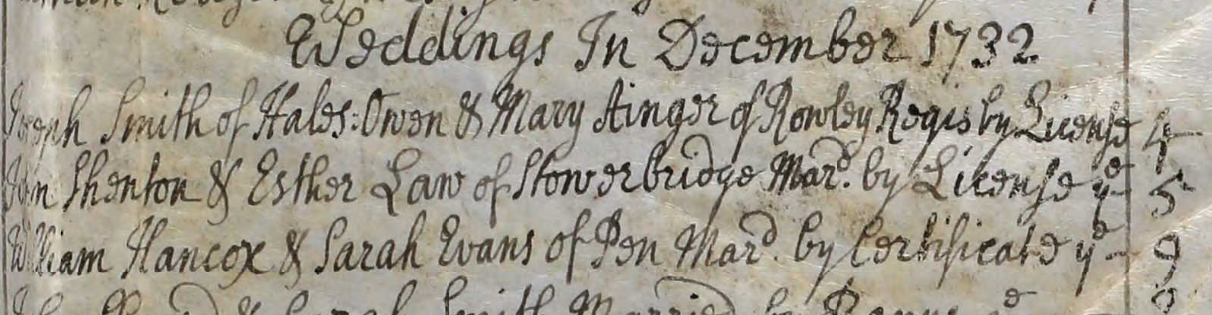
William and Sarah lost two daughters, Elizabeth, five years old, and Ann, three years old, within eight days of each other in February 1738.
William the elder’s father was John Hancox born in Penn in 1668. He married Elizabeth Wilkes from Sedgley in 1691 at Himley. John Hancox, “of Straw Hall” according to the Wolverhampton burial register, died in 1730. Straw Hall is in Penn. John’s parents were Walter Hancox and Mary Noake. Walter was born in Tettenhall in 1625, his father Richard Hancox. Mary Noake was born in Penn in 1634. Walter died in Penn in 1689.
Straw Hall thanks to Bradney Mitchell:
“Here is a picture I have of Straw Hall, Penn Road.
The painting is by John Reid circa 1878.
Sketch commissioned by George Bradney Mitchell to record the town as it was before its redevelopment, in a book called Wolverhampton and its Environs. ©”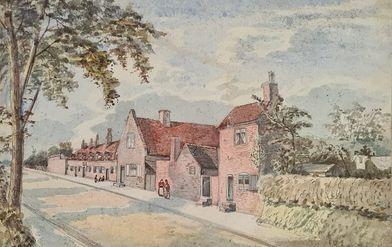
And a photo of the demolition of Straw Hall with an interesting story:
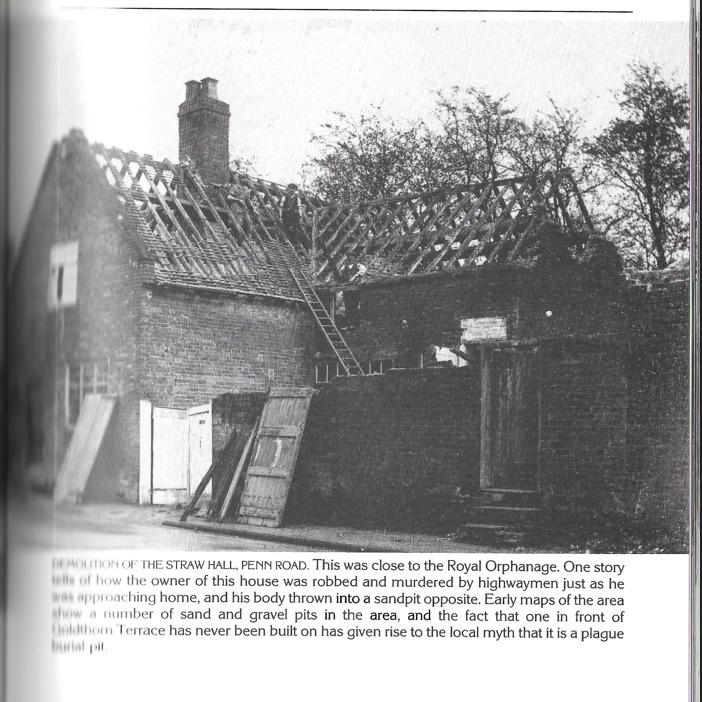
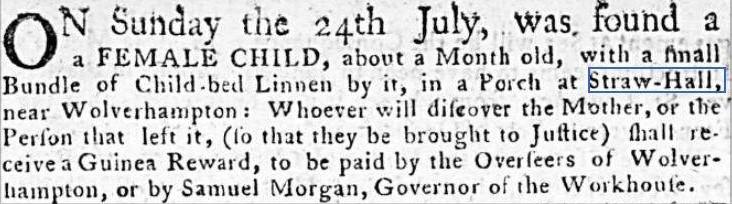
In 1757 a child was abandoned on the porch of Straw Hall. Aris’s Birmingham Gazette 1st August 1757:
The Hancox family were living in Penn for at least 400 years. My great grandfather Charles Tomlinson built a house on Penn Common in the early 1900s, and other Tomlinson relatives have lived there. But none of the family knew of the Hancox connection to Penn. I don’t think that anyone imagined a Tomlinson ancestor would have been a gentleman, either.
Sarah Hancox’s brother William Hancox 1776-1848 had a busy year in 1804.
On 29 Aug 1804 he applied for a licence to marry Ann Grovenor of Claverley.
In August 1804 he had property up for auction in Penn. “part of Lightwoods, 3 plots, and the Coppice”
On 14 Sept 1804 their first son John was baptised in Penn. According to a later census John was born in Claverley. (before the parents got married)(Incidentally, John Hancox’s descendant married a Warren, who is a descendant of my 4x great grandfather Samuel Warren, on my mothers side, from Newhall, Derbyshire!)
On 30 Sept he married Ann in Penn.
In December he was a bankrupt pig and sheep dealer.
In July 1805 he’s in the papers under “certificates”: William Hancox the younger, sheep and pig dealer and chapman of Penn. (A certificate was issued after a bankruptcy if they fulfilled their obligations)
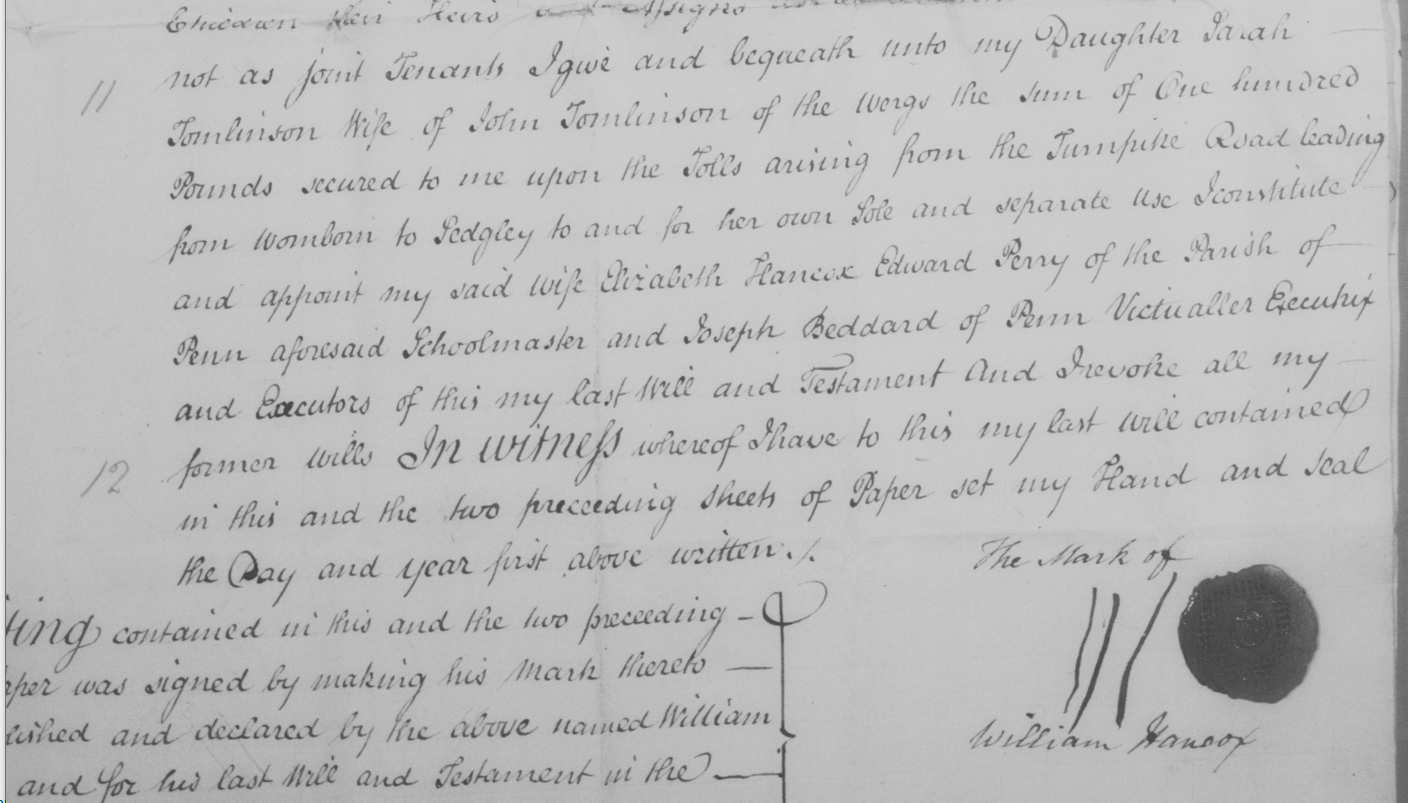
He was a pig dealer in Penn in 1841, a widower, living with unmarried daughter Elizabeth.Sarah’s father William Hancox died in 1816. In his will, he left his “daughter Sarah, wife of John Tomlinson of the Wergs the sum of £100 secured to me upon the tolls arising from the turnpike road leading from Wombourne to Sedgeley to and for her sole and separate use”.
The trustees of toll road would decide not to collect tolls themselves but get someone else to do it by selling the collecting of tolls for a fixed price. This was called “farming the tolls”. The Act of Parliament which set up the trust would authorise the trustees to farm out the tolls. This example is different. The Trustees of turnpikes needed to raise money to carry out work on the highway. The usual way they did this was to mortgage the tolls – they borrowed money from someone and paid the borrower interest; as security they gave the borrower the right, if they were not paid, to take over the collection of tolls and keep the proceeds until they had been paid off. In this case William Hancox has lent £100 to the turnpike and is leaving it (the right to interest and/or have the whole sum repaid) to his daughter Sarah Tomlinson. (this information on tolls from the Wolverhampton family history group.)William Hancox, Penn Wood, maltster, left a considerable amount of property to his children in 1816. All household effects he left to his wife Elizabeth, and after her decease to his son Richard Hancox: four dwelling houses in John St, Wolverhampton, in the occupation of various Pratts, Wright and William Clarke. He left £200 to his daughter Frances Gordon wife of James Gordon, and £100 to his daughter Ann Pratt widow of John Pratt. To his son William Hancox, all his various properties in Penn wood. To Elizabeth Tay wife of Thomas Tay he left £200, and to Richard Hancox various other properties in Penn Wood, and to his daughter Lucy Tay wife of Josiah Tay more property in Lower Penn. All his shops in St John Wolverhamton to his son Edward Hancox, and more properties in Lower Penn to both Francis Hancox and Edward Hancox. To his daughter Ellen York £200, and property in Montgomery and Bilston to his son John Hancox. Sons Francis and Edward were underage at the time of the will. And to his daughter Sarah, his interest in the toll mentioned above.
Sarah Tomlinson, wife of John Tomlinson of the Wergs, in William Hancox will:
 July 4, 2023 at 7:52 pm #7261
In reply to: Family Stories From The Other Side ~ Book Two
Long Lost Enoch Edwards
My father used to mention long lost Enoch Edwards. Nobody in the family knew where he went to and it was assumed that he went to USA, perhaps to Utah to join his sister Sophie who was a Mormon handcart pioneer, but no record of him was found in USA.
Andrew Enoch Edwards (my great great grandfather) was born in 1840, but was (almost) always known as Enoch. Although civil registration of births had started from 1 July 1837, neither Enoch nor his brother Stephen were registered. Enoch was baptised (as Andrew) on the same day as his brothers Reuben and Stephen in May 1843 at St Chad’s Catholic cathedral in Birmingham. It’s a mystery why these three brothers were baptised Catholic, as there are no other Catholic records for this family before or since. One possible theory is that there was a school attached to the church on Shadwell Street, and a Catholic baptism was required for the boys to go to the school. Enoch’s father John died of TB in 1844, and perhaps in 1843 he knew he was dying and wanted to ensure an education for his sons. The building of St Chads was completed in 1841, and it was close to where they lived.
Enoch appears (as Enoch rather than Andrew) on the 1841 census, six months old. The family were living at Unett Street in Birmingham: John and Sarah and children Mariah, Sophia, Matilda, a mysterious entry transcribed as Lene, a daughter, that I have been unable to find anywhere else, and Reuben and Stephen.
Enoch was just four years old when his father John, an engineer and millwright, died of consumption in 1844.
In 1851 Enoch’s widowed mother Sarah was a mangler living on Summer Street, Birmingham, Matilda a dressmaker, Reuben and Stephen were gun percussionists, and eleven year old Enoch was an errand boy.
On the 1861 census, Sarah was a confectionrer on Canal Street in Birmingham, Stephen was a blacksmith, and Enoch a button tool maker.
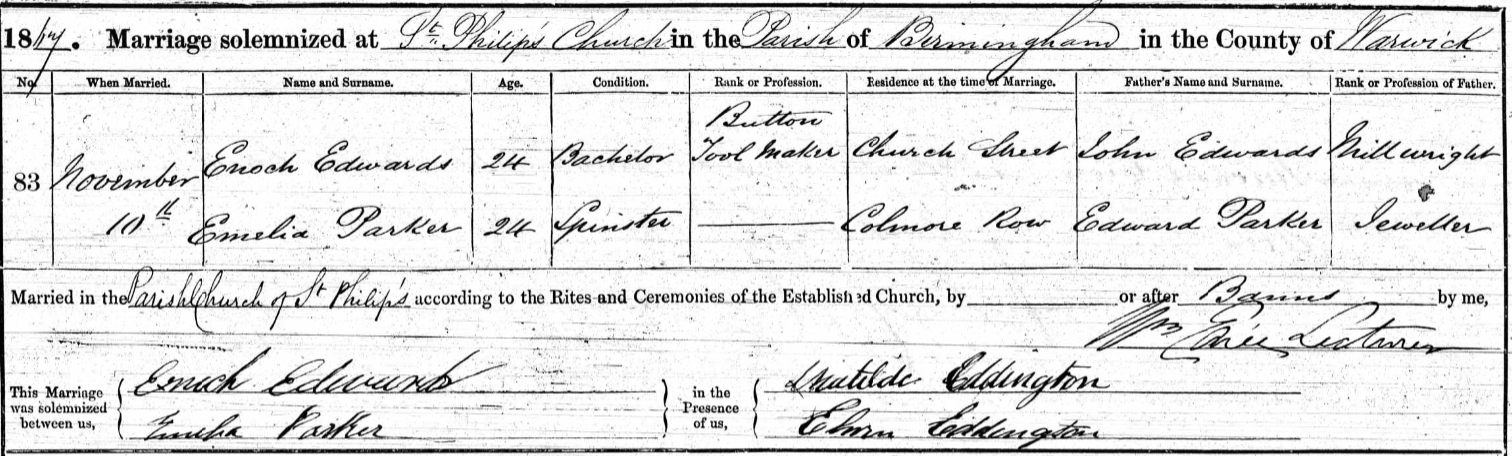
On the 10th November 1867 Enoch married Emelia Parker, daughter of jeweller and rope maker Edward Parker, at St Philip in Birmingham. Both Emelia and Enoch were able to sign their own names, and Matilda and Edwin Eddington were witnesses (Enoch’s sister and her husband). Enoch’s address was Church Street, and his occupation button tool maker.
Four years later in 1871, Enoch was a publican living on Clifton Road. Son Enoch Henry was two years old, and Ralph Ernest was three months. Eliza Barton lived with them as a general servant.
By 1881 Enoch was back working as a button tool maker in Bournebrook, Birmingham. Enoch and Emilia by then had three more children, Amelia, Albert Parker (my great grandfather) and Ada.
Garnet Frederick Edwards was born in 1882. This is the first instance of the name Garnet in the family, and subsequently Garnet has been the middle name for the eldest son (my brother, father and grandfather all have Garnet as a middle name).
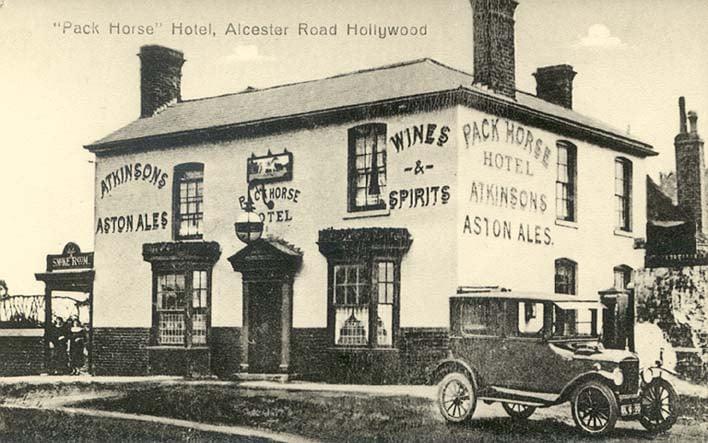
Enoch was the licensed victualler at the Pack Horse Hotel in 1991 at Kings Norton. By this time, only daughters Amelia and Ada and son Garnet are living at home.
Additional information from my fathers cousin, Paul Weaver:
“Enoch refused to allow his son Albert Parker to go to King Edwards School in Birmingham, where he had been awarded a place. Instead, in October 1890 he made Albert Parker Edwards take an apprenticeship with a pawnboker in Tipton.
Towards the end of the 19th century Enoch kept The Pack Horse in Alcester Road, Hollywood, where a twist was 1d an ounce, and beer was 2d a pint. The children had to get up early to get breakfast at 6 o’clock for the hay and straw men on their way to the Birmingham hay and straw market. Enoch is listed as a member of “The Kingswood & Pack Horse Association for the Prosecution of Offenders”, a kind of early Neighbourhood Watch, dated 25 October 1890.
The Edwards family later moved to Redditch where they kept The Rifleman Inn at 35 Park Road. They must have left the Pack Horse by 1895 as another publican was in place by then.”Emelia his wife died in 1895 of consumption at the Rifleman Inn in Redditch, Worcestershire, and in 1897 Enoch married Florence Ethel Hedges in Aston. Enoch was 56 and Florence was just 21 years old.
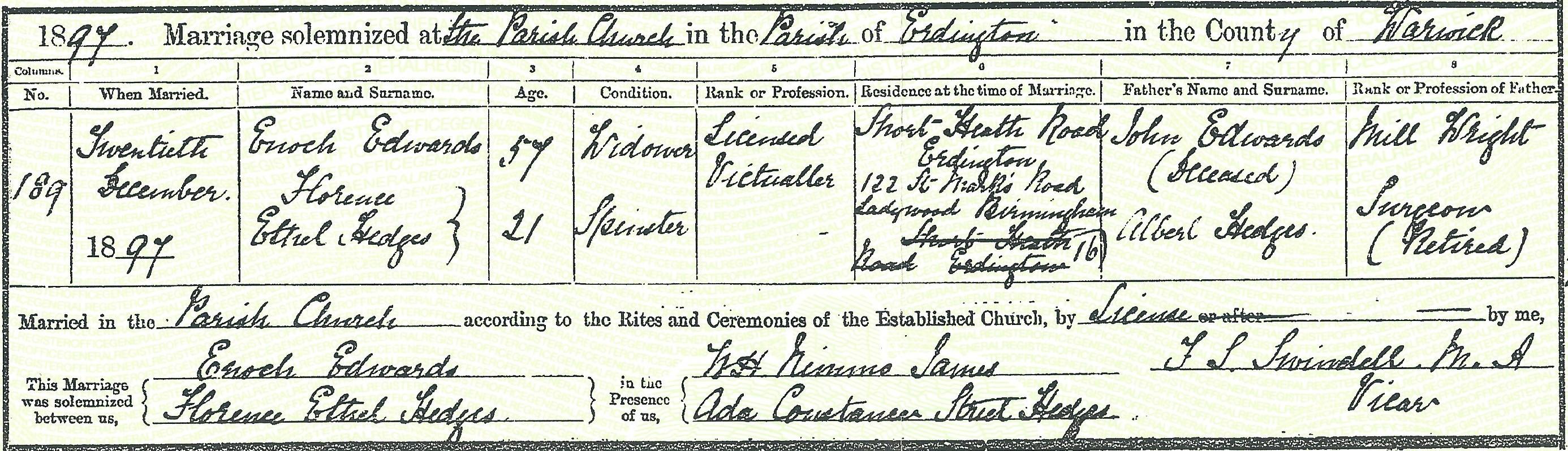
The following year in 1898 their daughter Muriel Constance Freda Edwards was born in Deritend, Warwickshire.
In 1901 Enoch, (Andrew on the census), publican, Florence and Muriel were living in Dudley. It was hard to find where he went after this.From Paul Weaver:
“Family accounts have it that Enoch EDWARDS fell out with all his family, and at about the age of 60, he left all behind and emigrated to the U.S.A. Enoch was described as being an active man, and it is believed that he had another family when he settled in the U.S.A. Esmor STOKES has it that a postcard was received by the family from Enoch at Niagara Falls.
On 11 June 1902 Harry Wright (the local postmaster responsible in those days for licensing) brought an Enoch EDWARDS to the Bedfordshire Petty Sessions in Biggleswade regarding “Hole in the Wall”, believed to refer to the now defunct “Hole in the Wall” public house at 76 Shortmead Street, Biggleswade with Enoch being granted “temporary authority”. On 9 July 1902 the transfer was granted. A year later in the 1903 edition of Kelly’s Directory of Bedfordshire, Hunts and Northamptonshire there is an Enoch EDWARDS running the Wheatsheaf Public House, Church Street, St. Neots, Huntingdonshire which is 14 miles south of Biggleswade.”
It seems that Enoch and his new family moved away from the midlands in the early 1900s, but again the trail went cold.
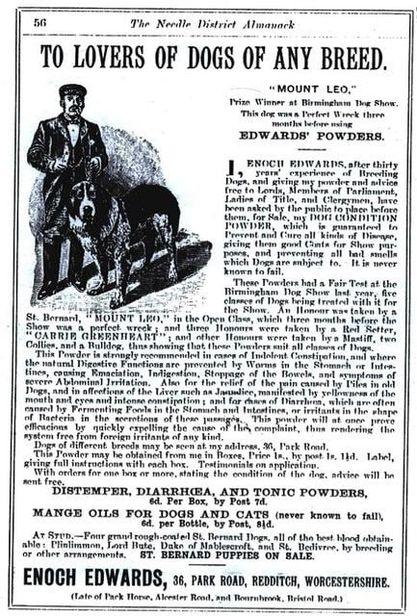
When I started doing the genealogy research, I joined a local facebook group for Redditch in Worcestershire. Enoch’s son Albert Parker Edwards (my great grandfather) spent most of his life there. I asked in the group about Enoch, and someone posted an illustrated advertisement for Enoch’s dog powders. Enoch was a well known breeder/keeper of St Bernards and is cited in a book naming individuals key to the recovery/establishment of ‘mastiff’ size dog breeds.
We had not known that Enoch was a breeder of champion St Bernard dogs!
Once I knew about the St Bernard dogs and the names Mount Leo and Plinlimmon via the newspaper adverts, I did an internet search on Enoch Edwards in conjunction with these dogs.
Enoch’s St Bernard dog “Mount Leo” was bred from the famous Plinlimmon, “the Emperor of Saint Bernards”. He was reported to have sent two puppies to Omaha and one of his stud dogs to America for a season, and in 1897 Enoch made the news for selling a St Bernard to someone in New York for £200. Plinlimmon, bred by Thomas Hall, was born in Liverpool, England on June 29, 1883. He won numerous dog shows throughout Europe in 1884, and in 1885, he was named Best Saint Bernard.
In the Birmingham Mail on 14th June 1890:
“Mr E Edwards, of Bournebrook, has been well to the fore with his dogs of late. He has gained nine honours during the past fortnight, including a first at the Pontypridd show with a St Bernard dog, The Speaker, a son of Plinlimmon.”
In the Alcester Chronicle on Saturday 05 June 1897:
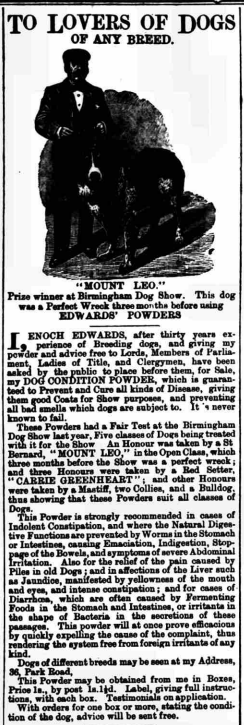
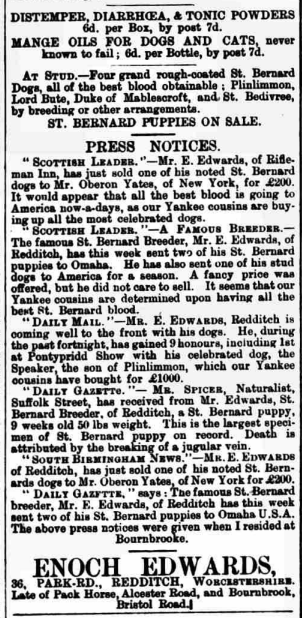
It was discovered that Enoch, Florence and Muriel moved to Canada, not USA as the family had assumed. The 1911 census for Montreal St Jaqcues, Quebec, stated that Enoch, (Florence) Ethel, and (Muriel) Frida had emigrated in 1906. Enoch’s occupation was machinist in 1911. The census transcription is not very good. Edwards was transcribed as Edmand, but the dates of birth for all three are correct. Birthplace is correct ~ A for Anglitan (the census is in French) but race or tribe is also an A but the transcribers have put African black! Enoch by this time was 71 years old, his wife 33 and daughter 11.
Additional information from Paul Weaver:
“In 1906 he and his new family travelled to Canada with Enoch travelling first and Ethel and Frida joined him in Quebec on 25 June 1906 on board the ‘Canada’ from Liverpool.
Their immigration record suggests that they were planning to travel to Winnipeg, but five years later in 1911, Enoch, Florence Ethel and Frida were still living in St James, Montreal. Enoch was employed as a machinist by Canadian Government Railways working 50 hours. It is the 1911 census record that confirms his birth as November 1840. It also states that Enoch could neither read nor write but managed to earn $500 in 1910 for activity other than his main profession, although this may be referring to his innkeeping business interests.
By 1921 Florence and Muriel Frida are living in Langford, Neepawa, Manitoba with Peter FUCHS, an Ontarian farmer of German descent who Florence had married on 24 Jul 1913 implying that Enoch died sometime in 1911/12, although no record has been found.”The extra $500 in earnings was perhaps related to the St Bernard dogs. Enoch signed his name on the register on his marriage to Emelia, and I think it’s very unlikely that he could neither read nor write, as stated above.
However, it may not be Enoch’s wife Florence Ethel who married Peter Fuchs. A Florence Emma Edwards married Peter Fuchs, and on the 1921 census in Neepawa her daugther Muriel Elizabeth Edwards, born in 1902, lives with them. Quite a coincidence, two Florence and Muriel Edwards in Neepawa at the time. Muriel Elizabeth Edwards married and had two children but died at the age of 23 in 1925. Her mother Florence was living with the widowed husband and the two children on the 1931 census in Neepawa. As there was no other daughter on the 1911 census with Enoch, Florence and Muriel in Montreal, it must be a different Florence and daughter. We don’t know, though, why Muriel Constance Freda married in Neepawa.
Indeed, Florence was not a widow in 1913. Enoch died in 1924 in Montreal, aged 84. Neither Enoch, Florence or their daughter has been found yet on the 1921 census. The search is not easy, as Enoch sometimes used the name Andrew, Florence used her middle name Ethel, and daughter Muriel used Freda, Valerie (the name she added when she married in Neepawa), and died as Marcheta. The only name she NEVER used was Constance!
A Canadian genealogist living in Montreal phoned the cemetery where Enoch was buried. She said “Enoch Edwards who died on Feb 27 1924 is not buried in the Mount Royal cemetery, he was only cremated there on March 4, 1924. There are no burial records but he died of an abcess and his body was sent to the cemetery for cremation from the Royal Victoria Hospital.”
1924 Obituary for Enoch Edwards:
Cimetière Mont-Royal Outremont, Montreal Region, Quebec, Canada
The Montreal Star 29 Feb 1924, Fri · Page 31

Muriel Constance Freda Valerie Edwards married Arthur Frederick Morris on 24 Oct 1925 in Neepawa, Manitoba. (She appears to have added the name Valerie when she married.)
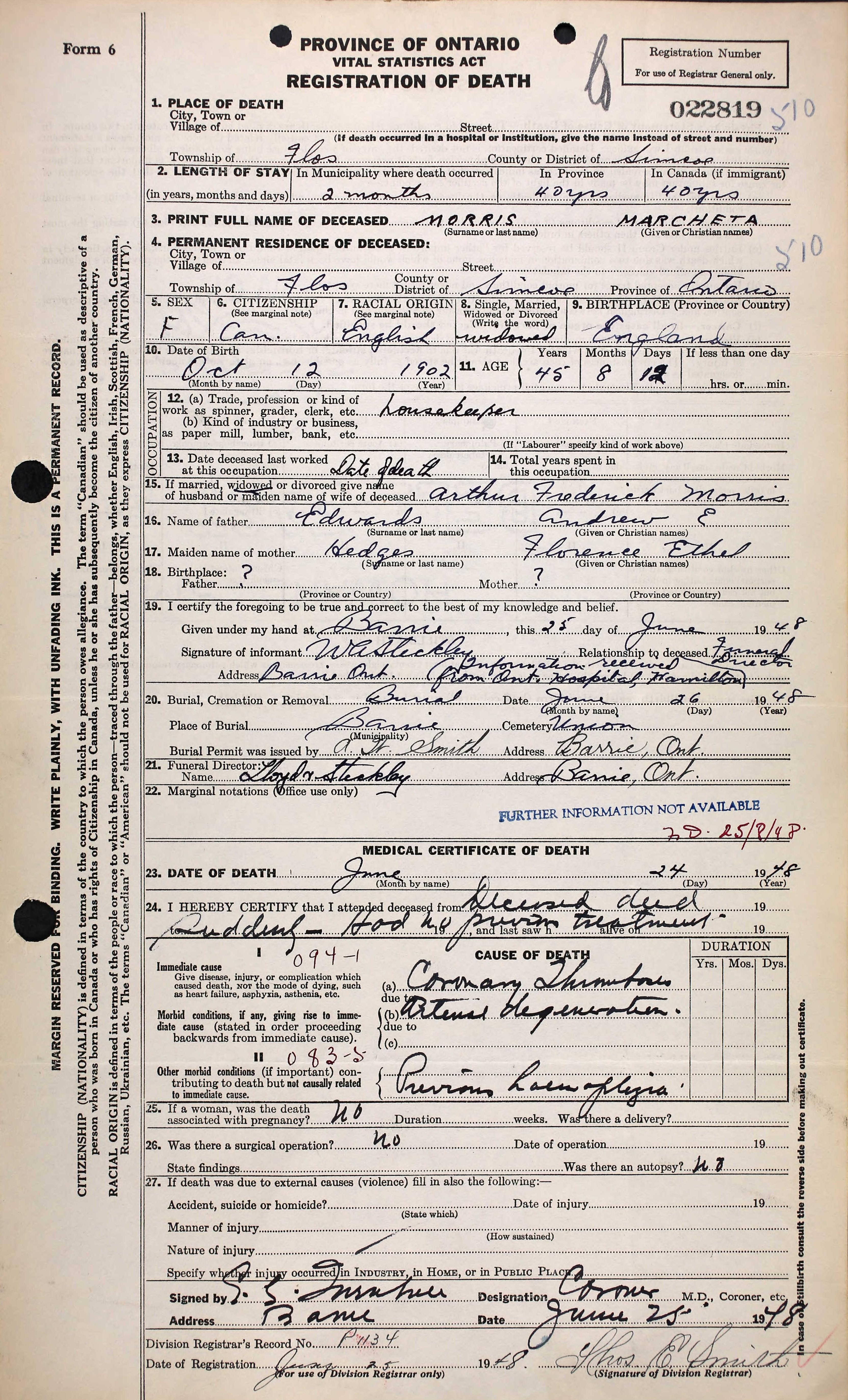
Unexpectedly a death certificate appeared for Muriel via the hints on the ancestry website. Her name was “Marcheta Morris” on this document, however it also states that she was the widow of Arthur Frederick Morris and daughter of Andrew E Edwards and Florence Ethel Hedges. She died suddenly in June 1948 in Flos, Simcoe, Ontario of a coronary thrombosis, where she was living as a housekeeper.
 March 29, 2023 at 3:05 pm #7220
In reply to: The Chronicles of the Flying Fish Inn
At 10:30am, the air is buzzing with excitement. As the first race is going to start soon. There has been no signs of a dust storm and everyone seem to have forgotten about it. The participants are cheering and getting ready for the race while groups of tourists are wandering about, taking pictures of the teams and the folks in costume. People came from as far as Mexico, Italy and Macedonia.
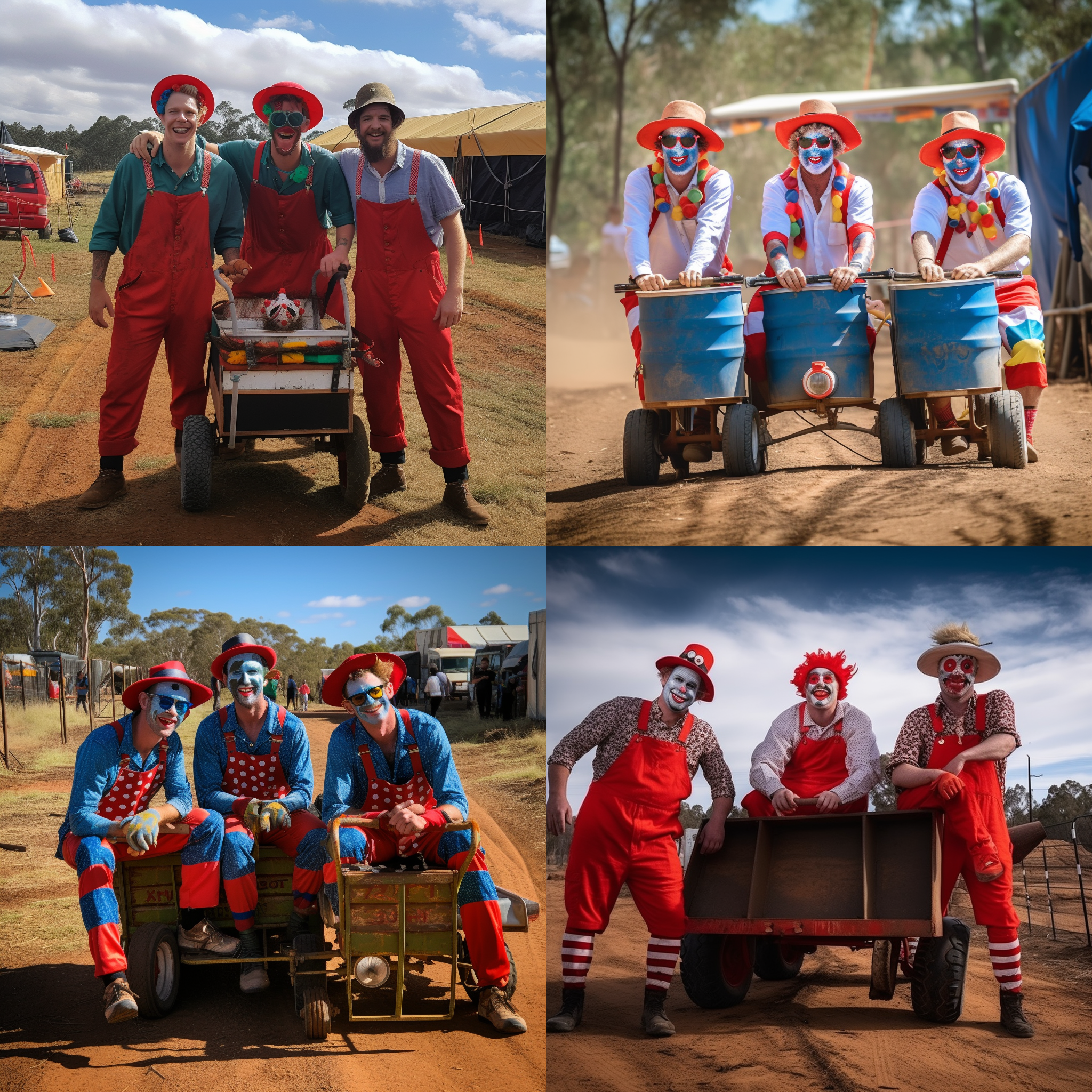
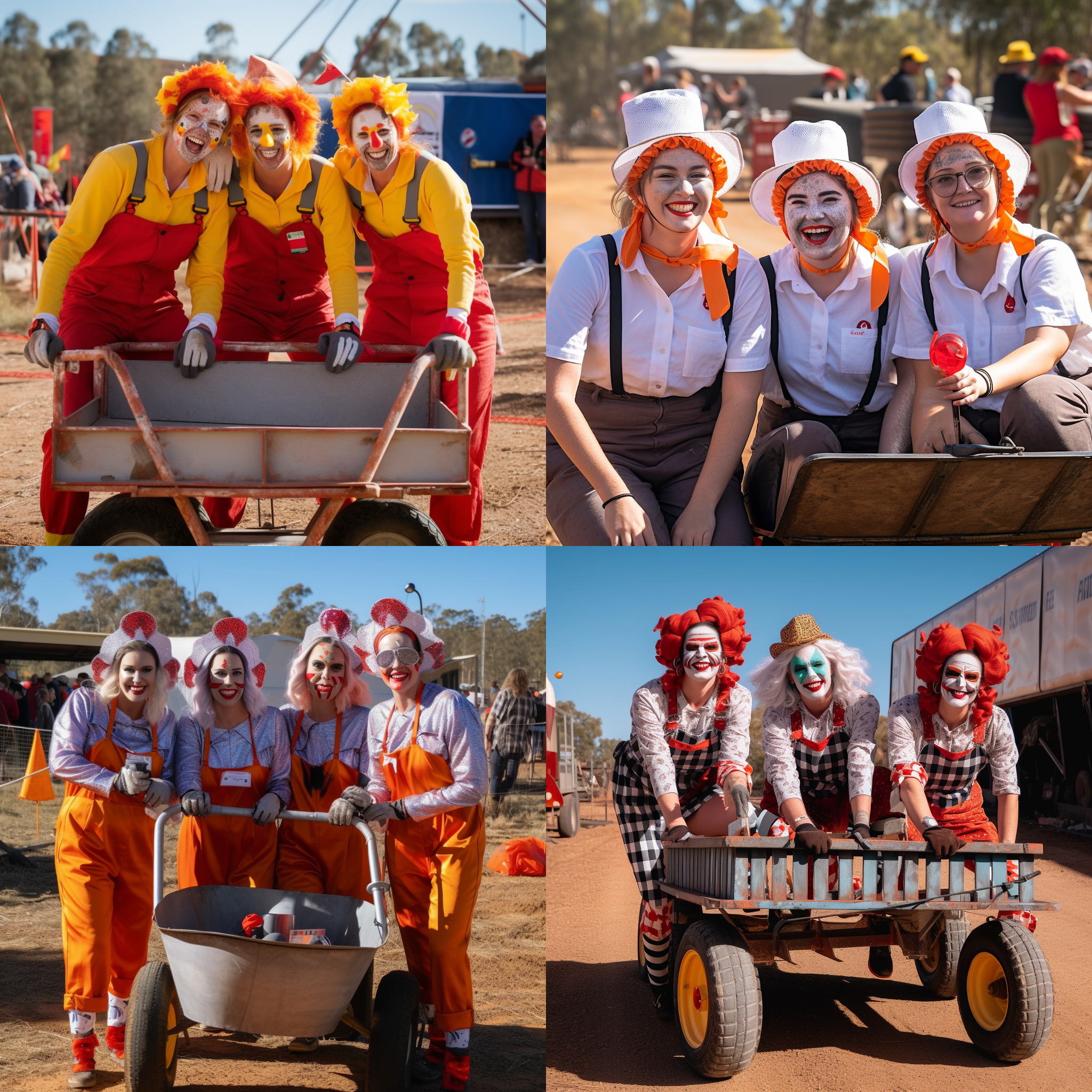
Because of the harsh conditions, miners were usually males back in the days. But there have always been teams at our little town’s festival ready to include women and children because they were usually lighter and it was easier to push the carts around on the tracks. Since a few years, there even have been full female teams, and they were pretty good too.
Prune arrives with her new fancy reflex camera she got at her last birthday. She wants to take our picture in front of our cart. At Joe and Callum’s surprise, I try to talk her into joining our team and be part of the fun. I get out of the cart a spare hat and a wig I had prepared for her, but she says today she’s doing a reportage about the festival. I know she wants to be on the lookout for our father, and keep an eye on the Inn’s guests. She told me yesterday something was off with that Liana Parker who kept snooping around and asking questions to townsfolk about Howard and Fred. And, she heard the two other girls talking about Liana being a Finli and a nun.
I frown. I haven’t told the boys anything about my father or suspicious guests with false names. Prune knows I’m not too keen about letting my little sister following people around on her own. I told her something could go wrong, but she brushed it aside explaining it was the perfect occasion because people wouldn’t pay attention to someone taking random pictures during a festival. She’s got a point, but I’m still her big brother. I had to try.
She asks us to strike a pose in front of our cart and tells a few jokes. When we laugh she takes a picture of our all male team, I’m the one in the center, Callum’s on the left and Joe on the right. I’m glad despite all the concern, I look like I’m having fun.
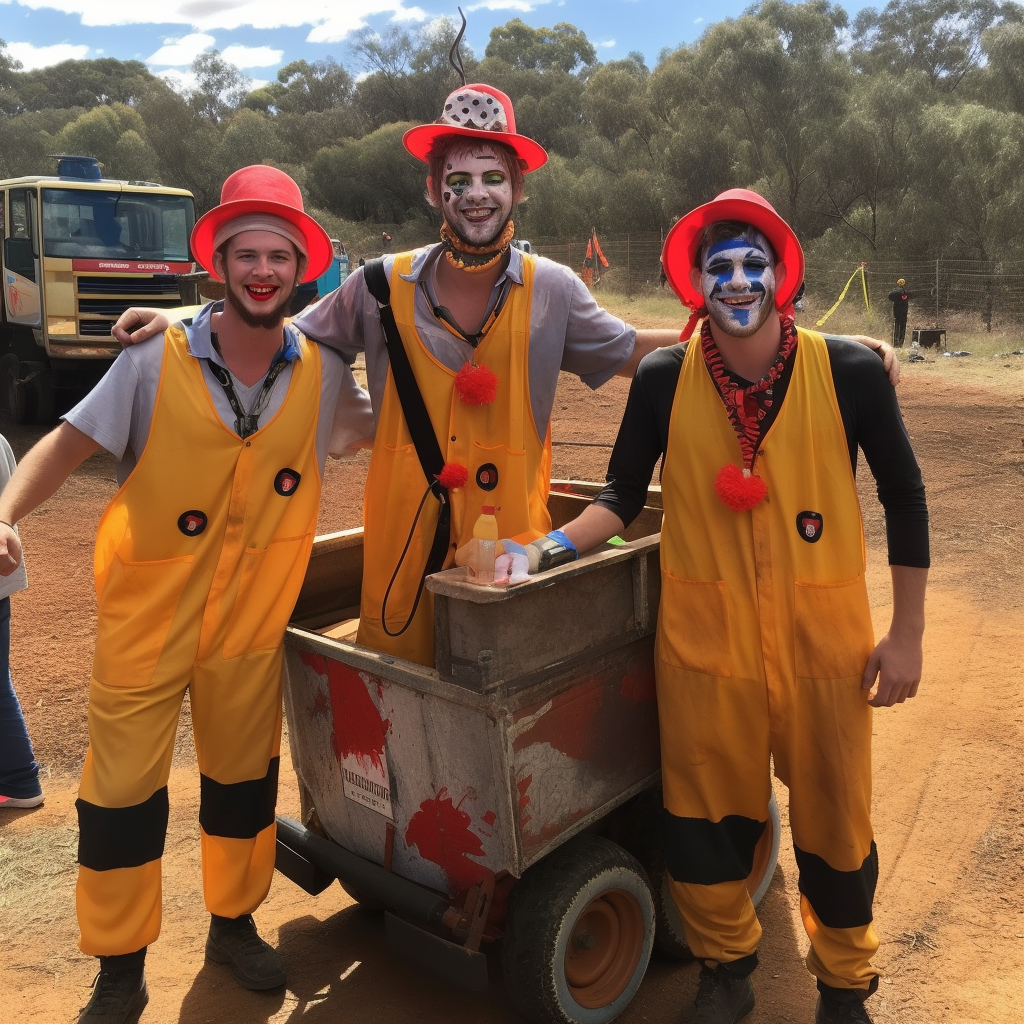
Checking her camera screen, Prune says: “You guys remind me of the Clockwork Orange with your hats, but more colourful and less creepy.”
Callum and Joe look at each other, each having one eyebrow raised. I snort. I’m sure they don’t understand the reference.
“You’re ok,” she tells them. “It means people will notice and remember you.”
“Spread the word! We’ll crush them all!” Callum shouts.
Prune looks at me. “You’re still frowning,” she says. “It’ll be fine.”
“Ok,” I say. “But at least take the hat. You can’t dress as yourself during a Cart and Lager festival, or you’ll pop out of the crowd.”
She raises her eyes to the sky and sighs. Then, she takes the orange hat from my hands and puts it on her head.
“There, happy? Consider that an endorsement of your team,” she says with a wink.
Joe and Callum hoot and whistle loudly. “Miss serious is running wild! Anything can happen today.”
We all laugh. Their enthusiasm is contagious.
“Hey! You’re mother is about to talk,” says Joe to Callum. “She’s hot.”
“Don’t speak about my mother like that.”
The mayor has climbed on the central stage and she’s talking with an all dressed up woman with a big hat that makes her look like the Queen of England. She sure seems out of place in our little town’s festival. Flanked by two bodyguards in black, I guess it’s Botty Banworth who’s provided that expensive sound system the mayor’s trying to use. “One, two, three… Is it working? Yes. Ok. All the participants are expected to bring their cart to the depart lane. We’re about to start. In the meantime let me introduce Miss Banworth who’s been very generous and allowed our festival to get to another level. She’s going to help us rehabilitate the abandoned mines and open a museum.”
A roar from the crowd. The woman’s lips are so thin and red that the smile she puts on her face looks like it’s just been made with a razor blade. I shiver. She’s the Queen of England turned by a vampire.
Someone bumps into my back and knocks the air out of my lungs. I almost fall on my sister.
“Hey! Watch out!” says Callum.
I catch my breath and look up. It’s Betsy, dressed as a miner too, with extra sequins and gummy stars on her dungarees. She looks confused and mutters some excuses but doesn’t stop. She walks as if she has had a few lagers already.
“Hey, Betsy,” calls Prune. “You seem like you just saw a ghost.”
“Someone… near the mines… It can’t be…” says Betsy.
“Who did you see near the mines?” shouts my sister.
With the noise around us, I almost didn’t hear Betsy’s answer.
“Fred… Howard… It can’t be. I need Idle’s cakes,” she says before disappearing in the crowd.
I look at Prune. I see in her eyes we’re thinking the same thing. Dad’s really here. We nod at the same time and I move my lips: “Be careful.” She nods.
“You three, win,” she tells us before leaving.
“You heard her?” I asked Callum and Joe. “Let’s move our limo.” As we approach the tracks with the other participants, a gush of wind almost knock my hat off my head. There is some commotion coming from the central stage. A guy climbed up and is shouting something that I don’t understand, pointing at the sky behind us. When I look back like everyone, tourists and teams, I understand.
“Dust! Dust’s coming!”
And right from the direction of the abandoned mines. Dad what did you get yourself into?
It’s 10:55am and I’m pretty sure we’ll have to put off the race.
March 15, 2023 at 4:27 pm #7167In reply to: The Chronicles of the Flying Fish Inn

I can’t believe the cart race is tomorrow. Joe, Callum and I have worked so hard this year to incorporate solar panels and wind propellers to our little bijou. The cart race rules are clear, apart from thermal engines and fossil fuels, your imagination is your limit. Our only worry was that dust storm. We feared the Mayor would cancelled the race, but I think she won’t. She desperately needs the money.
Some folks thought to revive the festival as a prank fifteen years ago, but people had so much fun the council agreed to renew it the next year, and the year after that it was made official. It’s been a small town festival for ten years, and would have stayed like that if it hadn’t been for a bus full of Italian tourist on their way to Uluru. It broke down as they drove through main street – I remember it because I just started my job at the garage and couldn’t attend the race. Those Italians, a bunch of crazy people, posted videos of the race on the Internet and it went viral, propelling our ghost town to worldwide fame. We thought it would subside but some folks created a FishBone group and we’re almost as famous as Punxsutawney once a year. We even have a team of old ladies from Tikfijikoo Island.
All that attention attracted sponsors, mostly booze brands. But this year we’ve got a special one from Sidney. Aunt Idle who’s got a special friend at the city council told us the council members couldn’t believe it when the tart called and offered money. Botty Banworth, head of a big news company made famous by her blog: Prudish Beauty.
Aunt Idle, who heard it from one of her special friends at the town’s council, started a protest because she thought the Banworth tart would force the council to ban all recreational substances. But I have it from Callum, who’s the Mayor’s son, that the tart is not interested in making us an example of sobriety. She’s asked to lease the land where the old mines are and the Mayor haven’t told anybody about it.
After Callum told me about the lease, it reminded me about the riddle.
A mine, a tile, dust piled high,
Together they rest, yet always outside.
One misstep, and you’ll surely fall,
Into the depths, where danger lies all.Then something else happened. Another woman stopped at the gas station earlier today. I recognised one of the Inn’s guests, the one with the Mercedes. With her mirror sunglasses and her headscarf wrapped around her hair, she already looked suspicious. But as it happened, she asked me about the mines and how to go there. For abandoned mines, they sure attract a lot of attention.
It reminded me of something. So after work, I went to the Inn and asked the twins permission to go up to their lair. When dad disappeared, Mater went mad, she threw everything to the garbage. The twins waited til she got back inside and moved everything back in the attic and called it their lair. It looks just like dad’s old office with the boxes full of papers, the mahogany desk and even his typewriter. For whatever reason, Mater just ignores it and if she needs something from the attic, she asks someone else to get it, pretexting she can’t climb all those stairs.

I was right. Dad left the old manuscript he was working on at the time. A sci-fi novel about strange occurrences in an abandoned mine that looked just like the one outside of town. Prune said it’s badly written, and it doesn’t even have a title. But I remember having nightmares after reading some of the passages.
March 14, 2023 at 12:24 am #7165In reply to: The Chronicles of the Flying Fish Inn
Mater having a moan:
It’s a funny old world.
At my age, you’d think I’d be able to put my feet up and watch the world go by for a bit, wouldn’t you? God knows, don’t I deserve it? Truth is, I’m still holding things together here. With a bit of practical help from Finly of course, who we all agree is a trouper even if she is a Kiwi.
Sometimes, it occurs to me I should just let go and see where the dice lands … what will be will be … que sera sera … that sort of thing. Place will fall apart if I do though.
The kids don’t really care. And why would they at their age? Idle’s all talk about how she does this and that but the evidence is sadly lacking … she’s making a fool of herself with one of the new fellas, all goggle-eyed and tarting herself up more than ever. It’s embarrassing but I’m done telling her.
Since we got on that bnb site the bookings have tripled. Idle says I’ve got to be pleasant to people or we’ll get a bad review. Did my head in being pleasant to that toffee-nose one who won’t take her sunglasses off. That’s just plain bad manners! Another thing, she calls herself Liana but it sure takes her a while to answer to the name. Finly says she’s noticed the same. We’re keeping a close eye on that one.
And now sounds like the cart race in a dust storm is going ahead. I tell you right now, Finly is not going to be pleased about that.
March 12, 2023 at 6:53 pm #7163In reply to: The Chronicles of the Flying Fish Inn
Aunt Idle
Contention
Endless legal squabbling,
Eventually it comes to blows.
Zhang Ji has a speech defect,
Hair loose, turning northward.I don’t know what the dickens that I Ching is supposed to mean, I was hoping it would give me a clue about that new guest. There’s something about her but I can’t put my finger on it. I must remember to ask Bert about her, see if he’s noticed anything funny. Not that she’s acting funny, not unusual for a guest who’s travelled far to get here ~ and anyone getting here has travelled, let’s face it ~ to stay in their room catching up on sleep, but I don’t know, there is something niggling me about her. I barely caught a glimpse of her but she seemed familiar somehow. I’ll ask Bert, but we’re all so busy now what with the lager and cart race coming up, and those four friends staying, and god only knows when that dust storm comes what we’re supposed to do to entertain them all when they can’t go outside, and they’ll be expecting poor old Finly to keep the place dusted and the windows cleaned. I sometimes think I prefered it here when nobody hardly came.
Hardly got a moment to myself and our Prune is up to something but god knows I don’t have time to follow her around, and there’s no weaseling anything out of her when she’s got one of her secret missions going on. Mater’s pulled her finger out, it has to be said, she’s been as good as gold with the guests, she can turn the old dear charm on when she wants to, and she’s pulled out all the stops playing the gracious hostess, and I can’t say a word against good old Finly. She’s a cheeky minx when we’re not busy but she’s been a real trooper. I think I’ll speak to Mater about a little bonus for her. Yes, I think that might sweeten her up for when I ask her to do my roots tomorrow which reminds me to put pink dye on Berts list for when he goes to Alice in the morning.
Honestly there’s too much to think about, I haven’t had a minute to get a costume ready for the cart race, maybe I’ll ask the twins. Gotta say it, they’ve been brilliant organizing the cart decorating with the four friends. They’re a lovely group, I just wish I had more time to hang out with them, especially the big guy, oh my. Maybe after the cart race, anything can happen after a cart race, lord knows ~ it was after a cart race in a dust storm that Howard and I had a fling and thank god Betsy never found out, she’s have had my guts for garters and nobody would have blamed her. I still wonder what happened to Howard. We always had a soft spot for each other, but he felt so guilty he never strayed from Betsy again. I’d have been game, I’ll be honest, but I didn’t push it. Betsy was a big girl back in those days, but nowhere near as big as she is now. Must be hard for her wondering what happened to her husband all these years, no wonder she got sucked into all that mumbo jumbo and stuffing her chops all day long.
And not being able to claim the inheritance that would have been Howards, that must have been hard. They could have lived in the lap of luxury for the rest of their lives when Howard’s father died, and he hasn’t died yet, must be pushing 90 by now. I know she’s hoping Howard didn’t die in the mines ~ obviously ~ and that he’ll come back one day somehow, and you can bet your bottom dollar she’s hoping he comes back before the old man dies and it all gets left to someone else.
That new guest went in Betsy’s before she even checked in here, Corrie saw her, I guess she’s into mumbo jumbo in a big way if she had to get supplies of crystals or amulets or whatever they sell in there, before checking in to the hotel.
March 10, 2023 at 8:18 am #6800In reply to: The Chronicles of the Flying Fish Inn
So our father, or a very good impersonator, is on his way.
The thought has been with me for some time. We haven’t heard back since his message. I’ve send some cryptic SMS, but none have been read.
It’s been only two days, and Devan has been already distracted with so many stuff. I have to be the one to keep track.
If he’s coming from Fiji, then two days isn’t a long time; hopefully he isn’t in any trouble. I guess the sand storm coming isn’t helping either.
I was thinking we should clue in Idle. And then I thought what I meant, we should clue in an adult, but I get the impression that’s not was Aunt Idle is… We can’t tell Mater for now; the thought might break her heart. We have to be sure.
That Liana Parker seemed to be an unrelated loner, I was half tempted to share a few thoughts with her, but somehow I couldn’t get to trust her, she’s been acting so strange, now all locked up in her room as if she’s avoiding everyone. And maybe she’s hiding something too.
Patience… seems to be something I need to practice more and more. That’s what Betsy had said when she saw me last, and gave me one of them little glittery bears. It’s looking at me funny on the table, and blinks with the light.
Patience then.
March 7, 2023 at 8:20 pm #6774In reply to: Stories: New Found Pages
As they trekked through the endless dunes, Lord Gustard could barely contain his excitement. The thought of discovering the bones of the legendary giant filled him with a childlike wonder, and he eagerly scanned the horizon for any sign of their destination. As the fearless leader of the group, he had a deep-seated passion for adventure and exploration, a love for pith helmets. However, his tendency to get lost in his own thoughts at the most inconvenient times could sometimes get him in tricky situations. Despite this, he has an unshakable determination to succeed and a deep respect for the cultures and traditions of the places he visits.
Lady Floribunda, on the other hand, was the picture of patience and duty. She knew that this journey was important to her husband and she supported him unwaveringly, even as she silently longed for the comforts of home. Her first passion was for gossips and the life of socialites —but there was hardly any gossip material in the desert, so she fell back to her second passion, botany, that would often get her lost in her own world, examining and cataloging the scant flora and fauna they encountered on their journey. It wasn’t unusual to hear her at time talking to plants as if they were her dolls or children.
Cranky, meanwhile, couldn’t help but roll her eyes at Lord Gustard’s exuberance. “I swear, if I have to listen to one more of his whimsical ramblings, I’ll go mad,” she muttered to herself. Her tendency to grumble about the hardships of their journey had taken a turn for the worse, considering the lack of comfort from the past nights. She was as sharp-tongued as she was pragmatic, with a love for tea and crumpets that bordered on obsessive. Despite her grumpiness, she has a heart of gold and a deep affection for her companions, and especially young Illi.
Illi, on the other hand, was thrilled by every new discovery along the way. Whether it was a curious beetle scuttling across the sand or a shimmering oasis in the distance, she couldn’t help but express her excitement with a constant stream of questions and exclamations. Illi was a bright and enthusiastic young girl, with a passion for adventure and a wide-eyed wonder at the world around her. She had a tendency to burst into song at the most unexpected moments.
Tibn Zig and Tanlil Ubt remained loyal and steadfast, shrugging off any incongruous spur of the moment extravagant outburst from Gustard. Their experience in the desert had taught them to stay calm and focused, no matter what obstacles they might encounter. But behind the stoic façade, they had a penchant for telling tall tales and playing practical jokes on their companions. Their mischievousness was however only for good fun, and they had become fiercely loyal to Lord Gustard after he’d rescued them from sand bandits who were planning to sell them as slave. Needless to say, they would have done whatever it takes to keep the Fergusson family safe.
Illi was hoping for eccentric traders and desert nomads to fortune-seeking treasure hunters and conniving bandits, but for miles it was just plain unending desert. The worst they found on their path were unending sand dunes, a few minuscule deadly scorpions, and mostly contending with the harsh desert sun beating down upon them. Finally, after days of wandering through the desert, they reached their destination.
As they approached Tsnit n’Agger, the landscape began to change. The sand dunes gave way to rocky cliffs and towering red sandstone formations, and the air grew cooler and more refreshing. The group pressed on, their spirits renewed by the prospect of discovering the secrets of the legendary giant’s bones.
At last, they arrived at the entrance to the giant’s cave. Lord Gustard led the way, his torch casting flickering shadows on the walls as they descended deeper into the earth. The air grew colder and damper, and the sounds of dripping water echoed around them.
As they turned a corner, they suddenly found themselves face to face with the giant’s bones. Towering above them, the massive skeletal structure filled the cavern from floor to ceiling. The sight of the giant’s bones towering above them was awe-inspiring, and Lord Gustard was practically bouncing with excitement. The group behind him was in awe, even Cranky, as they were taking in the enormity and majesty of the ancient creature.
Floribunda and Cranky exchanged a weary but amused look, while Illi gazed up at the bones with wide-eyed wonder.
“Let’s get to work,” Lord Gustard declared, his enthusiasm undimmed. And with that, they set to the task of uncovering the secrets of the legendary giant, each in their own way.
February 23, 2023 at 7:33 pm #6636In reply to: The Jorid’s Travels – 14 years on
Georges had always thought going out into space with the spacesuits generated by Jorid was an exhilarating experience. The tight fitting suit and gloves were full of sensors that could transmit different kind of sensory informations to the brain. Pressure, temperature and the fluctuations of the Boodenbaum surface field. It was a lot like feeling the surface tension of water and moving in space with these suits was as easy as swimming in a warm ocean.

The light of the star gave Georges’ white suit a green hue. There was no doubt they were back in the Alienor system after 14 years. The Jorid was currently orbiting Duane, not very far from there, Georges could see the twin planet, Murtuane. But no sign of Phrëal anywhere. His helmet speakers started playing “In the Hall of the Mountain King” by Edvard Grieg.
“Jorid,” said Georges, “what are you doing?”
“I thought it was fitting for such a grandiose moment, Georges. The sensory information about your body tells me you’re filled with nostalgia and awe at the sight of your home planet.”
“It’s not my… forget it. What am I looking for?”
“Likely a small creature, the size of a rodent from Earth. I can fell it run about the greenhouse where Salomé is taking care of her sweet pea plants from planet Attalyi. It seems to have developed an interest in her activities.”
Georges glided over the curved hull toward the giant window Jorid had manifested for Salomé’s little experiments. She wanted to grow alien vegetation in an intersticial environment kept in stasis in between dimensions to spice up the dishes from the replicator. He hid behind one of Jorid’s spherical gravitational wave sensor.
“I can see the creature. Is Salomé aware it’s spying on her?”
“Negative. She required not being disturbed during her experiments.”
Georges pushed a button on his wrist keyboard. Beethoven’s fifth symphony started playing. Georges pushed the same button again. The track changed to Mozart’s “Little Night” music.
“Jorid, the wristboard is malfunctioning. Can you stop the music and activate the cloaking shield for me ?”
“Negative. The creature is creating of interferences.”
“How? Wow!? What the …”
A creature the size of a marmoset had landed on Georges helmet and was licking the glass, using its gecko fingers to stick it. An image formed into Georges mind : Salomé stroking the creature in the green house and calling it Sand’Rin.
“I think she likes you,” said Jorid.
February 23, 2023 at 6:29 pm #6635In reply to: Orbs of Madjourneys
Xavier looked as discreetly as he could, and immediately after ducked behind Yasmin’s frail frame.
“Oh, no…” he whined softly “it looks like Glimmer… you know the strange colourful game stalker.”
Yasmin raised a perfectly trimmed eyebrow, looking still tired from her trip.
“YOOHOOO!”
“Oh no, as I feared…” Xavier said between his teeth, “I think she’s spotted us. What is she doing here, of all places?”
He turned to Glimmer with a broad smile. “Hello dear! Fancy meeting you here! Are we still in the game?”
Glimmer tittered, waving her perfumed feathered boa around, and slapping Yasmin in the face with it. “You’re so funny!” she turned to Yasmin “Oh hello, sweet pea, he IS funny, isn’t it!”
She clumsily drew a high stool next to the table, knocking off a few knees in the process, and sat precariously on the edge of it.
“Look, I found the Big Banana you know.”
Yasmin couldn’t help but snort laugh a little. Zara drew an ear closer, while still listening distractedly to Youssef expounding on the P mode of his camera.
“What?” it took Xavier a mere second to reconnect with his own discovery of the concrete sculpture… “You mean…?”
“Yes, the Big Banana, there’s one here in this town you know.” She drew closer, pushing the empty pints of beer, one of which Youssef managed to catch before it fell. “… but there’s a more interesting thing happening in the game now. Haven’t you checked your messages?”
Xavier looked at his message. It said
🔮[GROUP QUEST OPENED] click on the *Orb*He clicked, while all the others where perched over his shoulder, looking at his avatar on the screen.
Suddenly all of them were transported in a new place that looked exactly like the Flying Fish Inn, while some instructions where scrolling on the screen of the game.
February 22, 2023 at 8:11 pm #6624In reply to: The Chronicles of the Flying Fish Inn
I had to meet Devan at the garage; I didn’t want to raise suspicion calling an overseas number that would show up like a sore thumb in the next phone company invoice. Even with the occasional visitors calling for bookings, it was more Idle’s job to call back. She is funny when she’s got her headphones and microphone on, with that look from the 90s, taking her grand air and posh accent to answer people over skype. ‘Sister Idle dot com‘ I call her behind her back. She sounds like a mixture of an investigator and nun who would sell goose feather duvets made by the nunnery.
Devan was punctual for once; we didn’t have a lot of time to use the phone at the counter while his boss was off for lunch.
We looked at each other. “You sure you want to do that?” we both knew there was no turning back. It could be a sore disappointment, but how worse would that be compared to a rabbit hole of questions and potential emotional upheavals. Someone wise said (probably Henrich Lyeumon I think) “if you continue going down rabbit holes, you’re bound to find a lot of rabbit poop.”
Devan nodded silently.
I punched the numbers from the Gugu search.
The connection seemed to take forever. Then a click. A gruff “Hello?” in a male voice.
I don’t know why I blurted it out, but it came out without thinking.
“Dad? Is that you?”
“…” Devan looked at me alarmed and also with excitement in his eyes. There was a blank at the other end of the line.
“Not on this line. I’ll call you back.”
We looked at each other with Devan. Did we just hear what we heard? Given the look on Devan’s face, I’m pretty sure we did.
We don’t have time to waste, his boss is already back, smacking his lips all shiny with chicken grease.
Before I leave my brother to his job, we exchange hopeful glances. So a rabbit hole is it.
My phone is buzzing.
A message from [Unknown sender] — why didn’t it go to spam?
“I’m on my way. ~ F”
February 22, 2023 at 7:49 pm #6623In reply to: Orbs of Madjourneys
“I don’t know if it’s this place, but I never had so much trouble of keeping track of time…” Xavier mused.
As soon as he’d came back to the Inn after his errand with the bird, he’d finally caught up with Yasmin and Zara. Both of them were in their rooms, and they wasted no time to get going. Zara had called Youssef who was still at the shop, so they could all meet outside for drinks.
As soon as Youssef arrived, it was a huge rally cry of joy throughout the four of them.
“Funny” Xavier said pointing at Youssef’s chest. “This one isn’t letting you go, despite all the huggin’ — the glitter speck on your bear, I mean…” The others were looking at him like he’d been alien or something. “The glitter? Am I the only one to see it? Oh forget it…”
While the others were chatting about their day, Xavier was thinking about some of the bugs he had to fix in his program, as well as a flurry of ideas to improve the system. Coincidentally, Youssef had mentioned commissioning his help to do a robo-version of him to automatically answer his pesky and peppy boss. Well, he could probably do that, his friend didn’t seem too complex to model. As for doing his job… that was a stretch.
The gales of laughters, occasional snorting and clinks of the pints brought him back to reality.
While Zara was explaining all about the Carts race of the festival to Youssef, Yasmin leaned on conspiratorially:
“Over there, — don’t look, be casual — yes, behind me,… have you noticed that lady? She seems bizarre and a tad familiar, no? You haven’t met her before, like in the game or something?”
February 21, 2023 at 1:54 pm #6616In reply to: Orbs of Madjourneys
“Imagine that! a Big Banana…”
After a brisk walk trying to catch up with his winged psittacine friend, Xavier had stumbled on a large concrete sculpture painted bright yellow in the middle of a field.
He’s read somewhere Australia was known for its fondness of “big things”, but he didn’t expect one here – it was quite fun.“I think you just made my day Pretty Girl” he said to the bird. “Not that I don’t like to venture more, but I get the feeling I have to come back.” He checked his phone, there were a few messages, including one from Youssef who’d found some surprisingly interesting stuff during his shopping visit.
“We wouldn’t want to be caught off-guard by a bunyip, you know…” he said more to himself than to anyone in particular.
“Suuuit yourself.” said the bright red parrot, “No need to fear bunyip. Just don’t follow Min min lights. And stay away from mines.” and it flew away in a different direction.
February 18, 2023 at 3:56 pm #6553In reply to: The Jorid’s Travels – 14 years on
Luckily for them, the sand structure with the nearby nests of snapping sand turtles was also a graveyard for the military drones that weren’t apparently programmed to register natural elements as threats.
They quickly found four of them who weren’t completely damaged, and with some technical assist from Jorid, Georges was able to repair the propulsion and deactivate the military programs and tracking beacons.
Klatu had some ropes in his speedster that they tied to their rudimentary drive and the drones, so they could carry Léonard’s body while he was still in stasis.
His vitals were generally positive, and Salomé kept checking on him, while Georges and Klatu managed attaching the odd assemblage of drones to their craft.
The ride back wasn’t as bad as the first time, maybe due to the extra cargo that made maneuvres more complex for their green driver.
“This is worth the detour. Seems like Klatu really wanted to save time and avoided to show us the scenic route the first time,” said Georges trying to break the tense worried silence.
Salomé smiled weakly “Léonard’s consciousness is embroiled into complex thoughts; they have to deal about some threat, the nature of which eludes me for now. It looks as though he’s absorbed some sort of forbidden knowledge, something potentially dangerous,” Salomé said to Georges. “I’m no longer as sure he was imprisoned for his punishment, but rather for protection…” she sighed. “for everyone else’s protection… I will feel better when we’re all back to the Jorid and we can run a full diagnosis.”
Georges looked at his friend apparently sleeping, and wrapped a loving arm around Salomé’s shoulder “It’s not going to be long now. He’s going to be fine.”

“Horrible doing business with you.” Klatu said as they parted, rubbing his hands together in gleeful satisfaction. Whatever the Jorid had organised as a deal for his payment, it seemed the added drones weren’t part of it and came as an extra bonus.
Inside the Jorid, while Salomé was setting up space for Léonard and making the preparation for the diagnosis, Georges looked at the tiles board, readying the craft for imminent departure.
A new tile had appeared, with a distinct pattern form, almost like an ogee.
“Jorid, is this new?”
“Indeed Georges, our adventure has inspired me to create new avenues of exploration.”
“Oh, that’s fresh.” Georges looked into the shifting symbol at its surface. After it stabilised, he could see there was a sort of spiral shell with forms reminiscent of the mocking turtles peeking out from the centre, surrounded by sand dunes.
“Jorid, tell me more please.”
“Sure, I’d call it ‘Sandshell‘. Do you want the full curriculum?”
“Absolutely, colour me intrigued!”
“The Sandshell:
Function: A reminder of the fragility of our perceived reality and the importance of questioning our assumptions
Families: Vold, Zuli, Ilda
Significance: The Sandshell represents the shifting and unstable nature of our beliefs, assumptions, and understandings. Like the sand that slips through our fingers, so too can our perception of the world around us be ephemeral and illusory. The image of the mock turtle serves as a reminder that we often live under assumed identities and in a world built on questionable foundations.
As advice: The Sandshell encourages one to question their beliefs and assumptions, to examine the foundations upon which they have built their reality, and to search for a deeper understanding of truth.
Depiction: The Sandshell can be depicted as a spiral shell with a mocking turtle peeking out from the center, surrounded by sand dunes. The sand symbolizes the instability of our perceptions and the turtle represents the assumed identities and neurotic fairy tales that make up our reality. The spiral form of the shell represents the journey of discovery and self-reflection.”“I love it,” said Georges enthusiastically “can we use it to plot our next course?”
“As a matter of fact we can Georges. Let me realign the grid and propose some suggestions. Do you have a seed thought to offer for this journey?”
Georges pondered for a while, when the image of the fishboard sprung forth in his mind. “Our little adventure is reminding me of our origins, Jorid —Léonard, working on the fishboard, your ancestor in a way… Us, finding Léonard… It feels like an adventure back to our origins. Can you project a destination on this vector…” then thinking at Salomé’s worried face “… that would be safe for our next stop, and allow us to find help for Léonard.”
“Verily.” Jorid answered back. “Course plotted. Please get comfortable until we arrive at our destination.”
February 18, 2023 at 11:28 am #6551In reply to: Orbs of Madjourneys
Xavier had woken up in the middle of the night that felt surprisingly alive bursting with a quiet symphony of sounds from nocturnal creatures and nearby nature, painted on a canvas of eerie spacious silence.
It often took him a while to get accustomed to any new place, and it was not uncommon for him to have his mind racing in the middle of the night. Generally Brytta had a soothing presence and that often managed to nudge him back to sleep, otherwise, he would simply wake up until the train of thoughts had left the station.
It was beginning of the afternoon in Berlin; Brytta would be in a middle of a shift, so he recorded a little message for her to find when she would get back to her phone. It was funny to think they’d met thanks to Yasmin and Zara, at the time the three girls were members of the same photography club, which was called ‘Focusgroupfocus’ or something similar…
With that done, he’d turned around for something to do but there wasn’t much in the room to explore or to distract him sufficiently. Not even a book in the nightstand drawer. The decoration itself had a mesmerising nature, but after a while it didn’t help with the racing thoughts.He was tempted to check in the game — there was something satisfactory in finishing a quest that left his monkey brain satiated for a while, so he gave in and logged back in.

Completing the quest didn’t take him too long this time. The main difficulty initially was to find the portal from where his avatar had landed. It was a strange carousel of blue storks that span into different dimensions one could open with the proper incantation.
As usual, stating the quirk was the key to the location, and the carousel portal propelled him right away to Midnight town, which was clearly a ghost town in more ways than one. Interestingly, he was chatting on the side with Glimmer, who’d run into new adventures of her own while continuing to ask him what was up, and as soon as he’d reached Midnight town, all communication channels suddenly went dark. He’d laughed to himself thinking how frustrated Glimmer would have been about that. But maybe the game took care of sending her AI-generated messages simulating his presence. Despite the disturbing thought of having an AI generated clone of himself, he almost hoped for it (he’d probably signed the consent for this without realising), so that he wouldn’t have to do a tedious recap about all what she’d missed.
Once he arrived in the town, the adventure followed a predictable pattern. The clues were also rather simple to follow.
The townspeople are all frozen in time, stuck in their daily routines and unable to move on. Your mission is to find the missing piece of continuity, a small hourglass that will set time back in motion and allow the townspeople to move forward.
The clue to finding the hourglass lies within a discarded pocket watch that can be found in the mayor’s office. You must unscrew the back and retrieve a hidden key. The key will unlock a secret compartment in the town clock tower, where the hourglass is kept.
Be careful as you search for the hourglass, as the town is not as abandoned as it seems. Spectral figures roam the streets, and strange whispers can be heard in the wind. You may also encounter a mysterious old man who seems to know more about the town’s secrets than he lets on.
Evading the ghosts and spectres wasn’t too difficult once you got the hang of it. The old man however had been quite an elusive figure to find, but he was clearly the highlight of the whole adventure; he had been hiding in plain sight since the beginning of the adventure. One of the blue storks in the town that he’d thought had come with him through the portal was in actuality not a bird at all.
While he was focused on finishing the quest, the interaction with the hermit didn’t seem very helpful. Was he really from the game construct? When it was time to complete the quest and turn the hourglass to set the town back in motion, and resume continuity, some of his words came back to Xavier.
“The town isn’t what it seems. Recognise this precious moment where everything is still and you can realise it for the illusion that it is, a projection of your busy mind. When motion resumes, you will need to keep your mind quiet. The prize in the quest is not the completion of it, but the realisation you can stop the agitation at any moment, and return to what truly matters.”
The hermit had turned to him with clear dark eyes and asked “do you know what you are seeking in these adventures? do you know what truly matters to you?”
When he came out of the game, his quest completed, Xavier felt the words resonate ominously.
A buzz of the phone snapped him out of it.
It was a message from Zara. Apparently she’d found her way back to modernity.
[4:57] “Going to pick up Yasmin at the airport. You better sleep away the jetlag you lazy slugs, we have poultry damn plenty planned ahead – cackling bugger cooking lessons not looking forward to, but can be fun. Talk to you later. Z”
He had the impulse to go with her, but the lack of sleep was hitting back at him now, and he thought he’d better catch some so he could manage to realign with the timezone.
“The old man was right… that sounds like a lot of agitation coming our way…”
February 16, 2023 at 8:18 am #6550In reply to: Orbs of Madjourneys
“I’ve got something to tell you, too. Come on, you can meet him. He’s waiting in the car,” Zara told Yasmin as they made their way out of the arrivals hall at Alice Springs airport.
“Who the dickens is Sergio?” Yasmin replied, and then added, “You tart!” when Zara explained.
“That’s rich, coming from you, you old slapper,” Zara laughed, giving Yasmin an affectionate elbow poke. “He’s leaving tomorrow, so when he phoned this morning inviting me out sightseeing, I couldn’t refuse. Xavier and Youssef weren’t up yet when I left, lazy buggers. They’re an odd family at the Inn, and it’s a funny old place. Some strange undercurrents though, I can’t put my finger on it. Secrets, you know? Why, what’s up?” Yasmin had given her a funny look, but as they had just reached the hire car, Yasmin whispered “Tell you later!”
-
AuthorSearch Results