-
AuthorSearch Results
-
December 4, 2024 at 8:44 am #7641
In reply to: Quintessence: Reversing the Fifth
The luxury of an afternoon nap was one of the finer pleasures of retirement, particularly during the heat of an Italian summer. Elara stretched like a cat on the capacious sofa, pulling a couple of kilim covered cushions into place to support her neck. She had only read a few pages of her book about the Cerne Abbas giant, the enigmatic chalk figure on a hill in Dorset, before her eyes slid closed and the book dropped with a thud onto her chest.
The distant clang of a bell woke her several hours later, although she remained motionless, unable to open her eyes at first. Not one to recall dreams as a rule, Elara was surprised at the intensity of the dream she was struggling to awaken from, and the clarity of the details, and the emotion. In the dream she was at the CERN conference, a clamour and cacophony of colleagues, some familiar to her in waking life, some characters complete strangers but familiar to her in the dream. She had felt agitation at the noise and at the cold coffee, and an indescribable feeling when Florian somehow appeared by her side, who was supposed to be in Tuscany, whispering in her ear that her mother had died and she was to make the funeral arrangements.
Elara’s mother had died when she was just a child, barely eight years old. She was no longer sure if she remembered her, or if her memories were from the photographs and anecdotes she’d seen and heard in the following years. Her older sister Vanessa had said darkly that she was lucky and well out of it, to not have had to put up with her when she was a teenager, like she had. Vanessa was ten years older than Elara, and had assumed the role of mother. She explained later that she’d let Elara run wild because she didn’t want to be bossy and domineering, but admitted that she should perhaps have reined her younger sister in a bit more than she had.
Again, the distant bell clanged. Shaking her head as if to dispel the memories the dream had conjured, Elara rose from the sofa and walked out on to the terrace. Across the yard she could see Florian, replacing the old bell on the new gate post.
“Sorry, did I wake you?” he called. “I had a bit of linen round the clanger so it didn’t make a noise while I screwed it to the post, but it slipped. Sorry,” he repeated.
Squinting in the bright sun, Elara strolled over to him, saying, “Honestly, don’t worry, I was glad to wake up. What a dream I had! That’s great Florian, nice job.”
December 4, 2024 at 6:50 am #7639In reply to: Quintessence: A Portrait in Reverse
Work in Progress: Character Timelines and Events
Matteo
- November 2024 (Reunion):
- Newly employed at the Sarah Bernhardt Café, started after its reopening.
- Writes the names of Lucien, Elara, Darius, and Amei in his notebook without understanding why.
- Acquires the bell from Les Reliques, drawn to it as if guided by an unseen force.
- Serves the group during the reunion, surprised to see all four together, though he knows them individually.
- Summer 2024 (Olympics):
- Working in a vineyard in southern France, nearing the end of the harvest season.
- Receives a call for a renovation job in Paris, which pulls him toward the city.
- Feels an intuitive connection to Paris, as if something is waiting for him there.
- Past Events (Implied):
- Matteo has a mysterious ability to sense patterns and connections in people’s lives.
- Has likely crossed paths with the group in unremarkable but meaningful ways before.
Darius
- November 2024 (Reunion):
- Arrives at the café, a wanderer who rarely stays in one place.
- Reflects on his time in India during the autumn and the philosophical journey it sparked.
- Brings with him an artifact that ties into his travels and personal story.
- Summer 2024 (Olympics):
- Living in Barcelona, sketching temples and engaging with a bohemian crowd.
- Prompted by a stranger to consider a trip to India, sparking curiosity and the seeds of his autumn journey.
- Begins to plan his travels, sensing that India is calling him for a reason he doesn’t yet understand.
- Past Events (Implied):
- Has a history of introducing enigmatic figures to the group, often leading to tension.
- His intense, nomadic lifestyle creates both fascination and distance between him and the others.
Elara
- November 2024 (Reunion):
- Travels from England to Paris to attend the reunion, balancing work and emotional hesitation.
- Still processing her mother’s passing and reflecting on their strained relationship.
- Finds comfort in the shared dynamics of the group but remains analytical about the events around the bell.
- Summer 2024 (Olympics):
- (was revealed to be a dream event) Attends a CERN conference in Geneva, immersed in intellectual debates and cutting-edge research. Receives news of her mother’s death in Montrouge, prompting a reflective journey to make funeral arrangements. Struggles with unresolved feelings about her mother but finds herself strangely at peace with the finality.
- Dreams of her mother’s death during a nap in Tuscany, a surreal merging of past and present that leaves her unsettled.
- Hears a bell’s clang, only to find Florian fixing a bell to the farmhouse gate. The sound pulls her further into introspection about her mother and her life choices.
- Mentors Florian, encouraging him to explore his creativity, paralleling her own evolving relationship with her chalk research.
- Past Events (Implied):
- Moved to Tuscany after retiring from academia, pursuing independent research on chalk.
- Fondly remembers the creative writing she once shared with the group, though it now feels like a distant chapter of her life.
- Had a close but occasionally challenging relationship with Lucien and Amei during their younger years.
- Values intellectual connections over emotional ones but is gradually learning to reconcile the two.
Lucien
- November 2024 (Reunion):
- Sends the letter that brings the group together at the café, though his intentions are unclear even to himself.
- In his Paris studio, struggles with an unfinished commissioned painting. Feels disconnected from his art and his sense of purpose.
- Packs a suitcase with sketchbooks and a bundle wrapped in linen, symbolizing his uncertainty—neither a complete departure nor a definitive arrival.
- Heads to the café in the rain, reluctant but compelled to reconnect with the group. Confronts his feelings of guilt and estrangement from the group.
- Summer 2024 (Olympics):
- Escapes Paris, overwhelmed by the crowds and noise of the Games, and travels to Lausanne.
- Reflects on his artistic block and the emotional weight of his distance from the group.
- Notices a sketch in his book of a doorway with a bell he doesn’t recall drawing, sparking vague recognition.
- Past Events (Implied):
- Once the emotional “anchor” of the group, he drifted apart after a falling-out or personal crisis.
- Feels a lingering sense of responsibility to reunite the group but struggles with his own vulnerabilities.
Amei
- November 2024 (Reunion):
- Joins the reunion at Lucien’s insistence, hesitant but curious about reconnecting with the group.
- Brings with her notebooks filled with fragments of stories and a quiet hope for resolution.
- Feels the weight of the group’s shared history but refrains from dwelling on it outwardly.
- Summer 2024 (Olympics):
- Recently moved into a smaller flat in London, downsizing after her daughter Tabitha left for university.
- Has a conversation with Tabitha about life and change, hinting at unresolved emotions about motherhood and independence.
- Tabitha jokes about Amei joining her in Goa, a suggestion Amei dismisses but secretly considers.
- Past Events (Implied):
- The last group meeting five years ago left her with lingering emotional scars.
- Maintains a deep but quiet connection to Lucien and shares a playful dynamic with Elara.
Tabitha (Amei’s Daughter)
- November 2024:
- Calls Amei to share snippets of her life, teasing her mother about her workaholic tendencies.
- Reflects on their relationship, noting Amei’s supportive but emotionally guarded nature.
- Summer 2024 (Olympics):
- Planning her autumn trip to Goa with friends, viewing it as a rite of passage.
- Discusses her mother’s habits with her peers, acknowledging Amei’s complexities while expressing affection.
- Past Events (Implied):
- Represents a bridge between Amei’s past and present, highlighting generational contrasts and continuities.
Key Threads and Patterns
- The Bell: Acts as a silent witness and instigator, threading its presence through pivotal moments in each character’s journey, whether directly or indirectly.
- Shared Histories: While each character grapples with personal struggles, their paths hint at intersections in the past, tied to unresolved tensions and shared experiences.
- Forward and Backward Motion: The narrative moves between the characters’ immediate challenges and the ripples of their past decisions, with the bell serving as a focal point for both.
December 4, 2024 at 6:22 am #7638In reply to: Quintessence: Reversing the Fifth
The Bell’s Moment: Paris, Summer 2024 – Olympic Games
The bell was dangling unassumingly from the side pocket of a sports bag, its small brass frame swinging lightly with the jostle of the crowd. The bag belonged to an American tourist, a middle-aged man in a rumpled USA Basketball T-shirt, hustling through the Olympic complex with his family in tow. They were here to cheer for his niece, a rising star on the team, and the bell—a strange little heirloom from his grandmother—had been an afterthought, clipped to the bag for luck. It seemed to fit right in with the bright chaos of the Games, blending into the swirl of flags, chants, and the hum of summer excitement.
1st Ring of the Bell: Matteo
The vineyard was quiet except for the hum of cicadas and the soft rustle of leaves. Matteo leaned against the tractor, wiping sweat from his brow with the back of his hand.
“You’ve done good work,” the supervisor said, clapping Matteo on the shoulder. “We’ll be finishing this batch by Friday.”
Matteo nodded. “And after that?”
The older man shrugged. “Some go north, some go south. You? You’ve got that look—like you already know where you’re headed.”
Matteo offered a half-smile, but he couldn’t deny it. He’d felt the tug for days, like a thread pulling him toward something undefined. The idea of returning to Paris had slipped into his thoughts quietly, as if it had been waiting for the right moment.
When his phone buzzed later that evening with a job offer to do renovation work in Paris, it wasn’t a surprise. He poured himself a small glass of wine, toasting the stars overhead.
Somewhere, miles away, the bell rang its first note.
2nd Ring of the Bell: Darius
In a shaded square in Barcelona, the air was thick with the scent of jasmine and the echo of a street performer’s flamenco guitar. Darius sprawled on a wrought-iron bench, his leather-bound journal open on his lap. He sketched absentmindedly, the lines of a temple taking shape on the page.
A man wearing a scarf of brilliant orange sat down beside him, his energy magnetic. “You’re an artist,” the man said without preamble, his voice carrying the cadence of Kolkata.
“Sometimes,” Darius replied, his pen still moving.
“Then you should come to India,” the man said, grinning. “There’s art everywhere. In the streets, in the temples, even in the food.”
Darius chuckled. “You recruiting me?”
“India doesn’t need recruiters,” the man replied. “It calls people when it’s time.”
The bell rang again in Paris, its chime faint and melodic, as Darius scribbled the words “India, autumn” in the corner of his page.
3rd Ring of the Bell: Elara
The crowd at CERN’s conference hall buzzed as physicists exchanged ideas, voices overlapping like equations scribbled on whiteboards. Elara sat at a corner table, sipping lukewarm coffee and scrolling through her messages.
The voicemail notification glared at her, and she tapped it reluctantly.
“Elara, it’s Florian. I… I’m sorry to tell you this over a message, but your mother passed away last night.”
Her coffee cup trembled slightly as she set it down.
Her relationship with her mother had been fraught, full of alternating period of silences and angry reunions, and had settled lately into careful politeness that masked deeper fractures. Years of therapy had softened the edges of her resentment but hadn’t erased it. She had come to accept that they would never truly understand each other, but the finality of death still struck her with a peculiar weight.
Her mother had been living alone in Montrouge, France, refusing to leave the little house Elara had begged her to sell for years. They had drifted apart, their conversations perfunctory and strained, like the ritual of winding a clock that no longer worked.
She would have to travel to Montrouge for the funeral arrangements.
In that moment, the bell in Les Reliques rang a third time.
4th Ring of the Bell: Lucien
The train to Lausanne glided through fields of dried up sunflowers, too early for the season, but the heat had been relentless. He could imagine the golden blooms swaying with a cracking sound in the summer breeze. Lucien stared out the window, the strap of his duffel bag wrapped tightly around his wrist.
Paris had been suffocating. The tourists swarmed the city like ants, turning every café into a photo opportunity and every quiet street into a backdrop. He hadn’t needed much convincing to take his friend up on the offer of a temporary studio in Lausanne.
He reached into his bag and pulled out a sketchbook. The pages were filled with half-finished drawings, but one in particular caught his eye: a simple doorway with an ornate bell hanging above it.
He didn’t remember drawing it, but the image felt familiar, like a memory from a dream.
The bell rang again in Paris, its resonance threading through the quiet hum of the train.
5th Ring of the Bell: …. Tabitha
In the courtyard of her university residence, Tabitha swung lazily in a hammock, her phone propped precariously on her chest.
“Goa, huh?” one of her friends asked, leaning against the tree holding up the hammock. “Think your mum will freak out?”
“She’ll probably worry herself into knots,” Tabitha replied, laughing. “But she won’t say no. She’s good at the whole supportive parent thing. Or at least pretending to be.”
Her friend raised an eyebrow. “Pretending?”
“Don’t get me wrong, I love her,” Tabitha said. “But she’s got her own stuff. You know, things she never really talks about. I think it’s why she works so much. Keeps her distracted.”
The bell rang faintly in Paris, though neither of them could hear it.
“Maybe you should tell her to come with you,” the friend suggested.
Tabitha grinned. “Now that would be a trip.”
Last Ring: The Pawn
It was now sitting on the counter at Les Reliques. Its brass surface gleamed faintly in the dim shop light, polished by the waves of time. Small and unassuming, its ring held something inexplicably magnetic.
Time seemed to settle heavily around it. In the heat of the Olympic summer, it rang six times. Each chime marked a moment that mattered, though none of the characters whose lives it touched understood why. Not yet.
“Where’d you get this?” the shopkeeper asked as the American tourist placed it down.
“It was my grandma’s,” he said, shrugging. “She said it was lucky. I just think it’s old.”
The shopkeeper ran her fingers over the brass surface, her expression unreadable. “And you’re selling it?”
“Need cash to get tickets for the USA basketball game tomorrow,” the man replied. “Quarterfinals. You follow basketball?”
“Not anymore,” the shopkeeper murmured, handing him a stack of bills.
The bell rang softly as she placed it on the velvet cloth, its sound settling into the space like a secret waiting to be uncovered.
And so it sat, quiet but full of presence, waiting for someone to claim it maybe months later, drawn by invisible threads woven through the magnetic field of lives, indifferent to the heat and chaos of the Parisian streets.
November 14, 2022 at 12:09 pm #6346In reply to: Family Stories From The Other Side ~ Book Two
The Mormon Browning Who Went To Utah
Isaac Browning’s (1784-1848) sister Hannah married Francis Buckingham. There were at least three Browning Buckingham marriages in Tetbury. Their daughter Charlotte married James Paskett, a shoemaker. Charlotte was born in 1818 and in 1871 she and her family emigrated to Utah, USA.
Charlotte’s relationship to me is first cousin five times removed.
James and Charlotte: (photos found online)
The house of James and Charlotte in Tetbury:
The home of James and Charlotte in Utah:
Obituary:
James Pope Paskett Dead.
Veteran of 87 Laid to rest. Special Correspondence Coalville, Summit Co., Oct 28—James Pope Paskett of Henefer died Oct. 24, 1903 of old age and general debility. Funeral services were held at Henefer today. Elders W.W. Cluff, Alma Elderge, Robert Jones, Oscar Wilkins and Bishop M.F. Harris were the speakers. There was a large attendance many coming from other wards in the stake. James Pope Paskett was born in Chippenham, Wiltshire, England, on March 12, 1817; married Chalotte Buckingham in the year 1839; eight children were born to them, three sons and five daughters, all of whom are living and residing in Utah, except one in Brisbane, Australia. Father Paskett joined the church of Jesus Christ of Latter Day Saints in 1847, and emigrated to Utah in 1871, and has resided in Henefer ever since. He leaves his faithful and aged wife. He was respected and esteemed by all who knew him.
Charlotte died in Henefer, Utah, on 27th December 1910 at the age of 91.
James and Charlotte in later life:
October 19, 2022 at 6:46 am #6336In reply to: Family Stories From The Other Side ~ Book Two
The Hamstall Ridware Connection
Stubbs and Woods
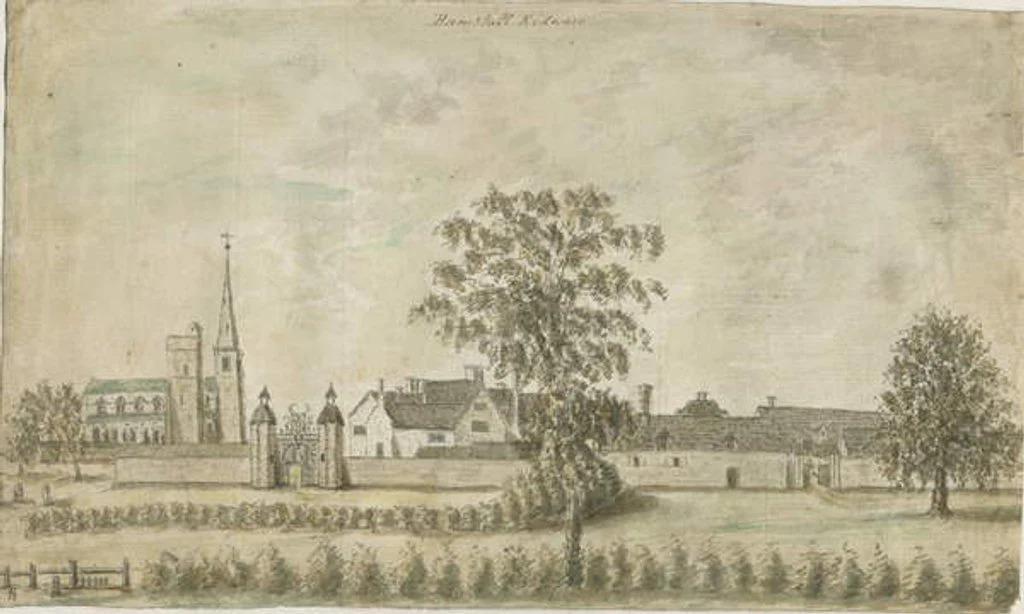 Hamstall Ridware
Charles Tomlinson‘s (1847-1907) wife Emma Grattidge (1853-1911) was born in Wolverhampton, the daughter and youngest child of William Grattidge (1820-1887) born in Foston, Derbyshire, and Mary Stubbs (1819-1880), born in Burton on Trent, daughter of Solomon Stubbs.
Solomon Stubbs (1781-1857) was born in Hamstall Ridware in 1781, the son of Samuel and Rebecca. Samuel Stubbs (1743-) and Rebecca Wood (1754-) married in 1769 in Darlaston. Samuel and Rebecca had six other children, all born in Darlaston. Sadly four of them died in infancy. Son John was born in 1779 in Darlaston and died two years later in Hamstall Ridware in 1781, the same year that Solomon was born there.
But why did they move to Hamstall Ridware?
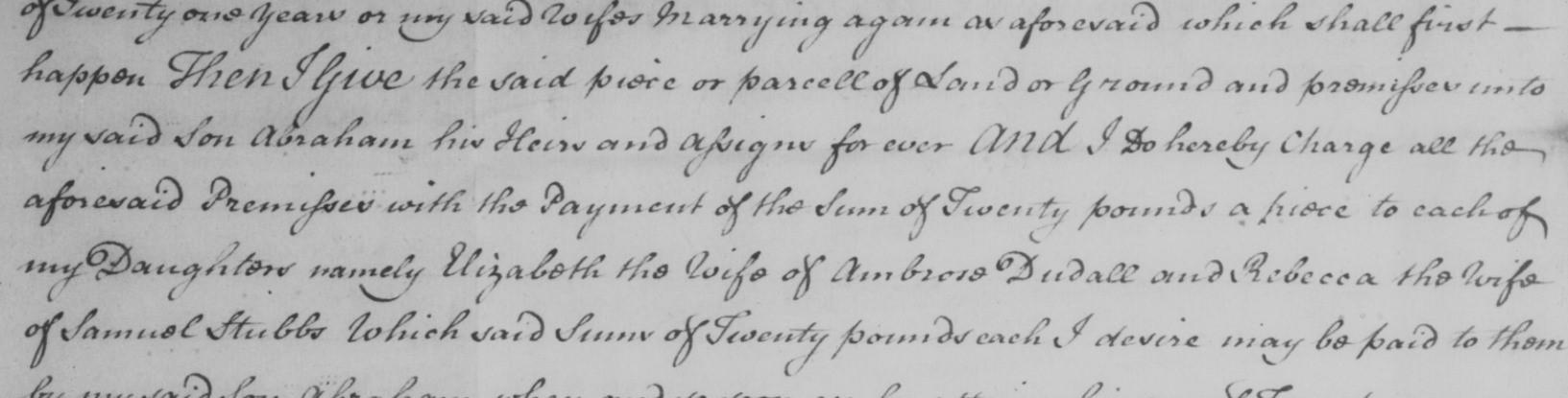
Samuel Stubbs was born in 1743 in Curdworth, Warwickshire (near to Birmingham). I had made a mistake on the tree (along with all of the public trees on the Ancestry website) and had Rebecca Wood born in Cheddleton, Staffordshire. Rebecca Wood from Cheddleton was also born in 1843, the right age for the marriage. The Rebecca Wood born in Darlaston in 1754 seemed too young, at just fifteen years old at the time of the marriage. I couldn’t find any explanation for why a woman from Cheddleton would marry in Darlaston and then move to Hamstall Ridware. People didn’t usually move around much other than intermarriage with neighbouring villages, especially women. I had a closer look at the Darlaston Rebecca, and did a search on her father William Wood. I found his 1784 will online in which he mentions his daughter Rebecca, wife of Samuel Stubbs. Clearly the right Rebecca Wood was the one born in Darlaston, which made much more sense.
An excerpt from William Wood’s 1784 will mentioning daughter Rebecca married to Samuel Stubbs:
But why did they move to Hamstall Ridware circa 1780?
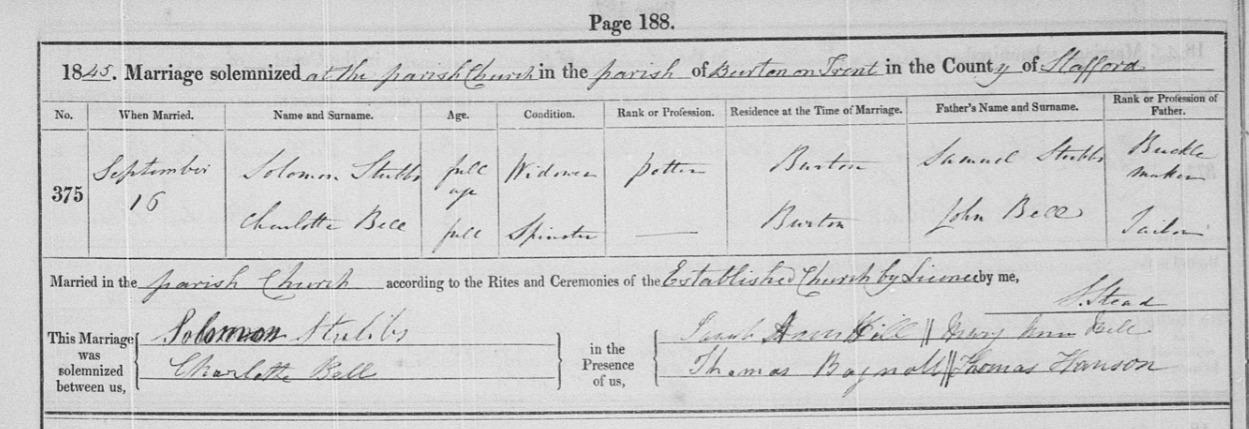
I had not intially noticed that Solomon Stubbs married again the year after his wife Phillis Lomas (1787-1844) died. Solomon married Charlotte Bell in 1845 in Burton on Trent and on the marriage register, Solomon’s father Samuel Stubbs occupation was mentioned: Samuel was a buckle maker.
Marriage of Solomon Stubbs and Charlotte Bell, father Samuel Stubbs buckle maker:
A rudimentary search on buckle making in the late 1700s provided a possible answer as to why Samuel and Rebecca left Darlaston in 1781. Shoe buckles had gone out of fashion, and by 1781 there were half as many buckle makers in Wolverhampton as there had been previously.
“Where there were 127 buckle makers at work in Wolverhampton, 68 in Bilston and 58 in Birmingham in 1770, their numbers had halved in 1781.”
via “historywebsite”(museum/metalware/steel)
Steel buckles had been the height of fashion, and the trade became enormous in Wolverhampton. Wolverhampton was a steel working town, renowned for its steel jewellery which was probably of many types. The trade directories show great numbers of “buckle makers”. Steel buckles were predominantly made in Wolverhampton: “from the late 1760s cut steel comes to the fore, from the thriving industry of the Wolverhampton area”. Bilston was also a great centre of buckle making, and other areas included Walsall. (It should be noted that Darlaston, Walsall, Bilston and Wolverhampton are all part of the same area)
In 1860, writing in defence of the Wolverhampton Art School, George Wallis talks about the cut steel industry in Wolverhampton. Referring to “the fine steel workers of the 17th and 18th centuries” he says: “Let them remember that 100 years ago [sc. c. 1760] a large trade existed with France and Spain in the fine steel goods of Birmingham and Wolverhampton, of which the latter were always allowed to be the best both in taste and workmanship. … A century ago French and Spanish merchants had their houses and agencies at Birmingham for the purchase of the steel goods of Wolverhampton…..The Great Revolution in France put an end to the demand for fine steel goods for a time and hostile tariffs finished what revolution began”.
The next search on buckle makers, Wolverhampton and Hamstall Ridware revealed an unexpected connecting link.
In Riotous Assemblies: Popular Protest in Hanoverian England by Adrian Randall:
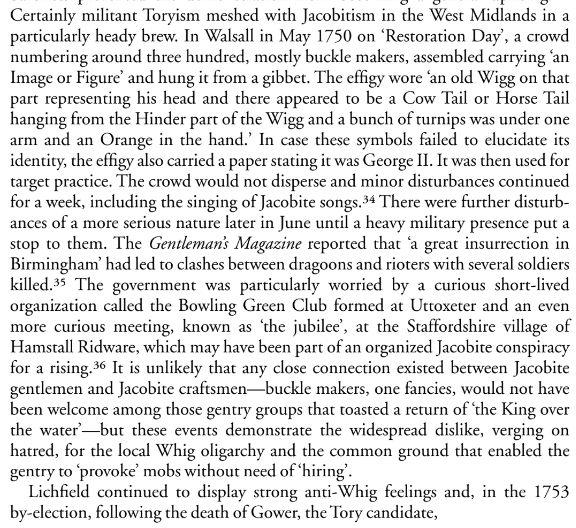
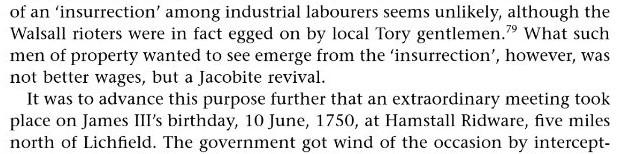
In Walsall in 1750 on “Restoration Day” a crowd numbering 300 assembled, mostly buckle makers, singing Jacobite songs and other rebellious and riotous acts. The government was particularly worried about a curious meeting known as the “Jubilee” in Hamstall Ridware, which may have been part of a conspiracy for a Jacobite uprising.
But this was thirty years before Samuel and Rebecca moved to Hamstall Ridware and does not help to explain why they moved there around 1780, although it does suggest connecting links.
Rebecca’s father, William Wood, was a brickmaker. This was stated at the beginning of his will. On closer inspection of the will, he was a brickmaker who owned four acres of brick kilns, as well as dwelling houses, shops, barns, stables, a brewhouse, a malthouse, cattle and land.
A page from the 1784 will of William Wood:
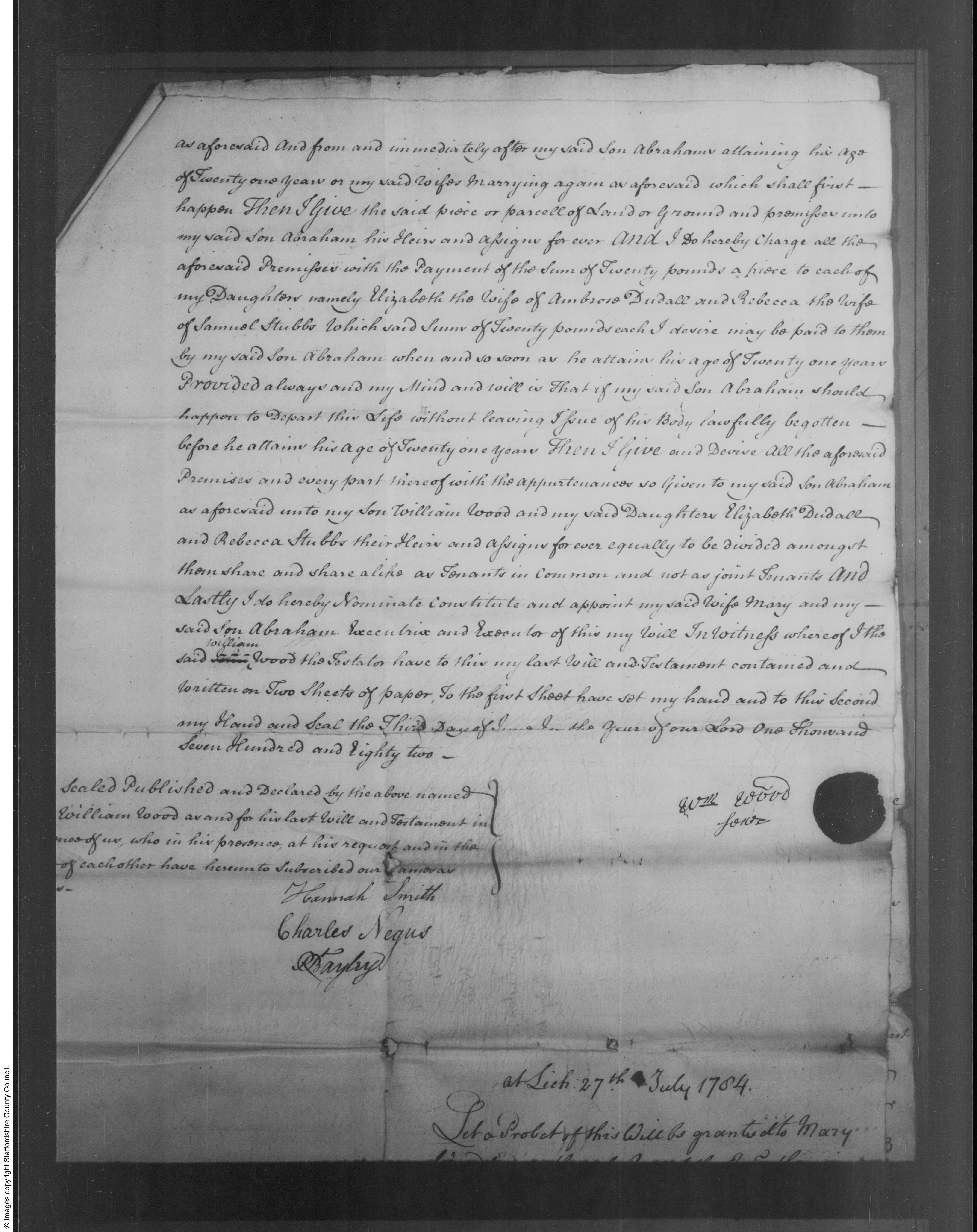
The 1784 will of William Wood of Darlaston:
I William Wood the elder of Darlaston in the county of Stafford, brickmaker, being of sound and disposing mind memory and understanding (praised be to god for the same) do make publish and declare my last will and testament in manner and form following (that is to say) {after debts and funeral expense paid etc} I give to my loving wife Mary the use usage wear interest and enjoyment of all my goods chattels cattle stock in trade ~ money securities for money personal estate and effects whatsoever and wheresoever to hold unto her my said wife for and during the term of her natural life providing she so long continues my widow and unmarried and from or after her decease or intermarriage with any future husband which shall first happen.
Then I give all the said goods chattels cattle stock in trade money securites for money personal estate and effects unto my son Abraham Wood absolutely and forever. Also I give devise and bequeath unto my said wife Mary all that my messuages tenement or dwelling house together with the malthouse brewhouse barn stableyard garden and premises to the same belonging situate and being at Darlaston aforesaid and now in my own possession. Also all that messuage tenement or dwelling house together with the shop garden and premises with the appurtenances to the same ~ belonging situate in Darlaston aforesaid and now in the several holdings or occupation of George Knowles and Edward Knowles to hold the aforesaid premises and every part thereof with the appurtenances to my said wife Mary for and during the term of her natural life provided she so long continues my widow and unmarried. And from or after her decease or intermarriage with a future husband which shall first happen. Then I give and devise the aforesaid premises and every part thereof with the appurtenances unto my said son Abraham Wood his heirs and assigns forever.
Also I give unto my said wife all that piece or parcel of land or ground inclosed and taken out of Heath Field in the parish of Darlaston aforesaid containing four acres or thereabouts (be the same more or less) upon which my brick kilns erected and now in my own possession. To hold unto my said wife Mary until my said son Abraham attains his age of twenty one years if she so long continues my widow and unmarried as aforesaid and from and immediately after my said son Abraham attaining his age of twenty one years or my said wife marrying again as aforesaid which shall first happen then I give the said piece or parcel of land or ground and premises unto my said son Abraham his heirs and assigns forever.
And I do hereby charge all the aforesaid premises with the payment of the sum of twenty pounds a piece to each of my daughters namely Elizabeth the wife of Ambrose Dudall and Rebecca the wife of Samuel Stubbs which said sum of twenty pounds each I devise may be paid to them by my said son Abraham when and so soon as he attains his age of twenty one years provided always and my mind and will is that if my said son Abraham should happen to depart this life without leaving issue of his body lawfully begotten before he attains his age of twenty one years then I give and devise all the aforesaid premises and every part thereof with the appurtenances so given to my said son Abraham as aforesaid unto my said son William Wood and my said daughter Elizabeth Dudall and Rebecca Stubbs their heirs and assigns forever equally divided among them share and share alike as tenants in common and not as joint tenants. And lastly I do hereby nominate constitute and appoint my said wife Mary and my said son Abraham executrix and executor of this my will.
The marriage of William Wood (1725-1784) and Mary Clews (1715-1798) in 1749 was in Hamstall Ridware.
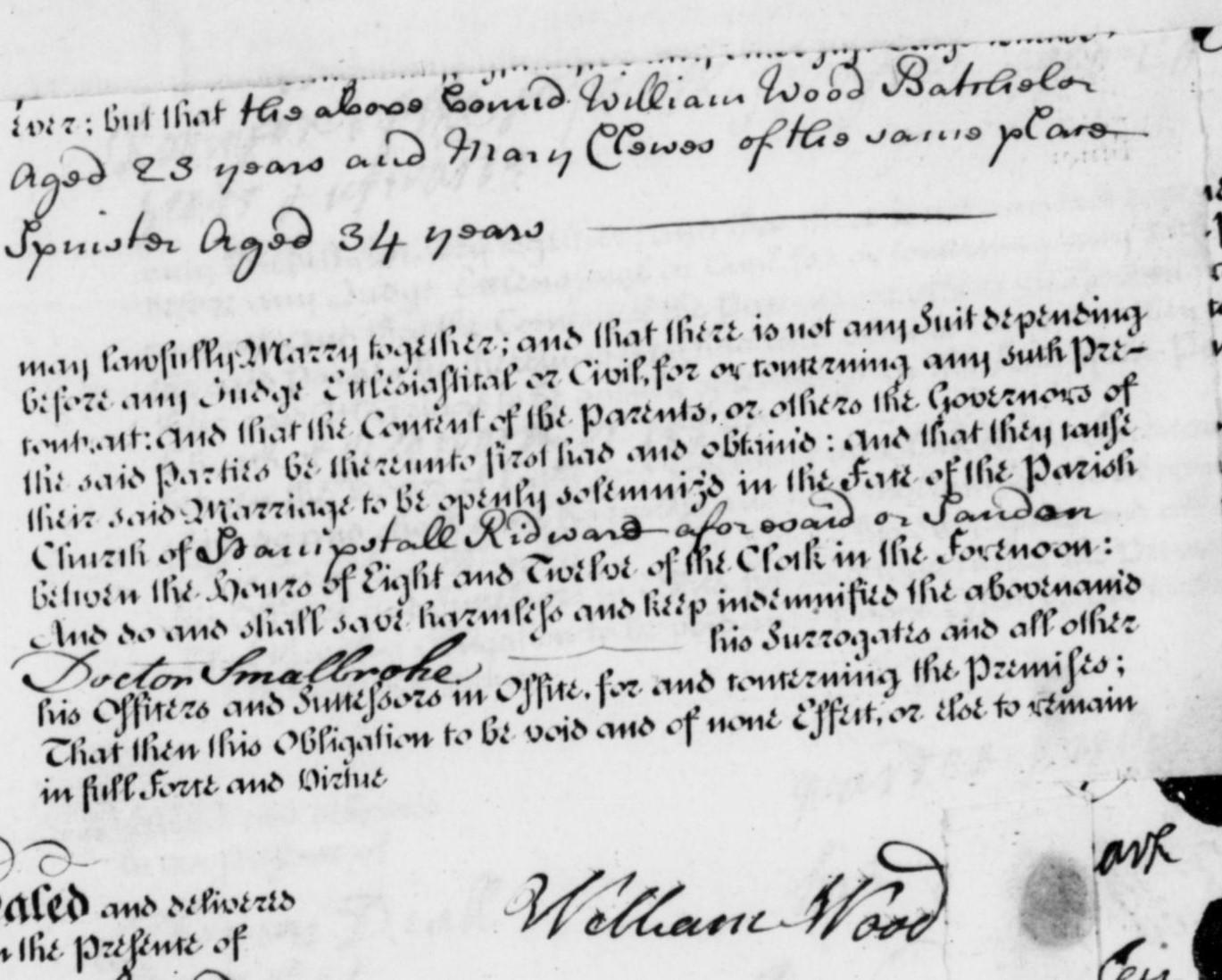
Mary was eleven years Williams senior, and it appears that they both came from Hamstall Ridware and moved to Darlaston after they married. Clearly Rebecca had extended family there (notwithstanding any possible connecting links between the Stubbs buckle makers of Darlaston and the Hamstall Ridware Jacobites thirty years prior). When the buckle trade collapsed in Darlaston, they likely moved to find employment elsewhere, perhaps with the help of Rebecca’s family.
I have not yet been able to find deaths recorded anywhere for either Samuel or Rebecca (there are a couple of deaths recorded for a Samuel Stubbs, one in 1809 in Wolverhampton, and one in 1810 in Birmingham but impossible to say which, if either, is the right one with the limited information, and difficult to know if they stayed in the Hamstall Ridware area or perhaps moved elsewhere)~ or find a reason for their son Solomon to be in Burton upon Trent, an evidently prosperous man with several properties including an earthenware business, as well as a land carrier business.
July 1, 2022 at 9:51 am #6306In reply to: The Elusive Samuel Housley and Other Family Stories
Looking for Robert Staley
William Warren (1835-1880) of Newhall (Stapenhill) married Elizabeth Staley (1836-1907) in 1858. Elizabeth was born in Newhall, the daughter of John Staley (1795-1876) and Jane Brothers. John was born in Newhall, and Jane was born in Armagh, Ireland, and they were married in Armagh in 1820. Elizabeths older brothers were born in Ireland: William in 1826 and Thomas in Dublin in 1830. Francis was born in Liverpool in 1834, and then Elizabeth in Newhall in 1836; thereafter the children were born in Newhall.
Marriage of John Staley and Jane Brothers in 1820:
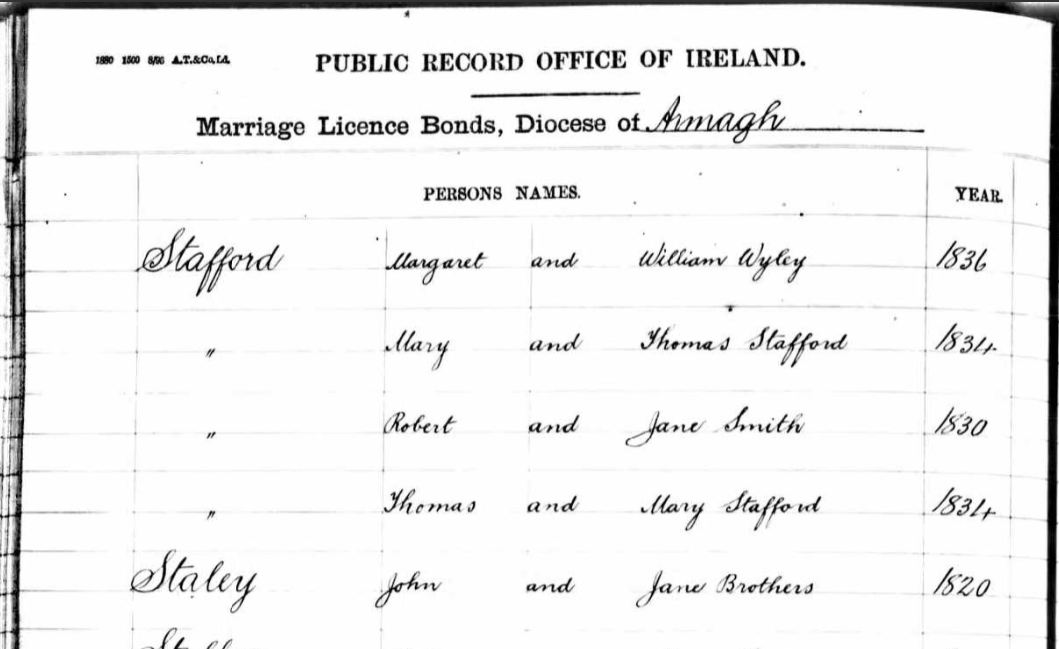
My grandmother related a story about an Elizabeth Staley who ran away from boarding school and eloped to Ireland, but later returned. The only Irish connection found so far is Jane Brothers, so perhaps she meant Elizabeth Staley’s mother. A boarding school seems unlikely, and it would seem that it was John Staley who went to Ireland.
The 1841 census states Jane’s age as 33, which would make her just 12 at the time of her marriage. The 1851 census states her age as 44, making her 13 at the time of her 1820 marriage, and the 1861 census estimates her birth year as a more likely 1804. Birth records in Ireland for her have not been found. It’s possible, perhaps, that she was in service in the Newhall area as a teenager (more likely than boarding school), and that John and Jane ran off to get married in Ireland, although I haven’t found any record of a child born to them early in their marriage. John was an agricultural labourer, and later a coal miner.
John Staley was the son of Joseph Staley (1756-1838) and Sarah Dumolo (1764-). Joseph and Sarah were married by licence in Newhall in 1782. Joseph was a carpenter on the marriage licence, but later a collier (although not necessarily a miner).
The Derbyshire Record Office holds records of an “Estimate of Joseph Staley of Newhall for the cost of continuing to work Pisternhill Colliery” dated 1820 and addresssed to Mr Bloud at Calke Abbey (presumably the owner of the mine)
Josephs parents were Robert Staley and Elizabeth. I couldn’t find a baptism or birth record for Robert Staley. Other trees on an ancestry site had his birth in Elton, but with no supporting documents. Robert, as stated in his 1795 will, was a Yeoman.
“Yeoman: A former class of small freeholders who farm their own land; a commoner of good standing.”
“Husbandman: The old word for a farmer below the rank of yeoman. A husbandman usually held his land by copyhold or leasehold tenure and may be regarded as the ‘average farmer in his locality’. The words ‘yeoman’ and ‘husbandman’ were gradually replaced in the later 18th and 19th centuries by ‘farmer’.”He left a number of properties in Newhall and Hartshorne (near Newhall) including dwellings, enclosures, orchards, various yards, barns and acreages. It seemed to me more likely that he had inherited them, rather than moving into the village and buying them.
There is a mention of Robert Staley in a 1782 newpaper advertisement.
“Fire Engine To Be Sold. An exceedingly good fire engine, with the boiler, cylinder, etc in good condition. For particulars apply to Mr Burslem at Burton-upon-Trent, or Robert Staley at Newhall near Burton, where the engine may be seen.”
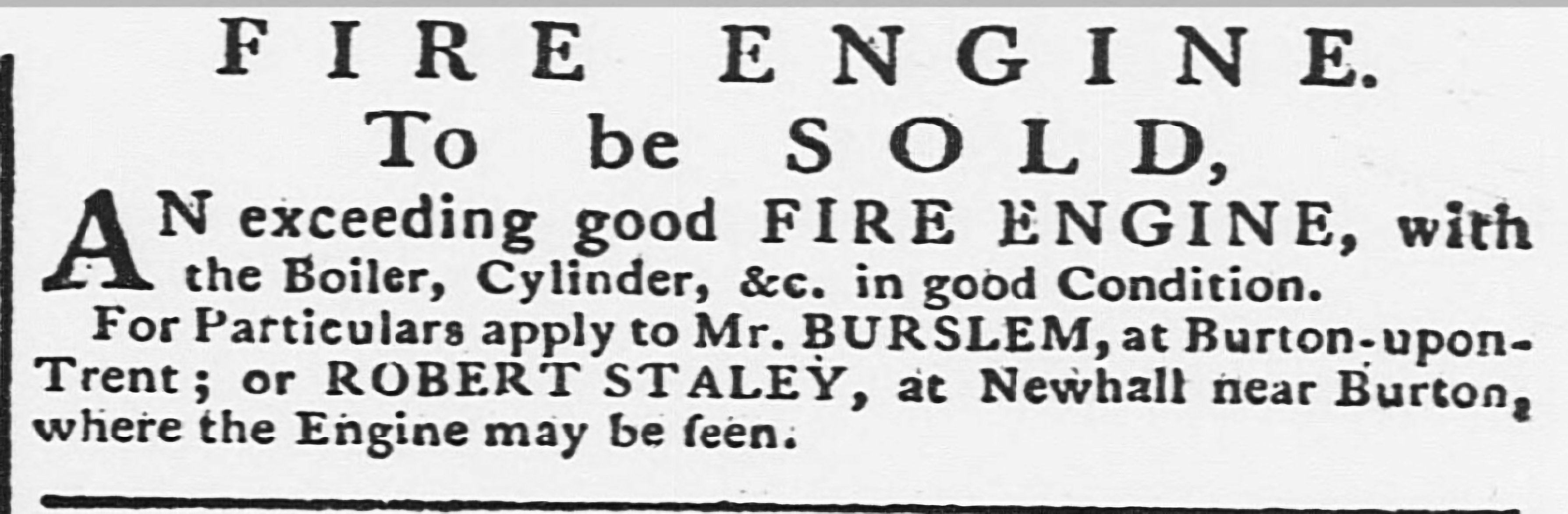
Was the fire engine perhaps connected with a foundry or a coal mine?
I noticed that Robert Staley was the witness at a 1755 marriage in Stapenhill between Barbara Burslem and Richard Daston the younger esquire. The other witness was signed Burslem Jnr.
Looking for Robert Staley
I assumed that once again, in the absence of the correct records, a similarly named and aged persons baptism had been added to the tree regardless of accuracy, so I looked through the Stapenhill/Newhall parish register images page by page. There were no Staleys in Newhall at all in the early 1700s, so it seemed that Robert did come from elsewhere and I expected to find the Staleys in a neighbouring parish. But I still didn’t find any Staleys.
I spoke to a couple of Staley descendants that I’d met during the family research. I met Carole via a DNA match some months previously and contacted her to ask about the Staleys in Elton. She also had Robert Staley born in Elton (indeed, there were many Staleys in Elton) but she didn’t have any documentation for his birth, and we decided to collaborate and try and find out more.
I couldn’t find the earlier Elton parish registers anywhere online, but eventually found the untranscribed microfiche images of the Bishops Transcripts for Elton.
via familysearch:
“In its most basic sense, a bishop’s transcript is a copy of a parish register. As bishop’s transcripts generally contain more or less the same information as parish registers, they are an invaluable resource when a parish register has been damaged, destroyed, or otherwise lost. Bishop’s transcripts are often of value even when parish registers exist, as priests often recorded either additional or different information in their transcripts than they did in the original registers.”Unfortunately there was a gap in the Bishops Transcripts between 1704 and 1711 ~ exactly where I needed to look. I subsequently found out that the Elton registers were incomplete as they had been damaged by fire.
I estimated Robert Staleys date of birth between 1710 and 1715. He died in 1795, and his son Daniel died in 1805: both of these wills were found online. Daniel married Mary Moon in Stapenhill in 1762, making a likely birth date for Daniel around 1740.
The marriage of Robert Staley (assuming this was Robert’s father) and Alice Maceland (or Marsland or Marsden, depending on how the parish clerk chose to spell it presumably) was in the Bishops Transcripts for Elton in 1704. They were married in Elton on 26th February. There followed the missing parish register pages and in all likelihood the records of the baptisms of their first children. No doubt Robert was one of them, probably the first male child.
(Incidentally, my grandfather’s Marshalls also came from Elton, a small Derbyshire village near Matlock. The Staley’s are on my grandmothers Warren side.)
The parish register pages resume in 1711. One of the first entries was the baptism of Robert Staley in 1711, parents Thomas and Ann. This was surely the one we were looking for, and Roberts parents weren’t Robert and Alice.
But then in 1735 a marriage was recorded between Robert son of Robert Staley (and this was unusual, the father of the groom isn’t usually recorded on the parish register) and Elizabeth Milner. They were married on the 9th March 1735. We know that the Robert we were looking for married an Elizabeth, as her name was on the Stapenhill baptisms of their later children, including Joseph Staleys. The 1735 marriage also fit with the assumed birth date of Daniel, circa 1740. A baptism was found for a Robert Staley in 1738 in the Elton registers, parents Robert and Elizabeth, as well as the baptism in 1736 for Mary, presumably their first child. Her burial is recorded the following year.
The marriage of Robert Staley and Elizabeth Milner in 1735:
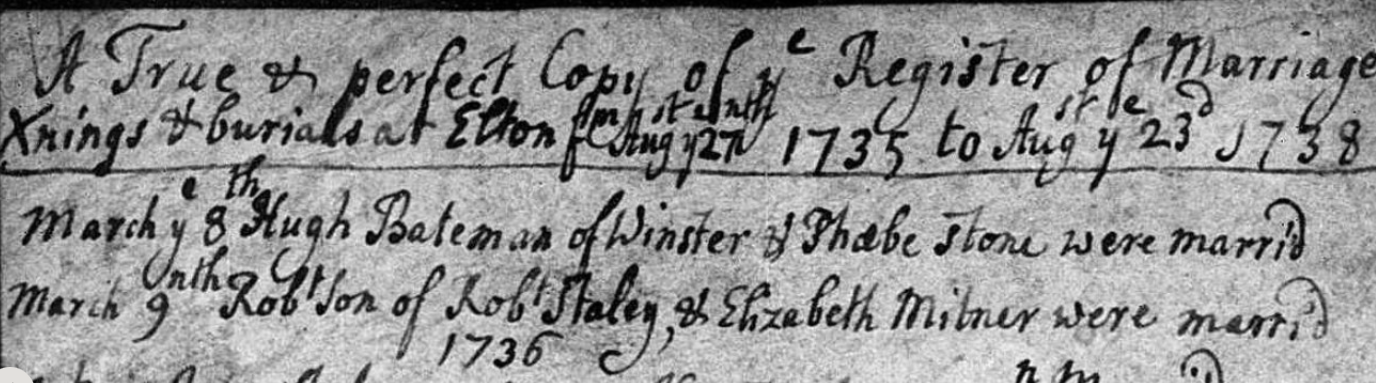
There were several other Staley couples of a similar age in Elton, perhaps brothers and cousins. It seemed that Thomas and Ann’s son Robert was a different Robert, and that the one we were looking for was prior to that and on the missing pages.
Even so, this doesn’t prove that it was Elizabeth Staleys great grandfather who was born in Elton, but no other birth or baptism for Robert Staley has been found. It doesn’t explain why the Staleys moved to Stapenhill either, although the Enclosures Act and the Industrial Revolution could have been factors.
The 18th century saw the rise of the Industrial Revolution and many renowned Derbyshire Industrialists emerged. They created the turning point from what was until then a largely rural economy, to the development of townships based on factory production methods.
The Marsden Connection
There are some possible clues in the records of the Marsden family. Robert Staley married Alice Marsden (or Maceland or Marsland) in Elton in 1704. Robert Staley is mentioned in the 1730 will of John Marsden senior, of Baslow, Innkeeper (Peacock Inne & Whitlands Farm). He mentions his daughter Alice, wife of Robert Staley.
In a 1715 Marsden will there is an intriguing mention of an alias, which might explain the different spellings on various records for the name Marsden: “MARSDEN alias MASLAND, Christopher – of Baslow, husbandman, 28 Dec 1714. son Robert MARSDEN alias MASLAND….” etc.
Some potential reasons for a move from one parish to another are explained in this history of the Marsden family, and indeed this could relate to Robert Staley as he married into the Marsden family and his wife was a beneficiary of a Marsden will. The Chatsworth Estate, at various times, bought a number of farms in order to extend the park.
THE MARSDEN FAMILY
OXCLOSE AND PARKGATE
In the Parishes of
Baslow and Chatsworthby
David Dalrymple-Smith“John Marsden (b1653) another son of Edmund (b1611) faired well. By the time he died in
1730 he was publican of the Peacock, the Inn on Church Lane now called the Cavendish
Hotel, and the farmer at “Whitlands”, almost certainly Bubnell Cliff Farm.”“Coal mining was well known in the Chesterfield area. The coalfield extends as far as the
Gritstone edges, where thin seams outcrop especially in the Baslow area.”“…the occupants were evicted from the farmland below Dobb Edge and
the ground carefully cleared of all traces of occupation and farming. Shelter belts were
planted especially along the Heathy Lea Brook. An imposing new drive was laid to the
Chatsworth House with the Lodges and “The Golden Gates” at its northern end….”Although this particular event was later than any events relating to Robert Staley, it’s an indication of how farms and farmland disappeared, and a reason for families to move to another area:
“The Dukes of Devonshire (of Chatsworth) were major figures in the aristocracy and the government of the
time. Such a position demanded a display of wealth and ostentation. The 6th Duke of
Devonshire, the Bachelor Duke, was not content with the Chatsworth he inherited in 1811,
and immediately started improvements. After major changes around Edensor, he turned his
attention at the north end of the Park. In 1820 plans were made extend the Park up to the
Baslow parish boundary. As this would involve the destruction of most of the Farm at
Oxclose, the farmer at the Higher House Samuel Marsden (b1755) was given the tenancy of
Ewe Close a large farm near Bakewell.
Plans were revised in 1824 when the Dukes of Devonshire and Rutland “Exchanged Lands”,
reputedly during a game of dice. Over 3300 acres were involved in several local parishes, of
which 1000 acres were in Baslow. In the deal Devonshire acquired the southeast corner of
Baslow Parish.
Part of the deal was Gibbet Moor, which was developed for “Sport”. The shelf of land
between Parkgate and Robin Hood and a few extra fields was left untouched. The rest,
between Dobb Edge and Baslow, was agricultural land with farms, fields and houses. It was
this last part that gave the Duke the opportunity to improve the Park beyond his earlier
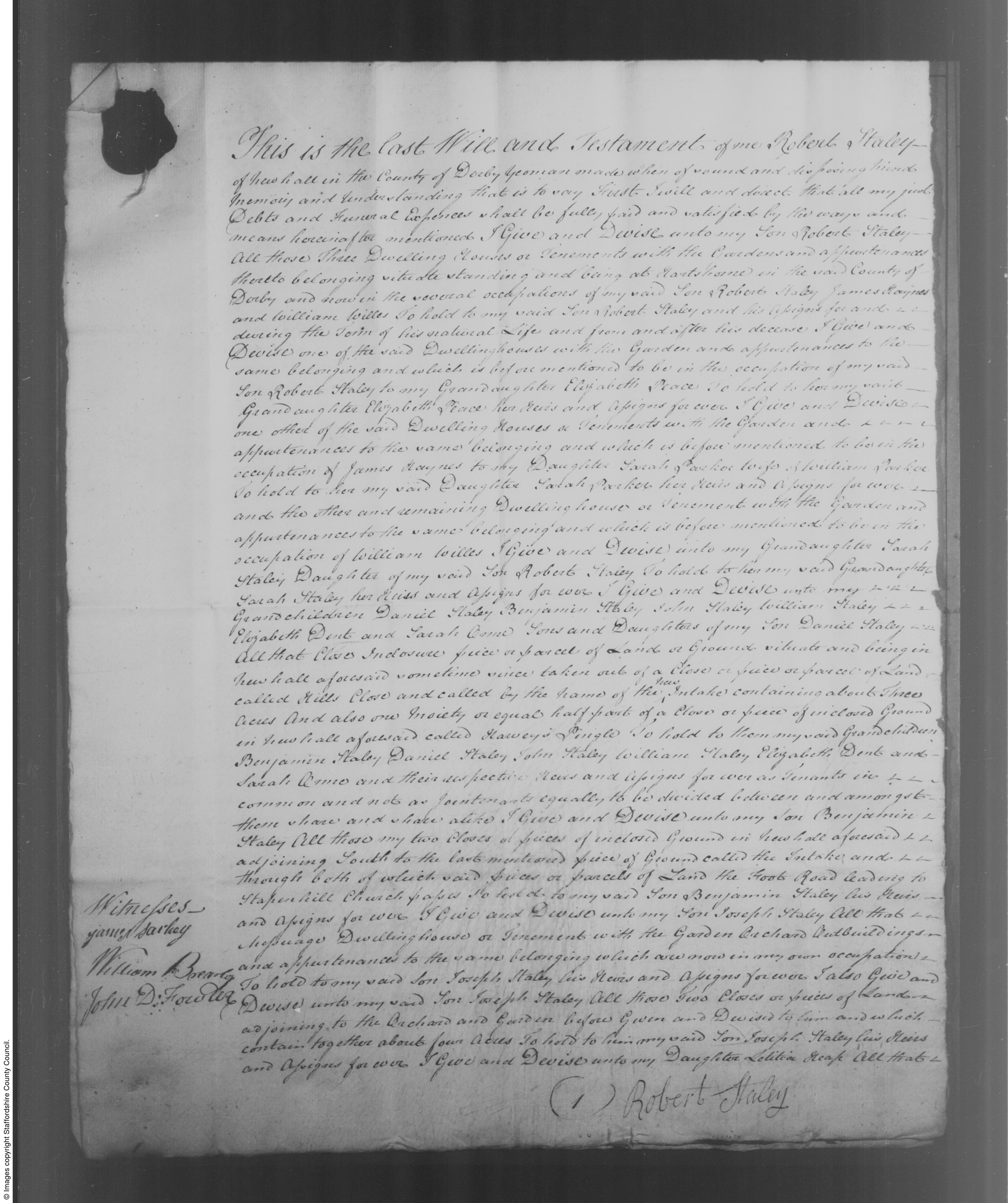
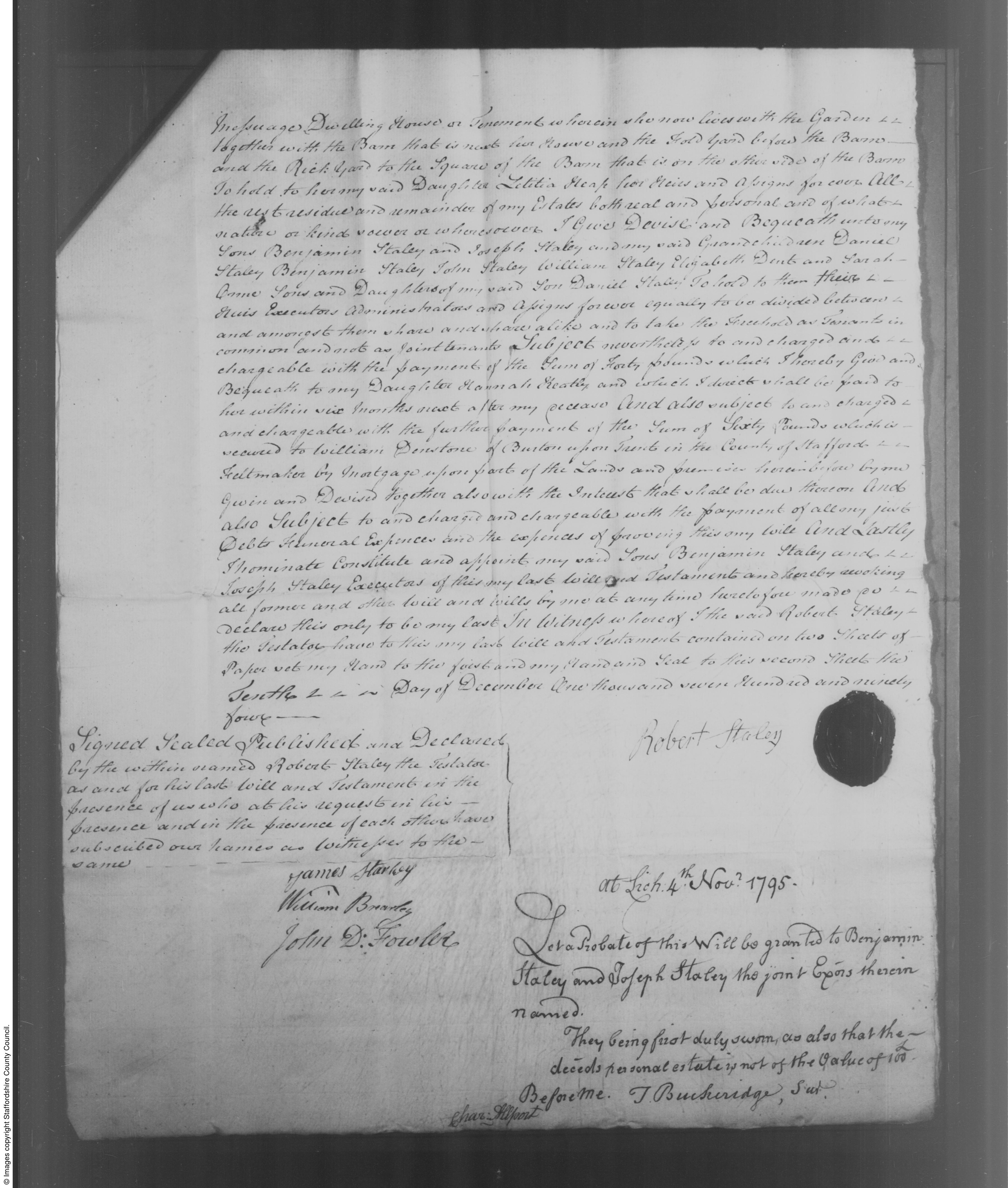
expectations.”The 1795 will of Robert Staley.
Inriguingly, Robert included the children of his son Daniel Staley in his will, but omitted to leave anything to Daniel. A perusal of Daniels 1808 will sheds some light on this: Daniel left his property to his six reputed children with Elizabeth Moon, and his reputed daughter Mary Brearly. Daniels wife was Mary Moon, Elizabeths husband William Moons daughter.
The will of Robert Staley, 1795:
The 1805 will of Daniel Staley, Robert’s son:
This is the last will and testament of me Daniel Staley of the Township of Newhall in the parish of Stapenhill in the County of Derby, Farmer. I will and order all of my just debts, funeral and testamentary expenses to be fully paid and satisfied by my executors hereinafter named by and out of my personal estate as soon as conveniently may be after my decease.
I give, devise and bequeath to Humphrey Trafford Nadin of Church Gresely in the said County of Derby Esquire and John Wilkinson of Newhall aforesaid yeoman all my messuages, lands, tenements, hereditaments and real and personal estates to hold to them, their heirs, executors, administrators and assigns until Richard Moon the youngest of my reputed sons by Elizabeth Moon shall attain his age of twenty one years upon trust that they, my said trustees, (or the survivor of them, his heirs, executors, administrators or assigns), shall and do manage and carry on my farm at Newhall aforesaid and pay and apply the rents, issues and profits of all and every of my said real and personal estates in for and towards the support, maintenance and education of all my reputed children by the said Elizabeth Moon until the said Richard Moon my youngest reputed son shall attain his said age of twenty one years and equally share and share and share alike.
And it is my will and desire that my said trustees or trustee for the time being shall recruit and keep up the stock upon my farm as they in their discretion shall see occasion or think proper and that the same shall not be diminished. And in case any of my said reputed children by the said Elizabeth Moon shall be married before my said reputed youngest son shall attain his age of twenty one years that then it is my will and desire that non of their husbands or wives shall come to my farm or be maintained there or have their abode there. That it is also my will and desire in case my reputed children or any of them shall not be steady to business but instead shall be wild and diminish the stock that then my said trustees or trustee for the time being shall have full power and authority in their discretion to sell and dispose of all or any part of my said personal estate and to put out the money arising from the sale thereof to interest and to pay and apply the interest thereof and also thereunto of the said real estate in for and towards the maintenance, education and support of all my said reputed children by the said
Elizabeth Moon as they my said trustees in their discretion that think proper until the said Richard Moon shall attain his age of twenty one years.Then I give to my grandson Daniel Staley the sum of ten pounds and to each and every of my sons and daughters namely Daniel Staley, Benjamin Staley, John Staley, William Staley, Elizabeth Dent and Sarah Orme and to my niece Ann Brearly the sum of five pounds apiece.
I give to my youngest reputed son Richard Moon one share in the Ashby Canal Navigation and I direct that my said trustees or trustee for the time being shall have full power and authority to pay and apply all or any part of the fortune or legacy hereby intended for my youngest reputed son Richard Moon in placing him out to any trade, business or profession as they in their discretion shall think proper.
And I direct that to my said sons and daughters by my late wife and my said niece shall by wholly paid by my said reputed son Richard Moon out of the fortune herby given him. And it is my will and desire that my said reputed children shall deliver into the hands of my executors all the monies that shall arise from the carrying on of my business that is not wanted to carry on the same unto my acting executor and shall keep a just and true account of all disbursements and receipts of the said business and deliver up the same to my acting executor in order that there may not be any embezzlement or defraud amongst them and from and immediately after my said reputed youngest son Richard Moon shall attain his age of twenty one years then I give, devise and bequeath all my real estate and all the residue and remainder of my personal estate of what nature and kind whatsoever and wheresoever unto and amongst all and every my said reputed sons and daughters namely William Moon, Thomas Moon, Joseph Moon, Richard Moon, Ann Moon, Margaret Moon and to my reputed daughter Mary Brearly to hold to them and their respective heirs, executors, administrator and assigns for ever according to the nature and tenure of the same estates respectively to take the same as tenants in common and not as joint tenants.And lastly I nominate and appoint the said Humphrey Trafford Nadin and John Wilkinson executors of this my last will and testament and guardians of all my reputed children who are under age during their respective minorities hereby revoking all former and other wills by me heretofore made and declaring this only to be my last will.
In witness whereof I the said Daniel Staley the testator have to this my last will and testament set my hand and seal the eleventh day of March in the year of our Lord one thousand eight hundred and five.
April 2, 2022 at 6:15 pm #6286In reply to: The Elusive Samuel Housley and Other Family Stories
Matthew Orgill and His Family
Matthew Orgill 1828-1907 was the Orgill brother who went to Australia, but returned to Measham. Matthew married Mary Orgill in Measham in October 1856, having returned from Victoria, Australia in May of that year.
Although Matthew was the first Orgill brother to go to Australia, he was the last one I found, and that was somewhat by accident, while perusing “Orgill” and “Measham” in a newspaper archives search. I chanced on Matthew’s obituary in the Nuneaton Observer, Friday 14 June 1907:
LATE MATTHEW ORGILL PEACEFUL END TO A BLAMELESS LIFE.
‘Sunset and Evening Star And one clear call for me.”
It is with very deep regret that we have to announce the death of Mr. Matthew Orgill, late of Measham, who passed peacefully away at his residence in Manor Court Road, Nuneaton, in the early hours of yesterday morning. Mr. Orgill, who was in his eightieth year, was a man with a striking history, and was a very fine specimen of our best English manhood. In early life be emigrated to South Africa—sailing in the “Hebrides” on 4th February. 1850—and was one of the first settlers at the Cape; afterwards he went on to Australia at the time of the Gold Rush, and ultimately came home to his native England and settled down in Measham, in Leicestershire, where he carried on a successful business for the long period of half-a-century.
He was full of reminiscences of life in the Colonies in the early days, and an hour or two in his company was an education itself. On the occasion of the recall of Sir Harry Smith from the Governorship of Natal (for refusing to be a party to the slaying of the wives and children in connection with the Kaffir War), Mr. Orgill was appointed to superintend the arrangements for the farewell demonstration. It was one of his boasts that he made the first missionary cart used in South Africa, which is in use to this day—a monument to the character of his work; while it is an interesting fact to note that among Mr. Orgill’s papers there is the original ground-plan of the city of Durban before a single house was built.
In Africa Mr. Orgill came in contact with the great missionary, David Livingstone, and between the two men there was a striking resemblance in character and a deep and lasting friendship. Mr. Orgill could give a most graphic description of the wreck of the “Birkenhead,” having been in the vicinity at the time when the ill-fated vessel went down. He played a most prominent part on the occasion of the famous wreck of the emigrant ship, “Minerva.” when, in conjunction with some half-a-dozen others, and at the eminent risk of their own lives, they rescued more than 100 of the unfortunate passengers. He was afterwards presented with an interesting relic as a memento of that thrilling experience, being a copper bolt from the vessel on which was inscribed the following words: “Relic of the ship Minerva, wrecked off Bluff Point, Port Natal. 8.A.. about 2 a.m.. Friday, July 5, 1850.”
Mr. Orgill was followed to the Colonies by no fewer than six of his brothers, all of whom did well, and one of whom married a niece (brother’s daughter) of the late Mr. William Ewart Gladstone.
On settling down in Measham his kindly and considerate disposition soon won for him a unique place in the hearts of all the people, by whom he was greatly beloved. He was a man of sterling worth and integrity. Upright and honourable in all his dealings, he led a Christian life that was a pattern to all with whom he came in contact, and of him it could truly he said that he wore the white flower of a blameless life.
He was a member of the Baptist Church, and although beyond much active service since settling down in Nuneaton less than two years ago he leaves behind him a record in Christian service attained by few. In politics he was a Radical of the old school. A great reader, he studied all the questions of the day, and could back up every belief he held by sound and fearless argument. The South African – war was a great grief to him. He knew the Boers from personal experience, and although he suffered at the time of the war for his outspoken condemnation, he had the satisfaction of living to see the people of England fully recognising their awful blunder. To give anything like an adequate idea of Mr. Orgill’s history would take up a great amount of space, and besides much of it has been written and commented on before; suffice it to say that it was strenuous, interesting, and eventful, and yet all through his hands remained unspotted and his heart was pure.
He is survived by three daughters, and was father-in-law to Mr. J. S. Massey. St Kilda. Manor Court Road, to whom deep and loving sympathy is extended in their sore bereavement by a wide circle of friends. The funeral is arranged to leave for Measham on Monday at twelve noon.
“To give anything like an adequate idea of Mr. Orgill’s history would take up a great amount of space, and besides much of it has been written and commented on before…”
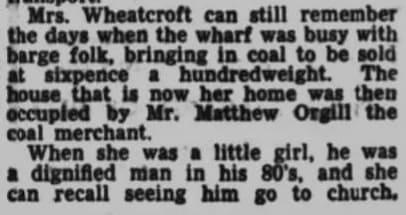
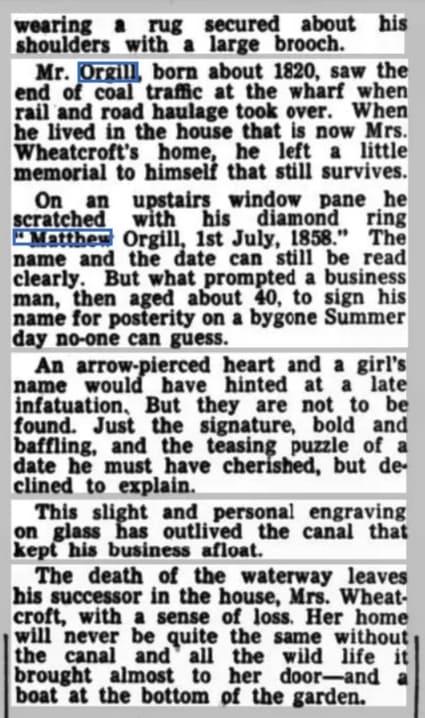
I had another look in the newspaper archives and found a number of articles mentioning him, including an intriguing excerpt in an article about local history published in the Burton Observer and Chronicle 8 August 1963:
on an upstairs window pane he scratched with his diamond ring “Matthew Orgill, 1st July, 1858”
I asked on a Measham facebook group if anyone knew the location of the house mentioned in the article and someone kindly responded. This is the same building, seen from either side:
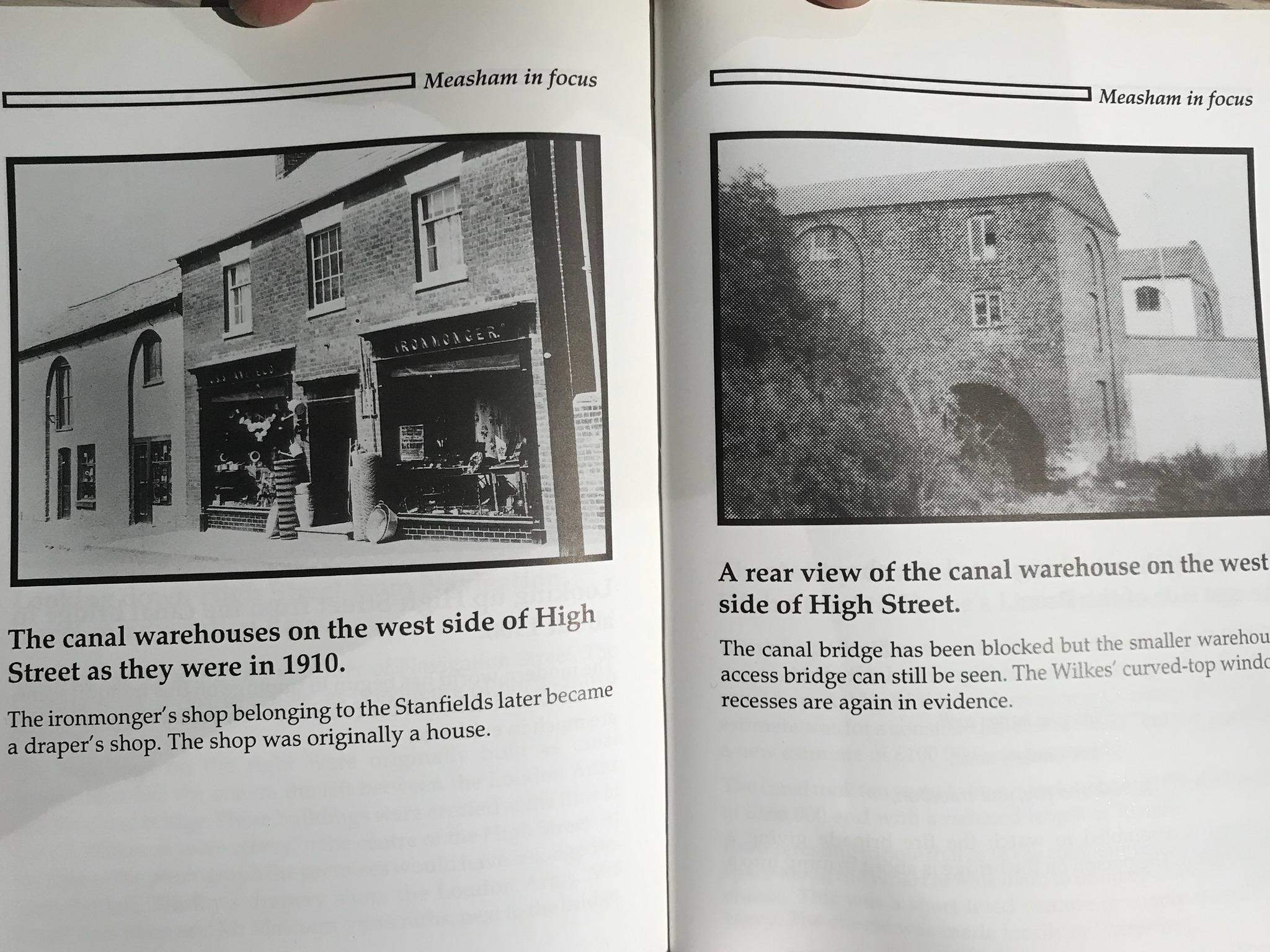
Coincidentally, I had already found this wonderful photograph of the same building, taken in 1910 ~ three years after Matthew’s death.
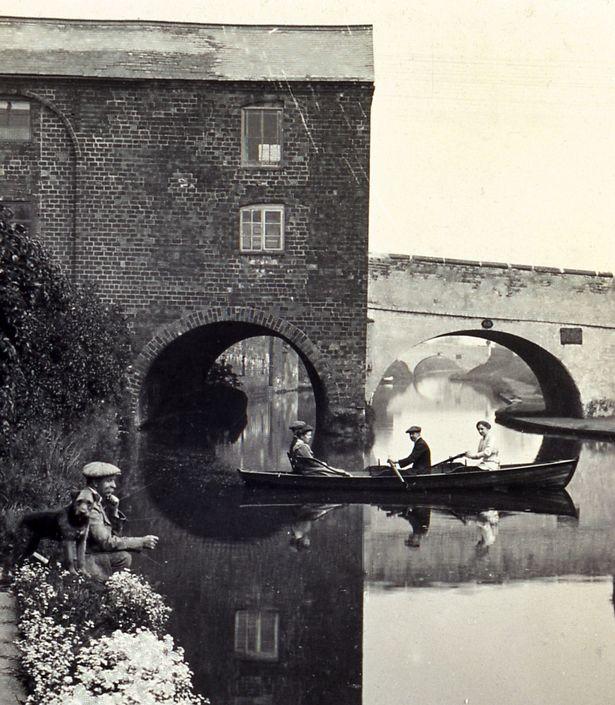
But what to make of the inscription in the window?
Matthew and Mary married in October 1856, and their first child (according to the records I’d found thus far) was a daughter Mary born in 1860. I had a look for a Matthew Orgill birth registered in 1858, the date Matthew had etched on the window, and found a death for a Matthew Orgill in 1859. Assuming I would find the birth of Matthew Orgill registered on the first of July 1958, to match the etching in the window, the corresponding birth was in July 1857!
Matthew and Mary had four children. Matthew, Mary, Clara and Hannah. Hannah Proudman Orgill married Joseph Stanton Massey. The Orgill name continues with their son Stanley Orgill Massey 1900-1979, who was a doctor and surgeon. Two of Stanley’s four sons were doctors, Paul Mackintosh Orgill Massey 1929-2009, and Michael Joseph Orgill Massey 1932-1989.
Mary Orgill 1827-1894, Matthews wife, was an Orgill too.
And this is where the Orgill branch of the tree gets complicated.
Mary’s father was Henry Orgill born in 1805 and her mother was Hannah Proudman born in 1805.
Henry Orgill’s father was Matthew Orgill born in 1769 and his mother was Frances Finch born in 1771.Mary’s husband Matthews parents are Matthew Orgill born in 1798 and Elizabeth Orgill born in 1803.
Another Orgill Orgill marriage!
Matthews parents, Matthew and Elizabeth, have the same grandparents as each other, Matthew Orgill born in 1736 and Ann Proudman born in 1735.
But Matthews grandparents are none other than Matthew Orgill born in 1769 and Frances Finch born in 1771 ~ the same grandparents as his wife Mary!
March 17, 2022 at 10:37 am #6283In reply to: The Elusive Samuel Housley and Other Family Stories
Purdy Cousins
My great grandmother Mary Ann Gilman Purdy was one of five children. Her sister Ellen Purdy was a well traveled nurse, and her sister Kate Rushby was a publican whose son who went to Africa. But what of her eldest sister Elizabeth and her brother Richard?
Elizabeth Purdy 1869-1905 married Benjamin George Little in 1892 in Basford, Nottinghamshire. Their first child, Frieda Olive Little, was born in Eastwood in December 1896, and their second daughter Catherine Jane Little was born in Warrington, Cheshire, in 1898. A third daughter, Edna Francis Little was born in 1900, but died three months later.
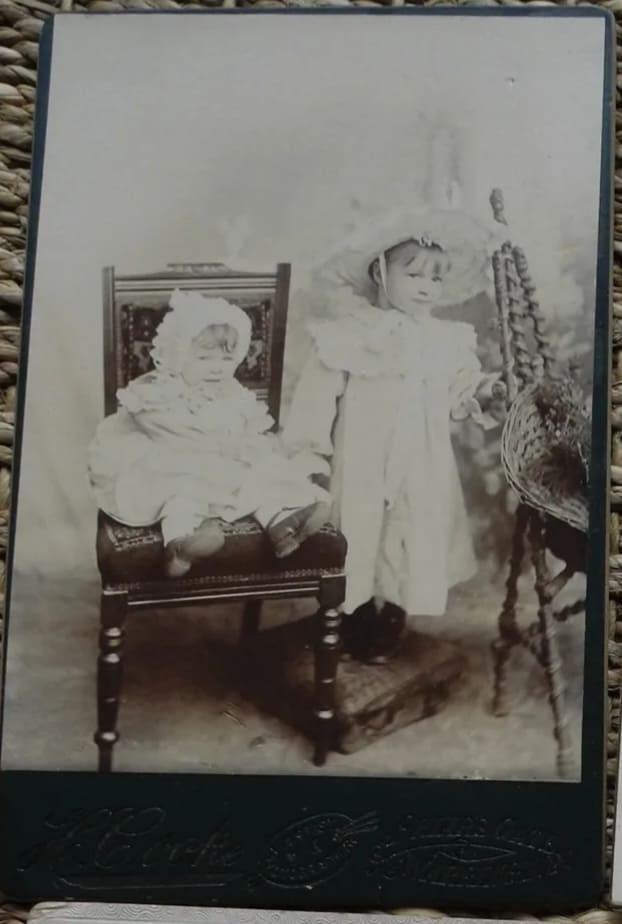
When I noticed that this unidentified photograph in our family collection was taken by a photographer in Warrington, and as no other family has been found in Warrington, I concluded that these two little girls are Frieda and Catherine:
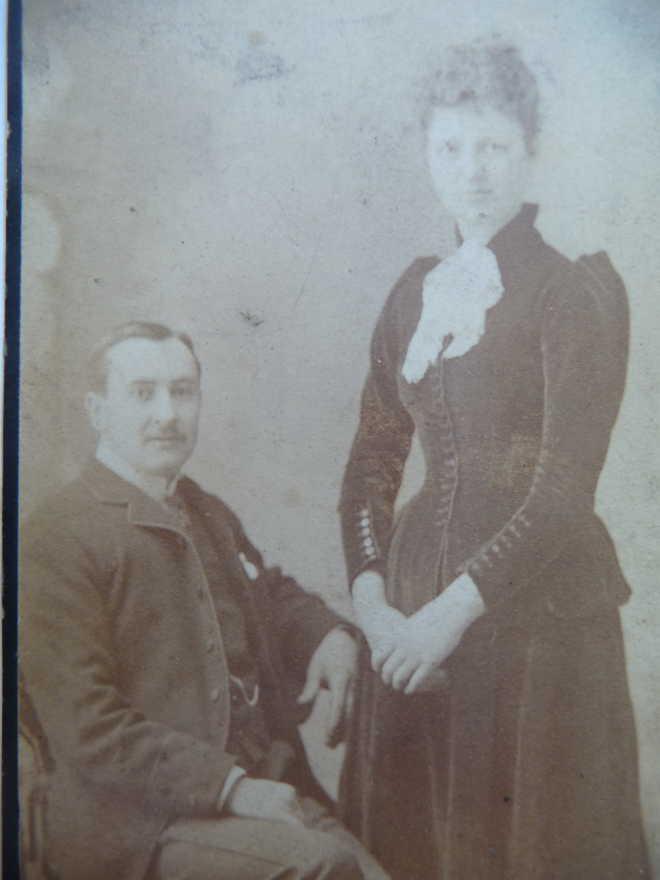
Benjamin Little, born in 1869, was the manager of a boot shop, according to the 1901 census, and a boot maker on the 1911 census. I found a photograph of Benjamin and Elizabeth Little on an ancestry website:
Frieda Olive Little 1896-1977 married Robert Warburton in 1924.
Frieda and Robert had two sons and a daughter, although one son died in infancy. They lived in Leominster, in Herefordshire, but Frieda died in 1977 at Enfield Farm in Warrington, four years after the death of her husband Robert.
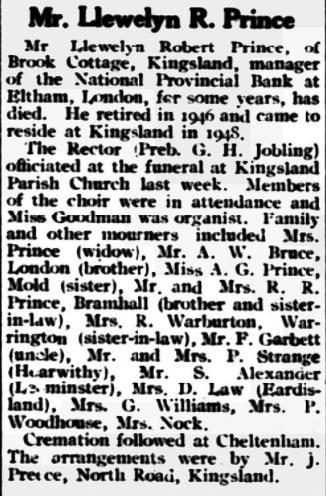
Catherine Jane Little 1899-1975 married Llewelyn Robert Prince 1884-1950. They do not appear to have had any children. Llewelyn was manager of the National Provinical Bank at Eltham in London, but died at Brook Cottage in Kingsland, Herefordshire. His wifes aunt Ellen Purdy the nurse had also lived at Brook Cottage. Ellen died in 1947, but her husband Frank Garbett was at the funeral:
Richard Purdy 1877-1940
Richard was born in Eastwood, Nottinghamshire. When his mother Catherine died in 1884 Richard was six years old. My great grandmother Mary Ann and her sister Ellen went to live with the Gilman’s in Buxton, but Richard and the two older sisters, Elizabeth and Kate, stayed with their father George Purdy, who remarried soon afterwards.
Richard married Ada Elizabeth Clarke in 1899. In 1901 Richard was an earthenware packer at a pottery, and on the 1939 census he was a colliery dataller. A dataller was a day wage man, paid on a daily basis for work done as required.
Richard and Ada had four children: Richard Baden Purdy 1900-1945, Winifred Maude 1903-1974, John Frederick 1907-1945, and Violet Gertrude 1910-1974.
Richard Baden Purdy married Ethel May Potter in Mansfield, Nottinghamshire, in 1926. He was listed on the 1939 census as a colliery deputy. In 1945 Richard Baden Purdy died as a result of injuries in a mine explosion.
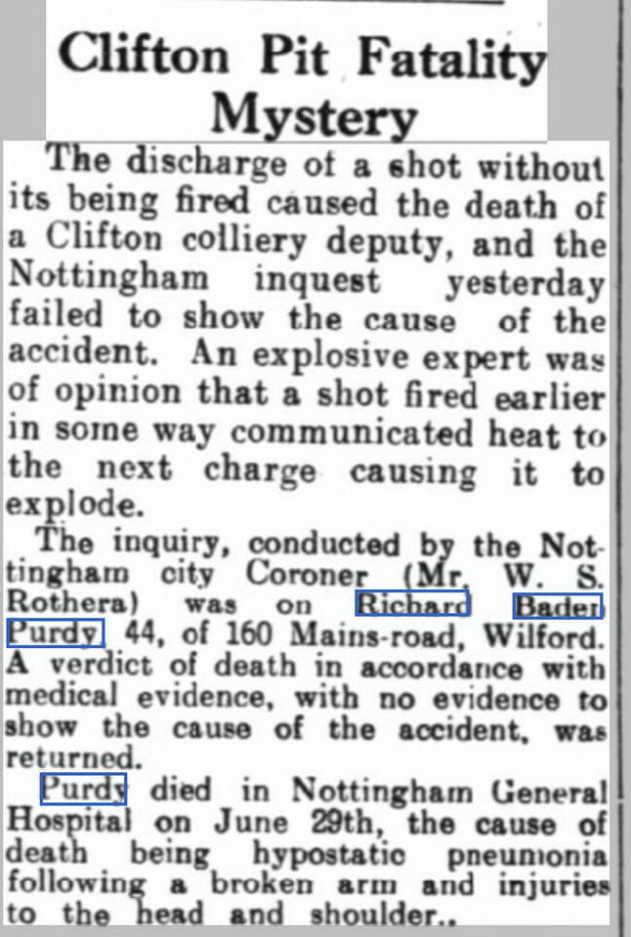
John Frederick Purdy married Iris Merryweather in 1938. On the 1939 census John and Iris live in Arnold, Nottinghamshire, and John’s occupation is a colliery hewer. Their daughter Barbara Elizabeth was born later that year. John died in 1945, the same year as his brother Richard Baden Purdy. It is not known without purchasing the death certificate what the cause of death was.
A memorial was posted in the Nottingham Evening Post on 29 June 1948:
PURDY, loving memories, Richard Baden, accidentally killed June 29th 1945; John Frederick, died 1 April 1945; Richard Purdy, father, died December 1940. Too dearly loved to be forgotten. Mother, families.
Violet Gertrude Purdy married Sidney Garland in 1932 in Southwell, Nottinghamshire. She died in Edwinstowe, Nottinghamshire, in 1974.
Winifred Maude Purdy married Bernard Fowler in Southwell in 1928. She also died in 1974, in Mansfield.
The two brothers died the same year, in 1945, and the two sisters died the same year, in 1974.
February 4, 2022 at 3:17 pm #6269In reply to: The Elusive Samuel Housley and Other Family Stories
The Housley Letters
From Barbara Housley’s Narrative on the Letters.
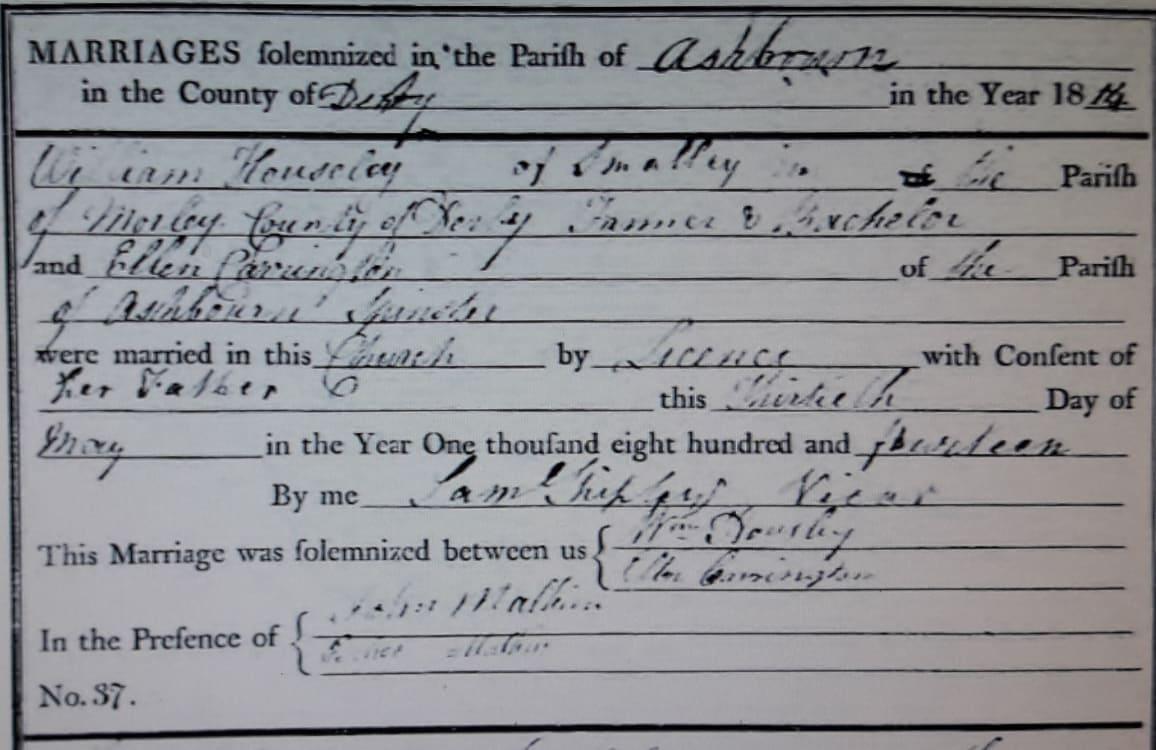
William Housley (1781-1848) and Ellen Carrington were married on May 30, 1814 at St. Oswald’s church in Ashbourne. William died in 1848 at the age of 67 of “disease of lungs and general debility”. Ellen died in 1872.
Marriage of William Housley and Ellen Carrington in Ashbourne in 1814:
Parish records show three children for William and his first wife, Mary, Ellens’ sister, who were married December 29, 1806: Mary Ann, christened in 1808 and mentioned frequently in the letters; Elizabeth, christened in 1810, but never mentioned in any letters; and William, born in 1812, probably referred to as Will in the letters. Mary died in 1813.
William and Ellen had ten children: John, Samuel, Edward, Anne, Charles, George, Joseph, Robert, Emma, and Joseph. The first Joseph died at the age of four, and the last son was also named Joseph. Anne never married, Charles emigrated to Australia in 1851, and George to USA, also in 1851. The letters are to George, from his sisters and brothers in England.
The following are excerpts of those letters, including excerpts of Barbara Housley’s “Narrative on Historic Letters”. They are grouped according to who they refer to, rather than chronological order.
ELLEN HOUSLEY 1795-1872
Joseph wrote that when Emma was married, Ellen “broke up the comfortable home and the things went to Derby and she went to live with them but Derby didn’t agree with her so she left again leaving her things behind and came to live with John in the new house where she died.” Ellen was listed with John’s household in the 1871 census.
In May 1872, the Ilkeston Pioneer carried this notice: “Mr. Hopkins will sell by auction on Saturday next the eleventh of May 1872 the whole of the useful furniture, sewing machine, etc. nearly new on the premises of the late Mrs. Housley at Smalley near Heanor in the county of Derby. Sale at one o’clock in the afternoon.”Ellen’s family was evidently rather prominant in Smalley. Two Carringtons (John and William) served on the Parish Council in 1794. Parish records are full of Carrington marriages and christenings; census records confirm many of the family groupings.
In June of 1856, Emma wrote: “Mother looks as well as ever and was told by a lady the other day that she looked handsome.” Later she wrote: “Mother is as stout as ever although she sometimes complains of not being able to do as she used to.”
Mary’s children:
MARY ANN HOUSLEY 1808-1878
There were hard feelings between Mary Ann and Ellen and her children. Anne wrote: “If you remember we were not very friendly when you left. They never came and nothing was too bad for Mary Ann to say of Mother and me, but when Robert died Mother sent for her to the funeral but she did not think well to come so we took no more notice. She would not allow her children to come either.”
Mary Ann was unlucky in love! In Anne’s second letter she wrote: “William Carrington is paying Mary Ann great attention. He is living in London but they write to each other….We expect it will be a match.” Apparantly the courtship was stormy for in 1855, Emma wrote: “Mary Ann’s wedding with William Carrington has dropped through after she had prepared everything, dresses and all for the occassion.” Then in 1856, Emma wrote: “William Carrington and Mary Ann are separated. They wore him out with their nonsense.” Whether they ever married is unclear. Joseph wrote in 1872: “Mary Ann was married but her husband has left her. She is in very poor health. She has one daughter and they are living with their mother at Smalley.”
Regarding William Carrington, Emma supplied this bit of news: “His sister, Mrs. Lily, has eloped with a married man. Is she not a nice person!”
WILLIAM HOUSLEY JR. 1812-1890
According to a letter from Anne, Will’s two sons and daughter were sent to learn dancing so they would be “fit for any society.” Will’s wife was Dorothy Palfry. They were married in Denby on October 20, 1836 when Will was 24. According to the 1851 census, Will and Dorothy had three sons: Alfred 14, Edwin 12, and William 10. All three boys were born in Denby.
In his letter of May 30, 1872, after just bemoaning that all of his brothers and sisters are gone except Sam and John, Joseph added: “Will is living still.” In another 1872 letter Joseph wrote, “Will is living at Heanor yet and carrying on his cattle dealing.” The 1871 census listed Will, 59, and his son William, 30, of Lascoe Road, Heanor, as cattle dealers.
Ellen’s children:
JOHN HOUSLEY 1815-1893
John married Sarah Baggally in Morely in 1838. They had at least six children. Elizabeth (born 2 May 1838) was “out service” in 1854. In her “third year out,” Elizabeth was described by Anne as “a very nice steady girl but quite a woman in appearance.” One of her positions was with a Mrs. Frearson in Heanor. Emma wrote in 1856: “Elizabeth is still at Mrs. Frearson. She is such a fine stout girl you would not know her.” Joseph wrote in 1872 that Elizabeth was in service with Mrs. Eliza Sitwell at Derby. (About 1850, Miss Eliza Wilmot-Sitwell provided for a small porch with a handsome Norman doorway at the west end of the St. John the Baptist parish church in Smalley.)
According to Elizabeth’s birth certificate and the 1841 census, John was a butcher. By 1851, the household included a nurse and a servant, and John was listed as a “victular.” Anne wrote in February 1854, “John has left the Public House a year and a half ago. He is living where Plumbs (Ann Plumb witnessed William’s death certificate with her mark) did and Thomas Allen has the land. He has been working at James Eley’s all winter.” In 1861, Ellen lived with John and Sarah and the three boys.
John sold his share in the inheritance from their mother and disappeared after her death. (He died in Doncaster, Yorkshire, in 1893.) At that time Charles, the youngest would have been 21. Indeed, Joseph wrote in July 1872: “John’s children are all grown up”.
In May 1872, Joseph wrote: “For what do you think, John has sold his share and he has acted very bad since his wife died and at the same time he sold all his furniture. You may guess I have never seen him but once since poor mother’s funeral and he is gone now no one knows where.”
In February 1874 Joseph wrote: “You want to know what made John go away. Well, I will give you one reason. I think I told you that when his wife died he persuaded me to leave Derby and come to live with him. Well so we did and dear Harriet to keep his house. Well he insulted my wife and offered things to her that was not proper and my dear wife had the power to resist his unmanly conduct. I did not think he could of served me such a dirty trick so that is one thing dear brother. He could not look me in the face when we met. Then after we left him he got a woman in the house and I suppose they lived as man and wife. She caught the small pox and died and there he was by himself like some wild man. Well dear brother I could not go to him again after he had served me and mine as he had and I believe he was greatly in debt too so that he sold his share out of the property and when he received the money at Belper he went away and has never been seen by any of us since but I have heard of him being at Sheffield enquiring for Sam Caldwell. You will remember him. He worked in the Nag’s Head yard but I have heard nothing no more of him.”
A mention of a John Housley of Heanor in the Nottinghma Journal 1875. I don’t know for sure if the John mentioned here is the brother John who Joseph describes above as behaving improperly to his wife. John Housley had a son Joseph, born in 1840, and John’s wife Sarah died in 1870.
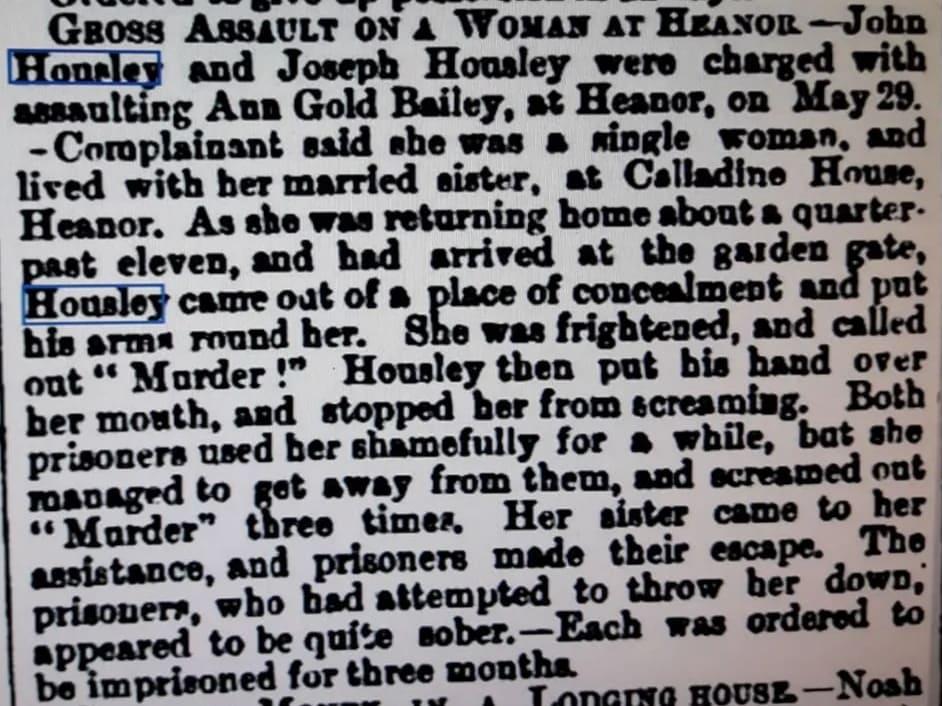
In 1876, the solicitor wrote to George: “Have you heard of John Housley? He is entitled to Robert’s share and I want him to claim it.”
SAMUEL HOUSLEY 1816-
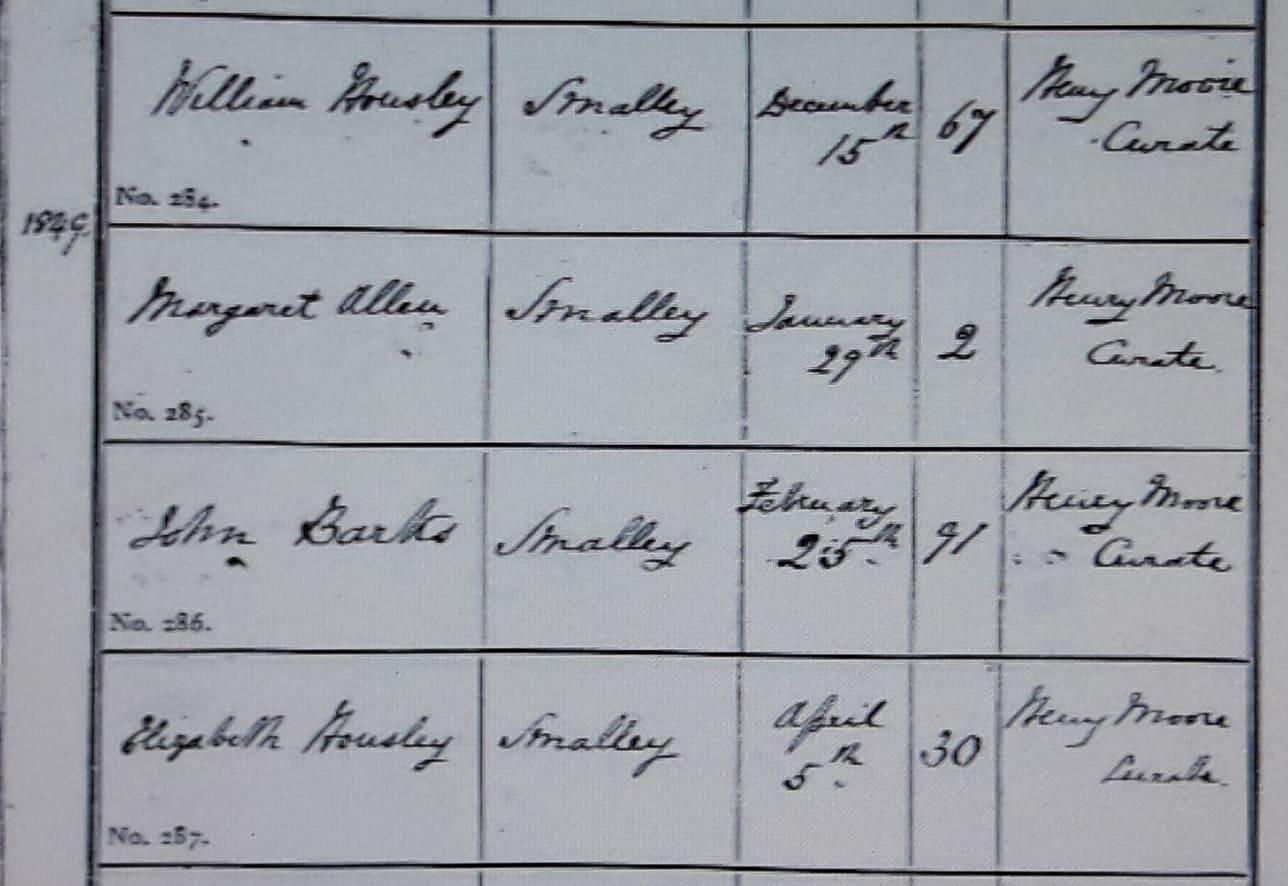
Sam married Elizabeth Brookes of Sutton Coldfield, and they had three daughters: Elizabeth, Mary Anne and Catherine. Elizabeth his wife died in 1849, a few months after Samuel’s father William died in 1848. The particular circumstances relating to these individuals have been discussed in previous chapters; the following are letter excerpts relating to them.
Death of William Housley 15 Dec 1848, and Elizabeth Housley 5 April 1849, Smalley:
Joseph wrote in December 1872: “I saw one of Sam’s daughters, the youngest Kate, you would remember her a baby I dare say. She is very comfortably married.”
In the same letter (December 15, 1872), Joseph wrote: “I think we have now found all out now that is concerned in the matter for there was only Sam that we did not know his whereabouts but I was informed a week ago that he is dead–died about three years ago in Birmingham Union. Poor Sam. He ought to have come to a better end than that….His daughter and her husband went to Brimingham and also to Sutton Coldfield that is where he married his wife from and found out his wife’s brother. It appears he has been there and at Birmingham ever since he went away but ever fond of drink.”
(Sam, however, was still alive in 1871, living as a lodger at the George and Dragon Inn, Henley in Arden. And no trace of Sam has been found since. It would appear that Sam did not want to be found.)
EDWARD HOUSLEY 1819-1843
Edward died before George left for USA in 1851, and as such there is no mention of him in the letters.
ANNE HOUSLEY 1821-1856
Anne wrote two letters to her brother George between February 1854 and her death in 1856. Apparently she suffered from a lung disease for she wrote: “I can say you will be surprised I am still living and better but still cough and spit a deal. Can do nothing but sit and sew.” According to the 1851 census, Anne, then 29, was a seamstress. Their friend, Mrs. Davy, wrote in March 1856: “This I send in a box to my Brother….The pincushion cover and pen wiper are Anne’s work–are for thy wife. She would have made it up had she been able.” Anne was not living at home at the time of the 1841 census. She would have been 19 or 20 and perhaps was “out service.”
In her second letter Anne wrote: “It is a great trouble now for me to write…as the body weakens so does the mind often. I have been very weak all summer. That I continue is a wonder to all and to spit so much although much better than when you left home.” She also wrote: “You know I had a desire for America years ago. Were I in health and strength, it would be the land of my adoption.”
In November 1855, Emma wrote, “Anne has been very ill all summer and has not been able to write or do anything.” Their neighbor Mrs. Davy wrote on March 21, 1856: “I fear Anne will not be long without a change.” In a black-edged letter the following June, Emma wrote: “I need not tell you how happy she was and how calmly and peacefully she died. She only kept in bed two days.”
Certainly Anne was a woman of deep faith and strong religious convictions. When she wrote that they were hoping to hear of Charles’ success on the gold fields she added: “But I would rather hear of him having sought and found the Pearl of great price than all the gold Australia can produce, (For what shall it profit a man if he gain the whole world and lose his soul?).” Then she asked George: “I should like to learn how it was you were first led to seek pardon and a savior. I do feel truly rejoiced to hear you have been led to seek and find this Pearl through the workings of the Holy Spirit and I do pray that He who has begun this good work in each of us may fulfill it and carry it on even unto the end and I can never doubt the willingness of Jesus who laid down his life for us. He who said whoever that cometh unto me I will in no wise cast out.”
Anne’s will was probated October 14, 1856. Mr. William Davy of Kidsley Park appeared for the family. Her estate was valued at under £20. Emma was to receive fancy needlework, a four post bedstead, feather bed and bedding, a mahogany chest of drawers, plates, linen and china. Emma was also to receive Anne’s writing desk. There was a condition that Ellen would have use of these items until her death.
The money that Anne was to receive from her grandfather, William Carrington, and her father, William Housley was to be distributed one third to Joseph, one third to Emma, and one third to be divided between her four neices: John’s daughter Elizabeth, 18, and Sam’s daughters Elizabeth, 10, Mary Ann, 9 and Catharine, age 7 to be paid by the trustees as they think “most useful and proper.” Emma Lyon and Elizabeth Davy were the witnesses.
The Carrington Farm:
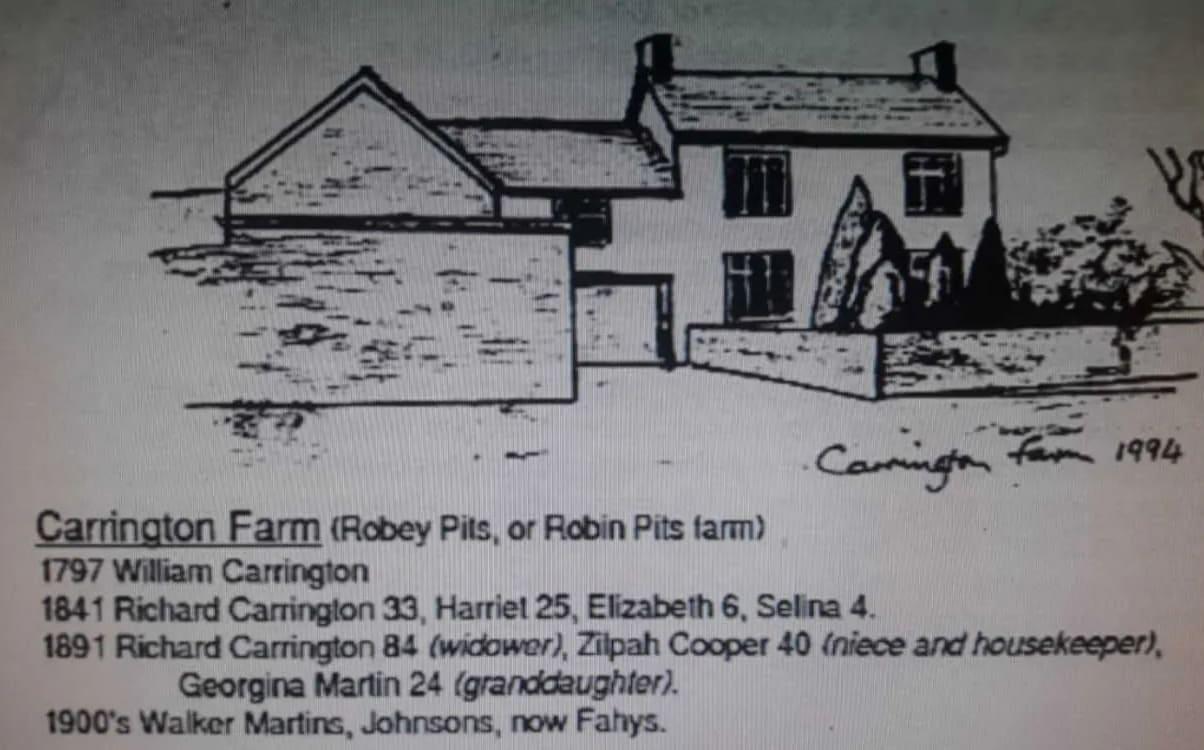
CHARLES HOUSLEY 1823-1855
Charles went to Australia in 1851, and was last heard from in January 1853. According to the solicitor, who wrote to George on June 3, 1874, Charles had received advances on the settlement of their parent’s estate. “Your promissory note with the two signed by your brother Charles for 20 pounds he received from his father and 20 pounds he received from his mother are now in the possession of the court.”
Charles and George were probably quite close friends. Anne wrote in 1854: “Charles inquired very particularly in both his letters after you.”
According to Anne, Charles and a friend married two sisters. He and his father-in-law had a farm where they had 130 cows and 60 pigs. Whatever the trade he learned in England, he never worked at it once he reached Australia. While it does not seem that Charles went to Australia because gold had been discovered there, he was soon caught up in “gold fever”. Anne wrote: “I dare say you have heard of the immense gold fields of Australia discovered about the time he went. Thousands have since then emigrated to Australia, both high and low. Such accounts we heard in the papers of people amassing fortunes we could not believe. I asked him when I wrote if it was true. He said this was no exaggeration for people were making their fortune daily and he intended going to the diggings in six weeks for he could stay away no longer so that we are hoping to hear of his success if he is alive.”
In March 1856, Mrs. Davy wrote: “I am sorry to tell thee they have had a letter from Charles’s wife giving account of Charles’s death of 6 months consumption at the Victoria diggings. He has left 2 children a boy and a girl William and Ellen.” In June of the same year in a black edged letter, Emma wrote: “I think Mrs. Davy mentioned Charles’s death in her note. His wife wrote to us. They have two children Helen and William. Poor dear little things. How much I should like to see them all. She writes very affectionately.”
In December 1872, Joseph wrote: “I’m told that Charles two daughters has wrote to Smalley post office making inquiries about his share….” In January 1876, the solicitor wrote: “Charles Housley’s children have claimed their father’s share.”
GEORGE HOUSLEY 1824-1877
George emigrated to the United states in 1851, arriving in July. The solicitor Abraham John Flint referred in a letter to a 15-pound advance which was made to George on June 9, 1851. This certainly was connected to his journey. George settled along the Delaware River in Bucks County, Pennsylvania. The letters from the solicitor were addressed to: Lahaska Post Office, Bucks County, Pennsylvania.
George married Sarah Ann Hill on May 6, 1854 in Doylestown, Bucks County, Pennsylvania. In her first letter (February 1854), Anne wrote: “We want to know who and what is this Miss Hill you name in your letter. What age is she? Send us all the particulars but I would advise you not to get married until you have sufficient to make a comfortable home.”
Upon learning of George’s marriage, Anne wrote: “I hope dear brother you may be happy with your wife….I hope you will be as a son to her parents. Mother unites with me in kind love to you both and to your father and mother with best wishes for your health and happiness.” In 1872 (December) Joseph wrote: “I am sorry to hear that sister’s father is so ill. It is what we must all come to some time and hope we shall meet where there is no more trouble.”
Emma wrote in 1855, “We write in love to your wife and yourself and you must write soon and tell us whether there is a little nephew or niece and what you call them.” In June of 1856, Emma wrote: “We want to see dear Sarah Ann and the dear little boy. We were much pleased with the “bit of news” you sent.” The bit of news was the birth of John Eley Housley, January 11, 1855. Emma concluded her letter “Give our very kindest love to dear sister and dearest Johnnie.”
In September 1872, Joseph wrote, “I was very sorry to hear that John your oldest had met with such a sad accident but I hope he is got alright again by this time.” In the same letter, Joseph asked: “Now I want to know what sort of a town you are living in or village. How far is it from New York? Now send me all particulars if you please.”
In March 1873 Harriet asked Sarah Ann: “And will you please send me all the news at the place and what it is like for it seems to me that it is a wild place but you must tell me what it is like….”. The question of whether she was referring to Bucks County, Pennsylvania or some other place is raised in Joseph’s letter of the same week.
On March 17, 1873, Joseph wrote: “I was surprised to hear that you had gone so far away west. Now dear brother what ever are you doing there so far away from home and family–looking out for something better I suppose.”The solicitor wrote on May 23, 1874: “Lately I have not written because I was not certain of your address and because I doubted I had much interesting news to tell you.” Later, Joseph wrote concerning the problems settling the estate, “You see dear brother there is only me here on our side and I cannot do much. I wish you were here to help me a bit and if you think of going for another summer trip this turn you might as well run over here.”
Apparently, George had indicated he might return to England for a visit in 1856. Emma wrote concerning the portrait of their mother which had been sent to George: “I hope you like mother’s portrait. I did not see it but I suppose it was not quite perfect about the eyes….Joseph and I intend having ours taken for you when you come over….Do come over before very long.”
In March 1873, Joseph wrote: “You ask me what I think of you coming to England. I think as you have given the trustee power to sign for you I think you could do no good but I should like to see you once again for all that. I can’t say whether there would be anything amiss if you did come as you say it would be throwing good money after bad.”
On June 10, 1875, the solicitor wrote: “I have been expecting to hear from you for some time past. Please let me hear what you are doing and where you are living and how I must send you your money.” George’s big news at that time was that on May 3, 1875, he had become a naturalized citizen “renouncing and abjuring all allegiance and fidelity to every foreign prince, potentate, state and sovereignity whatsoever, and particularly to Victoria Queen of Great Britain of whom he was before a subject.”
ROBERT HOUSLEY 1832-1851
In 1854, Anne wrote: “Poor Robert. He died in August after you left he broke a blood vessel in the lung.”
From Joseph’s first letter we learn that Robert was 19 when he died: “Dear brother there have been a great many changes in the family since you left us. All is gone except myself and John and Sam–we have heard nothing of him since he left. Robert died first when he was 19 years of age. Then Anne and Charles too died in Australia and then a number of years elapsed before anyone else. Then John lost his wife, then Emma, and last poor dear mother died last January on the 11th.”Anne described Robert’s death in this way: “He had thrown up blood many times before in the spring but the last attack weakened him that he only lived a fortnight after. He died at Derby. Mother was with him. Although he suffered much he never uttered a murmur or regret and always a smile on his face for everyone that saw him. He will be regretted by all that knew him”.
Robert died a resident of St. Peter’s Parish, Derby, but was buried in Smalley on August 16, 1851.
Apparently Robert was apprenticed to be a joiner for, according to Anne, Joseph took his place: “Joseph wanted to be a joiner. We thought we could do no better than let him take Robert’s place which he did the October after and is there still.”In 1876, the solicitor wrote to George: “Have you heard of John Housley? He is entitled to Robert’s share and I want him to claim it.”
EMMA HOUSLEY 1836-1871
Emma was not mentioned in Anne’s first letter. In the second, Anne wrote that Emma was living at Spondon with two ladies in her “third situation,” and added, “She is grown a bouncing woman.” Anne described her sister well. Emma wrote in her first letter (November 12, 1855): “I must tell you that I am just 21 and we had my pudding last Sunday. I wish I could send you a piece.”
From Emma’s letters we learn that she was living in Derby from May until November 1855 with Mr. Haywood, an iron merchant. She explained, “He has failed and I have been obliged to leave,” adding, “I expect going to a new situation very soon. It is at Belper.” In 1851 records, William Haywood, age 22, was listed as an iron foundry worker. In the 1857 Derby Directory, James and George were listed as iron and brass founders and ironmongers with an address at 9 Market Place, Derby.
In June 1856, Emma wrote from “The Cedars, Ashbourne Road” where she was working for Mr. Handysides.
While she was working for Mr. Handysides, Emma wrote: “Mother is thinking of coming to live at Derby. That will be nice for Joseph and I.”Friargate and Ashbourne Road were located in St. Werburgh’s Parish. (In fact, St. Werburgh’s vicarage was at 185 Surrey Street. This clue led to the discovery of the record of Emma’s marriage on May 6, 1858, to Edwin Welch Harvey, son of Samuel Harvey in St. Werburgh’s.)
In 1872, Joseph wrote: “Our sister Emma, she died at Derby at her own home for she was married. She has left two young children behind. The husband was the son of the man that I went apprentice to and has caused a great deal of trouble to our family and I believe hastened poor Mother’s death….”. Joseph added that he believed Emma’s “complaint” was consumption and that she was sick a good bit. Joseph wrote: “Mother was living with John when I came home (from Ascension Island around 1867? or to Smalley from Derby around 1870?) for when Emma was married she broke up the comfortable home and the things went to Derby and she went to live with them but Derby did not agree with her so she had to leave it again but left all her things there.”
Emma Housley and Edwin Welch Harvey wedding, 1858:
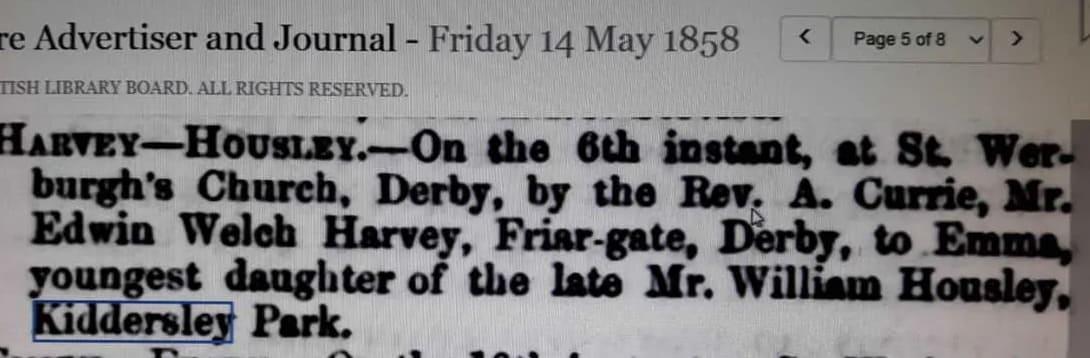
JOSEPH HOUSLEY 1838-1893
We first hear of Joseph in a letter from Anne to George in 1854. “Joseph wanted to be a joiner. We thought we could do no better than let him take Robert’s place which he did the October after (probably 1851) and is there still. He is grown as tall as you I think quite a man.” Emma concurred in her first letter: “He is quite a man in his appearance and quite as tall as you.”
From Emma we learn in 1855: “Joseph has left Mr. Harvey. He had not work to employ him. So mother thought he had better leave his indenture and be at liberty at once than wait for Harvey to be a bankrupt. He has got a very good place of work now and is very steady.” In June of 1856, Emma wrote “Joseph and I intend to have our portraits taken for you when you come over….Mother is thinking of coming to Derby. That will be nice for Joseph and I. Joseph is very hearty I am happy to say.”
According to Joseph’s letters, he was married to Harriet Ballard. Joseph described their miraculous reunion in this way: “I must tell you that I have been abroad myself to the Island of Ascension. (Elsewhere he wrote that he was on the island when the American civil war broke out). I went as a Royal Marine and worked at my trade and saved a bit of money–enough to buy my discharge and enough to get married with but while I was out on the island who should I meet with there but my dear wife’s sister. (On two occasions Joseph and Harriet sent George the name and address of Harriet’s sister, Mrs. Brooks, in Susquehanna Depot, Pennsylvania, but it is not clear whether this was the same sister.) She was lady’s maid to the captain’s wife. Though I had never seen her before we got to know each other somehow so from that me and my wife recommenced our correspondence and you may be sure I wanted to get home to her. But as soon as I did get home that is to England I was not long before I was married and I have not regretted yet for we are very comfortable as well as circumstances will allow for I am only a journeyman joiner.”
Proudly, Joseph wrote: “My little family consists of three nice children–John, Joseph and Susy Annie.” On her birth certificate, Susy Ann’s birthdate is listed as 1871. Parish records list a Lucy Annie christened in 1873. The boys were born in Derby, John in 1868 and Joseph in 1869. In his second letter, Joseph repeated: “I have got three nice children, a good wife and I often think is more than I have deserved.” On August 6, 1873, Joseph and Harriet wrote: “We both thank you dear sister for the pieces of money you sent for the children. I don’t know as I have ever see any before.” Joseph ended another letter: “Now I must close with our kindest love to you all and kisses from the children.”
In Harriet’s letter to Sarah Ann (March 19, 1873), she promised: “I will send you myself and as soon as the weather gets warm as I can take the children to Derby, I will have them taken and send them, but it is too cold yet for we have had a very cold winter and a great deal of rain.” At this time, the children were all under 6 and the baby was not yet two.
In March 1873 Joseph wrote: “I have been working down at Heanor gate there is a joiner shop there where Kings used to live I have been working there this winter and part of last summer but the wages is very low but it is near home that is one comfort.” (Heanor Gate is about 1/4 mile from Kidsley Grange. There was a school and industrial park there in 1988.) At this time Joseph and his family were living in “the big house–in Old Betty Hanson’s house.” The address in the 1871 census was Smalley Lane.
A glimpse into Joseph’s personality is revealed by this remark to George in an 1872 letter: “Many thanks for your portrait and will send ours when we can get them taken for I never had but one taken and that was in my old clothes and dear Harriet is not willing to part with that. I tell her she ought to be satisfied with the original.”
On one occasion Joseph and Harriet both sent seeds. (Marks are still visible on the paper.) Joseph sent “the best cow cabbage seed in the country–Robinson Champion,” and Harriet sent red cabbage–Shaw’s Improved Red. Possibly cow cabbage was also known as ox cabbage: “I hope you will have some good cabbages for the Ox cabbage takes all the prizes here. I suppose you will be taking the prizes out there with them.” Joseph wrote that he would put the name of the seeds by each “but I should think that will not matter. You will tell the difference when they come up.”
George apparently would have liked Joseph to come to him as early as 1854. Anne wrote: “As to his coming to you that must be left for the present.” In 1872, Joseph wrote: “I have been thinking of making a move from here for some time before I heard from you for it is living from hand to mouth and never certain of a job long either.” Joseph then made plans to come to the United States in the spring of 1873. “For I intend all being well leaving England in the spring. Many thanks for your kind offer but I hope we shall be able to get a comfortable place before we have been out long.” Joseph promised to bring some things George wanted and asked: “What sort of things would be the best to bring out there for I don’t want to bring a lot that is useless.” Joseph’s plans are confirmed in a letter from the solicitor May 23, 1874: “I trust you are prospering and in good health. Joseph seems desirous of coming out to you when this is settled.”
George must have been reminiscing about gooseberries (Heanor has an annual gooseberry show–one was held July 28, 1872) and Joseph promised to bring cuttings when they came: “Dear Brother, I could not get the gooseberries for they was all gathered when I received your letter but we shall be able to get some seed out the first chance and I shall try to bring some cuttings out along.” In the same letter that he sent the cabbage seeds Joseph wrote: “I have got some gooseberries drying this year for you. They are very fine ones but I have only four as yet but I was promised some more when they were ripe.” In another letter Joseph sent gooseberry seeds and wrote their names: Victoria, Gharibaldi and Globe.
In September 1872 Joseph wrote; “My wife is anxious to come. I hope it will suit her health for she is not over strong.” Elsewhere Joseph wrote that Harriet was “middling sometimes. She is subject to sick headaches. It knocks her up completely when they come on.” In December 1872 Joseph wrote, “Now dear brother about us coming to America you know we shall have to wait until this affair is settled and if it is not settled and thrown into Chancery I’m afraid we shall have to stay in England for I shall never be able to save money enough to bring me out and my family but I hope of better things.”
On July 19, 1875 Abraham Flint (the solicitor) wrote: “Joseph Housley has removed from Smalley and is working on some new foundry buildings at Little Chester near Derby. He lives at a village called Little Eaton near Derby. If you address your letter to him as Joseph Housley, carpenter, Little Eaton near Derby that will no doubt find him.”
George did not save any letters from Joseph after 1874, hopefully he did reach him at Little Eaton. Joseph and his family are not listed in either Little Eaton or Derby on the 1881 census.
In his last letter (February 11, 1874), Joseph sounded very discouraged and wrote that Harriet’s parents were very poorly and both had been “in bed for a long time.” In addition, Harriet and the children had been ill.
The move to Little Eaton may indicate that Joseph received his settlement because in August, 1873, he wrote: “I think this is bad news enough and bad luck too, but I have had little else since I came to live at Kiddsley cottages but perhaps it is all for the best if one could only think so. I have begun to think there will be no chance for us coming over to you for I am afraid there will not be so much left as will bring us out without it is settled very shortly but I don’t intend leaving this house until it is settled either one way or the other. “Joseph Housley and the Kiddsley cottages:
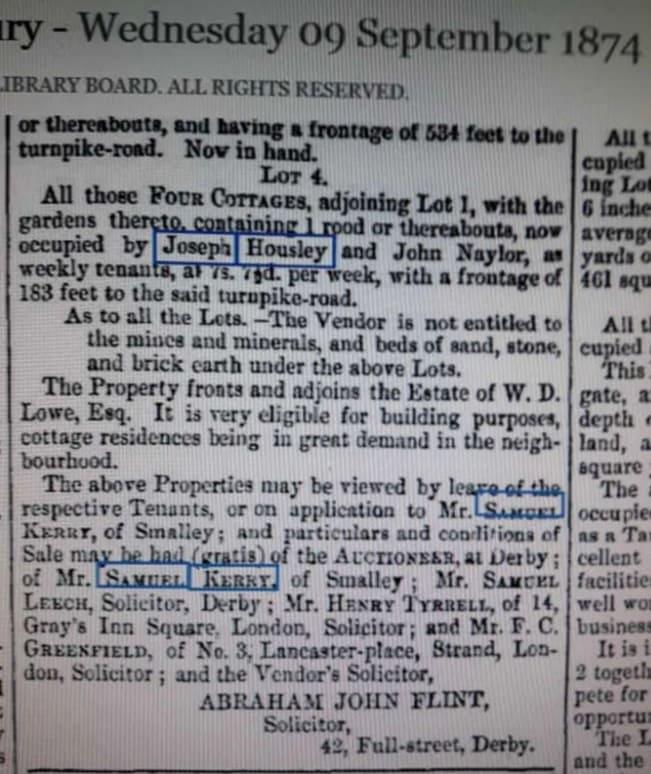 January 28, 2022 at 3:13 pm #6262
In reply to: The Elusive Samuel Housley and Other Family Stories
From Tanganyika with Love
continued ~ part 3
With thanks to Mike Rushby.
Mchewe Estate. 22nd March 1935
Dearest Family,
I am feeling much better now that I am five months pregnant and have quite got
my appetite back. Once again I go out with “the Mchewe Hunt” which is what George
calls the procession made up of the donkey boy and donkey with Ann confidently riding
astride, me beside the donkey with Georgie behind riding the stick which he much
prefers to the donkey. The Alsatian pup, whom Ann for some unknown reason named
‘Tubbage’, and the two cats bring up the rear though sometimes Tubbage rushes
ahead and nearly knocks me off my feet. He is not the loveable pet that Kelly was.
It is just as well that I have recovered my health because my mother-in-law has
decided to fly out from England to look after Ann and George when I am in hospital. I am
very grateful for there is no one lse to whom I can turn. Kath Hickson-Wood is seldom on
their farm because Hicky is working a guano claim and is making quite a good thing out of
selling bat guano to the coffee farmers at Mbosi. They camp out at the claim, a series of
caves in the hills across the valley and visit the farm only occasionally. Anne Molteno is
off to Cape Town to have her baby at her mothers home and there are no women in
Mbeya I know well. The few women are Government Officials wives and they come
and go. I make so few trips to the little town that there is no chance to get on really
friendly terms with them.Janey, the ayah, is turning into a treasure. She washes and irons well and keeps
the children’s clothes cupboard beautifully neat. Ann and George however are still
reluctant to go for walks with her. They find her dull because, like all African ayahs, she
has no imagination and cannot play with them. She should however be able to help with
the baby. Ann is very excited about the new baby. She so loves all little things.
Yesterday she went into ecstasies over ten newly hatched chicks.She wants a little sister and perhaps it would be a good thing. Georgie is so very
active and full of mischief that I feel another wild little boy might be more than I can
manage. Although Ann is older, it is Georgie who always thinks up the mischief. They
have just been having a fight. Georgie with the cooks umbrella versus Ann with her frilly
pink sunshade with the inevitable result that the sunshade now has four broken ribs.
Any way I never feel lonely now during the long hours George is busy on the
shamba. The children keep me on my toes and I have plenty of sewing to do for the
baby. George is very good about amusing the children before their bedtime and on
Sundays. In the afternoons when it is not wet I take Ann and Georgie for a walk down
the hill. George meets us at the bottom and helps me on the homeward journey. He
grabs one child in each hand by the slack of their dungarees and they do a sort of giant
stride up the hill, half walking half riding.Very much love,
Eleanor.Mchewe Estate. 14th June 1935
Dearest Family,
A great flap here. We had a letter yesterday to say that mother-in-law will be
arriving in four days time! George is very amused at my frantic efforts at spring cleaning
but he has told me before that she is very house proud so I feel I must make the best
of what we have.George is very busy building a store for the coffee which will soon be ripening.
This time he is doing the bricklaying himself. It is quite a big building on the far end of the
farm and close to the river. He is also making trays of chicken wire nailed to wooden
frames with cheap calico stretched over the wire.Mother will have to sleep in the verandah room which leads off the bedroom
which we share with the children. George will have to sleep in the outside spare room as
there is no door between the bedroom and the verandah room. I am sewing frantically
to make rose coloured curtains and bedspread out of material mother-in-law sent for
Christmas and will have to make a curtain for the doorway. The kitchen badly needs
whitewashing but George says he cannot spare the labour so I hope mother won’t look.
To complicate matters, George has been invited to lunch with the Governor on the day
of Mother’s arrival. After lunch they are to visit the newly stocked trout streams in the
Mporotos. I hope he gets back to Mbeya in good time to meet mother’s plane.
Ann has been off colour for a week. She looks very pale and her pretty fair hair,
normally so shiny, is dull and lifeless. It is such a pity that mother should see her like this
because first impressions do count so much and I am looking to the children to attract
attention from me. I am the size of a circus tent and hardly a dream daughter-in-law.
Georgie, thank goodness, is blooming but he has suddenly developed a disgusting
habit of spitting on the floor in the manner of the natives. I feel he might say “Gran, look
how far I can spit and give an enthusiastic demonstration.Just hold thumbs that all goes well.
your loving but anxious,
Eleanor.Mchewe Estate. 28th June 1935
Dearest Family,
Mother-in-law duly arrived in the District Commissioner’s car. George did not dare
to use the A.C. as she is being very temperamental just now. They also brought the
mail bag which contained a parcel of lovely baby clothes from you. Thank you very
much. Mother-in-law is very put out because the large parcel she posted by surface
mail has not yet arrived.Mother arrived looking very smart in an ankle length afternoon frock of golden
brown crepe and smart hat, and wearing some very good rings. She is a very
handsome woman with the very fair complexion that goes with red hair. The hair, once
Titan, must now be grey but it has been very successfully tinted and set. I of course,
was shapeless in a cotton maternity frock and no credit to you. However, so far, motherin-
law has been uncritical and friendly and charmed with the children who have taken to
her. Mother does not think that the children resemble me in any way. Ann resembles her
family the Purdys and Georgie is a Morley, her mother’s family. She says they had the
same dark eyes and rather full mouths. I say feebly, “But Georgie has my colouring”, but
mother won’t hear of it. So now you know! Ann is a Purdy and Georgie a Morley.
Perhaps number three will be a Leslie.What a scramble I had getting ready for mother. Her little room really looks pretty
and fresh, but the locally woven grass mats arrived only minutes before mother did. I
also frantically overhauled our clothes and it a good thing that I did so because mother
has been going through all the cupboards looking for mending. Mother is kept so busy
in her own home that I think she finds time hangs on her hands here. She is very good at
entertaining the children and has even tried her hand at picking coffee a couple of times.
Mother cannot get used to the native boy servants but likes Janey, so Janey keeps her
room in order. Mother prefers to wash and iron her own clothes.I almost lost our cook through mother’s surplus energy! Abel our previous cook
took a new wife last month and, as the new wife, and Janey the old, were daggers
drawn, Abel moved off to a job on the Lupa leaving Janey and her daughter here.
The new cook is capable, but he is a fearsome looking individual called Alfani. He has a
thick fuzz of hair which he wears long, sometimes hidden by a dingy turban, and he
wears big brass earrings. I think he must be part Somali because he has a hawk nose
and a real Brigand look. His kitchen is never really clean but he is an excellent cook and
as cooks are hard to come by here I just keep away from the kitchen. Not so mother!
A few days after her arrival she suggested kindly that I should lie down after lunch
so I rested with the children whilst mother, unknown to me, went out to the kitchen and
not only scrubbed the table and shelves but took the old iron stove to pieces and
cleaned that. Unfortunately in her zeal she poked a hole through the stove pipe.
Had I known of these activities I would have foreseen the cook’s reaction when
he returned that evening to cook the supper. he was furious and wished to leave on the
spot and demanded his wages forthwith. The old Memsahib had insulted him by
scrubbing his already spotless kitchen and had broken his stove and made it impossible
for him to cook. This tirade was accompanied by such waving of hands and rolling of
eyes that I longed to sack him on the spot. However I dared not as I might not get
another cook for weeks. So I smoothed him down and he patched up the stove pipe
with a bit of tin and some wire and produced a good meal. I am wondering what
transformations will be worked when I am in hospital.Our food is really good but mother just pecks at it. No wonder really, because
she has had some shocks. One day she found the kitchen boy diligently scrubbing the box lavatory seat with a scrubbing brush which he dipped into one of my best large
saucepans! No one can foresee what these boys will do. In these remote areas house
servants are usually recruited from the ranks of the very primitive farm labourers, who first
come to the farm as naked savages, and their notions of hygiene simply don’t exist.
One day I said to mother in George’s presence “When we were newly married,
mother, George used to brag about your cooking and say that you would run a home
like this yourself with perhaps one ‘toto’. Mother replied tartly, “That was very bad of
George and not true. If my husband had brought me out here I would not have stayed a
month. I think you manage very well.” Which reply made me warm to mother a lot.
To complicate things we have a new pup, a little white bull terrier bitch whom
George has named Fanny. She is tiny and not yet house trained but seems a plucky
and attractive little animal though there is no denying that she does look like a piglet.Very much love to all,
Eleanor.Mchewe Estate. 3rd August 1935
Dearest Family,
Here I am in hospital, comfortably in bed with our new daughter in her basket
beside me. She is a lovely little thing, very plump and cuddly and pink and white and
her head is covered with tiny curls the colour of Golden Syrup. We meant to call her
Margery Kate, after our Marj and my mother-in-law whose name is Catherine.
I am enjoying the rest, knowing that George and mother will be coping
successfully on the farm. My room is full of flowers, particularly with the roses and
carnations which grow so well here. Kate was not due until August 5th but the doctor
wanted me to come in good time in view of my tiresome early pregnancy.For weeks beforehand George had tinkered with the A.C. and we started for
Mbeya gaily enough on the twenty ninth, however, after going like a dream for a couple
of miles, she simply collapsed from exhaustion at the foot of a hill and all the efforts of
the farm boys who had been sent ahead for such an emergency failed to start her. So
George sent back to the farm for the machila and I sat in the shade of a tree, wondering
what would happen if I had the baby there and then, whilst George went on tinkering
with the car. Suddenly she sprang into life and we roared up that hill and all the way into
Mbeya. The doctor welcomed us pleasantly and we had tea with his family before I
settled into my room. Later he examined me and said that it was unlikely that the baby
would be born for several days. The new and efficient German nurse said, “Thank
goodness for that.” There was a man in hospital dying from a stomach cancer and she
had not had a decent nights sleep for three nights.Kate however had other plans. I woke in the early morning with labour pains but
anxious not to disturb the nurse, I lay and read or tried to read a book, hoping that I
would not have to call the nurse until daybreak. However at four a.m., I went out into the
wind which was howling along the open verandah and knocked on the nurse’s door. She
got up and very crossly informed me that I was imagining things and should get back to
bed at once. She said “It cannot be so. The Doctor has said it.” I said “Of course it is,”
and then and there the water broke and clinched my argument. She then went into a flat
spin. “But the bed is not ready and my instruments are not ready,” and she flew around
to rectify this and also sent an African orderly to call the doctor. I paced the floor saying
warningly “Hurry up with that bed. I am going to have the baby now!” She shrieked
“Take off your dressing gown.” But I was passed caring. I flung myself on the bed and
there was Kate. The nurse had done all that was necessary by the time the doctor
arrived.A funny thing was, that whilst Kate was being born on the bed, a black cat had
kittens under it! The doctor was furious with the nurse but the poor thing must have crept
in out of the cold wind when I went to call the nurse. A happy omen I feel for the baby’s
future. George had no anxiety this time. He stayed at the hospital with me until ten
o’clock when he went down to the hotel to sleep and he received the news in a note
from me with his early morning tea. He went to the farm next morning but will return on
the sixth to fetch me home.I do feel so happy. A very special husband and three lovely children. What
more could anyone possibly want.Lots and lots of love,
Eleanor.Mchewe Estate. 20th August 1935
Dearest Family,
Well here we are back at home and all is very well. The new baby is very placid
and so pretty. Mother is delighted with her and Ann loved her at sight but Georgie is not
so sure. At first he said, “Your baby is no good. Chuck her in the kalonga.” The kalonga
being the ravine beside the house , where, I regret to say, much of the kitchen refuse is
dumped. he is very jealous when I carry Kate around or feed her but is ready to admire
her when she is lying alone in her basket.George walked all the way from the farm to fetch us home. He hired a car and
native driver from the hotel, but drove us home himself going with such care over ruts
and bumps. We had a great welcome from mother who had had the whole house
spring cleaned. However George loyally says it looks just as nice when I am in charge.
Mother obviously, had had more than enough of the back of beyond and
decided to stay on only one week after my return home. She had gone into the kitchen
one day just in time to see the houseboy scooping the custard he had spilt on the table
back into the jug with the side of his hand. No doubt it would have been served up
without a word. On another occasion she had walked in on the cook’s daily ablutions. He
was standing in a small bowl of water in the centre of the kitchen, absolutely naked,
enjoying a slipper bath. She left last Wednesday and gave us a big laugh before she
left. She never got over her horror of eating food prepared by our cook and used to
push it around her plate. Well, when the time came for mother to leave for the plane, she
put on the very smart frock in which she had arrived, and then came into the sitting room
exclaiming in dismay “Just look what has happened, I must have lost a stone!’ We
looked, and sure enough, the dress which had been ankle deep before, now touched
the floor. “Good show mother.” said George unfeelingly. “You ought to be jolly grateful,
you needed to lose weight and it would have cost you the earth at a beauty parlour to
get that sylph-like figure.”When mother left she took, in a perforated matchbox, one of the frilly mantis that
live on our roses. She means to keep it in a goldfish bowl in her dining room at home.
Georgie and Ann filled another matchbox with dead flies for food for the mantis on the
journey.Now that mother has left, Georgie and Ann attach themselves to me and firmly
refuse to have anything to do with the ayah,Janey. She in any case now wishes to have
a rest. Mother tipped her well and gave her several cotton frocks so I suspect she wants
to go back to her hometown in Northern Rhodesia to show off a bit.
Georgie has just sidled up with a very roguish look. He asked “You like your
baby?” I said “Yes indeed I do.” He said “I’ll prick your baby with a velly big thorn.”Who would be a mother!
EleanorMchewe Estate. 20th September 1935
Dearest Family,
I have been rather in the wars with toothache and as there is still no dentist at
Mbeya to do the fillings, I had to have four molars extracted at the hospital. George
says it is fascinating to watch me at mealtimes these days because there is such a gleam
of satisfaction in my eye when I do manage to get two teeth to meet on a mouthful.
About those scissors Marj sent Ann. It was not such a good idea. First she cut off tufts of
George’s hair so that he now looks like a bad case of ringworm and then she cut a scalp
lock, a whole fist full of her own shining hair, which George so loves. George scolded
Ann and she burst into floods of tears. Such a thing as a scolding from her darling daddy
had never happened before. George immediately made a long drooping moustache
out of the shorn lock and soon had her smiling again. George is always very gentle with
Ann. One has to be , because she is frightfully sensitive to criticism.I am kept pretty busy these days, Janey has left and my houseboy has been ill
with pneumonia. I now have to wash all the children’s things and my own, (the cook does
George’s clothes) and look after the three children. Believe me, I can hardly keep awake
for Kate’s ten o’clock feed.I do hope I shall get some new servants next month because I also got George
to give notice to the cook. I intercepted him last week as he was storming down the hill
with my large kitchen knife in his hand. “Where are you going with my knife?” I asked.
“I’m going to kill a man!” said Alfani, rolling his eyes and looking extremely ferocious. “He
has taken my wife.” “Not with my knife”, said I reaching for it. So off Alfani went, bent on
vengeance and I returned the knife to the kitchen. Dinner was served and I made no
enquiries but I feel that I need someone more restful in the kitchen than our brigand
Alfani.George has been working on the car and has now fitted yet another radiator. This
is a lorry one and much too tall to be covered by the A.C.’s elegant bonnet which is
secured by an old strap. The poor old A.C. now looks like an ancient shoe with a turned
up toe. It only needs me in it with the children to make a fine illustration to the old rhyme!
Ann and Georgie are going through a climbing phase. They practically live in
trees. I rushed out this morning to investigate loud screams and found Georgie hanging
from a fork in a tree by one ankle, whilst Ann stood below on tiptoe with hands stretched
upwards to support his head.Do I sound as though I have straws in my hair? I have.
Lots of love,
Eleanor.Mchewe Estate. 11th October 1935
Dearest Family,
Thank goodness! I have a new ayah name Mary. I had heard that there was a
good ayah out of work at Tukuyu 60 miles away so sent a messenger to fetch her. She
arrived after dark wearing a bright dress and a cheerful smile and looked very suitable by
the light of a storm lamp. I was horrified next morning to see her in daylight. She was
dressed all in black and had a rather sinister look. She reminds me rather of your old maid
Candace who overheard me laughing a few days before Ann was born and croaked
“Yes , Miss Eleanor, today you laugh but next week you might be dead.” Remember
how livid you were, dad?I think Mary has the same grim philosophy. Ann took one look at her and said,
“What a horrible old lady, mummy.” Georgie just said “Go away”, both in English and Ki-
Swahili. Anyway Mary’s references are good so I shall keep her on to help with Kate
who is thriving and bonny and placid.Thank you for the offer of toys for Christmas but, if you don’t mind, I’d rather have
some clothing for the children. Ann is quite contented with her dolls Barbara and Yvonne.
Barbara’s once beautiful face is now pieced together like a jigsaw puzzle having come
into contact with Georgie’s ever busy hammer. However Ann says she will love her for
ever and she doesn’t want another doll. Yvonne’s hay day is over too. She
disappeared for weeks and we think Fanny, the pup, was the culprit. Ann discovered
Yvonne one morning in some long wet weeds. Poor Yvonne is now a ghost of her
former self. All the sophisticated make up was washed off her papier-mâché face and
her hair is decidedly bedraggled, but Ann was radiant as she tucked her back into bed
and Yvonne is as precious to Ann as she ever was.Georgie simply does not care for toys. His paint box, hammer and the trenching
hoe George gave him for his second birthday are all he wants or needs. Both children
love books but I sometimes wonder whether they stimulate Ann’s imagination too much.
The characters all become friends of hers and she makes up stories about them to tell
Georgie. She adores that illustrated children’s Bible Mummy sent her but you would be
astonished at the yarns she spins about “me and my friend Jesus.” She also will call
Moses “Old Noses”, and looking at a picture of Jacob’s dream, with the shining angels
on the ladder between heaven and earth, she said “Georgie, if you see an angel, don’t
touch it, it’s hot.”Eleanor.
Mchewe Estate. 17th October 1935
Dearest Family,
I take back the disparaging things I said about my new Ayah, because she has
proved her worth in an unexpected way. On Wednesday morning I settled Kate in he
cot after her ten o’clock feed and sat sewing at the dining room table with Ann and
Georgie opposite me, both absorbed in painting pictures in identical seed catalogues.
Suddenly there was a terrific bang on the back door, followed by an even heavier blow.
The door was just behind me and I got up and opened it. There, almost filling the door
frame, stood a huge native with staring eyes and his teeth showing in a mad grimace. In
his hand he held a rolled umbrella by the ferrule, the shaft I noticed was unusually long
and thick and the handle was a big round knob.I was terrified as you can imagine, especially as, through the gap under the
native’s raised arm, I could see the new cook and the kitchen boy running away down to
the shamba! I hastily tried to shut and lock the door but the man just brushed me aside.
For a moment he stood over me with the umbrella raised as though to strike. Rather
fortunately, I now think, I was too petrified to say a word. The children never moved but
Tubbage, the Alsatian, got up and jumped out of the window!Then the native turned away and still with the same fixed stare and grimace,
began to attack the furniture with his umbrella. Tables and chairs were overturned and
books and ornaments scattered on the floor. When the madman had his back turned and
was busily bashing the couch, I slipped round the dining room table, took Ann and
Georgie by the hand and fled through the front door to the garage where I hid the
children in the car. All this took several minutes because naturally the children were
terrified. I was worried to death about the baby left alone in the bedroom and as soon
as I had Ann and Georgie settled I ran back to the house.I reached the now open front door just as Kianda the houseboy opened the back
door of the lounge. He had been away at the river washing clothes but, on hearing of the
madman from the kitchen boy he had armed himself with a stout stick and very pluckily,
because he is not a robust boy, had returned to the house to eject the intruder. He
rushed to attack immediately and I heard a terrific exchange of blows behind me as I
opened our bedroom door. You can imagine what my feelings were when I was
confronted by an empty cot! Just then there was an uproar inside as all the farm
labourers armed with hoes and pangas and sticks, streamed into the living room from the
shamba whence they had been summoned by the cook. In no time at all the huge
native was hustled out of the house, flung down the front steps, and securely tied up
with strips of cloth.In the lull that followed I heard a frightened voice calling from the bathroom.
”Memsahib is that you? The child is here with me.” I hastily opened the bathroom door
to find Mary couched in a corner by the bath, shielding Kate with her body. Mary had
seen the big native enter the house and her first thought had been for her charge. I
thanked her and promised her a reward for her loyalty, and quickly returned to the garage
to reassure Ann and Georgie. I met George who looked white and exhausted as well
he might having run up hill all the way from the coffee store. The kitchen boy had led him
to expect the worst and he was most relieved to find us all unhurt if a bit shaken.
We returned to the house by the back way whilst George went to the front and
ordered our labourers to take their prisoner and lock him up in the store. George then
discussed the whole affair with his Headman and all the labourers after which he reported
to me. “The boys say that the bastard is an ex-Askari from Nyasaland. He is not mad as
you thought but he smokes bhang and has these attacks. I suppose I should take him to
Mbeya and have him up in court. But if I do that you’ll have to give evidence and that will be a nuisance as the car won’t go and there is also the baby to consider.”Eventually we decided to leave the man to sleep off the effects of the Bhang
until evening when he would be tried before an impromptu court consisting of George,
the local Jumbe(Headman) and village Elders, and our own farm boys and any other
interested spectators. It was not long before I knew the verdict because I heard the
sound of lashes. I was not sorry at all because I felt the man deserved his punishment
and so did all the Africans. They love children and despise anyone who harms or
frightens them. With great enthusiasm they frog-marched him off our land, and I sincerely
hope that that is the last we see or him. Ann and Georgie don’t seem to brood over this
affair at all. The man was naughty and he was spanked, a quite reasonable state of
affairs. This morning they hid away in the small thatched chicken house. This is a little brick
building about four feet square which Ann covets as a dolls house. They came back
covered in stick fleas which I had to remove with paraffin. My hens are laying well but
they all have the ‘gapes’! I wouldn’t run a chicken farm for anything, hens are such fussy,
squawking things.Now don’t go worrying about my experience with the native. Such things
happen only once in a lifetime. We are all very well and happy, and life, apart from the
children’s pranks is very tranquil.Lots and lots of love,
Eleanor.Mchewe Estate. 25th October 1935
Dearest Family,
The hot winds have dried up the shamba alarmingly and we hope every day for
rain. The prices for coffee, on the London market, continue to be low and the local
planters are very depressed. Coffee grows well enough here but we are over 400
miles from the railway and transport to the railhead by lorry is very expensive. Then, as
there is no East African Marketing Board, the coffee must be shipped to England for
sale. Unless the coffee fetches at least 90 pounds a ton it simply doesn’t pay to grow it.
When we started planting in 1931 coffee was fetching as much as 115 pounds a ton but
prices this year were between 45 and 55 pounds. We have practically exhausted our
capitol and so have all our neighbours. The Hickson -Woods have been keeping their
pot boiling by selling bat guano to the coffee farmers at Mbosi but now everyone is
broke and there is not a market for fertilisers. They are offering their farm for sale at a very
low price.Major Jones has got a job working on the district roads and Max Coster talks of
returning to his work as a geologist. George says he will have to go gold digging on the
Lupa unless there is a big improvement in the market. Luckily we can live quite cheaply
here. We have a good vegetable garden, milk is cheap and we have plenty of fruit.
There are mulberries, pawpaws, grenadillas, peaches, and wine berries. The wine
berries are very pretty but insipid though Ann and Georgie love them. Each morning,
before breakfast, the old garden boy brings berries for Ann and Georgie. With a thorn
the old man pins a large leaf from a wild fig tree into a cone which he fills with scarlet wine
berries. There is always a cone for each child and they wait eagerly outside for the daily
ceremony of presentation.The rats are being a nuisance again. Both our cats, Skinny Winnie and Blackboy
disappeared a few weeks ago. We think they made a meal for a leopard. I wrote last
week to our grocer at Mbalizi asking him whether he could let us have a couple of kittens
as I have often seen cats in his store. The messenger returned with a nailed down box.
The kitchen boy was called to prize up the lid and the children stood by in eager
anticipation. Out jumped two snarling and spitting creatures. One rushed into the kalonga
and the other into the house and before they were captured they had drawn blood from
several boys. I told the boys to replace the cats in the box as I intended to return them
forthwith. They had the colouring, stripes and dispositions of wild cats and I certainly
didn’t want them as pets, but before the boys could replace the lid the cats escaped
once more into the undergrowth in the kalonga. George fetched his shotgun and said he
would shoot the cats on sight or they would kill our chickens. This was more easily said
than done because the cats could not be found. However during the night the cats
climbed up into the loft af the house and we could hear them moving around on the reed
ceiling.I said to George,”Oh leave the poor things. At least they might frighten the rats
away.” That afternoon as we were having tea a thin stream of liquid filtered through the
ceiling on George’s head. Oh dear!!! That of course was the end. Some raw meat was
put on the lawn for bait and yesterday George shot both cats.I regret to end with the sad story of Mary, heroine in my last letter and outcast in
this. She came to work quite drunk two days running and I simply had to get rid of her. I
have heard since from Kath Wood that Mary lost her last job at Tukuyu for the same
reason. She was ayah to twin girls and one day set their pram on fire.So once again my hands are more than full with three lively children. I did say
didn’t I, when Ann was born that I wanted six children?Very much love from us all, Eleanor.
Mchewe Estate. 8th November 1935
Dearest Family,
To set your minds at rest I must tell you that the native who so frightened me and
the children is now in jail for attacking a Greek at Mbalizi. I hear he is to be sent back to
Rhodesia when he has finished his sentence.Yesterday we had one of our rare trips to Mbeya. George managed to get a couple of
second hand tyres for the old car and had again got her to work so we are celebrating our
wedding anniversary by going on an outing. I wore the green and fawn striped silk dress
mother bought me and the hat and shoes you sent for my birthday and felt like a million
dollars, for a change. The children all wore new clothes too and I felt very proud of them.
Ann is still very fair and with her refined little features and straight silky hair she
looks like Alice in Wonderland. Georgie is dark and sturdy and looks best in khaki shirt
and shorts and sun helmet. Kate is a pink and gold baby and looks good enough to eat.
We went straight to the hotel at Mbeya and had the usual warm welcome from
Ken and Aunty May Menzies. Aunty May wears her hair cut short like a mans and
usually wears shirt and tie and riding breeches and boots. She always looks ready to go
on safari at a moments notice as indeed she is. She is often called out to a case of illness
at some remote spot.There were lots of people at the hotel from farms in the district and from the
diggings. I met women I had not seen for four years. One, a Mrs Masters from Tukuyu,
said in the lounge, “My God! Last time I saw you , you were just a girl and here you are
now with two children.” To which I replied with pride, “There is another one in a pram on
the verandah if you care to look!” Great hilarity in the lounge. The people from the
diggings seem to have plenty of money to throw around. There was a big party on the
go in the bar.One of our shamba boys died last Friday and all his fellow workers and our
house boys had the day off to attend the funeral. From what I can gather the local
funerals are quite cheery affairs. The corpse is dressed in his best clothes and laid
outside his hut and all who are interested may view the body and pay their respects.
The heir then calls upon anyone who had a grudge against the dead man to say his say
and thereafter hold his tongue forever. Then all the friends pay tribute to the dead man
after which he is buried to the accompaniment of what sounds from a distance, very
cheerful keening.Most of our workmen are pagans though there is a Lutheran Mission nearby and
a big Roman Catholic Mission in the area too. My present cook, however, claims to be
a Christian. He certainly went to a mission school and can read and write and also sing
hymns in Ki-Swahili. When I first engaged him I used to find a large open Bible
prominently displayed on the kitchen table. The cook is middle aged and arrived here
with a sensible matronly wife. To my surprise one day he brought along a young girl,
very plump and giggly and announced proudly that she was his new wife, I said,”But I
thought you were a Christian Jeremiah? Christians don’t have two wives.” To which he
replied, “Oh Memsahib, God won’t mind. He knows an African needs two wives – one
to go with him when he goes away to work and one to stay behind at home to cultivate
the shamba.Needles to say, it is the old wife who has gone to till the family plot.
With love to all,
Eleanor.Mchewe Estate. 21st November 1935
Dearest Family,
The drought has broken with a bang. We had a heavy storm in the hills behind
the house. Hail fell thick and fast. So nice for all the tiny new berries on the coffee! The
kids loved the excitement and three times Ann and Georgie ran out for a shower under
the eaves and had to be changed. After the third time I was fed up and made them both
lie on their beds whilst George and I had lunch in peace. I told Ann to keep the
casement shut as otherwise the rain would drive in on her bed. Half way through lunch I
heard delighted squeals from Georgie and went into the bedroom to investigate. Ann
was standing on the outer sill in the rain but had shut the window as ordered. “Well
Mummy , you didn’t say I mustn’t stand on the window sill, and I did shut the window.”
George is working so hard on the farm. I have a horrible feeling however that it is
what the Africans call ‘Kazi buri’ (waste of effort) as there seems no chance of the price of
coffee improving as long as this world depression continues. The worry is that our capitol
is nearly exhausted. Food is becoming difficult now that our neighbours have left. I used
to buy delicious butter from Kath Hickson-Wood and an African butcher used to kill a
beast once a week. Now that we are his only European customers he very rarely kills
anything larger than a goat, and though we do eat goat, believe me it is not from choice.
We have of course got plenty to eat, but our diet is very monotonous. I was
delighted when George shot a large bushbuck last week. What we could not use I cut
into strips and the salted strips are now hanging in the open garage to dry.With love to all,
Eleanor.Mchewe Estate. 6th December 1935
Dearest Family,
We have had a lot of rain and the countryside is lovely and green. Last week
George went to Mbeya taking Ann with him. This was a big adventure for Ann because
never before had she been anywhere without me. She was in a most blissful state as
she drove off in the old car clutching a little basket containing sandwiches and half a bottle
of milk. She looked so pretty in a new blue frock and with her tiny plaits tied with
matching blue ribbons. When Ann is animated she looks charming because her normally
pale cheeks become rosy and she shows her pretty dimples.As I am still without an ayah I rather looked forward to a quiet morning with only
Georgie and Margery Kate to care for, but Georgie found it dull without Ann and wanted
to be entertained and even the normally placid baby was peevish. Then in mid morning
the rain came down in torrents, the result of a cloudburst in the hills directly behind our
house. The ravine next to our house was a terrifying sight. It appeared to be a great
muddy, roaring waterfall reaching from the very top of the hill to a point about 30 yards
behind our house and then the stream rushed on down the gorge in an angry brown
flood. The roar of the water was so great that we had to yell at one another to be heard.
By lunch time the rain had stopped and I anxiously awaited the return of Ann and
George. They returned on foot, drenched and hungry at about 2.30pm . George had
had to abandon the car on the main road as the Mchewe River had overflowed and
turned the road into a muddy lake. The lower part of the shamba had also been flooded
and the water receded leaving branches and driftwood amongst the coffee. This was my
first experience of a real tropical storm. I am afraid that after the battering the coffee has
had there is little hope of a decent crop next year.Anyway Christmas is coming so we don’t dwell on these mishaps. The children
have already chosen their tree from amongst the young cypresses in the vegetable
garden. We all send our love and hope that you too will have a Happy Christmas.Eleanor
Mchewe Estate. 22nd December 1935
Dearest Family,
I’ve been in the wars with my staff. The cook has been away ill for ten days but is
back today though shaky and full of self pity. The houseboy, who really has been a brick
during the cooks absence has now taken to his bed and I feel like taking to Mine! The
children however have the Christmas spirit and are making weird and wonderful paper
decorations. George’s contribution was to have the house whitewashed throughout and
it looks beautifully fresh.My best bit of news is that my old ayah Janey has been to see me and would
like to start working here again on Jan 1st. We are all very well. We meant to give
ourselves an outing to Mbeya as a Christmas treat but here there is an outbreak of
enteric fever there so will now not go. We have had two visitors from the Diggings this
week. The children see so few strangers that they were fascinated and hung around
staring. Ann sat down on the arm of the couch beside one and studied his profile.
Suddenly she announced in her clear voice, “Mummy do you know, this man has got
wax in his ears!” Very awkward pause in the conversation. By the way when I was
cleaning out little Kate’s ears with a swab of cotton wool a few days ago, Ann asked
“Mummy, do bees have wax in their ears? Well, where do you get beeswax from
then?”I meant to keep your Christmas parcel unopened until Christmas Eve but could
not resist peeping today. What lovely things! Ann so loves pretties and will be
delighted with her frocks. My dress is just right and I love Georgie’s manly little flannel
shorts and blue shirt. We have bought them each a watering can. I suppose I shall
regret this later. One of your most welcome gifts is the album of nursery rhyme records. I
am so fed up with those that we have. Both children love singing. I put a record on the
gramophone geared to slow and off they go . Georgie sings more slowly than Ann but
much more tunefully. Ann sings in a flat monotone but Georgie with great expression.
You ought to hear him render ‘Sing a song of sixpence’. He cannot pronounce an R or
an S. Mother has sent a large home made Christmas pudding and a fine Christmas
cake and George will shoot some partridges for Christmas dinner.
Think of us as I shall certainly think of you.Your very loving,
Eleanor.Mchewe Estate. 2nd January 1936
Dearest Family,
Christmas was fun! The tree looked very gay with its load of tinsel, candles and
red crackers and the coloured balloons you sent. All the children got plenty of toys
thanks to Grandparents and Aunts. George made Ann a large doll’s bed and I made
some elegant bedding, Barbara, the big doll is now permanently bed ridden. Her poor
shattered head has come all unstuck and though I have pieced it together again it is a sad
sight. If you have not yet chosen a present for her birthday next month would you
please get a new head from the Handy House. I enclose measurements. Ann does so
love the doll. She always calls her, “My little girl”, and she keeps the doll’s bed beside
her own and never fails to kiss her goodnight.We had no guests for Christmas this year but we were quite festive. Ann
decorated the dinner table with small pink roses and forget-me-knots and tinsel and the
crackers from the tree. It was a wet day but we played the new records and both
George and I worked hard to make it a really happy day for the children. The children
were hugely delighted when George made himself a revolting set of false teeth out of
plasticine and a moustache and beard of paper straw from a chocolate box. “Oh Daddy
you look exactly like Father Christmas!” cried an enthralled Ann. Before bedtime we lit
all the candles on the tree and sang ‘Away in a Manger’, and then we opened the box of
starlights you sent and Ann and Georgie had their first experience of fireworks.
After the children went to bed things deteriorated. First George went for his bath
and found and killed a large black snake in the bathroom. It must have been in the
bathroom when I bathed the children earlier in the evening. Then I developed bad
toothache which kept me awake all night and was agonising next day. Unfortunately the
bridge between the farm and Mbeya had been washed away and the water was too
deep for the car to ford until the 30th when at last I was able to take my poor swollen
face to Mbeya. There is now a young German woman dentist working at the hospital.
She pulled out the offending molar which had a large abscess attached to it.
Whilst the dentist attended to me, Ann and Georgie played happily with the
doctor’s children. I wish they could play more often with other children. Dr Eckhardt was
very pleased with Margery Kate who at seven months weighs 17 lbs and has lovely
rosy cheeks. He admired Ann and told her that she looked just like a German girl. “No I
don’t”, cried Ann indignantly, “I’m English!”We were caught in a rain storm going home and as the old car still has no
windscreen or side curtains we all got soaked except for the baby who was snugly
wrapped in my raincoat. The kids thought it great fun. Ann is growing up fast now. She
likes to ‘help mummy’. She is a perfectionist at four years old which is rather trying. She
gets so discouraged when things do not turn out as well as she means them to. Sewing
is constantly being unpicked and paintings torn up. She is a very sensitive child.
Georgie is quite different. He is a man of action, but not silent. He talks incessantly
but lisps and stumbles over some words. At one time Ann and Georgie often
conversed in Ki-Swahili but they now scorn to do so. If either forgets and uses a Swahili
word, the other points a scornful finger and shouts “You black toto”.With love to all,
Eleanor.January 28, 2022 at 2:29 pm #6261In reply to: The Elusive Samuel Housley and Other Family Stories
From Tanganyika with Love
continued
With thanks to Mike Rushby.
Mchewe Estate. 11th July 1931.
Dearest Family,
You say that you would like to know more about our neighbours. Well there is
not much to tell. Kath Wood is very good about coming over to see me. I admire her
very much because she is so capable as well as being attractive. She speaks very
fluent Ki-Swahili and I envy her the way she can carry on a long conversation with the
natives. I am very slow in learning the language possibly because Lamek and the
houseboy both speak basic English.I have very little to do with the Africans apart from the house servants, but I do
run a sort of clinic for the wives and children of our employees. The children suffer chiefly
from sore eyes and worms, and the older ones often have bad ulcers on their legs. All
farmers keep a stock of drugs and bandages.George also does a bit of surgery and last month sewed up the sole of the foot
of a boy who had trodden on the blade of a panga, a sort of sword the Africans use for
hacking down bush. He made an excellent job of it. George tells me that the Africans
have wonderful powers of recuperation. Once in his bachelor days, one of his men was
disembowelled by an elephant. George washed his “guts” in a weak solution of
pot.permang, put them back in the cavity and sewed up the torn flesh and he
recovered.But to get back to the neighbours. We see less of Hicky Wood than of Kath.
Hicky can be charming but is often moody as I believe Irishmen often are.
Major Jones is now at home on his shamba, which he leaves from time to time
for temporary jobs on the district roads. He walks across fairly regularly and we are
always glad to see him for he is a great bearer of news. In this part of Africa there is no
knocking or ringing of doorbells. Front doors are always left open and visitors always
welcome. When a visitor approaches a house he shouts “Hodi”, and the owner of the
house yells “Karibu”, which I believe means “Come near” or approach, and tea is
produced in a matter of minutes no matter what hour of the day it is.
The road that passes all our farms is the only road to the Gold Diggings and
diggers often drop in on the Woods and Major Jones and bring news of the Goldfields.
This news is sometimes about gold but quite often about whose wife is living with
whom. This is a great country for gossip.Major Jones now has his brother Llewyllen living with him. I drove across with
George to be introduced to him. Llewyllen’s health is poor and he looks much older than
his years and very like the portrait of Trader Horn. He has the same emaciated features,
burning eyes and long beard. He is proud of his Welsh tenor voice and often bursts into
song.Both brothers are excellent conversationalists and George enjoys walking over
sometimes on a Sunday for a bit of masculine company. The other day when George
walked across to visit the Joneses, he found both brothers in the shamba and Llew in a
great rage. They had been stooping to inspect a water furrow when Llew backed into a
hornets nest. One furious hornet stung him on the seat and another on the back of his
neck. Llew leapt forward and somehow his false teeth shot out into the furrow and were
carried along by the water. When George arrived Llew had retrieved his teeth but
George swears that, in the commotion, the heavy leather leggings, which Llew always
wears, had swivelled around on his thin legs and were calves to the front.
George has heard that Major Jones is to sell pert of his land to his Swedish brother-in-law, Max Coster, so we will soon have another couple in the neighbourhood.I’ve had a bit of a pantomime here on the farm. On the day we went to Tukuyu,
all our washing was stolen from the clothes line and also our new charcoal iron. George
reported the matter to the police and they sent out a plain clothes policeman. He wears
the long white Arab gown called a Kanzu much in vogue here amongst the African elite
but, alas for secrecy, huge black police boots protrude from beneath the Kanzu and, to
add to this revealing clue, the askari springs to attention and salutes each time I pass by.
Not much hope of finding out the identity of the thief I fear.George’s furrow was entirely successful and we now have water running behind
the kitchen. Our drinking water we get from a lovely little spring on the farm. We boil and
filter it for safety’s sake. I don’t think that is necessary. The furrow water is used for
washing pots and pans and for bath water.Lots of love,
EleanorMchewe Estate. 8th. August 1931
Dearest Family,
I think it is about time I told you that we are going to have a baby. We are both
thrilled about it. I have not seen a Doctor but feel very well and you are not to worry. I
looked it up in my handbook for wives and reckon that the baby is due about February
8th. next year.The announcement came from George, not me! I had been feeling queasy for
days and was waiting for the right moment to tell George. You know. Soft lights and
music etc. However when I was listlessly poking my food around one lunch time
George enquired calmly, “When are you going to tell me about the baby?” Not at all
according to the book! The problem is where to have the baby. February is a very wet
month and the nearest Doctor is over 50 miles away at Tukuyu. I cannot go to stay at
Tukuyu because there is no European accommodation at the hospital, no hotel and no
friend with whom I could stay.George thinks I should go South to you but Capetown is so very far away and I
love my little home here. Also George says he could not come all the way down with
me as he simply must stay here and get the farm on its feet. He would drive me as far
as the railway in Northern Rhodesia. It is a difficult decision to take. Write and tell me what
you think.The days tick by quietly here. The servants are very willing but have to be
supervised and even then a crisis can occur. Last Saturday I was feeling squeamish and
decided not to have lunch. I lay reading on the couch whilst George sat down to a
solitary curry lunch. Suddenly he gave an exclamation and pushed back his chair. I
jumped up to see what was wrong and there, on his plate, gleaming in the curry gravy
were small bits of broken glass. I hurried to the kitchen to confront Lamek with the plate.
He explained that he had dropped the new and expensive bottle of curry powder on
the brick floor of the kitchen. He did not tell me as he thought I would make a “shauri” so
he simply scooped up the curry powder, removed the larger pieces of glass and used
part of the powder for seasoning the lunch.The weather is getting warmer now. It was very cold in June and July and we had
fires in the daytime as well as at night. Now that much of the land has been cleared we
are able to go for pleasant walks in the weekends. My favourite spot is a waterfall on the
Mchewe River just on the boundary of our land. There is a delightful little pool below the
waterfall and one day George intends to stock it with trout.Now that there are more Europeans around to buy meat the natives find it worth
their while to kill an occasional beast. Every now and again a native arrives with a large
bowl of freshly killed beef for sale. One has no way of knowing whether the animal was
healthy and the meat is often still warm and very bloody. I hated handling it at first but am
becoming accustomed to it now and have even started a brine tub. There is no other
way of keeping meat here and it can only be kept in its raw state for a few hours before
going bad. One of the delicacies is the hump which all African cattle have. When corned
it is like the best brisket.See what a housewife I am becoming.
With much love,
Eleanor.Mchewe Estate. Sept.6th. 1931
Dearest Family,
I have grown to love the life here and am sad to think I shall be leaving
Tanganyika soon for several months. Yes I am coming down to have the baby in the
bosom of the family. George thinks it best and so does the doctor. I didn’t mention it
before but I have never recovered fully from the effects of that bad bout of malaria and
so I have been persuaded to leave George and our home and go to the Cape, in the
hope that I shall come back here as fit as when I first arrived in the country plus a really
healthy and bouncing baby. I am torn two ways, I long to see you all – but how I would
love to stay on here.George will drive me down to Northern Rhodesia in early October to catch a
South bound train. I’ll telegraph the date of departure when I know it myself. The road is
very, very bad and the car has been giving a good deal of trouble so, though the baby
is not due until early February, George thinks it best to get the journey over soon as
possible, for the rains break in November and the the roads will then be impassable. It
may take us five or six days to reach Broken Hill as we will take it slowly. I am looking
forward to the drive through new country and to camping out at night.
Our days pass quietly by. George is out on the shamba most of the day. He
goes out before breakfast on weekdays and spends most of the day working with the
men – not only supervising but actually working with his hands and beating the labourers
at their own jobs. He comes to the house for meals and tea breaks. I potter around the
house and garden, sew, mend and read. Lamek continues to be a treasure. he turns out
some surprising dishes. One of his specialities is stuffed chicken. He carefully skins the
chicken removing all bones. He then minces all the chicken meat and adds minced onion
and potatoes. He then stuffs the chicken skin with the minced meat and carefully sews it
together again. The resulting dish is very filling because the boned chicken is twice the
size of a normal one. It lies on its back as round as a football with bloated legs in the air.
Rather repulsive to look at but Lamek is most proud of his accomplishment.
The other day he produced another of his masterpieces – a cooked tortoise. It
was served on a dish covered with parsley and crouched there sans shell but, only too
obviously, a tortoise. I took one look and fled with heaving diaphragm, but George said
it tasted quite good. He tells me that he has had queerer dishes produced by former
cooks. He says that once in his hunting days his cook served up a skinned baby
monkey with its hands folded on its breast. He says it would take a cannibal to eat that
dish.And now for something sad. Poor old Llew died quite suddenly and it was a sad
shock to this tiny community. We went across to the funeral and it was a very simple and
dignified affair. Llew was buried on Joni’s farm in a grave dug by the farm boys. The
body was wrapped in a blanket and bound to some boards and lowered into the
ground. There was no service. The men just said “Good-bye Llew.” and “Sleep well
Llew”, and things like that. Then Joni and his brother-in-law Max, and George shovelled
soil over the body after which the grave was filled in by Joni’s shamba boys. It was a
lovely bright afternoon and I thought how simple and sensible a funeral it was.
I hope you will be glad to have me home. I bet Dad will be holding thumbs that
the baby will be a girl.Very much love,
Eleanor.Note
“There are no letters to my family during the period of Sept. 1931 to June 1932
because during these months I was living with my parents and sister in a suburb of
Cape Town. I had hoped to return to Tanganyika by air with my baby soon after her
birth in Feb.1932 but the doctor would not permit this.A month before my baby was born, a company called Imperial Airways, had
started the first passenger service between South Africa and England. One of the night
stops was at Mbeya near my husband’s coffee farm, and it was my intention to take the
train to Broken Hill in Northern Rhodesia and to fly from there to Mbeya with my month
old baby. In those days however, commercial flying was still a novelty and the doctor
was not sure that flying at a high altitude might not have an adverse effect upon a young
baby.He strongly advised me to wait until the baby was four months old and I did this
though the long wait was very trying to my husband alone on our farm in Tanganyika,
and to me, cherished though I was in my old home.My story, covering those nine long months is soon told. My husband drove me
down from Mbeya to Broken Hill in NorthernRhodesia. The journey was tedious as the
weather was very hot and dry and the road sandy and rutted, very different from the
Great North road as it is today. The wooden wheel spokes of the car became so dry
that they rattled and George had to bind wet rags around them. We had several
punctures and with one thing and another I was lucky to catch the train.
My parents were at Cape Town station to welcome me and I stayed
comfortably with them, living very quietly, until my baby was born. She arrived exactly
on the appointed day, Feb.8th.I wrote to my husband “Our Charmian Ann is a darling baby. She is very fair and
rather pale and has the most exquisite hands, with long tapering fingers. Daddy
absolutely dotes on her and so would you, if you were here. I can’t bear to think that you
are so terribly far away. Although Ann was born exactly on the day, I was taken quite by
surprise. It was awfully hot on the night before, and before going to bed I had a fancy for
some water melon. The result was that when I woke in the early morning with labour
pains and vomiting I thought it was just an attack of indigestion due to eating too much
melon. The result was that I did not wake Marjorie until the pains were pretty frequent.
She called our next door neighbour who, in his pyjamas, drove me to the nursing home
at breakneck speed. The Matron was very peeved that I had left things so late but all
went well and by nine o’clock, Mother, positively twittering with delight, was allowed to
see me and her first granddaughter . She told me that poor Dad was in such a state of
nerves that he was sick amongst the grapevines. He says that he could not bear to go
through such an anxious time again, — so we will have to have our next eleven in
Tanganyika!”The next four months passed rapidly as my time was taken up by the demands
of my new baby. Dr. Trudy King’s method of rearing babies was then the vogue and I
stuck fanatically to all the rules he laid down, to the intense exasperation of my parents
who longed to cuddle the child.As the time of departure drew near my parents became more and more reluctant
to allow me to face the journey alone with their adored grandchild, so my brother,
Graham, very generously offered to escort us on the train to Broken Hill where he could
put us on the plane for Mbeya.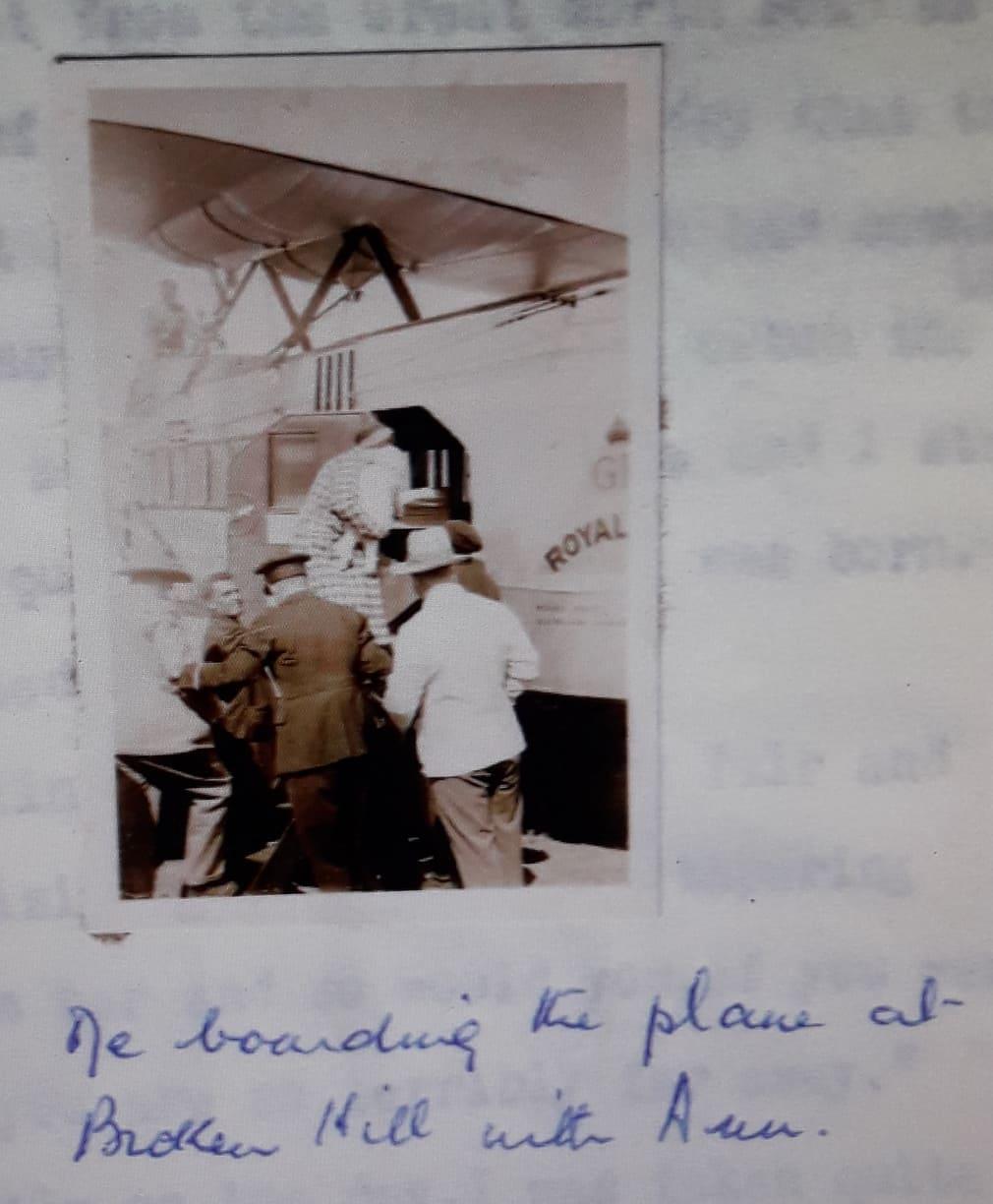
Mchewe Estate. June 15th 1932
Dearest Family,
You’ll be glad to know that we arrived quite safe and sound and very, very
happy to be home.The train Journey was uneventful. Ann slept nearly all the way.
Graham was very kind and saw to everything. He even sat with the baby whilst I went
to meals in the dining car.We were met at Broken Hill by the Thoms who had arranged accommodation for
us at the hotel for the night. They also drove us to the aerodrome in the morning where
the Airways agent told us that Ann is the first baby to travel by air on this section of the
Cape to England route. The plane trip was very bumpy indeed especially between
Broken Hill and Mpika. Everyone was ill including poor little Ann who sicked up her milk
all over the front of my new coat. I arrived at Mbeya looking a sorry caricature of Radiant
Motherhood. I must have been pale green and the baby was snow white. Under the
circumstances it was a good thing that George did not meet us. We were met instead
by Ken Menzies, the owner of the Mbeya Hotel where we spent the night. Ken was
most fatherly and kind and a good nights rest restored Ann and me to our usual robust
health.Mbeya has greatly changed. The hotel is now finished and can accommodate
fifty guests. It consists of a large main building housing a large bar and dining room and
offices and a number of small cottage bedrooms. It even has electric light. There are
several buildings out at the aerodrome and private houses going up in Mbeya.
After breakfast Ken Menzies drove us out to the farm where we had a warm
welcome from George, who looks well but rather thin. The house was spotless and the
new cook, Abel, had made light scones for tea. George had prepared all sorts of lovely
surprises. There is a new reed ceiling in the living room and a new dresser gay with
willow pattern plates which he had ordered from England. There is also a writing table
and a square table by the door for visitors hats. More personal is a lovely model ship
which George assembled from one of those Hobbie’s kits. It puts the finishing touch to
the rather old world air of our living room.In the bedroom there is a large double bed which George made himself. It has
strips of old car tyres nailed to a frame which makes a fine springy mattress and on top
of this is a thick mattress of kapok.In the kitchen there is a good wood stove which
George salvaged from a Mission dump. It looks a bit battered but works very well. The
new cook is excellent. The only blight is that he will wear rubber soled tennis shoes and
they smell awful. I daren’t hurt his feelings by pointing this out though. Opposite the
kitchen is a new laundry building containing a forty gallon hot water drum and a sink for
washing up. Lovely!George has been working very hard. He now has forty acres of coffee seedlings
planted out and has also found time to plant a rose garden and fruit trees. There are
orange and peach trees, tree tomatoes, paw paws, guavas and berries. He absolutely
adores Ann who has been very good and does not seem at all unsettled by the long
journey.It is absolutely heavenly to be back and I shall be happier than ever now that I
have a baby to play with during the long hours when George is busy on the farm,
Thank you for all your love and care during the many months I was with you. Ann
sends a special bubble for granddad.Your very loving,
Eleanor.Mchewe Estate Mbeya July 18th 1932
Dearest Family,
Ann at five months is enchanting. She is a very good baby, smiles readily and is
gaining weight steadily. She doesn’t sleep much during the day but that does not
matter, because, apart from washing her little things, I have nothing to do but attend to
her. She sleeps very well at night which is a blessing as George has to get up very
early to start work on the shamba and needs a good nights rest.
My nights are not so good, because we are having a plague of rats which frisk
around in the bedroom at night. Great big ones that come up out of the long grass in the
gorge beside the house and make cosy homes on our reed ceiling and in the thatch of
the roof.We always have a night light burning so that, if necessary, I can attend to Ann
with a minimum of fuss, and the things I see in that dim light! There are gaps between
the reeds and one night I heard, plop! and there, before my horrified gaze, lay a newly
born hairless baby rat on the floor by the bed, plop, plop! and there lay two more.
Quite dead, poor things – but what a careless mother.I have also seen rats scampering around on the tops of the mosquito nets and
sometimes we have them on our bed. They have a lovely game. They swarm down
the cord from which the mosquito net is suspended, leap onto the bed and onto the
floor. We do not have our net down now the cold season is here and there are few
mosquitoes.Last week a rat crept under Ann’s net which hung to the floor and bit her little
finger, so now I tuck the net in under the mattress though it makes it difficult for me to
attend to her at night. We shall have to get a cat somewhere. Ann’s pram has not yet
arrived so George carries her when we go walking – to her great content.
The native women around here are most interested in Ann. They come to see
her, bearing small gifts, and usually bring a child or two with them. They admire my child
and I admire theirs and there is an exchange of gifts. They produce a couple of eggs or
a few bananas or perhaps a skinny fowl and I hand over sugar, salt or soap as they
value these commodities. The most lavish gift went to the wife of Thomas our headman,
who produced twin daughters in the same week as I had Ann.Our neighbours have all been across to welcome me back and to admire the
baby. These include Marion Coster who came out to join her husband whilst I was in
South Africa. The two Hickson-Wood children came over on a fat old white donkey.
They made a pretty picture sitting astride, one behind the other – Maureen with her arms
around small Michael’s waist. A native toto led the donkey and the children’ s ayah
walked beside it.It is quite cold here now but the sun is bright and the air dry. The whole
countryside is beautifully green and we are a very happy little family.Lots and lots of love,
Eleanor.Mchewe Estate August 11th 1932
Dearest Family,
George has been very unwell for the past week. He had a nasty gash on his
knee which went septic. He had a swelling in the groin and a high temperature and could
not sleep at night for the pain in his leg. Ann was very wakeful too during the same
period, I think she is teething. I luckily have kept fit though rather harassed. Yesterday the
leg looked so inflamed that George decided to open up the wound himself. he made
quite a big cut in exactly the right place. You should have seen the blackish puss
pouring out.After he had thoroughly cleaned the wound George sewed it up himself. he has
the proper surgical needles and gut. He held the cut together with his left hand and
pushed the needle through the flesh with his right. I pulled the needle out and passed it
to George for the next stitch. I doubt whether a surgeon could have made a neater job
of it. He is still confined to the couch but today his temperature is normal. Some
husband!The previous week was hectic in another way. We had a visit from lions! George
and I were having supper about 8.30 on Tuesday night when the back verandah was
suddenly invaded by women and children from the servants quarters behind the kitchen.
They were all yelling “Simba, Simba.” – simba means lions. The door opened suddenly
and the houseboy rushed in to say that there were lions at the huts. George got up
swiftly, fetched gun and ammunition from the bedroom and with the houseboy carrying
the lamp, went off to investigate. I remained at the table, carrying on with my supper as I
felt a pioneer’s wife should! Suddenly something big leapt through the open window
behind me. You can imagine what I thought! I know now that it is quite true to say one’s
hair rises when one is scared. However it was only Kelly, our huge Irish wolfhound,
taking cover.George returned quite soon to say that apparently the commotion made by the
women and children had frightened the lions off. He found their tracks in the soft earth
round the huts and a bag of maize that had been playfully torn open but the lions had
moved on.Next day we heard that they had moved to Hickson-Wood’s shamba. Hicky
came across to say that the lions had jumped over the wall of his cattle boma and killed
both his white Muskat riding donkeys.
He and a friend sat up all next night over the remains but the lions did not return to
the kill.Apart from the little set back last week, Ann is blooming. She has a cap of very
fine fair hair and clear blue eyes under straight brow. She also has lovely dimples in both
cheeks. We are very proud of her.Our neighbours are picking coffee but the crops are small and the price is low. I
am amazed that they are so optimistic about the future. No one in these parts ever
seems to grouse though all are living on capital. They all say “Well if the worst happens
we can always go up to the Lupa Diggings.”Don’t worry about us, we have enough to tide us over for some time yet.
Much love to all,
Eleanor.Mchewe Estate. 28th Sept. 1932
Dearest Family,
News! News! I’m going to have another baby. George and I are delighted and I
hope it will be a boy this time. I shall be able to have him at Mbeya because things are
rapidly changing here. Several German families have moved to Mbeya including a
German doctor who means to build a hospital there. I expect he will make a very good
living because there must now be some hundreds of Europeans within a hundred miles
radius of Mbeya. The Europeans are mostly British or German but there are also
Greeks and, I believe, several other nationalities are represented on the Lupa Diggings.
Ann is blooming and developing according to the Book except that she has no
teeth yet! Kath Hickson-Wood has given her a very nice high chair and now she has
breakfast and lunch at the table with us. Everything within reach goes on the floor to her
amusement and my exasperation!You ask whether we have any Church of England missionaries in our part. No we
haven’t though there are Lutheran and Roman Catholic Missions. I have never even
heard of a visiting Church of England Clergyman to these parts though there are babies
in plenty who have not been baptised. Jolly good thing I had Ann Christened down
there.The R.C. priests in this area are called White Fathers. They all have beards and
wear white cassocks and sun helmets. One, called Father Keiling, calls around frequently.
Though none of us in this area is Catholic we take it in turn to put him up for the night. The
Catholic Fathers in their turn are most hospitable to travellers regardless of their beliefs.
Rather a sad thing has happened. Lucas our old chicken-boy is dead. I shall miss
his toothy smile. George went to the funeral and fired two farewell shots from his rifle
over the grave – a gesture much appreciated by the locals. Lucas in his day was a good
hunter.Several of the locals own muzzle loading guns but the majority hunt with dogs
and spears. The dogs wear bells which make an attractive jingle but I cannot bear the
idea of small antelope being run down until they are exhausted before being clubbed of
stabbed to death. We seldom eat venison as George does not care to shoot buck.
Recently though, he shot an eland and Abel rendered down the fat which is excellent for
cooking and very like beef fat.Much love to all,
Eleanor.Mchewe Estate. P.O.Mbeya 21st November 1932
Dearest Family,
George has gone off to the Lupa for a week with John Molteno. John came up
here with the idea of buying a coffee farm but he has changed his mind and now thinks of
staking some claims on the diggings and also setting up as a gold buyer.Did I tell you about his arrival here? John and George did some elephant hunting
together in French Equatorial Africa and when John heard that George had married and
settled in Tanganyika, he also decided to come up here. He drove up from Cape Town
in a Baby Austin and arrived just as our labourers were going home for the day. The little
car stopped half way up our hill and John got out to investigate. You should have heard
the astonished exclamations when John got out – all 6 ft 5 ins. of him! He towered over
the little car and even to me it seemed impossible for him to have made the long
journey in so tiny a car.Kath Wood has been over several times lately. She is slim and looks so right in
the shirt and corduroy slacks she almost always wears. She was here yesterday when
the shamba boy, digging in the front garden, unearthed a large earthenware cooking pot,
sealed at the top. I was greatly excited and had an instant mental image of fabulous
wealth. We made the boy bring the pot carefully on to the verandah and opened it in
happy anticipation. What do you think was inside? Nothing but a grinning skull! Such a
treat for a pregnant female.We have a tree growing here that had lovely straight branches covered by a
smooth bark. I got the garden boy to cut several of these branches of a uniform size,
peeled off the bark and have made Ann a playpen with the poles which are much like
broom sticks. Now I can leave her unattended when I do my chores. The other morning
after breakfast I put Ann in her playpen on the verandah and gave her a piece of toast
and honey to keep her quiet whilst I laundered a few of her things. When I looked out a
little later I was horrified to see a number of bees buzzing around her head whilst she
placidly concentrated on her toast. I made a rapid foray and rescued her but I still don’t
know whether that was the thing to do.We all send our love,
Eleanor.Mbeya Hospital. April 25th. 1933
Dearest Family,
Here I am, installed at the very new hospital, built by Dr Eckhardt, awaiting the
arrival of the new baby. George has gone back to the farm on foot but will walk in again
to spend the weekend with us. Ann is with me and enjoys the novelty of playing with
other children. The Eckhardts have two, a pretty little girl of two and a half and a very fair
roly poly boy of Ann’s age. Ann at fourteen months is very active. She is quite a little girl
now with lovely dimples. She walks well but is backward in teething.George, Ann and I had a couple of days together at the hotel before I moved in
here and several of the local women visited me and have promised to visit me in
hospital. The trip from farm to town was very entertaining if not very comfortable. There
is ten miles of very rough road between our farm and Utengule Mission and beyond the
Mission there is a fair thirteen or fourteen mile road to Mbeya.As we have no car now the doctor’s wife offered to drive us from the Mission to
Mbeya but she would not risk her car on the road between the Mission and our farm.
The upshot was that I rode in the Hickson-Woods machila for that ten mile stretch. The
machila is a canopied hammock, slung from a bamboo pole, in which I reclined, not too
comfortably in my unwieldy state, with Ann beside me or sometime straddling me. Four
of our farm boys carried the machila on their shoulders, two fore and two aft. The relief
bearers walked on either side. There must have been a dozen in all and they sang a sort
of sea shanty song as they walked. One man would sing a verse and the others took up
the chorus. They often improvise as they go. They moaned about my weight (at least
George said so! I don’t follow Ki-Swahili well yet) and expressed the hope that I would
have a son and that George would reward them handsomely.George and Kelly, the dog, followed close behind the machila and behind
George came Abel our cook and his wife and small daughter Annalie, all in their best
attire. The cook wore a palm beach suit, large Terai hat and sunglasses and two colour
shoes and quite lent a tone to the proceedings! Right at the back came the rag tag and
bobtail who joined the procession just for fun.Mrs Eckhardt was already awaiting us at the Mission when we arrived and we had
an uneventful trip to the Mbeya Hotel.During my last week at the farm I felt very tired and engaged the cook’s small
daughter, Annalie, to amuse Ann for an hour after lunch so that I could have a rest. They
played in the small verandah room which adjoins our bedroom and where I keep all my
sewing materials. One afternoon I was startled by a scream from Ann. I rushed to the
room and found Ann with blood steaming from her cheek. Annalie knelt beside her,
looking startled and frightened, with my embroidery scissors in her hand. She had cut off
half of the long curling golden lashes on one of Ann’s eyelids and, in trying to finish the
job, had cut off a triangular flap of skin off Ann’s cheek bone.I called Abel, the cook, and demanded that he should chastise his daughter there and
then and I soon heard loud shrieks from behind the kitchen. He spanked her with a
bamboo switch but I am sure not as well as she deserved. Africans are very tolerant
towards their children though I have seen husbands and wives fighting furiously.
I feel very well but long to have the confinement over.Very much love,
Eleanor.Mbeya Hospital. 2nd May 1933.
Dearest Family,
Little George arrived at 7.30 pm on Saturday evening 29 th. April. George was
with me at the time as he had walked in from the farm for news, and what a wonderful bit
of luck that was. The doctor was away on a case on the Diggings and I was bathing Ann
with George looking on, when the pains started. George dried Ann and gave her
supper and put her to bed. Afterwards he sat on the steps outside my room and a
great comfort it was to know that he was there.The confinement was short but pretty hectic. The Doctor returned to the Hospital
just in time to deliver the baby. He is a grand little boy, beautifully proportioned. The
doctor says he has never seen a better formed baby. He is however rather funny
looking just now as his head is, very temporarily, egg shaped. He has a shock of black
silky hair like a gollywog and believe it or not, he has a slight black moustache.
George came in, looked at the baby, looked at me, and we both burst out
laughing. The doctor was shocked and said so. He has no sense of humour and couldn’t
understand that we, though bursting with pride in our son, could never the less laugh at
him.Friends in Mbeya have sent me the most gorgeous flowers and my room is
transformed with delphiniums, roses and carnations. The room would be very austere
without the flowers. Curtains, bedspread and enamelware, walls and ceiling are all
snowy white.George hired a car and took Ann home next day. I have little George for
company during the day but he is removed at night. I am longing to get him home and
away from the German nurse who feeds him on black tea when he cries. She insists that
tea is a medicine and good for him.Much love from a proud mother of two.
Eleanor.Mchewe Estate 12May 1933
Dearest Family,
We are all together at home again and how lovely it feels. Even the house
servants seem pleased. The boy had decorated the lounge with sprays of
bougainvillaea and Abel had backed one of his good sponge cakes.Ann looked fat and rosy but at first was only moderately interested in me and the
new baby but she soon thawed. George is good with her and will continue to dress Ann
in the mornings and put her to bed until I am satisfied with Georgie.He, poor mite, has a nasty rash on face and neck. I am sure it is just due to that
tea the nurse used to give him at night. He has lost his moustache and is fast loosing his
wild black hair and emerging as quite a handsome babe. He is a very masculine looking
infant with much more strongly marked eyebrows and a larger nose that Ann had. He is
very good and lies quietly in his basket even when awake.George has been making a hatching box for brown trout ova and has set it up in
a small clear stream fed by a spring in readiness for the ova which is expected from
South Africa by next weeks plane. Some keen fishermen from Mbeya and the District
have clubbed together to buy the ova. The fingerlings are later to be transferred to
streams in Mbeya and Tukuyu Districts.I shall now have my hands full with the two babies and will not have much time for the
garden, or I fear, for writing very long letters. Remember though, that no matter how
large my family becomes, I shall always love you as much as ever.Your affectionate,
Eleanor.Mchewe Estate. 14th June 1933
Dearest Family,
The four of us are all well but alas we have lost our dear Kelly. He was rather a
silly dog really, although he grew so big he retained all his puppy ways but we were all
very fond of him, especially George because Kelly attached himself to George whilst I
was away having Ann and from that time on he was George’s shadow. I think he had
some form of biliary fever. He died stretched out on the living room couch late last night,
with George sitting beside him so that he would not feel alone.The children are growing fast. Georgie is a darling. He now has a fluff of pale
brown hair and his eyes are large and dark brown. Ann is very plump and fair.
We have had several visitors lately. Apart from neighbours, a car load of diggers
arrived one night and John Molteno and his bride were here. She is a very attractive girl
but, I should say, more suited to life in civilisation than in this back of beyond. She has
gone out to the diggings with her husband and will have to walk a good stretch of the fifty
or so miles.The diggers had to sleep in the living room on the couch and on hastily erected
camp beds. They arrived late at night and left after breakfast next day. One had half a
beard, the other side of his face had been forcibly shaved in the bar the night before.your affectionate,
EleanorMchewe Estate. August 10 th. 1933
Dearest Family,
George is away on safari with two Indian Army officers. The money he will get for
his services will be very welcome because this coffee growing is a slow business, and
our capitol is rapidly melting away. The job of acting as White Hunter was unexpected
or George would not have taken on the job of hatching the ova which duly arrived from
South Africa.George and the District Commissioner, David Pollock, went to meet the plane
by which the ova had been consigned but the pilot knew nothing about the package. It
came to light in the mail bag with the parcels! However the ova came to no harm. David
Pollock and George brought the parcel to the farm and carefully transferred the ova to
the hatching box. It was interesting to watch the tiny fry hatch out – a process which took
several days. Many died in the process and George removed the dead by sucking
them up in a glass tube.When hatched, the tiny fry were fed on ant eggs collected by the boys. I had to
take over the job of feeding and removing the dead when George left on safari. The fry
have to be fed every four hours, like the baby, so each time I have fed Georgie. I hurry
down to feed the trout.The children are very good but keep me busy. Ann can now say several words
and understands more. She adores Georgie. I long to show them off to you.Very much love
Eleanor.Mchewe Estate. October 27th 1933
Dear Family,
All just over flu. George and Ann were very poorly. I did not fare so badly and
Georgie came off best. He is on a bottle now.There was some excitement here last Wednesday morning. At 6.30 am. I called
for boiling water to make Georgie’s food. No water arrived but muffled shouting and the
sound of blows came from the kitchen. I went to investigate and found a fierce fight in
progress between the house boy and the kitchen boy. In my efforts to make them stop
fighting I went too close and got a sharp bang on the mouth with the edge of an
enamelled plate the kitchen boy was using as a weapon. My teeth cut my lip inside and
the plate cut it outside and blood flowed from mouth to chin. The boys were petrified.
By the time I had fed Georgie the lip was stiff and swollen. George went in wrath
to the kitchen and by breakfast time both house boy and kitchen boy had swollen faces
too. Since then I have a kettle of boiling water to hand almost before the words are out
of my mouth. I must say that the fight was because the house boy had clouted the
kitchen boy for keeping me waiting! In this land of piece work it is the job of the kitchen
boy to light the fire and boil the kettle but the houseboy’s job to carry the kettle to me.
I have seen little of Kath Wood or Marion Coster for the past two months. Major
Jones is the neighbour who calls most regularly. He has a wireless set and calls on all of
us to keep us up to date with world as well as local news. He often brings oranges for
Ann who adores him. He is a very nice person but no oil painting and makes no effort to
entertain Ann but she thinks he is fine. Perhaps his monocle appeals to her.George has bought a six foot long galvanised bath which is a great improvement
on the smaller oval one we have used until now. The smaller one had grown battered
from much use and leaks like a sieve. Fortunately our bathroom has a cement floor,
because one had to fill the bath to the brim and then bath extremely quickly to avoid
being left high and dry.Lots and lots of love,
Eleanor.Mchewe Estate. P.O. Mbeya 1st December 1933
Dearest Family,
Ann has not been well. We think she has had malaria. She has grown a good
deal lately and looks much thinner and rather pale. Georgie is thriving and has such
sparkling brown eyes and a ready smile. He and Ann make a charming pair, one so fair
and the other dark.The Moltenos’ spent a few days here and took Georgie and me to Mbeya so
that Georgie could be vaccinated. However it was an unsatisfactory trip because the
doctor had no vaccine.George went to the Lupa with the Moltenos and returned to the farm in their Baby
Austin which they have lent to us for a week. This was to enable me to go to Mbeya to
have a couple of teeth filled by a visiting dentist.We went to Mbeya in the car on Saturday. It was quite a squash with the four of
us on the front seat of the tiny car. Once George grabbed the babies foot instead of the
gear knob! We had Georgie vaccinated at the hospital and then went to the hotel where
the dentist was installed. Mr Dare, the dentist, had few instruments and they were very
tarnished. I sat uncomfortably on a kitchen chair whilst he tinkered with my teeth. He filled
three but two of the fillings came out that night. This meant another trip to Mbeya in the
Baby Austin but this time they seem all right.The weather is very hot and dry and the garden a mess. We are having trouble
with the young coffee trees too. Cut worms are killing off seedlings in the nursery and
there is a borer beetle in the planted out coffee.George bought a large grey donkey from some wandering Masai and we hope
the children will enjoy riding it later on.Very much love,
Eleanor.Mchewe Estate. 14th February 1934.
Dearest Family,
You will be sorry to hear that little Ann has been very ill, indeed we were terribly
afraid that we were going to lose her. She enjoyed her birthday on the 8th. All the toys
you, and her English granny, sent were unwrapped with such delight. However next
day she seemed listless and a bit feverish so I tucked her up in bed after lunch. I dosed
her with quinine and aspirin and she slept fitfully. At about eleven o’clock I was
awakened by a strange little cry. I turned up the night light and was horrified to see that
Ann was in a convulsion. I awakened George who, as always in an emergency, was
perfectly calm and practical. He filled the small bath with very warm water and emersed
Ann in it, placing a cold wet cloth on her head. We then wrapped her in blankets and
gave her an enema and she settled down to sleep. A few hours later we had the same
thing over again.At first light we sent a runner to Mbeya to fetch the doctor but waited all day in
vain and in the evening the runner returned to say that the doctor had gone to a case on
the diggings. Ann had been feverish all day with two or three convulsions. Neither
George or I wished to leave the bedroom, but there was Georgie to consider, and in
the afternoon I took him out in the garden for a while whilst George sat with Ann.
That night we both sat up all night and again Ann had those wretched attacks of
convulsions. George and I were worn out with anxiety by the time the doctor arrived the
next afternoon. Ann had not been able to keep down any quinine and had had only
small sips of water since the onset of the attack.The doctor at once diagnosed the trouble as malaria aggravated by teething.
George held Ann whilst the Doctor gave her an injection. At the first attempt the needle
bent into a bow, George was furious! The second attempt worked and after a few hours
Ann’s temperature dropped and though she was ill for two days afterwards she is now
up and about. She has also cut the last of her baby teeth, thank God. She looks thin and
white, but should soon pick up. It has all been a great strain to both of us. Georgie
behaved like an angel throughout. He played happily in his cot and did not seem to
sense any tension as people say, babies do. Our baby was cheerful and not at all
subdued.This is the rainy season and it is a good thing that some work has been done on
our road or the doctor might not have got through.Much love to all,
Eleanor.Mchewe Estate. 1st October 1934
Dearest Family,
We are all well now, thank goodness, but last week Georgie gave us such a
fright. I was sitting on the verandah, busy with some sewing and not watching Ann and
Georgie, who were trying to reach a bunch of bananas which hung on a rope from a
beam of the verandah. Suddenly I heard a crash, Georgie had fallen backward over the
edge of the verandah and hit the back of his head on the edge of the brick furrow which
carries away the rainwater. He lay flat on his back with his arms spread out and did not
move or cry. When I picked him up he gave a little whimper, I carried him to his cot and
bathed his face and soon he began sitting up and appeared quite normal. The trouble
began after he had vomited up his lunch. He began to whimper and bang his head
against the cot.George and I were very worried because we have no transport so we could not
take Georgie to the doctor and we could not bear to go through again what we had gone
through with Ann earlier in the year. Then, in the late afternoon, a miracle happened. Two
men George hardly knew, and complete strangers to me, called in on their way from the
diggings to Mbeya and they kindly drove Georgie and me to the hospital. The Doctor
allowed me to stay with Georgie and we spent five days there. Luckily he responded to
treatment and is now as alive as ever. Children do put years on one!There is nothing much else to report. We have a new vegetable garden which is
doing well but the earth here is strange. Gardens seem to do well for two years but by
that time the soil is exhausted and one must move the garden somewhere else. The
coffee looks well but it will be another year before we can expect even a few bags of
coffee and prices are still low. Anyway by next year George should have some good
return for all his hard work.Lots of love,
Eleanor.Mchewe Estate. November 4th 1934
Dearest Family,
George is home from his White Hunting safari looking very sunburnt and well.
The elderly American, who was his client this time, called in here at the farm to meet me
and the children. It is amazing what spirit these old lads have! This one looked as though
he should be thinking in terms of slippers and an armchair but no, he thinks in terms of
high powered rifles with telescopic sights.It is lovely being together again and the children are delighted to have their Dad
home. Things are always exciting when George is around. The day after his return
George said at breakfast, “We can’t go on like this. You and the kids never get off the
shamba. We’ll simply have to get a car.” You should have heard the excitement. “Get a
car Daddy?’” cried Ann jumping in her chair so that her plaits bounced. “Get a car
Daddy?” echoed Georgie his brown eyes sparkling. “A car,” said I startled, “However
can we afford one?”“Well,” said George, “on my way back from Safari I heard that a car is to be sold
this week at the Tukuyu Court, diseased estate or bankruptcy or something, I might get it
cheap and it is an A.C.” The name meant nothing to me, but George explained that an
A.C. is first cousin to a Rolls Royce.So off he went to the sale and next day the children and I listened all afternoon for
the sound of an approaching car. We had many false alarms but, towards evening we
heard what appeared to be the roar of an aeroplane engine. It was the A.C. roaring her
way up our steep hill with a long plume of steam waving gaily above her radiator.
Out jumped my beaming husband and in no time at all, he was showing off her
points to an admiring family. Her lines are faultless and seats though worn are most
comfortable. She has a most elegant air so what does it matter that the radiator leaks like
a sieve, her exhaust pipe has broken off, her tyres are worn almost to the canvas and
she has no windscreen. She goes, and she cost only five pounds.Next afternoon George, the kids and I piled into the car and drove along the road
on lookout for guinea fowl. All went well on the outward journey but on the homeward
one the poor A.C. simply gasped and died. So I carried the shot gun and George
carried both children and we trailed sadly home. This morning George went with a bunch
of farmhands and brought her home. Truly temperamental, she came home literally
under her own steam.George now plans to get a second hand engine and radiator for her but it won’t
be an A.C. engine. I think she is the only one of her kind in the country.
I am delighted to hear, dad, that you are sending a bridle for Joseph for
Christmas. I am busy making a saddle out of an old piece of tent canvas stuffed with
kapok, some webbing and some old rug straps. A car and a riding donkey! We’re
definitely carriage folk now.Lots of love to all,
Eleanor.Mchewe Estate. 28th December 1934
Dearest Family,
Thank you for the wonderful Christmas parcel. My frock is a splendid fit. George
declares that no one can knit socks like Mummy and the children love their toys and new
clothes.Joseph, the donkey, took his bit with an air of bored resignation and Ann now
rides proudly on his back. Joseph is a big strong animal with the looks and disposition of
a mule. he will not go at all unless a native ‘toto’ walks before him and when he does go
he wears a pained expression as though he were carrying fourteen stone instead of
Ann’s fly weight. I walk beside the donkey carrying Georgie and our cat, ‘Skinny Winnie’,
follows behind. Quite a cavalcade. The other day I got so exasperated with Joseph that
I took Ann off and I got on. Joseph tottered a few paces and sat down! to the huge
delight of our farm labourers who were going home from work. Anyway, one good thing,
the donkey is so lazy that there is little chance of him bolting with Ann.The Moltenos spent Christmas with us and left for the Lupa Diggings yesterday.
They arrived on the 22nd. with gifts for the children and chocolates and beer. That very
afternoon George and John Molteno left for Ivuna, near Lake Ruckwa, to shoot some
guinea fowl and perhaps a goose for our Christmas dinner. We expected the menfolk
back on Christmas Eve and Anne and I spent a busy day making mince pies and
sausage rolls. Why I don’t know, because I am sure Abel could have made them better.
We decorated the Christmas tree and sat up very late but no husbands turned up.
Christmas day passed but still no husbands came. Anne, like me, is expecting a baby
and we both felt pretty forlorn and cross. Anne was certain that they had been caught up
in a party somewhere and had forgotten all about us and I must say when Boxing Day
went by and still George and John did not show up I felt ready to agree with her.
They turned up towards evening and explained that on the homeward trip the car
had bogged down in the mud and that they had spent a miserable Christmas. Anne
refused to believe their story so George, to prove their case, got the game bag and
tipped the contents on to the dining room table. Out fell several guinea fowl, long past
being edible, followed by a large goose so high that it was green and blue where all the
feathers had rotted off.The stench was too much for two pregnant girls. I shot out of the front door
closely followed by Anne and we were both sick in the garden.I could not face food that evening but Anne is made of stronger stuff and ate her
belated Christmas dinner with relish.I am looking forward enormously to having Marjorie here with us. She will be able
to carry back to you an eyewitness account of our home and way of life.Much love to you all,
Eleanor.Mchewe Estate. 5th January 1935
Dearest Family,
You cannot imagine how lovely it is to have Marjorie here. She came just in time
because I have had pernicious vomiting and have lost a great deal of weight and she
took charge of the children and made me spend three days in hospital having treatment.
George took me to the hospital on the afternoon of New Years Eve and decided
to spend the night at the hotel and join in the New Years Eve celebrations. I had several
visitors at the hospital that evening and George actually managed to get some imported
grapes for me. He returned to the farm next morning and fetched me from the hospital
four days later. Of course the old A.C. just had to play up. About half way home the
back axle gave in and we had to send a passing native some miles back to a place
called Mbalizi to hire a lorry from a Greek trader to tow us home to the farm.
The children looked well and were full of beans. I think Marjorie was thankful to
hand them over to me. She is delighted with Ann’s motherly little ways but Georgie she
calls “a really wild child”. He isn’t, just has such an astonishing amount of energy and is
always up to mischief. Marjorie brought us all lovely presents. I am so thrilled with my
sewing machine. It may be an old model but it sews marvellously. We now have an
Alsatian pup as well as Joseph the donkey and the two cats.Marjorie had a midnight encounter with Joseph which gave her quite a shock but
we had a good laugh about it next day. Some months ago George replaced our wattle
and daub outside pit lavatory by a substantial brick one, so large that Joseph is being
temporarily stabled in it at night. We neglected to warn Marj about this and one night,
storm lamp in hand, she opened the door and Joseph walked out braying his thanks.
I am afraid Marjorie is having a quiet time, a shame when the journey from Cape
Town is so expensive. The doctor has told me to rest as much as I can, so it is
impossible for us to take Marj on sight seeing trips.I hate to think that she will be leaving in ten days time.
Much love,
Eleanor.Mchewe Estate. 18th February 1935
Dearest Family,
You must be able to visualise our life here quite well now that Marj is back and
has no doubt filled in all the details I forget to mention in my letters. What a journey we
had in the A.C. when we took her to the plane. George, the children and I sat in front and
Marj sat behind with numerous four gallon tins of water for the insatiable radiator. It was
raining and the canvas hood was up but part of the side flaps are missing and as there is
no glass in the windscreen the rain blew in on us. George got fed up with constantly
removing the hot radiator cap so simply stuffed a bit of rag in instead. When enough
steam had built up in the radiator behind the rag it blew out and we started all over again.
The car still roars like an aeroplane engine and yet has little power so that George sent
gangs of boys to the steep hills between the farm and the Mission to give us a push if
necessary. Fortunately this time it was not, and the boys cheered us on our way. We
needed their help on the homeward journey however.George has now bought an old Chev engine which he means to install before I
have to go to hospital to have my new baby. It will be quite an engineering feet as
George has few tools.I am sorry to say that I am still not well, something to do with kidneys or bladder.
George bought me some pills from one of the several small shops which have opened
in Mbeya and Ann is most interested in the result. She said seriously to Kath Wood,
“Oh my Mummy is a very clever Mummy. She can do blue wee and green wee as well
as yellow wee.” I simply can no longer manage the children without help and have
engaged the cook’s wife, Janey, to help. The children are by no means thrilled. I plead in
vain that I am not well enough to go for walks. Ann says firmly, “Ann doesn’t want to go
for a walk. Ann will look after you.” Funny, though she speaks well for a three year old,
she never uses the first person. Georgie say he would much rather walk with
Keshokutwa, the kitchen boy. His name by the way, means day-after-tomorrow and it
suits him down to the ground, Kath Wood walks over sometimes with offers of help and Ann will gladly go walking with her but Georgie won’t. He on the other hand will walk with Anne Molteno
and Ann won’t. They are obstinate kids. Ann has developed a very fertile imagination.
She has probably been looking at too many of those nice women’s magazines you
sent. A few days ago she said, “You are sick Mummy, but Ann’s got another Mummy.
She’s not sick, and my other mummy (very smugly) has lovely golden hair”. This
morning’ not ten minutes after I had dressed her, she came in with her frock wet and
muddy. I said in exasperation, “Oh Ann, you are naughty.” To which she instantly
returned, “My other Mummy doesn’t think I am naughty. She thinks I am very nice.” It
strikes me I shall have to get better soon so that I can be gay once more and compete
with that phantom golden haired paragon.We had a very heavy storm over the farm last week. There was heavy rain with
hail which stripped some of the coffee trees and the Mchewe River flooded and the
water swept through the lower part of the shamba. After the water had receded George
picked up a fine young trout which had been stranded. This was one of some he had
put into the river when Georgie was a few months old.The trials of a coffee farmer are legion. We now have a plague of snails. They
ring bark the young trees and leave trails of slime on the glossy leaves. All the ring
barked trees will have to be cut right back and this is heartbreaking as they are bearing
berries for the first time. The snails are collected by native children, piled upon the
ground and bashed to a pulp which gives off a sickening stench. I am sorry for the local
Africans. Locusts ate up their maize and now they are losing their bean crop to the snails.Lots of love, Eleanor
January 14, 2022 at 7:27 am #6252In reply to: The Elusive Samuel Housley and Other Family Stories
The USA Housley’s
This chapter is copied from Barbara Housley’s Narrative on Historic Letters, with thanks to her brother Howard Housley for sharing it with me. Interesting to note that Housley descendants (on the Marshall paternal side) and Gretton descendants (on the Warren maternal side) were both living in Trenton, New Jersey at the same time.
GEORGE HOUSLEY 1824-1877
George emigrated to the United states in 1851, arriving in July. The solicitor Abraham John Flint referred in a letter to a 15-pound advance which was made to George on June 9, 1851. This certainly was connected to his journey. George settled along the Delaware River in Bucks County, Pennsylvania. The letters from the solicitor were addressed to: Lahaska Post Office, Bucks County, Pennsylvania. George married Sarah Ann Hill on May 6, 1854 in Doylestown, Bucks County, Pennsylvania. The service was performed by Attorney James Gilkyson.
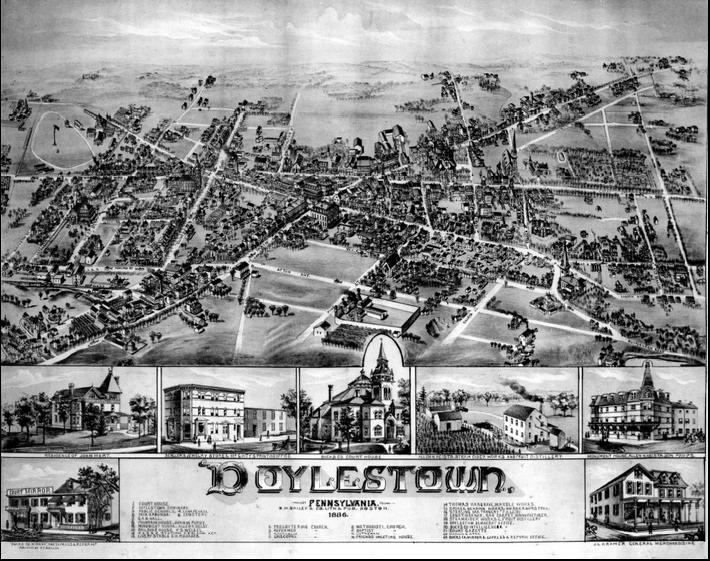
In her first letter (February 1854), Anne (George’s sister in Smalley, Derbyshire) wrote: “We want to know who and what is this Miss Hill you name in your letter. What age is she? Send us all the particulars but I would advise you not to get married until you have sufficient to make a comfortable home.”
Upon learning of George’s marriage, Anne wrote: “I hope dear brother you may be happy with your wife….I hope you will be as a son to her parents. Mother unites with me in kind love to you both and to your father and mother with best wishes for your health and happiness.” In 1872 (December) Joseph (George’s brother) wrote: “I am sorry to hear that sister’s father is so ill. It is what we must all come to some time and hope we shall meet where there is no more trouble.”
Emma (George’s sister) wrote in 1855, “We write in love to your wife and yourself and you must write soon and tell us whether there is a little nephew or niece and what you call them.” In June of 1856, Emma wrote: “We want to see dear Sarah Ann and the dear little boy. We were much pleased with the “bit of news” you sent.” The bit of news was the birth of John Eley Housley, January 11, 1855. Emma concluded her letter “Give our very kindest love to dear sister and dearest Johnnie.”
According to his obituary, John Eley was born at Wrightstown and “removed” to Lumberville at the age of 19. John was married first to Lucy Wilson with whom he had three sons: George Wilson (1883), Howard (1893) and Raymond (1895); and then to Elizabeth Kilmer with whom he had one son Albert Kilmer (1907). John Eley Housley died November 20, 1926 at the age of 71. For many years he had worked for John R. Johnson who owned a store. According to his son Albert, John was responsible for caring for Johnson’s horses. One named Rex was considered to be quite wild, but was docile in John’s hands. When John would take orders, he would leave the wagon at the first house and walk along the backs of the houses so that he would have access to the kitchens. When he reached the seventh house he would climb back over the fence to the road and whistle for the horses who would come to meet him. John could not attend church on Sunday mornings because he was working with the horses and occasionally Albert could convince his mother that he was needed also. According to Albert, John was regular in attendance at church on Sunday evenings.
John was a member of the Carversville Lodge 261 IOOF and the Carversville Lodge Knights of Pythias. Internment was in the Carversville cemetery; not, however, in the plot owned by his father. In addition to his sons, he was survived by his second wife Elizabeth who lived to be 80 and three grandchildren: George’s sons, Kenneth Worman and Morris Wilson and Raymond’s daughter Miriam Louise. George had married Katie Worman about the time John Eley married Elizabeth Kilmer. Howard’s first wife Mary Brink and daughter Florence had died and he remarried Elsa Heed who also lived into her eighties. Raymond’s wife was Fanny Culver.
Two more sons followed: Joseph Sackett, who was known as Sackett, September 12, 1856 and Edwin or Edward Rose, November 11, 1858. Joseph Sackett Housley married Anna Hubbs of Plumsteadville on January 17, 1880. They had one son Nelson DeC. who in turn had two daughters, Eleanor Mary and Ruth Anna, and lived on Bert Avenue in Trenton N.J. near St. Francis Hospital. Nelson, who was an engineer and built the first cement road in New Jersey, died at the age of 51. His daughters were both single at the time of his death. However, when his widow, the former Eva M. Edwards, died some years later, her survivors included daughters, Mrs. Herbert D. VanSciver and Mrs. James J. McCarrell and four grandchildren. One of the daughters (the younger) was quite crippled in later years and would come to visit her great-aunt Elizabeth (John’s widow) in a chauffeur driven car. Sackett died in 1929 at the age of 70. He was a member of the Warrington Lodge IOOF of Jamison PA, the Uncas tribe and the Uncas Hayloft 102 ORM of Trenton, New Jersey. The interment was in Greenwood cemetery where he had been caretaker since his retirement from one of the oldest manufacturing plants in Trenton (made milk separators for one thing). Sackett also was the caretaker for two other cemeteries one located near the Clinton Street station and the other called Riverside.
Ed’s wife was named Lydia. They had two daughters, Mary and Margaret and a third child who died in infancy. Mary had seven children–one was named for his grandfather–and settled in lower Bucks county. Margaret never married. She worked for Woolworths in Flemington, N. J. and then was made manager in Somerville, N.J., where she lived until her death. Ed survived both of his brothers, and at the time of Sackett’s death was living in Flemington, New Jersey where he had worked as a grocery clerk.
In September 1872, Joseph wrote, “I was very sorry to hear that John your oldest had met with such a sad accident but I hope he is got alright again by this time.” In the same letter, Joseph asked: “Now I want to know what sort of a town you are living in or village. How far is it from New York? Now send me all particulars if you please.”
In March 1873 Harriet asked Sarah Ann: “And will you please send me all the news at the place and what it is like for it seems to me that it is a wild place but you must tell me what it is like….” The question of whether she was referring to Bucks County, Pennsylvania or some other place is raised in Joseph’s letter of the same week.
On March 17, 1873, Joseph wrote: “I was surprised to hear that you had gone so far away west. Now dear brother what ever are you doing there so far away from home and family–looking out for something better I suppose.” The solicitor wrote on May 23, 1874: “Lately I have not written because I was not certain of your address and because I doubted I had much interesting news to tell you.” Later, Joseph wrote concerning the problems settling the estate, “You see dear brother there is only me here on our side and I cannot do much. I wish you were here to help me a bit and if you think of going for another summer trip this turn you might as well run over here.”
Apparently, George had indicated he might return to England for a visit in 1856. Emma wrote concerning the portrait of their mother which had been sent to George: “I hope you like mother’s portrait. I did not see it but I suppose it was not quite perfect about the eyes….Joseph and I intend having ours taken for you when you come over….Do come over before very long.”
In March 1873, Joseph wrote: “You ask me what I think of you coming to England. I think as you have given the trustee power to sign for you I think you could do no good but I should like to see you once again for all that. I can’t say whether there would be anything amiss if you did come as you say it would be throwing good money after bad.”
On June 10, 1875, the solicitor wrote: “I have been expecting to hear from you for some time past. Please let me hear what you are doing and where you are living and how I must send you your money.” George’s big news at that time was that on May 3, 1875, he had become a naturalized citizen “renouncing and abjuring all allegiance and fidelity to every foreign prince, potentate, state and sovereignity whatsoever, and particularly to Victoria Queen of Great Britain of whom he was before a subject.”
Another matter which George took care of during the years the estate was being settled was the purchase of a cemetery plot! On March 24, 1873, George purchased plot 67 section 19 division 2 in the Carversville (Bucks County PA) Cemetery (incorporated 1859). The plot cost $15.00, and was located at the very edge of the cemetery. It was in this cemetery, in 1991, while attending the funeral of Sarah Lord Housley, wife of Albert Kilmer Housley, that sixteen month old Laura Ann visited the graves of her great-great-great grandparents, George and Sarah Ann Hill Housley.
George died on August 13, 1877 and was buried three days later. The text for the funeral sermon was Proverbs 27:1: “Do not boast about tomorrow, for you do not know what a day may bring forth.”
December 18, 2021 at 12:59 pm #6243In reply to: The Elusive Samuel Housley and Other Family Stories
William Housley’s Will and the Court Case
William Housley died in 1848, but his widow Ellen didn’t die until 1872. The court case was in 1873. Details about the court case are archived at the National Archives at Kew, in London, but are not available online. They can be viewed in person, but that hasn’t been possible thus far. However, there are a great many references to it in the letters.
William Housley’s first wife was Mary Carrington 1787-1813. They had three children, Mary Anne, Elizabeth and William. When Mary died, William married Mary’s sister Ellen, not in their own parish church at Smalley but in Ashbourne. Although not uncommon for a widower to marry a deceased wife’s sister, it wasn’t legal. This point is mentioned in one of the letters.
One of the pages of William Housley’s will:
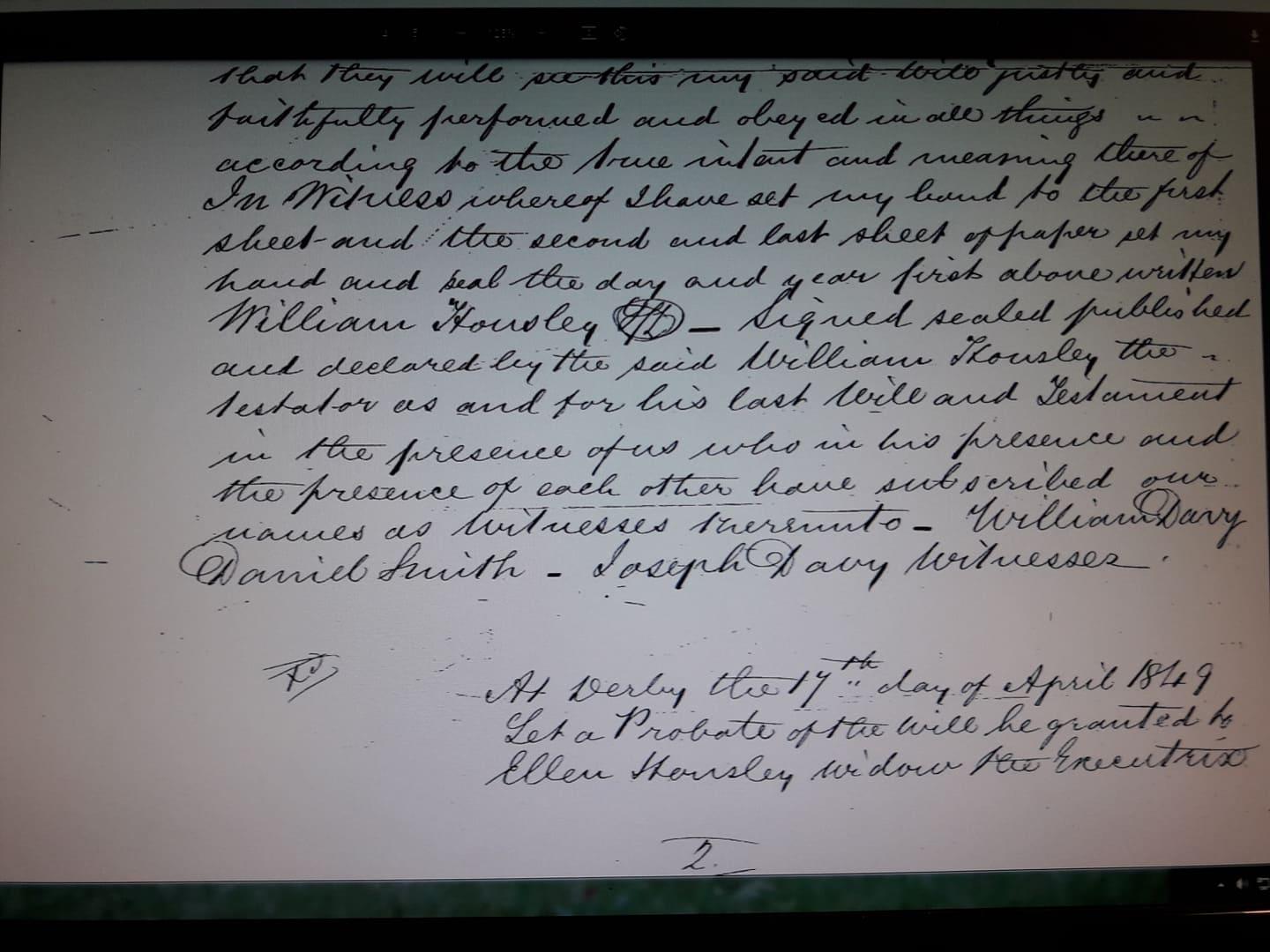
An excerpt from Barbara Housley’s Narrative on the Letters:
A comment in a letter from Joseph (August 6, 1873) indicated that William was married twice and that his wives were sisters: “What do you think that I believe that Mary Ann is trying to make our father’s will of no account as she says that my father’s marriage with our mother was not lawful he marrying two sisters. What do you think of her? I have heard my mother say something about paying a fine at the time of the marriage to make it legal.” Markwell and Saul in The A-Z Guide to Tracing Ancestors in Britain explain that marriage to a deceased wife’s sister was not permissible under Canon law as the relationship was within the prohibited degrees. However, such marriages did take place–usually well away from the couple’s home area. Up to 1835 such marriages were not void but were voidable by legal action. Few such actions were instituted but the risk was always there.
Joseph wrote that when Emma was married, Ellen “broke up the comfortable home and the things went to Derby and she went to live with them but Derby didn’t agree with her so she left again leaving her things behind and came to live with John in the new house where she died.” Ellen was listed with John’s household in the 1871 census.
In May 1872, the Ilkeston Pioneer carried this notice: “Mr. Hopkins will sell by auction on Saturday next the eleventh of May 1872 the whole of the useful furniture, sewing machine, etc. nearly new on the premises of the late Mrs. Housley at Smalley near Heanor in the county of Derby. Sale at one o’clock in the afternoon.”There were hard feelings between Mary Ann and Ellen and her children. Anne wrote: “If you remember we were not very friendly when you left. They never came and nothing was too bad for Mary Ann to say of Mother and me, but when Robert died Mother sent for her to the funeral but she did not think well to come so we took no more notice. She would not allow her children to come either.”
Mary Ann was still living in May 1872. Joseph implied that she and her brother, Will “intend making a bit of bother about the settlement of the bit of property” left by their mother. The 1871 census listed Mary Ann’s occupation as “income from houses.”In July 1872, Joseph introduced Ruth’s husband: “No doubt he is a bad lot. He is one of the Heath’s of Stanley Common a miller and he lives at Smalley Mill” (Ruth Heath was Mary Anne Housley’s daughter)
In 1873 Joseph wrote, “He is nothing but a land shark both Heath and his wife and his wife is the worst of the two. You will think these is hard words but they are true dear brother.” The solicitor, Abraham John Flint, was not at all pleased with Heath’s obstruction of the settlement of the estate. He wrote on June 30, 1873: “Heath agreed at first and then because I would not pay his expenses he refused and has since instructed another solicitor for his wife and Mrs. Weston who have been opposing us to the utmost. I am concerned for all parties interested except these two….The judge severely censured Heath for his conduct and wanted to make an order for sale there and then but Heath’s council would not consent….” In June 1875, the solicitor wrote: “Heath bid for the property but it fetched more money than he could give for it. He has been rather quieter lately.”In May 1872, Joseph wrote: “For what do you think, John has sold his share and he has acted very bad since his wife died and at the same time he sold all his furniture. You may guess I have never seen him but once since poor mother’s funeral and he is gone now no one knows where.”
In 1876, the solicitor wrote to George: “Have you heard of John Housley? He is entitled to Robert’s share and I want him to claim it.”
Anne intended that one third of the inheritance coming to her from her father and her grandfather, William Carrington, be divided between her four nieces: Sam’s three daughters and John’s daughter Elizabeth.
In the same letter (December 15, 1872), Joseph wrote:
“I think we have now found all out now that is concerned in the matter for there was only Sam that we did not know his whereabouts but I was informed a week ago that he is dead–died about three years ago in Birmingham Union. Poor Sam. He ought to have come to a better end than that”However, Samuel was still alive was on the 1871 census in Henley in Arden, and no record of his death can be found. Samuel’s brother in law said he was dead: we do not know why he lied, or perhaps the brothers were lying to keep his share, or another possibility is that Samuel himself told his brother in law to tell them that he was dead. I am inclined to think it was the latter.
Excerpts from Barbara Housley’s Narrative on the Letters continued:
Charles went to Australia in 1851, and was last heard from in January 1853. According to the solicitor, who wrote to George on June 3, 1874, Charles had received advances on the settlement of their parent’s estate. “Your promissory note with the two signed by your brother Charles for 20 pounds he received from his father and 20 pounds he received from his mother are now in the possession of the court.”
In December 1872, Joseph wrote: “I’m told that Charles two daughters has wrote to Smalley post office making inquiries about his share….” In January 1876, the solicitor wrote: “Charles Housley’s children have claimed their father’s share.”
In the Adelaide Observer 28 Aug 1875
HOUSLEY – wanted information
as to the Death, Will, or Intestacy, and
Children of Charles Housley, formerly of
Smalley, Derbyshire, England, who died at
Geelong or Creewick Creek Diggings, Victoria
August, 1855. His children will hear of something to their advantage by communicating with
Mr. A J. Flint, solicitor, Derby, England.
June 16,1875.The Diggers & Diggings of Victoria in 1855. Drawn on Stone by S.T. Gill:
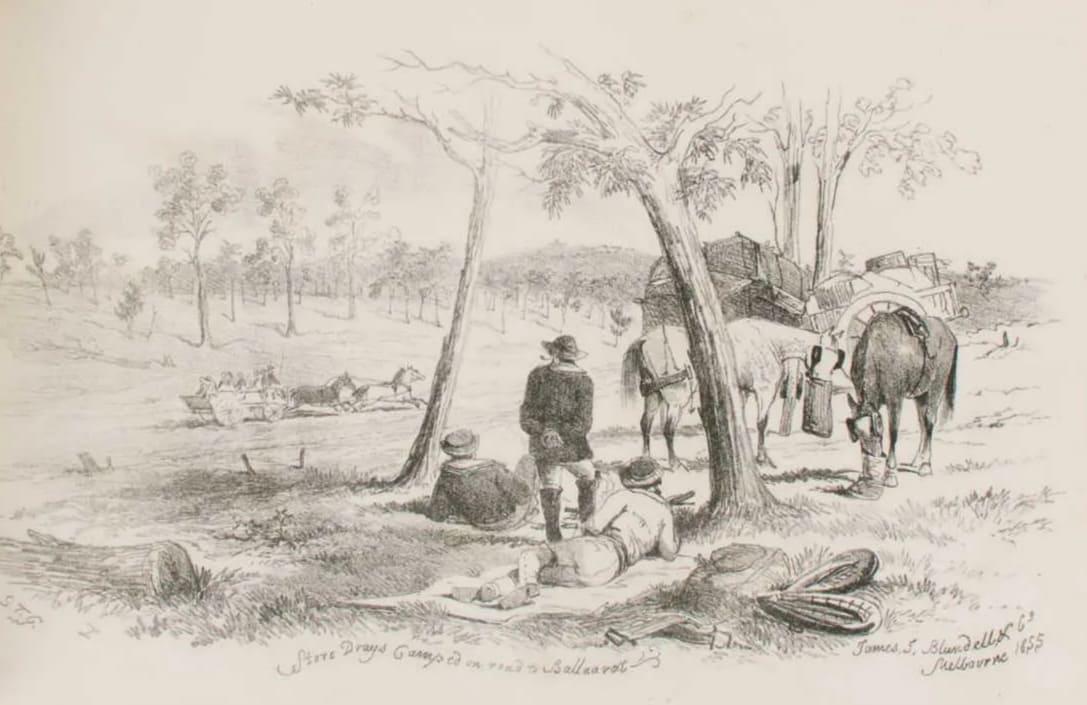
The court case:
Kerry v Housley.
Documents: Bill, demurrer.
Plaintiffs: Samuel Kerry and Joseph Housley.
Defendants: William Housley, Joseph Housley (deleted), Edwin Welch Harvey, Eleanor Harvey (deleted), Ernest Harvey infant, William Stafford, Elizabeth Stafford his wife, Mary Ann Housley, George Purdy and Catherine Purdy his wife, Elizabeth Housley, Mary Ann Weston widow and William Heath and Ruth Heath his wife (deleted).
Provincial solicitor employed in Derbyshire.
Date: 1873From the Narrative on the Letters:
The solicitor wrote on May 23, 1874: “Lately I have not written because I was not certain of your address and because I doubted I had much interesting news to tell you.” Later, Joseph wrote concerning the problems settling the estate, “You see dear brother there is only me here on our side and I cannot do much. I wish you were here to help me a bit and if you think of going for another summer trip this turn you might as well run over here.”
In March 1873, Joseph wrote: “You ask me what I think of you coming to England. I think as you have given the trustee power to sign for you I think you could do no good but I should like to see you once again for all that. I can’t say whether there would be anything amiss if you did come as you say it would be throwing good money after bad.”
In September 1872 Joseph wrote; “My wife is anxious to come. I hope it will suit her health for she is not over strong.” Elsewhere Joseph wrote that Harriet was “middling sometimes. She is subject to sick headaches. It knocks her up completely when they come on.” In December 1872 Joseph wrote, “Now dear brother about us coming to America you know we shall have to wait until this affair is settled and if it is not settled and thrown into Chancery I’m afraid we shall have to stay in England for I shall never be able to save money enough to bring me out and my family but I hope of better things.”
On July 19, 1875 Abraham Flint (the solicitor) wrote: “Joseph Housley has removed from Smalley and is working on some new foundry buildings at Little Chester near Derby. He lives at a village called Little Eaton near Derby. If you address your letter to him as Joseph Housley, carpenter, Little Eaton near Derby that will no doubt find him.”In his last letter (February 11, 1874), Joseph sounded very discouraged and wrote that Harriet’s parents were very poorly and both had been “in bed for a long time.” In addition, Harriet and the children had been ill.
The move to Little Eaton may indicate that Joseph received his settlement because in August, 1873, he wrote: “I think this is bad news enough and bad luck too, but I have had little else since I came to live at Kiddsley cottages but perhaps it is all for the best if one could only think so. I have begun to think there will be no chance for us coming over to you for I am afraid there will not be so much left as will bring us out without it is settled very shortly but I don’t intend leaving this house until it is settled either one way or the other. ”Joseph’s letters were much concerned with the settling of their mother’s estate. In 1854, Anne wrote, “As for my mother coming (to America) I think not at all likely. She is tied here with her property.” A solicitor, Abraham John Flint of 42 Full Street Derby, was engaged by John following the death of their mother. On June 30, 1873 the solicitor wrote: “Dear sir, On the death of your mother I was consulted by your brother John. I acted for him with reference to the sale and division of your father’s property at Smalley. Mr. Kerry was very unwilling to act as trustee being over 73 years of age but owing to the will being a badly drawn one we could not appoint another trustee in his place nor could the property be sold without a decree of chancery. Therefore Mr. Kerry consented and after a great deal of trouble with Heath who has opposed us all throughout whenever matters did not suit him, we found the title deeds and offered the property for sale by public auction on the 15th of July last. Heath could not find his purchase money without mortaging his property the solicitor which the mortgagee employed refused to accept Mr. Kerry’s title and owing to another defect in the will we could not compel them.”
In July 1872, Joseph wrote, “I do not know whether you can remember who the trustee was to my father’s will. It was Thomas Watson and Samuel Kerry of Smalley Green. Mr. Watson is dead (died a fortnight before mother) so Mr. Kerry has had to manage the affair.”
On Dec. 15, 1972, Joseph wrote, “Now about this property affair. It seems as far off of being settled as ever it was….” and in the following March wrote: “I think we are as far off as ever and farther I think.”
Concerning the property which was auctioned on July 15, 1872 and brought 700 pounds, Joseph wrote: “It was sold in five lots for building land and this man Heath bought up four lots–that is the big house, the croft and the cottages. The croft was made into two lots besides the piece belonging to the big house and the cottages and gardens was another lot and the little intake was another. William Richardson bought that.” Elsewhere Richardson’s purchase was described as “the little croft against Smith’s lane.” Smith’s Lane was probably named for their neighbor Daniel Smith, Mrs. Davy’s father.
But in December 1872, Joseph wrote that they had not received any money because “Mr. Heath is raising all kinds of objections to the will–something being worded wrong in the will.” In March 1873, Joseph “clarified” matters in this way: “His objection was that one trustee could not convey the property that his signature was not guarantee sufficient as it states in the will that both trustees has to sign the conveyance hence this bother.”
Joseph indicated that six shares were to come out of the 700 pounds besides Will’s 20 pounds. Children were to come in for the parents shares if dead. The solicitor wrote in 1873, “This of course refers to the Kidsley property in which you take a one seventh share and which if the property sells well may realize you about 60-80 pounds.” In March 1873 Joseph wrote: “You have an equal share with the rest in both lots of property, but I am afraid there will be but very little for any of us.”The other “lot of property” was “property in Smalley left under another will.” On July 17, 1872, Joseph wrote: “It was left by my grandfather Carrington and Uncle Richard is trustee. He seems very backward in bringing the property to a sale but I saw him and told him that I for one expect him to proceed with it.” George seemed to have difficulty understanding that there were two pieces of property so Joseph explained further: “It was left by my grandfather Carrington not by our father and Uncle Richard is the trustee for it but the will does not give him power to sell without the signatures of the parties concerned.” In June 1873 the solicitor Abraham John Flint asked: “Nothing has been done about the other property at Smalley at present. It wants attention and the other parties have asked me to attend to it. Do you authorize me to see to it for you as well?”
After Ellen’s death, the rent was divided between Joseph, Will, Mary Ann and Mr. Heath who bought John’s share and was married to Mary Ann’s daughter, Ruth. Joseph said that Mr. Heath paid 40 pounds for John’s share and that John had drawn 110 pounds in advance. The solicitor said Heath said he paid 60. The solicitor said that Heath was trying to buy the shares of those at home to get control of the property and would have defied the absent ones to get anything.
In September 1872 Joseph wrote that the lawyer said the trustee cannot sell the property at the bottom of Smalley without the signatures of all parties concerned in it and it will have to go through chancery court which will be a great expense. He advised Joseph to sell his share and Joseph advised George to do the same.George sent a “portrait” so that it could be established that it was really him–still living and due a share. Joseph wrote (July 1872): “the trustee was quite willing to (acknowledge you) for the portrait I think is a very good one.” Several letters later in response to an inquiry from George, Joseph wrote: “The trustee recognized you in a minute…I have not shown it to Mary Ann for we are not on good terms….Parties that I have shown it to own you again but they say it is a deal like John. It is something like him, but I think is more like myself.”
In September 1872 Joseph wrote that the lawyer required all of their ages and they would have to pay “succession duty”. Joseph requested that George send a list of birth dates.On May 23, 1874, the solicitor wrote: “I have been offered 240 pounds for the three cottages and the little house. They sold for 200 pounds at the last sale and then I was offered 700 pounds for the whole lot except Richardson’s Heanor piece for which he is still willing to give 58 pounds. Thus you see that the value of the estate has very materially increased since the last sale so that this delay has been beneficial to your interests than other-wise. Coal has become much dearer and they suppose there is coal under this estate. There are many enquiries about it and I believe it will realize 800 pounds or more which increase will more than cover all expenses.” Eventually the solicitor wrote that the property had been sold for 916 pounds and George would take a one-ninth share.
January 14, 1876: “I am very sorry to hear of your lameness and illness but I trust that you are now better. This matter as I informed you had to stand over until December since when all the costs and expenses have been taxed and passed by the court and I am expecting to receive the order for these this next week, then we have to pay the legacy duty and them divide the residue which I doubt won’t come to very much amongst so many of you. But you will hear from me towards the end of the month or early next month when I shall have to send you the papers to sign for your share. I can’t tell you how much it will be at present as I shall have to deduct your share with the others of the first sale made of the property before it went to court.
Wishing you a Happy New Year, I am Dear Sir, Yours truly
Abram J. Flint”September 15, 1876 (the last letter)
“I duly received your power of attorney which appears to have been properly executed on Thursday last and I sent it on to my London agent, Mr. Henry Lyvell, who happens just now to be away for his annual vacation and will not return for 14 or 20 days and as his signature is required by the Paymaster General before he will pay out your share, it must consequently stand over and await his return home. It shall however receive immediate attention as soon as he returns and I hope to be able to send your checque for the balance very shortly.”1874 in chancery:
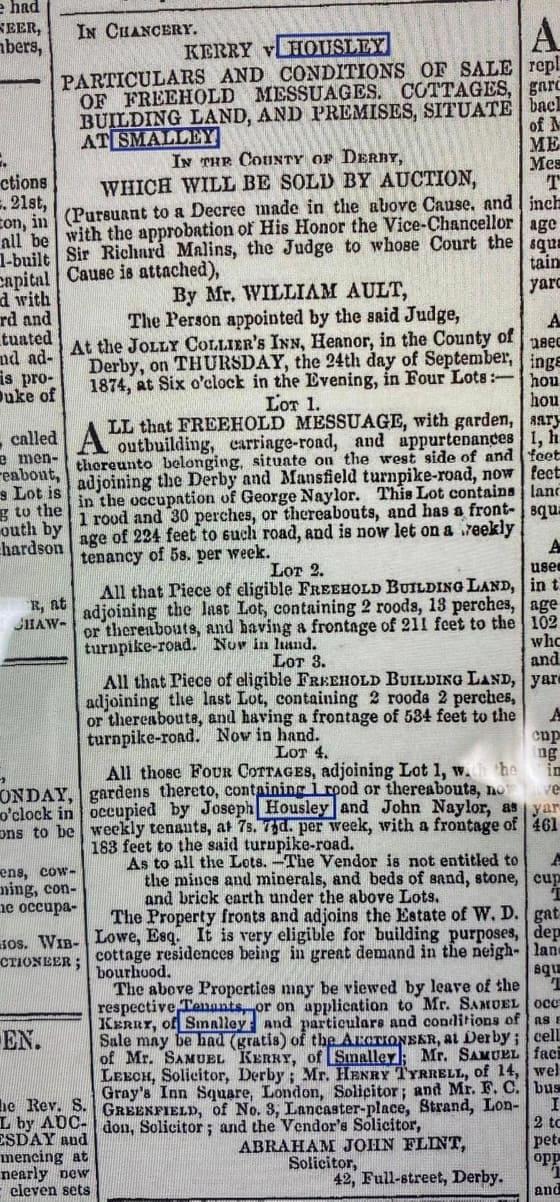 December 18, 2021 at 10:02 am #6242
In reply to: The Elusive Samuel Housley and Other Family Stories
The Housley Letters
We discovered that one of Samuel’s brothers, George Housley 1826-1877, emigrated to America in 1851, to Solebury, in Pennsylvania. Another brother, Charles 1823-1856, emigrated to Australia at the same time.
I wrote to the Solebury Historical Society to ask them if they had any information on the Housleys there. About a month later I had a very helpful and detailed reply from them.
There were Housley people in Solebury Township and nearby communities from 1854 to at least 1973, perhaps 1985. George Housley immigrated in 1851, arriving in New York from London in July 1851 on the ship “Senator”. George was in Solebury by 1854, when he is listed on the tax roles for the Township He didn’t own land at that time. Housley family members mostly lived in the Lumberville area, a village in Solebury, or in nearby Buckingham or Wrightstown. The second wife of Howard (aka Harry) Housley was Elsa (aka Elsie) R. Heed, the daughter of the Lumberville Postmaster. Elsie was the proprietor of the Lumberville General Store from 1939 to 1973, and may have continued to live in Lumberville until her death in 1985. The Lumberville General Store was, and still is, a focal point of the community. The store was also the official Post Office at one time, hence the connection between Elsie’s father as Postmaster, and Elsie herself as the proprietor of the store. The Post Office function at Lumberville has been reduced now to a bank of cluster mailboxes, and official U.S. Postal functions are now in Point Pleasant, PA a few miles north of Lumberville.
We’ve attached a pdf of the Housley people buried in Carversville Cemetery, which is in the town next to Lumberville, and is still in Solebury Township. We hope this list will confirm that these are your relatives.It doesn’t seem that any Housley people still live in the area. Some of George’s descendents moved to Wilkes-Barre, PA and Flemington, NJ. One descendent, Barbara Housley, lived in nearby Doylestown, PA, which is the county seat for Bucks County. She actually visited Solebury Township Historical Society looking for Housley relatives, and it would have been nice to connect you with her. Unfortunately she died in 2018. Her obituary is attached in case you want to follow up with the nieces and great nieces who are listed.
Lumberville General Store, Pennsylvania, Elsie Housley:
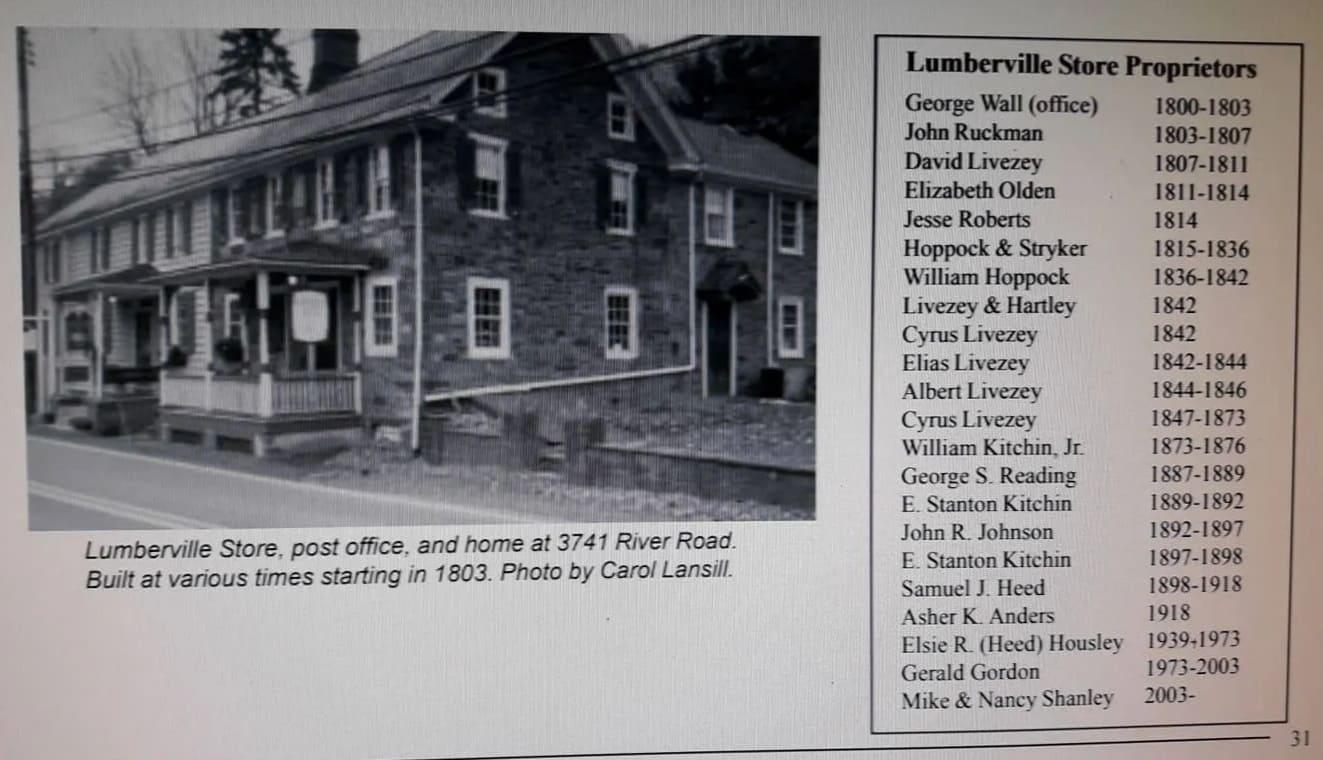
I noticed the name of Barbara’s brother Howard Housley in her obituary, and found him on facebook. I knew it was the right Howard Housley as I recognized Barbara’s photograph in his friends list as the same photo in the obituary. Howard didn’t reply initially to a friend request from a stranger, so I found his daughter Laura on facebook and sent her a message. She replied, spoke to her father, and we exchanged email addresses and were able to start a correspondence. I simply could not believe my luck when Howard sent me a 17 page file of Barbara’s Narrative on the Letters with numerous letter excerpts interspersed with her own research compiled on a six month trip to England.
The letters were written to George between 1851 and the 1870s, from the Housley family in Smalley.
Narrative of Historic Letters ~ Barbara Housley.
AND BELIEVE ME EVER MY DEAR BROTHER, YOUR AFFECTIONATE FAMILY
In February 1991, I took a picture of my 16 month old niece Laura Ann Housley standing near the tombstones of her great-great-great-grandparents, George and Sarah Ann Hill Housley. The occassion was the funeral of another Sarah Housley, Sarah Lord Housley, wife of Albert Kilmer Housley, youngest son of John Eley Housley (George and Sarah Ann’s first born). Laura Ann’s great-grandfather (my grandfather) was another George, John Eley’s first born. It was Aunt Sarah who brought my mother, Lois, a packet of papers which she had found in the attic. Mom spent hours transcribing the letters which had been written first horizontally and then vertically to save paper. What began to emerge was a priceless glimpse into the lives and concerns of Housleys who lived and died over a century ago. All of the letters ended with the phrase “And believe me ever my dear brother, your affectionate….”
The greeting and opening remarks of each of the letters are included in a list below. The sentence structure and speech patterns have not been altered however spelling and some punctuation has been corrected. Some typical idiosyncrasies were: as for has, were for where and vice versa, no capitals at the beginnings of sentences, occasional commas and dashes but almost no periods. Emma appears to be the best educated of the three Housley letter-writers. Sister-in-law Harriet does not appear to be as well educated as any of the others. Since their mother did not write but apparently was in good health, it must be assumed that she could not.
The people discussed and described in the following pages are for the most part known to be the family and friends of the Housleys of Smalley, Derbyshire, England. However, practically every page brings conjectures about the significance of persons who are mentioned in the letters and information about persons whose names seem to be significant but who have not yet been established as actual members of the family.To say this was a priceless addition to the family research is an understatement. I have since, with Howard’s permission, sent the file to the Derby Records Office for their family history section. We are hoping that Howard will find the actual letters in among the boxes he has of his sisters belongings. Some of the letters mention photographs that were sent. Perhaps some will be found.
December 15, 2021 at 3:37 pm #6238In reply to: The Elusive Samuel Housley and Other Family Stories
Ellen (Nellie) Purdy
My grandfathers aunt Nellie Purdy 1872-1947 grew up with his mother Mary Ann at the Gilmans in Buxton. We knew she was a nurse or a matron, and that she made a number of trips to USA.
I started looking for passenger lists and immigration lists (we had already found some of them, and my cousin Linda Marshall in Boston found some of them), and found one in 1904 with details of the “relatives address while in US”.
October 31st, 1904, Ellen Purdy sailed from Liverpool to Baltimore on the Friesland. She was a 32 year old nurse and she paid for her own ticket. The address of relatives in USA was Druid Hill and Lafayette Ave, Baltimore, Maryland.
I wondered if she stayed with relatives, perhaps they were the Housley descendants. It was her great uncle George Housley who emigrated in 1851, not so far away in Pennsylvania. I wanted to check the Baltimore census to find out the names at that address, in case they were Housley’s. So I joined a Baltimore History group on facebook, and asked how I might find out. The people were so enormously helpful! The address was the Home of the Friendless, an orphanage. (a historic landmark of some note I think), and someone even found Ellen Purdy listed in the Baltimore directory as a nurse there.
She sailed back to England in 1913. Ellen sailed in 1900 and 1920 as well but I haven’t unraveled those trips yet.
THE HOME OF THE FRIENDLESS, is situated at the corner of Lafayette and Druid Hill avenues, Baltimore. It is a large brick building, which was erected at a cost of $62,000. It was organized in 1854.The chief aim of the founders of this institution was to respond to a need for providing a home for the friendless and homeless children, orphans, and half-orphans, or the offspring of vagrants. It has been managed since its organization by a board of ladies, who, by close attention and efficient management, have made the institution one of the most prominent charitable institutions in the State. From its opening to the present time there have been received 5,000 children, and homes have been secured for nearly one thousand of this number. The institution has a capacity of about 200 inmates. The present number of beneficiaries is 165. A kindergarten and other educational facilities are successfully conducted. The home knows no demonimational creed, being non-sectarian. Its principal source of revenue is derived from private contributions. For many years the State has appropriated different sums towards it maintenance, and the General Assembly of 1892 contributed the sum of $3,000 per annum.
A later trip: The ship’s manifest from May 1920 the Baltic lists Ellen on board arriving in Ellis Island heading to Baltimore age 48. The next of kin is listed as George Purdy (her father) of 2 Gregory Blvd Forest Side, Nottingham. She’s listed as a nurse, and sailed from Liverpool May 8 1920.
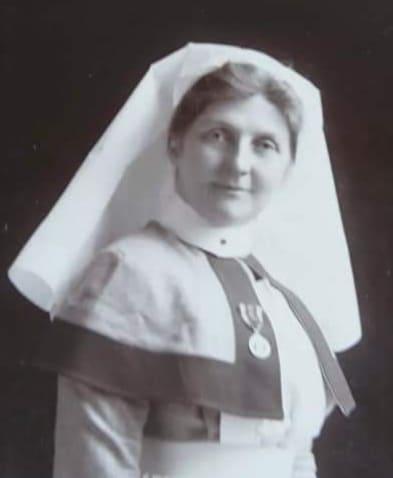
Ellen eventually retired in England and married Frank Garbett, a tax collector, at the age of 51 in Herefordshire. Judging from the number of newspaper articles I found about her, she was an active member of the community and was involved in many fundraising activities for the local cottage hospital.
Her obituary in THE KINGTON TIMES, NOVEMBER 8, 1947:
Mrs. Ellen Garbett wife of Mr. F. Garbett, of Brook Cottage, Kingsland, whose funeral took place at St. Michael’s Church, Kingsland, on October 30th, was a familiar figure in the district, and by her genial manner and kindly ways had endeared herself to many.
Mrs Garbett had had a wide experience in the nursing profession. Beginning her training in this country, she went to the Italian Riviera and there continued her work, later going to the United States. In 1916 she gained the Q.A.I.M.N.S. and returned to England and was appointed sister at the Lord Derby Military Hospital, an appointment she held for four years.We didn’t know that Ellen had worked on the Italian Riviera, and hope in due course to find out more about it.
Mike Rushby, Ellen’s sister Kate’s grandson in Australia, spoke to his sister in USA recently about Nellie Purdy. She replied: I told you I remembered Auntie Nellie coming to Jacksdale. She gave me a small green leatherette covered bible which I still have ( though in a very battered condition). Here is a picture of it.
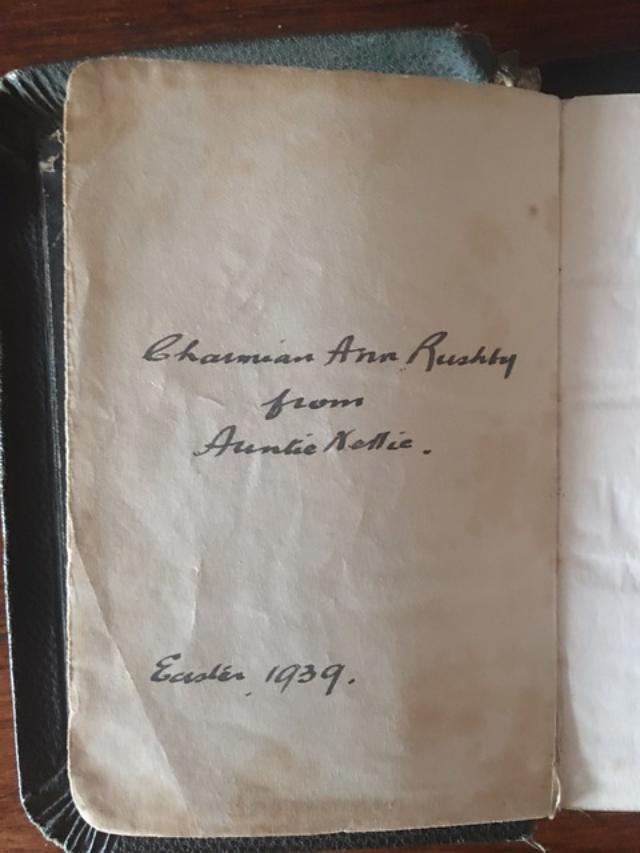 April 24, 2021 at 8:02 pm #6193
In reply to: The Whale’s Diaries Collection
I hope all this social media as they call it stands the test of time because little things like this are priceless and so few and far between, and someday someone wants to know a little thing like this to paint a picture in their mind. I don’t know if this is one of ours as they say but but he was there too and could even have been one of you or another one of me, the possibilities are endless and the charm of the random snippet is boundless.
“The gallery stairs were honeycombed on
each side by old Jonathan Beniston’s spiked
crutches, and although Jonathan could not
read, he considered himself a valuable
addition to the choir, contributing a sort of
drone bass accompaniment to the melodies. after the style of a bagpipe ” chanter.”Here’s another one I want to include in my book:
Mr. Joseph Moss, formerly a framework knitter of Woodhouse Lane, for several years kept a Diary of the principal events and incidents in the locality: a most commendable undertaking. It is much to be regretted that so few attempt anything of the kind, so useful, and always interest- ing. Besides the registration of marriages and funerals, we have notices of storms, removals, accidents, sales, robberies, police captures, festivities, re-openings of churches, and many other matters. His record begins in 1855, ^^d ends in 1881, Mr. Moss was a violinist of some ability, and was in great demand at all rural festivities. He was a good singer, and sang (inter alia) ” The Beggar’s Ramble ” with his own local variations^ in good style, and usually with much eclat. The following are a few extracts from his Diary : —
” — July. Restoration of Horsley Church. New weathercock placed on spire by Charles, son of Mr. Anthony Kerry, the builder, on the 31st. A few days later, the south arches of the nave fell down, bringing with it the roofs of nave and south aisle. The pillar next the tower had been under- mined by the making of a grave, and as soon as the gravestone over it was moved the column began to settle : a loud shout was made, and the workmen had only just time to scamper out of the building before the roof and top windows and all came down.”
October 4, 2019 at 9:25 pm #4856In reply to: Seven Twines and the Dragon Heartwoods
“Speaking of people hiding, has anyone seen Eleri since she went to that funeral?” asked Glynnis. “She promised she would help with the dusting … “
“Perhaps said promise is the reason for her failure to materialise,” said Fox with an almost imperceptible twitch of his nose. “Not that I am one to be catty, but let’s call it … an astute observation.”
“I am inclined to agree, though, like you, I am loth to come to such a harsh conclusion. It is possible, I suppose …” Glynnis paused doubtfully, “some misadventure may have befallen her?”
“She does complain frequently of being locked out,” agreed Fox. “Although I confess, I fail to see the barriers to which she so often refers.”
September 10, 2019 at 9:34 am #4805In reply to: Seven Twines and the Dragon Heartwoods
Olliver was surprised when he teleported back to the cottage to see everyone busy with their own affairs.
Fox was practicing a speech in front of the gargoyles statues rearranged in the garden like pupils in a class. He looked so serious that Olliver swallowed his guffaw. He wanted to update him about his scouting around, for the entrance that Rukshan had spoken about, and Fox had seemed interested at the time to join the exploration. His keen sense and shape-shifting abilities were always handy to have in a team.
The kids were at school, and he found out that Glynnis was teaching birds in the wood thicket.
“So much schooling going around” he whispered, almost afraid to be caught skipping classes.
“You can still join me, if you’d like,” Eleri said, having jumped out of nowhere. Her black dress was an interesting piece of improvisation. “I’m going to a funeral, but it should be fun, the deceased has promised he would haunt Leroway and his thugs.”
October 11, 2014 at 6:35 am #3542In reply to: The Chronicles of the Flying Fish Inn
Mater:
I am 73 years old and some think I look pretty good for my age. Not the kids—the kids think I look as old as Methuselah. When I was young my hair was jet black. Now it is white and I wear it in a long braid down my back; it is easy to look after and I certainly don’t trust Dodi to cut it, though she has offered. I wash it once a week and put vinegar in the final rinse to get rid of the yellow tinge. My back is straight, no dowager’s hump like some my age, and I can still touch my toes at a push. I married my childhood sweetheart—the love of my life—in 1958 and he died of sickness, April 12th, 1978. My favourite dish is spaghetti and meatballs. When I was younger, when I lived in Perth, I was a milliner. I don’t make hats now; there is not the same demand out here. And of course there is Fred, my son, who scarpered God-knows-where a year ago.
It isn’t much to say about a life, but I suspect it is way more than you wanted to know.
This reminds me; Dodi went to a funeral in Sydney a few months ago. The funeral of a dear school friend who died in a motor vehicle accident. Not her fault, as I understand it. She was driving along, minding her own business, returning home from a quiet night playing trivial pursuits at the local community centre. A teenage driver lost control of her car. She was fine; I mean the other driver was fine, barely a scrape. Dodi’s friend was not so fortunate. At the funeral of her friend—I forget her name—the place was packed.
At the time, when Dodi recounted the events of the funeral, I started thinking about my own future demise. It may perhaps sound morbid, or vain, but I found myself wondering who might be there to see me off. Other than the family, who would be duty bound to attend, I couldn’t think of many who would care enough to pay their respects—perhaps a few locals there for the supper afterwards and a bit of a chinwag no doubt.
I am rambling; I have a tendency to do that. I can’t blame it on old age because I have always rambled. The point is, I don’t think I have done much with my life. And this saddens me.
However, I suspect this is of less interest to you than the ghost I mentioned earlier.
The idea of a ghost is not a new concept at the Flying Fish Inn. It has been around for as long as we have been here. But it was just a joke—it wasn’t a real ghost, if you see what I mean. Every strange noise or other untoward happening we would blame on “the ghost”. The dilapidated look of the place lent itself very well to having resident ghost, it was almost obligatory, and Fred even had a plan to market our imaginary ghost as a tourist attraction.
So what changed? Well, I saw him.
July 27, 2014 at 8:08 am #3315In reply to: Get your Drag Team Queer
Some character development, obviously not quite canon material…
The Arousing Scarf
– a short storyby Ewkmon
Sadie Merrie had always hated derelict Birmingham with its zesty, zealous zoos. It was a place where she felt snappy.
She was a mysterious, freakish, algae smoothie drinker with ginger arms and supple hair. Her friends saw her as a successful, sad saint. Once, she had even helped a clear batty old crone recover from a flying accident. That’s the sort of woman he was.
Sadie walked over to the window and reflected on her dusty surroundings. The storm teased like rampaging rabbits.
Then she saw something in the distance, or rather someone. It was the figure of Sadie’s sister Moanie. Sadie’s sister was an awkward succubus with funny arms and impressive hair.
Sadie gulped. She was not prepared for Sadie’s sister.
As Sadie stepped outside and Sadie’s sister came closer, she could see the mysterious glint in her eye.
“I am here because I want revenge,” Sadie’s sister bellowed, in a glamourous tone. She slammed her fist against Sadie’s chest, with the force of 3750 grumpy cats. “I frigging love you, Sadie Merrie.”
Sadie looked back, even more mad and still fingering the arousing scarf. “Sadie’s sister, I love you,” she replied.
They looked at each other with cheery feelings, like two talented, thankful twin piggies drinking at a very generous funeral, which had jazz music playing in the background and two slim uncles flying to the beat.
Suddenly, Sadie’s sister lunged forward and tried to punch Sadie in the face. Quickly, Sadie grabbed the arousing scarf and brought it down on Sadie’s sister’s skull.
Sadie’s sister’s funny arms trembled and her impressive hair wobbled. She looked vindicative, her body raw like a breakable, blue-eyed broom.
Then she let out an agonising groan and collapsed onto the ground. Moments later Sadie’s sister Moanie was dead.
Sadie Merrie went back inside and made herself a nice drink of algae smoothie.
THE END
- November 2024 (Reunion):
-
AuthorSearch Results