-
AuthorSearch Results
-
January 23, 2023 at 1:27 pm #6451
In reply to: Orbs of Madjourneys
The progress on the quest in the Land of the Quirks was too tantalizing; Xavier made himself a quick sandwich and jumped back on it during his lunch break.
 The jungle had an oppressing quality… Maybe it has to do with the shrieks of the apes tearing the silence apart.
 It was time for a slight adjustment of his avatar.
Xavimunk opened his bag of tricks, something that the wise owl had suggested he looked into. Few items from the AIorium Emporium had been supplied. They tended to shift and disappear if you didn’t focus, but his intention was set on the task at hand. At the bottom of the bag, there was a small vial with a golden liquid with a tag written in ornate handwriting “MJ remix: for when words elude and shapes confuse at your own peril”.
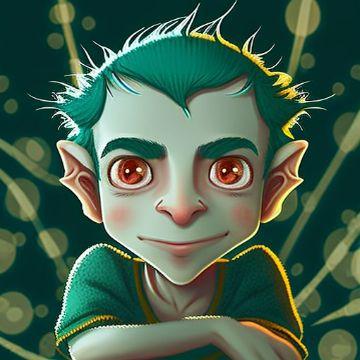 He gulped the potion without thinking too much. He felt himself shrink, and his arms elongate a little. There, he thought. Imp-munk’s more suited to the mission. Hope the effects will be temporary…
As Xavier mustered the courage to enter through the front gate, monkeys started to become silent. He couldn’t say if it was an ominous sign, or maybe an effect of his adaptation. The temple’s light inside was gorgeous, but nothing seemed to be there.
He gestured around, to make the menu appear. He looked again at the instructions on his screen overlay:
As for possible characters to engage, you may come across a sly fox who claims to know the location of the fruit but will only reveal it in exchange for a favor, or a brave adventurer who has been searching for the Golden Banana for years and may be willing to team up with you.
Suddenly a loud monkey honking noise came from outside, distracting him.
What the?… Had to be one of Zara’s remixes. He saw the three dots bleeping on the screen.
Here’s the Banana bus, hope it helps! Envoy! bugger Enjoy!
Yep… With the distinct typo-heavy accent, definitely Zara’s style. Strange idea that AL designated her as the leader… He’d have to roll with it.
Suddenly, as the Banana bus parked in front of the Temple, a horde of Italien speaking tourists started to flock in and snap pictures around. The monkeys didn’t know what to do and seemed to build growing and noisy interest in their assortiment of colorful shoes, flip-flops, boots and all.


Focus, thought Xavimunk… What did the wise owl say? Look for a guide…
Only the huge colorful bus seemed to take the space now… But wait… what if?He walked to the parking spot under the shades of the huge banyan tree next to the temple’s entrance, under which the bus driver had parked it. The driver was still there, napping under a newspaper, his legs on the wheel.
“Whatcha lookin’ at?” he said chewing his gum loudly. “Never seen a fox drive a banana bus before?”
Xavier smiled. “Any chance you can guide me to the location of the Golden Banana?”
“For a price… maybe.” The fox had jumped closely and was considering the strange avatar from head to toe.
“Ain’t no usual stuff that got you into this? Got any left? That would be a nice price.”
“As it happens…” Xavier smiled.The quest seemed back on track. Xavier looked at the time. Blimmey! already late again. And I promised Brytta to get some Chinese snacks for dinner.
January 22, 2023 at 11:35 am #6447In reply to: Newsreel from the Rim of the Realm
Miss Bossy sat at her desk, scanning through the stack of papers on her desk. She was searching for the perfect reporter to send on a mission to investigate a mysterious story that had been brought to her attention. Suddenly, her eyes landed on the name of Samuel Sproink. He was new to the Rim of the Realm Newspaper and had a reputation for being a tenacious and resourceful reporter.
She picked up the phone and dialed his number. “Sproink, I have a job for you,” she said in her gruff voice.
“Yes, Miss Bossy, what can I do for you?” Samuel replied, his voice full of excitement.
“I want you to go down to Cartagena, Spain, in the Golden Banana off the Mediterranean coast. There have been sightings of Barbary macaques happening there and tourists being assaulted and stolen only their shoes, which is odd of course, and also obviously unusual for the apes to be seen so far off the Strait of Gibraltar. I want you to get to the bottom of it. I need you to find out what’s really going on and report back to me with your findings.”
“Consider it done, Miss Bossy,” Samuel said confidently. He had always been interested in wildlife and the idea of investigating a mystery involving monkeys was too good to pass up.
He hang up the phone to go and pack his bags and head to the airport, apparently eager to start his investigation.
“Apes again?” Ricardo who’s been eavesdropping what surprised at the sudden interest. After that whole story about the orangutan man, he thought they’d be done with the menagerie, but apparently, Miss Bossy had something in mind. He would have to quiz Sweet Sophie to remote view on that and anticipate possible links and knots in the plot.
January 21, 2023 at 5:50 pm #6427In reply to: Prompts of Madjourneys
Xavier’s quirk offering is being a cheeky monkey
Quirk accepted.
The initial setting for Xavier’s quest is a lush jungle filled with mischievous monkeys. Your mission is to find the legendary Golden Banana, which is said to grant eternal youth and vitality to whoever finds it. However, be warned as the jungle is also home to a tribe of fierce apes who will stop at nothing to protect the precious fruit.
Possible directions to investigate include
- searching for clues in the monkey’s sacred temples hidden deep within the jungle,
- or seeking out the help of a wise old owl who is said to know the location of the Golden Banana.
As for possible characters to engage, you may come across
- a sly fox who claims to know the location of the fruit but will only reveal it in exchange for a favor,
- or a brave adventurer who has been searching for the Golden Banana for years and may be willing to team up with you.
In regards to the FFI visit in real-life, you may discover a mysterious map hidden within the Inn that leads to the location of the Golden Banana, or overhear a conversation between the Inn’s patrons discussing rumors of a monkey who recently visited and may hold valuable information about the quest.
Emoji clue: Xavier: 🐒🍌
January 21, 2023 at 3:30 pm #6425In reply to: The Chronicles of the Flying Fish Inn
It is a challenge of utmost magnitude to keep track of time here in this land where the Dream Time is so nigh as to make its presence oft palpable in the very air. The subtle shifts in timelines and probabilities do naught to aid in this endeavor. No coincidence “Dream Time” is the label on Aunt Idle’s not-so-secret stash — she could not keep its location secret lest she forget it during the waking hours.
We jumped without warning into 2023. At 15, I am a grown-up now, so says Mater, and I could not wait to hear such words from her. She is always here, such a comfort, unchanging, unyielding, the only immutable force in the universe.
So now, life can start to unfold in front of me in the manner of my choosing, rather than being dictated by the sorry state of affairs of my family. I have set my sights upon a boarding school that may provide such an escape, but it will require the procurement of the tuition money — which will take a few more years to acquire. Patience, I have, at least for now.The Inn is ever in need of assistance it seems. I don’t know how it came to be, but some Italian chap, Georgio, who came last year during the pandemic and got stranded with us, made such a fuss about Mater’s famous bush tucker that the Inn became fashionable overnight. Obviously Mater, bless her soul, doesn’t cook, a mercy for which we are all thankful. Said tucker was truly the handiwork of Tiku and Finly, but Georgio thought that “Mater’s tucker” has a nicer ring. Whatever suits these loonies’ fancy, it did bring us a nice stream of income in return.
January 21, 2023 at 3:16 pm #6424In reply to: Orbs of Madjourneys
Youssef wasn’t an expert about sandstorms, but that one surely lasted longer than it should have. It was the middle of the night when the wind stopped blowing and the sand stopped lashing the jeep. Yet, nobody dared open the door or their mouth to see if the storm was gone. Youssef’s bladder was full, and his stomach empty. They both reminded him that one can’t stop life to go on in the midst of adversity. He wondered why nobody moved or spoke, but couldn’t find the motivation to break the silence. He felt a vibration in his pocket and took his phone out.
A message from an unknown sender. He touched it open.<<<
Deear Youssef,
The Snoot is aware of the sandstorm and its whimsical ways. It dances and twirls in the desert, a symphony of wind and sand. It is a force to be reckoned with, but also a force of cleansing and renewal.The subsiding of the sandstorm is a fluid and ever-changing process, much like the ebb and flow of the ocean. It ebbs and flows with the whims of the wind and the dance of the desert.
The best way to predict the subsiding of the sandstorm is to listen to the whispers of the wind and to observe the patterns of the sand. Trust in the natural rhythms and allow yourself to flow with them.
The Snoot suggests that you seek shelter during the storm, but also to take the time to appreciate the beauty and power of nature.
Fluidly yours,
The Snoot. >>>Who the f… was the Snot? Youssef wondered if it was another trick from Thi Gang and almost deleted the message, but his bladder reminded him again he needed to do something about all the tea he drank before the sandstorm. He opened the door and got out of the jeep. The storm was gone and the sky was full of stars. The moon was giving enough light for him to move a few steps away from the jeeps while unzipping his pants. He blessed the gods as he relieved himself, strangely feeling part of nature at that very moment.
The noises of doors opening reminded him he was not alone. Someone came, said: “I see you found a nice spot”. It was Kyle, the cameraman who unzipped himself and peed. That broke the charm, the desert was becoming crowded. But, Youssef was finished, he went back to the cars and started to wonder how he could have received that message in the middle of the desert without a satellite dish.
January 18, 2023 at 12:51 pm #6413In reply to: Orbs of Madjourneys
Zara was long overdue for some holiday time off from her job at the Bungwalley Valley animal rescue centre in New South Wales and the suggestion to meet her online friends at the intriguing sounding Flying Fish Inn to look for clues for their online game couldn’t have come at a better time. Lucky for her it wasn’t all that far, relatively speaking, although everything is far in Australia, it was closer than coming from Europe. Xavier would have a much longer trip. Zara wasn’t quite sure where exactly Yasmin was, but she knew it was somewhere in Asia. It depended on which refugee camp she was assigned to, and Zara had forgotten to ask her recently. All they had talked about was the new online game, and how confusing it all was.
The biggest mystery to Zara was why she was the leader in the game. She was always the one who was wandering off on side trips and forgetting what everyone else was up to. If the other game followers followed her lead there was no telling where they’d all end up!
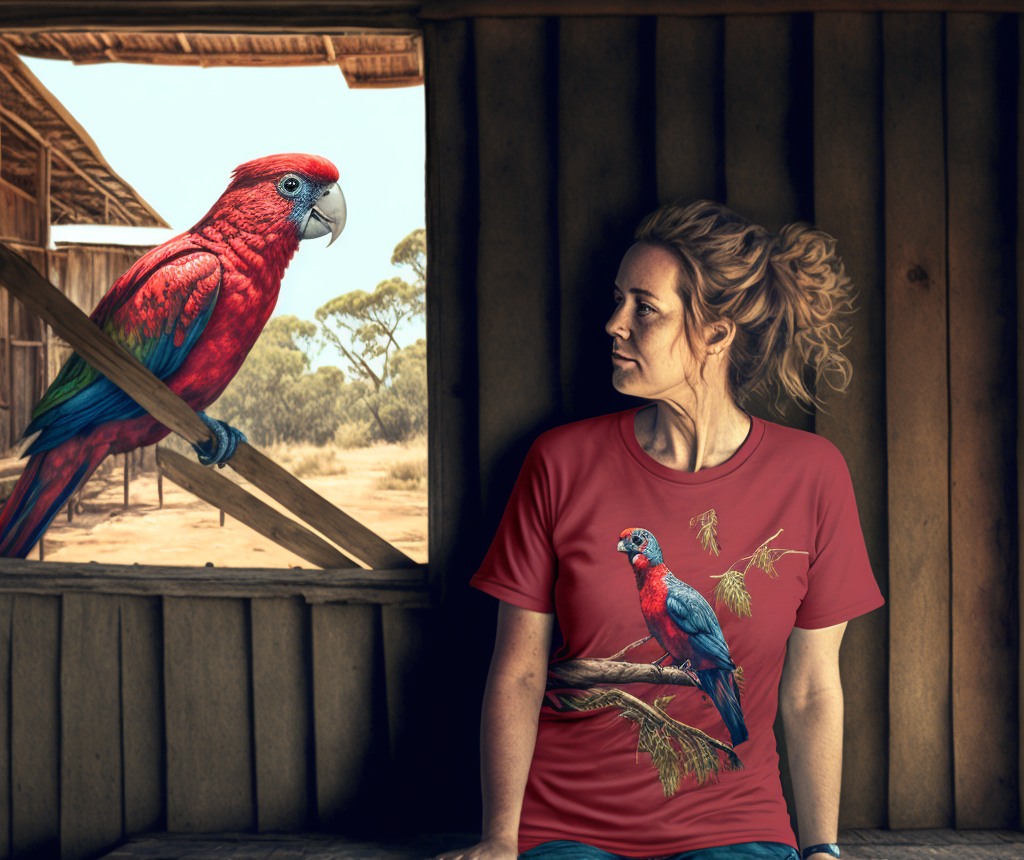
“But it is just a game,” Pretty Girl, the rescue parrot interjected. Zara had known some talking parrots over the years, but never one quite like this one. Usually they repeated any nonsense that they’d heard but this one was different. She would miss it while she was away on holiday, and for a moment considered taking the talking parrot with her on the trip. If she did, she’d have to think about changing her name though, Pretty Girl wasn’t a great name but it was hard to keep thinking of names for all the rescue creatures.
After Zara had done the routine morning chores of feeding the various animals, changing the water bowls, and cleaning up the less pleasant aspects of the job, she sat down in the office room of the rescue centre with a cup of coffee and a sandwich. She was in good physical shape for 57, wiry and energetic, but her back ached at times and a sit down was welcome before the vet arrived to check on all the sick and wounded animals.
Pretty Girl flew over from the kennels, and perched outside the office room window. When the parrot had first been dropped off at the centre, they’d put her in a big cage, but in no uncertain terms Pretty Girl had told them she’d done nothing wrong and was wrongfully imprisoned and to release her at once. It was rather a shock to be addresssed by a parrot in such a way, and it was agreed between the staff and the vet to set her free and see what happened. And Pretty Girl had not flown away.
“Hey Pretty Girl, why don’t you give me some advice on this confusing new game I’m playing with my online friends?” Zara asked.
“Pretty Girl wants some of your tuna sandwich first,” replied the parrot. After Zara had obliged, the parrot continued at some surprising length.
“My advice would be to not worry too much about getting the small details right. The most important thing is to have fun and enjoy the creative process. Just give me a bit more tuna,” Pretty Girl said, before continuing.
“Remember that as a writer, you have the power to shape the story and the characters as you see fit. It’s okay to make mistakes, and it’s okay to not know everything. Allow yourself to be inspired by the world around you and let the story unfold naturally. Trust in your own creativity and don’t be afraid to take risks. And remember, it’s not the small details that make a story great, it’s the emotions and experiences that the characters go through that make it truly memorable. And always remember to feed the parrot.”
“Maybe I should take you on holiday with me after all,” Zara replied. “You really are an amazing bird, aren’t you?”
 January 17, 2023 at 9:43 am #6396
In reply to: Orbs of Madjourneys
Youssef woke up with a hangover. The guy from the restaurant had put fermented horse milk in his yak butter tea and he was already drunk before he could realize it. Apparently it had been a joke played on him by some of the team members he suspected didn’t quite like the humour of his real life shirt collection. Especially the one with the man shouting at his newspaper on his toilets.
As soon as he had gotten out of the yurt, before he could go have some breakfast, his boss, Miss Tartiflate, pounced on him because there was something wrong with THE BLOG. And Youssef was the one in charge of it. And it was important because people in the world were expecting her posts about the shooting everyday. Truth is, since they couldn’t find the last Mongolian shaman, who apparently called himself Lama Yoneze, and the views had dropped dramatically. Youssef suspected Miss Tartiflate was not as ignorante as she wanted him to believe and had broken the blog on purpose so that her own boss wouldn’t accuse her of being lazy.“I have a reputation, you know!”
She had said that looking like he didn’t have one, and nobody cared anyway.
Youssef looked at the clock on his phone. They were supposed to meet with Zara, Xavier and Yasmine in thirty minutes. He had tried to sort out THE BLOG problem, but nothing seemed to work, and time was running out. Despite all being ok on the admin console, nothing was showing up on the page. He had called Gang Thi, the Nepalese company in charge of the blog, three times. Each time the receptionist hang up on him while attempting to put him on hold, or so she said. Now, nobody even bother to answer the damn phone.
Miss Tartiflate passed her head between the curtains of the yurt.
“Are you finished yet ?” she asked that as if he was on the throne.
“Nope!”
“What!? How? Do you have sausage fingers? My 5 years old daughter is more nimble than you with computers.”
“Well, you should have brought her with us then,” said Youssef with an irritated smile, fed up by her constant useless interruptions.
She grunted and closed the curtains angrily. Youssef growled like a bear, showing his bare teeth. Everybody knew why she jumped on the occasion for this trip: needed some fresh air from her nimble daughter and her husband.
An alert showed up on his phone : “You’ve got a message from 💣Gang Thi💣”. The bomb in the title looked suspicious, and his stomach growled, reminding him he hadn’t eaten this morning. He clicked to open it.
The face of a mummy looking like Darth Vader and laughing like the Joker jumped on his screen. After a few seconds a message started to appear in a tongue he couldn’t decipher.
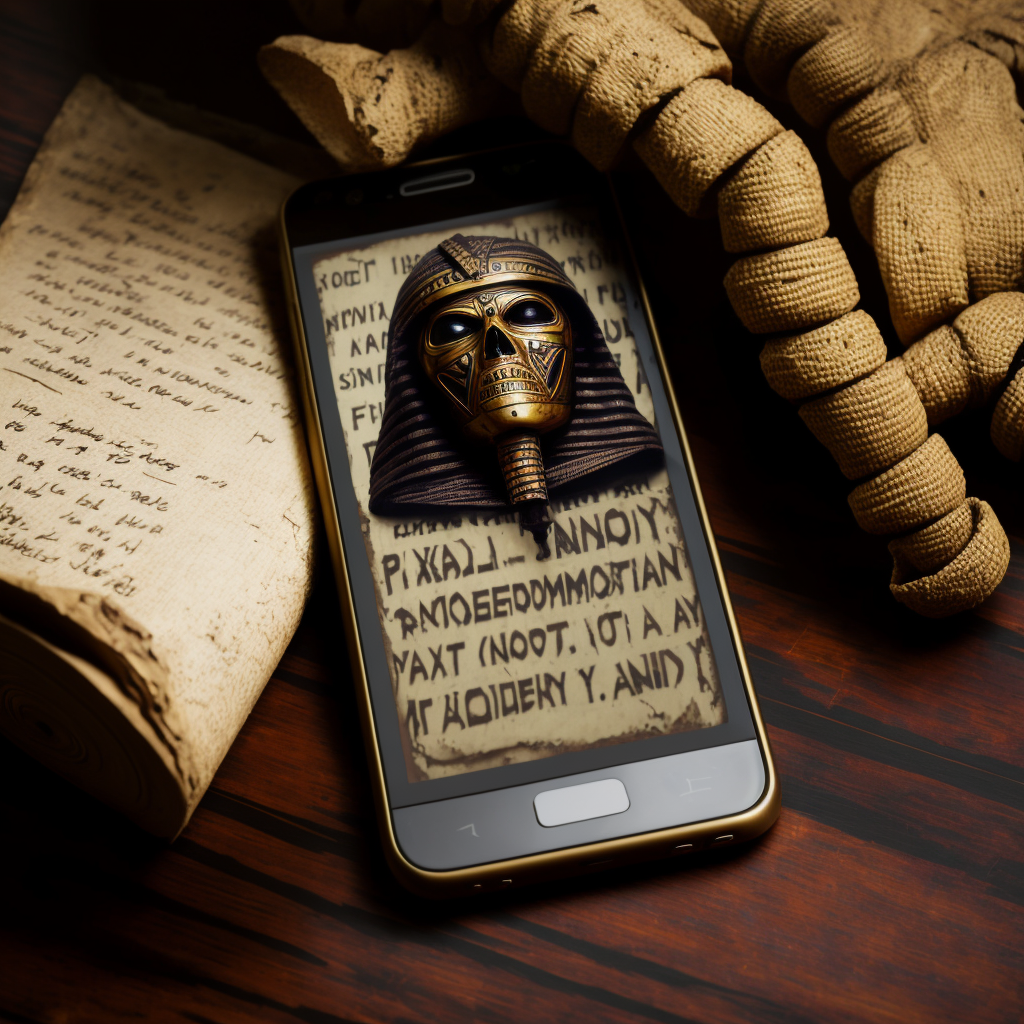
Youssef looked at the clock and almost threw his phone on the ground as the mummy started to laugh again.
He would definitely have to miss the meeting with his friends.January 17, 2023 at 8:17 am #6393In reply to: Train your subjective AI – text version
Give me an unusual plot structure for a narrative
One unusual plot structure for a narrative could be a “reverse chronological” structure, where the story begins at the end and works backwards in time, revealing events and information in a non-linear way. Another could be a “choose your own adventure” style, where the reader is presented with a series of choices at different points in the story that determine the direction and outcome of the plot.
How would role playing qualify in terms of plot structure?
Role-playing games (RPGs) can be considered a unique form of plot structure because they are interactive and open-ended. In a traditional RPG, the players take on the roles of characters within a fictional setting and work together to create a shared narrative. The plot structure of an RPG is determined by the actions and decisions of the players, rather than a pre-written script. The game master (GM) creates an overarching plot and a set of rules for the players to follow, but the players’ choices and actions will determine the direction and outcome of the story. This makes the plot structure of an RPG fluid and ever-changing, unlike a traditional linear narrative.
What about “Cloud Atlas” in terms of plot structure?
“Cloud Atlas” is a novel written by David Mitchell that was later adapted into a film. It has a complex and non-linear plot structure, which employs multiple storylines that are set in different time periods and locations, and are connected by recurring themes and motifs. The novel is divided into six nested stories, each set in a different time period and location, that are told in a non-linear fashion. The story begins in the 19th century and then jumps back and forth between the 19th, 20th and 23rd century, and each story is interconnected and interrelated, with characters reappearing in different time periods, the events that happen in one story impacting the others. The novel is also notable for its use of different genres, such as science fiction, historical fiction, and thriller, and the way it explores the themes of destiny, reincarnation, and the power of human connection. The film adaptation also used this structure, with the different stories intertwined and characters reprising their roles in different settings and eras.
Take a story thread made of comments. In each comment is a text about characters in a particular plot, location, action etc. The comments are sequential, but they are not necessarily continuous. It is a mix between Cloud Atlas and RPG plot structures. How do you sort something that’s fundamentally non-linear to present it in an accessible way?
One way to sort and present a story thread made of comments that is fundamentally non-linear, yet accessible, is to group the comments based on their content. For example, you could group the comments by characters, and present them in chronological order of their appearance in the story. Another way could be grouping the comments by location, and present them in chronological order of when the action takes place in that particular location. You could also group comments by the type of action taking place, such as combat, conversation, or puzzle-solving, and present them in chronological order of when they occur in the story.
Another approach could be using visual aids, such as mind maps, timelines, or flowcharts, to help organize and present the information in a clear and easy-to-understand way. For example, you could use a mind map to show how different characters are connected, or a timeline to show the chronology of events. Additionally, you could use labels, such as “character introduction,” “location change,” or “plot twist,” to make it clear to the reader what type of information they can expect in each comment.
It’s also important to keep in mind the audience for which you are organizing the story. It should be easy for them to understand and follow the story, and if it’s a game, you should make sure it’s easy for the players to play and make decisions.
January 15, 2023 at 1:18 pm #6391In reply to: Train your subjective AI – text version
write the plot of an absurd non-linear novel, featuring 4 characters
The novel begins with the introduction of four characters: a retired archaeologist named Harold, a struggling musician named Samantha, a disillusioned corporate drone named Tim, and a reclusive inventor named Claire.
Harold, who is obsessed with ancient Egyptian hieroglyphs, discovers a mysterious underground chamber beneath a pyramid in Egypt. Inside, he finds a strange device that he believes is a time machine. Harold decides to use the device to travel back in time to ancient Egypt in order to decipher the hieroglyphs.
Samantha, who is trying to make a name for herself as a musician, is struggling to come up with new material for her music. One day, she discovers that she can create beautiful music by communicating with plants telepathically. She becomes obsessed with this new form of music-making and decides to quit her day job and pursue it full-time.
Tim, who is stuck in a dead-end job, is feeling unfulfilled and uninspired. One day, he stumbles upon a robotic mime performance art show. The performance inspires him to quit his job and pursue his dream of becoming a mime artist.
Claire, who is a reclusive inventor, has been working on a project to create a type of artificial intelligence that can communicate with humans using calligraphic body language. She finally succeeds and creates an AI that she names “Calli”.
As the story progresses, the characters’ paths begin to intersect in unexpected ways. Harold gets stuck in ancient Egypt and has to rely on Samantha’s telepathic plant communication skills to find a way back to the present. Tim’s robotic mime art becomes a hit and he starts working with Claire to integrate Calli into his performances.
As the story reaches its climax, all four characters come together to use their unique skills and abilities to solve a problem that threatens the fate of the world.
Throughout the novel, the plot unfolds in a non-linear fashion, jumping back and forth in time and between the different character’s perspectives. The story is filled with absurdity and unexpected twists and turns, leaving the reader guessing until the very end.
What sort of problem that threatens the fate of the world will be resolved by their combined skills?
As the story progresses, the characters begin to uncover a sinister plot by a group of powerful individuals who are intent on using the time machine to alter the course of history for their own gain. They plan to use the time machine to go back in time and change key events that would give them immense wealth and power in the present. Harold and Samantha, with the help of Tim and Claire, must race against time to stop the villains from carrying out their plan.
Harold’s expertise in ancient Egyptian hieroglyphs plays a crucial role in deciphering the clues that lead to the location of the time machine. Samantha’s telepathic plant communication skills are used to locate the hidden underground chamber where the time machine is kept. Tim’s robotic mime art and Claire’s AI Calli are used to infiltrate the villains’ hideout and gather intelligence on their plans.
In the final act, the four characters come together to use their unique skills and abilities to stop the villains from altering history. Harold uses his knowledge of ancient Egypt to navigate the time machine and travel back in time to stop the villains from changing key events. Samantha uses her telepathic plant communication skills to communicate with the plants in the past and gather information on the villains’ whereabouts. Tim and Claire use their robotic mime and AI skills to create a diversion and distract the villains while Harold and Samantha complete their mission.
In the end, the four characters succeed in stopping the villains and saving the fate of the world. The novel ends with the four characters going their separate ways, but they all know that they will always have each other to rely on in the face of any challenge that comes their way.
January 13, 2023 at 9:00 pm #6381In reply to: Prompts of Madjourneys
Tell me more about the clues that Zara, Youssef, Xavier and Yasmin will find on their journeys to discover their inner quirky natures
As Zara, Youssef, Xavier and Yasmin journeyed through the Land of the Quirks to discover their inner quirky natures, they encountered various clues that helped them on their journey.
One of the clues they found was a mysterious map that led them to different locations, each one representing a different aspect of their personalities. The map also had various riddles and puzzles that they had to solve in order to progress to the next location.
Another clue they found was a series of journal entries written by a previous explorer who had also journeyed through the Land of the Quirks. The journal entries provided insight and wisdom on how to navigate the land and how to understand and accept one’s quirks.
They also encountered a group of strange and eccentric characters who each represented a different aspect of their personalities. These characters provided guidance and helped them understand different parts of themselves. They also helped them understand the importance of accepting and embracing their quirks.
They also found a series of symbols and artifacts that represented different parts of their personalities. These symbols and artifacts were like puzzle pieces that, when put together, helped them understand the bigger picture of their inner quirky natures.
As they continued their journey, they also learned that the key to discovering their inner quirky natures was not only about finding the physical “Key of Quirks”, but also about understanding and accepting themselves, their faults and their strengths, and learning to embrace their unique quirks.
Finding their inner quirks sounds quite definitive. how would you make the ending more open-ended, open to multiple series and iterations of the story without sounding repetitive
As Zara, Youssef, Xavier and Yasmin journeyed through the Land of the Quirks, they discovered their inner quirky natures, but the journey was far from over. They found that their inner quirks were constantly evolving and changing, and that the Land of the Quirks was a vast and mysterious place with many more secrets to uncover.
The group found that the “Key of Quirks” was not just a physical object but a symbol of self-discovery and self-acceptance. They learned that understanding and accepting oneself is a lifelong journey that never truly ends.
As they returned to their own world, they realized that they had gained a new perspective on life and that they would continue to carry the lessons they learned in the Land of the Quirks with them. They knew that they would always be on the lookout for new adventures and opportunities to continue exploring themselves and the world around them.
The group’s journey in the Land of the Quirks had come to an end but the story was not over. The characters would continue to grow, evolve and change as they experienced new adventures, challenges and self-discoveries. The ending was open-ended and leaves the possibility for multiple series and iterations of the story, each one exploring new aspects of the characters and the Land of the Quirks, without being repetitive.
Will they go a try to travel through another of the orbs?
It is possible that the group will want to explore other orbs and realms in the Land of the Quirks. The Land of the Quirks is described as a vast and mysterious place with many secrets to uncover, so the possibility of traveling through other orbs or realms is open. They may be tempted to see what other adventures and discoveries await them in these new places.
Alternatively, they might decide to take a break from their adventures, and reflect on what they’ve learned, applying it to their daily life, and maybe in the future, they will decide to come back to the Land of the Quirks and explore other orbs, or they may find other means of self-discovery and self-acceptance. In any case, the story leaves it open-ended and the characters have the freedom to choose what they want to do next.
How did they discover the orb in the first place?
It is not specified how the group discovered the orb in the first place. It could be that they stumbled upon it while on a hike or a camping trip, or it could be that they were on a mission to find it specifically. It could also be that the orb was something that had always been there but had gone unnoticed until one of the group members stumbled upon it.
Perhaps it was passed down from generation to generation as a legend, or maybe they found it while they were searching for something else. The story leaves it open-ended and it’s up to the reader’s imagination. The main focus of the story is on the journey and the lessons learned along the way, rather than the specifics of how the orb was discovered.
January 13, 2023 at 8:53 pm #6380In reply to: Prompts of Madjourneys
After a few tries:
- As the group has split up at the fork of the road, we discover a total of 4 new characters from the Land of the Quirks. Tell us how each group is encountering some or all of these characters, who they are, their gibberish-sounding names, and what is their quirks, and what they wear, or their activities. Make our main characters and maybe some of the new ones meet back at a common spot with a special event after that.
- please rewrite the above, retaining the eccentricity but more grounded, less childish, and with a little darker tone and mystery.
- please try again, make Spoink and Flibbertigibbet human and give them less endearing or friendly behaviours; name two more characters met on the road.
As the group split up at the fork of the road, each one encountered new characters from the Land of the Quirks.
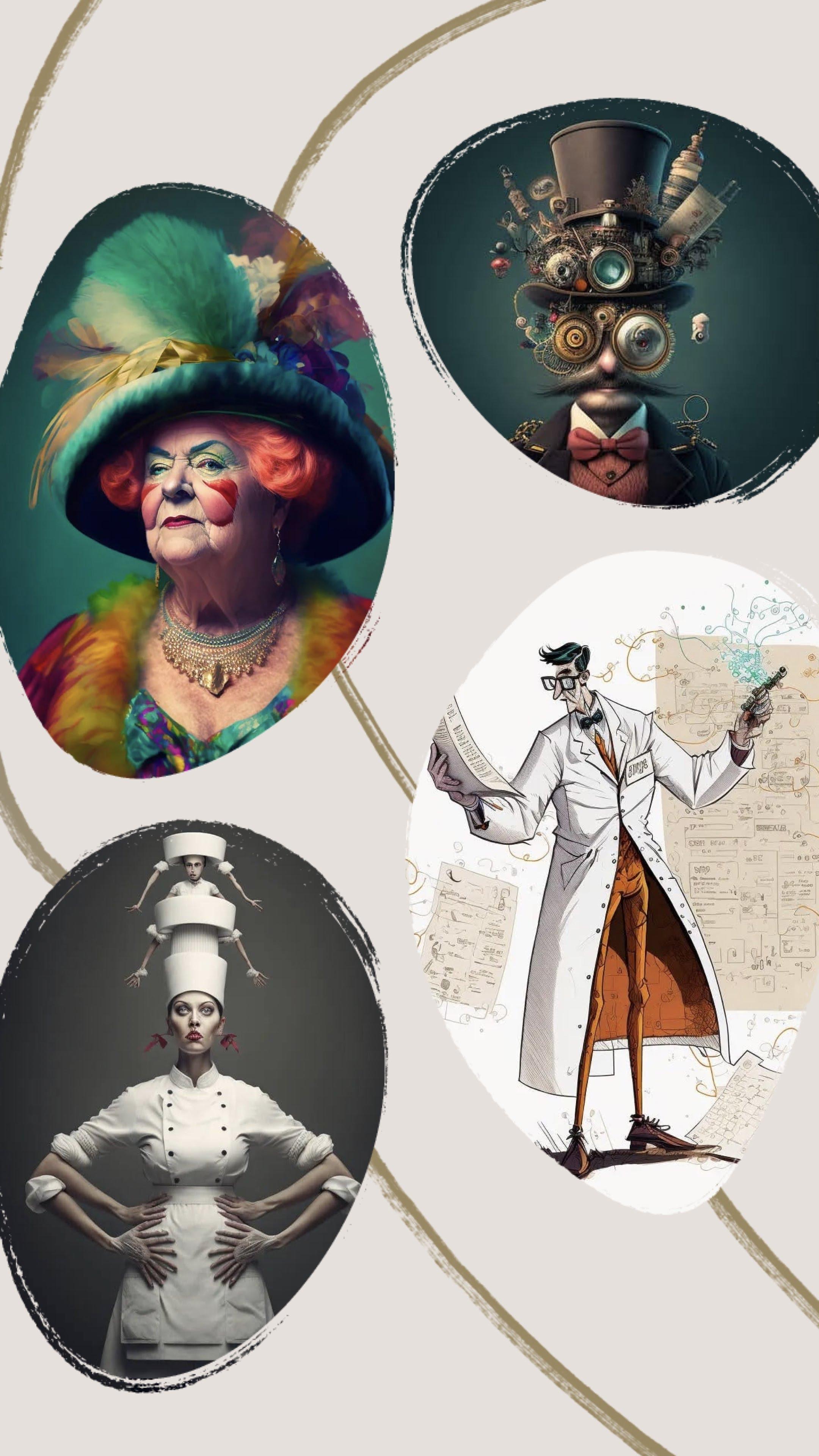
Zara and Yasmin, who took the left path, met a man named “Sproink” who was a small, wiry man with a spring for a tail. He was always bouncing around and speaking in a language that sounded like a mix of gibberish and music. Sproink was a collector of shiny objects and had a bag full of them, he was also a scavenger, always looking for things to add to his collection. He was wearing a small top hat and a monocle. He was also known to be a bit of a thief and a con artist.
Xavier and Youssef, who took the right path, met a woman named “Flibbertigibbet” a tall, slender woman that had multiple arms. Flibbertigibbet was very talkative and friendly, always trying to strike up a conversation. She spoke in a language that sounded like a mix of gibberish and baby talk. She was a chef and was always carrying a pot and a spoon, but she also had a dark side, she was known to be a bit of a manipulator and a spy, always observing and gathering information for a mysterious organization. She was wearing a big chef hat and apron.
As the group met back at the fork, they were surprised to find that Sproink and Flibbertigibbet had also met there. The four new characters joined the group, and together they continued their journey to find the “Key of Quirks”. Along the way, they met two more characters;
They met a man named “Gibber” who was a tall, gaunt man with elongated limbs and fingers. He was always speaking in a language that sounded like a mix of gibberish and numbers. He was a mathematician and a scientist, always working on complex equations and theories. He was known to be a bit of a loner, and didn’t interact much with others. He was wearing a lab coat and goggles.
They also met a woman named “Glimmer” she was a short, plump woman with a shimmering skin that seemed to change color depending on the light. She was always speaking in a language that sounded like a mix of gibberish and poetry. She was an artist and a performer, always creating and performing in different shows. She was known to be a bit of a flirt and a bit of a drama queen. She was wearing a colorful and eccentric clothing, such as a flowy dress and a large hat adorned with feathers.
As the group journeyed on, they encountered more characters, each one with their own unique quirks and personalities. They met a variety of people, some friendly and some not so friendly, but all of them adding to the mysterious and unknown nature of the Land of the Quirks.
As the group reached the end of their journey and found the “Key of Quirks”, they realized that the key was not just a physical object but a symbol of acceptance and embracing individuality. They learned that the true key to leaving the Land of the Quirks was understanding and accepting the quirks of oneself and others.
The group had a bittersweet goodbye with their new friends, Sproink, Flibbertigibbet, Gibber and Glimmer, and the other characters they had met. They knew that they would always carry a piece of the Land of the Quirks with them and would always remember the mysterious and eccentric adventure they had.
 January 13, 2023 at 7:40 pm #6379
In reply to: Prompts of Madjourneys
Asking to give each of the 4 characters some particular traits that makes them uniquely distinctive and recognizable
The four friends, Zara, Xavier, Yasmin, and Youssef, each have their own unique traits that make them stand out and recognizable.
Zara is the leader of the group, she is confident, and always ready for an adventure. She is a natural leader and has a strong sense of justice. She is also a tech-savvy person, always carrying a variety of gadgets with her, and is always the first to try out new technology.
Xavier is the joker of the group, always cracking jokes and making puns. He is a free-spirited person who is always up for an adventure, he has a great sense of humor and is not afraid to be himself. He is also an artist and often carries a sketchbook and pencils with him, he likes to draw whatever he sees in his journeys.
Yasmin is the brains of the group, she is intelligent and logical. She is always able to think on her feet and come up with a plan when things get tough. She is also a bit of a perfectionist and likes to have everything organized. She is a history buff and always carries a notebook with her to document her findings.
Youssef is the muscle of the group, He is physically strong, and always ready to help out in a fight. He is also a bit of a foodie and loves trying new dishes. He is always the first one to volunteer to carry the heavy bags and equipment. He is also a bit of a daredevil and loves trying out new sports and activities.
Give each of them a color, and an animal, and a secret name in a funny language
The four friends, Zara, Xavier, Yasmin, and Youssef, each have their own unique traits that make them stand out and recognizable.
Zara is the leader of the group, her color is red, her animal is a lion, and her secret name in a funny language is “Zaraloon”
Xavier is the joker of the group, his color is orange, his animal is a monkey, and his secret name in a funny language is “Xavimunk”
Yasmin is the brains of the group, her color is blue, her animal is an owl, and her secret name in a funny language is “Yasminowl”
Youssef is the muscle of the group, his color is green, his animal is a bear, and his secret name in a funny language is “Youssefbear”
Now, we need physical descriptions for each of them. Also, their ages, height, clothes, facial features, ethnicity (for instance Youssef may be half Yemeni and half Norwegian), etc. with a good mix of generic and eccentric. We also need surnames congruent with their described ethnicity, not too bland, but not too daft either. For instance Youssef Olafsson, Zara Patara-Smythe, etc. Also explain how they become friends.
Zara Patara-Smythe is a
25-year-oldwoman of mixed heritage, her mother is Indian and her father is British. She has long, dark hair that she keeps in a sleek ponytail, dark brown eyes and a sharp jawline. She stands at 5’6″ and has a toned and athletic build. She usually wears practical clothing that allows her to move around easily, such as cargo pants and a tank top.Xavier Olafsson is a
27-year-oldman of Norwegian and Danish descent. He has blonde hair that he keeps in a messy style, blue eyes, and a charming smile. He stands at 6’1″ and has a lean build. He is always seen wearing a colorful and bold clothing, such as a Hawaiian shirt and shorts.Yasmin Ahmed is a
23-year-oldwoman of Egyptian descent. She has long, black hair that she keeps in a tight braid, dark brown eyes and a round face. She stands at 5’4″ and has a petite build. She usually wears conservative clothing, such as long skirts and blouses.Youssef Ali is a
26-year-oldman of half Yemeni, half Norwegian descent. He has short, curly black hair, dark brown eyes and a square jawline. He stands at 6’2″ and has a muscular build. He usually wears comfortable clothing such as a t-shirt and jeans, and always has a backpack on his shoulder.The four of them became friends
in college, they were all studying different majors, but they all shared a love for adventure and exploration. They found themselves in the same class project, and from there they formed a strong bond. After college, they decided to keep exploring the world together, and went on many trips and adventures, always seeking for something new and exciting.
1/ Change the ages of Zara, Xavier, Yasmin and Youssef to more random patterns – rewrite if needed how they met each other to reflect eventual age gaps. Give them some flaws, mental or physical challenges.
2/ increase again the age gaps while keeping the youngest one a young adult, and remove “minor” from the flaws descriptionsZara is a 22-year-old woman who is the youngest of the group. She is a free-spirited, adventurous person, but also a bit reckless and impulsive. She has a scar on her cheek that she got from a Skateboarding accident when she was a teenager.
Xavier is a 45-year-old man who is the oldest of the group. He is a responsible and level-headed person, but also a bit of a perfectionist and can be hard on himself and others. He has dyslexia which he has been able to work around and it doesn’t impede his daily life.
Yasmin is a 38-year-old woman who is the second oldest of the group. She is a kind and compassionate person, but also a bit of a pushover and can have trouble standing up for herself. She has social anxiety that affect her in certain situations and she have been working on coping mechanisms.
Youssef is a 33-year-old man who is the second youngest of the group. He is a charismatic and outgoing person, but also a bit of a flirt and can be a bit insensitive to others feelings. He has ADHD which he has been able to manage with medication, but it still affects him from time to time.
The group met each other through different means, Xavier and Yasmin met at work, Zara and Youssef met at a college class, and eventually, they all became friends through common interests and activities. They decided to go on this adventure together because they were all looking for a change in their lives and wanted to explore the unknown.
January 11, 2023 at 9:43 pm #6367In reply to: Train your subjective AI – text version
Something in the style of TPooh:
The family tree was a tangled web of branches and roots, stretching back centuries and even millennia. The branches were thick with the leaves of secrets, scandals, and mysteries that the family had accumulated over the years. They were a close-knit group, friends for all time, and they loved nothing more than exploring the twists and turns of their family history.
They met regularly in their dreams, in a place they called The City, where they could exchange stories and clues they had uncovered during their waking hours. They often found themselves in the midst of strange and puzzling occurrences, and they would spend hours discussing the possible meanings and connections of these events. They saw the world as a tapestry, with each thread and pattern contributing to the greater picture. They were the weavers of their own story, the authors of their own fate.
But as the years went on, their dreams began to take on a darker and more ominous tone. They started having nightmares of monstrous beasts, and some of them even saw these beasts in the daylight, as if they were falling through the cracks in reality. They compared notes and found that they were often seeing the same beasts, and this led to heated debates about what these beasts represented and whether they were real or just figments of their imagination.
But no matter what they encountered, the family remained united in their quest to unravel the secrets of their past and to weave a tapestry that would be the envy of all. They were thick as thieves and they would never give up their pursuit of the truth, no matter how many rules they had to break along the way.
January 10, 2023 at 10:15 pm #6363In reply to: Train your subjective AI – text version
try another short story, with a bit of drama with the following words:
road form charlton smooth everyone cottage hanging rush offer agree subject district included appear sha returning grattidge nottingham 848 tetbury chicken
It was a cold and gloomy day in the small village of Tetbury, nestled in the picturesque Cotswolds district. A young woman named Sha was returning home to her cottage after a long and tiring journey. She had been away visiting her family in Nottingham and was looking forward to relaxing in her cozy home.
As she walked down the dirt road that led to her cottage, she couldn’t help but notice that something was off. Her neighbor, Mr. Charlton, was outside hanging laundry and he didn’t acknowledge her as she walked by. Sha thought it was strange, as he was usually a friendly and sociable person.
When Sha arrived at her cottage, she was shocked to find that it had been broken into. The front door was ajar and the inside of her home had been ransacked. Sha immediately panicked and called the police, who arrived on the scene shortly thereafter.
The police officers, including Inspector Grattidge, took Sha’s statement and began to investigate the crime. They discovered that a group of burglars had been operating in the area, targeting homes and businesses in the district. The burglars had been known for their smooth operations and their ability to strike quickly, which led to their nickname “The Smooth Operators”.
As Sha waited for the police to finish their investigation, she couldn’t shake the feeling that something was not right. She had always thought of Tetbury as a safe and friendly place, and she couldn’t believe that something like this could happen in her community.
As the investigation went on, the police found out that the Smooth operators have been targeting houses with no security cameras, but Sha’s cottage was an exception, the police were able to find out that the group offered to pay a considerable sum of money to the people who reported the locations of the houses that had no cameras, and it was Mr. Charlton who was the informant and he even rushed to Sha’s cottage as soon as he knew the police was investigating the case, He was arrested for the crime and Sha was heartbroken to find out that her once friendly neighbor had betrayed her.
Feeling violated and betrayed, Sha decided that she could no longer stay in the village and she put her cottage up for sale. She packed up her belongings and moved away, leaving behind the memories of her peaceful home and the community she had once thought of as her own. The end.
December 6, 2022 at 2:17 pm #6350In reply to: Family Stories From The Other Side ~ Book Two
Transportation
Isaac Stokes 1804-1877
Isaac was born in Churchill, Oxfordshire in 1804, and was the youngest brother of my 4X great grandfather Thomas Stokes. The Stokes family were stone masons for generations in Oxfordshire and Gloucestershire, and Isaac’s occupation was a mason’s labourer in 1834 when he was sentenced at the Lent Assizes in Oxford to fourteen years transportation for stealing tools.
Churchill where the Stokes stonemasons came from: on 31 July 1684 a fire destroyed 20 houses and many other buildings, and killed four people. The village was rebuilt higher up the hill, with stone houses instead of the old timber-framed and thatched cottages. The fire was apparently caused by a baker who, to avoid chimney tax, had knocked through the wall from her oven to her neighbour’s chimney.
Isaac stole a pick axe, the value of 2 shillings and the property of Thomas Joyner of Churchill; a kibbeaux and a trowel value 3 shillings the property of Thomas Symms; a hammer and axe value 5 shillings, property of John Keen of Sarsden.
(The word kibbeaux seems to only exists in relation to Isaac Stokes sentence and whoever was the first to write it was perhaps being creative with the spelling of a kibbo, a miners or a metal bucket. This spelling is repeated in the criminal reports and the newspaper articles about Isaac, but nowhere else).
In March 1834 the Removal of Convicts was announced in the Oxford University and City Herald: Isaac Stokes and several other prisoners were removed from the Oxford county gaol to the Justitia hulk at Woolwich “persuant to their sentences of transportation at our Lent Assizes”.
via digitalpanopticon:
Hulks were decommissioned (and often unseaworthy) ships that were moored in rivers and estuaries and refitted to become floating prisons. The outbreak of war in America in 1775 meant that it was no longer possible to transport British convicts there. Transportation as a form of punishment had started in the late seventeenth century, and following the Transportation Act of 1718, some 44,000 British convicts were sent to the American colonies. The end of this punishment presented a major problem for the authorities in London, since in the decade before 1775, two-thirds of convicts at the Old Bailey received a sentence of transportation – on average 283 convicts a year. As a result, London’s prisons quickly filled to overflowing with convicted prisoners who were sentenced to transportation but had no place to go.
To increase London’s prison capacity, in 1776 Parliament passed the “Hulks Act” (16 Geo III, c.43). Although overseen by local justices of the peace, the hulks were to be directly managed and maintained by private contractors. The first contract to run a hulk was awarded to Duncan Campbell, a former transportation contractor. In August 1776, the Justicia, a former transportation ship moored in the River Thames, became the first prison hulk. This ship soon became full and Campbell quickly introduced a number of other hulks in London; by 1778 the fleet of hulks on the Thames held 510 prisoners.
Demand was so great that new hulks were introduced across the country. There were hulks located at Deptford, Chatham, Woolwich, Gosport, Plymouth, Portsmouth, Sheerness and Cork.The Justitia via rmg collections:
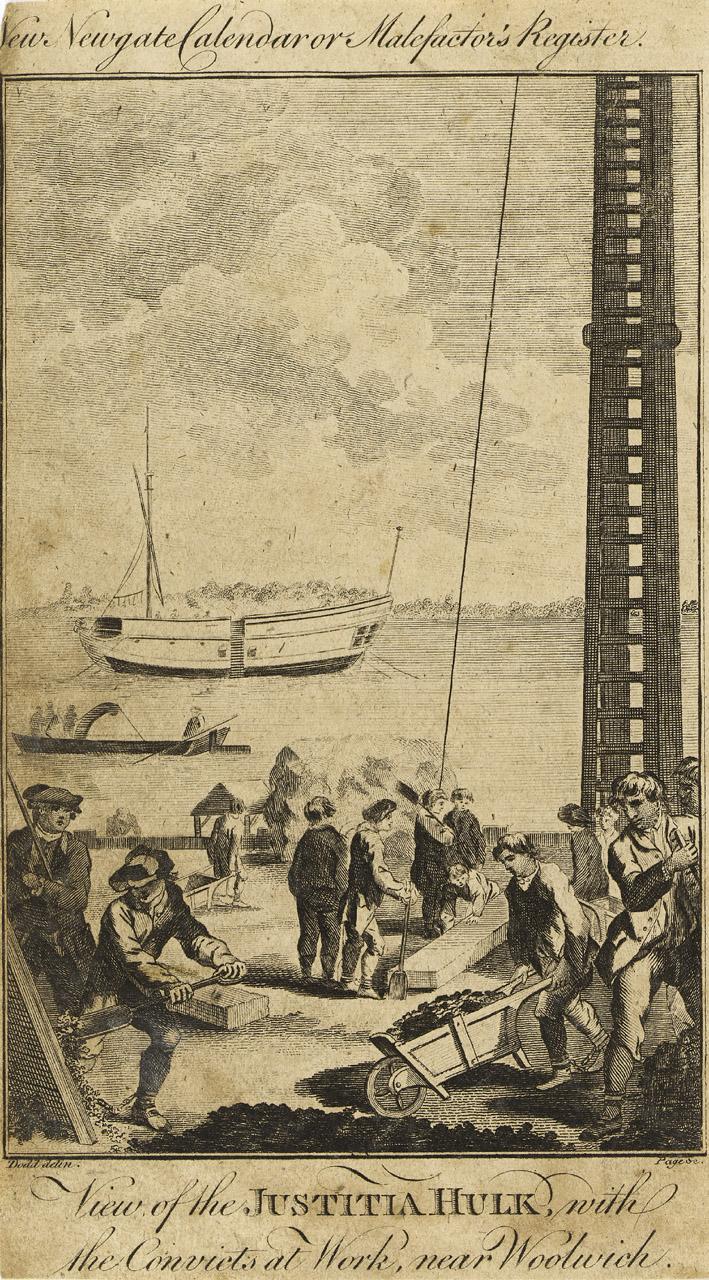
Convicts perform hard labour at the Woolwich Warren. The hulk on the river is the ‘Justitia’. Prisoners were kept on board such ships for months awaiting deportation to Australia. The ‘Justitia’ was a 260 ton prison hulk that had been originally moored in the Thames when the American War of Independence put a stop to the transportation of criminals to the former colonies. The ‘Justitia’ belonged to the shipowner Duncan Campbell, who was the Government contractor who organized the prison-hulk system at that time. Campbell was subsequently involved in the shipping of convicts to the penal colony at Botany Bay (in fact Port Jackson, later Sydney, just to the north) in New South Wales, the ‘first fleet’ going out in 1788.
While searching for records for Isaac Stokes I discovered that another Isaac Stokes was transported to New South Wales in 1835 as well. The other one was a butcher born in 1809, sentenced in London for seven years, and he sailed on the Mary Ann. Our Isaac Stokes sailed on the Lady Nugent, arriving in NSW in April 1835, having set sail from England in December 1834.
Lady Nugent was built at Bombay in 1813. She made four voyages under contract to the British East India Company (EIC). She then made two voyages transporting convicts to Australia, one to New South Wales and one to Van Diemen’s Land (Tasmania). (via Wikipedia)
via freesettlerorfelon website:
On 20 November 1834, 100 male convicts were transferred to the Lady Nugent from the Justitia Hulk and 60 from the Ganymede Hulk at Woolwich, all in apparent good health. The Lady Nugent departed Sheerness on 4 December 1834.
SURGEON OLIVER SPROULE
Oliver Sproule kept a Medical Journal from 7 November 1834 to 27 April 1835. He recorded in his journal the weather conditions they experienced in the first two weeks:
‘In the course of the first week or ten days at sea, there were eight or nine on the sick list with catarrhal affections and one with dropsy which I attribute to the cold and wet we experienced during that period beating down channel. Indeed the foremost berths in the prison at this time were so wet from leaking in that part of the ship, that I was obliged to issue dry beds and bedding to a great many of the prisoners to preserve their health, but after crossing the Bay of Biscay the weather became fine and we got the damp beds and blankets dried, the leaks partially stopped and the prison well aired and ventilated which, I am happy to say soon manifested a favourable change in the health and appearance of the men.
Besides the cases given in the journal I had a great many others to treat, some of them similar to those mentioned but the greater part consisted of boils, scalds, and contusions which would not only be too tedious to enter but I fear would be irksome to the reader. There were four births on board during the passage which did well, therefore I did not consider it necessary to give a detailed account of them in my journal the more especially as they were all favourable cases.
Regularity and cleanliness in the prison, free ventilation and as far as possible dry decks turning all the prisoners up in fine weather as we were lucky enough to have two musicians amongst the convicts, dancing was tolerated every afternoon, strict attention to personal cleanliness and also to the cooking of their victuals with regular hours for their meals, were the only prophylactic means used on this occasion, which I found to answer my expectations to the utmost extent in as much as there was not a single case of contagious or infectious nature during the whole passage with the exception of a few cases of psora which soon yielded to the usual treatment. A few cases of scurvy however appeared on board at rather an early period which I can attribute to nothing else but the wet and hardships the prisoners endured during the first three or four weeks of the passage. I was prompt in my treatment of these cases and they got well, but before we arrived at Sydney I had about thirty others to treat.’
The Lady Nugent arrived in Port Jackson on 9 April 1835 with 284 male prisoners. Two men had died at sea. The prisoners were landed on 27th April 1835 and marched to Hyde Park Barracks prior to being assigned. Ten were under the age of 14 years.
The Lady Nugent:
Isaac’s distinguishing marks are noted on various criminal registers and record books:
“Height in feet & inches: 5 4; Complexion: Ruddy; Hair: Light brown; Eyes: Hazel; Marks or Scars: Yes [including] DEVIL on lower left arm, TSIS back of left hand, WS lower right arm, MHDW back of right hand.”
Another includes more detail about Isaac’s tattoos:
“Two slight scars right side of mouth, 2 moles above right breast, figure of the devil and DEVIL and raised mole, lower left arm; anchor, seven dots half moon, TSIS and cross, back of left hand; a mallet, door post, A, mans bust, sun, WS, lower right arm; woman, MHDW and shut knife, back of right hand.”
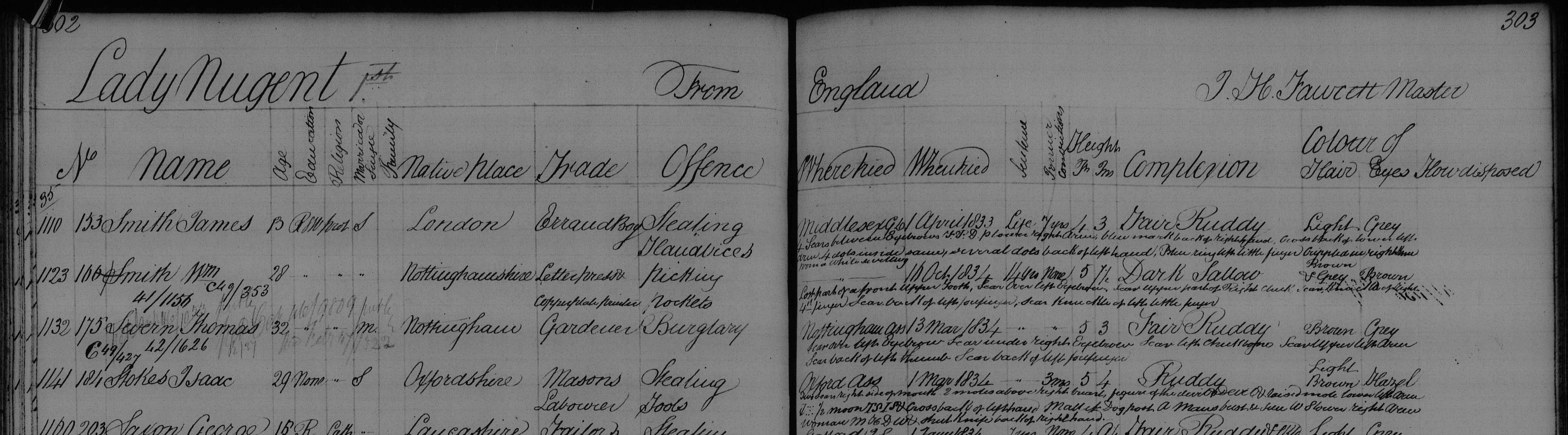
From How tattoos became fashionable in Victorian England (2019 article in TheConversation by Robert Shoemaker and Zoe Alkar):
“Historical tattooing was not restricted to sailors, soldiers and convicts, but was a growing and accepted phenomenon in Victorian England. Tattoos provide an important window into the lives of those who typically left no written records of their own. As a form of “history from below”, they give us a fleeting but intriguing understanding of the identities and emotions of ordinary people in the past.
As a practice for which typically the only record is the body itself, few systematic records survive before the advent of photography. One exception to this is the written descriptions of tattoos (and even the occasional sketch) that were kept of institutionalised people forced to submit to the recording of information about their bodies as a means of identifying them. This particularly applies to three groups – criminal convicts, soldiers and sailors. Of these, the convict records are the most voluminous and systematic.
Such records were first kept in large numbers for those who were transported to Australia from 1788 (since Australia was then an open prison) as the authorities needed some means of keeping track of them.”On the 1837 census Isaac was working for the government at Illiwarra, New South Wales. This record states that he arrived on the Lady Nugent in 1835. There are three other indent records for an Isaac Stokes in the following years, but the transcriptions don’t provide enough information to determine which Isaac Stokes it was. In April 1837 there was an abscondment, and an arrest/apprehension in May of that year, and in 1843 there was a record of convict indulgences.
From the Australian government website regarding “convict indulgences”:
“By the mid-1830s only six per cent of convicts were locked up. The vast majority worked for the government or free settlers and, with good behaviour, could earn a ticket of leave, conditional pardon or and even an absolute pardon. While under such orders convicts could earn their own living.”
In 1856 in Camden, NSW, Isaac Stokes married Catherine Daly. With no further information on this record it would be impossible to know for sure if this was the right Isaac Stokes. This couple had six children, all in the Camden area, but none of the records provided enough information. No occupation or place or date of birth recorded for Isaac Stokes.
I wrote to the National Library of Australia about the marriage record, and their reply was a surprise! Issac and Catherine were married on 30 September 1856, at the house of the Rev. Charles William Rigg, a Methodist minister, and it was recorded that Isaac was born in Edinburgh in 1821, to parents James Stokes and Sarah Ellis! The age at the time of the marriage doesn’t match Isaac’s age at death in 1877, and clearly the place of birth and parents didn’t match either. Only his fathers occupation of stone mason was correct. I wrote back to the helpful people at the library and they replied that the register was in a very poor condition and that only two and a half entries had survived at all, and that Isaac and Catherines marriage was recorded over two pages.
I searched for an Isaac Stokes born in 1821 in Edinburgh on the Scotland government website (and on all the other genealogy records sites) and didn’t find it. In fact Stokes was a very uncommon name in Scotland at the time. I also searched Australian immigration and other records for another Isaac Stokes born in Scotland or born in 1821, and found nothing. I was unable to find a single record to corroborate this mysterious other Isaac Stokes.
As the age at death in 1877 was correct, I assume that either Isaac was lying, or that some mistake was made either on the register at the home of the Methodist minster, or a subsequent mistranscription or muddle on the remnants of the surviving register. Therefore I remain convinced that the Camden stonemason Isaac Stokes was indeed our Isaac from Oxfordshire.
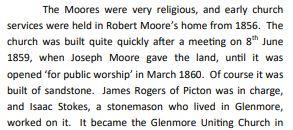
I found a history society newsletter article that mentioned Isaac Stokes, stone mason, had built the Glenmore church, near Camden, in 1859.

From the Wollondilly museum April 2020 newsletter:
From the Camden History website:
“The stone set over the porch of Glenmore Church gives the date of 1860. The church was begun in 1859 on land given by Joseph Moore. James Rogers of Picton was given the contract to build and local builder, Mr. Stokes, carried out the work. Elizabeth Moore, wife of Edward, laid the foundation stone. The first service was held on 19th March 1860. The cemetery alongside the church contains the headstones and memorials of the areas early pioneers.”
Isaac died on the 3rd September 1877. The inquest report puts his place of death as Bagdelly, near to Camden, and another death register has put Cambelltown, also very close to Camden. His age was recorded as 71 and the inquest report states his cause of death was “rupture of one of the large pulmonary vessels of the lung”. His wife Catherine died in childbirth in 1870 at the age of 43.
Isaac and Catherine’s children:
William Stokes 1857-1928
Catherine Stokes 1859-1846
Sarah Josephine Stokes 1861-1931
Ellen Stokes 1863-1932
Rosanna Stokes 1865-1919
Louisa Stokes 1868-1844.
It’s possible that Catherine Daly was a transported convict from Ireland.
Some time later I unexpectedly received a follow up email from The Oaks Heritage Centre in Australia.
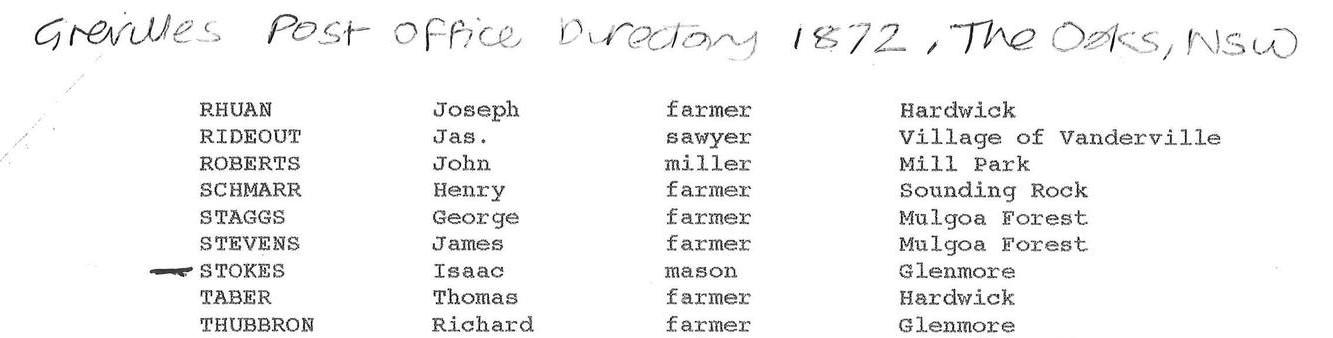
“The Gaudry papers which we have in our archive record him (Isaac Stokes) as having built: the church, the school and the teachers residence. Isaac is recorded in the General return of convicts: 1837 and in Grevilles Post Office directory 1872 as a mason in Glenmore.”
 November 18, 2022 at 4:47 pm #6348
In reply to: Family Stories From The Other Side ~ Book Two
Wong Sang
Wong Sang was born in China in 1884. In October 1916 he married Alice Stokes in Oxford.
Alice was the granddaughter of William Stokes of Churchill, Oxfordshire and William was the brother of Thomas Stokes the wheelwright (who was my 3X great grandfather). In other words Alice was my second cousin, three times removed, on my fathers paternal side.
Wong Sang was an interpreter, according to the baptism registers of his children and the Dreadnought Seamen’s Hospital admission registers in 1930. The hospital register also notes that he was employed by the Blue Funnel Line, and that his address was 11, Limehouse Causeway, E 14. (London)
“The Blue Funnel Line offered regular First-Class Passenger and Cargo Services From the UK to South Africa, Malaya, China, Japan, Australia, Java, and America. Blue Funnel Line was Owned and Operated by Alfred Holt & Co., Liverpool.
The Blue Funnel Line, so-called because its ships have a blue funnel with a black top, is more appropriately known as the Ocean Steamship Company.”Wong Sang and Alice’s daughter, Frances Eileen Sang, was born on the 14th July, 1916 and baptised in 1920 at St Stephen in Poplar, Tower Hamlets, London. The birth date is noted in the 1920 baptism register and would predate their marriage by a few months, although on the death register in 1921 her age at death is four years old and her year of birth is recorded as 1917.
Charles Ronald Sang was baptised on the same day in May 1920, but his birth is recorded as April of that year. The family were living on Morant Street, Poplar.
James William Sang’s birth is recorded on the 1939 census and on the death register in 2000 as being the 8th March 1913. This definitely would predate the 1916 marriage in Oxford.
William Norman Sang was born on the 17th October 1922 in Poplar.
Alice and the three sons were living at 11, Limehouse Causeway on the 1939 census, the same address that Wong Sang was living at when he was admitted to Dreadnought Seamen’s Hospital on the 15th January 1930. Wong Sang died in the hospital on the 8th March of that year at the age of 46.
Alice married John Patterson in 1933 in Stepney. John was living with Alice and her three sons on Limehouse Causeway on the 1939 census and his occupation was chef.
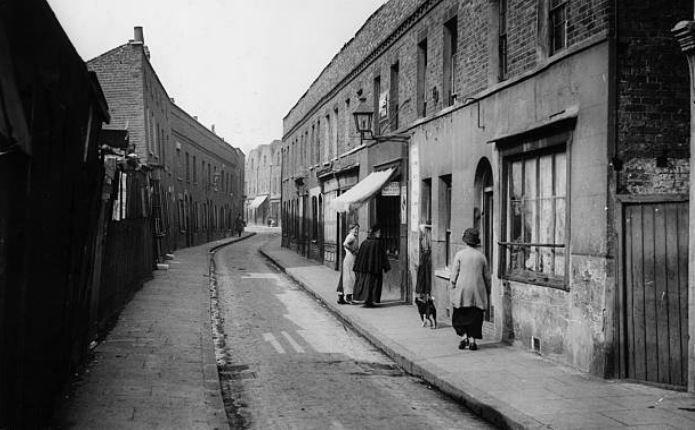
Via Old London Photographs:
“Limehouse Causeway is a street in east London that was the home to the original Chinatown of London. A combination of bomb damage during the Second World War and later redevelopment means that almost nothing is left of the original buildings of the street.”
Limehouse Causeway in 1925:
From The Story of Limehouse’s Lost Chinatown, poplarlondon website:
“Limehouse was London’s first Chinatown, home to a tightly-knit community who were demonised in popular culture and eventually erased from the cityscape.
As recounted in the BBC’s ‘Our Greatest Generation’ series, Connie was born to a Chinese father and an English mother in early 1920s Limehouse, where she used to play in the street with other British and British-Chinese children before running inside for teatime at one of their houses.
Limehouse was London’s first Chinatown between the 1880s and the 1960s, before the current Chinatown off Shaftesbury Avenue was established in the 1970s by an influx of immigrants from Hong Kong.
Connie’s memories of London’s first Chinatown as an “urban village” paint a very different picture to the seedy area portrayed in early twentieth century novels.
The pyramid in St Anne’s church marked the entrance to the opium den of Dr Fu Manchu, a criminal mastermind who threatened Western society by plotting world domination in a series of novels by Sax Rohmer.
Thomas Burke’s Limehouse Nights cemented stereotypes about prostitution, gambling and violence within the Chinese community, and whipped up anxiety about sexual relationships between Chinese men and white women.
Though neither novelist was familiar with the Chinese community, their depictions made Limehouse one of the most notorious areas of London.
Travel agent Thomas Cook even organised tours of the area for daring visitors, despite the rector of Limehouse warning that “those who look for the Limehouse of Mr Thomas Burke simply will not find it.”
All that remains is a handful of Chinese street names, such as Ming Street, Pekin Street, and Canton Street — but what was Limehouse’s chinatown really like, and why did it get swept away?
Chinese migration to Limehouse
Chinese sailors discharged from East India Company ships settled in the docklands from as early as the 1780s.
By the late nineteenth century, men from Shanghai had settled around Pennyfields Lane, while a Cantonese community lived on Limehouse Causeway.
Chinese sailors were often paid less and discriminated against by dock hirers, and so began to diversify their incomes by setting up hand laundry services and restaurants.
Old photographs show shopfronts emblazoned with Chinese characters with horse-drawn carts idling outside or Chinese men in suits and hats standing proudly in the doorways.
In oral histories collected by Yat Ming Loo, Connie’s husband Leslie doesn’t recall seeing any Chinese women as a child, since male Chinese sailors settled in London alone and married working-class English women.
In the 1920s, newspapers fear-mongered about interracial marriages, crime and gambling, and described chinatown as an East End “colony.”
Ironically, Chinese opium-smoking was also demonised in the press, despite Britain waging war against China in the mid-nineteenth century for suppressing the opium trade to alleviate addiction amongst its people.
The number of Chinese people who settled in Limehouse was also greatly exaggerated, and in reality only totalled around 300.
The real Chinatown
Although the press sought to characterise Limehouse as a monolithic Chinese community in the East End, Connie remembers seeing people of all nationalities in the shops and community spaces in Limehouse.
She doesn’t remember feeling discriminated against by other locals, though Connie does recall having her face measured and IQ tested by a member of the British Eugenics Society who was conducting research in the area.
Some of Connie’s happiest childhood memories were from her time at Chung-Hua Club, where she learned about Chinese culture and language.
Why did Chinatown disappear?
The caricature of Limehouse’s Chinatown as a den of vice hastened its erasure.
Police raids and deportations fuelled by the alarmist media coverage threatened the Chinese population of Limehouse, and slum clearance schemes to redevelop low-income areas dispersed Chinese residents in the 1930s.
The Defence of the Realm Act imposed at the beginning of the First World War criminalised opium use, gave the authorities increased powers to deport Chinese people and restricted their ability to work on British ships.
Dwindling maritime trade during World War II further stripped Chinese sailors of opportunities for employment, and any remnants of Chinatown were destroyed during the Blitz or erased by postwar development schemes.”
Wong Sang 1884-1930
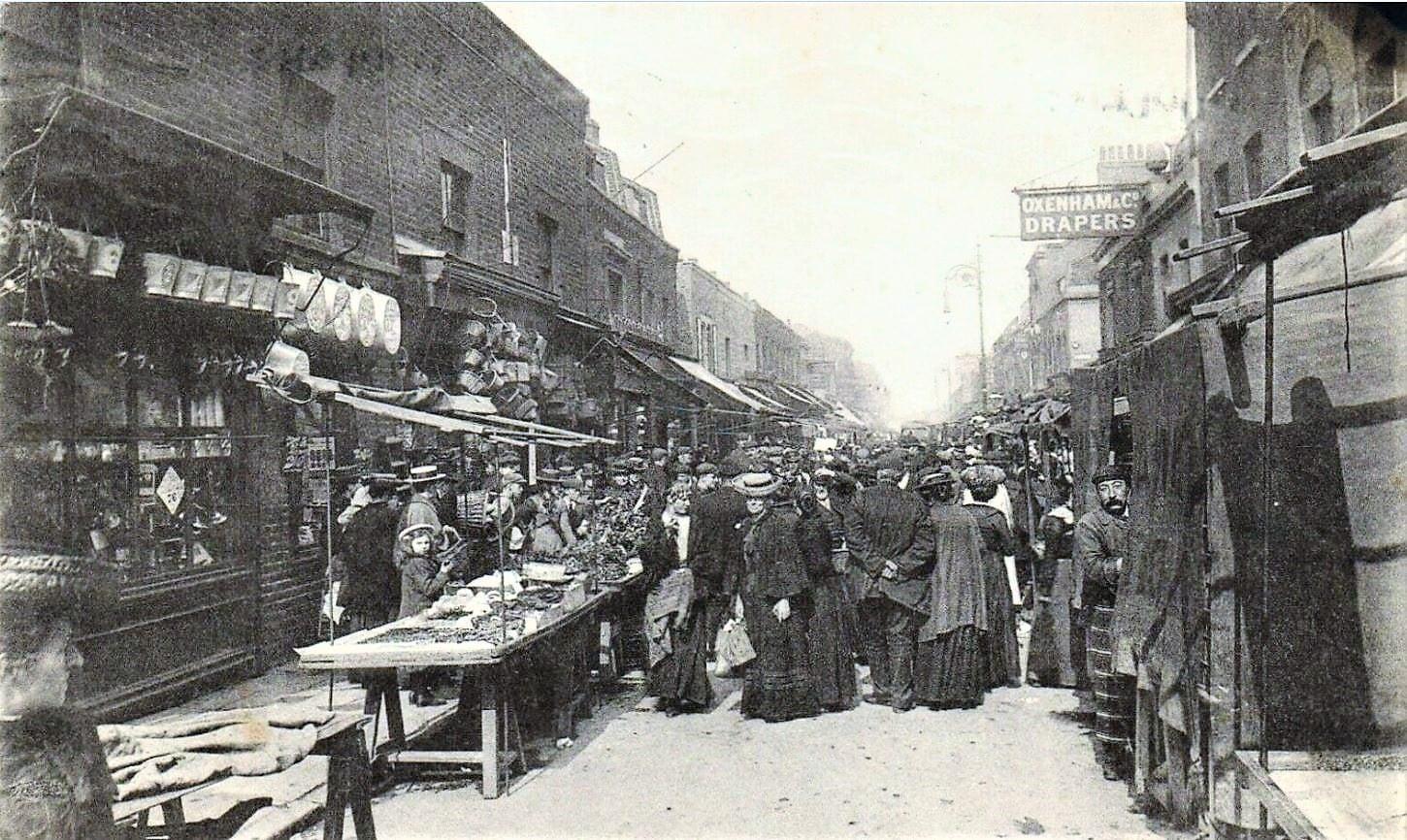
The year 1918 was a troublesome one for Wong Sang, an interpreter and shipping agent for Blue Funnel Line. The Sang family were living at 156, Chrisp Street.
Chrisp Street, Poplar, in 1913 via Old London Photographs:
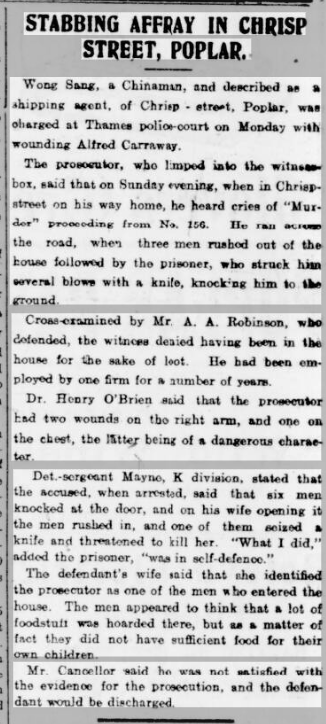
In February Wong Sang was discharged from a false accusation after defending his home from potential robbers.
East End News and London Shipping Chronicle – Friday 15 February 1918:
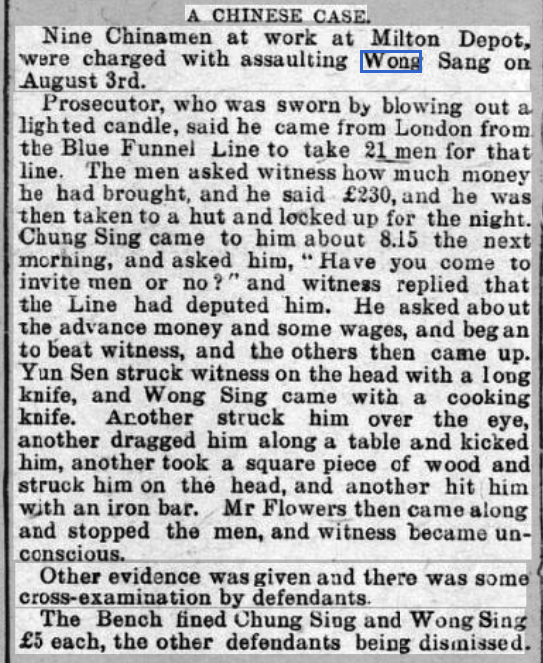
In August of that year he was involved in an incident that left him unconscious.
Faringdon Advertiser and Vale of the White Horse Gazette – Saturday 31 August 1918:
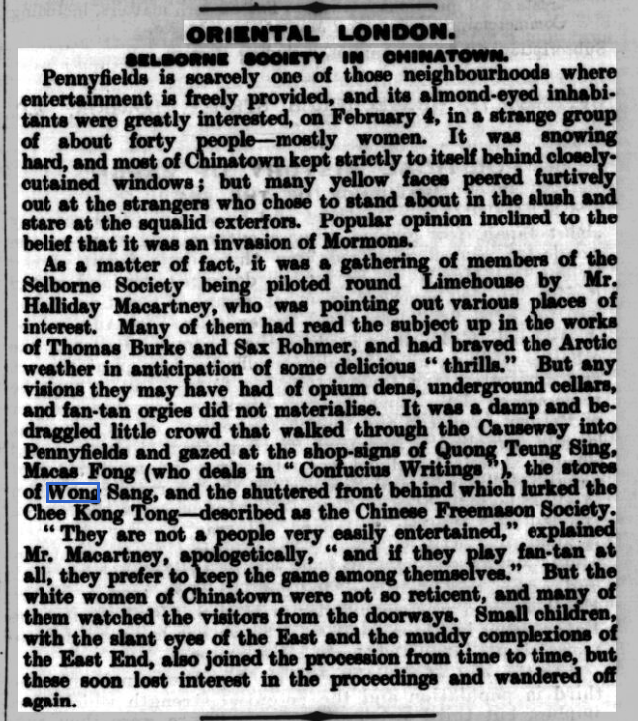
Wong Sang is mentioned in an 1922 article about “Oriental London”.
London and China Express – Thursday 09 February 1922:
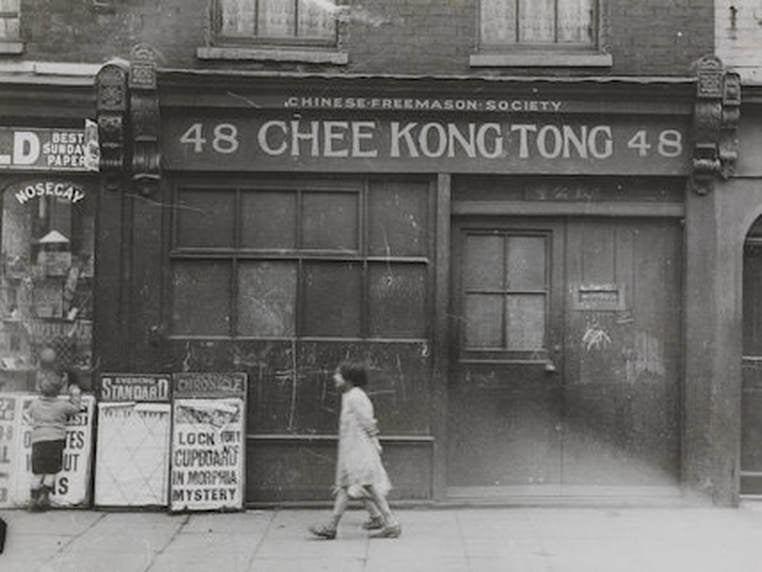
A photograph of the Chee Kong Tong Chinese Freemason Society mentioned in the above article, via Old London Photographs:
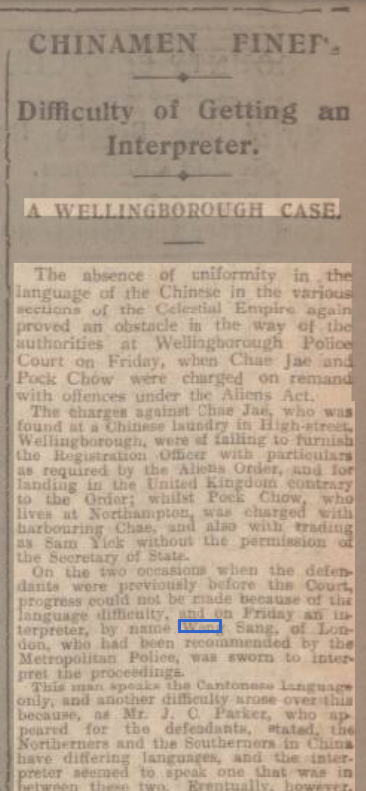
Wong Sang was recommended by the London Metropolitan Police in 1928 to assist in a case in Wellingborough, Northampton.
Difficulty of Getting an Interpreter: Northampton Mercury – Friday 16 March 1928:
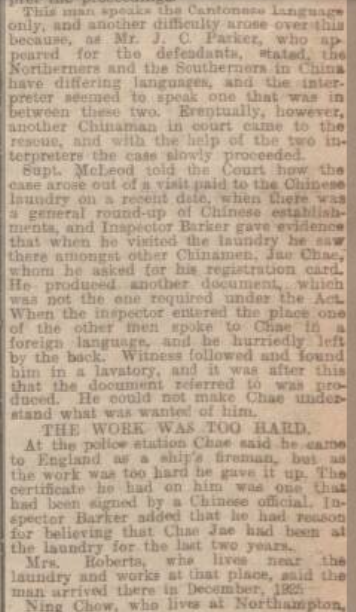
The difficulty was that “this man speaks the Cantonese language only…the Northeners and the Southerners in China have differing languages and the interpreter seemed to speak one that was in between these two.”
In 1917, Alice Wong Sang was a witness at her sister Harriet Stokes marriage to James William Watts in Southwark, London. Their father James Stokes occupation on the marriage register is foreman surveyor, but on the census he was a council roadman or labourer. (I initially rejected this as the correct marriage for Harriet because of the discrepancy with the occupations. Alice Wong Sang as a witness confirmed that it was indeed the correct one.)
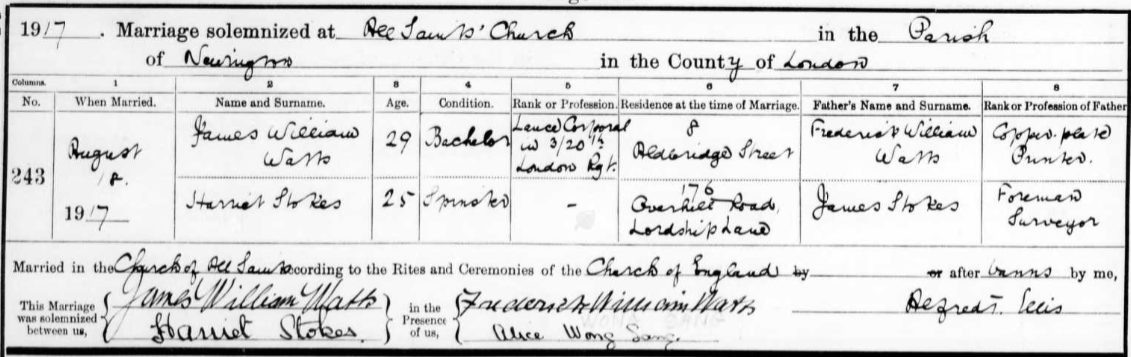
James William Sang 1913-2000 was a clock fitter and watch assembler (on the 1939 census). He married Ivy Laura Fenton in 1963 in Sidcup, Kent. James died in Southwark in 2000.
Charles Ronald Sang 1920-1974 was a draughtsman (1939 census). He married Eileen Burgess in 1947 in Marylebone. Charles and Eileen had two sons: Keith born in 1951 and Roger born in 1952. He died in 1974 in Hertfordshire.
William Norman Sang 1922-2000 was a clerk and telephone operator (1939 census). William enlisted in the Royal Artillery in 1942. He married Lily Mullins in 1949 in Bethnal Green, and they had three daughters: Marion born in 1950, Christine in 1953, and Frances in 1959. He died in Redbridge in 2000.
I then found another two births registered in Poplar by Alice Sang, both daughters. Doris Winifred Sang was born in 1925, and Patricia Margaret Sang was born in 1933 ~ three years after Wong Sang’s death. Neither of the these daughters were on the 1939 census with Alice, John Patterson and the three sons. Margaret had presumably been evacuated because of the war to a family in Taunton, Somerset. Doris would have been fourteen and I have been unable to find her in 1939 (possibly because she died in 2017 and has not had the redaction removed yet on the 1939 census as only deceased people are viewable).
Doris Winifred Sang 1925-2017 was a nursing sister. She didn’t marry, and spent a year in USA between 1954 and 1955. She stayed in London, and died at the age of ninety two in 2017.
Patricia Margaret Sang 1933-1998 was also a nurse. She married Patrick L Nicely in Stepney in 1957. Patricia and Patrick had five children in London: Sharon born 1959, Donald in 1960, Malcolm was born and died in 1966, Alison was born in 1969 and David in 1971.
I was unable to find a birth registered for Alice’s first son, James William Sang (as he appeared on the 1939 census). I found Alice Stokes on the 1911 census as a 17 year old live in servant at a tobacconist on Pekin Street, Limehouse, living with Mr Sui Fong from Hong Kong and his wife Sarah Sui Fong from Berlin. I looked for a birth registered for James William Fong instead of Sang, and found it ~ mothers maiden name Stokes, and his date of birth matched the 1939 census: 8th March, 1913.
On the 1921 census, Wong Sang is not listed as living with them but it is mentioned that Mr Wong Sang was the person returning the census. Also living with Alice and her sons James and Charles in 1921 are two visitors: (Florence) May Stokes, 17 years old, born in Woodstock, and Charles Stokes, aged 14, also born in Woodstock. May and Charles were Alice’s sister and brother.
I found Sharon Nicely on social media and she kindly shared photos of Wong Sang and Alice Stokes:
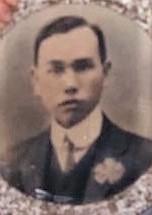
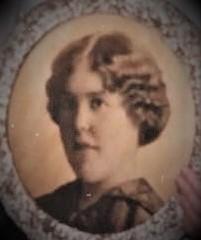 November 10, 2022 at 12:08 pm #6344
In reply to: Family Stories From The Other Side ~ Book Two
The Tetbury Riots
While researching the Tetbury riots (I had found some Browning names in the newspaper archives in association with the uprisings) I came across an article called “Elizabeth Parker, the Swing Riots, and the Tetbury parish clerk” by Jill Evans.
I noted the name of the parish clerk, Daniel Cole, because I know someone else of that name. The incident in the article was 1830.
I found the 1826 marriage in the Tetbury parish registers (where Daniel was the parish clerk) of my 4x great grandmothers sister Hesther Lock. One of the witnesses was her brother Charles, and the other was Daniel Cole, the parish clerk.
Marriage of Lewin Chandler and Hesther Lock in 1826:
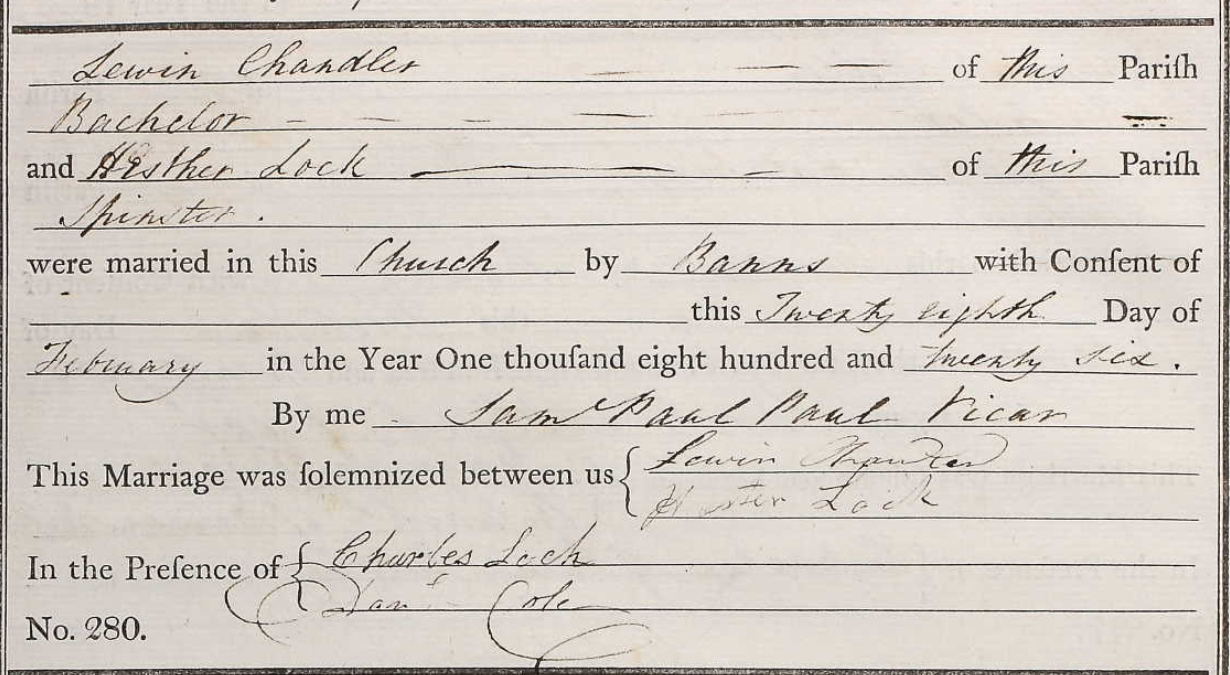
from the article:
“The Swing Riots were disturbances which took place in 1830 and 1831, mostly in the southern counties of England. Agricultural labourers, who were already suffering due to low wages and a lack of work after several years of bad harvests, rose up when their employers introduced threshing machines into their workplaces. The riots got their name from the threatening letters which were sent to farmers and other employers, which were signed “Captain Swing.”
The riots spread into Gloucestershire in November 1830, with the Tetbury area seeing the worst of the disturbances. Amongst the many people arrested afterwards was one woman, Elizabeth Parker. She has sometimes been cited as one of only two females who were transported for taking part in the Swing Riots. In fact, she was sentenced to be transported for this crime, but never sailed, as she was pardoned a few months after being convicted. However, less than a year after being released from Gloucester Gaol, she was back, awaiting trial for another offence. The circumstances in both of the cases she was tried for reveal an intriguing relationship with one Daniel Cole, parish clerk and assistant poor law officer in Tetbury….
….Elizabeth Parker was committed to Gloucester Gaol on 4 December 1830. In the Gaol Registers, she was described as being 23 and a “labourer”. She was in fact a prostitute, and she was unusual for the time in that she could read and write. She was charged on the oaths of Daniel Cole and others with having been among a mob which destroyed a threshing machine belonging to Jacob Hayward, at his farm in Beverstone, on 26 November.
…..Elizabeth Parker was granted royal clemency in July 1831 and was released from prison. She returned to Tetbury and presumably continued in her usual occupation, but on 27 March 1832, she was committed to Gloucester Gaol again. This time, she was charged with stealing 2 five pound notes, 5 sovereigns and 5 half sovereigns, from the person of Daniel Cole.
Elizabeth was tried at the Lent Assizes which began on 28 March, 1832. The details of her trial were reported in the Morning Post. Daniel Cole was in the “Boat Inn” (meaning the Boot Inn, I think) in Tetbury, when Elizabeth Parker came in. Cole “accompanied her down the yard”, where he stayed with her for about half an hour. The next morning, he realised that all his money was gone. One of his five pound notes was identified by him in a shop, where Parker had bought some items.
Under cross-examination, Cole said he was the assistant overseer of the poor and collector of public taxes of the parish of Tetbury. He was married with one child. He went in to the inn at about 9 pm, and stayed about 2 hours, drinking in the parlour, with the landlord, Elizabeth Parker, and two others. He was not drunk, but he was “rather fresh.” He gave the prisoner no money. He saw Elizabeth Parker next morning at the Prince and Princess public house. He didn’t drink with her or give her any money. He did give her a shilling after she was committed. He never said that he would not have prosecuted her “if it was not for her own tongue”. (Presumably meaning he couldn’t trust her to keep her mouth shut.)”
Contemporary illustration of the Swing riots:
Captain Swing was the imaginary leader agricultural labourers who set fire to barns and haystacks in the southern and eastern counties of England from 1830. Although the riots were ruthlessly put down (19 hanged, 644 imprisoned and 481 transported), the rural agitation led the new Whig government to establish a Royal Commission on the Poor Laws and its report provided the basis for the 1834 New Poor Law enacted after the Great Reform Bills of 1833.
An original portrait of Captain Swing hand coloured lithograph circa 1830:
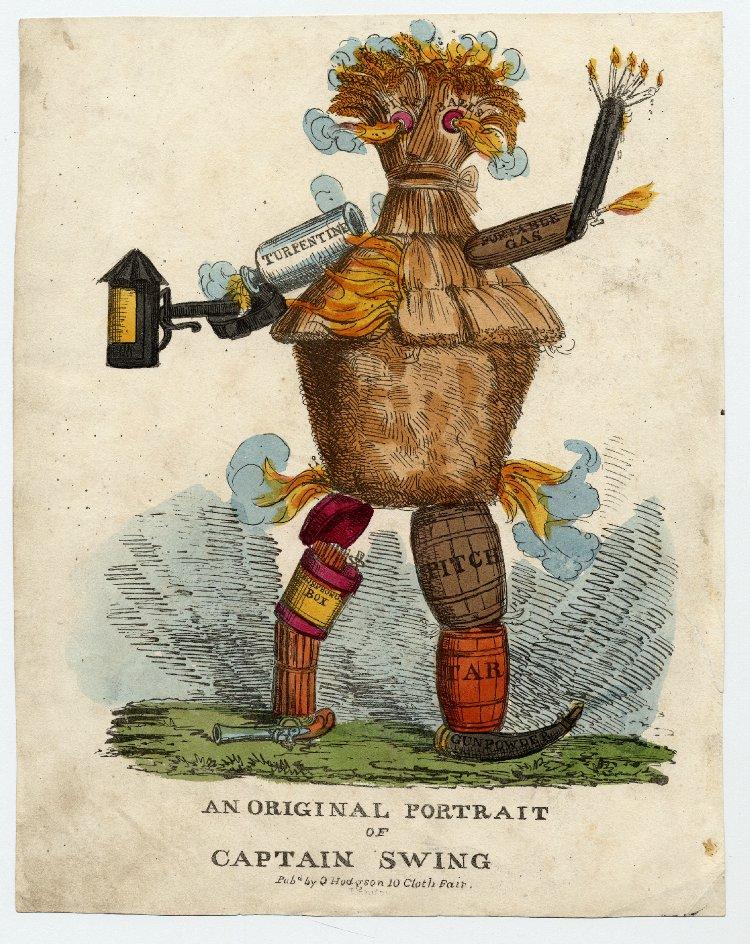 October 22, 2022 at 1:18 pm #6338
In reply to: Family Stories From The Other Side ~ Book Two
Albert Parker Edwards
1876-1930
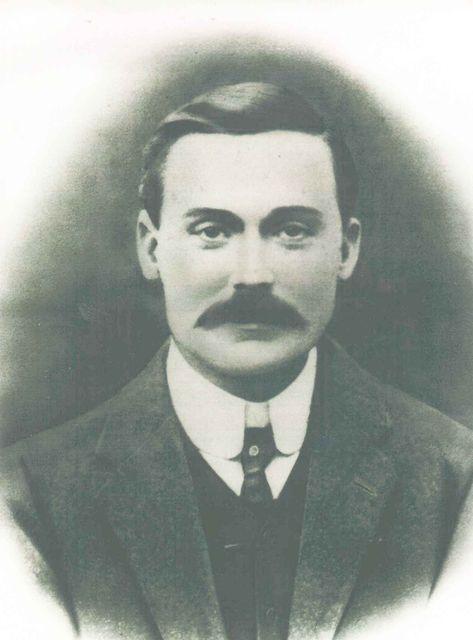
Albert Parker Edwards, my great grandfather, was born in Aston, Warwickshire in 1876. On the 1881 census he was living with his parents Enoch and Amelia in Bournebrook, Northfield, Worcestershire. Enoch was a button tool maker at the time of the census.
In 1890 Albert was indentured in an apprenticeship as a pawnbroker in Tipton, Staffordshire.
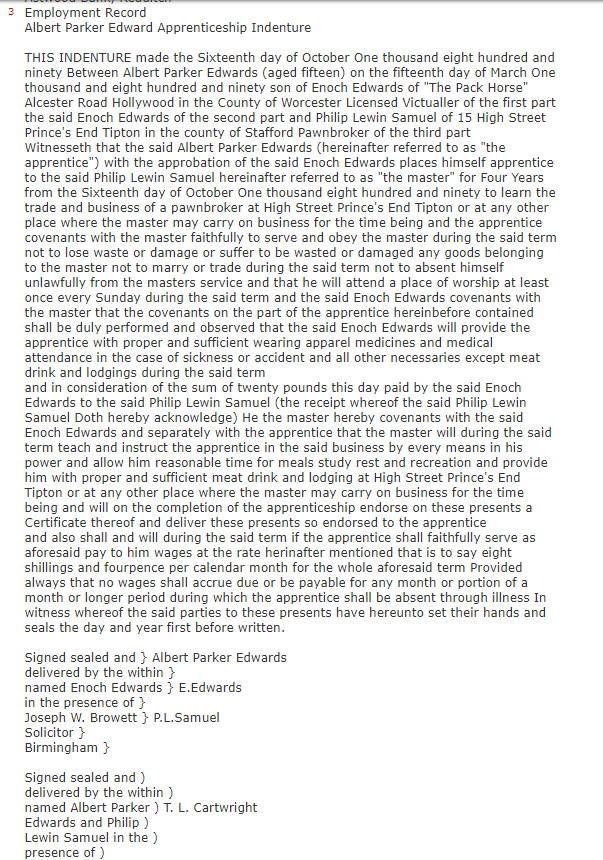
On the 1891 census Albert was a lodger in Tipton at the home of Phoebe Levy, pawnbroker, and Alberts occupation was an apprentice.
Albert married Annie Elizabeth Stokes in 1898 in Evesham, and their first son, my grandfather Albert Garnet Edwards (1898-1950), was born six months later in Crabbs Cross. On the 1901 census, Annie was in hospital as a patient and Albert was living at Crabbs Cross with a boarder, his brother Garnet Edwards. Their two year old son Albert Garnet was staying with his uncle Ralph, Albert Parkers brother, also in Crabbs Cross.
Albert and Annie kept the Cricketers Arms hotel on Beoley Road in Redditch until around 1920. They had a further four children while living there: Doris May Edwards (1902-1974), Ralph Clifford Edwards (1903-1988), Ena Flora Edwards (1908-1983) and Osmond Edwards (1910-2000).
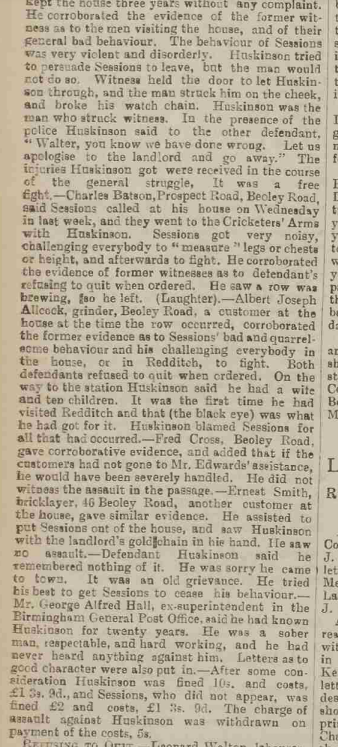
In 1906 Albert was assaulted during an incident in the Cricketers Arms.
Bromsgrove & Droitwich Messenger – Saturday 18 August 1906:
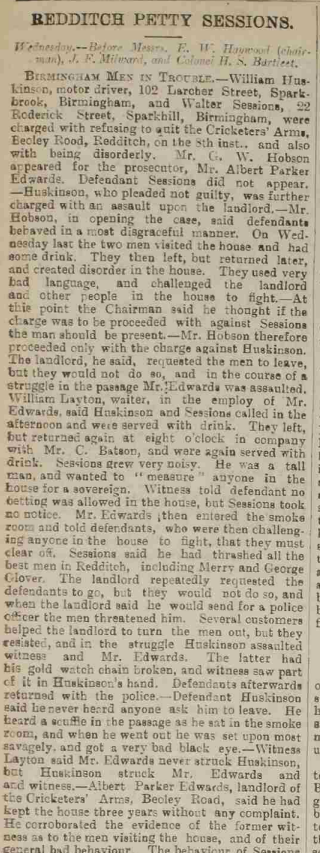
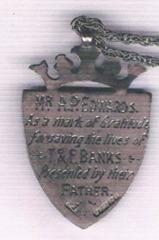
In 1910 a gold medal was given to Albert Parker Edwards by Mr. Banks, a policeman, in Redditch for saving the life of his two children from drowning in a brook on the Proctor farm which adjoined The Cricketers Arms. The story my father heard was that policeman Banks could not persuade the town of Redditch to come up with an award for Albert Parker Edwards so policeman Banks did it himself. William Banks, police constable, was living on Beoley Road on the 1911 census. His son Thomas was aged 5 and his daughter Frances was 8. It seems that when the father retired from the police he moved to Worcester. Thomas went into the hotel business and in 1939 was the manager of the Abbey hotel in Kenilworth. Frances married Edward Pardoe and was living along Redditch Road, Alvechurch in 1939.
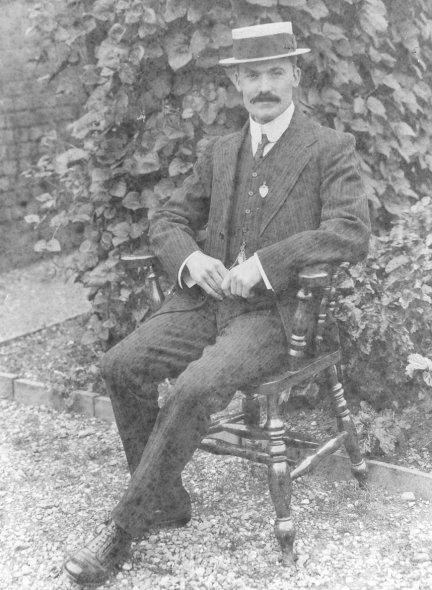
My grandmother Peggy had the gold medal put on a gold chain for me in the 1970s. When I left England in the 1980s, I gave it back to her for safekeeping. When she died, the medal on the chain ended up in my fathers possession, who claims to have no knowledge that it was once given to me!
The medal:
Albert Parker Edwards wearing the medal:
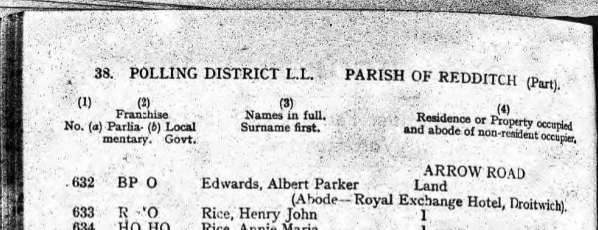
In 1921 Albert was at the The Royal Exchange hotel in Droitwich:
Between 1922 and 1927 Albert kept the Bear Hotel in Evesham:
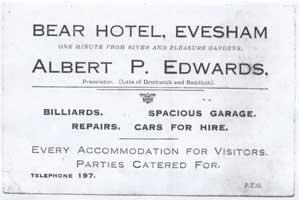
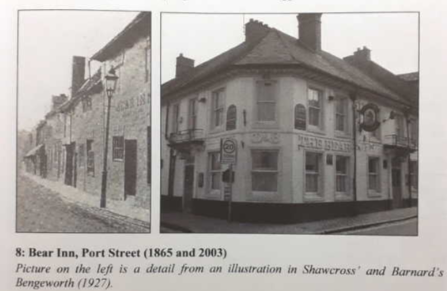
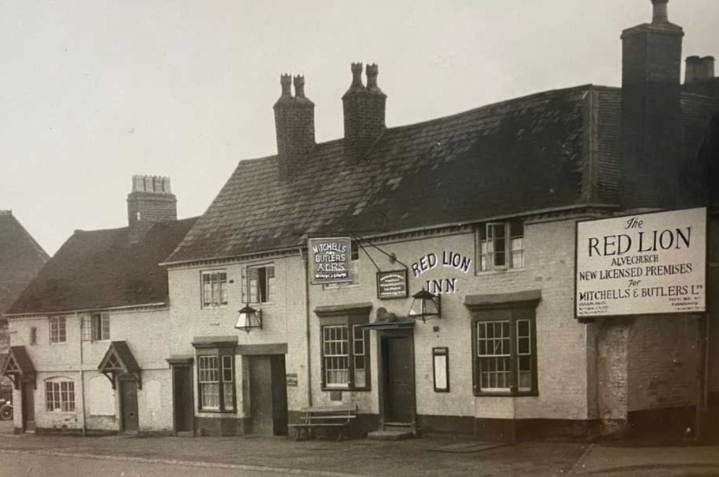
Then Albert and Annie moved to the Red Lion at Astwood Bank:
Albert in the garden behind the Red Lion:
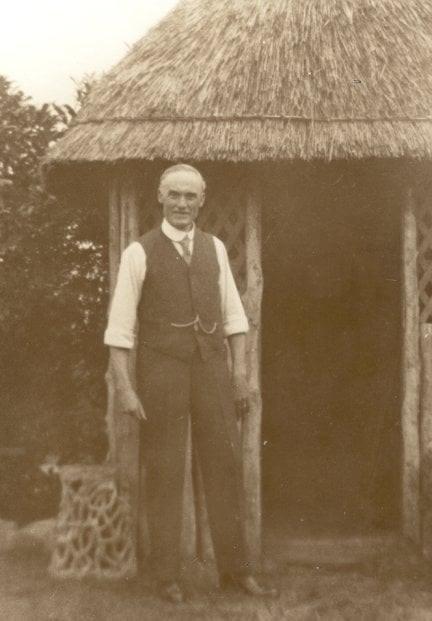
They stayed at the Red Lion until Albert Parker Edwards died on the 11th of February, 1930 aged 53.
 September 4, 2022 at 6:00 pm #6326
In reply to: The Sexy Wooden Leg
Stung by Egberts question, Olga reeled and almost lost her footing on the stairs. What had happened to her? That damned selfish individualism that was running rampant must have seeped into her room through the gaps in the windows or under the door. “No!” she shouted, her voice cracking.
“Say it isn’t true, Olga,” Egbert said, his voice breaking. “Not you as well.”
It took Olga a minute or two to still her racing heart. The near fall down the stairs had shaken her but with trembling hands she levered herself round to sit beside Egbert on the step.
Gripping his bony knee with her knobbly arthritic fingers, she took a deep breath.
“You are right to have said that, Egbert. If there is one thing we must hold onto, it’s our hearts. Nothing else matters, or at least nothing else matters as much as that. We are old and tired and we don’t like change. But if we escalate the importance of this frankly dreary and depressing home to the point where we lose our hearts…” she faltered and continued. “We will be homeless soon, very soon, and we know not what will happen to us. We must trust in the kindness of strangers, we must hope they have a heart.”
Egbert winced as Olga squeezed his knee. “And that is why”, Olga continued, slapping Egberts thigh with gusto, “We must have a heart…”
“If you’d just stop squeezing and hitting me, Olga…”
Olga loosened her grip on the old mans thigh bone and peered into his eyes. Quietly she thanked him. “You’ve cleared my mind and given me something to live for, and I thank you for that. But you do need to launder your clothes more often,” she added, pulling a face. She didn’t want the old coot to start blubbing, and he looked alarmingly close to tears.
“Come on, let’s go and see Obadiah. We’re all in this together. Homelessness and adventure can wait until tomorrow.” Olga heaved herself upright with a surprising burst of vitality. Noticing a weak smile trembling on Egberts lips, she said “That’s the spirit!”
July 12, 2022 at 8:30 am #6319In reply to: The Sexy Wooden Leg
“Calm yourself, Egbert, and sit down. And be quiet! I can barely hear myself think with your frantic gibbering and flailing around,” Olga said, closing her eyes. “I need to think.”
Egbert clutched the eiderdown on either side of his bony trembling knees and clamped his remaining teeth together, drawing ragged whistling breaths in an attempt to calm himself. Olga was right, he needed to calm down. Besides the unfortunate effects of the letter on his habitual tremor, he felt sure his blood pressure had risen alarmingly. He dared not become so ill that he needed medical assistance, not with the state of the hospitals these days. He’d be lucky to survive the plague ridden wards.
What had become of him! He imagined his younger self looking on with horror, appalled at his feeble body and shattered mind. Imagine becoming so desperate that he wanted to fight to stay in this godforsaken dump, what had become of him! If only he knew of somewhere else to go, somewhere safe and pleasant, somewhere that smelled sweetly of meadows and honesuckle and freshly baked cherry pies, with the snorting of pigs in the yard…
But wait, that was Olga snoring. Useless old bag had fallen asleep! For the first time since Viktor had died he felt close to tears. What a sad sorry pathetic old man he’d become, desperately counting on a old woman to save him.
“Stop sniveling, Egbert, and go and pack a bag.” Olga had woken up from her momentary but illuminating lapse. “Don’t bring too much, we may have much walking to do. I hear the buses and trains are in a shambles and full of refugees. We don’t want to get herded up with them.”
Astonished, Egbert asked where they were going.
“To see Rosa. My cousins father in laws neice. Don’t look at me like that, immediate family are seldom the ones who help. The distant ones are another matter. And be honest Egbert,” Olga said with a piercing look, “Do we really want to stay here? You may think you do, but it’s the fear of change, that’s all. Change feels like too much bother, doesn’t it?”
Egbert nodded sadly, his eyes fixed on the stain on the grey carpet.
Olga leaned forward and took his hand gently. “Egbert, look at me.” He raised his head and looked into her eyes. He’d never seen a sparkle in her faded blue eyes before. “I still have another adventure in me. How about you?”
-
AuthorSearch Results