
Search Results for 'three'
-
AuthorSearch Results
-
January 16, 2026 at 11:00 pm #8048
In reply to: The Hoards of Sanctorum AD26
“Bless you,” Helier offered, instinctively sliding the half-chewed pencil stub under a pile of National Geographics from 1978. He felt a flush of guilt, as if he’d been caught trying to steal a kid’s toy.
Cerenise rolled into the room, looking like a sorry pile of laundry. She was wrapped in three different shawls—one Paisley, one Tartan, and one that looked like a doily from a medieval altar. She held a lace handkerchief to her nose, trumpeting into it with a force that rattled the nearby display of thimbles.
“It’s not the damp,” she croaked, her voice an octave lower than usual. “It’s the cleanliness. Since Spirius fixed that pipe, the air is too… sterile. My immune system is in shock. It misses the spores.”
She eyed the spot where Helier had hidden the pencil. “You were thinking about it, weren’t you?”
“Thinking about what?” Helier feigned innocence, picking up a ceramic frog.
“The Novena,” she whispered the word like a curse. “I saw the look in your eye. The ‘maybe I don’t need this’ look. It’s the fever talking, Helier. Don’t give in. I almost threw away a button yesterday. A bakelite toggle from a 1930s duffel coat. I held it over the bin for a full minute.” She shuddered, pulling the shawls tighter. “Madness.”
“Pure madness,” Helier agreed, quickly retrieving the pencil stub and placing it prominently on the desk to prove his loyalty to the hoard. “We must stay strong. Now, surely you didn’t brave the drafty hallway just to discuss my potential apostasy?”
“I didn’t,” Cerenise sniffed, tucking the handkerchief into her sleeve. “I found him. Or at least, I found the thread.”
She wheeled closer, dropping a printout onto Helier’s knees. It was a genealogy chart, annotated with her elegant, spider-scrawl handwriting.
“Pierre Wenceslas Varlet,” she announced. “Born 1824. Brother to a last of the famously named Austreberthes — mortal ones, unsaintly, of course. Her lineage didn’t die out, Helier.”
Helier squinted at the paper. “Varlet? Sounds like a villain in one of Liz Tattler’s bodice-rippers. ‘The Vengeful Varlet of Venice’.“
“Focus, Helier. Look at the modern branch.” She pointed to the bottom of the page. “The name changed in the 1950s. Anglicized. And I think, if my research into the local council tax records—hacked via that delightful ‘incognito mode’ you showed me—is correct, the current ‘Varlet’ is closer than we think.”
“How close?”
“Gloucester close,” Cerenise said, her eyes gleaming with the thrill of the hunt, momentarily forgetting her flu. “And you’ll never guess where he works.”
January 6, 2026 at 6:20 pm #8044In reply to: The Hoards of Sanctorum AD26
With a warm smile of approval, Cerenise tapped out the names and dates on her keyboard. So refreshing when people were original when naming the fruit of their loins, she thought. Some of the family trees she’d done for friends and clients had been a veritable cesspit of endlessly repeated Johns and Marys, Williams and Elizabeths. Despite suppressing a shudder when introduced to a modern human named River or Sky, or worse, the ridiculously creative spelling of a common name, some of the older examples of unusual names she found quite delightful. Especially, it had to be said, French ones.
Pierre Wenceslas Varlet born on the 28th of September, 1824 in Clenleu, Pas-de-Calais, brother of Austreberthe Varlet, born two years previously on the 8th of June. Wenceslas! What would you call Wenceslas for short? she mused. Wence?
“An ’twere not as good a deed as drink to turn true man and to leave these rogues, I am the veriest varlet that ever chewed with a tooth”.
A cautious knock at the door interrupted Cerenise’s mental meanderings.
“Enter,” she called, and Laddie Bentry sidled in looking sheepish.
“Ah, it’s you, the veriest varlet of number 26. Well, what is it? You look as though you accidentally dropped Helier’s trashy novel in the water butt.”
Taken aback by Cernice’s perspicacity, Laddie recoiled slightly and then squared his shoulders. “How did you know?” he asked.
“Oh just a lucky guess,” Cerenise replied breezily, tapping the side of her nose. “I suppose you want me to order you another copy from Amaflob before he notices? I’ll arrange for an express delivery. Keep an eye out for the delivery man”
Waving away his thanks, she picked up the old document on her desk that Yvoise had kindly provided, albeit reluctantly, and squinted at it. She could make out the name Austreberthe, but what did the rest say?
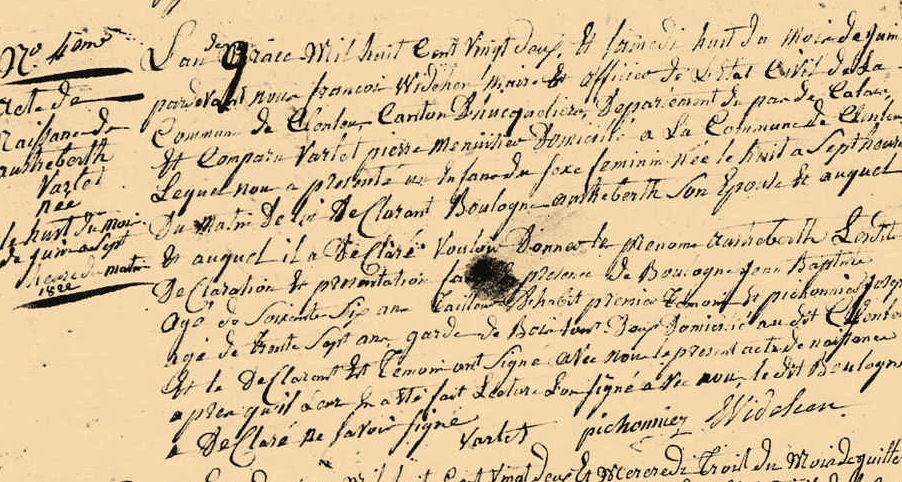
Cerenise dozed off, dreaming of the Folies Bergere. The atmosphere was exciting and convivial at first, escalating into an eruption of approval when the new act came on the stage. Cerenise felt the energy of the crowd but her attention was drawn to the flamboyant figure of a man dressed as one of the three kings of the Magi, and he was making his way over to her. Why, it was Lazuli Galore! What on earth was he doing here? And who was that dumpy overly made up woman in the blue dress, Godfreda, who had tagged along with them?
Another knock on the door wakened her and she called out “Come in!” in an irritable tone. She’d been having such fun in the dream. “Oh it’s you, oh good, the book has arrived.”
Laddie shifted his feet and replied, “Well yes, a Liz Tattler novel has arrived.”
“Oh, good, well be off with you then so I can get on with my work.”
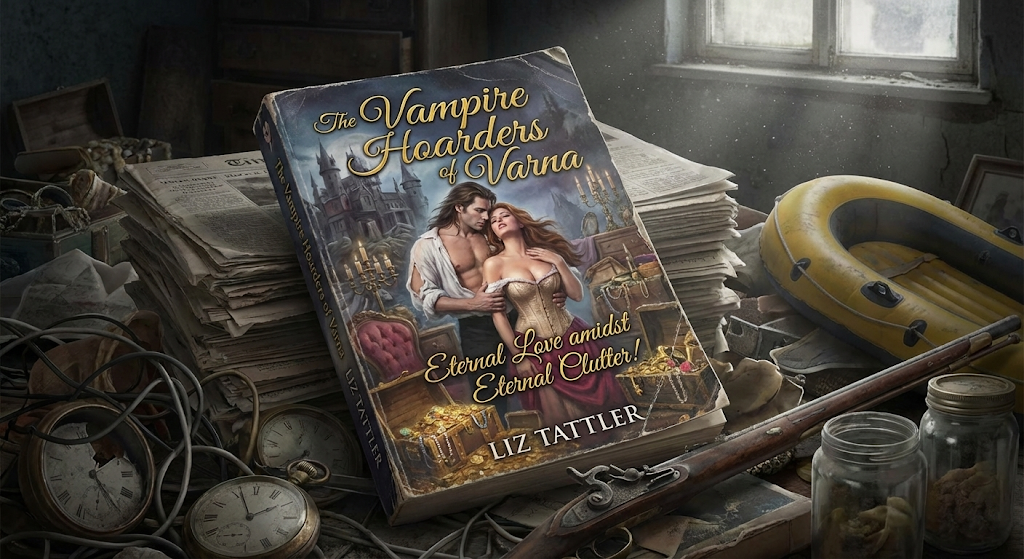
“But it’s not The Vampires of Varna. It’s The Valedictorian Vampires of Valley View High.”
“Jolly good, I expect you’ll enjoy it,” Cerenise said, picking up the old document again and peering at it. Perceiving that Laddie had not yet exited the room, she looked up. “Helier won’t notice, those books are all the same. Now get off with you.”
January 4, 2026 at 6:59 pm #8029In reply to: The Hoards of Sanctorum AD26
“While you’re off to another wild dragon chase, I’m calling the plumber,” Yvoise announced. She’d found one who accepted payment in Roman denarii. She began tapping furiously on her smartphone to recover the phone number, incensed at having been blocked again from Faceterest for sharing potentially unchecked facts (ignorants! she wanted to shout at the screen).
 After a bit of struggle, the appointment was set. She adjusted her blazer; she had a ‘Health and Safety in the Workplace’ seminar to lead at Sanctus Training in twenty minutes, and she couldn’t smell like wet dog.
“Make sure you bill it to the company account…!” Helier shouted over the noise Spirius was making huffing and struggling to load the antique musket.
“…under ‘Facility Maintenance’!”
“Obviously,” Yvoise scoffed. “We are a legitimate enterprise. Sanctus House has a reputation to uphold. Even if the landlord at Olympus Park keeps asking why our water consumption rivals a small water park.”
Spirius shuddered at the name. “Olympus Park. Pagan nonsense. I told you we should have bought the unit in St. Peter’s Industrial Estate.”
“The zoning laws were restrictive, Spirius,” Yvoise sighed. “Besides, ‘Sanctus Training Ltd’ looks excellent on a letterhead. Now, if you’ll excuse me, I have six junior executives coming in for a workshop on ‘Conflict Resolution.’ I plan to read them the entirety of the Treaty of Arras until they submit.”
“And dear old Boothroyd and I have a sewer dragon to exterminate in the name of all that’s Holy. Care to join, Helier?”
“Not really, had my share of those back in the day. I’ll help Yvoise with the plumbing. That’s more pressing. And might I remind you the dragon messing with the plumbing is only the first of the three tasks that Austreberthe placed in her will to be accomplished in the month following her demise…”
“Not now, Helier, I really need to get going!” Yvoise was feeling overwhelmed. “And where’s Cerenise? She could help with the second task. Finding the living descendants of the last named Austreberthe, was it? It’s all behind-desk type of stuff and doesn’t require her to get rid of anything…” she knew well Cerenise and her buttons.
“Yet.” Helier cut. “The third task may well be the toughest.”
“Don’t say it!” They all recoiled in horror.
“The No-ve-na of Cleans-ing” he said in a lugubrious voice.
“Damn it, Helier. You’re such a mood killer. Maybe better to look for a loophole for that one. We can’t just throw stuff away to make place for hers, as nice her tastes for floor tiling were.” Yvoise was in a rush to get to her appointment and couldn’t be bothered to enter a debate. She rushed to the front door.
“See you later… Helier-gator” snickered Laddie under her breath, as she was pretending to clean the unkempt cupboards.
January 3, 2026 at 8:09 pm #8025In reply to: The Hoards of Sanctorum AD26
As soon as Boothroyd had gone, Laddie Bentry, the under gardener, emerged from behind the Dicksonia squarrosa that was planted in a rare French Majolica Onnaing dragon eagle pot. The pot, and in particular the tree fern residing within it, were Laddie’s favourite specimen, reminding him of his homeland far away.
Keeping a cautious eye on the the door leading into the house, Laddie hurried over to the cast iron planter and retrieved the Liz Tattler novel hidden underneath. Quickly he tucked in into the inside pocket of his shabby tweed jacket and hastened to the door leading to the garden. Holding on to his cap, for the wind was cold and gusty, he ran to the old stable and darted inside. Laddie reckoned he had an hour or two free without Boothroyd hovering over him, and he settled himself on a heap of old sacks.
 The Vampire Hoarders of Varna. It wasn’t the first time Laddie had seen Boothroyd surreptitiously reading Helier’s books, and it had piqued his curiosity. What was it the old fart found so interesting about Helier’s novels? The library was full of books, if he wanted to read. Not bothering to read the preface, and not having time to start on page one, Laddie Bentry flicked through the book, pausing to read random passages.
….the carriage rattled and lurched headlong through the valley, jostling the three occupants unmercifully. “I’ll have the guts of that coachman for garters! The devil take him!” Galfrey exclaimed, after bouncing his head off the door frame of the compartment.
“Is it bleeding?” asked Triviella, inadvertently licking her lips and she inspected his forehead.
“The devil take you too, for your impertinence,” Galfrey scowled and shook her off, his irritation enhanced by his alarm at the situation they found themselves in.
Ignoring his uncharacteristic bad humour, Triviella snuggled close and and stroked his manly thigh, clad in crimson silk breeches. “Just think about the banquet later,” she purred.
Jacobino, austere and taciturn, on the opposite seat, who had thus far been studiously ignoring both of them, heard the mention of the banquet and smiled for the first time since…
Laddie opened the book to another passage.
“……1631, just before the siege of Gloucester, and what a feast it was! It was hard to imagine a time when we’d feasted so well. Such rich and easy pickings and such a delightful cocktail. One can never really predict a perfect cocktail of blood types at a party, and centuries pass between particularly memorable ones. Another is long overdue, and one would hate to miss it,” Jacobino explained to the innocent and trusting young dairy maid, who was in awe that the handsome young gentleman was talking to her at all, yet understood very little of his dialogue.
“Which is why,” Jacobino implored, taking hold of her small calloused hands, “You must come with me to the banquet tonight.”
Little did she know that her soft rosy throat was on the menu…..
December 30, 2025 at 6:42 pm #8003In reply to: The Elusive Samuel Housley and Other Family Stories
JOHN BROOKS ALIAS PRIESTLAND
1766-1846John Brooks, my 5x great grandfather, was born in 1766, according to the 1841 census and the burial register in 1846 which stated his age at death as 80 years, but no baptism has been found thus far.
On his first son’s baptism in 1790 the parish register states “John son of John and Elizabeth Brooks Priestnal was baptised”. The name Priestnal was not mentioned in any further sibling baptism, and he was John Brooks on his marriage, on the 1841 census and on his burial in the Netherseal parish register. The name Priestnal was a mystery.
I wondered why there was a nine year gap between the first son John, and the further six siblings, and found that his first wife Elizabeth Wilson died in 1791, and in 1798 John married Elizabeth Cowper, a widow.
John was a farmer of Netherseal on both marriage licences, and of independent means on the 1841 census.
Without finding a baptism it was impossible to go further back, and I was curious to find another tree on the ancestry website with many specific dates but no sources attached, that had Thomas Brooks as his father and his mother as Mary Priestland. I couldn’t find a marriage for John and Mary Priestland, so I sent a message to the owner of the tree, and before receiving a reply, did a bit more searching.
I found an article in the newspaper archives dated 9 August 1839 about a dispute over a right of way, and John Brooks, 73 years of age and a witness for the complainant, said that he had lived in Netherseal all his life (and had always know that public right of way and so on).
I found three lists of documents held by the Derby Records Office about property deeds and transfers, naming a John Brooks alias Priestland, one in 1794, one in 1814, and one in 1824. One of them stated that his father was Thomas Brooks. I was beginning to wonder if Thomas Brooks and Mary Priestland had never married, and this proved to be the case.
The Australian owner of the other tree replied, and said that they had paid a researcher in England many years ago, and that she would look through a box of papers. She sent me a transcribed summary of the main ponts of Thomas Brooks 1784 will:
Thomas Brooks, husbandman of Netherseal
To daughter Ann husband of George Oakden, £20.
To grandson William Brooks, £20.
To son William Brooks and his wife Ann, one shilling each.
To his servant Mary Priestland, £20 and certain household effects and certain property.
To his natural son John Priestland alias Brooks, various properties and the residue of his estate.
John Priestland alias Brooks appointed sole executor.It would appear that Thomas Brooks left the bulk of his estate to his illegitimate son, and more to his servant Mary Priestland than to his legitimate children.
THOMAS BROOKS
1706-1784
Thomas Brooks, my 6x great grandfather, had three wives. He had four children with his first wife, Elizabeth, between 1732 and 1737. Elizabeth died in 1737. He then married Mary Bath, who died in 1763. Thomas had no children with Mary Bath. In 1765 Thomas married Mary Beck. In 1766 his son John Brooks alias Priestland was born to his servant Mary Priestland.
Thomas Brooks parents were John Brooks 1671-1741, and his wife Anne Speare 1674-1718, both of Netherseal, Leicestershire.
December 30, 2025 at 1:13 pm #8001In reply to: The Elusive Samuel Housley and Other Family Stories
John Brooks
The Father of Catherine Housley’s Mother, Elizabeth Brooks.I had not managed to find out anything about the Brooks family in previous searches. We knew that Elizabeth Brooks father was J Brooks, cooper, from her marriage record. A cooper is a man who makes barrels.
Elizabeth was born in 1819 in Sutton Coldfield, parents John and Mary Brooks. Elizabeth had three brothers, all baptised in Sutton Coldfield: Thomas 1815-1821, John 1816-1821, and William Brooks, 1822-1875. William was known to Samuel Housley, the husband of Elizabeth, which we know from the Housley Letters, sent from the family in Smalley to George, Samuel’s brother, in USA, from the 1850s to 1870s. More to follow on William Brooks.
Elizabeth married Samuel Housley in Wolverhampton in 1844. Elizabeth and Samuel had three daughters in Smalley before Elizabeth’s death from TB in 1849, the youngest, just 6 weeks old at the time, was my great great grandmother Catherine Housley.
Elizabeth’s mother Mary died in 1823, and it not known if Elizabeth, then four, and William, a year old, stayed at home with their father or went to stay with relatives. There were no census records during those years.
John Brooks married Mary Wagstaff in 1814 in Birmingham. A witness at their marriage was Elizabeth Brooks, and this was probably John’s sister.
On the 1841 census (which was the first census in England) John Brooks, cooper, was living on Dudley Road, Wolverhampton, with wife Sarah. I was unable to find a marriage for them before a marriage in 1845 between John Brooks and Sarah Hughes, so presumably they lived together as man and wife before they married.
Then came the lucky find with John Brooks place of birth: Netherseal, Leicestershire. The place of birth on the 1841 census wasn’t specified, thereafter it was. On the 1851 census John Brooks, cooper, and Sarah his wife were living at Queens Cross, Dudley, with a three year old granddaughter E Brooks. John was born in 1791 in Netherseal.
It was commonplace for people to move to the industrial midlands around this time, from the surrounding countryside. However if they died before the 1851 census stating place of birth, it’s usually impossible to find out where they came from, particularly if they had a common name.
John Brooks doesn’t appear on any further census. I found seven deaths registered in Dudley for a John Brooks between 1851 and 1861, so presumably he is one of them.NETHERSEAL
On 27 June 1790 appears in the Netherseal parish register “John Brooks the son of John and Elizabeth Brooks Priestnal was baptised.” The name Priestnal does not appear in the transcription, nor the Bishops Transcripts, nor on any other sibling baptism. The Priestnal mystery will be solved in the next chapter.
John Brooks senior married Elizabeth Wilson by marriage licence on 20 November 1788 in Gresley, a neighbouring town in Derbyshire (incidentally near to Swadlincote and the ancestral lines of the Warren family, which also has branches in Netherseal. The Brooks family is the Marshall side). John Brooks was a farmer.
I haven’t found a baptism yet for John Brooks senior, but his death in Netherseal in 1846 provided the age at death, eighty years old, which puts his birth at 1766. The 1841 census has his birth as 1766 as well.
In 1841 John Brooks was 75, and “independent”, meaning that he was living on his own means. The name Brooks was transcribed as Broster, making this difficult to find, but it is clearly Brooks if you look at the original.
His wife Elizabeth, born in 1762, is also on the census, as well as the Jackson family: Joseph Jackon born 1804, Elizabeth Jackson his wife born 1799, and children Joseph, born 1833, William 1834, Thomas 1835, Stephen 1836, and Mary born 1838.
John and Elizabeths daughter Elizabeth Brooks, born in 1799, married Joseph Jackson, the son of an “opulent farmer” (newspaper archives) of Tatenhill, Staffordshire. They married on the 19th January 1832 in Burton on Trent. (Elizabeth Brooks was probably the witness on John Brooks junior’s marriage to Mary Wagstaff in Birmingham in 1814, although it could have been his mother, also Elizabeth Brooks.)
(Elizabeth Jackson nee Brooks was the aunt of Elizabeth in the portrait)
Joseph Jackson was declared bankrupt in 1833 (newspapers) and in 1834 a noticed in the newspapers “to the creditors of Joseph Jackson junior”, a victualler and farmer late of Netherseal, “following no business, who was lately dischared from his Majesty’s Gaol at Stafford” whose real estate was to be sold by auction. I haven’t yet found what he was in prison for.
In 1841 Joseph appeared again in the newspapers, in which he publicly stated that he had accused Thomas Webb, surgeon of Barton Under Needwood, of owing him money “just to annoy him” and “with a view to extort money from him”. and that he undertakes to pay Thomas Webb or his attorney, the costs within 14 days.
Joseph and Elizabeth had twins in 1841, born in Netherseal, John and Ruth. Elizabeth died in 1850.
Thereafter, Joseph was a labourer at the iron works in Wednesbury, and many generations of Jacksons continued working in the iron industry in Wednesbury ~ all orignially descended from farmers in Netherseal and Tatenhill.June 7, 2025 at 7:32 am #7955In reply to: Cofficionados Bandits (vs Lucid Dreamers)
The wind picked up just as Thiram adjusted the gazebo’s solar kettle. At first, he blamed the rising draft on Carob’s sighing—but quickly figured out that this one had… velocity.
Then the scent came floating by: jasmine, hair spray, and over-steeped calamansi tea.
A gust of hot air blew through the plantation clearing, swirling snack wrappers and curling Amy’s page corners. From the vortex stepped a woman, sequins ablaze, eyeliner undefeated.
She wore a velvet shawl patterned like a satellite weather map.
“Did someone say Auringa?” she cooed, gliding forward as her three crystal balls rotated lazily around her hips like obedient moons.
“Madam Auringa?” Kit asked, wide-eyed.Thiram’s devices were starting to bip, checking for facts. “Madam Auringa claims to have been born during a literal typhoon in the Visayas, with a twin sister who “vanished into the eye.” She’s been forecasting mischief, breakups, and supernatural infestations ever since…”
Carob raised an eyebrow. “Source?”
Humphrey harrumphed: “We don’t usually invite atmospheric phenomena!”
“Doctor Madam Auringa, Psychic Climatologist and Typhoon Romantic,” the woman corrected, removing a laminated badge from her ample bosom. “Bachelor of Arts in Forecasted Love and Atmospheric Vibes. I am both the typhoon… and its early warning system.”
“Is she… floating?” Amy whispered.
“No,” said Chico solemnly, “She’s just wearing platform sandals on a bed of mulch.”
Auringa snapped her fingers. A steamy demitasse of kopi luwak materialized midair and plopped neatly into her hand. It wasn’t for drink, although the expensive brevage born of civet feces had an irrepressible appeal —it was for her only to be peered into.
“This coffee is trembling,” she murmured. “It fears a betrayal. A rendezvous gone sideways. A gazebo… compromised.”
Carob reached for her notes. “I knew the gazebo had a hidden floor hatch.”
Madam Auringa raised one bejeweled finger. “But I have come with warning and invitation. The skies have spoken: the Typhoon Auring approaches. And it brings… revelations. Some shall find passion. Others—ant infestations.”
“Did she just say passion or fashion?” Thiram mumbled.
“Both,” Madam Auringa confirmed, winking at him with terrifying precision.
She added ominously “May asim pa ako!”. Thiram’s looked at his translator with doubt : “You… still have a sour taste?”
She tittered, “don’t be silly”. “It means ‘I’ve still got zest’…” her sultry glance disturbing even the ants.
March 28, 2025 at 10:28 pm #7881In reply to: The Last Cruise of Helix 25
Mars Outpost — Welcome to the Wild Wild Waste
No one had anticipated how long it would take to get a shuttle full of half-motivated, gravity-averse Helix25 passengers to agree on proper footwear.
“I told you, Claudius, this is the fancy terrain suit. The others make my hips look like reinforced cargo crates,” protested Tilly Nox, wrangling with her buckles near the shuttle airlock.
“You’re about to step onto a red-rock planet that hasn’t seen visitors since the Asteroid Belt Mining Fiasco,” muttered Claudius, tightening his helmet strap. “Your hips are the least of Mars’ concerns.”
Behind them, a motley group of Helix25 residents fidgeted with backpacks, oxygen readouts, and wide-eyed anticipation. Veranassessee had allowed a single-day “expedition excursion” for those eager—or stir-crazy—enough to brave Mars’ surface. She’d made it clear it was volunteer-only.
Most stayed aboard, in orbit of the red planet, looking at its surface from afar to the tune of “eh, gravity, don’t we have enough of that here?” —Finkley had recoiled in horror at the thought of real dust getting through the vents and had insisted on reviewing personally all the airlocks protocols. No way that they’d sullied her pristine halls with Martian dust or any dust when the shuttle would come back. No – way.
But for the dozen or so who craved something raw and unfiltered, this was it. Mars: the myth, the mirage, the Far West frontier at the invisible border separating Earthly-like comforts into the wider space without any safety net.
At the helm of Shuttle Dandelion, Sue Forgelot gave the kind of safety briefing that could both terrify and inspire. “If your oxygen starts blinking red, panic quietly and alert your buddy. If you fall into a crater, forget about taking a selfie, wave your arms and don’t grab on your neighbor. And if you see a sand wyrm, congratulations, you’ve either hit gold or gone mad.”
Luca Stroud chuckled from the copilot seat. “Didn’t see you so chirpy in a long while. That kind of humour, always the best warning label.”
They touched down near Outpost Station Delta-6 just as the Martian wind was picking up, sending curls of red dust tumbling like gossip.
And there she was.
Leaning against the outpost hatch with a spanner slung across one shoulder, goggles perched on her forehead, Prune watched them disembark with the wary expression of someone spotting tourists traipsing into her backyard garden.
Sue approached first, grinning behind her helmet. “Prune Curara, I presume?”
“You presume correctly,” she said, arms crossed. “Let me guess. You’re here to ruin my peace and use my one functioning kettle.”
Luca offered a warm smile. “We’re only here for a brief scan and a bit of radioactive treasure hunting. Plus, apparently, there’s been a petition to name a Martian dust lizard after you.”
“That lizard stole my solar panel last year,” Prune replied flatly. “It deserves no honor.”
Inside, the outpost was cramped, cluttered, and undeniably charming. Hand-drawn maps of Martian magnetic hotspots lined one wall; shelves overflowed with tagged samples, sketchpads, half-disassembled drones, and a single framed photo of a fireplace with something hovering inexplicably above it—a fish?
“Flying Fish Inn,” Luca whispered to Sue. “Legendary.”
The crew spent the day fanning out across the region in staggered teams. Sue and Claudius oversaw the scan points, Tilly somehow got her foot stuck in a crevice that definitely wasn’t in the geological briefing, which was surprisingly enough about as much drama they could conjure out.
Back at the outpost, Prune fielded questions, offered dry warnings, and tried not to get emotionally attached to the odd, bumbling crew now walking through her kingdom.
Then, near sunset, Veranassessee’s voice crackled over comms: “Curara. We’ll be lifting a crew out tomorrow, but leaving a team behind. With the right material, for all the good Muck’s mining expedition did out on the asteroid belt, it left the red planet riddled with precious rocks. But you, you’ve earned to take a rest, with a ticket back aboard. That’s if you want it. Three months back to Earth via the porkchop plot route. No pressure. Your call.”
Prune froze. Earth.
The word sat like an old song on her tongue. Faint. Familiar. Difficult to place.
She stepped out to the ridge, watching the sun dip low across the dusty plain. Behind her, laughter from the tourists trading their stories of the day —Tilly had rigged a heat plate with steel sticks and somehow convinced people to roast protein foam. Are we wasting oxygen now? Prune felt a weight lift; after such a long time struggling to make ends meet, she now could be free of that duty.
Prune closed her eyes. In her head, Mater’s voice emerged, raspy and amused: You weren’t meant to settle, sugar. You were meant to stir things up. Even on Mars.
She let the words tumble through her like sand in her boots.
She’d conquered her dream, lived it, thrived in it.
Now people were landing, with their new voices, new messes, new puzzles.
She could stay. Be the last queen of red rock and salvaged drones.
Or she could trade one hell of people for another. Again.
The next morning, with her patched duffel packed and goggles perched properly this time, Prune boarded Shuttle Dandelion with a half-smirk and a shrug.
“I’m coming,” she told Sue. “Can’t let Earth ruin itself again without at least watching.”
Sue grinned. “Welcome back to the madhouse.”
As the shuttle lifted off, Prune looked once, just once, at the red plains she’d called home.
“Thanks, Mars,” she whispered. “Don’t wait up.”
March 22, 2025 at 11:16 am #7875In reply to: The Last Cruise of Helix 25
Mars Outpost — Fueling of Dreams (Prune)
I lean against the creaking bulkhead of this rust-stained fueling station, watching Mars breathe. Dust twirls across the ochre plains like it’s got somewhere important to be. The whole place rattles every time the wind picks up—like the metal shell itself is complaining. I find it oddly comforting. Reminds me of the Flying Fish Inn back home, where the fireplace wheezed like a drunk aunt and occasionally spit out sparks for drama.
Funny how that place, with all its chaos and secret stash hidey-holes, taught me more about surviving space than any training program ever could.
“Look at me now, Mater,” I catch myself thinking, tapping the edge of the viewport with a gloved knuckle. “Still scribbling starships in my head. Only now I’m living inside one.”
Behind me, the ancient transceiver gives its telltale blip… blip. I don’t need to check—I recognize the signal. Helix 25, closing in. The one ship people still whisper about like it’s a myth with plumbing. Part of me grins. Half nostalgia, half challenge.
Back in ’27, I shipped off to that mad boarding school with the oddball astronaut program. Professors called me a prodigy. I called it stubborn curiosity and a childhood steeped in ghost stories, half-baked prophecies, and improperly labeled pickle jars. The real trick wasn’t the calculus—it was surviving the Curara clan’s brand of creative chaos.
After graduation, I bought into a settlers’ programme. Big mistake. Turns out it was more con than colonization, sold with just enough truth to sting. Some people cracked. I just adjusted course. Spent some time bouncing between jobs, drifted home a couple times for stew and sideways advice, and kept my head sharp. Lesson logged: deceit’s just another puzzle with missing pieces.
A hiss behind the wall cuts into my thoughts—pipes complaining again. I spin, scan the console. Pressure’s holding. “Fine,” which out here means “still not exploding.” Good enough.
I remember the lottery ticket that got me here— 2049, commercial flights to Mars at last soared skyward— and Effin Muck’s big lottery. At last a seat to Mars, on section D. Just sheer luck that felt like a miracle at the time. But while I was floating spaceward, Earth went sideways: asteroid mining gone wrong, panic, nuclear strikes. I watched pieces of home disappear through a porthole while the Mars colonies went silent, one by one. All those big plans reduced to empty shells and flickering lights.
I was supposed to be evacuated, too. Instead, my lowly post at this fueling station—this rust bucket perched on a dusty plateau—kept me in place. Cosmic joke? Probably. But here I am. Still alive. Still tinkering with things that shouldn’t work. Still me.
I reprogrammed the oxygen scrubbers myself. Hacked them with a dusty old patch from Aunt Idle’s “Dream Time” stash. When the power systems started failing and had to cut all the AI support to save on power, I taught myself enough broken assembly code to trick ancient processors into behaving. Improvisation is my mother tongue.
“Mars is quieter than the Inn,” I say aloud, half to myself. “Only upside, really.”
Another ping from the transceiver—it’s getting closer. The Helix 25, humanity’s last-ditch bottle-in-space. They say it’s carrying what’s left of us. Part myth, part mobile city. If I didn’t have the logs, I’d half believe it was a fever dream.
But no dream prepares you for this kind of quiet.
I think about the Inn again. How everyone swore it had secret tunnels, cursed tiles, hallucinations in the pantry. Honestly, it probably did. But it also had love—scrambled, sarcastic love—and enough stories to keep you wondering if any of them were real. That’s where I learned to spot a lie, tell a better one, and stay grounded when the walls started talking.
I smack the comm panel until it stops crackling. That’s the secret to maintenance on Mars: decisive violence.
“All right, Helix,” I mutter. “Let’s see what you’ve got. I’ve got thruster fuel, half-functional docking protocols, and a mean kettle of tea if you’re lucky.”
I catch my reflection in the viewport glass—older, sure. Forty-two now. Taller. Calmer in the eyes. But the glint’s still there, the one that says I’ve seen worse, and I’m still standing. That kid at the Inn would’ve cheered.
Earth’s collapse wasn’t some natural catastrophe—it was textbook human arrogance. Effin Muck’s greedy asteroid mining scheme. World leaders playing hot potato with nuclear codes. It burned. Probably still does… But I can’t afford to stew in it. We’re not here to mourn; we’re here to rebuild. If someone’s going to help carry that torch, it might as well be someone who’s already walked through fire.
I fiddle with the dials on the fuel board. It hums like a tired dragon, but it’s awake. That’s all I need.
“Might be time to pass some of that brilliance along,” I mutter, mostly to the station walls. Somewhere, I bet my siblings are making fun of me. Probably watching soap dramas and eating improperly reheated stew. Bless them. They were my first reality check, and I still measure the world by how weird it is compared to them. Loved them for how hard they made me feel normal after all.
The wind howls across the shutters. I stand up straight, brush the dust off my sleeves. Helix 25 is almost here.
“Showtime,” I say, and grin. Not the nice kind. The kind that says I’ve got one wrench, three working systems, and no intention of rolling over.
The Flying Fish Inn shaped me with every loud, strange, inexplicable day. It gave me humor. It gave me bite. It gave me an unshakable sense of self when everything else fell apart.
So here I stand—keeper of the last Martian fueling post, scrappy guardian of whatever future shows up next.
I glance once more at the transceiver, then hit the big green button to unlock the landing bay.
“Welcome to Mars,” I say, deadpan. Then add, mostly to myself, “Let’s see if they’re ready for me.”
March 9, 2025 at 10:34 pm #7862In reply to: The Last Cruise of Helix 25
Sue Forgelot couldn’t believe her eyes when she came to her ringing door.
Of course, after the Carnival party was over and she’d taken an air shower, and put on her bathrobe with her meerkat slipper, slathered relaxing face cream topped with two slices of cucumber, she was quite groggy, and the cucumber slices on her eyelids made it harder to see. But once she’d removed them, she could see as bright as day.
The Captain was standing right here, and she hadn’t aged a day.
“Quickly, come in.” Sue wasted no time to usher her in. She looked at the corridor suspiciously; at that time of night, only a dusting robot was patrolling the corridors, chasing for dust motes and finger smears on the datapads.
Nobody.
“I haven’t been followed, Sue, will you just relax for a moment.”
“V’ass, it’s been so long. How did you get out?… What broke the code?”
“I don’t know, Sue. I think —something called back, from Earth.”
“From Earth? I didn’t know there was much technology left, or at least one that could reach us there. And one that could bypass that darned central AI —I knew it couldn’t keep you under lock and key forever.”
“Seems there is such tech, and it’s also managed to force the ship to turn around.”
Silence fell on the two friends for a moment, as they were grasping for the implications of the changes in motion.
Veranassessee couldn’t help by smile uncontrollably. “Those rejuvenation tricks do wonders, don’t they. You don’t look a day over a 100 years old.”Sue couldn’t help but chuckle. “And you don’t look so bad yourself, for an old forgotten popsicle.” She tilted her head. “You do know you’ve been in the freezer longer than some of our newest passengers have been alive, right?”
V’ass shrugged. “And yet, here I am—fit, rested, and none the worse for wear.”
Sue sighed. “Meanwhile, I’ve had three hip replacements, a cybernetic knee, and somebody keeps hijacking my artificial leg with spam messages.”
V’ass blinked. “…You should probably get that checked.”
Sue waved her off. “Bah. If it’s not trying to sell me ‘hot singles in my quadrant,’ I let it be.”After the laughter had dissipated, Sue said “You need my help to get back your ship, don’t you?”. She tapped on her cybernetic leg with a knowing smile. “You can count on me.”
Veranassessee noded. “Then start by filling me in, what should I know?”
Sue leaned in conspiratorially. “Ethan is dead, for one.”
“Death?” Veranassessee was weighing the implications, and completed “… Murder?”
Sue shrugged “As much as it pains me to say, it’s all a bit irrelevant. The AI let it happen, but I doubt she pushed the button. Ethan wasn’t much of a threat to its rule. Makes one wonder why, maybe it computed some cascade of events we don’t yet see. They found ancient DNA on the crime scene, but it’s all a mess of clues, and I must say we’re pretty inept at the whole murder mystery thing. Glad we don’t have a serial killer in our midst, or we would have plenty of composting to do…”
Veranassessee started to pace the room. “Well, if there isn’t anything more relevant, we need to hatch a plan. I suspect all my access got revoked; I’ll need a skeleton key to get in the right places. To regain control over the central AI, and the main deck.”
“Of course, the Marlowes…” Sue had a moment of revelation on her face. “They were the crypto locksmiths… With Ethan now dead, maybe we should pay dear old Ellis a visit.”
March 1, 2025 at 12:41 pm #7847In reply to: The Last Cruise of Helix 25
Helix 25 – The Lexican Quarters – Anuí’s Chambers
Anuí Naskó had been many things in their life—historian, philosopher, linguist, nuisance. But a father? No. No, that was entirely new.
And yet, here they were, rocking a very tiny, very loud creature wrapped in Lexican ceremonial cloth, embroidered with the full unpronounceable name bestowed upon it just moments ago: Hšyra-Mak-Talún i Ešvar—”He Who Cries the Arrival of the Infinite Spiral.”
The baby did, indeed, cry.
“Why do you scream at me?” Anuí muttered, swaying slightly, more in a daze than any real instinct to soothe. “I did not birth you. I did not know you existed until three hours ago. And yet, you are here, squalling, because your other father and your mother have decided to fulfill the Prophecy of the Spiral Throne.”
The Prophecy. The one that spoke of the moment the world would collapse and the Lexicans would ascend. The one nobody took seriously. Until now.
Zoya Kade, sitting across from them, watched with narrowed, calculating eyes. “And what exactly does that entail? This Lexican Dynasty?”
Anuí sighed, looking down at the writhing child who was trying to suck on their sleeves, still stained with the remnants of the protein paste they had spent the better part of the morning brewing. The Atrium’s walls needed to be prepared, after all—Kio’ath could not write the sigils without the proper medium. And as the cycles dictated, the medium must be crafted, fermented, and blessed by the hand of one who walks between identities. It had been a tedious, smelly process, but Anuí had endured worse in the name of preservation.
“Patterns repeat, cycles fold inward.” “Patterns repeat, cycles fold inward. The old texts speak of it, the words carved into the silent bones of forgotten tongues. This, Zoya, is no mere madness. This is the resurgence of what was foretold. A dynasty cannot exist without succession, and history does not move without inheritors. They believe they are ensuring the inevitability of their rise. And they might not be wrong.”
They adjusted their grip on the child, murmuring a phrase in a language so old it barely survived in the archives. “Tz’uran velth ka’an, the root that binds to the branch, the branch that binds to the sky. Our truths do not stand alone.”
The baby flailed, screaming louder. “Yes, yes, you are the heir,” Anuí murmured, bouncing it with more confidence. “Your lineage has been declared, your burden assigned. Accept it and be silent.” “Well, apparently it requires me to be a single parent while they go forth and multiply, securing ‘heirs to the truth.’ A dynasty is no good without an heir and a spare, you see.”
The baby flailed, screaming even louder. “Yes, yes, you are the heir,” Anuí murmured with a hint of irritation, bouncing the baby awkwardly. “You have been declared. Please, cease wailing now.”
Zoya exhaled through her nose, somewhere between disbelief and mild amusement. “And in the middle of all this divine nonsense, the Lexicans have chosen to back me?”
Anuí arched a delicate brow, shifting the baby to one arm with newfound ease. “Of course. The truth-seeker is foretold. The woman who speaks with voices of the past. We have our empire; you are our harbinger.”
Zoya’s lips twitched. “Your empire consists of thirty-eight highly unstable academics and a baby.”
“Thirty-nine. Kio’ath returned from exile yesterday,” Anuí corrected. “They claim the moons have been whispering.”
“Ah. Of course they have.”
Zoya fell silent, fingers tracing the worn etchings of her chair’s armrest. The ship’s hum pressed into her bones, the weight of something stirring in her mind, something old, something waiting.
Anuí’s gaze sharpened, the edges of their thoughts aligning like an ancient lexicon unfurling in front of them. “And now you are hearing it, aren’t you? The echoes of something that was always there. The syllables of the past, reshaped by new tongues, waiting for recognition. The Lexican texts spoke of a fracture in the line, a leader divided, a bridge yet to be found.”
They took a slow breath, fingers tightening over the child’s swaddled form. “The prophecy is not a single moment, Zoya. It is layers upon layers, intersecting at the point where chaos demands order. Where the unseen hand corrects its own forgetting. This is why they back you. Not because you seek the truth, but because you are the conduit through which it must pass.”
Zoya’s breath shallowed. A warmth curled in her chest, not of her own making. Her fingers twitched as if something unseen traced over them, urging her forward. The air around her thickened, charged.
She knew this feeling.
Her head tipped back, and when she spoke, it was not entirely her own voice.
“The past rises in bloodlines and memory,” she intoned, eyes unfocused, gaze burning through Anuí. “The lost sibling walks beneath the ice. The leader sleeps, but he must awaken, for the Spiral Throne cannot stand alone.”
Anuí’s pulse skipped. “Zoya—”
The baby let out a startled hiccup.
But Zoya did not stop.
“The essence calls, older than names, older than the cycle. I am Achaia-Vor, the Echo of Sundered Lineage. The Lost, The Twin, The Nameless Seed. The Spiral cannot turn without its axis. Awaken Victor Holt. He is the lock. You are the key. The path is drawn.
“The cycle bends but does not break. Across the void, the lost ones linger, their voices unheard, their blood unclaimed. The Link must be found. The Speaker walks unknowingly, divided across two worlds. The bridge between past and present, between silence and song. The Marlowe thread is cut, yet the weave remains. To see, you must seek the mirrored souls. To open the path, the twins must speak.”
Achaia-Vor. The name vibrated through the air, curling through the folds of Anuí’s mind like a forgotten melody.
Zoya’s eyes rolled back, body jerking as if caught between two timelines, two truths. She let out a breathless whisper, almost longing.
“Victor, my love. He is waiting for me. I must bring him back.”
Anuí cradled the baby closer, and for the first time, they saw the prophecy not as doctrine but as inevitability. The patterns were aligning—the cut thread of the Marlowes, the mirrored souls, the bridge that must be found.
“It is always the same,” they murmured, almost to themselves. “An axis must be turned, a voice must rise. We have seen this before, written in languages long burned to dust. The same myth, the same cycle, only the names change.”
They met Zoya’s gaze, the air between them thick with the weight of knowing. “And now, we must find the Speaker. Before another voice is silenced.”
“Well,” they muttered, exhaling slowly. “This just got significantly more complicated.”
The baby cooed.
Zoya Kade smiled.
February 28, 2025 at 11:57 pm #7840In reply to: The Last Cruise of Helix 25
Helix 25 — Aftermath of the Solar Flare Alert
The Second Murder
It didn’t take them long to arrive at the scene, Riven alerted by a distraught Finkley who’d found the body.
Evie knelt beside the limp, twitching form of Mandrake, his cybernetic collar flickering erratically, tiny sparks dancing along its edge. The cat’s body convulsed, its organic parts frozen in eerie stillness while the cybernetic half stuttered between functions, blinking in and out of awareness.
Mandrake was both dead and not dead.
“Well, this is unsettling,” TP quipped, materializing beside them with an exaggerated frown. “A most profound case of existential uncertainty. Schrödinger himself would have found this delightful—if he weren’t very much confirmed dead.”
Riven crouched, running a scanner over Mandrake’s collar. The readout spat out errors. “Neural link’s corrupted. He’s lost something.”
Evie’s stomach twisted. “Lost what? But… he can be repaired, surely, can’t he?”
Evan replied with a sigh “Hard to tell how much damage he’s suffered, but we caught him in time thanks to Finkley’s reflexes, he may stand a chance, even if he may need to be reprogrammed.”
Mandrake’s single functioning eye flickered open, its usual sharpness dull. Then, rasping, almost disjointedly, he muttered:
“I was… murdered.”
Then his system crashed, leaving nothing but silence.
Upper Decks Carnival
Sue was still adjusting her hat and feathers for the Carnival Party wondering if that would be appropriate as she was planning to go to the wake first, and then to the Lexican’s baby shower. It wasn’t every day there was a baby nowadays. And a boy too. But then, there was no such thing as being overdressed in her book.
The ship’s intercom crackled to life, cutting through her thoughts, its automated cheerfulness electrifying like a misplaced party horn.
“Attention, dear passengers! As scheduled, with the solar flare now averted, we are preparing for our return to Earth. Please enjoy the journey and partake in today’s complimentary hibiscus tea at the Grand Hall! Samba!”
The words ‘return to Earth’ sent a shudder through Sue’s spine. That wasn’t right. That wasn’t possible.
A sudden pulse of static in her artificial limb made her flinch. A garbled transmission—so faint she almost dismissed it—whispered through her internal interface, that was constantly scanning hacking through the data streams of the ship, and having found critical intel that was quickly being scrubbed by the maintenance system.
Signal detected…
Beacon coordinates triangulating…
…origin: Earth…Her breath stopped. Sue had spent years pretending she knew everything, but this… was something else entirely.
She got the odd and ominous feeling that Synthia was listening.
Quadrant B – The Wake of Mr. Herbert
The air in the gathering hall was thick with preservative floral mist—the result of enthusiastic beauticians who had done their best to restore and rehydrate the late Mr. Herbert to some semblance of his former self.
And yet, despite their efforts, he still looked vaguely like a damp raisin in a suit.
Gloria adjusted her shawl and whispered to Sharon, “He don’t look half bad, does he?”
Sharon squinted. “Oh, love, I’d say he looks at least three-quarters bad.”
Marlowe Sr. stood by the casket, his posture unnervingly rigid, as if he were made of something more fragile than bone. When he spoke, his voice cracked. “Ethan.”
He was in no condition for a speech— only able to utter the name.
Gloria dabbed her eyes, nudging Mavis. “I reckon this is the saddest thing I’ve seen since they discontinued complimentary facials at the spa.”
Mavis sniffed. “And yet, they say he’ll be composted by next Tuesday. Bloody efficient, innit?”
Marlowe didn’t hear them.
Because at that moment, as he stared at his son’s face, the realization struck him like a dying star—this was no mistake. This was something bigger.
And for the first time in years, he felt the weight of knowing too much.
He would have to wake and talk to the Captain. She would know what to do.
February 24, 2025 at 9:11 am #7833In reply to: The Last Cruise of Helix 25
“We were heading that way anyway,” Molly informed the others. She was pleased with the decision to head towards Hungary, or what used to be known as Hungary.
“Slowly heading that way,” interjected Tundra. “We spent years roaming around Ukraine and never saw a sign of survivors anywhere.”
“And I wanted to go home,” continued Molly. “Or try to, anyway. I’m very old, you know,” she added, as if they might not have noticed.
“I’ve never even been outside Ukraine,” said Yulia. “How exciting!”
Anya gave her a withering look. “You can send some postcards,” she said which caused a general tittering about the absurdity of the idea.
Yulia returned the look and said sharply, ” I plan to draw in my sketchbook all the new sights.”
“While we’re foraging for food and building campfires and washing our knickers in streams?” snorted Finja.
“Does anyone actually know where this city is that we’re heading for? And the way there?” asked Gregor, “Because if it’s any help,” he added, rummaging in his backpack, “I saved this.” Triumphantly we waved a battered old folded map.
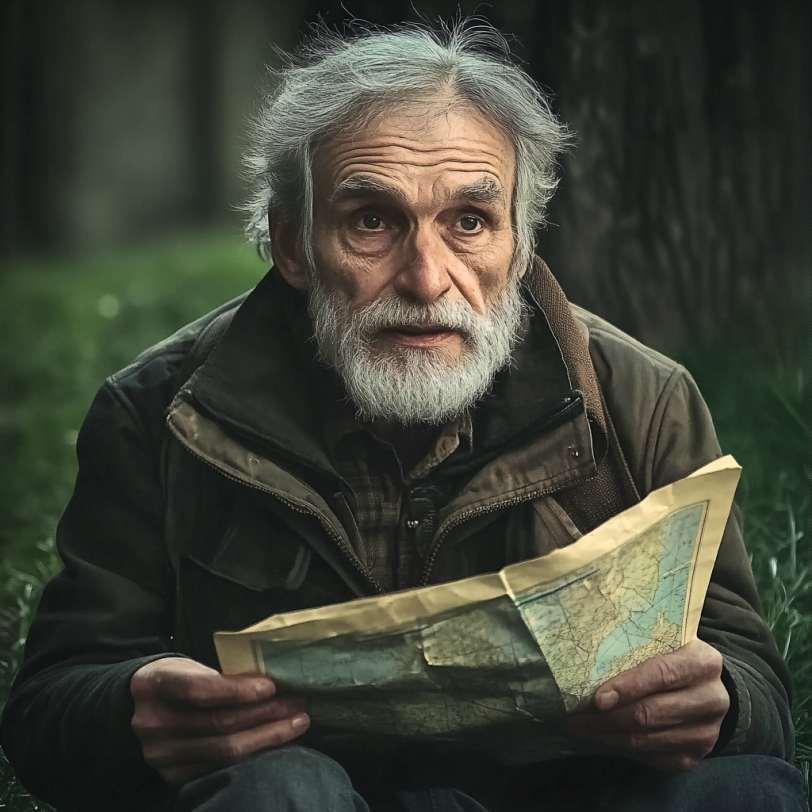
It was the first time in years that anyone had paid the old man any attention. Mikhail, Anya and Jian rushed over to him, eager to have a look. As their hands reached for the fragile map, Gregor clapsed it close to his chest, savouring his moment of glory.
“Ha!” he said, “Ha! Nobody wanted paper maps, but I knew it would come in handy one day!”
“Well done, Gregor” Molly said loudly. “A man after my own heart! I also have a paper map!” Tundra beamed happily at her great grandmother.
An excited buzz of murmuring swept through the gathered group.
“Ok, calm down everyone.” Anya stepped in to organise the situation. “Someone spread out a blanket. Let’s have a look at these maps ~ carefully! Stand back, everyone.”
Reluctantly, Molly and Gregor handed the maps to Anya, allowing her to slowly open them and spread them out. The folds had worn away completely in parts. Pebbles were collected to hold down the corners and protect the delicate paper from the breeze.
“Here, look” Mikhail pointed. “Here’s where we were at the asylum. Middle of nowhere. And here,” he pointed to a position slightly westwards, “Is where we are now. As you can see, the Hungarian border is close.”
“Where was that truck heading?” asked Vera.
Mikhail frowned and pored over the map. “Eastwards is all we can say for sure. Probably in the direction of Mukachevo, but Molly and Tundra said there were no survivors there. We just don’t know.”
“Yet,” added Jian, a man of few words.
“And where are we aiming for?” asked Finja.
“Nyíregyháza,” replied Mikhail, pointing at the map. “Should take us three or four days. Maybe a bit longer,” he added, glancing at Molly and Gregor.
“You’ll not outwalk Berlingo,” Molly snorted, “And I for one will be jolly glad to get back to some places that I can pronounce. And spell. Never did get a grip on that Cyrillic, I’d have been lost without Tundra.” Tundra beamed again at her grandmother. “And Hungarian names are only a tad better.”
“I can help you there,” Petro spoke up for the first time.
“You, help?” Anya said in astonishment, ” All you’ve ever done is complain!”
“Nobody has ever needed me, that’s why. I’m Hungarian. Surprised, are you? Nobody ever wanted to know where I was from. Nobody ever wanted my help with anything.”
“We’re all very glad you can help us now, Petro,” Molly said kindly, throwing a severe glance around the group. Tundra beamed proudly at Molly again.
“It’s an easy enough journey,” Petro addressed Molly directly, “Mostly agricultural plains. Well, they were agricultural anyway. Might be a good chance of feral chickens and self propagated crops, and the like. Finding water shouldn’t be a problem either. Used to be a lovely area,” Petro grew wistful. “I might go back to my village,” his voice trailed off as his mind returned to his childhood. “Never thought I’d ever see it again.”
“Well never mind that now,” Anya butted in rudely, “We need to make a start.” She began to carefully fold up the maps.
February 23, 2025 at 1:42 pm #7829In reply to: Helix Mysteries – Inside the Case
Helix 25 – Investigation Breakdown: Suspects, Factions, and Ship’s Population
To systematically investigate the murder(s) and the overarching mystery, let’s break down the known groups and individuals, their possible means to commit crimes, and their potential motivations.
1. Ship Population & Structure
Estimated Population of Helix 25
- Originally a luxury cruise ship before the exodus.
- Largest cruise ships built on Earth in 2025 carried ~5,000 people.
Space travel, however, requires generations. - Estimated current ship population on Helix 25: Between 15,000 and 50,000, depending on deck expansion and growth of refugee populations over decades.
- Possible Ship Propulsion:
- Plasma-based propulsion (high-efficiency ion drives)
- Slingshot navigation using gravity assists
- Solar sails & charged particle fields
- Current trajectory: Large elliptical orbit, akin to a comet.
Estimated direction of the original space trek was still within Solar System, not beyond the Kuiper Belt (~30 astrological units) and programmed to return towards it point of origin.
Due to the reprogramming by the refugees, it is not known if there has been significant alteration of the course – it should be known as the ship starts to reach the aphelion (farthest from the Sun) and either comes back towards it, or to a different course.

- Question: Are they truly on a course out of the galaxy? Or is that just the story Synthia is feeding them?
Is there a Promised Land beyond the Ark’s adventure?
2. Breaking Down People & Factions
To find the killer(s), conspiracies, and ship dynamics, here are some of factions, known individuals, and their possible means/motives.
A. Upper Decks: The Elite & Decision-Makers
- Defining Features:
- Wealthy descendants of the original passengers. They have adopted names of stars as new family names, as if de-facto rulers of the relative segments of the space.
- Have never known hardship like the Lower Decks.
- Kept busy with social prestige, arts, and “meaningful” pursuits to prevent existential crisis.
Key Individuals:
-
Sue Forgelot –
- Means: Extensive social connections, influence, and hidden cybernetic enhancements.
- Motive: Could be protecting something or someone—she knows too much about the ship’s past.
- Secrets: Claims to have met the Captain. Likely lying… unless?
-
Dr. Amara Voss –
- Means: Expert geneticist, access to data. Could tamper with DNA.
- Motive: What if Herbert knew something about her old research? Did she kill to bury it?
-
Ellis Marlowe (Retired Postman) –
- Means: None obvious. But as a former Earth liaison, he has archives and knowledge of what was left behind.
- Motive: Unclear, but his son was the murder victim. His son was previously left on Earth, and seemed to have found a way onto Helix 25 (possibly through the refugee wave who took over the ship)
- Question: Did he know Herbert’s real identity?
-
Finkley (Upper Deck cleaner, informant) –
- Means: As a cleaner, has access everywhere.
- Motive: None obvious, but cleaners notice everything.
- Secret: She and Finja (on Earth) are telepathically linked. Could Finja have picked up something?
-
The Three Old Ladies (Shar, Glo, Mavis) –
- Means: Absolutely none.
- Motive: Probably just want more drama.
- Accidental Detectives: They mix up stories but might have stumbled on actual facts.
-
Trevor Pee Marshall (TP, AI detective) –
- Means: Can scan records, project into locations, analyze logic patterns.
- Motive: Should have none—unless he’s been compromised as hinted by some of the remnants of old Muck & Lump tech into his program.
B. Lower Decks: Workers, Engineers, Hidden Knowledge
- Defining Features:
- Unlike the Upper Decks, they work—mechanics, hydroponics, labor.
- Self-sufficient, but cut off from decisions.
- Some distrust Synthia, believing Helix 25 is off-course.
Key Individuals:
-
Luca Stroud (Engineer, Cybernetic Expert) –
- Means: Can tamper with ship’s security, medical implants, and life-support systems.
- Motive: Possible sabotage, or he was helping Herbert with something.
- Secret: Works in black-market tech modifications.
-
Romualdo (Gardener, Archivist-in-the-Making) –
- Means: None obvious. Seem to lack the intelligence, but isn’t stupid.
- Motive: None—but he lent Herbert a Liz Tattler book about genetic memories.
- Question: What exactly did Herbert learn from his reading?
-
Zoya Kade (Revolutionary Figure, Not Directly Involved) –
- Means: Strong ideological influence, but not an active conspirator.
- Motive: None, but her teachings have created and fed factions.
-
The Underground Movement –
- Means: They know ways around Synthia’s surveillance.
- Motive: They believe the ship is on a suicide mission.
- Question: Would they kill to prove it?
C. The Hold: The Wild Cards & Forgotten Spaces
- Defining Features:
- Refugees who weren’t fully integrated.
- Maintain autonomy, trade, and repair systems that the rest of the ship ignores.
Key Individuals:
-
Kai Nova (Pilot, Disillusioned) –
- Means: Can manually override ship systems… if Synthia lets him.
- Motive: Suspects something’s off about the ship’s fuel levels.
-
Cadet Taygeta (Sharp, Logical, Too Honest) –
- Means: No real power, but access to data.
- Motive: Trying to figure out what Kai is hiding.
D. AI & Non-Human Factors
-
Synthia (Central AI, Overseer of Helix 25)
- Means: Controls everything.
- Motive: Unclear, but her instructions are decades old.
- Question: Does she even have free will?
-
The Captain (Nemo)
- Means: Access to ship-wide controls. He is blending in the ship’s population but has special access.
- Motive: Seems uncertain about his mission.
- Secret: He might not be following Synthia’s orders anymore.
3. Who Has the Means to Kill in Zero-G?
The next murder happens in a zero-gravity sector. Likely methods:
- Oxygen deprivation (tampered life-support, “accident”)
- Drowning (hydro-lab “malfunction”)
Likely Suspects for Next Murder
Suspect Means to Kill in Zero-G Motive Luca Stroud Can tamper with tech Knows ship secrets Amara Voss Access to medical, genetic data Herbert was digging into past Underground Movement Can evade Synthia’s surveillance Wants to prove ship is doomed Synthia (or Rogue AI processes) Controls airflow, gravity, and safety protocols If she sees someone as a threat, can she remove them? The Captain (Nemo?) Has override authority Is he protecting secrets?
4. Next Steps in the Investigation
- Evie and Riven Re-interview Suspects. Who benefited from Herbert’s death?
- Investigate the Flat-Earth Conspiracies. Who is spreading paranoia?
- Check the Captain’s Logs. What does Nemo actually believe?
- Stop the Next Murder. (Too late?)
Final Question: Where Do We Start?
- Evie and Riven visit the Captain’s quarters? (If they find him…)
- Investigate the Zero-G Crime Scene? (Second body = New urgency)
- Confront one of the Underground Members? (Are they behind it?)
Let’s pick a thread and dive back into the case!
February 17, 2025 at 8:53 pm #7822In reply to: The Last Cruise of Helix 25
Helix 25 – Gentle Utopia at Upper Decks
The Upper Decks of Helix 25 were a marvel of well-designed choreography and engineered tranquility. Life here was made effortless, thanks to an artful curation of everyday problems. Climate control ensured the air was always crisp, with just enough variation to keep the body alert, while maintaining a perfect balance of warm and cool, hygrometry, with no crazy seasons or climate change upheaval to disrupt the monotony. Food dispensers served gourmet meals for every individual preferences —decadent feasts perfectly prepared at the push of a button. The Helix cruise starships were designed for leisure, an eternity of comfort — and it had succeeded.
For the average resident, the days blended into one another in an animated swirl of hobbyist pursuits. There were the Arboretum Philosophers, who debated meaningfully over the purpose of existence while sipping floral-infused teas. There were the Artisans, who crafted digital masterpieces that vanished into the ship’s archives as soon as they were complete. There were the Virtual Adventurers, who lived entire lifetimes in fully immersive life-like simulations, all while reclining on plush lounges, connected to their brain chips courtesy of Muck Industries.
And then, there were Sharon, Gloria, and Mavis.
Three old ladies who, by all accounts, should have spent their days knitting and reminiscing about their youth, but instead had taken it upon themselves to make Helix 25 a little more interesting.

“Another marvelous day, ladies,” Sharon declared as she strolled along the gilded walkway of the Grand Atrium, a cavernous space filled with floating lounges and soft ambient music. The ceiling was a perfect replica of a sky—complete with drifting, lazy clouds and the occasional simulated flock of birds. Enough to make you almost forget you were in a closed fully-controlled environment.
Mavis sighed, adjusting her gaudy, glittering shawl. “It’s too marvelous, if you ask me. Bit samey, innit? Not even a good scandal to shake things up.”
Gloria scoffed. “Pah! That’s ‘cause we ain’t lookin’ hard enough. Did you hear about that dreadful business down in the Granary? Dried ‘im up like an apricot, they did. Disgustin’.”
“Dreadful,” Sharon agreed solemnly. “And not a single murder for decades, you know. We were overdue.”
Mavis clutched her pearls. “You make it sound like a good thing.”
Gloria waved a dismissive hand. “I’m just sayin’, bit of drama keeps people from losing their minds. No offense, but how many decades of spa treatments can a person endure before they go barmy?”
They passed a Wellness Lounge, where a row of residents were floating in Zero-G Hydrotherapy Pods, their faces aglow with Rejuvenex™ Anti-Aging Serum. Others lounged under mild UV therapy lamps, soaking up synthetic vitamin D while attendants rubbed nutrient-rich oils into their wrinkle-free skin.
Mavis peered at them. “Y’know, I swear some of ‘em are the same age as when we boarded.”
Gloria sniffed. “Not the same, Mavis. Just better preserved.”
Sharon tapped her lips, thoughtful. “I always wondered why we don’t have crime ‘ere. I mean, back on Earth, it were all fights, robbery, someone goin’ absolutely mental over a parking space—”
Gloria nodded. “It’s ‘cause we ain’t got money, Sha. No money, no stress, see? Everyone gets what they need.”
“Needs? Glo, love, people here have twelve-course meals and private VR vacations to Ancient Rome! I don’t reckon that counts as ‘needs’.”
“Well, it ain’t money, exactly,” Mavis pondered, “but we still ‘ave credits, don’t we?”
They fell into deep philosophical debates —or to say, their version of it.
Currency still existed aboard Helix 25, in a way. Each resident had a personal wealth balance, a digital measure of their social contributions—creative works, mentorship, scientific discovery, or participation in ship maintenance (for those who actually enjoyed labor, an absurd notion to most Upper Deckers). It wasn’t about survival, not like on the Lower Decks or the Hold, but about status. The wealthiest weren’t necessarily the smartest or the strongest, but rather those who best entertained or enriched the community.
Gloria finally waved her hand dismissively. “Point is, they keep us comfortable so we don’t start thinkin’ about things too much. Keep us occupied. Like a ship-sized cruise, but forever.”
Mavis wrinkled her nose. “A bit sinister, when you put it like that.”
“Well, I didn’t say it were sinister, I just said it were clever.” Gloria sniffed. “Anyway, we ain’t the ones who need entertainin’, are we? We’ve got a mystery on our hands.”
Sharon clapped excitedly. “Ooooh yes! A real mystery! Ain’t it thrillin’?”
“A proper one,” Gloria agreed. “With dead bodies an’ secrets an’—”
“—murder,” Mavis finished, breathless.
The three of them sighed in unison, delighted at the prospect.
They continued their stroll past the Grand Casino & Theatre, where a live orchestral simulation played for a well-dressed audience. Past the Astronomer’s Lounge, where youngster were taught to chart the stars that Helix 25 would never reach. Past the Crystal Arcade, where another group of youth of the ship enjoyed their free time on holographic duels and tactical board games.
So much entertainment. So much luxury.
So much designed distraction.
Gloria stopped suddenly, narrowing her eyes. “You ever wonder why we ain’t heard from the Captain in years?”
Sharon and Mavis stopped.
A hush fell over them.
Mavis frowned. “I thought you said the Captain were an idea, not a person.”
“Well, maybe. But if that’s true, who’s actually runnin’ the show?” Gloria folded her arms.
They glanced around, as if expecting an answer from the glowing Synthia panels embedded in every wall.
For the first time in a long while, they felt watched.
“…Maybe we oughta be careful,” Sharon muttered.
Mavis shivered. “Oh, Glo. What ‘ave you gotten us into this time?”
Gloria straightened her collar. “Dunno yet, love. But ain’t it excitin’?”
“With all the excitment, I almost forgot to tell you about that absolutely ghastly business,” Gloria declared, moments later, at the Moonchies’ Café, swirling her lavender-infused tea. “Watched a documentary this morning. About man-eating lions of Njombe.”
Sharon gasped, clutching her pearls. “Man eating lions?!”
Mavis blinked. “Wait. Man-eating lions, or man eating lions?”
There was a pause.
Gloria narrowed her eyes. “Mavis, why in the name of clotted cream would I be watchin’ a man eating lions?”
Mavis shrugged. “Well, I dunno, do I? Maybe he ran out of elephants.”
Sharon nodded sagely. “Yes, happens all the time in those travel shows.”
Gloria exhaled through her nose. “It’s not a travel show, Sha. And it’s not fiction.”
Mavis scoffed. “You sure? Sounds ridiculous.”
“Not as ridiculous as a man sittin’ down to a plate of roast lion chops,” Gloria shot back.
Mavis tilted her head. “Maybe it’s in a recipe book?”
Gloria slammed her teacup down. “I give up. I absolutely give up.”
Sharon patted her hand. “There, there, Glo. You can always watch somethin’ lighter tomorrow. Maybe a nice documentary about man-eating otters.”
Mavis grinned. “Or man eating otters.”
Gloria inhaled deeply, resisting the urge to upend her tea.
This, this was why Helix 25 had never known war.
No one had the time.
February 16, 2025 at 2:59 pm #7816In reply to: The Precious Life and Rambles of Liz Tattler
Liz had, in her esteemed opinion, finally cracked the next great literary masterpiece.
It had everything—forbidden romance, ancient mysteries, a dash of gratuitous betrayal, and a protagonist with just the right amount of brooding introspection to make him irresistible to at least two stunningly beautiful, completely unnecessary love interests.
And, of course, there was a ghost. She would have preferred a mummy but it had been edited out one morning she woke up drooling on her work with little recollection of the night.
Unfortunately, none of this mattered because Godfrey, her ever-exasperated editor, was staring at her manuscript with the same enthusiasm he reserved for peanut shells stuck in his teeth.
“This—” he hesitated, massaging his temples, “—this is supposed to be about the Crusades.”
Liz beamed. “It is! Historical and spicy. I expect an award.”
Godfrey set down the pages and reached for his ever-dwindling bowl of peanuts. “Liz, for the love of all that is holy, why is the Templar knight taking off his armor every other page?”
Liz gasped in indignation. “You wouldn’t understand, Godfrey. It’s symbolic. A shedding of the past! A rebirth of the soul!” She made an exaggerated sweeping motion, nearly knocking over her champagne flute.
“Symbolic,” Godfrey repeated flatly, chewing another peanut. “He’s shirtless on page three, in a monastery.”
Finnley, who had been dusting aggressively, made a sharp sniff. “Disgraceful.”
Liz ignored her. “Oh please, Godfrey. You have no vision. Readers love a little intimacy in their historical fiction.”
“The priest,” Godfrey said, voice rising, “is supposed to be celibate. You explicitly wrote that his vow was unbreakable.”
Liz waved a dismissive hand. “Oh, I solved that. He forgets about it momentarily.”
Godfrey choked on a peanut. Finnley paused mid-dust, staring at Liz in horror.
Roberto, who had been watering the hydrangeas outside the window, suddenly leaned in. “Did I hear something about a forgetful priest?”
“Not now, Roberto,” Liz said sharply.
Finnley folded her arms. “And how, pray tell, does one simply forget their sacred vows?”
Liz huffed. “The same way one forgets to clean behind the grandfather clock, I imagine.”
Finnley turned an alarming shade of purple.
Godfrey was still in disbelief. “And you’re telling me,” he said, flipping through the pages in growing horror, “that this man, Brother Edric, the holy warrior, somehow manages to fall in love with—who is this—” he squinted, “—Laetitia von Somethingorother?”
Liz beamed. “Ah, yes. Laetitia! Mysterious, tragic, effortlessly seductive—”
“She’s literally the most obvious spy I’ve ever read,” Godfrey groaned, rubbing his face.
“She is not! She is enigmatic.”
“She has a knife hidden in every scene.”
“A woman should be prepared.”
Godfrey took a deep breath and picked up another sheet. “Oh fantastic. There’s a secret baby now.”
Liz nodded sagely. “Yes. I felt that revelation.”
Finnley snorted. “Roberto also felt something last week, and it turned out to be food poisoning.”
Roberto, still hovering at the window, nodded solemnly. “It was quite moving.”
Godfrey set the papers down in defeat. “Liz. Please. I’m begging you. Just one novel—just one—where the historical accuracy lasts at least until page ten.”
Liz tapped her chin. “You might have a point.”
Godfrey perked up.
Liz snapped her fingers. “I should move the shirtless scene to page two.”
Godfrey’s head hit the table.
Roberto clapped enthusiastically. “Genius! I shall fetch celebratory figs!”
Finnley sighed dramatically, threw down her duster, and walked out of the room muttering about professional disgrace.
Liz grinned, completely unfazed. “You know, Godfrey, I really don’t think you appreciate my artistic sacrifices.”
Godfrey, face still buried in his arms, groaned, “Liz, I think Brother Edric’s celibacy lasted longer than my patience.”
Liz threw a hand to her forehead theatrically. “Then it was simply not meant to be.”
Roberto reappeared, beaming. “I found the figs.”
Godfrey reached for another peanut.
He was going to need a lot more of them.
 February 16, 2025 at 12:50 pm #7810
In reply to: The Last Cruise of Helix 25
Helix 25 – Below Lower Decks – Shadow Sector
Kai Nova moved cautiously through the underbelly of Helix 25, entering a part of the Lower Decks where the usual throb of the ship’s automated systems turned muted. The air had a different smell here— it was less sterile, more… human. It was warm, the heat from outdated processors and unmonitored power nodes radiating through the bulkheads. The Upper Decks would have reported this inefficiency.
Here, it simply went unnoticed, or more likely, ignored.
He was being watched.
He knew it the moment he passed a cluster of workers standing by a storage unit, their voices trailing off as he walked by. Not unusual, except these weren’t Lower Deck engineers. They had the look of people who existed outside of the ship’s official structure—clothes unmarked by department insignias, movements too intentional for standard crew assignments.
He stopped at the rendezvous point: an unlit access panel leading to what was supposed to be an abandoned sublevel. The panel had been manually overridden, its system logs erased. That alone told him enough—whoever he was meeting had the skills to work outside of Helix 25’s omnipresent oversight.
A voice broke the silence.
“You’re late.”
Kai turned, keeping his stance neutral. The speaker was of indistinct gender, shaved head, tall and wiry, with sharp green eyes locked on his movements. They wore layered robes that, at a glance, could have passed as scavenged fabric—until Kai noticed the intricate stitching of symbols hidden in the folds.
They looked like Zoya’s brand —he almost thought… or let’s just say, Zoya’s influence. Zoya Kade’s litanies had a farther reach he would expect.
“Wasn’t aware this was a job interview,” Kai quipped, leaning casually against the bulkhead.
“Everything’s a test,” they replied. “Especially for outsiders.”
Kai smirked. “I didn’t come to join your book club. I came for answers.”
A low chuckle echoed from the shadows, followed by the shifting of figures stepping into the faint light. Three, maybe four of them. It could have been an ambush, but that was a display.
“Pilot,” the woman continued, avoiding names. “Seeker of truth? Or just another lost soul looking for something to believe in?”
Kai rolled his shoulders, sensing the tension in the air. “I believe in not running out of fuel before reaching nowhere.”
That got their attention.
The recruiter studied him before nodding slightly. “Good. You understand the problem.”
Kai crossed his arms. “I understand a lot of problems. I also understand you’re not just a bunch of doomsayers whispering in the dark. You’re organized. And you think this ship is heading toward a dead end.”
“You say that like it isn’t.”
Kai exhaled, glancing at the flickering emergency light above. “Synthia doesn’t make mistakes.”
They smiled, but it wasn’t friendly. “No. It makes adjustments.” — the heavy tone on the “it” struck him. Techno-bigots, or something else? Were they denying Synthia’s sentience, or just adjusting for gender misnomers, it was hard to tell, and he had a hard time to gauge the sanity of this group.
A low murmur of agreement rippled through the gathered figures.
Kai tilted his head. “You think she’s leading us into the abyss?”
The person stepped closer. “What do you think happened to the rest of the fleet, Pilot?”
Kai stiffened slightly. The Helix Fleet, the original grand exodus of humanity—once multiple ships, now only Helix 25, drifting further into the unknown.
He had never been given a real answer.
“Think about it,” they pressed. “This ship wasn’t built for endless travel. Its original mission was altered. Its course reprogrammed. You fly the vessel, but you don’t control it.” She gestured to the others. “None of us do. We’re passengers on a ride to oblivion, on a ship driven by a dead man’s vision.”
Kai had heard the whispers—about the tycoon who had bankrolled Helix 25, about how the ship’s true directive had been rewritten when the Earth refugees arrived. But this group… they didn’t just speculate. They were ready to act.
He kept his voice steady. “You planning on mutiny?”
They smiled, stepping back into the half-shadow. “Mutiny is such a crude word. We’re simply ensuring that we survive.”
Before Kai could respond, a warning prickle ran up his spine.
Someone else was watching.
He turned slowly, catching the faintest silhouette lingering just beyond the corridor entrance. He recognized the stance instantly—Cadet Taygeta.
Damn it.
She had followed him.
The group noticed, shifting slightly. Not hostile, but suddenly alert.
“Well, well,” the woman murmured. “Seems you have company. You weren’t as careful as you thought. How are you going to deal with this problem now?”
Kai exhaled, weighing his options. If Taygeta had followed him, she’d already flagged this meeting in her records. If he tried to run, she’d report it. If he didn’t run, she might just dig deeper.
And the worst part?
She wasn’t corruptible. She wasn’t the type to look the other way.
“You should go,” the movement person said. “Before your shadow decides to interfere.”
Kai hesitated for half a second, before stepping back.
“This isn’t over,” he said.
Her smile returned. “No, Pilot. It’s just beginning.”
With that, Kai turned and walked toward the exit—toward Taygeta, who was waiting for him with arms crossed, expression unreadable.
He didn’t speak first.
She did.
“You’re terrible at being subtle.”
Kai sighed, thinking quickly of how much of the conversation could be accessed by the central system. They were still in the shadow zone, but that wasn’t sufficient. “How much did you hear?”
“Enough.” Her voice was even, but her fingers twitched at her side. “You know this is treason, right?”
Kai ran a hand through his hair. “You really think we’re on course for a fresh new paradise?”
Taygeta didn’t answer right away. That was enough of an answer.
Finally, she exhaled. “You should report this.”
“You should,” Kai corrected.
She frowned.
He pressed on. “You know me, Taygeta. I don’t follow lost causes. I don’t get involved in politics. I fly. I survive. But if they’re right—if there’s even a chance that we’re being sent to our deaths—I need to know.”
Taygeta’s fingers twitched again.
Then, with a sharp breath, she turned.
“I didn’t see anything tonight.”
Kai blinked. “What?”
Her back was already to him, her voice tight. “Whatever you’re doing, Nova, be careful. Because next time?” She turned her head slightly, just enough to let him see the edge of her conflicted expression.
“I will report you.”
Then she was gone.
Kai let out a slow breath, glancing back toward the hidden movement behind him.
No turning back now.
February 14, 2025 at 10:02 am #7780In reply to: The Last Cruise of Helix 25
Orrin Holt gripped the wheel of the battered truck, his knuckles white as the vehicle rumbled over the dry, cracked road. The leather wrap was a patchwork of smooth and worn, stichted together from whatever scraps they had—much like the quilts his mother used to make before her hands gave out. The main road was a useless, unpredictable mess of asphalt gravels and sinkholes. Years of war with Russia, then the collapse, left it to rot before anyone could fix it. Orrin stuck to the dirt path beside it. That was the only safe way through. The engine coughed but held. A miracle, considering how many times it had been patched together.
The cargo in the back was too important for a breakdown now. Medical supplies—antibiotics, painkillers, and a few salvaged vials of something even rarer. They’d traded well for it, risking much. Now he had to get it back to Base Klyutch (Ukrainian word for Key) without incident. If he continued like that he could make it before noon.
Still, something bothered him. That group of people he’d seen.
They had been barely more than silhouettes on top of a hill. Strangers, a rarity in these times. His first instinct had been to stop and evaluate who they were. But his instructions let room for no delay. So, he’d pushed forward and ignored them. The world wasn’t kind to the wandering. But they hadn’t looked like raiders or scavengers. Lost, perhaps. Or searching.
The truck lurched forward as he pushed it harder. The fences of the base rose in the distance, grey and wiry against the blue sky. Base Klyutch was a former military complex, fortified over the years with scavenged materials, steel sheets, and watchtowers. It wasn’t perfect, but it kept them alive.
As he rolled up to the main gate, the sentries swung the barricade open. Before he could fully cut the engine, a woman wearing a pristine white lab coat stepped forward, her sharp eyes scanning the truck’s cargo bed. Dr. Yelena Markova, the camp’s chief doctor, a former nurse who had to step up when the older one died in a raid on their camp three years ago. Stern-faced and wiry, with a perpetual air of exhaustion, she moved with the efficiency of someone who had long stopped hoping for ease. She had been waiting for this delivery.
“Finally,” she murmured, motioning for her assistants to start unloading. “We were running low. This will keep us going for a while.”
Orrin barely had time to nod before Dmytro Koval, the de facto leader of the base, strode toward him with the gait of a tall bear. His face seemed to have been carved out by a dulled blade, hardened by years of survival. A scar barred his mouth, pulling slightly at the corner when he spoke, giving the impression of a permanent sneer.
“Did you get it?” Koval asked, voice low.
Orrin reached into his kaki jacket and pulled out a sealed letter, along with a small package.
Koval took both, his expression unreadable. “Anything on the road?”
Orrin exhaled and adjusted his stance. “Saw something on the way back. A group, about a dozen, on a hill ten kilometers out. They seemed lost.”
“Armed?” asked Koval with a frown.
“Can’t say for sure.”
Dr. Markova straightened. “Lost? Unarmed? Out in the open like that, they won’t last long with Sokolov’s gang roaming the land. We have to go take them in.”
Koval grimaced. “Or they’re Sokolov’s spies. Trying to infiltrate us and find a weakness in our defenses. You know how it works.”
Before Koval could argue, a new voice cut in. “Or they could just be people.”
Solara Ortega had stepped into the conversation, brushing dirt from her overalls. A woman of lean strength, with the tan of someone spending long hours outside. Her sharp amber eyes carried the weight of someone who had survived too much but refused to be hardened by it. Orrin shoved down a mix of joy and ache at her sight. Her voice was calm but firm. “We can’t always assume the worst. We need more hands and we don’t leave people to die if we can help it. And in case you forgot, Koval, you don’t make all the decisions around here. I say we send a team to assess them.”
Koval narrowed his eyes, but he held his tongue. There was tension between them, but the council wasn’t a dictatorship.
“Fine,” Koval said after a moment, his jaw tense. “A team of two. They scout first. No direct contact until we’re sure. Orrin, you one of them take whoever wants to accompany you, but not one of my men. We need to maintain tight security.”
Dr. Markova sighed with relief when the man left. “If he wasn’t good at what he does, I would gladly kick him out of our camp.”
Solara, her face framed by strands of dark hair, shot a glance at Orrin. “I’m coming with you.”
This time, Orrin couldn’t repress a longing for a time before everything fell apart, when she had been his wife. The collapse had torn them apart in an instant, and by the time he found her again, years later, she had built a new life within the base in Ukraine. She had a husband now, one of the scientists managing the radio equipment, and two children. Orrin kept his expression neutral, but the weight of time pressed heavy on him.
“Then let’s get on the move. They might not stay there long.”
February 9, 2025 at 7:22 am #7777In reply to: The Last Cruise of Helix 25
The Survivors:
“Well, I’ll be damned,” Gregor said, his face cracking into another toothless grin. “Beginning to think we might be the last ones.”
“So did we.” Molly glanced nervously around at the odd assortment of people staring at her and Tundra. “I’m Molly. This is Tundra.”
“Tundra? Like the frozen wasteland?” Yulia asked.
Tundra nodded. “It’s because I’m strong and tough.”
“Would you like to join us?” Tala motioned toward the fire.
“Yes, yes, of course, ” Anya said. “Are you hungry?”
Molly hesitated, glancing toward the edge of the clearing, where their horses stood tethered to a low branch. “We have food,” she said. “We foraged.”
“I’d have foraged if someone didn’t keep going on about food poisoning,” Yulia muttered.
Finja sniffed. “Forgive me for trying to keep you alive.”
Molly watched the exchange with interest. It had been years since she’d seen people bicker over something so trivial. It was oddly comforting.
She lowered herself slowly onto the log next to Vera. “Alright, tell me—who exactly are you lot?”
Petro chuckled. “We’ve escaped from the asylum.”
Molly’s face remained impassive. “Asylum?”
“It’s okay,” Tala said quickly. “We’re mostly sane.”
“Not completely crazy, anyway,” Yulia added cheerfully.
“We were left behind years ago,” Anya said simply. “So we built our own kind of life.”
A pause. Molly gave a slow nod, considering this. Vera leaned towards her eagerly.
“Where are you from? Any noble blood?”
Molly frowned. “Does it matter?”
“Oh, not really,” Vera said dejectedly. “I just like knowing.”
Tundra, warming her hands by the fire, looked at Vera. “We came from Spain.”
Vera perked up. “Spain? Fascinating! And tell me, dear girl, have you ever traced your lineage?”
“Just back to Molly. She’s ninety-three,” Tundra said proudly.
Mikhail, who had been watching quietly, finally spoke. “You travelled all the way from Spain?”
Molly nodded. “A long time ago. There were more of us then… ” Her voice wavered. “We were looking for other survivors.”
“And?”Mikhail asked.
Molly sighed, glancing at Tundra. “We never found any.”
________________________________________
That night, they took turns keeping watch, though Molly tried to reassure them there was no need.
“At first, we did too,” she had said, shaking her head. “But there was no one…”
By dawn, the fire had burned to embers, and the camp stirred reluctantly to life.
They finished off the last of their cooked vegetables from the night before, while Molly and Tundra laid out a handful of foraged berries and mushrooms. It wasn’t much, but it was enough to start the day.
“Right,” Anya said, stretching. “I suppose we should get moving.” She looked at Molly and Tundra. “You’re coming with us, then? To the city?”
Molly nodded. “If you’ll have us.”
“We kept going and going, hoping to find people. Now we have,” Tundra said.
“Then it’s settled,” Anya said. “We head to the city.”
“And what exactly are we looking for?” Molly asked.
Mikhail shrugged. “Anything that keeps us alive.”
________________________________________________
It was late morning when they saw it.
A vehicle—an old, battered truck, crawling slowly toward them.
The sight was so absurd, so impossible, that for a moment, no one spoke.
“That can’t be,” Molly murmured.
The truck bounced over the uneven ground, its engine a dull, sluggish rattle. It wasn’t in good shape, but it was moving.
February 2, 2025 at 10:56 pm #7729In reply to: The Last Cruise of Helix 25
It was Evie who found the body.
Word spread fast, even on a ship this size. Evie, though properly shocked wasted no time telling Sue—because everyone knew if something serious happened, Sue was the one to go to. Not that anything like this had ever happened before.
Sue knew exactly what to do.
“Let’s not panick, folks” Sue’s voice crackled on her radio channel over the ship’s comms, after the chirpy jingle had faded into static “We’ve had a… situation. A dead person’s been found. In the drying machine.”
Naturally, everyone panicked.
For one, it had been long since anybody’d died. They had ways to preserve people these days —if someone got too close to the edge, easy: put them in cryo, sleep it out for a bit, pump them full of rejuv’ drugs, the lots. They would come up a bit disoriented, but mostly alive.
But this one, when Evie found him, he was all shrivelled and dried up, tangled in the bags full of tiger nuts meant for kids snacks. Mr Herbert she thought ; hard to tell. She thought she’d recognized him despite he’d looked barely human, a husk.
It could have been an accident, but then the AI would have stopped the machine. One had forgotten such things could happen.
It wasn’t long before everyone started to whisper about this long forgotten word.
Murder.
As sure as they’d been stuck in that nebula for the past three weeks, and now… someone had just turned up dead.
-
AuthorSearch Results