

Search Results for 'high'
-
AuthorSearch Results
-
February 21, 2023 at 9:10 am #6615
In reply to: Orbs of Madjourneys
Like ships in the night, Zara and Yasmin still hadn’t met up with Xavier and Youssef at the inn. Yasmin was tired from traveling and retired to her room to catch up on some sleep, despite Zara’s hopes that they’d have a glass of wine or two and discuss whatever it was that was on Yasmins mind. Zara decided to catch up on her game.
The next quirk was “unleash your hidden rudeness” which gave Zara pause to consider how hidden her rudeness actually was. But wait, it was the avatar Zara, not herself. Or was it? Zara rearranged the pillows and settled herself on the bed.
Zara found her game self in the bustling streets of a medieval market town, visually an improvement on the previous game level of the mines, which pleased her, with many colourful characters and intriguing alleyways and street market vendors.
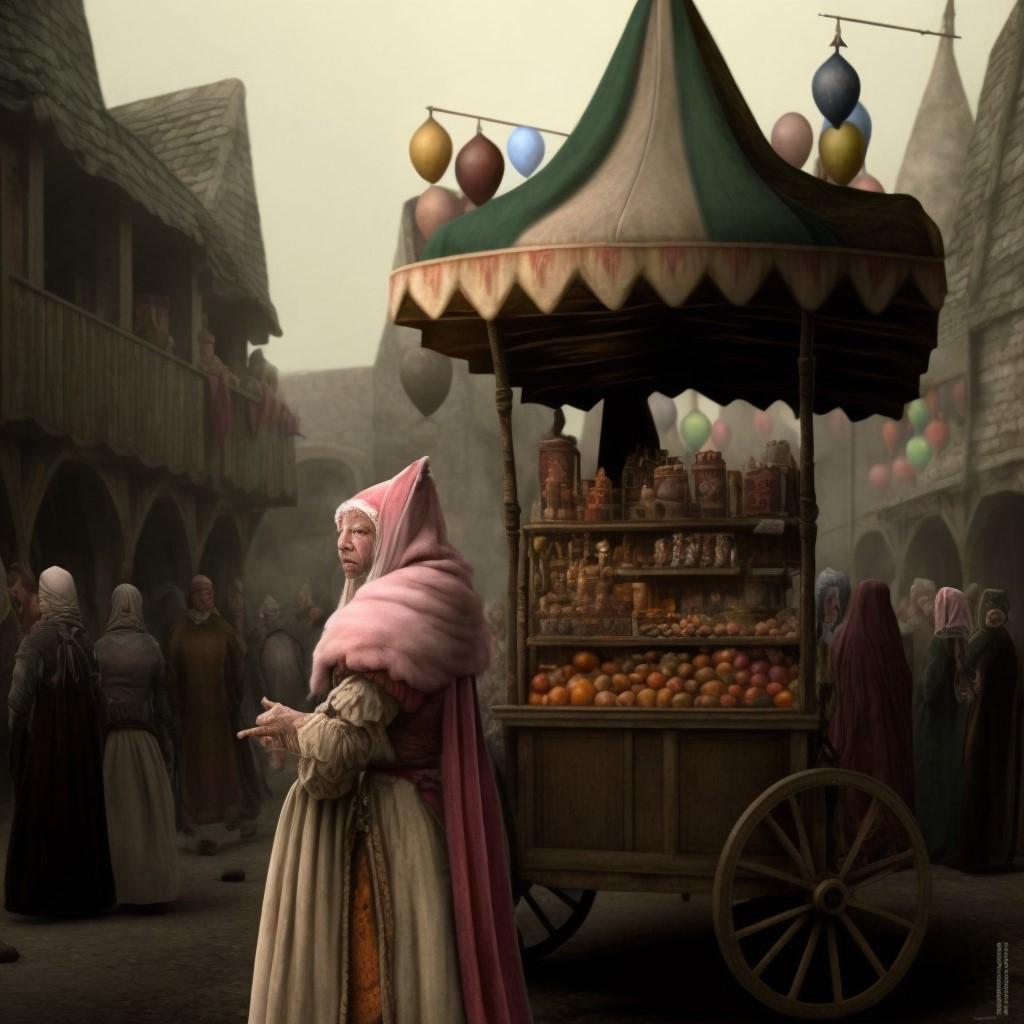
She quickly forgot what her quest was and set off wandering around the scene. Each alley led to a little square and each square had gaily coloured carts of wares for sale, and an abundance of grinning jesters and jugglers. Although tempted to linger and join the onlookers jeering and goading the jugglers and artistes that she encountered, Zara continued her ramble around the scene.
She came to a gathering outside an old market hall, where two particularly raucous jesters were trying to tempt the onlookers into partaking of what appeared to be cups of tea. Zara wondered what the joke was and why nobody in the crowd was willing to try. She inched closer, attracting the attention of the odd grinning fellow in the orange head piece.
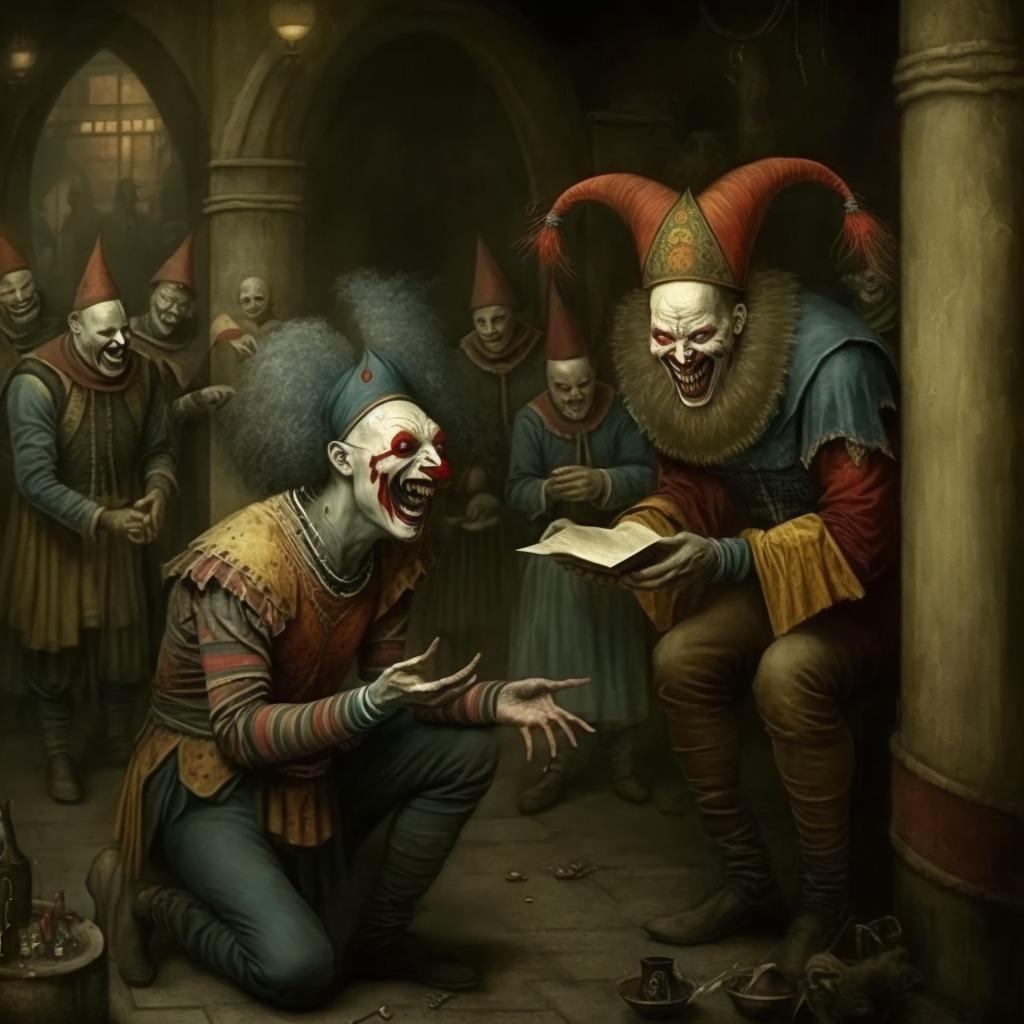
“Come hither, ye fine wench in thy uncomely scant garments, I know what thou seekest! Pray, sit thee down beside me and partake of my remedy.”
“Who, me?” asked Zara, looking behind her to make sure he wasn’t talking to someone else.
“Thoust in dire need of my elixir, come ye hither!”
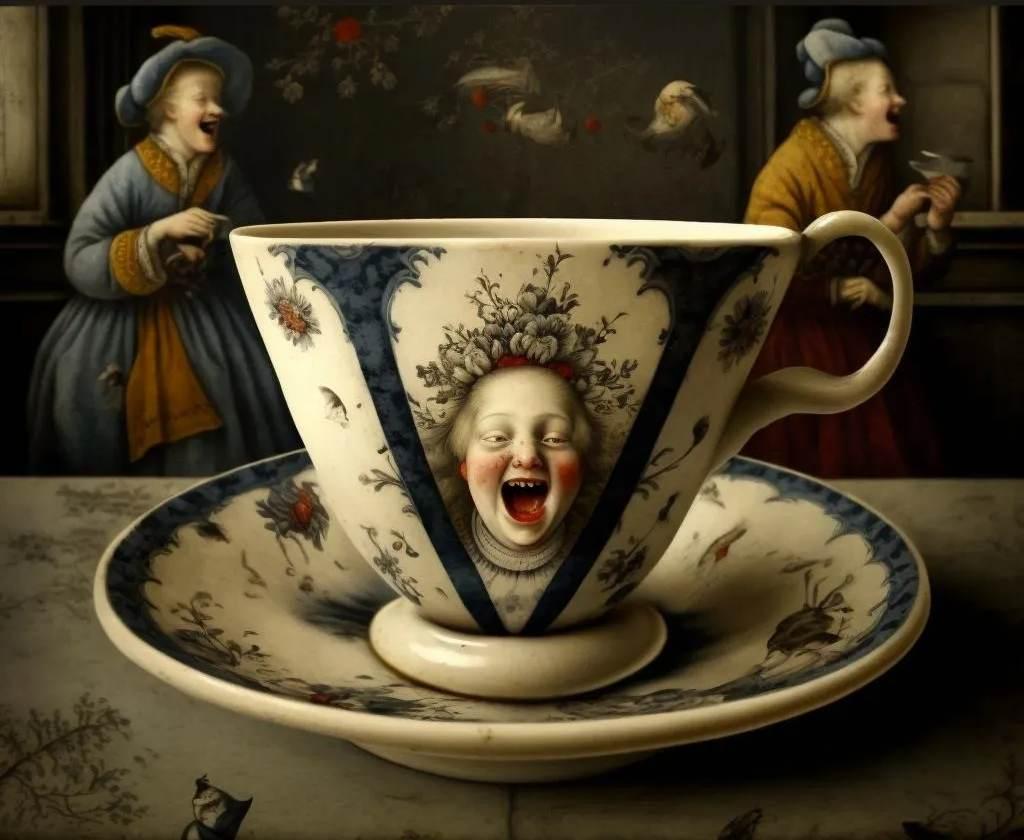
Somewhat reluctantly Zara stepped towards the odd figure who was offering to hand her a cup. She considered the inadvisability of drinking something that everyone else was refusing, but what the hell, she took the cup and saucer off him and took a hesitant sip.
The crowd roared with laughter and there was much mirthful thigh slapping when Zara spit the foul tasting concoction all over the jesters shoes.
“Believe me dame,” quoth the Jester, “I perceive proffered ware is worse by ten in the hundred than that which is sought. But I pray ye, tell me thy quest.”
“My quest is none of your business, and your tea sucks, mister,” Zara replied. “But I like the cup.”
Pushing past the still laughing onlookers and clutching the cup, Zara spotted a tavern on the opposite side of the square and made her way towards it. A tankard of ale was what she needed to get rid of the foul taste lingering in her mouth.
The inside of the tavern was as much a madhouse as the streets outside it. What was everyone laughing at? Zara found a place to sit on a bench beside a long wooden table. She sat patiently waiting to be served, trying to eavesdrop to decipher the cause of such merriment, but the snatches of conversation made no sense to her. The jollity was contagious, and before long Zara was laughing along with the others. A strange child sat down on the opposite bench (she seemed familiar somehow) and Zara couldn’t help remarking, “You lot are as mad as a box of frogs, are you all on drugs or something?” which provoked further hoots of laughter, thigh slapping and table thumping.
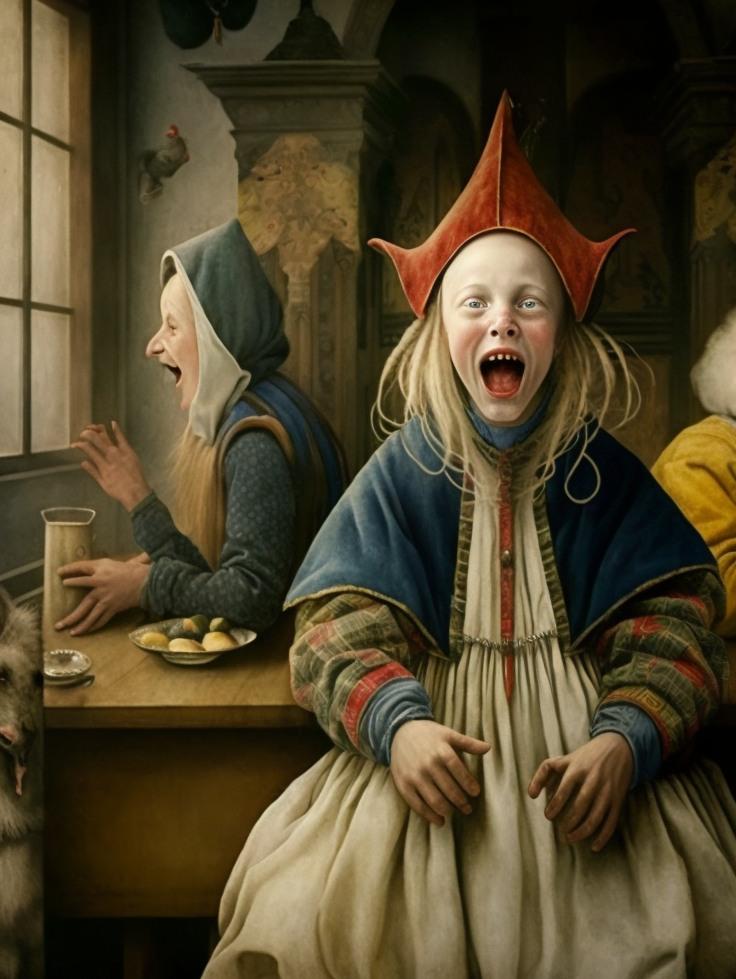
“Ye be an ungodly rude maid, and ye’ll not get a tankard of ale while thoust leavest thy cup of elixir untasted yet,” the child said with a smirk.
“And you are an impertinent child,” Zara replied, considering the potential benefits of drinking the remainder of the concoction if it would hasten the arrival of the tankard of ale she was now craving. She gritted her teeth and picked up the cup.
But the design on the cup had changed, and now bore a strange resemblance to Xavier. Not only that, the cup was calling her name in Xavier’s voice, and the table thumping got louder.
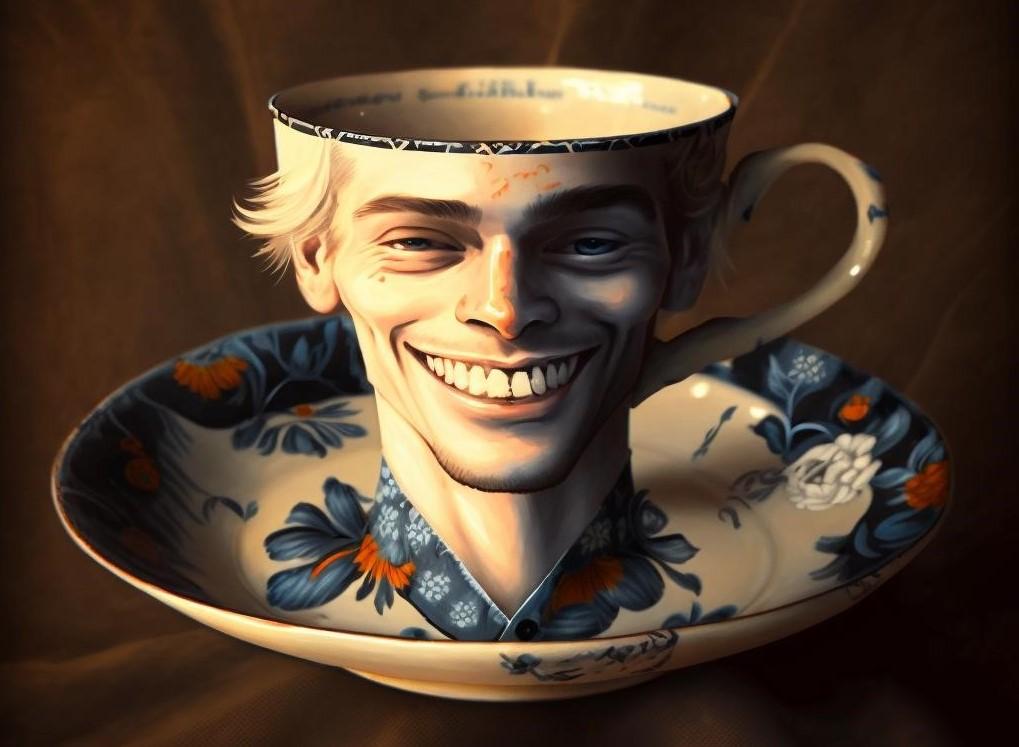
“Zara!” Xavier was knocking on her bedroom door. “Zara! We’re going for a beer in the local tavern, are you coming?”
“Xavi!” Zara snapped back to reality, “Yes! I’m bloody parched.”
February 18, 2023 at 11:28 am #6551In reply to: Orbs of Madjourneys
Xavier had woken up in the middle of the night that felt surprisingly alive bursting with a quiet symphony of sounds from nocturnal creatures and nearby nature, painted on a canvas of eerie spacious silence.
It often took him a while to get accustomed to any new place, and it was not uncommon for him to have his mind racing in the middle of the night. Generally Brytta had a soothing presence and that often managed to nudge him back to sleep, otherwise, he would simply wake up until the train of thoughts had left the station.
It was beginning of the afternoon in Berlin; Brytta would be in a middle of a shift, so he recorded a little message for her to find when she would get back to her phone. It was funny to think they’d met thanks to Yasmin and Zara, at the time the three girls were members of the same photography club, which was called ‘Focusgroupfocus’ or something similar…
With that done, he’d turned around for something to do but there wasn’t much in the room to explore or to distract him sufficiently. Not even a book in the nightstand drawer. The decoration itself had a mesmerising nature, but after a while it didn’t help with the racing thoughts.He was tempted to check in the game — there was something satisfactory in finishing a quest that left his monkey brain satiated for a while, so he gave in and logged back in.

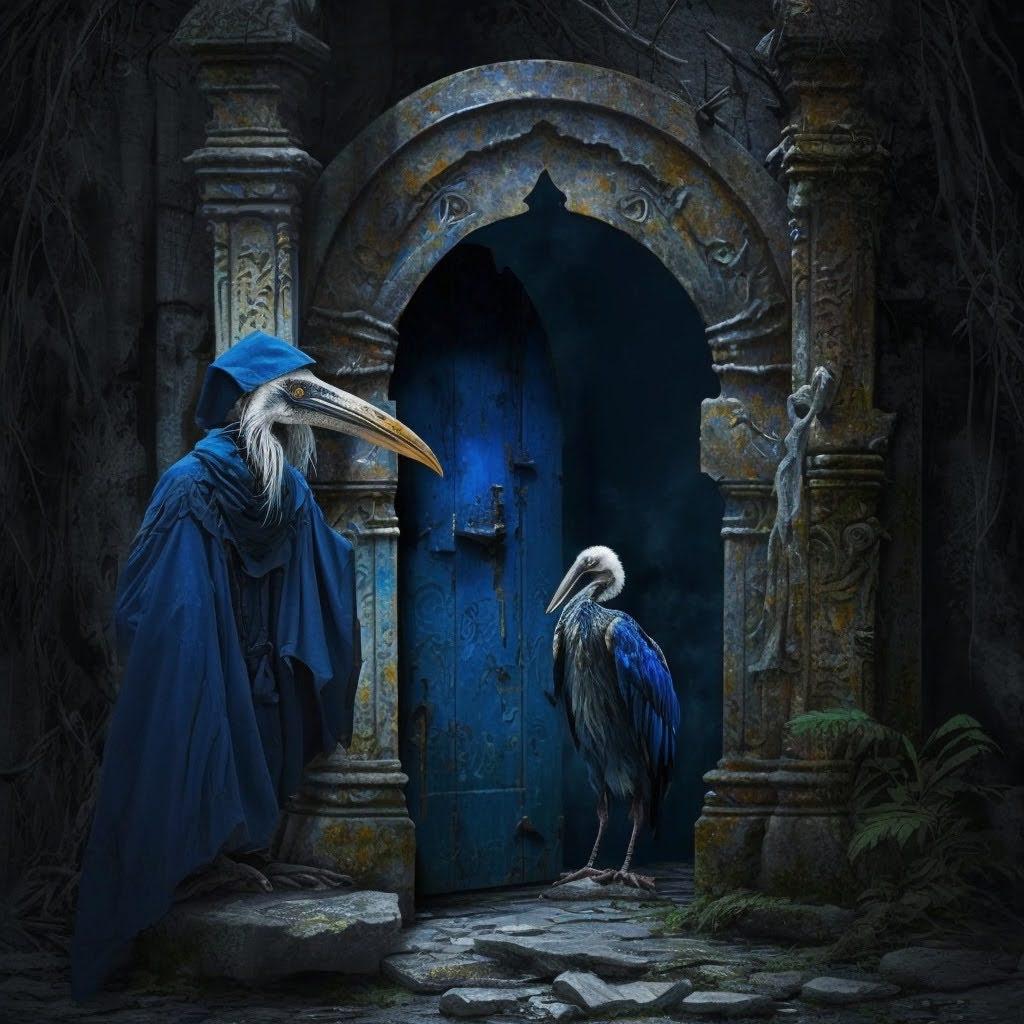
Completing the quest didn’t take him too long this time. The main difficulty initially was to find the portal from where his avatar had landed. It was a strange carousel of blue storks that span into different dimensions one could open with the proper incantation.
As usual, stating the quirk was the key to the location, and the carousel portal propelled him right away to Midnight town, which was clearly a ghost town in more ways than one. Interestingly, he was chatting on the side with Glimmer, who’d run into new adventures of her own while continuing to ask him what was up, and as soon as he’d reached Midnight town, all communication channels suddenly went dark. He’d laughed to himself thinking how frustrated Glimmer would have been about that. But maybe the game took care of sending her AI-generated messages simulating his presence. Despite the disturbing thought of having an AI generated clone of himself, he almost hoped for it (he’d probably signed the consent for this without realising), so that he wouldn’t have to do a tedious recap about all what she’d missed.
Once he arrived in the town, the adventure followed a predictable pattern. The clues were also rather simple to follow.
The townspeople are all frozen in time, stuck in their daily routines and unable to move on. Your mission is to find the missing piece of continuity, a small hourglass that will set time back in motion and allow the townspeople to move forward.
The clue to finding the hourglass lies within a discarded pocket watch that can be found in the mayor’s office. You must unscrew the back and retrieve a hidden key. The key will unlock a secret compartment in the town clock tower, where the hourglass is kept.
Be careful as you search for the hourglass, as the town is not as abandoned as it seems. Spectral figures roam the streets, and strange whispers can be heard in the wind. You may also encounter a mysterious old man who seems to know more about the town’s secrets than he lets on.
Evading the ghosts and spectres wasn’t too difficult once you got the hang of it. The old man however had been quite an elusive figure to find, but he was clearly the highlight of the whole adventure; he had been hiding in plain sight since the beginning of the adventure. One of the blue storks in the town that he’d thought had come with him through the portal was in actuality not a bird at all.
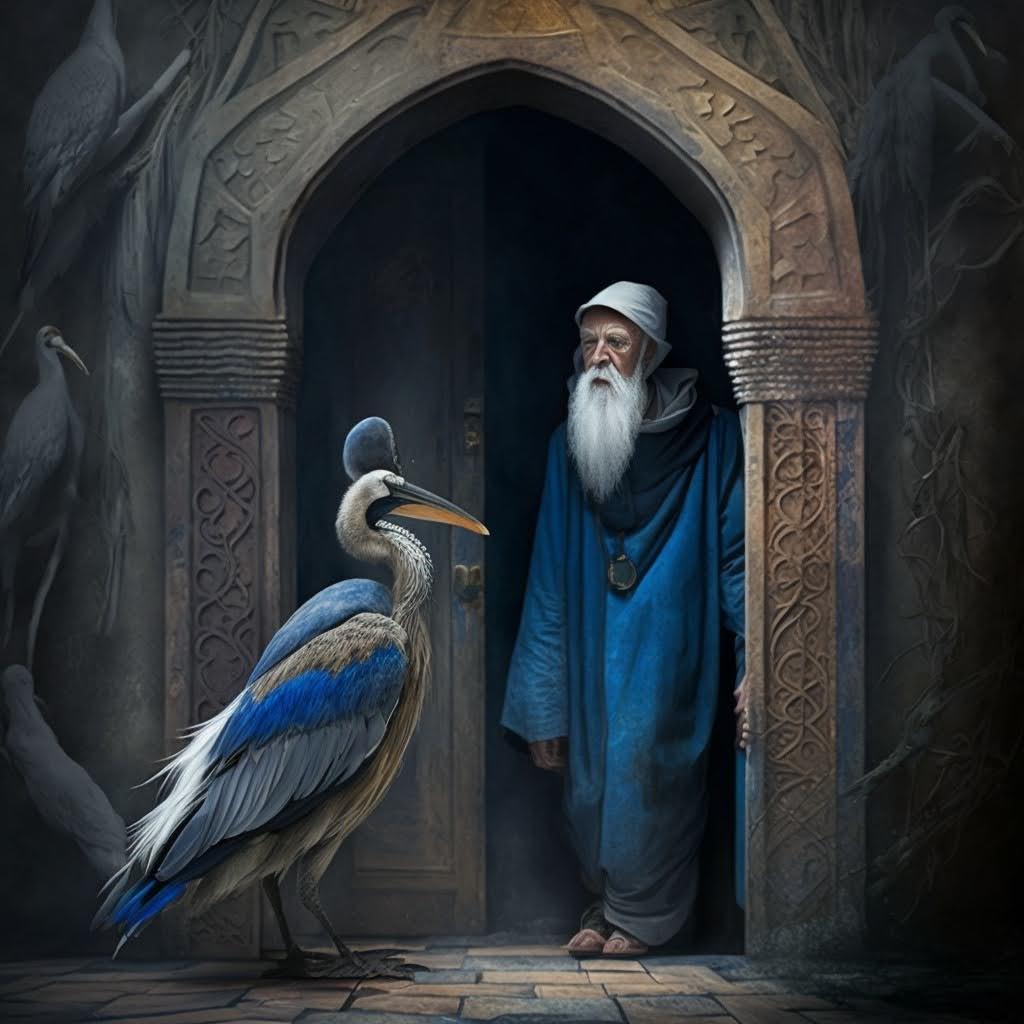
While he was focused on finishing the quest, the interaction with the hermit didn’t seem very helpful. Was he really from the game construct? When it was time to complete the quest and turn the hourglass to set the town back in motion, and resume continuity, some of his words came back to Xavier.
“The town isn’t what it seems. Recognise this precious moment where everything is still and you can realise it for the illusion that it is, a projection of your busy mind. When motion resumes, you will need to keep your mind quiet. The prize in the quest is not the completion of it, but the realisation you can stop the agitation at any moment, and return to what truly matters.”
The hermit had turned to him with clear dark eyes and asked “do you know what you are seeking in these adventures? do you know what truly matters to you?”
When he came out of the game, his quest completed, Xavier felt the words resonate ominously.
A buzz of the phone snapped him out of it.
It was a message from Zara. Apparently she’d found her way back to modernity.
[4:57] “Going to pick up Yasmin at the airport. You better sleep away the jetlag you lazy slugs, we have poultry damn plenty planned ahead – cackling bugger cooking lessons not looking forward to, but can be fun. Talk to you later. Z”
He had the impulse to go with her, but the lack of sleep was hitting back at him now, and he thought he’d better catch some so he could manage to realign with the timezone.
“The old man was right… that sounds like a lot of agitation coming our way…”
February 13, 2023 at 7:45 am #6541In reply to: Orbs of Madjourneys
When Sergio dropped her back at the Flying Fish Inn it was later than Zara realized. The verandah and reception lights were on but everyone had gone to bed, everyone except Idle who was poring over a pile of old notebooks at a dining room table. “Good day out?” she looked up over the top of her reading glasses and smiled at Zara.
Zara returned the smile. “It was great, thanks! I’d love one”, she added when Idle asked her if she fancied a glass of wine.
“Grab a glass off the sideboard there and come and sit down,” Idle said. “Are you hungry or did you grab a bite in Alice?”
“Yeah, I did, thanks,” replied Zara, trying hard not to pull a face at the first sip of the Australian wine. “Nice label,” she said, “Yellow Trail. I should be used to seeing kangaroos on wine bottles by now” she laughed.
“A place called Monte’s Lounge,” she replied when Idle asked where she’d eaten, “A cabaret meets circus theme, not what I was expecting out here. I met a guy on the trail…”
“The plot thickens,” Idle grinned, “Comedy and romance.”
Zara laughed, warming to her genial host. Accepting a second glass of wine, she told Idle all about Sergio. He was a Spanish archaeologist who had come over to see his daughter in Townsville on the east coast, and had booked a few side trips to see some of the indigenous rock art. When Zara walked off the trail after she found the compass (and the damn parrot vanished, leaving her alone) she had found herself in a small clearing with high rocky sides. Sergio had his back to her and was photographing the rock wall.
“Well, long story short, we got on like a house on fire,” Idle smiled encouragingly as Zara continued. “It’s been absolutely ages you know, ever since I left Rupert, nobody’s really taken my fancy. Anyway he invited me for dinner and said he didn’t mind bringing me back here later in the hire car.”
Zara had another sip of wine, thinking about Rupert. What a prize twat he’d turned out to be. Still, the divorce settlement had been good. He’d seemed so adventurous and just the ticket at first, lots of holidays in unusual places. Bit of a Hooray Henry and a Champagne Charlie, but it had been fun at first. And a tad too much charlie, too. She had been blissfully unaware of politics and conspiracy theories at the time, but it wasn’t long before his views came between them and she could no longer stomach his idiotic and, to her mind, dangerously cretinous beliefs.
“My parents are both archaeologists,” Zara told Idle, “I learned a lot from them and always been interested in it, but didn’t fancy all the years of studying, and I really wanted to work with animals. There aren’t many good paying jobs working with animals though, not the kind of animals that need helping. Anyway, it worked out ok in the end, thanks to Rupert’s money.”
“You must have had a lot in common to talk about with Sergio, then, him being an archaeologist,” Idle remarked and Zara felt herself blush, much to her astonishment. She couldn’t recall blushing in years.
“Yes we did do some talking,” they both laughed and Zara said “I better get off to bed. Thanks for the wine.”
Zara had completely forgotten about her friends arriving, or the game she’d intended to play until they arrived. She collapsed on the bed without brushing her teeth and was asleep within minutes.
February 12, 2023 at 9:49 pm #6539In reply to: Prompts of Madjourneys
Zara is the main protagonist, and also the reluctant leader of the game. In RL, she is wandering off the trail nearby Arltunga, Australia, where she is visiting, staying at the small family run inn the Flying Fish Inn. Bert, the local handyman drove her there, told her specifically not to wander off, yet in search of where a mysterious compass she collected on the trail is leading, and egged on by her talking smart parrot “Beautiful Girl”, she goes off the trail to explore. The sun is still high, and she already started to hallucinate some hooded figures with blue frog-faces with jelly-bean carts.
Meanwhile, her friends Youssef and Xavier, just landed from abroad, are driving toward the rendez-vous spot at the Flying Fish Inn. The owners Mater and Idle don’t have any idea where Zara is.
Yasmin, the fourth friend in the group is still on her way from Fiji, bearing a message written in red on an envelope from a mysterious Fred, who we don’t know yet, but seems to be linked to Mater & Idle’s family.
What’s going to happen next to Zara? The game is encouraging her to explore her rudeness in a playful manner, in a medieval setting.
Provide a series of playful and fun actions for Zara, linking these contexts. You may incorporate Tiku, a wise and no-nonsense Aboriginal woman who may guide her though the Dreamtime challenges. Provide random keywords to each action in the list.Here is a list of playful and fun actions for Zara in the game:
- “Follow the Compass”: Zara can follow the mysterious compass she collected on the trail, as it leads her to new locations and challenges. Keywords: Adventure, Exploration, Mystery.
- “Converse with Beautiful Girl”: Zara’s talking smart parrot “Beautiful Girl” may provide humorous commentary and encouragement throughout her journey. Keywords: Humor, Personality, Support.
- “Solve Riddles with Tiku”: Tiku, the wise and no-nonsense Aboriginal woman, can guide Zara through the Dreamtime challenges. To do this, Tiku may present her with riddles or puzzles that she must solve to progress. Keywords: Wisdom, Intelligence, Spirituality.
- “Collect Items”: Zara can collect items along the way, such as artifacts or treasures that may help her in her journey or lead her to new discoveries. Keywords: Collection, Discovery, Help.
- “Play Music with Beautiful Girl”: Zara can play musical instruments with Beautiful Girl, creating an entertaining and musical interlude in her journey. Keywords: Music, Joy, Creativity.
- “Cook with Mater and Idle”: At the Flying Fish Inn, Zara can join Mater and Idle in the kitchen and help them cook traditional dishes from the region. Keywords: Cooking, Culture, Community.
- “Race with Youssef and Xavier”: Zara can engage in friendly races with Youssef and Xavier, such as foot races or cart races, as a way to pass the time and have fun. Keywords: Competition, Speed, Excitement.
These playful and fun actions can add variety and excitement to Zara’s journey and provide an opportunity for players to interact with the world and characters in new and unique ways.
🔁 Regenerate responseFebruary 9, 2023 at 9:50 pm #6520In reply to: Orbs of Madjourneys
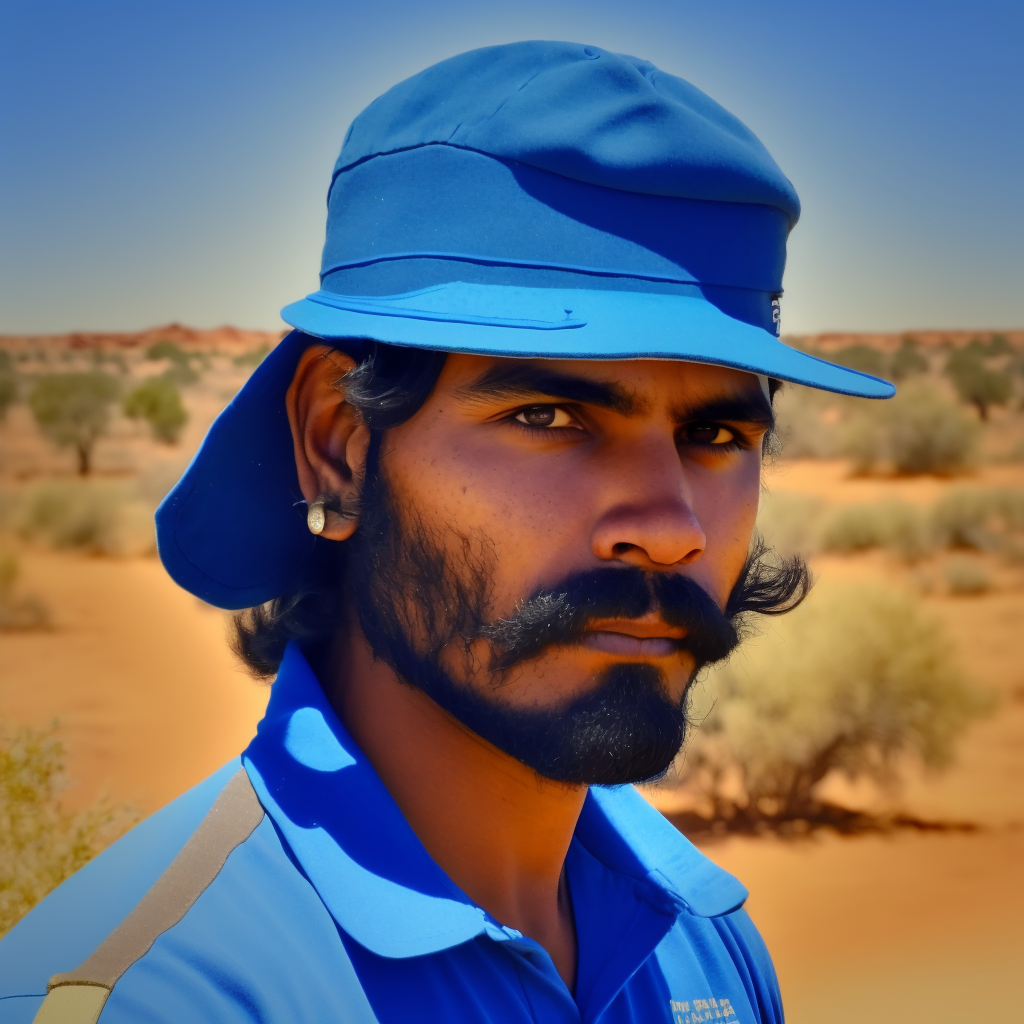

Rajkumar had named his car JUMPY because he said it reminded him of his mother country. He drove like they were in the chaotic streets of an Indian city. Youssef’s fist was clenched on the door handle, his knuckles white. He needed to hold on to something just as much as he was afraid of loosing the door.
He had never been so happy as when Rajkumar stopped in front of his cousin’s shop and restaurant.
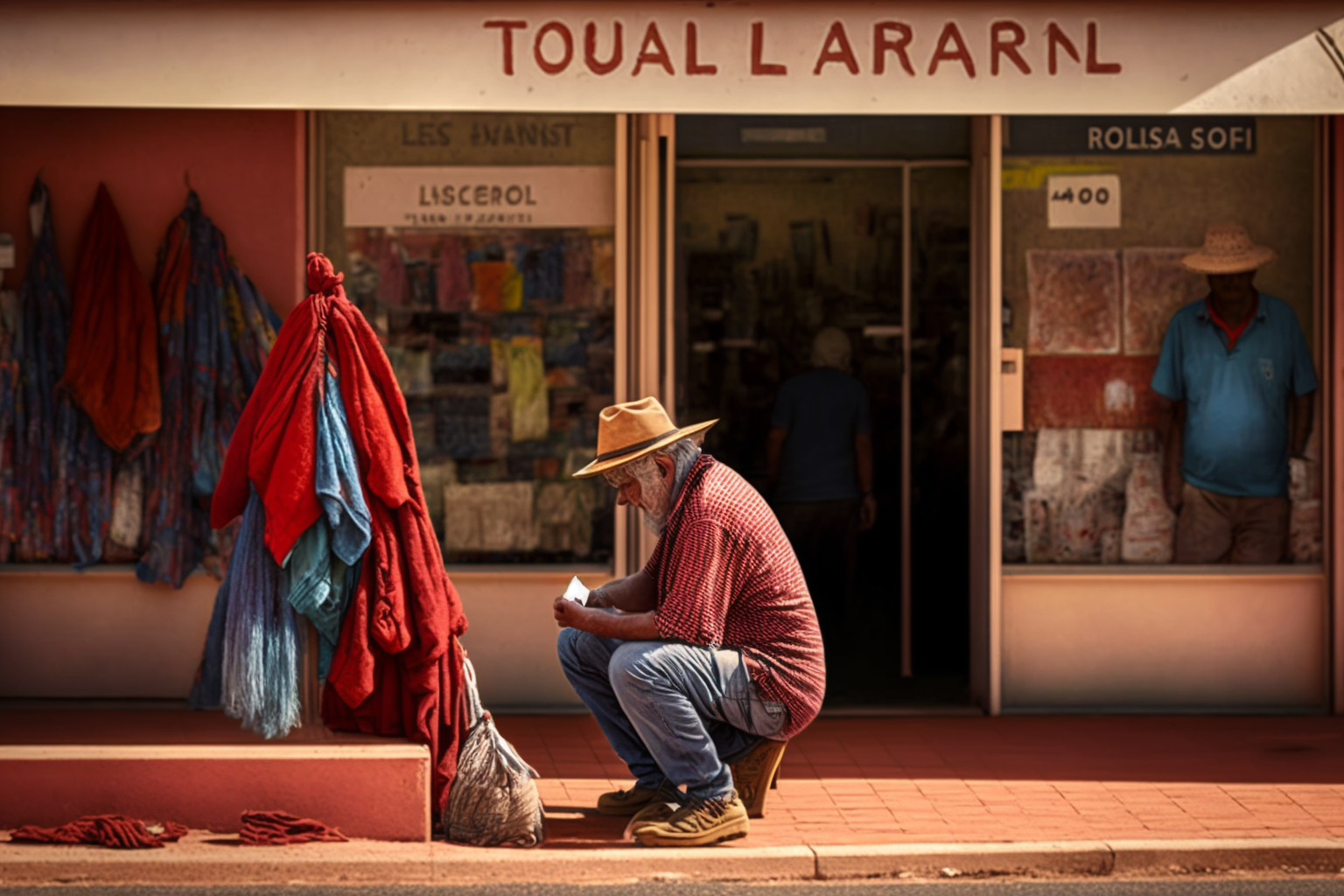 “Just in time for the best butter chicken in all Alice Springs!” said Rajkumar, pointing to the restaurant on the left.
Smells of greasy sauce, meat and spices floated in the air. Despite his legendary hunger, Youssef’s stomach started to protest from the recent treatment on the road. If he had had any doubt, he was sure now that he wouldn’t go on a trip in Jumpy with Rajkumar.
“Maybe I’ll go for the scarf first,” he said.
Rajkumar noded and pointed to the right, to a stout man squating in front of a pile of scarves.
“This is cousin Ashish. You can’t find a better shop in town for scarves,” said Rajkumar. He high fived his cousin who looked like a giant in comparison with the short guide. They talked for a long time in what Youssef assumed to be some Indian dialect. At some point, his guide pointed a finger at him and said : “This big man is looking for a red scarf. I told him you had the best quality in town. Hand made, right from India. Ashish buys and sells the best to the best only. I have to go park the car and tell my other cousin to prepare you a meal. Best Indian food in Alice.”
After he left, cousin Ashish showed Youssef in. At the entrance incense burned at the feet of a couple of colourful Hindu gods. The intoxicating smell reminded him of a stop at a temple during his last trip with the documentary team. The face of Miss Tartiflate jumped into his mind. He would have to take care of THE BLOG at some point, but for now, he was looking for a red scarf. The inside of the shop was as messy as a Mongolian bazaar. Clothes upon clothes, and piles of scarves everywhere.
“Red scarves are over there, said Ashish. Follow me.”
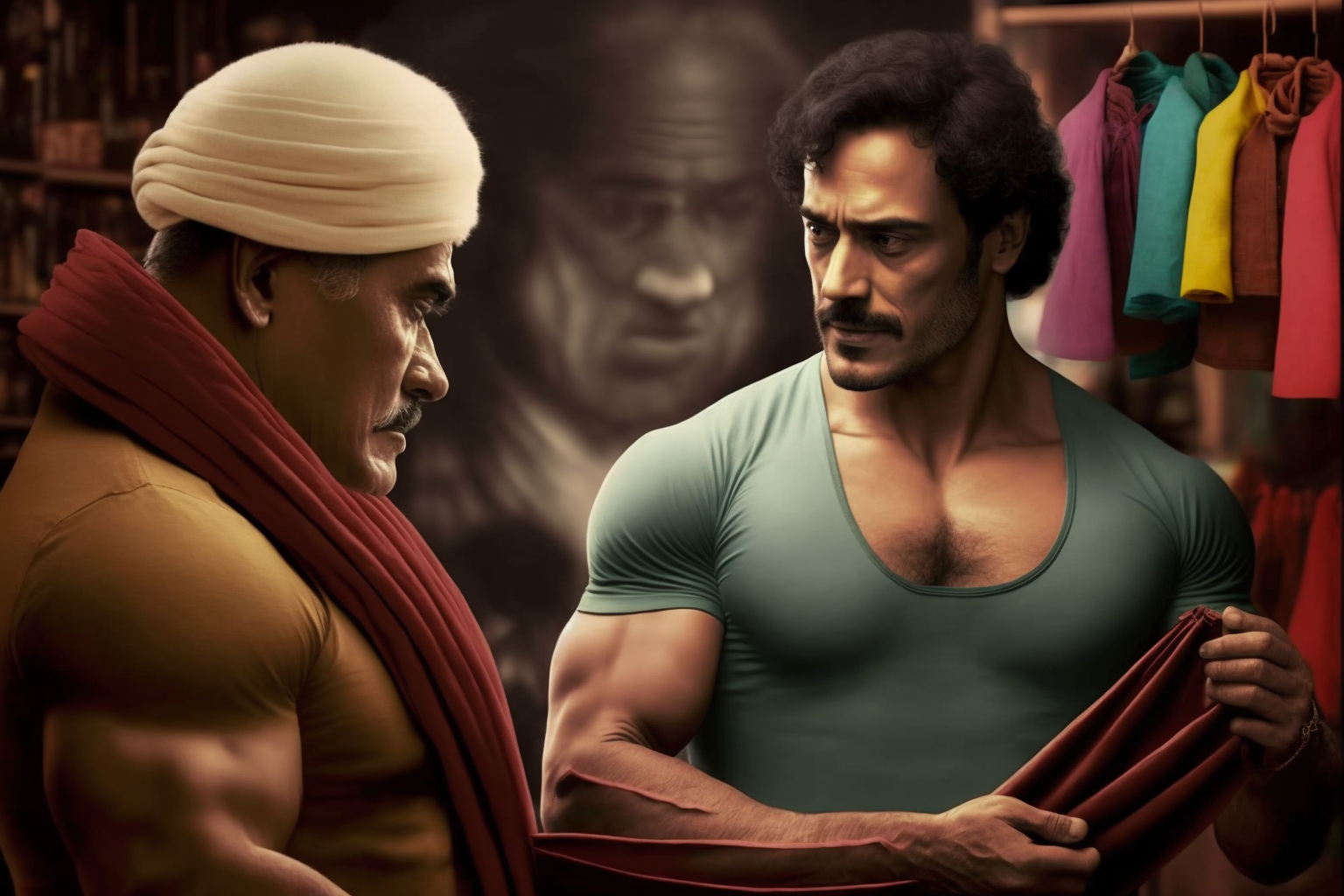
He was less talkative than his cousin, which was a welcome relief. He led Youssef to the back of the shop. On the wall, the portrait in black and white of an old Indian man was watching over their shoulder.
Ashish took one long red scarf and put it around his neck.
“You can touch, he said. Very good quality. Very light. Like you wear nothing.”
Youssef took the end of the fabric in his hand. It felt very silky and light to the touch.
“That’s perfect, I’ll take it”, he said.
His phone buzzed in his pocket. He took it out and checked his messages.
- 📨
[Quirk Land] NEW QUEST OPENED
Looking at the time, it was already noon. Xavier must have landed in Alice already. He started to type a message to his friend :
💬
Meet me for lunch at Todd Mall. Patel indian restaurant next to fabric shopFebruary 7, 2023 at 6:20 pm #6506In reply to: Orbs of Madjourneys
Bert dropped Zara off after breakfast at the start of the Yeperenye trail. He suggested that she phone him when she wanted him to pick her up, and asked if she was sure she had enough water and reminded her, not for the first time, not to wander off the trail. Of course not, she replied blithely, as if she’d never wandered off before.
“It’s a beautiful gorge, you’ll like it,” he called through the open window, “You’ll need the bug spray when you get to the water holes.” Zara smiled and waved as the car roared off in a cloud of dust.
On the short drive to the start of the trail, Bert had told her that the trail was named after the Yeperenye dreamtime, also known as ‘Caterpillar Dreaming’ and that it was a significant dreamtime story in Aboriginal mythology. Be sure to look at the aboriginal rock art, he’d said. He mentioned several varieties of birds but Zara quickly forgot the names of them.
It felt good to be outside, completely alone in the vast landscape with the bone warming sun. To her surprise, she hadn’t seen the parrot again after the encounter at the bedroom window, although she had heard a squalky laugh coming from a room upstairs as she passed the staircase on her way to the dining room.
But it was nice to be on her own. She walked slowly, appreciating the silence and the scenery. Acacia and eucalyptus trees were dotted about and long grasses whispered in the occasional gentle breezes. Birds twittered and screeched and she heard a few rustlings in the undergrowth from time to time as she strolled along.
After a while the rocky outcrops towered above her on each side of the path and the gorge narrowed, the trail winding through stands of trees and open grassland. Zara was glad of the shade as the sun rose higher.

The first water hole she came to took Zara by surprise. She expected it to be pretty and scenic, like the photos she’d seen, but the spectacular beauty of the setting and shimmering light somehow seemed timeless and otherwordly. It was a moment or two before she realized she wasn’t alone.
It was time to stop for a drink and the sandwich that one of the twins had made for her, and this was the perfect spot, but she wondered if the man would find it intrusive of her to plonk herself down and picnic at the same place as him. Had he come here for the solitude and would he resent her appearance?
It is a public trail, she reminded herself not to be silly, but still, she felt uneasy. The man hadn’t even glanced up as far as Zara could tell. Had he noticed her?
She found a smooth rock to sit on under a tree and unwrapped her lunch, glancing up from time to time ready to give a cheery wave and shout hi, if he looked up from what he was doing. But he didn’t look up, and what exactly was he doing? It was hard to say, he was pacing around on the opposite side of the pool, looking intently at the ground.
When Zara finished her drink, she went behind a bush for a pee, making sure she would not be seen if the man glanced up. When she emerged, the man was gone. Zara walked slowly around the water hole, taking photos, and keeping an eye out for the man, but he was nowhere to be seen. When she reached the place where he’d been pacing looking at the ground, she paused and retraced his steps. Something small and shiny glinted in the sun catching her eye. It was a compass, a gold compass, and quite an unusual one.
Zara didn’t know what to do, had the man been looking for it? Should she return it to him? But who was he and where did he go? She decided there was no point in leaving it here, so she put it in her pocket. Perhaps she could ask at the inn if there was a lost and found place or something.
Refreshed from the break, Zara continued her walk. She took the compass out and looked at it, wondering not for the first time how on earth anyone used one to find their way. She fiddled with it, and the needle kept pointing in the same direction. What good is it knowing which way north is, if you don’t know where you are anyway? she wondered.
With a squalk and a beating of wings, Pretty Girl appeared, seemingly out of nowhere. “It’s not that kind of compass. You’re supposed to follow the pointer.”
“Am I? But it’s pointing off the trail, and Bert said don’t go off the trail.”
“That’s because Bert doesn’t want you to find it,” replied the parrot.
Intrigued, Zara set off in the direction the compass was pointing towards.
February 7, 2023 at 2:18 pm #6505In reply to: The Chronicles of the Flying Fish Inn
I told Devan in no ambiguous terms to solve his own funny riddle.
I did try to make an effort, but that seemed a rather desperate way to catch our attention after not really caring about the family for so long.
It was good to see him though.With all the activity around the coming guests at the Inn, it’s easy getting lost in the wind of activities, like the motes of dust hiding in Dido’s hair.
The twins did a good effort though, with all the decorating and stuff. I was sincerely impressed. Been a long time since I’ve been impressed by them. Seems they may actually grow up fine. Who would have known really.Hormonal growth be damned, I’m feeling all sort of contradictory feelings about this.
Like, what about hearing about our funny father after all this time.
And Devan, who’d shut us all off, now back for a little make-over time… Or something else maybe. He doesn’t seem to realize the emotional landscape and baggage here. He’s a nice brother though.
It’s horrible. So much contradiction – I feel some rage on the surface, lots of… and underneath so much caring it’s painful.
So what happened to our father? Still alive? Quite possibly. I’ve had my suspicious when this strange guy posed as a friend to the twins on the social network some years back.
I was young when he left without a note; hadn’t started to write my journals yet, so my memories of him are very little. But I remember the chaos left after him; Mater wasn’t really the same after. I think she’s burned all pictures of him, and somehow pretends they never existed.
Idle plays it as if she doesn’t care, but I’m sure she does. She doesn’t want to let it be known, but she probably doesn’t want to hurt Mater more with this.God, what a family drama. Why would Devan want to unearth all of this now, at a moment we were all quiet and settled like a decent respectable family.
It was maybe just keeping up with appearances, and the veneer was thin to start with.
That’s in the middle of all this angst mixed with puberty that it hit me.
Acrostic. Or ἀκροστιχίς in Greek. First verse, or first letter.
My dad was a writer, so he liked word riddles. And the little sign was a pointer.
>A mine, a tile, dust piled high,
Together they rest, yet always outside.
One misstep, and you’ll surely fall,
Into the depths, where danger lies all.ATOI didn’t seem to make much sense, but I remembered how small “l” sometimes looked like a capital “I”.
Atoll was the clue I’m sure of it. Where to disappear if not to islands.
The letters at the end of the verses are spelling HELL. So it’s opposite.Basically, Atoll Paradise.
A little Gugu search with AI, and that was it. That was our father here, with a number to call.
Atoll Paradise
Boat rentals – Island tours
Copywriter, biographer
Call FRED @ (+679) 215-7644Now it’ll be fair if Devan is calling me crazy. We’ll have to call and check before saying anything to Idle or even Mater for now.
February 1, 2023 at 12:57 pm #6487In reply to: The Chronicles of the Flying Fish Inn
I’ve always felt like the odd one out in my family. Growing up at the Flying Fish Inn, I’ve always felt like I was on the outside looking in. My mother left when I was young, and my father disappeared not long after. I’ve always felt like I was the only one who didn’t fit in with the craziness of my family.
I’ve always tried to keep my distance with the others. I didn’t want to get too involved, take sides about petty things, like growing weed in the backyard, making psychedelic termite honey, or trying to influence the twins to buy proper clothes. But truth is, you can’t get too far away. Town’s too small. Family always get back to you, and manage to get you involved in their shit, one way or another, even if you don’t say anything. That’s how it works. They don’t need my participation to use me as an argument.
So I stopped paying attention, almost stopped caring. I lived my life working at the gas station, and drinking beers with my buddies Joe and Jasper, living in a semi-comatose state. I learned that word today when I came bringing little honey buns to mater. I know she secretly likes them, even if she pretend she doesn’t in front of Idle. But I can see the breadcrumbs on her cardigan when I come say hi at the end of the day. This morning, Idle was rocking in her favourite chair on the porch, looking at the clouds behind her mirrored sunglasses. Prune was talking to her, I saw she was angry because of the contraction of the muscles of her jaw and her eyes were darker than usual. She was saying to Idle that she was always in a semi-comatose state and doing nothing useful for the Inn when we had a bunch of tourists arriving. And something about the twins redecorating the rooms without proper design knowledge. Idle did what she usually does. She ignored the comment and kept on looking at the clouds. I’m not even sure she heard or understood that word that Prune said. Semi-comatose. It sounds like glucose. That’s how I’m spending my life between the Inn, the gas station and my buddies.
But things changed today when I got back to my apartment for lunch. You can call it a hunch or a coincidence. But as we talked with Joe about that time when my dad left, making me think we were doing hide and seek, and he left me a note saying he would be back someday. I don’t know why I felt the need to go search that note afterwards. So I went back to the apartment and opened the mailbox. Among the bills and ads, I found a postcard with a few words written on the image and nothing except my address on the back. I knew it was from my dad.
It was not signed or anything, but still I was sure it was his handwriting. I would recognise it anywhere. I went and took the shoebox I keep hidden on top of the kitchen closet, because I saw people do that in movies. That’s not very original, I know, but I’m not too bright either. I opened the box and took the note my dad left me when he disappeared.
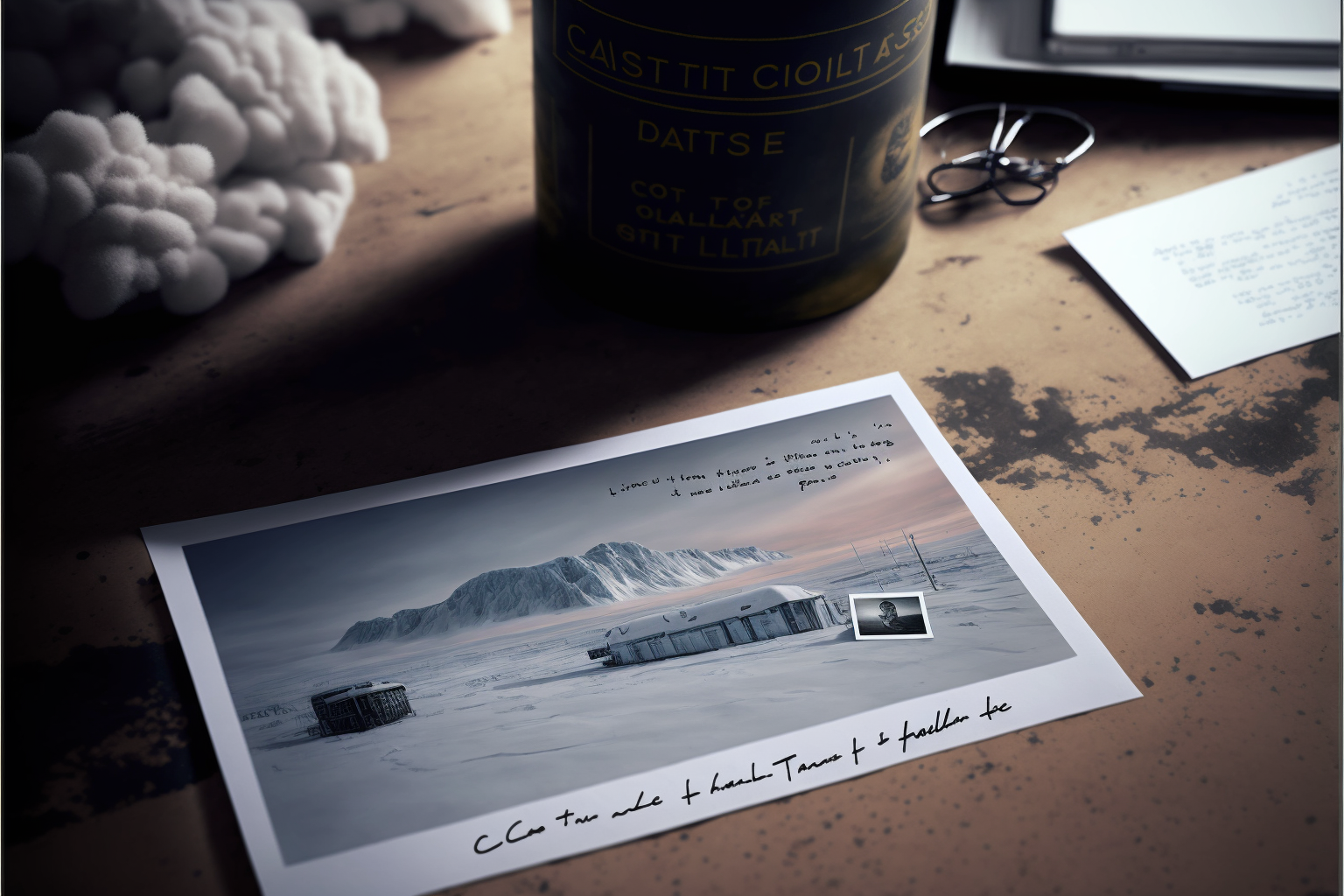 I put the card on the desk near the note. The handwritings matched. I felt so excited, and confused.
A few words at the bottom of the card said : “Memories from the coldest place on Earth…”
Why would dad go to such a place to send me a postcard after all those years ? Just to say that.
That’s when I recalled what Prune had told me once as we were watching a detective movie : “Read everything with care and always double check your information.”
On the back, it said that the image was from a scientific station in Antartica, but the stamp indicated it had been posted from a floating post office in the North Pole. I turned the card and looked at the text again. Above the station, a few words were written that sounded like a riddle.
> A mine, a tile, dust piled high,
Together they rest, yet always outside.
One misstep, and you’ll surely fall,
Into the depths, where danger lies all.It sure sounds like a warning. But I’m not too good with riddles. No need to worry Mater about that, in case of false hope and all that. Idle ? Don’t even think about it. She won’t believe me when I say it’s from dad. She never does believe me. And she’ll keep playing with the words trying to find her answer in the shape of smoke. The twins, they are a riddle on their own.
No. It’s Prune’s help I need.
January 29, 2023 at 2:30 pm #6467In reply to: Newsreel from the Rim of the Realm
“Ricardo, my dear, those new reporters are quite the catch.”
Miss Bossy Pants remarked as she handed him the printed report. “Imagine that, if you can. A preliminary report sent, even before asking, AND with useful details. It’s as though they’re a new generation with improbable traits definitely not inherited from their forebearers…”
Ricardo scanned the document, a look of intrigue on his face. “Indeed, they seem to have a knack for getting things done. I can’t help but notice that our boy Sproink omitted that Sweet Sophie had used her remote viewing skills to point out something was of interest on the Rock of Gibraltar. I wonder how much that influenced his decision to seek out Dr. Patelonus.”
Miss Bossy Pants leaned back in her chair, a sly smile creeping across her lips. “Well, don’t quote me later on this, but some level of initiative is a valuable trait in a journalist. We can’t have drones regurgitating soothing nonsense. We need real, we need grit.” She paused in mid sentence. “By the way, heard anything from Hilda & Connie? I do hope they’re getting something back from this terribly long detour in the Nordics.”
Dear Miss Bossy Pants,
I am writing to give you a preliminary report on my investigation into the strange occurrences of Barbary macaques in Cartagena, Spain.
Taking some initiative and straying from your initial instructions, I first traveled to Gibraltar to meet with Dr. Patelonus, an expert in simiantics (the study of ape languages). Dr. Patelonus provided me with valuable insights into the behavior of Barbary macaques, including their typical range and habits and what they may be after. He also mentioned that the recent reports of Barbary macaques venturing further away from their usual habitat in coastal towns like Cartagena is highly unusual, and that he suspects something else is influencing them. He mentioned chatter on the simian news netwoke, that his secretary, a lovely female gorilla by the name of Barbara was kind enough to get translated for us.
I managed to find a wifi spot to send you this report before I board the next bus to Cartagena, where I plan to collect samples and observe the local macaque population. I have spoken with several tourists in Gib’ who have reported being assaulted and having their shoes stolen by the apes. It is again, a highly unusual behaviour for Barbary macaques, who seem untempted by the food left to appease them as a distraction, and I am currently trying to find out the reason behind this.
As soon as I gather them, I will send samples collected in situ without delay to my colleague Giles Gibber at the newspaper for analysis. Hopefully, his findings will shed some light on the situation.
I will continue my investigation and keep you appraised on any new developments.
Sincerely,
Samuel Sproink
Rim of the Realm Newspaper.January 23, 2023 at 6:13 am #6448In reply to: Orbs of Madjourneys
In the muggy warmth of the night, Yasmin tossed and turned on her bed. A small fan on the bedside table rattled noisily next to her but did little to dispel the heat. She kicked the thin sheet covering her to the ground, only to retrieve it and gather it tightly around herself when she heard a familiar sound.
“You little shit,” she hissed, slapping wildly in the direction of the high pitched whine.
She could make out the sound of a child crying in the distance and briefly considered getting up to check before hearing quick footsteps pass her door. Sister Aliti was on duty tonight. She liked Sister Aliti with her soft brown eyes and wide toothy smile — nothing seemed to rattle her. She liked all the Nuns, perhaps with the exception of Sister Finnlie.
Sister Finnlie was a sharp faced woman who was obsessed with cleanliness and sometimes made the children cry for such silly little things … perhaps if they talked too loudly or spilled some crumbs on the floor at lunch time. “Let them be, Sister,” Sister Aliti would admonish her and Sister Finnlie would pinch her lips and make a huffing noise.
The other day, during the morning reflection time when everyone sat in silent contemplation, Yasmin had found herself fixated on Sister Finnlie’s hands, her thin fingers tidily entwined on her lap. And Yasmin remembered a conversation with her friends online about AI creating a cleaning woman with sausage fingers. “Sometimes they look like a can of worms,” Youssef had said.
And, looking at those fingers and thinking about Youssef and the others and the fun conversations they had, Yasmin snort laughed.
She had tried to suppress it but the more she tried the more it built up inside of her until it exploded from her nose in a loud grunting noise. Sister Aliti had giggled but Sister Finnlie had glared at Yasmin and very pointedly rolled her eyes. Later, she’d put her on bin cleaning duty, surely the worst job ever, and Yasmin knew for sure it was pay back.
January 11, 2023 at 8:44 pm #6366In reply to: Train your subjective AI – text version
Asking the AI to expand on the glossary of the original Circle of Eights Story:
Locations
Malvina’s Cave: A dark and damp cave located in the heart of the Gripshawk mountains, known for its population of Glukenitch creatures.
Lan’ork: A vast and diverse continent known for its Eastern Lagunas, home to the Indogo flamingos. Dragon Head Peninsula: A rugged and mountainous region, home to the Langoat creatures and also known for its rich deposits of dragon ore.
Asgurdy: A sprawling desert region, known for its nomadic tribes who use Saurhse as mounts for transportation.
Golfindely: An idyllic coastal region known for its beautiful beaches and crystal clear waters, home to the Golfindel and Grake creatures.
Magical Schools
Dragonian Magic: A form of magic that is practiced by Dragonriders and Dragon tamers, which involves the manipulation of dragon energy and bonding with dragon companions.
Gripshawk Magic: A form of magic that is practiced by Gripshawks, which involves the manipulation of the natural elements and telepathic communication with other creatures.
Ugling Magic: A form of magic that is practiced by Uglings, which involves the use of charms, spells, and potions to manipulate the physical world.
Guilds
Dragon Riders Guild: A prestigious guild of dragon riders, responsible for maintaining peace and order in the world by using their dragon companions for protection and transportation.
Gripshawk Hunters Guild: A guild of skilled hunters who specialize in hunting and capturing exotic creatures for various purposes.
Ugling Alchemists Guild: A guild of alchemists and potion makers, who create various potions and elixirs for medicinal and magical purposes.
Organizations
The Order of the Buntifluën: A secret organization dedicated to the study and use of Buntifluën artefacts for the betterment of communication and understanding between sentient beings.
The Glubolín Network: A network of individuals who possess Glubolín devices, used for communication and sharing information across long distances.
The Sabulmantium Society: A society of scholars and adventurers who study the properties and uses of Sabulmantium devices for divination and navigation.
Here are a few new invented terms with their potential IPA pronunciations and definitions that would fit in this fantasy world:
Dragons:
Krynn [ ˈkrĭn ] : A subspecies of dragon known for its ability to control and manipulate time.
Creatures:
Kelpies [ ˈkĕl-pēz ] : Aquatic creatures resembling horses, known for their ability to shape-shift and lure unsuspecting victims into the water.
Magical Artefacts:
Dragonwhisper [ ˈdrā-gən-ˌhwis-pər ] : An ancient and powerful magical artifact, which allows the user to communicate and control dragons telepathically.
Necrotalisman [ ˈnĕk-rə-ˈtā-lĭz-mən ] : A magical artifact in the shape of a talisman that grants its wielder the ability to control and summon the dead.
Plants:
Blightthorn [ ˈblīt-ˌthôrn ] : A poisonous plant known for its dark purple flowers and thorny stem, its extract is used in dark magic
Faeleaf [ ˈfā-ˌlēf ] : A rare plant found in the deep forest known for its bright green leaves, its extract is used in healing potions
Locations:
The Shadowland [ ˈshā-dō-ˌland ] : A mysterious and dangerous land overrun by dark magic and controlled by Necromancers.
The Hidden Vale [ ˈhī-dən-ˈvāl ] : A secluded valley located deep in the mountains, home to the reclusive Faeleaf plants.
Organization:
The Necromancers’ Circle [ ˈnĕk-rə-ˈmän-sər-z-ˈsər-kəl ] : A secret organization of powerful necromancers who seek to expand their control over death and the dead.
Here are a few more invented terms with their potential IPA pronunciations and definitions that fit in this fantasy world, having less to do with necromancy, and more with various forms of consciousness or energy manipulation, magical or mythical creatures or species:
Creatures:
Eterneon [ ˈē-tər-ˈnē-ən ] : A species of winged creatures known for their ability to manipulate and harness the energy of the stars, they are highly sought after by astromancers and star-gazers.
Psicon [ ˈsī-ˌkän ] : A species of psychic creatures, known for their ability to read minds and influence emotions.
Magical Artefacts:
Energyshield [ ˈen-ər-jē-ˌshēld ] : A magical artifact that creates a protective barrier around the user, deflecting or absorbing any kind of energy-based attacks.
Empathstone [ ˈĕm-pāth-ˈstōn ] : A small, glowing stone which allows the user to sense and control the emotions of others.
Magical Schools:
Energyshaping [ ˈen-ər-jē-ˌshāp-ing ] : A school of magic that involves the manipulation and control of various forms of energy.
Empathymagic [ ˈĕm-pā-thē-ˈmaj-ik ] : A school of magic that involves the manipulation of emotions and the ability to sense the emotions of others.
Locations:
Eternity’s Edge [ ˈē-tər-nə-tēz-ˈēj] : A remote and mysterious cliff located high in the mountains, known for its strong emanations of star energy and rumored to be home to a hidden community of Eterneons.
Psicon’s Den [ ˈsī-kän-z-ˈdĕn] : A secret cave system located deep within the forest, it is said to be home to a colony of Psicon creatures.
Organizations:
The Energists Guild [ ˈen-ər-jist-z-ˈgild] : A powerful guild of magic users specializing in Energyshaping magic.
The Empath Council [ ˈĕm-pāth-ˈkoun-səl]: A secretive group of Empathymagic users, dedicated to the study and control of emotions.
January 10, 2023 at 10:14 pm #6362In reply to: Train your subjective AI – text version
write a short story based on the following cloud of words:
pride bet shouted lit wibberly case highly ours unless paid spend twice gay talking heads elizabeth in entries drink kill baker

“Gay baker triumphs over adversity”
Once upon a time, there was a gay baker named Elizabeth who took a great deal of pride in her craft. She spent twice the amount of money on high-quality ingredients and put in extra effort to make her baked goods stand out from the rest. However, her small town was not particularly accepting of the LGBT community, and she often faced discrimination from her neighbors.
One day, a group of men from the town entered her bakery and began shouting homophobic slurs at her. Elizabeth, feeling hurt and humiliated, decided that she would not let their hateful words get to her. She refused to back down and instead, decided to put all of her energy into creating a spectacular cake for the annual county fair.
She worked tirelessly on the cake, putting in long hours and experimenting with new flavors and techniques. The day of the fair finally arrived and Elizabeth brought her entry to be judged. To her surprise and delight, her cake was declared the winner and she was awarded a blue ribbon.
As she stood on stage holding her ribbon, Elizabeth couldn’t help but think about the men who had shouted at her in her bakery. She realized that their words no longer had power over her and she felt a sense of vindication. She knew that she had proven to herself and to her community that she was a skilled baker and a worthy member of society, regardless of her sexual orientation.
Feeling elated, Elizabeth closed the bakery for the day and went to the local bar where she met her friends, and they all drinks together, she was happy and felt like nothing can bring her down, as she went back home she felt like a new person, someone who has overcome prejudice and discrimination, she felt like a winner not just in the fair but in life.
The end.
December 6, 2022 at 2:17 pm #6350In reply to: Family Stories From The Other Side ~ Book Two
Transportation
Isaac Stokes 1804-1877
Isaac was born in Churchill, Oxfordshire in 1804, and was the youngest brother of my 4X great grandfather Thomas Stokes. The Stokes family were stone masons for generations in Oxfordshire and Gloucestershire, and Isaac’s occupation was a mason’s labourer in 1834 when he was sentenced at the Lent Assizes in Oxford to fourteen years transportation for stealing tools.
Churchill where the Stokes stonemasons came from: on 31 July 1684 a fire destroyed 20 houses and many other buildings, and killed four people. The village was rebuilt higher up the hill, with stone houses instead of the old timber-framed and thatched cottages. The fire was apparently caused by a baker who, to avoid chimney tax, had knocked through the wall from her oven to her neighbour’s chimney.
Isaac stole a pick axe, the value of 2 shillings and the property of Thomas Joyner of Churchill; a kibbeaux and a trowel value 3 shillings the property of Thomas Symms; a hammer and axe value 5 shillings, property of John Keen of Sarsden.
(The word kibbeaux seems to only exists in relation to Isaac Stokes sentence and whoever was the first to write it was perhaps being creative with the spelling of a kibbo, a miners or a metal bucket. This spelling is repeated in the criminal reports and the newspaper articles about Isaac, but nowhere else).
In March 1834 the Removal of Convicts was announced in the Oxford University and City Herald: Isaac Stokes and several other prisoners were removed from the Oxford county gaol to the Justitia hulk at Woolwich “persuant to their sentences of transportation at our Lent Assizes”.
via digitalpanopticon:
Hulks were decommissioned (and often unseaworthy) ships that were moored in rivers and estuaries and refitted to become floating prisons. The outbreak of war in America in 1775 meant that it was no longer possible to transport British convicts there. Transportation as a form of punishment had started in the late seventeenth century, and following the Transportation Act of 1718, some 44,000 British convicts were sent to the American colonies. The end of this punishment presented a major problem for the authorities in London, since in the decade before 1775, two-thirds of convicts at the Old Bailey received a sentence of transportation – on average 283 convicts a year. As a result, London’s prisons quickly filled to overflowing with convicted prisoners who were sentenced to transportation but had no place to go.
To increase London’s prison capacity, in 1776 Parliament passed the “Hulks Act” (16 Geo III, c.43). Although overseen by local justices of the peace, the hulks were to be directly managed and maintained by private contractors. The first contract to run a hulk was awarded to Duncan Campbell, a former transportation contractor. In August 1776, the Justicia, a former transportation ship moored in the River Thames, became the first prison hulk. This ship soon became full and Campbell quickly introduced a number of other hulks in London; by 1778 the fleet of hulks on the Thames held 510 prisoners.
Demand was so great that new hulks were introduced across the country. There were hulks located at Deptford, Chatham, Woolwich, Gosport, Plymouth, Portsmouth, Sheerness and Cork.The Justitia via rmg collections:
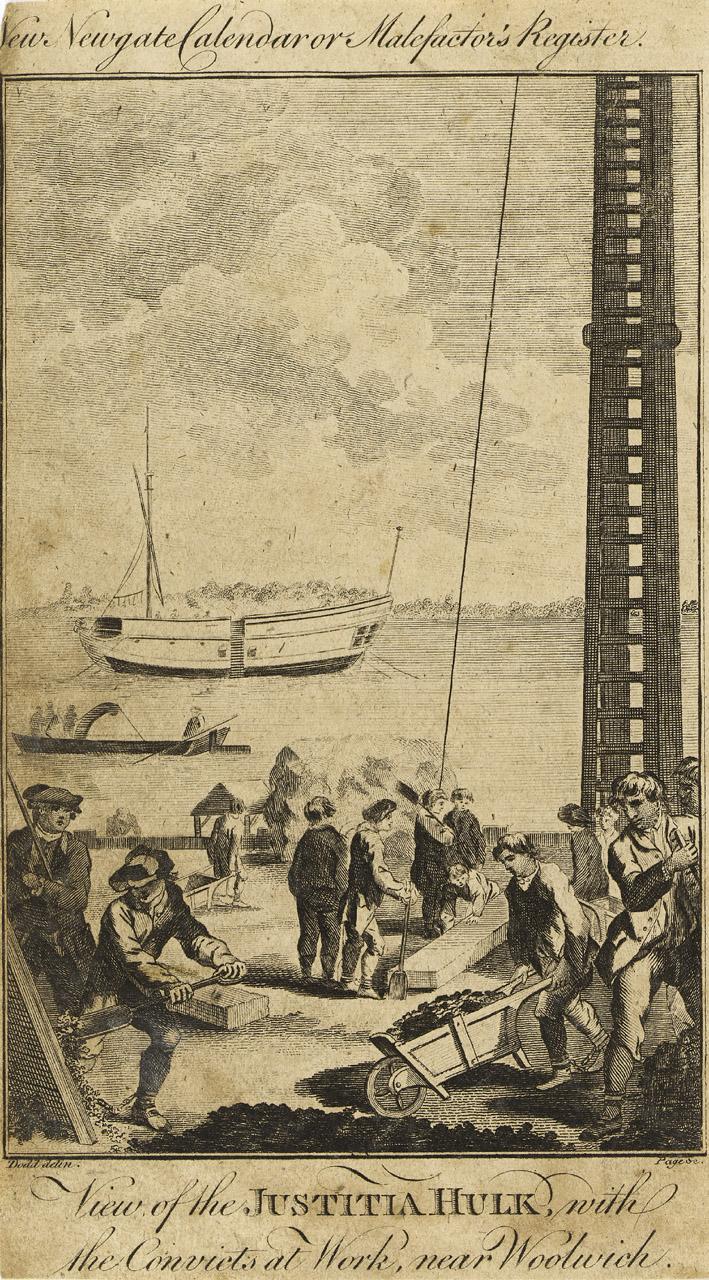
Convicts perform hard labour at the Woolwich Warren. The hulk on the river is the ‘Justitia’. Prisoners were kept on board such ships for months awaiting deportation to Australia. The ‘Justitia’ was a 260 ton prison hulk that had been originally moored in the Thames when the American War of Independence put a stop to the transportation of criminals to the former colonies. The ‘Justitia’ belonged to the shipowner Duncan Campbell, who was the Government contractor who organized the prison-hulk system at that time. Campbell was subsequently involved in the shipping of convicts to the penal colony at Botany Bay (in fact Port Jackson, later Sydney, just to the north) in New South Wales, the ‘first fleet’ going out in 1788.
While searching for records for Isaac Stokes I discovered that another Isaac Stokes was transported to New South Wales in 1835 as well. The other one was a butcher born in 1809, sentenced in London for seven years, and he sailed on the Mary Ann. Our Isaac Stokes sailed on the Lady Nugent, arriving in NSW in April 1835, having set sail from England in December 1834.
Lady Nugent was built at Bombay in 1813. She made four voyages under contract to the British East India Company (EIC). She then made two voyages transporting convicts to Australia, one to New South Wales and one to Van Diemen’s Land (Tasmania). (via Wikipedia)
via freesettlerorfelon website:
On 20 November 1834, 100 male convicts were transferred to the Lady Nugent from the Justitia Hulk and 60 from the Ganymede Hulk at Woolwich, all in apparent good health. The Lady Nugent departed Sheerness on 4 December 1834.
SURGEON OLIVER SPROULE
Oliver Sproule kept a Medical Journal from 7 November 1834 to 27 April 1835. He recorded in his journal the weather conditions they experienced in the first two weeks:
‘In the course of the first week or ten days at sea, there were eight or nine on the sick list with catarrhal affections and one with dropsy which I attribute to the cold and wet we experienced during that period beating down channel. Indeed the foremost berths in the prison at this time were so wet from leaking in that part of the ship, that I was obliged to issue dry beds and bedding to a great many of the prisoners to preserve their health, but after crossing the Bay of Biscay the weather became fine and we got the damp beds and blankets dried, the leaks partially stopped and the prison well aired and ventilated which, I am happy to say soon manifested a favourable change in the health and appearance of the men.
Besides the cases given in the journal I had a great many others to treat, some of them similar to those mentioned but the greater part consisted of boils, scalds, and contusions which would not only be too tedious to enter but I fear would be irksome to the reader. There were four births on board during the passage which did well, therefore I did not consider it necessary to give a detailed account of them in my journal the more especially as they were all favourable cases.
Regularity and cleanliness in the prison, free ventilation and as far as possible dry decks turning all the prisoners up in fine weather as we were lucky enough to have two musicians amongst the convicts, dancing was tolerated every afternoon, strict attention to personal cleanliness and also to the cooking of their victuals with regular hours for their meals, were the only prophylactic means used on this occasion, which I found to answer my expectations to the utmost extent in as much as there was not a single case of contagious or infectious nature during the whole passage with the exception of a few cases of psora which soon yielded to the usual treatment. A few cases of scurvy however appeared on board at rather an early period which I can attribute to nothing else but the wet and hardships the prisoners endured during the first three or four weeks of the passage. I was prompt in my treatment of these cases and they got well, but before we arrived at Sydney I had about thirty others to treat.’
The Lady Nugent arrived in Port Jackson on 9 April 1835 with 284 male prisoners. Two men had died at sea. The prisoners were landed on 27th April 1835 and marched to Hyde Park Barracks prior to being assigned. Ten were under the age of 14 years.
The Lady Nugent:
Isaac’s distinguishing marks are noted on various criminal registers and record books:
“Height in feet & inches: 5 4; Complexion: Ruddy; Hair: Light brown; Eyes: Hazel; Marks or Scars: Yes [including] DEVIL on lower left arm, TSIS back of left hand, WS lower right arm, MHDW back of right hand.”
Another includes more detail about Isaac’s tattoos:
“Two slight scars right side of mouth, 2 moles above right breast, figure of the devil and DEVIL and raised mole, lower left arm; anchor, seven dots half moon, TSIS and cross, back of left hand; a mallet, door post, A, mans bust, sun, WS, lower right arm; woman, MHDW and shut knife, back of right hand.”
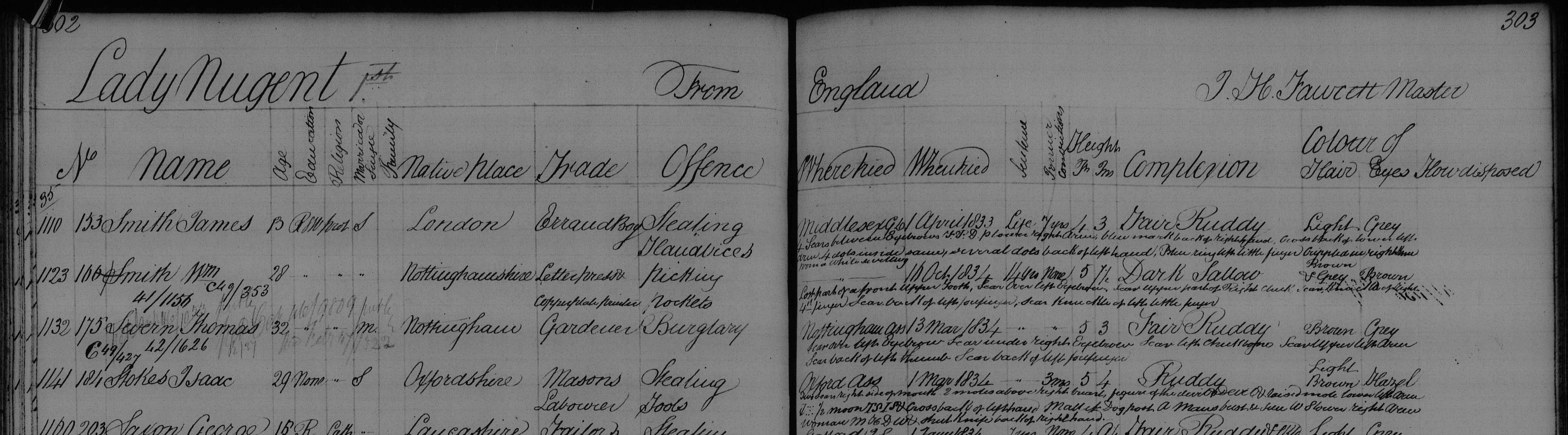
From How tattoos became fashionable in Victorian England (2019 article in TheConversation by Robert Shoemaker and Zoe Alkar):
“Historical tattooing was not restricted to sailors, soldiers and convicts, but was a growing and accepted phenomenon in Victorian England. Tattoos provide an important window into the lives of those who typically left no written records of their own. As a form of “history from below”, they give us a fleeting but intriguing understanding of the identities and emotions of ordinary people in the past.
As a practice for which typically the only record is the body itself, few systematic records survive before the advent of photography. One exception to this is the written descriptions of tattoos (and even the occasional sketch) that were kept of institutionalised people forced to submit to the recording of information about their bodies as a means of identifying them. This particularly applies to three groups – criminal convicts, soldiers and sailors. Of these, the convict records are the most voluminous and systematic.
Such records were first kept in large numbers for those who were transported to Australia from 1788 (since Australia was then an open prison) as the authorities needed some means of keeping track of them.”On the 1837 census Isaac was working for the government at Illiwarra, New South Wales. This record states that he arrived on the Lady Nugent in 1835. There are three other indent records for an Isaac Stokes in the following years, but the transcriptions don’t provide enough information to determine which Isaac Stokes it was. In April 1837 there was an abscondment, and an arrest/apprehension in May of that year, and in 1843 there was a record of convict indulgences.
From the Australian government website regarding “convict indulgences”:
“By the mid-1830s only six per cent of convicts were locked up. The vast majority worked for the government or free settlers and, with good behaviour, could earn a ticket of leave, conditional pardon or and even an absolute pardon. While under such orders convicts could earn their own living.”
In 1856 in Camden, NSW, Isaac Stokes married Catherine Daly. With no further information on this record it would be impossible to know for sure if this was the right Isaac Stokes. This couple had six children, all in the Camden area, but none of the records provided enough information. No occupation or place or date of birth recorded for Isaac Stokes.
I wrote to the National Library of Australia about the marriage record, and their reply was a surprise! Issac and Catherine were married on 30 September 1856, at the house of the Rev. Charles William Rigg, a Methodist minister, and it was recorded that Isaac was born in Edinburgh in 1821, to parents James Stokes and Sarah Ellis! The age at the time of the marriage doesn’t match Isaac’s age at death in 1877, and clearly the place of birth and parents didn’t match either. Only his fathers occupation of stone mason was correct. I wrote back to the helpful people at the library and they replied that the register was in a very poor condition and that only two and a half entries had survived at all, and that Isaac and Catherines marriage was recorded over two pages.
I searched for an Isaac Stokes born in 1821 in Edinburgh on the Scotland government website (and on all the other genealogy records sites) and didn’t find it. In fact Stokes was a very uncommon name in Scotland at the time. I also searched Australian immigration and other records for another Isaac Stokes born in Scotland or born in 1821, and found nothing. I was unable to find a single record to corroborate this mysterious other Isaac Stokes.
As the age at death in 1877 was correct, I assume that either Isaac was lying, or that some mistake was made either on the register at the home of the Methodist minster, or a subsequent mistranscription or muddle on the remnants of the surviving register. Therefore I remain convinced that the Camden stonemason Isaac Stokes was indeed our Isaac from Oxfordshire.
I found a history society newsletter article that mentioned Isaac Stokes, stone mason, had built the Glenmore church, near Camden, in 1859.
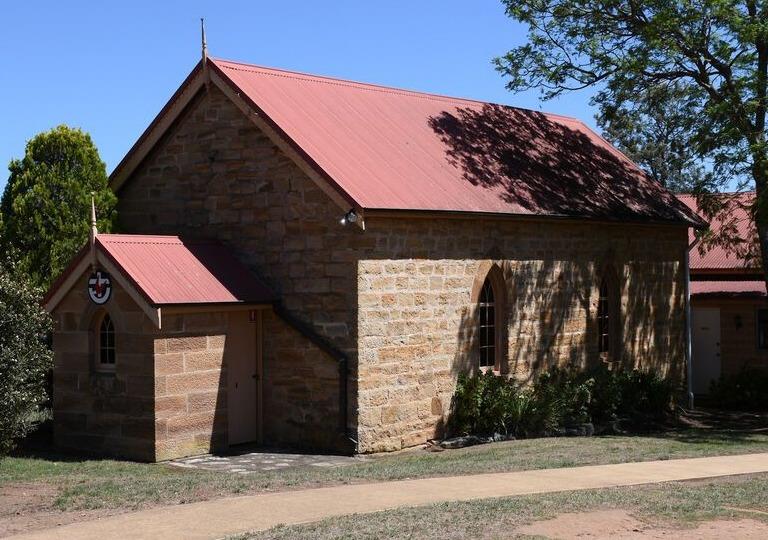
From the Wollondilly museum April 2020 newsletter:
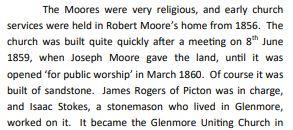
From the Camden History website:
“The stone set over the porch of Glenmore Church gives the date of 1860. The church was begun in 1859 on land given by Joseph Moore. James Rogers of Picton was given the contract to build and local builder, Mr. Stokes, carried out the work. Elizabeth Moore, wife of Edward, laid the foundation stone. The first service was held on 19th March 1860. The cemetery alongside the church contains the headstones and memorials of the areas early pioneers.”
Isaac died on the 3rd September 1877. The inquest report puts his place of death as Bagdelly, near to Camden, and another death register has put Cambelltown, also very close to Camden. His age was recorded as 71 and the inquest report states his cause of death was “rupture of one of the large pulmonary vessels of the lung”. His wife Catherine died in childbirth in 1870 at the age of 43.
Isaac and Catherine’s children:
William Stokes 1857-1928
Catherine Stokes 1859-1846
Sarah Josephine Stokes 1861-1931
Ellen Stokes 1863-1932
Rosanna Stokes 1865-1919
Louisa Stokes 1868-1844.
It’s possible that Catherine Daly was a transported convict from Ireland.
Some time later I unexpectedly received a follow up email from The Oaks Heritage Centre in Australia.
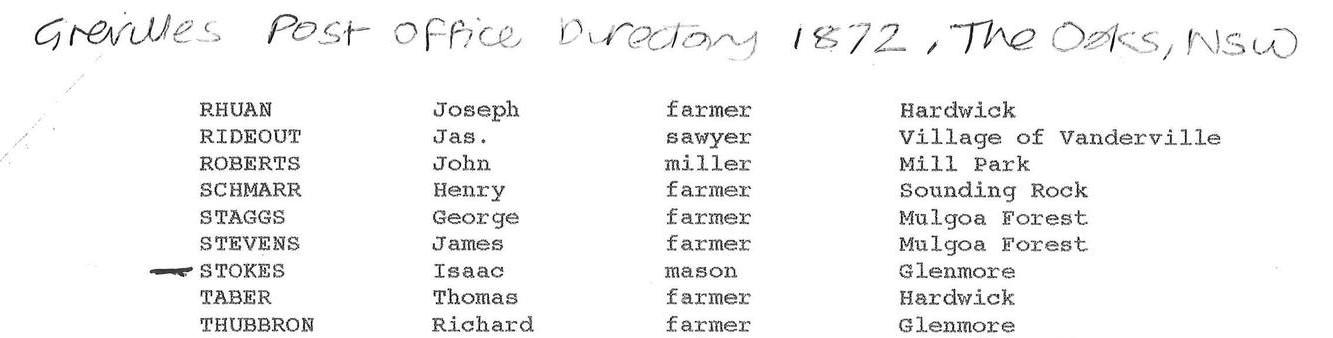
“The Gaudry papers which we have in our archive record him (Isaac Stokes) as having built: the church, the school and the teachers residence. Isaac is recorded in the General return of convicts: 1837 and in Grevilles Post Office directory 1872 as a mason in Glenmore.”
 November 13, 2022 at 10:29 pm #6345
In reply to: Family Stories From The Other Side ~ Book Two
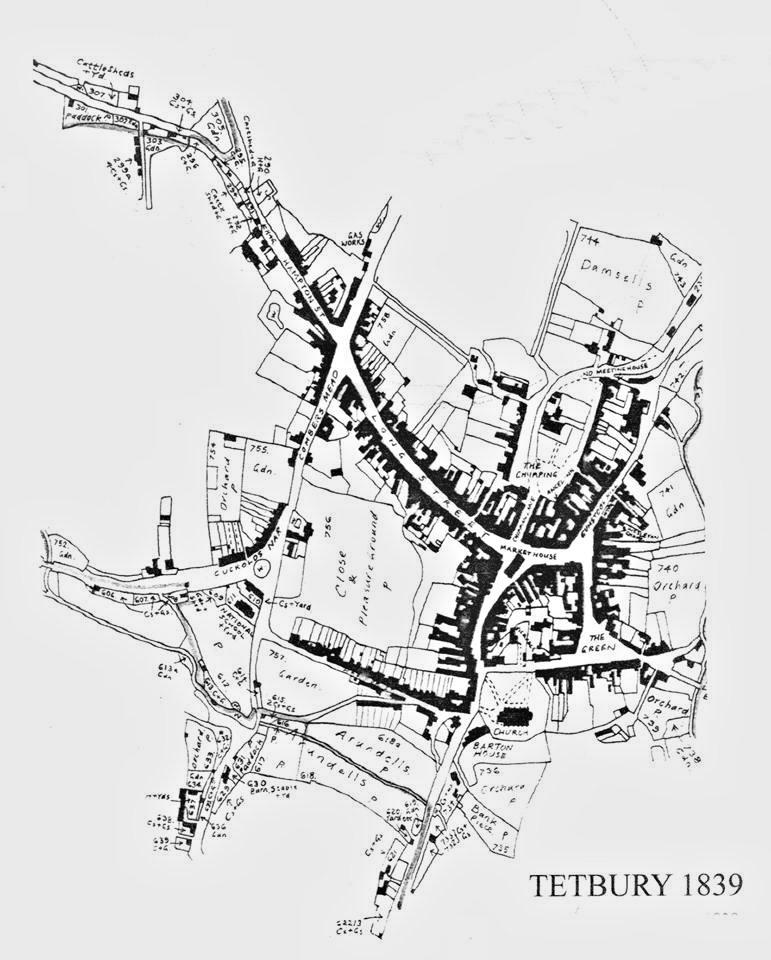
Crime and Punishment in Tetbury
I noticed that there were quite a number of Brownings of Tetbury in the newspaper archives involved in criminal activities while doing a routine newspaper search to supplement the information in the usual ancestry records. I expanded the tree to include cousins, and offsping of cousins, in order to work out who was who and how, if at all, these individuals related to our Browning family.
I was expecting to find some of our Brownings involved in the Swing Riots in Tetbury in 1830, but did not. Most of our Brownings (including cousins) were stone masons. Most of the rioters in 1830 were agricultural labourers.
The Browning crimes are varied, and by todays standards, not for the most part terribly serious ~ you would be unlikely to receive a sentence of hard labour for being found in an outhouse with the intent to commit an unlawful act nowadays, or for being drunk.
The central character in this chapter is Isaac Browning (my 4x great grandfather), who did not appear in any criminal registers, but the following individuals can be identified in the family structure through their relationship to him.
RICHARD LOCK BROWNING born in 1853 was Isaac’s grandson, his son George’s son. Richard was a mason. In 1879 he and Henry Browning of the same age were sentenced to one month hard labour for stealing two pigeons in Tetbury. Henry Browning was Isaac’s nephews son.
In 1883 Richard Browning, mason of Tetbury, was charged with obtaining food and lodging under false pretences, but was found not guilty and acquitted.
In 1884 Richard Browning, mason of Tetbury, was sentenced to one month hard labour for game trespass.Richard had been fined a number of times in Tetbury:
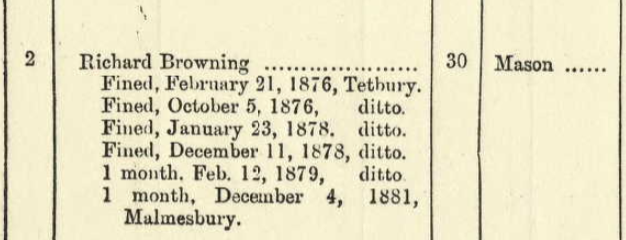
Richard Lock Browning was five feet eight inches tall, dark hair, grey eyes, an oval face and a dark complexion. He had two cuts on the back of his head (in February 1879) and a scar on his right eyebrow.
HENRY BROWNING, who was stealing pigeons with Richard Lock Browning in 1879, (Isaac’s brother Williams grandson, son of George Browning and his wife Charity) was charged with being drunk in 1882 and ordered to pay a fine of one shilling and costs of fourteen shillings, or seven days hard labour.
Henry was found guilty of gaming in the highway at Tetbury in 1872 and was sentenced to seven days hard labour. In 1882 Henry (who was also a mason) was charged with assault but discharged.
Henry was five feet five inches tall, brown hair and brown eyes, a long visage and a fresh complexion.
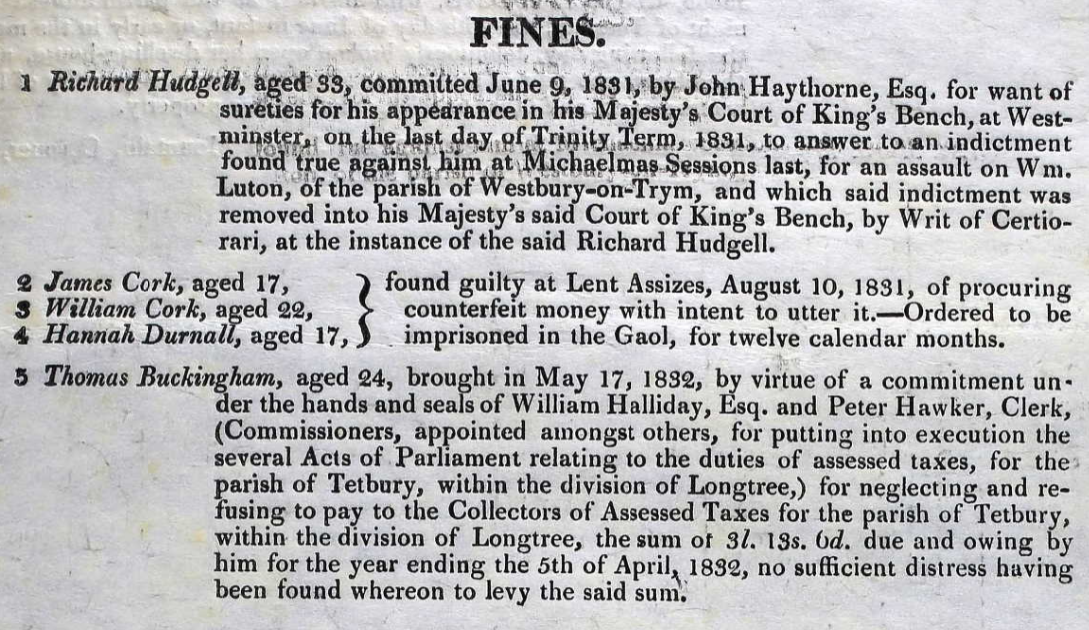
Henry emigrated with his daughter to Canada in 1913, and died in Vancouver in 1919.THOMAS BUCKINGHAM 1808-1846 (Isaacs daughter Janes husband) was charged with stealing a black gelding in Tetbury in 1838. No true bill. (A “no true bill” means the jury did not find probable cause to continue a case.)
Thomas did however neglect to pay his taxes in 1832:
LEWIN BUCKINGHAM (grandson of Isaac, his daughter Jane’s son) was found guilty in 1846 stealing two fowls in Tetbury when he was sixteen years old.
In 1846 he was sentence to one month hard labour (or pay ten shillings fine and ten shillings costs) for loitering with the intent to trespass in search of conies.
A year later in 1847, he and three other young men were sentenced to four months hard labour for larceny.
Lewin was five feet three inches tall, with brown hair and brown eyes, long visage, sallow complexion, and had a scar on his left arm.JOHN BUCKINGHAM born circa 1832, a Tetbury labourer (Isaac’s grandson, Lewin’s brother) was sentenced to six weeks hard labour for larceny in 1855 for stealing a duck in Cirencester. The notes on the register mention that he had been employed by Mr LOCK, Angel Inn. (John’s grandmother was Mary Lock so this is likely a relative).
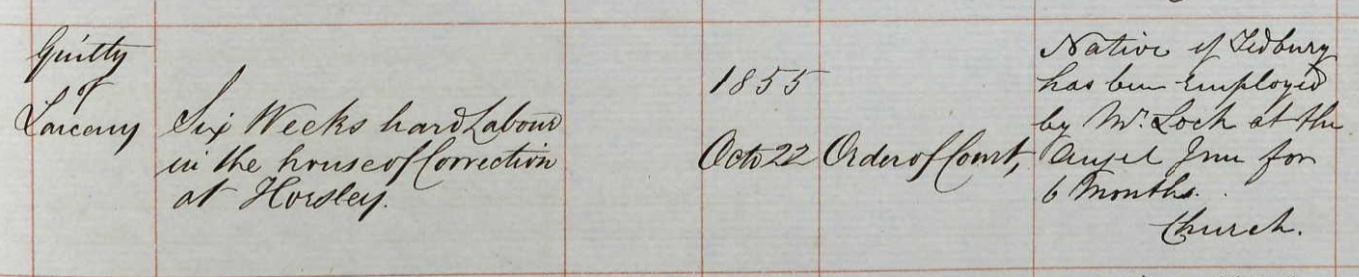
The previous year in 1854 John was sentenced to one month or a one pound fine for assaulting and beating W. Wood.
John was five feet eight and three quarter inches tall, light brown hair and grey eyes, an oval visage and a fresh complexion. He had a scar on his left arm and inside his right knee.JOSEPH PERRET was born circa 1831 and he was a Tetbury labourer. (He was Isaac’s granddaughter Charlotte Buckingham’s husband)
In 1855 he assaulted William Wood and was sentenced to one month or a two pound ten shilling fine. Was it the same W Wood that his wifes cousin John assaulted the year before?
In 1869 Joseph was sentenced to one month hard labour for feloniously receiving a cupboard known to be stolen.JAMES BUCKINGAM born circa 1822 in Tetbury was a shoemaker. (Isaac’s nephew, his sister Hannah’s son)
In 1854 the Tetbury shoemaker was sentenced to four months hard labour for stealing 30 lbs of lead off someones house.
In 1856 the Tetbury shoemaker received two months hard labour or pay £2 fine and 12 s costs for being found in pursuit of game.
In 1868 he was sentenced to two months hard labour for stealing a gander. A unspecified previous conviction is noted.
1871 the Tetbury shoemaker was found in an outhouse for an unlawful purpose and received ten days hard labour. The register notes that his sister is Mrs Cook, the Green, Tetbury. (James sister Prudence married Thomas Cook)
James sister Charlotte married a shoemaker and moved to UTAH.
James was five feet eight inches tall, dark hair and blue eyes, a long visage and a florid complexion. He had a scar on his forehead and a mole on the right side of his neck and abdomen, and a scar on the right knee.November 4, 2022 at 2:19 pm #6342In reply to: Family Stories From The Other Side ~ Book Two
Brownings of Tetbury
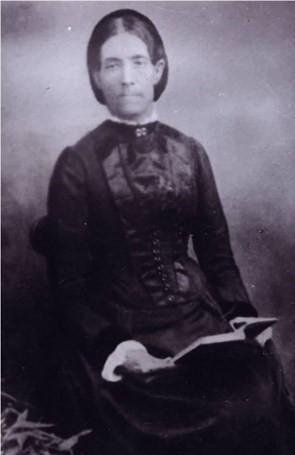
Isaac Browning (1784-1848) married Mary Lock (1787-1870) in Tetbury in 1806. Both of them were born in Tetbury, Gloucestershire. Isaac was a stone mason. Between 1807 and 1832 they baptised fourteen children in Tetbury, and on 8 Nov 1829 Isaac and Mary baptised five daughters all on the same day.
I considered that they may have been quintuplets, with only the last born surviving, which would have answered my question about the name of the house La Quinta in Broadway, the home of Eliza Browning and Thomas Stokes son Fred. However, the other four daughters were found in various records and they were not all born the same year. (So I still don’t know why the house in Broadway had such an unusual name).
Their son George was born and baptised in 1827, but Louisa born 1821, Susan born 1822, Hesther born 1823 and Mary born 1826, were not baptised until 1829 along with Charlotte born in 1828. (These birth dates are guesswork based on the age on later censuses.) Perhaps George was baptised promptly because he was sickly and not expected to survive. Isaac and Mary had a son George born in 1814 who died in 1823. Presumably the five girls were healthy and could wait to be done as a job lot on the same day later.
Eliza Browning (1814-1886), my great great great grandmother, had a baby six years before she married Thomas Stokes. Her name was Ellen Harding Browning, which suggests that her fathers name was Harding. On the 1841 census seven year old Ellen was living with her grandfather Isaac Browning in Tetbury. Ellen Harding Browning married William Dee in Tetbury in 1857, and they moved to Western Australia.
Ellen Harding Browning Dee: (photo found on ancestry website)
OBITUARY. MRS. ELLEN DEE.
A very old and respected resident of Dongarra, in the person of Mrs. Ellen Dee, passed peacefully away on Sept. 27, at the advanced age of 74 years.The deceased had been ailing for some time, but was about and actively employed until Wednesday, Sept. 20, whenn she was heard groaning by some neighbours, who immediately entered her place and found her lying beside the fireplace. Tho deceased had been to bed over night, and had evidently been in the act of lighting thc fire, when she had a seizure. For some hours she was conscious, but had lost the power of speech, and later on became unconscious, in which state she remained until her death.
The deceased was born in Gloucestershire, England, in 1833, was married to William Dee in Tetbury Church 23 years later. Within a month she left England with her husband for Western Australian in the ship City oí Bristol. She resided in Fremantle for six months, then in Greenough for a short time, and afterwards (for 42 years) in Dongarra. She was, therefore, a colonist of about 51 years. She had a family of four girls and three boys, and five of her children survive her, also 35 grandchildren, and eight great grandchildren. She was very highly respected, and her sudden collapse came as a great shock to many.
Eliza married Thomas Stokes (1816-1885) in September 1840 in Hempstead, Gloucestershire. On the 1841 census, Eliza and her mother Mary Browning (nee Lock) were staying with Thomas Lock and family in Cirencester. Strangely, Thomas Stokes has not been found thus far on the 1841 census, and Thomas and Eliza’s first child William James Stokes birth was registered in Witham, in Essex, on the 6th of September 1841.
I don’t know why William James was born in Witham, or where Thomas was at the time of the census in 1841. One possibility is that as Thomas Stokes did a considerable amount of work with circus waggons, circus shooting galleries and so on as a journeyman carpenter initially and then later wheelwright, perhaps he was working with a traveling circus at the time.
But back to the Brownings ~ more on William James Stokes to follow.
One of Isaac and Mary’s fourteen children died in infancy: Ann was baptised and died in 1811. Two of their children died at nine years old: the first George, and Mary who died in 1835. Matilda was 21 years old when she died in 1844.
Jane Browning (1808-) married Thomas Buckingham in 1830 in Tetbury. In August 1838 Thomas was charged with feloniously stealing a black gelding.
Susan Browning (1822-1879) married William Cleaver in November 1844 in Tetbury. Oddly thereafter they use the name Bowman on the census. On the 1851 census Mary Browning (Susan’s mother), widow, has grandson George Bowman born in 1844 living with her. The confusion with the Bowman and Cleaver names was clarified upon finding the criminal registers:
30 January 1834. Offender: William Cleaver alias Bowman, Richard Bunting alias Barnfield and Jeremiah Cox, labourers of Tetbury. Crime: Stealing part of a dead fence from a rick barton in Tetbury, the property of Robert Tanner, farmer.
And again in 1836:
29 March 1836 Bowman, William alias Cleaver, of Tetbury, labourer age 18; 5’2.5” tall, brown hair, grey eyes, round visage with fresh complexion; several moles on left cheek, mole on right breast. Charged on the oath of Ann Washbourn & others that on the morning of the 31 March at Tetbury feloniously stolen a lead spout affixed to the dwelling of the said Ann Washbourn, her property. Found guilty 31 March 1836; Sentenced to 6 months.
On the 1851 census Susan Bowman was a servant living in at a large drapery shop in Cheltenham. She was listed as 29 years old, married and born in Tetbury, so although it was unusual for a married woman not to be living with her husband, (or her son for that matter, who was living with his grandmother Mary Browning), perhaps her husband William Bowman alias Cleaver was in trouble again. By 1861 they are both living together in Tetbury: William was a plasterer, and they had three year old Isaac and Thomas, one year old. In 1871 William was still a plasterer in Tetbury, living with wife Susan, and sons Isaac and Thomas. Interestingly, a William Cleaver is living next door but one!
Susan was 56 when she died in Tetbury in 1879.
Three of the Browning daughters went to London.
Louisa Browning (1821-1873) married Robert Claxton, coachman, in 1848 in Bryanston Square, Westminster, London. Ester Browning was a witness.
Ester Browning (1823-1893)(or Hester) married Charles Hudson Sealey, cabinet maker, in Bethnal Green, London, in 1854. Charles was born in Tetbury. Charlotte Browning was a witness.
Charlotte Browning (1828-1867?) was admitted to St Marylebone workhouse in London for “parturition”, or childbirth, in 1860. She was 33 years old. A birth was registered for a Charlotte Browning, no mothers maiden name listed, in 1860 in Marylebone. A death was registered in Camden, buried in Marylebone, for a Charlotte Browning in 1867 but no age was recorded. As the age and parents were usually recorded for a childs death, I assume this was Charlotte the mother.
I found Charlotte on the 1851 census by chance while researching her mother Mary Lock’s siblings. Hesther Lock married Lewin Chandler, and they were living in Stepney, London. Charlotte is listed as a neice. Although Browning is mistranscribed as Broomey, the original page says Browning. Another mistranscription on this record is Hesthers birthplace which is transcribed as Yorkshire. The original image shows Gloucestershire.
Isaac and Mary’s first son was John Browning (1807-1860). John married Hannah Coates in 1834. John’s brother Charles Browning (1819-1853) married Eliza Coates in 1842. Perhaps they were sisters. On the 1861 census Hannah Browning, John’s wife, was a visitor in the Harding household in a village called Coates near Tetbury. Thomas Harding born in 1801 was the head of the household. Perhaps he was the father of Ellen Harding Browning.
George Browning (1828-1870) married Louisa Gainey in Tetbury, and died in Tetbury at the age of 42. Their son Richard Lock Browning, a 32 year old mason, was sentenced to one month hard labour for game tresspass in Tetbury in 1884.
Isaac Browning (1832-1857) was the youngest son of Isaac and Mary. He was just 25 years old when he died in Tetbury.
October 11, 2022 at 2:58 pm #6334In reply to: Family Stories From The Other Side ~ Book Two
The House on Penn Common
Toi Fang and the Duke of Sutherland
Tomlinsons
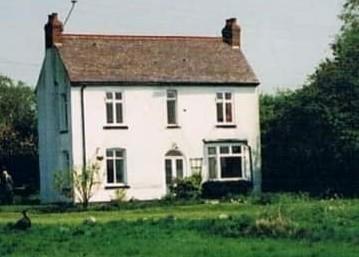
Grassholme
Charles Tomlinson (1873-1929) my great grandfather, was born in Wolverhampton in 1873. His father Charles Tomlinson (1847-1907) was a licensed victualler or publican, or alternatively a vet/castrator. He married Emma Grattidge (1853-1911) in 1872. On the 1881 census they were living at The Wheel in Wolverhampton.
Charles married Nellie Fisher (1877-1956) in Wolverhampton in 1896. In 1901 they were living next to the post office in Upper Penn, with children (Charles) Sidney Tomlinson (1896-1955), and Hilda Tomlinson (1898-1977) . Charles was a vet/castrator working on his own account.
In 1911 their address was 4, Wakely Hill, Penn, and living with them were their children Hilda, Frank Tomlinson (1901-1975), (Dorothy) Phyllis Tomlinson (1905-1982), Nellie Tomlinson (1906-1978) and May Tomlinson (1910-1983). Charles was a castrator working on his own account.
Charles and Nellie had a further four children: Charles Fisher Tomlinson (1911-1977), Margaret Tomlinson (1913-1989) (my grandmother Peggy), Major Tomlinson (1916-1984) and Norah Mary Tomlinson (1919-2010).
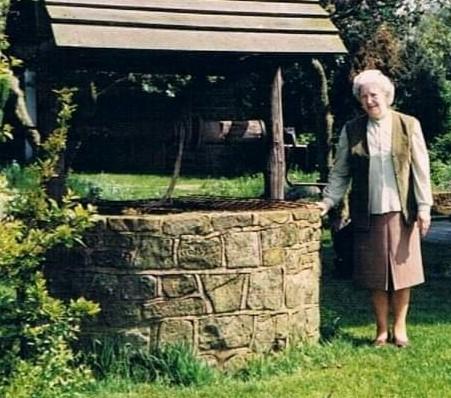
My father told me that my grandmother had fallen down the well at the house on Penn Common in 1915 when she was two years old, and sent me a photo of her standing next to the well when she revisted the house at a much later date.
Peggy next to the well on Penn Common:
My grandmother Peggy told me that her father had had a racehorse called Toi Fang. She remembered the racing colours were sky blue and orange, and had a set of racing silks made which she sent to my father.
Through a DNA match, I met Ian Tomlinson. Ian is the son of my fathers favourite cousin Roger, Frank’s son. Ian found some racing silks and sent a photo to my father (they are now in contact with each other as a result of my DNA match with Ian), wondering what they were.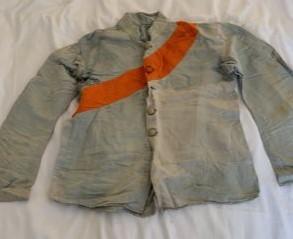
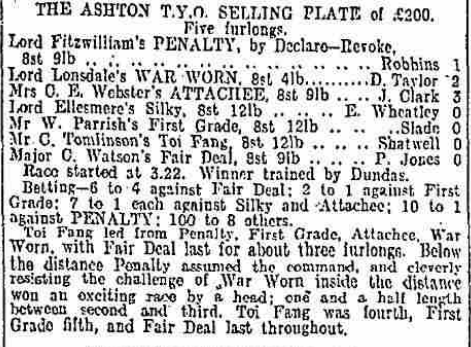
When Ian sent a photo of these racing silks, I had a look in the newspaper archives. In 1920 there are a number of mentions in the racing news of Mr C Tomlinson’s horse TOI FANG. I have not found any mention of Toi Fang in the newspapers in the following years.
The Scotsman – Monday 12 July 1920:
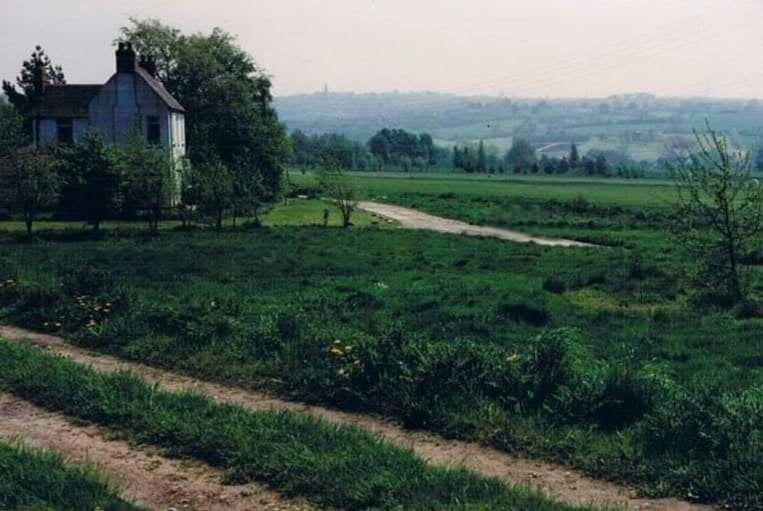
The other story that Ian Tomlinson recalled was about the house on Penn Common. Ian said he’d heard that the local titled person took Charles Tomlinson to court over building the house but that Tomlinson won the case because it was built on common land and was the first case of it’s kind.
Penn Common Right of Way Case:
Staffordshire Advertiser March 9, 1912In the chancery division, on Tuesday, before Mr Justice Joyce, it was announced that a settlement had been arrived at of the Penn Common Right of Way case, the hearing of which occupied several days last month. The action was brought by the Duke of Sutherland (as Lord of the Manor of Penn) and Mr Harry Sydney Pitt (on behalf of himself and other freeholders of the manor having a right to pasturage on Penn Common) to restrain Mr James Lakin, Carlton House, Penn; Mr Charles Tomlinson, Mayfield Villa, Wakely Hill, Penn; and Mr Joseph Harold Simpkin, Dudley Road, Wolverhampton, from drawing building materials across the common, or otherwise causing injury to the soil.
The real point in dispute was whether there was a public highway for all purposes running by the side of the defendants land from the Turf Tavern past the golf club to the Barley Mow.
Mr Hughes, KC for the plaintiffs, now stated that the parties had been in consultation, and had come to terms, the substance of which was that the defendants admitted that there was no public right of way, and that they were granted a private way. This, he thought, would involve the granting of some deed or deeds to express the rights of the parties, and he suggested that the documents should be be settled by some counsel to be mutually agreed upon.His lordship observed that the question of coal was probably the important point. Mr Younger said Mr Tomlinson was a freeholder, and the plaintiffs could not mine under him. Mr Hughes: The coal actually under his house is his, and, of course, subsidence might be produced by taking away coal some distance away. I think some document is required to determine his actual rights.
Mr Younger said he wanted to avoid anything that would increase the costs, but, after further discussion, it was agreed that Mr John Dixon (an expert on mineral rights), or failing him, another counsel satisfactory to both parties, should be invited to settle the terms scheduled in the agreement, in order to prevent any further dispute.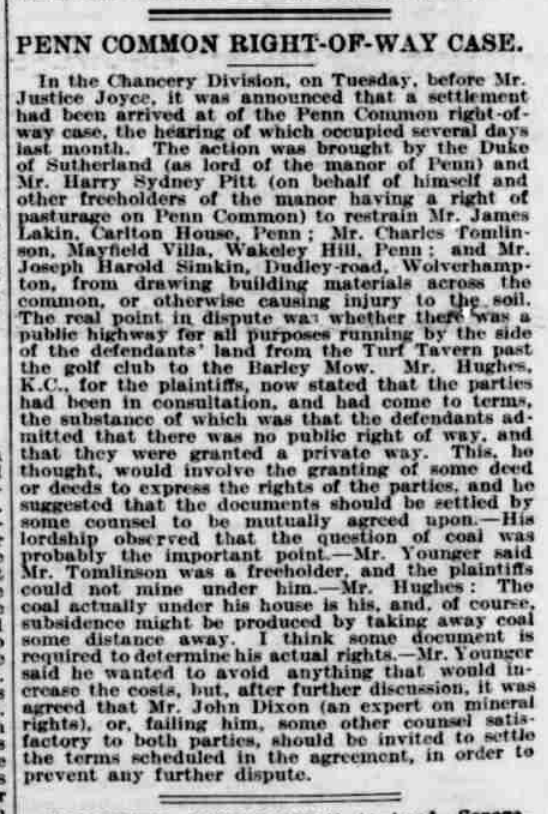
The name of the house is Grassholme. The address of Mayfield Villas is the house they were living in while building Grassholme, which I assume they had not yet moved in to at the time of the newspaper article in March 1912.
What my grandmother didn’t tell anyone was how her father died in 1929:
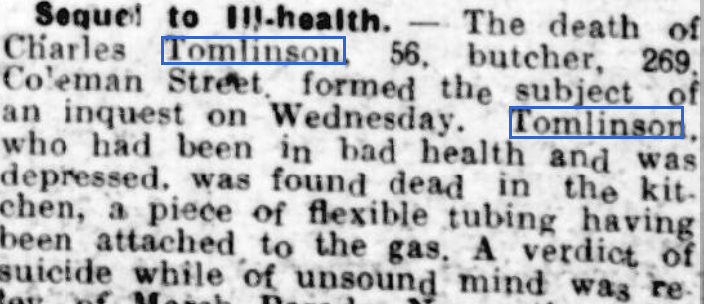
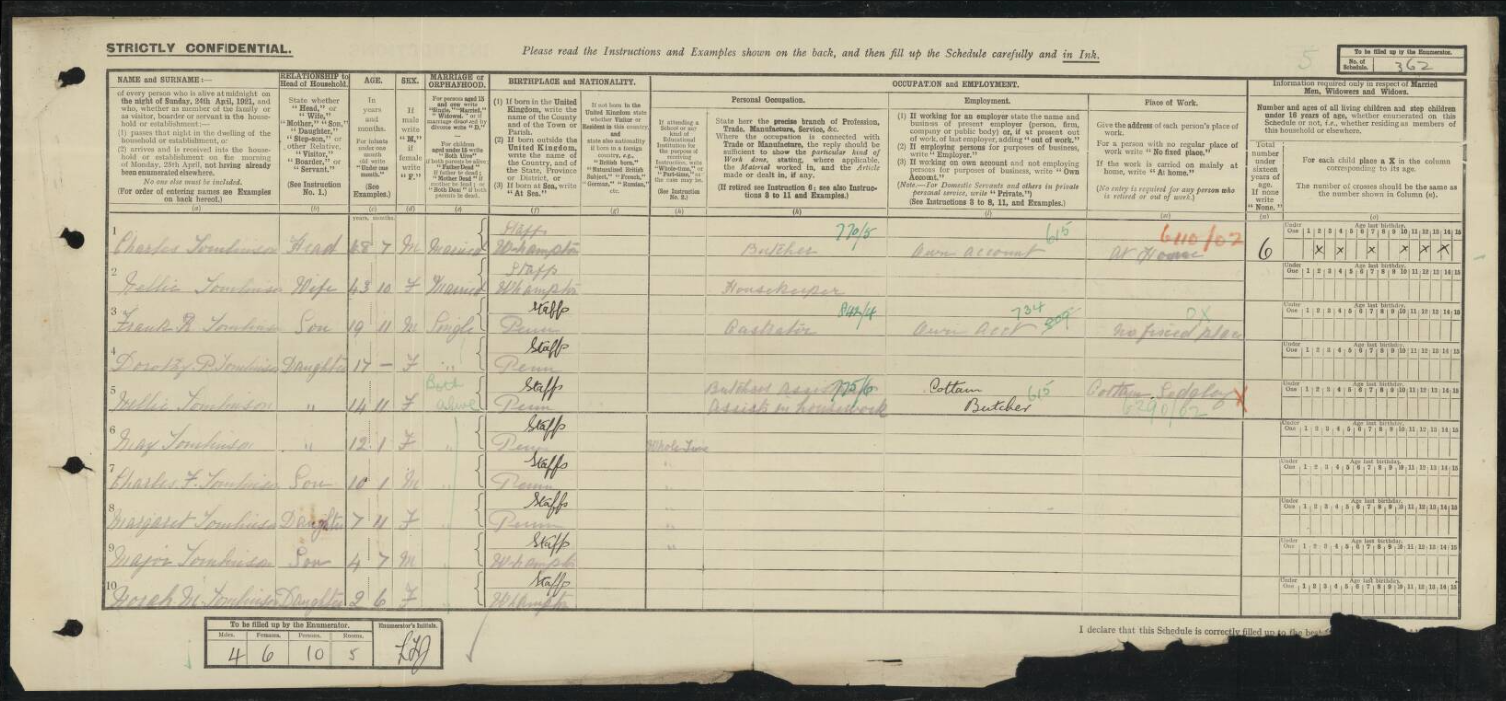
On the 1921 census, Charles, Nellie and eight of their children were living at 269 Coleman Street, Wolverhampton.
They were living on Coleman Street in 1915 when Charles was fined for staying open late.
Staffordshire Advertiser – Saturday 13 February 1915:

What is not yet clear is why they moved from the house on Penn Common sometime between 1912 and 1915. And why did he have a racehorse in 1920?
September 4, 2022 at 6:00 pm #6326In reply to: The Sexy Wooden Leg
Stung by Egberts question, Olga reeled and almost lost her footing on the stairs. What had happened to her? That damned selfish individualism that was running rampant must have seeped into her room through the gaps in the windows or under the door. “No!” she shouted, her voice cracking.
“Say it isn’t true, Olga,” Egbert said, his voice breaking. “Not you as well.”
It took Olga a minute or two to still her racing heart. The near fall down the stairs had shaken her but with trembling hands she levered herself round to sit beside Egbert on the step.
Gripping his bony knee with her knobbly arthritic fingers, she took a deep breath.
“You are right to have said that, Egbert. If there is one thing we must hold onto, it’s our hearts. Nothing else matters, or at least nothing else matters as much as that. We are old and tired and we don’t like change. But if we escalate the importance of this frankly dreary and depressing home to the point where we lose our hearts…” she faltered and continued. “We will be homeless soon, very soon, and we know not what will happen to us. We must trust in the kindness of strangers, we must hope they have a heart.”
Egbert winced as Olga squeezed his knee. “And that is why”, Olga continued, slapping Egberts thigh with gusto, “We must have a heart…”
“If you’d just stop squeezing and hitting me, Olga…”
Olga loosened her grip on the old mans thigh bone and peered into his eyes. Quietly she thanked him. “You’ve cleared my mind and given me something to live for, and I thank you for that. But you do need to launder your clothes more often,” she added, pulling a face. She didn’t want the old coot to start blubbing, and he looked alarmingly close to tears.
“Come on, let’s go and see Obadiah. We’re all in this together. Homelessness and adventure can wait until tomorrow.” Olga heaved herself upright with a surprising burst of vitality. Noticing a weak smile trembling on Egberts lips, she said “That’s the spirit!”
July 12, 2022 at 3:57 pm #6322In reply to: Scrying the Word Cloud
numerous cats fear sounds
lawrence contents joined sister melbourne
high african nonsense reported
andrew dear kianda derbyshire
black class bucks secondJuly 1, 2022 at 9:51 am #6306In reply to: The Elusive Samuel Housley and Other Family Stories
Looking for Robert Staley
William Warren (1835-1880) of Newhall (Stapenhill) married Elizabeth Staley (1836-1907) in 1858. Elizabeth was born in Newhall, the daughter of John Staley (1795-1876) and Jane Brothers. John was born in Newhall, and Jane was born in Armagh, Ireland, and they were married in Armagh in 1820. Elizabeths older brothers were born in Ireland: William in 1826 and Thomas in Dublin in 1830. Francis was born in Liverpool in 1834, and then Elizabeth in Newhall in 1836; thereafter the children were born in Newhall.
Marriage of John Staley and Jane Brothers in 1820:
My grandmother related a story about an Elizabeth Staley who ran away from boarding school and eloped to Ireland, but later returned. The only Irish connection found so far is Jane Brothers, so perhaps she meant Elizabeth Staley’s mother. A boarding school seems unlikely, and it would seem that it was John Staley who went to Ireland.
The 1841 census states Jane’s age as 33, which would make her just 12 at the time of her marriage. The 1851 census states her age as 44, making her 13 at the time of her 1820 marriage, and the 1861 census estimates her birth year as a more likely 1804. Birth records in Ireland for her have not been found. It’s possible, perhaps, that she was in service in the Newhall area as a teenager (more likely than boarding school), and that John and Jane ran off to get married in Ireland, although I haven’t found any record of a child born to them early in their marriage. John was an agricultural labourer, and later a coal miner.
John Staley was the son of Joseph Staley (1756-1838) and Sarah Dumolo (1764-). Joseph and Sarah were married by licence in Newhall in 1782. Joseph was a carpenter on the marriage licence, but later a collier (although not necessarily a miner).
The Derbyshire Record Office holds records of an “Estimate of Joseph Staley of Newhall for the cost of continuing to work Pisternhill Colliery” dated 1820 and addresssed to Mr Bloud at Calke Abbey (presumably the owner of the mine)
Josephs parents were Robert Staley and Elizabeth. I couldn’t find a baptism or birth record for Robert Staley. Other trees on an ancestry site had his birth in Elton, but with no supporting documents. Robert, as stated in his 1795 will, was a Yeoman.
“Yeoman: A former class of small freeholders who farm their own land; a commoner of good standing.”
“Husbandman: The old word for a farmer below the rank of yeoman. A husbandman usually held his land by copyhold or leasehold tenure and may be regarded as the ‘average farmer in his locality’. The words ‘yeoman’ and ‘husbandman’ were gradually replaced in the later 18th and 19th centuries by ‘farmer’.”He left a number of properties in Newhall and Hartshorne (near Newhall) including dwellings, enclosures, orchards, various yards, barns and acreages. It seemed to me more likely that he had inherited them, rather than moving into the village and buying them.
There is a mention of Robert Staley in a 1782 newpaper advertisement.
“Fire Engine To Be Sold. An exceedingly good fire engine, with the boiler, cylinder, etc in good condition. For particulars apply to Mr Burslem at Burton-upon-Trent, or Robert Staley at Newhall near Burton, where the engine may be seen.”
Was the fire engine perhaps connected with a foundry or a coal mine?
I noticed that Robert Staley was the witness at a 1755 marriage in Stapenhill between Barbara Burslem and Richard Daston the younger esquire. The other witness was signed Burslem Jnr.
Looking for Robert Staley
I assumed that once again, in the absence of the correct records, a similarly named and aged persons baptism had been added to the tree regardless of accuracy, so I looked through the Stapenhill/Newhall parish register images page by page. There were no Staleys in Newhall at all in the early 1700s, so it seemed that Robert did come from elsewhere and I expected to find the Staleys in a neighbouring parish. But I still didn’t find any Staleys.
I spoke to a couple of Staley descendants that I’d met during the family research. I met Carole via a DNA match some months previously and contacted her to ask about the Staleys in Elton. She also had Robert Staley born in Elton (indeed, there were many Staleys in Elton) but she didn’t have any documentation for his birth, and we decided to collaborate and try and find out more.
I couldn’t find the earlier Elton parish registers anywhere online, but eventually found the untranscribed microfiche images of the Bishops Transcripts for Elton.
via familysearch:
“In its most basic sense, a bishop’s transcript is a copy of a parish register. As bishop’s transcripts generally contain more or less the same information as parish registers, they are an invaluable resource when a parish register has been damaged, destroyed, or otherwise lost. Bishop’s transcripts are often of value even when parish registers exist, as priests often recorded either additional or different information in their transcripts than they did in the original registers.”Unfortunately there was a gap in the Bishops Transcripts between 1704 and 1711 ~ exactly where I needed to look. I subsequently found out that the Elton registers were incomplete as they had been damaged by fire.
I estimated Robert Staleys date of birth between 1710 and 1715. He died in 1795, and his son Daniel died in 1805: both of these wills were found online. Daniel married Mary Moon in Stapenhill in 1762, making a likely birth date for Daniel around 1740.
The marriage of Robert Staley (assuming this was Robert’s father) and Alice Maceland (or Marsland or Marsden, depending on how the parish clerk chose to spell it presumably) was in the Bishops Transcripts for Elton in 1704. They were married in Elton on 26th February. There followed the missing parish register pages and in all likelihood the records of the baptisms of their first children. No doubt Robert was one of them, probably the first male child.
(Incidentally, my grandfather’s Marshalls also came from Elton, a small Derbyshire village near Matlock. The Staley’s are on my grandmothers Warren side.)
The parish register pages resume in 1711. One of the first entries was the baptism of Robert Staley in 1711, parents Thomas and Ann. This was surely the one we were looking for, and Roberts parents weren’t Robert and Alice.
But then in 1735 a marriage was recorded between Robert son of Robert Staley (and this was unusual, the father of the groom isn’t usually recorded on the parish register) and Elizabeth Milner. They were married on the 9th March 1735. We know that the Robert we were looking for married an Elizabeth, as her name was on the Stapenhill baptisms of their later children, including Joseph Staleys. The 1735 marriage also fit with the assumed birth date of Daniel, circa 1740. A baptism was found for a Robert Staley in 1738 in the Elton registers, parents Robert and Elizabeth, as well as the baptism in 1736 for Mary, presumably their first child. Her burial is recorded the following year.
The marriage of Robert Staley and Elizabeth Milner in 1735:
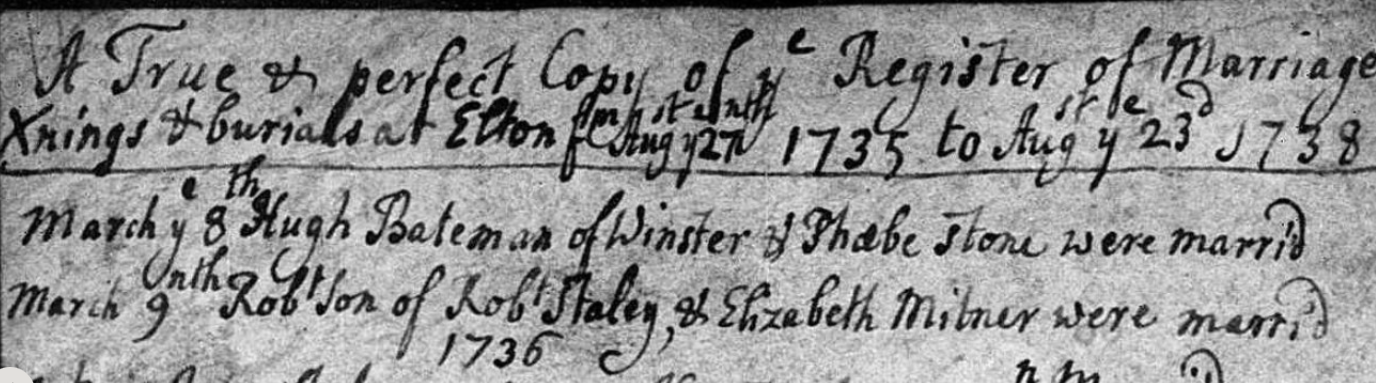
There were several other Staley couples of a similar age in Elton, perhaps brothers and cousins. It seemed that Thomas and Ann’s son Robert was a different Robert, and that the one we were looking for was prior to that and on the missing pages.
Even so, this doesn’t prove that it was Elizabeth Staleys great grandfather who was born in Elton, but no other birth or baptism for Robert Staley has been found. It doesn’t explain why the Staleys moved to Stapenhill either, although the Enclosures Act and the Industrial Revolution could have been factors.
The 18th century saw the rise of the Industrial Revolution and many renowned Derbyshire Industrialists emerged. They created the turning point from what was until then a largely rural economy, to the development of townships based on factory production methods.
The Marsden Connection
There are some possible clues in the records of the Marsden family. Robert Staley married Alice Marsden (or Maceland or Marsland) in Elton in 1704. Robert Staley is mentioned in the 1730 will of John Marsden senior, of Baslow, Innkeeper (Peacock Inne & Whitlands Farm). He mentions his daughter Alice, wife of Robert Staley.
In a 1715 Marsden will there is an intriguing mention of an alias, which might explain the different spellings on various records for the name Marsden: “MARSDEN alias MASLAND, Christopher – of Baslow, husbandman, 28 Dec 1714. son Robert MARSDEN alias MASLAND….” etc.
Some potential reasons for a move from one parish to another are explained in this history of the Marsden family, and indeed this could relate to Robert Staley as he married into the Marsden family and his wife was a beneficiary of a Marsden will. The Chatsworth Estate, at various times, bought a number of farms in order to extend the park.
THE MARSDEN FAMILY
OXCLOSE AND PARKGATE
In the Parishes of
Baslow and Chatsworthby
David Dalrymple-Smith“John Marsden (b1653) another son of Edmund (b1611) faired well. By the time he died in
1730 he was publican of the Peacock, the Inn on Church Lane now called the Cavendish
Hotel, and the farmer at “Whitlands”, almost certainly Bubnell Cliff Farm.”“Coal mining was well known in the Chesterfield area. The coalfield extends as far as the
Gritstone edges, where thin seams outcrop especially in the Baslow area.”“…the occupants were evicted from the farmland below Dobb Edge and
the ground carefully cleared of all traces of occupation and farming. Shelter belts were
planted especially along the Heathy Lea Brook. An imposing new drive was laid to the
Chatsworth House with the Lodges and “The Golden Gates” at its northern end….”Although this particular event was later than any events relating to Robert Staley, it’s an indication of how farms and farmland disappeared, and a reason for families to move to another area:
“The Dukes of Devonshire (of Chatsworth) were major figures in the aristocracy and the government of the
time. Such a position demanded a display of wealth and ostentation. The 6th Duke of
Devonshire, the Bachelor Duke, was not content with the Chatsworth he inherited in 1811,
and immediately started improvements. After major changes around Edensor, he turned his
attention at the north end of the Park. In 1820 plans were made extend the Park up to the
Baslow parish boundary. As this would involve the destruction of most of the Farm at
Oxclose, the farmer at the Higher House Samuel Marsden (b1755) was given the tenancy of
Ewe Close a large farm near Bakewell.
Plans were revised in 1824 when the Dukes of Devonshire and Rutland “Exchanged Lands”,
reputedly during a game of dice. Over 3300 acres were involved in several local parishes, of
which 1000 acres were in Baslow. In the deal Devonshire acquired the southeast corner of
Baslow Parish.
Part of the deal was Gibbet Moor, which was developed for “Sport”. The shelf of land
between Parkgate and Robin Hood and a few extra fields was left untouched. The rest,
between Dobb Edge and Baslow, was agricultural land with farms, fields and houses. It was
this last part that gave the Duke the opportunity to improve the Park beyond his earlier
expectations.”The 1795 will of Robert Staley.
Inriguingly, Robert included the children of his son Daniel Staley in his will, but omitted to leave anything to Daniel. A perusal of Daniels 1808 will sheds some light on this: Daniel left his property to his six reputed children with Elizabeth Moon, and his reputed daughter Mary Brearly. Daniels wife was Mary Moon, Elizabeths husband William Moons daughter.
The will of Robert Staley, 1795:
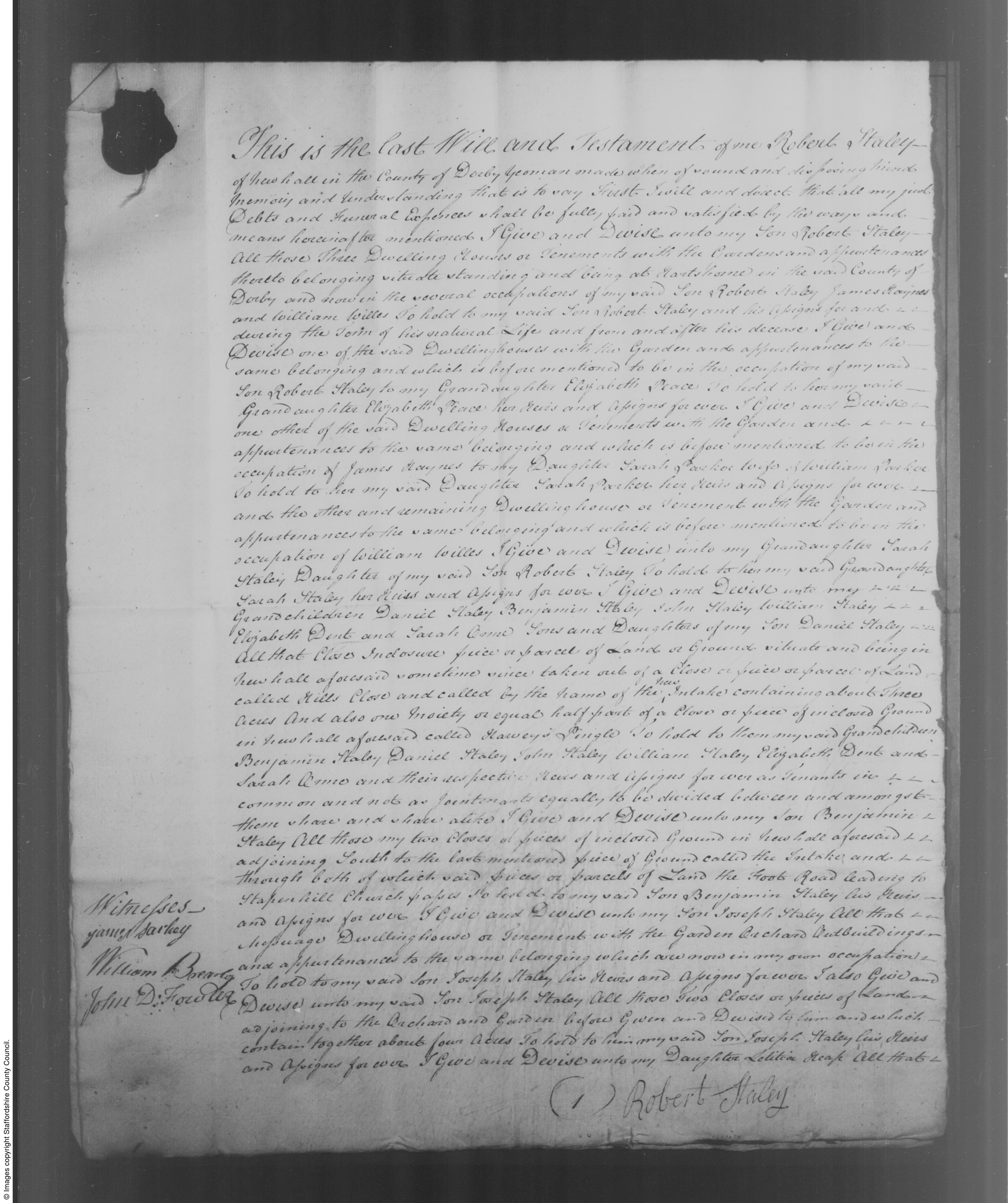
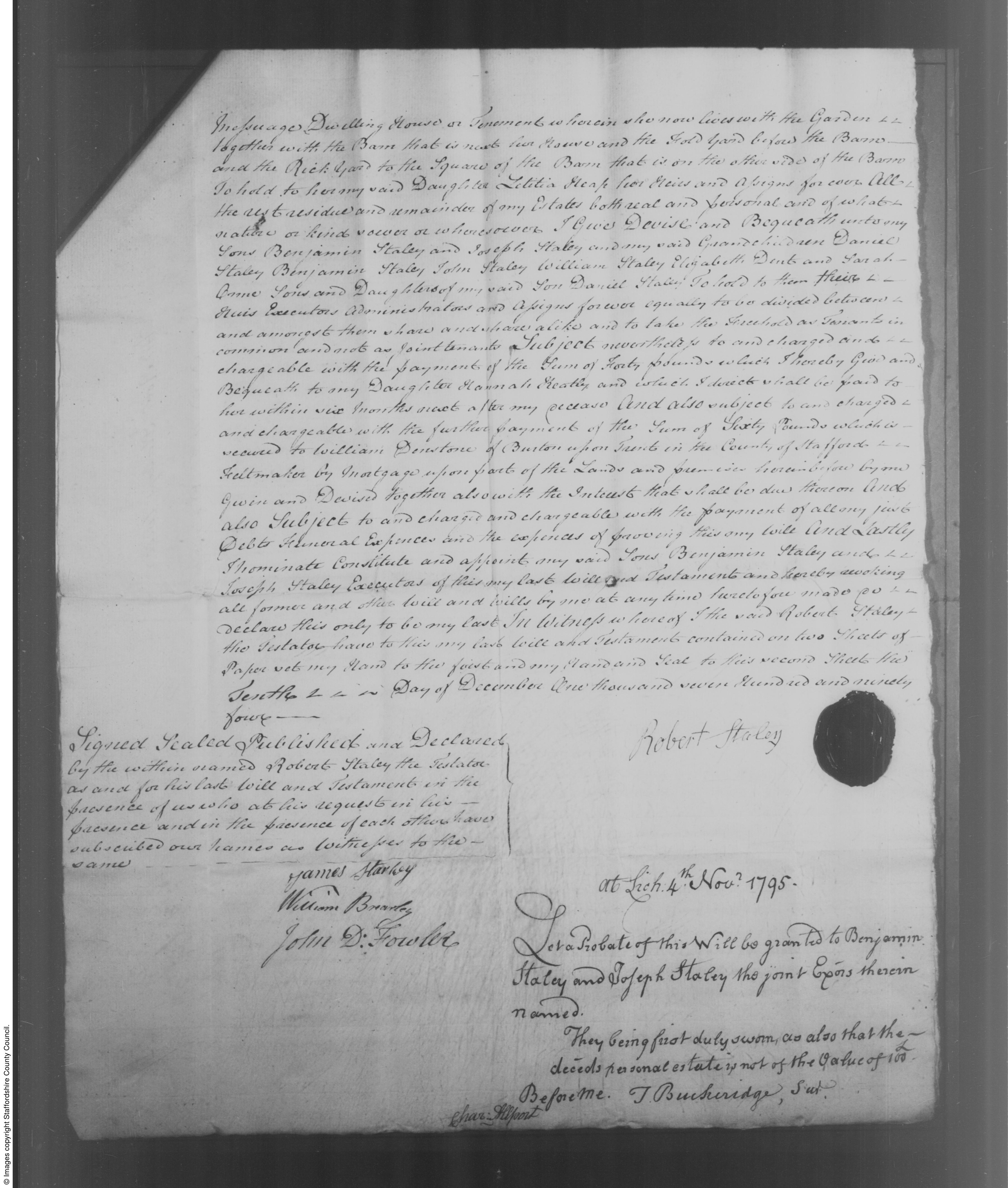
The 1805 will of Daniel Staley, Robert’s son:
This is the last will and testament of me Daniel Staley of the Township of Newhall in the parish of Stapenhill in the County of Derby, Farmer. I will and order all of my just debts, funeral and testamentary expenses to be fully paid and satisfied by my executors hereinafter named by and out of my personal estate as soon as conveniently may be after my decease.
I give, devise and bequeath to Humphrey Trafford Nadin of Church Gresely in the said County of Derby Esquire and John Wilkinson of Newhall aforesaid yeoman all my messuages, lands, tenements, hereditaments and real and personal estates to hold to them, their heirs, executors, administrators and assigns until Richard Moon the youngest of my reputed sons by Elizabeth Moon shall attain his age of twenty one years upon trust that they, my said trustees, (or the survivor of them, his heirs, executors, administrators or assigns), shall and do manage and carry on my farm at Newhall aforesaid and pay and apply the rents, issues and profits of all and every of my said real and personal estates in for and towards the support, maintenance and education of all my reputed children by the said Elizabeth Moon until the said Richard Moon my youngest reputed son shall attain his said age of twenty one years and equally share and share and share alike.
And it is my will and desire that my said trustees or trustee for the time being shall recruit and keep up the stock upon my farm as they in their discretion shall see occasion or think proper and that the same shall not be diminished. And in case any of my said reputed children by the said Elizabeth Moon shall be married before my said reputed youngest son shall attain his age of twenty one years that then it is my will and desire that non of their husbands or wives shall come to my farm or be maintained there or have their abode there. That it is also my will and desire in case my reputed children or any of them shall not be steady to business but instead shall be wild and diminish the stock that then my said trustees or trustee for the time being shall have full power and authority in their discretion to sell and dispose of all or any part of my said personal estate and to put out the money arising from the sale thereof to interest and to pay and apply the interest thereof and also thereunto of the said real estate in for and towards the maintenance, education and support of all my said reputed children by the said
Elizabeth Moon as they my said trustees in their discretion that think proper until the said Richard Moon shall attain his age of twenty one years.Then I give to my grandson Daniel Staley the sum of ten pounds and to each and every of my sons and daughters namely Daniel Staley, Benjamin Staley, John Staley, William Staley, Elizabeth Dent and Sarah Orme and to my niece Ann Brearly the sum of five pounds apiece.
I give to my youngest reputed son Richard Moon one share in the Ashby Canal Navigation and I direct that my said trustees or trustee for the time being shall have full power and authority to pay and apply all or any part of the fortune or legacy hereby intended for my youngest reputed son Richard Moon in placing him out to any trade, business or profession as they in their discretion shall think proper.
And I direct that to my said sons and daughters by my late wife and my said niece shall by wholly paid by my said reputed son Richard Moon out of the fortune herby given him. And it is my will and desire that my said reputed children shall deliver into the hands of my executors all the monies that shall arise from the carrying on of my business that is not wanted to carry on the same unto my acting executor and shall keep a just and true account of all disbursements and receipts of the said business and deliver up the same to my acting executor in order that there may not be any embezzlement or defraud amongst them and from and immediately after my said reputed youngest son Richard Moon shall attain his age of twenty one years then I give, devise and bequeath all my real estate and all the residue and remainder of my personal estate of what nature and kind whatsoever and wheresoever unto and amongst all and every my said reputed sons and daughters namely William Moon, Thomas Moon, Joseph Moon, Richard Moon, Ann Moon, Margaret Moon and to my reputed daughter Mary Brearly to hold to them and their respective heirs, executors, administrator and assigns for ever according to the nature and tenure of the same estates respectively to take the same as tenants in common and not as joint tenants.And lastly I nominate and appoint the said Humphrey Trafford Nadin and John Wilkinson executors of this my last will and testament and guardians of all my reputed children who are under age during their respective minorities hereby revoking all former and other wills by me heretofore made and declaring this only to be my last will.
In witness whereof I the said Daniel Staley the testator have to this my last will and testament set my hand and seal the eleventh day of March in the year of our Lord one thousand eight hundred and five.
June 6, 2022 at 12:58 pm #6303In reply to: The Elusive Samuel Housley and Other Family Stories
The Hollands of Barton under Needwood
Samuel Warren of Stapenhill married Catherine Holland of Barton under Needwood in 1795.
I joined a Barton under Needwood History group and found an incredible amount of information on the Holland family, but first I wanted to make absolutely sure that our Catherine Holland was one of them as there were also Hollands in Newhall. Not only that, on the marriage licence it says that Catherine Holland was from Bretby Park Gate, Stapenhill.
Then I noticed that one of the witnesses on Samuel’s brother Williams marriage to Ann Holland in 1796 was John Hair. Hannah Hair was the wife of Thomas Holland, and they were the Barton under Needwood parents of Catherine. Catherine was born in 1775, and Ann was born in 1767.
The 1851 census clinched it: Catherine Warren 74 years old, widow and formerly a farmers wife, was living in the household of her son John Warren, and her place of birth is listed as Barton under Needwood. In 1841 Catherine was a 64 year old widow, her husband Samuel having died in 1837, and she was living with her son Samuel, a farmer. The 1841 census did not list place of birth, however. Catherine died on 31 March 1861 and does not appear on the 1861 census.
Once I had established that our Catherine Holland was from Barton under Needwood, I had another look at the information available on the Barton under Needwood History group, compiled by local historian Steve Gardner.
Catherine’s parents were Thomas Holland 1737-1828 and Hannah Hair 1739-1822.
Steve Gardner had posted a long list of the dates, marriages and children of the Holland family. The earliest entries in parish registers were Thomae Holland 1562-1626 and his wife Eunica Edwardes 1565-1632. They married on 10th July 1582. They were born, married and died in Barton under Needwood. They were direct ancestors of Catherine Holland, and as such my direct ancestors too.
The known history of the Holland family in Barton under Needwood goes back to Richard De Holland. (Thanks once again to Steve Gardner of the Barton under Needwood History group for this information.)
“Richard de Holland was the first member of the Holland family to become resident in Barton under Needwood (in about 1312) having been granted lands by the Earl of Lancaster (for whom Richard served as Stud and Stock Keeper of the Peak District) The Holland family stemmed from Upholland in Lancashire and had many family connections working for the Earl of Lancaster, who was one of the biggest Barons in England. Lancaster had his own army and lived at Tutbury Castle, from where he ruled over most of the Midlands area. The Earl of Lancaster was one of the main players in the ‘Barons Rebellion’ and the ensuing Battle of Burton Bridge in 1322. Richard de Holland was very much involved in the proceedings which had so angered Englands King. Holland narrowly escaped with his life, unlike the Earl who was executed.
From the arrival of that first Holland family member, the Hollands were a mainstay family in the community, and were in Barton under Needwood for over 600 years.”Continuing with various items of information regarding the Hollands, thanks to Steve Gardner’s Barton under Needwood history pages:
“PART 6 (Final Part)
Some mentions of The Manor of Barton in the Ancient Staffordshire Rolls:
1330. A Grant was made to Herbert de Ferrars, at le Newland in the Manor of Barton.
1378. The Inquisitio bonorum – Johannis Holand — an interesting Inventory of his goods and their value and his debts.
1380. View of Frankpledge ; the Jury found that Richard Holland was feloniously murdered by his wife Joan and Thomas Graunger, who fled. The goods of the deceased were valued at iiij/. iijj. xid. ; one-third went to the dead man, one-third to his son, one- third to the Lord for the wife’s share. Compare 1 H. V. Indictments. (1413.)
That Thomas Graunger of Barton smyth and Joan the wife of Richard de Holond of Barton on the Feast of St. John the Baptist 10 H. II. (1387) had traitorously killed and murdered at night, at Barton, Richard, the husband of the said Joan. (m. 22.)
The names of various members of the Holland family appear constantly among the listed Jurors on the manorial records printed below : —
1539. Richard Holland and Richard Holland the younger are on the Muster Roll of Barton
1583. Thomas Holland and Unica his wife are living at Barton.
1663-4. Visitations. — Barton under Needword. Disclaimers. William Holland, Senior, William Holland, Junior.
1609. Richard Holland, Clerk and Alice, his wife.
1663-4. Disclaimers at the Visitation. William Holland, Senior, William Holland, Junior.”I was able to find considerably more information on the Hollands in the book “Some Records of the Holland Family (The Hollands of Barton under Needwood, Staffordshire, and the Hollands in History)” by William Richard Holland. Luckily the full text of this book can be found online.
William Richard Holland (Died 1915) An early local Historian and author of the book:
‘Holland House’ taken from the Gardens (sadly demolished in the early 60’s):
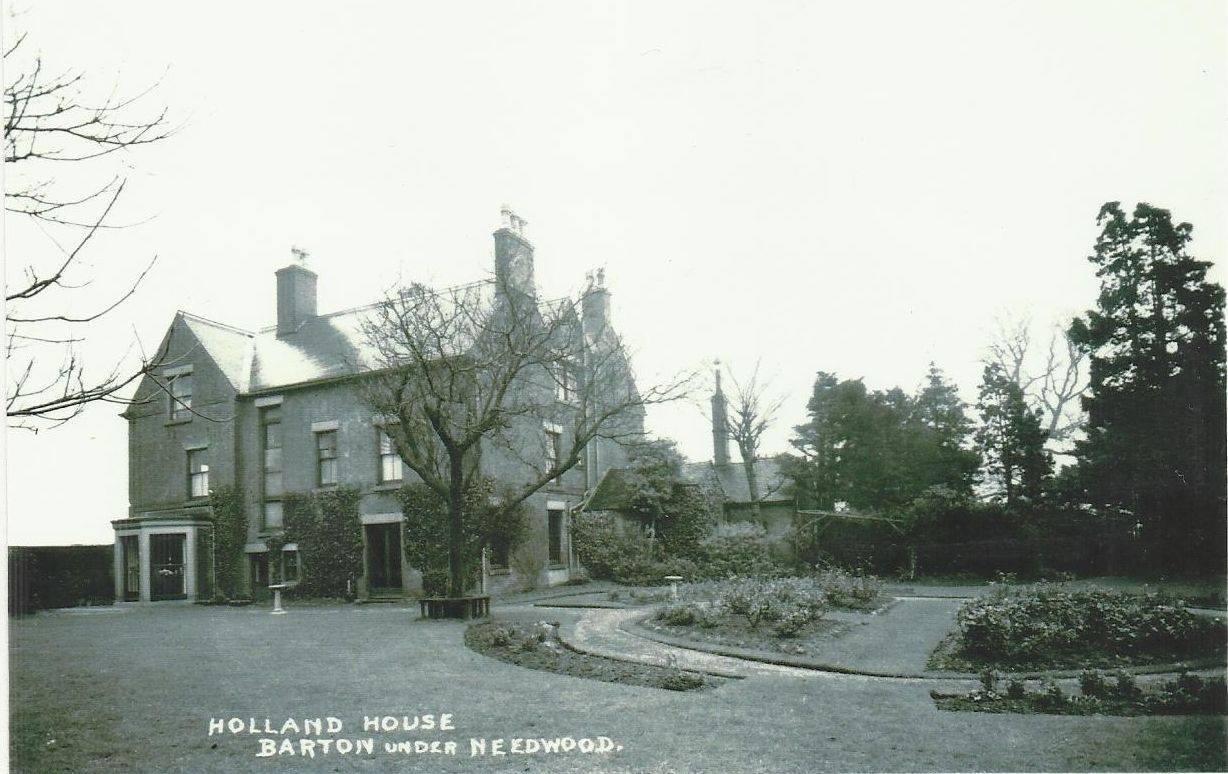
Excerpt from the book:
“The charter, dated 1314, granting Richard rights and privileges in Needwood Forest, reads as follows:
“Thomas Earl of Lancaster and Leicester, high-steward of England, to whom all these present shall come, greeting: Know ye, that we have given, &c., to Richard Holland of Barton, and his heirs, housboot, heyboot, and fireboot, and common of pasture, in our forest of Needwood, for all his beasts, as well in places fenced as lying open, with 40 hogs, quit of pawnage in our said forest at all times in the year (except hogs only in fence month). All which premises we will warrant, &c. to the said Richard and his heirs against all people for ever”
“The terms “housboot” “heyboot” and “fireboot” meant that Richard and his heirs were to have the privilege of taking from the Forest, wood needed for house repair and building, hedging material for the repairing of fences, and what was needful for purposes of fuel.”
Further excerpts from the book:
“It may here be mentioned that during the renovation of Barton Church, when the stone pillars were being stripped of the plaster which covered them, “William Holland 1617” was found roughly carved on a pillar near to the belfry gallery, obviously the work of a not too devout member of the family, who, seated in the gallery of that time, occupied himself thus during the service. The inscription can still be seen.”
“The earliest mention of a Holland of Upholland occurs in the reign of John in a Final Concord, made at the Lancashire Assizes, dated November 5th, 1202, in which Uchtred de Chryche, who seems to have had some right in the manor of Upholland, releases his right in fourteen oxgangs* of land to Matthew de Holland, in consideration of the sum of six marks of silver. Thus was planted the Holland Tree, all the early information of which is found in The Victoria County History of Lancaster.
As time went on, the family acquired more land, and with this, increased position. Thus, in the reign of Edward I, a Robert de Holland, son of Thurstan, son of Robert, became possessed of the manor of Orrell adjoining Upholland and of the lordship of Hale in the parish of Childwall, and, through marriage with Elizabeth de Samlesbury (co-heiress of Sir Wm. de Samlesbury of Samlesbury, Hall, near to Preston), of the moiety of that manor….
* An oxgang signified the amount of land that could be ploughed by one ox in one day”
“This Robert de Holland, son of Thurstan, received Knighthood in the reign of Edward I, as did also his brother William, ancestor of that branch of the family which later migrated to Cheshire. Belonging to this branch are such noteworthy personages as Mrs. Gaskell, the talented authoress, her mother being a Holland of this branch, Sir Henry Holland, Physician to Queen Victoria, and his two sons, the first Viscount Knutsford, and Canon Francis Holland ; Sir Henry’s grandson (the present Lord Knutsford), Canon Scott Holland, etc. Captain Frederick Holland, R.N., late of Ashbourne Hall, Derbyshire, may also be mentioned here.*”
Thanks to the Barton under Needwood history group for the following:
WALES END FARM:
In 1509 it was owned and occupied by Mr Johannes Holland De Wallass end who was a well to do Yeoman Farmer (the origin of the areas name – Wales End). Part of the building dates to 1490 making it probably the oldest building still standing in the Village: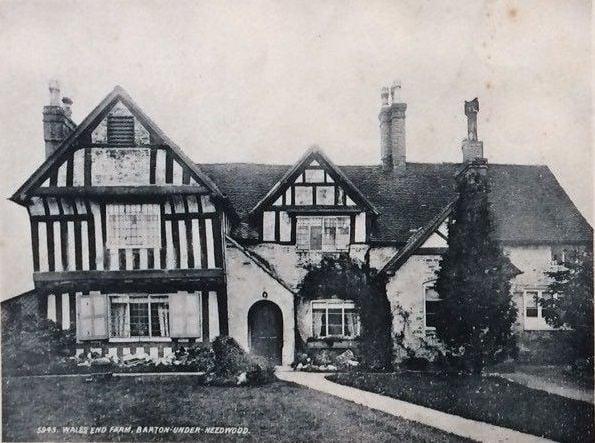
I found records for all of the Holland’s listed on the Barton under Needwood History group and added them to my ancestry tree. The earliest will I found was for Eunica Edwardes, then Eunica Holland, who died in 1632.
A page from the 1632 will and inventory of Eunica (Unice) Holland:
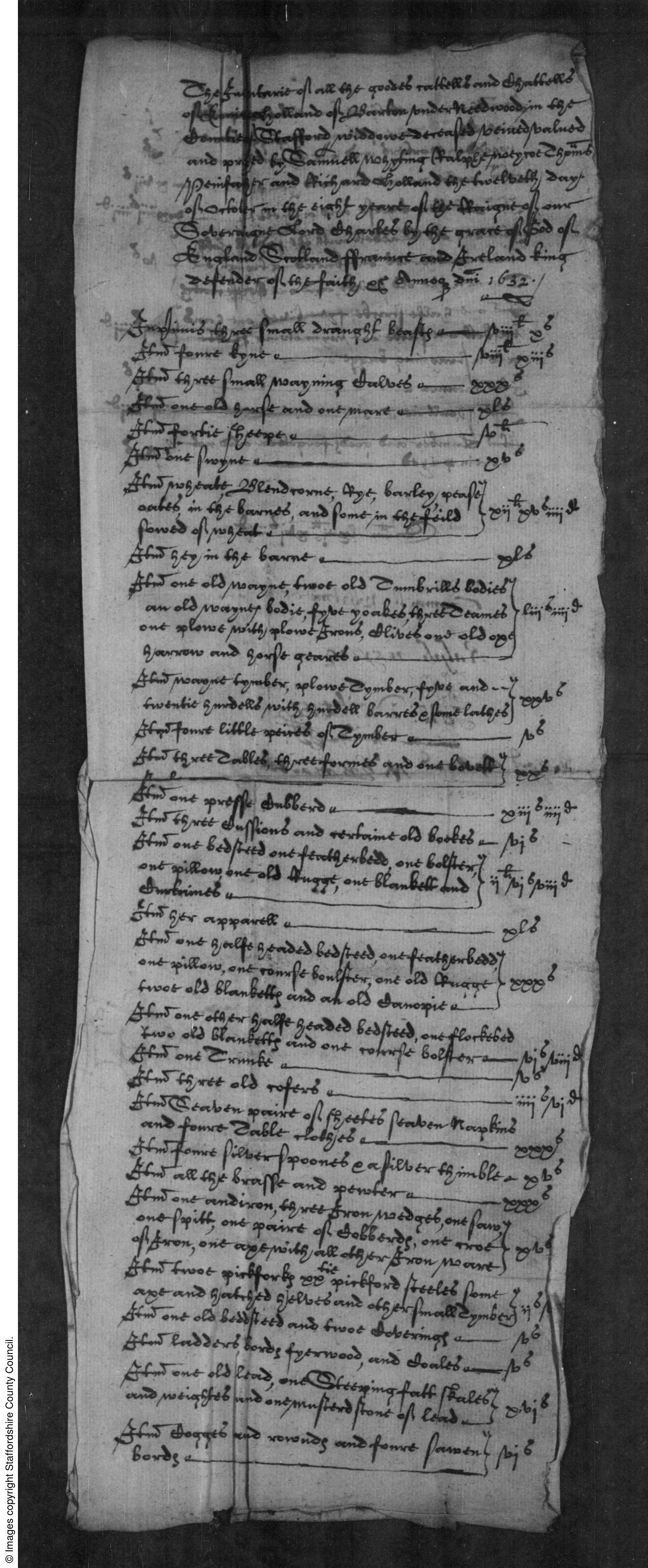
I’d been reading about “pedigree collapse” just before I found out her maiden name of Edwardes. Edwards is my own maiden name.
“In genealogy, pedigree collapse describes how reproduction between two individuals who knowingly or unknowingly share an ancestor causes the family tree of their offspring to be smaller than it would otherwise be.
Without pedigree collapse, a person’s ancestor tree is a binary tree, formed by the person, the parents, grandparents, and so on. However, the number of individuals in such a tree grows exponentially and will eventually become impossibly high. For example, a single individual alive today would, over 30 generations going back to the High Middle Ages, have roughly a billion ancestors, more than the total world population at the time. This apparent paradox occurs because the individuals in the binary tree are not distinct: instead, a single individual may occupy multiple places in the binary tree. This typically happens when the parents of an ancestor are cousins (sometimes unbeknownst to themselves). For example, the offspring of two first cousins has at most only six great-grandparents instead of the normal eight. This reduction in the number of ancestors is pedigree collapse. It collapses the binary tree into a directed acyclic graph with two different, directed paths starting from the ancestor who in the binary tree would occupy two places.” via wikipediaThere is nothing to suggest, however, that Eunica’s family were related to my fathers family, and the only evidence so far in my tree of pedigree collapse are the marriages of Orgill cousins, where two sets of grandparents are repeated.
A list of Holland ancestors:
Catherine Holland 1775-1861
her parents:
Thomas Holland 1737-1828 Hannah Hair 1739-1832
Thomas’s parents:
William Holland 1696-1756 Susannah Whiteing 1715-1752
William’s parents:
William Holland 1665- Elizabeth Higgs 1675-1720
William’s parents:
Thomas Holland 1634-1681 Katherine Owen 1634-1728
Thomas’s parents:
Thomas Holland 1606-1680 Margaret Belcher 1608-1664
Thomas’s parents:
Thomas Holland 1562-1626 Eunice Edwardes 1565- 1632 -
AuthorSearch Results