

Search Results for 'himself'
-
AuthorSearch Results
-
January 28, 2022 at 7:57 am #6259
In reply to: The Elusive Samuel Housley and Other Family Stories
George “Mike” Rushby
A short autobiography of George Gilman Rushby’s son, published in the Blackwall Bugle, Australia.
Early in 2009, Ballina Shire Council Strategic and
Community Services Group Manager, Steve Barnier,
suggested that it would be a good idea for the Wardell
and District community to put out a bi-monthly
newsletter. I put my hand up to edit the publication and
since then, over 50 issues of “The Blackwall Bugle”
have been produced, encouraged by Ballina Shire
Council who host the newsletter on their website.
Because I usually write the stories that other people
generously share with me, I have been asked by several
community members to let them know who I am. Here is
my attempt to let you know!My father, George Gilman Rushby was born in England
in 1900. An Electrician, he migrated to Africa as a young
man to hunt and to prospect for gold. He met Eleanor
Dunbar Leslie who was a high school teacher in Cape
Town. They later married in Dar es Salaam, Tanganyika.
I was the second child and first son and was born in a
mud hut in Tanganyika in 1933. I spent my first years on
a coffee plantation. When four years old, and with
parents and elder sister on a remote goldfield, I caught
typhoid fever. I was seriously ill and had no access to
proper medical facilities. My paternal grandmother
sailed out to Africa from England on a steam ship and
took me back to England for medical treatment. My
sister Ann came too. Then Adolf Hitler started WWII and
Ann and I were separated from our parents for 9 years.Sister Ann and I were not to see him or our mother for
nine years because of the war. Dad served as a Captain in
the King’s African Rifles operating in the North African
desert, while our Mum managed the coffee plantation at
home in Tanganyika.Ann and I lived with our Grandmother and went to
school in Nottingham England. In 1946 the family was
reunited. We lived in Mbeya in Southern Tanganyika
where my father was then the District Manager of the
National Parks and Wildlife Authority. There was no
high school in Tanganyika so I had to go to school in
Nairobi, Kenya. It took five days travelling each way by
train and bus including two days on a steamer crossing
Lake Victoria.However, the school year was only two terms with long
holidays in between.When I was seventeen, I left high school. There was
then no university in East Africa. There was no work
around as Tanganyika was about to become
independent of the British Empire and become
Tanzania. Consequently jobs were reserved for
Africans.A war had broken out in Korea. I took a day off from
high school and visited the British Army headquarters
in Nairobi. I signed up for military service intending to
go to Korea. The army flew me to England. During
Army basic training I was nicknamed ‘Mike’ and have
been called Mike ever since. I never got to Korea!
After my basic training I volunteered for the Parachute
Regiment and the army sent me to Egypt where the
Suez Canal was under threat. I carried out parachute
operations in the Sinai Desert and in Cyprus and
Jordan. I was then selected for officer training and was
sent to England to the Eaton Hall Officer Cadet School
in Cheshire. Whilst in Cheshire, I met my future wife
Jeanette. I graduated as a Second Lieutenant in the
Royal Lincolnshire Regiment and was posted to West
Berlin, which was then one hundred miles behind the
Iron Curtain. My duties included patrolling the
demarcation line that separated the allies from the
Russian forces. The Berlin Wall was yet to be built. I
also did occasional duty as guard commander of the
guard at Spandau Prison where Adolf Hitler’s deputy
Rudolf Hess was the only prisoner.From Berlin, my Regiment was sent to Malaya to
undertake deep jungle operations against communist
terrorists that were attempting to overthrow the
Malayan Government. I was then a Lieutenant in
command of a platoon of about 40 men which would go
into the jungle for three weeks to a month with only air
re-supply to keep us going. On completion of my jungle
service, I returned to England and married Jeanette. I
had to stand up throughout the church wedding
ceremony because I had damaged my right knee in a
competitive cross-country motorcycle race and wore a
splint and restrictive bandage for the occasion!
At this point I took a career change and transferred
from the infantry to the Royal Military Police. I was in
charge of the security of British, French and American
troops using the autobahn link from West Germany to
the isolated Berlin. Whilst in Germany and Austria I
took up snow skiing as a sport.Jeanette and I seemed to attract unusual little
adventures along the way — each adventure trivial in
itself but adding up to give us a ‘different’ path through
life. Having climbed Mount Snowdon up the ‘easy way’
we were witness to a serious climbing accident where a
member of the staff of a Cunard Shipping Line
expedition fell and suffered serious injury. It was
Sunday a long time ago. The funicular railway was
closed. There was no telephone. So I ran all the way
down Mount Snowdon to raise the alarm.On a road trip from Verden in Germany to Berlin with
our old Opel Kapitan motor car stacked to the roof with
all our worldly possessions, we broke down on the ice and snow covered autobahn. We still had a hundred kilometres to go.A motorcycle patrolman flagged down a B-Double
tanker. He hooked us to the tanker with a very short tow
cable and off we went. The truck driver couldn’t see us
because we were too close and his truck threw up a
constant deluge of ice and snow so we couldn’t see
anyway. We survived the hundred kilometre ‘sleigh
ride!’I then went back to the other side of the world where I
carried out military police duties in Singapore and
Malaya for three years. I took up scuba diving and
loved the ocean. Jeanette and I, with our two little
daughters, took a holiday to South Africa to see my
parents. We sailed on a ship of the Holland-Afrika Line.
It broke down for four days and drifted uncontrollably
in dangerous waters off the Skeleton Coast of Namibia
until the crew could get the ship’s motor running again.
Then, in Cape Town, we were walking the beach near
Hermanus with my youngest brother and my parents,
when we found the dead body of a man who had thrown
himself off a cliff. The police came and secured the site.
Back with the army, I was promoted to Major and
appointed Provost Marshal of the ACE Mobile Force
(Allied Command Europe) with dual headquarters in
Salisbury, England and Heidelberg, Germany. The cold
war was at its height and I was on operations in Greece,
Denmark and Norway including the Arctic. I had
Norwegian, Danish, Italian and American troops in my
unit and I was then also the Winter Warfare Instructor
for the British contingent to the Allied Command
Europe Mobile Force that operated north of the Arctic
Circle.The reason for being in the Arctic Circle? From there
our special forces could look down into northern
Russia.I was not seeing much of my two young daughters. A
desk job was looming my way and I decided to leave
the army and migrate to Australia. Why Australia?
Well, I didn’t want to go back to Africa, which
seemed politically unstable and the people I most
liked working with in the army, were the Australian
troops I had met in Malaya.I migrated to Brisbane, Australia in 1970 and started
working for Woolworths. After management training,
I worked at Garden City and Brookside then became
the manager in turn of Woolworths stores at
Paddington, George Street and Redcliff. I was also the
first Director of FAUI Queensland (The Federation of
Underwater Diving Instructors) and spent my spare
time on the Great Barrier Reef. After 8 years with
Woollies, I opted for a sea change.I moved with my family to Evans Head where I
converted a convenience store into a mini
supermarket. When IGA moved into town, I decided
to take up beef cattle farming and bought a cattle
property at Collins Creek Kyogle in 1990. I loved
everything about the farm — the Charolais cattle, my
horses, my kelpie dogs, the open air, fresh water
creek, the freedom, the lifestyle. I also became a
volunteer fire fighter with the Green Pigeon Brigade.
In 2004 I sold our farm and moved to Wardell.
My wife Jeanette and I have been married for 60 years
and are now retired. We have two lovely married
daughters and three fine grandchildren. We live in the
greatest part of the world where we have been warmly
welcomed by the Wardell community and by the
Wardell Brigade of the Rural Fire Service. We are
very happy here.Mike Rushby
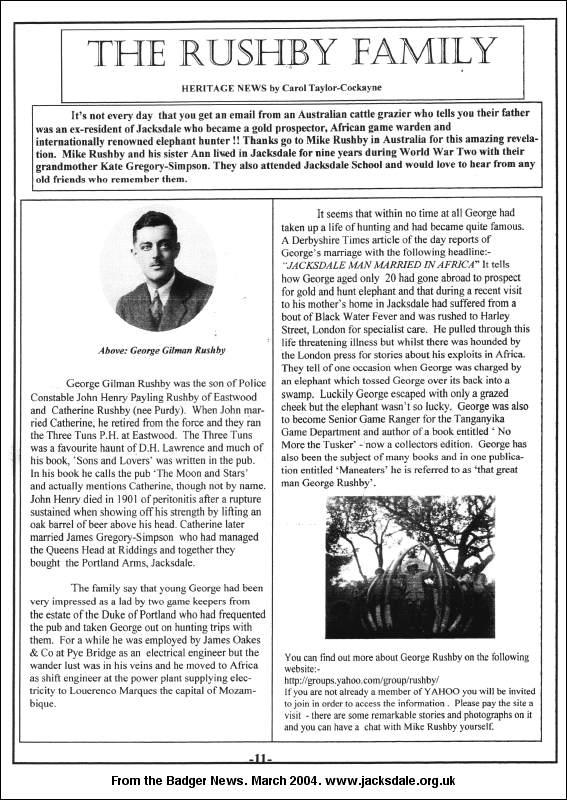
A short article sent to Jacksdale in England from Mike Rushby in Australia:
 December 18, 2021 at 12:59 pm #6243
In reply to: The Elusive Samuel Housley and Other Family Stories
William Housley’s Will and the Court Case
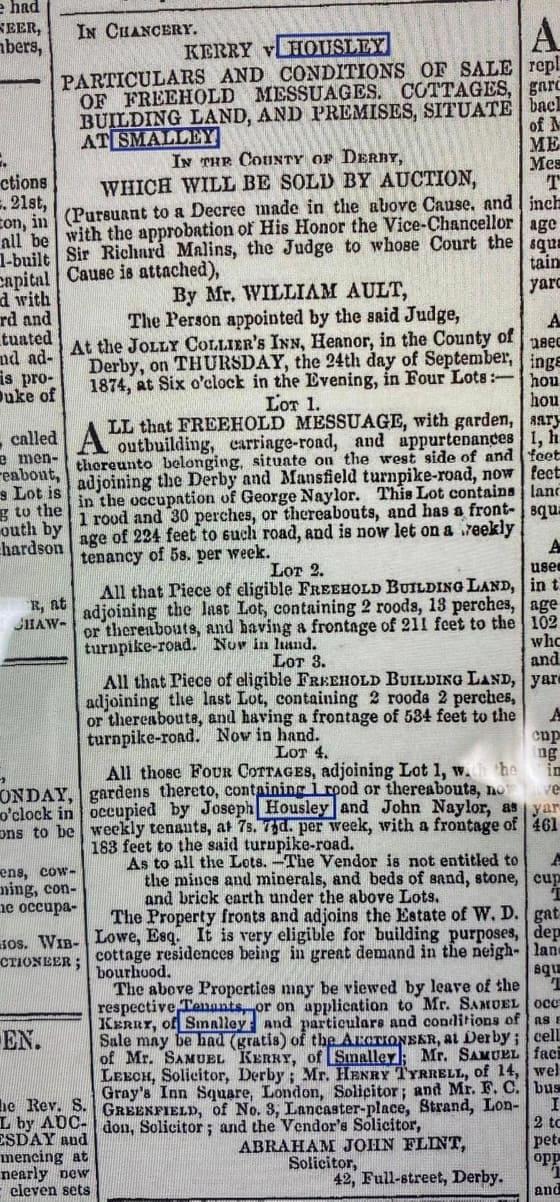
William Housley died in 1848, but his widow Ellen didn’t die until 1872. The court case was in 1873. Details about the court case are archived at the National Archives at Kew, in London, but are not available online. They can be viewed in person, but that hasn’t been possible thus far. However, there are a great many references to it in the letters.
William Housley’s first wife was Mary Carrington 1787-1813. They had three children, Mary Anne, Elizabeth and William. When Mary died, William married Mary’s sister Ellen, not in their own parish church at Smalley but in Ashbourne. Although not uncommon for a widower to marry a deceased wife’s sister, it wasn’t legal. This point is mentioned in one of the letters.
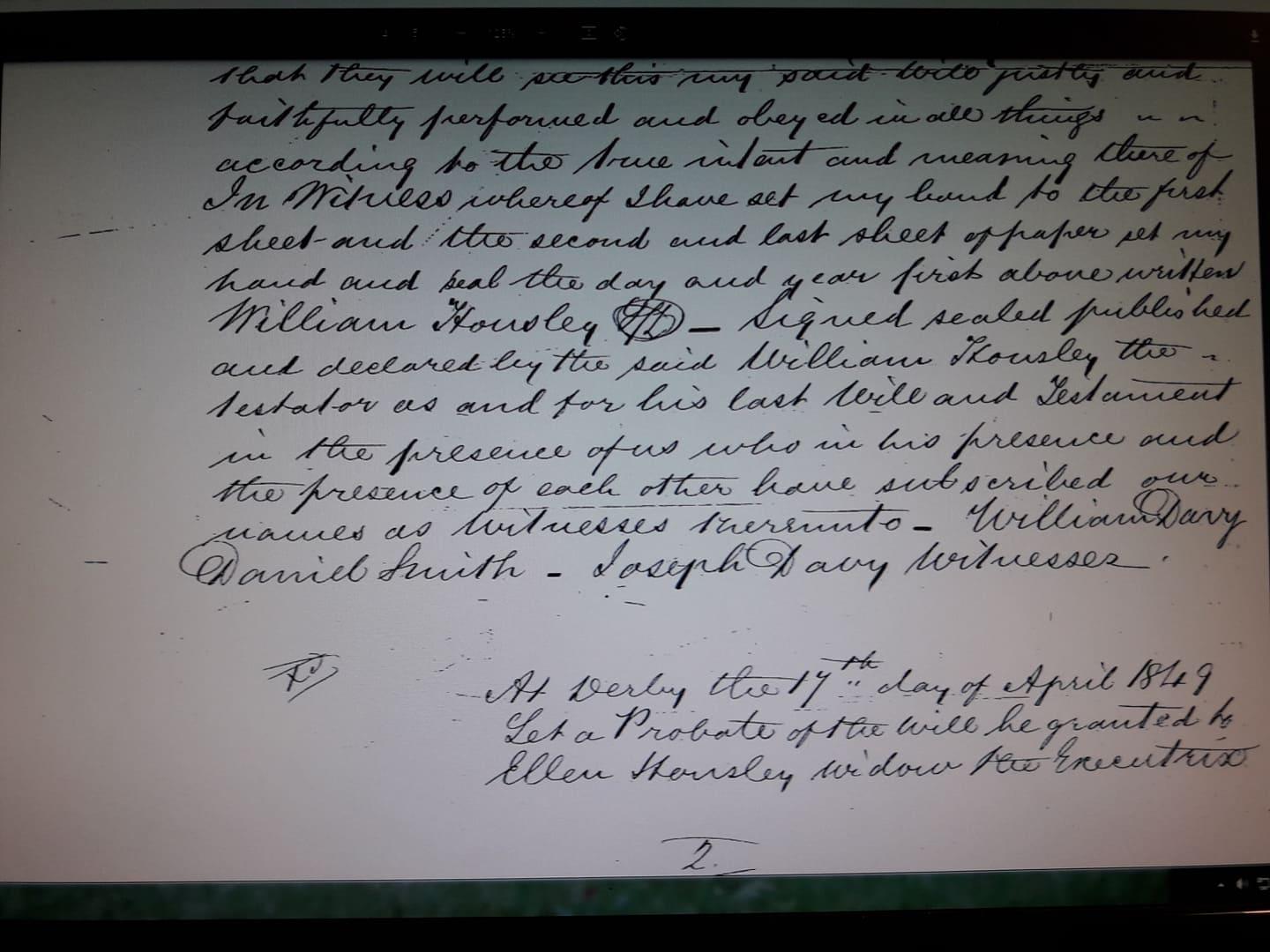
One of the pages of William Housley’s will:
An excerpt from Barbara Housley’s Narrative on the Letters:
A comment in a letter from Joseph (August 6, 1873) indicated that William was married twice and that his wives were sisters: “What do you think that I believe that Mary Ann is trying to make our father’s will of no account as she says that my father’s marriage with our mother was not lawful he marrying two sisters. What do you think of her? I have heard my mother say something about paying a fine at the time of the marriage to make it legal.” Markwell and Saul in The A-Z Guide to Tracing Ancestors in Britain explain that marriage to a deceased wife’s sister was not permissible under Canon law as the relationship was within the prohibited degrees. However, such marriages did take place–usually well away from the couple’s home area. Up to 1835 such marriages were not void but were voidable by legal action. Few such actions were instituted but the risk was always there.
Joseph wrote that when Emma was married, Ellen “broke up the comfortable home and the things went to Derby and she went to live with them but Derby didn’t agree with her so she left again leaving her things behind and came to live with John in the new house where she died.” Ellen was listed with John’s household in the 1871 census.
In May 1872, the Ilkeston Pioneer carried this notice: “Mr. Hopkins will sell by auction on Saturday next the eleventh of May 1872 the whole of the useful furniture, sewing machine, etc. nearly new on the premises of the late Mrs. Housley at Smalley near Heanor in the county of Derby. Sale at one o’clock in the afternoon.”There were hard feelings between Mary Ann and Ellen and her children. Anne wrote: “If you remember we were not very friendly when you left. They never came and nothing was too bad for Mary Ann to say of Mother and me, but when Robert died Mother sent for her to the funeral but she did not think well to come so we took no more notice. She would not allow her children to come either.”
Mary Ann was still living in May 1872. Joseph implied that she and her brother, Will “intend making a bit of bother about the settlement of the bit of property” left by their mother. The 1871 census listed Mary Ann’s occupation as “income from houses.”In July 1872, Joseph introduced Ruth’s husband: “No doubt he is a bad lot. He is one of the Heath’s of Stanley Common a miller and he lives at Smalley Mill” (Ruth Heath was Mary Anne Housley’s daughter)
In 1873 Joseph wrote, “He is nothing but a land shark both Heath and his wife and his wife is the worst of the two. You will think these is hard words but they are true dear brother.” The solicitor, Abraham John Flint, was not at all pleased with Heath’s obstruction of the settlement of the estate. He wrote on June 30, 1873: “Heath agreed at first and then because I would not pay his expenses he refused and has since instructed another solicitor for his wife and Mrs. Weston who have been opposing us to the utmost. I am concerned for all parties interested except these two….The judge severely censured Heath for his conduct and wanted to make an order for sale there and then but Heath’s council would not consent….” In June 1875, the solicitor wrote: “Heath bid for the property but it fetched more money than he could give for it. He has been rather quieter lately.”In May 1872, Joseph wrote: “For what do you think, John has sold his share and he has acted very bad since his wife died and at the same time he sold all his furniture. You may guess I have never seen him but once since poor mother’s funeral and he is gone now no one knows where.”
In 1876, the solicitor wrote to George: “Have you heard of John Housley? He is entitled to Robert’s share and I want him to claim it.”
Anne intended that one third of the inheritance coming to her from her father and her grandfather, William Carrington, be divided between her four nieces: Sam’s three daughters and John’s daughter Elizabeth.
In the same letter (December 15, 1872), Joseph wrote:
“I think we have now found all out now that is concerned in the matter for there was only Sam that we did not know his whereabouts but I was informed a week ago that he is dead–died about three years ago in Birmingham Union. Poor Sam. He ought to have come to a better end than that”However, Samuel was still alive was on the 1871 census in Henley in Arden, and no record of his death can be found. Samuel’s brother in law said he was dead: we do not know why he lied, or perhaps the brothers were lying to keep his share, or another possibility is that Samuel himself told his brother in law to tell them that he was dead. I am inclined to think it was the latter.
Excerpts from Barbara Housley’s Narrative on the Letters continued:
Charles went to Australia in 1851, and was last heard from in January 1853. According to the solicitor, who wrote to George on June 3, 1874, Charles had received advances on the settlement of their parent’s estate. “Your promissory note with the two signed by your brother Charles for 20 pounds he received from his father and 20 pounds he received from his mother are now in the possession of the court.”
In December 1872, Joseph wrote: “I’m told that Charles two daughters has wrote to Smalley post office making inquiries about his share….” In January 1876, the solicitor wrote: “Charles Housley’s children have claimed their father’s share.”
In the Adelaide Observer 28 Aug 1875
HOUSLEY – wanted information
as to the Death, Will, or Intestacy, and
Children of Charles Housley, formerly of
Smalley, Derbyshire, England, who died at
Geelong or Creewick Creek Diggings, Victoria
August, 1855. His children will hear of something to their advantage by communicating with
Mr. A J. Flint, solicitor, Derby, England.
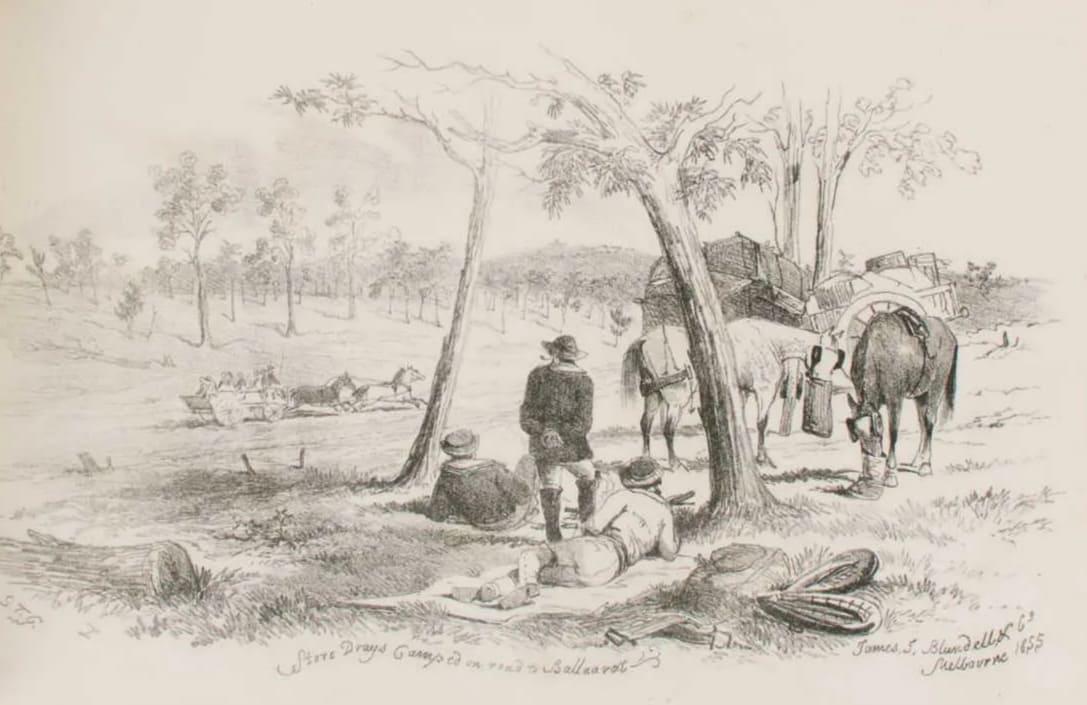
June 16,1875.The Diggers & Diggings of Victoria in 1855. Drawn on Stone by S.T. Gill:
The court case:
Kerry v Housley.
Documents: Bill, demurrer.
Plaintiffs: Samuel Kerry and Joseph Housley.
Defendants: William Housley, Joseph Housley (deleted), Edwin Welch Harvey, Eleanor Harvey (deleted), Ernest Harvey infant, William Stafford, Elizabeth Stafford his wife, Mary Ann Housley, George Purdy and Catherine Purdy his wife, Elizabeth Housley, Mary Ann Weston widow and William Heath and Ruth Heath his wife (deleted).
Provincial solicitor employed in Derbyshire.
Date: 1873From the Narrative on the Letters:
The solicitor wrote on May 23, 1874: “Lately I have not written because I was not certain of your address and because I doubted I had much interesting news to tell you.” Later, Joseph wrote concerning the problems settling the estate, “You see dear brother there is only me here on our side and I cannot do much. I wish you were here to help me a bit and if you think of going for another summer trip this turn you might as well run over here.”
In March 1873, Joseph wrote: “You ask me what I think of you coming to England. I think as you have given the trustee power to sign for you I think you could do no good but I should like to see you once again for all that. I can’t say whether there would be anything amiss if you did come as you say it would be throwing good money after bad.”
In September 1872 Joseph wrote; “My wife is anxious to come. I hope it will suit her health for she is not over strong.” Elsewhere Joseph wrote that Harriet was “middling sometimes. She is subject to sick headaches. It knocks her up completely when they come on.” In December 1872 Joseph wrote, “Now dear brother about us coming to America you know we shall have to wait until this affair is settled and if it is not settled and thrown into Chancery I’m afraid we shall have to stay in England for I shall never be able to save money enough to bring me out and my family but I hope of better things.”
On July 19, 1875 Abraham Flint (the solicitor) wrote: “Joseph Housley has removed from Smalley and is working on some new foundry buildings at Little Chester near Derby. He lives at a village called Little Eaton near Derby. If you address your letter to him as Joseph Housley, carpenter, Little Eaton near Derby that will no doubt find him.”In his last letter (February 11, 1874), Joseph sounded very discouraged and wrote that Harriet’s parents were very poorly and both had been “in bed for a long time.” In addition, Harriet and the children had been ill.
The move to Little Eaton may indicate that Joseph received his settlement because in August, 1873, he wrote: “I think this is bad news enough and bad luck too, but I have had little else since I came to live at Kiddsley cottages but perhaps it is all for the best if one could only think so. I have begun to think there will be no chance for us coming over to you for I am afraid there will not be so much left as will bring us out without it is settled very shortly but I don’t intend leaving this house until it is settled either one way or the other. ”Joseph’s letters were much concerned with the settling of their mother’s estate. In 1854, Anne wrote, “As for my mother coming (to America) I think not at all likely. She is tied here with her property.” A solicitor, Abraham John Flint of 42 Full Street Derby, was engaged by John following the death of their mother. On June 30, 1873 the solicitor wrote: “Dear sir, On the death of your mother I was consulted by your brother John. I acted for him with reference to the sale and division of your father’s property at Smalley. Mr. Kerry was very unwilling to act as trustee being over 73 years of age but owing to the will being a badly drawn one we could not appoint another trustee in his place nor could the property be sold without a decree of chancery. Therefore Mr. Kerry consented and after a great deal of trouble with Heath who has opposed us all throughout whenever matters did not suit him, we found the title deeds and offered the property for sale by public auction on the 15th of July last. Heath could not find his purchase money without mortaging his property the solicitor which the mortgagee employed refused to accept Mr. Kerry’s title and owing to another defect in the will we could not compel them.”
In July 1872, Joseph wrote, “I do not know whether you can remember who the trustee was to my father’s will. It was Thomas Watson and Samuel Kerry of Smalley Green. Mr. Watson is dead (died a fortnight before mother) so Mr. Kerry has had to manage the affair.”
On Dec. 15, 1972, Joseph wrote, “Now about this property affair. It seems as far off of being settled as ever it was….” and in the following March wrote: “I think we are as far off as ever and farther I think.”
Concerning the property which was auctioned on July 15, 1872 and brought 700 pounds, Joseph wrote: “It was sold in five lots for building land and this man Heath bought up four lots–that is the big house, the croft and the cottages. The croft was made into two lots besides the piece belonging to the big house and the cottages and gardens was another lot and the little intake was another. William Richardson bought that.” Elsewhere Richardson’s purchase was described as “the little croft against Smith’s lane.” Smith’s Lane was probably named for their neighbor Daniel Smith, Mrs. Davy’s father.
But in December 1872, Joseph wrote that they had not received any money because “Mr. Heath is raising all kinds of objections to the will–something being worded wrong in the will.” In March 1873, Joseph “clarified” matters in this way: “His objection was that one trustee could not convey the property that his signature was not guarantee sufficient as it states in the will that both trustees has to sign the conveyance hence this bother.”
Joseph indicated that six shares were to come out of the 700 pounds besides Will’s 20 pounds. Children were to come in for the parents shares if dead. The solicitor wrote in 1873, “This of course refers to the Kidsley property in which you take a one seventh share and which if the property sells well may realize you about 60-80 pounds.” In March 1873 Joseph wrote: “You have an equal share with the rest in both lots of property, but I am afraid there will be but very little for any of us.”The other “lot of property” was “property in Smalley left under another will.” On July 17, 1872, Joseph wrote: “It was left by my grandfather Carrington and Uncle Richard is trustee. He seems very backward in bringing the property to a sale but I saw him and told him that I for one expect him to proceed with it.” George seemed to have difficulty understanding that there were two pieces of property so Joseph explained further: “It was left by my grandfather Carrington not by our father and Uncle Richard is the trustee for it but the will does not give him power to sell without the signatures of the parties concerned.” In June 1873 the solicitor Abraham John Flint asked: “Nothing has been done about the other property at Smalley at present. It wants attention and the other parties have asked me to attend to it. Do you authorize me to see to it for you as well?”
After Ellen’s death, the rent was divided between Joseph, Will, Mary Ann and Mr. Heath who bought John’s share and was married to Mary Ann’s daughter, Ruth. Joseph said that Mr. Heath paid 40 pounds for John’s share and that John had drawn 110 pounds in advance. The solicitor said Heath said he paid 60. The solicitor said that Heath was trying to buy the shares of those at home to get control of the property and would have defied the absent ones to get anything.
In September 1872 Joseph wrote that the lawyer said the trustee cannot sell the property at the bottom of Smalley without the signatures of all parties concerned in it and it will have to go through chancery court which will be a great expense. He advised Joseph to sell his share and Joseph advised George to do the same.George sent a “portrait” so that it could be established that it was really him–still living and due a share. Joseph wrote (July 1872): “the trustee was quite willing to (acknowledge you) for the portrait I think is a very good one.” Several letters later in response to an inquiry from George, Joseph wrote: “The trustee recognized you in a minute…I have not shown it to Mary Ann for we are not on good terms….Parties that I have shown it to own you again but they say it is a deal like John. It is something like him, but I think is more like myself.”
In September 1872 Joseph wrote that the lawyer required all of their ages and they would have to pay “succession duty”. Joseph requested that George send a list of birth dates.On May 23, 1874, the solicitor wrote: “I have been offered 240 pounds for the three cottages and the little house. They sold for 200 pounds at the last sale and then I was offered 700 pounds for the whole lot except Richardson’s Heanor piece for which he is still willing to give 58 pounds. Thus you see that the value of the estate has very materially increased since the last sale so that this delay has been beneficial to your interests than other-wise. Coal has become much dearer and they suppose there is coal under this estate. There are many enquiries about it and I believe it will realize 800 pounds or more which increase will more than cover all expenses.” Eventually the solicitor wrote that the property had been sold for 916 pounds and George would take a one-ninth share.
January 14, 1876: “I am very sorry to hear of your lameness and illness but I trust that you are now better. This matter as I informed you had to stand over until December since when all the costs and expenses have been taxed and passed by the court and I am expecting to receive the order for these this next week, then we have to pay the legacy duty and them divide the residue which I doubt won’t come to very much amongst so many of you. But you will hear from me towards the end of the month or early next month when I shall have to send you the papers to sign for your share. I can’t tell you how much it will be at present as I shall have to deduct your share with the others of the first sale made of the property before it went to court.
Wishing you a Happy New Year, I am Dear Sir, Yours truly
Abram J. Flint”September 15, 1876 (the last letter)
“I duly received your power of attorney which appears to have been properly executed on Thursday last and I sent it on to my London agent, Mr. Henry Lyvell, who happens just now to be away for his annual vacation and will not return for 14 or 20 days and as his signature is required by the Paymaster General before he will pay out your share, it must consequently stand over and await his return home. It shall however receive immediate attention as soon as he returns and I hope to be able to send your checque for the balance very shortly.”1874 in chancery:
 December 15, 2021 at 7:53 am #6234
In reply to: The Elusive Samuel Housley and Other Family Stories
Ben Warren
Derby County and England football legend who died aged 37 penniless and ‘insane’
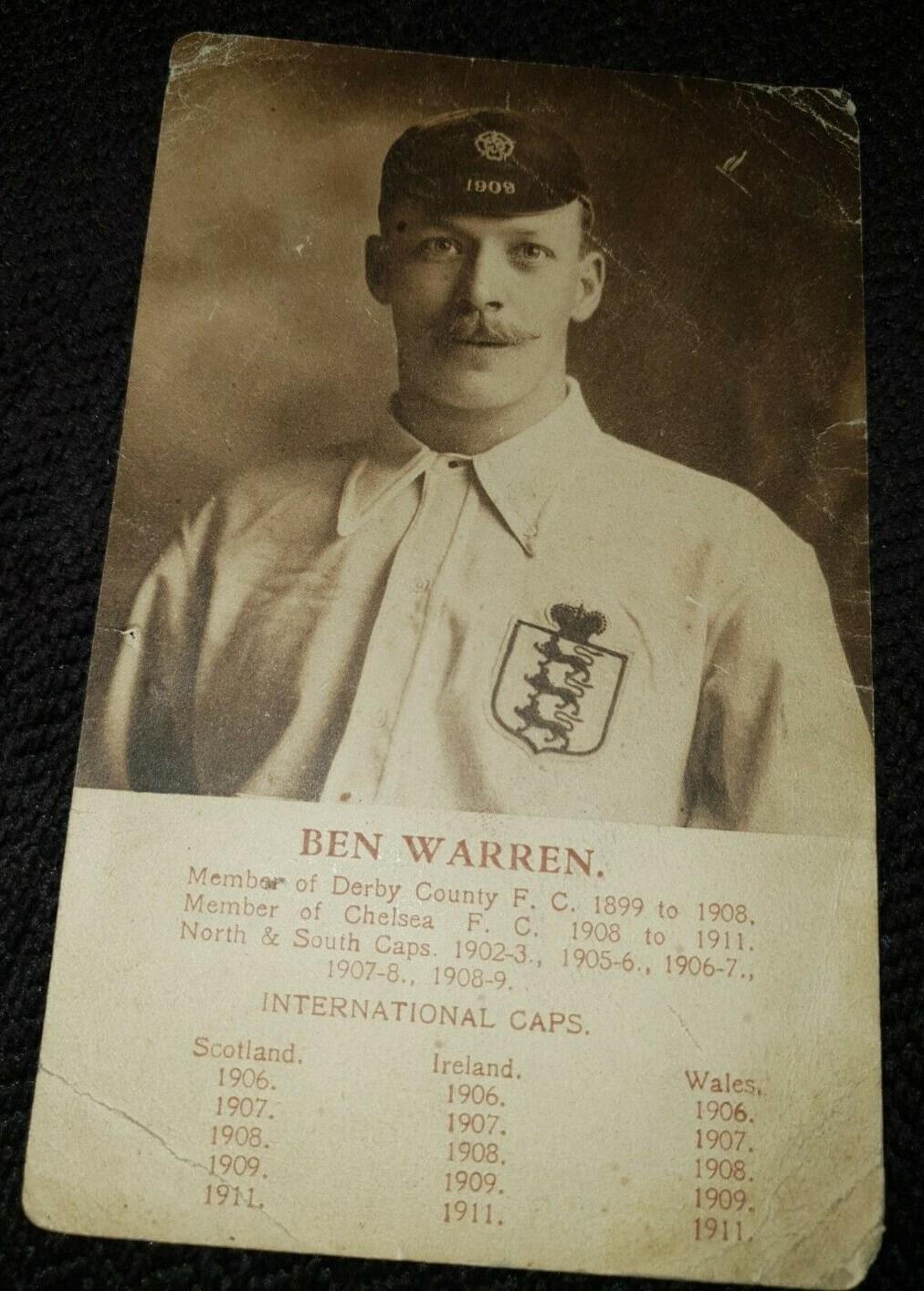
Ben Warren 1879 – 1917 was Samuel Warren’s (my great grandfather) cousin.
From the Derby Telegraph:
Just 17 months after earning his 22nd England cap, against Scotland at Everton on April 1, 1911, he was certified insane. What triggered his decline was no more than a knock on the knee while playing for Chelsea against Clapton Orient.
The knee would not heal and the longer he was out, the more he fretted about how he’d feed his wife and four children. In those days, if you didn’t play, there was no pay.
…..he had developed “brain fever” and this mild-mannered man had “become very strange and, at times, violent”. The coverage reflected his celebrity status.
On December 15, 1911, as Rick Glanvill records in his Official Biography of Chelsea FC: “He was admitted to a private clinic in Nottingham, suffering from acute mania, delusions that he was being poisoned and hallucinations of hearing and vision.”
He received another blow in February, 1912, when his mother, Emily, died. She had congestion of the lungs and caught influenza, her condition not helped, it was believed, by worrying about Ben.
She had good reason: her famous son would soon be admitted to the unfortunately named Derby County Lunatic Asylum.
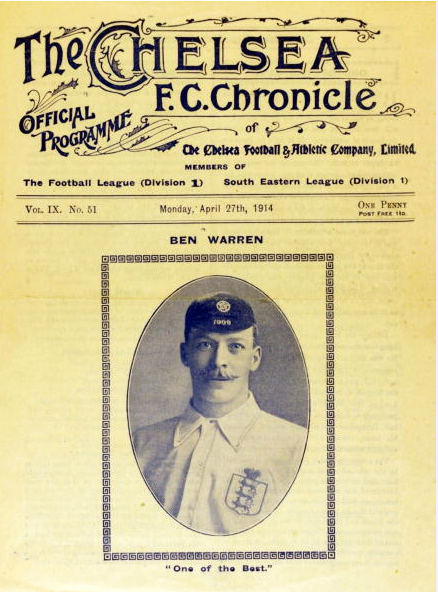
As Britain sleepwalked towards the First World War, Ben’s condition deteriorated. Glanvill writes: “His case notes from what would be a five-year stay, catalogue a devastating decline in which he is at various times described as incoherent, restless, destructive, ‘stuporose’ and ‘a danger to himself’.’”
photo: Football 27th April 1914. A souvenir programme for the testimonial game for Chelsea and England’s Ben Warren, (pictured) who had been declared insane and sent to a lunatic asylum. The game was a select XI for the North playing a select XI from The South proceeds going to Warren’s family.
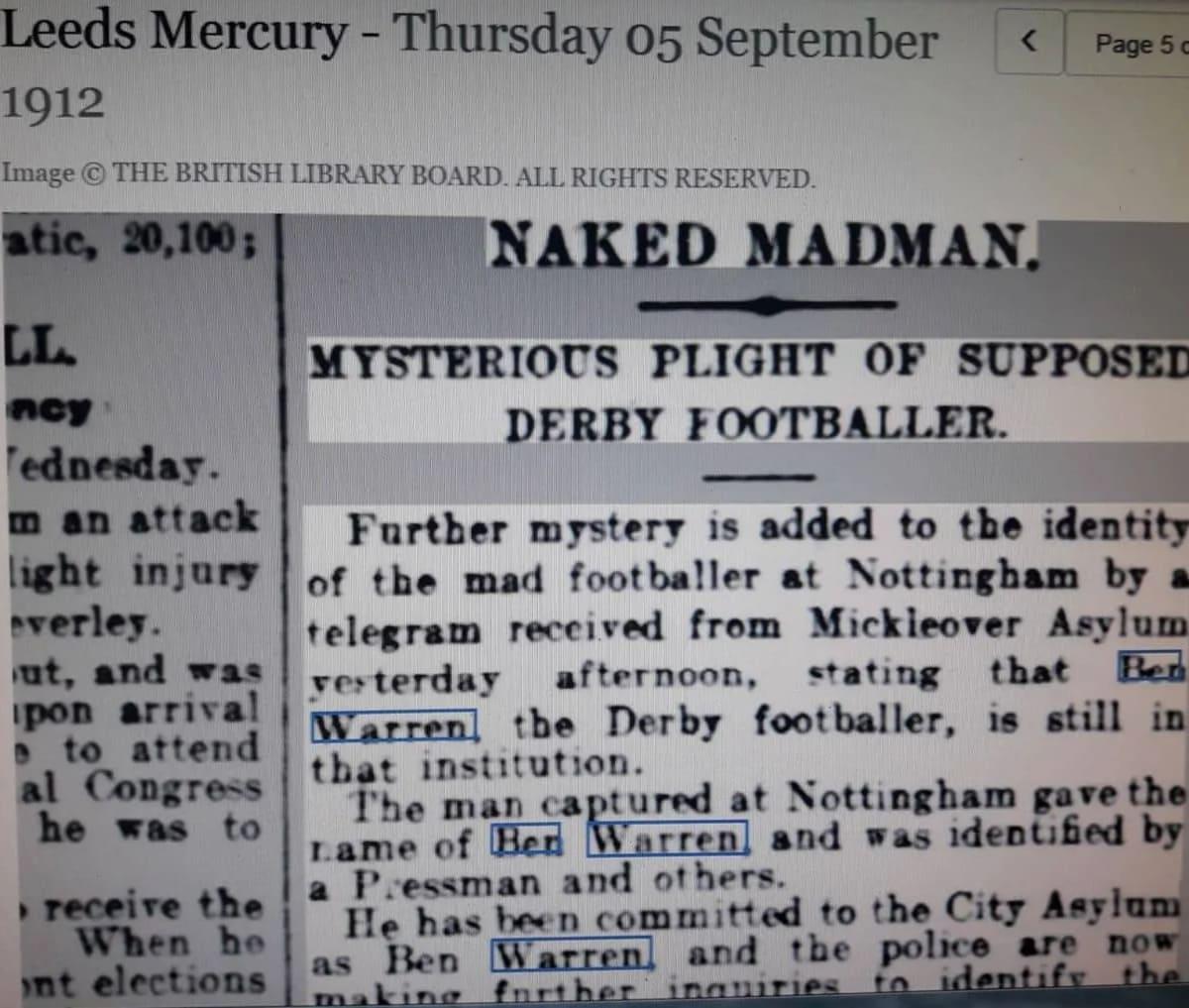
In September, that decline reached a new and pitiable low. The following is an abridged account of what The Courier called “an amazing incident” that took place on September 4.
“Spotted by a group of men while walking down Derby Road in Nottingham, a man was acting strangely, smoking a cigarette and had nothing on but a collar and tie.
“He jumped about the pavement and roadway, as though playing an imaginary game of football. When approached, he told them he was going to Trent Bridge to play in a match and had to be there by 3.30.”
Eventually he was taken to a police station and recognised by a reporter as England’s erstwhile right-half. What made the story even harder to digest was that Ben had escaped from the asylum and walked the 20 miles to Nottingham apparently unnoticed.
He had played at “Trent Bridge” many times – at least on Nottingham Forest’s adjacent City Ground.
As a shocked nation came to terms with the desperate plight of one of its finest footballers, some papers suggested his career was not yet over. And his relatives claimed that he had been suffering from nothing more than a severe nervous breakdown.
He would never be the same again – as a player or a man. He wasn’t even a shadow of the weird “footballer” who had walked 20 miles to Nottingham.
Then, he had nothing on, now he just had nothing – least of all self-respect. He ripped sheets into shreds and attempted suicide, saying: “I’m no use to anyone – and ought to be out of the way.”
“A year before his suicide attempt in 1916 the ominous symptom of ‘dry cough’ had been noted. Two months after it, in October 1916, the unmistakable signs of tuberculosis were noted and his enfeebled body rapidly succumbed.
At 11.30pm on 15 January 1917, international footballer Ben Warren was found dead by a night attendant.
He was 37 and when they buried him the records described him as a “pauper’.”
However you look at it, it is the salutary tale of a footballer worrying about money. And it began with a knock on the knee.
On 14th November 2021, Gill Castle posted on the Newhall and Swadlincote group:
I would like to thank Colin Smith and everyone who supported him in getting my great grandfather’s grave restored (Ben Warren who played for Derby, Chelsea and England)
The month before, Colin Smith posted:
My Ben Warren Journey is nearly complete.
It started two years ago when I was sent a family wedding photograph asking if I recognised anyone. My Great Great Grandmother was on there. But soon found out it was the wedding of Ben’s brother Robert to my 1st cousin twice removed, Eveline in 1910.
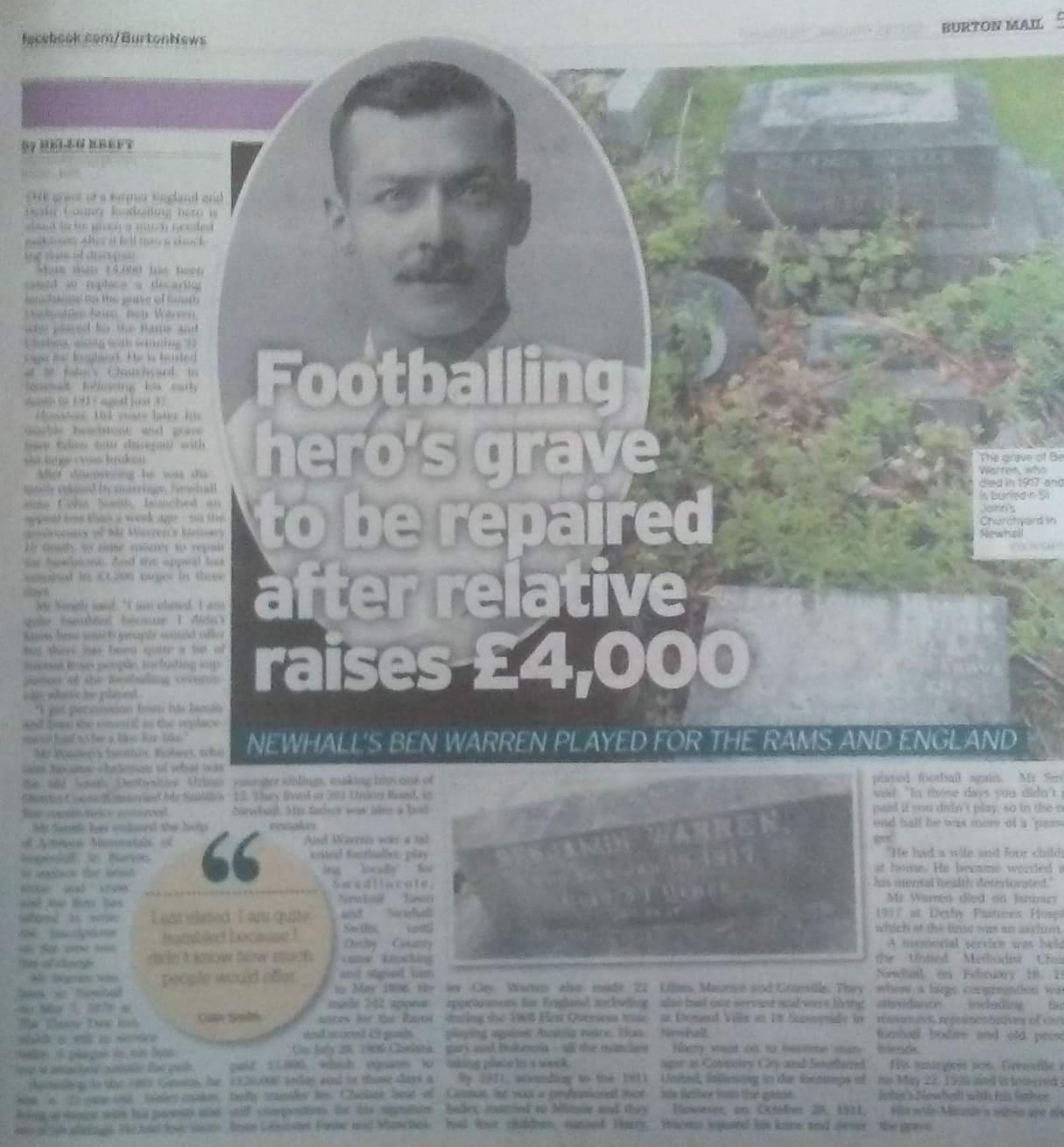
I researched Ben and his football career and found his resting place in St Johns Newhall, all overgrown and in a poor state with the large cross all broken off. I stood there and decided he needed to new memorial & headstone. He was our local hero, playing Internationally for England 22 times. He needs to be remembered.
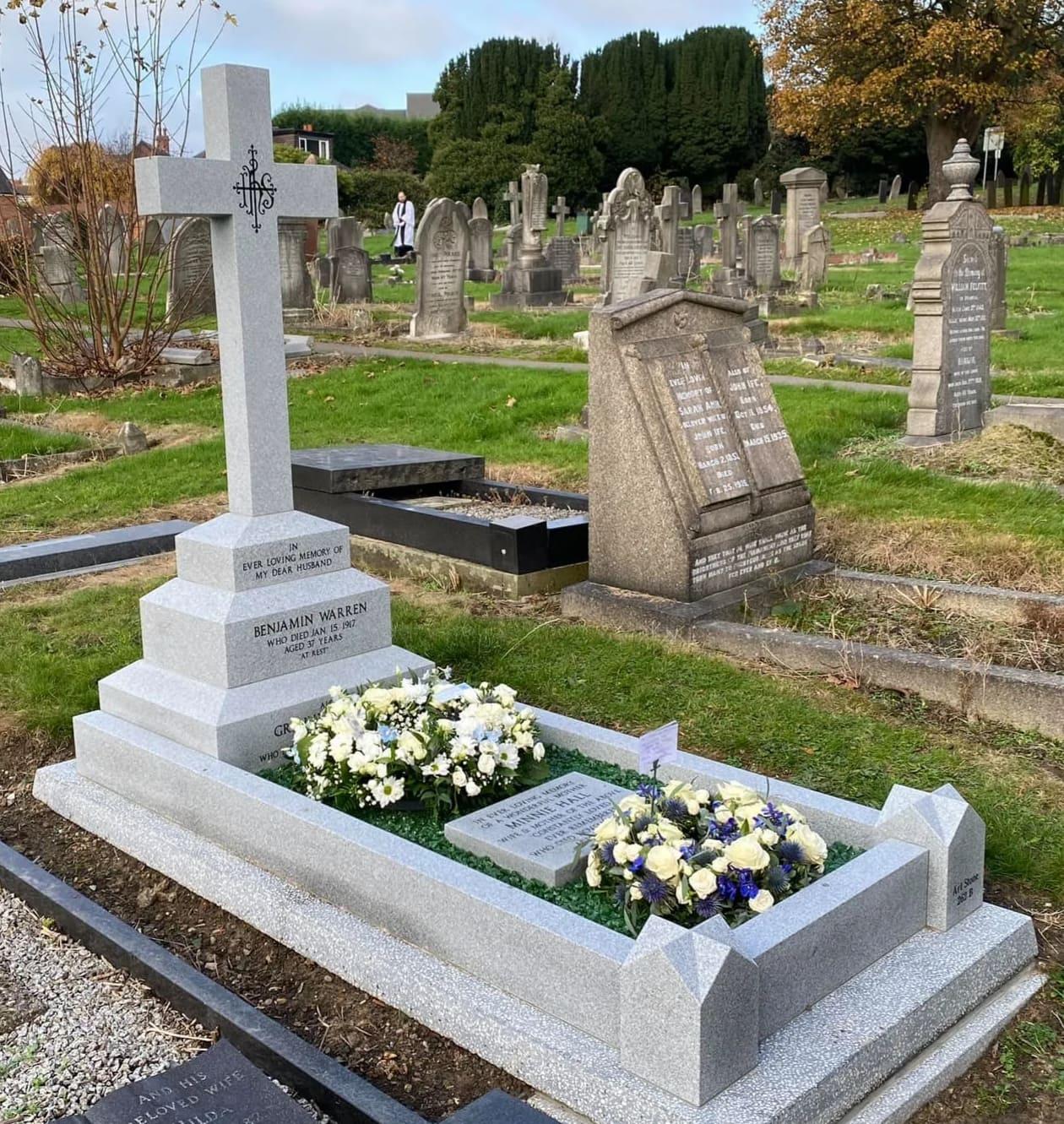
After seeking family permission and Council approval, I had a quote from Art Stone Memorials, Burton on Trent to undertake the work. Fundraising then started and the memorial ordered.
Covid came along and slowed the process of getting materials etc. But we have eventually reached the final installation today.
I am deeply humbled for everyone who donated in January this year to support me and finally a massive thank you to everyone, local people, football supporters of Newhall, Derby County & Chelsea and football clubs for their donations.
Ben will now be remembered more easily when anyone walks through St Johns and see this beautiful memorial just off the pathway.
Finally a huge thank you for Art Stone Memorials Team in everything they have done from the first day I approached them. The team have worked endlessly on this project to provide this for Ben and his family as a lasting memorial. Thank you again Alex, Pat, Matt & Owen for everything. Means a lot to me.
The final chapter is when we have a dedication service at the grave side in a few weeks time,
Ben was born in The Thorntree Inn Newhall South Derbyshire and lived locally all his life.
He played local football for Swadlincote, Newhall Town and Newhall Swifts until Derby County signed Ben in May 1898. He made 242 appearances and scored 19 goals at Derby County.
28th July 1908 Chelsea won the bidding beating Leicester Fosse & Manchester City bids.
Ben also made 22 appearance’s for England including the 1908 First Overseas tour playing Austria twice, Hungary and Bohemia all in a week.
28 October 1911 Ben Injured his knee and never played football again
Ben is often compared with Steven Gerard for his style of play and team ethic in the modern era.
Herbert Chapman ( Player & Manager ) comments “ Warren was a human steam engine who played through 90 minutes with intimidating strength and speed”.
Charles Buchan comments “I am certain that a better half back could not be found, Part of the Best England X1 of all time”
Chelsea allowed Ben to live in Sunnyside Newhall, he used to run 5 miles every day round Bretby Park and had his own gym at home. He was compared to the likes of a Homing Pigeon, as he always came back to Newhall after his football matches.
Ben married Minnie Staley 21st October 1902 at Emmanuel Church Swadlincote and had four children, Harry, Lillian, Maurice & Grenville. Harry went on to be Manager at Coventry & Southend following his father in his own career as football Manager.
After Ben’s football career ended in 1911 his health deteriorated until his passing at Derby Pastures Hospital aged 37yrs
Ben’s youngest son, Grenville passed away 22nd May 1929 and is interred together in St John’s Newhall with his Father
His wife, Minnie’s ashes are also with Ben & Grenville.
Thank you again everyone.
RIP Ben Warren, our local Newhall Hero. You are remembered.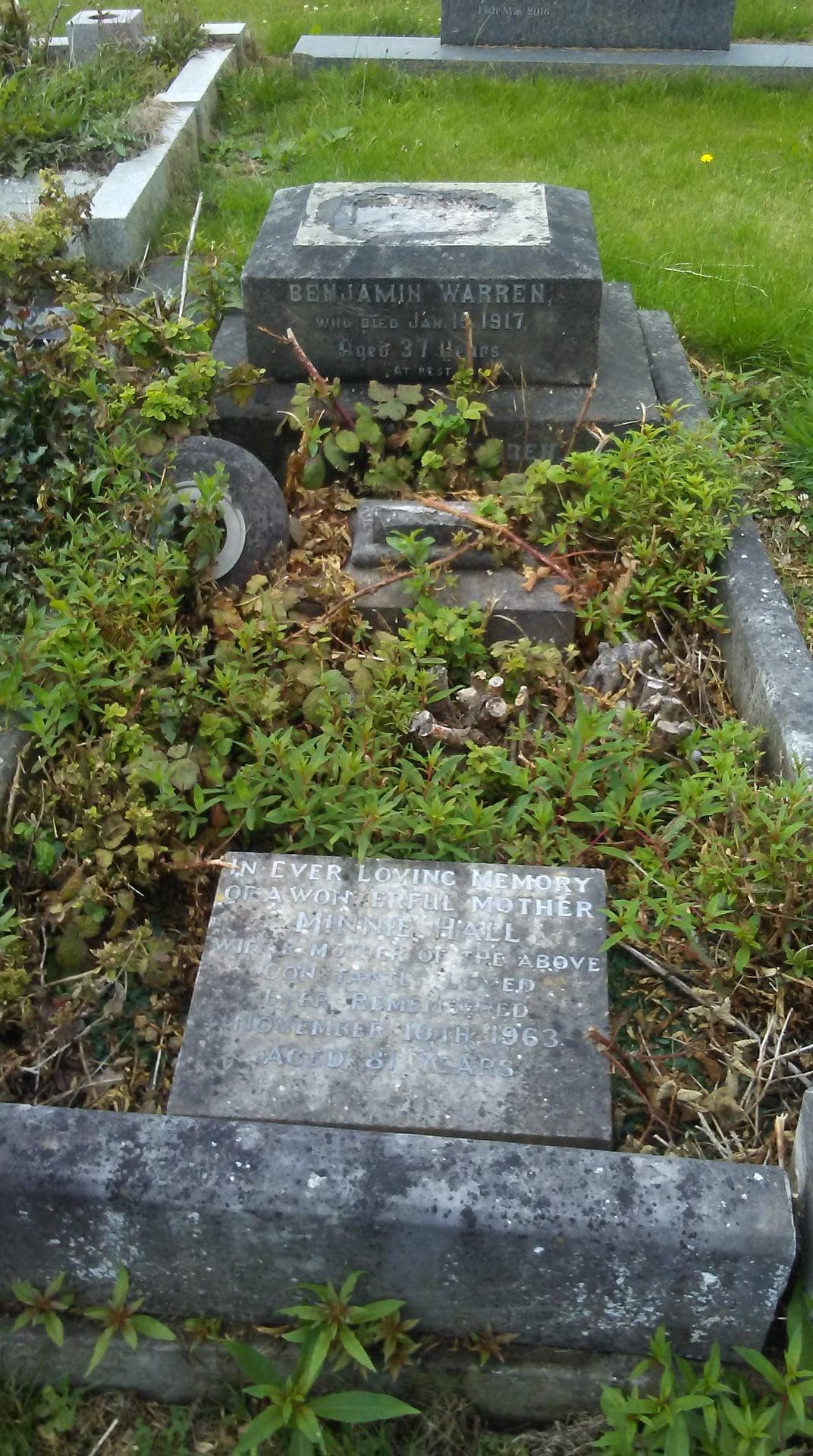
 December 13, 2021 at 3:06 pm #6228
In reply to: The Elusive Samuel Housley and Other Family Stories
Francis Purdy: The Beggarlea Bulldog and Primitive Methodist Preacher
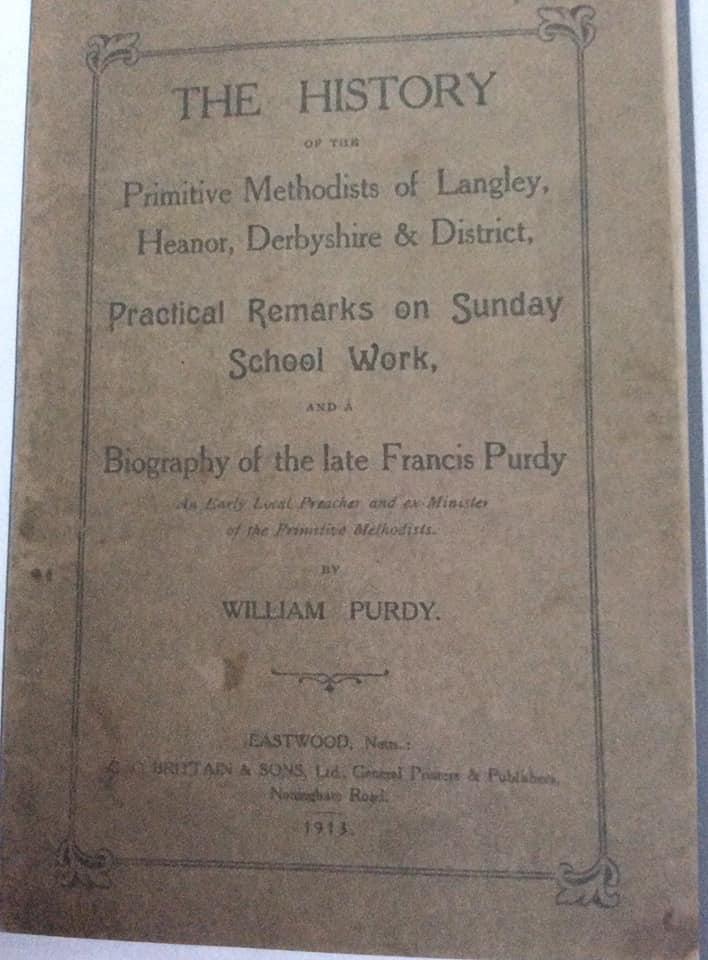
Francis Purdy was my great great grandfather. We did not know anything about the Primitive Methodists prior to this family research project, but my mother had another look through the family souvenirs and photographs and found a little book dated 1913, by William Purdy called: The History of The Primitive Methodists of Langley, Heanor, Derbyshire and District. Practical remarks on Sunday school work and a biography of the late Francis Purdy, an early local preacher. Printed by GC Brittain and sons. William Purdy was Francis son, and George’s brother.
Francis Purdy:
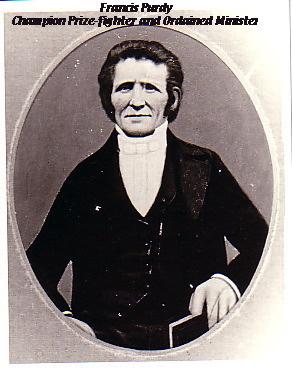
The following can be found online from various sources but I am unable to find the original source to credit with this information:
“In spite of having pious parents, Francis was a great prize-fighter and owner of champion dogs. He was known as the Beggarlee Bulldog, and fought many pitched battles. It was in 1823 that he fought on Nottingham Forest for the championship of three counties. After the fight going eleven rounds, which continued one hour and twenty minutes, he was declared victorious.”
The Primitive Methodists under the Rev Richard Whitechurch began a regular mission in Beggarlee. The locals tried to dismiss the Methodist “Ranters” by the use of intimidating tactics. Francis was prepared to release his fighting dogs during their prayer meeting, but became so interested in their faith that he instead joined them. The Methodist Church wrote: ”A strong feeling came over him, while his mates incited him to slip his dogs from the leads. He refused, and decided to return home. After concealing himself in a dyke, to listen to the Missioners on the following Sunday, he stole into the house of a Mrs Church, where a service was being held. Shortly after this, a society was formed with Francis Purdy as leader, and he was also the superintendent of the first Sunday School. After a short spell as local preacher at Beauvale, Tag Hill, Awsworth, Kimberly, Brinsley, etc., Mr Francis Purdy was ordained a minister by the Rev. Thomas King, of Nottingham, on the 17th December, 1827.”
December 13, 2021 at 2:34 pm #6227In reply to: The Elusive Samuel Housley and Other Family Stories
The Scottish Connection
My grandfather always used to say we had some Scottish blood because his “mother was a Purdy”, and that they were from the low counties of Scotland near to the English border.
My mother had a Scottish hat in among the boxes of souvenirs and old photographs. In one of her recent house moves, she finally threw it away, not knowing why we had it or where it came from, and of course has since regretted it! It probably came from one of her aunts, either Phyllis or Dorothy. Neither of them had children, and they both died in 1983. My grandfather was executor of the estate in both cases, and it’s assumed that the portraits, the many photographs, the booklet on Primitive Methodists, and the Scottish hat, all relating to his mother’s side of the family, came into his possession then. His sister Phyllis never married and was living in her parents home until she died, and is the likeliest candidate for the keeper of the family souvenirs.
Catherine Housley married George Purdy, and his father was Francis Purdy, the Primitive Methodist preacher. William Purdy was the father of Francis.
Record searches find William Purdy was born on 16 July 1767 in Carluke, Lanarkshire, near Glasgow in Scotland. He worked for James Watt, the inventor of the steam engine, and moved to Derbyshire for the purpose of installing steam driven pumps to remove the water from the collieries in the area.
Another descendant of Francis Purdy found the following in a book in a library in Eastwood:
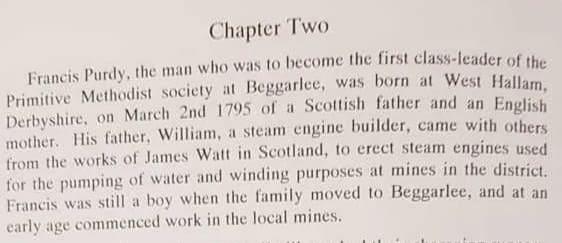
William married a local girl, Ruth Clarke, in Duffield in Derbyshire in 1786. William and Ruth had nine children, and the seventh was Francis who was born at West Hallam in 1795.
Perhaps the Scottish hat came from William Purdy, but there is another story of Scottish connections in Smalley: Bonnie Prince Charlie and the Jacobite Rebellion of 1745. Although the Purdy’s were not from Smalley, Catherine Housley was.
From an article on the Heanor and District Local History Society website:
The Jacobites in Smalley
Few people would readily associate the village of Smalley, situated about two miles west of Heanor, with Bonnie Prince Charlie and the Jacobite Rebellion of 1745 – but there is a clear link.
During the winter of 1745, Charles Edward Stuart, the “Bonnie Prince” or “The Young Pretender”, marched south from Scotland. His troops reached Derby on 4 December, and looted the town, staying for two days before they commenced a fateful retreat as the Duke of Cumberland’s army approached.
While staying in Derby, or during the retreat, some of the Jacobites are said to have visited some of the nearby villages, including Smalley.
A history of the local aspects of this escapade was written in 1933 by L. Eardley-Simpson, entitled “Derby and the ‘45,” from which the following is an extract:
“The presence of a party at Smalley is attested by several local traditions and relics. Not long ago there were people living who remember to have seen at least a dozen old pikes in a room adjoining the stables at Smalley Hall, and these were stated to have been left by a party of Highlanders who came to exchange their ponies for horses belonging to the then owner, Mrs Richardson; in 1907, one of these pikes still remained. Another resident of Smalley had a claymore which was alleged to have been found on Drumhill, Breadsall Moor, while the writer of the History of Smalley himself (Reverend C. Kerry) had a magnificent Andrew Ferrara, with a guard of finely wrought iron, engraved with two heads in Tudor helmets, of the same style, he states, as the one left at Wingfield Manor, though why the outlying bands of Army should have gone so far afield, he omits to mention. Smalley is also mentioned in another strange story as to the origin of the family of Woolley of Collingham who attained more wealth and a better position in the world than some of their relatives. The story is to the effect that when the Scots who had visited Mrs Richardson’s stables were returning to Derby, they fell in with one Woolley of Smalley, a coal carrier, and impressed him with horse and cart for the conveyance of certain heavy baggage. On the retreat, the party with Woolley was surprised by some of the Elector’s troopers (the Royal army) who pursued the Scots, leaving Woolley to shift for himself. This he did, and, his suspicion that the baggage he was carrying was part of the Prince’s treasure turning out to be correct, he retired to Collingham, and spent the rest of his life there in the enjoyment of his luckily acquired gains. Another story of a similar sort was designed to explain the rise of the well-known Derbyshire family of Cox of Brailsford, but the dates by no means agree with the family pedigree, and in any event the suggestion – for it is little more – is entirely at variance with the views as to the rights of the Royal House of Stuart which were expressed by certain members of the Cox family who were alive not many years ago.”
A letter from Charles Kerry, dated 30 July 1903, narrates another strange twist to the tale. When the Highlanders turned up in Smalley, a large crowd, mainly women, gathered. “On a command in Gaelic, the regiment stooped, and throwing their kilts over their backs revealed to the astonished ladies and all what modesty is careful to conceal. Father, who told me, said they were not any more troubled with crowds of women.”
Folklore or fact? We are unlikely to know, but the Scottish artefacts in the Smalley area certainly suggest that some of the story is based on fact.
We are unlikely to know where that Scottish hat came from, but we did find the Scottish connection. William Purdy’s mother was Grizel Gibson, and her mother was Grizel Murray, both of Lanarkshire in Scotland. The name Grizel is a Scottish form of the name Griselda, and means “grey battle maiden”. But with the exception of the name Murray, The Purdy and Gibson names are not traditionally Scottish, so there is not much of a Scottish connection after all. But the mystery of the Scottish hat remains unsolved.
April 24, 2021 at 8:02 pm #6193In reply to: The Whale’s Diaries Collection
I hope all this social media as they call it stands the test of time because little things like this are priceless and so few and far between, and someday someone wants to know a little thing like this to paint a picture in their mind. I don’t know if this is one of ours as they say but but he was there too and could even have been one of you or another one of me, the possibilities are endless and the charm of the random snippet is boundless.
“The gallery stairs were honeycombed on
each side by old Jonathan Beniston’s spiked
crutches, and although Jonathan could not
read, he considered himself a valuable
addition to the choir, contributing a sort of
drone bass accompaniment to the melodies. after the style of a bagpipe ” chanter.”Here’s another one I want to include in my book:
Mr. Joseph Moss, formerly a framework knitter of Woodhouse Lane, for several years kept a Diary of the principal events and incidents in the locality: a most commendable undertaking. It is much to be regretted that so few attempt anything of the kind, so useful, and always interest- ing. Besides the registration of marriages and funerals, we have notices of storms, removals, accidents, sales, robberies, police captures, festivities, re-openings of churches, and many other matters. His record begins in 1855, ^^d ends in 1881, Mr. Moss was a violinist of some ability, and was in great demand at all rural festivities. He was a good singer, and sang (inter alia) ” The Beggar’s Ramble ” with his own local variations^ in good style, and usually with much eclat. The following are a few extracts from his Diary : —
” — July. Restoration of Horsley Church. New weathercock placed on spire by Charles, son of Mr. Anthony Kerry, the builder, on the 31st. A few days later, the south arches of the nave fell down, bringing with it the roofs of nave and south aisle. The pillar next the tower had been under- mined by the making of a grave, and as soon as the gravestone over it was moved the column began to settle : a loud shout was made, and the workmen had only just time to scamper out of the building before the roof and top windows and all came down.”
February 21, 2021 at 8:09 pm #6188In reply to: Twists and One Return From the Time Capsule
Reddening, Bob stammered, “Yeah, yes, uh, yeah. Um…”
Clara squeezed her grandfathers arm reassuringly. “We’re looking for my friend Nora.” she interrupted, to give him time to compose himself. Poor dear was easily flustered these days. Turning to Will, “She was hiking over to visit us and should have arrived yesterday and she’d have passed right by here, but her phone seems to be dead.”
Will had to think quickly. If he could keep them both here with Nora long enough to get the box ~ or better yet, replace the contents with something else. Yes, that was it! He could take a sack of random stuff to put in the box, and they’d never suspect a thing. He was going to hide the contents in a statue anyway, so he didn’t even need the box.
Spreading his arms wide in welcome and smiling broadly, he said “This is your lucky day! Come inside and I’ll put the kettle on, Nora’s gone up to take some photos of the old ruin, she’ll be back soon.”
Bob and Clara relaxed and returned the smile and allowed themselves to be ushered into the kitchen and seated at the table.
Will lit the gas flame under the soup before filling the kettle with water. They’d be too polite to refuse, if he put a bowl in front of them, and if they didn’t drink it, well then he’d have to resort to plan B. He put a little pinch of powder from a tiny jar into each cup of tea; it wouldn’t hurt and would likely make them more biddable. Then the soup would do the trick.
Will steered the conversation to pleasant banter about the wildflowers on the way up to the ruins that he’d said Nora was visiting, and the birds that were migrating at this time of year, keeping the topics off anything potentially agitating. The tea was starting to take effect and Clara and Bob relaxed and enjoyed the conversation. They sipped the soup without protest, although Bob did grimace a bit at the thought of eating on an agitated stomach. He’d have indigestion for days, but didn’t want to be rude and refuse. He was enjoying the respite from all the vexation, though, and was quite happy for the moment just to let the man prattle on while he ate the damn soup.
“Oh, I think Nora must be back! I just heard her voice!” exclaimed Clara.
Will had heard it too, but he said, “That wasn’t Nora, that was the parrot! It’s a fast leaner, and Nora’s been training it to say things….I tell you what, you stay here and finish your soup, and I’ll go and fetch the parrot.”
“Parrot? What parrot?” Clara and Bob said in unison. They both found it inordinately funny and by the time Will had exited the kitchen, locking the door from the outside, they were hooting and wiping the tears of laughter from their cheeks.
“What the hell was in that tea!” Clara joked, finishing her soup.
What was Nora doing awake already? Will didn’t have to keep her quiet for long, but he needed to keep her quiet now, just until the soup took effect on the others.
Either that or find a parrot.
February 6, 2021 at 5:44 am #6184In reply to: Twists and One Return From the Time Capsule
Clara had an uneasy feeling which, try as she might, she could not shake it off. She attempted to distract herself by making a sandwich for lunch, but the feeling wouldn’t go away. She went outside to look for Bob, eventually finding him chatting away to himself out in the orchard. It sounded like he was arguing with someone.
“Grandpa?”
Bob jumped. “Didn’t see you there, Clara!” He laughed shakily. “What are you doing sneaking up on me like that? It’s not good for me old heart.”
“Grandpa, I need to go and find Nora. I’ve got a bad feeling, like she’s in some sort of trouble.”
“Go and find her? Do you know where she is then? Has she been in touch?”
“I need to go to the Village. Where the statue man lives.”
“Well you’re not going by yourself. Not with all these strange goings ons and the numerous bits of paper and maps and whatnot which keep turning up all over the place.”
January 5, 2021 at 9:03 pm #6175In reply to: Twists and One Return From the Time Capsule
“”Sorry, I’m only just telling you this about the note now, lovie. Your Grandma’s been on at me to tell you. Just in my thoughts I mean!” he added quickly.
Jane smirked and tapped her forehead. “Careful, Old Man. She’ll think you’ve completely lost it!”
Clara stared at him, a small frown creasing her brow. “So, the note said you were to call him?”
Bob nodded uneasily. Clara had that look on her face. The one that means she aren’t happy with the way things are proceeding.
“And then what?” asked Clara slowly.
“I dunno.” Bob shrugged. “Guess they’d bury it again? They was pretty clear they didn’t want it found. Now, how about I put the kettle on?” Bob stood quickly and began to busy himself filling the jug with water from the tap.
Clara shook her head firmly. “No.”
“No to a cup of tea?”
“No we can’t call this man.”
“I don’t know Clara. It’s getting odd it is. Strangers leaving maps in collars and whatnot. It’s not right.”
“Well, I agree it needs further investigation. But we can’t call him … not without knowing why and what’s in it.” She tapped her fingers on the table. “I’ll try and get hold of Nora again.”
April 28, 2020 at 9:15 am #6078In reply to: Seven Twines and the Dragon Heartwoods
“You really know your trade, Fuyi,” said Rukshan. “You’ve built the most exquisite and comfortable place. And I think the empty dishes speak aplenty about the quality of the food and the pleasure we took in this shared meal. Now, let us help you with the dishes,” said Rukshan.
“Ach! Don’t be so polite,” said Fuyi. “I’ll have plenty of time after yar departure tomorrow. It’s not like the inn is full. Just enjoy an evening together, discuss yar plans, and have some rest. I know that life. Take the chance when it presents itself!”
Rushan nodded and looked at Kumihimo. Fox sighed with relief. His belly was full and round, and he didn’t want to disturbed his digestion with some chore.
The Sinese food made by the innkeeper had been delicious and quite a first for most of them. Tak had particularly enjoyed the crunchy texture of the stir fried vegetables flavoured with the famous five spices sauce. Nesy had preferred the algae and chili dishes while Fox, who ate a red hot pepper thinking it was bell pepper, had stuffed himself with juicy pork buns to put out the fire in his mouth.
Gorrash, befuddled by the novelty, had been at a loss of labels, good or bad. He simply chose to welcome the new experiences and body reactions to flavours and textures. As for Olliver, he gave up the chopsticks when he saw how fast Fox made the food disappear from the dishes.
Now that the dishes were empty, the children and Gorrash had left the table and were playing near the fireplace. Olliver was looking at the trio with envy, split between the desire to play and enjoy the simplicity of the moment, and the desire to be taken more seriously which meant participate in the conversation with the adults.
“We have plenty to discuss, Fae,” said Kumihimo.
Fuyi looked at Olliver, recognising the conundrum. “That’s settled, then,” he said to the group. Then turning toward Olliver: “Boy! I’m sure the start of the conversation will be boring for a young mind. Let’s join the others for a story of my own. You can still come back later and they’ll fill you in on the details.”
Fuyi and Olliver moved to the fireplace. The innkeeper threw cushions on the floor and sat on a wooden rocking chair. At the mention of a story, Tak, Nesy and Gorrash couldn’t contain their exuberant joy and gathered all ears around Admirable Fuyi. As he rocked, the chair creaked. He waited until they all calmed down. And when he was satisfied he started.
“I was young and still a fresh recruit in the Sinese army,” started Fuyi. “We were stationed at the western frontier just below the high plateaus and I hadn’t participated in any battle yet. With the folly of youth I thought that our weapons and the bond we shared with my fellow soldiers were enough to defeat anything.”
April 18, 2020 at 6:20 pm #6061In reply to: Scrying the Word Cloud
Sometimes whales
managed taste
whispered guess
line care tellPlague walk
funny treatment
pop himself
hilda looBreath added
free knewApril 12, 2020 at 11:31 am #5988In reply to: Pop﹡in People Tribulations
Shawn Paul looked suspiciously at the pictures of the dolls in the Michigan forest on Maeve’s phone. He had heard about the Cottingley Fairies pictures, supposedly taken a long time ago by two little girls. The two little girls came out long after confessing they had staged the whole thing. Some said they had been coerced into it to keep the world from knowing the truth. It could well be the same thing with the whole dollmania, and Shawn Paul thought one was never dubious enough.
He noded politely to Maeve and decided to hide his doubts for now. They were resting on sunbeds near the hotel swimming pool.
“Do you want another cocktail?” asked a waitress dressed up in the local costume. Not much really, and so close-fitting. She was presenting them with a tray of colourful drinks and a candid smile. Her bosom was on the brink of spilling over the band of cloth she had around her chest. It was decorated with a pair of parrots stretched in such a way their lubricious eyes threatening to pop out at any moment.
Shawn Paul, who had the talent to see the odd and misplaced, forced himself to look at the tray and spotted the strangest one. He pushed his glasses back up on his nose and asked without looking at the waitress.
“What’s that strange bluish blob under the layers of alcohol and fruits?”
Maeve raised one eyebrow and looked at her companion with disapproval, but the waitress answered as if she heard that all the time.
“That’s a spoonful of honey from the blue bees. We feed them a special treat and they make us honey with remarkable properties that we have learned to use for the treatments we offer.”
“Oh,” said Shawn Paul who did not dare ask more about the treatments.
They had arrived to Tikfidjikoo just before the confinement had been declared all over the world, and they had a moment of hesitation to take the last plane with the other tourists and go back safely to Canada. But after the inconclusive adventure in Australia, Maeve had convinced him they had to stay to find out more about the dolls.
They had met those three old ladies and one of them had one of the dolls. Sharon, Mavis and Gloria, they were called and they were going to a smaller island of the archipelago, one that was not even on the maps apparently. That should have given them suspicions, but it seemed so important to Maeve that Shawn Paul hadn’t had the heart to leave her alone.
“I have a plan,” had said Maeve, “We’re going to follow them, befriend them and learn more about how they came to have the doll and try and get the key that’s inside of it.”
“You’re here for the beauty treatment?” had asked the girl at the counter. “You’re lucky, with the confinement a lot of our reservations have been canceled. We have plenty of vacancy and some fantastic deals.”
Maeve had enrolled them for a free week treatment before Shawn Paul could say anything. They hadn’t seen the ladies much since they had arrived on the island, and now there were no way in or out of the island. They had been assured they had plenty of food and alcohol and a lot of activities that could be fitted to everyone’s taste.
March 26, 2020 at 5:03 pm #5924In reply to: Scrying the Word Cloud
Sense rolled case diary himself
Distance says travelling nearly happens
Lots wanted ignoring suddenly mass
Slammed search rukshan messages locking
Dusty careful liked floating ailill
Vision jasper habit became lavatory
Thick fair landed olli gold
Love enjoying mavis shape lived
Anxiety doubts army geckoMarch 20, 2020 at 1:27 pm #5832In reply to: The Precious Life and Rambles of Liz Tattler
“What are you two conspiring again behind my back?” Liz barged in, with a few patches of nicotine across her face.
“It better be good.” she leaned towards Godfrey who was always incapable of lying properly.
“It just… that… ouch!” he started hesitantly, while Finnley elbowed him vigorously. She also knew he wouldn’t pass a serious questioning without ratting them out. She questioned why in the first place he got her involved with his flimsy start of a plan.
“What about?” Liz continued, her face nervously twitching. She coughed raucously.
“THERE! Told you!” Godfrey couldn’t contain himself. “We should confine you, at your age, it could be dangerous!”
At the mention of Liz’s age, all hell broke loose in the mansion.
January 29, 2020 at 4:21 am #5660In reply to: Two Aunties au Pair and Their Pert Carouses
Arthur was driving the minivan. It was an old Chewy Express van with the big bold “DRAPES CLEANING” sign on it that he’d repainted by himself over the years. The business wasn’t doing great, truth be told, so he’d cut down the marketing costs, which according to Ella Marie wasn’t a bright idea. “You never know where you next patrons could hide.” She’d said, and then had him hooked up on some social website to post random things and get some likes and thumbs up. He’d come a little late for the new century’s game and couldn’t see any of the appeal, but he’d learned over the years never to make the missus irate.
He’d been so glad when she’d come back from the floods, unscathed and full of completely batshit crazy stories. Mummies and stuff. Sounded like being rolled in shredded drapes fanfiction to him. Complete garbage, but you can’t tell people they’re crazy, they’d hate you for it, and in truth you may be wrong. You might be the one crazy and all the others the sane ones. How’s that for a thought.
Anyway, he loved his Ella Marie dearly, and had learned not to sweat the small stuff. Like this night drive to a funny place she’d just received coordinates from an acquaintance on the Net. Those were mad times, mad times indeed. At least, she could have told him she wanted to catch a new rare pokemeon go! in the dead of night, and it might have sounded… well, just as mad probably.
They were driving steadily, being careful about the road signs; the van wasn’t much for crazy stunts anyway.
“How far is that?” he asked the wife, who was busy on her phone tracking the route and chatting on the thing with her friends imaginary or else.
“Not far, luv’. Next turn right, then left, then right and we should be there.”
The last turn took them off the road, and Arthur started to wonder if that wasn’t another “turn left at your peril” GPS experiment, where they’d have to haul the van out of a tar pit, but it seemed fine so far. The place looked ominous, and full of croaking noises 🐸🐸🐸🐸.
He killed the headlights, and moved in the parking lot at a crawl. There was no point in alerting whoever was there of their nocturnal visit. A barn owl flew straight in front of the van, scaring them.
“STOP!” jumped Jacqui, who’d been sleeping the whole time, and woke up to a frightful sight.
Arthur pushed on the brakes that gave off a screeching sound that would wake up a mummy.
“Ooh, I’ve got a bad feeling about this” Ella Marie said. “Something evil is afoot, that owl was bad omen.”
January 26, 2020 at 7:20 pm #5651In reply to: Two Aunties au Pair and Their Pert Carouses
Looking at the exasperated voices of his captors, Barron needn’t know how to speak Spanish to be entirely certain he was in over his head.
He wondered why the negotiators hadn’t been brought in already; the plan was simple —well, initially. He was to get a cut of the ransom, and disappear with it in some nice sunny resort in the South. Like the extreme South, not Alabama South.
Someone must have interfered… He could have sworn there was a woman’s voice with a funny accent speaking to them before she hung up on them.
¡La chica dice que ya tienen al bebé!
 That much he could understand; an impostor 👶🏻baby now? And who had replaced August in his duties?
Well, at the moment, he had a group of angry Frenchmen and Mexicans in a smelly rillettes distillery with a useless baby on their hands. He knew too well that if he wanted to keep all his limbs, he’d have to improvise quickly. Good thing they hadn’t removed his eye-watch. By now, as inept as they’d be, the two nannies should have got his GPS coordinates.
Well… They had trouble spelling their names without typos at times so he’d better not leave that to chance.
He started to text:
SOS - baby in danger at Rillettes Distillery, AlabamaHe added the GPS coordinates, just in case; now, with help possibly on the way, he’d have to prepare that distraction in order to extract himself of his predicament.
January 16, 2020 at 10:21 am #5589In reply to: Two Aunties au Pair and Their Pert Carouses
Barron was not really a baby, more a toddler already. He was playing alone in his play fence, like he was usually left doing when his odd caretakers had gone for an escapade. After a while, he got bored cooing like a baby looking at shiny stuff and suckling at noisy things. After all, as not many had realized, he was blessed with a genius IQ — there was no point at hiding his smarts when no one was around.
The house bulldog was sleeping nearby, snoozing like a roaring motorbike. Apart from that, this part of the House was quiet. Occasionally he could hear gurgling sounds coming from the badly soundproofed pipes of the old building. Somebody was having an industrious bowel movement. Hardly news material, his father would have say.
He checked the e-zapwatch that his nannies had put on his wrist. Bad news. His kidnappers were late. He wondered if something had changed in the near perfect plan. Yet, he’d managed to have the money wired to the offshore account, while his contacts, codenames Jesús & Araceli (he wasn’t sure they were codenames at all) said it was in order for the baby abduction.
He could hear suspicious sounds outside; the bulldog barely registered. What if some acolytes in the plan had bailed out? The sounds at his bedroom’s window could be his abductors, waiting for a way in.
As usual, he would have to take matters in his own tiny hands, and let others get the credit for it.
He peeled off one side of the net and tumbled outside of the playpen. Damn, these bodies were so difficult to manœuvre at times. Reaching the window would be difficult but not impossible. After dragging a chair, and a pile of cushions, he hoisted himself finally at reach of the latch, and flung it open. The brisk cold air from outside made his nose itch, and it was the last thing he remembered while he smelled the chloroform.
January 7, 2020 at 2:10 pm #5357In reply to: Seven Twines and the Dragon Heartwoods
“Isn’t it a pretty loo?” Glynis was marveling at the marble work, and the exquisite boiseries. “Master Guilbert really outdid himself.” Fox opined.
The jinx on the cottage loo was finally lifted, and not before the hiemal cold had settled in, right before the Sol Invictus festivities.
Meanwhile, they’ve had occasional updates from Rukshan, who was exploring the Land of the Giants. He’d mentioned in his last telebat echoing that he’d found the elusive Master creator of Gorrash, and had hope for the dwarf. The magic binding the stones was strong he’s said, although some additional magic would help speed up the recovery process which otherwise would take probably centuries if not millennia.
Glynis had looked at the requirements; it only said
‘strong magic, born from pain, hardened in gems
– dissolve in pink clay, mix well and apply generously’.None of her magic had seemed to fit. Pain, she’d had plenty, but her magic was born from the water element, emotions, plants and potions. She went to the nearby Library, their restricted section of applied magic was scarce, nothing really applicable there. Honestly, if she’d known her whereabouts, it would have been a task better suited to Eleri. Her kind of area of expertise with concrete and iron work and stone paints was a bit more unpredictable though; it could end up do more damage to Gorrash’s continuity than else; she’d quickly put that impetuous idea to rest.
Glynis was still mulling over, thinking about finding a solution when she noticed a gaunt figure was at the door. It took her a few seconds to realize it wasn’t a stranger, but a familiar friend. Rukshan had returned, although verily worn down by his travails, with a full grown beard that gave him a seriouser look. Without thinking, she went to hug him. Such unusual display of affection did surprise the Fae who was beeming.
He smiled widely at Glynis and showed her an unusually large ampoule: “I’ve found the kind of magic our friend needs. These three Giant’s gallstones weren’t a picnic to obtain, I can tell you.”
“I can’t wait to hear all about this exciting story.” interrupted Eleri.
November 7, 2019 at 7:25 am #4866In reply to: Seven Twines and the Dragon Heartwoods
Glynis was casting discret glances at the new joiner. He was a friend of Rukshan and a was a fae too. He arrived in the morning at the cottage with his tools and presented himself as Guilbert the Maker. Tall with a fair skin, he was also more muscular than was his friend, and than she thought a fae could be. They were such a secretive people.
The potion maker, with her new lovely face glowing inwardly realised she hadn’t been allowing herself to find other people attractive, not in the way she found this fae attractive, and she had felt the warmth of desire rising to colour her cheeks. As Guilbert was busy taking measurements for the new loo, Glynis unconsciously found things to clean close to the loo.
She felt a tad irritated when he announced that he had all he needed and that he would be back in a few days with everything that he needed.
So fast, she thought. Too fast. And yet he would be back in a few days.Glynis went through the rest of the day struggling with hope. Hope was treacherous. She had yearned for it for so long with her previous curse, and now it carried with it the taste of bitter almond. She didn’t dare think he… Guilbert would be back. The fae’s name had a sweetness when she thought it and it was hard not to say it aloud. But poison, she thought, can also be deceivingly sweet.
October 23, 2019 at 9:27 am #4858In reply to: Pop﹡in People Tribulations
“Well, where were we?” Jerk took the articles where he left them when he got up to check the price on one lacking a barcode.
The blip blip resumed, with the impatient twitching lady pouncing on the items as soon as they passed the scanning, to cram them into her compostable bag.Days were stretching in ennui, and he started to feel like an android. At least, the rhythmical blips and “Have a good day, thank you for your purchase” were now part of his muscle memory, and didn’t require much paying attention to.
He’d renewed the yearly fee to maintain his group website yesterday, but he wasn’t sure why he did it. There were still the occasional posts on the groups he was managing, but the buzz had died already. People had moved to other things, autumn for one. Really, what was the point of maintaining it for 3 posts a week (and those were good weeks, of course not counting the spam).
There was fun occasionally, but more often than not, there were harangues.
He wondered what archetype he was in his life story; maybe he was just a background character, and that was fine, so long as he wasn’t just a supporting cast to another megalomaniac politician.The apartment blocks were he was living were awfully quiet. His neighbours were still in travel, he wondered how they could afford it. Lucinda was completely immersed in her writing courses, and Fabio was still around amazingly – Lucinda didn’t look like she could even care of herself, so a dog… Meanwhile, the town council was envisaging a “refresh” of their neighborhood, but he had strong suspicion it was another real-estate development scheme. Only time would tell. He wasn’t in a rush to jump to the conclusion of an expropriation drama —leave that to Luce.
Friday would have been her 60th brithday (funny typo he thought). Their dead friend’s birthday would still crop up in his calendar, and he liked that they were still these connections at least. Did she move on, he wondered. Sometimes her energy felt present, and Lucinda would argue she was helping her in her writing endeavours. He himself wasn’t sure, those synchronicities were nice enough without the emphatic spiritualist extrapolations.
“Happy birthday Granola.” he said.

Another crack appeared on the red crystal into which Granola was stuck for what felt like ages.
“About time!” she said. “I wonder if they have all forgotten about me now.”
She looked closely at the crack. There was an opening, invisible, the size of an atom. But maybe, just maybe, it was just enough for her to squeeze in. She leaned in and focused on the little dot to escape.
-
AuthorSearch Results
