


Search Results for 'hold'
-
AuthorSearch Results
-
January 28, 2022 at 1:10 pm #6260
In reply to: The Elusive Samuel Housley and Other Family Stories
From Tanganyika with Love
With thanks to Mike Rushby.
- “The letters of Eleanor Dunbar Leslie to her parents and her sister in South Africa
concerning her life with George Gilman Rushby of Tanganyika, and the trials and
joys of bringing up a family in pioneering conditions.
These letters were transcribed from copies of letters typed by Eleanor Rushby from
the originals which were in the estate of Marjorie Leslie, Eleanor’s sister. Eleanor
kept no diary of her life in Tanganyika, so these letters were the living record of an
important part of her life.Prelude
Having walked across Africa from the East coast to Ubangi Shauri Chad
in French Equatorial Africa, hunting elephant all the way, George Rushby
made his way down the Congo to Leopoldville. He then caught a ship to
Europe and had a holiday in Brussels and Paris before visiting his family
in England. He developed blackwater fever and was extremely ill for a
while. When he recovered he went to London to arrange his return to
Africa.Whilst staying at the Overseas Club he met Eileen Graham who had come
to England from Cape Town to study music. On hearing that George was
sailing for Cape Town she arranged to introduce him to her friend
Eleanor Dunbar Leslie. “You’ll need someone lively to show you around,”
she said. “She’s as smart as paint, a keen mountaineer, a very good school
teacher, and she’s attractive. You can’t miss her, because her father is a
well known Cape Town Magistrate. And,” she added “I’ve already written
and told her what ship you are arriving on.”Eleanor duly met the ship. She and George immediately fell in love.
Within thirty six hours he had proposed marriage and was accepted
despite the misgivings of her parents. As she was under contract to her
High School, she remained in South Africa for several months whilst
George headed for Tanganyika looking for a farm where he could build
their home.These details are a summary of chapter thirteen of the Biography of
George Gilman Rushby ‘The Hunter is Death “ by T.V.Bulpin.Dearest Marj,
Terrifically exciting news! I’ve just become engaged to an Englishman whom I
met last Monday. The result is a family upheaval which you will have no difficulty in
imagining!!The Aunts think it all highly romantic and cry in delight “Now isn’t that just like our
El!” Mummy says she doesn’t know what to think, that anyway I was always a harum
scarum and she rather expected something like this to happen. However I know that
she thinks George highly attractive. “Such a nice smile and gentle manner, and such
good hands“ she murmurs appreciatively. “But WHY AN ELEPHANT HUNTER?” she
ends in a wail, as though elephant hunting was an unmentionable profession.
Anyway I don’t think so. Anyone can marry a bank clerk or a lawyer or even a
millionaire – but whoever heard of anyone marrying anyone as exciting as an elephant
hunter? I’m thrilled to bits.Daddy also takes a dim view of George’s profession, and of George himself as
a husband for me. He says that I am so impulsive and have such wild enthusiasms that I
need someone conservative and steady to give me some serenity and some ballast.
Dad says George is a handsome fellow and a good enough chap he is sure, but
he is obviously a man of the world and hints darkly at a possible PAST. George says
he has nothing of the kind and anyway I’m the first girl he has asked to marry him. I don’t
care anyway, I’d gladly marry him tomorrow, but Dad has other ideas.He sat in his armchair to deliver his verdict, wearing the same look he must wear
on the bench. If we marry, and he doesn’t think it would be a good thing, George must
buy a comfortable house for me in Central Africa where I can stay safely when he goes
hunting. I interrupted to say “But I’m going too”, but dad snubbed me saying that in no
time at all I’ll have a family and one can’t go dragging babies around in the African Bush.”
George takes his lectures with surprising calm. He says he can see Dad’s point of
view much better than I can. He told the parents today that he plans to buy a small
coffee farm in the Southern Highlands of Tanganyika and will build a cosy cottage which
will be a proper home for both of us, and that he will only hunt occasionally to keep the
pot boiling.Mummy, of course, just had to spill the beans. She said to George, “I suppose
you know that Eleanor knows very little about house keeping and can’t cook at all.” a fact
that I was keeping a dark secret. But George just said, “Oh she won’t have to work. The
boys do all that sort of thing. She can lie on a couch all day and read if she likes.” Well
you always did say that I was a “Lily of the field,” and what a good thing! If I were one of
those terribly capable women I’d probably die of frustration because it seems that
African house boys feel that they have lost face if their Memsahibs do anything but the
most gracious chores.George is absolutely marvellous. He is strong and gentle and awfully good
looking too. He is about 5 ft 10 ins tall and very broad. He wears his curly brown hair cut
very short and has a close clipped moustache. He has strongly marked eyebrows and
very striking blue eyes which sometimes turn grey or green. His teeth are strong and
even and he has a quiet voice.I expect all this sounds too good to be true, but come home quickly and see for
yourself. George is off to East Africa in three weeks time to buy our farm. I shall follow as
soon as he has bought it and we will be married in Dar es Salaam.Dad has taken George for a walk “to get to know him” and that’s why I have time
to write such a long screed. They should be back any minute now and I must fly and
apply a bit of glamour.Much love my dear,
your jubilant
EleanorS.S.Timavo. Durban. 28th.October. 1930.
Dearest Family,
Thank you for the lovely send off. I do wish you were all on board with me and
could come and dance with me at my wedding. We are having a very comfortable
voyage. There were only four of the passengers as far as Durban, all of them women,
but I believe we are taking on more here. I have a most comfortable deck cabin to
myself and the use of a sumptuous bathroom. No one is interested in deck games and I
am having a lazy time, just sunbathing and reading.I sit at the Captain’s table and the meals are delicious – beautifully served. The
butter for instance, is moulded into sprays of roses, most exquisitely done, and as for
the ice-cream, I’ve never tasted anything like them.The meals are continental type and we have hors d’oeuvre in a great variety
served on large round trays. The Italians souse theirs with oil, Ugh! We also of course
get lots of spaghetti which I have some difficulty in eating. However this presents no
problem to the Chief Engineer who sits opposite to me. He simply rolls it around his
fork and somehow the spaghetti flows effortlessly from fork to mouth exactly like an
ascending escalator. Wine is served at lunch and dinner – very mild and pleasant stuff.
Of the women passengers the one i liked best was a young German widow
from South west Africa who left the ship at East London to marry a man she had never
met. She told me he owned a drapers shop and she was very happy at the prospect
of starting a new life, as her previous marriage had ended tragically with the death of her
husband and only child in an accident.I was most interested to see the bridegroom and stood at the rail beside the gay
young widow when we docked at East London. I picked him out, without any difficulty,
from the small group on the quay. He was a tall thin man in a smart grey suit and with a
grey hat perched primly on his head. You can always tell from hats can’t you? I wasn’t
surprised to see, when this German raised his head, that he looked just like the Kaiser’s
“Little Willie”. Long thin nose and cold grey eyes and no smile of welcome on his tight
mouth for the cheery little body beside me. I quite expected him to jerk his thumb and
stalk off, expecting her to trot at his heel.However she went off blithely enough. Next day before the ship sailed, she
was back and I saw her talking to the Captain. She began to cry and soon after the
Captain patted her on the shoulder and escorted her to the gangway. Later the Captain
told me that the girl had come to ask him to allow her to work her passage back to
Germany where she had some relations. She had married the man the day before but
she disliked him because he had deceived her by pretending that he owned a shop
whereas he was only a window dresser. Bad show for both.The Captain and the Chief Engineer are the only officers who mix socially with
the passengers. The captain seems rather a melancholy type with, I should say, no
sense of humour. He speaks fair English with an American accent. He tells me that he
was on the San Francisco run during Prohibition years in America and saw many Film
Stars chiefly “under the influence” as they used to flock on board to drink. The Chief
Engineer is big and fat and cheerful. His English is anything but fluent but he makes up
for it in mime.I visited the relations and friends at Port Elizabeth and East London, and here at
Durban. I stayed with the Trotters and Swans and enjoyed myself very much at both
places. I have collected numerous wedding presents, china and cutlery, coffee
percolator and ornaments, and where I shall pack all these things I don’t know. Everyone has been terribly kind and I feel extremely well and happy.At the start of the voyage I had a bit of bad luck. You will remember that a
perfectly foul South Easter was blowing. Some men were busy working on a deck
engine and I stopped to watch and a tiny fragment of steel blew into my eye. There is
no doctor on board so the stewardess put some oil into the eye and bandaged it up.
The eye grew more and more painful and inflamed and when when we reached Port
Elizabeth the Captain asked the Port Doctor to look at it. The Doctor said it was a job for
an eye specialist and telephoned from the ship to make an appointment. Luckily for me,
Vincent Tofts turned up at the ship just then and took me off to the specialist and waited
whilst he extracted the fragment with a giant magnet. The specialist said that I was very
lucky as the thing just missed the pupil of my eye so my sight will not be affected. I was
temporarily blinded by the Belladona the eye-man put in my eye so he fitted me with a
pair of black goggles and Vincent escorted me back to the ship. Don’t worry the eye is
now as good as ever and George will not have to take a one-eyed bride for better or
worse.I have one worry and that is that the ship is going to be very much overdue by
the time we reach Dar es Salaam. She is taking on a big wool cargo and we were held
up for three days in East london and have been here in Durban for five days.
Today is the ninth Anniversary of the Fascist Movement and the ship was
dressed with bunting and flags. I must now go and dress for the gala dinner.Bless you all,
Eleanor.S.S.Timavo. 6th. November 1930
Dearest Family,
Nearly there now. We called in at Lourenco Marques, Beira, Mozambique and
Port Amelia. I was the only one of the original passengers left after Durban but there we
took on a Mrs Croxford and her mother and two men passengers. Mrs C must have
something, certainly not looks. She has a flat figure, heavily mascared eyes and crooked
mouth thickly coated with lipstick. But her rather sweet old mother-black-pearls-type tells
me they are worn out travelling around the world trying to shake off an admirer who
pursues Mrs C everywhere.The one male passenger is very quiet and pleasant. The old lady tells me that he
has recently lost his wife. The other passenger is a horribly bumptious type.
I had my hair beautifully shingled at Lourenco Marques, but what an experience it
was. Before we docked I asked the Captain whether he knew of a hairdresser, but he
said he did not and would have to ask the agent when he came aboard. The agent was
a very suave Asian. He said “Sure he did” and offered to take me in his car. I rather
doubtfully agreed — such a swarthy gentleman — and was driven, not to a hairdressing
establishment, but to his office. Then he spoke to someone on the telephone and in no
time at all a most dago-y type arrived carrying a little black bag. He was all patent
leather, hair, and flashing smile, and greeted me like an old and valued friend.
Before I had collected my scattered wits tthe Agent had flung open a door and
ushered me through, and I found myself seated before an ornate mirror in what was only
too obviously a bedroom. It was a bedroom with a difference though. The unmade bed
had no legs but hung from the ceiling on brass chains.The agent beamingly shut the door behind him and I was left with my imagination
and the afore mentioned oily hairdresser. He however was very business like. Before I
could say knife he had shingled my hair with a cut throat razor and then, before I could
protest, had smothered my neck in stinking pink powder applied with an enormous and
filthy swansdown powder puff. He held up a mirror for me to admire his handiwork but I
was aware only of the enormous bed reflected in it, and hurriedly murmuring “very nice,
very nice” I made my escape to the outer office where, to my relief, I found the Chief
Engineer who escorted me back to the ship.In the afternoon Mrs Coxford and the old lady and I hired a taxi and went to the
Polana Hotel for tea. Very swish but I like our Cape Peninsula beaches better.
At Lorenco Marques we took on more passengers. The Governor of
Portuguese Nyasaland and his wife and baby son. He was a large middle aged man,
very friendly and unassuming and spoke perfect English. His wife was German and
exquisite, as fragile looking and with the delicate colouring of a Dresden figurine. She
looked about 18 but she told me she was 28 and showed me photographs of two
other sons – hefty youngsters, whom she had left behind in Portugal and was missing
very much.It was frightfully hot at Beira and as I had no money left I did not go up to the
town, but Mrs Croxford and I spent a pleasant hour on the beach under the Casurina
trees.The Governor and his wife left the ship at Mozambique. He looked very
imposing in his starched uniform and she more Dresden Sheperdish than ever in a
flowered frock. There was a guard of honour and all the trimmings. They bade me a warm farewell and invited George and me to stay at any time.The German ship “Watussi” was anchored in the Bay and I decided to visit her
and try and have my hair washed and set. I had no sooner stepped on board when a
lady came up to me and said “Surely you are Beeba Leslie.” It was Mrs Egan and she
had Molly with her. Considering Mrs Egan had not seen me since I was five I think it was
jolly clever of her to recognise me. Molly is charming and was most friendly. She fixed
things with the hairdresser and sat with me until the job was done. Afterwards I had tea
with them.Port Amelia was our last stop. In fact the only person to go ashore was Mr
Taylor, the unpleasant man, and he returned at sunset very drunk indeed.
We reached Port Amelia on the 3rd – my birthday. The boat had anchored by
the time I was dressed and when I went on deck I saw several row boats cluttered
around the gangway and in them were natives with cages of wild birds for sale. Such tiny
crowded cages. I was furious, you know me. I bought three cages, carried them out on
to the open deck and released the birds. I expected them to fly to the land but they flew
straight up into the rigging.The quiet male passenger wandered up and asked me what I was doing. I said
“I’m giving myself a birthday treat, I hate to see caged birds.” So next thing there he
was buying birds which he presented to me with “Happy Birthday.” I gladly set those
birds free too and they joined the others in the rigging.Then a grinning steward came up with three more cages. “For the lady with
compliments of the Captain.” They lost no time in joining their friends.
It had given me so much pleasure to free the birds that I was only a little
discouraged when the quiet man said thoughtfully “This should encourage those bird
catchers you know, they are sold out. When evening came and we were due to sail I
was sure those birds would fly home, but no, they are still there and they will probably
remain until we dock at Dar es Salaam.During the morning the Captain came up and asked me what my Christian name
is. He looked as grave as ever and I couldn’t think why it should interest him but said “the
name is Eleanor.” That night at dinner there was a large iced cake in the centre of the
table with “HELENA” in a delicate wreath of pink icing roses on the top. We had
champagne and everyone congratulated me and wished me good luck in my marriage.
A very nice gesture don’t you think. The unpleasant character had not put in an
appearance at dinner which made the party all the nicerI sat up rather late in the lounge reading a book and by the time I went to bed
there was not a soul around. I bathed and changed into my nighty,walked into my cabin,
shed my dressing gown, and pottered around. When I was ready for bed I put out my
hand to draw the curtains back and a hand grasped my wrist. It was that wretched
creature outside my window on the deck, still very drunk. Luckily I was wearing that
heavy lilac silk nighty. I was livid. “Let go at once”, I said, but he only grinned stupidly.
“I’m not hurting you” he said, “only looking”. “I’ll ring for the steward” said I, and by
stretching I managed to press the bell with my free hand. I rang and rang but no one
came and he just giggled. Then I said furiously, “Remember this name, George
Rushby, he is a fine boxer and he hates specimens like you. When he meets me at Dar
es Salaam I shall tell him about this and I bet you will be sorry.” However he still held on
so I turned and knocked hard on the adjoining wall which divided my cabin from Mrs
Croxfords. Soon Mrs Croxford and the old lady appeared in dressing gowns . This
seemed to amuse the drunk even more though he let go my wrist. So whilst the old
lady stayed with me, Mrs C fetched the quiet passenger who soon hustled him off. He has kept out of my way ever since. However I still mean to tell George because I feel
the fellow got off far too lightly. I reported the matter to the Captain but he just remarked
that he always knew the man was low class because he never wears a jacket to meals.
This is my last night on board and we again had free champagne and I was given
some tooled leather work by the Captain and a pair of good paste earrings by the old
lady. I have invited them and Mrs Croxford, the Chief Engineer, and the quiet
passenger to the wedding.This may be my last night as Eleanor Leslie and I have spent this long while
writing to you just as a little token of my affection and gratitude for all the years of your
love and care. I shall post this letter on the ship and must turn now and get some beauty
sleep. We have been told that we shall be in Dar es Salaam by 9 am. I am so excited
that I shall not sleep.Very much love, and just for fun I’ll sign my full name for the last time.
with my “bes respeks”,Eleanor Leslie.
Eleanor and George Rushby:
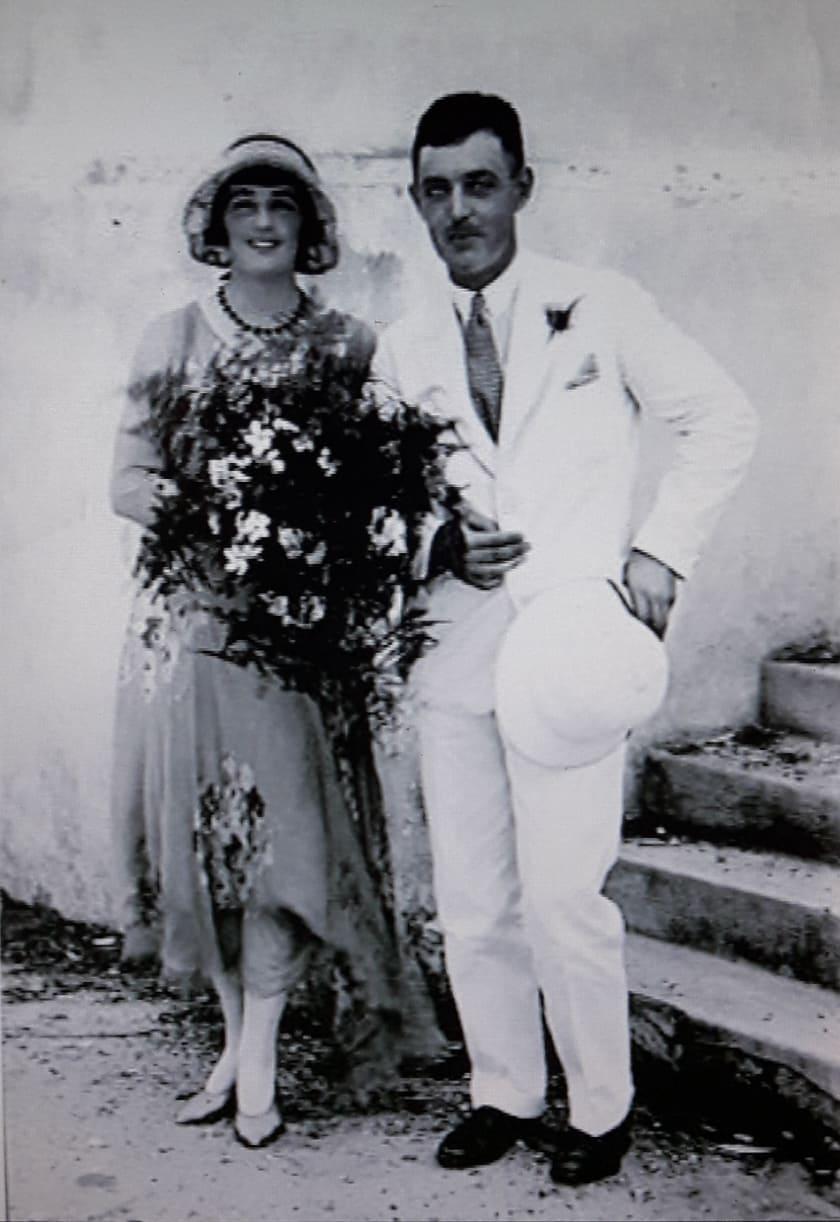
Splendid Hotel, Dar es Salaam 11th November 1930
Dearest Family,
I’m writing this in the bedroom whilst George is out buying a tin trunk in which to
pack all our wedding presents. I expect he will be gone a long time because he has
gone out with Hicky Wood and, though our wedding was four days ago, it’s still an
excuse for a party. People are all very cheery and friendly here.
I am wearing only pants and slip but am still hot. One swelters here in the
mornings, but a fresh sea breeze blows in the late afternoons and then Dar es Salaam is
heavenly.We arrived in Dar es Salaam harbour very early on Friday morning (7 th Nov).
The previous night the Captain had said we might not reach Dar. until 9 am, and certainly
no one would be allowed on board before 8 am. So I dawdled on the deck in my
dressing gown and watched the green coastline and the islands slipping by. I stood on
the deck outside my cabin and was not aware that I was looking out at the wrong side of
the landlocked harbour. Quite unknown to me George and some friends, the Hickson
Woods, were standing on the Gymkhana Beach on the opposite side of the channel
anxiously scanning the ship for a sign of me. George says he had a horrible idea I had
missed the ship. Blissfully unconscious of his anxiety I wandered into the bathroom
prepared for a good soak. The anchor went down when I was in the bath and suddenly
there was a sharp wrap on the door and I heard Mrs Croxford say “There’s a man in a
boat outside. He is looking out for someone and I’m sure it’s your George. I flung on
some clothes and rushed on deck with tousled hair and bare feet and it was George.
We had a marvellous reunion. George was wearing shorts and bush shirt and
looked just like the strong silent types one reads about in novels. I finished dressing then
George helped me bundle all the wedding presents I had collected en route into my
travelling rug and we went into the bar lounge to join the Hickson Woods. They are the
couple from whom George bought the land which is to be our coffee farm Hicky-Wood
was laughing when we joined them. he said he had called a chap to bring a couple of
beers thinking he was the steward but it turned out to be the Captain. He does wear
such a very plain uniform that I suppose it was easy to make the mistake, but Hicky
says he was not amused.Anyway as the H-W’s are to be our neighbours I’d better describe them. Kath
Wood is very attractive, dark Irish, with curly black hair and big brown eyes. She was
married before to Viv Lumb a great friend of George’s who died some years ago of
blackwater fever. They had one little girl, Maureen, and Kath and Hicky have a small son
of three called Michael. Hicky is slightly below average height and very neat and dapper
though well built. He is a great one for a party and good fun but George says he can be
bad tempered.Anyway we all filed off the ship and Hicky and Cath went on to the hotel whilst
George and I went through customs. Passing the customs was easy. Everyone
seemed to know George and that it was his wedding day and I just sailed through,
except for the little matter of the rug coming undone when George and I had to scramble
on the floor for candlesticks and fruit knives and a wooden nut bowl.
Outside the customs shed we were mobbed by a crowd of jabbering Africans
offering their services as porters, and soon my luggage was piled in one rickshaw whilst
George and I climbed into another and we were born smoothly away on rubber shod
wheels to the Splendid Hotel. The motion was pleasing enough but it seemed weird to
be pulled along by one human being whilst another pushed behind. We turned up a street called Acacia Avenue which, as its name implies, is lined
with flamboyant acacia trees now in the full glory of scarlet and gold. The rickshaw
stopped before the Splendid Hotel and I was taken upstairs into a pleasant room which
had its own private balcony overlooking the busy street.Here George broke the news that we were to be married in less than an hours
time. He would have to dash off and change and then go straight to the church. I would
be quite all right, Kath would be looking in and friends would fetch me.
I started to dress and soon there was a tap at the door and Mrs Hickson-Wood
came in with my bouquet. It was a lovely bunch of carnations and frangipani with lots of
asparagus fern and it went well with my primrose yellow frock. She admired my frock
and Leghorn hat and told me that her little girl Maureen was to be my flower girl. Then
she too left for the church.I was fully dressed when there was another knock on the door and I opened it to
be confronted by a Police Officer in a starched white uniform. I’m McCallum”, he said,
“I’ve come to drive you to the church.” Downstairs he introduced me to a big man in a
tussore silk suit. “This is Dr Shicore”, said McCallum, “He is going to give you away.”
Honestly, I felt exactly like Alice in Wonderland. Wouldn’t have been at all surprised if
the White Rabbit had popped up and said he was going to be my page.I walked out of the hotel and across the pavement in a dream and there, by the
curb, was a big dark blue police car decorated with white ribbons and with a tall African
Police Ascari holding the door open for me. I had hardly time to wonder what next when
the car drew up before a tall German looking church. It was in fact the Lutheran Church in
the days when Tanganyika was German East Africa.Mrs Hickson-Wood, very smart in mushroom coloured georgette and lace, and
her small daughter were waiting in the porch, so in we went. I was glad to notice my
friends from the boat sitting behind George’s friends who were all complete strangers to
me. The aisle seemed very long but at last I reached George waiting in the chancel with
Hicky-Wood, looking unfamiliar in a smart tussore suit. However this feeling of unreality
passed when he turned his head and smiled at me.In the vestry after the ceremony I was kissed affectionately by several complete
strangers and I felt happy and accepted by George’s friends. Outside the church,
standing apart from the rest of the guests, the Italian Captain and Chief Engineer were
waiting. They came up and kissed my hand, and murmured felicitations, but regretted
they could not spare the time to come to the reception. Really it was just as well
because they would not have fitted in at all well.Dr Shircore is the Director of Medical Services and he had very kindly lent his
large house for the reception. It was quite a party. The guests were mainly men with a
small sprinkling of wives. Champagne corks popped and there was an enormous cake
and soon voices were raised in song. The chief one was ‘Happy Days Are Here Again’
and I shall remember it for ever.The party was still in full swing when George and I left. The old lady from the ship
enjoyed it hugely. She came in an all black outfit with a corsage of artificial Lily-of-the-
Valley. Later I saw one of the men wearing the corsage in his buttonhole and the old
lady was wearing a carnation.When George and I got back to the hotel,I found that my luggage had been
moved to George’s room by his cook Lamek, who was squatting on his haunches and
clapped his hands in greeting. My dears, you should see Lamek – exactly like a
chimpanzee – receding forehead, wide flat nose, and long lip, and such splayed feet. It was quite a strain not to laugh, especially when he produced a gift for me. I have not yet
discovered where he acquired it. It was a faded mauve straw toque of the kind worn by
Queen Mary. I asked George to tell Lamek that I was touched by his generosity but felt
that I could not accept his gift. He did not mind at all especially as George gave him a
generous tip there and then.I changed into a cotton frock and shady straw hat and George changed into shorts
and bush shirt once more. We then sneaked into the dining room for lunch avoiding our
wedding guests who were carrying on the party in the lounge.After lunch we rejoined them and they all came down to the jetty to wave goodbye
as we set out by motor launch for Honeymoon Island. I enjoyed the launch trip very
much. The sea was calm and very blue and the palm fringed beaches of Dar es Salaam
are as romantic as any bride could wish. There are small coral islands dotted around the
Bay of which Honeymoon Island is the loveliest. I believe at one time it bore the less
romantic name of Quarantine Island. Near the Island, in the shallows, the sea is brilliant
green and I saw two pink jellyfish drifting by.There is no jetty on the island so the boat was stopped in shallow water and
George carried me ashore. I was enchanted with the Island and in no hurry to go to the
bungalow, so George and I took our bathing costumes from our suitcases and sent the
luggage up to the house together with a box of provisions.We bathed and lazed on the beach and suddenly it was sunset and it began to
get dark. We walked up the beach to the bungalow and began to unpack the stores,
tea, sugar, condensed milk, bread and butter, sardines and a large tin of ham. There
were also cups and saucers and plates and cutlery.We decided to have an early meal and George called out to the caretaker, “Boy
letta chai”. Thereupon the ‘boy’ materialised and jabbered to George in Ki-Swaheli. It
appeared he had no utensil in which to boil water. George, ever resourceful, removed
the ham from the tin and gave him that. We had our tea all right but next day the ham
was bad.Then came bed time. I took a hurricane lamp in one hand and my suitcase in the
other and wandered into the bedroom whilst George vanished into the bathroom. To
my astonishment I saw two perfectly bare iron bedsteads – no mattress or pillows. We
had brought sheets and mosquito nets but, believe me, they are a poor substitute for a
mattress.Anyway I arrayed myself in my pale yellow satin nightie and sat gingerly down
on the iron edge of the bed to await my groom who eventually appeared in a
handsome suit of silk pyjamas. His expression, as he took in the situation, was too much
for me and I burst out laughing and so did he.Somewhere in the small hours I woke up. The breeze had dropped and the
room was unbearably stuffy. I felt as dry as a bone. The lamp had been turned very
low and had gone out, but I remembered seeing a water tank in the yard and I decided
to go out in the dark and drink from the tap. In the dark I could not find my slippers so I
slipped my feet into George’s shoes, picked up his matches and groped my way out
of the room. I found the tank all right and with one hand on the tap and one cupped for
water I stooped to drink. Just then I heard a scratchy noise and sensed movements
around my feet. I struck a match and oh horrors! found that the damp spot on which I was
standing was alive with white crabs. In my hurry to escape I took a clumsy step, put
George’s big toe on the hem of my nightie and down I went on top of the crabs. I need
hardly say that George was awakened by an appalling shriek and came rushing to my
aid like a knight of old. Anyway, alarms and excursions not withstanding, we had a wonderful weekend on the island and I was sorry to return to the heat of Dar es Salaam, though the evenings
here are lovely and it is heavenly driving along the coast road by car or in a rickshaw.
I was surprised to find so many Indians here. Most of the shops, large and small,
seem to be owned by Indians and the place teems with them. The women wear
colourful saris and their hair in long black plaits reaching to their waists. Many wear baggy
trousers of silk or satin. They give a carnival air to the sea front towards sunset.
This long letter has been written in instalments throughout the day. My first break
was when I heard the sound of a band and rushed to the balcony in time to see The
Kings African Rifles band and Askaris march down the Avenue on their way to an
Armistice Memorial Service. They looked magnificent.I must end on a note of most primitive pride. George returned from his shopping
expedition and beamingly informed me that he had thrashed the man who annoyed me
on the ship. I felt extremely delighted and pressed for details. George told me that
when he went out shopping he noticed to his surprise that the ‘Timavo” was still in the
harbour. He went across to the Agents office and there saw a man who answered to the
description I had given. George said to him “Is your name Taylor?”, and when he said
“yes”, George said “Well my name is George Rushby”, whereupon he hit Taylor on the
jaw so that he sailed over the counter and down the other side. Very satisfactory, I feel.
With much love to all.Your cave woman
Eleanor.Mchewe Estate. P.O. Mbeya 22 November 1930
Dearest Family,
Well here we are at our Country Seat, Mchewe Estate. (pronounced
Mn,-che’-we) but I will start at the beginning of our journey and describe the farm later.
We left the hotel at Dar es Salaam for the station in a taxi crowded with baggage
and at the last moment Keith Wood ran out with the unwrapped bottom layer of our
wedding cake. It remained in its naked state from there to here travelling for two days in
the train on the luggage rack, four days in the car on my knee, reposing at night on the
roof of the car exposed to the winds of Heaven, and now rests beside me in the tent
looking like an old old tombstone. We have no tin large enough to hold it and one
simply can’t throw away ones wedding cake so, as George does not eat cake, I can see
myself eating wedding cake for tea for months to come, ants permitting.We travelled up by train from Dar to Dodoma, first through the lush vegetation of
the coastal belt to Morogoro, then through sisal plantations now very overgrown with
weeds owing to the slump in prices, and then on to the arid area around Dodoma. This
part of the country is very dry at this time of the year and not unlike parts of our Karoo.
The train journey was comfortable enough but slow as the engines here are fed with
wood and not coal as in South Africa.Dodoma is the nearest point on the railway to Mbeya so we left the train there to
continue our journey by road. We arrived at the one and only hotel in the early hours and
whilst someone went to rout out the night watchman the rest of us sat on the dismal
verandah amongst a litter of broken glass. Some bright spark remarked on the obvious –
that there had been a party the night before.When we were shown to a room I thought I rather preferred the verandah,
because the beds had not yet been made up and there was a bucket of vomit beside
the old fashioned washstand. However George soon got the boys to clean up the
room and I fell asleep to be awakened by George with an invitation to come and see
our car before breakfast.Yes, we have our own car. It is a Chev, with what is called a box body. That
means that sides, roof and doors are made by a local Indian carpenter. There is just the
one front seat with a kapok mattress on it. The tools are kept in a sort of cupboard fixed
to the side so there is a big space for carrying “safari kit” behind the cab seat.
Lamek, who had travelled up on the same train, appeared after breakfast, and
helped George to pack all our luggage into the back of the car. Besides our suitcases
there was a huge bedroll, kitchen utensils and a box of provisions, tins of petrol and
water and all Lamek’s bits and pieces which included three chickens in a wicker cage and
an enormous bunch of bananas about 3 ft long.When all theses things were packed there remained only a small space between
goods and ceiling and into this Lamek squeezed. He lay on his back with his horny feet a
mere inch or so from the back of my head. In this way we travelled 400 miles over
bumpy earth roads and crude pole bridges, but whenever we stopped for a meal
Lamek wriggled out and, like Aladdin’s genie, produced good meals in no time at all.
In the afternoon we reached a large river called the Ruaha. Workmen were busy
building a large bridge across it but it is not yet ready so we crossed by a ford below
the bridge. George told me that the river was full of crocodiles but though I looked hard, I
did not see any. This is also elephant country but I did not see any of those either, only
piles of droppings on the road. I must tell you that the natives around these parts are called Wahehe and the river is Ruaha – enough to make a cat laugh. We saw some Wahehe out hunting with spears
and bows and arrows. They live in long low houses with the tiniest shuttered windows
and rounded roofs covered with earth.Near the river we also saw a few Masai herding cattle. They are rather terrifying to
look at – tall, angular, and very aloof. They wear nothing but a blanket knotted on one
shoulder, concealing nothing, and all carried one or two spears.
The road climbs steeply on the far side of the Ruaha and one has the most
tremendous views over the plains. We spent our first night up there in the high country.
Everything was taken out of the car, the bed roll opened up and George and I slept
comfortably in the back of the car whilst Lamek, rolled in a blanket, slept soundly by a
small fire nearby. Next morning we reached our first township, Iringa, and put up at the
Colonist Hotel. We had a comfortable room in the annex overlooking the golf course.
our room had its own little dressing room which was also the bathroom because, when
ordered to do so, the room boy carried in an oval galvanised bath and filled it with hot
water which he carried in a four gallon petrol tin.When we crossed to the main building for lunch, George was immediately hailed
by several men who wanted to meet the bride. I was paid some handsome
compliments but was not sure whether they were sincere or the result of a nice alcoholic
glow. Anyhow every one was very friendly.After lunch I went back to the bedroom leaving George chatting away. I waited and
waited – no George. I got awfully tired of waiting and thought I’d give him a fright so I
walked out onto the deserted golf course and hid behind some large boulders. Soon I
saw George returning to the room and the boy followed with a tea tray. Ah, now the hue
and cry will start, thought I, but no, no George appeared nor could I hear any despairing
cry. When sunset came I trailed crossly back to our hotel room where George lay
innocently asleep on his bed, hands folded on his chest like a crusader on his tomb. In a
moment he opened his eyes, smiled sleepily and said kindly, “Did you have a nice walk
my love?” So of course I couldn’t play the neglected wife as he obviously didn’t think
me one and we had a very pleasant dinner and party in the hotel that evening.
Next day we continued our journey but turned aside to visit the farm of a sprightly
old man named St.Leger Seaton whom George had known for many years, so it was
after dark before George decided that we had covered our quota of miles for the day.
Whilst he and Lamek unpacked I wandered off to a stream to cool my hot feet which had
baked all day on the floor boards of the car. In the rather dim moonlight I sat down on the
grassy bank and gratefully dabbled my feet in the cold water. A few minutes later I
started up with a shriek – I had the sensation of red hot pins being dug into all my most
sensitive parts. I started clawing my clothes off and, by the time George came to the
rescue with the lamp, I was practically in the nude. “Only Siafu ants,” said George calmly.
Take off all your clothes and get right in the water.” So I had a bathe whilst George
picked the ants off my clothes by the light of the lamp turned very low for modesty’s
sake. Siafu ants are beastly things. They are black ants with outsized heads and
pinchers. I shall be very, very careful where I sit in future.The next day was even hotter. There was no great variety in the scenery. Most
of the country was covered by a tree called Miombo, which is very ordinary when the
foliage is a mature deep green, but when in new leaf the trees look absolutely beautiful
as the leaves,surprisingly, are soft pastel shades of red and yellow.Once again we turned aside from the main road to visit one of George’s friends.
This man Major Hugh Jones MC, has a farm only a few miles from ours but just now he is supervising the making of an airstrip. Major Jones is quite a character. He is below
average height and skinny with an almost bald head and one nearly blind eye into which
he screws a monocle. He is a cultured person and will, I am sure, make an interesting
neighbour. George and Major Jones’ friends call him ‘Joni’ but he is generally known in
this country as ‘Ropesoles’ – as he is partial to that type of footwear.
We passed through Mbeya township after dark so I have no idea what the place
is like. The last 100 miles of our journey was very dusty and the last 15 miles extremely
bumpy. The road is used so little that in some places we had to plow our way through
long grass and I was delighted when at last George turned into a side road and said
“This is our place.” We drove along the bank of the Mchewe River, then up a hill and
stopped at a tent which was pitched beside the half built walls of our new home. We
were expected so there was hot water for baths and after a supper of tinned food and
good hot tea, I climbed thankfully into bed.Next morning I was awakened by the chattering of the African workmen and was
soon out to inspect the new surroundings. Our farm was once part of Hickson Wood’s
land and is separated from theirs by a river. Our houses cannot be more than a few
hundred yards apart as the crow flies but as both are built on the slopes of a long range
of high hills, and one can only cross the river at the foot of the slopes, it will be quite a
safari to go visiting on foot . Most of our land is covered with shoulder high grass but it
has been partly cleared of trees and scrub. Down by the river George has made a long
coffee nursery and a large vegetable garden but both coffee and vegetable seedlings
are too small to be of use.George has spared all the trees that will make good shade for the coffee later on.
There are several huge wild fig trees as big as oaks but with smooth silvery-green trunks
and branches and there are lots of acacia thorn trees with flat tops like Japanese sun
shades. I’ve seen lovely birds in the fig trees, Louries with bright plumage and crested
heads, and Blue Rollers, and in the grasslands there are widow birds with incredibly long
black tail feathers.There are monkeys too and horrible but fascinating tree lizards with blue bodies
and orange heads. There are so many, many things to tell you but they must wait for
another time as James, the house boy, has been to say “Bafu tiari” and if I don’t go at
once, the bath will be cold.I am very very happy and terribly interested in this new life so please don’t
worry about me.Much love to you all,
Eleanor.Mchewe Estate 29th. November 1930
Dearest Family,
I’ve lots of time to write letters just now because George is busy supervising the
building of the house from early morning to late afternoon – with a break for lunch of
course.On our second day here our tent was moved from the house site to a small
clearing further down the slope of our hill. Next to it the labourers built a ‘banda’ , which is
a three sided grass hut with thatched roof – much cooler than the tent in this weather.
There is also a little grass lav. so you see we have every convenience. I spend most of
my day in the banda reading or writing letters. Occasionally I wander up to the house site
and watch the building, but mostly I just sit.I did try exploring once. I wandered down a narrow path towards the river. I
thought I might paddle and explore the river a little but I came round a bend and there,
facing me, was a crocodile. At least for a moment I thought it was and my adrenaline
glands got very busy indeed. But it was only an enormous monitor lizard, four or five
feet long. It must have been as scared as I was because it turned and rushed off through
the grass. I turned and walked hastily back to the camp and as I passed the house site I
saw some boys killing a large puff adder. Now I do my walking in the evenings with
George. Nothing alarming ever seems to happen when he is around.It is interesting to watch the boys making bricks for the house. They make a pile
of mud which they trample with their feet until it is the right consistency. Then they fill
wooden moulds with the clayey mud, and press it down well and turn out beautiful shiny,
dark brown bricks which are laid out in rows and covered with grass to bake slowly in the
sun.Most of the materials for the building are right here at hand. The walls will be sun
dried bricks and there is a white clay which will make a good whitewash for the inside
walls. The chimney and walls will be of burnt brick and tiles and George is now busy
building a kiln for this purpose. Poles for the roof are being cut in the hills behind the
house and every day women come along with large bundles of thatching grass on their
heads. Our windows are modern steel casement ones and the doors have been made
at a mission in the district. George does some of the bricklaying himself. The other
bricklayer is an African from Northern Rhodesia called Pedro. It makes me perspire just
to look at Pedro who wears an overcoat all day in the very hot sun.
Lamek continues to please. He turns out excellent meals, chicken soup followed
by roast chicken, vegetables from the Hickson-Woods garden and a steamed pudding
or fruit to wind up the meal. I enjoy the chicken but George is fed up with it and longs for
good red meat. The chickens are only about as large as a partridge but then they cost
only sixpence each.I had my first visit to Mbeya two days ago. I put on my very best trousseau frock
for the occasion- that yellow striped silk one – and wore my wedding hat. George didn’t
comment, but I saw later that I was dreadfully overdressed.
Mbeya at the moment is a very small settlement consisting of a bundle of small
Indian shops – Dukas they call them, which stock European tinned foods and native soft
goods which seem to be mainly of Japanese origin. There is a one storied Government
office called the Boma and two attractive gabled houses of burnt brick which house the
District Officer and his Assistant. Both these houses have lovely gardens but i saw them
only from the outside as we did not call. After buying our stores George said “Lets go to the pub, I want you to meet Mrs Menzies.” Well the pub turned out to be just three or four grass rondavels on a bare
plot. The proprietor, Ken Menzies, came out to welcome us. I took to him at once
because he has the same bush sandy eyebrows as you have Dad. He told me that
unfortunately his wife is away at the coast, and then he ushered me through the door
saying “Here’s George with his bride.” then followed the Iringa welcome all over again,
only more so, because the room was full of diggers from the Lupa Goldfields about fifty
miles away.Champagne corks popped as I shook hands all around and George was
clapped on the back. I could see he was a favourite with everyone and I tried not to be
gauche and let him down. These men were all most kind and most appeared to be men
of more than average education. However several were unshaven and looked as
though they had slept in their clothes as I suppose they had. When they have a little luck
on the diggings they come in here to Menzies pub and spend the lot. George says
they bring their gold dust and small nuggets in tobacco tins or Kruschen salts jars and
hand them over to Ken Menzies saying “Tell me when I’ve spent the lot.” Ken then
weighs the gold and estimates its value and does exactly what the digger wants.
However the Diggers get good value for their money because besides the drink
they get companionship and good food and nursing if they need it. Mrs Menzies is a
trained nurse and most kind and capable from what I was told. There is no doctor or
hospital here so her experience as a nursing sister is invaluable.
We had lunch at the Hotel and afterwards I poured tea as I was the only female
present. Once the shyness had worn off I rather enjoyed myself.Now to end off I must tell you a funny story of how I found out that George likes
his women to be feminine. You will remember those dashing black silk pyjamas Aunt
Mary gave me, with flowered “happy coat” to match. Well last night I thought I’d give
George a treat and when the boy called me for my bath I left George in the ‘banda’
reading the London Times. After my bath I put on my Japanese pyjamas and coat,
peered into the shaving mirror which hangs from the tent pole and brushed my hair until it
shone. I must confess that with my fringe and shingled hair I thought I made quite a
glamourous Japanese girl. I walked coyly across to the ‘banda’. Alas no compliment.
George just glanced up from the Times and went on reading.
He was away rather a long time when it came to his turn to bath. I glanced up
when he came back and had a slight concussion. George, if you please, was arrayed in
my very best pale yellow satin nightie. The one with the lace and ribbon sash and little
bows on the shoulder. I knew exactly what he meant to convey. I was not to wear the
trousers in the family. I seethed inwardly, but pretending not to notice, I said calmly “shall
I call for food?” In this garb George sat down to dinner and it says a great deal for African
phlegm that the boy did not drop the dishes.We conversed politely about this and that, and then, as usual, George went off
to bed. I appeared to be engrossed in my book and did not stir. When I went to the
tent some time later George lay fast asleep still in my nightie, though all I could see of it
was the little ribbon bows looking farcically out of place on his broad shoulders.
This morning neither of us mentioned the incident, George was up and dressed
by the time I woke up but I have been smiling all day to think what a ridiculous picture
we made at dinner. So farewell to pyjamas and hey for ribbons and bows.Your loving
Eleanor.Mchewe Estate. Mbeya. 8th December 1930
Dearest Family,
A mere shadow of her former buxom self lifts a languid pen to write to you. I’m
convalescing after my first and I hope my last attack of malaria. It was a beastly
experience but all is now well and I am eating like a horse and will soon regain my
bounce.I took ill on the evening of the day I wrote my last letter to you. It started with a
splitting headache and fits of shivering. The symptoms were all too familiar to George
who got me into bed and filled me up with quinine. He then piled on all the available
blankets and packed me in hot water bottles. I thought I’d explode and said so and
George said just to lie still and I’d soon break into a good sweat. However nothing of the
kind happened and next day my temperature was 105 degrees. Instead of feeling
miserable as I had done at the onset, I now felt very merry and most chatty. George
now tells me I sang the most bawdy songs but I hardly think it likely. Do you?
You cannot imagine how tenderly George nursed me, not only that day but
throughout the whole eight days I was ill. As we do not employ any African house
women, and there are no white women in the neighbourhood at present to whom we
could appeal for help, George had to do everything for me. It was unbearably hot in the
tent so George decided to move me across to the Hickson-Woods vacant house. They
have not yet returned from the coast.George decided I was too weak to make the trip in the car so he sent a
messenger over to the Woods’ house for their Machila. A Machila is a canopied canvas
hammock slung from a bamboo pole and carried by four bearers. The Machila duly
arrived and I attempted to walk to it, clinging to George’s arm, but collapsed in a faint so
the trip was postponed to the next morning when I felt rather better. Being carried by
Machila is quite pleasant but I was in no shape to enjoy anything and got thankfully into
bed in the Hickson-Woods large, cool and rather dark bedroom. My condition did not
improve and George decided to send a runner for the Government Doctor at Tukuyu
about 60 miles away. Two days later Dr Theis arrived by car and gave me two
injections of quinine which reduced the fever. However I still felt very weak and had to
spend a further four days in bed.We have now decided to stay on here until the Hickson-Woods return by which
time our own house should be ready. George goes off each morning and does not
return until late afternoon. However don’t think “poor Eleanor” because I am very
comfortable here and there are lots of books to read and the days seem to pass very
quickly.The Hickson-Wood’s house was built by Major Jones and I believe the one on
his shamba is just like it. It is a square red brick building with a wide verandah all around
and, rather astonishingly, a conical thatched roof. There is a beautiful view from the front
of the house and a nice flower garden. The coffee shamba is lower down on the hill.
Mrs Wood’s first husband, George’s friend Vi Lumb, is buried in the flower
garden. He died of blackwater fever about five years ago. I’m told that before her
second marriage Kath lived here alone with her little daughter, Maureen, and ran the farm
entirely on her own. She must be quite a person. I bet she didn’t go and get malaria
within a few weeks of her marriage.The native tribe around here are called Wasafwa. They are pretty primitive but
seem amiable people. Most of the men, when they start work, wear nothing but some
kind of sheet of unbleached calico wrapped round their waists and hanging to mid calf. As soon as they have drawn their wages they go off to a duka and buy a pair of khaki
shorts for five or six shillings. Their women folk wear very short beaded skirts. I think the
base is goat skin but have never got close enough for a good look. They are very shy.
I hear from George that they have started on the roof of our house but I have not
seen it myself since the day I was carried here by Machila. My letters by the way go to
the Post Office by runner. George’s farm labourers take it in turn to act in this capacity.
The mail bag is given to them on Friday afternoon and by Saturday evening they are
back with our very welcome mail.Very much love,
Eleanor.Mbeya 23rd December 1930
Dearest Family,
George drove to Mbeya for stores last week and met Col. Sherwood-Kelly VC.
who has been sent by the Government to Mbeya as Game Ranger. His job will be to
protect native crops from raiding elephants and hippo etc., and to protect game from
poachers. He has had no training for this so he has asked George to go with him on his
first elephant safari to show him the ropes.George likes Col. Kelly and was quite willing to go on safari but not willing to
leave me alone on the farm as I am still rather shaky after malaria. So it was arranged that
I should go to Mbeya and stay with Mrs Harmer, the wife of the newly appointed Lands
and Mines Officer, whose husband was away on safari.So here I am in Mbeya staying in the Harmers temporary wattle and daub
house. Unfortunately I had a relapse of the malaria and stayed in bed for three days with
a temperature. Poor Mrs Harmer had her hands full because in the room next to mine
she was nursing a digger with blackwater fever. I could hear his delirious babble through
the thin wall – very distressing. He died poor fellow , and leaves a wife and seven
children.I feel better than I have done for weeks and this afternoon I walked down to the
store. There are great signs of activity and people say that Mbeya will grow rapidly now
owing to the boom on the gold fields and also to the fact that a large aerodrome is to be
built here. Mbeya is to be a night stop on the proposed air service between England
and South Africa. I seem to be the last of the pioneers. If all these schemes come about
Mbeya will become quite suburban.26th December 1930
George, Col. Kelly and Mr Harmer all returned to Mbeya on Christmas Eve and
it was decided that we should stay and have midday Christmas dinner with the
Harmers. Col. Kelly and the Assistant District Commissioner came too and it was quite a
festive occasion, We left Mbeya in the early afternoon and had our evening meal here at
Hickson-Wood’s farm. I wore my wedding dress.I went across to our house in the car this morning. George usually walks across to
save petrol which is very expensive here. He takes a short cut and wades through the
river. The distance by road is very much longer than the short cut. The men are now
thatching the roof of our cottage and it looks charming. It consists of a very large living
room-dinning room with a large inglenook fireplace at one end. The bedroom is a large
square room with a smaller verandah room adjoining it. There is a wide verandah in the
front, from which one has a glorious view over a wide valley to the Livingstone
Mountains on the horizon. Bathroom and storeroom are on the back verandah and the
kitchen is some distance behind the house to minimise the risk of fire.You can imagine how much I am looking forward to moving in. We have some
furniture which was made by an Indian carpenter at Iringa, refrectory dining table and
chairs, some small tables and two armchairs and two cupboards and a meatsafe. Other
things like bookshelves and extra cupboards we will have to make ourselves. George
has also bought a portable gramophone and records which will be a boon.
We also have an Irish wolfhound puppy, a skinny little chap with enormous feet
who keeps me company all day whilst George is across at our farm working on the
house.Lots and lots of love,
Eleanor.Mchewe Estate 8th Jan 1931
Dearest Family,
Alas, I have lost my little companion. The Doctor called in here on Boxing night
and ran over and killed Paddy, our pup. It was not his fault but I was very distressed
about it and George has promised to try and get another pup from the same litter.
The Hickson-Woods returned home on the 29th December so we decided to
move across to our nearly finished house on the 1st January. Hicky Wood decided that
we needed something special to mark the occasion so he went off and killed a sucking
pig behind the kitchen. The piglet’s screams were terrible and I felt that I would not be
able to touch any dinner. Lamek cooked and served sucking pig up in the traditional way
but it was high and quite literally, it stank. Our first meal in our own home was not a
success.However next day all was forgotten and I had something useful to do. George
hung doors and I held the tools and I also planted rose cuttings I had brought from
Mbeya and sowed several boxes with seeds.Dad asked me about the other farms in the area. I haven’t visited any but there
are five besides ours. One belongs to the Lutheran Mission at Utengule, a few miles
from here. The others all belong to British owners. Nearest to Mbeya, at the foot of a
very high peak which gives Mbeya its name, are two farms, one belonging to a South
African mining engineer named Griffiths, the other to I.G.Stewart who was an officer in the
Kings African Rifles. Stewart has a young woman called Queenie living with him. We are
some miles further along the range of hills and are some 23 miles from Mbeya by road.
The Mchewe River divides our land from the Hickson-Woods and beyond their farm is
Major Jones.All these people have been away from their farms for some time but have now
returned so we will have some neighbours in future. However although the houses are
not far apart as the crow flies, they are all built high in the foothills and it is impossible to
connect the houses because of the rivers and gorges in between. One has to drive right
down to the main road and then up again so I do not suppose we will go visiting very
often as the roads are very bumpy and eroded and petrol is so expensive that we all
save it for occasional trips to Mbeya.The rains are on and George has started to plant out some coffee seedlings. The
rains here are strange. One can hear the rain coming as it moves like a curtain along the
range of hills. It comes suddenly, pours for a little while and passes on and the sun
shines again.I do like it here and I wish you could see or dear little home.
Your loving,
Eleanor.Mchewe Estate. 1st April 1931
Dearest Family,
Everything is now running very smoothly in our home. Lamek continues to
produce palatable meals and makes wonderful bread which he bakes in a four gallon
petrol tin as we have no stove yet. He puts wood coals on the brick floor of the kitchen,
lays the tin lengh-wise on the coals and heaps more on top. The bread tins are then put
in the petrol tin, which has one end cut away, and the open end is covered by a flat
piece of tin held in place by a brick. Cakes are also backed in this make-shift oven and I
have never known Lamek to have a failure yet.Lamek has a helper, known as the ‘mpishi boy’ , who does most of the hard
work, cleans pots and pans and chops the firewood etc. Another of the mpishi boy’s
chores is to kill the two chickens we eat each day. The chickens run wild during the day
but are herded into a small chicken house at night. One of the kitchen boy’s first duties is
to let the chickens out first thing in the early morning. Some time after breakfast it dawns
on Lamek that he will need a chicken for lunch. he informs the kitchen boy who selects a
chicken and starts to chase it in which he is enthusiastically joined by our new Irish
wolfhound pup, Kelly. Together they race after the frantic fowl, over the flower beds and
around the house until finally the chicken collapses from sheer exhaustion. The kitchen
boy then hands it over to Lamek who murders it with the kitchen knife and then pops the
corpse into boiling water so the feathers can be stripped off with ease.I pointed out in vain, that it would be far simpler if the doomed chickens were kept
in the chicken house in the mornings when the others were let out and also that the correct
way to pluck chickens is when they are dry. Lamek just smiled kindly and said that that
may be so in Europe but that his way is the African way and none of his previous
Memsahibs has complained.My houseboy, named James, is clean and capable in the house and also a
good ‘dhobi’ or washboy. He takes the washing down to the river and probably
pounds it with stones, but I prefer not to look. The ironing is done with a charcoal iron
only we have no charcoal and he uses bits of wood from the kitchen fire but so far there
has not been a mishap.It gets dark here soon after sunset and then George lights the oil lamps and we
have tea and toast in front of the log fire which burns brightly in our inglenook. This is my
favourite hour of the day. Later George goes for his bath. I have mine in the mornings
and we have dinner at half past eight. Then we talk a bit and read a bit and sometimes
play the gramophone. I expect it all sounds pretty unexciting but it doesn’t seem so to
me.Very much love,
Eleanor.Mchewe Estate 20th April 1931
Dearest Family,
It is still raining here and the countryside looks very lush and green, very different
from the Mbeya district I first knew, when plains and hills were covered in long brown
grass – very course stuff that grows shoulder high.Most of the labourers are hill men and one can see little patches of cultivation in
the hills. Others live in small villages near by, each consisting of a cluster of thatched huts
and a few maize fields and perhaps a patch of bananas. We do not have labour lines on
the farm because our men all live within easy walking distance. Each worker has a labour
card with thirty little squares on it. One of these squares is crossed off for each days work
and when all thirty are marked in this way the labourer draws his pay and hies himself off
to the nearest small store and blows the lot. The card system is necessary because
these Africans are by no means slaves to work. They work only when they feel like it or
when someone in the family requires a new garment, or when they need a few shillings
to pay their annual tax. Their fields, chickens and goats provide them with the food they
need but they draw rations of maize meal beans and salt. Only our headman is on a
salary. His name is Thomas and he looks exactly like the statues of Julius Caesar, the
same bald head and muscular neck and sardonic expression. He comes from Northern
Rhodesia and is more intelligent than the locals.We still live mainly on chickens. We have a boy whose job it is to scour the
countryside for reasonable fat ones. His name is Lucas and he is quite a character. He
has such long horse teeth that he does not seem able to close his mouth and wears a
perpetual amiable smile. He brings his chickens in beehive shaped wicker baskets
which are suspended on a pole which Lucas carries on his shoulder.We buy our groceries in bulk from Mbeya, our vegetables come from our
garden by the river and our butter from Kath Wood. Our fresh milk we buy from the
natives. It is brought each morning by three little totos each carrying one bottle on his
shaven head. Did I tell you that the local Wasafwa file their teeth to points. These kids
grin at one with their little sharks teeth – quite an “all-ready-to-eat-you-with-my-dear” look.
A few nights ago a message arrived from Kath Wood to say that Queenie
Stewart was very ill and would George drive her across to the Doctor at Tukuyu. I
wanted George to wait until morning because it was pouring with rain, and the mountain
road to Tukuyu is tricky even in dry weather, but he said it is dangerous to delay with any
kind of fever in Africa and he would have to start at once. So off he drove in the rain and I
did not see him again until the following night.George said that it had been a nightmare trip. Queenie had a high temperature
and it was lucky that Kath was able to go to attend to her. George needed all his
attention on the road which was officially closed to traffic, and very slippery, and in some
places badly eroded. In some places the decking of bridges had been removed and
George had to get out in the rain and replace it. As he had nothing with which to fasten
the decking to the runners it was a dangerous undertaking to cross the bridges especially
as the rivers are now in flood and flowing strongly. However they reached Tukuyu safely
and it was just as well they went because the Doctor diagnosed Queenies illness as
Spirillium Tick Fever which is a very nasty illness indeed.Eleanor.
Mchewe Estate. 20th May 1931
Dear Family,
I’m feeling fit and very happy though a bit lonely sometimes because George
spends much of his time away in the hills cutting a furrow miles long to bring water to the
house and to the upper part of the shamba so that he will be able to irrigate the coffee
during the dry season.It will be quite an engineering feat when it is done as George only has makeshift
surveying instruments. He has mounted an ordinary cheap spirit level on an old camera
tripod and has tacked two gramophone needles into the spirit level to give him a line.
The other day part of a bank gave way and practically buried two of George’s labourers
but they were quickly rescued and no harm was done. However he will not let them
work unless he is there to supervise.I keep busy so that the days pass quickly enough. I am delighted with the
material you sent me for curtains and loose covers and have hired a hand sewing
machine from Pedro-of-the-overcoat and am rattling away all day. The machine is an
ancient German one and when I say rattle, I mean rattle. It is a most cumbersome, heavy
affair of I should say, the same vintage as George Stevenson’s Rocket locomotive.
Anyway it sews and I am pleased with my efforts. We made a couch ourselves out of a
native bed, a mattress and some planks but all this is hidden under the chintz cover and
it looks quite the genuine bought article. I have some diversions too. Small black faced
monkeys sit in the trees outside our bedroom window and they are most entertaining to
watch. They are very mischievous though. When I went out into the garden this morning
before breakfast I found that the monkeys had pulled up all my carnations. There they
lay, roots in the air and whether they will take again I don’t know.I like the monkeys but hate the big mountain baboons that come and hang
around our chicken house. I am terrified that they will tear our pup into bits because he is
a plucky young thing and will rush out to bark at the baboons.George usually returns for the weekends but last time he did not because he had
a touch of malaria. He sent a boy down for the mail and some fresh bread. Old Lucas
arrived with chickens just as the messenger was setting off with mail and bread in a
haversack on his back. I thought it might be a good idea to send a chicken to George so
I selected a spry young rooster which I handed to the messenger. He, however,
complained that he needed both hands for climbing. I then had one of my bright ideas
and, putting a layer of newspaper over the bread, I tucked the rooster into the haversack
and buckled down the flap so only his head protruded.I thought no more about it until two days later when the messenger again
appeared for fresh bread. He brought a rather terse note from George saying that the
previous bread was uneatable as the rooster had eaten some of it and messed on the
rest. Ah me!The previous weekend the Hickson-Woods, Stewarts and ourselves, went
across to Tukuyu to attend a dance at the club there. the dance was very pleasant. All
the men wore dinner jackets and the ladies wore long frocks. As there were about
twenty men and only seven ladies we women danced every dance whilst the surplus
men got into a huddle around the bar. George and I spent the night with the Agricultural
Officer, Mr Eustace, and I met his fiancee, Lillian Austin from South Africa, to whom I took
a great liking. She is Governess to the children of Major Masters who has a farm in the
Tukuyu district.On the Sunday morning we had a look at the township. The Boma was an old German one and was once fortified as the Africans in this district are a very warlike tribe.
They are fine looking people. The men wear sort of togas and bands of cloth around
their heads and look like Roman Senators, but the women go naked except for a belt
from which two broad straps hang down, one in front and another behind. Not a graceful
garb I assure you.We also spent a pleasant hour in the Botanical Gardens, laid out during the last
war by the District Commissioner, Major Wells, with German prisoner of war labour.
There are beautiful lawns and beds of roses and other flowers and shady palm lined
walks and banana groves. The gardens are terraced with flights of brick steps connecting
the different levels and there is a large artificial pond with little islands in it. I believe Major
Wells designed the lake to resemble in miniature, the Lakes of Killarney.
I enjoyed the trip very much. We got home at 8 pm to find the front door locked
and the kitchen boy fast asleep on my newly covered couch! I hastily retreated to the
bedroom whilst George handled the situation.Eleanor.
January 20, 2022 at 9:16 am #6255In reply to: The Elusive Samuel Housley and Other Family Stories
My Grandparents
George Samuel Marshall 1903-1995
Florence Noreen Warren (Nora) 1906-1988
I always called my grandfather Mop, apparently because I couldn’t say the name Grandpa, but whatever the reason, the name stuck. My younger brother also called him Mop, but our two cousins did not.
My earliest memories of my grandparents are the picnics. Grandma and Mop loved going out in the car for a picnic. Favourite spots were the Clee Hills in Shropshire, North Wales, especially Llanbedr, Malvern, and Derbyshire, and closer to home, the caves and silver birch woods at Kinver Edge, Arley by the river Severn, or Bridgnorth, where Grandma’s sister Hildreds family lived. Stourbridge was on the western edge of the Black Country in the Midlands, so one was quickly in the countryside heading west. They went north to Derbyshire less, simply because the first part of the trip entailed driving through Wolverhampton and other built up and not particularly pleasant urban areas. I’m sure they’d have gone there more often, as they were both born in Derbyshire, if not for that initial stage of the journey.
There was predominantly grey tartan car rug in the car for picnics, and a couple of folding chairs. There were always a couple of cushions on the back seat, and I fell asleep in the back more times than I can remember, despite intending to look at the scenery. On the way home Grandma would always sing, “Show me the way to go home, I’m tired and I want to go to bed, I had a little drink about an hour ago, And it’s gone right to my head.” I’ve looked online for that song, and have not found it anywhere!
Grandma didn’t just make sandwiches for picnics, there were extra containers of lettuce, tomatoes, pickles and so on. I used to love to wash up the picnic plates in the little brook on the Clee Hills, near Cleeton St Mary. The close cropped grass was ideal for picnics, and Mop and the sheep would Baaa at each other.
Mop would base the days outting on the weather forcast, but Grandma often used to say he always chose the opposite of what was suggested. She said if you want to go to Derbyshire, tell him you want to go to Wales. I recall him often saying, on a gloomy day, Look, there’s a bit of clear sky over there. Mop always did the driving as Grandma never learned to drive. Often she’d dust the dashboard with a tissue as we drove along.
My brother and I often spent the weekend at our grandparents house, so that our parents could go out on a Saturday night. They gave us 5 shillings pocket money, which I used to spend on two Ladybird books at 2 shillings and sixpence each. We had far too many sweets while watching telly in the evening ~ in the dark, as they always turned the lights off to watch television. The lemonade and pop was Corona, and came in returnable glass bottles. We had Woodpecker cider too, even though it had a bit of an alcohol content.
Mop smoked Kensitas and Grandma smoked Sovereign cigarettes, or No6, and the packets came with coupons. They often let me choose something for myself out of the catalogue when there were enough coupons saved up.
When I had my first garden, in a rented house a short walk from theirs, they took me to garden nurseries and taught me all about gardening. In their garden they had berberis across the front of the house under the window, and cotoneaster all along the side of the garage wall. The silver birth tree on the lawn had been purloined as a sapling from Kinver edge, when they first moved into the house. (they lived in that house on Park Road for more than 60 years). There were perennials and flowering shrubs along the sides of the back garden, and behind the silver birch, and behind that was the vegeatable garden. Right at the back was an Anderson shelter turned into a shed, the rhubarb, and the washing line, and the canes for the runner beans in front of those. There was a little rose covered arch on the path on the left, and privet hedges all around the perimeter.
My grandfather was a dental technician. He worked for various dentists on their premises over the years, but he always had a little workshop of his own at the back of his garage. His garage was full to the brim of anything that might potentially useful, but it was not chaotic. He knew exactly where to find anything, from the tiniest screw for spectacles to a useful bit of wire. He was “mechanicaly minded” and could always fix things like sewing machines and cars and so on.
Mop used to let me sit with him in his workshop, and make things out of the pink wax he used for gums to embed the false teeth into prior to making the plaster casts. The porcelain teeth came on cards, and were strung in place by means of little holes on the back end of the teeth. I still have a necklace I made by threading teeth onto a string. There was a foot pedal operated drill in there as well, possibly it was a dentists drill previously, that he used with miniature grinding or polishing attachments. Sometimes I made things out of the pink acrylic used for the final denture, which had a strong smell and used to harden quickly, so you had to work fast. Initially, the workshop was to do the work for Uncle Ralph, Grandmas’s sisters husband, who was a dentist. In later years after Ralph retired, I recall a nice man called Claude used to come in the evening to collect the dentures for another dental laboratory. Mop always called his place of work the laboratory.
Grandma loved books and was always reading, in her armchair next to the gas fire. I don’t recall seeing Mop reading a book, but he was amazingly well informed about countless topics.
At family gatherings, Mops favourite topic of conversation after dinner was the atrocities committed over the centuries by organized religion.My grandfather played snooker in his younger years at the Conservative club. I recall my father assuming he voted Conservative, and Mop told him in no uncertain terms that he’s always voted Labour. When asked why he played snooker at the Conservative club and not the Labour club, he said with a grin that “it was a better class of people”, but that he’d never vote Conservative because it was of no benefit to the likes of us working people.
Grandma and her sister in law Marie had a little grocers shop on Brettel Lane in Amblecote for a few years but I have no personal recollection of that as it was during the years we lived in USA. I don’t recall her working other than that. She had a pastry making day once a week, and made Bakewell tart, apple pie, a meat pie, and her own style of pizza. She had an old black hand operated sewing machine, and made curtains and loose covers for the chairs and sofa, but I don’t think she made her own clothes, at least not in later years. I have her sewing machine here in Spain.
At regular intervals she’d move all the furniture around and change the front room into the living room and the back into the dining room and vice versa. In later years Mop always had the back bedroom (although when I lived with them aged 14, I had the back bedroom, and painted the entire room including the ceiling purple). He had a very lumpy mattress but he said it fit his bad hip perfectly.Grandma used to alternate between the tiny bedroom and the big bedroom at the front. (this is in later years, obviously) The wardrobes and chests of drawers never changed, they were oak and substantial, but rather dated in appearance. They had a grandfather clock with a brass face and a grandmother clock. Over the fireplace in the living room was a Utrillo print. The bathroom and lavatory were separate rooms, and the old claw foot bath had wood panels around it to make it look more modern. There was a big hot water geyser above it. Grandma was fond of using stick on Fablon tile effects to try to improve and update the appearance of the bathroom and kitchen. Mop was a generous man, but would not replace household items that continued to function perfectly well. There were electric heaters in all the rooms, of varying designs, and gas fires in living room and dining room. The coal house on the outside wall was later turned into a downstairs shower room, when Mop moved his bedroom downstairs into the front dining room, after Grandma had died and he was getting on.
Mop was 91 when he told me he wouldn’t be growing any vegetables that year. He said the sad thing was that he knew he’d never grow vegetables again. He worked part time until he was in his early 80s.
January 14, 2022 at 3:06 pm #6253In reply to: The Elusive Samuel Housley and Other Family Stories
My Grandparents Kitchen
My grandmother used to have golden syrup in her larder, hanging on the white plastic coated storage rack that was screwed to the inside of the larder door. Mostly the larder door was left propped open with an old flat iron, so you could see the Heinz ketchup and home made picallilli (she made a particularly good picallili), the Worcester sauce and the jar of pickled onions, as you sat at the kitchen table.
If you were sitting to the right of the kitchen table you could see an assortment of mismatched crockery, cups and bowls, shoe cleaning brushes, and at the back, tiny tins of baked beans and big ones of plum tomatoes, and normal sized tins of vegetable and mushroom soup. Underneath the little shelves that housed the tins was a blue plastic washing up bowl with a few onions, some in, some out of the yellow string bag they came home from the expensive little village supermarket in.
There was much more to the left in the awkward triangular shape under the stairs, but you couldn’t see under there from your seat at the kitchen table. You could see the shelf above the larder door which held an ugly china teapot of graceless modern lines, gazed with metallic silver which was wearing off in places. Beside the teapot sat a serving bowl, squat and shapely with little handles, like a flattened Greek urn, in white and reddish brown with flecks of faded gilt. A plain white teapot completed the trio, a large cylindrical one with neat vertical ridges and grooves.
There were two fridges under the high shallow wooden wall cupboard. A waist high bulbous old green one with a big handle that pulled out with a clunk, and a chest high sleek white one with a small freezer at the top with a door of its own. On the top of the fridges were biscuit and cracker tins, big black keys, pencils and brittle yellow notepads, rubber bands and aspirin value packs and a bottle of Brufen. There was a battered old maroon spectacle case and a whicker letter rack, letters crammed in and fanning over the top. There was always a pile of glossy advertising pamphlets and flyers on top of the fridges, of the sort that were best put straight into the tiny pedal bin.
My grandmother never lined the pedal bin with a used plastic bag, nor with a specially designed plastic bin liner. The bin was so small that the flip top lid was often gaping, resting on a mound of cauliflower greens and soup tins. Behind the pedal bin, but on the outer aspect of the kitchen wall, was the big black dustbin with the rubbery lid. More often than not, the lid was thrust upwards. If Thursday when the dustbin men came was several days away, you’d wish you hadn’t put those newspapers in, or those old shoes! You stood in the softly drizzling rain in your slippers, the rubbery sheild of a lid in your left hand and the overflowing pedal bin in the other. The contents of the pedal bin are not going to fit into the dustbin. You sigh, put the pedal bin and the dustbin lid down, and roll up your sleeves ~ carefully, because you’ve poked your fingers into a porridge covered teabag. You grab the sides of the protruding black sack and heave. All being well, the contents should settle and you should have several inches more of plastic bag above the rim of the dustbin. Unless of course it’s a poor quality plastic bag in which case your fingernail will go through and a horizontal slash will appear just below rubbish level. Eventually you upend the pedal bin and scrape the cigarette ash covered potato peelings into the dustbin with your fingers. By now the fibres of your Shetland wool jumper are heavy with damp, just like the fuzzy split ends that curl round your pale frowning brow. You may push back your hair with your forearm causing the moisture to bead and trickle down your face, as you turn the brass doorknob with your palm and wrist, tea leaves and cigarette ash clinging unpleasantly to your fingers.
The pedal bin needs rinsing in the kitchen sink, but the sink is full of mismatched saucepans, some new in shades of harvest gold, some battered and mishapen in stainless steel and aluminium, bits of mashed potato stuck to them like concrete pebbledash. There is a pale pink octagonally ovoid shallow serving dish and a little grey soup bowl with a handle like a miniature pottery saucepan decorated with kitcheny motifs.
The water for the coffee bubbles in a suacepan on the cream enamelled gas cooker. My grandmother never used a kettle, although I do remember a heavy flame orange one. The little pan for boiling water had a lip for easy pouring and a black plastic handle.
The steam has caused the condensation on the window over the sink to race in rivulets down to the fablon coated windowsill. The yellow gingham curtains hang limply, the left one tucked behind the back of the cooker.
You put the pedal bin back it it’s place below the tea towel holder, and rinse your mucky fingers under the tap. The gas water heater on the wall above you roars into life just as you turn the tap off, and disappointed, subsides.
As you lean over to turn the cooker knob, the heat from the oven warms your arm. The gas oven was almost always on, the oven door open with clean tea towels and sometimes large white pants folded over it to air.
The oven wasn’t the only heat in my grandparents kitchen. There was an electric bar fire near the red formica table which used to burn your legs. The kitchen table was extended by means of a flap at each side. When I was small I wasn’t allowed to snap the hinge underneath shut as my grandmother had pinched the skin of her palm once.
The electric fire was plugged into the same socket as the radio. The radio took a minute or two to warm up when you switched it on, a bulky thing with sharp seventies edges and a reddish wood effect veneer and big knobs. The light for my grandfathers workshop behind the garage (where he made dentures) was plugged into the same socket, which had a big heavy white three way adaptor in. The plug for the washing machine was hooked by means of a bit of string onto a nail or hook so that it didn’t fall down behing the washing machine when it wasn’t plugged in. Everything was unplugged when it wasn’t in use. Sometimes there was a shrivelled Christmas cactus on top of the radio, but it couldn’t hide the adaptor and all those plugs.
Above the washing machine was a rhomboid wooden wall cupboard with sliding frsoted glass doors. It was painted creamy gold, the colour of a nicotine stained pub ceiling, and held packets of Paxo stuffing and little jars of Bovril and Marmite, packets of Bisto and a jar of improbably red Maraschino cherries.
The nicotine coloured cupboard on the opposite wall had half a dozen large hooks screwed under the bottom shelf. A variety of mugs and cups hung there when they weren’t in the bowl waiting to be washed up. Those cupboard doors seemed flimsy for their size, and the thin beading on the edge of one door had come unstuck at the bottom and snapped back if you caught it with your sleeve. The doors fastened with a little click in the centre, and the bottom of the door reverberated slightly as you yanked it open. There were always crumbs in the cupboard from the numerous packets of bisucits and crackers and there was always an Allbran packet with the top folded over to squeeze it onto the shelf. The sugar bowl was in there, sticky grains like sandpaper among the biscuit crumbs.
Half of one of the shelves was devoted to medicines: grave looking bottles of codeine linctus with no nonsense labels, brown glass bottles with pills for rheumatism and angina. Often you would find a large bottle, nearly full, of Brewers yeast or vitamin supplements with a dollar price tag, souvenirs of the familys last visit. Above the medicines you’d find a faded packet of Napolitana pasta bows or a dusty packet of muesli. My grandparents never used them but she left them in the cupboard. Perhaps the dollar price tags and foreign foods reminded her of her children.
If there had been a recent visit you would see monstrous jars of Sanka and Maxwell House coffee in there too, but they always used the coffee. They liked evaporated milk in their coffee, and used tins and tins of “evap” as they called it. They would pour it over tinned fruit, or rhubard crumble or stewed apples.
When there was just the two of them, or when I was there as well, they’d eat at the kitchen table. The table would be covered in a white embroidered cloth and the food served in mismatched serving dishes. The cutlery was large and bent, the knife handles in varying shades of bone. My grandfathers favourite fork had the tip of each prong bent in a different direction. He reckoned it was more efficient that way to spear his meat. He often used to chew his meat and then spit it out onto the side of his plate. Not in company, of course. I can understand why he did that, not having eaten meat myself for so long. You could chew a piece of meat for several hours and still have a stringy lump between your cheek and your teeth.
My grandfather would always have a bowl of Allbran with some Froment wheat germ for his breakfast, while reading the Daily Mail at the kitchen table. He never worse slippers, always shoes indoors, and always wore a tie. He had lots of ties but always wore a plain maroon one. His shirts were always cream and buttoned at throat and cuff, and eventually started wearing shirts without detachable collars. He wore greeny grey trousers and a cardigan of the same shade most of the time, the same colour as a damp English garden.
The same colour as the slimy green wooden clothes pegs that I threw away and replaced with mauve and fuschia pink plastic ones. “They’re a bit bright for up the garden, aren’t they,” he said. He was right. I should have ignored the green peg stains on the laundry. An English garden should be shades of moss and grassy green, rich umber soil and brick red walls weighed down with an atmosphere of dense and heavy greyish white.
After Grandma died and Mop had retired (I always called him Mop, nobody knows why) at 10:00am precisely Mop would have a cup of instant coffee with evap. At lunch, a bowl of tinned vegetable soup in his special soup bowl, and a couple of Krackawheat crackers and a lump of mature Cheddar. It was a job these days to find a tasty cheddar, he’d say.
When he was working, and he worked until well into his seventies, he took sandwiches. Every day he had the same sandwich filling: a combination of cheese, peanut butter and marmite. It was an unusal choice for an otherwise conventional man. He loved my grandmothers cooking, which wasn’t brilliant but was never awful. She was always generous with the cheese in cheese sauces and the meat in meat pies. She overcooked the cauliflower, but everyone did then. She made her gravy in the roasting pan, and made onion sauce, bread sauce, parsley sauce and chestnut stuffing. She had her own version of cosmopolitan favourites, and called her quiche a quiche when everyone was still calling it egg and bacon pie. She used to like Auntie Daphne’s ratatouille, rather exotic back then, and pronounced it Ratta Twa. She made pizza unlike any other, with shortcrust pastry smeared with tomato puree from a tube, sprinkled with oregano and great slabs of cheddar.
The roast was always overdone. “We like our meat well done” she’d say. She’d walk up the garden to get fresh mint for the mint sauce and would announce with pride “these runner beans are out of the garding”. They always grew vegetables at the top of the garden, behind the lawn and the silver birch tree. There was always a pudding: a slice of almond tart (always with home made pastry), a crumble or stewed fruit. Topped with evap, of course.
January 1, 2022 at 10:21 am #6249In reply to: The Elusive Samuel Housley and Other Family Stories
Grettons in USA and The Lusitania Survivor
Two of my grandmothers uncles emigrated to New Jersey, USA, John Orgill Gretton in 1888, and Michael Thomas Gretton in 1889. My grandmothers mother Florence Nightingale Gretton, born in 1881 and the youngest of eight, was still a child when they left. This is perhaps why we knew nothing of them until the family research started.
Michael Thomas Gretton
1870-1940
Michael, known by his middle name of Thomas, married twice. His occupation was a potter in the sanitary ware industry. He and his first wife Edith Wise had three children, William R Gretton 1894-1961, Charles Thomas Gretton 1897-1960, and Clara P Gretton 1895-1997. Edith died in 1922, and Thomas married again. His second wife Martha Ann Barker was born in Stoke on Trent in England, but had emigrated to USA in 1909. She had two children with her first husband Thomas Barker, Doris and Winifred. Thomas Barker died in 1921.
Martha Ann Barker and her daughter Doris, born in 1900, were Lusitania survivors. The Lusitania was a British ocean liner that was sunk on 7 May 1915 by a German U-boat 11 miles (18 km) off the southern coast of Ireland, killing 1,198 passengers and crew. Martha and Doris survived, but sadly nine year old Winifred did not. Her remains were lost at sea.
Winifred Barker:
Thomas Barker sailed to England after the disaster to accompany Martha and Doris on the trip home to USA:
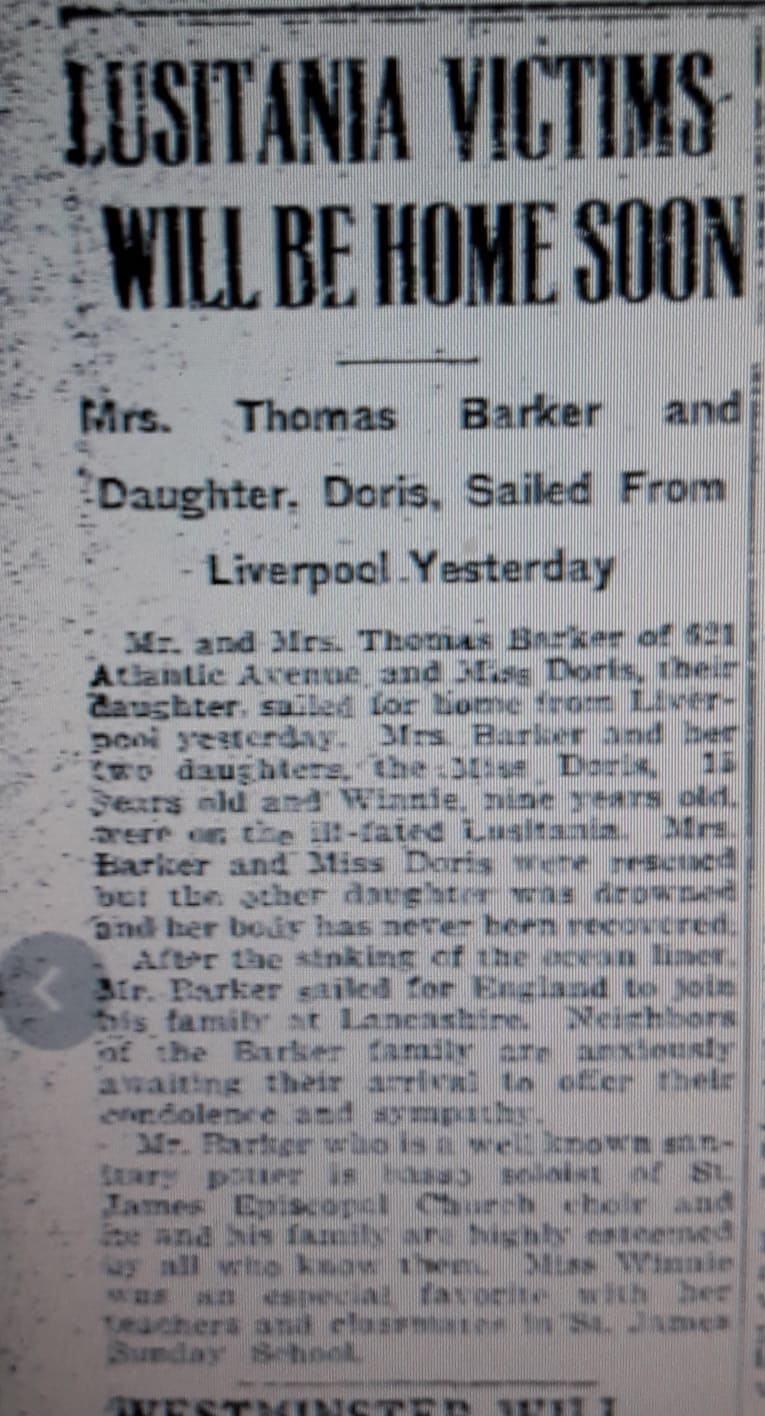
Thomas Gretton, Martha’s second husband, died in 1940. She survived him by 23 years and died in 1963 in New Jersey:
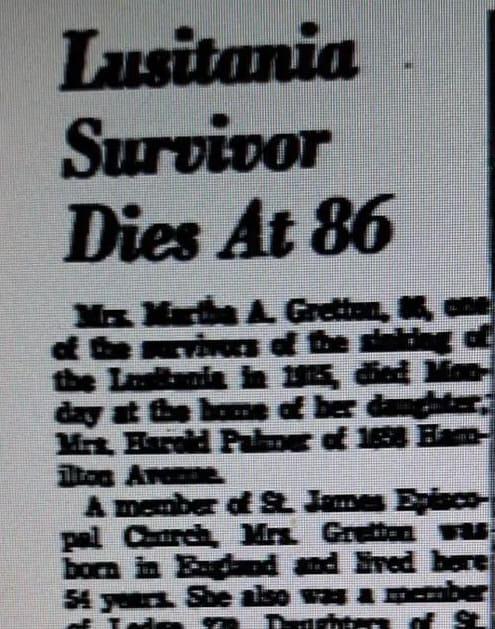
John Orgill Gretton
1868-1949
John Orgill Gretton was a “Freeholder” in New Jersey for 24 years. New Jersey alone of all the United States has the distinction of retaining the title of “FREEHOLDER” to denote the elected members of the county governing bodies. This descriptive name, which commemorates the origin of home rule, is used by only 21 of the nation’s 3,047 counties. In other states, these county officials are known as commissioners, supervisors, probate judges, police jurors, councilors and a variety of other names.
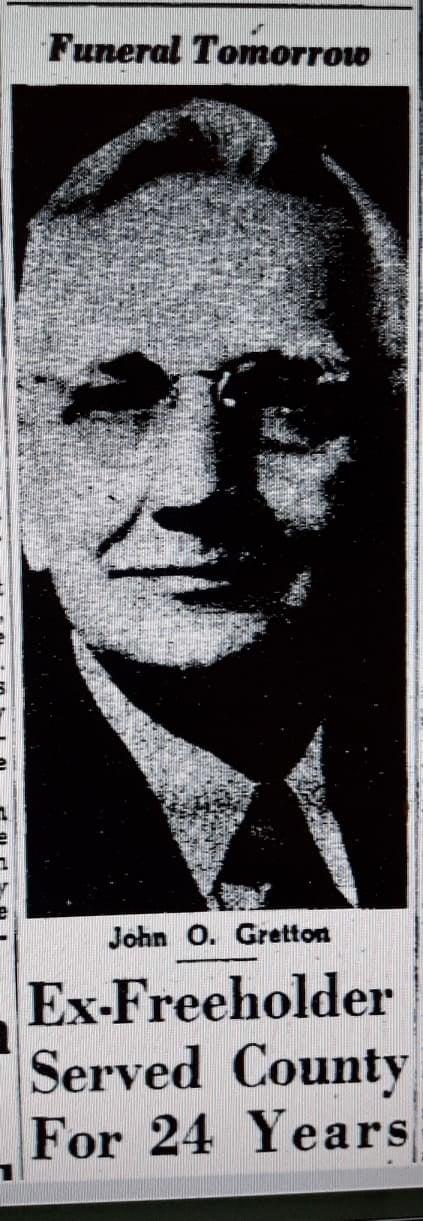
John and his wife Caroline Thum had four children, Florence J Gretton 1893-1965, George Thum Gretton 1895-1951, Wilhelmina F Gretton 1899-1931, and Nathalie A Gretton 1904-1947.
Their engagements and weddings appear on the society pages of the Trenton Newspapers. For example the article headline on the wedding in 1919 of George Thum Gretton and his wife Elizabeth Stokes announces “Charming Society Girl Becomes Bride Today”.
December 18, 2021 at 12:59 pm #6243In reply to: The Elusive Samuel Housley and Other Family Stories
William Housley’s Will and the Court Case
William Housley died in 1848, but his widow Ellen didn’t die until 1872. The court case was in 1873. Details about the court case are archived at the National Archives at Kew, in London, but are not available online. They can be viewed in person, but that hasn’t been possible thus far. However, there are a great many references to it in the letters.
William Housley’s first wife was Mary Carrington 1787-1813. They had three children, Mary Anne, Elizabeth and William. When Mary died, William married Mary’s sister Ellen, not in their own parish church at Smalley but in Ashbourne. Although not uncommon for a widower to marry a deceased wife’s sister, it wasn’t legal. This point is mentioned in one of the letters.
One of the pages of William Housley’s will:
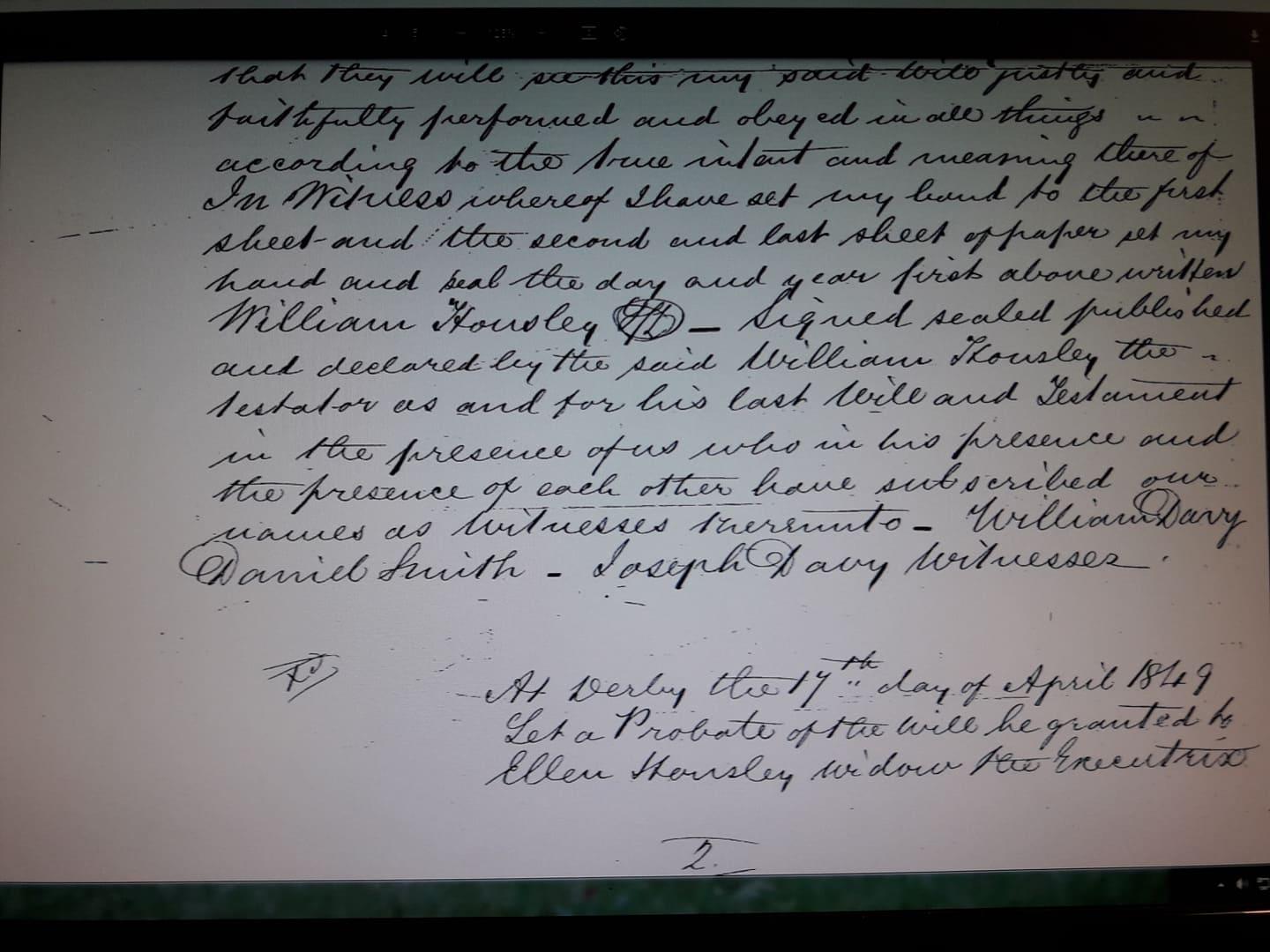
An excerpt from Barbara Housley’s Narrative on the Letters:
A comment in a letter from Joseph (August 6, 1873) indicated that William was married twice and that his wives were sisters: “What do you think that I believe that Mary Ann is trying to make our father’s will of no account as she says that my father’s marriage with our mother was not lawful he marrying two sisters. What do you think of her? I have heard my mother say something about paying a fine at the time of the marriage to make it legal.” Markwell and Saul in The A-Z Guide to Tracing Ancestors in Britain explain that marriage to a deceased wife’s sister was not permissible under Canon law as the relationship was within the prohibited degrees. However, such marriages did take place–usually well away from the couple’s home area. Up to 1835 such marriages were not void but were voidable by legal action. Few such actions were instituted but the risk was always there.
Joseph wrote that when Emma was married, Ellen “broke up the comfortable home and the things went to Derby and she went to live with them but Derby didn’t agree with her so she left again leaving her things behind and came to live with John in the new house where she died.” Ellen was listed with John’s household in the 1871 census.
In May 1872, the Ilkeston Pioneer carried this notice: “Mr. Hopkins will sell by auction on Saturday next the eleventh of May 1872 the whole of the useful furniture, sewing machine, etc. nearly new on the premises of the late Mrs. Housley at Smalley near Heanor in the county of Derby. Sale at one o’clock in the afternoon.”There were hard feelings between Mary Ann and Ellen and her children. Anne wrote: “If you remember we were not very friendly when you left. They never came and nothing was too bad for Mary Ann to say of Mother and me, but when Robert died Mother sent for her to the funeral but she did not think well to come so we took no more notice. She would not allow her children to come either.”
Mary Ann was still living in May 1872. Joseph implied that she and her brother, Will “intend making a bit of bother about the settlement of the bit of property” left by their mother. The 1871 census listed Mary Ann’s occupation as “income from houses.”In July 1872, Joseph introduced Ruth’s husband: “No doubt he is a bad lot. He is one of the Heath’s of Stanley Common a miller and he lives at Smalley Mill” (Ruth Heath was Mary Anne Housley’s daughter)
In 1873 Joseph wrote, “He is nothing but a land shark both Heath and his wife and his wife is the worst of the two. You will think these is hard words but they are true dear brother.” The solicitor, Abraham John Flint, was not at all pleased with Heath’s obstruction of the settlement of the estate. He wrote on June 30, 1873: “Heath agreed at first and then because I would not pay his expenses he refused and has since instructed another solicitor for his wife and Mrs. Weston who have been opposing us to the utmost. I am concerned for all parties interested except these two….The judge severely censured Heath for his conduct and wanted to make an order for sale there and then but Heath’s council would not consent….” In June 1875, the solicitor wrote: “Heath bid for the property but it fetched more money than he could give for it. He has been rather quieter lately.”In May 1872, Joseph wrote: “For what do you think, John has sold his share and he has acted very bad since his wife died and at the same time he sold all his furniture. You may guess I have never seen him but once since poor mother’s funeral and he is gone now no one knows where.”
In 1876, the solicitor wrote to George: “Have you heard of John Housley? He is entitled to Robert’s share and I want him to claim it.”
Anne intended that one third of the inheritance coming to her from her father and her grandfather, William Carrington, be divided between her four nieces: Sam’s three daughters and John’s daughter Elizabeth.
In the same letter (December 15, 1872), Joseph wrote:
“I think we have now found all out now that is concerned in the matter for there was only Sam that we did not know his whereabouts but I was informed a week ago that he is dead–died about three years ago in Birmingham Union. Poor Sam. He ought to have come to a better end than that”However, Samuel was still alive was on the 1871 census in Henley in Arden, and no record of his death can be found. Samuel’s brother in law said he was dead: we do not know why he lied, or perhaps the brothers were lying to keep his share, or another possibility is that Samuel himself told his brother in law to tell them that he was dead. I am inclined to think it was the latter.
Excerpts from Barbara Housley’s Narrative on the Letters continued:
Charles went to Australia in 1851, and was last heard from in January 1853. According to the solicitor, who wrote to George on June 3, 1874, Charles had received advances on the settlement of their parent’s estate. “Your promissory note with the two signed by your brother Charles for 20 pounds he received from his father and 20 pounds he received from his mother are now in the possession of the court.”
In December 1872, Joseph wrote: “I’m told that Charles two daughters has wrote to Smalley post office making inquiries about his share….” In January 1876, the solicitor wrote: “Charles Housley’s children have claimed their father’s share.”
In the Adelaide Observer 28 Aug 1875
HOUSLEY – wanted information
as to the Death, Will, or Intestacy, and
Children of Charles Housley, formerly of
Smalley, Derbyshire, England, who died at
Geelong or Creewick Creek Diggings, Victoria
August, 1855. His children will hear of something to their advantage by communicating with
Mr. A J. Flint, solicitor, Derby, England.
June 16,1875.The Diggers & Diggings of Victoria in 1855. Drawn on Stone by S.T. Gill:
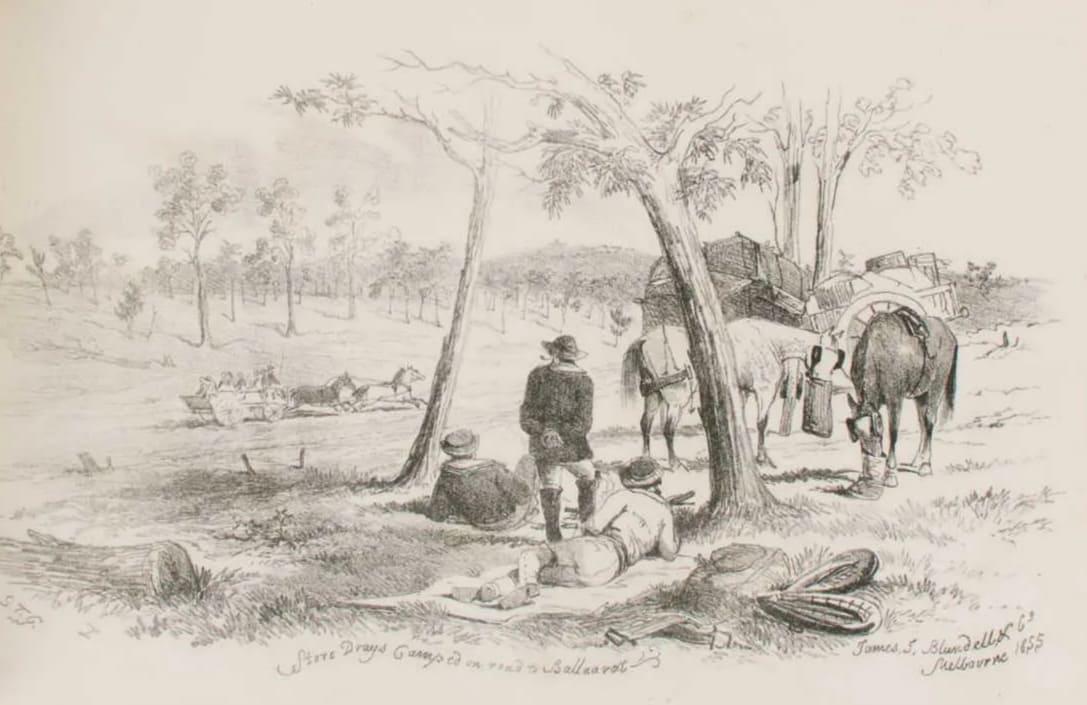
The court case:
Kerry v Housley.
Documents: Bill, demurrer.
Plaintiffs: Samuel Kerry and Joseph Housley.
Defendants: William Housley, Joseph Housley (deleted), Edwin Welch Harvey, Eleanor Harvey (deleted), Ernest Harvey infant, William Stafford, Elizabeth Stafford his wife, Mary Ann Housley, George Purdy and Catherine Purdy his wife, Elizabeth Housley, Mary Ann Weston widow and William Heath and Ruth Heath his wife (deleted).
Provincial solicitor employed in Derbyshire.
Date: 1873From the Narrative on the Letters:
The solicitor wrote on May 23, 1874: “Lately I have not written because I was not certain of your address and because I doubted I had much interesting news to tell you.” Later, Joseph wrote concerning the problems settling the estate, “You see dear brother there is only me here on our side and I cannot do much. I wish you were here to help me a bit and if you think of going for another summer trip this turn you might as well run over here.”
In March 1873, Joseph wrote: “You ask me what I think of you coming to England. I think as you have given the trustee power to sign for you I think you could do no good but I should like to see you once again for all that. I can’t say whether there would be anything amiss if you did come as you say it would be throwing good money after bad.”
In September 1872 Joseph wrote; “My wife is anxious to come. I hope it will suit her health for she is not over strong.” Elsewhere Joseph wrote that Harriet was “middling sometimes. She is subject to sick headaches. It knocks her up completely when they come on.” In December 1872 Joseph wrote, “Now dear brother about us coming to America you know we shall have to wait until this affair is settled and if it is not settled and thrown into Chancery I’m afraid we shall have to stay in England for I shall never be able to save money enough to bring me out and my family but I hope of better things.”
On July 19, 1875 Abraham Flint (the solicitor) wrote: “Joseph Housley has removed from Smalley and is working on some new foundry buildings at Little Chester near Derby. He lives at a village called Little Eaton near Derby. If you address your letter to him as Joseph Housley, carpenter, Little Eaton near Derby that will no doubt find him.”In his last letter (February 11, 1874), Joseph sounded very discouraged and wrote that Harriet’s parents were very poorly and both had been “in bed for a long time.” In addition, Harriet and the children had been ill.
The move to Little Eaton may indicate that Joseph received his settlement because in August, 1873, he wrote: “I think this is bad news enough and bad luck too, but I have had little else since I came to live at Kiddsley cottages but perhaps it is all for the best if one could only think so. I have begun to think there will be no chance for us coming over to you for I am afraid there will not be so much left as will bring us out without it is settled very shortly but I don’t intend leaving this house until it is settled either one way or the other. ”Joseph’s letters were much concerned with the settling of their mother’s estate. In 1854, Anne wrote, “As for my mother coming (to America) I think not at all likely. She is tied here with her property.” A solicitor, Abraham John Flint of 42 Full Street Derby, was engaged by John following the death of their mother. On June 30, 1873 the solicitor wrote: “Dear sir, On the death of your mother I was consulted by your brother John. I acted for him with reference to the sale and division of your father’s property at Smalley. Mr. Kerry was very unwilling to act as trustee being over 73 years of age but owing to the will being a badly drawn one we could not appoint another trustee in his place nor could the property be sold without a decree of chancery. Therefore Mr. Kerry consented and after a great deal of trouble with Heath who has opposed us all throughout whenever matters did not suit him, we found the title deeds and offered the property for sale by public auction on the 15th of July last. Heath could not find his purchase money without mortaging his property the solicitor which the mortgagee employed refused to accept Mr. Kerry’s title and owing to another defect in the will we could not compel them.”
In July 1872, Joseph wrote, “I do not know whether you can remember who the trustee was to my father’s will. It was Thomas Watson and Samuel Kerry of Smalley Green. Mr. Watson is dead (died a fortnight before mother) so Mr. Kerry has had to manage the affair.”
On Dec. 15, 1972, Joseph wrote, “Now about this property affair. It seems as far off of being settled as ever it was….” and in the following March wrote: “I think we are as far off as ever and farther I think.”
Concerning the property which was auctioned on July 15, 1872 and brought 700 pounds, Joseph wrote: “It was sold in five lots for building land and this man Heath bought up four lots–that is the big house, the croft and the cottages. The croft was made into two lots besides the piece belonging to the big house and the cottages and gardens was another lot and the little intake was another. William Richardson bought that.” Elsewhere Richardson’s purchase was described as “the little croft against Smith’s lane.” Smith’s Lane was probably named for their neighbor Daniel Smith, Mrs. Davy’s father.
But in December 1872, Joseph wrote that they had not received any money because “Mr. Heath is raising all kinds of objections to the will–something being worded wrong in the will.” In March 1873, Joseph “clarified” matters in this way: “His objection was that one trustee could not convey the property that his signature was not guarantee sufficient as it states in the will that both trustees has to sign the conveyance hence this bother.”
Joseph indicated that six shares were to come out of the 700 pounds besides Will’s 20 pounds. Children were to come in for the parents shares if dead. The solicitor wrote in 1873, “This of course refers to the Kidsley property in which you take a one seventh share and which if the property sells well may realize you about 60-80 pounds.” In March 1873 Joseph wrote: “You have an equal share with the rest in both lots of property, but I am afraid there will be but very little for any of us.”The other “lot of property” was “property in Smalley left under another will.” On July 17, 1872, Joseph wrote: “It was left by my grandfather Carrington and Uncle Richard is trustee. He seems very backward in bringing the property to a sale but I saw him and told him that I for one expect him to proceed with it.” George seemed to have difficulty understanding that there were two pieces of property so Joseph explained further: “It was left by my grandfather Carrington not by our father and Uncle Richard is the trustee for it but the will does not give him power to sell without the signatures of the parties concerned.” In June 1873 the solicitor Abraham John Flint asked: “Nothing has been done about the other property at Smalley at present. It wants attention and the other parties have asked me to attend to it. Do you authorize me to see to it for you as well?”
After Ellen’s death, the rent was divided between Joseph, Will, Mary Ann and Mr. Heath who bought John’s share and was married to Mary Ann’s daughter, Ruth. Joseph said that Mr. Heath paid 40 pounds for John’s share and that John had drawn 110 pounds in advance. The solicitor said Heath said he paid 60. The solicitor said that Heath was trying to buy the shares of those at home to get control of the property and would have defied the absent ones to get anything.
In September 1872 Joseph wrote that the lawyer said the trustee cannot sell the property at the bottom of Smalley without the signatures of all parties concerned in it and it will have to go through chancery court which will be a great expense. He advised Joseph to sell his share and Joseph advised George to do the same.George sent a “portrait” so that it could be established that it was really him–still living and due a share. Joseph wrote (July 1872): “the trustee was quite willing to (acknowledge you) for the portrait I think is a very good one.” Several letters later in response to an inquiry from George, Joseph wrote: “The trustee recognized you in a minute…I have not shown it to Mary Ann for we are not on good terms….Parties that I have shown it to own you again but they say it is a deal like John. It is something like him, but I think is more like myself.”
In September 1872 Joseph wrote that the lawyer required all of their ages and they would have to pay “succession duty”. Joseph requested that George send a list of birth dates.On May 23, 1874, the solicitor wrote: “I have been offered 240 pounds for the three cottages and the little house. They sold for 200 pounds at the last sale and then I was offered 700 pounds for the whole lot except Richardson’s Heanor piece for which he is still willing to give 58 pounds. Thus you see that the value of the estate has very materially increased since the last sale so that this delay has been beneficial to your interests than other-wise. Coal has become much dearer and they suppose there is coal under this estate. There are many enquiries about it and I believe it will realize 800 pounds or more which increase will more than cover all expenses.” Eventually the solicitor wrote that the property had been sold for 916 pounds and George would take a one-ninth share.
January 14, 1876: “I am very sorry to hear of your lameness and illness but I trust that you are now better. This matter as I informed you had to stand over until December since when all the costs and expenses have been taxed and passed by the court and I am expecting to receive the order for these this next week, then we have to pay the legacy duty and them divide the residue which I doubt won’t come to very much amongst so many of you. But you will hear from me towards the end of the month or early next month when I shall have to send you the papers to sign for your share. I can’t tell you how much it will be at present as I shall have to deduct your share with the others of the first sale made of the property before it went to court.
Wishing you a Happy New Year, I am Dear Sir, Yours truly
Abram J. Flint”September 15, 1876 (the last letter)
“I duly received your power of attorney which appears to have been properly executed on Thursday last and I sent it on to my London agent, Mr. Henry Lyvell, who happens just now to be away for his annual vacation and will not return for 14 or 20 days and as his signature is required by the Paymaster General before he will pay out your share, it must consequently stand over and await his return home. It shall however receive immediate attention as soon as he returns and I hope to be able to send your checque for the balance very shortly.”1874 in chancery:
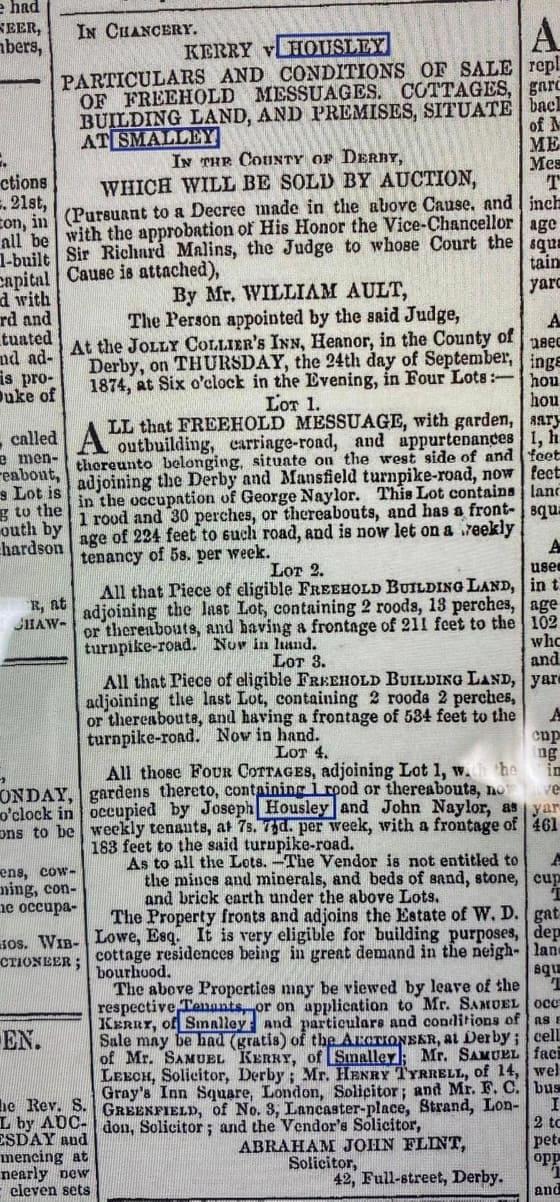 December 15, 2021 at 1:16 pm #6237
In reply to: The Elusive Samuel Housley and Other Family Stories
Murder At The Bennistons
We don’t know exactly what happened immediately after the death of Catherine Housley’s mother in 1849, but by 1850 the two older daughters Elizabeth and Mary Anne were inmates in Belper Workhouse. Catherine was just six weeks old, so presumably she was with a wet nurse, possibly even prior to her mothers death. By 1851, according to the census, she was living in Heanor, a small town near to Smalley, with John Benniston, a framework knitter, and his family. Framework knitters (abbreviated to FWK should you happen to see it on a census) rented a large loom and made stockings and everyone in the family helped. Often the occupation of other household members would be “seamer”: they would stitch the stocking seams together. Catherine was still living with the Bennistons ten years later in 1861.
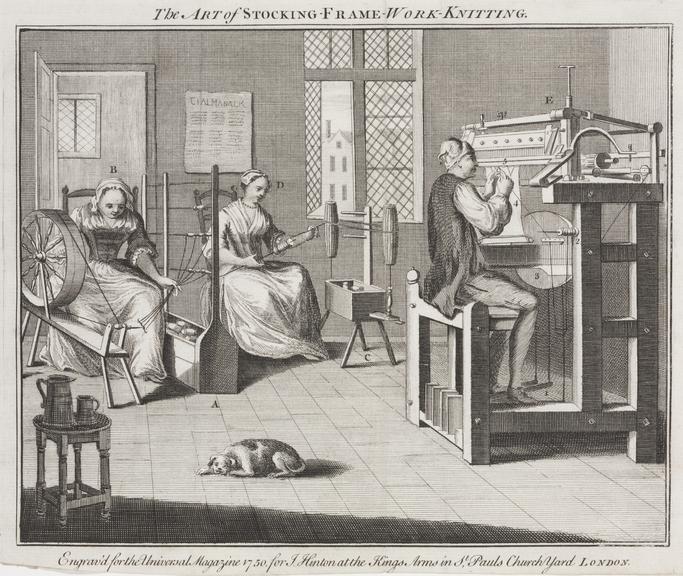
I read some chapters of a thesis on the south Derbyshire poor in the 1800s and found some illuminating information about indentured apprenticeship of children especially if one parent died. It was not at all uncommon, and framework knitters in particular often had indentured apprentices. It was a way to ensure the child was fed and learned a skill. Children commonly worked from the age of ten or 12 anyway. They were usually placed walking distance of the family home and maintained contact. The indenture could be paid by the parish poor fund, which cost them slightly less than sending them to the poorhouse, and could be paid off by a parent if circumstances improved to release the child from the apprenticeship.
A child who was an indentured apprentice would continue a normal life after the term of apprenticeship, usually still in contact with family locally.I found a newspaper article titled “Child Murder at Heanor” dated 1858.
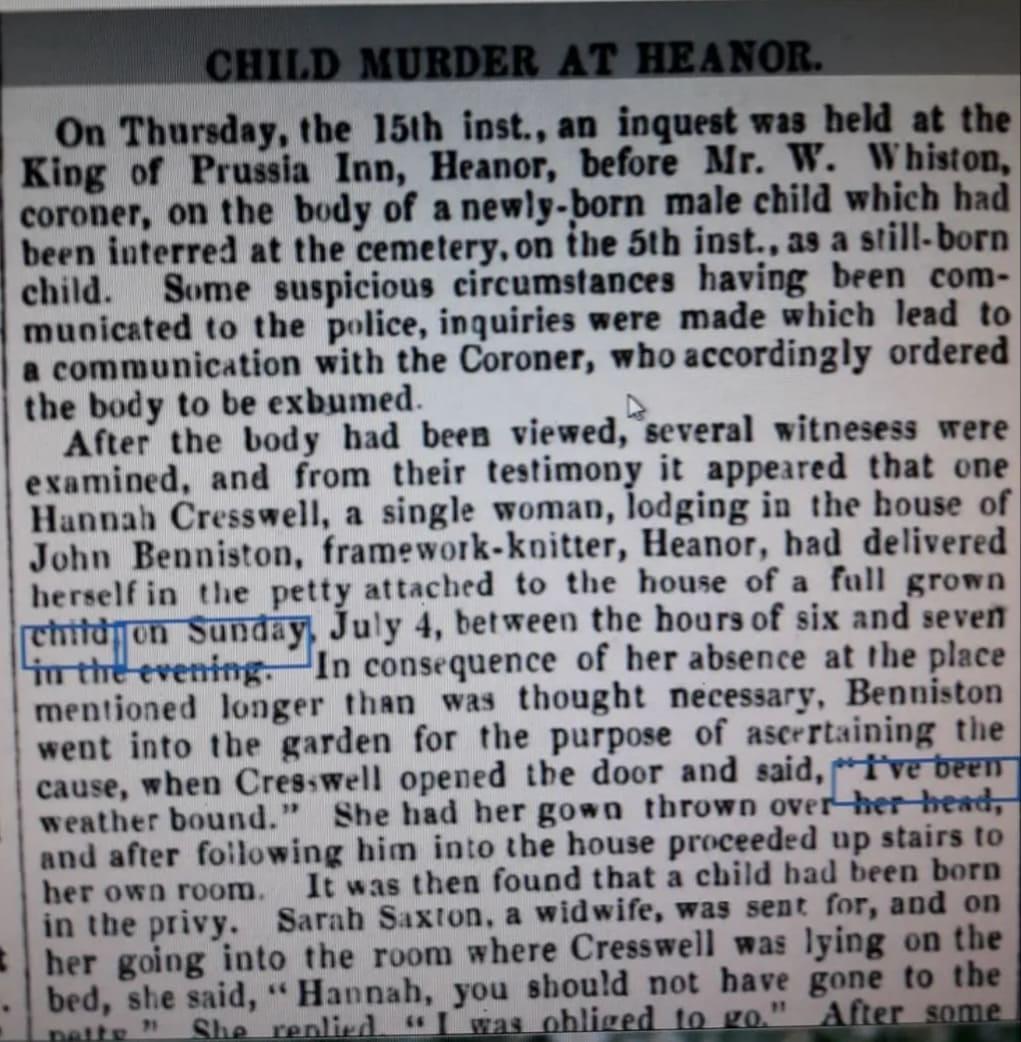
A 23 year old lodger at the Bennistons, Hannah Cresswell, apparently murdered a new born baby that she gave birth to in the privy, which the midwife took away and had buried as a still birth. The baby was exhumed after an anonymous tip off from a neighbour, citing that it was the 4th such incident. Catherine Housley would have been nine years old at the time.
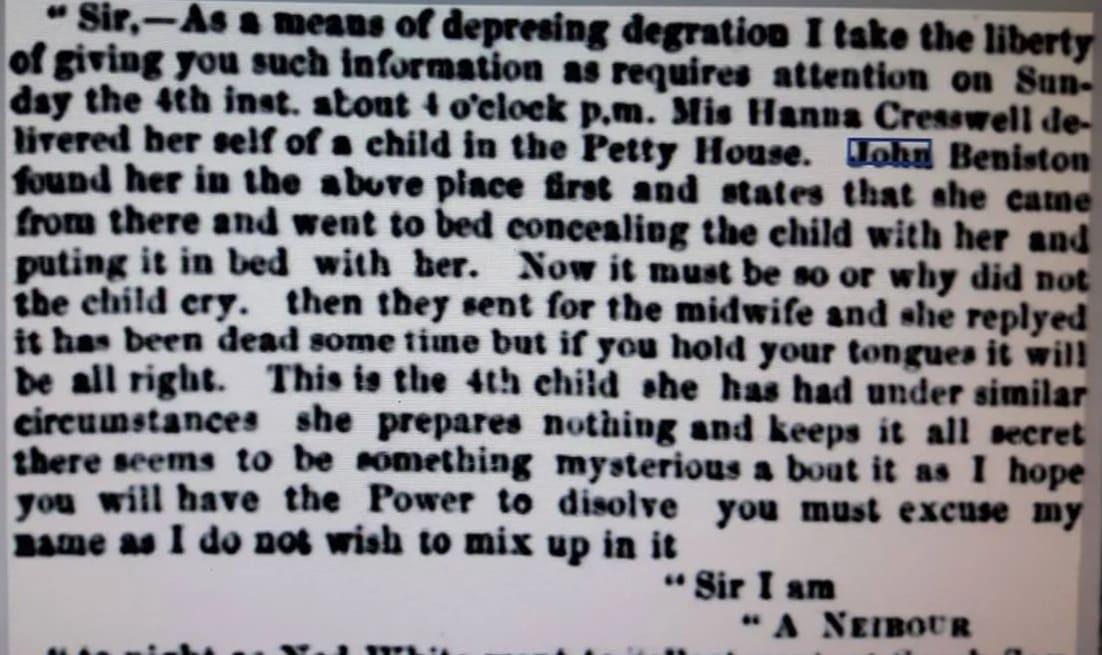
Subsequent newspaper articles indicate that the case was thrown out, despite the doctors evidence that the baby had been beaten to death.
In July 1858 the inquest was held in the King of Prussia, on the Hannah Cresswell baby murder at the Bennistons.
The King of Prussia, Heanor, in 1860:
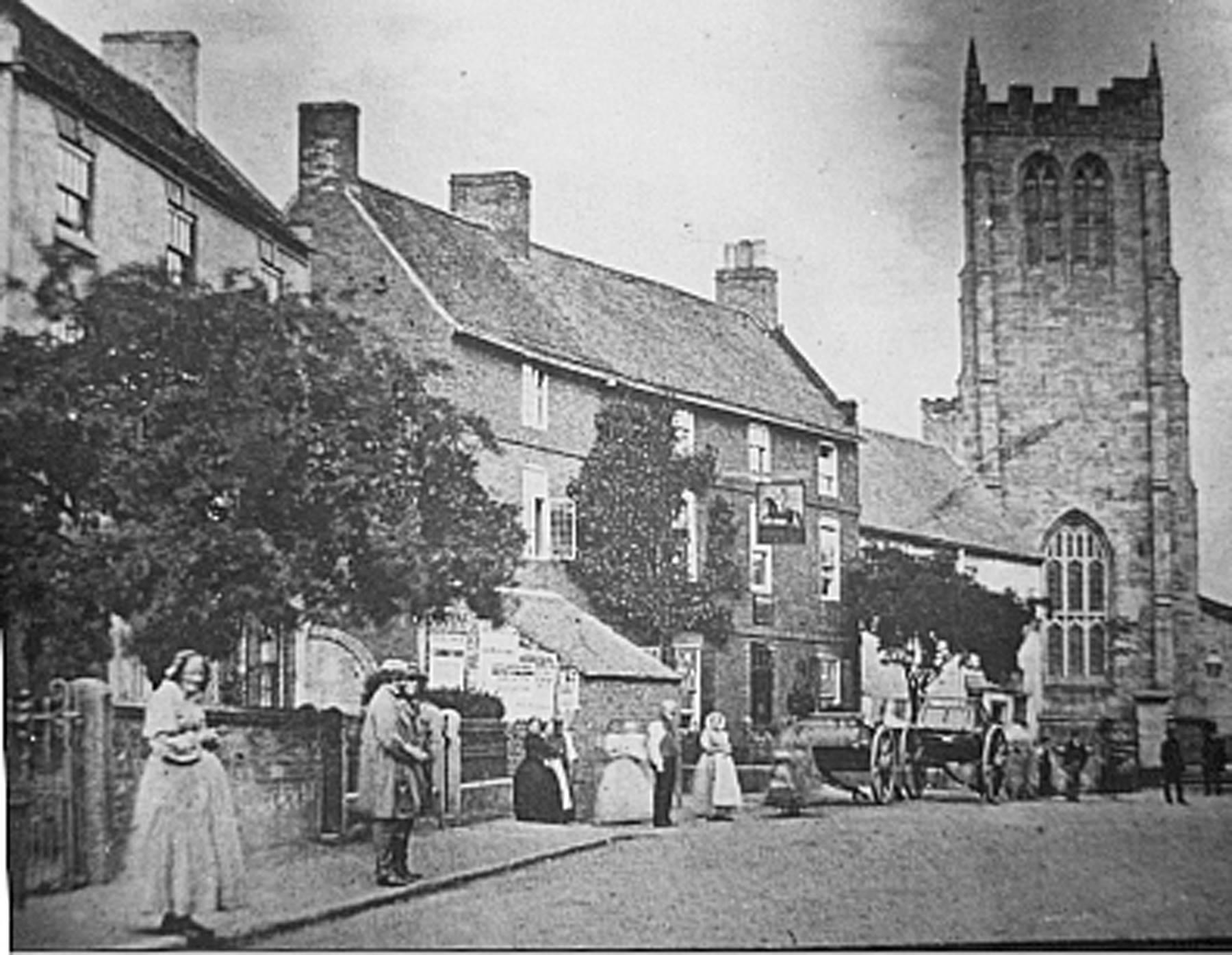 December 15, 2021 at 9:34 am #6236
In reply to: The Elusive Samuel Housley and Other Family Stories
The Liverpool Fires
Catherine Housley had two older sisters, Elizabeth 1845-1883 and Mary Anne 1846-1935. Both Elizabeth and Mary Anne grew up in the Belper workhouse after their mother died, and their father was jailed for failing to maintain his three children. Mary Anne married Samuel Gilman and they had a grocers shop in Buxton. Elizabeth married in Liverpool in 1873.
What was she doing in Liverpool? How did she meet William George Stafford?
According to the census, Elizabeth Housley was in Belper workhouse in 1851. In 1861, aged 16, she was a servant in the household of Peter Lyon, a baker in Derby St Peters. We noticed that the Lyon’s were friends of the family and were mentioned in the letters to George in Pennsylvania.
No record of Elizabeth can be found on the 1871 census, but in 1872 the birth and death was registered of Elizabeth and William’s child, Elizabeth Jane Stafford. The parents are registered as William and Elizabeth Stafford, although they were not yet married. William’s occupation is a “refiner”.
In April, 1873, a Fatal Fire is reported in the Liverpool Mercury. Fearful Termination of a Saturday Night Debauch. Seven Persons Burnt To Death. Interesting to note in the article that “the middle room being let off to a coloured man named William Stafford and his wife”.
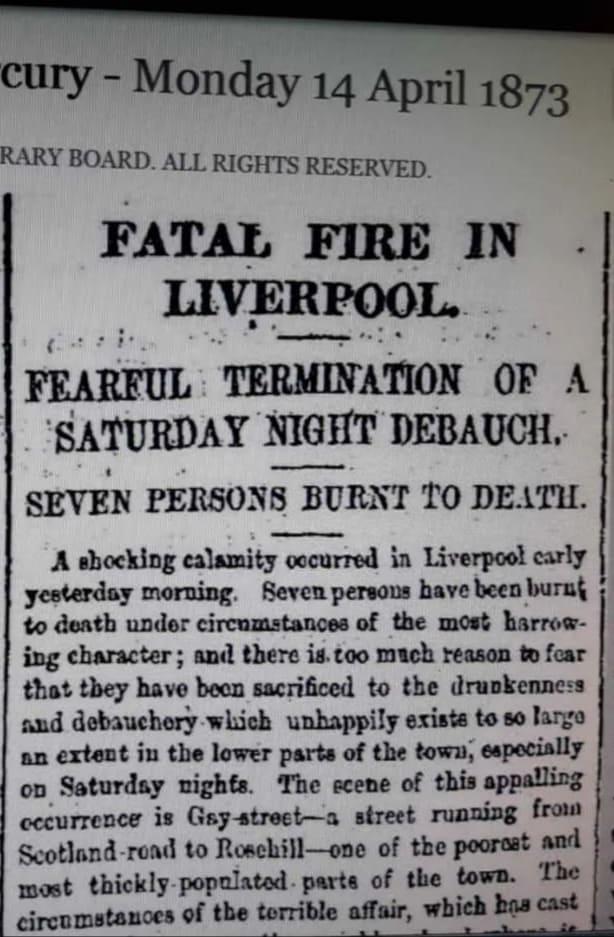
We had noted on the census that William Stafford place of birth was “Africa, British subject” but it had not occurred to us that he was “coloured”. A register of birth has not yet been found for William and it is not known where in Africa he was born.
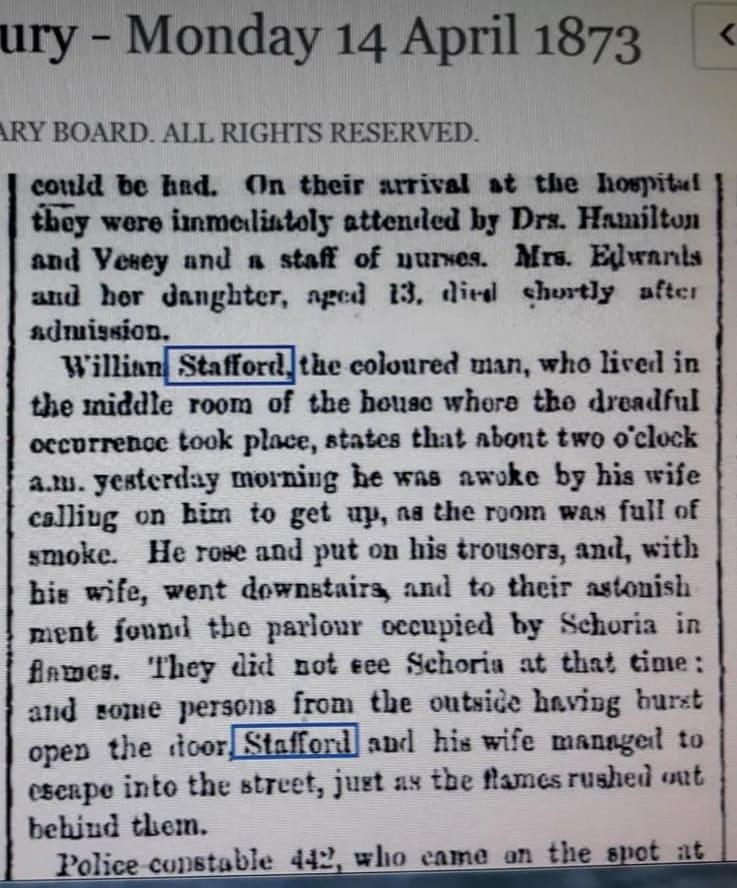
Elizabeth and William survived the fire on Gay Street, and were still living on Gay Street in October 1873 when they got married.
William’s occupation on the marriage register is sugar refiner, and his father is Peter Stafford, farmer. Elizabeth’s father is Samuel Housley, plumber. It does not say Samuel Housley deceased, so perhaps we can assume that Samuel is still alive in 1873.
Eliza Florence Stafford, their second daughter, was born in 1876.
William’s occupation on the 1881 census is “fireman”, in his case, a fire stoker at the sugar refinery, an unpleasant and dangerous job for which they were paid slightly more. William, Elizabeth and Eliza were living in Byrom Terrace.
Byrom Terrace, Liverpool, in 1933
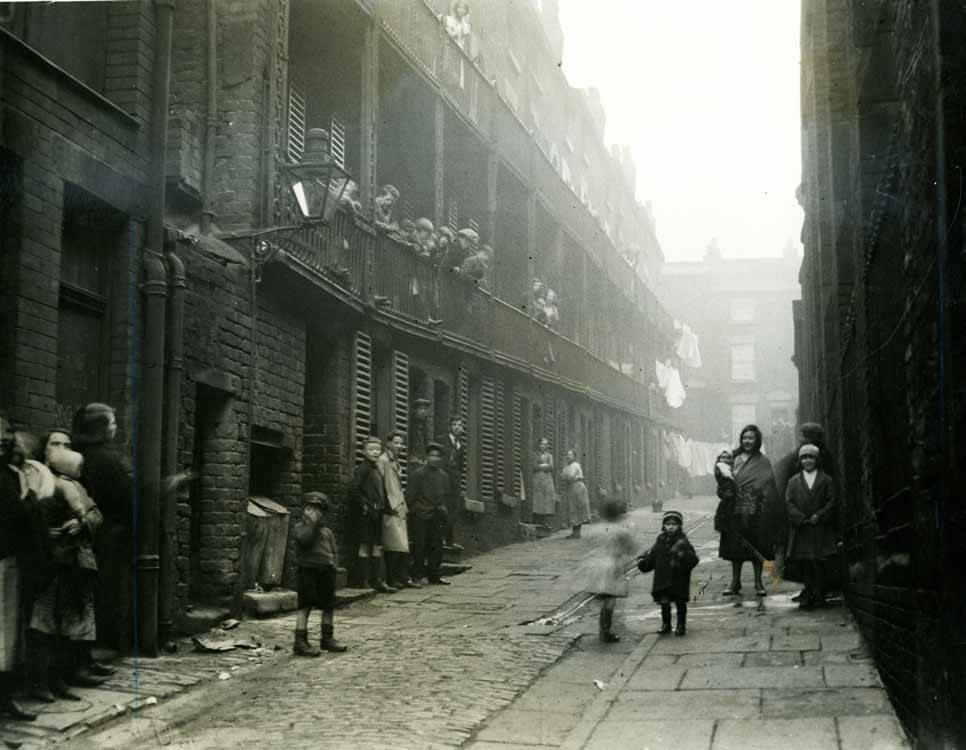
Elizabeth died of heart problems in 1883, when Eliza was six years old, and in 1891 her father died, scalded to death in a tragic accident at the sugar refinery.
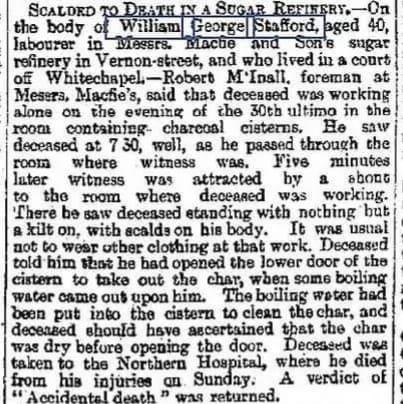
Eliza, aged 15, was living as an inmate at the Walton on the Hill Institution in 1891. It’s not clear when she was admitted to the workhouse, perhaps after her mother died in 1883.
In 1901 Eliza Florence Stafford is a 24 year old live in laundrymaid, according to the census, living in West Derby (a part of Liverpool, and not actually in Derby). On the 1911 census there is a Florence Stafford listed as an unnmarried laundress, with a daughter called Florence. In 1901 census she was a laundrymaid in West Derby, Liverpool, and the daughter Florence Stafford was born in 1904 West Derby. It’s likely that this is Eliza Florence, but nothing further has been found so far.
The questions remaining are the location of William’s birth, the name of his mother and his family background, what happened to Eliza and her daughter after 1911, and how did Elizabeth meet William in the first place.
William Stafford was a seaman prior to working in the sugar refinery, and he appears on several ship’s crew lists. Nothing so far has indicated where he might have been born, or where his father came from.
Some months after finding the newspaper article about the fire on Gay Street, I saw an unusual request for information on the Liverpool genealogy group. Someone asked if anyone knew of a fire in Liverpool in the 1870’s. She had watched a programme about children recalling past lives, in this case a memory of a fire. The child recalled pushing her sister into a burning straw mattress by accident, as she attempted to save her from a falling beam. I watched the episode in question hoping for more information to confirm if this was the same fire, but details were scant and it’s impossible to say for sure.
December 14, 2021 at 9:28 pm #6231In reply to: The Elusive Samuel Housley and Other Family Stories
Gladstone Road
My mother remembers her grandfather Samuel Warren’s house at 3 Gladstone Road, Stourbridge. She was born in 1933, so this would be late 1930s early 1940s.
“Opening a big wooden gate in a high brick wall off the sidewalk I went down a passage with a very high hedge to the main house which was entered on this side through a sort of glassed-in lean-to then into the dark and damp scullery and then into a large room with a fireplace which was dining room and living room for most of the time. The house was Georgian and had wooden interior shutters at the windows. My Grandad sat by the fire probably most of the day. The fireplace may have had an oven built over or to the side of the fire which was common in those days and was used for cooking.
That room led into a hall going three ways and the main front door was here. One hall went to the pantry which had stone slabs for keeping food cool, such a long way from the kitchen! Opposite the pantry was the door to the cellar. One hall led to two large rooms with big windows overlooking the garden. There was also a door at the end of this hallway which opened into the garden. The stairs went up opposite the front door with a box room at the top then along a landing to another hall going right and left with two bedrooms down each hall.
The toilet got to from the scullery and lean-to was outside down another passage all overgrown near the pigsty. No outside lights!
On Christmas day the families would all have the day here. I think the menfolk went over to the pub {Gate Hangs Well?} for a drink while the women cooked dinner. Chris would take all the children down the dark, damp cellar steps and tell us ghost stories scaring us all. A fire would be lit in one of the big main rooms {probably only used once a year} and we’d sit in there and dinner was served in the other big main room. When the house was originally built the servants would have used the other room and scullery.
I have a recollection of going upstairs and into a bedroom off the right hand hall and someone was in bed, I thought an old lady but I was uncomfortable in there and never went in again. Seemed that person was there a long time. I did go upstairs with Betty to her room which was the opposite way down the hall and loved it. She was dating lots of soldiers during the war years. One in particular I remember was an American Army Officer that she was fond of but he was killed when he left England to fight in Germany.
I wonder if the person in bed that nobody spoke about was an old housekeeper?
My mother used to say there was a white lady who floated around in the garden. I think Kay died at Gladstone Road!”Samuel Warren, born in 1874 in Newhall, Derbyshire, was my grandmothers father. This is the only photograph we’ve seen of him (seated on right with cap). Kay, who died of TB in 1938, is holding the teddy bear. Samuel died in 1950, in Stourbridge, at the age of 76.
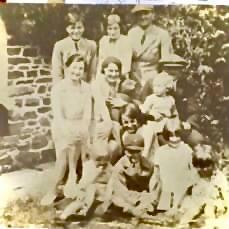
Left to right: back row: Leslie Warren. Hildred Williams / Griffiths (Nee Warren). Billy Warren. 2nd row: Gladys (Gary) Warren. Kay Warren (holding teddy bear). Samuel Warren (father). Hildred’s son Chris Williams (on knee). Lorna Warren. Joan Williams. Peggy Williams (Hildreds daughters). Jack Warren. Betty Warren.
December 13, 2021 at 3:38 pm #6229In reply to: The Elusive Samuel Housley and Other Family Stories
Gretton Tailoresses of Swadlincote and the Single Journalist Boot Maker Next Door
The Purdy’s, Housley’s and Marshall’s are my mothers fathers side of the family. The Warrens, Grettons and Staleys are from my mothers mothers side.
I decided to add all the siblings to the Gretton side of the family, in search of some foundation to a couple of family anecdotes. My grandmother, Nora Marshall, whose mother was Florence Nightingale Gretton, used to mention that our Gretton side of the family were related to the Burton Upon Trent Grettons of Bass, Ratcliff and Gretton, the brewery. She also said they were related to Lord Gretton of Stableford Park in Leicestershire. When she was a child, she said parcels of nice clothes were sent to them by relatives.
It should be noted however that Baron Gretton is a title in the Peerage of the United Kingdom, and was created in 1944 for the brewer and Conservative politician John Gretton. He was head of the brewery firm of Bass, Ratcliff & Gretton Ltd of Burton upon Trent. So they were not members of the Peerage at the time of this story.
What I found was unexpected.
My great great grandfather Richard Gretton 1833-1898, a baker in Swadlincote, didn’t have any brothers, but he did have a couple of sisters.
One of them, Frances, born 1831, never married, but had four children. She stayed in the family home, and named her children Gretton. In 1841 and 1851 she’s living with parents and siblings. In 1861 she is still living with parents and now on the census she has four children all named Gretton listed as grandchildren of her father.
In 1871, her mother having died in 1866, she’s still living with her father William Gretton, Frances is now 40, and her son William 19 and daughter Jane 15 live there.
By the time she is 50 in 1881 and her parents have died she’s head of the house with 5 children all called Gretton, including her daughter Jane Gretton aged 24.Twenty five year old Robert Staley is listed on the census transcription as living in the same household, but when viewing the census image it becomes clear that he lived next door, on his own and was a bootmaker, and on the other side, his parents Benjamin and Sarah Staley lived at the Prince of Wales pub with two other siblings.
Who was fathering all these Gretton children?
It seems that Jane did the same thing as her mother: she stayed at home and had three children, all with the name Gretton. Jane Gretton named her son, born in 1878, Michael William Staley Gretton, which would suggest that Staley was the name of the father of the child/children of Jane Gretton.
The father of Frances Gretton’s four children is not known, and there is no father on the birth registers, although they were all baptized.
I found a photo of Jane Gretton on a family tree on an ancestry site, so I contacted the tree owner hoping that she had some more information, but she said no, none of the older family members would explain when asked about it. Jane later married Tom Penn, and Jane Gretton’s children are listed on census as Tom Penn’s stepchildren.
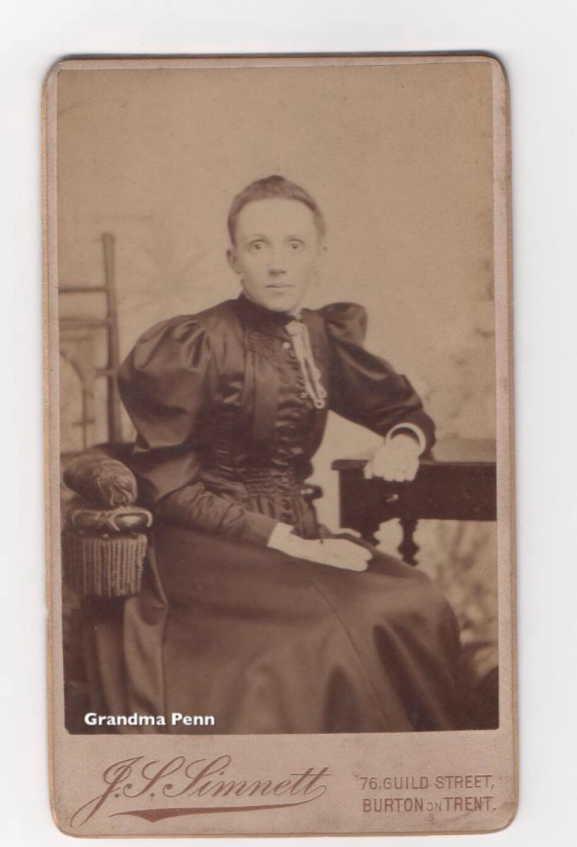
It seems that Robert Staley (who may or may not be the father of Jane’s children) never married. In 1891 Robert is 35, single, living with widowed mother Sarah in Swadlincote. Sarah is living on own means and Robert has no occupation. On the 1901 census Robert is an unmarried 45 year old journalist and author, living with his widowed mother Sarah Staley aged 79, in Swadlincote.
There are at least three Staley Warren marriages in the family, and at least one Gretton Staley marriage.
There is a possibility that the father of Frances’s children could be a Gretton, but impossible to know for sure. William Gretton was a tailor, and several of his children and grandchildren were tailoresses. The Gretton family who later bought Stableford Park lived not too far away, and appear to be well off with a dozen members of live in staff on the census. Did our Gretton’s the tailors make their clothes? Is that where the parcels of nice clothes came from?
Perhaps we’ll find a family connection to the brewery Grettons, or find the family connection was an unofficial one, or that the connection is further back.
I suppose luckily, this isn’t my direct line but an exploration of an offshoot, so the question of paternity is merely a matter of curiosity. It is a curious thing, those Gretton tailors of Church Gresley near Burton upon Trent, and there are questions remaining.
December 13, 2021 at 12:33 pm #6225In reply to: The Elusive Samuel Housley and Other Family Stories
William Marshall’s Parents
William Marshall 1876-1968, my great grandfather, married Mary Ann Gilman Purdy in Buxton. We assumed that both their families came from Buxton, but this was not the case. The Marshall’s came from Elton, near Matlock; the Purdy’s from Eastwood, Nottinghamshire.
William Marshall, seated in centre, with colleagues from the insurance company:
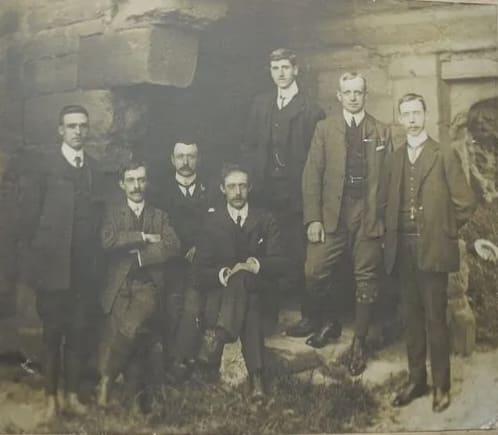
William and all his siblings were born in Fairfield in Buxton. But both Emma Featherstone 1847-1928, his mother, and John Marshall 1842-1930, his father, came from rural Derbyshire. Emma from Ashbourne (or Biggin, Newhaven, or Hartington, depending on what she chose to put on the census, which are all tiny rural places in the same area).
Emma and John Marshall in the middle, photo says “William Marshall’s parents” on the back:
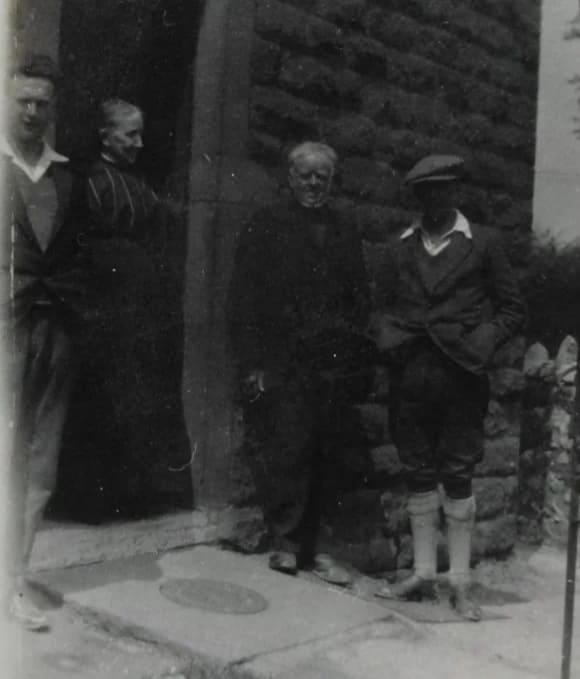
John Marshall was a carter, later a coal carter, and was born in Elton, Derbyshire. Elton is a rural village near to Matlock. He was unable to write (at least at the time of his wedding) but Emma signed her own name.
In 1851 Emma is 3 or 4 years old living with family at the Jug and Glass Inn, Hartington. In 1861 Emma was a 14 year old servant at a 112 acre farm, Heathcote, but her parents were still living at the Jug and Glass. Emma Featherstone’s parents both died when she was 18, in 1865.
In 1871 she was a servant at Old House Farm, Nether Hartington Quarter, Ashborne.On the census, a female apprentice was listed as a servant, a boy as an apprentice. It seems to have been quite normal, at least that’s what I’ve found so far, for all teenagers to go and live in another household to learn a trade, to be independent from the parents, and so doesn’t necessarily mean a servant as we would think of it. Often they stayed with family friends, and usually married in their early twenties and had their own household ~ often with a “servant” or teenager from someone else’s family.
The only marriage I could find for Emma and John was in Manchester in 1873, which didn’t make much sense. If Emma was single on the 1871 census, and her first child James was born in 1873, her marriage had to be between those dates. But the marriage register in Manchester appears to be correct, John was a carter, Emma’s father was Francis Featherstone. But why Manchester?
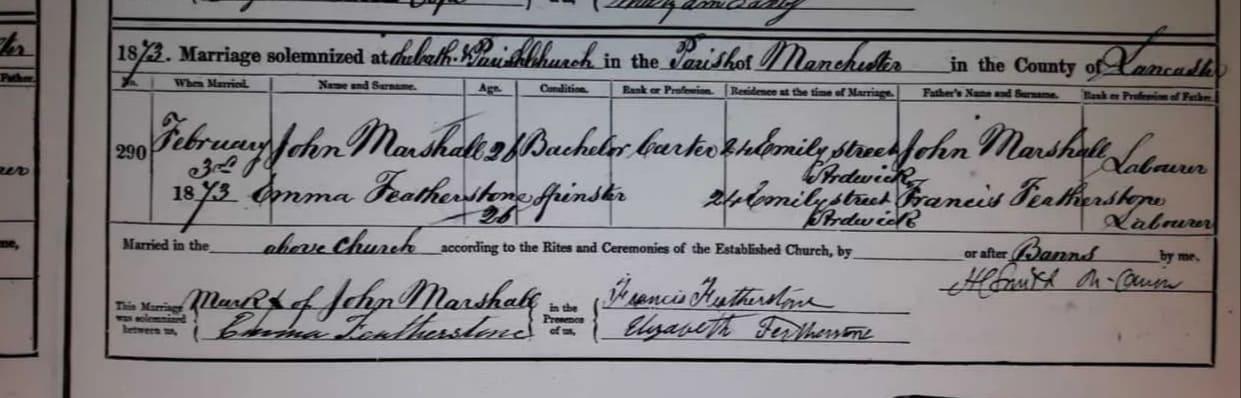
I noticed that the witnesses to the marriage were Francis and Elizabeth Featherstone. He father was Francis, but who was Elizabeth? Emma’s mother was Sarah. Then I found that Emma’s brother Francis married Elizabeth, and they lived in Manchester on the 1871 census. Henry Street, Ardwick. Emma and John’s address on the marriage register is Emily Street, Ardwick. Both of them at the same address.
The marriage was in February 1873, and James, the first child was born in July, 1873, in Buxton.
It would seem that Emma and John had to get married, hence the move to Manchester where her brother was, and then quickly moved to Buxton for the birth of the child. It was far from uncommon, I’ve found while making notes of dates in registers, for a first child to be born six or 7 months after the wedding.
Emma died in 1928 at the age of 80, two years before her husband John. She left him a little money in her will! This seems unusual so perhaps she had her own money, possibly from the death of her parents before she married, and perhaps from the sale of the Jug and Glass.
I found a photo of the Jug and Glass online. It looks just like the pub I’d seen in my family history meditations on a number of occasions:
 December 13, 2021 at 10:09 am #6219
Topic: The Elusive Samuel Housley and Other Family Stories
in forum TP’s Family BooksThe following stories started with a single question.
Who was Catherine Housley’s mother?
But one question leads to another, and another, and so this book will never be finished. This is the first in a collection of stories of a family history research project, not a complete family history. There will always be more questions and more searches, and each new find presents more questions.
A list of names and dates is only moderately interesting, and doesn’t mean much unless you get to know the characters along the way. For example, a cousin on my fathers side has already done a great deal of thorough and accurate family research. I copied one branch of the family onto my tree, going back to the 1500’s, but lost interest in it after about an hour or so, because I didn’t feel I knew any of the individuals.
Parish registers, the census every ten years, birth, death and marriage certificates can tell you so much, but they can’t tell you why. They don’t tell you why parents chose the names they did for their children, or why they moved, or why they married in another town. They don’t tell you why a person lived in another household, or for how long. The census every ten years doesn’t tell you what people were doing in the intervening years, and in the case of the UK and the hundred year privacy rule, we can’t even use those for the past century. The first census was in 1831 in England, prior to that all we have are parish registers. An astonishing amount of them have survived and have been transcribed and are one way or another available to see, both transcriptions and microfiche images. Not all of them survived, however. Sometimes the writing has faded to white, sometimes pages are missing, and in some case the entire register is lost or damaged.
Sometimes if you are lucky, you may find mention of an ancestor in an obscure little local history book or a journal or diary. Wills, court cases, and newspaper archives often provide interesting information. Town memories and history groups on social media are another excellent source of information, from old photographs of the area, old maps, local history, and of course, distantly related relatives still living in the area. Local history societies can be useful, and some if not all are very helpful.
If you’re very lucky indeed, you might find a distant relative in another country whose grandparents saved and transcribed bundles of old letters found in the attic, from the family in England to the brother who emigrated, written in the 1800s. More on this later, as it merits its own chapter as the most exciting find so far.
The social history of the time and place is important and provides many clues as to why people moved and why the family professions and occupations changed over generations. The Enclosures Act and the Industrial Revolution in England created difficulties for rural farmers, factories replaced cottage industries, and the sons of land owning farmers became shop keepers and miners in the local towns. For the most part (at least in my own research) people didn’t move around much unless there was a reason. There are no reasons mentioned in the various registers, records and documents, but with a little reading of social history you can sometimes make a good guess. Samuel Housley, for example, a plumber, probably moved from rural Derbyshire to urban Wolverhampton, when there was a big project to install indoor plumbing to areas of the city in the early 1800s. Derbyshire nailmakers were offered a job and a house if they moved to Wolverhampton a generation earlier.
Occasionally a couple would marry in another parish, although usually they married in their own. Again, there was often a reason. William Housley and Ellen Carrington married in Ashbourne, not in Smalley. In this case, William’s first wife was Mary Carrington, Ellen’s sister. It was not uncommon for a man to marry a deceased wife’s sister, but it wasn’t strictly speaking legal. This caused some problems later when William died, as the children of the first wife contested the will, on the grounds of the second marriage being illegal.
Needless to say, there are always questions remaining, and often a fresh pair of eyes can help find a vital piece of information that has escaped you. In one case, I’d been looking for the death of a widow, Mary Anne Gilman, and had failed to notice that she remarried at a late age. Her death was easy to find, once I searched for it with her second husbands name.
This brings me to the topic of maternal family lines. One tends to think of their lineage with the focus on paternal surnames, but very quickly the number of surnames increases, and all of the maternal lines are directly related as much as the paternal name. This is of course obvious, if you start from the beginning with yourself and work back. In other words, there is not much point in simply looking for your fathers name hundreds of years ago because there are hundreds of other names that are equally your own family ancestors. And in my case, although not intentionally, I’ve investigated far more maternal lines than paternal.
This book, which I hope will be the first of several, will concentrate on my mothers family: The story so far that started with the portrait of Catherine Housley’s mother.
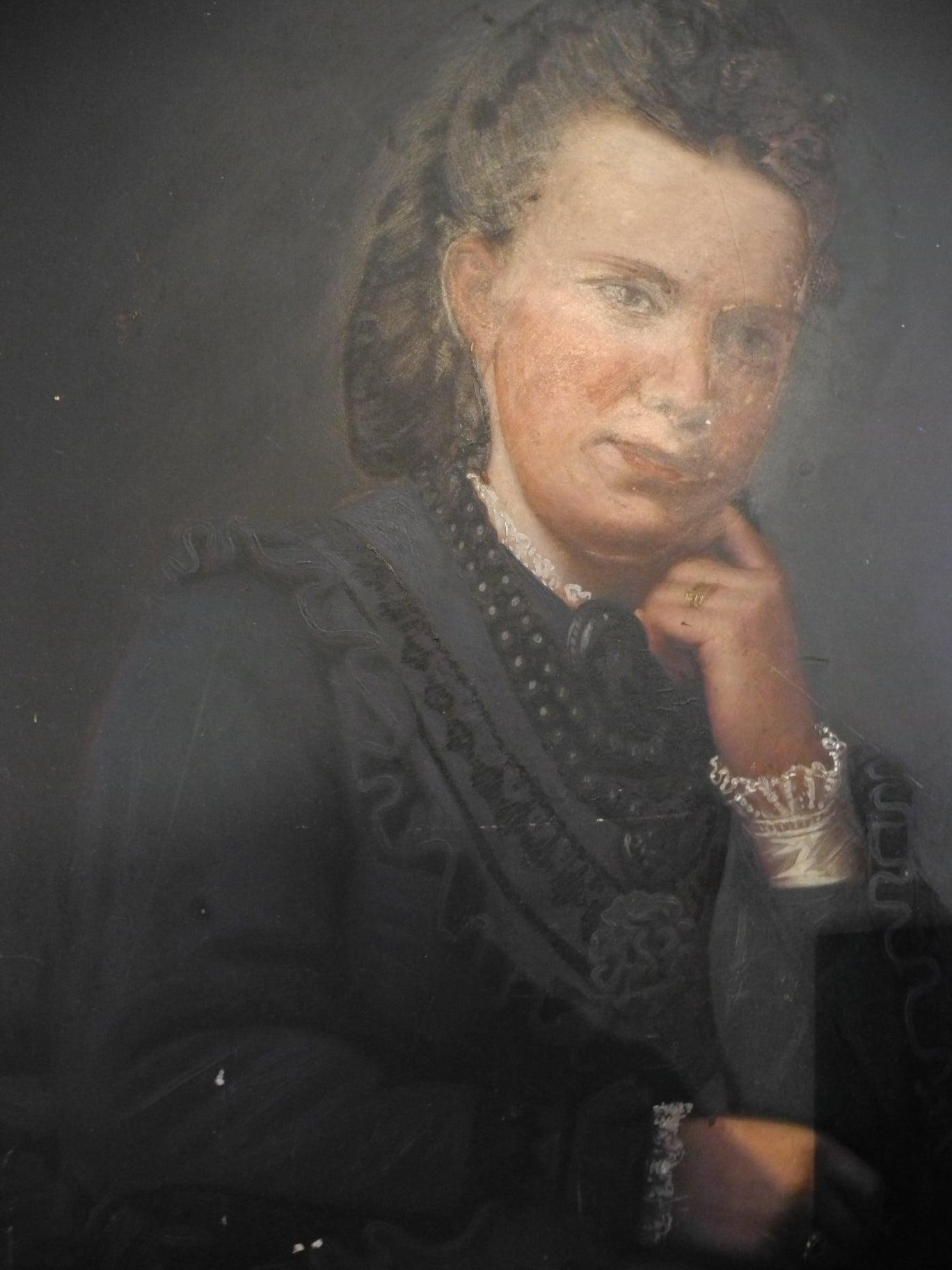
This painting, now in my mothers house, used to hang over the piano in the home of her grandparents. It says on the back “Catherine Housley’s mother, Smalley”.
The portrait of Catherine Housley’s mother can be seen above the piano. Back row Ronald Marshall, my grandfathers brother, William Marshall, my great grandfather, Mary Ann Gilman Purdy Marshall in the middle, my great grandmother, with her daughters Dorothy on the left and Phyllis on the right, at the Marshall’s house on Love Lane in Stourbridge.
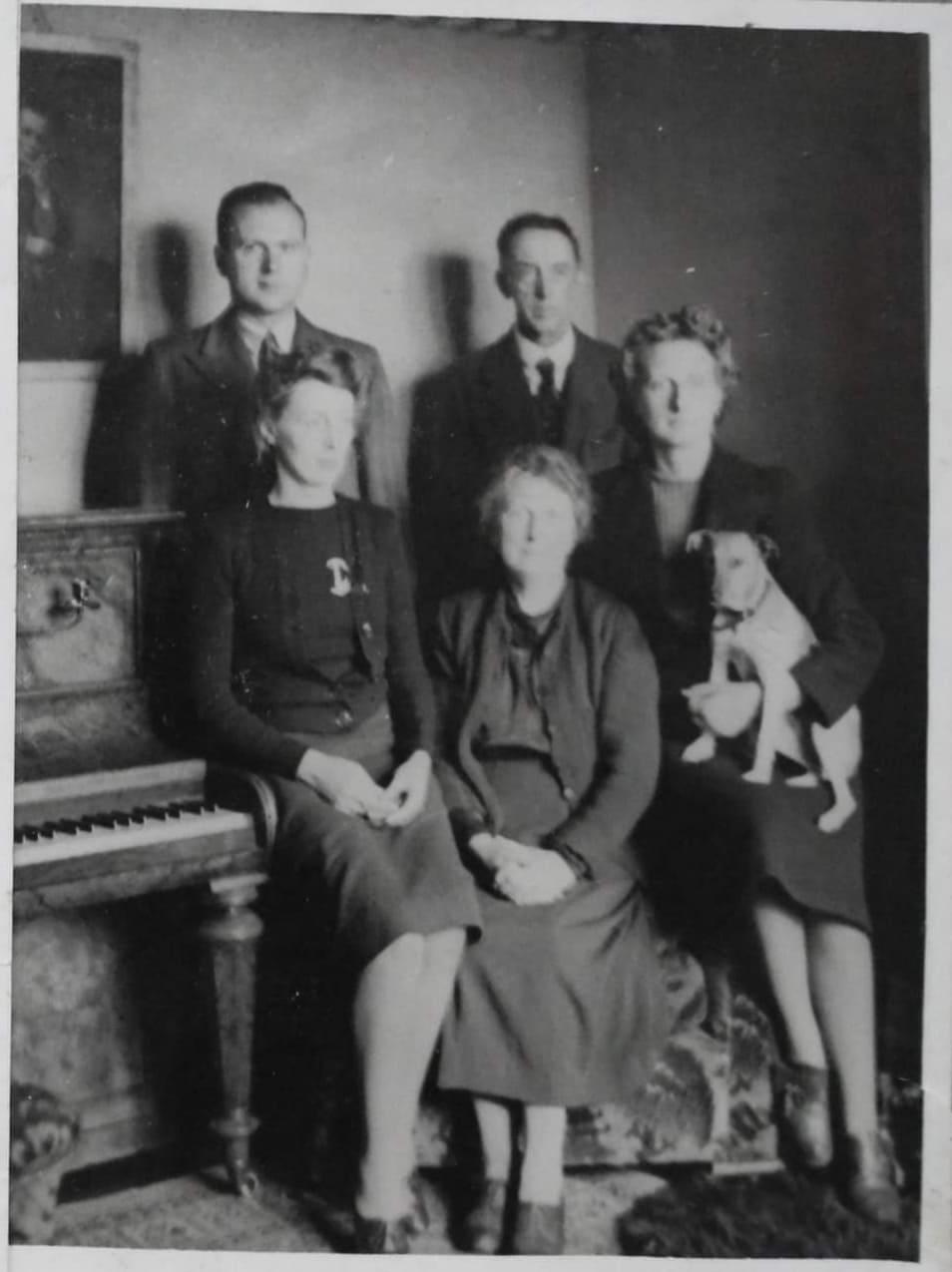
The Search for Samuel Housley
As soon as the search for Catherine Housley’s mother was resolved, achieved by ordering a paper copy of her birth certificate, the search for Catherine Housley’s father commenced. We know he was born in Smalley in 1816, son of William Housley and Ellen Carrington, and that he married Elizabeth Brookes in Wolverhampton in 1844. He was a plumber and glazier. His three daughters born between 1845 and 1849 were born in Smalley. Elizabeth died in 1849 of consumption, but Samuel didn’t register her death. A 20 year old neighbour called Aaron Wadkinson did.
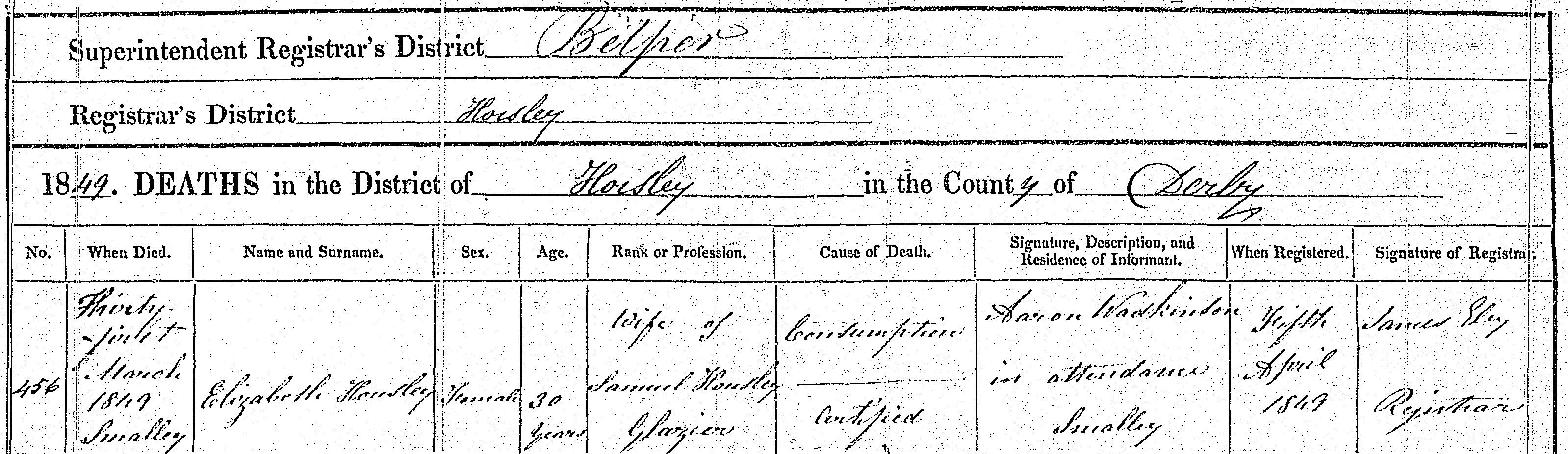
Where was Samuel?
On the 1851 census, two of Samuel’s daughters were listed as inmates in the Belper Workhouse, and the third, 2 year old Catherine, was listed as living with John Benniston and his family in nearby Heanor. Benniston was a framework knitter.
Where was Samuel?
A long search through the microfiche workhouse registers provided an answer. The reason for Elizabeth and Mary Anne’s admission in June 1850 was given as “father in prison”. In May 1850, Samuel Housley was sentenced to one month hard labour at Derby Gaol for failing to maintain his three children. What happened to those little girls in the year after their mothers death, before their father was sentenced, and they entered the workhouse? Where did Catherine go, a six week old baby? We have yet to find out.
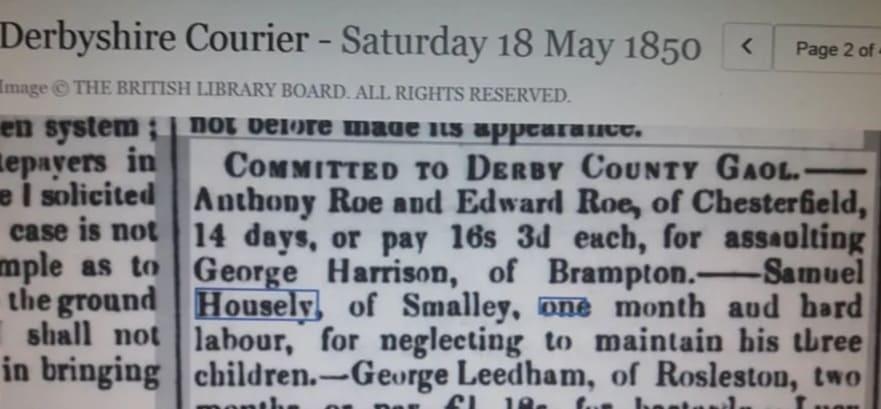
And where was Samuel Housley in 1851? He hasn’t appeared on any census.
According to the Belper workhouse registers, Mary Anne was discharged on trial as a servant February 1860. She was readmitted a month later in March 1860, the reason given: unwell.
Belper Workhouse:
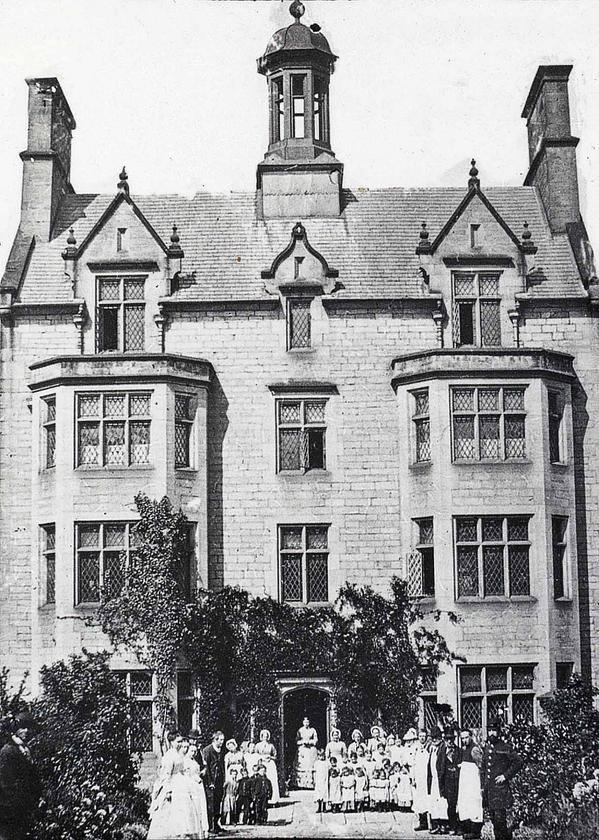
Eventually, Mary Anne and Elizabeth were discharged, in April 1860, with an aunt and uncle. The workhouse register doesn’t name the aunt and uncle. One can only wonder why it took them so long.
On the 1861 census, Elizabeth, 16 years old, is a servant in St Peters, Derby, and Mary Anne, 15 years old, is a servant in St Werburghs, Derby.But where was Samuel?
After some considerable searching, we found him, despite a mistranscription of his name, on the 1861 census, living as a lodger and plumber in Darlaston, Walsall.
Eventually we found him on a 1871 census living as a lodger at the George and Dragon in Henley in Arden. The age is not exactly right, but close enough, he is listed as an unmarried painter, also close enough, and his birth is listed as Kidsley, Derbyshire. He was born at Kidsley Grange Farm. We can assume that he was probably alive in 1872, the year his mother died, and the following year, 1873, during the Kerry vs Housley court case.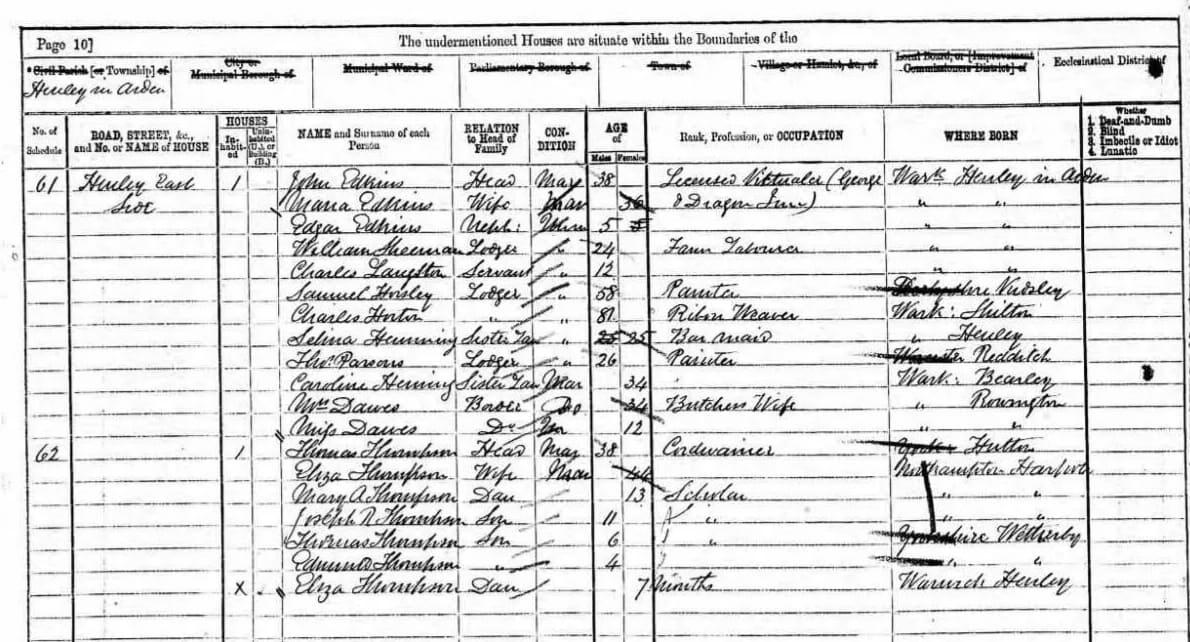
I found some living Housley descendants in USA. Samuel Housley’s brother George emigrated there in 1851. The Housley’s in USA found letters in the attic, from the family in Smalley ~ written between 1851 and 1870s. They sent me a “Narrative on the Letters” with many letter excerpts.
The Housley family were embroiled in a complicated will and court case in the early 1870s. In December 15, 1872, Joseph (Samuel’s brother) wrote to George:
“I think we have now found all out now that is concerned in the matter for there was only Sam that we did not know his whereabouts but I was informed a week ago that he is dead–died about three years ago in Birmingham Union. Poor Sam. He ought to have come to a better end than that….His daughter and her husband went to Birmingham and also to Sutton Coldfield that is where he married his wife from and found out his wife’s brother. It appears he has been there and at Birmingham ever since he went away but ever fond of drink.”
No record of Samuel Housley’s death can be found for the Birmingham Union in 1869 or thereabouts.
But if he was alive in 1871 in Henley In Arden…..
Did Samuel tell his wife’s brother to tell them he was dead? Or did the brothers say he was dead so they could have his share?We still haven’t found a death for Samuel Housley.
June 6, 2021 at 9:18 pm #6202In reply to: The Precious Life and Rambles of Liz Tattler
While Finnley was making the tea, Liz consulted the Possibe L’Oracle for a reading. It said:
“We are the collective of the Ancient Draigh’Ones, we greet you and your queries, Liz.
Well, well. Looking at the concepts you brought up in your last offering to this story thread, we couldn’t really pick up what your energy was trying to express.
Forgive us, humans still elude us at times.We must withhold points for continuity {audible snort} though, as it feels it needs to gather more support from your fellow companions {snort} for now. But who knows, you may just be a pioneer. Go on trailblazing Liz!
Psst. We’ll give you a hint, here are some trending concepts here you may want to check out for yourself.”
Perplexa the robot provided her typically superfluous additional information, with baffling lists of numbers, but Liz noted the many mentions of cleanliness and cleaning implements, and wondered why that hadn’t manifested into a marvelously clean house.
Leaf (1 ), with mentions by Flove (1) — last seen in #6198, 2 days ago
Cleanliness (1 ), with mentions by Flove (1) — last seen in #6200, 22 hours ago
The Glow (1 ), with mentions by Flove (1) — last seen in #6200, 22 hours ago
The Edge (1 ), with mentions by Tracy (1) — last seen in #6199, 2 days ago
Cleaning tools (1 ), with mentions by Tracy (1) — last seen in #6199, 2 days ago
Brush (1 ), with mentions by Tracy (1) — last seen in #6199, 2 days ago
Jeffrey Combs (1 ), with mentions by Flove (1) — last seen in #6198, 2 days ago
The Times (1 ), with mentions by Flove (1) — last seen in #6198, 2 days ago
Drama (1 ), with mentions by Flove (1) — last seen in #6198, 2 days ago
Fern (1 ), with mentions by Flove (1) — last seen in #6198, 2 days ago
Time (1 ), with mentions by Flove (1) — last seen in #6198, 2 days agoJanuary 27, 2021 at 9:21 pm #6177In reply to: Twists and One Return From the Time Capsule
“Grandpa, I can’t get hold of Nora. I keep getting her answer phone.” Clara flicked back through her texts. “Last time she messaged me was to ask if I knew anyone in the Village she could stay with. And I never got back with the details like I was supposed to … I got distracted by Van Gogh going missing and everything … ” She screwed up her face. “Also I couldn’t recall the man’s name.”
“I’m sure she’ll be fine,” said Bob soothingly, reaching out to pat Clara’s hand. “She always were a bit unreliable that one, weren’t she?”
Clara looked like she was about to burst into tears. “Grandpa, I’m such an idiot! What if something bad has happened to her?
January 5, 2021 at 9:03 pm #6175In reply to: Twists and One Return From the Time Capsule
“”Sorry, I’m only just telling you this about the note now, lovie. Your Grandma’s been on at me to tell you. Just in my thoughts I mean!” he added quickly.
Jane smirked and tapped her forehead. “Careful, Old Man. She’ll think you’ve completely lost it!”
Clara stared at him, a small frown creasing her brow. “So, the note said you were to call him?”
Bob nodded uneasily. Clara had that look on her face. The one that means she aren’t happy with the way things are proceeding.
“And then what?” asked Clara slowly.
“I dunno.” Bob shrugged. “Guess they’d bury it again? They was pretty clear they didn’t want it found. Now, how about I put the kettle on?” Bob stood quickly and began to busy himself filling the jug with water from the tap.
Clara shook her head firmly. “No.”
“No to a cup of tea?”
“No we can’t call this man.”
“I don’t know Clara. It’s getting odd it is. Strangers leaving maps in collars and whatnot. It’s not right.”
“Well, I agree it needs further investigation. But we can’t call him … not without knowing why and what’s in it.” She tapped her fingers on the table. “I’ll try and get hold of Nora again.”
December 4, 2020 at 8:32 pm #6153In reply to: Twists and One Return From the Time Capsule
“That horsetail has such long roots, otherwise I never would have dug so deep,” mused Clara. “Are you okay holding that end? Not too heavy for you?”
Grandpa Bob grunted. The box was heavy—in more ways than one—but he wasn’t about to let Clara know he wasn’t up to it.
“Let’s put it down there behind the lawn mower,” said Clara. “Do you think it will be safe there? We could cover it?” She ran her hand appreciatively over the shiny exterior of the box; her fingers paused inquisitively at one end and she peered closely at the spot. “I think there is something here … an inscription or something!”
“Probably just some old scratches,” muttered Grandpa Bob. He straightened up with a moan and rubbed his back.
“No, look!” Clara was shining her phone torch at the area. “Look, it’s definitely letters of some sort. I’ll take a photo for Alienor!”
September 6, 2020 at 7:19 pm #6125In reply to: Tart Wreck Repackage
Embarrassed at the uncouth behaviour of her staff, or as they preferred to be called, colleagues, Star slipped out of the bar quietly. Nobody noticed her leaving: all eyes were on the mysterious stranger with the melodious voice. She quickly made her way down the street, and ducked into a side street out of sight of the bar entrance.
Swaying, she caught hold of a lamp post and tried to steady herself. She sank to her knees, overcome with dizziness. The last thing she saw before she passed out was a peculiar close up view of Aprils ankles, and a disembodied voice from far above saying something indecipherable but strangely compelling.
September 4, 2020 at 2:20 am #6122In reply to: Tart Wreck Repackage
“Wait!” said Star. “Have we unwittingly stumbled upon a secret meeting of the bellbird cult?”
The bouncer laughed. “Not exactly a secret meeting. It’s more of our monthly get-together. We have drinks and what-not and a bit of a sing-song”
“Sound great! Where do I sign up?” asked Tara, mesmerised by the burly bouncer’s biceps.
“Tara!” hissed Star. “I think you’ve had a few too many!” Just then, she noticed April trying to make a sneaky getaway.”NOT SO FAST, APRIL!” she shouted.”Grab her, Burly Bouncer!”
The BB grinned charmingly and grabbed hold of April. “Anything to oblige,” he said, flirtatiously winking at Star.
“Now, April,” said Star sternly, “you are not going anywhere until you have told us exactly what is going on?”
April sighed crossly. “I came to the get-together tonight to find out if anyone had seen or heard from Vince. It was mere chance I stumbled upon you two.”
Tara sneered at the obvious lie. “Then why did you run? Huh?”
“If you must know, and it appears you must, I believe I saw him.” She pointed to the entrance. “He was wearing a disguise of course. When he saw me, he ran, clearly fearing I would see through his disguise and reveal to the world that he is not in a coma.”
Star scratched her head. “I see,” she said.
“So much for New Zealand and your remote viewing skills,” sneered Tara.
“Why is Vince French pretending to be in a coma? And, if it is not him, then who is in a coma?” asked Star, ignoring Tara’s rudeness. She had always been a nasty drunk.
April shook her head. “Those are questions only Vincent French can answer.”
“Going around in circles a bit, aren’t you?” said BB with a kindly smile. “Cheer up! Look around you! Beauty is everywhere and drinks are on the house!”
September 2, 2020 at 7:11 am #6120In reply to: Tart Wreck Repackage
After a minute or two of Tara banging on about morse code, Star gave up. “Okay, have it your way, Tara. I’ve got important stuff to do.”
“Bugger off, then,” said Tara. “I’m going to have a few more gin and tonics before my hair appointment. Wish me luck!”
As Star turned to leave, she tripped on Tara’s oversized handbag—goodness only knows what she kept in it— and crashed into an ornamental pot-plant revealing none other than Auntie April.
“Oh, my!” said April with an embarrassed titter. “Fancy meeting you two here!”
Tara leapt up. “You were spying on us! We are the spies!” She jabbed an accusing finger at April. “How dare you be the spy!”
“How dare YOU!” said April, scrambling over the fallen pot-plant in her haste to get away.
“HOW DARE YOU!” shouted Tara. She lunged at the fleeing April and managed to grab hold of her jacket.
“Look!” cried Star. “On her shoulder! A bell-bird.”
May 26, 2020 at 3:35 pm #6088In reply to: Tart Wreck Repackage
No sooner had they reached for the drinks in the office cupboard, than the phone rang loudly.
“Rosamund!” howled Star. “Where is that daft niece of yours, and what good is she if she doesn’t even answer the calls! Rosamund!”
“I thought you gave her the afternoon?” Tara mouthed while picking the annoying phone. “Cartwright and Wrexham Private Investigators, can I help you?”
Her face frowned. “Herself speaking.”
“Yes, we do private investigations. Very successfully I may say. Alright Ma’am, let me check my agenda.” She looked in the air, flipping an imaginary agenda. “Oh, you’re in luck, our 5pm just cancelled. Alright then, see you at our office. Au revoir.”
Tara hung up with a smile.
Star was busy slurping the mojito while struggling with the mint bits in her teeth. “What? Tell me this instant!”
“Our second case! Isn’t it exciting!”
“Sure thing, what it is this time? Evil possession?”
“Actually, it’s not that far off. Apparently, our ladyship needs a falgrante delicto of adultery. Her husband seems to be a cheating one, and with a twinge of double personality… Or at least that’s what she said.”
“Fantastic. Can’t wait for all the juicy details. I’ll go prepare my sequin red dress to set the honey trap darling.”
“Good lord, get a hold of yourself Star, it’s only been a day, and you’re ready to jump on the next passing horse as it were.”
“Who said you shouldn’t mix pleasure with business.”
“Right. Thought that was the reverse…”
“Tsk. Just to get the last word.”
“Indeed.”
May 26, 2020 at 9:43 am #6085In reply to: The Chronicles of the Flying Fish Inn
She made us miss Mater’s birthday, didn’t she?
Idle had one job…
Truth is, wouldn’t have been much fun to party with masks on, although the thought occurred that a masquerade ball would be something to behold.
Oh well, Mater is going to have a field day making us all look guilty. I’m sure it’ll warm her soft heart. Might be all she needs nowadays.
Can’t say that the business at the inn had been splendid. We’ve grown so used to the idea we might have to sell it anytime, that it doesn’t feel such an earthshattering revelation.
But if we sell, how much can we scrap by to send Mater to a nice nursing home. She might screech and kick us if we only voiced the idea. People have no idea how feral she can be on the topic. Aunt Dido knows though. I’m sure she’s having a few hustles down the road to get the household afloat.
- “The letters of Eleanor Dunbar Leslie to her parents and her sister in South Africa
-
AuthorSearch Results