
Daily Random Quote

  • Becky snorted right back at Tina (unfortunately forgetting her cold, and hurriedly wiping up the snotty mess). Does energy smell? It smells of roast dinner sometimes. Becky sighed. She couldn’t smell a thing with this cold. ... · ID #611 (continued)
    (next in 12h 22min…)

Latest Activity

Search Results for 'illi'

Forums Search Search Results for 'illi'

Viewing 20 results - 141 through 160 (of 475 total)
  • Author
    Search Results
  • #6230
    TracyTracy
    Participant

      “Godfrey, a word in your ear, my good man,” Finnley said as soon as Liz was out of earshot.  “In the billiards room in about ten minutes.”

      “We don’t have a billiards room, Finnley,” Gordon replied, “And why are you calling me Godfrey?”

      “Shh! She’s coming!” hissed Finnley.

      “I heard every word with my hearing trumpet,” snapped Liz.  “Finnely, Gordon is simply a transcription error on the 1851 census. On the 1841 census he was Godfrey, and elsewhere he is Godfrey.  That doesn’t mean that Gordon isn’t Godfrey however.  Now then, what was it you wanted to see him about in the billiards room?”

      “If you must know, you nosy eavesdropping old harridan, I was going to ask Godfrey, er, Gordon, if we should tell you where Samuel Housley is.”

      #6229
      TracyTracy
      Participant

        Gretton Tailoresses of Swadlincote and the Single Journalist Boot Maker Next Door

        The Purdy’s, Housley’s and Marshall’s are my mothers fathers side of the family.  The Warrens, Grettons and Staleys are from my mothers mothers side.

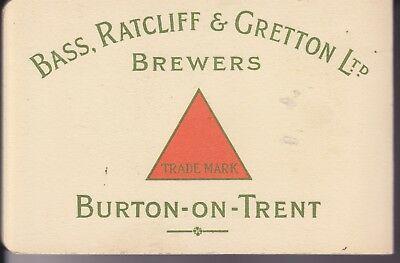
        I decided to add all the siblings to the Gretton side of the family, in search of some foundation to a couple of family anecdotes.  My grandmother, Nora Marshall, whose mother was Florence Nightingale Gretton, used to mention that our Gretton side of the family were related to the Burton Upon Trent Grettons of Bass, Ratcliff and Gretton, the brewery.  She also said they were related to Lord Gretton of Stableford Park in Leicestershire.  When she was a child, she said parcels of nice clothes were sent to them by relatives.

        Bass Ratcliffe and Gretton


        It should be noted however that Baron Gretton is a title in the Peerage of the United Kingdom, and was created in 1944 for the brewer and Conservative politician John Gretton. He was head of the brewery firm of Bass, Ratcliff & Gretton Ltd of Burton upon Trent. So they were not members of the Peerage at the time of this story.

        What I found was unexpected.

        My great great grandfather Richard Gretton 1833-1898, a baker in Swadlincote, didn’t have any brothers, but he did have a couple of sisters.

        One of them, Frances, born 1831, never married, but had four children. She stayed in the family home, and named her children Gretton. In 1841 and 1851 she’s living with parents and siblings. In 1861 she is still living with parents and now on the census she has four children all named Gretton listed as grandchildren of her father.
        In 1871, her mother having died in 1866, she’s still living with her father William Gretton, Frances is now 40, and her son William 19 and daughter Jane 15 live there.
        By the time she is 50 in 1881 and her parents have died she’s head of the house with 5 children all called Gretton, including her daughter Jane Gretton aged 24.

        Twenty five year old Robert Staley is listed on the census transcription as living in the same household, but when viewing the census image it becomes clear that he lived next door, on his own and was a bootmaker, and on the other side, his parents Benjamin and Sarah Staley lived at the Prince of Wales pub with two other siblings.

        Who was fathering all these Gretton children?

        It seems that Jane did the same thing as her mother: she stayed at home and had three children, all with the name Gretton.  Jane Gretton named her son, born in 1878, Michael William Staley Gretton, which would suggest that Staley was the name of the father of the child/children of Jane Gretton.

        The father of Frances Gretton’s four children is not known, and there is no father on the birth registers, although they were all baptized.

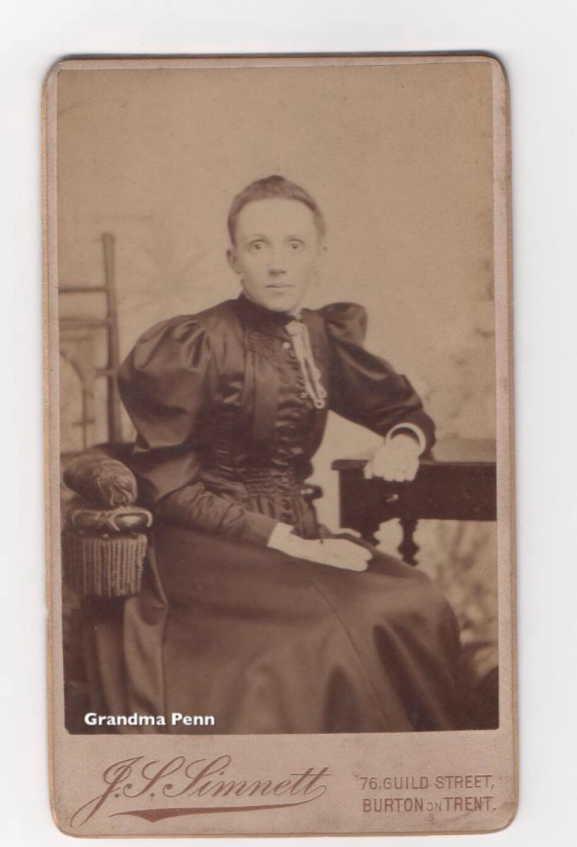
        I found a photo of Jane Gretton on a family tree on an ancestry site, so I contacted the tree owner hoping that she had some more information, but she said no, none of the older family members would explain when asked about it.  Jane later married Tom Penn, and Jane Gretton’s children are listed on census as Tom Penn’s stepchildren.

        Jane Gretton Penn


        It seems that Robert Staley (who may or may not be the father of Jane’s children) never married. In 1891 Robert is 35, single, living with widowed mother Sarah in Swadlincote. Sarah is living on own means and Robert has no occupation. On the 1901 census Robert is an unmarried 45 year old journalist and author, living with his widowed mother Sarah Staley aged 79, in Swadlincote.

        There are at least three Staley  Warren marriages in the family, and at least one Gretton Staley marriage.

        There is a possibility that the father of Frances’s children could be a Gretton, but impossible to know for sure. William Gretton was a tailor, and several of his children and grandchildren were tailoresses.  The Gretton family who later bought Stableford Park lived not too far away, and appear to be well off with a dozen members of live in staff on the census.   Did our Gretton’s the tailors make their clothes? Is that where the parcels of nice clothes came from?

        Perhaps we’ll find a family connection to the brewery Grettons, or find the family connection was an unofficial one, or that the connection is further back.

        I suppose luckily, this isn’t my direct line but an exploration of an offshoot, so the question of paternity is merely a matter of curiosity.  It is a curious thing, those Gretton tailors of Church Gresley near Burton upon Trent, and there are questions remaining.

        #6228
        TracyTracy
        Participant

          Francis Purdy: The Beggarlea Bulldog and Primitive Methodist Preacher

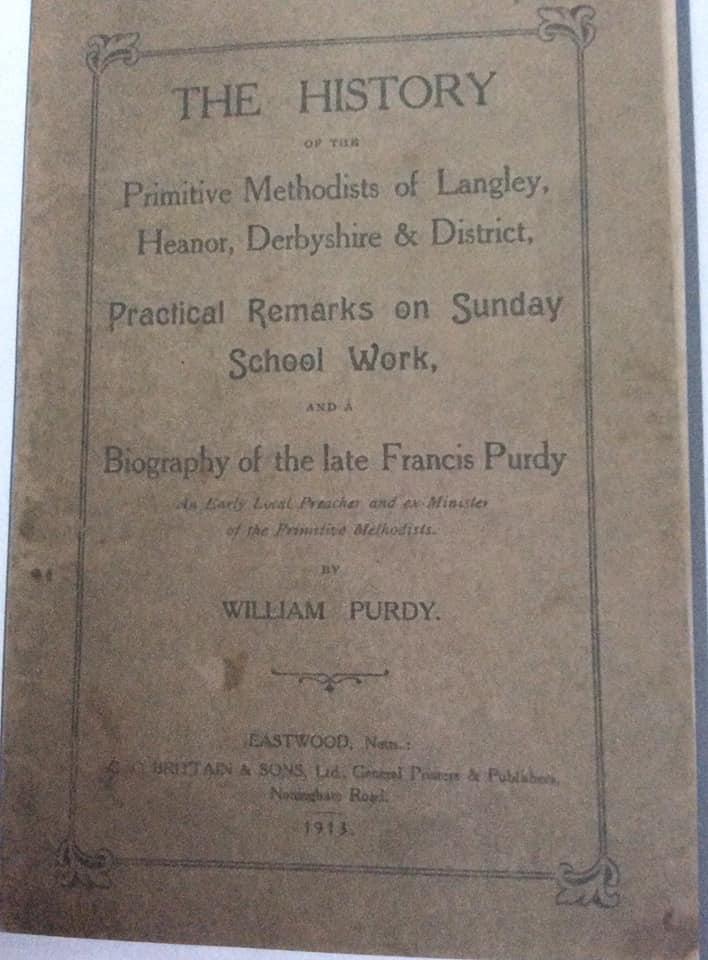
          Francis Purdy was my great great grandfather.  We did not know anything about the Primitive Methodists prior to this family research project, but my mother had another look through the family souvenirs and photographs and found a little book dated 1913, by William Purdy called: The History of The Primitive Methodists of Langley, Heanor, Derbyshire and District. Practical remarks on Sunday school work and a biography of the late Francis Purdy, an early local preacher. Printed by GC Brittain and sons.  William Purdy was Francis son, and George’s brother.

          Francis Purdy 1913 book

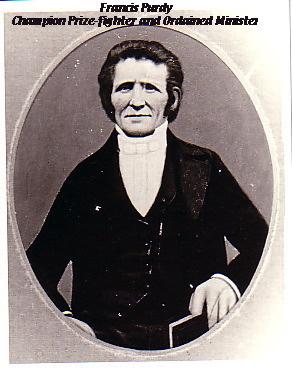
          Francis Purdy:

          Francis Purdy


          The following can be found online from various sources but I am unable to find the original source to credit with this information:

          “In spite of having pious parents, Francis was a great prize-fighter and owner of champion dogs. He was known as the Beggarlee Bulldog, and fought many pitched battles. It was in 1823 that he fought on Nottingham Forest for the championship of three counties. After the fight going eleven rounds, which continued one hour and twenty minutes, he was declared victorious.”

          The Primitive Methodists under the Rev Richard Whitechurch began a regular mission in Beggarlee. The locals tried to dismiss the Methodist “Ranters” by the use of intimidating tactics. Francis was prepared to release his fighting dogs during their prayer meeting, but became so interested in their faith that he instead joined them. The Methodist Church wrote: ”A strong feeling came over him, while his mates incited him to slip his dogs from the leads. He refused, and decided to return home. After concealing himself in a dyke, to listen to the Missioners on the following Sunday, he stole into the house of a Mrs Church, where a service was being held. Shortly after this, a society was formed with Francis Purdy as leader, and he was also the superintendent of the first Sunday School. After a short spell as local preacher at Beauvale, Tag Hill, Awsworth, Kimberly, Brinsley, etc., Mr Francis Purdy was ordained a minister by the Rev. Thomas King, of Nottingham, on the 17th December, 1827.”

          #6227
          TracyTracy
          Participant

            The Scottish Connection

            My grandfather always used to say we had some Scottish blood because his “mother was a Purdy”, and that they were from the low counties of Scotland near to the English border.

            My mother had a Scottish hat in among the boxes of souvenirs and old photographs. In one of her recent house moves, she finally threw it away, not knowing why we had it or where it came from, and of course has since regretted it!  It probably came from one of her aunts, either Phyllis or Dorothy. Neither of them had children, and they both died in 1983. My grandfather was executor of the estate in both cases, and it’s assumed that the portraits, the many photographs, the booklet on Primitive Methodists, and the Scottish hat, all relating to his mother’s side of the family, came into his possession then. His sister Phyllis never married and was living in her parents home until she died, and is the likeliest candidate for the keeper of the family souvenirs.

            Catherine Housley married George Purdy, and his father was Francis Purdy, the Primitive Methodist preacher.  William Purdy was the father of Francis.

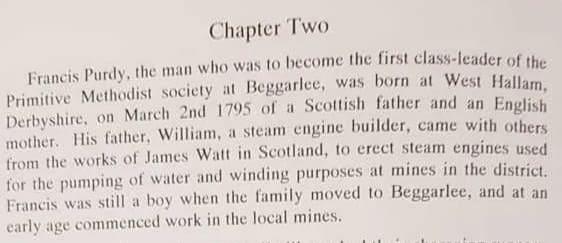
            Record searches find William Purdy was born on 16 July 1767 in Carluke, Lanarkshire, near Glasgow in Scotland. He worked for James Watt, the inventor of the steam engine, and moved to Derbyshire for the purpose of installing steam driven pumps to remove the water from the collieries in the area.

            Another descendant of Francis Purdy found the following in a book in a library in Eastwood:

            William Purdy

            William married a local girl, Ruth Clarke, in Duffield in Derbyshire in 1786.  William and Ruth had nine children, and the seventh was Francis who was born at West Hallam in 1795.

            Perhaps the Scottish hat came from William Purdy, but there is another story of Scottish connections in Smalley:  Bonnie Prince Charlie and the Jacobite Rebellion of 1745.  Although the Purdy’s were not from Smalley, Catherine Housley was.

            From an article on the Heanor and District Local History Society website:

            The Jacobites in Smalley

            Few people would readily associate the village of Smalley, situated about two miles west of Heanor, with Bonnie Prince Charlie and the Jacobite Rebellion of 1745 – but there is a clear link.

            During the winter of 1745, Charles Edward Stuart, the “Bonnie Prince” or “The Young Pretender”, marched south from Scotland. His troops reached Derby on 4 December, and looted the town, staying for two days before they commenced a fateful retreat as the Duke of Cumberland’s army approached.

            While staying in Derby, or during the retreat, some of the Jacobites are said to have visited some of the nearby villages, including Smalley.

            A history of the local aspects of this escapade was written in 1933 by L. Eardley-Simpson, entitled “Derby and the ‘45,” from which the following is an extract:

            “The presence of a party at Smalley is attested by several local traditions and relics. Not long ago there were people living who remember to have seen at least a dozen old pikes in a room adjoining the stables at Smalley Hall, and these were stated to have been left by a party of Highlanders who came to exchange their ponies for horses belonging to the then owner, Mrs Richardson; in 1907, one of these pikes still remained. Another resident of Smalley had a claymore which was alleged to have been found on Drumhill, Breadsall Moor, while the writer of the History of Smalley himself (Reverend C. Kerry) had a magnificent Andrew Ferrara, with a guard of finely wrought iron, engraved with two heads in Tudor helmets, of the same style, he states, as the one left at Wingfield Manor, though why the outlying bands of Army should have gone so far afield, he omits to mention. Smalley is also mentioned in another strange story as to the origin of the family of Woolley of Collingham who attained more wealth and a better position in the world than some of their relatives. The story is to the effect that when the Scots who had visited Mrs Richardson’s stables were returning to Derby, they fell in with one Woolley of Smalley, a coal carrier, and impressed him with horse and cart for the conveyance of certain heavy baggage. On the retreat, the party with Woolley was surprised by some of the Elector’s troopers (the Royal army) who pursued the Scots, leaving Woolley to shift for himself. This he did, and, his suspicion that the baggage he was carrying was part of the Prince’s treasure turning out to be correct, he retired to Collingham, and spent the rest of his life there in the enjoyment of his luckily acquired gains. Another story of a similar sort was designed to explain the rise of the well-known Derbyshire family of Cox of Brailsford, but the dates by no means agree with the family pedigree, and in any event the suggestion – for it is little more – is entirely at variance with the views as to the rights of the Royal House of Stuart which were expressed by certain members of the Cox family who were alive not many years ago.”

            A letter from Charles Kerry, dated 30 July 1903, narrates another strange twist to the tale. When the Highlanders turned up in Smalley, a large crowd, mainly women, gathered. “On a command in Gaelic, the regiment stooped, and throwing their kilts over their backs revealed to the astonished ladies and all what modesty is careful to conceal. Father, who told me, said they were not any more troubled with crowds of women.”

            Folklore or fact? We are unlikely to know, but the Scottish artefacts in the Smalley area certainly suggest that some of the story is based on fact.

            We are unlikely to know where that Scottish hat came from, but we did find the Scottish connection.  William Purdy’s mother was Grizel Gibson, and her mother was Grizel Murray, both of Lanarkshire in Scotland.  The name Grizel is a Scottish form of the name Griselda, and means “grey battle maiden”.  But with the exception of the name Murray, The Purdy and Gibson names are not traditionally Scottish, so there is not much of a Scottish connection after all.  But the mystery of the Scottish hat remains unsolved.

            #6225
            TracyTracy
            Participant

              William Marshall’s Parents

              William Marshall  1876-1968, my great grandfather, married Mary Ann Gilman Purdy in Buxton. We assumed that both their families came from Buxton, but this was not the case.  The Marshall’s came from Elton, near Matlock; the Purdy’s from Eastwood, Nottinghamshire.

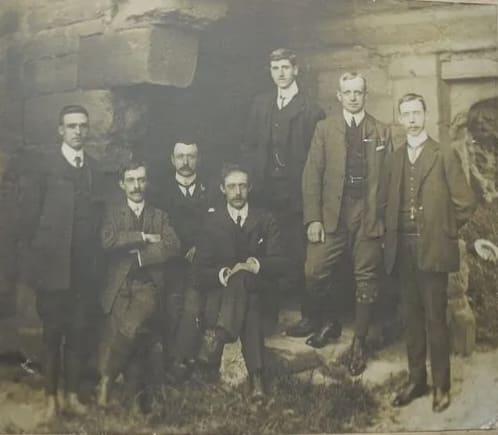
              William Marshall, seated in centre, with colleagues from the insurance company:

              William Marshall


              William and all his siblings were born in Fairfield in Buxton. But both Emma Featherstone 1847-1928, his mother, and John Marshall 1842-1930, his father, came from rural Derbyshire. Emma from Ashbourne (or Biggin, Newhaven, or Hartington, depending on what she chose to put on the census, which are all tiny rural places in the same area).

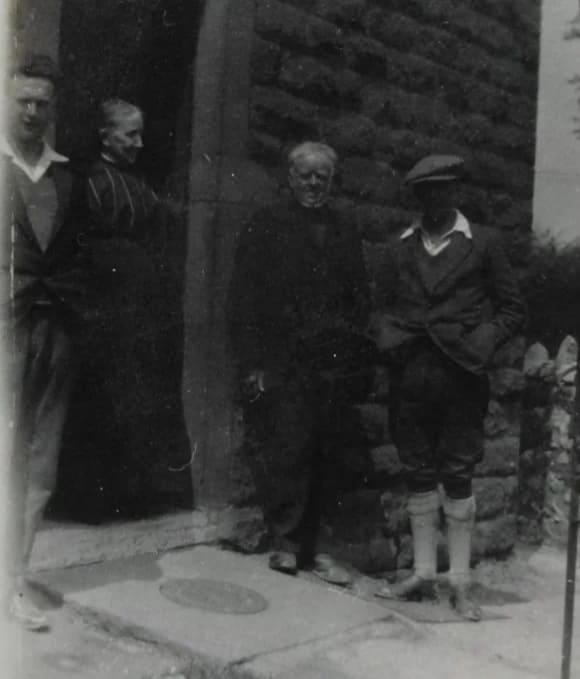
              Emma and John Marshall in the middle, photo says “William Marshall’s parents” on the back:

              Emma and John Marshall


              John Marshall was a carter, later a coal carter, and was born in Elton, Derbyshire. Elton is a rural village near to Matlock. He was unable to write (at least at the time of his wedding) but Emma signed her own name.

              In 1851 Emma is 3 or 4 years old living with family at the Jug and Glass Inn, Hartington. In 1861 Emma was a 14 year old servant at a 112 acre farm, Heathcote, but her parents were still living at the Jug and Glass. Emma Featherstone’s parents both died when she was 18, in 1865.
              In 1871 she was a servant at Old House Farm, Nether Hartington Quarter, Ashborne.

              On the census, a female apprentice was listed as a servant, a boy as an apprentice. It seems to have been quite normal, at least that’s what I’ve found so far,  for all teenagers to go and live in another household to learn a trade, to be independent from the parents, and so doesn’t necessarily mean a servant as we would think of it. Often they stayed with family friends, and usually married in their early twenties and had their own household ~ often with a “servant” or teenager from someone else’s family.

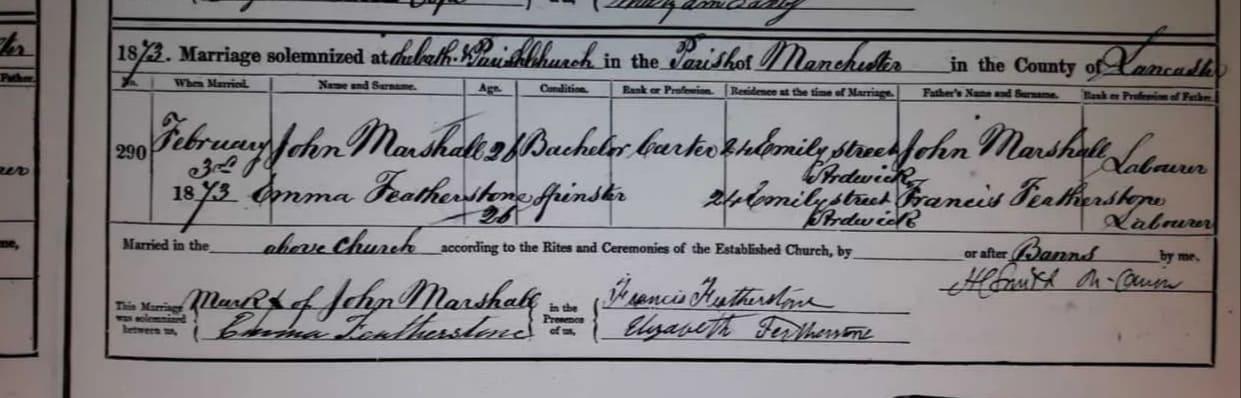
              The only marriage I could find for Emma and John was in Manchester in 1873, which didn’t make much sense. If Emma was single on the 1871 census, and her first child James was born in 1873, her marriage had to be between those dates. But the marriage register in Manchester appears to be correct, John was a carter, Emma’s father was Francis Featherstone. But why Manchester?

              Marshall Featherstone marriage

              I noticed that the witnesses to the marriage were Francis and Elizabeth Featherstone. He father was Francis, but who was Elizabeth? Emma’s mother was Sarah. Then I found that Emma’s brother Francis married Elizabeth, and they lived in Manchester on the 1871 census. Henry Street, Ardwick. Emma and John’s address on the marriage register is Emily Street, Ardwick. Both of them at the same address.

              The marriage was in February 1873, and James, the first child was born in July, 1873, in Buxton.

              It would seem that Emma and John had to get married, hence the move to Manchester where her brother was, and then quickly moved to Buxton for the birth of the child.  It was far from uncommon, I’ve found while making notes of dates in registers, for a first child to be born six or 7 months after the wedding.

              Emma died in 1928 at the age of 80, two years before her husband John. She left him a little money in her will! This seems unusual so perhaps she had her own money, possibly from the death of her parents before she married, and perhaps from the sale of the Jug and Glass.

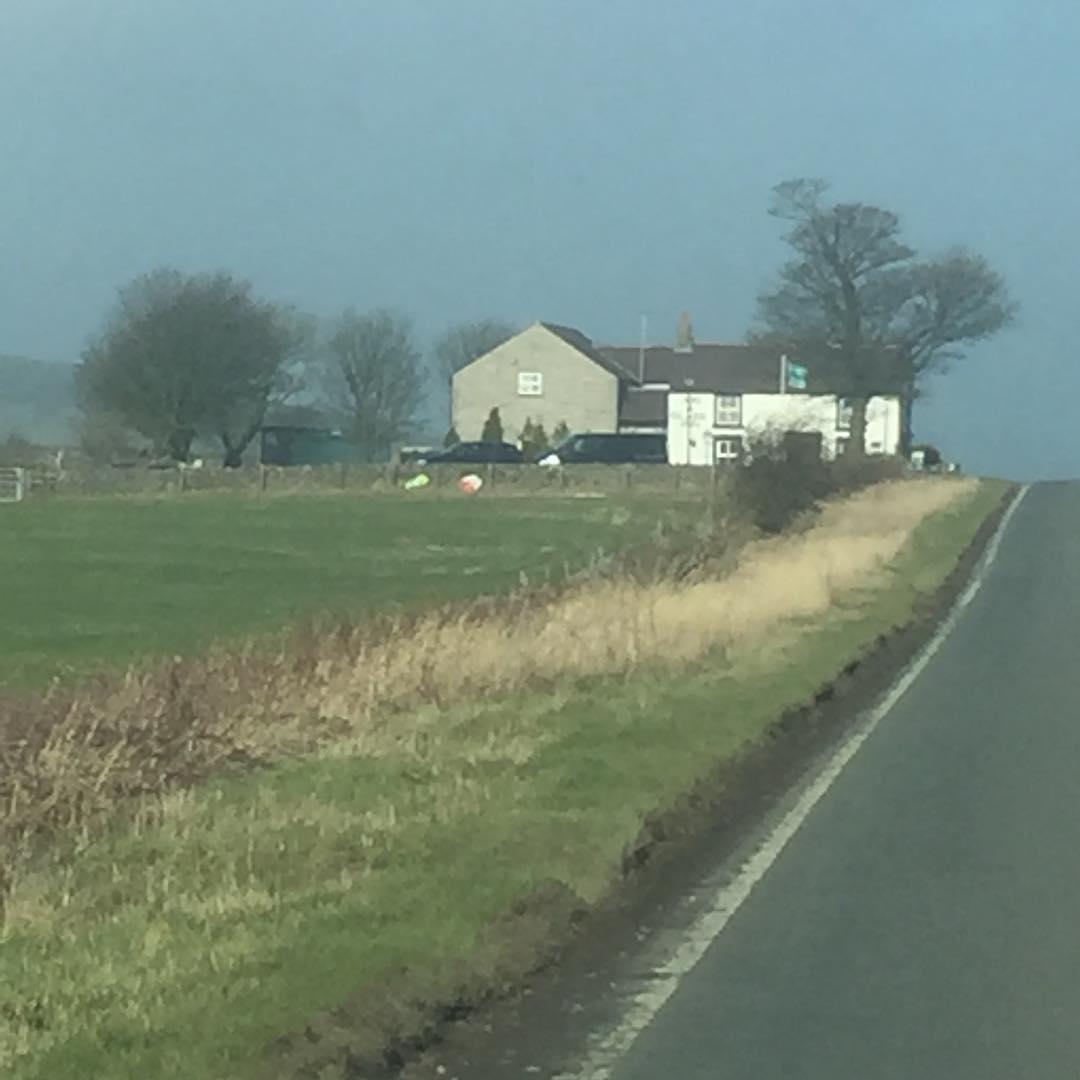
              I found a photo of the Jug and Glass online.  It looks just like the pub I’d seen in my family history meditations on a number of occasions:

              Jug and Glass

              #6222
              TracyTracy
              Participant

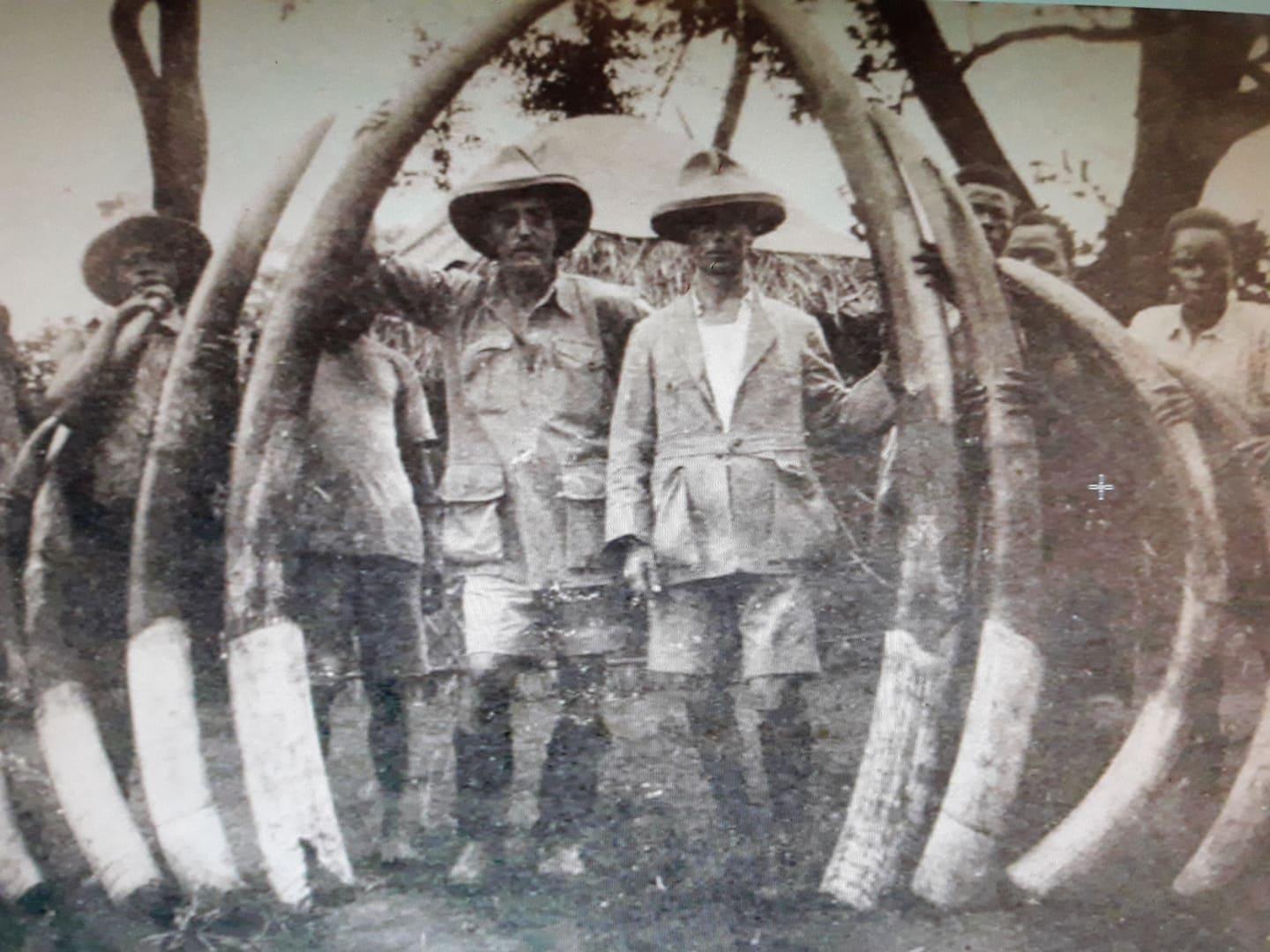
                George Gilman Rushby: The Cousin Who Went To Africa

                The portrait of the woman has “mother of Catherine Housley, Smalley” written on the back, and one of the family photographs has “Francis Purdy” written on the back. My first internet search was “Catherine Housley Smalley Francis Purdy”. Easily found was the family tree of George (Mike) Rushby, on one of the genealogy websites. It seemed that it must be our family, but the African lion hunter seemed unlikely until my mother recalled her father had said that he had a cousin who went to Africa. I also noticed that the lion hunter’s middle name was Gilman ~ the name that Catherine Housley’s daughter ~ my great grandmother, Mary Ann Gilman Purdy ~ adopted, from her aunt and uncle who brought her up.

                I tried to contact George (Mike) Rushby via the ancestry website, but got no reply. I searched for his name on Facebook and found a photo of a wildfire in a place called Wardell, in Australia, and he was credited with taking the photograph. A comment on the photo, which was a few years old, got no response, so I found a Wardell Community group on Facebook, and joined it. A very small place, population some 700 or so, and I had an immediate response on the group to my question. They knew Mike, exchanged messages, and we were able to start emailing. I was in the chair at the dentist having an exceptionally long canine root canal at the time that I got the message with his email address, and at that moment the song Down in Africa started playing.

                Mike said it was clever of me to track him down which amused me, coming from the son of an elephant and lion hunter.  He didn’t know why his father’s middle name was Gilman, and was not aware that Catherine Housley’s sister married a Gilman.

                Mike Rushby kindly gave me permission to include his family history research in my book.  This is the story of my grandfather George Marshall’s cousin.  A detailed account of George Gilman Rushby’s years in Africa can be found in another chapter called From Tanganyika With Love; the letters Eleanor wrote to her family.

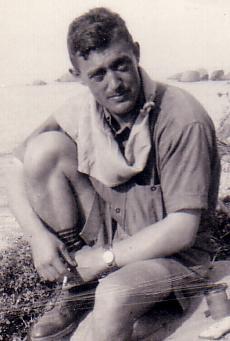
                George Gilman Rushby:

                George Gilman Rushby


                The story of George Gilman Rushby 1900-1969, as told by his son Mike:

                George Gilman Rushby:
                Elephant hunter,poacher, prospector, farmer, forestry officer, game ranger, husband to Eleanor, and father of 6 children who now live around the world.

                George Gilman Rushby was born in Nottingham on 28 Feb 1900 the son of Catherine Purdy and John Henry Payling Rushby. But John Henry died when his son was only one and a half years old, and George shunned his drunken bullying stepfather Frank Freer and was brought up by Gypsies who taught him how to fight and took him on regular poaching trips. His love of adventure and his ability to hunt were nurtured at an early stage of his life.
                The family moved to Eastwood, where his mother Catherine owned and managed The Three Tuns Inn, but when his stepfather died in mysterious circumstances, his mother married a wealthy bookmaker named Gregory Simpson. He could afford to send George to Worksop College and to Rugby School. This was excellent schooling for George, but the boarding school environment, and the lack of a stable home life, contributed to his desire to go out in the world and do his own thing. When he finished school his first job was as a trainee electrician with Oaks & Co at Pye Bridge. He also worked part time as a motor cycle mechanic and as a professional boxer to raise the money for a voyage to South Africa.

                In May 1920 George arrived in Durban destitute and, like many others, living on the beach and dependant upon the Salvation Army for a daily meal. However he soon got work as an electrical mechanic, and after a couple of months had earned enough money to make the next move North. He went to Lourenco Marques where he was appointed shift engineer for the town’s power station. However he was still restless and left the comfort of Lourenco Marques for Beira in August 1921.

                Beira was the start point of the new railway being built from the coast to Nyasaland. George became a professional hunter providing essential meat for the gangs of construction workers building the railway. He was a self employed contractor with his own support crew of African men and began to build up a satisfactory business. However, following an incident where he had to shoot and kill a man who attacked him with a spear in middle of the night whilst he was sleeping, George left the lower Zambezi and took a paddle steamer to Nyasaland (Malawi). On his arrival in Karongo he was encouraged to shoot elephant which had reached plague proportions in the area – wrecking African homes and crops, and threatening the lives of those who opposed them.

                His next move was to travel by canoe the five hundred kilometre length of Lake Nyasa to Tanganyika, where he hunted for a while in the Lake Rukwa area, before walking through Northern Rhodesia (Zambia) to the Congo. Hunting his way he overachieved his quota of ivory resulting in his being charged with trespass, the confiscation of his rifles, and a fine of one thousand francs. He hunted his way through the Congo to Leopoldville then on to the Portuguese enclave, near the mouth of the mighty river, where he worked as a barman in a rough and tough bar until he received a message that his old friend Lumb had found gold at Lupa near Chunya. George set sail on the next boat for Antwerp in Belgium, then crossed to England and spent a few weeks with his family in Jacksdale before returning by sea to Dar es Salaam. Arriving at the gold fields he pegged his claim and almost immediately went down with blackwater fever – an illness that used to kill three out of four within a week.

                When he recovered from his fever, George exchanged his gold lease for a double barrelled .577 elephant rifle and took out a special elephant control licence with the Tanganyika Government. He then headed for the Congo again and poached elephant in Northern Rhodesia from a base in the Congo. He was known by the Africans as “iNyathi”, or the Buffalo, because he was the most dangerous in the long grass. After a profitable hunting expedition in his favourite hunting ground of the Kilombera River he returned to the Congo via Dar es Salaam and Mombassa. He was after the Kabalo district elephant, but hunting was restricted, so he set up his base in The Central African Republic at a place called Obo on the Congo tributary named the M’bomu River. From there he could make poaching raids into the Congo and the Upper Nile regions of the Sudan. He hunted there for two and a half years. He seldom came across other Europeans; hunters kept their own districts and guarded their own territories. But they respected one another and he made good and lasting friendships with members of that small select band of adventurers.

                Leaving for Europe via the Congo, George enjoyed a short holiday in Jacksdale with his mother. On his return trip to East Africa he met his future bride in Cape Town. She was 24 year old Eleanor Dunbar Leslie; a high school teacher and daughter of a magistrate who spent her spare time mountaineering, racing ocean yachts, and riding horses. After a whirlwind romance, they were betrothed within 36 hours.

                On 25 July 1930 George landed back in Dar es Salaam. He went directly to the Mbeya district to find a home. For one hundred pounds he purchased the Waizneker’s farm on the banks of the Mntshewe Stream. Eleanor, who had been delayed due to her contract as a teacher, followed in November. Her ship docked in Dar es Salaam on 7 Nov 1930, and they were married that day. At Mchewe Estate, their newly acquired farm, they lived in a tent whilst George with some help built their first home – a lovely mud-brick cottage with a thatched roof. George and Eleanor set about developing a coffee plantation out of a bush block. It was a very happy time for them. There was no electricity, no radio, and no telephone. Newspapers came from London every two months. There were a couple of neighbours within twenty miles, but visitors were seldom seen. The farm was a haven for wild life including snakes, monkeys and leopards. Eleanor had to go South all the way to Capetown for the birth of her first child Ann, but with the onset of civilisation, their first son George was born at a new German Mission hospital that had opened in Mbeya.

                Occasionally George had to leave the farm in Eleanor’s care whilst he went off hunting to make his living. Having run the coffee plantation for five years with considerable establishment costs and as yet no return, George reluctantly started taking paying clients on hunting safaris as a “white hunter”. This was an occupation George didn’t enjoy. but it brought him an income in the days when social security didn’t exist. Taking wealthy clients on hunting trips to kill animals for trophies and for pleasure didn’t amuse George who hunted for a business and for a way of life. When one of George’s trackers was killed by a leopard that had been wounded by a careless client, George was particularly upset.
                The coffee plantation was approaching the time of its first harvest when it was suddenly attacked by plagues of borer beetles and ring barking snails. At the same time severe hail storms shredded the crop. The pressure of the need for an income forced George back to the Lupa gold fields. He was unlucky in his gold discoveries, but luck came in a different form when he was offered a job with the Forestry Department. The offer had been made in recognition of his initiation and management of Tanganyika’s rainbow trout project. George spent most of his short time with the Forestry Department encouraging the indigenous people to conserve their native forests.

                In November 1938 he transferred to the Game Department as Ranger for the Eastern Province of Tanganyika, and over several years was based at Nzasa near Dar es Salaam, at the old German town of Morogoro, and at lovely Lyamungu on the slopes of Kilimanjaro. Then the call came for him to be transferred to Mbeya in the Southern Province for there was a serious problem in the Njombe district, and George was selected by the Department as the only man who could possibly fix the problem.

                Over a period of several years, people were being attacked and killed by marauding man-eating lions. In the Wagingombe area alone 230 people were listed as having been killed. In the Njombe district, which covered an area about 200 km by 300 km some 1500 people had been killed. Not only was the rural population being decimated, but the morale of the survivors was so low, that many of them believed that the lions were not real. Many thought that evil witch doctors were controlling the lions, or that lion-men were changing form to kill their enemies. Indeed some wichdoctors took advantage of the disarray to settle scores and to kill for reward.

                By hunting down and killing the man-eaters, and by showing the flesh and blood to the doubting tribes people, George was able to instil some confidence into the villagers. However the Africans attributed the return of peace and safety, not to the efforts of George Rushby, but to the reinstallation of their deposed chief Matamula Mangera who had previously been stood down for corruption. It was Matamula , in their eyes, who had called off the lions.

                Soon after this adventure, George was appointed Deputy Game Warden for Tanganyika, and was based in Arusha. He retired in 1956 to the Njombe district where he developed a coffee plantation, and was one of the first in Tanganyika to plant tea as a major crop. However he sensed a swing in the political fortunes of his beloved Tanganyika, and so sold the plantation and settled in a cottage high on a hill overlooking the Navel Base at Simonstown in the Cape. It was whilst he was there that TV Bulpin wrote his biography “The Hunter is Death” and George wrote his book “No More The Tusker”. He died in the Cape, and his youngest son Henry scattered his ashes at the Southern most tip of Africa where the currents of the Atlantic and Indian Oceans meet .

                George Gilman Rushby:

                #6221
                TracyTracy
                Participant

                  Mary Ann Gilman Purdy

                  1880-1950

                  Mary Ann Gilman Purdy Marshall

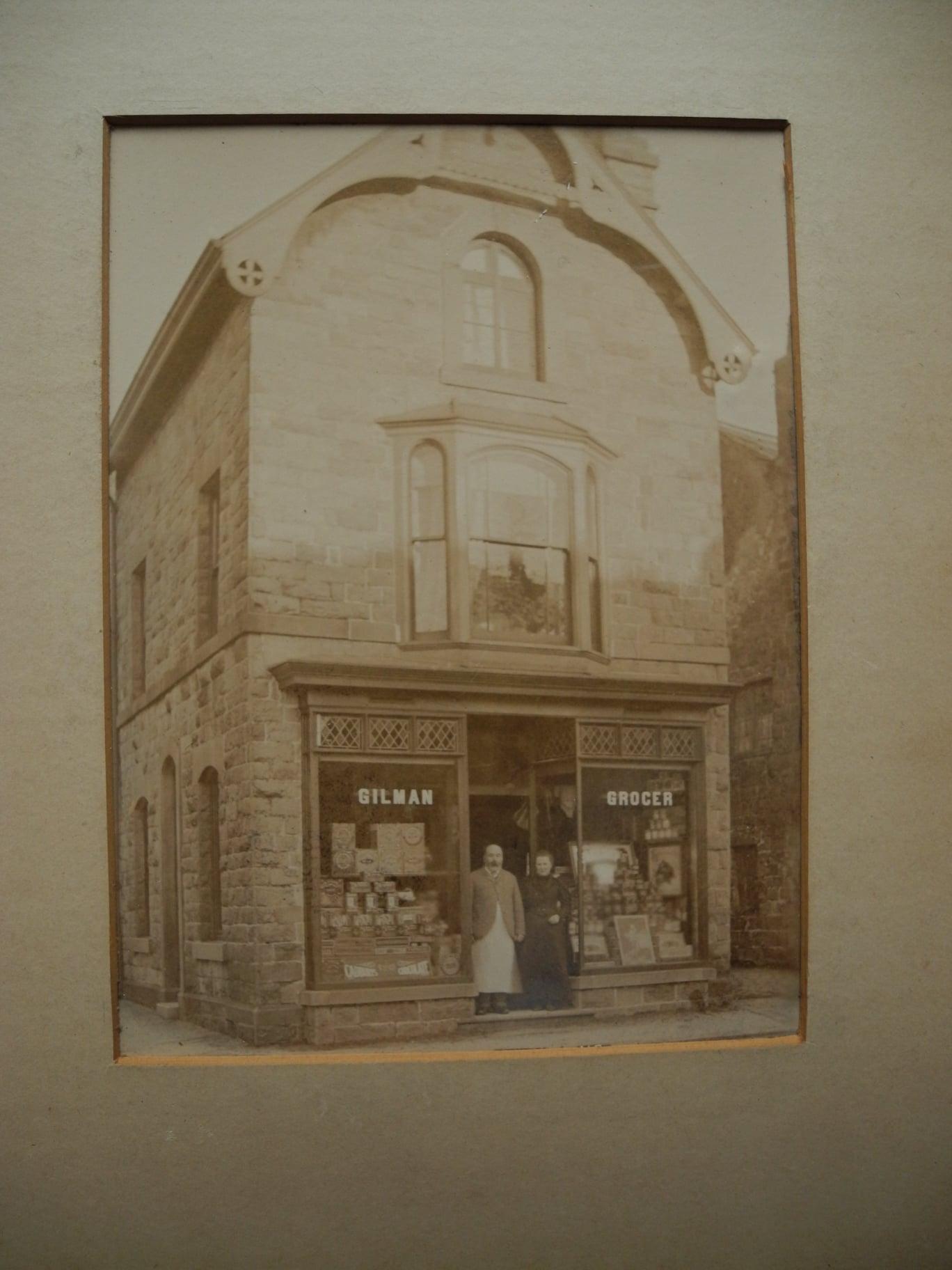
                  Mary Ann was my grandfather George Marshall’s mother. She died in 1950, seven years before I was born. She has been referred to more often than not, since her death, as Mary Ann Gilman Purdy, rather than Mary Marshall. She was from Buxton, so we believed, as was her husband William Marshall. There are family photos of the Gilmans, grocers in Buxton, and we knew that Mary Ann was brought up by them. My grandfather, her son, said that she thought very highly of the Gilman’s, and added the Gilman name to her birth name of Purdy.


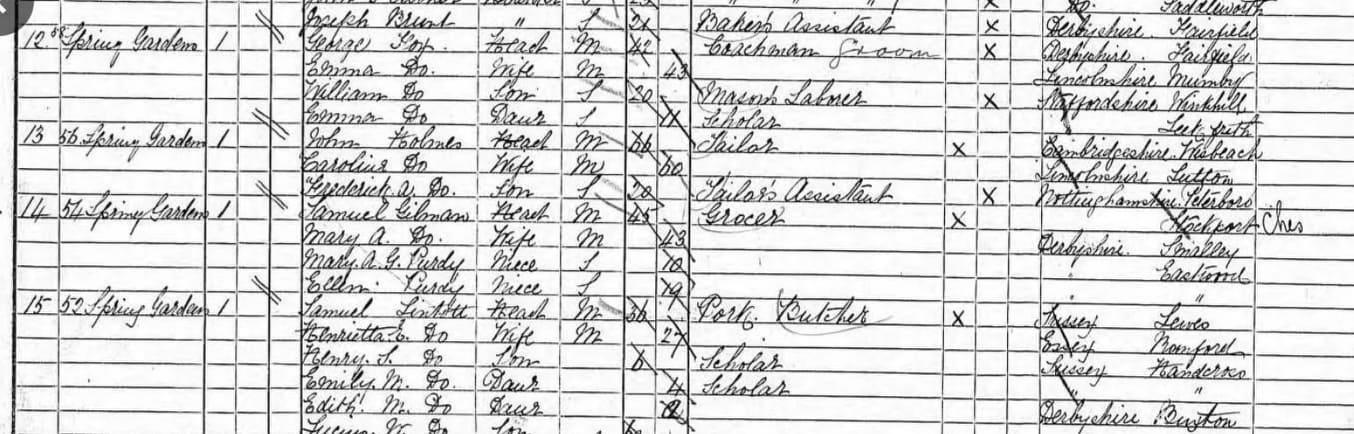
                  The 1891 census in Buxton:

                  1891 census Buxton


                  (Mary Ann’s aunt, Mrs Gilman, was also called Mary Anne, but spelled with an E.)

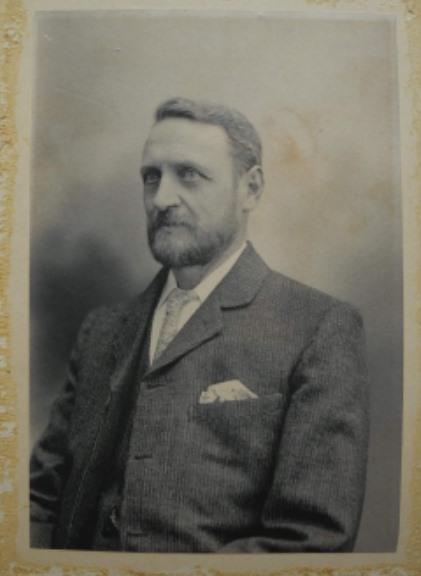
                  Samuel Gilman 1846-1909, and Mary Anne (Housley) Gilman  1846-1935,  in Buxton:

                  Gilmans Grocers

                  Samuel Gilman


                  What we didn’t know was why Mary Ann (and her sister Ellen/Nellie, we later found) grew up with the Gilman’s. But Mary Ann wasn’t born in Buxton, Derbyshire, she was born in Eastwood, Nottinghamshire. When the search moved to Nottingham, we found the Purdy’s.

                  George Purdy 1848-1935, Mary Ann’s father:

                  George Purdy


                  Mary Ann’s parents were George Purdy of Eastwood, and Catherine Housley of Smalley.

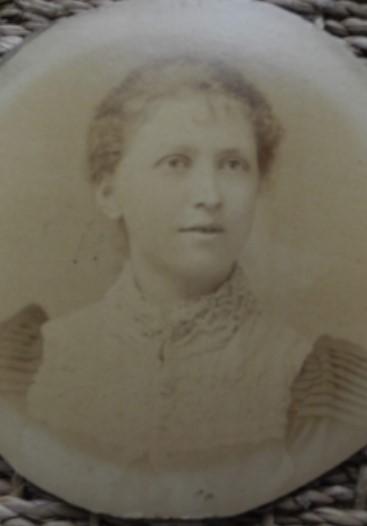
                  Catherine Housley 1849-1884, Mary Ann’s mother:

                  Catherine Housley


                  Mary Ann was four years old when her mother died. She had three sisters and one brother. George Purdy remarried and kept the two older daughters, and the young son with him. The two younger daughters, Mary Ann and Nellie, went to live with Catherine’s sister, also called Mary Anne, and her husband Samuel Gilman. They had no children of their own. One of the older daughters who stayed with their father was Kate , whose son George Gilman Rushby, went to Africa. But that is another chapter.

                  George was the son of Francis Purdy and his second wife Jane Eaton. Francis had some twenty children, and is believed in Eastwood to be the reason why there are so many Purdy’s.

                  The woman who was a mother to Mary Ann and who she thought very highly of, her mothers sister, spent her childhood in the Belper Workhouse. She and her older sister Elizabeth were admitted in June, 1850, the reason: father in prison. Their mother had died the previous year. Mary Anne Housley, Catherine’s sister, married Samuel Gilman, and looked after her dead sisters children.

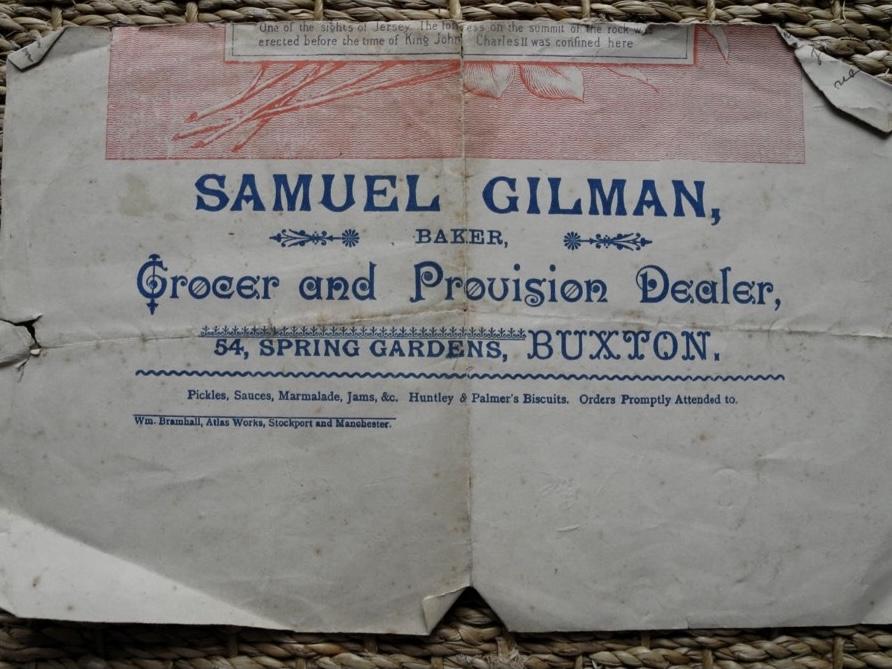
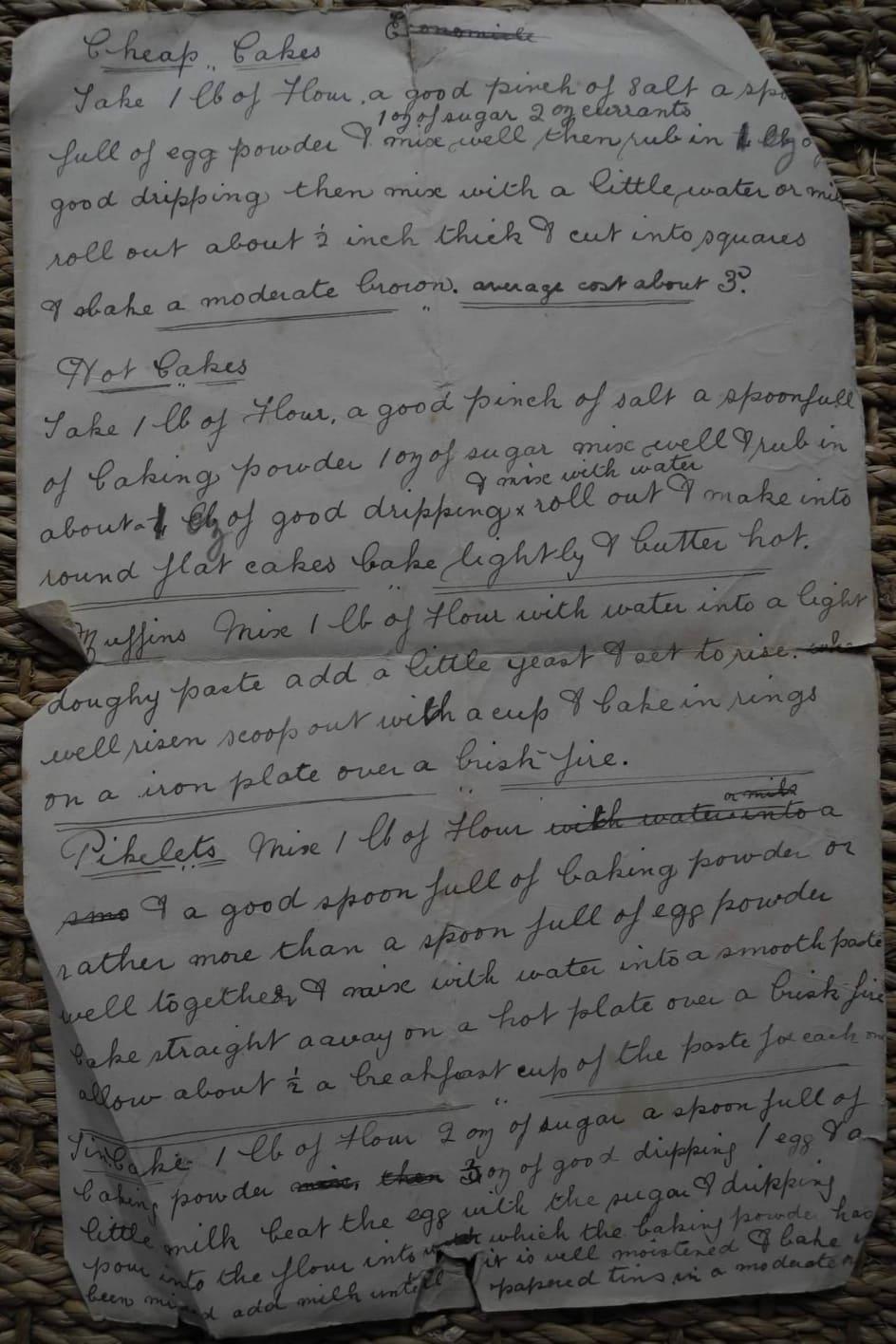
                  Mary Ann Gilman Purdy Marshalls recipes written on the back of the Gilmans Grocers paper:

                  recipes

                  #6219
                  TracyTracy
                  Participant

                    The following stories started with a single question.

                    Who was Catherine Housley’s mother?

                    But one question leads to another, and another, and so this book will never be finished.  This is the first in a collection of stories of a family history research project, not a complete family history.  There will always be more questions and more searches, and each new find presents more questions.

                    A list of names and dates is only moderately interesting, and doesn’t mean much unless you get to know the characters along the way.   For example, a cousin on my fathers side has already done a great deal of thorough and accurate family research. I copied one branch of the family onto my tree, going back to the 1500’s, but lost interest in it after about an hour or so, because I didn’t feel I knew any of the individuals.

                    Parish registers, the census every ten years, birth, death and marriage certificates can tell you so much, but they can’t tell you why.  They don’t tell you why parents chose the names they did for their children, or why they moved, or why they married in another town.  They don’t tell you why a person lived in another household, or for how long. The census every ten years doesn’t tell you what people were doing in the intervening years, and in the case of the UK and the hundred year privacy rule, we can’t even use those for the past century.  The first census was in 1831 in England, prior to that all we have are parish registers. An astonishing amount of them have survived and have been transcribed and are one way or another available to see, both transcriptions and microfiche images.  Not all of them survived, however. Sometimes the writing has faded to white, sometimes pages are missing, and in some case the entire register is lost or damaged.

                    Sometimes if you are lucky, you may find mention of an ancestor in an obscure little local history book or a journal or diary.  Wills, court cases, and newspaper archives often provide interesting information. Town memories and history groups on social media are another excellent source of information, from old photographs of the area, old maps, local history, and of course, distantly related relatives still living in the area.  Local history societies can be useful, and some if not all are very helpful.

                    If you’re very lucky indeed, you might find a distant relative in another country whose grandparents saved and transcribed bundles of old letters found in the attic, from the family in England to the brother who emigrated, written in the 1800s.  More on this later, as it merits its own chapter as the most exciting find so far.

                    The social history of the time and place is important and provides many clues as to why people moved and why the family professions and occupations changed over generations.  The Enclosures Act and the Industrial Revolution in England created difficulties for rural farmers, factories replaced cottage industries, and the sons of land owning farmers became shop keepers and miners in the local towns.  For the most part (at least in my own research) people didn’t move around much unless there was a reason.  There are no reasons mentioned in the various registers, records and documents, but with a little reading of social history you can sometimes make a good guess.  Samuel Housley, for example, a plumber, probably moved from rural Derbyshire to urban Wolverhampton, when there was a big project to install indoor plumbing to areas of the city in the early 1800s.  Derbyshire nailmakers were offered a job and a house if they moved to Wolverhampton a generation earlier.

                    Occasionally a couple would marry in another parish, although usually they married in their own. Again, there was often a reason.  William Housley and Ellen Carrington married in Ashbourne, not in Smalley.  In this case, William’s first wife was Mary Carrington, Ellen’s sister.  It was not uncommon for a man to marry a deceased wife’s sister, but it wasn’t strictly speaking legal.  This caused some problems later when William died, as the children of the first wife contested the will, on the grounds of the second marriage being illegal.

                    Needless to say, there are always questions remaining, and often a fresh pair of eyes can help find a vital piece of information that has escaped you.  In one case, I’d been looking for the death of a widow, Mary Anne Gilman, and had failed to notice that she remarried at a late age. Her death was easy to find, once I searched for it with her second husbands name.

                    This brings me to the topic of maternal family lines. One tends to think of their lineage with the focus on paternal surnames, but very quickly the number of surnames increases, and all of the maternal lines are directly related as much as the paternal name.  This is of course obvious, if you start from the beginning with yourself and work back.  In other words, there is not much point in simply looking for your fathers name hundreds of years ago because there are hundreds of other names that are equally your own family ancestors. And in my case, although not intentionally, I’ve investigated far more maternal lines than paternal.

                    This book, which I hope will be the first of several, will concentrate on my mothers family: The story so far that started with the portrait of Catherine Housley’s mother.
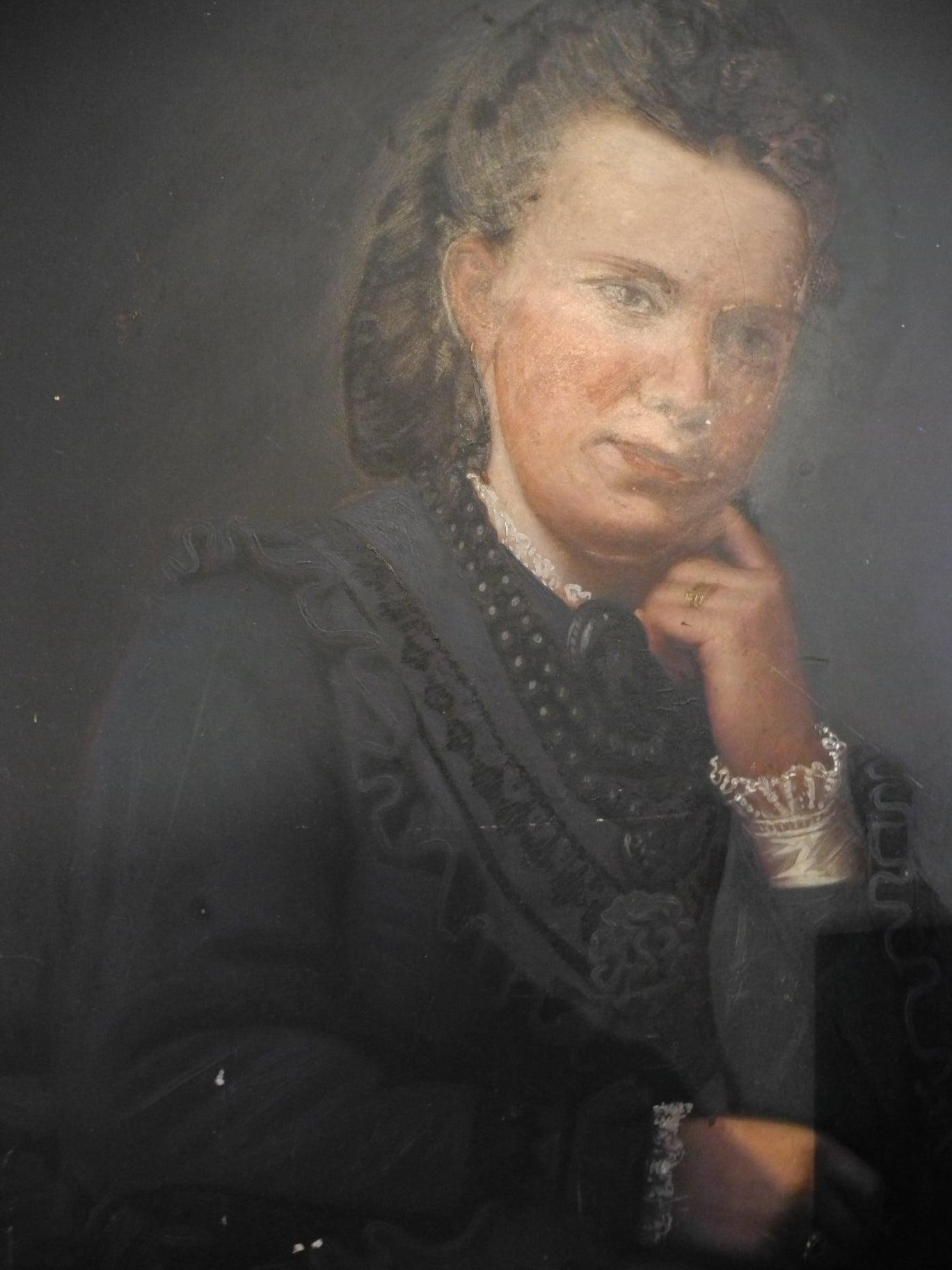
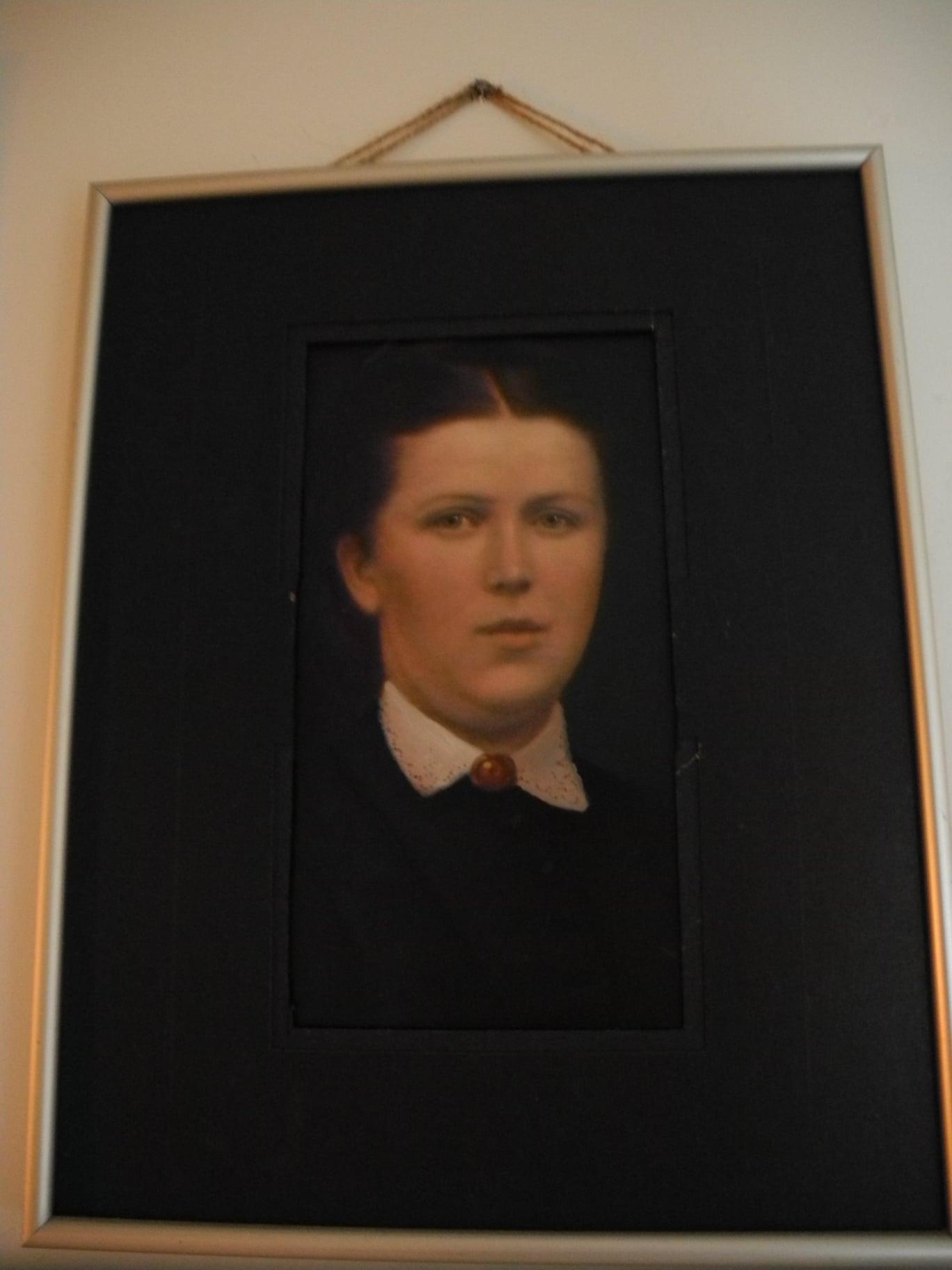
                    Elizabeth Brookes


                    This painting, now in my mothers house, used to hang over the piano in the home of her grandparents.   It says on the back “Catherine Housley’s mother, Smalley”.

                    The portrait of Catherine Housley’s mother can be seen above the piano. Back row Ronald Marshall, my grandfathers brother, William Marshall, my great grandfather, Mary Ann Gilman Purdy Marshall in the middle, my great grandmother, with her daughters Dorothy on the left and Phyllis on the right, at the Marshall’s house on Love Lane in Stourbridge.
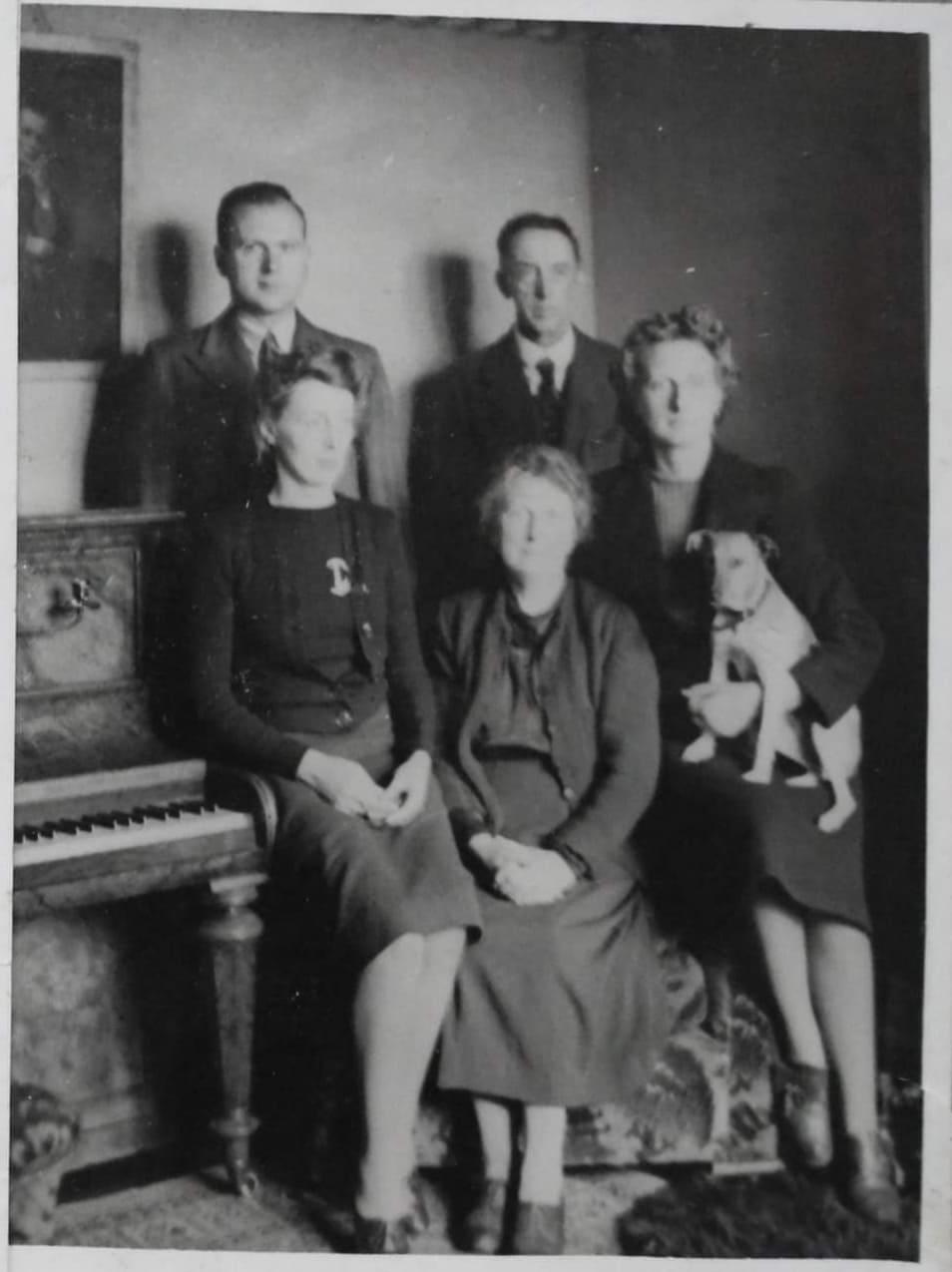
                    Marshalls


                    The Search for Samuel Housley

                    As soon as the search for Catherine Housley’s mother was resolved, achieved by ordering a paper copy of her birth certificate, the search for Catherine Housley’s father commenced. We know he was born in Smalley in 1816, son of William Housley and Ellen Carrington, and that he married Elizabeth Brookes in Wolverhampton in 1844. He was a plumber and glazier. His three daughters born between 1845 and 1849 were born in Smalley. Elizabeth died in 1849 of consumption, but Samuel didn’t register her death. A 20 year old neighbour called Aaron Wadkinson did.
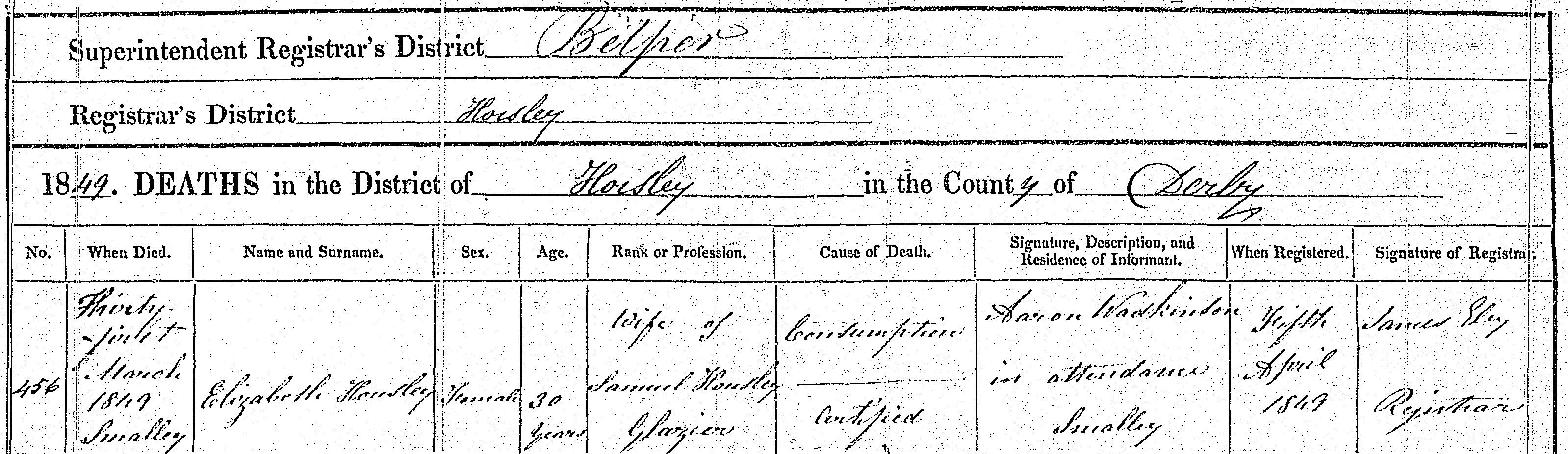
                    Elizabeth death


                    Where was Samuel?

                    On the 1851 census, two of Samuel’s daughters were listed as inmates in the Belper Workhouse, and the third, 2 year old Catherine, was listed as living with John Benniston and his family in nearby Heanor.  Benniston was a framework knitter.

                    Where was Samuel?

                    A long search through the microfiche workhouse registers provided an answer. The reason for Elizabeth and Mary Anne’s admission in June 1850 was given as “father in prison”. In May 1850, Samuel Housley was sentenced to one month hard labour at Derby Gaol for failing to maintain his three children. What happened to those little girls in the year after their mothers death, before their father was sentenced, and they entered the workhouse? Where did Catherine go, a six week old baby? We have yet to find out.
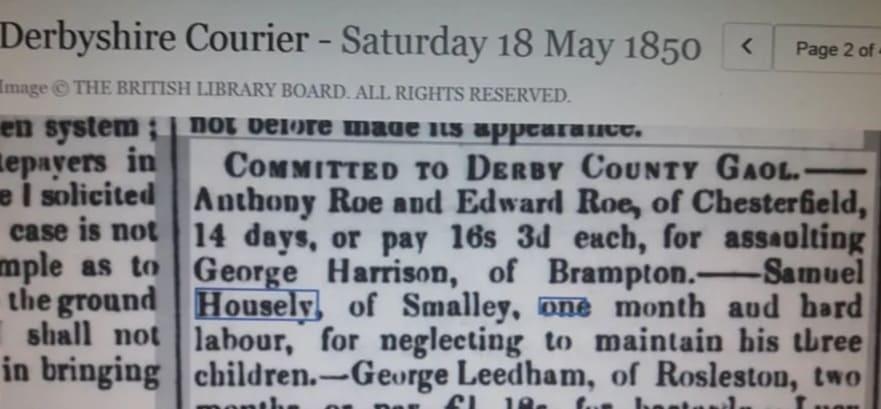
                    Samuel Housley 1850


                    And where was Samuel Housley in 1851? He hasn’t appeared on any census.

                    According to the Belper workhouse registers, Mary Anne was discharged on trial as a servant February 1860. She was readmitted a month later in March 1860, the reason given: unwell.

                    Belper Workhouse:
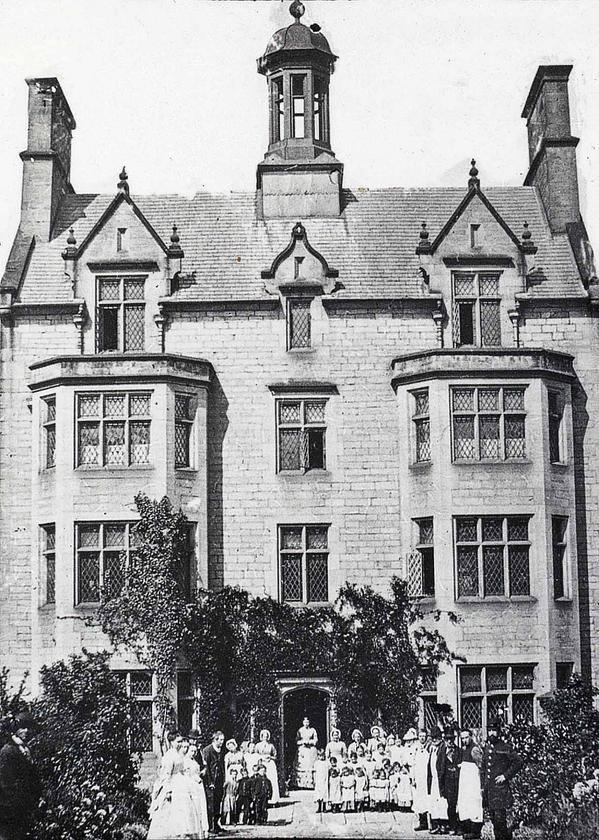
                    Belper Workhouse

                    Eventually, Mary Anne and Elizabeth were discharged, in April 1860, with an aunt and uncle. The workhouse register doesn’t name the aunt and uncle. One can only wonder why it took them so long.
                    On the 1861 census, Elizabeth, 16 years old, is a servant in St Peters, Derby, and Mary Anne, 15 years old, is a servant in St Werburghs, Derby.

                    But where was Samuel?

                    After some considerable searching, we found him, despite a mistranscription of his name, on the 1861 census, living as a lodger and plumber in Darlaston, Walsall.
                    Eventually we found him on a 1871 census living as a lodger at the George and Dragon in Henley in Arden. The age is not exactly right, but close enough, he is listed as an unmarried painter, also close enough, and his birth is listed as Kidsley, Derbyshire. He was born at Kidsley Grange Farm. We can assume that he was probably alive in 1872, the year his mother died, and the following year, 1873, during the Kerry vs Housley court case.
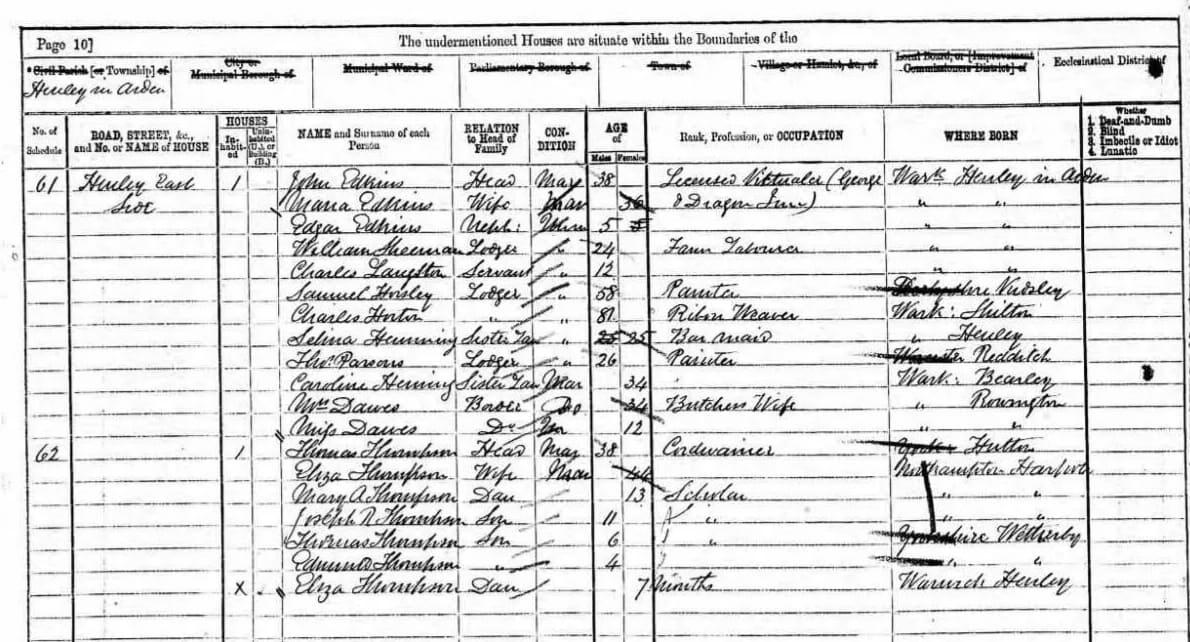
                    Samuel Housley 1871


                    I found some living Housley descendants in USA. Samuel Housley’s brother George emigrated there in 1851. The Housley’s in USA found letters in the attic, from the family in Smalley ~ written between 1851 and 1870s. They sent me a “Narrative on the Letters” with many letter excerpts.

                    The Housley family were embroiled in a complicated will and court case in the early 1870s. In December 15, 1872, Joseph (Samuel’s brother) wrote to George:

                    “I think we have now found all out now that is concerned in the matter for there was only Sam that we did not know his whereabouts but I was informed a week ago that he is dead–died about three years ago in Birmingham Union. Poor Sam. He ought to have come to a better end than that….His daughter and her husband went to Birmingham and also to Sutton Coldfield that is where he married his wife from and found out his wife’s brother. It appears he has been there and at Birmingham ever since he went away but ever fond of drink.”

                    No record of Samuel Housley’s death can be found for the Birmingham Union in 1869 or thereabouts.

                    But if he was alive in 1871 in Henley In Arden…..
                    Did Samuel tell his wife’s brother to tell them he was dead? Or did the brothers say he was dead so they could have his share?

                    We still haven’t found a death for Samuel Housley.


                    #6201
                    TracyTracy
                    Participant

                      “Go and put the kettle on while I think about this,” Liz instructed Finnley.  “A vacation is not a bad idea.  A change of air would do us good.  Perhaps a nice self catering cottage somewhere in the country…”

                      “Self catering? And who might that self be that would be doing the catering for you, Liz?”

                      “I was only thinking of you!” retorted Liz, affronted. “You might get bored in a fancy hotel with nothing to dust!”

                      “Try me!” snapped Finnley.  “You think you know me inside out, don’t you, but I’m just a story character to you, aren’t I? You don’t know me at all! Just the idea you have of a cleaner! I can’t take it anymore!”

                      “Oh for god’s sake stop blubbering, Finnley, no need to be so dramatic. Where would you like to go?”

                      “OH, I don’t know, Somewhere sunny and warm, with mountains and beaches, and not too many tourists.”

                      “Hah! Anywhere nice and warm with mountains and beaches is going to be packed with tourists. If you want a nice quiet holiday with no tourists you’d have to go somewhere cold and horrid.” Liz sniffed. “Everywhere nice in the world is stuffed with tourists. I know! How about a staycation?  We can stay right here and you can make us a nice picnic every day to eat on the lawn.”

                      “Fuck off, Liz,” snapped Finnley.

                      “I say, there is no need to be rude! I could sack you for that!”

                      “Yes but you won’t. Nobody else would work for you, and you know it.”

                      “Yes well there is that,” Liz had to admit, sighing. “Well then, YOU choose somewhere. You decide. I am putty in your sweaty hands, willing to bend to your every whim. Just to keep the peace.”

                      Finnley rolled her eyes and went to put the kettle on. Where DID she want to go, she wondered?   And would a holiday with Liz be any holiday at all?

                      #6194

                      Did I hear you ask: what is a framework knitter?

                      It was William Lee from Calverton in Nottingham who invented the first knitting frame. In 1598, or thereabouts. This made it about 100 times faster than knitting by hand.

                      Bad luck for old William though. Queen Elizabeth I refused to grant him a patent for his invention. Maybe because she thought the new fangled invention would take work away from hand knitters.

                      William took the design to try his luck in France but alas he had no better luck. It is said that William died a penniless man. His brother fared better. He took the design back to Britain and the framwork knitting trade took off.

                      It was hard work being a framework knitter. The work was tough and the hours were long.

                      #6188

                      Reddening, Bob stammered, “Yeah, yes, uh, yeah. Um…”

                      Clara squeezed her grandfathers arm reassuringly.  “We’re looking for my friend Nora.” she interrupted, to give him time to compose himself.  Poor dear was easily flustered these days. Turning to Will, “She was hiking over to visit us and should have arrived yesterday and she’d have passed right by here, but her phone seems to be dead.”

                      Will had to think quickly. If he could keep them both here with Nora long enough to get the box ~ or better yet, replace the contents with something else. Yes, that was it!  He could take a sack of random stuff to put in the box, and they’d never suspect a thing. He was going to hide the contents in a statue anyway, so he didn’t even need the box.

                      Spreading his arms wide in welcome and smiling broadly, he said “This is your lucky day! Come inside and I’ll put the kettle on, Nora’s gone up to take some photos of the old ruin, she’ll be back soon.”

                      Bob and Clara relaxed and returned the smile and allowed themselves to be ushered into the kitchen and seated at the table.

                      Will lit the gas flame under the soup before filling the kettle with water. They’d be too polite to refuse, if he put a bowl in front of them, and if they didn’t drink it, well then he’d have to resort to plan B.  He put a little pinch of powder from a tiny jar into each cup of  tea; it wouldn’t hurt and would likely make them more biddable.  Then the soup would do the trick.

                      Will steered the conversation to pleasant banter about the wildflowers on the way up to the ruins that he’d said Nora was visiting, and the birds that were migrating at this time of year, keeping the topics off anything potentially agitating.  The tea was starting to take effect and Clara and Bob relaxed and enjoyed the conversation.  They sipped the soup without protest, although Bob did grimace a bit at the thought of eating on an agitated stomach. He’d have indigestion for days, but didn’t want to be rude and refuse. He was enjoying the respite from all the vexation,  though, and was quite happy for the moment just to let the man prattle on while he ate the damn soup.

                      “Oh, I think Nora must be back! I just heard her voice!” exclaimed Clara.

                      Will had heard it too, but he said, “That wasn’t Nora, that was the parrot! It’s a fast leaner, and Nora’s been training it to say things….I tell you what, you stay here and finish your soup, and I’ll go and fetch the parrot.”

                      “Parrot? What parrot?” Clara and Bob said in unison.  They both found it inordinately funny and by the time Will had exited the kitchen, locking the door from the outside, they were hooting and wiping the tears of laughter from their cheeks.

                      “What the hell was in that tea!” Clara joked, finishing her soup.

                      What was Nora doing awake already? Will didn’t have to keep her quiet for long, but he needed to keep her quiet now, just until the soup took effect on the others.

                      Either that or find a parrot.

                      #6185

                      “I’ll be right back!” Nora told Will, who was stirring a big bubbling pot on the stove. “Need to wash my hands.”

                      She had a quick look around the bedroom she’d slept in for her missing phone. Nowhere to be found!  Maybe she could find Will’s phone when he went out to feed the donkey, and call her phone to try and locate it. Damn, that wouldn’t work either. Will had said there was no network here. That would explain why her phone stopped working when she was alone in the dark woods.

                      “Smells delicious!” she said brightly, scraping a chair back across the brick floor and seating herself at the kitchen table.

                      The home made soup was chock full of vegetables and looked and smelled wonderful, but it had a peculiar acrid aftertaste.  Nora tried to ignore it, taking gulps of wine in between each mouthful to eliminate the bitterness.  She wished it wasn’t soup in a way, so that she’d be able to surreptitiously palm some of it off onto the dogs that were waiting hopefully under the table.  If only Will would leave the room for a minute, but he seemed to be watching her every move.

                      “Very tasty, but I can’t manage another mouthful, it’s so filling,” she said, but Will looked so offended that she sighed and carried on eating. He topped up her wine glass.

                      By the time Nora had finished the soup, she felt quite nauseous and stood up quickly to head for the bathroom. The room started to spin and she held on to the edge of the table, but it was no good. The spinning didn’t stop and she crashed to the floor, unconscious.

                      Smiling with satisfaction, Will stood up and walked around the table to where she lay. Shame he’d had to put her to sleep, really she was quite a nice woman and cute, too, in a funny elfin way.  He’d started to like her.  Plenty of time to get to know her now, anyway. She wouldn’t be going anywhere for awhile.

                      He picked her up and carried her to the secret room behind his workshop on the other side of the patio.  The walls and floor were thick stone, and there were no windows.  He laid her on the bench, locked the door, and went back in the house to fetch blankets and bedding and a pile of books for her to read when she came round.  Probably not for a good 24 hours he reckoned, somehow she’d managed to eat all the soup.  He would put much less in the next batch, just enough to keep her docile and sleepy.

                      It would only be for a few days, just long enough for him to find that box and move it to a safer location. He’d been entrusted to make sure the contents of the box were preserved for the people in the future, and he was a man of his word.

                      If they had listened to him in the first place this would never have happened.  Burying a box was a risk: all kinds of possibilities existed for a buried box to be accidentally unearthed.   He had suggested encasing the contents inside a concrete statue, but they’d ignored him. Well, now was his chance.  He was looking forward to making a new statue.

                      #6175

                      “”Sorry, I’m only just telling you this about the note now, lovie. Your Grandma’s been on at me to tell you. Just in my thoughts I mean!” he added quickly.

                      Jane smirked and tapped her forehead. “Careful, Old Man. She’ll think you’ve completely lost it!”

                      Clara stared at him, a small frown creasing her brow. “So, the note said you were to call him?”

                      Bob nodded uneasily. Clara had that look on her face. The one that means she aren’t happy with the way things are proceeding.

                      “And then what?” asked Clara slowly.

                      “I dunno.” Bob shrugged. “Guess they’d bury it again? They was pretty clear they didn’t want it found. Now, how about I put the kettle on?” Bob stood quickly and began to busy himself filling the jug with water from the tap.

                      Clara shook her head firmly. “No.”

                      “No to a cup of tea?”

                      “No we can’t call this man.”

                      “I don’t know Clara. It’s getting odd it is. Strangers leaving maps in collars and whatnot. It’s not right.”

                      “Well, I agree it needs further investigation. But we can’t call him … not without knowing why and what’s in it.” She tapped her fingers on the table. “I’ll try and get hold of Nora again.”

                      #6144

                      “You know, April … I’ve never felt myself suited to work. Never found my …” June screwed up her face in concentration. “… special calling.”

                      “Can’t we sit down over there for a minute? My feet are bloody killing me.” April nodded towards a park bench; she didn’t have much patience today for June and her philosophising, after all, wasn’t it June’s fault they were in this mess? “It’s too bad we can’t even afford the bus fare,” she grumbled as she settled herself on the wooden seat.

                      “Not too much further,” said June plonking down next to her.

                      April bent down to take off her socks and sneakers and massaged her grateful feet in the damp grass. “Think I’ve got a blister. And I’d kill for a cuppa tea. I do hope Finnley has kept on top of things.”

                      June snorted. “Not bloody likely. Anyway, while we’ve been walking I’ve been thinking … what if we sue?”

                      April yawned noisily without bothering to put a hand over her mouth—she knew June hated that. “Who is Sue? Does she have money?”

                      “No, you idiot, not, who Sue. I mean what if we sue for money? Sue the president for wrongdoings which have been done to us.”

                      “Oh!” April perked up. “There’s certainly been plenty of wrongdoings!”

                      June smiled smugly. “Exactly.”

                      #6100
                      TracyTracy
                      Participant

                        Time indeed has told the story, notwithstanding no story was told during the time.

                        Eleven long years ago this story was told:

                        The writer wanted to write, full stop. The problem was that the writer’s desire to write was continually interrupted with things in brackets assuming monstrous and all comsuming proportions. Endless chains of things in brackets that always seemed to have priority.

                        “You could always write about the things in brackets, Ann,” remarked her new friend Lavender. “Might be fun. A thrilling blast, even.”

                        The era would later be known as the Bracket Age, a dark mysterious age lost in the mists of time when nothing was recorded, no story told, as the Things In Brackets took over what was left of the known world.

                        #6077
                        Jib
                        Participant

                          “Finnley, stop pacing like that with that concerned look of yours, you make me dizzy. Is that too difficult a task to hire a secretary?”

                          Finnley rolled her eyes. “Not at all, Madam. I already found you a pearl.”

                          “You mean the perfect one for me?”

                          “No I mean, she’s called Pearl. She’ll start tomorrow. What concerns me is something else entirely. Something strange, if you ask me. But you never ask, so I’m telling you.”

                          “Well, this whole conversation started because I asked you.”

                          “You asked me because you thought it was related to your previous request.”

                          “Then tell me and stop brooding. It’s killing the mood.”

                          Finnley snorted. “If you want to know, someone is throwing things on the balcony. Children things. The other day I found that cheap toy to make soap bubbles. And then it was a small blue children’s plastic sand shovel. And today they dropped a red bucket.”

                          Liz tried to laugh, but it was more of a cackle. “Isn’t that Godfrey or Roberto playing with you?” she asked.

                          “I’ve asked Godfrey and I’m positive it’s not him because it’s driving him nut too. We asked Roberto because he’s been attempting to teach tricks to the dogs. A waste of time if you ask me, letting the garden going to the dogs,” she smirked.

                          “Then, was it Roberto and the dogs?”

                          “Not at all! We kept an eye on him while he was training the dogs. Nothing. But the objects keep coming. I’m telling you either we have a ghost or a portal to another dimension in this mansion.”

                          “That sounds like a nice idea,” said Liz, pouting at the possibilities.

                          “You wouldn’t say that if another you came into this thread.”

                          #5993
                          TracyTracy
                          Participant

                            “Do you think I should go back and get those dolls?” Dillie asked.

                            Lucinda hadn’t hesitated.  “Yes. Go back and get them.” She nearly said, and look inside.  “And look for more dolls.”

                            Then she changed the subject, not wanting to sound too pushy or eager. Or desperate, god forbid. It was important to ensure that Dilly didn’t give the dolls away on impulse or something, she was like that. Somehow Lucinda had to make sure Dillie would keep them safe and well hidden until such time as she could travel again, but without her having to spill the beans entirely. She decided to play it by ear.

                            Then she realized she didn’t remember what the beans were anyway.

                            #5988

                            Shawn Paul looked suspiciously at the pictures of the dolls in the Michigan forest on Maeve’s phone. He had heard about the Cottingley Fairies pictures, supposedly taken a long time ago by two little girls. The two little girls came out long after confessing they had staged the whole thing. Some said they had been coerced into it to keep the world from knowing the truth. It could well be the same thing with the whole dollmania, and Shawn Paul thought one was never dubious enough.

                            He noded politely to Maeve and decided to hide his doubts for now. They were resting on sunbeds near the hotel swimming pool.

                            “Do you want another cocktail?” asked a waitress dressed up in the local costume. Not much really, and so close-fitting. She was presenting them with a tray of colourful drinks and a candid smile. Her bosom was on the brink of spilling over the band of cloth she had around her chest. It was decorated with a pair of parrots stretched in such a way their lubricious eyes threatening to pop out at any moment.

                            Shawn Paul, who had the talent to see the odd and misplaced, forced himself to look at the tray and spotted the strangest one. He pushed his glasses back up on his nose and asked without looking at the waitress.

                            “What’s that strange bluish blob under the layers of alcohol and fruits?”

                            Maeve raised one eyebrow and looked at her companion with disapproval, but the waitress answered as if she heard that all the time.

                            “That’s a spoonful of honey from the blue bees. We feed them a special treat and they make us honey with remarkable properties that we have learned to use for the treatments we offer.”

                            “Oh,” said Shawn Paul who did not dare ask more about the treatments.

                            They had arrived to Tikfidjikoo just before the confinement had been declared all over the world, and they had a moment of hesitation to take the last plane with the other tourists and go back safely to Canada. But after the inconclusive adventure in Australia, Maeve had convinced him they had to stay to find out more about the dolls.

                            They had met those three old ladies and one of them had one of the dolls. Sharon, Mavis and Gloria, they were called and they were going to a smaller island of the archipelago, one that was not even on the maps apparently. That should have given them suspicions, but it seemed so important to Maeve that Shawn Paul hadn’t had the heart to leave her alone.

                            “I have a plan,” had said Maeve, “We’re going to follow them, befriend them and learn more about how they came to have the doll and try and get the key that’s inside of it.”

                            “You’re here for the beauty treatment?” had asked the girl at the counter. “You’re lucky, with the confinement a lot of our reservations have been canceled. We have plenty of vacancy and some fantastic deals.”

                            Maeve had enrolled them for a free week treatment before Shawn Paul could say anything. They hadn’t seen the ladies much since they had arrived on the island, and now there were no way in or out of the island. They had been assured they had plenty of food and alcohol and a lot of activities that could be fitted to everyone’s taste.

                            #5985
                            TracyTracy
                            Participant

                              Lucinda had all but forgotten about the mysterious dolls, what with the global events dominating everyone’s thoughts. It was hard to focus on anything else, and even Helper Effy wasn’t pushing her too much to keep up with her writing.

                              When her friend Dillie sent her the first photograph of a doll hanging on a tree in the Michigan forest, she’d found it amusing, of course, but had thought no more about it. It was always fun to find unexpected things in random places, but the significance of it being a doll had escaped her notice.

                              When Dillie sent a photo of another doll hanging on a tree by a woodland trail a few days later, the penny dropped. Dolls! What were they doing in Michigan? Were there more dolls in those woods?

                              Dillie had been tempted to take the dolls home with her, but hesitated. There was something strange about them and she intuitively felt she should leave them where they were.

                              Lucinda wondered what to do. Should she go to Michigan? Ask her friend to go back and fetch the dolls and send them to her?  Wait and see if Dillie found any more?

                              The dolls looked strangely pristine, as if they’d only recently been hung there. Who had done that, and why?

                              #5927

                              Dear Diary

                              Bella says to me, I want to see the whales. She keeps going on about it, tugging at my skirts while I’m trying to get things done. What do you mean you want to see the whales I asks her. Took me a time to know she means the stories I used to tell about the place where my Mam lives with the legend of the whales there. The place we be going but how can she know that?

                               First it is Jimmy and his dreams and now Bella. It be so many years since I told her these tales and now she is remembering them. Cook is here I must leave off writing for now for she is asking after the hens. I won’t have her killing my Esther for her pot. God knows what will happen to them once we’ve gone. I will set them free before then. At least they have a chance.

                            Viewing 20 results - 141 through 160 (of 475 total)

                            Daily Random Quote

                            • Becky snorted right back at Tina (unfortunately forgetting her cold, and hurriedly wiping up the snotty mess). Does energy smell? It smells of roast dinner sometimes. Becky sighed. She couldn’t smell a thing with this cold. ... · ID #611 (continued)
                              (next in 12h 22min…)

                            Recent Replies

                            WordCloud says