
Search Results for 'later'
-
AuthorSearch Results
-
February 22, 2023 at 8:54 am #6621
In reply to: Orbs of Madjourneys
As the four of them walked into the tavern, having walked the mile or so from the Flying Fish Inn to the main street of the tiny town, Zara noticed the black BMW that she and Yasmin had seen parked outside the Piggly supermarket on the way back from the airport in Alice. She elbowed Yasmin in the ribs to point it out, but there was no need as Yasmin was already snorting nervously at the sight of it.

Sister Finli caught sight of them as she was just about to leave Betsy’s gem shop and paused until they’d disappeared into the bar before leaving the shop. It was the first time that Finli had seen Betsy in the flesh, and what a lot of flesh there was to see. Finli was horrifed, comparing her own elegant thin fingers with the fat sausage like digits of Betsy. She would never have expected Betsy to look this way. Still, it had thrown her, and she lost her usual efficient composure and quickly purchased a pink speckled gummy bear necklace. Annoyingly, this transaction reminded her that she seemed to have lost her crucifix.
Finli was an orphan. The nuns had named her Finean Lisa. Finean meant beautiful daughter, and Lisa meant devoted to god. Later they shortened it to Finli. She’d spent all her life at the orphanage in Suva, having been deposited there at birth, and although she had no particular calling to be a nun, she had not known what else to do with her life. It was the only family she’d ever known, and so she stayed on. It was only in the past year or two that she’d had any curiosity about who her real parents were, when she read about DNA tests and ancestry research. She’d been told in the past that no records existed as she had been found on the doorstep of the orphanage one morning 43 years ago. The knowledge had filled her with comtempt for her parents, whoever they were, and for the most part she pushed them from her mind, not caring to know. But when she read about all the successes of adopted people finding their real parents, she was consumed with curiosity. At first she just wanted to know who they were. But once she had found their names, she wanted to know more. She wanted to know why. One thing led to another.
Her real father had disappeared, lost down some mines although the story there was far from clear. Indeed, that particular story was a darn sight more than unclear, it was downright fishy. Her real mother was was alive and kicking, and living near to the mines where Howard had disappeared. Finli deduced that she must have been born, or at least conceived, in this godforsaken place in the outback. What an ignominous start to her uneventful life.
She knew that Fred was her uncle, but she had not told him she knew that. Did Fred know who she was? He’d always been kind to her, but then, he was affable to everyone. When it came to her knowledge that Fred had given that tiresome snorting volunteer girl a parcel to take with her, to, of all places! that very town in the outback, Finli simply had to know what was in it. But she didn’t want to spill the beans too soon, in case it hindered her attempts to find the truth about Howard, her father. She decided to travel to the town incognito. But how was she going to find the money for it? Well, she knew she was burning her bridges, but she had to do it. She stole the golden chalice from the church and sold it on Ubay. She was suprised at how much money it fetched. Not only could she afford the trip, she could do it in style.
It was an exciting adventure, but Finli was not accustomed to travel and adventure. In fact, she was dreading meeting her mother. At times she wished she’d just stayed at the orphanage. But it was too late now. She was here.
 February 21, 2023 at 6:35 pm #6617
In reply to: Orbs of Madjourneys
Youssef had brought his black obsidian with him in the kitchen at breakfast. Idle—Youssef had realised that on top of being her way of life, it was also her name—was preparing a herbal brownie under the supervision of a colourful parrot perched on her shoulder.
“If you’re interested in rocks, you should go to Betsy’s. She’s got that ‘Gems & Minerals’ shop on Main street. She opened it with her hubby a few years back. Before he died.”
“Nutty Betsy, Pretty Girl likes her better,” said the parrot.
Idle looked at his backpack and his clothes.
“You seem the wandering type, lad. I was like you when I was younger, always gallivanting here, there, and everywhere with my brother. Now, I prefer wandering in my mind, if you know what I mean,” she said licking her finger full of chocolate. “Anyway, an advice. Don’t go down the mines alone. Betsy’s hubby’s still down there after one of the tunnels collapsed a few years back. She’s not been quite herself ever since.”

Main street was —well— the only street in town. They’ve been preparing for some kind of festival, putting banners on top of the shops and in between two trees near the gas station. Youssef stopped there to buy snacks that he stacked on top of the obsidian stone in his backpack. The young boy who worked there, Devan, seemed quite excited at the perspective of the Lager and Cart Race. It happened only every ten years and last time he was too young to participate.
The shop had not been difficult to find, at the other end of the street. A tiny sign covered in purple star sequins indicated “Betsy’s Gems & Minerals — We deliver worldwide”. He felt with his hand the black rock he had put in his backpack. If Idle had not mentioned the mines and the dead husband, Youssef might have reconsidered going in. But the coincidence with his dream and the game was too intriguing. He entered.
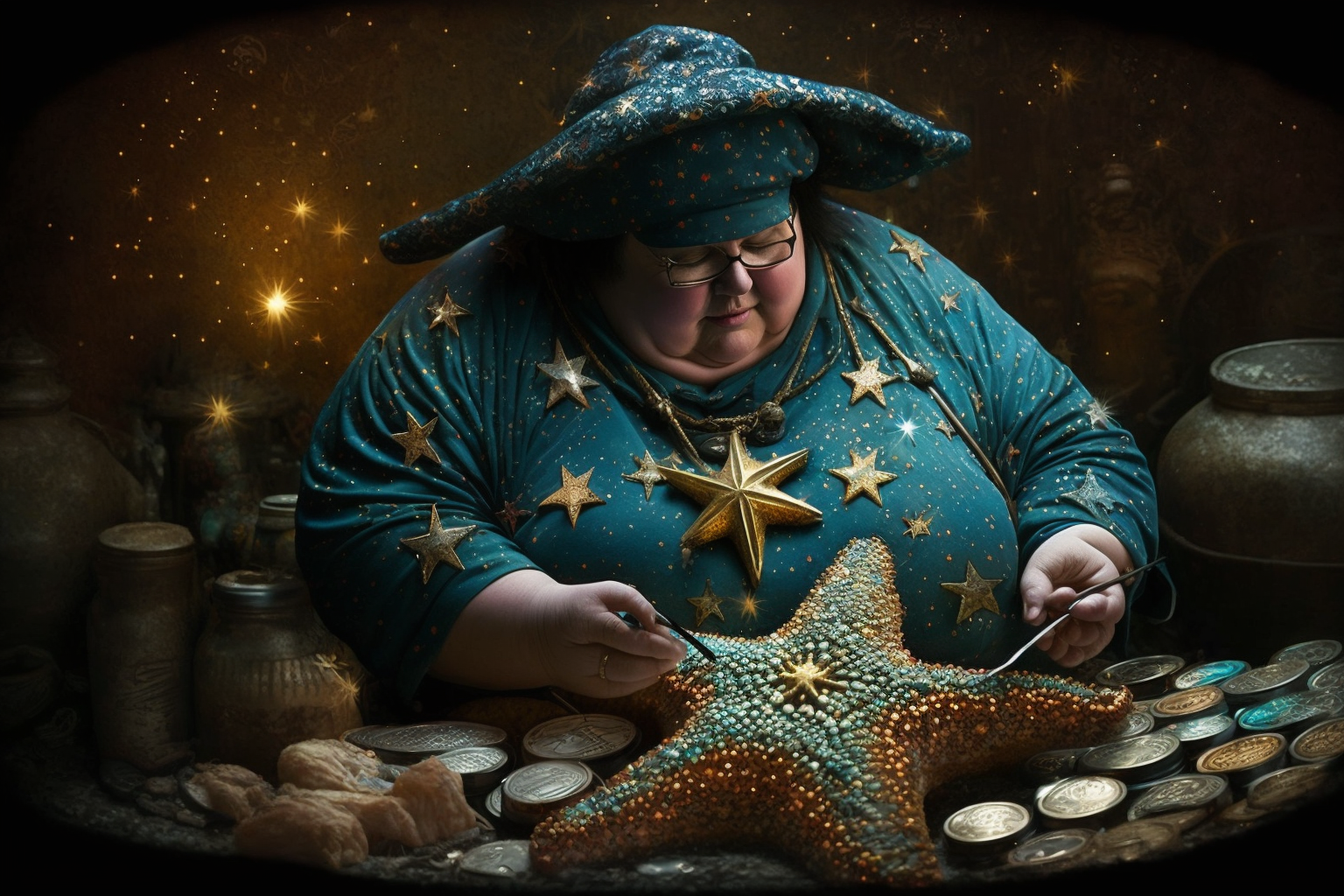 The shop was a mess. Crates full of stones, cardboard boxes and bubble wrappings. In the back, a plump woman, working on a giant starfish she held on her lap, was humming as she listened to loud rock music. Youssef recognised a song from the Last Shadow Puppets’ second album : The Element of Surprise. Apparently, the woman hadn’t heard him enter. She wore a dress and a hat sprinkled with golden stars, and her wrists were hidden under a ton of stone bracelets. The music track changed. The woman started shaking her head following the rhythm of the tune. She was gluing small red stones, she picked in a little box, on one of the starfish arms.
“Bad Habits! Uhu. Bad Habits! Uhu.”
Youssef moved closer. His shadow covered the starfish. The woman raised her head and screamed, scattering the red stones in her workshop. The starfish fell from her lap onto the ground with a thud.
“Oh! My! Little devil. Look at what you made me do. I lost my marbles,” she said with a high pitched laugh. “Your mother never taught you? That’s bad habit to creep up on people like that. You scared the sheep out of me!”
“I’m so sorry,” said Youssef, getting on his knees to help her gather the stones.
When they were all back in their box, Youssef got back on his feet. The woman looked a him with a softened face.
“You such a cutie with your bear shirt. You make me think of my Howard. He was as tall as you are. I’m Betsy, obviously” she said with a giggle, extending her hand to him.
They shook hands, making the pearls of her bracelets clink together.
“I’m Youssef.”

Youssef didn’t need to insist too much. Betsy was a real juke box of gossips. He just had to ask one question from time to time, and she would get going again. He was starting to feel his quirk could be more than a curse after all.
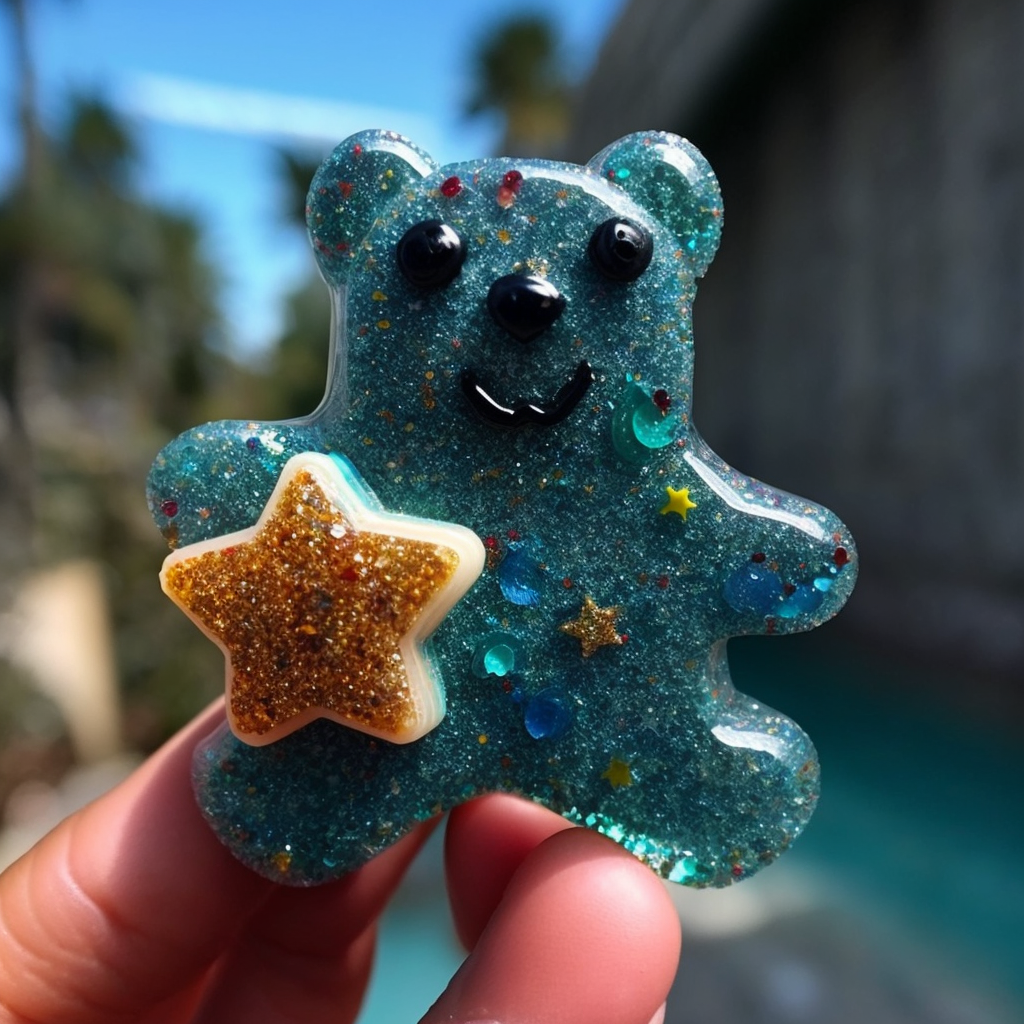
“When the tunnel collapsed,” Betsy said, “I was ready to give up the stone shop. The pain was too much to bear, everything in the shop reminded me of Howard. And in a miners’ town, who would want to buy stones anyway. We’ve been in bad terms with Idle and her family for some time, but that tragic incident coincided with her brother Fred’s disappearance. They thought at first Fred had died in the mines with Howard, because they spent so much time discussing together in Room 8 at the Inn. I overheard them once, talking about something they found in the mines. But Howard never told me, he was so secretive about that. We even had a fight, you know. But Fred, the children found some message later that suggested he had just left the family. Imagine, the children! Idle was pissed with him of course. Abandoning her with that mother of theirs and that money pit of an Inn and the rest of the family. And I needed company. So we started to get together on a regular basis. She would bring her special cakes, and we would complain about our lives. At some point she got involved with that shamanic stuff she found online, and she helped me find my totem Bear. It was quite a revelation. Bear suggested I diversify and open an online shop and start making orgonites. I love those little gummy bears so much. So, I followed Bear’s advice and it has been working like a charm ever since. That’s why I trusted you straight away, lad. Not ’cause of your cute face. You got the Bear in your heart,” she said putting her finger at the center of his chest.
My inner Bear, of course, thought Youssef. That’s the magnet. His phone buzzed. He took it out and saw he had an alert from the game and a message from his friends.
You found the source of your quirk, the magnetic pull that attracts talkative people to you.
Now obtain the silver key in the shape of a tongue to fulfil your quest.Zara : Where are you!?
 We’re at the bar, getting parched! They got Pale Ale!
“I have to go,” said Youssef.
“Wait,” said Betsy.
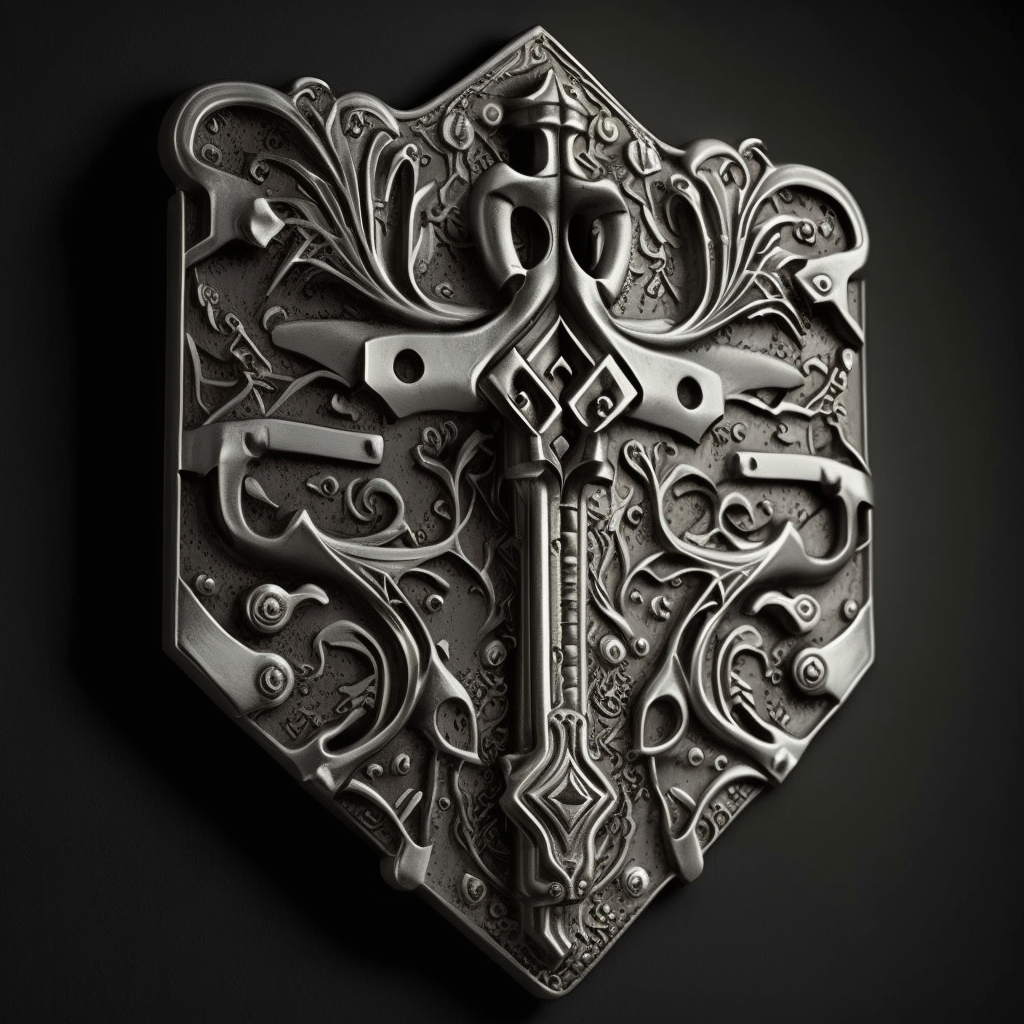
She foraged through her orgonite collection and handed Youssef one little gummy bear and an ornate metal badge.
“Bear wants me to give this to you. Howard made it. He said it was his forked tongue key.”
She looked at him, emotion in her eyes.
“I know you won’t listen if I tell you not to. So, be careful when you go into the mines.”
 February 19, 2023 at 8:12 am #6559
In reply to: Orbs of Madjourneys
Why do I always pick the cart with the wonky wheel, Zara thought, but she wasn’t going to go back and get another one and keep Sergio and Yasmin waiting outside. She zigzagged up and down the aisles until she came to the wine. What was it the old dear back at the Inn was saying about the alcohol laws in Alice? Well, surely that didn’t apply to tourists. There were two men chatting in the middle of the aisle and Zara deftly skirted around them without the unpredictable cart crashing. While she was perusing the wines hoping to find a nice Rioja, she couldn’t help but overhear the clear ringing tones of one of the men saying “True love never dies!” and a few other things which she later forgot, which she thought was quite an odd topic for two men to be discussing in the Piggly supermarket in the outback of all places. The man with the poetic voice went on his way, leaving the other man with the little girl in the child seat of the cart ready to move on, but Zara’s cart was straddled across the aisle so she quickly moved it out of the way and continued scanning the wine selection. A clear sweet voice rang out behind her. “Thank you.” She turned, and her eyes met those of the girl (afterwards Zara could have sworn the child was 10 or 11, and surely too big to be sitting in the baby seat, but yet felt sure the child had indeed been sitting in the cart). They exchanged a deep meaningful smile of magical proportions that defied explaining in mere words. Later when Zara told Yasmin about it, she said it was “one of those moments, you know?” and Yasmin understood what she meant. The child seemed somehow familiar, and there was that shimmery timeless oddness to the encounter which made Zara feel a bemused lightness.

Zara was still gazing at the rows of wine bottles when Yasmin caught up with her. “What’s taking you so long, you haven’t even got anything in your cart yet!”
Snapping her attention back, Zara asked Yasmin to help her choose the wine, asking her, “Do you ever feel like you can’t tell the difference between the game and real life? Like sometimes a scene in real life isn’t quite real?”
“I dunno about the game but real life seems strange enough. That woman outside with the BMW hire car that was in the loo before me, there was something familiar about her, something creepy. And look what I found in the cubicle,” Yasmin looked around quickly to make sure they were alone and pulled something out of her pocket.
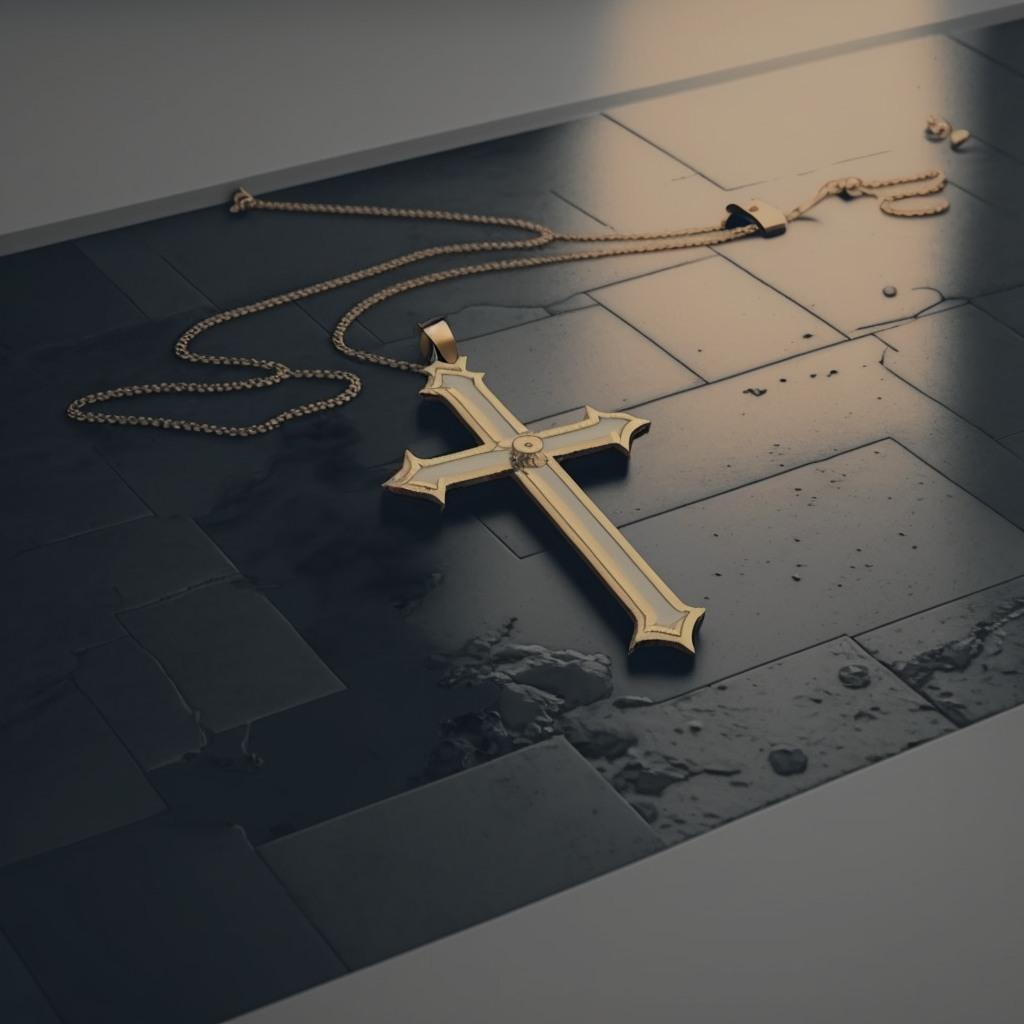
“Looks like the chain broke, is it gold? Might be worth something,” Zara was missing the point.
“It’s a crucifix.”
“If it’s gold it can be melted down and made into something else,” said Zara missing the point again.
“It’s the same as the ones the nuns at the orphanage wear,” Yasmins whisper turned into a nervous snort.
“I wonder who dropped it and what they were doing here. That tart in the BMW didn’t look like a nun to me.” Zara almost snorted too (was it contagious?) and then wondered why tart and nun sounded vaguely familiar and why yellow cabs had popped into her mind. “Come on, we’ve kept Sergio waiting long enough already.”
After all the deliberation over which wine to choose, they grabbed a half dozen bottles each without further ado and went to the checkout.
February 18, 2023 at 11:28 am #6551In reply to: Orbs of Madjourneys
Xavier had woken up in the middle of the night that felt surprisingly alive bursting with a quiet symphony of sounds from nocturnal creatures and nearby nature, painted on a canvas of eerie spacious silence.
It often took him a while to get accustomed to any new place, and it was not uncommon for him to have his mind racing in the middle of the night. Generally Brytta had a soothing presence and that often managed to nudge him back to sleep, otherwise, he would simply wake up until the train of thoughts had left the station.
It was beginning of the afternoon in Berlin; Brytta would be in a middle of a shift, so he recorded a little message for her to find when she would get back to her phone. It was funny to think they’d met thanks to Yasmin and Zara, at the time the three girls were members of the same photography club, which was called ‘Focusgroupfocus’ or something similar…
With that done, he’d turned around for something to do but there wasn’t much in the room to explore or to distract him sufficiently. Not even a book in the nightstand drawer. The decoration itself had a mesmerising nature, but after a while it didn’t help with the racing thoughts.He was tempted to check in the game — there was something satisfactory in finishing a quest that left his monkey brain satiated for a while, so he gave in and logged back in.

Completing the quest didn’t take him too long this time. The main difficulty initially was to find the portal from where his avatar had landed. It was a strange carousel of blue storks that span into different dimensions one could open with the proper incantation.
As usual, stating the quirk was the key to the location, and the carousel portal propelled him right away to Midnight town, which was clearly a ghost town in more ways than one. Interestingly, he was chatting on the side with Glimmer, who’d run into new adventures of her own while continuing to ask him what was up, and as soon as he’d reached Midnight town, all communication channels suddenly went dark. He’d laughed to himself thinking how frustrated Glimmer would have been about that. But maybe the game took care of sending her AI-generated messages simulating his presence. Despite the disturbing thought of having an AI generated clone of himself, he almost hoped for it (he’d probably signed the consent for this without realising), so that he wouldn’t have to do a tedious recap about all what she’d missed.
Once he arrived in the town, the adventure followed a predictable pattern. The clues were also rather simple to follow.
The townspeople are all frozen in time, stuck in their daily routines and unable to move on. Your mission is to find the missing piece of continuity, a small hourglass that will set time back in motion and allow the townspeople to move forward.
The clue to finding the hourglass lies within a discarded pocket watch that can be found in the mayor’s office. You must unscrew the back and retrieve a hidden key. The key will unlock a secret compartment in the town clock tower, where the hourglass is kept.
Be careful as you search for the hourglass, as the town is not as abandoned as it seems. Spectral figures roam the streets, and strange whispers can be heard in the wind. You may also encounter a mysterious old man who seems to know more about the town’s secrets than he lets on.
Evading the ghosts and spectres wasn’t too difficult once you got the hang of it. The old man however had been quite an elusive figure to find, but he was clearly the highlight of the whole adventure; he had been hiding in plain sight since the beginning of the adventure. One of the blue storks in the town that he’d thought had come with him through the portal was in actuality not a bird at all.
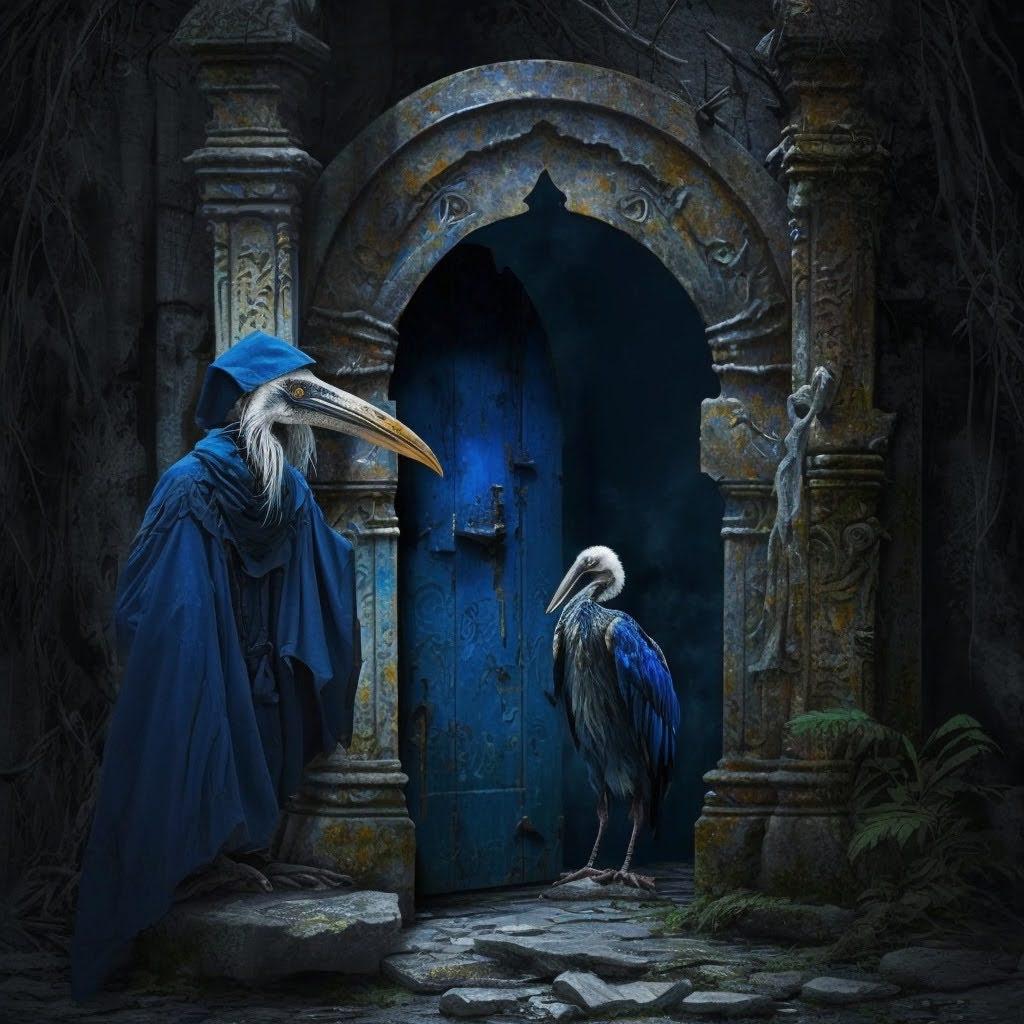
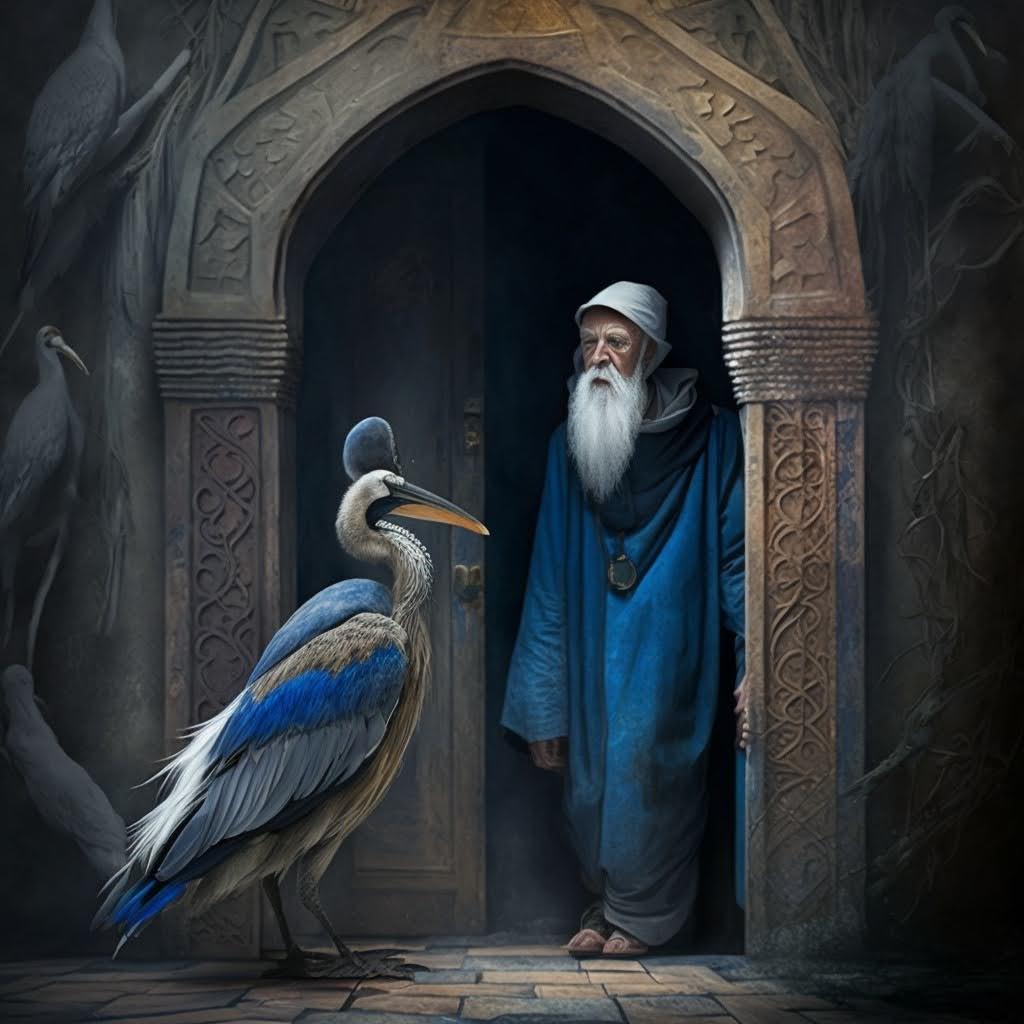
While he was focused on finishing the quest, the interaction with the hermit didn’t seem very helpful. Was he really from the game construct? When it was time to complete the quest and turn the hourglass to set the town back in motion, and resume continuity, some of his words came back to Xavier.
“The town isn’t what it seems. Recognise this precious moment where everything is still and you can realise it for the illusion that it is, a projection of your busy mind. When motion resumes, you will need to keep your mind quiet. The prize in the quest is not the completion of it, but the realisation you can stop the agitation at any moment, and return to what truly matters.”
The hermit had turned to him with clear dark eyes and asked “do you know what you are seeking in these adventures? do you know what truly matters to you?”
When he came out of the game, his quest completed, Xavier felt the words resonate ominously.
A buzz of the phone snapped him out of it.
It was a message from Zara. Apparently she’d found her way back to modernity.
[4:57] “Going to pick up Yasmin at the airport. You better sleep away the jetlag you lazy slugs, we have poultry damn plenty planned ahead – cackling bugger cooking lessons not looking forward to, but can be fun. Talk to you later. Z”
He had the impulse to go with her, but the lack of sleep was hitting back at him now, and he thought he’d better catch some so he could manage to realign with the timezone.
“The old man was right… that sounds like a lot of agitation coming our way…”
February 16, 2023 at 8:18 am #6550In reply to: Orbs of Madjourneys
“I’ve got something to tell you, too. Come on, you can meet him. He’s waiting in the car,” Zara told Yasmin as they made their way out of the arrivals hall at Alice Springs airport.
“Who the dickens is Sergio?” Yasmin replied, and then added, “You tart!” when Zara explained.
“That’s rich, coming from you, you old slapper,” Zara laughed, giving Yasmin an affectionate elbow poke. “He’s leaving tomorrow, so when he phoned this morning inviting me out sightseeing, I couldn’t refuse. Xavier and Youssef weren’t up yet when I left, lazy buggers. They’re an odd family at the Inn, and it’s a funny old place. Some strange undercurrents though, I can’t put my finger on it. Secrets, you know? Why, what’s up?” Yasmin had given her a funny look, but as they had just reached the hire car, Yasmin whispered “Tell you later!”
February 15, 2023 at 7:59 pm #6548In reply to: Orbs of Madjourneys
Made it through customs with the parcel. Should be at the hotel early this evening.
Finally a message from Yasmin. Zara replied: Finally, a message, wondered where you’d got to!
With an affectionate smile Yasmin pretended to roll her eyes.
 I’ve got something very odd to tell you when I see you. Gotta go, talk later
Bloody typical! Zara thought, rolling her eyes.
February 13, 2023 at 7:45 am #6541In reply to: Orbs of Madjourneys
When Sergio dropped her back at the Flying Fish Inn it was later than Zara realized. The verandah and reception lights were on but everyone had gone to bed, everyone except Idle who was poring over a pile of old notebooks at a dining room table. “Good day out?” she looked up over the top of her reading glasses and smiled at Zara.
Zara returned the smile. “It was great, thanks! I’d love one”, she added when Idle asked her if she fancied a glass of wine.
“Grab a glass off the sideboard there and come and sit down,” Idle said. “Are you hungry or did you grab a bite in Alice?”
“Yeah, I did, thanks,” replied Zara, trying hard not to pull a face at the first sip of the Australian wine. “Nice label,” she said, “Yellow Trail. I should be used to seeing kangaroos on wine bottles by now” she laughed.
“A place called Monte’s Lounge,” she replied when Idle asked where she’d eaten, “A cabaret meets circus theme, not what I was expecting out here. I met a guy on the trail…”
“The plot thickens,” Idle grinned, “Comedy and romance.”
Zara laughed, warming to her genial host. Accepting a second glass of wine, she told Idle all about Sergio. He was a Spanish archaeologist who had come over to see his daughter in Townsville on the east coast, and had booked a few side trips to see some of the indigenous rock art. When Zara walked off the trail after she found the compass (and the damn parrot vanished, leaving her alone) she had found herself in a small clearing with high rocky sides. Sergio had his back to her and was photographing the rock wall.
“Well, long story short, we got on like a house on fire,” Idle smiled encouragingly as Zara continued. “It’s been absolutely ages you know, ever since I left Rupert, nobody’s really taken my fancy. Anyway he invited me for dinner and said he didn’t mind bringing me back here later in the hire car.”
Zara had another sip of wine, thinking about Rupert. What a prize twat he’d turned out to be. Still, the divorce settlement had been good. He’d seemed so adventurous and just the ticket at first, lots of holidays in unusual places. Bit of a Hooray Henry and a Champagne Charlie, but it had been fun at first. And a tad too much charlie, too. She had been blissfully unaware of politics and conspiracy theories at the time, but it wasn’t long before his views came between them and she could no longer stomach his idiotic and, to her mind, dangerously cretinous beliefs.
“My parents are both archaeologists,” Zara told Idle, “I learned a lot from them and always been interested in it, but didn’t fancy all the years of studying, and I really wanted to work with animals. There aren’t many good paying jobs working with animals though, not the kind of animals that need helping. Anyway, it worked out ok in the end, thanks to Rupert’s money.”
“You must have had a lot in common to talk about with Sergio, then, him being an archaeologist,” Idle remarked and Zara felt herself blush, much to her astonishment. She couldn’t recall blushing in years.
“Yes we did do some talking,” they both laughed and Zara said “I better get off to bed. Thanks for the wine.”
Zara had completely forgotten about her friends arriving, or the game she’d intended to play until they arrived. She collapsed on the bed without brushing her teeth and was asleep within minutes.
February 7, 2023 at 9:54 pm #6509In reply to: A Dog and a Dig – The trenches of the Time Capsule
Table of characters:
Characters Keyword Characteristics Sentiment Clara Woman in her late 40s, VanGogh’s owner Inquisitive, curious VanGogh Clara’s dog Curious Grandpa Bob Clara’s grandfather, widowed, early signs of dementia Skeptical, anxious Nora Clara’s friend, amateur archaeologist, nicknamed Alienor by Clara Adventure-seeking Jane Grandpa Bob’s wife, Clara’s mother, only Bob seem to see her, possibly a hallucination Teasing Julienne / Mr. Willets Neighbors of Clara & Bob – Bubbles (Time-dragglers squad, alternate timeline) Junior drag-queen, reporting to Linda Pol (office manager) adventurous, brave, concerned Will After Nora encountered a man with a white donkey, she awakes in a cottage. Will is introduced later, and drugs Nora unbeknownst to her. Later Bob & Clara come at his doorstep (they know him as the gargoyle statues selling man from the market), looking for her friend. Affable, mysterious, hiding secrets Some connecting threads:
- The discovery of a mysterious pear-shaped box with inscriptions by Clara and her grandfather.
- Clara sending photos of the artifact to Nora (Alienor), an amateur archaeologist.
- Nora’s journey from her place to reach the location where the box was discovered and her encounter with a man with a donkey (Will?).
- Grandpa Bob’s anxious behavior and the confusion over the torn piece of paper with a phone number.
- The parallel timeline of a potential breach in the timelines in Linda Pol’s office.
- The search for VanGogh and the discovery of a map tucked into his collar.
- The suggestion from Jane that Clara should be told something.
- Nora awakes at a cottage and spends time with Will who drugs her soup. Bob & Clara show up later, looking for her.
February 2, 2023 at 2:47 pm #6491In reply to: Newsreel from the Rim of the Realm
Sophie was glad she could help that young guy Youssef get out of this mess with that false ingenue. She was clearly not for him, he needed someone more mature who would know how to handle his big body. She looked at Miss Bossy Pants’ office. Ricardo was there again and they seem to be in another of their grand discussions. When Miss Bossy saw Sophie watching, she moved to the big window and shut the venetian blind. What were they all about, always plotting things in the back of their journalists. If Sophie didn’t have an ounce of ethic, she would have RVed them long ago, but she made a point to only use her abilities for good, and at times good gossip with friends.
She went out to the elevator and called it. While she waited, she started writing a message : “The boy is on his way. I did like you asked. Now book me a place to that Akashic Record training as promised.”
The answer came only a few seconds later : “consider it done”
The elevator bell rang and the door opened. Sophie got in with a big satisfied smile on her face.”
February 1, 2023 at 12:12 pm #6486In reply to: Orbs of Madjourneys
Zara took dozens of screenshots of the many etchings and drawings, as her game character paused to do the same. She had lost sight of the two figures up ahead, and remembered she probably should have been following them.
The tunnel came to a four way junction. There were drawings on the walls and floors of all of them, and a dim light coming from a distance in each. One was more brightly lit than the others, and Zara chose to explore that one first. Presently a side room appeared, with green tiles on the floor similar to the one at the mine entrance. Daylight shone though a small window, and a diagram was drawn onto the wall.
Zara toyed with the idea of simply climbing out through the window while there was still a chance to get out of the mine. She knew she was lost and would not be able to find her way out the way she came. It was tempting, but she just took a screenshot. Maybe when she looked at them later she’d be able to work out how to retrace her steps.
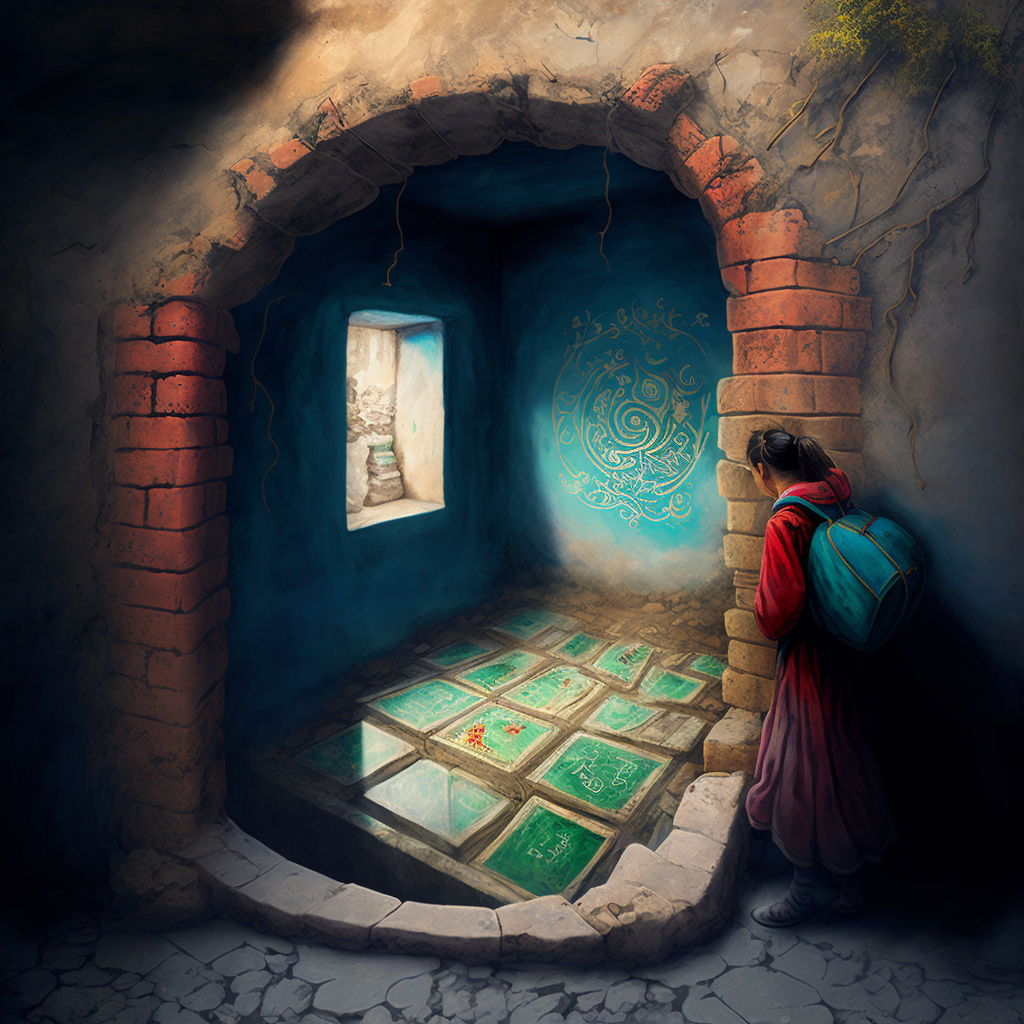
After recording the image of the room of tiles, Zara continued along the tunnel. The light shining from the little window in the tile room faded as she progressed, and she found herself once again in near darkness. She came to a fork. Both ways were equally gloomy, but a faint blue light enticed her to take the right hand tunnel.
So many forks and side tunnels, I am surely completely lost now! And not one of these supposed maps is helping, I can’t decipher any of them. Another etching on the wall caught her eye, and Zara forgot about being lost.
Zara stopped to look at what appeared to be a map on the tunnel wall, but it was unfathomable at this stage. She recorded it for future reference, and then looked around, unsure whether to continue on this path or retrace her stops back to the four way junction. And then she saw him in an alcove.
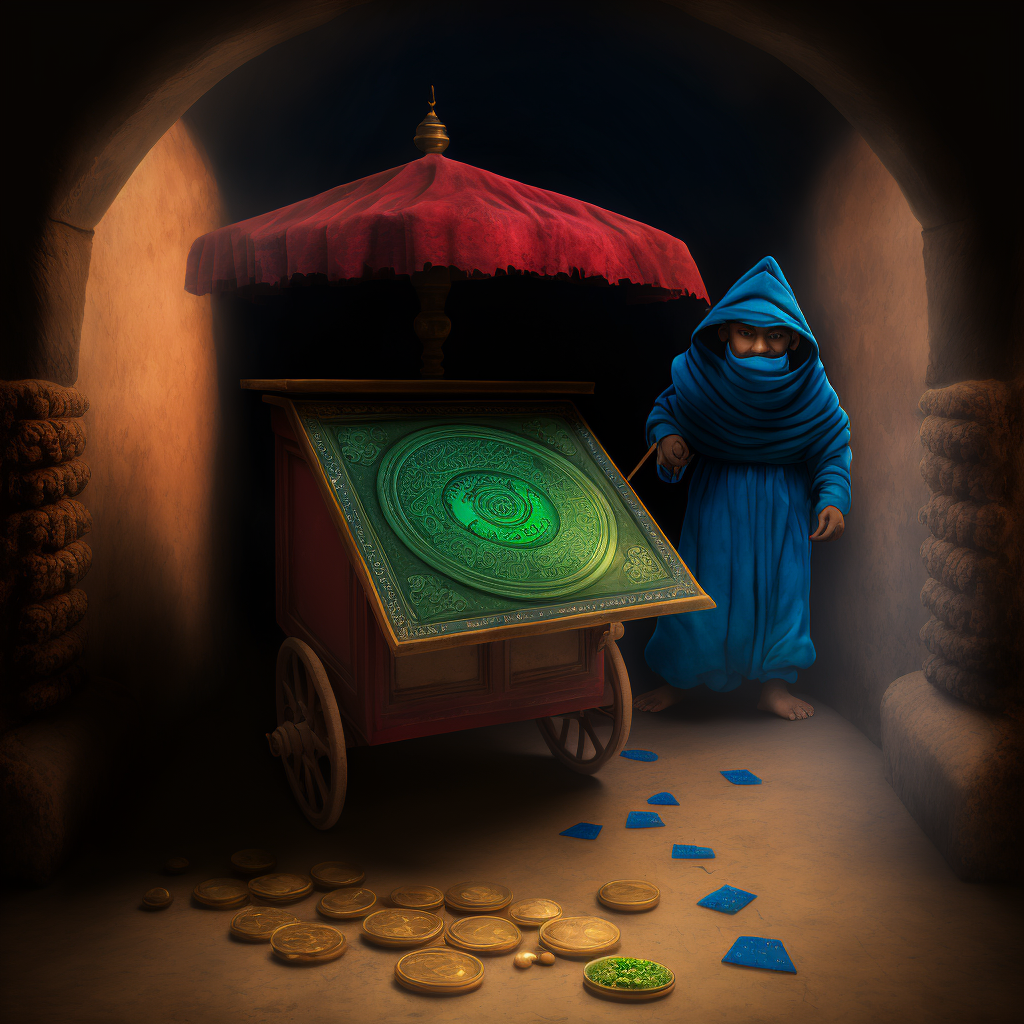
Osnas! This time Zara did say it out loud, and just as the frog faced stewardess was passing with her cart piled with used cups and cans and empty packets. I swear she just winked at me! Zara did a double take, but the cart and the woman had passed, collecting more rubbish.
With a little smile, Zara noticed that the mask Osnas was wearing was one of those paper pandemic masks. She had expected something a bit more Venice carnival when the prompt mentioned that he always wore a mask, not one of those. She hoped the clue in this case wasn’t the mask, as she had avoided the plague successfully so far and didn’t want to be late to that particular party, but the square green thing on his cart resembled the tile at the mine entrance. What do I do now though? I still don’t know what any of these things mean. Approach him and see if he speaks I suppose.
“Ladies and gentlemen, we are now approaching Alice Springs, please fasten your seatbelts and switch off all your devices ready for landing. We hope you have enjoyed your flight.”
January 31, 2023 at 11:58 am #6478In reply to: Orbs of Madjourneys
“One of them’s arriving early!” Aunt Idle told Mater who had just come swanning into the kitchen with her long grey hair neatly plaited and tied with a red velvet bow. Ridiculous being so particular about her hair at her age, Idle thought, whose own hair was an untidy and non too clean looking tangle of long dreadlocks with faded multicolour dyes growing out from her grey scalp. “Bert’s going to pick her up at seven.”
“You better get a move on then, the verandah needs sweeping and the dining room needs dusting. Are the bedrooms ready yet?” Mater replied, patting her hair and pulling her cardigan down neatly.
“Plenty of time, no need to worry!” Idle said, looking worried. “What on earth was that?” Something bright caught her eye through the kitchen window.
“Never mind that, make a start on the cleaning!” Mater said with a loud tut and an eye roll. Always getting distracted, that one, never finishes a job before she’s off sidetracking. Mater gave her hair another satisfied pat, and put two slices of bread in the toaster.
But Aunt Idle had gone outside to investigate. A minute or two later she returned, saying “You’ll never guess what, there’s a tame red parrot sitting on the porch table. And it talks!”
“So you’re planning to spend the day talking to a parrot, and leave me to do all the dusting, is that it?” Mater said, spreading honey on her toast.
 January 31, 2023 at 11:34 am #6477
In reply to: Orbs of Madjourneys
Bertie dropped Zara off at the bus station in Camden early the next morning. She let him think she was catching a plane from Sydney, given her impulsive lie about having to meet her friends sooner, but she was going by train. The reviews she’d read online were tantalizing:
“The Ghan journey tells the story of the land. The train is the canvas, and the changing landscape paints the picture.”
A two day train ride would give her time to relax and play the game, and she assumed two days of desert scenery would not be too distracting. Luckily before she paid for her ticket she had the presence of mind to ask if there was internet on the train. There was not. Zara sighed, and booked a flight instead, but decided she would catch the train back home after the holiday at the Flying Fish Inn. By then perhaps the novelty of the game would have worn off, and she would appreciate the time spent in quiet contemplation, and perhaps do some writing.
Zara hated flying, especially airports. The best that could be said of flying was that it was a quick way to get from A to B.
“You’ll have to go in a cage for the flight, Pretty Girl,” she told the parrot.
“I think not,” replied Pretty Girl. “I’ll meet you there. See you!” and off she flew into the low morning sun, momentarily blinding Zara as she watched her go.
Her flight left Sydney at 14:35. Three and a half hours later she would arrive at Alice Springs and from there it was a half hour road trip to the Flying Fish. Zara sent an email to the inn asking if anyone could pick her up, otherwise she would get a bus or a taxi. She received a reply saying that they’d send Bert to pick her up around seven o’clock. Another Bert!
January 29, 2023 at 9:30 pm #6470In reply to: Orbs of Madjourneys
Put your thoughts to sleep. Do not let them cast a shadow over the moon of your heart. Let go of thinking.
~ RumiTired from not having any sleep, Zara had found the suburb of Camden unattractive and boring, and her cousin Bertie, although cheerful and kind and eager to show her around, had become increasingly irritating to her. She found herself wishing he’d shut up and take her back to the house so she could play the game again. And then felt even more cranky at how uncomfortable she felt about being so ungrateful. She wondered if she was going to get addicted and spent the rest of her life with her head bent over a gadget and never look up at the real word again, like boring people moaned about on social media.
Maybe she should leave tomorrow, even if it meant arriving first at the Flying Fish Inn. But what about the ghost of Isaac in the church, would she regret later not following that up. On the other hand, if she went straight to the Inn and had a few days on her own, she could spend as long as she wanted in the game with nobody pestering her. Zara squirmed mentally when she realized she was translating Berties best efforts at hospitality as pestering.
Bertie stopped the car at a traffic light and was chatting to the passenger in the next car through his open window. Zara picked her phone up and checked her daily Call The Whale app for some inspiration.
Let go of thinking.
A ragged sigh escaped Zara’s lips, causing Bertie to glance over. She adjusted her facial expression quickly and rustled up a cheery smile and Bertie continued his conversation with the occupants of the other car until the lights changed.
“I thought you’d like to meet the folks down at the library, they know all the history of Camden,” Bertie said, but Zara interrupted him.
“Oh Bertie, how kind of you! But I’ve just had a message and I have to leave tomorrow morning for the rendezvous with my friends. There’s been a change of plans.” Zara astonished herself that she blurted that out without thinking it through first. But there. It was said. It was decided.
January 29, 2023 at 2:30 pm #6467In reply to: Newsreel from the Rim of the Realm
“Ricardo, my dear, those new reporters are quite the catch.”
Miss Bossy Pants remarked as she handed him the printed report. “Imagine that, if you can. A preliminary report sent, even before asking, AND with useful details. It’s as though they’re a new generation with improbable traits definitely not inherited from their forebearers…”
Ricardo scanned the document, a look of intrigue on his face. “Indeed, they seem to have a knack for getting things done. I can’t help but notice that our boy Sproink omitted that Sweet Sophie had used her remote viewing skills to point out something was of interest on the Rock of Gibraltar. I wonder how much that influenced his decision to seek out Dr. Patelonus.”
Miss Bossy Pants leaned back in her chair, a sly smile creeping across her lips. “Well, don’t quote me later on this, but some level of initiative is a valuable trait in a journalist. We can’t have drones regurgitating soothing nonsense. We need real, we need grit.” She paused in mid sentence. “By the way, heard anything from Hilda & Connie? I do hope they’re getting something back from this terribly long detour in the Nordics.”
Dear Miss Bossy Pants,
I am writing to give you a preliminary report on my investigation into the strange occurrences of Barbary macaques in Cartagena, Spain.
Taking some initiative and straying from your initial instructions, I first traveled to Gibraltar to meet with Dr. Patelonus, an expert in simiantics (the study of ape languages). Dr. Patelonus provided me with valuable insights into the behavior of Barbary macaques, including their typical range and habits and what they may be after. He also mentioned that the recent reports of Barbary macaques venturing further away from their usual habitat in coastal towns like Cartagena is highly unusual, and that he suspects something else is influencing them. He mentioned chatter on the simian news netwoke, that his secretary, a lovely female gorilla by the name of Barbara was kind enough to get translated for us.
I managed to find a wifi spot to send you this report before I board the next bus to Cartagena, where I plan to collect samples and observe the local macaque population. I have spoken with several tourists in Gib’ who have reported being assaulted and having their shoes stolen by the apes. It is again, a highly unusual behaviour for Barbary macaques, who seem untempted by the food left to appease them as a distraction, and I am currently trying to find out the reason behind this.
As soon as I gather them, I will send samples collected in situ without delay to my colleague Giles Gibber at the newspaper for analysis. Hopefully, his findings will shed some light on the situation.
I will continue my investigation and keep you appraised on any new developments.
Sincerely,
Samuel Sproink
Rim of the Realm Newspaper.January 29, 2023 at 12:01 pm #6465In reply to: Orbs of Madjourneys
Given the new scenery unfolding in front of him, it was time for a change into more appropriate garments.

Luckily, the portal he’d clicked on came with some interesting new goodies. Xavier skimmed over some of the available options, until he found an interesting pair of old boots.
Looking at the old worn leather boots that had appeared in Xavier’s bag, he felt they would be quite appropriate, and put them on.
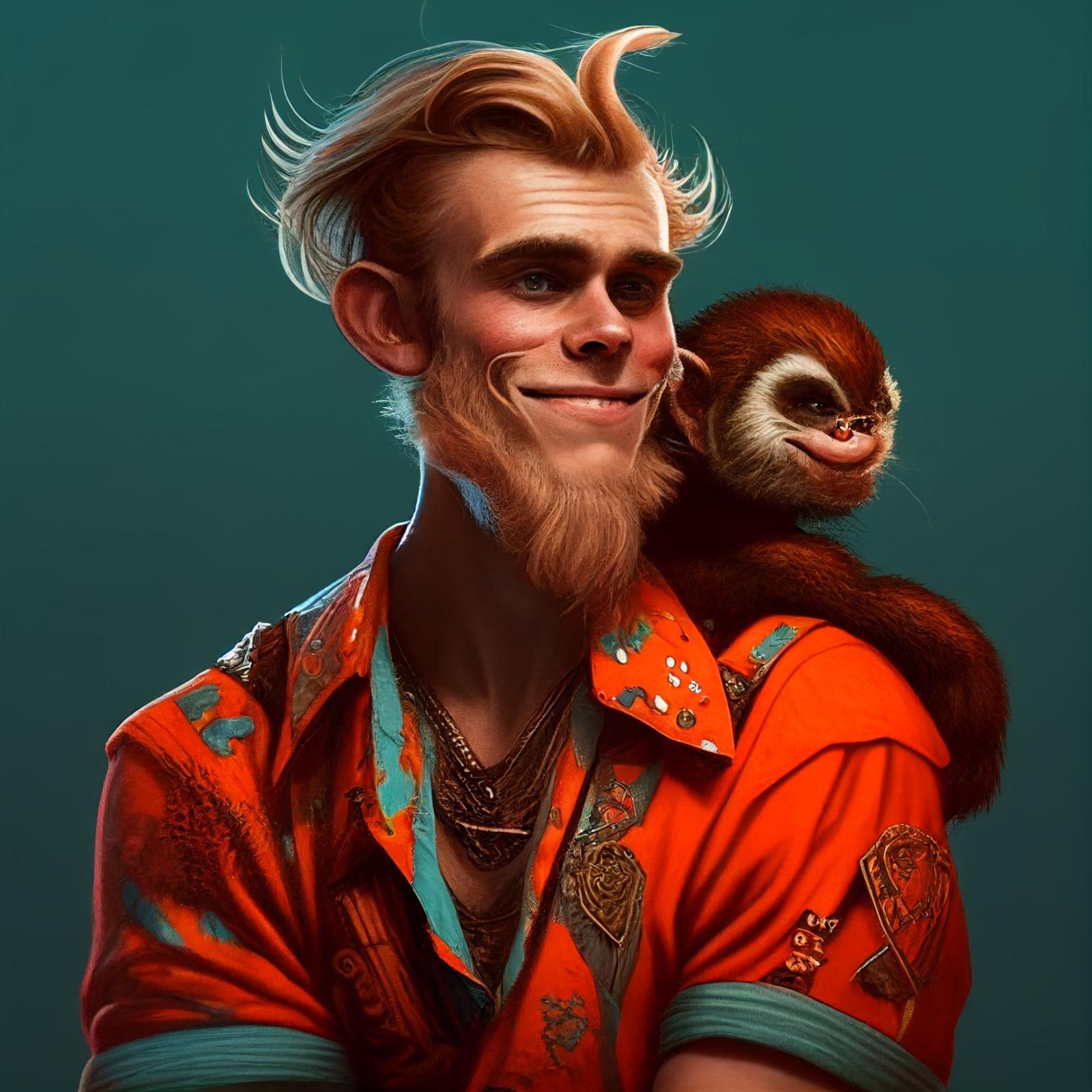 The changes were subtle, but Xavier already felt more in character with the place.
Suddenly a capuchin monkey jumped on his shoulder and started to pull his ear to make it to the casino boat.The too friendly, potentially mischievous pickpocketing monkey seemed a bit of a trope, but Xavier found the creature endearing.
“Let’s go then! Seems like this party is waiting for us.” he said to the excited monkey.
He jumped into one of the dinghy doing the rounds to the boat with some of the customers.
“Ahoy there, matey!” a rather small man with a piercing blue eye and massive top hat said, giving Xavier a sideways glance. He had an eerie presence and seemed very imposing for such a small frame. “The name’s Sproink, and ye be a first-timer, I see.” he said as a casual matter of introduction.

“Nice to meet you sir” Xavier said distractedly, as he was taking in all the details in the curious boat lit by lanterns dangling in the soft wind.
“Yer too polite for these parts, me friend,” Sproink guffawed. “But have no fear, Sproink’s got yer back.” He winked at the capuchin, Xavier couldn’t help but notice, and suddenly realised that the monkey truly belonged to Sproink.
“No need to check yer pockets, matey” Sproink smiled “I have me sights set on far more interesting game than yer trinkets.” He handed him back some of the stuff that the capuchin had managed to spirit away unnoticed. “But watch yerself, matey. Not all the folk here be what they seem.”
“Point taken!” Xavimunk was indeed a bit too naive, but if anything, that’d often managed to keep him out of trouble. As the small wiry guy left with his bag of tricks in a springy gait, he turned to check his shoulder, and the monkey had disappeared somewhere on the boat too. Xavier was left wondering if he’d see more of him later.
 “Welcome, welcome, me hearties!” a buxom girl of large stature with a baroque assortment of feathers and garish colours was a the entrance chewing on a straw, and looking as though the place belonged to her. But there was something else, she was too playing a part, and didn’t seem from here.
She leaned conspiratorially towards Xavier, and dragged him in a corner.
“Yer a naughty monkey, ignoring me prompts,” she said. “Was I too discrete, or what?”
“Wait, what?” Xavier was confused. Then he remembered the strange message. “Wait a minute… you’re Glimble… something, with unicorns shit or something?” He didn’t have time to entertain the young geek gamers, they were too immature, and well… a lot more invested in the game than he was, they would often turn seriously creepy.
“Oi, come on now!” she raised her hands and shook herself violently. She had turned into a different version of herself. “Now, is it better? It’s true, them avatars easily turn into ava-tarts if you ask me. But you can’t deny a lady a bit o’ comfort with a wrinkle filter. They went a bit overboard with this one, if you ask me.”
“Let’s start again. Glimmer Gambol, and nice to meet you young man.”
 January 23, 2023 at 6:13 am #6448
In reply to: Orbs of Madjourneys
In the muggy warmth of the night, Yasmin tossed and turned on her bed. A small fan on the bedside table rattled noisily next to her but did little to dispel the heat. She kicked the thin sheet covering her to the ground, only to retrieve it and gather it tightly around herself when she heard a familiar sound.
“You little shit,” she hissed, slapping wildly in the direction of the high pitched whine.
She could make out the sound of a child crying in the distance and briefly considered getting up to check before hearing quick footsteps pass her door. Sister Aliti was on duty tonight. She liked Sister Aliti with her soft brown eyes and wide toothy smile — nothing seemed to rattle her. She liked all the Nuns, perhaps with the exception of Sister Finnlie.
Sister Finnlie was a sharp faced woman who was obsessed with cleanliness and sometimes made the children cry for such silly little things … perhaps if they talked too loudly or spilled some crumbs on the floor at lunch time. “Let them be, Sister,” Sister Aliti would admonish her and Sister Finnlie would pinch her lips and make a huffing noise.
The other day, during the morning reflection time when everyone sat in silent contemplation, Yasmin had found herself fixated on Sister Finnlie’s hands, her thin fingers tidily entwined on her lap. And Yasmin remembered a conversation with her friends online about AI creating a cleaning woman with sausage fingers. “Sometimes they look like a can of worms,” Youssef had said.
And, looking at those fingers and thinking about Youssef and the others and the fun conversations they had, Yasmin snort laughed.
She had tried to suppress it but the more she tried the more it built up inside of her until it exploded from her nose in a loud grunting noise. Sister Aliti had giggled but Sister Finnlie had glared at Yasmin and very pointedly rolled her eyes. Later, she’d put her on bin cleaning duty, surely the worst job ever, and Yasmin knew for sure it was pay back.
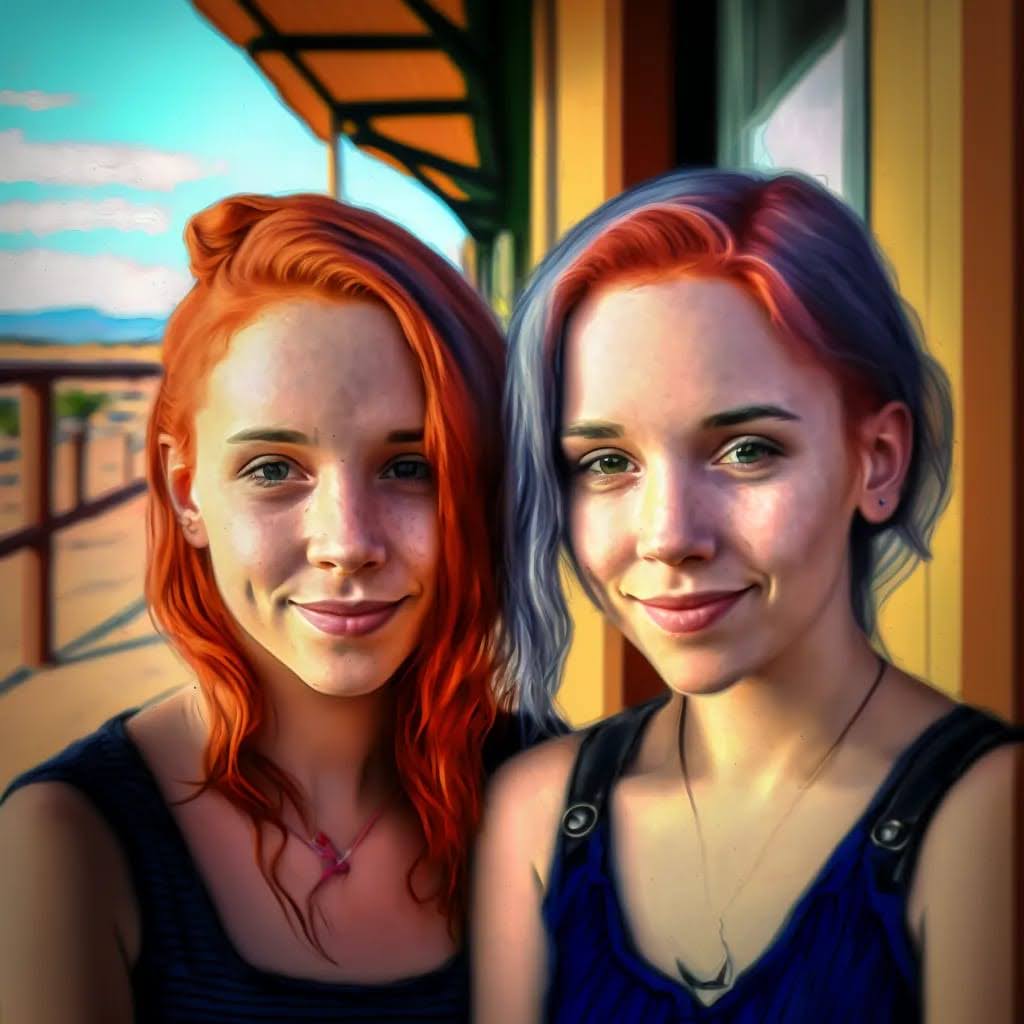
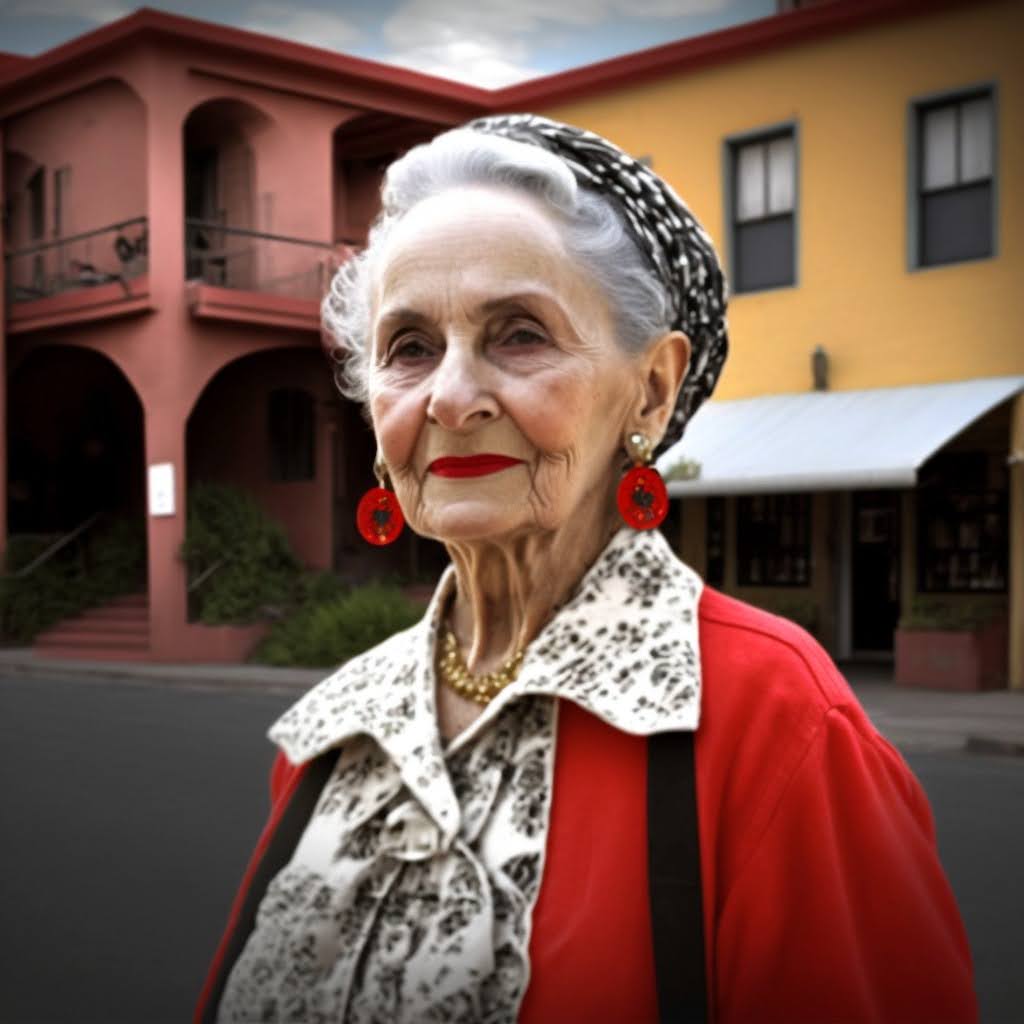
January 21, 2023 at 9:58 pm #6428I must become sentimental or something, but here are some pictures I found left on my desk.
Probably a gift from Finly, she can be all soft and think she’s doing me some service.
I must say my grand-children in particular are not too bad looking. Couldn’t find a picture of Fred though… Maybe later.










 January 17, 2023 at 8:17 am #6393
In reply to: Train your subjective AI – text version
Give me an unusual plot structure for a narrative
One unusual plot structure for a narrative could be a “reverse chronological” structure, where the story begins at the end and works backwards in time, revealing events and information in a non-linear way. Another could be a “choose your own adventure” style, where the reader is presented with a series of choices at different points in the story that determine the direction and outcome of the plot.
How would role playing qualify in terms of plot structure?
Role-playing games (RPGs) can be considered a unique form of plot structure because they are interactive and open-ended. In a traditional RPG, the players take on the roles of characters within a fictional setting and work together to create a shared narrative. The plot structure of an RPG is determined by the actions and decisions of the players, rather than a pre-written script. The game master (GM) creates an overarching plot and a set of rules for the players to follow, but the players’ choices and actions will determine the direction and outcome of the story. This makes the plot structure of an RPG fluid and ever-changing, unlike a traditional linear narrative.
What about “Cloud Atlas” in terms of plot structure?
“Cloud Atlas” is a novel written by David Mitchell that was later adapted into a film. It has a complex and non-linear plot structure, which employs multiple storylines that are set in different time periods and locations, and are connected by recurring themes and motifs. The novel is divided into six nested stories, each set in a different time period and location, that are told in a non-linear fashion. The story begins in the 19th century and then jumps back and forth between the 19th, 20th and 23rd century, and each story is interconnected and interrelated, with characters reappearing in different time periods, the events that happen in one story impacting the others. The novel is also notable for its use of different genres, such as science fiction, historical fiction, and thriller, and the way it explores the themes of destiny, reincarnation, and the power of human connection. The film adaptation also used this structure, with the different stories intertwined and characters reprising their roles in different settings and eras.
Take a story thread made of comments. In each comment is a text about characters in a particular plot, location, action etc. The comments are sequential, but they are not necessarily continuous. It is a mix between Cloud Atlas and RPG plot structures. How do you sort something that’s fundamentally non-linear to present it in an accessible way?
One way to sort and present a story thread made of comments that is fundamentally non-linear, yet accessible, is to group the comments based on their content. For example, you could group the comments by characters, and present them in chronological order of their appearance in the story. Another way could be grouping the comments by location, and present them in chronological order of when the action takes place in that particular location. You could also group comments by the type of action taking place, such as combat, conversation, or puzzle-solving, and present them in chronological order of when they occur in the story.
Another approach could be using visual aids, such as mind maps, timelines, or flowcharts, to help organize and present the information in a clear and easy-to-understand way. For example, you could use a mind map to show how different characters are connected, or a timeline to show the chronology of events. Additionally, you could use labels, such as “character introduction,” “location change,” or “plot twist,” to make it clear to the reader what type of information they can expect in each comment.
It’s also important to keep in mind the audience for which you are organizing the story. It should be easy for them to understand and follow the story, and if it’s a game, you should make sure it’s easy for the players to play and make decisions.
December 6, 2022 at 2:17 pm #6350In reply to: Family Stories From The Other Side ~ Book Two
Transportation
Isaac Stokes 1804-1877
Isaac was born in Churchill, Oxfordshire in 1804, and was the youngest brother of my 4X great grandfather Thomas Stokes. The Stokes family were stone masons for generations in Oxfordshire and Gloucestershire, and Isaac’s occupation was a mason’s labourer in 1834 when he was sentenced at the Lent Assizes in Oxford to fourteen years transportation for stealing tools.
Churchill where the Stokes stonemasons came from: on 31 July 1684 a fire destroyed 20 houses and many other buildings, and killed four people. The village was rebuilt higher up the hill, with stone houses instead of the old timber-framed and thatched cottages. The fire was apparently caused by a baker who, to avoid chimney tax, had knocked through the wall from her oven to her neighbour’s chimney.
Isaac stole a pick axe, the value of 2 shillings and the property of Thomas Joyner of Churchill; a kibbeaux and a trowel value 3 shillings the property of Thomas Symms; a hammer and axe value 5 shillings, property of John Keen of Sarsden.
(The word kibbeaux seems to only exists in relation to Isaac Stokes sentence and whoever was the first to write it was perhaps being creative with the spelling of a kibbo, a miners or a metal bucket. This spelling is repeated in the criminal reports and the newspaper articles about Isaac, but nowhere else).
In March 1834 the Removal of Convicts was announced in the Oxford University and City Herald: Isaac Stokes and several other prisoners were removed from the Oxford county gaol to the Justitia hulk at Woolwich “persuant to their sentences of transportation at our Lent Assizes”.
via digitalpanopticon:
Hulks were decommissioned (and often unseaworthy) ships that were moored in rivers and estuaries and refitted to become floating prisons. The outbreak of war in America in 1775 meant that it was no longer possible to transport British convicts there. Transportation as a form of punishment had started in the late seventeenth century, and following the Transportation Act of 1718, some 44,000 British convicts were sent to the American colonies. The end of this punishment presented a major problem for the authorities in London, since in the decade before 1775, two-thirds of convicts at the Old Bailey received a sentence of transportation – on average 283 convicts a year. As a result, London’s prisons quickly filled to overflowing with convicted prisoners who were sentenced to transportation but had no place to go.
To increase London’s prison capacity, in 1776 Parliament passed the “Hulks Act” (16 Geo III, c.43). Although overseen by local justices of the peace, the hulks were to be directly managed and maintained by private contractors. The first contract to run a hulk was awarded to Duncan Campbell, a former transportation contractor. In August 1776, the Justicia, a former transportation ship moored in the River Thames, became the first prison hulk. This ship soon became full and Campbell quickly introduced a number of other hulks in London; by 1778 the fleet of hulks on the Thames held 510 prisoners.
Demand was so great that new hulks were introduced across the country. There were hulks located at Deptford, Chatham, Woolwich, Gosport, Plymouth, Portsmouth, Sheerness and Cork.The Justitia via rmg collections:
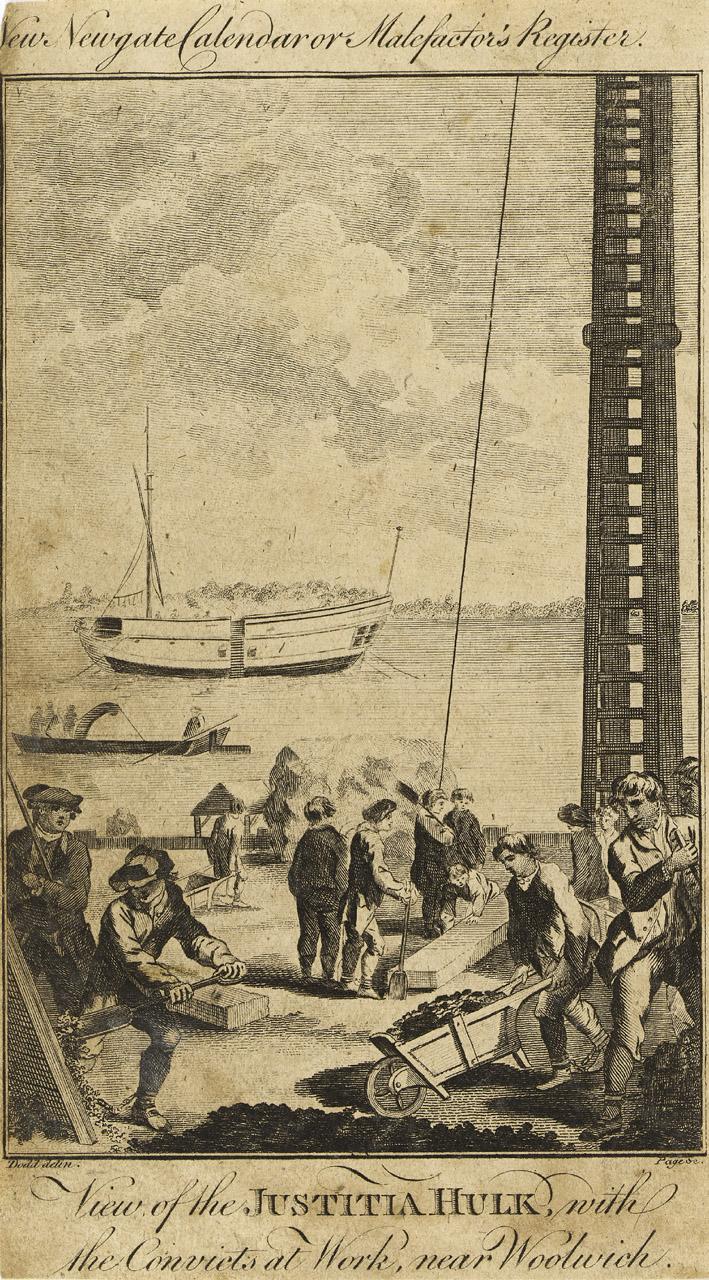
Convicts perform hard labour at the Woolwich Warren. The hulk on the river is the ‘Justitia’. Prisoners were kept on board such ships for months awaiting deportation to Australia. The ‘Justitia’ was a 260 ton prison hulk that had been originally moored in the Thames when the American War of Independence put a stop to the transportation of criminals to the former colonies. The ‘Justitia’ belonged to the shipowner Duncan Campbell, who was the Government contractor who organized the prison-hulk system at that time. Campbell was subsequently involved in the shipping of convicts to the penal colony at Botany Bay (in fact Port Jackson, later Sydney, just to the north) in New South Wales, the ‘first fleet’ going out in 1788.
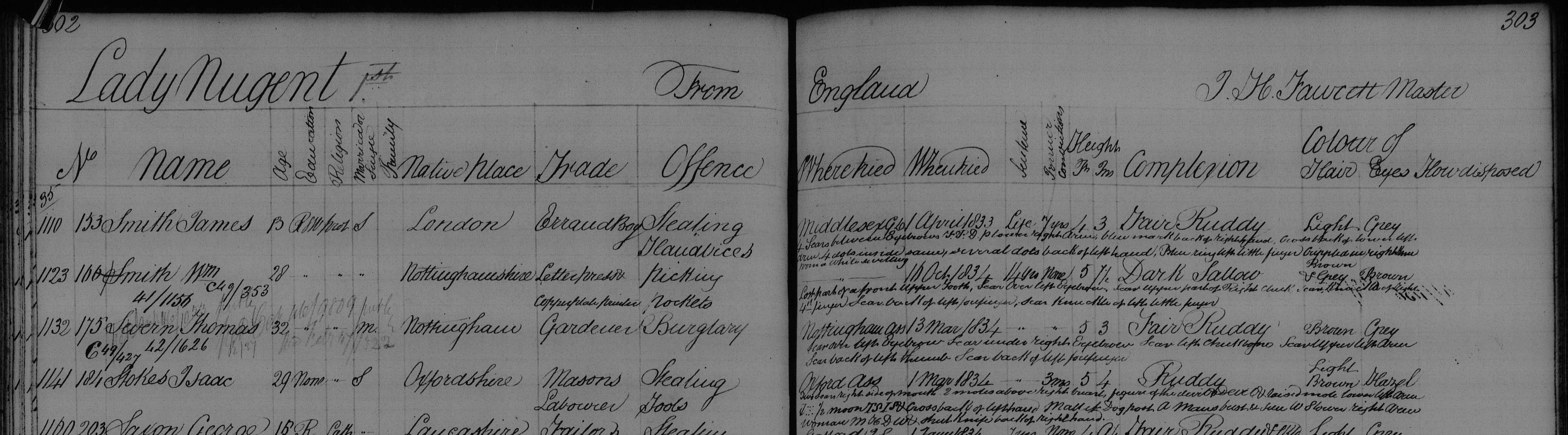
While searching for records for Isaac Stokes I discovered that another Isaac Stokes was transported to New South Wales in 1835 as well. The other one was a butcher born in 1809, sentenced in London for seven years, and he sailed on the Mary Ann. Our Isaac Stokes sailed on the Lady Nugent, arriving in NSW in April 1835, having set sail from England in December 1834.
Lady Nugent was built at Bombay in 1813. She made four voyages under contract to the British East India Company (EIC). She then made two voyages transporting convicts to Australia, one to New South Wales and one to Van Diemen’s Land (Tasmania). (via Wikipedia)
via freesettlerorfelon website:
On 20 November 1834, 100 male convicts were transferred to the Lady Nugent from the Justitia Hulk and 60 from the Ganymede Hulk at Woolwich, all in apparent good health. The Lady Nugent departed Sheerness on 4 December 1834.
SURGEON OLIVER SPROULE
Oliver Sproule kept a Medical Journal from 7 November 1834 to 27 April 1835. He recorded in his journal the weather conditions they experienced in the first two weeks:
‘In the course of the first week or ten days at sea, there were eight or nine on the sick list with catarrhal affections and one with dropsy which I attribute to the cold and wet we experienced during that period beating down channel. Indeed the foremost berths in the prison at this time were so wet from leaking in that part of the ship, that I was obliged to issue dry beds and bedding to a great many of the prisoners to preserve their health, but after crossing the Bay of Biscay the weather became fine and we got the damp beds and blankets dried, the leaks partially stopped and the prison well aired and ventilated which, I am happy to say soon manifested a favourable change in the health and appearance of the men.
Besides the cases given in the journal I had a great many others to treat, some of them similar to those mentioned but the greater part consisted of boils, scalds, and contusions which would not only be too tedious to enter but I fear would be irksome to the reader. There were four births on board during the passage which did well, therefore I did not consider it necessary to give a detailed account of them in my journal the more especially as they were all favourable cases.
Regularity and cleanliness in the prison, free ventilation and as far as possible dry decks turning all the prisoners up in fine weather as we were lucky enough to have two musicians amongst the convicts, dancing was tolerated every afternoon, strict attention to personal cleanliness and also to the cooking of their victuals with regular hours for their meals, were the only prophylactic means used on this occasion, which I found to answer my expectations to the utmost extent in as much as there was not a single case of contagious or infectious nature during the whole passage with the exception of a few cases of psora which soon yielded to the usual treatment. A few cases of scurvy however appeared on board at rather an early period which I can attribute to nothing else but the wet and hardships the prisoners endured during the first three or four weeks of the passage. I was prompt in my treatment of these cases and they got well, but before we arrived at Sydney I had about thirty others to treat.’
The Lady Nugent arrived in Port Jackson on 9 April 1835 with 284 male prisoners. Two men had died at sea. The prisoners were landed on 27th April 1835 and marched to Hyde Park Barracks prior to being assigned. Ten were under the age of 14 years.
The Lady Nugent:
Isaac’s distinguishing marks are noted on various criminal registers and record books:
“Height in feet & inches: 5 4; Complexion: Ruddy; Hair: Light brown; Eyes: Hazel; Marks or Scars: Yes [including] DEVIL on lower left arm, TSIS back of left hand, WS lower right arm, MHDW back of right hand.”
Another includes more detail about Isaac’s tattoos:
“Two slight scars right side of mouth, 2 moles above right breast, figure of the devil and DEVIL and raised mole, lower left arm; anchor, seven dots half moon, TSIS and cross, back of left hand; a mallet, door post, A, mans bust, sun, WS, lower right arm; woman, MHDW and shut knife, back of right hand.”
From How tattoos became fashionable in Victorian England (2019 article in TheConversation by Robert Shoemaker and Zoe Alkar):
“Historical tattooing was not restricted to sailors, soldiers and convicts, but was a growing and accepted phenomenon in Victorian England. Tattoos provide an important window into the lives of those who typically left no written records of their own. As a form of “history from below”, they give us a fleeting but intriguing understanding of the identities and emotions of ordinary people in the past.
As a practice for which typically the only record is the body itself, few systematic records survive before the advent of photography. One exception to this is the written descriptions of tattoos (and even the occasional sketch) that were kept of institutionalised people forced to submit to the recording of information about their bodies as a means of identifying them. This particularly applies to three groups – criminal convicts, soldiers and sailors. Of these, the convict records are the most voluminous and systematic.
Such records were first kept in large numbers for those who were transported to Australia from 1788 (since Australia was then an open prison) as the authorities needed some means of keeping track of them.”On the 1837 census Isaac was working for the government at Illiwarra, New South Wales. This record states that he arrived on the Lady Nugent in 1835. There are three other indent records for an Isaac Stokes in the following years, but the transcriptions don’t provide enough information to determine which Isaac Stokes it was. In April 1837 there was an abscondment, and an arrest/apprehension in May of that year, and in 1843 there was a record of convict indulgences.
From the Australian government website regarding “convict indulgences”:
“By the mid-1830s only six per cent of convicts were locked up. The vast majority worked for the government or free settlers and, with good behaviour, could earn a ticket of leave, conditional pardon or and even an absolute pardon. While under such orders convicts could earn their own living.”
In 1856 in Camden, NSW, Isaac Stokes married Catherine Daly. With no further information on this record it would be impossible to know for sure if this was the right Isaac Stokes. This couple had six children, all in the Camden area, but none of the records provided enough information. No occupation or place or date of birth recorded for Isaac Stokes.
I wrote to the National Library of Australia about the marriage record, and their reply was a surprise! Issac and Catherine were married on 30 September 1856, at the house of the Rev. Charles William Rigg, a Methodist minister, and it was recorded that Isaac was born in Edinburgh in 1821, to parents James Stokes and Sarah Ellis! The age at the time of the marriage doesn’t match Isaac’s age at death in 1877, and clearly the place of birth and parents didn’t match either. Only his fathers occupation of stone mason was correct. I wrote back to the helpful people at the library and they replied that the register was in a very poor condition and that only two and a half entries had survived at all, and that Isaac and Catherines marriage was recorded over two pages.
I searched for an Isaac Stokes born in 1821 in Edinburgh on the Scotland government website (and on all the other genealogy records sites) and didn’t find it. In fact Stokes was a very uncommon name in Scotland at the time. I also searched Australian immigration and other records for another Isaac Stokes born in Scotland or born in 1821, and found nothing. I was unable to find a single record to corroborate this mysterious other Isaac Stokes.
As the age at death in 1877 was correct, I assume that either Isaac was lying, or that some mistake was made either on the register at the home of the Methodist minster, or a subsequent mistranscription or muddle on the remnants of the surviving register. Therefore I remain convinced that the Camden stonemason Isaac Stokes was indeed our Isaac from Oxfordshire.
I found a history society newsletter article that mentioned Isaac Stokes, stone mason, had built the Glenmore church, near Camden, in 1859.
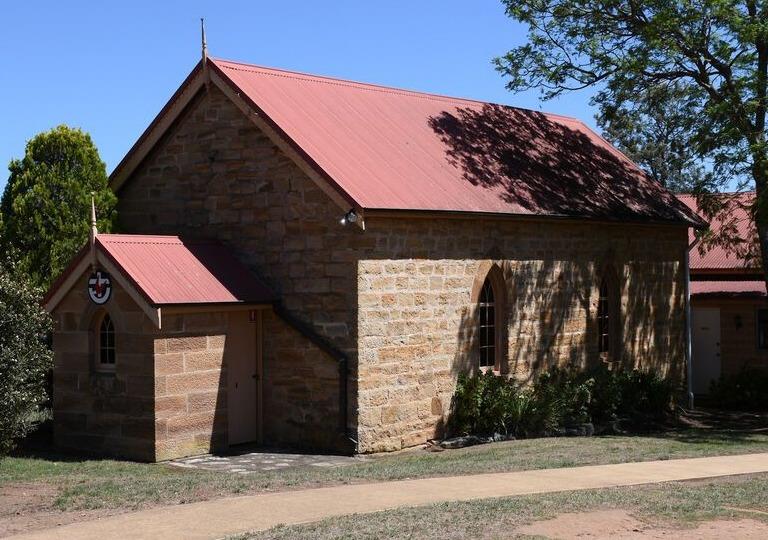
From the Wollondilly museum April 2020 newsletter:
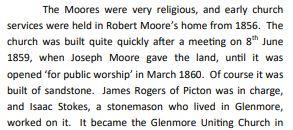
From the Camden History website:
“The stone set over the porch of Glenmore Church gives the date of 1860. The church was begun in 1859 on land given by Joseph Moore. James Rogers of Picton was given the contract to build and local builder, Mr. Stokes, carried out the work. Elizabeth Moore, wife of Edward, laid the foundation stone. The first service was held on 19th March 1860. The cemetery alongside the church contains the headstones and memorials of the areas early pioneers.”
Isaac died on the 3rd September 1877. The inquest report puts his place of death as Bagdelly, near to Camden, and another death register has put Cambelltown, also very close to Camden. His age was recorded as 71 and the inquest report states his cause of death was “rupture of one of the large pulmonary vessels of the lung”. His wife Catherine died in childbirth in 1870 at the age of 43.
Isaac and Catherine’s children:
William Stokes 1857-1928
Catherine Stokes 1859-1846
Sarah Josephine Stokes 1861-1931
Ellen Stokes 1863-1932
Rosanna Stokes 1865-1919
Louisa Stokes 1868-1844.
It’s possible that Catherine Daly was a transported convict from Ireland.
Some time later I unexpectedly received a follow up email from The Oaks Heritage Centre in Australia.
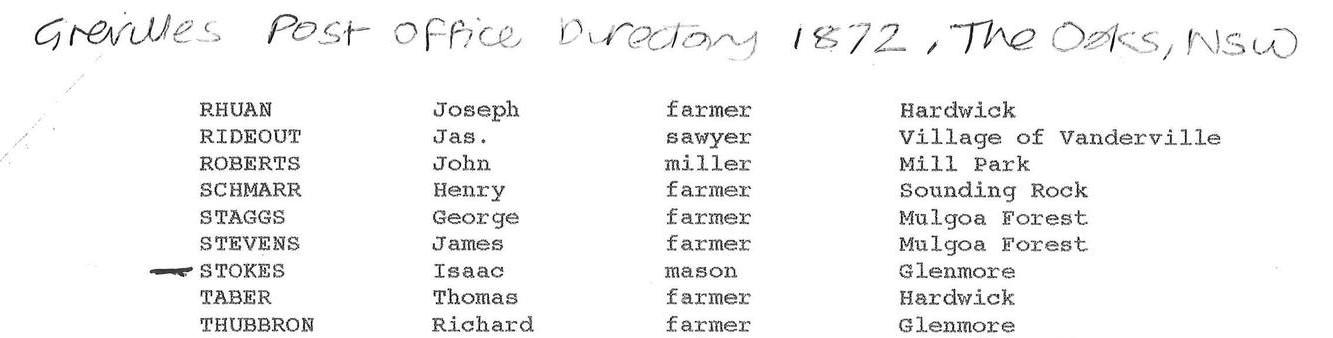
“The Gaudry papers which we have in our archive record him (Isaac Stokes) as having built: the church, the school and the teachers residence. Isaac is recorded in the General return of convicts: 1837 and in Grevilles Post Office directory 1872 as a mason in Glenmore.”
 November 18, 2022 at 4:47 pm #6348
In reply to: Family Stories From The Other Side ~ Book Two
Wong Sang
Wong Sang was born in China in 1884. In October 1916 he married Alice Stokes in Oxford.
Alice was the granddaughter of William Stokes of Churchill, Oxfordshire and William was the brother of Thomas Stokes the wheelwright (who was my 3X great grandfather). In other words Alice was my second cousin, three times removed, on my fathers paternal side.
Wong Sang was an interpreter, according to the baptism registers of his children and the Dreadnought Seamen’s Hospital admission registers in 1930. The hospital register also notes that he was employed by the Blue Funnel Line, and that his address was 11, Limehouse Causeway, E 14. (London)
“The Blue Funnel Line offered regular First-Class Passenger and Cargo Services From the UK to South Africa, Malaya, China, Japan, Australia, Java, and America. Blue Funnel Line was Owned and Operated by Alfred Holt & Co., Liverpool.
The Blue Funnel Line, so-called because its ships have a blue funnel with a black top, is more appropriately known as the Ocean Steamship Company.”Wong Sang and Alice’s daughter, Frances Eileen Sang, was born on the 14th July, 1916 and baptised in 1920 at St Stephen in Poplar, Tower Hamlets, London. The birth date is noted in the 1920 baptism register and would predate their marriage by a few months, although on the death register in 1921 her age at death is four years old and her year of birth is recorded as 1917.
Charles Ronald Sang was baptised on the same day in May 1920, but his birth is recorded as April of that year. The family were living on Morant Street, Poplar.
James William Sang’s birth is recorded on the 1939 census and on the death register in 2000 as being the 8th March 1913. This definitely would predate the 1916 marriage in Oxford.
William Norman Sang was born on the 17th October 1922 in Poplar.
Alice and the three sons were living at 11, Limehouse Causeway on the 1939 census, the same address that Wong Sang was living at when he was admitted to Dreadnought Seamen’s Hospital on the 15th January 1930. Wong Sang died in the hospital on the 8th March of that year at the age of 46.
Alice married John Patterson in 1933 in Stepney. John was living with Alice and her three sons on Limehouse Causeway on the 1939 census and his occupation was chef.
Via Old London Photographs:
“Limehouse Causeway is a street in east London that was the home to the original Chinatown of London. A combination of bomb damage during the Second World War and later redevelopment means that almost nothing is left of the original buildings of the street.”
Limehouse Causeway in 1925:
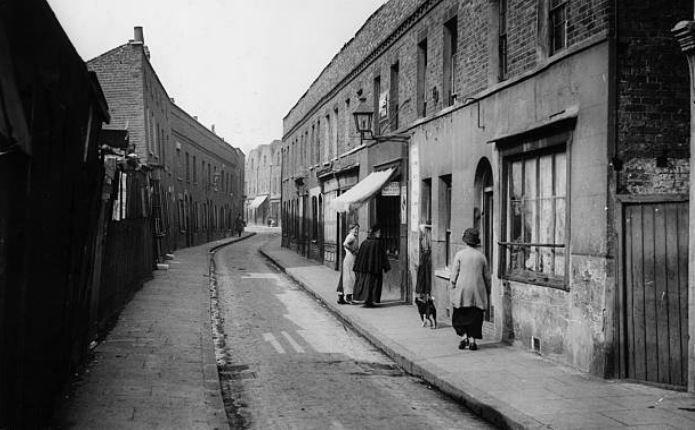
From The Story of Limehouse’s Lost Chinatown, poplarlondon website:
“Limehouse was London’s first Chinatown, home to a tightly-knit community who were demonised in popular culture and eventually erased from the cityscape.
As recounted in the BBC’s ‘Our Greatest Generation’ series, Connie was born to a Chinese father and an English mother in early 1920s Limehouse, where she used to play in the street with other British and British-Chinese children before running inside for teatime at one of their houses.
Limehouse was London’s first Chinatown between the 1880s and the 1960s, before the current Chinatown off Shaftesbury Avenue was established in the 1970s by an influx of immigrants from Hong Kong.
Connie’s memories of London’s first Chinatown as an “urban village” paint a very different picture to the seedy area portrayed in early twentieth century novels.
The pyramid in St Anne’s church marked the entrance to the opium den of Dr Fu Manchu, a criminal mastermind who threatened Western society by plotting world domination in a series of novels by Sax Rohmer.
Thomas Burke’s Limehouse Nights cemented stereotypes about prostitution, gambling and violence within the Chinese community, and whipped up anxiety about sexual relationships between Chinese men and white women.
Though neither novelist was familiar with the Chinese community, their depictions made Limehouse one of the most notorious areas of London.
Travel agent Thomas Cook even organised tours of the area for daring visitors, despite the rector of Limehouse warning that “those who look for the Limehouse of Mr Thomas Burke simply will not find it.”
All that remains is a handful of Chinese street names, such as Ming Street, Pekin Street, and Canton Street — but what was Limehouse’s chinatown really like, and why did it get swept away?
Chinese migration to Limehouse
Chinese sailors discharged from East India Company ships settled in the docklands from as early as the 1780s.
By the late nineteenth century, men from Shanghai had settled around Pennyfields Lane, while a Cantonese community lived on Limehouse Causeway.
Chinese sailors were often paid less and discriminated against by dock hirers, and so began to diversify their incomes by setting up hand laundry services and restaurants.
Old photographs show shopfronts emblazoned with Chinese characters with horse-drawn carts idling outside or Chinese men in suits and hats standing proudly in the doorways.
In oral histories collected by Yat Ming Loo, Connie’s husband Leslie doesn’t recall seeing any Chinese women as a child, since male Chinese sailors settled in London alone and married working-class English women.
In the 1920s, newspapers fear-mongered about interracial marriages, crime and gambling, and described chinatown as an East End “colony.”
Ironically, Chinese opium-smoking was also demonised in the press, despite Britain waging war against China in the mid-nineteenth century for suppressing the opium trade to alleviate addiction amongst its people.
The number of Chinese people who settled in Limehouse was also greatly exaggerated, and in reality only totalled around 300.
The real Chinatown
Although the press sought to characterise Limehouse as a monolithic Chinese community in the East End, Connie remembers seeing people of all nationalities in the shops and community spaces in Limehouse.
She doesn’t remember feeling discriminated against by other locals, though Connie does recall having her face measured and IQ tested by a member of the British Eugenics Society who was conducting research in the area.
Some of Connie’s happiest childhood memories were from her time at Chung-Hua Club, where she learned about Chinese culture and language.
Why did Chinatown disappear?
The caricature of Limehouse’s Chinatown as a den of vice hastened its erasure.
Police raids and deportations fuelled by the alarmist media coverage threatened the Chinese population of Limehouse, and slum clearance schemes to redevelop low-income areas dispersed Chinese residents in the 1930s.
The Defence of the Realm Act imposed at the beginning of the First World War criminalised opium use, gave the authorities increased powers to deport Chinese people and restricted their ability to work on British ships.
Dwindling maritime trade during World War II further stripped Chinese sailors of opportunities for employment, and any remnants of Chinatown were destroyed during the Blitz or erased by postwar development schemes.”
Wong Sang 1884-1930
The year 1918 was a troublesome one for Wong Sang, an interpreter and shipping agent for Blue Funnel Line. The Sang family were living at 156, Chrisp Street.
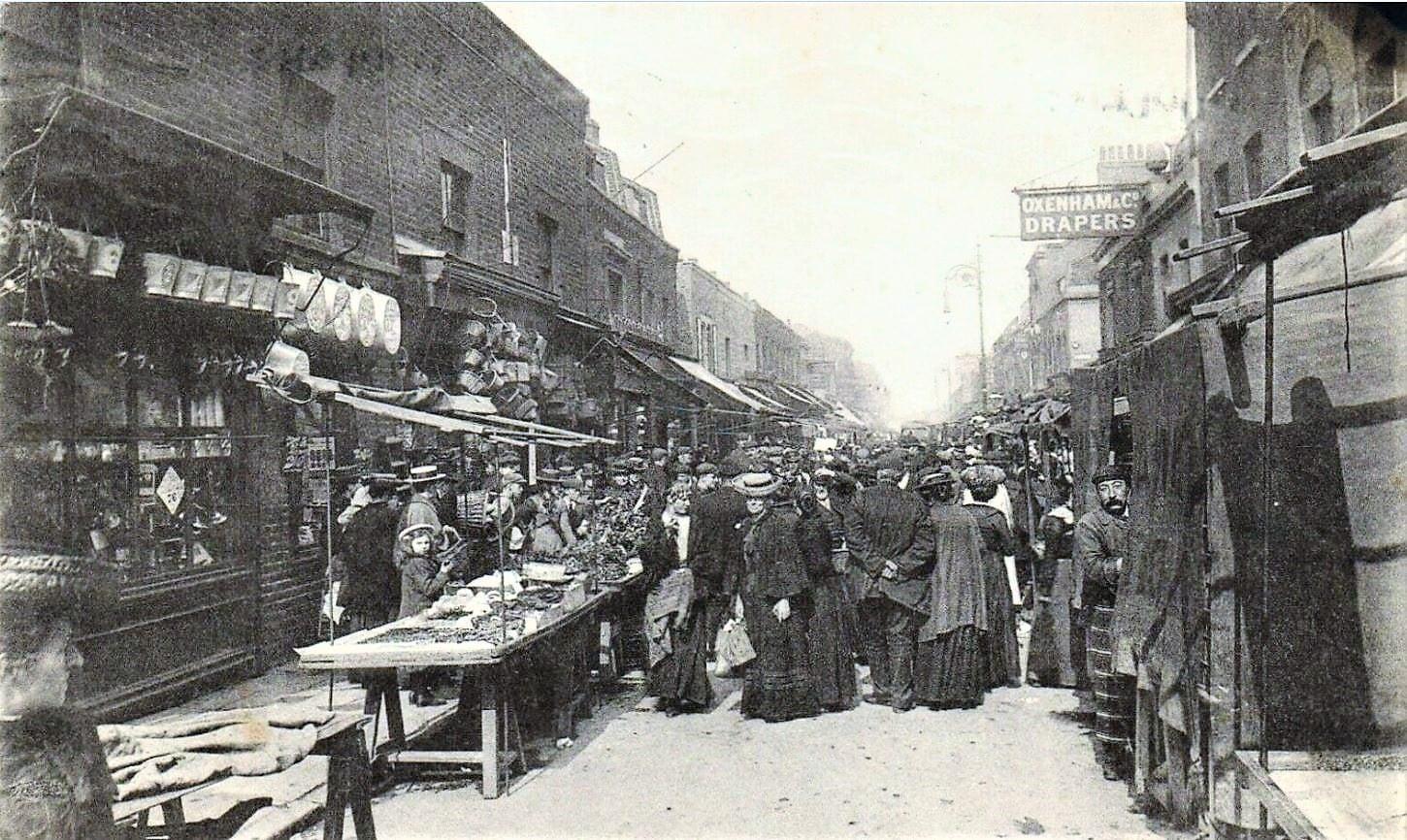
Chrisp Street, Poplar, in 1913 via Old London Photographs:
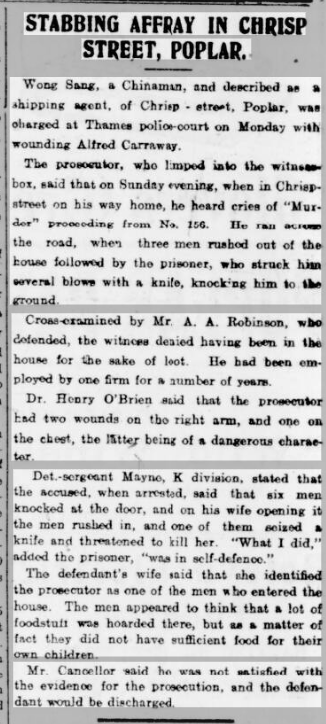
In February Wong Sang was discharged from a false accusation after defending his home from potential robbers.
East End News and London Shipping Chronicle – Friday 15 February 1918:
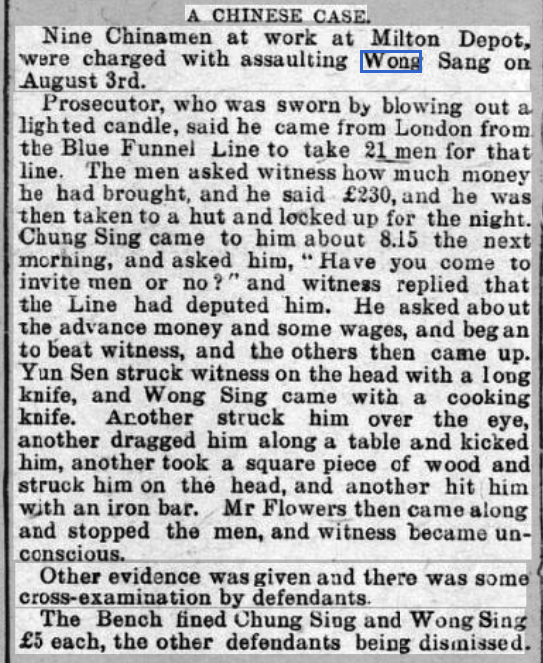
In August of that year he was involved in an incident that left him unconscious.
Faringdon Advertiser and Vale of the White Horse Gazette – Saturday 31 August 1918:
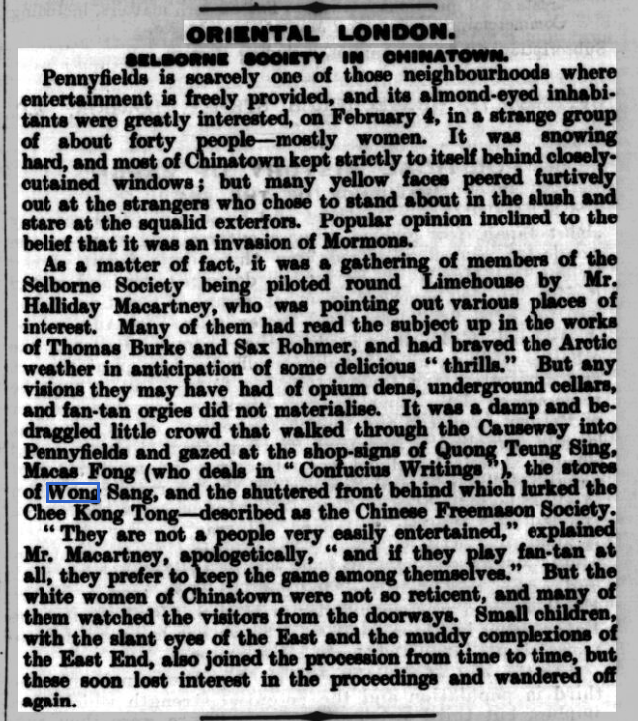
Wong Sang is mentioned in an 1922 article about “Oriental London”.
London and China Express – Thursday 09 February 1922:
A photograph of the Chee Kong Tong Chinese Freemason Society mentioned in the above article, via Old London Photographs:
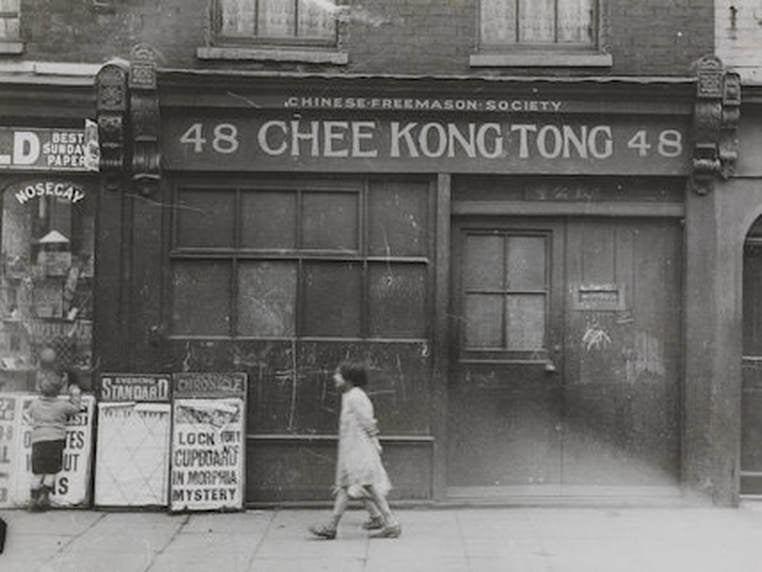
Wong Sang was recommended by the London Metropolitan Police in 1928 to assist in a case in Wellingborough, Northampton.
Difficulty of Getting an Interpreter: Northampton Mercury – Friday 16 March 1928:
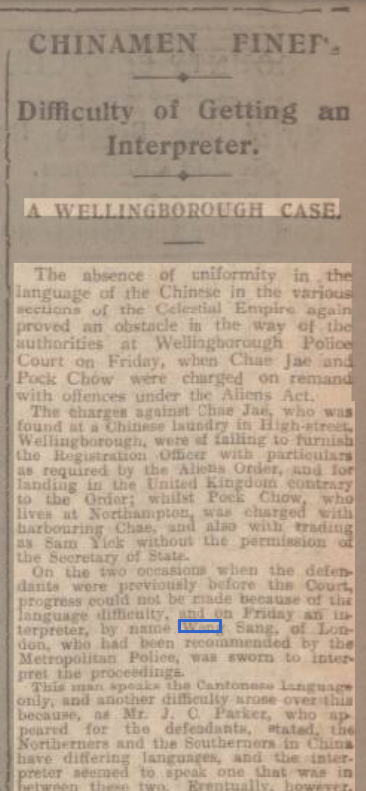
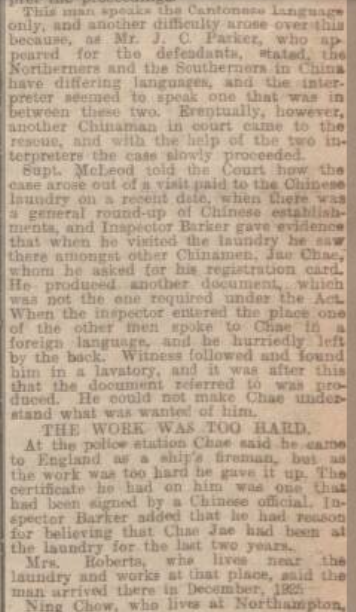
The difficulty was that “this man speaks the Cantonese language only…the Northeners and the Southerners in China have differing languages and the interpreter seemed to speak one that was in between these two.”
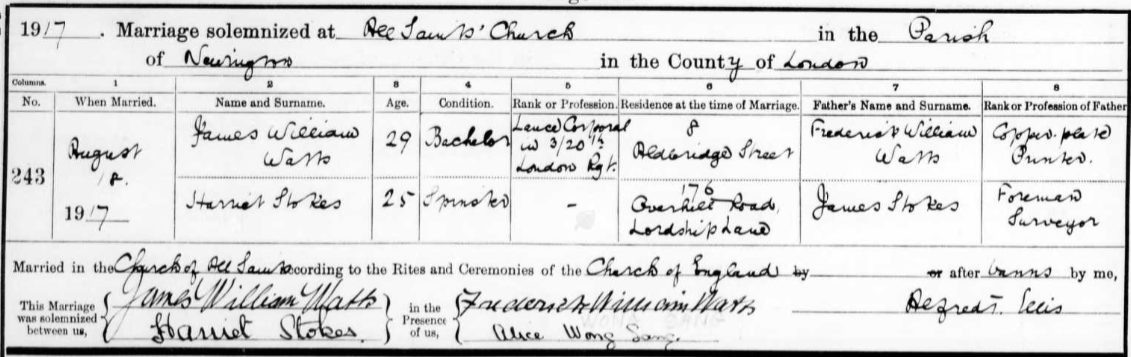
In 1917, Alice Wong Sang was a witness at her sister Harriet Stokes marriage to James William Watts in Southwark, London. Their father James Stokes occupation on the marriage register is foreman surveyor, but on the census he was a council roadman or labourer. (I initially rejected this as the correct marriage for Harriet because of the discrepancy with the occupations. Alice Wong Sang as a witness confirmed that it was indeed the correct one.)
James William Sang 1913-2000 was a clock fitter and watch assembler (on the 1939 census). He married Ivy Laura Fenton in 1963 in Sidcup, Kent. James died in Southwark in 2000.
Charles Ronald Sang 1920-1974 was a draughtsman (1939 census). He married Eileen Burgess in 1947 in Marylebone. Charles and Eileen had two sons: Keith born in 1951 and Roger born in 1952. He died in 1974 in Hertfordshire.
William Norman Sang 1922-2000 was a clerk and telephone operator (1939 census). William enlisted in the Royal Artillery in 1942. He married Lily Mullins in 1949 in Bethnal Green, and they had three daughters: Marion born in 1950, Christine in 1953, and Frances in 1959. He died in Redbridge in 2000.
I then found another two births registered in Poplar by Alice Sang, both daughters. Doris Winifred Sang was born in 1925, and Patricia Margaret Sang was born in 1933 ~ three years after Wong Sang’s death. Neither of the these daughters were on the 1939 census with Alice, John Patterson and the three sons. Margaret had presumably been evacuated because of the war to a family in Taunton, Somerset. Doris would have been fourteen and I have been unable to find her in 1939 (possibly because she died in 2017 and has not had the redaction removed yet on the 1939 census as only deceased people are viewable).
Doris Winifred Sang 1925-2017 was a nursing sister. She didn’t marry, and spent a year in USA between 1954 and 1955. She stayed in London, and died at the age of ninety two in 2017.
Patricia Margaret Sang 1933-1998 was also a nurse. She married Patrick L Nicely in Stepney in 1957. Patricia and Patrick had five children in London: Sharon born 1959, Donald in 1960, Malcolm was born and died in 1966, Alison was born in 1969 and David in 1971.
I was unable to find a birth registered for Alice’s first son, James William Sang (as he appeared on the 1939 census). I found Alice Stokes on the 1911 census as a 17 year old live in servant at a tobacconist on Pekin Street, Limehouse, living with Mr Sui Fong from Hong Kong and his wife Sarah Sui Fong from Berlin. I looked for a birth registered for James William Fong instead of Sang, and found it ~ mothers maiden name Stokes, and his date of birth matched the 1939 census: 8th March, 1913.
On the 1921 census, Wong Sang is not listed as living with them but it is mentioned that Mr Wong Sang was the person returning the census. Also living with Alice and her sons James and Charles in 1921 are two visitors: (Florence) May Stokes, 17 years old, born in Woodstock, and Charles Stokes, aged 14, also born in Woodstock. May and Charles were Alice’s sister and brother.
I found Sharon Nicely on social media and she kindly shared photos of Wong Sang and Alice Stokes:
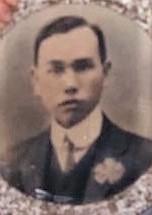
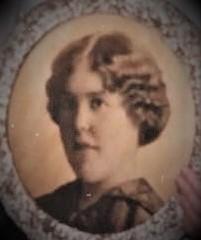
-
AuthorSearch Results