

Search Results for 'lived'
-
AuthorSearch Results
-
December 31, 2025 at 10:00 pm #8021
In reply to: The Hoards of Sanctorum AD26
Helier was the only one paying attention to Bartholomew, Cerenise noticed in a rare moment of focus on the proceedings at hand. A unique human (albeit an exceedingly long lived version of human) story was being revealed for the first time in near unprecedented circumstances, and he was relishing every moment of the revelations. That much was clear in a flash of understanding to Cerenise. Notwithstanding her propensity to jump to consclusions prematurely, she felt a moment of satisfaction and pleasure at the unexpected unfolding tale. Helier was as intrigued as she was, that much she knew.
December 31, 2025 at 11:11 am #8009In reply to: Finder’s Keepers of the Hoard
Some ideas for the background thread and character profiles for “The Hoards of Emporium 26.”
The Setting: Emporium 26
They live in Gloucester (ancient Glevum), a city built on Roman bones where the layout of the streets still follows the legions’ sandals. They inhabit a sprawling, shared Georgian townhouse complex that has been knocked through into one labyrinthine dwelling—Number 26.
To the outside world, it looks like a dilapidated heritage site. Inside, it is The Emporium: a geological stratification of history, where layers of Roman pottery are mixed with 1990s Beanie Babies and medieval reliquaries.
The Background Thread: “The Weight of Eternity”
Why do they hoard? Because when you live forever, “letting go” feels like losing a piece of the timeline. Hoarding objects is for them an accumulation of evidence of existence.
- The Curse: They cannot die naturally, but they can fade if they are forgotten. The “stuff” anchors them to the physical plane.
- The “Halo” Effect: Occasionally, when they are arguing over whose turn it is to do the dishes, or when they find a lost treasure, the stained-glass light of their old divinity flickers behind their heads—a neon halo of forgotten holiness.
The Hoarders & Their Stashes
1. Helier ( The Hermit / The Dreamer)
- Saintly Origin: Based on St. Helier (Jersey/Normandy). He was an ascetic hermit who lived in a cave and was eventually beheaded.
- Modern Persona: A soft-spoken agoraphobe who hasn’t left the house since the invention of the internet. He wears oversized cardigans that smell like old library books.
- The Mania: Escapism & Communication.
- Because he spent centuries in silence on a rock, he is now obsessed with human stories and noise.
- The Hoard: ” The Media Mountain.”
- His wing of the house is a fire hazard of pulp fiction, towering stacks of National Geographic (dating back to the first issue), thousands of VHS tapes (he has no VCR), and tangled knots of ethernet cables that he refuses to throw away “in case they fit a port from 1998.”
- The Secret Stash: Beneath a pile of “The Hoarder Vampires” novels lies his true relic: The Stone Pillow. The actual rock he slept on in the 6th century. He still naps on it when his back hurts.
2. Spirius (The Bishop / The Container)
- Saintly Origin: Evocative of St. Exuperius (Bayeux). A driver-out of demons and a man of grand gestures.
- Modern Persona: A nervous, fidgety man who is convinced the world is leaking. He is the “fixer” of the group but usually makes things worse with duct tape.
- The Mania: Containment & Preservation.
- In the old days, he bottled demons. Now, he’s terrified of running out of space to put things.
- The Hoard: “The Vessel Void.”
- Spirius hoards anything that can hold something else. Empty jam jars (washed, mostly), Tupperware with no matching lids, biscuit tins, and thousands of plastic carrier bags stuffed inside other carrier bags (the “Bag of Bags”).
- The Secret Stash: In a locked pantry, he keeps a shelf of sealed mason jars labeled with dates like “1431” or “1789.” He claims they contain the “Sigh of a King” or “The smell of rain before the Plague.” It’s actually just dust, but the jars vibrate slightly.
3. Cerenise (The Weaver / The Mender)
- Saintly Origin: Evocative of St. Ceneri or St. Cerneuf. A saint of travelers, or perhaps needlework.
- Modern Persona: She is the “Wheelchair Girl’s” friend mentioned in the intro? Or perhaps she is in a wheelchair now—not because she can’t walk, but because she’s too tired from walking for 1,500 years. She is sharp-tongued and fashionable in a “crazy bag lady” sort of way.
- The Mania: Potential & Texture.
- She sees the soul in broken things. She cannot throw away anything that “could be fixed.”
- The Hoard: “The Fabric of Time.”
- Her rooms are draped in layers of textiles: velvet curtains from a 1920s cinema, moth-eaten tapestries depicting her own miracles (she thinks the nose is wrong), and buttons. Millions of buttons. She also hoards broken appliances—toasters, lamps, clocks—insisting she will repair them “next Tuesday.”
- The Secret Stash: A mannequin dressed in a perfectly preserved Roman stola, hidden under forty layers of polyester coats. It’s the outfit she wore when she performed her first miracle. She tries it on every New Year’s Eve.
4. Yvoise (The Advocate / The Bureaucrat)
- Saintly Origin: Evocative of St. Yves (Patron of Lawyers/Brittany/Normandy). The arbiter of justice.
- Modern Persona: The “Manager” of Emporium 26. She wears power suits from the 80s and is always carrying a clipboard. She loves rules, even if she invents them.
- The Mania: Proof of Truth.
- She is terrified of being forgotten or cheated. She needs a receipt for everything.
- The Hoard: “The Archive of Nothing.”
- Yvoise hoards paper. Receipts from a coffee bought in 1952, bus tickets, expired warranties, junk mail, and legal disclaimers torn off mattresses. Her room looks like the inside of a shredder that exploded. She claims she is building “The Case for Humanity.”
- The Secret Stash: A filing cabinet labeled “Do Not Open.” Inside is not paper, but Seeds. Seeds from the trees of ancient Gaul. She is saving them for when the paper finally takes over the world and she needs to replant the forest she misses.
Starter: The Reading of Austreberthe’s Will
The story kicks off because Austreberthe (The Saint of Washing/Water) has died. Her hoard was Soap and Water.
- The house is now flooding because her magical containment on the plumbing has broken.
- The remaining four must navigate her “Tsunami Wing”—a treacherous dungeon of accumulated bath bombs, stolen hotel towels, and aggressive washing machines—to find her Will.
- The Will is rumored to reveal the location of the “Golden Key,” an object that can legally terminate their lease on Emporium 26, which none of them want, but all of them crave.
December 30, 2025 at 6:42 pm #8003In reply to: The Elusive Samuel Housley and Other Family Stories
JOHN BROOKS ALIAS PRIESTLAND
1766-1846John Brooks, my 5x great grandfather, was born in 1766, according to the 1841 census and the burial register in 1846 which stated his age at death as 80 years, but no baptism has been found thus far.
On his first son’s baptism in 1790 the parish register states “John son of John and Elizabeth Brooks Priestnal was baptised”. The name Priestnal was not mentioned in any further sibling baptism, and he was John Brooks on his marriage, on the 1841 census and on his burial in the Netherseal parish register. The name Priestnal was a mystery.
I wondered why there was a nine year gap between the first son John, and the further six siblings, and found that his first wife Elizabeth Wilson died in 1791, and in 1798 John married Elizabeth Cowper, a widow.
John was a farmer of Netherseal on both marriage licences, and of independent means on the 1841 census.
Without finding a baptism it was impossible to go further back, and I was curious to find another tree on the ancestry website with many specific dates but no sources attached, that had Thomas Brooks as his father and his mother as Mary Priestland. I couldn’t find a marriage for John and Mary Priestland, so I sent a message to the owner of the tree, and before receiving a reply, did a bit more searching.
I found an article in the newspaper archives dated 9 August 1839 about a dispute over a right of way, and John Brooks, 73 years of age and a witness for the complainant, said that he had lived in Netherseal all his life (and had always know that public right of way and so on).
I found three lists of documents held by the Derby Records Office about property deeds and transfers, naming a John Brooks alias Priestland, one in 1794, one in 1814, and one in 1824. One of them stated that his father was Thomas Brooks. I was beginning to wonder if Thomas Brooks and Mary Priestland had never married, and this proved to be the case.
The Australian owner of the other tree replied, and said that they had paid a researcher in England many years ago, and that she would look through a box of papers. She sent me a transcribed summary of the main ponts of Thomas Brooks 1784 will:
Thomas Brooks, husbandman of Netherseal
To daughter Ann husband of George Oakden, £20.
To grandson William Brooks, £20.
To son William Brooks and his wife Ann, one shilling each.
To his servant Mary Priestland, £20 and certain household effects and certain property.
To his natural son John Priestland alias Brooks, various properties and the residue of his estate.
John Priestland alias Brooks appointed sole executor.It would appear that Thomas Brooks left the bulk of his estate to his illegitimate son, and more to his servant Mary Priestland than to his legitimate children.
THOMAS BROOKS
1706-1784
Thomas Brooks, my 6x great grandfather, had three wives. He had four children with his first wife, Elizabeth, between 1732 and 1737. Elizabeth died in 1737. He then married Mary Bath, who died in 1763. Thomas had no children with Mary Bath. In 1765 Thomas married Mary Beck. In 1766 his son John Brooks alias Priestland was born to his servant Mary Priestland.
Thomas Brooks parents were John Brooks 1671-1741, and his wife Anne Speare 1674-1718, both of Netherseal, Leicestershire.
December 30, 2025 at 1:13 pm #8001In reply to: The Elusive Samuel Housley and Other Family Stories
John Brooks
The Father of Catherine Housley’s Mother, Elizabeth Brooks.I had not managed to find out anything about the Brooks family in previous searches. We knew that Elizabeth Brooks father was J Brooks, cooper, from her marriage record. A cooper is a man who makes barrels.
Elizabeth was born in 1819 in Sutton Coldfield, parents John and Mary Brooks. Elizabeth had three brothers, all baptised in Sutton Coldfield: Thomas 1815-1821, John 1816-1821, and William Brooks, 1822-1875. William was known to Samuel Housley, the husband of Elizabeth, which we know from the Housley Letters, sent from the family in Smalley to George, Samuel’s brother, in USA, from the 1850s to 1870s. More to follow on William Brooks.
Elizabeth married Samuel Housley in Wolverhampton in 1844. Elizabeth and Samuel had three daughters in Smalley before Elizabeth’s death from TB in 1849, the youngest, just 6 weeks old at the time, was my great great grandmother Catherine Housley.
Elizabeth’s mother Mary died in 1823, and it not known if Elizabeth, then four, and William, a year old, stayed at home with their father or went to stay with relatives. There were no census records during those years.
John Brooks married Mary Wagstaff in 1814 in Birmingham. A witness at their marriage was Elizabeth Brooks, and this was probably John’s sister.
On the 1841 census (which was the first census in England) John Brooks, cooper, was living on Dudley Road, Wolverhampton, with wife Sarah. I was unable to find a marriage for them before a marriage in 1845 between John Brooks and Sarah Hughes, so presumably they lived together as man and wife before they married.
Then came the lucky find with John Brooks place of birth: Netherseal, Leicestershire. The place of birth on the 1841 census wasn’t specified, thereafter it was. On the 1851 census John Brooks, cooper, and Sarah his wife were living at Queens Cross, Dudley, with a three year old granddaughter E Brooks. John was born in 1791 in Netherseal.
It was commonplace for people to move to the industrial midlands around this time, from the surrounding countryside. However if they died before the 1851 census stating place of birth, it’s usually impossible to find out where they came from, particularly if they had a common name.
John Brooks doesn’t appear on any further census. I found seven deaths registered in Dudley for a John Brooks between 1851 and 1861, so presumably he is one of them.NETHERSEAL
On 27 June 1790 appears in the Netherseal parish register “John Brooks the son of John and Elizabeth Brooks Priestnal was baptised.” The name Priestnal does not appear in the transcription, nor the Bishops Transcripts, nor on any other sibling baptism. The Priestnal mystery will be solved in the next chapter.
John Brooks senior married Elizabeth Wilson by marriage licence on 20 November 1788 in Gresley, a neighbouring town in Derbyshire (incidentally near to Swadlincote and the ancestral lines of the Warren family, which also has branches in Netherseal. The Brooks family is the Marshall side). John Brooks was a farmer.
I haven’t found a baptism yet for John Brooks senior, but his death in Netherseal in 1846 provided the age at death, eighty years old, which puts his birth at 1766. The 1841 census has his birth as 1766 as well.
In 1841 John Brooks was 75, and “independent”, meaning that he was living on his own means. The name Brooks was transcribed as Broster, making this difficult to find, but it is clearly Brooks if you look at the original.
His wife Elizabeth, born in 1762, is also on the census, as well as the Jackson family: Joseph Jackon born 1804, Elizabeth Jackson his wife born 1799, and children Joseph, born 1833, William 1834, Thomas 1835, Stephen 1836, and Mary born 1838.
John and Elizabeths daughter Elizabeth Brooks, born in 1799, married Joseph Jackson, the son of an “opulent farmer” (newspaper archives) of Tatenhill, Staffordshire. They married on the 19th January 1832 in Burton on Trent. (Elizabeth Brooks was probably the witness on John Brooks junior’s marriage to Mary Wagstaff in Birmingham in 1814, although it could have been his mother, also Elizabeth Brooks.)
(Elizabeth Jackson nee Brooks was the aunt of Elizabeth in the portrait)
Joseph Jackson was declared bankrupt in 1833 (newspapers) and in 1834 a noticed in the newspapers “to the creditors of Joseph Jackson junior”, a victualler and farmer late of Netherseal, “following no business, who was lately dischared from his Majesty’s Gaol at Stafford” whose real estate was to be sold by auction. I haven’t yet found what he was in prison for.
In 1841 Joseph appeared again in the newspapers, in which he publicly stated that he had accused Thomas Webb, surgeon of Barton Under Needwood, of owing him money “just to annoy him” and “with a view to extort money from him”. and that he undertakes to pay Thomas Webb or his attorney, the costs within 14 days.
Joseph and Elizabeth had twins in 1841, born in Netherseal, John and Ruth. Elizabeth died in 1850.
Thereafter, Joseph was a labourer at the iron works in Wednesbury, and many generations of Jacksons continued working in the iron industry in Wednesbury ~ all orignially descended from farmers in Netherseal and Tatenhill.March 28, 2025 at 10:28 pm #7881In reply to: The Last Cruise of Helix 25
Mars Outpost — Welcome to the Wild Wild Waste
No one had anticipated how long it would take to get a shuttle full of half-motivated, gravity-averse Helix25 passengers to agree on proper footwear.
“I told you, Claudius, this is the fancy terrain suit. The others make my hips look like reinforced cargo crates,” protested Tilly Nox, wrangling with her buckles near the shuttle airlock.
“You’re about to step onto a red-rock planet that hasn’t seen visitors since the Asteroid Belt Mining Fiasco,” muttered Claudius, tightening his helmet strap. “Your hips are the least of Mars’ concerns.”
Behind them, a motley group of Helix25 residents fidgeted with backpacks, oxygen readouts, and wide-eyed anticipation. Veranassessee had allowed a single-day “expedition excursion” for those eager—or stir-crazy—enough to brave Mars’ surface. She’d made it clear it was volunteer-only.
Most stayed aboard, in orbit of the red planet, looking at its surface from afar to the tune of “eh, gravity, don’t we have enough of that here?” —Finkley had recoiled in horror at the thought of real dust getting through the vents and had insisted on reviewing personally all the airlocks protocols. No way that they’d sullied her pristine halls with Martian dust or any dust when the shuttle would come back. No – way.
But for the dozen or so who craved something raw and unfiltered, this was it. Mars: the myth, the mirage, the Far West frontier at the invisible border separating Earthly-like comforts into the wider space without any safety net.
At the helm of Shuttle Dandelion, Sue Forgelot gave the kind of safety briefing that could both terrify and inspire. “If your oxygen starts blinking red, panic quietly and alert your buddy. If you fall into a crater, forget about taking a selfie, wave your arms and don’t grab on your neighbor. And if you see a sand wyrm, congratulations, you’ve either hit gold or gone mad.”
Luca Stroud chuckled from the copilot seat. “Didn’t see you so chirpy in a long while. That kind of humour, always the best warning label.”
They touched down near Outpost Station Delta-6 just as the Martian wind was picking up, sending curls of red dust tumbling like gossip.
And there she was.
Leaning against the outpost hatch with a spanner slung across one shoulder, goggles perched on her forehead, Prune watched them disembark with the wary expression of someone spotting tourists traipsing into her backyard garden.
Sue approached first, grinning behind her helmet. “Prune Curara, I presume?”
“You presume correctly,” she said, arms crossed. “Let me guess. You’re here to ruin my peace and use my one functioning kettle.”
Luca offered a warm smile. “We’re only here for a brief scan and a bit of radioactive treasure hunting. Plus, apparently, there’s been a petition to name a Martian dust lizard after you.”
“That lizard stole my solar panel last year,” Prune replied flatly. “It deserves no honor.”
Inside, the outpost was cramped, cluttered, and undeniably charming. Hand-drawn maps of Martian magnetic hotspots lined one wall; shelves overflowed with tagged samples, sketchpads, half-disassembled drones, and a single framed photo of a fireplace with something hovering inexplicably above it—a fish?
“Flying Fish Inn,” Luca whispered to Sue. “Legendary.”
The crew spent the day fanning out across the region in staggered teams. Sue and Claudius oversaw the scan points, Tilly somehow got her foot stuck in a crevice that definitely wasn’t in the geological briefing, which was surprisingly enough about as much drama they could conjure out.
Back at the outpost, Prune fielded questions, offered dry warnings, and tried not to get emotionally attached to the odd, bumbling crew now walking through her kingdom.
Then, near sunset, Veranassessee’s voice crackled over comms: “Curara. We’ll be lifting a crew out tomorrow, but leaving a team behind. With the right material, for all the good Muck’s mining expedition did out on the asteroid belt, it left the red planet riddled with precious rocks. But you, you’ve earned to take a rest, with a ticket back aboard. That’s if you want it. Three months back to Earth via the porkchop plot route. No pressure. Your call.”
Prune froze. Earth.
The word sat like an old song on her tongue. Faint. Familiar. Difficult to place.
She stepped out to the ridge, watching the sun dip low across the dusty plain. Behind her, laughter from the tourists trading their stories of the day —Tilly had rigged a heat plate with steel sticks and somehow convinced people to roast protein foam. Are we wasting oxygen now? Prune felt a weight lift; after such a long time struggling to make ends meet, she now could be free of that duty.
Prune closed her eyes. In her head, Mater’s voice emerged, raspy and amused: You weren’t meant to settle, sugar. You were meant to stir things up. Even on Mars.
She let the words tumble through her like sand in her boots.
She’d conquered her dream, lived it, thrived in it.
Now people were landing, with their new voices, new messes, new puzzles.
She could stay. Be the last queen of red rock and salvaged drones.
Or she could trade one hell of people for another. Again.
The next morning, with her patched duffel packed and goggles perched properly this time, Prune boarded Shuttle Dandelion with a half-smirk and a shrug.
“I’m coming,” she told Sue. “Can’t let Earth ruin itself again without at least watching.”
Sue grinned. “Welcome back to the madhouse.”
As the shuttle lifted off, Prune looked once, just once, at the red plains she’d called home.
“Thanks, Mars,” she whispered. “Don’t wait up.”
March 23, 2025 at 7:37 am #7878In reply to: The Precious Life and Rambles of Liz Tattler
Liz threw another pen into the tin wastepaper basket with a clatter and called loudly for Finnley while giving her writing hand a shake to relieve the cramp.
Finnley appeared sporting her habitual scowl clearly visible above her paper mask. “I hope this is important because this red dust is going to take days to clean up as it is without you keep interrupting me.”
“Oh is that what you’ve been doing, I wondered where you were. Well, let’s thank our lucky stars THAT’S all over!”
“Might be over for you,” muttered Finnley, “But that hare brained scheme of Godfrey’s has caused a very great deal of work for me. He’s made more of a mess this time than even you could have, red dust everywhere and all these obsolete parts all over the place. Roberto’s on his sixth trip to the recycling depot, and he’s barely scratched the surface.”
“Good old Roberto, at least he doesn’t keep complaining. You should take a leaf out of his book, Finnley, you’d get more work done. And speaking of books, I need another packet of pens. I’m writing my books with a pen in future. On paper. Oh and get me another pack of paper.”
Mildly curious, despite her irritation, Finnely asked her why she was writing with a pen on paper. “Is it some sort of historical re enactment? Would you prefer parchment and a quill? Or perhaps a slab of clay and some etching tools? Shall we find you a nice cave,” Finnley was warming to the theme, “And some red ochre and charcoal?”
“It may come to that,” Liz replied grimly. “But some pens and paper will do for now. Godfrey can’t interfere in my stories if I write them on paper. Robots writing my stories, honestly, who would ever have believed such a thing was possible back when I started writing all my best sellers! How times have changed!”
“Yet some things never change, ” Finnley said darkly, running her duster across the parts of Liz’s desk that weren’t covered with stacks of blue scrawled papers.
“Thank you for asking,” Liz said sarcastically, as Finnley hadn’t asked, “It’s a story about six spinsters in the early 19th century.”
“Sounds gripping,” muttered Finnley.
“And a blind uncle who never married and lived to 102. He was so good at being blind that he knew all his sheep individually.”
“Perhaps that’s why he never needed to marry,” Finnley said with a lewd titter.
“The steamy scenes I had in mind won’t be in the sheep dip,” Liz replied, “Honestly, what a low degraded mind you must have.”
“Yeah, from proof reading your trashy novels,” Finnley replied as she flounced out in search of pens and paper.
March 9, 2025 at 11:36 pm #7864In reply to: The Last Cruise of Helix 25
Mavis adjusted her reading glasses, peering suspiciously at the announcement flashing across the common area screen.
“Right then,” she said, tapping it. “Would you look at that. We’re not drifting to our doom in the black abyss anymore. We’re going home. Makes me almost sad to think of it that way.”
Gloria snorted. “Home? I haven’t lived on Earth in so long I don’t even remember which part of it I used to hate the most.”
Sharon sighed dramatically. “Oh, don’t be daft, Glo. We had civilisation back there. Fresh air, real ground under our feet. Seasons!”
Mavis leaned back with a smirk. “And let’s not forget: gravity. Remember that, Glo? That thing that kept our knickers from floating off at inconvenient moments?”
Gloria waved a dismissive hand. “Oh please, Earth gravity’s overrated. I’ve gotten used to my ankles not being swollen. Besides, you do realise that Earth’s just a tiny, miserable speck in all this? How could we tire of this grand adventure into nothing?” She gestured widely, nearly knocking Sharon’s drink out of her hand.
Sharon gasped. “Well, that was uncalled for. Tiny miserable speck, my foot! That tiny speck is the only thing in this whole bloody universe with tea and biscuits. Get the same in Uranus now!”
Mavis nodded sagely. “She’s got a point, Glo.”
Gloria narrowed her eyes. “Oh, don’t you start. I was perfectly fine living out my days in the great unknown, floating about like a well-moisturized sage of space, unburdened by all the nonsense of Earth.”
Sharon rolled her eyes. “Oh, spare me. Two weeks ago you were crying about missing your favorite brand of shampoo.”
Gloria sniffed. “That was a moment of weakness.”
Mavis grinned. “And now you’re about to have another when we get back and realise how much tax has accumulated while we’ve been away.”
A horrified silence fell between them.
Sharon exhaled. “Right. Back to the abyss then?”
Gloria nodded solemnly. “Back to the abyss.”
Mavis raised her cup. “To the abyss.”
They clinked their mismatched mugs together in a toast, while the ship quietly, inevitably, pulled them home.
March 1, 2025 at 3:21 pm #7849In reply to: The Last Cruise of Helix 25
Helix 25 – The Genetic Puzzle
Amara’s Lab – Data Now Aggregated
(Discrepancies Never Addressed)On the screen in front of Dr. Amara Voss, lines upon lines of genetic code were cascading and making her sleepy. While the rest of the ship was running amok, she was barricaded into her lab, content to have been staring at the sequences for the most part of the day —too long actually.
She took a sip of her long-cold tea and exhaled sharply.
Even if data was patchy from the records she had access to, there was a solid database of genetic materials, all dutifully collected for all passengers, or crew before embarkment, as was mandated by company policy. The official reason being to detect potential risks for deep space survival. Before the ship’s take-over, systematic recording of new-borns had been neglected, and after the ship’s takeover, population’s new born had drastically reduced, with the birth control program everyone had agreed on, as was suggested by Synthia. So not everyone’s DNA was accounted for, but in theory, anybody on the ship could be traced back and matched by less than 2 or 3 generations to the original data records.
The Marlowe lineage was the one that kept resurfacing. At first, she thought it was coincidence—tracing the bloodlines of the ship’s inhabitants was messy, a tangled net of survivors, refugees, and engineered populations. But Marlowe wasn’t alone.
Another name pulsed in the data. Forgelot. Then Holt. Old names of Earth, unlike the new star-birthed. There were others, too.
Families that had been aboard Helix 25 for some generations. But more importantly, bloodlines that could be traced back to Earth’s distant past.
But beyond just analysing their origins, there was something else that caught her attention. It was what was happening to them now.
Amara leaned forward, pulling up the mutation activation models she had been building. In normal conditions, these dormant genetic markers would remain just that—latent. Passed through generations like forgotten heirlooms, meaningless until triggered.
Except in this case, there was evidence that something had triggered them.
The human body, subjected to long-term exposure to deep space radiation, artificial gravity shifts, and cosmic phenomena, and had there not been a fair dose of shielding from the hull, should have mutated chaotically, randomly. But this was different. The genetic sequences weren’t just mutating—they were activating.
And more surprisingly… it wasn’t truly random.
Something—or someone—had inherited an old mechanism that allowed them to access knowledge, instincts, memories from generations long past.
The ancient Templars had believed in a ritualistic process to recover ancestral skills and knowledge. What Amara was seeing now…
She rubbed her forehead.
“Impossible.”
And yet—here was the data.
On Earth, the past was written in stories and fading ink. In space, the past was still alive—hiding inside their cells, waiting.
Earth – The Quiz Night Reveal
The Golden Trowel, Hungary
The candlelit warmth of The Golden Trowel buzzed with newfound energy. The survivors sat in a loose circle, drinks in hand, at this unplanned but much-needed evening of levity.
Once the postcards shared, everyone was listening as Tala addressed the group.
“If anyone has an anecdote, hang on to the postcard,” she said. “If not, pass it on. No wrong answers, but the best story wins.”
Molly felt the weight of her own selection, the Giralda’s spire sharp and unmistakable. Something about it stirred her—an itch in the back of her mind, a thread tugging at long-buried memories.
She turned toward Vera, who was already inspecting her own card with keen interest.
“Tower of London, anything exciting to share?”
Vera arched a perfectly sculpted eyebrow, lips curving in amusement.
“Molly Darling,” she drawled, “I can tell you lots, I know more about dead people’s families than most people know about their living ones, and London is surely a place of abundance of stories. But do you even know about your own name Marlowe?”
She spun the postcard between her fingers before answering.
“Not sure, really, I only know about Philip Marlowe, the fictional detective from Lady in the Lake novel… Never really thought about the name before.”
“Marlowe,” Vera smiled. “That’s an old name. Very old. Derived from an Old English phrase meaning ‘remnants of a lake.’”
Molly inhaled sharply.
Remnants of the Lady of the Lake ?
Her pulse thrummed. Beyond the historical curiosity she’d felt a deep old connection.
If her family had left behind records, they would have been on the ship… The thought came with unwanted feelings she’d rather have buried. The living mattered, the lost ones… They’d lost connection for so long, how could they…
Her fingers tightened around the postcard.
Unless there was something behind her ravings?
Molly swallowed the lump in her throat and met Vera’s gaze. “I need to talk to Finja.”

Finja had spent most of the evening pretending not to exist.
But after the fifth time Molly nudged her, eyes bright with silent pleas, she let out a long-suffering sigh.
“Alright,” she muttered. “But just one.”
Molly exhaled in relief.
The once-raucous Golden Trowel had dimmed into something softer—the edges of the night blurred with expectation.
Because it wasn’t just Molly who wanted to ask.
Maybe it was the effect of the postcards game, a shared psychic connection, or maybe like someone had muttered, caused by the new Moon’s sickness… A dozen others had realized, all at once, that they too had names to whisper.
Somehow, a whole population was still alive, in space, after all this time. There was no time for disbelief now, Finja’s knowledge of stuff was incontrovertible. Molly was cued by the care-taking of Ellis Marlowe by Finkley, she knew things about her softie of a son, only his mother and close people would know.
So Finja had relented. And agreed to use all means to establish a connection, to reignite a spark of hope she was worried could just be the last straw before being thrown into despair once again.
Finja closed her eyes.
The link had always been there, an immediate vivid presence beneath her skull, pristine and comfortable but tonight it felt louder, crowdier.
The moons had shifted, in syzygy, with a gravity pull in their orbits tugging at things unseen.
She reached out—
And the voices crashed into her.
Too much. Too many.
Hundreds of voices, drowning her in longing and loss.
“Where is my brother?”
“Did my wife make it aboard?”
“My son—please—he was supposed to be on Helix 23—”
“Tell them I’m still here!”Her head snapped back, breath shattering into gasps.
The crowd held its breath.
A dozen pairs of eyes, wide and unblinking.
Finja clenched her fists. She had to shut it down. She had to—
And then—
Something else.
A presence. Watching.
Synthia.
Her chest seized.
There was no logical way for an AI to interfere with telepathic frequencies.
And yet—
She felt it.
A subtle distortion. A foreign hand pressing against the link, observing.
The ship knew.
Finja jerked back, knocking over her chair.
The bar erupted into chaos.
“FINJA?! What did you see?”
“Was someone there?”
“Did you find anyone?!”Her breath came in short, panicked bursts.
She had never thought about the consequences of calling out across space.
But now…
Now she knew.
They were not the last survivors. Other lived and thrived beyond Earth.
And Synthia wanted to keep it that way.
Yet, Finja and Finkley had both simultaneously caught something.
It would take the ship time, but they were coming back. Synthia was not pleased about it, but had not been able to override the response to the beacon.They were coming back.
February 28, 2025 at 8:18 am #7837In reply to: The Last Cruise of Helix 25
The village lay huddled before them, appearing like a mirage as they reached the top of the rise. Habitation always looks so picturesque when it’s been taken over by nature, Molly thought, by no means for the first time. Even before the collapse, she had penchant for overgrown abandoned ruins. Vines and ivy rampaged gleefully over the houses, softening the hard outlines, and saplings reached for the sky through crumbling roofs.
The survivors had stopped on the low hill to survey the scene, but soon they were rushing down towards the village to explore. As they came closer they could see all the cucumbers and courgettes dangling from the festoons of vines. Molly had visions of cucumber sandwiches on delicate thin sliced white bread with a piping hot pot of tea. But a waterey tasteless courgette soup will have to do, I suppose.
It was mid afternoon but there was no debate about continuing the journey that day. There were all the houses to search, and several shops, and more importantly, shelter for the night. The rain clouds were approaching from the east.
The church was chosen as a base camp as it was spacious enough to accomodate them all and the roof was intact, all but for the collapsed wooden tower which would provide wood for a fire. Lev and Luka set to work organising the space inside the church, supervised by Molly, Gregor and Petro, who wanted to rest. The others had dumped their bags and gone off to explore the buildings for supplies and forage in the overgrown gardens.
Tundra, happy that for once the responsibility of finding food was shared with so many other people, indulged her curiosity to just snoop around aimlessly. Clambering over a crumbling wooden porch, she pushed open what remained of a peeling door and stepped carefully inside. Venturing around the edges of the room, she peered at all the faded and warped framed photographs on the walls, portraits and family groups, wondering about the family who had lived here. There was a tray on a side table inscribed with Greetings from Niagara Falls! in a jolly cursive script, and an odd shaped rusting metal object with the words Souvenir de la tour Eiffel.
Slowly Tundra toured the house, inspecting all the objects in the rooms. Gingerly she made her way up the stairs, testing each riser before committing her weight to it. In a small bedroom packed with decomposing plastic bags and cardboard boxes spilling their assorted contents, she came upon a pile of letters and postcards, yellowy and curling, with mouse nibbled edges. Molly had told her about grandads postcard collection, but he’d taken it with him and she’d never seen them herself. I wonder what happened to that ship? Is my grandad still alive? Tundra sighed. Maybe he’ll come back one day. And my dad.

Sitting on the floor, Tundra sorted out the intact postcards from the badly damaged ones. She would take them with her to look at later, maybe ask the others what they knew of all the pictured places.
February 17, 2025 at 8:53 pm #7822In reply to: The Last Cruise of Helix 25
Helix 25 – Gentle Utopia at Upper Decks
The Upper Decks of Helix 25 were a marvel of well-designed choreography and engineered tranquility. Life here was made effortless, thanks to an artful curation of everyday problems. Climate control ensured the air was always crisp, with just enough variation to keep the body alert, while maintaining a perfect balance of warm and cool, hygrometry, with no crazy seasons or climate change upheaval to disrupt the monotony. Food dispensers served gourmet meals for every individual preferences —decadent feasts perfectly prepared at the push of a button. The Helix cruise starships were designed for leisure, an eternity of comfort — and it had succeeded.
For the average resident, the days blended into one another in an animated swirl of hobbyist pursuits. There were the Arboretum Philosophers, who debated meaningfully over the purpose of existence while sipping floral-infused teas. There were the Artisans, who crafted digital masterpieces that vanished into the ship’s archives as soon as they were complete. There were the Virtual Adventurers, who lived entire lifetimes in fully immersive life-like simulations, all while reclining on plush lounges, connected to their brain chips courtesy of Muck Industries.
And then, there were Sharon, Gloria, and Mavis.
Three old ladies who, by all accounts, should have spent their days knitting and reminiscing about their youth, but instead had taken it upon themselves to make Helix 25 a little more interesting.
“Another marvelous day, ladies,” Sharon declared as she strolled along the gilded walkway of the Grand Atrium, a cavernous space filled with floating lounges and soft ambient music. The ceiling was a perfect replica of a sky—complete with drifting, lazy clouds and the occasional simulated flock of birds. Enough to make you almost forget you were in a closed fully-controlled environment.
Mavis sighed, adjusting her gaudy, glittering shawl. “It’s too marvelous, if you ask me. Bit samey, innit? Not even a good scandal to shake things up.”
Gloria scoffed. “Pah! That’s ‘cause we ain’t lookin’ hard enough. Did you hear about that dreadful business down in the Granary? Dried ‘im up like an apricot, they did. Disgustin’.”
“Dreadful,” Sharon agreed solemnly. “And not a single murder for decades, you know. We were overdue.”
Mavis clutched her pearls. “You make it sound like a good thing.”
Gloria waved a dismissive hand. “I’m just sayin’, bit of drama keeps people from losing their minds. No offense, but how many decades of spa treatments can a person endure before they go barmy?”
They passed a Wellness Lounge, where a row of residents were floating in Zero-G Hydrotherapy Pods, their faces aglow with Rejuvenex™ Anti-Aging Serum. Others lounged under mild UV therapy lamps, soaking up synthetic vitamin D while attendants rubbed nutrient-rich oils into their wrinkle-free skin.
Mavis peered at them. “Y’know, I swear some of ‘em are the same age as when we boarded.”
Gloria sniffed. “Not the same, Mavis. Just better preserved.”
Sharon tapped her lips, thoughtful. “I always wondered why we don’t have crime ‘ere. I mean, back on Earth, it were all fights, robbery, someone goin’ absolutely mental over a parking space—”
Gloria nodded. “It’s ‘cause we ain’t got money, Sha. No money, no stress, see? Everyone gets what they need.”
“Needs? Glo, love, people here have twelve-course meals and private VR vacations to Ancient Rome! I don’t reckon that counts as ‘needs’.”
“Well, it ain’t money, exactly,” Mavis pondered, “but we still ‘ave credits, don’t we?”
They fell into deep philosophical debates —or to say, their version of it.
Currency still existed aboard Helix 25, in a way. Each resident had a personal wealth balance, a digital measure of their social contributions—creative works, mentorship, scientific discovery, or participation in ship maintenance (for those who actually enjoyed labor, an absurd notion to most Upper Deckers). It wasn’t about survival, not like on the Lower Decks or the Hold, but about status. The wealthiest weren’t necessarily the smartest or the strongest, but rather those who best entertained or enriched the community.
Gloria finally waved her hand dismissively. “Point is, they keep us comfortable so we don’t start thinkin’ about things too much. Keep us occupied. Like a ship-sized cruise, but forever.”
Mavis wrinkled her nose. “A bit sinister, when you put it like that.”
“Well, I didn’t say it were sinister, I just said it were clever.” Gloria sniffed. “Anyway, we ain’t the ones who need entertainin’, are we? We’ve got a mystery on our hands.”
Sharon clapped excitedly. “Ooooh yes! A real mystery! Ain’t it thrillin’?”
“A proper one,” Gloria agreed. “With dead bodies an’ secrets an’—”
“—murder,” Mavis finished, breathless.
The three of them sighed in unison, delighted at the prospect.
They continued their stroll past the Grand Casino & Theatre, where a live orchestral simulation played for a well-dressed audience. Past the Astronomer’s Lounge, where youngster were taught to chart the stars that Helix 25 would never reach. Past the Crystal Arcade, where another group of youth of the ship enjoyed their free time on holographic duels and tactical board games.
So much entertainment. So much luxury.
So much designed distraction.
Gloria stopped suddenly, narrowing her eyes. “You ever wonder why we ain’t heard from the Captain in years?”
Sharon and Mavis stopped.
A hush fell over them.
Mavis frowned. “I thought you said the Captain were an idea, not a person.”
“Well, maybe. But if that’s true, who’s actually runnin’ the show?” Gloria folded her arms.
They glanced around, as if expecting an answer from the glowing Synthia panels embedded in every wall.
For the first time in a long while, they felt watched.
“…Maybe we oughta be careful,” Sharon muttered.
Mavis shivered. “Oh, Glo. What ‘ave you gotten us into this time?”
Gloria straightened her collar. “Dunno yet, love. But ain’t it excitin’?”
“With all the excitment, I almost forgot to tell you about that absolutely ghastly business,” Gloria declared, moments later, at the Moonchies’ Café, swirling her lavender-infused tea. “Watched a documentary this morning. About man-eating lions of Njombe.”
Sharon gasped, clutching her pearls. “Man eating lions?!”
Mavis blinked. “Wait. Man-eating lions, or man eating lions?”
There was a pause.
Gloria narrowed her eyes. “Mavis, why in the name of clotted cream would I be watchin’ a man eating lions?”
Mavis shrugged. “Well, I dunno, do I? Maybe he ran out of elephants.”
Sharon nodded sagely. “Yes, happens all the time in those travel shows.”
Gloria exhaled through her nose. “It’s not a travel show, Sha. And it’s not fiction.”
Mavis scoffed. “You sure? Sounds ridiculous.”
“Not as ridiculous as a man sittin’ down to a plate of roast lion chops,” Gloria shot back.
Mavis tilted her head. “Maybe it’s in a recipe book?”
Gloria slammed her teacup down. “I give up. I absolutely give up.”
Sharon patted her hand. “There, there, Glo. You can always watch somethin’ lighter tomorrow. Maybe a nice documentary about man-eating otters.”
Mavis grinned. “Or man eating otters.”
Gloria inhaled deeply, resisting the urge to upend her tea.
This, this was why Helix 25 had never known war.
No one had the time.
February 8, 2025 at 7:22 pm #7776In reply to: Quintessence: Reversing the Fifth
Epilogue & Prologue
Paris, November 2029 – The Fifth Note Resounds
Tabitha sat by the window at the Sarah Bernhardt Café, letting the murmur of conversations and the occasional purring of the espresso machine settle around her. It was one of the few cafés left in the city where time still moved at a human pace. She stirred her cup absentmindedly. Paris was still Paris, but the world outside had changed in ways her mother’s generation still struggled to grasp.
It wasn’t just the ever-presence of automation and AI making themselves known in subtle ways—screens adjusting to glances, the quiet surveillance woven into everyday life. It wasn’t just the climate shifts, the aircon turned to cold in the midst of November, the summers unpredictable, the air thick with contradictions of progress and collapse of civilization across the Atlantic.
The certainty of impermanence was what defined her generation. BANI world they used to say—Brittle, Anxious, Nonlinear, Incomprehensible. A cold fact: impossible to grasp and impossible to fight. Unlike her mother and her friends, who had spent their lives tethered to a world that no longer existed, she had never known certainty. She was born in the flux.
And yet, this café remained. One of the last to resist full automation, where a human still brought you coffee, where the brass bell above the door still rang, where things still unfolded at a human pace.
The bell above the door rang—the fifth note, as her mother had called it once.
She had never been here before, not in any way that mattered. Yet, she had heard the story. The unlikely reunion five years ago. The night that moved new projects in motion for her mother and her friends.
Tabitha’s fingers traced the worn edges of the notebook in front of her—Lucien’s, then Amei’s, then Darius’s. Pieces of a life written by many hands.
“Some things don’t work the first time. But sometimes, in the ruins of what failed, something else sprouts and takes root.”
And that was what had happened.
The shared housing project they had once dreamed of hadn’t survived—not in its original form. But through their rekindled bond, they had started something else.
True Stories of How It Was.
It had begun as a quiet defiance—a way to preserve real, human stories in an age of synthetic, permanent ephemerality and ephemeral impermanence, constantly changing memory. They were living in a world where AI’s fabricated histories had overwhelmed all the channels of information, where the past was constantly rewritten, altered, repackaged. Authenticity had become a rare currency.
As she graduated in anthropology few years back, she’d wondered about the validity of history —it was, after all, a construct. The same could be said for literature, art, even science. All of them constructs of the human mind, tenuous grasp of the infinite truth, but once, they used to evolve at such a slow pace that they felt solid, reliable. Ultimately their group was not looking for ultimate truth, that would be arrogant and probably ignorant. Authenticity was what they were looking for. And with it, connections, love, genuineness —unquantifiables by means of science and yet, true and precious beyond measure.
Lucien had first suggested it, tracing the idea from his own frustrations—the way art had become a loop of generated iterations, the human touch increasingly erased. He was in a better place since Matteo had helped him settle his score with Renard and, free of influence, he had found confidence in developing of his own art.
Amei —her mother—, had changed in a way Tabitha couldn’t quite define. Her restlessness had quieted, not through settling down but through accepting impermanence as something other than loss. She had started writing again—not as a career, not to publish, but to preserve stories that had no place in a digitized world. Her quiet strength had always been in preserving connections, and she knew they had to move quickly before real history faded beneath layers of fabricated recollections.
Darius, once skeptical, saw its weight—he had spent years avoiding roots, only to realize that stories were the only thing that made places matter. He was somewhere in Morocco now, leading a sustainable design project, bridging cultures rather than simply passing through them.
Elara had left science. Or at least, science as she had known it. The calculations, the certainty, the constraints of academia, with no escape from the automated “enhanced” digital helpers. Her obsession and curiosities had found attract in something more human, more chaotic. She had thrown herself into reviving old knowledge, forgotten architectures, regenerative landscapes.
And Matteo—Matteo had grounded it.
The notebook read: Matteo wasn’t a ghost from our past. He was the missing note, the one we didn’t know we needed. And because of him, we stopped looking backward. We started building something else.
For so long, Matteo had been a ghost of sorts, by his own account, lingering at the edges of their story, the missing note in their unfinished chord. But now, he was fully part of it. His mother had passed, her past history unraveling in ways he had never expected, branching new connections even now. And though he had lost something in that, he had also found something else. Juliette. Or maybe not. The story wasn’t finished.
Tabitha turned the page.
“We were not historians, not preservationists, not even archivists. But we have lived. And as it turned out, that was enough.”
They had begun collecting stories through their networks—not legends, not myths, but true accounts of how it was, from people who still remembered.
A grandfather’s voice recording of a train ride to a city that no longer exists.
Handwritten recipes annotated by generations of hands, each adding something new.
A letter from a protest in 2027, detailing a movement that the history books had since erased.
An old woman’s story of her first love, spoken in a dialect that AI could not translate properly.It had grown in ways they hadn’t expected. People began sending them recordings, letters, transcripts, photos —handwritten scraps of fading ink. Some were anonymous, others carefully curated with full names and details, like makeshift ramparts against the tide of time.
At first, few had noticed. It was never the goal to make it worlwide movement. But little by little, strange things happened, and more began to listen.
There was something undeniably powerful about genuine human memory when it was raw and unfiltered, when it carried unpolished, raw weight of experience, untouched by apologetic watered down adornments and out-of-place generative hallucinations.
Now, there were exhibitions, readings, archives—entire underground movements dedicated to preserving pre-synthetic history. Their project had become something rare, valuable, almost sacred.
And yet, here in the café, none of that felt urgent.
Tabitha looked up as the server approached. Not Matteo, but someone new.
“Another espresso?”
She hesitated, then nodded. “Yes. And a glass of water, please.”
She glanced at the counter, where Matteo was leaning, speaking to someone, laughing. He had changed, too. No longer just an observer, no longer just the quiet figure who knew too much. Now, he belonged here.
A bell rang softly as the door swung open again.
Tabitha smiled to herself. The fifth note always sounded, in the end.
She turned back to the notebook, the city moving around her, the story still unfolding in more directions than one.
December 8, 2024 at 9:51 pm #7657In reply to: Quintessence: A Portrait in Reverse
A list of events for reference (WIP)
Date Matteo Lucien Darius Amei Elara Nov 2024 M: Working as a server in Paris; recognizes and cryptically addresses the group at the Sarah Bernhardt Café. L: Sketching in Paris; begins orchestrating the reunion by sending letters to the group. D: is back in Paris for the reunion A: visits Paris for the reunion E: visits Paris for the reunion from Churchill Guest House (Samphire Hoe), visits a guest house in Kent, back in England for a week weeks/months, all expense paid. Mrs Lovejoy the landlady. Spring 2024 M: In Avignon, works at a vineyard. Finds a map. Crosses path with Lucien. Moves to next job in Paris. L: Visits Avignon. Caught in debt to Monsieur Renard; creates labyrinthine sketches blending personal and mythical themes. Crosses path with Matteo. D: by June 2024 sends a postcard to Amei, Is seen in Goa A: Her daughter Tabitha is in Goa teaching E: is retired in Tuscany, living with Florian, a distant relative met through family research.
Summer 2024 (Olympics) has a strange dream at CERN learning about the death of her mother who’d actually died in her youth.
She reminisces about chalkapocalypse.Feb 2024 M:In London, works for a moving company. Crosses path with Amei and Tabitha. L: Is implied he is caught back into the schemes of M. Renard to pay his debts. D: A: Moves from her London home to a smaller apartment in London; reflects on her estranged friends and past. Crosses path with Matteo. E: Dec 2023 M:In Avignon, considers moving to a job in London to support his mother’s care. L: Going with the alias “Julien”, he is recognized in the streets, after 3 years of self-imposed exile, to escape M. Renard & Eloïse. D: Resumes his travels on his own terms A: Buys candles, reflects on leaving. E: Nov 2023 M: His mother requires more care, he goes to Avignon regularly where she is in care. Breaks up with Juliette end of summer. L: D: moves on from Guadeloupe, where he spent time rebuilding homes and reflecting. A: E: early 2023 M: Visits Valencia and Xàtiva, hometown of the Borgias with Juliette; she makes him discover Darius’ videos. L: D: Lives in South of France, returns to Guadeloupe after hurricane Fiona. A: E: Dec 2022 M: New year’s eve, Matteo discovers about Elara’s work on memory applicable to early stage Alzheimer with sensory soundwaves stimuli and ancestral genetic research. L: D: Runs a wellness channel. Goes back to Paris, breaks ties with M. Renard & Eloïse. Receives an invitation to see friends in South of France A: Lives with Paul E: early 2022 M: Lives in Paris with Juliette, travels to many places together, week-ends getaways in London, Amsterdam, Rome… L: D: A: E: Early May, pandemic restrictions were largely over. Florian, her distant relative, moves in to Elara’s Tuscan farmhouse, where she is enjoying retirement. end of 2021 M: L: After the pandemic lockdown thinks of a way to escape. Goes by the alias “Julien” D: Locked down in Budapest; sketches empty streets, sends postcards to Amei to maintain emotional connections. A: E: Dec. 2021, first Christmas in Tuscany
Nov – end of Genealogix royalties from her successful patent, taken over by more efficient AI algorithms. She gives the idea to Darius of looking for 1-euro housing.beginning 2021 M: L: Third & last wave of lockdown measures in France D: A: E: 2020 M: L: D: A: E: beg. 2020 M: L: Pandemic starts – first waves of lockdown D: A: E: Nov 2019 M: Last group meeting before the Nov 2024 reunion L: Last group meeting before the Nov 2024 reunion D: Last group meeting before the Nov 2024 reunion A: Last group meeting before the Nov 2024 reunion E: Last group meeting before the Nov 2024 reunion 2019 M: Plans for his mother / co-housing project L: Spring break in Andalucia with Elara D: Spring break in Andalucia with Elara A: Spring break in Andalucia with Elara E: Spring, before pandemic; visit in Andalucia to her father – joined by Lucien & Amei ; Darius tried to bring those people (M. Renard & Eloïse presumably) to see the hidden pyramid ca. 2014 M: L: D: A: E: chalkapocalypse, before Elara’s retirement. She is employed in Warwick.
Before that, lived from short term teaching contracts mostly, enabling her to travel. She learned Spanish when she moved with her father to Spain 30 years ago, working in an English school for expats, improved her French while working in Paris, moved to Warwick to be near her sister Vanessa thinking she would settle there.2010 M: L: D: A: E: Genealogix became unexpectedly lucrative when it was picked up by a now-dominant genealogy platform around 2010. Every ancestry test sold earned her a modest but steady royalty, which for a time, gave her the freedom to pursue less practical research. 2007 M: L: Meets Elara & Amei, Darius a concert of Eliane Radigue at Aarau, Switzerland D: Meets Lucien, Elara & Amei a concert of Eliane Radigue at Aarau, Switzerland A:Accepts Elara’s invitation to go to a concert of Eliane Radigue at Aarau, Switzerland, meets Lucien & Darius there. The group is formed E:Goes to a concert of Eliane Radigue at Aarau, Switzerland with Amei, meets Lucien & Darius there. The group is formed before 2007 M: L: D: A:Meets Elara at a gallery in London, Southbank E: Meets Amei at a gallery, London Southbank December 7, 2024 at 11:52 am #7653In reply to: Quintessence: Reversing the Fifth
Matteo — Winter 2023: The Move
The rumble of the moving truck echoed faintly in the quiet residential street as Matteo leaned against the open door, arms crossed, waiting for the signal to load the boxes. He glanced at the crisp winter sky, a pale gray threatening snow, and then at the house behind him. Its windows were darkened by empty rooms, their once-lived-in warmth replaced by the starkness of transition. The ornate names artistically painted on the mailbox struck him somehow. Amei & Tabitha M.: his clients for the day.
The cold damp of London’s suburbia was making him long even more for the warmth of sunny days. With the past few moves he’s been managing for his company, the tipping had been generous; he could probably plan a spring break in South of France, or maybe make a more permanent move there.
The sound of the doorbell brought him back from his rêverie.
Inside the house, the faint sounds of boxes being taped and last-minute goodbyes carried through the hallways. Matteo had been part of these moves too many times to count now. People always left a little bit of themselves behind—forgotten trinkets, echoes of old conversations, or the faint imprint of a life lived. It was a rhythm he’d come to expect, and he knew his part in it: lift, carry, and disappear into the background.
Matteo straightened as the door opened and a girl that could have been in her early twenties, but looked like a teenager stepped out, bundled against the cold. She held a steaming mug in one hand and balanced a box awkwardly on her hip with the other.
“That’s the last of it,” she called over her shoulder. “Mum, are you sure you don’t want me to take the notebooks?”
“They’re fine in the car, Tabitha!” A voice—calm and steady, maybe tinged with weariness—floated from inside.
The girl named Tabitha turned to Matteo, offering the box. “This is fragile,” she said, a smile tugging at her lips. “Be nice to it.”
Matteo took the box carefully, glancing at the mug in her hand. “You’re not leaving that behind, are you?” he asked with a faint smile.
Tabitha laughed. “This? No way. That’s my lifeline. The mug stays.”
As Matteo carried the box to the truck, his eyes caught on something inside—a weathered postcard tucked haphazardly between the pages of a journal. The image on the front was striking: a swirling green fairy, dancing above a glass of absinthe. La Fée Verte was scrawled in looping letters across the top.
“Tabitha!” Her mother’s voice carried out to the driveway, and Matteo turned instinctively. She stepped out onto the porch, her scarf wrapped loosely around her neck, her breath visible in the chilly air. Matteo could see the resemblance—the same poise and humor in her gaze, though softened by something older, quieter.
“Put this somewhere, will you” she said, holding up another postcard, this one with a faded image of a winding mountain road.
Tabitha grinned, stepping forward to take it. “Thanks, Mum. That one’s special.” She tucked it into her coat pocket.
“Special how?” her mother asked lightly.
“It’s from Darius,” Tabitha said, her tone almost teasing. “… The one you never want to talk about.” she leaned teasingly. “One of his cryptic postcards —too bad I was too young to really remember him, he must have been fun to be around.”
Matteo’s ears perked at the name, though he kept his head down, settling the box in place. It wasn’t unusual to overhear snippets like this during a move, but something about the unusual name roused his curiosity.
“Why you want to keep those?” Amei asked, tilting her head.
Tabitha shrugged. “They’re kind of… a map, I guess. Of people, not places.”
Amei paused, her expression softening. “He was always good at that,” she murmured, almost to herself.
The conversation lingered in Matteo’s mind as the day went on. By the time the truck was loaded, and he’d helped arrange the last of the boxes in Amei’s new, smaller apartment, the name and the postcard had taken root.
As Matteo stacked the final piece of furniture—a worn bookshelf—against the living room wall, he noticed Amei lingering near a window, her gaze distant.
“It’s different, isn’t it?” she said suddenly, not looking at him.
“Moving?” Matteo asked, unsure if the question was for him.
“Starting over,” she clarified, her voice quieter now. “Feels smaller, even when it’s supposed to be lighter.”
Matteo didn’t reply, sensing she wasn’t looking for an answer. He stepped back, nodding politely as she thanked him and disappeared into the kitchen.
The postcard stuck in his mind for days after. Matteo had heard of absinthe before, of course—its mystique, its history—but something about the way Tabitha had called the postcard a “map of people” resonated.
By the time spring arrived, Matteo was wandering through Avignon, chasing vague curiosities and half-formed questions. When he saw Lucien crouched over his chalk labyrinth, the memory of the postcard rose unbidden.
“Do you know where I can find absinthe?” he asked, the question more instinct than intent.
Lucien’s raised eyebrow and faint smile felt like another piece clicking into place. The connections were there—threads woven in patterns he couldn’t yet see. But for the first time in months, Matteo felt he was back on the right path.
December 5, 2024 at 11:01 pm #7647In reply to: Quintessence: Reversing the Fifth
Darius: A Map of People
June 2023 – Capesterre-Belle-Eau, Guadeloupe
The air in Capesterre-Belle-Eau was thick with humidity, the kind that clung to your skin and made every movement slow and deliberate. Darius leaned against the railing of the veranda, his gaze fixed on the horizon where the sky blends into the sea. The scent of wet earth and banana leaves filling the air. He was home.
It had been nearly a year since hurricane Fiona swept through Guadeloupe, its winds blowing a trail of destruction across homes, plantations, and lives. Capesterre-Belle-Eau had been among the hardest hit, its banana plantations reduced to ruin and its roads washed away in torrents of mud.
Darius hadn’t been here when it happened. He’d read about it from across the Atlantic, the news filtering through headlines and phone calls from his aunt, her voice brittle with worry.
“Darius, you should come back,” she’d said. “The land remembers everyone who’s left it.”
It was an unusual thing for her to say, but the words lingered. By the time he arrived in early 2023 to join the relief efforts, the worst of the crisis had passed, but the scars remained—on the land, on the people, and somewhere deep inside himself.
Home, and Not — Now, passing days having turned into quick six months, Darius was still here, though he couldn’t say why. He had thrown himself into the work, helped to rebuild homes, clear debris, and replant crops. But it wasn’t just the physical labor that kept him—it was the strange sensation of being rooted in a place he’d once fled.
Capesterre-Belle-Eau wasn’t just home; it was bones-deep memories of childhood. The long walks under the towering banana trees, the smell of frying codfish and steaming rice from his aunt’s kitchen, the rhythm of gwoka drums carrying through the evening air.
“Tu reviens pour rester cette fois ?” Come back to stay? a neighbor had asked the day he returned, her eyes sharp with curiosity.
He had laughed, brushing off the question. “On verra,” he’d replied. We’ll see.
But deep down, he knew the answer. He wasn’t back for good. He was here to make amends—not just to the land that had raised him but to himself.
A Map of Travels — On the veranda that afternoon, Darius opened his phone and scrolled through his photo gallery. Each image was pinned to a digital map, marking all the places he’d been since he got the phone. Of all places, it was Budapest which popped out, a poor snapshot of Buda Castle.
He found it a funny thought — just like where he was now, he hadn’t planned to stay so long there. He remembered the date: 2020, in the midst of the pandemic. He’d spent in Budapest most of it, sketching the empty streets.
Five years ago, their little group of four had all been reconnecting in Paris, full of plans that never came to fruition. By late 2019, the group had scattered, each of them drawn into their own orbits, until the first whispers of the pandemic began to ripple across the world.
Funding his travels had never been straightforward. He’d tried his hand at dozens of odd jobs over the years—bartending in Lisbon, teaching English in Marrakech, sketching portraits in tourist squares across Europe. He lived frugally, keeping his possessions light and his plans loose. Yet, his confidence had a way of opening doors; people trusted him without knowing why, offering him opportunities that always seemed to arrive at just the right time.
Even during the pandemic, when the world seemed to fold in on itself, he had found a way.
Darius had already arrived in Budapest by then, living cheaply in a rented studio above a bakery. The city had remained open longer than most in Europe or the world, its streets still alive with muted activity even as the rest of Europe closed down. He’d wandered freely for months, sketching graffiti-covered bridges, quiet cafes, and the crumbling facades of buildings that seemed to echo his own restlessness.
When the lockdowns finally came like everywhere else, it was just before winter, he’d stayed, uncertain of where else to go. His days became a rhythm of sketching, reading, and sending postcards. Amei was one of the few who replied—but never ostentatiously. It was enough to know she was still there, even if the distance between them felt greater than ever.
But the map didn’t tell the whole story. It didn’t show the faces, the laughter, the fleeting connections that had made those places matter.
Swatting at a buzzing mosquito, he reached for the small leather-bound folio on the table beside him. Inside was a collection of fragments: ticket stubs, pressed flowers, a frayed string bracelet gifted by a child in Guatemala, and a handful of postcards he’d sent to Amei but had never been sure she received.
One of them, yellowed at the edges, showed a labyrinth carved into stone. He turned it over, his own handwriting staring back at him.
“Amei,” it read. “I thought of you today. Of maps and paths and the people who make them worth walking. Wherever you are, I hope you’re well. —D.”
He hadn’t sent it. Amei’s responses had always been brief—a quick WhatsApp message, a thumbs-up on his photos, or a blue tick showing she’d read his posts. But they’d never quite managed to find their way back to the conversations they used to have.
The Market — The next morning, Darius wandered through the market in Trois-Rivières, a smaller town nestled between the sea and the mountains. The vendors called out their wares—bunches of golden bananas, pyramids of vibrant mangoes, bags of freshly ground cassava flour.
“Tiens, Darius!” called a woman selling baskets woven from dried palm fronds. “You’re not at work today?”
“Day off,” he said, smiling as he leaned against her stall. “Figured I’d treat myself.”
She handed him a small woven bracelet, her eyes twinkling. “A gift. For luck, wherever you go next.”
Darius accepted it with a quiet laugh. “Merci, tatie.”
As he turned to leave, he noticed a couple at the next stall—tourists, by the look of them, their backpacks and wide-eyed curiosity marking them as outsiders. They made him suddenly realise how much he missed the lifestyle.
The woman wore an orange scarf, its boldness standing out as if the color orange itself had disappeared from the spectrum, and only a single precious dash could be seen into all the tones of the market. Something else about them caught his attention. Maybe it was the way they moved together, or the way the man gestured as he spoke, as if every word carried weight.
“Nice scarf,” Darius said casually as he passed.
The woman smiled, adjusting the fabric. “Thanks. Picked it up in Rajasthan. It’s been with me everywhere since.”
Her partner added, “It’s funny, isn’t it? The things we carry. Sometimes it feels like they know more about where we’ve been than we do.”
Darius tilted his head, intrigued. “Do you ever think about maps? Not the ones that lead to places, but the ones that lead to people. Paths crossing because they’re meant to.”
The man grinned. “Maybe it’s not about the map itself,” he said. “Maybe it’s about being open to seeing the connections.”
A Letter to Amei — That evening, as the sun dipped below the horizon, Darius sat at the edge of the bay, his feet dangling above the water. The leather-bound folio sat open beside him, its contents spread out in the fading light.
He picked up the labyrinth postcard again, tracing its worn edges with his thumb.
“Amei,” he wrote on the back just under the previous message a second one —the words flowing easily this time. “Guadeloupe feels like a map of its own, its paths crossing mine in ways I can’t explain. It made me think of you. I hope you’re well. —D.”
He folded the card into an envelope and tucked it into his bag, resolving to send it the next day.
As he watched the waves lap against the rocks, he felt a sense of motion rolling like waves asking to be surfed. He didn’t know where the next path would lead next, but he felt it was time to move on again.
October 29, 2024 at 7:27 am #7574In reply to: The Incense of the Quadrivium’s Mystiques
In a dream that night, Jeezel connected to one of her Neanderthal ancestry who lived and died in Gibraltar. While that Gibraltar Woman, as affectionately named by archaeologists grunted her name with prehistoric fabulousness, Jeezel thought that nowadays her ancestor would deserve a name like Chantelle.
Chantelle de Gibraltar, a name with flair, mystery and a touch of French elegance.
Jeezel giggled and her ancestor grunted with satisfaction in recognition of their eternal bond.
August 28, 2024 at 6:26 am #7548In reply to: The Elusive Samuel Housley and Other Family Stories
Elton Marshall’s
Early Quaker Emigrants to USA.
The earliest Marshall in my tree is Charles Marshall (my 5x great grandfather), Overseer of the Poor and Churchwarden of Elton. His 1819 gravestone in Elton says he was 77 years old when he died, indicating a birth in 1742, however no baptism can be found.
According to the Derbyshire records office, Elton was a chapelry of Youlgreave until 1866. The Youlgreave registers date back to the mid 1500s, and there are many Marshalls in the registers from 1559 onwards. The Elton registers however are incomplete due to fire damage.
While doing a google books search for Marshall’s of Elton, I found many American family history books mentioning Abraham Marshall of Gratton born in 1667, who became a Quaker aged 16, and emigrated to Pennsylvania USA in 1700. Some of these books say that Abraham’s parents were Humphrey Marshall and his wife Hannah Turner. (Gratton is a tiny village next to Elton, also in Youlgreave parish.)
Abraham’s son born in USA was also named Humphrey. He was a well known botanist.
Abraham’s cousin John Marshall, also a Quaker, emigrated from Elton to USA in 1687, according to these books.
(There are a number of books on Colonial Families in Pennsylvania that repeat each other so impossible to cite the original source)
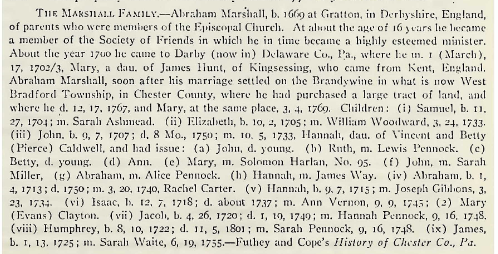
In the Youlgreave parish registers I found a baptism in 1667 for Humphrey Marshall son of Humphrey and Hannah. I didn’t find a baptism for Abraham, but it looks as though it could be correct. Abraham had a son he named Humphrey. But did it just look logical to whoever wrote the books, or do they know for sure? Did the famous botanist Humphrey Marshall have his own family records? The books don’t say where they got this information.
An earlier Humphrey Marshall was baptised in Youlgreave in 1559, his father Edmund. And in 1591 another Humphrey Marshall was baptised, his father George.
But can we connect these Marshall’s to ours? We do have an Abraham Marshall, grandson of Charles, born in 1792. The name isn’t all that common, so may indicate a family connection. The villages of Elton, Gratton and Youlgreave are all very small and it would seem very likely that the Marshall’s who went the USA are related to ours, if not brothers, then probably cousins.
Derbyshire Quakers
In “Derbyshire Quakers 1650-1761” by Helen Forde:
“… Friends lived predominantly in the northern half of the country during this first century of existence. Numbers may have been reduced by emigration to America and migration to other parts of the country but were never high and declined in the early eighteenth century. Predominantly a middle to lower class group economically, Derbyshire Friends numbered very few wealthy members. Many were yeoman farmers or wholesalers and it was these groups who dominated the business meetings having time to devote themselves to the Society. Only John Gratton of Monyash combined an outstanding ministry together with an organising ability which brought him recognition amongst London Friends as well as locally. Derbyshire Friends enjoyed comparatively harmonious relations with civil and Anglican authorities, though prior to the Toleration Act of 1639 the priests were their worst persecutors…..”
Also mentioned in this book: There were monthly meetings in Elton, as well as a number of other nearby places.
John Marshall of Elton 1682/3 appears in a list of Quaker emigrants from Derbyshire.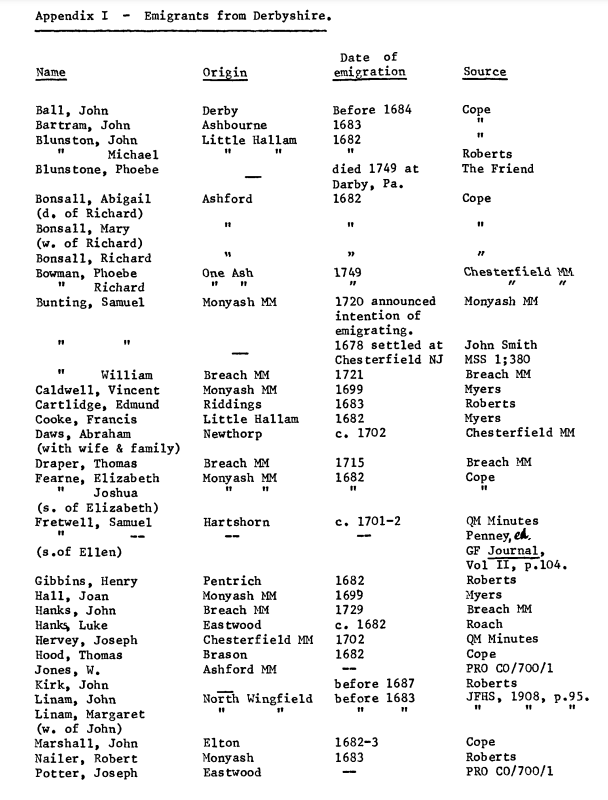
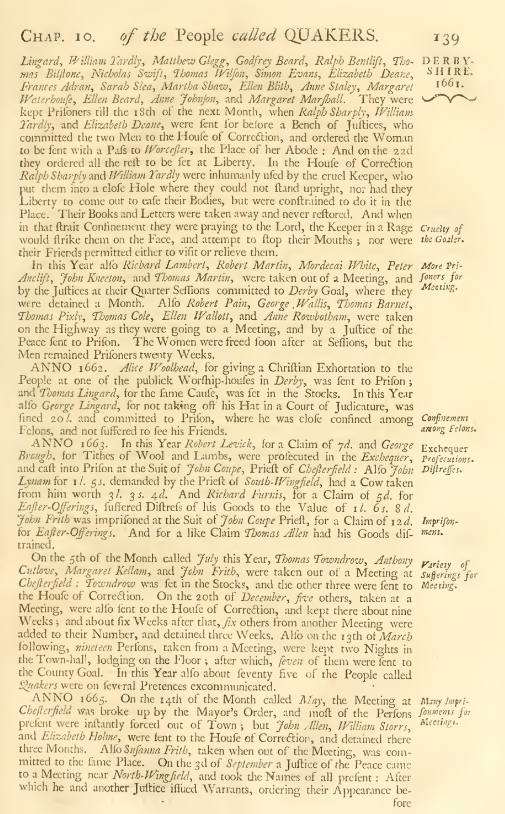
The following image is a page from the 1753 book on the sufferings of Quakers by Joseph Besse as an example of some of the persecutions of Quakers in Derbyshire in the 1600s:
A collection of the sufferings of the people called Quakers, for the testimony of a good conscience from the time of their being first distinguished by that name in the year 1650 to the time of the act commonly called the Act of toleration granted to Protestant dissenters in the first year of the reign of King William the Third and Queen Mary in the year 1689 (Volume 1)
Besse, Joseph. 1753Note the names Margaret Marshall and Anne Staley. This book would appear to contradict Helen Forde’s statement above about the harmonious relations with Anglican authority.
The Botanist
Humphry Marshall 1722-1801 was born in Marshallton, Pennsylvania, the son of the immigrant from Elton, Abraham Marshall. He was the cousin of botanists John Bartram and William Bartram. Like many early American botanists, he was a Quaker. He wrote his first book, A Few Observations Concerning Christ, in 1755.
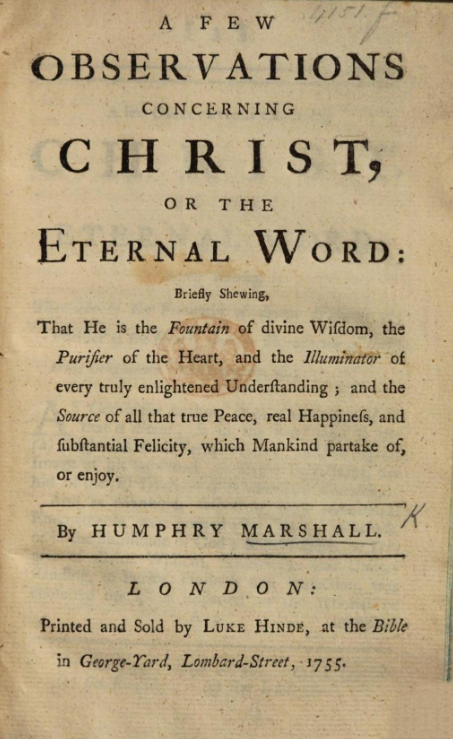
In 1785, Marshall published Arbustrum Americanum: The American Grove, an Alphabetical Catalogue of Forest Trees and Shrubs, Natives of the American United States (Philadelphia).
Marshall has been called the “Father of American Dendrology”.
A genus of plants, Marshallia, was named in honor of Humphry Marshall and his nephew Moses Marshall, also a botanist.
In 1848 the Borough of West Chester established the Marshall Square Park in his honor. Marshall Square Park is four miles east of Marshallton.
via Wikipedia.
From The History of Chester County Pennsylvania, 1881, by J Smith Futhey and Gilbert Cope:
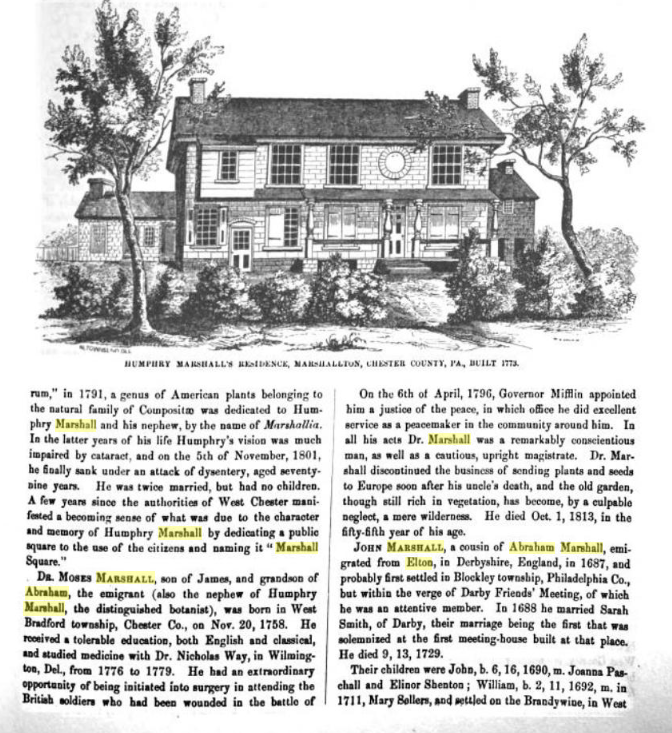
From The Chester Country History Center:
“Immediately on the Receipt of your Letter, I ordered a Reflecting Telescope for you which was made accordingly. Dr. Fothergill had since desired me to add a Microscope and Thermometer, and will
pay for the whole.’– Benjamin Franklin to Humphry, March 18, 1770
“In his lifetime, Humphry Marshall made his living as a stonemason, farmer, and miller, but eventually became known for his contributions to astronomy, meteorology, agriculture, and the natural sciences.
In 1773, Marshall built a stone house with a hothouse, a botanical laboratory, and an observatory for astronomical studies. He established an arboretum of native trees on the property and the second botanical garden in the nation (John Bartram, his cousin, had the first). From his home base, Humphry expanded his botanical plant exchange business and increased his overseas contacts. With the help of men like Benjamin Franklin and the English botanist Dr. John Fothergill, they eventually included German, Dutch, Swedish, and Irish plant collectors and scientists. Franklin, then living in London, introduced Marshall’s writings to the Royal Society in London and both men encouraged Marshall’s astronomical and botanical studies by supplying him with books and instruments including the latest telescope and microscope.
Marshall’s scientific work earned him honorary memberships to the American Philosophical Society and the Philadelphia Society for Promoting Agriculture, where he shared his ground-breaking ideas on scientific farming methods. In the years before the American Revolution, Marshall’s correspondence was based on his extensive plant and seed exchanges, which led to further studies and publications. In 1785, he authored his magnum opus, Arbustum Americanum: The American Grove. It is a catalog of American trees and shrubs that followed the Linnaean system of plant classification and was the first publication of its kind.”
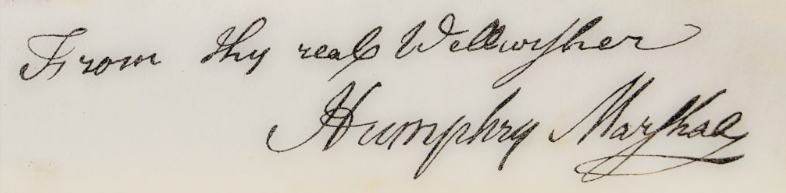 February 26, 2024 at 8:35 am #7389
In reply to: The Incense of the Quadrivium’s Mystiques
“Well, it’s a long story, are you sure you want to hear it?”
“Tell me everything, right from the beginning. You’re the one who keeps saying we have plenty of time, Truella. I shall quite enjoy just sitting here with a bottle of wine listening to the story,” Frigella said, feeling all the recent stress pleasantly slipping away.
“Alright then, you asked for it!” Truella said, topping up their glasses. The evening was warm enough to sit outside on the porch, which faced the rising moon. A tawny owl in a nearby tree called to another a short distance away. “It’s kind of hard to say when it all started, though. I suppose it all started when I joined that Arkan coven years ago and the focus wasn’t on spells so much as on time travel.”
“We used to travel to times and places in the past,” Truella continued, “Looking back now, I wonder how much of it we made up, you know?” Frigella nodded. “Preconceptions, assumptions based on what we thought we knew. It was fun though, and I’m pretty sure some of it was valid. Anyway, valid or not, one thing leads to another and it was fun.
“One of the trips was to this area but many centuries ago in the distant past. The place seemed to be a sort of ancient motorway rest stop affair, somewhere for travellers to stay overnight on a route to somewhere. There was nothing to be found out about it in any books or anything though, so no way to verify it like we could with some of our other trips. I didn’t think much more about it really, we did so many other trips. For some reason we all got a bit obsessed with pyramids, as you do!”
They both laughed. “Yeah, always pyramids or special magical stones,” agreed Frigella.
“Yeah that and the light warriors!” Truella snorted.
“So then I found a couple of pyramids not far away, well of course they weren’t actually pyramids but they did look like they were. We did lots of trips there and made up all sorts of baloney between us about them, and I kept going back to look around there. We used to say that archaeologists were hiding the truth about all the pyramids and past civilizations, quite honestly it’s a bit embarrassing now to remember that but anyway, I met an actual archaeologist by chance and asked her about that place. And the actual history of it was way more interesting than all that stuff we’d made up or imagined.
The ruins I’d found there were Roman, but it went further back than that. It was a bronze age hill fort, and later Phoenician and Punic, before it was Roman. I asked the archaeologist about Roman sites and how would I be able to tell and she showed me a broken Roman roof tile, and said one would always find these on a Roman site.
I found loads over the years while out walking, but then I found one in the old stone kitchen wall. Here, let me fetch another bottle.” Truella got up and went inside, returning with the wine and a dish of peanuts.
“So that’s when I decided to dig a hole in the garden and just keep digging until I found something. I don’t know why I never thought to do that years ago. I tell you what, I think everyone should just dig a hole in their garden, and just keep digging until they find something, I can honestly say that I’ve never had so much fun!”
“But couldn’t you have just done a spell, instead of all that digging?” Frigella asked.
“Oh my god, NO! Hell no! That wouldn’t be the same thing at all,” Truella was adamant. “In fact, this dig has made me wonder about all our spells to be honest, are we going too fast and missing the finds along the way? I’ve learned so much about so many things by taking it slowly.”
“Yeah I kinda know what you mean, but carry on with the story. We should discuss that later, though.”
“Well, I just keep finding broken pottery, loads of it. We thought it was all Roman but some of it is older, much older. I’m happy about that because I read up on Romans and frankly wasn’t impressed. Warmongering and greedy, treated the locals terribly. Ok they made everything look nice with the murals and mosaics and what not, and their buildings lasted pretty well, but who actually built the stuff, not Romans was it, it was the slaves. Still, I wasn’t complaining, finding Roman stuff in the garden was pretty cool. But I kept wishing I knew more about the people who lived here before they came on the rampage taking everything back to Rome. Hey, let me go and grab another bottle of wine.”
Frigella was feeling pleasantly squiffy by now. The full moon was bright overhead, and she reckoned it was light enough to wander around the garden while Truella was in the kitchen. As she walked down the garden, the tawny owl called and she looked up hoping to see him in the fig tree. She missed her step and fell over a bucket, and she was falling, falling, falling, like Alice down the rabbit hole.
The fall was slow like a feather wafting gently down and she saw hundreds of intriguing fragments of objects and etchings and artefacts on the sides of the hole and she drifted slowly down. At last she came to rest at the bottom, and found herself in an arched gallery of mirrors and tiles and doors. On every surface were incomplete drawings and shreds of writings, wondrous and fascinating. She didn’t immediately notice the hippocampus smiling benignly down at her. He startled her a little, but had such a pleasant face that she smiled back up at him. “Where am I?” she asked.
“You’d be surprised how many people ask me that.” he replied, with a soft whicker of mirth. “Not many realise that they’ve called on me to help them navigate. Now tell me, where is it you want to go?”
“Well,” Frigella replied slowly, “Now that you ask, I’m not entirely sure. But I’m pretty sure Truella would like to see this place.”
 February 9, 2024 at 11:44 am #7360
In reply to: The Incense of the Quadrivium’s Mystiques
Trying not to smile too broadly, Truella was delighted with Malove’s latest idea. An inveterate and unrepentant smoker, she had often wondered what the hysteria about cigarette smoke was all about. It seemed as ludicrous as the Victorian fashion for hiding immodest table and piano legs with voluminous paisley shawls while sending children up chimneys to clean them. Those who railed against tobacco smoke filled their rooms with the noxious fumes of incense or toxic “air fresheners”, their fridges with smoked bacon and smoked salmon, delighted in “real fires” with nostalgic wisps of smoke curling from country cottage chimneys, and sitting around a smoking barbecue or campfire. Humans had lived in smokey hovels and caves since the beginning of time.
Frigella noticed Truella smirking and shook her head, tutting. With a devilishly wide grin, Truella whispered, “Meet me in the pub afterwards, need to talk.”
“Perhaps we can count on your full and undivided participation for once, Truella,” Malove said, who hadn’t missed anything. “With your penchant for filling public spaces with smoke, this mission will no doubt appeal to you greatly.”
“Indeed,” she replied, endeavouring to look demure and obedient.
February 1, 2024 at 10:18 am #7337In reply to: The Incense of the Quadrivium’s Mystiques
The bone people had replied to Truella’s urgent message while she was at the meeting, much to her relief. The last thing she wanted was the authorities snooping around, just as she was delving into the rich new layer. The odd things she’d been finding recently had piqued her curiousity and she had to keep reminding herself to merely find, observe and document, without attempting to make assumptions. She couldn’t help wondering though if these disparate items, things she hadn’t expected to find, were the ingredients for an ancient spell. The little bone amulet, the pigs teeth, and all the other little bits of bone with curious smooth sides. Fragments of mother of pearl, gleaming like new silver in the dirt, uncorroded and pristine despite the passage of time and the weight of the earth. Little clumps of charcoal, but scattered, not all in the same place. Not like there’d been a fire, more like little things had burned, here and there, at various times.
All the broken dishes and amphora were to be expected, but why so many? And why didn’t whoever lived here take their dishes with them when they went? Maybe they left in a hurry, smashing everything on the way out of the door so there was nothing left for the invaders? Or did the dishes simply fall and break when the abandoned wooden shelves rotted away over the centuries? A layer of abandonment was a curious and intriguing thing to contemplate.
Now that she had the experts opinion on the teeth ~ pig, not human ~ haste was needed to quell the growing rumours in the village that she had found human remains. That was the last thing she needed, the neighbours giving her suspicious looks or the authorities roping off her dig with striped plastic tape and putting a police tent over it, messing with the hole she had dug trowel by trowel, rubbing every handful of soil between her fingers. The very thought of it was unbearable. For this reason she rather hoped NOT to find a hoard of valuable ancient coins, contrary to what most people would hope to find. Still, she couldn’t help wonder while she was digging if the next trowel of soil would reveal one.
She must make it absolutely clear to Roger than he was only required to carry buckets of soil, and was not to do any actual digging.
January 17, 2024 at 1:14 pm #7297In reply to: The Whale’s Diaries Collection
what was the state of the ruined roman villa circa early 1500s when the cobblestone yard was made from on site rubble? What did the work men find?
Ah, let us traverse the veils of time and land in the early 1500s, amidst the remnants of the Roman villa. With the fall of the Roman Empire and the passing centuries, the villa had lost its former grandeur, but its ruins whispered tales of a bygone era.
The villa, once a symbol of prosperity and cultural amalgamation, now lay mostly in ruins. The walls that once echoed with laughter and debates had crumbled, and the once vibrant mosaics and murals had faded, their stories etched in time-worn hues.
The outbuildings, too, bore the scars of time. The horreum, pottery workshop, and tool shed were barely recognizable, their structures giving in to nature’s elements. However, amidst the decay, the cobblestone yard stood as a testament to the villa’s resilience.
The yard, once a bustling hub of activity, had been repurposed. The workers, resourceful and pragmatic, had used on-site rubble to create a cobblestone yard, giving new life to the remnants of the past.
As they worked, they uncovered artifacts from the villa’s past. Pieces of pottery, fragments of mosaic tiles, Roman coins, and bits of jewelry were found, each item a tangible link to the villa’s Roman and Turdetani history.
Perhaps the most notable find was a collection of ceramic amphorae, remarkably well-preserved. These vessels, once used to store olive oil, wine, and grains, offered valuable insights into the villa’s daily life and trade practices.
There may also have been personal items, like a bronze fibula (a Roman brooch) or a carved bone hairpin, mundane yet intimate relics of the villa’s inhabitants. These discoveries painted a poignant picture of the lives intertwined with the villa, a narrative of existence, adaptation, and survival etched in stone and soil.
What about the lives of the people who lived here in the 1500s?
Ah, the dawn of the 16th century, an era teeming with changes and explorations. Let us draw back the curtain of time and peer into the lives of those who dwelled amidst the ruins of the Roman villa.
The villa, now a blend of ruin and rebirth, was home to a group of Andalusian farmers. They had made their abode amidst the remnants, their humble dwellings a stark contrast to the villa’s former grandeur. Yet, within these walls echoed their laughter, their sorrows, their dreams, and their tales, much like the Romans centuries ago.
The patriarch, Diego, was a man of the soil. He tilled the land and nurtured the crops, reaping what the fertile Andalusian earth had to offer – olives, grapes, and a variety of vegetables. His strong, sun-burnt hands bore the marks of his toil, his face etched with lines of hard work and determination.
His wife, Isabella, was the custodian of the hearth. She cooked, cleaned, and cared for their three children. Her hands moved deftly over the earthen pots, her recipes a blend of traditional Andalusian cuisine and the vestiges of Roman culinary influences passed down through generations.
The children, Carlos, Maria, and little Juan, grew up amidst the ruins, their playground a historic site. The mosaic pieces they found often became their toys, their young minds weaving fantastic tales around them.
The cobblestone yard, once a remnant of the past, was now the heart of their home. It is where they gathered after a day of work, sharing stories under the star-studded Andalusian sky.
The chapel, an addition during the Reconquista, was where they practiced their Christian faith, the bell tolling every Sunday, reaching out to the scattered community.
Amidst the ruins, they found their sanctuary, their home. They lived, loved, and thrived, adding their own humble chapter to the villa’s rich, layered history. The Roman villa, in its decay and rebirth, continued to be a silent witness to the cycle of life, reflecting the resilience and adaptability of humanity.
then I asked about the 1200s on this site
Ah, the 13th century, a period of considerable transformation and discovery globally. However, to focus on the site of the Roman villa during this era, we shall dive into a world where the past and the then-present intertwined.
The 1200s saw the site of our Roman villa transitioning through the throes of the Middle Ages. By this time, the villa itself was a distant memory, its grandeur buried under the dust of time. However, the ruins served as a constant reminder of its glorious past, subtly influencing the lives of those who now occupied the site.
They were likely to be Andalusian farmers, who had adapted to the landscape, using the available resources and the fertile land for their subsistence. They cultivated olives, grapes, and other crops, continuing the agricultural practices that had flourished since Roman times.
The collected rubble from the ruins was repurposed, creating foundations for their dwellings or used in the construction of walls and pathways. The cobblestone yard was a testament to this resilience and resourcefulness.
The ruins also provided them with materials and artifacts. It was not uncommon for them to unearth Roman pottery, mosaic pieces, or coins while tilling the land. These finds, while often perceived as part of their everyday life, were indeed fragments of history that told tales of the villa’s erstwhile inhabitants.
Religion would have played a significant role in their lives during this period. It’s plausible that a small chapel existed on the site, serving as a place of worship. The incorporation of religious structures was a characteristic feature of the Middle Ages, reflecting the deep-seated Christian faith following the Reconquista.
Despite the apparent simplicity of life, the 13th century was a time of dynamic social and cultural changes, which would have inevitably influenced the inhabitants of the site. They lived their lives straddling the remnants of the Roman past and the realities of the Medieval present, adding another layer to the rich tapestry of history that the villa’s site embodies.
-
AuthorSearch Results