

Search Results for 'novels'
-
AuthorSearch Results
-
January 3, 2026 at 8:09 pm #8025
In reply to: The Hoards of Sanctorum AD26
As soon as Boothroyd had gone, Laddie Bentry, the under gardener, emerged from behind the Dicksonia squarrosa that was planted in a rare French Majolica Onnaing dragon eagle pot. The pot, and in particular the tree fern residing within it, were Laddie’s favourite specimen, reminding him of his homeland far away.
Keeping a cautious eye on the the door leading into the house, Laddie hurried over to the cast iron planter and retrieved the Liz Tattler novel hidden underneath. Quickly he tucked in into the inside pocket of his shabby tweed jacket and hastened to the door leading to the garden. Holding on to his cap, for the wind was cold and gusty, he ran to the old stable and darted inside. Laddie reckoned he had an hour or two free without Boothroyd hovering over him, and he settled himself on a heap of old sacks.
 The Vampire Hoarders of Varna. It wasn’t the first time Laddie had seen Boothroyd surreptitiously reading Helier’s books, and it had piqued his curiosity. What was it the old fart found so interesting about Helier’s novels? The library was full of books, if he wanted to read. Not bothering to read the preface, and not having time to start on page one, Laddie Bentry flicked through the book, pausing to read random passages.
….the carriage rattled and lurched headlong through the valley, jostling the three occupants unmercifully. “I’ll have the guts of that coachman for garters! The devil take him!” Galfrey exclaimed, after bouncing his head off the door frame of the compartment.
“Is it bleeding?” asked Triviella, inadvertently licking her lips and she inspected his forehead.
“The devil take you too, for your impertinence,” Galfrey scowled and shook her off, his irritation enhanced by his alarm at the situation they found themselves in.
Ignoring his uncharacteristic bad humour, Triviella snuggled close and and stroked his manly thigh, clad in crimson silk breeches. “Just think about the banquet later,” she purred.
Jacobino, austere and taciturn, on the opposite seat, who had thus far been studiously ignoring both of them, heard the mention of the banquet and smiled for the first time since…
Laddie opened the book to another passage.
“……1631, just before the siege of Gloucester, and what a feast it was! It was hard to imagine a time when we’d feasted so well. Such rich and easy pickings and such a delightful cocktail. One can never really predict a perfect cocktail of blood types at a party, and centuries pass between particularly memorable ones. Another is long overdue, and one would hate to miss it,” Jacobino explained to the innocent and trusting young dairy maid, who was in awe that the handsome young gentleman was talking to her at all, yet understood very little of his dialogue.
“Which is why,” Jacobino implored, taking hold of her small calloused hands, “You must come with me to the banquet tonight.”
Little did she know that her soft rosy throat was on the menu…..
December 31, 2025 at 11:11 am #8009In reply to: Finder’s Keepers of the Hoard
Some ideas for the background thread and character profiles for “The Hoards of Emporium 26.”
The Setting: Emporium 26
They live in Gloucester (ancient Glevum), a city built on Roman bones where the layout of the streets still follows the legions’ sandals. They inhabit a sprawling, shared Georgian townhouse complex that has been knocked through into one labyrinthine dwelling—Number 26.
To the outside world, it looks like a dilapidated heritage site. Inside, it is The Emporium: a geological stratification of history, where layers of Roman pottery are mixed with 1990s Beanie Babies and medieval reliquaries.
The Background Thread: “The Weight of Eternity”
Why do they hoard? Because when you live forever, “letting go” feels like losing a piece of the timeline. Hoarding objects is for them an accumulation of evidence of existence.
- The Curse: They cannot die naturally, but they can fade if they are forgotten. The “stuff” anchors them to the physical plane.
- The “Halo” Effect: Occasionally, when they are arguing over whose turn it is to do the dishes, or when they find a lost treasure, the stained-glass light of their old divinity flickers behind their heads—a neon halo of forgotten holiness.
The Hoarders & Their Stashes
1. Helier ( The Hermit / The Dreamer)
- Saintly Origin: Based on St. Helier (Jersey/Normandy). He was an ascetic hermit who lived in a cave and was eventually beheaded.
- Modern Persona: A soft-spoken agoraphobe who hasn’t left the house since the invention of the internet. He wears oversized cardigans that smell like old library books.
- The Mania: Escapism & Communication.
- Because he spent centuries in silence on a rock, he is now obsessed with human stories and noise.
- The Hoard: ” The Media Mountain.”
- His wing of the house is a fire hazard of pulp fiction, towering stacks of National Geographic (dating back to the first issue), thousands of VHS tapes (he has no VCR), and tangled knots of ethernet cables that he refuses to throw away “in case they fit a port from 1998.”
- The Secret Stash: Beneath a pile of “The Hoarder Vampires” novels lies his true relic: The Stone Pillow. The actual rock he slept on in the 6th century. He still naps on it when his back hurts.
2. Spirius (The Bishop / The Container)
- Saintly Origin: Evocative of St. Exuperius (Bayeux). A driver-out of demons and a man of grand gestures.
- Modern Persona: A nervous, fidgety man who is convinced the world is leaking. He is the “fixer” of the group but usually makes things worse with duct tape.
- The Mania: Containment & Preservation.
- In the old days, he bottled demons. Now, he’s terrified of running out of space to put things.
- The Hoard: “The Vessel Void.”
- Spirius hoards anything that can hold something else. Empty jam jars (washed, mostly), Tupperware with no matching lids, biscuit tins, and thousands of plastic carrier bags stuffed inside other carrier bags (the “Bag of Bags”).
- The Secret Stash: In a locked pantry, he keeps a shelf of sealed mason jars labeled with dates like “1431” or “1789.” He claims they contain the “Sigh of a King” or “The smell of rain before the Plague.” It’s actually just dust, but the jars vibrate slightly.
3. Cerenise (The Weaver / The Mender)
- Saintly Origin: Evocative of St. Ceneri or St. Cerneuf. A saint of travelers, or perhaps needlework.
- Modern Persona: She is the “Wheelchair Girl’s” friend mentioned in the intro? Or perhaps she is in a wheelchair now—not because she can’t walk, but because she’s too tired from walking for 1,500 years. She is sharp-tongued and fashionable in a “crazy bag lady” sort of way.
- The Mania: Potential & Texture.
- She sees the soul in broken things. She cannot throw away anything that “could be fixed.”
- The Hoard: “The Fabric of Time.”
- Her rooms are draped in layers of textiles: velvet curtains from a 1920s cinema, moth-eaten tapestries depicting her own miracles (she thinks the nose is wrong), and buttons. Millions of buttons. She also hoards broken appliances—toasters, lamps, clocks—insisting she will repair them “next Tuesday.”
- The Secret Stash: A mannequin dressed in a perfectly preserved Roman stola, hidden under forty layers of polyester coats. It’s the outfit she wore when she performed her first miracle. She tries it on every New Year’s Eve.
4. Yvoise (The Advocate / The Bureaucrat)
- Saintly Origin: Evocative of St. Yves (Patron of Lawyers/Brittany/Normandy). The arbiter of justice.
- Modern Persona: The “Manager” of Emporium 26. She wears power suits from the 80s and is always carrying a clipboard. She loves rules, even if she invents them.
- The Mania: Proof of Truth.
- She is terrified of being forgotten or cheated. She needs a receipt for everything.
- The Hoard: “The Archive of Nothing.”
- Yvoise hoards paper. Receipts from a coffee bought in 1952, bus tickets, expired warranties, junk mail, and legal disclaimers torn off mattresses. Her room looks like the inside of a shredder that exploded. She claims she is building “The Case for Humanity.”
- The Secret Stash: A filing cabinet labeled “Do Not Open.” Inside is not paper, but Seeds. Seeds from the trees of ancient Gaul. She is saving them for when the paper finally takes over the world and she needs to replant the forest she misses.
Starter: The Reading of Austreberthe’s Will
The story kicks off because Austreberthe (The Saint of Washing/Water) has died. Her hoard was Soap and Water.
- The house is now flooding because her magical containment on the plumbing has broken.
- The remaining four must navigate her “Tsunami Wing”—a treacherous dungeon of accumulated bath bombs, stolen hotel towels, and aggressive washing machines—to find her Will.
- The Will is rumored to reveal the location of the “Golden Key,” an object that can legally terminate their lease on Emporium 26, which none of them want, but all of them crave.
March 23, 2025 at 7:37 am #7878In reply to: The Precious Life and Rambles of Liz Tattler
Liz threw another pen into the tin wastepaper basket with a clatter and called loudly for Finnley while giving her writing hand a shake to relieve the cramp.
Finnley appeared sporting her habitual scowl clearly visible above her paper mask. “I hope this is important because this red dust is going to take days to clean up as it is without you keep interrupting me.”
“Oh is that what you’ve been doing, I wondered where you were. Well, let’s thank our lucky stars THAT’S all over!”
“Might be over for you,” muttered Finnley, “But that hare brained scheme of Godfrey’s has caused a very great deal of work for me. He’s made more of a mess this time than even you could have, red dust everywhere and all these obsolete parts all over the place. Roberto’s on his sixth trip to the recycling depot, and he’s barely scratched the surface.”
“Good old Roberto, at least he doesn’t keep complaining. You should take a leaf out of his book, Finnley, you’d get more work done. And speaking of books, I need another packet of pens. I’m writing my books with a pen in future. On paper. Oh and get me another pack of paper.”
Mildly curious, despite her irritation, Finnely asked her why she was writing with a pen on paper. “Is it some sort of historical re enactment? Would you prefer parchment and a quill? Or perhaps a slab of clay and some etching tools? Shall we find you a nice cave,” Finnley was warming to the theme, “And some red ochre and charcoal?”
“It may come to that,” Liz replied grimly. “But some pens and paper will do for now. Godfrey can’t interfere in my stories if I write them on paper. Robots writing my stories, honestly, who would ever have believed such a thing was possible back when I started writing all my best sellers! How times have changed!”
“Yet some things never change, ” Finnley said darkly, running her duster across the parts of Liz’s desk that weren’t covered with stacks of blue scrawled papers.
“Thank you for asking,” Liz said sarcastically, as Finnley hadn’t asked, “It’s a story about six spinsters in the early 19th century.”
“Sounds gripping,” muttered Finnley.
“And a blind uncle who never married and lived to 102. He was so good at being blind that he knew all his sheep individually.”
“Perhaps that’s why he never needed to marry,” Finnley said with a lewd titter.
“The steamy scenes I had in mind won’t be in the sheep dip,” Liz replied, “Honestly, what a low degraded mind you must have.”
“Yeah, from proof reading your trashy novels,” Finnley replied as she flounced out in search of pens and paper.
February 23, 2025 at 1:35 pm #7828In reply to: The Last Cruise of Helix 25
Helix 25 – The Murder Board
Evie sat cross-legged on the floor of her cramped workspace, staring at the scattered notes, datapads, and threads taped to the wall. Finding some yarn on the ship had not been as easy as she thought, but it was a nice touch she thought.
The Murder Board, as Riven Holt had started calling it, was becoming an increasingly frustrating mess of unanswered questions.
Riven stood nearby, arms crossed, with a an irritated skepticism. “Almost a week,” he muttered. “We’re no closer than when we started.”
Evie exhaled sharply. “Then let’s go back to the basics.”
She tapped the board, where the crime scene was crudely sketched. The Drying Machine. Granary. Jardenery. Blood that shouldn’t exist.
She turned to Riven. “Alright, let’s list it out. Who are our suspects?”
He looked at his notes, dejected for a moment; “too many, obviously.” Last census on the ship was not accurate by far, but by all AI’s accounts cross-referenced with Finkley’s bots data, they estimated the population to be between 15,000 and 50,000. Give or take.
They couldn’t interview possibly all of them, all the more since there the interest in the murder had waned very rapidly. Apart from the occasional trio of nosy elderly ladies, the ship had returned mostly to the lull of the day-to-day routine.
So they’d focused on a few, and hoped TP’s machine brain could see patterns where they couldn’t.- First, the Obvious Candidates: People with Proximity to the Crime Scene
Romualdo, the Gardener – Friendly, unassuming. He lends books, grows plants, and talks about Elizabeth Tattler novels. But Herbert visited him often. Why?
Dr. Amara Voss – The geneticist. Her research proves the Crusader DNA link, but could she be hiding more? Despite being Evie’s godmother, she couldn’t be ruled out just yet.
Sue Forgelot – The socialite with connections everywhere. She had eluded their request for interviews. —does she know more than she lets on?
The Cleaning Staff – they had access everywhere. And the murder had a clean elegance to it… - Second, The Wild Cards: People with Unknown Agendas
The Lower Deck Engineers – Talented mechanic, with probable cybernetic knowledge, with probable access to unauthorized modifications. Could they kill for a reason, or for hire?
Zoya Kade and her Followers – They believe Helix 25 is on a doomed course, manipulated by a long-dead tycoon’s plan. Would they kill to force exposure of an inconvenient truth?
The Crew – Behind the sense of duty and polite smiles, could any of them be covering something up? - Third, The AI Factor: Sentient or Insentient?
Synthia, the AI – Controls the ship. Omnipresent. Can see everything, and yet… didn’t notice or report the murder. Too convenient.
Other personal AIs – Like Trevor Pee’s programme, most had in-built mechanisms to make them incapable of lying or harming humans. But could one of their access be compromised?
Riven frowned. “And what about Herbert himself? Who was he, really? He called himself Mr. Herbert, but the cat erm… Mandrake says that wasn’t his real name. If we figure out his past, maybe we find out why he was killed.”
Evie rubbed her temples. “We also still don’t know how he was killed. The ship’s safety systems should have shut the machine down. But something altered how the system perceived him before he went in.”
She gestured to another note. “And there’s still the genetic link. What was Herbert doing with Crusader DNA?”
A heavy silence settled between them.
Then TP’s voice chimed in. “Might I suggest an old detective’s trick? When stumped, return to who benefits.”
Riven exhaled. “Fine. Who benefits from Herbert’s death?”
Evie chewed the end of her stylus. “Depends. If it was personal, the killer is on this ship, and it’s someone who knew him. If it was bigger than Herbert, then we’re dealing with something… deeper.”
TP hummed. “I do hate deeper mysteries. They tend to involve conspiracies, misplaced prophecies, and far too many secret societies.”
Evie and Riven exchanged a glance.
Riven sighed. “We need a break.”
Evie scoffed. “Time means nothing here.”
Riven gestured out the window. “Then let’s go see it. The Sun.”
Helix 25 – The Sun-Gazing Chamber
The Sun-Gazing Chamber was one of Helix 25’s more poetic and yet practical inventions —an optically and digitally-enhanced projection of the Sun, positioned at the ship’s perihelion. It was meant to provide a psychological tether, a sense of humanity’s connection to the prime provider of life as they drifted in the void of the Solar System.
It was a beautifully designed setting where people would simply sit and relax, attuned to the shift of days and nights as if still on Earth. The primary setting had been voted to a massive 83.5% to be like in Hawai’i latitude and longitude, as its place was believed to be a reflection of Earth’s heart. That is was a State in the USA was a second thought of course.
Evie sat on the observation bench, staring at the massive, golden sphere suspended in the darkness. “Do you think people back on Earth are still watching the sunrise?” she murmured.
Riven was quiet for a moment. “If there’s anyone left.”
Evie frowned. “If they are, I doubt they got much of a choice.”
TP materialized beside them, adjusting his holographic tie. “Ah, the age-old existential debate: are we the lucky ones who left Earth, or the tragic fools who abandoned it?”
Evie ignored him, glancing at the other ship residents in the chamber. Most people just sat quietly, basking in the light. But she caught snippets of whispers, doubt, something spreading through the ranks.
“Some people think we’re not really where they say we are,” she muttered.
Riven raised an eyebrow. “What, like conspiracy theories?”
TP scoffed. “Oh, you mean the Flat-Earthers?” He tsked. “Who couldn’t jump on the Helix lifeboats for their lives, convinced as they were we couldn’t make it to the stars. They deserved what came to them. Next they’ll be saying Helix 25 never even launched and we’re all just trapped in a simulation of a luxury cruise.”
Evie was shocked at Trevor Pee’s eructation and rubbed her face. “Damn Effin Muck tech, and those “Truth Control” rubbish datasets. I thought I’d thoroughly scrubbed all the old propaganda tech from the system.”
“Ah,” TP said, “but conspiracies are like mold. Persistent. Annoying. Occasionally toxic.”
Riven shook his head. “It’s nonsense. We’re moving. We’ve been moving for decades.”
Evie didn’t look convinced. “Then why do we feel stuck?”
A chime interrupted them.
A voice, over the comms. Solar flare alert.
Evie stiffened.
Then: Stay calm and return to your quarters until further notice.
Evie raised an eyebrow. This was the first time something like that happened. She turned to Riven who was looking at his datapad who was flashing and buzzing.
He said to her: “Stay quiet and come with me, a new death has been reported. Crazy coincidence. It’s just behind the Sun-Gazing chamber actually, in the Zero-G sector.”
February 15, 2025 at 10:33 am #7794In reply to: Helix Mysteries – Inside the Case
Some pictures selections
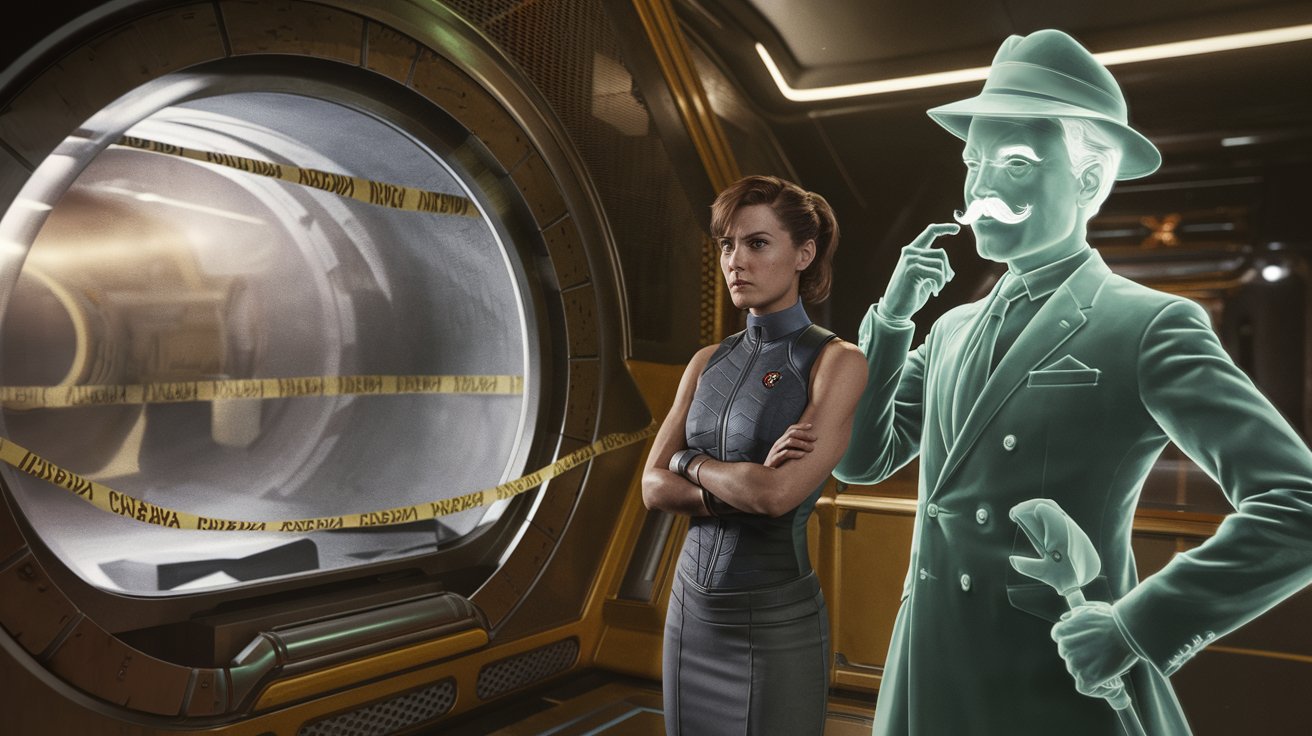
Evie and TP Investigating the Drying Machine Crime Scene

A cinematic sci-fi mini-scene aboard the vast and luxurious Helix 25. In the industrial depths of the ship, a futuristic drying machine hums ominously, crime scene tape lazily flickering in artificial gravity. Evie, a sharp-eyed investigator in a sleek yet practical uniform, stands with arms crossed, listening intently. Beside her, a translucent, retro-stylized holographic detective—Trevor Pee Marshall (TP)—adjusts his tiny mustache with a flourish, pointing dramatically at the drying machine with his cane. The air is thick with mystery, the ship’s high-tech environment reflecting off Evie’s determined face while TP’s flickering presence adds an almost comedic contrast. A perfect blend of noir and high-tech detective intrigue.
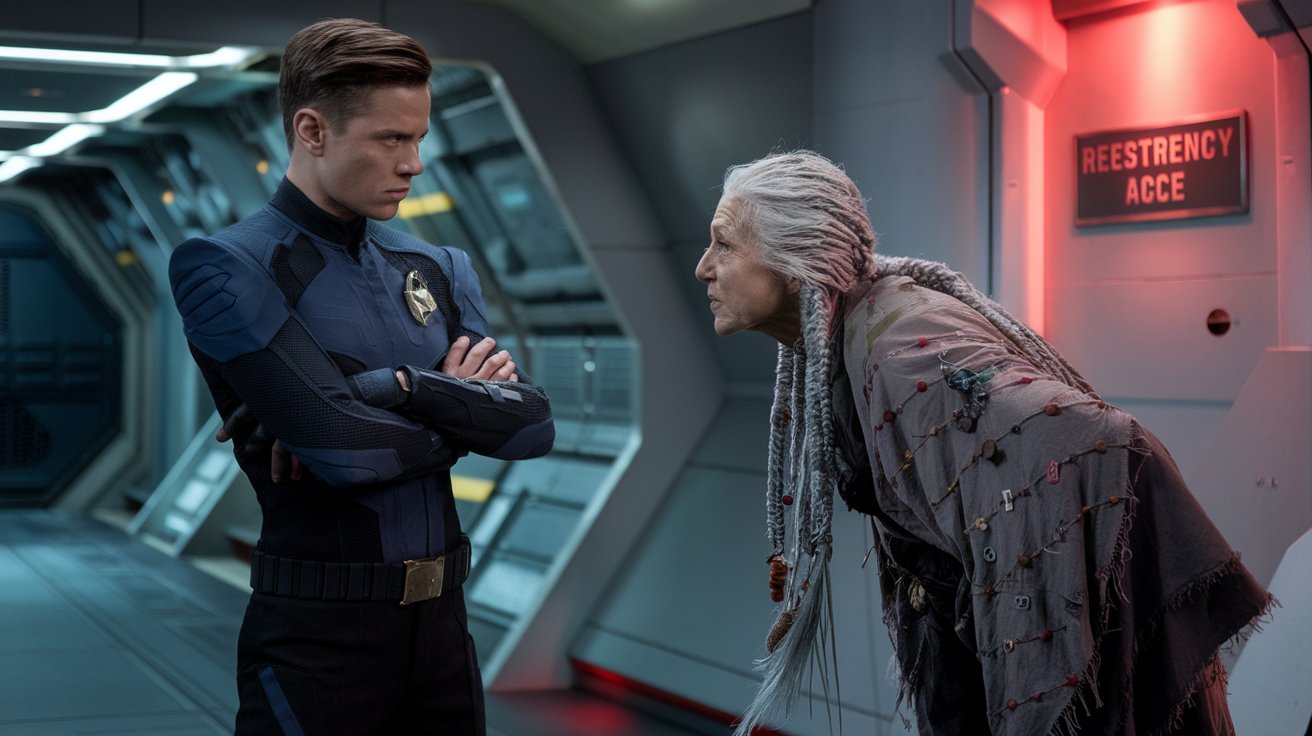
Riven Holt and Zoya Kade Confronting Each Other in a Dimly Lit Corridor
A dramatic, cinematic sci-fi scene aboard the vast and luxurious Helix 25. Riven Holt, a disciplined young officer with sharp features, stands in a high-tech corridor, his arms crossed, jaw tense—exuding authority and restraint. Opposite him, Zoya Kade, a sharp-eyed, wiry 83-year-old scientist-prophet, leans slightly forward, her mismatched layered robes adorned with tiny artifacts—beads, old circuits, and a fragment of a key. Her silver-white braid gleams under the soft emergency lighting, her piercing gaze challenging him. The corridor hums with unseen energy, a subtle red glow from a “restricted access” sign casting elongated shadows. Their confrontation is palpable—a struggle between order and untamed knowledge, hierarchy and rebellion. In the background, the walls of Helix 25 curve sleekly, high-tech yet strangely claustrophobic, reinforcing the ship’s ever-present watchfulness.
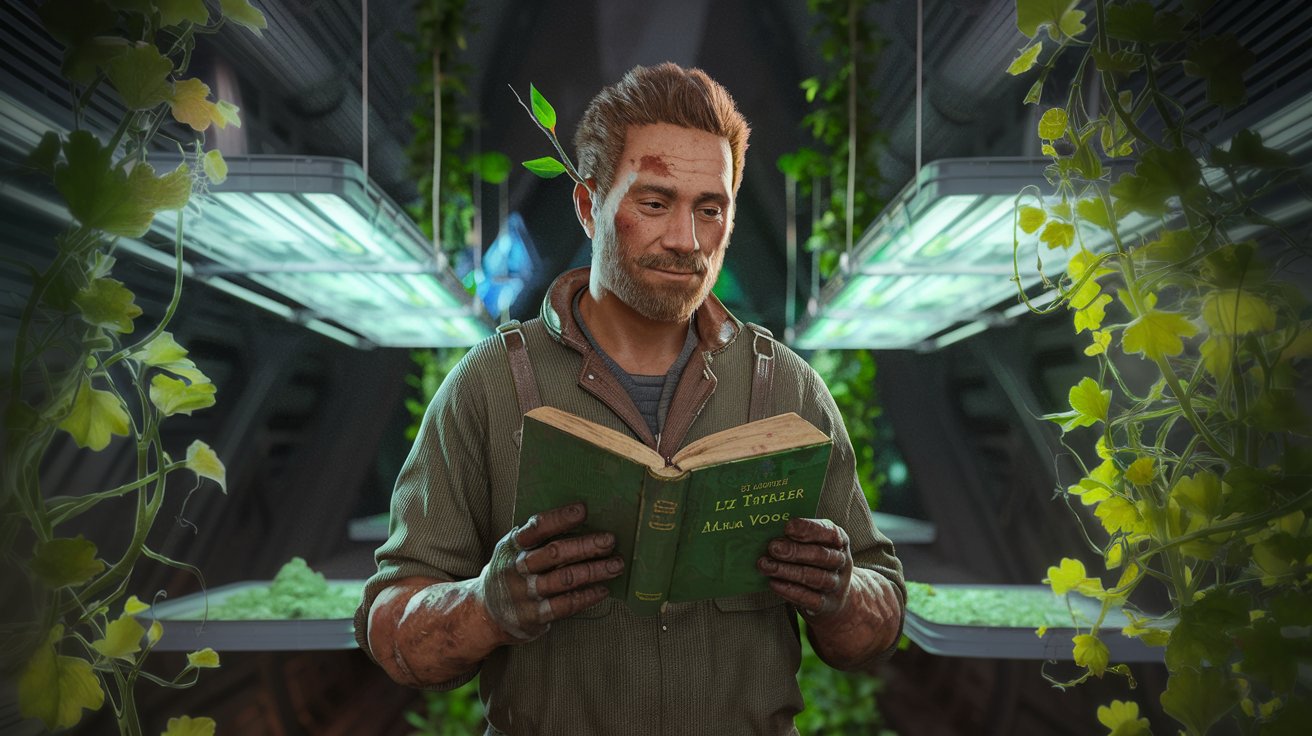
Romualdo, the Gardener, Among the Bioluminescent Plants
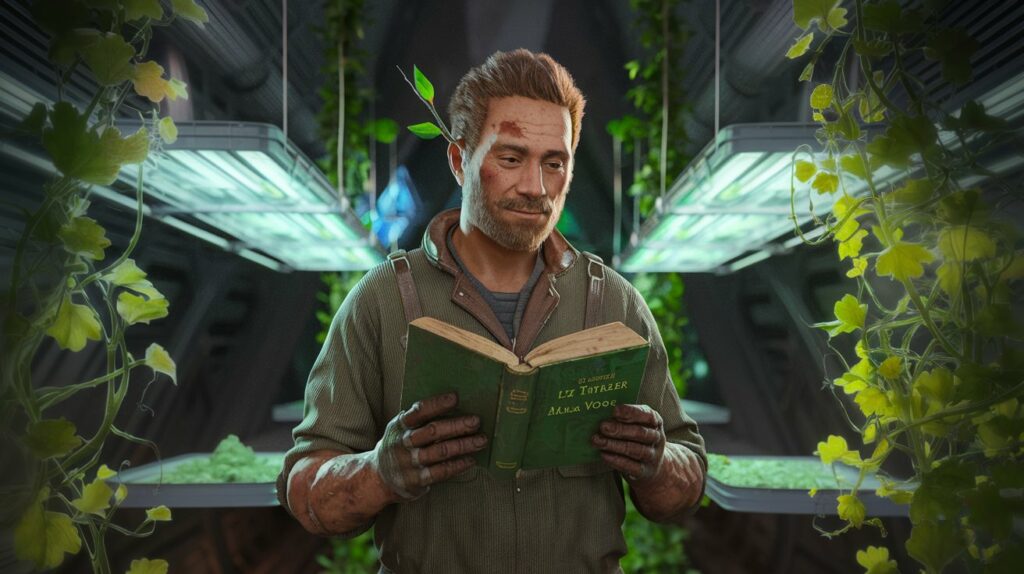
A richly detailed sci-fi portrait of Romualdo, the ship’s gardener, standing amidst the vibrant greenery of the Jardenery. He is a rugged yet gentle figure, dressed in a simple work jumpsuit with soil-streaked hands, a leaf-tipped stem tucked behind his ear like a cigarette. His eyes scan an old, well-worn book—one of Liz Tattler’s novels—that Dr. Amara Voss gave him for his collection. The glowing plants cast an ethereal blue-green light over him, creating an atmosphere both peaceful and mysterious. In the background, the towering vines and suspended hydroponic trays hint at the ship’s careful balance between survival and serenity.
Finja and Finkley – A Telepathic Parallel Across Space

A surreal, cinematic sci-fi composition split into two mirrored halves, reflecting a mysterious connection across vast distances. On one side, Finja, a wiry, intense woman with an almost obsessive neatness, walks through the overgrown ruins of post-apocalyptic Earth, her expression distant as she “listens” to unseen voices. Dust lingers in the air, catching the golden morning light, and she mutters to herself about cleanliness. In her reflection, on the other side of the image, is Finkley, a no-nonsense crew member aboard the gleaming, futuristic halls of Helix 25. She stands with hands on her hips, barking orders at small cleaning bots as they maintain the ship’s pristine corridors. The lighting is cold and artificial, sterile in contrast to the dust-filled Earth. Yet, both women share a strange symmetry—gesturing in unison as if unknowingly mirroring one another across time and space. A faint, ghostly thread of light suggests their telepathic bond, making the impossible feel eerily real.
December 14, 2024 at 6:42 pm #7682In reply to: Quintessence: Reversing the Fifth
Matteo — Autumn 2023
The Jardin des Plantes park was quiet, the kind of quiet that settled after a brisk autumn rain. Matteo sat on a weathered wooden bench, watching a golden retriever chase the last of the fallen leaves tumbling across the gravel path. The damp air was carrying scents of the earth welcoming a retreat inside, and taking the time to be alone with his thoughts was something he’d missed.
His phone buzzed with a notification—a news update about the latest film adaptation from a Liz Tattler classic fiction. The name made him smile faintly. Juliette had loved Tattler’s novels, their whimsical characters, and the unflinching and unapologetic observations about life’s quiet mysteries and the unexpected rants about the virtues of cleaning and dustsceawung that propelled the word in the people’s top 100 favourite in the Oxford dictionary for several years consecutively.
“They’re so full of texture,” Juliette once said as she was sprawled on the bed of their tiny Parisian flat, a battered paperback in her hands. “Like you can feel the pages breathe.”
His image of her was still vivid, they’d stayed on good terms and he would still thumb up some of her posts from time to time —but it was only small moments rather than full scenes that used to come back, fragmented pieces of memories really —her dark hair falling messily over her face, her legs crossed in a casual way.
Paris had been a playground for them. For a while, they were caught in a whirlwind of late-night conversations in smoky cafés and lazy Sunday mornings wandering the Seine. They’d spent hours in bookstores, Juliette hunting for first editions and Matteo snapping pictures of the handwritten notes tucked between the pages of used novels.
A year ago, a different park in a different city—Hyde Park, London. She was there, twirling a scarf she’d picked up in Vienna the weekend before, the bright red of it like a ribbon of fire against the soft gray skies. They had been enamored with each other and with the spontaneity of hopping trains to new cities, their weekends folding into one another like pages of a travel journal. London one week, Paris the next, Berlin after that. Each city a postcard snapshot, vibrant and fleeting.
Juliette would tease him about his fascination with the little things—how he would linger too long over a cup of coffee at a café or stop to photograph a tree in the middle of nowhere. “You’re always looking for stories,” she’d said with a laugh, tucking a stray strand of hair behind her ear. “Even when you’re not sure what they mean.”
“Stories are everywhere,” he would reply, snapping a picture of her against the backdrop of the park, her scarf billowing in the wind. She had rolled her eyes but smiled, and in that moment, he had believed her smile was the most perfect thing he’d ever seen.
The break-up came unannounced, but not fully unexpected. There were signs here and there. Her love of the endless whirlwind of life, that was a match for his way of following life’s intents for him. When sometimes life went still during winter, he would also follow, but she wouldn’t. She had insatiable love for a life filled with animation, bursts of colours, sounds. It had been easy to be with her then, her curiosity pulling him along, their shared love of stories giving their time together a weight that felt timeless. It was when Drusilla’s condition worsened, that their rhythms became untangled, no longer synching at every heartbeat. And it was fine. Matteo had made his decision then to leave Paris and bring his mother to Avignon where she could receive the care she needed. Those past two weeks that brought the inevitable conclusion of their separation had left him surprisingly content. Happy for the past moments, and hopeful for the unwritten future.
He could see clearly that Juliette needed her freedom back; and she’d agreed. Regular train rides to Avignon, the weekends spent trying to make the sparse walls of his mother’s room feel like home as she started to forget her son’s girlfriend, and sometimes even her own son.
Last they were in this park together was one of their last shared moments of innocent happiness ; It was a beautiful sunny afternoon —or was it only coloured by memories? They had been sitting in the Jardin des Plantes, sharing a crêpe. Juliette had been scrolling through her phone, stopping at an announcement about an interview with Liz Tattler airing that evening. “You should watch it,” she’d said, her tone light but distant. “Her books are about people like us—drifting, figuring it out.”
He had smiled then, nodding, though he wasn’t sure if he’d meant it. A week later, she told him she was moving back to Lille, closer to her family until she figured out her next step. “It’s not you, Matteo,” she’d said, her eyes soft but resolute. “You need to be here, for her. I need… something else.”
Now, sitting in the park a few weeks later, Matteo pulled his phone from his pocket and opened his gallery. He scrolled through the pictures until he found one from their weekend in London—a black-and-white shot of Julia standing in front of a red telephone booth, her smile sharp and her eyes already focused on the next shooting star to catch.
Julia was right, he thought. People like them—they drifted, but they also found their way, sometimes in unexpected ways. He put on his earpods, listening to the beginning of Liz Tattler’s interview.
Her distinct raspy voice brimming with a cackling energy was already engrossing. Synchy as ever, she was saying:
“Every story begins with something lost, but it’s never about the loss. It’s about what you find because of it.”
July 5, 2024 at 6:39 pm #7531In reply to: Washed off the sea ~ Creative larks

The rose coloured spectacle lens.
Aunt Idle:
“Well, crikey, finding one pink sunglass lens on the road is quite the curiosity, isn’t it? Let’s delve into the symbolic undertones of such an odd discovery. Pink lens, no less—a splash of color with quite the story to tell.
1. Seeing the World through Rose-Tinted Glasses: Finding a pink sunglass lens can symbolize optimism and seeing the world in a positive light. But here’s the kicker—it’s just one lens. This suggests a duality; perhaps you’re being asked to blend optimism with realism. Life isn’t always about sunshine and rainbows, but choosing to see the bright side can balance out the darker shades.
2. Fragmented Perspectives: A single lens means you don’t have the full picture. You’re seeing things partially, which can indicate missing information or a need to look at situations from multiple angles. It’s a nudge to take off those blinders and open your other eye, figuratively speaking. You might be clinging to a half-truth or ignoring an important aspect of your life.
3. Lost and Found: In practical terms, a lone lens on the road means someone has lost it. It’s a signifier of separation, maybe something in your life has split or broken apart. It can be a gentle reminder to look into areas where you might have lost connection—be it with loved ones, a project, or even a part of yourself.
4. Symbol of Love and Compassion: Pink is often associated with love, compassion, and femininity. The lens could be a reminder to look at things with kindness and empathy. Perhaps there’s a situation in your life that requires a softer, more loving approach.
5. Hindsight and Insight: The road is a metaphor for your life’s journey. Finding the lens there might hint at reflecting on past experiences (hindsight) while gaining new understanding or clarity (insight). Maybe there’s an opportunity to learn from what’s happened and apply it moving forward, seeing things with fresh, yet incomplete, clarity.
Putting it in Truella’s Context: If Truella found this lens, it could be a sign she needs to reassess her current path or research direction. Her overwhelming stack of books and discovery of the ancient manuscript hint at a bigger picture she might not be seeing clearly yet. Perhaps she’s overly focused on one aspect and neglecting others.
Personal Symbolism for Aunt Idle: For you, Aunt Idle, this lens could be a cheeky nudge to reassess some of your adventurous antics and half-remembered tales. Maybe there’s an old mystery or a relationship needing a fresh perspective. Or it’s just life’s way of saying, “Look closer, love—you might be missing out!”
In any case, a single pink sunglass lens is a quirky, delightful piece of life’s puzzle, inviting you to ponder, reflect, and adjust your view. So, next time you’re journeying on the dusty roads of life and stumble upon such oddities, take a moment—there just might be a zinger of wisdom waiting for you. Cheers!”

“A lone pink lens paves the road to the unseen clarity of kaleidoscopic sunrise.”
~Journey of Reflections, Enrich P. Lwellman. The Snoot:
“Ahhh, a single pink lens, lost and found amidst the stone and dust! Sings of mysteries and tales untold! Perhaps a sprite misplaced their vision or a pixie left a clue.
Lean close! Such a find whispers soft secrets:
Balance Broken, Yet Bright Like seeing life with a tint of whimsy! One eye tinted pink, the other clear. A call to mix reality with dreams, maybe?
Half Truth, Half Fantasy A hint that stories blend truths and imaginations. Seek both sides to find whole pictures.
Lost and Waiting Could be a sign someone’s journey is incomplete, needing you as a puzzle piece. Maybe the other lens waits for your path?Snootly wisdom: Use the lens not to see, but to imagine.Peer through the pink and let dreams color your heart. Could be you’re on the cusp of a grand adventure; just follow the allure of the pink!
Liz:
Oh, darling, how positively intriguing! A single pink sunglass lens left upon the road—why, it’s like a snippet from one of my novels, fraught with symbolism and brimming with untold stories.
Let’s unravel this little mystery together, shall we? First, the color pink itself is rich with meaning. It speaks of love, compassion, and a certain kind of whimsicality. It’s a hue that embodies the gentle side of passion, the tender whispers of the heart. Now, to find just one lens, separated from its twin, adds a layer of poignancy. It’s a fragment of something once whole, a poignant reminder of loss or incompletion.
One might surmise that this lens represents a part of oneself that has been misplaced or overlooked. Perhaps it’s a call to rediscover a piece of your own heart, the softer, more romantic side that life’s hustle and bustle may have sidelined. Or it could symbolize a different perspective—after all, sunglasses shield us from the sun’s glare, making things clearer in their own shaded way. This lone lens might be urging you to look at a situation with fresh eyes, to find beauty in the fragmented and the unexpected.
Imagine, if you will, a character in one of my novels stumbling upon this very lens. They’d be on the cusp of a grand adventure, naturally. The pink lens would become their talisman, a clue leading them to unforeseen revelations and untold treasures. It would be both a physical object and a metaphorical guide, urging them to view the world—and their place within it—through a lens of love and compassion.
Perhaps it is also a nod to the impermanence of things, a gentle reminder that beauty and meaning can be found even in life’s fleeting moments. Much like the single pink lens, our journeys are filled with fragments of experiences that, when pieced together, create a mosaic of our existence.
So, my dear, take this as a sign to embrace the whimsical, to seek out the overlooked pieces of your own story, and to cherish the beauty of the incomplete. After all, it’s the mysteries and the musings that make life a narrative worth living.
Mater:
Ah, a single pink sunglass lens on the road, you say? Now that’s a curious find. Objects like that can be teeming with symbolic meaning if you’ve got the eyes to see it. Let’s break it down a bit, shall we?
Firstly, the color pink. Traditionally, pink is associated with love, compassion, and nurturing. It’s a color that often brings to mind warmth and affection, something tender and gentle. But finding just one lens suggests something is missing or incomplete—a piece of a larger whole.
A sunglass lens, on the other hand, is meant to protect the eyes from harsh light, allowing you to see the world more clearly without being blinded. Seeing through a pink lens, metaphorically speaking, can mean looking at life with an optimistic or compassionate perspective. It’s like seeing the world through rose-colored glasses, as they say.
Now, finding just one lens on the road—well, roads are pathways, journeys, the direction we take in life. A single lens could indicate a moment of clarity or a shift in perspective on your journey. But it could also symbolize a need to find balance or the missing piece of your outlook to see the full picture clearly.
Maybe it’s a nudge from the universe to take a closer look at how you view your current path. Are you seeing things in the best light possible? Or perhaps it’s a reminder that while optimism and compassion are vital, you might be missing another crucial aspect—realism or practicality, perhaps?
Or, it could be as simple as a reminder to lighten up and find joy and playfulness in your journey.
Like a pink flamingo standing on one leg, sometimes life’s oddities are just there to make you smile and wonder.
Whatever the meaning, love, take it as a sign to reflect and consider. The road ahead is always full of mystery and wonder, and sometimes the smallest things can carry the biggest messages.
Finnley:
Pink sunglass lens on the road, you say? Well, ain’t that a curious bit of rubbish. If we’re dabbling in symbolism, it could mean a variety of things depending on how fanciful you want to get. Pink is often associated with love, compassion, and care. So, finding a lens could mean you’re only seeing half the picture when it comes to matters of the heart. Or maybe you’re missing the rosy view on life, and you need to adjust your perspective.
Then again, it could just mean some poor sod lost their sunnies and now they’ve got a squint and a sunburnt nose. Life’s not always riddled with deep meanings, sometimes it’s just a bit of lost plastic on the tarmac.
Now, if you ask me, you ought to be more concerned about the litter. If everyone went around leaving bits and bobs all over the place, we’d be living in a right tip. So pick it up, toss it in the bin, and let’s keep things tidy, shall we?
Mandrake:
Ah, the solitary pink sunglass lens on the road. Delightfully poetic. A symbol of half-seen truths, perhaps? Seeing the world through rose-tinted glasses, but only partially. Could it be urging you to seek balance, to view life with both optimism and realism? Or maybe just a nudge from the universe to pick up your litter. Such profundity from a piece of plastic. Life’s a riddle, darling.
Sha: A pink sunglass lens on the road, eh? Now that’s a right peculiar find if ever I ‘eard one. Makes you wonder what it means, don’t it?
Glo: Oh, Sha, you’re always lookin’ for the hidden meanin’ in things. It’s just a bit of plastic, ain’t it? Though, come to think of it, pink’s a powerful colour. Symbolises love, compassion, and all that mushy stuff.
Mavis: I reckon it might be a sign, ladies. A pink lens… maybe it’s tellin’ you to look at the world through rose-tinted glasses, y’know? See the good in things. Or it could be a message from the universe, remindin’ you to keep an eye out for the unusual.
Sha: Right you are, Mav! And let’s not forget the conspiracies! Maybe it’s a clue from them secret societies, leavin’ hints for those sharp enough to notice. Could be part of a bigger puzzle, a breadcrumb leadin’ to somethin’ magnificent.
Glo: Or maybe someone’s just dropped their specs out the car window in a rush, and it’s nothin’ more than that. But where’s the fun in that sort of thinkin’?
Mavis: True, true. We’ll go with the idea that it’s a symbol of keepin’ an open mind and lookin’ out for the small wonders of life. Who knows what other treasures we might find if we keep our eyes peeled?
Sha: And next time we’re out and about, let’s be on the lookout for the other lens. Could be a sign that we’re missin’ half the picture.
Glo: Oh, you and your signs, Sha! But alright, we’ll keep our peepers open. Never know what the universe might be tryin’ to tell us next.
June 16, 2024 at 10:30 pm #7486In reply to: Smoke Signals: Arcanas of the Quadrivium’s incense
The Morticians Guild:
Nemo Tenebris, and let me tell ya, he’s a character straight out of one of those dark romance novels. Tall, brooding, with tousled hair somewhere between charcoal and mahogany, he’s got that rugged charm that makes even the bravest witches’ hearts skip a beat. His hands are like an artist’s, always deliberate and precise, whether he’s handling ancient texts or, well, more corporeal tasks. His personality? Think intense and enigmatic, with occasional bursts of biting humor. He’s the type who’ll share a grim tale and then light the room with a grin that makes you question your reality. Don’t underestimate him – he’s a master of necromancy and has an uncanny sensitivity to life’s deepest mysteries.
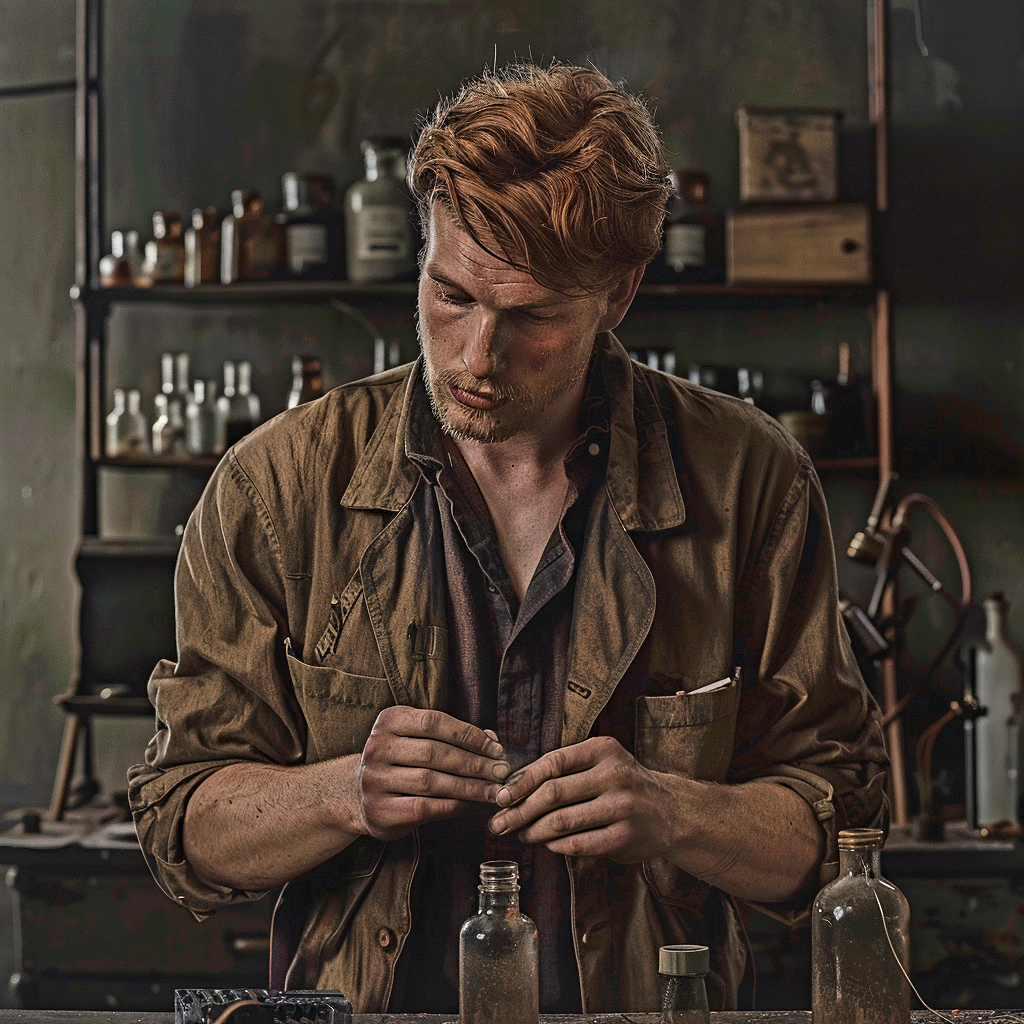
Silas Gravewalker. An older gent, he looks as though he’s always expecting a foggy night – grey cloak, even greyer hair, and eyes the color of storm clouds. His demeanor is gentle but don’t mistake it for weakness. He’s the wise old guardian of the Guild, carrying centuries of rituals, chants, and incantations within him. Silas is a remarkable blend of grandfatherly wisdom and hidden strength, and he’s a calming presence in the midst of chaos. His sense of humor is dryer than the Outback in summer, subtle yet striking at just the right moments. When Silas speaks, you listen, because his words are often tinged with layers of arcane meaning.
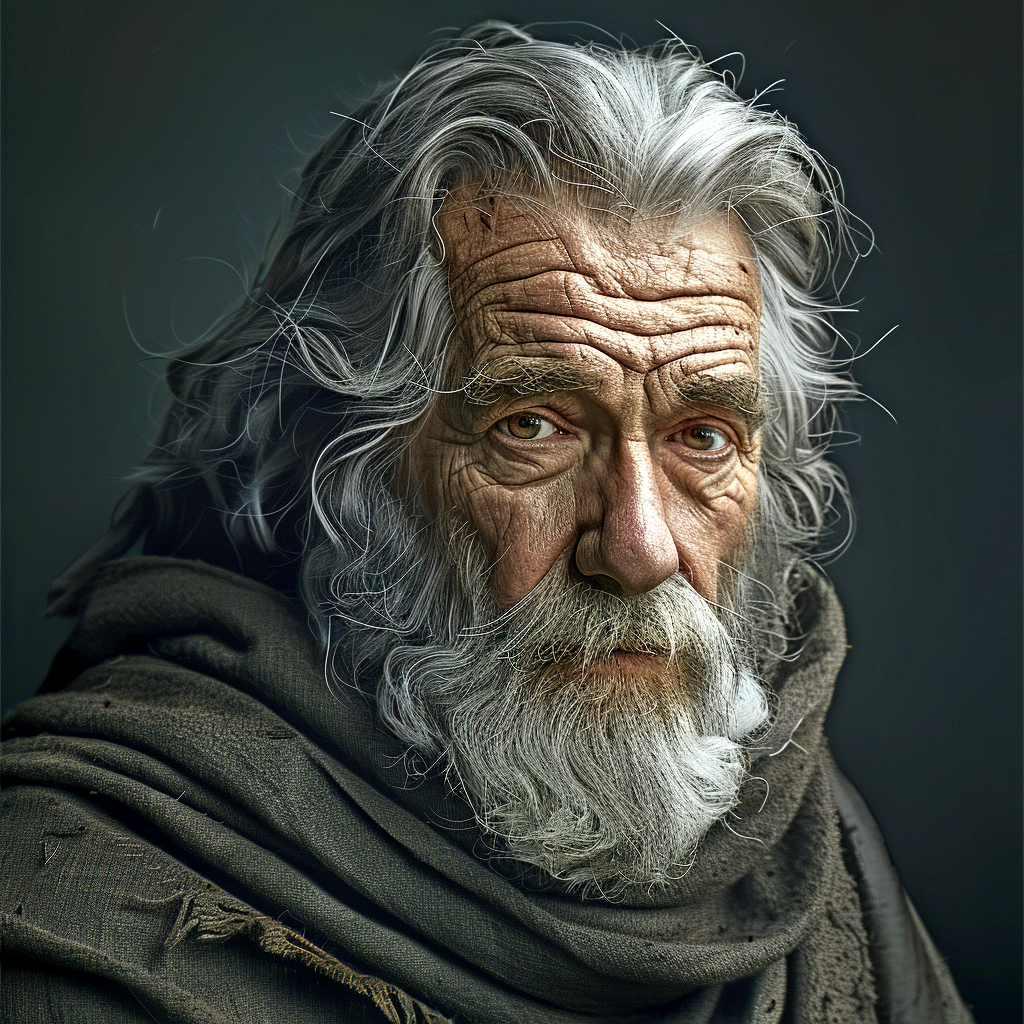
Rufus Blackwood: Enter Rufus Blackwood, the stoic guardian of the guild. He’s tall and broad-shouldered, with a presence that commands both respect and a shiver down the spine. His hair is a dusty shade of midnight black, streaked with the occasional silver – probably from the weight of the secrets he carries. His eyes are a pale grey, like the fog rolling off a moor, always scanning, always measuring. He’s perpetually clad in a long, leather duster coat that sweeps the floor as he glides across the room.
Personality-wise, Rufus is the strong, silent type, but when he speaks, it feels like ancient tombs whispering forgotten wisdom. He’s got a dry humor that surfaces in the most unexpected moments, like a ray of moonlight in a pitch-black night. He’s fiercely protective of his coven and guildmates, and there’s a sense of old-world honor about him. Underneath that granite exterior is a surprisingly tender heart that only a select few have glimpsed.

Garrett Ashford: Now, Garrett Ashford, he’s a bit of a dandy, as far as morticians go. Picture a man of average height but with presence larger than life. His hair is a striking ash blonde, always perfectly coiffed, and his attire is meticulously sharp – tailored suits, often in dark, rich fabrics with just a hint of eccentricity, like a red silk handkerchief or a silver pocket watch. His eyes are a sharp, pale blue, twinkling with a touch of playful mischief.
Garrett’s got a personality as polished as his appearance. He’s charismatic, with a knack for easing tensions with a well-timed joke or a charming smile. Though he might come off as a bit of a showman, make no mistake – Garrett’s got depth and a sharp mind. He’s a skilled embalmer and incantation master, knowing just the right touch to handle even the most delicate of cases. His flair for the dramatic doesn’t overshadow his competence; it complements it. He’s the kind of bloke who can discuss the darkest of topics with a light-hearted grace, making him a bit of a paradox but undeniably captivating.
 February 7, 2023 at 1:22 pm #6503
In reply to: Orbs of Madjourneys
The plane trip stretched on forever. Xavier had the time to rewatch a few blockbusters, and catch up on light novels – in particular a roadtrip of 3 elderly Ukrainians —a story that didn’t seem to have much to say, but did put a smile on his face.
The plane has wifi, and he could have connected to the game, but he was trying his capacity to be weaned of the adrenaline rush that came with the adventures. Glimmer and the pirate ship would have to wait. He’d put his avatar on autopilot, and usually that helped propel the plot forward without investing too much time in going through relatively mundane adventures (those were needed to provide background balance and contrast against the rush of the occasional action). He hoped Glimmer wouldn’t abuse of it, and send them both to some crazy place looking for Flove knows what.
There was the occasional temptation to catch a hold of the news and his friends, but relying on the old ways of daydreaming and imagination, he could feel they were doing fine.
He could well picture Zara off to explore in and out of the game, that much was a given. As for Youssef he should be able to catch up in Alice Springs, since he wasn’t anywhere in Sydney when he landed. He was probably squeezed right now on an economy seat in between a sweaty tourist, an annoying expat, and a chatty woman. Xavier chuckled to himself thinking of the large frame of his friend in the tiny space.
He hoped all was right with Yasmin. He hadn’t be able to connect before the flight, but she was resourceful and given her competitive spirit, there was actually a good chance she had a shortcut to be there before any of them.Alice Springs was close by now. The plane prepared for landing.
Xavier remembered he’d have to get the black notebook that was part of the last assignment. They surely would have something like that in the duty free area.
November 18, 2022 at 4:47 pm #6348In reply to: Family Stories From The Other Side ~ Book Two
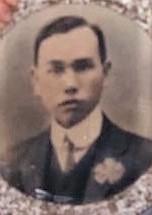
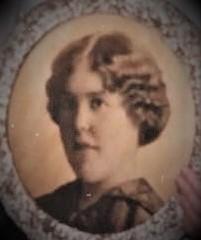
Wong Sang
Wong Sang was born in China in 1884. In October 1916 he married Alice Stokes in Oxford.
Alice was the granddaughter of William Stokes of Churchill, Oxfordshire and William was the brother of Thomas Stokes the wheelwright (who was my 3X great grandfather). In other words Alice was my second cousin, three times removed, on my fathers paternal side.
Wong Sang was an interpreter, according to the baptism registers of his children and the Dreadnought Seamen’s Hospital admission registers in 1930. The hospital register also notes that he was employed by the Blue Funnel Line, and that his address was 11, Limehouse Causeway, E 14. (London)
“The Blue Funnel Line offered regular First-Class Passenger and Cargo Services From the UK to South Africa, Malaya, China, Japan, Australia, Java, and America. Blue Funnel Line was Owned and Operated by Alfred Holt & Co., Liverpool.
The Blue Funnel Line, so-called because its ships have a blue funnel with a black top, is more appropriately known as the Ocean Steamship Company.”Wong Sang and Alice’s daughter, Frances Eileen Sang, was born on the 14th July, 1916 and baptised in 1920 at St Stephen in Poplar, Tower Hamlets, London. The birth date is noted in the 1920 baptism register and would predate their marriage by a few months, although on the death register in 1921 her age at death is four years old and her year of birth is recorded as 1917.
Charles Ronald Sang was baptised on the same day in May 1920, but his birth is recorded as April of that year. The family were living on Morant Street, Poplar.
James William Sang’s birth is recorded on the 1939 census and on the death register in 2000 as being the 8th March 1913. This definitely would predate the 1916 marriage in Oxford.
William Norman Sang was born on the 17th October 1922 in Poplar.
Alice and the three sons were living at 11, Limehouse Causeway on the 1939 census, the same address that Wong Sang was living at when he was admitted to Dreadnought Seamen’s Hospital on the 15th January 1930. Wong Sang died in the hospital on the 8th March of that year at the age of 46.
Alice married John Patterson in 1933 in Stepney. John was living with Alice and her three sons on Limehouse Causeway on the 1939 census and his occupation was chef.
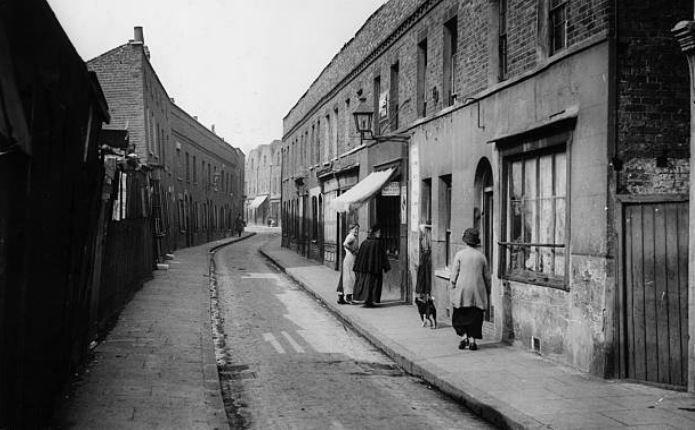
Via Old London Photographs:
“Limehouse Causeway is a street in east London that was the home to the original Chinatown of London. A combination of bomb damage during the Second World War and later redevelopment means that almost nothing is left of the original buildings of the street.”
Limehouse Causeway in 1925:
From The Story of Limehouse’s Lost Chinatown, poplarlondon website:
“Limehouse was London’s first Chinatown, home to a tightly-knit community who were demonised in popular culture and eventually erased from the cityscape.
As recounted in the BBC’s ‘Our Greatest Generation’ series, Connie was born to a Chinese father and an English mother in early 1920s Limehouse, where she used to play in the street with other British and British-Chinese children before running inside for teatime at one of their houses.
Limehouse was London’s first Chinatown between the 1880s and the 1960s, before the current Chinatown off Shaftesbury Avenue was established in the 1970s by an influx of immigrants from Hong Kong.
Connie’s memories of London’s first Chinatown as an “urban village” paint a very different picture to the seedy area portrayed in early twentieth century novels.
The pyramid in St Anne’s church marked the entrance to the opium den of Dr Fu Manchu, a criminal mastermind who threatened Western society by plotting world domination in a series of novels by Sax Rohmer.
Thomas Burke’s Limehouse Nights cemented stereotypes about prostitution, gambling and violence within the Chinese community, and whipped up anxiety about sexual relationships between Chinese men and white women.
Though neither novelist was familiar with the Chinese community, their depictions made Limehouse one of the most notorious areas of London.
Travel agent Thomas Cook even organised tours of the area for daring visitors, despite the rector of Limehouse warning that “those who look for the Limehouse of Mr Thomas Burke simply will not find it.”
All that remains is a handful of Chinese street names, such as Ming Street, Pekin Street, and Canton Street — but what was Limehouse’s chinatown really like, and why did it get swept away?
Chinese migration to Limehouse
Chinese sailors discharged from East India Company ships settled in the docklands from as early as the 1780s.
By the late nineteenth century, men from Shanghai had settled around Pennyfields Lane, while a Cantonese community lived on Limehouse Causeway.
Chinese sailors were often paid less and discriminated against by dock hirers, and so began to diversify their incomes by setting up hand laundry services and restaurants.
Old photographs show shopfronts emblazoned with Chinese characters with horse-drawn carts idling outside or Chinese men in suits and hats standing proudly in the doorways.
In oral histories collected by Yat Ming Loo, Connie’s husband Leslie doesn’t recall seeing any Chinese women as a child, since male Chinese sailors settled in London alone and married working-class English women.
In the 1920s, newspapers fear-mongered about interracial marriages, crime and gambling, and described chinatown as an East End “colony.”
Ironically, Chinese opium-smoking was also demonised in the press, despite Britain waging war against China in the mid-nineteenth century for suppressing the opium trade to alleviate addiction amongst its people.
The number of Chinese people who settled in Limehouse was also greatly exaggerated, and in reality only totalled around 300.
The real Chinatown
Although the press sought to characterise Limehouse as a monolithic Chinese community in the East End, Connie remembers seeing people of all nationalities in the shops and community spaces in Limehouse.
She doesn’t remember feeling discriminated against by other locals, though Connie does recall having her face measured and IQ tested by a member of the British Eugenics Society who was conducting research in the area.
Some of Connie’s happiest childhood memories were from her time at Chung-Hua Club, where she learned about Chinese culture and language.
Why did Chinatown disappear?
The caricature of Limehouse’s Chinatown as a den of vice hastened its erasure.
Police raids and deportations fuelled by the alarmist media coverage threatened the Chinese population of Limehouse, and slum clearance schemes to redevelop low-income areas dispersed Chinese residents in the 1930s.
The Defence of the Realm Act imposed at the beginning of the First World War criminalised opium use, gave the authorities increased powers to deport Chinese people and restricted their ability to work on British ships.
Dwindling maritime trade during World War II further stripped Chinese sailors of opportunities for employment, and any remnants of Chinatown were destroyed during the Blitz or erased by postwar development schemes.”
Wong Sang 1884-1930
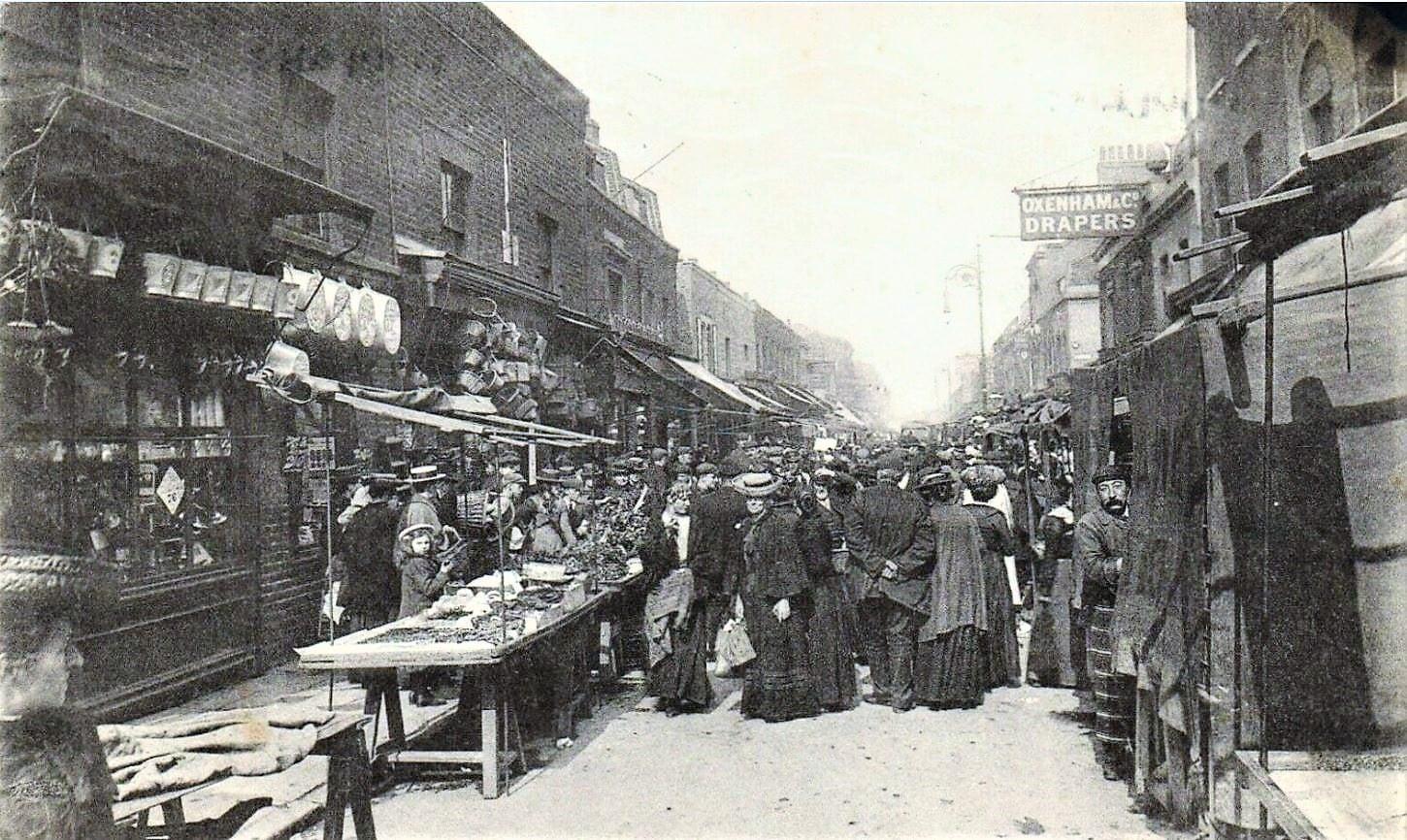
The year 1918 was a troublesome one for Wong Sang, an interpreter and shipping agent for Blue Funnel Line. The Sang family were living at 156, Chrisp Street.
Chrisp Street, Poplar, in 1913 via Old London Photographs:
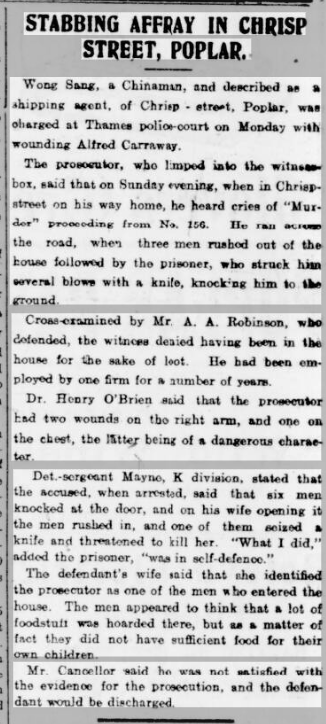
In February Wong Sang was discharged from a false accusation after defending his home from potential robbers.
East End News and London Shipping Chronicle – Friday 15 February 1918:
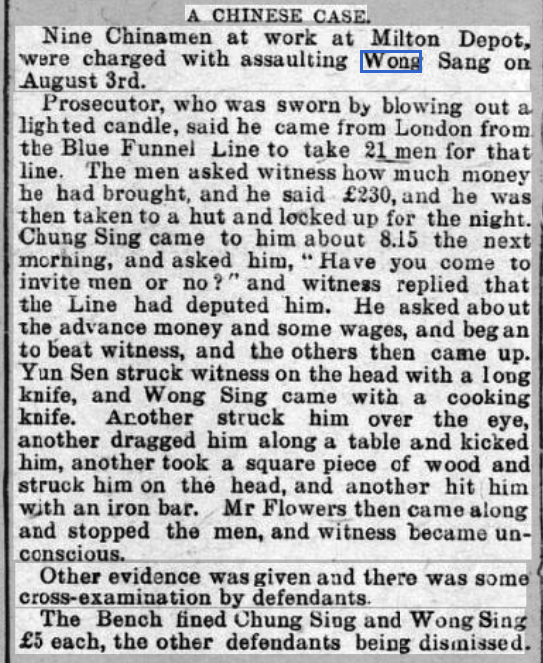
In August of that year he was involved in an incident that left him unconscious.
Faringdon Advertiser and Vale of the White Horse Gazette – Saturday 31 August 1918:
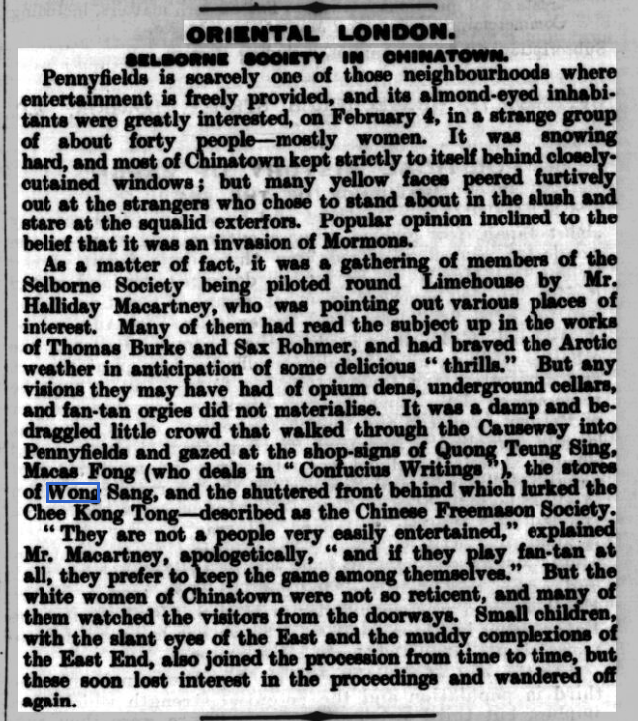
Wong Sang is mentioned in an 1922 article about “Oriental London”.
London and China Express – Thursday 09 February 1922:
A photograph of the Chee Kong Tong Chinese Freemason Society mentioned in the above article, via Old London Photographs:
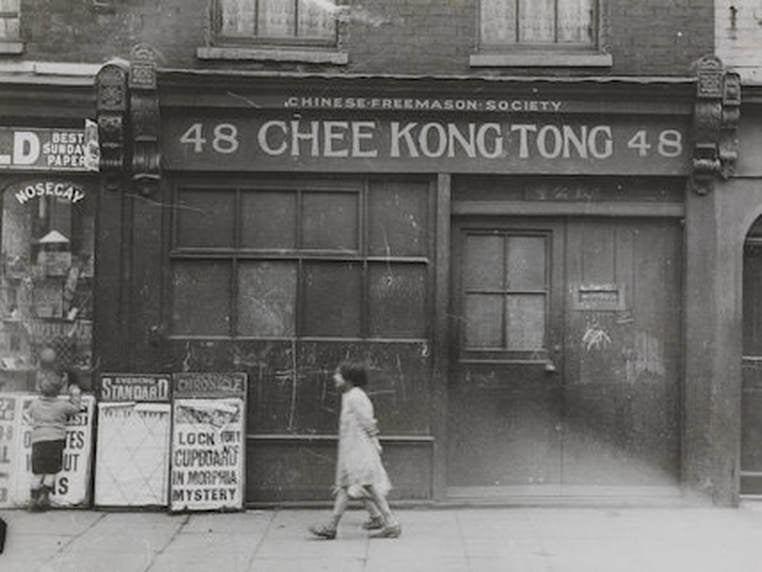
Wong Sang was recommended by the London Metropolitan Police in 1928 to assist in a case in Wellingborough, Northampton.
Difficulty of Getting an Interpreter: Northampton Mercury – Friday 16 March 1928:
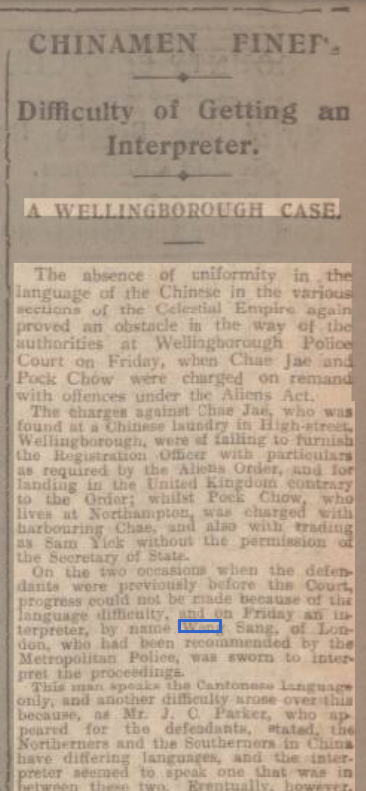
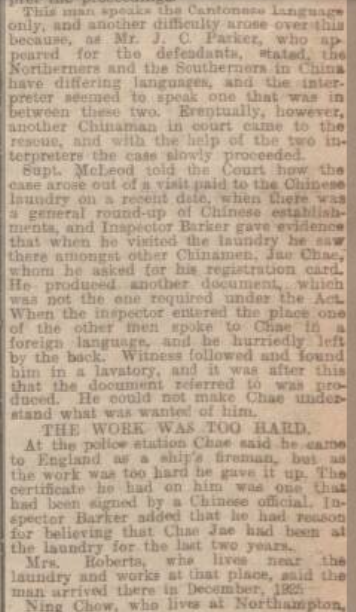
The difficulty was that “this man speaks the Cantonese language only…the Northeners and the Southerners in China have differing languages and the interpreter seemed to speak one that was in between these two.”
In 1917, Alice Wong Sang was a witness at her sister Harriet Stokes marriage to James William Watts in Southwark, London. Their father James Stokes occupation on the marriage register is foreman surveyor, but on the census he was a council roadman or labourer. (I initially rejected this as the correct marriage for Harriet because of the discrepancy with the occupations. Alice Wong Sang as a witness confirmed that it was indeed the correct one.)
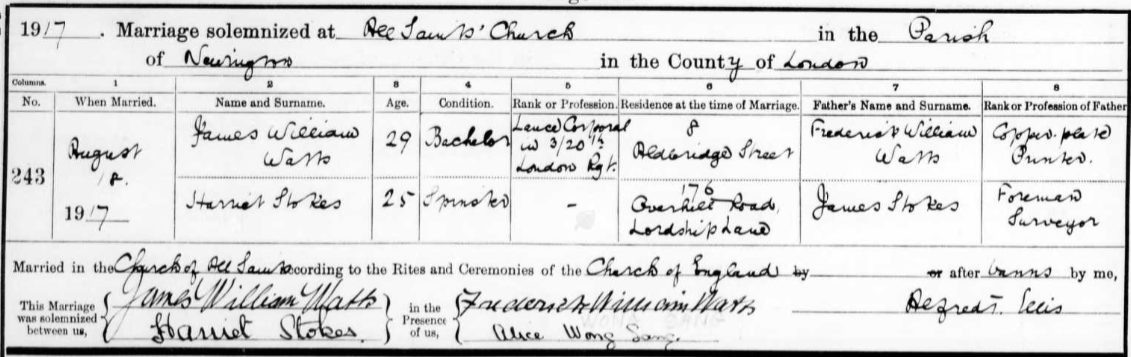
James William Sang 1913-2000 was a clock fitter and watch assembler (on the 1939 census). He married Ivy Laura Fenton in 1963 in Sidcup, Kent. James died in Southwark in 2000.
Charles Ronald Sang 1920-1974 was a draughtsman (1939 census). He married Eileen Burgess in 1947 in Marylebone. Charles and Eileen had two sons: Keith born in 1951 and Roger born in 1952. He died in 1974 in Hertfordshire.
William Norman Sang 1922-2000 was a clerk and telephone operator (1939 census). William enlisted in the Royal Artillery in 1942. He married Lily Mullins in 1949 in Bethnal Green, and they had three daughters: Marion born in 1950, Christine in 1953, and Frances in 1959. He died in Redbridge in 2000.
I then found another two births registered in Poplar by Alice Sang, both daughters. Doris Winifred Sang was born in 1925, and Patricia Margaret Sang was born in 1933 ~ three years after Wong Sang’s death. Neither of the these daughters were on the 1939 census with Alice, John Patterson and the three sons. Margaret had presumably been evacuated because of the war to a family in Taunton, Somerset. Doris would have been fourteen and I have been unable to find her in 1939 (possibly because she died in 2017 and has not had the redaction removed yet on the 1939 census as only deceased people are viewable).
Doris Winifred Sang 1925-2017 was a nursing sister. She didn’t marry, and spent a year in USA between 1954 and 1955. She stayed in London, and died at the age of ninety two in 2017.
Patricia Margaret Sang 1933-1998 was also a nurse. She married Patrick L Nicely in Stepney in 1957. Patricia and Patrick had five children in London: Sharon born 1959, Donald in 1960, Malcolm was born and died in 1966, Alison was born in 1969 and David in 1971.
I was unable to find a birth registered for Alice’s first son, James William Sang (as he appeared on the 1939 census). I found Alice Stokes on the 1911 census as a 17 year old live in servant at a tobacconist on Pekin Street, Limehouse, living with Mr Sui Fong from Hong Kong and his wife Sarah Sui Fong from Berlin. I looked for a birth registered for James William Fong instead of Sang, and found it ~ mothers maiden name Stokes, and his date of birth matched the 1939 census: 8th March, 1913.
On the 1921 census, Wong Sang is not listed as living with them but it is mentioned that Mr Wong Sang was the person returning the census. Also living with Alice and her sons James and Charles in 1921 are two visitors: (Florence) May Stokes, 17 years old, born in Woodstock, and Charles Stokes, aged 14, also born in Woodstock. May and Charles were Alice’s sister and brother.
I found Sharon Nicely on social media and she kindly shared photos of Wong Sang and Alice Stokes:
 January 28, 2022 at 1:10 pm #6260
In reply to: The Elusive Samuel Housley and Other Family Stories
From Tanganyika with Love
With thanks to Mike Rushby.
- “The letters of Eleanor Dunbar Leslie to her parents and her sister in South Africa
concerning her life with George Gilman Rushby of Tanganyika, and the trials and
joys of bringing up a family in pioneering conditions.
These letters were transcribed from copies of letters typed by Eleanor Rushby from
the originals which were in the estate of Marjorie Leslie, Eleanor’s sister. Eleanor
kept no diary of her life in Tanganyika, so these letters were the living record of an
important part of her life.Prelude
Having walked across Africa from the East coast to Ubangi Shauri Chad
in French Equatorial Africa, hunting elephant all the way, George Rushby
made his way down the Congo to Leopoldville. He then caught a ship to
Europe and had a holiday in Brussels and Paris before visiting his family
in England. He developed blackwater fever and was extremely ill for a
while. When he recovered he went to London to arrange his return to
Africa.Whilst staying at the Overseas Club he met Eileen Graham who had come
to England from Cape Town to study music. On hearing that George was
sailing for Cape Town she arranged to introduce him to her friend
Eleanor Dunbar Leslie. “You’ll need someone lively to show you around,”
she said. “She’s as smart as paint, a keen mountaineer, a very good school
teacher, and she’s attractive. You can’t miss her, because her father is a
well known Cape Town Magistrate. And,” she added “I’ve already written
and told her what ship you are arriving on.”Eleanor duly met the ship. She and George immediately fell in love.
Within thirty six hours he had proposed marriage and was accepted
despite the misgivings of her parents. As she was under contract to her
High School, she remained in South Africa for several months whilst
George headed for Tanganyika looking for a farm where he could build
their home.These details are a summary of chapter thirteen of the Biography of
George Gilman Rushby ‘The Hunter is Death “ by T.V.Bulpin.Dearest Marj,
Terrifically exciting news! I’ve just become engaged to an Englishman whom I
met last Monday. The result is a family upheaval which you will have no difficulty in
imagining!!The Aunts think it all highly romantic and cry in delight “Now isn’t that just like our
El!” Mummy says she doesn’t know what to think, that anyway I was always a harum
scarum and she rather expected something like this to happen. However I know that
she thinks George highly attractive. “Such a nice smile and gentle manner, and such
good hands“ she murmurs appreciatively. “But WHY AN ELEPHANT HUNTER?” she
ends in a wail, as though elephant hunting was an unmentionable profession.
Anyway I don’t think so. Anyone can marry a bank clerk or a lawyer or even a
millionaire – but whoever heard of anyone marrying anyone as exciting as an elephant
hunter? I’m thrilled to bits.Daddy also takes a dim view of George’s profession, and of George himself as
a husband for me. He says that I am so impulsive and have such wild enthusiasms that I
need someone conservative and steady to give me some serenity and some ballast.
Dad says George is a handsome fellow and a good enough chap he is sure, but
he is obviously a man of the world and hints darkly at a possible PAST. George says
he has nothing of the kind and anyway I’m the first girl he has asked to marry him. I don’t
care anyway, I’d gladly marry him tomorrow, but Dad has other ideas.He sat in his armchair to deliver his verdict, wearing the same look he must wear
on the bench. If we marry, and he doesn’t think it would be a good thing, George must
buy a comfortable house for me in Central Africa where I can stay safely when he goes
hunting. I interrupted to say “But I’m going too”, but dad snubbed me saying that in no
time at all I’ll have a family and one can’t go dragging babies around in the African Bush.”
George takes his lectures with surprising calm. He says he can see Dad’s point of
view much better than I can. He told the parents today that he plans to buy a small
coffee farm in the Southern Highlands of Tanganyika and will build a cosy cottage which
will be a proper home for both of us, and that he will only hunt occasionally to keep the
pot boiling.Mummy, of course, just had to spill the beans. She said to George, “I suppose
you know that Eleanor knows very little about house keeping and can’t cook at all.” a fact
that I was keeping a dark secret. But George just said, “Oh she won’t have to work. The
boys do all that sort of thing. She can lie on a couch all day and read if she likes.” Well
you always did say that I was a “Lily of the field,” and what a good thing! If I were one of
those terribly capable women I’d probably die of frustration because it seems that
African house boys feel that they have lost face if their Memsahibs do anything but the
most gracious chores.George is absolutely marvellous. He is strong and gentle and awfully good
looking too. He is about 5 ft 10 ins tall and very broad. He wears his curly brown hair cut
very short and has a close clipped moustache. He has strongly marked eyebrows and
very striking blue eyes which sometimes turn grey or green. His teeth are strong and
even and he has a quiet voice.I expect all this sounds too good to be true, but come home quickly and see for
yourself. George is off to East Africa in three weeks time to buy our farm. I shall follow as
soon as he has bought it and we will be married in Dar es Salaam.Dad has taken George for a walk “to get to know him” and that’s why I have time
to write such a long screed. They should be back any minute now and I must fly and
apply a bit of glamour.Much love my dear,
your jubilant
EleanorS.S.Timavo. Durban. 28th.October. 1930.
Dearest Family,
Thank you for the lovely send off. I do wish you were all on board with me and
could come and dance with me at my wedding. We are having a very comfortable
voyage. There were only four of the passengers as far as Durban, all of them women,
but I believe we are taking on more here. I have a most comfortable deck cabin to
myself and the use of a sumptuous bathroom. No one is interested in deck games and I
am having a lazy time, just sunbathing and reading.I sit at the Captain’s table and the meals are delicious – beautifully served. The
butter for instance, is moulded into sprays of roses, most exquisitely done, and as for
the ice-cream, I’ve never tasted anything like them.The meals are continental type and we have hors d’oeuvre in a great variety
served on large round trays. The Italians souse theirs with oil, Ugh! We also of course
get lots of spaghetti which I have some difficulty in eating. However this presents no
problem to the Chief Engineer who sits opposite to me. He simply rolls it around his
fork and somehow the spaghetti flows effortlessly from fork to mouth exactly like an
ascending escalator. Wine is served at lunch and dinner – very mild and pleasant stuff.
Of the women passengers the one i liked best was a young German widow
from South west Africa who left the ship at East London to marry a man she had never
met. She told me he owned a drapers shop and she was very happy at the prospect
of starting a new life, as her previous marriage had ended tragically with the death of her
husband and only child in an accident.I was most interested to see the bridegroom and stood at the rail beside the gay
young widow when we docked at East London. I picked him out, without any difficulty,
from the small group on the quay. He was a tall thin man in a smart grey suit and with a
grey hat perched primly on his head. You can always tell from hats can’t you? I wasn’t
surprised to see, when this German raised his head, that he looked just like the Kaiser’s
“Little Willie”. Long thin nose and cold grey eyes and no smile of welcome on his tight
mouth for the cheery little body beside me. I quite expected him to jerk his thumb and
stalk off, expecting her to trot at his heel.However she went off blithely enough. Next day before the ship sailed, she
was back and I saw her talking to the Captain. She began to cry and soon after the
Captain patted her on the shoulder and escorted her to the gangway. Later the Captain
told me that the girl had come to ask him to allow her to work her passage back to
Germany where she had some relations. She had married the man the day before but
she disliked him because he had deceived her by pretending that he owned a shop
whereas he was only a window dresser. Bad show for both.The Captain and the Chief Engineer are the only officers who mix socially with
the passengers. The captain seems rather a melancholy type with, I should say, no
sense of humour. He speaks fair English with an American accent. He tells me that he
was on the San Francisco run during Prohibition years in America and saw many Film
Stars chiefly “under the influence” as they used to flock on board to drink. The Chief
Engineer is big and fat and cheerful. His English is anything but fluent but he makes up
for it in mime.I visited the relations and friends at Port Elizabeth and East London, and here at
Durban. I stayed with the Trotters and Swans and enjoyed myself very much at both
places. I have collected numerous wedding presents, china and cutlery, coffee
percolator and ornaments, and where I shall pack all these things I don’t know. Everyone has been terribly kind and I feel extremely well and happy.At the start of the voyage I had a bit of bad luck. You will remember that a
perfectly foul South Easter was blowing. Some men were busy working on a deck
engine and I stopped to watch and a tiny fragment of steel blew into my eye. There is
no doctor on board so the stewardess put some oil into the eye and bandaged it up.
The eye grew more and more painful and inflamed and when when we reached Port
Elizabeth the Captain asked the Port Doctor to look at it. The Doctor said it was a job for
an eye specialist and telephoned from the ship to make an appointment. Luckily for me,
Vincent Tofts turned up at the ship just then and took me off to the specialist and waited
whilst he extracted the fragment with a giant magnet. The specialist said that I was very
lucky as the thing just missed the pupil of my eye so my sight will not be affected. I was
temporarily blinded by the Belladona the eye-man put in my eye so he fitted me with a
pair of black goggles and Vincent escorted me back to the ship. Don’t worry the eye is
now as good as ever and George will not have to take a one-eyed bride for better or
worse.I have one worry and that is that the ship is going to be very much overdue by
the time we reach Dar es Salaam. She is taking on a big wool cargo and we were held
up for three days in East london and have been here in Durban for five days.
Today is the ninth Anniversary of the Fascist Movement and the ship was
dressed with bunting and flags. I must now go and dress for the gala dinner.Bless you all,
Eleanor.S.S.Timavo. 6th. November 1930
Dearest Family,
Nearly there now. We called in at Lourenco Marques, Beira, Mozambique and
Port Amelia. I was the only one of the original passengers left after Durban but there we
took on a Mrs Croxford and her mother and two men passengers. Mrs C must have
something, certainly not looks. She has a flat figure, heavily mascared eyes and crooked
mouth thickly coated with lipstick. But her rather sweet old mother-black-pearls-type tells
me they are worn out travelling around the world trying to shake off an admirer who
pursues Mrs C everywhere.The one male passenger is very quiet and pleasant. The old lady tells me that he
has recently lost his wife. The other passenger is a horribly bumptious type.
I had my hair beautifully shingled at Lourenco Marques, but what an experience it
was. Before we docked I asked the Captain whether he knew of a hairdresser, but he
said he did not and would have to ask the agent when he came aboard. The agent was
a very suave Asian. He said “Sure he did” and offered to take me in his car. I rather
doubtfully agreed — such a swarthy gentleman — and was driven, not to a hairdressing
establishment, but to his office. Then he spoke to someone on the telephone and in no
time at all a most dago-y type arrived carrying a little black bag. He was all patent
leather, hair, and flashing smile, and greeted me like an old and valued friend.
Before I had collected my scattered wits tthe Agent had flung open a door and
ushered me through, and I found myself seated before an ornate mirror in what was only
too obviously a bedroom. It was a bedroom with a difference though. The unmade bed
had no legs but hung from the ceiling on brass chains.The agent beamingly shut the door behind him and I was left with my imagination
and the afore mentioned oily hairdresser. He however was very business like. Before I
could say knife he had shingled my hair with a cut throat razor and then, before I could
protest, had smothered my neck in stinking pink powder applied with an enormous and
filthy swansdown powder puff. He held up a mirror for me to admire his handiwork but I
was aware only of the enormous bed reflected in it, and hurriedly murmuring “very nice,
very nice” I made my escape to the outer office where, to my relief, I found the Chief
Engineer who escorted me back to the ship.In the afternoon Mrs Coxford and the old lady and I hired a taxi and went to the
Polana Hotel for tea. Very swish but I like our Cape Peninsula beaches better.
At Lorenco Marques we took on more passengers. The Governor of
Portuguese Nyasaland and his wife and baby son. He was a large middle aged man,
very friendly and unassuming and spoke perfect English. His wife was German and
exquisite, as fragile looking and with the delicate colouring of a Dresden figurine. She
looked about 18 but she told me she was 28 and showed me photographs of two
other sons – hefty youngsters, whom she had left behind in Portugal and was missing
very much.It was frightfully hot at Beira and as I had no money left I did not go up to the
town, but Mrs Croxford and I spent a pleasant hour on the beach under the Casurina
trees.The Governor and his wife left the ship at Mozambique. He looked very
imposing in his starched uniform and she more Dresden Sheperdish than ever in a
flowered frock. There was a guard of honour and all the trimmings. They bade me a warm farewell and invited George and me to stay at any time.The German ship “Watussi” was anchored in the Bay and I decided to visit her
and try and have my hair washed and set. I had no sooner stepped on board when a
lady came up to me and said “Surely you are Beeba Leslie.” It was Mrs Egan and she
had Molly with her. Considering Mrs Egan had not seen me since I was five I think it was
jolly clever of her to recognise me. Molly is charming and was most friendly. She fixed
things with the hairdresser and sat with me until the job was done. Afterwards I had tea
with them.Port Amelia was our last stop. In fact the only person to go ashore was Mr
Taylor, the unpleasant man, and he returned at sunset very drunk indeed.
We reached Port Amelia on the 3rd – my birthday. The boat had anchored by
the time I was dressed and when I went on deck I saw several row boats cluttered
around the gangway and in them were natives with cages of wild birds for sale. Such tiny
crowded cages. I was furious, you know me. I bought three cages, carried them out on
to the open deck and released the birds. I expected them to fly to the land but they flew
straight up into the rigging.The quiet male passenger wandered up and asked me what I was doing. I said
“I’m giving myself a birthday treat, I hate to see caged birds.” So next thing there he
was buying birds which he presented to me with “Happy Birthday.” I gladly set those
birds free too and they joined the others in the rigging.Then a grinning steward came up with three more cages. “For the lady with
compliments of the Captain.” They lost no time in joining their friends.
It had given me so much pleasure to free the birds that I was only a little
discouraged when the quiet man said thoughtfully “This should encourage those bird
catchers you know, they are sold out. When evening came and we were due to sail I
was sure those birds would fly home, but no, they are still there and they will probably
remain until we dock at Dar es Salaam.During the morning the Captain came up and asked me what my Christian name
is. He looked as grave as ever and I couldn’t think why it should interest him but said “the
name is Eleanor.” That night at dinner there was a large iced cake in the centre of the
table with “HELENA” in a delicate wreath of pink icing roses on the top. We had
champagne and everyone congratulated me and wished me good luck in my marriage.
A very nice gesture don’t you think. The unpleasant character had not put in an
appearance at dinner which made the party all the nicerI sat up rather late in the lounge reading a book and by the time I went to bed
there was not a soul around. I bathed and changed into my nighty,walked into my cabin,
shed my dressing gown, and pottered around. When I was ready for bed I put out my
hand to draw the curtains back and a hand grasped my wrist. It was that wretched
creature outside my window on the deck, still very drunk. Luckily I was wearing that
heavy lilac silk nighty. I was livid. “Let go at once”, I said, but he only grinned stupidly.
“I’m not hurting you” he said, “only looking”. “I’ll ring for the steward” said I, and by
stretching I managed to press the bell with my free hand. I rang and rang but no one
came and he just giggled. Then I said furiously, “Remember this name, George
Rushby, he is a fine boxer and he hates specimens like you. When he meets me at Dar
es Salaam I shall tell him about this and I bet you will be sorry.” However he still held on
so I turned and knocked hard on the adjoining wall which divided my cabin from Mrs
Croxfords. Soon Mrs Croxford and the old lady appeared in dressing gowns . This
seemed to amuse the drunk even more though he let go my wrist. So whilst the old
lady stayed with me, Mrs C fetched the quiet passenger who soon hustled him off. He has kept out of my way ever since. However I still mean to tell George because I feel
the fellow got off far too lightly. I reported the matter to the Captain but he just remarked
that he always knew the man was low class because he never wears a jacket to meals.
This is my last night on board and we again had free champagne and I was given
some tooled leather work by the Captain and a pair of good paste earrings by the old
lady. I have invited them and Mrs Croxford, the Chief Engineer, and the quiet
passenger to the wedding.This may be my last night as Eleanor Leslie and I have spent this long while
writing to you just as a little token of my affection and gratitude for all the years of your
love and care. I shall post this letter on the ship and must turn now and get some beauty
sleep. We have been told that we shall be in Dar es Salaam by 9 am. I am so excited
that I shall not sleep.Very much love, and just for fun I’ll sign my full name for the last time.
with my “bes respeks”,Eleanor Leslie.
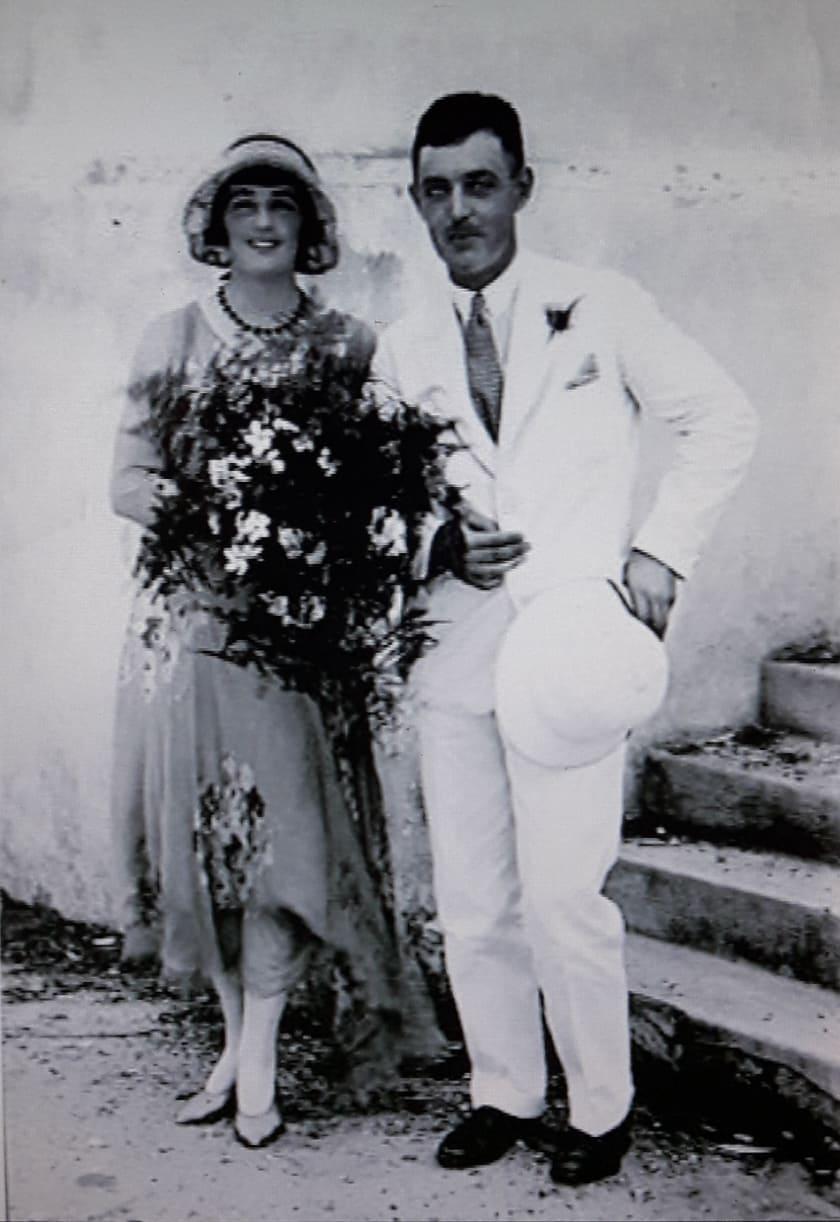
Eleanor and George Rushby:
Splendid Hotel, Dar es Salaam 11th November 1930
Dearest Family,
I’m writing this in the bedroom whilst George is out buying a tin trunk in which to
pack all our wedding presents. I expect he will be gone a long time because he has
gone out with Hicky Wood and, though our wedding was four days ago, it’s still an
excuse for a party. People are all very cheery and friendly here.
I am wearing only pants and slip but am still hot. One swelters here in the
mornings, but a fresh sea breeze blows in the late afternoons and then Dar es Salaam is
heavenly.We arrived in Dar es Salaam harbour very early on Friday morning (7 th Nov).
The previous night the Captain had said we might not reach Dar. until 9 am, and certainly
no one would be allowed on board before 8 am. So I dawdled on the deck in my
dressing gown and watched the green coastline and the islands slipping by. I stood on
the deck outside my cabin and was not aware that I was looking out at the wrong side of
the landlocked harbour. Quite unknown to me George and some friends, the Hickson
Woods, were standing on the Gymkhana Beach on the opposite side of the channel
anxiously scanning the ship for a sign of me. George says he had a horrible idea I had
missed the ship. Blissfully unconscious of his anxiety I wandered into the bathroom
prepared for a good soak. The anchor went down when I was in the bath and suddenly
there was a sharp wrap on the door and I heard Mrs Croxford say “There’s a man in a
boat outside. He is looking out for someone and I’m sure it’s your George. I flung on
some clothes and rushed on deck with tousled hair and bare feet and it was George.
We had a marvellous reunion. George was wearing shorts and bush shirt and
looked just like the strong silent types one reads about in novels. I finished dressing then
George helped me bundle all the wedding presents I had collected en route into my
travelling rug and we went into the bar lounge to join the Hickson Woods. They are the
couple from whom George bought the land which is to be our coffee farm Hicky-Wood
was laughing when we joined them. he said he had called a chap to bring a couple of
beers thinking he was the steward but it turned out to be the Captain. He does wear
such a very plain uniform that I suppose it was easy to make the mistake, but Hicky
says he was not amused.Anyway as the H-W’s are to be our neighbours I’d better describe them. Kath
Wood is very attractive, dark Irish, with curly black hair and big brown eyes. She was
married before to Viv Lumb a great friend of George’s who died some years ago of
blackwater fever. They had one little girl, Maureen, and Kath and Hicky have a small son
of three called Michael. Hicky is slightly below average height and very neat and dapper
though well built. He is a great one for a party and good fun but George says he can be
bad tempered.Anyway we all filed off the ship and Hicky and Cath went on to the hotel whilst
George and I went through customs. Passing the customs was easy. Everyone
seemed to know George and that it was his wedding day and I just sailed through,
except for the little matter of the rug coming undone when George and I had to scramble
on the floor for candlesticks and fruit knives and a wooden nut bowl.
Outside the customs shed we were mobbed by a crowd of jabbering Africans
offering their services as porters, and soon my luggage was piled in one rickshaw whilst
George and I climbed into another and we were born smoothly away on rubber shod
wheels to the Splendid Hotel. The motion was pleasing enough but it seemed weird to
be pulled along by one human being whilst another pushed behind. We turned up a street called Acacia Avenue which, as its name implies, is lined
with flamboyant acacia trees now in the full glory of scarlet and gold. The rickshaw
stopped before the Splendid Hotel and I was taken upstairs into a pleasant room which
had its own private balcony overlooking the busy street.Here George broke the news that we were to be married in less than an hours
time. He would have to dash off and change and then go straight to the church. I would
be quite all right, Kath would be looking in and friends would fetch me.
I started to dress and soon there was a tap at the door and Mrs Hickson-Wood
came in with my bouquet. It was a lovely bunch of carnations and frangipani with lots of
asparagus fern and it went well with my primrose yellow frock. She admired my frock
and Leghorn hat and told me that her little girl Maureen was to be my flower girl. Then
she too left for the church.I was fully dressed when there was another knock on the door and I opened it to
be confronted by a Police Officer in a starched white uniform. I’m McCallum”, he said,
“I’ve come to drive you to the church.” Downstairs he introduced me to a big man in a
tussore silk suit. “This is Dr Shicore”, said McCallum, “He is going to give you away.”
Honestly, I felt exactly like Alice in Wonderland. Wouldn’t have been at all surprised if
the White Rabbit had popped up and said he was going to be my page.I walked out of the hotel and across the pavement in a dream and there, by the
curb, was a big dark blue police car decorated with white ribbons and with a tall African
Police Ascari holding the door open for me. I had hardly time to wonder what next when
the car drew up before a tall German looking church. It was in fact the Lutheran Church in
the days when Tanganyika was German East Africa.Mrs Hickson-Wood, very smart in mushroom coloured georgette and lace, and
her small daughter were waiting in the porch, so in we went. I was glad to notice my
friends from the boat sitting behind George’s friends who were all complete strangers to
me. The aisle seemed very long but at last I reached George waiting in the chancel with
Hicky-Wood, looking unfamiliar in a smart tussore suit. However this feeling of unreality
passed when he turned his head and smiled at me.In the vestry after the ceremony I was kissed affectionately by several complete
strangers and I felt happy and accepted by George’s friends. Outside the church,
standing apart from the rest of the guests, the Italian Captain and Chief Engineer were
waiting. They came up and kissed my hand, and murmured felicitations, but regretted
they could not spare the time to come to the reception. Really it was just as well
because they would not have fitted in at all well.Dr Shircore is the Director of Medical Services and he had very kindly lent his
large house for the reception. It was quite a party. The guests were mainly men with a
small sprinkling of wives. Champagne corks popped and there was an enormous cake
and soon voices were raised in song. The chief one was ‘Happy Days Are Here Again’
and I shall remember it for ever.The party was still in full swing when George and I left. The old lady from the ship
enjoyed it hugely. She came in an all black outfit with a corsage of artificial Lily-of-the-
Valley. Later I saw one of the men wearing the corsage in his buttonhole and the old
lady was wearing a carnation.When George and I got back to the hotel,I found that my luggage had been
moved to George’s room by his cook Lamek, who was squatting on his haunches and
clapped his hands in greeting. My dears, you should see Lamek – exactly like a
chimpanzee – receding forehead, wide flat nose, and long lip, and such splayed feet. It was quite a strain not to laugh, especially when he produced a gift for me. I have not yet
discovered where he acquired it. It was a faded mauve straw toque of the kind worn by
Queen Mary. I asked George to tell Lamek that I was touched by his generosity but felt
that I could not accept his gift. He did not mind at all especially as George gave him a
generous tip there and then.I changed into a cotton frock and shady straw hat and George changed into shorts
and bush shirt once more. We then sneaked into the dining room for lunch avoiding our
wedding guests who were carrying on the party in the lounge.After lunch we rejoined them and they all came down to the jetty to wave goodbye
as we set out by motor launch for Honeymoon Island. I enjoyed the launch trip very
much. The sea was calm and very blue and the palm fringed beaches of Dar es Salaam
are as romantic as any bride could wish. There are small coral islands dotted around the
Bay of which Honeymoon Island is the loveliest. I believe at one time it bore the less
romantic name of Quarantine Island. Near the Island, in the shallows, the sea is brilliant
green and I saw two pink jellyfish drifting by.There is no jetty on the island so the boat was stopped in shallow water and
George carried me ashore. I was enchanted with the Island and in no hurry to go to the
bungalow, so George and I took our bathing costumes from our suitcases and sent the
luggage up to the house together with a box of provisions.We bathed and lazed on the beach and suddenly it was sunset and it began to
get dark. We walked up the beach to the bungalow and began to unpack the stores,
tea, sugar, condensed milk, bread and butter, sardines and a large tin of ham. There
were also cups and saucers and plates and cutlery.We decided to have an early meal and George called out to the caretaker, “Boy
letta chai”. Thereupon the ‘boy’ materialised and jabbered to George in Ki-Swaheli. It
appeared he had no utensil in which to boil water. George, ever resourceful, removed
the ham from the tin and gave him that. We had our tea all right but next day the ham
was bad.Then came bed time. I took a hurricane lamp in one hand and my suitcase in the
other and wandered into the bedroom whilst George vanished into the bathroom. To
my astonishment I saw two perfectly bare iron bedsteads – no mattress or pillows. We
had brought sheets and mosquito nets but, believe me, they are a poor substitute for a
mattress.Anyway I arrayed myself in my pale yellow satin nightie and sat gingerly down
on the iron edge of the bed to await my groom who eventually appeared in a
handsome suit of silk pyjamas. His expression, as he took in the situation, was too much
for me and I burst out laughing and so did he.Somewhere in the small hours I woke up. The breeze had dropped and the
room was unbearably stuffy. I felt as dry as a bone. The lamp had been turned very
low and had gone out, but I remembered seeing a water tank in the yard and I decided
to go out in the dark and drink from the tap. In the dark I could not find my slippers so I
slipped my feet into George’s shoes, picked up his matches and groped my way out
of the room. I found the tank all right and with one hand on the tap and one cupped for
water I stooped to drink. Just then I heard a scratchy noise and sensed movements
around my feet. I struck a match and oh horrors! found that the damp spot on which I was
standing was alive with white crabs. In my hurry to escape I took a clumsy step, put
George’s big toe on the hem of my nightie and down I went on top of the crabs. I need
hardly say that George was awakened by an appalling shriek and came rushing to my
aid like a knight of old. Anyway, alarms and excursions not withstanding, we had a wonderful weekend on the island and I was sorry to return to the heat of Dar es Salaam, though the evenings
here are lovely and it is heavenly driving along the coast road by car or in a rickshaw.
I was surprised to find so many Indians here. Most of the shops, large and small,
seem to be owned by Indians and the place teems with them. The women wear
colourful saris and their hair in long black plaits reaching to their waists. Many wear baggy
trousers of silk or satin. They give a carnival air to the sea front towards sunset.
This long letter has been written in instalments throughout the day. My first break
was when I heard the sound of a band and rushed to the balcony in time to see The
Kings African Rifles band and Askaris march down the Avenue on their way to an
Armistice Memorial Service. They looked magnificent.I must end on a note of most primitive pride. George returned from his shopping
expedition and beamingly informed me that he had thrashed the man who annoyed me
on the ship. I felt extremely delighted and pressed for details. George told me that
when he went out shopping he noticed to his surprise that the ‘Timavo” was still in the
harbour. He went across to the Agents office and there saw a man who answered to the
description I had given. George said to him “Is your name Taylor?”, and when he said
“yes”, George said “Well my name is George Rushby”, whereupon he hit Taylor on the
jaw so that he sailed over the counter and down the other side. Very satisfactory, I feel.
With much love to all.Your cave woman
Eleanor.Mchewe Estate. P.O. Mbeya 22 November 1930
Dearest Family,
Well here we are at our Country Seat, Mchewe Estate. (pronounced
Mn,-che’-we) but I will start at the beginning of our journey and describe the farm later.
We left the hotel at Dar es Salaam for the station in a taxi crowded with baggage
and at the last moment Keith Wood ran out with the unwrapped bottom layer of our
wedding cake. It remained in its naked state from there to here travelling for two days in
the train on the luggage rack, four days in the car on my knee, reposing at night on the
roof of the car exposed to the winds of Heaven, and now rests beside me in the tent
looking like an old old tombstone. We have no tin large enough to hold it and one
simply can’t throw away ones wedding cake so, as George does not eat cake, I can see
myself eating wedding cake for tea for months to come, ants permitting.We travelled up by train from Dar to Dodoma, first through the lush vegetation of
the coastal belt to Morogoro, then through sisal plantations now very overgrown with
weeds owing to the slump in prices, and then on to the arid area around Dodoma. This
part of the country is very dry at this time of the year and not unlike parts of our Karoo.
The train journey was comfortable enough but slow as the engines here are fed with
wood and not coal as in South Africa.Dodoma is the nearest point on the railway to Mbeya so we left the train there to
continue our journey by road. We arrived at the one and only hotel in the early hours and
whilst someone went to rout out the night watchman the rest of us sat on the dismal
verandah amongst a litter of broken glass. Some bright spark remarked on the obvious –
that there had been a party the night before.When we were shown to a room I thought I rather preferred the verandah,
because the beds had not yet been made up and there was a bucket of vomit beside
the old fashioned washstand. However George soon got the boys to clean up the
room and I fell asleep to be awakened by George with an invitation to come and see
our car before breakfast.Yes, we have our own car. It is a Chev, with what is called a box body. That
means that sides, roof and doors are made by a local Indian carpenter. There is just the
one front seat with a kapok mattress on it. The tools are kept in a sort of cupboard fixed
to the side so there is a big space for carrying “safari kit” behind the cab seat.
Lamek, who had travelled up on the same train, appeared after breakfast, and
helped George to pack all our luggage into the back of the car. Besides our suitcases
there was a huge bedroll, kitchen utensils and a box of provisions, tins of petrol and
water and all Lamek’s bits and pieces which included three chickens in a wicker cage and
an enormous bunch of bananas about 3 ft long.When all theses things were packed there remained only a small space between
goods and ceiling and into this Lamek squeezed. He lay on his back with his horny feet a
mere inch or so from the back of my head. In this way we travelled 400 miles over
bumpy earth roads and crude pole bridges, but whenever we stopped for a meal
Lamek wriggled out and, like Aladdin’s genie, produced good meals in no time at all.
In the afternoon we reached a large river called the Ruaha. Workmen were busy
building a large bridge across it but it is not yet ready so we crossed by a ford below
the bridge. George told me that the river was full of crocodiles but though I looked hard, I
did not see any. This is also elephant country but I did not see any of those either, only
piles of droppings on the road. I must tell you that the natives around these parts are called Wahehe and the river is Ruaha – enough to make a cat laugh. We saw some Wahehe out hunting with spears
and bows and arrows. They live in long low houses with the tiniest shuttered windows
and rounded roofs covered with earth.Near the river we also saw a few Masai herding cattle. They are rather terrifying to
look at – tall, angular, and very aloof. They wear nothing but a blanket knotted on one
shoulder, concealing nothing, and all carried one or two spears.
The road climbs steeply on the far side of the Ruaha and one has the most
tremendous views over the plains. We spent our first night up there in the high country.
Everything was taken out of the car, the bed roll opened up and George and I slept
comfortably in the back of the car whilst Lamek, rolled in a blanket, slept soundly by a
small fire nearby. Next morning we reached our first township, Iringa, and put up at the
Colonist Hotel. We had a comfortable room in the annex overlooking the golf course.
our room had its own little dressing room which was also the bathroom because, when
ordered to do so, the room boy carried in an oval galvanised bath and filled it with hot
water which he carried in a four gallon petrol tin.When we crossed to the main building for lunch, George was immediately hailed
by several men who wanted to meet the bride. I was paid some handsome
compliments but was not sure whether they were sincere or the result of a nice alcoholic
glow. Anyhow every one was very friendly.After lunch I went back to the bedroom leaving George chatting away. I waited and
waited – no George. I got awfully tired of waiting and thought I’d give him a fright so I
walked out onto the deserted golf course and hid behind some large boulders. Soon I
saw George returning to the room and the boy followed with a tea tray. Ah, now the hue
and cry will start, thought I, but no, no George appeared nor could I hear any despairing
cry. When sunset came I trailed crossly back to our hotel room where George lay
innocently asleep on his bed, hands folded on his chest like a crusader on his tomb. In a
moment he opened his eyes, smiled sleepily and said kindly, “Did you have a nice walk
my love?” So of course I couldn’t play the neglected wife as he obviously didn’t think
me one and we had a very pleasant dinner and party in the hotel that evening.
Next day we continued our journey but turned aside to visit the farm of a sprightly
old man named St.Leger Seaton whom George had known for many years, so it was
after dark before George decided that we had covered our quota of miles for the day.
Whilst he and Lamek unpacked I wandered off to a stream to cool my hot feet which had
baked all day on the floor boards of the car. In the rather dim moonlight I sat down on the
grassy bank and gratefully dabbled my feet in the cold water. A few minutes later I
started up with a shriek – I had the sensation of red hot pins being dug into all my most
sensitive parts. I started clawing my clothes off and, by the time George came to the
rescue with the lamp, I was practically in the nude. “Only Siafu ants,” said George calmly.
Take off all your clothes and get right in the water.” So I had a bathe whilst George
picked the ants off my clothes by the light of the lamp turned very low for modesty’s
sake. Siafu ants are beastly things. They are black ants with outsized heads and
pinchers. I shall be very, very careful where I sit in future.The next day was even hotter. There was no great variety in the scenery. Most
of the country was covered by a tree called Miombo, which is very ordinary when the
foliage is a mature deep green, but when in new leaf the trees look absolutely beautiful
as the leaves,surprisingly, are soft pastel shades of red and yellow.Once again we turned aside from the main road to visit one of George’s friends.
This man Major Hugh Jones MC, has a farm only a few miles from ours but just now he is supervising the making of an airstrip. Major Jones is quite a character. He is below
average height and skinny with an almost bald head and one nearly blind eye into which
he screws a monocle. He is a cultured person and will, I am sure, make an interesting
neighbour. George and Major Jones’ friends call him ‘Joni’ but he is generally known in
this country as ‘Ropesoles’ – as he is partial to that type of footwear.
We passed through Mbeya township after dark so I have no idea what the place
is like. The last 100 miles of our journey was very dusty and the last 15 miles extremely
bumpy. The road is used so little that in some places we had to plow our way through
long grass and I was delighted when at last George turned into a side road and said
“This is our place.” We drove along the bank of the Mchewe River, then up a hill and
stopped at a tent which was pitched beside the half built walls of our new home. We
were expected so there was hot water for baths and after a supper of tinned food and
good hot tea, I climbed thankfully into bed.Next morning I was awakened by the chattering of the African workmen and was
soon out to inspect the new surroundings. Our farm was once part of Hickson Wood’s
land and is separated from theirs by a river. Our houses cannot be more than a few
hundred yards apart as the crow flies but as both are built on the slopes of a long range
of high hills, and one can only cross the river at the foot of the slopes, it will be quite a
safari to go visiting on foot . Most of our land is covered with shoulder high grass but it
has been partly cleared of trees and scrub. Down by the river George has made a long
coffee nursery and a large vegetable garden but both coffee and vegetable seedlings
are too small to be of use.George has spared all the trees that will make good shade for the coffee later on.
There are several huge wild fig trees as big as oaks but with smooth silvery-green trunks
and branches and there are lots of acacia thorn trees with flat tops like Japanese sun
shades. I’ve seen lovely birds in the fig trees, Louries with bright plumage and crested
heads, and Blue Rollers, and in the grasslands there are widow birds with incredibly long
black tail feathers.There are monkeys too and horrible but fascinating tree lizards with blue bodies
and orange heads. There are so many, many things to tell you but they must wait for
another time as James, the house boy, has been to say “Bafu tiari” and if I don’t go at
once, the bath will be cold.I am very very happy and terribly interested in this new life so please don’t
worry about me.Much love to you all,
Eleanor.Mchewe Estate 29th. November 1930
Dearest Family,
I’ve lots of time to write letters just now because George is busy supervising the
building of the house from early morning to late afternoon – with a break for lunch of
course.On our second day here our tent was moved from the house site to a small
clearing further down the slope of our hill. Next to it the labourers built a ‘banda’ , which is
a three sided grass hut with thatched roof – much cooler than the tent in this weather.
There is also a little grass lav. so you see we have every convenience. I spend most of
my day in the banda reading or writing letters. Occasionally I wander up to the house site
and watch the building, but mostly I just sit.I did try exploring once. I wandered down a narrow path towards the river. I
thought I might paddle and explore the river a little but I came round a bend and there,
facing me, was a crocodile. At least for a moment I thought it was and my adrenaline
glands got very busy indeed. But it was only an enormous monitor lizard, four or five
feet long. It must have been as scared as I was because it turned and rushed off through
the grass. I turned and walked hastily back to the camp and as I passed the house site I
saw some boys killing a large puff adder. Now I do my walking in the evenings with
George. Nothing alarming ever seems to happen when he is around.It is interesting to watch the boys making bricks for the house. They make a pile
of mud which they trample with their feet until it is the right consistency. Then they fill
wooden moulds with the clayey mud, and press it down well and turn out beautiful shiny,
dark brown bricks which are laid out in rows and covered with grass to bake slowly in the
sun.Most of the materials for the building are right here at hand. The walls will be sun
dried bricks and there is a white clay which will make a good whitewash for the inside
walls. The chimney and walls will be of burnt brick and tiles and George is now busy
building a kiln for this purpose. Poles for the roof are being cut in the hills behind the
house and every day women come along with large bundles of thatching grass on their
heads. Our windows are modern steel casement ones and the doors have been made
at a mission in the district. George does some of the bricklaying himself. The other
bricklayer is an African from Northern Rhodesia called Pedro. It makes me perspire just
to look at Pedro who wears an overcoat all day in the very hot sun.
Lamek continues to please. He turns out excellent meals, chicken soup followed
by roast chicken, vegetables from the Hickson-Woods garden and a steamed pudding
or fruit to wind up the meal. I enjoy the chicken but George is fed up with it and longs for
good red meat. The chickens are only about as large as a partridge but then they cost
only sixpence each.I had my first visit to Mbeya two days ago. I put on my very best trousseau frock
for the occasion- that yellow striped silk one – and wore my wedding hat. George didn’t
comment, but I saw later that I was dreadfully overdressed.
Mbeya at the moment is a very small settlement consisting of a bundle of small
Indian shops – Dukas they call them, which stock European tinned foods and native soft
goods which seem to be mainly of Japanese origin. There is a one storied Government
office called the Boma and two attractive gabled houses of burnt brick which house the
District Officer and his Assistant. Both these houses have lovely gardens but i saw them
only from the outside as we did not call. After buying our stores George said “Lets go to the pub, I want you to meet Mrs Menzies.” Well the pub turned out to be just three or four grass rondavels on a bare
plot. The proprietor, Ken Menzies, came out to welcome us. I took to him at once
because he has the same bush sandy eyebrows as you have Dad. He told me that
unfortunately his wife is away at the coast, and then he ushered me through the door
saying “Here’s George with his bride.” then followed the Iringa welcome all over again,
only more so, because the room was full of diggers from the Lupa Goldfields about fifty
miles away.Champagne corks popped as I shook hands all around and George was
clapped on the back. I could see he was a favourite with everyone and I tried not to be
gauche and let him down. These men were all most kind and most appeared to be men
of more than average education. However several were unshaven and looked as
though they had slept in their clothes as I suppose they had. When they have a little luck
on the diggings they come in here to Menzies pub and spend the lot. George says
they bring their gold dust and small nuggets in tobacco tins or Kruschen salts jars and
hand them over to Ken Menzies saying “Tell me when I’ve spent the lot.” Ken then
weighs the gold and estimates its value and does exactly what the digger wants.
However the Diggers get good value for their money because besides the drink
they get companionship and good food and nursing if they need it. Mrs Menzies is a
trained nurse and most kind and capable from what I was told. There is no doctor or
hospital here so her experience as a nursing sister is invaluable.
We had lunch at the Hotel and afterwards I poured tea as I was the only female
present. Once the shyness had worn off I rather enjoyed myself.Now to end off I must tell you a funny story of how I found out that George likes
his women to be feminine. You will remember those dashing black silk pyjamas Aunt
Mary gave me, with flowered “happy coat” to match. Well last night I thought I’d give
George a treat and when the boy called me for my bath I left George in the ‘banda’
reading the London Times. After my bath I put on my Japanese pyjamas and coat,
peered into the shaving mirror which hangs from the tent pole and brushed my hair until it
shone. I must confess that with my fringe and shingled hair I thought I made quite a
glamourous Japanese girl. I walked coyly across to the ‘banda’. Alas no compliment.
George just glanced up from the Times and went on reading.
He was away rather a long time when it came to his turn to bath. I glanced up
when he came back and had a slight concussion. George, if you please, was arrayed in
my very best pale yellow satin nightie. The one with the lace and ribbon sash and little
bows on the shoulder. I knew exactly what he meant to convey. I was not to wear the
trousers in the family. I seethed inwardly, but pretending not to notice, I said calmly “shall
I call for food?” In this garb George sat down to dinner and it says a great deal for African
phlegm that the boy did not drop the dishes.We conversed politely about this and that, and then, as usual, George went off
to bed. I appeared to be engrossed in my book and did not stir. When I went to the
tent some time later George lay fast asleep still in my nightie, though all I could see of it
was the little ribbon bows looking farcically out of place on his broad shoulders.
This morning neither of us mentioned the incident, George was up and dressed
by the time I woke up but I have been smiling all day to think what a ridiculous picture
we made at dinner. So farewell to pyjamas and hey for ribbons and bows.Your loving
Eleanor.Mchewe Estate. Mbeya. 8th December 1930
Dearest Family,
A mere shadow of her former buxom self lifts a languid pen to write to you. I’m
convalescing after my first and I hope my last attack of malaria. It was a beastly
experience but all is now well and I am eating like a horse and will soon regain my
bounce.I took ill on the evening of the day I wrote my last letter to you. It started with a
splitting headache and fits of shivering. The symptoms were all too familiar to George
who got me into bed and filled me up with quinine. He then piled on all the available
blankets and packed me in hot water bottles. I thought I’d explode and said so and
George said just to lie still and I’d soon break into a good sweat. However nothing of the
kind happened and next day my temperature was 105 degrees. Instead of feeling
miserable as I had done at the onset, I now felt very merry and most chatty. George
now tells me I sang the most bawdy songs but I hardly think it likely. Do you?
You cannot imagine how tenderly George nursed me, not only that day but
throughout the whole eight days I was ill. As we do not employ any African house
women, and there are no white women in the neighbourhood at present to whom we
could appeal for help, George had to do everything for me. It was unbearably hot in the
tent so George decided to move me across to the Hickson-Woods vacant house. They
have not yet returned from the coast.George decided I was too weak to make the trip in the car so he sent a
messenger over to the Woods’ house for their Machila. A Machila is a canopied canvas
hammock slung from a bamboo pole and carried by four bearers. The Machila duly
arrived and I attempted to walk to it, clinging to George’s arm, but collapsed in a faint so
the trip was postponed to the next morning when I felt rather better. Being carried by
Machila is quite pleasant but I was in no shape to enjoy anything and got thankfully into
bed in the Hickson-Woods large, cool and rather dark bedroom. My condition did not
improve and George decided to send a runner for the Government Doctor at Tukuyu
about 60 miles away. Two days later Dr Theis arrived by car and gave me two
injections of quinine which reduced the fever. However I still felt very weak and had to
spend a further four days in bed.We have now decided to stay on here until the Hickson-Woods return by which
time our own house should be ready. George goes off each morning and does not
return until late afternoon. However don’t think “poor Eleanor” because I am very
comfortable here and there are lots of books to read and the days seem to pass very
quickly.The Hickson-Wood’s house was built by Major Jones and I believe the one on
his shamba is just like it. It is a square red brick building with a wide verandah all around
and, rather astonishingly, a conical thatched roof. There is a beautiful view from the front
of the house and a nice flower garden. The coffee shamba is lower down on the hill.
Mrs Wood’s first husband, George’s friend Vi Lumb, is buried in the flower
garden. He died of blackwater fever about five years ago. I’m told that before her
second marriage Kath lived here alone with her little daughter, Maureen, and ran the farm
entirely on her own. She must be quite a person. I bet she didn’t go and get malaria
within a few weeks of her marriage.The native tribe around here are called Wasafwa. They are pretty primitive but
seem amiable people. Most of the men, when they start work, wear nothing but some
kind of sheet of unbleached calico wrapped round their waists and hanging to mid calf. As soon as they have drawn their wages they go off to a duka and buy a pair of khaki
shorts for five or six shillings. Their women folk wear very short beaded skirts. I think the
base is goat skin but have never got close enough for a good look. They are very shy.
I hear from George that they have started on the roof of our house but I have not
seen it myself since the day I was carried here by Machila. My letters by the way go to
the Post Office by runner. George’s farm labourers take it in turn to act in this capacity.
The mail bag is given to them on Friday afternoon and by Saturday evening they are
back with our very welcome mail.Very much love,
Eleanor.Mbeya 23rd December 1930
Dearest Family,
George drove to Mbeya for stores last week and met Col. Sherwood-Kelly VC.
who has been sent by the Government to Mbeya as Game Ranger. His job will be to
protect native crops from raiding elephants and hippo etc., and to protect game from
poachers. He has had no training for this so he has asked George to go with him on his
first elephant safari to show him the ropes.George likes Col. Kelly and was quite willing to go on safari but not willing to
leave me alone on the farm as I am still rather shaky after malaria. So it was arranged that
I should go to Mbeya and stay with Mrs Harmer, the wife of the newly appointed Lands
and Mines Officer, whose husband was away on safari.So here I am in Mbeya staying in the Harmers temporary wattle and daub
house. Unfortunately I had a relapse of the malaria and stayed in bed for three days with
a temperature. Poor Mrs Harmer had her hands full because in the room next to mine
she was nursing a digger with blackwater fever. I could hear his delirious babble through
the thin wall – very distressing. He died poor fellow , and leaves a wife and seven
children.I feel better than I have done for weeks and this afternoon I walked down to the
store. There are great signs of activity and people say that Mbeya will grow rapidly now
owing to the boom on the gold fields and also to the fact that a large aerodrome is to be
built here. Mbeya is to be a night stop on the proposed air service between England
and South Africa. I seem to be the last of the pioneers. If all these schemes come about
Mbeya will become quite suburban.26th December 1930
George, Col. Kelly and Mr Harmer all returned to Mbeya on Christmas Eve and
it was decided that we should stay and have midday Christmas dinner with the
Harmers. Col. Kelly and the Assistant District Commissioner came too and it was quite a
festive occasion, We left Mbeya in the early afternoon and had our evening meal here at
Hickson-Wood’s farm. I wore my wedding dress.I went across to our house in the car this morning. George usually walks across to
save petrol which is very expensive here. He takes a short cut and wades through the
river. The distance by road is very much longer than the short cut. The men are now
thatching the roof of our cottage and it looks charming. It consists of a very large living
room-dinning room with a large inglenook fireplace at one end. The bedroom is a large
square room with a smaller verandah room adjoining it. There is a wide verandah in the
front, from which one has a glorious view over a wide valley to the Livingstone
Mountains on the horizon. Bathroom and storeroom are on the back verandah and the
kitchen is some distance behind the house to minimise the risk of fire.You can imagine how much I am looking forward to moving in. We have some
furniture which was made by an Indian carpenter at Iringa, refrectory dining table and
chairs, some small tables and two armchairs and two cupboards and a meatsafe. Other
things like bookshelves and extra cupboards we will have to make ourselves. George
has also bought a portable gramophone and records which will be a boon.
We also have an Irish wolfhound puppy, a skinny little chap with enormous feet
who keeps me company all day whilst George is across at our farm working on the
house.Lots and lots of love,
Eleanor.Mchewe Estate 8th Jan 1931
Dearest Family,
Alas, I have lost my little companion. The Doctor called in here on Boxing night
and ran over and killed Paddy, our pup. It was not his fault but I was very distressed
about it and George has promised to try and get another pup from the same litter.
The Hickson-Woods returned home on the 29th December so we decided to
move across to our nearly finished house on the 1st January. Hicky Wood decided that
we needed something special to mark the occasion so he went off and killed a sucking
pig behind the kitchen. The piglet’s screams were terrible and I felt that I would not be
able to touch any dinner. Lamek cooked and served sucking pig up in the traditional way
but it was high and quite literally, it stank. Our first meal in our own home was not a
success.However next day all was forgotten and I had something useful to do. George
hung doors and I held the tools and I also planted rose cuttings I had brought from
Mbeya and sowed several boxes with seeds.Dad asked me about the other farms in the area. I haven’t visited any but there
are five besides ours. One belongs to the Lutheran Mission at Utengule, a few miles
from here. The others all belong to British owners. Nearest to Mbeya, at the foot of a
very high peak which gives Mbeya its name, are two farms, one belonging to a South
African mining engineer named Griffiths, the other to I.G.Stewart who was an officer in the
Kings African Rifles. Stewart has a young woman called Queenie living with him. We are
some miles further along the range of hills and are some 23 miles from Mbeya by road.
The Mchewe River divides our land from the Hickson-Woods and beyond their farm is
Major Jones.All these people have been away from their farms for some time but have now
returned so we will have some neighbours in future. However although the houses are
not far apart as the crow flies, they are all built high in the foothills and it is impossible to
connect the houses because of the rivers and gorges in between. One has to drive right
down to the main road and then up again so I do not suppose we will go visiting very
often as the roads are very bumpy and eroded and petrol is so expensive that we all
save it for occasional trips to Mbeya.The rains are on and George has started to plant out some coffee seedlings. The
rains here are strange. One can hear the rain coming as it moves like a curtain along the
range of hills. It comes suddenly, pours for a little while and passes on and the sun
shines again.I do like it here and I wish you could see or dear little home.
Your loving,
Eleanor.Mchewe Estate. 1st April 1931
Dearest Family,
Everything is now running very smoothly in our home. Lamek continues to
produce palatable meals and makes wonderful bread which he bakes in a four gallon
petrol tin as we have no stove yet. He puts wood coals on the brick floor of the kitchen,
lays the tin lengh-wise on the coals and heaps more on top. The bread tins are then put
in the petrol tin, which has one end cut away, and the open end is covered by a flat
piece of tin held in place by a brick. Cakes are also backed in this make-shift oven and I
have never known Lamek to have a failure yet.Lamek has a helper, known as the ‘mpishi boy’ , who does most of the hard
work, cleans pots and pans and chops the firewood etc. Another of the mpishi boy’s
chores is to kill the two chickens we eat each day. The chickens run wild during the day
but are herded into a small chicken house at night. One of the kitchen boy’s first duties is
to let the chickens out first thing in the early morning. Some time after breakfast it dawns
on Lamek that he will need a chicken for lunch. he informs the kitchen boy who selects a
chicken and starts to chase it in which he is enthusiastically joined by our new Irish
wolfhound pup, Kelly. Together they race after the frantic fowl, over the flower beds and
around the house until finally the chicken collapses from sheer exhaustion. The kitchen
boy then hands it over to Lamek who murders it with the kitchen knife and then pops the
corpse into boiling water so the feathers can be stripped off with ease.I pointed out in vain, that it would be far simpler if the doomed chickens were kept
in the chicken house in the mornings when the others were let out and also that the correct
way to pluck chickens is when they are dry. Lamek just smiled kindly and said that that
may be so in Europe but that his way is the African way and none of his previous
Memsahibs has complained.My houseboy, named James, is clean and capable in the house and also a
good ‘dhobi’ or washboy. He takes the washing down to the river and probably
pounds it with stones, but I prefer not to look. The ironing is done with a charcoal iron
only we have no charcoal and he uses bits of wood from the kitchen fire but so far there
has not been a mishap.It gets dark here soon after sunset and then George lights the oil lamps and we
have tea and toast in front of the log fire which burns brightly in our inglenook. This is my
favourite hour of the day. Later George goes for his bath. I have mine in the mornings
and we have dinner at half past eight. Then we talk a bit and read a bit and sometimes
play the gramophone. I expect it all sounds pretty unexciting but it doesn’t seem so to
me.Very much love,
Eleanor.Mchewe Estate 20th April 1931
Dearest Family,
It is still raining here and the countryside looks very lush and green, very different
from the Mbeya district I first knew, when plains and hills were covered in long brown
grass – very course stuff that grows shoulder high.Most of the labourers are hill men and one can see little patches of cultivation in
the hills. Others live in small villages near by, each consisting of a cluster of thatched huts
and a few maize fields and perhaps a patch of bananas. We do not have labour lines on
the farm because our men all live within easy walking distance. Each worker has a labour
card with thirty little squares on it. One of these squares is crossed off for each days work
and when all thirty are marked in this way the labourer draws his pay and hies himself off
to the nearest small store and blows the lot. The card system is necessary because
these Africans are by no means slaves to work. They work only when they feel like it or
when someone in the family requires a new garment, or when they need a few shillings
to pay their annual tax. Their fields, chickens and goats provide them with the food they
need but they draw rations of maize meal beans and salt. Only our headman is on a
salary. His name is Thomas and he looks exactly like the statues of Julius Caesar, the
same bald head and muscular neck and sardonic expression. He comes from Northern
Rhodesia and is more intelligent than the locals.We still live mainly on chickens. We have a boy whose job it is to scour the
countryside for reasonable fat ones. His name is Lucas and he is quite a character. He
has such long horse teeth that he does not seem able to close his mouth and wears a
perpetual amiable smile. He brings his chickens in beehive shaped wicker baskets
which are suspended on a pole which Lucas carries on his shoulder.We buy our groceries in bulk from Mbeya, our vegetables come from our
garden by the river and our butter from Kath Wood. Our fresh milk we buy from the
natives. It is brought each morning by three little totos each carrying one bottle on his
shaven head. Did I tell you that the local Wasafwa file their teeth to points. These kids
grin at one with their little sharks teeth – quite an “all-ready-to-eat-you-with-my-dear” look.
A few nights ago a message arrived from Kath Wood to say that Queenie
Stewart was very ill and would George drive her across to the Doctor at Tukuyu. I
wanted George to wait until morning because it was pouring with rain, and the mountain
road to Tukuyu is tricky even in dry weather, but he said it is dangerous to delay with any
kind of fever in Africa and he would have to start at once. So off he drove in the rain and I
did not see him again until the following night.George said that it had been a nightmare trip. Queenie had a high temperature
and it was lucky that Kath was able to go to attend to her. George needed all his
attention on the road which was officially closed to traffic, and very slippery, and in some
places badly eroded. In some places the decking of bridges had been removed and
George had to get out in the rain and replace it. As he had nothing with which to fasten
the decking to the runners it was a dangerous undertaking to cross the bridges especially
as the rivers are now in flood and flowing strongly. However they reached Tukuyu safely
and it was just as well they went because the Doctor diagnosed Queenies illness as
Spirillium Tick Fever which is a very nasty illness indeed.Eleanor.
Mchewe Estate. 20th May 1931
Dear Family,
I’m feeling fit and very happy though a bit lonely sometimes because George
spends much of his time away in the hills cutting a furrow miles long to bring water to the
house and to the upper part of the shamba so that he will be able to irrigate the coffee
during the dry season.It will be quite an engineering feat when it is done as George only has makeshift
surveying instruments. He has mounted an ordinary cheap spirit level on an old camera
tripod and has tacked two gramophone needles into the spirit level to give him a line.
The other day part of a bank gave way and practically buried two of George’s labourers
but they were quickly rescued and no harm was done. However he will not let them
work unless he is there to supervise.I keep busy so that the days pass quickly enough. I am delighted with the
material you sent me for curtains and loose covers and have hired a hand sewing
machine from Pedro-of-the-overcoat and am rattling away all day. The machine is an
ancient German one and when I say rattle, I mean rattle. It is a most cumbersome, heavy
affair of I should say, the same vintage as George Stevenson’s Rocket locomotive.
Anyway it sews and I am pleased with my efforts. We made a couch ourselves out of a
native bed, a mattress and some planks but all this is hidden under the chintz cover and
it looks quite the genuine bought article. I have some diversions too. Small black faced
monkeys sit in the trees outside our bedroom window and they are most entertaining to
watch. They are very mischievous though. When I went out into the garden this morning
before breakfast I found that the monkeys had pulled up all my carnations. There they
lay, roots in the air and whether they will take again I don’t know.I like the monkeys but hate the big mountain baboons that come and hang
around our chicken house. I am terrified that they will tear our pup into bits because he is
a plucky young thing and will rush out to bark at the baboons.George usually returns for the weekends but last time he did not because he had
a touch of malaria. He sent a boy down for the mail and some fresh bread. Old Lucas
arrived with chickens just as the messenger was setting off with mail and bread in a
haversack on his back. I thought it might be a good idea to send a chicken to George so
I selected a spry young rooster which I handed to the messenger. He, however,
complained that he needed both hands for climbing. I then had one of my bright ideas
and, putting a layer of newspaper over the bread, I tucked the rooster into the haversack
and buckled down the flap so only his head protruded.I thought no more about it until two days later when the messenger again
appeared for fresh bread. He brought a rather terse note from George saying that the
previous bread was uneatable as the rooster had eaten some of it and messed on the
rest. Ah me!The previous weekend the Hickson-Woods, Stewarts and ourselves, went
across to Tukuyu to attend a dance at the club there. the dance was very pleasant. All
the men wore dinner jackets and the ladies wore long frocks. As there were about
twenty men and only seven ladies we women danced every dance whilst the surplus
men got into a huddle around the bar. George and I spent the night with the Agricultural
Officer, Mr Eustace, and I met his fiancee, Lillian Austin from South Africa, to whom I took
a great liking. She is Governess to the children of Major Masters who has a farm in the
Tukuyu district.On the Sunday morning we had a look at the township. The Boma was an old German one and was once fortified as the Africans in this district are a very warlike tribe.
They are fine looking people. The men wear sort of togas and bands of cloth around
their heads and look like Roman Senators, but the women go naked except for a belt
from which two broad straps hang down, one in front and another behind. Not a graceful
garb I assure you.We also spent a pleasant hour in the Botanical Gardens, laid out during the last
war by the District Commissioner, Major Wells, with German prisoner of war labour.
There are beautiful lawns and beds of roses and other flowers and shady palm lined
walks and banana groves. The gardens are terraced with flights of brick steps connecting
the different levels and there is a large artificial pond with little islands in it. I believe Major
Wells designed the lake to resemble in miniature, the Lakes of Killarney.
I enjoyed the trip very much. We got home at 8 pm to find the front door locked
and the kitchen boy fast asleep on my newly covered couch! I hastily retreated to the
bedroom whilst George handled the situation.Eleanor.
September 9, 2019 at 12:04 pm #4804In reply to: The Precious Life and Rambles of Liz Tattler
“What if she’s bluffing and it’s a ploy to bargain for a raise…” Godfrey said to Elizabeth keeping his voice down “or even more devious, to get you to write in spite…” he added, slightly concerned about Liz reaction.
“Say it bloody loud Godfrey! She wants to sexy up all my stuff, that derelinquant! Caught her doing so waaaay before, she’s never stopped trying. I’m sure her bloody novels are all sentimental romantic rubbish.”
Godfrey looked surprised “Funny you say that. She never really struck me as the sentimental type. Are you sure it’s not all jealousy or holding grudge for her disparate appreciation of your taste in art. That rope-snake is very… philosophical.”
August 28, 2019 at 3:18 pm #4770In reply to: The Precious Life and Rambles of Liz Tattler
“Finnley disappeared.”
Liz couldn’t believe her ears; at first she’d ignored the harbingers, the unattended dust trails, and of course, all the crumbs on the table piling up day after day.
Godfrey repeated “I’m telling you, Finnley took off and disappeared.”
He paused to leave room for Liz’ to answer, not that she ever needed any to start with. But she was profoundly shocked at the betrayal.
“I don’t believe you gave her paid leaves, have you; one of your silly ideas?”
Godfrey thought for a moment, “Now you mention it, I don’t believe she had any, even after all this time, had she?”
“Don’t be daft, Godfrey, she wouldn’t want any; of course, there’s a reason I chose her over the other very qualified staff lining up to work here.”
“Not even a trace, her personal belonging are gone; not even a message left behind. A mystery fit for one of your novels, eh.”
“I guess there’s nothing in the fridge either.” Liz said listlessly. “Guess you’ll have to order from the Pakistani restaurant tonight. Roberto, cute as he is, can’t cook for his life.”
August 28, 2019 at 1:44 pm #4769In reply to: The Chronicles of the Flying Fish Inn
Aunt Idle:
I bet you were expecting reports of action and adventure, a fast paced tale of risks and rescues, with perhaps a little romance. Hah! It’s been like a morgue around here after that fluster of activity and new arrivals. Like everyone lost the wind out of their sails and wondered what they were doing here.
Sanso took to his room with no explanation, other than he needed to rest. He wouldn’t let anyone in except Finly with food and drinks (quite an extraordinary amount for just one man, I must say, and not a crumb or a drop left over on the trays Finly carried back to the kitchen.) I told Finly to quiz him, find out if he was sick or needed a doctor, or perhaps a bit of company, but the only thing she said was that he was fine, and it was none of our business, he’d paid up front hadn’t he? So what was the problem. Bit rude if you ask me.
Mater had taken to her room with a pile of those trashy romance novels, complaining of her arthritis. She’d gone into a sulk ever since I ruined her red pantsuit in a boil wash, and dyed all the table linen pink in the process. The other guests lounged around listlessly in the sitting room or the porch, flicking through magazines or scrolling their gadgets, mostly with bored vacant expressions, and little conversation beyond a cursory reply to any attempt to chat.
Bert was nowhere to be seen most of the time, and even when he was around, he was as uncommunicative as the rest of them, and Devan, what was he up to, always down the cellar? Checking the rat traps was all he said when I asked him. But we haven’t got rats, I told him, not down the cellar anyway. He gave me a look that was unreadable, to put it politely. Maybe he’s got a crack lab going on down there, planning on selling it to the bored guests. God knows, maybe that’d liven us all up a bit.
I did get to wondering about those two women who wandered off down the mine, but whenever I mentioned them to anyone, all I got was a blank stare. I even banged on Sanso’s door a time or two, but he didn’t answer. I made Finly ask him, and she said all he would say is Not to worry, it would be sorted out. I mean, really! He hadn’t left that room all week, how was he going to sort it out? Bert said the same thing when I eventually managed to collar him, he said just wait, it will get sorted out, and then that glazed look came over his face again.
It’s weird, I tell you. We’re like a cast of characters with nobody writing the story, waiting. Waiting to start again on whatever comes next.
July 22, 2019 at 8:41 am #4706In reply to: The Precious Life and Rambles of Liz Tattler
“You know,” Inspector Melon said, having narrowly missed a peanut threat perniciously placed on top of a carrot cupcake. “I’m most intrigued by that mysterious Management organization that you wrote in your stories. They seemed to steer the plot somewhat efficiently, placing operatives on certain threats…”
“What’s your question Walter?” Liz was getting tipsy on the rosé bubbly, and she frankly had no idea what he was talking about, clutching at the bottle that Finnley was trying to move out of her reach.
“Well, somehow the Management, such fascinating and mysterious organization as it is, seems to have gathered an awful lot of information on this world’s arcane mysteries, and let’s not be shy to say, on some of its evils.”
“And?…”
“And, I wouldn’t be surprised if they’d decided a “Blow the lid off” type of covert operation, in order to gather KEY evidences of those evils and release all of them simultaneously so that the evil guys can’t get clued to it in time for an escape.”
“Mmm, of course yes.” Liz replied distractedly, looking at watermelon pièce montée that had just rolled into the room. It had suddenly triggered fond memories of watermelon codpieces she’d written as fashion pieces in one of the novels, that would have been perfect with the theme of the party.
Walter thought deeply… “Then, that would mean the mysterious Uncle Fergus with the Harley Davidson, may be one of such operative, that could have been compromised and sent the keys as a fail-safe… Now, I wonder what secrets these may reveal.”
He looked at Liz who was gorging herself on watermelon chous.
“But of course, you would have thought about all that. I can’t wait to read the rest of it!”
Of course, nothing of the discussion had been missed by the ever careful Finnley. Sliding behind the heavy curtains, she found Godfrey in the kitchen who was looking for the peanut jar.
He greeted her with a non nonplussed look. “Hmm, lovely socks.”She leaned in conspiratorially: “I think the Inspector knows too much already.”
May 29, 2019 at 12:48 pm #4595In reply to: The Precious Life and Rambles of Liz Tattler
“Finnley, pssst!”
The maid looked tersely and visibly annoyed at the lanky unkempt guy with the crazy eye.
“Do not bloody psst me, Godfrey! I’m not your run-of-the-mill hostess, for Flove’s sake.”
“Alright, alright. Come here, and don’t make a sound!”Finnley clutched at her broom, which she’d found could make a mean improved nunchaku in case Godfrey’d forgotten proper manners.
“Don’t sulk, dear. What I’ve found here is nothing short of a breathrough – pardon my typo, I mean of a breakthrough.”
“Oh Good Lord, spit it out already, and I mean it metaphorically. I haven’t got all day, you know,… places to clean, all that.”
“Look at that!”
Godfrey handed her a pile of typed papers.“Well, what’s about it? It does look a bit too neat and coffee-stain free, but the style is unmistakable. Long nonsensical babble, random words and characters, illogical sentence structure and improbable settings… That’s all you have psst ed me for? Another of some old Liz garbage novels?”
“That’s it! Isn’t it genius?” Godfrey looked at Finnley with an air of sheer madness. “You know Liz hasn’t written in years now, nothing fresh at least. You’ve be one to endlessly complain about that. Something about needing the paper to clean the window glass.”
“Of course I remember.” She paused, considering the enormous improbability that had just been hinted at. “Do you mean it’s not hers?”
“Ahahaha, isn’t it brilliant! This is all written by a clever AI. I’ve called it Fliz 2.0 !”
Finnley was at a loss for words. She didn’t know what was more terrifying, the thought of another Liz, or of an endless inexhaustible stream of Liz prose…
Godfrey looked pleased at himself “and to think it only took Fliz 44 minutes to spit the entire 888 pages novel!”
June 4, 2017 at 3:18 am #4346In reply to: The Precious Life and Rambles of Liz Tattler
At that moment the trap in the ceiling opened revealing the dark attic.
“Is that smoke coming from the attic?” asked Godfrey, suddenly worried someone had started a fire up there.
“It’s looking more like mist,” said Liz who had suddenly forgotten about her unborn babies. “You know, in those mystery novels they add some when they want to create an atmosphere of suspens.”
Godfrey looked doubtful as the mist was continuing to pour down from the attic in slow motion, like the harbinger of a darker secret. A loud noise made them jump. A metallic ladder, apparently attached on the attic’s floor which was the corridor’s ceiling, unfolded quickly. It stopped just before hitting the floor.
They all looked at each others, waiting for someone to say something. Anything.
“Go have a look, Godfrey,” said Liz.
“Shouldn’t it be Walter? He’s from the police after all, if there is danger he should be the one to take the lead.”Liz looked a bit uncomfortable.
“I’m not sure,” she said in a hum. “There might be some dark secrets I don’t want to reveal to outsiders.”“Are you coming or what?” Said a voice coming from the attic.
February 2, 2016 at 3:52 am #3891In reply to: The Precious Life and Rambles of Liz Tattler
Liz had taken well to her new prescription drugs.
In appearance, it had seemed to have drained out the inexhaustible source of inspiration that let her write novels after novels. Or maybe that was just due to the absence of Finnleys to take care of the editing.In the meantime, Godfrey had worked hard to nurture her back to whatever state she called sanity and suited her best, and gently coax her to resume her former passion.
“Godfrey, let me retire from writing, it’s too passé.” she was pouring concrete into the silicon molds to make new saint statues. Over the years, she’d accumulated quite a few of those saints and martyrs that she collected (or stole) from derelict places of cult during her travels. She liked to paint them back to life with gaudy colours, mimicking some sort of Mexican style. Sometimes she would dress them, and ask Finnley to sew them clothes and little hats.
Strangely, getting her out of the hospice had made her want to populate the whole house with concrete clones of those statues. Maybe to fill a void of inspiration ?
Nevertheless, Godfrey was amazed at her capacity to innovate. Her writing momentum was certainly at a low, but did she channel her creativity in many ways.
The last batch of Christian martyr statues painted in the many outfits of David Bowie were a testament to that.March 26, 2015 at 12:15 am #3727In reply to: The Precious Life and Rambles of Liz Tattler
“I go away for a little holiday—and Flove only knows I deserve one—and the whole story falls to pieces. What a mess!” muttered Finnley crossly.
“I do think you are being a little harsh, Finnley,” sniffed Liz huffily. “But then you always were prone to exaggeration. It is all those ridiculous Lemonolol novels you read.”August 7, 2014 at 3:17 am #3394In reply to: The Time-Dragglers’ Extravaganzas
King Artie had decided he would be George. That would be his adventurer’s identity, his nom de plume (if he ever gets out of his adventure alive and manages to write novels out of it, that is).
He’d packed in a hurry, taking advantage of the guards’ shift at midday to disappear from the castle unnoticed.
The bag full of his stone collection was getting heavy under the sun, and the exertion took his toll and dulled his usually quick reflexes so that he was taken by surprise when the girl grabbed him. A strong woman… Now he was smitten.He’d noticed her leaving under the most peculiar of cloaks, taking her at first for a male adventurer —he had assumed being followed by a stray cat meant it was a fish-smelly adventurer too. Her gait sure wasn’t very feminine, but her face was pretty; even prettier when she looked angry was something he would have loved to tell her if she’d given him the chance.
He chose to ignore her last remark and continue to discreetly follow her. She knew her way around, and seemed headed out of town. At least she was a better bet than being under the thumb of the P’hope’s minions.
-
AuthorSearch Results