


Search Results for 'object'
-
AuthorSearch Results
-
February 2, 2022 at 1:15 pm #6268
In reply to: The Elusive Samuel Housley and Other Family Stories
From Tanganyika with Love
continued part 9
With thanks to Mike Rushby.
Lyamungu 3rd January 1945
Dearest Family.
We had a novel Christmas this year. We decided to avoid the expense of
entertaining and being entertained at Lyamungu, and went off to spend Christmas
camping in a forest on the Western slopes of Kilimanjaro. George decided to combine
business with pleasure and in this way we were able to use Government transport.
We set out the day before Christmas day and drove along the road which skirts
the slopes of Kilimanjaro and first visited a beautiful farm where Philip Teare, the ex
Game Warden, and his wife Mary are staying. We had afternoon tea with them and then
drove on in to the natural forest above the estate and pitched our tent beside a small
clear mountain stream. We decorated the tent with paper streamers and a few small
balloons and John found a small tree of the traditional shape which we decorated where
it stood with tinsel and small ornaments.We put our beer, cool drinks for the children and bottles of fresh milk from Simba
Estate, in the stream and on Christmas morning they were as cold as if they had been in
the refrigerator all night. There were not many presents for the children, there never are,
but they do not seem to mind and are well satisfied with a couple of balloons apiece,
sweets, tin whistles and a book each.George entertain the children before breakfast. He can make a magical thing out
of the most ordinary balloon. The children watched entranced as he drew on his pipe
and then blew the smoke into the balloon. He then pinched the neck of the balloon
between thumb and forefinger and released the smoke in little puffs. Occasionally the
balloon ejected a perfect smoke ring and the forest rang with shouts of “Do it again
Daddy.” Another trick was to blow up the balloon to maximum size and then twist the
neck tightly before releasing. Before subsiding the balloon darted about in a crazy
fashion causing great hilarity. Such fun, at the cost of a few pence.After breakfast George went off to fish for trout. John and Jim decided that they
also wished to fish so we made rods out of sticks and string and bent pins and they
fished happily, but of course quite unsuccessfully, for hours. Both of course fell into the
stream and got soaked, but I was prepared for this, and the little stream was so shallow
that they could not come to any harm. Henry played happily in the sand and I had a
most peaceful morning.Hamisi roasted a chicken in a pot over the camp fire and the jelly set beautifully in the
stream. So we had grilled trout and chicken for our Christmas dinner. I had of course
taken an iced cake for the occasion and, all in all, it was a very successful Christmas day.
On Boxing day we drove down to the plains where George was to investigate a
report of game poaching near the Ngassari Furrow. This is a very long ditch which has
been dug by the Government for watering the Masai stock in the area. It is also used by
game and we saw herds of zebra and wildebeest, and some Grant’s Gazelle and
giraffe, all comparatively tame. At one point a small herd of zebra raced beside the lorry
apparently enjoying the fun of a gallop. They were all sleek and fat and looked wild and
beautiful in action.We camped a considerable distance from the water but this precaution did not
save us from the mosquitoes which launched a vicious attack on us after sunset, so that
we took to our beds unusually early. They were on the job again when we got up at
sunrise so I was very glad when we were once more on our way home.“I like Christmas safari. Much nicer that silly old party,” said John. I agree but I think
it is time that our children learned to play happily with others. There are no other young
children at Lyamungu though there are two older boys and a girl who go to boarding
school in Nairobi.On New Years Day two Army Officers from the military camp at Moshi, came for
tea and to talk game hunting with George. I think they rather enjoy visiting a home and
seeing children and pets around.Eleanor.
Lyamungu 14 May 1945
Dearest Family.
So the war in Europe is over at last. It is such marvellous news that I can hardly
believe it. To think that as soon as George can get leave we will go to England and
bring Ann and George home with us to Tanganyika. When we know when this leave can
be arranged we will want Kate to join us here as of course she must go with us to
England to meet George’s family. She has become so much a part of your lives that I
know it will be a wrench for you to give her up but I know that you will all be happy to
think that soon our family will be reunited.The V.E. celebrations passed off quietly here. We all went to Moshi to see the
Victory Parade of the King’s African Rifles and in the evening we went to a celebration
dinner at the Game Warden’s house. Besides ourselves the Moores had invited the
Commanding Officer from Moshi and a junior officer. We had a very good dinner and
many toasts including one to Mrs Moore’s brother, Oliver Milton who is fighting in Burma
and has recently been awarded the Military Cross.There was also a celebration party for the children in the grounds of the Moshi
Club. Such a spread! I think John and Jim sampled everything. We mothers were
having our tea separately and a friend laughingly told me to turn around and have a look.
I did, and saw the long tea tables now deserted by all the children but my two sons who
were still eating steadily, and finding the party more exciting than the game of Musical
Bumps into which all the other children had entered with enthusiasm.There was also an extremely good puppet show put on by the Italian prisoners
of war from the camp at Moshi. They had made all the puppets which included well
loved characters like Snow White and the Seven Dwarfs and the Babes in the Wood as
well as more sophisticated ones like an irritable pianist and a would be prima donna. The
most popular puppets with the children were a native askari and his family – a very
happy little scene. I have never before seen a puppet show and was as entranced as
the children. It is amazing what clever manipulation and lighting can do. I believe that the
Italians mean to take their puppets to Nairobi and am glad to think that there, they will
have larger audiences to appreciate their art.George has just come in, and I paused in my writing to ask him for the hundredth
time when he thinks we will get leave. He says I must be patient because it may be a
year before our turn comes. Shipping will be disorganised for months to come and we
cannot expect priority simply because we have been separated so long from our
children. The same situation applies to scores of other Government Officials.
I have decided to write the story of my childhood in South Africa and about our
life together in Tanganyika up to the time Ann and George left the country. I know you
will have told Kate these stories, but Ann and George were so very little when they left
home that I fear that they cannot remember much.My Mother-in-law will have told them about their father but she can tell them little
about me. I shall send them one chapter of my story each month in the hope that they
may be interested and not feel that I am a stranger when at last we meet again.Eleanor.
Lyamungu 19th September 1945
Dearest Family.
In a months time we will be saying good-bye to Lyamungu. George is to be
transferred to Mbeya and I am delighted, not only as I look upon Mbeya as home, but
because there is now a primary school there which John can attend. I feel he will make
much better progress in his lessons when he realises that all children of his age attend
school. At present he is putting up a strong resistance to learning to read and spell, but
he writes very neatly, does his sums accurately and shows a real talent for drawing. If
only he had the will to learn I feel he would do very well.Jim now just four, is too young for lessons but too intelligent to be interested in
the ayah’s attempts at entertainment. Yes I’ve had to engage a native girl to look after
Henry from 9 am to 12.30 when I supervise John’s Correspondence Course. She is
clean and amiable, but like most African women she has no initiative at all when it comes
to entertaining children. Most African men and youths are good at this.I don’t regret our stay at Lyamungu. It is a beautiful spot and the change to the
cooler climate after the heat of Morogoro has been good for all the children. John is still
tall for his age but not so thin as he was and much less pale. He is a handsome little lad
with his large brown eyes in striking contrast to his fair hair. He is wary of strangers but
very observant and quite uncanny in the way he sums up people. He seldom gets up
to mischief but I have a feeling he eggs Jim on. Not that Jim needs egging.Jim has an absolute flair for mischief but it is all done in such an artless manner that
it is not easy to punish him. He is a very sturdy child with a cap of almost black silky hair,
eyes brown, like mine, and a large mouth which is quick to smile and show most beautiful
white and even teeth. He is most popular with all the native servants and the Game
Scouts. The servants call Jim, ‘Bwana Tembo’ (Mr Elephant) because of his sturdy
build.Henry, now nearly two years old, is quite different from the other two in
appearance. He is fair complexioned and fair haired like Ann and Kate, with large, black
lashed, light grey eyes. He is a good child, not so merry as Jim was at his age, nor as
shy as John was. He seldom cries, does not care to be cuddled and is independent and
strong willed. The servants call Henry, ‘Bwana Ndizi’ (Mr Banana) because he has an
inexhaustible appetite for this fruit. Fortunately they are very inexpensive here. We buy
an entire bunch which hangs from a beam on the back verandah, and pluck off the
bananas as they ripen. This way there is no waste and the fruit never gets bruised as it
does in greengrocers shops in South Africa. Our three boys make a delightful and
interesting trio and I do wish you could see them for yourselves.We are delighted with the really beautiful photograph of Kate. She is an
extraordinarily pretty child and looks so happy and healthy and a great credit to you.
Now that we will be living in Mbeya with a school on the doorstep I hope that we will
soon be able to arrange for her return home.Eleanor.
c/o Game Dept. Mbeya. 30th October 1945
Dearest Family.
How nice to be able to write c/o Game Dept. Mbeya at the head of my letters.
We arrived here safely after a rather tiresome journey and are installed in a tiny house on
the edge of the township.We left Lyamungu early on the morning of the 22nd. Most of our goods had
been packed on the big Ford lorry the previous evening, but there were the usual
delays and farewells. Of our servants, only the cook, Hamisi, accompanied us to
Mbeya. Japhet, Tovelo and the ayah had to be paid off and largesse handed out.
Tovelo’s granny had come, bringing a gift of bananas, and she also brought her little
granddaughter to present a bunch of flowers. The child’s little scolded behind is now
completely healed. Gifts had to be found for them too.At last we were all aboard and what a squash it was! Our few pieces of furniture
and packing cases and trunks, the cook, his wife, the driver and the turney boy, who
were to take the truck back to Lyamungu, and all their bits and pieces, bunches of
bananas and Fanny the dog were all crammed into the body of the lorry. George, the
children and I were jammed together in the cab. Before we left George looked
dubiously at the tyres which were very worn and said gloomily that he thought it most
unlikely that we would make our destination, Dodoma.Too true! Shortly after midday, near Kwakachinja, we blew a back tyre and there
was a tedious delay in the heat whilst the wheel was changed. We were now without a
spare tyre and George said that he would not risk taking the Ford further than Babati,
which is less than half way to Dodoma. He drove very slowly and cautiously to Babati
where he arranged with Sher Mohammed, an Indian trader, for a lorry to take us to
Dodoma the next morning.It had been our intention to spend the night at the furnished Government
Resthouse at Babati but when we got there we found that it was already occupied by
several District Officers who had assembled for a conference. So, feeling rather
disgruntled, we all piled back into the lorry and drove on to a place called Bereku where
we spent an uncomfortable night in a tumbledown hut.Before dawn next morning Sher Mohammed’s lorry drove up, and there was a
scramble to dress by the light of a storm lamp. The lorry was a very dilapidated one and
there was already a native woman passenger in the cab. I felt so tired after an almost
sleepless night that I decided to sit between the driver and this woman with the sleeping
Henry on my knee. It was as well I did, because I soon found myself dosing off and
drooping over towards the woman. Had she not been there I might easily have fallen
out as the battered cab had no door. However I was alert enough when daylight came
and changed places with the woman to our mutual relief. She was now able to converse
with the African driver and I was able to enjoy the scenery and the fresh air!
George, John and Jim were less comfortable. They sat in the lorry behind the
cab hemmed in by packing cases. As the lorry was an open one the sun beat down
unmercifully upon them until George, ever resourceful, moved a table to the front of the
truck. The two boys crouched under this and so got shelter from the sun but they still had
to endure the dust. Fanny complicated things by getting car sick and with one thing and
another we were all jolly glad to get to Dodoma.We spent the night at the Dodoma Hotel and after hot baths, a good meal and a
good nights rest we cheerfully boarded a bus of the Tanganyika Bus Service next
morning to continue our journey to Mbeya. The rest of the journey was uneventful. We slept two nights on the road, the first at Iringa Hotel and the second at Chimala. We
reached Mbeya on the 27th.I was rather taken aback when I first saw the little house which has been allocated
to us. I had become accustomed to the spacious houses we had in Morogoro and
Lyamungu. However though the house is tiny it is secluded and has a long garden
sloping down to the road in front and another long strip sloping up behind. The front
garden is shaded by several large cypress and eucalyptus trees but the garden behind
the house has no shade and consists mainly of humpy beds planted with hundreds of
carnations sadly in need of debudding. I believe that the previous Game Ranger’s wife
cultivated the carnations and, by selling them, raised money for War Funds.
Like our own first home, this little house is built of sun dried brick. Its original
owners were Germans. It is now rented to the Government by the Custodian of Enemy
Property, and George has his office in another ex German house.This afternoon we drove to the school to arrange about enrolling John there. The
school is about four miles out of town. It was built by the German settlers in the late
1930’s and they were justifiably proud of it. It consists of a great assembly hall and
classrooms in one block and there are several attractive single storied dormitories. This
school was taken over by the Government when the Germans were interned on the
outbreak of war and many improvements have been made to the original buildings. The
school certainly looks very attractive now with its grassed playing fields and its lawns and
bright flower beds.The Union Jack flies from a tall flagpole in front of the Hall and all traces of the
schools German origin have been firmly erased. We met the Headmaster, Mr
Wallington, and his wife and some members of the staff. The school is co-educational
and caters for children from the age of seven to standard six. The leaving age is elastic
owing to the fact that many Tanganyika children started school very late because of lack
of educational facilities in this country.The married members of the staff have their own cottages in the grounds. The
Matrons have quarters attached to the dormitories for which they are responsible. I felt
most enthusiastic about the school until I discovered that the Headmaster is adamant
upon one subject. He utterly refuses to take any day pupils at the school. So now our
poor reserved Johnny will have to adjust himself to boarding school life.
We have arranged that he will start school on November 5th and I shall be very
busy trying to assemble his school uniform at short notice. The clothing list is sensible.
Boys wear khaki shirts and shorts on weekdays with knitted scarlet jerseys when the
weather is cold. On Sundays they wear grey flannel shorts and blazers with the silver
and scarlet school tie.Mbeya looks dusty, brown and dry after the lush evergreen vegetation of
Lyamungu, but I prefer this drier climate and there are still mountains to please the eye.
In fact the lower slopes of Lolesa Mountain rise at the upper end of our garden.Eleanor.
c/o Game Dept. Mbeya. 21st November 1945
Dearest Family.
We’re quite settled in now and I have got the little house fixed up to my
satisfaction. I have engaged a rather uncouth looking houseboy but he is strong and
capable and now that I am not tied down in the mornings by John’s lessons I am able to
go out occasionally in the mornings and take Jim and Henry to play with other children.
They do not show any great enthusiasm but are not shy by nature as John is.
I have had a good deal of heartache over putting John to boarding school. It
would have been different had he been used to the company of children outside his
own family, or if he had even known one child there. However he seems to be adjusting
himself to the life, though slowly. At least he looks well and tidy and I am quite sure that
he is well looked after.I must confess that when the time came for John to go to school I simply did not
have the courage to take him and he went alone with George, looking so smart in his
new uniform – but his little face so bleak. The next day, Sunday, was visiting day but the
Headmaster suggested that we should give John time to settle down and not visit him
until Wednesday.When we drove up to the school I spied John on the far side of the field walking
all alone. Instead of running up with glad greetings, as I had expected, he came almost
reluctently and had little to say. I asked him to show me his dormitory and classroom and
he did so politely as though I were a stranger. At last he volunteered some information.
“Mummy,” he said in an awed voice, Do you know on the night I came here they burnt a
man! They had a big fire and they burnt him.” After a blank moment the penny dropped.
Of course John had started school and November the fifth but it had never entered my
head to tell him about that infamous character, Guy Fawkes!I asked John’s Matron how he had settled down. “Well”, she said thoughtfully,
“John is very good and has not cried as many of the juniors do when they first come
here, but he seems to keep to himself all the time.” I went home very discouraged but
on the Sunday John came running up with another lad of about his own age.” This is my
friend Marks,” he announced proudly. I could have hugged Marks.Mbeya is very different from the small settlement we knew in the early 1930’s.
Gone are all the colourful characters from the Lupa diggings for the alluvial claims are all
worked out now, gone also are our old friends the Menzies from the Pub and also most
of the Government Officials we used to know. Mbeya has lost its character of a frontier
township and has become almost suburban.The social life revolves around two places, the Club and the school. The Club
which started out as a little two roomed building, has been expanded and the golf
course improved. There are also tennis courts and a good library considering the size of
the community. There are frequent parties and dances, though most of the club revenue
comes from Bar profits. The parties are relatively sober affairs compared with the parties
of the 1930’s.The school provides entertainment of another kind. Both Mr and Mrs Wallington
are good amateur actors and I am told that they run an Amateur Dramatic Society. Every
Wednesday afternoon there is a hockey match at the school. Mbeya town versus a
mixed team of staff and scholars. The match attracts almost the whole European
population of Mbeya. Some go to play hockey, others to watch, and others to snatch
the opportunity to visit their children. I shall have to try to arrange a lift to school when
George is away on safari.I have now met most of the local women and gladly renewed an old friendship
with Sheilagh Waring whom I knew two years ago at Morogoro. Sheilagh and I have
much in common, the same disregard for the trappings of civilisation, the same sense of
the ludicrous, and children. She has eight to our six and she has also been cut off by the
war from two of her children. Sheilagh looks too young and pretty to be the mother of so
large a family and is, in fact, several years younger than I am. her husband, Donald, is a
large quiet man who, as far as I can judge takes life seriously.Our next door neighbours are the Bank Manager and his wife, a very pleasant
couple though we seldom meet. I have however had correspondence with the Bank
Manager. Early on Saturday afternoon their houseboy brought a note. It informed me
that my son was disturbing his rest by precipitating a heart attack. Was I aware that my
son was about 30 feet up in a tree and balanced on a twig? I ran out and,sure enough,
there was Jim, right at the top of the tallest eucalyptus tree. It would be the one with the
mound of stones at the bottom! You should have heard me fluting in my most
wheedling voice. “Sweets, Jimmy, come down slowly dear, I’ve some nice sweets for
you.”I’ll bet that little story makes you smile. I remember how often you have told me
how, as a child, I used to make your hearts turn over because I had no fear of heights
and how I used to say, “But that is silly, I won’t fall.” I know now only too well, how you
must have felt.Eleanor.
c/o Game Dept. Mbeya. 14th January 1946
Dearest Family.
I hope that by now you have my telegram to say that Kate got home safely
yesterday. It was wonderful to have her back and what a beautiful child she is! Kate
seems to have enjoyed the train journey with Miss Craig, in spite of the tears she tells
me she shed when she said good-bye to you. She also seems to have felt quite at
home with the Hopleys at Salisbury. She flew from Salisbury in a small Dove aircraft
and they had a smooth passage though Kate was a little airsick.I was so excited about her home coming! This house is so tiny that I had to turn
out the little store room to make a bedroom for her. With a fresh coat of whitewash and
pretty sprigged curtains and matching bedspread, borrowed from Sheilagh Waring, the
tiny room looks most attractive. I had also iced a cake, made ice-cream and jelly and
bought crackers for the table so that Kate’s home coming tea could be a proper little
celebration.I was pleased with my preparations and then, a few hours before the plane was
due, my crowned front tooth dropped out, peg and all! When my houseboy wants to
describe something very tatty, he calls it “Second-hand Kabisa.” Kabisa meaning
absolutely. That is an apt description of how I looked and felt. I decided to try some
emergency dentistry. I think you know our nearest dentist is at Dar es Salaam five
hundred miles away.First I carefully dried the tooth and with a match stick covered the peg and base
with Durofix. I then took the infants rubber bulb enema, sucked up some heat from a
candle flame and pumped it into the cavity before filling that with Durofix. Then hopefully
I stuck the tooth in its former position and held it in place for several minutes. No good. I
sent the houseboy to a shop for Scotine and tried the whole process again. No good
either.When George came home for lunch I appealed to him for advice. He jokingly
suggested that a maize seed jammed into the space would probably work, but when
he saw that I really was upset he produced some chewing gum and suggested that I
should try that . I did and that worked long enough for my first smile anyway.
George and the three boys went to meet Kate but I remained at home to
welcome her there. I was afraid that after all this time away Kate might be reluctant to
rejoin the family but she threw her arms around me and said “Oh Mummy,” We both
shed a few tears and then we both felt fine.How gay Kate is, and what an infectious laugh she has! The boys follow her
around in admiration. John in fact asked me, “Is Kate a Princess?” When I said
“Goodness no, Johnny, she’s your sister,” he explained himself by saying, “Well, she
has such golden hair.” Kate was less complementary. When I tucked her in bed last night
she said, “Mummy, I didn’t expect my little brothers to be so yellow!” All three boys
have been taking a course of Atebrin, an anti-malarial drug which tinges skin and eyeballs
yellow.So now our tiny house is bursting at its seams and how good it feels to have one
more child under our roof. We are booked to sail for England in May and when we return
we will have Ann and George home too. Then I shall feel really content.Eleanor.
c/o Game Dept. Mbeya. 2nd March 1946
Dearest Family.
My life just now is uneventful but very busy. I am sewing hard and knitting fast to
try to get together some warm clothes for our leave in England. This is not a simple
matter because woollen materials are in short supply and very expensive, and now that
we have boarding school fees to pay for both Kate and John we have to budget very
carefully indeed.Kate seems happy at school. She makes friends easily and seems to enjoy
communal life. John also seems reconciled to school now that Kate is there. He no
longer feels that he is the only exile in the family. He seems to rub along with the other
boys of his age and has a couple of close friends. Although Mbeya School is coeducational
the smaller boys and girls keep strictly apart. It is considered extremely
cissy to play with girls.The local children are allowed to go home on Sundays after church and may bring
friends home with them for the day. Both John and Kate do this and Sunday is a very
busy day for me. The children come home in their Sunday best but bring play clothes to
change into. There is always a scramble to get them to bath and change again in time to
deliver them to the school by 6 o’clock.When George is home we go out to the school for the morning service. This is
taken by the Headmaster Mr Wallington, and is very enjoyable. There is an excellent
school choir to lead the singing. The service is the Church of England one, but is
attended by children of all denominations, except the Roman Catholics. I don’t think that
more than half the children are British. A large proportion are Greeks, some as old as
sixteen, and about the same number are Afrikaners. There are Poles and non-Nazi
Germans, Swiss and a few American children.All instruction is through the medium of English and it is amazing how soon all the
foreign children learn to chatter in English. George has been told that we will return to
Mbeya after our leave and for that I am very thankful as it means that we will still be living
near at hand when Jim and Henry start school. Because many of these children have to
travel many hundreds of miles to come to school, – Mbeya is a two day journey from the
railhead, – the school year is divided into two instead of the usual three terms. This
means that many of these children do not see their parents for months at a time. I think
this is a very sad state of affairs especially for the seven and eight year olds but the
Matrons assure me , that many children who live on isolated farms and stations are quite
reluctant to go home because they miss the companionship and the games and
entertainment that the school offers.My only complaint about the life here is that I see far too little of George. He is
kept extremely busy on this range and is hardly at home except for a few days at the
months end when he has to be at his office to check up on the pay vouchers and the
issue of ammunition to the Scouts. George’s Range takes in the whole of the Southern
Province and the Southern half of the Western Province and extends to the border with
Northern Rhodesia and right across to Lake Tanganyika. This vast area is patrolled by
only 40 Game Scouts because the Department is at present badly under staffed, due
partly to the still acute shortage of rifles, but even more so to the extraordinary reluctance
which the Government shows to allocate adequate funds for the efficient running of the
Department.The Game Scouts must see that the Game Laws are enforced, protect native
crops from raiding elephant, hippo and other game animals. Report disease amongst game and deal with stock raiding lions. By constantly going on safari and checking on
their work, George makes sure the range is run to his satisfaction. Most of the Game
Scouts are fine fellows but, considering they receive only meagre pay for dangerous
and exacting work, it is not surprising that occasionally a Scout is tempted into accepting
a bribe not to report a serious infringement of the Game Laws and there is, of course,
always the temptation to sell ivory illicitly to unscrupulous Indian and Arab traders.
Apart from supervising the running of the Range, George has two major jobs.
One is to supervise the running of the Game Free Area along the Rhodesia –
Tanganyika border, and the other to hunt down the man-eating lions which for years have
terrorised the Njombe District killing hundreds of Africans. Yes I know ‘hundreds’ sounds
fantastic, but this is perfectly true and one day, when the job is done and the official
report published I shall send it to you to prove it!I hate to think of the Game Free Area and so does George. All the game from
buffalo to tiny duiker has been shot out in a wide belt extending nearly two hundred
miles along the Northern Rhodesia -Tanganyika border. There are three Europeans in
widely spaced camps who supervise this slaughter by African Game Guards. This
horrible measure is considered necessary by the Veterinary Departments of
Tanganyika, Rhodesia and South Africa, to prevent the cattle disease of Rinderpest
from spreading South.When George is home however, we do relax and have fun. On the Saturday
before the school term started we took Kate and the boys up to the top fishing camp in
the Mporoto Mountains for her first attempt at trout fishing. There are three of these
camps built by the Mbeya Trout Association on the rivers which were first stocked with
the trout hatched on our farm at Mchewe. Of the three, the top camp is our favourite. The
scenery there is most glorious and reminds me strongly of the rivers of the Western
Cape which I so loved in my childhood.The river, the Kawira, flows from the Rungwe Mountain through a narrow valley
with hills rising steeply on either side. The water runs swiftly over smooth stones and
sometimes only a foot or two below the level of the banks. It is sparkling and shallow,
but in places the water is deep and dark and the banks high. I had a busy day keeping
an eye on the boys, especially Jim, who twice climbed out on branches which overhung
deep water. “Mummy, I was only looking for trout!”How those kids enjoyed the freedom of the camp after the comparative
restrictions of town. So did Fanny, she raced about on the hills like a mad dog chasing
imaginary rabbits and having the time of her life. To escape the noise and commotion
George had gone far upstream to fish and returned in the late afternoon with three good
sized trout and four smaller ones. Kate proudly showed George the two she had caught
with the assistance or our cook Hamisi. I fear they were caught in a rather unorthodox
manner but this I kept a secret from George who is a stickler for the orthodox in trout
fishing.Eleanor.
Jacksdale England 24th June 1946
Dearest Family.
Here we are all together at last in England. You cannot imagine how wonderful it
feels to have the whole Rushby family reunited. I find myself counting heads. Ann,
George, Kate, John, Jim, and Henry. All present and well. We had a very pleasant trip
on the old British India Ship Mantola. She was crowded with East Africans going home
for the first time since the war, many like us, eagerly looking forward to a reunion with their
children whom they had not seen for years. There was a great air of anticipation and
good humour but a little anxiety too.“I do hope our children will be glad to see us,” said one, and went on to tell me
about a Doctor from Dar es Salaam who, after years of separation from his son had
recently gone to visit him at his school. The Doctor had alighted at the railway station
where he had arranged to meet his son. A tall youth approached him and said, very
politely, “Excuse me sir. Are you my Father?” Others told me of children who had
become so attached to their relatives in England that they gave their parents a very cool
reception. I began to feel apprehensive about Ann and George but fortunately had no
time to mope.Oh, that washing and ironing for six! I shall remember for ever that steamy little
laundry in the heat of the Red Sea and queuing up for the ironing and the feeling of guilt
at the size of my bundle. We met many old friends amongst the passengers, and made
some new ones, so the voyage was a pleasant one, We did however have our
anxious moments.John was the first to disappear and we had an anxious search for him. He was
quite surprised that we had been concerned. “I was just talking to my friend Chinky
Chinaman in his workshop.” Could John have called him that? Then, when I returned to
the cabin from dinner one night I found Henry swigging Owbridge’s Lung Tonic. He had
drunk half the bottle neat and the label said ‘five drops in water’. Luckily it did not harm
him.Jim of course was forever risking his neck. George had forbidden him to climb on
the railings but he was forever doing things which no one had thought of forbidding him
to do, like hanging from the overhead pipes on the deck or standing on the sill of a
window and looking down at the well deck far below. An Officer found him doing this and
gave me the scolding.Another day he climbed up on a derrick used for hoisting cargo. George,
oblivious to this was sitting on the hatch cover with other passengers reading a book. I
was in the wash house aft on the same deck when Kate rushed in and said, “Mummy
come and see Jim.” Before I had time to more than gape, the butcher noticed Jim and
rushed out knife in hand. “Get down from there”, he bellowed. Jim got, and with such
speed that he caught the leg or his shorts on a projecting piece of metal. The cotton
ripped across the seam from leg to leg and Jim stood there for a humiliating moment in a
sort of revealing little kilt enduring the smiles of the passengers who had looked up from
their books at the butcher’s shout.That incident cured Jim of his urge to climb on the ship but he managed to give
us one more fright. He was lost off Dover. People from whom we enquired said, “Yes
we saw your little boy. He was by the railings watching that big aircraft carrier.” Now Jim,
though mischievous , is very obedient. It was not until George and I had conducted an
exhaustive search above and below decks that I really became anxious. Could he have
fallen overboard? Jim was returned to us by an unamused Officer. He had been found
in one of the lifeboats on the deck forbidden to children.Our ship passed Dover after dark and it was an unforgettable sight. Dover Castle
and the cliffs were floodlit for the Victory Celebrations. One of the men passengers sat
down at the piano and played ‘The White Cliffs of Dover’, and people sang and a few
wept. The Mantola docked at Tilbury early next morning in a steady drizzle.
There was a dockers strike on and it took literally hours for all the luggage to be
put ashore. The ships stewards simply locked the public rooms and went off leaving the
passengers shivering on the docks. Eventually damp and bedraggled, we arrived at St
Pancras Station and were given a warm welcome by George’s sister Cath and her
husband Reg Pears, who had come all the way from Nottingham to meet us.
As we had to spend an hour in London before our train left for Nottingham,
George suggested that Cath and I should take the children somewhere for a meal. So
off we set in the cold drizzle, the boys and I without coats and laden with sundry
packages, including a hand woven native basket full of shoes. We must have looked like
a bunch of refugees as we stood in the hall of The Kings Cross Station Hotel because a
supercilious waiter in tails looked us up and down and said, “I’m afraid not Madam”, in
answer to my enquiry whether the hotel could provide lunch for six.
Anyway who cares! We had lunch instead at an ABC tea room — horrible
sausage and a mound or rather sloppy mashed potatoes, but very good ice-cream.
After the train journey in a very grimy third class coach, through an incredibly green and
beautiful countryside, we eventually reached Nottingham and took a bus to Jacksdale,
where George’s mother and sisters live in large detached houses side by side.
Ann and George were at the bus stop waiting for us, and thank God, submitted
to my kiss as though we had been parted for weeks instead of eight years. Even now
that we are together again my heart aches to think of all those missed years. They have
not changed much and I would have picked them out of a crowd, but Ann, once thin and
pale, is now very rosy and blooming. She still has her pretty soft plaits and her eyes are
still a clear calm blue. Young George is very striking looking with sparkling brown eyes, a
ready, slightly lopsided smile, and charming manners.Mother, and George’s elder sister, Lottie Giles, welcomed us at the door with the
cheering news that our tea was ready. Ann showed us the way to mother’s lovely lilac
tiled bathroom for a wash before tea. Before I had even turned the tap, Jim had hung
form the glass towel rail and it lay in three pieces on the floor. There have since been
similar tragedies. I can see that life in civilisation is not without snags.I am most grateful that Ann and George have accepted us so naturally and
affectionately. Ann said candidly, “Mummy, it’s a good thing that you had Aunt Cath with
you when you arrived because, honestly, I wouldn’t have known you.”Eleanor.
Jacksdale England 28th August 1946
Dearest Family.
I am sorry that I have not written for some time but honestly, I don’t know whether
I’m coming or going. Mother handed the top floor of her house to us and the
arrangement was that I should tidy our rooms and do our laundry and Mother would
prepare the meals except for breakfast. It looked easy at first. All the rooms have wall to
wall carpeting and there was a large vacuum cleaner in the box room. I was told a
window cleaner would do the windows.Well the first time I used the Hoover I nearly died of fright. I pressed the switch
and immediately there was a roar and the bag filled with air to bursting point, or so I
thought. I screamed for Ann and she came at the run. I pointed to the bag and shouted
above the din, “What must I do? It’s going to burst!” Ann looked at me in astonishment
and said, “But Mummy that’s the way it works.” I couldn’t have her thinking me a
complete fool so I switched the current off and explained to Ann how it was that I had
never seen this type of equipment in action. How, in Tanganyika , I had never had a
house with electricity and that, anyway, electric equipment would be superfluous
because floors are of cement which the houseboy polishes by hand, one only has a
few rugs or grass mats on the floor. “But what about Granny’s house in South Africa?’”
she asked, so I explained about your Josephine who threatened to leave if you
bought a Hoover because that would mean that you did not think she kept the house
clean. The sad fact remains that, at fourteen, Ann knows far more about housework than I
do, or rather did! I’m learning fast.The older children all go to school at different times in the morning. Ann leaves first
by bus to go to her Grammar School at Sutton-in-Ashfield. Shortly afterwards George
catches a bus for Nottingham where he attends the High School. So they have
breakfast in relays, usually scrambled egg made from a revolting dried egg mixture.
Then there are beds to make and washing and ironing to do, so I have little time for
sightseeing, though on a few afternoons George has looked after the younger children
and I have gone on bus tours in Derbyshire. Life is difficult here with all the restrictions on
foodstuffs. We all have ration books so get our fair share but meat, fats and eggs are
scarce and expensive. The weather is very wet. At first I used to hang out the washing
and then rush to bring it in when a shower came. Now I just let it hang.We have left our imprint upon my Mother-in-law’s house for ever. Henry upset a
bottle of Milk of Magnesia in the middle of the pale fawn bedroom carpet. John, trying to
be helpful and doing some dusting, broke one of the delicate Dresden china candlesticks
which adorn our bedroom mantelpiece.Jim and Henry have wrecked the once
professionally landscaped garden and all the boys together bored a large hole through
Mother’s prized cherry tree. So now Mother has given up and gone off to Bournemouth
for a much needed holiday. Once a week I have the capable help of a cleaning woman,
called for some reason, ‘Mrs Two’, but I have now got all the cooking to do for eight. Mrs
Two is a godsend. She wears, of all things, a print mob cap with a hole in it. Says it
belonged to her Grandmother. Her price is far beyond Rubies to me, not so much
because she does, in a couple of hours, what it takes me all day to do, but because she
sells me boxes of fifty cigarettes. Some non-smoking relative, who works in Players
tobacco factory, passes on his ration to her. Until Mrs Two came to my rescue I had
been starved of cigarettes. Each time I asked for them at the shop the grocer would say,
“Are you registered with us?” Only very rarely would some kindly soul sell me a little
packet of five Woodbines.England is very beautiful but the sooner we go home to Tanganyika, the better.
On this, George and I and the children agree.Eleanor.
Jacksdale England 20th September 1946
Dearest Family.
Our return passages have now been booked on the Winchester Castle and we
sail from Southampton on October the sixth. I look forward to returning to Tanganyika but
hope to visit England again in a few years time when our children are older and when
rationing is a thing of the past.I have grown fond of my Sisters-in-law and admire my Mother-in-law very much.
She has a great sense of humour and has entertained me with stories of her very
eventful life, and told me lots of little stories of the children which did not figure in her
letters. One which amused me was about young George. During one of the air raids
early in the war when the sirens were screaming and bombers roaring overhead Mother
made the two children get into the cloak cupboard under the stairs. Young George
seemed quite unconcerned about the planes and the bombs but soon an anxious voice
asked in the dark, “Gran, what will I do if a spider falls on me?” I am afraid that Mother is
going to miss Ann and George very much.I had a holiday last weekend when Lottie and I went up to London on a spree. It
was a most enjoyable weekend, though very rushed. We placed ourselves in the
hands of Thos. Cook and Sons and saw most of the sights of London and were run off
our feet in the process. As you all know London I shall not describe what I saw but just
to say that, best of all, I enjoyed walking along the Thames embankment in the evening
and the changing of the Guard at Whitehall. On Sunday morning Lottie and I went to
Kew Gardens and in the afternoon walked in Kensington Gardens.We went to only one show, ‘The Skin of our Teeth’ starring Vivienne Leigh.
Neither of us enjoyed the performance at all and regretted having spent so much on
circle seats. The show was far too highbrow for my taste, a sort of satire on the survival
of the human race. Miss Leigh was unrecognisable in a blond wig and her voice strident.
However the night was not a dead loss as far as entertainment was concerned as we
were later caught up in a tragicomedy at our hotel.We had booked communicating rooms at the enormous Imperial Hotel in Russell
Square. These rooms were comfortably furnished but very high up, and we had a rather
terrifying and dreary view from the windows of the enclosed courtyard far below. We
had some snacks and a chat in Lottie’s room and then I moved to mine and went to bed.
I had noted earlier that there was a special lock on the outer door of my room so that
when the door was closed from the inside it automatically locked itself.
I was just dropping off to sleep when I heard a hammering which seemed to
come from my wardrobe. I got up, rather fearfully, and opened the wardrobe door and
noted for the first time that the wardrobe was set in an opening in the wall and that the
back of the wardrobe also served as the back of the wardrobe in the room next door. I
quickly shut it again and went to confer with Lottie.Suddenly a male voice was raised next door in supplication, “Mary Mother of
God, Help me! They’ve locked me in!” and the hammering resumed again, sometimes
on the door, and then again on the back of the wardrobe of the room next door. Lottie
had by this time joined me and together we listened to the prayers and to the
hammering. Then the voice began to threaten, “If you don’t let me out I’ll jump out of the
window.” Great consternation on our side of the wall. I went out into the passage and
called through the door, “You’re not locked in. Come to your door and I’ll tell you how to
open it.” Silence for a moment and then again the prayers followed by a threat. All the
other doors in the corridor remained shut.Luckily just then a young man and a woman came walking down the corridor and I
explained the situation. The young man hurried off for the night porter who went into the
next door room. In a matter of minutes there was peace next door. When the night
porter came out into the corridor again I asked for an explanation. He said quite casually,
“It’s all right Madam. He’s an Irish Gentleman in Show Business. He gets like this on a
Saturday night when he has had a drop too much. He won’t give any more trouble
now.” And he didn’t. Next morning at breakfast Lottie and I tried to spot the gentleman in
the Show Business, but saw no one who looked like the owner of that charming Irish
voice.George had to go to London on business last Monday and took the older
children with him for a few hours of sight seeing. They returned quite unimpressed.
Everything was too old and dirty and there were far too many people about, but they
had enjoyed riding on the escalators at the tube stations, and all agreed that the highlight
of the trip was, “Dad took us to lunch at the Chicken Inn.”Now that it is almost time to leave England I am finding the housework less of a
drudgery, Also, as it is school holiday time, Jim and Henry are able to go on walks with
the older children and so use up some of their surplus energy. Cath and I took the
children (except young George who went rabbit shooting with his uncle Reg, and
Henry, who stayed at home with his dad) to the Wakes at Selston, the neighbouring
village. There were the roundabouts and similar contraptions but the side shows had
more appeal for the children. Ann and Kate found a stall where assorted prizes were
spread out on a sloping table. Anyone who could land a penny squarely on one of
these objects was given a similar one as a prize.I was touched to see that both girls ignored all the targets except a box of fifty
cigarettes which they were determined to win for me. After numerous attempts, Kate
landed her penny successfully and you would have loved to have seen her radiant little
face.Eleanor.
Dar es Salaam 22nd October 1946
Dearest Family.
Back in Tanganyika at last, but not together. We have to stay in Dar es Salaam
until tomorrow when the train leaves for Dodoma. We arrived yesterday morning to find
all the hotels filled with people waiting to board ships for England. Fortunately some
friends came to the rescue and Ann, Kate and John have gone to stay with them. Jim,
Henry and I are sleeping in a screened corner of the lounge of the New Africa Hotel, and
George and young George have beds in the Palm Court of the same hotel.We travelled out from England in the Winchester Castle under troopship
conditions. We joined her at Southampton after a rather slow train journey from
Nottingham. We arrived after dark and from the station we could see a large ship in the
docks with a floodlit red funnel. “Our ship,” yelled the children in delight, but it was not the
Winchester Castle but the Queen Elizabeth, newly reconditioned.We had hoped to board our ship that evening but George made enquiries and
found that we would not be allowed on board until noon next day. Without much hope,
we went off to try to get accommodation for eight at a small hotel recommended by the
taxi driver. Luckily for us there was a very motherly woman at the reception desk. She
looked in amusement at the six children and said to me, “Goodness are all these yours,
ducks? Then she called over her shoulder, “Wilf, come and see this lady with lots of
children. We must try to help.” They settled the problem most satisfactorily by turning
two rooms into a dormitory.In the morning we had time to inspect bomb damage in the dock area of
Southampton. Most of the rubble had been cleared away but there are still numbers of
damaged buildings awaiting demolition. A depressing sight. We saw the Queen Mary
at anchor, still in her drab war time paint, but magnificent nevertheless.
The Winchester Castle was crammed with passengers and many travelled in
acute discomfort. We were luckier than most because the two girls, the three small boys
and I had a stateroom to ourselves and though it was stripped of peacetime comforts,
we had a private bathroom and toilet. The two Georges had bunks in a huge men-only
dormitory somewhere in the bowls of the ship where they had to share communal troop
ship facilities. The food was plentiful but unexciting and one had to queue for afternoon
tea. During the day the decks were crowded and there was squatting room only. The
many children on board got bored.Port Said provided a break and we were all entertained by the ‘Gully Gully’ man
and his conjuring tricks, and though we had no money to spend at Simon Artz, we did at
least have a chance to stretch our legs. Next day scores of passengers took ill with
sever stomach upsets, whether from food poisoning, or as was rumoured, from bad
water taken on at the Egyptian port, I don’t know. Only the two Georges in our family
were affected and their attacks were comparatively mild.As we neared the Kenya port of Mombassa, the passengers for Dar es Salaam
were told that they would have to disembark at Mombassa and continue their journey in
a small coaster, the Al Said. The Winchester Castle is too big for the narrow channel
which leads to Dar es Salaam harbour.From the wharf the Al Said looked beautiful. She was once the private yacht of
the Sultan of Zanzibar and has lovely lines. Our admiration lasted only until we were
shown our cabins. With one voice our children exclaimed, “Gosh they stink!” They did, of
a mixture of rancid oil and sweat and stale urine. The beds were not yet made and the
thin mattresses had ominous stains on them. John, ever fastidious, lifted his mattress and two enormous cockroaches scuttled for cover.We had a good homely lunch served by two smiling African stewards and
afterwards we sat on deck and that was fine too, though behind ones enjoyment there
was the thought of those stuffy and dirty cabins. That first night nearly everyone,
including George and our older children, slept on deck. Women occupied deck chairs
and men and children slept on the bare decks. Horrifying though the idea was, I decided
that, as Jim had a bad cough, he, Henry and I would sleep in our cabin.When I announced my intention of sleeping in the cabin one of the passengers
gave me some insecticide spray which I used lavishly, but without avail. The children
slept but I sat up all night with the light on, determined to keep at least their pillows clear
of the cockroaches which scurried about boldly regardless of the light. All the next day
and night we avoided the cabins. The Al Said stopped for some hours at Zanzibar to
offload her deck cargo of live cattle and packing cases from the hold. George and the
elder children went ashore for a walk but I felt too lazy and there was plenty to watch
from deck.That night I too occupied a deck chair and slept quite comfortably, and next
morning we entered the palm fringed harbour of Dar es Salaam and were home.Eleanor.
Mbeya 1st November 1946
Dearest Family.
Home at last! We are all most happily installed in a real family house about three
miles out of Mbeya and near the school. This house belongs to an elderly German and
has been taken over by the Custodian of Enemy Property and leased to the
Government.The owner, whose name is Shenkel, was not interned but is allowed to occupy a
smaller house on the Estate. I found him in the garden this morning lecturing the children
on what they may do and may not do. I tried to make it quite clear to him that he was not
our landlord, though he clearly thinks otherwise. After he had gone I had to take two
aspirin and lie down to recover my composure! I had been warned that he has this effect
on people.Mr Shenkel is a short and ugly man, his clothes are stained with food and he
wears steel rimmed glasses tied round his head with a piece of dirty elastic because
one earpiece is missing. He speaks with a thick German accent but his English is fluent
and I believe he is a cultured and clever man. But he is maddening. The children were
more amused than impressed by his exhortations and have happily Christened our
home, ‘Old Shenks’.The house has very large grounds as the place is really a derelict farm. It suits us
down to the ground. We had no sooner unpacked than George went off on safari after
those maneating lions in the Njombe District. he accounted for one, and a further two
jointly with a Game Scout, before we left for England. But none was shot during the five
months we were away as George’s relief is quite inexperienced in such work. George
thinks that there are still about a dozen maneaters at large. His theory is that a female
maneater moved into the area in 1938 when maneating first started, and brought up her
cubs to be maneaters, and those cubs in turn did the same. The three maneating lions
that have been shot were all in very good condition and not old and maimed as
maneaters usually are.George anticipates that it will be months before all these lions are accounted for
because they are constantly on the move and cover a very large area. The lions have to
be hunted on foot because they range over broken country covered by bush and fairly
dense thicket.I did a bit of shooting myself yesterday and impressed our African servants and
the children and myself. What a fluke! Our houseboy came to say that there was a snake
in the garden, the biggest he had ever seen. He said it was too big to kill with a stick and
would I shoot it. I had no gun but a heavy .450 Webley revolver and I took this and
hurried out with the children at my heels.The snake turned out to be an unusually large puff adder which had just shed its
skin. It looked beautiful in a repulsive way. So flanked by servants and children I took
aim and shot, not hitting the head as I had planned, but breaking the snake’s back with
the heavy bullet. The two native boys then rushed up with sticks and flattened the head.
“Ma you’re a crack shot,” cried the kids in delighted surprise. I hope to rest on my laurels
for a long, long while.Although there are only a few weeks of school term left the four older children will
start school on Monday. Not only am I pleased with our new home here but also with
the staff I have engaged. Our new houseboy, Reuben, (but renamed Robin by our
children) is not only cheerful and willing but intelligent too, and Jumbe, the wood and
garden boy, is a born clown and a source of great entertainment to the children.I feel sure that we are all going to be very happy here at ‘Old Shenks!.
Eleanor.
December 18, 2021 at 12:59 pm #6243In reply to: The Elusive Samuel Housley and Other Family Stories
William Housley’s Will and the Court Case
William Housley died in 1848, but his widow Ellen didn’t die until 1872. The court case was in 1873. Details about the court case are archived at the National Archives at Kew, in London, but are not available online. They can be viewed in person, but that hasn’t been possible thus far. However, there are a great many references to it in the letters.
William Housley’s first wife was Mary Carrington 1787-1813. They had three children, Mary Anne, Elizabeth and William. When Mary died, William married Mary’s sister Ellen, not in their own parish church at Smalley but in Ashbourne. Although not uncommon for a widower to marry a deceased wife’s sister, it wasn’t legal. This point is mentioned in one of the letters.
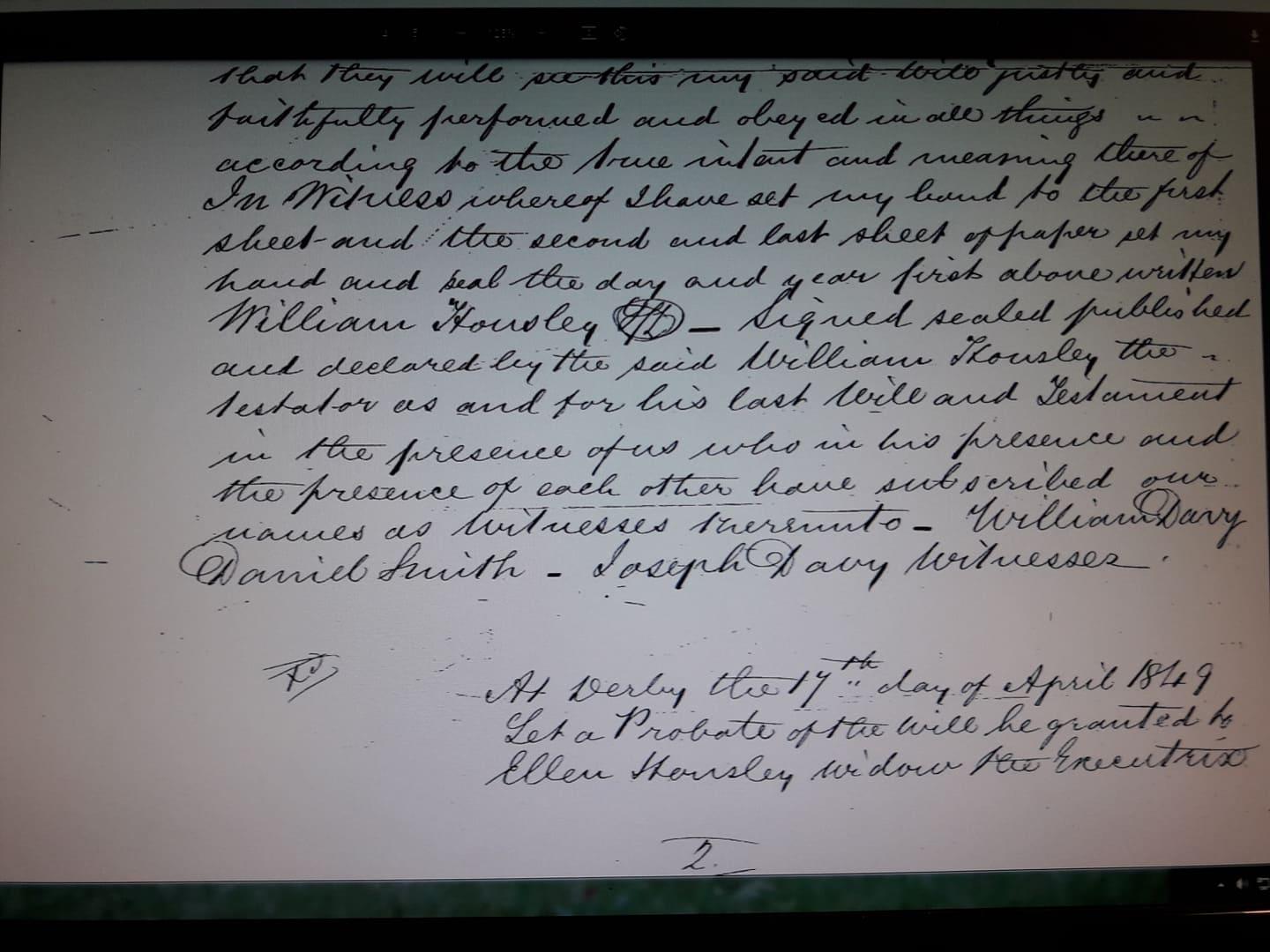
One of the pages of William Housley’s will:
An excerpt from Barbara Housley’s Narrative on the Letters:
A comment in a letter from Joseph (August 6, 1873) indicated that William was married twice and that his wives were sisters: “What do you think that I believe that Mary Ann is trying to make our father’s will of no account as she says that my father’s marriage with our mother was not lawful he marrying two sisters. What do you think of her? I have heard my mother say something about paying a fine at the time of the marriage to make it legal.” Markwell and Saul in The A-Z Guide to Tracing Ancestors in Britain explain that marriage to a deceased wife’s sister was not permissible under Canon law as the relationship was within the prohibited degrees. However, such marriages did take place–usually well away from the couple’s home area. Up to 1835 such marriages were not void but were voidable by legal action. Few such actions were instituted but the risk was always there.
Joseph wrote that when Emma was married, Ellen “broke up the comfortable home and the things went to Derby and she went to live with them but Derby didn’t agree with her so she left again leaving her things behind and came to live with John in the new house where she died.” Ellen was listed with John’s household in the 1871 census.
In May 1872, the Ilkeston Pioneer carried this notice: “Mr. Hopkins will sell by auction on Saturday next the eleventh of May 1872 the whole of the useful furniture, sewing machine, etc. nearly new on the premises of the late Mrs. Housley at Smalley near Heanor in the county of Derby. Sale at one o’clock in the afternoon.”There were hard feelings between Mary Ann and Ellen and her children. Anne wrote: “If you remember we were not very friendly when you left. They never came and nothing was too bad for Mary Ann to say of Mother and me, but when Robert died Mother sent for her to the funeral but she did not think well to come so we took no more notice. She would not allow her children to come either.”
Mary Ann was still living in May 1872. Joseph implied that she and her brother, Will “intend making a bit of bother about the settlement of the bit of property” left by their mother. The 1871 census listed Mary Ann’s occupation as “income from houses.”In July 1872, Joseph introduced Ruth’s husband: “No doubt he is a bad lot. He is one of the Heath’s of Stanley Common a miller and he lives at Smalley Mill” (Ruth Heath was Mary Anne Housley’s daughter)
In 1873 Joseph wrote, “He is nothing but a land shark both Heath and his wife and his wife is the worst of the two. You will think these is hard words but they are true dear brother.” The solicitor, Abraham John Flint, was not at all pleased with Heath’s obstruction of the settlement of the estate. He wrote on June 30, 1873: “Heath agreed at first and then because I would not pay his expenses he refused and has since instructed another solicitor for his wife and Mrs. Weston who have been opposing us to the utmost. I am concerned for all parties interested except these two….The judge severely censured Heath for his conduct and wanted to make an order for sale there and then but Heath’s council would not consent….” In June 1875, the solicitor wrote: “Heath bid for the property but it fetched more money than he could give for it. He has been rather quieter lately.”In May 1872, Joseph wrote: “For what do you think, John has sold his share and he has acted very bad since his wife died and at the same time he sold all his furniture. You may guess I have never seen him but once since poor mother’s funeral and he is gone now no one knows where.”
In 1876, the solicitor wrote to George: “Have you heard of John Housley? He is entitled to Robert’s share and I want him to claim it.”
Anne intended that one third of the inheritance coming to her from her father and her grandfather, William Carrington, be divided between her four nieces: Sam’s three daughters and John’s daughter Elizabeth.
In the same letter (December 15, 1872), Joseph wrote:
“I think we have now found all out now that is concerned in the matter for there was only Sam that we did not know his whereabouts but I was informed a week ago that he is dead–died about three years ago in Birmingham Union. Poor Sam. He ought to have come to a better end than that”However, Samuel was still alive was on the 1871 census in Henley in Arden, and no record of his death can be found. Samuel’s brother in law said he was dead: we do not know why he lied, or perhaps the brothers were lying to keep his share, or another possibility is that Samuel himself told his brother in law to tell them that he was dead. I am inclined to think it was the latter.
Excerpts from Barbara Housley’s Narrative on the Letters continued:
Charles went to Australia in 1851, and was last heard from in January 1853. According to the solicitor, who wrote to George on June 3, 1874, Charles had received advances on the settlement of their parent’s estate. “Your promissory note with the two signed by your brother Charles for 20 pounds he received from his father and 20 pounds he received from his mother are now in the possession of the court.”
In December 1872, Joseph wrote: “I’m told that Charles two daughters has wrote to Smalley post office making inquiries about his share….” In January 1876, the solicitor wrote: “Charles Housley’s children have claimed their father’s share.”
In the Adelaide Observer 28 Aug 1875
HOUSLEY – wanted information
as to the Death, Will, or Intestacy, and
Children of Charles Housley, formerly of
Smalley, Derbyshire, England, who died at
Geelong or Creewick Creek Diggings, Victoria
August, 1855. His children will hear of something to their advantage by communicating with
Mr. A J. Flint, solicitor, Derby, England.
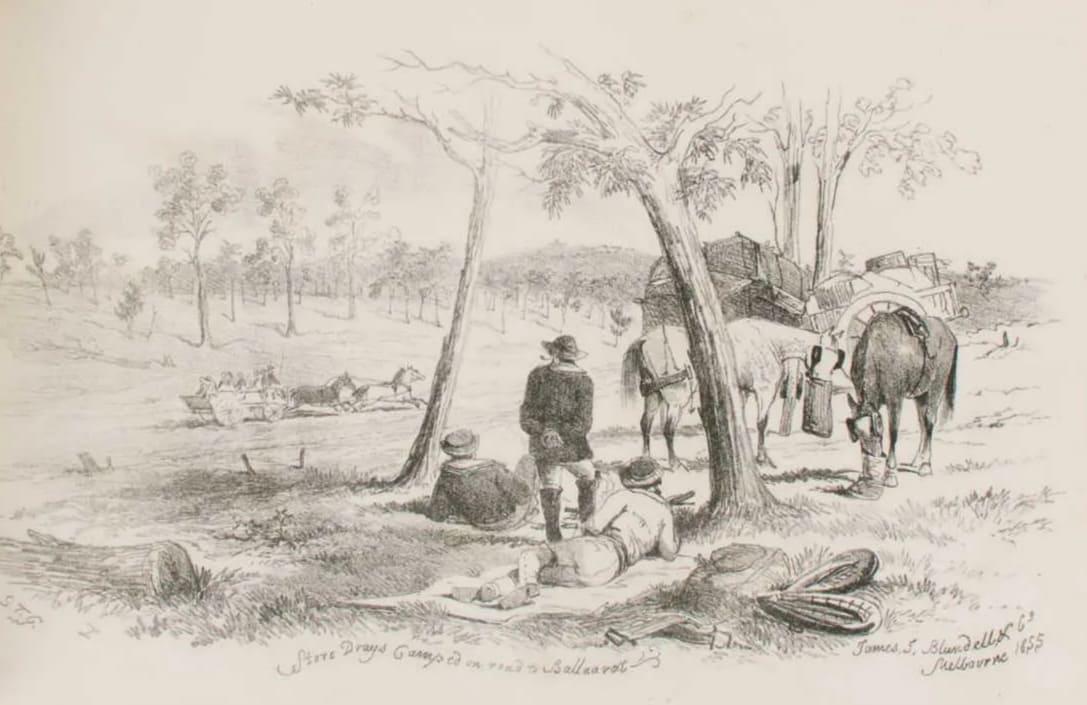
June 16,1875.The Diggers & Diggings of Victoria in 1855. Drawn on Stone by S.T. Gill:
The court case:
Kerry v Housley.
Documents: Bill, demurrer.
Plaintiffs: Samuel Kerry and Joseph Housley.
Defendants: William Housley, Joseph Housley (deleted), Edwin Welch Harvey, Eleanor Harvey (deleted), Ernest Harvey infant, William Stafford, Elizabeth Stafford his wife, Mary Ann Housley, George Purdy and Catherine Purdy his wife, Elizabeth Housley, Mary Ann Weston widow and William Heath and Ruth Heath his wife (deleted).
Provincial solicitor employed in Derbyshire.
Date: 1873From the Narrative on the Letters:
The solicitor wrote on May 23, 1874: “Lately I have not written because I was not certain of your address and because I doubted I had much interesting news to tell you.” Later, Joseph wrote concerning the problems settling the estate, “You see dear brother there is only me here on our side and I cannot do much. I wish you were here to help me a bit and if you think of going for another summer trip this turn you might as well run over here.”
In March 1873, Joseph wrote: “You ask me what I think of you coming to England. I think as you have given the trustee power to sign for you I think you could do no good but I should like to see you once again for all that. I can’t say whether there would be anything amiss if you did come as you say it would be throwing good money after bad.”
In September 1872 Joseph wrote; “My wife is anxious to come. I hope it will suit her health for she is not over strong.” Elsewhere Joseph wrote that Harriet was “middling sometimes. She is subject to sick headaches. It knocks her up completely when they come on.” In December 1872 Joseph wrote, “Now dear brother about us coming to America you know we shall have to wait until this affair is settled and if it is not settled and thrown into Chancery I’m afraid we shall have to stay in England for I shall never be able to save money enough to bring me out and my family but I hope of better things.”
On July 19, 1875 Abraham Flint (the solicitor) wrote: “Joseph Housley has removed from Smalley and is working on some new foundry buildings at Little Chester near Derby. He lives at a village called Little Eaton near Derby. If you address your letter to him as Joseph Housley, carpenter, Little Eaton near Derby that will no doubt find him.”In his last letter (February 11, 1874), Joseph sounded very discouraged and wrote that Harriet’s parents were very poorly and both had been “in bed for a long time.” In addition, Harriet and the children had been ill.
The move to Little Eaton may indicate that Joseph received his settlement because in August, 1873, he wrote: “I think this is bad news enough and bad luck too, but I have had little else since I came to live at Kiddsley cottages but perhaps it is all for the best if one could only think so. I have begun to think there will be no chance for us coming over to you for I am afraid there will not be so much left as will bring us out without it is settled very shortly but I don’t intend leaving this house until it is settled either one way or the other. ”Joseph’s letters were much concerned with the settling of their mother’s estate. In 1854, Anne wrote, “As for my mother coming (to America) I think not at all likely. She is tied here with her property.” A solicitor, Abraham John Flint of 42 Full Street Derby, was engaged by John following the death of their mother. On June 30, 1873 the solicitor wrote: “Dear sir, On the death of your mother I was consulted by your brother John. I acted for him with reference to the sale and division of your father’s property at Smalley. Mr. Kerry was very unwilling to act as trustee being over 73 years of age but owing to the will being a badly drawn one we could not appoint another trustee in his place nor could the property be sold without a decree of chancery. Therefore Mr. Kerry consented and after a great deal of trouble with Heath who has opposed us all throughout whenever matters did not suit him, we found the title deeds and offered the property for sale by public auction on the 15th of July last. Heath could not find his purchase money without mortaging his property the solicitor which the mortgagee employed refused to accept Mr. Kerry’s title and owing to another defect in the will we could not compel them.”
In July 1872, Joseph wrote, “I do not know whether you can remember who the trustee was to my father’s will. It was Thomas Watson and Samuel Kerry of Smalley Green. Mr. Watson is dead (died a fortnight before mother) so Mr. Kerry has had to manage the affair.”
On Dec. 15, 1972, Joseph wrote, “Now about this property affair. It seems as far off of being settled as ever it was….” and in the following March wrote: “I think we are as far off as ever and farther I think.”
Concerning the property which was auctioned on July 15, 1872 and brought 700 pounds, Joseph wrote: “It was sold in five lots for building land and this man Heath bought up four lots–that is the big house, the croft and the cottages. The croft was made into two lots besides the piece belonging to the big house and the cottages and gardens was another lot and the little intake was another. William Richardson bought that.” Elsewhere Richardson’s purchase was described as “the little croft against Smith’s lane.” Smith’s Lane was probably named for their neighbor Daniel Smith, Mrs. Davy’s father.
But in December 1872, Joseph wrote that they had not received any money because “Mr. Heath is raising all kinds of objections to the will–something being worded wrong in the will.” In March 1873, Joseph “clarified” matters in this way: “His objection was that one trustee could not convey the property that his signature was not guarantee sufficient as it states in the will that both trustees has to sign the conveyance hence this bother.”
Joseph indicated that six shares were to come out of the 700 pounds besides Will’s 20 pounds. Children were to come in for the parents shares if dead. The solicitor wrote in 1873, “This of course refers to the Kidsley property in which you take a one seventh share and which if the property sells well may realize you about 60-80 pounds.” In March 1873 Joseph wrote: “You have an equal share with the rest in both lots of property, but I am afraid there will be but very little for any of us.”The other “lot of property” was “property in Smalley left under another will.” On July 17, 1872, Joseph wrote: “It was left by my grandfather Carrington and Uncle Richard is trustee. He seems very backward in bringing the property to a sale but I saw him and told him that I for one expect him to proceed with it.” George seemed to have difficulty understanding that there were two pieces of property so Joseph explained further: “It was left by my grandfather Carrington not by our father and Uncle Richard is the trustee for it but the will does not give him power to sell without the signatures of the parties concerned.” In June 1873 the solicitor Abraham John Flint asked: “Nothing has been done about the other property at Smalley at present. It wants attention and the other parties have asked me to attend to it. Do you authorize me to see to it for you as well?”
After Ellen’s death, the rent was divided between Joseph, Will, Mary Ann and Mr. Heath who bought John’s share and was married to Mary Ann’s daughter, Ruth. Joseph said that Mr. Heath paid 40 pounds for John’s share and that John had drawn 110 pounds in advance. The solicitor said Heath said he paid 60. The solicitor said that Heath was trying to buy the shares of those at home to get control of the property and would have defied the absent ones to get anything.
In September 1872 Joseph wrote that the lawyer said the trustee cannot sell the property at the bottom of Smalley without the signatures of all parties concerned in it and it will have to go through chancery court which will be a great expense. He advised Joseph to sell his share and Joseph advised George to do the same.George sent a “portrait” so that it could be established that it was really him–still living and due a share. Joseph wrote (July 1872): “the trustee was quite willing to (acknowledge you) for the portrait I think is a very good one.” Several letters later in response to an inquiry from George, Joseph wrote: “The trustee recognized you in a minute…I have not shown it to Mary Ann for we are not on good terms….Parties that I have shown it to own you again but they say it is a deal like John. It is something like him, but I think is more like myself.”
In September 1872 Joseph wrote that the lawyer required all of their ages and they would have to pay “succession duty”. Joseph requested that George send a list of birth dates.On May 23, 1874, the solicitor wrote: “I have been offered 240 pounds for the three cottages and the little house. They sold for 200 pounds at the last sale and then I was offered 700 pounds for the whole lot except Richardson’s Heanor piece for which he is still willing to give 58 pounds. Thus you see that the value of the estate has very materially increased since the last sale so that this delay has been beneficial to your interests than other-wise. Coal has become much dearer and they suppose there is coal under this estate. There are many enquiries about it and I believe it will realize 800 pounds or more which increase will more than cover all expenses.” Eventually the solicitor wrote that the property had been sold for 916 pounds and George would take a one-ninth share.
January 14, 1876: “I am very sorry to hear of your lameness and illness but I trust that you are now better. This matter as I informed you had to stand over until December since when all the costs and expenses have been taxed and passed by the court and I am expecting to receive the order for these this next week, then we have to pay the legacy duty and them divide the residue which I doubt won’t come to very much amongst so many of you. But you will hear from me towards the end of the month or early next month when I shall have to send you the papers to sign for your share. I can’t tell you how much it will be at present as I shall have to deduct your share with the others of the first sale made of the property before it went to court.
Wishing you a Happy New Year, I am Dear Sir, Yours truly
Abram J. Flint”September 15, 1876 (the last letter)
“I duly received your power of attorney which appears to have been properly executed on Thursday last and I sent it on to my London agent, Mr. Henry Lyvell, who happens just now to be away for his annual vacation and will not return for 14 or 20 days and as his signature is required by the Paymaster General before he will pay out your share, it must consequently stand over and await his return home. It shall however receive immediate attention as soon as he returns and I hope to be able to send your checque for the balance very shortly.”1874 in chancery:
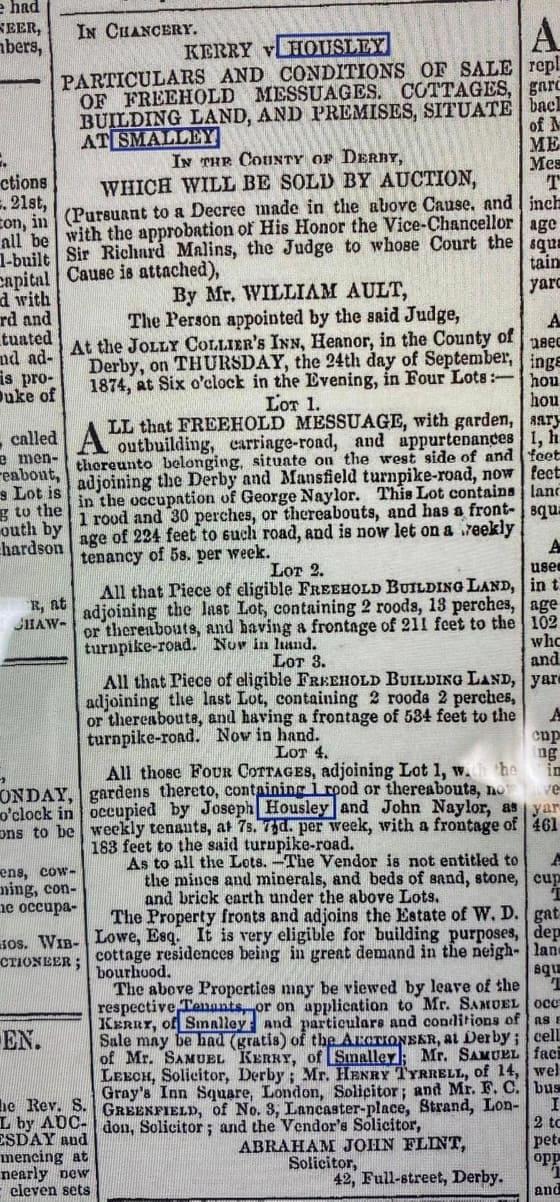 December 6, 2020 at 9:00 am #6155
In reply to: Twists and One Return From the Time Capsule
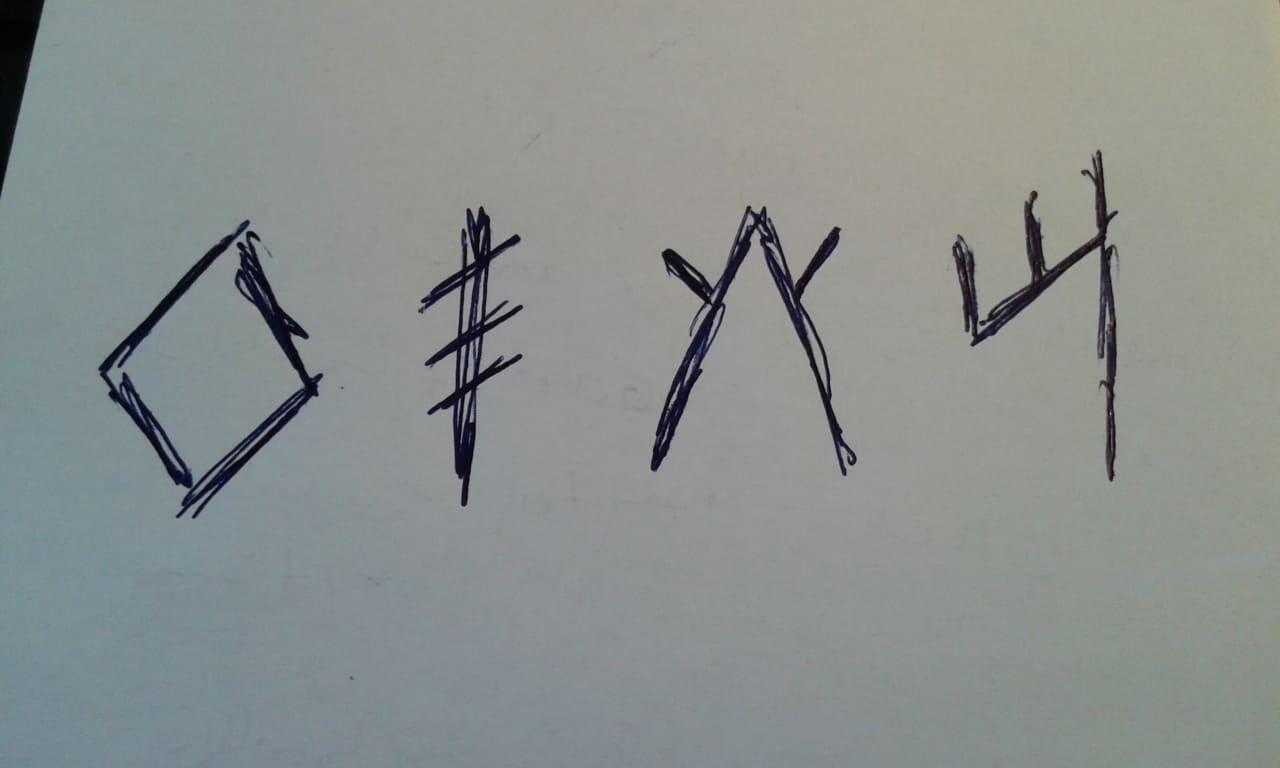 Damn these municipal restrictions! Frustrated, Nora looked again at the photo of the inscriptions on the mysterious pear shaped box that Clara had found. She picked up a pen and copied the symbols onto a piece of paper. Glancing back over the message her friend had sent, her face softened at Clara’s pet name for her, Alienor. Clara had started called her that years ago, when she found out about the ouija board incident and the aliens Nora had been talking to. Was it really an alien, or….? Clara had asked, and Nora had laughed and said Of course it was an alien or! and the name had stuck.
Nora’s mood had changed with the reminiscence, and she had an idea. She was working from home, but all that really meant was that she had to have internet access. Nobody would have to know which home she was working from, if she could just make it past the town barriers. But she didn’t have to go by road: the barriers were only on the roads. There was nothing stopping her walking cross country.
Putting aside the paper with the symbols on, she perused a map. She had to cross three town boundaries, and by road it was quite a distance. But as the crow flies, not that far. And if she took the old smugglers track, it was surprisingly direct. Nora calculated the distance: forty nine kilometers. Frowning, she wondered if she could walk that distance in a single day and thought it unlikely. Three days more like, but maybe she could do it in two, at a push. That would mean one overnight stay somewhere. What a pity it was so cold! It would mean carrying a warm sleeping bag, and she hated carrying things.
Nora looked at the map again, and found the halfway point: it was a tiny hamlet. A perfect place to spend the night. If only she knew someone who lived there, somebody who wouldn’t object to her breaking the restrictions.
Nora yawned. It was late. She would finalize the plan tomorrow, but first she sent a message to Clara, asking her if she knew anyone in the little village.
August 30, 2020 at 10:44 pm #6114In reply to: Tart Wreck Repackage
Aunt April blew her nose loudly into a tissue.
“Are you ready to talk, April?” asked Star gently.
April nodded, took a sip from her tea, put it on the saucer and sighed loudly. “I’ll do my best. You see, everyone thinks Vince French is in a coma. But he isn’t. That isn’t Vince.”
“Wait up, let me take notes,” said Tara. “So, how do you know that isn’t Vince French?”
“The real Vince has a tattoo of a bell-bird on his right buttock.”
Rosamund snorted. “Ooh, go Auntie April!”
“I had my suspicions … so I had to see for myself. On pretext of being a nurse, I managed to inveigle myself into the institution where he is supposedly being kept to look at his derriere. There are other small differences too, but that clinched it for me.”
Star nodded. “I see, well done! So you and Vincent French were having an …?”
“A liaison of rather a passionate nature. Yes.”
“And the wardrobe? The notes?”
“I had the wardrobe sent up.”
Tara looked puzzled. “But … what on earth for?”
“Oh, the wardrobe is a red herring. I really just wanted to get rid of it and rather than send it to charity thought you girls might make use of it.”
“And the notes? The fictitious Uncle Albie?” asked Star.
April screwed up her face and giggled nervously. “Well, you are a struggling start-up business and there were no social media reviews to go by … so it was a test really. To see if you were good enough to take on the case.”
Tara glowered at her. “And?”
“You passed! Congratulations! As Rosamund may have told you, I am filthy rich and money is no object. We must get to the bottom of this mystery.”
“Bottom,” said Rosamund and sniggered.
April 27, 2020 at 4:57 pm #6077In reply to: The Precious Life and Rambles of Liz Tattler
“Finnley, stop pacing like that with that concerned look of yours, you make me dizzy. Is that too difficult a task to hire a secretary?”
Finnley rolled her eyes. “Not at all, Madam. I already found you a pearl.”
“You mean the perfect one for me?”
“No I mean, she’s called Pearl. She’ll start tomorrow. What concerns me is something else entirely. Something strange, if you ask me. But you never ask, so I’m telling you.”
“Well, this whole conversation started because I asked you.”
“You asked me because you thought it was related to your previous request.”
“Then tell me and stop brooding. It’s killing the mood.”
Finnley snorted. “If you want to know, someone is throwing things on the balcony. Children things. The other day I found that cheap toy to make soap bubbles. And then it was a small blue children’s plastic sand shovel. And today they dropped a red bucket.”
Liz tried to laugh, but it was more of a cackle. “Isn’t that Godfrey or Roberto playing with you?” she asked.
“I’ve asked Godfrey and I’m positive it’s not him because it’s driving him nut too. We asked Roberto because he’s been attempting to teach tricks to the dogs. A waste of time if you ask me, letting the garden going to the dogs,” she smirked.
“Then, was it Roberto and the dogs?”
“Not at all! We kept an eye on him while he was training the dogs. Nothing. But the objects keep coming. I’m telling you either we have a ghost or a portal to another dimension in this mansion.”
“That sounds like a nice idea,” said Liz, pouting at the possibilities.
“You wouldn’t say that if another you came into this thread.”
March 28, 2020 at 12:08 pm #5928In reply to: The Whale’s Diaries Collection
Hello Whale,
I don’t keep track of the days since we have been forcefully encouraged to stay home. I have plenty of carrots and chocolate mousse. Talking of mousse, I might have a mouse keeping me company. Let’s not hope it’s a family. But I heard that animals are coming back into town now that we are all cozy in our burrows. There have been mentions of chicks on the ring road. Not the kind of chick with makeup, the real fluffy and yellow ones. And one of my friends saw a fox roaming the streets while going to the supermarket. I bet he had a bag full of carrots. Now I wouldn’t be surprised having rabbits everywhere with all those carrots around.
I may sound confusing but I guess that’s what being confined does to people. I even had day dreams of birds flying in my bedroom. I swear I really saw one. Well, to be fair I only saw its shadow, but it was a shadow in the air, not on the wall. I wonder what kind of bird it was. My little pinky said it was a finch, the one my mother loved looking at in her garden. She will be part of the numbers soon. Either with her death or with her survival. Now when I think of her I see her surrounded by a bunch of animals. I even saw the fox, but I don’t think it would count amongst the animals I see in town.
Since I’m not trying to be analytic, I’ve found a strange poetry in life around here. People are talking like senators, all trying to give their certainties to the world, but I can tell you nobody knows shit and nobody has a clue. You might as well welcome the virus for some tea to get to know each other and have some interesting stories about yourself and your relation to nature.
I’m raving again. Someone told me a joke recently. The national board of psychologists published a official communiqué because they received too many calls from people. They said it was normal in this time of confinement to talk to the walls or the objects in your house, and to call them only in case the objects talked back.
What would they think if they knew I’m talking to a whale and it’s giving me advice for my writing? I can even hear them as it sends me short audio. I haven’t been able to figure out what they said in the audio though. I’m glad the advice for my writing do come directly translated and not in the form of a whale song. I’m grateful for technology in that case.
Oh and one last mention. A friend told me about the current roller coaster of the stock market. I dreamt of a stocking market. I must say it was very colourful and the seller used their stockings in very creative ways.
Keep the connection going! Talk to you soon Whale. I’ll have to find you a name. My pinky suggested Jorid so it will be my name for you.
September 20, 2019 at 4:50 pm #4823In reply to: Pop﹡in People Tribulations
Bugger them all then, Lucinda said to herself, I’ll carry on here without them.
For a time she had been despondent at being abandoned, sinking into an aching overcast gloom to match the weather. Waiting for it to rain, and then waiting for it to stop.
On impulse, in an attempt to snap out of the doldrums, she signed up for a Creative Writing and Rambling course at the local Psychic Self Institute. Institutionalizing psychic matters had been the brainchild of the latest political party to gain power, and hitherto under the radar prophets, healers and remote viewers had flocked to sign up. The institute has promised pension and public health credits to all members who could prove their mental prowess, and needless to say it had attracted many potential scammers: useless nobodies who wanted to heal their diseases, or lazy decrepit old scroungers who wanted to retire.
Much to everyone’s surprise, not least their own, the majority of them had passed the tests, simply by winging it: making it up and hoping for the best. Astonishingly the results were more impressive than the results from the already established professional P.H.A.R.T.s ~ (otherwise known as Prophets, Healers and Remote Technicians).
This raised questions about the premise of the scheme, and how increasingly difficult it was to establish a criteria for deservingness of pensions and health care, particularly if any untrained and unregistered Tom, Dick or Harry was in possession of superior skills, as appeared to be the case. The debate continues to this day.
Nothwithstanding, the Institute continued to offer courses, outings and educational and inspiring talks. The original plan had been to offer qualifications, but the entrance exams had provoked such a quandary about the value and meaning (if any) of qualifications, that the current modus operandi was to simply offer each member, regardless of merit or experience, a simple membership card with a number on it. It was gold coloured and had classical scrolls and lettering on it in an attempt to bestow worth and meaning. Nobody was fooled, but everyone loved it.
And everyone loved the tea room at the Institute. It was thought that some cake aficionado’s had even joined the Institute merely for the desserts, but nobody objected. There was a welcome collective energy of pleasure, appreciation and conviviality in the tea room, and it’s magnetic appeal ~ and exceptional cakes ~ ensured it’s popularity and acclaim.
A small group had started a campaign to get it placed on the Institutes Energetic Cake Connector mapping programme. As Lucinda had said in a moment of clarity, “A back street bar can be just as much of an energy magnet as an old stone relic”, casting doubt over the M.O.S.S group’s (Mysterious Old Stone Sites) relevance to anything potentially useful.
“In fact,” Lucinda continued, surprising herself, ““I’ve only just realized that the energy magnets aren’t going to be secret, hidden and derelict. They’re going to be busy. Like cities.”
Several members of the M.O.S.S group had glared at her.
Lucinda hadn’t really thought much about what to expect in the creative writing classes.
September 8, 2019 at 5:28 pm #4797In reply to: The Precious Life and Rambles of Liz Tattler
“Beans are probably hot now. Back in a sec.”“
It was such a good example, I simply had to start with it. You may be wondering who I am, and how I gained access at this level. I’m not quite sure yet. A fictional character, yes. My name is Trebuchet. It has a nice ring to it, so I have no objection to it. I don’t know where it came from.
July 18, 2019 at 3:31 pm #4693In reply to: The Stories So Near
Some updates on the Heartwoods Weave
So far, there were loosely 2 chapters in this story, and we’re entering the 3rd.
Let’s call them:- Ch. 1 – The Curses of the Stolen Shards
- Ch. 2 – The Flight to the Desert Mountains
- Ch. 3 – Down the Lands of Giants
Ch. 1 – The Curses of the Stolen Shards
In Chapter One, we get acquainted with the main characters as their destinies intertwine (Rukshan, Glynis, Eleri, Gorrash, Fox, Olliver and Tak).
In a long past, the Forest held a powerful artifact created and left behind as a seal by the Gods now departed in their World: a Gem of Creation. It was defiled by thieves (the 7 characters in their previous incarnations of Dark Fae (Ru), Toothless Dragon (Gl), Laughing Crone (El), Mapster Dwarf (Go), Glade Troll (Fo), Trickster Dryad (Ol), Tricked Girl (Ta)), and they all took a shard of the Gem, although the innocent girl was tricked to open the woods by a promise of resurrecting a loved one, and resented all the others for it. She unwittingly created the curse all characters were suffering from, as an eternal punishment. Removing the Gem from the center of the Forest and breaking it started a chain of events, leading to many changes in the World. The Forest continued to grow and claim land, and around the (Dragon) Heartwoods at the center, grew many other woods – the Haunted Bamboo Forest, the Enchanted Forest, the Hermit’s Forest, the Fae’s Forest etc. At the other side, Cities had developed, and at the moment of the story, started to gain control over the magical world of Old.
From the special abilities the Seven gained, some changes were triggered too. One God left behind was turned into stone by the now young Crone (E).
Due to the curse, their memories were lost, and they were born again in many places and other forms.
During the course of Ch.1, they got healed with the help of Master Gibbon, and the Braider Shaman Kumihimo, who directed Rukshan how to use the Vanishing Book, which once completed by all, and burnt as an offering, lifted the curse. Tak (the Girl of the origin story), now a shapeshifting Gibbon boy, learned to let go of the pain, and to start to live as a young orphan under the gentle care of the writer Margoritt Loursenoir and her goat Emma, in a cottage in the woods.
Glynis, a powerful healer with a knack for potions, still haven’t found a way to undo the curse of her scales, which she accepts, has found residency and new friends and a funny parrot named Sunshine. Eleri besides her exploration of anti-gravity, learnt to make peace with the reawakened God Hasamelis no longer vengeful but annoyed at being ignored for a mortal Yorath. Eleri continues to love to butt heads with the iniquities of the world, which are never in lack, often embodied by Leroway and his thugs. Gorrash, who adopted the little baby Snoots activated by Glynis’ potions seemed simply happy to have found a community. Fox, a fox which under the tutelage of Master Gibbon, learnt to shapeshift as a human for all his work and accumulation of good karma. Olliver, a young man with potential, found his power by activating the teleporting egg Rukshan gave him. As for Rukshan, who was plagued by ghosts and dark forces, he found a way to relieve the Forest and the world of their curse, but his world is torn between his duties towards his Fae family in the woods, his impossible love for his Queen, and his wants for a different life of exploration, especially now knowing his past is more than what he thought he knew.
At the end of the chapter, the Door to the God’s realm, at the center of the Forest seems to have reopened.Ch. 2 – The Flight to the Desert Mountains
In the second Chapter, strange sightings of light beams in the mountains prompt some of our friends to go investigate, while in the cottage, the others stay to repel encroachments by brutal modernity embodied by Leroway and his minions. Glynis has found a way to be rid of her scales, but almost failed due to Tak’s appetite for untested potions. Remaking the potion, and succeeding at last, she often still keeps her burka as fond token of her trials. Eleri is spreading glamour bomb concrete statues in the woods, and trying her hand with Glynis supervision at potions to camouflage the cottage through an invisibility spell. Muriel, Margoritt’s sister, comes for a visit.
In the mountains, the venturing heroes are caught in a sand storm and discover spirits trapped in mystical objects. Pushing forward through the mountain, they are tracked and hunted by packs of hellhounds, and dark energy released from an earthquake. Rukshan works on a magical mandala with the help and protection of his friends. Olliver discovers a new teleportation trick making him appear two places at once. Kumihimo rejoins the friends in trouble, and they all try to leave through the magical portal, while Fox baits the dogs and the Shadow. Eerily, only Fox emerges from the portal, to find a desolated, burnt Forest and his friends all gone. They had been too late, and the Shadow went with them through the portal instead of being destroyed. Luckily, a last potion left by Glynis is able to rewind Fox in time, and succeed in undoing the disaster. The beaming lights were only honeypots for wandering travellers, it turned out.
Shaken by the ordeal, Rukshan leaves the party for some R&R time in the parallel world of the Faes, which is now mostly abandoned.Ch. 3 – Down the Lands of Giants
In Chapter 3, which has only just begun, some time has passed, and Margoritt has come back to the City, at the beginning of winter for some special kneedle treatments. Glynis and Margoritt are in turn taking care of Tak, who has joined a local school, where he seems to have befriended a mysterious girl Nesingwarys (Nesy). Gorrash seems to have been hurt, broken whilst in his statue form by Leroway’s thugs, but the Snoot babies are still staying with him, so there is hope. Fox is always hungry, and helps with the reconstruction work for the cottage, which was damaged in a fire (we suppose during Leroway’s men foray in the woods).
Rukshan emerges from his retreat after an encounter with a mad Fae, babbling about a Dark Lord’s return. Piecing clues together, he finds a long lost World Map and connection with a renegade magician who may have been the Maker of Gorrash (and maybe linked to the trapped spirits in the mountain after all). He sends a pigeon to his friends before he returns to the thick of the Heartwoods.
Now, it seems the Door to the God’s realm has reopened the ancient Realms of the Underworld too, all accessible through the central pillar of the World, intersecting their World precisely at the Heartwoods, were the Gem of Creation originally was. He’s planning to go to the long lost Underworld of the Giants, were he suspects the so-called Dark Lord is hiding.July 12, 2019 at 6:53 am #4649In reply to: Pop﹡in People Tribulations
Maeve had left only taking with her the wrapping of the package and had been glad to leave Shawn Paul with its content, especially when she had seen what it was.
The mysterious thing was heavy, brown and looked a tad like a dry turd. It could hold in Shawn Paul’s hand and it seemed shaped to fit in his closed fist, but the young man hesitated to keep it too long because of the way it looked.
A note from his mother accompanied it. Who else could have sent a parcel this way? he thought, meaning not through the post office and delivered by a decrepit old man.
So the thing had been put on top of a pile of his latest scribblings, which was on top of his not so latest scribblings. Before putting it there, he almost saw the interest of a clean desktop or table, but it got lost in the immediacy of the moment and the tiredness caused by his recent fever.“I’m sure you’re wondering what this marvellous object is.” the note started. Shawn Paul looked at the thing. It looked like a turd more than ever on all that white paper, so he made his yuck face. What he was wondering was rather why did she send me anything? She lives in an apartment on the upper floor. She could have brought it herself.
“I found it in a car boot sale,” she continued, her sharp and melodious voice chirping in her son’s head while he read the rest. “I met that old man, Patrick, who will deliver it to you. He’s a dear nice fellow never frugal with his words, and he told me it had been given to him by an Inuit shaman. It’s a fossil bone of the inner ear of a whale when they escaped Lemuria. Can you imagine that? Apparently it will help you develop your psychic abilities. You know how I’ve always known you had such a great potential in that area…”
Shawn Paul snorted and put down the paper. There was no use keeping up reading. His mother and her crazy ideas. He looked at the pile of papers.
It’ll do for a nice paperweight, he thought.But Granola had not lost a crumble of what the mother had told in the rest of the note. She was lurking at the inner bone and she wondered if she could make herself heard if she merged with it.
June 27, 2019 at 1:19 pm #4613In reply to: Pop﹡in People Tribulations
For a moment, Granola felt in a dream world. It wasn’t the first time it happened, so she relaxed, and let her consciousness focus despite the distraction from the shimmering and vibrating around the objects and people.
She was in another mental space, but this one was more solid, not just a diversion born from a single thought or a single mind. It was built in layers of cooperation, alignment, and pyramid energy. A shared vision, although at times, a confused one.
The first time she’d visited, she thought it was a fun fantasy, like a dream, quickly enjoyed and discarded. But then she would come back at times, and the fantasy world continued to expand and feel lively.
It slowly dawned on her that this was a projection of an old project of her friends. The more striking was how people in the place looked a bit like Maeve’s dolls, but she could see the other’s imprints —Shaw-Paul’s, Lucinda’s and Jerk’s—, subtle energy currents driving the characters and animating everything.
It felt like a primordial fount of creativity, and she basked in the glorious feeling of it.
Once, she got trapped long enough to start exploring the “place” in and out, and it all became curiouser when she found out that the places and the stories they told were all connected through a central underground stream.
Granola had been an artist most of her life, so she understood how creativity worked. Before she died, she had been intrigued the first time her online friends had mentioned this collaboration game, creating that mindspace filled with their barmy stories. She didn’t believe such pure mental creation could be called real at all.
Maybe that was the kind of comments that let her friends forget it.
If only she could tell them now!“You could, if you’d hone your pop-in skills, dear”, a random character suddenly turned to her and spoke in the voice of Ailill, her blue mentor.
“But how can you see me? I’ve tried and the characters of these stories don’t ever see me!”
“That’s what popping in is all about, justly so!” Ailill had this way of making her mind race for a spin.
“Now, will you stop hijacking this person, and tell me why you’re interrupting my present mission?” Granola turned burgundy red, increased her typeface a few notches, and pushed her ghost leg vigorously at the story character.
“Oh, you are right about that. It is a mission.” he smiled, “I think you’d want to go find certain characters, or avatars. Your friends personae are always shifting into new characters, but they hide themselves and don’t progress. Actually, some of them are trapped in loops, and those loops are not happily ever after. You can help free them, so they can recover their trapped creativity.”
“Well, that doesn’t sound like an impossibly vague mission at all!”She was about to continue ranting, but the pop-in effect was gone, and the character was back to his routine, unperturbed by her ghostly agitation.
October 11, 2018 at 3:21 am #4534In reply to: Seven Twines and the Dragon Heartwoods
Of course the spell failed! Glynis continued to berate herself sternly. She had approached it mostly as an intellectual exercise and she realised now her heart had not been fully engaged in the spell-making. For sure she cared about Margoritt and the fate of the cottage but if she were completely honest, there was a large part of her wondering what the point of it was. It may buy them some time, but how much use was that unless the others returned soon with the treasure?
It took potent magic to cloak an object as large as the cottage — how foolish she had been to think she could perform a spell this powerful with cloudy intentions.
Maybe there is still a way. Even if my own heart is divided, perhaps if we all work together the spell may still succeed.
It was at this moment Glynis noticed several things. Firstly, that she was no longer quite sure where she was and that at some point she must have left the track and secondly, how dark it had become. Just a faint, rapidly fading light still illuminated the ground in patches through the trees.
July 1, 2017 at 5:17 am #4366In reply to: The Precious Life and Rambles of Liz Tattler
It’s all a bit quiet there, where have they all gone again? One could hear plants growing in that silence.
“Finnley!” she shouted across the mansion, pondering at what demoniac activity the maid was devoted recently.
She hadn’t seen the maid in the all of the week, but somehow they had been communicating in a sort of eerie telepathic way, by subtle positions of objects in the house. A piece of clothe in this or that position would mean, please wash it hasta pronto, but if it was slightly above ground, she somehow would get it was meant to be just folded for another use. There had been a silent tug of war as to where the towel would dry, as she didn’t like it to be in the humid bathroom. And for every lunch, she would find something prepared in the fridge, ready to be heated in the microwave oven.
But she had to tell her, that was enough with chicken and grilled aubergines. A little variety would go a long way…
January 15, 2017 at 8:57 am #4276In reply to: Seven Twines and the Dragon Heartwoods
The garden was becoming too small for Gorrash. With time, the familiarity had settled down in his heart and he knew very well each and every stone or blade of grass there was to know. With familiarity, boredom was not very far. Gorrash threw a small pebble in the pond, he was becoming restless and his new and most probably short friendship with Rainbow had triggered a seed in his heart, the desire to know more about the world.
Before he’d met the creature, Gorrash could remember the pain and sadness present in the heart of his maker. He had thought that was all he needed to know about the world, that mankind was not to be trusted. And he had avoided any contact with that dragon lady, lest she would hurt him. He knew that all came from his maker, although he had no real access to the actual memories, only to their effects.
Gorrash threw another pebble into the pond, it made a splashing sound which dissolved into the silence. He imagined the sound was like the waves at the surface of the pond, going endlessly outward into the world. He imagined himself on top of those waves, carried away into the world. A shiver ran through his body, which felt more like an earthquake than anything else, stone bodies are not so flexible after all. He looked at the soft glowing light near the bush where Rainbow was hiding. The memory of joy and love he had experienced when they hunted together gave his current sadness a sharp edge, biting into his heart mercilessly. He thought there was nothing to be done, Rainbow would leave and he would be alone again.
His hand reached in his pocket where he found the phial of black potion he had kept after Rainbow refused it. He shook it a few times. Each time he looked at it, Gorrash would see some strange twirls, curls and stars in the liquid that seemed made of light. He wondered what it was. What kind of liquid was so dark to the point of being luminous sometimes ? The twirls were fascinating, leading his attention to the curls ending in an explosion of little stars. Had the witch captured the night sky into that bottle?
Following the changes into the liquid was strangely soothing his pain. Gorrash was feeling sleepy and it was a very enjoyable feeling. Feelings were quite new to him and he was quite fascinated by them and how they changed his experience of the world. The phial first seemed to pulse back and forth into his hand, then the movement got out and began to spread into his body which began to move back and forth, carried along with this sensual lullaby. Gorrash wondered if it would go further, beyond his body into the world. But as the thought was born, the feeling was gone and he was suddenly back into the night. A chill went down his spine. It was the first time. The joy triggered his sadness again.
The dwarf looked at the dark phial. Maybe it could help ease his pain. He opened it, curious and afraid. What if it was poison? said a voice of memory. Gorrash dismissed it as the scent of Jasmine reached his nose. His maker was fond of Jasmine tea, and he was surprised at the fondness that rose in his heart. But still no images, it was merely voices and feelings. Sometimes it was frustrating to only have bits and never the whole picture, and full of exasperation, Gorrash gulped in the dark substance.
He waited.
Nothing was happening. He could still hear the cooing of Rainbow, infatuated with it eggs, he could hear the scratches of the shrews, the flight of the insects. That’s when Gorrash noticed something was different as he was beginning to hear the sharp cries of the bats above. He tried to move his arm to look at the phial, but his body was so heavy. He had never felt so heavy in his short conscious life, even as the light of the Sun hardened his body, it was not that heavy.
The soil seemed to give way under his increasing weight, the surface tension unable to resist. He continued to sink into the ground, down the roots of the trees, through the tunnels of a brown moles quite surprised to see him there, surrounded by rocks and more soil, some little creatures’ bones, and down he went carried into hell by the weight of his pain.
After some time, his butt met a flat white surface, cold as ice, making him jump back onto his feet. The weird heaviness that a moment before froze his body was gone. He looked around, he was in a huge cave and he was not alone. There was an old woman seated crosslegged on a donkey skin. Gorrash knew it was a donkey because it still had its head, and it was smiling. The old woman had hair the colour of the clouds before a storm in summer, It was full of knots and of lightning streaks twirling and curling around her head. Her attention was all on the threads she had in her hands. Gorrash counted six threads. But she was doing nothing with them. She was very still and the dwarf wondered if she was dead or asleep.
What do you want? asked the donkey head in a loud bray.
It startled the dwarf but it didn’t seem to bother the old lady who was still entranced and focused on her threads.
Nothing, said Gorrash who couldn’t think of anything he would want.
Nonsense, brayed the donkey, laughing so hard that the skin was shaking under the old lady. Everyone wants something. You wouldn’t be here if you didn’t want something.
Gorrash thought about what he could want, what he had been wanting that night. He remembered his desire to get out of the garden.
And there you are, brayed the donkey head, that’s a start. What do you want then?
Getting out of the garden?
Noooo! That’s a consequence of a deeper desire, but that’s not what you want.
I have never thought about desires before, said Gorrash. It’s pretty new to me. I just came to life a few weeks ago during a full moon.
The donkey head tilted slightly on its right. No excuses, it spat, If you’re awake, then you have a desire in your heart that wants to be fulfilled. What do you want? Take your time, but not too long. The universe is always on the move and you may miss the train, or the bus, or the caravan…
As the donkey went on making a list of means of transportation, Gorrash looked hesitantly at the old lady. She was still focused on her six threads she had not moved since he had arrived there.
Who is she? he asked to the donkey.
_She’s known by many names and has many titles. She’s Kumihimo Weaver of Braids, Ahina Maker of Songs, Gadong Brewer of Stews…
Ok! said Gorrash, not wanting the donkey go on again into his list enumeration pattern. What is she doing?
She’s waiting.
And, what is she waiting for?
She’s waiting for the seventh thread, brayed the donkey head. I’m also waiting for the thread, it whined loudly. She won’t leave my back until she’s finished her braid. The head started to cry, making the dwarf feel uncomfortable. Suddenly it stopped and asked And, who are you?
The question resonated in the cave and in his ears, taking Gorrash by surprise. He had no answer to that question. He had just woken up a few weeks ago in that garden near the forest, with random memories of a maker he had not known, and he had no clue what he desired most. Maybe if he could access more memories and know more about his maker that would help him know what he wanted.
Good! brayed the donkey, We are making some progress here. Now if you’d be so kind as to give her a nose hair, she could have her last thread and she could tell you where to find your maker.
Hope rose in Gorrash’s heart. Really?
Certainly, brayed the head with a hint of impatience.
But wouldn’t a nose hair be too short for her braid? asked the dwarf. All the other threads seemed quite long to him.
Don’t waste my time with such triviality. Pull it out!
Gorrash doubted it would work but he grabbed a nose hair between his thumb and index and began to pull. He was surprised as he didn’t feel the pain he expected but instead the hair kept being pulled out. He felt annoyed and maybe ashamed that it was quite long and he had not been aware of it. He took out maybe several meters long before a sudden pain signalled the end of the operation. Ouch!
hee haw, laughed the donkey head.
The pain brought out the memory of a man, white hair, the face all wrinkled, a long nose and a thin mouth. He was wearing a blouse tightened at his waist by a tool belt. He was looking at a block of stone wondering what to make out of it, and a few tears were rolling down his cheeks. Gorrash knew very well that sadness, it was the sadness inside of him. Many statues surrounded the man in what looked like a small atelier. There were animals, gods, heads, hands, and objects. The vision shifted to outside the house, and he saw trees and bushes different than the ones he was used to in the garden where he woke up. Gorrash felt a strange feeling in his heart. A deep longing for home.
Now you have what you came here for. Give the old lady her thread, urged the donkey. She’s like those old machines, you have to put a coin to get your coffee.
Gorrash had no idea what the donkey was talking about. He was still under the spell of the vision. As soon as he handed the hair to the woman, she began to move. She took the hair and combined it to the other threads, she was moving the threads too swiftly for his eyes to follow, braiding them in odd patterns that he felt attracted to.
Time for you to go, said the donkey.
I’d like to stay a bit longer. What she’s doing is fascinating.
Oh! I’m sure, brayed the donkey, But you have seen enough of it already. And someone is waiting for you.
The dwarf felt lighter. And he struggled as he began levitating. What!? His body accelerated up through the earth, through the layers of bones and rocks, through the hard soil and the softer soil of years past. He saw the brown mole again and the familiar roots of the trees of the garden in the enchanted forest.
Gorrash took a deep breath as he reintegrated his stone body. He wobbled, trying to catch his ground. He felt like throwing up after such an accelerated trip. His knees touched the ground and he heard a noise of broken glass as he dropped the phial.
“Are you alright?” asked a man’s voice. Gorrash forced his head up as a second wave of nausea attempted to get out. A man in a dark orange coat was looking down at him with genuine worry on his face.
“I’m good,” said the dwarf. “But who are you?”
“My name is Fox. What’s yours?”
January 6, 2017 at 7:06 am #4272In reply to: Seven Twines and the Dragon Heartwoods
Kumihimo was rummaging through the content of a wooden chest at the back of the cave. According to the smell it had spent too much time in the dark and humid environment. She might have to do some spring cleaning one day. But the chest was now too heavy for her to carry. I need an apprentice for this, she thought not knowing if if was a wish or a regret.
In that chest, she had her many tools of the thread. Some were made of bones and she had carved them herself under the direction of her spirit guides. Each one had a specific purpose, either to catch, to extract, to guide, or to dissipate, and many more usages that even she had forgotten after so many years spent in that place.
She had accumulated so many things in that chest. Fortunately she liked miniature, and most of her creations were seldom bigger than her little finger. However that made it difficult to keep things in order and finding something was often a real challenge. So she sang lullabies to lure the object she was looking for out of their sanctuary.
Victory! she exulted in the ancient tongue, which would translate also as ‘I have done all that is necessary to harvest the benefits of the next crop’. Kumihimo liked simple things and she liked when one word could signify a very complex meaning. Under an old donkey skin that she often used to camouflage herself when she was going down in the valley, she had found the loom she had been looking for.
The loom was made from the right shoulder blade of a bear. It was one of the first objects she had carved when she arrived in the vicinity. It had a yellowish patina and felt very smooth in her hands. Its shape was octagonal and each side had seven notches under which were three rows of symbols, some of the ink was gone after so many years, but she could still feel the groove where she had carved them. She smiled at the fond memories and at the dear friend who allowed her to take his bone when he died of old age.
In the centre of the loom was a heart with a circular hole in it. It was where the braid would emerge.Holding the precious object, Kumihimo could feel all the braids she had already made and all the potential braids that waited to come into existence. She felt warmth bloom in her heart at the task at hand.
Each notch corresponded at the same time to a time of the year, to a direction on earth and in the sky, and some rather obscure references to many other phenomenon and concepts. The weaving depended on very complex rules that she had discovered from experience. Actually the meaning weaved itself into the braid through a subtle interaction between her and Spirit. That way she didn’t have to bother about what to do or what notch to use as it would all unfold during the weaving.
She stood up and walked outside. The day was still young and she had a lot to do. The weaving ceremony was an act of spontaneity, but it required some preparation. She put the loom on a round rock to dry in the Sun and went to examine the hanging threads. She had to choose carefully.
November 27, 2016 at 2:34 am #4219In reply to: Seven Twines and the Dragon Heartwoods
As the crow flies, Glenville is about 100 miles from the Forest of Enchantment.
“What a pretty town!” tourists to the area would exclaim, delighted by the tree lined streets and quaint houses with thatched roofs and brightly painted exteriors. They didn’t see the dark underside which rippled just below the surface of this exuberant facade. If they stayed for more than a few days, sure enough, they would begin to sense it. “Time to move on, perhaps,” they would say uneasily, although unsure exactly why and often putting it down to their own restless natures.
Glynis Cotfield was born in one of these houses. Number 4 Leafy Lane. Number 4 had a thatched roof and was painted a vibrant shade of yellow. There were purple trims around each window and a flower box either side of the front door containing orange flowers which each spring escaped their confines to sprawl triumphantly down the side of the house.
Her father, Kevin Cotfield, was a bespectacled clerk who worked in an office at the local council. He was responsible for building permits and making sure people adhered to very strict requirements to ‘protect the special and unique character of Glenville’.
And her mother, Annelie … well, her mother was a witch. Annelie Cotfield came from a long line of witches and she had 3 siblings, all of whom practised the magical arts in some form or other.
Uncle Brettwick could make fire leap from any part of his body. Once, he told Glynis she could put her hand in the fire and it wouldn’t hurt her. Tentatively she did. To her amazement the fire was cold; it felt like the air on a frosty winter’s day. She knew he could also make the fire burning hot, if he wanted. Some people were a little scared of her Uncle Brettwick and there were occasions—such as when Lucy Dickwit told everyone at school they should spit at Glynis because she came from an ‘evil witch family’—when she used this to her advantage.
“Yes, and I will tell my Uncle to come and burn down your stinking house if you don’t shut your stinking stupid mouth!” she said menacingly, sticking her face close to Lucy’s face. “And give me your bracelet,” she added as an after thought. It had worked. She got her peace and she got the bracelet.
Aunt Janelle could move objects with her mind. She set up a stall in the local market and visitors to the town would give her money to watch their trinkets move. “Lay it on the table”, she would command them imperiously. “See, I place my hands very far from your coin. I do not touch it. See?” Glynis would giggle because Aunt Janelle put on a funny accent and wore lots of garish makeup and would glare ferociously at the tourists.
But Aunt Bethell was Glynis’s favourite—she made magic with stories. “I am the Mistress of Illusions,” she would tell people proudly. When Glynis was little, Aunt Bethell would create whole stories for her entertainment. When Glynis tried to touch the story characters, her hand would go right through them. And Aunt Bethell didn’t even have to be in the same room as Glynis to send her a special magical story. Glynis adored Aunt Bethell.
Her mother, Annelie, called herself a healer but others called her a witch. She concocted powerful healing potions using recipes from her ’Big Book of Spells’, a book which had belonged to Annelie’s mother and her mother before her. On the first page of the book, in spindly gold writing it said: ‘May we never forget our LOVE of Nature and the Wisdom of Ages’. When Glynis asked what the ‘Wisdom of Ages’ meant, her mother said it was a special knowing that came from the heart and from our connection with All That Is. She said Glynis had the Wisdom of Ages too and then she would ask Glynis to gather herbs from the garden for her potions. Glynis didn’t think she had any particular wisdom and wondered if it was a ploy on her mother’s part to get free labour. She obeyed grudgingly but drew the line at learning any spells. And on this matter her father sided with her. “Don’t fill her mind with all that hocus pocus stuff,” he would say grumpily.
Despite this, the house was never empty; people came from all over to buy her mother’s potions and often to have their fortunes told as well. Mostly while her father was at work.
Glynis’s best friend when she was growing up was Tomas. Tomas lived at number 6 Leafy Lane. They both knew instinctively they shared a special bond because Tomas’s father also practised magic. He was a sorcerer. Glynis was a bit scared of Tomas’s Dad who had a funny crooked walk and never spoke directly to her. “Tell your friend you must come home now, Tomas,” he would call over the fence.
Being the son of a sorcerer, Tomas would also be a sorcerer. “It is my birthright,” he told her seriously one day. Glynis was impressed and wondered if Tomas had the Wisdom of Ages but it seemed a bit rude to ask in case he didn’t.
When Tomas was 13, his father took him away to begin his sorcery apprenticeship. Sometimes he would be gone for days at a time. Tomas never talked about where he went or what he did there. But he started to change: always a quiet boy, he became increasingly dark and brooding.
Glynis felt uneasy around this new Tomas and his growing possessiveness towards her. When Paul Ackleworthy asked her to the School Ball, Tomas was so jealous he broke Paul’s leg. Of course, nobody other than Glynis guessed it was Tomas who caused Paul’s bike to suddenly wobble so that he fell in the way of a passing car.
“You could have fucking killed him!” she had shouted at Tomas.
Tomas just shrugged. This was when she started to be afraid of him.
One day he told her he was going for his final initiation into the ‘Sorcerer Fraternity’.
“I have to go away for quite some time; I am not sure how long, but I want you to wait for me, Glynis.”
“Wait for you?”
He looked at her intensely. “It is destined for us to be together and you must promise you will be here for me when I get back.”
Glynis searched for her childhood friend in his eyes but she could no longer find him there.
“Look, Tomas, I don’t know,” she stuttered, wary of him, unwilling to tell the truth. “Maybe we shouldn’t make any arrangements like this … after all you might be away for a long time. You might meet someone else even …. some hot Sorceress,” she added, trying not to sound hopeful.
Suddenly, Glynis found herself flying. A gust of wind from nowhere lifted her from her feet, spun her round and then held her suspended, as though trying to decide what to do next, before letting her go. She landed heavily at Tomas’s feet.
“Ow!” she said angrily.
“Promise me.”
“Okay! I promise!” she said.
Her mother’s face went white when Glynis told her what Tomas had done.
That evening there was a gathering of Uncle Brettwick and the Aunts. There was much heated discussion which would cease abruptly when Glynis or her father entered the room. “Alright, dearie?” one of the Aunts would say, smiling way too brightly. And over the following days and weeks there was a flurry of magical activity at 4 Leafy Lane, all accompanied by fervent and hushed whisperings.
Glynis knew they were trying to help her, and was grateful, but after the initial fear, she became defiant. “Who the hell did he think he was, anyway?” She left Glenville to study architecture at the prestigious College of Mugglebury. It was there she met Conway, who worked in the cafe where she stopped for coffee each morning on her way to class. They fell in love and moved in together, deciding that as soon as Glynis had graduated they would marry. It had been 4 years since she had last seen Tomas and he was now no more than a faint anxious fluttering in her chest.
It was a Friday when she got the news that Conway had driven in the path of an oncoming truck and was killed instantly. She knew it was Friday because she was in the supermarket buying supplies for a party that weekend to celebrate her exams being over when she got the call. And it was the same day Tomas turned up at her house.
And it was then she knew.
“You murderer!” she had screamed through her tears. “Kill me too, if you want to. I will never love you.”
“You’ve broken my heart,” he said. “And for that you must pay the price. If I can’t have you then I will make sure no-one else wants you either.”
“You don’t have a heart to break,” she whispered.
Dragon face,” Tomas hissed as he left.
Glynis returned to Glenville just long enough to tell her family she was leaving again. “No, she didn’t know where,” she said, her heart feeling like stone. Her mother and her Aunts cried and begged her to reconsider. Her Uncle smouldered in silent fury and let off little puffs of smoke from his ears which he could not contain. Her father was simply bewildered and wanted to know what was all the fuss about and for crying out loud why was she wearing a burka?
The day she left her mother gave her the ‘Book of Spells”. Glynis knew how precious this book was to her mother but could only think how heavy it would be to lug around with her on her journey.
“Remember, Glynis,” her mother said as she hugged Glynis tightly to her, “the sorcerers have powerful magic but it is a mere drop in the ocean in comparison to the magic of All That Is. You have that great power within you and no sorcerer can take take that from you. You have the power to transform this into something beautiful.”
November 22, 2016 at 3:36 am #4197In reply to: The Chronicles of the Flying Fish Inn
MATER
Bert seems to be digging a very large hole. I mean, good grief, it’s just a veggie garden. I don’t think my cabbages warrant all that effort. I pull open the window—the latch wobbles precariously on its single screw—and call out to him.
“What are you doing, Bert? Digging a grave or something?”
My humour is clearly lost on him. He glances over in my direction, distractedly, before placing his spade on the ground. He then kneels down in the dirt and leaning right inside the hole begins scrabbling with his hands.
How odd!
I pull a jacket on over my pink floral onesie. The onesie was a birthday gift from the girls and was accompanied by rather a lot of silliness and giggling. However I was privately rather taken with my gift and with summer over and a cool chill in the air it was very handy to put on in the mornings. Completing my ensemble with an old pair of gumboots by the back doorstep, I go and join Bert in the garden.
“What’s that, Bert? What’s that you’ve found in there?”
“I’m not sure yet,” he replied. At least, I think that’s what he said. It was hard to hear him when he was hanging upside down in a hole.
I crouch down beside him, no mean feat at my age, and take a look.
All I can see are some bones.
“What is it? A dog or something?”
“Too big for a dog.”
“Oh my goodness!” I gasp. “Are those … people bones?”
Bert gently extricates an object from the dirt and pulling himself back up he perches down beside me. “Not unless they have a beak for a nose,” he says, gently dusting off the dirt and holding it up for me to see.
It was a giant skull. Like a strange giant bird.
“Dragon skull,” says Bert with a satisfied smile.
July 15, 2016 at 9:18 pm #4123In reply to: The Chronicles of the Flying Fish Inn
Corrie’s findings from elsewhere:
“Mike wasn’t as courageous as his former self, the Baron. That new name had a cowardly undertone which wasn’t as enticing to craze and bravery as “The Baron”.
The idea of the looming limbo which had swallowed the man whole, and having to care for a little girl who surely shouldn’t be out there on her own at such an early hour of the day spelt in unequivocal letters “T-R-O-U-B-B-L-E” — ah, and that he was barely literate wasn’t an improvement on the character either.
Mike didn’t want to think to much. He could remember a past, maybe even a future, and be bound by them. As well, he probably had a family, and the mere though of it would be enough to conjure up a boring wife named Tina, and six or seven… he had to stop now. Self introspection wasn’t good for him, he would get lost in it in quicker and surer ways than if he’d run into that Limbo.
“Let me tell you something… Prune?… Prune is it?”
“I stop you right there, mister, we don’t have time for the “shouldn’t be here on your own” talk, there is a man to catch, and maybe more where he hides.”“Little girl, this is not my battle, I know a lost cause when I see one. You look exhausted, and I told my wife I would be back with her bloody croissants before she wakes up. You can’t imagine the dragon she becomes if she doesn’t get her croissants and coffee when she wakes up. My pick-up is over there, I can offer you a lift.”
Prune made a frown and a annoyed pout. At her age, she surely should know better than pout. The thought of the dragon-wife made her smile though, she sounded just like Mater when she was out of vegemite and toasts.
Prune started to have a sense of when characters appearing in her life were just plot devices conjured out of thin air. Mike had potential, but somehow had just folded back into a self-imposed routine, and had become just a part of the story background. She’d better let him go until just finds a real character. She could start by doing a stake-out next to the strange glowing building near the frontier.
“It’s OK mister, you go back to your wife, I’ll wait a little longer at the border. Something tells me this story just got started.”

“Aunt Idle was craving for sweets again. She tip toed in the kitchen, she didn’t want to hear another lecture from Mater. It only took time from her indulging in her attachments. Her new yogiguru Togurt had told the flockus group that they had to indulge more. And she was determined to do so.
The kitchen was empty. A draft of cold air brushed her neck, or was it her neck brushing against the tiny molecules of R. She cackled inwardly, which almost made her choke on her breath. That was surely a strange experience, choking on something without substance. A first for her, if you know what I mean.The shelves were closed with simple locks. She snorted. Mater would need more than that to put a stop to Idle’s cravings. She had watched a video on Wootube recently about how to unlock a lock. She would need pins. She rummaged through her dreadlocks, she was sure she had forgotten one or two in there when she began to forge the dreads. Very practicle for smuggling things.
It took her longer than she had thought, only increasing her craving for sweets.
There was only one jar. Certainly honey. Idle took the jar and turned it to see the sticker. It was written Termite Honey, Becky’s Farm in Mater’s ornate writing. Idle opened the jar. Essence of sweetness reached her nose and made her drool. She plunged her fingers into the white thick substance.” “But wait! What is this?
Her greedy fingers had located something unexpected; something dense and uncompromising was lurking in her precious nectar. Carefully, she explored the edges of the object with her finger tips and then tugged. The object obligingly emerged, a gooey gelatinous blob.
Dido sponged off the honey allowing it to plunk on to the table top. It did not occur to her to clean it up. Indeed, she felt a wave of defiant pleasure.
The ants will love that, although I guess Mater won’t be so thrilled. Fussy old bat.
She licked her fingers then transferred her attention back to the job at hand. After a moment of indecision whilst her slightly disordered mind flicked through various possibilities, she managed to identify the object as a small plastic package secured with tape. Excited, and her ravenous hunger cravings temporarily stilled in the thrill of the moment, she began to pick at the edges of the tape.Cocooned Inside the plastic was a piece of paper folded multiple times. Released from its plicature, the wrinkled and dog-eared paper revealed the following type written words:
food self herself next face write water truth religious behind mince salt words soon yourself hope nature keep wrong wonder noticed.”
““What a load of rubbish!” Idle exclaimed, disappointed that it wasn’t a more poetic message. She screwed up the scrap of crumpled paper, rolled it in the honey on the table, and threw it at the ceiling. It stuck, in the same way that cooked spaghetti sticks to the ceiling when you throw it to see if it’s done. She refocused on the honey and her hunger for sweetness, and sank her fingers back into the jar.”
“The paper fell from the ceiling on to Dido’s head. She was too busy stuffing herself full of honey to notice. In fact it was days before anyone noticed.”
“The honeyed ball of words had dislodged numerous strands of dried spaghetti, which nestled amongst Aunt Idle’s dreadlocks rather attractively, with the paper ball looking like a little hair bun.”
““Oh my god …. gross!“ cackled the cautacious Cackler.”
““Right, that does it! I’m moving the whole family back to the right story!” said Aunt Idle, invigorated and emboldened with the sweet energy of the honey. “Bloody cackling nonsense!””
July 6, 2016 at 7:56 am #4102In reply to: Cakletown and the Lone Chancers of Custard
“You!”, said Jeremy Duncan Jasper before jumping on the woman. “You stole my cat! What have you done to Max ?”
“I don’t have your cat”, said Funley loudly. She was trying to protect her face as an instinctive reaction and pushed on the ground with her feet. The chair had little wheels which allowed her to escape the man’s grasp, but it bumped on Ed’s desk. She was cornered. She jumped out of the chair and ran behind Ed’s desk followed closely by an angry Jeremy.“I assume you already know each others”, said Ed, tugging at his mustache casually.
“Of course I know her”, said Jeremy in a short breath. He showed his fist angrily. “She was supposedly from the hygiene inspection bureau when I worked at the veterinarian clinic. She stole my cat!”
“I don’t have your cat”, repeated Funley.
“What have you done with him old crone ? You gave me all those papers to read and sign and when I came back you were gone… with Max.”
“Tsk tsk”, said Ed. “We have more important matters to attend to.” He lifted his hand to prevent any objection. “You may or may not have noticed, but I have and that’s the more important. Reality has been rebooting repeatedly, and each time people… or animals”, he said looking at Jeremy, “are disappearing.”
“You see”, said Funley, “I don’t have your cat.” Jasper snorted and showed his teeth.
“We need to do something”, concluded Ed.
“Excuse me”, said Duncan, “but what does that have to do with us ? I’m just a bank employee.”
“A bank employee, who was a veterinarian, a plumber, a taxi driver, a tech guy at the phone company… and more importantly a map dancer. I need a team of gifted people to maximize our chances of survival.”
Funley raised an eyebrow. “Mr Steam, à propos”, she said brandishing the paper she had found in the trash can.
March 6, 2016 at 8:06 pm #3955In reply to: Cakletown and the Lone Chancers of Custard
But wait! What is this?
Her greedy fingers had located something unexpected; something dense and uncompromising was lurking in her precious nectar. Carefully, she explored the edges of the object with her finger tips and then tugged. The object obligingly emerged, a gooey gelatinous blob.
Dido sponged off the honey allowing it to plunk on to the table top. It did not occur to her to clean it up. Indeed, she felt a wave of defiant pleasure.
The ants will love that, although I guess Mater won’t be so thrilled. Fussy old bat.
She licked her fingers then transferred her attention back to the job at hand. After a moment of indecision whilst her slightly disordered mind flicked through various possibilities, she managed to identify the object as a small plastic package secured with tape. Excited, and her ravenous hunger cravings temporarily stilled in the thrill of the moment, she began to pick at the edges of the tape.
Cocooned Inside the plastic was a piece of paper folded multiple times. Released from its plicature, the wrinkled and dog-eared paper revealed the following type written words:
food self herself next face write water truth religious behind mince salt words soon yourself hope nature keep wrong wonder noticed.
-
AuthorSearch Results
