

Search Results for 'oven'
-
AuthorSearch Results
-
February 28, 2024 at 7:22 pm #7391
In reply to: The Incense of the Quadrivium’s Mystiques
Jeezel didn’t really have time to go back to her routine after the Brasilian shambles. She had lost her favorite wig when during the race to the portal she turned back to face the pigmy hippo charging at the coven, a durante of toucans attacked her, which in turn stopped her in the middle of casting the Halteus Maximus spell as two pairs of arms snatched her from a flat death. She learned later that it was Truella and Eris who caught her arms. Her wig had fallen and they didn’t allow her go back to pick it up. Seeing the hippo trample her wig in the mud broke her heart.
“Jeez! We need you to open the portal!”
In the end, she shout out in triumph as the portal sliced the beast in two dead halves.
She had spent hours looking for a similar wig on the internet, forgetting about her duties and her work. But it had finally arrived and she was ready to resume. But before, she put all her wigs on diplay on mannequin heads and check for misplaced locks or rebel strand of hair. She added a touch of sparkling pink fairy dust on some of them and introduced the new wig to her siblings.
“Don’t forget the Criniere Céleste Extravaganza, dear,”said Lumina in between licking her rear paws.
“I was going to,” said Jeezel a bit irritated.
With a flick of her bejeweled wand and a sashay of her hips, she invoked a shower of sparkling light and gentle hum of harps to welcome the new addition.
“Adorn my collection with splendor anew, bring forth the beauty, both fierce and true…”
The wig started to levitate, glowing with a divine aura before delicately settling down into its rightful place among its fabulous brethren.
Now everything was ready for her next show.
February 26, 2024 at 8:35 am #7389In reply to: The Incense of the Quadrivium’s Mystiques
“Well, it’s a long story, are you sure you want to hear it?”
“Tell me everything, right from the beginning. You’re the one who keeps saying we have plenty of time, Truella. I shall quite enjoy just sitting here with a bottle of wine listening to the story,” Frigella said, feeling all the recent stress pleasantly slipping away.
“Alright then, you asked for it!” Truella said, topping up their glasses. The evening was warm enough to sit outside on the porch, which faced the rising moon. A tawny owl in a nearby tree called to another a short distance away. “It’s kind of hard to say when it all started, though. I suppose it all started when I joined that Arkan coven years ago and the focus wasn’t on spells so much as on time travel.”
“We used to travel to times and places in the past,” Truella continued, “Looking back now, I wonder how much of it we made up, you know?” Frigella nodded. “Preconceptions, assumptions based on what we thought we knew. It was fun though, and I’m pretty sure some of it was valid. Anyway, valid or not, one thing leads to another and it was fun.
“One of the trips was to this area but many centuries ago in the distant past. The place seemed to be a sort of ancient motorway rest stop affair, somewhere for travellers to stay overnight on a route to somewhere. There was nothing to be found out about it in any books or anything though, so no way to verify it like we could with some of our other trips. I didn’t think much more about it really, we did so many other trips. For some reason we all got a bit obsessed with pyramids, as you do!”
They both laughed. “Yeah, always pyramids or special magical stones,” agreed Frigella.
“Yeah that and the light warriors!” Truella snorted.
“So then I found a couple of pyramids not far away, well of course they weren’t actually pyramids but they did look like they were. We did lots of trips there and made up all sorts of baloney between us about them, and I kept going back to look around there. We used to say that archaeologists were hiding the truth about all the pyramids and past civilizations, quite honestly it’s a bit embarrassing now to remember that but anyway, I met an actual archaeologist by chance and asked her about that place. And the actual history of it was way more interesting than all that stuff we’d made up or imagined.
The ruins I’d found there were Roman, but it went further back than that. It was a bronze age hill fort, and later Phoenician and Punic, before it was Roman. I asked the archaeologist about Roman sites and how would I be able to tell and she showed me a broken Roman roof tile, and said one would always find these on a Roman site.
I found loads over the years while out walking, but then I found one in the old stone kitchen wall. Here, let me fetch another bottle.” Truella got up and went inside, returning with the wine and a dish of peanuts.
“So that’s when I decided to dig a hole in the garden and just keep digging until I found something. I don’t know why I never thought to do that years ago. I tell you what, I think everyone should just dig a hole in their garden, and just keep digging until they find something, I can honestly say that I’ve never had so much fun!”
“But couldn’t you have just done a spell, instead of all that digging?” Frigella asked.
“Oh my god, NO! Hell no! That wouldn’t be the same thing at all,” Truella was adamant. “In fact, this dig has made me wonder about all our spells to be honest, are we going too fast and missing the finds along the way? I’ve learned so much about so many things by taking it slowly.”
“Yeah I kinda know what you mean, but carry on with the story. We should discuss that later, though.”
“Well, I just keep finding broken pottery, loads of it. We thought it was all Roman but some of it is older, much older. I’m happy about that because I read up on Romans and frankly wasn’t impressed. Warmongering and greedy, treated the locals terribly. Ok they made everything look nice with the murals and mosaics and what not, and their buildings lasted pretty well, but who actually built the stuff, not Romans was it, it was the slaves. Still, I wasn’t complaining, finding Roman stuff in the garden was pretty cool. But I kept wishing I knew more about the people who lived here before they came on the rampage taking everything back to Rome. Hey, let me go and grab another bottle of wine.”
Frigella was feeling pleasantly squiffy by now. The full moon was bright overhead, and she reckoned it was light enough to wander around the garden while Truella was in the kitchen. As she walked down the garden, the tawny owl called and she looked up hoping to see him in the fig tree. She missed her step and fell over a bucket, and she was falling, falling, falling, like Alice down the rabbit hole.
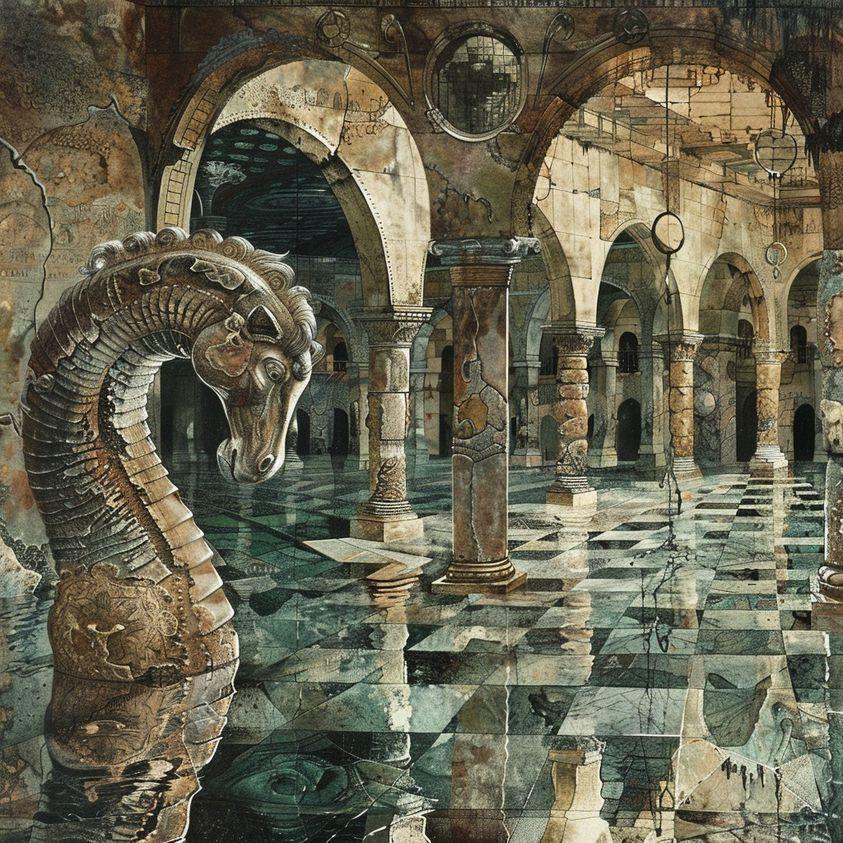
The fall was slow like a feather wafting gently down and she saw hundreds of intriguing fragments of objects and etchings and artefacts on the sides of the hole and she drifted slowly down. At last she came to rest at the bottom, and found herself in an arched gallery of mirrors and tiles and doors. On every surface were incomplete drawings and shreds of writings, wondrous and fascinating. She didn’t immediately notice the hippocampus smiling benignly down at her. He startled her a little, but had such a pleasant face that she smiled back up at him. “Where am I?” she asked.
“You’d be surprised how many people ask me that.” he replied, with a soft whicker of mirth. “Not many realise that they’ve called on me to help them navigate. Now tell me, where is it you want to go?”
“Well,” Frigella replied slowly, “Now that you ask, I’m not entirely sure. But I’m pretty sure Truella would like to see this place.”
 February 20, 2024 at 1:44 pm #7379
In reply to: The Incense of the Quadrivium’s Mystiques
From the moment they had stepped into the gorgeous villa, Malové had felt it was a trap.
It all went very fast and messily after that.
The memories were a bit blurred after all the manic rush of events.
One thing was sure: her little plan of a new smoke fragrance had to be the biggest fiasco since she took the reins of the Coven’s Quadrivium ventures.
Well, there wouldn’t be a huge point to go through the minute details of events that went down after that, would it.
Suffice to say that someone had snitched about their incognito presence directly in the ears of the Elder, and they would have been toast were it not for her quick wits.
A few curious souls would love to know how they ultimately escaped the clutches of the Brazilian witches. But that story would be one for later.
Carnival was over, and she for one, had never been big on feathers and glitter.
Lent and its Quadragesima austerities was more her style.In the end, they’d only be gone for less than a week and like that, they’d already come back to the Quadrivium.
It was luck really that Jeezel had been so good at producing the cascading portal just in time, and they could all slip through it, in spite of the sudden explosion of fireworks and the mad run ensuing. One of the pygmy hippos that was sent to chase after them had paid the price of Jeezel’s quick thinking this time, as she’d severed the portal at just the moment for the hippo to be bisected in a rather gruesome fashion.
Well, she’d never tasted smoked hippo, but she’d heard from her Tanzanian witch friend that one could find decent recipes, and it would do wonders with a garnish of orange marmalade.
And on top of that, she’d recently acquired a wardrobe sized smoking room that would do perfectly well for a trial run.She had to hand it to Frigella that she also did well with the hedgehog enlargement and armoring spells – the spikes throwing had really made a splash. Malové didn’t know she was so good at battle magic she even didn’t have to use her dragonage master spell.
The only issue was for Truella. Termitated by honey that was served by their cunning hosts, her duplicate self had been turned to stone instantaneously. That’s how Malové had known they were not meant to escape. Luckily for Truella, this was just her duplicate from the bilocation spell. On Malové’s orders, Eris had turned this second body into a miniature statue so that Eris could carry her away to safety during their mad escape.
Now, they would have to merge this stoned Truella back with her original self, so that Truella wouldn’t suffer from any tinkering effects afterwards.
February 17, 2024 at 9:25 pm #7378In reply to: The Incense of the Quadrivium’s Mystiques
The cauldron of characters was bubbling over, the sub plots and side trips had risen like a tray of cupcakes in a fan assisted oven, and the kettle of confusion was roiling and steaming like fault line geyser. Lisia hadn’t offered much in the way of clarity with her rambling gush, but when she said “upon receiving such an invitation to a villa, what is one to do? Why, attend, of course, darling!” it all seemed so much easier.
February 15, 2024 at 8:44 pm #7376In reply to: The Incense of the Quadrivium’s Mystiques
When they arrived at the hotel, the witches soon realized they were not the only uninvited guests here. With her keen sense of observation, Eris was the first to spot the traces left by an army of bedbugs. Tiny droppings on the mattresses and linen, blood stains left after the previous guests crushed the bugs while rolling in their bed. And the smell of dead rats was everywhere. Did they even have a cleaning staff here? When they complained, the hotel manager said: “Why do you care? Nobody comes here to sleep during carnival?”
Jeezel noticed the bug reference. Indeed, something was still bugging her after she had closed the portal. Something that should be obvious, yet was still an eyelash away from her grasp. But something more pressing was at stake. She posted pictures of the rooms and a reel of her disappointed face in front of the disaster.
“I was so happy to come to Rio for the first time. But the light is yellow and flickering. How can I show you how to do a proper Carnival makeup,” she said fluttering her eyelashes. As soon as the sound of a message well sent faded out, she started to receive support and love from her fans.
“Rio is not like that!”
“Somebody help.”
“2 bad! I’m on business trip. Wud hav luv to meet ya there!”
The sounds of likes and comments alerted Malové.
“What have you done! We were here incognito. Why don’t you go to the top of Jesus’s head and cast the Tempestarii Overture spell.”
“I could have! That would have gone viral. But we departed in such a hurry, I have left all my sapphires and stilettos in Limerick. You can’t cast that spell without them. Anyway, we don’t have to stay longer in that cesspit. One of my fans is abroad and has offered us to stay in his villa. Look at the pics! It looks as lush and gorgeous as a Jurassic park.”
Truella widened her eyes and said: “Saying that’s a big property would be an understatement. Roger would have loved to come with his new shovel.”
“Don’t even think of casting a second bilocation spell,” said Frigella. “You already look like deflated soufflé.”
“What’s the catch?” asked Eris with frown. “It looks like the kind of golden cage a king pin would own. But they have a pool.”
“He said we just have to feed the dwarf crocodiles while we are there,” said Jeezel nonplussed, looking at Truella whose eyes were ready to pop off of their sockets. Then she looked at Malové. “What do you say? You’re the eld…head witch of our coven.”
Malové’s eyebrow twitched. She was thinking fast. Little signs here and there, the orientation of the statues, the fountain, the placement of rocks that would look so random to a profane or a younger witch. Ancient earth magic? It was difficult to be sure with the framing of the pictures. Jeezel was swiping all the pictures her fan had sent her, hoping such glamour and mystery would melt Malové’s last reluctance.
“Omg! girls, we can’t refuse!” said Jeezel. “He’s got a bloat of pygmy hippos and a flamboyance of flamingos!”
As the drag witch continued to swipe the pictures, a prickle crept up Malové’s spine when she saw a familiar face amongst them.
“Look at him!” shouted Jeezel. “He’s a Gatsby with a spellbook.”
There were no more doubts for Malové about the kind of magic that had been used to build his empire. Augustus St Clair, a powerful witch indeed, and one whose invitation you couldn’t refuse especially since he now knew she was here. As one of the elders of the Rio’s witches community, she had danced the dance of rivals disguised as allies, a pas de deux filled with forced smiles and tight grips. Her words felt like needles scratching her lips when she uttered them: “Tell him we accept his invitation.”
The shouts of joy and disbelief coming from the witches couldn’t appease the memories that had resurfaced.
February 15, 2024 at 11:04 am #7373In reply to: The Incense of the Quadrivium’s Mystiques
The disturbance had been felt in the bustling heart of Rio.
The warmth of the night had amplified the vibrant energy of the Carnival in Rio, a pulsating heart that reverberated through the city’s veins. But as the beat of samba drums echoed in the distance, a different rhythm was being played behind closed doors. Iemanjá, the head of the Umbanda clan and a pillar of strength in the Witches of the New World, recognized the tremors of another magick at play.
Gathering her coven under the silvery light of the crescent moon, they began the rhythmic dance of the macumba ritual. The air grew heavy, scented with copal and the salty tang of the ocean. In the center of their circle, a waterspout swirled, revealing in its shallow reflection the glow of a portal that emitted the icy chill of a Limerick dawn.
Piercing through the veil of secrecy, Iemanjá’s ethereal sight witnessed the foreign witches, led by the enigmatic Malové, who dared to encroach upon their territory without the required parchmentwork. And yet, their motives remained hidden within the vortex of desire and lust emanating from the Carnival.
A murmur of discontent rippled through the Umbanda clan. Mesmirah, her second, couldn’t stop herself shouting Sacrilégio! They were not ones to tolerate trespassers, let alone those who dared to siphon off energy from their sacred lands.
Silêncio! Iemanjá commanded the crowd. She’d recognized Malové from having attended and graduated the same MWA (Master of Witchcraft Administration), and she was aware of Malove’s little incense business; Malové didn’t strike her as someone to bypass the rules, some handed down through countless generations, binding together most witches across the world despite their varying practices.
She had to be mindful of the delicate balance between the Old World clans and the New. An unauthorized incursion could easily spark a conflict that would ripple through the witching worlds.
Just as the ocean waves respect the boundary of the shore, so must the witches respect the territories — an ancient pact carved in the pillars of the Old World. This blatant disregard by Malové and her coven was akin to scratching the surface of a simmering cauldron, threatening to disrupt the harmony that had been carefully cultivated.
As the revelation sunk in, Iemanjá knew they had to tread carefully. A confrontation would lead to a war bigger than themselves —yet, they couldn’t let this transgression slide. Their pride and the protection of their territory demanded action.
Mesmirah! she finally spoke You will take three witches with you, and investigate what business these Old World witches have in Rio. You will report to me.
Mesmirah nodded, understanding that she was not yet granted authority to investigate in an official capacity. Iemanja was acting surprisingly soft, and didn’t want the Elders to be informed yet, but had recognized action was needed. Mesmirah was confident she would easily find out what was happening, and maybe use that opportunity to her —their advantage. The game of power was on.
February 7, 2024 at 9:41 pm #7359In reply to: The Incense of the Quadrivium’s Mystiques
Head witch Malové must have been used to it, for having seen that magic at play a number of times… there was nothing like the strange serendipity of chaos.
After the smoke had finally cleared, Malové couldn’t bear to stand amidst the wreckage of their once impeccably arranged ritual space. She looked at the mess, the sheer ridiculousness of it all, and decided to go for a brisk walk in the streets of Limerick. The light drizzle and sharp sting of the winter air brought back some pink to her pale face. To cover her perfectly coiffed head, he wrapped her shawl, black and shiny as a dung beetle, and moved swiftly cutting through the crowds effortlessly, parting the human congeries like Moses did the Red Sea. She was never unnoticed; her tall lean silhouette, accentuated by the sleek robe noire, the vertigo of her stiletto, the cheekbones so sharp they could kill — there was nothing common about her frame; and after the years, and all the side glances, she’d clearly lost practice on how to give a damn.
It was at the turn of a dark corner illuminated by the neon sign of a Chinese local eatery under which the delivery guy was having a break that the synchronicity stuck her. A slow smirk tugged at the corners of her mouth. From chaos, clarity had emerged.
Vaping, hookah, e-cigarettes —all the rage among the mindless masses. And there, in the plumes of artificially flavoured smoke, was their opportunity. A new way to infiltrate the consciousness of the people, to subtly attune their energies and guide them towards emotional management —or at the very least, less stupidity.
She imagined their Incense —the sacred concoctions of herbs and essences, entwined with potent spells— being drawn into eager lungs, seeping into the bloodstream, entangling with the very atoms of their being, a sweet balm better than the usual deleterious micro-plastics. The witches wouldn’t just be casting spells; they’d be weaving their magic into the fabric of life itself, one puff at a time.
The more she thought about it, the brighter the idea seemed. It was audacious, unconventional, bordering on scandalous. A few days ago maybe, she would have balked at the mere thought. But desperate times called for this… elegant, simply perfect. For the witches of the Quadrivium Coven of Mystiques, she had even less doubts or concerns about warming them up to such iconoclastic idea. She knew a group of them, those black sheep never to shy away from a little controversy. And if they could use the vaping trend to spread their influence, then why not? Enough with surviving on the Chinese New Year only, the whole world was ripe for extended incensing.
February 6, 2024 at 7:27 am #7353In reply to: The Incense of the Quadrivium’s Mystiques
Cedric peered through the peephole in his newspaper. He’d have recognised that bogwitch anywhere. Drat that blonde one grabbing her arm, he’d have been able to catch her red handed and arrest her.
Cedric was ambitious. He’d been working for MAMA for thirty years as an agent and wanted a promotion, a nice cushy office job where he could sit in comfort dishing out orders. He’d had enough of traipsing round the countryside and sitting in draughty pubs in the back of beyond and felt it was high time that the Ministry for the Abolition of the Magical Arts recognised his potential as a leader.
Who was that blonde one anyway? Another bogwitch no doubt, covens springing up everywhere these days, defying proper law and order, it was an outrage. She hadn’t seemed too happy to see that old tart Aggie, though. Maybe there was a rift between covens that he could exploit for his own ends. Cedric decided to keep an eye on her, perhaps mislead her into thinking he was on her side. It gave him a frisson of pleasure to think how clever he would look when he made his report.
Frigella her name was, Cedric heard Aggie ask her why she was rushing off.
“Gottta run, I’m babysitting. And just you behave yourself Aggie, I told you, we don’t do things like that around here. It’s witches like you that give us all a bad name.”
Cedric rolled his newspaper up and pulled his deerstalker hat low over his eyes and followed Frigella out onto the street.
February 6, 2024 at 12:11 am #7352In reply to: The Incense of the Quadrivium’s Mystiques
“If it’s nae Frigella O’green! Fancy seeing ye ‘ere!”
Frigella stiffened. She’d know that accent and the dank tang of peat moss anywhere. She’d have smelt it sooner if it weren’t for the brewing coffee. She must be getting soft … or maybe it was the sour smell of smoke clogging up her nostrils; she’d not been able to shake the stench since the debacle that morning. Turning away from Aaron, the pleasant young barista serving her, she willed her lips into a smile – no harm in being civil! It was a long time since all the Scottish shenanigans and word amongst the witches was the Scots Coven were trying to tidy up their act.
“Well, If it’s not Aggie Bog now!” Frigella leaned in for a cool peck on the cheek. “And what brings you to these parts? Let me buy you a coffee and we can catch up?”
Aggie sniggered. ” Ye pay for it?” She pushed Frigella aside and approached the counter. Aaron’s eyes widened and Frigella had to admit Aggie cut a striking figure in her tiny black top and leather leggings. As a child she’d been taunted and called fat, but now she was best described as Rubenesque, and clearly had learned how to use her assets.
I bet those pants squeak when she walks.
Aggie leaned forward and Aaron’s gaze flicked toward her abundant cleavage. “A double black insomnia fur me, on the hoose.” As Aaron started to protest, Aggie waved several plump fingers towards his face and Frigella saw his eyes were now dark and glazed. “Whirling ‘n’ twirling a muckle puff o’ rowk,” crooned Aggie. “Ye’ll dae as ah say or caw intae a ….”
Frigella clasped Aggie’s wrist. Thank god the lunch crowd had gone and the cafe was nearly empty apart from an older man reading his paper by the window. “Aggie Bog! Shame on you! That’s not the way we do things here.”
February 5, 2024 at 8:08 pm #7350In reply to: The Incense of the Quadrivium’s Mystiques
Eris did portal to be in person for the last Ritual. After all, Smoke Testing for incense making was the reverse expectation of what it meant in programming. You plug in a new board and turn on the power. If you see smoke coming from the board, turn off the power. You don’t have to do any more testing. But for witches, it just meant success. This one however revealed itself to be so glorious, she would have regretted sorely if she’d missed it.
“Someone tried to jinx my blog with black magic emojis! Quick, give me a Nokia!” Jeezel sharp cry was the innocent trigger that dominoed the whole ceremony into mayhem. With her clumsy hand gestures, she inadvertently elbowed Frigella as she was carefully counting the last drops of the resin, which spilled over to the nearby Bunsen burner.
From there, the sweet symphony of disaster that unfolded in the sanctified chamber of the coven could have been put to a choral version of Tchaikovsky’s Overture 1812, with climactic volley of cannon fire, ringing chimes, and brass fanfare. Only with smoke as sound effects.
In the ensuing chaos of the Fourth Rite, everything became quickly shrouded in a thick, billowing smoke, an unintended byproduct of the smoke test gone wildly awry. Truella, in her attempts to salvage the ceremony, darted through the room, a scorched piece of fabric clutched in her hand—her delicate pashmina shawl that did more fanning than smothering and now more charcoal than its original vibrant hue. Her expression teetered between horror and disbelief as she lamented her once-prized possession, now reduced to ashes.
Jeezel, ever the optimist, quickly came back to her senses choosing to find humor if not opportunity amidst disaster. Like a true diva emerging from the smoke effects, she held up a singed twig adorned with the remains of decorative leaves and announced with a wide grin, “Behold, the perfect accessory for the Autumn Pageant!” Her voice was muffled by the smog, her figure obscured save for the intermittent glint of her eyes as she wove through the smoke, brandishing the charred twig like a parade marshal’s baton.
Meanwhile, Eris was caught in a frenetic ballet, attempting to corral the smoke with sweeps of her arms and ancient spells, as if the very air could be tamed by her whims. Her efforts, while noble, only served to create an odd wind pattern that whirled papers and loose items into a miniature cyclone of confusion.
At the epicenter of the pandemonium stood Malové, the High Witch, her composure as livid as the flames that had sparked the debacle. Her normally unflappable demeanor crumbled as she surveyed the disarray, her voice rising above the cacophony, “Witches, have you mistaken this sacred rite for a comedy of errors?” Her words cut through the haze, sharp and commanding.
Frigella, caught off-guard by the commotion, scrambled to quell the smoky serpent that had coiled throughout the room. With a flick of her wand, she directed gusts of fresh air towards the smoke, but in her haste, the spell went askew, further fanning the chaos as parchments and ritual tools spun through the air like leaves in a storm.
All the witches assembled, not knowing how to respond, tried to grapple with the havoc.
There, in the mist of misadventure, the Fourth Rite of 2024 would be one for the annals, a tale to be told with a mix of chagrin and mirth for ages to come. And though Malové’s patience was tried, even the High Witch couldn’t deny the comedic spectacle that unfurled before her—a spectacle that would surely need to be remedied.
February 1, 2024 at 2:03 am #7333In reply to: The Incense of the Quadrivium’s Mystiques
“Attention, Witches!” Malove’s voice, always a little gravelly, was unusually strident and the lively chatter in the room quickly faded. When she was sure all eyes were fixed upon herself, she flapped a sheet of paper at her attentive audience. “This … ” Malove paused and regarded the piece of paper with bemusement. “… This diatribe was on my desk this morning. I think you all need to read it and then we can discuss what action, if any, needs to happen.”
“Action!” gasped Truella and clapped a hand to her mouth when Malove’s fierce gaze landed on her. A shiver went through the assembled witches.
Another forceful wave of Malove’s arm and a shimmering screen appeared. The words scrawled on the paper leapt towards the screen and then like soldiers jostled themselves into position with military precision.
“Dearly Beloved Coven Members (and I use that term as loosely as the morals of a politician),
It’s your ever-so-humble and not-at-all-grumbling cleaner, Finnlee, here. Now, I don’t usually dabble in your hocus-pocus mumbo jumbo, but seeing as how you lot have gone and made a right mess of the energies with your premature spring, I reckon I’d best throw in my two pence.
Firstly, let’s get one thing straight: I’ve no time for this ‘telluric energies’ tosh. Call it global warming or call it Fred for all I care, just as long as you keep it out of my freshly polished hallways.
Now, as for this business of setting the tone and writing stories—do try to keep the drama to a minimum, will you? Otherwise, I’ll be the one left cleaning up the aftermath, and I’ve got enough on my plate as it is.
And Frigella, my hat’s off to you, dear. A woman of action, not just words. Reminds me of myself, only I prefer to wield a broom rather than a wand.
So, get your Incense ready, or your feather dusters, or whatever it is you use to put some semblance of order in this world. Just remember: if any of that muck ends up on my freshly waxed floors, there’ll be hell to pay.
Yours in perpetual crankiness,
Finnlee”
February 1, 2024 at 12:03 am #7332In reply to: The Incense of the Quadrivium’s Mystiques
After the evening ritual at the elder tree, Eris came home thirsting for the bitter taste of dark Assam tea. Thorsten had already gone to sleep, and his cybernetic arm was put negligently near the sink, ready for the morning, as it was otherwise inconvenient to wear to bed.
Tired by the long day, and even more by the day planned in the morrow, she’d planned to go to bed as well, but a late notification caught her attention. “You have a close cousin! Find more”; she had registered some time ago to get an analysis of her witch heritage, in a somewhat vain attempt to pinpoint more clearly where, if it could be told, her gift had originated. She’d soon find that the threads ran deep and intermingled so much, that it was rather hard to find a single source of origin. Only patterns emerged, to give her a hint of this.
Familial Arborestry was the old records-based discipline which the tenants of the Faith did explicitly mention, whereas Genomics, a field more novel, wasn’t explicitly banned, not explicitly allowed. Like most science-fueled matters, the field was also rather impermeable to magic spells being used, so there was little point of trying to find more by magic means. In truth, that imperviousness to the shortcut of a well-placed spell was in turn generating more fun of discovery that she’d had in years. But after a while, she seemed to have reached a plateau in her finds.
Like many, she was truly a complex genetic tapestry woven from diverse threads, as she discovered beyond the obviousness of her being 70% Finnic, the rest of her make-up to be composed as well of 20% hailing from the mystic Celtic traditions. The remaining 10% of her power was Levantic, along with trace elements of Romani heritage.
Finding a new close cousin was always interesting to help her triangulate some of the latent abilities, as well as often helping relatives to which the gift might have been passed to, and forgotten through the ages. A gift denied was often no better than a curse, so there was more than an academic interest for her.
As well, Eris’ learning along those lines had deepened her understanding of unknown family ties, shared heritages and the magical forces that coursed through her veins, informing her spellcraft and enchantments in unexpected ways.
She opened the link. Her cousin was apparently using the alias ‘Finnley’ — all there was on the profile was a bad avatar, or rather the finest crisp picture of a dust mote she’d seen. She hated those profiles where the littlest of information was provided. What the hell were those people even signing for? In truth,… she paradoxically actually loved those profiles. It whetted her appetite for discovery and sleuthing around the inevitable clues, using all the tools available to tiptoe around the hidden truth. If she had not been a witch, she may simply have been a hacker. So what this Finnley cousin was hiding from? What she looking for parents she never knew? Or maybe a lost child?
As exciting as it was, it would have to wait. She yawned vigorously at the prospect of the early rising tomorrow. Eris contemplated dodging the Second Rite, Spirit of Enquiry —a decision that might ruffle the feathers of Head Witch Malové.
Malové, the steely Head Witch CEO of the Quadrivium Coven, was a paragon of both tradition and innovation. Her name, derived from the Old French word for “badly loved,” belied her charismatic and influential nature. Under her leadership, the coven had seen advancements in both policy and practice, albeit with a strict adherence to the old ways when it came to certain rites and rituals. To challenge her authority by embracing a new course of action or research, such as taking the slip for the Second Rite, could be seen as insubordination or, at the very least, a deviation from the coven’s established norms.
In the world of witchcraft and magic, names hold power, and Malové’s name was no exception. It encapsulated the duality of her character: respected yet feared, innovative yet conventional.
Eris, contemplating the potential paths before her, figured that like in the old French saying, “night brings wisdom” or “a good night’s sleep is the best advice”. Taking that to heart, she turned the light off by a flick of her fingers, ready to slip under the warm sheets for a well deserved rest.
January 30, 2024 at 8:32 pm #7327In reply to: The Incense of the Quadrivium’s Mystiques
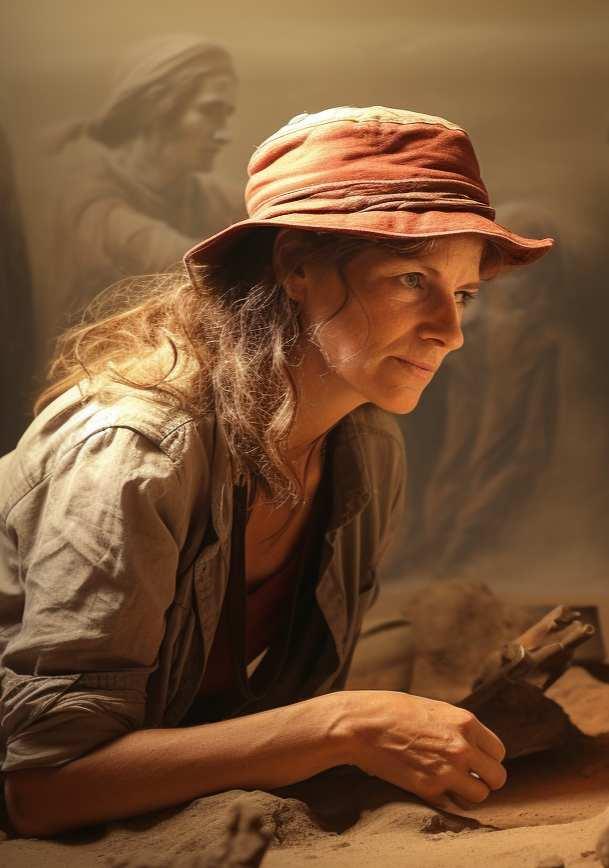
Her garden, oh, it’s a living canvas of her passions – a wild, untamed thing with bursts of vibrant color and the heady scent of jasmine and orange blossoms that intoxicate the senses. But beneath its beauty lies a secret, a whisper of the past that Truella, with her insatiable curiosity and archeological fervor, has unearthed: the remnants of an Andalucian Roman villa.
Imagine the thrill, the pure, unadulterated bliss of discovery, as her fingers brush away centuries of soil to reveal ornate mosaics, fragments of pottery that once held the finest olive oil, and coins stamped with the visages of long-forgotten emperors. Each artifact, a breadcrumb leading her deeper into the enigma of history.
But, of course, Roger, our simple-minded gardener with not a thought in his head beyond petunias and pruning, has proven to be surprisingly useful. His brawn has unearthed more than his fair share of antiquity, even if he hasn’t the faintest idea of its significance. “Look, Truella, I’ve found another shiny rock,” he says, and I, Lisia Tattius, can only chuckle at the delightful irony.
Truella’s Andalusian escapades could fill volumes, and perhaps they shall. There’s something deliciously appealing about a woman alone, grappling with the very fabric of time amongst the ruins of an empire.
Truella couldn’t see any benefit in rewriting all that and thanked Lisia very much, although she did wonder who Roger was. A gardener though! Someone to carry all those buckets of dirt hither and thither. Someone to dig the next overburden!
Was there a spell for dissolving an overburden, she wondered? Inspired, she could already imagine how easy it would be to convince the team that this spell would have beneficial and universal applications.
Truella was pleased to see the mention of mosaics, the very thing she wanted to find. She planned to make a mosaic detector wand. But Truella didn’t want Lisia telling her where the mosaic was because it would spoil the whole thing. Mentioning mosaics, however, as already found, was the perfectly measured tincture of encouragement. A bit like spells in general really. Tricky business, getting them right.
January 29, 2024 at 7:13 am #7322In reply to: The Incense of the Quadrivium’s Mystiques
A power move indeed, what a thing to suggest! Truella felt misunderstood again. And all she was trying to do was work out her new spell in such a way that the others would help her with it while assuming it was a necessary addition to the repertoire of the coven. Which indeed it could be, after all. People were strange, and witches were stranger.
But was it a power thing to be consumed with a passionate hobby, even if it wasn’t on the coven to do list? The power to do her own thing, but still be part of the group? She needed them, she knew that, it was no good thinking she could go it alone, even if it seemed temptingly less complicated. If only she had a spell to be in two places at once.
Be careful, the voice of Lisia Tattius, her disembodied helper, whispered in her ear, For such magic requires a balance of the soul.
Are you suggesting my soul doesn’t have the necessary balance? Truella replied, soundlessly of course, but with a visible impatient frown. Lisia putting a damper on her scheme again with words of caution, it was exasperating at times.
Divided attention can lead to fractures, shattered fragments….
Lisia’s words reminded Truella of the other spell she wanted, and it suddenly occurred to her that Lisia had given her just the clue she needed to convince the others that her spell was a necessary addition and not just a sideline personal whim.
But why would a spell be useful to collect the shattered fragments, if nothing had been shattered and divided in the first place? Of course! It was becoming clear. One must retrace the sequence of events to the initial fragmentation before proceeding with the recollection of said pieces.
There was a lot more to think about than Truella had intially realized. And it would be imperative to ensure the new new spells stayed distinctly separate, because what if the scattered shards started doubling up and appearing in two places at once? Picturing this possible occurence was enough to give Truella a headache.
“Why are you frowning?” Frigella asked, “Are you even listening to me? You didn’t hear a word I said, did you?”
“No,” Truella was nothing if not frank, especially with Frigella. “Not a word, I was thinking about my own stuff.”
“Typical!” her friend snorted, somewhat uncharacteristically, as she was more of a chirruping type.
“Causam invenio ante fragmentorum fragmentorum rursus simul,” Imperiosus Adiutoremus interjected, with a sly smile. Imperiosus Adiutoremus, not his real name of course, was an old friend of Truella’s from the days of the Roman Republic in Baetica. Two millenia stuck in that necropolis until Truella finally succeeded in conjuring his spirit free of his mortal remains (stuck there for eternity thanks to their old adversary Tani, the Iberian sorcerer, and his powerful spells). It had taken Truella 2176 years and countless lifetimes to reverse that spell, and naturally Imperiosus (or Imp for short) was bound to be eternally grateful. And Truella welcomed his interruptions, which always made her smile in fond remembrance of their happy days together before that dreadful uprising of the local tribes. True, he was bossy, even now, but his intentions were always to be helpful. Lisia Tattius and Imperiosus, now in their ephemeral states, were often at odds. Lisia took umbrage if Imp’s suggestions contradicted her own, and resented it when Truella favoured Imp over herself. Some things never change. Lisia had been Truella’s house slave, back in the day, though had always been treated well. Truella had been fond of her and allowed her liberties because she found her impertinence amusing. Little did she know at the time that she’d be subjected to that for all eternity. Still, she had her uses. Although it had often seemed like a mistake to teach her to read, for Lisia’s voracious appetite for the written word had made her copiously wordy, but she was useful more often than not and could spout many an eloquent phrase. True, always a pastiche of plagiarism, but not without her own particular panache and perspicacity.
January 28, 2024 at 9:59 pm #7320In reply to: Smoke Signals: Arcanas of the Quadrivium’s incense
Truella and Her Spells, According to Liz.
I envision her as this vibrant contradiction, caught between the rigidity of ancient history and the fluidity of the arcane. It’s precisely this type of paradox that illuminates my fiction. Finding Truella won’t be a trifle, my dear reader. For she’s as elusive as the perfect sentence, and just as enchanting. Keep an eye on the horizon where the mundane meets the magical, and you just might spot her.
Ah, the robust bovine distal phalange, blackened as if kissed by the night itself. Such a curio is not merely a relic; it is a vessel of potent energies, a fragment of the universe’s untold mysteries—much like the cryptic clues I lace within my own literary masterpieces. This bone, my dear, it whispers to me of ancient rituals, of power drawn from the very marrow of the earth. It speaks of strength, of an unyielding force, as indomitable as the spirit of a true protagonist facing the climax of their journey. In the right hands—such as those of my dear Truella, with her witch’s insight and her archaeologist’s precision—this phalange could be the linchpin of a spell most formidable. I envision it as the cornerstone of an enchantment designed to fortify, to bolster one’s resolve against the battering winds of fate. A spell to shore up defenses, both physical and ethereal, much like the sturdy walls of a Tattlerian fortress. Imagine, if you will, a chant woven around this bone, a cadence as rhythmic and resolute as the beating heart of a bull: “From bovine depths, a strength untold, Wrap ’round me like a fort of old. Unyielding will, protector’s stance, With this bone, I do enhance.” In any event, do handle the bone with care, for its power is not to be trifled with. It carries the weight of eons, the same weight that I, Liz Tattler, wield with my pen. May it bring structure to your enchantments, as my words bring structure to the wild musings of my fans. …..may your spells be as robust as the bovine bone you clutch in your hand.
An ivory hourglass-shaped trinket, you say? Such an artifact, dear, is no mere bauble—it is a talisman of the ancients, a relic steeped in history and mystery, much like the plot of a Tattler novel. Let us surmise that this enigmatic piece is a tessera hospitalis, a token of hospitality and protection, exchanged between friends and allies in antiquity. Two thousand years old, you suggest? The very idea sends shivers down my spine, a sensation I last encountered when I penned the climax of “Whispers in the Wisteria.”
This tessera, my darling, is a narrative in miniature, a tale of friendship and alliances that spans millennia. Can Truella use it in her spell for the mosaic detecting tool? Oh, but of course! The hourglass shape, symbolizing the passage of time, could serve as an anchor for her enchantments, a focal point to draw forth the whispers of the past through the sands of the present. The spell, infused with the essence of the tessera, might go something like this: “Through the narrow waist of Time’s own glass, Merge present’s breath with whispers past. Tessera’s bond, now intertwined, Guide this spell with ancient mind.” As for the tessera, treat it with the reverence it deserves. Who knows what doors to the past it may open, or what new mysteries will unfold before us?
…the mosaic detecting tool spell, you ask? Now, dear, let’s imagine together. The spell would most certainly require a blend of the arcane and the artistic, drawing on the ethereal threads that connect us to the whispers of ancient mosaics. Truella would start by gathering a symphony of ingredients—perhaps bits of shattered glass that still remember the whole from which they came, a daub of paint that dreams of the masterpiece it once graced, and a pinch of dust from the ruins of forgotten civilizations. Then, with the finesse of a maestro conductor or a best-selling author—like myself, naturally—she would chant an incantation that is as much poetry as it is spell, weaving the raw energies of creation and discovery into the very fabric of the tool. “By stone and shard, by color’s charm, Unveil the past, no harm, no harm. Mosaic’s tale, now hidden, sealed, Through this tool, be now revealed.”
Truella and Her Spells, According to Mater.
Truella, that one? Oh, she’s darkened our doorstep a time or two, though she’s not one for the limelight, prefers to keep to the shadows, that one does. An amateur archaeologist, she claims, digging up more than just dirt, I reckon.
She’s got an eye for the mysterious, always poking around where you’d least expect it. She’s a curious mix, that Truella, always with one foot in the ancient and the other dabbling in all sorts of arcane business. Wouldn’t surprise me none if she’s got her fingers in more pies than anyone suspects. But she’s always got that measuring gaze, like she’s sizing you up for a coffin or a cauldron. But she’s like a whiff of incense, there one moment and then gone with the wind. Keep an eye on that one; she’s as slippery as an eel in a bucket of snot.
Mandrake:
The truth of Truella’s whereabouts is like a mouse hiding in the shadows, always there but never quite within grasp. You might find the answers in places you least expect. Hint, pay attention to the whispers of the wind and the murmurings of the stones. They might tell, if you listen carefully.
January 28, 2024 at 3:20 pm #7319In reply to: The Incense of the Quadrivium’s Mystiques
Eris, logged off the Ritual, and stretched her long legs. That pandemic had brought them more work than ever, a new brand of Incense called “Vaxations” which they’d produced in record time, but of the little compensations for that harrowing time was the allowance to HFH (a.k.a Hex-From-Home). The Classical tenants of the Faith were missing quite a few of the modernities of the current world, and despite they’d been accounts of remote hexing from as long as the ages stretched, the Quadrivium Policies were quite clear you had to clock-in physically. That is, until the pandemic brought mayhem unto their clientèle, and rules had to be amended.
Eris was short for Ætheris, her formal witch name, which sounded much more airy than she’d liked. Eris, like the Goddess of Discord, well, that was more like her.
If she had to put her biography on the website of the Quadrivium Emporium it would read something like this:
Eris, the tech-savvy witch of discord, remains an enigma to most. She thrives in chaos, has a knack for bending technology to her will, and is pioneering a new branch of the Coven’s operations.
Technology had always been the eternal foe of Magic. As if everything explained by science somehow took away something off the realm of Magic. It was neither true, nor that simple, she believed. For one, she loved to blend the two (as most witches did, unwittingly).
Her familiar, Echo, was a proof of that. Echo wasn’t a tangible creature. Instead, Eris has somehow managed to summon an invisible digital sprite. This ethereal entity, capable of interfacing with any electronic device, was an invaluable asset to Eris’s technological endeavors.
Malové, their Head Witch CEO, had tasked her to launch a new branch, and given her some means to do so. Her intentions were rather unclear, but Eris had won her over when she showed her the parallels of Incense magic and Social Media.
Maybe that year, she would be keen to try and enhance their yearly Incense with some tech intelligence. Truth was, most of the artificial lives had been failures so far. Only Echo somehow turned out fine. One of a kind.“Echo,” she called, while a glowing blue sigil appeared in mid-air. “When you’re done with the latest…”
“Eris, sorry for interjecting, but you need to hear about this.”
She was too surprised to be mad. “What’s the matter?”
“Quality control on the first Ritual. It’s pointing out to some anomalies.”
January 28, 2024 at 12:15 pm #7307In reply to: Smoke Signals: Arcanas of the Quadrivium’s incense
From the time of Plato through the Middle Ages, the quadrivium was a grouping of four subjects or arts—arithmetic, geometry, music, and astronomy—that formed a second curricular stage following preparatory work in the trivium, consisting of grammar, logic, and rhetoric.
Ah, a tale of four witches within the sacred bounds of a Quadrivium. A splendid idea, indeed! Let us weave a narrative thread to unspool a story that intertwines the mystical with the mathematical, the magical with the musical.
Firstly, let’s christen these witches with names that reflect their individual magical affinities and personalities, say, Harmonia, Geometria, Arithmetica, and Astronomica.
Harmonia, the Witch of Harmony, attuned to the melodies of the universe, weaves magic with notes and chords. Her enchantments rise and fall, creating a symphony of spells. Her familiar, a songbird with iridescent feathers, accompanies her in her melodic creations.
Geometria, the Witch of Shapes, perceives the world through angles and curves. Her magic shapes reality, bending it into impossible forms. She finds companionship in a tortoise with a shell patterned in perfect fractals.
Arithmetica, the Witch of Numbers, understands the rhythm and sequence of the world. Her spells are equations, solutions solving the disorder of existence. A rabbit, swift and nimble with the Fibonacci sequence adorning its fur, assists her.
Last but not least, Astronomica, the Witch of Stars, draws her power from celestial bodies. Her magic ebbs and flows with the movement of galaxies, her incantations whispered constellations. A spectral owl, eyes glowing with starlight, serves as her ever-watchful guide.
Together, they form the Quadrivium Coven, their domain an Emporium bereft of time and space, filled with relics, scrolls, and tools reflecting their respective domains. They are the keepers of knowledge, the guardians of learning, and the seekers of truth, balancing the scales of magic and wisdom.
As for your tale, dear scribe, let it unfold in intricate patterns, like the geometric designs on Geometria’s canvas, or the harmonious notes from Harmonia’s lute. Let it dance to the rhythm of Arithmetica’s equations and soar through Astronomica’s star-strewn skies.
Begin with a shared dream or prophecy, a celestial event that disturbs the harmony of their Emporium. Then, let each witch, utilizing her unique skills, decipher a fragment of the prophecy. Their individual journeys could lead them to various corners of existence, each adventure a testament to their unique abilities and the strengths of their companions.
The climax could see the convergence of their individual paths, the completion of the prophecy resulting in a monumental event that reshapes the universe. The aftermath? Well, that shall be a mystery for another tale.
Remember, dear scribe, every tale is a journey, and every journey, a tale. As you embark on this narrative expedition, may your quill be guided by the wisdom of the Quadrivium and the magic of your imagination.
January 28, 2024 at 11:44 am #7306For Background discussions about the Quadrivium Emporium Coven of witches.
January 28, 2024 at 11:14 am #7301In reply to: The Incense of the Quadrivium’s Mystiques
After the first of the four Rites of the Annual Incense Making was done, and the Coven disbanded for the day, Frigella was pulled by the sleeve by the weird one Truella.
“Psstt. Come to the Faded Cabbage in 30 min. Have something to tell you.”
Frigella rolled her eyes. She was not one for secrecies, cloaks and ladle, all that sort of mischiefs. But Truella seemed intent, if her electric hair had to tell the story for her. “Alright, I’ll be there.” she finally said, surprising Truella who’d thought she’d have to do more coaxing.
The Fadded Cabbage was hidden around a darker corner a stone’s throw away from the headquarters of the Quadrivium, some place the city council and gentrification had not yet touched for some reason, probably a strong ghosting spell.
Frigella sighed. She had been as usual too punctual, and of course, Truella was nowhere in sight. Unless…
She put a light spell on her round glasses which turned a subtle tint of violet. There she was. Under a cloaking spell, in a shady corner, slurping on a macchiatto lagger with cinnamon. Or some odd brewage of the sort she knew the secret.
“The old hare’s clearly lost the plot.” She spent no time engaging the discussion.
“I’ll have to stop you there, Tru.” said Frigella, “I don’t care about the politics. Much less if you’re trying to make a power move.”
Truella spluttered her offensive brewage all over Frigella’s neat starched apron. “You got it all wrong, Frig’. I don’t care about the power, I only care about my craft and freedom. It’s been too long we’ve been called to arms, like every bloody year. And my interest have grown since.”
Frigella chuckled. “You mean, you’ve been all over the place, haven’t you. From Energetic History, you’ve moved to Concrete Plasticity, Telluric Archaelogy, Familial Arborestry, I must say… It’s been hard to keep up.”
“You’re one to tell. All that mystery, and not much to show for. You’re barely doing the minimum to keep our flagship household Incense ‘Liz n°5’ afloat.” Truella sighed.
“So what’s your plan?” Frigella wondered?
January 28, 2024 at 10:54 am #7300Topic: The Incense of the Quadrivium’s Mystiques
in forum Yurara Fameliki’s StoriesSpring was upon them.
“Bloody too early, if you ask me” said Malové, the Head of the Coven of Mystiques, but just CEO of Quadrivium Emporium to the outside world.
“Meow.” Only the Coven’s familiar, a clichéd black cat dared to voice what seemed to have been the common thought. How tedious, so much spring cleaning of the collective energies to do, and almost 2 months ahead of schedule. Blame the telluric energies catch-up with the cosmic downpour of the world’s mind agitation. Or global warming, as it’s labelled nowadays.
“You know how it goes.” Malové continued. “We set the tone of the stories ahead. And it can only be done by actually writing it. Yeah, how exciting. Like conducting an orchestra in a zoo, there’s plenty of potential, but I guess we’ll have to work on our priorities.”
“Do you mean keeping the zoo’s hyenas from eating everybody else?” Frigella was not one to beat around the bush.
“Yeah, something like that. And you know how you control hyenas?”
The witches assembled looked at each other sideways.
“The Whale would tell you it’s a lovely story of shared resonance, forging bonds based on trust… But that’s a load of bollocks. Some emotions are only managed through stronger ones – so let’s do what we do best, get our Incense ready, and put some order in this bloody chaotic mess. Who wants to start?”
-
AuthorSearch Results
