


Search Results for 'rio'
-
AuthorSearch Results
-
December 14, 2024 at 2:35 pm #7675
In reply to: Liz Tattler – A Lifetime of Stories, in videos
Glynis making potions (in Dragon Heartswood Fellowship story)
[Scene opens in Glynis’s cozy alchemical nook, where sunlight filters through stained glass, casting a kaleidoscope of colors onto the wooden workbench.]
Glynis, hair tied in a practical bun, hums a gentle melody, her hands deftly moving among jars of fragrant herbs and sparkling crystals. The air is rich with the scent of cinnamon and cardamom, mingling with the earthy aroma of freshly picked herbs.
Among her collection of vials and beakers, a group of soft, furry baby Snoots frolics, their fur a dazzling array of colors—from vibrant blues to shimmering purples—each reflecting their unique magic-imbued personalities.
One baby Snoot, with fur like a sunset, nudges a vial toward Glynis, its tiny paws leaving prints of glowing stardust. Glynis chuckles, accepting the offering with a warm smile. “Thank you, little one,” she whispers, adding a sprinkle of the sparkling dust to the simmering potion.
The Snoots, enchanted by the alchemical ballet, gather around the cauldron, their eyes wide with wonder as the potion bubbles and swirls with hues to match their fur. Occasionally, a brave Snoot dips a curious paw into the brew, causing a cascade of giggles as their fur momentarily absorbs the potion’s glow.
Glynis, her heart full with the joy of companionship, pauses to gently scratch behind the ears of a Snoot nestled by her elbow. “You’re all such wonderful helpers,” she murmurs, her voice a melody of gratitude.
As the potion reaches its peak, the room is momentarily filled with a burst of iridescent light, a reflection of the harmonious magic that binds Glynis and her Snoot companions in their delightful symbiotic dance.
December 14, 2024 at 1:40 pm #7669In reply to: Quintessence: A Portrait in Reverse
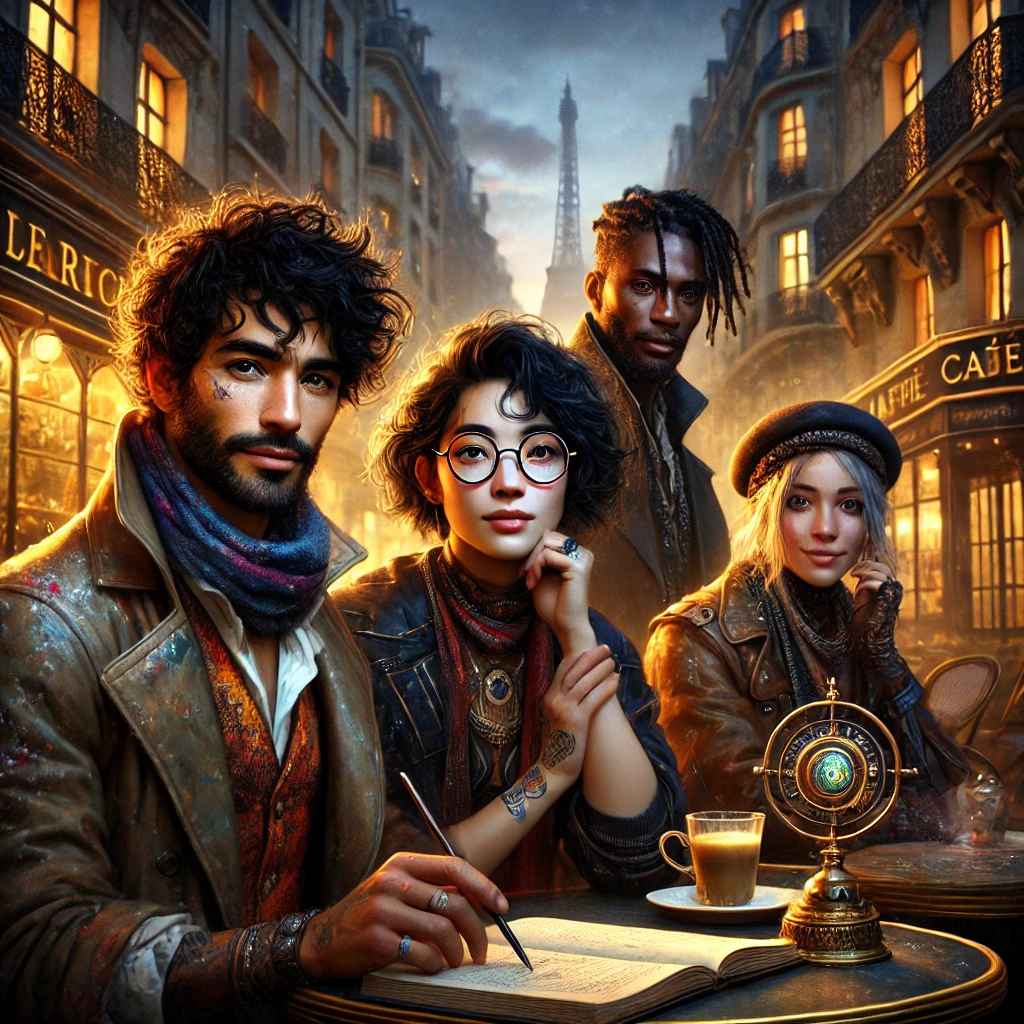
Quintessence – Looking for the 5th — A concept film trailer…
The scene begins in reverse motion at the Parisian café at dusk, vibrant with life as four friends sit together, laughter and connection tangible. The scenes fades backward into a flashback sequence, unraveling across time and space. Brief flashes rewind through their lives:
- Lucien, the artist, sketching furiously in his studio, charcoal dust flying as he creates a labyrinth of faces.
- Darius, a traveler, striding through sunlit banana trees in Guadeloupe, the dappled light casting moving patterns on his determined face.
- Amei, the fabric artist, flipping through a stack of vibrant postcards at her cluttered desk, her fingers brushing over familiar textures.
- Elara, the rebel scientist, chalking spiraling equations and shapes on a blackboard, her eyes alight with discovery.
The threads coil faster, converging in reverse at a vibrant field in the verdant South of France. The sun streams across open land dotted with wildflowers, a faint outline of a shared dream—a co-housing project—lingering in the golden light. The scene ends on an empty but inviting promise, the land glowing with warmth and possibility.
December 13, 2024 at 1:22 am #7664In reply to: Quintessence: Reversing the Fifth
There was a sharp knock on the front door. Amei opened it to find Finnley from Meticulous Maids standing there, bucket in one hand, a bag of cleaning supplies in the other.
“Back to tackle that oven,” she announced, brushing past Amei and striding towards the kitchen.
“Good to see you too, Finnley.”
A moment later, an anguished cry echoed from the kitchen. Amei rushed in to find Finnley clutching her brow and pointing accusingly at the oven. “This oven has not been treated with respect,” she declared dramatically.
“Well, I told you on the phone it was quite bad.”
“Quite bad!” Finnley rolled her eyes and dumped her supplies on the counter with a thud. “Moving out, are we?”
“In a few weeks,” Amei said, leaning against the doorframe. “I’ve still got books and stuff to pack, but I’m trying to leave the place in decent shape.”
“Decent?” Finnley snorted, already pulling on a pair of gloves. “This oven’s beyond decent. But I’ll see if I can drag it back from the brink.”
Finnley proceeded to inspect the oven with the air of a general preparing for war. She muttered something under her breath that Amei couldn’t quite catch, then added louder, “Books and boxes. Someone’s got the easy bit.”
Finnley had cleaned for Amei before. She was rude and pricey, but she always got the job done.
“I’ll leave you to it, then,” said Amei, retreating back to her packing.
“Sure,” Finnley muttered. “But if I find anything moving in here, I’m charging extra.”
The house fell silent, save for the occasional scrape of metal and Finnley’s muffled grumblings. An hour later, Amei realized she hadn’t heard anything for a while. Curious, she walked back to the kitchen and peeked her head around the door.
Finnley was slumped in a chair by the kitchen bench, arms crossed, her head tilted at an awkward angle. Her bucket and gloves sat abandoned on the floor. She was fast asleep.
Amei stood there for a moment, not sure what to do. Finally, she cleared her throat. “I take it the oven won?”
Finnley’s eyes snapped open, and she straightened with a snort. “I just needed a regroup,” she muttered, rubbing her face. She looked at the oven and shuddered. “I dreamed that bloody monster of a thing was chasing me.”
“Chasing you?” Amei said, trying hard not to laugh.
Finnley stood, tugging her gloves back on with determination. “It’s not going to win. Not today.” She glared at Amei. “And I’ll be charging you for my break.”
December 11, 2024 at 4:41 am #7662In reply to: Quintessence: Reversing the Fifth
The Waking
Lucien – Early 2024 Darius – Dec 2022 Amei – 2022-2023 Elara – 2022 Matteo – Halloween 2023 Aversion/Reflection Jealousy/Accomplishment Pride/Equanimity Attachment/Discernment Ignorance/Wisdom The sky outside Lucien’s studio window was still dark, the faint glow of dawn breaking on the horizon. He woke suddenly, the echo of footsteps chasing him out of sleep. Renard’s shadow loomed in his mind like a smudge he couldn’t erase. He sat up, rubbing his temples, the remnants of the dream slipping away like water through his fingers. The chase felt endless, but this time, something had shifted. There was no fear in his chest—only a whisper of resolve. “Time to stop running.” The hum of the airplane’s engine filled Darius’s ears as he opened his eyes, the cabin lights dimmed for landing. He glanced at the blinking seatbelt sign and adjusted his scarf. The dream still lingered, faint and elusive, like smoke curling away before he could grasp it. He wasn’t sure where he’d been in his mind, but he felt a pull—something calling him back. South of France was just the next stop. Beyond that,… Beyond that? He didn’t know. Amei sat cross-legged on her living room floor, the guided meditation app still playing its soft tones through her headphones. Her breathing steadied, but her thoughts drifted. Images danced at the edges of her mind—threads weaving together, faces she couldn’t place, a labyrinth spiraling endlessly. The meditation always seemed to end with these fragments, leaving her both unsettled and curious. What was she trying to find? Elara woke with a start, the unfamiliar sensation of a dream etched vividly in her mind. Her dreams usually dissolved the moment she opened her eyes, but this one lingered, sharp and bright. She reached for her notebook on the bedside table, fumbling for the pen. The details spilled out onto the page—a white bull, a labyrinth of light, faces shifting like water. “I never remember my dreams,” she thought, “but this one… this one feels important.” Matteo woke to the sound of children laughing outside, their voices echoing through the streets of Avignon. Halloween wasn’t as big a deal here as elsewhere, but it had its charm. He stretched and sat up, the weight of a restless sleep hanging over him. His dreams had been strange—familiar faces, glowing patterns, a sense of something unfinished. The room seemed to glow for a moment. “Strange,” he thought, brushing it off as a trick of the light. “No resentment, only purpose.” “You’re not lost. You’re walking your own path.” “Messy patterns are still patterns.” “Let go. The beauty is in the flow.” “Everything is connected. Even the smallest light adds to the whole.” The Endless Chase –
Lucien ran through a labyrinth, its walls shifting and alive, made of tangled roots and flickering light. Behind him, the echo of footsteps and Renard’s voice calling his name, mocking him. But as he turned a corner, the walls parted to reveal a still lake, its surface reflecting the stars. He stopped, breathless, staring at his reflection in the water. It wasn’t him—it was a younger boy, wide-eyed and unafraid. The boy reached out, and Lucien felt a calm ripple through him. The chase wasn’t real. It never was. The walls dissolved, leaving him standing under a vast, open sky.The Wandering Maze –
Darius wandered through a green field, the tall grass brushing against his hands. The horizon seemed endless, but each step revealed new paths, twisting and turning like a living map. He saw figures ahead—people he thought he recognized—but when he reached them, they vanished, leaving only their footprints. Frustration welled up in his chest, but then he heard laughter—a clear, joyful sound. A child ran past him, leaving a trail of flowers in their wake. Darius followed, the path opening into a vibrant garden. There, he saw his own footprints, weaving among the flowers. “You’re not lost,” a voice said. “You’re walking your own path.”The Woven Tapestry –
Amei found herself in a dim room, lit only by the soft glow of a loom. Threads of every color stretched across the space, intertwining in intricate patterns. She sat before the loom, her hands moving instinctively, weaving the threads together. Faces appeared in the fabric—Tabitha, her estranged friends, even strangers she didn’t recognize. The threads wove tighter, forming a brilliant tapestry that seemed to hum with life. She saw herself in the center, not separate from the others but connected. This time she heard clearly “Messy patterns are still patterns,” a voice whispered, and she smiled.The Scattered Grains –
Elara stood on a beach, the sand slipping through her fingers as she tried to gather it. The harder she grasped, the more it escaped. A wave rolled in, sweeping the sand into intricate patterns that glowed under the moonlight. She knelt, watching the designs shift and shimmer, each one unique and fleeting. “Let go,” the wind seemed to say. “The beauty is in the flow.” Elara let the sand fall, and as it scattered, it transformed into light, rising like fireflies into the night sky.The Mandala of Light –
Matteo stood in a darkened room, the only light coming from a glowing mandala etched on the floor. As he stepped closer, the patterns began to move, spinning and shifting. Faces appeared—his mother, the friends he hadn’t yet met, and even his own reflection. The mandala expanded, encompassing the room, then the city, then the world. “Everything is connected,” a voice said, low and resonant. “Even the smallest light adds to the whole.” Matteo reached out, touching the edge of the mandala, and felt its warmth spread through him.

Dreamtime
It begins with running—feet pounding against the earth, my breath sharp in my chest. The path twists endlessly, the walls of the labyrinth curling like roots, closing tighter with each turn. I know I’m being chased, though I never see who or what is behind me. The air thickens as I round a corner and come to a halt before a still lake. Its surface gleams under a canopy of stars, too perfect, too quiet. I kneel to look closer, and the face that stares back isn’t mine. A boy gazes up with wide, curious eyes, unafraid. He smiles as though he knows something I don’t, and my breath steadies. The walls of the labyrinth crumble, their roots receding into the earth. Around me, the horizon stretches wide and infinite, and I wonder if I’ve always been here.
The grass is soft under my feet, swaying with a breeze that hums like a song I almost recognize. I walk, though I don’t know where I’m going. Figures appear ahead—shadowy forms I think I know—but as I approach, they dissolve into mist. I call out, but my voice is swallowed by the wind. Laughter ripples through the air, and a child darts past me, their feet leaving trails of flowers in the earth. I follow, unable to stop myself. The path unfolds into a garden, vibrant and alive, every bloom humming with its own quiet song. At the center, I find myself again—my own footprints weaving among the flowers. The laughter returns, soft and knowing. A voice says, “You’re not lost. You’re walking your own path.” But whose voice is it? My own? Someone else’s? I can’t tell.
The scene shifts, or maybe it’s always been this way. Threads of light stretch across the horizon, forming a vast loom. My hands move instinctively, weaving the threads into patterns I don’t understand but feel compelled to create. Faces emerge in the fabric—some I know, others I only feel. Each thread hums with life, vibrating with its own story. The patterns grow more intricate, their colors blending into something breathtaking. At the center, my own face appears, not solitary but connected to all the others. The threads seem to breathe, their rhythm matching my own heartbeat. A voice whispers, teasing but kind: “Messy patterns are still patterns.” I want to laugh, or cry, or maybe both, but my hands keep weaving as the threads dissolve into light.
I’m on the beach now, though I don’t remember how I got here. The sand is cool under my hands, slipping through my fingers no matter how tightly I try to hold it. A wave rolls in, its foam glowing under a pale moon. Where the water touches the sand, intricate patterns bloom—spirals, mandalas, fleeting images that shift with the tide. I try to gather them, to keep them, but the harder I hold on, the faster they fade. A breeze lifts the patterns into the air, scattering them like fireflies. I watch them go, feeling both loss and wonder. “Let go,” a voice says, carried by the wind. “The beauty is in the flow.” I let the sand fall from my hands, and for the first time, I see the patterns clearly, etched not on the ground but in the sky.
The room is dark, yet I see everything. A mandala of light spreads across the floor, its intricate shapes pulsing with a rhythm I recognize but can’t place. I step closer, and the mandala begins to spin, its patterns expanding to fill the room, then the city, then the world. Faces appear within the light—my mother’s, a child’s, strangers I know but have never met. The mandala connects everything it touches, its warmth spreading through me like a flame. I reach out, my hand trembling, and the moment I touch it, a voice echoes in the air: “Everything is connected. Even the smallest light adds to the whole.” The mandala slows, its light softening, and I find myself standing at its center, whole and unafraid.
I feel the labyrinth’s walls returning, but they’re no longer enclosing me—they’re part of the loom, their roots weaving into the threads. The flowers of the garden bloom within the mandala’s light, their petals scattering like sand into the tide. The waves carry them to the horizon, where they rise into the sky, forming constellations I feel I’ve always known.
I wake—or do I? The dream lingers, its light and rhythm threading through my thoughts. It feels like a map, a guide, a story unfinished. I see the faces again—yours, mine, ours—and wonder where the path leads next.
December 7, 2024 at 10:48 pm #7654In reply to: Quintessence: Reversing the Fifth
The first one to find the bar buys the drinks, Darius had said, and they’d all laughed, but it was no laughing matter being lost in those woods.
Siiting on a cushion on the floor surrounded by cardboard shoeboxes and piles of photos and letters, Elara leaned towards the lamp to better see the photograph. The white bull.
Lucien had refused when Elara asked him to do a painting of the white bull, and then relented and said he would. But he hadn’t, not that she knew of anyway. The incident had happened the year before the pandemic, the spring of 2019. Not long before they all went their separate ways. Elara had been visiting her father in Andalucia for his 90th birthday when a neighbour of his had told her about the stone in the woods. She knew the others would be interested and had invited them over; her father Roland had plenty of room at his finca overlooking the Hozgarganta river, and had no objections.
Darius had wanted to bring those people to see the pyramidal stone in the woods, and Elara was having none of it. I was told in private about that, I shouldn’t have shown anyone, Darius, not even you, she had told him. Resentfully, Darius had tried to argue his point: that it was for the greater good, shouldn’t be kept secret, and how could he keep it from them anyway, they would know he was hiding something.
You may not be able to find it again, look at the trouble we had. You might get attacked by wild boar or fall off a precipice into the gorge, Amei added, not relishing the idea of sharing the discovery with those people either. She couldn’t help thinking it wouldn’t be a bad thing if those people did disappear without a trace. Darius hadn’t been the same since getting sucked into their cultish clutches.
They had lost their way in the gloomy trackless forest trying to find the stone, impossible to see further than the next few trees. Increasingly alarmed at the boar tracks and the fading late afternoon light, Elara had suggested they give up and try and retrace their steps, rather than penetrating further down into the woods. And then suddenly Lucien shouted There is it! That’s it! and there it stood, rising above the tree canopy, the sharp grey stone sides contrasting gloriously with the thick tangled foliage.
Rushing towards it, they fanned out circling it, touching it, gazing up at the smooth sides. Solid stone, not constructed with blocks, its purpose indecipherable, astonishingly incongruous to the location.
Look, we need to start making our way back to the car, Elara had said, It’ll be dark in a couple of hours.
Amei had helped her convince Lucien and Darius who were reluctant to leave, promising another visit. Now we know where it is, she said, although she wasn’t sure if they did know how to find it again. It had appeared while they were lost, after all.The scramble back to the car had been no less confusing than the walk down to the stone, they only knew they had to go uphill to find the unpaved forest road.
Squinting as they emerged from trees into the sunlight, a spontaneous cheer was immediately silenced at the sight of the white bull lying serenely by the site of the road, glowing like white marble, implacable, wise, and godly.
Is it real? whispered Amei, awestruck.I wonder if Darius ever did take those people there, Elara wondered. It had never been mentioned again, but then, things started to change after that. So many things were left unsaid. Elara had never been back, but the white bull had stayed in her mind perhaps more even than the stone pyramid had. I wonder if Lucien ever did that painting of it? Elara propped the photo up behind a candlestick on the fireplace mantel. Now that she was retired, maybe she’d do a painting of it herself.
December 7, 2024 at 11:52 am #7653In reply to: Quintessence: Reversing the Fifth
Matteo — Winter 2023: The Move
The rumble of the moving truck echoed faintly in the quiet residential street as Matteo leaned against the open door, arms crossed, waiting for the signal to load the boxes. He glanced at the crisp winter sky, a pale gray threatening snow, and then at the house behind him. Its windows were darkened by empty rooms, their once-lived-in warmth replaced by the starkness of transition. The ornate names artistically painted on the mailbox struck him somehow. Amei & Tabitha M.: his clients for the day.
The cold damp of London’s suburbia was making him long even more for the warmth of sunny days. With the past few moves he’s been managing for his company, the tipping had been generous; he could probably plan a spring break in South of France, or maybe make a more permanent move there.
The sound of the doorbell brought him back from his rêverie.
Inside the house, the faint sounds of boxes being taped and last-minute goodbyes carried through the hallways. Matteo had been part of these moves too many times to count now. People always left a little bit of themselves behind—forgotten trinkets, echoes of old conversations, or the faint imprint of a life lived. It was a rhythm he’d come to expect, and he knew his part in it: lift, carry, and disappear into the background.
Matteo straightened as the door opened and a girl that could have been in her early twenties, but looked like a teenager stepped out, bundled against the cold. She held a steaming mug in one hand and balanced a box awkwardly on her hip with the other.
“That’s the last of it,” she called over her shoulder. “Mum, are you sure you don’t want me to take the notebooks?”
“They’re fine in the car, Tabitha!” A voice—calm and steady, maybe tinged with weariness—floated from inside.
The girl named Tabitha turned to Matteo, offering the box. “This is fragile,” she said, a smile tugging at her lips. “Be nice to it.”
Matteo took the box carefully, glancing at the mug in her hand. “You’re not leaving that behind, are you?” he asked with a faint smile.
Tabitha laughed. “This? No way. That’s my lifeline. The mug stays.”
As Matteo carried the box to the truck, his eyes caught on something inside—a weathered postcard tucked haphazardly between the pages of a journal. The image on the front was striking: a swirling green fairy, dancing above a glass of absinthe. La Fée Verte was scrawled in looping letters across the top.
“Tabitha!” Her mother’s voice carried out to the driveway, and Matteo turned instinctively. She stepped out onto the porch, her scarf wrapped loosely around her neck, her breath visible in the chilly air. Matteo could see the resemblance—the same poise and humor in her gaze, though softened by something older, quieter.
“Put this somewhere, will you” she said, holding up another postcard, this one with a faded image of a winding mountain road.
Tabitha grinned, stepping forward to take it. “Thanks, Mum. That one’s special.” She tucked it into her coat pocket.
“Special how?” her mother asked lightly.
“It’s from Darius,” Tabitha said, her tone almost teasing. “… The one you never want to talk about.” she leaned teasingly. “One of his cryptic postcards —too bad I was too young to really remember him, he must have been fun to be around.”
Matteo’s ears perked at the name, though he kept his head down, settling the box in place. It wasn’t unusual to overhear snippets like this during a move, but something about the unusual name roused his curiosity.
“Why you want to keep those?” Amei asked, tilting her head.
Tabitha shrugged. “They’re kind of… a map, I guess. Of people, not places.”
Amei paused, her expression softening. “He was always good at that,” she murmured, almost to herself.
The conversation lingered in Matteo’s mind as the day went on. By the time the truck was loaded, and he’d helped arrange the last of the boxes in Amei’s new, smaller apartment, the name and the postcard had taken root.
As Matteo stacked the final piece of furniture—a worn bookshelf—against the living room wall, he noticed Amei lingering near a window, her gaze distant.
“It’s different, isn’t it?” she said suddenly, not looking at him.
“Moving?” Matteo asked, unsure if the question was for him.
“Starting over,” she clarified, her voice quieter now. “Feels smaller, even when it’s supposed to be lighter.”
Matteo didn’t reply, sensing she wasn’t looking for an answer. He stepped back, nodding politely as she thanked him and disappeared into the kitchen.
The postcard stuck in his mind for days after. Matteo had heard of absinthe before, of course—its mystique, its history—but something about the way Tabitha had called the postcard a “map of people” resonated.
By the time spring arrived, Matteo was wandering through Avignon, chasing vague curiosities and half-formed questions. When he saw Lucien crouched over his chalk labyrinth, the memory of the postcard rose unbidden.
“Do you know where I can find absinthe?” he asked, the question more instinct than intent.
Lucien’s raised eyebrow and faint smile felt like another piece clicking into place. The connections were there—threads woven in patterns he couldn’t yet see. But for the first time in months, Matteo felt he was back on the right path.
December 7, 2024 at 10:07 am #7650In reply to: Quintessence: A Portrait in Reverse
Some elements for inspiration as to the backstory of the group and how it could tie to the current state of the story:
Here’s a draft version of the drama surrounding Éloïse and Monsieur Renard (the “strange couple”), incorporating their involvement with Darius, their influence on the group’s dynamic, and the fallout that caused the estrangement five years ago.
The Strange Couple: Éloïse and Monsieur Renard
Winter 2019: Paris, Just Before the Pandemic
The group’s last reunion before their estrangement was supposed to be a celebration—one of those rare moments when their diverging paths aligned. They had gathered in Paris in late December, the city cloaked in gray skies and glowing light. The plan was simple: a few days together, catching up, exploring old haunts, and indulging in the kind of reckless spontaneity that had defined their earlier years.
It was Darius who disrupted the rhythm. He had arrived late to their first dinner, rain-soaked and apologetic, with Éloïse and Monsieur Renard in tow.
First Impressions of Éloïse and Monsieur Renard
Éloïse was striking—lithe, dark-haired, with sharp eyes that seemed to unearth secrets before you could name them. She moved with a predatory grace, her laughter a mix of charm and edge. Renard was her shadow, older and impeccably dressed, his silvery hair and angular features giving him the air of a fox. He spoke little, but when he did, his words had the weight of finality, as if he were accustomed to being obeyed.
“They’re just friends,” Darius said when the others exchanged wary glances. “They’re… interesting. You’ll like them.”
But it didn’t take long for Éloïse and Renard to unsettle the group. At dinner, Éloïse dominated the conversation, her stories wild and improbable—of séances in abandoned mansions, of lost artifacts with strange energies, of lives transformed by unseen forces. Renard’s occasional interjections only added to the mystique, his tone implying he’d seen more than he cared to share.
Lucien, ever the skeptic, found himself drawn to Éloïse despite his instincts. Her talk of energies and symbols resonated with his artistic side, and when she mentioned labyrinths, his attention sharpened.
Elara, in contrast, bristled at their presence. She saw through their mystique, recognizing in Renard the manipulative charisma of someone who thrived on control.
Amei was harder to read, but she watched Éloïse and Renard closely, her silence betraying a guardedness that hinted at deeper discomfort.
Darius’s Growing Involvement
Over the following days, Darius spent more time with Éloïse and Renard, skipping planned outings with the group. He spoke of them with a reverence that was uncharacteristic, praising their insight into things he’d never thought to question.
“They see connections in everything,” he told Amei during a rare moment alone. “It’s… enlightening.”
“Connections to what?” she asked, her tone sharper than she intended.
“Paths, people, purpose,” he replied vaguely. “It’s hard to explain, but it feels… right.”
Amei didn’t press further, but she mentioned it to Elara later. “It’s like he’s slipping into something he can’t see his way out of,” she said.
The Séance
The turning point came during an impromptu gathering at Éloïse and Renard’s rented apartment—a dimly lit space filled with strange objects: glass jars of cloudy liquid, intricate carvings, and an ornate bronze bell hanging above the mantelpiece.
Éloïse had invited the group for what she called “an evening of clarity.” The others arrived reluctantly, wary of what she had planned but unwilling to let Darius face it alone.
The séance began innocuously enough—Éloïse guiding them through what she described as a “journey inward.” She spoke in a low, rhythmic tone, her words weaving a spell that was hard to resist.
Then things took a darker turn. She asked them to focus on the labyrinth she had drawn on the table—a design eerily similar to the map Lucien had found weeks earlier.
“You must find your center,” she said, her voice dropping. “But beware the edges. They’ll show you things you’re not ready to see.”
The room grew heavy with silence. Darius leaned into the moment, his eyes closed, his breathing steady. Lucien tried to focus but felt a growing unease. Elara sat rigid, her scientific mind railing against the absurdity of it all. Amei’s hands gripped the edge of the table, her knuckles white.
And then, the bell rang.
It was faint at first, a distant chime that seemed to come from nowhere. Then it grew louder, resonating through the room, its tone deep and haunting.
“What the hell is that?” Lucien muttered, his eyes snapping open.
Éloïse smiled faintly but said nothing. Renard’s expression remained inscrutable, though his fingers tapped rhythmically against the table, as if counting something unseen.
Elara stood abruptly, breaking the spell. “This is ridiculous,” she said. “You’re playing with people’s minds.”
Darius’s eyes opened, his gaze unfocused. “You don’t understand,” he said softly. “It’s not a game.”
The Fallout
The séance fractured the group.
- Elara: Left the apartment furious, calling Renard a charlatan and vowing never to entertain such nonsense again. Her relationship with Darius cooled, her disappointment palpable.
- Lucien: Became fascinated with the labyrinth and its connection to his art, but he couldn’t shake the unease the séance had left. His conversations with Éloïse deepened in the following days, further isolating him from the group.
- Amei: Refused to speak about what she’d experienced. When pressed, she simply said, “Some things are better left forgotten.”
- Darius stayed with Éloïse and Renard for weeks after the others left Paris, becoming more entrenched in their world. But something changed. When he finally returned, he was distant and cagey, unwilling to discuss what had happened during his time with them.
Lingering Questions
- What Happened to Darius with Éloïse and Renard?
- Darius’s silence suggests something traumatic or transformative occurred during his deeper involvement with the couple.
- The Bell’s Role:
- The bronze bell that rang during the séance ties into its repeated presence in the story. Was it part of the couple’s mystique, or does it hold a deeper significance?
- Lucien’s Entanglement:
- Lucien’s fascination with Éloïse and the labyrinth hints at a lingering connection. Did she influence his art, or was their connection more personal?
- Éloïse and Renard’s Motives:
- Were they simply grifters manipulating Darius and others, or were they genuinely exploring something deeper, darker, and potentially dangerous?
Impact on the Reunion
- The group’s estrangement is rooted in the fractures caused by Éloïse and Renard’s influence, compounded by the isolation of the pandemic.
- Their reunion at the café is a moment of reckoning, with Matteo acting as the subtle thread pulling them back together to confront their shared past.
December 6, 2024 at 8:44 am #7648In reply to: Quintessence: Reversing the Fifth
Spring 2024
Matteo was wandering through the streets of Avignon, the spring air heavy with the scent of blooming flowers and sun-warmed stone. The hum of activity surrounded him—shopkeepers arranging displays, the occasional burst of laughter from a café terrace. He walked with no particular destination, drawn more by instinct than intent, until a splash of colour caught his eye.
On the cobblestones ahead, an artist crouched over a sprawling chalk drawing. It was a labyrinthine map, its intricate paths winding across the ground with deliberate precision. Matteo froze, his breath catching. The resemblance to the map he’d found at the vineyard office was uncanny—the same loops and spirals, the same sense of motion and stillness intertwined. But it wasn’t the map itself that held him in place. It was the faces.
Four of them, scattered in different corners of the design, each rendered with surprising detail. Beneath them were names. Matteo felt a shiver crawl up his spine. He knew three of those faces. Amei, Elara, Darius… he had met each of them once, in moments that now felt distant and fragmented. Strangers to him, but not quite.
The artist shifted, brushing dark, rain-damp curls from his forehead. His scarf, streaked faintly with paint, hung loosely around his neck. Matteo stepped closer, his curiosity overpowering any hesitation. “Is that your name?” he asked, gesturing toward the face labeled Lucien.
The artist straightened, his hand resting lightly on a piece of green chalk. He studied Matteo for a moment, his expression unreadable. “Yes,” he said simply, his voice low but clear.
Matteo crouched beside him, tracing the edge of the map with his eyes. “It’s incredible,” he said. “The detail, the connections. Why the faces?”
Lucien hesitated, glancing at the names scattered across his work. “Because that’s how it is,” he said softly. “We’re all here, but… not together.”
Matteo tilted his head, intrigued. “You mean you’ve drifted?”
Lucien nodded, his gaze dropping to the chalk in his hand. “Something like that. Paths cross, then they don’t. People take their turns.”
Matteo studied the map again, its intertwining lines seeming both chaotic and deliberate. The faces stared back at him, and he felt the pull of the map he no longer carried. “Do you think paths can lead back?” he asked, his voice thoughtful.
Lucien glanced at him, something flickering briefly in his eyes. “Sometimes. If you follow them long enough.”
Matteo smiled faintly, standing. His curiosity shifted as he turned his attention to the artist himself. “Do you know where I can find absinthe?” he asked.
Lucien raised an eyebrow. “Absinthe? Haven’t heard anyone ask for that in a while.”
“Just something I’ve been chasing,” Matteo replied lightly, his tone almost playful.
Lucien gestured vaguely toward a café down the street. “You might try there. They keep the old things alive.”
“Thanks,” Matteo said, offering a nod. He took a few steps away but paused, turning back to the artist still crouched over his map. “It’s a good drawing,” he said. “Hope your paths cross again.”
Lucien didn’t reply, but his hand moved back to the chalk, drawing a faint line that connected two of the faces. Matteo watched for a moment longer before continuing down the street, the memory of the map and the names lingering in his mind like an unanswered question. Paths crossed, he thought, but maybe they didn’t always stay apart.
For the first time in days, Matteo felt a strange sense of possibility. The map was gone, but perhaps it had done what it was meant to do—leave its mark.
December 5, 2024 at 11:01 pm #7647In reply to: Quintessence: Reversing the Fifth
Darius: A Map of People
June 2023 – Capesterre-Belle-Eau, Guadeloupe
The air in Capesterre-Belle-Eau was thick with humidity, the kind that clung to your skin and made every movement slow and deliberate. Darius leaned against the railing of the veranda, his gaze fixed on the horizon where the sky blends into the sea. The scent of wet earth and banana leaves filling the air. He was home.
It had been nearly a year since hurricane Fiona swept through Guadeloupe, its winds blowing a trail of destruction across homes, plantations, and lives. Capesterre-Belle-Eau had been among the hardest hit, its banana plantations reduced to ruin and its roads washed away in torrents of mud.
Darius hadn’t been here when it happened. He’d read about it from across the Atlantic, the news filtering through headlines and phone calls from his aunt, her voice brittle with worry.
“Darius, you should come back,” she’d said. “The land remembers everyone who’s left it.”
It was an unusual thing for her to say, but the words lingered. By the time he arrived in early 2023 to join the relief efforts, the worst of the crisis had passed, but the scars remained—on the land, on the people, and somewhere deep inside himself.
Home, and Not — Now, passing days having turned into quick six months, Darius was still here, though he couldn’t say why. He had thrown himself into the work, helped to rebuild homes, clear debris, and replant crops. But it wasn’t just the physical labor that kept him—it was the strange sensation of being rooted in a place he’d once fled.
Capesterre-Belle-Eau wasn’t just home; it was bones-deep memories of childhood. The long walks under the towering banana trees, the smell of frying codfish and steaming rice from his aunt’s kitchen, the rhythm of gwoka drums carrying through the evening air.
“Tu reviens pour rester cette fois ?” Come back to stay? a neighbor had asked the day he returned, her eyes sharp with curiosity.
He had laughed, brushing off the question. “On verra,” he’d replied. We’ll see.
But deep down, he knew the answer. He wasn’t back for good. He was here to make amends—not just to the land that had raised him but to himself.
A Map of Travels — On the veranda that afternoon, Darius opened his phone and scrolled through his photo gallery. Each image was pinned to a digital map, marking all the places he’d been since he got the phone. Of all places, it was Budapest which popped out, a poor snapshot of Buda Castle.
He found it a funny thought — just like where he was now, he hadn’t planned to stay so long there. He remembered the date: 2020, in the midst of the pandemic. He’d spent in Budapest most of it, sketching the empty streets.
Five years ago, their little group of four had all been reconnecting in Paris, full of plans that never came to fruition. By late 2019, the group had scattered, each of them drawn into their own orbits, until the first whispers of the pandemic began to ripple across the world.
Funding his travels had never been straightforward. He’d tried his hand at dozens of odd jobs over the years—bartending in Lisbon, teaching English in Marrakech, sketching portraits in tourist squares across Europe. He lived frugally, keeping his possessions light and his plans loose. Yet, his confidence had a way of opening doors; people trusted him without knowing why, offering him opportunities that always seemed to arrive at just the right time.
Even during the pandemic, when the world seemed to fold in on itself, he had found a way.
Darius had already arrived in Budapest by then, living cheaply in a rented studio above a bakery. The city had remained open longer than most in Europe or the world, its streets still alive with muted activity even as the rest of Europe closed down. He’d wandered freely for months, sketching graffiti-covered bridges, quiet cafes, and the crumbling facades of buildings that seemed to echo his own restlessness.
When the lockdowns finally came like everywhere else, it was just before winter, he’d stayed, uncertain of where else to go. His days became a rhythm of sketching, reading, and sending postcards. Amei was one of the few who replied—but never ostentatiously. It was enough to know she was still there, even if the distance between them felt greater than ever.
But the map didn’t tell the whole story. It didn’t show the faces, the laughter, the fleeting connections that had made those places matter.
Swatting at a buzzing mosquito, he reached for the small leather-bound folio on the table beside him. Inside was a collection of fragments: ticket stubs, pressed flowers, a frayed string bracelet gifted by a child in Guatemala, and a handful of postcards he’d sent to Amei but had never been sure she received.
One of them, yellowed at the edges, showed a labyrinth carved into stone. He turned it over, his own handwriting staring back at him.
“Amei,” it read. “I thought of you today. Of maps and paths and the people who make them worth walking. Wherever you are, I hope you’re well. —D.”
He hadn’t sent it. Amei’s responses had always been brief—a quick WhatsApp message, a thumbs-up on his photos, or a blue tick showing she’d read his posts. But they’d never quite managed to find their way back to the conversations they used to have.
The Market — The next morning, Darius wandered through the market in Trois-Rivières, a smaller town nestled between the sea and the mountains. The vendors called out their wares—bunches of golden bananas, pyramids of vibrant mangoes, bags of freshly ground cassava flour.
“Tiens, Darius!” called a woman selling baskets woven from dried palm fronds. “You’re not at work today?”
“Day off,” he said, smiling as he leaned against her stall. “Figured I’d treat myself.”
She handed him a small woven bracelet, her eyes twinkling. “A gift. For luck, wherever you go next.”
Darius accepted it with a quiet laugh. “Merci, tatie.”
As he turned to leave, he noticed a couple at the next stall—tourists, by the look of them, their backpacks and wide-eyed curiosity marking them as outsiders. They made him suddenly realise how much he missed the lifestyle.
The woman wore an orange scarf, its boldness standing out as if the color orange itself had disappeared from the spectrum, and only a single precious dash could be seen into all the tones of the market. Something else about them caught his attention. Maybe it was the way they moved together, or the way the man gestured as he spoke, as if every word carried weight.
“Nice scarf,” Darius said casually as he passed.
The woman smiled, adjusting the fabric. “Thanks. Picked it up in Rajasthan. It’s been with me everywhere since.”
Her partner added, “It’s funny, isn’t it? The things we carry. Sometimes it feels like they know more about where we’ve been than we do.”
Darius tilted his head, intrigued. “Do you ever think about maps? Not the ones that lead to places, but the ones that lead to people. Paths crossing because they’re meant to.”
The man grinned. “Maybe it’s not about the map itself,” he said. “Maybe it’s about being open to seeing the connections.”
A Letter to Amei — That evening, as the sun dipped below the horizon, Darius sat at the edge of the bay, his feet dangling above the water. The leather-bound folio sat open beside him, its contents spread out in the fading light.
He picked up the labyrinth postcard again, tracing its worn edges with his thumb.
“Amei,” he wrote on the back just under the previous message a second one —the words flowing easily this time. “Guadeloupe feels like a map of its own, its paths crossing mine in ways I can’t explain. It made me think of you. I hope you’re well. —D.”
He folded the card into an envelope and tucked it into his bag, resolving to send it the next day.
As he watched the waves lap against the rocks, he felt a sense of motion rolling like waves asking to be surfed. He didn’t know where the next path would lead next, but he felt it was time to move on again.
December 5, 2024 at 8:45 am #7646In reply to: Quintessence: Reversing the Fifth
Mon. November 25th, 10am.
The bell sat on the stool near Lucien’s workbench, its bronze surface polished to a faint glow. He had spent the last ten minutes running a soft cloth over its etched patterns, tracing the curves and grooves he’d never fully understood. It wasn’t the first time he had picked it up, and it wouldn’t be the last. Something about the bell kept him tethered to it, even after all these years. He could still remember the day he’d found it—a cold morning at a flea market in the north of Paris, the stalls cramped and overflowing with gaudy trinkets, antiques, and forgotten relics.
He’d spotted it on a cluttered table, nestled between a rusted lamp and a cracked porcelain dish. As he reached for it, she had appeared, her dark eyes sharp with curiosity and mischief. Éloïse. The bell had been their first conversation, its strange beauty sparking a connection that quickly spiraled into something far more dangerous. Her charm masking the shadows she moved in. Slowly she became the reason he distanced himself from Amei, Elara, and Darius. It hadn’t been intentional, at least not at first. But by the time he realized what was happening, it was already too late.
A sharp knock at the door yanked him from the memory. Lucien’s hand froze mid-polish, the cloth resting against the bell. The knock came again, louder this time, impatient. He knew who it would be, though the name on the patron’s lips changed depending on who was asking. Most called him “Monsieur Renard.” The Fox. A nickname as smooth and calculating as the man himself.
Lucien opened the door, and Monsieur Renard stepped in, his gray suit immaculate and his air of quiet authority as sharp as ever. His eyes swept the studio, frowning as they landed on the unfinished painting on the easel—a lavish banquet scene, rich with silver and velvet.
“Lucien,” Renard said smoothly, his voice cutting through the silence. “I trust you’ll be ready to deliver on this commission.”
Lucien stiffened. “I need more time.”
“Of course,” Renard replied with a small smile that didn’t reach his eyes. “We all need something we can’t have. You have until the end of the week. Don’t make her regret recommending you.”
As Renard spoke, his gaze fell on the bell perched on the stool. “What’s this?” he asked, stepping closer. He picked it up, his long and strong fingers brushing the polished surface. “Charming,” he murmured, turning it over. “A flea market find, I suppose?”
Lucien said nothing, his jaw tightening as Renard tipped the bell slightly, the etched patterns catching the faint light from the window. Without care, Renard dropped it back onto the stool, the force of the motion knocking it over. The bell struck the wood with a resonant tone that lingered in the air, low and haunting.
Renard didn’t even glance at it. “You’ve always had a weakness for the past,” he remarked lightly, turning his attention back to the painting. “I’ll leave you to it. Don’t disappoint.”
With that, he was gone, his polished shoes clicking against the floor as he disappeared down the hall.
Lucien stood in the silence, staring at the bell where it had fallen, its soft tone still reverberating in his mind. Slowly, he bent down and picked it up, cradling it in his hands. The polished bronze felt warm, almost alive, as if it were vibrating faintly beneath his fingertips. He wrapped it carefully in a piece of linen and placed it inside his suitcase, alongside his sketchbooks and a few hastily folded clothes. The suitcase had been half-packed for weeks, a quiet reflection of his own uncertainty—leaving or staying, running or standing still, he hadn’t known.
Crossing the room, he sat at his desk, staring at the blank paper in front of him. The pen felt heavy in his hand as he began to write: Sarah Bernhardt Cafe, November 30th , 4 PM. No excuses this time!
He paused, rereading the words, then wrote them again and again, folding each note with care. He didn’t know what he expected from his friends—Amei, Elara, Darius—but they were the only ones who might still know him, who might still see something in him worth saving. If there was a way out of the shadows Éloïse and Monsieur Renard had drawn him into, it lay with them.
As he sealed the last envelope, the low tone of the bell still hummed faintly in his memory, echoing like a call he couldn’t ignore.
December 5, 2024 at 2:37 am #7645In reply to: Quintessence: Reversing the Fifth
Amei sat cross-legged on the floor in what had once been the study, its emptiness amplified by the packed boxes stacked along the walls. The bookshelves were mostly bare now, save for a few piles of books she was donating to goodwill.
The window was open, and a soft breeze stirred the curtains, carrying with it the faint chime of church bells in the distance. Ten o’clock. Tomorrow was moving day.
Her notebooks were heaped beside her on the floor—a chaotic mix of battered leather covers, spiral-bound pads, and sleek journals bought in fleeting fits of optimism. She ran a hand over the stack, wondering if it was time to let them go. A fresh start meant travelling lighter, didn’t it?
She hesitated, then picked up the top notebook. Flipping it open, she skimmed the pages—lists, sketches, fragments of thoughts and poems. As she turned another page, a postcard slipped out and fluttered to the floor.
She picked it up. The faded image showed a winding mountain road, curling into mist. On the back, Darius had written:
“Found this place by accident. You’d love it. Or maybe hate it. Either way, it made me think of you. D.”
Amei stared at the card. She’d forgotten about these postcards, scattered through her notebooks like breadcrumbs to another time. Sliding it back into place, she set the notebook aside and reached for another, older one. Its edges were frayed, its cover softened by time.
She flicked through the pages until an entry caught her eye, scrawled as though written in haste:
Lucien found the map at a flea market. He thought it was just a novelty, but the seller was asking too much. L was ready to leave it when Elara saw the embossed bell in the corner. LIKE THE OTHER BELL. Darius was sure it wasn’t a coincidence, but of course wouldn’t say why. Typical. He insisted we buy it, and somehow the map ended up with me. “You’ll keep it safe,” he said. Safe from what? He wouldn’t say.
The map! Where was the map now? How had she forgotten it entirely? It had just been another one of their games back then, following whatever random clues they stumbled across. Fun at the time, but nothing she’d taken seriously. Maybe Darius had, though—especially in light of what happened later. She flipped the page, but the next entry was mundane—a note about Elara’s birthday. She read through to the end of the notebook, but there was no follow-up.
She glanced at the boxes. Could the map still be here, buried among her things? Stuffed into one of her notebooks? Or, most likely, had it been lost long ago?
She closed the notebook and sighed. Throwing them out would have been easier if they hadn’t started whispering to her again, pulling at fragments of a past she thought she had left behind.
December 4, 2024 at 11:58 pm #7644In reply to: Quintessence: Reversing the Fifth
From Decay to Birth: a Map of Paths and Connections
7. Darius’s Encounter (November 2024)
Moments before the reunion with Lucien and his friends, Darius was wandering the bouquinistes along the Seine when he spotted this particular map among a stack of old prints. The design struck him immediately—the spirals, the loops, the faint shimmer of indigo against yellowed paper.
He purchased it without hesitation. As he would examine it more closely, he would notice faint marks along the edges—creases that had come from a vineyard pin, and a smudge of red dust, from Catalonia.
When the bouquiniste had mentioned that the map had come from a traveler passing through, Darius had felt a strange familiarity. It wasn’t the map itself but the echoes of its journey— quiet connections he couldn’t yet place.
6. Matteo’s Discovery (near Avignon, Spring 2024)
The office at the edge of the vineyard was a ruin, its beams sagging and its walls cracked. Matteo had wandered in during a quiet afternoon, drawn by the promise of shade and a moment of solitude.
His eyes scanned the room—a rusted typewriter, ledgers crumbling into dust, and a paper pinned to the wall, its edges curling with age. Matteo stepped closer, pulling the pin free and unfolding what turned out to be a map.
Its lines twisted and looped in ways that seemed deliberate yet impossible to follow. Matteo traced one path with his finger, feeling the faint grooves where the ink had sunk into the paper. Something about it unsettled him, though he couldn’t say why.
Days later, while sharing a drink with a traveler at the local inn, Matteo showed him the map.
“It’s beautiful,” the traveler said, running his hand over the faded indigo lines. “But it doesn’t belong here.”
Matteo nodded. “Take it, then. Maybe you’ll figure it out.”
The traveler left with the map that night, and Matteo returned to the vineyard, feeling lighter somehow.
5. From Hand to Hand (1995–2024)
By the time Matteo found it in the spring of 2024, the map had long been forgotten, its intricate lines dulled by dust and time.
2012: A vineyard owner near Avignon purchased it at an estate sale, pinning it to the wall of his office without much thought.
2001: A collector in Marseille framed it in her study, claiming it was a lost artifact of a secret cartographer society, though she later sold it when funds ran low.
1997: A scholar in Barcelona traded an old atlas for it, drawn to its artistry but unable to decipher its purpose.
The map had passed through many hands over the previous three decades and each owner puzzling over, and finally adding their own meaning to its lines.
4. The Artist (1995)
The mapmaker was a recluse, known only as Almadora to the handful of people who bought her work. Living in a sunlit attic in Girona, she spent her days tracing intricate patterns onto paper, claiming to chart not geography but connections.
“I don’t map what is,” she once told a curious buyer. “I map what could be.”
In 1995, Almadora began work on the labyrinthine map. She used a pale paper from Girona and indigo ink from India, layering lines that seemed to twist and spiral outward endlessly. The map wasn’t signed, nor did it bear any explanations. When it was finished, Almadora sold it to a passing merchant for a handful of coins, its journey into the world beginning quietly, without ceremony.
3. The Ink (1990s)
The ink came from a different path altogether. Indigo plants, or aviri, grown on Kongarapattu, were harvested, fermented, and dried into cakes of pigment. The process was ancient, perfected over centuries, and the resulting hue was so rich it seemed to vibrate with unexplored depth.
From the harbour of Pondicherry, this particular batch of indigo made its way to an artisan in Girona, who mixed it with oils and resins to create a striking ink. Its journey intersected with Amei’s much later, when remnants of the same batch were used to dye textiles she would work with as a designer. But in the mid-1990s, it served a singular purpose: to bring a recluse artist’s vision to life.
2. The Paper (1980)
The tree bore laughter and countless other sounds of nature and passer-by’s arguments for years, a sturdy presence, unwavering in a sea of shifting lives. Even after the farmhouse was sold, long after the sisters had grown apart, the tree remained. But time is merciless, even to the strongest roots.
By 1979, battered by storms and neglect, the great tree cracked and fell, its once-proud form reduced to timber for a nearby mill.
The tree’s journey didn’t end in the mill; it transformed. Its wood was stripped, pulped, and pressed into paper. Some sheets were coarse and rough, destined for everyday use. But a few, including one particularly smooth and pale sheet, were set aside as high-quality stock for specialized buyers.
This sheet traveled south to Catalonia, where it sat in a shop in Girona for years, its surface untouched but full of potential. By the time the artist found it in the mid-1990s, it had already begun to yellow at the edges, carrying the faint scent of age.
1. The Seed (1950s)
It began in a forgotten corner of Kent, where a seed took root beneath a patch of open sky. The tree grew tall and sprawling over decades, its branches a canopy for birds and children alike. By 1961, it had become the centerpiece of the small farmhouse where two young sisters, Vanessa and Elara, played beneath its shade.
“Elara, you’re too slow!” Vanessa called, her voice sharp with mock impatience. Elara, only six years old, trailed behind, clutching a wooden stick she used to scratch shapes into the dirt. “I’m making a map!” she announced, her curls bouncing as she ran to catch up.
Vanessa rolled her eyes, already halfway up the tree’s lowest branch. “You and your maps. You think you’re going somewhere?”
December 4, 2024 at 6:50 am #7639In reply to: Quintessence: A Portrait in Reverse
Work in Progress: Character Timelines and Events
Matteo
- November 2024 (Reunion):
- Newly employed at the Sarah Bernhardt Café, started after its reopening.
- Writes the names of Lucien, Elara, Darius, and Amei in his notebook without understanding why.
- Acquires the bell from Les Reliques, drawn to it as if guided by an unseen force.
- Serves the group during the reunion, surprised to see all four together, though he knows them individually.
- Summer 2024 (Olympics):
- Working in a vineyard in southern France, nearing the end of the harvest season.
- Receives a call for a renovation job in Paris, which pulls him toward the city.
- Feels an intuitive connection to Paris, as if something is waiting for him there.
- Past Events (Implied):
- Matteo has a mysterious ability to sense patterns and connections in people’s lives.
- Has likely crossed paths with the group in unremarkable but meaningful ways before.
Darius
- November 2024 (Reunion):
- Arrives at the café, a wanderer who rarely stays in one place.
- Reflects on his time in India during the autumn and the philosophical journey it sparked.
- Brings with him an artifact that ties into his travels and personal story.
- Summer 2024 (Olympics):
- Living in Barcelona, sketching temples and engaging with a bohemian crowd.
- Prompted by a stranger to consider a trip to India, sparking curiosity and the seeds of his autumn journey.
- Begins to plan his travels, sensing that India is calling him for a reason he doesn’t yet understand.
- Past Events (Implied):
- Has a history of introducing enigmatic figures to the group, often leading to tension.
- His intense, nomadic lifestyle creates both fascination and distance between him and the others.
Elara
- November 2024 (Reunion):
- Travels from England to Paris to attend the reunion, balancing work and emotional hesitation.
- Still processing her mother’s passing and reflecting on their strained relationship.
- Finds comfort in the shared dynamics of the group but remains analytical about the events around the bell.
- Summer 2024 (Olympics):
- (was revealed to be a dream event) Attends a CERN conference in Geneva, immersed in intellectual debates and cutting-edge research. Receives news of her mother’s death in Montrouge, prompting a reflective journey to make funeral arrangements. Struggles with unresolved feelings about her mother but finds herself strangely at peace with the finality.
- Dreams of her mother’s death during a nap in Tuscany, a surreal merging of past and present that leaves her unsettled.
- Hears a bell’s clang, only to find Florian fixing a bell to the farmhouse gate. The sound pulls her further into introspection about her mother and her life choices.
- Mentors Florian, encouraging him to explore his creativity, paralleling her own evolving relationship with her chalk research.
- Past Events (Implied):
- Moved to Tuscany after retiring from academia, pursuing independent research on chalk.
- Fondly remembers the creative writing she once shared with the group, though it now feels like a distant chapter of her life.
- Had a close but occasionally challenging relationship with Lucien and Amei during their younger years.
- Values intellectual connections over emotional ones but is gradually learning to reconcile the two.
Lucien
- November 2024 (Reunion):
- Sends the letter that brings the group together at the café, though his intentions are unclear even to himself.
- In his Paris studio, struggles with an unfinished commissioned painting. Feels disconnected from his art and his sense of purpose.
- Packs a suitcase with sketchbooks and a bundle wrapped in linen, symbolizing his uncertainty—neither a complete departure nor a definitive arrival.
- Heads to the café in the rain, reluctant but compelled to reconnect with the group. Confronts his feelings of guilt and estrangement from the group.
- Summer 2024 (Olympics):
- Escapes Paris, overwhelmed by the crowds and noise of the Games, and travels to Lausanne.
- Reflects on his artistic block and the emotional weight of his distance from the group.
- Notices a sketch in his book of a doorway with a bell he doesn’t recall drawing, sparking vague recognition.
- Past Events (Implied):
- Once the emotional “anchor” of the group, he drifted apart after a falling-out or personal crisis.
- Feels a lingering sense of responsibility to reunite the group but struggles with his own vulnerabilities.
Amei
- November 2024 (Reunion):
- Joins the reunion at Lucien’s insistence, hesitant but curious about reconnecting with the group.
- Brings with her notebooks filled with fragments of stories and a quiet hope for resolution.
- Feels the weight of the group’s shared history but refrains from dwelling on it outwardly.
- Summer 2024 (Olympics):
- Recently moved into a smaller flat in London, downsizing after her daughter Tabitha left for university.
- Has a conversation with Tabitha about life and change, hinting at unresolved emotions about motherhood and independence.
- Tabitha jokes about Amei joining her in Goa, a suggestion Amei dismisses but secretly considers.
- Past Events (Implied):
- The last group meeting five years ago left her with lingering emotional scars.
- Maintains a deep but quiet connection to Lucien and shares a playful dynamic with Elara.
Tabitha (Amei’s Daughter)
- November 2024:
- Calls Amei to share snippets of her life, teasing her mother about her workaholic tendencies.
- Reflects on their relationship, noting Amei’s supportive but emotionally guarded nature.
- Summer 2024 (Olympics):
- Planning her autumn trip to Goa with friends, viewing it as a rite of passage.
- Discusses her mother’s habits with her peers, acknowledging Amei’s complexities while expressing affection.
- Past Events (Implied):
- Represents a bridge between Amei’s past and present, highlighting generational contrasts and continuities.
Key Threads and Patterns
- The Bell: Acts as a silent witness and instigator, threading its presence through pivotal moments in each character’s journey, whether directly or indirectly.
- Shared Histories: While each character grapples with personal struggles, their paths hint at intersections in the past, tied to unresolved tensions and shared experiences.
- Forward and Backward Motion: The narrative moves between the characters’ immediate challenges and the ripples of their past decisions, with the bell serving as a focal point for both.
December 4, 2024 at 6:22 am #7638In reply to: Quintessence: Reversing the Fifth
The Bell’s Moment: Paris, Summer 2024 – Olympic Games
The bell was dangling unassumingly from the side pocket of a sports bag, its small brass frame swinging lightly with the jostle of the crowd. The bag belonged to an American tourist, a middle-aged man in a rumpled USA Basketball T-shirt, hustling through the Olympic complex with his family in tow. They were here to cheer for his niece, a rising star on the team, and the bell—a strange little heirloom from his grandmother—had been an afterthought, clipped to the bag for luck. It seemed to fit right in with the bright chaos of the Games, blending into the swirl of flags, chants, and the hum of summer excitement.
1st Ring of the Bell: Matteo
The vineyard was quiet except for the hum of cicadas and the soft rustle of leaves. Matteo leaned against the tractor, wiping sweat from his brow with the back of his hand.
“You’ve done good work,” the supervisor said, clapping Matteo on the shoulder. “We’ll be finishing this batch by Friday.”
Matteo nodded. “And after that?”
The older man shrugged. “Some go north, some go south. You? You’ve got that look—like you already know where you’re headed.”
Matteo offered a half-smile, but he couldn’t deny it. He’d felt the tug for days, like a thread pulling him toward something undefined. The idea of returning to Paris had slipped into his thoughts quietly, as if it had been waiting for the right moment.
When his phone buzzed later that evening with a job offer to do renovation work in Paris, it wasn’t a surprise. He poured himself a small glass of wine, toasting the stars overhead.
Somewhere, miles away, the bell rang its first note.
2nd Ring of the Bell: Darius
In a shaded square in Barcelona, the air was thick with the scent of jasmine and the echo of a street performer’s flamenco guitar. Darius sprawled on a wrought-iron bench, his leather-bound journal open on his lap. He sketched absentmindedly, the lines of a temple taking shape on the page.
A man wearing a scarf of brilliant orange sat down beside him, his energy magnetic. “You’re an artist,” the man said without preamble, his voice carrying the cadence of Kolkata.
“Sometimes,” Darius replied, his pen still moving.
“Then you should come to India,” the man said, grinning. “There’s art everywhere. In the streets, in the temples, even in the food.”
Darius chuckled. “You recruiting me?”
“India doesn’t need recruiters,” the man replied. “It calls people when it’s time.”
The bell rang again in Paris, its chime faint and melodic, as Darius scribbled the words “India, autumn” in the corner of his page.
3rd Ring of the Bell: Elara
The crowd at CERN’s conference hall buzzed as physicists exchanged ideas, voices overlapping like equations scribbled on whiteboards. Elara sat at a corner table, sipping lukewarm coffee and scrolling through her messages.
The voicemail notification glared at her, and she tapped it reluctantly.
“Elara, it’s Florian. I… I’m sorry to tell you this over a message, but your mother passed away last night.”
Her coffee cup trembled slightly as she set it down.
Her relationship with her mother had been fraught, full of alternating period of silences and angry reunions, and had settled lately into careful politeness that masked deeper fractures. Years of therapy had softened the edges of her resentment but hadn’t erased it. She had come to accept that they would never truly understand each other, but the finality of death still struck her with a peculiar weight.
Her mother had been living alone in Montrouge, France, refusing to leave the little house Elara had begged her to sell for years. They had drifted apart, their conversations perfunctory and strained, like the ritual of winding a clock that no longer worked.
She would have to travel to Montrouge for the funeral arrangements.
In that moment, the bell in Les Reliques rang a third time.
4th Ring of the Bell: Lucien
The train to Lausanne glided through fields of dried up sunflowers, too early for the season, but the heat had been relentless. He could imagine the golden blooms swaying with a cracking sound in the summer breeze. Lucien stared out the window, the strap of his duffel bag wrapped tightly around his wrist.
Paris had been suffocating. The tourists swarmed the city like ants, turning every café into a photo opportunity and every quiet street into a backdrop. He hadn’t needed much convincing to take his friend up on the offer of a temporary studio in Lausanne.
He reached into his bag and pulled out a sketchbook. The pages were filled with half-finished drawings, but one in particular caught his eye: a simple doorway with an ornate bell hanging above it.
He didn’t remember drawing it, but the image felt familiar, like a memory from a dream.
The bell rang again in Paris, its resonance threading through the quiet hum of the train.
5th Ring of the Bell: …. Tabitha
In the courtyard of her university residence, Tabitha swung lazily in a hammock, her phone propped precariously on her chest.
“Goa, huh?” one of her friends asked, leaning against the tree holding up the hammock. “Think your mum will freak out?”
“She’ll probably worry herself into knots,” Tabitha replied, laughing. “But she won’t say no. She’s good at the whole supportive parent thing. Or at least pretending to be.”
Her friend raised an eyebrow. “Pretending?”
“Don’t get me wrong, I love her,” Tabitha said. “But she’s got her own stuff. You know, things she never really talks about. I think it’s why she works so much. Keeps her distracted.”
The bell rang faintly in Paris, though neither of them could hear it.
“Maybe you should tell her to come with you,” the friend suggested.
Tabitha grinned. “Now that would be a trip.”
Last Ring: The Pawn
It was now sitting on the counter at Les Reliques. Its brass surface gleamed faintly in the dim shop light, polished by the waves of time. Small and unassuming, its ring held something inexplicably magnetic.
Time seemed to settle heavily around it. In the heat of the Olympic summer, it rang six times. Each chime marked a moment that mattered, though none of the characters whose lives it touched understood why. Not yet.
“Where’d you get this?” the shopkeeper asked as the American tourist placed it down.
“It was my grandma’s,” he said, shrugging. “She said it was lucky. I just think it’s old.”
The shopkeeper ran her fingers over the brass surface, her expression unreadable. “And you’re selling it?”
“Need cash to get tickets for the USA basketball game tomorrow,” the man replied. “Quarterfinals. You follow basketball?”
“Not anymore,” the shopkeeper murmured, handing him a stack of bills.
The bell rang softly as she placed it on the velvet cloth, its sound settling into the space like a secret waiting to be uncovered.
And so it sat, quiet but full of presence, waiting for someone to claim it maybe months later, drawn by invisible threads woven through the magnetic field of lives, indifferent to the heat and chaos of the Parisian streets.
December 2, 2024 at 1:19 am #7631In reply to: Quintessence: Reversing the Fifth
Amei found the letter waiting on the narrow hallway table; her flatmate, Felix, must have left it there. They rarely crossed paths these days as he was working long shifts at the hospital. His absence suited her—mostly.
It was a novelty to get a letter! She turned it over in her hands, noting the faint coffee stain on one corner and the Paris postmark. The handwriting was sharp and angular, unmistakably Lucien’s. It felt like a relic from another life, a self she’d long ago left behind in favour of the safe existence she had built in London.
She slipped a finger under the flap and opened the envelope. It contained a single piece of paper—she read the words and Lucien’s familiar insistence leapt off the page.
Amei set the letter on the kitchen counter and stood for a moment, staring out the window. The view was of the neighbouring building—a dreary brick wall streaked with stains, its monotony interrupted only by a single trailing vine struggling to cling to life.
The flat was small but tidy, shaped by two lives that rarely intersected. Felix’s presence was minimal: a mug left on the counter, a jacket draped over a chair. The rest was hers—books stacked on shelves, notebooks brimming with half-formed ideas, and an easel by the window holding an unfinished canvas. She freelanced as a textile designer. On the desk lay fabric swatches and sketches for her latest project—a clean, modern design for a boutique client. The work was steady and paid the bills but left little room for the creative freedom she once craved.
It certainly wasn’t the life she’d envisioned for herself at twenty, or even thirty, but it was functional. Yet there was an emptiness to it all; she was good at what she did, but the passion she’d once felt for her work had dulled.
There were no children at home to fill the silence, no pets to demand her attention. Relationships had come and gone, but none had felt like forever. Felix offered a semblance of company, though their conversations had dwindled to polite exchanges or the odd humorous anecdote. Her days had settled into a rhythm of predictability, punctuated only by deadlines and occasional dinners with colleagues she liked but never truly connected with.
Amei sank into the armchair by the window. Should she go? She had to admit she was curious. It must be nearly five years since they had last been together and the events of that last occasion still haunted her.
She leaned back, her gaze trailing to the vine outside the window, and let the question linger.
December 1, 2024 at 5:56 pm #7625In reply to: Quintessence: A Portrait in Reverse
Characters list
Character / Personality Traits / Connection clues to Matteo
- Lucien
- The Artist
- Introspective, dreamy, quietly sarcastic
- A painter who sees the world in textures and light. His sketchbook holds fragmented memories of their shared past.
- Matteo recalls Lucien’s fleeting romance marked by an order of absinthe—a memory Lucien himself can’t fully place.
- Elara
- The Scientist
- Analytical, sharp, skeptical
- A physicist drawn to patterns and precision. Her research often brushes the edges of metaphysical questions.
- Matteo remembers her ordering black coffee, always focused, and making fleeting remarks about the nature of time.
- Darius
- The Explorer
- Bold, restless, deeply curious
- A wanderer with a talent for uncovering hidden stories. He carries artifacts of his travels like talismans.
- Matteo recalls a postcard Darius once gave him —a detail that surprises even Darius.
- Amei
- The Storyteller
- Observant, wise, enigmatic
- A weaver of tales who often carries journals filled with unfinished stories. She sees connections others miss.
- Matteo knows her through her ritual of mint tea and her belief that the right tea could mend almost anything.

- Matteo
- The Enigmatic Server
- Charismatic, cryptic, all-knowing
- A waiter with an uncanny awareness of the four friends, both individually and collectively.
- Holds a quiet, unspoken role as the bridge between their shared pasts, though his true connection remains unexplained.
November 24, 2024 at 9:55 pm #7613In reply to: The Incense of the Quadrivium’s Mystiques
Frella stretched out on the tartan rug, staring at the sky, determined to enjoy the surprise holiday. The picnic, the dramatic entrances, the tension crackling between Malove and Truella—it was all so bizarre.
“Do you ever think things through so they make sense?” she asked, tilting her head towards Truella. “I feel like I’ve stumbled into a play and I don’t know my lines.”
Truella waved her cigarette, the smoke spiralling upwards like a miniature storm cloud. “Bit rude, Frella! Anyway, explanations are notoriously overrated. Life’s way more fun when you go with the flow.”
“Fun?” Frella snorted, glancing at Jeezel, who was snapping photos like a paparazzo. The clicking felt intrusive, like a mosquito buzzing in her ear. “And Jeezel, must you document everything?”
“Of course,” Jeezel replied, eyes glued to her camera. “This is pure gold—Truella playing holiday queen, Malove looking almost…pleasant? Art in motion!”
Frella rolled her eyes, but, deep down, she knew Jeezel wasn’t entirely wrong. The golden light glinting off the champagne bottle, the weathered beauty of the ruins in the background, and the strange but undeniable camaraderie of their mismatched group—there was indeed something picturesque about it all. She closed her eyes for a moment, letting the faint hum of insects and the soft rustle of the breeze settle over her. Why couldn’t she just enjoy it?
“Think Cromwell’s plotting revenge?” she asked, breaking the momentary calm.
“Probably,” Truella replied breezily, “He loves that sort of thing. But that’s tomorrow’s problem. Do buck up, Frell, you’re being such a bore.”
November 20, 2024 at 10:44 pm #7610In reply to: The Incense of the Quadrivium’s Mystiques
Thanks to Eris’s undeniable aptitude and professionalism for choosing the most efficacious spells and implementing them perfectly, and before Truella had got to grips with the first layer of the costumes undergarments, Cromwell was back at Austin Friars, and Malove stood before them, quivering with rage. Or was it panic?
“Fancy some of this cheese and some olives? The bread’s amazing, we’re having a picnic, and there’s some champers if Jeezel hasn’t guzzled it all,” Truella thought a casual nothing is wrong approach was worth a shot, however futile. It might delay the inevitable.
“Thanks,” replied Malove, sinking down on to the tartan picnic rug with a grateful if shuddering sigh. “That was awful, don’t even ask! I will never complain about anything ever again!”
“Really?” Truella wasn’t convinced. “What was it like?”
“No iboprufen. It was just awful. So damp, and no iboprufen.” Malove shivered. “My arthritis played me up something rotten.”
“Well, why on earth didn’t you just magic some up then?” Truella blurted out.
“Do you remember to just magic up a spell for your arthritis?” Truella quaked under the force of Malove’s terrifying glare.
“She doesn’t, but I do,” interjected Jeezel, scrolling through the images she’d just captured of the ongoing scenario and capturing a few more.
Does this mean I’m on holiday now too? Malove wondered. Jeezel caught the pensive but hopeful expression, Malove’s harsh profile softened with a fortuitous wisp of Truella’s cigarette smoke against a backdrop of bramble and vine covered ruins, an exotic foreign flower dangling lanquidly beside her ~ what a picture!
November 18, 2024 at 9:40 pm #7605In reply to: The Incense of the Quadrivium’s Mystiques
Although the small hotel was tucked in a relatively quiet corner, and despite the authentic but delightfully shabby interior of soothing dimensions ~ roomy and airy, but not vast and terrifyingly empty ~ the constant background hum of city life was making Truella yearn for the stillness of home. Not that home was silence, indeed not: the background tranquility was frequently punctuated with noises, many strident. A dog barks, a neighbour shouts, a car drives past from time to time. But the noises have an identifiable individuality and reason, unlike the continual maddening drone of the metropolis.
She was pleased to find her room had a little balcony. Even if the little wooden chair was rickety and uncomfortable, it was enough to perch on to enjoy a cigarette and breathe in the car fumes. Truella slept fitfully, waking to remember Tolkeinesque snapshots of dreams, drifting off again and returning to wakefullness with snatches of conversations in unknown tongues. Sitting on the balcony in the deep dark hours of the night, the street below, now quiet, shivered and changed, her head still swimming with dream images. She caught glimpses of people as they passed, vivid, clear and full of character. Many who passed were carrying bunches of grasses or herbs or wildflowers in their hands, the women with a basket over their arm and a shawl draped over their head or shoulders.
Hardly any men though, I wonder why?
When Truella mentioned it over breakfast the next moring, Eris said “You’ve been reading too much of that new gender and feminist anthropology stuff over on GreenGrotto.”
Laughing, Truella tipped another packet of sugar in her coffee. “I love the colour of the walls in here,” she said, gazing around the breakfast room. “A sort of bright but muted sun shining on a white wall. Nice old furniture, too.”
“Tell me about the old furniture, the mirror in my room is all speckled, makes me look like I have blemishes all over my face,” said Zeezel with a toss of her head. “Can I have your sugar, Frella, if you’re not having it,” adding I’m on holiday by way of excuse.
Absentmindely Frella passed over the paper packet. “I had strange dreams last night too…about that place we’re supposed to be going to a picnic to later.”
Catching everyones attention, she continued, “The abandoned colosseum with Giovanni, with all the vines and flowers. It was like a game board and the stone statues were the players and they moved around the board, Oh! and such a beautiful board it was with all the vines and flowers ….. ”
“Gosh” said Truella, leaning back and folding her hands. What an idea.
November 18, 2024 at 8:46 am #7603In reply to: The Incense of the Quadrivium’s Mystiques
“That was such a pleasant trip!” Truella said with a happy sigh, “First time I’ve ever been on a coach full of Italians, but weren’t they fun! Especially that Ravioli dude.”
“I think you mean Giovanni,” Frella said with her usual eye roll.
“Giovanni, yeah, he said he’d take me on a time travel tour of the Colosseum.”
“That sounds awful! You can’t be serious!” Jeezel said with a look of horror.
“No, not back to when it was in use, but back through the ages of its abandonment. It sounds ever so interesting. Apparently there were flowers and plants growing in there that nobody had seen before, they reckoned the seeds must have come in with the exotic animals.”
“Now that does sound interesting,” Eris said, “I wonder if we could time travel back and collect some herbs and seeds to use in our spells.”
“Well we’re supposed to be on holiday, not thinking about work,” Truella glared at Eris, “But I don’t see why not. Giovanni said there was a hermitage for pilgrims inside the colosseum, and it was covered in vines, a botanical paradise in the midst of the city, he said. We could take a picnic!”
“Yeah, that does sound good,” Frella was warming to the idea.
-
AuthorSearch Results